EP0096908B2 - Schüttgutfläche für Fussballplätze und Verfahren zu ihrer Herstellung - Google Patents
Schüttgutfläche für Fussballplätze und Verfahren zu ihrer Herstellung Download PDFInfo
- Publication number
- EP0096908B2 EP0096908B2 EP83200668A EP83200668A EP0096908B2 EP 0096908 B2 EP0096908 B2 EP 0096908B2 EP 83200668 A EP83200668 A EP 83200668A EP 83200668 A EP83200668 A EP 83200668A EP 0096908 B2 EP0096908 B2 EP 0096908B2
- Authority
- EP
- European Patent Office
- Prior art keywords
- layer
- particles
- bark
- bulk material
- bulk
- Prior art date
- Legal status (The legal status is an assumption and is not a legal conclusion. Google has not performed a legal analysis and makes no representation as to the accuracy of the status listed.)
- Expired
Links
- 239000013590 bulk material Substances 0.000 title claims abstract description 29
- 238000000034 method Methods 0.000 title claims description 6
- 238000004519 manufacturing process Methods 0.000 title claims description 4
- 239000000463 material Substances 0.000 claims abstract description 41
- 239000002245 particle Substances 0.000 claims abstract description 36
- XLYOFNOQVPJJNP-UHFFFAOYSA-N water Substances O XLYOFNOQVPJJNP-UHFFFAOYSA-N 0.000 claims abstract description 16
- 239000002023 wood Substances 0.000 claims description 26
- 230000036961 partial effect Effects 0.000 claims description 16
- 239000011230 binding agent Substances 0.000 claims description 7
- 239000000203 mixture Substances 0.000 claims description 5
- 230000035699 permeability Effects 0.000 claims description 5
- 239000011148 porous material Substances 0.000 claims description 4
- NINIDFKCEFEMDL-UHFFFAOYSA-N Sulfur Chemical compound [S] NINIDFKCEFEMDL-UHFFFAOYSA-N 0.000 claims description 2
- 238000010521 absorption reaction Methods 0.000 claims description 2
- 239000000654 additive Substances 0.000 claims description 2
- 230000000996 additive effect Effects 0.000 claims description 2
- 238000005056 compaction Methods 0.000 claims description 2
- 230000008021 deposition Effects 0.000 claims 4
- 241000283690 Bos taurus Species 0.000 claims 2
- 239000005864 Sulphur Substances 0.000 claims 1
- 239000003112 inhibitor Substances 0.000 claims 1
- 230000000386 athletic effect Effects 0.000 abstract 1
- 239000010410 layer Substances 0.000 description 67
- 230000006378 damage Effects 0.000 description 4
- 238000009434 installation Methods 0.000 description 4
- 238000012423 maintenance Methods 0.000 description 4
- 238000005096 rolling process Methods 0.000 description 4
- 208000027418 Wounds and injury Diseases 0.000 description 3
- 208000014674 injury Diseases 0.000 description 3
- 229910052500 inorganic mineral Inorganic materials 0.000 description 3
- 239000011707 mineral Substances 0.000 description 3
- 239000011295 pitch Substances 0.000 description 3
- 239000000126 substance Substances 0.000 description 3
- 239000002344 surface layer Substances 0.000 description 3
- 208000035874 Excoriation Diseases 0.000 description 2
- 238000005299 abrasion Methods 0.000 description 2
- 238000010276 construction Methods 0.000 description 2
- 239000004746 geotextile Substances 0.000 description 2
- 239000011121 hardwood Substances 0.000 description 2
- 230000002401 inhibitory effect Effects 0.000 description 2
- 230000002829 reductive effect Effects 0.000 description 2
- 238000007873 sieving Methods 0.000 description 2
- 238000003860 storage Methods 0.000 description 2
- 244000025254 Cannabis sativa Species 0.000 description 1
- 208000034656 Contusions Diseases 0.000 description 1
- 230000001133 acceleration Effects 0.000 description 1
- 230000002378 acidificating effect Effects 0.000 description 1
- 230000001154 acute effect Effects 0.000 description 1
- 235000015278 beef Nutrition 0.000 description 1
- 239000004566 building material Substances 0.000 description 1
- 230000015556 catabolic process Effects 0.000 description 1
- 230000006835 compression Effects 0.000 description 1
- 238000007906 compression Methods 0.000 description 1
- 239000004035 construction material Substances 0.000 description 1
- 238000013016 damping Methods 0.000 description 1
- 238000006731 degradation reaction Methods 0.000 description 1
- 238000000280 densification Methods 0.000 description 1
- 230000006866 deterioration Effects 0.000 description 1
- 239000000839 emulsion Substances 0.000 description 1
- 238000000605 extraction Methods 0.000 description 1
- 238000009408 flooring Methods 0.000 description 1
- 238000009499 grossing Methods 0.000 description 1
- 230000002906 microbiologic effect Effects 0.000 description 1
- 239000011236 particulate material Substances 0.000 description 1
- 239000003415 peat Substances 0.000 description 1
- 230000000149 penetrating effect Effects 0.000 description 1
- 230000002085 persistent effect Effects 0.000 description 1
- 239000000843 powder Substances 0.000 description 1
- 230000002335 preservative effect Effects 0.000 description 1
- 239000002994 raw material Substances 0.000 description 1
- 230000008929 regeneration Effects 0.000 description 1
- 238000011069 regeneration method Methods 0.000 description 1
- 239000011347 resin Substances 0.000 description 1
- 229920005989 resin Polymers 0.000 description 1
- 229920006395 saturated elastomer Polymers 0.000 description 1
- 239000002356 single layer Substances 0.000 description 1
- 239000002893 slag Substances 0.000 description 1
- 239000002689 soil Substances 0.000 description 1
- 239000007921 spray Substances 0.000 description 1
- 239000007858 starting material Substances 0.000 description 1
- 238000005728 strengthening Methods 0.000 description 1
- 239000000758 substrate Substances 0.000 description 1
- 230000008961 swelling Effects 0.000 description 1
- 229920001864 tannin Polymers 0.000 description 1
- 239000001648 tannin Substances 0.000 description 1
- 235000018553 tannin Nutrition 0.000 description 1
- 230000007704 transition Effects 0.000 description 1
- 238000011179 visual inspection Methods 0.000 description 1
- 239000002699 waste material Substances 0.000 description 1
Images
Classifications
-
- E—FIXED CONSTRUCTIONS
- E01—CONSTRUCTION OF ROADS, RAILWAYS, OR BRIDGES
- E01C—CONSTRUCTION OF, OR SURFACES FOR, ROADS, SPORTS GROUNDS, OR THE LIKE; MACHINES OR AUXILIARY TOOLS FOR CONSTRUCTION OR REPAIR
- E01C13/00—Pavings or foundations specially adapted for playgrounds or sports grounds; Drainage, irrigation or heating of sports grounds
- E01C13/06—Pavings made in situ, e.g. for sand grounds, clay courts E01C13/003
- E01C13/065—Pavings made in situ, e.g. for sand grounds, clay courts E01C13/003 at least one in situ layer consisting of or including bitumen, rubber or plastics
-
- E—FIXED CONSTRUCTIONS
- E01—CONSTRUCTION OF ROADS, RAILWAYS, OR BRIDGES
- E01C—CONSTRUCTION OF, OR SURFACES FOR, ROADS, SPORTS GROUNDS, OR THE LIKE; MACHINES OR AUXILIARY TOOLS FOR CONSTRUCTION OR REPAIR
- E01C13/00—Pavings or foundations specially adapted for playgrounds or sports grounds; Drainage, irrigation or heating of sports grounds
- E01C13/06—Pavings made in situ, e.g. for sand grounds, clay courts E01C13/003
Definitions
- the invention relates to a bulk material area for soccer fields.
- the invention further relates to a method for producing such a bulk material surface.
- Sports fields are subject to very high loads when used as intended, especially if the sport is associated with high positive or negative accelerations in the movement of the athletes and / or sports shoes with studs are used. This is especially true for soccer fields.
- the cover or covering layer consists of a mechanically compacted mineral material fill made of comparatively inexpensive particulate material, such as lava slag;
- Known bulk material surfaces for sports or football fields with a mineral surface layer, the so-called turf flooring, and the usual structure of a sub-base or substructure and a multi-layer superstructure are referred to as «turf surfaces» (DIN 18035) or hard courts, the surface layer of which is not necessarily water-permeable .
- the grip is sufficient for low to medium loads, but usually fails at higher loads due to the curl of the particles the fill.
- the risk of falling injuries from abrasion / bruising is high. Maintenance, for example by smoothing and rolling, is much easier than that of a lawn.
- Such a bulk material is considered to be too soft for soccer fields and previous tests with wood bark material have shown that simple fillings, even after rolling, do not have sufficient tread strength for regular soccer games, because an essentially loose particle bed is obtained, the surface of which is loaded by parallel or Forces acting at an acute angle to the surface show practically no cohesion.
- the object of the invention is to provide a bulk material area for football pitches, the cover layer of which consists at least predominantly of tree bark particles of the type mentioned and nevertheless has the stiffness required for regular game operation.
- top layer suitable for use as a football field without artificial binder can be obtained from particulate wood bark material; it was rather believed that an unbound bed of wood bark particles would not be able to cope with the surface loads that would occur when used as a regular football field, and the applicant's first attempts with single-layer beds of tree bark particles seemed to confirm this.
- bulk material area is used in the same way as the term “turf area” and basically means a multi-layer bulk material bed and not a two-dimensional "area” in the geometric sense.
- Preferred embodiments of the bulk material surface according to the invention have the features specified in claims 2 to 9, the DIN or SNV standard reference referring to the respective German or Swiss standard regulations.
- the method according to the invention for producing the new bulk material surface has the features specified in claim 10.
- On the superstructure produced in the usual way see, for example, DIN 18035, at least two superimposed partial layers of different texture are formed as the top layer, preferably fresh or at least slightly rotten wood bark material particles being used as the wood bark material for all partial layers.
- a pre-orientation of the platelet-shaped particles when building up the partial layers can be achieved by ent speaking storage methods, e.g. B. scattering machines, with predominantly parallel particle delivery or by treating the deposited layer, for. B. with rakes can be achieved.
- the necessary structuring of the top layer takes place by compacting the individual sub-layers, e.g. by isostatic rolling, typically compacting by in each case at least about 10% and for example about 30% of the thickness of the respective loose bed. In general, there is sufficient minimum resistance to treading when the top layer allows for at least one game without interruptions due to the surface under the usual load for professional football.
- wood bark materials of various origins deciduous or coniferous trees
- various types of extraction manual or mechanical debarking
- Bark and bast material from hard-to-decompose woods in particular hardwoods such as oak, and wood bark with a wood content of 10-30% by weight represent a preferred starting material.
- a platelet-shaped wood bark material suitable for the invention - hereinafter referred to as a mixture for short - the raw material obtained during debarking, if necessary after comminution, can be obtained by known classification methods such as sieving, sifting and the like.
- classification methods such as sieving, sifting and the like.
- the devices suitable for this are known to the person skilled in the art for the production of building material mixtures. Bark products of different origins can also be mixed before or after classification.
- Suitable platelet-shaped parts or particles of the bark material are capable of forming a bed which, if necessary after prior orientation, can be compressed into a partial layer which, in vertical section, shows an orientation of the particles which is approximately parallel to the surface of the covering.
- the wood bark material contains little or no fines, e.g. B. less than 10 wt .-% particles with maximum dimensions of less than 6 mm. Particles that are too long or narrow are less suitable, which is why the width-to-length ratio of a considerable (e.g.
- 50% by weight or more) fraction is at least 1: 4 and accordingly normally at most 1: otherwise the «widths »Dimension becomes the « length »dimension; finally, the smaller area dimension ("width") of an essential and usually at least 50% by weight part of the wood bark material should be at least three times larger than the thickness of the particles.
- a certain proportion, preferably at least 20% and in particular at least 50% (in each case based on weight) of the wood bark material is preferably formed by particles which have a maximum thickness of approximately 3 mm and each have a total surface area of more than 300 mm 2 .
- the classification of particles suitable or preferred for the invention can generally be carried out according to known criteria for the assessment of particle sizes or particle shapes, as described in the relevant standard regulations and can be checked by visual inspection, sieving and the like methods.
- Wood bark material particles are particularly advantageous which, according to SNV standard 670 / 120a, have a non-uniformity index C " of 10-50 or / and a curvature index C e of 1-3.
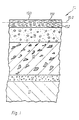
- the bulk material surface or bulk material bed 10 lies on a substructure 11, which is either the substrate, i.e. the naturally occurring soil, possibly improved, e.g. B. is by mechanical strengthening or with binder, or a substructure, d. H. a heap on the ground, which can also be improved.
- a substructure 11 which is either the substrate, i.e. the naturally occurring soil, possibly improved, e.g. B. is by mechanical strengthening or with binder, or a substructure, d. H. a heap on the ground, which can also be improved.
- the base or substructure 11 is leveled in the usual way with the flatness and inclination values customary for sports fields.
- the filter layer 12 lying above is the first bed layer that normally belongs to the superstructure, but can also be replaced by a geotextile layer. Any drainage devices (not shown) are usually located in or immediately below the filter layer, which is generally intended to prevent sub-surface or sub-construction material softened after frost periods or persistent rain from penetrating into the overlying base layer 13.
- This base layer should have a sufficiently stable grain structure in order to increase the load-bearing capacity of the covering and furthermore have a pore space which is sufficiently large for rain drainage of the layers above.
- the installation of a dynamic layer 14 is optional; such layers normally serve mainly to increase the elastic compliance under vertical loads. Since the covering layer 15 according to the invention has a much higher elasticity than conventional turf coverings, the installation of a dynamic layer 14 is usually dispensed with; such a dynamic layer 14 can, however, form a granulometric transition between the covering layer 15 and the base layer 13 and have an additional water storage function.
- the substructure or substructure 11 and the surface layers 12, 13 and optionally 14 can be produced and constructed in practically the same way as that of conventional turf surfaces, apart from the covering of the latter. Find specific information about suitable thickness and compositions of layers 11-14 for example in relevant standards, e.g. DIN 18035 or the installation recommendations of the suppliers of geotextiles.
- the cover layer 15 typically has a thickness of 5-25 cm, but could also be thicker and is applied in at least two work steps, each work step being poured on with simultaneous or subsequent pre-orientation and compacting, e.g. B. with conventional rollers.
- a comparatively “coarser” wood bark material eg grain size according to SNV 670 812a to 60 mm, preferably up to 40 mm
- Wood bark material for example grain size according to SNV 670812a up to 30 mm, preferably up to 15 mm
- To form surface shear strength or in the lower sub-layer 152 for example a 10-20 cm and typically 15 cm thick wood bark platelet layer with a coarser texture and higher water permeability.
- the platelet-shaped wood bark material to be used for the lower sub-layer 152 of the top layer 15 can first be loosely sprinkled evenly onto the layer 13 or 14; when using relatively smooth, i.e. this loose layer can already have a certain surface-parallel particle orientation when the pouring devices are not swirling strongly. If this is not the case, mechanical coarse screens can be used.
- the loose bed of wood bark material for the lower sub-layer 152 is processed by compression, typically by about 10-40% and for example 30% of its loose bed height, e.g. with a smooth wheel roller of around 1 t / m drum width.
- a theoretical boundary layer 159 indicated by dash-dotted lines is formed, at which the two differently textured partial layers 151, 152 adjoin one another or merge into one another.
- the entire top layer 15 is preferably saturated several times with water, which, depending on the weather, may require 1-4 liters / m 2 of covering per day. Between the saturation phases, it is expedient to carry out repeated densification, expediently until a total pore volume of about 45-70% is reached and a water permeability value of 2, 10-3 cm / sec is not undercut.
- the optimum water content of the top layer 15 is approximately 45-50% by weight under normal conditions.
- the bulk material surface 10 according to the invention is now ready for use as a soccer field.
- Test pieces taken from the edge of the top layer 15 made of wood bark material show a pronounced grain, i.e. Particle orientation, parallel to surface 150 of cover layer 15.
- Known red-inhibiting substances can be added to the water used to saturate the top layer 15 or the wood bark material for forming the top layer 15.
- Elemental sulfur in powder form is a preferred additive for this, e.g. in amounts of 0.1-5%, in particular 0.5-3% and typically about 1% by weight of the bark material, but other substances are also suitable which are practically insoluble in water and which have a physiologically acidic action in layer 15 Produce pH of preferably 6 or less and in any case delay the microbiological degradation.
- artificial binders eg an aqueous tar or PVC emulsion
- the proportion of artificial binder in the cover layer should be less than 5% by weight, preferably less than 1% by weight.
- the resin, which is usually present in relatively high proportions in wood bark material, is often sufficient for sufficient top layer strength and is not included in the artificial binder.
- the addition of special red-inhibiting substances to the top layer 15 is not particularly critical if it contains considerable amounts of bark material which contains a large amount of tannins or has a similar preservative effect (“Gerberlohe”), as is typical for hardwoods such as oak.
- the invention offers advantages in terms of space construction and maintenance costs, since the bark material is comparatively cheap, but the covering produced with it is comparatively stable and generally does not require any particularly high maintenance expenditure. Detached covering parts can usually easily, e.g. B. with trawls or by rolling back in the layer and usually leave no holes, but comparatively harmless because of flat depressions.
- a cover layer 15 according to the invention does not lose its porosity due to swelling.
- the finished top layer 15 z. Have as a according to DIN 18 035 Part 5, certain water-absorption value of at least 2.10- 3 cm / sec and a pore volume of 45-50 Vol .-%, which can be usually achieved with the above-mentioned beef materials or installation conditions.
- a typical cover layer 15 of 5-20 cm thickness produced according to the above information has a comparatively high resilience and is still practically completely sturdy, so that all movement sequences typical of football and comparable sports remain unimpeded.
- the risk of bumping and crushing injuries when falling can be significantly reduced compared to hard or hard lawns and the risk of abrasions can be almost eliminated.
- Another considerable advantage of the invention, particularly in the case of soccer fields, is that raining immediately before or during the game does not normally lead to a deterioration in playability, that is to say no “heavy ground” arises; it may even be expedient to spray water on a football field according to the invention immediately before a game.
Landscapes
- Engineering & Computer Science (AREA)
- Architecture (AREA)
- Civil Engineering (AREA)
- Structural Engineering (AREA)
- Road Paving Structures (AREA)
- Golf Clubs (AREA)
- Crystals, And After-Treatments Of Crystals (AREA)
Description
- Die Erfindung betrifft eine Schüttgutfläche für Fussballplätze. Die Erfindung betrifft ferner ein Verfahren zur Herstellung einer solchen Schüttgutfläche.
- Sportplätze unterliegen bei ihrer bestimmungsgemässen Benützung einer sehr grossen Beanspruchung, insbesondere wenn die Sportart mit hohen positiven oder negativen Beschleunigungen der Bewegung der Sportler verbunden ist und/oder Sportschuhe mit Stollen verwendet werden. Dies gilt besonders für Fussballplätze.
- Die wegen einer solchen Belastung aus Gründen der Beschädigungsbeständigkeit an sich wünschbare Härte des Belages steht aber im Widerspruch zur Anforderung einer griffigen und vorzugsweise auch sturzdämpfenden Beschaffenheit des Belages. Dieser Widerspruch war bisher nicht in befriedigender Weise lösbar, jedenfalls nicht mit zumutbarem wirtschaftlichem Aufwand.
- Als Belag für Fussballplätze gilt natürlicher Rasen mit Drainage des Feldes für die Spieler als optimal; bezüglich Erhaltung und Pflege ist Rasenbelag aber sehr problematisch, weil die Rasennabe sehr empfindlich ist und für die Regeneration (Nachwachsen/Nachpflanzen/Transplantieren) viel Zeit erfordert.
- Für regelmässiges und relativ häufiges Fussballtraining sind Rasenplätze daher weniger geeignet und man verwendet Plätze, die in bezug auf Unterhalt weniger aufwendig sind, indem die Deck- oder Belagschicht aus einer mechanisch verdichteten Mineralgutschüttung aus vergleichsweise preiswertem teilchenförmigem Material, wie Lavaschlacke, besteht; bekannte Schüttgutflächen für Sport- bzw. Fussballplätze mit einer mineralischen Deckschicht, dem sogenannten Tennenbelag, und dem üblichen Aufbau aus Untergrund oder Unterbau und einem mehrschichtigen Oberbau werden als «Tennenflächen» (DIN 18035) bzw. als Hartplätze bezeichnet, deren Deckschicht nicht notwendigerweise wasserdurchlässig ist.
- Die Bilanz der Nachteile und Vorteile von Schüttgutflächen mit wasserdurchlässiger mineralischer Deck- oder Belagschicht nach Art von Tennenflächen für Training und Wettspiel liegt auf der Hand: die Griffigkeit ist zwar bei geringer bis mittlerer Belastung ausreichend, versagt aber meist bei höherer Belastung wegen der Rollneigung der Teilchen der Schüttung. Die Sturzverletzungsgefahr durch Schürfung/Prellung ist hoch. Die Pflege, etwa durch Glätten und Walzen ist aber sehr viel einfacher als die eines Rasenplatzes.
- Die Verwendung von relativ weichem Schüttgut, wie Torfmull und üblichem, d. h. plättchenförmigem Holzrindenabfall, dessen Teilchen maximale Längen von 100 mm sowie Dicken von weniger als 10 mm besitzen, ist für verschiedene Sportflächen, wie Reit- und Laufbahnen oder Spielflächen, bekannt und solche Flächen sind geeignet, die Sturzverletzungsgefahr zu vermindern.
- Für Fussballplätze gilt ein derartiges Schüttgutmaterial aber als zu weich und frühere Versuche mit Holzrindenmaterial haben gezeigt, dass einfache Schüttungen auch nach dem Walzen keine für reguläres Fussballspielen ausreichende Trittfestigkeit haben, weil dabei eine im wesentlichen lose Teilchenbettung erhalten wird, deren Oberfläche bei Belastung durch parallel oder spitzwinklig zur Oberfläche einwirkende Kräfte praktisch keinen Zusammenhalt zeigt.
- Aufgabe der Erfindung ist es, eine Schüttgutfläche für Fussballplätze anzugeben, deren Deckschicht mindestens überwiegend aus Baumrindenteilchen der genannten Art besteht und trotzdem die für regulären Spielbetrieb erforderliche Trittfestigkeit hat.
- Diese Aufgabe wird erfindungsgemäss gelöst durch eine Schüttgutfläche mit den in Anspruch 1 genannten Merkmalen.
- Es war für den Fachmann im Sportplatzbau keineswegs zu erwarten, dass aus teilchenförmigem Holzrindenmaterial eine zur Verwendung als Fussballplatz geeignete Deckschicht ohne künstliches Bindemittel erhältlich ist; man war vielmehr der Ansicht, dass eine nicht gebundene Schüttung aus Holzrindenteilchen nicht den bei Verwendung als regulären Fussballplatz auftretenden Oberflächenbelastungen gewachsen wäre, und erste Versuche des Anmelders mit einschichtigen Schüttungen aus Baumrindenteilchen schienen dies zu bestätigen.
- Es war daher überraschend, dass mit einem mehrschichtigen Aufbau aus unterschiedlich strukturierten Teilschichten eine den sehr hohen Oberflächenbelastungen des Fussballspiels für regulären Betrieb widerstehende Deckschicht aus Holzrindenteilchen auf Schüttgutflächen für Fussballplätze sowie eine technisch und wirtschaftlich vorteilhafte Lösung der oben geschilderten Probleme erreicht werden kann.
- Die Bezeichnung «Schüttgutfläche» wird dabei analog wie die Bezeichnung «Tennenfläche» verwendet und bedeutet sinngemäss eine mehrschichtige Schüttgutbettung und keine zweidimensionale «Fläche» im geometrischen Sinn.
- Bevorzugte Ausführungsformen der erfindungsgemässen Schüttgutfläche haben die in den Ansprüchen 2 bis 9 angegebenen Merkmale, wobei sich die Normangabe DIN bzw. SNV auf die jeweiligen deutschen bzw. schweizerischen Normvorschriften beziehen.
- Das erfindungsgemässe Verfahren zur Herstellung der neuen Schüttgutfläche hat die in Anspruch 10 angegebenen Merkmale. Auf dem in üblicher Weise erzeugten (siehe z.B. DIN 18035) Oberbau werden als Deckschicht mindestens zwei übereinanderliegende Teilschichten unterschiedlicher Textur gebildet, wobei man als Holzrindenmaterial für alle Teilschichten vorzugsweise frische oder höchstens schwach angerottete Holzrindenmaterialteilchen verwendet. Eine Vororientierung der plättchenförmigen Teilchen beim Aufbau der Teilschichten kann durch entsprechende Ablagemethoden, z. B. Streumaschinen, mit vorwiegend paralleler Teilchenabgabe oder durch Behandeln der abgelegten Schicht, z. B. mit Rechen, erzielt werden.
- Die nötige Strukturierung der Deckschicht erfolgt durch Verdichten der einzelnen Teilschichten, z.B. durch isostatisches Walzen, wobei typisch um jeweils mindestens etwa 10% und beispielsweise etwa 30% der Dicke der jeweiligen lockeren Schüttung verdichtet wird. Allgemein ist eine ausreichende Mindesttrittfestigkeit dann gegeben, wenn die Deckschicht bei der für professionellen Fussball üblichen Belastung mindestens ein Spiel ohne belagsbedingte Unterbrechungen ermöglicht.
- Für die Zwecke der Erfindung sind zunächst Holzrindenmaterialien verschiedener Herkunft (Laub- oder Nadelbäume) und verschiedener Gewinnungsart (manuelle oder maschinelle Entrindung) geeignet. Borken- und Bastmaterial von schwer verrottbaren Hölzern, insbesondere Laubhölzern, wie Eiche, sowie Holzrinde mit einem Holzanteil von 10-30 Gew.-% stellen ein bevorzugtes Ausgangsmaterial dar.
- Zur Gewinnung eines für die Erfindung geeigneten plättchenförmigen Holzrindenmaterials - im folgenden kurz Mischung genannt - kann das beim Entrinden gewonnene Rohmaterial, gegebenenfalls nach Zerkleinerung, durch an sich bekannte Klassierungsmethoden, wie Sieben, Sichten und dergleichen, gewonnen werden. Die hierzu geeigneten Einrichtungen sind dem Fachmann für die Herstellung von Baumaterialmischungen bekannt. Es können auch Rindenprodukte unterschiedlicher Herkunft vor oder nach dem Klassieren gemischt werden.
- Geeignete plättchenförmige Teile oder Teilchen des Rindenmaterials sind zur Bildung einer Schüttung befähigt, die sich - gegebenenfalls nach Vororientierung - zu einer Teilschicht verdichten lässt, welche im Vertikalschnitt eine überwiegend zur Belagsoberfläche annähernd parallele Orientierung der Teilchen zeigt. Dies gilt allgemein für Teilchen mit den oben genannten maximalen Längen und Dicken. Vorzugsweise enthält das Holzrindenmaterial wenig oder kein Feingut, z. B. weniger als 10 Gew.-% Teilchen mit Maximalabmessungen von weniger als 6 mm. Allzu lange bzw. schmale Teilchen sind weniger geeignet, weswegen das Breite-Länge-Verhältnis eines erheblichen (z. B. 50 Gew.-% oder mehr) Anteils mindestens 1:4 und dementsprechend normalerweise höchstens 1 : beträgt, da sonst die «Breiten»-Dimension zur «Längen»-Dimension wird; schliesslich sollte die kleinere Flächendimension («Breite») eines wesentlichen und meist mindestens 50 Gew.-%igen Teils des Holzrindenmaterials mindestens dreimal grösser als die Dicke derTeilchen sein.
- Vorzugsweise ist ein gewisser Anteil, vorzugsweise mindestens 20% und insbesondere mindestens 50% (jeweils gewichtsbezogen) des Holzrindenmaterials von Teilchen gebildet, die eine maximale Dicke von etwa 3 mm haben und jeweils Gesamtoberflächen von mehr als 300 mm2 aufweisen.
- Die Klassierung von für die Erfindung geeigneten oder bevorzugten Teilchen kann allgemein nach an sich bekannten Kriterien für die Beurteilung von Teilchengrössen bzw. Teilchenformen erfolgen, wie sie in einschlägigen Normvorschriften beschrieben und durch visuelle Prüfung, Siebung und dergleichen Methoden überprüfbar sind.
- Insbesondere vorteilhaft sind Holzrindenmaterialteilchen, die nach SNV-Norm 670/120a einen Ungleichförmigkeitsindex C" von 10-50 oder/und einen Krümmungsindex Ce von 1-3 besitzen.
- Die Erfindung wird anhand der beigeschlossenen Zeichnung weiter erläutert, deren einzige Figur die schematische Darstellung des Querschnittes einer bevorzugten Ausführungsform der erfindungsgemässen Schüttgutfläche zeigt.
- Die Schüttgutfläche oder Schüttgutbettung 10 liegt auf einer Unterstruktur 11, die entweder der Untergrund, d.h. der natürlich anstehende Boden, gegebenenfalls verbessert, z. B. durch mechanische Verfestigung oder mit Bindemittel, oder ein Unterbau ist, d. h. eine Aufschüttung auf dem Untergrund, die ebenfalls verbessert sein kann.
- Der Untergrund oder Unterbau 11 ist in üblicher Weise mit den für Sportplätze üblichen Ebenheits- und Neigungswerten planiert. Die darüber liegende Filterschicht 12 ist die erste, normalerweise zum Oberbau gehörende Schüttungsschicht, die aber auch durch eine Geotextilschicht ersetzt sein kann. Allfällige Drainageeinrichtungen (nicht dargestellt) liegen meist in oder unmittelbar unter der Filterschicht, die allgemein verhindern soll, dass nach Frostperioden oder anhaltendem Regen aufgeweichtes Untergrund-oder Unterbaumaterial in die darüberliegende Tragschicht 13 eindringt. Diese Tragschicht soll ein ausreichend stabiles Korngerüst haben, um die Tragfähigkeit des Belages zu erhöhen, und ferner einen zur Regenentwässerung der darüberliegenden Schichten ausreichend grossen Porenraum besitzen.
- Der Einbau einer dynamischen Schicht 14 ist fakultativ; solche Schichten dienen normalerweise hauptsächlich dazu, die elastische Nachgiebigkeit bei vertikaler Belastung zu erhöhen. Da die erfindungsgemässe Belagschicht 15 eine im Vergleich zu üblichen Tennenbelägen wesentlich höhere Elastizität aufweist, wird meist auf den Einbau einer dynamischen Schicht 14 verzichtet; eine solche dynamische Schicht 14 kann aber einen granulometrischen Übergang zwischen der Belagschicht 15 und der Tragschicht 13 bilden und eine zusätzliche Wasserspeicherfunktion haben.
- Allgemein können Untergrund bzw. Unterbau 11 und die Oberbauschichten 12, 13 sowie gegebenenfalls 14 in praktisch gleicher Weise hergestellt und beschaffen sein, wie die von üblichen Tennenflächen, abgesehen vom Belag der letzteren. Spezielle Angaben über geeignete Dicke und Zusammensetzungen der Schichten 11-14 finden sich beispielsweise in einschlägigen Normen, z.B. DIN 18035 oder den Einbauempfehlungen der Lieferanten von Geotextilien.
- Die Deckschicht 15 hat typisch eine Dicke von 5-25 cm, könnte aber auch dicker sein und wird in mindestens zwei Arbeitsgängen aufgebracht, wobei jeder Arbeitsgang das Aufschütten mit gleichzeitiger oder nachfolgender Vororientierung und das Verdichten, z. B. mit üblichen Walzen, umfasst.
- Beim erfindungsgemässen Aufbauen der Deckschicht 15 in mindestens zwei Arbeitsgängen wird für die untere Schicht 152 ein vergleichsweise «gröberes» Holzrindenmaterial (z. B. Körnung nach SNV 670 812a bis 60 mm, vorzugsweise bis 40 mm) und für die obere Schicht 151 ein vergleichsweise feineres Holzrindenmaterial (z.B. Körnung nach SNV 670812a bis 30 mm, vorzugsweise bis 15 mm) verwendet werden, um in der oberen Teilschicht 151 unter deren Oberfläche 150 eine beispielsweise 5-10 cm und typisch etwa 8 cm dicke Holzrindenplättchenschicht mit feinerer Textur und höherer Tritt- und Oberflächenscherfestigkeit bzw. in der unteren Teilschicht 152 eine beispielsweise 10-20 cm und typisch 15 cm dicke Holzrindenplättchenschicht mit gröberer Textur und höherer Wasserdurchlässigkeit zu bilden.
- Allgemein kann man das für die untere Teilschicht 152 der Deckschicht 15 zu verwendende plättchenförmige Holzrindenmaterial zunächst locker auf die Schicht 13 bzw. 14 gleichmässig aufstreuen; bei Verwendung von verhältnismässig glatt ablegenden, d.h. nicht stark wirbelnden Schütteinrichtungen kann diese lose Schicht bereits eine gewisse oberflächenparallele Teilchenorientierung haben. Ist dies nicht der Fall, kann mit mechanischen Grobrechen nachgearbeitet werden.
- Dann wird die lockere Schüttung aus Holzrindenmaterial für die untere Teilschicht 152 durch Verdichten, typisch um etwa 10-40% und beispielsweise 30% ihrer lockeren Schüttungshöhe, bearbeitet, z..B. mit einer Glattradwalze von etwa 1 t/m Bandagenbreite.
- Bei zweischichtigem Aufbau der Deckschicht 15 entsteht dabei eine strichpunktiert angedeutete theoretische Grenzschicht 159, an welcher die beiden unterschiedlich texturierten Teilschichten 151, 152 aneinander grenzen bzw. ineinander übergehen.
- Nach dem abschliessenden Verdichten der Deckschicht 15 bzw. der oberen Teilschicht 151 wird die gesamte Deckschicht 15 vorzugsweise mehrmals mit Wasser gesättigt, was je nach Witterung 1-4 Liter/m2 Belag pro Tag benötigen kann. Zwischen den Sättigungsphasen wird zweckmässig mehrmals nachverdichtet, zweckmässig bis ein Gesamtporenvolumen von etwa 45-70% erreicht und ein Wasserdurchlässigkeitswert von 2, 10-3 cm/sec noch nicht unterschritten ist. Der optimale Wassergehalt der Deckschicht 15 beträgt unter Normalbedingungen etwa 45-50 Gew.-%.
- Die erfindungsgemässe Schüttgutfläche 10 ist nun zur Verwendung als Fussballplatz fertig. Probestücke, die am Rand der Deckschicht 15 aus Holzrindenmaterial genommen werden, zeigen eine ausgeprägte Maserung, d.h. Teilchenorientierung, parallel zur Oberfläche 150 der Deckschicht 15.
- Dem zur Sättigung der Deckschicht 15 verwendeten Wasser oder dem Holzrindenmaterial für die Bildung der Deckschicht 15 können bekannte rotthemmende Stoffe zugegeben werden. Elementarer Schwefel in Pulverform ist ein hierfür bevorzugter Zusatz, z..B. in Mengen von 0,1-5%, insbesondere 0,5-3% und typisch etwa 1% des Gewichtes des Rindenmaterials, doch sind auch andere Stoffe geeignet, die in Wasser praktisch nicht löslich sind und in der Schicht 15 einen physiologisch sauer wirkenden pH von vorzugsweise 6 oder weniger erzeugen und jedenfalls den mikrobiologischen Abbau verzögern.
- Dem Holzrindenmaterial oder dem zur Sättigung der Schicht 15 verwendeten Wasser können gewünschtenfalls zur weiteren Verfestigung künstliche Bindemittel (z. B. eine wässrige Teer-oder PVC-Emulsion) zugegeben werden. Die Verwendung von solchen Bindemitteln in erheblichen Anteilen ist jedoch meist weder nötig noch vorteilhaft und kann den Nachteil haben, dass die Wasserdurchlässigkeit übermässig stark vermindert wird. Allgemein soll der Anteil der Deckschicht an künstlichem Bindemittel unter 5 Gew.-%, vorzugsweise unter 1 Gew.-%, liegen. Das in Holzrindenmaterial meist in relativ hohen Anteilen enthaltene Harz ist häufig für eine genügende Deckschichtfestigkeit ausreichend und wird dem künstlichen Bindemittel nicht zugerechnet.
- In analoger Weise ist der Zusatz von besonderen rotthemmenden Stoffen zur Deckschicht 15 dann nicht besonders kritisch, wenn diese erhebliche Anteile von stark gerbstoffhaltigem oder ähnlich konservierend wirkendem Rindenmaterial («Gerberlohe»), wie es für Laubhölzer, wie Eiche, typisch ist, enthält.
- Die Erfindung bietet einerseits Vorteile in Bezug auf die Platzbau- und Unterhaltskosten, da das Rindenmaterial vergleichsweise billig, der damit hergestellte Belag aber vergleichsweise beständig ist und allgemein keinen besonders erhöhten Wartungsaufwand erfordert. Losgetretene Belagsteile können meist leicht, z. B. mit Schleppnetzen oder durch Walzen wieder in der Schicht befestigt werden und hinterlassen normalerweise keine Löcher, sondern vergleichsweise ungefährliche weil flache Einsenkungen.
- Da die Quellbarkeit von Rindenmaterial vergleichsweise gering ist, verliert eine erfindungsgemässe Deckschicht 15 ihre Porosität durch Quellung nicht. Im allgemeinen soll die fertige Deckschicht 15 z. B. einen nach DIN 18 035, Teil 5, bestimmten Wasserschluckwert von mindestens 2.10-3 cm/sec und ein Porenvolumen von 45-50 Vol.-% aufweisen, was sich normalerweise mit den oben genannten Rindenmaterialien bzw. Einbaubedingungen erreichen lässt.
- Insgesamt bietet die Erfindung beachtliche Benutzungsvorteile: eine gemäss obigen Angaben hergestellte typische Deckschicht 15 von 5-20 cm Dicke hat eine verhältnismässig hohe Rückfederungselastizität und ist dennoch praktisch völlig trittfest, so dass alle für Fussball und vergleichbare Sportarten typischen Bewegungsabläufe unbehindert bleiben. Die Gefahr von Prell- und Stauchverletzungen beim Sturz kann dadurch im Vergleich zu Hartplätzen oder harten Rasenplätzen wesentlich vermindert und die Gefahr von Schürfungen nahezu ausgeschaltet werden. Ein weiterer beachtlicher Vorteil der Erfindung, besonders im Fall von Fussballplätzen, besteht darin, dass Regenfall unmittelbar vor oder während des Spiels normalerweise nicht zu einer Verschlechterung der Bespielbarkeit führt, also kein «schwerer Boden» entsteht; es kann sogar zweckmässig sein, einen erfindungsgemässen Fussballplatz unmittelbar vor einem Spiel mit Wasser zu bespritzen.
Claims (11)
Priority Applications (1)
| Application Number | Priority Date | Filing Date | Title |
|---|---|---|---|
| AT83200668T ATE14327T1 (de) | 1982-05-14 | 1983-05-11 | Schuettgutflaeche fuer sportplaetze und verfahren zu ihrer herstellung. |
Applications Claiming Priority (2)
| Application Number | Priority Date | Filing Date | Title |
|---|---|---|---|
| CH3001/82A CH664292A5 (de) | 1982-05-14 | 1982-05-14 | Schuettgutdecke fuer sportplaetze. |
| CH3001/82 | 1982-05-14 |
Publications (3)
| Publication Number | Publication Date |
|---|---|
| EP0096908A1 EP0096908A1 (de) | 1983-12-28 |
| EP0096908B1 EP0096908B1 (de) | 1985-07-17 |
| EP0096908B2 true EP0096908B2 (de) | 1989-10-18 |
Family
ID=4246405
Family Applications (1)
| Application Number | Title | Priority Date | Filing Date |
|---|---|---|---|
| EP83200668A Expired EP0096908B2 (de) | 1982-05-14 | 1983-05-11 | Schüttgutfläche für Fussballplätze und Verfahren zu ihrer Herstellung |
Country Status (4)
| Country | Link |
|---|---|
| EP (1) | EP0096908B2 (de) |
| AT (1) | ATE14327T1 (de) |
| CH (1) | CH664292A5 (de) |
| DE (1) | DE3360405D1 (de) |
Families Citing this family (7)
| Publication number | Priority date | Publication date | Assignee | Title |
|---|---|---|---|---|
| US4830532A (en) * | 1987-02-25 | 1989-05-16 | Anthony V. Macke | Tracks for sporting events |
| ATE83516T1 (de) * | 1987-10-29 | 1993-01-15 | Bernd Wengmann | Sport- oder spielplatzflaeche. |
| GB2225240B (en) * | 1988-11-02 | 1992-12-23 | Nottingham County Council | Play surfaces |
| GB2292090A (en) * | 1994-08-13 | 1996-02-14 | Fibresand Ltd | Surfaces for sports grounds |
| WO2010037239A1 (de) * | 2008-10-01 | 2010-04-08 | Bernd Wengmann | Sportplatzbelag |
| DE102012200358A1 (de) * | 2012-01-11 | 2013-07-11 | Alois Dold | Schichtaufbau für eine Sportrasenfläche und Verfahren zu dessen Herstellung |
| FR3164489A1 (fr) * | 2024-07-11 | 2026-01-16 | Iseo Innovation | Dispositif d’amortissement pour aire de jeux comprenant un empilement d’une couche de granulats en élastomère et une couche de copeaux de bois |
Family Cites Families (4)
| Publication number | Priority date | Publication date | Assignee | Title |
|---|---|---|---|---|
| DE7828231U1 (de) * | 1979-02-01 | Sportbau Goedel & Von Cramm, 2000 Hamburg | Belagbahn für Fußballplätze | |
| FR548559A (fr) * | 1922-03-08 | 1923-01-18 | Produit pour la constitution du sol des terrains de sports et jeux de plein air ou pour toutes applications analogues | |
| CH207054A (de) * | 1939-05-06 | 1939-09-30 | Neuhaeusler Andreas | Sportplatz-Belag, insbesondere für Tennisplätze. |
| US3427934A (en) * | 1966-08-31 | 1969-02-18 | American Can Co | Ski slope or the like with layer of tree bark |
-
1982
- 1982-05-14 CH CH3001/82A patent/CH664292A5/de not_active IP Right Cessation
-
1983
- 1983-05-11 DE DE8383200668T patent/DE3360405D1/de not_active Expired
- 1983-05-11 EP EP83200668A patent/EP0096908B2/de not_active Expired
- 1983-05-11 AT AT83200668T patent/ATE14327T1/de not_active IP Right Cessation
Also Published As
| Publication number | Publication date |
|---|---|
| CH664292A5 (de) | 1988-02-29 |
| DE3360405D1 (en) | 1985-08-22 |
| ATE14327T1 (de) | 1985-08-15 |
| EP0096908B1 (de) | 1985-07-17 |
| EP0096908A1 (de) | 1983-12-28 |
Similar Documents
| Publication | Publication Date | Title |
|---|---|---|
| DE3642610C2 (de) | Wetterfeste Bodenfläche für Sportfelder und Materialmischung zur Erstellung von Sportfeldböden | |
| DE69400615T3 (de) | Element für einen synthetischen tennisplatz und sein herstellungsverfahren | |
| DE2652557C2 (de) | Mehrschichtiger Spielflächenbelag insbesondere für Tennisspiele | |
| DE69331918T2 (de) | Bodenoberfläche zur Benutzung beim Sport und zu ähnlichem | |
| US4900010A (en) | Athletic field and playground | |
| DE69502199T2 (de) | Bodenoberfläche zur nutzung für sport- und ähnliche zwecke | |
| EP0096908B1 (de) | Schüttgutfläche für Fussballplätze und Verfahren zu ihrer Herstellung | |
| DE19723530A1 (de) | Bodenbelag | |
| EP1992739A2 (de) | Bodenschicht für sportliche Aktivitäten | |
| DE19946947C2 (de) | Schichtaufbau | |
| EP1285997B1 (de) | Allwettertrittschicht insbesondere für Reitplätze | |
| DE3835880A1 (de) | Elastische matte fuer bodenbelaege von sport- und freizeitflaechen | |
| DE2946242A1 (de) | Vielzweckboden | |
| DE69924250T2 (de) | Markierungssystem für spielfelder | |
| DE69525760T2 (de) | Verfahren um abrieb an rasen zu verringern | |
| WO2010037239A1 (de) | Sportplatzbelag | |
| DE10038534A1 (de) | Unterbau für Sportplätze, insbesondere Reitplätze | |
| DE3780763T2 (de) | Vielfaeltig verwendbare rennbahn eingerichtet fuer sport, insbesondere fuer reitkunst. | |
| DE1658467A1 (de) | Verfahren zur Regulierung und Verbesserung der physikalischen Eigenschaften einer Bodenflaeche und Bauelement zur Durchfuehrung des Verfahrens | |
| DE8915879U1 (de) | Vegetationsaufbau für den Anbau von Pflanzen | |
| DE557163C (de) | Bettung fuer Eisenbahngleise aus feinkoernigen Naturstoffen | |
| DE3335267A1 (de) | Bodenbelag fuer sportplaetze, insbesondere tennisplaetze | |
| DE4336565C1 (de) | Elastische Tragschicht für Sportflächen und Verfahren zu deren Herstellung | |
| DE532283C (de) | Verfahren zur Herstellung eines Wegebelagmaterials | |
| CH197802A (de) | Verfahren zur Herstellung eines Strassenbelages aus Holz und gemäss dem Verfahren hergestellter Strassenbelag. |
Legal Events
| Date | Code | Title | Description |
|---|---|---|---|
| PUAI | Public reference made under article 153(3) epc to a published international application that has entered the european phase |
Free format text: ORIGINAL CODE: 0009012 |
|
| AK | Designated contracting states |
Designated state(s): AT BE CH DE FR GB IT LI NL SE |
|
| 17P | Request for examination filed |
Effective date: 19831212 |
|
| ITF | It: translation for a ep patent filed | ||
| GRAA | (expected) grant |
Free format text: ORIGINAL CODE: 0009210 |
|
| AK | Designated contracting states |
Designated state(s): AT BE CH DE FR GB IT LI NL SE |
|
| REF | Corresponds to: |
Ref document number: 14327 Country of ref document: AT Date of ref document: 19850815 Kind code of ref document: T |
|
| PG25 | Lapsed in a contracting state [announced via postgrant information from national office to epo] |
Ref country code: SE Effective date: 19850730 |
|
| REF | Corresponds to: |
Ref document number: 3360405 Country of ref document: DE Date of ref document: 19850822 |
|
| ET | Fr: translation filed | ||
| PLBI | Opposition filed |
Free format text: ORIGINAL CODE: 0009260 |
|
| PLBI | Opposition filed |
Free format text: ORIGINAL CODE: 0009260 |
|
| 26 | Opposition filed |
Opponent name: BUNDESVERBAND GARTEN-, LAND- SCHAFTS- UND SPORTPLA Effective date: 19860415 |
|
| 26 | Opposition filed |
Opponent name: VERBAND SCHWEIZERISCHER GAERTNERMEISTER Effective date: 19860419 |
|
| NLR1 | Nl: opposition has been filed with the epo |
Opponent name: VERBAND SCHWEIZERISCHER GAERTNERMEISTER Opponent name: BUNDESVERBAND GARTEN-,LAND-SCHAFTS-UND SPORTPLATZB |
|
| PLBJ | Opposition found inadmissible |
Free format text: ORIGINAL CODE: 0009275 |
|
| NLXE | Nl: other communications concerning ep-patents (part 3 heading xe) |
Free format text: IN PAT.BUL.13/86,PAGE 1599:THE SECOND OPPOSITION HAS BEEN DECLARED INADMISSABLE |
|
| 26U | Opposition found inadmissible |
Opponent name: VERBAND SCHWEIZERISCHER GAERTNERMEISTER Effective date: 19870416 |
|
| PLAB | Opposition data, opponent's data or that of the opponent's representative modified |
Free format text: ORIGINAL CODE: 0009299OPPO |
|
| R26 | Opposition filed (corrected) |
Opponent name: BUNDESVERBAND GARTEN-, LAND- SCHAFTS- UND SPORTPLA Effective date: 19860415 |
|
| RTI2 | Title (correction) |
Free format text: BULK MATERIAL SURFACE FOR FOOTBALL FIELDS AND METHOD FOR ITS PRODUCTION. |
|
| PUAH | Patent maintained in amended form |
Free format text: ORIGINAL CODE: 0009272 |
|
| STAA | Information on the status of an ep patent application or granted ep patent |
Free format text: STATUS: PATENT MAINTAINED AS AMENDED |
|
| 27A | Patent maintained in amended form |
Effective date: 19891018 |
|
| AK | Designated contracting states |
Kind code of ref document: B2 Designated state(s): AT BE CH DE FR GB IT LI NL SE |
|
| EN | Fr: translation not filed | ||
| ET3 | Fr: translation filed ** decision concerning opposition | ||
| NLR2 | Nl: decision of opposition | ||
| NLR3 | Nl: receipt of modified translations in the netherlands language after an opposition procedure | ||
| ITTA | It: last paid annual fee | ||
| PGFP | Annual fee paid to national office [announced via postgrant information from national office to epo] |
Ref country code: GB Payment date: 19960404 Year of fee payment: 14 |
|
| PGFP | Annual fee paid to national office [announced via postgrant information from national office to epo] |
Ref country code: BE Payment date: 19960507 Year of fee payment: 14 |
|
| PGFP | Annual fee paid to national office [announced via postgrant information from national office to epo] |
Ref country code: NL Payment date: 19960529 Year of fee payment: 14 |
|
| PG25 | Lapsed in a contracting state [announced via postgrant information from national office to epo] |
Ref country code: GB Effective date: 19970511 |
|
| PG25 | Lapsed in a contracting state [announced via postgrant information from national office to epo] |
Ref country code: BE Effective date: 19970531 |
|
| BERE | Be: lapsed |
Owner name: WENGMANN BERND Effective date: 19970531 |
|
| PG25 | Lapsed in a contracting state [announced via postgrant information from national office to epo] |
Ref country code: NL Effective date: 19971201 |
|
| GBPC | Gb: european patent ceased through non-payment of renewal fee |
Effective date: 19970511 |
|
| NLV4 | Nl: lapsed or anulled due to non-payment of the annual fee |
Effective date: 19971201 |
|
| PGFP | Annual fee paid to national office [announced via postgrant information from national office to epo] |
Ref country code: FR Payment date: 19990419 Year of fee payment: 17 |
|
| PGFP | Annual fee paid to national office [announced via postgrant information from national office to epo] |
Ref country code: AT Payment date: 19990422 Year of fee payment: 17 |
|
| PG25 | Lapsed in a contracting state [announced via postgrant information from national office to epo] |
Ref country code: AT Free format text: LAPSE BECAUSE OF NON-PAYMENT OF DUE FEES Effective date: 20000511 |
|
| PG25 | Lapsed in a contracting state [announced via postgrant information from national office to epo] |
Ref country code: FR Free format text: LAPSE BECAUSE OF NON-PAYMENT OF DUE FEES Effective date: 20010131 |
|
| REG | Reference to a national code |
Ref country code: FR Ref legal event code: ST |
|
| PGFP | Annual fee paid to national office [announced via postgrant information from national office to epo] |
Ref country code: CH Payment date: 20020701 Year of fee payment: 20 |
|
| PGFP | Annual fee paid to national office [announced via postgrant information from national office to epo] |
Ref country code: DE Payment date: 20020731 Year of fee payment: 20 |
|
| PG25 | Lapsed in a contracting state [announced via postgrant information from national office to epo] |
Ref country code: LI Free format text: LAPSE BECAUSE OF EXPIRATION OF PROTECTION Effective date: 20030510 Ref country code: CH Free format text: LAPSE BECAUSE OF EXPIRATION OF PROTECTION Effective date: 20030510 |
|
| REG | Reference to a national code |
Ref country code: CH Ref legal event code: PL |
|
| PLAB | Opposition data, opponent's data or that of the opponent's representative modified |
Free format text: ORIGINAL CODE: 0009299OPPO |
|
| R26 | Opposition filed (corrected) |
Opponent name: BUNDESVERBAND GARTEN-, LAND- SCHAFTS- UND SPORTPLA Effective date: 19860415 |