EP0096768A2 - Verfahren zur Herstellung von wasserverdünnbaren Oxazolidingruppen tragenden Epoxidharzestern, daraus hergestellte Überzugsmittel und deren Verwendung als kathodisch abscheidbare Lacke - Google Patents
Verfahren zur Herstellung von wasserverdünnbaren Oxazolidingruppen tragenden Epoxidharzestern, daraus hergestellte Überzugsmittel und deren Verwendung als kathodisch abscheidbare Lacke Download PDFInfo
- Publication number
- EP0096768A2 EP0096768A2 EP83105099A EP83105099A EP0096768A2 EP 0096768 A2 EP0096768 A2 EP 0096768A2 EP 83105099 A EP83105099 A EP 83105099A EP 83105099 A EP83105099 A EP 83105099A EP 0096768 A2 EP0096768 A2 EP 0096768A2
- Authority
- EP
- European Patent Office
- Prior art keywords
- radical
- binders
- reaction
- hydrogen atom
- oxazolidine
- Prior art date
- Legal status (The legal status is an assumption and is not a legal conclusion. Google has not performed a legal analysis and makes no representation as to the accuracy of the status listed.)
- Withdrawn
Links
- 238000000034 method Methods 0.000 title claims abstract description 9
- 150000002148 esters Chemical class 0.000 title claims description 21
- 229920000647 polyepoxide Polymers 0.000 title claims description 9
- 239000003822 epoxy resin Substances 0.000 title claims description 8
- 125000000160 oxazolidinyl group Chemical group 0.000 title description 6
- 239000004922 lacquer Substances 0.000 title description 5
- 239000008199 coating composition Substances 0.000 title description 3
- -1 aromatic dicarboxylic acids Chemical class 0.000 claims abstract description 21
- 150000001875 compounds Chemical class 0.000 claims abstract description 18
- 239000011230 binding agent Substances 0.000 claims abstract description 16
- 238000002360 preparation method Methods 0.000 claims abstract description 13
- 125000001931 aliphatic group Chemical group 0.000 claims abstract description 10
- 238000006386 neutralization reaction Methods 0.000 claims abstract description 7
- 150000007522 mineralic acids Chemical class 0.000 claims abstract description 5
- 150000007524 organic acids Chemical class 0.000 claims abstract description 5
- 235000005985 organic acids Nutrition 0.000 claims abstract description 5
- 238000006243 chemical reaction Methods 0.000 claims description 31
- WYNCHZVNFNFDNH-UHFFFAOYSA-N Oxazolidine Chemical compound C1COCN1 WYNCHZVNFNFDNH-UHFFFAOYSA-N 0.000 claims description 14
- 150000001728 carbonyl compounds Chemical class 0.000 claims description 14
- 239000007795 chemical reaction product Substances 0.000 claims description 12
- 125000004435 hydrogen atom Chemical group [H]* 0.000 claims description 11
- 125000004432 carbon atom Chemical group C* 0.000 claims description 10
- 229920006395 saturated elastomer Polymers 0.000 claims description 9
- 150000003628 tricarboxylic acids Chemical class 0.000 claims description 9
- IJGRMHOSHXDMSA-UHFFFAOYSA-N Atomic nitrogen Chemical compound N#N IJGRMHOSHXDMSA-UHFFFAOYSA-N 0.000 claims description 8
- 125000003700 epoxy group Chemical group 0.000 claims description 7
- 239000002904 solvent Substances 0.000 claims description 7
- 239000004593 Epoxy Substances 0.000 claims description 6
- NIXOWILDQLNWCW-UHFFFAOYSA-M Acrylate Chemical compound [O-]C(=O)C=C NIXOWILDQLNWCW-UHFFFAOYSA-M 0.000 claims description 5
- RTZKZFJDLAIYFH-UHFFFAOYSA-N Diethyl ether Chemical compound CCOCC RTZKZFJDLAIYFH-UHFFFAOYSA-N 0.000 claims description 5
- CERQOIWHTDAKMF-UHFFFAOYSA-N Methacrylic acid Chemical compound CC(=C)C(O)=O CERQOIWHTDAKMF-UHFFFAOYSA-N 0.000 claims description 5
- 239000000178 monomer Substances 0.000 claims description 5
- 239000004215 Carbon black (E152) Substances 0.000 claims description 4
- CIUQDSCDWFSTQR-UHFFFAOYSA-N [C]1=CC=CC=C1 Chemical compound [C]1=CC=CC=C1 CIUQDSCDWFSTQR-UHFFFAOYSA-N 0.000 claims description 4
- NIXOWILDQLNWCW-UHFFFAOYSA-N acrylic acid group Chemical group C(C=C)(=O)O NIXOWILDQLNWCW-UHFFFAOYSA-N 0.000 claims description 4
- 125000003118 aryl group Chemical group 0.000 claims description 4
- 239000011248 coating agent Substances 0.000 claims description 4
- 125000004122 cyclic group Chemical group 0.000 claims description 4
- 229930195733 hydrocarbon Natural products 0.000 claims description 4
- 229910052757 nitrogen Inorganic materials 0.000 claims description 4
- 239000000049 pigment Substances 0.000 claims description 4
- 125000003178 carboxy group Chemical group [H]OC(*)=O 0.000 claims description 3
- 125000002887 hydroxy group Chemical group [H]O* 0.000 claims description 3
- 125000005395 methacrylic acid group Chemical group 0.000 claims description 3
- 238000005903 acid hydrolysis reaction Methods 0.000 claims description 2
- 125000000217 alkyl group Chemical group 0.000 claims description 2
- 125000002947 alkylene group Chemical group 0.000 claims description 2
- 229910052799 carbon Inorganic materials 0.000 claims description 2
- 125000004185 ester group Chemical group 0.000 claims description 2
- 125000001033 ether group Chemical group 0.000 claims description 2
- 239000000945 filler Substances 0.000 claims description 2
- 239000003607 modifier Substances 0.000 claims description 2
- 239000003973 paint Substances 0.000 claims description 2
- 229920001281 polyalkylene Polymers 0.000 claims description 2
- 125000002496 methyl group Chemical group [H]C([H])([H])* 0.000 claims 1
- XLYOFNOQVPJJNP-UHFFFAOYSA-N water Substances O XLYOFNOQVPJJNP-UHFFFAOYSA-N 0.000 abstract description 14
- 150000002917 oxazolidines Chemical class 0.000 abstract description 4
- 230000015572 biosynthetic process Effects 0.000 abstract description 3
- 238000004070 electrodeposition Methods 0.000 abstract description 2
- 150000002118 epoxides Chemical group 0.000 abstract 2
- 239000000047 product Substances 0.000 description 17
- 239000007787 solid Substances 0.000 description 15
- QTBSBXVTEAMEQO-UHFFFAOYSA-N Acetic acid Chemical compound CC(O)=O QTBSBXVTEAMEQO-UHFFFAOYSA-N 0.000 description 9
- 239000002253 acid Substances 0.000 description 9
- OFOBLEOULBTSOW-UHFFFAOYSA-N Malonic acid Chemical compound OC(=O)CC(O)=O OFOBLEOULBTSOW-UHFFFAOYSA-N 0.000 description 8
- 150000008064 anhydrides Chemical group 0.000 description 8
- 238000012360 testing method Methods 0.000 description 7
- LYCAIKOWRPUZTN-UHFFFAOYSA-N Ethylene glycol Chemical compound OCCO LYCAIKOWRPUZTN-UHFFFAOYSA-N 0.000 description 6
- 150000001412 amines Chemical class 0.000 description 6
- 239000003795 chemical substances by application Substances 0.000 description 6
- SWXVUIWOUIDPGS-UHFFFAOYSA-N diacetone alcohol Chemical compound CC(=O)CC(C)(C)O SWXVUIWOUIDPGS-UHFFFAOYSA-N 0.000 description 6
- 239000000203 mixture Substances 0.000 description 6
- 229920005989 resin Polymers 0.000 description 5
- 239000011347 resin Substances 0.000 description 5
- 238000009835 boiling Methods 0.000 description 4
- 150000001735 carboxylic acids Chemical class 0.000 description 4
- 238000000576 coating method Methods 0.000 description 4
- LNEPOXFFQSENCJ-UHFFFAOYSA-N haloperidol Chemical compound C1CC(O)(C=2C=CC(Cl)=CC=2)CCN1CCCC(=O)C1=CC=C(F)C=C1 LNEPOXFFQSENCJ-UHFFFAOYSA-N 0.000 description 4
- 239000013067 intermediate product Substances 0.000 description 4
- FAAWECNSILPHMQ-UHFFFAOYSA-N 1,3-oxazolidine-2,2-dicarboxylic acid Chemical compound O1C(NCC1)(C(=O)O)C(=O)O FAAWECNSILPHMQ-UHFFFAOYSA-N 0.000 description 3
- WSFSSNUMVMOOMR-UHFFFAOYSA-N Formaldehyde Chemical compound O=C WSFSSNUMVMOOMR-UHFFFAOYSA-N 0.000 description 3
- CTQNGGLPUBDAKN-UHFFFAOYSA-N O-Xylene Chemical compound CC1=CC=CC=C1C CTQNGGLPUBDAKN-UHFFFAOYSA-N 0.000 description 3
- 150000001338 aliphatic hydrocarbons Chemical class 0.000 description 3
- 150000001244 carboxylic acid anhydrides Chemical class 0.000 description 3
- 238000004132 cross linking Methods 0.000 description 3
- SBZXBUIDTXKZTM-UHFFFAOYSA-N diglyme Chemical compound COCCOCCOC SBZXBUIDTXKZTM-UHFFFAOYSA-N 0.000 description 3
- 125000004356 hydroxy functional group Chemical group O* 0.000 description 3
- WGCNASOHLSPBMP-UHFFFAOYSA-N hydroxyacetaldehyde Natural products OCC=O WGCNASOHLSPBMP-UHFFFAOYSA-N 0.000 description 3
- 238000006798 ring closing metathesis reaction Methods 0.000 description 3
- 239000007858 starting material Substances 0.000 description 3
- 238000003756 stirring Methods 0.000 description 3
- 239000008096 xylene Substances 0.000 description 3
- HZAXFHJVJLSVMW-UHFFFAOYSA-N 2-Aminoethan-1-ol Chemical compound NCCO HZAXFHJVJLSVMW-UHFFFAOYSA-N 0.000 description 2
- KBXUTBMGSKKPFL-UHFFFAOYSA-N 3-hydroxy-2-methylprop-2-enoic acid Chemical class OC=C(C)C(O)=O KBXUTBMGSKKPFL-UHFFFAOYSA-N 0.000 description 2
- ISWSIDIOOBJBQZ-UHFFFAOYSA-N Phenol Chemical compound OC1=CC=CC=C1 ISWSIDIOOBJBQZ-UHFFFAOYSA-N 0.000 description 2
- 229910000831 Steel Inorganic materials 0.000 description 2
- 150000001252 acrylic acid derivatives Chemical class 0.000 description 2
- HUMNYLRZRPPJDN-UHFFFAOYSA-N benzaldehyde Chemical compound O=CC1=CC=CC=C1 HUMNYLRZRPPJDN-UHFFFAOYSA-N 0.000 description 2
- 230000001588 bifunctional effect Effects 0.000 description 2
- IISBACLAFKSPIT-UHFFFAOYSA-N bisphenol A Chemical compound C=1C=C(O)C=CC=1C(C)(C)C1=CC=C(O)C=C1 IISBACLAFKSPIT-UHFFFAOYSA-N 0.000 description 2
- JHIVVAPYMSGYDF-UHFFFAOYSA-N cyclohexanone Chemical compound O=C1CCCCC1 JHIVVAPYMSGYDF-UHFFFAOYSA-N 0.000 description 2
- HGCIXCUEYOPUTN-UHFFFAOYSA-N cyclohexene Chemical compound C1CCC=CC1 HGCIXCUEYOPUTN-UHFFFAOYSA-N 0.000 description 2
- 150000001991 dicarboxylic acids Chemical class 0.000 description 2
- 238000007865 diluting Methods 0.000 description 2
- 150000002430 hydrocarbons Chemical class 0.000 description 2
- 239000012442 inert solvent Substances 0.000 description 2
- 239000000543 intermediate Substances 0.000 description 2
- 150000002576 ketones Chemical class 0.000 description 2
- 238000004519 manufacturing process Methods 0.000 description 2
- 150000002734 metacrylic acid derivatives Chemical class 0.000 description 2
- 150000002763 monocarboxylic acids Chemical class 0.000 description 2
- ULSIYEODSMZIPX-UHFFFAOYSA-N phenylethanolamine Chemical compound NCC(O)C1=CC=CC=C1 ULSIYEODSMZIPX-UHFFFAOYSA-N 0.000 description 2
- 150000003141 primary amines Chemical class 0.000 description 2
- 125000002924 primary amino group Chemical group [H]N([H])* 0.000 description 2
- AZIQALWHRUQPHV-UHFFFAOYSA-N prop-2-eneperoxoic acid Chemical compound OOC(=O)C=C AZIQALWHRUQPHV-UHFFFAOYSA-N 0.000 description 2
- 150000003839 salts Chemical class 0.000 description 2
- 150000003335 secondary amines Chemical class 0.000 description 2
- 239000007921 spray Substances 0.000 description 2
- 239000010959 steel Substances 0.000 description 2
- KDYFGRWQOYBRFD-UHFFFAOYSA-N succinic acid Chemical compound OC(=O)CCC(O)=O KDYFGRWQOYBRFD-UHFFFAOYSA-N 0.000 description 2
- 125000001302 tertiary amino group Chemical group 0.000 description 2
- KMOUUZVZFBCRAM-OLQVQODUSA-N (3as,7ar)-3a,4,7,7a-tetrahydro-2-benzofuran-1,3-dione Chemical compound C1C=CC[C@@H]2C(=O)OC(=O)[C@@H]21 KMOUUZVZFBCRAM-OLQVQODUSA-N 0.000 description 1
- VQBYQQAWHSCZET-UHFFFAOYSA-N 1,3-oxazolidin-2-ol Chemical compound OC1NCCO1 VQBYQQAWHSCZET-UHFFFAOYSA-N 0.000 description 1
- HXKKHQJGJAFBHI-UHFFFAOYSA-N 1-aminopropan-2-ol Chemical compound CC(O)CN HXKKHQJGJAFBHI-UHFFFAOYSA-N 0.000 description 1
- ZGCHLAJIRWDGFE-UHFFFAOYSA-N 1-aminopropane-1,1-diol Chemical class CCC(N)(O)O ZGCHLAJIRWDGFE-UHFFFAOYSA-N 0.000 description 1
- KWKAKUADMBZCLK-UHFFFAOYSA-N 1-octene Chemical group CCCCCCC=C KWKAKUADMBZCLK-UHFFFAOYSA-N 0.000 description 1
- STMDPCBYJCIZOD-UHFFFAOYSA-N 2-(2,4-dinitroanilino)-4-methylpentanoic acid Chemical compound CC(C)CC(C(O)=O)NC1=CC=C([N+]([O-])=O)C=C1[N+]([O-])=O STMDPCBYJCIZOD-UHFFFAOYSA-N 0.000 description 1
- SMZOUWXMTYCWNB-UHFFFAOYSA-N 2-(2-methoxy-5-methylphenyl)ethanamine Chemical compound COC1=CC=C(C)C=C1CCN SMZOUWXMTYCWNB-UHFFFAOYSA-N 0.000 description 1
- DPBJAVGHACCNRL-UHFFFAOYSA-N 2-(dimethylamino)ethyl prop-2-enoate Chemical compound CN(C)CCOC(=O)C=C DPBJAVGHACCNRL-UHFFFAOYSA-N 0.000 description 1
- BQJLEQAXRYBKPQ-UHFFFAOYSA-N 2-amino-2-methylpropane-1,1-diol Chemical compound CC(C)(N)C(O)O BQJLEQAXRYBKPQ-UHFFFAOYSA-N 0.000 description 1
- FEWFXBUNENSNBQ-UHFFFAOYSA-N 2-hydroxyacrylic acid Chemical class OC(=C)C(O)=O FEWFXBUNENSNBQ-UHFFFAOYSA-N 0.000 description 1
- QHPQWRBYOIRBIT-UHFFFAOYSA-N 4-tert-butylphenol Chemical compound CC(C)(C)C1=CC=C(O)C=C1 QHPQWRBYOIRBIT-UHFFFAOYSA-N 0.000 description 1
- HRPVXLWXLXDGHG-UHFFFAOYSA-N Acrylamide Chemical compound NC(=O)C=C HRPVXLWXLXDGHG-UHFFFAOYSA-N 0.000 description 1
- UGFAIRIUMAVXCW-UHFFFAOYSA-N Carbon monoxide Chemical compound [O+]#[C-] UGFAIRIUMAVXCW-UHFFFAOYSA-N 0.000 description 1
- VGGSQFUCUMXWEO-UHFFFAOYSA-N Ethene Chemical compound C=C VGGSQFUCUMXWEO-UHFFFAOYSA-N 0.000 description 1
- 239000005977 Ethylene Substances 0.000 description 1
- NTIZESTWPVYFNL-UHFFFAOYSA-N Methyl isobutyl ketone Chemical compound CC(C)CC(C)=O NTIZESTWPVYFNL-UHFFFAOYSA-N 0.000 description 1
- UIHCLUNTQKBZGK-UHFFFAOYSA-N Methyl isobutyl ketone Natural products CCC(C)C(C)=O UIHCLUNTQKBZGK-UHFFFAOYSA-N 0.000 description 1
- BPQQTUXANYXVAA-UHFFFAOYSA-N Orthosilicate Chemical compound [O-][Si]([O-])([O-])[O-] BPQQTUXANYXVAA-UHFFFAOYSA-N 0.000 description 1
- DNIAPMSPPWPWGF-UHFFFAOYSA-N Propylene glycol Chemical class CC(O)CO DNIAPMSPPWPWGF-UHFFFAOYSA-N 0.000 description 1
- YKTSYUJCYHOUJP-UHFFFAOYSA-N [O--].[Al+3].[Al+3].[O-][Si]([O-])([O-])[O-] Chemical compound [O--].[Al+3].[Al+3].[O-][Si]([O-])([O-])[O-] YKTSYUJCYHOUJP-UHFFFAOYSA-N 0.000 description 1
- 239000000654 additive Substances 0.000 description 1
- 150000001298 alcohols Chemical class 0.000 description 1
- 150000003934 aromatic aldehydes Chemical class 0.000 description 1
- 239000003849 aromatic solvent Substances 0.000 description 1
- 125000000484 butyl group Chemical group [H]C([*])([H])C([H])([H])C([H])([H])C([H])([H])[H] 0.000 description 1
- 150000001721 carbon Chemical group 0.000 description 1
- 239000006229 carbon black Substances 0.000 description 1
- 125000002915 carbonyl group Chemical group [*:2]C([*:1])=O 0.000 description 1
- 229940072282 cardura Drugs 0.000 description 1
- 229920001577 copolymer Polymers 0.000 description 1
- 239000008367 deionised water Substances 0.000 description 1
- 229910021641 deionized water Inorganic materials 0.000 description 1
- 238000000151 deposition Methods 0.000 description 1
- 230000008021 deposition Effects 0.000 description 1
- 235000014113 dietary fatty acids Nutrition 0.000 description 1
- GYZLOYUZLJXAJU-UHFFFAOYSA-N diglycidyl ether Chemical class C1OC1COCC1CO1 GYZLOYUZLJXAJU-UHFFFAOYSA-N 0.000 description 1
- 150000002009 diols Chemical class 0.000 description 1
- RUZYUOTYCVRMRZ-UHFFFAOYSA-N doxazosin Chemical compound C1OC2=CC=CC=C2OC1C(=O)N(CC1)CCN1C1=NC(N)=C(C=C(C(OC)=C2)OC)C2=N1 RUZYUOTYCVRMRZ-UHFFFAOYSA-N 0.000 description 1
- 238000005886 esterification reaction Methods 0.000 description 1
- 150000002170 ethers Chemical class 0.000 description 1
- 229930195729 fatty acid Natural products 0.000 description 1
- 239000000194 fatty acid Substances 0.000 description 1
- 125000003055 glycidyl group Chemical group C(C1CO1)* 0.000 description 1
- VOZRXNHHFUQHIL-UHFFFAOYSA-N glycidyl methacrylate Chemical compound CC(=C)C(=O)OCC1CO1 VOZRXNHHFUQHIL-UHFFFAOYSA-N 0.000 description 1
- 238000000227 grinding Methods 0.000 description 1
- 238000005984 hydrogenation reaction Methods 0.000 description 1
- 125000002768 hydroxyalkyl group Chemical group 0.000 description 1
- 238000007654 immersion Methods 0.000 description 1
- JEIPFZHSYJVQDO-UHFFFAOYSA-N iron(III) oxide Inorganic materials O=[Fe]O[Fe]=O JEIPFZHSYJVQDO-UHFFFAOYSA-N 0.000 description 1
- 229940102253 isopropanolamine Drugs 0.000 description 1
- VZCYOOQTPOCHFL-UPHRSURJSA-N maleic acid Chemical compound OC(=O)\C=C/C(O)=O VZCYOOQTPOCHFL-UPHRSURJSA-N 0.000 description 1
- 239000011976 maleic acid Substances 0.000 description 1
- 239000000463 material Substances 0.000 description 1
- WCYWZMWISLQXQU-UHFFFAOYSA-N methyl Chemical compound [CH3] WCYWZMWISLQXQU-UHFFFAOYSA-N 0.000 description 1
- 238000012986 modification Methods 0.000 description 1
- 230000004048 modification Effects 0.000 description 1
- 150000002762 monocarboxylic acid derivatives Chemical class 0.000 description 1
- 229920003986 novolac Polymers 0.000 description 1
- QNGNSVIICDLXHT-UHFFFAOYSA-N para-ethylbenzaldehyde Natural products CCC1=CC=C(C=O)C=C1 QNGNSVIICDLXHT-UHFFFAOYSA-N 0.000 description 1
- 150000002989 phenols Chemical class 0.000 description 1
- 125000001997 phenyl group Chemical group [H]C1=C([H])C([H])=C(*)C([H])=C1[H] 0.000 description 1
- 235000013772 propylene glycol Nutrition 0.000 description 1
- 238000007363 ring formation reaction Methods 0.000 description 1
- 238000003860 storage Methods 0.000 description 1
- 239000000758 substrate Substances 0.000 description 1
- 239000001384 succinic acid Substances 0.000 description 1
- VZCYOOQTPOCHFL-UHFFFAOYSA-N trans-butenedioic acid Natural products OC(=O)C=CC(O)=O VZCYOOQTPOCHFL-UHFFFAOYSA-N 0.000 description 1
- SRPWOOOHEPICQU-UHFFFAOYSA-N trimellitic anhydride Chemical compound OC(=O)C1=CC=C2C(=O)OC(=O)C2=C1 SRPWOOOHEPICQU-UHFFFAOYSA-N 0.000 description 1
- LENZDBCJOHFCAS-UHFFFAOYSA-N tris Chemical compound OCC(N)(CO)CO LENZDBCJOHFCAS-UHFFFAOYSA-N 0.000 description 1
- 125000000391 vinyl group Chemical group [H]C([*])=C([H])[H] 0.000 description 1
- 229920002554 vinyl polymer Polymers 0.000 description 1
Classifications
-
- C—CHEMISTRY; METALLURGY
- C09—DYES; PAINTS; POLISHES; NATURAL RESINS; ADHESIVES; COMPOSITIONS NOT OTHERWISE PROVIDED FOR; APPLICATIONS OF MATERIALS NOT OTHERWISE PROVIDED FOR
- C09D—COATING COMPOSITIONS, e.g. PAINTS, VARNISHES OR LACQUERS; FILLING PASTES; CHEMICAL PAINT OR INK REMOVERS; INKS; CORRECTING FLUIDS; WOODSTAINS; PASTES OR SOLIDS FOR COLOURING OR PRINTING; USE OF MATERIALS THEREFOR
- C09D5/00—Coating compositions, e.g. paints, varnishes or lacquers, characterised by their physical nature or the effects produced; Filling pastes
- C09D5/44—Coating compositions, e.g. paints, varnishes or lacquers, characterised by their physical nature or the effects produced; Filling pastes for electrophoretic applications
- C09D5/4419—Coating compositions, e.g. paints, varnishes or lacquers, characterised by their physical nature or the effects produced; Filling pastes for electrophoretic applications with polymers obtained otherwise than by polymerisation reactions only involving carbon-to-carbon unsaturated bonds
- C09D5/4423—Polyesters, esterified polyepoxides
- C09D5/4426—Esterified polyepoxides
Definitions
- EP 00 28 402 describes a process for the preparation of binders which are water-dilutable after complete or partial neutralization with inorganic and / or organic acids, in particular for use in cathodically depositable coating compositions, based on epoxy resin esters, which is characterized in that the epoxy groups of a resinous compound with at least 2 epoxy groups per molecule with a half ester of an aliphatic, cycloaliphatic or aromatic dicarboxylic acid and an N-2-hydroxyalkyloxazolidine and optionally a saturated and / or unsaturated monocarboxylic acid in the presence of inert solvents at 60 to 75 ° C completely.
- the epoxy groups are reacted in part with saturated and / or unsaturated carboxylic acids, primary and / or secondary amines or half-esters from dicarboxylic acids and tertiary amino alcohols.
- the invention further relates to the coating compositions produced from these binders and to their use as cathodically depositable lacquers.
- substituted oxazolidines means products substituted on both the nitrogen and the various carbon atoms.
- half ester is also understood to mean partial esters of such tricarboxylic acids whose anhydride group has been reacted with a hydroxyoxazolidine. These products wei - sen accordingly on two capable of reacting with epoxy carboxyl groups.
- the oxazolidine ring formation can also take place in a different way, a hydroxyalkyloxazolidine of the formula to react with the dicarboxylic acid (d) (products according to formula Ia).
- the epoxidamine adduct is reacted with the carbonyl compound (c) at 80 to 110 ° C. with ring closure, the water of reaction formed azeotropically using an entrainer, for. B. a gasoline hydrocarbon with a boiling range of 80 to 120 ° C is separated.
- the reaction of the oxazolidine (e) or (e1) with the dicarboxylic anhydride, which is represented in the formula (I) by the formula part HOOC - R 1 - COO -, takes place in stoichiometric proportions, preferably in the presence of inert solvents, such as esters, Ethers, ketones or aromatic solvents.
- inert solvents such as esters, Ethers, ketones or aromatic solvents.
- the reaction is accelerated by the basic groupings and takes place very quickly even at low temperatures. At temperatures between 40 and 80 ° C, the theoretical acid value of the half-ester is normally reached after 30 to 120 minutes. Temperatures above 80 ° C. should be avoided in the production of the half esters, in which case crosslinking reactions can already occur, which lead to unusable intermediates.
- alkanol monoamines can be used which have a primary amino group and a primary or a secondary alkanol group and 2-12 carbon atoms.
- Alkanolalkylamines of the homologous monoalkanolmonoamine type and their isomers are preferably used. These include, for example, the monoethanolamine, the Monopropanolamines etc. However, substituted alkanolamines, such as 2-phenyl-2-hydroxy-ethylamine, can also be used.
- carboxylic acid glycidyl esters such as in particular Cardura® E (the glycidyl ester of branched C 9 -C 11 monocarboxylic acids) or glycidyl methacrylate
- glycidyl ethers such as butyl, phenyl, p-tert-butylphenol or allyl glycidyl ether or hydrocarbon oxides such as Octylene oxide (CH3- Styrene oxide or cyclohexene vinyl monoxide can be used.
- the properties of the end product with regard to flow, elasticity, hardness, crosslinking density, etc. can be significantly influenced by appropriate selection of the residue on the glycidic group.
- Aliphatic and aromatic aldehydes preferably formaldehyde and benzaldehyde or ketones, such as methyl isobutyl ketone or cyclohexanone, are used as carbonyl compounds (c), which are used to form the oxazolidine ring.
- Saturated or unsaturated aliphatic or cycloaliphatic dicarboxylic acid anhydrides ie the anhydrides of succinic acid and their homologues, or the various hydrogenation stages of aromatic dicarboxylic acids or maleic acid can be used as carboxylic acid anhydrides (d).
- the anhydrides of aromatic di- or tricarboxylic acids e.g. B. o-phthalic anhydride, o-naphthocarboxylic anhydrides or trimellitic anhydride can be used.
- Dicarboxylic acid anhydrides are preferably used, and tetrahydrophthalic anhydride is particularly preferred. If tricarboxylic anhydrides are used alone or, if appropriate, proportionately, the higher is of course Functionality of the resulting partial ester should be taken into account when selecting the epoxy resins used for further implementation.
- the primary amine diol (a) is reacted with the acrylate monomer (b) at 80 to 100 ° C. for about 2 hours. If methacrylates are used, the reaction is advantageously carried out at about 140.degree.
- the ring closure with the carbonyl Compound (c) and the reaction with the di- or tricarboxylic anhydride is carried out under the conditions given in section (A).
- the 2-amino-2-methyl-propanediol 1,3 and its straight-chain or branched homologs can also be used as amino compounds.
- a bifunctional half ester is obtained when trimethylolaminomethane is used.
- homologous esters of acrylic acid or methacrylic acid with monoalcohols monomers bearing tertiary amino groups, for example dimethylaminoethyl acrylate and its homologues or (meth) acrylamide, can also be used as acrylate monomers (b).
- acrylate monomers (b) for example dimethylaminoethyl acrylate and its homologues or (meth) acrylamide.
- bifunctional half-esters can also be produced in this case.
- the carbonyl compounds (c) and carboxylic anhydrides (d) used correspond to the compounds given in section (A).
- the primary ⁇ -hydroxymonoamine (a), with the hydroxyacrylate (b), is reacted at 80 to 100 ° C. in equimolar amounts for about 2 hours.
- the reaction is advantageously carried out at 140.degree.
- the ring closure with the carbonyl component (c) and the reaction with the di- or tricarboxylic anhydride also take place under the conditions specified in section (A).
- the ⁇ -hydroxymonoamines (a) which can be used are monoalkanolamines such as monoethanolamine or isopropanolamine or substituted amines of the 2-phenyl-2-hydroxy-ethylamine type.
- hydroxy (meth) acrylates come hydroxyalkyl (meth) acrylates, i.e. H. the acrylic or methacrylic monoesters of diols, such as ethylene glycol and its homologues, but also hydroxypolyalkylene ether acrylates, d. H. the mono-esterification products of (meth) acrylic acid with di-, tri- and higher ethylene or propylene glycols for use.
- the carbonyl compounds (c) and the carboxylic anhydrides (d) correspond to the compounds given in section (A).
- the half-esters thus obtained are reacted at 60 to 75 ° C. with the compounds bearing 1,2-epoxy groups up to an acid number of less than 3 mg KOH / g.
- the various known epoxy resins based on phenols, especially bisphenol A and phenol novolaks, and epoxy resins based on aliphatic alcohols and glycidyl group-containing copolymers with an epoxy equivalent of at least 160 are suitable as compounds bearing 1,2-epoxy groups the epoxy compounds used according to the invention have at least 2 1,2-epoxy groups per molecule.
- Compounds of this type are described in detail in the "Handbook of Epoxy Resins" by H. Lee and K. Neville, McGraw-Hill Book Com., New York, 1967.
- the epoxy groups of the di- or polyepoxide resins which do not react when the oxazolidine groups are introduced are reacted with other modifying compounds with active hydrogen atoms, such as carboxylic acids or amines.
- the products for processing as ETL binders are practically free of unreacted epoxy groups.
- aliphatic dicarboxylic acids can also be used to a lesser extent, however, when using primary or secondary amines it is necessary to adhere to the framework for the total number of amines and to influence the Vis be considered, since otherwise the deposition parameters are changed too largely.
- the quantitative ratios between the components are chosen so that a theoretical amine number of at least 35, preferably 50-140 mg KOH / g results for the end product.
- the binders prepared according to the invention are subjected to acidic hydrolysis at 50 to 80 ° C. following the reaction of the epoxy resin with the intermediate products carrying the oxazolidine groups or the other modifiers, the oxazolidine rings probably partly with formation of substituted methylol groups be opened.
- reaction product is treated with water and part of the acid used later for neutralization for a few hours at the temperature indicated.
- the binders can be ground with pigments in a known manner and are used to produce a ready-to-use material after partial or complete neutralization with inorganic or organic Acids at pH values between 4 and 7 diluted to a solids content of between 5 and 20% with preferably deionized water when used for electrocoating.
- the binders produced according to the invention show excellent water dilutability even at low degrees of neutralization.
- the use of additives and auxiliaries and the conditions for coating a substrate connected as a cathode are known to the person skilled in the art and require no further explanation.
- the products produced according to the invention are particularly suitable as grinding media for pigments and fillers. Here, too, the procedures are known to the person skilled in the art.
- compositions and reaction conditions for the preparation of the hydroxyalkyloxazolidines are summarized in TAB 1.
- the monoepoxide compound and the monoalkanolamine are heated to 90 to 130 ° C. in a suitable reaction vessel, taking into account any exothermic reaction that may occur, and are held at this temperature for 2 to 3 hours.
- the carbonyl compound (and dialkanolamine optionally used) and a suitable azeotropic cycle agent preferably special gasoline with a boiling range between 80 and 120 ° C or a similar aliphatic hydrocarbon
- the set circuit temperature is held until the calculated amount of water of reaction is separated.
- the circulating agent is then drawn off by applying a vacuum.
- the oxazolidine dicarboxylic acid half esters are prepared in accordance with the information given in Table 2. The conversion takes place up to the theoretical acid value for the half ester.
- the reaction can optionally be carried out in suitable solvents, such as xylene or diethylene glycol dimethyl ether.
- suitable solvents such as xylene or diethylene glycol dimethyl ether.
- the solids content of the intermediate products is advantageously between 80 and 100%.
- the starting materials specified in TAB 3 are optionally dissolved in EGL, so that a solution with a solids content of 62-72% by weight results.
- the mixture is heated to 75 ° C. and kept at this temperature until the acid number has dropped below 3 mg KOH / g.
- the products are then kept under stirring for about 3 hours after adding 10 mmol of acetic acid per 100 g of solid resin and diluting with water to a solids content of 60% by weight.
- the binders can be further diluted with solvents such as diacetone alcohol or glycol ethers before processing.
- the aminopropanediols are reacted with the acrylate at 80 to 100 ° C for 2 hours.
- the reaction temperature is advantageously increased to about 140 ° C.
- the carbonyl compound (and, if appropriate, dialkanolamine used) and a suitable azeotropic cycle agent (preferably special gasoline with a boiling range between 80 and 120 ° C or a similar aliphatic hydrocarbon) are then added at 70 to 80 ° C.
- the set circuit temperature is held until the calculated amount of water of reaction is separated.
- the circulating agent is then drawn off by applying a vacuum.
- TAB 5 The composition and reaction conditions are summarized in TAB 5.
- the oxazolidine dicarboxylic acid half esters are prepared in accordance with the information given in Table 6. The conversion follows up to the theoretical acid value for the half ester.
- the reaction can optionally be carried out in suitable solvents, such as xylene or diethylene glycol dimethyl ether.
- suitable solvents such as xylene or diethylene glycol dimethyl ether.
- the solids content of the intermediate products is advantageously between 80 and 100%.
- the starting materials specified in TAB 7 are optionally dissolved in EGL, so that a solution with a solids content of 62-72% by weight results.
- the mixture is heated to 75 ° C. and kept at this temperature until the acid number has dropped below 3 mg KOH / g.
- the products are then added after adding 10 mmol acetic acid per 100 g solid resin and diluted with water to a solids content of 60% by weight for about 3 hours at 60 to 70 ° C with stirring.
- the binders can be further diluted with solvents such as diacetone alcohol or glycol ethers before processing.
- the primary ⁇ -hydroxymonoamine is reacted at 80 to 100 ° C with equimolar amounts of the hydroxyacrylate and optionally together with monoepoxide compounds for about 2 hours.
- hydroxymethacrylates it is advantageous to work at approx. 140 ° C.
- the carbonyl compound (and, if appropriate, dialkanolamine used) and a suitable azeotropic cycle agent (preferably special gasoline with a boiling range between 80 and 120 ° C or a similar aliphatic hydrocarbon) are then added at 70 to 80 ° C.
- the set circuit temperature is held until the calculated amount of water of reaction is separated.
- the circulating agent is then drawn off by applying a vacuum.
- Compositions and reaction conditions are summarized in TAB 9.
- the oxazolidine dicarboxylic acid half esters are prepared in accordance with the information given in Table 10. The conversion takes place up to the theoretical acid value for the half ester.
- the reaction can optionally be carried out in suitable solvents, such as xylene or diethylene glycol dimethyl ether.
- suitable solvents such as xylene or diethylene glycol dimethyl ether.
- the solids content of the intermediate products is advantageously between 80 and 100%.
- the starting materials specified in TAB 11 are optionally dissolved in EGL, so that a solution with a solids content of 62-72% by weight results.
- the mixture is heated to 75 ° C. and held at this temperature until the acid number has dropped below 3 mg KOH / g.
- the products are then kept under stirring for about 3 hours after adding 10 mmol of acetic acid per 100 g of solid resin and diluting with water to a solids content of 60% by weight.
- the binders can be further diluted with solvents such as diacetone alcohol or glycol ethers before processing.
- the testing of the binders according to Examples 1-18 is carried out when determining the water resistance by coating a degreased, not pretreated steel sheet with the corresponding clear lacquer.
- the degreased, not pretreated steel sheets are coated with a pigmented lacquer (100 parts solid resin, 16 parts aluminum silicate pigment, 2 parts carbon black, 2 parts lead silicate) under the optimal tension conditions, which Dry film thickness of 16 to 20 microns, coated and baked at 160 ° C for 30 minutes.
- the coatings show no optically visible changes due to rust attack or blistering after a test period of 380 hours.
- ASTM-B 117-64 all coatings show a cross cut attack of less than 2 mm after a test time of 340 hours (tear-off method).
Landscapes
- Chemical & Material Sciences (AREA)
- Life Sciences & Earth Sciences (AREA)
- Chemical Kinetics & Catalysis (AREA)
- Health & Medical Sciences (AREA)
- Molecular Biology (AREA)
- Engineering & Computer Science (AREA)
- Materials Engineering (AREA)
- Wood Science & Technology (AREA)
- Organic Chemistry (AREA)
- Paints Or Removers (AREA)
- Epoxy Resins (AREA)
Abstract
Description
- In der EP 00 28 402 wird ein Verfahren zur Herstellung von nach vollständiger oder partieller Neutralisation mit anorganischen und/oder organischen Säuren wasserverdünnbaren Bindemitteln, insbesondere für die Verwendung in kathodisch abscheidbaren Überzugsmitteln, auf der Basis von Epoxidharzestern beschrieben, welches dadurch gekennzeichnet ist, daß man die Epoxidgruppen einer harzartigen Verbindung mit mindestens 2 Epoxidgruppen pro Molekül mit einem Halbester einer aliphatischen, cycloaliphatischen oder aromatischen Dicarbonsäure und einem N-2-Hydroxyalkyloxazolidin und gegebenenfalls einer gesättigten und/oder ungesättigten Monocarbonsäure in Gegenwart inerter Lösungsmittel bei 60 bis 75°C vollständig umsetzt. Zur Einführung zusätzlicher Vernetzungsfunktionen bzw. zur Beeinflussung von Filmaufbau und Filmoberfläche werden die Epoxidgruppen anteilig mit gesättigten und/oder ungesättigten Carbonsäuren, primären und/oder sekundären Aminen oder Halbestern aus Dicarbonsäuren und tertiären Aminoalkoholen umgesetzt.
- Es wurde nun gefunden, daß man durch den Einsatz von substituierten Oxazolidinhalbestern Produkte mit wesentlich verbesserten Eigenschaften, insbesondere bezüglich der Ausbildung einer einwandfreien Filmoberfläche der eingebrannte Filme, erhält.
- Die vorliegende Erfindung betrifft demgemäß ein Verfahren zur Herstellung von nach vollständiger oder partieller Neutralisation mit anorganischen und/oder organischen Säuren wasserverdünnbaren Bindemitteln, durch Umsetzung von mindestens 50 Mol-% der Epoxidgruppen einer harzartigen Verbindung mit mindestens zwei 1,2-Epoxidgruppen pro Molekül und einem Epoxidäquivalent von mindestens 160, mit Halbestern aus aliphatischen, cycloaliphatischen oder aromatischen Dicarbonsäuren und Hydroxyalkyloxazolidinen, welches dadurch gekennzeichnet ist, daß man als Oxazolidinhalbester
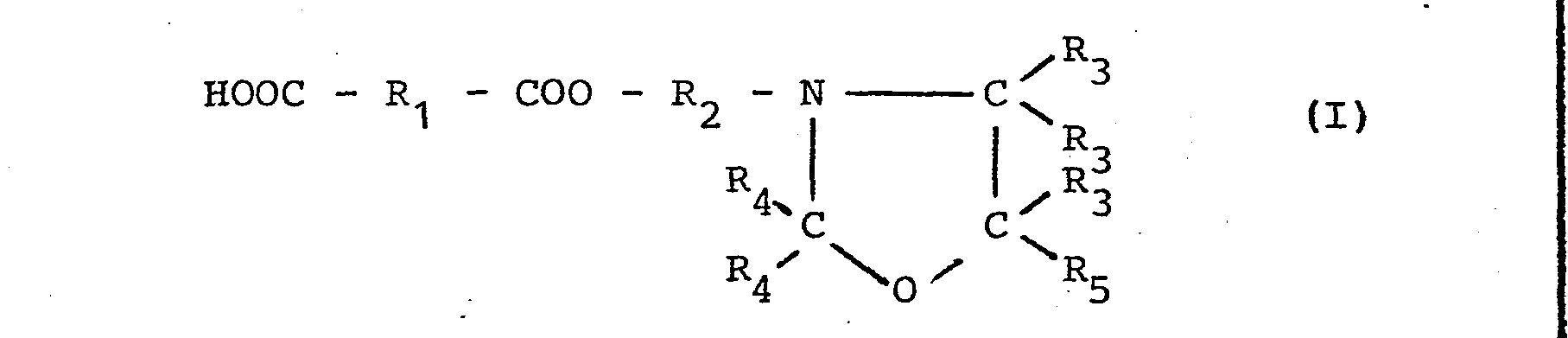
- (a) ein Umsetzungsprodukt aus einem primären Alkanolamin, einer Monoepoxidverbindung, einer Carbonylverbindung und einer anhydridbildenden Di- und/oder Tricarbonsäure mit der allgemeinen Formel


- (b) ein Umsetzungsprodukt aus einem 2-Aminopropandiol-1,3, einem (Meth)acrylsäureester', einer Carbonylverbindung und einer anhydridbildenden Di- oder Tricarbonsäure mit der allgemeinen Formel

- (c)ein Umsetzungsprodukt aus einem primären ß-Hydroxymonoamin, einem Hydroxy(meth)acrylat, einer Carbonylverbindung und einer anhydridbildenden Di- oder Tricarbonsäure mit der i allgemeinen Formel

- R1 einen gesättigten oder ungesättigten, aliphatischen, cycloaliphatischen oder aromatischen, gegebenenfalls Carboxylgruppen tragenden Kohlenwasserstoffrest,
- R2 einen geradkettigen oder verzweigten oder cyclischen, gegebenenfalls substituierten Alkylenrest mit 1 bis 12 C-Atomen,
- R3 ein Wasserstoffatom oder einen Methylrest,
- R4 ein Wasserstoffatom oder einen geradkettigen oder verzweigten Alkylrest mit 1 bis 4 C-Atomen oder, für beide R4 gemeinsam,einen ringbildenden, gegebenenfalls substituierten Alkylenrest und
- R5 einen gesättigten oder ungesättigten, gegebenenfalls Äther- oder Estergruppen enthaltenden aliphatischen, cycloaliphatischen oder aromatischen Kohlenwasserstoffrest,
- R6 = R3 oder einen Alkylrest mit mehr als 1 C-Atom oder einen Phenylrest,
- R7 ein Wasserstoffatom oder einen geradkettigen oder verzweigten oder cyclischen, gegebenenfalls Hydroxylgruppen tragenden,Alkylrest mit 2 bis 12 C-Atomen,
- R8 einen nach der Reaktion mit dem am Stickstoff befindlichen aktiven Wasserstoffatom verbleibenden Rest.eines in bezug auf die Doppelbindungen monofunktionalen Acryl- oder Methacrylmonomeren,
- R9 einen geradkettigen oder verzweigten Alkylen- oder Polyalkylenätherrest,
- R10 ein Wasserstoffatom, einen Alkyl- oder einen Phenylrest darstellt.
- Die Erfindung betrifft weiters die aus diesen Bindemitteln hergestellten Überzugsmittel, sowie deren Verwendung als kathodisch abscheidbare Lacke.
- Wie sich aus den angegebenen allgemeinen Formeln I bis III ergibt, werden unter dem Begriff "substituierte Oxazolidine' sowohl am Stickstoff als auch an den verschiedenen Kohlenstoffatomen substituierte Produkte verstanden.
- Unter dem Begriff "Halbester" werden in der Beschreibung der vorliegenden Erfindung auch Partialester von solchen Tricarbonsäuren verstanden, deren Anhydridgruppe mit einem Hydroxyoxazolidin umgesetzt wurde . Diese Produkte wei- sen demgemäß zwei zur Reaktion mit Epoxidgruppen befähigte Carboxylgruppen auf.
- Die Reaktionsfolge bei. der Herstellung der erfindungsgemäß eingesetzten substituierten Oxazolidinhalbester kann wie folgt dargestellt werden:
- (A) Produkte gemäß Formel (I) bzw. (Ia)


- Bei der Verwendung von primären ß-Hydroxyaminen kann die Oxazolidinringbildung auch in anderer Weise erfolgen, wobei ein Hydroxyalkyloxazolidin der Formel

- Zur Herstellung der Oxazolidinhalbester gemäß den Formeln (I) und (Ia) wird 1 Mol eines primären Alkanolamins (a) mit 1 Mol einer Monoepoxidverbindung (b) umgesetzt, wobei die Reaktion vorteilhaft durch Zugabe der Monoepoxidverbindung (b) zum Amin (a) bei 60 bis 130°C erfolgt. Zur Vervollständigung der Reaktion wird eine Temperatur von 90 bis 130°C nach Ende der Zugabe weiter aufrechterhalten.
- In der zweiten Stufe wird das Epoxidaminaddukt mit der Carbonylverbindung (c) bei 80 bis 110°C unter Ringschluß umgesetzt, wobei das entstehende Reaktionswasser azeotrop mit Hilfe eines Schleppmittels z. B. einem Benzinkohlenwasserstoff mit einem Siedebereich von 80 bis 120°C abgetrennt wird.
- Die Umsetzung des Oxazolidins (e) bzw. (e1) mit dem Dicarbonsäureanhydrid, welches in der Formel (I) durch den Formelteil HOOC - R1 - COO - dargestellt ist, erfolgt in stöchiometrischen Mengenverhältnissen, vorzugsweise in Gegenwart inerter Lösungsmittel, wie Estern, Äthern, Ketonen oder aromatischen Lösungsmitteln. Durch die basischen Gruppierungen wird die Reaktion beschleunigt und erfolgt sehr schnell auch bei niedrigen Temperaturen. Bei Temperaturen zwischen 40 und 80°C wird normalerweise nach 30 bis 120 Minuten der theoretische Säurewert des Halbesters erreicht. Temperaturen über 80°C sollen bei der Herstellung der Halbester vermieden werden, daß in diesem Falle bereits Vernetzungsreaktionen eintreten können, welche zu unbrauchbaren Zwischenprodukten führen.
- Als primäre Alkanolamine (a) können Alkanolmonoamine verwendet werden, welche eine primäre Aminogruppe und eine pri märe oder eine sekundäre Alkanolgruppe und 2 - 12 C-Atome aufweisen. Bevorzugt werden Alkanolalkylamine vom Typ der homologen Monoalkanolmonoamine, sowie deren Isomere verwendet. Dazu zählen beispielsweise das Monoäthanolamin, die Monopropanolamine usw. Es können jedoch auch substituierte Alkanolamine, wie das 2-Phenyl-2-hydroxy-äthylamin zum Einsatz kommen.
- Als Monoepoxidverbindungen (b) können Carbonsäureglycidylester, wie insbesonders Cardura ® E (der Glycidylester von verzweigten C9-C11-Monocarbonsäuren) oder Glycidylmethacrylat, Glycidyläther wie Butyl-, Phenyl-, p-tert.Butylphenol-oder Allylglycidyläther oder Kohlenwasserstoffoxide wie Olefinoxide


- Als Carbonylverbindungen (c), welche zur Ausbildung des Oxazolidinringes dienen, werden aliphatische und aromatische Aldehyde, vorzugsweise Formaldehyd und Benzaldehyd oder Ketone, wie Methylisobutylketon oder Cyclohexanon eingesetzt.
- Als Carbonsäureanhydride (d) können gesättigte oder ungesättigte aliphatische oder cycloaliphatische Dicarbonsäureanhydride, also die Anhydride der Bernsteinsäure und ihre Homologen, oder der verschiedenen Hydrierungsstufen aromatischer Dicarbonsäuren oder Maleinsäure eingesetzt werden. Ebenso können die Anhydride aromatischer Di- oder Tricarbonsäuren, z. B. o-Phtalsäureanhydrid, o-Naphtocarbonsäureanhydride oder Trimellithsäureanhydrid eingesetzt werden. Bevorzugt werden Dicarbonsäureanhydride und besonders bevorzugt das Tetrahydrophthalsäureanhydrid verwendet. Beim alleinigen oder gegebenenfalls anteiligen Einsatz von Tricarbonsäureanhydriden ist selbstverständlich die höhere Funktionalität des resultierenden Partialesters bei der Auswahl der zur weiteren Umsetzung herangezogenen Epoxidharze zu berücksichtigen.
-

- Zur Herstellung der erfindungsgemäß eingesetzten Oxazolidinhalbester gemäß Formel (II) wird in erster Stufe das primäre Amindiol (a) bei 80 bis 100°C mit dem Acrylatmonomeren (b) etwa 2 Stunden umgesetzt. Bei Verwendung von Methacrylaten wird die Reaktion vorteilhafterweise bei etwa 140°C durchgeführt. Der Ringschluß mit der Carbonylverbindung (c) sowie die Umsetzung mit dem Di- oder Tricarbonsäureanhydrid erfolgt unter den in Abschnitt (A) angegebenen Bedingungen.
- Als Aminoverbindungen können neben dem 2-Aminopropandiol-1,3 weiters das 2-Amino-2-methyl-propandiol-1,3 sowie dessen geradkettige oder verzweigte Homologe eingesetzt werden. Ein bifunktioneller Halbester wird beim Einsatz von Trimethylolaminomethan erhalten.
- Als Acrylatmonomere (b) können neben den homologen Estern der Acrylsäure bzw. der Methacrylsäure mit Monoalkoholen auch tertiäre Aminogruppen tragende Monomere, beispielsweise Dimethylaminoäthylacrylat und dessen Homologe oder (Meth)acrylamid eingesetzt werden. Beim Einsatz der homologen Hydroxyacrylate können auch in diesem Fall bifunktionelle Halbester hergestellt werden.
- Die eingesetzten Carbonylverbindungen (c) und Carbonsäureanhydride (d) entsprechen den in Abschnitt (A) angegebenen Verbindungen.
-


- Zur Herstellung der erfindungsgemäß eingesetzten Oxazolidinhalbester gemäß Formel (III) wird in erster Stufe das primäre ß-Hydroxymonoamin (a), mit dem Hydroxyacrylat (b), bei 80 bis 100°C in äquimolaren Mengen etwa 2 Stunden umgesetzt. Bei Verwendung von Hydroxymethacrylaten wird die Reaktion vorteilhaft bei 140°C durchgeführt. Der Ringschluß mit der Carbonylkomponente (c) sowie die Umsetzung mit dem Di- oder Tricarbonsäureanhydrid erfolgt ebenfalls unter den im Abschnitt (A) angegebenen Bedingungen.
- Als ß-Hydroxymonoamine (a) können Monoalkanolamine wie Monoäthanolamin oder Isopropanolamin oder substituierte Amine vom Typ des 2-Phenyl-2-hydroxy-äthylamines eingesetzt werden.
- Als Hydroxy(meth)acrylate (b) kommen Hydroxyalkyl(meth)-acrylate, d. h. die Acryl- bzw. Methacrylmonoester von Diolen, wie Äthylenglykol und seine Homologe, aber auch Hydroxypolyalkylenätheracrylate, d. h. die Monoveresterungs produkte der (Meth)acrylsäure mit Di-, Tri- und höheren Äthylen- oder Propylenglykolen zur Anwendung.
- Die Carbonylverbindungen (c) und die Carbonsäureanhydride (d) entsprechen den'im Abschnitt (A) angegebenen Verbindungen.
- Die so erhaltenen Halbester werden bei 60 bis 75°C mit den 1,2-Epoxidgruppen tragenden Verbindungen bis zu einer Säurezahl von weniger als 3 mg KOH/g reagiert.
- Geeignet als 1,2-Epoxidgruppen tragende Verbindungen sind die verschiedenen bekannten Epoxidharze auf Basis von Phenolen, insbesonders von Bisphenol A und Phenolnovolaken, sowie Epoxidharze auf Basis aliphatischer Alkohole und Glycidylgruppen tragende Copolymerisate mit einem Epoxidäquivalent von mind. 160. Zur Gewährleistung einer ausreichenden Funktionalität weisen die erfindungsgemäß eingesetzten Epoxidverbindungen mindestens 2 1,2-Epoxidgruppen pro Molekül auf. Verbindungen dieser Art sind in ausführlicher Weise im "Handbook of Epoxy Resins" von H. Lee und K. Neville, McGraw-Hill Book Com., New York, 1967 beschrieben.
- Die bei der Einführung der Oxazolidingruppen tragenden Zwischenprodukte nicht zur Reaktion gelangenden Epoxidgruppen der Di- oder Polyepoxidharze werden mit anderen modifizierenden Verbindungen mit aktiven Wasserstoffatomen, wie Carbonsäuren oder Aminen reagiert. Die zur Verarbeitung als ETL-Bindemittel gelangenden Produkte sind praktisch frei von nichtreagierten Epoxidgruppen. Als Carbonsäuren können längerkettige Carbonsäuren, wie gesättigte oder ungesättigte Ölfettsäuren, aber auchd("ß-ungesättigte Mono carbonsäuren, wie (Meth)acrylsäure oder auch Halbester von Dicarbonsäuren mit gesättigten oder ungesättigten Alkohole oder Hydroxyalkyloxazolidinen oder Partialester von Tricarbonsäuren eingesetzt werden. Ähnliche Modifikationen sind auch in der EP 00 28 402 beschrieben. Bei gleichzeitiger Erhöhung des Molekulargewichtes können in untergeordnetem Maße auch aliphatische Dicarbonsäuren herangezogen werden. Bei der Verwendung von primären oder sekundären Aminen muß jedoch die Einhaltung des für die Gesamtaminzahl gegebenen Rahmens sowie Beeinflussung der Viskosität berücksichtigt werden, da anderenfalls die Abscheidungsparameter zu weitgehend verändert werden.
- Die Mengenverhältnisse zwischen den Komponenten werden so gewählt, daß für das Endprodukt eine theoretische Aminzahl von mindestens 35, vorzugsweise von 50 - 140 mg KOH/g resultiert.
- Eine technologische Vereinfachung bei der Modifizierung der Epoxidverbindungen mit verschiedenen Oxazolidinhalbestern besteht in der gemeinsamen Herstellung dieser Zwischenprodukte. So können z. B. die Halbester gemäß EP 00 28 402 und die erfindungsgemäß eingesetzten Halbester in vielen Fällen in einem Arbeitsgang hergestellt werden.
- In einer besonders günstigen Ausführungsform des Verfahren werden die erfindungsgemäß hergestellten Bindemittel im Anschluß an die Umsetzung des Epoxidharzes mit den Oxazolidingruppen tragenden Zwischenprodukten bzw. den übrigen Modifikatoren einer sauren Hydrolyse bei 50 bis 80°C unterworfen, wobei die Oxazolidinringe wahrscheinlich zum Teil unter Bildung substituierter Methylolgruppen geöffnet werden.
- Durch diese Nachbehandlung werden Reaktionen vorweggenommen, welche ansonsten erst im fertigen Lack bzw. im Tauchbad ablaufen. Zu diesem Zweck wird das Reaktionsprodukt mit Wasser und einem Teil der später zur Neutralisation eingesetzten Säure einige Stunden bei der angegebenen Temperatur behandelt.
- Die Bindemittel können in bekannter Weise mit Pigmenten vermahlen werden und werden zur Herstellung eines verarbeitungsfertigen Materials nach partieller oder vollständiger Neutralisation mit anorganischen oder organischen Säuren bei pH-Werten zwischen 4 und 7 mit vorzugsweise deionisiertem Wasser bei Verwendung für die Elektrotauchlackierung auf einen Festkörpergehalt zwischen 5 und 20 % verdünnt. Die erfindungsgemäß hergestellten Bindemittel zeigen auch bei niedrigen Neutralisationsgraden ausgezeichnete Wasserverdünnbarkeit. Die Verwendung von Zusatz- und Hilfsstoffen sowie die Bedingungen für die Beschichtung eines als Kathode geschalteten Substrats sind dem Fachmann bekannt und bedürfen keiner weiteren Erläuterung. Besonders eignen sich die erfindungsgemäß hergestellten Produkte als Anreibmedien für Pigmente und Füllstoffe. Auch hier sind die Verfahrensweisen dem Fachmann bekannt.
- Die nachfolgenden Beispiele sollen die Erfindung erläutern, stellen jedoch keine Beschränkung ihres Umfanges dar. Alle Angaben in Teilen oder Prozenten beziehen sich, soferne nicht anders angegeben, auf Gewichtseinheiten. Alle Angaben in den Tabellen beziehen sich auf Feststoffe.
- In den Beispielen werden folgende Abkürzungen verwendet:


- Zusammensetzungen und Reaktionsbedingungen für die Herstellung der Hydroxyalkyloxazolidine sind in TAB 1 zusammengefaßt. Zur Herstellung werden die Monoepoxidverbindung und das Monoalkanolamin in einem geeigneten Reaktionsgefäß unter Beachtung einer eventuell auftretenden Exothermie auf 90 bis 130°C erhitzt und bei dieser Temperatur 2 bis 3 Stunden gehalten. Anschließend wird bei 70 bis 80°C die Carbonylverbindung (sowie gegebenenfalls eingesetztes Dialkanolamin) und geeignetes Azeotropkreislaufmittel (vorzugsweise Spezialbenzin mit einem Siedebereich zwischen 80 und 120°C oder ein ähnlicher aliphatischer Kohlenwasserstoff) zugegeben. Die sich einstellende Kreislauftemperatur wird solange gehalten, bis die berechnete Reaktionswassermenge abgeschieden ist. Das Kreislaufmittel wird dann durch Anlegen von Vakuum abgezogen.
- Die Oxazolidin-Dicarbonsäurehalbester werden entsprechend den in Tabelle 2 gemachten Angaben hergestellt. Die Umsetzung erfolgt bis zum theoretischen Säurewert für den Halbester. Die Umsetzung kann gegebenenfalls in geeigneten Lösungsmitteln, wie Xylol oder Diäthylenglykoldimethyläther erfolgen. Der Festkörpergehalt der Zwischenprodukte liegt vorteilhafterweise zwischen 80 und 100 %.


- Die in TAB 3 angegebenen Ausgangsmaterialien werden gegebenenfalls in EGL gelöst, sodaß eine Lösung mit 62 - 72 Gew.-% Festköpergehalt resultiert. Der Ansatz wird auf 75°C erwärmt und solange bei dieser Temperatur gehalten, bis die Säurezahl unter 3 mg KOH/g gesunken ist. Anschließend werden die Produkte nach Zusatz von 10 mMol Essigsäure pro 100 g Festharz und Verdünnung mit Wasser auf einen Festkörpergehalt von 60 Gew.-% etwa 3 Stunden bei 60 bis 70°C unter Rühren gehalten. Bei Bedarf können die Bindemittel mit Lösungsmitteln, wie Diacetonalkohol oder Glykoläthern vor der Verarbeitung weiterverdünnt werden.


- In der TAB 4 sind die Kennzahlen der Produkte gemäß den Beispielen 1 - 8 zusammengefaßt.

- In erster Stufe werden die Aminopropandiolemit dem Acrylat 2 Stunden bei 80 bis 100°C reagiert. Bei Verwendung von Methacrylaten wird vorteilhafterweise die Reaktionstemperatur auf etwa 140°C erhöht. Anschließend wird bei 70 bis 80°C die Carbonylverbindung (sowie gegebenenfalls eingesetztes Dialkanolamin) und ein geeignetes Azeotropkreislaufmittel (vorzugsweise Spezialbenzin mit einem Siedebereich zwischen 80 und 120°C oder ein ähnlicher aliphatischer Kohlenwasserstoff) zugegeben. Die sich einstellende Kreislauftemperatur wird solange gehalten, bis die berechnete Reaktionswassermenge abgeschieden ist. Das Kreislaufmittel wird dann durch Anlegen von Vakuum abgezogen. Zusammensetzung und Reaktionsbedingungen sind in TAB 5 zusammengefaßt.
- Die Oxazolidin-Dicarbonsäurehalbester werden entsprechend den in Tabelle 6 gemachten Angaben hergestellt. Die Umsetzung derfolgt bis zum theoretischen Säurewert für den Halbester. Die Umsetzung kann gegebenenfalls in geeigneten Lösungsmitteln, wie Xylol oder Diäthylenglykoldimethyläther erfolgen. Der Festkörpergehalt der Zwischenprodukte liegt vorteilhafterweise zwischen 80 und 100 %.
- Die in TAB 7 angegebenen Ausgangsmaterialien werden gegebenenfalls in EGL gelöst, sodaß eine Lösung mit 62 - 72 Gew.-% Festkörpergehalt resultiert. Der Ansatz wird auf 75°C erwärmt und solange bei dieser Temperatur gehalten, bis die Säurezahl unter 3 mg KOH/g gesunken ist. Anschließend werden die Produkte nach Zusatz von 10 mMol Essigsäure pro 100 g Festharz und Verdünnung mit Wasser auf einen Festkörpergehalt von 60 Gew.-% etwa 3 Stunden bei 60 bis 70°C unter Rühren gehalten.Bei Bedarf können die Bindemittel mit Lösungsmitteln, wie Diacetonalkohol oder Glykoläthern, vor der Verarbeitung weiterverdünnt werden.


- In der TAB 8 sind die Kennzahlen der Produkte gemäß den Beispielen 9 - 12 zusammengefaßt.

- In erster Stufe wird das primäre ß-Hydroxymonoamin bei 80 bis 100°C mit äquimolaren Mengen des Hydroxyacrylats und gegebenenfalls gemeinsam mit Monoepoxidverbindungen etwa 2 Stunden reagiert. Beim Einsatz von Hydroxymethacrylaten wird vorteilhaft bei ca. 140°C gearbeitet. Anschließend wird bei 70 bis 80°C die Carbonylverbindung (sowie gegebenenfalls eingesetztes Dialkanolamin) und ein geeignetes Azeotropkreislaufmittel (vorzugsweise Spezialbenzin mit einem Siedebereich zwischen 80 und 120°C oder ein ähnlicher aliphatischer Kohlenwasserstoff) zugegeben. Die sich einstellende Kreislauftemperatur wird solange gehalten, bis die berechnete Reaktionswassermenge abgeschieden ist. Das Kreislaufmittel wird dann durch Anlegen von Vakuum abgezogen. Zusammensetzungen und Reaktionsbedingungen sind in TAB 9 zusammengefaßt.
- Die Oxazolidin-Dicarbonsäurehalbester werden entsprechend den in Tabelle 10 gemachten Angaben hergestellt. Die Umsetzung erfolgt bis zum theoretischen Säurewert für den Halbester. Die Umsetzung kann gegebenenfalls in geeigneten Lösungsmitteln, wie Xylol oder Diäthylenglykoldimethyläther erfolgen. Der Festkörpergehalt der Zwischenprodukte liegt vorteilhafterweise zwischen 80 und 100%.

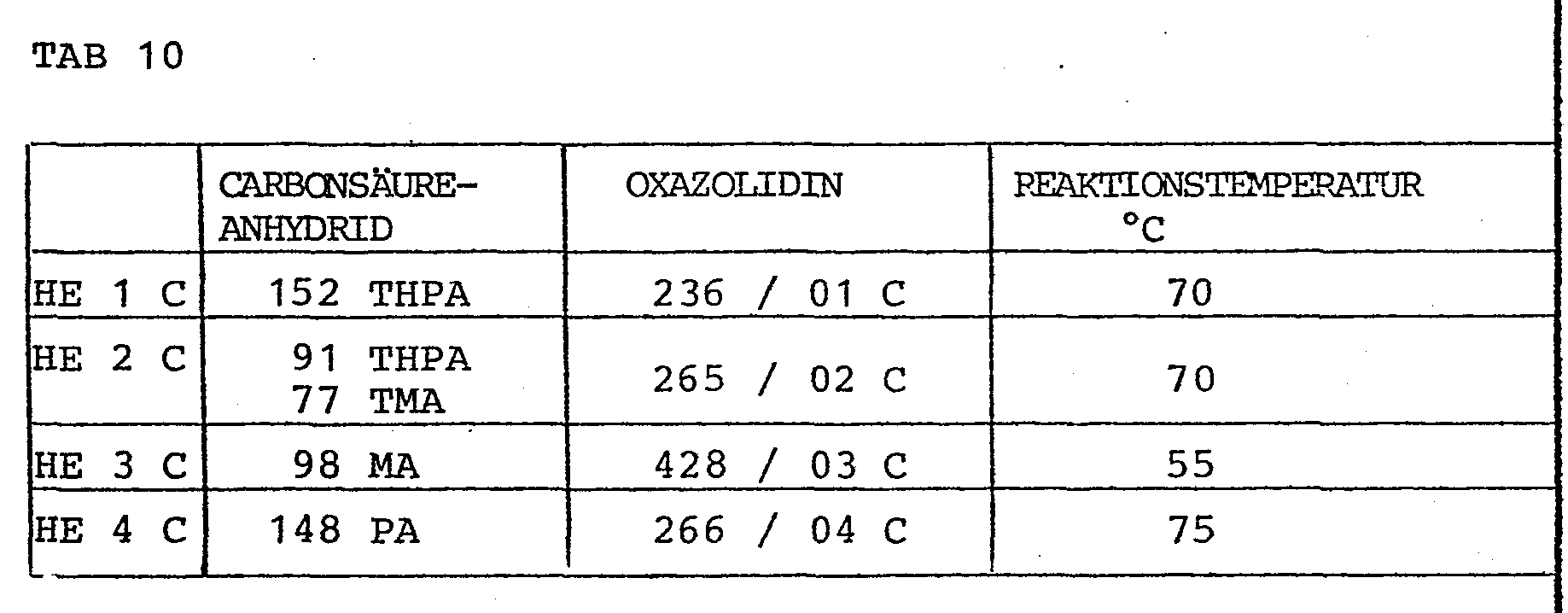
- Die in TAB 11 angegebenen Ausgangsmaterialien werden gegebenenfalls in EGL gelöst, sodaß eine Lösung mit 62 - 72 Gew.-% Festkörpergehalt resultiert. Der Ansatz wird auf 75°C erwärmt und solange bei dieser Temperatur gehalten, bLs die Säurezahl unter 3 mg KOH/g gesunken ist. Anschließend werden die Produkte nach Zusatz von 10 mMol Essigsäure pro 100 g Festharz und Verdünnung mit Wasser auf einen Festkörpergehalt von 60 Gew.-% etwa 3 Stunden bei 60 bis 70°C unter Rühren gehalten. Bei Bedarf können die Bindemittel mit Lösungsmitteln, wie Diacetonalkohol oder Glykoläthern vor der Verarbeitung weiterverdünnt werden.
-

- In der TAB 12 sind die Kennzahlen der Produkte gemäß den Beispielen 13 - 18 zusammengefaßt.

- Die Prüfung der Bindemittel gemäß Beispiel 1 - 18 erfolgt bei der Bestimmung der Wasserbeständigkeit durch Beschichtung eines entfetteten, nicht vorbehandelten Stahlblechs mit dem entsprechenden Klarlack. Für den Salzsprühtest werden die entfetteten, nicht vorbehandelten Stahlbleche mit einem pigmentierten Lack (100 Teile Festharz, 16 Teile Al-Silikatpigment, 2 Teile Ruß, 2 Teile Bleisilikat) unter den optimalen Spannungsbedingungen, welche eine. Trockenfilmstärke von 16 bis 20 µm ergeben, beschichtet und 30 Minuten bei 160°C eingebrannt. Bei der Prüfung der Wasserfestigkeit (Wasserlagerung bei 40°C) zeigen die Beschichtungen nach 380 Stunden Testzeit keine optisch sichtbaren Veränderungen durch Rostangriff oder Bläschenbildung. Beim Salzsprühtest gemäß ASTM-B 117-64 zeigen alle Beschichtungen nach einer Testzeit von 340 Stunden einen Kreuzschnittangriff von weniger als 2 mm (Abreißmethode).
Claims (4)


Applications Claiming Priority (4)
| Application Number | Priority Date | Filing Date | Title |
|---|---|---|---|
| AT0226282A AT380483B (de) | 1982-06-11 | 1982-06-11 | Verfahren zur herstellung von wasserverduennbaren oxazolidingruppen tragenden epoxidharzestern |
| AT226182A AT379166B (de) | 1982-06-11 | 1982-06-11 | Verfahren zur herstellung von wasserverduennbaren, oxazolidingruppen tragenden epoxidharzestern |
| AT2262/82 | 1982-06-11 | ||
| AT2261/82 | 1982-06-11 |
Publications (2)
| Publication Number | Publication Date |
|---|---|
| EP0096768A2 true EP0096768A2 (de) | 1983-12-28 |
| EP0096768A3 EP0096768A3 (de) | 1987-09-02 |
Family
ID=25598070
Family Applications (1)
| Application Number | Title | Priority Date | Filing Date |
|---|---|---|---|
| EP83105099A Withdrawn EP0096768A3 (de) | 1982-06-11 | 1983-05-24 | Verfahren zur Herstellung von wasserverdünnbaren Oxazolidingruppen tragenden Epoxidharzestern, daraus hergestellte Überzugsmittel und deren Verwendung als kathodisch abscheidbare Lacke |
Country Status (4)
| Country | Link |
|---|---|
| EP (1) | EP0096768A3 (de) |
| AU (1) | AU1503483A (de) |
| BR (1) | BR8303093A (de) |
| ES (1) | ES522929A0 (de) |
Cited By (2)
| Publication number | Priority date | Publication date | Assignee | Title |
|---|---|---|---|---|
| DE3439130A1 (de) * | 1983-12-19 | 1985-08-29 | Vianova Kunstharz Ag, Werndorf | Verfahren zur herstellung von oxazolidingruppen enthaltenden lackbindemitteln |
| US4772716A (en) * | 1986-07-14 | 1988-09-20 | Ciba-Geigy Corporation | Oxazolidines containing silane groups |
Family Cites Families (2)
| Publication number | Priority date | Publication date | Assignee | Title |
|---|---|---|---|---|
| US4327200A (en) * | 1979-11-05 | 1982-04-27 | Vianova Kunstharz, A.G. | Water-dilutable oxazolidine group containing epoxy resin esters, coating compositions prepared therefrom, and their use as cathodically depositable paints |
| EP0076955B1 (de) * | 1981-10-12 | 1985-11-27 | Vianova Kunstharz Aktiengesellschaft | Verfahren zur Herstellung von oxazolidingruppentragenden modifizierten Epoxidharzen |
-
1983
- 1983-05-24 EP EP83105099A patent/EP0096768A3/de not_active Withdrawn
- 1983-05-27 AU AU15034/83A patent/AU1503483A/en not_active Abandoned
- 1983-06-01 ES ES522929A patent/ES522929A0/es active Granted
- 1983-06-10 BR BR8303093A patent/BR8303093A/pt unknown
Cited By (2)
| Publication number | Priority date | Publication date | Assignee | Title |
|---|---|---|---|---|
| DE3439130A1 (de) * | 1983-12-19 | 1985-08-29 | Vianova Kunstharz Ag, Werndorf | Verfahren zur herstellung von oxazolidingruppen enthaltenden lackbindemitteln |
| US4772716A (en) * | 1986-07-14 | 1988-09-20 | Ciba-Geigy Corporation | Oxazolidines containing silane groups |
Also Published As
| Publication number | Publication date |
|---|---|
| BR8303093A (pt) | 1984-01-31 |
| EP0096768A3 (de) | 1987-09-02 |
| ES8407508A1 (es) | 1984-10-01 |
| AU1503483A (en) | 1983-12-15 |
| ES522929A0 (es) | 1984-10-01 |
Similar Documents
| Publication | Publication Date | Title |
|---|---|---|
| EP0082291B1 (de) | Wärmehärtbare kationische wasserverdünnbare Bindemittel | |
| DE2320301C3 (de) | Im wesentlichen epoxidgruppenfreie Polykondensations-Polyadditions-Produkte und ihre Verwendung | |
| EP0028402B1 (de) | Verfahren zur Herstellung von wasserverdünnbaren, Oxazolidingruppen tragenden Epoxidharzestern, daraus hergestellte Überzugsmittel und deren Verwendung als kathodisch abscheidbare Lacke | |
| EP0076955B1 (de) | Verfahren zur Herstellung von oxazolidingruppentragenden modifizierten Epoxidharzen | |
| EP0030692B2 (de) | Verfahren zur Herstellung kathodisch abscheidbarer Bindemittel | |
| EP0165556B1 (de) | Hitzehärtbares Überzugsmittel, seine Verwendung, bzw. Verfahren zu seiner Herstellung | |
| JP2862976B2 (ja) | 陰極に電着可能な塗料用バインダーの製造方法及びその使用法 | |
| DE3014290A1 (de) | Wasserverduennbare bindemittel, ihre herstellung und verwendung | |
| EP0268051B1 (de) | Verfahren zur Katalysierung kationischer Lackbindemittel | |
| EP0096768A2 (de) | Verfahren zur Herstellung von wasserverdünnbaren Oxazolidingruppen tragenden Epoxidharzestern, daraus hergestellte Überzugsmittel und deren Verwendung als kathodisch abscheidbare Lacke | |
| EP0157102A1 (de) | Verfahren zur Herstellung von kathodisch abscheidbaren Lackbindemitteln | |
| AT375952B (de) | Verfahren zur herstellung von wasserverduennbaren oxazolidingruppen tragenden epoxidharzestern | |
| KR930004698B1 (ko) | 음극 침착가능한 전착도료 | |
| EP0129105B1 (de) | Verfahren zur Herstellung von Härterkomponenten für Lackbindemittel | |
| DE3300555C2 (de) | Verfahren zur Herstellung von nach vollständiger oder partieller Neutralisation mit anorganischen und/oder organischen Säuren wasserverdünnbaren Bindemitteln auf der Basis von modifizierten Epoxidharzen | |
| AT392647B (de) | Verfahren zur herstellung von kathodisch abscheidbaren elektrotauchlacken | |
| DE3324960C2 (de) | Verfahren zur Herstellung von wasserverdünnbaren, Oxazolidingruppen tragenden Bindemitteln | |
| DE3337154C2 (de) | Verfahren zur Herstellung kationischer Epoxidharzester | |
| DE4428505C2 (de) | Verfahren zur Herstellung von organischen Titanverbindungen und deren Verwendung in kathodisch abscheidbaren Elektrotauchlacken | |
| JPH04214780A (ja) | 陰極に析出可能な電着塗料用顔料ペーストを処方するためのカチオン性ペイントバインダーの製造方法 | |
| AT369027B (de) | Verfahren zur herstellung von wasserverduennbaren oxazolidingruppen tragenden epoxidharzestern | |
| DE2063151A1 (de) | Verfahren zur Herstellung von wasser verdunnbaren, vinylmodifizierten Kunsthar zen auf der Grundlage von Polyathern | |
| DE3539365C2 (de) | ||
| DE3343706A1 (de) | Verfahren zur herstellung kationischer lackbindemittel | |
| AT377771B (de) | Verfahren zur herstellung von oxazolidingruppen- tragenden modifizierten epoxidharzen |
Legal Events
| Date | Code | Title | Description |
|---|---|---|---|
| PUAI | Public reference made under article 153(3) epc to a published international application that has entered the european phase |
Free format text: ORIGINAL CODE: 0009012 |
|
| 17P | Request for examination filed |
Effective date: 19830601 |
|
| AK | Designated contracting states |
Designated state(s): DE FR GB IT |
|
| PUAL | Search report despatched |
Free format text: ORIGINAL CODE: 0009013 |
|
| AK | Designated contracting states |
Kind code of ref document: A3 Designated state(s): DE FR GB IT |
|
| 17Q | First examination report despatched |
Effective date: 19890517 |
|
| STAA | Information on the status of an ep patent application or granted ep patent |
Free format text: STATUS: THE APPLICATION HAS BEEN WITHDRAWN |
|
| 18W | Application withdrawn |
Withdrawal date: 19890722 |
|
| R18W | Application withdrawn (corrected) |
Effective date: 19890722 |
|
| RIN1 | Information on inventor provided before grant (corrected) |
Inventor name: PAAR, WILLIBALD, DR. Inventor name: HOENIG, HELMUT, DR. |