EP0092444B1 - Zusammensetzung von photoempfindlichem Harz des Positivtyps - Google Patents
Zusammensetzung von photoempfindlichem Harz des Positivtyps Download PDFInfo
- Publication number
- EP0092444B1 EP0092444B1 EP83302258A EP83302258A EP0092444B1 EP 0092444 B1 EP0092444 B1 EP 0092444B1 EP 83302258 A EP83302258 A EP 83302258A EP 83302258 A EP83302258 A EP 83302258A EP 0092444 B1 EP0092444 B1 EP 0092444B1
- Authority
- EP
- European Patent Office
- Prior art keywords
- naphthoquinonediazide
- compound
- formula
- sulfonic acid
- group
- Prior art date
- Legal status (The legal status is an assumption and is not a legal conclusion. Google has not performed a legal analysis and makes no representation as to the accuracy of the status listed.)
- Expired
Links
- 239000011342 resin composition Substances 0.000 title claims description 40
- 150000001875 compounds Chemical class 0.000 claims description 84
- 229920005989 resin Polymers 0.000 claims description 39
- 239000011347 resin Substances 0.000 claims description 39
- 229920003986 novolac Polymers 0.000 claims description 38
- 125000000217 alkyl group Chemical group 0.000 claims description 18
- ISWSIDIOOBJBQZ-UHFFFAOYSA-N Phenol Chemical compound OC1=CC=CC=C1 ISWSIDIOOBJBQZ-UHFFFAOYSA-N 0.000 claims description 15
- 125000003710 aryl alkyl group Chemical group 0.000 claims description 12
- 125000003118 aryl group Chemical group 0.000 claims description 12
- 239000000203 mixture Substances 0.000 claims description 12
- 125000004432 carbon atom Chemical group C* 0.000 claims description 11
- 125000004435 hydrogen atom Chemical group [H]* 0.000 claims description 6
- 239000003377 acid catalyst Substances 0.000 claims description 3
- 238000006482 condensation reaction Methods 0.000 claims description 2
- 125000002485 formyl group Chemical class [H]C(*)=O 0.000 claims 1
- 125000004051 hexyl group Chemical group [H]C([H])([H])C([H])([H])C([H])([H])C([H])([H])C([H])([H])C([H])([H])* 0.000 claims 1
- 125000002496 methyl group Chemical group [H]C([H])([H])* 0.000 claims 1
- 125000001997 phenyl group Chemical group [H]C1=C([H])C([H])=C(*)C([H])=C1[H] 0.000 claims 1
- -1 2,3,4-trihydroxyphenyl methyl Chemical group 0.000 description 84
- 239000000243 solution Substances 0.000 description 20
- 229920002120 photoresistant polymer Polymers 0.000 description 19
- 238000000034 method Methods 0.000 description 18
- IWDCLRJOBJJRNH-UHFFFAOYSA-N p-cresol Chemical compound CC1=CC=C(O)C=C1 IWDCLRJOBJJRNH-UHFFFAOYSA-N 0.000 description 16
- 230000035945 sensitivity Effects 0.000 description 14
- 239000003513 alkali Substances 0.000 description 11
- 239000011248 coating agent Substances 0.000 description 8
- 238000000576 coating method Methods 0.000 description 8
- RLSSMJSEOOYNOY-UHFFFAOYSA-N m-cresol Chemical compound CC1=CC=CC(O)=C1 RLSSMJSEOOYNOY-UHFFFAOYSA-N 0.000 description 8
- MUBZPKHOEPUJKR-UHFFFAOYSA-N Oxalic acid Chemical compound OC(=O)C(O)=O MUBZPKHOEPUJKR-UHFFFAOYSA-N 0.000 description 6
- HEMHJVSKTPXQMS-UHFFFAOYSA-M Sodium hydroxide Chemical compound [OH-].[Na+] HEMHJVSKTPXQMS-UHFFFAOYSA-M 0.000 description 6
- ZMANZCXQSJIPKH-UHFFFAOYSA-N Triethylamine Chemical compound CCN(CC)CC ZMANZCXQSJIPKH-UHFFFAOYSA-N 0.000 description 6
- 239000007864 aqueous solution Substances 0.000 description 6
- 238000004519 manufacturing process Methods 0.000 description 6
- QWVGKYWNOKOFNN-UHFFFAOYSA-N o-cresol Chemical compound CC1=CC=CC=C1O QWVGKYWNOKOFNN-UHFFFAOYSA-N 0.000 description 6
- 239000000758 substrate Substances 0.000 description 6
- SVONRAPFKPVNKG-UHFFFAOYSA-N 2-ethoxyethyl acetate Chemical compound CCOCCOC(C)=O SVONRAPFKPVNKG-UHFFFAOYSA-N 0.000 description 4
- 230000000052 comparative effect Effects 0.000 description 4
- 230000007423 decrease Effects 0.000 description 4
- CDBYLPFSWZWCQE-UHFFFAOYSA-L sodium carbonate Substances [Na+].[Na+].[O-]C([O-])=O CDBYLPFSWZWCQE-UHFFFAOYSA-L 0.000 description 4
- 239000002904 solvent Substances 0.000 description 4
- WGTYBPLFGIVFAS-UHFFFAOYSA-M tetramethylammonium hydroxide Chemical compound [OH-].C[N+](C)(C)C WGTYBPLFGIVFAS-UHFFFAOYSA-M 0.000 description 4
- NKTOLZVEWDHZMU-UHFFFAOYSA-N 2,5-xylenol Chemical compound CC1=CC=C(C)C(O)=C1 NKTOLZVEWDHZMU-UHFFFAOYSA-N 0.000 description 3
- ZWEHNKRNPOVVGH-UHFFFAOYSA-N 2-Butanone Chemical compound CCC(C)=O ZWEHNKRNPOVVGH-UHFFFAOYSA-N 0.000 description 3
- QTBSBXVTEAMEQO-UHFFFAOYSA-N Acetic acid Chemical compound CC(O)=O QTBSBXVTEAMEQO-UHFFFAOYSA-N 0.000 description 3
- LFQSCWFLJHTTHZ-UHFFFAOYSA-N Ethanol Chemical compound CCO LFQSCWFLJHTTHZ-UHFFFAOYSA-N 0.000 description 3
- XEKOWRVHYACXOJ-UHFFFAOYSA-N Ethyl acetate Chemical compound CCOC(C)=O XEKOWRVHYACXOJ-UHFFFAOYSA-N 0.000 description 3
- WSFSSNUMVMOOMR-UHFFFAOYSA-N Formaldehyde Chemical compound O=C WSFSSNUMVMOOMR-UHFFFAOYSA-N 0.000 description 3
- OKKJLVBELUTLKV-UHFFFAOYSA-N Methanol Chemical compound OC OKKJLVBELUTLKV-UHFFFAOYSA-N 0.000 description 3
- KWYUFKZDYYNOTN-UHFFFAOYSA-M Potassium hydroxide Chemical compound [OH-].[K+] KWYUFKZDYYNOTN-UHFFFAOYSA-M 0.000 description 3
- YXFVVABEGXRONW-UHFFFAOYSA-N Toluene Chemical compound CC1=CC=CC=C1 YXFVVABEGXRONW-UHFFFAOYSA-N 0.000 description 3
- 239000002253 acid Substances 0.000 description 3
- 239000003054 catalyst Substances 0.000 description 3
- 238000006243 chemical reaction Methods 0.000 description 3
- 150000005690 diesters Chemical class 0.000 description 3
- 238000001914 filtration Methods 0.000 description 3
- 239000011148 porous material Substances 0.000 description 3
- 150000005691 triesters Chemical class 0.000 description 3
- QWBBPBRQALCEIZ-UHFFFAOYSA-N 2,3-dimethylphenol Chemical compound CC1=CC=CC(O)=C1C QWBBPBRQALCEIZ-UHFFFAOYSA-N 0.000 description 2
- CPEXFJVZFNYXGU-UHFFFAOYSA-N 2,4,6-trihydroxybenzophenone Chemical compound OC1=CC(O)=CC(O)=C1C(=O)C1=CC=CC=C1 CPEXFJVZFNYXGU-UHFFFAOYSA-N 0.000 description 2
- NXXYKOUNUYWIHA-UHFFFAOYSA-N 2,6-Dimethylphenol Chemical compound CC1=CC=CC(C)=C1O NXXYKOUNUYWIHA-UHFFFAOYSA-N 0.000 description 2
- GJYCVCVHRSWLNY-UHFFFAOYSA-N 2-butylphenol Chemical compound CCCCC1=CC=CC=C1O GJYCVCVHRSWLNY-UHFFFAOYSA-N 0.000 description 2
- ZNQVEEAIQZEUHB-UHFFFAOYSA-N 2-ethoxyethanol Chemical compound CCOCCO ZNQVEEAIQZEUHB-UHFFFAOYSA-N 0.000 description 2
- XLLIQLLCWZCATF-UHFFFAOYSA-N 2-methoxyethyl acetate Chemical compound COCCOC(C)=O XLLIQLLCWZCATF-UHFFFAOYSA-N 0.000 description 2
- YCOXTKKNXUZSKD-UHFFFAOYSA-N 3,4-xylenol Chemical compound CC1=CC=C(O)C=C1C YCOXTKKNXUZSKD-UHFFFAOYSA-N 0.000 description 2
- HMNKTRSOROOSPP-UHFFFAOYSA-N 3-Ethylphenol Chemical compound CCC1=CC=CC(O)=C1 HMNKTRSOROOSPP-UHFFFAOYSA-N 0.000 description 2
- HXDOZKJGKXYMEW-UHFFFAOYSA-N 4-ethylphenol Chemical compound CCC1=CC=C(O)C=C1 HXDOZKJGKXYMEW-UHFFFAOYSA-N 0.000 description 2
- QUSNBJAOOMFDIB-UHFFFAOYSA-N Ethylamine Chemical compound CCN QUSNBJAOOMFDIB-UHFFFAOYSA-N 0.000 description 2
- VEXZGXHMUGYJMC-UHFFFAOYSA-N Hydrochloric acid Chemical compound Cl VEXZGXHMUGYJMC-UHFFFAOYSA-N 0.000 description 2
- NQRYJNQNLNOLGT-UHFFFAOYSA-N Piperidine Chemical compound C1CCNCC1 NQRYJNQNLNOLGT-UHFFFAOYSA-N 0.000 description 2
- KAESVJOAVNADME-UHFFFAOYSA-N Pyrrole Chemical compound C=1C=CNC=1 KAESVJOAVNADME-UHFFFAOYSA-N 0.000 description 2
- VYPSYNLAJGMNEJ-UHFFFAOYSA-N Silicium dioxide Chemical compound O=[Si]=O VYPSYNLAJGMNEJ-UHFFFAOYSA-N 0.000 description 2
- 239000004115 Sodium Silicate Substances 0.000 description 2
- QAOWNCQODCNURD-UHFFFAOYSA-N Sulfuric acid Chemical compound OS(O)(=O)=O QAOWNCQODCNURD-UHFFFAOYSA-N 0.000 description 2
- 150000001299 aldehydes Chemical class 0.000 description 2
- JHIVVAPYMSGYDF-UHFFFAOYSA-N cyclohexanone Chemical compound O=C1CCCCC1 JHIVVAPYMSGYDF-UHFFFAOYSA-N 0.000 description 2
- HPNMFZURTQLUMO-UHFFFAOYSA-N diethylamine Chemical compound CCNCC HPNMFZURTQLUMO-UHFFFAOYSA-N 0.000 description 2
- HYBBIBNJHNGZAN-UHFFFAOYSA-N furfural Chemical compound O=CC1=CC=CO1 HYBBIBNJHNGZAN-UHFFFAOYSA-N 0.000 description 2
- FFUAGWLWBBFQJT-UHFFFAOYSA-N hexamethyldisilazane Chemical compound C[Si](C)(C)N[Si](C)(C)C FFUAGWLWBBFQJT-UHFFFAOYSA-N 0.000 description 2
- 125000002887 hydroxy group Chemical group [H]O* 0.000 description 2
- 230000010354 integration Effects 0.000 description 2
- BDAGIHXWWSANSR-UHFFFAOYSA-N methanoic acid Natural products OC=O BDAGIHXWWSANSR-UHFFFAOYSA-N 0.000 description 2
- 239000003960 organic solvent Substances 0.000 description 2
- 235000006408 oxalic acid Nutrition 0.000 description 2
- WGYKZJWCGVVSQN-UHFFFAOYSA-N propylamine Chemical compound CCCN WGYKZJWCGVVSQN-UHFFFAOYSA-N 0.000 description 2
- 150000003242 quaternary ammonium salts Chemical class 0.000 description 2
- 229910052814 silicon oxide Inorganic materials 0.000 description 2
- 229910000029 sodium carbonate Inorganic materials 0.000 description 2
- NTHWMYGWWRZVTN-UHFFFAOYSA-N sodium silicate Chemical compound [Na+].[Na+].[O-][Si]([O-])=O NTHWMYGWWRZVTN-UHFFFAOYSA-N 0.000 description 2
- 229910052911 sodium silicate Inorganic materials 0.000 description 2
- 239000000126 substance Substances 0.000 description 2
- ARWCZKJISXFBGI-UHFFFAOYSA-N (3,4-dihydroxyphenyl)-phenylmethanone Chemical compound C1=C(O)C(O)=CC=C1C(=O)C1=CC=CC=C1 ARWCZKJISXFBGI-UHFFFAOYSA-N 0.000 description 1
- ULICCTKFOINEEJ-UHFFFAOYSA-N 1-(2,3,4-trihydroxyphenyl)heptan-1-one Chemical compound CCCCCCC(=O)C1=CC=C(O)C(O)=C1O ULICCTKFOINEEJ-UHFFFAOYSA-N 0.000 description 1
- REUQOHDZTHCRIM-UHFFFAOYSA-N 1-(2,3,4-trihydroxyphenyl)pentan-1-one Chemical compound CCCCC(=O)C1=CC=C(O)C(O)=C1O REUQOHDZTHCRIM-UHFFFAOYSA-N 0.000 description 1
- NRCNBXIMKFFCSN-UHFFFAOYSA-N 1-(2,3,4-trihydroxyphenyl)propan-1-one Chemical compound CCC(=O)C1=CC=C(O)C(O)=C1O NRCNBXIMKFFCSN-UHFFFAOYSA-N 0.000 description 1
- PSGDWIWNOYZWMW-UHFFFAOYSA-N 1-(2,3,4-trihydroxyphenyl)tridecan-1-one Chemical compound CCCCCCCCCCCCC(=O)C1=CC=C(O)C(O)=C1O PSGDWIWNOYZWMW-UHFFFAOYSA-N 0.000 description 1
- PSYQCGJLQQXEHN-UHFFFAOYSA-N 1-(2,3,4-trihydroxyphenyl)undecan-1-one Chemical compound CCCCCCCCCCC(=O)C1=CC=C(O)C(O)=C1O PSYQCGJLQQXEHN-UHFFFAOYSA-N 0.000 description 1
- WGJIVPZLBPWKET-UHFFFAOYSA-N 1-(2,4,6-trihydroxyphenyl)heptan-1-one Chemical compound CCCCCCC(=O)C1=C(O)C=C(O)C=C1O WGJIVPZLBPWKET-UHFFFAOYSA-N 0.000 description 1
- HPBAQDWUBZVAMF-UHFFFAOYSA-N 1-(2,4,6-trihydroxyphenyl)pentan-1-one Chemical compound CCCCC(=O)C1=C(O)C=C(O)C=C1O HPBAQDWUBZVAMF-UHFFFAOYSA-N 0.000 description 1
- VFQKAJVKZKHVPD-UHFFFAOYSA-N 1-(2,4-dihydroxyphenyl)-2-phenylethanone Chemical compound OC1=CC(O)=CC=C1C(=O)CC1=CC=CC=C1 VFQKAJVKZKHVPD-UHFFFAOYSA-N 0.000 description 1
- RXDIDNDIEUCKLE-UHFFFAOYSA-N 1-(2,4-dihydroxyphenyl)heptan-1-one Chemical compound CCCCCCC(=O)C1=CC=C(O)C=C1O RXDIDNDIEUCKLE-UHFFFAOYSA-N 0.000 description 1
- VSJCHGYLCJUPRX-UHFFFAOYSA-N 1-(2,4-dihydroxyphenyl)pentan-1-one Chemical compound CCCCC(=O)C1=CC=C(O)C=C1O VSJCHGYLCJUPRX-UHFFFAOYSA-N 0.000 description 1
- LLBBBYLDTDJMNU-UHFFFAOYSA-N 1-(2,4-dihydroxyphenyl)propan-1-one Chemical compound CCC(=O)C1=CC=C(O)C=C1O LLBBBYLDTDJMNU-UHFFFAOYSA-N 0.000 description 1
- WGYSFLLDWMLZTR-UHFFFAOYSA-N 1-(2,4-dihydroxyphenyl)tridecan-1-one Chemical compound CCCCCCCCCCCCC(=O)C1=CC=C(O)C=C1O WGYSFLLDWMLZTR-UHFFFAOYSA-N 0.000 description 1
- IBKQQKPQRYUGBJ-UHFFFAOYSA-N 1-(3,4,5-trihydroxyphenyl)ethanone Chemical compound CC(=O)C1=CC(O)=C(O)C(O)=C1 IBKQQKPQRYUGBJ-UHFFFAOYSA-N 0.000 description 1
- LJPMCPHSTVMALD-UHFFFAOYSA-N 1-(3,4,5-trihydroxyphenyl)heptan-1-one Chemical compound CCCCCCC(=O)C1=CC(O)=C(O)C(O)=C1 LJPMCPHSTVMALD-UHFFFAOYSA-N 0.000 description 1
- FTBXKUSGZDAGIS-UHFFFAOYSA-N 1-(3,4,5-trihydroxyphenyl)pentan-1-one Chemical compound CCCCC(=O)C1=CC(O)=C(O)C(O)=C1 FTBXKUSGZDAGIS-UHFFFAOYSA-N 0.000 description 1
- YPBINNAUQNBYJB-UHFFFAOYSA-N 1-(3,4,5-trihydroxyphenyl)propan-1-one Chemical compound CCC(=O)C1=CC(O)=C(O)C(O)=C1 YPBINNAUQNBYJB-UHFFFAOYSA-N 0.000 description 1
- DCYWTATWKFDUDH-UHFFFAOYSA-N 1-(3,4-dihydroxyphenyl)-2-phenylethanone Chemical compound C1=C(O)C(O)=CC=C1C(=O)CC1=CC=CC=C1 DCYWTATWKFDUDH-UHFFFAOYSA-N 0.000 description 1
- RNHPCDSFTQVKPI-UHFFFAOYSA-N 1-(3,4-dihydroxyphenyl)heptan-1-one Chemical compound CCCCCCC(=O)C1=CC=C(O)C(O)=C1 RNHPCDSFTQVKPI-UHFFFAOYSA-N 0.000 description 1
- WYIDMUXMURUPTQ-UHFFFAOYSA-N 1-(3,4-dihydroxyphenyl)pentan-1-one Chemical compound CCCCC(=O)C1=CC=C(O)C(O)=C1 WYIDMUXMURUPTQ-UHFFFAOYSA-N 0.000 description 1
- HNWIHBDMOYWCGX-UHFFFAOYSA-N 1-(3,4-dihydroxyphenyl)propan-1-one Chemical compound CCC(=O)C1=CC=C(O)C(O)=C1 HNWIHBDMOYWCGX-UHFFFAOYSA-N 0.000 description 1
- KGWYICAEPBCRBL-UHFFFAOYSA-N 1h-indene-1-carboxylic acid Chemical class C1=CC=C2C(C(=O)O)C=CC2=C1 KGWYICAEPBCRBL-UHFFFAOYSA-N 0.000 description 1
- XIROXSOOOAZHLL-UHFFFAOYSA-N 2',3',4'-Trihydroxyacetophenone Chemical compound CC(=O)C1=CC=C(O)C(O)=C1O XIROXSOOOAZHLL-UHFFFAOYSA-N 0.000 description 1
- XLEYFDVVXLMULC-UHFFFAOYSA-N 2',4',6'-trihydroxyacetophenone Chemical compound CC(=O)C1=C(O)C=C(O)C=C1O XLEYFDVVXLMULC-UHFFFAOYSA-N 0.000 description 1
- SULYEHHGGXARJS-UHFFFAOYSA-N 2',4'-dihydroxyacetophenone Chemical compound CC(=O)C1=CC=C(O)C=C1O SULYEHHGGXARJS-UHFFFAOYSA-N 0.000 description 1
- GQHTUMJGOHRCHB-UHFFFAOYSA-N 2,3,4,6,7,8,9,10-octahydropyrimido[1,2-a]azepine Chemical compound C1CCCCN2CCCN=C21 GQHTUMJGOHRCHB-UHFFFAOYSA-N 0.000 description 1
- HTQNYBBTZSBWKL-UHFFFAOYSA-N 2,3,4-trihydroxbenzophenone Chemical compound OC1=C(O)C(O)=CC=C1C(=O)C1=CC=CC=C1 HTQNYBBTZSBWKL-UHFFFAOYSA-N 0.000 description 1
- ZXDDPOHVAMWLBH-UHFFFAOYSA-N 2,4-Dihydroxybenzophenone Chemical compound OC1=CC(O)=CC=C1C(=O)C1=CC=CC=C1 ZXDDPOHVAMWLBH-UHFFFAOYSA-N 0.000 description 1
- KUFFULVDNCHOFZ-UHFFFAOYSA-N 2,4-xylenol Chemical compound CC1=CC=C(O)C(C)=C1 KUFFULVDNCHOFZ-UHFFFAOYSA-N 0.000 description 1
- IXQGCWUGDFDQMF-UHFFFAOYSA-N 2-Ethylphenol Chemical compound CCC1=CC=CC=C1O IXQGCWUGDFDQMF-UHFFFAOYSA-N 0.000 description 1
- XNWFRZJHXBZDAG-UHFFFAOYSA-N 2-METHOXYETHANOL Chemical compound COCCO XNWFRZJHXBZDAG-UHFFFAOYSA-N 0.000 description 1
- YYKGZYGSFFMVEP-UHFFFAOYSA-N 2-phenyl-1-(2,3,4-trihydroxyphenyl)ethanone Chemical compound OC1=C(O)C(O)=CC=C1C(=O)CC1=CC=CC=C1 YYKGZYGSFFMVEP-UHFFFAOYSA-N 0.000 description 1
- ZNQSZJZSJIPBER-UHFFFAOYSA-N 2-phenyl-1-(3,4,5-trihydroxyphenyl)ethanone Chemical compound OC1=C(O)C(O)=CC(C(=O)CC=2C=CC=CC=2)=C1 ZNQSZJZSJIPBER-UHFFFAOYSA-N 0.000 description 1
- UCQUAMAQHHEXGD-UHFFFAOYSA-N 3',4'-dihydroxyacetophenone Chemical compound CC(=O)C1=CC=C(O)C(O)=C1 UCQUAMAQHHEXGD-UHFFFAOYSA-N 0.000 description 1
- MQSXUKPGWMJYBT-UHFFFAOYSA-N 3-butylphenol Chemical compound CCCCC1=CC=CC(O)=C1 MQSXUKPGWMJYBT-UHFFFAOYSA-N 0.000 description 1
- OSWFIVFLDKOXQC-UHFFFAOYSA-N 4-(3-methoxyphenyl)aniline Chemical compound COC1=CC=CC(C=2C=CC(N)=CC=2)=C1 OSWFIVFLDKOXQC-UHFFFAOYSA-N 0.000 description 1
- CYYZDBDROVLTJU-UHFFFAOYSA-N 4-n-Butylphenol Chemical compound CCCCC1=CC=C(O)C=C1 CYYZDBDROVLTJU-UHFFFAOYSA-N 0.000 description 1
- VHUUQVKOLVNVRT-UHFFFAOYSA-N Ammonium hydroxide Chemical compound [NH4+].[OH-] VHUUQVKOLVNVRT-UHFFFAOYSA-N 0.000 description 1
- DKPFZGUDAPQIHT-UHFFFAOYSA-N Butyl acetate Natural products CCCCOC(C)=O DKPFZGUDAPQIHT-UHFFFAOYSA-N 0.000 description 1
- DRSHXJFUUPIBHX-UHFFFAOYSA-N COc1ccc(cc1)N1N=CC2C=NC(Nc3cc(OC)c(OC)c(OCCCN4CCN(C)CC4)c3)=NC12 Chemical compound COc1ccc(cc1)N1N=CC2C=NC(Nc3cc(OC)c(OC)c(OCCCN4CCN(C)CC4)c3)=NC12 DRSHXJFUUPIBHX-UHFFFAOYSA-N 0.000 description 1
- PTHLEKANMPKYDB-UHFFFAOYSA-N Flopropione Chemical compound CCC(=O)C1=C(O)C=C(O)C=C1O PTHLEKANMPKYDB-UHFFFAOYSA-N 0.000 description 1
- UEEJHVSXFDXPFK-UHFFFAOYSA-N N-dimethylaminoethanol Chemical compound CN(C)CCO UEEJHVSXFDXPFK-UHFFFAOYSA-N 0.000 description 1
- GRYLNZFGIOXLOG-UHFFFAOYSA-N Nitric acid Chemical compound O[N+]([O-])=O GRYLNZFGIOXLOG-UHFFFAOYSA-N 0.000 description 1
- CTQNGGLPUBDAKN-UHFFFAOYSA-N O-Xylene Chemical compound CC1=CC=CC=C1C CTQNGGLPUBDAKN-UHFFFAOYSA-N 0.000 description 1
- 229930040373 Paraformaldehyde Natural products 0.000 description 1
- XSTXAVWGXDQKEL-UHFFFAOYSA-N Trichloroethylene Chemical compound ClC=C(Cl)Cl XSTXAVWGXDQKEL-UHFFFAOYSA-N 0.000 description 1
- GSEJCLTVZPLZKY-UHFFFAOYSA-N Triethanolamine Chemical compound OCCN(CCO)CCO GSEJCLTVZPLZKY-UHFFFAOYSA-N 0.000 description 1
- 235000011054 acetic acid Nutrition 0.000 description 1
- 150000001412 amines Chemical class 0.000 description 1
- QGZKDVFQNNGYKY-UHFFFAOYSA-N ammonia Natural products N QGZKDVFQNNGYKY-UHFFFAOYSA-N 0.000 description 1
- 150000004945 aromatic hydrocarbons Chemical class 0.000 description 1
- 239000002585 base Substances 0.000 description 1
- LULMFBYHTJPWGM-UHFFFAOYSA-N benzene-1,2,3,5-tetrol;1,3-diphenylpropan-2-one Chemical compound OC1=CC(O)=C(O)C(O)=C1.C=1C=CC=CC=1CC(=O)CC1=CC=CC=C1 LULMFBYHTJPWGM-UHFFFAOYSA-N 0.000 description 1
- YXVFYQXJAXKLAK-UHFFFAOYSA-N biphenyl-4-ol Chemical compound C1=CC(O)=CC=C1C1=CC=CC=C1 YXVFYQXJAXKLAK-UHFFFAOYSA-N 0.000 description 1
- 239000007859 condensation product Substances 0.000 description 1
- 239000000470 constituent Substances 0.000 description 1
- 229960002887 deanol Drugs 0.000 description 1
- 230000003247 decreasing effect Effects 0.000 description 1
- 230000007547 defect Effects 0.000 description 1
- 230000006866 deterioration Effects 0.000 description 1
- 239000012972 dimethylethanolamine Substances 0.000 description 1
- WEHWNAOGRSTTBQ-UHFFFAOYSA-N dipropylamine Chemical compound CCCNCCC WEHWNAOGRSTTBQ-UHFFFAOYSA-N 0.000 description 1
- 230000000694 effects Effects 0.000 description 1
- 229920001971 elastomer Polymers 0.000 description 1
- 230000032050 esterification Effects 0.000 description 1
- 238000005886 esterification reaction Methods 0.000 description 1
- 150000002148 esters Chemical class 0.000 description 1
- LYCAIKOWRPUZTN-UHFFFAOYSA-N ethylene glycol Natural products OCCO LYCAIKOWRPUZTN-UHFFFAOYSA-N 0.000 description 1
- 235000019253 formic acid Nutrition 0.000 description 1
- FUZZWVXGSFPDMH-UHFFFAOYSA-M hexanoate Chemical compound CCCCCC([O-])=O FUZZWVXGSFPDMH-UHFFFAOYSA-M 0.000 description 1
- WGCNASOHLSPBMP-UHFFFAOYSA-N hydroxyacetaldehyde Natural products OCC=O WGCNASOHLSPBMP-UHFFFAOYSA-N 0.000 description 1
- 229920003049 isoprene rubber Polymers 0.000 description 1
- 150000002561 ketenes Chemical class 0.000 description 1
- 150000002576 ketones Chemical class 0.000 description 1
- 239000000463 material Substances 0.000 description 1
- 229910052751 metal Inorganic materials 0.000 description 1
- 239000002184 metal Substances 0.000 description 1
- WSFSSNUMVMOOMR-NJFSPNSNSA-N methanone Chemical compound O=[14CH2] WSFSSNUMVMOOMR-NJFSPNSNSA-N 0.000 description 1
- 150000007522 mineralic acids Chemical class 0.000 description 1
- GNVRJGIVDSQCOP-UHFFFAOYSA-N n-ethyl-n-methylethanamine Chemical compound CCN(C)CC GNVRJGIVDSQCOP-UHFFFAOYSA-N 0.000 description 1
- 229910017604 nitric acid Inorganic materials 0.000 description 1
- 239000003921 oil Substances 0.000 description 1
- 150000007524 organic acids Chemical class 0.000 description 1
- 235000005985 organic acids Nutrition 0.000 description 1
- 229920002866 paraformaldehyde Polymers 0.000 description 1
- 150000002989 phenols Chemical class 0.000 description 1
- NOAFJSWVIVQQQM-UHFFFAOYSA-N phenyl-(3,4,5-trihydroxyphenyl)methanone Chemical compound OC1=C(O)C(O)=CC(C(=O)C=2C=CC=CC=2)=C1 NOAFJSWVIVQQQM-UHFFFAOYSA-N 0.000 description 1
- 239000000049 pigment Substances 0.000 description 1
- 150000003141 primary amines Chemical class 0.000 description 1
- 239000000047 product Substances 0.000 description 1
- 150000003335 secondary amines Chemical class 0.000 description 1
- 235000019795 sodium metasilicate Nutrition 0.000 description 1
- 239000003381 stabilizer Substances 0.000 description 1
- 238000003756 stirring Methods 0.000 description 1
- 239000004094 surface-active agent Substances 0.000 description 1
- 150000003512 tertiary amines Chemical class 0.000 description 1
- 229940073455 tetraethylammonium hydroxide Drugs 0.000 description 1
- LRGJRHZIDJQFCL-UHFFFAOYSA-M tetraethylazanium;hydroxide Chemical compound [OH-].CC[N+](CC)(CC)CC LRGJRHZIDJQFCL-UHFFFAOYSA-M 0.000 description 1
- 238000009834 vaporization Methods 0.000 description 1
- 230000008016 vaporization Effects 0.000 description 1
- XLYOFNOQVPJJNP-UHFFFAOYSA-N water Substances O XLYOFNOQVPJJNP-UHFFFAOYSA-N 0.000 description 1
- 239000008096 xylene Substances 0.000 description 1
Classifications
-
- G—PHYSICS
- G03—PHOTOGRAPHY; CINEMATOGRAPHY; ANALOGOUS TECHNIQUES USING WAVES OTHER THAN OPTICAL WAVES; ELECTROGRAPHY; HOLOGRAPHY
- G03F—PHOTOMECHANICAL PRODUCTION OF TEXTURED OR PATTERNED SURFACES, e.g. FOR PRINTING, FOR PROCESSING OF SEMICONDUCTOR DEVICES; MATERIALS THEREFOR; ORIGINALS THEREFOR; APPARATUS SPECIALLY ADAPTED THEREFOR
- G03F7/00—Photomechanical, e.g. photolithographic, production of textured or patterned surfaces, e.g. printing surfaces; Materials therefor, e.g. comprising photoresists; Apparatus specially adapted therefor
- G03F7/004—Photosensitive materials
- G03F7/022—Quinonediazides
Definitions
- This invention relates to a positive type photosensitive resin composition. More particularly, it relates to a positive type photosensitive resin composition having a high sensitivity, a high yield of residual film thickness and an excellent developability and being suitable for use as a photoresist for making integrated circuits, said composition comprising an alkali-soluble novolak resin as a base material.
- negative type photoresists prepared by adding a bisazide compound to a cyclized isoprene rubber.
- said negative type photoresists are limited in resolution, and therefore, considered unable to cope with requirements in the future production of integrated circuits in view of the fact that the degree of integration in the integrated circuit is now increasing year by year.
- positive type photoresists are excellent in resolution and can sufficiently afford to cope with the miniaturization of integrated circuit.
- the substance characterizing the novolak resin-based positive type photoresist is the 1,2-quinonediazide compound.
- 1,2-Quinonediazide compounds are soluble in organic solvents only, and they are insoluble in aqueous alkali solutions. If exposed to ultraviolet rays, however, they are converted into ketenes and further into indenecarboxylic acids which are quite readily soluble in aqueous alkali solutions. That is to say, a pattern excellent in resolution can be formed by exposing a coating film of novolak resin-based positive type photoresist to ultraviolet rays through a photo-mask and then treating it with an aqueous alkali solution as a developer.
- the exposure method for increasing the degree of integration in integrated circuits is going to be changed from a contact exposure method which is now mainly used to a scale-down projection exposure method.
- This scale-down projection exposure method comprises stepwise exposing a mask pattern to light instead of exposing it at once, and hence, is excellent as a means for improving resolution, but has the fault that the productivity is low.
- the novolak resin-based positive type photoresists which are now commercially available are low in sensitivity, as mentioned above.
- Another fault of the prior novolak resin-based positive type photoresists is that the yield of residual film thickness is low.
- the unexposed coating film of novolak resin-based positive type photoresists is difficult to dissolve in a developer consisting of an aqueous alkali solution as mentioned above, but is not completely insoluble therein. If the solubility of novolak resin itself in an aqueous alkali solution is increased or the amount of a 1,2-quinonediazide compound added is decreased, the solubility of the unexposed coating film of the photoresist in an aqueous alkali solution increases somewhat and the apparent developability after exposure through a photo-mask improves, so that it seems at a glance that the sensitivity has been enhanced.
- the unexposed area to be left as pattern dissolves somewhat in the developer even though its extent is not so great as in the exposed area, resulting in a decrease in height of pattern.
- the ratio of height before exposure to height after development of the unexposed area to be left as pattern is called yield of residual film thickness.
- Commercially available novolak resin-based photoresists have been low in this yield of residual film thickness. If a positive type photoresists low in yield of residual film thickness is coated on a substrate having a step structure, exposed to light and developed to form a pattern, the pattern cannot sufficiently coat the step structure part and it becomes difficult to prepare a normal integrated circuit.
- the present inventors have conducted extensive research. As a result, it has been found that the above-mentioned faults can be overcome by adding a specific 1,2-quinonediazide compound to an alkali-soluble novolak resin.
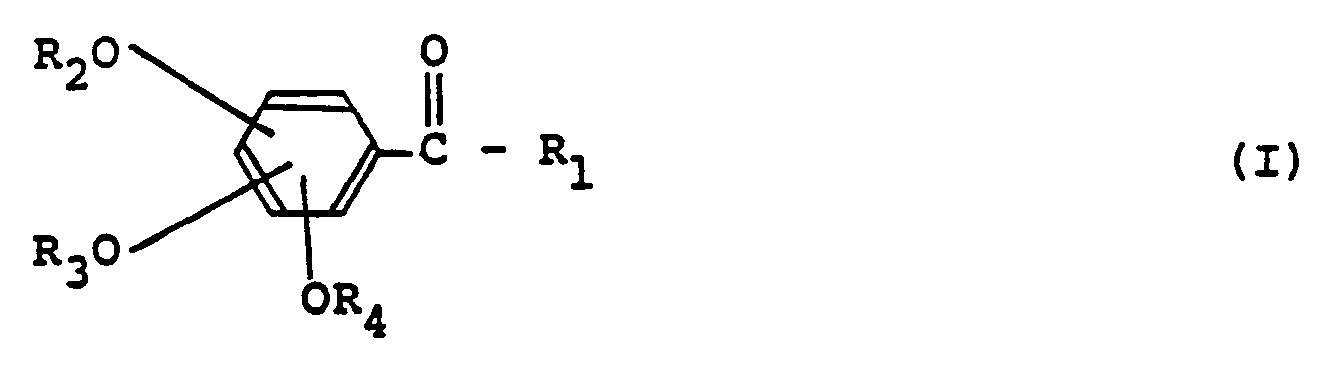
- a positive type photosensitive resin composition comprising an alkali-soluble novolak resin and (A) a compound represented by the following general formula (I) and a compound represented by the following general formula (II), or (B) a compound represented by the following general formula (111) and a compound represented by the following general formula (IV), wherein the molar ratio of the compound represented by the general formula (I) to the compound represented by the general formula (II) (hereinafter referred to as (I)/lll) is from 6.5:3.5 to 8.5:1.5 or the molar ratio of the compound represented by the general formula (III) to the compound represented by general formula (IV) (hereinafter referred to as (III)/(IV)) is 1/9-9/1, and the total amount of the component (A) or (B) is 5-100 parts by weight per 100 parts by weight of the alkali-soluble novolak resin: wherein R 1 , R 5 , R s and R 1o , which may be identical or different
- the compounds represented by the general formula (I) and the compounds represented by the general formula (II) can be obtained, as mentioned in, for example, U.S.P. 3, 046, 118, U.S.P.
- the compounds represented by the general formula (111) and the compounds represented by the general formula (IV) can be obtained, as mentioned in, for example, U.S.P. 3,106,465, U.S.P.
- alkali catalyst there may be used inorganic alkalis such as sodium hydroxide, sodium carbonate and the like and amines such as diethylamine, triethylamine.
- the compound represented by the general formula (I) thus obtained includes, for example,
- the compound represented by the general formula (II) thus obtained includes, for example,
- the compound represented by the general formula (III) thus obtained includes, for example,
- the compound represented by the general formula (IV) thus obtained includes, for example,
- the molar ratio (I)/(II) is from 6.5:3.5 to 8.5:1.5. If the molar ratio (I)/(II) exceeds 8.5:1.5, the photosensitive resin composition having a high sensitivity which is the object of this invention cannot be obtained, and the developability becomes worse. In addition, undeveloped portion remains at the pattern edge or at the interface between pattern and substrate, and defects appear in the pattern owing to embrittlement of photosensitive resin composition. If the molar ratio (I)/(II) is smaller than 6.5:1.5, the yield of residual film thickness of the pattern after development decreases, the coverage at the step structure becomes incomplete, the heat resistance decreases.
- the molar ratio (IIII/(IV) is 1/9-9/1, preferably 2/8-7/3. If the molar ratio (III)/(IV) is smaller than 1/9, the photosensitive resin composition having a high sensitivity which is the object of this invention cannot be obtained. Further, in this case, the compound represented by the general formula (IV) in the photosensitive resin composition cannot undergo sufficient chemical change if the time of exposure is short, and the remaining compound represented by the general formula (IV) results in a deterioration in developability and makes development difficult particularly in the case of fine pattern. In addition, when the pattern is large, undeveloped portion remains in the area to be developed and the surface of the pattern which is to be left is chipped.
- the molar ratio (III)/(IV) exceeds 9/1, the contribution of alkali-insolubilization to the photosensitive resin composition decreases, so that the pattern after development becomes slender and the yield of residual film thickness becomes low.
- the pattern cannot sufficiently cover the step structure portion, and the percentage of good article cannot be increased at the time of producing integrated circuits. Further, the pattern becomes susceptible to deformation at the time of post-baking since the heat resistance is low.
- the total amount of the component (A), namely the compound represented by the general formula (1) and the compound represented by the general formula (II), or the component (B), namely the compound represented by the general formula (III) and the compound represented by the general formula (IV), is 5-100 parts by weight, preferably 10-50 parts by weight, per 100 parts by weight of the alkali-soluble novolak resin. If the total amount is less than 5 parts by weight, the yield of residual film thickness after development becomes insufficient, and a deformed pattern is produced. If the total amount exceeds 100 parts by weight, no photosensitive resin composition having a high sensitivity can be obtained.
- 1,2-quinonediazide compounds may be incorporated in an amount of, for example, 20 parts by weight or less, preferably 10 parts by weight or less, per 100 parts by weight of the alkali-soluble novolak resin.
- Examples of said other 1,2-quinonediazide compound include the compounds represented by the general formula (III) and the compounds represented by the general formula (IV) when the compound represented by the general formula (I) and the compound represented by the general formula (II) are both used, while the examples include the compounds represented by the general formula (1) and the compounds represented by the general formula (II) when the compound represented by the general formula (III) and the compound represented by the general formula (IV) are both used.
- 1,2-quinonediazide compounds other than mentioned above among said other 1,2-quinonediazide compounds there may be used compounds represented by the general formula (Vll): wherein R 15 is an alkyl group, an aryl group or an aralkyl group, preferably an alkyl group having 1-12 carbon atoms, particularly preferably 1-6 carbon atoms, an aryl group represented by (R e and R d , which may be identical or different, represent hydrogen atoms or alkyl groups having 1-4 carbon atoms, or an aralkyl group represented by (R e is a hydrogen atom or an alkyl group having 1-4 carbon atoms, and m is 1 or 2), and R 16 is a 1,2-naphthoquinonediazide-4-sulfonyl group, 1,2-naphthoquinonediazide-5-sulfonyl group or 1,2-benzoquinonediazide-4-sulfonyl group, and compounds (VIII) prepared by
- the compound represented by the general formula (VII) includes, for example,
- the alkali-soluble novolak resin used in this invention can be produced by an addition-condensation reaction of a phenol and an aldehyde preferably in a proportion of 0.7-1 mole of the latter per mole of the former in the presence of an acid catalyst.
- phenol there may be used phenol, o-cresol, m-cresol, p-cresol, o-ethylphenol, m-ethylphenol, p-ethylphenol, o-butylphenol, m-butylphenol, p-butylphenol, 2,3-xylenol, 2,4-xylenol, 2,5-xylenol, 2,6-xylenol, 3,4-xylenol, 3,6-xylenol, p-phenylphenol and the like.
- These phenols may be used either along or in admixture of two or more, considering their alkali-solubility.
- aldehyde there may be used formaldehyde, paraformaldehyde, furfural and the like.
- acid catalyst there may be used inorganic acids such as hydrochloric acid, nitric acid, sulfuric acid and the like and organic acids such as formic acid, oxalic acid, acetic acid and the like.
- the photosensitive resin composition of this invention is produced by dissolving the above-mentioned alkali-soluble novolak resin and 1,2-quinonediazide compound in a solvent.
- Solvents usable for this purpose include, for example, glycol ethers such as ethylene glycol monomethyl ether or ethylene glycol monoethyl ether; Cellosolve esters such as methyl Cellosolve acetate or ethyl Cellosolve acetate; aromatic hydrocarbons such as toluene or xylene; ketones such as methyl ethyl ketone or cyclohexanone; and esters such as ethyl acetate or butyl acetate. These solvents may be used in admixture of several members, considering the solubilities of the constituents, vaporization speed of solvent after coating and photosensitive resin composition on a substrate, and the effect of coating film on the surface shape.
- a storage stabilizer may also be added to the photosensitive resin composition of this invention.
- the substrate may be previously coated with hexamethyldisilazane, choromethylsilane or the like.
- aqueous solutions of alkalis including inorganic alkalis such as sodium hydroxide, potassium hydroxide, sodium carbonate, sodium silicate, sodium metasilicate, aqueous ammonia and the like; primary amines such as ethylamine, n-propylamine and the like; secondary amines such as diethylamine, di-n-propylamine and the like; tertiary amines such as triethylamine, methyldiethylamine and the like; alkanolamines such as dimethylethanolamine, triethanolamine and the like; quaternary ammonium salts such as tetramethylammonium hydroxide, tetraethylammonium hydroxide and the like; and aqueous solutions of cyclic amines such as pyrrole, piperidine, 1,8-diazabicyclo(5,4,0)-7-undecene, 1,5
- an aqueous solution of a quaternary ammonium salt or a cyclic amine is preferable.
- the developer there may also be used an aqueous solution prepared by adding an appropriate quantity of a water-soluble organic solvent, such as methanol or ethanol, or a surfactant to the above-mentioned aqueous alkali solution.
- the photosensitive resin composition of this invention is useful not only as a positive type photoresist for the production of an integrated circuit but also as a positive type photoresist for the production of a photo-mask.
- the above-mentioned photosensitive resin composition solution was applied to a silicon oxide film wafer by means of a spinner, it was prebaked in an oven at 90°C for 25 minutes to form a coating film of photosensitive resin composition having a thickness of 1 pm.
- the coating film was exposed to ultraviolet rays having an intensity of 9 mJ/cm 2 through a photo-mask manufactured by Toppan Insatsu K.K. and then developed with 2.4% by weight aqueous solution of tetramethylammonium hydroxide at 20°C for 60 seconds, whereby a pattern having a line width of 1.0 pm was resolved.
- the yield of residual film thickness was 92%. Accordingly, this photosensitive resin composition is understood to have a high sensitivity and a high yield of residual film thickness.
- a photosensitive resin composition solution was prepared by dissolving 1 g of the compound (a) used in Example 1 and 4 g of the alkali-soluble novolak resin synthesized in Example 1 in 15 g of ethyl Cellosolve acetate and filtering the solution through a filter having a pore diameter of 0.2 pm. Then, the photosensitive resin composition thus obtained was evaluated by the same methods as in Example 1. As a result, it was found that an ultraviolet exposure energy of 25 mJ/cm 2 was necessary for resolving a pattern having a line width of 1.0 pm, and hence the photosensitive resin composition had a low sensitivity. Further, unexposed portion remained between the pattern and the substrate, and a part of the pattern was chipped.
- Photosensitive resin composition solutions were prepared by repeating the same procedure as in Example 1, except that the amounts of the compounds (a), (b) and (c) were as shown in Table 1. Then, the photosensitive resin compositions were evaluated by the same methods as in Example 1. The results were as shown in Table 1.
- the photosensitive resin composition was evaluated by the same methods as in Example 1. As a result, it was found that the ultraviolet exposure energy necessary for resolving a pattern having a line width of 1.0 11m was 10.5 mJ/ cm 2 and the yield of residual film thickness was 90%. It is apparent from these results that this photosensitive resin composition is high in both sensitivity and yield of residual film thickness.
- a photosensitive resin composition solution was prepared by repeating the same procedure as in Example 1, except that the compounds (a), (b) and (c) were replaced with 1 g of the compound (h). Then, the photosensitive resin composition was evaluated by the same methods as in Example 1. As a result, it was found that an ultraviolet exposure energy of 25 mJ/cm 2 was necessary for resolving a pattern having a line width of 1.0 pm, and hence, the sensitivity of the composition was low.
- An alkali-soluble novolak resin was synthesized by repeating the same procedure as in Example 1, except that the 30 g of phenol and the 70 g of p-cresol were replaced with 75 g of m-cresol and 25 g of p-cresol respectively.
- the photosensitive resin composition was evaluated by the same methods as in Example 1. As a result, it was found that the ultraviolet exposure energy necessary for resolving a pattern having a line width of 1 pm was 8.9 mJ/cm 2 and the yield of residual film thickness was 87%. It is apparent from these results that this photosensitive resin composition is high in both sensitivity and yield of residual film thickness.
Landscapes
- Physics & Mathematics (AREA)
- General Physics & Mathematics (AREA)
- Materials For Photolithography (AREA)
- Photosensitive Polymer And Photoresist Processing (AREA)
Claims (9)


Applications Claiming Priority (4)
| Application Number | Priority Date | Filing Date | Title |
|---|---|---|---|
| JP65759/82 | 1982-04-20 | ||
| JP6575982A JPS58182632A (ja) | 1982-04-20 | 1982-04-20 | ポジ型感光性樹脂組成物 |
| JP40478/83 | 1983-03-11 | ||
| JP4047883A JPS59165053A (ja) | 1983-03-11 | 1983-03-11 | ポジ型感光性樹脂組成物 |
Publications (3)
| Publication Number | Publication Date |
|---|---|
| EP0092444A2 EP0092444A2 (de) | 1983-10-26 |
| EP0092444A3 EP0092444A3 (en) | 1984-12-05 |
| EP0092444B1 true EP0092444B1 (de) | 1990-08-29 |
Family
ID=26379934
Family Applications (1)
| Application Number | Title | Priority Date | Filing Date |
|---|---|---|---|
| EP83302258A Expired EP0092444B1 (de) | 1982-04-20 | 1983-04-20 | Zusammensetzung von photoempfindlichem Harz des Positivtyps |
Country Status (3)
| Country | Link |
|---|---|
| US (1) | US4499171A (de) |
| EP (1) | EP0092444B1 (de) |
| DE (1) | DE3381834D1 (de) |
Families Citing this family (38)
| Publication number | Priority date | Publication date | Assignee | Title |
|---|---|---|---|---|
| DE3220816A1 (de) * | 1982-06-03 | 1983-12-08 | Merck Patent Gmbh, 6100 Darmstadt | Lichtempfindliche komponenten fuer positiv arbeitende fotoresistmaterialien |
| EP0136110A3 (de) * | 1983-08-30 | 1986-05-28 | Mitsubishi Kasei Corporation | Positive lichtempfindliche Zusammensetzung und Verwendung für Photolacke |
| US4596763A (en) * | 1984-10-01 | 1986-06-24 | American Hoechst Corporation | Positive photoresist processing with mid U-V range exposure |
| JPS61141441A (ja) * | 1984-12-14 | 1986-06-28 | Tokyo Ohka Kogyo Co Ltd | ポジ型ホトレジスト組成物 |
| JPS61185741A (ja) * | 1985-02-13 | 1986-08-19 | Mitsubishi Chem Ind Ltd | ポジ型フオトレジスト組成物 |
| US4588670A (en) * | 1985-02-28 | 1986-05-13 | American Hoechst Corporation | Light-sensitive trisester of O-quinone diazide containing composition for the preparation of a positive-acting photoresist |
| JPS62123444A (ja) | 1985-08-07 | 1987-06-04 | Japan Synthetic Rubber Co Ltd | ポジ型感放射線性樹脂組成物 |
| US5256522A (en) * | 1985-08-12 | 1993-10-26 | Hoechst Celanese Corporation | Image reversal negative working O-naphthoquinone diazide and cross-linking compound containing photoresist process with thermal curing |
| US4931381A (en) * | 1985-08-12 | 1990-06-05 | Hoechst Celanese Corporation | Image reversal negative working O-quinone diazide and cross-linking compound containing photoresist process with thermal curing treatment |
| US5217840A (en) * | 1985-08-12 | 1993-06-08 | Hoechst Celanese Corporation | Image reversal negative working o-quinone diazide and cross-linking compound containing photoresist process with thermal curing treatment and element produced therefrom |
| US4684597A (en) * | 1985-10-25 | 1987-08-04 | Eastman Kodak Company | Non-precipitating quinone diazide polymer containing photoresist composition with o-quinone diazide trisester as dissolution inhibitor |
| EP0227487B1 (de) * | 1985-12-27 | 1992-07-15 | Japan Synthetic Rubber Co., Ltd. | Strahlungsempfindliche positiv arbeitende Kunststoffzusammensetzung |
| US5035976A (en) * | 1986-05-02 | 1991-07-30 | Hoechst Celanese Corporation | Photosensitive article having phenolic photosensitizers containing quinone diazide and acid halide substituents |
| US5162510A (en) * | 1986-05-02 | 1992-11-10 | Hoechst Celanese Corporation | Process for the preparation of photosensitive compositions containing a mixed ester o-quinone photosensitizer |
| US4732836A (en) * | 1986-05-02 | 1988-03-22 | Hoechst Celanese Corporation | Novel mixed ester O-quinone photosensitizers |
| US4732837A (en) * | 1986-05-02 | 1988-03-22 | Hoechst Celanese Corporation | Novel mixed ester O-quinone photosensitizers |
| US4902785A (en) * | 1986-05-02 | 1990-02-20 | Hoechst Celanese Corporation | Phenolic photosensitizers containing quinone diazide and acidic halide substituents |
| JPH0654388B2 (ja) * | 1986-05-02 | 1994-07-20 | 東京応化工業株式会社 | ポジ型ホトレジスト組成物 |
| JP2568827B2 (ja) * | 1986-10-29 | 1997-01-08 | 富士写真フイルム株式会社 | ポジ型フオトレジスト組成物 |
| US5128230A (en) * | 1986-12-23 | 1992-07-07 | Shipley Company Inc. | Quinone diazide containing photoresist composition utilizing mixed solvent of ethyl lactate, anisole and amyl acetate |
| JPS63178228A (ja) * | 1987-01-20 | 1988-07-22 | Fuji Photo Film Co Ltd | ポジ型フオトレジスト組成物 |
| US4996122A (en) * | 1988-03-31 | 1991-02-26 | Morton International, Inc. | Method of forming resist pattern and thermally stable and highly resolved resist pattern |
| DE3842896C2 (de) * | 1988-04-22 | 1998-07-02 | Tokyo Ohka Kogyo Co Ltd | Positiv arbeitende lichtempfindliche Zusammensetzung |
| US4943511A (en) * | 1988-08-05 | 1990-07-24 | Morton Thiokol, Inc. | High sensitivity mid and deep UV resist |
| US5169741A (en) * | 1988-10-11 | 1992-12-08 | Matsushita Electric Industrial Co., Ltd. | Method for forming high sensitivity positive patterns employing a material containing a photosensitive compound having a diazo group, an alkaline-soluble polymer, a compound capable of adjusting the pH to 4 or less and a solvent |
| JP2715480B2 (ja) * | 1988-10-13 | 1998-02-18 | 住友化学工業株式会社 | ポジ型レジスト用組成物 |
| US5753406A (en) * | 1988-10-18 | 1998-05-19 | Japan Synthetic Rubber Co., Ltd. | Radiation-sensitive resin composition |
| DE3837500A1 (de) * | 1988-11-04 | 1990-05-23 | Hoechst Ag | Neue, strahlungsempfindliche verbindungen, hiermit hergestelltes strahlungsempfindliches gemisch und aufzeichnungsmaterial |
| EP0701169B1 (de) * | 1989-09-08 | 1998-12-30 | Olin Microelectronic Chemicals, Inc. | Vollständig substituierte Novalak-Polymere enthaltende Strahlungsempfindliche Zusammensetzungen |
| US5075194A (en) * | 1990-01-09 | 1991-12-24 | Industrial Technology Research Institute | Positive photoresist composition containing 4,4-diester, 4,5-diester, or 5,5-diester of spiroglycol and 1-oxo-2-diazonaphthalene-5-sulfonic acid chloride |
| JP2761786B2 (ja) * | 1990-02-01 | 1998-06-04 | 富士写真フイルム株式会社 | ポジ型フオトレジスト組成物 |
| TW202504B (de) * | 1990-02-23 | 1993-03-21 | Sumitomo Chemical Co | |
| JPH03294861A (ja) * | 1990-04-13 | 1991-12-26 | Mitsubishi Petrochem Co Ltd | ポジ型フォトレジスト組成物 |
| US5346799A (en) * | 1991-12-23 | 1994-09-13 | Ocg Microelectronic Materials, Inc. | Novolak resins and their use in radiation-sensitive compositions wherein the novolak resins are made by condensing 2,6-dimethylphenol, 2,3-dimethylphenol, a para-substituted phenol and an aldehyde |
| JPH0915853A (ja) * | 1995-04-27 | 1997-01-17 | Fuji Photo Film Co Ltd | ポジ型フォトレジスト組成物 |
| US20040192876A1 (en) * | 2002-11-18 | 2004-09-30 | Nigel Hacker | Novolac polymer planarization films with high temparature stability |
| EP1649322A4 (de) * | 2003-07-17 | 2007-09-19 | Honeywell Int Inc | Planarisierungsfilme für fortschrittliche mikroelektronsiche anwendungen und einrichtungen und herstellungsverfahren dafür |
| KR101430962B1 (ko) * | 2008-03-04 | 2014-08-18 | 주식회사 동진쎄미켐 | 포토레지스트 조성물 및 이를 이용한 어레이 기판의 제조방법 |
Family Cites Families (9)
| Publication number | Priority date | Publication date | Assignee | Title |
|---|---|---|---|---|
| NL80628C (de) * | 1949-07-23 | |||
| DE938233C (de) * | 1953-03-11 | 1956-01-26 | Kalle & Co Ag | Lichtempfindliches Material fuer die photomechanische Herstellung von Druckformen |
| NL131386C (de) * | 1959-08-29 | |||
| NL255517A (de) * | 1959-09-04 | |||
| CA774047A (en) * | 1963-12-09 | 1967-12-19 | Shipley Company | Light-sensitive material and process for the development thereof |
| US3802885A (en) * | 1967-08-15 | 1974-04-09 | Algraphy Ltd | Photosensitive lithographic naphthoquinone diazide printing plate with aluminum base |
| US4005437A (en) * | 1975-04-18 | 1977-01-25 | Rca Corporation | Method of recording information in which the electron beam sensitive material contains 4,4'-bis(3-diazo-3-4-oxo-1-naphthalene sulfonyloxy)benzil |
| US4189320A (en) * | 1975-04-29 | 1980-02-19 | American Hoechst Corporation | Light-sensitive o-quinone diazide compositions and photographic reproduction processes and structures |
| US4059449A (en) * | 1976-09-30 | 1977-11-22 | Rca Corporation | Photoresist containing a thiodipropionate compound |
-
1983
- 1983-04-12 US US06/484,312 patent/US4499171A/en not_active Expired - Lifetime
- 1983-04-20 DE DE8383302258T patent/DE3381834D1/de not_active Expired - Lifetime
- 1983-04-20 EP EP83302258A patent/EP0092444B1/de not_active Expired
Also Published As
| Publication number | Publication date |
|---|---|
| EP0092444A3 (en) | 1984-12-05 |
| DE3381834D1 (de) | 1990-10-04 |
| US4499171A (en) | 1985-02-12 |
| EP0092444A2 (de) | 1983-10-26 |
Similar Documents
| Publication | Publication Date | Title |
|---|---|---|
| EP0092444B1 (de) | Zusammensetzung von photoempfindlichem Harz des Positivtyps | |
| JP3968177B2 (ja) | 微細レジストパターン形成方法 | |
| US20030134223A1 (en) | Positive photoresist composition and method of patterning resist thin film for use in inclined implantation process | |
| US5215856A (en) | Tris-(hydroxyphenyl) lower alkane compounds as sensitivity enhancers for o-quinonediazide containing radiation-sensitive compositions and elements | |
| US6905809B2 (en) | Photoresist compositions | |
| JPH034896B2 (de) | ||
| JPS58182632A (ja) | ポジ型感光性樹脂組成物 | |
| US6475694B2 (en) | Positive photoresist composition comprising a phenolic compound having both an acid-decomposable group and a naphthoquinonediazide sulfonyl group | |
| JPH08262712A (ja) | 感放射線性樹脂組成物 | |
| US6762005B2 (en) | Positive photoresist composition and method of patterning resist thin film for use in inclined implantation process | |
| KR100608966B1 (ko) | 감방사선성수지조성물 | |
| JP3784095B2 (ja) | 感光性樹脂組成物 | |
| JPS61130947A (ja) | ポジ型レジスト組成物 | |
| JPS63210923A (ja) | パタ−ン形成用樹脂組成物 | |
| US5024921A (en) | Thermally stable light-sensitive compositions with o-quinone diazide and phenolic resin used in a method of forming a positive photoresist image | |
| JPH0654385B2 (ja) | ポジ型感放射線性樹脂組成物 | |
| JP3666000B2 (ja) | 感放射線性樹脂組成物 | |
| JP2623803B2 (ja) | 感放射線性樹脂組成物 | |
| JPH07281429A (ja) | ポジ型レジスト溶液 | |
| JPH08179499A (ja) | ポジ型レジスト溶液 | |
| JPH04211257A (ja) | ポリフェノール化合物 | |
| JPH0656488B2 (ja) | ポジ型感光性樹脂組成物 | |
| JP3629692B2 (ja) | ポジ型レジスト組成物 | |
| JPH09222728A (ja) | ポジ型レジスト組成物 | |
| JPH042180B2 (de) |
Legal Events
| Date | Code | Title | Description |
|---|---|---|---|
| PUAI | Public reference made under article 153(3) epc to a published international application that has entered the european phase |
Free format text: ORIGINAL CODE: 0009012 |
|
| AK | Designated contracting states |
Designated state(s): DE FR GB |
|
| PUAL | Search report despatched |
Free format text: ORIGINAL CODE: 0009013 |
|
| AK | Designated contracting states |
Designated state(s): DE FR GB |
|
| 17P | Request for examination filed |
Effective date: 19850123 |
|
| 17Q | First examination report despatched |
Effective date: 19860725 |
|
| D17Q | First examination report despatched (deleted) | ||
| GRAA | (expected) grant |
Free format text: ORIGINAL CODE: 0009210 |
|
| AK | Designated contracting states |
Kind code of ref document: B1 Designated state(s): DE FR GB |
|
| REF | Corresponds to: |
Ref document number: 3381834 Country of ref document: DE Date of ref document: 19901004 |
|
| ET | Fr: translation filed | ||
| PLBE | No opposition filed within time limit |
Free format text: ORIGINAL CODE: 0009261 |
|
| STAA | Information on the status of an ep patent application or granted ep patent |
Free format text: STATUS: NO OPPOSITION FILED WITHIN TIME LIMIT |
|
| 26N | No opposition filed | ||
| REG | Reference to a national code |
Ref country code: GB Ref legal event code: IF02 |
|
| PGFP | Annual fee paid to national office [announced via postgrant information from national office to epo] |
Ref country code: FR Payment date: 20020410 Year of fee payment: 20 |
|
| PGFP | Annual fee paid to national office [announced via postgrant information from national office to epo] |
Ref country code: GB Payment date: 20020417 Year of fee payment: 20 |
|
| PGFP | Annual fee paid to national office [announced via postgrant information from national office to epo] |
Ref country code: DE Payment date: 20020424 Year of fee payment: 20 |
|
| PG25 | Lapsed in a contracting state [announced via postgrant information from national office to epo] |
Ref country code: GB Free format text: LAPSE BECAUSE OF EXPIRATION OF PROTECTION Effective date: 20030419 |
|
| REG | Reference to a national code |
Ref country code: GB Ref legal event code: PE20 |