EP0088158B1 - Verfahren zur Herstellung von mit Organosilanen oberflächenmodifizierten Zeolithen - Google Patents
Verfahren zur Herstellung von mit Organosilanen oberflächenmodifizierten Zeolithen Download PDFInfo
- Publication number
- EP0088158B1 EP0088158B1 EP82110922A EP82110922A EP0088158B1 EP 0088158 B1 EP0088158 B1 EP 0088158B1 EP 82110922 A EP82110922 A EP 82110922A EP 82110922 A EP82110922 A EP 82110922A EP 0088158 B1 EP0088158 B1 EP 0088158B1
- Authority
- EP
- European Patent Office
- Prior art keywords
- zeolite
- zeolites
- silanes
- modified
- organosilane
- Prior art date
- Legal status (The legal status is an assumption and is not a legal conclusion. Google has not performed a legal analysis and makes no representation as to the accuracy of the status listed.)
- Expired
Links
- 239000010457 zeolite Substances 0.000 title claims description 38
- 150000001282 organosilanes Chemical group 0.000 title claims description 15
- 238000000034 method Methods 0.000 title claims description 10
- 229910021536 Zeolite Inorganic materials 0.000 claims description 23
- HNPSIPDUKPIQMN-UHFFFAOYSA-N dioxosilane;oxo(oxoalumanyloxy)alumane Chemical compound O=[Si]=O.O=[Al]O[Al]=O HNPSIPDUKPIQMN-UHFFFAOYSA-N 0.000 claims description 23
- 239000003599 detergent Substances 0.000 claims description 7
- 239000000725 suspension Substances 0.000 claims description 5
- NBXZNTLFQLUFES-UHFFFAOYSA-N triethoxy(propyl)silane Chemical compound CCC[Si](OCC)(OCC)OCC NBXZNTLFQLUFES-UHFFFAOYSA-N 0.000 claims description 5
- 239000007921 spray Substances 0.000 claims description 4
- XLYOFNOQVPJJNP-UHFFFAOYSA-N water Substances O XLYOFNOQVPJJNP-UHFFFAOYSA-N 0.000 claims description 4
- YYLGKUPAFFKGRQ-UHFFFAOYSA-N dimethyldiethoxysilane Chemical compound CCO[Si](C)(C)OCC YYLGKUPAFFKGRQ-UHFFFAOYSA-N 0.000 claims description 3
- 238000004519 manufacturing process Methods 0.000 claims description 3
- 239000003960 organic solvent Substances 0.000 claims description 3
- 239000000203 mixture Substances 0.000 claims description 2
- 239000007787 solid Substances 0.000 claims 1
- BLRPTPMANUNPDV-UHFFFAOYSA-N Silane Chemical compound [SiH4] BLRPTPMANUNPDV-UHFFFAOYSA-N 0.000 description 9
- 229910000077 silane Inorganic materials 0.000 description 9
- 238000006243 chemical reaction Methods 0.000 description 7
- 150000004756 silanes Chemical class 0.000 description 7
- 239000002904 solvent Substances 0.000 description 6
- 102000005701 Calcium-Binding Proteins Human genes 0.000 description 3
- 108010045403 Calcium-Binding Proteins Proteins 0.000 description 3
- 238000005054 agglomeration Methods 0.000 description 3
- 230000002776 aggregation Effects 0.000 description 3
- JYIMWRSJCRRYNK-UHFFFAOYSA-N dialuminum;disodium;oxygen(2-);silicon(4+);hydrate Chemical compound O.[O-2].[O-2].[O-2].[O-2].[O-2].[O-2].[Na+].[Na+].[Al+3].[Al+3].[Si+4] JYIMWRSJCRRYNK-UHFFFAOYSA-N 0.000 description 3
- 239000002245 particle Substances 0.000 description 3
- 239000000843 powder Substances 0.000 description 3
- 125000003545 alkoxy group Chemical group 0.000 description 2
- 238000009826 distribution Methods 0.000 description 2
- 238000002360 preparation method Methods 0.000 description 2
- 239000007858 starting material Substances 0.000 description 2
- -1 Aliphatic alcohols Chemical class 0.000 description 1
- 239000004593 Epoxy Substances 0.000 description 1
- 229910019142 PO4 Inorganic materials 0.000 description 1
- XUIMIQQOPSSXEZ-UHFFFAOYSA-N Silicon Chemical group [Si] XUIMIQQOPSSXEZ-UHFFFAOYSA-N 0.000 description 1
- NIXOWILDQLNWCW-UHFFFAOYSA-N acrylic acid group Chemical group C(C=C)(=O)O NIXOWILDQLNWCW-UHFFFAOYSA-N 0.000 description 1
- 239000013543 active substance Substances 0.000 description 1
- 125000001931 aliphatic group Chemical group 0.000 description 1
- 125000003277 amino group Chemical group 0.000 description 1
- 239000007900 aqueous suspension Substances 0.000 description 1
- 239000003054 catalyst Substances 0.000 description 1
- 125000000753 cycloalkyl group Chemical group 0.000 description 1
- 238000007865 diluting Methods 0.000 description 1
- 125000003700 epoxy group Chemical group 0.000 description 1
- 230000009969 flowable effect Effects 0.000 description 1
- 238000010438 heat treatment Methods 0.000 description 1
- 125000001183 hydrocarbyl group Chemical group 0.000 description 1
- 239000012442 inert solvent Substances 0.000 description 1
- 230000004048 modification Effects 0.000 description 1
- 238000012986 modification Methods 0.000 description 1
- 239000002808 molecular sieve Substances 0.000 description 1
- 235000021317 phosphate Nutrition 0.000 description 1
- 150000003013 phosphoric acid derivatives Chemical class 0.000 description 1
- 239000011541 reaction mixture Substances 0.000 description 1
- 238000010992 reflux Methods 0.000 description 1
- 229910052710 silicon Inorganic materials 0.000 description 1
- URGAHOPLAPQHLN-UHFFFAOYSA-N sodium aluminosilicate Chemical compound [Na+].[Al+3].[O-][Si]([O-])=O.[O-][Si]([O-])=O URGAHOPLAPQHLN-UHFFFAOYSA-N 0.000 description 1
- 238000001694 spray drying Methods 0.000 description 1
- 238000005507 spraying Methods 0.000 description 1
- 239000003381 stabilizer Substances 0.000 description 1
- 239000000126 substance Substances 0.000 description 1
- 239000004094 surface-active agent Substances 0.000 description 1
- CZDYPVPMEAXLPK-UHFFFAOYSA-N tetramethylsilane Chemical compound C[Si](C)(C)C CZDYPVPMEAXLPK-UHFFFAOYSA-N 0.000 description 1
Classifications
-
- C—CHEMISTRY; METALLURGY
- C11—ANIMAL OR VEGETABLE OILS, FATS, FATTY SUBSTANCES OR WAXES; FATTY ACIDS THEREFROM; DETERGENTS; CANDLES
- C11D—DETERGENT COMPOSITIONS; USE OF SINGLE SUBSTANCES AS DETERGENTS; SOAP OR SOAP-MAKING; RESIN SOAPS; RECOVERY OF GLYCEROL
- C11D3/00—Other compounding ingredients of detergent compositions covered in group C11D1/00
- C11D3/02—Inorganic compounds ; Elemental compounds
- C11D3/12—Water-insoluble compounds
- C11D3/124—Silicon containing, e.g. silica, silex, quartz or glass beads
- C11D3/1246—Silicates, e.g. diatomaceous earth
- C11D3/128—Aluminium silicates, e.g. zeolites
-
- C—CHEMISTRY; METALLURGY
- C01—INORGANIC CHEMISTRY
- C01B—NON-METALLIC ELEMENTS; COMPOUNDS THEREOF; METALLOIDS OR COMPOUNDS THEREOF NOT COVERED BY SUBCLASS C01C
- C01B39/00—Compounds having molecular sieve and base-exchange properties, e.g. crystalline zeolites; Their preparation; After-treatment, e.g. ion-exchange or dealumination
- C01B39/02—Crystalline aluminosilicate zeolites; Isomorphous compounds thereof; Direct preparation thereof; Preparation thereof starting from a reaction mixture containing a crystalline zeolite of another type, or from preformed reactants; After-treatment thereof
- C01B39/026—After-treatment
-
- C—CHEMISTRY; METALLURGY
- C11—ANIMAL OR VEGETABLE OILS, FATS, FATTY SUBSTANCES OR WAXES; FATTY ACIDS THEREFROM; DETERGENTS; CANDLES
- C11D—DETERGENT COMPOSITIONS; USE OF SINGLE SUBSTANCES AS DETERGENTS; SOAP OR SOAP-MAKING; RESIN SOAPS; RECOVERY OF GLYCEROL
- C11D3/00—Other compounding ingredients of detergent compositions covered in group C11D1/00
- C11D3/16—Organic compounds
- C11D3/162—Organic compounds containing Si
-
- B—PERFORMING OPERATIONS; TRANSPORTING
- B01—PHYSICAL OR CHEMICAL PROCESSES OR APPARATUS IN GENERAL
- B01J—CHEMICAL OR PHYSICAL PROCESSES, e.g. CATALYSIS OR COLLOID CHEMISTRY; THEIR RELEVANT APPARATUS
- B01J2229/00—Aspects of molecular sieve catalysts not covered by B01J29/00
- B01J2229/10—After treatment, characterised by the effect to be obtained
- B01J2229/12—After treatment, characterised by the effect to be obtained to alter the outside of the crystallites, e.g. selectivation
-
- B—PERFORMING OPERATIONS; TRANSPORTING
- B01—PHYSICAL OR CHEMICAL PROCESSES OR APPARATUS IN GENERAL
- B01J—CHEMICAL OR PHYSICAL PROCESSES, e.g. CATALYSIS OR COLLOID CHEMISTRY; THEIR RELEVANT APPARATUS
- B01J2229/00—Aspects of molecular sieve catalysts not covered by B01J29/00
- B01J2229/30—After treatment, characterised by the means used
- B01J2229/32—Reaction with silicon compounds, e.g. TEOS, siliconfluoride
-
- Y—GENERAL TAGGING OF NEW TECHNOLOGICAL DEVELOPMENTS; GENERAL TAGGING OF CROSS-SECTIONAL TECHNOLOGIES SPANNING OVER SEVERAL SECTIONS OF THE IPC; TECHNICAL SUBJECTS COVERED BY FORMER USPC CROSS-REFERENCE ART COLLECTIONS [XRACs] AND DIGESTS
- Y10—TECHNICAL SUBJECTS COVERED BY FORMER USPC
- Y10T—TECHNICAL SUBJECTS COVERED BY FORMER US CLASSIFICATION
- Y10T428/00—Stock material or miscellaneous articles
- Y10T428/29—Coated or structually defined flake, particle, cell, strand, strand portion, rod, filament, macroscopic fiber or mass thereof
- Y10T428/2982—Particulate matter [e.g., sphere, flake, etc.]
- Y10T428/2991—Coated
- Y10T428/2993—Silicic or refractory material containing [e.g., tungsten oxide, glass, cement, etc.]
- Y10T428/2995—Silane, siloxane or silicone coating
Definitions
- the invention relates to a process for the production of surface-modified zeolites with organosilanes.
- the reactive groups of the silanes still remaining after the reaction with the zeolite surface also mean that the modified zeolites are not compatible with all surface-active agents which are usually used in detergents.
- the object of the invention is to produce a zeolite which has been surface-modified with silanes and which can avoid these disadvantages.
- the invention relates to a process for the preparation of crystalline zeolites which are surface-modified with organosilanes and are in the Na form and which is characterized in that the zeolites contain 0.02-5% by weight, based on the amount of zeolite used, an organosilane from the group of n-propyltriethoxysilane and dimethyldiethoxysilane are reacted, the organosilane optionally being dissolved in an organic solvent.
- a type A zeolite is used as the starting material, which according to the German laid-open documents DE-A-24 47 021, DE-A-25 17 218, DE-A-26 51 419, DE-A-26 51 420 , DE-A-26 51 436, DE-A-26 51 437, DE-A-26 51 445 and / or DE-A-26 51 485 was produced and has the particle size distribution shown there.
- a type A zeolite powder according to DE-A-26 51 485 is preferably used.
- the water content of the zeolite can be 0-25%, preferably 15 to 25%.
- the organosilane can be dripped or sprayed onto the zeolite placed in a sealable vessel.
- the amount of organosilane amounts to 0.02-5% by weight, based on the amount of zeolite used.
- the same amounts of organosilane can also be mixed with the zeolite dissolved in an organic solvent.
- concentration of the silane in the solvent is preferably between 0.5 and 1% by weight.
- Inert, apolar, saturated aliphatic and unsaturated cyclic hydrocarbons are particularly suitable as solvents.
- Aliphatic alcohols can also advantageously be used.
- the purpose of diluting the silanes with solvents is to distribute them evenly on the surface of the zeolite during spraying or dropping. After the reaction of the silane has taken place, the solvent is then stripped off if it has not already evaporated during the reaction step, which takes place at elevated temperature.
- the total concentration of the silane in the solvent corresponds to the 0.02-5% by weight given above, based on the amount of the zeolite to be reacted.
- the reaction mixture of zeolite / silane or silane / solvent is mixed intensively at temperatures between 30 ° C. and 150 ° C., preferably 80 and 150 ° C., until a complete conversion of the silane has taken place.
- the organosilane can be added to an aqueous suspension which has a content of between 20 and 60% by weight, preferably 43 and 51% by weight, of zeolite.
- a stabilizing agent contained in such suspensions does not interfere.
- the suspension is then spray dried.
- a powder is then likewise obtained, the flowability and agglomeration behavior of which are improved in comparison with the starting zeolite. This means that in this case the surface modification took place during the heating in the spray tower.
- the reactive alkoxy groups react with the zeolite, so that only inert hydrocarbon residues are bound to the silicon atom after the reaction. For this reason, no reaction of these groups with the other surface-active substances used in the detergents is to be feared later.
- the zeolite obtained according to the invention surprisingly shows a marked improvement in the flowability and shows a significantly lower tendency to agglomerate than the starting material, although the converted silanes no longer have any reactive groups.
- the calcium binding capacity which is of crucial importance in assessing the applicability of the zeolites, drops only insignificantly.
- the bulk density of the powdery zeolite is only slightly reduced by modifying the surface with the organosilanes.
- the height of the cone was chosen as a measure of the flowability and the agglomeration behavior.
- HAB A40 type A zeolite
Landscapes
- Chemical & Material Sciences (AREA)
- Life Sciences & Earth Sciences (AREA)
- Organic Chemistry (AREA)
- Chemical Kinetics & Catalysis (AREA)
- Engineering & Computer Science (AREA)
- Oil, Petroleum & Natural Gas (AREA)
- Wood Science & Technology (AREA)
- General Life Sciences & Earth Sciences (AREA)
- Geology (AREA)
- Inorganic Chemistry (AREA)
- Materials Engineering (AREA)
- Silicates, Zeolites, And Molecular Sieves (AREA)
- Detergent Compositions (AREA)
Description
- Die Erfindung betrifft ein Verfahren zur Herstellung von mit Organosilanen oberflächenmodifizierten Zeolithen.
- Es ist bekannt, Phosphate in Waschmitteln mittels des kristallinen Zeoliths des Typs NaA4, der eine definierte Teilchengrößenverteilung aufweist, zu substituieren.
- Es zeigt sich jedoch, daß Zeolithe mit kleiner Teilchengröße bei der Herstellung der Waschmittel zum Agglomerieren neigen. Die so entstandenen Agglomerate verschlechtern die Wirksamkeit und lagern sich im ungünstigsten Fall auf der Wäsche ab. Eine Möglichkeit, die Agglomerationsneigung von pulverförmigen Substanzen zu verringern besteht in der Modifizierung der Oberfläche.
- Es ist bekannt, wasserfreie Zeolithe mit Silanen bei erhöhten Temperaturen umzusetzen. Dabei handelte es sich jedoch um Y-Zeolithe, die in der ausgetauschten H-Form vorlagen. Sie wurden bei Temperaturen zwischen 250 und 650 °C mit Tetramethylsilan umgesetzt und anschließend ihre Wirksamkeit als Katalysatoren getestet. (Mc Ateer, J. J. Rooney « Proceedings of the 3rd Int. Conference on Molecular Sieves », J. B. Unterhoeven, Editor, Zürich, 3-7 September 1973, S. 258-265).
- Weiterhin ist bekannt, Zeolithe in der Na-Form mit Organosilanen zu behandeln (US-A-4 138 363, DE-A-28 43 709, US-A-4 243 545) und auf diesem Wege die Agglomerationsneigung zu verringern. Dabei wird das Calciumbindevermögen der Zeolithe nur unwesentlich beeinflußt, das für den Einsatz in Waschmitteln von Bedeutung ist.
- Bedingung für die Einsetzbarkeit der Silane nach diesen Verfahren ist aber, daß sie nach der Umsetzung der Alkoxygruppen mit dem Zeolith noch eine weitere reaktive Gruppe wie z. B. Acryl-, Epoxy-oder Aminogruppen besitzen.
- Erst die Anwesenheit dieser Gruppen bewirkt die oben angeführten Eigenschaftsverbesserungen der oberflächenmodifizierten Zeolithe.
- Die Herstellung derartiger Silane ist aber mit einem großen Aufwand verbunden, der sie entsprechend kostspielig werden läßt.
- Die nach der Umsetzung mit der Zeolithoberfläche noch verbleibenden reaktiven Gruppen der Silane führen außerdem dazu, daß die modifizierten Zeolithe nicht mit allen oberflächenaktiven Mitteln verträglich sind, die üblicherweise in Waschmitteln Verwendung finden.
- Aufgabe der Erfindung ist es, einen mit Silanen oberflächenmodifizierten Zeolith herzustellen, der diese Nachteile vermeiden läßt.
- Gegenstand der Erfindung ist ein Verfahren zur Herstellung von mit Organosilanen oberflächenmodifizierten, in der Na-Form vorliegenden, kristallinen Zeolithen, das dadurch gekennzeichnet ist, daß die Zeolithe mit 0,02-5 Gew.-%, bezogen auf die Menge des eingesetzten Zeolithen, eines Organosilans aus der Gruppe n-Propyltriäthoxysilan und Dimethyldiäthoxysilan umgesetzt werden, wobei das Organosilan gegebenenfalls in einem organischen Lösungsmittel gelöst eingesetzt wird.
- In einer bevorzugten Ausführungsform wird als Ausgangsmaterial ein Zeolith des Typs A eingesetzt, der gemäß den deutschen Offenlegungsschriffen DE-A-24 47 021, DE-A-25 17 218, DE-A-26 51 419, DE-A-26 51 420, DE-A-26 51 436, DE-A-26 51 437, DE-A-26 51 445 und/oder DE-A-26 51 485 hergestellt wurde und die dort aufgeführte Teilchengrößenverteilung aufweist.
- Vorzugsweise wird ein Zeolithpulver des Typs A gemäß DE-A-26 51 485 verwendet.
- Der Wassergehalt des Zeolithen kann 0-25 %, bevorzugt 15 bis 25 % betragen.
- Zur Herstellung des erfindungsgemäßen Produkts kann das Organosilan auf den in einem verschließbaren gefäß vorgelegten Zeolith aufgetropft bzw. aufgesprüht werden. Die Menge des Organosilans beläuft sich auf 0,02-5 Gew.-%, bezogen auf die Menge des eingesetzten Zeolithen.
- Bevorzugt werden 0,02-2 Gew.-% angewendet.
- Dieselben Mengen an Organosilan können aber auch in einem organischen Lösungsmittel gelöst mit dem Zeolith vermischt werden. Vorzugsweise liegt die Konzentration des Silans im Lösungsmittel zwischen 0,5 und 1 Gew.-%. Als Lösungsmittel sind insbesondere geeignet, inerte, apolare, gesättigte aliphatische und ungesättigte cyclische Kohlenwasserstoffe. Vorteilhaft sind auch aliphatische Alkohole verwendbar. Zweck der Verdünnung der Silane durch Lösungsmittel ist deren gleichmäßige Verteilung auf der Zeolithoberfläche während des Aufsprühens oder Auftropfens. Das Lösungsmittel wird dann nach der erfolgten Umsetzung des Silans abgezogen, wenn es nicht während des Umsetzungsschrittes, der bei erhöhter Temperatur erfolgt, schon verdampft ist.
- Die Gesamtkonzentration des Silans im Lösungsmittel entspricht den oben angegebenen 0,02-5 Gew.-%, bezogen auf die Menge des umzusetzenden Zeoliths.
- Das Reaktionsgemisch aus Zeolith/Silan bzw. Silan/Lösungsmittel wird bei Temperaturen zwischen 30 °C und 150 °C, bevorzugt 80 und 150 °C, solange untensiv gemischt, bis eine vollständige Umsetzung des Silans stattgefunden hat.
- In einer bevorzugten Ausführungsform kann das Organosilan einer wässrigen Suspension zugesetzt werden, die einen Gehalt zwischen 20 und 60 Gew.-%, bevorzugt 43 und 51 Gew.-% Zeolith aufweist. Dabei wirkt ein in derartigen Suspensionen enthaltenes Stabilisierungsmittel nicht störend. Anschließend wird die Suspension sprühgetrocknet. Man erhält dann ebenfalls ein Pulver, dessen Fließfähigkeit und Agglomerationsverhalten verbessert sind im Vergleich mit dem Ausgangszeolith. Das bedeutet, daß in diesem Fall die Oberflächenmodifizierung bei der Erhitzung im Sprühturm stattgefunden hat.
- Die reaktiven Alkoxygruppen reagieren mit dem Zeolith, so daß nach der Reaktion nur noch inerte Kohlenwasserstoffreste an das Siliciumatom gebunden sind. Aus diesem Grund ist später keine Umsetzung dieser Gruppen mit den sonstigen in den Waschmitteln eingesetzten oberflächenaktiven Substanzen zu befürchten.
- Der erhaltene erfindungsgemäß modifizierte Zeolith zeigt Überraschenderweise eine deutliche Verbesserung der Fließfähigkeit und zeigt eine deutlich geringere Neigung zur Agglomeration als das Ausgangsmaterial, obwohl die umgesetzten Silane keine reaktiven Gruppen mehr aufweisen.
- Das Calciumbindevermögen, dem eine entscheidende Bedeutung bei der Beurteilung der Einsetzbarkeit der Zeolithe zukommt, sinkt nur unwesentlich.
- Ebenso wird die Schüttdichte des pulverfömigen Zeoliths durch die Modifizierung der Oberfläche mit den Organosilanen nur geringfügig abgesenkt.
- Zur Verdeutlichung der Erfindung sind im folgenden eine reihe von Beispielen aufgeführt.
- Als maß für die Fließfähigkeit bzw. das Agglomerationsverhalten wurde die Schüttkegelhöhe gewählt.
- Je höher dieser Wert ist, desto weniger fließfähig ist das untersuchte Pulver.
- Als Zeolith wurde in allen Fällen ein Zeolith des Typs A (HAB A40) eingesetzt, der gemäß DE-A-26 57 485 hergestellt wurde.
- Es werden die folgenden 5 Methoden zur Aufgringung des Silans angewandt. Die Prozentangaben bedeuten Gew.% pro 100 Teile Mischung Zeolith/Silan.
- 1. HAB A 40 wird in einem Erlenmayerkolben vorgelegt, mit 0,5 %, 0,1 %, 0,05 % und 0,02 % Propyltriäthoxisilan versetzt und manuell gut vermischt.
- 2. Wie unter 1, nur werden 5 % Dimethyldiäthoxysilan eingesetzt.
- 3. HAB A 40 wird in einem telschig-Freifallmischer vorgelegt und 1 %, 0,5 %, 0,1 %, 0,05 % Propyltriäthoxilan aufgesprüht.
- 4. HAB A 40 wird in 200 ml eines inerten Lösungsmittels mit 1 % Propyltriäthoxisilan versetzt und 2 h am Rückfluß gekocht.
- Die Proben werden 4 h bei 150 °C zur Reaktion gebracht und anschließend das Calciumbindevermögen sowie die Schüttkegelhöhe als Maß für das. Fließverhalten bestimmt (siehe Tabelle).
- 5. HAB A 40 wird als Suspension in Wasser vorgelegt, in die dann 2 % und 0,05 % Propyltriäthoxysilan eingerührt werden. Daran schließt die Sprühtrocknung an.
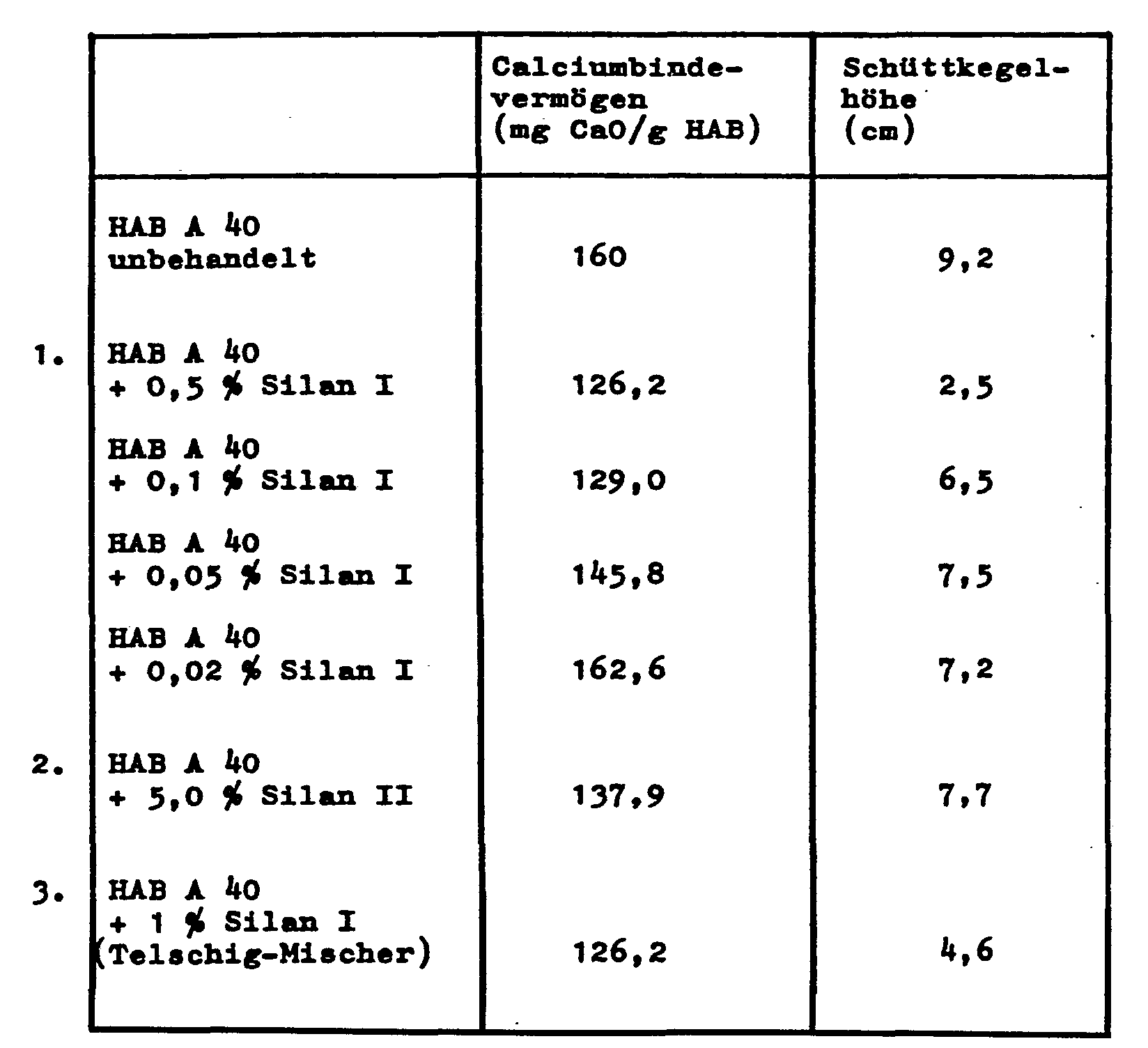


- Die Versuche haben gezeigt, daß eine Verbesserung der Fließfähigkeit und des Agglomerationsverhaltens durch Zugabe von 2 % und 0,5 % Silan nach dieser Methode im Sprühturn erreichbar ist.
Claims (4)
Applications Claiming Priority (2)
| Application Number | Priority Date | Filing Date | Title |
|---|---|---|---|
| DE19823208598 DE3208598A1 (de) | 1982-03-10 | 1982-03-10 | Verfahren zur herstellung von mit organosilanen oberflaechenmodifizierten zeolithen |
| DE3208598 | 1982-03-10 |
Publications (2)
| Publication Number | Publication Date |
|---|---|
| EP0088158A1 EP0088158A1 (de) | 1983-09-14 |
| EP0088158B1 true EP0088158B1 (de) | 1985-03-13 |
Family
ID=6157813
Family Applications (1)
| Application Number | Title | Priority Date | Filing Date |
|---|---|---|---|
| EP82110922A Expired EP0088158B1 (de) | 1982-03-10 | 1982-11-26 | Verfahren zur Herstellung von mit Organosilanen oberflächenmodifizierten Zeolithen |
Country Status (4)
| Country | Link |
|---|---|
| US (1) | US4454056A (de) |
| EP (1) | EP0088158B1 (de) |
| JP (1) | JPS58167423A (de) |
| DE (2) | DE3208598A1 (de) |
Cited By (1)
| Publication number | Priority date | Publication date | Assignee | Title |
|---|---|---|---|---|
| WO2021029979A1 (en) | 2019-08-14 | 2021-02-18 | Exxonmobil Research And Engineering Company | Increasing hydrothermal stability of an adsorbent comprising a small pore zeolite in a swing adsorption process |
Families Citing this family (32)
| Publication number | Priority date | Publication date | Assignee | Title |
|---|---|---|---|---|
| GB8329880D0 (en) * | 1983-11-09 | 1983-12-14 | Unilever Plc | Particulate adjuncts |
| US4534880A (en) * | 1984-03-27 | 1985-08-13 | Dow Corning Corporation | Detergent composition with siliconate-zeolite and silicate builder |
| US4600646A (en) * | 1984-08-15 | 1986-07-15 | E. I. Du Pont De Nemours And Company | Metal oxide stabilized chromatography packings |
| US4927749A (en) * | 1986-04-09 | 1990-05-22 | Jeanette Simpson | Reagent for cell separation |
| US5063070A (en) * | 1989-06-30 | 1991-11-05 | Nabisco Brands, Inc. | Processes for separation of sterol compounds from fluid mixtures using substantially insoluble compounds |
| US5064668A (en) * | 1989-06-30 | 1991-11-12 | Nabisco Brands, Inc. | Process for separation of sterol compounds from fluid mixtures |
| FR2652818B1 (fr) * | 1989-10-09 | 1994-04-01 | Rhone Poulenc Chimie | Suspension de zeolite comprenant une resine silicone. |
| FR2652819B1 (fr) * | 1989-10-09 | 1994-01-07 | Rhone Poulenc Chimie | Suspension de zeolite comprenant un siliconate. |
| US5243117A (en) * | 1990-06-05 | 1993-09-07 | Mobil Oil Corp. | Catalyst and process for the selective production of para-dialkyl substituted benzenes |
| US5091117A (en) * | 1990-04-16 | 1992-02-25 | Nabisco Brands, Inc. | Process for the removal of sterol compounds and saturated fatty acids |
| US5183710A (en) * | 1990-08-30 | 1993-02-02 | U-Sus Distributors, Inc. | Hydrophobic inorganic materials and process for making same |
| GB9209366D0 (en) * | 1992-04-30 | 1992-06-17 | Unilever Plc | Builder and bleach system |
| US5714453A (en) * | 1996-04-01 | 1998-02-03 | S. C. Johnson & Son, Inc. | Alkaline cleaning formulation containing a hydrolyzed silane and method of applying the same |
| US6284696B1 (en) | 1996-06-07 | 2001-09-04 | Asahi Kasei Kogyo Kabushiki Kaisha | Mesopore molecular sieve and process for the production thereof |
| US5948383A (en) * | 1997-03-26 | 1999-09-07 | Engelhard Corporation | Hybrid zeolite-silica compositions |
| DE19853971B4 (de) | 1998-11-23 | 2011-06-16 | Fraunhofer-Gesellschaft zur Förderung der angewandten Forschung e.V. | Anorganisch/organische Polysiloxanhybridpolymere und ihre Verwendung |
| DE19901302A1 (de) * | 1999-01-15 | 2000-07-20 | Degussa | Alkylhalogensilan enthaltene Zeolithpulver |
| US20040120915A1 (en) * | 2002-12-19 | 2004-06-24 | Kaiyuan Yang | Multifunctional compositions for surface applications |
| US9107455B2 (en) * | 2003-11-21 | 2015-08-18 | Philip Morris Usa Inc. | Cigarette filter |
| US7827996B2 (en) | 2003-12-22 | 2010-11-09 | Philip Morris Usa Inc. | Amphiphile-modified sorbents in smoking articles and filters |
| CA2592019C (en) * | 2004-12-21 | 2010-07-13 | Degussa Gmbh | Perfume delivery system |
| US20060165740A1 (en) * | 2005-01-24 | 2006-07-27 | Goldschmidt Chemical Corporation | Perfume delivery system |
| CA2545563C (en) * | 2005-05-02 | 2016-10-25 | Trican Well Service Ltd. | Method for making particulate slurries and particulate slurry compositions |
| US9714371B2 (en) | 2005-05-02 | 2017-07-25 | Trican Well Service Ltd. | Method for making particulate slurries and particulate slurry compositions |
| EA024720B1 (ru) * | 2005-09-23 | 2016-10-31 | Трайкэн Велл Сервис Лтд. | Композиция водной суспензии для осуществления гидроразрыва и способ ее получения |
| DE102006029849A1 (de) * | 2006-06-27 | 2008-01-03 | Nanoscape Ag | Beschichtetes Molekularsieb |
| BRPI0810971A2 (pt) | 2007-04-26 | 2015-07-21 | Trican Well Service Ltd | Método de controle do arraste de particulados por fluidos e composição de lodo aquoso do método |
| CA2889374A1 (en) | 2014-04-25 | 2015-10-25 | Trican Well Service Ltd. | Compositions and methods for making aqueous slurry |
| CA2856942A1 (en) | 2014-07-16 | 2016-01-16 | Trican Well Service Ltd. | Aqueous slurry for particulates transportation |
| CA2880646A1 (en) | 2015-01-30 | 2016-07-30 | Trican Well Service Ltd. | Composition and method of using polymerizable natural oils to treat proppants |
| WO2019026053A2 (en) * | 2017-08-04 | 2019-02-07 | Fernando Thome Kreutz | RUBBER COMPOSITIONS AND ASSOCIATED METHODS |
| CN115724438B (zh) * | 2022-10-20 | 2024-03-22 | 陕西科技大学 | 一种高疏水性有机修饰天然沸石及其制备方法 |
Family Cites Families (16)
| Publication number | Priority date | Publication date | Assignee | Title |
|---|---|---|---|---|
| JPS5034537B2 (de) * | 1972-08-24 | 1975-11-10 | ||
| FR2267992A1 (de) * | 1974-04-19 | 1975-11-14 | Rhone Poulenc Ind | |
| DE2447021C3 (de) * | 1974-10-02 | 1984-03-22 | Degussa Ag, 6000 Frankfurt | Kristallines Zeolithpulver des Typs A und das Verfahren zu seiner Herstellung |
| DE2517218B2 (de) * | 1975-04-18 | 1977-05-05 | Henkel & Cie GmbH, 4000 Düsseldorf; Deutsche Gold- und Silber-Scheideanstalt vormals Roessler, 6000 Frankfurt | Kristallines zeolithpulver des typs a |
| US4013574A (en) * | 1975-04-22 | 1977-03-22 | The Procter & Gamble Company | Organosilane-containing prill |
| FR2351156A1 (fr) * | 1976-05-11 | 1977-12-09 | Rhone Poulenc Ind | Compositions organosiliciques presentant une activite antimousse stable |
| DE2651485A1 (de) * | 1976-11-11 | 1978-05-24 | Degussa | Kristallines zeolithpulver des typs a i |
| DE2651419A1 (de) * | 1976-11-11 | 1978-05-18 | Degussa | Kristallines zeolithpulver des typs a iv |
| DE2651420A1 (de) * | 1976-11-11 | 1978-05-18 | Degussa | Kristallines zeolithpulver des typs a v |
| DE2651436A1 (de) * | 1976-11-11 | 1978-05-18 | Degussa | Kristallines zeolithpulver des typs a iii |
| DE2651437A1 (de) * | 1976-11-11 | 1978-05-18 | Degussa | Kristallines zeolithpulver des typs a vi |
| US4138363A (en) * | 1977-09-14 | 1979-02-06 | Pq Corporation | Silane-zeolite compositions |
| IT1160682B (it) * | 1977-10-14 | 1987-03-11 | Po Corp. | Composizioni detergenti con coadiuvante di silano-zeolite |
| US4183814A (en) * | 1978-01-03 | 1980-01-15 | Union Carbide Corporation | Asbestos composition having organo-silane coating |
| US4216125A (en) * | 1978-12-07 | 1980-08-05 | Pq Corporation | Detergent compositions with silane-zeolite silicate builder |
| US4243545A (en) * | 1979-12-10 | 1981-01-06 | Pq Corporation | Detergent compositions with silane-zeolite silicate builder |
-
1982
- 1982-03-10 DE DE19823208598 patent/DE3208598A1/de not_active Ceased
- 1982-11-26 DE DE8282110922T patent/DE3262571D1/de not_active Expired
- 1982-11-26 EP EP82110922A patent/EP0088158B1/de not_active Expired
-
1983
- 1983-03-09 US US06/473,634 patent/US4454056A/en not_active Expired - Lifetime
- 1983-03-10 JP JP58038410A patent/JPS58167423A/ja active Granted
Cited By (1)
| Publication number | Priority date | Publication date | Assignee | Title |
|---|---|---|---|---|
| WO2021029979A1 (en) | 2019-08-14 | 2021-02-18 | Exxonmobil Research And Engineering Company | Increasing hydrothermal stability of an adsorbent comprising a small pore zeolite in a swing adsorption process |
Also Published As
| Publication number | Publication date |
|---|---|
| DE3208598A1 (de) | 1983-09-22 |
| EP0088158A1 (de) | 1983-09-14 |
| DE3262571D1 (en) | 1985-04-18 |
| US4454056A (en) | 1984-06-12 |
| JPS58167423A (ja) | 1983-10-03 |
| JPH0239447B2 (de) | 1990-09-05 |
Similar Documents
| Publication | Publication Date | Title |
|---|---|---|
| EP0088158B1 (de) | Verfahren zur Herstellung von mit Organosilanen oberflächenmodifizierten Zeolithen | |
| EP0011667B1 (de) | Verfahren zur Herstellung von Aluminiumtrihydroxid und dessen Verwendung als Füllstoff | |
| DE3200125C2 (de) | ||
| EP0126871B1 (de) | An der Oberfläche modifizierte natürliche oxidische oder silikatische Füllstoffe, ein Verfahren zur Herstellung und deren Verwendung | |
| DE2359619C3 (de) | Verfahren zum Verbessern der Fällstoffeigenschaften feinteiligen Siliciumdioxyds | |
| DE68909113T2 (de) | Absorbierende Fällungskieselsäure und Zusammensetzung auf der Basis dieser Kieselsäure. | |
| DE1200982B (de) | Verfahren zur Herstellung von Russkuegelchen fuer Druckerschwaerze | |
| DE2460771A1 (de) | Verfahren zur herstellung von zirkonphosphaten | |
| DE69906724T2 (de) | Antimonsilikatsorptionsmittel zur abtrennung von metallionen | |
| DE60116264T2 (de) | Bor enthaltende amorphe kieselsäureteilchen | |
| DE2333068B2 (de) | Verfahren zur herstellung eines pulverfoermigen kristallinen zeolithischen molekularsiebes des typs a und dessen verwendung | |
| DE2456979C2 (de) | Rieselfaehige harnstoffharzmassen | |
| DE2928401C2 (de) | Verfahren zum Verfestigen von Schwefel | |
| DE4034976A1 (de) | Mit einer organosiliciumverbindung behandeltes siliciumdioxid, dieses siliciumdioxid enthaltendes gemisch und verfahren zu dessen herstellung | |
| DE1247625B (de) | Verwendung organischer Siliziumverbindungen als Zusatz zu organischen Bindern zur Bindung anorganischer Massen auf Siliziumbasis | |
| EP2593404A1 (de) | Verfahren zur herstellung hochreiner, organisch modifizierter schichtsilikate | |
| DE2646595B2 (de) | Sinterfähige feinteilige Polyvinylchlorid-Formmassen | |
| DE3007080A1 (de) | Verfahren zur herstellung von kristallinem zeolithpulver des typs a | |
| DE2811475C3 (de) | Verfahren zur Herstellung von porösen Behältern | |
| DE2601046A1 (de) | Verfahren zum herstellen von silikonharz | |
| DE2653597A1 (de) | Katalysatorkomponente und verfahren zu ihrer herstellung | |
| DE3505278C2 (de) | ||
| DE1768910A1 (de) | Salze tertiaerer Amine als Katalysatoren und Cohaertungsmittel in Epoxyharzsystemen | |
| DE2756220A1 (de) | Krack-katalysator, verfahren zu seiner herstellung und seine verwendung | |
| CH682986A5 (de) | Verfahren zur chargenweisen Regenerierbehandlung von überwiegend tongebundenem Giesserei-Altsand. |
Legal Events
| Date | Code | Title | Description |
|---|---|---|---|
| PUAI | Public reference made under article 153(3) epc to a published international application that has entered the european phase |
Free format text: ORIGINAL CODE: 0009012 |
|
| 17P | Request for examination filed |
Effective date: 19821126 |
|
| AK | Designated contracting states |
Designated state(s): DE FR IT |
|
| ITF | It: translation for a ep patent filed | ||
| GRAA | (expected) grant |
Free format text: ORIGINAL CODE: 0009210 |
|
| AK | Designated contracting states |
Designated state(s): DE FR IT |
|
| REF | Corresponds to: |
Ref document number: 3262571 Country of ref document: DE Date of ref document: 19850418 |
|
| ET | Fr: translation filed | ||
| PLBE | No opposition filed within time limit |
Free format text: ORIGINAL CODE: 0009261 |
|
| STAA | Information on the status of an ep patent application or granted ep patent |
Free format text: STATUS: NO OPPOSITION FILED WITHIN TIME LIMIT |
|
| 26N | No opposition filed | ||
| REG | Reference to a national code |
Ref country code: FR Ref legal event code: ST |
|
| PGFP | Annual fee paid to national office [announced via postgrant information from national office to epo] |
Ref country code: DE Payment date: 20011031 Year of fee payment: 20 |
|
| PGFP | Annual fee paid to national office [announced via postgrant information from national office to epo] |
Ref country code: FR Payment date: 20011106 Year of fee payment: 20 |