EP0086945B1 - Neue Alkenole(I), Verfahren zu deren Herstellung, Verwendung von (I) als Riechstoffe und Riechstoffkompositionen mit einem Gehalt an (I) - Google Patents
Neue Alkenole(I), Verfahren zu deren Herstellung, Verwendung von (I) als Riechstoffe und Riechstoffkompositionen mit einem Gehalt an (I) Download PDFInfo
- Publication number
- EP0086945B1 EP0086945B1 EP83100328A EP83100328A EP0086945B1 EP 0086945 B1 EP0086945 B1 EP 0086945B1 EP 83100328 A EP83100328 A EP 83100328A EP 83100328 A EP83100328 A EP 83100328A EP 0086945 B1 EP0086945 B1 EP 0086945B1
- Authority
- EP
- European Patent Office
- Prior art keywords
- methyl
- dimethyl
- ether
- stands
- alkyl
- Prior art date
- Legal status (The legal status is an assumption and is not a legal conclusion. Google has not performed a legal analysis and makes no representation as to the accuracy of the status listed.)
- Expired
Links
- 239000000203 mixture Substances 0.000 title claims description 25
- 239000003205 fragrance Substances 0.000 title claims description 20
- 238000000034 method Methods 0.000 title claims description 5
- 238000002360 preparation method Methods 0.000 title description 3
- 150000001875 compounds Chemical class 0.000 claims description 18
- 239000000126 substance Substances 0.000 claims description 16
- IDEYZABHVQLHAF-GQCTYLIASA-N (e)-2-methylpent-2-enal Chemical compound CC\C=C(/C)C=O IDEYZABHVQLHAF-GQCTYLIASA-N 0.000 claims description 13
- IDEYZABHVQLHAF-UHFFFAOYSA-N 2-Methyl-2-pentenal Natural products CCC=C(C)C=O IDEYZABHVQLHAF-UHFFFAOYSA-N 0.000 claims description 13
- ACWQBUSCFPJUPN-UHFFFAOYSA-N Tiglaldehyde Natural products CC=C(C)C=O ACWQBUSCFPJUPN-UHFFFAOYSA-N 0.000 claims description 12
- ZBOPZUZYSYDLCI-UHFFFAOYSA-N 4-methylundec-3-en-5-ol Chemical compound CCCCCCC(O)C(C)=CCC ZBOPZUZYSYDLCI-UHFFFAOYSA-N 0.000 claims description 10
- JJWHBAZVHHFWMV-UHFFFAOYSA-N 4,6,8-trimethylnon-3-en-5-ol Chemical compound CCC=C(C)C(O)C(C)CC(C)C JJWHBAZVHHFWMV-UHFFFAOYSA-N 0.000 claims description 9
- UFHFLCQGNIYNRP-UHFFFAOYSA-N Hydrogen Chemical compound [H][H] UFHFLCQGNIYNRP-UHFFFAOYSA-N 0.000 claims description 7
- 229910052739 hydrogen Inorganic materials 0.000 claims description 7
- 239000001257 hydrogen Substances 0.000 claims description 7
- APCUNSXXUCAWIM-UHFFFAOYSA-N 2,6-dimethylnona-1,6-dien-5-ol Chemical compound CCC=C(C)C(O)CCC(C)=C APCUNSXXUCAWIM-UHFFFAOYSA-N 0.000 claims description 6
- 125000002496 methyl group Chemical group [H]C([H])([H])* 0.000 claims description 6
- PAAAEUYSYBGUCD-UHFFFAOYSA-N 4,9-dimethyldec-3-en-5-ol Chemical compound CCC=C(C)C(O)CCCC(C)C PAAAEUYSYBGUCD-UHFFFAOYSA-N 0.000 claims description 5
- RLSYGCSPZKJBSB-UHFFFAOYSA-N 4,6-dimethyldec-3-en-5-ol Chemical compound CCCCC(C)C(O)C(C)=CCC RLSYGCSPZKJBSB-UHFFFAOYSA-N 0.000 claims description 4
- WAWYLYQTCPNJQN-UHFFFAOYSA-N 4,9-dimethyldeca-3,8-dien-5-ol Chemical compound CCC=C(C)C(O)CCC=C(C)C WAWYLYQTCPNJQN-UHFFFAOYSA-N 0.000 claims description 3
- OYZLDTIRKUCRQY-UHFFFAOYSA-N 4-methyldodec-3-en-5-ol Chemical compound CCCCCCCC(O)C(C)=CCC OYZLDTIRKUCRQY-UHFFFAOYSA-N 0.000 claims description 3
- KERLGWLNMPSXHK-UHFFFAOYSA-N 4,10-dimethylundeca-3,9-dien-5-ol Chemical compound CCC=C(C)C(O)CCCC=C(C)C KERLGWLNMPSXHK-UHFFFAOYSA-N 0.000 claims description 2
- DDXXOGBSBYMEPQ-UHFFFAOYSA-N 4,6-dimethylundec-3-en-5-ol Chemical compound CCCCCC(C)C(O)C(C)=CCC DDXXOGBSBYMEPQ-UHFFFAOYSA-N 0.000 claims description 2
- NPRWUDNEOJDRGM-UHFFFAOYSA-N 4-methyldeca-3,9-dien-5-ol Chemical compound CCC=C(C)C(O)CCCC=C NPRWUDNEOJDRGM-UHFFFAOYSA-N 0.000 claims description 2
- XQPOLCNJUSUGOZ-UHFFFAOYSA-N 4-methyltridec-3-en-5-ol Chemical compound CCCCCCCCC(O)C(C)=CCC XQPOLCNJUSUGOZ-UHFFFAOYSA-N 0.000 claims description 2
- 229910052736 halogen Inorganic materials 0.000 claims description 2
- 150000002367 halogens Chemical class 0.000 claims description 2
- 238000004519 manufacturing process Methods 0.000 claims description 2
- 229920006395 saturated elastomer Polymers 0.000 claims description 2
- OHWMJCFOAPTNNB-UHFFFAOYSA-N 4,7,8-trimethylnon-3-en-5-ol Chemical compound CCC=C(C)C(O)CC(C)C(C)C OHWMJCFOAPTNNB-UHFFFAOYSA-N 0.000 claims 1
- IJNGONXIBLPKFP-UHFFFAOYSA-N 4-methylundeca-3,8-dien-5-ol Chemical compound CCC=CCCC(O)C(C)=CCC IJNGONXIBLPKFP-UHFFFAOYSA-N 0.000 claims 1
- RTZKZFJDLAIYFH-UHFFFAOYSA-N Diethyl ether Chemical compound CCOCC RTZKZFJDLAIYFH-UHFFFAOYSA-N 0.000 description 68
- WYURNTSHIVDZCO-UHFFFAOYSA-N Tetrahydrofuran Chemical compound C1CCOC1 WYURNTSHIVDZCO-UHFFFAOYSA-N 0.000 description 14
- 238000009835 boiling Methods 0.000 description 13
- FYYHWMGAXLPEAU-UHFFFAOYSA-N Magnesium Chemical compound [Mg] FYYHWMGAXLPEAU-UHFFFAOYSA-N 0.000 description 12
- 125000004429 atom Chemical group 0.000 description 12
- 239000011777 magnesium Substances 0.000 description 12
- 229910052749 magnesium Inorganic materials 0.000 description 12
- 230000003595 spectral effect Effects 0.000 description 12
- -1 alkyl radicals Chemical class 0.000 description 11
- 239000012043 crude product Substances 0.000 description 11
- 239000007818 Grignard reagent Substances 0.000 description 10
- 238000006243 chemical reaction Methods 0.000 description 10
- 238000004508 fractional distillation Methods 0.000 description 10
- 150000004795 grignard reagents Chemical class 0.000 description 10
- 239000000243 solution Substances 0.000 description 7
- YLQBMQCUIZJEEH-UHFFFAOYSA-N tetrahydrofuran Natural products C=1C=COC=1 YLQBMQCUIZJEEH-UHFFFAOYSA-N 0.000 description 7
- 230000000694 effects Effects 0.000 description 6
- 244000299461 Theobroma cacao Species 0.000 description 4
- 125000003342 alkenyl group Chemical group 0.000 description 4
- 235000021028 berry Nutrition 0.000 description 4
- 235000019645 odor Nutrition 0.000 description 4
- 239000003921 oil Substances 0.000 description 4
- 235000019198 oils Nutrition 0.000 description 4
- 238000010992 reflux Methods 0.000 description 4
- 239000000344 soap Substances 0.000 description 4
- 125000000217 alkyl group Chemical group 0.000 description 3
- 235000019219 chocolate Nutrition 0.000 description 3
- 239000002304 perfume Substances 0.000 description 3
- UEGBWDUVDAKUGA-UHFFFAOYSA-N 2,6,10-trimethylundec-9-enal Chemical compound CC(C)=CCCC(C)CCCC(C)C=O UEGBWDUVDAKUGA-UHFFFAOYSA-N 0.000 description 2
- NLXLAEXVIDQMFP-UHFFFAOYSA-N Ammonia chloride Chemical class [NH4+].[Cl-] NLXLAEXVIDQMFP-UHFFFAOYSA-N 0.000 description 2
- 240000008772 Cistus ladanifer Species 0.000 description 2
- 235000005241 Cistus ladanifer Nutrition 0.000 description 2
- 241000402754 Erythranthe moschata Species 0.000 description 2
- GLZPCOQZEFWAFX-UHFFFAOYSA-N Geraniol Chemical compound CC(C)=CCCC(C)=CCO GLZPCOQZEFWAFX-UHFFFAOYSA-N 0.000 description 2
- 238000003747 Grignard reaction Methods 0.000 description 2
- 239000004869 Labdanum Substances 0.000 description 2
- QUKGYYKBILRGFE-UHFFFAOYSA-N benzyl acetate Chemical compound CC(=O)OCC1=CC=CC=C1 QUKGYYKBILRGFE-UHFFFAOYSA-N 0.000 description 2
- 239000010627 cedar oil Substances 0.000 description 2
- QMVPMAAFGQKVCJ-UHFFFAOYSA-N citronellol Chemical compound OCCC(C)CCC=C(C)C QMVPMAAFGQKVCJ-UHFFFAOYSA-N 0.000 description 2
- JOZKFWLRHCDGJA-UHFFFAOYSA-N citronellol acetate Chemical compound CC(=O)OCCC(C)CCC=C(C)C JOZKFWLRHCDGJA-UHFFFAOYSA-N 0.000 description 2
- 239000002537 cosmetic Substances 0.000 description 2
- 239000003599 detergent Substances 0.000 description 2
- 238000009792 diffusion process Methods 0.000 description 2
- RRAFCDWBNXTKKO-UHFFFAOYSA-N eugenol Chemical compound COC1=CC(CC=C)=CC=C1O RRAFCDWBNXTKKO-UHFFFAOYSA-N 0.000 description 2
- 150000004820 halides Chemical class 0.000 description 2
- 125000000959 isobutyl group Chemical group [H]C([H])([H])C([H])(C([H])([H])[H])C([H])([H])* 0.000 description 2
- 125000001972 isopentyl group Chemical group [H]C([H])([H])C([H])(C([H])([H])[H])C([H])([H])C([H])([H])* 0.000 description 2
- 239000000171 lavandula angustifolia l. flower oil Substances 0.000 description 2
- XMGQYMWWDOXHJM-UHFFFAOYSA-N limonene Chemical compound CC(=C)C1CCC(C)=CC1 XMGQYMWWDOXHJM-UHFFFAOYSA-N 0.000 description 2
- CDOSHBSSFJOMGT-UHFFFAOYSA-N linalool Chemical compound CC(C)=CCCC(C)(O)C=C CDOSHBSSFJOMGT-UHFFFAOYSA-N 0.000 description 2
- KVWWIYGFBYDJQC-UHFFFAOYSA-N methyl dihydrojasmonate Chemical compound CCCCCC1C(CC(=O)OC)CCC1=O KVWWIYGFBYDJQC-UHFFFAOYSA-N 0.000 description 2
- 125000004108 n-butyl group Chemical group [H]C([H])([H])C([H])([H])C([H])([H])C([H])([H])* 0.000 description 2
- 150000003254 radicals Chemical class 0.000 description 2
- 239000002904 solvent Substances 0.000 description 2
- NRQHBELEOZLJOJ-UHFFFAOYSA-N (2-butan-2-yl-1-methylcyclohexyl) acetate Chemical compound CCC(C)C1CCCCC1(C)OC(C)=O NRQHBELEOZLJOJ-UHFFFAOYSA-N 0.000 description 1
- 239000001490 (3R)-3,7-dimethylocta-1,6-dien-3-ol Substances 0.000 description 1
- 229940098795 (3z)- 3-hexenyl acetate Drugs 0.000 description 1
- WEFHSZAZNMEWKJ-KEDVMYETSA-N (6Z,8E)-undeca-6,8,10-trien-2-one (6E,8E)-undeca-6,8,10-trien-2-one (6Z,8E)-undeca-6,8,10-trien-3-one (6E,8E)-undeca-6,8,10-trien-3-one (6Z,8E)-undeca-6,8,10-trien-4-one (6E,8E)-undeca-6,8,10-trien-4-one Chemical compound CCCC(=O)C\C=C\C=C\C=C.CCCC(=O)C\C=C/C=C/C=C.CCC(=O)CC\C=C\C=C\C=C.CCC(=O)CC\C=C/C=C/C=C.CC(=O)CCC\C=C\C=C\C=C.CC(=O)CCC\C=C/C=C/C=C WEFHSZAZNMEWKJ-KEDVMYETSA-N 0.000 description 1
- QMVPMAAFGQKVCJ-SNVBAGLBSA-N (R)-(+)-citronellol Natural products OCC[C@H](C)CCC=C(C)C QMVPMAAFGQKVCJ-SNVBAGLBSA-N 0.000 description 1
- CDOSHBSSFJOMGT-JTQLQIEISA-N (R)-linalool Natural products CC(C)=CCC[C@@](C)(O)C=C CDOSHBSSFJOMGT-JTQLQIEISA-N 0.000 description 1
- UFLHIIWVXFIJGU-ARJAWSKDSA-N (Z)-hex-3-en-1-ol Chemical compound CC\C=C/CCO UFLHIIWVXFIJGU-ARJAWSKDSA-N 0.000 description 1
- HTSGKJQDMSTCGS-UHFFFAOYSA-N 1,4-bis(4-chlorophenyl)-2-(4-methylphenyl)sulfonylbutane-1,4-dione Chemical compound C1=CC(C)=CC=C1S(=O)(=O)C(C(=O)C=1C=CC(Cl)=CC=1)CC(=O)C1=CC=C(Cl)C=C1 HTSGKJQDMSTCGS-UHFFFAOYSA-N 0.000 description 1
- MRMOPGVGWFNHIN-UHFFFAOYSA-N 1,6-dioxacycloheptadecan-7-one Chemical compound O=C1CCCCCCCCCCOCCCCO1 MRMOPGVGWFNHIN-UHFFFAOYSA-N 0.000 description 1
- XZKFBZOAIGFZSU-UHFFFAOYSA-N 1-bromo-4-methylpentane Chemical compound CC(C)CCCBr XZKFBZOAIGFZSU-UHFFFAOYSA-N 0.000 description 1
- LSXKDWGTSHCFPP-UHFFFAOYSA-N 1-bromoheptane Chemical compound CCCCCCCBr LSXKDWGTSHCFPP-UHFFFAOYSA-N 0.000 description 1
- MNDIARAMWBIKFW-UHFFFAOYSA-N 1-bromohexane Chemical compound CCCCCCBr MNDIARAMWBIKFW-UHFFFAOYSA-N 0.000 description 1
- VMKOFRJSULQZRM-UHFFFAOYSA-N 1-bromooctane Chemical compound CCCCCCCCBr VMKOFRJSULQZRM-UHFFFAOYSA-N 0.000 description 1
- YBUIAJZFOGJGLJ-SWRJLBSHSA-N 1-cedr-8-en-9-ylethanone Chemical compound C1[C@]23[C@H](C)CC[C@H]3C(C)(C)[C@@H]1C(C)=C(C(C)=O)C2 YBUIAJZFOGJGLJ-SWRJLBSHSA-N 0.000 description 1
- QACBYNLZEUNZSC-UHFFFAOYSA-N 1-methoxy-1-methylcyclododecane Chemical compound COC1(C)CCCCCCCCCCC1 QACBYNLZEUNZSC-UHFFFAOYSA-N 0.000 description 1
- OPFWNTRCBNGIGG-UHFFFAOYSA-N 2,2,8-trimethylnon-7-en-3-ol Chemical compound CC(C)=CCCCC(O)C(C)(C)C OPFWNTRCBNGIGG-UHFFFAOYSA-N 0.000 description 1
- HMKKIXGYKWDQSV-SDNWHVSQSA-N 2-Pentyl-3-phenyl-2-propenal Chemical compound CCCCC\C(C=O)=C/C1=CC=CC=C1 HMKKIXGYKWDQSV-SDNWHVSQSA-N 0.000 description 1
- IUXIOXCOPJFKMQ-UHFFFAOYSA-N 2-bromo-4-methylpentane Chemical compound CC(C)CC(C)Br IUXIOXCOPJFKMQ-UHFFFAOYSA-N 0.000 description 1
- HLAUCEOFCOXKNF-UHFFFAOYSA-N 2-bromoheptane Chemical compound CCCCCC(C)Br HLAUCEOFCOXKNF-UHFFFAOYSA-N 0.000 description 1
- NEBYCXAKZCQWAW-UHFFFAOYSA-N 2-bromohexane Chemical compound CCCCC(C)Br NEBYCXAKZCQWAW-UHFFFAOYSA-N 0.000 description 1
- KVMWYGAYARXPOL-QDEBKDIKSA-N 2-cyclohexylethyl (e)-2-methylbut-2-enoate Chemical compound C\C=C(/C)C(=O)OCCC1=CC=CC=C1 KVMWYGAYARXPOL-QDEBKDIKSA-N 0.000 description 1
- 125000003229 2-methylhexyl group Chemical group [H]C([H])([H])C([H])([H])C([H])([H])C([H])([H])C([H])(C([H])([H])[H])C([H])([H])* 0.000 description 1
- WXCMHFPAUCOJIG-UHFFFAOYSA-N 4'-tert-Butyl-2',6'-dimethyl-3',5'-dinitroacetophenone Chemical compound CC(=O)C1=C(C)C([N+]([O-])=O)=C(C(C)(C)C)C([N+]([O-])=O)=C1C WXCMHFPAUCOJIG-UHFFFAOYSA-N 0.000 description 1
- LGMPVUDVTHHFDR-UHFFFAOYSA-N 4-chloro-2-methylbut-1-ene Chemical compound CC(=C)CCCl LGMPVUDVTHHFDR-UHFFFAOYSA-N 0.000 description 1
- UNXURIHDFUQNOC-UHFFFAOYSA-N 5-bromo-2-methylpent-2-ene Chemical compound CC(C)=CCCBr UNXURIHDFUQNOC-UHFFFAOYSA-N 0.000 description 1
- LPNANKDXVBMDKE-UHFFFAOYSA-N 5-bromopent-1-ene Chemical compound BrCCCC=C LPNANKDXVBMDKE-UHFFFAOYSA-N 0.000 description 1
- BQLGVERBFZPMIL-UHFFFAOYSA-N 6-bromo-2-methylhex-2-ene Chemical compound CC(C)=CCCCBr BQLGVERBFZPMIL-UHFFFAOYSA-N 0.000 description 1
- 235000003717 Boswellia sacra Nutrition 0.000 description 1
- 240000007551 Boswellia serrata Species 0.000 description 1
- 235000012035 Boswellia serrata Nutrition 0.000 description 1
- CPELXLSAUQHCOX-UHFFFAOYSA-M Bromide Chemical compound [Br-] CPELXLSAUQHCOX-UHFFFAOYSA-M 0.000 description 1
- 240000007436 Cananga odorata Species 0.000 description 1
- NPBVQXIMTZKSBA-UHFFFAOYSA-N Chavibetol Natural products COC1=CC=C(CC=C)C=C1O NPBVQXIMTZKSBA-UHFFFAOYSA-N 0.000 description 1
- JOZKFWLRHCDGJA-LLVKDONJSA-N Citronellyl acetate Natural products CC(=O)OCC[C@H](C)CCC=C(C)C JOZKFWLRHCDGJA-LLVKDONJSA-N 0.000 description 1
- 241000207199 Citrus Species 0.000 description 1
- 244000068485 Convallaria majalis Species 0.000 description 1
- 235000009046 Convallaria majalis Nutrition 0.000 description 1
- 244000241257 Cucumis melo Species 0.000 description 1
- 235000015510 Cucumis melo subsp melo Nutrition 0.000 description 1
- 241000612152 Cyclamen hederifolium Species 0.000 description 1
- 239000005770 Eugenol Substances 0.000 description 1
- 241000116713 Ferula gummosa Species 0.000 description 1
- 239000004863 Frankincense Substances 0.000 description 1
- 239000005792 Geraniol Substances 0.000 description 1
- GLZPCOQZEFWAFX-YFHOEESVSA-N Geraniol Natural products CC(C)=CCC\C(C)=C/CO GLZPCOQZEFWAFX-YFHOEESVSA-N 0.000 description 1
- 235000010254 Jasminum officinale Nutrition 0.000 description 1
- 240000005385 Jasminum sambac Species 0.000 description 1
- 235000019501 Lemon oil Nutrition 0.000 description 1
- 244000223072 Narcissus jonquilla Species 0.000 description 1
- 244000061176 Nicotiana tabacum Species 0.000 description 1
- 235000002637 Nicotiana tabacum Nutrition 0.000 description 1
- 241000218657 Picea Species 0.000 description 1
- 229920000175 Pistacia lentiscus Polymers 0.000 description 1
- UVMRYBDEERADNV-UHFFFAOYSA-N Pseudoeugenol Natural products COC1=CC(C(C)=C)=CC=C1O UVMRYBDEERADNV-UHFFFAOYSA-N 0.000 description 1
- 235000001466 Ribes nigrum Nutrition 0.000 description 1
- 241001312569 Ribes nigrum Species 0.000 description 1
- FAPWRFPIFSIZLT-UHFFFAOYSA-M Sodium chloride Chemical class [Na+].[Cl-] FAPWRFPIFSIZLT-UHFFFAOYSA-M 0.000 description 1
- 235000009470 Theobroma cacao Nutrition 0.000 description 1
- FJJCIZWZNKZHII-UHFFFAOYSA-N [4,6-bis(cyanoamino)-1,3,5-triazin-2-yl]cyanamide Chemical compound N#CNC1=NC(NC#N)=NC(NC#N)=N1 FJJCIZWZNKZHII-UHFFFAOYSA-N 0.000 description 1
- 239000002253 acid Substances 0.000 description 1
- 230000001476 alcoholic effect Effects 0.000 description 1
- 150000001298 alcohols Chemical class 0.000 description 1
- 150000001299 aldehydes Chemical class 0.000 description 1
- 150000005215 alkyl ethers Chemical class 0.000 description 1
- 229940062909 amyl salicylate Drugs 0.000 description 1
- METKIMKYRPQLGS-UHFFFAOYSA-N atenolol Chemical compound CC(C)NCC(O)COC1=CC=C(CC(N)=O)C=C1 METKIMKYRPQLGS-UHFFFAOYSA-N 0.000 description 1
- 239000010619 basil oil Substances 0.000 description 1
- 229940018006 basil oil Drugs 0.000 description 1
- 229940007550 benzyl acetate Drugs 0.000 description 1
- JGQFVRIQXUFPAH-UHFFFAOYSA-N beta-citronellol Natural products OCCC(C)CCCC(C)=C JGQFVRIQXUFPAH-UHFFFAOYSA-N 0.000 description 1
- 125000004369 butenyl group Chemical group C(=CCC)* 0.000 description 1
- 235000014121 butter Nutrition 0.000 description 1
- NPFVOOAXDOBMCE-PLNGDYQASA-N cis-3-Hexenyl acetate Natural products CC\C=C/CCOC(C)=O NPFVOOAXDOBMCE-PLNGDYQASA-N 0.000 description 1
- RRGOKSYVAZDNKR-ARJAWSKDSA-M cis-3-hexenylacetate Chemical compound CC\C=C/CCCC([O-])=O RRGOKSYVAZDNKR-ARJAWSKDSA-M 0.000 description 1
- 235000000484 citronellol Nutrition 0.000 description 1
- 239000001111 citrus aurantium l. leaf oil Substances 0.000 description 1
- 239000001926 citrus aurantium l. subsp. bergamia wright et arn. oil Substances 0.000 description 1
- 235000020971 citrus fruits Nutrition 0.000 description 1
- 239000001071 citrus reticulata blanco var. mandarin Substances 0.000 description 1
- 230000000536 complexating effect Effects 0.000 description 1
- 229940125904 compound 1 Drugs 0.000 description 1
- 239000010636 coriander oil Substances 0.000 description 1
- 239000006071 cream Substances 0.000 description 1
- 229930186364 cyclamen Natural products 0.000 description 1
- 229940019836 cyclamen aldehyde Drugs 0.000 description 1
- 239000001939 cymbopogon martini roxb. stapf. oil Substances 0.000 description 1
- 239000002781 deodorant agent Substances 0.000 description 1
- 150000002148 esters Chemical class 0.000 description 1
- NYNCZOLNVTXTTP-UHFFFAOYSA-N ethyl 2-(1,3-dioxoisoindol-2-yl)acetate Chemical compound C1=CC=C2C(=O)N(CC(=O)OCC)C(=O)C2=C1 NYNCZOLNVTXTTP-UHFFFAOYSA-N 0.000 description 1
- 125000004494 ethyl ester group Chemical group 0.000 description 1
- 229960002217 eugenol Drugs 0.000 description 1
- 238000001704 evaporation Methods 0.000 description 1
- 230000008020 evaporation Effects 0.000 description 1
- ONKNPOPIGWHAQC-UHFFFAOYSA-N galaxolide Chemical compound C1OCC(C)C2=C1C=C1C(C)(C)C(C)C(C)(C)C1=C2 ONKNPOPIGWHAQC-UHFFFAOYSA-N 0.000 description 1
- 239000004864 galbanum Substances 0.000 description 1
- 239000007789 gas Substances 0.000 description 1
- 229940113087 geraniol Drugs 0.000 description 1
- 239000010648 geranium oil Substances 0.000 description 1
- 235000019717 geranium oil Nutrition 0.000 description 1
- UFLHIIWVXFIJGU-UHFFFAOYSA-N hex-3-en-1-ol Natural products CCC=CCCO UFLHIIWVXFIJGU-UHFFFAOYSA-N 0.000 description 1
- WPFVBOQKRVRMJB-UHFFFAOYSA-N hydroxycitronellal Chemical compound O=CCC(C)CCCC(C)(C)O WPFVBOQKRVRMJB-UHFFFAOYSA-N 0.000 description 1
- 239000004615 ingredient Substances 0.000 description 1
- 125000004491 isohexyl group Chemical group C(CCC(C)C)* 0.000 description 1
- 150000002576 ketones Chemical class 0.000 description 1
- 239000010501 lemon oil Substances 0.000 description 1
- 235000001510 limonene Nutrition 0.000 description 1
- 229940087305 limonene Drugs 0.000 description 1
- 229930007744 linalool Natural products 0.000 description 1
- 239000006210 lotion Substances 0.000 description 1
- 125000005394 methallyl group Chemical group 0.000 description 1
- 239000002324 mouth wash Substances 0.000 description 1
- 125000003136 n-heptyl group Chemical group [H]C([H])([H])C([H])([H])C([H])([H])C([H])([H])C([H])([H])C([H])([H])C([H])([H])* 0.000 description 1
- 125000001280 n-hexyl group Chemical group C(CCCCC)* 0.000 description 1
- 229930014626 natural product Natural products 0.000 description 1
- 239000002674 ointment Substances 0.000 description 1
- 125000002255 pentenyl group Chemical group C(=CCCC)* 0.000 description 1
- JDQVBGQWADMTAM-UHFFFAOYSA-N phenethyl isobutyrate Chemical compound CC(C)C(=O)OCCC1=CC=CC=C1 JDQVBGQWADMTAM-UHFFFAOYSA-N 0.000 description 1
- 239000001738 pogostemon cablin oil Substances 0.000 description 1
- 239000000843 powder Substances 0.000 description 1
- 239000000047 product Substances 0.000 description 1
- 230000001681 protective effect Effects 0.000 description 1
- 239000002994 raw material Substances 0.000 description 1
- 239000011541 reaction mixture Substances 0.000 description 1
- 239000010671 sandalwood oil Substances 0.000 description 1
- 150000003333 secondary alcohols Chemical class 0.000 description 1
- 239000002453 shampoo Substances 0.000 description 1
- 235000019565 spicy aroma Nutrition 0.000 description 1
- 238000003756 stirring Methods 0.000 description 1
- 239000006228 supernatant Substances 0.000 description 1
- 239000000606 toothpaste Substances 0.000 description 1
- NPFVOOAXDOBMCE-UHFFFAOYSA-N trans-3-hexenyl acetate Natural products CCC=CCCOC(C)=O NPFVOOAXDOBMCE-UHFFFAOYSA-N 0.000 description 1
- ZFNVDHOSLNRHNN-UHFFFAOYSA-N xi-3-(4-Isopropylphenyl)-2-methylpropanal Chemical compound O=CC(C)CC1=CC=C(C(C)C)C=C1 ZFNVDHOSLNRHNN-UHFFFAOYSA-N 0.000 description 1
Classifications
-
- C—CHEMISTRY; METALLURGY
- C07—ORGANIC CHEMISTRY
- C07C—ACYCLIC OR CARBOCYCLIC COMPOUNDS
- C07C33/00—Unsaturated compounds having hydroxy or O-metal groups bound to acyclic carbon atoms
- C07C33/02—Acyclic alcohols with carbon-to-carbon double bonds
- C07C33/025—Acyclic alcohols with carbon-to-carbon double bonds with only one double bond
- C07C33/03—Acyclic alcohols with carbon-to-carbon double bonds with only one double bond in beta-position, e.g. allyl alcohol, methallyl alcohol
-
- C—CHEMISTRY; METALLURGY
- C07—ORGANIC CHEMISTRY
- C07C—ACYCLIC OR CARBOCYCLIC COMPOUNDS
- C07C29/00—Preparation of compounds having hydroxy or O-metal groups bound to a carbon atom not belonging to a six-membered aromatic ring
- C07C29/36—Preparation of compounds having hydroxy or O-metal groups bound to a carbon atom not belonging to a six-membered aromatic ring increasing the number of carbon atoms by reactions with formation of hydroxy groups, which may occur via intermediates being derivatives of hydroxy, e.g. O-metal
- C07C29/38—Preparation of compounds having hydroxy or O-metal groups bound to a carbon atom not belonging to a six-membered aromatic ring increasing the number of carbon atoms by reactions with formation of hydroxy groups, which may occur via intermediates being derivatives of hydroxy, e.g. O-metal by reaction with aldehydes or ketones
- C07C29/40—Preparation of compounds having hydroxy or O-metal groups bound to a carbon atom not belonging to a six-membered aromatic ring increasing the number of carbon atoms by reactions with formation of hydroxy groups, which may occur via intermediates being derivatives of hydroxy, e.g. O-metal by reaction with aldehydes or ketones with compounds containing carbon-to-metal bonds
-
- C—CHEMISTRY; METALLURGY
- C07—ORGANIC CHEMISTRY
- C07F—ACYCLIC, CARBOCYCLIC OR HETEROCYCLIC COMPOUNDS CONTAINING ELEMENTS OTHER THAN CARBON, HYDROGEN, HALOGEN, OXYGEN, NITROGEN, SULFUR, SELENIUM OR TELLURIUM
- C07F3/00—Compounds containing elements of Groups 2 or 12 of the Periodic Table
- C07F3/02—Magnesium compounds
-
- C—CHEMISTRY; METALLURGY
- C11—ANIMAL OR VEGETABLE OILS, FATS, FATTY SUBSTANCES OR WAXES; FATTY ACIDS THEREFROM; DETERGENTS; CANDLES
- C11B—PRODUCING, e.g. BY PRESSING RAW MATERIALS OR BY EXTRACTION FROM WASTE MATERIALS, REFINING OR PRESERVING FATS, FATTY SUBSTANCES, e.g. LANOLIN, FATTY OILS OR WAXES; ESSENTIAL OILS; PERFUMES
- C11B9/00—Essential oils; Perfumes
- C11B9/0007—Aliphatic compounds
- C11B9/0015—Aliphatic compounds containing oxygen as the only heteroatom
Definitions
- the invention relates to new fragrances. These are the compounds of the formula: wherein R 1 is hydrogen and R 2 is straight-chain or terminally branched C 5-7 alkyl or C 4-7 alkenyl, or R 1 is methyl and R 2 is straight-chain or terminally branched C 4-7 alkyl.
- C 4-7 or C 5-7 alkyl radicals are n-butyl, iso-butyl, n-amyl, iso-amyl, n-hexyl, iso-hexyl, n-heptyl, iso-heptyl.
- C 4-7 alkenyl radicals are methallyl, butenyl, methylbutenyl, methylpentenyl, pentenyl etc.
- the terminally branched alkenyls such as methylbutenyl or methylpentenyl are preferred.
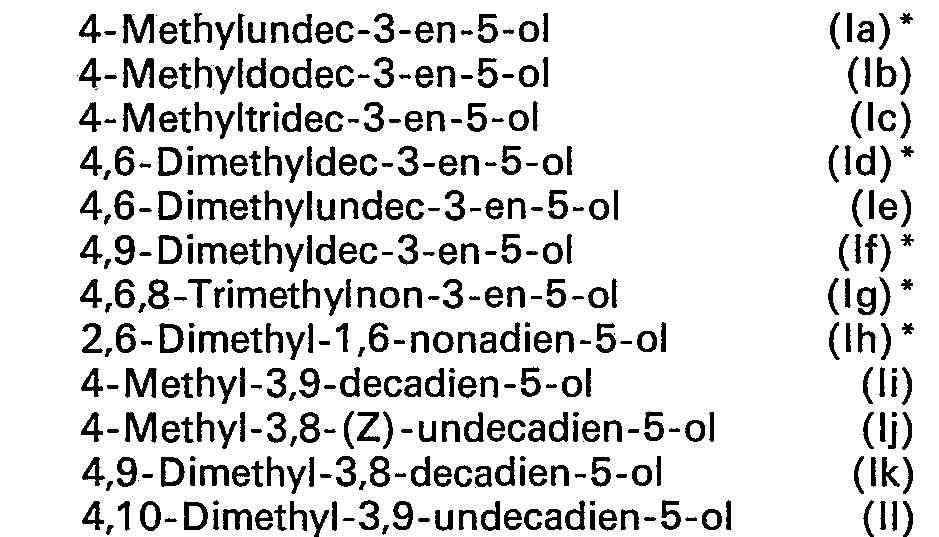
- the saturated radicals R 2 are preferred. Accordingly, the formula should in particular include the secondary alcohols: in the form of their respective possible stereoisomers (cis or trans configuration on the double bonds). The compounds marked with an asterisk are preferred.
- the invention further relates to a process for the preparation of the compounds of formula I.
- This process is characterized in that 2-methyl-2-pentenal with a compound of the formula: in which R 1 and R 2 have the above meaning and X represents halogen.
- halides are suitable as halides II, but bromide is preferably used.
- the reaction of the methyl pentenal with the compound II is conveniently carried out according to the known Grignard reaction methods, see e.g. "Organikum, Org. Chem. Grundpraktikum", reprint 15th edition, VEB German Publishing House of Sciences, Berlin 1977.617 seq. It is therefore expedient to work in diethylate or a higher alkyl ether or in tetrahydrofuran as a solvent and at temperatures of approx. 0 to 80 ° C.
- the compounds 1 have special organoleptic properties which make them particularly suitable as fragrances.
- the invention accordingly also relates to the use of compound 1 as fragrance substances.
- the 4-methylundec-3-en-5-ol la for example, has a floral, fruity and, at the same time, green smell, which is complemented in the rear by powdery, chocolate-like nuances, while the 4,6,8-trimethylnon-3- en-5-ol Ig primarily has fruity, berry-like and additionally pleasantly spicy aromas.
- the products usually have a surprising additional greasy, buttery odor.
- Alcohols citronellol, geraniol, cis-3-hexenol, linalool, Sandela® (3-isocamphyl-5-cyclohexanol), 2,2,8-trimethyl-7-nonen-3-ol etc.
- Aldehydes a-amylcinnamaldehyde, cyclamenaldehyde, hydroxycitronellal, 2,6,10-trimethylundec-9-en-1-al (Adoxal®) etc.
- Ester amyl salicylate, benzyl acetate, citronellyl acetate, cis-3-hexenylacetate, 1-methyl-2-sec-butyl- cyclohexyl acetate, methyl dihydrojasmonate, phenylethyl isobutyrate, phenylethyl tiglate, 1,3,6,6-tetramethylcyclohex-2-encarboxylic acid ethyl ester, 3,6,6-trimethyl-2-ethylcyclohex-2-encarbonic acid ethyl ester etc.
- the compounds of the formula I can be used within wide limits, which can range, for example, from 0.1 (detergents) to 25% (alcoholic solutions) in compositions, without these values, however, being intended to represent limit values, since the experienced perfumer can use even lower ones Concentrations achieve effects or with even higher dosages, e.g. with up to 40%, can build up new complexes.
- the preferred concentrations are between 0.5 and 20%.
- the compositions produced with I can be used for all types of perfumed consumer goods (Eaux de Cologne, Eaux de Toilette, extras, lotions, creams, shampoos, soaps, ointments, powder, toothpastes, mouthwashes, deodorants, detergents, tobacco etc.)
- the compounds I can accordingly be used in the production of compositions and - as the above compilation shows - using a wide range of known fragrances.
- the known fragrances listed above can be used in a manner known to the perfumer, e.g. from W.A. Poucher, "Perfumes, Cosmetics and Soaps", 2.7. Auf!., Chapman and Hall, London, 1974.
- Spectral data IR: 3340, 2958, 2924, 2858, 1670, 1460, 1378, 1303, 1045, 1002, 854 cm -1 .
- Smell floral, fruity, green, reminiscent of chocolate.
- the Grignard reagent which can be obtained by reacting 3.38 g (0.139 g atoms) of magnesium in 20 ml of ether and 24.89 g (0.139 moi) of 1-bromoheptane in 80 ml of ether, is 11.90 g (0.12 mol) of 2-methyl-2-pentenal reacted in 30 ml of ether.
- Spectral data IR: 3340, 2920, 2850, 1670, 1460, 1375, 1300, 1048, 1010, 852 cm -1 .
- Smell green, floral, fruity.
- the Grignard reagent which is obtainable by reacting 3.38 g (0.139 g atoms) of magnesium in 20 ml of ether and 26.9 g (0.139 mol) of 1-bromooctane in 80 ml of ether, with 11 80 g (0.12 mol) of 2-methyl-2-penten-1-al reacted in 30 ml of ether.
- Spectral data IR: 3340, 2920, 2842, 1670, 1458, 1377, 1302, 1112, 1070, 995, 852 cm -1 .
- Smell fruity, green, greasy.
- the Grignard reagent which can be obtained by reacting 8.03 g (0.33 g atoms) of magnesium in 100 ml of ether and 58.18 g (0.35 mol) of 2-bromohexane in 250 ml of ether, becomes analogous to Example 1 , reacted with 28.3 g (0.29 mol) of 2-methyl-2-pentenal in 50 ml of ether.
- Spectral data IR: 3380, 2958, 2924, 2865, 2855, 1670, 1460, 1378, 1300, 1000, 850 cm- 1 .
- the Grignard reagent which is obtained by reaction of 3.38 g (0.139 g atoms) of magnesium in 20 ml of ether and 24.89 g (0.139 mol) 2-bromheptane available in 80 ml ether is reacted with 11.90 g (0.12 mol) 2-methyl-2-pentalenal in 30 ml ether.
- Spectral data IR: 3380, 2958, 2920, 2860, 1670, 1458, 1385, 1300, 1000, 850 cm -1 .
- the Grignard reagent which can be obtained by reaction of 3.38 g (0.139 g atoms) of magnesium in 20 ml of ether and 23.0 g (0.139 mol) of 1-bromo-4-methylpentane in 80 ml of ether, becomes analogous to Example 1 , reacted with 11.9 g (0.12 mol) of 2-methyl-2-pentenal in 30 ml of ether.
- Spectral data IR: 3340, 2950, 2922, 2862, 1670, 1460, 1385, 1365, 1303, 1068, 1045, 1010, 854 cm - 1.
- Spectral data IR: 3400, 2955, 2922, 2863, 1670, 1460, 1384, 1366, 1065, 1005, 960, 853 cm -1 .
- the Grignard reagent which is obtained by reaction of 6.60 g (0.27 g atoms) of magnesium in 30 ml of tetrahydrofuran and 28.50 g (0.27 mol) of 3-methyl-3-buten-1 -yl chloride is available in 120 ml of tetrahydrofuran, reacted with 22.90 g (0.23 mol) of 2-methyl-2-pentenal in 40 ml of tetrahydrofuran.
- Spectral data IR: 3340, 2065, 2955, 2922, 2860,1650,1440,1370,1300,1060,1008,882, 855 cm -1 .
- the Grignard reagent which can be obtained by reacting 3.38 g (0.139 g atoms) of magnesium in 20 ml of tetrahydrofuran and 16.5 g (0.139 mol) of cis-3-hexyl chloride in 70 ml of tetrahydrofuran, is analogous to Example 1 , reacted with 11.8 g (0.12 mol) of 2-methyl-2-pentenal in 20 ml of tetrahydrofuran.
- Spectral data IR: 3340, 3000, 2955, 2922, 2862, 1660, 1452, 1302, 1060, 1000, 855, 720 cm - 1.
- Smell green, like butter, floral.
- the Grignard reagent which is obtained by reacting 7.10 g (0.29 g atoms) of magnesium in 50 ml of ether and 43.60 g (0.29 mol) of 4-penten-1-yl bromide in 200 ml ether is available, reacted with 24.50 g (0.25 mol) 2-methyl-2-pentenal in 50 ml ether.
- Spectral data IR: 3340, 3075, 2960, 2925, 2860, 1645, 1460, 1304, 1060, 1015, 990, 908, 853 cm - 1 .
- the Grignard reagent which by reaction with 6.60 g (0.27 g atoms) of magnesium in 50 ml of ether and 45.00 g (0.28 mol) of 4-methyl-3-pentene-1 -yl bromide is available in 150 ml ether, reacted with 23.56 g (0.24 mol) 2-methyl-2-pentenal in 70 ml ether.
- Spectral data IR: 3350, 2960, 2922, 2865, 2855, 1670, 1450, 1375, 1105, 1052, 1005, 855, 829 cm - 1 .
- Odor greasy, aldehydic, green, floral.
- Spectral data IR: 3360, 1670, 1454, 1380, 1072, 1024, 1000.864 cm- 1 .
- Smell fruity (melon), floral (cyclamen), fresh, green.
- 2,6-dimethyl-1,6-nonadien-5-ol emphasizes the green-flowery aspect, i.e. the new compound complexes with other components (e.g. with Galbanum) of the base.
- the colognebase subsequently becomes much more spicy and herbaceous. It looks much fresher and livelier and now tends much more towards men's eau-de-cologne.
Landscapes
- Chemical & Material Sciences (AREA)
- Organic Chemistry (AREA)
- Chemical Kinetics & Catalysis (AREA)
- Life Sciences & Earth Sciences (AREA)
- Engineering & Computer Science (AREA)
- Oil, Petroleum & Natural Gas (AREA)
- Wood Science & Technology (AREA)
- Cosmetics (AREA)
- Organic Low-Molecular-Weight Compounds And Preparation Thereof (AREA)
- Fats And Perfumes (AREA)
Description
- Die Erfindung betrifft neue Riechstoffe. Es handelt sich dabei um die Verbindungen der Formel:

- Beispiele von C4-7- bzw. C5-7-Alkylresten sind n-Butyl, iso-Butyl, n-Amyl, iso-Amyl, n-Hexyl, iso-Hexyl, n-Heptyl, iso-Heptyl. Bevorzugte Reste sind n-Amyl und iso-Amyl (insbesondere im Falle von R1 = H) und n-Butyl bzw. iso-Butyl (insbesondere im Falle von R1 = CH3).
- Beispiele von C4-7-Alkenylresten sind Methallyl, Butenyl, Methylbutenyl, Methylpentenyl, Pentenyl etc. Die endständig verzweigten Alkenyle wie z.B. Methylbutenyl oder Methylpentenyl sind bevorzugt.
- Eine bevorzugte Untergruppe von Verbindungen I bildet diejenige mit R1 = Wasserstoff und R2 = geradkettiges oder endständig einmal verzweigtes C5-7-Alkyl oder C4-7-Alkenyl. Die gesättigten Reste R2 wiederum sind bevorzugt. Die Formel soll demgemäss insbesondere die sekundären Alkohole:
- Die Erfindung betrifft ferner ein Verfahren zur Herstellung der Verbindungen der Formel I.
- Dieses Verfahren ist dadurch gekennzeichnet, dass man 2-Methyl-2-pentenal mit einer Verbindung der Formel:

- Als Halogenide II kommen alle Halogenide in Frage, doch wird vorzugsweise das Bromid verwendet.
- Die Umsetzung des Methylpentenals mit der Verbindung II erfolgt zweckmässigerweise nach den an sich bekannten Methoden der Grignard-Reaktion, siehe z.B. "Organikum, Org. Chem. Grundpraktikum", Nachdruck 15. Aufl., VEB deutscher Verlag der Wissenschaften, Berlin 1977,617 seq. Man arbeitet also zweckmässigerweise in Di- äthyläter oder einem höheren Alkyläther bzw. in Tetrahydrofuran als Lösungsmittel und bei Temperaturen von ca. 0 bis 80° C.
- Die Verbindungen 1 weisen besondere organoleptische Eigenschaften auf, auf Grund derer sie sich vorzüglich als Riechstoffe eignen.
- Die Erfindung betrifft demgemäss auch die Verwendung der Verbindung 1 als Riechstoffe.
- Das 4-Methylundec-3-en-5-ol la beispielsweise besitzt einen blumigen, fruchtigen und zugleich grün wirkenden Geruch, der im Fond durch pudrige, an Schokolade erinnernde Nuancen ergänzt wird, während das 4,6,8-Trimethylnon-3-en-5-ol Ig in erster Linie fruchtige, beerenartige und zusätzlich angenehm würzige Geruchsnoten besitzt. Im Falle der C4-7-Alkenylderivate weisen die Produkte zumeist noch eine überraschende zusätzliche fettig-butterartige Geruchsnote auf.
- Die Verbindungen der Formel eignen sich aufgrund ihrer natürlichen Geruchsnoten insbesondere zur Modifizierung von bekannten, z.B.
- a) blumigen Kompositionen (z.B. für Colognetypen u. ä., Extraits, Seifen und Kosmetika), wo insbesondere die blumigen Noten intensiviert werden,
- b) des weiteren aber auch von Chypre- und Fougeretypen, die durch Zusatz von Verbindungen I moderner, belebter wirken und insbesondere einen sehr angenehmen frisch-grünen Aspekt erhalten (Extraittypen und Eaux de Cologne der maskulinen Richtung).
- Die Verbindungen I verbinden sich mit zahlreichen bekannten Riechstoffingredienzien natürlichen oder synthetischen Ursprungs, wobei die Palette der natürlichen Rohstoffe sowohl leicht- als auch mittel- und schwerflüchtige Komponenten, und diejenige der Synthetika Vertreter aus praktisch allen Stoffklassen umfassen kann, wie dies aus der folgenden Zusammenstellung ersichtlich ist:
- Naturprodukte: Basilikumöl, Baummoos-Absolue, Bergamottöl, Cassisknospen-Absolue, Zedernholzöl, Ciste labdanum, Korianderöl, Eichenmoos-Absolue, Eleminöl, Fichtennadelöl, Gälbanum, Geraniumöl, Jasmin-Absolue und sein synthetischer Ersatz, Jonquille-Absolue, Lavendelöl, Mandarinenöl, Mastix-Absolue, Palmarosaöl, Patchouliöl, Petitgrainöl Paraguay, Sandelholzöl, Weihrauch, Ylang-Ylang-Öl und sein synthetischer Ersatz, Zitronenöl etc.
- Alkohole: Citronellol, Geraniol, cis-3-Hexenol, Linalool, Sandela® (3-Isocamphyl-5-cyclohexanol), 2,2,8-Trimethyl-7-nonen-3-ol etc.
- Aldehyde: a-Amylzimtaldehyd, Cyclamenaldehyd, Hydroxycitronellal, 2,6,10-Trimethylundec-9-en-1-al(Adoxal®) etc.
- Ketone: 3,7,7-Trimethyl-3-[3'-methyl-2'-butenyl]bicyclo-[4.1.0]-hepten-4-on, a-Jonon, Vertofix® ( = acetyliertes Zedernholzöl) etc.
- Ester: Amylsalicylat, Benzylacetat, Citronellylacetat, cis-3-Hexenylacetat, 1-Methyl-2-sec-butyl- cyclohexylacetat, Methyldihydrojasmonat, Phenyläthylisobutyrat, Phenyläthyltiglat, 1,3,6,6-Tetramethylcyclohex-2-encarbonsäureäthyl- ester, 3,6,6-Trimethyl-2-äthylcyclohex-2-encar- bonsäureäthylester etc.
- Verschiedene: Eugenol, Limonen, p-Menthan-8-thiol-3-on, 1-Methylcyclododecylmethyläther, y-Undecalacton, Ambrettemoschus, Galaxolid® (1,3,4,6,7,8-Hexahydro-4,6,6,7,8,8-Hexame- thylcyclopenta-γ-2-benzopyran), Ketonmoschus, Musk 174® (12-Oxahexadecanolid) etc.
- Die Verbindungen der Formel I lassen sich in weiten Grenzen einsetzen, die beispielsweise von 0,1 (Detergenzien) bis 25% (alkoholische Lösungen) in Kompositionen reichen können, ohne dass diese Werte jedoch Grenzwerte darstellen sollen, da der erfahrene Parfümeur auch mit noch geringeren Konzentrationen Effekte erzielen oder aber mit noch höheren Dosierungen, z.B. mit bis zu 40%, neuartige Komplexe aufbauen kann. Die bevorzugten Konzentrationen bewegen sich zwischen 0,5 und 20%. Die mit I hergestellten Kompositionen lassen sich für alle Arten von parfümierten Verbrauchsgütern einsetzen (Eaux de Cologne, Eaux de Toilette, Extraits, Lotionen, Cremes, Shampoos, Seifen, Salben, Puder, Zahnpasten, Mundwässer, Desodorants, Detergenzien, Tabak etc.)
- Die Verbindungen I können demgemäss bei der Herstellung von Kompositionen und - wie obige Zusammenstellung zeigt - unter Verwendung einer breiten Palette bekannter Riechstoffe verwendet werden. Bei der Herstellung solcher Kompositionen können die oben aufgeführten bekannten Riechstoffe nach (dem Parfümeur bekannter) Art und Weise verwendet werden, wie z.B. aus W.A. Poucher, "Perfumes, Cosmetics and Soaps", 2,7. Auf!., Chapman und Hall, London, 1974, hervorgehen.
- In einer für Grignard-Reaktionen üblichen Apparatur werden 14,30 g (0,59 g-Atome) Magnesium in 100 ml Äther vorgelegt. Unter Rühren und unter Schutzgasatmosphäre (N2) werden anschliessend 99,0 g (0,60 mol) 1-Bromhexan in 400 ml absolutem Äther so zugetropft, dass der Äther nach Einsetzen der Reaktion ständig schwach siedet. Nach beendeter Zugabe wird noch 30 min bei Rückflusstemperatur gehalten, dann auf 10° C abgekühlt und eine Lösung von 49,1 g (0,50 mol) 2-Methyl-2-pentenal in 300 ml Äther während 30 min so zugetropft, dass die Reaktionstemperatur ständig zwischen 10 und 25° C liegt. Zwecks Beendigung der Reaktion wird noch 1 h bei Rückflusstemperatur gehalten, dann der Grignard-Komplex mit gesättigter Ammoniumchloridlösung und Eis zersetzt, die überstehende ätherische Lösung mit gesättigter Kochsalzlösung gewaschen und getrocknet. Nach Abdampfen des Lösungsmittels verbleiben 105,3 g Rohprodukt, die fraktioniert destilliert werden. Man erhält so 77,8 g (84,4%) olfaktisch gutes 4-Methyl-3-un- decen-5-ol vom Siedepunkt 66° C/0,04 mmHg.
- Spektrale Daten: IR: 3340, 2958, 2924, 2858, 1670, 1460, 1378, 1303, 1045, 1002, 854 cm-1.
- MS: 184(M+, 7), 169(2), 155(26), 113(5), 99(100), 81(26), 71(15), 55(17), 43(70), 41(18).
- Geruch: blumig, fruchtig, grün, an Schokolade erinnernd.
- Analog Beispiel 1 wird das Grignard-Reagens, welches durch Reaktion von 3,38 g (0,139 g-Atome) Magnesium in 20 ml Äther und 24,89g (0,139moi) 1-Bromheptan in 80 ml Äther erhältlich ist, mit 11,90 g (0,12 mol) 2-Methyl-2-pentenal in 30 ml Äther umgesetzt.
- Die fraktionierte Destillation des Rohproduktes (29,5 g) ergibt 16,3 g (68,5%) olfaktisch gutes 4-Methyl-3-dodecen-5-ol vom Siedepunkt 74° C/0,04 mmHg.
- Spektrale Daten: IR: 3340, 2920, 2850, 1670, 1460, 1375, 1300, 1048, 1010, 852 cm-1.
- MS: 198(M+, 19), 169(25), 127(7), 109(2), 99(100), 81 (17), 69(5), 55(8), 43(20), 41 (14).
- Geruch: grün, blumig, fruchtig.
- Analog Beispiel 1 wird das Grignard-Reagens, welches durch Reaktion von 3,38 g (0,139 g-Atome) Magnesium in 20 ml Äther und 26,9 g (0,139 mol) 1-Bromoctan in 80 mi Äther erhältlich ist, mit 11,80 g (0,12 mol) 2-Methyl-2-penten-1-al in 30 ml Äther umgesetzt.
- Die fraktionierte Destillation des Rohproduktes (28,9 g) ergibt 20,7 g (81,2%) olfaktisch gutes 4-Methyl-3-tridecen-5-ol vom Siedepunkt 85° C/0,15 mmHg.
- Spektrale Daten: IR: 3340, 2920, 2842, 1670, 1458,1377, 1302, 1112, 1070, 995, 852 cm-1.
- MS: 212(M+, 3), 183(12), 141 (3), 99(87), 81(24), 71(18), 57(15), 55(22), 43(100), 41 (30).
- Geruch: fruchtig, grün, fettig.
- Analog Beispiel 1 wird das Grignard-Reagens, welches durch Reaktion von 8,03 g (0,33 g-Atome) Magnesium in 100 ml Äther und 58,18 g (0,35 mol) 2-Bromhexan in 250 ml Äther erhältlich ist, mit 28,3 g (0,29 mol) 2-Methyl-2-pentenal in 50 ml Äther umgesetzt.
- Die fraktionierte Destillation des Rohproduktes (43,0 g) ergibt 26,4 g (49,4%) olfaktisch gutes 4,6-Dimethyl-3-decen-5-ol vom Siedepunkt 105° C/12 mmHg.
- Spektrale Daten: IR: 3380, 2958, 2924, 2865, 2855,1670,1460,1378,1300,1000, 850 cm-1.
- MS: 184(M+, 1), 155(1), 109(1), 99(60), 85(3), 81 (15), 71 (10), 55(18), 43(100), 41 (38).
- Geruch: grün, fettig, blumig, fruchtig, an Schokolade erinnernde Nuancen.
- Analog Beispiel 1 wird das Grignard-Reagens, welches durch Reaktion von 3,38 g (0,139 g-Atome) Magnesium in 20 ml Äther und 24,89 g (0,139 mol) 2-Bromheptan in 80 ml Äther erhältlich ist mit 11,90 g (0,12 mol) 2-Methyl-2-pente- nal in 30 ml Äther umgesetzt.
- Die fraktionierte Destillation des Rohproduktes (28,7 g) ergibt 12,1 g (50,9%) olfaktisch gutes 4,6-Dimethyl-3-undecen-5-ol vom Siedepunkt 65° C/0,04 mmHg.
- Spektrale Daten: IR: 3380, 2958, 2920, 2860, 1670, 1458, 1385,1300, 1000, 850 cm-1.
- MS: 198(M+, 6), 169(37), 99(100), 81 (5), 71 (4), 55(7), 43(17), 41 (15).
- Geruch: grün, blumig, fruchtig (Beeren).
- Analog Beispiel 1 wird das Grignard-Reagens, welches durch Reaktion von 3,38 g (0,139 g-Atome) Magnesium in 20 ml Äther und 23,0 g (0,139 mol) 1-Brom-4-methylpentan in 80 ml Äther erhältlich ist, mit 11,9 g (0,12 mol) 2-Methyl-2-pentenal in 30 ml Äther umgesetzt.
- Die fraktionierte Destillation des Rohproduktes (23,2 g) ergibt 17,2 g (77,8%) olfaktisch gutes 2,7-Dimethyl-7-decen-6-ol (bzw. 4,9-Dimethyl- dec-3-en-5-ol) vom Siedepunkt 81 ° C/ 0,1 mmHg.
- Spektrale Daten: IR: 3340, 2950, 2922, 2862, 1670, 1460, 1385, 1365, 1303, 1068, 1045, 1010, 854 cm-1.
- MS: 184(5), 155(13), 109(3), 99(100), 85(11), 81 (32), 71 (15), 69(17), 55(18), 43(77), 41(20).
- Geruch: grün, fruchtig, blumig, an Schokolade erinnernde Nuancen.
- Analog Beispiel 1 wird das Grignard-Reagens, welches durch Reaktion von 19,2 g (0,79 g-Atome) Magnesium in 200 ml Äther und 169,9 g (0,80 mol) 2-Brom-4-methylpentan in 400 ml Äther erhältlich ist, mit 68,0 g (0,69 mol) 2-Methyl-2-pentenal in 200 ml Äther umgesetzt.
- Die fraktionierte Destillation des Rohproduktes (137 g) ergibt 54,0 g (42,5%) olfaktisch gutes 2,4,6-Trimethyl-6-nonen-5-ol (bzw. 4,6,8-Trimethylnon-3-en-5-ol) vom Siedepunkt 100°C/12 mmHg.
- Spektrale Daten: IR: 3400, 2955, 2922, 2863, 1670, 1460, 1384, 1366, 1065, 1005, 960, 853 cm-1.
- MS: 184(M+, <0,2), 109(1), 99(71), 85(5), 81(17), 71(11 ), 57(7), 55(15), 43(100), 41 (22). Geruch: grün, fruchtig, nach Beeren, würzig.
- Analog Beispiel 1 wird das Grignard-Reagens, welches durch Reaktion von 6,60 g (0,27 g-Atome) Magnesium in 30 ml Tetrahydrofuran und 28,50 g (0,27 mol) 3-Methyl-3-buten-1-ylchlorid in 120 ml Tetrahydrofuran erhältlich ist, mit 22,90 g (0,23 mol) 2-Methyl-2-pentenal in 40 ml Tetrahydrofuran umgesetzt.
- Die fraktionierte Destillation des Rohproduktes (46,6 g) ergibt 24,1 g (62,3%) olfaktisch gutes 2,6-Dimethyl-1,6-nonadien-5-ol vom Siedepunkt 62° C/0,03 mmHg.
- MS: 168(M+, 2), 150(49), 139(68), 121(15), 112(82), 99(100), 81(40), 69(31), 55(30), 43(50).
- Spektrale Daten: IR: 3340, 2065, 2955, 2922, 2860,1650,1440,1370,1300,1060,1008,882, 855 cm-1.
- Geruch: blumig, fruchtig, blätterartig, schwach bitter, an Kakao erinnernde Nuancen.
- Analog Beispiel 1 wird das Grignard-Reagens, welches durch Reaktion von 3,38 g (0,139 g-Atome) Magnesium in 20 ml Tetrahydrofuran und 16,5 g (0,139 mol) cis-3-Hexe- nylchlorid in 70 ml Tetrahydrofuran erhältlich ist, mit 11,8 g (0,12 mol) 2-Methyl-2-pentenal in 20 ml Tetrahydrofuran umgesetzt.
- Die fraktionierte Destillation des Rohproduktes (33,1 g) ergibt 12,8 g (58,5%) olfaktisch gutes 4-Methyl-3,8-(Z)-undecadien-5-ol vom Siedepunkt 58° C/0,03 mmHg.
- Spektrale Daten: IR: 3340, 3000, 2955, 2922, 2862, 1660, 1452, 1302, 1060, 1000, 855, 720 cm-1.
- MS: 182(M+, 2), 153(13), 100(18), 99(37), 81(28), 71(20), 69(28), 55(28), 43(100), 41(45).
- Geruch: grün, nach Butter, blumig.
- Analog Beispiel 1 wird das Grignard-Reagens, welches durch Reaktion von 7,10 g (0,29 g-Atome) Magnesium in 50 ml Äther und 43,60 g (0,29 mol) 4-Penten-1-ylbromid in 200 ml Äther erhältlich ist, mit 24,50 g (0,25 mol) 2-Methyl-2-pentenal in 50 ml Äther umgesetzt.
- Die fraktionierte Destillation des Rohproduktes (43,7 g) ergibt 29,8 g (70,8%) olfaktisch gutes 4-Methyl-3,9-decadien-5-ol vom Siedepunkt 101° C/12 mmHg.
- Spektrale Daten: IR: 3340, 3075, 2960, 2925, 2860, 1645, 1460, 1304, 1060, 1015, 990, 908, 853 cm-1.
- MS: 168(M+, 3), 139(30), 125(8), 99(100), 81 (37), 71 (17), 69(31), 55(28), 43(92), 41(31).
- Geruch: grün, metallisch, fettig.
- Analog Beispiel 1 wird das Grignard-Reagens, welches durch Reaktion um 6,60 g (0,27 g-Atome) Magnesium in 50 ml Äther und 45,00 g (0,28 mol) 4-Methyl-3-penten-1-ylbro- mid in 150 ml Äther erhältlich ist, mit 23,56 g (0,24 mol) 2-Methyl-2-pentenal in 70 ml Äther umgesetzt.
- Die fraktionierte Destillation des Rohproduktes (50,0 g) ergibt 31,7 g (72,4%) olfaktisch gutes 2,7-Dimethyl-2,7-decadien-6-ol (bzw. 4,9-Dimethyl-3,8-decadien-5-ol) vom Siedepunkt 115° C/12 mmHg.
- Spektrale Daten: IR: 3350, 2960, 2922, 2865, 2855, 1670, 1450, 1375, 1105, 1052, 1005, 855, 829 cm-1.
- MS: 182 (M+, 20), 153(53), 135(16), 125(19), 121 (14), 99(55), 97(42), 93(25), 83(37), 81(50), 71(35), 69(60), 55(47), 43(100), 41(62).
- Geruch: fettig, aldehydisch, grün, blumig.
- Analog den vorhergehenden Beispielen werden 0,89 g (0,037 g-Atome) Magnesium in 5 ml absolutem Äther bei der Siedetemperatur des Äthers mit einer Lösung von 6,6 g (0,037 mol) 5-Methyl-4-hexenylbromid in 20 ml absolutem Äther zur Reaktion gebracht. Nach beendeter Zugabe wird noch 30 min bei Rückflusstemperatur gehalten. Anschliessend werden bei Raumtemperatur 3,0 g (0,03 mol) 2-Methyl-2-pentenal in 5 ml absolutem Äther während 30 min so zugetropft, dass der Äther wieder zu sieden beginnt. Nach einer weiteren Stunde Rückflussieren wird das Reaktionsgemisch abgekühlt, mit Eis und gesättigter Ammoniumchloridlösung zersetzt und aufgearbeitet. Man erhält so 2,9 g 4,10-Dimethyl-3,9- undecadien-5-ol vom Siedepunkt 110°C/ 0,06 mmHg,

- Spektrale Daten: IR: 3360, 1670, 1454, 1380, 1072,1024,1000,864 cm-1.
- MS: 196(6, M+), 167(13), 149(5), 125(26), 99(35), 96(25), 82(100), 81(52), 69(31), 55(37), 43(71).
- Geruch: fruchtig(Melone), blumig(Cyclamen), frisch, grün.
-

- Der Zusatz von 65 Teilen 4-Methyl-3-undecen-5-ol bewirkt ein Unterstreichen der blumigen Seite der ursprünglichen Komposition. Es entsteht ein vorher nicht erkennbarer Maiglöckchencharakter.
- Durch Zusatz von 65 Teilen 4-Methyl-3,8-(Z)-undecadien-5-ol ändert sich der Geruchscharakter der Komposition in eindrücklicher Weise. Es entsteht ein fruchtiger (nach Beeren), würziger Eindruck, und gleichzeitig wird durch Komplexierung mit den Citrusbestandteilen der Komposition ein Eau-de-Cologne-Effekt bewirkt.
-

- 170 Teile 4-Methyl-3-dodecen-5-ol unterstreichen in obiger Komposition den sandelblumigen Komplex und verstärken damit den gewünschten Eindruck dieser Komposition.
- 170 Teile 4,6,8-Trimethyl-3-nonen-5-ol bewirken dagegen einen sehr verblüffenden Effekt in der Base: trotz des sehr grünen Charakters dieser Substanz entsteht in der Base ein sehr angenehm beeriger, auch kosmetisch grün-blumig wirkender Geruchskomplex, der sich gut für Seifen eignet.
- Der Zusatz von 2,6-Dimethyl-1,6-nonadien-5-ol bewirkt eine Betonung des grün-blumigen Aspektes, d.h. die neue Verbindung komplexiert mit anderen Komponenten (z.B. mit Galbanum) der Grundbase.
-
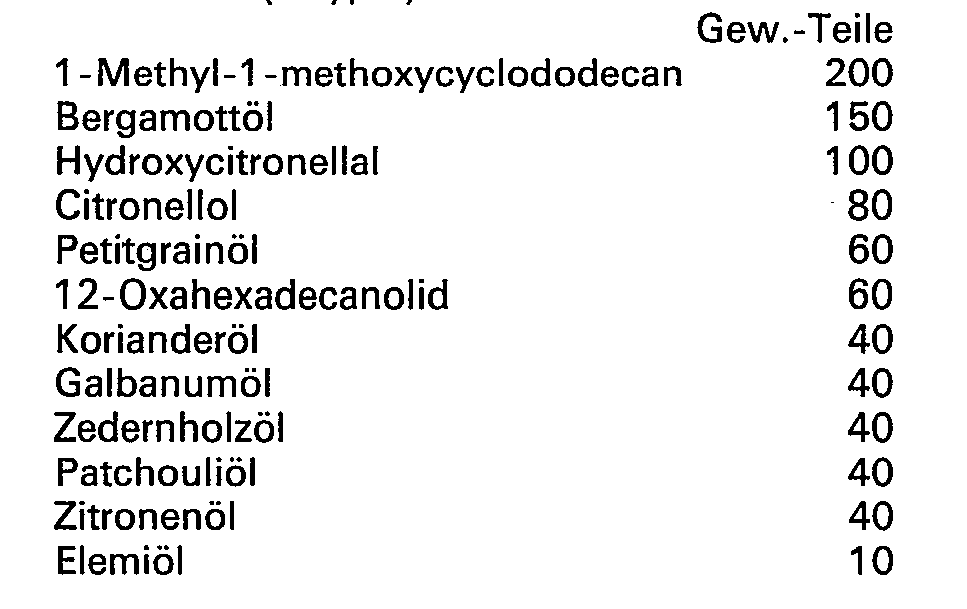

- Der Zusatz von 5 Teilen 4-Methyl-3-undecen-5-ol bewirkt eine Auffrischung der grünen und krautigen Aspekte dieser Komposition.
- 5 Teile 4,6,8-Trimethyl-3-nonen-5-ol andererseits bewirken in dieser Base eine viel grössere Diffusion, die neue Base wirkt viel frischer, grüner und auch krautig, so dass sie für ein modernes Herren-Cologne sehr geeignet ist. Der Effekt ist ähnlich mit dem mit 4-Methyl-3-undecen-5-ol erzielten, aber wesentlich ausgeprägter.
-

- Gibt man zu dieser Fougerekomposition 30 Teile 4-Methyl-3-undecen-5-ol, so wird diese viel frischer und grüner; sie erhält mehr Volumen (wesentlich verstärkte Diffusion) und wirkt dadurch viel stärker als die Komposition ohne Zusatz.
- 4,6,8-Trimethyl-3-nonen-5-ol wirkt durch ein Unterstreichen speziell der krautigen Note. Der Zusatz vermittelt so der Fougerekomposition mehr Leben.
-

- Ein Zusatz von 35 Teilen 4-Methyl-3-undecen-5-ol wirkt durch blumige Nuancierung dieses Eau-de-Cologne-Typs und unterstreicht damit dessen femininen Charakter.
- Durch Zusatz von 35 Teilen 2,6-Dimethyl-1,6- nonadien-5-ol wird die Colognebase dagegen in der Folge viel würziger und krautiger. Sie wirkt sehr viel frischer und belebter und tendiert jetzt viel mehr in Richtung Herren-Eau-de-Cologne.
Claims (21)




Applications Claiming Priority (2)
| Application Number | Priority Date | Filing Date | Title |
|---|---|---|---|
| CH49182 | 1982-01-27 | ||
| CH491/82 | 1982-01-27 |
Publications (2)
| Publication Number | Publication Date |
|---|---|
| EP0086945A1 EP0086945A1 (de) | 1983-08-31 |
| EP0086945B1 true EP0086945B1 (de) | 1984-12-05 |
Family
ID=4188224
Family Applications (1)
| Application Number | Title | Priority Date | Filing Date |
|---|---|---|---|
| EP83100328A Expired EP0086945B1 (de) | 1982-01-27 | 1983-01-15 | Neue Alkenole(I), Verfahren zu deren Herstellung, Verwendung von (I) als Riechstoffe und Riechstoffkompositionen mit einem Gehalt an (I) |
Country Status (4)
| Country | Link |
|---|---|
| US (1) | US4572795A (de) |
| EP (1) | EP0086945B1 (de) |
| JP (1) | JPS58128332A (de) |
| DE (1) | DE3360016D1 (de) |
Families Citing this family (8)
| Publication number | Priority date | Publication date | Assignee | Title |
|---|---|---|---|---|
| US4863723A (en) * | 1983-05-27 | 1989-09-05 | Consortium Fur Elektrochemische | Method for preparing hexamethylcyclotrisiloxane and uses for the same |
| DE3345784A1 (de) * | 1983-12-17 | 1985-06-27 | Haarmann & Reimer Gmbh, 3450 Holzminden | Verwendung von 5-methyl-2-hepten-4-on als riech- und/oder aromastoff sowie diesen stoff enthaltende riech- und/oder aromastoffkompositionen |
| JP2505982B2 (ja) * | 1994-08-05 | 1996-06-12 | 矢崎総業株式会社 | 配線板組立体の製造方法 |
| GB0321313D0 (en) * | 2003-09-12 | 2003-10-15 | Givaudan Sa | Organic compound |
| MX367893B (es) * | 2012-12-20 | 2019-09-11 | Firmenich & Cie | Odorante de salvia. |
| US20150275132A1 (en) * | 2014-03-26 | 2015-10-01 | The Procter & Gamble Company | Perfume systems |
| US9758744B2 (en) * | 2014-05-08 | 2017-09-12 | Firmenich Sa | Floral, green odorant |
| CN104591968B (zh) * | 2015-02-03 | 2016-03-23 | 滕州市悟通香料有限责任公司 | 一种1-辛烯-3-醇的合成方法 |
Family Cites Families (11)
| Publication number | Priority date | Publication date | Assignee | Title |
|---|---|---|---|---|
| CH527897A (de) * | 1969-04-26 | 1972-09-15 | Givaudan & Cie Sa | Riech- oder Geschmackstoffkomposition |
| US3781368A (en) * | 1971-01-12 | 1973-12-25 | Union Carbide Corp | Production of allylic ethers |
| US4168248A (en) * | 1972-11-13 | 1979-09-18 | Fritzsche Dodge & Olcott Inc. | Perfume compositions |
| JPS5058004A (de) * | 1973-09-26 | 1975-05-20 | ||
| JPS5747890B2 (de) * | 1974-04-22 | 1982-10-13 | ||
| JPS5740813B2 (de) * | 1974-04-22 | 1982-08-30 | ||
| GB1532177A (en) * | 1976-06-08 | 1978-11-15 | Kuraray Co | Isomerisation of alkenols |
| DE2751766A1 (de) * | 1977-11-19 | 1979-05-23 | Basf Ag | Verfahren zur isomerisierung von 3-buten-1-ol-verbindungen zu den entsprechenden 2-buten-1-ol-verbindungen |
| DE3027269A1 (de) * | 1980-07-18 | 1982-03-04 | Basf Ag, 6700 Ludwigshafen | 3,6-dimethyl-3-hydroxy-1-octine und -1-octene sowie derivate davon und ihre verwendung als riechstoffe und verfahren zur herstellung von 3,6-dimethyl-3-hydroxy-octan |
| US4482762A (en) * | 1980-07-31 | 1984-11-13 | Givaudan Corporation | Odorant and/or flavoring substances |
| JPS5818323A (ja) * | 1981-07-27 | 1983-02-02 | Sumitomo Chem Co Ltd | アルコ−ル類の製造方法 |
-
1983
- 1983-01-15 EP EP83100328A patent/EP0086945B1/de not_active Expired
- 1983-01-15 DE DE8383100328T patent/DE3360016D1/de not_active Expired
- 1983-01-26 JP JP58011217A patent/JPS58128332A/ja active Granted
- 1983-01-26 US US06/461,054 patent/US4572795A/en not_active Expired - Lifetime
Also Published As
| Publication number | Publication date |
|---|---|
| US4572795A (en) | 1986-02-25 |
| JPH0465814B2 (de) | 1992-10-21 |
| DE3360016D1 (en) | 1985-01-17 |
| EP0086945A1 (de) | 1983-08-31 |
| JPS58128332A (ja) | 1983-07-30 |
Similar Documents
| Publication | Publication Date | Title |
|---|---|---|
| EP0177807B1 (de) | Hexanoate, Verfahren zu deren Herstellung und Riech- und/oder Geschmackstoffkompositionen mit einem Gehalt an solchen Verbindungen | |
| EP0086945B1 (de) | Neue Alkenole(I), Verfahren zu deren Herstellung, Verwendung von (I) als Riechstoffe und Riechstoffkompositionen mit einem Gehalt an (I) | |
| DE2163868A1 (de) | Verfahren zur Herstellung gamma, deltaungesättigter Carbonylderivate | |
| EP0137419B1 (de) | Riechstoffkompositionen mit einem Gehalt an Benzyläthern | |
| EP0085352B1 (de) | Ungesättigte Oxime(I) und Verfahren zu deren Herstellung, Verwendung von (I) als Riechstoffe sowie Riechstoffkompositionen mit einem Gehalt an (I) | |
| EP0000771B1 (de) | 2,5,7-Trimethyloctan-3-ol und 2,4-Dimethylnonan-8-ol; Verfahren zu deren Herstellung, deren Verwendung als Riechstoffe; diese enthaltende Riechstoffkompositionen, sowie Herstellung solcher Riechstoffkompositionen | |
| EP0045453B1 (de) | Neue Alkenole (I) und Verfahren zu deren Herstellung, Verwendung von (I) als Riech- und/oder Geschmackstoffe sowie Riech- und/oder Geschmackstoffkompositionen mit einem Gehalt an (I) | |
| EP0002510B1 (de) | Cyclohexane, Verfahren zu deren Herstellung, deren Verwendung und diese enthaltende Kompositionen | |
| EP0045861B1 (de) | Neue ungesättigte Verbindungen, (I), Verfahren zu deren Herstellung, Verwendung von I als Riechstoffe sowie Riechstoffkompositionen mit einem Gehalt an I | |
| CH621105A5 (de) | ||
| EP0191365B1 (de) | Araliphatische Oxime, Verfahren zu deren Herstellung und Riechstoffkompositionen mit einem Gehalt an solchen Verbindungen | |
| DE2756772C2 (de) | ||
| DE3341605A1 (de) | Alpha-tertiaere dimethylacetale, ihre herstellung und verwendung als riechstoffe | |
| DE2827636C2 (de) | ||
| DE69803429T2 (de) | Von 3-Isopropenyl-1,2-dimethyl-1-cyclopentanol abgeleitete Nitrile und Aldehyde und ihre Verwendung in der Parfümerie | |
| EP0086944B1 (de) | Neue ungesättigte Aether (I), Verfahren zu deren Herstellung, Verwendung von (I) als Riech- und/oder Geschmackstoffe und Riech- und/oder Geschmackstoffkompositionen mit einem Gehalt an (I) | |
| EP0116127B1 (de) | Aliphatische Ether des Cyclododecen-2-ols, Verfahren zu ihrer Herstellung sowie ihre Verwendung zur Herstellung von Riechstoffkompositionen | |
| EP0444586B1 (de) | Bicyclisches, polysubstituiertes Keton | |
| DE3128790A1 (de) | C-8-substituierte 1,5-dimethyl-bicyclo (3.2.1)octan-8-ole | |
| DE2659196A1 (de) | Riechstoffkompositionen und verfahren zur schaffung von wohlgeruechen | |
| CH624844A5 (en) | Odoriferous composition | |
| EP0011877B1 (de) | Neue Caranderivate (I), Verfahren zu deren Herstellung, Verwendung von I als Riechstoffe sowie Riechstoffkompositionen mit einem Gehalt an I. | |
| DE2553328C2 (de) | Verfahren zur Herstellung von Riechstoffzusammensetzungen, parfümierten Stoffen oder parfümierten Artikeln und 8-Allyl-8-hydroxytricyclo [5,2,1,0&uarr;2&uarr;&uarr;,&uarr;&uarr;6&uarr;] decan | |
| EP1476527B1 (de) | Verwendung von hexenal-derivaten als riechstoffe | |
| EP0073771A1 (de) | Neue riechstoffe. |
Legal Events
| Date | Code | Title | Description |
|---|---|---|---|
| PUAI | Public reference made under article 153(3) epc to a published international application that has entered the european phase |
Free format text: ORIGINAL CODE: 0009012 |
|
| 17P | Request for examination filed |
Effective date: 19830115 |
|
| AK | Designated contracting states |
Designated state(s): CH DE FR GB LI NL |
|
| GRAA | (expected) grant |
Free format text: ORIGINAL CODE: 0009210 |
|
| AK | Designated contracting states |
Designated state(s): CH DE FR GB LI NL |
|
| REF | Corresponds to: |
Ref document number: 3360016 Country of ref document: DE Date of ref document: 19850117 |
|
| ET | Fr: translation filed | ||
| PLBE | No opposition filed within time limit |
Free format text: ORIGINAL CODE: 0009261 |
|
| STAA | Information on the status of an ep patent application or granted ep patent |
Free format text: STATUS: NO OPPOSITION FILED WITHIN TIME LIMIT |
|
| 26N | No opposition filed | ||
| REG | Reference to a national code |
Ref country code: CH Ref legal event code: PFA Free format text: GIVAUDAN-ROURE (INTERNATIONAL) S.A., VERNIER-GENEVE |
|
| REG | Reference to a national code |
Ref country code: FR Ref legal event code: CD |
|
| NLT1 | Nl: modifications of names registered in virtue of documents presented to the patent office pursuant to art. 16 a, paragraph 1 |
Owner name: GIVAUDAN-ROURE (INTERNATIONAL) S.A. TE VERNIER-GEN |
|
| PGFP | Annual fee paid to national office [announced via postgrant information from national office to epo] |
Ref country code: GB Payment date: 20001221 Year of fee payment: 19 |
|
| PGFP | Annual fee paid to national office [announced via postgrant information from national office to epo] |
Ref country code: NL Payment date: 20001227 Year of fee payment: 19 Ref country code: CH Payment date: 20001227 Year of fee payment: 19 |
|
| PGFP | Annual fee paid to national office [announced via postgrant information from national office to epo] |
Ref country code: DE Payment date: 20010102 Year of fee payment: 19 |
|
| PGFP | Annual fee paid to national office [announced via postgrant information from national office to epo] |
Ref country code: FR Payment date: 20010103 Year of fee payment: 19 |
|
| REG | Reference to a national code |
Ref country code: GB Ref legal event code: IF02 |
|
| PG25 | Lapsed in a contracting state [announced via postgrant information from national office to epo] |
Ref country code: GB Free format text: LAPSE BECAUSE OF NON-PAYMENT OF DUE FEES Effective date: 20020115 |
|
| PG25 | Lapsed in a contracting state [announced via postgrant information from national office to epo] |
Ref country code: LI Free format text: LAPSE BECAUSE OF NON-PAYMENT OF DUE FEES Effective date: 20020131 Ref country code: CH Free format text: LAPSE BECAUSE OF NON-PAYMENT OF DUE FEES Effective date: 20020131 |
|
| PG25 | Lapsed in a contracting state [announced via postgrant information from national office to epo] |
Ref country code: NL Free format text: LAPSE BECAUSE OF NON-PAYMENT OF DUE FEES Effective date: 20020801 Ref country code: DE Free format text: LAPSE BECAUSE OF NON-PAYMENT OF DUE FEES Effective date: 20020801 |
|
| GBPC | Gb: european patent ceased through non-payment of renewal fee |
Effective date: 20020115 |
|
| REG | Reference to a national code |
Ref country code: CH Ref legal event code: PL |
|
| PG25 | Lapsed in a contracting state [announced via postgrant information from national office to epo] |
Ref country code: FR Free format text: LAPSE BECAUSE OF NON-PAYMENT OF DUE FEES Effective date: 20020930 |
|
| NLV4 | Nl: lapsed or anulled due to non-payment of the annual fee |
Effective date: 20020801 |
|
| REG | Reference to a national code |
Ref country code: FR Ref legal event code: ST |