EP0084833A2 - Verfahren zur Herstellung von Ethanol und n-Propanol aus Methanol und Synthesegas - Google Patents
Verfahren zur Herstellung von Ethanol und n-Propanol aus Methanol und Synthesegas Download PDFInfo
- Publication number
- EP0084833A2 EP0084833A2 EP83100334A EP83100334A EP0084833A2 EP 0084833 A2 EP0084833 A2 EP 0084833A2 EP 83100334 A EP83100334 A EP 83100334A EP 83100334 A EP83100334 A EP 83100334A EP 0084833 A2 EP0084833 A2 EP 0084833A2
- Authority
- EP
- European Patent Office
- Prior art keywords
- phosphine
- cobalt
- methanol
- carboxyethyl
- bis
- Prior art date
- Legal status (The legal status is an assumption and is not a legal conclusion. Google has not performed a legal analysis and makes no representation as to the accuracy of the status listed.)
- Granted
Links
- OKKJLVBELUTLKV-UHFFFAOYSA-N Methanol Chemical compound OC OKKJLVBELUTLKV-UHFFFAOYSA-N 0.000 title claims abstract description 81
- LFQSCWFLJHTTHZ-UHFFFAOYSA-N Ethanol Chemical compound CCO LFQSCWFLJHTTHZ-UHFFFAOYSA-N 0.000 title claims abstract description 28
- 238000000034 method Methods 0.000 title claims abstract description 21
- BDERNNFJNOPAEC-UHFFFAOYSA-N propan-1-ol Chemical compound CCCO BDERNNFJNOPAEC-UHFFFAOYSA-N 0.000 title claims abstract description 13
- 238000004519 manufacturing process Methods 0.000 title abstract description 8
- 230000015572 biosynthetic process Effects 0.000 title description 13
- 238000003786 synthesis reaction Methods 0.000 title description 13
- XYFCBTPGUUZFHI-UHFFFAOYSA-N Phosphine Chemical compound P XYFCBTPGUUZFHI-UHFFFAOYSA-N 0.000 claims abstract description 30
- 239000003054 catalyst Substances 0.000 claims abstract description 21
- 229910000073 phosphorus hydride Inorganic materials 0.000 claims abstract description 15
- 229910052739 hydrogen Inorganic materials 0.000 claims abstract description 12
- 239000001257 hydrogen Substances 0.000 claims abstract description 12
- UFHFLCQGNIYNRP-UHFFFAOYSA-N Hydrogen Chemical compound [H][H] UFHFLCQGNIYNRP-UHFFFAOYSA-N 0.000 claims abstract description 10
- UGFAIRIUMAVXCW-UHFFFAOYSA-N Carbon monoxide Chemical compound [O+]#[C-] UGFAIRIUMAVXCW-UHFFFAOYSA-N 0.000 claims abstract description 9
- 229910002091 carbon monoxide Inorganic materials 0.000 claims abstract description 9
- XMBWDFGMSWQBCA-UHFFFAOYSA-N hydrogen iodide Chemical compound I XMBWDFGMSWQBCA-UHFFFAOYSA-N 0.000 claims abstract description 5
- 150000003304 ruthenium compounds Chemical class 0.000 claims abstract description 5
- 150000001869 cobalt compounds Chemical class 0.000 claims abstract description 4
- 229910017052 cobalt Inorganic materials 0.000 claims description 26
- 239000010941 cobalt Substances 0.000 claims description 26
- GUTLYIVDDKVIGB-UHFFFAOYSA-N cobalt atom Chemical compound [Co] GUTLYIVDDKVIGB-UHFFFAOYSA-N 0.000 claims description 24
- ATUOYWHBWRKTHZ-UHFFFAOYSA-N Propane Chemical compound CCC ATUOYWHBWRKTHZ-UHFFFAOYSA-N 0.000 claims description 12
- 239000000203 mixture Substances 0.000 claims description 10
- KJTLSVCANCCWHF-UHFFFAOYSA-N Ruthenium Chemical compound [Ru] KJTLSVCANCCWHF-UHFFFAOYSA-N 0.000 claims description 9
- 229910052707 ruthenium Inorganic materials 0.000 claims description 9
- -1 alkyl radicals Chemical class 0.000 claims description 8
- QJUNTVHQBIPVGA-UHFFFAOYSA-N 3-[2-carboxyethyl(cyclohexyl)phosphanyl]propanoic acid Chemical compound OC(=O)CCP(CCC(O)=O)C1CCCCC1 QJUNTVHQBIPVGA-UHFFFAOYSA-N 0.000 claims description 6
- BKIMMITUMNQMOS-UHFFFAOYSA-N normal nonane Natural products CCCCCCCCC BKIMMITUMNQMOS-UHFFFAOYSA-N 0.000 claims description 6
- 239000001294 propane Substances 0.000 claims description 5
- 150000003254 radicals Chemical class 0.000 claims description 5
- 125000000143 2-carboxyethyl group Chemical group [H]OC(=O)C([H])([H])C([H])([H])* 0.000 claims description 4
- FEBSZCIAEVCCAY-UHFFFAOYSA-N 3-dicyclohexylphosphanylpropanoic acid Chemical compound C1CCCCC1P(CCC(=O)O)C1CCCCC1 FEBSZCIAEVCCAY-UHFFFAOYSA-N 0.000 claims description 4
- OAICVXFJPJFONN-UHFFFAOYSA-N Phosphorus Chemical compound [P] OAICVXFJPJFONN-UHFFFAOYSA-N 0.000 claims description 4
- 125000004432 carbon atom Chemical group C* 0.000 claims description 4
- ZCYXXKJEDCHMGH-UHFFFAOYSA-N nonane Chemical compound CCCC[CH]CCCC ZCYXXKJEDCHMGH-UHFFFAOYSA-N 0.000 claims description 4
- 229910052698 phosphorus Inorganic materials 0.000 claims description 4
- 239000011574 phosphorus Substances 0.000 claims description 4
- HRXKRNGNAMMEHJ-UHFFFAOYSA-K trisodium citrate Chemical compound [Na+].[Na+].[Na+].[O-]C(=O)CC(O)(CC([O-])=O)C([O-])=O HRXKRNGNAMMEHJ-UHFFFAOYSA-K 0.000 claims description 4
- QGZKDVFQNNGYKY-UHFFFAOYSA-O Ammonium Chemical compound [NH4+] QGZKDVFQNNGYKY-UHFFFAOYSA-O 0.000 claims description 3
- SWLAJORWAFVRTF-UHFFFAOYSA-N C12=C3C(CCC3C(CC1)C2)P(CCC(=O)O)C1C2=C3CCC(C2CC1)C3 Chemical compound C12=C3C(CCC3C(CC1)C2)P(CCC(=O)O)C1C2=C3CCC(C2CC1)C3 SWLAJORWAFVRTF-UHFFFAOYSA-N 0.000 claims description 3
- 229910052783 alkali metal Inorganic materials 0.000 claims description 3
- 125000002619 bicyclic group Chemical group 0.000 claims description 3
- 150000001340 alkali metals Chemical class 0.000 claims description 2
- 150000005840 aryl radicals Chemical class 0.000 claims description 2
- 125000004122 cyclic group Chemical group 0.000 claims description 2
- 150000002431 hydrogen Chemical class 0.000 claims description 2
- 238000002360 preparation method Methods 0.000 claims description 2
- BKSDLEDWAMLDSO-UHFFFAOYSA-N 3-(9-phosphabicyclo[3.3.1]nonan-9-yl)propanoic acid Chemical compound C1CCC2CCCC1P2CCC(=O)O BKSDLEDWAMLDSO-UHFFFAOYSA-N 0.000 claims 1
- 238000006243 chemical reaction Methods 0.000 description 16
- 239000007789 gas Substances 0.000 description 15
- 150000001875 compounds Chemical class 0.000 description 9
- ZCYVEMRRCGMTRW-UHFFFAOYSA-N 7553-56-2 Chemical compound [I] ZCYVEMRRCGMTRW-UHFFFAOYSA-N 0.000 description 7
- 229910052740 iodine Inorganic materials 0.000 description 7
- 239000011630 iodine Substances 0.000 description 7
- XLYOFNOQVPJJNP-UHFFFAOYSA-N water Substances O XLYOFNOQVPJJNP-UHFFFAOYSA-N 0.000 description 7
- 150000003003 phosphines Chemical class 0.000 description 6
- 239000011541 reaction mixture Substances 0.000 description 6
- FVAUCKIRQBBSSJ-UHFFFAOYSA-M sodium iodide Chemical compound [Na+].[I-] FVAUCKIRQBBSSJ-UHFFFAOYSA-M 0.000 description 6
- VUKIWGYTUWFIDN-UHFFFAOYSA-N 3-(3-sulfophenyl)phosphanylbenzenesulfonic acid Chemical compound OS(=O)(=O)C1=CC=CC(PC=2C=C(C=CC=2)S(O)(=O)=O)=C1 VUKIWGYTUWFIDN-UHFFFAOYSA-N 0.000 description 5
- 150000001298 alcohols Chemical class 0.000 description 5
- CURLTUGMZLYLDI-UHFFFAOYSA-N Carbon dioxide Chemical compound O=C=O CURLTUGMZLYLDI-UHFFFAOYSA-N 0.000 description 4
- VNWKTOKETHGBQD-UHFFFAOYSA-N methane Chemical compound C VNWKTOKETHGBQD-UHFFFAOYSA-N 0.000 description 4
- RIOQSEWOXXDEQQ-UHFFFAOYSA-N triphenylphosphine Chemical compound C1=CC=CC=C1P(C=1C=CC=CC=1)C1=CC=CC=C1 RIOQSEWOXXDEQQ-UHFFFAOYSA-N 0.000 description 4
- IYWJIYWFPADQAN-LNTINUHCSA-N (z)-4-hydroxypent-3-en-2-one;ruthenium Chemical compound [Ru].C\C(O)=C\C(C)=O.C\C(O)=C\C(C)=O.C\C(O)=C\C(C)=O IYWJIYWFPADQAN-LNTINUHCSA-N 0.000 description 3
- SPEUIVXLLWOEMJ-UHFFFAOYSA-N 1,1-dimethoxyethane Chemical compound COC(C)OC SPEUIVXLLWOEMJ-UHFFFAOYSA-N 0.000 description 3
- XEKOWRVHYACXOJ-UHFFFAOYSA-N Ethyl acetate Chemical compound CCOC(C)=O XEKOWRVHYACXOJ-UHFFFAOYSA-N 0.000 description 3
- 239000006227 byproduct Substances 0.000 description 3
- 230000000052 comparative effect Effects 0.000 description 3
- 230000000737 periodic effect Effects 0.000 description 3
- DHKHKXVYLBGOIT-UHFFFAOYSA-N 1,1-Diethoxyethane Chemical compound CCOC(C)OCC DHKHKXVYLBGOIT-UHFFFAOYSA-N 0.000 description 2
- NIXOWILDQLNWCW-UHFFFAOYSA-N 2-Propenoic acid Chemical group OC(=O)C=C NIXOWILDQLNWCW-UHFFFAOYSA-N 0.000 description 2
- IKHGUXGNUITLKF-UHFFFAOYSA-N Acetaldehyde Chemical compound CC=O IKHGUXGNUITLKF-UHFFFAOYSA-N 0.000 description 2
- IJGRMHOSHXDMSA-UHFFFAOYSA-N Atomic nitrogen Chemical compound N#N IJGRMHOSHXDMSA-UHFFFAOYSA-N 0.000 description 2
- 229910000831 Steel Inorganic materials 0.000 description 2
- 239000001569 carbon dioxide Substances 0.000 description 2
- 229910002092 carbon dioxide Inorganic materials 0.000 description 2
- 238000001816 cooling Methods 0.000 description 2
- 230000000694 effects Effects 0.000 description 2
- 238000002474 experimental method Methods 0.000 description 2
- 229910052736 halogen Inorganic materials 0.000 description 2
- 150000002367 halogens Chemical class 0.000 description 2
- 238000011905 homologation Methods 0.000 description 2
- 239000012442 inert solvent Substances 0.000 description 2
- 150000002497 iodine compounds Chemical class 0.000 description 2
- 239000003446 ligand Substances 0.000 description 2
- 150000002894 organic compounds Chemical class 0.000 description 2
- 150000003018 phosphorus compounds Chemical class 0.000 description 2
- 239000000047 product Substances 0.000 description 2
- 230000002040 relaxant effect Effects 0.000 description 2
- 235000009518 sodium iodide Nutrition 0.000 description 2
- 239000007858 starting material Substances 0.000 description 2
- 239000010959 steel Substances 0.000 description 2
- POILWHVDKZOXJZ-ARJAWSKDSA-M (z)-4-oxopent-2-en-2-olate Chemical compound C\C([O-])=C\C(C)=O POILWHVDKZOXJZ-ARJAWSKDSA-M 0.000 description 1
- SMZOUWXMTYCWNB-UHFFFAOYSA-N 2-(2-methoxy-5-methylphenyl)ethanamine Chemical group COC1=CC=C(C)C=C1CCN SMZOUWXMTYCWNB-UHFFFAOYSA-N 0.000 description 1
- GTOFXGPXYNYBEC-UHFFFAOYSA-K 2-ethylhexanoate;ruthenium(3+) Chemical compound [Ru+3].CCCCC(CC)C([O-])=O.CCCCC(CC)C([O-])=O.CCCCC(CC)C([O-])=O GTOFXGPXYNYBEC-UHFFFAOYSA-K 0.000 description 1
- BYGQBDHUGHBGMD-UHFFFAOYSA-N 2-methylbutanal Chemical compound CCC(C)C=O BYGQBDHUGHBGMD-UHFFFAOYSA-N 0.000 description 1
- BQKUVUWVDQIQHC-UHFFFAOYSA-N 3-(9-phosphabicyclo[4.2.1]nonan-1-yl)propanoic acid Chemical compound C(=O)(O)CCC12CCCCC(CC1)P2 BQKUVUWVDQIQHC-UHFFFAOYSA-N 0.000 description 1
- VEXZGXHMUGYJMC-UHFFFAOYSA-M Chloride anion Chemical compound [Cl-] VEXZGXHMUGYJMC-UHFFFAOYSA-M 0.000 description 1
- OTMSDBZUPAUEDD-UHFFFAOYSA-N Ethane Chemical compound CC OTMSDBZUPAUEDD-UHFFFAOYSA-N 0.000 description 1
- XBDQKXXYIPTUBI-UHFFFAOYSA-M Propionate Chemical compound CCC([O-])=O XBDQKXXYIPTUBI-UHFFFAOYSA-M 0.000 description 1
- NINIDFKCEFEMDL-UHFFFAOYSA-N Sulfur Chemical compound [S] NINIDFKCEFEMDL-UHFFFAOYSA-N 0.000 description 1
- KXKVLQRXCPHEJC-UHFFFAOYSA-N acetic acid trimethyl ester Natural products COC(C)=O KXKVLQRXCPHEJC-UHFFFAOYSA-N 0.000 description 1
- 238000009529 body temperature measurement Methods 0.000 description 1
- 125000000484 butyl group Chemical group [H]C([*])([H])C([H])([H])C([H])([H])C([H])([H])[H] 0.000 description 1
- 125000002915 carbonyl group Chemical group [*:2]C([*:1])=O 0.000 description 1
- 239000007795 chemical reaction product Substances 0.000 description 1
- 238000004140 cleaning Methods 0.000 description 1
- 239000003034 coal gas Substances 0.000 description 1
- 229910021446 cobalt carbonate Inorganic materials 0.000 description 1
- UFMZWBIQTDUYBN-UHFFFAOYSA-N cobalt dinitrate Chemical compound [Co+2].[O-][N+]([O-])=O.[O-][N+]([O-])=O UFMZWBIQTDUYBN-UHFFFAOYSA-N 0.000 description 1
- 229910001981 cobalt nitrate Inorganic materials 0.000 description 1
- VLWBWEUXNYUQKJ-UHFFFAOYSA-N cobalt ruthenium Chemical class [Co].[Ru] VLWBWEUXNYUQKJ-UHFFFAOYSA-N 0.000 description 1
- QAEKNCDIHIGLFI-UHFFFAOYSA-L cobalt(2+);2-ethylhexanoate Chemical compound [Co+2].CCCCC(CC)C([O-])=O.CCCCC(CC)C([O-])=O QAEKNCDIHIGLFI-UHFFFAOYSA-L 0.000 description 1
- ZOTKGJBKKKVBJZ-UHFFFAOYSA-L cobalt(2+);carbonate Chemical compound [Co+2].[O-]C([O-])=O ZOTKGJBKKKVBJZ-UHFFFAOYSA-L 0.000 description 1
- AVWLPUQJODERGA-UHFFFAOYSA-L cobalt(2+);diiodide Chemical compound [Co+2].[I-].[I-] AVWLPUQJODERGA-UHFFFAOYSA-L 0.000 description 1
- FJDJVBXSSLDNJB-LNTINUHCSA-N cobalt;(z)-4-hydroxypent-3-en-2-one Chemical compound [Co].C\C(O)=C\C(C)=O.C\C(O)=C\C(C)=O.C\C(O)=C\C(C)=O FJDJVBXSSLDNJB-LNTINUHCSA-N 0.000 description 1
- MAWOHFOSAIXURX-UHFFFAOYSA-N cyclopentylcyclopentane Chemical group C1CCCC1C1CCCC1 MAWOHFOSAIXURX-UHFFFAOYSA-N 0.000 description 1
- 125000003493 decenyl group Chemical group [H]C([*])=C([H])C([H])([H])C([H])([H])C([H])([H])C([H])([H])C([H])([H])C([H])([H])C([H])([H])C([H])([H])[H] 0.000 description 1
- PDDYFPPQDKRJTK-UHFFFAOYSA-N diphenyl(prop-2-enyl)phosphane Chemical compound C=1C=CC=CC=1P(CC=C)C1=CC=CC=C1 PDDYFPPQDKRJTK-UHFFFAOYSA-N 0.000 description 1
- 238000004821 distillation Methods 0.000 description 1
- 150000002170 ethers Chemical class 0.000 description 1
- 125000001495 ethyl group Chemical group [H]C([H])([H])C([H])([H])* 0.000 description 1
- 238000007163 homologation reaction Methods 0.000 description 1
- 229930195733 hydrocarbon Natural products 0.000 description 1
- 150000002430 hydrocarbons Chemical class 0.000 description 1
- 238000005984 hydrogenation reaction Methods 0.000 description 1
- XLYOFNOQVPJJNP-UHFFFAOYSA-M hydroxide Chemical compound [OH-] XLYOFNOQVPJJNP-UHFFFAOYSA-M 0.000 description 1
- 239000012535 impurity Substances 0.000 description 1
- 150000002496 iodine Chemical class 0.000 description 1
- 125000001449 isopropyl group Chemical group [H]C([H])([H])C([H])(*)C([H])([H])[H] 0.000 description 1
- 125000002496 methyl group Chemical group [H]C([H])([H])* 0.000 description 1
- YKYONYBAUNKHLG-UHFFFAOYSA-N n-Propyl acetate Natural products CCCOC(C)=O YKYONYBAUNKHLG-UHFFFAOYSA-N 0.000 description 1
- 125000001624 naphthyl group Chemical group 0.000 description 1
- 239000003345 natural gas Substances 0.000 description 1
- 125000001971 neopentyl group Chemical group [H]C([*])([H])C(C([H])([H])[H])(C([H])([H])[H])C([H])([H])[H] 0.000 description 1
- 229910052757 nitrogen Inorganic materials 0.000 description 1
- 229910052762 osmium Inorganic materials 0.000 description 1
- SYQBFIAQOQZEGI-UHFFFAOYSA-N osmium atom Chemical compound [Os] SYQBFIAQOQZEGI-UHFFFAOYSA-N 0.000 description 1
- 125000001147 pentyl group Chemical group C(CCCC)* 0.000 description 1
- 239000003208 petroleum Substances 0.000 description 1
- 125000001997 phenyl group Chemical group [H]C1=C([H])C([H])=C(*)C([H])=C1[H] 0.000 description 1
- AVNRJUHUOZDFKS-UHFFFAOYSA-N phenyl(3-phenylphosphanylpropyl)phosphane Chemical compound C=1C=CC=CC=1PCCCPC1=CC=CC=C1 AVNRJUHUOZDFKS-UHFFFAOYSA-N 0.000 description 1
- AQSJGOWTSHOLKH-UHFFFAOYSA-N phosphite(3-) Chemical class [O-]P([O-])[O-] AQSJGOWTSHOLKH-UHFFFAOYSA-N 0.000 description 1
- 150000004714 phosphonium salts Chemical class 0.000 description 1
- 125000001557 phthalyl group Chemical group C(=O)(O)C1=C(C(=O)*)C=CC=C1 0.000 description 1
- 229940090181 propyl acetate Drugs 0.000 description 1
- 125000001436 propyl group Chemical group [H]C([*])([H])C([H])([H])C([H])([H])[H] 0.000 description 1
- 238000007342 radical addition reaction Methods 0.000 description 1
- 239000000376 reactant Substances 0.000 description 1
- 230000000754 repressing effect Effects 0.000 description 1
- 150000003839 salts Chemical class 0.000 description 1
- 238000005070 sampling Methods 0.000 description 1
- 238000007127 saponification reaction Methods 0.000 description 1
- 239000002904 solvent Substances 0.000 description 1
- 230000006641 stabilisation Effects 0.000 description 1
- 238000011105 stabilization Methods 0.000 description 1
- 238000006277 sulfonation reaction Methods 0.000 description 1
- 229910052717 sulfur Inorganic materials 0.000 description 1
- 239000011593 sulfur Substances 0.000 description 1
- 125000003944 tolyl group Chemical group 0.000 description 1
- NQPDZGIKBAWPEJ-UHFFFAOYSA-N valeric acid Chemical compound CCCCC(O)=O NQPDZGIKBAWPEJ-UHFFFAOYSA-N 0.000 description 1
Classifications
-
- C—CHEMISTRY; METALLURGY
- C07—ORGANIC CHEMISTRY
- C07C—ACYCLIC OR CARBOCYCLIC COMPOUNDS
- C07C29/00—Preparation of compounds having hydroxy or O-metal groups bound to a carbon atom not belonging to a six-membered aromatic ring
- C07C29/32—Preparation of compounds having hydroxy or O-metal groups bound to a carbon atom not belonging to a six-membered aromatic ring increasing the number of carbon atoms by reactions without formation of -OH groups
-
- C—CHEMISTRY; METALLURGY
- C07—ORGANIC CHEMISTRY
- C07C—ACYCLIC OR CARBOCYCLIC COMPOUNDS
- C07C31/00—Saturated compounds having hydroxy or O-metal groups bound to acyclic carbon atoms
- C07C31/02—Monohydroxylic acyclic alcohols
- C07C31/08—Ethanol
-
- C—CHEMISTRY; METALLURGY
- C07—ORGANIC CHEMISTRY
- C07C—ACYCLIC OR CARBOCYCLIC COMPOUNDS
- C07C31/00—Saturated compounds having hydroxy or O-metal groups bound to acyclic carbon atoms
- C07C31/02—Monohydroxylic acyclic alcohols
- C07C31/10—Monohydroxylic acyclic alcohols containing three carbon atoms
-
- C—CHEMISTRY; METALLURGY
- C07—ORGANIC CHEMISTRY
- C07F—ACYCLIC, CARBOCYCLIC OR HETEROCYCLIC COMPOUNDS CONTAINING ELEMENTS OTHER THAN CARBON, HYDROGEN, HALOGEN, OXYGEN, NITROGEN, SULFUR, SELENIUM OR TELLURIUM
- C07F9/00—Compounds containing elements of Groups 5 or 15 of the Periodic Table
- C07F9/02—Phosphorus compounds
- C07F9/28—Phosphorus compounds with one or more P—C bonds
- C07F9/50—Organo-phosphines
-
- Y—GENERAL TAGGING OF NEW TECHNOLOGICAL DEVELOPMENTS; GENERAL TAGGING OF CROSS-SECTIONAL TECHNOLOGIES SPANNING OVER SEVERAL SECTIONS OF THE IPC; TECHNICAL SUBJECTS COVERED BY FORMER USPC CROSS-REFERENCE ART COLLECTIONS [XRACs] AND DIGESTS
- Y02—TECHNOLOGIES OR APPLICATIONS FOR MITIGATION OR ADAPTATION AGAINST CLIMATE CHANGE
- Y02P—CLIMATE CHANGE MITIGATION TECHNOLOGIES IN THE PRODUCTION OR PROCESSING OF GOODS
- Y02P20/00—Technologies relating to chemical industry
- Y02P20/50—Improvements relating to the production of bulk chemicals
- Y02P20/52—Improvements relating to the production of bulk chemicals using catalysts, e.g. selective catalysts
Definitions
- the invention relates to a process for the production of ethanol and n-propanol from methanol and synthesis gas, ie the mixture of carbon monoxide and hydrogen in the presence of cobalt and ruthenium as catalysts.
- This reaction known as homologization, makes it possible to produce higher homologous alcohols starting from methanol by introducing one or more CH 2 groups.
- Synthesis gas or methanol produced therefrom is required as the starting material; Synthesis gas, e.g. from coal or natural gas accessible using various, technically proven processes.
- EP-OS 22 038 describes the production of ethanol from methanol using cobalt as a catalyst, an organic and inorganic iodine compound, ammonium or phosphonium compounds and a ruthenium compound as promoters.
- ethanol is obtained from synthesis gas and methanol using a catalyst consisting of cobalt acetylacetonate, an organic compound of a group VA element of the Periodic Table of the Elements, a riuthenium compound and an iodine compound.
- GB-PS 2 036 739 also claims the use of a catalyst consisting of cobalt, ruthenium or osmium, halogen and an organic compound of an element from group VA of the periodic table for the production of ethanol from methanol and synthesis gas.
- Cobalt, ruthenium, iodine and a tert. Phosphine as a catalyst component is also used in US Pat. No. 4,233,466 for the production of ethanol from methanol and synthesis gas, with the proviso that the ratio of the individual components leads to stabilization and increased activity of the catalyst system within certain limits.
- a catalyst system for the production of ethanol from methanol consisting of a dimeric cobalt-tricarbonyl-ligand complex, the ligand of which consists of a compound of an element from Group VA of the Periodic Table of the Elements and contains iodine and ruthenium acetylacetonate as promoters, is described in US Pat. No. 4,239 924.
- EP-OS 30 434 describes a process for the homologation of methanol with synthesis gas in the presence of an inert solvent and a catalyst system composed of defined cobalt-ruthenium complexes, iodine-containing promoters and tert. Phosphines or phosphites. Instead of the defined Co / Ru complexes, it should also be possible to use soluble Ru complexes together with Co 2 (CO) 8-n (PR 3 ) n complexes. (FR 3 ) n complexes can be used.
- the yields achieved in the reaction are not sufficient for industrial use. It should be taken into account here that the by-products are obtained not only in large quantities, but in the form of numerous, different quantities, but in the form of numerous, different individual compounds.
- the desired alcohols e.g. Methane, ethane, propane, various ethers as well as methyl acetate, ethyl acetate, propyl acetate, acetaldehyde dimethyl acetal, acetyldehyde methyl ethyl acetal and acetaldehyde diethyl acetal are formed.
- a high level of effort is therefore required in order to obtain the valuable product portions obtainable from the by-products, e.g. by hydrogenation, saponification and distillation.
- the task was therefore to develop a procedure which allows methanol to be converted into ethanol and n-propanol with high selectivity and high conversion, and to reduce the number of by-products substantially, so that the reaction mixture can be separated in a simple manner .
- the invention solves this problem by means of a process for the preparation of methanol and n-propanol by reacting methanol with carbon monoxide and hydrogen at elevated pressures of 2CC to 600 bar and temperatures of 150 to 250 ° C in the presence of a catalyst which is a cobalt compound Contains ruthenium compound, an iodide and an organic phosphine. It is characterized in that the organic phosphine contains a group which has a radical -SO-M, -OSO 3 M or -COOM, where M is H, alkali metals or ammonium. According to a particularly preferred embodiment.
- H 2 is 1: 2.0 to 1: 3.5
- the molar ratio of cobalt to methanol is 1; 30 to 1 : 5000, from cobalt to iodine equal to 1: G, 1 to 1: 2, from cobalt to ruthenium equal to 1: 0.01 to 1 : 0.05 and from cobalt to phosphorus equal to 1 : 0.5 to 1 : 2.5.
- n stands for the numbers from 1 to 6 and the radicals R 1 to R 3 are identical or different and stand for hydrogen, straight-chain or branched (also bicyclic) alkyl radicals with 1 to 16 carbon atoms or aryl radicals with 6 to 15 carbon atoms.
- the radicals R 7 and R 2 can be connected to one another in pairs and in this way form a cyclic or bicyclic system containing phosphorus.
- alkyl radicals are methyl, ethyl, propyl, butyl, pentyl, i-propyl, i-hexadecyl, neopentyl, for cycloalkyl radicals cyclohexyl, dicyclopentyl, tricyclo- (5,2,1,0 2,6 ) decenyl and for aryl radicals phenyl, Tolyl, naphthyl, phthalyl.
- interlinked alkyl radicals are, for example Examples of compounds according to the formulas described which are used in the context of the procedure according to the invention are bis- (tricyclo (5,2,1,0 2,6 ) decenyl) -2-carboxyethyl-phosphine (1), 2-carboxyethyl- dicyclohexylphosphine (2), bis (2-carboxyethyl) cyclohexylphosphine (3) and a mixture of 9- (2-carboxyethyl-9-phosphabicyclo (4,2,1) nonane and 9- (2-carboxyethyl) -9 -phosphabi-cyclo (3,3,1) nonane (4).
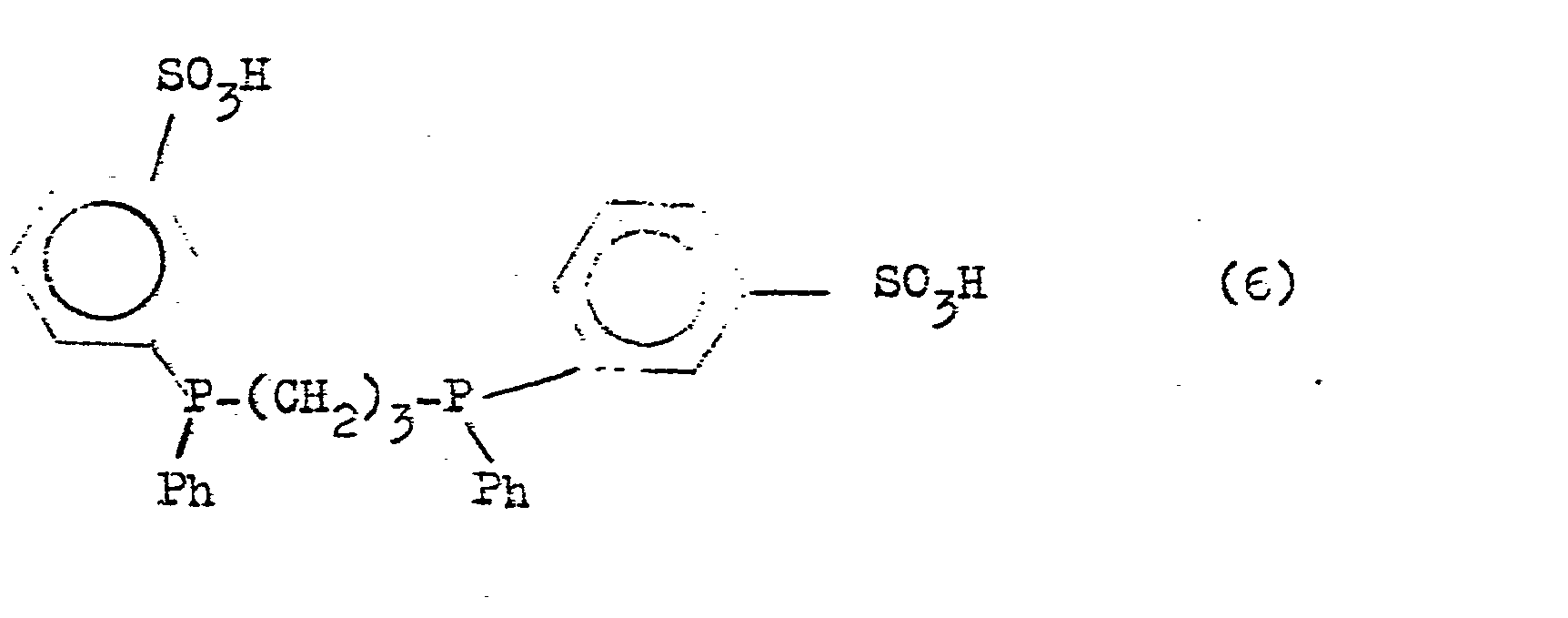
- Suitable phosphines which are used in the course of the procedure according to the invention are the trisodium salt of (2-suliatopropyl) bis (m-sulfophenyl) phosphine (5) and (bis-1,3- (m-sulfophenyr) phenyl) -phosphino) propane (6)
- phosphorus compounds with (-COOM) groups can be obtained by radical addition of a P-H bond to a C-C double bond (cf. e.g. DE-OS 29 39 588 and J.Org. Chem., 26 (1961) 138).
- Compounds 1 to 4 are prepared by reaction between the corresponding mono- or di-tertiary phosphines and acrylic acid. In the case of monotertiary phosphines, two acrylic acid residues are added (cf. Verb. 3).
- the trisodium salt of (2-sulfatopropyl) bis (m-sulfophenyl) phosphine (5) and (bis-1,3- (m-sulfophenyl) phenylphosphino) propane (G) can be obtained by sulfonation of allyldiphenylphosphine and 1,3-Diphenyl-phosphinopropane accessible.
- These phosphorus compounds form complex compounds with the cobalt and ruthenium compounds under the reaction conditions, which may also contain halogen, carbon monoxide and hydrogen. These compounds form part of the active catalyst system.
- Cobalt is generally added to the reaction mixture in the form of a salt such as cobalt 2-ethylhexanoate, cobalt acetylaeetonate, cobalt halide, cobalt nitrate, as an oxide or hydroxide.
- a salt such as cobalt 2-ethylhexanoate, cobalt acetylaeetonate, cobalt halide, cobalt nitrate, as an oxide or hydroxide.
- Cobalt carbonate has proven particularly useful. However, it is also possible to use finely divided metallic cobalt.
- cobalt or the cobalt compound reacts with carbon monoxide and hydrogen to form a cobalt carbonyl or hydrocarbonyl.
- Another component of the Ka t alysatorsystens accordance with the new method is ruthenium, ruthenium-2-ethylhexanoate to the reaction mixture as the compound which reacts under the reaction conditions in carbonyl complexes, such as ruthenium, Rutheniuan chloride, (NH 4) 4 ( Ru 2 SSl 10 ), preferably as ruthenium acetylacetonate.
- the analyzer system also contains iodine in ionic form.
- Alkali metal salts and particularly advantageously cobalt iodide can be used as iodine salts.
- the catalyst system used in the process according to the invention can be fed to the reaction mixture in the form of its individual components. It is not necessary to preform the metal complex compounds that are components of the catalyst system.
- the catalyst system can be used repeatedly.
- the methanol used as the starting material can be used in the form of the product manufactured in industrial plants with a water content of 4 to 6%. Additional cleaning is not necessary.
- the reaction mixture originally used contains 5 to 25% by weight of water, based on methanol.
- the addition of water causes an increase in sales. Higher quantities of water only have an insignificant impact on sales; lower amounts have no or only insignificant increases in sales.
- the water is expediently fed to the reactor together with the methanol.
- the molar ratio of cobalt to methanol is 1:30 to 1: 5000.
- Cobalt and phosphine are used in a molar ratio of 1: 0.5 to 1: 2.5.
- the atomic ratio of cobalt to ruthenium is 1: 0.01 to 1: 0.05.
- Cobalt and iodine are used in a molar ratio of 1 0.1 to 1: 2.
- the carbon monoxide / hydrogen mixture should not contain any impurities such as sulfur which affect the activity of the catalyst system. Carbon dioxide, inert hydrocarbons and / or nitrogen up to 5 vol .-% based on the total mixture do no harm.
- the new process can be carried out batchwise or continuously.
- the conversion of methanol, carbon monoxide and hydrogen takes place at tenper investigating from 150 to 250 ° C., in particular 160 to 230 ° C.
- the pressure is kept at values between 200 to 600 bar, preferably 450 to 600 bar.
- the molar ratio of hydrogen to carbon monoxide in the synthesis gas is 1: 2.0 to 1: 3.5.
Landscapes
- Chemical & Material Sciences (AREA)
- Organic Chemistry (AREA)
- Chemical Kinetics & Catalysis (AREA)
- Health & Medical Sciences (AREA)
- Life Sciences & Earth Sciences (AREA)
- Biochemistry (AREA)
- General Health & Medical Sciences (AREA)
- Molecular Biology (AREA)
- Organic Low-Molecular-Weight Compounds And Preparation Thereof (AREA)
Abstract
Description
- Die Erfindung betrifft ein Verfahren zur Herstellung von Ethanol und n-Propanol aus Methanol und Synthesegas, d.h. dem Gemisch von Kohlenmonoxid und Wasserstoff in Gegenwart von Kobalt und Ruthenium als Katalysatoren. Diese Reaktion, sie wird als Homologisierung bezeichnet, ermöglicht es, ausgehend von Methanol, durch Einführung einer oder mehrerer CH2-Gruppen höhere homologe Alkohole herzustellen.
- Die Homologisierung findet im verstärkten Maße Interesse, da sie einen Weg zur Gewinnung höherer Alkohole eröffnet, der unabhänig von der Verwendung von Erdöl ist. Als Einsatzstoff wird Synthesegas bzw. daraus hergestelltes Methanol benötigt; Synthesegas ist, z.B. aus Kohle oder Erdgas nach verschiedenen, technisch bewährten Prozessen zugänglich.
- Es ist bekannt (vgl. z.B. DE-FS 867 849), Methanol mit Wasserstoff und Kohlewaonoxid in Gegenwart eines Kobaltkatalysators bei hohen Temperaturen und Drücken in Ethanol umzuwandeln. Die Reaktion verläuft nach folgender Summengleichung:


- Während ursprünglich für die Reaktion ausschließlich Kobalt als Katalysator verwendet wurde, gewannen im Laufe der Zeit Mehrkomponenten-Katalysatoren zunehmend an Bedeutung.
- In der EP-OS 22 038 ist die Herstellung von Ethanol aus Methanol unter Verwendung von Kobalt als Katalysator, einer organischen und anorganischen Jodverbindung, Ammonium- bzw. Phosphoniumverbindungen sowie einer Rutheniumvarbindung als Promotoren beschrieben.
- Die gleichzeitige Produktion von Ethanol und Acetaldehyd wird unter Verwendung eines Katalysatorsystems aus einer Kobalt-, einer Jod- und einer zweizähnigen Phosphinkomponente in der EP-OS 10 373 beschrieben. Durch Zugabe eines inerten Lösungsmittels soll die Selektivität zu Ethanol gesteigert werden. Als weitere Katalysatorkomponente soll Ruthenium einsetzbar sein.
- Nach der Lehre der US-PS 4 133 966 gewinnt man Ethanol aus Synthesegas und Methanol unter Verwendung eines aus Kobaltacetylacetonat, einer organischen Verbindung eines Elementes der Gruppe VA des Periodensystems der Elemente, einer Riutheniumverbindung und einer Jodverbindung bestehenden Katalysators.
- In der GB-PS 2 036 739 wird gleichfalls die Verwendung eines Katalysators bestehend aus Kobalt, Ruthenium oder Osmium, Halogen und einer organischen Verbindung eines Elementes der Gruppe VA des Periodensystems zur Herstellung von Ethanol aus Methanol und Synthesegas beansprucht.
- Kobalt, Ruthenium, Jod und ein tert. Phosphin als Katalysatorkomponente werden auch in der US-PS 4 233 466 zur Herstellung von Ethanol aus Methanol und Synthesegas verwendet mit der Maßgabe, daß das Verhältnis der einzelnen Komponenten innerhalb gewisser Grenzen zu einer Stabilisierung und Aktivitätssteigerung des Katalysatorsystems führt.
- Ein Katalysatorsystem zur Herstellung von Ethanol aus Methanol bestehend aus einem dimeren Kobalt-tricarbonyl-Ligand-Komplex, dessen Ligand aus einer Verbindung eines Elementes der Gruppe VA des Periodensystems der Elemente besteht sowie Jod und Rutheniumacetylacetonat als Promotoren enthält, beschreibt die US-Patentschrift 4 239 924.
- Die EP-OS 30 434 beschreibt ein Verfahren zur Homologisierung von Methanol mit Synthesegas in Gegenwart eines inerten Lösungsmittels und einem Katalysatorsystem aus definierten Kobalt-Ruthenium-Komplexen, jodhaltigen Promotoren und tert. Phosphinen oder Phosphiten. An Stelle der definierten Co/Ru-Komplexe sollen auch lösliche Ru-Komplexe zusammen mit Co2(CO)8-n (PR3)n-Komplexen einsetzbar sein. (FR3)n-Komplexen einsetzbar sein.
- Trotz der vorstehend beschriebenen Maßrahmen reichen die erzielten Ausbeuten der Reaktion für eine technische Anwendung nicht aus. Hierbei ist zu berücksichtigen, daß die Nebenprodukte nicht nur in großer Menge, sondern in Form zahlreicher, unterschiedlicher Menge, sondern in Form zahlreicher, unterschiedlicher Einzelverbindungen anfallen. So werden neben den erwünschten Alkoholen z.B. Methan, Ethan, Propan, verschiedene Ether sowie Methylacetat, Ethylacetat, Propylacetat, Acetaldehyd-dimethyl-acetal, Acetyldehyd-methyl-ethylacetal und Acetaldehyd-diethylacetal gebildet. Bei industrieller Nutzung des Prozesses ist daher ein hoher Aufwand erforderlich, um die aus den Nebenprodukten gewinnbaren Wertproduktanteile, z.B. durch Hydrierung, Verseifung und Destillation, zu isolieren.
- Eine Verbesserung der Selektivität der Umsetzung durch Zusatz eines Lösungsmittels zu den Reaktionspartnern hat eine erhebliche Abnahme des Umsatzes bezogen auf Reaktorvolumen und Zeit zur Folge.
- Nach den bekannten Verfahren kann man also entweder Methanol mit zufriedenstellender Selektivität in höhere Alkohole überführen, erzielt dann aber nur geringe Umsätze oder man erreicht hohe Umsätze bei niedriger Selektivität.
- Es bestand daher die Aufgabe, eine Arbeitsweise zu entwickeln, die es erlaubt, Methanol in Ethanol und n-Propanol mit hoher Selektivität und hohem Umsatz zu überführen, sowie die Anzahl der Nebenprodukte wesentlich zu reduzieren, so daß das Reaktionsgemisch in einfacher Weise aufgetrennt werden kann.
- Die Erfindung löst diese Aufgabe mittels eines Verfahrens zur Herstellung von Rthanol und n-Propanol durch Umsetzung von Methanol mit Kohlenmonoxid und Wasserstoff bei erhöhten Drücken von 2CC bis 600 bar und Temperaturen von 150 bis 250°C in Gegenwart eines Katalysators, der eine Kobaltverbindung, eine Rutheniumverbindung, einJodid und ein organisches Phosphin enthält. Es ist dadurch gekennzeichnet, daß das organische Phosphin eine Gruppe enthält, die einen Rest -SO-M, -OSO3M oder -COOM aufweist, wobei M für H, Alkalimetalle oder Ammonium stekt. Nach einer besonders bevorzugten Ausführungsform. beträgt das Volumenverhältnis CC; H2 gleich 1: 2,0 bis 1: 3,5, das molare Verhältnis von Kobalt zu Methanol gleich 1; 30 bis 1 : 5000, von Kobalt zu Jod gleich 1: G,1 bis 1: 2, von Kobalt zu Ruthenium gleich 1: 0,01 bis 1 : 0,05 und von Kobalt zu Phosphor gleich 1 : 0,5 bis 1 : 2,5.
- Es war überraschend festzustellen, daß durch den Einsatz von derartigen Phosphinen eine erhebliche. Verbesserung der Umsätze von Methanol und der Selektivitäten zu Ethanol und n-Propanol erreicht wird. Wie der Vergleich unter Verwendung von Triphenylphosphin, das keine -SC.,M. -CGC3M oder -COOM-Gruppe besitst, in Vergleichsbeispiel 7 zeigt, werden erfindungsgemäß in Vergleichsbeispiel 7 zeigt, werden erfidungsgemäß erheblich gesteigerte Umsätze und Selektivitäten unter gleichen Resktionsbedingungen, wie in den Beispielen 1 bis 6 belegt, erreicht.
- Als organische Phosphine, die im Rahmen der Vorliegenden Erfindung eingesetzt werden können, haben sich besonders Verbindungen mit den allgemeinen Formeln


- Hierbei steht m für die Zahlen von 1 bis 6 und die Reste R1 bis R3 sind gleich oder verschieden und stehen für Wasserstoff, geradkettige oder verzweigte (auch bicyclische) Alkylreste mit 1 bis 16 Kohlenstoffatomen oder Arylreste nit 6 bis 15 Kohlenstoffatomen.
- Bei (I) können die Reste R7 und R2 paarweise miteinander verbunden sein und auf diese Weise ein Phosphor enthaltendes cyclisches oder bicyclisches System bilden.
- Beispiele für Alkylreste sind Methyl, Ethyl, Propyl, Butyl, Pentyl, i-Propyl, i-Hexadecyl, Neopentyl, für Cycloalkylreste Cyclohexyl, Dicyclopentyl, Tricyclo-(5,2,1,02,6)decenyl und für Arylreste Phenyl, Tolyl, Naphthyl, Phthalyl.
- Beispiele für untereinander verbundene Alkylreste sind z.B.





- Die vorstehend beschriebenen Phosphorverbindungen mit (-COOM)-Gruppen sind durch radikalische Addition einer P-H-Bindung an eine C-C-Doppelbindung zugänglich (vgl. z.B. DE-OS 29 39 588 und J.Org. Chem., 26 (1961) 138). Die Darstellung der Verbindungen 1 bis 4 erfolgt durch Reaktion zwischen den entsprechenden mono- bzw. ditertiären Phosphinen und Acrylsäure. Im Falle von monotertiären Phosphinen werden zwei Acrylsäurereste addiert (vgl. Verb. 3).
- Das Trinatriumsalz von (2-Sulfato-propyl)-bis (m-sulfophenyl)phosphin (5) und (Bis-1,3-(m-sulfo-phenyl)phenyl-phosphino)propan (G) sind durch Sulfonierung von Allyldiphenylphosphin bzw. 1,3-Diphenyl-phosphino-propan zugänglich.
- Diese Phosphorverbindungen bilden mit den Kobalt-und Rutheniumverbindungen unter den Reaktionsbedingungen Komplexverbindungen, die außerdem Halogen, Kohlenmonoxid und Wasserstoff enthalten können. Diese Verbindungen stellen einen Bestandteil des wirksamen Katalysatorsystems dar.
- Kobalt wird dem Reaktionsgemisch im allgemeinen in Form eines Salzes wie Kobalt-2-ethylhexanoat, Kobaltacetylaeetonat, Kobalthalogenid, Kobaltnitrat, als Oxid oder Hydroxid zugesetzt. Besonders bewährt hat sich Kobaltcarbonat. Es ist aber auch möglich, metallisches Kobalt in feinverteilter Form zu verwenden.
- Entscheidend ist, daß Kobalt bzw. die Kobaltverbindung mit Kohlenmonoxid und Wasserstoff unter bildung eines Kobalt-Carbonyls oder -Hydrocarbonyls reagiert.
- Ein weiterer Bestandteil des Katalysatorsystens entsprechend dem neuen Verfahren ist Ruthenium, das dem Reaktionsgemisch als Verbindung, die sich unter den Reaktionsbedingungen in Carbonylkomplexe umsetzt, z.B. Rutheniumhalogenid, Ruthenium-2-ethyl-hexanoat, Rutheniuan-chlorid, (NH4)4 (Ru2SSl10), vorzugsweise als Rutheniumacetylacetonat zugesetzt wird.
- Schließlich enthält das Kalalysatorsystem noch Jod in ionischer Form. Als Salze des Jods können Alkalimetallsalze und besonders vorteilhaft Kobaltjodid verwendet werden.
- Das im erfindungsgemäßen Verfahren eingesetzte Katalysatorsystem kann man dem Reaktionsgemisch in Form seiner einzelnen Bestandteile zuführen. Eine Präformierung der Metallkomplexverbindungen, die Komponenten des Katalysatorsystems sind, ist nicht erforderlich. Das Katalysatorsystem ist wiederholt einsetzbar.
- Das als Ausgangsstoff eingesetzte Methanol kann in Form des in technischen Anlagen hergestellten Produktes mit einem Wassergehalt von 4 bis 6 % verwendet werden. Eine zusätzliche Reinigung ist nicht erforderlich.
- Das ursprünglich einsesetzte Reaktionsgemisch enthält 5 bis 25 Gew.-% Wasser, bezoger auf Methanol. Durch den Wasserzusatz wird eine Erhöhung des Umsatzes bewirkt. Höhere Wassermengen beeinflussen den Umsatz nur unwesentlich, geringere Mengen haben keine oder nur unerhebliche Umsatzsteigerungen zur Folge. Zweckmäßig wird das Wasser zusammen mit dem Methanol dem Reaktor zugeführt.
- Das molare Verhältnis von Kobalt zu Methanol beträgt 1: 30 bis 1: 5000. Kobalt und Phosphin werden in einem molaren Verhältnis von 1 : 0,5 bis 1 : 2,5 eingesetzt.
- Das Atomverhältnis von Kobalt zu Ruthenium beträgt 1 : 0.01 bis 1 : 0,05.
- Kobalt und Jod werden im molaren Verhältnis von 1 0,1 bis 1 : 2 angewandt.
- Das Kohlenmonoxid-/Wasserstoff-Gemisch soll keine die Aktivität des Katalysatorsystems beeinflussenden Verunreinigungen wie Schwefel enthalten. Kohlendioxid, inerte Kohlenwasserstoffe und/oder Stickstoff bis zu 5 Vol.-% bezogen auf das Gesamtgemisch schaden nicht.
- Der neue Prozeß kann sowohl diskontinuierlich als auch kontinuierlich durchgeführt werden. Im allgemeinen erfolgt die Umsetzung von Methanol, Kohlenmonoxid und Wasserstoff bei Tenperautren von 150 bis 250°C insbesondere 160 bis 230°C. Der Druck wird auf Werte zwischen 200 bis 600 bar vorzugsweise 450 bis 600 bar gehalten. Das molare Verhältnis von Wasserstoff zu Kohlenmonoxid im Synthesegas beträgt 1 : 2,0 bis 1 : 3,5.
- Die nachstehend beschriebenen Beispiele erläutern die Erfindung.
- Die in den Tabellen angegebenen Selektivitäten wurden nach folgender Definition berechnet:

- In einem Stahlautoklaven (1 1 Inhalt), versehen mit Rührer, Temperaturmessung, Probenahmestutzen und einem Gasometer, das zum Auffangen gasförmiger Bestandteile dient, werden 9,375 mol (300 g) Methanol, 1,67 mol (30 g) Wasser, 25,22 mmol (3 g CoCO3) Co, 10 mmol (1,5 g NaJ) Jodid und 30,56 mmol (11,2 g) Bis-(Tricyclo(5,2,1,02,6)decenyl)-2-carboxyethyl-phosphin) und 0,83 mmol (0,33 g Eu(III)acetylacetonat) Ru vorgelegt. Anschließend wird mit Synthesegas ein Druck von 550 bar eingestellt, auf 2000C erhitzt und die Reaktion 3 Stunden lang unter Nachpressen von Synthesegas fortgesetzt.
- Nach Abkühlen des Reaktionsgemisches und Entspannen in den Gasometer wird eine Durchschnittsprobe gewonnen, deren gaschromatographische Zusammensetzung in der Tabelle angegeben ist.
- Diese Versuche werden analog Beispiel 1 durchgeführt, als phosphinhaytige Komponenten werden in
- Beispiel 2: 27,74 mmol (7,2 g) 2-Carboxyethyldicyclohexylphosphin
- Beispiel 3: 24,33 mmol (6,3 g) Bis-(2-carboxyethyl)-cyclohexyl-phosphin
- Beispiel 4: 27,73 mmol (6,6 g) Gemisch aus 9-(2-Carboxyethyl)-9-phosphabi-cyclo(4,2,1)nonan und 9-(2-Carboxyethyl)-9-phosphabi-cyclo(3,3,1)nonan
- In den Stahlautoklaven der Apparatur gemäß Beispiel 1 werden 9,375 mol (300 g) Methanol, 1,67 mol (30 g) Wasser, 12,61 mmol (1,5 g CoCO3) Co, 12,68 mmol (1,9 g) Natriumjodid, 0,43 mmol (0,17 g Ru(acac)3) Ru sowie 27,8 mmol (15,3 g) des Trinatriumsalzes von (2-Sulfato-propyl)bis-(m-sulfophenyl)phosphin vorgelegt, mit Synthesegas CO/H2 = 1 : 3 ein Druck von 550 bar eingestellte auf 20C°C erhitzt und die Reaktion 3 Stunden lang unter Nachpressen von Synthesegas fortgesetzt. Nach Abkühlen des Gemisches und Entspannen in den Gasometer wird eine Durchschnittsprobe entnommen, deren gaschromatographische Zusammensetzung in Tabelle 1 angegeben ist.
- Der Versuch wird analog Beispiel 5 durchgeführt, als Phosphinkomponente werden 13,99 mmol (8,0 g) (Bis-1,3-(s-sulfophenyl)-phenyl-phcsphino)propan eingesetzt.
- Unter den gleichen Versuchsbedingungen wie in Beispiel 5 werden 14,1 mmol (3,7 g) Triphenylphosphin als Phosphinkomponente eingesetzt.
- Die Versuchsergebnisse aller beschriebenen Beispiele sind in Tabelle 2 aufgelistet.


und in
eingesetzt. Die gaschromatographische Zusammensetzung der einzelnen Reaktionsprodukte ist in Tabelle 1 angegeben.
Claims (7)


Applications Claiming Priority (2)
| Application Number | Priority Date | Filing Date | Title |
|---|---|---|---|
| DE19823201665 DE3201665A1 (de) | 1982-01-21 | 1982-01-21 | Verfahren zur herstellung von ethanol und n-propanol aus methanol und synthesegas |
| DE3201665 | 1982-01-21 |
Publications (3)
| Publication Number | Publication Date |
|---|---|
| EP0084833A2 true EP0084833A2 (de) | 1983-08-03 |
| EP0084833A3 EP0084833A3 (en) | 1983-11-23 |
| EP0084833B1 EP0084833B1 (de) | 1984-12-12 |
Family
ID=6153490
Family Applications (1)
| Application Number | Title | Priority Date | Filing Date |
|---|---|---|---|
| EP19830100334 Expired EP0084833B1 (de) | 1982-01-21 | 1983-01-17 | Verfahren zur Herstellung von Ethanol und n-Propanol aus Methanol und Synthesegas |
Country Status (3)
| Country | Link |
|---|---|
| US (1) | US4472526A (de) |
| EP (1) | EP0084833B1 (de) |
| DE (2) | DE3201665A1 (de) |
Cited By (1)
| Publication number | Priority date | Publication date | Assignee | Title |
|---|---|---|---|---|
| EP0253540A1 (de) * | 1986-07-15 | 1988-01-20 | Coal Industry (Patents) Limited | Umwandlungsverfahren für Synthesegas |
Families Citing this family (6)
| Publication number | Priority date | Publication date | Assignee | Title |
|---|---|---|---|---|
| JPS60136525A (ja) * | 1983-12-26 | 1985-07-20 | Agency Of Ind Science & Technol | エタノ−ルの製造法 |
| US4954665A (en) * | 1985-11-07 | 1990-09-04 | Union Carbide Chemicals And Plastics Company Inc. | Methanol homologation |
| US4727200A (en) * | 1987-03-27 | 1988-02-23 | Union Carbide Corporation | Alcohol homologation |
| GB9306366D0 (en) * | 1993-03-26 | 1993-05-19 | Bp Chem Int Ltd | Process for prepariang polyketones |
| CA2614094C (en) * | 2005-07-06 | 2014-01-14 | Bp Chemicals Limited | Process for the conversion of synthesis gas to oxygenates containing c2+ alcohols |
| US7718832B1 (en) | 2006-12-29 | 2010-05-18 | Pacific Renewable Fuels, Inc. | Combination catalytic process for producing ethanol from synthesis gas |
Family Cites Families (7)
| Publication number | Priority date | Publication date | Assignee | Title |
|---|---|---|---|---|
| US3635937A (en) * | 1969-11-05 | 1972-01-18 | Shell Oil Co | Ethylene polymerization |
| BE758107A (nl) * | 1969-11-05 | 1971-04-28 | Shell Int Research | Werkwijze ter bereiding van 9-carboxymethyl- 9- fosfabicyclononanen en alkalimetaalzouten daarvan |
| FR2366237A1 (fr) * | 1976-07-27 | 1978-04-28 | Rhone Poulenc Ind | Procede de telomerisation de dienes |
| DE2902202C2 (de) * | 1979-01-20 | 1982-01-21 | Chemische Werke Hüls AG, 4370 Marl | Sekundäre und tertiäre 2-Carboxiethyl- und Carboximethylphosphine und deren Salze, Verfahren zur Herstellung sowie Verwendung derselben |
| US4348541A (en) * | 1979-11-30 | 1982-09-07 | Exxon Research And Engineering Company | Methanol homologation using cobalt-ruthenium catalysts |
| US4253987A (en) * | 1980-04-10 | 1981-03-03 | Union Carbide Corporation | Homologation process for the production of ethanol from methanol |
| US4362821A (en) * | 1981-10-29 | 1982-12-07 | Texaco Inc. | Process for preparing alkanols from synthesis gas |
-
1982
- 1982-01-21 DE DE19823201665 patent/DE3201665A1/de not_active Withdrawn
- 1982-09-29 US US06/427,092 patent/US4472526A/en not_active Expired - Fee Related
-
1983
- 1983-01-17 DE DE8383100334T patent/DE3360025D1/de not_active Expired
- 1983-01-17 EP EP19830100334 patent/EP0084833B1/de not_active Expired
Cited By (1)
| Publication number | Priority date | Publication date | Assignee | Title |
|---|---|---|---|---|
| EP0253540A1 (de) * | 1986-07-15 | 1988-01-20 | Coal Industry (Patents) Limited | Umwandlungsverfahren für Synthesegas |
Also Published As
| Publication number | Publication date |
|---|---|
| DE3201665A1 (de) | 1983-09-08 |
| EP0084833A3 (en) | 1983-11-23 |
| US4472526A (en) | 1984-09-18 |
| DE3360025D1 (en) | 1985-01-24 |
| EP0084833B1 (de) | 1984-12-12 |
Similar Documents
| Publication | Publication Date | Title |
|---|---|---|
| DE3232557C2 (de) | ||
| DE3243593A1 (de) | Verfahren zur herstellung von propylenglykol-monoalkylaethern | |
| EP0051859B1 (de) | Verfahren zur Herstellung von Ethanol aus Methanol | |
| DE2655406C2 (de) | Verfahren zur Herstellung eines Glykolmonoäthers | |
| DE2749955C2 (de) | Verfahren zur Herstellung niedrigmolekularer Alkanmonocarbonsäuren | |
| DE2703802C3 (de) | Verfahren zur kontinuierlichen Herstellung von organischen Phosphinen | |
| DE2538364B2 (de) | Verfahren zur herstellung von butandiolen | |
| DE3633033A1 (de) | Verfahren und katalysatorsystem zur trimerisierung von acetylen und acetylenverbindungen | |
| EP0084833B1 (de) | Verfahren zur Herstellung von Ethanol und n-Propanol aus Methanol und Synthesegas | |
| EP0053792B1 (de) | Verfahren zur Herstellung von Ethanol und n-Propanol aus Methanol | |
| DE2030575A1 (de) | Verfahren zur Hydroformylierung von Olefinen | |
| DE2310808C2 (de) | Verfahren zur Herstellung von Propionsäure und/oder Propionsäureanhydrid | |
| DE3034019C2 (de) | Verfahren zur gleichzeitigen Herstellung von Estern von Alkanolen und vicinalen Glykolen | |
| DE3221607A1 (de) | Verfahren zur herstellung von alkanolen aus synthesegas | |
| DE3221608A1 (de) | Verfahren zur herstellung von alkanolen aus synthesegas | |
| EP0048335A1 (de) | Verfahren zur Herstellung von Carbonsäurehalogeniden | |
| EP0008763B1 (de) | Aminomethyl-cyclododecane, ein Verfahren zu ihrer Herstellung und ihre Verwendung als Korrosionsschutzmittel | |
| EP0136499B1 (de) | Verfahren zur Herstellung von Ethanol | |
| DE3147849A1 (de) | "verfahren zur herstellung von aethylenglykol und dessen aethern" | |
| DE69001960T2 (de) | Hydroformylierungsverfahren. | |
| DE2928313A1 (de) | Verfahren zur herstellung von 3-(4)- formyltricyclo- eckige klammer auf 5,2,1, 0 hoch 2,6 eckige klammer zu -decen-8 | |
| EP0173226B1 (de) | Verfahren zur Herstellung von beta-Formylpropionsäure-tert.-butylester | |
| DE19607957A1 (de) | 4-Formyl-3,3,5-trimethyl-cyclohexanon und Verfahren zu seiner Herstellung | |
| DE1955828C2 (de) | Verfahren zur Herstellung von Alkoholen und Aldehyden | |
| DE2456739C3 (de) | Verfahren zur Herstellung von Aldehyden |
Legal Events
| Date | Code | Title | Description |
|---|---|---|---|
| PUAI | Public reference made under article 153(3) epc to a published international application that has entered the european phase |
Free format text: ORIGINAL CODE: 0009012 |
|
| AK | Designated contracting states |
Designated state(s): BE DE FR GB IT NL SE |
|
| PUAL | Search report despatched |
Free format text: ORIGINAL CODE: 0009013 |
|
| AK | Designated contracting states |
Designated state(s): BE DE FR GB IT NL SE |
|
| 17P | Request for examination filed |
Effective date: 19831221 |
|
| ITF | It: translation for a ep patent filed | ||
| GRAA | (expected) grant |
Free format text: ORIGINAL CODE: 0009210 |
|
| AK | Designated contracting states |
Designated state(s): BE DE FR GB IT NL SE |
|
| REF | Corresponds to: |
Ref document number: 3360025 Country of ref document: DE Date of ref document: 19850124 |
|
| ET | Fr: translation filed | ||
| PLBE | No opposition filed within time limit |
Free format text: ORIGINAL CODE: 0009261 |
|
| STAA | Information on the status of an ep patent application or granted ep patent |
Free format text: STATUS: NO OPPOSITION FILED WITHIN TIME LIMIT |
|
| 26N | No opposition filed | ||
| PGFP | Annual fee paid to national office [announced via postgrant information from national office to epo] |
Ref country code: SE Payment date: 19911219 Year of fee payment: 10 |
|
| PGFP | Annual fee paid to national office [announced via postgrant information from national office to epo] |
Ref country code: FR Payment date: 19911224 Year of fee payment: 10 |
|
| PGFP | Annual fee paid to national office [announced via postgrant information from national office to epo] |
Ref country code: GB Payment date: 19920107 Year of fee payment: 10 |
|
| PGFP | Annual fee paid to national office [announced via postgrant information from national office to epo] |
Ref country code: BE Payment date: 19920114 Year of fee payment: 10 |
|
| PGFP | Annual fee paid to national office [announced via postgrant information from national office to epo] |
Ref country code: NL Payment date: 19920131 Year of fee payment: 10 |
|
| PGFP | Annual fee paid to national office [announced via postgrant information from national office to epo] |
Ref country code: DE Payment date: 19920213 Year of fee payment: 10 |
|
| PG25 | Lapsed in a contracting state [announced via postgrant information from national office to epo] |
Ref country code: GB Effective date: 19930117 |
|
| PG25 | Lapsed in a contracting state [announced via postgrant information from national office to epo] |
Ref country code: SE Effective date: 19930118 |
|
| PG25 | Lapsed in a contracting state [announced via postgrant information from national office to epo] |
Ref country code: BE Effective date: 19930131 |
|
| BERE | Be: lapsed |
Owner name: HOECHST A.G. Effective date: 19930131 |
|
| PG25 | Lapsed in a contracting state [announced via postgrant information from national office to epo] |
Ref country code: NL Effective date: 19930801 |
|
| GBPC | Gb: european patent ceased through non-payment of renewal fee |
Effective date: 19930117 |
|
| NLV4 | Nl: lapsed or anulled due to non-payment of the annual fee | ||
| PG25 | Lapsed in a contracting state [announced via postgrant information from national office to epo] |
Ref country code: FR Effective date: 19930930 |
|
| PG25 | Lapsed in a contracting state [announced via postgrant information from national office to epo] |
Ref country code: DE Effective date: 19931001 |
|
| REG | Reference to a national code |
Ref country code: FR Ref legal event code: ST |
|
| EUG | Se: european patent has lapsed |
Ref document number: 83100334.8 Effective date: 19930810 |