EP0078084A2 - Schaltungsanordnung mit einem umschaltbaren Glättungsglied - Google Patents
Schaltungsanordnung mit einem umschaltbaren Glättungsglied Download PDFInfo
- Publication number
- EP0078084A2 EP0078084A2 EP82201320A EP82201320A EP0078084A2 EP 0078084 A2 EP0078084 A2 EP 0078084A2 EP 82201320 A EP82201320 A EP 82201320A EP 82201320 A EP82201320 A EP 82201320A EP 0078084 A2 EP0078084 A2 EP 0078084A2
- Authority
- EP
- European Patent Office
- Prior art keywords
- capacitor
- resistor
- output terminal
- amplifier
- voltage
- Prior art date
- Legal status (The legal status is an assumption and is not a legal conclusion. Google has not performed a legal analysis and makes no representation as to the accuracy of the status listed.)
- Granted
Links
Images
Classifications
-
- H—ELECTRICITY
- H03—ELECTRONIC CIRCUITRY
- H03L—AUTOMATIC CONTROL, STARTING, SYNCHRONISATION OR STABILISATION OF GENERATORS OF ELECTRONIC OSCILLATIONS OR PULSES
- H03L7/00—Automatic control of frequency or phase; Synchronisation
- H03L7/06—Automatic control of frequency or phase; Synchronisation using a reference signal applied to a frequency- or phase-locked loop
- H03L7/08—Details of the phase-locked loop
- H03L7/10—Details of the phase-locked loop for assuring initial synchronisation or for broadening the capture range
- H03L7/107—Details of the phase-locked loop for assuring initial synchronisation or for broadening the capture range using a variable transfer function for the loop, e.g. low pass filter having a variable bandwidth
-
- H—ELECTRICITY
- H03—ELECTRONIC CIRCUITRY
- H03F—AMPLIFIERS
- H03F1/00—Details of amplifiers with only discharge tubes, only semiconductor devices or only unspecified devices as amplifying elements
- H03F1/56—Modifications of input or output impedances, not otherwise provided for
-
- H—ELECTRICITY
- H03—ELECTRONIC CIRCUITRY
- H03F—AMPLIFIERS
- H03F3/00—Amplifiers with only discharge tubes or only semiconductor devices as amplifying elements
- H03F3/34—DC amplifiers in which all stages are DC-coupled
-
- H—ELECTRICITY
- H03—ELECTRONIC CIRCUITRY
- H03F—AMPLIFIERS
- H03F3/00—Amplifiers with only discharge tubes or only semiconductor devices as amplifying elements
- H03F3/50—Amplifiers in which input is applied to, or output is derived from, an impedance common to input and output circuits of the amplifying element, e.g. cathode follower
-
- H—ELECTRICITY
- H03—ELECTRONIC CIRCUITRY
- H03F—AMPLIFIERS
- H03F3/00—Amplifiers with only discharge tubes or only semiconductor devices as amplifying elements
- H03F3/72—Gated amplifiers, i.e. amplifiers which are rendered operative or inoperative by means of a control signal
-
- H—ELECTRICITY
- H03—ELECTRONIC CIRCUITRY
- H03F—AMPLIFIERS
- H03F2203/00—Indexing scheme relating to amplifiers with only discharge tubes or only semiconductor devices as amplifying elements covered by H03F3/00
- H03F2203/72—Indexing scheme relating to gated amplifiers, i.e. amplifiers which are rendered operative or inoperative by means of a control signal
- H03F2203/7221—Indexing scheme relating to gated amplifiers, i.e. amplifiers which are rendered operative or inoperative by means of a control signal the gated amplifier being switched on or off by a switch at the output of the amplifier
Definitions
- the invention relates to a circuit arrangement for transmitting a DC voltage with a switchable smoothing element located between an input terminal and an output terminal against a reference potential, which consists of at least one series resistor and behind it in the shunt arm a first capacitor, which may be in series with a first resistor, and a second capacitor, optionally connected in series with a second resistor, can be connected, which can be connected to the output terminal to increase the time constant.
- a changing voltage is normally transmitted to regulate a voltage controlled oscillator.
- the second capacitor is switched off, there is usually a different voltage on it than on the first capacitor.
- a charging or discharging current flows to it, and accordingly there is a surge which affects the transmitted voltage and which can have disadvantageous consequences.
- the oscillator can get out of the capture range, which causes a new switchover. The oscillator catches up again, etc. This takes a long time until the control loop has finally switched to the slow time constant.
- the invention has for its object to avoid this surge.
- This object is achieved according to the invention in that with the output terminal the input of an amplifier with a high input impedance and with an amplification factor of is connected at least approximately 1, the output of which is connected to the second capacitor.
- the output of the amplifier is connected to an output terminal of a switch, the switchable tongue of which is connected to the second capacitor, and the other output terminal of which is connected to the output terminal of the smoothing filter.
- the second capacitor is connected to the output terminal via the second resistor, the amplifier is connected in parallel with the second resistor, and the amplifier is switched between the gain factor zero and at least approximately 1.
- a changeover switch in the branch of the smoothing capacitor is not required; the switchover is effected by a control variable which switches the amplifier between the gain factor 1 and zero.
- the voltage of the second capacitor is also controlled with the voltage of the first capacitor, so that no current flows through the second resistor and the second resistor is ineffective for the smoothing filter.
- the second capacitor is connected to the smoothing filter via the resistor. This resistance need not be great, such that the second capacitor is connected practically directly to the output terminal.
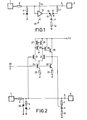
- a control voltage source 1 generates a DC voltage on the order of a few volts, e.g. 6 volts + 2 volts supplied. This is fed via a series resistor 2 to a shunt branch connected to ground, which contains the series connection of a first capacitor 3 and an associated series resistor 4. This branch may also contain other parallel branches with a similar structure or a parallel capacitor without a series resistor.
- the voltage occurring at the connection point of the resistors 2 and 4 is fed to the output terminal 5 and from there to a stage to be regulated, for example a voltage-dependent controlled oscillator 6.
- a resistor 7 is also connected to the terminal 5, which is connected to the one changeover contact 8 of a changeover switch 9, the tongue 10 of which is connected to ground via a second capacitor 11 of, for example, 4.7 / uF and possibly a resistor 12.
- the resistor 7 and possibly the resistor 12 is a second resistor in the circuit of the capacitor 11 when the latter is effective in the position of the tongue 10 of the switch 9 in the smoothing filter (not shown).
- the high-resistance input of an amplifier 13 is connected to the DC voltage line, to which the capacitor 3 is connected via the resistor 4, and is connected between a supply terminal + U of 12 volts and ground. Its low-resistance output is connected to the second terminal 14 of the switch 9. The same voltage occurs at this terminal 14 with low impedance, which is present at the series connection of capacitor 3 and resistor 4.
- the amplification factor of the amplifier 13 thus corresponds at least approximately to 1. This voltage is supplied to the capacitor 11 at every moment in the position of the tongue 10 of the switch 9 shown. If the switch 9 is then switched over, this voltage is transmitted from the capacitor 11 to the output terminal 5, it being evident that no disturbing voltage change can result.
- the changeover switch 9 can be saved and the capacitor 11 can remain permanently connected to the output of the amplifier 13 and also also to the resistor 7 if the amplifier 13 can be switched between the gain 1 and zero by means of a switching voltage supplied with a broken line terminal 15.
- the contacts 8 and 14 are then in permanent connection with the tongue 10. With the degree of amplification 1, the above-mentioned transmission of the voltage from the capacitor 3 to the capacitor 11 results. Then there is no voltage difference between the capacitor 11 and the output terminal 5, and accordingly overflows the resistor 7 no current: the capacitor 11 is therefore not effective in charging and discharging and smoothing the voltage at the output terminal 5.
- the amplifier 13 is switched to zero gain, its output becomes high-impedance, and the capacitor 11 is connected via the resistor 7 to the output terminal 5 and is effective in the smoothing filter.
- the resistor 7 can have a low value; because with effective amplifier 13 is due to him no voltage, so that it does not cause any stress in the circuit.
- FIG. 2 An embodiment of this circuit according to the invention, which operates without switching, is shown in FIG. 2, in which the same parts are again provided with the same reference numbers as in FIG. 1.
- a further capacitor 20 is connected in parallel with the series connection of the first capacitor 3 and the first resistor 4 to improve the smoothing properties.
- the voltage occurring at the output of the resistor 2 and at the terminal 5 is fed to the base of a first npn transistor 21, the emitter of which is connected to the emitter of a second npn transistor 22 and to the collector of a third npn transistor 23.
- the base of transistor 23 is connected to a terminal 24, to which a switching voltage V is supplied; the emitter of transistor 23 is connected to ground via a resistor 25.
- the collectors of the transistors 21 and 22 are connected via the collector-emitter paths of two pnp transistors 27 and 28 to the 12 V supply source + U.
- the collector of transistor 27 is also at the base of a pnp transistor 29, the emitter of which is connected to the connected bases of transistors 27 and 28 and the collector of which is connected to ground.
- the transistors 27, 28 and 29 form a current mirror circuit by means of which the collector currents of the transistors 21 and 22 are kept the same.
- the collector of transistor 22 is further connected to the base of an npn transistor 30, the emitter of which controls the base of an npn transistor 31, the emitter of which is connected to the base of transistor 22.
- the collectors of transistors 30 and 31 are connected to + U.
- the collector-emitter path of an npn transistor 32 also lies between the base of transistor 22 and ground Emitter resistor 33.
- the base of transistor 32 is connected to terminal 24.
- the connection point of the emitter of transistor 31 to the collector of transistor 32 and the base of transistor 22 is further connected to the connection point of capacitor 11 and resistor 7.
- the transistors 23 and 32 act as current sources on the one hand for the differential amplifier 21, 22 and on the other hand for the emitter current branch of the double emitter follower 30, 31.
- This circuit ensures that the voltages at the bases of the transistors 21 and 22 are always exactly the same, the input of transistor 21 being very high-resistance and the base connection of transistor 22 being very low-resistance due to the action of emitter followers 30, 31.
- the voltage occurring at the output terminal 5 is therefore always transferred to the capacitor 11; there is no voltage difference across resistor 7. If necessary, the capacitor 11 is recharged by the transistors 30, 31, 32, the maximum discharge current being determined by the current source 32, 33.
- the amplifier with the transistors 21 to 32 is currentless and ineffective. Then the capacitor 11 is connected with a series resistor 12 via the resistor 7 at the output terminal 5 and thus causes an increase in the time constant of the smoothing element.
Landscapes
- Engineering & Computer Science (AREA)
- Power Engineering (AREA)
- Amplifiers (AREA)
- Networks Using Active Elements (AREA)
- Direct Current Feeding And Distribution (AREA)
- Control Of Electrical Variables (AREA)
- Filters And Equalizers (AREA)
Abstract
Description
- Die Erfindung bezieht sich auf eine Schaltungsanordnung zum Übertragen einer Gleichspannung mit einem zwischen einer Eingangsklemme und einer Ausgangsklemme gegen ein Bezugspotential liegenden umschaltbaren Glättungsglied, das aus wenigstens einem Längswiderstand und dahinter im Querzweig einem, ggf. mit einem ersten Widerstand in Reihe liegenden, ersten Kondensator und einem, ggf. mit einem zweiten Widerstand in Reihe liegenden, wahlweise anschaltbaren zweiten Kondensator besteht, der zur Vergrößerung der Zeitkonstante an die Ausgangsklemme angeschaltet werden kann.
- Bei bekannten Schaltungen dieser Art, die z.B. zur Regelung eines spannungsgesteuerten Oszillators verwendet werden können, wird normalerweise eine sich ändernde Spannung übertragen. Wenn der zweite Kondensator abgeschaltet ist, steht an ihm in der Regel eine andere Spannung als am ersten Kondensator. Sobald der zweite Kondensator eingeschaltet wird, fließt zu ihm ein Lade- oder Entladestrom, und dementsprechend gibt es einen Spannungsstoß, der sich auf die übertragene Spannung auswirkt, und der nachteilige Folgen haben kann. Z.B. kann der Oszillator aus dem Fangbereich geraten, was eine neue Umschaltung verursacht. Der Oszillator fängt aufs neue ein, usw. Hierbei vergeht eine lange Zeit, bis der Regelkreis endgültig auf die langsame Zeitkonstante umgeschaltet hat.
- Der Erfindung liegt die Aufgabe zugrunde, diesen Spannungsstoß zu vermeiden.
- Diese Aufgabe wird nach der Erfindung dadurch gelöst, daß mit der Ausgangsklemme der Eingang eines Verstärkers mit hoher Eingangsimpedanz und mit einem Verstärkungsfaktor von wenigstens annähernd 1 verbunden ist, dessen Ausgang mit dem zweiten Kondensator verbunden ist.
- Nach einer bevorzugten Ausführungsform liegt der Ausgang des Verstärkers an einer Ausgangsklemme eines Umschalters, dessen umschaltbare Zunge mit dem zweiten Kondensator verbunden ist, und dessen andere Ausgangsklemme an die Ausgangsklemme des Glättungsfilters angeschlossen ist.
- Nach einer anderen bevorzugten Ausführungsform ist der zweite Kondensator über den zweiten Widerstand mit der Ausgangsklemme verbunden, parallel zum zweiten Widerstand ist der Verstärker angeschlossen, und der Verstärker wird zwischen dem Verstärkungsfaktor Null und wenigstens annähernd 1 umgeschaltet. In diesem Fall ist ein Umschalter im Zweig des Glättungskondensators nicht erforderlich; die Umschaltung wird durch eine Steuergröße bewirkt, die den Verstärker zwischen dem Verstärkungsfaktor 1 und Null umschaltet. Im ersten Fall wird die Spannung des zweiten Kondensators mit der Spannung des ersten Kondensators mitgesteuert, so daß über den zweiten Widerstand kein Strom fließt und der zweite Widerstand für das Glättungsfilter unwirksam ist. Im zweiten Falle ist der zweite Kondensator über den Widerstand an das Glättungsfilter angeschlossen. Dieser Widerstand braucht nicht groß zu sein, derart, daß der zweite Kondensator praktisch direkt an die Ausgangsklemme angeschlossen ist.
- Der Vollständigkeit halber sei bemerkt, daß es aus der DE-OS 21 59 223 bekannt ist, einem im Längszweig des Glättungsfilters liegenden Widerstand einen als Schalter wirksamen Transistorverstärker parallel zu schalten und diesem Verstärker ein Schaltsignal zuzuführen. Wenn dieser Verstärker unwirksam ist, ist der Längswiderstand voll in das Glättungsfilter eingeschaltet. Wenn dagegen der Schaltverstärker Strom führt, wird dem Längswiderstand ein weiterer Widerstandszweig parallel geschaltet derart, daß der effektive Widerstandswert wesentlich vermindert und dadurch die Grenzfrequenz des Glättungsfilters entsprechend erhöht ist. Da dieser Längswiderstand auch Strom führen kann, ist ein Spannungsstoß in der übertragenen Gleichspannung nicht vermieden. Außerdem wird die Längsimpedanz des Glättungsfilters verändert, was unerwünscht sein kann.
- Die Erfindung wird nachstehend anhand der Zeichnung beispielsweise näher erläutert, die in
- Fig. 1 ein Prinzipschaltbild und in
- Fig. 2 eine Detailschaltung mit Steuerung durch eine angelegte Spannung V zeigt.
- In Fig. 1 wird von einer Regelspannungsquelle 1 eine Gleichspannung in der Größenordnung von einigen Volt, z.B. 6 Volt + 2 Volt, geliefert. Diese wird über einen Längswiderstand 2 einem nach Masse angeschlossenen Querzweig zugeführt, der die Reihenschaltung eines ersten Kondensators 3 und eines dazugehörenden Vorwiderstandes 4 enthält. Dieser Zweig kann ggf. auch weitere Parallelzweige mit ähnlichem Aufbau oder auch einen Parallelkondensator ohne Vorwiderstand enthalten.
- Die am Verbindungspunkt der Widerstände 2 und 4 auftretende Spannung wird der Ausgangsklemme 5 und von dort einer zu regelnden Stufe, z.B. einem spannungsabhängig gesteuerten Oszillator 6 zugeführt. An die Klemme 5 ist weiter ein Widerstand 7 angeschlossen, der an dem einen Umschaltkontakt 8 eines Umschalters 9 liegt, dessen Zunge 10 über einen zweiten Kondensator 11 von z.B. 4,7 /uF und ggf. einen Widerstand 12 mit Masse verbunden ist. Der Widerstand 7 und ggf. der Widerstand 12 liegt als zweiter Widerstand im Stromkreis des Kondensators 11, wenn dieser in der nicht dargestellten Lage der Zunge 10 des Umschalters 9 im Glättungsfilter wirksam ist.
- An die Gleichspannungsleitung, an die der Kondensator 3 über den Widerstand 4 angeschlossen ist, ist der hochohmige Eingang eines Verstärkers 13 angeschlossen, der zwischen einer Speiseklemme +U von 12 Volt und Masse angeschaltet ist. Sein niederohmiger Ausgang ist mit der zweiten Klemme 14 des Umschalters 9 verbunden. An dieser Klemme 14 tritt mit geringer Impedanz die gleiche Spannung auf, die an der Reihenschaltung von Kondensator 3 und Widerstand 4 anliegt. Der Verstärkungsfaktor des Verstärkers 13 entspricht also wenigstens annähernd 1. Diese Spannung wird in der dargestellten Lage der Zunge 10 des Umschalters 9 dem Kondensator 11 in jedem Augenblick zugeführt. Wenn dann der Schalter 9 umgeschaltet wird, wird diese Spannung vom Kondensator 11 zur Ausgangsklemme 5 übertragen, wobei sich ersichtlich keine störende Spannungsänderung ergeben kann.
- Der Umschalter 9 kann erspart werden und der Kondensator 11 kann mit dem Ausgang des Verstärkers 13 und außerdem auch dem Widerstand 7 dauernd verbunden bleiben, wenn der Verstärker 13 mittels einer einer gestrichelt gezeichneten Klemme 15 zugeführten Schaltspannung zwischen dem Verstärkungsgrad 1 und Null umgeschaltet werden kann. Die Kontakte 8 und 14 stehen dann in dauernder Verbindung mit der Zunge 10. Beim Verstärkungsgrad 1 ergibt sich die erwähnte Übertragung der Spannung vom Kondensator 3 auf den Kondensator 11. Dann besteht zwischen dem Kondensator 11 und der Ausgangsklemme 5 keine Spannungsdifferenz, und entsprechend fließt über den Widerstand 7 kein Strom: Der Kondensator 11 ist also nicht durch Ladung und Entladung speichernd und glättend für die Spannung an der Ausgangsklemme 5 wirksam. Wird jedoch der Verstärker 13 auf die Verstärkung Null umgeschaltet, so wird sein Ausgang hochohmig, und der Kondensator 11 ist über den Widerstand 7 an die Ausgangsklemme 5 angeschlossen und im Glättungsfilter wirksam. Der Widerstand 7 kann einen geringen Wert aufweisen; denn bei wirksamem Verstärker 13 liegt an ihm keine Spannung, so daß er also auch keine Belastung in der Schaltung bewirkt.
- Eine Ausführungsform dieser ohne Umschaltung arbeitenden Schaltung nach der Erfindung zeigt Fig. 2, in der gleiche Teile wieder mit gleichen Bezugsziffern wie in Fig. 1 versehen sind.
- Der Reihenschaltung des ersten Kondensators 3 und des ersten Widerstandes 4 ist hier ein weiterer Kondensator 20 zur Verbesserung der Glättungseigenschaften parallelgeschaltet. Die am Ausgang des Widerstandes 2 und an der Klemme 5 auftretende Spannung wird der Basis eines ersten npn-Transistors 21 zugeführt, dessen Emitter mit dem Emitter eines zweiten npn-Transistors 22 und mit dem Kollektor eines dritten npn-Transistors 23 verbunden ist. Die Basis des Transistors 23 liegt an einer Klemme 24, der eine Schaltspannung V zugeführt wird; der Emitter des Transistors 23 ist über einen Widerstand 25 an Masse angeschlossen. Die Kollektoren der Transistoren 21 und 22 sind über die Kollektor-Emitter-Strecken zweier pnp-Transistoren 27 bzw. 28 an die Speisequelle +U von 12 Volt angeschlossen. Der Kollektor des Transistors 27 liegt außerdem an der Basis eines pnp-Transistors 29, dessen Emitter an die verbundenen Basen der Transistoren 27 und 28 und dessen Kollektor an Masse angeschlossen ist. Die Transistoren 27, 28 und 29 bilden eine Stromspiegelschaltung, durch die die Kollektorströme der Transistoren 21 und 22 gleich gehalten werden.
- Der Kollektor des Transistors 22 ist weiter mit der Basis eines npn-Transistors 30 verbunden, dessen Emitter die Basis eines npn-Transistors 31 steuert, der mit seinem Emitter an der Basis des Transistors 22 liegt. Die Kollektoren der Transistoren 30 und 31 sind an +U angeschlossen. Zwischen der Basis des Transistors 22 und Masse liegt weiter die Kollektor-Emitter-Strecke eines npn-Transistors 32 mit Emitterwiderstand 33. Die Basis des Transistors 32 ist an die Klemme 24 angeschlossen. Der Verbindungspunkt des Emitters des Transistors 31 mit dem Kollektor des Transistors 32 und der Basis des Transistors 22 ist weiter mit dem Verbindungspunkt des Kondensators 11 und des Widerstandes 7 verbunden.
- Wenn die dargestellte Transistor-Verstärkerschaltung in Betrieb ist dadurch, daß der Klemme 24 eine Schaltspannung von z.B. +1 Volt zugeführt wird, wirken die Transistoren 23 und 32 als Stromquellen einerseits für den Differenzverstärker 21, 22 und andererseits für den Emitterstromzweig des doppelten Emitterfolgers 30, 31. In dieser Schaltung ist sichergestellt, daß die Spannungen an den Basen der Transistoren 21 und 22 immer exakt gleich sind, wobei der Eingang des Transistors 21 sehr hochohmig und der Basisanschluß des Transistors 22 durch die Wirkung der Emitterfolger 30, 31 sehr niederohmig ist. Die an der Ausgangsklemme 5 auftretende Spannung wird also stets auf den Kondensator 11 übertragen; am Widerstand 7 tritt keine Spannungsdifferenz auf. Der Kondensator 11 wird von den Transistoren 30, 31, 32 erforderlichenfalls umgeladen, wobei der maximale Entladestrom durch die Stromquelle 32, 33 bestimmt wird.
- Wenn die Schaltspannung V an der Klemme 24 auf Null Volt reduziert wird, ist der Verstärker mit den Transistoren 21 bis 32 stromlos und unwirksam. Dann liegt der Kondensator 11 mit Vorwiderstand 12 über den Widerstand 7 an der Ausgangsklemme 5 und bewirkt somit eine Vergrößerung der Zeitkonstante des Glättungsgliedes.
Claims (3)
Applications Claiming Priority (2)
| Application Number | Priority Date | Filing Date | Title |
|---|---|---|---|
| DE19813142612 DE3142612A1 (de) | 1981-10-28 | 1981-10-28 | Schaltungsanordnung mit einem umschaltbaren glaettungsglied |
| DE3142612 | 1981-10-28 |
Publications (3)
| Publication Number | Publication Date |
|---|---|
| EP0078084A2 true EP0078084A2 (de) | 1983-05-04 |
| EP0078084A3 EP0078084A3 (en) | 1984-10-10 |
| EP0078084B1 EP0078084B1 (de) | 1988-09-21 |
Family
ID=6144946
Family Applications (1)
| Application Number | Title | Priority Date | Filing Date |
|---|---|---|---|
| EP82201320A Expired EP0078084B1 (de) | 1981-10-28 | 1982-10-22 | Schaltungsanordnung mit einem umschaltbaren Glättungsglied |
Country Status (4)
| Country | Link |
|---|---|
| US (1) | US4849663A (de) |
| EP (1) | EP0078084B1 (de) |
| JP (1) | JPS5882320A (de) |
| DE (2) | DE3142612A1 (de) |
Cited By (1)
| Publication number | Priority date | Publication date | Assignee | Title |
|---|---|---|---|---|
| AT513104B1 (de) * | 2012-07-10 | 2015-11-15 | Felix Dipl Ing Dr Himmelstoss | Vorrichtung zur Konstanthaltung der Frequenz eines spannungsgesteuerten Oszillators |
Families Citing this family (7)
| Publication number | Priority date | Publication date | Assignee | Title |
|---|---|---|---|---|
| JPH02174414A (ja) * | 1988-12-27 | 1990-07-05 | Hitachi Ltd | 半導体集積回路装置 |
| JP2748676B2 (ja) * | 1990-09-19 | 1998-05-13 | 日本電気株式会社 | Pll回路 |
| US5444312A (en) * | 1992-05-04 | 1995-08-22 | Compaq Computer Corp. | Soft switching circuit for audio muting or filter activation |
| US5394028A (en) * | 1992-06-26 | 1995-02-28 | Motorola, Inc. | Apparatus for transitioning between power supply levels |
| US5794130A (en) * | 1994-04-26 | 1998-08-11 | Funai Electric Engineering Company Limited | Wireless communication system having improved PLL circuits |
| DE19611219A1 (de) * | 1996-03-21 | 1997-09-25 | Fraunhofer Ges Forschung | Phasenregelschleife mit umschaltbarer Schleifenbandbreite |
| US5841324A (en) * | 1996-06-20 | 1998-11-24 | Harris Corporation | Charge-based frequency locked loop and method |
Family Cites Families (14)
| Publication number | Priority date | Publication date | Assignee | Title |
|---|---|---|---|---|
| US2828419A (en) * | 1954-10-11 | 1958-03-25 | Gen Electric | Automatic frequency control system |
| US3893034A (en) * | 1958-11-04 | 1975-07-01 | Bell Telephone Labor Inc | Smoothing circuits |
| US3287657A (en) * | 1963-04-09 | 1966-11-22 | Ericsson Telefon Ab L M | Phase controlled oscillator with a variable synchronizing range |
| US3408590A (en) * | 1966-10-31 | 1968-10-29 | Bell Telephone Labor Inc | Active hybrid filter using frequency emphasizing and attenuating networks |
| DE2159223A1 (de) * | 1971-11-30 | 1973-06-14 | Licentia Gmbh | Zeilensynchronisierschaltung mit umschaltbarer zeitkonstante fuer einen fernsehempfaenger |
| US3909735A (en) * | 1974-04-04 | 1975-09-30 | Ncr Co | Slow switch for bandwidth change in phase-locked loop |
| US4007429A (en) * | 1976-01-19 | 1977-02-08 | Gte International Incorporated | Phase-locked loop having a switched lowpass filter |
| JPS5923126B2 (ja) * | 1976-09-09 | 1984-05-31 | 日本電気株式会社 | しや断周波数可変濾波器 |
| US4142110A (en) * | 1977-04-07 | 1979-02-27 | Fa. Weber Lichtsteuergerate Kg. | Circuit to eliminate DC bias |
| US4156855A (en) * | 1978-01-26 | 1979-05-29 | Rca Corporation | Phase-locked loop with variable gain and bandwidth |
| GB2017444B (en) * | 1978-03-14 | 1982-05-26 | Secr Defence | Active filter network |
| US4540946A (en) * | 1980-06-06 | 1985-09-10 | National Research Development Corp. | Variable characteristic filters |
| JPS5843031U (ja) * | 1981-09-17 | 1983-03-23 | パイオニア株式会社 | 低域通過型フイルタ |
| US4482869A (en) * | 1982-04-13 | 1984-11-13 | Pioneer Electronic Corporation | PLL Detection circuit having dual bandwidth loop filter |
-
1981
- 1981-10-28 DE DE19813142612 patent/DE3142612A1/de not_active Withdrawn
-
1982
- 1982-10-22 EP EP82201320A patent/EP0078084B1/de not_active Expired
- 1982-10-22 DE DE8282201320T patent/DE3279067D1/de not_active Expired
- 1982-10-25 JP JP57186220A patent/JPS5882320A/ja active Granted
-
1989
- 1989-01-06 US US07/294,964 patent/US4849663A/en not_active Expired - Fee Related
Cited By (1)
| Publication number | Priority date | Publication date | Assignee | Title |
|---|---|---|---|---|
| AT513104B1 (de) * | 2012-07-10 | 2015-11-15 | Felix Dipl Ing Dr Himmelstoss | Vorrichtung zur Konstanthaltung der Frequenz eines spannungsgesteuerten Oszillators |
Also Published As
| Publication number | Publication date |
|---|---|
| DE3142612A1 (de) | 1983-05-11 |
| DE3279067D1 (en) | 1988-10-27 |
| EP0078084B1 (de) | 1988-09-21 |
| US4849663A (en) | 1989-07-18 |
| JPS5882320A (ja) | 1983-05-17 |
| EP0078084A3 (en) | 1984-10-10 |
| JPH0468810B2 (de) | 1992-11-04 |
Similar Documents
| Publication | Publication Date | Title |
|---|---|---|
| DE3713376A1 (de) | Komparator mit erweitertem eingangsgleichtaktspannungsbereich | |
| EP0087175A1 (de) | Schaltung zur elektronischen Verstärkungsstellung | |
| DE1812292C3 (de) | Schaltungsanordnung zur Verstärkungsregelung | |
| WO1997033365A1 (de) | Operationsverstärker | |
| EP0078084B1 (de) | Schaltungsanordnung mit einem umschaltbaren Glättungsglied | |
| EP0809350A1 (de) | Digital einstellbarer Quarzoszillator mit monolithisch integrierter Oszillatorschaltung | |
| DE2931922C2 (de) | "Schaltungsanordnung zum Speisen einer eine konstante Betriebsspannung liefernden Stromversorgungseinrichtung" | |
| DE3901983A1 (de) | Stifttreiberschaltung | |
| CH629052A5 (de) | Elektronischer sender fuer gleichstromtelegraphiesysteme. | |
| DE2946952C2 (de) | ||
| DE3539379C2 (de) | Monolithisch integrierte Steuerschaltung für die Umschaltung von Transistoren | |
| EP0608694B1 (de) | Integrierbare Stromquellenschaltung | |
| EP0106408B1 (de) | Schaltungsanordnung zur Lautstärkestellung | |
| DE3029895C2 (de) | Schaltungsanordnung zum Speisen einer eine konstante Betriebsspannung liefernden Stromversorgungseinrichtung | |
| DE3145771C2 (de) | ||
| DE2107714C3 (de) | Schaltung zum Umschalten der Resonanzfrequenzen elektrischer Schwingkreise | |
| DE3816140A1 (de) | Videosignalumschalter | |
| DE2006757C3 (de) | Elektrische Schaltungsanordnung zur stufenlosen Veränderung der Nachstellzeitkonstanten eines Reglers mit nachgebender Rückführung | |
| DE1537606C (de) | Gleichstromverstärker mit Schaltung zur Driftkompensation | |
| DE3418191C2 (de) | ||
| DE1537606A1 (de) | Gleichstromverstaerker mit Schaltung zur Driftkompensation | |
| DE2711520B2 (de) | Belastungsschaltung für eine Signalquelle | |
| DE3043768C2 (de) | Spannungsfolger-Verstärker für eine kapazitive Last | |
| DE2931901C2 (de) | Monolithisch integrierter Schwellwertschalter | |
| DE3715731C2 (de) |
Legal Events
| Date | Code | Title | Description |
|---|---|---|---|
| PUAI | Public reference made under article 153(3) epc to a published international application that has entered the european phase |
Free format text: ORIGINAL CODE: 0009012 |
|
| 17P | Request for examination filed |
Effective date: 19821022 |
|
| AK | Designated contracting states |
Designated state(s): DE FR GB IT |
|
| PUAL | Search report despatched |
Free format text: ORIGINAL CODE: 0009013 |
|
| AK | Designated contracting states |
Designated state(s): DE FR GB IT |
|
| 17Q | First examination report despatched |
Effective date: 19861107 |
|
| R17C | First examination report despatched (corrected) |
Effective date: 19870424 |
|
| RAP1 | Party data changed (applicant data changed or rights of an application transferred) |
Owner name: N.V. PHILIPS' GLOEILAMPENFABRIEKEN Owner name: PHILIPS PATENTVERWALTUNG GMBH |
|
| GRAA | (expected) grant |
Free format text: ORIGINAL CODE: 0009210 |
|
| AK | Designated contracting states |
Kind code of ref document: B1 Designated state(s): DE FR GB IT |
|
| REF | Corresponds to: |
Ref document number: 3279067 Country of ref document: DE Date of ref document: 19881027 |
|
| ITF | It: translation for a ep patent filed | ||
| ET | Fr: translation filed | ||
| GBT | Gb: translation of ep patent filed (gb section 77(6)(a)/1977) | ||
| PLBE | No opposition filed within time limit |
Free format text: ORIGINAL CODE: 0009261 |
|
| STAA | Information on the status of an ep patent application or granted ep patent |
Free format text: STATUS: NO OPPOSITION FILED WITHIN TIME LIMIT |
|
| 26N | No opposition filed | ||
| PGFP | Annual fee paid to national office [announced via postgrant information from national office to epo] |
Ref country code: GB Payment date: 19910809 Year of fee payment: 10 |
|
| PGFP | Annual fee paid to national office [announced via postgrant information from national office to epo] |
Ref country code: FR Payment date: 19911023 Year of fee payment: 10 |
|
| ITTA | It: last paid annual fee | ||
| PG25 | Lapsed in a contracting state [announced via postgrant information from national office to epo] |
Ref country code: GB Effective date: 19921022 |
|
| GBPC | Gb: european patent ceased through non-payment of renewal fee |
Effective date: 19921022 |
|
| PG25 | Lapsed in a contracting state [announced via postgrant information from national office to epo] |
Ref country code: FR Effective date: 19930630 |
|
| REG | Reference to a national code |
Ref country code: FR Ref legal event code: ST |
|
| PGFP | Annual fee paid to national office [announced via postgrant information from national office to epo] |
Ref country code: DE Payment date: 19951219 Year of fee payment: 14 |
|
| PG25 | Lapsed in a contracting state [announced via postgrant information from national office to epo] |
Ref country code: DE Effective date: 19970701 |