EP0067333B1 - Verfahren zum Deinken von bedrucktem Altpapier - Google Patents
Verfahren zum Deinken von bedrucktem Altpapier Download PDFInfo
- Publication number
- EP0067333B1 EP0067333B1 EP19820104630 EP82104630A EP0067333B1 EP 0067333 B1 EP0067333 B1 EP 0067333B1 EP 19820104630 EP19820104630 EP 19820104630 EP 82104630 A EP82104630 A EP 82104630A EP 0067333 B1 EP0067333 B1 EP 0067333B1
- Authority
- EP
- European Patent Office
- Prior art keywords
- fatty
- weight
- acid
- resinic
- waste paper
- Prior art date
- Legal status (The legal status is an assumption and is not a legal conclusion. Google has not performed a legal analysis and makes no representation as to the accuracy of the status listed.)
- Expired
Links
Classifications
-
- D—TEXTILES; PAPER
- D21—PAPER-MAKING; PRODUCTION OF CELLULOSE
- D21C—PRODUCTION OF CELLULOSE BY REMOVING NON-CELLULOSE SUBSTANCES FROM CELLULOSE-CONTAINING MATERIALS; REGENERATION OF PULPING LIQUORS; APPARATUS THEREFOR
- D21C5/00—Other processes for obtaining cellulose, e.g. cooking cotton linters ; Processes characterised by the choice of cellulose-containing starting materials
- D21C5/02—Working-up waste paper
- D21C5/025—De-inking
- D21C5/027—Chemicals therefor
-
- Y—GENERAL TAGGING OF NEW TECHNOLOGICAL DEVELOPMENTS; GENERAL TAGGING OF CROSS-SECTIONAL TECHNOLOGIES SPANNING OVER SEVERAL SECTIONS OF THE IPC; TECHNICAL SUBJECTS COVERED BY FORMER USPC CROSS-REFERENCE ART COLLECTIONS [XRACs] AND DIGESTS
- Y02—TECHNOLOGIES OR APPLICATIONS FOR MITIGATION OR ADAPTATION AGAINST CLIMATE CHANGE
- Y02W—CLIMATE CHANGE MITIGATION TECHNOLOGIES RELATED TO WASTEWATER TREATMENT OR WASTE MANAGEMENT
- Y02W30/00—Technologies for solid waste management
- Y02W30/50—Reuse, recycling or recovery technologies
- Y02W30/64—Paper recycling
Definitions
- the invention relates to a method for deinking printed waste paper by treating the waste paper in the fabric dissolver at alkaline pH values using alkali silicate, oxidizing bleaching agents, fatty acids and / or resin acids with more than 10 carbon atoms and dispersing agents, as well as separating the detached ink particles from the fiber suspension by flotation and / or washing.
- Deinken is the removal of printing inks from waste paper fiber suspensions.
- the cleaned fibers are used again for the production of various paper qualities, such as printing paper, hygienic paper, writing paper or the like.
- it is essential that printed waste paper is shredded with the addition of chemicals, whereby the printing inks detach from the fibers.
- the detached printing inks are removed from the fiber suspension in subsequent flotation or washing processes.
- the waste paper is shredded in an alkaline medium with the addition of sodium hydroxide solution, alkali silicate, hydrogen peroxide and collector, foamer and complexing agent and then cleaned in the so-called flotation cell by floating out the printing inks or by washing out in a filter and paper production fed again.
- alkali causes a certain swelling of the cellulose fiber and removes the hydrogen bond, which makes it easy to disintegrate the waste paper.
- the alkali also saponifies fatty acids if they are used as collectors.
- the soaps reduce the surface or. Interfacial tension and detach the printing inks. Some of the soap with the water hardness precipitates as an insoluble lime soap and attaches to the printing inks and makes them hydrophobic.
- nonionic surfactants from the classes fatty alcohol polyglycol ether and alkylphenol polyglycol ether are also used, which also support foam development in the flotation cell.
- Hydrogen peroxide is used to prevent fiber yellowing caused by alkali.
- Other chemicals such as water glass and complexing agents stabilize the bleaching liquor.
- the complexing agents prevent the rapid decomposition of the hydrogen peroxide by heavy metal ions such as copper, iron, manganese and the like.
- DE-A-2 093 150 specifies the following chemical formulation based on the waste paper:
- complexing agents are used, they are added in an amount of up to 0.4% by weight in the form of 40% commercial goods, the consistency in the pulper is 4-7% by weight and the temperature is 20 to 50 ° C.
- different waste paper qualities are used, such as daily newspapers, magazines, NCR papers, labels and the like.
- Daily papers with a low ash content for example, are used for later use as hygienic papers, while a waste mixture of daily papers and magazines is used in a ratio of 1: 1 for printing papers.
- the difficulty in removing the inks from the waste paper often depends on the printing process and the ink composition.
- the whiteness of a waste paper mixture from unprinted marginal strips from daily newspapers and magazines in a ratio of 1: 1 is generally 61 - 63%.
- the use of fatty acids generally achieves a whiteness of 58 - 60%.
- the fatty acids are added in liquid form immediately before the waste paper is shredded.
- a solid fatty acid melter is required unless liquid fatty acids are preferred.
- the fatty acids saponify very slowly, resulting in rough flocculation.
- the lime soap formed on the surface of the flocculation makes further saponification of the enclosed fatty acids difficult and prevents their action. Unsaponified fatty acid is absorbed on the fibers and, through their hydrophobization, causes higher fiber losses during flotation.
- the dyes thus exposed are finally excreted by being taken up by a water-immiscible liquid, whereupon this liquid with the dyes contained therein by a suitable device, e.g. is separated by means of a centrifugal filter.
- the object of the present invention was to improve the known deinking processes in such a way that the disadvantages mentioned are largely avoided.
- the object was achieved in that the fatty acids and / or resin acids and the dispersants are used in the form of an oil-in-water emulsion.
- the emulsion is added to the alkaline liquor, spontaneous saponification (salt formation) of the fatty acids and / or resin acids occurs.
- the alkali soap then forms a more or less strong precipitation of the lime soap in very fine flakes depending on the emulsifier concentration and hardness level of the water.
- These fine flakes act as a selective collector for the printing inks and prevent the printing inks from being deposited again on the paper fibers.
- Pre-emulsified fatty acids and / or resin acids can be used before or during the shredding of the waste paper, even with high consistency. This also takes into account developments in shredding the waste paper with a high consistency (15 - 20%) (e.g. cloth dissolving drums or helicopulper).
- Another advantage is that fatty acids with a high melting point or paraffins in dispersed form can also be used as deinking aids without any technical problems.
- Fatty acids and / or resin acids in dispersed form even without the addition of non-ionic dispersants, cause excellent ink separation and a more selective printing ink discharge in the flotation cells. As a result, higher degrees of whiteness, lower fiber losses and higher ash reduction are achieved.
- the concentration of the oil-in-water emulsion is preferably 20-50% by weight, based on the emulsion.
- the method is carried out in such a way that the waste paper in the pulper with 1-5% by weight alkali silicate, 0.5-2% by weight sodium hydroxide and / or sodium carbonate, 0.5-3.0% by weight. % oxidative bleach and 0.2 - 1.5 wt .-% fatty acid and / or resin acid in the form of an oil-in-water emulsion, based on the waste paper, is treated.
- Nonionic and / or anionic dispersants are preferably used for the preparation of the emulsion. Based on the fatty and / or resin acids, 1-35% by weight of nonionic and / or anionic dispersants are used. If anionic dispersants are used, they are preferably 1-10% by weight, based on the fatty and / or resin acid in the emulsion. Alkali and / or amine salts of fatty and / or resin acids and / or olefin sulfonates and / or fatty alcohol sulfates and / or fatty alcohol polyglycol ether sulfates have proven particularly useful as anionic dispersants.
- Fatty acid polyglycol esters, fatty alcohol polyglycol ethers, resin acid polyglycol esters, alkylphenol polyglycol ethers, ethoxylated fatty acid mono- and / or diglycerides have proven themselves as nonionic dispersants in the context of the invention.
- Fatty acid polyglycol esters and / or resin acid polyglycol esters are preferably used with 3-10 mol ethylene oxide content.
- the proportion of nonionic dispersants is preferably 5-25% by weight, based on the fatty and / or resin acid.
- the swelling time was 2 hours. After 2 minutes of defoliation on the Ultra-Turrax @ , the stock suspension was then diluted with water from approx. 12 ° dH to 0.8% consistency and 12 min in a «Voith» laboratory flotation cell. floats.
- the amount, dry matter and ash content of the foam collected were determined.
- the cleaned stock suspension was then acidified to pH 5 with sulfuric acid.
- the degree of whiteness was determined on the Elrepho @ test device from the test sheets that were produced on the “Rapid-Köthen” sheet-forming system.
- Example 2 The procedure was as in Example 1, but instead of oleic acid, 0.8% by weight of dry substance of an oleic acid emulsion, based on the waste paper, was used.
- the oleic acid emulsion had the following composition:
- Example 2 The procedure was as in Example 1, but using 0.8% by weight of dry substance of a fatty acid / resin acid emulsion instead of oleic acid.
- the emulsion had the following composition:
- Example 4 The procedure was as in Example 4, but the emulsion contained a tall oil distillate with 25-30% resin acid. Other additives to the emulsion as in Example 4.
Landscapes
- Health & Medical Sciences (AREA)
- Chemical & Material Sciences (AREA)
- Chemical Kinetics & Catalysis (AREA)
- General Chemical & Material Sciences (AREA)
- Toxicology (AREA)
- Paper (AREA)
- Containers And Packaging Bodies Having A Special Means To Remove Contents (AREA)
- Two-Way Televisions, Distribution Of Moving Picture Or The Like (AREA)
- Ultra Sonic Daignosis Equipment (AREA)
- Studio Devices (AREA)
Description
- Die Erfindung betrifft ein Verfahren zum Deinken von bedrucktem Altpapier durch Behandeln des Altpapiers im Stofflöser bei alkalischen pH-Werten mittels Alkalisilikat, oxidativ wirkenden Bleichmitteln, Fettsäuren und/oder Harzsäuren mit mehr als 10 C-Atomen und Dispergiermitteln sowie Ausscheiden der abgelösten Druckfarbenteilchen aus der Faserstoffsuspension durch Flotation und/oder Waschen.
- Unter Deinken versteht man die Entfernung von Druckfarben aus Altpapierfasersuspensionen. Die gereinigten Fasern werden zur Herstellung verschiedener Papierqualitäten, wie Druckpapier, Hygienepapier, Schreibpapier o. ä. erneut eingesetzt. Beim Ablauf der Deinking-Verfahren ist es wesentlich, dass bedruckte Altpapiersorten unter Zusatz von Chemikalien zerfasert werden, wobei sich die Druckfarben von den Fasern ablösen. Die abgelösten Druckfarben werden in nachgeschalteten Flotations-oder Waschprozessen aus der Fasersuspension entfernt. Sowohl bei dem Flotationsverfahren als auch bei dem Waschverfahren wird das Altpapier in alkalischem Milieu unter Zusatz von Natronlauge, Alkalisilikat, Wasserstoffperoxid sowie Sammler, Schäumer und Komplexbildner zerfasert und dann in der sogenannten Flotationszelle durch Ausflotieren der Druckfarben oder durch Auswaschen in einem Filter gereinigt und der Papierproduktion erneut zugeführt.
- Der Alkalizusatz bewirkt eine gewisse Quellung der Cellulosefaser und hebt die Wasserstoffbrückenbindung auf, wodurch ein leichter Aufschluss des Altpapiers ermöglicht wird. Das Alkali verseift auch Fettsäuren, sofern diese als Sammler eingesetzt werden. Die Seifen bewirken eine Herabsetzung der Oberflächen-bzw. Grenzflächenspannung und lösen die Druckfarben ab. Zum Teil fällt Seife mit den Härtebildnern des Wassers als unlösliche Kalkseife aus und lagert sich an die Druckfarben an und hydrophobiert sie. Zur Verbesserung der Druckfarbenablösung und Dispergierung werden zusätzlich nichtionische Tenside der Klassen Fettalkoholpolyglycoläther bzw. Alkylphenolpolyglycoläther eingesetzt, die auch die Schaumentwicklung in der Flotationszelle unterstützen. Wasserstoffperoxid wird zur Verhinderung der alkalibedingten Faservergilbung eingesetzt. Andere Chemikalien wie Wasserglas und Komplexbildner stabilisieren die Bleichflotte. Dabei verhindern die Komplexbildner die schnelle Zersetzung des Wasserstoffperoxids durch Schwermetallionen wie Kupfer, Eisen, Mangan und ähnliche.
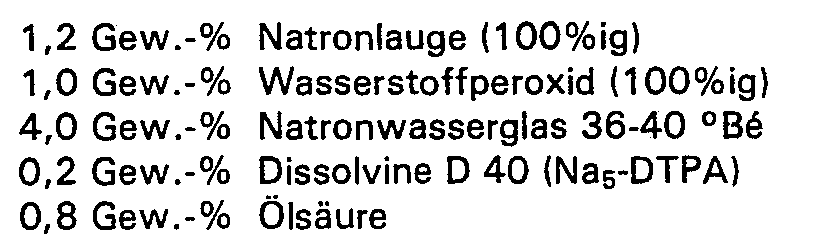
- In der DE-A-2 093 150 wird beispielsweise folgende Chemikalienrezeptur bezogen auf das Altpapier angegeben:

- Sofern Komplexbildner eingesetzt werden, fügt man diese in einer Menge von bis zu 0,4 Gew.-% in Form 40%iger Handelsware zu, die Stoffdichte im Pulper beträgt 4 - 7 Gew.-%, die Temperatur 20 bis 50°C. Je nach dem Bestimmungszweck des wiederaufzuarbeitenden Papiers kommen verschiedene Altpapierqualitäten zum Einsatz, wie beispielsweise Tageszeitungen, Illustrierte, NCR-Papiere, Etiketten und ähnliches. Für den späteren Einsatz als Hygienepapiere werden beispielsweise Tageszeitungen mit geringem Aschegehalt eingesetzt, während man für Druckpapiere eine Altpapiermischung von Tageszeitung und Illustrierte im Verhältnis 1 : 1 nimmt. Die Schwierigkeit der Entfernung der Druckfarben aus den Altpapieren hängt häufig vom Druckverfahren und von der Druckfarbenzusammensetzung ab.
- Der Weissgrad einer Altpapiermischung aus unbedruckten Randstreifen von Tageszeitungen und Illustrierten im Verhältnis 1 : 1 beträgt im allgemeinen 61 - 63%. Beim Deinken von 1 : 1-Mischungen bedruckter Tageszeitungen und Illustrierten erzielt man bei dem Einsatz von Fettsäuren im allgemeinen einen Weissgrad von 58 - 60%. Die Zugabe der Fettsäuren erfolgt dabei in flüssiger Form unmittelbar vor dem Zerfasern des Altpapiers. Man benötigt eine Schmelzvorrichtung für die festen Fettsäuren, sofern man nicht flüssige Fettsäuren bevorzugt. Unter den milden Reaktionsbedingungen im Zerfaserer, verseifen die Fettsäuren sehr langsam wobei grobe Ausflockungen entstehen. Die an der Oberfläche der Ausflockungen gebildete Kalkseife erschwert eine weitere Verseifung der eingeschlossenen Fettsäuren und verhindert ihre Wirkung. Nichtverseifte Fettsäure zieht auf die Fasern auf und bewirkt durch deren Hydrophobierung höhere Faserverluste bei der Flotation.
- Ähnliches beobachtet man auch beim Verfahren gemäss der DE-C-415 062, bei den in der Druckerschwärze enthaltenen unlöslichen Farbstoffe werden durch Auflösen des Bindemittels oder der Farbe des Farbstoffes durch eine Emulsion einer Fettsäure, z.B. Oleinsäure, in einer wässrigen Lösung eines fettsauren oder harzsauren alkalischen Salzes, das auch sulfonsauer sein kann, z.B. eines alkalischen Oleates, Sulfooleates, Sulforizinates, Resinates und Sulforesinates, blossgelegt.
- Die so blossgelegten Farbstoffe werden endlich ausgeschieden, indem sie von einer mit Wasser nicht mischbaren Flüssigkeit aufgenommen werden, worauf diese Flüssigkeit mit den in ihr enthaltenen Farbstoffen durch eine geeignete Vorrichtung, z.B. mittels eines Zentrifugalfilters abgeschieden wird.
- Aufgabe der vorliegenden Erfindung war es, die bekannten Deinkingverfahren so zu verbessern, dass die genannten Nachteile weitgehend vermieden werden.
- Gelöst wurde die Aufgabe dadurch, dass die Fettsäuren und/oder Harzsäuren und die Dispergiermittel in Form einer ÖI-in-Wasser-Emulsion eingesetzt werden. Bei der Zugabe der Emulsion in die alkalische Flotte tritt eine spontane Verseifung (Salzbildung) der Fettsäuren und/oder Harzsäuren ein. Die Alkaliseife bildet dann mit den Härtebildnern des Wassers je nach Emulgatorkonzentration und Härtegrad des Wassers eine mehr oder minder starke Ausfällung der Kalkseife in sehr feinen Flocken.
- Diese feinen Flocken wirken als selektiver Sammler für die Druckfarben und verhindern erneute Ablagerung der Druckfarben auf die Papierfasern.
- Voremulgierte Fettsäuren und/oder Harzsäuren können vor oder während der Zerfaserung des Altpapiers, auch bei hoher Stoffdichte eingesetzt werden. Hiermit werden auch Entwicklungen berücksichtigt, das Altpapier bei hoher Stoffdichte (15 - 20%) zu zerfasern (z.B. Stofflösetrommeln oder Helicopulper).
- Ein weiterer Vorteil besteht darin, dass auch Fettsäuren mit hohem Schmelzpunkt oder Paraffine in dispergierter Form ohne anwendungstechnische Probleme als Deinkinghilfsmittel eingesetzt werden können.
- Fettsäuren und/oder Harzsäuren bewirken in dispergierter Form, auch ohne Zusatz von nichtionogenen Dispergatoren, eine ausgezeichnete Druckfarbenablösung und einen selektiveren Druckfarbenaustrag in den Flotationszellen. Hierdurch werden höhere Weissgrade, niedrigere Faserverluste, und höhere Aschereduzierung erzielt.
- Vorzugsweise beträgt die Konzentration der Öl-in-Wasser-Emulsion 20 - 50 Gew.-% Stoffanteil bezogen auf die Emulsion.
- In Ausgestaltung der Erfindung wird das Verfahren so durchgeführt, dass das Altpapier im Stofflöser mit 1 - 5 Gew.-% Alkalisilikat, 0,5 - 2 Gew.-% Natriumhydroxid und/oder Natriumcarbonat, 0,5 - 3,0 Gew.- % oxidativ wirkende Bleichmittel und 0,2 - 1,5 Gew.-% Fettsäure und/oder Harzsäure in Form einer Öl-in-Wasser-Emulsion, bezogen auf das Altpapier, behandelt wird.
- Zur Emulsionsherstellung werden vorzugsweise nichtionische und/oder anionische Dispergiermittel verwendet. Dabei werden, bezogen auf die Fett-und/oder Harzsäuren 1 - 35 Gew.-% nichtionische und/oder anionische Dispergiermittel eingesetzt. Werden anionische Dispergiermittel eingesetzt, so betragen diese vorzugsweise 1 - 10 Gew.-% bezogen auf die Fett- und/oder Harzsäure in der Emulsion. Als anionische Dispergiermittel haben sich insbesondere Alkali- und/oder Aminsalze der Fett- und/oder Harzsäuren und/oderOlefin-Sulfonate und/oder Fettalkoholsulfate und/oder Fettalkoholpolyglycoläthersulfate bewährt. Als nichtionische Dispergatoren haben sich Fettsäurepolyglycolester, Fettalkoholpolyglycoläther, Harzsäurepolyglycolester, Alkylphenolpolyglycoläther, äthoxylierte Fettsäuremono- und/ oder -diglyceride im Rahmen der Erfindung bewährt. Fettsäurepolyglycolester und/oder Harzsäurepolyglycolester werden vorzugsweise mit 3 - 10 Mol Äthylenoxidanteil eingesetzt. Der Anteil an nichtionischen Dispergatoren beträgt vorzugsweise 5 - 25 Gew.-% bezogen auf die Fett- und/oder Harzsäure.
- Die Erfindung wird anhand der nachfolgenden Beispiele näher erläutert.
-
- 120 g einer Altpapiermischung bestehend aus:
- 60 g Tageszeitungen und
- 60 g Illustrierten
- Die Quellzeit betrug 2 Stunden.
Nach 2minutiger Entstippung am Ultra-Turrax@ wurde die Stoffsuspension dann mit Wasser von ca. 12 °dH auf 0,8% Stoffdichte verdünnt und in einer «Voith»-Laborflotationszelle 12 min. flotiert. - Von dem gesammelten Schaum wurden Menge, Trockensubstanz und Aschegehalt bestimmt. Die gereinigte Stoffsuspension wurde dann mit Schwefelsäure auf pH 5 abgesäuert. Von den Prüfblättern, die auf der «Rapid-Köthen»-Blattbildungsanlage hergestellt wurden, wurden am Elrepho@-Testgerät der Weissgrad bestimmt.

- Es wurde wie im Beispiel 1 verfahren, jedoch anstelle der Ölsäure 0,8 Gew.-% handelsübliche Deinking-Seife eingesetzt.

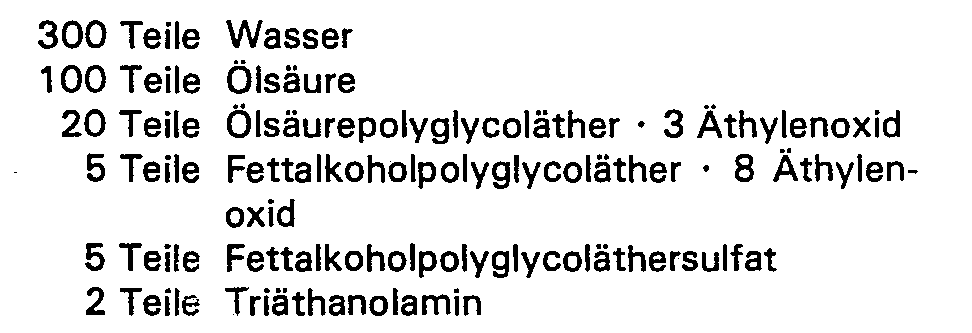
- Es wurde wie im Beispiel 1 verfahren, jedoch anstelle der Ölsäure, 0,8 Gew.-% an Trockensubstanz einer Ölsäureemulsion bezogen auf das Altpapier eingesetzt.
- Die Ölsäureemulsion hatte die folgende Stoffzusammensetzung:

- Es wurde wie im Beispiel 1 verfahren, jedoch anstelle der Ölsäure 0,8 Gew.-% an Trockensubstanz einer Fettsäure/Harzsäure-Emulsion eingesetzt.
- Die Emulsion hatte die folgende Zusammensetzung:


- Es wurde wie im Beispiel 4 verfahren, jedoch enthielt die Emulsion ein Tallöldestillat mit 25 - 30% Harzsäure. Andere Zusätze zur Emulsion wie im Beispiel 4.

- Es wurde wie im Beispiel 3 gearbeitet, die Ölsäureemulsion hatte jedoch folgende Stoffzusammensetzung:


- Es wurde wie im Beispiel 4 verfahren, die Fettsäure/Harzsäure-Emulsion hatte jedoch die folgende Zusammensetzung:


- Es wurde wie im Beispiel 5 verfahren, die Fettsäure/Harzsäure-Emulsion hatte jedoch die folgende Zusammensetzung:


- Es wurde wie im Beispiel 3 verfahren, jedoch mit folgender Emulsionszusammensetzung:


- Es wurde wie im Beispiel 3 verfahren, jedoch mit folgender Emulsionszusammensetzung:
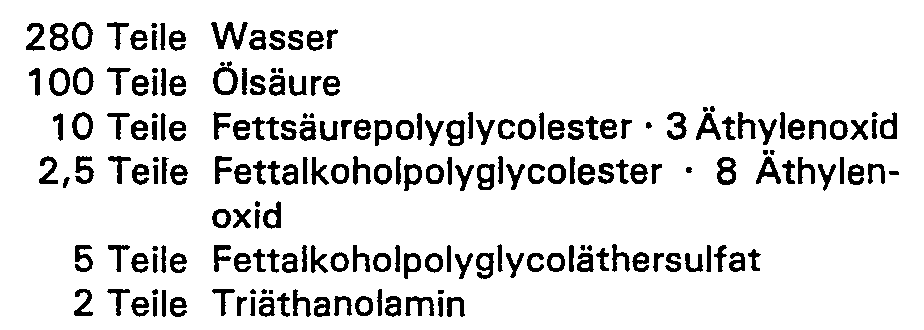

- Es wurde wie im Beispiel 3 verfahren, jedoch mit folgender Emulsionszusammensetzung:


- Es wurde wie im Beispiel 3 verfahren, jedoch mit folgender Emulsionszusammensetzung:
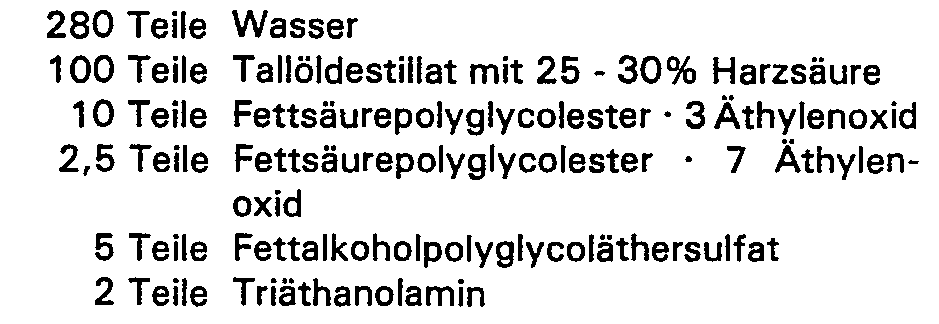

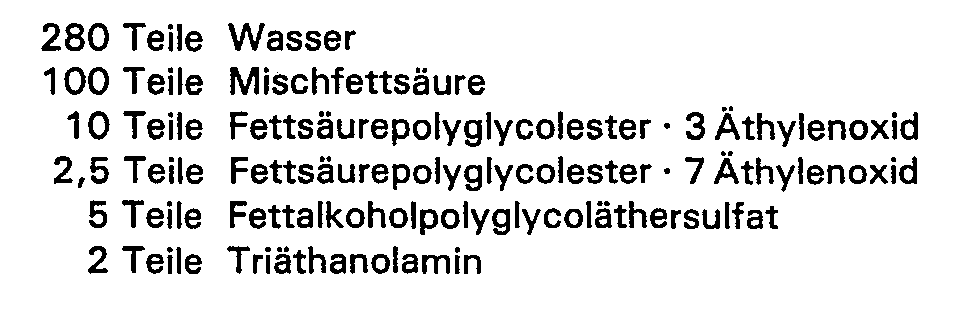
- Es wurde wie im Beispiel 3 verfahren, jedoch mit folgender Emulsionszusammensetzung:

- Eine Gegenüberstellung der getesteten Formulierungen zeigt die deutlichen Vorteile der Emulsion hinsichtlich Weissgrad, Aschereduzierung und Faserverluste.

werden 5 min. bei 12% Stoffdichte und bei einer Temperatur von 20 und 50°C unter Zugabe der nachstehend genannten Chemikalien imprägniert und 5 min. bei 4% Stoffdichte zerfasert. Die Härte des Wassers betrug 12 °dH..
Claims (10)
Priority Applications (1)
| Application Number | Priority Date | Filing Date | Title |
|---|---|---|---|
| AT82104630T ATE12273T1 (de) | 1981-06-12 | 1982-05-27 | Verfahren zum deinken von bedrucktem altpapier. |
Applications Claiming Priority (2)
| Application Number | Priority Date | Filing Date | Title |
|---|---|---|---|
| DE3123353 | 1981-06-12 | ||
| DE3123353A DE3123353C2 (de) | 1981-06-12 | 1981-06-12 | Verfahren zum Deinken von bedrucktem Altpapier |
Publications (2)
| Publication Number | Publication Date |
|---|---|
| EP0067333A1 EP0067333A1 (de) | 1982-12-22 |
| EP0067333B1 true EP0067333B1 (de) | 1985-03-20 |
Family
ID=6134559
Family Applications (1)
| Application Number | Title | Priority Date | Filing Date |
|---|---|---|---|
| EP19820104630 Expired EP0067333B1 (de) | 1981-06-12 | 1982-05-27 | Verfahren zum Deinken von bedrucktem Altpapier |
Country Status (8)
| Country | Link |
|---|---|
| US (1) | US4586982A (de) |
| EP (1) | EP0067333B1 (de) |
| JP (1) | JPS57210093A (de) |
| AT (1) | ATE12273T1 (de) |
| CA (1) | CA1182611A (de) |
| DE (1) | DE3123353C2 (de) |
| FI (1) | FI70055C (de) |
| NO (1) | NO159540C (de) |
Cited By (1)
| Publication number | Priority date | Publication date | Assignee | Title |
|---|---|---|---|---|
| DE3729446A1 (de) * | 1987-09-03 | 1989-04-06 | Akzo Gmbh | Mittel zum deinken von altpapier |
Families Citing this family (31)
| Publication number | Priority date | Publication date | Assignee | Title |
|---|---|---|---|---|
| DE3123353C2 (de) * | 1981-06-12 | 1984-09-13 | Akzo Gmbh, 5600 Wuppertal | Verfahren zum Deinken von bedrucktem Altpapier |
| DD223746A1 (de) * | 1983-12-20 | 1985-06-19 | Wolfen Filmfab Veb | Chemikalienflotte zur druckfarbenentfernung aus altpapierstoffen |
| DE3702978C1 (de) * | 1987-02-02 | 1988-06-30 | Gruenau Gmbh Chem Fab | Verfahren zum De-inken von bedrucktem Altpapier |
| DE3811025A1 (de) * | 1988-03-31 | 1989-10-12 | Gruenau Gmbh Chem Fab | Verfahren zum de-inken von bedrucktem altpapier |
| DE3923393A1 (de) * | 1989-07-14 | 1991-01-17 | Henkel Kgaa | Verfahren zur altpapieraufbereitung |
| US5725730A (en) * | 1989-10-19 | 1998-03-10 | Gruenau Illertissen | Aqueous dispersions containing carboxylic acids and/or resinic acids for deinking printed wastepaper |
| DE3934882A1 (de) * | 1989-10-19 | 1991-04-25 | Gruenau Gmbh Chem Fab | Waessrige, carbonsaeuren und/oder harzsaeuren enthaltende dispersionen zum deinken von bedruckten altpapieren |
| DE4002213A1 (de) * | 1990-01-26 | 1991-08-01 | Henkel Kgaa | Alkoxylierte verbindungen, hergestellt aus epoxidierten carbonsaeurederivaten |
| US5442082A (en) * | 1990-01-26 | 1995-08-15 | Henkel Kommanditgesellschaft Auf Aktien | Alkoxylated compounds produced from epoxidized carboxylic acid derivatives |
| US5171427A (en) * | 1990-02-23 | 1992-12-15 | The Dow Chemical Company | Sulfonated and carboxylate collector compositions useful in the flotation of minerals |
| DE59104480D1 (de) * | 1990-10-30 | 1995-03-16 | Benckiser Knapsack Ladenburg | Verfahren zur Wiedergewinnung von Fasern durch Flotationsdeinken aus Altpapier. |
| US5302245A (en) * | 1991-04-02 | 1994-04-12 | Vps Technology Partnership | Integrated wastepaper treatment process |
| US5200034A (en) * | 1991-04-25 | 1993-04-06 | Betz Paperchem, Inc. | Use of surfactants having an HLB less than 10 in the deinking of dry toner electrostatic printed wastepaper |
| NZ242280A (en) * | 1991-04-25 | 1994-02-25 | Betz Int | De-inking electrostatically printed paper using a surfactant in an aqueous |
| US5248388A (en) * | 1991-04-25 | 1993-09-28 | Betz Paperchem, Inc. | Use of surfactants having an HLB less than 10 in the deinking of dry toner electrostatic printed wastepaper |
| US5238538A (en) * | 1991-11-25 | 1993-08-24 | Georgia Tech Research Corporation | Method for deinking recycled fiber by applying direct current electric field |
| CA2082557C (en) * | 1992-02-24 | 1997-03-11 | Charles W. Hankins | Integrated pulping process of waste paper yielding tissue-grade paper fibers |
| US5314580A (en) * | 1992-07-08 | 1994-05-24 | Mauvin Material & Chemical Processing Limited | Process for the removal of ink, resin, and adhesive residues from paper, textile fabrics and solid surfaces |
| WO1996008598A1 (en) * | 1994-09-12 | 1996-03-21 | Ppg Industries, Inc. | Deinking composition and method for deinking waste paper |
| JP2992210B2 (ja) | 1994-10-20 | 1999-12-20 | 花王株式会社 | 古紙再生用脱墨剤 |
| US5658427A (en) * | 1995-08-01 | 1997-08-19 | Geo Specialty Chemicals, Inc. | Ethoxylated soya glycerides with glycols as deinking collector modifiers |
| JP3051826B2 (ja) | 1996-06-03 | 2000-06-12 | 花王株式会社 | 脱墨方法 |
| US6217706B1 (en) * | 1999-10-28 | 2001-04-17 | University Of Florida | Method of de-inking paper and other cellulosic materials |
| US20020121347A1 (en) * | 2000-12-21 | 2002-09-05 | Akzo Nobel N.V. | Chemical composition and process |
| DE10138029A1 (de) * | 2001-08-08 | 2003-02-27 | Stockhausen Chem Fab Gmbh | Verwendung von Emulsionen beim Deinking |
| US6666950B2 (en) * | 2001-11-28 | 2003-12-23 | Basf Ag | Process for deinking paper using a triglyceride |
| US7433948B2 (en) * | 2002-01-23 | 2008-10-07 | Cisco Technology, Inc. | Methods and apparatus for implementing virtualization of storage within a storage area network |
| ES2241408B1 (es) * | 2002-11-13 | 2006-12-16 | Universitat Politecnica De Catalunya | Nuevo material a partir de residuos de papel impreso de alta calidad yy su metodo de obtencion. |
| WO2005068709A1 (en) * | 2004-01-06 | 2005-07-28 | University Of Florida | Improved method of de-inking paper and other cellulosic materials |
| GB0902429D0 (en) | 2009-02-13 | 2009-04-01 | Probe Ind Ltd | Compositions and their use |
| EP2443281A1 (de) | 2009-06-17 | 2012-04-25 | Kemira OYJ | Deinking-verfahren |
Family Cites Families (9)
| Publication number | Priority date | Publication date | Assignee | Title |
|---|---|---|---|---|
| FR559897A (fr) * | 1922-03-15 | 1923-09-22 | Procédé de désencrage des papiers imprimés | |
| FR580624A (fr) * | 1923-07-19 | 1924-11-12 | Procédé perfectionné de désencrage du papier imprimé | |
| US2112562A (en) * | 1934-08-20 | 1938-03-29 | Gardner Richardson Co | Process of deinking paper |
| DE1922038A1 (de) * | 1969-04-30 | 1970-11-12 | Giulini Gmbh Geb | Verfahren zur Herstellung eines Leimungs- und Hydrophobierungsmittels |
| US4013505A (en) * | 1972-03-09 | 1977-03-22 | Vyzkumny Ustav Papieru A Celulosy | Method of deinking printed wastepapers |
| JPS53130309A (en) * | 1977-04-15 | 1978-11-14 | Miyoshi Yushi Kk | Ink removing agent for waste paper regeneration |
| US4360439A (en) * | 1977-10-20 | 1982-11-23 | Montedison S.P.A. | Composition for the de-inking of printed waste paper by the washing process |
| DE2903150A1 (de) * | 1979-01-27 | 1980-08-07 | Henkel Kgaa | Verfahren zum deinken von bedrucktem altpapier |
| DE3123353C2 (de) * | 1981-06-12 | 1984-09-13 | Akzo Gmbh, 5600 Wuppertal | Verfahren zum Deinken von bedrucktem Altpapier |
-
1981
- 1981-06-12 DE DE3123353A patent/DE3123353C2/de not_active Expired
-
1982
- 1982-05-27 AT AT82104630T patent/ATE12273T1/de active
- 1982-05-27 EP EP19820104630 patent/EP0067333B1/de not_active Expired
- 1982-06-07 FI FI822021A patent/FI70055C/fi not_active IP Right Cessation
- 1982-06-11 CA CA000404954A patent/CA1182611A/en not_active Expired
- 1982-06-11 JP JP10053082A patent/JPS57210093A/ja active Pending
- 1982-06-11 NO NO821960A patent/NO159540C/no not_active IP Right Cessation
-
1984
- 1984-08-27 US US06/644,655 patent/US4586982A/en not_active Expired - Lifetime
Cited By (1)
| Publication number | Priority date | Publication date | Assignee | Title |
|---|---|---|---|---|
| DE3729446A1 (de) * | 1987-09-03 | 1989-04-06 | Akzo Gmbh | Mittel zum deinken von altpapier |
Also Published As
| Publication number | Publication date |
|---|---|
| EP0067333A1 (de) | 1982-12-22 |
| NO159540C (no) | 1989-01-11 |
| FI70055C (fi) | 1986-09-12 |
| ATE12273T1 (de) | 1985-04-15 |
| FI70055B (fi) | 1986-01-31 |
| DE3123353C2 (de) | 1984-09-13 |
| NO821960L (no) | 1982-12-13 |
| FI822021A0 (fi) | 1982-06-07 |
| DE3123353A1 (de) | 1982-12-30 |
| JPS57210093A (en) | 1982-12-23 |
| CA1182611A (en) | 1985-02-19 |
| US4586982A (en) | 1986-05-06 |
| NO159540B (no) | 1988-10-03 |
Similar Documents
| Publication | Publication Date | Title |
|---|---|---|
| EP0067333B1 (de) | Verfahren zum Deinken von bedrucktem Altpapier | |
| EP0277570B1 (de) | Verfahren zum De-inken von bedrucktem Altpapier | |
| EP0335260B1 (de) | Flotationsverfahren zum De-inken von bedrucktem Altpapier | |
| DE68907563T2 (de) | Mittel zum Deinken. | |
| EP0483571B1 (de) | Verfahren zur Wiedergewinnung von Fasern durch Flotationsdeinken aus Altpapier | |
| DE2746077C2 (de) | ||
| DE3729446C2 (de) | Mittel zum Deinken von Altpapier und Verfahren zur Herstellung desselben | |
| DE602005004542T2 (de) | Verfahren zum entfärben von altpapier | |
| DE69417089T2 (de) | Verfahren zur Entfernung von bei der Verbrennung aschebildenden Bestandteilen sowie von öligen Rückständen bei der Papierwiedergewinnung | |
| EP0027922B1 (de) | Verfahren zur Entfernung von Pigmenten aus Altpapier | |
| DE69409521T2 (de) | Entschwärzungszusammensetzung für flexographische tinte | |
| EP0013758B1 (de) | Verfahren zum Deinken von bedrucktem Altpapier | |
| DE69325098T2 (de) | Verfahren zur behandlung von altpapier und wiedergewonnenes papier | |
| DE3934893A1 (de) | Waessrige, erdalkaliseifen und/oder erdalkaliharzseifen enthaltende dispersionen zum deinken von bedruckten altpapieren | |
| DE69430623T2 (de) | De-inkverfahren durch flotation dieses mittels | |
| EP0464057B1 (de) | Verfahren zur altpapieraufbereitung | |
| DE69703351T2 (de) | Verfahren zum deinken von altpapier | |
| DE69507506T2 (de) | Verfahren zur wiedergewinnung von faserprodukten | |
| DE10254862A1 (de) | Verfahren zur Druckfarbenentfärbung aus Altpapier durch Flotationsdeinking | |
| DE3118192A1 (de) | Verfahren zum deinken von altpapier | |
| DE19620952C2 (de) | Verfahren zur Weißgradsteigerung im Deinkingprozeß | |
| WO1993015260A1 (de) | Verfahren zur entfernung von druckfarben aus bedrucktem altpapier | |
| DE3142118A1 (de) | "verfahren zur rueckgewinnung von altpapier" | |
| DE4110379C2 (de) | Verfahren und Mittel zur Druckfarbenentfernung aus Altpapier | |
| DE69413153T2 (de) | Verfahren zur Entfärbung von Altpapier |
Legal Events
| Date | Code | Title | Description |
|---|---|---|---|
| PUAI | Public reference made under article 153(3) epc to a published international application that has entered the european phase |
Free format text: ORIGINAL CODE: 0009012 |
|
| AK | Designated contracting states |
Designated state(s): AT BE CH FR GB IT LI LU NL SE |
|
| 17P | Request for examination filed |
Effective date: 19821113 |
|
| ITF | It: translation for a ep patent filed | ||
| GRAA | (expected) grant |
Free format text: ORIGINAL CODE: 0009210 |
|
| AK | Designated contracting states |
Designated state(s): AT BE CH FR GB IT LI LU NL SE |
|
| REF | Corresponds to: |
Ref document number: 12273 Country of ref document: AT Date of ref document: 19850415 Kind code of ref document: T |
|
| ET | Fr: translation filed | ||
| PLBE | No opposition filed within time limit |
Free format text: ORIGINAL CODE: 0009261 |
|
| STAA | Information on the status of an ep patent application or granted ep patent |
Free format text: STATUS: NO OPPOSITION FILED WITHIN TIME LIMIT |
|
| 26N | No opposition filed | ||
| NLT1 | Nl: modifications of names registered in virtue of documents presented to the patent office pursuant to art. 16 a, paragraph 1 |
Owner name: AKZO PATENTE GMBH TE WUPPERTAL, BONDSREPUBLIEK DUI |
|
| ITTA | It: last paid annual fee | ||
| EPTA | Lu: last paid annual fee | ||
| EAL | Se: european patent in force in sweden |
Ref document number: 82104630.7 |
|
| PGFP | Annual fee paid to national office [announced via postgrant information from national office to epo] |
Ref country code: CH Payment date: 19980331 Year of fee payment: 17 |
|
| PGFP | Annual fee paid to national office [announced via postgrant information from national office to epo] |
Ref country code: AT Payment date: 19980424 Year of fee payment: 17 |
|
| PGFP | Annual fee paid to national office [announced via postgrant information from national office to epo] |
Ref country code: LU Payment date: 19980513 Year of fee payment: 17 |
|
| PGFP | Annual fee paid to national office [announced via postgrant information from national office to epo] |
Ref country code: NL Payment date: 19980528 Year of fee payment: 17 |
|
| PG25 | Lapsed in a contracting state [announced via postgrant information from national office to epo] |
Ref country code: LU Free format text: LAPSE BECAUSE OF NON-PAYMENT OF DUE FEES Effective date: 19990527 Ref country code: AT Free format text: LAPSE BECAUSE OF NON-PAYMENT OF DUE FEES Effective date: 19990527 |
|
| PG25 | Lapsed in a contracting state [announced via postgrant information from national office to epo] |
Ref country code: LI Free format text: LAPSE BECAUSE OF NON-PAYMENT OF DUE FEES Effective date: 19990531 Ref country code: CH Free format text: LAPSE BECAUSE OF NON-PAYMENT OF DUE FEES Effective date: 19990531 |
|
| PG25 | Lapsed in a contracting state [announced via postgrant information from national office to epo] |
Ref country code: NL Free format text: LAPSE BECAUSE OF NON-PAYMENT OF DUE FEES Effective date: 19991201 |
|
| REG | Reference to a national code |
Ref country code: CH Ref legal event code: PL |
|
| NLV4 | Nl: lapsed or anulled due to non-payment of the annual fee |
Effective date: 19991201 |
|
| PGFP | Annual fee paid to national office [announced via postgrant information from national office to epo] |
Ref country code: FR Payment date: 20010501 Year of fee payment: 20 |
|
| PGFP | Annual fee paid to national office [announced via postgrant information from national office to epo] |
Ref country code: SE Payment date: 20010503 Year of fee payment: 20 |
|
| PGFP | Annual fee paid to national office [announced via postgrant information from national office to epo] |
Ref country code: GB Payment date: 20010504 Year of fee payment: 20 |
|
| PGFP | Annual fee paid to national office [announced via postgrant information from national office to epo] |
Ref country code: BE Payment date: 20010515 Year of fee payment: 20 |
|
| BE20 | Be: patent expired |
Free format text: 20020527 *AKZO G.M.B.H. |
|
| REG | Reference to a national code |
Ref country code: GB Ref legal event code: IF02 |
|
| PG25 | Lapsed in a contracting state [announced via postgrant information from national office to epo] |
Ref country code: GB Free format text: LAPSE BECAUSE OF EXPIRATION OF PROTECTION Effective date: 20020526 |
|
| REG | Reference to a national code |
Ref country code: GB Ref legal event code: PE20 Effective date: 20020526 |
|
| EUG | Se: european patent has lapsed |
Ref document number: 82104630.7 |