EP0054850B1 - Verfahren zur Herstellung von Ammoniumsulfamat - Google Patents
Verfahren zur Herstellung von Ammoniumsulfamat Download PDFInfo
- Publication number
- EP0054850B1 EP0054850B1 EP81110308A EP81110308A EP0054850B1 EP 0054850 B1 EP0054850 B1 EP 0054850B1 EP 81110308 A EP81110308 A EP 81110308A EP 81110308 A EP81110308 A EP 81110308A EP 0054850 B1 EP0054850 B1 EP 0054850B1
- Authority
- EP
- European Patent Office
- Prior art keywords
- ammonia
- melt
- reactor
- sulfur trioxide
- liquid
- Prior art date
- Legal status (The legal status is an assumption and is not a legal conclusion. Google has not performed a legal analysis and makes no representation as to the accuracy of the status listed.)
- Expired
Links
Images
Classifications
-
- C—CHEMISTRY; METALLURGY
- C01—INORGANIC CHEMISTRY
- C01B—NON-METALLIC ELEMENTS; COMPOUNDS THEREOF; METALLOIDS OR COMPOUNDS THEREOF NOT COVERED BY SUBCLASS C01C
- C01B21/00—Nitrogen; Compounds thereof
- C01B21/082—Compounds containing nitrogen and non-metals and optionally metals
- C01B21/087—Compounds containing nitrogen and non-metals and optionally metals containing one or more hydrogen atoms
- C01B21/093—Compounds containing nitrogen and non-metals and optionally metals containing one or more hydrogen atoms containing also one or more sulfur atoms
- C01B21/096—Amidosulfonic acid; Salts thereof
Definitions
- the invention relates to an improved process for the production of ammonium sulfamate from ammonia and sulfur trioxide under pressure.
- Ammonium sulfamate is an important starting material for the production of free amidosulfonic acid.
- ammonium sulfamate by introducing ammonia and sulfur trioxide under pressure (DE-A-19 15 723). It works under conditions under which the reaction product is molten.
- the reaction product consists mainly of ammonium sulfamate with small amounts of ammonium imidodisulfonate and some ammonium sulfate. It is possible to use ammonia and sulfur trioxide in liquid form and, for example, to proceed in such a way that ammonia and sulfur trioxide are introduced directly into the molten reaction mixture in the lower part of the reaction vessel through inlet pipes.
- an ammonia excess is used, which is preferably 2 to 4 times the stoichiometric amount.
- the excess ammonia is drawn off from the reaction vessel and can be used again.
- DE-A1-2 909 033 it is therefore recommended in DE-A1-2 909 033 to briefly relax the pressure vessel after longer reaction times and thus to discharge the majority of the inert gases that accumulate.
- a process has now been found for the continuous production of ammonium sulfamate starting from ammonia and sulfur trioxide, in which liquid sulfur trioxide and liquid ammonia in a molar ratio NH 3 / S0 3 of over 2.0: 1 are introduced into a pressure reactor which contains the molten reaction product, excess ammonia is continuously removed from the reactor and the liquid sulfur trioxide is introduced into the melt.
- the process is characterized in that the liquid ammonia is passed onto the surface of the melt.
- Sulfur trioxide is e.g. B. initiated by a submerged tube in the melt. It was found that the excess ammonia emerging from the reactor no longer contained any solids, even if the ammonia was fed into the reactor in liquid excess. If, on the other hand, the liquid ammonia is placed under the surface of the melt, a lot of melt is sprayed and considerable amounts of solids are carried away by the unreacted ammonia. In the process according to the invention, it is possible to cool the melt by means of the evaporating excess ammonia and to remove a large part of the considerable heat of reaction by direct evaporative cooling. Part of the heat of reaction is removed by wall cooling or by cooling coils or by a heat exchanger through which the melt flows.
- the amount of ammonia is preferably 1.1 to 10 times, but in particular 1.2 to 4 times the amount stoichiometrically required for the formation of ammonium sulfamate (molar ratio NH 3 / SO 3 2.2: 1 to 20: 1, in particular 2 4: 1 to 8: 1).
- the process is carried out under pressure, preferably under a pressure of 2 to 30 bar, in particular 5 to 20 bar, and at a temperature of 120 to 300 ° C., preferably 160 to 250 ° C.
- the excess ammonia is withdrawn from the reactor in gaseous form. It can be liquefied by compression and cooling and reused in the process.
- a particular embodiment of the process according to the invention consists in condensing the evaporated excess ammonia in a reflux condenser placed on the reactor and then returning it to the reactor. It is also possible to absorb the excess ammonia in water or dilute nitric acid and to use the absorption solution for fertilizer production.
- the process is preferably carried out continuously so that the starting products are introduced continuously and the resulting melt of ammonium sulfamate is continuously drawn off. It is advantageous if the sulfur trioxide introduced is distributed as quickly as possible in the melt. This can be achieved by passing the melt in the reactor at a high flow rate past the sulfur trioxide feed point. It is best to use a stirred kettle. The SO 3 inlet point should be immersed as deep as possible in the melt so that no S0 3 escapes into the gas space. A reaction of S0 3 with NH 3 in the gas space is not desirable. Since the melt is very corrosive, it is also advantageous to use an enamel boiler as a pressure reactor.
- the reaction product contains approximately 80-86.5% ammonium sulfamate, 10-15% ammonium imidosulfonate, 3-5% ammonium sulfate and approximately 0.3-0.5% free ammonia.
- About 1% ammonium sulfate is formed by water, which is carried in with the feed materials NH 3 and SO 3. The rest is caused by side reactions in the melt. Although gaseous feed materials are free of water, they also lead to melts, which are approx. 5% Contains ammonium sulfate.
- It can be directly mixed with acids, e.g. B. dilute nitric acid to be converted to amidosulfonic acid. The invention is explained in more detail in the examples below.
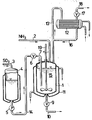
- An enamelled 3 m 3 stirred tank (1) with stirrer (19) serves as the reaction vessel.
- Sulfur trioxide is added to the feed (4) via the feed line (3).
- sulfur trioxide is introduced into the melt (15) via line (14) and valve (6) through the inlet pipe (7). It is important to ensure an optimal distribution of the sulfur trioxide in the melt (Before introducing the S0 3 , the tube (7) is expediently flushed with nitrogen.)
- liquid ammonia is passed through the line (2) into the boiler (1) onto the melt (15) abandoned.
- the reactor (1) is provided with a cooling jacket (11). This is cooled with thermal oil.
- the melt After expansion through the valve (9) via line (10), the melt is continuously removed from the reactor and z. B. further implemented with nitric acid.
- the ammonia coming from the reactor via line (13) is condensed in the condenser (12) and returned to the reactor (1) via lines (16) and (13).
- the condenser (12) is kept at the required temperature via a cooling circuit with water or brine. The excess ammonia and inert gases leave the system via valve (17) and line (18).
- Another variant of the process (not shown) consists in not condensing the ammonia not required for the reaction, but rather in absorbing it in a column.
Landscapes
- Chemical & Material Sciences (AREA)
- Organic Chemistry (AREA)
- Inorganic Chemistry (AREA)
- Treating Waste Gases (AREA)
- Organic Low-Molecular-Weight Compounds And Preparation Thereof (AREA)
- Fertilizers (AREA)
Description
- Die Erfindung betrifft ein verbessertes Verfahren zur Herstellung von Ammoniumsulfamat aus Ammoniak und Schwefeltrioxid unter Druck. Ammoniumsulfamat stellt ein wichtiges Ausgangsmaterial zur Herstellung freier Amidosulfonsäure dar.
- Es ist bereits bekannt, Ammoniumsulfamat durch Einleiten von Ammoniak und Schwefeltrioxid unter Druck herzustellen (DE-A-19 15 723). Dabei arbeitet man unter Bedingungen, unter denen das Reaktionsprodukt schmelzflüssig anfällt. Das Reaktionsprodukt besteht überwiegend aus Ammoniumsulfamat mit geringen Anteilen an Ammonium-Imidodisulfonat und etwas Ammoniumsulfat. Dabei kann man Ammoniak und Schwefeltrioxid in flüssiger Form verwenden und beispielsweise so verfahren, daß Ammoniak und Schwefeltrioxid durch Einleitungsrohre unmittelbar in das flüssige im unteren Teil des Reaktionsgefäßes befindliche geschmolzene Reaktionsgemisch eingebracht werden.
- Nach der Lehre dieser Literaturstelle arbeitet man mit einem Ammoniaküberschuß, der vorzugsweise das 2- bis 4fache der stöchiometrischen Menge beträgt. Das überschüssige Ammoniak wird aus dem Reaktionsgefäß abgezogen und kann erneut wieder eingesetzt werden.
- Bei diesem Verfahren kann es vorkommen, daß die Abgasleitungen und Armaturen beim kontinuierlichen Abblasen von überschüssigem Ammoniak sehr rasch durch mitgerissene Schmelzetröpfchen und Feststoffanteile verstopfen. Um diesem Problem abzuhelfen, wird gemäß DE-A1-2710399 Ammoniak im Unterschuß angewendet; die sich über der Schmelze im Reaktor ansammelnden Gase werden nicht aus dem Reaktionsraum entfernt. Das Arbeiten mit einem Ammoniak-Unterschuß bringt jedoch andere Nachteile mit sich. So werden Reaktionsgeschwindigkeit und Umsetzungsgrad verringert, wenn durch Zersetzung von Ammoniumsulfamat bei höherer Temperatur Stickstoff entsteht, der sich als inertes Gas im Gasraum des Reaktors anreichert und so den Ammoniakpartialdruck erniedrigt.
- Um diesem Nachteil abzuhelfen, wird daher in der DE-A1-2 909 033 empfohlen, das Druckgefäß nach längeren Reaktionszeiten kurz zu entspannen und so die Hauptmenge der sich ansammelnden Inertgase auszuschleusen.
- Aus der DE-A1-2 909 032 ist es bekannt, daß die Raum-Zeitausbeute an Ammoniumsulfamat-Schmelze in einem gegebenen Reaktor in erster Linie durch die Möglichkeit begrenzt ist, die frei werdende Reaktionswärme abzuführen. Es wird daher empfohlen, den Reaktionspartner Ammoniak ganz oder teilweise in flüssiger Form einzusetzen und dabei die latente Verdampfungswärme von Ammoniak für die Kühlung auszunutzen. Auch hier wird kein überschüssiger Ammoniak durch den Reaktor geleitet. Ferner wird in dieser Literaturstelle nicht expressis verbis angegeben, an welcher Stelle der flüssige Ammoniak in das emaillierte Rührgefäß eingeleitet wird.
- Es bestand daher die Aufgabe, ein Verfahren zu finden, das die Nachteile der bekannten Verfahren nicht aufweist. Ein solches Verfahren sollte die optimale Kühlwirkung von flüssigem Ammoniak im Überschuß verbinden mit der kontinuierlichen Ausschleusung von überschüssigem Ammoniak und andererseits nicht anfällig sein gegen Verstopfungen der Gasableitungsrohre.
- Es wurde nun ein Verfahren zur kontinuierlichen Herstellung von Ammoniumsulfamat ausgehend von Ammoniak und Schwefeltrioxyd gefunden, bei dem flüssiges Schwefeltrioxyd und flüssiges Ammoniak in einem Molverhältnis NH3/ S03 von über 2,0 : 1 in einen Druckreaktor eingeleitet werden, der schmelzflüssiges Reaktionsprodukt enthält, wobei überschüssiges Ammoniak aus dem Reaktor kontinuierlich entfernt und das flüssige Schwefeltrioxyd in die Schmelze eingeleitet wird. Das Verfahren ist dadurch gekennzeichnet, daß das flüssige Ammoniak auf die Oberfläche der Schmelze geleitet wird.
- Schwefeltrioxyd wird z. B. durch ein abgetauchtes Rohr in die Schmelze eingeleitet. Es wurde gefunden, daß das aus dem Reaktor austretende überschüssige Ammoniak keine Feststoffanteile mehr enthält, selbst wenn man das Ammoniak in größerem Überschuß flüssig in den Reaktor einspeist. Wird hingegen das flüssige Ammoniak unter die Oberfläche der Schmelze gegeben, so verspritzt viel Schmelze und es werden erhebliche Feststoffanteile vom nicht umgesetzten Ammoniak mitgerissen. Beim erfindungsgemäßen Verfahren ist es möglich, durch das verdampfende überschüssige Ammoniak die Schmelze zu kühlen und einen großen Teil der erheblichen Reaktionswärme durch direkte Verdampfungskühlung abzuführen. Ein Teil der Reaktionswärme wird durch Wandkühlung oder durch Kühlschlangen oder durch einen von der Schmelze durchströmten Wärmetauscher abgeführt. Die Ammoniakmenge beträgt dabei vorzugsweise das 1,1- bis 10fache, insbesondere aber das 1,2- bis 4fache der stöchiometrisch zur Bildung von Ammoniumsulfamat nötigen Menge (Molverhältnis NH3/SO3 2,2: 1 bis 20 : 1, insbesondere 2,4 : 1 bis 8 : 1).
- Das Verfahren wird unter Druck, vorzugsweise unter einem Druck von 2 bis 30 bar, insbesondere von 5 bis 20 bar, und bei einer Temperatur von 120 bis 300° C, vorzugsweise von 160 bis 250° C durchgeführt. Das überschüssige Ammoniak wird gasförmig aus dem Reaktor abgezogen. Es kann durch Kompression und Kühlung verflüssigt und in den Prozeß wieder eingesetzt werden. Eine besondere Ausführungsform des erfindungsgemäßen Verfahrens besteht darin, daß man das verdampfte überschüssige Ammoniak in einem auf dem Reaktor aufgesetzten Rückflußkühler kondensiert und anschließend in den Reaktor zurückführt. Ferner besteht die Möglichkeit, das überschüssige Ammoniak in Wasser oder verdünnter Salpetersäure zu absorbieren und die Absorptionslösung zur Düngemittelherstellung zu verwenden.
- Das Verfahren wird vorzugsweise kontinuierlich so durchgeführt, daß die Ausgangsprodukte kontinuierlich eingeführt werden und die entstehende Schmelze von Ammoniumsulfamat kontinuierlich abgezogen wird. Es ist vorteilhaft, wenn das eingeführte Schwefeltrioxyd in der Schmelze möglichst rasch verteilt wird. Dies kann man dadurch erreichen, daß man die Schmelze im Reaktor mit hoher Strömungsgeschwindigkeit an der Einleitestelle für Schwefeltrioxyd vorbeiführt. Am besten wird ein Rührkessel verwendet. Die Einleitstelle für SO3 soll möglichst tief in die Schmelze eintauchen, damit kein S03 in den Gasraum entweicht. Eine Reaktion von S03 mit NH3 im Gasraum ist nicht erwünscht. Da die Schmelze sehr korrosiv ist, ist es ferner vorteilhaft, einen Emailkessel als Druckreaktor zu verwenden.
- Das Reaktionsprodukt enthält ca. 80-86,5% Ammoniumsulfamat, 10-15% Ammoniumimidosulfonat, 3-5% Ammoniumsulfat und ca. 0,3-0,5% freies Ammoniak. (Etwa 1% Ammoniumsulfat wird gebildet durch Wasser, das mit den Einsatzstoffen NH3 und SO3 eingeschleppt wird. Der Rest entsteht durch Nebenreaktionen in der Schmelze. Obwohl gasförmige Einsatzstoffe frei sind von Wasser, führen auch sie zu Schmelzen, die ca. 5% Ammoniumsulfat enthalten.) Es kann direkt mit Säuren, z. B. verdünnter Salpetersäure, zu Amidosulfonsäure umgesetzt werden. Die Erfindung wird in den nachstehenden Beispielen näher erläutert.
- Die verwendete Apparatur ist in der Figur schematisch dargestellt. Als Reaktionsgefäß dient ein emaillierter 3 m3-Rührkessel (1) mit Rührer (19). Schwefeltrioxid wird über die Zuleitung (3) in die Vorlage (4) gegeben. Mit Hilfe der Membranpumpe (5) wird Schwefeltrioxid über Leitung (14) und Ventil (6) durch das Einleitungsrohr (7) in die Schmelze (15) eingeleitet. Dabei ist auf eine optimale Verteilung des Schwefeltrioxids in der Schmelze zu achten (Vor Einleiten des S03 wird zweckmäßigerweise das Rohr (7) mit Stickstoff freigespült.) Gleichzeitig wird flüssiges Ammoniak über die Leitung (2) in den Kessel (1) auf die Schmelze (15) aufgegeben. Zur Abführung von Reaktionswärme ist der Reaktor (1) mit einem Kühlmantel (11) versehen. Dieser wird mit Wärmeträgeröl gekühlt. Die Schmelze wird nach der Entspannung durch das Ventil (9) über Leitung (10) kontinuierlich aus dem Reaktor entnommen und z. B. mit Salpetersäure weiter umgesetzt. Im Kondensator (12) wird das aus dem Reaktor über Leitung (13) kommende Ammoniak kondensiert und über Leitungen (16) und (13) wieder zum Reaktor (1) zurückgeführt. Der Kondensator (12) wird über einen Kühlkreislauf mit Wasser oder Sole auf der erforderlichen Temperatur gehalten. Über Ventil (17) und Leitung (18) verläßt der Ammoniaküberschuß nebst Inertgasen das System.
- Eine andere Variante des Verfahrens (nicht gezeichnet) besteht darin, das nicht zur Reaktion benötigte Ammoniak nicht zu kondensieren, sondern in einer Kolonne zu absorbieren.
- Stündlich werden 442 kg Schwefeltrioxid und 350 kg flüssiges Ammoniak in den Kessel 1 gegeben. Das Molverhältnis NH3/SO3 beträgt ca. 3,7 : 1, die Reaktionstemperatur 210°, der Druck 7 bar. Die Vorlauftemperatur des Öls liegt bei 90° C.
- Pro Stunde werden 625 kg Schmelze (Zusammensetzung: 83 Gew.-% Ammoniumsulfamat, 13% Ammonium-imidodisulfonat, 3,5% Ammoniumsulfat, 0,5% Ammoniak) erzeugt, aus der nach der Umsetzung mit Salpetersäure 470 kg Amidosulfonsäure erhalten werden können.
- Benutzt wird die gleiche Apparatur wie in Beispiel 1. In den Reaktor werden 436 kg SOa/h und 248 kg NH3/h eingeleitet (Molverhältnis SO3 : NH3 = 1 : 2,7) bei einer Reaktionstemperatur von 218°C und einem Druck von 8 bar. Hierbei entstehen stündlich 617 kg Schmelze der gleichen Zusammensetzung wie in Beispiel 1. Nach Umsetzung mit Salpetersäure lassen sich daraus 462 kg/h Amidosulfonsäure herstellen.
- Beim Rühren bildet die Oberfläche der Schmelze eine Trombe. Das Ende des Einleitrohres für NH3 endet nur wenig oberhalb des tiefsten Punktes der Trombe. Auf diese Weise wird erreicht, daß das flüssige NH3 kaum mit der Innenseite des Reaktors in Berührung kommt und von dort auf die Schmelze fließt. Bei Verwendung eines Reaktors, der innen emailliert ist, würde beim Auftreffen von flüssigem NH3 auf die Innenseite die Gefahr bestehen, daß die Emaillierung abplatzt.
Claims (7)
Applications Claiming Priority (2)
| Application Number | Priority Date | Filing Date | Title |
|---|---|---|---|
| DE3048057 | 1980-12-19 | ||
| DE19803048057 DE3048057A1 (de) | 1980-12-19 | 1980-12-19 | "verfahren zur herstellung von ammoniumsulfamat" |
Publications (2)
| Publication Number | Publication Date |
|---|---|
| EP0054850A1 EP0054850A1 (de) | 1982-06-30 |
| EP0054850B1 true EP0054850B1 (de) | 1984-06-27 |
Family
ID=6119705
Family Applications (1)
| Application Number | Title | Priority Date | Filing Date |
|---|---|---|---|
| EP81110308A Expired EP0054850B1 (de) | 1980-12-19 | 1981-12-10 | Verfahren zur Herstellung von Ammoniumsulfamat |
Country Status (3)
| Country | Link |
|---|---|
| US (1) | US4393033A (de) |
| EP (1) | EP0054850B1 (de) |
| DE (2) | DE3048057A1 (de) |
Family Cites Families (7)
| Publication number | Priority date | Publication date | Assignee | Title |
|---|---|---|---|---|
| DE668142C (de) * | 1937-04-24 | 1938-12-20 | I G Farbenindustrie Akt Ges | Herstellung von imido- und amidosulfonsaurem Ammonium |
| US2426420A (en) * | 1945-07-19 | 1947-08-26 | Du Pont | Process for producing ammonium sulfamate |
| DE1915723C3 (de) * | 1969-03-27 | 1979-01-11 | Hoechst Ag, 6000 Frankfurt | Verfahren zur Herstellung von Amidosulfonsäure |
| DE2710399C3 (de) * | 1977-03-10 | 1981-08-20 | Hoechst Ag, 6000 Frankfurt | Verfahren zur Herstellung von Ammoniumsulfamat |
| DE2850903A1 (de) * | 1978-11-24 | 1980-06-04 | Hoechst Ag | Verfahren zur herstellung von ammoniumsulfamat |
| DE2909032C2 (de) * | 1979-03-08 | 1982-06-16 | Hoechst Ag, 6000 Frankfurt | Verfahren zur Herstellung von Ammoniumsulfamat |
| DE2909033A1 (de) * | 1979-03-08 | 1980-09-11 | Hoechst Ag | Verfahren zur herstellung von ammoniumsulfamat |
-
1980
- 1980-12-19 DE DE19803048057 patent/DE3048057A1/de not_active Withdrawn
-
1981
- 1981-12-10 DE DE8181110308T patent/DE3164473D1/de not_active Expired
- 1981-12-10 EP EP81110308A patent/EP0054850B1/de not_active Expired
- 1981-12-18 US US06/332,236 patent/US4393033A/en not_active Expired - Fee Related
Also Published As
| Publication number | Publication date |
|---|---|
| DE3164473D1 (en) | 1984-08-02 |
| EP0054850A1 (de) | 1982-06-30 |
| DE3048057A1 (de) | 1982-07-01 |
| US4393033A (en) | 1983-07-12 |
Similar Documents
| Publication | Publication Date | Title |
|---|---|---|
| EP0156199B1 (de) | Verfahren zur Herstellung von Nitrobenzol | |
| DD202536A5 (de) | Verfahren zur entfernung von harnstoff, ammoniak und kohlendioxid aus verduennten waessrigen loesungen | |
| CH698707B1 (de) | Vorrichtung zur Synthese von Harnstoff und Kit zum Nachrüsten einer bestehenden solchen Vorrichtung. | |
| DE4410610A1 (de) | Verfahren zur Herstellung von Ethanolaminen | |
| DE69101022T2 (de) | Verfahren zur Konzentrierung von Harnstofflösungen unter Vakuum. | |
| DE102007052538A1 (de) | Verfahren zur Herstellung von Chlorcyan | |
| DE60218851T2 (de) | Verfahren zur behandlung eines phosphat, cyclohexanon, cyclohexanonoxim enthaltenden wässrigen mediums | |
| DE69414304T2 (de) | Verfahren zur Reduzierung des Ammoniakgehalts von Abgasen aus Harnstoff-Herstellungsfabriken | |
| EP0054850A1 (de) | Verfahren zur Herstellung von Ammoniumsulfamat | |
| EP0873302A1 (de) | Verfahren und vorrichtung zur kontinuierlichen herstellung von n-acylaminocarbonsäuren und n-acylaminosulfonsäuren sowie deren alkalimetallsalzen | |
| EP1534630B1 (de) | Verfahren zur herstellung einer wässrigen lösung von hydroxylamin | |
| EP0064206B1 (de) | Verfahren zur Herstellung von Chlorcyan aus Blausäure und Chlor | |
| DE69010892T2 (de) | Verfahren zur herstellung von nitrosylfluorid. | |
| DE2048277C3 (de) | Verfahren zur Herstellung von Fluorwasserstoffsäure | |
| CH434232A (de) | Verfahren zur Herstellung von organischen Zwischenprodukten und Verbindungen, die Harnstoff-Gruppen enthalten | |
| DE2710399C3 (de) | Verfahren zur Herstellung von Ammoniumsulfamat | |
| EP1957442B1 (de) | Verfahren zur herstellung von schwefelsäuremonoestern aus aminoalkanolen | |
| DE3015616C2 (de) | Verfahren zur Herstellung von praktisch nicht hygroskopischem und auch im feingemahlenen Zustand stabilen Kupfer(II)-sulfatmonohydrat | |
| DE1468861B2 (de) | ||
| DD251259A3 (de) | Verfahren zur herstellung von aminomethylenphosphonsaeureloesungen | |
| AT343152B (de) | Verfahren zur herstellung von mehrnahrstoffdungemitteln durch aufschluss von rohphosphat mit salpetersaure gegebenenfalls unter zusatz von phosphorsaure und/oder schwefelsaure wahrend des aufschlusses | |
| DE2122042A1 (de) | Verfahren zur Herstellung von Ammoniumpolyphosphaten | |
| DE1051871B (de) | Kontinuierliches Verfahren zur Herstellung von hochwertigen, frei fliessenden, granulierten Diammoniumphosphatduengemitteln | |
| DE1768216C3 (de) | Verfahren zur Abtrennung von Ammoniak aus den bei der Herstellung von Acrylsäurenitril aus Propylen entstehenden Reaktionsgasen | |
| DE2200653C3 (de) | Verfahren und Vorrichtung zur Herstellung von phosphoriger Säure |
Legal Events
| Date | Code | Title | Description |
|---|---|---|---|
| PUAI | Public reference made under article 153(3) epc to a published international application that has entered the european phase |
Free format text: ORIGINAL CODE: 0009012 |
|
| AK | Designated contracting states |
Designated state(s): BE DE FR GB IT NL |
|
| 17P | Request for examination filed |
Effective date: 19821028 |
|
| ITF | It: translation for a ep patent filed | ||
| GRAA | (expected) grant |
Free format text: ORIGINAL CODE: 0009210 |
|
| RBV | Designated contracting states (corrected) |
Designated state(s): BE DE FR GB IT NL |
|
| AK | Designated contracting states |
Designated state(s): BE DE FR GB IT NL |
|
| REF | Corresponds to: |
Ref document number: 3164473 Country of ref document: DE Date of ref document: 19840802 |
|
| ET | Fr: translation filed | ||
| PGFP | Annual fee paid to national office [announced via postgrant information from national office to epo] |
Ref country code: FR Payment date: 19841109 Year of fee payment: 4 |
|
| PGFP | Annual fee paid to national office [announced via postgrant information from national office to epo] |
Ref country code: BE Payment date: 19841231 Year of fee payment: 4 |
|
| PGFP | Annual fee paid to national office [announced via postgrant information from national office to epo] |
Ref country code: DE Payment date: 19850116 Year of fee payment: 4 |
|
| PLBE | No opposition filed within time limit |
Free format text: ORIGINAL CODE: 0009261 |
|
| STAA | Information on the status of an ep patent application or granted ep patent |
Free format text: STATUS: NO OPPOSITION FILED WITHIN TIME LIMIT |
|
| 26N | No opposition filed | ||
| PGFP | Annual fee paid to national office [announced via postgrant information from national office to epo] |
Ref country code: NL Payment date: 19861231 Year of fee payment: 6 |
|
| PG25 | Lapsed in a contracting state [announced via postgrant information from national office to epo] |
Ref country code: BE Effective date: 19871231 |
|
| BERE | Be: lapsed |
Owner name: HOECHST A.G. Effective date: 19871231 |
|
| PG25 | Lapsed in a contracting state [announced via postgrant information from national office to epo] |
Ref country code: NL Effective date: 19880701 |
|
| NLV4 | Nl: lapsed or anulled due to non-payment of the annual fee | ||
| GBPC | Gb: european patent ceased through non-payment of renewal fee | ||
| PG25 | Lapsed in a contracting state [announced via postgrant information from national office to epo] |
Ref country code: FR Free format text: LAPSE BECAUSE OF NON-PAYMENT OF DUE FEES Effective date: 19880831 |
|
| PG25 | Lapsed in a contracting state [announced via postgrant information from national office to epo] |
Ref country code: DE Effective date: 19880901 |
|
| REG | Reference to a national code |
Ref country code: FR Ref legal event code: ST |
|
| PG25 | Lapsed in a contracting state [announced via postgrant information from national office to epo] |
Ref country code: GB Free format text: LAPSE BECAUSE OF NON-PAYMENT OF DUE FEES Effective date: 19881121 |