EP0049990B1 - Folded bit line-shared sense amplifiers - Google Patents
Folded bit line-shared sense amplifiers Download PDFInfo
- Publication number
- EP0049990B1 EP0049990B1 EP81304614A EP81304614A EP0049990B1 EP 0049990 B1 EP0049990 B1 EP 0049990B1 EP 81304614 A EP81304614 A EP 81304614A EP 81304614 A EP81304614 A EP 81304614A EP 0049990 B1 EP0049990 B1 EP 0049990B1
- Authority
- EP
- European Patent Office
- Prior art keywords
- pair
- coupled
- node
- transistor
- bit lines
- Prior art date
- Legal status (The legal status is an assumption and is not a legal conclusion. Google has not performed a legal analysis and makes no representation as to the accuracy of the status listed.)
- Expired
Links
- 230000015654 memory Effects 0.000 claims description 99
- 239000003990 capacitor Substances 0.000 claims description 39
- 238000002955 isolation Methods 0.000 claims description 30
- 230000008878 coupling Effects 0.000 claims description 11
- 238000010168 coupling process Methods 0.000 claims description 11
- 238000005859 coupling reaction Methods 0.000 claims description 11
- 238000000034 method Methods 0.000 claims description 6
- 230000003213 activating effect Effects 0.000 claims description 4
- 230000001143 conditioned effect Effects 0.000 claims description 4
- 230000000295 complement effect Effects 0.000 claims 1
- 230000007704 transition Effects 0.000 description 2
- 230000008901 benefit Effects 0.000 description 1
- 238000010276 construction Methods 0.000 description 1
- 238000010586 diagram Methods 0.000 description 1
- 239000011159 matrix material Substances 0.000 description 1
- 230000002093 peripheral effect Effects 0.000 description 1
- 230000001105 regulatory effect Effects 0.000 description 1
- 230000004044 response Effects 0.000 description 1
- 239000004065 semiconductor Substances 0.000 description 1
Images
Classifications
-
- G—PHYSICS
- G11—INFORMATION STORAGE
- G11C—STATIC STORES
- G11C11/00—Digital stores characterised by the use of particular electric or magnetic storage elements; Storage elements therefor
- G11C11/21—Digital stores characterised by the use of particular electric or magnetic storage elements; Storage elements therefor using electric elements
- G11C11/34—Digital stores characterised by the use of particular electric or magnetic storage elements; Storage elements therefor using electric elements using semiconductor devices
- G11C11/40—Digital stores characterised by the use of particular electric or magnetic storage elements; Storage elements therefor using electric elements using semiconductor devices using transistors
- G11C11/401—Digital stores characterised by the use of particular electric or magnetic storage elements; Storage elements therefor using electric elements using semiconductor devices using transistors forming cells needing refreshing or charge regeneration, i.e. dynamic cells
- G11C11/4063—Auxiliary circuits, e.g. for addressing, decoding, driving, writing, sensing or timing
- G11C11/407—Auxiliary circuits, e.g. for addressing, decoding, driving, writing, sensing or timing for memory cells of the field-effect type
- G11C11/409—Read-write [R-W] circuits
- G11C11/4097—Bit-line organisation, e.g. bit-line layout, folded bit lines
-
- G—PHYSICS
- G11—INFORMATION STORAGE
- G11C—STATIC STORES
- G11C11/00—Digital stores characterised by the use of particular electric or magnetic storage elements; Storage elements therefor
- G11C11/21—Digital stores characterised by the use of particular electric or magnetic storage elements; Storage elements therefor using electric elements
- G11C11/34—Digital stores characterised by the use of particular electric or magnetic storage elements; Storage elements therefor using electric elements using semiconductor devices
- G11C11/40—Digital stores characterised by the use of particular electric or magnetic storage elements; Storage elements therefor using electric elements using semiconductor devices using transistors
- G11C11/401—Digital stores characterised by the use of particular electric or magnetic storage elements; Storage elements therefor using electric elements using semiconductor devices using transistors forming cells needing refreshing or charge regeneration, i.e. dynamic cells
- G11C11/4063—Auxiliary circuits, e.g. for addressing, decoding, driving, writing, sensing or timing
- G11C11/407—Auxiliary circuits, e.g. for addressing, decoding, driving, writing, sensing or timing for memory cells of the field-effect type
- G11C11/409—Read-write [R-W] circuits
-
- G—PHYSICS
- G11—INFORMATION STORAGE
- G11C—STATIC STORES
- G11C11/00—Digital stores characterised by the use of particular electric or magnetic storage elements; Storage elements therefor
- G11C11/21—Digital stores characterised by the use of particular electric or magnetic storage elements; Storage elements therefor using electric elements
- G11C11/34—Digital stores characterised by the use of particular electric or magnetic storage elements; Storage elements therefor using electric elements using semiconductor devices
- G11C11/40—Digital stores characterised by the use of particular electric or magnetic storage elements; Storage elements therefor using electric elements using semiconductor devices using transistors
- G11C11/401—Digital stores characterised by the use of particular electric or magnetic storage elements; Storage elements therefor using electric elements using semiconductor devices using transistors forming cells needing refreshing or charge regeneration, i.e. dynamic cells
- G11C11/4063—Auxiliary circuits, e.g. for addressing, decoding, driving, writing, sensing or timing
- G11C11/407—Auxiliary circuits, e.g. for addressing, decoding, driving, writing, sensing or timing for memory cells of the field-effect type
- G11C11/409—Read-write [R-W] circuits
- G11C11/4091—Sense or sense/refresh amplifiers, or associated sense circuitry, e.g. for coupled bit-line precharging, equalising or isolating
Definitions
- the present invention relates generally to improvements in MOS (metal-oxide- semiconductor) memories and, more particularly, to a shared sense amplifier arrangement for sensing the logic state of a memory cell.
- MOS metal-oxide- semiconductor
- each cell includes a capacitor for storing a charge which indicates whether its cell is in a logic 1 or a logic 0 state.
- a large number of such memory cells are typically associated with each of the memory's bit lines.
- a number of dummy cells are also included in the memory. These dummy cells have dummy capacitors which are precharged to reference voltage levels.
- the charge of the memory's cell capacitor is dumped on a first bit line and the charge on the dummy cell's capacitor is dumped on a second bit line.
- The-resultant difference in voltage on the two bit lines is sensed by a sense amplifier and used as an indication of whether the memory cell is in a logic 1 or a logic 0 state.
- a sense amplifier is typically positioned between and coupled to two pairs of bit lines.
- Such an arrangement is shown in DE-A-2 919 166 (Fig. 7, 8) in which the sense amplifier is constructed to sense the voltage difference between the two bit lines of the pair of one or the other side of the sense amplifier.
- respective, input/output lines have to be provided to each side of the sense amplifier together with appropriate decoders such that the arrangement is complex, difficult to read, and occupies a large area.
- bit lines on one side of the sense amplifier are typically coupled to input/output buss lines, the latter bit lines are used as conductive paths for coupling the latched state of the sense amplifier to the input/output buss lines._ This facility for easily reading the latched stated of the sense amplifier is a prime reason for the above-mentioned arrangement.
- an MOS memory comprising a plurality of memory cells each having a memory cell capacitor adapted to be charged so as to reflect the logic state of its memory cell, a plurality of bit lines and word lies for accessing a particular memory cell input/output buss lines for reading the logic state of the accessed memory cell, and a folded bit line-shared sense amplifier arrangement for sensing the state of an access memory cell, said sense amplifier arrangement comprising a first pair of bit lines which are adjacent to each other and are coupled to respective first and second input-output modes of said shared sense amplifier by a respective one of a first pair of isolation transistors, a second pair of bit lines which are adjacent to each other and are coupled to said respective first and second input- output modes of said shared sense amplifier by a respective one of a second pair of isolation transistors the first pair of bit lines being located on one side, the second pair at the other side of the shared sense amplifier on the chip, and decoding means for activating a selected pair of isolation transistors to couple the associated pair of bit lines
- the shared sense amplifier arrangement of the MOS memory of the invention provides good common mode noise rejection while simultaneously enabling the latched state of the sense amplifier to be read by the input/output buss lines.
- the invention also extends to a method of reading the logic state of an accessed memory cell in an MOS memory, wherein said memory comprises a plurality of memory cells each having a memory cell capacitor adapted to be charged so as to reflect the logic state of its memory cell, a plurality of bit lines and word lines for accessing a particular memory cell, input/ output buss lines for reading the logic state of the accessed memory cell, and a folded bit line-shared sense amplifier arrangement for sensing the state of an accessed memory cell, said sense amplifier arrangement comprising a first pair of bit lines which are adjacent to each other and are coupled to respective first and second input- output modes of said shared sense amplifier by a respective one of a first pair of isolation transistors, a second pair of bit lines which are adjacent to each other and are coupled to said respective first and second input-output modes of said shared sense amplifier by a respective one of a second pair of isolation transistors the first pair of bit lines being located on one side, the second pair at the other side of the shared sense amplifier on the chip, and wherein said method comprises
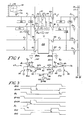
- a representative portion of a dynamic MOS memory which includes a preferred embodiment of a sense amplifier arrangement.
- the illustrated portion has four pairs of bit lines identified as A-B, C-D, E-F, and G-H.
- the pair of bit lines A-B is coupled through isolation transistors 10 and 12 to a sense amplifier 14.
- the pair of bit lines C-D is similarly coupled to the sense amplifier 14 via isolation transistors 16 and 18.
- the sense amplifier 14 is adapted by decoding circuitry to sense the potentials on bit lines A and B or on bit lines C and D.
- the pairs of bit lines E-F and G-H are similarly connected to another sense amplifier 20.
- one of the bit lines for each pair is coupled to a capacitor associated with an addressed memory cell so that a charge transfer occurs between that bit line and the latter capacitor.
- the other bit line in that pair (B, for example) carries a reference voltage induced by a dummy cell capacitor.
- the sense amplifier detects the voltage difference between bit lines A and B and latches in a state representing this difference. The latched state of the sense amplifier therefore represents the logic level of the addressed memory cell.
- the decoding circuitry enables the data on the bit lines A and B to be coupled to input/output (I/O andTTO) buss lines 17 and 19 via bit lines C and D.
- I/O andTTO input/output
- bit line D is coupled to the I/O buss 19 via a transistor DT, the state of the sense amplifier is readily ascertained.
- bit line D provides a path for sensing the state of the amplifier 14.
- Bit lines B and C are used in the same manner.
- bit lines A and B are usually physically close to each other, as are bit lines C and D.
- bit lines A and D are physically separated from each other on the memory chip.
- any noise which affects bit line A will probably not influence bit line D in the same manner.
- the conventional sense amplifier arrangement senses bit lines having different amounts of noise and is therefore, susceptible to developing noise- induced errors. Because the present arrangement senses bit lines which are physically near each other on the chip, noise problems are reduced.
- switch circuitry described below permits the state of the sense amplifiers to be conveniently transferred to the t/0 and I/O busses.
- this device includes transistors 22 and 24 which are interconnected as a flip-flop with voltage nodes 21 and 23. As shown, terminal 10a of the transistor 10 is coupled to the drain of the transistor 22 and to the gate of the transistor 24. Terminal 12a of the transistor 12 is coupled to the drain of the transistor 24 and to the gate of the transistor 22.
- the sense amplifier is coupled to a latching transistor 25 whose gate is driven by clock signal 0 ⁇ SD .
- the bit lines C and D are coupled via transistors 16 and 18, respectively, to the sense amplifier 14. As shown, terminal 16a of the transistor 16 is coupled to the drain of transistor 22 and to the gate of transistor 24. In addition, terminal 18a of the transistor 18 is coupled to the drain of the transistor 24 and to the gate of the transistor 22. From the above described arrangement, either the transistor pair 10 and 12 or the transistor pair 16 and 18 may be turned on to couple the sense amplifier 14 to bit lines A and B or to bit lines C and D.
- Memory cell M1 is shown coupled to bit line A for accessing.
- Memory cell M1 includes a transistor 26 and a memory cell capacitor Cm. This capacitor conventionally stores a charge which is indicative of the logic state of the cell M1.
- a word line 28 is driven to a high level when the cell M1 is addressed so as to turn on the transistor 26 and thereby couple the capacitor Cm to the bit line A.
- Additional memory cells 30, each similar to the cell M1, are also associated with bit line A and may be coupled thereto when addressed by their own word lines.
- memory cells groups 32, 34, and 36 are associated with bit lines B, C, and D, respectively, and may be selectively coupled to their associated bit lines when addressed by their own word lines.
- bit lines E and F they are associated with memory cell groups (not shown) and are coupled to the sense amplifier 20 via transistors 38 and 40, respectively.
- Bit lines G and H are also associated with memory cell groups (again, not shown) and are coupled to the sense amplifier 20 via transistors 42 and 44, respectively.
- Each memory cell group contains cells which are similar to the memory cell M1 and are addressed in a similar manner.
- the sense amplifier 20 operates in the same manner as the sense amplifier 14 to sense the voltage differential between bit lines E and F or between bit lines G and H, depending on whether transistors 38 and 40 are energized or whether transistors 42 and 44 are energized.
- bit line A When the memory cell M1 is addressed, its memory capacitor CM is coupled to the bit line A via the transistor 26. Thus, a transfer of charge occurs between the latter capacitor and the bit line A, thereby altering the voltage level on that bit line.
- the voltage on bit line B is altered by a dummy cell D1 which is coupled to the bit line B and to another bit line (F, for example). Included in the dummy cell D1 is a dummy cell capacitor C D , preferably of the same size as the memory cell capacitor C M , and precharged to a reference voltage level (for example, 0 volts).
- the dummy capacitor In response to a signal on a dummy word line (not shown), the dummy capacitor is coupled to bit lines B and F such that substantially equal transfers of charge occur between the capacitor C o and the bit lines to which it is coupled. Thus, the charge on the dummy capacitor is split between both bit lines to alter the bit line voltages. Then the voltage on the bit line A is compared by the sense amplifier 14 with the voltage on the bit line B to determine the logic state of the memory cell M1.
- a dummy cell D2 similarto the dummy cell D1, is coupled between the bit lines A and E.
- similar dummy cells D3 and D4 are coupled between bit lines D-H and C-G, respectively.
- the dummy cells D2-D4 operate in a manner similar to the dummy cell D1 so as to alter the voltage on the bit lines to which they are coupled.
- Bit lines C; D, G and H are coupled via transistors Cn D T , G TI and H T , respectively, to the I/O or the I/O buss lines.
- the voltages on the selected pair of bit lines (for example, A and B) are sensed by the sense amplifiers and transferred to the buss lines via these transistors (for example, C T and D T ).
- a clock signal is generated and coupled via line 60 to the gates of the transistors 10, 12, 38, and 40.
- another clock signal is generated and coupled via line 62 to the gates of the transistors 16,18,42, and 44. If the pairs of bit lines A-B and E-F are to be sensed by sense amplifiers 14 and 20, respectively, the clock signal 0 ⁇ RPR is pulled low and the clock signal ⁇ RPL is left floating above V cc . Consequently, transistors 10 and 12 are turned on to couple the bit lines A and B to the sense amplifier 14, while transistors 38 and 40 are turned on for coupling the bit lines E and F to the sense amplifier 20. Concurrently, transistors 16, 18,42, and 44 are held off to decouple the bit lines C, D, G, and H from the sense amplifiers 14 and 20. A more detailed description of the sensing operation is discussed below.
- the clock signal 0 ⁇ RPL on line 60 is generated by a circuit 64 which includes transistors 66-68 and capacitor 70 which are coupled together at node 72.
- the gate of transistor 68 is driven by clock signal 0 L while capacitor 70 couples clock signal 0 ⁇ SD to node 72.
- a switch 74 is adapted to be closed for selectively coupling node 72 to ground.
- the clock signal 0 ⁇ RPR on line 62 is generated by a circuit 76 which includes transistors 78-80 and capacitor 82 which are all coupled to a node 84.
- the gate of transistor 80 is driven by the clock signal 0 L while capacitor 82 couples the clock signal ⁇ SD to node 84.
- a switch 86 is included for selectively coupling node 84 to ground.
- Circuits 64 and 76 are coupled via lines 60a and 62a, respectively, to a switch 90.
- lines 60b and 62b couple circuits 64 and 76 to switches 92 and 94.
- Line 96 connects switches 92 and 94 to a node 98 which is coupled via a capacitor 100 to a signal O RPK on line 102.
- nodes 72 and 84 will have been precharged to 5 volts by a previous cycle of the signal 0 L .
- the closing of switch 74 couples node 72 to ground and, accordingly, holds transistor 66 off.
- the high level voltage on line 60 is undisturbed.
- switch 86 remains open, the node 84 stays at the 5 volt level and transistor 78 turns on to clamp the voltage on line 62 to 5 volts minus 1 volt (the threshold voltage in this embodiment) or 4 volts. Consequently, transistors 16 and 18 are turned off while the 9 volt level on line 60 keeps the transistors 10 and 12 on, thereby coupling bit lines A and B to the sense amplifier 14.
- bit lines have also been precharged to 5 volts.
- the voltage on bit line A may drop down to 4.8 volts and the voltage on bit line B may drop down to 4.9 volts.
- the sense amplifiers 14 and 20 are enabled by the signal ⁇ SD going high to 5 volts at time t 2 .
- the latch transistor 25 turns on and enables the sense amplifier 14 to latch the voltage on node 21 to 0 volts and to leave the voltage on node 23 at about 4 volts. Because the 4 volts on line 62 is being applied to the gates of transistors 16 and 18, the 5 volts on node 23 does not disturb the 5 volt precharge level on bit line D.
- the 5 volt potential on line D continues to be coupled to I/O buss line 19.
- the 0 volt level- on node 21 turns on transistor 16 which then couples that 0 volt level to I/O buss line 17 via bit line C.
- the 5 volt kick of signal ⁇ SD is also coupled by capacitors 70 and 82 to nodes 72 and 84.
- Node 72 is not affected because it is still coupled to ground via closed switch 74.
- the voltage on node 84 is driven upwardly to approximately 7 volts.
- transistor 78 turns on harder to pull the voltage on line 62 up to 5 volts. This acts to improve the reading speed of the sense amplifiers by turning transistor 16 on harder, thereby enabling the 0 volts on node 21 to be more easily coupled to the I/O buss line 17.
- the signal ⁇ RPR on line 62 is continuously held at approximately 5 volts when transistor 78 is turned on hard. This is important in that if the signal ⁇ RPR is not actively held at the 5 volt level, then a low level signal on either bit line C or D would be capacitively coupled to line 62 via the gate-source capacitance of either transistor 16 or 18.
- the memory cell is refreshed in the following manner.
- the switch 86 in circuitry 76 closes to ground node 84 and turn the transistor 78 off. Consequently, the signal O RPR on line 62 is released from its clamped 5 volt level. Then the signal O RPK on line 102 goes high at time t 3 . Simultaneously, the switch 90 is closed to short the signal ⁇ RPL on line 60 to the signal ⁇ RPR on line 62.
- the signal ⁇ RPL on line 60 was pulled from 9 volts down to about 7 volts as a result of being capacitively coupled by the transistors 10,12, 38, and 40 to the lower voltages on bit lines A, B, E, and F. Therefore, when the signals ⁇ RPL (at 7 volts) and ⁇ RPR (at 5 volts) are shorted by switch 90 and the signal ⁇ RPK goes high, the signals ⁇ RPL and ⁇ RPL are first driven towards 6 volts and are then boosted back up to 7 volts to turn on all the isolation transistors. As a result, the sense amplifier couples bit line A to bit line C and bit line B to bit line D.
- bit line A If a logic 1 were present in the memory cell capacitor Cm, the voltage on bit line A would have dropped to 4 volts as a result of the sense amplifier 14 sensing a logic 1 in the accessed cell M1 coupled to bit line A. However, the voltage on bit line C remains at 5 volts because transistor 18 stays off. Therefore, when bit lines A and C are coupled by the sense amplifier 14, the bit line capacitance of bit lines A and C is shared and the voltage on both bit lines goes to 4.5 volts. Correspondingly, the word line 28 is held at high voltage (by circuitry not shown) so that the 4.5 volts on bit line A refreshes the accessed memory cell capacitor Cm.
- the switches 92 and 94 are opened and all the bit lines are precharged back to the 5 volt level by circuitry not shown in the figures. Also, the signals ⁇ RPL and ⁇ RPR are precharged back up to 9 volts by capacitive coupling through all the isolation transistors as the bit lines are precharged to 5 volts.
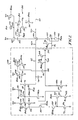
- Fig. 2 illustrates a more detailed circuit 104 for regulating the signal ⁇ RPR' on line 62.
- a duplicate circuit (not shown) controls the signal ⁇ RPL on line 60.
- a more detailed circuit 106 of the elements common to the signals ⁇ RPR and ⁇ RPL is shown.
- the switch 94 in Fig. 1 is depicted in the form of transistor 94a in Fig. 2 and controlled by the circuitry arranged from transistors 108, 110, 112, 114, 116, 118, T20, 122, 124, 126, 136, and 138.
- the switch 86 in Fig. 1 is arranged from transistors 86a and 86b and their associated circuitry in Fig. 2.
- transistors 108 and 110 are arranged as a push-pull driver for producing alternating high and low signals at node 128.
- Clock signals ⁇ PRS and ⁇ XI are applied as inputs into the respective gates of transistors 108 and 110.
- the signal on node 128 is applied to the gate of transistor 112 which is coupled to transistor 114 so as to form another push-pull driver for producing alternating high and low signals at node 130.
- the clock signals ⁇ AOR and ⁇ PRS are applied as inputs into terminal 112a of transistor 112 and the gate of transistor 114, respectively.
- the signal on node 130 is coupled by capacitor 16 to node 132 which is, in turn, coupled via line 134 to the gate of transistor 94a.
- a pair of transistors 136 and 138 are also coupled to line 134 between node 132 and the gate of transistor 94a with clock signals ⁇ PRS and ⁇ L being applied as inputs to the gates of transistors 136 and 138.
- a pair of push-pull drivers are arranged from transistors 120 and 122 and transistors 124 and 126 to drive transistor 118 which is coupled to node 132.
- Clock signal ⁇ PRS and the signal from row address A 7 are applied to the.
- the transistor 94a is turned on by the above-mentioned control circuitry in the following manner.
- the signal ⁇ PRS is at a high level. Consequently, transistors 108 and 124 are turned on to pull the signals on nodes 128 and 140, respectively, up to 4 volts.
- transistor 114 turns on to hold the signal on node 130 at ground.
- a 7 reaches the logic 1 state at time t 4 (See Figure 3) transistor 126 turns on. As a result, the signal on node 140 is pulled to ground. Concurrently, A 7 turns on transistor 122 which, in turn, holds the signal on node 142 to ground.
- the signal on node 142 remains low because the transistor 120 is still off due to the signal on node 140 also being low.
- the signal on node 130 goes high because transistor 112 is turned on.
- the positive transition on node 130 is coupled through capacitor 116 to node 132, thereby pulling up the signal on node 132.
- the high signal on node 132 is coupled via line 134 to the gate of transistor 94a, thereby turning on transistor 94a.
- switch 86 is depicted by transistors 86a and 86b and associated circuitry.
- the gate of transistor 86b is coupled to node 144 while the terminal 86bb of transistor 86b is coupled to node 146.
- the transistor 86a is arranged such that its gate is coupled to a pair of push-pull transistors 148 and 150.
- the gate of transistor 148 is driven by a clock signal ⁇ KI
- the gate of transistor 150 is driven by the clock signal O PRS .
- the transistor 148 is coupled to the transistor 150 at node 152 which, in turn, is connected to the gate of transistor 86a.
- the transistor 86a is coupled via node 154 to the transistor 156.
- Node 154 is also coupled to node 146.
- the gate of transistor 156 is driven by the clock signal ⁇ PRS .
- transistor 80 is coupled to transistor 82 at node 84, and. the gate of transistor 80 is driven by the clock signal 0 L .
- 84 is coupled to transistor 78 which is connected to.line 62.
- capacitor 158 has been added to couple the signal 0 L on the gate of transistor 80 to the node 146.
- a capacitor 79 is coupled to transistor 78 on line 62.
- transistors representing the switch 74 are not shown in Fig. 2 although transistors 86a and 86b and their peripheral circuitry duplicate that of switch 74. Therefore, for purposes of explanation, assume that the transistors for switch 74 are transistors 86a and 86b. Also, assume that the inputs to the gates of transistors 122 and 126 are A 7 rather than A 7 such that A 7 is at a logic 0 state.
- the signal O AOR rises at time t 5
- the signal on node 142 and node 144 is pulled high by transistor 120 to turn transistor 86b on.
- the signal on node 84 is pulled to ground. Then the clock signal ⁇ SD rises at time t 2 .
- node 84 remains low because transistor 86b is on.
- transistor 86b is turned off.
- node 84 is capacitively coupled to about 7 volts as the clock signal 0so rises at time t 2 .
- the signal ⁇ RPR is clamped to 5 volts during sense amplifier latching.
- the switch 86 is closed when the signal ⁇ KI rises at time t 6 (See Figure 3) to turn on transistor 148, thereby pulling the signal on node 152 high to turn on transistor 86a. As a result, the signal on node 84 is pulled to ground. It should be noted that the signal on node 152 had previously been precharged low by the clock signal O PRS via transistor 150.
- Switch 90 in Fig. 1 is depicted by transistor 90a and its associated circuitry in Fig. 2.
- the drain and source of transistor 90a are connected to lines 60a and 62a, respectively.
- the gate of transistor 90a and node 162 are capacitively coupled by transistor 160 to the clock signal O RPK on line 102.
- This signal is also coupled by capacitor 100 to node 98 which, in turn, is connected on line 96 to the transistor 94a and to transistor 99 being driven by the clock signal ⁇ L .
- Node 162 is coupled to push-pull transistors 164 and 166.
- the terminal 166b of transistor 166 is coupled to clock signal 0 x , while the gate of the same transistor is driven by signal ⁇ AOR .
- the gate of transistor 162 is driven by the signal on node 168 which is coupled to transistors 170, 172, and 174.
- Transistor 170 capacitively couples node 168 to signal 0 s p.
- the gate of transistor 172 is driven by the signal O PRS
- the gate of transistor 174 is driven by the signal on node 176.
- This signal is developed by push-pull transistors 178 and 180 which is also coupled to node 176.
- the gate of transistor 178 is driven by signal ⁇ KI . while the gate of transistor 180 is driven by signal O PRS .
- the signal on node 168 is precharged to 4 volts by the signal ⁇ PRS turning on transistor 172. Thereafter, the signal ⁇ SD goes high at time t 2 , and this high is capacitively coupled by transistor 170 to node 168. As a result, the signal on node 168 is kicked up to 7 volts. Accordingly, transistor 164 is pulled on to pull the signal on node 162 to the 5 volt level.
- the signal O RPK goes high at time t 3
- the high is capacitively coupled by capacitor 160 to kick up the signal on the gate of transistor 90a.
- transistor 90a turns on to short lines 60 and 62 together. Thereafter, the signals on these lines move towards 6 volts.
- the signal on node 168 is driven to ground to keep transistor 164 turned off while the signal on the gate of transistor 90a is kicked up to avoid losing charge to V cc via transistor 164.
- the signal ⁇ KI turns on transistor 178 to raise the signal on node 176, and, consequently, the transistor 174 turns on to pull down the signal on node 168.
- the low to high transition of the signal O RPK is also capacitively coupled via transistor 100 and node 98 to transistor 94a for driving the signal on shorted lines 60 and 62 up to 7 volts. This permits refreshing of the memory cell capacitor Cm as described above. Then the bit lines get precharged to 5 volts which further drives the signal on lines 60 and 62 to 9 volts. Thereafter, the sensing operation as described above is ready to be performed.
Landscapes
- Engineering & Computer Science (AREA)
- Microelectronics & Electronic Packaging (AREA)
- Computer Hardware Design (AREA)
- Dram (AREA)
- Static Random-Access Memory (AREA)
Applications Claiming Priority (2)
| Application Number | Priority Date | Filing Date | Title |
|---|---|---|---|
| US06/195,728 US4351034A (en) | 1980-10-10 | 1980-10-10 | Folded bit line-shared sense amplifiers |
| US195728 | 1994-02-14 |
Publications (3)
| Publication Number | Publication Date |
|---|---|
| EP0049990A2 EP0049990A2 (en) | 1982-04-21 |
| EP0049990A3 EP0049990A3 (en) | 1982-10-13 |
| EP0049990B1 true EP0049990B1 (en) | 1987-05-27 |
Family
ID=22722538
Family Applications (1)
| Application Number | Title | Priority Date | Filing Date |
|---|---|---|---|
| EP81304614A Expired EP0049990B1 (en) | 1980-10-10 | 1981-10-05 | Folded bit line-shared sense amplifiers |
Country Status (5)
| Country | Link |
|---|---|
| US (1) | US4351034A (enExample) |
| EP (1) | EP0049990B1 (enExample) |
| JP (1) | JPS5792486A (enExample) |
| CA (1) | CA1175939A (enExample) |
| DE (1) | DE3176224D1 (enExample) |
Families Citing this family (27)
| Publication number | Priority date | Publication date | Assignee | Title |
|---|---|---|---|---|
| JPS5745267A (en) * | 1980-09-01 | 1982-03-15 | Nec Corp | Semiconductor device |
| US4413329A (en) * | 1980-12-24 | 1983-11-01 | International Business Machines Corporation | Dynamic memory cell |
| US4739497A (en) * | 1981-05-29 | 1988-04-19 | Hitachi, Ltd. | Semiconductor memory |
| US4442508A (en) * | 1981-08-05 | 1984-04-10 | General Instrument Corporation | Storage cells for use in two conductor data column storage logic arrays |
| US4402063A (en) * | 1981-09-28 | 1983-08-30 | Bell Telephone Laboratories, Incorporated | Flip-flop detector array for minimum geometry semiconductor memory apparatus |
| US4494220A (en) * | 1982-11-24 | 1985-01-15 | At&T Bell Laboratories | Folded bit line memory with one decoder per pair of spare rows |
| USRE33266E (en) * | 1982-11-24 | 1990-07-17 | American Telephone And Telegraph Company, At&T Bell Laboratories | Folded bit line memory with one decoder per pair of spare rows |
| US4584672A (en) * | 1984-02-22 | 1986-04-22 | Intel Corporation | CMOS dynamic random-access memory with active cycle one half power supply potential bit line precharge |
| US4961166A (en) * | 1984-05-07 | 1990-10-02 | Hitachi, Ltd. | Dynamic RAM having a full size dummy cell |
| JPS6150284A (ja) * | 1984-08-17 | 1986-03-12 | Mitsubishi Electric Corp | シエアドセンスアンプ回路の駆動方法 |
| JPS6150283A (ja) * | 1984-08-17 | 1986-03-12 | Mitsubishi Electric Corp | シエアドセンスアンプの駆動回路 |
| JPH0793009B2 (ja) * | 1984-12-13 | 1995-10-09 | 株式会社東芝 | 半導体記憶装置 |
| ATE66314T1 (de) * | 1985-08-30 | 1991-08-15 | Sgs Thomson Microelectronics | Parallele zeile pro zeile datenuebertragung in ram-speichern. |
| JPS6280897A (ja) * | 1985-10-04 | 1987-04-14 | Mitsubishi Electric Corp | 半導体記憶装置 |
| US4807195A (en) * | 1987-05-18 | 1989-02-21 | International Business Machines Corporation | Apparatus and method for providing a dual sense amplifier with divided bit line isolation |
| JPH01184787A (ja) * | 1988-01-19 | 1989-07-24 | Toshiba Corp | 半導体メモリ |
| DE3937068C2 (de) * | 1988-11-07 | 1994-10-06 | Toshiba Kawasaki Kk | Dynamische Halbleiterspeicheranordnung |
| JPH02201797A (ja) * | 1989-01-31 | 1990-08-09 | Toshiba Corp | 半導体メモリ装置 |
| JP2742719B2 (ja) * | 1990-02-16 | 1998-04-22 | 三菱電機株式会社 | 半導体記憶装置 |
| US5046050A (en) * | 1990-04-10 | 1991-09-03 | National Semiconductor Corporation | Shared BiCMOS sense amplifier |
| US5241503A (en) * | 1991-02-25 | 1993-08-31 | Motorola, Inc. | Dynamic random access memory with improved page-mode performance and method therefor having isolator between memory cells and sense amplifiers |
| JPH06195973A (ja) * | 1992-10-12 | 1994-07-15 | Nec Corp | ダイナミックram |
| US5572459A (en) * | 1994-09-16 | 1996-11-05 | Ramtron International Corporation | Voltage reference for a ferroelectric 1T/1C based memory |
| US5836007A (en) * | 1995-09-14 | 1998-11-10 | International Business Machines Corporation | Methods and systems for improving memory component size and access speed including splitting bit lines and alternate pre-charge/access cycles |
| US5636170A (en) * | 1995-11-13 | 1997-06-03 | Micron Technology, Inc. | Low voltage dynamic memory |
| US5999459A (en) | 1998-05-27 | 1999-12-07 | Winbond Electronics Corporation | High-performance pass-gate isolation circuitry |
| JP2007095264A (ja) * | 2005-09-29 | 2007-04-12 | Hynix Semiconductor Inc | 共有ビットライン感知増幅器構造を有する半導体メモリ素子及びその駆動方法 |
Citations (1)
| Publication number | Priority date | Publication date | Assignee | Title |
|---|---|---|---|---|
| DE2647394B1 (de) * | 1976-10-20 | 1978-03-16 | Siemens Ag | MOS-Halbleiterspeicherbaustein |
Family Cites Families (4)
| Publication number | Priority date | Publication date | Assignee | Title |
|---|---|---|---|---|
| US3560940A (en) * | 1968-07-15 | 1971-02-02 | Ibm | Time shared interconnection apparatus |
| DE2919166C2 (de) * | 1978-05-12 | 1986-01-02 | Nippon Electric Co., Ltd., Tokio/Tokyo | Speichervorrichtung |
| JPS54148340A (en) * | 1978-05-12 | 1979-11-20 | Nec Corp | Memory circuit |
| US4279023A (en) * | 1979-12-19 | 1981-07-14 | International Business Machines Corporation | Sense latch |
-
1980
- 1980-10-10 US US06/195,728 patent/US4351034A/en not_active Ceased
-
1981
- 1981-03-17 CA CA000373225A patent/CA1175939A/en not_active Expired
- 1981-10-05 EP EP81304614A patent/EP0049990B1/en not_active Expired
- 1981-10-05 DE DE8181304614T patent/DE3176224D1/de not_active Expired
- 1981-10-05 JP JP56158569A patent/JPS5792486A/ja active Granted
Patent Citations (1)
| Publication number | Priority date | Publication date | Assignee | Title |
|---|---|---|---|---|
| DE2647394B1 (de) * | 1976-10-20 | 1978-03-16 | Siemens Ag | MOS-Halbleiterspeicherbaustein |
Also Published As
| Publication number | Publication date |
|---|---|
| EP0049990A3 (en) | 1982-10-13 |
| JPH0115957B2 (enExample) | 1989-03-22 |
| JPS5792486A (en) | 1982-06-09 |
| EP0049990A2 (en) | 1982-04-21 |
| DE3176224D1 (en) | 1987-07-02 |
| CA1175939A (en) | 1984-10-09 |
| US4351034A (en) | 1982-09-21 |
Similar Documents
| Publication | Publication Date | Title |
|---|---|---|
| EP0049990B1 (en) | Folded bit line-shared sense amplifiers | |
| US5241503A (en) | Dynamic random access memory with improved page-mode performance and method therefor having isolator between memory cells and sense amplifiers | |
| US4932002A (en) | Bit line latch sense amp | |
| US4062000A (en) | Current sense amp for static memory cell | |
| US4363111A (en) | Dummy cell arrangement for an MOS memory | |
| US20010037429A1 (en) | Balanced switching method and circuit | |
| US5185722A (en) | Semiconductor memory device having a memory test circuit | |
| US6438049B1 (en) | Variable equilibrate voltage circuit for paired digit lines | |
| US4397003A (en) | Dynamic random access memory | |
| JPH07226087A (ja) | 半導体メモリ装置 | |
| US4112512A (en) | Semiconductor memory read/write access circuit and method | |
| US4622655A (en) | Semiconductor memory | |
| US5017815A (en) | Sense amplifier with selective pull up | |
| US4338679A (en) | Row driver circuit for semiconductor memory | |
| US4451906A (en) | Dynamic type memory device having improved operation speed | |
| JPH06162776A (ja) | 半導体メモリ回路 | |
| JPS649680B2 (enExample) | ||
| US5771187A (en) | Multiple level storage DRAM cell | |
| US5796666A (en) | Method and apparatus for quickly restoring digit I/O lines | |
| USRE32682E (en) | Folded bit line-shared sense amplifiers | |
| US5515315A (en) | Dynamic random access memory | |
| US5894434A (en) | MOS static memory array | |
| US5949730A (en) | Method and apparatus for quickly restoring digit I/O lines | |
| US6301178B1 (en) | Reduced cell voltage for memory device | |
| US6141264A (en) | Floating isolation gate for DRAM sensing |
Legal Events
| Date | Code | Title | Description |
|---|---|---|---|
| PUAI | Public reference made under article 153(3) epc to a published international application that has entered the european phase |
Free format text: ORIGINAL CODE: 0009012 |
|
| AK | Designated contracting states |
Designated state(s): DE FR GB NL |
|
| PUAL | Search report despatched |
Free format text: ORIGINAL CODE: 0009013 |
|
| AK | Designated contracting states |
Designated state(s): DE FR GB NL |
|
| 17P | Request for examination filed |
Effective date: 19830406 |
|
| 17Q | First examination report despatched |
Effective date: 19851009 |
|
| RAP1 | Party data changed (applicant data changed or rights of an application transferred) |
Owner name: INMOS CORPORATION |
|
| GRAA | (expected) grant |
Free format text: ORIGINAL CODE: 0009210 |
|
| AK | Designated contracting states |
Kind code of ref document: B1 Designated state(s): DE FR GB NL |
|
| REF | Corresponds to: |
Ref document number: 3176224 Country of ref document: DE Date of ref document: 19870702 |
|
| ET | Fr: translation filed | ||
| PLBE | No opposition filed within time limit |
Free format text: ORIGINAL CODE: 0009261 |
|
| STAA | Information on the status of an ep patent application or granted ep patent |
Free format text: STATUS: NO OPPOSITION FILED WITHIN TIME LIMIT |
|
| 26N | No opposition filed | ||
| PGFP | Annual fee paid to national office [announced via postgrant information from national office to epo] |
Ref country code: FR Payment date: 20000918 Year of fee payment: 20 |
|
| PGFP | Annual fee paid to national office [announced via postgrant information from national office to epo] |
Ref country code: GB Payment date: 20000921 Year of fee payment: 20 |
|
| PGFP | Annual fee paid to national office [announced via postgrant information from national office to epo] |
Ref country code: NL Payment date: 20000925 Year of fee payment: 20 |
|
| PGFP | Annual fee paid to national office [announced via postgrant information from national office to epo] |
Ref country code: DE Payment date: 20001229 Year of fee payment: 20 |
|
| PG25 | Lapsed in a contracting state [announced via postgrant information from national office to epo] |
Ref country code: GB Free format text: LAPSE BECAUSE OF EXPIRATION OF PROTECTION Effective date: 20011004 |
|
| PG25 | Lapsed in a contracting state [announced via postgrant information from national office to epo] |
Ref country code: NL Free format text: LAPSE BECAUSE OF EXPIRATION OF PROTECTION Effective date: 20011005 |
|
| REG | Reference to a national code |
Ref country code: GB Ref legal event code: PE20 Effective date: 20011004 |
|
| NLV7 | Nl: ceased due to reaching the maximum lifetime of a patent |
Effective date: 20011005 |