EP0034366A2 - Verfahren zur Herstellung von Steroid-20-Carbamatverbindungen - Google Patents
Verfahren zur Herstellung von Steroid-20-Carbamatverbindungen Download PDFInfo
- Publication number
- EP0034366A2 EP0034366A2 EP81101117A EP81101117A EP0034366A2 EP 0034366 A2 EP0034366 A2 EP 0034366A2 EP 81101117 A EP81101117 A EP 81101117A EP 81101117 A EP81101117 A EP 81101117A EP 0034366 A2 EP0034366 A2 EP 0034366A2
- Authority
- EP
- European Patent Office
- Prior art keywords
- carbamate
- oxo
- steroid
- process according
- pregna
- Prior art date
- Legal status (The legal status is an assumption and is not a legal conclusion. Google has not performed a legal analysis and makes no representation as to the accuracy of the status listed.)
- Granted
Links
- 238000000034 method Methods 0.000 title claims description 29
- 238000002360 preparation method Methods 0.000 title claims description 6
- 150000003431 steroids Chemical class 0.000 title description 8
- 238000005944 trans-halogenation reaction Methods 0.000 claims abstract description 4
- LFQSCWFLJHTTHZ-UHFFFAOYSA-N Ethanol Chemical compound CCO LFQSCWFLJHTTHZ-UHFFFAOYSA-N 0.000 claims description 13
- 239000002904 solvent Substances 0.000 claims description 9
- 230000015572 biosynthetic process Effects 0.000 claims description 8
- 239000011541 reaction mixture Substances 0.000 claims description 7
- KWYUFKZDYYNOTN-UHFFFAOYSA-M Potassium hydroxide Chemical compound [OH-].[K+] KWYUFKZDYYNOTN-UHFFFAOYSA-M 0.000 claims description 6
- HEMHJVSKTPXQMS-UHFFFAOYSA-M Sodium hydroxide Chemical compound [OH-].[Na+] HEMHJVSKTPXQMS-UHFFFAOYSA-M 0.000 claims description 6
- MARXMDRWROUXMD-UHFFFAOYSA-N 2-bromoisoindole-1,3-dione Chemical compound C1=CC=C2C(=O)N(Br)C(=O)C2=C1 MARXMDRWROUXMD-UHFFFAOYSA-N 0.000 claims description 4
- KXDHJXZQYSOELW-UHFFFAOYSA-M Carbamate Chemical compound NC([O-])=O KXDHJXZQYSOELW-UHFFFAOYSA-M 0.000 claims description 4
- 150000001298 alcohols Chemical class 0.000 claims description 4
- 125000004432 carbon atom Chemical group C* 0.000 claims description 4
- 239000007806 chemical reaction intermediate Substances 0.000 claims description 3
- 239000007795 chemical reaction product Substances 0.000 claims description 3
- 150000008282 halocarbons Chemical class 0.000 claims description 3
- FTFICZTVERFENE-WFLKQGPQSA-N 1-[(8r,9s,10r,13s,14s)-10,13-dimethyl-3-oxo-2,6,7,8,9,11,12,14,15,16-decahydro-1h-cyclopenta[a]phenanthren-17-ylidene]ethylcarbamic acid Chemical compound C1CC2=CC(=O)CC[C@]2(C)[C@@H]2[C@@H]1[C@@H]1CCC(=C(NC(O)=O)C)[C@@]1(C)CC2 FTFICZTVERFENE-WFLKQGPQSA-N 0.000 claims description 2
- WZLBSAJUEGNQHQ-WFLKQGPQSA-N 1-[(8s,9s,10r,13s,14s)-10,13-dimethyl-3-oxo-7,8,9,11,12,14,15,16-octahydro-6h-cyclopenta[a]phenanthren-17-ylidene]ethylcarbamic acid Chemical compound C1CC2=CC(=O)C=C[C@]2(C)[C@@H]2[C@@H]1[C@@H]1CCC(=C(NC(O)=O)C)[C@@]1(C)CC2 WZLBSAJUEGNQHQ-WFLKQGPQSA-N 0.000 claims description 2
- YZEHNJLZMHNQHM-VJFOQZSSSA-N 1-[(8s,9s,10r,13s,14s,17s)-10,13-dimethyl-3-oxo-6,7,8,9,11,12,14,15,16,17-decahydrocyclopenta[a]phenanthren-17-yl]ethylcarbamic acid Chemical compound C1CC2=CC(=O)C=C[C@]2(C)[C@@H]2[C@@H]1[C@@H]1CC[C@H](C(NC(O)=O)C)[C@@]1(C)CC2 YZEHNJLZMHNQHM-VJFOQZSSSA-N 0.000 claims description 2
- JOYRKODLDBILNP-UHFFFAOYSA-N Ethyl urethane Chemical compound CCOC(N)=O JOYRKODLDBILNP-UHFFFAOYSA-N 0.000 claims description 2
- 150000004703 alkoxides Chemical class 0.000 claims description 2
- 239000012298 atmosphere Substances 0.000 claims description 2
- 229910052799 carbon Inorganic materials 0.000 claims description 2
- 239000003054 catalyst Substances 0.000 claims description 2
- 238000002955 isolation Methods 0.000 claims description 2
- NVMFNJLAKXKBME-VJFOQZSSSA-N 1-[(8s,9s,10r,13s,14s,17s)-10,13-dimethyl-3-oxo-1,2,6,7,8,9,11,12,14,15,16,17-dodecahydrocyclopenta[a]phenanthren-17-yl]ethylcarbamic acid Chemical compound C1CC2=CC(=O)CC[C@]2(C)[C@@H]2[C@@H]1[C@@H]1CC[C@H](C(NC(O)=O)C)[C@@]1(C)CC2 NVMFNJLAKXKBME-VJFOQZSSSA-N 0.000 claims 1
- 239000012442 inert solvent Substances 0.000 claims 1
- 125000003368 amide group Chemical group 0.000 abstract 1
- 238000006243 chemical reaction Methods 0.000 description 14
- -1 20-substituted 3-oxo-pregna-4-ene steroid compounds Chemical class 0.000 description 11
- RJKFOVLPORLFTN-LEKSSAKUSA-N Progesterone Chemical compound C1CC2=CC(=O)CC[C@]2(C)[C@@H]2[C@@H]1[C@@H]1CC[C@H](C(=O)C)[C@@]1(C)CC2 RJKFOVLPORLFTN-LEKSSAKUSA-N 0.000 description 11
- YMWUJEATGCHHMB-UHFFFAOYSA-N Dichloromethane Chemical compound ClCCl YMWUJEATGCHHMB-UHFFFAOYSA-N 0.000 description 9
- OKKJLVBELUTLKV-UHFFFAOYSA-N Methanol Chemical compound OC OKKJLVBELUTLKV-UHFFFAOYSA-N 0.000 description 9
- PCLIMKBDDGJMGD-UHFFFAOYSA-N N-bromosuccinimide Chemical compound BrN1C(=O)CCC1=O PCLIMKBDDGJMGD-UHFFFAOYSA-N 0.000 description 8
- 150000001875 compounds Chemical class 0.000 description 8
- 239000007858 starting material Substances 0.000 description 8
- IJGRMHOSHXDMSA-UHFFFAOYSA-N Atomic nitrogen Chemical compound N#N IJGRMHOSHXDMSA-UHFFFAOYSA-N 0.000 description 6
- XLYOFNOQVPJJNP-UHFFFAOYSA-N water Substances O XLYOFNOQVPJJNP-UHFFFAOYSA-N 0.000 description 6
- QTBSBXVTEAMEQO-UHFFFAOYSA-N Acetic acid Chemical compound CC(O)=O QTBSBXVTEAMEQO-UHFFFAOYSA-N 0.000 description 5
- 229960003387 progesterone Drugs 0.000 description 5
- 239000000186 progesterone Substances 0.000 description 5
- WQDUMFSSJAZKTM-UHFFFAOYSA-N Sodium methoxide Chemical compound [Na+].[O-]C WQDUMFSSJAZKTM-UHFFFAOYSA-N 0.000 description 4
- 150000004657 carbamic acid derivatives Chemical class 0.000 description 4
- KFZMGEQAYNKOFK-UHFFFAOYSA-N Isopropanol Chemical compound CC(C)O KFZMGEQAYNKOFK-UHFFFAOYSA-N 0.000 description 3
- 239000002253 acid Substances 0.000 description 3
- 150000001408 amides Chemical class 0.000 description 3
- BTANRVKWQNVYAZ-UHFFFAOYSA-N butan-2-ol Chemical compound CCC(C)O BTANRVKWQNVYAZ-UHFFFAOYSA-N 0.000 description 3
- 150000001805 chlorine compounds Chemical class 0.000 description 3
- 239000012043 crude product Substances 0.000 description 3
- 239000000543 intermediate Substances 0.000 description 3
- 230000002906 microbiologic effect Effects 0.000 description 3
- 239000000203 mixture Substances 0.000 description 3
- 229910052757 nitrogen Inorganic materials 0.000 description 3
- 239000011877 solvent mixture Substances 0.000 description 3
- CSDQQAQKBAQLLE-UHFFFAOYSA-N 4-(4-chlorophenyl)-4,5,6,7-tetrahydrothieno[3,2-c]pyridine Chemical compound C1=CC(Cl)=CC=C1C1C(C=CS2)=C2CCN1 CSDQQAQKBAQLLE-UHFFFAOYSA-N 0.000 description 2
- CPELXLSAUQHCOX-UHFFFAOYSA-N Hydrogen bromide Chemical compound Br CPELXLSAUQHCOX-UHFFFAOYSA-N 0.000 description 2
- LRHPLDYGYMQRHN-UHFFFAOYSA-N N-Butanol Chemical compound CCCCO LRHPLDYGYMQRHN-UHFFFAOYSA-N 0.000 description 2
- DKGAVHZHDRPRBM-UHFFFAOYSA-N Tert-Butanol Chemical compound CC(C)(C)O DKGAVHZHDRPRBM-UHFFFAOYSA-N 0.000 description 2
- UKLDJPRMSDWDSL-UHFFFAOYSA-L [dibutyl(dodecanoyloxy)stannyl] dodecanoate Chemical compound CCCCCCCCCCCC(=O)O[Sn](CCCC)(CCCC)OC(=O)CCCCCCCCCCC UKLDJPRMSDWDSL-UHFFFAOYSA-L 0.000 description 2
- 229960000583 acetic acid Drugs 0.000 description 2
- 239000000010 aprotic solvent Substances 0.000 description 2
- 125000003178 carboxy group Chemical group [H]OC(*)=O 0.000 description 2
- 239000003638 chemical reducing agent Substances 0.000 description 2
- 239000003795 chemical substances by application Substances 0.000 description 2
- 239000012975 dibutyltin dilaurate Substances 0.000 description 2
- 230000002140 halogenating effect Effects 0.000 description 2
- 238000005658 halogenation reaction Methods 0.000 description 2
- 238000004519 manufacturing process Methods 0.000 description 2
- BDERNNFJNOPAEC-UHFFFAOYSA-N propan-1-ol Chemical compound CCCO BDERNNFJNOPAEC-UHFFFAOYSA-N 0.000 description 2
- 239000000376 reactant Substances 0.000 description 2
- AKHNMLFCWUSKQB-UHFFFAOYSA-L sodium thiosulfate Chemical group [Na+].[Na+].[O-]S([O-])(=O)=S AKHNMLFCWUSKQB-UHFFFAOYSA-L 0.000 description 2
- 235000019345 sodium thiosulphate Nutrition 0.000 description 2
- 239000000758 substrate Substances 0.000 description 2
- FYSNRJHAOHDILO-UHFFFAOYSA-N thionyl chloride Chemical compound ClS(Cl)=O FYSNRJHAOHDILO-UHFFFAOYSA-N 0.000 description 2
- WSLDOOZREJYCGB-UHFFFAOYSA-N 1,2-Dichloroethane Chemical compound ClCCCl WSLDOOZREJYCGB-UHFFFAOYSA-N 0.000 description 1
- XNWFRZJHXBZDAG-UHFFFAOYSA-N 2-METHOXYETHANOL Chemical compound COCCO XNWFRZJHXBZDAG-UHFFFAOYSA-N 0.000 description 1
- JJVWWLILUCSYPJ-WFLKQGPQSA-N 2-[(8s,9s,10r,13s,14s)-10,13-dimethyl-3-oxo-7,8,9,11,12,14,15,16-octahydro-6h-cyclopenta[a]phenanthren-17-ylidene]propanoic acid Chemical compound C1CC2=CC(=O)C=C[C@]2(C)[C@@H]2[C@@H]1[C@@H]1CCC(=C(C(O)=O)C)[C@@]1(C)CC2 JJVWWLILUCSYPJ-WFLKQGPQSA-N 0.000 description 1
- JLKPSGDKNWRREC-VJFOQZSSSA-N 2-[(8s,9s,10r,13s,14s,17r)-10,13-dimethyl-3-oxo-1,2,6,7,8,9,11,12,14,15,16,17-dodecahydrocyclopenta[a]phenanthren-17-yl]propanamide Chemical compound C1CC2=CC(=O)CC[C@]2(C)[C@@H]2[C@@H]1[C@@H]1CC[C@H](C(C)C(N)=O)[C@@]1(C)CC2 JLKPSGDKNWRREC-VJFOQZSSSA-N 0.000 description 1
- WIKMMMPPONXZIX-VJFOQZSSSA-N 2-[(8s,9s,10r,13s,14s,17r)-10,13-dimethyl-3-oxo-6,7,8,9,11,12,14,15,16,17-decahydrocyclopenta[a]phenanthren-17-yl]propanamide Chemical compound C1CC2=CC(=O)C=C[C@]2(C)[C@@H]2[C@@H]1[C@@H]1CC[C@H](C(C)C(N)=O)[C@@]1(C)CC2 WIKMMMPPONXZIX-VJFOQZSSSA-N 0.000 description 1
- OZESBBVMFLIODA-VJFOQZSSSA-N 2-[(8s,9s,10r,13s,14s,17r)-10,13-dimethyl-3-oxo-6,7,8,9,11,12,14,15,16,17-decahydrocyclopenta[a]phenanthren-17-yl]propanoic acid Chemical compound C1CC2=CC(=O)C=C[C@]2(C)[C@@H]2[C@@H]1[C@@H]1CC[C@H](C(C)C(O)=O)[C@@]1(C)CC2 OZESBBVMFLIODA-VJFOQZSSSA-N 0.000 description 1
- KXDHJXZQYSOELW-UHFFFAOYSA-N Carbamic acid Chemical group NC(O)=O KXDHJXZQYSOELW-UHFFFAOYSA-N 0.000 description 1
- OKTJSMMVPCPJKN-UHFFFAOYSA-N Carbon Chemical compound [C] OKTJSMMVPCPJKN-UHFFFAOYSA-N 0.000 description 1
- QIEPWCSVQYUPIY-LEKSSAKUSA-N Delta(1)-progesterone Chemical class C1CC2=CC(=O)C=C[C@]2(C)[C@@H]2[C@@H]1[C@@H]1CC[C@H](C(=O)C)[C@@]1(C)CC2 QIEPWCSVQYUPIY-LEKSSAKUSA-N 0.000 description 1
- 150000007513 acids Chemical class 0.000 description 1
- 150000007514 bases Chemical class 0.000 description 1
- 238000005893 bromination reaction Methods 0.000 description 1
- 150000003857 carboxamides Chemical class 0.000 description 1
- 230000015556 catabolic process Effects 0.000 description 1
- 238000003776 cleavage reaction Methods 0.000 description 1
- 238000006731 degradation reaction Methods 0.000 description 1
- 230000008030 elimination Effects 0.000 description 1
- 238000003379 elimination reaction Methods 0.000 description 1
- 230000007717 exclusion Effects 0.000 description 1
- 150000004673 fluoride salts Chemical class 0.000 description 1
- 239000012362 glacial acetic acid Substances 0.000 description 1
- 230000026030 halogenation Effects 0.000 description 1
- 150000005826 halohydrocarbons Chemical class 0.000 description 1
- 229910000042 hydrogen bromide Inorganic materials 0.000 description 1
- 230000003301 hydrolyzing effect Effects 0.000 description 1
- 150000004694 iodide salts Chemical class 0.000 description 1
- 239000012948 isocyanate Substances 0.000 description 1
- 150000002513 isocyanates Chemical class 0.000 description 1
- 230000000813 microbial effect Effects 0.000 description 1
- 230000003472 neutralizing effect Effects 0.000 description 1
- 239000012299 nitrogen atmosphere Substances 0.000 description 1
- WVDDGKGOMKODPV-ZQBYOMGUSA-N phenyl(114C)methanol Chemical compound O[14CH2]C1=CC=CC=C1 WVDDGKGOMKODPV-ZQBYOMGUSA-N 0.000 description 1
- 230000007017 scission Effects 0.000 description 1
- 125000001424 substituent group Chemical group 0.000 description 1
- 238000003786 synthesis reaction Methods 0.000 description 1
- 230000009466 transformation Effects 0.000 description 1
Classifications
-
- C—CHEMISTRY; METALLURGY
- C07—ORGANIC CHEMISTRY
- C07J—STEROIDS
- C07J41/00—Normal steroids containing one or more nitrogen atoms not belonging to a hetero ring
- C07J41/0033—Normal steroids containing one or more nitrogen atoms not belonging to a hetero ring not covered by C07J41/0005
- C07J41/005—Normal steroids containing one or more nitrogen atoms not belonging to a hetero ring not covered by C07J41/0005 the 17-beta position being substituted by an uninterrupted chain of only two carbon atoms, e.g. pregnane derivatives
-
- C—CHEMISTRY; METALLURGY
- C07—ORGANIC CHEMISTRY
- C07J—STEROIDS
- C07J41/00—Normal steroids containing one or more nitrogen atoms not belonging to a hetero ring
- C07J41/0033—Normal steroids containing one or more nitrogen atoms not belonging to a hetero ring not covered by C07J41/0005
- C07J41/0055—Normal steroids containing one or more nitrogen atoms not belonging to a hetero ring not covered by C07J41/0005 the 17-beta position being substituted by an uninterrupted chain of at least three carbon atoms which may or may not be branched, e.g. cholane or cholestane derivatives, optionally cyclised, e.g. 17-beta-phenyl or 17-beta-furyl derivatives
- C07J41/0061—Normal steroids containing one or more nitrogen atoms not belonging to a hetero ring not covered by C07J41/0005 the 17-beta position being substituted by an uninterrupted chain of at least three carbon atoms which may or may not be branched, e.g. cholane or cholestane derivatives, optionally cyclised, e.g. 17-beta-phenyl or 17-beta-furyl derivatives one of the carbon atoms being part of an amide group
-
- C—CHEMISTRY; METALLURGY
- C07—ORGANIC CHEMISTRY
- C07J—STEROIDS
- C07J41/00—Normal steroids containing one or more nitrogen atoms not belonging to a hetero ring
- C07J41/0033—Normal steroids containing one or more nitrogen atoms not belonging to a hetero ring not covered by C07J41/0005
- C07J41/0088—Normal steroids containing one or more nitrogen atoms not belonging to a hetero ring not covered by C07J41/0005 containing unsubstituted amino radicals
Definitions
- the invention relates to the production of certain steroid 20 carbamate compounds by chemical transformation, it being possible to use 17 C side chain steroid substrates which are commercially available as starting materials.
- the carbamates obtainable by the process according to the invention are valuable intermediates on the way of the synthesis of progesterone, dehydroprogesterone and related compounds, which can be used in various ways, in particular in the pharmaceutical field.
- the substituent X in the 20-position must be converted to the 20-oxo group.
- the invention describes an important sub-step of this chemical transformation.
- BNC compounds according to A to D can be converted into the corresponding acid chlorides by halogenation, preferably with thionyl chloride, ie in compounds in which X corresponds to the radical -COCl.
- These acid chlorides are converted into the corresponding acid amides by ammoniacal treatment, ie into the compounds A to D in which X corresponds to the radical -CONH 2 . Details of these process steps can be found in the older European patent application 81 100 145.2 and in the parallel European patent application ............ ("New 20-substituted 3-oxo-pregna-4-ene steroid compounds and Process for their preparation ", C ase 4168, USPriortician of 19 February 1980 file number 122397) of the same applicant.
- the invention accordingly relates to a process for the preparation of steroid-20-carbamates from the group 3-oxo-pregn-4-en-2O-carbamate, 3-oxo-pregna-1,4-diene-20-carbamate, 3-oxo-pregna-4,17 (20) -diene-20-carbamate and / or 3-oxo-pregna-1,4,17 (20) -triene-20-carbamate, this process being characterized in that the corresponding steroid 20-carboxamides are subjected to transhalogenation with N-bromosuccinimide or N-bromophthalimide, the reaction product is treated with a strong base and reacted with a monohydric alcohol.
- This multistage process is preferably carried out in one reaction step without isolation of the reaction intermediates.
- the N-halogenation of the carboxamides used as the starting material according to the invention is carried out by transhalogenation using selected N-haloimide compounds.
- the inventively preferred Trans halogenating agent - are N-bromosuccinimide and N-bromophthalimide.
- the N-haloimide used as the reactant is used at least in an amount equivalent to the steroid compound used. However, a moderate excess of the N-haloimide compound is preferably used. These halogenating agents are usually used in amounts of 1.1 to 5.0 equivalents, preferably of about 1.2 to 3.0 equivalents per equivalent of steroid compound.
- This reaction is expediently carried out in the presence of solvents.
- Aprotic solvents can be used here, which make it possible to isolate the steroid N-haloimide compounds formed as such as such.
- Suitable aprotic solvents are, for example, halogenated hydrocarbons, such as methylene chloride or ethylene dichloride. Sufficient amounts of the solvent should be used to facilitate the implementation of the otherwise viscous reaction mass. In the preferred embodiment described below, however, alcohols are used as solvents or at least as part of a solvent mixture, which then enable the carbamates to form directly in the reaction mixture.
- the process temperature is expediently in the range from 0 ° C. to 95 ° C., in particular in the range from approximately 10 ° C. to 60 ° C.
- N-halogen-substituted steroid amides these are treated with strong bases.
- strong bases Sodium hydroxide, potassium hydroxide or the corresponding alkoxides, in particular sodium methoxide, are preferably used as strong bases.
- the basic compound is used at least in equivalent amounts, based on the steroid compound present, it being advantageous to work with a certain excess of the strongly basic component. After the process has ended, this excess of base can be eliminated by neutralizing with acids, for example acetic acid.
- the carbamate compound aimed for according to the invention is formed by reacting the reaction intermediate now present with a monohydric alcohol which preferably contains no more than 10 carbon atoms.
- a monohydric alcohol which preferably contains no more than 10 carbon atoms.
- Lower alkanols are preferably used as the alcohol component, and in particular those with up to 5 carbon atoms.
- the alcohol can be initially introduced as a reactive solvent, so that according to the invention the steroid carboxamide is converted into the carbamate in one go.
- a solvent mixture which contains the reactive alcohol component in admixture with a non-reactive solvent component - for example the halogenated hydrocarbons already mentioned.
- a solvent mixture which contains the reactive alcohol component in admixture with a non-reactive solvent component - for example the halogenated hydrocarbons already mentioned.
- suitable se alcohol / halohydrocarbon mixtures in a weight ratio of about 15: 1 to about 1:10.
- the alcohol component is to be used in stoichiometrically sufficient amounts to enable carbamate formation.
- Suitable alcohols are, for example, methanol, ethanol, n-propanol, 2-propanol, n-butanol, 2-butanol, tert-butanol.
- alcohols with a larger carbon number and / or a different structure can also be used in the process according to the invention. Examples include: benzyl alcohol, 2-alkoxyalkanols such as 2-methoxyethanol, and mixtures of the components mentioned here.
- the reaction it is preferred to carry out the reaction in the absence of water or at least with restriction of any water content which may be present.
- the virtually complete exclusion of water is necessary if steroid compounds with a double bond in the 17 (20) position are used as the starting material.
- water up to about 5% by weight, preferably in amounts of not more than about 2.5% by weight, based on the weight of the reactants, can be tolerated.
- urethane formation catalyst for example dibutyltin dilaurate
- a reducing agent in this sense is sodium thiosulfate.
- reaction solution is then acidified with 2 l of glacial acetic acid. The one remaining after removal of the solvent under reduced pressure The residue is dissolved in methylene chloride and washed intensively with water, sodium thiosulfate and again water.
- the yield of the desired reaction product is slightly improved by the addition of dibutyltin dilaurate.
- 3-oxo-pregna-1,4-diene-20-carboxamide is used as the starting material in the same amount and under the same process conditions, the corresponding 3-oxo-pregna-1,4-diene-20-methylcarbamate also falls into one Yield over 80% of theory.
Landscapes
- Chemical & Material Sciences (AREA)
- Organic Chemistry (AREA)
- Health & Medical Sciences (AREA)
- General Health & Medical Sciences (AREA)
- Steroid Compounds (AREA)
- Organic Low-Molecular-Weight Compounds And Preparation Thereof (AREA)
Abstract
Description
- Die Erfindung betrifft die Herstellung bestimmter Steroid-20-Carbamatverbindungen durch chemische Transformation, wobei als Ausgangsmaterialien großtechnisch zugängliche 17-C-Seitenketten-Steroidsubstrate eingesetzt werden können. Die nach dem erfindungsgemäßen Verfahren erhältlichen Carbamate sind wertvolle Zwischenprodukte auf dem Weg der Synthese von Progesteron, Dehydroprogesteron und verwandten Verbindungen, die insbesondere auf pharmazeutischem Gebiet in vielfältiger Weise Verwendung finden können.
- Es ist eine Mehrzahl von Vorschlägen gemacht worden, Progesteron und verwandte Verbindungen herzustellen. Erfindungsgemäß werden die dem Progesteron bzw. seinen Homologen entsprechenden 20-Carboxamidoverbindungen als Ausgangsmaterialien eingesetzt. Diese Ausgangsmaterialien sind heute nach wohlfeilen Verfahren großtechnisch zugänglich. So beschreibt die veröffentlichte Europäische Patentanmeldung 004913 ein mikrobiologisches Verfahren, bei dem 3-Oxo-pregna-4-en-2O-carbonsäure(Δ4-BNC) und/oder 3-Oxo-pregna-1,4-dien-20-carbonsäure(Δ1,4-BNC) durch mikrobiellen Seitenkettenabbau an 17-C-Seitenketten-Steroidsubstraten natürlichen Ursprungs gewonnen werden. In der Europäischen Patentanmeldung 81 100 146.0 wird ein entsprechendes mikrobiologisches Verfahren zur Herstellung der 3-Oxo-pregna-1,4,17(20)-trien-20-carbonsäure(Δ1,4,17-BNC) geschildert.
- Die US-PS 3 924 933 schildert die mikrobiologische Herstellung der 3-Oxo-pregna-4,17(2O)-dien-20-carbonsäure(Δ4,17-BNC). Die Strukturformeln der hier genannten BNC-Verbindungen entsprechen den folgenden Formelbildern A bis D mit der Maßgabe, daß der Rest X aus diesen Formeln der Carboxylgruppe-COOH entspricht. Die Struktur der Δ 1,4-BNC entspricht A, B stellt Δ4-BNC dar. C beschreibt die Δ1,4,17-BNC, während D schließlich die Δ4,17-BNC wiedergibt.
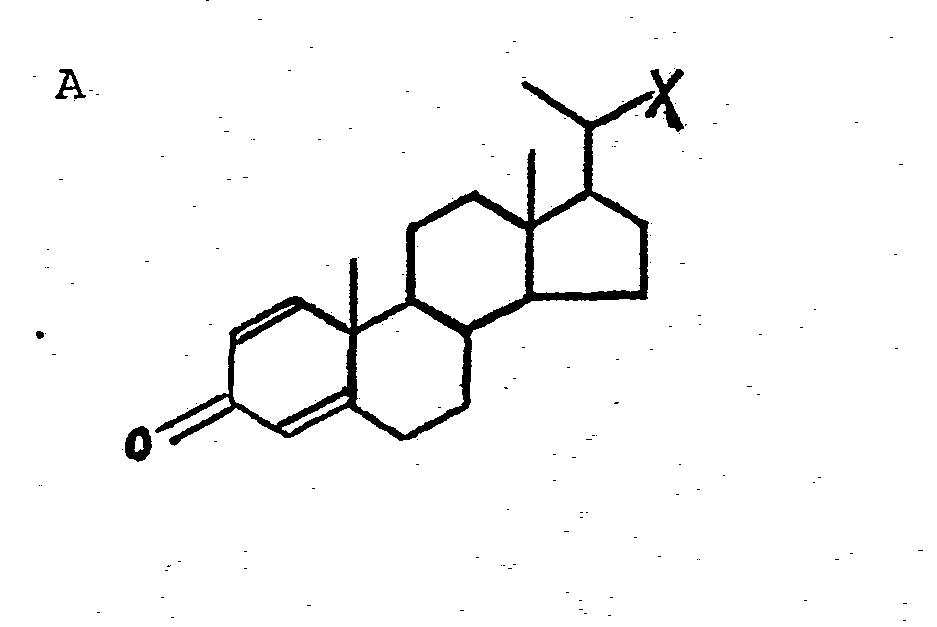
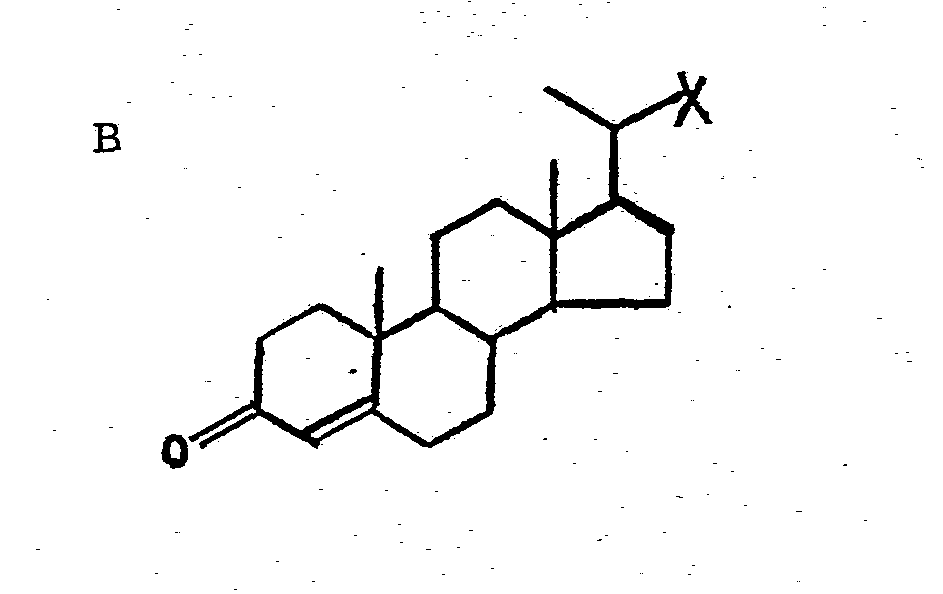


- Zur Umwandlung dieser Ausgangsmaterialien zum Progesteron bzw. Verbindungen vom Progesterontyp muß der Substituent X in 20-Stellung zur 20-Oxogruppe umgewandelt werden. Die Erfindung schildert einen wichtigen Teilschritt dieser chemischen Transformation.
- BNC-Verbindungen gemäß A bis D können durch Halogenierung - vorzugsweise mit Thionylchlorid - in die entsprechenden Säurechloride umgewandelt werden, d.h. in Verbindungen, in denen X dem Rest -COCl entspricht. Diese Säurechloride werden durch ammoniakalische Behandlung in die entsprechenden Säureamide umgewandelt, d.h. in die Verbindungen A bis D, in denen X dem Rest -CONH2 entspricht. Einzelheiten zu diesen Verfahrensschritten finden sich in der älteren Europäischen Patentanmeldung 81 100 145.2 sowie in der parallelen Europäischen Patentanmeldung............ ("Neue 20-substituierte 3-Oxo-pregna-4-en-steroidverbindungen und Verfahren zu ihrer Herstellung", Case 4168, U.S.Priorität vom 19. Februar 1980, Aktenzeichen 122 397) der gleichen Anmelderin.
- Erfindungsgemäß werden die Säureamide zunächst einer N-Bromierung unterworfen (X = -CONHBr), dann wird unter Abspaltung von Bromwasserstoff und intermediärer Isocyanatbildung (X = -NCO) das Carbamat gebildet (X = -NHCOOR).
- Gegenstand der Erfindung ist dementsprechend ein Verfahren zur Herstellung von Steroid-20-Carba- maten aus der Gruppe 3-Oxo-pregn-4-en-2O-carbamat, 3-Oxo-pregna-1,4-dien-20-carbamat, 3-Oxo- pregna-4,17(20)-dien-20-carbamat und/oder 3-Oxo- pregna-1,4,17(20)-trien-20-carbamat, wobei dieses Verfahren dadurch gekennzeichnet ist, daß man die entsprechenden Steroid-20-Carboxamide einer Transhalogenierung mit N-Bromsuccinimid oder N-Bromphthalsäureimid unterwirft, das Reaktionsprodukt mit einer starken Base behandelt und mit einem einwertigen Alkohol umsetzt. Vorzugsweise wird dieses Mehrstufenverfahren in einem Reaktionsschritt ohne Isolierung der Reaktionszwischenprodukte durchgeführt.
- Die N-Halogenierung der erfindungsgemäß als Ausgangsmaterial eingesetzten Carboxamide erfolgt durch Transhalogenierung mittels ausgewählter N-Haloimidverbindungen. Die erfindungsgemäß bevorzugten Transhalogenierungsmittel-sind N-Bromsuccinimid und N-Bromphthalimid. Prinzipiell - wenn auch weniger bevorzugt - läßt sich die Reaktion auch mit den entsprechenden Chloriden und gewünschtenfalls auch den entsprechenden Fluoriden und Iodiden durchführen.
- Das als Reaktant eingesetzte N-Haloimid wird wenigstens in einer der eingesetzten Steroidverbindung äquivalenten Menge verwendet. Vorzugsweise wird jedoch ein mäßiger Überschuß der N-Haloimidverbindung eingesetzt. Üblicherweise werden diese Halogenierungsmittel in Mengen von 1,1 bis 5,0 Äquivalenten, vorzugsweise von etwa 1,2 bis 3,0 Äquivalenten je Äquivalent Steroidverbindung verwendet.
- Zweckmäßigerweise wird weiterhin diese Umsetzung in Gegenwart von Lösungsmitteln durchgeführt. Hierbei können aprotische Lösungsmittel Verwendung finden, die es erlauben, die intermediär entstehenden Steroid-N-Haloimidverbindungen als solche zu isolieren. Geeignete aprotische Lösungsmittel sind beispielsweise Halogenkohlenwasserstoffe, wie Methylenchlorid oder Äthylendichlorid. Hinreichende Mengen des Lösungsmittels sollten Verwendung finden, um die Umsetzung der sonst zähflüssigen Reaktionsmasse zu erleichtern. In der bevorzugten, im folgenden geschilderten Ausführungsform werden jedoch als Lösungsmittel oder wenigstens als Teil eines Lösungsmittelgemisches Alkohole eingesetzt, die dann die unmittelbare Bildung der Carbamate im Reaktionsansatz ermöglichen.
- Die Verfahrenstemperatur liegt zweckmäßigerweise im Bereich von O°C bis 95°C, insbesondere im Bereich von etwa 10°C bis 60°C.
- Zur weiteren Umwandlung der intermediär gebildeten N-Halogen-substituierten Steroidamide werden diese mit starken Basen behandelt. Als starke Basen werden vorzugsweise Natriumhydroxid, Kaliumhydroxid bzw. die entsprechenden Alkoxide, insbesondere Natriummethoxid eingesetzt. Die basische Verbindung wird wenigstens in äquivalenten Mengen, bezogen auf vorliegende Steroidverbindung, verwendet, wobei zweckmäßigerweise mit einem gewissen Überschuß der stark-basischen Komponente gearbeitet wird. Nach Verfahrensabschluß kann dieser Basenüberschuß durch Neutralisieren mit Säuren, beispielsweise Essigsäure, beseitigt werden.
- Die erfindungsgemäß angestrebte Carbamatverbindung entsteht durch Umsetzung des jetzt vorliegenden Reaktionszwischenproduktes mit einem einwertigen Alkohol, der vorzugsweise nicht mehr als 10 C-Atome enthält. Bevorzugt wird mit niederen Alkanolen als Alkoholkomponente gearbeitet und insbesondere mit solchen bis zu 5 C-Atomen. Der Alkohol kann, wie eingangs dargestellt, bereits von Anfang an als reaktives Lösungsmittel vorgelegt werden, so daß erfindungsgemäß auf diesem Wege in einem Zuge das Steroidcarbonsäureamid in das Carbamat umgewandelt wird. Es kann zweckmäßig sein, mit einem Lösungsmittelgemisch zu arbeiten, das die reaktive Alkoholkomponente in Abmischung mit einer nichtreaktiven Lösungsmittelkomponente - beispielsweise den bereits genannten halogenierten Kohlenwasserstoffen - enthält. Geeignet sind beispielsweise Alkohol-/Halogenkohlenwasserstoff-Gemische in einem Gewichtsverhältnis von etwa 15:1 bis etwa 1:10. Die Alkoholkomponente ist auf jeden Fall in stöchiometrisch hinreichenden Mengen einzusetzen, um die Carbamatbildung zu ermöglichen. Geeignete Alkohole sind beispielsweise Methanol, Ethanol, n-Propanol, 2-Propanol, n-Butanol, 2-Butanol, tert.-Butanol. Aber auch Alkohole mit einer größeren Kohlenstoffzahl und/oder einer anderen Struktur können im erfindungsgemäßen Verfahren eingesetzt werden. Als Beispiele seien benannt: Benzylalkohol, 2-Alkoxyalkanole wie 2-Methoxyäthanol, sowie Mischungen der hier genannten Komponenten.
- Erfindungsgemäß wird es bevorzugt, die Reaktion in Abwesenheit von Wasser oder wenigstens unter Einschränkung eines eventuell vorliegenden Wassergehalts durchzuführen. Der praktisch vollständige Ausschluß von Wasser ist erforderlich, wenn Steroidverbindungen mit einer Doppelbindung in 17(20)-Stellung als Ausgangsmaterial eingesetzt werden. Bei den anderen Komponenten wurde überraschenderweise festgestellt, daß Wasser bis zu etwa 5 Gew.-%, vorzugsweise in Mengen von nicht mehr als etwa 2,5 Gew.-%, bezogen auf das Gewicht der Reaktanten, toleriert werden kann.
- Es ist weiterhin bevorzugt, die Umsetzungen in inerter Atmosphäre, insbesondere unter Stickstoff, durchzuführen und das Reaktionsgefäß vor Durchführung der Reaktion in entsprechender Weise hinreichend auszuspülen. Zur Beseitigung von Feuchtigkeitsspuren, beispielsweise im Lösungsmittel bzw. Lösungsmittelgemisch, kann Calciumhydrid besonders geeignet sein.
- Es kann weiterhin zweckmäßig sein, dem Reaktionsgemisch einen Urethanbildungskatalysator, beispielsweise Dibutylzinndilaurat,zuzusetzen.
- Im erfindungsgemäßen Verfahren kann es zweckmäßig sein, dem Reaktionsgemisch nach der Bildung des Steroid-N-Haloamids ein Reduktionsmittel zuzusetzen. Ein geeignetes Reduktionsmittel in diesem Sinne ist Natriumthiosulfat.
- Verschiedenartigste Transformationsreaktionen an Steroidverbindungen sind im Stand der Technik beschrieben worden. Keiner dieser Vorschläge schildert jedoch das erfindungsgemäße Verfahren zur Her- stellung der Steroid-20-Carbamatverbindungen. Diese Carbamatverbindungen können ihrerseits wichtige Ausgangsmaterialien für die letztendlich angestrebte Ausbildung der 20-Oxogruppe sein. So kann die Carbamatfunktion in die 20-Aminofunktion umgewandelt werden, die ihrerseits wieder zur 20-Oxogruppe umgewandelt werden kann. Näheres zu diesen möglichen nachfolgenden Verfahrensschritten findet sich beispielsweise in den parallelen Europäischen Patentanmeldungen ..... ("Verfahren zur hydrolytischen Spaltung von Steroid-20-Carbamaten", Case 4183, U.S:Priorität vom 19. Februar 1980, Aktenzeichen 122 321) ("Neue Steroidverbindung mit einer 20-Amino-Funktion und Verfahren zu ihrer Herstellung", Cases 4168/4183, U.S.Prioritäten vom 19. Feb: 1980, Aktenzeichen 122 397 und 122 321) ("Verfahren zur Herstellung von 3,20-Dioxo-pregn-4-en und/oder 3,20-Dioxo-pregna-1,4-dien" , Case 4167, U.S.Priorität vom 19. Februar 1980, Akten- zeichen: 122,396) der gleichen Anmelderin.
- Aus dem Stand der Technik zur chemischen Transformation von Steroidverbindungen wird verwiesen auf Canadian Journal of Chemistry, Band 34 (1956), S. 982-990, sowie Helvetica Chimica Acta, Band XXXII, Teil VI (1949), No. 255, S. 1922 - 1933, sowie a.a.0. Band XXXII, Teil V (1949), No. 233, S. 1764 - 1769. Verwiesen wird weiterhin auf JACS, Band LXX (1948), No. 3, S. 887 - 892, sowie Helvetica Chimica Acta, Band XXXII, Teil V (1949), No. 232, S.1758 - 1763. Verwiesen sei schließlich auch noch auf die US-PS 3 519 658.
- 1 kg 3-Oxo-pregn-4-en-20-carbonsäureamid wird zu 4,5 1 Methanol gegeben. Das Methanol ist zuvor mit Calciumhydrid getrocknet worden. In das Reaktionsgemisch werden weiterhin 375 g Natriummethoxid eingegeben. Die Reaktionsmischung wird dann unter Stickstoff auf 45°C erwärmt. 600 g handelsübliches N-Bromsuccinimid werden dem Reaktionsgemisch bei 45°C unter Stickstoff zugesetzt. Die Mischung wird für einen Zeitraum von etwa 45 Minuten gerührt, die Stickstoffatmosphäre bleibt dabei aufrechterhalten.
- Die Reaktionslösung wird anschließend mit 2 1 Eisessig angesäuert. Der nach Entfernung des Lösungsmittels unter verringertem Druck verbleibende Rückstand wird in Methylenchlorid gelöst und intensiv mit Wasser, Natriumthiosulfat und erneut Wasser gewaschen.
- Anschließend wird das Methylenchlorid unter verringertem Druck entfernt. Es werden 1.200 g Rohprodukt erhalten. Die Analyse des Rohprodukts zeigt, daß sich das 3-Oxo-pregn-4-en-2O-methyl- carbamat in einer Ausbeute von mehr als 80 % der Theorie gebildet hat. Im Reaktionsrohprodukt wird nur noch ein geringer Rest des eingesetzten Säureamids gefunden.
- Die Ausbeute an gewünschtem Reaktionsprodukt wird durch den Zusatz von Dibutylzinndilaurat leicht verbessert.
- Praktisch gleiche Verfahrensergebnisse werden erhalten, wenn anstelle des N-Bromsuccinimids N-Bromphthalimid eingesetzt wird.
- Wird 3-Oxo-pregna-1,4-dien-20-carbonsäureamid als Ausgangsmaterial in gleicher Menge und unter gleichen Verfahrensbedingungen eingesetzt, so fällt auch hier das entsprechende 3-Oxo-pregna-1,4-dien-20-methylcarbamat in einer Ausbeute über 80 % der Theorie an.
Claims (7)
- l. Verfahren zur Herstellung von Steroid-20- Carbamaten aus der Gruppe 3-Oxo-pregn-4-en-20-carbamat, 3-Oxo-pregna-1,4-dien-20-carbamat, 3-Oxo-pregna-4,17(20)-dien-20-carbamat und/oder 3-Oxö-pregna-1,4,17(20)-trien-20-carbamat, dadurch gekennzeichnet, daß man die entsprechenden Steroid-20-Carboxamide einer Transhalogenierung mit N-Bromsuccinimid oder N-Bromphthalimid unterwirft, das Reaktionsprodukt mit einer starken Base behandelt und mit einem einwertigen Alkohol umsetzt.
- 2. Verfahren nach Anspruch 2, dadurch gekennzeichnet, daß man das Mehrstufen-Verfahren in einem Zuge ohne Isolierung der Reaktionszwischenprodukte durchführt.
- 3. Verfahren nach Ansprüchen 1 und 2, dadurch gekennzeichnet, daß man mit Alkoholen mit bis zu 10-C-Atomen, insbesondere mit niederen Alkanolen mit vorzugsweise bis zu 5-C-Atomen als Alkoholkomponente arbeitet.
- 4. Verfahren nach Ansprüchen 1 bis 3, dadurch gekennzeichnet, daß man in Gegenwart von Lösungsmitteln arbeitet, wobei bevorzugt der zur Carbamatbildung benötigte Alkohol - ggf. in Abmischung mit inerten Lösungsmitteln, wie Halogenkohlenwasserstoffen. - als reaktives Lösungsmittel eingesetzt werden kann.
- 5. Verfahren nach Ansprüchen 1 bis 4, dadurch gekennzeichnet, daß man als starke Base Natriumhydroxid, Kaliumhydroxid und/oder die , entsprechenden Alkoxide einsetzt.
- 6. Verfahren nach Ansprüchen 1 bis 5, dadurch gekennzeichnet, daß man bei Temperaturen von 0°C bis 95°C, insbesondere im Bereich von etwa 10°C bis 60°C und vorzugsweise in inerter Atmosphäre arbeitet.
- 7. Verfahren nach Ansprüchen 1 bis 6, dadurch gekennzeichnet, daß man dem Reaktionsgemisch einen Urethanbildungskatalysator zusetzt.
Priority Applications (1)
| Application Number | Priority Date | Filing Date | Title |
|---|---|---|---|
| AT81101117T ATE8148T1 (de) | 1980-02-19 | 1981-02-17 | Verfahren zur herstellung von steroid-20carbamatverbindungen. |
Applications Claiming Priority (2)
| Application Number | Priority Date | Filing Date | Title |
|---|---|---|---|
| US122398 | 1980-02-19 | ||
| US06/122,398 US4251450A (en) | 1980-02-19 | 1980-02-19 | Nitrogen transhalogenation process |
Publications (3)
| Publication Number | Publication Date |
|---|---|
| EP0034366A2 true EP0034366A2 (de) | 1981-08-26 |
| EP0034366A3 EP0034366A3 (en) | 1981-10-28 |
| EP0034366B1 EP0034366B1 (de) | 1984-06-27 |
Family
ID=22402489
Family Applications (1)
| Application Number | Title | Priority Date | Filing Date |
|---|---|---|---|
| EP81101117A Expired EP0034366B1 (de) | 1980-02-19 | 1981-02-17 | Verfahren zur Herstellung von Steroid-20-Carbamatverbindungen |
Country Status (5)
| Country | Link |
|---|---|
| US (1) | US4251450A (de) |
| EP (1) | EP0034366B1 (de) |
| JP (1) | JPS56128744A (de) |
| AT (1) | ATE8148T1 (de) |
| DE (1) | DE3164356D1 (de) |
Families Citing this family (1)
| Publication number | Priority date | Publication date | Assignee | Title |
|---|---|---|---|---|
| FR2486947A1 (fr) * | 1980-07-15 | 1982-01-22 | Roussel Uclaf | Nouveaux derives steroides 20-isonitriles 17(20) insatures, leur procede de preparation et leur application a la preparation des steroides 17a-hydroxy 20-ceto |
Family Cites Families (2)
| Publication number | Priority date | Publication date | Assignee | Title |
|---|---|---|---|---|
| US3149102A (en) * | 1959-11-27 | 1964-09-15 | Smith Kline French Lab | Process for the preparation of iminopregnadienes, novel steroid intermediates and novel 3-keto-delta4-18, 20-oxygenated steroid derivatives |
| US3591611A (en) * | 1969-08-04 | 1971-07-06 | Merck & Co Inc | 3-oxygenated-17-ureido-androstanes and process |
-
1980
- 1980-02-19 US US06/122,398 patent/US4251450A/en not_active Expired - Lifetime
-
1981
- 1981-01-14 JP JP329081A patent/JPS56128744A/ja active Pending
- 1981-02-17 DE DE8181101117T patent/DE3164356D1/de not_active Expired
- 1981-02-17 EP EP81101117A patent/EP0034366B1/de not_active Expired
- 1981-02-17 AT AT81101117T patent/ATE8148T1/de not_active IP Right Cessation
Non-Patent Citations (1)
| Title |
|---|
| ORGANIC REACTIONS, Band III, 1947, Kapitel 7, Seiten 267-286 Ausg. John Wiley and Sons, Inc. New York, U.S.A. E.S. WALLIS et al.: "The Hofmann reaction" * Seiten 268,269,273,274,282 * * |
Also Published As
| Publication number | Publication date |
|---|---|
| JPS56128744A (en) | 1981-10-08 |
| EP0034366A3 (en) | 1981-10-28 |
| ATE8148T1 (de) | 1984-07-15 |
| US4251450A (en) | 1981-02-17 |
| DE3164356D1 (en) | 1984-08-02 |
| EP0034366B1 (de) | 1984-06-27 |
Similar Documents
| Publication | Publication Date | Title |
|---|---|---|
| EP0034366B1 (de) | Verfahren zur Herstellung von Steroid-20-Carbamatverbindungen | |
| EP0034364B1 (de) | Neue 20-substituierte 3-Oxo-pregna-4-en-steroidverbindungen und Verfahren zu ihrer Herstellung | |
| DE3226164A1 (de) | Einfuehrung eines fluoratoms | |
| DE2332430A1 (de) | Verfahren zur herstellung von fluorierten organischen stickstoffverbindungen | |
| DE1200813B (de) | Verfahren zur Herstellung von 6-Fluorsteroiden der Androstan- oder Pregnanreihe bzw. von entsprechenden 19-Norverbindungen | |
| DE69604513T2 (de) | Verfahren zur Herstellung substituierter Carbodiimide | |
| EP0034367B1 (de) | Verfahren zur hydrolytischen Spaltung von Steroid-20-Carbamaten | |
| EP0034368B1 (de) | Verfahren zur Umwandlung von Steroid-20-Carbonsäureamiden in die entsprechenden Steroid-20-Carbamate | |
| EP0034248B1 (de) | Neue mehrfach ungesättigte BNC-Halogenide und Verfahren zu ihrer Herstellung | |
| DE1795714A1 (de) | Neue fuer die peptidsynthese vorteilhafte harzartige verbindungen, verfahren zu ihrer herstellung und verwendung dieser verbindungen fuer peptidsynthesen | |
| EP0039861B1 (de) | Verfahren zum Abbau der 20-Carboxylgruppe in delta-1,4-BNC und verwandten Steroidverbindungen sowie neue stickstoffhaltige C-21-Steroidverbindungen | |
| DE3486450T2 (de) | 17-Alpha-Ethynyl Steroide | |
| AT370741B (de) | Verfahren zur herstellung von delta 4-c-21-steroidverbindungen mit einer stickstoff-funktion in 20-stellung | |
| EP0034363B1 (de) | Neue Steroidverbindung mit einer 20-Amino-Funktion und Verfahren zu ihrer Herstellung | |
| CH643864A5 (de) | 16,17-pyrazolino- und 16,17-isopyrazolino-1, 4-pregnadien-derivate. | |
| DE2137546C3 (de) | Verfahren zur Herstellung von 17alpha Athjnyl, Methyl und Vinyl 17beta Acetyloxysteroiden der Androstan bzw Ostranreihe | |
| DE2126309A1 (de) | Verfahren zur Herstellung von alpha-Fluornitriminsteroiden | |
| DE69511888T2 (de) | Verfahren zur herstellung von 16 alpha, 17 alpha-ketal steroid-derivaten | |
| EP0041612B1 (de) | Verfahren zur Herstellung von 20-Carbonyl-Steroiden durch Abbau von Steroid-C22-Carbonsäuren | |
| AT374205B (de) | Verfahren zur herstellung eines neuen delta 1,4,17-bisnovcholansaeure-derivates | |
| DE750212C (de) | Verfahren zur Gewinnung der 3-Acyloxybisnorcholensaeure | |
| DE2460657B2 (de) | Verfahren zur Herstellung von Steroidalkyläthern | |
| DE1618747C3 (de) | Verfahren zur Herstellung von Delta hoch 5(10) 3-Keto-19-nor-steroiden | |
| DE1593501B2 (de) | 15,16 beta-Methylensteroide der 19-Nor-androstan-Reihe, Verfahren zu deren Herstellung sowie diese enthaltende Mittel | |
| EP0034365A2 (de) | Verfahren zur Herstellung von 3,20-Dioxo-pregn-4-en und/oder 3,20-Dioxo-pregna-1,4-dien |
Legal Events
| Date | Code | Title | Description |
|---|---|---|---|
| PUAI | Public reference made under article 153(3) epc to a published international application that has entered the european phase |
Free format text: ORIGINAL CODE: 0009012 |
|
| AK | Designated contracting states |
Designated state(s): AT BE CH DE FR GB IT LI LU NL SE |
|
| PUAL | Search report despatched |
Free format text: ORIGINAL CODE: 0009013 |
|
| AK | Designated contracting states |
Designated state(s): AT BE CH DE FR GB IT LI LU NL SE |
|
| 17P | Request for examination filed |
Effective date: 19820327 |
|
| ITF | It: translation for a ep patent filed | ||
| RAP1 | Party data changed (applicant data changed or rights of an application transferred) |
Owner name: HENKEL CORPORATION |
|
| GRAA | (expected) grant |
Free format text: ORIGINAL CODE: 0009210 |
|
| AK | Designated contracting states |
Designated state(s): AT BE CH DE FR GB IT LI LU NL SE |
|
| REF | Corresponds to: |
Ref document number: 8148 Country of ref document: AT Date of ref document: 19840715 Kind code of ref document: T |
|
| REF | Corresponds to: |
Ref document number: 3164356 Country of ref document: DE Date of ref document: 19840802 |
|
| ET | Fr: translation filed | ||
| PLBE | No opposition filed within time limit |
Free format text: ORIGINAL CODE: 0009261 |
|
| STAA | Information on the status of an ep patent application or granted ep patent |
Free format text: STATUS: NO OPPOSITION FILED WITHIN TIME LIMIT |
|
| 26N | No opposition filed | ||
| ITTA | It: last paid annual fee | ||
| EPTA | Lu: last paid annual fee | ||
| EAL | Se: european patent in force in sweden |
Ref document number: 81101117.0 |
|
| PGFP | Annual fee paid to national office [announced via postgrant information from national office to epo] |
Ref country code: GB Payment date: 19970210 Year of fee payment: 17 |
|
| PGFP | Annual fee paid to national office [announced via postgrant information from national office to epo] |
Ref country code: FR Payment date: 19970211 Year of fee payment: 17 |
|
| PGFP | Annual fee paid to national office [announced via postgrant information from national office to epo] |
Ref country code: AT Payment date: 19970213 Year of fee payment: 17 |
|
| PGFP | Annual fee paid to national office [announced via postgrant information from national office to epo] |
Ref country code: SE Payment date: 19970217 Year of fee payment: 17 |
|
| PGFP | Annual fee paid to national office [announced via postgrant information from national office to epo] |
Ref country code: CH Payment date: 19970220 Year of fee payment: 17 |
|
| PGFP | Annual fee paid to national office [announced via postgrant information from national office to epo] |
Ref country code: DE Payment date: 19970221 Year of fee payment: 17 |
|
| PGFP | Annual fee paid to national office [announced via postgrant information from national office to epo] |
Ref country code: NL Payment date: 19970227 Year of fee payment: 17 |
|
| PGFP | Annual fee paid to national office [announced via postgrant information from national office to epo] |
Ref country code: LU Payment date: 19970327 Year of fee payment: 17 |
|
| PGFP | Annual fee paid to national office [announced via postgrant information from national office to epo] |
Ref country code: BE Payment date: 19970410 Year of fee payment: 17 |
|
| PG25 | Lapsed in a contracting state [announced via postgrant information from national office to epo] |
Ref country code: LU Free format text: LAPSE BECAUSE OF NON-PAYMENT OF DUE FEES Effective date: 19980217 Ref country code: GB Free format text: LAPSE BECAUSE OF NON-PAYMENT OF DUE FEES Effective date: 19980217 Ref country code: AT Free format text: LAPSE BECAUSE OF NON-PAYMENT OF DUE FEES Effective date: 19980217 |
|
| PG25 | Lapsed in a contracting state [announced via postgrant information from national office to epo] |
Ref country code: SE Free format text: LAPSE BECAUSE OF NON-PAYMENT OF DUE FEES Effective date: 19980218 |
|
| PG25 | Lapsed in a contracting state [announced via postgrant information from national office to epo] |
Ref country code: LI Free format text: LAPSE BECAUSE OF NON-PAYMENT OF DUE FEES Effective date: 19980228 Ref country code: FR Free format text: THE PATENT HAS BEEN ANNULLED BY A DECISION OF A NATIONAL AUTHORITY Effective date: 19980228 Ref country code: CH Free format text: LAPSE BECAUSE OF NON-PAYMENT OF DUE FEES Effective date: 19980228 Ref country code: BE Free format text: LAPSE BECAUSE OF NON-PAYMENT OF DUE FEES Effective date: 19980228 |
|
| BERE | Be: lapsed |
Owner name: HENKEL CORP. Effective date: 19980228 |
|
| PG25 | Lapsed in a contracting state [announced via postgrant information from national office to epo] |
Ref country code: NL Free format text: LAPSE BECAUSE OF NON-PAYMENT OF DUE FEES Effective date: 19980901 |
|
| GBPC | Gb: european patent ceased through non-payment of renewal fee |
Effective date: 19980217 |
|
| REG | Reference to a national code |
Ref country code: CH Ref legal event code: PL |
|
| EUG | Se: european patent has lapsed |
Ref document number: 81101117.0 |
|
| NLV4 | Nl: lapsed or anulled due to non-payment of the annual fee |
Effective date: 19980901 |
|
| PG25 | Lapsed in a contracting state [announced via postgrant information from national office to epo] |
Ref country code: DE Free format text: LAPSE BECAUSE OF NON-PAYMENT OF DUE FEES Effective date: 19981103 |
|
| REG | Reference to a national code |
Ref country code: FR Ref legal event code: ST |