EP0027113B1 - Process for making a non-woven alginate fabric useful as a wound dressing - Google Patents
Process for making a non-woven alginate fabric useful as a wound dressing Download PDFInfo
- Publication number
- EP0027113B1 EP0027113B1 EP80900666A EP80900666A EP0027113B1 EP 0027113 B1 EP0027113 B1 EP 0027113B1 EP 80900666 A EP80900666 A EP 80900666A EP 80900666 A EP80900666 A EP 80900666A EP 0027113 B1 EP0027113 B1 EP 0027113B1
- Authority
- EP
- European Patent Office
- Prior art keywords
- filaments
- water
- alginate
- calcium
- per cent
- Prior art date
- Legal status (The legal status is an assumption and is not a legal conclusion. Google has not performed a legal analysis and makes no representation as to the accuracy of the status listed.)
- Expired
Links
Images
Classifications
-
- D—TEXTILES; PAPER
- D21—PAPER-MAKING; PRODUCTION OF CELLULOSE
- D21H—PULP COMPOSITIONS; PREPARATION THEREOF NOT COVERED BY SUBCLASSES D21C OR D21D; IMPREGNATING OR COATING OF PAPER; TREATMENT OF FINISHED PAPER NOT COVERED BY CLASS B31 OR SUBCLASS D21G; PAPER NOT OTHERWISE PROVIDED FOR
- D21H5/00—Special paper or cardboard not otherwise provided for
- D21H5/12—Special paper or cardboard not otherwise provided for characterised by the use of special fibrous materials
- D21H5/1227—Special paper or cardboard not otherwise provided for characterised by the use of special fibrous materials of polysaccharide fibres other than cellulosic, e.g. alginate fibres
-
- A—HUMAN NECESSITIES
- A61—MEDICAL OR VETERINARY SCIENCE; HYGIENE
- A61L—METHODS OR APPARATUS FOR STERILISING MATERIALS OR OBJECTS IN GENERAL; DISINFECTION, STERILISATION OR DEODORISATION OF AIR; CHEMICAL ASPECTS OF BANDAGES, DRESSINGS, ABSORBENT PADS OR SURGICAL ARTICLES; MATERIALS FOR BANDAGES, DRESSINGS, ABSORBENT PADS OR SURGICAL ARTICLES
- A61L15/00—Chemical aspects of, or use of materials for, bandages, dressings or absorbent pads
- A61L15/16—Bandages, dressings or absorbent pads for physiological fluids such as urine or blood, e.g. sanitary towels, tampons
- A61L15/22—Bandages, dressings or absorbent pads for physiological fluids such as urine or blood, e.g. sanitary towels, tampons containing macromolecular materials
- A61L15/28—Polysaccharides or their derivatives
-
- A—HUMAN NECESSITIES
- A61—MEDICAL OR VETERINARY SCIENCE; HYGIENE
- A61L—METHODS OR APPARATUS FOR STERILISING MATERIALS OR OBJECTS IN GENERAL; DISINFECTION, STERILISATION OR DEODORISATION OF AIR; CHEMICAL ASPECTS OF BANDAGES, DRESSINGS, ABSORBENT PADS OR SURGICAL ARTICLES; MATERIALS FOR BANDAGES, DRESSINGS, ABSORBENT PADS OR SURGICAL ARTICLES
- A61L15/00—Chemical aspects of, or use of materials for, bandages, dressings or absorbent pads
- A61L15/16—Bandages, dressings or absorbent pads for physiological fluids such as urine or blood, e.g. sanitary towels, tampons
- A61L15/42—Use of materials characterised by their function or physical properties
- A61L15/64—Use of materials characterised by their function or physical properties specially adapted to be resorbable inside the body
-
- D—TEXTILES; PAPER
- D21—PAPER-MAKING; PRODUCTION OF CELLULOSE
- D21H—PULP COMPOSITIONS; PREPARATION THEREOF NOT COVERED BY SUBCLASSES D21C OR D21D; IMPREGNATING OR COATING OF PAPER; TREATMENT OF FINISHED PAPER NOT COVERED BY CLASS B31 OR SUBCLASS D21G; PAPER NOT OTHERWISE PROVIDED FOR
- D21H13/00—Pulp or paper, comprising synthetic cellulose or non-cellulose fibres or web-forming material
- D21H13/10—Organic non-cellulose fibres
- D21H13/28—Organic non-cellulose fibres from natural polymers
- D21H13/30—Non-cellulose polysaccharides
- D21H13/32—Alginate fibres
Definitions
- This invention relates to alginate filaments and to wound dressings containing them.
- the extrusion of alginate solutions into an aqueous sulution containing calcium ions to form yarns of calcium alginate filaments is known, for example, from GB-A-567,641, 568,177, 571,657 and 624,987.
- the alginate yarn when formed into a fabric is useful as a haemostatic wound dressing as described in GB-A-621,320.
- Such fabrics have generally been prepared by knitting a yarn of calcium alginate filaments and partially converting the calcium alginate to the sodium form to form a calcium sodium alginate containing, for example, 38-70 per cent by weight of the carboxy groups of the alginate in the calcium form. This process is difficult in practice.
- the alginate fibres in the calcium form are brittle and in the sodium calcium alginate form they are very weak and sensitive to moisture.
- USA4,104,115 describes a method of manufacturing alginate paper by forming a paper-making stock which consists of a slurry of water-insoluble calcium alginate fibres in water and presenting the stock to the screen of the web-forming unit of a paper-making machine.
- a process according to the invention for making a non-woven alginate fabric useful as a wound dressing by feeding calcium alginate fibres onto a water-pervious support and drying the fibres so that they become bonded to each other is characterised in that the fibres are in the form of a tow of continuous calcium alginate filaments which have been water-washed but not dried and the tow is spread in a flow of water and fed to the water-pervious support at an overfeed of at least 2 per cent so that the filaments cross over each other on the water-pervious support and upon drying become bonded to each other at their points of contact where they cross over each other.
- the continuous calcium alginate filaments can be prepared by extruding a 5 to 10 per cent aqueous solution of sodium alginate into an aqueous solution containing 5 to 35 grams/litre of calcium chloride or an equivalent amount of any other calcium salt.
- the sodium alginate solution can be treated with an oxidising agent such as hydrogen peroxide, chlorine or sodium hypochlorite (e.g. in an amount of 1-10 per cent by weight, based on sodium alginate) to reduce its viscosity and is then preferably filtered before extrusion to form continuous filaments.
- the extruded tow preferably comprises 4000 to 40,000 continuous filaments of total decitex 10,000-100,000.
- the freshly spun calcium alginate tow is preferably stretched, suitably by a factor of 1.5 to 2.5, in an atmosphere of steam, preferably at 90-120 0 C, while still wet with calcium salt solution.
- Steam stretching particularly when following oxidation of the alginate solution, leads to stronger, more lustrous and less brittle filaments. It also reduces the water content of the filaments, which when freshly spun are in a swollen gel state.
- the steam-stretched filaments are particularly suitable for forming a non-woven fabric according to the invention. Hot-stretching has not previously been used in calcium alginate filaments because of the risk of filament breakage during stretching. The oxidation of the alginate solution before extrusion leads to fibres strong enough to survive stretching.
- the tow is preferably spread by feeding a tow of continuous calcium alginate filaments, which have been stretched and water-washed but not dried, through a fish tail device whose cross-section gradually widens in a first direction and narrows in a second direction at right angles to the first.
- the degree of overfeeding of the spread filaments on to the water-pervious support is at least 2 per cent, that is to say the speed of the filaments is at least 2 per cent greater than the speed of the support, for example a wire mesh conveyor, on which they are laid.
- the degree of overfeeding can be as high as 200 per cent or even more. However, we prefer an overfeed of 10-50 per cent which we have found gives a substantially uniform layer of filaments with sufficient crossing over of filaments to lead to a unitary non-woven fabric when the filaments are bonded.
- the drying of the web of calcium alginate filaments formed on the support is preferably achieved by first sucking surplus water from beneath the water-pervious support so as to bond the filaments together at their points of contact and finally by heating, for example by passing over cylinders heated to 120-150°C, to remove all residual water.
- the calcium alginate filaments particularly if they have been spun into solutions containing 5-10 grams/litre CaCl 2 , and have been subjected to hot stretching, have a ribbon-like cross-section and have a natural tendency to bond together on drying, like paper fibres. This cross-section is also responsible in part for the greatly reduced brittleness of the fibres.
- the dried web produced is thus a stable non-woven fabric in which the filaments are bonded at their points of contact where they cross over each other.
- the degree of bonding of the filaments can be increased by treating the filaments while they are on the conveyor with an aqueous solution of a sodium salt, to replace part of the calcium ions by sodium ions to form calcium sodium alginate fibres.
- the sodium salt is preferably a salt of an acid which forms an insoluble calcium salt, for example the carbonate, sulphite, oxalate or palmitate.
- the sodium salt solution can be applied as a spray.
- the freshly spun and stretched calcium alginate filaments spread in the flow of water generally contain about 95 per cent of their carboxyl groups in the calcium form and 5 per cent in the sodium form.
- Treatment with a sodium salt solution to increase the bonding of the filaments on the conveyor slightly increases their sodium content, but the calcium content should generally remain above 70 per cent.
- Non-woven alginate fabrics having this high calcium content of 70 to 95 per cent are useful for example as throat swabs, which after swabbing are dissolved in sodium hexametaphosphate solution.
- the non-woven alginate fabrics can be treated to partially replace calcium by sodium, for example by treatment with alcoholic sodium hydroxide and sodium acetate so that from 30 to 70 per cent of the carboxyl groups are in the sodium form.
- the sodium calcium alginate fabrics produced are useful as haemostatic wound dressings which can be absorbed by body fluids, for use for example in deep surgery or after tooth extraction.
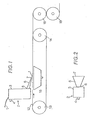
- a tow 1 of stretched and washed calcium alginate filaments is fed to a spreading device 2.
- the spreading device consists of a chamber 3 containing water continuously fed in through an inlet 4 and a fish tail device 5 which forms the outlet of the spreading device.
- the fish tail is of substantially square cross-section at the point 6 where it joins with chamber 3, but its outlet 7 is in the form of a broad slit.
- a water-pervious support 12 passes under fish tail 5 and around rolls 13 and 14 in the direction shown.
- the spread tow of alginate filaments emerging from the fish tail 5 is led on the mesh conveyor as the tow passes from the outlet 7 of the fish tail.
- the speed of the alginate filaments emerging from the outlet 7 is arranged to be greater, for example 20 per cent greater than the speed of the conveyor 12.
- the water carrying the alginate filaments passes through the conveyor 12 to a receptacle 15 under the upper flight of the conveyor. Suction is applied to the filaments on the belt through the receptacle 15; alternatively or additionally, a separate suction box can be mounted beneath the conveyor and further along the conveyor.
- the web of partially dried calcium alginate filaments parts from the conveyor at roll 14 and passes around heated cylinders 18 and 19 which further dry the alginate filaments.
- the invention is illustrated by the following Example.
- the stretched calcium alginate tow was fed to the apparatus shown in Figures 1 and 2, the speed of the conveyor 12 being such as to give a 20 per cent overfeed of the tow.
- the spread filaments were laid in a sinuous configuration with the filaments crossing over one another and drying by suction while the filaments were on the conveyor 12 bonded the filaments in this configuration to produce a non-woven alginate fabric which was dried by heated cylinders 18 and 19.
Landscapes
- Health & Medical Sciences (AREA)
- General Health & Medical Sciences (AREA)
- Hematology (AREA)
- Engineering & Computer Science (AREA)
- Materials Engineering (AREA)
- Epidemiology (AREA)
- Life Sciences & Earth Sciences (AREA)
- Chemical & Material Sciences (AREA)
- Public Health (AREA)
- Animal Behavior & Ethology (AREA)
- Veterinary Medicine (AREA)
- Artificial Filaments (AREA)
- Materials For Medical Uses (AREA)
- Nonwoven Fabrics (AREA)
- Paper (AREA)
- Treatment Of Fiber Materials (AREA)
Applications Claiming Priority (2)
| Application Number | Priority Date | Filing Date | Title |
|---|---|---|---|
| GB7913392 | 1979-04-18 | ||
| GB7913392 | 1979-04-18 |
Publications (2)
| Publication Number | Publication Date |
|---|---|
| EP0027113A1 EP0027113A1 (en) | 1981-04-22 |
| EP0027113B1 true EP0027113B1 (en) | 1982-11-24 |
Family
ID=10504608
Family Applications (1)
| Application Number | Title | Priority Date | Filing Date |
|---|---|---|---|
| EP80900666A Expired EP0027113B1 (en) | 1979-04-18 | 1980-11-04 | Process for making a non-woven alginate fabric useful as a wound dressing |
Country Status (6)
| Country | Link |
|---|---|
| US (1) | US4421583A (enExample) |
| EP (1) | EP0027113B1 (enExample) |
| JP (1) | JPS6338461B2 (enExample) |
| DE (1) | DE3061136D1 (enExample) |
| IE (1) | IE49193B1 (enExample) |
| WO (1) | WO1980002300A1 (enExample) |
Families Citing this family (26)
| Publication number | Priority date | Publication date | Assignee | Title |
|---|---|---|---|---|
| AU546556B2 (en) * | 1981-08-18 | 1985-09-05 | Courtaulds Plc | Alginate fibre material and process |
| US4960413A (en) * | 1985-11-09 | 1990-10-02 | The Shirley Institute | Wound dressing |
| US4793337A (en) * | 1986-11-17 | 1988-12-27 | E. R. Squibb & Sons, Inc. | Adhesive structure and products including same |
| US4990339A (en) * | 1987-11-16 | 1991-02-05 | H. B. Fuller Company | Dermal treatment film |
| US5197945A (en) * | 1988-05-31 | 1993-03-30 | Minnesota Mining And Manufacturing Company | Alginate wound dressing of good integrity |
| DE68928335T2 (de) * | 1988-05-31 | 1998-03-19 | Minnesota Mining & Mfg | Alginatewundverband mit guter Integrität |
| GB8815132D0 (en) * | 1988-06-24 | 1988-08-03 | Britcair Ltd | Wound dressing |
| GB8820564D0 (en) * | 1988-08-31 | 1988-09-28 | Britcair Ltd | Wound dressing |
| US5484604A (en) * | 1990-07-21 | 1996-01-16 | Chatfield Pharmaceuticals Limited | Cross-linked alginate transdermal medicine delivery devices |
| GB9109367D0 (en) * | 1991-05-01 | 1991-06-26 | Merck Sharp & Dohme | Surgical dressing |
| US5714232A (en) * | 1991-05-01 | 1998-02-03 | E. R. Squibb & Sons, Inc. | Alginate fabric, its use in wound dressings and surgical haemostats and a process for its manufacture |
| US5470576A (en) * | 1992-06-08 | 1995-11-28 | The Kendall Company | Process for preparing the alginate-containing wound dressing |
| US5840777A (en) * | 1992-06-19 | 1998-11-24 | Albany International Corp. | Method of producing polysaccharide foams |
| EP0680525B1 (en) * | 1993-01-20 | 1997-05-07 | E.R. SQUIBB & SONS, INC. | Fibres |
| GB9301258D0 (en) * | 1993-01-22 | 1993-03-17 | Courtaulds Plc | Use of absorbent fibre |
| GB9414303D0 (en) * | 1994-07-15 | 1994-09-07 | C V Lab Ltd | Alginate fibres, method of preparation and use |
| NO953115L (no) | 1995-06-07 | 1996-12-09 | Albany Int Research | Fremgangsmåte for fremstilling av polysakkaridskum |
| US5688923A (en) * | 1996-02-15 | 1997-11-18 | Hercules Incorporated | Pectin fibers |
| US5925218A (en) * | 1997-03-03 | 1999-07-20 | Westvaco Corporation | Rehydration of once-dried fiber |
| DE10007794A1 (de) * | 2000-02-21 | 2001-06-28 | Zimmer Ag | Polymerzusammensetzung und daraus hergestellter Formkörper |
| US6648862B2 (en) | 2001-11-20 | 2003-11-18 | Spheric Products, Ltd. | Personally portable vacuum desiccator |
| US7790945B1 (en) | 2004-04-05 | 2010-09-07 | Kci Licensing, Inc. | Wound dressing with absorption and suction capabilities |
| TWI405594B (zh) * | 2009-07-28 | 2013-08-21 | Taiwan Textile Res Inst | 創傷敷材之製作裝置 |
| CN103170004B (zh) * | 2012-04-23 | 2016-08-31 | 佛山市优特医疗科技有限公司 | 一种制备含银纤维伤口敷料的方法 |
| US20210052767A1 (en) * | 2012-04-23 | 2021-02-25 | Foshan United Medical Technologies Ltd. | Antimicrobial fiber comprising silver, fabric and wound dressing comprising the antimicrobial fiber, and methods for manufacturing the fiber, the fabric, and the wound dressing |
| CN105755578A (zh) * | 2015-12-25 | 2016-07-13 | 青岛海之林生物科技开发有限公司 | 一种水溶性海藻酸钙纤维的制备方法和应用 |
Family Cites Families (13)
| Publication number | Priority date | Publication date | Assignee | Title |
|---|---|---|---|---|
| FR797829A (fr) * | 1935-02-01 | 1936-05-05 | Perfectionnements à la fabrication de matières artificielles à base de dérivés de cellulose | |
| US2512616A (en) * | 1946-01-12 | 1950-06-27 | Johnson & Johnson | Hemostatic alginic surgical dressings |
| US2496797A (en) * | 1946-07-26 | 1950-02-07 | Eastman Kodak Co | Method of preparing oxidized cellulose gauze |
| US2600504A (en) * | 1947-06-19 | 1952-06-17 | Alginate Ind Ltd | Forming paper from modified calcium alginate fibers |
| FR971200A (fr) * | 1948-08-25 | 1951-01-15 | Brothier Lab | Fils artificiels, produits textiles obtenus à partir de ces fils et leurs applications en chirurgie, notamment comme matériaux de suture et de pansement |
| US3802980A (en) * | 1962-03-19 | 1974-04-09 | C Harmon | Continuous filament web and method of manufacturing the same |
| DE1461092A1 (de) * | 1963-12-20 | 1969-02-27 | Feldmuehle Ag | Verfahren zur Herstellung von aus Endlosfasern bestehenden Flaechengebilden auf der Papiermaschine |
| US3531363A (en) * | 1967-01-06 | 1970-09-29 | Du Pont | Nonwoven fabric |
| DE1785302C3 (de) * | 1968-09-07 | 1974-08-29 | Bayer Ag, 5090 Leverkusen | Verfahren und Vorrichtung zum kontinuierlichen Herstellen eines Wirrfadenvlieses und Wirrfadenvlies |
| GB1287885A (enExample) * | 1968-10-17 | 1972-09-06 | ||
| GB1231506A (enExample) * | 1968-11-13 | 1971-05-12 | ||
| US3550592A (en) * | 1968-12-23 | 1970-12-29 | Kimberly Clark Co | Sanitary napkin and disposable wrapper therefor |
| US4104115A (en) * | 1973-11-29 | 1978-08-01 | Carreras Rothmans, Limited | Method of making paper from water insoluble alginate fibers and the paper produced |
-
1980
- 1980-04-15 IE IE762/80A patent/IE49193B1/en unknown
- 1980-04-17 WO PCT/GB1980/000066 patent/WO1980002300A1/en not_active Ceased
- 1980-04-17 JP JP55500763A patent/JPS6338461B2/ja not_active Expired
- 1980-04-17 DE DE8080900666T patent/DE3061136D1/de not_active Expired
- 1980-11-04 EP EP80900666A patent/EP0027113B1/en not_active Expired
-
1982
- 1982-09-22 US US06/421,231 patent/US4421583A/en not_active Expired - Lifetime
Also Published As
| Publication number | Publication date |
|---|---|
| EP0027113A1 (en) | 1981-04-22 |
| JPS6338461B2 (enExample) | 1988-07-29 |
| DE3061136D1 (en) | 1982-12-30 |
| IE800762L (en) | 1980-10-18 |
| WO1980002300A1 (en) | 1980-10-30 |
| US4421583A (en) | 1983-12-20 |
| JPS56500659A (enExample) | 1981-05-14 |
| IE49193B1 (en) | 1985-08-21 |
Similar Documents
| Publication | Publication Date | Title |
|---|---|---|
| US4421583A (en) | Man-made filaments and method of making wound dressings containing them | |
| US4289824A (en) | High fluid-holding alloy rayon fiber mass | |
| EP0072680B1 (en) | Process for the production of alginate fibre material and products made therefrom | |
| FI103813B (fi) | Selluloosakuituja | |
| US2626214A (en) | Paper from long synthetic fibers and partially water soluble sodium carboxymethylcellulose and method | |
| RU2664206C1 (ru) | Лиоцелловый материал для сигаретного фильтра и способ его получения | |
| JPH03130494A (ja) | 重合体変性繊維状パルプを含有する吸収性紙とその湿式抄紙法 | |
| CN107569320A (zh) | 一种加强的伤口敷料及其制备方法 | |
| CN115161829A (zh) | 一种天然抗菌防螨复合纸纱及其制作方法 | |
| CN112281483A (zh) | 一种纤维素纤维的快速交联方法及抗原纤化纤维素纤维的制备方法 | |
| SU1355133A3 (ru) | Кручена пр жа | |
| US20180326113A1 (en) | Fibres | |
| GB2103993A (en) | Production of alginate fibres | |
| US3453818A (en) | Production of asbestos yarn | |
| JPS60119248A (ja) | 水溶性ポリビニルアルコ−ル長繊維を使用した混合紡績糸による織物の製造法 | |
| SU1386681A1 (ru) | Способ получени материала из химических волокон или смеси химических и натуральных волокон | |
| US2020304A (en) | Textile materials | |
| US3907633A (en) | Process of making polyolefin fibers | |
| CN108728983A (zh) | 一种具有锆基盾的面料及其织造工艺 | |
| CN108252141A (zh) | 一种蔺草纤维及其湿法非织造织物的制备方法 | |
| US2144677A (en) | Crepe thread and fabric | |
| Miraftab et al. | Advanced wound care materials: developing an alginate fibre containing branan ferulate | |
| CN108221173A (zh) | 一种高效抗菌丝绵被及其制作方法 | |
| JP2918567B2 (ja) | 経糸準備方法 | |
| RU2155250C1 (ru) | Марля медицинская отбеленная хлопчатобумажная |
Legal Events
| Date | Code | Title | Description |
|---|---|---|---|
| PUAI | Public reference made under article 153(3) epc to a published international application that has entered the european phase |
Free format text: ORIGINAL CODE: 0009012 |
|
| AK | Designated contracting states |
Designated state(s): CH DE FR GB |
|
| 17P | Request for examination filed |
Effective date: 19810327 |
|
| GRAA | (expected) grant |
Free format text: ORIGINAL CODE: 0009210 |
|
| AK | Designated contracting states |
Designated state(s): CH DE FR GB |
|
| REF | Corresponds to: |
Ref document number: 3061136 Country of ref document: DE Date of ref document: 19821230 |
|
| ET | Fr: translation filed | ||
| PGFP | Annual fee paid to national office [announced via postgrant information from national office to epo] |
Ref country code: CH Payment date: 19840625 Year of fee payment: 5 |
|
| PG25 | Lapsed in a contracting state [announced via postgrant information from national office to epo] |
Ref country code: LI Effective date: 19880430 Ref country code: CH Effective date: 19880430 |
|
| REG | Reference to a national code |
Ref country code: CH Ref legal event code: PL |
|
| PGFP | Annual fee paid to national office [announced via postgrant information from national office to epo] |
Ref country code: DE Payment date: 19890628 Year of fee payment: 10 |
|
| PG25 | Lapsed in a contracting state [announced via postgrant information from national office to epo] |
Ref country code: DE Effective date: 19910101 |
|
| PGFP | Annual fee paid to national office [announced via postgrant information from national office to epo] |
Ref country code: FR Payment date: 19990315 Year of fee payment: 20 |
|
| PGFP | Annual fee paid to national office [announced via postgrant information from national office to epo] |
Ref country code: GB Payment date: 19990323 Year of fee payment: 20 |
|
| PG25 | Lapsed in a contracting state [announced via postgrant information from national office to epo] |
Ref country code: GB Free format text: LAPSE BECAUSE OF EXPIRATION OF PROTECTION Effective date: 20000416 |
|
| REG | Reference to a national code |
Ref country code: GB Ref legal event code: PE20 Effective date: 20000416 |
|
| PLBE | No opposition filed within time limit |
Free format text: ORIGINAL CODE: 0009261 |
|
| STAA | Information on the status of an ep patent application or granted ep patent |
Free format text: STATUS: NO OPPOSITION FILED WITHIN TIME LIMIT |