EP0026257B1 - Installation comportant une pompe à chaleur à absorption - Google Patents
Installation comportant une pompe à chaleur à absorption Download PDFInfo
- Publication number
- EP0026257B1 EP0026257B1 EP80102725A EP80102725A EP0026257B1 EP 0026257 B1 EP0026257 B1 EP 0026257B1 EP 80102725 A EP80102725 A EP 80102725A EP 80102725 A EP80102725 A EP 80102725A EP 0026257 B1 EP0026257 B1 EP 0026257B1
- Authority
- EP
- European Patent Office
- Prior art keywords
- heat
- heat pump
- absorption
- absorber
- generator
- Prior art date
- Legal status (The legal status is an assumption and is not a legal conclusion. Google has not performed a legal analysis and makes no representation as to the accuracy of the status listed.)
- Expired
Links
Images


Classifications
-
- F—MECHANICAL ENGINEERING; LIGHTING; HEATING; WEAPONS; BLASTING
- F25—REFRIGERATION OR COOLING; COMBINED HEATING AND REFRIGERATION SYSTEMS; HEAT PUMP SYSTEMS; MANUFACTURE OR STORAGE OF ICE; LIQUEFACTION SOLIDIFICATION OF GASES
- F25B—REFRIGERATION MACHINES, PLANTS OR SYSTEMS; COMBINED HEATING AND REFRIGERATION SYSTEMS; HEAT PUMP SYSTEMS
- F25B30/00—Heat pumps
- F25B30/04—Heat pumps of the sorption type
-
- F—MECHANICAL ENGINEERING; LIGHTING; HEATING; WEAPONS; BLASTING
- F25—REFRIGERATION OR COOLING; COMBINED HEATING AND REFRIGERATION SYSTEMS; HEAT PUMP SYSTEMS; MANUFACTURE OR STORAGE OF ICE; LIQUEFACTION SOLIDIFICATION OF GASES
- F25B—REFRIGERATION MACHINES, PLANTS OR SYSTEMS; COMBINED HEATING AND REFRIGERATION SYSTEMS; HEAT PUMP SYSTEMS
- F25B15/00—Sorption machines, plants or systems, operating continuously, e.g. absorption type
- F25B15/02—Sorption machines, plants or systems, operating continuously, e.g. absorption type without inert gas
- F25B15/06—Sorption machines, plants or systems, operating continuously, e.g. absorption type without inert gas the refrigerant being water vapour evaporated from a salt solution, e.g. lithium bromide
-
- F—MECHANICAL ENGINEERING; LIGHTING; HEATING; WEAPONS; BLASTING
- F25—REFRIGERATION OR COOLING; COMBINED HEATING AND REFRIGERATION SYSTEMS; HEAT PUMP SYSTEMS; MANUFACTURE OR STORAGE OF ICE; LIQUEFACTION SOLIDIFICATION OF GASES
- F25B—REFRIGERATION MACHINES, PLANTS OR SYSTEMS; COMBINED HEATING AND REFRIGERATION SYSTEMS; HEAT PUMP SYSTEMS
- F25B17/00—Sorption machines, plants or systems, operating intermittently, e.g. absorption or adsorption type
- F25B17/08—Sorption machines, plants or systems, operating intermittently, e.g. absorption or adsorption type the absorbent or adsorbent being a solid, e.g. salt
-
- F—MECHANICAL ENGINEERING; LIGHTING; HEATING; WEAPONS; BLASTING
- F25—REFRIGERATION OR COOLING; COMBINED HEATING AND REFRIGERATION SYSTEMS; HEAT PUMP SYSTEMS; MANUFACTURE OR STORAGE OF ICE; LIQUEFACTION SOLIDIFICATION OF GASES
- F25B—REFRIGERATION MACHINES, PLANTS OR SYSTEMS; COMBINED HEATING AND REFRIGERATION SYSTEMS; HEAT PUMP SYSTEMS
- F25B27/00—Machines, plants or systems, using particular sources of energy
- F25B27/002—Machines, plants or systems, using particular sources of energy using solar energy
- F25B27/007—Machines, plants or systems, using particular sources of energy using solar energy in sorption type systems
-
- Y—GENERAL TAGGING OF NEW TECHNOLOGICAL DEVELOPMENTS; GENERAL TAGGING OF CROSS-SECTIONAL TECHNOLOGIES SPANNING OVER SEVERAL SECTIONS OF THE IPC; TECHNICAL SUBJECTS COVERED BY FORMER USPC CROSS-REFERENCE ART COLLECTIONS [XRACs] AND DIGESTS
- Y02—TECHNOLOGIES OR APPLICATIONS FOR MITIGATION OR ADAPTATION AGAINST CLIMATE CHANGE
- Y02A—TECHNOLOGIES FOR ADAPTATION TO CLIMATE CHANGE
- Y02A30/00—Adapting or protecting infrastructure or their operation
- Y02A30/27—Relating to heating, ventilation or air conditioning [HVAC] technologies
-
- Y—GENERAL TAGGING OF NEW TECHNOLOGICAL DEVELOPMENTS; GENERAL TAGGING OF CROSS-SECTIONAL TECHNOLOGIES SPANNING OVER SEVERAL SECTIONS OF THE IPC; TECHNICAL SUBJECTS COVERED BY FORMER USPC CROSS-REFERENCE ART COLLECTIONS [XRACs] AND DIGESTS
- Y02—TECHNOLOGIES OR APPLICATIONS FOR MITIGATION OR ADAPTATION AGAINST CLIMATE CHANGE
- Y02B—CLIMATE CHANGE MITIGATION TECHNOLOGIES RELATED TO BUILDINGS, e.g. HOUSING, HOUSE APPLIANCES OR RELATED END-USER APPLICATIONS
- Y02B30/00—Energy efficient heating, ventilation or air conditioning [HVAC]
- Y02B30/62—Absorption based systems
Definitions
- the invention relates to an absorption heat pump system with an expeller-absorber unit, which contains zeolite as an absorbent and a working medium absorbed therein and works alternately as an expeller or absorber, furthermore with a heating device for supplying thermal energy to the expeller-absorber unit at a relatively high temperature.
- a device for extracting heat coupled to the expeller-absorber unit, a condenser arrangement coupled to the expeller-absorber unit for condensing vaporous working fluid which has been expelled from the absorbent by the supply of heat at a pressure in a predetermined pressure range, a device for reducing the pressure of the condensed working medium and an evaporator for evaporating the condensed working medium of reduced pressure.
- Absorption heat pumps can be powered by an oil or gas burner, thereby avoiding some of the disadvantages of compressor heat pumps mentioned above.
- Absorption heat pumps which are supplied with operating energy by a gas or oil burner, also have disadvantages: An economic use of the primary energy requires an adjustment of the cooling and / or heat output of the heat pump to the respective heat demand, i.e. that the system must be controllable. Continuous control of oil burners has proven difficult.
- a two-point control is not as efficient as a constant control and, in addition, there is a risk of condensation of combustion products in the chimney, i.e. so-called chimney sooting, in times of relatively low heat requirements, when the burner's switch-on times are relatively short and separated by longer breaks.
- an absorption heat pump which can contain zeolite as an absorption medium in combination with hydrocarbons as a working medium. Intermittent storage is not provided here.
- the present invention is accordingly based on the object of further developing an absorption heat pump system of the type mentioned at the outset in such a way that it enables larger amounts of heat to be stored over virtually any time and to generate useful heat of a relatively high temperature.
- the heating device is designed for expulsion at temperatures up to over 250 ° C.
- the absorbent can also contain CaO or Mg X Ca t _ X O (x to about 0.5).
- the device for extracting heat from the expeller-absorber unit is coupled to an expander of an additional absorption heat pump circuit via a heat transfer circuit and / or the condenser arrangement.
- the additional absorption heat pump circuit can work with the working fluid system LiBr / H 2 0. LiBr / CH 3 0H or NH 3 / H 2 0.
- an arrangement for extracting heat from a condenser and / or an absorber of the additional absorption heat pump circuit and feeding at least a part of the extracted heat into the first-mentioned evaporator is preferably provided.
- the heating device which supplies the heat to be stored can be operated under optimal operating conditions. If an electric heater is used to store heat in the expeller absorber unit which serves as a heat store, night current and excess current can be used in low load times.
- the waste heat from an engine, a turbine or an industrial process can also be stored in the expeller-absorber unit, which serves as a heat store.
- the expeller-absorber unit serving as storage is heated with a burner, it can be operated optimally and with relatively long heating periods, after which the storage can be thermally closed, so that no chimney losses occur.
- a regulation on the heating side is not necessary, but the absorption heat pump can be regulated by releasing the stored energy as required and in the amount required
- the absorption heat pump system according to the invention is harmless, environmentally friendly and works with non-toxic and non-corrosive substances.
- absorption heat pump is also intended to include absorption heat pumps, in which case evaporation and condensation of the working fluid correspond to desorption or resorption.
- the system shown in FIG. 1, which can be used for heating and / or cooling, contains an absorption heat pump, designated as a whole by 210, and a heating device, designated as a whole by 212, for an expeller 214 of the heat pump 210 known manner, an absorbent capable of absorbing a working fluid which can be expelled from the absorbent by heating.
- the expeller 214 has an outlet for gaseous working medium, which is connected via a line 216 to a condenser 218, which works as a heat exchanger and has a heat outlet 218a. Useful heat is extracted from a heating system and waste heat is removed from a cooling system.
- Liquefied working fluid is passed from the condenser 218 via a line 222, a throttle element 224 and a line 226 into an evaporator 228, which works as a heat exchanger and has a heat input 230, via which the thermal energy required for the evaporation of the liquefied and relaxed working medium can be supplied.
- the heat input 230 receives the heat to be removed.
- the vaporized working fluid is fed via a line to an absorber 234, in which the working fluid vapor is absorbed by the absorbent. The heat of absorption released in this process occurs at a useful or waste heat outlet 236 of the absorber.
- the absorbent loaded with working medium is transported into the expeller 214 via a pump 238.
- the expeller 214 has a heat input portion that contains a heater coil 240. By means of the heat supplied, the working medium is expelled again from the absorption medium and the absorption medium essentially free of working medium is introduced into the absorber 234 via an absorption medium outlet line 242 and a throttle element 244.
- the absorption heat pump 210 works continuously and contains other, conventional components that are not shown to simplify the drawing, for. B. heat exchanger between rich and poor absorbent solution or between liquid and gaseous working medium. However, a batch heat pump can also be used,
- the heating device 212 for the expeller 214 of the heat pump 210 is designed as a heat pump upstream of the heat pump 210 and contains a sorption heat accumulator 246 which works with zeolite as the absorption medium and water as the working medium.
- the housing 246a is connected to a working medium steam outlet line 382, which contains a shut-off valve 382a and leads to a heating coil 340 in the expeller 214 of the absorption heat pump 210.
- the output of the heating coil 340 is connected to a working medium storage vessel 384, which therefore contains liquid water when the working medium H 2 0 is used.
- the storage vessel 384 has an outlet line 386, which is connected to an evaporator 394 via an optional liquid / gas heat exchanger 387, which is advantageous in the case of high working medium vapor density in the evaporator 394, with a throttle element 388, which consists of a shut-off and control valve and its low-pressure side is connected via the evaporator 394 and the gas side of the heat exchanger 387 to a working medium inlet line 390 of the sorption store 246, which contains a shut-off valve 390a.
- a heat exchanger 392 can advantageously be provided between the outlet side of the heating coil 340 and the inlet of the storage vessel 384, from which useful heat can be removed.
- a coil 254 is also arranged, which serves to dissipate the thermal energy, which is stored in the heat accumulator 246 as specific heat and which is released as sorption heat when the working medium is introduced.
- the coil 254 is connected to a heat transfer circuit 252, the z. B. can work with water as a heat transfer medium and contains an outlet line connected to the outlet side of the tube length 254, which leads to the heating coil 240 arranged in the expeller 214.
- the outlet side of the heating coil 240 is connected via an outlet line 258, which contains a heat exchanger 304, to the inlet of a heat transfer medium reservoir 260, the outlet of which is connected to the inlet end of the pipe coil 254 via a control valve 264 (or a controllable pump 266).
- working means can flow into the sorption heat accumulator 246 in a controlled manner through the throttle element 388 designed as a shut-off and control valve.
- the valve 382a is now closed and the valve 390a is open.
- the working medium is then absorbed by the absorption medium, whereby sorption heat is released, which is transported through the heat transfer circuit 252 to the heating coil 240 in the expeller 214 and now supplies the heat pump 210 with operating energy.
- the heating coils 340 and 240 therefore both deliver heat energy to the expeller 214 at different times.
- the residual heat can be removed from the heat accumulator via the heat exchanger 304.
- the heat input side of evaporator 394 can be used for cooling purposes. However, if heat is at a higher level, e.g. B. exhaust heat or the like available, the heat input side of the evaporator 394 can be acted on with a correspondingly high temperature, which has the advantage that the temperature level in the heat accumulator 246 shifts to higher values and correspondingly higher temperatures are available in the heat carrier circuit 252 .
- a higher level e.g. B. exhaust heat or the like available
- the heating device 212 can also be operated as a simple (without heat increase) sorption heat store. This has the advantage that a larger part of the useful heat is available as useful heat during the later sorption operation. In this case the heating coil 340 is then short-circuited by 341 and the expulsion is carried out in the expeller 246 at such low pressures that the condensation takes place in 392 at ambient temperature. The sorption process proceeds as described and the useful heat generated is removed via the heat transfer circuit 252.
- the heating coil 1 can be modified by short-circuiting the heating coil 240 through a three-way valve 305 or omitting it at all and connecting the heat carrier outlet line 256 directly to the heat exchanger 304. In this case, the heat is then removed when the heat accumulator 246 is discharged via the heat exchanger 304 as useful heat and z. B. for preparing food, washing, rinsing, heating and the like.
- the heat transfer circuit 252 can be replaced by a blower or the like, which blows air in a controlled manner through corresponding air channels in the accumulator 246.
- Another variant which also has its special advantages, is to omit the heating coil 340 or to short-circuit it by means of a three-way valve 341.
- the condensation heat that is released when the heat accumulator 246 is loaded and when the storage vessel 384 is filled is then removed in this case exclusively via the heat exchanger 392 and used as useful heat.
- the heat exchanger 387 can be omitted.
- the evaporator 394 to which inferior low-temperature heat can be supplied, also works the working medium circuit in a very advantageous manner as a heat pump, and the heat that can be removed by the heat transfer circuit 252 is increased by the amount of heat supplied via the evaporator 394.
- the cooling capacity is additionally increased by the heat absorbed by the evaporator 394.
- the heat accumulator 246 also works as an expeller and as an absorber of a discontinuously operated heat pump, which is to be understood as operation with a time shift or time interval between the expulsion process and the absorption process.
- the construction of the heat pump 210 is not limited to a specific type. You can use both continuously working types (as described) as well as types that work discontinuously in the sense defined above for these heat pumps.
- a discontinuously operating absorption heat pump it is known that various components, which were mentioned individually above, can be functionally combined, e.g. B. expeller and absorber and / or evaporator and condenser, which will be explained below with reference to Figures 4 and 5.
- the heating device 212 which supplies the expeller 214 with thermal energy, operates as a discontinuously operated heat pump with respect to the working medium circuit 382-392-384-388-394-390 containing the sorption storage 246. Since zeolite is used as the absorption medium in the heat accumulator 246, which is alternatively operated as an expeller and absorber, a heat pump system results which can also be operated on its own, that is also without a downstream heat pump 210, since it is able to is to deliver useful heat at temperatures in the order of 100 ° C and above. This is not possible with the known absorption media / working fluid systems.
- the useful heat can be generated at a maximum of 60 ° C and then the pressure of the working fluid when it is driven out is already 30 bar.
- the system LiBr / H 2 0 allows higher useful heat temperatures, the corrosion problems then become significant and due to the increasing decomposition of the lithium bromide, a limit is reached even at expeller temperatures of around 150 ° C.
- heat of higher temperature for. B. in the temperature range of 150 to 300 ° C and above to generate a larger amount of heat at temperatures around 100 ° C.
- the increase in heat is based on the "pumping up" of the inferior low-temperature heat supplied to the evaporator 394, the z. B. the ambient air, the groundwater, an "energy roof” or the like.
- the heating coils 240 and 340 are omitted and the useful heat is taken from the condenser 392 and the heat transfer circuit 252.
- cooling capacity is available on both the evaporator 230 and the evaporator 394.
- the system described above thus has an efficiency, even when heated with electricity, which is approximately the same as when a compressor-type refrigeration machine ( ⁇ s 2.1) is supplied with electricity from a pumped storage power plant ( ⁇ ⁇ 0.65).
- ⁇ s 2.1 compressor-type refrigeration machine
- ⁇ ⁇ 0.65 pumped storage power plant
- the cooling capacity can only be generated at the evaporator 394.
- the heat pump 210 is then switched off and the cooling fluid, which otherwise flows through the condenser 218 and / or the absorber 234, is now passed through the heat exchanger 304, as a result of which the accumulator 246 can be completely discharged and additional cooling power can be generated in 394.
- the degree of saturation ⁇ of the absorbent is defined as the ratio of the weight of the sorbed H 2 0 to the weight of the zeolite in the desorbed state.
- a absorber operating cycle of the sorption memory 246 :
- This operating mode a) is suitable for a low inlet temperature at the evaporator 394, for. B. for ice production or cooling.
- Operating modes b), c), d) and e) are suitable for generating a high output temperature in the heat transfer circuit 252.
- the expeller temperature can be reduced at the same expeller pressure and the same condenser temperature.
- x can also have larger values, e.g. B. 0.5.
- a subdivision of the storage also enables quasi-continuous operation by working the storage parts out of phase, and the efficiency of the system can be improved by internal heat exchange between the storage parts.
- FIG. 2 shows, for example, a sorption storage device of the type explained with reference to FIG. 1, which is divided into two halves 246a and 246b and can be used in a system according to FIG. 1, 4 or 5. There is thermal insulation 250 between the two storage halves. A separate electrical heating device 248a or 248b and / or a separate burner 270a or 270b is provided for each storage half. In each storage half there is a coil 254a or 254b, which can be optionally switched into the heat transfer circuit 252 (FIG. 1) via three-way valves 400.
- Each storage half also has a working fluid outlet line 382a or 382b, which can optionally be connected to line 382 (FIG. 1) via a three-way valve 402.
- each storage half has a working fluid inlet line 390a or 390b, which can optionally be connected to line 390 via a three-way valve 404.
- the two halves can also be operated alternately as expeller and absorber, so that quasi-continuous operation of the heat pump part of the heating device 212 (FIG. 1) is then possible. It is then possible to continuously extract heat from the heating coils 240 and 340 and from the heat exchangers 304 and 392 and to continuously generate cold at the evaporator 394.
- Another advantage of subdividing a sorption heat store is that the thermal energy generated in the expeller phase can be "stored” by introducing expelled working fluid into the storage part working in the absorber mode.
- the waste heat obtained from the flue gases can be fed from the heat exchanger 278 (FIG. 2) to the evaporator 394 (FIG. 1). This then increases the temperature level during the absorption phase, since a higher working fluid vapor pressure is set.
- FIG. 3 shows a heat exchanger 504 which can be used with particular advantage instead of the heat exchanger 304 (FIG. 1).
- the temperature of the heat carrier in the heat carrier circuit 252 (FIG. 1) changes relatively strongly during the absorption operating cycle of the absorption heat accumulator 246.
- the heat exchanger 504 is a hot water boiler, from which cold water can be supplied at the bottom via a line 506 and hot water can be taken off via a line 508.
- the line 508 is connected via a three-way valve 510 to a lower and an upper water withdrawal connection 512 or 514 of the hot water boiler.
- the hot water boiler contains e.g. B. three heating coils 516, 518 and 520.
- the input side of the heating coil 516 is connected to the heat transfer circuit 252 via an input line 307 (see also FIG. 1).
- the input sides of the coil 518 and 520 can be connected to the input line 307 through valves 522 and 524, respectively.
- the output side of the heating coil 516 is connected directly to the input of the heat transfer medium 560, while the output sides of the heating coils 518 and 520 each have a check valve 526 or 528 are connected to the inlet of the heat carrier storage 560.
- the heat carrier in the heat carrier circuit 252 is still relatively high, the heat carrier is only passed through the heating coil 516, the valves 522 and 524 are closed. As the temperature drops, the valve 522 and finally the valve 524 are then opened and the temperature of the heat carrier is thus adapted to the temperature stratification of the water column in the water heater 504.
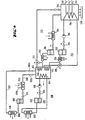
- FIG. 4 shows an embodiment of the invention, which contains a heating device 212 of the type described with reference to FIG. 1, followed by a heat pump 610, which operates discontinuously in the sense defined above.
- the heat pump 610 contains an expeller 614 which is heated by the heating device 212 and which alternately works as expeller and absorber.
- the working medium expelled during the expulsion phase flows through a working medium output line 682 containing a valve 682a to a condenser 618, from which useful or waste heat is extracted via a heat exchanger coil 618a, and is condensed there.
- the condensed, liquid working fluid flows into a storage vessel 600 (which corresponds functionally to the storage vessel 384).
- the liquid working fluid is fed to an evaporator 630, which contains a heat exchanger coil 630a, and which absorbs heat, so that a device connected to the heat exchanger coil 630a can be cooled.
- the evaporated working fluid then flows back from the evaporator 630 via a working fluid inlet line 690, which contains a valve 690a, in particular a non-return valve, to the expeller absorber 614.
- the expeller absorber 614 also contains a device for removing the work fluid from absorption absorbing heat. This device is shown in FIG.
- a heat transfer circuit 636 which is a heat exchanger coil which is used to remove the sorption heat and is arranged in the expeller absorber 614 654, a heat exchanger 604 (e.g. a space heater or the like) for utilizing or dissipating the sorption heat removed, a heat transfer reservoir or expansion tank 660, a control valve 664 and, if necessary, a circulation pump 666.
- the expeller absorber 614 can, however, also be designed such that the sorption heat released during absorption can be taken directly from it, e.g. B. by blowing air through a tube system passing through it.
- the expeller absorber 614 operates as an expeller during a first period (expulsion phase).
- the valve 682a is open and the valve 690a is closed.
- the gaseous working medium expelled from the absorbent by the supply of heat from the heating device 212 flows through the line 682 into the condenser 618, where it condenses with the release of useful heat and the condensed working medium is then collected in the storage vessel 600.
- Control valve 624 and valve 690a will generally be closed during this phase.
- the heat transfer circuit 636 is out of operation during this expulsion phase.
- the expeller absorber is switched to absorber operation.
- the valve 682a is closed, the valve 690a is opened and, by means of the control valve 624, liquid working fluid is fed in a controlled manner from the storage vessel 600 into the evaporator 630 in accordance with the heating and / or cooling requirement.
- the evaporating working fluid absorbs heat so that a device connected to the heat exchanger coil 630a can be cooled.
- absorption heat is released in the expeller absorber 614, which is removed via the heat transfer circuit 636 and z. B. can be used for water heating or na the environment can be dissipated.
- the heat transfer medium in the circuit 252 can e.g. B. be water (steam) or oil.
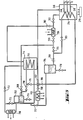
- FIG. 5 shows a schematic illustration of a system according to the invention of the type explained with reference to FIG. 4, which, however, is further simplified by combining certain structural units and interconnecting the working medium circuits of the heat pump serving as a heating device and the downstream heat pump.
- the working fluid in the two heat pump circuits and the heat transfer medium in the heat transfer circuit must consist of the same substance as H 2 0.
- the system according to FIG. 5 contains a sorption memory 246 alternately operating as an expeller and absorber, which corresponds to that of the system according to FIG. 1.
- the system also contains an absorber expeller 714, which fulfills the function of the expeller absorber 614 and contains a heating coil 754, which fulfills the functions of the heating and heat exchanger coils 240, 340 and 654 of the system according to FIG. 4.
- An evaporator 794 which fulfills the function of evaporators 394 and 630 (FIG. 4), works together with expeller-absorber heat stores 246 and 714. It is fed by a storage vessel 760, which fulfills the functions of the storage vessels 600 and 384 in FIG. 4.
- a condenser 718 cooperates with the expeller absorber 714 and fulfills the functions of the heat exchanger 604 and the condenser 618.
- the working medium condensed in it flows into a storage vessel 760, which fulfills the functions of the storage vessels 600 and 660 and part of the function of the storage vessel 384.
- the functions of the heat exchanger coils 240, 340 and 654 are performed by a single heat exchanger coil 754.
- a heat exchanger 792 is also provided, which fulfills the functions of the heat exchangers 392 and 304.
- Valves 715 and 716 are used to clean storage containers 760 and 784, respectively. Removing working fluid from storage container 760 for sorption in both 714 and 246 results in better efficiency in evaporator 794 because the average temperature level in 760 is lower than in 784 .
- subdivided heat stores 246 can also be used, as was explained above with reference to FIG. 2.
- the heat pumps described which work with zeolite as the absorption medium, can be used with great advantage to utilize the waste heat of a gasoline or diesel engine, particularly in quasi-continuous operation with a double accumulator according to FIG. 2, either alone or with a downstream heat pump 210.
- the heat of the exhaust gases is used for expulsion and the cooling water or cooling air heat (cooling fluid heat) for heating the evaporator (eg 394 in FIG. 1).
- Useful heat is obtained, the temperature of which is above the cooling fluid temperature, so that the entire waste heat of the engine is available at a higher temperature level.
- This heat can be used either directly for heating or via an absorption heat pump (e.g. 210 in Fig. 1) for heating and / or cooling, especially if the engine in turn drives a compressor heat pump.
Landscapes
- Engineering & Computer Science (AREA)
- Physics & Mathematics (AREA)
- Mechanical Engineering (AREA)
- Thermal Sciences (AREA)
- General Engineering & Computer Science (AREA)
- Chemical & Material Sciences (AREA)
- Materials Engineering (AREA)
- Life Sciences & Earth Sciences (AREA)
- Sustainable Development (AREA)
- Sustainable Energy (AREA)
- Sorption Type Refrigeration Machines (AREA)
- Central Heating Systems (AREA)
Claims (7)
caractérisée en ce que
Priority Applications (1)
| Application Number | Priority Date | Filing Date | Title |
|---|---|---|---|
| AT80102725T ATE28929T1 (de) | 1979-09-28 | 1980-05-16 | Absorptions-waermepumpeanlage. |
Applications Claiming Priority (2)
| Application Number | Priority Date | Filing Date | Title |
|---|---|---|---|
| DE19792939423 DE2939423A1 (de) | 1979-09-28 | 1979-09-28 | Verfahren zum betrieb einer eine absorber-waermepumpe enthaltenden heizungsanlage und heizungsanlage zur durchfuehrung dieses verfahrens |
| DE2939423 | 1979-09-28 |
Publications (3)
| Publication Number | Publication Date |
|---|---|
| EP0026257A2 EP0026257A2 (fr) | 1981-04-08 |
| EP0026257A3 EP0026257A3 (en) | 1982-06-02 |
| EP0026257B1 true EP0026257B1 (fr) | 1987-08-12 |
Family
ID=6082167
Family Applications (1)
| Application Number | Title | Priority Date | Filing Date |
|---|---|---|---|
| EP80102725A Expired EP0026257B1 (fr) | 1979-09-28 | 1980-05-16 | Installation comportant une pompe à chaleur à absorption |
Country Status (5)
| Country | Link |
|---|---|
| US (1) | US4408468A (fr) |
| EP (1) | EP0026257B1 (fr) |
| JP (1) | JPS5656567A (fr) |
| AT (1) | ATE28929T1 (fr) |
| DE (2) | DE2939423A1 (fr) |
Cited By (1)
| Publication number | Priority date | Publication date | Assignee | Title |
|---|---|---|---|---|
| CN108759159A (zh) * | 2018-05-18 | 2018-11-06 | 北京清天精创节能设备有限公司 | 基于吸收式热泵的高温矿井冷、热源利用系统及运行方式 |
Families Citing this family (34)
| Publication number | Priority date | Publication date | Assignee | Title |
|---|---|---|---|---|
| DE3022284A1 (de) * | 1980-06-13 | 1982-01-14 | Alefeld, Georg, Prof.Dr., 8000 München | Verfahren und einrichtung zum speichern und hochtransformieren der temperatur von waerme |
| FR2509845B2 (fr) * | 1981-07-16 | 1986-08-14 | Centre Nat Rech Scient | Procede et dispositifs pour la revalorisation d'energie thermique a bas niveau mettant en oeuvre des phenomenes d'evaporation et de melange de deux fluides en equilibre de pression de vapeur sous des temperatures differentes, et application a la valorisation d'une energie thermique noble |
| EP0046112B1 (fr) * | 1980-08-11 | 1986-02-26 | Etablissement Public dit: CENTRE NATIONAL DE LA RECHERCHE SCIENTIFIQUE (CNRS) | Dispositif et systèmes pour la revalorisation d'énergie thermique à bas niveau mettant en oeuvre des phénomènes d'évaporation et de mélange de deux fluides en équilibre de pression de vapeur sous des températures différentes |
| GB2091411B (en) * | 1980-12-05 | 1984-11-28 | Exxon Research Engineering Co | Combined adsorption and absorption heat pumps |
| DE3207656A1 (de) * | 1982-02-15 | 1983-08-25 | Hieronimi, Ulrich, 8000 München | Sorptionsapparate und verfahren fuer ihren betrieb |
| DE3212608A1 (de) * | 1982-04-05 | 1983-10-06 | Georg Alefeld | Speicherheizungsanlage mit sorptionsspeicher |
| GB2126706B (en) * | 1982-09-03 | 1986-02-05 | Exxon Research Engineering Co | Combined adsorption and absorption heat pump |
| US4441332A (en) * | 1982-12-06 | 1984-04-10 | Gas Research Institute | Absorption refrigeration and heat pump system |
| JPS59173700A (ja) * | 1983-03-22 | 1984-10-01 | 三菱重工業株式会社 | ロケツト発射設備の俯仰装置 |
| JPS60173870U (ja) * | 1984-04-23 | 1985-11-18 | 矢崎総業株式会社 | 吸収冷凍機の再生器 |
| DE3532093C1 (de) * | 1985-09-09 | 1987-04-09 | Schiedel Gmbh & Co | Diskontinuierlich arbeitende Sorptions-Speichervorrichtung mit Feststoffabsorber |
| JPH0788996B2 (ja) * | 1986-09-24 | 1995-09-27 | 品川燃料株式会社 | 冷却方法 |
| US5598721A (en) * | 1989-03-08 | 1997-02-04 | Rocky Research | Heating and air conditioning systems incorporating solid-vapor sorption reactors capable of high reaction rates |
| US5263330A (en) * | 1989-07-07 | 1993-11-23 | Rocky Research | Discrete constant pressure system for staging solid-vapor compounds |
| US5241831A (en) * | 1989-11-14 | 1993-09-07 | Rocky Research | Continuous constant pressure system for staging solid-vapor compounds |
| US4972679A (en) * | 1990-02-09 | 1990-11-27 | Columbia Gas Service Corporation | Absorption refrigeration and heat pump system with defrost |
| US5360057A (en) * | 1991-09-09 | 1994-11-01 | Rocky Research | Dual-temperature heat pump apparatus and system |
| DE4438427C2 (de) * | 1994-10-27 | 1998-02-12 | Zae Bayern Bayerisches Zentrum Fuer Angewandte Energieforschung Ev | Mehrstufige Kältemaschine bzw. Wärmepumpe |
| DE102004053436A1 (de) * | 2004-11-05 | 2006-05-11 | Fraunhofer-Gesellschaft zur Förderung der angewandten Forschung e.V. | PKW-Klimaanlagen mit Adsorptionswärmepumpen |
| FR2886222B1 (fr) * | 2005-05-30 | 2008-12-05 | Giat Ind Sa | Dispositif de gestion de l'energie thermique pour un vehicule |
| FR2904098B1 (fr) * | 2006-07-24 | 2008-09-19 | Cooltech Applic Soc Par Action | Generateur thermique magnetocalorique |
| DE102007022950A1 (de) * | 2007-05-16 | 2008-11-20 | Weiss, Dieter | Verfahren zum Transport von Wärmeenergie und Vorrichtungen zur Durchführung eines solchen Verfahrens |
| DE102007039657A1 (de) * | 2007-08-22 | 2009-02-26 | Behr Gmbh & Co. Kg | Vorrichtung zum Heizen und/oder Klimatisieren und Anordnung einer Vorrichtung zum Heizen und/oder Klimatisieren in einem Kraftfahrzeug |
| CN104251571A (zh) * | 2013-06-27 | 2014-12-31 | 朱瑞敏 | 利用地源热泵、太阳能处理工业废热的方法 |
| RU2625073C1 (ru) * | 2016-07-25 | 2017-07-11 | федеральное государственное бюджетное образовательное учреждение высшего образования "Национальный исследовательский университет "МЭИ" (ФГБОУ ВО "НИУ "МЭИ") | Абсорбционная холодильная машина со встроенной теплонасосной установкой |
| CN109990366A (zh) * | 2017-12-29 | 2019-07-09 | 国家电投集团科学技术研究院有限公司 | 储热耦合吸收式热泵供热系统 |
| CN111351107A (zh) * | 2018-12-20 | 2020-06-30 | 大连民族大学 | 混分的太阳能补热溴化锂热泵供暖方法 |
| DE102018010009A1 (de) | 2018-12-28 | 2020-07-02 | Steinbeis Transferzentren GmbH an der Hochschule Karlsruhe | Modulares Sorptionsmodul für eine Adsorptionswärmepumpe |
| CN112254377B (zh) * | 2020-10-20 | 2022-06-17 | 山东建筑大学 | 一种R134a-DMF精馏塔吸收式制冷系统及方法 |
| IT202100018419A1 (it) * | 2021-07-13 | 2023-01-13 | Mgs S R L | Pompa di calore ad assorbimento perfezionata per uso in impianti di riscaldamento e/o produzione di acqua calda sanitaria con elevate temperature di esercizio |
| DE102022000362A1 (de) | 2022-01-31 | 2023-08-03 | Roland Burk | Sorptive Wärmetransformationseinrichtung und Verfahren für dessen Betrieb |
| DE102022000363A1 (de) | 2022-01-31 | 2023-08-03 | Roland Burk | Mehrkammer-Sorptionsmodul für große Temperaturspreizung und Betriebsverfahren desselben |
| US11879387B2 (en) * | 2022-04-13 | 2024-01-23 | Audubon Engineering Company, L.P. | System and method for diluting vapor and generating electricity |
| CN115183306A (zh) * | 2022-05-31 | 2022-10-14 | 华能营口热电有限责任公司 | 一种脱硫浆液闪蒸与太阳能互补供热的系统及方法 |
Citations (1)
| Publication number | Priority date | Publication date | Assignee | Title |
|---|---|---|---|---|
| US3483710A (en) * | 1968-06-13 | 1969-12-16 | Crane Co | Cascade absorption refrigeration system |
Family Cites Families (27)
| Publication number | Priority date | Publication date | Assignee | Title |
|---|---|---|---|---|
| DE596308C (de) * | 1928-08-22 | 1934-05-23 | Wulff Berzelius Normelli | Vorrichtung zur Erzeugung von Waerme durch die Kondensation bzw. Absorption in einer absatzweise wirkenden Absorptionskaeltemaschine |
| US2003310A (en) * | 1932-06-04 | 1935-06-04 | Standard Oil Co | Refrigeration |
| US2182098A (en) * | 1934-09-29 | 1939-12-05 | Mallory & Co Inc P R | Duplex solution thermo-compression process |
| DE818649C (de) * | 1950-01-08 | 1951-10-25 | Heinrich Tritschler K G | Heisswasserspeicher in Verbindung mit einer Absorptionskaelteanlage |
| US3302401A (en) * | 1965-01-26 | 1967-02-07 | United Aircraft Corp | Underwater propulsion system |
| DE2112362A1 (de) * | 1971-03-15 | 1972-09-28 | Schantz Hugo Dipl Ing | Hintereinanderschaltung von Waermepumpenkreislaeufen zur Erzeugung verschiedener Temperaturen in den einzelnen Stufen |
| US4034569A (en) * | 1974-11-04 | 1977-07-12 | Tchernev Dimiter I | Sorption system for low-grade (solar) heat utilization |
| US4011731A (en) * | 1974-11-15 | 1977-03-15 | Gershon Meckler | Air conditioning apparatus utilizing solar energy and method |
| US4007776A (en) * | 1974-12-23 | 1977-02-15 | Universal Oil Products Company | Heating and cooling system utilizing solar energy |
| GB1532542A (en) * | 1975-01-14 | 1978-11-15 | Awalt T | Hot or cold storage system |
| US4121566A (en) * | 1975-04-07 | 1978-10-24 | Ljubomir Radenkovic | Sonia system |
| US3973552A (en) * | 1975-06-23 | 1976-08-10 | Rockwell International Corporation | Method of storing and releasing thermal energy |
| DE2622699B2 (en) * | 1976-05-21 | 1978-05-24 | Gebrueder Sulzer Ag, Winterthur (Schweiz) | Absorption heat accumulator element - has absorbent and collector in common tubular gastight vessel with space between |
| US4138855A (en) * | 1976-06-25 | 1979-02-13 | Exxon Research & Engineering Co. | Transferring heat from relatively cold to relatively hot locations |
| JPS533108A (en) * | 1976-06-30 | 1978-01-12 | Nec Corp | Terminating charge system |
| DE2631320C2 (de) * | 1976-07-12 | 1983-05-11 | Alefeld, Georg, Prof.Dr., 8000 München | Verfahren zur Speicherung von Wärme |
| US4070870A (en) * | 1976-10-04 | 1978-01-31 | Borg-Warner Corporation | Heat pump assisted solar powered absorption system |
| GB1572737A (en) * | 1977-01-17 | 1980-08-06 | Exxon France | Heat pump |
| DE2808464A1 (de) * | 1977-03-01 | 1978-09-21 | Pro Elektra Ag Baden | Verfahren und anordnung zur periodischen speicherung und freigabe von waerme |
| US4121432A (en) * | 1977-03-24 | 1978-10-24 | Institute Of Gas Technology | Solid adsorption air conditioning apparatus and method |
| JPS53129333A (en) * | 1977-04-15 | 1978-11-11 | Ai Chiyaanebu Deimitaa | System for absorbing and accumulating low grade heat energy |
| US4134273A (en) * | 1977-04-22 | 1979-01-16 | Brautigam Robert F | Home heating and cooling system |
| DE2737059C3 (de) * | 1977-08-17 | 1981-02-19 | Georg Prof. Dr. 8000 Muenchen Alefeld | Kreisprozeß mit einem Mehrstoffarbeitsmittel |
| US4153104A (en) * | 1977-09-08 | 1979-05-08 | Overland Energy, Inc. | Solar heating and cooling system |
| US4272268A (en) * | 1977-10-17 | 1981-06-09 | Leonard Greiner | Chemical heat pump |
| GB1596786A (en) * | 1978-04-24 | 1981-08-26 | Horstmann Gear Group Ltd | Energy storage devices |
| US4251997A (en) * | 1979-04-02 | 1981-02-24 | Borg-Warner Corporation | Control of absorption systems energized from plural storage tanks maintained at different temperatures |
-
1979
- 1979-09-28 DE DE19792939423 patent/DE2939423A1/de not_active Withdrawn
-
1980
- 1980-05-16 DE DE8080102725T patent/DE3072006D1/de not_active Expired
- 1980-05-16 AT AT80102725T patent/ATE28929T1/de not_active IP Right Cessation
- 1980-05-16 EP EP80102725A patent/EP0026257B1/fr not_active Expired
- 1980-09-17 US US06/188,120 patent/US4408468A/en not_active Expired - Lifetime
- 1980-09-29 JP JP13448880A patent/JPS5656567A/ja active Pending
Patent Citations (1)
| Publication number | Priority date | Publication date | Assignee | Title |
|---|---|---|---|---|
| US3483710A (en) * | 1968-06-13 | 1969-12-16 | Crane Co | Cascade absorption refrigeration system |
Non-Patent Citations (2)
| Title |
|---|
| Buch "KÄLTETECHNIK", Verlag G. Braun, S. 656 * |
| Buch "SORPTIONS-KÄLTEMASCHINEN, von W. Niebergall, Springer-Verlag 1959, S. 240-241 * |
Cited By (2)
| Publication number | Priority date | Publication date | Assignee | Title |
|---|---|---|---|---|
| CN108759159A (zh) * | 2018-05-18 | 2018-11-06 | 北京清天精创节能设备有限公司 | 基于吸收式热泵的高温矿井冷、热源利用系统及运行方式 |
| CN108759159B (zh) * | 2018-05-18 | 2020-09-08 | 北京清天精创节能设备有限公司 | 基于吸收式热泵的高温矿井冷、热源利用系统及运行方式 |
Also Published As
| Publication number | Publication date |
|---|---|
| US4408468A (en) | 1983-10-11 |
| ATE28929T1 (de) | 1987-08-15 |
| DE2939423A1 (de) | 1981-04-16 |
| DE3072006D1 (en) | 1987-09-17 |
| EP0026257A2 (fr) | 1981-04-08 |
| JPS5656567A (en) | 1981-05-18 |
| EP0026257A3 (en) | 1982-06-02 |
Similar Documents
| Publication | Publication Date | Title |
|---|---|---|
| EP0026257A2 (fr) | Installation comportant une pompe à chaleur à absorption | |
| EP0042160B1 (fr) | Procédé et installation pour emmagasiner la chaleur et pour en élever la température | |
| EP0086383A2 (fr) | Appareils à sorption et procédé pour leur mise en oeuvre | |
| EP2076721B1 (fr) | Pompe à chaleur à adsorption dotée d'un accumulateur de chaleur | |
| DE3413349C2 (de) | Verfahren und Vorrichtung zum Heizen mit einer periodischen Adsorptionsspeicher-Wärmepumpe | |
| CH647590A5 (en) | Process and equipment for producing useful energy from low-grade heat sources | |
| EP0216237A2 (fr) | Accumulateur à sorption à marche discontinue avec un absorbeur contenant un solide | |
| DE10330104A1 (de) | Kühlsystem mit Adsorptions-Kühlgerät | |
| AT394200B (de) | Verfahren zur nutzung und/oder speicherung von energie aus der umwelt | |
| DD160199A5 (de) | Verfahren und vorrichtung zur energiesparenden gewinnung von nutzwaerme aus der umgebung oder aus abfallwaerme | |
| DE102012009696A1 (de) | System und Verfahren zur Erzeugung und /oder Speicherung von Wärme und /oder Kälte | |
| WO2019038262A1 (fr) | Procédé de fonctionnement d'un système de refroidissement et/ou de chauffage et système de refroidissement et/ou de chauffage | |
| EP3497383A1 (fr) | Contenant de transport | |
| DE678942C (de) | Einrichtung zur Waermeumwandlung | |
| EP0091095B1 (fr) | Installation de chauffage par accumulation contenant un réservoir à sorption | |
| DE1020997B (de) | Verfahren zur Wärmeübertragung in Richtung auf höhere Temperatur | |
| DE2649872A1 (de) | Waermepumpe zur erzeugung von nutzwaerme und nutzkaelte mit energiespeicherung unter ausnutzung der erstarrungs- bzw. schmelzwaerme von wasser | |
| DE3129957C2 (fr) | ||
| DE102013016461A1 (de) | Verfahren zum Betrieb eines Niedertemperaturkraftwerkes, sowie Niedertemperaturkraftwerk selbst | |
| DE626864C (de) | Ausnutzung und Speicherung der Abwaerme einer kontinuierlichen Absorptionskaeltemaschine | |
| AT511823A4 (de) | Verfahren und einrichtung zur erzeugung von kälte und/oder nutzwärme sowie mechanischer bzw. elektrischer energie mittels eines absorptionskreislaufes | |
| DE3044580C2 (de) | Wärmepumpe und Verfahren zu ihrem Betrieb | |
| DE10240659B4 (de) | Verfahren und Vorrichtung zur solarthermischen Kälteerzeugung | |
| DE3238333A1 (de) | Heiz- und kuehlvorrichtung und -verfahren | |
| DE2359813A1 (de) | Vorrichtung zur verbesserung des wirkungsgrades von mit dampf betriebenen generatorturbinen |
Legal Events
| Date | Code | Title | Description |
|---|---|---|---|
| PUAI | Public reference made under article 153(3) epc to a published international application that has entered the european phase |
Free format text: ORIGINAL CODE: 0009012 |
|
| AK | Designated contracting states |
Designated state(s): AT BE CH DE FR GB IT NL SE |
|
| PUAL | Search report despatched |
Free format text: ORIGINAL CODE: 0009013 |
|
| AK | Designated contracting states |
Designated state(s): AT BE CH DE FR GB IT NL SE |
|
| 17P | Request for examination filed |
Effective date: 19821130 |
|
| GRAA | (expected) grant |
Free format text: ORIGINAL CODE: 0009210 |
|
| AK | Designated contracting states |
Kind code of ref document: B1 Designated state(s): AT BE CH DE FR GB IT LI NL SE |
|
| PG25 | Lapsed in a contracting state [announced via postgrant information from national office to epo] |
Ref country code: NL Effective date: 19870812 Ref country code: IT Free format text: LAPSE BECAUSE OF FAILURE TO SUBMIT A TRANSLATION OF THE DESCRIPTION OR TO PAY THE FEE WITHIN THE PRESCRIBED TIME-LIMIT;WARNING: LAPSES OF ITALIAN PATENTS WITH EFFECTIVE DATE BEFORE 2007 MAY HAVE OCCURRED AT ANY TIME BEFORE 2007. THE CORRECT EFFECTIVE DATE MAY BE DIFFERENT FROM THE ONE RECORDED. Effective date: 19870812 Ref country code: FR Free format text: THE PATENT HAS BEEN ANNULLED BY A DECISION OF A NATIONAL AUTHORITY Effective date: 19870812 Ref country code: BE Effective date: 19870812 |
|
| REF | Corresponds to: |
Ref document number: 28929 Country of ref document: AT Date of ref document: 19870815 Kind code of ref document: T |
|
| PG25 | Lapsed in a contracting state [announced via postgrant information from national office to epo] |
Ref country code: SE Effective date: 19870831 |
|
| REF | Corresponds to: |
Ref document number: 3072006 Country of ref document: DE Date of ref document: 19870917 |
|
| NLV1 | Nl: lapsed or annulled due to failure to fulfill the requirements of art. 29p and 29m of the patents act | ||
| EN | Fr: translation not filed | ||
| PG25 | Lapsed in a contracting state [announced via postgrant information from national office to epo] |
Ref country code: GB Effective date: 19880516 Ref country code: AT Effective date: 19880516 |
|
| PG25 | Lapsed in a contracting state [announced via postgrant information from national office to epo] |
Ref country code: LI Effective date: 19880531 Ref country code: CH Effective date: 19880531 |
|
| PLBE | No opposition filed within time limit |
Free format text: ORIGINAL CODE: 0009261 |
|
| STAA | Information on the status of an ep patent application or granted ep patent |
Free format text: STATUS: NO OPPOSITION FILED WITHIN TIME LIMIT |
|
| 26N | No opposition filed | ||
| REG | Reference to a national code |
Ref country code: CH Ref legal event code: PL |
|
| GBPC | Gb: european patent ceased through non-payment of renewal fee | ||
| PGFP | Annual fee paid to national office [announced via postgrant information from national office to epo] |
Ref country code: DE Payment date: 19940413 Year of fee payment: 15 |
|
| PG25 | Lapsed in a contracting state [announced via postgrant information from national office to epo] |
Ref country code: DE Effective date: 19960201 |