EP0025552B1 - Verfahren zur Herstellung von 1-Halogenalkylisocyanaten und 1-Alkenylisocyanaten - Google Patents
Verfahren zur Herstellung von 1-Halogenalkylisocyanaten und 1-Alkenylisocyanaten Download PDFInfo
- Publication number
- EP0025552B1 EP0025552B1 EP80105234A EP80105234A EP0025552B1 EP 0025552 B1 EP0025552 B1 EP 0025552B1 EP 80105234 A EP80105234 A EP 80105234A EP 80105234 A EP80105234 A EP 80105234A EP 0025552 B1 EP0025552 B1 EP 0025552B1
- Authority
- EP
- European Patent Office
- Prior art keywords
- isocyanates
- end product
- isocyanate
- haloalkyl
- alkenyl
- Prior art date
- Legal status (The legal status is an assumption and is not a legal conclusion. Google has not performed a legal analysis and makes no representation as to the accuracy of the status listed.)
- Expired
Links
- 0 CCC(*)*=[N+][O-] Chemical compound CCC(*)*=[N+][O-] 0.000 description 3
Classifications
-
- C—CHEMISTRY; METALLURGY
- C07—ORGANIC CHEMISTRY
- C07C—ACYCLIC OR CARBOCYCLIC COMPOUNDS
- C07C263/00—Preparation of derivatives of isocyanic acid
- C07C263/04—Preparation of derivatives of isocyanic acid from or via carbamates or carbamoyl halides
Definitions
- the invention relates to a process for the preparation of 1-haloalkyl isocyanates and 1-alkenyl isocyanates by reacting 1-haloalkylcarbamic acid halides or 1-haloalkyl isocyanates with a-pinene.
- 1-alkenyl isocyanates are not only thermally unstable but also sensitive to acids, bases and hydrolysis.
- the best-known production methods are the Curtius degradation of substituted acrylic acid azides (J. Org. Chem., Volume 26 (1961), pages 770 to 779), the vacuum pyrolysis of trisvinyl isocyanurates (DE-AS 1932811) and the thermal cleavage of N-tert. -Alkyl-N- (1-alkenyl) carbamic acid chlorides (DE-AS 1 922 412).
- 1-Fluoropropyl isocyanate is obtained in the low-temperature fluorination of propyl isocyanate in addition to other reaction products (J. Org. Chem. Volume 32 (1967), pages 1633 to 1635).
- chloromethyl isocyanate can be obtained by reacting hydroxymethyl isocyanate with thionyl chloride.
- the 1,2,2,2-tetrachloroethyl isocyanate can also be prepared accordingly.
- the process according to the invention surprisingly provides 1-alkenyl isocyanates and 1-haloalkyl isocyanates in a good yield and purity in a simpler and more economical manner.
- 1-alkenyl isocyanates 1-haloalkyl isocyanates can also be prepared by the process according to the invention and can be separated off by distillation.
- starting materials la are used, essentially the end products Ib are obtained.
- a-pinene is converted to bornyl halide.
- Preferred starting materials II and la and consequently preferred end substances la and Ib are those in the formulas of which the radicals X can be identical or different in the starting material II and advantageously mean a bromine atom or in particular a chlorine atom.
- the starting materials II are in a simple manner, for. B. by the method described in DE-OS 2 741 980.
- the after the reaction by e.g. Distillation from the end products separated from the mixture la can be used again as starting materials for the inventive reaction to achieve a high proportion of end product Ib.
- Suitable starting materials II are, for example: 1-chloroethyl carbamic acid chloride, 1-bromoethyl carbamic acid bromide, 1-chloropropyl carbamic acid chloride, 1-bromopropyl carbamic acid bromide, 1-chloro-1-methyl ethyl carbamide acid chloride, 1-bromo-1-methyl ethyl carbamide acid bromide, 2-chlorobutyl carbamic acid chloride, 2-bromobutyl- (2) -carbamic acid bromide, 1-chloro-2-methylpropylcarbamic acid bromide, 1-bromo-2-methylpropylcarbamic acid bromide, 2-chloro-3-methylbutyl- (2) -carbamic acid chloride, 2-bromo-3- methylbutyl- (2) carbamic acid bromide.
- Suitable starting materials la are, for example: 1-chloroethyl isocyanate, 1-bromoethyl isocyanate, 1-chloropropyl isocyanate, 1-bromopropyl isocyanate, 1-chloro-1-methylethyl isocyanate, 1-bromo-1-methyl-ethyl isocyanate, 2-chlorobutyl (2) isocyanate, 2-bromobutyl (2) isocyanate, 1-chloro-2-methylpropyl isocyanate, 1-bromo-2-methylpropyl isocyanate, 2-chloro-3-methylbutyl (2) isocyanate, 2-bromo-3-methylbutyl (2) isocyanate.
- the mixtures of end product la and end product Ib obtained as end products generally contain 0.05 to 2 moles of end product la per mole of end product Ib.
- the reaction is generally carried out at a temperature of from -10 to 150 ° C., in the case of the preparation of mixtures with more than 1.5, in particular above 1.5 to 2, mol of end product Ia per mole of end product Ib, advantageously from 20 to 50 ° C, in the case of the production of mixtures with 0.5 to 1.5, in particular 0.9 to 1.1 mol of end product la per mole of end product Ib, advantageously from 70 to 100 ° C, in the case of the production of mixtures with less as 0.5, in particular 0.05 to below 0.5 mol of end product la per mole of end product Ib, advantageously from 100 to 150 ° C.
- the reaction is advantageously started at a temperature of from -10 to 30 ° C., the temperature is slowly increased and the reaction is ended at the above-mentioned, suitable reaction temperatures.
- the reaction time is generally 0.5 to 6 hours, advantageously in the case of the production of mixtures with more than 1.5, in particular above 1.5 to 2, mol of end product Ia per mole of end product Ib, 4 to 6 hours, in the case of the production of Mixtures with 0.5 to 1.5, in particular 0.9 to 1.1, mol of end product la per mole of end product Ib for 2 to 4 hours, in the case of the preparation of mixtures with less than 0.5, in particular 0.05 to below 0 , 5 moles of end product la per mole of end product Ib 0.5 to 2 hours.
- the amount of a-pinene is expediently chosen in accordance with the amount of hydrogen halide to be split off or the desired amount of end product Ib in the end mixture.
- the reaction can be carried out as follows: A mixture of starting material II or la and a-pinene is reacted at the reaction temperature during the aforementioned reaction time. The end products la and Ib are then separated off from the reaction mixture, expediently directly after the reaction by increasing the temperature and fractional distillation.
- the reaction mixtures from the preparation of these starting materials e.g. use the crude halogenation mixtures that result from the halogenation of carbamic acid halides.
- the 1-alkenyl isocyanates Ib and 1-haloalkyl isocyanates la which can be prepared according to the invention are valuable starting materials for the production of pesticides, dyes, pharmaceuticals, textile water repellents, detergents, plastics, bleaches and adhesives, since they are, in addition to a reactive iso cyanate group still have an activated double bond or an activated aC atom.
- 1-alkenyl isocyanates are important monomers which can be converted into chain and ladder polymers, such as, for example, radiation-curing coating resins (CA 51, (1957), 18694 be; J. Polymer Sci. 35 (1959), pages 215 to 218, J. of Coatings Techn. 49 (1977), No.
- a mixture of 160 parts of 1-chloroethylcarbamic acid chloride and 537 parts of a-pinene is heated from 24 to 105 ° C. with stirring for 2 hours and the reaction mixture is fractionally distilled.
- a total of 27.6 parts (23% of theory) of 1-chloroethyl isocyanate, bp 92 ° C (1013 mbar) and 34.6 parts of vinyl isocyanate, bp 38.5 ° C (1013 mbar) are obtained.
- a mixture of 231 parts of 1-bromoethylcarbamic acid bromide and 475 parts of a-pinene is heated from 23 to 120 ° C. with stirring for 1.5 hours and the reaction mixture is fractionally distilled.
- a total of 14.6 parts (10% of theory) of 1-bromoethyl isocyanate and 61.5 parts (89% of theory) of vinyl isocyanate with a boiling point of 38.5 ° C. (1013 mbar) are obtained.
Landscapes
- Chemical & Material Sciences (AREA)
- Organic Chemistry (AREA)
- Organic Low-Molecular-Weight Compounds And Preparation Thereof (AREA)
Description
- Die Erfindung betrifft ein Verfahren zur Herstellung von 1-Halogenalkylisocyanaten und 1-Alkenylisocyanaten durch Umsetzung von 1-Halogenalkylcarbamidsäurehalogeniden oder 1-Halogenalkylisocyanaten mit a-Pinen.
- Die wirtschaftliche Synthese von 1-Alkenylisocyanaten ist wegen der grossen Reaktivität dieser Verbindungen schwierig, da 1-Alkenylisocyanate nicht nur thermisch labil, sondern auch säure-, basen- und hydrolyseempfindlich sind. Die bekanntesten Herstellungsmethoden sind der Curtius-Abbau von substituierten Acrylsäureaziden (J. Org. Chem., Band 26 (1961), Seiten 770 bis 779), die Vakuumpyrolyse von Trisvinylisocyanuraten (DE-AS 1932811) und die thermische Spaltung von N-tert.-Alkyl-N-(1-alkenyl)-carbamidsäure- chloriden (DE-AS 1 922 412).
- Es ist aus Liebigs Annalen der Chemie, Band 762 (1972), Seiten 88 bis 92 und Ber. Band 102 (1969), Seiten 2972 bis 2976 bekannt, araliphatische Ketimine mit Phosgen zu einem Gemisch von N-Chlorkarbonylaralkylketiminen und a-Chloralkylisocyanaten umzusetzen. Mehrfach halogensubstituierte 1-Halogenalkylisocyanate sind durch Halogenierung sowohl von unsubstituierten als auch bereits halogensubstituierten Alkylisocyanaten und Carbamidsäurehalogeniden zugänglich (US-PS 3 437 680; DE-OS 1 418 666).
- 1-Fluorpropylisocyanat wird bei der Tieftemperatur-Fluorierung von Propylisocyanat neben anderen Reaktionsprodukten erhalten (J. Org. Chem. Band 32 (1967), Seiten 1633 bis 1635).
- Es ist aus J. Org. Chem., Band 28 (1963), Seiten 1825 bis 1830 bekannt, dass man Chlormethylisocyanat durch Umsetzung von Hydroxymethylisocyanat mit Thionylchlorid erhält. Entsprechend kann auch das 1,2,2,2-Tetrachloräthylisocyanat hergestellt werden.
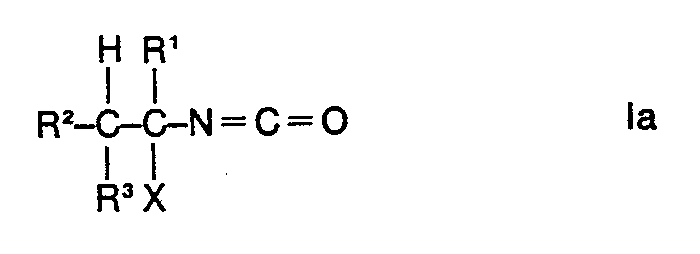
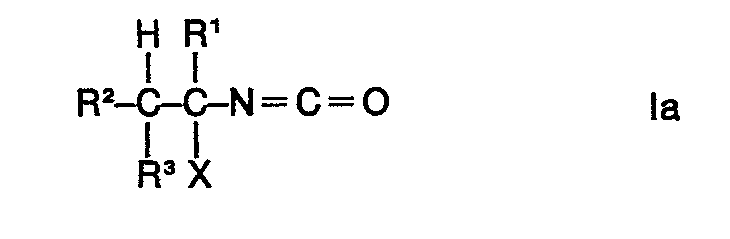
- Es wurde nun gefunden, dass man Gemische von 1-Halogenalkylisocyanaten der Formel


- Die Umsetzung kann für den Fall der Verwendung von 1-Chloräthylcarbamidsäurechlorid durch die folgenden Formeln wiedergegeben werden:

- Im Hinblick auf den Stand der Technik liefert das Verfahren nach der Erfindung überraschend auf einfacherem und wirtschaftlicherem Wege 1-Alkenylisocyanate und 1-Halogenalkylisocyanate in guter Ausbeute und Reinheit. Diese vorteilhaften Eigenschaften des erfindungsgemässen Verfahrens waren nicht vorauszusehen.
- Denn man konnte nicht erwarten, dass man mit a-Pinen auch Halogenwasserstoff, der nicht von der Carbamidsäurehalogenidgruppe, sondern von den Atomen des Kohlenstoffgerüsts stammt, unter Ausbildung einer olefinischen Doppelbindung eliminieren kann. Das erfindungsgemässe Verfahren ist um so überraschender, da 1-Alkenylisocyanate bekanntlich ausserordentlich empfindlich gegen Halogenwasserstoff sind und schon bei Raumtemperatur mit diesem harzartige Polymersubstanzen bilden (Recueil, Band 94 (1975), Seite 102) und bei sehr niederen Temperaturen diesen spontan addieren (DE-OS 2 732 284). In Anbetracht des Carbamidsäurechlorid-Isocyanat-Gleichgewichts (Houben-Weyl, Methoden der Organischen Chemie, Band 8, Seite 121) war zu erwarten gewesen, dass entstandenes 1-Alkenylisocyanat mit Halogenwasserstoff aus noch nicht umgesetzten 1-Halogenalkylcarbamidsäurehalogenid zu polymeren Verbindungen abreagieren würde.
- Weiterhin ist es überraschend, dass sich nach dem erfindungsgemässen Verfahren neben 1-Alkenylisocyanaten auch 1-Halogenalkylisocyanate herstellen und durch Destillation abtrennen lassen.
- Im Falle der Verwendung der Ausgangsstoffe la erhält man im wesentlichen die Endstoffe Ib. a-Pinen wird bei dem erfindungsgemässen Verfahren zu Bornylhalogenid umgesetzt. Bevorzugte Ausgangsstoffe II und la und demzufolge bevorzugte Endstoffe la und Ib sind solche, in deren Formeln die Reste X gleich oder verschieden im Ausgangsstoff II sein können und vorteilhaft ein Bromatom oder insbesondere ein Chloratom bedeuten. Die Ausgangsstoffe II werden auf einfache Weise, z. B. nach dem in der DE-OS 2 741 980 beschriebenen Verfahren, hergestellt. Die nach der Reaktion durch z.B. Destillation aus dem Gemisch abgetrennten Endstoffe la können als Ausgangsstoffe erneut wieder für die erfindungsgemässe Umsetzung zur Erzielung eines hohen Anteils an Endstoff Ib verwendet werden.
- Geeignete Ausgangsstoffe II sind beispielsweise: 1-Chlorethylcarbamidsäurechlorid, 1-Bromäthylcarbamidsäurebromid, 1-Chlorpropylcarbamidsäurechlorid, 1-Brompropylcarbamidsäurebromid, 1-Chlor-1-methyläthylcarbamid- säurechlorid, 1-Brom-1-methyläthylcarbamid- säurebromid, 2-Chlorbutyl-(2)-carbamidsäure- chlorid, 2-Brombutyl-(2)-carbamidsäurebromid, 1-Chlor-2-methylpropylcarbamidsäurebromid, 1-Brom-2-methylpropylcarbamidsäurebromid, 2-Chlor-3-methylbutyl-(2)-carbamidsäurechlorid, 2-Brom-3-methylbutyl-(2)-carbamidsäurebromid.
- Geeignete Ausgangsstoffe la sind beispielsweise: 1-Chloräthylisocyanat, 1-Bromäthylisocyanat, 1-Chlorpropylisocyanat, 1-Brompropylisocyanat, 1-Chlor-1-methyläthylisocyanat, 1-Brom-1-methyl-äthylisocyanat, 2-Chlorbutyl-(2)-isocyanat, 2-Brombutyl-(2)-isocyanat, 1-Chlor-2-methylpropylisocyanat, 1-Brom-2-methylpropyl- isocyanat, 2-Chlor-3-methylbutyl-(2)-isocyanat, 2-Brom-3-methylbutyl-(2)-isocyanat.
- Die als Endstoffe erhaltenen Gemische von Endstoff la und Endstoff Ib enthalten im allgemeinen 0,05 bis 2 Mol Endstoff la je Mol Endstoff Ib. Je höher die Reaktionstemperatur und je länger die Reaktionszeit, desto höher ist der Anteil von Endstoff Ib im Endgemisch. Die Umsetzung wird in der Regel bei einer Temperatur von -10 bis 150°C, im Falle der Herstellung von Gemischen mit mehr als 1,5, insbesondere oberhalb 1,5 bis 2 Mol Endstoff la je Mol Endstoff Ib, zweckmässig von 20 bis 50°C, im Falle der Herstellung von Gemischen mit 0,5 bis 1,5, insbesondere 0,9 bis 1,1 Mol Endstoff la je Mol Endstoff Ib, zweckmässig von 70 bis 100°C, im Falle der Herstellung von Gemischen mit weniger als 0,5, insbesondere 0,05 bis unterhalb 0,5 Mol Endstoff la je Mol Endstoff Ib, zweckmässig von 100 bis 150°C drucklos oder unter Druck, kontinuierlich oder diskontinuierlich durchgeführt. Vorteilhaft beginnt man die Umsetzung bei einer Temperatur von -10 bis 30°C, erhöht langsam die Temperatur und beendet die Reaktion bei den vorgenannten, zweckmässigen Reaktionstemperaturen. Die Reaktionszeit beträgt im allgemeinen 0,5 bis 6 Stunden, vorteilhaft im Falle der Herstellung von Gemischen mit mehr als 1,5, insbesondere oberhalb 1,5 bis 2 Mol Endstoff la je Mol Endstoff Ib 4 bis 6 Stunden, im Falle der Herstellung von Gemischen mit 0,5 bis 1,5, insbesondere 0,9 bis 1,1 Mol Endstoff la je Mol Endstoff Ib 2 bis 4 Stunden, im Falle der Herstellung von Gemischen mit weniger als 0,5, insbesondere 0,05 bis unterhalb 0,5 Mol Endstoff la je Mol Endstoff Ib 0,5 bis 2 Stunden.
- Die Menge an a-Pinen wird zweckmässig entsprechend der Menge des abzuspaltenden Halogenwasserstoffs bzw. der gewünschten Menge an Endstoff Ib im Endgemisch gewählt. So verwendet man vorteilhaft 2 bis 20 Mol a-Pinen je Mol Endstoff Ib, bevorzugt für die Herstellung von Gemischen mit mehr als 1,5, insbesondere oberhalb 1,5 bis 2 Mol Endstoff la je Mol Endstoff Ib 9 bis 20 Mol a-Pinen je Mol Endstoff Ib, für die Herstellung von Gemischen mit 0,5 bis 1,5, insbesondere 0,9 bis 1,1 Mol Endstoff la je Mol Endstoff Ib 4 bis 9 Mol a-Pinen je Mol Endstoff Ib, für die Herstellung von Gemischen mit weniger als 0,5, insbesondere 0,05 bis unterhalb 0,5 Mol Endstoff la je Mol Endstoff Ib 3 bis 4 Mol a-Pinen je Mol Endstoff Ib.
- Die Reaktion kann wie folgt durchgeführt werden: Ein Gemisch von Ausgangsstoff II oder la und a-Pinen wird bei der Reaktionstemperatur während vorgenannter Reaktionszeit umgesetzt. Aus dem Reaktionsgemisch werden dann die Endstoffe la und Ib, zweckmässig direkt nach der Reaktion durch Erhöhung der Temperatur und fraktionierte Destillation, abgetrennt. Anstelle der reinen 1-Halogenalkylisocyanate la oder 1-Halogenalkylcarbamidsäurehalogenide II lassen sich auch die Reaktionsgemische aus der Herstellung dieser Ausgangsstoffe, z.B. die rohen Halogenierungsgemische verwenden, die bei der Halogenierung von Carbamidsäurehalogeniden anfallen.
- Die erfindungsgemäss herstellbaren 1-Alkenylisocyanate Ib und 1-Halogenalkylisocyanate la sind wertvolle Ausgangsstoffe für die Herstellung von Schädlingsbekämpfungsmitteln, Farbstoffen, Pharmazeutika, Textilhydrophobierungsmitteln, Waschmitteln, Kunststoffen, Bleichmitteln und Klebstoffen, da sie neben einer reaktiven Isocyanatgruppe noch eine aktivierte Doppelbindung bzw. ein aktiviertes a-C-Atom besitzen. Zudem sind 1-Alkenylisocyanate wichtige Monomere, die zu Ketten- und Leiterpolymeren, wie z.B, strahlungshärtenden Lackharzen, umgesetzt werden können (C.A. 51, (1957), 18694 b-e; J. Polymer Sci. 35 (1959), Seiten 215 bis 218, J. of Coatings Techn. 49 (1977), Heft 632, Seiten 82 bis 86). Sie können Urethanen, z.B. für die Verwendung als Schaumstoffe oder hochmolekulare Überzüge mit hoher Flexibilität, oder Harnstoffen umgesetzt werden. Bezüglich der Verwendung wird auf vorgenannte Veröffentlichungen und Ullmanns Encyklopädie der technischen Chemie, Band 9, Seiten, 11, 12, 404 sowie Band 17, Seite 204 (3. Auflage), hingewiesen.
- Die in den folgenden Beispielen aufgeführten Teile bedeuten Gewichtsteile.
- Ein Gemisch aus 160 Teilen 1-Chloräthylcarbamidsäurechlorid und 537 Teilen a-Pinen wird während 2 Stunden unter Rühren von 24 auf 105°C erwärmt und das Reaktionsgemisch fraktioniert destilliert. Man erhält insgesamt 27,6 Teile (23% der Theorie) 1-Chloräthylisocyanat vom Kp 92 °C (1013 mbar) und 34,6 Teile Vinylisocyanat vom Kp 38,5°C (1013 mbar).
- Ein Gemisch aus 231 Teilen 1-Bromäthylcarbamidsäurebromid und 475 Teilen a-Pinen wird während 1,5 Stunden unter Rühren von 23 auf 120 °C erwärmt und das Reaktionsgemisch fraktioniert destilliert. Man erhält insgesamt 14,6 Teile (10% der Theorie) 1-Bromäthylisocyanat und 61,5 Teile (89% der Theorie) Vinylisocyanat vom Kp 38,5 °C (1013 mbar).
Claims (1)
- Verfahren zur Herstellung der Gemische von 1-Halogenalkylisocyanaten der Formel


Applications Claiming Priority (2)
| Application Number | Priority Date | Filing Date | Title |
|---|---|---|---|
| DE2937006 | 1979-09-13 | ||
| DE19792937006 DE2937006A1 (de) | 1979-09-13 | 1979-09-13 | Verfahren zur herstellung von 1-halogenalkylisocyanaten und 1-alkenylisocyanaten |
Publications (2)
| Publication Number | Publication Date |
|---|---|
| EP0025552A1 EP0025552A1 (de) | 1981-03-25 |
| EP0025552B1 true EP0025552B1 (de) | 1983-09-21 |
Family
ID=6080763
Family Applications (1)
| Application Number | Title | Priority Date | Filing Date |
|---|---|---|---|
| EP80105234A Expired EP0025552B1 (de) | 1979-09-13 | 1980-09-03 | Verfahren zur Herstellung von 1-Halogenalkylisocyanaten und 1-Alkenylisocyanaten |
Country Status (6)
| Country | Link |
|---|---|
| US (1) | US4294773A (de) |
| EP (1) | EP0025552B1 (de) |
| JP (1) | JPS5646852A (de) |
| CA (1) | CA1159075A (de) |
| DE (2) | DE2937006A1 (de) |
| IL (1) | IL60753A (de) |
Families Citing this family (1)
| Publication number | Priority date | Publication date | Assignee | Title |
|---|---|---|---|---|
| DE3205433A1 (de) * | 1982-02-16 | 1983-08-25 | Basf Ag, 6700 Ludwigshafen | Verfahren zur herstellung von 1-alkenylisocyanaten |
Family Cites Families (5)
| Publication number | Priority date | Publication date | Assignee | Title |
|---|---|---|---|---|
| CH425768A (de) * | 1961-05-26 | 1966-12-15 | Basf Ag | Verfahren zur Herstellung von a,B-ungesättigten Isocyanaten und Carbamidsäurehalogeniden |
| US3535360A (en) * | 1965-06-07 | 1970-10-20 | Bayer Ag | Alpha-halogeno isocyanates and preparation thereof |
| DE1618420B2 (de) * | 1967-05-09 | 1973-07-26 | Farbwerke Hoechst AG, vormals Meister Lucius & Brüning, 6000 Frankfurt | Verfahren zur herstellung von beta-brom- und beta-chloralkyl-isocyanaten |
| US3816495A (en) * | 1971-08-31 | 1974-06-11 | Du Pont | Polyfluorinated poly(vinyl isocyanates) |
| DE2210285C3 (de) * | 1972-03-03 | 1981-09-24 | Basf Ag, 6700 Ludwigshafen | Verfahren zur Herstellung von Isocyanaten |
-
1979
- 1979-09-13 DE DE19792937006 patent/DE2937006A1/de not_active Withdrawn
-
1980
- 1980-08-04 IL IL60753A patent/IL60753A/xx unknown
- 1980-08-04 CA CA000357573A patent/CA1159075A/en not_active Expired
- 1980-08-05 US US06/175,591 patent/US4294773A/en not_active Expired - Lifetime
- 1980-09-03 EP EP80105234A patent/EP0025552B1/de not_active Expired
- 1980-09-03 DE DE8080105234T patent/DE3064944D1/de not_active Expired
- 1980-09-11 JP JP12537880A patent/JPS5646852A/ja active Pending
Also Published As
| Publication number | Publication date |
|---|---|
| CA1159075A (en) | 1983-12-20 |
| IL60753A (en) | 1984-08-31 |
| EP0025552A1 (de) | 1981-03-25 |
| US4294773A (en) | 1981-10-13 |
| IL60753A0 (en) | 1980-10-26 |
| JPS5646852A (en) | 1981-04-28 |
| DE3064944D1 (en) | 1983-10-27 |
| DE2937006A1 (de) | 1981-04-02 |
Similar Documents
| Publication | Publication Date | Title |
|---|---|---|
| EP0444508A2 (de) | Ethylenisch ungesättigte, fluorhaltige Urethanderivate und Verfahren zu ihrer Herstellung | |
| EP0132733B1 (de) | Neue Fluorpivalsäurefluoride und Verfahren zu ihrer Herstellung | |
| EP0057844B1 (de) | Verfahren zur Herstellung von Polychlorbenzoylchloriden | |
| EP0025907B1 (de) | Halogenierte, tertiäre Alkylisocyanate und Verfahren zu ihrer Herstellung | |
| DE1141278B (de) | Verfahren zur Herstellung chlor-substituierter Methylisocyanid-dichloride | |
| EP0050739B1 (de) | Verfahren zur Herstellung aliphatischer Isocyanate | |
| EP0025552A1 (de) | Verfahren zur Herstellung von 1-Halogenalkylisocyanaten und 1-Alkenylisocyanaten | |
| EP0025906B1 (de) | 1-Monohalogenierte Isocyanate und Verfahren zur Herstellung von Gemischen von 1-monohalogenierten Isocyanaten und 1,2-ungesättigten Isocyanaten | |
| DE2153356C2 (de) | Verfahren zur Herstellung von α-Anilinopropionsäuren und/oder deren Derivaten | |
| EP0132734B1 (de) | Neopentylisocyanate und ihre Herstellung | |
| DE3641100C2 (de) | ||
| EP0057772B1 (de) | Halogenierte, tertiäre Diisocyanate und Verfahren zu ihrer Herstellung | |
| EP0010281B1 (de) | Verfahren zur Herstellung von alpha, beta-Dihalogenalkylisocyanaten | |
| AT237629B (de) | Verfahren zur Herstellung von N-Alkyl-N-halogenmethyl-acylamino-Verbindungen | |
| EP0073871B1 (de) | Verfahren zur Herstellung von N-substituierten N-Acetyl-2,6-dialkylanilinen | |
| DE2706683C2 (de) | Verfahren zur Herstellung von N-Fluormethylcarbamidsäurefluoriden | |
| EP0086424B1 (de) | Verfahren zur Herstellung von 1-Alkenylisocyanaten | |
| DE1568629A1 (de) | Verfahren zur Herstellung von organischen Isocyanaten | |
| DE1163803B (de) | Verfahren zur Herstellung von 3-Aryl-1,1,3,3-tetrachlor-2-aza-propenen | |
| DE1153756B (de) | Verfahren zur Herstellung von N-Alkyl-N-halogenmethylacylamino-verbindungen | |
| EP0071790B1 (de) | Neue Fluormethylthiobenzoylfluoride und Verfahren zu ihrer Herstellung | |
| DE1142859B (de) | Verfahren zur Herstellung von Acetessigsaeureamiden | |
| DE2043235C3 (de) | Verfahren zur Herstellung von aChloralkylcarbamidsäurechloriden | |
| EP0053687A1 (de) | Verfahren zur Herstellung von 1,1-Dichloralkenylenverbindungen | |
| DE2008115A1 (en) | N-substituted n-acyl carbamoyl halide prepn |
Legal Events
| Date | Code | Title | Description |
|---|---|---|---|
| PUAI | Public reference made under article 153(3) epc to a published international application that has entered the european phase |
Free format text: ORIGINAL CODE: 0009012 |
|
| AK | Designated contracting states |
Designated state(s): BE CH DE FR GB NL |
|
| RBV | Designated contracting states (corrected) |
Designated state(s): BE CH DE FR GB LI NL |
|
| 17P | Request for examination filed |
Effective date: 19810828 |
|
| GRAA | (expected) grant |
Free format text: ORIGINAL CODE: 0009210 |
|
| AK | Designated contracting states |
Designated state(s): BE CH DE FR GB LI NL |
|
| REF | Corresponds to: |
Ref document number: 3064944 Country of ref document: DE Date of ref document: 19831027 |
|
| ET | Fr: translation filed | ||
| PLBE | No opposition filed within time limit |
Free format text: ORIGINAL CODE: 0009261 |
|
| STAA | Information on the status of an ep patent application or granted ep patent |
Free format text: STATUS: NO OPPOSITION FILED WITHIN TIME LIMIT |
|
| PGFP | Annual fee paid to national office [announced via postgrant information from national office to epo] |
Ref country code: FR Payment date: 19840821 Year of fee payment: 5 |
|
| PGFP | Annual fee paid to national office [announced via postgrant information from national office to epo] |
Ref country code: CH Payment date: 19840823 Year of fee payment: 5 |
|
| PGFP | Annual fee paid to national office [announced via postgrant information from national office to epo] |
Ref country code: DE Payment date: 19840824 Year of fee payment: 5 |
|
| 26N | No opposition filed | ||
| PGFP | Annual fee paid to national office [announced via postgrant information from national office to epo] |
Ref country code: BE Payment date: 19840930 Year of fee payment: 5 |
|
| PGFP | Annual fee paid to national office [announced via postgrant information from national office to epo] |
Ref country code: NL Payment date: 19860930 Year of fee payment: 7 |
|
| PG25 | Lapsed in a contracting state [announced via postgrant information from national office to epo] |
Ref country code: LI Effective date: 19870930 Ref country code: CH Effective date: 19870930 Ref country code: BE Effective date: 19870930 |
|
| BERE | Be: lapsed |
Owner name: BASF A.G. Effective date: 19870930 |
|
| PG25 | Lapsed in a contracting state [announced via postgrant information from national office to epo] |
Ref country code: NL Effective date: 19880401 |
|
| NLV4 | Nl: lapsed or anulled due to non-payment of the annual fee | ||
| PG25 | Lapsed in a contracting state [announced via postgrant information from national office to epo] |
Ref country code: FR Free format text: LAPSE BECAUSE OF NON-PAYMENT OF DUE FEES Effective date: 19880531 |
|
| REG | Reference to a national code |
Ref country code: CH Ref legal event code: PL |
|
| GBPC | Gb: european patent ceased through non-payment of renewal fee | ||
| REG | Reference to a national code |
Ref country code: FR Ref legal event code: ST |
|
| PG25 | Lapsed in a contracting state [announced via postgrant information from national office to epo] |
Ref country code: GB Free format text: LAPSE BECAUSE OF NON-PAYMENT OF DUE FEES Effective date: 19881118 |
|
| PG25 | Lapsed in a contracting state [announced via postgrant information from national office to epo] |
Ref country code: DE Effective date: 19890919 |