EP0004331A2 - Mit Phenolcarbonsäuren veresterte Glyzerinphosphite, ihre Herstellung und Verwendung als Stabilisatoren für Kunststoffe - Google Patents
Mit Phenolcarbonsäuren veresterte Glyzerinphosphite, ihre Herstellung und Verwendung als Stabilisatoren für Kunststoffe Download PDFInfo
- Publication number
- EP0004331A2 EP0004331A2 EP79100731A EP79100731A EP0004331A2 EP 0004331 A2 EP0004331 A2 EP 0004331A2 EP 79100731 A EP79100731 A EP 79100731A EP 79100731 A EP79100731 A EP 79100731A EP 0004331 A2 EP0004331 A2 EP 0004331A2
- Authority
- EP
- European Patent Office
- Prior art keywords
- alkyl
- atoms
- weight
- parts
- unsubstituted
- Prior art date
- Legal status (The legal status is an assumption and is not a legal conclusion. Google has not performed a legal analysis and makes no representation as to the accuracy of the status listed.)
- Granted
Links
Classifications
-
- C—CHEMISTRY; METALLURGY
- C08—ORGANIC MACROMOLECULAR COMPOUNDS; THEIR PREPARATION OR CHEMICAL WORKING-UP; COMPOSITIONS BASED THEREON
- C08K—Use of inorganic or non-macromolecular organic substances as compounding ingredients
- C08K5/00—Use of organic ingredients
- C08K5/49—Phosphorus-containing compounds
- C08K5/51—Phosphorus bound to oxygen
-
- C—CHEMISTRY; METALLURGY
- C07—ORGANIC CHEMISTRY
- C07F—ACYCLIC, CARBOCYCLIC OR HETEROCYCLIC COMPOUNDS CONTAINING ELEMENTS OTHER THAN CARBON, HYDROGEN, HALOGEN, OXYGEN, NITROGEN, SULFUR, SELENIUM OR TELLURIUM
- C07F9/00—Compounds containing elements of Groups 5 or 15 of the Periodic Table
- C07F9/02—Phosphorus compounds
- C07F9/06—Phosphorus compounds without P—C bonds
- C07F9/08—Esters of oxyacids of phosphorus
- C07F9/141—Esters of phosphorous acids
- C07F9/1411—Esters of phosphorous acids with hydroxyalkyl compounds with further substituents on alkyl
-
- C—CHEMISTRY; METALLURGY
- C07—ORGANIC CHEMISTRY
- C07F—ACYCLIC, CARBOCYCLIC OR HETEROCYCLIC COMPOUNDS CONTAINING ELEMENTS OTHER THAN CARBON, HYDROGEN, HALOGEN, OXYGEN, NITROGEN, SULFUR, SELENIUM OR TELLURIUM
- C07F9/00—Compounds containing elements of Groups 5 or 15 of the Periodic Table
- C07F9/02—Phosphorus compounds
- C07F9/06—Phosphorus compounds without P—C bonds
- C07F9/16—Esters of thiophosphoric acids or thiophosphorous acids
- C07F9/201—Esters of thiophosphorus acids
- C07F9/2015—Esters of thiophosphorus acids with hydroxyalkyl compounds with further substituents on alkyl
-
- C—CHEMISTRY; METALLURGY
- C07—ORGANIC CHEMISTRY
- C07F—ACYCLIC, CARBOCYCLIC OR HETEROCYCLIC COMPOUNDS CONTAINING ELEMENTS OTHER THAN CARBON, HYDROGEN, HALOGEN, OXYGEN, NITROGEN, SULFUR, SELENIUM OR TELLURIUM
- C07F9/00—Compounds containing elements of Groups 5 or 15 of the Periodic Table
- C07F9/02—Phosphorus compounds
- C07F9/06—Phosphorus compounds without P—C bonds
- C07F9/22—Amides of acids of phosphorus
- C07F9/24—Esteramides
- C07F9/2404—Esteramides the ester moiety containing a substituent or a structure which is considered as characteristic
- C07F9/2408—Esteramides the ester moiety containing a substituent or a structure which is considered as characteristic of hydroxyalkyl compounds
-
- C—CHEMISTRY; METALLURGY
- C07—ORGANIC CHEMISTRY
- C07F—ACYCLIC, CARBOCYCLIC OR HETEROCYCLIC COMPOUNDS CONTAINING ELEMENTS OTHER THAN CARBON, HYDROGEN, HALOGEN, OXYGEN, NITROGEN, SULFUR, SELENIUM OR TELLURIUM
- C07F9/00—Compounds containing elements of Groups 5 or 15 of the Periodic Table
- C07F9/02—Phosphorus compounds
- C07F9/06—Phosphorus compounds without P—C bonds
- C07F9/22—Amides of acids of phosphorus
- C07F9/24—Esteramides
- C07F9/2454—Esteramides the amide moiety containing a substituent or a structure which is considered as characteristic
- C07F9/2479—Compounds containing the structure P(=X)n-N-acyl, P(=X)n-N-heteroatom, P(=X)n-N-CN (X = O, S, Se; n = 0, 1)
- C07F9/2491—Compounds containing the structure P(=X)n-N-acyl, P(=X)n-N-heteroatom, P(=X)n-N-CN (X = O, S, Se; n = 0, 1) containing the structure P(=X)n-N-N (X = O, S, Se; n = 0, 1)
-
- C—CHEMISTRY; METALLURGY
- C07—ORGANIC CHEMISTRY
- C07F—ACYCLIC, CARBOCYCLIC OR HETEROCYCLIC COMPOUNDS CONTAINING ELEMENTS OTHER THAN CARBON, HYDROGEN, HALOGEN, OXYGEN, NITROGEN, SULFUR, SELENIUM OR TELLURIUM
- C07F9/00—Compounds containing elements of Groups 5 or 15 of the Periodic Table
- C07F9/02—Phosphorus compounds
- C07F9/547—Heterocyclic compounds, e.g. containing phosphorus as a ring hetero atom
- C07F9/553—Heterocyclic compounds, e.g. containing phosphorus as a ring hetero atom having one nitrogen atom as the only ring hetero atom
- C07F9/576—Six-membered rings
- C07F9/59—Hydrogenated pyridine rings
-
- C—CHEMISTRY; METALLURGY
- C07—ORGANIC CHEMISTRY
- C07F—ACYCLIC, CARBOCYCLIC OR HETEROCYCLIC COMPOUNDS CONTAINING ELEMENTS OTHER THAN CARBON, HYDROGEN, HALOGEN, OXYGEN, NITROGEN, SULFUR, SELENIUM OR TELLURIUM
- C07F9/00—Compounds containing elements of Groups 5 or 15 of the Periodic Table
- C07F9/02—Phosphorus compounds
- C07F9/547—Heterocyclic compounds, e.g. containing phosphorus as a ring hetero atom
- C07F9/6564—Heterocyclic compounds, e.g. containing phosphorus as a ring hetero atom having phosphorus atoms, with or without nitrogen, oxygen, sulfur, selenium or tellurium atoms, as ring hetero atoms
- C07F9/6571—Heterocyclic compounds, e.g. containing phosphorus as a ring hetero atom having phosphorus atoms, with or without nitrogen, oxygen, sulfur, selenium or tellurium atoms, as ring hetero atoms having phosphorus and oxygen atoms as the only ring hetero atoms
- C07F9/657109—Heterocyclic compounds, e.g. containing phosphorus as a ring hetero atom having phosphorus atoms, with or without nitrogen, oxygen, sulfur, selenium or tellurium atoms, as ring hetero atoms having phosphorus and oxygen atoms as the only ring hetero atoms esters of oxyacids of phosphorus in which one or more exocyclic oxygen atoms have been replaced by (a) sulfur atom(s)
- C07F9/657118—Heterocyclic compounds, e.g. containing phosphorus as a ring hetero atom having phosphorus atoms, with or without nitrogen, oxygen, sulfur, selenium or tellurium atoms, as ring hetero atoms having phosphorus and oxygen atoms as the only ring hetero atoms esters of oxyacids of phosphorus in which one or more exocyclic oxygen atoms have been replaced by (a) sulfur atom(s) non-condensed with carbocyclic rings or heterocyclic rings or ring systems
-
- C—CHEMISTRY; METALLURGY
- C07—ORGANIC CHEMISTRY
- C07F—ACYCLIC, CARBOCYCLIC OR HETEROCYCLIC COMPOUNDS CONTAINING ELEMENTS OTHER THAN CARBON, HYDROGEN, HALOGEN, OXYGEN, NITROGEN, SULFUR, SELENIUM OR TELLURIUM
- C07F9/00—Compounds containing elements of Groups 5 or 15 of the Periodic Table
- C07F9/02—Phosphorus compounds
- C07F9/547—Heterocyclic compounds, e.g. containing phosphorus as a ring hetero atom
- C07F9/6564—Heterocyclic compounds, e.g. containing phosphorus as a ring hetero atom having phosphorus atoms, with or without nitrogen, oxygen, sulfur, selenium or tellurium atoms, as ring hetero atoms
- C07F9/6571—Heterocyclic compounds, e.g. containing phosphorus as a ring hetero atom having phosphorus atoms, with or without nitrogen, oxygen, sulfur, selenium or tellurium atoms, as ring hetero atoms having phosphorus and oxygen atoms as the only ring hetero atoms
- C07F9/657154—Cyclic esteramides of oxyacids of phosphorus
-
- C—CHEMISTRY; METALLURGY
- C07—ORGANIC CHEMISTRY
- C07F—ACYCLIC, CARBOCYCLIC OR HETEROCYCLIC COMPOUNDS CONTAINING ELEMENTS OTHER THAN CARBON, HYDROGEN, HALOGEN, OXYGEN, NITROGEN, SULFUR, SELENIUM OR TELLURIUM
- C07F9/00—Compounds containing elements of Groups 5 or 15 of the Periodic Table
- C07F9/02—Phosphorus compounds
- C07F9/547—Heterocyclic compounds, e.g. containing phosphorus as a ring hetero atom
- C07F9/6564—Heterocyclic compounds, e.g. containing phosphorus as a ring hetero atom having phosphorus atoms, with or without nitrogen, oxygen, sulfur, selenium or tellurium atoms, as ring hetero atoms
- C07F9/6571—Heterocyclic compounds, e.g. containing phosphorus as a ring hetero atom having phosphorus atoms, with or without nitrogen, oxygen, sulfur, selenium or tellurium atoms, as ring hetero atoms having phosphorus and oxygen atoms as the only ring hetero atoms
- C07F9/6574—Esters of oxyacids of phosphorus
- C07F9/65742—Esters of oxyacids of phosphorus non-condensed with carbocyclic rings or heterocyclic rings or ring systems
-
- C—CHEMISTRY; METALLURGY
- C07—ORGANIC CHEMISTRY
- C07F—ACYCLIC, CARBOCYCLIC OR HETEROCYCLIC COMPOUNDS CONTAINING ELEMENTS OTHER THAN CARBON, HYDROGEN, HALOGEN, OXYGEN, NITROGEN, SULFUR, SELENIUM OR TELLURIUM
- C07F9/00—Compounds containing elements of Groups 5 or 15 of the Periodic Table
- C07F9/02—Phosphorus compounds
- C07F9/547—Heterocyclic compounds, e.g. containing phosphorus as a ring hetero atom
- C07F9/6564—Heterocyclic compounds, e.g. containing phosphorus as a ring hetero atom having phosphorus atoms, with or without nitrogen, oxygen, sulfur, selenium or tellurium atoms, as ring hetero atoms
- C07F9/6571—Heterocyclic compounds, e.g. containing phosphorus as a ring hetero atom having phosphorus atoms, with or without nitrogen, oxygen, sulfur, selenium or tellurium atoms, as ring hetero atoms having phosphorus and oxygen atoms as the only ring hetero atoms
- C07F9/6574—Esters of oxyacids of phosphorus
- C07F9/65746—Esters of oxyacids of phosphorus the molecule containing more than one cyclic phosphorus atom
Definitions
- Phenol compounds and phosphites have long been used to stabilize plastics, in particular polyolefins.
- phosphite stabilizers i.a. also described phosphites of glycerol (US Pat. No. 3,082,189). These products have so far had no significance on the market, presumably because they are hydrolysis-sensitive, highly viscous liquids which can only be metered into the plastic granulate at great expense and distributed homogeneously therein.
- R ', R "and R"' independently of one another denote H or C 1 - to C 4 -alkyl
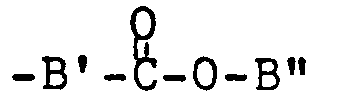
- B a chemical bond or ⁇ ) the residue of a straight-chain or branched, unsubstituted or phenyl-substituted alkane with 1 to 20 C atoms or ß) an unsubstituted or C 1 - to C 5 -alkyl-substituted, cycloaliphatic alkane with 5 to 12 C atoms, or ⁇ ) an unsubstituted or C 1 - to C 12 -alkyl-substituted aromatic hydrocarbon with 6 or 10 C atoms, or ⁇ ) a group -B'-0-B "-, or ⁇ ) a group -B'- -OB "is intended to represent, where B 'is a chemical bond or the residue of a straight-chain, branched or cyclic, unsubstituted or phenyl-substituted alkyl having 1 to 20 C atoms or an unsubstituted or alkyl-substituted phen
- the phenolic grouping shown in the general formula comes from a phenol carboxylic acid of the structure.
- This class of compounds is preferred, in particular bis (3-tert-butyl-4-hydroxy-phenyl) acetic acid and 2,2-bis (3'-tert-butyl-4'-hydroxy-phenyl) butanoic acid.
- hydroxyphenyldicarboxylic acids of the general formula are 2- (3 ', 5'-di-tert-butyl-4'-hydroxy-phenyl) -malonic acid, 2,2-bis (3'-tert-butyl-4'-hydroxy-phenyl) - succinic acid and 2,2-bis (3'-tert-butyl-4'-hydroxy-phenyl) glutaric acid.
- phenol carboxylic acids containing ether groups of the structure are, for example, 3-tert-butyl-4-hydroxy-phenoxyacetic acid or p- (3-tert-butyl-4-hydroxy-phenoxy) benzoic acid.
- phenol carboxylic acids containing ester groups of the structure are the monoesters obtainable in the reaction of alkylated dihydroxybenzenes with dicarboxylic acid derivatives, such as, for example, phthalic acid mono- (3,5-di-tert-butyl-4-hydroxyphenyl) esters, succinic or maleic acid mono- (3rd , 6-di-tert-butyl-4-hydroxy-phenyl) ester or terephthalic acid mono- (2-hydroxy-3,5-di-tert-butylphenyl) ester.
- dicarboxylic acid derivatives such as, for example, phthalic acid mono- (3,5-di-tert-butyl-4-hydroxyphenyl) esters, succinic or maleic acid mono- (3rd , 6-di-tert-butyl-4-hydroxy-phenyl) ester or terephthalic acid mono- (2-hydroxy-3,5-di-tert-butylphenyl)
- R'-Y'-H are the alcohol of the formula (I) and hydrazines of the formula (II)
- Compounds of formula (II) are known from DE-OS 2 711 206.
- the 3 ', 5'-di-tert-butyl-4'-hydroxyphenyl-propionic acid hydrazide and the 3,3-bis (3'-tert-butyl-4'-hydroxy-phenyl) -butanoic acid hydrazide are particularly preferred.
- the phenol carboxylic acid glycerol esters serving as starting substances can be prepared by conventional methods from the phenol carboxylic acids or their esters with glycerol.
- the fast and smooth addition of phenol carboxylic acids to glycide in the presence of a basic or acidic catalyst is preferably used at temperatures of about 50 to 150 ° C., in particular 100 to 130 ° C., which takes place in the following way:
- the reaction can be carried out without a solvent, but it also takes place in the presence of aromatic or aliphatic solvents such as toluene or diisobutyl ketone, as described, for example, in DE-OS 2 449 847.
- aromatic or aliphatic solvents such as toluene or diisobutyl ketone, as described, for example, in DE-OS 2 449 847.
- the reaction is in the melt of the above-characterized RYH-compounds, ie long chain alcohol, amine or Merca p tan, etc. or mixtures of these substances performed.
- a particular advantage of this preferred method is that after the addition of glycid, for which 30 min. up to 2 hours are needed and the end point can be easily determined by thin-layer chromatography, by adding a phosphorous or phosphoric acid ester with a volatile alcohol or phenol, the transesterification and thus linking it to the RYH used as the reaction medium in the addition reaction or the R1-Y1 which may still be added -H- compound can be carried out via phosphorus to the end product by distilling off the alcohol or phenol released, without the time-consuming and costly subsequent removal of a solvent being necessary.
- the manufacturing process according to the invention is thus a very simple and therefore inexpensive one-pot process.
- Suitable phosphorus-containing starting materials are generally derivatives of phosphoric acid and preferably of phosphorous acid with alcoholically cleavable, volatile substituents, in particular alcohol and amine substituents, for example preferably tri-lower alkyl or triaryl phosphites or phosphates, for example triphenyl phosphite, tripropyl phosphite, triethyl phosphate , Trimethyl phosphate and in particular trimethyl and triethyl phosphite, furthermore for example also hexamethylphosphoric triamide and hexamethylphosphoric triamide. If necessary, you can also use PC1 3 or POC1 3 .
- the glycid addition is due to basic substances such as di- and trialkylamines, e.g. Triethylamine, triisopropanolamine, alkali alcoholate, alkali amide, hydride or alkali hydroxide and optionally also by acid, e.g. Ammonium salts, catalyzable.
- the catalyst is added in amounts of 0.01 to about 5% based on the weight of the glycid.
- the temperature at which Phosphitumestimi is 80-210 o C, preferably between 120 and 180 ° C. It is usually chosen so that the alcohol released quickly distills off. Of course it is also possible, and in In the case of high-boiling alcohols such as phenol, it is also advantageous to support the elimination of the alcohol by applying a vacuum.
- the quantities of starting materials depend on which end products are to be obtained. Phenol carboxylic acid and glycid are always reacted with each other in an approximately equivalent ratio.
- the phosphorus-containing component, the RYH and the R i- Y 1- H components are used in such an amount that either 1 mole of the glycerol ester formed in the 1st process stage meets 1 mole of RYH compound and 1 mole of phosphorus-containing component, where Cyclic phosphites result, or a total of 4 moles of RYH and R 1 -Y 1 -H component is used per equivalent of glycerol ester, at least 1 mole of which must be RYH compound, and allowed to react with 2 moles of phosphorus-containing component. In this case, open-chain glycerol ester diphosphites are formed.
- the phosphorus-containing glycerol esters according to the invention are further characterized by a high discoloration stability when processing thermoplastic materials. This fact is also surprising and was not predictable. Glycerol esters tend to form acrolein when subjected to thermal stress with double ß-elimination, which reacts with itself to form strongly discolouring resins. This behavior is well known from the chemistry of fats, which are tris-carboxylic acid glycerol esters. It is all the more surprising that precisely this phenomenon, which is to be expected per se, does not occur even at the high temperatures of processing plastics, but on the contrary, an extremely effective stabilization of discoloration can be observed when using the compounds according to the invention.
- the compounds according to the invention increase both the processing stability and the heat aging resistance of plastics such as PVC and other chlorine-containing vinyl, homopolymers and copolymers and in particular of .olefin homopolymers and copolymers, for.
- plastics such as PVC and other chlorine-containing vinyl, homopolymers and copolymers and in particular of .olefin homopolymers and copolymers, for.
- metal salts In chlorine-containing plastics, in addition to the substances according to the invention, metal salts, epoxy stabilizers, polyhydric alcohols and, if appropriate, oG-phenylindole are used as costabilizers.
- metal compounds known as stabilizers are understood to mean: calcium, barium, strontium, zinc, cadmium, magnesium, aluminum and lead soaps of aliphatic carboxylic acids and oxycarboxylic acids with about 12 to 32 carbon atoms or of phenolic substituted aliphatic carboxylic acids, salts of the metals mentioned with aromatic carboxylic acids, for example benzoates, salicylates and (alkyl) phenolates of these metals, furthermore organotin compounds, such as, for example Dialkyltin thiol glycolates and carboxylates and the recently known analogue ester tin derivatives.
- Known epoxy stabilizers are e.g.
- Polyhydric alcohols can be, for example, pentaerythritol, trimethylolpropane, sorbitol or mannitol, i.e. preferably alcohols with 5 or 6 carbon atoms and 3 to 6 OH groups.
- a stabilizer combination for processing halogen-containing plastic materials consists, for example, of 0.005 to 5, preferably 0.05 to 3 and in particular 0.1 to 1 part by weight of one or more of the phosphite compounds according to the invention, 0.1 to 10, preferably 0.5 to 5 parts by weight of Metal compounds known as stabilizers, 0.1 to 10, preferably 0.5 to 5 parts by weight of a known epoxy stabilizer and 0 to 1 part by weight of a polyhydric alcohol.
- the phosphites according to the invention are particularly effective in stabilizing polyolefins. Their use as stabilizers for polyolefins is therefore preferred.
- the light and heat stability of polypropylene is considerably improved by adding customary amounts (less than 1% by weight) of the substances according to the invention, optionally in the presence of phenolic and possibly sulfidic antioxidants.
- Phenolic and sulfidic stabilizers are understood to mean the usual heat stabilizers used in plastics processing, e.g. 3,5-di-tert-buty-4-hydroxy-phenyl-propionic acid ester, 2,6-di-tert-butyl-p-cresol, alkylidene-bis-alkylphenols, esters and salts of the bis- (4'- hydroxy-3'-tert-butylphenyl) butanoic acid or the cycloalkylidene bis (alkylphenol) carboxylic acid ester and thiodipropionic acid ester of fatty alcohols or di-octadecyl sulfide and disulfide.
- a stabilizer combination for processing halogen-free poly- ⁇ -olefins such as high, medium and low pressure polymers of C 2 to C 4 - ⁇ -olefins, in particular polyethylene and polypropylene, or copolymers of such oC-olefins consists of, for example, 0.01 to 2, preferably 0.05 to 0.5 parts by weight of a fatty or wax acid calcium salt, optionally 0.005 to 3, preferably 0.01 to 1 parts by weight of a phenolic stabilizer, optionally 0.005, preferably 0.01 to 1 part by weight of a sulfidic stabilizer, optionally 0.005 to 5, preferably 0.05 to 1 part by weight of an organic phosphite and 0.005 to 5, preferably 0.05 to 1 part by weight of one or more of the compounds according to the invention.
- UV stabilizers can be added to this mixture in amounts of 0.01 to 3 parts by weight.
- Mixtures of the compounds according to the invention and known stabilizers not only improve the stability of polyolefins and of chlorine-containing polymers, but also that of polyesters, polyamides, phenol-formaldehyde resins, epoxy resins, polyacrylonitrile, polycarbonate, polysiloxanes, polyethers, polyurethanes and SBR- Rubber compounds.
- ⁇ -Hydroxytriacontyl- (3,5-di-tert-butyl-4-hydroxy-benzoyl) glycerinyl phosphite 48 g (0.2 mol) of 3,5-di-tert-butyl-4-hydroxy-benzoic acid and 22.3 g (0.26 mol) of glycide are in the presence of 0.1 g of KOH and 100 g (0 , 2 mol) 1,2-dihydroxy-triacontane (obtained by hydrolysis of the C30 epoxide shown in DE-AS 2 436 817, Examples 9 to 12), which in this process step only has the function of the reaction medium, at 110 ° C. under Nitrogen atmosphere stirred for two hours.
- Di-stearyl- [2,2-bis- (3'-tert-butyl-4'-hydroxyphenyl) glutaroyl] bis-glycerinyl diphosphite 42.8 g (0.1 mol) of 2,2-bis (3'-tert-butyl-4'-hydroxyphenyl) glutaric acid, 20 ml (22.3 g 0.26 mol) of glycide and 0.05 g of KOH are stirred in 100 ml of toluene at 100 ° C. for 90 minutes under nitrogen.
- the product obtained has a pour point of 34/35 ° C.
- the product obtained has a flow / drop point of 64-65 0 C.
- the toluene is distilled off, the residue is treated with 3.6 ml (20 mmol) of triethyl phosphite was added and the temperature is raised to about 110 ° C.
- 9.45 g (35 mmol) of stearyl alcohol and 2.50 g (5 mmol) of 1,2-dihydroxytriacontane are added, whereupon the mixture is gradually increased in temperature to approx. 160 ° C. until End of ethanol development continues. A short vacuum is applied and the mixture is allowed to cool.
- the product obtained has a pour / dropping point of 61 / 61.5 ° C.
- the table below shows the respective degree of hydrolysis determined under these conditions as the quotient of the actual alkali consumption and theoretically possible alkali consumption with complete hydrolysis. For comparison, the hydrolysis stability of some other phosphites known as stabilizers was determined.
Landscapes
- Chemical & Material Sciences (AREA)
- Organic Chemistry (AREA)
- Health & Medical Sciences (AREA)
- Life Sciences & Earth Sciences (AREA)
- Biochemistry (AREA)
- General Health & Medical Sciences (AREA)
- Molecular Biology (AREA)
- Crystallography & Structural Chemistry (AREA)
- Chemical Kinetics & Catalysis (AREA)
- Medicinal Chemistry (AREA)
- Polymers & Plastics (AREA)
- Compositions Of Macromolecular Compounds (AREA)
Abstract
Description
- Seit langem werden zur Stabilisierung von Kunststoffen, insbesondere von Polyolefinen sowohl Phenolverbindungen als auch Phosphite eingesetzt.
- Als Phosphit-Stabilisatoren werden u.a. auch Phosphite des Glyzerins beschrieben (US-PS 3 082 189). Diese Produkte haben bisher keinerlei Bedeutung auf dem Markt erringen können, vermutlich deshalb, weil sie hydrolyseempfindliche, hochviskose Flüssigkeiten darstellen, welche sich nur unter großem Aufwand zum Kunststoffgranulat zudosieren und darin homogen verteilen lassen.
- In nuerer Zeit wurde versucht, die Phosphit- und Phenolfunktion in einem einzigen Stabilisatormolekül zu vereinen, was z.B. bei den Estern aus Phenolcarbonsäuren und bizyklischem Pentaerythritphosphit der Fall ist (DE-OS 2 219 695). Diese Verbindungen besitzen wiederum den schwerwiegenden Nachteil, daß sie hydrolyeempfindlich sind, so daß sie bereits durch die Luftfeuchtigkeit sowohl ihre Phosphitwirkung als auch die zur Entfaltung der Phenolwirksamkeit notwendige Verträglichkeit im Kunststoff einbüßen. Außerdem ist die Umesterungsreaktion von Phenolcarbonsäureestern mit bizyklischem Pentaerythritphosphit schwierig durchzuführen, weil die als Katalysatoren eingesetzten Basen durch Reaktion mit den sauren Phenolen in ihrer Wirksamkeit geschwächt werden, so daß die Reaktion nur langsam abläuft. Ähnliches gilt für gemischte Ester aus phosphorhaltigen Säuren, Hydroxyphenyl-substituierten Alkoholen und aliphatischen oder aromatischen Alkoholen (US-PS 3 763 287). Auch diese Substanzen haben bisher keinerlei Bedeutung auf dem Markt erringen können. Es besteht daher nach wie vor ein Bedürfnis nach hydrolysfesten und in einer einfachen und schnell ablaufenden Reaktion darstellbaren Phenolgruppenhaltigen festen Phosphiten.
- Überraschend hat sich herausgestellt, daß mit Phenolcarbonsäuren veresterte Glycerinphosphite, bei denen an den Phosphor noch Reste von langkettigen Alkoholen, Aminen, Mercaptanen oder Phenolverbindungen gebunden sind, eine ausreichende Hydrolysestabilität besitzen und auch die anderen Forderungen hinsichtlich der Wirksamkeit und der leichten Herstellbarkeit erfüllen.
- Die Erfindung betrifft somit Substanzen der allgemeinen Formel


- R die Bedeutung eines unverzweigten Alkylrestes mit 12 bis 30 C-Atomen sowie im Falle von Y = -0- auch die eines unverzweigten ß-Hydroxyalkylrestes mit 12 bis ca. 30 C-Atomen, oder eines 3-Thia-5-hydroxy-alkylrestes mit 12 bis ca. 32 C-Atomen oder eines Mono- oder Di-C12- bis C30-Fett- säureesters des Dihydroxylpropylradikals hat, und -Y1-R1 entweder gleich -Y-R ist, oder für einen Rest der Struktur

steht, - R', R" und R"' unabhängig voneinander H oder C1- bis C4-Alkyl bedeuten,
- B eine chemische Bindung oder ~) den Rest eines geradkettigen oder verzweigten, unsubstituierten oder phenylsubstituierten Alkans mit 1 bis 20 C-Atomen oder ß) eines unsubstituierten oder C1- bis C5-alkylsubstitutierten, cycloaliphatischen Alkans mit 5 bis 12 C-Atomen, oder γ) eines unsbustituierten oder C1- bis C12-alkylsubsitutierten aromatischen Kohlenwasserstoffes mit 6 oder 10 C-Atomen, oder δ) eine Gruppe -B'-0-B"-, oder ε) eine Gruppe -B'--O-B" darstellen soll, wobei B' eine chemische Bindung oder der Rest eines geradkettigen, verzweigten oder cyclischen, unsbustituierten oder phenylsubstituierten Alkyls mit 1 bis 20 C-Atomen oder eines unsubstituierten oder alkylsubstituierten Phenylrestes ist, und B" eine chemische Bindung oder einen geradkettigen oder verzweigten Alkylrest mit 1 bis 6 C-Atomen bedeutet und sowohl m als auch n = 1 oder 2 ist.

- Durch die oben angegebene allgemeine Formel kann lediglich eine Aussage über die formale Struktur der neuen Verbindungen und ihre Bruttozusammensetzung gemacht werden, jedoch keine definierte Angabe über den Ort der Phenolcarbonsäure- bzw. der Phosphitesterbindung am Glycerinmolekül und über die gegenseitige räumliche Anordnung der Substituenten zueinander.
- Die in der allgemeinen Formel dargestellte phenolische Gruppierung entstammt einer Phenolcarbonsäure der Struktur.

- wobei B, R', R", R"' und n die oben angegebene Bedeutung besitzen. Solche Phenolcarbonsäuren mit n = 1 sind beispielsweise Salicylsäure, 3,5-Di-tert.-butyl-4-hydroxy-benzoesäure, 3,5-Di-tert.-butyl-4-hydroxy-phenylessigsäure, 3,5-Di-tert.-butyl-4-hydroxy-phenylpropionsäure und auch 2,4-Di-tert.-butyl-3-hydroxy-6-methylbenzoesäure und ihre Abwandlungsprodukte, die z.B. in der DE-OS 2 445 306 näher beschrieben sind.
- Phenolcarbonsäuren mit n = 2 sind Bis-hydroxyphenylcarbonsäuren, wie sie beispielsweise in der DE-OS 2 544 014 näher beschrieben werden. Geeignet sind z.B. 3,3-Bis-(3'-tert.-butyl-4'-hydroxyphenyl)-butansäure, Bis-(3-tert.-butyl-4-hydroxyphenyl)-essigsäure, Bis-(3',5'-di-tert.-butyl-4'-hydroxyphenyl)-essigsäure, 2,2-Bis-(3'-tert.-butyl-4'-hydroxyphenyl)-cyclohexancarbonsäure-(1) oder auch 2,2-Bis-(3'-tert.-butyl-4'-hydroxyphenyl)-cyclohexyl-1-propionsäure.
- Diese Verbindungsklasse wird bevorzugt, insbesondere Bis-(3-tert.-butyl-4-hydroxy-phenyl)-essigsäure und 2,2-Bis-(3'-tert.-butyl-4'-hydroxy-phenyl)-butansäure.
- Beispiele für Hydroxyphenyldicarbonsäuren der allgemeinen Formel

- Beispiele für Äthergruppen enthaltende Phenolcarbonsäuren der Struktur

- Beispiele für Estergruppen enthaltende Phenolcarbonsäuren der Struktur

- Die in der allgemeinen Formel für A und A' stehenden, an Phosphor gebundenen Reste -Y-R entstammen langkettigen Alkylverbindungen der Formel H-Y-R, welche eine funktionelle Gruppe mit aktivem Wasserstoff enthalten und im einzelnen sein können:
- d,ß-Diole der Struktur R-CH(OH)-CH2OH mit einer Kettenlänge von 12 bis 32, vorzugsweise 20 bis 30 C-Atomen, oder auch Mischungen solcher Diole, die z.B. aus den Epoxiden langkettiger d-Olefine durch Hydrolyse in hoher Ausbeute zugänglich sind. Monoalkohole ROH mit einer Kettenlänge von 12 bis ca. 40 C-Atorren, beispielsweise Fett- und Wachsalkohole, wie sie z.B. durch Hydrierung von Fett- und Wachssäuren zugänglich werden oder in natürlichen und fossilen Wachsen enthalten sind, oder auch die durch Oligomerisierung von Äthylen erhältlichen, unter der Bezeichnung "Alfole" im Handel befindlichen Synthesealkohole. Vorzugsweise zu nennen sind Stearyl-und Behenylalkohol. Des weiteren seien genannt 3-Thia-5-hydroxyalkylalkohole mit 12 bis ca. 32 C-Atomen, die durch Addition von Mercaptoäthanol bzw. Thioglycerin an langkettige Epoxide erhalten werden, ferner Mono- oder Di-Fett- bzw. Wachssäureester des Glycerins, wobei die Säure eine Kettenlänge von 12 bis ca. 40 C-Atomen besitzt, aliphatische primäre Mercaptane mit 12 bis 30, vorzugsweise 12 bis 20 C-Atomen wie beispielsweise Dodecylmercaptan oder Octadecylmercaptan sowie auch Amine der Struktur
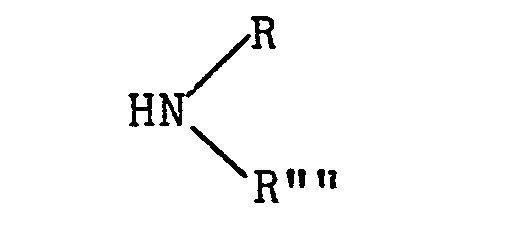
- mit R"" = H oder C1- bis C20-Alkyl und R = C12- bis C30-, vorzugsweise C12- bis C20-Alkyl, z.B. Laurylamin, bevorzugt Stearylamin, N-Methyl-stearylamin und Distearylamin.
- Verbindungen der Struktur R'-Y'-H sind der Alkohol der Formel (I) sowie Hydrazine der Formel (II)

- Die Herstellung der als Ausgangssubstanzen dienenden Phenolcarbonsäure-Glycerinester kann nach üblichen Methoden aus den Phenolcarbonsäuren bzw. deren Estern mit Glycerin erfolgen. Bevorzugt bedient man sich der schnell und glatt ablaufenden Addition von Phenolcarbonsäuren an Glycid in Gegenwart eines basischen oder sauren Katalysators bei Temperaturen von etwa 50 bis 150 C, insbesondere 100 bis 130oC, die in folgender Weise abläuft:

- Die Reaktion kann ohne Lösungsmittel durchgeführt werden, sie läuft aber auch in Gegenwart von aromatischen oder aliphatischen Lösungsmitteln wie etwa Toluol oder Di-isobutylketon ab, wie z.B. in der DE-OS 2 449 847 beschrieben ist. Bevorzugt und erfindungsgemäß wird die Umsetzung in der Schmelze einer der oben charakterisierten R-Y-H-Verbindungen, also von langkettigem Alkohol, Amin oder Mercaptan usw. bzw. von Mischungen dieser Substanzen, durchgeführt.
- Ein besonderer Vorteil dieses bevorzugten Verfahrens liegt darin, daß nach beendeter Glycidaddition, für welche 30 Min. bis 2 Stunden benötigt werden und deren Endpunkt dünnschichtchromatographisch gut festzustellen ist, durch Zusatz eines Phosphorig- bzw. Phosphorsäureesters mit einem leichtflüchtigen Alkohol oder Phenol die Umesterung und damit Verknüpfung mit der bei der Additionsreaktion als Reaktionsmedium diendenden R-Y-H bzw. der gegebenenfalls noch zuzusetzenden R1-Y1-H-Verbindung über Phosphor zum Endprodukt unter Abdestillation des freigesetzten Alkohols oder Phenols durchgeführt werden kann, ohne daß die zeitraubende und kostspielige nachträgliche Entfernung eines Lösungsmittels notwendig wird. Das erfindungsgemäße Herstellverfahren ist somit ein sehr einfaches und damit konstengünstiges Eintopfverfahren.
- Als phosphorhaltige Ausgangsmaterialien kommen allgemein Derivate der Phosphorsäure und vorzugsweise der Phosphorigen Säure mit alkoholytisch abspaltbaren, leichtflüchtigen Substituenten, insbesondere Alkohol- und Aminsubstituenten, in Frage, z.B. bevorzugt Tri-niedrig-alkyl- bzw. Triarylphosphite bzw. -Phosphate beispielsweise Triphenylphosphit, Tripropylphosphit, Triäthylphosphat, Trimethylphosphat und insbesondere Trimethyl- und Triäthylphosphit, ferner z.B. auch Hexamethylphosphorsäuretriamid und Hexamethylphosphorigsäuretriamid. Gegebenenfalls kann man auch PC13 oder POC13 einsetzen.
- Die Glycidaddition ist durch basische Stoffe wie Di- und Trialkylamine, z.B. Triäthylamin, Triisopropanolamin, Alkalialkoholat, Alkaliamid, -hydrid oder Alkalihydroxid und gegebenenfalls auch durch saure, wie z.B. Ammoniumsalze, katalysierbare. Der Katalysator wird in Mengen von 0,01 bis etwa 5 %, bezogen auf das Gewicht des Glycids, zugesetzt.
- Die Temperatur bei der Phosphitumesterung liegt zwischen 80 und 210oC, vorzugsweise zwischen 120 und 180°C. Sie wird in der Regel so gewählt, daß der freigesetzte Alkohol zügig abdestilliert. Natürlich ist es auch möglich, und im Falle von hochsiedenden Alkoholen wie etwa Phenol auch vorteilhaft die Abspaltung des Alkohols durch Anlegen von Vakuum zu unterstützen.
- Die Mengen an Ausgangsmaterialien richten sich danach, welche Endprodukte erhalten werden sollen. Phenolcarbonsäure und Glycid werden stets in etwa äquivalentem Verhältnis miteinander umgesetzt. Die phosphorhaltige Komponente, die R-Y-H und die Ri-Y1-H-Komponenten werden in einer solchen Menge eingesetzt, daß entweder auf 1 Äquivalent des in der 1. Verfahrensstufe gebildeten Glycerinesters 1 Mol R-Y-H-Verbindung und 1 Mol phosphorhaltige Komponente treffen, wobei cyclische Phosphite resultieren, oder man setzt pro Äquivalent Glycerinester insgesamt 4 Mol R-Y-H und R1-Y1-H-Komponente ein, wobei mindestens 1 Mol davon R-Y-H-Verbindung sein muß, und läßt mit 2 Mol phosphorhaltiger Komponente reagieren. In diesem Fall entstehen offenkettige Glycerinester-Diphosphite.
- Die Endprodukte erstarren beim Erkalten zu wachsartigen Festkörpern, welche ohne weitere Reinigung als Stabilisatoren eingesetzt werden können, was als besonderer Vorzug zu werten ist, wenngleich dieser Umstand natürlich bedingt, daß die erhaltenen Produkte nicht in jedem Fall chemisch einheitliche, von Nebenprodukten freie Stoffe sind.
- Es ist möglich und in mancher Hinsicht vorteilhaft, die erhaltenen Produkte nach DE-OS 2 753 136 mit Wachs zu coaten bzw. in der Schmelze zu mischen.
- Neben der Tatsache, daß sich die Produkte gemäß der Erfindung sehr leicht herstellen lassen, ist ihre z. T. außerordentlich hohe Hydrolysefestigkeit hervorzuheben. Diese Eigenschaft war nicht vorhersehbar, denn die Massierung von stark polaren Gruppierungen auf eine engen Molekülabschnitt, so wie es bei einem G'lycerinesterphosphit bzw. -phosphat vorliegt, läßt im Gegenteil eine starke Hydrolysanfälligkeit erwarten.
- Die erfindungsgemäßen phosphorhaltigen Glycerinester zeichnen sich des weiteren durch eine hohe Verfärbungsstabilität bei der Verarbeitung von thermoplastischen Kunststoffen aus. Auch dieser Umstand ist überraschend und war nicht vorhersehbar. Glycerinester neigen nämlich bei thermischer Belastung unter zweifacher ß-Eliminierung zur Bildung von Acrolein, welches mit sich selbst unter Bildung von stark verfärbenden Harzen weiterreagiert. Aus der Chemie der Fette, welche ja Tris-carbonsäure-glycerinester darstellen, ist dieses Verhalten wohlbekannt. Umso überraschender ist, daß eben diese an sich zu erwartende Erscheinung auch bei den hohen Temperaturen der Kunststoff-Verarbeitung nicht eintritt, sondern im Gegenteil eine außerordentlich wirksame Verfärbungsstabilisierung bei der Verwendung der erfindungsgemäßen Verbindungen zu beobachten ist.
- Hervorzuheben ist weiterhin die gegenüber den handelsüblichen phenolischen Antioxidantien außerordentlich hohe Extraktionsfestigkeit der erfindungsgemäßen Phenolverbindungen aus dem Kunststoff, wenn er in Kontakt mit Öl- oder Fett-ähnlichen Substanzen gebracht wird. Diese Eigenschaft ist deshalb von entscheidender Bedeutung, weil einerseits der beabsichtigte Oxidationsschutz des Kunststoffs auch in Kontakt mit Ölen und Fetten gewährleistet ist und vor allem, weil darüber hinaus die äußerst unerwünschte Kontaminierung von gegebenenfalls in dem Kunststoff verpackten fett- oder ölhaltigen Lebensmitteln mit den Stabilisatoren unterbleibt.
- Die erfindungsgemäßen Verbindungen steigern sowohl die Verarbeitungsstabilität als auch die Wärmealterungsbeständigkeit von Kunststoffen wie PVC und anderen chlorhaltigen Vinyl-,Homo- und Copolymerisaten sowie insbesondere von .£-Olefin-Homo- und Copolymerisaten, z. B. Polyäthylen, Polypropylen oder Äthylen-Vinylacetat-Copolymeren. Sie werden in Mengen von 0,005 bis 5,0 Gewichtsteilen auf 100 Gewichtsteile Polymeres eingesetzt.
- In chlorhaltigen Kunststoffen finden als Costabilitsatoren neben den erfindungsgemäßen Substanzen noch Metallsalze, Epoxidstabilisatoren, mehrwetige Alkohole und gegebenenfalls noch oG-Phenylindol Verwendung.
- Unter als Stabilisatoren bekannten Metallverbindungen werden in diesem Zusammenhang verstanden: Calcium-, Barium-, Strontium-, Zink-, Cadmium-, Magnesium-, Aluminium- und Bleiseifen aliphatischer Carbonsäuren und -Oxycarbonsäuren mit etwa 12 bis 32 C-Atomen oder von Phenol-substituierten aliphatischen Carbonsäuren, Salze der genannten Metalle mit aromatischen Carbonsäuren, beispielsweise Benzoate, Salizylate sowie (Alkyl-)Phenolate dieser Metalle, ferner Organozinnverbindungen, wie z.B. Dialkylzinn-Thiolglykolate und -Carboxylate und die neuerdings bekannt gewordenen analogen Esterzinnderivate. Bekannte Epoxidstabilisatoren sind z.B. epoxidierte höhere Fettsäuren wie epoxidiertes Sojabohnenöl, Tallöl oder Leinöl sowie epoxidiertes Butyloleat und die Epoxide langkettiger α-Olefine. Mehrwertige Alkohole können beispielsweise Pentaerythrit, Trimethylolpropan, Sorbit oder Mannit sein, d.h. bevorzugt Alkohole mit 5 oder 6 C-Atomen und 3 bis 6 OH-Gruppen.
- Eine Stabilisatorkombination für die Verarbeitung halogenhaltiger plastischer Massen besteht beispielsweise aus 0,005 bis 5, vorzugsweise 0,05 bis 3 und insbesondere 0,1 bis 1 Gewichtsteilen einer oder mehrerer der erfindungsgemäßen Phosphitverbindungen, 0,1 bis 10, vorzugsweise 0,5 bis 5 Gewichtsteilen von als Stabilisatoren bekannten Metallverbindungen, 0,1 bis 10, vorzugsweise 0,5 bis 5 Gewichtsteilen eines bekannten Epoxidstabilisators und 0 bis 1 Gewichtsteil eines mehrwertigen Alkohols.
- Die erfindungsgemäßen Phosphite zeigen insbesondere bei der Stabilisierung von Polyolefinen eine hervorragende Wirksamkeit. Ihre Verwendung als Stabilisatoren für Polyolefine ist daher bevorzugt. So wird z.B. die Licht- und Wärmestabilität von Polypropylen durch Zusatz üblicher Mengen (weniger als 1 Gew.-%) der erfindungsgemäßen Substanzen, gegebenenfalls in Gegenwart von phenolischen und evtl. sulfidischen Antioxidantien ganz erheblich verbessert.
- Unter phenolischen und sulfidischen Stabilisatoren werden die üblichen, bei der Kunststoffverarbeitung verwendeten Wärmestabilisatoren verstanden, z.B. 3,5-Di-tert.-buty-4-hydroxy-phenyl-propionsäureester, 2,6-Di-tert.-butyl-p-kresol, Alkyliden-bis-alkylphenole, Ester und Salze der Bis-(4'-hydroxy-3'-tert.-butylphenyl)-butansäure oder der Cycloalkyliden-bis-(alkylphenol)-carborsäureester sowie Thiodipropionsäureester von Fettalkoholen oder Di-octadecylsulfid- und disulfid.
- Eine Stabilisatorkombination für die Verarbeitung von halogenfreien Poly-α-olefinen, wie z.B. Hoch-, Mittel- und Niederdruckpolymerisaten von C2 bis C4-α-Olefinen, insbesondere Polyäthylen und Polypropylen, oder von Copolymerisaten derartigeroC-Olefine besteht aus beispielsweise 0,01 bis 2, vorzugsweise 0,05 bis 0,5 Gewichtsteilen eines Fett- oder Wachssäurecalciumsalzes, gegebenenfalls 0,005 bis 3, vorzugsweise 0,01 bis 1 Gewichtsteilen eines phenolischen Stabilisators, gegebenenfalls 0,005, vorzugsweise 0,01 bis 1 Gewichtsteilen eines sulfidischen Stabilisators, gegebenenfalls 0,005 bis 5, vorzugsweise 0,05 bis 1 Gewichtsteilen eines organischen Phosphits und 0,005 bis 5, vorzugsweise 0,05 bis 1 Gewichtsteilen einer oder mehrerer der erfindungsgemäßen Verbindungen. Falls erforderlich, können dieser Mischung noch spezielle Ultraviolett-Stabilisatoren in Mengen von 0,01 bis 3 Gewichtsteilen zugefügt werden. Aus der Vielzahl der handelsüblichen UV-Stabilisatoren seien beispielsweise genannt: Alkoxyhydroxybenzophenone, Hydroxyphenylbenztriazole, Salizylsäurephenolester, Benzoesäurehydroxyphenolester, Benzylidenmalonsäurenitrilester sowie sog. "Quencher" wie Nickelchelate, Hexamethylphosphorsäuretriamid, die als "HALS"-Produkte (hindered light stabilizers) bekannt gewordenen Piperidinstabilisatoren oder auch die Azaadamantane.
- Mit Mischungen der erfindungsgemäßen Verbindungen und bekannten Stabilisatoren läßt sich nicht nur die Stabilität von Polyolefinen und von chlorhaltigen Polymeren verbessern, sondern auch die von Polyestern, Polyamiden, Phenol-Formaldehyd-Harzen, Epoxiharzen, Polyacrylnitril, Polycarbonat, Polysiloxanen, Polyäthern, Polyurethanen und SBR-Gummimischungen.
- Die nachstehenden Beispiele sollen die Erfindung näher erläutern.
- ß-Hydroxytriacontyl-(3,5-di-tert.-butyl-4-hydroxy-benzoyl)-glycerinyl-phosphit

- Nach Beendigung der Äthanolentwicklung legt man zur Entfernung von nicht umgesetzten Triäthylphosphit Vakuum an. Die Produktschmelze wird schließlich durch ein beheiztes Druckfilter filtriert. Man erhält 130 g eines Wachses mit einem Fließ-/Tropfpunkt von 86,5 bis 87,5°C.
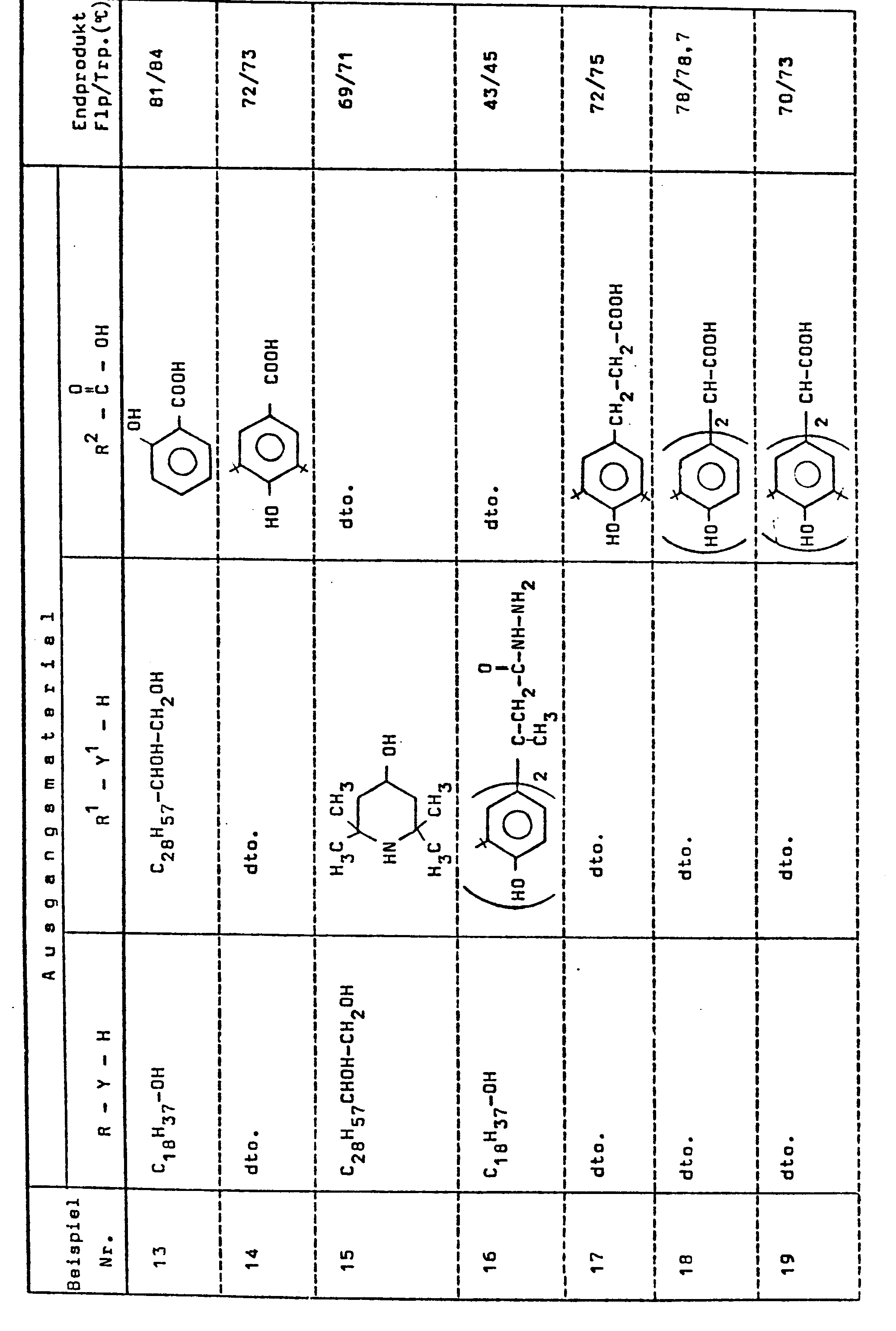
- In völliger Analogie zu der in Beispiel 1 beschriebenen Verfahrensweise wurden Verbindungen der allgemeinen Formel


- Verbindungen der Formel
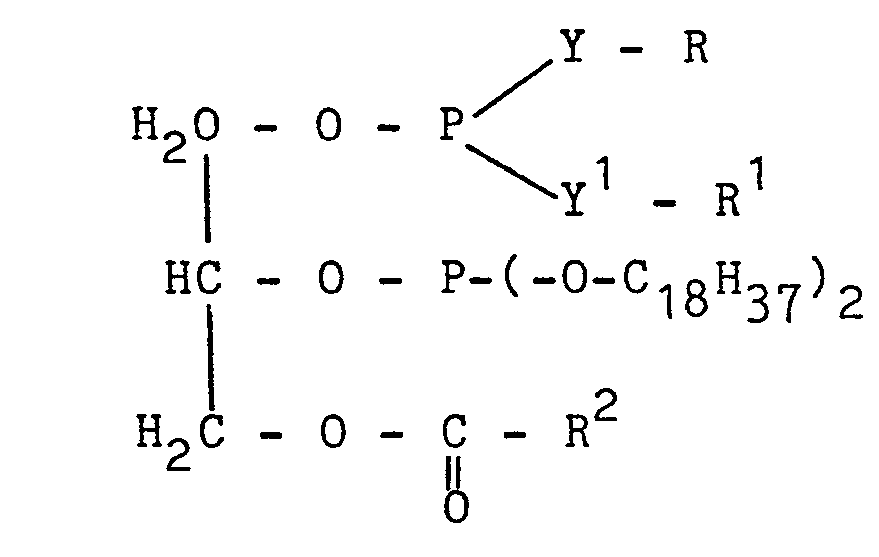
- Es kamen zum Einsatz jeweils 1 Mol Phenolcarbonsäure, Glycid, R-Y-H und R1-Y1-H-Verbindung mit je 2 Mol Phosphit und 2 Mol Stearylalkohol.

- Di-stearyl-[2,2-bis-(3'-tert.-butyl-4'-hydroxy-phenyl)-glutaroyl]-bis-glycerinyl-diphosphit
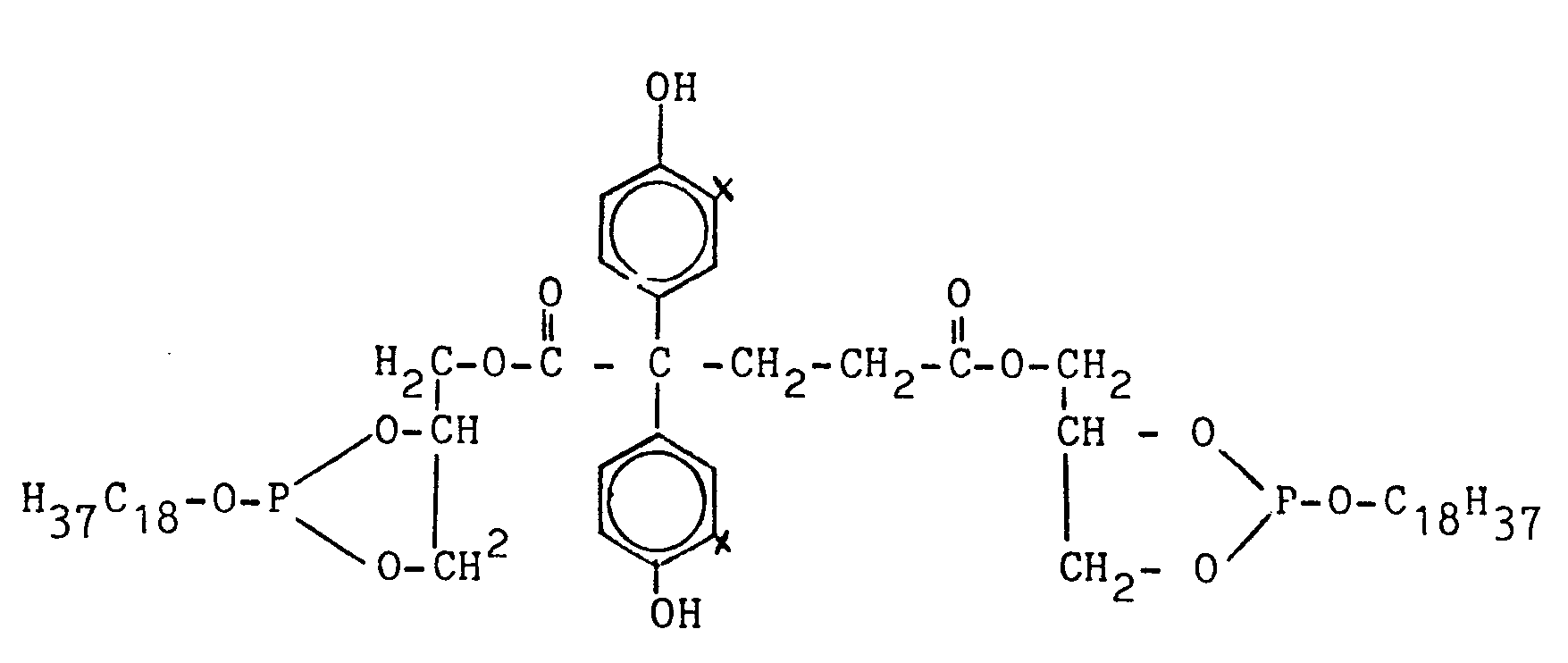
- Das erhaltene Produkt hat einen Fließ-/Tropfpunkt von 34/35°C.
- β-Hydroxytriacontyl-hepta-stearyl-[2,2-bis-3'-tert.-butyl-4'-hydroxy-phenyl)-glutaroyl_7-bis-glycerinyl-tet-raphosphit
-

- Das erhaltene Produkt besitzt einen Fließ-/Tropfpunkt von 64/650C.
- β-Hydroxytriacontyl-hepta-stearyl-[2,2-Bis-(5'-tert.-butyl-4'-hydroxy-malonyl 7-bis-glycerinyl-tetraphosphit

- Dieses Beispiel zeigt die überraschend hohe Hydrolysefestigkeit der erfindungsgemäßen Phosphite, die wie folgt geprüft wurde:
- Je 5 g des zu prüfenden Produktes werden in 100 ml entsalztem Wasser 20 Minuten gekocht. Dann läßt man erkalten und filtriert die wäßrige Phase durch ein Faltenfilter ab. Aus dem Filtrat werden je zwei 20-ml-Proben abpipettiert und mit 0,1 n KOH gegen Bromphenolblau titriert.
- Aus nachstehender Tabelle ist der jeweilige unter diesen Bedingungen ermittelte Hydrolysegrad als Quotient aus tatsächlichem Lauge-Verbrauch und theoretisch möglichem Lauge-Verbrauch bei vollständiger Hydrolyse zu entnehmen. Zum Vergleich wurde die Hydrolysestabilität einiger anderen, als Stabilisatoren bekannter Phosphite bestimmt.

- In diesem Beispiel soll die stabilisierende Wirkung der erfindungsgemäßen, Phenolgruppen enthaltenden Phosphite in Polypropylen aufgezeigt werden. (Die angegebenen Teile sind Gewichtsteile):
- Auf der Zweiwalze wird eine Mischung ausbei 200°C fünf Minuten lang homogenisiert. Die Kunststoffschmelze wird sodann bei 200°C zu einer Platte von 1 mm Dicke gepreßt. Aus der erkalteten Platte werden streifenförmige Prüfkörper (100 x 10 x 1 mm) gestanzt. Diese werden zur Bestimmung der Wärmealterungsbeständigkeit in einem Umluft-Trockenschrank in ein motorgetriebenes Gestell mit rotierenden Horden eingehängt und bei gleichmäßiger Frischluftzufuhr einer Temperaturbelastung von 140oC unterworfen. Die Zeit, nach der die Proben zu verspröden beginnen (nach DIN 53 383 gekennzeichnet durch die Bildung verfärbter, trüber, teilweise abbröckelnder Stellen), wird festgehalten. Die Prüfergebnisse sind in nachstehender Tabelle zusammengefaßt:
 Wie aus der Tabelle zu entnehmen ist, sind die erfindungsgemäßen Substanzen hervorragend zur Stabilisierung von Polyolefinen geeignet.
Claims (8)


und -Y1-R1 entweder gleich -Y-R ist, oder für einen Rest der Struktur

steht,
und der Hydroxyphenylcarbonsäurerest die Struktur


1 Mol einer Phenolcarbonsäure bzw. Phenoldicarbonsäure der Formel


Applications Claiming Priority (2)
| Application Number | Priority Date | Filing Date | Title |
|---|---|---|---|
| DE19782811667 DE2811667A1 (de) | 1978-03-17 | 1978-03-17 | Mit phenolcarbonsaeuren veresterte glycerinphosphite, ihre herstellung und verwendung |
| DE2811667 | 1978-03-17 |
Publications (3)
| Publication Number | Publication Date |
|---|---|
| EP0004331A2 true EP0004331A2 (de) | 1979-10-03 |
| EP0004331A3 EP0004331A3 (en) | 1979-10-17 |
| EP0004331B1 EP0004331B1 (de) | 1981-05-13 |
Family
ID=6034721
Family Applications (1)
| Application Number | Title | Priority Date | Filing Date |
|---|---|---|---|
| EP79100731A Expired EP0004331B1 (de) | 1978-03-17 | 1979-03-12 | Mit Phenolcarbonsäuren veresterte Glyzerinphosphite, ihre Herstellung und Verwendung als Stabilisatoren für Kunststoffe |
Country Status (4)
| Country | Link |
|---|---|
| US (1) | US4229382A (de) |
| EP (1) | EP0004331B1 (de) |
| DE (2) | DE2811667A1 (de) |
| ZA (1) | ZA791239B (de) |
Families Citing this family (5)
| Publication number | Priority date | Publication date | Assignee | Title |
|---|---|---|---|---|
| DK328182A (da) * | 1981-07-31 | 1983-02-01 | Fujisawa Pharmaceutical Co | Fremgangsmaade til fremstilling af phospholipidderivater |
| US5616636A (en) * | 1992-03-11 | 1997-04-01 | Sandoz Ltd. | Phosphonite-hals and phosphite-hals compounds as stabilizers |
| JP3497560B2 (ja) * | 1994-04-27 | 2004-02-16 | ジャパンエポキシレジン株式会社 | 変性エポキシ樹脂の製造方法と製造された変性エポキシ樹脂及びこのエポキシ樹脂の組成物 |
| EP1817354A1 (de) * | 2004-12-02 | 2007-08-15 | DSMIP Assets B.V. | Hydroxyaromatische verbindung, deren herstellung und verwendung |
| US9752093B2 (en) * | 2015-06-04 | 2017-09-05 | Chevron Oronite Company Llc | Borated polyol ester of hindered phenol antioxidant/friction modifier with enhanced performance |
Family Cites Families (7)
| Publication number | Priority date | Publication date | Assignee | Title |
|---|---|---|---|---|
| US2938877A (en) * | 1954-01-08 | 1960-05-31 | Carlisle Chemical Works | Stabilized halogen-containing resins |
| US3288819A (en) * | 1961-10-30 | 1966-11-29 | Standard Oil Co | Zinc salts of glycerol monoester dithiophosphates |
| US3369059A (en) * | 1965-07-27 | 1968-02-13 | Weston Chemical Corp | Monomeric polyphosphites with ether linkages |
| US3763287A (en) * | 1970-09-28 | 1973-10-02 | Gaf Corp | Phosphorus containing derivatives of omega-(3,5-dialkyl-4-hydroxyphenyl)alkanols |
| IL39241A0 (en) * | 1971-04-22 | 1972-06-28 | Ciba Geigy Ag | Bicyclic phosphorus compounds,their manufacture and their use for stabilising organic materials |
| JPS5222578A (en) * | 1975-08-15 | 1977-02-19 | Adeka Argus Chem Co Ltd | Stabilizing agent for organic materials |
| DE2633393C3 (de) * | 1976-07-24 | 1980-02-07 | Hoechst Ag, 6000 Frankfurt | Cyclische Phosphite von Polyalkoholen, ihre Herstellung und Verwendung |
-
1978
- 1978-03-17 DE DE19782811667 patent/DE2811667A1/de not_active Withdrawn
-
1979
- 1979-03-12 US US06/019,785 patent/US4229382A/en not_active Expired - Lifetime
- 1979-03-12 EP EP79100731A patent/EP0004331B1/de not_active Expired
- 1979-03-12 DE DE7979100731T patent/DE2960335D1/de not_active Expired
- 1979-03-16 ZA ZA791239A patent/ZA791239B/xx unknown
Also Published As
| Publication number | Publication date |
|---|---|
| US4229382A (en) | 1980-10-21 |
| EP0004331B1 (de) | 1981-05-13 |
| DE2811667A1 (de) | 1979-09-20 |
| EP0004331A3 (en) | 1979-10-17 |
| DE2960335D1 (en) | 1981-08-20 |
| ZA791239B (en) | 1980-04-30 |
Similar Documents
| Publication | Publication Date | Title |
|---|---|---|
| DE69526854T2 (de) | Physikalisch modifizierte abbaubare thermoplastische zusammensetzung | |
| EP0009115A1 (de) | Neue Phosphorigsäureester und ihre Verwendung zur Stabilisierung von Polyamiden | |
| DE2623985A1 (de) | Neue organische phosphite und ihre verwendung als stabilisatoren | |
| EP0004331B1 (de) | Mit Phenolcarbonsäuren veresterte Glyzerinphosphite, ihre Herstellung und Verwendung als Stabilisatoren für Kunststoffe | |
| EP0075697B1 (de) | Verfahren zur Herstellung von gegebenenfalls polymeren Organosilanestern mit Polyolen | |
| EP0019103B1 (de) | Phenolgruppen enthaltende Epoxidharze, ihre Verwendung und sie enthaltende Kunststoffmassen | |
| DE2166425B2 (de) | Ni (O) -Komplexverbindungen mit organischen Phosphiten und deren Verwendung zum UV-Iicht-Stabilisieren von Polymeren | |
| DE3887586T2 (de) | Polyolefin-Zusammensetzung. | |
| DE2633393C3 (de) | Cyclische Phosphite von Polyalkoholen, ihre Herstellung und Verwendung | |
| DE1593946A1 (de) | Verfaerbungsinhibierung von Alkylphenol-Produkten | |
| EP0291872A2 (de) | Wachsartige Verbindungen aromatischer Alkohole und ihre Verwendung | |
| DE60008515T2 (de) | Stabile lösungen von seltenenerden tris(organophosphor-derivaten) | |
| DE2630257C3 (de) | Neue organische Phosphite und ihre Verwendung als Stabilisatoren | |
| DE2621323A1 (de) | Neue, organische phosphite, verfahren zu ihrer herstellung und ihre verwendung als stabilisatoren | |
| US5225467A (en) | Cellulose ester resin stabilizer and cellulose ester resin compositions stabilized therewith | |
| US4125501A (en) | Phosphites of sugar alcohols and polymers stabilized therewith | |
| CH490434A (de) | Masse aus Homopolymerisaten oder Copolymerisaten von Olefinen oder Vinylchlorid mit verbesserter Beständigkeit gegen Verschlechterung beim Erhitzen und Verfahren zur Herstellung derselben | |
| DE2523910A1 (de) | Neue organische phosphite und ihre verwendung als stabilisatoren | |
| DE2711206A1 (de) | Bis-(alkylphenol)-alkancarbonsaeurehydrazide, ihre herstellung und verwendung | |
| DE1220601B (de) | Formmassen auf Basis von festen Propylenpolymerisaten | |
| DE3029026A1 (de) | Polyester aus dicarbonsaeuren und mono-(phenolcarbonsaeure)-glycerinestern, ihre herstellung und verwendung | |
| US4207270A (en) | Phosphites of polyalcohols | |
| DE2738675A1 (de) | Phenolgruppen-enthaltende zuckeralkoholphosphite bzw. -phosphate, ihre herstellung und verwendung | |
| DE2656748C2 (de) | Phosphitgemische, Verfahren zu ihrer Herstellung und ihre Verwendung zum Stabilisieren organischer Materialien | |
| DE3029176C2 (de) | Migrationsfeste, polymere, aromatische Phosphite |
Legal Events
| Date | Code | Title | Description |
|---|---|---|---|
| PUAI | Public reference made under article 153(3) epc to a published international application that has entered the european phase |
Free format text: ORIGINAL CODE: 0009012 |
|
| PUAL | Search report despatched |
Free format text: ORIGINAL CODE: 0009013 |
|
| AK | Designated contracting states |
Designated state(s): BE CH DE FR GB NL |
|
| AK | Designated contracting states |
Designated state(s): BE CH DE FR GB NL |
|
| 17P | Request for examination filed | ||
| GRAA | (expected) grant |
Free format text: ORIGINAL CODE: 0009210 |
|
| AK | Designated contracting states |
Designated state(s): BE CH DE FR GB NL |
|
| REF | Corresponds to: |
Ref document number: 2960335 Country of ref document: DE Date of ref document: 19810820 |
|
| PGFP | Annual fee paid to national office [announced via postgrant information from national office to epo] |
Ref country code: CH Payment date: 19840217 Year of fee payment: 6 |
|
| PGFP | Annual fee paid to national office [announced via postgrant information from national office to epo] |
Ref country code: FR Payment date: 19840222 Year of fee payment: 6 |
|
| PGFP | Annual fee paid to national office [announced via postgrant information from national office to epo] |
Ref country code: BE Payment date: 19840331 Year of fee payment: 6 |
|
| PGFP | Annual fee paid to national office [announced via postgrant information from national office to epo] |
Ref country code: DE Payment date: 19840413 Year of fee payment: 6 |
|
| PGFP | Annual fee paid to national office [announced via postgrant information from national office to epo] |
Ref country code: NL Payment date: 19850214 Year of fee payment: 7 |
|
| PG25 | Lapsed in a contracting state [announced via postgrant information from national office to epo] |
Ref country code: DE Effective date: 19851203 |
|
| PG25 | Lapsed in a contracting state [announced via postgrant information from national office to epo] |
Ref country code: CH Effective date: 19860331 Ref country code: BE Effective date: 19860331 |
|
| BERE | Be: lapsed |
Owner name: HOECHST A.G. Effective date: 19860331 |
|
| PG25 | Lapsed in a contracting state [announced via postgrant information from national office to epo] |
Ref country code: NL Effective date: 19861001 |
|
| GBPC | Gb: european patent ceased through non-payment of renewal fee | ||
| PG25 | Lapsed in a contracting state [announced via postgrant information from national office to epo] |
Ref country code: FR Free format text: LAPSE BECAUSE OF NON-PAYMENT OF DUE FEES Effective date: 19861128 |
|
| REG | Reference to a national code |
Ref country code: CH Ref legal event code: PL |
|
| NLV4 | Nl: lapsed or anulled due to non-payment of the annual fee | ||
| REG | Reference to a national code |
Ref country code: FR Ref legal event code: ST |
|
| PG25 | Lapsed in a contracting state [announced via postgrant information from national office to epo] |
Ref country code: GB Effective date: 19881117 |
|
| PLBE | No opposition filed within time limit |
Free format text: ORIGINAL CODE: 0009261 |
|
| STAA | Information on the status of an ep patent application or granted ep patent |
Free format text: STATUS: NO OPPOSITION FILED WITHIN TIME LIMIT |