EP0019103B1 - Phenolgruppen enthaltende Epoxidharze, ihre Verwendung und sie enthaltende Kunststoffmassen - Google Patents
Phenolgruppen enthaltende Epoxidharze, ihre Verwendung und sie enthaltende Kunststoffmassen Download PDFInfo
- Publication number
- EP0019103B1 EP0019103B1 EP80102149A EP80102149A EP0019103B1 EP 0019103 B1 EP0019103 B1 EP 0019103B1 EP 80102149 A EP80102149 A EP 80102149A EP 80102149 A EP80102149 A EP 80102149A EP 0019103 B1 EP0019103 B1 EP 0019103B1
- Authority
- EP
- European Patent Office
- Prior art keywords
- bis
- alkyl
- butyl
- atoms
- acid
- Prior art date
- Legal status (The legal status is an assumption and is not a legal conclusion. Google has not performed a legal analysis and makes no representation as to the accuracy of the status listed.)
- Expired
Links
- 239000004033 plastic Substances 0.000 title claims description 20
- 229920003023 plastic Polymers 0.000 title claims description 20
- 229920000647 polyepoxide Polymers 0.000 title claims description 12
- ISWSIDIOOBJBQZ-UHFFFAOYSA-N phenol group Chemical group C1(=CC=CC=C1)O ISWSIDIOOBJBQZ-UHFFFAOYSA-N 0.000 title claims description 11
- 239000000203 mixture Substances 0.000 title claims description 10
- 239000003381 stabilizer Substances 0.000 claims description 21
- 150000001875 compounds Chemical class 0.000 claims description 17
- 229920000642 polymer Polymers 0.000 claims description 12
- 239000000126 substance Substances 0.000 claims description 12
- 125000004432 carbon atom Chemical group C* 0.000 claims description 9
- 125000000217 alkyl group Chemical group 0.000 claims description 8
- 229910052760 oxygen Inorganic materials 0.000 claims description 6
- 239000001301 oxygen Substances 0.000 claims description 5
- 150000001335 aliphatic alkanes Chemical class 0.000 claims description 4
- QVGXLLKOCUKJST-UHFFFAOYSA-N atomic oxygen Chemical compound [O] QVGXLLKOCUKJST-UHFFFAOYSA-N 0.000 claims description 4
- 125000004435 hydrogen atom Chemical group [H]* 0.000 claims description 4
- 230000000087 stabilizing effect Effects 0.000 claims description 4
- 229920001577 copolymer Polymers 0.000 claims description 3
- 125000000999 tert-butyl group Chemical group [H]C([H])([H])C(*)(C([H])([H])[H])C([H])([H])[H] 0.000 claims description 3
- 239000004611 light stabiliser Substances 0.000 claims description 2
- 125000001997 phenyl group Chemical group [H]C1=C([H])C([H])=C(*)C([H])=C1[H] 0.000 claims description 2
- 230000009931 harmful effect Effects 0.000 claims 2
- 229920001519 homopolymer Polymers 0.000 claims 2
- 125000006539 C12 alkyl group Chemical group [H]C([H])([H])C([H])([H])C([H])([H])C([H])([H])C([H])([H])C([H])([H])C([H])([H])C([H])([H])C([H])([H])C([H])([H])C([H])([H])C([H])([H])* 0.000 claims 1
- 239000012760 heat stabilizer Substances 0.000 claims 1
- RTZKZFJDLAIYFH-UHFFFAOYSA-N Diethyl ether Chemical compound CCOCC RTZKZFJDLAIYFH-UHFFFAOYSA-N 0.000 description 20
- PEDCQBHIVMGVHV-UHFFFAOYSA-N Glycerine Chemical compound OCC(O)CO PEDCQBHIVMGVHV-UHFFFAOYSA-N 0.000 description 20
- -1 phenol diazo compounds Chemical class 0.000 description 18
- 150000007965 phenolic acids Chemical class 0.000 description 15
- 239000000047 product Substances 0.000 description 15
- ZLFHNCHMEGLFKL-UHFFFAOYSA-N 3,3-bis(3-tert-butyl-4-hydroxyphenyl)butanoic acid Chemical compound C1=C(O)C(C(C)(C)C)=CC(C(C)(CC(O)=O)C=2C=C(C(O)=CC=2)C(C)(C)C)=C1 ZLFHNCHMEGLFKL-UHFFFAOYSA-N 0.000 description 12
- ZMXDDKWLCZADIW-UHFFFAOYSA-N N,N-Dimethylformamide Chemical compound CN(C)C=O ZMXDDKWLCZADIW-UHFFFAOYSA-N 0.000 description 12
- 239000002904 solvent Substances 0.000 description 11
- 229910052757 nitrogen Inorganic materials 0.000 description 10
- YGSDEFSMJLZEOE-UHFFFAOYSA-N Salicylic acid Natural products OC(=O)C1=CC=CC=C1O YGSDEFSMJLZEOE-UHFFFAOYSA-N 0.000 description 9
- 239000004593 Epoxy Substances 0.000 description 7
- 239000003963 antioxidant agent Substances 0.000 description 7
- 238000006243 chemical reaction Methods 0.000 description 7
- 150000002148 esters Chemical class 0.000 description 7
- 238000006116 polymerization reaction Methods 0.000 description 7
- 239000002253 acid Substances 0.000 description 6
- 239000002530 phenolic antioxidant Substances 0.000 description 6
- 238000012545 processing Methods 0.000 description 6
- QTBSBXVTEAMEQO-UHFFFAOYSA-N Acetic acid Chemical compound CC(O)=O QTBSBXVTEAMEQO-UHFFFAOYSA-N 0.000 description 5
- CTQNGGLPUBDAKN-UHFFFAOYSA-N O-Xylene Chemical compound CC1=CC=CC=C1C CTQNGGLPUBDAKN-UHFFFAOYSA-N 0.000 description 5
- 229920000098 polyolefin Polymers 0.000 description 5
- 239000008096 xylene Substances 0.000 description 5
- IJGRMHOSHXDMSA-UHFFFAOYSA-N Atomic nitrogen Chemical compound N#N IJGRMHOSHXDMSA-UHFFFAOYSA-N 0.000 description 4
- ATUOYWHBWRKTHZ-UHFFFAOYSA-N Propane Chemical compound CCC ATUOYWHBWRKTHZ-UHFFFAOYSA-N 0.000 description 4
- KKEYFWRCBNTPAC-UHFFFAOYSA-N Terephthalic acid Chemical compound OC(=O)C1=CC=C(C(O)=O)C=C1 KKEYFWRCBNTPAC-UHFFFAOYSA-N 0.000 description 4
- 150000007513 acids Chemical class 0.000 description 4
- 150000008064 anhydrides Chemical class 0.000 description 4
- 230000015572 biosynthetic process Effects 0.000 description 4
- IISBACLAFKSPIT-UHFFFAOYSA-N bisphenol A Chemical compound C=1C=C(O)C=CC=1C(C)(C)C1=CC=C(O)C=C1 IISBACLAFKSPIT-UHFFFAOYSA-N 0.000 description 4
- 239000011575 calcium Substances 0.000 description 4
- NZNMSOFKMUBTKW-UHFFFAOYSA-N cyclohexanecarboxylic acid Chemical compound OC(=O)C1CCCCC1 NZNMSOFKMUBTKW-UHFFFAOYSA-N 0.000 description 4
- 239000003822 epoxy resin Substances 0.000 description 4
- LNEPOXFFQSENCJ-UHFFFAOYSA-N haloperidol Chemical compound C1CC(O)(C=2C=CC(Cl)=CC=2)CCN1CCCC(=O)C1=CC=C(F)C=C1 LNEPOXFFQSENCJ-UHFFFAOYSA-N 0.000 description 4
- 238000000034 method Methods 0.000 description 4
- 150000002989 phenols Chemical class 0.000 description 4
- 238000010992 reflux Methods 0.000 description 4
- 229920005989 resin Polymers 0.000 description 4
- 239000011347 resin Substances 0.000 description 4
- 0 COC(C(C1=CCCCC1C(*(*)*)=O)=C)=O Chemical compound COC(C(C1=CCCCC1C(*(*)*)=O)=C)=O 0.000 description 3
- LYCAIKOWRPUZTN-UHFFFAOYSA-N Ethylene glycol Chemical compound OCCO LYCAIKOWRPUZTN-UHFFFAOYSA-N 0.000 description 3
- 239000004743 Polypropylene Substances 0.000 description 3
- HEMHJVSKTPXQMS-UHFFFAOYSA-M Sodium hydroxide Chemical compound [OH-].[Na+] HEMHJVSKTPXQMS-UHFFFAOYSA-M 0.000 description 3
- YXFVVABEGXRONW-UHFFFAOYSA-N Toluene Chemical compound CC1=CC=CC=C1 YXFVVABEGXRONW-UHFFFAOYSA-N 0.000 description 3
- 125000001931 aliphatic group Chemical group 0.000 description 3
- NEPKLUNSRVEBIX-UHFFFAOYSA-N bis(oxiran-2-ylmethyl) benzene-1,4-dicarboxylate Chemical compound C=1C=C(C(=O)OCC2OC2)C=CC=1C(=O)OCC1CO1 NEPKLUNSRVEBIX-UHFFFAOYSA-N 0.000 description 3
- 150000001735 carboxylic acids Chemical class 0.000 description 3
- GYZLOYUZLJXAJU-UHFFFAOYSA-N diglycidyl ether Chemical compound C1OC1COCC1CO1 GYZLOYUZLJXAJU-UHFFFAOYSA-N 0.000 description 3
- 238000002845 discoloration Methods 0.000 description 3
- 239000003925 fat Substances 0.000 description 3
- 239000003921 oil Substances 0.000 description 3
- 229920001155 polypropylene Polymers 0.000 description 3
- 230000006641 stabilisation Effects 0.000 description 3
- 238000011105 stabilization Methods 0.000 description 3
- 238000012360 testing method Methods 0.000 description 3
- KMOUUZVZFBCRAM-OLQVQODUSA-N (3as,7ar)-3a,4,7,7a-tetrahydro-2-benzofuran-1,3-dione Chemical compound C1C=CC[C@@H]2C(=O)OC(=O)[C@@H]21 KMOUUZVZFBCRAM-OLQVQODUSA-N 0.000 description 2
- QUHBECTVXQMROA-UHFFFAOYSA-N 2,2-bis(3-tert-butyl-4-hydroxyphenyl)acetic acid Chemical compound C1=C(O)C(C(C)(C)C)=CC(C(C(O)=O)C=2C=C(C(O)=CC=2)C(C)(C)C)=C1 QUHBECTVXQMROA-UHFFFAOYSA-N 0.000 description 2
- HZAXFHJVJLSVMW-UHFFFAOYSA-N 2-Aminoethan-1-ol Chemical compound NCCO HZAXFHJVJLSVMW-UHFFFAOYSA-N 0.000 description 2
- RNLHGQLZWXBQNY-UHFFFAOYSA-N 3-(aminomethyl)-3,5,5-trimethylcyclohexan-1-amine Chemical compound CC1(C)CC(N)CC(C)(CN)C1 RNLHGQLZWXBQNY-UHFFFAOYSA-N 0.000 description 2
- YBRVSVVVWCFQMG-UHFFFAOYSA-N 4,4'-diaminodiphenylmethane Chemical compound C1=CC(N)=CC=C1CC1=CC=C(N)C=C1 YBRVSVVVWCFQMG-UHFFFAOYSA-N 0.000 description 2
- FKQGNPJFWGLLNO-UHFFFAOYSA-N 4,4-bis(3-tert-butyl-4-hydroxyphenyl)pentanoic acid Chemical compound C1=C(O)C(C(C)(C)C)=CC(C(C)(CCC(O)=O)C=2C=C(C(O)=CC=2)C(C)(C)C)=C1 FKQGNPJFWGLLNO-UHFFFAOYSA-N 0.000 description 2
- JOOXCMJARBKPKM-UHFFFAOYSA-N 4-oxopentanoic acid Chemical compound CC(=O)CCC(O)=O JOOXCMJARBKPKM-UHFFFAOYSA-N 0.000 description 2
- YZCKVEUIGOORGS-UHFFFAOYSA-N Hydrogen atom Chemical compound [H] YZCKVEUIGOORGS-UHFFFAOYSA-N 0.000 description 2
- NBIIXXVUZAFLBC-UHFFFAOYSA-N Phosphoric acid Chemical compound OP(O)(O)=O NBIIXXVUZAFLBC-UHFFFAOYSA-N 0.000 description 2
- NQRYJNQNLNOLGT-UHFFFAOYSA-N Piperidine Chemical compound C1CCNCC1 NQRYJNQNLNOLGT-UHFFFAOYSA-N 0.000 description 2
- 239000004793 Polystyrene Substances 0.000 description 2
- 229960000583 acetic acid Drugs 0.000 description 2
- 230000009471 action Effects 0.000 description 2
- 239000003513 alkali Substances 0.000 description 2
- 150000001412 amines Chemical class 0.000 description 2
- 238000000137 annealing Methods 0.000 description 2
- 230000003078 antioxidant effect Effects 0.000 description 2
- 125000003118 aryl group Chemical group 0.000 description 2
- 150000007514 bases Chemical class 0.000 description 2
- SRSXLGNVWSONIS-UHFFFAOYSA-N benzenesulfonic acid Chemical group OS(=O)(=O)C1=CC=CC=C1 SRSXLGNVWSONIS-UHFFFAOYSA-N 0.000 description 2
- DJUWPHRCMMMSCV-UHFFFAOYSA-N bis(7-oxabicyclo[4.1.0]heptan-4-ylmethyl) hexanedioate Chemical compound C1CC2OC2CC1COC(=O)CCCCC(=O)OCC1CC2OC2CC1 DJUWPHRCMMMSCV-UHFFFAOYSA-N 0.000 description 2
- XUCHXOAWJMEFLF-UHFFFAOYSA-N bisphenol F diglycidyl ether Chemical compound C1OC1COC(C=C1)=CC=C1CC(C=C1)=CC=C1OCC1CO1 XUCHXOAWJMEFLF-UHFFFAOYSA-N 0.000 description 2
- 229940106691 bisphenol a Drugs 0.000 description 2
- 239000007795 chemical reaction product Substances 0.000 description 2
- 150000002009 diols Chemical class 0.000 description 2
- 238000009826 distribution Methods 0.000 description 2
- 125000003700 epoxy group Chemical group 0.000 description 2
- 238000001704 evaporation Methods 0.000 description 2
- 230000008020 evaporation Effects 0.000 description 2
- 238000000605 extraction Methods 0.000 description 2
- 239000012362 glacial acetic acid Substances 0.000 description 2
- 239000011521 glass Substances 0.000 description 2
- NAQMVNRVTILPCV-UHFFFAOYSA-N hexane-1,6-diamine Chemical compound NCCCCCCN NAQMVNRVTILPCV-UHFFFAOYSA-N 0.000 description 2
- 239000000155 melt Substances 0.000 description 2
- VNWKTOKETHGBQD-UHFFFAOYSA-N methane Chemical compound C VNWKTOKETHGBQD-UHFFFAOYSA-N 0.000 description 2
- 230000005012 migration Effects 0.000 description 2
- 238000013508 migration Methods 0.000 description 2
- 239000000178 monomer Substances 0.000 description 2
- 238000006384 oligomerization reaction Methods 0.000 description 2
- 229920000570 polyether Polymers 0.000 description 2
- 239000004848 polyfunctional curative Substances 0.000 description 2
- 239000000843 powder Substances 0.000 description 2
- 239000001294 propane Substances 0.000 description 2
- 125000001436 propyl group Chemical group [H]C([*])([H])C([H])([H])C([H])([H])[H] 0.000 description 2
- 239000011541 reaction mixture Substances 0.000 description 2
- GHMLBKRAJCXXBS-UHFFFAOYSA-N resorcinol Chemical compound OC1=CC=CC(O)=C1 GHMLBKRAJCXXBS-UHFFFAOYSA-N 0.000 description 2
- 150000003839 salts Chemical class 0.000 description 2
- 239000000243 solution Substances 0.000 description 2
- 229920001059 synthetic polymer Polymers 0.000 description 2
- 230000008646 thermal stress Effects 0.000 description 2
- XLYOFNOQVPJJNP-UHFFFAOYSA-N water Substances O XLYOFNOQVPJJNP-UHFFFAOYSA-N 0.000 description 2
- LTVUCOSIZFEASK-MPXCPUAZSA-N (3ar,4s,7r,7as)-3a-methyl-3a,4,7,7a-tetrahydro-4,7-methano-2-benzofuran-1,3-dione Chemical compound C([C@H]1C=C2)[C@H]2[C@H]2[C@]1(C)C(=O)OC2=O LTVUCOSIZFEASK-MPXCPUAZSA-N 0.000 description 1
- KNDQHSIWLOJIGP-UMRXKNAASA-N (3ar,4s,7r,7as)-rel-3a,4,7,7a-tetrahydro-4,7-methanoisobenzofuran-1,3-dione Chemical compound O=C1OC(=O)[C@@H]2[C@H]1[C@]1([H])C=C[C@@]2([H])C1 KNDQHSIWLOJIGP-UMRXKNAASA-N 0.000 description 1
- JYEUMXHLPRZUAT-UHFFFAOYSA-N 1,2,3-triazine Chemical compound C1=CN=NN=C1 JYEUMXHLPRZUAT-UHFFFAOYSA-N 0.000 description 1
- OUPZKGBUJRBPGC-UHFFFAOYSA-N 1,3,5-tris(oxiran-2-ylmethyl)-1,3,5-triazinane-2,4,6-trione Chemical compound O=C1N(CC2OC2)C(=O)N(CC2OC2)C(=O)N1CC1CO1 OUPZKGBUJRBPGC-UHFFFAOYSA-N 0.000 description 1
- WZCQRUWWHSTZEM-UHFFFAOYSA-N 1,3-phenylenediamine Chemical compound NC1=CC=CC(N)=C1 WZCQRUWWHSTZEM-UHFFFAOYSA-N 0.000 description 1
- CBCKQZAAMUWICA-UHFFFAOYSA-N 1,4-phenylenediamine Chemical compound NC1=CC=C(N)C=C1 CBCKQZAAMUWICA-UHFFFAOYSA-N 0.000 description 1
- MQQKTNDBASEZSD-UHFFFAOYSA-N 1-(octadecyldisulfanyl)octadecane Chemical compound CCCCCCCCCCCCCCCCCCSSCCCCCCCCCCCCCCCCCC MQQKTNDBASEZSD-UHFFFAOYSA-N 0.000 description 1
- IHWDIGHWDQPQMQ-UHFFFAOYSA-N 1-octadecylsulfanyloctadecane Chemical compound CCCCCCCCCCCCCCCCCCSCCCCCCCCCCCCCCCCCC IHWDIGHWDQPQMQ-UHFFFAOYSA-N 0.000 description 1
- VILCJCGEZXAXTO-UHFFFAOYSA-N 2,2,2-tetramine Chemical compound NCCNCCNCCN VILCJCGEZXAXTO-UHFFFAOYSA-N 0.000 description 1
- FTVFPPFZRRKJIH-UHFFFAOYSA-N 2,2,6,6-tetramethylpiperidin-4-amine Chemical compound CC1(C)CC(N)CC(C)(C)N1 FTVFPPFZRRKJIH-UHFFFAOYSA-N 0.000 description 1
- VDVUCLWJZJHFAV-UHFFFAOYSA-N 2,2,6,6-tetramethylpiperidin-4-ol Chemical compound CC1(C)CC(O)CC(C)(C)N1 VDVUCLWJZJHFAV-UHFFFAOYSA-N 0.000 description 1
- AHDSRXYHVZECER-UHFFFAOYSA-N 2,4,6-tris[(dimethylamino)methyl]phenol Chemical compound CN(C)CC1=CC(CN(C)C)=C(O)C(CN(C)C)=C1 AHDSRXYHVZECER-UHFFFAOYSA-N 0.000 description 1
- JPSKCQCQZUGWNM-UHFFFAOYSA-N 2,7-Oxepanedione Chemical compound O=C1CCCCC(=O)O1 JPSKCQCQZUGWNM-UHFFFAOYSA-N 0.000 description 1
- AYHLPQOWRMPEKH-UHFFFAOYSA-N 2-(6-methylheptoxymethyl)oxirane Chemical compound CC(C)CCCCCOCC1CO1 AYHLPQOWRMPEKH-UHFFFAOYSA-N 0.000 description 1
- YSUQLAYJZDEMOT-UHFFFAOYSA-N 2-(butoxymethyl)oxirane Chemical compound CCCCOCC1CO1 YSUQLAYJZDEMOT-UHFFFAOYSA-N 0.000 description 1
- FALRKNHUBBKYCC-UHFFFAOYSA-N 2-(chloromethyl)pyridine-3-carbonitrile Chemical compound ClCC1=NC=CC=C1C#N FALRKNHUBBKYCC-UHFFFAOYSA-N 0.000 description 1
- PTTPXKJBFFKCEK-UHFFFAOYSA-N 2-Methyl-4-heptanone Chemical compound CC(C)CC(=O)CC(C)C PTTPXKJBFFKCEK-UHFFFAOYSA-N 0.000 description 1
- CUFXMPWHOWYNSO-UHFFFAOYSA-N 2-[(4-methylphenoxy)methyl]oxirane Chemical compound C1=CC(C)=CC=C1OCC1OC1 CUFXMPWHOWYNSO-UHFFFAOYSA-N 0.000 description 1
- SYEWHONLFGZGLK-UHFFFAOYSA-N 2-[1,3-bis(oxiran-2-ylmethoxy)propan-2-yloxymethyl]oxirane Chemical compound C1OC1COCC(OCC1OC1)COCC1CO1 SYEWHONLFGZGLK-UHFFFAOYSA-N 0.000 description 1
- FSYPIGPPWAJCJG-UHFFFAOYSA-N 2-[[4-(oxiran-2-ylmethoxy)phenoxy]methyl]oxirane Chemical class C1OC1COC(C=C1)=CC=C1OCC1CO1 FSYPIGPPWAJCJG-UHFFFAOYSA-N 0.000 description 1
- UZDBWHMHPZZCNE-UHFFFAOYSA-N 2-benzyl-n,n-dimethylaniline Chemical compound CN(C)C1=CC=CC=C1CC1=CC=CC=C1 UZDBWHMHPZZCNE-UHFFFAOYSA-N 0.000 description 1
- TZLVUWBGUNVFES-UHFFFAOYSA-N 2-ethyl-5-methylpyrazol-3-amine Chemical compound CCN1N=C(C)C=C1N TZLVUWBGUNVFES-UHFFFAOYSA-N 0.000 description 1
- WJQOZHYUIDYNHM-UHFFFAOYSA-N 2-tert-Butylphenol Chemical compound CC(C)(C)C1=CC=CC=C1O WJQOZHYUIDYNHM-UHFFFAOYSA-N 0.000 description 1
- PZRWFKGUFWPFID-UHFFFAOYSA-N 3,9-dioctadecoxy-2,4,8,10-tetraoxa-3,9-diphosphaspiro[5.5]undecane Chemical compound C1OP(OCCCCCCCCCCCCCCCCCC)OCC21COP(OCCCCCCCCCCCCCCCCCC)OC2 PZRWFKGUFWPFID-UHFFFAOYSA-N 0.000 description 1
- WPMYUUITDBHVQZ-UHFFFAOYSA-N 3-(3,5-ditert-butyl-4-hydroxyphenyl)propanoic acid Chemical compound CC(C)(C)C1=CC(CCC(O)=O)=CC(C(C)(C)C)=C1O WPMYUUITDBHVQZ-UHFFFAOYSA-N 0.000 description 1
- VKJLYEDTHCTCOH-UHFFFAOYSA-N 3-(3-octadecoxy-3-oxopropyl)sulfanylpropanoic acid Chemical compound CCCCCCCCCCCCCCCCCCOC(=O)CCSCCC(O)=O VKJLYEDTHCTCOH-UHFFFAOYSA-N 0.000 description 1
- YAXXOCZAXKLLCV-UHFFFAOYSA-N 3-dodecyloxolane-2,5-dione Chemical compound CCCCCCCCCCCCC1CC(=O)OC1=O YAXXOCZAXKLLCV-UHFFFAOYSA-N 0.000 description 1
- VPWNQTHUCYMVMZ-UHFFFAOYSA-N 4,4'-sulfonyldiphenol Chemical compound C1=CC(O)=CC=C1S(=O)(=O)C1=CC=C(O)C=C1 VPWNQTHUCYMVMZ-UHFFFAOYSA-N 0.000 description 1
- VHYFNPMBLIVWCW-UHFFFAOYSA-N 4-Dimethylaminopyridine Chemical compound CN(C)C1=CC=NC=C1 VHYFNPMBLIVWCW-UHFFFAOYSA-N 0.000 description 1
- IGSBHTZEJMPDSZ-UHFFFAOYSA-N 4-[(4-amino-3-methylcyclohexyl)methyl]-2-methylcyclohexan-1-amine Chemical compound C1CC(N)C(C)CC1CC1CC(C)C(N)CC1 IGSBHTZEJMPDSZ-UHFFFAOYSA-N 0.000 description 1
- NUKYPUAOHBNCPY-UHFFFAOYSA-N 4-aminopyridine Chemical compound NC1=CC=NC=C1 NUKYPUAOHBNCPY-UHFFFAOYSA-N 0.000 description 1
- 229940090248 4-hydroxybenzoic acid Drugs 0.000 description 1
- OECTYKWYRCHAKR-UHFFFAOYSA-N 4-vinylcyclohexene dioxide Chemical compound C1OC1C1CC2OC2CC1 OECTYKWYRCHAKR-UHFFFAOYSA-N 0.000 description 1
- FKBMTBAXDISZGN-UHFFFAOYSA-N 5-methyl-3a,4,5,6,7,7a-hexahydro-2-benzofuran-1,3-dione Chemical compound C1C(C)CCC2C(=O)OC(=O)C12 FKBMTBAXDISZGN-UHFFFAOYSA-N 0.000 description 1
- RREANTFLPGEWEN-MBLPBCRHSA-N 7-[4-[[(3z)-3-[4-amino-5-[(3,4,5-trimethoxyphenyl)methyl]pyrimidin-2-yl]imino-5-fluoro-2-oxoindol-1-yl]methyl]piperazin-1-yl]-1-cyclopropyl-6-fluoro-4-oxoquinoline-3-carboxylic acid Chemical compound COC1=C(OC)C(OC)=CC(CC=2C(=NC(\N=C/3C4=CC(F)=CC=C4N(CN4CCN(CC4)C=4C(=CC=5C(=O)C(C(O)=O)=CN(C=5C=4)C4CC4)F)C\3=O)=NC=2)N)=C1 RREANTFLPGEWEN-MBLPBCRHSA-N 0.000 description 1
- YXALYBMHAYZKAP-UHFFFAOYSA-N 7-oxabicyclo[4.1.0]heptan-4-ylmethyl 7-oxabicyclo[4.1.0]heptane-4-carboxylate Chemical compound C1CC2OC2CC1C(=O)OCC1CC2OC2CC1 YXALYBMHAYZKAP-UHFFFAOYSA-N 0.000 description 1
- ZCYVEMRRCGMTRW-UHFFFAOYSA-N 7553-56-2 Chemical compound [I] ZCYVEMRRCGMTRW-UHFFFAOYSA-N 0.000 description 1
- ADAHGVUHKDNLEB-UHFFFAOYSA-N Bis(2,3-epoxycyclopentyl)ether Chemical compound C1CC2OC2C1OC1CCC2OC21 ADAHGVUHKDNLEB-UHFFFAOYSA-N 0.000 description 1
- LCFVJGUPQDGYKZ-UHFFFAOYSA-N Bisphenol A diglycidyl ether Chemical compound C=1C=C(OCC2OC2)C=CC=1C(C)(C)C(C=C1)=CC=C1OCC1CO1 LCFVJGUPQDGYKZ-UHFFFAOYSA-N 0.000 description 1
- ILVCIGMNNZIREK-UHFFFAOYSA-N CC(CC1)CC(C2CCCCC2)C1N(C)C Chemical compound CC(CC1)CC(C2CCCCC2)C1N(C)C ILVCIGMNNZIREK-UHFFFAOYSA-N 0.000 description 1
- XDTMQSROBMDMFD-UHFFFAOYSA-N Cyclohexane Chemical compound C1CCCCC1 XDTMQSROBMDMFD-UHFFFAOYSA-N 0.000 description 1
- MQJKPEGWNLWLTK-UHFFFAOYSA-N Dapsone Chemical compound C1=CC(N)=CC=C1S(=O)(=O)C1=CC=C(N)C=C1 MQJKPEGWNLWLTK-UHFFFAOYSA-N 0.000 description 1
- RPNUMPOLZDHAAY-UHFFFAOYSA-N Diethylenetriamine Chemical compound NCCNCCN RPNUMPOLZDHAAY-UHFFFAOYSA-N 0.000 description 1
- MYMOFIZGZYHOMD-UHFFFAOYSA-N Dioxygen Chemical compound O=O MYMOFIZGZYHOMD-UHFFFAOYSA-N 0.000 description 1
- OTMSDBZUPAUEDD-UHFFFAOYSA-N Ethane Chemical compound CC OTMSDBZUPAUEDD-UHFFFAOYSA-N 0.000 description 1
- PIICEJLVQHRZGT-UHFFFAOYSA-N Ethylenediamine Chemical compound NCCN PIICEJLVQHRZGT-UHFFFAOYSA-N 0.000 description 1
- JKIJEFPNVSHHEI-UHFFFAOYSA-N Phenol, 2,4-bis(1,1-dimethylethyl)-, phosphite (3:1) Chemical compound CC(C)(C)C1=CC(C(C)(C)C)=CC=C1OP(OC=1C(=CC(=CC=1)C(C)(C)C)C(C)(C)C)OC1=CC=C(C(C)(C)C)C=C1C(C)(C)C JKIJEFPNVSHHEI-UHFFFAOYSA-N 0.000 description 1
- FQYUMYWMJTYZTK-UHFFFAOYSA-N Phenyl glycidyl ether Chemical compound C1OC1COC1=CC=CC=C1 FQYUMYWMJTYZTK-UHFFFAOYSA-N 0.000 description 1
- ABLZXFCXXLZCGV-UHFFFAOYSA-N Phosphorous acid Chemical class OP(O)=O ABLZXFCXXLZCGV-UHFFFAOYSA-N 0.000 description 1
- OAICVXFJPJFONN-UHFFFAOYSA-N Phosphorus Chemical compound [P] OAICVXFJPJFONN-UHFFFAOYSA-N 0.000 description 1
- LGRFSURHDFAFJT-UHFFFAOYSA-N Phthalic anhydride Natural products C1=CC=C2C(=O)OC(=O)C2=C1 LGRFSURHDFAFJT-UHFFFAOYSA-N 0.000 description 1
- 239000005062 Polybutadiene Substances 0.000 description 1
- 239000004698 Polyethylene Substances 0.000 description 1
- 239000004721 Polyphenylene oxide Substances 0.000 description 1
- XBDQKXXYIPTUBI-UHFFFAOYSA-N Propionic acid Substances CCC(O)=O XBDQKXXYIPTUBI-UHFFFAOYSA-N 0.000 description 1
- QOSMNYMQXIVWKY-UHFFFAOYSA-N Propyl levulinate Chemical compound CCCOC(=O)CCC(C)=O QOSMNYMQXIVWKY-UHFFFAOYSA-N 0.000 description 1
- AWMVMTVKBNGEAK-UHFFFAOYSA-N Styrene oxide Chemical compound C1OC1C1=CC=CC=C1 AWMVMTVKBNGEAK-UHFFFAOYSA-N 0.000 description 1
- NINIDFKCEFEMDL-UHFFFAOYSA-N Sulfur Chemical compound [S] NINIDFKCEFEMDL-UHFFFAOYSA-N 0.000 description 1
- ZJCCRDAZUWHFQH-UHFFFAOYSA-N Trimethylolpropane Chemical compound CCC(CO)(CO)CO ZJCCRDAZUWHFQH-UHFFFAOYSA-N 0.000 description 1
- 239000007983 Tris buffer Substances 0.000 description 1
- FDLQZKYLHJJBHD-UHFFFAOYSA-N [3-(aminomethyl)phenyl]methanamine Chemical compound NCC1=CC=CC(CN)=C1 FDLQZKYLHJJBHD-UHFFFAOYSA-N 0.000 description 1
- 230000002378 acidificating effect Effects 0.000 description 1
- 239000000654 additive Substances 0.000 description 1
- 230000032683 aging Effects 0.000 description 1
- 238000007605 air drying Methods 0.000 description 1
- 150000001298 alcohols Chemical class 0.000 description 1
- 150000001334 alicyclic compounds Chemical class 0.000 description 1
- 229910052784 alkaline earth metal Inorganic materials 0.000 description 1
- 125000002947 alkylene group Chemical group 0.000 description 1
- 229910000147 aluminium phosphate Inorganic materials 0.000 description 1
- 150000001408 amides Chemical class 0.000 description 1
- IMUDHTPIFIBORV-UHFFFAOYSA-N aminoethylpiperazine Chemical compound NCCN1CCNCC1 IMUDHTPIFIBORV-UHFFFAOYSA-N 0.000 description 1
- 239000010425 asbestos Substances 0.000 description 1
- 230000008901 benefit Effects 0.000 description 1
- 150000001565 benzotriazoles Chemical class 0.000 description 1
- VCCBEIPGXKNHFW-UHFFFAOYSA-N biphenyl-4,4'-diol Chemical group C1=CC(O)=CC=C1C1=CC=C(O)C=C1 VCCBEIPGXKNHFW-UHFFFAOYSA-N 0.000 description 1
- GLROGUSVUGSGPO-UHFFFAOYSA-N bis(3-methyl-7-oxabicyclo[4.1.0]heptan-4-yl) hexanedioate Chemical compound C1C2OC2CC(C)C1OC(=O)CCCCC(=O)OC1CC2OC2CC1C GLROGUSVUGSGPO-UHFFFAOYSA-N 0.000 description 1
- JRPRCOLKIYRSNH-UHFFFAOYSA-N bis(oxiran-2-ylmethyl) benzene-1,2-dicarboxylate Chemical compound C=1C=CC=C(C(=O)OCC2OC2)C=1C(=O)OCC1CO1 JRPRCOLKIYRSNH-UHFFFAOYSA-N 0.000 description 1
- ZXOATMQSUNJNNG-UHFFFAOYSA-N bis(oxiran-2-ylmethyl) benzene-1,3-dicarboxylate Chemical compound C=1C=CC(C(=O)OCC2OC2)=CC=1C(=O)OCC1CO1 ZXOATMQSUNJNNG-UHFFFAOYSA-N 0.000 description 1
- LMMDJMWIHPEQSJ-UHFFFAOYSA-N bis[(3-methyl-7-oxabicyclo[4.1.0]heptan-4-yl)methyl] hexanedioate Chemical compound C1C2OC2CC(C)C1COC(=O)CCCCC(=O)OCC1CC2OC2CC1C LMMDJMWIHPEQSJ-UHFFFAOYSA-N 0.000 description 1
- JHIWVOJDXOSYLW-UHFFFAOYSA-N butyl 2,2-difluorocyclopropane-1-carboxylate Chemical compound CCCCOC(=O)C1CC1(F)F JHIWVOJDXOSYLW-UHFFFAOYSA-N 0.000 description 1
- 229910052791 calcium Inorganic materials 0.000 description 1
- CJZGTCYPCWQAJB-UHFFFAOYSA-L calcium stearate Chemical compound [Ca+2].CCCCCCCCCCCCCCCCCC([O-])=O.CCCCCCCCCCCCCCCCCC([O-])=O CJZGTCYPCWQAJB-UHFFFAOYSA-L 0.000 description 1
- 235000013539 calcium stearate Nutrition 0.000 description 1
- 239000008116 calcium stearate Substances 0.000 description 1
- 229910052799 carbon Inorganic materials 0.000 description 1
- 150000001244 carboxylic acid anhydrides Chemical class 0.000 description 1
- 230000015556 catabolic process Effects 0.000 description 1
- 239000003054 catalyst Substances 0.000 description 1
- 238000010668 complexation reaction Methods 0.000 description 1
- 238000011109 contamination Methods 0.000 description 1
- VZFUCHSFHOYXIS-UHFFFAOYSA-N cycloheptane carboxylic acid Natural products OC(=O)C1CCCCCC1 VZFUCHSFHOYXIS-UHFFFAOYSA-N 0.000 description 1
- 238000000354 decomposition reaction Methods 0.000 description 1
- 238000006731 degradation reaction Methods 0.000 description 1
- 238000006704 dehydrohalogenation reaction Methods 0.000 description 1
- 238000007865 diluting Methods 0.000 description 1
- 239000003085 diluting agent Substances 0.000 description 1
- 125000003438 dodecyl group Chemical group [H]C([H])([H])C([H])([H])C([H])([H])C([H])([H])C([H])([H])C([H])([H])C([H])([H])C([H])([H])C([H])([H])C([H])([H])C([H])([H])C([H])([H])* 0.000 description 1
- 230000008030 elimination Effects 0.000 description 1
- 238000003379 elimination reaction Methods 0.000 description 1
- 150000002118 epoxides Chemical group 0.000 description 1
- 230000032050 esterification Effects 0.000 description 1
- 238000005886 esterification reaction Methods 0.000 description 1
- 238000002474 experimental method Methods 0.000 description 1
- 229960004979 fampridine Drugs 0.000 description 1
- 230000002349 favourable effect Effects 0.000 description 1
- 235000013305 food Nutrition 0.000 description 1
- ANSXAPJVJOKRDJ-UHFFFAOYSA-N furo[3,4-f][2]benzofuran-1,3,5,7-tetrone Chemical compound C1=C2C(=O)OC(=O)C2=CC2=C1C(=O)OC2=O ANSXAPJVJOKRDJ-UHFFFAOYSA-N 0.000 description 1
- 229940083124 ganglion-blocking antiadrenergic secondary and tertiary amines Drugs 0.000 description 1
- 239000003365 glass fiber Substances 0.000 description 1
- 150000002314 glycerols Chemical class 0.000 description 1
- 125000003055 glycidyl group Chemical group C(C1CO1)* 0.000 description 1
- BHEPBYXIRTUNPN-UHFFFAOYSA-N hydridophosphorus(.) (triplet) Chemical compound [PH] BHEPBYXIRTUNPN-UHFFFAOYSA-N 0.000 description 1
- 150000002430 hydrocarbons Chemical group 0.000 description 1
- 229910052739 hydrogen Inorganic materials 0.000 description 1
- 125000002887 hydroxy group Chemical group [H]O* 0.000 description 1
- 230000006872 improvement Effects 0.000 description 1
- 229910052740 iodine Inorganic materials 0.000 description 1
- 239000011630 iodine Substances 0.000 description 1
- 229940040102 levulinic acid Drugs 0.000 description 1
- 230000007774 longterm Effects 0.000 description 1
- 229940018564 m-phenylenediamine Drugs 0.000 description 1
- FPYJFEHAWHCUMM-UHFFFAOYSA-N maleic anhydride Chemical compound O=C1OC(=O)C=C1 FPYJFEHAWHCUMM-UHFFFAOYSA-N 0.000 description 1
- 238000004519 manufacturing process Methods 0.000 description 1
- HZVOZRGWRWCICA-UHFFFAOYSA-N methanediyl Chemical compound [CH2] HZVOZRGWRWCICA-UHFFFAOYSA-N 0.000 description 1
- 238000002156 mixing Methods 0.000 description 1
- 230000004048 modification Effects 0.000 description 1
- 238000012986 modification Methods 0.000 description 1
- ZETYUTMSJWMKNQ-UHFFFAOYSA-N n,n',n'-trimethylhexane-1,6-diamine Chemical compound CNCCCCCCN(C)C ZETYUTMSJWMKNQ-UHFFFAOYSA-N 0.000 description 1
- 238000006386 neutralization reaction Methods 0.000 description 1
- UTOPWMOLSKOLTQ-UHFFFAOYSA-M octacosanoate Chemical compound CCCCCCCCCCCCCCCCCCCCCCCCCCCC([O-])=O UTOPWMOLSKOLTQ-UHFFFAOYSA-M 0.000 description 1
- QIQXTHQIDYTFRH-UHFFFAOYSA-N octadecanoic acid Chemical compound CCCCCCCCCCCCCCCCCC(O)=O QIQXTHQIDYTFRH-UHFFFAOYSA-N 0.000 description 1
- 235000014593 oils and fats Nutrition 0.000 description 1
- 239000003960 organic solvent Substances 0.000 description 1
- YOURXVGYNVXQKT-UHFFFAOYSA-N oxacycloundecane-2,11-dione Chemical compound O=C1CCCCCCCCC(=O)O1 YOURXVGYNVXQKT-UHFFFAOYSA-N 0.000 description 1
- LJAGLQVRUZWQGK-UHFFFAOYSA-N oxecane-2,10-dione Chemical compound O=C1CCCCCCCC(=O)O1 LJAGLQVRUZWQGK-UHFFFAOYSA-N 0.000 description 1
- 230000003647 oxidation Effects 0.000 description 1
- 238000007254 oxidation reaction Methods 0.000 description 1
- 239000003973 paint Substances 0.000 description 1
- 238000010422 painting Methods 0.000 description 1
- NFHFRUOZVGFOOS-UHFFFAOYSA-N palladium;triphenylphosphane Chemical compound [Pd].C1=CC=CC=C1P(C=1C=CC=CC=1)C1=CC=CC=C1.C1=CC=CC=C1P(C=1C=CC=CC=1)C1=CC=CC=C1.C1=CC=CC=C1P(C=1C=CC=CC=1)C1=CC=CC=C1.C1=CC=CC=C1P(C=1C=CC=CC=1)C1=CC=CC=C1 NFHFRUOZVGFOOS-UHFFFAOYSA-N 0.000 description 1
- AQSJGOWTSHOLKH-UHFFFAOYSA-N phosphite(3-) Chemical class [O-]P([O-])[O-] AQSJGOWTSHOLKH-UHFFFAOYSA-N 0.000 description 1
- 229910052698 phosphorus Inorganic materials 0.000 description 1
- 239000011574 phosphorus Substances 0.000 description 1
- 229920000058 polyacrylate Polymers 0.000 description 1
- 229920002857 polybutadiene Polymers 0.000 description 1
- 229920000728 polyester Polymers 0.000 description 1
- 229920000573 polyethylene Polymers 0.000 description 1
- 229920001223 polyethylene glycol Polymers 0.000 description 1
- 229920001195 polyisoprene Polymers 0.000 description 1
- 229920000193 polymethacrylate Polymers 0.000 description 1
- 229920001451 polypropylene glycol Polymers 0.000 description 1
- 150000007519 polyprotic acids Polymers 0.000 description 1
- 229920002223 polystyrene Polymers 0.000 description 1
- 239000002243 precursor Substances 0.000 description 1
- 150000003141 primary amines Chemical class 0.000 description 1
- 230000008569 process Effects 0.000 description 1
- CZMAXQOXGAWNDO-UHFFFAOYSA-N propane-1,1,2-triol Chemical compound CC(O)C(O)O CZMAXQOXGAWNDO-UHFFFAOYSA-N 0.000 description 1
- 150000003856 quaternary ammonium compounds Chemical class 0.000 description 1
- 230000009467 reduction Effects 0.000 description 1
- 229910052895 riebeckite Inorganic materials 0.000 description 1
- LMHHRCOWPQNFTF-UHFFFAOYSA-N s-propan-2-yl azepane-1-carbothioate Chemical compound CC(C)SC(=O)N1CCCCCC1 LMHHRCOWPQNFTF-UHFFFAOYSA-N 0.000 description 1
- 150000003335 secondary amines Chemical class 0.000 description 1
- 238000000926 separation method Methods 0.000 description 1
- 239000007858 starting material Substances 0.000 description 1
- 238000003756 stirring Methods 0.000 description 1
- 229940014800 succinic anhydride Drugs 0.000 description 1
- 150000005846 sugar alcohols Polymers 0.000 description 1
- 229910052717 sulfur Inorganic materials 0.000 description 1
- 239000011593 sulfur Substances 0.000 description 1
- HSVFKFNNMLUVEY-UHFFFAOYSA-N sulfuryl diazide Chemical compound [N-]=[N+]=NS(=O)(=O)N=[N+]=[N-] HSVFKFNNMLUVEY-UHFFFAOYSA-N 0.000 description 1
- 150000003512 tertiary amines Chemical class 0.000 description 1
- FAGUFWYHJQFNRV-UHFFFAOYSA-N tetraethylenepentamine Chemical compound NCCNCCNCCNCCN FAGUFWYHJQFNRV-UHFFFAOYSA-N 0.000 description 1
- 238000005809 transesterification reaction Methods 0.000 description 1
- 238000000214 vapour pressure osmometry Methods 0.000 description 1
- 125000000391 vinyl group Chemical group [H]C([*])=C([H])[H] 0.000 description 1
- 238000010792 warming Methods 0.000 description 1
- 238000005303 weighing Methods 0.000 description 1
- 230000004580 weight loss Effects 0.000 description 1
Classifications
-
- C—CHEMISTRY; METALLURGY
- C08—ORGANIC MACROMOLECULAR COMPOUNDS; THEIR PREPARATION OR CHEMICAL WORKING-UP; COMPOSITIONS BASED THEREON
- C08L—COMPOSITIONS OF MACROMOLECULAR COMPOUNDS
- C08L23/00—Compositions of homopolymers or copolymers of unsaturated aliphatic hydrocarbons having only one carbon-to-carbon double bond; Compositions of derivatives of such polymers
- C08L23/02—Compositions of homopolymers or copolymers of unsaturated aliphatic hydrocarbons having only one carbon-to-carbon double bond; Compositions of derivatives of such polymers not modified by chemical after-treatment
-
- C—CHEMISTRY; METALLURGY
- C07—ORGANIC CHEMISTRY
- C07D—HETEROCYCLIC COMPOUNDS
- C07D303/00—Compounds containing three-membered rings having one oxygen atom as the only ring hetero atom
- C07D303/02—Compounds containing oxirane rings
- C07D303/12—Compounds containing oxirane rings with hydrocarbon radicals, substituted by singly or doubly bound oxygen atoms
- C07D303/16—Compounds containing oxirane rings with hydrocarbon radicals, substituted by singly or doubly bound oxygen atoms by esterified hydroxyl radicals
-
- C—CHEMISTRY; METALLURGY
- C07—ORGANIC CHEMISTRY
- C07D—HETEROCYCLIC COMPOUNDS
- C07D303/00—Compounds containing three-membered rings having one oxygen atom as the only ring hetero atom
- C07D303/02—Compounds containing oxirane rings
- C07D303/12—Compounds containing oxirane rings with hydrocarbon radicals, substituted by singly or doubly bound oxygen atoms
- C07D303/18—Compounds containing oxirane rings with hydrocarbon radicals, substituted by singly or doubly bound oxygen atoms by etherified hydroxyl radicals
- C07D303/20—Ethers with hydroxy compounds containing no oxirane rings
- C07D303/24—Ethers with hydroxy compounds containing no oxirane rings with polyhydroxy compounds
-
- C—CHEMISTRY; METALLURGY
- C08—ORGANIC MACROMOLECULAR COMPOUNDS; THEIR PREPARATION OR CHEMICAL WORKING-UP; COMPOSITIONS BASED THEREON
- C08G—MACROMOLECULAR COMPOUNDS OBTAINED OTHERWISE THAN BY REACTIONS ONLY INVOLVING UNSATURATED CARBON-TO-CARBON BONDS
- C08G59/00—Polycondensates containing more than one epoxy group per molecule; Macromolecules obtained by polymerising compounds containing more than one epoxy group per molecule using curing agents or catalysts which react with the epoxy groups
- C08G59/18—Macromolecules obtained by polymerising compounds containing more than one epoxy group per molecule using curing agents or catalysts which react with the epoxy groups ; e.g. general methods of curing
- C08G59/20—Macromolecules obtained by polymerising compounds containing more than one epoxy group per molecule using curing agents or catalysts which react with the epoxy groups ; e.g. general methods of curing characterised by the epoxy compounds used
- C08G59/22—Di-epoxy compounds
-
- C—CHEMISTRY; METALLURGY
- C08—ORGANIC MACROMOLECULAR COMPOUNDS; THEIR PREPARATION OR CHEMICAL WORKING-UP; COMPOSITIONS BASED THEREON
- C08G—MACROMOLECULAR COMPOUNDS OBTAINED OTHERWISE THAN BY REACTIONS ONLY INVOLVING UNSATURATED CARBON-TO-CARBON BONDS
- C08G59/00—Polycondensates containing more than one epoxy group per molecule; Macromolecules obtained by polymerising compounds containing more than one epoxy group per molecule using curing agents or catalysts which react with the epoxy groups
- C08G59/18—Macromolecules obtained by polymerising compounds containing more than one epoxy group per molecule using curing agents or catalysts which react with the epoxy groups ; e.g. general methods of curing
- C08G59/40—Macromolecules obtained by polymerising compounds containing more than one epoxy group per molecule using curing agents or catalysts which react with the epoxy groups ; e.g. general methods of curing characterised by the curing agents used
- C08G59/62—Alcohols or phenols
- C08G59/625—Hydroxyacids
-
- C—CHEMISTRY; METALLURGY
- C08—ORGANIC MACROMOLECULAR COMPOUNDS; THEIR PREPARATION OR CHEMICAL WORKING-UP; COMPOSITIONS BASED THEREON
- C08L—COMPOSITIONS OF MACROMOLECULAR COMPOUNDS
- C08L57/00—Compositions of unspecified polymers obtained by reactions only involving carbon-to-carbon unsaturated bonds
-
- C—CHEMISTRY; METALLURGY
- C08—ORGANIC MACROMOLECULAR COMPOUNDS; THEIR PREPARATION OR CHEMICAL WORKING-UP; COMPOSITIONS BASED THEREON
- C08K—Use of inorganic or non-macromolecular organic substances as compounding ingredients
- C08K5/00—Use of organic ingredients
- C08K5/04—Oxygen-containing compounds
- C08K5/09—Carboxylic acids; Metal salts thereof; Anhydrides thereof
- C08K5/098—Metal salts of carboxylic acids
-
- C—CHEMISTRY; METALLURGY
- C08—ORGANIC MACROMOLECULAR COMPOUNDS; THEIR PREPARATION OR CHEMICAL WORKING-UP; COMPOSITIONS BASED THEREON
- C08K—Use of inorganic or non-macromolecular organic substances as compounding ingredients
- C08K5/00—Use of organic ingredients
- C08K5/04—Oxygen-containing compounds
- C08K5/15—Heterocyclic compounds having oxygen in the ring
-
- C—CHEMISTRY; METALLURGY
- C08—ORGANIC MACROMOLECULAR COMPOUNDS; THEIR PREPARATION OR CHEMICAL WORKING-UP; COMPOSITIONS BASED THEREON
- C08L—COMPOSITIONS OF MACROMOLECULAR COMPOUNDS
- C08L67/00—Compositions of polyesters obtained by reactions forming a carboxylic ester link in the main chain; Compositions of derivatives of such polymers
-
- C—CHEMISTRY; METALLURGY
- C08—ORGANIC MACROMOLECULAR COMPOUNDS; THEIR PREPARATION OR CHEMICAL WORKING-UP; COMPOSITIONS BASED THEREON
- C08L—COMPOSITIONS OF MACROMOLECULAR COMPOUNDS
- C08L91/00—Compositions of oils, fats or waxes; Compositions of derivatives thereof
- C08L91/06—Waxes
Definitions
- phenolic antioxidants have long been added to plastics, in particular polyolefins, in order to delay their degradation under the influence of atmospheric oxygen and heat.
- the duration of long-term stabilization will include however limited by the fact that the stabilizer migrates out of the plastic or is released.
- proposed mixing phenol diazo compounds into the plastic powder, which decompose into carbenes during processing with nitrogen elimination and attach to the hydrocarbon chain of the plastic ["Polymer Letters Edition", Vol. 11, pp. 357-361 (1973)].
- This method has the disadvantage that the nitrogen that forms leads to the formation of bubbles in the plastic.
- the same objection must be raised against sulfonyl azide antioxidants and against azidoformyl antioxidants (DE-OS No. 2733657 and DE-OS No. 2636136).
- phenolic antioxidants are polymers of sterically hindered phenols which have vinyl groups in the vicinity of the aromatic nucleus (e.g. US Pat. No. 4026342 and Japanese PS No. 77050-048).
- the serious disadvantage of this class of compounds is that the polymers tend to cleave back into the volatile monomeric starting products when subjected to high thermal stress during processing of the plastic.
- antioxidants which contain phenylsulfonic acid groups in the polymer body have also been proposed (DE-OS No. 2716811). Such antioxidants may have a certain importance in cable sheathing for Cu complexation, but they are generally not suitable for stabilizing polyolefins, since the action of phenylsulfonic acid on phenols leads to discoloration at the high temperatures of polyolefin processing.
- polymeric phenolic antioxidants have also been described, which are prepared by Ziegler polymerization of unsaturated alcohols and subsequent transesterification with phenolalkanecarboxylic acid esters (DE-AS No. 2119701). This synthetic route is complex and cumbersome.
- the low molecular weight carbene precursors mentioned at the outset can be distributed homogeneously in the plastic, but have the disadvantages described, the polymeric antioxidants mentioned are no longer homogeneously dispersible in a low concentration because of their high molecular weight in the plastic. This means that either high stabilizer concentrations have to be used, which is uneconomical, or that one is satisfied with a stabilization that is less satisfactory than in the prior art, if the stability of the stabilizer used is important.
- the invention further relates to the use of the new compounds as stabilizers in synthetic polymers.
- the phenolic grouping shown in the general formula (I) comes from a phenol carboxylic acid of the structure where A, R, R ', R "and n have the meaning given above.
- the substances according to the invention are obtained by reacting phenol carboxylic acids with epoxy compounds.
- phenol carboxylic acid is added to diglycidyl ether, bis (glycidyloxymethyl) tricyclododecane, alkylene diol diglycidyl ether, to ⁇ -bisglycidylalkylene diol glycerol polyether, to diglycidyl ester, to di- ⁇ -methylglycidyl ester of optionally alkyl branched aliphatic, cycloaliphatic or aromatic dicarboxylic acids, on ⁇ , ⁇ -bisglycidyldicarboxylic acid glycerol polyesters, on resorcinol or hydroquinone diglycidyl ethers, on ⁇ , ⁇ -bisglycidylhydroquinone glycerol polyethers, on bisphenol-F-diglycylglycerol ether, or diglycylg
- the free phenol carboxylic acids are generally reacted with the epoxy compounds at 50 to about 200, preferably at 80 to 130 ° C. It can be carried out both without a solvent and in the presence of inert aromatic or aliphatic solvents such as xylene, toluene or diisobutyl ketone, analogously to a process described in DE-OS No. 2449847. If you work solvent-free, the reaction can be carried out in mixers, kneaders or on rollers.
- Such polyepoxide compounds are, for example, polyglycidyl or poly- ⁇ -methylglycidyl ether of polyhydric alcohols such as polyethylene glycols, polypropylene glycols or 2,2-bis- (4'-hydroxycyclohexy) propane, of polyhydric phenols such as 2,2-bis (4'-hydroxyphenyl) ) -propane, bis- (4-hydroxyphenyl) sulfone, 1,1,2,2-tetrabis (4-hydroxypehnyl) ethane, also polyglycidyl or poly- ⁇ -methylglycidyl) esters of polycarboxylic acid, for example diglycidyl phthalate, diglycidyl isophthalate, ⁇ 4 -Tetrahydroph- thal Aciddiglycidylester, Hexahydrophthal Aciddiglycidylester, Glutarkladylester, Adipinklakladylester, Sebazinklastedy
- 5-dimethylhydantoin or epoxy compounds which result from the dehydrohalogenation of the reaction products from epihalohydrin or ß-methylepihalohydrin and primary or secondary amines such as anili n or 4,4'-diaminodiphenylmethane can be obtained; alicyclic compounds containing several epoxy groups, such as vinylcyclohexene diepoxide, dicyclopentadiene diepoxide, ethylene glycol bis (3,4-epoxytetrahydrodicyclopentadien-8-yl) ether, (3 ', 4'-epoxycyclohexylmethyl) -3,4-epoxycyclohexane carboxylate, ( , 4'-epoxy-6'-methylcyclohexylmethyl) -3,4-epoxy-6-methylcyclohexane carboxylate, bis (2,3-epoxycyclopentyl) ether, 3- (3 ', 4'-ep
- one or more of the polyepoxide compounds listed can be used, optionally also in a mixture with so-called reactive diluents such as e.g. Styrene oxide, butyl glycidyl ether, isooctyl glycidyl ether, phenyl glycidyl ether, cresyl glycidyl ether or glycidyl esters of synthetic highly branched, mainly tertiary aliphatic monocarboxylic acids.
- reactive diluents such as e.g. Styrene oxide, butyl glycidyl ether, isooctyl glycidyl ether, phenyl glycidyl ether, cresyl glycidyl ether or glycidyl esters of synthetic highly branched, mainly tertiary aliphatic monocarboxylic acids.
- Basic or acidic compounds are suitable as such, for example amines or amides such as aliphatic, cycloaliphatic or aromatic primary, secondary and tertiary amines such as ethanolamine, ethylenediamine, hexamethylenediamine, trimethylhexamethylenediamine, diethylenetriamine, triethylenetetramine, tetraethylenepentamine, 2,2,6,6-tetramethyl -4-aminopiperidine, 2,2,6,6-tetramethyl-4-hydroxypiperidine, N, N-dimethylpropylenediamine-1,3, N, N-diethylpropylenediamine-1,3, bis- (4-amino-3-methylcyclohexyl) methane, 3,5,5-trimethyl-3- (aminomethyl)
- the reaction with the polycarboxylic anhydrides mentioned can be accelerated by adding basic compounds such as alkali alcoholate, tertiary amines, their salts or quaternary ammonium compounds.
- basic compounds such as alkali alcoholate, tertiary amines, their salts or quaternary ammonium compounds.
- Examples include benzyl dimethylaniline, 4-aminopyridine, 4- (dimethylamino) pyridine and especially alkali methylate, ethylate or isopropylate.
- Acidic compounds such as phosphorous or phosphoric acid are also suitable.
- the catalyst amounts are 0.001 to 1% by weight, based on epoxy.
- an advantage of the substance class according to the invention is that the epoxy compounds serving as starting products are manufactured on an industrial scale and are widely used in the paint sector, for example for painting cans.
- the polymeric stabilizers according to the invention can thus be prepared inexpensively.
- the high degree of discoloration stability when used in plastics is also to be emphasized in the case of the stabilizers according to the invention.
- glycerol carboxylic acid esters tend to form discolored decomposition products under thermal stress. It is all the more surprising that the similarly constructed compounds according to the invention have even better color behavior than commercially available phenolic antioxidants.
- the low volatility of the stabilizers according to the invention should also be emphasized. While the polymers of ethylenically unsaturated compounds mentioned at the outset have a tendency to cleave back into monomers under the high thermal load during plastics processing, the compounds according to the invention even tend to increase the molecular weight under these conditions, since the epoxy groups still present in the oligomerate can react with itself but optionally also with added amines, carboxylic acids or carboxylic anhydrides to form higher molecular weight substances.
- This behavior is particularly advantageous because in this way it is possible to incorporate and distribute prepolymeric antioxidants with a comparatively low molecular weight which is still optimal for homogeneous distribution in the plastic, and at the same time they become higher molecular weight under the influence of the high processing temperatures. migration-resistant stabilizers can continue to react.
- the epoxy resins containing phenol groups according to the invention are preferably prepolymers with a molecular weight that is not too high, approximately in the order of magnitude of 1000 to 10,000, in particular 2000 to 5000. They are obtained by adding 0.01 to a maximum of 1 mol of phenol carboxylic acid to an epoxy equivalent of a polyepoxide compound, where the reaction conditions should be selected so that the formation of cross-linked, high-polymer reaction products is avoided.
- the stabilizers according to the invention are notable for their high extraction strength.
- a high extraction strength of the stabilizer in the plastic, also against oil and fat-like substances, is of crucial importance because, on the one hand, the intended oxidation protection of the plastic is preserved even in contact with oils and fats and, above all, because the extremely undesirable contamination of possibly in the plastic-packed fat and oil-containing foods with the stabilizers are not.
- the phenol group-containing epoxy resins of the invention are suited for the stabilization of synthetic polymers and copolymers of C 2 - 0lefinen - ⁇ -bis C Q, preferably suitable polyolefins such as polybutadiene, polyisoprene, and in particular polyethylene and polypropylene, and also for polystyrene, polyacrylates and polymethacrylates, and for the types reinforced with glass fibers, asbestos, etc. They are used in amounts of 0.001 to 5.0, preferably 0.01 to 1.0 parts by weight per 100 parts by weight of polymer. They are particularly preferred where the plastic is exposed to eluting media such as oil, fat, organic solvents, but also water, acids and alkalis.
- suitable polyolefins such as polybutadiene, polyisoprene, and in particular polyethylene and polypropylene, and also for polystyrene, polyacrylates and polymethacrylates, and for the types reinforced with glass fibers, asbestos, etc.
- customary other phenolic antioxidants are optionally added as costabilizers.
- esters of 3,5-di-tert-butyl-4-hydroxyphenylpropionic acid or 3,3-bis (3'-tert-butyl-4'-hydroxyphenyl) butyric acid examples may be mentioned: esters of 3,5-di-tert-butyl-4-hydroxyphenylpropionic acid or 3,3-bis (3'-tert-butyl-4'-hydroxyphenyl) butyric acid.
- Alkaline earth metal salts of long-chain carboxylic acids for example Ca stearate or Ca montanate, are used as pH stabilizers.
- sulfur costabilizers for example lauryl or stearyl thiodipropionate or dioctadecyl sulfide or dioctadecyl disulfide, has proven advantageous.
- phosphorus-containing costabilizers are phosphites, phosphinates and phosphonates, such as distearylpentaerythrityl diphosphite, distearyl- ⁇ -hydroxytriacontylsorbityl triphosphite, tris (2,4-ditertbutylphenyl) phosphite, diphenyl-4,4'-diphosphinic acid tetrakis ( -ditert.-butylphenyl) ester or the Ca or Ni salt of 3,5-ditert.-butyl-4-hydroxybenzylphosphonic acid ethyl ester.
- phosphites such as distearylpentaerythrityl diphosphite, distearyl- ⁇ -hydroxytriacontylsorbityl triphosphite, tris (2,4-ditertbutylphenyl) phosphite, diphenyl-4,4'-diphosphinic acid te
- Oligomers of terephthalic acid monoglycidyl mono- (2-hydroxy-3- [3 ', 3'-di (3 "tert-. Butyl-4" -hydroxyphenyl) butyroxy] propyl ester Analogously to Example 1, 27.8 g (0.1 mol) of terephthalic acid diglycidyl ester and 38.4 g (0.1 mol) of 3,3-bis (3'-tert-butyl-4'-hydroxyphenyl) butanoic acid in 250 ml Xylene boiled under reflux in the presence of a trace of KOH for 3 h. After evaporation of the solvent, 60 g of a brittle glass with mp / tp 116/123 ° C. and a MW of 955 are obtained, which corresponds to a degree of polymerization of 1.4.
- a resin is obtained with an mp / tp of 107/118 ° C.
- the determination of the molar mass gives a value of 1965, which corresponds to a degree of oligomerization of 2.6.
- This example is intended to demonstrate the low volatility and discoloration stability of the substances according to the invention.
- the products are only slightly colored yellow, corresponding to an iodine color number (according to DIN 6162) between 5 and 12.
- This example shows the effectiveness of antioxidants according to the invention in a polypropylene wax with a molecular weight of 2000 and a melt viscosity (measured at 170 ° C.) of 1550 mPas under its thermal load.
- 0.5 g of the stabilizers according to the invention are added to each 100 g of wax, whereupon the mixture is placed in a 250 ml three-necked flask at an internal temperature of 150 ° C. with simultaneous passage of a dry air stream of 75 ml / min and stirring with a loop stirrer Speed of 200 rpm is stirred for 5 h. Then the experiment is stopped. The melt viscosity of the samples is then determined at 170 ° C. using a rotary viscometer.
- the table below contains the determined values.
- the table shows that the stabilizers according to the invention impressively delay the reduction in viscosity caused by the action of heat and oxygen and are comparable in this respect to commercially available, low molecular weight phenol stabilizers.
- the substances according to the invention are outstandingly suitable for stabilizing polyolefins.
Landscapes
- Chemical & Material Sciences (AREA)
- Organic Chemistry (AREA)
- Health & Medical Sciences (AREA)
- Chemical Kinetics & Catalysis (AREA)
- Medicinal Chemistry (AREA)
- Polymers & Plastics (AREA)
- Epoxy Resins (AREA)
- Compositions Of Macromolecular Compounds (AREA)
- Epoxy Compounds (AREA)
- Plural Heterocyclic Compounds (AREA)
Description
- Bekanntlich werden Kunststoffen, insbesondere Polyolefinen, seit langem phenolische Antioxidantien zugesetzt, um ihren Abbau unter dem Einfluss von atmosphärischem Sauerstoff und Wärme hinauszuzögern. Die Wirkungsdauer der Langzeitstabilisierung wird u.a. jedoch dadurch begrenzt, dass der Stabilisator aus dem Kunststoff herausmigriert bzw. herausgelöst wird. Es hat nicht an Versuchen gefehlt, die Extrahierbarkeit der Additive zu verringern. So wurde z.B. vorgeschlagen, dem Kunststoffpulver Phenoldiazoverbindungen zuzumischen, welche bei der Verarbeitung unter Stickstoffabspaltung in Carbene zerfallen, die sich an die Kohlenwasserstoffkette des Kunststoffes anlagern [«Polymer Letters Edition», Bd. 11, S. 357-361 (1973)]. Dieses Verfahren hat den Nachteil, dass der entstehende Stickstoff zur Blasenbildung im Kunststoff führt. Derselbe Einwand ist gegen Sulfonylazid-Antioxidantien sowie gegen Azidoformyl-Antioxidantien (DE-OS Nr. 2733657 bzw. DE-OS Nr. 2636136) zu erheben.
- Eine weitere Klasse von phenolischen Antioxidantien stellen Polymerisate von sterisch gehinderten Phenolen, welche in Nachbarschaft zum aromatischen Kern Vinylgruppen besitzen, dar (z.B. US-PS Nr. 4026342 sowie Japanische PS Nr. 77050-048). Der schwerwiegende Nachteil dieser Verbindungsklasse ist, dass die Polymeren bei der starken thermischen Belastung während der Verarbeitung des Kunststoffes zur Rückspaltung in die flüchtigen monomeren Ausgangsprodukte neigen.
- Auch o,o'-verknüpfte polymere phenolische Antioxidantien, welche Phenylsulfonsäuregruppen im Polymerkörper enthalten, sind schon vorgeschlagen worden (DE-OS Nr. 2716811). Solche Antioxidantien mögen bei der Kabelummantelung zur Cu-Komplexierung eine gewisse Bedeutung haben, zur Stabilisierung von Polyolefinen sind sie im allgemeinen sicher nicht geeignet, da die Einwirkung von Phenylsulfonsäure auf Phenole bei den hohen Temperaturen der Polyolefinverarbeitung zu Verfärbungserscheinungen führt.
- Polymere Phenolester, bei welchen die Verknüpfung der Monomereinheiten durch Veresterung der phenolischen OH-Gruppe mit mehrbasischen Säuren zustande kommt, sind ebenfalls bereits als Antioxidantien bekannt (DE-OS Nr. 2715589). Der Nachteil dieser Verbindungsklasse ist, dass durch die Esterbildung die antioxidativ wirksame Phenolgruppierung zum Teil blockiert und somit an der vollen Entfaltung ihrer Wirksamkeit gehindert wird.
- Es wurden schliesslich auch polymere phenolische Antioxidantien beschrieben, welche durch Ziegler-Polymerisation von ungesättigten Alkoholen und anschliessende Umesterung mit Phenolalkancarbonsäureestern dargestellt werden (DE-AS Nr. 2119701). Dieser Syntheseweg ist aufwendig und umständlich.
- Während die eingangs erwähnten niedermolekularen Carben-Vorstufen zwar homogen im Kunststoff verteilt werden können, aber die geschilderten Nachteile aufweisen, sind die angeführten polymeren Antioxidantien wegen ihres hohen Molekulargewichtes im Kunststoff in niedriger Konzentration nicht mehr homogen dispergierbar. Dies bedingt, dass man entweder hohe Stabilisatorkonzentrationen einsetzen muss, was unwirtschaftlich ist, oder dass man sich mit einer im Vergleich zu dem Stand der Technik weniger befriedigenden Stabilisierung zufrieden gibt, wenn man Wert auf eine hohe Migrationsfestigkeit des eingesetzten Stabilisators legt.
- Es besteht daher ein Bedarf nach Stabilisatoren, deren Molekulargewicht einerseits zur homogenen Verteilung im Kunststoff hinreichend klein ist, die aber andererseits zum Teil noch reaktive Gruppen enthalten, welche unter den Bedingungen der Kunststoffverarbeitung zu einer Molekulargewichtserhöhung und somit zu einer Verbesserung der Migrationsfestigkeit beitragen.
- Es wurde gefunden, dass bestimmte Phenolgruppen enthaltende Epoxidharze überraschenderweise die gestellten Anforderungen erfüllen.
- Die vorliegende Erfindung betrifft daher Phenolgruppen enthaltende Epoxidharze und ihre Homooligomerisate der allgemeinen Formel (I)
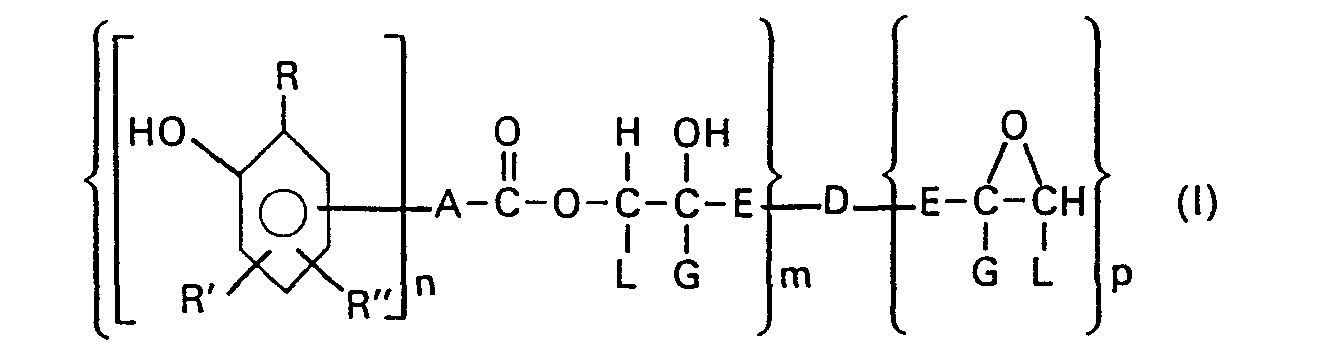
- R = C2 bis Ca Alkyl, vorzugsweise t-Butyl,
- R' und R" unabhängig voneinander H oder C1 bis C4 Alkyl bedeuten,
- n = 1 oder 2 sein soll, und
- A = eine chemische Bindung oder
- a) der Rest eines geradkettigen oder verzweigten, unsubstituierten oder phenylsubstituierten Alkans mit 1 bis 20 C-Atomen, oder
- β) der Rest eines unsubstituierten oder C1 bis C" alkylsubstituierten, cycloaliphatischen Alkans mit 5 bis 12 C-Atomen, oder
- y) ein unsubstituierter oder C1 bis C12 alkylsubstituierter Phenyl- oder Naphthylrest ist,
- E für eine CH2-Gruppe,
- G für ein H-Atom oder eine CH3-Gruppe und L für ein H-Atom steht, oder
- E und L zusammen mit den sie verbindenden C-Atomen einen Cycloalkylrest mit 5 bis 12 C-Atomen, der auch alkylsubstituiert sein kann, bilden und
- D = Sauerstoff oder ein Radikal der Formel


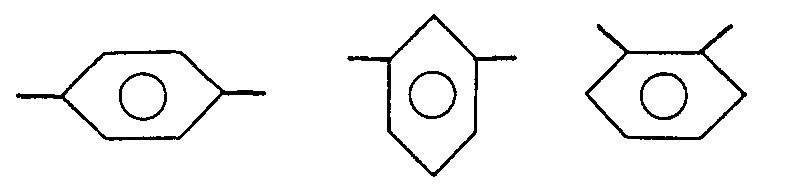



- m = 1,2 oder 3 und
- p = 0, oder 2 bedeutet, mit der Einschränkung, dass p+m entweder 2 oder 3 ist.
- Die Erfindung betrifft weiterhin die Verwendung der neuen Verbindungen als Stabilisatoren in synthetischen Polymeren.
- Die in der allgemeinen Formel (I) dargestellte phenolische Gruppierung entstammt einer Phenolcarbonsäure der Struktur

- Phenolcarbonsäuren mit n = 2 sind Bishydroxyphenylcarbonsäuren, die beispielsweise aus der DE-OS Nr. 2544014 bekannt sind. Geeignet sind z.B. 3,3-Bis-(3'-tert.-butyl-4'-hydroxyphenyl) butansäure, Bis-(3-tert.-butyl-4-hydroxyphenyl) essigsäure, 2,2-Bis-(3'-tert.-butyl-4'-hydroxyphenyl)cyclohexancarbonsäure-(1 ) oder auch 2,2-Bis-(3'-tert.-butyl-4'-hydroxyphenyl) cyclohexyl-1-propionsäure. Von dieser zu bevorzugenden Verbindungsklasse seien insbesondere Bis-(3-tert.-butyl-4-hydroxyphenyl)essigsäure, 3,3-Bis-(3'-tert.-butyl-4'-hydroxyphenyl) butansäure und 4,4-Bis-(3'-tert.-butyl-4'-hydroxyphenyl)pentansäure genannt.
- Die erfindungsgemässen Substanzen werden durch Umsetzen von Phenolcarbonsäuren mit Epoxidverbindungen erhalten. So addiert man z.B. 1 oder 2 mol Phenolcarbonsäure an Diglycidylether, Bis(glycidyloxymethyl)tricyclododecan, Alkylendioldiglycidylether, an αω-Bisglycidylalkylendiolglycerinpolyether, an Diglycidylester, an Di-ß-methylglycidylester von ggf. alkylverzweigten aliphatischen, cycloaliphatischen oder aromatischen Dicarbonsäuren, an α,ω-Bisglycidyldicarbonsäureglycerinpolyester, an Resorcin- bzw. Hydrochinondiglycidylether, an α,ω-Bisglycidylhydrochinonglycerinpolyether, an Bisphenol-F- bzw. Bisphenol-A-diglycidylether, an deren α,ω-Diglycidylglycerinpolyether, an N,N'-Bisglycidyl-N,N'-dimethylaminodiphenyl- methan oder an N,N'-Bisglycidylhydantoine.
- Man kann auch 1, 2 oder 3 mol Phenolcarbonsäure mit einem mol Glycerintriglycidylether oder Triglycidylisocyanurat oder 2,4,6-Trisepoxypropyltriazin oder mit Trimethylolpropantris- (2,3-epoxypropylhexahydrophthalat) zur Reaktion bringen, oder 1 oder 2 mol Phenolcarbonsäure an beispielsweise Bis-(2,3-epoxycyclopentyl)ether oder 3,4-Epoxycyclohexylmethyl-3,4-epoxy cyclohexancarboxylat oder Bis-(3,4-epoxy-6-methylcyclohexylmethyl)adipat oder auch an Bis-(3,4-epoxycyclohexylmethyl)adipat addieren.
- Bei der Umsetzung werden in der Regel die freien Phenolcarbonsäuren mit den Epoxidverbindungen bei 50 bis etwa 200, vorzugsweise bei 80 bis 130° C zur Reaktion gebracht. Sie kann sowohl ohne Lösungsmittel durchgeführt werden, als auch in Gegenwart von inerten aromatischen oder aliphatischen Lösungsmitteln wie Xylol, Toluol oder Diisobutylketon, analog einem in der DE-OS Nr. 2449847 beschriebenen Verfahren. Arbeitet man lösungsmittelfrei, so kann die Reaktion in Mischern, Knetern oder auf Walzen durchgeführt werden.
- Bevorzugt wird die Umsetzung von Phenolcarbonsäuren mit Di- und Polyepoxidverbindungen des Handels, deren Darstellung in der Literatur ausführlich beschrieben ist, beispielsweise in Houben-Weyl, 14/2 (1963), S. 462 ff., oder in «Praktikum der Makromolekularen Organischen Chemie», Hüthig-Verlag, Heidelberg, 1966, S. 218 ff.
- Derartige Polyepoxidverbindungen sind z.B. Polyglycidyl- bzw. Poly-ß-methylglycidylether von mehrwertigen Alkoholen wie Polyethylenglykolen, Polypropylenglykolen oder 2,2-Bis-(4'-hydroxycyclohexy)propan, von mehrwertigen Phenolen wie 2,2-Bis-(4'-hydroxyphenyl)-propan, Bis-(4-hydroxyphenyl)sulfon, 1,1,2,2-Tetrabis-(4-hydroxypehnyl)ethan, ferner Polyglycidyl- bzw. Poly-ß-methylglycidyl)ester von Polycarbonsäure, z.B. Phthalsäurediglycidylester, Isophthalsäurediglycidylester, Δ4-Tetrahydroph- thalsäurediglycidylester, Hexahydrophthalsäurediglycidylester, Glutarsäurediglycidylester, Adipinsäurediglycidylester, Sebazinsäurediglycidylester, alkylsubstituierte Dicarbonsäuredi- (ß- methylglycidyl)ester, wie sie z.B. in der DE-AS Nr. 1942836 beschrieben sind, Triglycidylisocyanurat, N,N'-Diglycidyl-5,5-dimethylhydantoin oder auch Epoxidverbindungen, die aus der Dehydrohalogenierung der Reaktionsprodukte aus Epihalogenhydrin bzw. ß-Methylepihalogenhydrin und primären oder sekundären Aminen wie Anilin oder 4,4'-Diaminodiphenylmethan erhalten werden; ferner, mehrere Epoxidgruppen enthaltende alicyclische Verbindungen wie Vinylcyclohexendiepoxid, Dicyclopentadiendiepoxid, Äthylen- glykolbis-(3,4-epoxytetrahydrodicyclo- pentadien-8-yl)ether, (3',4'-Epoxycyclohexylmethyl) -3,4-epoxycyclohexancarboxylat, (3',4'-Epoxy-6'-methylcyclohexylmethyl)-3,4-epoxy-6-methylcyclohexancarboxylat, Bis-(2,3-epoxy- cyclopentyl)ether, 3-(3',4'-Epoxycyclohexyl)-2,4-dioxaspiro-(5,5)-9,10-epoxyundecan, 3,4-Epoxyhexahydrobenzol-3', 4'-epoxy-1',1'- bis(oxymethyl)cyclohexan, Bis-(3,4-epoxy-6-methylcyclohexyl)adipat oder Bis-(3,4-epoxycyclohexylmethyl)adipat.
- Gewünschtenfalls kann man eine oder auch mehrere der aufgeführten Polyepoxidverbindungen einsetzen, gegebenenfalls auch im Gemisch mit sogenannten reaktiven Verdünnern wie z.B. Styroloxid, Butylglycidylether, Isooctylglycidylether, Phenylglycidylether, Kresylglycidether oder Glycidylestern von synthetischen hochverzweigten, in der Hauptsache tertiären aliphatischen Monocarbonsäuren.
- Es ist ferner möglich, die erhaltenen, noch Epoxidgruppen enthaltenden Additionsprodukte aus Polyepoxid und Phenolcarbonsäure nachträglich in ihrem Molekulargewicht zu steigern. Dies wird erreicht durch Reagierenlassen mit sog. Härtern. Als solche kommen basische oder saure Verbindungen in Frage, beispielsweise Amine oder Amide wie aliphatische, cycloaliphatische oder aromatische primäre, sekundäre und tertiäre Amine wie Ethanolamin, Ethylendiamin, Hexamethylendiamin, Trimethylhexamethylendiamin, Diethylentriamin, Triethylentetramin, Tetraethylenpentamin, 2,2,6,6-Tetramethyt-4-aminopiperidin, 2,2,6,6-Tetramethyl-4-hydroxypiperidin, N,N-Dimethylpropylendiamin-1,3, N,N-Diethylpropylendiamin-1,3, Bis- (4-amino-3-methylcyclohexyl)methan, 3,5,5-Trimethyl-3-(aminomethyl)cyclohexylamin («Isophorondiamin»), Mannichbasen wie 2,4,6-Tris(dimethylaminomethyl)phenol, m-Phenylendiamin, p-Phenylendiamin, Bis-(4-aminophenyl)methan, Bis-(4-aminophenyl)sulfon, m-Xylylendiamin, N-(2-aminoethyl)piperazin.
- Als saure Härter sind u.a. mehrbasische Carbonsäuren und ihre Anhydride zu nennen, z.B. Phthalsäureanhydrid, Δ4-Tetrahydrophthalsäureanhydrid, Hexahydrohthalsäureanhydrid, 4-Methylhexahydrophthalsäureanhydrid, 3,6-Endomethylen-Δ4-tetrahydrophthalsäureanhydrid, 4-Methyl-3,6-endomethylen-Δ4-tetrahydrophthalsäureanhydrid, 4-Methyl-3,6- endomethylen-Al-tetrahydrohthalsäureanhydrid (= Methylnadicanhydrid), 3,4,5,6,7,7-Hexachlor-3,6-endomethylen-04-tetrahydrophthalsäureanhydrid, Bernsteinsäureanhydrid, Adipinsäureanhydrid, Azelainsäureanhydrid, Sebacinsäureanhydrid, Maleinsäureanhydrid, Dodecylbernsteinsäureanhydrid, Pyromellitsäureanhydrid oder Gemische solcher Anhydride.
- Die Umsetzung mit den genannten Polycarbonsäureanhydriden lässt sich durch Zusatz basischer Verbindungen wie Alkalialkoholat, tert.-Amine, deren Salze oder quarternäre Amoniumverbindungen beschleunigen. Genannt seien z.B. Benzyldimethylanilin, 4-Aminopyridin, 4-(Dimethylamino)pyridin und insbesondere Alkalimethylat, -ethylat oder Isopropylat. Auch saure Verbindungen wie z.B. phosphorige- oder Phosphorsäure sind geeignet. Die Katalysatormengen liegen bei 0,001 bis 1 Gew.%, bezogen auf Epoxid.
- Ein nicht zu unterschätzender Vorteil der erfindungsgemässen Substanzklasse ist, dass die als Ausgangsprodukte dienenden Epoxidverbindungen grosstechnisch hergestellt werden, und auf dem Lacksektor, beispielsweise zur Lackierung von Konservendosen, verbreitet Anwendung finden. Im Verein mit den aus billigen Ausgangsstoffen in einfacher Weise gut zugänglichen Phenolcarbonsäuren und dem glatt verlaufenden erfindungsgemässen Herstellungsverfahren können die polymeren Stabilisatoren gemäss der Erfindung somit preisgünstig dargestellt werden.
- Neben der einfachen Darstellbarkeit aus gut zugänglichen Ausgangsprodukten ist bei den erfindungsgemässen Stabilisatoren noch die hohe Verfärbungsstabilität beim Einsatz in den Kunststoffen hervorzuheben. Dieses ist überraschend und war nicht vorhersehbar, insbesondere bei den Phenolcarbonsäureestern der Glycerinabkömmlinge. Wie aus der Chemie der Fette bekannt ist, neigen Glycerincarbonsäureester bei thermischer Belastung zur Bildung von verfärbten Zersetzungsprodukten. Um so erstaunlicher ist, dass die ähnlich gebauten erfindungsgemässen Verbindungen sogar noch ein besseres Farbverhalten als handelsübliche phenolische Antioxidantien aufweisen.
- Weiterhin ist die geringe Flüchtigkeit der erfindungsgemässen Stabilisatoren hervorzuheben. Während nämlich die eingangs erwähnten Polymerisate ethylenisch ungesättigter Verbindungen unter der starken thermischen Belastung bei der Kunststoffverarbeitung - wie bereits erwähnt - die Tendenz haben, in Monomeren zurückzuspalten, neigen die erfindungsgemässen Verbindungen unter diesen Bedingungen sogar noch zu einer Molekulargewichtserhöhung, da die im Oligomerisat noch vorhandenen Epoxidgruppen mit sich selbst aber gegebenenfalls auch mit zugesetzten Aminen, Carbonsäuren oder auch Carbonsäureanhydriden zu höhermolekularen Substanzen reagieren können. Dieses Verhalten ist deshalb besonders vorteilhaft, weil sich auf diese Weise präpolymere Antioxidantien mit einem zur homogenen Verteilung im Kunststoff noch optimalen, vergleichsweise niederen Molekulargewicht bei der Verarbeitung im Kunststoff homogen einarbeiten und verteilen lassen, und sie gleichzeitig unter dem Einfluss der hohen Verarbeitungstemperaturen zu höhermolekularen, migrationsfesten Stabilisatoren weiterreagieren können.
- Dieses günstige Verhalten der erfindungsgemässen Substanzen ist bei keinem der bisher beschriebenen Stabilisatorsysteme anzutreffen und stellt einen erheblichen Fortschritt gegenüber dem Stand der Technik dar.
- Die erfindungsgemässen Phenolgruppen enthaltenden Epoxidharze stellen vorzugsweise Präpolymere mit einem nicht allzu hohen Molekulargewicht, etwa in der Grössenordnung 1000 bis 10000, insbesondere 2000 bis 5000 dar. Man erhält sie durch Addition von 0,01 bis maximal 1 mol Phenolcarbonsäure an ein Epoxidäquivalent einer Polyepoxidverbindung, wobei die Reaktionsbedingungen so zu wählen sind, dass die Ausbildung vernetzter, hochpolymerer Reaktionsprodukte vermieden wird. Man erreicht dies beispielsweise durch Verdünnen der Reaktionskomponenten mit einem Lösungsmittel, durch eine niedrige Reaktionstemperatur von etwa 50 bis 110° C und vor allem durch rechtzeitigen Abbruch der Reaktion durch Temperaturabsenkung, sobald sich - etwa durch Trübung des Reaktionsansatzes - die Abscheidung von unlöslichen, vernetzten Hochpolymeren anzeigt.
- Die erfindungsgemässen Stabilisatoren zeichen sich durch ihre hohe Extraktionsfestigkeit aus. Eine hohe Extraktionsfestigkeit des Stabilisators im Kunststoff auch gegenüber öl- und fettähnlichen Substanzen ist deshalb von entscheidender Bedeutung, weil einerseits der beabsichtigte Oxidationschutz des Kunststoffs auch in Kontakt mit Ölen und Fetten erhalten bleibt und vor allem, weil darüber hinaus die äusserst unerwünschte Kontaminierung von gegebenenfalls in dem Kunststoff verpackten fett- und ölhaltigen Lebensmitteln mit den Stabilisatoren unterbleibt.
- Die Phenolgruppen enthaltenden Epoxidharze der Erfindung sind hervorragend zur Stabilisierung von synthetischen Polymerisaten und Copolymerisaten von C2- bis CQ-α-0lefinen, vorzugsweise von Polyolefinen wie Polybutadien, Polyisopren und insbesondere Polyethylen und Polypropylen geeignet, ferner für Polystyrol, Polyacrylate und Polymethacrylate, auch bei den durch Glasfasern, Asbest usw. verstärkten Typen. Sie kommen in Mengen von 0,001 bis 5,0, vorzugsweise 0,01 bis 1,0 Gewichtsteilen auf 100 Gewichtsteile Polymerisat, zum Einsatz. Bevorzugtes Anwendungsgebiet finden sie vor allem dort, wo der Kunststoff eluierend wirkenden Medien wie Öl, Fett, organischen Lösemitteln aber auch Wasser, Säuren und Laugen ausgesetzt ist.
- Beim Stabilisieren der Polymeren werden als Costabilisatoren gegebenenfalls noch übliche andere phenolische Antioxidantien zugesetzt. Aus der grossen Zahl der hierfür in Frage kommenden Produkte seien beispielsweise genannt: Ester der 3,5-Ditert.-butyl-4-hydroxyphenylpropionsäure oder der 3,3-Bis-(3'-tert.-butyl-4'-hydroxyphenyl)buttersäure. Als pH-Stabilisatorfinden Erdalkalisalze von langkettigen Carbonsäuren Verwendung, z.B. Ca-Stearat oder Ca-Montanat. In manchen Fällen erweist sich der Zusatz von Schwefel-Costabilisatoren vorteilhaft, z.B. von Lauryl- oder Stearylthiodipropionat oder Dioctadecylsulfid bzw. Dioctadecyldisulfid als vorteilhaft. Als phosphorhaltige Costabilisatoren sind beispielsweise Phosphite, Phosphinate und Phosphonate zu nennen, wie etwa Distearylpentaerythrityldiphosphit, Distearyl-ß-hydroxytriacontylsorbityltriphosphit, Tris-(2,4-ditertbutylphenyl)-phosphit, Diphenyl-4,4'-diphosphinsäuretetra- kis-(2,4-ditert.-butylphenyl)ester oder das Ca- bzw. Ni-Salz des 3,5-Ditert.-butyl-4-hydroxy- benzylphosphonsäureethylesters. Gelegentlich empfiehlt es sich, neben den genannten Costabilisatoren noch Lichtschutzmittel einzusetzen, von denen als Beispiel Oxybenzophenone, Benztriazole oder auch die Piperidinstabilisatoren, insbesondere die hochpolymeren Vertreter dieser Substanzklasse, genannt seien.
- Die nachfolgenden Beispiele sollen die Erfindung näher erläutern.
- Oligomere des Glycerinbis-(2-hydroxy-3-[3',3'-di-(3"-tert.-butyl-4"-hydroxyphenyl)-butyroxy] propyl) monoglycidyltriethers

- a) 5 g des erhaltenen Produktes werden bei 200° C 2 h getempert. Das Molekulargewicht erhöht sich durch diese Massnahme auf 2800, der Fp/Tp auf 115/120° C.
- b) 5 g des erhaltenen Produktes werden mit 0,5 g Tetrahydrophthalsäureanhydrid vermischt, aufgeschmolzen und 1 h bei 150° C getempert. Man erhält ein Produkt mit der Molmasse 3140, was einem Polymerisationsgrad von 2,6 entspricht. Der Fp/Tp hat sich auf 119/130° C erhöht.
- c) 5 g des Produktes werden mit 0,5 g Terephthalsäure 2 h, wie vorstehend angegeben, bei 200° C getempert. Das Produkt ist in allen Lösemitteln unlöslich und unschmelzbar.
- Oligomere des Glycerinmono-(2-hydroxy-3-[3',3'-di-(3"-tert.-butyl-4"-hydroxyphenyl)-butyroxy] propyl) bisglycidyltriethers

- Im Dünnschichtchromatogramm ist dann keine Phenolcarbonsäure mehr nachweisbar. Der Reaktionsansatz wird mit 0,5 ml Eisessig neutralisiert und das Lösungsmittel abdestilliert. Man erhält ein leicht gelblich verfärbtes, glasiges Harz, dessen Molekulargewicht bei 2240 liegt. 15- bis 30minutiges Tempern bei 200° C/Vakuum erhöht das Molekulargewicht auf 2410 bzw. 2510, was einem Polymerisationsgrad von etwa 3 bis 4 entspricht.
- Oligomere des Glycerinbis-(2-hydroxy-3-[4',4'-di-(3"-tert.-butyl-4"-hydroxyphenyl)pentan- oxyloxy]propyl)glycidylethers

- Analog zu Beispiel 1 werden 5 g (1 /60 mol) Trisglycidylglycerinether, 13,3 g (2/60 mol) 4,4-Bis-(3'-tert.-butyl-4'-hydroxyphenyl) pentansäure (hergestellt aus Lävulinsäure und o-tert.-butylphenol analog einer in DE-OS Nr. 2544014 beschriebenen Methode) in 50 ml Xylol in Gegenwart von 0,05 g KOH 5 h unter Rückfluss gekocht. Laut Dünnschichtchromatogramm ist nach dieser Zeit die Phenolcarbonsäure abreagiert. Nach dem Abziehen des Lösemittels verbleibt als Rückstand ein farbloses, glasartiges Harz mit einem Molekulargewicht von 1830, was einem Polymerisationsgrad von ca. 1,7 entspricht.
- Oligomere von Terephthalsäuremonoglycidyl- mono-(2-hydroxy-3-[3',3'-di-(3"-tert.-.butyl-4"-hydroxyphenyl) butyroxy] propylester

- Tempert man 7,3 g dieses Produktes mit 0,55 g Tetrahydrophthalsäureanhydrid 1 h bei 150° C, so erhält man einen Stoff mit dem Molgewicht 1540, was einem Polymerisationsgrad von 2,3 entspricht. Der Fp/Tp liegt bei 119/136° C.
- Terephthalsäure-(2-hydroxy-3-[3',3'-di-(3"- tert. - buty) -4" - hydroxyphenyl) butyroxy] propyl - diester

- Oligomere von Bisphenol-A/Bisphenol-F-mo- noglycidylmono-(2-hydroxy-3-[3',3'-di-(3"- tert.-butyl-4"-hydroxyphenyl)butyroxy]propyl-ether ether OH

- 18,3 g (0,05 mol) eines handelsüblichen Gemisches aus ca. 70% Bisphenol-A-diglycidylether und 30% Bisphenol-F-diglycidylether [2,2-(4,4'-Dihydroxydiphenyl)dimethylmethan bzw. -methan] in 200 ml Dimethylformamid werden im Laufe von 2 h zu einer auf 130° C erwärmten Lösung von 19,2 g (0,05 mol) 3,3-Bis-(3'-tert.-butyl-4'-hydroxyphenyl)butansäure und 0,05 g KOH in 50 ml Dimethylformamid getropft. Man rührt 4 h nach, versetzt dann mit weiteren 2 g Bisphenol-A/F-diglycidylether und destilliert nach 2 h das Lösungsmittel im Vakuum ab.
- Man erhält ein Harz mit dem Fp/Tp von 107/ 118° C. Die Bestimmung der Molmasse ergibt einen Wert von 1965, was einem Oligomerisationsgrad von 2,6 entspricht.
-

- 73,3 g (0,15 Epoxyäquivalent) eines käuflichen α,ω-Diglycidylethers von trimerem Bisphenol-A-(ß-hydroxypropandiol)ethers in 200 ml Dimethylformamid werden unter N2-Überlagerung im Laufe von 2 h zu einer auf 140° C erwärmten Lösung von 19,2 g (0,05 mol) 3,3-Bis-(3'-tert.-butyl-4'-hydroxyphenyl)butansäure und einer Spur KOH in 50 ml Dimethylformamid getropft.
- Dann wird 6 h bei 150°C nachgerührt. Nach dem Abdestillieren des Lösungsmittels verbleibt ein leicht gelblich gefärbtes Harz mit einem Fp/Tp 148/153° C. Die Bestimmung der Molekulargewichts ergab einen Wert von 5505, was einem Oligomerisationsgrad von etwa 5 entspricht.
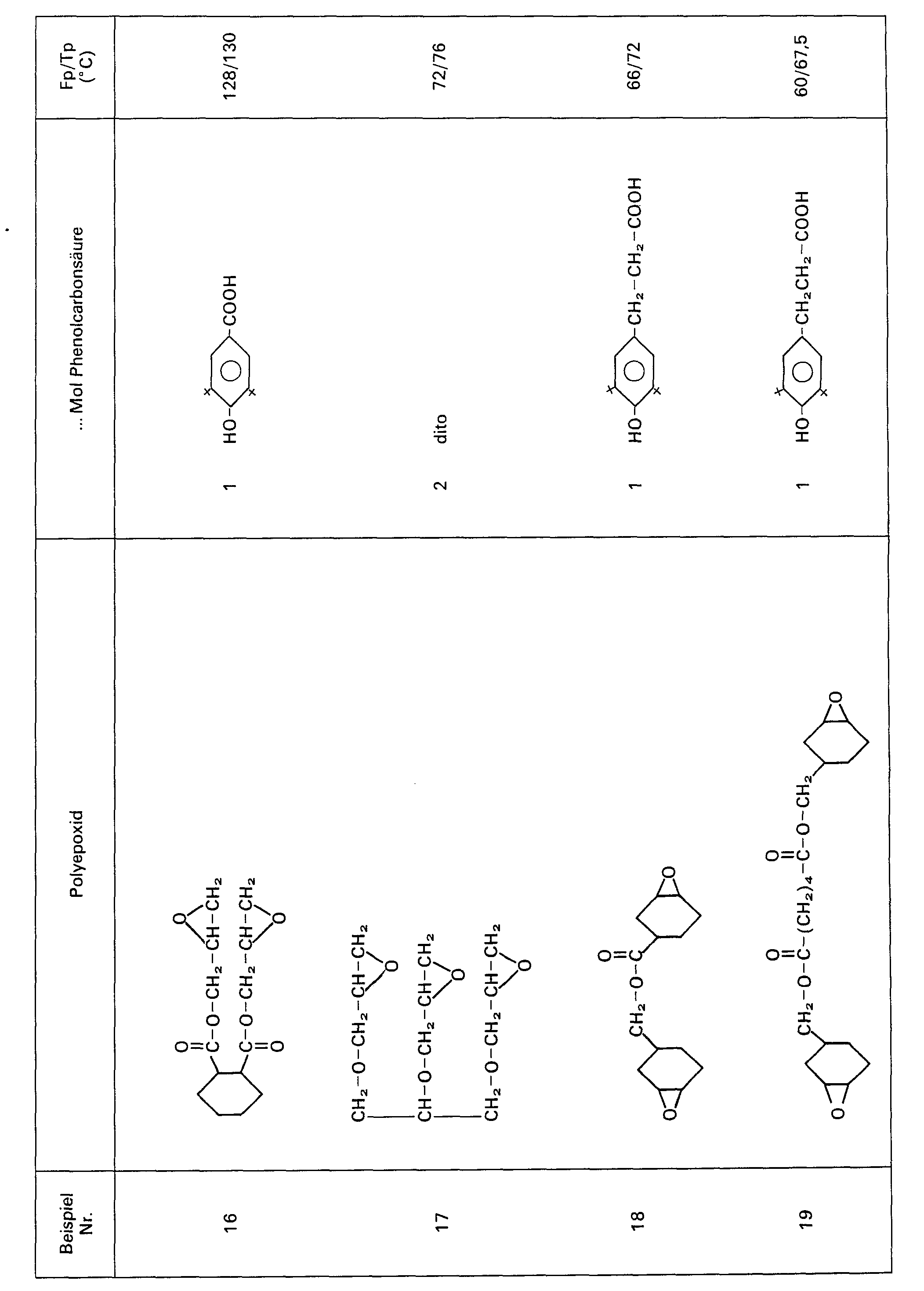
- Analog der in Beispiel 1 angegebenen Vorschrift wurden weitere Polyepoxide mit der 3,3-Bis-(3'-tert.-butyl-4'-hydroxyphenyl)butansäure (BBB) im angegebenen Molverhältnis miteinander umgesetzt.




- Dieses Beispiel soll die Schwerflüchtigkeit und Verfärbungsstabilität der erfindungsgemässen Substanzen aufzeigen.
- Zur Prüfung dieser Eigenschaften werden etwa 1 g Substanz in ein Wägegläschen eingewogen und anschliessend in einem Wärmeschrank bei 200° C 2 h an der Luft stehengelassen. In nachstehender Tabelle ist der ermittelte Gewichtsverlust in Prozent angegeben.

- Die Produkte sind durchwegs nur leicht nach gelb verfärbt, entsprechend einer Jodfarbzahl (nach DIN 6162) zwischen 5 und 12.
- Dieses Beispiel zeigt die Wirksamkeit erfindungsgemässer Antioxidantien in einem Polypropylenwachs vom Molekulargewicht 2000 und einer Schmelzviskosität (gemessen bei 170°C) von 1550 mPas bei dessen thermischer Belastung. Zu 100 g Wachs werden jeweils 0,5 g der erfindungsgemässen Stabilisatoren gegeben, worauf die Mischung in einem 250-ml-Dreihalskolben bei einer Innentemperatur von 150° C unter gleichzeitigem Durchleiten eines trockenen Luftstromes von 75 ml/min und Rühren mit einem Schleifenrührer mit einer Geschwindigkeit von 200 UpM 5 h gerührt wird. Dann wird der Versuch abgebrochen. Mit Hilfe eines Rotationsviskosimeters wird sodann bei 170° C die Schmelzviskosität der Proben bestimmt.
- Die nachstehende Tabelle enthält die ermittelten Werte.

- +)3,3-Bis-(3'-tert.-butyl-4'-hydroxyphenyl)-butansäureethandioldiester
- Aus der Tabelle geht hervor, dass die erfindungsgemässen Stabilisatoren den durch Wärme-und Sauerstoffeinwirkung bedingten Viskositätsabbau eindrucksvoll verzögern und in dieser Hinsicht mit handelsüblichen, niedermolekularen Phenolstabilisatoren vergleichbar sind.
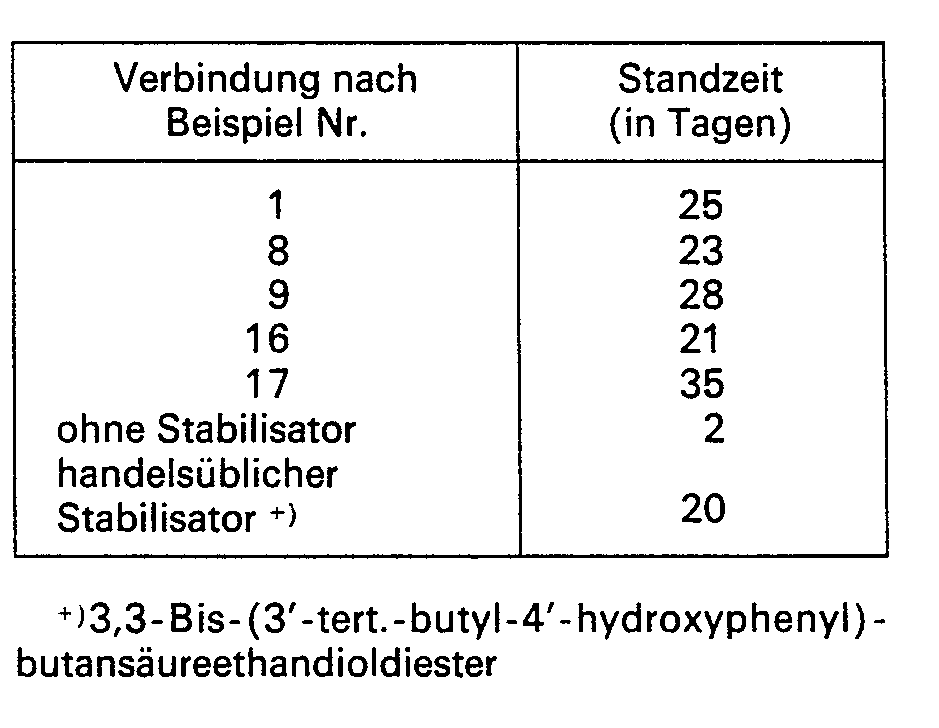
- In diesem Beispiel soll die antioxidative Wirksamkeit der erfindungsgemässen Stabilisatoren aufgezeigt werden.
- Auf der Zweiwalze wird eine Mischung aus
- 100 Gew.-Teilen unstabilisiertem Polypropylenpulver der Dichte 0,90 (Schmelzindex is ca. 6 g/10 min, bestimmt in Anlehnung an ASTM D 1238-62 T),
- 0,2 Gew.-Teilen Calciumstearat und
- 0,3 Gew.-Teilen Stabilisator
- Wie aus der Tabelle zu entnehmen ist, sind die erfindungsgemässen Substanzen hervorragend zur Stabilisierung von Polyolefinen geeignet.
bei 200° C 5 min lang homogenisiert. Die Kunststoffschmelze wird sodann bei 200° C zu einer Platte von 1 mm Dicke gepresst. Aus der Kunststoffplatte werden streifenförmige Prüfkörper (100x10x1 mm) gestanzt. Diese werden zur Bestimmung der Wärmealterungsbeständigkeit in einem Umluft-Trockenschrank in ein motorgetriebenes Gestell mit rotierenden Horden eingehängt und bei einer gleichmässigen Frischluftzufuhr einer Temperaturbelastung von 140° C unterworfen. Die Zeit, nach der an einigen Stellen eine beginnende lokale Versprödung eintritt, nach DIN 53383 gekennzeichnet durch die Bildung verfärbter, trüber, teilweise abbröckelnder Stellen, wird festgehalten. Die Prüfergebnisse sind in nachstehender Tabelle zusammengefasst.
Claims (3)





Applications Claiming Priority (2)
| Application Number | Priority Date | Filing Date | Title |
|---|---|---|---|
| DE2916877 | 1979-04-26 | ||
| DE19792916877 DE2916877A1 (de) | 1979-04-26 | 1979-04-26 | Phenolgruppen enthaltende epoxidharze, ihre herstellung und verwendung |
Publications (2)
| Publication Number | Publication Date |
|---|---|
| EP0019103A1 EP0019103A1 (de) | 1980-11-26 |
| EP0019103B1 true EP0019103B1 (de) | 1982-12-22 |
Family
ID=6069302
Family Applications (1)
| Application Number | Title | Priority Date | Filing Date |
|---|---|---|---|
| EP80102149A Expired EP0019103B1 (de) | 1979-04-26 | 1980-04-22 | Phenolgruppen enthaltende Epoxidharze, ihre Verwendung und sie enthaltende Kunststoffmassen |
Country Status (5)
| Country | Link |
|---|---|
| US (1) | US4308195A (de) |
| EP (1) | EP0019103B1 (de) |
| JP (1) | JPS55145723A (de) |
| DE (2) | DE2916877A1 (de) |
| ZA (1) | ZA802531B (de) |
Families Citing this family (11)
| Publication number | Priority date | Publication date | Assignee | Title |
|---|---|---|---|---|
| WO1982002206A1 (fr) * | 1980-12-29 | 1982-07-08 | Voegeli Marcel | Procede de preparation de pieces faconnees en polyolefines |
| US4496757A (en) * | 1981-11-05 | 1985-01-29 | Ciba-Geigy Corporation | Ultraviolet-absorbing stabilizers substituted an aliphatic hydroxyl group |
| US4559379A (en) * | 1983-09-14 | 1985-12-17 | Ciba Geigy Corporation | 4-Hydroxyphenylthio substituted stabilizers for polymers |
| EP0157740B1 (de) * | 1984-04-04 | 1990-06-27 | Ciba-Geigy Ag | Glycidyloxydiketone |
| US4569959A (en) * | 1985-01-17 | 1986-02-11 | Mallinckrodt, Inc. | Isocyanurate esters of thioamidophenols and polyolefin polymeric compositions stabilized therewith |
| US4879328A (en) * | 1987-05-18 | 1989-11-07 | Toray Industries | Aromatic polyester composition and process for producing the same |
| US5213897A (en) * | 1991-04-03 | 1993-05-25 | Elf Atochem North America, Inc. | Epoxy resins containing bound light stabilizing groups |
| US5237076A (en) * | 1992-08-28 | 1993-08-17 | The Aerospace Corporation | Preparation of liquid crystalline di(alkoxyglycidyl) compounds, and their use in curable epoxide mixtures |
| JPH093156A (ja) * | 1995-06-15 | 1997-01-07 | Yuka Shell Epoxy Kk | 変性エポキシ樹脂、その製造法及び塗料用組成物 |
| EP0748830A3 (de) * | 1995-06-15 | 1997-07-02 | Shell Int Research | Modifizierte Epoxidharze |
| US6818293B1 (en) * | 2003-04-24 | 2004-11-16 | Eastman Chemical Company | Stabilized polyester fibers and films |
Family Cites Families (4)
| Publication number | Priority date | Publication date | Assignee | Title |
|---|---|---|---|---|
| US3496128A (en) * | 1959-02-05 | 1970-02-17 | Avisun Corp | Stabilization of polypropylene |
| DE1745035C2 (de) * | 1967-02-14 | 1982-10-28 | Alfred 5047 Wesseling Krüger | Verfahren zur Herstellung von Epoxidpolyaddukten |
| NL7103380A (de) | 1971-03-13 | 1972-09-15 | ||
| JPS53109600A (en) * | 1977-03-07 | 1978-09-25 | Ueno Seiyaku Oyo Kenkyujo Kk | Manufacture of eposy resin |
-
1979
- 1979-04-26 DE DE19792916877 patent/DE2916877A1/de not_active Withdrawn
-
1980
- 1980-04-22 DE DE8080102149T patent/DE3061406D1/de not_active Expired
- 1980-04-22 EP EP80102149A patent/EP0019103B1/de not_active Expired
- 1980-04-23 US US06/143,089 patent/US4308195A/en not_active Expired - Lifetime
- 1980-04-24 JP JP5368180A patent/JPS55145723A/ja active Pending
- 1980-04-25 ZA ZA00802531A patent/ZA802531B/xx unknown
Also Published As
| Publication number | Publication date |
|---|---|
| DE2916877A1 (de) | 1980-11-06 |
| DE3061406D1 (en) | 1983-01-27 |
| EP0019103A1 (de) | 1980-11-26 |
| JPS55145723A (en) | 1980-11-13 |
| ZA802531B (en) | 1981-05-27 |
| US4308195A (en) | 1981-12-29 |
Similar Documents
| Publication | Publication Date | Title |
|---|---|---|
| DE60108271T2 (de) | Mittel zur flammschutzausrüstung | |
| DE3850143T2 (de) | Antioxydante aromatische Fluorophosphite. | |
| EP0019103B1 (de) | Phenolgruppen enthaltende Epoxidharze, ihre Verwendung und sie enthaltende Kunststoffmassen | |
| DE1812972A1 (de) | Verfahren zur Herstellung von Phenylhydroxyaethern | |
| DE2837027A1 (de) | Neue phosphorigsaeureester und ihre verwendung zur stabilisierung von polyamiden | |
| DE2448168B2 (de) | Härtbare Epoxyharz-Zusammensetznng und Verfahren zu ihrer Herstellung | |
| DE2709419A1 (de) | Farbstabilisierte halogenbisphenolaethylen-polycarbonate | |
| US4122064A (en) | Novel organo-tin compounds and their use as stabilizers | |
| DE3118797A1 (de) | Polyester und verfahren zu seiner herstellung | |
| DE1942836A1 (de) | Neue Diglycidylester von aliphatischen Dicarbonsaeuren,Verfahren zu ihrer Herstellung und ihrer Anwendung | |
| US3560434A (en) | Enhancement of resistance of olefin polymers to copper-catalyzed oxidative degradation | |
| EP0412936B1 (de) | Phosphorverbindungen | |
| US4309335A (en) | Polyphenylene oxide resin composition stabilizer | |
| US3998782A (en) | Stabilizer composition for polyvinyl chloride polymers | |
| US4118352A (en) | Organic phosphites, process for their manufacture and their use as stabilizers | |
| US3396130A (en) | Organic triphosphites and synthetic resin compositions containing the same | |
| EP0004331B1 (de) | Mit Phenolcarbonsäuren veresterte Glyzerinphosphite, ihre Herstellung und Verwendung als Stabilisatoren für Kunststoffe | |
| EP0254683A2 (de) | Flammhemmende Zusammensetzungen | |
| EP0271649B1 (de) | Ester von 3-tert.-Butyl- bzw. 3-tert.-Butyl-5-alkyl-4-hydroxylphenyl-(alkan)-carbonsäuren mit Oxethylaten von Bis-(4- bzw. 2-hydroxyphenyl)-alkanen, -oxiden, -sulfiden und -sulfonen, von Tris-(4-hydroxyphenyl)-alkanen und von 1,3,5-Tris-(4-hydroxyphenyl-isopropyliden)-arylen, Verfahren zu ihrer Herstellung und ihre Verwendung als Stabilisatoren | |
| US3662032A (en) | Hydroxy containing aromatic phosphites | |
| JPS5920342A (ja) | 塩化ビニル樹脂組成物 | |
| CH508675A (de) | Masse aus Homo- oder Copolymerisaten von Olefinen und Vinylchlorid mit verbesserter Beständigkeit gegen Verschlechterung beim Erhitzen | |
| EP0794205A1 (de) | Lagerstabile, phosphormodifizierte Epoxidharze | |
| DE2165892A1 (de) | Polycarbonat-Zusammensetzung | |
| DE2944155A1 (de) | Thermisch stabile polycarbonat-zusammensetzungen |
Legal Events
| Date | Code | Title | Description |
|---|---|---|---|
| PUAI | Public reference made under article 153(3) epc to a published international application that has entered the european phase |
Free format text: ORIGINAL CODE: 0009012 |
|
| AK | Designated contracting states |
Designated state(s): BE CH DE FR GB NL |
|
| 17P | Request for examination filed |
Effective date: 19810225 |
|
| GRAA | (expected) grant |
Free format text: ORIGINAL CODE: 0009210 |
|
| AK | Designated contracting states |
Designated state(s): BE CH DE FR GB LI NL |
|
| REF | Corresponds to: |
Ref document number: 3061406 Country of ref document: DE Date of ref document: 19830127 |
|
| ET | Fr: translation filed | ||
| PGFP | Annual fee paid to national office [announced via postgrant information from national office to epo] |
Ref country code: NL Payment date: 19840322 Year of fee payment: 5 Ref country code: CH Payment date: 19840322 Year of fee payment: 5 |
|
| PGFP | Annual fee paid to national office [announced via postgrant information from national office to epo] |
Ref country code: BE Payment date: 19840331 Year of fee payment: 5 |
|
| PGFP | Annual fee paid to national office [announced via postgrant information from national office to epo] |
Ref country code: FR Payment date: 19840411 Year of fee payment: 5 |
|
| PGFP | Annual fee paid to national office [announced via postgrant information from national office to epo] |
Ref country code: DE Payment date: 19840510 Year of fee payment: 5 |
|
| PG25 | Lapsed in a contracting state [announced via postgrant information from national office to epo] |
Ref country code: LI Effective date: 19850430 Ref country code: CH Effective date: 19850430 Ref country code: BE Effective date: 19850430 |
|
| BERE | Be: lapsed |
Owner name: HOECHST A.G. Effective date: 19850422 |
|
| PG25 | Lapsed in a contracting state [announced via postgrant information from national office to epo] |
Ref country code: NL Effective date: 19851101 |
|
| GBPC | Gb: european patent ceased through non-payment of renewal fee | ||
| NLV4 | Nl: lapsed or anulled due to non-payment of the annual fee | ||
| PG25 | Lapsed in a contracting state [announced via postgrant information from national office to epo] |
Ref country code: FR Free format text: LAPSE BECAUSE OF NON-PAYMENT OF DUE FEES Effective date: 19851230 |
|
| REG | Reference to a national code |
Ref country code: CH Ref legal event code: PL |
|
| PG25 | Lapsed in a contracting state [announced via postgrant information from national office to epo] |
Ref country code: DE Effective date: 19860101 |
|
| REG | Reference to a national code |
Ref country code: FR Ref legal event code: ST |
|
| PG25 | Lapsed in a contracting state [announced via postgrant information from national office to epo] |
Ref country code: GB Effective date: 19881118 |
|
| PLBE | No opposition filed within time limit |
Free format text: ORIGINAL CODE: 0009261 |
|
| STAA | Information on the status of an ep patent application or granted ep patent |
Free format text: STATUS: NO OPPOSITION FILED WITHIN TIME LIMIT |