EP0002423B1 - Procédé et machine pour le lavage et le blanchiment de matières textiles - Google Patents
Procédé et machine pour le lavage et le blanchiment de matières textiles Download PDFInfo
- Publication number
- EP0002423B1 EP0002423B1 EP78810028A EP78810028A EP0002423B1 EP 0002423 B1 EP0002423 B1 EP 0002423B1 EP 78810028 A EP78810028 A EP 78810028A EP 78810028 A EP78810028 A EP 78810028A EP 0002423 B1 EP0002423 B1 EP 0002423B1
- Authority
- EP
- European Patent Office
- Prior art keywords
- solution
- bleaching
- process according
- catholyte
- wash bath
- Prior art date
- Legal status (The legal status is an assumption and is not a legal conclusion. Google has not performed a legal analysis and makes no representation as to the accuracy of the status listed.)
- Expired
Links
Images

Classifications
-
- D—TEXTILES; PAPER
- D06—TREATMENT OF TEXTILES OR THE LIKE; LAUNDERING; FLEXIBLE MATERIALS NOT OTHERWISE PROVIDED FOR
- D06F—LAUNDERING, DRYING, IRONING, PRESSING OR FOLDING TEXTILE ARTICLES
- D06F35/00—Washing machines, apparatus, or methods not otherwise provided for
- D06F35/003—Washing machines, apparatus, or methods not otherwise provided for using electrochemical cells
-
- C—CHEMISTRY; METALLURGY
- C02—TREATMENT OF WATER, WASTE WATER, SEWAGE, OR SLUDGE
- C02F—TREATMENT OF WATER, WASTE WATER, SEWAGE, OR SLUDGE
- C02F1/00—Treatment of water, waste water, or sewage
- C02F1/46—Treatment of water, waste water, or sewage by electrochemical methods
- C02F1/461—Treatment of water, waste water, or sewage by electrochemical methods by electrolysis
- C02F1/467—Treatment of water, waste water, or sewage by electrochemical methods by electrolysis by electrochemical disinfection; by electrooxydation or by electroreduction
- C02F1/4672—Treatment of water, waste water, or sewage by electrochemical methods by electrolysis by electrochemical disinfection; by electrooxydation or by electroreduction by electrooxydation
-
- C—CHEMISTRY; METALLURGY
- C25—ELECTROLYTIC OR ELECTROPHORETIC PROCESSES; APPARATUS THEREFOR
- C25B—ELECTROLYTIC OR ELECTROPHORETIC PROCESSES FOR THE PRODUCTION OF COMPOUNDS OR NON-METALS; APPARATUS THEREFOR
- C25B1/00—Electrolytic production of inorganic compounds or non-metals
- C25B1/01—Products
- C25B1/28—Per-compounds
- C25B1/30—Peroxides
-
- D—TEXTILES; PAPER
- D06—TREATMENT OF TEXTILES OR THE LIKE; LAUNDERING; FLEXIBLE MATERIALS NOT OTHERWISE PROVIDED FOR
- D06F—LAUNDERING, DRYING, IRONING, PRESSING OR FOLDING TEXTILE ARTICLES
- D06F35/00—Washing machines, apparatus, or methods not otherwise provided for
- D06F35/004—Washing machines, apparatus, or methods not otherwise provided for using chlorine generators
-
- C—CHEMISTRY; METALLURGY
- C02—TREATMENT OF WATER, WASTE WATER, SEWAGE, OR SLUDGE
- C02F—TREATMENT OF WATER, WASTE WATER, SEWAGE, OR SLUDGE
- C02F1/00—Treatment of water, waste water, or sewage
- C02F1/72—Treatment of water, waste water, or sewage by oxidation
- C02F1/722—Oxidation by peroxides
-
- C—CHEMISTRY; METALLURGY
- C02—TREATMENT OF WATER, WASTE WATER, SEWAGE, OR SLUDGE
- C02F—TREATMENT OF WATER, WASTE WATER, SEWAGE, OR SLUDGE
- C02F1/00—Treatment of water, waste water, or sewage
- C02F1/46—Treatment of water, waste water, or sewage by electrochemical methods
- C02F1/461—Treatment of water, waste water, or sewage by electrochemical methods by electrolysis
- C02F1/46104—Devices therefor; Their operating or servicing
- C02F1/46109—Electrodes
- C02F2001/46133—Electrodes characterised by the material
-
- C—CHEMISTRY; METALLURGY
- C02—TREATMENT OF WATER, WASTE WATER, SEWAGE, OR SLUDGE
- C02F—TREATMENT OF WATER, WASTE WATER, SEWAGE, OR SLUDGE
- C02F1/00—Treatment of water, waste water, or sewage
- C02F1/46—Treatment of water, waste water, or sewage by electrochemical methods
- C02F1/461—Treatment of water, waste water, or sewage by electrochemical methods by electrolysis
- C02F1/46104—Devices therefor; Their operating or servicing
- C02F1/46109—Electrodes
- C02F2001/46152—Electrodes characterised by the shape or form
- C02F2001/46157—Perforated or foraminous electrodes
- C02F2001/46161—Porous electrodes
- C02F2001/46166—Gas diffusion electrodes
-
- C—CHEMISTRY; METALLURGY
- C02—TREATMENT OF WATER, WASTE WATER, SEWAGE, OR SLUDGE
- C02F—TREATMENT OF WATER, WASTE WATER, SEWAGE, OR SLUDGE
- C02F2201/00—Apparatus for treatment of water, waste water or sewage
- C02F2201/46—Apparatus for electrochemical processes
- C02F2201/461—Electrolysis apparatus
- C02F2201/46105—Details relating to the electrolytic devices
- C02F2201/46115—Electrolytic cell with membranes or diaphragms
-
- C—CHEMISTRY; METALLURGY
- C02—TREATMENT OF WATER, WASTE WATER, SEWAGE, OR SLUDGE
- C02F—TREATMENT OF WATER, WASTE WATER, SEWAGE, OR SLUDGE
- C02F2201/00—Apparatus for treatment of water, waste water or sewage
- C02F2201/46—Apparatus for electrochemical processes
- C02F2201/461—Electrolysis apparatus
- C02F2201/46105—Details relating to the electrolytic devices
- C02F2201/4618—Supplying or removing reactants or electrolyte
- C02F2201/46185—Recycling the cathodic or anodic feed
-
- D—TEXTILES; PAPER
- D06—TREATMENT OF TEXTILES OR THE LIKE; LAUNDERING; FLEXIBLE MATERIALS NOT OTHERWISE PROVIDED FOR
- D06F—LAUNDERING, DRYING, IRONING, PRESSING OR FOLDING TEXTILE ARTICLES
- D06F34/00—Details of control systems for washing machines, washer-dryers or laundry dryers
- D06F34/28—Arrangements for programme selection, e.g. control panels therefor; Arrangements for indicating programme parameters, e.g. the selected programme or its progress
- D06F34/30—Arrangements for programme selection, e.g. control panels therefor; Arrangements for indicating programme parameters, e.g. the selected programme or its progress characterised by mechanical features, e.g. buttons or rotary dials
Definitions
- the present invention relates to a method and a machine for washing and bleaching textile materials.
- the detergent compositions provided with bleaching agents which are the most marketed at the present time are solid compositions (which are essentially in powder form), in which the bleaching agent is most often constituted by perborate of sodium tetrahydrate. It is generally accepted that sodium perborate constitutes a very effective bleaching agent, provided however that the washing bath is brought to temperatures close to the boiling temperature. The whitening action of perborate remains relatively weak at the lowest washing temperatures (below 60 to 78 ° C), which is a particularly important drawback in the current context of energy savings. Attempts are being made at present to add perborate decomposition activators to these solid detergent compositions, in order to allow washing and bleaching at lower temperatures.
- perborate as a bleaching agent in detergent compositions leads to a number of other drawbacks, most of which are linked to its often excessive content (generally greater than 15 to 20% by weight). Too high a content of perborate is indeed likely to cause a deterioration of the textile fibers (in particular of the cellulose fibers), as well as an attenuation of the nuances of certain colors (certain dyes being in effect strongly sensitive to an excess of oxidant) .
- the object of the present invention is precisely to overcome the above-mentioned drawbacks, by proposing a process for washing and bleaching textile materials based on the use as a bleaching agent of a particularly active form of hydrogen peroxide, which can be incorporated at the desired time. in the washing process and produced "in situ" immediately before use.
- the subject of the present invention is a process for washing and bleaching textile materials by means of an aqueous detergent bath containing a detergent composition substantially devoid of bleaching agent, characterized in that said bleaching is obtained by incorporation into said detergent bath, at the desired time, of a freshly prepared aqueous alkaline solution containing hydrogenoperoxide ions, said oxidizing alkaline aqueous solution being produced, immediately before its incorporation into said detergent bath, by electro-reduction of oxygen.
- the present invention also relates to a machine for washing and bleaching textile materials, of the type including those comprising in particular an enclosure intended to contain said textile materials to be treated, means for supplying water to said enclosure, means for introducing a detergent composition into said enclosure, means for forming an aqueous detergent bath within said enclosure by mixing said detergent composition with water and means for agitating relatively relative to each other said detergent bath aqueous and said textile materials to be treated, characterized in that said machine further comprises an electrochemical reactor intended to ensure the production of an aqueous alkaline oxidizing solution containing hydrogenoperoxide ions, and means for introducing, at the desired time of the washing, said aqueous alkaline oxidizing solution within said aqueous detergent bath.
- textile materials is a general expression intended to encompass materials such as fabrics, threads or other fibrous or filamentary materials, these materials possibly being made up of natural organic, artificial or synthetic materials.
- the simplified detergent compositions capable of being used in the present invention can consist of all the detergent compositions, known or to come, which are substantially devoid of bleaching agent.
- Such compositions generally consist, as is well known, of basic constituents as well as more or less optional adjuvants.
- These fundamental constituents essentially comprise a surfactant or detergent base (capable of being constituted by a mixture of different anionic and / or nonionic and / or amphoteric surfactants, etc.) as well as a detergency aid or "builder” (usually sodium tripolyphosphate), while more or less optional adjuvants usually include substances such as corrosion inhibitors (e.g. sodium silicate), fillers (e.g. sodium sulfate), anti-redeposition agents, foam regulating agents, enzymes, optical brighteners, perfumes, etc.
- corrosion inhibitors e.g. sodium silicate
- fillers e.g. sodium sulfate
- anti-redeposition agents e.g. sodium sul
- the simplified detergent compositions which can be used in the present invention can moreover be in any physical form usually encountered in this kind of application: powder, granulate, gel, paste, solution, emulsion, suspension, etc.
- the main thing is that, by mixing a correctly dosed quantity of this simplified detergent composition with water, an aqueous detergent bath having the required detergency characteristics, with a view to bringing the textile materials to be treated with this detergent bath.
- the textile materials to be washed and bleached being brought into intimate contact with the detergent bath prepared from the simplified detergent composition, it is then possible, at any time desired, to incorporate into this detergent bath the bleaching solution produced electrochemically.
- the electrochemical production of this alkaline aqueous solution containing hydrogenoperoxide ions is essentially obtained by electroreduction of oxygen in the presence of a initial alkaline solution in an electrochemical reactor comprising at least one cathode compartment equipped with a porous cathode and at least one anode compartment equipped with an anode chemically inert with respect to the medium.
- the initial alkaline solution having been introduced into the cathode compartment of the electrochemical reactor, a pressurized gas containing oxygen is then circulated inside the porous cathode and an electric current is passed through the reactor, so as to cause contact with the active surface of the cathode to form hydrogenoperoxide ions (as well as hydroxyl ions) by reduction of oxygen.
- a progressive concentration of the catholyte in hydrogenoperoxide ions and in hydroxyl ions is then observed as the electrolysis continues.
- the electrolysis is stopped when the concentrations of hydrogenoperoxide ions and hydroxyl ions of the catholyte reach desired values.
- the catholyte can then be evacuated to the outside of the cathode compartment, with a view to incorporating it into the detergent bath at the desired time of the washing process.
- Obtaining the desired concentrations of hydrogenoperoxide ions and hydroxyl ions for the bleaching solution is essentially made possible by the judicious use as a catholyte of an initial alkaline solution that is weakly concentrated (initial concentration of the catholyte chosen lower than the desired concentration in hydroxyl ions for the bleaching solution), as well as thanks to the choice of conditions under which the electrochemical reduction takes place, the implementation thereof resulting in a progressive concentration of the catholyte in hydrogenoperoxide ions and in hydroxyl ions, which is evacuated to outside when it has reached the desired concentrations for the bleaching solution.
- the parameters governing the electrochemical process (initial concentration of the alkaline solution, quantity of electricity passing through the reactor, dimensioning of the reactor, etc.) will be adjusted so that the solution discharged from the electrochemical reactor has respectively a concentration of total hydrogen peroxide (i.e. hydrogenoperoxide ions HO-2 + hydrogen peroxide H 2 0 2 ) between 0.1 and 10 grams / liters of solution and a pH below 14.
- a concentration of total hydrogen peroxide i.e. hydrogenoperoxide ions HO-2 + hydrogen peroxide H 2 0 2
- the choice of the initial concentration of the alkaline solution to be introduced into the cathode compartment is in particular absolutely essential.
- This initial concentration must in fact not be too high, if it is desired that the bleaching solution finally obtained, and consequently the detergent bath in which this solution must be incorporated, do not exhibit too high alkalinity (the continuation of the electrochemical process resulting in a progressive concentration of the catholyte in hydroxyl ions).
- This initial concentration should not however be negligible, for reasons of conductivity if it is desired to obtain an acceptable yield with regard to the production of hydrogenoperoxide ions. It is indeed proven that such a yield can become very bad if one operates with an initial solution having a substantially neutral pH. It is highly desirable, therefore, to choose to use an initial weakly alkaline solution, the initial pH of which will preferably be between 10 and 13.
- Such a variant has the major advantage of avoiding the introduction of an excess of alkali within the detergent bath, and thus making it possible to maintain this detergent bath within much more acceptable alkalinity limits.
- a mixture of sodium silicate and sodium sulphate as the alkaline constituent of the initial solution to be incorporated in the cathode compartment of the electrochemical reactor (only the sodium silicate being in fact really alkaline in the above-mentioned mixture, and the sulfate serving above all to ensure good electrical conductivity of the medium), and simultaneously plan to use a simplified detergent composition, the concentration of sodium silicate and sodium sulfate would also be greatly reduced, or even even completely canceled.
- the electrolytic bleaching solution can be produced by two main methods, one discontinuous and the other continuous.
- the discontinuous method consists of working with limited volumes of catholyte and recycling these volumes until they reach the desired concentrations. Such a method makes it possible in particular to use a reactor of relatively small dimensions, therefore relatively inexpensive.
- the continuous method consists of working with catholyte volumes chosen according to the performance of the cathode so that they can be brought to the desired concentrations in a single pass over the cathode. Such a method requires the use of a reactor of larger dimensions, but on the other hand it makes it possible to eliminate the recycling means.
- the incorporation into the detergent bath of the electrolytically produced bleaching solution can be carried out at any desired time during the washing cycle. This incorporation can be triggered both immediately (i.e. from the start of the wash cycle) and later (i.e. only during the wash cycle). Such incorporation with immediate or delayed triggering can also be carried out both in a single operation (introduction of the entire solution at one time) and in several operations (introduction of successive fractions of solution in a staggered fashion over time ).
- aqueous alkaline oxidizing solution according to the invention as a substitute for the bleaching agents usually incorporated in conventional detergent compositions has a number of major advantages, one of the main ones being its high bleaching efficiency.
- the electrochemical technique used for the production of such a bleaching solution makes it possible in particular to obtain hydrogen peroxide in a particularly active form, namely the hydrogenoperoxide ion in an alkaline medium. It is indeed generally accepted for hydrogen peroxide, although the mechanism of the various reactions which concern it is still not fully understood, that it is essentially the hydrogenoperoxide ion HOO- which is responsible for bleaching.
- the alkaline aqueous solution used in the process according to the invention is therefore in particular much more active from the bleaching point of view than an equivalent solution prepared with commercial hydrogen peroxide.
- the latter which is usually marketed in the form of a stabilized alkaline solution indeed has a relatively low content of hydrogenoperoxide ions, because the reactions which contribute to the formation of these ions are here counterbalanced by reverse reactions tending to cause their disappearance (a phenomenon further accentuated by the addition of stabilizers to commercial hydrogen peroxide).
- the fact, in the present invention of being able to produce your bleaching solution immediately before its use also makes it possible to avoid the problems of storage stability liable to arise with commercial hydrogen peroxide.
- bleaching can be carried out in the present invention using a peroxide-based solution finally has the primary advantage of ensuring appreciable energy savings, by allowing effective bleaching at relatively temperatures. low, as well as minimizing nuisance problems with regard to the waste water from washing (no polluting by-product).
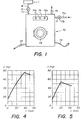
- the appended drawing illustrates, schematically and by way of example, an embodiment as well as a variant of a machine for implementing the washing and bleaching process according to the invention.
- FIG. 1 is shown an automatic washing machine 70, of a type similar to those generally encountered in commerce.
- This type of machine being well known, one will avoid for the sake of brevity to describe all the constituent elements, and one will be satisfied to describe and represent only those of these elements which are new compared to the conventional machines, as well as those of known elements located outside which allow the user to operate the machine (thus, we will not particularly describe all the well-known elements which are normally located inside automatic washing machines, such as the enclosure intended to contain the textile materials to be washed, the means making it possible to form an aqueous detergent bath within this enclosure by mixing the detergent composition with water, the means making it possible to agitate relatively with respect to the other the aqueous detergent bath and the textile materials to be washed, the means for heating the water and / or the detergent bath to the desired temperatures, the control circuits allowing the implementation different preselected washing programs, etc.).
- the automatic machine 70 represented in this FIG. 1 comprises in particular, in a known manner, a water inlet 71, connected to a water supply pipe 71 a via a solenoid valve 71 b (solenoid valve actuable by the machine control circuit); an entry 72 for the introduction of the detergent composition; an outlet 73 for the evacuation of waste water; a cord 74 for supplying electrical power to the machine; an access door 75 for the introduction of the textile materials to be washed inside the machine; and a control panel 76 for controlling the execution of the different washing programs, comprising a switch 76a and programming and selection buttons 76b.
- this machine 70 also comprises an additional inlet 77, connected via a solenoid valve 19 (also actuable by the control circuit of the machine) to the outlet 18 of an electrochemical reactor 1 (the reactor electrochemical 1 is normally intended to be mounted inside the chassis of the machine (it is, for the sake of clarity, shown in the drawing as being located outside the machine).
- the automatic machine 70 is intended to be supplied at its inlet 72 with a simplified detergent composition substantially devoid of bleaching agent, while the electrochemical reactor 1 is intended to allow the production of an aqueous alkaline oxidizing solution containing in particular hydrogenoperoxide ions , can be incorporated into the machine at the desired time by actuating the solenoid valve 19.
- FIG. 2 illustrates in detail a possible embodiment for this electrochemical reactor 1.
- the reactor 1 shown in this figure comprises a single elementary cell constituted by a substantially horizontal casing 2 made of an electrically insulating material.
- This casing 2 is divided by a plane diaphragm 3 arranged horizontally in two superimposed compartments 4 and 5, respectively, a lower cathode compartment 4 and an upper anode compartment 5.
- the cathode compartment 4 is itself divided by a flat porous cathode 6 disposed horizontally in two superimposed chambers 7 and 8, respectively, an upper chamber 7 and a lower chamber 8.
- the upper chamber 7 is intended to contain the catholyte, and it is respectively provided at its opposite ends with an inlet orifice 7a and an outlet 7b for the catholyte.
- the lower chamber 8 is intended to supply pressurized air (of the order of 100 to 1000 grams / cm 2 ) to the porous cathode 6, by means of an inlet orifice 8a connected to a source of pressurized air (not shown), excess pressurized air being capable of escaping through safety valves 8b.
- the porous electrode 6 is advantageously made of a hydrophobic conductive material capable of stopping water while letting air pass.
- This porous cathode 6 can thus, by way of example, be constituted by a carbon felt impregnated with a Teflon suspension, or by porous blocks of vitreous carbon with open porosity, the thickness of this cathode also being advantageously between 5 and 10 mm.
- the anode compartment 5 is, for its part, intended to contain the anolyte, and it is respectively equipped with an anode 9 (or counter electrode) disposed against its upper wall and with two inlet orifices 5a and outlet 5b for the anolyte, located at its opposite ends.
- the anode 9 is advantageously made of a conductive material chemically and electrochemically inert with respect to the anolyte.
- This anode 9 can thus, by way of example, consist of a material such as platinum titanium, graphite, suitably chosen stainless steel, or any other material usually designated by the term "dimensionally stable anode".
- the plane diaphragm 3 which separates the anolyte from the catholyte is finally advantageously constituted by a cation exchange membrane, or by a semi-permeable micro-porous diaphragm.
- the outlet 7b and inlet 7a ports of the chamber 7 are further connected to each other by means of recycling the catholyte, formed by a conduit 10 and a pumping member 11 Similarly, the outlet 5b and inlet 5a ports of the anode compartment 5 are interconnected by means of recycling the anolyte formed by a conduit 12 and a pumping member 13.
- the reactor comprises another first inlet duct 14 connected via a valve 15 to a portion of duct 12 adjacent to the inlet orifice 5a of the anode compartment 5; a second intake duct 16 connected via a valve 17 to a portion of the duct 10 adjacent to the inlet orifice 7a of the chamber 7; and a discharge conduit 18 connected via a valve 19 to the conduit 10, downstream of the pumping member 11.
- the first intake duct 14 is intended to allow the introduction into the anode compartment 5 of an alkaline solution having an initial concentration greater than that which it is desired to obtain for the bleaching solution, this initial solution being intended to constitute the reactor anolyte.
- the second intake duct 16 is for its part intended to allow the introduction into the chamber 7 of an alkaline solution having an initial concentration lower than that which it is desired to obtain for the bleaching solution, this solution being intended for constitute the catholyte of the reactor.
- the evacuation conduit 18 is finally intended to allow the withdrawal towards the outside of the catholyte, after the latter has undergone a certain number of recycling operations having brought it to the desired concentrations, the catholyte thus extracted constituting the bleaching solution.
- porous cathode 6 and the anode 9 of the reactor are intended to be respectively connected to the negative and positive poles of a DC voltage source 20.
- the passage of the catholyte through the chamber 7 has in particular the effect of causing, by reduction of oxygen at the cathode, the formation of hydrogenoperoxide ions H02 and of hydroxyl ions OH-, the permanent recycling of the catholyte also causing a progressive concentration of this catholyte in hydrogenoperoxide ions and hydroxyl ions. It can also be seen that the passage of the anolyte through the anode compartment 5 leads to a progressive reduction in the alkali concentration of this anolyte.
- the recycling of the catholyte and the anolyte continues until the catholyte concentrations of hydrogenoperoxide ions and hydroxyl ions reach the desired values, this catholyte then constituting the desired bleaching solution.
- the reactor 1 is then stopped, and the bleaching solution introduced into the washing machine via the solenoid valve 19, at the desired time of the washing program.
- the anolyte whose alkali concentration has greatly reduced, is also removed from the reactor and discharged with the wastewater.
- This evacuated anolyte is possibly capable, instead of being discharged into wastewater, of being recovered with a view to serving as a catholyte for the manufacture of a new batch of bleaching solution (transfer shown diagrammatically in the drawing by the dotted line 21).
- the strictly horizontal position of the reactor is not compulsory.
- this initial solution containing sodium chloride also makes it possible to introduce into the cathode compartment an initial solution also containing sodium chloride, this in order to improve the conductivity of the solutions and reduce the drop ohmic through the cation exchanger separator (this sodium chloride does not participate in the cathodic reaction but only serves as a support salt).
- the purpose of the presence of sodium chloride in solution in the anode compartment is to cause the formation of chlorine gas in contact with the anode, depending on the reaction: the chlorine gas thus formed reacting with sodium hydroxide to give hypochlorite, according to the reaction:
- the anode solution obtained at the end of recycling, loaded with hypochlorite can then be used in combination with the cathode solution loaded with hydrogen peroxide, in order to carry out the ' washing / bleaching.
- a treatment will be carried out by first bringing the anode solution loaded with hypochlorite then the cathode solution loaded with hydrogen peroxide at contact of the material to be treated.
- the combined use of hypochlorite and hydrogen peroxide has the major advantage of causing the formation of "singlet" oxygen, which turns out to be an excellent oxidizing agent.
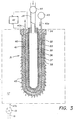
- FIG. 3 illustrates another possible variant of an electrochemical reactor which can be incorporated into the machine according to the invention, according to which a reactor of the "open cell” type is used, intended to allow the manufacture of the bleaching solution according to a continuous method.
- the electrochemical reactor shown in this FIG. 3 comprises a single elementary cell 31 of tubular shape.
- This cell 31 consists of two concentric porous tubular envelopes 32 and 33 with a rounded bottom, namely, an outer envelope 32 made of a porous electrically insulating microporous hydrophilic material such as a canvas or felt (for example nylon, fiber-of glass or polyethylene).
- the open end of these envelopes 32 and 33 is closed by a plant cover 34 made of an insulating material.
- the inner envelope 33 is called upon to play the role of a microporous diaphragm dividing the cell 31 into two coaxial compartments 35 and 36, respectively, a central anode compartment 35 of cylindrical shape, and a peripheral cathode compartment 36 of annular shape.
- the central anode compartment 35 is equipped with a porous tubular anode 37 disposed against the internal wall of the microporous diaphragm 33, this porous anode 37 being made of a material such as porous graphite or porous vitreous carbon.
- This anode compartment 35 is intended to contain the anolyte, and it is provided at its upper part with an inlet port 38 passing through the cover 34.
- the peripheral cathode compartment 36 is itself filled with an electrically packed bed of particles conductive 39 (such as graphite and activated carbon granules or carbon fibers), intended to serve as a three-dimensional cathode.
- This bed is made partially hydrophobic by treatment with a Teflon suspension.
- This particle bed 39 is traversed over its entire length by a conduit 40 pierced with a multiplicity of openings, the ends of which are respectively connected to an inlet port 40a and an outlet port 40b formed in two diametrically opposite locations in the cover 34.
- a filiform current collector 41 (for example made of gold), intended to be connected to the negative pole of a DC voltage source 42 the other positive pole of which is connected to the anode 37.
- the drilled conduit 40 is intended to be connected via the inlet port 40a to a source of pressurized air 43 capable of delivering cold air under a pressure of the order of 20 to 50 glcm 2 , the conduit 40 thus being responsible for supplying pressurized air to the dispersed cathode 39 (the cold air intended to maintain the interior of the cell 1 at a temperature of the order of 15 to 20 ° C., so as to optimize the efficiency of electroreduction.
- the inlet port 38 of the anode compartment 35 is finally intended to be connected, by means of a pumping member 44, to a reservoir (not shown) containing an alkaline aqueous solution whose concentration is substantially identical (or slightly higher) than the alkali concentration of the bleaching solution which it is desired to manufacture.
- This pumping member 44 is responsible for continuously supplying the compartment anodic 35 in aqueous alkaline solution under pressure, the pr ession under which this alkaline aqueous solution is introduced being chosen so that the anode compartment 35 is in permanent overpressure relative to the cathode compartment 36.
- the cell 31 is finally mounted inside a container 47 (shown in dotted lines in the drawing), the bottom of which has an outlet orifice 47a.
- This outlet orifice 47a is intended to be connected, via the conduit 18 and the solenoid valve 19, to the inlet orifice 77 of the machine 70 (fig. 1).
- the electrochemical reactor which has just been described operates in the following manner: the choice of the hydrogen peroxide and alkali concentrations of the bleaching solution which it is desired to manufacture having been fixed, the cell 31 is energized and the operates the means for supplying an alkaline aqueous solution to the anode compartment 35 as well as the means for supplying air to the dispersed cathode 39, while maintaining the anode compartment 35 in constant overpressure relative to the cathode compartment 36.
- the alkaline aqueous solution which flows into the anode compartment 35 undergoes on contact with the anode 37 the anode reaction (reaction identical to that stated above), so that it takes up oxygen while losing part of its alkali concentration, this alkali-depleted solution then passing through the microporous diaphragm 33 under the effect of the overpressure.
- this alkali-depleted solution (which thus constitutes the catholyte) then undergoes the cathode reaction (reaction also identical to that set out above), so that it is in particular charged with hydrogenoperoxide ions and with hydroxyl ions before to flow outside in the form of droplets 45 on the outer walls of the porous ceramic 32.
- the parameters governing the operation of the cell 31 are chosen so that the enrichment in hydrogenoperoxide ions and in hydroxyl ions of the catholyte can reach the concentration values fixed for the bleaching solution at the moment when this catholyte is discharged outside in the form of droplets 45, so that all of these droplets 45 recovered by the container 47 constitute the bleaching solution intended inée to be incorporated at the desired time in the machine 70, via the solenoid valve 19.
- the detergent composition BT ′ is used in tests in combination with the bleaching solution produced electrochemically according to the invention (BT ′ + H 2 0 2 produced electrochemically), this solution being introduced at the desired time into the detergent bath.
- This solution is produced by means of a reactor similar to that of FIG. 2, from an initial alkaline solution containing a mixture of silicate and sodium sulfate.
- a bleaching solution containing in particular 2.25 g / I of hydrogen peroxide from a mixture containing 7.5 g / I of sodium sulphate and 11.75 g / I of sodium silicate at 49 ° Bé the procedure is as follows : an alkaline initial solution containing 7.5 g / l of sodium sulfate and 11.75 g / l of sodium silicate at 49 ° Be is introduced into the cathode compartment, respectively, and a solution into the cathode compartment, aqueous sodium hydroxide having an initial concentration of sodium hydroxide equal to 40 g / I, the respective volumes of solution introduced into each of the compartments being 2000 ml (the temperature of these solutions being moreover maintained at 22 ° C.).
- the reactor is then energized, and the means for supplying air to the cathode as well as the means for recycling the catholyte and the anolyte are started.
- the cathode voltage is adjusted to be - 800 mV compared to a calomel electrode (which corresponds to a potential difference across the cell equal to 2.4 Volts and an average current density 10 mA / cm 2 ).
- the catholyte and the anolyte are recycled for 240 min, time after which the catholyte reaches the desired concentration of hydrogen peroxide (this time can of course be considerably reduced, using a plurality of cells connected in series instead of of a single cell, and / or by increasing the dimensions of these cells).
- the catholyte is then evacuated to the outside (one collects 2000 ml) to be used as a bleaching solution.
- the detergency efficiency corresponding to each of these tests is determined by light reflectance measurements using a MACBETH type reflectometer, carried out on the strips of EMPA tissue, respectively, before and after washing these bands.
- the detergency efficiency corresponding to a given test X will be expressed in a relative manner, by relating it to that corresponding to a reference test A carried out under analogous operating conditions using the washing powder of RF reference.
- This relative efficiency, expressed in%, is given by the relation: where E. and E A denote the clarifications obtained, respectively, by the determined test X and by the reference test A, the clarification E being itself given by the relation: where R denotes the measured reflectance
- This table makes it possible in particular to demonstrate the superior efficacy from the point of view of bleaching of the process according to the invention compared to conventional washing processes using more conventional bleaching agents.
Landscapes
- Chemical & Material Sciences (AREA)
- Engineering & Computer Science (AREA)
- Chemical Kinetics & Catalysis (AREA)
- Electrochemistry (AREA)
- Organic Chemistry (AREA)
- Textile Engineering (AREA)
- Inorganic Chemistry (AREA)
- Materials Engineering (AREA)
- Metallurgy (AREA)
- General Chemical & Material Sciences (AREA)
- Life Sciences & Earth Sciences (AREA)
- Hydrology & Water Resources (AREA)
- Environmental & Geological Engineering (AREA)
- Water Supply & Treatment (AREA)
- Detergent Compositions (AREA)
- Organic Low-Molecular-Weight Compounds And Preparation Thereof (AREA)
- Electrolytic Production Of Non-Metals, Compounds, Apparatuses Therefor (AREA)
Applications Claiming Priority (2)
| Application Number | Priority Date | Filing Date | Title |
|---|---|---|---|
| CH14876/77 | 1977-12-06 | ||
| CH1487677 | 1977-12-06 |
Publications (2)
| Publication Number | Publication Date |
|---|---|
| EP0002423A1 EP0002423A1 (fr) | 1979-06-13 |
| EP0002423B1 true EP0002423B1 (fr) | 1981-10-14 |
Family
ID=4404486
Family Applications (2)
| Application Number | Title | Priority Date | Filing Date |
|---|---|---|---|
| EP78810028A Expired EP0002423B1 (fr) | 1977-12-06 | 1978-12-04 | Procédé et machine pour le lavage et le blanchiment de matières textiles |
| EP78900292A Expired EP0009480B1 (fr) | 1977-12-06 | 1979-07-03 | Procédé et réacteur pour fabriquer une solution aqueuse de traitement contenant au moins des ions hydrogenoperoxydes et des ions hydroxyles selon des concentrations prédéterminées et utilisation du reacteur |
Family Applications After (1)
| Application Number | Title | Priority Date | Filing Date |
|---|---|---|---|
| EP78900292A Expired EP0009480B1 (fr) | 1977-12-06 | 1979-07-03 | Procédé et réacteur pour fabriquer une solution aqueuse de traitement contenant au moins des ions hydrogenoperoxydes et des ions hydroxyles selon des concentrations prédéterminées et utilisation du reacteur |
Country Status (5)
| Country | Link |
|---|---|
| US (2) | US4319973A (enExample) |
| EP (2) | EP0002423B1 (enExample) |
| JP (1) | JPS54500035A (enExample) |
| DE (2) | DE2861172D1 (enExample) |
| WO (2) | WO1979000347A1 (enExample) |
Families Citing this family (54)
| Publication number | Priority date | Publication date | Assignee | Title |
|---|---|---|---|---|
| CA1160140A (fr) * | 1979-12-20 | 1984-01-10 | Alain Groult | Machine et methode automatique a laver le linge ou la vaisselle |
| FR2493878A1 (fr) * | 1980-11-13 | 1982-05-14 | Ardennes Cellulose | Procede pour la production de l'eau oxygenee en milieu alcalin et cellule electrolytique pour la mise en oeuvre dudit procede |
| EP0066663A1 (fr) * | 1981-06-10 | 1982-12-15 | La Cellulose Des Ardennes | Cellule électrolytique de production d'eau oxygénée en milieu alcalin |
| US4357217A (en) * | 1981-10-02 | 1982-11-02 | Occidental Research Corporation | Three compartment electrolytic cell method for producing hydrogen peroxide |
| IT1147150B (it) * | 1981-12-14 | 1986-11-19 | Zanussi A Spa Industrie | Lavastoviglie con cella elettrochimica |
| IT1147149B (it) * | 1981-12-14 | 1986-11-19 | Zanussi A Spa Industrie | Macchina lavabiancheria provvista di cella elettrochimica |
| DE3370657D1 (en) * | 1982-05-28 | 1987-05-07 | Bbc Brown Boveri & Cie | Process for the electrolytic production of hydrogen peroxide, and use thereof |
| DE3439265A1 (de) * | 1984-10-26 | 1986-05-07 | Hoechst Ag, 6230 Frankfurt | Elektrolyseapparat mit horizontal angeordneten elektroden |
| DE3610061A1 (de) * | 1986-03-25 | 1987-10-01 | Peroxid Chemie Gmbh | Verfahren zur aktivierung von wasserstoffperoxid auf elektrochemischem wege |
| FR2597126B1 (fr) * | 1986-04-11 | 1988-09-09 | Atochem | Procede de desinfection de textiles contamines par des bacteries |
| US4758317A (en) * | 1986-11-20 | 1988-07-19 | Fmc Corporation | Process and cell for producing hydrogen peroxide |
| DE4000397A1 (de) * | 1990-01-09 | 1991-07-11 | Hoechst Ag | Lipidselektive antioxidantien sowie deren herstellung und verwendung |
| US5106464A (en) * | 1990-04-16 | 1992-04-21 | H-D Tech Inc. | Decreasing the concentration of hydroxyl ions in aqueous alkaline peroxide solutions |
| NO931689L (no) * | 1993-05-10 | 1994-11-11 | Sigurd Fongen | Anordning for elektrokjemisk syntese for "in-line" og "off-line" bleking, oksidasjon og desinfeksjon av organiske stoffer i væsker. |
| ES2080686B1 (es) | 1994-02-16 | 1996-10-16 | S E De Carburos Metalicos S A | Proceso y equipo de depuracion electrolitica en aguas residuales contaminadas utilizando catodos de oxigeno. |
| US5565073A (en) * | 1994-07-15 | 1996-10-15 | Fraser; Mark E. | Electrochemical peroxide generator |
| US5527705A (en) * | 1994-09-12 | 1996-06-18 | Becton, Dickinson And Company | Roller bottle for trans-membrane co-culture of cells and method for its use |
| US5456809A (en) * | 1995-02-06 | 1995-10-10 | The Regents Of The University Of California | Electrochemical mercerization, souring, and bleaching of textiles |
| ES2126492B1 (es) * | 1996-07-05 | 1999-12-16 | Espan Carburos Metal | Pila de combustible alcalina para la cogeneracion de peroxido de hidrogeno. |
| EP1036874A3 (fr) * | 1999-03-14 | 2001-09-12 | C.S.E.M. Centre Suisse D'electronique Et De Microtechnique Sa | Cellule de blanchiment et de désinfection et application de celle-ci aux machines à laver de linge |
| ES2203505T3 (es) | 1999-08-05 | 2004-04-16 | Steris Inc. | Sintesis electrolitica de acido peracetico. |
| EP1285884A4 (en) * | 2000-04-27 | 2005-06-01 | Nippon Oil Corp | METHOD AND DEVICE FOR TREATING CLARIFICATION OF WATER |
| DE10161265A1 (de) * | 2001-12-13 | 2003-06-26 | Dystar Textilfarben Gmbh & Co | Verfahren zur Farbveränderung von gefärbten textilen Substraten |
| US6674781B1 (en) * | 2002-08-19 | 2004-01-06 | The Boeing Company | Method and system for fueling a closed cycle chemical oxygen iodine laser |
| US20050224099A1 (en) * | 2004-04-13 | 2005-10-13 | Luckman Joel A | Method and apparatus for cleaning objects in an automatic cleaning appliance using an oxidizing agent |
| EP1740757A1 (en) * | 2004-04-29 | 2007-01-10 | Unilever N.V. | Dry cleaning method |
| AU2005248346B2 (en) * | 2004-05-17 | 2009-12-10 | The Procter & Gamble Company | Method and system for washing with wash liquor cleanup and recycle |
| KR100625083B1 (ko) | 2005-05-12 | 2006-09-20 | 한국원자력연구소 | pH가 조절된 단일 전해액의 배출만을 갖는 pH 조절용이온교환 분리막 전해방법과 그 장치 |
| EP1739207A3 (en) * | 2005-06-27 | 2007-10-03 | Unilever N.V. | Peroxide generating device and method |
| WO2007008591A2 (en) * | 2005-07-07 | 2007-01-18 | Applied Intellectual Capital | Methods and apparatus for generating oxidizing agents |
| GB0519046D0 (en) * | 2005-09-17 | 2005-10-26 | Reckitt Benckiser Uk Ltd | Improvements in and relating to cleaning |
| GB2437956A (en) * | 2006-04-11 | 2007-11-14 | Dyson Technology Ltd | Production of hydrogen peroxide |
| GB2437079A (en) * | 2006-04-11 | 2007-10-17 | Dyson Technology Ltd | Hydrogen peroxide production apparatus |
| GB2437957A (en) * | 2006-04-11 | 2007-11-14 | Dyson Technology Ltd | An electrolytic cell for the production of hydrogen peroxide |
| US7604719B2 (en) * | 2006-05-25 | 2009-10-20 | Uop Llc | In situ generation of hydrogen peroxide |
| US7754064B2 (en) * | 2006-09-29 | 2010-07-13 | Eltron Research & Development | Methods and apparatus for the on-site production of hydrogen peroxide |
| WO2008089120A2 (en) * | 2007-01-12 | 2008-07-24 | Integrated Environmental Technologies, Ltd. | Aqueous solution for managing microbes in oil and gas production and method for their production |
| US7851429B2 (en) | 2007-05-07 | 2010-12-14 | Whirlpool Corporation | Recapture of ions applied in a wash process |
| IL184046A (en) * | 2007-06-19 | 2012-07-31 | Lev Gurevich | Method and systems with cycle |
| US7829732B2 (en) * | 2008-03-17 | 2010-11-09 | Regents Of The University Of California | High-yield conversion of cellulosic biomass into furanic biofuels and value-added products |
| KR101072813B1 (ko) * | 2009-09-02 | 2011-10-14 | (주)아쿠아테크 | 전극 분리식 연수기 |
| US8562810B2 (en) | 2011-07-26 | 2013-10-22 | Ecolab Usa Inc. | On site generation of alkalinity boost for ware washing applications |
| DE102011080099A1 (de) * | 2011-07-29 | 2013-01-31 | Henkel Ag & Co. Kgaa | Wasch- oder Reinigungsmittel mit elektrochemisch aktivierbarer Mediatorverbindung |
| JP5914637B2 (ja) * | 2012-03-19 | 2016-05-11 | シャープ株式会社 | 洗浄装置および洗浄方法 |
| ITMI20131521A1 (it) * | 2013-09-16 | 2015-03-17 | Industrie De Nora Spa | Cella elettrolitica per produzione di soluzioni ossidanti |
| FR3034689B1 (fr) * | 2015-04-07 | 2017-05-19 | Ceram Hyd | Machine de lavage comportant une cellule electrolytique |
| CN118621881A (zh) | 2015-08-24 | 2024-09-10 | 科勒公司 | 具有清洁化合物分配系统的马桶及其分配系统 |
| DE102016200602A1 (de) * | 2016-01-19 | 2017-07-20 | BSH Hausgeräte GmbH | Wäschepflegegerät mit einem Substanzbehälter |
| ES2584436B2 (es) * | 2016-06-28 | 2017-03-28 | Universitat Politècnica De València | Procedimiento electroquímico para el blanqueo de telas que contienen fibras celulósicas naturales |
| GB201710655D0 (en) * | 2017-07-03 | 2017-08-16 | Imp Innovations Ltd | Electrochemical cell |
| DE102018218878A1 (de) * | 2018-11-06 | 2020-05-07 | Henkel Ag & Co. Kgaa | Vorrichtung zur Aktivierung einer Mediatorspezies |
| DE102019124813A1 (de) * | 2019-09-16 | 2021-03-18 | Henkel Ag & Co. Kgaa | Vorrichtung zur Montage auf einer inneren Umfangsfläche einer Waschmaschinentrommel |
| DE102020103662A1 (de) * | 2020-02-12 | 2021-08-12 | Miele & Cie. Kg | Wasserführendes elektrisches Gerät |
| CN118084148B (zh) * | 2024-04-26 | 2024-07-05 | 天津大学 | 低浓度苏打水生产油污清洗液的电化学方法 |
Family Cites Families (8)
| Publication number | Priority date | Publication date | Assignee | Title |
|---|---|---|---|---|
| FR1335541A (fr) * | 1962-06-27 | 1963-08-23 | Thomson Houston Comp Francaise | Machine à laver le linge et appareil générateur d'eau oxygénée et d'ozone |
| US3506560A (en) * | 1967-01-30 | 1970-04-14 | Kimberly Clark Co | Electrolytic cell having novel electrolyte flow path means |
| US3507769A (en) * | 1967-01-30 | 1970-04-21 | Kimberly Clark Co | Simplified electrolytic cell |
| US3607687A (en) * | 1969-07-29 | 1971-09-21 | Kimberly Clark Co | Process for producing peroxides |
| US3616442A (en) * | 1969-12-11 | 1971-10-26 | Kimrberly Clark Corp | Electrochemical cell having gas diffusion electrode |
| US3878072A (en) * | 1973-11-01 | 1975-04-15 | Hooker Chemicals Plastics Corp | Electrolytic method for the manufacture of chlorates |
| US3884777A (en) * | 1974-01-02 | 1975-05-20 | Hooker Chemicals Plastics Corp | Electrolytic process for manufacturing chlorine dioxide, hydrogen peroxide, chlorine, alkali metal hydroxide and hydrogen |
| US3969201A (en) * | 1975-01-13 | 1976-07-13 | Canadian Patents And Development Limited | Electrolytic production of alkaline peroxide solutions |
-
1978
- 1978-12-04 JP JP50012478A patent/JPS54500035A/ja active Pending
- 1978-12-04 DE DE7878810028T patent/DE2861172D1/de not_active Expired
- 1978-12-04 DE DE7878900292T patent/DE2861037D1/de not_active Expired
- 1978-12-04 US US06/129,976 patent/US4319973A/en not_active Expired - Lifetime
- 1978-12-04 US US06/130,167 patent/US4350575A/en not_active Expired - Lifetime
- 1978-12-04 WO PCT/CH1978/000044 patent/WO1979000347A1/de not_active Ceased
- 1978-12-04 WO PCT/CH1978/000043 patent/WO1979000346A1/de not_active Ceased
- 1978-12-04 EP EP78810028A patent/EP0002423B1/fr not_active Expired
-
1979
- 1979-07-03 EP EP78900292A patent/EP0009480B1/fr not_active Expired
Also Published As
| Publication number | Publication date |
|---|---|
| DE2861037D1 (en) | 1981-11-26 |
| US4350575A (en) | 1982-09-21 |
| WO1979000346A1 (fr) | 1979-06-28 |
| US4319973A (en) | 1982-03-16 |
| WO1979000347A1 (fr) | 1979-06-28 |
| EP0009480B1 (fr) | 1981-09-02 |
| EP0002423A1 (fr) | 1979-06-13 |
| DE2861172D1 (en) | 1981-12-24 |
| EP0009480A1 (fr) | 1980-04-16 |
| JPS54500035A (enExample) | 1979-10-11 |
Similar Documents
| Publication | Publication Date | Title |
|---|---|---|
| EP0002423A1 (fr) | Procédé et machine pour le lavage et le blanchiment de matières textiles | |
| EP0031308B1 (fr) | Machine automatique à laver le linge ou la vaisselle | |
| AU2005248346B2 (en) | Method and system for washing with wash liquor cleanup and recycle | |
| MXPA06013010A (es) | Metodo y sistema para lavar. | |
| EP0863793A1 (fr) | Procede de nettoyage d'une installation de filtration du type a membranes immergees | |
| MXPA04011400A (es) | Metodos electroquimicos con base en senal para el lavado automatico de platos y utensilios. | |
| CA2312345A1 (en) | Method and apparatus for producing cleaning agent | |
| WO2010067697A1 (ja) | 電解水生成装置 | |
| EP0131527B1 (fr) | Composition pour le nettoyage automatique des cuvettes | |
| Abu Ghalwa et al. | Electrochemical degradation of acid green dye in aqueous wastewater dyestuff solutions using a lead oxide coated titanium electrode | |
| FR2524024A1 (enExample) | ||
| FR2628451A2 (fr) | Procede pour le lavage et l'adoucissement du linge en machine | |
| FR2976597A1 (fr) | Adsorbant de matieres radioactives sous forme de vetement et son procede de fabrication. | |
| JP2013094205A (ja) | 洗濯機 | |
| FR3027612A1 (fr) | Dispositif de desinfection de l'eau a configurations multiples utilisant une cellule d'electrolyse | |
| FR2460348A1 (fr) | Procede et dispositif pour revetir des elements de petite dimension d'un depot metallique | |
| CA1115656A (fr) | Procede et reacteur pour fabriquer une solution aqueuse de traitement contenant au moins des ions hydrogenoperoxydes et des ions hydroxyles selon des concentrations predeterminees | |
| EP0219440A1 (fr) | Procédé de décontamination d'une plage de sable ou de galets | |
| CH634217A5 (en) | Automatic dish-washing machine | |
| EP0066663A1 (fr) | Cellule électrolytique de production d'eau oxygénée en milieu alcalin | |
| JP4030316B2 (ja) | 食器洗い機 | |
| JP2012183145A (ja) | ドラム式洗濯機 | |
| BE882550R (fr) | Procede de formation d'hydrogene | |
| CN1082584C (zh) | 洗衣机用的氯去除装置和具有该装置的洗衣机 | |
| FR3141703A1 (fr) | Système et procédé de production d'une solution désinfectante à base d’acide hypochloreux |
Legal Events
| Date | Code | Title | Description |
|---|---|---|---|
| PUAI | Public reference made under article 153(3) epc to a published international application that has entered the european phase |
Free format text: ORIGINAL CODE: 0009012 |
|
| AK | Designated contracting states |
Designated state(s): BE CH DE FR GB IT NL SE LU |
|
| 17P | Request for examination filed | ||
| ITF | It: translation for a ep patent filed | ||
| GRAA | (expected) grant |
Free format text: ORIGINAL CODE: 0009210 |
|
| AK | Designated contracting states |
Designated state(s): BE CH DE FR GB IT LU NL SE |
|
| REF | Corresponds to: |
Ref document number: 2861172 Country of ref document: DE Date of ref document: 19811224 |
|
| PG25 | Lapsed in a contracting state [announced via postgrant information from national office to epo] |
Ref country code: LU Free format text: LAPSE BECAUSE OF NON-PAYMENT OF DUE FEES Effective date: 19811231 |
|
| PLBI | Opposition filed |
Free format text: ORIGINAL CODE: 0009260 |
|
| 26 | Opposition filed |
Opponent name: BOSCH-SIEMENS HAUSGERAETE GMBH, STUTTGART Effective date: 19820707 |
|
| PLBN | Opposition rejected |
Free format text: ORIGINAL CODE: 0009273 |
|
| STAA | Information on the status of an ep patent application or granted ep patent |
Free format text: STATUS: OPPOSITION REJECTED |
|
| 27O | Opposition rejected |
Effective date: 19870423 |
|
| NLR2 | Nl: decision of opposition | ||
| PGFP | Annual fee paid to national office [announced via postgrant information from national office to epo] |
Ref country code: SE Payment date: 19891211 Year of fee payment: 12 |
|
| PGFP | Annual fee paid to national office [announced via postgrant information from national office to epo] |
Ref country code: LU Payment date: 19891213 Year of fee payment: 12 |
|
| PGFP | Annual fee paid to national office [announced via postgrant information from national office to epo] |
Ref country code: FR Payment date: 19891214 Year of fee payment: 12 |
|
| PGFP | Annual fee paid to national office [announced via postgrant information from national office to epo] |
Ref country code: CH Payment date: 19891222 Year of fee payment: 12 |
|
| PGFP | Annual fee paid to national office [announced via postgrant information from national office to epo] |
Ref country code: DE Payment date: 19891228 Year of fee payment: 12 |
|
| PGFP | Annual fee paid to national office [announced via postgrant information from national office to epo] |
Ref country code: BE Payment date: 19891229 Year of fee payment: 12 |
|
| ITTA | It: last paid annual fee | ||
| PGFP | Annual fee paid to national office [announced via postgrant information from national office to epo] |
Ref country code: NL Payment date: 19891231 Year of fee payment: 12 Ref country code: GB Payment date: 19891231 Year of fee payment: 12 |
|
| PG25 | Lapsed in a contracting state [announced via postgrant information from national office to epo] |
Ref country code: GB Effective date: 19901204 |
|
| PG25 | Lapsed in a contracting state [announced via postgrant information from national office to epo] |
Ref country code: SE Effective date: 19901205 |
|
| PG25 | Lapsed in a contracting state [announced via postgrant information from national office to epo] |
Ref country code: CH Effective date: 19901231 Ref country code: BE Effective date: 19901231 |
|
| BERE | Be: lapsed |
Owner name: BATTELLE MEMORIAL INSTITUTE Effective date: 19901231 |
|
| PG25 | Lapsed in a contracting state [announced via postgrant information from national office to epo] |
Ref country code: NL Effective date: 19910701 |
|
| GBPC | Gb: european patent ceased through non-payment of renewal fee | ||
| NLV4 | Nl: lapsed or anulled due to non-payment of the annual fee | ||
| PG25 | Lapsed in a contracting state [announced via postgrant information from national office to epo] |
Ref country code: FR Effective date: 19910830 |
|
| REG | Reference to a national code |
Ref country code: CH Ref legal event code: PL |
|
| PG25 | Lapsed in a contracting state [announced via postgrant information from national office to epo] |
Ref country code: DE Effective date: 19910903 |
|
| REG | Reference to a national code |
Ref country code: FR Ref legal event code: ST |
|
| EUG | Se: european patent has lapsed |
Ref document number: 78810028.7 Effective date: 19910910 |