EP0000898B1 - Egalisiermittel und Verfahren zum Färben von synthetischen Fasermaterialien - Google Patents
Egalisiermittel und Verfahren zum Färben von synthetischen Fasermaterialien Download PDFInfo
- Publication number
- EP0000898B1 EP0000898B1 EP78100620A EP78100620A EP0000898B1 EP 0000898 B1 EP0000898 B1 EP 0000898B1 EP 78100620 A EP78100620 A EP 78100620A EP 78100620 A EP78100620 A EP 78100620A EP 0000898 B1 EP0000898 B1 EP 0000898B1
- Authority
- EP
- European Patent Office
- Prior art keywords
- polyester
- levelling agent
- acid
- mol
- agent according
- Prior art date
- Legal status (The legal status is an assumption and is not a legal conclusion. Google has not performed a legal analysis and makes no representation as to the accuracy of the status listed.)
- Expired
Links
- 238000000034 method Methods 0.000 title claims description 23
- 238000004043 dyeing Methods 0.000 title claims description 22
- 239000002657 fibrous material Substances 0.000 title description 2
- 229920000728 polyester Polymers 0.000 claims description 40
- MTHSVFCYNBDYFN-UHFFFAOYSA-N diethylene glycol Chemical compound OCCOCCO MTHSVFCYNBDYFN-UHFFFAOYSA-N 0.000 claims description 34
- 239000003795 chemical substances by application Substances 0.000 claims description 30
- 150000002009 diols Chemical class 0.000 claims description 26
- 239000004359 castor oil Substances 0.000 claims description 22
- 235000019438 castor oil Nutrition 0.000 claims description 22
- ZEMPKEQAKRGZGQ-XOQCFJPHSA-N glycerol triricinoleate Natural products CCCCCC[C@@H](O)CC=CCCCCCCCC(=O)OC[C@@H](COC(=O)CCCCCCCC=CC[C@@H](O)CCCCCC)OC(=O)CCCCCCCC=CC[C@H](O)CCCCCC ZEMPKEQAKRGZGQ-XOQCFJPHSA-N 0.000 claims description 22
- 125000001931 aliphatic group Chemical group 0.000 claims description 20
- 239000002253 acid Substances 0.000 claims description 18
- QQVIHTHCMHWDBS-UHFFFAOYSA-N isophthalic acid Chemical compound OC(=O)C1=CC=CC(C(O)=O)=C1 QQVIHTHCMHWDBS-UHFFFAOYSA-N 0.000 claims description 18
- 239000000203 mixture Substances 0.000 claims description 15
- 150000001875 compounds Chemical class 0.000 claims description 14
- 125000004432 carbon atom Chemical group C* 0.000 claims description 12
- 229910052708 sodium Inorganic materials 0.000 claims description 12
- 239000011734 sodium Substances 0.000 claims description 12
- XLYOFNOQVPJJNP-UHFFFAOYSA-N water Substances O XLYOFNOQVPJJNP-UHFFFAOYSA-N 0.000 claims description 11
- 125000000118 dimethyl group Chemical group [H]C([H])([H])* 0.000 claims description 10
- 239000000463 material Substances 0.000 claims description 10
- 229920006395 saturated elastomer Polymers 0.000 claims description 10
- IAYPIBMASNFSPL-UHFFFAOYSA-N Ethylene oxide Chemical compound C1CO1 IAYPIBMASNFSPL-UHFFFAOYSA-N 0.000 claims description 8
- -1 aromatic dicarboxylic acids Chemical class 0.000 claims description 8
- 150000003077 polyols Chemical class 0.000 claims description 8
- ZIBGPFATKBEMQZ-UHFFFAOYSA-N triethylene glycol Chemical compound OCCOCCOCCO ZIBGPFATKBEMQZ-UHFFFAOYSA-N 0.000 claims description 8
- 238000006068 polycondensation reaction Methods 0.000 claims description 7
- 229920001223 polyethylene glycol Polymers 0.000 claims description 7
- 150000003839 salts Chemical class 0.000 claims description 7
- QGZKDVFQNNGYKY-UHFFFAOYSA-O Ammonium Chemical compound [NH4+] QGZKDVFQNNGYKY-UHFFFAOYSA-O 0.000 claims description 6
- KKEYFWRCBNTPAC-UHFFFAOYSA-N Terephthalic acid Chemical compound OC(=O)C1=CC=C(C(O)=O)C=C1 KKEYFWRCBNTPAC-UHFFFAOYSA-N 0.000 claims description 6
- OJURWUUOVGOHJZ-UHFFFAOYSA-N methyl 2-[(2-acetyloxyphenyl)methyl-[2-[(2-acetyloxyphenyl)methyl-(2-methoxy-2-oxoethyl)amino]ethyl]amino]acetate Chemical compound C=1C=CC=C(OC(C)=O)C=1CN(CC(=O)OC)CCN(CC(=O)OC)CC1=CC=CC=C1OC(C)=O OJURWUUOVGOHJZ-UHFFFAOYSA-N 0.000 claims description 6
- 125000003178 carboxy group Chemical group [H]OC(*)=O 0.000 claims description 5
- 229920005862 polyol Polymers 0.000 claims description 5
- 229920002994 synthetic fiber Polymers 0.000 claims description 5
- 239000002202 Polyethylene glycol Substances 0.000 claims description 4
- 150000007513 acids Chemical class 0.000 claims description 4
- 229910052783 alkali metal Inorganic materials 0.000 claims description 4
- 150000001340 alkali metals Chemical class 0.000 claims description 4
- 125000001033 ether group Chemical group 0.000 claims description 4
- 125000002887 hydroxy group Chemical group [H]O* 0.000 claims description 4
- DRXSQBCVCJBRRO-UHFFFAOYSA-N 2-(3-sulfopropoxy)benzene-1,3-dicarboxylic acid Chemical compound OC(=O)C1=CC=CC(C(O)=O)=C1OCCCS(O)(=O)=O DRXSQBCVCJBRRO-UHFFFAOYSA-N 0.000 claims description 3
- 239000007864 aqueous solution Substances 0.000 claims description 3
- 239000006185 dispersion Substances 0.000 claims description 3
- 125000004430 oxygen atom Chemical group O* 0.000 claims description 3
- YZTJKOLMWJNVFH-UHFFFAOYSA-N 2-sulfobenzene-1,3-dicarboxylic acid Chemical compound OC(=O)C1=CC=CC(C(O)=O)=C1S(O)(=O)=O YZTJKOLMWJNVFH-UHFFFAOYSA-N 0.000 claims description 2
- 150000003863 ammonium salts Chemical class 0.000 claims description 2
- GSEJCLTVZPLZKY-UHFFFAOYSA-O triethanolammonium Chemical compound OCC[NH+](CCO)CCO GSEJCLTVZPLZKY-UHFFFAOYSA-O 0.000 claims description 2
- DGAQECJNVWCQMB-PUAWFVPOSA-M Ilexoside XXIX Chemical compound C[C@@H]1CC[C@@]2(CC[C@@]3(C(=CC[C@H]4[C@]3(CC[C@@H]5[C@@]4(CC[C@@H](C5(C)C)OS(=O)(=O)[O-])C)C)[C@@H]2[C@]1(C)O)C)C(=O)O[C@H]6[C@@H]([C@H]([C@@H]([C@H](O6)CO)O)O)O.[Na+] DGAQECJNVWCQMB-PUAWFVPOSA-M 0.000 claims 1
- 125000004435 hydrogen atom Chemical group [H]* 0.000 claims 1
- 125000000843 phenylene group Chemical group C1(=C(C=CC=C1)*)* 0.000 claims 1
- 229940094537 polyester-10 Drugs 0.000 claims 1
- 239000000047 product Substances 0.000 description 28
- 239000000975 dye Substances 0.000 description 17
- OFOBLEOULBTSOW-UHFFFAOYSA-N Malonic acid Chemical compound OC(=O)CC(O)=O OFOBLEOULBTSOW-UHFFFAOYSA-N 0.000 description 16
- 150000002148 esters Chemical class 0.000 description 16
- HEMHJVSKTPXQMS-UHFFFAOYSA-M Sodium hydroxide Chemical compound [OH-].[Na+] HEMHJVSKTPXQMS-UHFFFAOYSA-M 0.000 description 12
- BVKZGUZCCUSVTD-UHFFFAOYSA-N carbonic acid Chemical class OC(O)=O BVKZGUZCCUSVTD-UHFFFAOYSA-N 0.000 description 11
- WOZVHXUHUFLZGK-UHFFFAOYSA-N dimethyl terephthalate Chemical compound COC(=O)C1=CC=C(C(=O)OC)C=C1 WOZVHXUHUFLZGK-UHFFFAOYSA-N 0.000 description 11
- LYCAIKOWRPUZTN-UHFFFAOYSA-N Ethylene glycol Chemical compound OCCO LYCAIKOWRPUZTN-UHFFFAOYSA-N 0.000 description 9
- OKKJLVBELUTLKV-UHFFFAOYSA-N Methanol Chemical compound OC OKKJLVBELUTLKV-UHFFFAOYSA-N 0.000 description 9
- 239000000243 solution Substances 0.000 description 9
- 150000001991 dicarboxylic acids Chemical class 0.000 description 8
- 239000000986 disperse dye Substances 0.000 description 6
- RTZKZFJDLAIYFH-UHFFFAOYSA-N ether Substances CCOCC RTZKZFJDLAIYFH-UHFFFAOYSA-N 0.000 description 6
- 238000007046 ethoxylation reaction Methods 0.000 description 6
- 239000000835 fiber Substances 0.000 description 6
- 125000001273 sulfonato group Chemical group [O-]S(*)(=O)=O 0.000 description 6
- 150000001298 alcohols Chemical class 0.000 description 5
- XNGIFLGASWRNHJ-UHFFFAOYSA-N phthalic acid Chemical class OC(=O)C1=CC=CC=C1C(O)=O XNGIFLGASWRNHJ-UHFFFAOYSA-N 0.000 description 5
- IJGRMHOSHXDMSA-UHFFFAOYSA-N Atomic nitrogen Chemical compound N#N IJGRMHOSHXDMSA-UHFFFAOYSA-N 0.000 description 4
- 0 COc1ccc(C*)c(*2(*)*=C2)c1 Chemical compound COc1ccc(C*)c(*2(*)*=C2)c1 0.000 description 4
- 150000008064 anhydrides Chemical class 0.000 description 4
- 230000000694 effects Effects 0.000 description 4
- DNIAPMSPPWPWGF-UHFFFAOYSA-N monopropylene glycol Natural products CC(O)CO DNIAPMSPPWPWGF-UHFFFAOYSA-N 0.000 description 4
- CYIDZMCFTVVTJO-UHFFFAOYSA-N pyromellitic acid Chemical compound OC(=O)C1=CC(C(O)=O)=C(C(O)=O)C=C1C(O)=O CYIDZMCFTVVTJO-UHFFFAOYSA-N 0.000 description 4
- 125000000020 sulfo group Chemical group O=S(=O)([*])O[H] 0.000 description 4
- VLDPXPPHXDGHEW-UHFFFAOYSA-N 1-chloro-2-dichlorophosphoryloxybenzene Chemical compound ClC1=CC=CC=C1OP(Cl)(Cl)=O VLDPXPPHXDGHEW-UHFFFAOYSA-N 0.000 description 3
- QTBSBXVTEAMEQO-UHFFFAOYSA-N Acetic acid Chemical compound CC(O)=O QTBSBXVTEAMEQO-UHFFFAOYSA-N 0.000 description 3
- ZMXDDKWLCZADIW-UHFFFAOYSA-N N,N-Dimethylformamide Chemical compound CN(C)C=O ZMXDDKWLCZADIW-UHFFFAOYSA-N 0.000 description 3
- 150000001805 chlorine compounds Chemical class 0.000 description 3
- KRKNYBCHXYNGOX-UHFFFAOYSA-N citric acid Chemical compound OC(=O)CC(O)(C(O)=O)CC(O)=O KRKNYBCHXYNGOX-UHFFFAOYSA-N 0.000 description 3
- MQHNKCZKNAJROC-UHFFFAOYSA-N dipropyl phthalate Chemical compound CCCOC(=O)C1=CC=CC=C1C(=O)OCCC MQHNKCZKNAJROC-UHFFFAOYSA-N 0.000 description 3
- 239000000155 melt Substances 0.000 description 3
- 238000002156 mixing Methods 0.000 description 3
- 229920000570 polyether Polymers 0.000 description 3
- JFINOWIINSTUNY-UHFFFAOYSA-N pyrrolidin-3-ylmethanesulfonamide Chemical compound NS(=O)(=O)CC1CCNC1 JFINOWIINSTUNY-UHFFFAOYSA-N 0.000 description 3
- 239000007787 solid Substances 0.000 description 3
- 239000000126 substance Substances 0.000 description 3
- 239000012209 synthetic fiber Substances 0.000 description 3
- DNIAPMSPPWPWGF-VKHMYHEASA-N (+)-propylene glycol Chemical compound C[C@H](O)CO DNIAPMSPPWPWGF-VKHMYHEASA-N 0.000 description 2
- YPFDHNVEDLHUCE-UHFFFAOYSA-N 1,3-propanediol Substances OCCCO YPFDHNVEDLHUCE-UHFFFAOYSA-N 0.000 description 2
- VGUWZCUCNQXGBU-UHFFFAOYSA-N 3-[(4-methylpiperazin-1-yl)methyl]-5-nitro-1h-indole Chemical compound C1CN(C)CCN1CC1=CNC2=CC=C([N+]([O-])=O)C=C12 VGUWZCUCNQXGBU-UHFFFAOYSA-N 0.000 description 2
- ALRHLSYJTWAHJZ-UHFFFAOYSA-N 3-hydroxypropionic acid Chemical compound OCCC(O)=O ALRHLSYJTWAHJZ-UHFFFAOYSA-N 0.000 description 2
- VZCYOOQTPOCHFL-OWOJBTEDSA-N Fumaric acid Chemical compound OC(=O)\C=C\C(O)=O VZCYOOQTPOCHFL-OWOJBTEDSA-N 0.000 description 2
- PEDCQBHIVMGVHV-UHFFFAOYSA-N Glycerine Chemical compound OCC(O)CO PEDCQBHIVMGVHV-UHFFFAOYSA-N 0.000 description 2
- AEMRFAOFKBGASW-UHFFFAOYSA-N Glycolic acid Chemical compound OCC(O)=O AEMRFAOFKBGASW-UHFFFAOYSA-N 0.000 description 2
- WNLRTRBMVRJNCN-UHFFFAOYSA-N adipic acid Chemical compound OC(=O)CCCCC(O)=O WNLRTRBMVRJNCN-UHFFFAOYSA-N 0.000 description 2
- 125000003118 aryl group Chemical group 0.000 description 2
- UJMDYLWCYJJYMO-UHFFFAOYSA-N benzene-1,2,3-tricarboxylic acid Chemical compound OC(=O)C1=CC=CC(C(O)=O)=C1C(O)=O UJMDYLWCYJJYMO-UHFFFAOYSA-N 0.000 description 2
- QMKYBPDZANOJGF-UHFFFAOYSA-N benzene-1,3,5-tricarboxylic acid Chemical compound OC(=O)C1=CC(C(O)=O)=CC(C(O)=O)=C1 QMKYBPDZANOJGF-UHFFFAOYSA-N 0.000 description 2
- WERYXYBDKMZEQL-UHFFFAOYSA-N butane-1,4-diol Chemical compound OCCCCO WERYXYBDKMZEQL-UHFFFAOYSA-N 0.000 description 2
- 238000006243 chemical reaction Methods 0.000 description 2
- 238000009833 condensation Methods 0.000 description 2
- 230000005494 condensation Effects 0.000 description 2
- QYQADNCHXSEGJT-UHFFFAOYSA-N cyclohexane-1,1-dicarboxylate;hydron Chemical compound OC(=O)C1(C(O)=O)CCCCC1 QYQADNCHXSEGJT-UHFFFAOYSA-N 0.000 description 2
- DOIRQSBPFJWKBE-UHFFFAOYSA-N dibutyl phthalate Chemical compound CCCCOC(=O)C1=CC=CC=C1C(=O)OCCCC DOIRQSBPFJWKBE-UHFFFAOYSA-N 0.000 description 2
- 125000004177 diethyl group Chemical group [H]C([H])([H])C([H])([H])* 0.000 description 2
- YSEKNCXYRGKTBJ-UHFFFAOYSA-N dimethyl 2-hydroxybutanedioate Chemical compound COC(=O)CC(O)C(=O)OC YSEKNCXYRGKTBJ-UHFFFAOYSA-N 0.000 description 2
- SZXQTJUDPRGNJN-UHFFFAOYSA-N dipropylene glycol Chemical compound OCCCOCCCO SZXQTJUDPRGNJN-UHFFFAOYSA-N 0.000 description 2
- LZCLXQDLBQLTDK-UHFFFAOYSA-N ethyl 2-hydroxypropanoate Chemical compound CCOC(=O)C(C)O LZCLXQDLBQLTDK-UHFFFAOYSA-N 0.000 description 2
- 238000001914 filtration Methods 0.000 description 2
- JVTAAEKCZFNVCJ-UHFFFAOYSA-N lactic acid Chemical compound CC(O)C(O)=O JVTAAEKCZFNVCJ-UHFFFAOYSA-N 0.000 description 2
- 238000004519 manufacturing process Methods 0.000 description 2
- VLKZOEOYAKHREP-UHFFFAOYSA-N n-Hexane Chemical group CCCCCC VLKZOEOYAKHREP-UHFFFAOYSA-N 0.000 description 2
- 229910052757 nitrogen Inorganic materials 0.000 description 2
- 239000012299 nitrogen atmosphere Substances 0.000 description 2
- 229920000166 polytrimethylene carbonate Polymers 0.000 description 2
- 235000013772 propylene glycol Nutrition 0.000 description 2
- 238000003756 stirring Methods 0.000 description 2
- TYFQFVWCELRYAO-UHFFFAOYSA-N suberic acid Chemical compound OC(=O)CCCCCCC(O)=O TYFQFVWCELRYAO-UHFFFAOYSA-N 0.000 description 2
- VXUYXOFXAQZZMF-UHFFFAOYSA-N titanium(IV) isopropoxide Chemical compound CC(C)O[Ti](OC(C)C)(OC(C)C)OC(C)C VXUYXOFXAQZZMF-UHFFFAOYSA-N 0.000 description 2
- VZCYOOQTPOCHFL-UHFFFAOYSA-N trans-butenedioic acid Natural products OC(=O)C=CC(O)=O VZCYOOQTPOCHFL-UHFFFAOYSA-N 0.000 description 2
- KQTIIICEAUMSDG-UHFFFAOYSA-N tricarballylic acid Chemical compound OC(=O)CC(C(O)=O)CC(O)=O KQTIIICEAUMSDG-UHFFFAOYSA-N 0.000 description 2
- ARCGXLSVLAOJQL-UHFFFAOYSA-N trimellitic acid Chemical compound OC(=O)C1=CC=C(C(O)=O)C(C(O)=O)=C1 ARCGXLSVLAOJQL-UHFFFAOYSA-N 0.000 description 2
- HDDLVZWGOPWKFW-UHFFFAOYSA-N trimethyl 2-hydroxypropane-1,2,3-tricarboxylate Chemical compound COC(=O)CC(O)(C(=O)OC)CC(=O)OC HDDLVZWGOPWKFW-UHFFFAOYSA-N 0.000 description 2
- MJHNUUNSCNRGJE-UHFFFAOYSA-N trimethyl benzene-1,2,4-tricarboxylate Chemical compound COC(=O)C1=CC=C(C(=O)OC)C(C(=O)OC)=C1 MJHNUUNSCNRGJE-UHFFFAOYSA-N 0.000 description 2
- QBYIENPQHBMVBV-HFEGYEGKSA-N (2R)-2-hydroxy-2-phenylacetic acid Chemical compound O[C@@H](C(O)=O)c1ccccc1.O[C@@H](C(O)=O)c1ccccc1 QBYIENPQHBMVBV-HFEGYEGKSA-N 0.000 description 1
- 239000001124 (E)-prop-1-ene-1,2,3-tricarboxylic acid Substances 0.000 description 1
- DNIAPMSPPWPWGF-GSVOUGTGSA-N (R)-(-)-Propylene glycol Chemical compound C[C@@H](O)CO DNIAPMSPPWPWGF-GSVOUGTGSA-N 0.000 description 1
- BJEPYKJPYRNKOW-REOHCLBHSA-N (S)-malic acid Chemical compound OC(=O)[C@@H](O)CC(O)=O BJEPYKJPYRNKOW-REOHCLBHSA-N 0.000 description 1
- MLHQPPYBHZSBCX-UHFFFAOYSA-N 1-(2-hydroxyethoxy)propan-2-ol Chemical compound CC(O)COCCO MLHQPPYBHZSBCX-UHFFFAOYSA-N 0.000 description 1
- RTBFRGCFXZNCOE-UHFFFAOYSA-N 1-methylsulfonylpiperidin-4-one Chemical compound CS(=O)(=O)N1CCC(=O)CC1 RTBFRGCFXZNCOE-UHFFFAOYSA-N 0.000 description 1
- QOVUSIZUVWPIAP-UHFFFAOYSA-N 2,6-bis(methoxycarbonyl)benzenesulfonic acid Chemical compound COC(=O)C1=CC=CC(C(=O)OC)=C1S(O)(=O)=O QOVUSIZUVWPIAP-UHFFFAOYSA-N 0.000 description 1
- JAHNSTQSQJOJLO-UHFFFAOYSA-N 2-(3-fluorophenyl)-1h-imidazole Chemical compound FC1=CC=CC(C=2NC=CN=2)=C1 JAHNSTQSQJOJLO-UHFFFAOYSA-N 0.000 description 1
- FALRKNHUBBKYCC-UHFFFAOYSA-N 2-(chloromethyl)pyridine-3-carbonitrile Chemical compound ClCC1=NC=CC=C1C#N FALRKNHUBBKYCC-UHFFFAOYSA-N 0.000 description 1
- LCZVSXRMYJUNFX-UHFFFAOYSA-N 2-[2-(2-hydroxypropoxy)propoxy]propan-1-ol Chemical compound CC(O)COC(C)COC(C)CO LCZVSXRMYJUNFX-UHFFFAOYSA-N 0.000 description 1
- FYELSNVLZVIGTI-UHFFFAOYSA-N 2-[4-[2-(2,3-dihydro-1H-inden-2-ylamino)pyrimidin-5-yl]-5-ethylpyrazol-1-yl]-1-(2,4,6,7-tetrahydrotriazolo[4,5-c]pyridin-5-yl)ethanone Chemical compound C1C(CC2=CC=CC=C12)NC1=NC=C(C=N1)C=1C=NN(C=1CC)CC(=O)N1CC2=C(CC1)NN=N2 FYELSNVLZVIGTI-UHFFFAOYSA-N 0.000 description 1
- FLCUEXJOTNUYJB-UHFFFAOYSA-N 2-methoxycarbonylbenzenesulfonic acid Chemical compound COC(=O)C1=CC=CC=C1S(O)(=O)=O FLCUEXJOTNUYJB-UHFFFAOYSA-N 0.000 description 1
- DSVZDMKYVFDILG-UHFFFAOYSA-N 3-(2-hydroxyethoxy)propan-1-ol Chemical compound OCCCOCCO DSVZDMKYVFDILG-UHFFFAOYSA-N 0.000 description 1
- SPXSLOBSNWHBEX-UHFFFAOYSA-N 3-(2-hydroxyethyl)benzoic acid Chemical compound OCCC1=CC=CC(C(O)=O)=C1 SPXSLOBSNWHBEX-UHFFFAOYSA-N 0.000 description 1
- HUBFEJLVQNDNKY-UHFFFAOYSA-N 3-(hydroxymethyl)cyclohexane-1-carboxylic acid Chemical compound OCC1CCCC(C(O)=O)C1 HUBFEJLVQNDNKY-UHFFFAOYSA-N 0.000 description 1
- NCAFAGCAGJLMCH-UHFFFAOYSA-N 3-[2,6-bis(methoxycarbonyl)phenoxy]propane-1-sulfonic acid Chemical compound COC(=O)C1=CC=CC(C(=O)OC)=C1OCCCS(O)(=O)=O NCAFAGCAGJLMCH-UHFFFAOYSA-N 0.000 description 1
- BZJMWEUXPKKANZ-UHFFFAOYSA-N 3-[3-(2-hydroxyethoxy)propoxy]propan-1-ol Chemical compound OCCCOCCCOCCO BZJMWEUXPKKANZ-UHFFFAOYSA-N 0.000 description 1
- LYKRIFJRHXXXDZ-UHFFFAOYSA-N 4-(4-hydroxybutoxy)butan-1-ol Chemical compound OCCCCOCCCCO LYKRIFJRHXXXDZ-UHFFFAOYSA-N 0.000 description 1
- VQMIUUBKKPIDBN-UHFFFAOYSA-N 4-(hydroxymethyl)cyclohexane-1-carboxylic acid Chemical compound OCC1CCC(C(O)=O)CC1 VQMIUUBKKPIDBN-UHFFFAOYSA-N 0.000 description 1
- SJZRECIVHVDYJC-UHFFFAOYSA-N 4-hydroxybutyric acid Chemical compound OCCCC(O)=O SJZRECIVHVDYJC-UHFFFAOYSA-N 0.000 description 1
- 229940006015 4-hydroxybutyric acid Drugs 0.000 description 1
- LSNNMFCWUKXFEE-UHFFFAOYSA-M Bisulfite Chemical compound OS([O-])=O LSNNMFCWUKXFEE-UHFFFAOYSA-M 0.000 description 1
- WQXRFVABCFNXTC-UHFFFAOYSA-N C(C=1C(C(=O)OCC)=CC=CC1)(=O)OCC.C(C1=CC(C(=O)O)=CC=C1)(=O)O.C(C1=CC(C(=O)O)=CC=C1)(=O)O Chemical compound C(C=1C(C(=O)OCC)=CC=CC1)(=O)OCC.C(C1=CC(C(=O)O)=CC=C1)(=O)O.C(C1=CC(C(=O)O)=CC=C1)(=O)O WQXRFVABCFNXTC-UHFFFAOYSA-N 0.000 description 1
- PQOQUYNXAHZQRD-UHFFFAOYSA-N CCCOC(=O)C1=C(C(=C(C=C1)S(=O)(=O)O)C(=O)OCCC)OCC Chemical compound CCCOC(=O)C1=C(C(=C(C=C1)S(=O)(=O)O)C(=O)OCCC)OCC PQOQUYNXAHZQRD-UHFFFAOYSA-N 0.000 description 1
- YCGVMANWNQUNFU-UHFFFAOYSA-N CCOC1=C(C=CC(=C1C(=O)OC(C)C)S(=O)(=O)O)C(=O)OC(C)C Chemical compound CCOC1=C(C=CC(=C1C(=O)OC(C)C)S(=O)(=O)O)C(=O)OC(C)C YCGVMANWNQUNFU-UHFFFAOYSA-N 0.000 description 1
- 229920002284 Cellulose triacetate Polymers 0.000 description 1
- 208000006558 Dental Calculus Diseases 0.000 description 1
- FEWJPZIEWOKRBE-JCYAYHJZSA-N Dextrotartaric acid Chemical compound OC(=O)[C@H](O)[C@@H](O)C(O)=O FEWJPZIEWOKRBE-JCYAYHJZSA-N 0.000 description 1
- PDSCSYLDRHAHOX-UHFFFAOYSA-N Dibutyl malate Chemical compound CCCCOC(=O)CC(O)C(=O)OCCCC PDSCSYLDRHAHOX-UHFFFAOYSA-N 0.000 description 1
- YUXIBTJKHLUKBD-UHFFFAOYSA-N Dibutyl succinate Chemical compound CCCCOC(=O)CCC(=O)OCCCC YUXIBTJKHLUKBD-UHFFFAOYSA-N 0.000 description 1
- QWDBCIAVABMJPP-UHFFFAOYSA-N Diisopropyl phthalate Chemical compound CC(C)OC(=O)C1=CC=CC=C1C(=O)OC(C)C QWDBCIAVABMJPP-UHFFFAOYSA-N 0.000 description 1
- UNXHWFMMPAWVPI-UHFFFAOYSA-N Erythritol Natural products OCC(O)C(O)CO UNXHWFMMPAWVPI-UHFFFAOYSA-N 0.000 description 1
- 239000004386 Erythritol Substances 0.000 description 1
- LFQSCWFLJHTTHZ-UHFFFAOYSA-N Ethanol Chemical compound CCO LFQSCWFLJHTTHZ-UHFFFAOYSA-N 0.000 description 1
- 239000005909 Kieselgur Substances 0.000 description 1
- YJLYANLCNIKXMG-UHFFFAOYSA-N N-Methyldioctylamine Chemical compound CCCCCCCCN(C)CCCCCCCC YJLYANLCNIKXMG-UHFFFAOYSA-N 0.000 description 1
- GQPHURFOZDPMDE-UHFFFAOYSA-N OCC1CC2CCCC(C2CC1)C(=O)O Chemical compound OCC1CC2CCCC(C2CC1)C(=O)O GQPHURFOZDPMDE-UHFFFAOYSA-N 0.000 description 1
- ALQSHHUCVQOPAS-UHFFFAOYSA-N Pentane-1,5-diol Chemical compound OCCCCCO ALQSHHUCVQOPAS-UHFFFAOYSA-N 0.000 description 1
- LGRFSURHDFAFJT-UHFFFAOYSA-N Phthalic anhydride Natural products C1=CC=C2C(=O)OC(=O)C2=C1 LGRFSURHDFAFJT-UHFFFAOYSA-N 0.000 description 1
- 239000004952 Polyamide Substances 0.000 description 1
- 229920002582 Polyethylene Glycol 600 Polymers 0.000 description 1
- 239000004721 Polyphenylene oxide Substances 0.000 description 1
- IWYDHOAUDWTVEP-UHFFFAOYSA-N R-2-phenyl-2-hydroxyacetic acid Natural products OC(=O)C(O)C1=CC=CC=C1 IWYDHOAUDWTVEP-UHFFFAOYSA-N 0.000 description 1
- VYPSYNLAJGMNEJ-UHFFFAOYSA-N Silicium dioxide Chemical compound O=[Si]=O VYPSYNLAJGMNEJ-UHFFFAOYSA-N 0.000 description 1
- KDYFGRWQOYBRFD-UHFFFAOYSA-N Succinic acid Natural products OC(=O)CCC(O)=O KDYFGRWQOYBRFD-UHFFFAOYSA-N 0.000 description 1
- FEWJPZIEWOKRBE-UHFFFAOYSA-N Tartaric acid Natural products [H+].[H+].[O-]C(=O)C(O)C(O)C([O-])=O FEWJPZIEWOKRBE-UHFFFAOYSA-N 0.000 description 1
- UWHCKJMYHZGTIT-UHFFFAOYSA-N Tetraethylene glycol, Natural products OCCOCCOCCOCCO UWHCKJMYHZGTIT-UHFFFAOYSA-N 0.000 description 1
- ZJCCRDAZUWHFQH-UHFFFAOYSA-N Trimethylolpropane Chemical compound CCC(CO)(CO)CO ZJCCRDAZUWHFQH-UHFFFAOYSA-N 0.000 description 1
- NNLVGZFZQQXQNW-ADJNRHBOSA-N [(2r,3r,4s,5r,6s)-4,5-diacetyloxy-3-[(2s,3r,4s,5r,6r)-3,4,5-triacetyloxy-6-(acetyloxymethyl)oxan-2-yl]oxy-6-[(2r,3r,4s,5r,6s)-4,5,6-triacetyloxy-2-(acetyloxymethyl)oxan-3-yl]oxyoxan-2-yl]methyl acetate Chemical compound O([C@@H]1O[C@@H]([C@H]([C@H](OC(C)=O)[C@H]1OC(C)=O)O[C@H]1[C@@H]([C@@H](OC(C)=O)[C@H](OC(C)=O)[C@@H](COC(C)=O)O1)OC(C)=O)COC(=O)C)[C@@H]1[C@@H](COC(C)=O)O[C@@H](OC(C)=O)[C@H](OC(C)=O)[C@H]1OC(C)=O NNLVGZFZQQXQNW-ADJNRHBOSA-N 0.000 description 1
- XDODWINGEHBYRT-UHFFFAOYSA-N [2-(hydroxymethyl)cyclohexyl]methanol Chemical compound OCC1CCCCC1CO XDODWINGEHBYRT-UHFFFAOYSA-N 0.000 description 1
- LUSFFPXRDZKBMF-UHFFFAOYSA-N [3-(hydroxymethyl)cyclohexyl]methanol Chemical compound OCC1CCCC(CO)C1 LUSFFPXRDZKBMF-UHFFFAOYSA-N 0.000 description 1
- YWMLORGQOFONNT-UHFFFAOYSA-N [3-(hydroxymethyl)phenyl]methanol Chemical compound OCC1=CC=CC(CO)=C1 YWMLORGQOFONNT-UHFFFAOYSA-N 0.000 description 1
- YIMQCDZDWXUDCA-UHFFFAOYSA-N [4-(hydroxymethyl)cyclohexyl]methanol Chemical compound OCC1CCC(CO)CC1 YIMQCDZDWXUDCA-UHFFFAOYSA-N 0.000 description 1
- BWVAOONFBYYRHY-UHFFFAOYSA-N [4-(hydroxymethyl)phenyl]methanol Chemical compound OCC1=CC=C(CO)C=C1 BWVAOONFBYYRHY-UHFFFAOYSA-N 0.000 description 1
- SSFGHKDDKYEERH-UHFFFAOYSA-N [6-(hydroxymethyl)naphthalen-2-yl]methanol Chemical compound C1=C(CO)C=CC2=CC(CO)=CC=C21 SSFGHKDDKYEERH-UHFFFAOYSA-N 0.000 description 1
- 230000002378 acidificating effect Effects 0.000 description 1
- 229940091181 aconitic acid Drugs 0.000 description 1
- 239000001361 adipic acid Substances 0.000 description 1
- 235000011037 adipic acid Nutrition 0.000 description 1
- 239000003513 alkali Substances 0.000 description 1
- BJEPYKJPYRNKOW-UHFFFAOYSA-N alpha-hydroxysuccinic acid Natural products OC(=O)C(O)CC(O)=O BJEPYKJPYRNKOW-UHFFFAOYSA-N 0.000 description 1
- JFCQEDHGNNZCLN-UHFFFAOYSA-N anhydrous glutaric acid Natural products OC(=O)CCCC(O)=O JFCQEDHGNNZCLN-UHFFFAOYSA-N 0.000 description 1
- 239000002585 base Substances 0.000 description 1
- GCAIEATUVJFSMC-UHFFFAOYSA-N benzene-1,2,3,4-tetracarboxylic acid Chemical compound OC(=O)C1=CC=C(C(O)=O)C(C(O)=O)=C1C(O)=O GCAIEATUVJFSMC-UHFFFAOYSA-N 0.000 description 1
- NHDLVKOYPQPGNT-UHFFFAOYSA-N benzene-1,2,3,5-tetracarboxylic acid Chemical compound OC(=O)C1=CC(C(O)=O)=C(C(O)=O)C(C(O)=O)=C1 NHDLVKOYPQPGNT-UHFFFAOYSA-N 0.000 description 1
- FYXKZNLBZKRYSS-UHFFFAOYSA-N benzene-1,2-dicarbonyl chloride Chemical compound ClC(=O)C1=CC=CC=C1C(Cl)=O FYXKZNLBZKRYSS-UHFFFAOYSA-N 0.000 description 1
- KYQRDNYMKKJUTH-UHFFFAOYSA-N bicyclo[2.2.1]heptane-3,4-dicarboxylic acid Chemical compound C1CC2(C(O)=O)C(C(=O)O)CC1C2 KYQRDNYMKKJUTH-UHFFFAOYSA-N 0.000 description 1
- CDQSJQSWAWPGKG-UHFFFAOYSA-N butane-1,1-diol Chemical class CCCC(O)O CDQSJQSWAWPGKG-UHFFFAOYSA-N 0.000 description 1
- KDYFGRWQOYBRFD-NUQCWPJISA-N butanedioic acid Chemical compound O[14C](=O)CC[14C](O)=O KDYFGRWQOYBRFD-NUQCWPJISA-N 0.000 description 1
- JHIWVOJDXOSYLW-UHFFFAOYSA-N butyl 2,2-difluorocyclopropane-1-carboxylate Chemical compound CCCCOC(=O)C1CC1(F)F JHIWVOJDXOSYLW-UHFFFAOYSA-N 0.000 description 1
- 125000002843 carboxylic acid group Chemical group 0.000 description 1
- 150000001735 carboxylic acids Chemical class 0.000 description 1
- 150000001768 cations Chemical class 0.000 description 1
- 239000007795 chemical reaction product Substances 0.000 description 1
- GTZCVFVGUGFEME-IWQZZHSRSA-N cis-aconitic acid Chemical compound OC(=O)C\C(C(O)=O)=C\C(O)=O GTZCVFVGUGFEME-IWQZZHSRSA-N 0.000 description 1
- 235000015165 citric acid Nutrition 0.000 description 1
- 238000001816 cooling Methods 0.000 description 1
- JEBXNNPMFYXVHS-UHFFFAOYSA-N cyclohexane-1,2,3-tricarboxylic acid Chemical compound OC(=O)C1CCCC(C(O)=O)C1C(O)=O JEBXNNPMFYXVHS-UHFFFAOYSA-N 0.000 description 1
- WTNDADANUZETTI-UHFFFAOYSA-N cyclohexane-1,2,4-tricarboxylic acid Chemical compound OC(=O)C1CCC(C(O)=O)C(C(O)=O)C1 WTNDADANUZETTI-UHFFFAOYSA-N 0.000 description 1
- QSAWQNUELGIYBC-UHFFFAOYSA-N cyclohexane-1,2-dicarboxylic acid Chemical compound OC(=O)C1CCCCC1C(O)=O QSAWQNUELGIYBC-UHFFFAOYSA-N 0.000 description 1
- XBZSBBLNHFMTEB-UHFFFAOYSA-N cyclohexane-1,3-dicarboxylic acid Chemical compound OC(=O)C1CCCC(C(O)=O)C1 XBZSBBLNHFMTEB-UHFFFAOYSA-N 0.000 description 1
- RLMGYIOTPQVQJR-UHFFFAOYSA-N cyclohexane-1,3-diol Chemical compound OC1CCCC(O)C1 RLMGYIOTPQVQJR-UHFFFAOYSA-N 0.000 description 1
- VKONPUDBRVKQLM-UHFFFAOYSA-N cyclohexane-1,4-diol Chemical compound OC1CCC(O)CC1 VKONPUDBRVKQLM-UHFFFAOYSA-N 0.000 description 1
- 229960002097 dibutylsuccinate Drugs 0.000 description 1
- 150000001990 dicarboxylic acid derivatives Chemical class 0.000 description 1
- ONIHPYYWNBVMID-UHFFFAOYSA-N diethyl benzene-1,4-dicarboxylate Chemical compound CCOC(=O)C1=CC=C(C(=O)OCC)C=C1 ONIHPYYWNBVMID-UHFFFAOYSA-N 0.000 description 1
- OUWSNHWQZPEFEX-UHFFFAOYSA-N diethyl glutarate Chemical compound CCOC(=O)CCCC(=O)OCC OUWSNHWQZPEFEX-UHFFFAOYSA-N 0.000 description 1
- GWZCCUDJHOGOSO-UHFFFAOYSA-N diphenic acid Chemical compound OC(=O)C1=CC=CC=C1C1=CC=CC=C1C(O)=O GWZCCUDJHOGOSO-UHFFFAOYSA-N 0.000 description 1
- TVCXTRSVWGUSPY-UHFFFAOYSA-L disodium;3,6-dihydroxynaphthalene-2,7-disulfonate Chemical compound [Na+].[Na+].OC1=C(S([O-])(=O)=O)C=C2C=C(S([O-])(=O)=O)C(O)=CC2=C1 TVCXTRSVWGUSPY-UHFFFAOYSA-L 0.000 description 1
- AFGPCIMUGMJQPD-UHFFFAOYSA-L disodium;4,5-dihydroxynaphthalene-2,7-disulfonate Chemical compound [Na+].[Na+].[O-]S(=O)(=O)C1=CC(O)=C2C(O)=CC(S([O-])(=O)=O)=CC2=C1 AFGPCIMUGMJQPD-UHFFFAOYSA-L 0.000 description 1
- 239000002270 dispersing agent Substances 0.000 description 1
- 238000010494 dissociation reaction Methods 0.000 description 1
- 230000005593 dissociations Effects 0.000 description 1
- 239000003995 emulsifying agent Substances 0.000 description 1
- UNXHWFMMPAWVPI-ZXZARUISSA-N erythritol Chemical compound OC[C@H](O)[C@H](O)CO UNXHWFMMPAWVPI-ZXZARUISSA-N 0.000 description 1
- 229940009714 erythritol Drugs 0.000 description 1
- 235000019414 erythritol Nutrition 0.000 description 1
- SAXHIDRUJXPDOD-UHFFFAOYSA-N ethyl hydroxy(phenyl)acetate Chemical compound CCOC(=O)C(O)C1=CC=CC=C1 SAXHIDRUJXPDOD-UHFFFAOYSA-N 0.000 description 1
- 239000001530 fumaric acid Substances 0.000 description 1
- 239000007789 gas Substances 0.000 description 1
- 235000011187 glycerol Nutrition 0.000 description 1
- 150000004820 halides Chemical class 0.000 description 1
- ACCCMOQWYVYDOT-UHFFFAOYSA-N hexane-1,1-diol Chemical class CCCCCC(O)O ACCCMOQWYVYDOT-UHFFFAOYSA-N 0.000 description 1
- XXMIOPMDWAUFGU-UHFFFAOYSA-N hexane-1,6-diol Chemical compound OCCCCCCO XXMIOPMDWAUFGU-UHFFFAOYSA-N 0.000 description 1
- 150000007529 inorganic bases Chemical class 0.000 description 1
- QQVIHTHCMHWDBS-UHFFFAOYSA-L isophthalate(2-) Chemical compound [O-]C(=O)C1=CC=CC(C([O-])=O)=C1 QQVIHTHCMHWDBS-UHFFFAOYSA-L 0.000 description 1
- 239000004310 lactic acid Substances 0.000 description 1
- 235000014655 lactic acid Nutrition 0.000 description 1
- 239000007788 liquid Substances 0.000 description 1
- VZCYOOQTPOCHFL-UPHRSURJSA-N maleic acid Chemical compound OC(=O)\C=C/C(O)=O VZCYOOQTPOCHFL-UPHRSURJSA-N 0.000 description 1
- 239000011976 maleic acid Substances 0.000 description 1
- FPYJFEHAWHCUMM-UHFFFAOYSA-N maleic anhydride Chemical compound O=C1OC(=O)C=C1 FPYJFEHAWHCUMM-UHFFFAOYSA-N 0.000 description 1
- 239000001630 malic acid Substances 0.000 description 1
- 235000011090 malic acid Nutrition 0.000 description 1
- 229960002510 mandelic acid Drugs 0.000 description 1
- LPEKGGXMPWTOCB-UHFFFAOYSA-N methyl 2-hydroxypropionate Chemical compound COC(=O)C(C)O LPEKGGXMPWTOCB-UHFFFAOYSA-N 0.000 description 1
- JUYVXCGKMCYNBN-UHFFFAOYSA-N methyl 4-hydroxybutanoate Chemical compound COC(=O)CCCO JUYVXCGKMCYNBN-UHFFFAOYSA-N 0.000 description 1
- LVHBHZANLOWSRM-UHFFFAOYSA-N methylenebutanedioic acid Natural products OC(=O)CC(=C)C(O)=O LVHBHZANLOWSRM-UHFFFAOYSA-N 0.000 description 1
- 230000004048 modification Effects 0.000 description 1
- 238000012986 modification Methods 0.000 description 1
- KVQQRFDIKYXJTJ-UHFFFAOYSA-N naphthalene-1,2,3-tricarboxylic acid Chemical class C1=CC=C2C(C(O)=O)=C(C(O)=O)C(C(=O)O)=CC2=C1 KVQQRFDIKYXJTJ-UHFFFAOYSA-N 0.000 description 1
- KYTZHLUVELPASH-UHFFFAOYSA-N naphthalene-1,2-dicarboxylic acid Chemical class C1=CC=CC2=C(C(O)=O)C(C(=O)O)=CC=C21 KYTZHLUVELPASH-UHFFFAOYSA-N 0.000 description 1
- ABMFBCRYHDZLRD-UHFFFAOYSA-N naphthalene-1,4-dicarboxylic acid Chemical compound C1=CC=C2C(C(=O)O)=CC=C(C(O)=O)C2=C1 ABMFBCRYHDZLRD-UHFFFAOYSA-N 0.000 description 1
- DFFZOPXDTCDZDP-UHFFFAOYSA-N naphthalene-1,5-dicarboxylic acid Chemical compound C1=CC=C2C(C(=O)O)=CC=CC2=C1C(O)=O DFFZOPXDTCDZDP-UHFFFAOYSA-N 0.000 description 1
- 150000007530 organic bases Chemical class 0.000 description 1
- WXZMFSXDPGVJKK-UHFFFAOYSA-N pentaerythritol Chemical compound OCC(CO)(CO)CO WXZMFSXDPGVJKK-UHFFFAOYSA-N 0.000 description 1
- UWJJYHHHVWZFEP-UHFFFAOYSA-N pentane-1,1-diol Chemical class CCCCC(O)O UWJJYHHHVWZFEP-UHFFFAOYSA-N 0.000 description 1
- 229920002647 polyamide Polymers 0.000 description 1
- 229940057847 polyethylene glycol 600 Drugs 0.000 description 1
- 229920001451 polypropylene glycol Polymers 0.000 description 1
- 229920002635 polyurethane Polymers 0.000 description 1
- 239000004814 polyurethane Substances 0.000 description 1
- 229910052700 potassium Inorganic materials 0.000 description 1
- 239000011591 potassium Substances 0.000 description 1
- VTPYWLJBOSNEKE-UHFFFAOYSA-M potassium;1,4-dihydroxy-1,4-dioxobutane-2-sulfonate Chemical compound [K+].OC(=O)CC(C(O)=O)S([O-])(=O)=O VTPYWLJBOSNEKE-UHFFFAOYSA-M 0.000 description 1
- 238000003825 pressing Methods 0.000 description 1
- 230000002829 reductive effect Effects 0.000 description 1
- MOODSJOROWROTO-UHFFFAOYSA-N salicylsulfuric acid Chemical compound OC(=O)C1=CC=CC=C1OS(O)(=O)=O MOODSJOROWROTO-UHFFFAOYSA-N 0.000 description 1
- 239000008234 soft water Substances 0.000 description 1
- 239000002904 solvent Substances 0.000 description 1
- 229940014800 succinic anhydride Drugs 0.000 description 1
- 230000002195 synergetic effect Effects 0.000 description 1
- 239000011975 tartaric acid Substances 0.000 description 1
- 235000002906 tartaric acid Nutrition 0.000 description 1
- KKEYFWRCBNTPAC-UHFFFAOYSA-L terephthalate(2-) Chemical compound [O-]C(=O)C1=CC=C(C([O-])=O)C=C1 KKEYFWRCBNTPAC-UHFFFAOYSA-L 0.000 description 1
- 150000000000 tetracarboxylic acids Chemical class 0.000 description 1
- RVSRYSJPDKQMMZ-UHFFFAOYSA-N tetramethyl benzene-1,2,3,5-tetracarboxylate Chemical compound COC(=O)C1=CC(C(=O)OC)=C(C(=O)OC)C(C(=O)OC)=C1 RVSRYSJPDKQMMZ-UHFFFAOYSA-N 0.000 description 1
- QVEIFJBUBJUUMB-UHFFFAOYSA-N tetramethyl benzene-1,2,4,5-tetracarboxylate Chemical compound COC(=O)C1=CC(C(=O)OC)=C(C(=O)OC)C=C1C(=O)OC QVEIFJBUBJUUMB-UHFFFAOYSA-N 0.000 description 1
- GTZCVFVGUGFEME-UHFFFAOYSA-N trans-aconitic acid Natural products OC(=O)CC(C(O)=O)=CC(O)=O GTZCVFVGUGFEME-UHFFFAOYSA-N 0.000 description 1
- 150000003628 tricarboxylic acids Chemical class 0.000 description 1
- SRPWOOOHEPICQU-UHFFFAOYSA-N trimellitic anhydride Chemical compound OC(=O)C1=CC=C2C(=O)OC(=O)C2=C1 SRPWOOOHEPICQU-UHFFFAOYSA-N 0.000 description 1
- QXJQHYBHAIHNGG-UHFFFAOYSA-N trimethylolethane Chemical compound OCC(C)(CO)CO QXJQHYBHAIHNGG-UHFFFAOYSA-N 0.000 description 1
- 229920006305 unsaturated polyester Polymers 0.000 description 1
Classifications
-
- D—TEXTILES; PAPER
- D06—TREATMENT OF TEXTILES OR THE LIKE; LAUNDERING; FLEXIBLE MATERIALS NOT OTHERWISE PROVIDED FOR
- D06P—DYEING OR PRINTING TEXTILES; DYEING LEATHER, FURS OR SOLID MACROMOLECULAR SUBSTANCES IN ANY FORM
- D06P1/00—General processes of dyeing or printing textiles, or general processes of dyeing leather, furs, or solid macromolecular substances in any form, classified according to the dyes, pigments, or auxiliary substances employed
- D06P1/44—General processes of dyeing or printing textiles, or general processes of dyeing leather, furs, or solid macromolecular substances in any form, classified according to the dyes, pigments, or auxiliary substances employed using insoluble pigments or auxiliary substances, e.g. binders
- D06P1/60—General processes of dyeing or printing textiles, or general processes of dyeing leather, furs, or solid macromolecular substances in any form, classified according to the dyes, pigments, or auxiliary substances employed using insoluble pigments or auxiliary substances, e.g. binders using compositions containing polyethers
- D06P1/613—Polyethers without nitrogen
- D06P1/6136—Condensation products of esters, acids, oils, oxyacids with oxiranes
-
- C—CHEMISTRY; METALLURGY
- C08—ORGANIC MACROMOLECULAR COMPOUNDS; THEIR PREPARATION OR CHEMICAL WORKING-UP; COMPOSITIONS BASED THEREON
- C08G—MACROMOLECULAR COMPOUNDS OBTAINED OTHERWISE THAN BY REACTIONS ONLY INVOLVING UNSATURATED CARBON-TO-CARBON BONDS
- C08G63/00—Macromolecular compounds obtained by reactions forming a carboxylic ester link in the main chain of the macromolecule
- C08G63/68—Polyesters containing atoms other than carbon, hydrogen and oxygen
- C08G63/688—Polyesters containing atoms other than carbon, hydrogen and oxygen containing sulfur
- C08G63/6884—Polyesters containing atoms other than carbon, hydrogen and oxygen containing sulfur derived from polycarboxylic acids and polyhydroxy compounds
- C08G63/6886—Dicarboxylic acids and dihydroxy compounds
-
- D—TEXTILES; PAPER
- D06—TREATMENT OF TEXTILES OR THE LIKE; LAUNDERING; FLEXIBLE MATERIALS NOT OTHERWISE PROVIDED FOR
- D06P—DYEING OR PRINTING TEXTILES; DYEING LEATHER, FURS OR SOLID MACROMOLECULAR SUBSTANCES IN ANY FORM
- D06P1/00—General processes of dyeing or printing textiles, or general processes of dyeing leather, furs, or solid macromolecular substances in any form, classified according to the dyes, pigments, or auxiliary substances employed
- D06P1/44—General processes of dyeing or printing textiles, or general processes of dyeing leather, furs, or solid macromolecular substances in any form, classified according to the dyes, pigments, or auxiliary substances employed using insoluble pigments or auxiliary substances, e.g. binders
- D06P1/52—General processes of dyeing or printing textiles, or general processes of dyeing leather, furs, or solid macromolecular substances in any form, classified according to the dyes, pigments, or auxiliary substances employed using insoluble pigments or auxiliary substances, e.g. binders using compositions containing synthetic macromolecular substances
- D06P1/5264—Macromolecular compounds obtained otherwise than by reactions involving only unsaturated carbon-to-carbon bonds
- D06P1/5271—Polyesters; Polycarbonates; Alkyd resins
Definitions
- the invention relates to a leveling agent and a method for uniformly dyeing materials made of synthetic fibers, such as e.g. Fibers made from cellulose triacetate, polyurethane, polyamides, but in particular from fibers made from linear polyesters and their mixtures with natural fibers with disperse dyes.
- synthetic fibers such as e.g. Fibers made from cellulose triacetate, polyurethane, polyamides, but in particular from fibers made from linear polyesters and their mixtures with natural fibers with disperse dyes.
- a water-soluble or dispersible branched, sulfonate group-containing polyester having a molecular weight of 600 to 5000, based on 100 mol -% of the polycarboxylic acid component, 1 to 40 mol% of branching components, ie
- branching components ie
- tricarboxylic acids, tetracarboxylic acids, trial alcohols or tetra alcohols can be used.
- the water-soluble or water-dispersible linear polyesters can be prepared in a manner known per se by polycondensation of 100 mol% of dicarboxylic acids with 90 to 120 mol% of diols, a total of 5 to 40 mol%, preferably 5 to 30 mol% of the Dicarboxylic acids and / or the dihydroxy compounds must carry sulfo groups in the form of salts.
- Saturated and unsaturated aliphatic, cycloaliphatic, araliphatic or aromatic dicarboxylic acids can be used as dicarboxylic acids.
- Dicarboxylic acids with 4 to 10 carbon atoms are preferred, especially the benzene dicarboxylic acids.
- suitable dicarboxylic acids are: succinic acid, glutaric acid, adipic acid, suberic acid, maleic acid, fumaric acid, itaconic acid, cyclohexanedicarboxylic acid 1,4, cyclohexanedicarboxylic acid 1,3, phthalic acid, isophthalic acid, terephthalic acid, the naphthalenedicarboxylic acids, e.g.
- 1,4-naphthalenedicarboxylic acid 1,5-naphthalenedicarboxylic acid, also diphenic acid, norbornane dicarboxylic acid etc.
- dicarboxylic acids their derivatives, such as anhydrides, acid halides, especially acid chlorides, esters, especially those with readily distillable alcohols having 1 to 4 carbon atoms, be used.
- esters, anhydrides and acid chlorides are, for example: dimethyl terephthalate, diethyl terephthalate, diperephthalate terephthalate, de-isopropyl terephthalate, dimethyl terephthalate, dimethyl isophthalate, di-isophthalate, isophthalate, di-isophthalate Diethyl phthalate, dipropyl phthalate, diisopropyl phthalate, dibutyl phthalate, dimethyl, dimethyl, diethyl, dipropyl or dibutyl malate, dimethyl or dibutyl succinate, diethyl glutarate or -diisopropyl ester, adipic acid-diethyl- or -di-isobutyl ester, pimelic acid-dimethyl-, -diisopropyl- or -di
- Suitable esters can also be those with the diols listed below as the alcohol component.
- Suitable diols for the linear polycondensates to be used according to the invention are saturated, unsaturated aliphatic, cycloaliphatic and araliphatic compounds, preferably those having 2 to 10 carbon atoms, especially saturated aliphatic, cycloaliphatic or araliphatic compounds with ether bridges.
- the indicated preferred range of 2 to 10 carbon atoms relates only to each of the aliphatic parts between 2 ether bridges or oxygen atoms.
- diols examples include: ethylene glycol, 1,2-propanediol and 1,3-propanediol, ethylene glycol mono- (3-hydroxy-propyl) ether, ethylene glycol mono- (3-hydroxy-propyl-2) ether, ethylene glycol mono- (2-hydroxypropyl) ether, butanediols, in particular 1,4-butanediol, pentanediols, such as 1,5-pentanediol, hexanediols, in particular 1,6-hexanediol, decanedio) -1.10, diethylene glycol, dipropylene glycol, bis (3-hydroxypropyl) ether, triethylene glycol, tetraethylene glycol, tripropylene glycol, 4,8-dioxadecane-1,10-diol, polyethylene glycols with a molecular weight of 300 to 2000, polypropylene glycols
- the preferred diol component is diethylene glycol, and also triethylene glycol.
- the diols can also expediently be used as mixtures, e.g. can be used as a mixture of diethylene and triethylene glycol.
- Other preferred mixtures contain 40 to 95 mol% of diethylene and / or triethylene glycol and 5 to 60 mol% of other diols, especially those with more than 2 ether bridges and particularly advantageously polyethylene glycol with an average molecular weight of 300 to 1000.
- dicarboxylic acids and the diols can be replaced by hydroxycarboxylic acids, which preferably contain 2 to 11 carbon atoms.
- Suitable hydroxycarboxylic acids are: glycolic acid, lactic acid, 3-hydroxypropionic acid, 4-hydroxybutyric acid, 5-hydroxypenten-3-acid, mandelic acid, 3-hydroxymethylcyclohexane carboxylic acid, 4-hydroxymethyl cyclohexane carboxylic acid, 6-hydroxymethyl decalin carboxylic acid (-2 ). 3-hydroxyethyl benzoic acid,
- Esters Derivatives of hydroxycarboxylic acids, e.g. Esters can be used.
- esters of hydroxycarboxylic acids are: lactic acid methyl ester, lactic acid ethyl ester, 4-hydroxybutyric acid methyl ester, mandelic acid ethyl ester,
- hydroxycarboxylic acids or their derivatives are used, preferably at most 40 mol% of the dicarboxylic acid and diol content are replaced by hydroxycarboxylic acids or their derivatives.
- Aliphatic, cycloaliphatic or aromatic dicarboxylic acids, aliphatic, cycloaliphatic or araliphatic diols, hydroxycarboxylic acids and, as far as it can be, as building blocks that carry sulfo groups in the form of salts, especially in the form of alkali, ammonium, substituted ammonium or triethanolammonium salts are carboxylic acids, also their derivatives, in particular esters, are used.
- sulfonato-containing hydroxycarboxylic acids or their esters 5-sodium sulfonatosalicylic acid, 5-sodium sulfonato-benzoic acid methyl ester,
- sulfonato-containing diols or ethoxylated diphenols are also suitable:
- Disodium-3,6-disulfonato-2,7-dihydroxynaphthalene disodium-3,6-disulfonato-1,8-dihydroxynaphthalene.
- a variation of the above general formula is that 0 to 40 mol% of the total proportion of benzenedicarboxylic acids in the formula is replaced by an aliphatic or cycloaliphatic dicarboxylic acid having 4 to 10 carbon atoms.
- linear polyesters which are preferred for the production of the leveling agent according to the invention, branched, water-soluble or water-dispersible polyesters can also be used, which are produced in principle like the aforementioned linear polyesters, only at least one branching component must be used in their production will.
- polycarboxylic acids with 3, 4 or 5, preferably 3 or 4 carboxyl groups, the polyhydroxy compounds or the hydroxycarboxylic acids mentioned under c) can optionally carry an S0 3 M group, where M is an alkali metal or ammonium.
- Suitable branching polycarboxylic acids or their derivatives include: trimellitic acid, trimesic acid, hemimellitic acid, mellophanic acid, prehnitic acid, pyromellitic acid, aconitic acid, tricarballylic acid, ⁇ thantetracarbonTalkre, trimellitic anhydride, pyromellitic dianhydride, Hemimeilithklareanhydrid, Mellophanklahydrid, Prehnitklareanhydrid, trimethyl trimellitate, Trimellithklathylester, Trimesinklaretrimethylester, Hemimellithkladretrimethylester, meii6ppur- acid tetramethyl ester, prehnitic acid tetramethyl ester, pyromellitic acid tetramethyl ester, pyromellitic acid tetraethyl ester, 1,2,3-cyclohexane tricarboxylic acid, 1,2,4
- Suitable polyhydroxy compounds are e.g. For example: glycerin, erythritol, pentaerythritol, trimethylolpropane, trimethylolethane.
- Suitable branching hydroxycarboxylic acids or their derivatives are e.g. As citric acid, malic acid, tartaric acid, trimethyl citrate, dimethyl malate, dimethyl tartar.
- those branched water-soluble or water-dispersible polyesters which contain 1 to 40 mol%, preferably 5 to 40 mol%, of branching components, based on 100 mol% of the components containing caboxyl groups.
- the dicarboxylic acid components present, at least 40 mol% preferably also consist of benzenedicarboxylic acids, in particular isophthalic acid.
- the compounds of the components carrying hydroxyl groups are selected so that, based on 100 mol% of the diols and polyols, they consist of at least 40 mol% of diethylene glycol and / or triethylene glycol.
- the required water-soluble or water-dispersible linear or branched polyesters containing sulfonate groups can also be obtained by introducing the water-solubilizing sulfonate groups into correspondingly unsaturated polyesters by, for. B. according to DT-OS 23 35 480 bisulfite on polyester containing double bonds.
- the apparent average molecular weight is determined in a vapor pressure osmometer in dimethylformamide as the solvent.
- the real average molecular weight is higher than the apparent value measured in this way.
- the measured value is a sufficiently precise criterion for characterizing the degree of condensation of the poly-mixed esters according to the invention and for determining the end product of the condensation.
- the ethoxylation products of castor oil required to produce the leveling agent according to the invention are in part commercially available as emulsifiers and are obtained in a manner known per se by reacting castor oil with 5 to 50 moles of ethylene oxide.
- the leveling agent according to the invention is produced by simply uniformly mixing the polyester component A with the ethoxylation product B in a weight ratio of 1: (0.1 to 5), preferably 1: (0.5 to 2). After components A and B have been mixed, the pH is usually slightly acidic. It is useful to adjust the pH of the leveling agent by stirring in an inorganic or organic base, such as. B. sodium hydroxide solution to a pH of 6 to 7. All or part of the COOH groups present are converted into the corresponding salts COOM, where M is the cation of the base, preferably an alkali metal or ammonium.
- the leveling agent according to the invention can also be used in the form of a solution, for example in the form of a 10 to 50% by weight, preferably 10 to 30% by weight, aqueous solution.
- the dyeing process according to the invention can be used to uniformly dye materials made from all synthetic fibers, but preferably fibers from linear polyesters, which can be dyed with water-insoluble disperse dyes by the customary HT exhaust process.
- the dyeing process according to the invention is also suitable for dye combinations which are difficult to handle in the case of textured material, in the case of bobbins and in the rapid dyeing process. Disruptions to fleet stability, filtering, irregularities, tone shifts and the like are prevented with a high degree of certainty.
- the addition of the ethoxylation product produces a synergistic effect, so that considerably less of the relatively expensive polyester has to be used. Rapid dyeing processes give particularly good results. In such rapid dyeing processes, the goods to be dyed are suddenly offered relatively large amounts of dye at temperatures of approximately 130 ° C. The resulting risk of irregularities is avoided by using the leveling agent according to the invention.
- the dye baths are prepared in the customary manner at 50 to 60 ° C. and adjusted to pH 4 to 6 by means of pH-regulating substances.
- the leveling agent according to the invention is optionally added in the form of a solution, in amounts of 0.02 g / 1 to 5 g / I, preferably 0.05 g / I to 2 g / I (based on 100% leveling agent).
- the predispersed, water-insoluble disperse dye and the material to be colored are then added and heated to the required dyeing temperature (temperatures up to approx. 130 ° C.) and the usual dyeing time is long.
- the dyeings are finished in a known manner, e.g. through reductive aftertreatment.
- the liquor is produced separately from the material to be colored with the addition of the polycondensate according to the invention.
- the liquor, heated to the dyeing temperature of 120 to 130 ° C, is then quickly brought into contact with the material to be dyed. If the so-called sluice technique is used, this can be fiction appropriate polycondensation product are also added to the dyebath before adding the dye dispersion.
- Polycondensation product can also be added to the dyebath before adding the dye dispersion.
- Example 2 The same product as in Example 1 is also obtained if the polyester melt of Example 1 is diluted with water to 1900 g of a 20% strength solution, neutralized and then 380 g of the commercially available adduct of 30 moles of ethylene oxide and 1 mole of castor oil are stirred in and homogeneously distributed .
- Example 1 A similarly effective product is obtained if, in Example 1, instead of the addition product of 30 mol AEO to 1 mol castor oil, the same amount by weight of an addition product of 50 mol AEO to 1 mol castor oil is used.
- Example 1 A similarly effective product is obtained if, in Example 1, instead of the addition product of 30 mol AEO to 1 mol castor oil, the same amount by weight of an addition product of 15 mol AEO to 1 mol castor oil is used.
- a clearly detectable improvement in the leveling effect can also be obtained by adding only 76 g of the addition product of 30 mol AEO to 1 mol castor oil in Example 2, which gives a 23% solution, based on the solids content.
- Example 2 An even better leveling product than in Example 1 is obtained if 2 760 g of the adduct of 30 moles of AEO and 1 mole of castor oil are used in Example 1, the concentration, based on the solids content, increasing to approximately 43%.
- a very good leveling product is also obtained if, in Example 1, 1900 g of the adduct of 30 moles of AEO and 1 mole of castor oil are added instead of 380 g.
- Example 9 The same product as in Example 9 can also be obtained if the 328 g of polyester melt is first diluted with 1312 ml of water to give a clear, amber-colored, 20% solution, neutralized with sodium hydroxide solution and subsequently 328 g of the addition product of 30 mol of AEO to 1 MOI castor oil is stirred in homogeneously.
- Muffles made of textured polyester yarns are flowed through on a HT dyeing machine at a liquor ratio of 1:10 with a liquor of 130 ° C. which consists of soft water of pH 4.5 (adjusted with acetic acid) and an addition of 1 , 5 g / l of a leveling agent according to the invention.
- the leveling agent consists of a linear, water-soluble polyester with a molecular weight of 2500, which according to Example 1 consists of polycondensation was prepared and the same amount by weight of an adduct of 30 moles of AEO and 1 mole of castor oil was mixed. The mixture was diluted with water as described in Example 1.
- the flow rate through the muff is 20 I / kg per minute. After 30 minutes of treatment at 130 ° C., the mixture is cooled, the liquor is drained and the colored material is reductively cleaned.
Landscapes
- Chemical & Material Sciences (AREA)
- Engineering & Computer Science (AREA)
- Textile Engineering (AREA)
- Chemical Kinetics & Catalysis (AREA)
- Health & Medical Sciences (AREA)
- Medicinal Chemistry (AREA)
- Polymers & Plastics (AREA)
- Organic Chemistry (AREA)
- Polyesters Or Polycarbonates (AREA)
- Coloring (AREA)
Description
- Die Erfindung betrifft ein Egalisiermittel und ein Verfahren zum gleichmäßigen Färben von Materialien aus Synthesefasern, wie z.B. Fasern aus Cellulosetriacetat, Polyurethan, Polyamiden, insbesondere aber von Fasern aus linearen Polyestern und deren Mischungen mit natürlichen Fasern mit Dispersionsfarbstoffen.
- Es ist ein Verfahren zum gleichmäßigen Färben von Fasermaterial aus linearen Polyestern und deren Mischungen mit natürlichen Fasern mit wasserunlöslichen Dispersionsfarbstoffen nach der Ausziehmethode bekannt (deutsche Auslegesschrift 25 08 472), bei dem man den wäßrigen Färbebädern neben den genannten Farbstoffen und pH-regulierenden Substanzen noch als Egalisiermittel in Wasser lösliche oder dispergierbare lineare Polyester mit einem durchschnittlichen Molekulargewicht von 800 bis 5000, die durch Polykondensation von
- a) einer oder mehreren gesättigten oder ungesättigten aliphatischen, cycloaliphatischen oder aromatischen Dicarbonsäure(n) mit
- b) einem oder mehreren gesättigten oder ungesättigten aliphatischen, cycloaliphatischen oder aromatischen Diol(en)
- Es ist auch schon vorgeschlagen worden, bei einem derartigen Verfahren als Dispergiermittel anstelle des in Wasser löslichen oder dispergierbaren linearen Polyesters einen in Wasser löslichen oder dispergierbaren verzweigten, sulfonatgruppenhaltigen Polyester mit einem Molekulargewicht von 600 bis 5000 zu verwenden, bei dessen Herstellung, bezogen auf 100 Mol-% der Polycarbonsäurekomponente, 1 bis 40 Mol-% verzweigende Komponenten, d.h. beispielsweise Tricarbonsäuren, Tetracarbonsäuren, Trialkohole bzw. Tetraalkohole, eingesetzt werden.
- Mit den vorgenannten Verfahren lassen sich Abfiltrationen der Farbstoffe bzw. Unegalitäten der gefärbten Waren verhindern. Es wurde nun überraschenderweise gefunden, daß die Wirksamkeit dieser Verfahren weiter verbessert werden kann, wenn bei diesen Verfahren zusätzlich ein Äthoxylierungsprodukt des Rizinusöls verwendet wird. Demgemäß betrifft die Erfindung ein Egalisiermittel und ein Verfahren zum gleichmäßigen Färben von Materialien aus Synthesefasern oder deren Mischungen mit natürlichen Fasern mit Dispersionsfarbstoffen, wobei das erfindungsgemäße Verfahren dadurch gekennzeichnet ist, daß man den wäßrigen Färbebädern neben den genannten Farbstoffen und pH-regulierenden Substanzen noch als Egalisiermittel ein Gemisch, bestehend aus
- A) einem in Wasser löslichen oder dispergierbaren linearen oder verzweigten Polyester mit einem durchschnittlichen Molekulargewicht von 600 bis 5000, der durch Polykondensation von
- a) 100 Mol-% einer oder mehreren gesättigten oder ungesättigten aliphatischen, cycloaliphatischen oder aromatischen Di- und gegebenenfalls Polycarbonsäure(n) mit
- b) 90 bis 120 Mol-% eines oder mehrerer gesättigten oder ungesättigten aliphatischen, cycloaliphatischen oder araliphatischen Di- und gegebenenfalls Polyols (Polyole) und/oder äthergruppenhaltigen gesättigten aliphatischen, cycloaliphatischen oder araliphatischen Diols (Diole) erhalten worden ist und wobei bis 0 Mol-%, vorzugsweise 5 bis 30 Mol-%, aller Di- und Polycarbonsäure-oder Di- oder Polyolkettenglieder Sulfogruppen in Form von Salzen tragen, und
- B) einem mit 5 bis 50 Mol Äthylenoxid oxäthylierten Ricinusöl im Gewichtsverhältnis A:B = 1 :(0,1 bis 5), vorzugsweise 1 :(0,5 bis 2) in Mengen von 0,02 bis 5 g/I, vorzugsweise von 0,05 bis 2 g/I, zusetzt.
- Die wasserlöslichen bzw. in Wasser dispergierbaren linearen Polyester können in an sich bekannter Weise durch Polykondensation von 100 Mol-% von Dicarbonsäuren mit 90 bis 120 Mol-% Diolen, wobei insgesamt 5 bis 40 Mol-%, vorzugsweise 5 bis 30 Mol-% der Dicarbonsäuren und/oder der Dihydroxyverbindungen Sulfogruppen in Form von Salzen tragen müssen, hergestellt werden.
- Als Dicarbonsäuren können gesättigte und ungesättigte aliphatische, cycloaliphatische, araliphatische oder aromatische Dicarbonsäuren eingesetzt werden. Bevorzugt werden Dicarbonsäuren mit 4 bis 10 Kohlenstoffatomen, insbesondere die Benzoldicarbonsäuren. Beispiele für geeignete Dicarbonsäuren sind: Bernsteinsäure, Glutarsäure, Adipinsäure, Korksäure, Maleinsäure, Fumarsäure, Itakonsäure, Cyclohexandicarbonsäure-1,4, Cyclohexandicarbonsäure-1,3, Phthalsäure, Isophthalsäure, Terephthalsäure, die Naphthalindicarbonsäuren, wie z.B. 1,4-Naphthalindicarbonsäure, 1,5-Naphthalindicarbonsäure, ferner Diphensäure, Norbornandicarbonsäure usw. Anstelle der Dicarbonsäuren können auch deren Derivate, wie Anhydride, Säurehalogenide, insbesondere Säurechloride, Ester, insbesondere solche mit leicht abdestillierbaren Alkoholen mit 1 bis 4 C-Atomen, eingesetzt werden.
- Vorzugsweise wird ein Gemisch von Dicarbonsäuren und/oder Dicarbonsäurederivaten eingesetzt. Geeignete Ester, Anhydride und Säurechloride sind zum Beispiel: Terephthalsäure-dimethylester, Terephthalsäure-diäthylester, Terephthalsäuredipropylester, Terephthalsäure-de-isopropylester, Terephthalsäure-dibutylester, Isophthalsäure-dimethylester, Isophthalsäure-diäthylester, lsophthalsäure-dipropylester, Isophthalsäure-dibutylester, Phthalsäure-dimethylester, Phthalsäure-diäthylester, Phthalsäure-dipropylester, Phthalsäure-di-isopropylester, Phthalsäuredibutylester, Malonsäure-dimethyl-, - diäthyl-, -dipropyl- oder -dibutylester, Bernsteinsäuredimethyl- oder -dibutylester, Glutarsäurediäthyl-oder -diisopropylester, Adipinsäure-diäthyl- oder -di-isobutylester, Pimelinsäure-dimethyl-, -diisopropyl- oder -di-butylester, Korksäure-dimethyl, -diäthyl-, -dipropyl- oder -di-butylester, 1,4-Cyciohexan-di-carbonsäure-dimethyl-, -diäthyl-, -dipropyl-, -dibutylester, 1,2-Cyclohexan-dicarbonsäure-dimethyl-, -diäthyl-, dipropyl-, -dibutylester, 1,3-Cyclohexan-dicarbonsäure-dimethyl-, -diäthyl-, - dipropyl-, -dibutylester, Phthalsäure-anhydrid, Maleinsäureanhydrid, Bernsteinsäure-anhydrid, Phthalylchlorid.
- Geeignete Ester können auch solche mit den nachstehend aufgeführten Diolen als Alkoholkomponente sein.
- Als Diole für die erfindungsgemäß zu verwendenden linearen Polykondensate eignen sich gesättigte, ungesättigte aliphatische, cycloaliphatische und araliphatische Verbindungen, vorzugsweise solche mit 2 bis 10 Kohlenstoffatomen, vor allem gesättigte aliphatische, cycloaliphatische oder araliphatische Verbindungen mit Ätherbrücken. Bei den äthergruppenhaltigen Verbindungen bezieht sich aber der angegebene, beforzugte Bereich von 2 bis 10 Kohlenstoffatomen lediglich auf jeden einzelnen der aliphatischen Teile zwischen 2 Ätherbrücken bzw. Sauerstoffatomen.
- Beispiele für geeignete Diole sind: Äthylenglykol, Propandiol-1,2 und Propandiol-1,3, Äthylenglykol-mono-(3-hydroxy-propyl)äther, Äthylenglykol-mono-(3-hydroxy-propyl-2)äther, Äthylenglykol- mono-(2-hydroxy-propyl)äther, Butandiole, insbesondere Butandiol-1,4, Pentandiole, wie Pentandiol-1,5, Hexandiole, insbesondere Hexandiol-1,6, Decandio)-1,10, Diäthylenglykol, Dipropylenglykol, Bis(3-hydroxypropyl)-äther, Triäthylenglykol, Tetraäthylenglykol, Tripropylenglykol, 4,8-Dioxadecan-1,10- diol, Polyäthylenglykole vom Molekulargewicht 300 bis 2000, Polypropylenglykole vom Molekulargewicht 300 bis 2000, Polyäther des Propandiois-1,3 und gemischte Polyäther des Athylenglykols mit Propylenglykol und/oder gegebenenfalls Propandiol-1,3, wobei die genannten Polyäther Molekulargewichte von 300 bis 2000 besitzen, Bis-(4-hydroxy-butyl)-äther, 2-Methylenpropandiol-1,3, 2,4-Dimethyl-2-äthyl-hexandiol-1,3, 2-Äthyl-2-butyl-propandiol-1,3, 2,2-Dimethyl-propandiol-1,3, 2-Äthyl-2-isobutyl-propandiol-1,3, 2,2,4-Trimethyl-hexandiol-1,6, 1,3-Dihydroxy-cyclohexan, 1,4-Dihydroxy-cyclohexan (Chinit), 1,4-Bis-(hydroxymethyl)cyclohexan, 1,3-Bis(hydroxymethyl)cyclohexan, 1,2-Bis-(hydroxymethyl)cyclohexan, 1,4-Bis(hydroxymethyl)benzol, 1,3-Bis(hydroxymethyl)benzol, 2,6-Bis-(hydroxymethyl)naphthalin.
- Ferner sind beispielsweise Diphenole geeignet, die durch beiderseitige Umsetzung mit Äthylenoxid in araliphatische Bishydroxyverbindungen übergeführt worden sind und denen z.B. die allgemeine Formel

- s = 1, 2, 3 oder 4 ist,
- Bevorzugte Diolkomponente ist das Diäthylenglykol, daneben auch das Triäthylenglykol. Auch die Diole können zweckmäßigerweise als Gemische, z.B. als Gemisch aus Diäthylen- und Triäthylenglykol eingesetzt werden. Andere bevorzugte Gemische enthalten 40 bis 95 Mol-% diäthylen- und/oder Triäthylenglykol und 5 bis 60 Mol-9o' andere Diole insbesondere solche mit mehr als 2 Ätherbrücken und besonderes vorteilhaft Polyäthylenglykol vom durchschnittlichen Molekulargewicht 300 bis 1000.
- Ein aliquoter Teil der Dicarbonsäuren und der Diole kann durch Hydroxycarbonsäuren ersetzt werden, die vorzugsweise 2 bis 11 C-Atome enthalten.
- Beispiele für geeignete Hydroxycarbonsäuren sind: Glykolsäure, Milchsäure, 3-Hydroxypropionsäure, 4-Hydroxybuttersäure, 5-Hydroxypenten-3-säure, Mandelsäure, 3-Hydroxymethyl-cyclohexancarbonsäure, 4-Hydroxymethyl-cyclohexancarbonsäure, 6-Hydroxymethyl-decalin-carbonsäure(-2). 3-Hydroxyäthyl-benzoesäure,


- Auch Derivate von Hydroxycarbonsäuren, wie z.B. Ester, können eingesetzt werden.
- Als Beispiel für geeignete Ester von Hydroxycarbonsäuren sind zu nennen: Milchsäure-methylester, Milchsäureäthylester, 4-Hydroxybuttersäure-methylester, Mandelsäure-äthylester,


- Soweit Hydroxycarbonsäuren bzw. deren Derivate eingesetzt werden, werden bevorzugt höchstens 40 Mol-% des Dicarbonsäure- und Diolgehalts durch Hydroxycarbonsäuren bzw. deren Derivate ersetzt.
- Als Bausteine, die Sulfogruppen in Form von Salzen, insbesondere in Form von alkali-, Ammonium-, substituierten Ammonium- oder Triäthanolammonium-salzen tragen, können aliphatische, cycloaliphatische oder aromatische Dicarbonsäuren, aliphatische, cycloaliphatische oder araliphatische Diole, Hydroxycarbonsäuren und, soweit es sich um Carbonsäuren handelt, auch deren Derivate, insbesondere Ester verwendet werden. Beispiele für derartige Verbindungen sind: Natriumsulfonatobernsteinsäure, Kalium-sulfonatobernsteinsäure, Ammoniumsulfonatobernsteinsäure, 4-Natriumsulfonatophthalsäure, 4-Natriumsulfonatophthalsäureanhydrid, 4-Kaliumsulfonatophthalsäure, 2-Natriumsulfonatoterephthalsäure, 2-Natriumsulfonatoterephthalsäure-dichlorid, 5-Natriumsulfonatoisophthalsäure, 5-Natriumsulfonatopropoxyisophthalsäure, 5-natriumsulfonatoäthoxy-isophthalsäure, Natriumsulfonatobernsteinsäure-dimethylester, Natriumsulfonatobernsteinsäurediäthylester, 4-Natriumsulfonatophthalsäure-diäthylester, 4-Natriumsulfonatophthalsäure-dimethylester, 4-Ammoniumsulfonatophthalsäure-dimethylester, 2-Natriumsulfonatoterephthalsäure-diäthylester, 5-Natriumsulfonatoisophthalsäure-dimethylester, 5-Natriumsulfonatopropoxy-isophthalsäure-dimethylester, 5-Natriumsulfonatoäthoxy-isophthalsäure-diäthylester, 5-Natriumsulfonatoäthoxy-isophthalsäure-diisopropylester, 5-Kaliumsulfonatoäthoxy-isophthalsäure-di-n-propylester,


- Als Beispiele für sulfonatogruppentragende Hydroxycarbonsäuren bzw. deren Ester sind zu nennen: 5-Natriumsulfonatosalizylsäure, 5-Natriumsulfonato-benzoesäuremethylester,
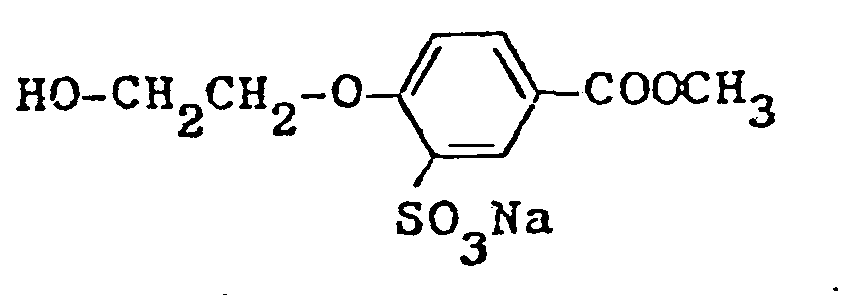


- Dinatrium-3,6-disulfonato-2,7-dihydroxynaphthalin, Dinatrium-3,6-disulfonato-1,8-dihydroxynaphthalin.
- Bevorzugt sind für den erfingungsgemäßen Zweck lineare Polyester der nachstehenden allgemeinen Formel

- X =-H, -O-CH2-CH2-CH2-SO3M oder -S03M
- M = Alkalimetall, Ammonium,
- R = ein Diolradikal (vgl. Aufzählung S. 5 bis 6) einer gesättigten oder ungesättigten aliphatischen, cycloaliphatischen oder araliphatischen Verbindung mit 2 bis 10 Kohlenstoffatomen und/oder einer äthergruppenhaltigen gesättigten aliphatischen, cycloaliphatischen oder araliphatischen Verbindung mit 2 bis 10 Kohlenstoffatomen in den aliphatischen Teilen zwischen zwei Sauerstoffatomen und
- n = so groß ist, daß das mittlere Molekulargewicht des Polyesters zwischen 800 und 5000 liegt.
- Besonders bevorzugt werden dabei wasserlösliche Polyester, in denen 10 bis 20 Mol-% der phenylenreste durch Einkondensieren von 5-Natriumsulfonatopropoxy-isophthalsäuredimethylester oder S-Natriumsulfonato-isophthalsäuredimethylester,
- 40 bis 90 Mol-% durch Einkondensieren von Isophthalsäure oder ihrer Derivate, und 0 bis 40 Mol-% durch Einkondensieren von Terephthalsäure, bevorzugt in Form des Dimethylesters, erhalten werden, sowie
- 40 bis 100 Mol-% der eingesetzten Diole Diäthylen- und/oder Triäthylenglykol und
- 0 bis 60 Mol-% ein oder mehrere andere Diole, insbesondere solche mit mehr als 2 Ätherbrücken und besonders vorteilhaft Polyäthylenglykol vom durchschnittlichen Molekulargewicht 300 bis 1000 sind.
- Eine Variation der obigen allgemeinen Formel besteht darin, daß man 0 bis 40 Mol-% des gesamten Anteils an Benzoldicarbonsäuren in der Formel durch eine aliphatische oder cycloaliphatische Dicarbonsäure mit 4 bis 10 Kohlenstoffatomen ersetzt. Anstelle der linearen Polyester, die für die Herstellung des erfindungsgemäßen Egalisiermittels bevorzugt sind, können auch verzweigte, wasserlösliche bzw. in Wasser dispergierbare Polyester verwendet werden, die im Prinzip wie die vorgenannten linearen Polyester hergestellt werden, nur muß bei ihrer Herstellung mindestens eine verzweigende Komponente eingesetzt werden.
- Solche verzweigenden Komponenten können sein:
- a) Polycarbonsäuren mit 3, 4 oder 5, vorzugsweise 3 und 4 Carboxylgruppen bzw. deren Ester, insbesondere mit niederen Alkoholen mit 1 bis 4 C-Atomen, deren Anhydride oder Säurechloride,
- b) Polyhydroxyverbindungen mit 3, 4 oder 5, vorzugsweise 3 Hydroxygruppen,
- c) Hydroxycarbonsäuren mit insgesamt 3, 4 oder 5, vorzugsweise 3 und 4 Hydroxy- und Carbonsäuregruppen bzw. deren Derivate, insbesondere deren Ester mit niederen Akoholen mit 1 bis 4 C-Atomen.
- Auch die vorstehend genannten Polycarbonsäuren mit 3, 4 oder 5, vorzugsweise 3 oder 4 Carboxylgruppen, die Polyhydroxyverbindungen oder die unter c) genannten Hydroxycarbonsäuren, können gegebenenfalls eine S03M-Gruppe tragen, wobei M ein Alkalimetall oder Ammonium bedeutet.
- Geeignete verzweigende Polycarbonsäuren bzw. deren Derivate sind beispielsweise: Trimellithsäure, Trimesinsäure, Hemimellithsäure, Mellophansäure, Prehnitsäure, Pyromellithsäure, Aconitsäure, Tricarballylsäure, Äthantetracarbonsäure, Trimellithsäureanhydrid, Pyromellithsäuredianhydrid, Hemimeilithsäureanhydrid, Mellophansäuredianhydrid, Prehnitsäureanhydrid, Trimellithsäuretrimethylester, Trimellithsäuretriäthylester, Trimesinsäuretrimethylester, Hemimellithsäuretrimethylester, meii6phän- säuretetramethylester, Prehnitsäuretetramethylester, Pyromellithsäuretetramethylester, Pyromellithsäuretetraäthylester, 1,2,3-Cyclohexantricarbonsäure, 1,2,4-Cyclohexantricarbonsäure, 1,3,5-Cyclohexantricarbonsäure, Naphthalintricarbonsäuren.
- Geeignete Polyhydroxyverbindungen sind z. B.: Glyzerin, Erythrit, Pentaerythrit, Trimethylolpropan, Trimethyloläthan.
- Geeignete verzweigende Hydroxycarbonsäuren bzw. deren Derivate sind z. B. Zitronensäure, Apfelsäure, Weinsäure, Zitronensäuretrimethylester, Apfelsäuredimethylester, Weinsäuredimethylester.
- Es werden insbesondere solche verzweigten wasserlöslichen bzw. in Wasser dispergierbaren Polyester verwendet, die bezogen auf 100 Mol-% der vorhandenen caboxylgruppentragenden Komponenten 1 bis 40 Mol-%, vorzugszweise 5 bis 40 Mol-% verzweigende Komponenten enthalten. Vorzugsweise bestehen auch von den vorhandenen Dicarbonsäurekomponenten mindestens 40 Mol-% aus Benzoldicarbonsäuren, insbesondere aus Isophthalsäure. Weiterhin ist es vorteilhaft, wenn die Verbindungen der hydroxylgruppentragenden Komponenten so ausgewählt werden, daß sie, bezogen auf 100 Mol-% der Di- und Polyole, mindestens zu 40 Mol-% aus Diäthylenglykol und/oder Triäthylenglykol bestehen.
- Die benötigten wasserlöslichen bzw. in Wasser dispergierbaren linearen oder verzweigten sulfonatgruppenenthaltenden Polyester können auch dadurch erhalten werden, daß man die wasserlöslichmachenden Sulfonatgruppen in entsprechend ungesättigte Polyester einführt, indem man, z. B. gemäß der DT-OS 23 35 480 Bisulfit an Doppelbindungen enthaltende Polyester anlagert.
- Die Bestimmung des scheinbaren mittleren Molekulargewichts erfolgt im Dampfdruckosmometer in Dimethylformamid als Lösungsmittel.
- Wegen der Dissoziation der Sulfonatgruppen liegt das wirkliche Mittel des Molekulargewichts höher als der so gemessene, scheinbare Wert. Der Meßwert ist jedoch ein hinreichend genaues Kriterium zur Charakterisierung des Kondensationsgrades der erfindungsgemäßen Polymischester und zur Bestimmung des Endproduktes der Kondensation.
- Die zur Herstellung des erfindungsgemäßen Egalisiermittels benötigten Äthoxylierungsprodukte des Rizinusöls sind zum Teil als Emulgatoren im Handel und werden in an sich bekannter Weise durch Umsetzung von Rizinusöl mit 5 bis 50 Molen Äthylenoxid erhalten. Durch einfaches gleichmäßiges Mischen der Polyesterkomponente A mit dem Athoxylierungsprodukt B im Gewichtsverhältnis 1 : (0,1 bis 5), vorzugsweise 1 : (0,5 bis 2) wird das erfingungsgemäße Egalisiermittel hergestellt. Nach dem Mischen der Komponenten A und B liegt normalerweise ein schwach saurer pH-Wert vor. Es ist zweckmäßig, den pH-Wert des Egalisiermittels durch Einrühren einer anorganischen oder organischen Base, wie z. B. Natronlauge, auf einen pH-Wert von 6 bis 7 einzustellen. Hierbei werden vorhandene COOH-Gruppen ganz oder zum Teil in die entsprechenden Salze COOM überführt, wobei M das Kation der Base, vorzugsweise ein Alkalimetall oder Ammonium ist.
- Das erfindungsgemäße Egalisiermittel kann auch in Form einer Lösung, beispielsweise in Form einer 10 bis 50 gew.%igen, vorzugsweise 10 bis 30 gew.%igen, wäßrigen Lösung zur Anwendung kommen.
- Nach dem erfindungsgemäßen Färbeverfahren können Materialien aus allen Synthesefasern, vorzugsweise jedoch Fasern aus linearen Polyestern, gleichmäßig gefärbt werden, die sich nach den üblichen HT-Ausziehverfahren mit wasserunlöslichen Dispersionsfarbstoffen färben lassen. Insbesondere ist das erfindungsgemäße Färbeverfahren auch für schwierig zu handhabende Farbstoffkombinationen bei texturiertem Material, bei Wickelkörpern und bei Schnellfärbeverfahren geeignet. Störungen der Flottenstabilität, Abfiltrationen, Unegalitäten, Tonverschiebungen und dgl. werden mit hoher Sicherheit verhindert. Überraschenderweise tritt durch den Zusatz des Äthoxylierungsproduktes ein synergistischer Effekt ein, so daß erheblich weniger von dem verhältnismäßig teuren Polyester eingesetzt werden muß. Besonders gute Ergebnisse erhält man bei Schnellfärbeverfahren. Bei derartigen Schnellfärbeverfahren werden der zu färbenden Ware bei Temperaturen von ca. 130°C plötzlich relativ große Farbstoffmengen angeboten. Die dadurch entstehende Gefahr von Unegalitäten wird durch die Anwendung des erfingungsgemäßen Egalisiermittels vermieden.
- Zur Durchführung des erfingungsgemäßen Färbeverfahrens werden die Färbebäder wie üblich bei 50 bis 60°C angesetzt und durch pH regulierende Substanzen auf pH 4 bis 6 eingestellt. Dann wird das erfindungsgemäße Egalisiermittel gegebenenfalls in Form einer Lösung, in Mangen von 0,02 g/1 bis 5 g/I, vorzugsweise 0,05 g/I bis 2 g/I (bezogen auf 100-%iges Egalisiermittel) zugesetzt. Es ist selbstverständlich aber auch möglich, der Färbeflotte die Polyesterkomponente und das Äthoxylierungsprodukt getrennt voneinander zuzusetzen.
- Anschließend wird der vordispergierte, wasserunlösliche Dispersionsfarbstoff und das zu färbende Material zugegeben und auf die erforderliche Färbetemperature (Temperaturen bis ca. 130°C) aufgeheizt und die übliche Färbezeit lang gefärbt. Die Fertigstellung der Färbungen erfolgt in bekannter Weise z.B. durch reduktive Nachbehandlung.
- Bei den besonders bevorzugten Schnellfärbeverfahren wird die Flotte getrennt von dem zu färbenden Material unter Zusatz des erfindungsgemäßen Polykondensats hergestellt. Die auf die Färbetemperatur von 120 bis 130°C erhitzte Flotte wird dann rasch in Kontakt mit dem zu färbenden Material gebracht. Falls nach der sogenannten Einschleustechnik gearbeitet wird, kann das erfindungsgemäße Polykondensationsprodukt auch dem Färbebad vor der Zugabe der Farbstoffdispersion zugegeben werden.
- Polykondensationsprodukt auch dem Färbebad vor der Zugabe der Farbstoffdispersion zugegeben werden.
- In den nachstehenden Beispielen werden folgende Abkürzungen gebraucht:
- SPO = 5-Natriumsulfonatopropoxy-isophthalsäuredimethylester
- DMT = Dimethylterephthalat
- IPA = Isophthalsäure
- DEG = Diäthylenglykol
- PEG = Polyäthylenglykol
- AEO = Äthylenoxid
- SIM = 5-Natriumsulfonato-iscphthalsäuredimethylester
- PMSA = Pyromellithsäuredianhydrid
- (10 Mol-% SPO, 40 Mol-% DMT, 50 Mol-% IPA, 100 Mol-% DEG, 10 Mol-% PEG 600, gleiche Menge Äthoxylierungsprodukt aus 1 Mol Rizinusöl und 30 Mol AEO).
- In einem 4-Liter-Schliffvierhalskolben mit Rührer, Thermometer, Gaseinleitungsrohr und absteigendem Kühler werden 132, 5 g Diäthylenglykol (1,25 Mol), 75 Polyäthylenglykol 600 (0,125 Mol), 97 g Terephthalsäuredimethylester (0,5 Mol), 44,25 g 5-Natriumsulfonatopropoxy-isophthalsäure- dimethylester (0,125 Mol) und 2 g Titantetraisopropylat unter Stickstoffatmosphäre im Laufe einer Stunde auf 150°C geheizt. Dabei destillieren etwa 12 g Methanol ab. Die Temperatur der Schmelze wird im Laufe einer Stunde auf 160°C und danach im Laufe einer weiteren Stunde auf 170°C gesteigert. Dabei destillieren nochmals ca. 18 g Methanol ab. Nun werden der Schmelze 103,75 g lsophthalsäure vom Reinheitsgrad 99% zugemischt, und unter ständigem Überleiten eines schwachen Stickstoffstroms wird anschließend die Temperatur stündlich um 10°C erhöht, bis nach 5 Stunden 220°C erreicht sind. Dabei destillieren allmählich ca. 20 g Wasser, das noch etwas Methanol enthält, ab. Nun wird noch 4 Stunden unter Stickstoff auf 220 bis 225°C erhitzt, wobei, wie während der gesamten Reaktion, die Schmelze ständig kräftig gerührt werden muß. Dann wird ein Wasserstrahlvakuum von ca. 13 mbar angelegt und solange bei 220 bis 225°C weitergerührt, bis das scheinbare mittlere Molekulargewicht einen Wert von ca. 2000 erreicht hat, was nach ca.
- 6 Stunden der Fall ist. Hierbei destilliert auch des überschüssige Diäthylenglykol ab. Man erhält 380 g einer hochviskosen, bernsteinfarbenen Schmelze, in die man bei 140 bis 150°C vorsichtig (Luftausschluß) die gleiche Gewichtsmenge des flüssigen, handelsüblichen Anlagerungsprodukts von 30 Molen Äthylenoxid an 1 Mol Ricinusöl einrührt.
- Es entstehen 760 g einer bernsteinfarbenen Mischung, die sich nach dem Abkühlen leicht mit 1520 g Wasser zu 2280 g einer 33 %igen wässrigen Lösung verdünnen lassen (= 20 %ig in Bezug auf den Polyestergehalt). Durch Zugabe von wenig 25 %iger Natronlauge wird neutralisiert. Anschließend kann man eine geringe Trübung leicht beseitigen durch Vermischen mit 1 Gew.% Kieselgur und Abpressen über ein Druckfilter.
- Das gleiche Produkt wie in Beispiel 1 erhält man auch, wenn man die Polyesterschmelze des Beispiels 1 mit Wasser auf 1900 g einer 20 %igen Lösung verdünnt, neutralisiert und dann 380 g des handelsüblichen Anlagerungsprodukts von 30 Molen Äthylenoxid an 1 Mol Ricinusöl einrührt und homogen verteilt.
- Ein ähnlich gut wirksames Produkt erhält man, wenn man in Beispiel 1 anstelle des Additions- produktes von 30 Mol AEO an 1 Mol Rizinusöl die gleiche Gewichtsmenge eines Additionsproduktes von 50 Mol AEO an 1 Mol Ricinusöl einsetzt.
- Ein ähnlich gut wirksames Produkt erhält man, wenn man in Beispiel 1 anstelle des Additions- produktes von 30 Mol AEO an 1 Mol Rizinusöl die gleiche Gewichtsmenge eines Additions-produktes von 15 Mol AEO an 1 Mol Ricinusöl einsetzt.
- Eine deutlich feststellbare Verbesserung der Egalisierwirkung erhält man auch schon, wenn man in Beispiel 2 nur 76 g des Additionsproduktes von 30 Mol AEO an 1 Mol Ricinusöl zusetzt, was eine 23 %ige Lösung, bezogen auf Feststoffgehalt, ergibt.
- Eine deutlich faststellbare Verbesserung der Egalisierwirkung erhält man auch schon, wenn man in Beispiel 2 nur 76 g des Additionsproduktes von 5 Mol AEO an 1 Mol Ricinusöl einsetzt.
- Ein noch besser egalisierendes Produkt als in Beispiel 1 erhält man, wenn man in Beispiel 1 2 760 g des Anlagerungsproduktes von 30 Mol AEO an 1 Mol Ricinusöl einsetzt, wobei die Konzentration, bezogen auf den Festgehalt, auf ca. 43% ansteigt.
- Ein sehr gut egalisierendes Produkt erhält man auch, wenn man in Beispiel 1 1900 g des Anlagerungsproduktes von 30 Mol AEO an 1 Mol Ricinusöl anstelle von 380 g zusetzt.
- (15 Mol-% SIM, 75 Mol-% IPA, 10 Mol-% PMSA, 100 Mol-% DEG, gleiche Menge Anlagerungsprodukt aus 1 Mol Ricinusöl und 30 Mol AEO).
- In der gleichen Versuchsapparatur, wie in Beispiel 1 beschrieben, werden 159 g Diäthylenglykol (1,5 Mol), 66,6 g 5-Natriumsulfonatoisophthalsäuredimethylester (0,225-Möl), 32,7 g-Pyromellithsäuredianhydrid (0,15 Mol) und 186,6 g 99 %ige Isophthalsäure (1,125 Mol) gut verrührt und unter Stickstoffatmosphäre im Laufe einer Stunde auf 150°C geheizt. Die Temperatur wird dann stündlich um 10°C gesteigert, bis nach 5 Stunden 200°C erreicht sind. Nun wird solange bei dieser Temperatur weitergeheizt, bis sich eine Probe klar in Wasser löst, also keine pulvrige Isophthalsäure mehr abscheidet. Dies ist nach etwa 2 Stunden der Fall, und das scheinbare mittlere Molekulargewicht beträgt dann ca. 800 bei einer Säurezahl von 90. Man rührt nun die gleiche Menge eines Additionsproduktes von 30 Mol Äthylenoxid an 1 Mol Ricinusöl in die vorliegenden 328 g Schmelze ein, läßt bis 110°C abkühlen und verdünnt mit 1312 ml Wasser auf 1640 g Ausbeute = 20 %ig, bezogen auf Polyesterschmelze, 33 %ig, bezogen auf Feststoffgehalt, Das Produkt wird mit etwa 40 ml 25 %iger Natronlauge neutralgestellt.
- Das gleiche Produkt wie in Beispiel 9 kann man auch erhalten, wenn man die 328 g Polyesterschmelze zuerst mit 1312 ml Wasser zu einer klaren, bernsteinfarbenen, 20 %igen Lösung verdünnt, mit Natronlauge neutralisiert und nachträglich 328 g des Additionsproduktes von 30 Mol AEO an 1 MOI Ricinusöl homogen einrührt.
- Wickelkörper ("Muffs") aus texturierten Polyestergarnen werden auf einem HT-Färbeapparat bei einem Flottenverhältnis von 1:10 mit einer Flotte von 130°C durchströmt, die aus weichem Wasser von pH 4,5 (eingestellt mit Essigsäure) und einem Zusatz von 1,5 g/I eines erfindungsgemäßen Egalisiermittels besteht. Das Egalisiermittel besteht aus einem linearen, wasserlöslichen Polyester vom Molgewicht 2500, der gemäß Beispiel 1 durch Polykondensation aus

- Dieser Flotte wird mittels eines Einschleusgeräts ein mit Wasser von 40°C vordispergiertes Gemisch der folgenden Dispersionsfarbstoffe in handelsüblicher Form rasch zugesetzt: 0,46 Gew.-% des Farbstoffs der Formel


- Die Durchström-Menge durch den Muff liegt bei 20 I/kg in der Minute. Nach 30 Minuten Behandlung bei 130°C wird abgekühlt, die Flotte abgelassen und das gefärbte Material reduktiv gereinigt.
- Es resultiert eine vollkommen egale Braunfärbung hoher Reibechtheit mit voller Farbstoffausbeute.
- Führt man die Färbung mit den gleichen Farbstoffen unter gleichen Bedingungen durch, jedoch ohne dem zugesetzten Polyester das Additionsprodukt von 30 Mol AEO an 1 Mol Ricinusöl einzumischen, so benötigt man davon für den gleichen Effekt 2 g/I.
- Führt man die Färbung mit den gleichen Farbstoffen unter den gleichen Bedingungen, jedoch mit der Abänderung durch, daß man als Egalisiermittel der Flotte 2 g/I des Additionsproduktes von 30 Mol AEO an 1 Mol Ricinusöl zusetzt, so erhält man nur eine unegale Färbung mit schlechter Reibechtheit. Dieses Oxäthylierungsprodukt hat für sich selbst also nur eine sehr geringe Egalisierwirkung.
erhalten worden sind und wobei 5 bis 30 Mol-% aller Dicarbonsäure- oder Diol-Kettenglieder Sulfogruppen bzw. deren Salze tragen, in Mengen von 0,1 bis 5 g/I zusetzt.
zugeordnet werden kann. Vertreter derartiger Produkte sind beispielsweise:


Claims (13)


Applications Claiming Priority (2)
| Application Number | Priority Date | Filing Date | Title |
|---|---|---|---|
| DE2737260 | 1977-08-18 | ||
| DE19772737260 DE2737260A1 (de) | 1977-08-18 | 1977-08-18 | Egalisiermittel und verfahren zum gleichmaessigen faerben von materialien aus synthesefasern |
Publications (2)
| Publication Number | Publication Date |
|---|---|
| EP0000898A1 EP0000898A1 (de) | 1979-03-07 |
| EP0000898B1 true EP0000898B1 (de) | 1982-02-03 |
Family
ID=6016731
Family Applications (1)
| Application Number | Title | Priority Date | Filing Date |
|---|---|---|---|
| EP78100620A Expired EP0000898B1 (de) | 1977-08-18 | 1978-08-07 | Egalisiermittel und Verfahren zum Färben von synthetischen Fasermaterialien |
Country Status (4)
| Country | Link |
|---|---|
| EP (1) | EP0000898B1 (de) |
| JP (1) | JPS5442475A (de) |
| DE (2) | DE2737260A1 (de) |
| IT (1) | IT1118248B (de) |
Families Citing this family (9)
| Publication number | Priority date | Publication date | Assignee | Title |
|---|---|---|---|---|
| JPS57131672A (en) * | 1981-02-06 | 1982-08-14 | Mitsubishi Heavy Ind Ltd | Cable traction device |
| JPS5928461U (ja) * | 1982-08-11 | 1984-02-22 | 東京製綱株式会社 | より線の引抜装置 |
| US4729925A (en) * | 1986-12-22 | 1988-03-08 | Eastman Kodak Company | Polyurethane elastomers comprising a charge-control agent and shaped elements therefrom |
| EP1070781A1 (de) * | 1999-07-19 | 2001-01-24 | Clariant International Ltd. | Erhöhung der Nassgleitfähigkeit von Textilmaterial und Nassgleitmittel dafür |
| EP1094147A1 (de) | 1999-09-22 | 2001-04-25 | Clariant International Ltd. | Erhöhung der Nassgleitfähigkeit von Textilmaterial und Nassgleitmittel dafür |
| EP1273102B1 (de) * | 2000-04-04 | 2005-11-16 | Koninklijke Philips Electronics N.V. | Ein digital-analog-wandler |
| JP4614912B2 (ja) * | 2006-05-16 | 2011-01-19 | 日華化学株式会社 | ポリエステル系繊維材料用オリゴマー除去剤 |
| BR102018077399A8 (pt) * | 2018-12-28 | 2021-06-15 | Suzano Papel E Celulose S A | resinas fenólicas do tipo resol, processo de síntese das referidas resinas e uso das mesmas |
| CN114575170B (zh) * | 2022-03-15 | 2023-10-03 | 浙江联胜新材股份有限公司 | 一种涤纶染色高温匀染剂的制备方法 |
Family Cites Families (5)
| Publication number | Priority date | Publication date | Assignee | Title |
|---|---|---|---|---|
| DE1619489C3 (de) * | 1966-09-09 | 1975-03-06 | Farbwerke Hoechst Ag, Vormals Meister Lucius & Bruening, 6000 Frankfurt | Emulgiermittel für wasserunlösliche Carrier für das Färben und Bedrucken von synthetischen Fasern |
| CH575442A5 (de) * | 1974-02-26 | 1976-05-14 | Ciba Geigy Ag | |
| DE2508472C3 (de) * | 1975-02-27 | 1980-08-28 | Hoechst Ag, 6000 Frankfurt | Verfahren zum gleichmäßigen Färben von Fasermaterialien aus linearen Polyestern |
| DE2621653A1 (de) * | 1976-05-15 | 1977-12-01 | Cassella Farbwerke Mainkur Ag | In wasser loesliche oder dispergierbare, verzweigte copolyester und verfahren zu ihrer herstellung |
| DE2653284C3 (de) * | 1976-11-24 | 1979-05-03 | Hoechst Ag, 6000 Frankfurt | Verfahren zum gleichmäßigen Färben von synthetischen Fasermaterialien |
-
1977
- 1977-08-18 DE DE19772737260 patent/DE2737260A1/de not_active Withdrawn
-
1978
- 1978-08-07 EP EP78100620A patent/EP0000898B1/de not_active Expired
- 1978-08-07 DE DE7878100620T patent/DE2861600D1/de not_active Expired
- 1978-08-17 JP JP9957678A patent/JPS5442475A/ja active Granted
- 1978-08-17 IT IT26798/78A patent/IT1118248B/it active
Also Published As
| Publication number | Publication date |
|---|---|
| DE2737260A1 (de) | 1979-07-12 |
| EP0000898A1 (de) | 1979-03-07 |
| JPS5442475A (en) | 1979-04-04 |
| IT7826798A0 (it) | 1978-08-17 |
| IT1118248B (it) | 1986-02-24 |
| DE2861600D1 (en) | 1982-03-11 |
| JPS6151073B2 (de) | 1986-11-07 |
Similar Documents
| Publication | Publication Date | Title |
|---|---|---|
| EP0001206B1 (de) | Polykondensat, Verfahren zu seiner Herstellung und Verfahren zum gleichmässigen Färben von synthetischen Fasermaterialien unter Verwendung des Polykondensats als Egalisiermittel | |
| DE2613755C2 (de) | Verfahren zur Herstellung von Propylenoxydumsetzungsprodukten und ihre Verwendung | |
| DE2508472C3 (de) | Verfahren zum gleichmäßigen Färben von Fasermaterialien aus linearen Polyestern | |
| DE2621653A1 (de) | In wasser loesliche oder dispergierbare, verzweigte copolyester und verfahren zu ihrer herstellung | |
| EP0309909A1 (de) | Verfahren zur Verbesserung der Lichtechtheit von Polyesterfärbungen unter Verwendung von Benzophenonetherestern und neue Benzophenonetherester | |
| DE2834537A1 (de) | Copolyester auf terephthalsaeurebasis | |
| EP0000898A1 (de) | Egalisiermittel und Verfahren zum Färben von synthetischen Fasermaterialien | |
| DE2900686C2 (de) | ||
| EP0364792A2 (de) | Carrier für das Färben von Polyestermaterialien | |
| DE2802305A1 (de) | Carboxylgruppenhaltige propylenoxyd-polyaddukte, verfahren zu ihrer herstellung und ihre verwendung als faerbereihilfsmittel | |
| DE2136688B2 (de) | Verfahren zur herstellung von gereinigtem bis-(beta-hydroxyaethyl)- terephthalat | |
| CH640160A5 (de) | Kokille mit kernzug. | |
| EP0029972A2 (de) | Präparation zum Aufhellen von Synthesefasern, Verfahren zu ihrer Herstellung und Verfahren zum optischen Aufhellen | |
| DE1595378C3 (de) | Verfahren zur Herstellung von modifizierten Polyestern | |
| CH515287A (de) | Verfahren zur Herstellung von Copolyestern | |
| DE2060604C3 (de) | Verfahren zur Herstellung von modifizierten Polyestern | |
| DE1595545A1 (de) | Verfahren zur Herstellung von Polyalkylenterephthalaten | |
| EP1347091B1 (de) | Färbereihilfsmittel | |
| WO1994001484A1 (de) | Verfahren zur reduktion des gelbwertes von nachkondensiertem polyestergranulat | |
| DE1494631B2 (de) | Verfahren zur Herstellung von Polyesterfäden und -folien mit einer verbesserten Färbbarkeit | |
| DE2060604B2 (de) | Verfahren zur Herstellung von modifizierten Polyestern | |
| DE961799C (de) | Verfahren zur Herstellung von Walkmitteln als feinstverteilte Emulsionen bzw. kolloidale Loesungen | |
| DE1271987C2 (de) | Verfahren zur herstellung von faser- und filmbildenden polyestern | |
| DE1939923A1 (de) | Verfahren zur Herstellung hochmolekularer Polyester | |
| DE3390326T1 (de) | Wasserfreie Tauchfärbemischung und Verfahren zum Färben von Gegenständen aus Kunststoff |
Legal Events
| Date | Code | Title | Description |
|---|---|---|---|
| PUAI | Public reference made under article 153(3) epc to a published international application that has entered the european phase |
Free format text: ORIGINAL CODE: 0009012 |
|
| AK | Designated contracting states |
Designated state(s): BE CH DE FR GB NL |
|
| 17P | Request for examination filed | ||
| GRAA | (expected) grant |
Free format text: ORIGINAL CODE: 0009210 |
|
| AK | Designated contracting states |
Designated state(s): BE CH DE FR GB NL |
|
| REF | Corresponds to: |
Ref document number: 2861600 Country of ref document: DE Date of ref document: 19820311 |
|
| PGFP | Annual fee paid to national office [announced via postgrant information from national office to epo] |
Ref country code: NL Payment date: 19820831 Year of fee payment: 5 |
|
| PG25 | Lapsed in a contracting state [announced via postgrant information from national office to epo] |
Ref country code: NL Effective date: 19840301 |
|
| NLV4 | Nl: lapsed or anulled due to non-payment of the annual fee | ||
| PGFP | Annual fee paid to national office [announced via postgrant information from national office to epo] |
Ref country code: FR Payment date: 19840717 Year of fee payment: 7 Ref country code: CH Payment date: 19840717 Year of fee payment: 7 |
|
| PGFP | Annual fee paid to national office [announced via postgrant information from national office to epo] |
Ref country code: BE Payment date: 19840930 Year of fee payment: 7 |
|
| PG25 | Lapsed in a contracting state [announced via postgrant information from national office to epo] |
Ref country code: GB Effective date: 19890807 |
|
| PG25 | Lapsed in a contracting state [announced via postgrant information from national office to epo] |
Ref country code: CH Effective date: 19890831 Ref country code: BE Effective date: 19890831 |
|
| BERE | Be: lapsed |
Owner name: CASSELLA A.G. Effective date: 19890831 |
|
| GBPC | Gb: european patent ceased through non-payment of renewal fee | ||
| PG25 | Lapsed in a contracting state [announced via postgrant information from national office to epo] |
Ref country code: FR Effective date: 19900427 |
|
| REG | Reference to a national code |
Ref country code: CH Ref legal event code: PL |
|
| REG | Reference to a national code |
Ref country code: FR Ref legal event code: ST |
|
| PGFP | Annual fee paid to national office [announced via postgrant information from national office to epo] |
Ref country code: DE Payment date: 19930906 Year of fee payment: 16 |
|
| PG25 | Lapsed in a contracting state [announced via postgrant information from national office to epo] |
Ref country code: DE Effective date: 19950503 |
|
| PLBE | No opposition filed within time limit |
Free format text: ORIGINAL CODE: 0009261 |
|
| STAA | Information on the status of an ep patent application or granted ep patent |
Free format text: STATUS: NO OPPOSITION FILED WITHIN TIME LIMIT |