CN102174586A - Method and device for recycling edible mushroom residues - Google Patents
Method and device for recycling edible mushroom residues Download PDFInfo
- Publication number
- CN102174586A CN102174586A CN2011100058174A CN201110005817A CN102174586A CN 102174586 A CN102174586 A CN 102174586A CN 2011100058174 A CN2011100058174 A CN 2011100058174A CN 201110005817 A CN201110005817 A CN 201110005817A CN 102174586 A CN102174586 A CN 102174586A
- Authority
- CN
- China
- Prior art keywords
- anaerobic reactor
- biogas
- edible fungi
- fungi residue
- residue
- Prior art date
- Legal status (The legal status is an assumption and is not a legal conclusion. Google has not performed a legal analysis and makes no representation as to the accuracy of the status listed.)
- Granted
Links
Images

Classifications
-
- C—CHEMISTRY; METALLURGY
- C12—BIOCHEMISTRY; BEER; SPIRITS; WINE; VINEGAR; MICROBIOLOGY; ENZYMOLOGY; MUTATION OR GENETIC ENGINEERING
- C12M—APPARATUS FOR ENZYMOLOGY OR MICROBIOLOGY; APPARATUS FOR CULTURING MICROORGANISMS FOR PRODUCING BIOMASS, FOR GROWING CELLS OR FOR OBTAINING FERMENTATION OR METABOLIC PRODUCTS, i.e. BIOREACTORS OR FERMENTERS
- C12M23/00—Constructional details, e.g. recesses, hinges
- C12M23/38—Caps; Covers; Plugs; Pouring means
-
- C—CHEMISTRY; METALLURGY
- C12—BIOCHEMISTRY; BEER; SPIRITS; WINE; VINEGAR; MICROBIOLOGY; ENZYMOLOGY; MUTATION OR GENETIC ENGINEERING
- C12M—APPARATUS FOR ENZYMOLOGY OR MICROBIOLOGY; APPARATUS FOR CULTURING MICROORGANISMS FOR PRODUCING BIOMASS, FOR GROWING CELLS OR FOR OBTAINING FERMENTATION OR METABOLIC PRODUCTS, i.e. BIOREACTORS OR FERMENTERS
- C12M21/00—Bioreactors or fermenters specially adapted for specific uses
- C12M21/04—Bioreactors or fermenters specially adapted for specific uses for producing gas, e.g. biogas
-
- C—CHEMISTRY; METALLURGY
- C12—BIOCHEMISTRY; BEER; SPIRITS; WINE; VINEGAR; MICROBIOLOGY; ENZYMOLOGY; MUTATION OR GENETIC ENGINEERING
- C12M—APPARATUS FOR ENZYMOLOGY OR MICROBIOLOGY; APPARATUS FOR CULTURING MICROORGANISMS FOR PRODUCING BIOMASS, FOR GROWING CELLS OR FOR OBTAINING FERMENTATION OR METABOLIC PRODUCTS, i.e. BIOREACTORS OR FERMENTERS
- C12M23/00—Constructional details, e.g. recesses, hinges
- C12M23/02—Form or structure of the vessel
- C12M23/18—Open ponds; Greenhouse type or underground installations
-
- C—CHEMISTRY; METALLURGY
- C12—BIOCHEMISTRY; BEER; SPIRITS; WINE; VINEGAR; MICROBIOLOGY; ENZYMOLOGY; MUTATION OR GENETIC ENGINEERING
- C12M—APPARATUS FOR ENZYMOLOGY OR MICROBIOLOGY; APPARATUS FOR CULTURING MICROORGANISMS FOR PRODUCING BIOMASS, FOR GROWING CELLS OR FOR OBTAINING FERMENTATION OR METABOLIC PRODUCTS, i.e. BIOREACTORS OR FERMENTERS
- C12M27/00—Means for mixing, agitating or circulating fluids in the vessel
- C12M27/02—Stirrer or mobile mixing elements
- C12M27/06—Stirrer or mobile mixing elements with horizontal or inclined stirrer shaft or axis
-
- C—CHEMISTRY; METALLURGY
- C12—BIOCHEMISTRY; BEER; SPIRITS; WINE; VINEGAR; MICROBIOLOGY; ENZYMOLOGY; MUTATION OR GENETIC ENGINEERING
- C12M—APPARATUS FOR ENZYMOLOGY OR MICROBIOLOGY; APPARATUS FOR CULTURING MICROORGANISMS FOR PRODUCING BIOMASS, FOR GROWING CELLS OR FOR OBTAINING FERMENTATION OR METABOLIC PRODUCTS, i.e. BIOREACTORS OR FERMENTERS
- C12M43/00—Combinations of bioreactors or fermenters with other apparatus
-
- Y—GENERAL TAGGING OF NEW TECHNOLOGICAL DEVELOPMENTS; GENERAL TAGGING OF CROSS-SECTIONAL TECHNOLOGIES SPANNING OVER SEVERAL SECTIONS OF THE IPC; TECHNICAL SUBJECTS COVERED BY FORMER USPC CROSS-REFERENCE ART COLLECTIONS [XRACs] AND DIGESTS
- Y02—TECHNOLOGIES OR APPLICATIONS FOR MITIGATION OR ADAPTATION AGAINST CLIMATE CHANGE
- Y02E—REDUCTION OF GREENHOUSE GAS [GHG] EMISSIONS, RELATED TO ENERGY GENERATION, TRANSMISSION OR DISTRIBUTION
- Y02E50/00—Technologies for the production of fuel of non-fossil origin
- Y02E50/30—Fuel from waste, e.g. synthetic alcohol or diesel
-
- Y—GENERAL TAGGING OF NEW TECHNOLOGICAL DEVELOPMENTS; GENERAL TAGGING OF CROSS-SECTIONAL TECHNOLOGIES SPANNING OVER SEVERAL SECTIONS OF THE IPC; TECHNICAL SUBJECTS COVERED BY FORMER USPC CROSS-REFERENCE ART COLLECTIONS [XRACs] AND DIGESTS
- Y02—TECHNOLOGIES OR APPLICATIONS FOR MITIGATION OR ADAPTATION AGAINST CLIMATE CHANGE
- Y02P—CLIMATE CHANGE MITIGATION TECHNOLOGIES IN THE PRODUCTION OR PROCESSING OF GOODS
- Y02P20/00—Technologies relating to chemical industry
- Y02P20/10—Process efficiency
- Y02P20/133—Renewable energy sources, e.g. sunlight
-
- Y—GENERAL TAGGING OF NEW TECHNOLOGICAL DEVELOPMENTS; GENERAL TAGGING OF CROSS-SECTIONAL TECHNOLOGIES SPANNING OVER SEVERAL SECTIONS OF THE IPC; TECHNICAL SUBJECTS COVERED BY FORMER USPC CROSS-REFERENCE ART COLLECTIONS [XRACs] AND DIGESTS
- Y02—TECHNOLOGIES OR APPLICATIONS FOR MITIGATION OR ADAPTATION AGAINST CLIMATE CHANGE
- Y02W—CLIMATE CHANGE MITIGATION TECHNOLOGIES RELATED TO WASTEWATER TREATMENT OR WASTE MANAGEMENT
- Y02W10/00—Technologies for wastewater treatment
- Y02W10/30—Wastewater or sewage treatment systems using renewable energies
- Y02W10/37—Wastewater or sewage treatment systems using renewable energies using solar energy
Landscapes
- Health & Medical Sciences (AREA)
- Life Sciences & Earth Sciences (AREA)
- Engineering & Computer Science (AREA)
- Chemical & Material Sciences (AREA)
- Wood Science & Technology (AREA)
- Organic Chemistry (AREA)
- Zoology (AREA)
- Bioinformatics & Cheminformatics (AREA)
- Genetics & Genomics (AREA)
- Biochemistry (AREA)
- General Engineering & Computer Science (AREA)
- Microbiology (AREA)
- Sustainable Development (AREA)
- Biomedical Technology (AREA)
- General Health & Medical Sciences (AREA)
- Biotechnology (AREA)
- Molecular Biology (AREA)
- Clinical Laboratory Science (AREA)
- Oil, Petroleum & Natural Gas (AREA)
- General Chemical & Material Sciences (AREA)
- Environmental & Geological Engineering (AREA)
- Processing Of Solid Wastes (AREA)
- Fertilizers (AREA)
Abstract
本发明涉及一种食用菌菌渣处理方法及装置,主要是将废弃菌渣与玉米秸秆或养牛场粪便置于厌氧反应器中联合发酵产沼气,厌氧反应器上方覆盖红泥塑料顶盖,并设有斜置式搅拌器,在利于菌渣原料进出料的同时,避免了结壳。产生的沼气用于发电或农用,沼渣制作有机肥,沼液调配成水果或蔬菜用叶面肥,在处理菌渣的同时,还得到了新能源-沼气和有机肥料。本发明主要应用于食用菌主产区,装置配套使用阳光板暖棚和太阳能供热装置,方法配套使用复合微生物菌剂,厌氧反应器一年四季可正常使用。
The invention relates to a method and device for treating edible fungus slag. The main method is to put waste slag and corn stalks or manure from cattle farms into an anaerobic reactor for joint fermentation to produce biogas, and the top of the anaerobic reactor is covered with a red mud plastic roof. Cover, and equipped with an inclined agitator, while facilitating the feeding and discharging of the fungus residue raw materials, it avoids crusting. The generated biogas is used for power generation or agricultural use, the biogas residue is made into organic fertilizer, and the biogas slurry is blended into foliar fertilizer for fruits or vegetables. While processing the fungus residue, new energy sources - biogas and organic fertilizer are also obtained. The invention is mainly used in the main production areas of edible fungi, and the device is matched with a solar panel greenhouse and a solar heating device, and the method is matched with a compound microbial agent, and the anaerobic reactor can be used normally throughout the year.
Description
技术领域technical field
本发明涉及一种食用菌菌渣资源化利用的处理方法及装置,可以同时解决废弃菌渣资源浪费和环境污染问题,属于农业技术领域。The invention relates to a treatment method and device for resource utilization of edible fungus residues, which can simultaneously solve the problems of resource waste and environmental pollution of discarded mushroom residues, and belongs to the field of agricultural technology.
背景技术Background technique
目前,我国已成为世界上食用菌生产第一大国,2009年全国食用菌总产量达到2.02×10⁷t,占全球总产量的70%以上,山东省食用菌总产量达到206万t,占全国食用菌总产量的10.2%。伴随着食用菌产业的蓬勃发展,每年有大量的食用菌菌渣产生,按食用菌生物学效率平均40%计算,2009年全国食用菌菌渣总产量约5.05×10⁷t,山东省食用菌菌渣总量达到515万t,数量巨大。At present, China has become the largest producer of edible fungi in the world. In 2009, the total output of edible fungi in China reached 2.02×10 7 t, accounting for more than 70% of the global total output. The total output of edible fungi in Shandong Province reached 2.06 million t, accounting for the 10.2% of the total output of edible fungi. With the vigorous development of the edible fungi industry, a large amount of edible fungus residues are produced every year. According to the average biological efficiency of edible fungi of 40%, the total output of edible fungi residues in China in 2009 was about 5.05×10 7 t. The total amount of fungus residue reached 5.15 million tons, which is a huge amount.
据了解,山东省栽培食用菌主要以棉子壳、玉米芯、酒糟为主料,棉子壳所含营养比较全面,吸水性强,透气性好,便于发菌出菇,主要用于栽培金针菇,而干玉米芯含水分8.7%,有机质91.3%,其中粗蛋白2.0%,粗脂肪0.7%,粗纤维28.2%,可溶性碳水化合物58.4%,粗灰分2.0%,钙0.1%,磷0.08%,主要适合于栽培平菇,酒糟也是一种很好的食用菌栽培原料,其营养成分适合鸡腿菇菌丝的生长,既可以降低鸡腿菇生产成本,又可防止污染环境。这些原料因其特有的性质而被菇农广泛使用。It is understood that the edible fungi cultivated in Shandong Province mainly use cottonseed husks, corn cobs, and distiller's grains as the main ingredients. Cottonseed husks contain comprehensive nutrients, strong water absorption, good air permeability, and are easy to grow and produce mushrooms. They are mainly used for cultivating Flammulina velutipes , while the dry corn cob contains 8.7% moisture, 91.3% organic matter, including 2.0% crude protein, 0.7% crude fat, 28.2% crude fiber, 58.4% soluble carbohydrate, 2.0% crude ash, 0.1% calcium, 0.08% phosphorus, mainly It is suitable for the cultivation of Pleurotus ostreatus, and distiller's grains are also a good raw material for edible fungus cultivation. Its nutritional components are suitable for the growth of Coprinus comatus mycelia, which can reduce the production cost of Coprinus comatus and prevent environmental pollution. These raw materials are widely used by mushroom farmers because of their unique properties.
然而如何对食用菌菌渣进行环保有效的处理,一直没有得到很好的解决。每年除少量菌渣被作为肥料外,大量的菌渣随意丢弃,这不仅造成了农业有机资源的巨大浪费,还造成了周围环境的恶化,造成细菌繁殖,疾病传播,给附近居民生活环境造成了严重影响,也给附近食用菌产业造成了巨大危害。Yet how to carry out environmental protection and effective treatment to edible fungus slag, have not been well solved always. In addition to a small amount of fungal residue being used as fertilizer every year, a large amount of fungal residue is discarded at will, which not only causes a huge waste of agricultural organic resources, but also causes the deterioration of the surrounding environment, causing bacteria to multiply and spread of diseases, causing damage to the living environment of nearby residents. Serious impact, but also caused great harm to the nearby edible fungus industry.
目前对于食用菌菌渣综合利用,有一些相关的报道,如专利号为200810070366.0“一种处理食用菌渣生产有机肥的方法”中公开了一种利用食用菌菌渣生产有机肥的方法;专利号为201010151096.3“一种利用食用菌下脚料生产猪饲料的方法”公开了一种利用食用菌菌渣生产猪饲料的方法;专利号200710049438.9“利用废弃食用菌渣制备活性炭的方法”公开了一种利用食用菌渣制备活性炭的方法,因食用菌菌渣木质纤维素含量高,不容易被厌氧消化,导致产气率低,在厌氧发酵过程中容易结壳和堵塞,目前尚无利用食用菌菌渣厌氧发酵生产沼气的方法的报道。For the comprehensive utilization of edible fungus slag at present, there are some relevant reports, such as patent No. 200810070366.0 "A method of processing edible fungus slag to produce organic fertilizer", which discloses a method for producing organic fertilizer by using edible fungus slag; No. 201010151096.3 "A Method for Producing Pig Feed Using Edible Mushroom Leftovers" discloses a method for producing pig feed using edible fungus slag; The method of using edible fungus residue to prepare activated carbon, because of the high lignocellulose content of edible fungus residue, is not easy to be anaerobically digested, resulting in low gas production rate, and easy to crust and block during anaerobic fermentation. A report on the method of producing biogas by anaerobic fermentation of fungal residue.
近年来,我国的农业废弃物厌氧处理工艺发展十分迅速,各种新工艺、新方法不断出现,如全混式厌氧反应器(CSTR)、升流式固体反应器(USR)、上流式厌氧污泥床反应器(UASB)和内循环厌氧反应器(IC)等,都取得了显著的效果。全混式厌氧反应器(CSTR)主要用于处理养殖场粪便,发酵原料的固形物(TS)浓度能达到8-12%,设置搅拌系统,升流式固体反应器(USR)主要适用固形物(TS)浓度5-8%的畜禽粪污,内部设置布水系统,上流式厌氧污泥床反应器(UASB)和内循环厌氧反应器(IC)主要用来处理高浓度有机废水,如酒精、糖蜜、柠檬酸等生产废水,也可以处理中等浓度有机废水,如啤酒、屠宰、软饮料等生产废水,还可以处理低浓度有机废水,如生活污水、城市污水等,但固形物(TS)浓度不宜过高。In recent years, the anaerobic treatment process of agricultural waste in my country has developed very rapidly, and various new processes and methods have emerged continuously, such as fully mixed anaerobic reactor (CSTR), upflow solid reactor (USR), upflow Anaerobic sludge bed reactor (UASB) and internal circulation anaerobic reactor (IC), etc., have achieved remarkable results. The fully mixed anaerobic reactor (CSTR) is mainly used to treat the manure of the farm. The solid matter (TS) concentration of the fermentation raw material can reach 8-12%. Livestock and poultry manure with a TS concentration of 5-8%, the internal water distribution system, the upflow anaerobic sludge bed reactor (UASB) and the internal circulation anaerobic reactor (IC) are mainly used to treat high-concentration organic matter Wastewater, such as alcohol, molasses, citric acid and other production wastewater, can also treat medium-concentration organic wastewater, such as beer, slaughter, soft drink and other production wastewater, and can also treat low-concentration organic wastewater, such as domestic sewage, urban sewage, etc., but the solids (TS) concentration should not be too high.
因食用菌菌渣物料的特性,若用目前常用的厌氧反应器(如普通全混式厌氧反应器)或水压式户用沼气池(10-30m3)等厌氧消化装置厌氧发酵,存在进料难,厌氧发酵过程中容易结壳,厌氧发酵后出料难等问题。对于一种新的适用于处理食用菌菌渣的厌氧发酵生产沼气的,即能方便进出料、防止结壳,又能保证冬季正常运转的厌氧反应器装置,目前尚无报道。Due to the characteristics of edible fungus residue materials, if anaerobic digestion devices such as anaerobic reactors (such as ordinary fully mixed anaerobic reactors) or hydraulic household biogas digesters (10-30m 3 ) are used, the anaerobic Fermentation, there are problems such as difficult feeding, easy crusting during anaerobic fermentation, and difficult discharging after anaerobic fermentation. For a kind of new anaerobic reactor device that is suitable for the anaerobic fermentation of processing edible fungus slag to produce biogas, promptly can conveniently feed in and out, prevent encrustation, can guarantee the anaerobic reactor device of winter normal operation again, still do not have report at present.
发明内容Contents of the invention
本发明针对现有技术的不足,提供一种食用菌菌渣资源化利用的处理方法及装置,实现食用菌菌渣资源化利用。Aiming at the deficiencies of the prior art, the invention provides a processing method and device for resource utilization of edible fungus residues, so as to realize resource utilization of edible mushroom residues.
发明概述Summary of the invention
本发明的目的在于提供一种食用菌菌渣资源化利用的处理方法及装置,主要是将废弃菌渣与玉米秸秆或养牛场粪便置于厌氧反应器中联合发酵产生沼气,方法中先将食用菌菌渣与玉米秸秆或养牛场粪便混合堆沤,调节合适的碳氮比并加速纤维素分解速度,物料进入厌氧发酵装置后加入微生物菌剂,可加速沼气发酵过程的进行,提高菌渣原料产气效率,装置中厌氧反应器上方覆盖红泥塑料顶盖,并设有斜置式搅拌器,在利于菌渣原料进出料的同时,避免了结壳,装置采用半地下或全地下式,可以利用部分地温,置于温室内,可以吸收和利用部分太阳能对物料进行加温,在冬季配套太阳能,这些措施可保证厌氧反应器装置冬季正常运转。产生的沼气用于发电或农用,沼渣制作有机肥,沼液调配成水果或蔬菜用叶面肥,在处理菌渣的同时,还得到了新能源——沼气和有机肥料。The purpose of the present invention is to provide a treatment method and device for resource utilization of edible fungus residues. The main method is to put the discarded mushroom residues and corn stalks or cattle manure in an anaerobic reactor for joint fermentation to produce biogas. Mix edible fungus residue with corn stalks or cattle manure to adjust the appropriate carbon-to-nitrogen ratio and accelerate the decomposition rate of cellulose. After the material enters the anaerobic fermentation device, adding microbial agents can accelerate the biogas fermentation process. To improve the gas production efficiency of the fungus residue raw material, the anaerobic reactor in the device is covered with a red mud plastic top cover, and is equipped with an oblique agitator, which facilitates the feeding and discharging of the fungal residue raw material and avoids crusting. The device adopts semi-underground or full-body The underground type can use part of the ground temperature and place it in the greenhouse to absorb and use part of the solar energy to heat the material. In winter, it is equipped with solar energy. These measures can ensure the normal operation of the anaerobic reactor device in winter. The generated biogas is used for power generation or agricultural use, the biogas residue is made into organic fertilizer, and the biogas slurry is blended into foliage fertilizer for fruits or vegetables. While processing the fungus residue, new energy sources—biogas and organic fertilizer are also obtained.
术语说明:Terminology Explanation:
新鲜的奶牛粪便:含水率为质量百分比78%-80%。Fresh cow manure: the water content is 78%-80% by mass.
干玉米秸秆:含水率为质量百分比16%-18%。Dry corn stalks: the water content is 16%-18% by mass.
堆沤:将有机物(如秸秆、粪便等)堆在一起,然后通过内部微生物的发酵作用将有机物分解,转化为可利用的小分子物质。Stack retting: Pile organic matter (such as straw, manure, etc.) together, and then decompose the organic matter through the fermentation of internal microorganisms and convert it into usable small molecular substances.
食用菌菌渣及秸秆类原料进行预先堆沤后用于沼气发酵,有很多好处:①在堆沤过程中,原料中带进去的发酵细菌大量生长繁殖,起到富集菌种的作用;②堆沤腐熟的物料进入沼气池后可减缓酸化作用,有利于酸化和甲烷化的平衡;③纤维素原料(如秸杆、食用菌菌渣等)经堆沤后,纤维素变松散,扩大了纤维素分解菌与纤维素的接触面,大大加速纤维素的分解速度,加速沼气发酵过程的进行;④堆沤腐烂的纤维素原料含水量较大,入池后很快沉底,不易浮面结壳;⑤原料堆沤后体积缩小,便于装池。Edible mushroom residues and straw raw materials are used for biogas fermentation after pre-stacking and retting, which has many advantages: ①During the stacking and retting process, the fermentation bacteria brought in by the raw materials grow and multiply in large quantities, and play the role of enriching bacteria; ② The acidification effect can be slowed down after the composted and decomposed materials enter the biogas digester, which is beneficial to the balance of acidification and methanation; ③ after the cellulose raw materials (such as straw, edible fungus residue, etc.) are stacked and retting, the cellulose becomes loose and expands The contact surface between cellulolytic bacteria and cellulose greatly accelerates the decomposition rate of cellulose and accelerates the biogas fermentation process; ④ The rotten cellulose raw material has a large water content, sinks to the bottom quickly after entering the pond, and is not easy to float on the surface. Shell; ⑤The volume of the raw material is reduced after stacking and retting, which is convenient for loading into the tank.
红泥塑料:一种沼气厌氧反应器装置顶部覆盖材料,主要由抗老化剂、抗氧化剂的红泥高强纤维复合组成,具有吸热性好,抗腐蚀,抗紫外线,抗老化等优点,能充分吸收太阳能量,厌氧发酵温度高,沼气产气量大,市售产品,有多种规格型号,均可使用于本发明。Red mud plastic: a top covering material for biogas anaerobic reactors, mainly composed of red mud high-strength fiber composites with anti-aging agents and antioxidants. It has the advantages of good heat absorption, corrosion resistance, UV resistance, and aging resistance. The solar energy is fully absorbed, the anaerobic fermentation temperature is high, and the biogas production capacity is large. Commercially available products have various specifications and models, and all of them can be used in the present invention.
砖混结构:砖混结构是混合结构的一种,是采用砖墙来承重,钢筋混凝土梁柱板等构件构成的混合结构体系。Brick-concrete structure: Brick-concrete structure is a kind of mixed structure, which is a mixed structure system composed of brick walls for load bearing, reinforced concrete beams, columns and slabs.
搪瓷钢板结构:搪瓷钢板是钛合金专用钢板,厚度可达到20mm,常用钢板厚度3-8mm,钢板表面含油、含锈、含氧化皮,经过酸洗、碱洗、打砂等前处理工艺,将钢板表面处理干净;再在电炉里经900高温二次搪瓷,在钢板的内外两面涂上0.3mm搪瓷涂层。搪瓷涂层和钢板之间具有很强的结合力。搪瓷涂层不仅能阻止罐体腐蚀,而且具有抗强酸,强碱的功能。并具有极强的抗磨损性。北京盈和瑞环保设备有限公司有售。Enamel steel plate structure: Enamel steel plate is a special steel plate for titanium alloy, the thickness can reach 20mm, and the thickness of commonly used steel plate is 3-8mm. The surface of the steel plate contains oil, rust, and scale. The surface of the steel plate is cleaned; and then enameled at a high temperature of 900 degrees in the electric furnace, and the inner and outer sides of the steel plate are coated with 0.3mm enamel coating. There is a strong bond between the enamel coating and the steel plate. The enamel coating can not only prevent tank corrosion, but also has the function of resisting strong acid and alkali. And has strong wear resistance. Beijing Yingherui Environmental Protection Equipment Co., Ltd. is available for sale.
本发明为实现上述目的所采用的技术方案如下:The technical scheme that the present invention adopts for realizing the above object is as follows:
一种食用菌菌渣资源化利用的处理方法,步骤如下:A processing method for resourceful utilization of edible fungus residues, the steps are as follows:
(1)取出完菇后的菌袋,去掉塑料包膜,将食用菌菌渣包块粉碎,使食用菌菌渣呈松散状;含水率为质量百分比50%-60%;(1) Take out the fungus bag after taking out the mushroom, remove the plastic coating, and pulverize the edible fungus dregs, so that the edible fungi dregs are loose; the moisture content is 50%-60% by mass;
(2)步骤(1)处理后的食用菌菌渣的C/N比小于(20-30)∶1时,将食用菌菌渣与粉碎的干玉米秸秆或新鲜的奶牛粪便混合,使C/N比在(20-30)∶1,加水搅拌均匀,使含水率为质量百分比60%-80%;(2) When the C/N ratio of the edible fungus slag treated in step (1) is less than (20-30): 1, the edible fungus slag is mixed with crushed dry corn stalks or fresh cow manure to make the C/N The N ratio is (20-30): 1, add water and stir evenly, so that the moisture content is 60%-80% by mass;
步骤(1)处理后的食用菌菌渣的C/N比在(20-30)∶1时,直接加水搅拌均匀,使含水率为质量百分比60%-80%;When the C/N ratio of the processed edible fungus residue in step (1) is (20-30): 1, directly add water and stir evenly, so that the moisture content is 60%-80% by mass;
得混合物料;get mixed materials;
(3)将步骤(2)的混合物料堆成料堆,用塑料薄膜或塑料布覆盖进行堆沤;堆沤时间5-9天,得食用菌菌渣发酵原料;(3) pile the mixed material of step (2) into a pile, cover with plastic film or plastic cloth and carry out retting; the retting time is 5-9 days, and the edible fungus slag fermentation raw material is obtained;
(4)将步骤(3)堆沤后的食用菌菌渣发酵原料投入厌氧反应器中,加入厌氧反应器容积的10%-15%的接种物,加水至厌氧反应器容积的80-90%,使厌氧反应装置内物料固形物含量为质量百分比10%-12%,并调节pH值为7.2-7.5;(4) The edible fungus slag fermentation raw material after step (3) stacking retting is dropped in anaerobic reactor, adds the inoculum of 10%-15% of anaerobic reactor volume, adds water to 80% of anaerobic reactor volume -90%, so that the solid content of the material in the anaerobic reaction device is 10%-12% by mass, and the pH value is adjusted to 7.2-7.5;
(5)在厌氧反应器中加入复合微生物菌剂,每10m3厌氧反应器容积加入0.5-1.2kg复合微生物菌剂,搅拌均匀,用红泥塑料顶盖封住厌氧反应器上口即可。(5) Add compound microbial bacterial agent into the anaerobic reactor, add 0.5-1.2kg compound microbial bacterial agent per 10m3 volume of the anaerobic reactor, stir evenly, and seal the upper opening of the anaerobic reactor with a red mud plastic top cover That's it.
步骤(5)中所述的复合微生物菌剂为市售产品,可市场购得,例如北京合百意生态能源科技开发有限公司生产的“绿秸灵”牌沼气菌剂(1kg装),山东金茂生物制品有限责任公司产售的微生物菌剂(1kg装)。所述的复合微生物菌剂也可以是按现有技术制备的产品,例如200810140400.7一种沼气池用复合微生物菌剂及其制备方法。该菌剂主要有分解纤维素和低温下提高产气率的作用,可提高菌渣原料产气率,并使厌氧反应器内发酵料液在10℃以上时正常产气。The composite microbial bacterial agent described in the step (5) is a commercially available product, which can be purchased in the market, such as "Lvjingling" brand biogas bacterial agent (1kg pack) produced by Beijing Hebaiyi Ecological Energy Technology Development Co., Ltd., Shandong Microbial agent (packaged in 1kg) produced and sold by Jinmao Biological Products Co., Ltd. The compound microbial bacterial agent can also be a product prepared according to the prior art, for example, 200810140400.7 A compound microbial bacterial agent for biogas digesters and its preparation method. The bacterial agent mainly has the functions of decomposing cellulose and increasing the gas production rate at low temperature, can increase the gas production rate of the fungus residue raw material, and make the fermentation material liquid in the anaerobic reactor produce gas normally when the temperature is above 10°C.
根据本发明的上述方法,优选如下:According to above-mentioned method of the present invention, preferably as follows:
所述步骤(2)中,食用菌菌渣与干玉米秸秆或新鲜的奶牛粪便质量配比为:In the step (2), the mass ratio of edible fungus residue to dry corn stalks or fresh cow manure is:
食用菌菌渣6-10质量份、干玉米秸秆1-2质量份;或6-10 parts by mass of edible fungus residue, 1-2 parts by mass of dry corn stalks; or
食用菌菌渣15-20质量份、新鲜奶牛粪便8-10质量份。15-20 parts by mass of edible mushroom residue, and 8-10 parts by mass of fresh cow manure.
所述步骤(3)中所述料堆,长2-2.7m,宽1.5-2m,高1.2-1.6m;最好在料堆中间垂直插孔利于空气进入。The stockpile described in the step (3) is 2-2.7m long, 1.5-2m wide, and 1.2-1.6m high; it is preferable to insert a vertical hole in the middle of the stockpile to facilitate air entry.
所述步骤(3)中堆沤时间为:夏季5-6天,冬季7-8天,春秋季节6-7天。The stacking retting time in the step (3) is: 5-6 days in summer, 7-8 days in winter, and 6-7 days in spring and autumn.
步骤(1)中所述的出完菇的菌袋为:以玉米芯为主原料的金针菇栽培菌渣、以棉子壳为主原料的平菇栽培菌渣或以酒糟为主原料的鸡腿菇栽培菌渣。The bacterium bag of the mushroom described in the step (1) is: the mushroom slag of Flammulina velutipes with corn cob as the main raw material, the mushroom slag of Pleurotus ostreatus with the cottonseed shell as the main raw material or the Coprinus comatus with distiller's grains as the main raw material Cultivation of bacteria residue.
步骤(1)中所述的粉碎,采用普通粉碎机,市场有售,一般种菇企业或农户都自备有。The pulverization described in the step (1) adopts a common pulverizer, which is available in the market, and the general mushroom planting enterprises or farmers are equipped with it.
步骤(4)中所述的接种物为正常产气沼气池中的沼液或沼渣。The inoculum described in step (4) is the biogas slurry or biogas residue in the biogas digester with normal gas production.
每隔2-3个月换料1次,进出料时,打开红泥塑料顶盖,将料液从厌氧反应器清出,留1/3沼渣作为接种物,新的食用菌菌渣发酵原料一次性进入。冬季(12月-3月)尽量不要换料。Refuel once every 2-3 months. When feeding and discharging, open the red mud plastic top cover, clear the feed liquid from the anaerobic reactor, and leave 1/3 of the biogas residue as the inoculum. New edible fungus residue Fermentation raw materials enter at one time. Try not to refuel in winter (December-March).
产气后的沼渣和沼液可作为有机肥料应用。Biogas residue and biogas slurry after gas production can be used as organic fertilizer.
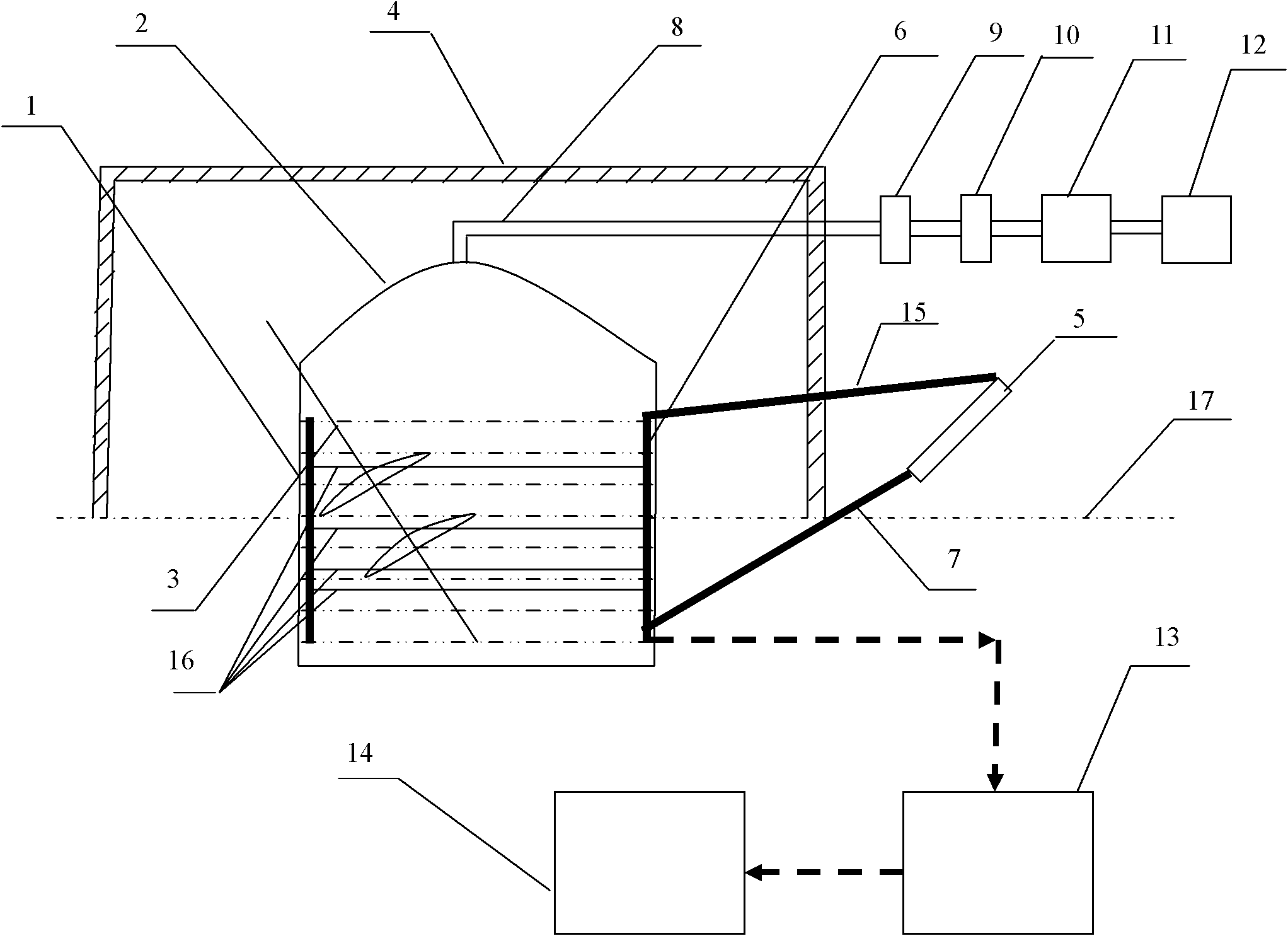
一种食用菌菌渣资源化利用的处理装置,包括厌氧反应器装置、沼气脱水脱硫器、储气装置和沼气利用装置,其特征在于,所述的厌氧反应器装置包括厌氧反应器、暖棚、太阳能集热装置;厌氧反应器上方覆盖红泥塑料顶盖,厌氧反应器内部设有斜置式搅拌器和内热管道,内热管道连通若干根贴近池壁的环状管,该环状管布满厌氧反应器池壁;厌氧反应器外面建有暖棚,太阳能集热装置置于暖棚外,太阳能集热装置底部有太阳能供热管道与厌氧反应器内热管道进水端相连,厌氧反应器内热管道出水端通过回水管与太阳能集热装置顶部入水口接通;厌氧反应器顶部有沼气出口连通沼气出气管。A treatment device for resource utilization of edible fungus residue, comprising an anaerobic reactor device, a biogas dehydration desulfurizer, a gas storage device and a biogas utilization device, characterized in that the anaerobic reactor device includes an anaerobic reactor , greenhouse, solar heat collection device; the top of the anaerobic reactor is covered with a red mud plastic roof, and the inside of the anaerobic reactor is equipped with an oblique stirrer and an internal heat pipe, and the internal heat pipe is connected to several annular pipes close to the pool wall. The annular pipe is covered with the pool wall of the anaerobic reactor; a greenhouse is built outside the anaerobic reactor, and the solar heat collection device is placed outside the greenhouse. The water end is connected, and the water outlet end of the heat pipe in the anaerobic reactor is connected to the water inlet on the top of the solar heat collector through the return pipe; the biogas outlet on the top of the anaerobic reactor is connected to the biogas outlet pipe.
所述的厌氧反应器装置大小可根据食用菌生产区原料情况选择,可制作为8-200m3,可以为每家每户1个,也可以为工厂化生产食用菌区。The size of the anaerobic reactor device can be selected according to the raw material conditions of the edible fungi production area, and can be made to be 8-200m 3 , and can be one for each household, or it can be a factory production edible fungus area.
所述的太阳能集热装置可根据厌氧反应器大小及冬季物料温度要求选择,市场有售,例如山东桑乐太阳能有限公司产售。The solar heat collecting device can be selected according to the size of the anaerobic reactor and the material temperature requirements in winter, and is available in the market, for example, produced and sold by Shandong Sangle Solar Energy Co., Ltd.
厌氧反应器通过沼气出气管可以与沼气脱水脱硫系统、储气装置依次相连,然后与沼气发电机或家用沼气灶连接,供用户使用。脱水脱硫系统是通用产品,市场有售。(例如东莞市康达环保热能有限公司产售),根据每天产气量可选择不同的型号,本领域技术人员均可选择。The anaerobic reactor can be connected to the biogas dehydration and desulfurization system and the gas storage device in turn through the biogas outlet pipe, and then connected to the biogas generator or household biogas stove for users to use. The dehydration and desulfurization system is a general product and is available in the market. (For example, produced and sold by Dongguan Kangda Environmental Protection Thermal Energy Co., Ltd.), different models can be selected according to the daily gas production, and those skilled in the art can choose.
对于每家每户使用的食用菌菌渣资源化利用的处理装置,容积为8-30m3,可以为全地下砖混结构,不配套沼渣沼液储存池、沼液调配池和沼渣处理场,沼渣沼液农户可自行施入农田。For the treatment device for resource utilization of edible fungus residue used by each household, the volume is 8-30m 3 , and it can be a fully underground brick-concrete structure, without matching biogas residue biogas slurry storage tank, biogas slurry blending pond and biogas residue treatment Farmers can apply biogas residue and biogas slurry to the farmland by themselves.
对于工厂化生产食用菌区,厌氧反应器装置容积为30-200m3,可以为半地下式搪瓷钢板结构,需配套沼渣沼液储存池、沼液调配池和沼渣处理场,沼液调配成水果、蔬菜专用肥,沼渣制成有机肥。For the industrial production of edible fungi, the volume of the anaerobic reactor is 30-200m 3 , which can be a semi-underground enamelled steel plate structure, and it needs to be equipped with a biogas slurry storage tank, a biogas slurry blending tank, and a biogas slurry treatment plant. It is blended into special fertilizer for fruits and vegetables, and biogas residue is made into organic fertilizer.
脱硫器是农村户用沼气输气系统中一种仪器。脱硫器由压力表、开关、脱硫瓶和脱硫剂组成。户用脱硫瓶容积一般是1.6升,脱硫瓶内装脱硫剂。脱硫剂有两种:一种为固体脱硫剂;另一种为液体脱硫剂。市场有售。The desulfurizer is an instrument in the rural household biogas transmission system. The desulfurizer is composed of pressure gauge, switch, desulfurization bottle and desulfurizer. The volume of the household desulfurization bottle is generally 1.6 liters, and the desulfurization agent is contained in the desulfurization bottle. There are two kinds of desulfurizers: one is solid desulfurizer; the other is liquid desulfurizer. The market is available.
根据本发明的上述装置,优选如下:According to above-mentioned device of the present invention, preferably as follows:
所述的厌氧反应器为全地下或圆柱体半地下搪瓷钢板结构。所述的暖棚材料为双层阳光板,市场有售。The anaerobic reactor is a fully underground or semi-underground cylindrical enameled steel plate structure. The greenhouse material is a double-layer solar panel, which is available in the market.
所述的太阳能供热装置管道和厌氧反应器内管道均为水介质传热管。Both the pipelines of the solar heating device and the internal pipelines of the anaerobic reactor are water medium heat transfer tubes.
上述装置在进出料时打开红泥塑料顶盖,将料液从厌氧反应器清出,新的食用菌菌渣发酵原料一次性进入,每隔2-3个月换料1次。冬季(12月-3月)尽量不要换料。The above-mentioned device opens the red mud plastic top cover when feeding and discharging the material, clears the feed liquid from the anaerobic reactor, and enters the new edible fungus residue fermentation raw material at one time, and refuels once every 2-3 months. Try not to refuel in winter (December-March).
所述的厌氧反应器上方的红泥塑料顶盖,由抗老化剂、抗氧化剂的红泥高强纤维复合组成,市售,有多种规格型号,因为食用菌菌渣木质、纤维素含量高,且不具有流动性,混合发酵料液比较难降解,存在进出料难的问题,使用的红泥塑料顶盖可以直接打开,进出料方便。The red mud plastic top cover above the anaerobic reactor is composed of red mud high-strength fibers with anti-aging agents and antioxidants. , and has no fluidity, the mixed fermentation feed liquid is relatively difficult to degrade, and there is a problem of difficulty in feeding and discharging materials. The red mud plastic top cover used can be opened directly, which is convenient for feeding and discharging materials.
所述的厌氧反应器为全地下或圆柱体半地下式结构,上方建有阳光板暖棚,内部设有厌氧反应器内管道,通过太阳能供热装置供热,这些措施在冬季可以保证厌氧反应器内料液达到10℃以上。The anaerobic reactor is a fully underground or cylindrical semi-underground structure, with a solar panel greenhouse built above it, and an internal pipeline in the anaerobic reactor, which is heated by a solar heating device. These measures can ensure The feed liquid in the anaerobic reactor reaches above 10°C.
所述的厌氧反应器内的斜置式搅拌器,主要是在混合搅拌过程中可将浆液附近的浮渣打入发酵液中,防止浮渣硬化,起到破壳作用。The oblique agitator in the anaerobic reactor is mainly used to beat the scum near the slurry into the fermentation liquid during the mixing and stirring process, so as to prevent the scum from hardening and break the shell.
与上述装置配套的设施还包括预处理场、沼渣沼液储存池、沼液调配池和沼渣处理场等设施,这些部分都是本领域技术人员熟知的。The supporting facilities for the above-mentioned device also include facilities such as pretreatment field, biogas residue biogas slurry storage pond, biogas slurry adjustment pond and biogas residue treatment field, which are well known to those skilled in the art.
所述的沼渣沼液储存池、沼液调配池均为地下砖混结构,沼渣沼液储存池用于食用菌菌渣厌氧反应器发酵后沼渣沼液的储存。沼液调配池用于沼渣沼液经固液分离后,沼液进入沼液调配池,通过加入微量元素调制成蔬菜或水果专用液体肥。The biogas residue and biogas slurry storage tank and the biogas slurry blending tank are all underground brick-concrete structures, and the biogas residue and biogas slurry storage tank is used for the storage of biogas residue and biogas slurry after fermentation by the anaerobic reactor of edible mushroom residue. The biogas slurry blending tank is used for biogas residues. After the solid-liquid separation, the biogas slurry enters the biogas slurry blending tank, and is prepared into a special liquid fertilizer for vegetables or fruits by adding trace elements.
所述的预处理场和沼渣处理场主要是地上水泥面场地,预处理场用于食用菌菌渣和农作物秸秆、养殖场粪便的混合堆沤预处理,预处理后的混合物物料直接进入厌氧反应器。沼渣处理场主要用于沼渣沼液经固液分离后,沼渣的干化处理,干化后的沼渣制作有机肥料。The pretreatment field and the biogas residue treatment field are mainly ground cement surface fields, and the pretreatment field is used for the mixed stacking and retting pretreatment of edible fungi residues, crop straws, and manure from farms. oxygen reactor. The biogas residue treatment plant is mainly used for the drying treatment of the biogas residue after the solid-liquid separation of the biogas residue, and the drying of the biogas residue to make organic fertilizers.
上述的食用菌菌渣资源化利用的处理装置,大小根据产生的菌渣量的多少选择,本领域的技术人员根据常识都可以实施。The size of the above-mentioned processing device for resource utilization of edible fungus residues is selected according to the amount of generated residues, and those skilled in the art can implement them according to common sense.
本发明与现有技术相比具有如下优点:Compared with the prior art, the present invention has the following advantages:
1、本发明方法发酵效率高,产气量大,配套使用复合微生物菌剂,冬季只要物料温度达到10℃以上,即能正常产气。1. The method of the present invention has high fermentation efficiency and large gas production capacity, and the compound microbial bacterial agent is used in conjunction with it. In winter, as long as the temperature of the material reaches above 10°C, the gas can be produced normally.
2、本发明食用菌菌渣资源化利用的处理方法,将食用菌菌渣作为一种资源,作为沼气池发酵原料来使用,解决了食用菌主产区菌渣浪费污染问题的同时,获得了新能源-沼气,同时,产气后的沼渣和沼液还可作为有机肥料。2. The processing method for resource utilization of edible fungus slag of the present invention uses the edible fungus slag as a resource and uses it as a raw material for biogas digester fermentation, which solves the problem of waste and pollution of the edible fungus slag in the main production area, and obtains New energy-biogas, at the same time, the biogas residue and biogas slurry after gas production can also be used as organic fertilizers.
3、本发明装置厌氧反应器为全地下或圆柱体半地下式厌氧反应器,上方覆盖红泥塑料顶盖,因菌渣为主要原料物料的特性,此结构进出料时可将红泥塑料顶盖打开,使用简单方便。3. The anaerobic reactor of the device of the present invention is a fully underground or cylindrical semi-underground anaerobic reactor, and the upper part is covered with a red mud plastic top cover. Because the fungus residue is the characteristic of the main raw material, the red mud can be used for feeding and discharging of this structure. The plastic top cover opens for easy and convenient use.
4、本发明厌氧反应器装置采用全地下或半地下式,上方建有阳光采光板暖棚,内部设有厌氧反应器内管道,这些保温升温措施在不消耗燃料的情况下,可以保证冬季厌氧反应器内料液达到10℃以上。4. The anaerobic reactor device of the present invention adopts a fully underground or semi-underground type, and a sun-lighting panel greenhouse is built above, and an internal pipeline of the anaerobic reactor is arranged inside. These heat preservation and temperature raising measures can ensure In winter, the feed liquid in the anaerobic reactor reaches above 10°C.
5、本发明厌氧反应器装置设有斜置式搅拌器,主要可以解决在厌氧反应器中菌渣或秸秆漂浮的问题,提高产气效率。5. The anaerobic reactor device of the present invention is equipped with an inclined agitator, which can mainly solve the problem of floating bacteria residue or straw in the anaerobic reactor and improve the gas production efficiency.
6、本发明食用菌菌渣处理方法操作简单,使用方便,实用性强,可大规模推广应用。6. The edible fungus residue treatment method of the present invention is simple to operate, convenient to use, strong in practicability, and can be popularized and applied on a large scale.
附图说明Description of drawings
图1是本发明食用菌菌渣资源化利用的处理装置-厌氧反应器装置的结构示意图;Fig. 1 is the structural representation of the treatment device-anaerobic reactor device of edible fungus slag resource utilization of the present invention;
其中:1、厌氧反应器,2、红泥塑料顶盖,3、斜置式搅拌器,4、暖棚,5、太阳能集热装置,6、厌氧反应器内热管道,7、太阳能供热管道,8、沼气出气管,9、脱水器,10、沼气脱硫器,11、储气装置,12、沼气发电机或家用沼气灶,13、沼渣沼液储存池,14、沼液调配池,15、集热装置回水管,16、环状管,17、地平面。Among them: 1. Anaerobic reactor, 2. Red mud plastic top cover, 3. Inclined agitator, 4. Greenhouse, 5. Solar heat collection device, 6. Internal heat pipe of anaerobic reactor, 7. Solar heating Pipeline, 8. Biogas outlet pipe, 9. Dehydrator, 10. Biogas desulfurizer, 11. Gas storage device, 12. Biogas generator or household biogas stove, 13. Biogas slurry storage tank, 14. Biogas slurry deployment tank , 15, heat collector return pipe, 16, annular pipe, 17, ground plane.
附图中厌氧反应器内的虚线代表发酵料液;厌氧反应器和沼渣沼液储存池、沼液调配池之间的虚线代表没有管道连接,预处理场、沼渣沼液储存池、沼液调配池和沼渣处理场各自独立设置。The dotted line in the anaerobic reactor in the attached figure represents the fermentation feed liquid; the dotted line between the anaerobic reactor and the biogas slurry storage tank and the biogas slurry blending tank represents that there is no pipeline connection, the pretreatment field, the biogas slurry storage tank, The biogas slurry adjustment pond and the biogas residue treatment field are set up independently.
具体实施方式Detailed ways
下面通过实施例并参照附图对本发明作详细描述。有必要指出的是实施例只用于对本发明进行进一步说明,不能理解为对本发明保护范围的限制,该领域的技术熟练人员可以根据上述本发明内容对本发明做出一些非本质的改进和调整。实施例中未详加说明的均按本领域现有技术。The present invention will be described in detail below by means of embodiments and with reference to the accompanying drawings. It must be pointed out that the embodiments are only used to further illustrate the present invention, and cannot be interpreted as limiting the protection scope of the present invention. Those skilled in the art can make some non-essential improvements and adjustments to the present invention according to the above-mentioned content of the present invention. Everything that is not described in detail in the embodiments is according to the prior art in this field.
实施例1:Example 1:
以玉米芯为主原料的金针菇菌渣的资源化利用方法-厌氧发酵生产沼气的方法及装置。Resource utilization method of Flammulina velutipes mushroom residue with corn cob as main raw material-method and device for producing biogas by anaerobic fermentation.
用于食用菌菌渣处理方法的厌氧反应器装置,如图1所示,包括厌氧反应器装置、沼气脱水器、沼气脱硫器、储气装置和沼气利用装置,其特征在于,所述的厌氧反应器装置包括厌氧反应器1、暖棚4、太阳能集热装置5;厌氧反应器上方覆盖红泥塑料顶盖2,厌氧反应器内部设有斜置式搅拌器3和厌氧反应器内热管道6,厌氧反应器内热管道6连通若干根贴近池壁的环状管,该环状管布满厌氧反应器池壁;厌氧反应器1外面建有暖棚4,太阳能集热装置5置于暖棚外,太阳能集热装置5底部有太阳能供热管道7与厌氧反应器内热管道6相连,厌氧反应器内热管道6出水端通过集热装置回水管15与太阳能集热装置5顶部入水口接通;厌氧反应器顶部有沼气出口连通沼气出气管8。The anaerobic reactor device for edible mushroom slag treatment method, as shown in Figure 1, comprises anaerobic reactor device, biogas dehydrator, biogas desulfurizer, gas storage device and biogas utilization device, it is characterized in that, The anaerobic reactor device comprises an anaerobic reactor 1, a
沼气出气管与脱水脱硫系统、沼气储气装置、沼气发电机或家用沼气灶连接,供用户使用。The biogas outlet pipe is connected with the dehydration and desulfurization system, biogas storage device, biogas generator or household biogas stove for use by users.
与上述装置配额套的设施还包括预处理场、沼渣沼液储存池、沼液调配池和沼渣处理场等设施,这些部分都术语本领域技术人员熟知的。The facilities matched with the above-mentioned device quota also include facilities such as pretreatment field, biogas residue biogas slurry storage pond, biogas slurry adjustment pond and biogas residue treatment field, and these parts are well known to those skilled in the art.
食用菌菌渣原料为玉米芯原料种植金针菇的菌渣,主要营养成分为(均为质量百分比):The raw material of edible fungus slag is the slag of corncob raw material planting Flammulina velutipes, and the main nutritional components are (both in mass percentage):

玉米芯原料日产1t金针菇企业,每年可产生废弃菌渣500t,根据菌渣的发酵周期,每批料液发酵3个月,固形物含量为10-12%,每次发酵物料为340t,冬季(12月-3月)尽量不要换料。Corn cob raw material daily production of 1t Flammulina velutipes enterprises can produce 500t of discarded fungus residues per year. According to the fermentation cycle of fungal residues, each batch of material liquid is fermented for 3 months, the solid content is 10-12%, and the material for each fermentation is 340t. In winter ( December-March) try not to refuel.
具体装置如下:The specific device is as follows:
1、预处理场面积为50m2,用于发酵物料的堆沤,尺寸为长×宽10.0m×5.0m;1. The area of the pretreatment field is 50m 2 , which is used for stacking and retting of fermentation materials, and the size is length×width 10.0m×5.0m;
2、厌氧反应装置为搪瓷钢板结构,水力停留时间为120d,反应器容积为190m3,有2个厌氧反应器,总容积380m3;2. The anaerobic reaction device is an enamel steel plate structure, the hydraulic retention time is 120d, the reactor volume is 190m 3 , there are 2 anaerobic reactors, the total volume is 380m 3 ;
3、根据常规计算90d厌氧反应器2/3沼渣沼液料液为240m3,沼渣沼液储存池容积为260m3,材质为砖混,尺寸为长×宽×高=13.0m×5.0m×4.0m;3. According to the conventional calculation, the 2/3 biogas residue and biogas slurry feed liquid of the 90d anaerobic reactor is 240m 3 , the biogas residue and biogas slurry storage tank has a volume of 260m 3 , the material is brick concrete, and the size is length×width×height=13.0m× 5.0m×4.0m;
4、根据常规计算,260m3沼渣沼液经固液分离机分离后沼液量为200m3,沼液调配池为210m3,砖混结构,尺寸为长×宽×高=7.0m×3.0m×10.0m;4. According to conventional calculations, the volume of biogas slurry after 260m 3 of biogas residue is separated by solid-liquid separator is 200m 3 , and the volume of biogas slurry blending tank is 210m 3 , with brick-concrete structure, and the size is length×width×height=7.0m×3.0 m×10.0m;
5、沼渣处理场为100m2,尺寸为长×宽=10.0m×10.0m。5. The biogas residue treatment site is 100m 2 , and the size is length×width=10.0m×10.0m.
具体方法如下:The specific method is as follows:
(1)取出食用菌渣,用粉碎机将食用菌菌渣包块粉碎,使菌渣呈松散状,置于预处理场;此时含水率为60%;(1) Take out the edible fungus slag, and pulverize the edible fungus slag with a pulverizer, so that the fungus slag is loose and placed in the pretreatment field; the moisture content is 60% at this time;
(2)将食用菌渣加水混合,边加水边搅拌均匀,使最终含水率为70%;(2) Add water to the edible fungus slag and mix, and stir evenly while adding water, so that the final moisture content is 70%;
(3)将菌渣堆成长2-2.7m,宽1.5-2m,高1.2-1.6m。料堆中间插孔。用塑料薄布覆盖进行堆沤,塑料布中间插孔以使空气进入。堆沤时间为夏季5-6天,冬季7-8天,春秋季节6-7天。(3) The pile of fungus slag is 2-2.7m long, 1.5-2m wide and 1.2-1.6m high. Jack in the middle of the stockpile. Cover the retting with a thin plastic sheet, with a hole in the middle of the sheet to allow air to enter. The stacking time is 5-6 days in summer, 7-8 days in winter, and 6-7 days in spring and autumn.
(4)将堆沤后的菌渣发酵原料投入2个厌氧反应器中,每个加入30m3的接种物,加水至每个厌氧反应器内料液为180m3,并调节pH值为7.2-7.5;(4) Throw the fermented raw material of fungus residue after stack retting into 2 anaerobic reactors, add 30m 3 inoculum to each, add water until the feed liquid in each anaerobic reactor is 180m 3 , and adjust the pH value 7.2-7.5;
(5)每个厌氧反应器加入复合微生物菌剂20kg,搅拌均匀,封盖即可。复合微生物菌剂是山东金茂生物制品有限责任公司产售的微生物菌剂(1kg装)。(5) Add 20kg of compound microbial bacterial agent to each anaerobic reactor, stir evenly, and seal the cover. The composite microbial agent is a microbial agent (packaged in 1 kg) produced and sold by Shandong Jinmao Biological Products Co., Ltd.
玉米芯原料种植金针菇的菇农,每家可建造10m3家用沼气池,每年进料2次即可。The corncob raw material is used by mushroom farmers who grow Flammulina velutipes, and each family can build a 10m 3 household biogas digester, which can be fed twice a year.
具体装置如下:The specific device is as follows:
1、厌氧反应装置为搪瓷钢板结构,反应器容积为10m3;1. The anaerobic reaction device is an enamel steel plate structure, and the reactor volume is 10m 3 ;
2、进料口连接厕所,厕所粪污直接进入沼气池,可调节碳氮比,同时提高产气量。2. The feed port is connected to the toilet, and the excrement of the toilet directly enters the biogas digester, which can adjust the carbon-nitrogen ratio and increase the gas production at the same time.
3、无需预处理场、沼渣沼液储存池、沼液调配池和沼渣处理场,产生的沼渣沼液农户直接施入农田作肥料;3. There is no need for pretreatment field, biogas residue biogas slurry storage tank, biogas slurry blending pond and biogas residue treatment field, and the biogas residue and biogas slurry produced by farmers are directly applied to the farmland as fertilizer;
具体方法如下:The specific method is as follows:
(1)取出食用菌渣,用粉碎机将食用菌菌渣包块粉碎,使菌渣呈松散状,置于院内;此时含水率为60%;(1) Take out the edible fungus slag, pulverize the edible fungus slag with a pulverizer, make the fungus slag loose, and place it in the hospital; at this time, the moisture content is 60%;
(2)将食用菌渣加水混合,边加水边搅拌均匀,使最终含水率为70%;(2) Add water to the edible fungus slag and mix, and stir evenly while adding water, so that the final moisture content is 70%;
(3)将菌渣堆成长1.0-1.2m,宽1.5-2m,高1.0-1.2m。料堆中间插孔。用塑料薄布覆盖进行堆沤,塑料布中间插孔以使空气进入。堆沤时间为夏季5-6天,冬季7-8天,春秋季节6-7天。(3) Make the pile of fungus residue 1.0-1.2m long, 1.5-2m wide, and 1.0-1.2m high. Jack in the middle of the stockpile. Cover the retting with a thin plastic sheet, with a hole in the middle of the sheet to allow air to enter. The stacking time is 5-6 days in summer, 7-8 days in winter, and 6-7 days in spring and autumn.
(4)将堆沤后的菌渣发酵原料投入沼气池中,加入1.5m3的接种物,加水至沼气池容积70%,并调节pH值为7.2-7.5;(4) Put the fermented material of fungus residue after retting into the biogas digester, add 1.5m inoculum, add water to 70% of the biogas digester volume, and adjust the pH value to 7.2-7.5;
(5)加入复合微生物菌剂1kg,搅拌均匀,封盖即可。复合微生物菌剂是山东金茂生物制品有限责任公司产售的微生物菌剂(1kg装)。(5) Add 1 kg of compound microbial bacterial agent, stir evenly, and seal the lid. The composite microbial agent is a microbial agent (packaged in 1 kg) produced and sold by Shandong Jinmao Biological Products Co., Ltd.
实施例2:棉籽壳原料种植平菇的菌渣的资源化利用方法-厌氧发酵生产沼气的方法及装置所使用的装置同实施例1。Example 2: Resource utilization method of fungus slag planted with oyster mushroom as raw material of cottonseed hulls - method and device for anaerobic fermentation to produce biogas The device used is the same as that in embodiment 1.
食用菌菌渣原料为棉籽壳原料种植平菇的菌渣,主要营养成分为(均为质量百分比):The raw material of edible fungus slag is the slag of oyster mushroom planted by cottonseed shell raw material, and the main nutritional components are (both in mass percentage):

周围无奶牛养殖场的棉籽壳原料日产0.5t平菇企业,每年可产生废弃菌渣200t,根据菌渣的发酵周期,每批料液发酵3个月,每年分4次进料发酵,每次菌渣原料50t,需加入8t干玉米秸秆调节碳氮比,每次发酵物料为180t,冬季(12月-3月)尽量不要换料。具体装置如下:Cottonseed husk raw materials from nearby dairy farms have a daily output of 0.5t oyster mushroom enterprises, which can produce 200t of discarded fungus residues per year. According to the fermentation cycle of fungal residues, each batch of feed liquid is fermented for 3 months, and the feed is fermented 4 times a year. For 50 tons of fungus residue raw material, 8 tons of dry corn stalks need to be added to adjust the carbon-to-nitrogen ratio. The material for each fermentation is 180 tons. Try not to change the material in winter (December-March). The specific device is as follows:
(1)预处理场面积为30m2,尺寸为长×宽=10.0m×3.0m;(1) The area of the pretreatment field is 30m 2 , and the size is length×width=10.0m×3.0m;
(2)厌氧反应装置为搪瓷钢板结构,水力停留时间为90d,反应器容积为200m3;(2) The anaerobic reaction device is an enamel steel plate structure, the hydraulic retention time is 90d, and the reactor volume is 200m 3 ;
(3)根据常规计算90d厌氧反应器2/3沼渣沼液料液为120m3,沼渣沼液储存池容积为150m3,材质为砖混,尺寸为长×宽×高=7.5m×5.0m×4.0m;(3) According to the conventional calculation, the 2/3 biogas residue and biogas slurry feed liquid of the 90d anaerobic reactor is 120m 3 , the volume of the biogas residue and biogas slurry storage tank is 150m 3 , the material is brick-concrete, and the size is length×width×height=7.5m ×5.0m×4.0m;
(4)根据常规计算,120m3沼渣沼液经固液分离机分离后沼液量为100m3,沼液调配池为110m3,砖混结构,尺寸为长×宽×高=5.5.0m×5.0m×4.0m;(4) According to conventional calculations, the biogas slurry volume of 120m 3 biogas residue after being separated by the solid-liquid separator is 100m 3 , and the biogas slurry preparation pool is 110m 3 , with a brick-concrete structure, and the size is length × width × height = 5.5.0m ×5.0m×4.0m;
(5)沼渣处理场为50m2,尺寸为长×宽=10.0m×5.0m。(5) The biogas residue treatment site is 50m 2 , and the size is length×width=10.0m×5.0m.
具体方法如下:The specific method is as follows:
(1)取出食用菌渣,用粉碎机粉碎食用菌菌渣包块,使菌渣呈松散状,置于预处理场;此时含水率为60%;(1) Take out the edible fungus slag, pulverize the edible fungus slag block with a pulverizer, make the fungus slag loose, and place it in the pretreatment field; at this time, the moisture content is 60%;
(2)取无农药、消毒液等有毒物质污染的干玉米秸秆,用粉碎机粉碎至1-1.5cm长;与食用菌菌渣加水混合,边加水边搅拌均匀,使最终含水率为70%;(2) Take dry corn stalks that are not polluted by toxic substances such as pesticides and disinfectants, and grind them to a length of 1-1.5 cm with a pulverizer; add water to the edible fungus residue and mix them evenly while adding water, so that the final moisture content is 70% ;
(3)将混合物料堆成长2-2.7m,宽1.5-2m,高1.2-1.6m。用塑料薄布覆盖进行堆沤,塑料布中间需插孔以保证空气进入。堆沤时间为夏季5-6天,冬季7-8天,春秋季节6-7天。(3) The pile of mixed material is 2-2.7m long, 1.5-2m wide and 1.2-1.6m high. Cover the retting with a thin plastic cloth, and insert holes in the middle of the plastic cloth to ensure the entry of air. The stacking time is 5-6 days in summer, 7-8 days in winter, and 6-7 days in spring and autumn.
(4)将堆沤后的菌渣发酵原料投入厌氧反应器中,加入20m3的接种物,加水至厌氧反应器内料液为160m3,并调节pH值为7.2-7.5。(4) Put the fermented raw material of fungus slag after retting into the anaerobic reactor, add 20m 3 of the inoculum, add water until the feed liquid in the anaerobic reactor is 160m 3 , and adjust the pH value to 7.2-7.5.
(5)加入复合微生物菌剂20kg,搅拌均匀,封盖即可。复合微生物菌剂是山东金茂生物制品有限责任公司产售的微生物菌剂(1kg装)。(5) Add 20kg of compound microbial bacterial agent, stir evenly, and seal the lid. The composite microbial agent is a microbial agent (packaged in 1 kg) produced and sold by Shandong Jinmao Biological Products Co., Ltd.
实施例3:棉籽壳原料种植平菇的菌渣厌氧发酵生产沼气的装置Embodiment 3: the device that the bacterium residue anaerobic fermentation of cottonseed shell raw material planting oyster mushroom produces biogas
周围有奶牛养殖场的棉籽壳原料日产0.5t平菇企业,每次菌渣原料50t,需加入25t新鲜奶牛粪便调节碳氮比,每次发酵物料为180t,装置同实施例1。方法步骤同实施例2,所不同的是步骤(2)操作如下:取新鲜奶牛粪便与食用菌菌渣加水混合,边加水边搅拌均匀,使最终含水率为70%。There is an oyster mushroom enterprise with a daily output of 0.5t of cottonseed shell raw materials in dairy farms. Each time the fungus slag raw material is 50t, 25t of fresh cow manure needs to be added to adjust the carbon-nitrogen ratio. The fermentation material is 180t each time. The device is the same as in Example 1. The steps of the method are the same as in Example 2, except that the operation of step (2) is as follows: take fresh cow feces and edible fungus residues and mix them with water, and stir evenly while adding water, so that the final moisture content is 70%.
Claims (10)
Priority Applications (1)
| Application Number | Priority Date | Filing Date | Title |
|---|---|---|---|
| CN2011100058174A CN102174586B (en) | 2011-01-12 | 2011-01-12 | Method and device for recycling edible mushroom residues |
Applications Claiming Priority (1)
| Application Number | Priority Date | Filing Date | Title |
|---|---|---|---|
| CN2011100058174A CN102174586B (en) | 2011-01-12 | 2011-01-12 | Method and device for recycling edible mushroom residues |
Publications (2)
| Publication Number | Publication Date |
|---|---|
| CN102174586A true CN102174586A (en) | 2011-09-07 |
| CN102174586B CN102174586B (en) | 2013-07-03 |
Family
ID=44517826
Family Applications (1)
| Application Number | Title | Priority Date | Filing Date |
|---|---|---|---|
| CN2011100058174A Expired - Fee Related CN102174586B (en) | 2011-01-12 | 2011-01-12 | Method and device for recycling edible mushroom residues |
Country Status (1)
| Country | Link |
|---|---|
| CN (1) | CN102174586B (en) |
Cited By (18)
| Publication number | Priority date | Publication date | Assignee | Title |
|---|---|---|---|---|
| CN102503602A (en) * | 2011-10-19 | 2012-06-20 | 山东正汉生物科技集团有限公司 | Ecological treatment and recycling technology for crop stalks |
| CN103044102A (en) * | 2012-12-27 | 2013-04-17 | 南京信息工程大学 | Method for developing ecological agriculture through resource utilization of crop straws and application thereof |
| CN103103216A (en) * | 2013-02-16 | 2013-05-15 | 滕明佳 | Biogas composite material |
| CN103288501A (en) * | 2013-06-22 | 2013-09-11 | 何寒 | High nutrition covering soil for coprinus comatus soil-covering culture, and preparation method thereof |
| CN103288509A (en) * | 2013-05-27 | 2013-09-11 | 汉川市佳旺达食品有限公司 | Agaricus bisporus compost and stacking fermentation method |
| CN103319221A (en) * | 2013-06-26 | 2013-09-25 | 江苏大学 | Method for preparing agricultural fertilizer from domestic wastewater and mushroom dreg |
| CN103999694A (en) * | 2014-06-09 | 2014-08-27 | 刘善勇 | Circular production method for edible mushrooms |
| CN104045469A (en) * | 2014-07-08 | 2014-09-17 | 南京农业大学 | Special bio-organic fertilizer for saline-alkali soil as well as preparation method and application of special bio-organic fertilizer |
| CN104628485A (en) * | 2015-02-14 | 2015-05-20 | 孟红琳 | Method for preparing organic slow release fertilizer by utilizing straw mushroom fungus dregs |
| CN104788151A (en) * | 2015-04-20 | 2015-07-22 | 河南省农业科学院植物营养与资源环境研究所 | Production method of mushroom dreg and cow dung composite organic fertilizer |
| CN106381261A (en) * | 2016-11-30 | 2017-02-08 | 诸暨市锦润再生资源有限公司 | Domestic garbage treatment system and method |
| CN107338273A (en) * | 2017-08-02 | 2017-11-10 | 农业部沼气科学研究所 | A kind of method for promoting needle mushroom pin producing methane through anaerobic fermentation using activated carbon |
| CN108546729A (en) * | 2018-05-22 | 2018-09-18 | 海南澄迈神州车用沼气有限公司 | A kind of method of anaerobic fermentation production biogas |
| CN108570407A (en) * | 2017-08-10 | 2018-09-25 | 东北师范大学 | A kind of applicable cold district band temperature raising and maintaining function integration biogas production system |
| CN108753842A (en) * | 2018-06-24 | 2018-11-06 | 大连地拓环境科技有限公司 | Method for preparing biogas from waste mushroom sticks of edible fungi |
| CN111733189A (en) * | 2020-06-28 | 2020-10-02 | 贵州省草业研究所 | Method for comprehensively utilizing edible fungus residues |
| CN113264649A (en) * | 2021-06-21 | 2021-08-17 | 中建一局华江建设有限公司 | River sludge treatment method |
| CN113348979A (en) * | 2021-06-29 | 2021-09-07 | 甘肃省农业工程技术研究院 | Soilless culture matrix recovery device |
Citations (5)
| Publication number | Priority date | Publication date | Assignee | Title |
|---|---|---|---|---|
| CN1923733A (en) * | 2006-09-18 | 2007-03-07 | 同济大学 | Method of preparing marsh gas by associating spartina alterniflora organism acid and highly effective anaerobic fermentation |
| CN101381761A (en) * | 2008-10-17 | 2009-03-11 | 山东省农业科学院土壤肥料研究所 | Application of duel functional composite bacteria agent capable of decomposition of stalk and low-temperature production of biogas |
| CN101413015A (en) * | 2008-11-28 | 2009-04-22 | 南京大学 | Method for producing methane from smooth cord-grass and cattle manure |
| CN101822311A (en) * | 2010-05-07 | 2010-09-08 | 吴建敏 | Process for producing solid biologic ferment by utilizing biogas residue |
| CN202017008U (en) * | 2011-01-12 | 2011-10-26 | 山东省农业科学院农业资源与环境研究所 | Edible fungus dreg recycling treatment device |
-
2011
- 2011-01-12 CN CN2011100058174A patent/CN102174586B/en not_active Expired - Fee Related
Patent Citations (5)
| Publication number | Priority date | Publication date | Assignee | Title |
|---|---|---|---|---|
| CN1923733A (en) * | 2006-09-18 | 2007-03-07 | 同济大学 | Method of preparing marsh gas by associating spartina alterniflora organism acid and highly effective anaerobic fermentation |
| CN101381761A (en) * | 2008-10-17 | 2009-03-11 | 山东省农业科学院土壤肥料研究所 | Application of duel functional composite bacteria agent capable of decomposition of stalk and low-temperature production of biogas |
| CN101413015A (en) * | 2008-11-28 | 2009-04-22 | 南京大学 | Method for producing methane from smooth cord-grass and cattle manure |
| CN101822311A (en) * | 2010-05-07 | 2010-09-08 | 吴建敏 | Process for producing solid biologic ferment by utilizing biogas residue |
| CN202017008U (en) * | 2011-01-12 | 2011-10-26 | 山东省农业科学院农业资源与环境研究所 | Edible fungus dreg recycling treatment device |
Non-Patent Citations (2)
| Title |
|---|
| 卫智涛 等: "食用菌菌渣利用研究现状", 《中国食用菌》 * |
| 李刚 等: "蘑菇栽培废料的厌氧发酵研究", 《安徽农业科学》 * |
Cited By (22)
| Publication number | Priority date | Publication date | Assignee | Title |
|---|---|---|---|---|
| CN102503602A (en) * | 2011-10-19 | 2012-06-20 | 山东正汉生物科技集团有限公司 | Ecological treatment and recycling technology for crop stalks |
| CN103044102A (en) * | 2012-12-27 | 2013-04-17 | 南京信息工程大学 | Method for developing ecological agriculture through resource utilization of crop straws and application thereof |
| CN103103216A (en) * | 2013-02-16 | 2013-05-15 | 滕明佳 | Biogas composite material |
| CN103288509A (en) * | 2013-05-27 | 2013-09-11 | 汉川市佳旺达食品有限公司 | Agaricus bisporus compost and stacking fermentation method |
| CN103288501A (en) * | 2013-06-22 | 2013-09-11 | 何寒 | High nutrition covering soil for coprinus comatus soil-covering culture, and preparation method thereof |
| CN103319221A (en) * | 2013-06-26 | 2013-09-25 | 江苏大学 | Method for preparing agricultural fertilizer from domestic wastewater and mushroom dreg |
| CN103319221B (en) * | 2013-06-26 | 2015-01-07 | 江苏大学 | Method for preparing agricultural fertilizer from domestic wastewater and mushroom dreg |
| CN103999694B (en) * | 2014-06-09 | 2016-06-29 | 刘善勇 | A kind of edible fungi cycle production process method |
| CN103999694A (en) * | 2014-06-09 | 2014-08-27 | 刘善勇 | Circular production method for edible mushrooms |
| CN104045469A (en) * | 2014-07-08 | 2014-09-17 | 南京农业大学 | Special bio-organic fertilizer for saline-alkali soil as well as preparation method and application of special bio-organic fertilizer |
| CN104628485A (en) * | 2015-02-14 | 2015-05-20 | 孟红琳 | Method for preparing organic slow release fertilizer by utilizing straw mushroom fungus dregs |
| CN104788151A (en) * | 2015-04-20 | 2015-07-22 | 河南省农业科学院植物营养与资源环境研究所 | Production method of mushroom dreg and cow dung composite organic fertilizer |
| CN106381261A (en) * | 2016-11-30 | 2017-02-08 | 诸暨市锦润再生资源有限公司 | Domestic garbage treatment system and method |
| CN107338273A (en) * | 2017-08-02 | 2017-11-10 | 农业部沼气科学研究所 | A kind of method for promoting needle mushroom pin producing methane through anaerobic fermentation using activated carbon |
| CN108570407A (en) * | 2017-08-10 | 2018-09-25 | 东北师范大学 | A kind of applicable cold district band temperature raising and maintaining function integration biogas production system |
| CN108570407B (en) * | 2017-08-10 | 2021-12-03 | 东北师范大学 | Be suitable for cold area district to heat up heat preservation function integration marsh gas production system |
| CN108546729A (en) * | 2018-05-22 | 2018-09-18 | 海南澄迈神州车用沼气有限公司 | A kind of method of anaerobic fermentation production biogas |
| CN108753842A (en) * | 2018-06-24 | 2018-11-06 | 大连地拓环境科技有限公司 | Method for preparing biogas from waste mushroom sticks of edible fungi |
| CN111733189A (en) * | 2020-06-28 | 2020-10-02 | 贵州省草业研究所 | Method for comprehensively utilizing edible fungus residues |
| CN113264649A (en) * | 2021-06-21 | 2021-08-17 | 中建一局华江建设有限公司 | River sludge treatment method |
| CN113348979A (en) * | 2021-06-29 | 2021-09-07 | 甘肃省农业工程技术研究院 | Soilless culture matrix recovery device |
| CN113348979B (en) * | 2021-06-29 | 2022-08-23 | 甘肃省农业工程技术研究院 | Soilless culture matrix recovery device |
Also Published As
| Publication number | Publication date |
|---|---|
| CN102174586B (en) | 2013-07-03 |
Similar Documents
| Publication | Publication Date | Title |
|---|---|---|
| CN102174586B (en) | Method and device for recycling edible mushroom residues | |
| CN101412642B (en) | Method for producing organic fertilizer by processing edible fungi residues | |
| CN101225003B (en) | Anaerobic fermentation treatment method of crop straw | |
| CN105002221B (en) | The method of intensive Vegetable area reclaiming organic waste efficient anaerobic fermentation production biogas | |
| CN102212561B (en) | Processing method of straw combined with dry method and wet method | |
| CN102268462A (en) | Integrated utilization method of agricultural and pastoral waste | |
| CN108605863A (en) | A kind of livestock culture waste ecology synthesis utilizes system | |
| CN102321677A (en) | Method for manufacturing biogas and organic fertilizer by straw | |
| CN203320008U (en) | Ecological cycle agricultural system based on village waste anaerobic fermentation | |
| CN103060388B (en) | Method for producing methane and organic fertilizer by wet and dry combined fermentation of energy grass | |
| CN101338273A (en) | Device and method for household straw dry fermentation to produce biogas | |
| CN101275150A (en) | Water hyacinth biogas energy fermentation method and product utilization | |
| CN101628841A (en) | Method for producing organic and inorganic compound fertilizer by utilizing duck dropping source | |
| CN101973682A (en) | Wet and dry coupling anaerobic fermentation process method | |
| CN102093137B (en) | Method and system for treating residual sludge by solar energy thermal radiation oxygen-enriched fermentation | |
| CN103319221A (en) | Method for preparing agricultural fertilizer from domestic wastewater and mushroom dreg | |
| CN105948841B (en) | Organic fertilizer tank type fermentation method taking mushroom dregs as substrate | |
| CN111777440A (en) | A kind of method for producing organic fertilizer by fermentation of corn stover and cow dung | |
| CN202017008U (en) | Edible fungus dreg recycling treatment device | |
| CN101696426A (en) | Composite material of marsh gas and method for preparing same | |
| CN207862214U (en) | The device of biological organic fertilizer is prepared using pig breeding waste | |
| CN101899474A (en) | A pretreatment method for straw biogas utilization | |
| CN104496581A (en) | Process for preparing organic fertilizer from crop residues | |
| CN101318853B (en) | Process and equipment for solar energy gasification of plant stalk and comprehensive utilization of waste slag | |
| CN204644363U (en) | A kind of integrated form biomass waste associating two-phase dry-type anaerobic fermentation device |
Legal Events
| Date | Code | Title | Description |
|---|---|---|---|
| C06 | Publication | ||
| PB01 | Publication | ||
| C10 | Entry into substantive examination | ||
| SE01 | Entry into force of request for substantive examination | ||
| C14 | Grant of patent or utility model | ||
| GR01 | Patent grant | ||
| CF01 | Termination of patent right due to non-payment of annual fee |
Granted publication date: 20130703 |
|
| CF01 | Termination of patent right due to non-payment of annual fee |