WO2025052922A1 - 回転電機及び回転電機のステータ - Google Patents
回転電機及び回転電機のステータ Download PDFInfo
- Publication number
- WO2025052922A1 WO2025052922A1 PCT/JP2024/029586 JP2024029586W WO2025052922A1 WO 2025052922 A1 WO2025052922 A1 WO 2025052922A1 JP 2024029586 W JP2024029586 W JP 2024029586W WO 2025052922 A1 WO2025052922 A1 WO 2025052922A1
- Authority
- WO
- WIPO (PCT)
- Prior art keywords
- stator
- electric machine
- core
- coil
- rotating electric
- Prior art date
- Legal status (The legal status is an assumption and is not a legal conclusion. Google has not performed a legal analysis and makes no representation as to the accuracy of the status listed.)
- Pending
Links
Images







Classifications
-
- H—ELECTRICITY
- H02—GENERATION; CONVERSION OR DISTRIBUTION OF ELECTRIC POWER
- H02K—DYNAMO-ELECTRIC MACHINES
- H02K1/00—Details of the magnetic circuit
- H02K1/06—Details of the magnetic circuit characterised by the shape, form or construction
- H02K1/12—Stationary parts of the magnetic circuit
-
- H—ELECTRICITY
- H02—GENERATION; CONVERSION OR DISTRIBUTION OF ELECTRIC POWER
- H02K—DYNAMO-ELECTRIC MACHINES
- H02K3/00—Details of windings
- H02K3/04—Windings characterised by the conductor shape, form or construction, e.g. with bar conductors
- H02K3/18—Windings for salient poles
Definitions
- stator core in which the base portions of the teeth, which do not affect the magnetic characteristics, are recessed and windings are arranged therein (see Patent Document 1). Also, there is a stator core in which the inner diameter side of the back yoke is formed on an arc so as not to affect the magnetic characteristics, thereby expanding the winding area (see Patent Document 2).
- stator described in the above Patent Document 1 a recess is provided for one coil, but because the inner diameter side shape of the back yoke is perpendicular to the tooth side surface, the winding area cannot be expanded beyond the size of one coil, which means that the space factor cannot be significantly improved.
- the stator described in Patent Document 1 also describes an example in which a notch groove that can accommodate several coils is arranged, but since the coils are arranged along an arc shape, the winding position of the first layer cannot be accurately positioned. Also, when winding the coil on the back yoke side of the second layer, the coil coming out of the winding nozzle interferes with the stator core, making it impossible to accurately position the winding position.
- the inner diameter side shape of the back yoke is configured as an arc shape, which allows the winding area to be expanded and the space factor to be improved.
- winding irregularities occur the coils can slip out of the winding or become thicker, causing contact between the coil and the stator core, or contact between the coils wound around the teeth of adjacent stators, which can cause a short circuit and poor insulation. In other words, the space factor cannot be improved.
- This disclosure discloses technology to solve the problems described above, and its purpose is to obtain a stator in which the coil wires are perfectly aligned when the coil is formed and the space factor of the coil wires is improved, as well as a rotating electric machine using this stator.
- the stator of the rotating electric machine of the present disclosure includes a yoke portion arranged in a circumferential direction, and a stator core having a plurality of teeth that protrude radially inward from the yoke portion and are formed at predetermined intervals in the circumferential direction; A coil wound around the teeth; A stator for a rotating electric machine including an upper winding frame disposed axially above the stator core, A first undercut portion is provided by cutting an inner peripheral surface of the yoke portion, which is a portion that does not affect magnetic characteristics, the upper winding frame is provided with a second undercut portion having a generally linear recessed shape on a surface facing the yoke portion, At least a portion of the wound coil is disposed in the first undercut portion and the second undercut portion.
- the rotating electric machine disclosed herein includes the stator of the rotating electric machine, and a rotor disposed opposite the stator with a gap therebetween.
- the rotating electric machine and rotating electric machine stator disclosed herein allow the coils to be wound in an aligned manner and the number of turns in the coils to be increased.
- FIG. 1 is a cross-sectional view showing a rotating electric machine having a stator according to a first embodiment of the present invention
- 2 is a plan cross-sectional view showing the cross section along line BB in FIG. 1.
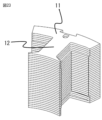
- 1 is a perspective view showing a stator of a rotating electric machine according to a first embodiment
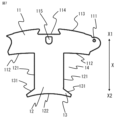
- 4 is a plan view of a tooth of one stator core according to embodiment 1 as viewed from above.
- FIG. 2 is a perspective view showing the configuration of one core plate that constitutes a stator core in the stator according to the first embodiment
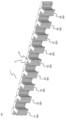
- FIG. 2 is a perspective view showing the configuration of a stator core formed by stacking core plates according to the first embodiment
- FIG. FIG. 2 is a plan view showing one core plate.
- FIG. 2 is a plan view showing one core plate.
- FIG. 4 is a cross-sectional view showing a connecting portion of the stator according to the first embodiment.
- FIG. 4 is a perspective view showing a configuration of an upper winding frame of an insulating member used in the stator according to the first embodiment.
- FIG. 4 is a perspective view showing a configuration of a lower winding frame of an insulating member used in the stator according to the first embodiment.
- FIG. 1 is a perspective view showing a state in which an upper winding frame and a lower winding frame are attached to a core portion according to the first embodiment.
- FIG. 1 is a plan view of the core portion as viewed from the direction indicated by the arrow D.
- FIG. 1 is a side view of the core portion as viewed from the direction indicated by the arrow E.
- FIG. 1 is a plan view of the core portion as viewed from the direction indicated by the arrow D.
- FIG. 2 is a front view of the core portion as viewed from the direction indicated by the arrow F.
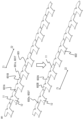
- FIG. 5A to 5C are plan views showing a manufacturing method of the stator according to the first embodiment.
- 5A to 5C are plan views showing a manufacturing method of the stator according to the first embodiment.
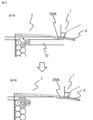
- FIG. 18A is an enlarged plan view showing a method for manufacturing the stator according to embodiment 1
- FIG. 18B is an enlarged plan view showing a method for manufacturing the stator according to embodiment 1.
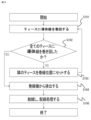
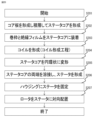
- 4 is a flowchart showing a coil forming process according to the first embodiment. 4 is a flowchart showing a manufacturing process of the rotating electric machine according to the first embodiment.
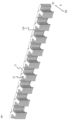
- FIG. 11 is a perspective view showing a stator core of a stator of a rotating electric machine according to a second embodiment. 11 is an enlarged plan view showing a thin-walled connecting portion of a stator core according to a second embodiment.
- FIG. 11 is a perspective view showing a stator core of a stator of a rotating electric machine according to a third embodiment.
- FIG. 13 is a plan view showing a core according to a fourth embodiment. 13 is a plan view showing a manufacturing method of the stator according to the fourth embodiment.
- Embodiment 1 relates to a stator for a rotating electrical machine, and more particularly to a stator structure for winding coils at high density.
- 1 is a cross-sectional view showing a rotating electric machine having a stator according to this embodiment.
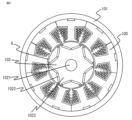
- the rotating electric machine 1000 includes a stator 100 according to this embodiment, a rotor 102 provided on the inner periphery side of the stator 100 with a predetermined gap (air gap) G therebetween, and a housing 101 for fixing the rotor 102 and the stator 100.
- the rotor 102 is rotatably held by fitting a shaft 1021 into an inner ring of a bearing 1011 provided in the housing 101.
- FIG. 2 is a plan cross-sectional view showing the cross section along line B-B in FIG. 1.
- Permanent magnets 1022 are embedded in a V-shape in rotor core 1023 fixed to the outer periphery of shaft 1021. They may also be arranged in other shapes, such as a straight line. Furthermore, permanent magnets 1022 do not have to be embedded, and may be affixed to the outer periphery of rotor core 1023 and arranged to face stator 100.
- FIG. 3 is a perspective view showing the stator 100 of the rotating electric machine 1000 according to the first embodiment.
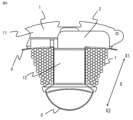
- 4 is a plan view of the teeth of one stator core 1 as viewed from above, and is a plan view of an arrangement of coils 7.
- the stator 100 includes a stator core 1, a coil 7, a yoke portion 11, and an upper winding form 2 and a lower winding form 3 as insulating portions arranged to insulate the stator core 1 and the coil 7, and an insulating film 8.
- the coil 7 is formed by winding an insulating-coated conductor wire 70 around the teeth 12.
- the directions in the stator 100 of the rotating electric machine 1000 are shown as the circumferential direction Z, the axial direction Y, the radial direction X, the outer side X1 in the radial direction X, and the inner side X2 in the radial direction X, based on the state when the yoke portion 11 of the stator 100 is arranged in a ring shape, as shown in Figure 3.
- each direction will be shown and explained in each figure based on the direction in the state when the yoke portion 11 of the stator 100 is arranged in a ring shape. Note that in other embodiments, the directions will be shown and explained based on the same standard.
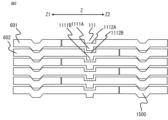
- the stator core 1 of the stator 100 is formed by stacking two types of core plates 6, a first core plate 601 and a second core plate 602, which are symmetrical and formed by punching a thin magnetic steel plate as shown in Figure 5, in multiple sheets alternately in the axial direction Y as shown in Figure 3. That is, as shown in FIG.
- the first core plate 601 is made of a magnetic plate such as an electromagnetic steel plate, and has a convex end 601A (hereinafter referred to as the first end 601A) at one end in a first circumferential direction Z1 and a concave end 601B (hereinafter referred to as the second end 601B) at one end in a second circumferential direction Z2 opposite to the first circumferential direction, and has a yoke portion 11 having connecting portions 601e, 601f at the first end 601A, and teeth 12 protruding radially inward from the yoke portion 11.
- the first core plate 601 has a plurality of core pieces arranged by fitting together first end portions 601A and second end portions 601B adjacent to each other in the circumferential direction.
- the second core plate 602 is made of a magnetic plate such as an electromagnetic steel plate, and has a convex end 602A (hereinafter referred to as the first end 602A) at one end in the second circumferential direction Z2 and a concave end 602B (hereinafter referred to as the second end 602B) at one end in the first circumferential direction Z1.
- the second core plate 602 also has a yoke portion 11 having connecting portions 602e, 602f at the first end 602A, and teeth 12 protruding radially inward from the yoke portion 11.
- the second core plate 602 is formed by arranging multiple core pieces by fitting the first end 602A and the second end 602B of circumferentially adjacent core pieces together, and is arranged in the opposite circumferential direction to the first core plate 601.
- Two types of core plates 6, a first core plate 601 and a second core plate 602, are formed by stacking multiple sheets so that the convex end 601A and the concave end 602B overlap in the axial direction Y as shown in Figure 5.
- the formed stator core 1 is shown in Figure 6.
- the stator core 1 has a yoke portion 11 arranged in a ring shape in the circumferential direction Z (however, in each figure, as previously shown, only one tooth is shown cut out), and a number of teeth 12 that protrude inward X2 in the radial direction X of the yoke portion 11 and are formed at predetermined intervals in the circumferential direction Z.
- the stator core 1 is formed by stacking the core plates 6, and each part of the core portion 60 will be described with reference to Fig. 7.
- the surface of the yoke portion 11 along the axial direction Y on the outer side X1 in the radial direction X is defined as the outer peripheral surface 113.
- the outer peripheral surface 113 of the yoke portion 11 is formed with a recess 114 extending in the axial direction Y.
- the recess 114 is used for positioning when the stator core 1 is attached to a winding machine that forms the coil 7.
- the teeth 12 are also provided with a shoe portion 13 that protrudes in the circumferential direction Z at the tip of the inner side X2 in the radial direction X.
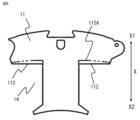
- Fig. 8 also shows the shape of the core plate 6, and the shape of the yoke portion is different from that of Fig. 7.
- the inner peripheral surface 112 of the yoke portion 11 which is a portion that does not affect the magnetic characteristics of the rotating electric machine, is cut to form a further inner peripheral surface 112A, and an undercut portion (first undercut portion) is created to enlarge the slot 14, which is the area in which the coil is arranged.
- the inner peripheral surface of the yoke portion 11 is formed with an undercut portion 112A by a recess punched out in an arc shape, similar to the outer peripheral surface of the yoke portion 11.
- first side surfaces 121 The surfaces of the teeth 12 extending in the axial direction Y at both ends in the circumferential direction Z are referred to as first side surfaces 121, and the surface extending in the axial direction Y at the tip of the inner side X2 of the teeth 12 in the radial direction X is referred to as tip surface 122.
- the surface of the shoe portion 13 extending in the axial direction Y at the outer side X1 in the radial direction X is referred to as second side surface 131.
- the first side surface 121, second side surface 131 and tip surface 122 are the side surfaces of the teeth 12 extending in the axial direction Y.
- the area surrounded by the inner circumferential surface 112, first side surface 121 and second side surface 131 becomes the slot 14 around which the conductor wire 70 is wound to form the coil 7.
- the first core plate 601 has a convex portion 1111A on one side of the end of the yoke portion 11 in the first circumferential direction Z1 of each core piece, and a concave portion 1112A on the other side.
- the second core plate 602 has a concave portion 1112B on one side of the end of the yoke portion 11 in the second circumferential direction Z2 symmetrically to the first core plate 601 with respect to the circumferential direction Z, and a convex portion 1111B on the other side, and the yoke portion 11 of the stator core 1 adjacent to the stator core 1 is fitted with the convex portion and the concave portion to form a connecting portion 111, and the yoke portions 11 are connected to each other.
- the stator core 1 is configured by connecting nine core portions 60 with the connecting portions 111.
- the first core plate 601 and the second core plate 602 are stacked by crimping in the Y direction at the crimping portion 1500.
- the yoke portion 11 of the stator core 1 can be freely bent, so that it can be made straight or can be deformed into a reverse-warped shape in which the direction in which the teeth 12 protrude in the radial direction X is reversed.
- the core portions 60 arranged in the circumferential direction Z are, from the winding start side of the conductor wire 70, a first core portion 61, a second core portion 62, a third core portion 63, a fourth core portion 64, a fifth core portion 65, a sixth core portion 66, a seventh core portion 67, an eighth core portion 68, and a ninth core portion 69.
- the power source is constituted by three-phase AC having U-phase, V-phase, and W-phase, and a wiring structure is adopted in which different phases are arranged for each of the core portions 60 adjacent in the circumferential direction Z.
- the first core portion 61 is a U phase (U1)
- the second core portion 62 is a V phase (V1)
- the third core portion 63 is a W phase (W1)
- the fourth core portion 64 is a U phase (U2)
- the fifth core portion 65 is a V phase (V2)
- the sixth core portion 66 is a W phase (W2)
- the seventh core portion 67 is a U phase (U3)
- the eighth core portion 68 is a V phase (V3)
- the ninth core portion 69 is a W phase (W3).
- each of core portions 61 to 69 is similarly equipped with a coil 7, an upper winding frame 2 and a lower winding frame 3 as insulating portions, and an insulating film 8.
- the reference numerals used for each of core portions 61 to 69 will be used regardless of whether the coil 7, the upper winding frame 2 and the lower winding frame 3 as insulating portions, and the insulating film 8 are installed in the core portion 61 to 69 or not.
- the insulating parts that is, the upper winding frame 2, the lower winding frame 3, and the insulating film 8, will be described with reference to Figs. 10 to 15 for the stator having one tooth shown in Fig. 4.
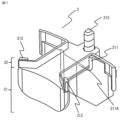
- the upper winding frame 2 is composed of a first protruding portion 21 and a first leg portion 22.
- the lower winding frame 3 is composed of a second protruding portion 31 and a second leg portion 32.
- 12 is a diagram showing a state in which the upper and lower winding frames 2, 3, and insulating film 8 are placed on the core portion 60, with the first protruding portion 21 protruding from one side in the axial direction Y from the core portion 60.
- the second protruding portion 31 is formed protruding from the other side in the axial direction Y from the core portion 60.
- the insulating portion includes a film portion between the first protruding portion 21 and the second protruding portion 31 and constituted by an insulating film 8 that covers the side surfaces of the teeth 12 .
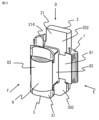
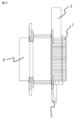
- FIG. 13 is a plan view of the core portion 60 as viewed from direction D in FIG. 12, FIG. 14 is a side view as viewed from direction E in FIG. 12, and FIG. 15 is a front view as viewed from direction F in FIG. 12.
- an introduction groove portion 214 is formed in the height direction of the first protrusion portion 21 of the upper winding frame 2, i.e., at the apex in the axial direction Y, communicating from the outer side X1 in the radial direction X of the first protrusion portion 21 to the inner side X2 in the radial direction X. Therefore, the introduction groove portion 214 is formed continuously from the outer peripheral surface 201 of the first protrusion portion 21 to the inner peripheral surface 202 on the inner side X2 in the radial direction X.
- the insulating member has an undercut portion 2000 (second undercut portion) of the insulating member that is recessed from one end in the circumferential direction Z to the radially outward direction X1 from a surface perpendicular to the circumferential side surface (first side surface 121) of the teeth 12.
- the undercut portion 2000 is provided on the surface of the upper winding frame 2 on the yoke portion 11 side.
- the insulating member has a shape in which the entire area on the yoke portion 11 side is expanded linearly toward the yoke portion 11 side by the radius of the conductor wire 70.
- This undercut portion 2000 has a shape that is recessed overall in a linear state, and the coils 7 are aligned and arranged in the slots 14, which form the expanded area.
- the first leg 22 of the upper winding frame 2 and the second leg 32 of the lower winding frame 3 are configured to cover the inner circumferential surface 112, the first side surface 121 and the second side surface 131 of the core portion 60.
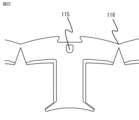
- the stator core 1 has a yoke central groove 115 formed in the axial direction Y in the teeth 12.
- the yoke central groove 115 may be either a through groove or a non-through groove machined from the top or bottom to the required depth.
- the upper winding frame 2 and the lower winding frame 3 are installed by fitting the convex portions 215, 315 into the yoke central groove 115 of the stator core 1.
- first leg 22 of the upper winding frame 2 and the second leg 32 of the lower winding frame 3 are provided with claws 211, 212, 213, 311, 312, and 313 for fixing the insulating film 8 that insulates the coil 7 from the stator core 1. That is, the first leg 22 and the second leg 32 fit into the slot 14 to insulate the coil 7 from the stator core 1 and further fix the insulating film 8.
- the insulating film 8 is formed of a thin insulating film material, and for example, a film material with a thickness of 0.125 mm can be used.
- the film material is creased.
- the insulating film 8 has a first side surface 81 that covers the inner peripheral surface 112 (see FIG. 7) that is the side surface along the axial direction Y on the inside X2 of the radial direction X of the yoke portion 11, a second side surface 82 that covers the first side surface 121 and the second side surface 131 that are the side surfaces along the axial direction Y of the teeth 12, and a third side surface 83 that covers the tip surface 122 that is the side surface along the axial direction Y of the teeth 12, as shown in FIG.
- the insulating film 8 When the insulating film 8 is attached to the stator core 1, it is in continuous contact with the first protrusion 21 and the second protrusion 31 in the axial direction Y.
- the insulating film 8 is also formed continuously corresponding to all of the core portions 61 to 69 of the stator core 1.
- the continuous contact in the axial direction Y of the insulating film 8 with the first protrusion 21 of the upper winding frame 2 and the second protrusion 31 of the lower winding frame 3 is specifically achieved by forming both ends of the insulating film 8 in the axial direction Y to be longer than the length of the stator core 1 in the axial direction Y.
- the portions of the insulating film 8 that are longer than both ends of the stator core 1 in the axial direction Y are fixed by the claws 211, 212, 213 of the upper winding frame 2 and the claws 311, 312, 313 of the lower winding frame 3, respectively.
- the top surface 21A of the first protrusion 21 of the upper winding form 2, which is connected to the introduction groove 214 of the first protrusion 21, is positioned radially outwardly from the inner circumferential surface 2111 by the radius of the wire conductor 70.
- the inner circumferential surface 2111 is provided with a guide 21B (first guide) whose radially inner end face is positioned radially inwardly from the inner circumferential surface 2111 by the radius of the wire conductor 70.
- the first turn of the conductor wire 70 introduced from the introduction groove portion 214 passes through the top surface 21A and is disposed on the radially inner end surface of the guide 21B.
- an introduction groove 214 for the coil 7 is provided on the axial upper surface of the first protrusion 21 provided on the upper winding frame 2, and a portion of the first turn of the coil 7 introduced from the introduction groove 214 passes through the first undercut portion 112A and the second undercut portion 2000, and the entire remaining first turn of the coil 7 is present in an area outside the first undercut portion 112A and the second undercut portion 2000.
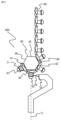
- the winding machine 400 has a hexagonal chuck mechanism 40.
- the chuck mechanism 40 has six chucks, 41, 42, 43, 44, 45, and 46.
- a winding nozzle 51 for winding the conductor wire 70 is installed at a position of the chuck mechanism 40 facing the chuck 42. Each winding nozzle 51 is rotated about the rotation axis T1, and winds the conductor wire 70 around each tooth 12.
- the first core portion 61 of the stator core 1 is fixed to the chuck 41.
- the first conductor wire 71 is introduced from the outer side X1 to the inner side X2 in the radial direction X using the introduction groove portion 214 of the first core portion 61.
- the conductor wire 70 is introduced from the outer side X1 to the inner side X2 in the radial direction X using the introduction groove portion 214 of the first core portion 61.
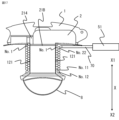
- the introduced conductor wire 70 is arranged from the upper winding frame 2 toward the lower winding frame 3 while being aligned with the second side surface 82 of the insulating film 8 covering the first side surface 121 of the stator core. At this time, it is arranged at the position No. 1 on the left side surface of the tooth 12 in FIG. 17.
- the winding nozzle 51 is rotated counterclockwise around the rotation axis T1 as viewed from the inner diameter side of the tooth 12 to start winding. That is, the conductor wire 70 is wound from the left side surface of the tooth to the right side surface of the tooth via the lower winding frame side in FIG. 17.
- the conductor wire 70 in the first turn is aligned along a guide 311A (second guide, see FIG. 11 ) extending radially inward in the X2 direction from the claw portions 311 of the lower winding frame 3, and the winding nozzle 51 is pitch-fed in the X2 direction by an amount equivalent to the wire diameter of the conductor wire 70, so that the conductor wire 70 is positioned at position No. 1 on the right side surface of the tooth. Then, the conductor wire 70 is arranged by pitch-feeding in the X2 direction to the position shown by No. 11, and then the conductor wire 70 is arranged by pitch-feeding in the X1 direction from the position of No. 12 to the position of No. 22.
- a guide 311A second guide, see FIG. 11
- the undercut portion is the area indicated by 112A in FIG. 8 in the core portion, and indicates the portion where the inner circumferential surface 112 has been cut away.
- the insulating member it is the area indicated by 2000 in FIG. 13, and in FIG. 13, it is an area offset toward the back yoke by the radius of the conductor wire 70 with the surface along the circumferential direction Z of the inner circumferential surfaces 202, 302 of the upper winding frame 2 and the lower winding frame 3 as one end surface, and with the surface perpendicular to the first side surface 121 of the tooth 12 as the reference.
- the winding which is the last turn of the second layer shown in No. 23 of the undercut portion is arranged from the target position (Fig. 18A) to the position of No. 23 shown in Fig. 18B, using the conductor wire of No. 22, which is the previous position, as a guide, while aligning the conductor wire shown in No. 23 with the conductor wire at the position of No. 22, as shown in Fig. 18A.
- This is to prevent the coil winding irregularity and the deterioration of the insulation quality of the coil, which may occur if the conductor wire is arranged directly at the position of No. 23 (Fig.
- the position of the arranged conductor wire of No. 23 is determined by contacting the surface of the part shape which is generally recessed in a straight line state in the undercut portion of the insulating member. This is necessary to align the conductor wire, and to suppress winding irregularity. Thereafter, for the undercut portions of the third and subsequent layers, the conductor wire 70 on the core back side is wound using the previous coil as a guide, in the same manner as for the conductor wire shown in No. 23.
- the positions are determined by contacting the surface of the overall recessed portion of the undercut portion of the insulating material in a straight line, in order to wind the conductor wires in an aligned manner, in the same manner as for No. 23.
- the positions of the last turns of the layers 2, 4, 6, ... are determined by contacting the surface of the overall recessed portion of the undercut portion of the insulating material in a straight line.
- the final turn of the second and subsequent layers wound circumferentially outside the first layer, including the first turn, of the coil 7 introduced from the introduction groove portion 214 contacts the surface of the second undercut portion 2000 that is generally recessed in a linear shape.
- the final turns of the second and subsequent layers are in contact with the surface of the second undercut portion 2000 which is generally recessed in a linear shape.
- the winding nozzle 51 is moved back and forth and up and down while processing the terminal wire.
- the chuck mechanism 40 rotates at a pitch of 60°. That is, the second core portion 62 moves at a rotational pitch of 60° to the position of the chuck 41 where the first core portion 61 was fixed during the first winding.
- the other core portions 60 also move at the same time. In this manner, winding is performed sequentially until winding is completed up to the ninth core portion 69.
- the core portion 60 is not fixed to the position of the chuck 45 because it is ejected from the position of the chuck 46.
- the U-phase, V-phase, and W-phase connections, as well as the power supply line and neutral point, are then treated as terminal wires.
- a connection process such as crimping, brazing, or soldering of the jumper wires may be used.
- the coil forming process which is the above-mentioned wiring process for the stator 100, is shown in the flow chart of FIG. 19.
- the conductor wire 70 is wound around the teeth 12 of the stator core inserted into the winding machine to form the coil 7 (step S191).
- it is determined whether the conductor wire 70 has been wound around all the teeth 12 (step S192), and if there are any remaining teeth 12, the adjacent teeth are set to the winding position (step S193), and the process returns to step S191.
- the stator core is removed from the winding machine (step S194).
- step S195 the connection and wiring process is performed (step S195), the neutral point 700 is connected, and the wiring process for the stator 100 is completed.
- the stator core 1 is formed into a circular ring, and the ends of the stator core 1 are fixed to each other by welding or the like. These steps form the stator 100.
- the entire rotating electrical machine shown in FIG. 1 the entire rotating electrical machine shown in FIG.
- a magnetic steel sheet is punched out alternately into two types of core piece groups, and multiple groups of each are stacked in the axial direction Y and connected at the connecting portions 111 of the yoke portions 11 to form the stator core 1 (step S201).
- the first leg 22 of the upper winding form 2 and the second leg 32 of the lower winding form 3 are inserted and fitted into the slots 14 from both ends of the axial direction Y of the stator core to fix the insulating film 8, and the upper winding form 2 and the lower winding form 3 are attached to the stator core (step S202).
- the wiring process for the stator 100 is performed.
- the coil 7 is formed in the core portion 60 of the stator 100, and the wiring is completed (step S203).
- the stator core 1 of the stator 100 thus formed is deformed into an annular shape (step S204), and both ends of the connected stator core are welded to complete the stator 100 (step S205).
- the stator 100 is fixed to the housing 101 of the rotating electric machine 1000 (step S206), and the rotor 102 is positioned facing the stator 100 (step S207), completing the rotating electric machine 1000.
- stator 100 has nine core portions 60
- the number of core portions 60 may be any number, and a similar manufacturing method is possible by repeating the manufacturing method for the stator 100.
- the stator of a rotating electric machine is a stator 100 of a rotating electric machine 1000 having a coil 7 wound around a stator core 1 via an insulating portion, and the yoke portion 11 of the stator core 1 has a shape in which the area influencing the magnetic properties of the width of the inner circumferential surface and the width of the outer circumferential surface at both ends of the yoke portion 11 is left, while the area not influencing the magnetic properties is punched out to expand the area in which the coil is disposed.
- the insulating member has a shape in which the entire area on the yoke portion 11 side is expanded in a straight line toward the yoke portion 11 side by the radius of the conductor wire 70.
- the winding area is expanded by punching out areas that do not affect the magnetic properties of the stator core 1, and further, the yoke surface of the insulating material is expanded toward the yoke portion 11 while remaining in a straight state. This makes it possible to wind the conductor wire 70 in an aligned manner and increase the number of turns, thereby improving the efficiency of the rotating electric machine.
- Embodiment 2 A stator for a rotating electric machine according to the second embodiment will be described below with reference to Figs. 21 and 22. In the description of the second embodiment, differences from the first embodiment will be mainly described, and descriptions of common parts will be omitted.
- a stator 100 of the present embodiment is similar to the stator 100 of the first embodiment, except for the structure of the stator core 1 used in the stator.
- FIG. 21 is a perspective view showing a thin-walled connecting core used in the stator according to the second embodiment.
- FIG. 22 is an enlarged plan view showing a thin-walled connecting core used in a stator according to the second embodiment.
- the stator 100 of this embodiment also includes a stator core, an insulating member, and an insulating film.
- the thin-walled connecting core according to the second embodiment also includes a yoke portion 11 arranged in a ring shape, and a plurality of teeth 12 formed protruding from the inner peripheral surface of the yoke portion 11 to the inner side X2 in the radial direction X at a predetermined interval in the circumferential direction Z.
- the thin-walled connecting core according to the second embodiment is also formed by stacking a plurality of core plates formed by punching thin magnetic steel plates in the axial direction Y.
- the area of the winding that does not affect the magnetic characteristics of the stator core is punched out to expand the area, and the number of turns can be increased to improve efficiency.
- the shape of the connecting portion of the stator core is changed depending on the product, and the rotary connecting core of the first embodiment is reversely warped as shown in Fig. 16, which allows high speed winding.
- the thin-walled connecting core of the second embodiment can be held in a straight state, which makes it easier to connect the wires to wind continuously between the stator cores. Furthermore, loosening of the wires can be prevented.
- the stator of this embodiment has the same configuration as the stator core of embodiment 1 except for the connecting portions of the stator core, and the same effects can be obtained by the same manufacturing method.
- Embodiment 3 A stator for a rotating electric machine according to the third embodiment will be described below with reference to Fig. 23.
- Stator 100 of the present embodiment is similar to stator 100 of the first embodiment, except that the structure of the stator core used in the stator is different.
- FIG. 23 is a perspective view showing a split core used in a stator according to the third embodiment. Similar to the first embodiment, the stator of the present embodiment also includes a stator core, an insulating member, and an insulating film.
- the split core used in this embodiment is formed by dividing it into individual teeth, unlike the first and second embodiments.
- the split core also has a yoke portion 11 arranged in an annular shape, and a plurality of teeth 12 formed to protrude inward X2 in the radial direction X from the inner circumferential surface of the yoke portion 11 at predetermined intervals in the circumferential direction Z.
- the split core according to this embodiment is also formed by laminating a plurality of core plates, which are formed by punching thin magnetic steel plates, in the axial direction Y. The difference from the first embodiment is that there is no connecting portion, and each core plate is divided into individual teeth. With this configuration, it becomes easier to wind the conductor wire using the nozzle.
- the winding process is performed by holding the split cores in a split core fixing jig and continuously winding the cores in the same manner as in embodiment 1. After that, the nine split cores are arranged in an annular shape and fixed together to form a stator. Fixing methods include welding or shrink fitting. There is also a method of connecting and holding the insulating members without using a fixing jig.
- the stator of the present embodiment has the same configuration as the stator of the first embodiment except for the core connection portion, and provides the same effects as those of the first embodiment described above.
- Embodiment 4 A stator for a rotating electric machine according to the fourth embodiment will be described below with reference to Fig. 24. In the description of the fourth embodiment, differences from the first, second and third embodiments will be mainly described, and descriptions of common parts will be omitted.
- the stator 100 of the present embodiment is similar to the stator 100 of the first embodiment, except that the structures of the undercut portion (first undercut portion) of the stator core 1 used in the stator and the undercut portion 2100 (second undercut portion) of the insulating member are different.
- the undercut portion refers to the portion where the inner circumferential surface 112 (see FIG. 8) has been cut away.
- this is the area indicated by 2100 in FIG. 24, and is an area that has a surface along the circumferential direction Z of the inner circumferential surfaces 202, 302 of the upper winding frame 2 and the lower winding frame 3 as one end face, and is offset toward the back yoke by the diameter of the conductor wire 70 based on a plane perpendicular to the first side surface 121 of the tooth 12.
- the insulating member has an undercut portion 2100 (second undercut portion) of the insulating member that is recessed from one end in the circumferential direction Z to the radially outward X1 direction from a surface perpendicular to the circumferential side surface (first side surface 121) of the teeth 12.
- the undercut portion 2100 is provided on the surface of the upper winding frame 2 on the yoke portion 11 side.
- the insulating member has a shape in which the entire area on the yoke portion 11 side is expanded in a linear state toward the yoke portion 11 side by the diameter of the conductor wire 70.
- This undercut portion 2100 has a shape that is recessed overall in a linear state, and in the slot 14, which is the expanded area, the coil 7 is aligned and arranged in the same way as in the first, second, and third embodiments.
- the conductor wire 70 on the first rotation is aligned with the guide 311A (second guide, see Figure 11) that extends radially inward in the X2 direction from the claw portion 311 of the lower winding frame 3, and the winding nozzle 51 is pitch-fed in the X2 direction by the wire diameter of the conductor wire 70, so that the conductor wire 70 is positioned at position No. 1 on the right side of the tooth.
- the guide 311A second guide, see Figure 11
- the conductor wire 70 of the first layer is placed by pitching in the X2 direction to the position shown in No. 11, and then the conductor wire 70 is placed by pitching in the X1 direction from the position of No. 12 to the position of No. 22.
- the winding shown in No. 23 included in the undercut portion of the radius of FIG. 25 is placed from the target position (FIG. 18A) to the position of No. 23 shown in FIG. 18B, using the conductor wire of No. 22, which is one position before, as a guide, while aligning the conductor wire shown in No. 23 with the conductor wire at the position of No. 22, as shown in FIG. 18A.
- No. 24 when arranging the third layer of conductor wire 70, No. 24 is not arranged on the yoke side, i.e., on the X1 side of No. 23, but is arranged on the X2 side of No. 23, between No. 22 and No. 23 shown in FIG. 25. This is to prevent interference between the convex parts 200A at both ends of the back yoke and the conductor wire 70 coming out of the winding nozzle 51, just like when arranging No. 23.
- the conductor wire 70 is arranged by pitching in the X2 direction to No. 34, with a space of one wire diameter left on the yoke side, and then the fourth layer of conductor wire 70 is arranged by pitching in the X1 direction from the position of No. 35 to the position of No. 45.
- an introduction groove 214 for the coil 7 is provided on the axial upper surface of the first protrusion 21 provided on the upper winding frame 2, and a top surface 21A of the first protrusion 21 connected to the introduction groove 214 is positioned radially outwardly from the inner circumferential surface 2111 by the diameter of the coil 7, and a first guide 21B is provided on the inner circumferential surface 2111, the radially inner end surface of which is positioned radially inwardly from the inner circumferential surface 2111 by the diameter of the coil 7, and the first turn of the coil 7 introduced from the introduction groove 214 passes through the top surface 21A and is positioned on the radially inner end surface of the first guide 21B. Furthermore, the final turn of the second or subsequent layer that contacts the generally concave surface in a linear state in the second undercut portion 2100 is contained within the first undercut portion 112A and the second undercut portion 2100.
- the area of the winding that does not affect the magnetic characteristics of the stator core is punched out to expand the area, and the number of turns can be increased to improve efficiency.
- the stator of this embodiment has the same configuration as the stator core of embodiment 1 except for the area of the undercut portion, is manufactured by the same manufacturing method, and provides the same effects.
- a stator core having a yoke portion arranged in a circumferential direction and a plurality of teeth protruding radially inward from the yoke portion and formed at predetermined intervals in the circumferential direction; A coil wound around the teeth;
- a stator for a rotating electric machine including an upper winding frame disposed axially above the stator core, A first undercut portion is provided by cutting an inner peripheral surface of the yoke portion, which is a portion that does not affect magnetic characteristics, the upper winding frame is provided with a second undercut portion having a generally linear recessed shape on a surface facing the yoke portion, A stator for a rotating electric machine, wherein at least a portion of the wound coil is disposed in the first undercut portion and the second undercut portion.
- (Appendix 2) The stator of claim 1, wherein the first undercut portion is formed by a recess punched into an inner peripheral surface of the yoke portion in an arc shape similar to the outer peripheral surface of the yoke portion.
- (Appendix 3) The stator of a rotating electric machine according to claim 1 or 2, wherein the second undercut portion has a structure recessed radially outward from a plane perpendicular to a circumferential side surface of the tooth from one circumferential end.
- a coil guide groove is provided on an axial upper surface of the first protrusion provided on the upper winding frame; 4.
- Appendix 5 The stator of a rotating electric machine as described in Appendix 4, wherein the last turn of a second or subsequent layer wound circumferentially outside a first layer including the first turn of the coil introduced from the introduction groove portion is in contact with a surface of the second undercut portion that is generally recessed in a linear state.
- stator of claim 5 wherein the final turn of the second and subsequent layers is in contact with a surface of the second undercut portion that is generally recessed in a linear manner.
- a coil guide groove is provided on an axial upper surface of the first protrusion provided on the upper winding frame; 7.
- a top surface of the first protrusion connected to the introduction groove portion is positioned radially outward from the inner circumferential surface by a radius of the coil, and a first guide is provided on the inner circumferential surface, the first guide having a radially inner end surface positioned radially inward from the inner circumferential surface by a radius of the coil, and a first turn of the coil introduced from the introduction groove portion passes through the top surface and is positioned on the radially inner end surface of the first guide.
- stator of a rotating electric machine wherein a last turn of a second or subsequent layer that contacts a surface in the second undercut portion that is generally recessed in a linear state is contained within the first undercut portion and the second undercut portion.
- Appendix 10 10.
- an insulating portion arranged to insulate the stator core and the coils is composed of the upper winding frame, a lower winding frame arranged axially below the stator core, and an insulating film covering side surfaces of the teeth between the upper winding frame and the lower winding frame.
- the stator core is formed by stacking a plurality of first core plates and a plurality of second core plates in an axial direction, 11.
- the stator of a rotating electric machine according to any one of claims 1 to 10, wherein the first core plate has a convex portion on one surface side of a first circumferential end of the yoke portion and a concave portion on the other surface side, and the second core plate has a convex portion on one surface side of a second circumferential end of the yoke portion and a concave portion on the other surface side, and the yoke portions of adjacent stator cores are connected by a connecting portion by engaging the convex portion and the concave portion. (Appendix 12) 12.
- stator of a rotating electric machine comprising: a stator of a rotating electric machine according to any one of claims 1 to 15; and a rotor disposed opposite the stator with a gap therebetween.
- stator core 1 stator core, 2 upper winding frame, 3 lower winding frame, 7 coil, 8 insulating film, 11 yoke portion, 12 teeth, 21 first protrusion, 21A top surface, 21B guide, 70 conductor wire, 100 stator, 111 connecting portion, 112A, 2000, 2100 undercut portion, 116 thin-walled connecting portion, 214 introduction groove portion, 601 first core plate, 602 second core plate, 1000 rotating electric machine, 1111A, 1111B convex portion, 1112A, 1112B concave portion, 2111 inner peripheral surface.
Landscapes
- Engineering & Computer Science (AREA)
- Power Engineering (AREA)
- Iron Core Of Rotating Electric Machines (AREA)
- Insulation, Fastening Of Motor, Generator Windings (AREA)
- Manufacture Of Motors, Generators (AREA)
Priority Applications (2)
| Application Number | Priority Date | Filing Date | Title |
|---|---|---|---|
| CN202480045980.9A CN121753226A (zh) | 2023-09-04 | 2024-08-21 | 旋转电机和旋转电机的定子 |
| JP2025544238A JPWO2025052922A1 (https=) | 2023-09-04 | 2024-08-21 |
Applications Claiming Priority (2)
| Application Number | Priority Date | Filing Date | Title |
|---|---|---|---|
| JP2023-142662 | 2023-09-04 | ||
| JP2023142662 | 2023-09-04 |
Publications (1)
| Publication Number | Publication Date |
|---|---|
| WO2025052922A1 true WO2025052922A1 (ja) | 2025-03-13 |
Family
ID=94923607
Family Applications (1)
| Application Number | Title | Priority Date | Filing Date |
|---|---|---|---|
| PCT/JP2024/029586 Pending WO2025052922A1 (ja) | 2023-09-04 | 2024-08-21 | 回転電機及び回転電機のステータ |
Country Status (3)
| Country | Link |
|---|---|
| JP (1) | JPWO2025052922A1 (https=) |
| CN (1) | CN121753226A (https=) |
| WO (1) | WO2025052922A1 (https=) |
Citations (4)
| Publication number | Priority date | Publication date | Assignee | Title |
|---|---|---|---|---|
| JPH10285880A (ja) * | 1997-04-11 | 1998-10-23 | Toshiba Corp | 回転電機のステータおよびステータの製造方法 |
| JPH11299132A (ja) * | 1998-04-07 | 1999-10-29 | Shibaura Mechatronics Corp | 電動機のステータコア |
| JP2013208021A (ja) * | 2012-03-29 | 2013-10-07 | Mitsuba Corp | ステータコア |
| WO2020174817A1 (ja) * | 2019-02-27 | 2020-09-03 | 三菱電機株式会社 | 回転電機のステータ、回転電機、回転電機のステータの製造方法、および、回転電機の製造方法 |
-
2024
- 2024-08-21 WO PCT/JP2024/029586 patent/WO2025052922A1/ja active Pending
- 2024-08-21 JP JP2025544238A patent/JPWO2025052922A1/ja active Pending
- 2024-08-21 CN CN202480045980.9A patent/CN121753226A/zh active Pending
Patent Citations (4)
| Publication number | Priority date | Publication date | Assignee | Title |
|---|---|---|---|---|
| JPH10285880A (ja) * | 1997-04-11 | 1998-10-23 | Toshiba Corp | 回転電機のステータおよびステータの製造方法 |
| JPH11299132A (ja) * | 1998-04-07 | 1999-10-29 | Shibaura Mechatronics Corp | 電動機のステータコア |
| JP2013208021A (ja) * | 2012-03-29 | 2013-10-07 | Mitsuba Corp | ステータコア |
| WO2020174817A1 (ja) * | 2019-02-27 | 2020-09-03 | 三菱電機株式会社 | 回転電機のステータ、回転電機、回転電機のステータの製造方法、および、回転電機の製造方法 |
Also Published As
| Publication number | Publication date |
|---|---|
| JPWO2025052922A1 (https=) | 2025-03-13 |
| CN121753226A (zh) | 2026-03-27 |
Similar Documents
| Publication | Publication Date | Title |
|---|---|---|
| JP5140389B2 (ja) | 回転電機用の固定子、及びこれを用いた回転電機 | |
| US20120181886A1 (en) | Electric rotating machine | |
| US9866084B2 (en) | Insulated stator of a motor having holding grooves to hold end parts of a coil winding | |
| KR20120041127A (ko) | 고정자, 브러시리스 모터 및 이의 제조방법 | |
| CN113454880B (zh) | 旋转电机的定子、旋转电机、旋转电机的定子的制造方法及旋转电机的制造方法 | |
| US11557935B2 (en) | Stator of electric rotating machine, hairpin of stator of electric rotating machine and manufacturing method thereof | |
| US8466598B2 (en) | Electric rotating machine | |
| US20120001516A1 (en) | Stator for electric rotating machine and method of manufacturing the same | |
| WO2011155327A1 (ja) | 電動機の突極集中巻きステータ及びその製造方法 | |
| US12068636B2 (en) | Stator for rotating electric machine with overlapping hairpin coils | |
| US20130033135A1 (en) | Rotating electrical machine, wire connecting substrate of rotating electrical machine, manufacturing method of rotating electrical machine, and manufacturing method of wire connecting substrate of rotating electrical machine | |
| WO2025052922A1 (ja) | 回転電機及び回転電機のステータ | |
| JP7044871B2 (ja) | 回転電機および回転電機の製造方法 | |
| JP6893274B1 (ja) | モータ | |
| JP7479230B2 (ja) | ステータコア、回転電機のステータ、回転電機、回転電機のステータの製造方法、および回転電機の製造方法 | |
| JP2011160572A (ja) | 回転電機のステータの製造方法 | |
| CN113315288A (zh) | 旋转电机 | |
| JP7819216B2 (ja) | 回転電機のステータ、回転電機、回転電機のステータの製造方法および回転電機の製造方法 | |
| JP2011229294A (ja) | コイルの製造方法およびモータ | |
| WO2021140715A1 (ja) | 回転電機のステータ、回転電機、回転電機のステータの製造方法および、回転電機の製造方法 | |
| US12587047B2 (en) | Segmented stator core for an electric motor | |
| JP7270846B2 (ja) | 回転電機のステータ、回転電機、回転電機のステータの製造方法、および回転電機の製造方法 | |
| JP7835212B2 (ja) | ステータの製造装置 | |
| JP2025132762A (ja) | ステータ、モータ及びステータの製造方法 | |
| JP2025001091A (ja) | 回転電機および回転電機の製造方法 |
Legal Events
| Date | Code | Title | Description |
|---|---|---|---|
| 121 | Ep: the epo has been informed by wipo that ep was designated in this application |
Ref document number: 24862576 Country of ref document: EP Kind code of ref document: A1 |
|
| ENP | Entry into the national phase |
Ref document number: 2025544238 Country of ref document: JP Kind code of ref document: A |
|
| WWE | Wipo information: entry into national phase |
Ref document number: 2025544238 Country of ref document: JP |