WO2025033299A1 - 溶接方法及び治具 - Google Patents
溶接方法及び治具 Download PDFInfo
- Publication number
- WO2025033299A1 WO2025033299A1 PCT/JP2024/027420 JP2024027420W WO2025033299A1 WO 2025033299 A1 WO2025033299 A1 WO 2025033299A1 JP 2024027420 W JP2024027420 W JP 2024027420W WO 2025033299 A1 WO2025033299 A1 WO 2025033299A1
- Authority
- WO
- WIPO (PCT)
- Prior art keywords
- conductive wire
- jig
- terminal
- pressing
- movable body
- Prior art date
- Legal status (The legal status is an assumption and is not a legal conclusion. Google has not performed a legal analysis and makes no representation as to the accuracy of the status listed.)
- Pending
Links
Images



Classifications
-
- B—PERFORMING OPERATIONS; TRANSPORTING
- B23—MACHINE TOOLS; METAL-WORKING NOT OTHERWISE PROVIDED FOR
- B23K—SOLDERING OR UNSOLDERING; WELDING; CLADDING OR PLATING BY SOLDERING OR WELDING; CUTTING BY APPLYING HEAT LOCALLY, e.g. FLAME CUTTING; WORKING BY LASER BEAM
- B23K9/00—Arc welding or cutting
-
- H—ELECTRICITY
- H02—GENERATION; CONVERSION OR DISTRIBUTION OF ELECTRIC POWER
- H02K—DYNAMO-ELECTRIC MACHINES
- H02K15/00—Processes or apparatus specially adapted for manufacturing, assembling, maintaining or repairing of dynamo-electric machines
- H02K15/06—Embedding prefabricated windings in the machines
Definitions
- the present invention relates to a welding method and a jig used for the stators of rotating electrical machines, etc.
- Patent Document 1 A conventional welding method is described in Patent Document 1.
- the busbar of the stator of a rotating electrical machine has a conductive wire connection portion as a terminal, and the conductive wire connection portion is held by crimping a side wall portion that is bent so as to surround, for example, two conductive wires of a coil. In this held state, the conductive wire connection portion and the conductive wires are joined by arc welding.
- Patent Document 1 The welding method described in Patent Document 1 can lead to variations in the contact area and contact pressure between the conductive wire and the conductive wire connection due to variations in the precision of various dimensions and the crimping process, etc.
- welding provides good thermal conduction when the contact area and contact pressure between two parts are large and strong. In other words, welding preferentially begins to melt the parts with good thermal conduction between the two parts. For this reason, if there is variation in the contact area and contact pressure between the electric wire and the conductive wire connection, for example, parts with weak contact pressure will not melt sufficiently, which can easily lead to variation in the weld.
- the present invention provides a welding method for welding the conductive wire of a coil inside an assembly by contacting it with the terminal of a bus bar.
- a jig is driven from outside the assembly to bring one of the conductive wire of the coil and the terminal of the bus bar into contact with the other of the conductive wire of the coil and the terminal of the bus bar by applying a pressing force from the jig, and the welding is performed while keeping the pressing force within a specified range by controlling the driving force of the jig.
- the present invention also provides a jig for use in the welding method.
- the jig includes a base member that supports the assembly, a movable body that is movable relative to the base member, a pressing unit that is provided on the movable body and is oriented toward one of the conductive wire of the coil and the terminal of the bus bar, sandwiching the other of the conductive wire of the coil and the terminal of the bus bar, and a drive unit that moves the movable body to contact the other of the conductive wire of the coil and the terminal of the bus bar with the pressing force of the pressing unit.
- the drive unit makes it possible to keep the pressing force within a specified range by controlling the driving force of the movable body.
- the present invention can reduce welding variation within an assembly.
- FIG. 1 is a perspective view of a stator according to an embodiment of the present invention.
- FIG. 2 is a perspective view showing a jig supporting the stator of FIG.
- FIG. 3 is an exploded perspective view showing the stator and the jig shown in FIG.
- FIG. 4 is a cross-sectional view showing the jig of FIG.
- FIG. 5 is an enlarged plan view of a portion of the jig of FIG.
- FIG. 6 is an enlarged cross-sectional view of a portion of the jig of FIG.
- FIG. 7 is an enlarged plan view of a portion of FIG.
- the goal of suppressing welding variation within the assembly is achieved by using a jig to bring the coil's conductive wires, which are welded together, into contact with the busbar terminals with a specified pressure.
- the welding method involves bringing the conductive wire 15 of the coil 7 inside the assembly 1 and the terminal 17 of the bus bar 9 into contact with each other and welding them together.
- a jig 19 is driven from outside the assembly 1, and one of the conductive wires 15 and terminals 17 is brought into contact with the other of the conductive wires 15 and terminals 17 by the pressing force of the jig 19.
- welding is performed while keeping the pressing force within a specified range.
- the conductive wires 15 and terminals 17 inside the assembly 1 where welding is performed can be conductive wires and busbar terminals of rotating electrical machines or power electronics devices.
- the assembly 1 is an assembly used in a rotating electric machine.
- the conductive wire 15 may be pressed at a position offset in the axial direction of the conductive wire 15 from the contact portion between the conductive wire 15 and the terminal 17, so that the conductive wire 15 comes into contact with the terminal 17.
- the edge of the terminal 17 may have an edge recess 17a that positions the conductive wire 15. In this case, the conductive wire 15 contacts the terminal 17 at the edge recess 17a.
- the number of conductive wires 15 welded to the terminal 17 is not particularly limited. In one embodiment, at least two conductive wires 15 may be arranged in parallel and contact the terminal 17 with a specified pressure.
- the jig 19 used in this welding method includes a base member 21, a movable body 23, a pressing unit 25, and a driving unit 27.
- the base member 21 supports the assembly 1.
- the movable body 23 is provided so as to be movable relative to the base member.
- the pressing unit 25 is provided on the movable body 23, and is oriented toward one of the conductive wire 15 and the terminal 17, sandwiching the other of the conductive wire 15 and the terminal 17.
- the driving unit 27 moves the movable body 23 to bring the other of the conductive wire 15 and the terminal 17 into contact with the one of the conductive wire 15 and the terminal 17 with the pressing force of the pressing unit 25.
- the driving unit 27 controls the driving force of the movable body 23 to make it possible to keep the pressing force within a specified range.
- the pressing portion 25 may have any suitable shape, but in one embodiment, it may have a concave pressing surface 53c against the conductive wire 15.
- the pressing portion 25 may be integral with or separate from the movable body 23, but may also be constructed as a separate part and supported by the movable body 23 in a replaceable manner.
- the movable body 23 may include a slide portion 45 and a pressure force transmission portion 47.
- the slide portion 45 moves along the base member 21 in conjunction with the drive portion 27.
- the pressure force transmission portion 47 is integrally provided on the slide portion 45 and is connected to the pressure portion 25.
- the drive unit 27 may include a drive bolt 49.
- the drive bolt 49 has a radial inner portion that penetrates the base member 21 in the radial direction and screws into the movable body 23, and a radial outer portion that protrudes from the base member 21 so as to be rotatable about the axis.
- the base member 21 may be provided with a cover 37 via a stud portion 35.
- the stud portion 35 is erected on the base member 21, and the cover 37 covers the coil 7 and the bus bar 9.
- This cover 37 has an access window 41 that exposes the terminal 17 and the conductive wire 15.
- FIG. 1 is a perspective view of an example of a stator.
- the stator 1 in FIG. 1 constitutes a rotating electric machine together with a rotor (not shown).
- This rotating electric machine is constituted, for example, as a three-phase (U-phase, V-phase, W-phase) AC motor.
- U-phase, V-phase, W-phase three-phase AC motor.
- the radial direction, circumferential direction, and axial direction refer to the radial direction, circumferential direction, and axial direction of the stator 1.
- the stator 1 includes a stator core 3, an insulator 5, a coil 7, a bus bar 9, etc.
- This stator 1 is an example of an assembly in this embodiment, and other configurations can also be adopted.
- the assembly is not limited to the stator 1, which is an assembly of a rotating electric machine, but can also be a power electronics device, etc.
- the stator core 3 is formed, for example, by laminating multiple annular electromagnetic steel plates.
- This stator core 3 has a yoke 11 and teeth 13, and is covered with an insulator 5 as described above.
- Each tooth 13 is wound with a conductive wire 15 covered with an insulating film, and the wound conductive wire 15 forms a coil 7.
- the conductive wire 15 has a circular cross section.
- the busbars 9 are conductive members for supplying three-phase drive current to the coils 7.
- the busbars 9 for each phase are routed appropriately from the connectors 18 over the insulators 5 and connected to the coils 7. For this reason, the busbars 9 are provided with terminals 17 for connection to the coils 7.
- the terminal 17 extends radially inward from the busbar 9 and protrudes in the shape of a plate having a width in the circumferential direction.
- the radially inner edge of the terminal 17 is joined to the end of the conductive wire 15 of the coil 7 by a welded portion W (see FIG. 7).
- Each end of the busbar 9 is arranged in the connector 18 as three-phase connector terminals 18a, 18b, and 18c.
- the welding method of this embodiment is to weld the conductive wire 15 of the coil 7 of the starter 1 to the terminal 17 of the bus bar 9. During this welding, the conductive wire 15 is brought into contact with the terminal 17 by a jig 19.
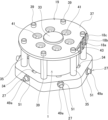
- FIG. 2 is a perspective view showing the jig 19 supporting the stator 1 in FIG. 1.
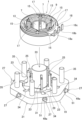
- FIG. 3 is an exploded perspective view showing the stator 1 and jig 19 in FIG. 2, omitting the cover 37.
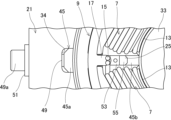
- FIG. 4 is a cross-sectional view of the jig 19 in FIG. 2.
- FIG. 5 is an enlarged plan view showing a portion of the jig 19 in FIG. 2, omitting the cover 37.
- the jig 19 used in the welding method of this embodiment constitutes a jig that can be driven from outside the stator 1.
- This jig 19 is driven to bring the conductive wire 15 of the coil 7 into contact with the terminal 17 of the bus bar 9 by applying a pressing force, and the pressing force is controlled to be within a specified range.
- the jig 19 includes a base member 21, a movable body 23, a pressing unit 25, and a driving unit 27.
- the base member 21 supports the stator 1 on one side in the axial direction.
- the base member 21 is formed in a plate shape, and has a hexagonal planar shape.
- the shape of the base member 21 is not particularly limited.
- a recess 29 is formed in the center of the base member 21.
- the recess 29 is concave in the plate thickness direction of the base member 21, and is open at the top.
- “upper” refers to the upper side in the figure, and does not necessarily refer to the vertical direction.
- the thickness direction of the base member 21 coincides with the axial direction of the stator 1.
- the central portion of the base member 21 is the portion excluding the outer periphery of the base member 21.
- the planar shape of the recess 29 is not particularly limited, but is circular in this embodiment.
- a core metal 33 is arranged via a spacer 31 in the central portion of the recess 29 excluding the outer periphery.
- the outer periphery of the recess 29 is a circular portion that surrounds the spacer 31.
- a plurality of groove-shaped recesses 34 are formed in the outer periphery of this recess 29.
- each groove-shaped recess 34 is concave in the thickness direction of the base member 21 and is open at the top.
- the groove-shaped recesses 34 are groove-shaped extending radially outward from the wall portion that defines the recess 29.
- the multiple groove-shaped recesses 34 are arranged at intervals in the circumferential direction.
- the circumferential width of the groove-shaped recess 34 corresponds to the width of the slide portion 45 of the movable body 23.
- the depth of the groove-shaped recess 34 is the same as the depth of the recess 29.
- the groove-shaped recess 34 is radially connected to the insertion hole 21a formed in the base member 21.
- the insertion hole 21a penetrates radially from the radial outer surface of the base member 21 to the groove-shaped recess 34.
- Stud bosses 35 are erected on the base member 21 as stud portions.
- the locations and number of the stud bosses 35 are not particularly limited, but in this embodiment, six stud bosses 35 are arranged to correspond to the respective corners of the planar shape of the base member 21.
- the stud bosses 35 support at their tips a cover 37 that covers the coils 5 and busbars 9. Through holes (not shown) corresponding to the stud bosses 35 are formed in the cover 37. Bolts 39 are fastened to the female threads (not shown) of the stud bosses 35 through the respective through holes. The cover 37 is attached and removed using the bolts 39.
- the stud portion may be a columnar member that supports the cover 37, and may be configured with a stud bolt attached to the stud boss 35. In this case, a nut is used instead of the bolt 39. Also, as long as the cover 37 can be fixed, it is not necessary to use bolts, nuts, etc.
- the cover 37 is formed in a plate shape, a disk shape in this embodiment, that covers the coil 7 and the bus bar 9.
- the planar shape of the cover 37 is not particularly limited.
- the cover 37 has an access window 41 that exposes the terminal 17 and the conductive wire 15, and a cutout portion 43 for the connector.
- the work windows 41 are formed in six locations.
- the work windows 41 have a cross-sectional shape that expands from the terminal 17 and conductive wire 15 side toward the outer surface of the cover 37 in the plate thickness direction.
- the cross-sectional shape of the work windows 41 is not particularly limited, but in this embodiment, the work windows 41 expand in a stepped shape.
- the cover 37 is intended to suppress the effects of heat on the stator 1 during welding, but can be omitted.
- the movable body 23 is provided so as to be movable relative to the base member 21.
- the movable body 23 is provided on the base member 21.
- the movable body 23 only needs to be configured so as to be movable relative to the base member 21, and does not need to be provided on the base member 21.
- the movable bodies 23 are arranged along the groove recesses 34 and are movable in the radial direction. However, the direction of movement of the movable bodies 23 is appropriately set according to the contact direction between the conductive wire 15 of the coil 7 and the terminal 17 of the bus bar 9.
- the movable body 23 is provided with a slide portion 45 and a pressure force transmission portion 47.
- the slide portion 45 moves along the base member 21 in conjunction with the drive unit 27.
- the slide portion 45 has a relatively wide base portion 45a on the radially outer side.
- the circumferential width of the base 45a corresponds to the width of the groove recess 34.
- the base 45a fits into the groove recess 34 and is guided along the groove recess 34.
- the radially inner tip 45b of the slide portion 45 protrudes toward the spacer 31 and is located below the bottom surface of the core metal 33. Therefore, the slide portion 45 can move stably in the radial direction.
- the pressing force transmission part 47 is formed in a columnar shape and stands up in the axial direction from the sliding part 45.
- a gradient part 47a is formed between the pressing force transmission part 47 and the sliding part 45.
- This pressing force transmission part 47 supports the pressing part 25, and the pressing part 25 is provided on the movable body 23.
- the pressing portion 25 is oriented radially inward with respect to the terminal 17, sandwiching the conductive wire 15.
- the pressing portion 25 is supported at the tip of the pressing force transmission portion 45.
- the pressing portion 25 may also be supported at the axial middle portion of the pressing force transmission portion 45, etc.
- the pressing portion 25 is in contact with the underside of the cover 37 so as to be relatively movable. However, the pressing portion 25 can also be moved away from the underside of the cover 37. Details of the pressing portion 25 will be described later.
- the driving unit 27 is linked to the movable body 23 and moves the movable body 23. This movement of the movable body 23 causes the pressing unit 25 to press the conductive wire 15 against the terminal 17, bringing them into contact.
- the drive unit 27 is configured with a plurality of drive bolts 49.
- Each drive bolt 49 penetrates the base member 21 radially through the insertion hole 21a.
- the drive bolt 49 penetrates the base member 21 radially inward and outward, and has a radial inner portion that is screwed into the movable body 23, and a radial outer portion that protrudes from the base member 21 so as to be rotatable about the axis.
- the radially outer portion of the drive bolt 49 has a head portion 49a, which is disposed so as to protrude radially outward from the base member 21.
- a washer 51 is interposed between the head portion 49a and the outer surface of the base member 21.
- the head portion 49a can be rotated about its axis using a tool or device.
- the drive unit 27 can move the movable body 23 radially by rotating the drive bolt 49.
- the drive bolt 49 may be configured to be screwed into the base member 21 and engaged with the movable body 23 so as to be capable of relative rotation. In this case, the drive bolt 49 moves radially in response to axial rotation operation to move the movable body 23.
- the drive bolt 49 may omit the head portion 49a, and it is sufficient that the axial rotation operation can be performed by a tool or device within the range protruding from the base member 21.
- the driving unit 27 manages the driving force that moves the movable body 23, so that the pressing unit 25 contacts the conductive wire 15 with the terminal 17 with a specified pressing force.
- the tightening torque of the driving bolt 49 which serves as the driving force, is managed, so that the conductive wire 15 can be brought into contact with the terminal 17 with a specified pressing force.
- the drive unit 27 can also be another type of linear actuator, such as one that uses fluid pressure or solenoid force.
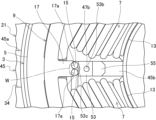
- FIG. 6 is an enlarged cross-sectional view showing a portion of the jig 19 in FIG. 2.
- FIG. 7 is an enlarged plan view of a portion of FIG. 5.
- each pressing portion 25 has an electric wire facing portion 53 and a cover contact portion 55.
- the cover contact portion 55 protrudes from the electric wire facing portion 53 in the axial direction.
- the electric wire facing portion 53 is formed in a plate or block shape and has a plurality of holes 53a and 53b and a pressing surface 53c. The plurality of holes 53a and 53b are arranged in a radial direction.
- the holes 53a and 53b are provided along the axial direction, and the mating pin 47b at the tip of the pressing force transmission part 47 is inserted in the axial direction to engage with them. This engagement allows the pressing part 25 to be supported replaceably with respect to the movable body 23.
- the hole 53a is concave with respect to the electric wire facing portion 53, and the hole 53b penetrates the electric wire facing portion 53 in the axial direction.
- the replaceable support of the pressing portion 25 can be realized by various structures such as fitting and screw fastening.
- the pressing portion 25 can also be formed integrally with the movable body 23.
- the pressing surface 53c is a surface that comes into contact with the conductive wire 15 and presses the conductive wire 15.
- the pressing surface 53c is oriented radially outward.
- the pressing surface 53c is positioned in a position that is biased toward the base member 21 in the axial direction from the contact portion between the terminal 17 and the conductive wire 15.
- the pressing surface 53c is concave toward the conductive wire 15 in a plan view.
- the pressing surface 53c is made up of a pair of inclined surfaces that transition from the center in the circumferential direction toward the conductive wire 15 on both sides.
- the pressing surface 53c can also be made concave with a curved surface or be made up of a flat surface, etc.
- the pressing surface 53c holds the pair of conductive wires 15 when the pair of inclined surfaces press the pair of conductive wires 15.
- the pair of conductive wires 15 are held while applying a force that pushes the pair of conductive wires 15 inward in the circumferential direction.
- the shape of the pressing surface 53c may be formed on the terminal 17.
- the shape of the edge recess 17a may also be formed on the wire-facing portion 53.
- One or both of the wire-facing portion 53 and the edge of the terminal 17 may also be formed linearly in a plan view, perpendicular to the radial direction.
- stator 1 before welding is placed inside the stud boss 35 of the base member 21.
- the pressing portion 25 of the jig 19 is positioned so that it is oriented radially toward the terminal 17 via the conductive wire 15 in a plan view.
- the cover 37 is attached to the tip of the stud boss 35. That is, the cover 37 is placed on the tip of the stud boss 35, and the bolts 39 are fastened to the female threads of the stud boss 35 through the through holes of the cover 37. In this state, the terminals 17 and conductive wires 15 are exposed in each of the working windows 41 of the cover 37.
- the conductive wire 15 is brought into contact with the terminal 17.
- the head portion 49a of each drive bolt 49 is rotated, the slide portion 45 of the movable body 23 that is screwed together by the rotation of the drive bolt 49 is pulled radially outward and moves.
- the head portion 49a can be rotated automatically by a device such as a robot, or manually by a tool.
- This movement of the movable body 23 causes the pressing force transmission part 47 to move in the same direction.
- the wire facing part 53 of the pressing part 25 presses the conductive wires 15 with the pressing surface 53c.
- This pressing brings the pair of conductive wires 15 into contact with the terminal 17.
- the contact is achieved by pressing the pair of conductive wires 15 against the edge recesses 17a of the terminal 17.
- the pair of inclined surfaces of the pressing surface 53c also press the pair of conductive wires 15 inward in the circumferential direction, thereby positioning the conductive wires 15.
- Each edge recess 17a with which the conductive wire 15 comes into contact is formed in the terminal 17 as an arc of approximately the same curvature as the outer peripheral surface of the conductive wire 15.
- the outer peripheral surfaces of the conductive wire 15 housed in the edge recess 17a may be slightly separated in the circumferential direction, but may still be in contact.
- the edge recess 17a may be omitted.
- the shape of the edge recess 17a may also be provided on the pressing surface 53c.
- This pressing force causes the conductive wire 15 to come into contact with the terminal 17.
- the pressing of the conductive wire 15 is performed at a position shifted in the axial direction of the conductive wire 15 from the contact portion between the conductive wire 15 and the terminal 17. Therefore, the conductive wire 15 comes into contact with the terminal 17 with its own elasticity in response to the pressing force from the jig 19.
- the contact pressure of the conductive wire 15 can be reliably received by the terminal 17 in the direction of the plate surface.
- This pressure is increased to a specified value by managing the tightening torque, which is the driving force of the head portion 49a.
- the specified pressure is a pressure that provides an appropriate contact pressure for arc welding, for example, in the contact area between the conductive wire 15 and the terminal 17.
- “Appropriate” means a level that allows sufficient penetration of the conductive wire 15, and is set appropriately depending on the welding method and the type of material being welded.
- the tightening torque increases due to the elasticity of the conductive wire 15 in response to the tightening of the drive bolt 49.
- the pressing force of the jig 19 for contacting the conductive wire 15 with the terminal 17 is set within a specified value range.
- welding is performed on the conductive wires 15 and terminals 17 in each work window 41.
- arc welding is performed.
- the welding can also be resistance welding.
- the coil 7 side is earthed, and the conductive wire 15 becomes the negative voltage side via the coil 7.
- the torch comes into contact through the work window 41 to perform arc welding between the terminal 17 and the conductive wire 15.
- the torch is positioned near the contact point between the terminal 17 and the conductive wire 15. Note that the torch may not be brought into contact with the terminal 17 or the conductive wire 15.
- This arc welding creates a welded portion W that joins the contacting portions of the terminals 17 and the conductive wires 15.
- the pair of conductive wires 15 are in contact with the terminals 17 uniformly with a specified pressure, so that they are uniformly and sufficiently welded together.
- the welding method of this embodiment drives the jig 19, which can be operated from outside the stator 1, to make contact between the conductive wire 15 and the terminal 17. Then, by controlling the driving force of the jig 19, welding can be performed while applying a specified pressing force between the conductive wire 15 and the terminal 17.
- the welding quality can be uniformly stabilized at multiple welding points, and the performance of the stator 1 can be stabilized.
- each welding section the two conductive wires 15 are arranged in parallel and are uniformly contacted and welded to the terminals 17 with a specified pressure. This makes it possible to suppress variation in the welding of each conductive wire 15 and stabilize the welding quality.
- the conductive wire 15 is pressed at a position offset in the axial direction of the conductive wire 15 from the contact point between the conductive wire 15 and the terminal 17, and the conductive wire 15 comes into contact with the terminal 17 by its elasticity.
- the driving force of the jig 19 can be reliably increased in response to an increase in the pressing force that brings the conductive wire 15 into contact with the terminal 17, and the pressing force can be easily and reliably managed.
- the conductive wire 15 can be positioned in the edge recess 17a of the terminal 17, making it easier to make the contact area and contact pressure of the conductive wire 15 with the terminal 17 uniform, and more reliably stabilizing the welding quality.
- the jig 19 used in the welding method of this embodiment of the present invention supports the stator 1 on the base member 21, and the movable body 23 is moved by rotating the head portion 49a of the drive portion 27, so that the conductive wire 15 can be brought into contact with the terminal 17 by the pressing portion 25.
- the jig 19 can bring the conductive wire 15 and the terminal 17 into contact with a specified pressure by controlling the driving force of the movable body 23. Therefore, by welding the conductive wire 15 and the terminal 17 in this contact state, it is possible to suppress variations in the welding and stabilize the welding quality.
- the pressing surface 53c of the pressing portion 25 is concave toward the conductive wire 15, so that the conductive wire 15 can be positioned relative to the edge of the terminal 17.
- the pressing part 25 is replaceable relative to the movable body 23, so repairing and replacing the pressing part 25 makes it easy to stabilize the welding quality.
- the slide portion 45 linked to the drive portion 27 can be moved accurately along the base member 21. This movement allows the force to be accurately transmitted to the pressing portion 25 via the pressing force transmission portion 47, and the specified pressing force can be accurately applied to the conductive wire 15.
- the drive unit 27 can rotate the head portion 49a of the drive bolt 49 around its axis on the radial outside of the base member 21, and can reliably transmit the drive force to the pressing portion 25 located on the radial inside of the stator 1.
- stator 3 stator core 7: coil 9: busbar 13: teeth 15: conductive wire 17: terminal 17a: end edge recess 19: jig 21: base member 23: movable body 25: pressing portion 27: driving portion 35: stud boss (stud portion) 37 Cover 41 Working window 5 Slide portion 47 Pressing force transmitting portion 49 Drive bolt 49a Head portion 53 Wire facing portion 53c Pressing surface W Welding portion
Landscapes
- Engineering & Computer Science (AREA)
- Manufacturing & Machinery (AREA)
- Power Engineering (AREA)
- Physics & Mathematics (AREA)
- Plasma & Fusion (AREA)
- Mechanical Engineering (AREA)
- Manufacture Of Motors, Generators (AREA)
Priority Applications (2)
| Application Number | Priority Date | Filing Date | Title |
|---|---|---|---|
| JP2025539343A JP7837477B2 (ja) | 2023-08-04 | 2024-07-31 | 溶接方法及び治具 |
| CN202480048895.8A CN121586986A (zh) | 2023-08-04 | 2024-07-31 | 焊接方法及夹具 |
Applications Claiming Priority (2)
| Application Number | Priority Date | Filing Date | Title |
|---|---|---|---|
| JP2023127590 | 2023-08-04 | ||
| JP2023-127590 | 2023-08-04 |
Publications (1)
| Publication Number | Publication Date |
|---|---|
| WO2025033299A1 true WO2025033299A1 (ja) | 2025-02-13 |
Family
ID=94534685
Family Applications (1)
| Application Number | Title | Priority Date | Filing Date |
|---|---|---|---|
| PCT/JP2024/027420 Pending WO2025033299A1 (ja) | 2023-08-04 | 2024-07-31 | 溶接方法及び治具 |
Country Status (3)
| Country | Link |
|---|---|
| JP (1) | JP7837477B2 (https=) |
| CN (1) | CN121586986A (https=) |
| WO (1) | WO2025033299A1 (https=) |
Citations (6)
| Publication number | Priority date | Publication date | Assignee | Title |
|---|---|---|---|---|
| JPH10277738A (ja) * | 1997-04-02 | 1998-10-20 | Kobe Steel Ltd | 立向エレクトロガスアーク溶接装置 |
| JPH11114674A (ja) * | 1997-10-08 | 1999-04-27 | Denso Corp | 絶縁被覆電線の接続方法及びその接続構造 |
| JP5417721B2 (ja) | 2008-03-13 | 2014-02-19 | 日本電産株式会社 | モータ |
| WO2016143771A1 (ja) * | 2015-03-12 | 2016-09-15 | 三菱電機株式会社 | 缶体の製造装置および缶体の製造方法 |
| WO2019107567A1 (ja) * | 2017-11-30 | 2019-06-06 | アイシン・エィ・ダブリュ株式会社 | 電機子および電機子の製造方法 |
| WO2023054407A1 (ja) * | 2021-09-29 | 2023-04-06 | 日本発條株式会社 | ステータの製造方法 |
-
2024
- 2024-07-31 CN CN202480048895.8A patent/CN121586986A/zh active Pending
- 2024-07-31 JP JP2025539343A patent/JP7837477B2/ja active Active
- 2024-07-31 WO PCT/JP2024/027420 patent/WO2025033299A1/ja active Pending
Patent Citations (6)
| Publication number | Priority date | Publication date | Assignee | Title |
|---|---|---|---|---|
| JPH10277738A (ja) * | 1997-04-02 | 1998-10-20 | Kobe Steel Ltd | 立向エレクトロガスアーク溶接装置 |
| JPH11114674A (ja) * | 1997-10-08 | 1999-04-27 | Denso Corp | 絶縁被覆電線の接続方法及びその接続構造 |
| JP5417721B2 (ja) | 2008-03-13 | 2014-02-19 | 日本電産株式会社 | モータ |
| WO2016143771A1 (ja) * | 2015-03-12 | 2016-09-15 | 三菱電機株式会社 | 缶体の製造装置および缶体の製造方法 |
| WO2019107567A1 (ja) * | 2017-11-30 | 2019-06-06 | アイシン・エィ・ダブリュ株式会社 | 電機子および電機子の製造方法 |
| WO2023054407A1 (ja) * | 2021-09-29 | 2023-04-06 | 日本発條株式会社 | ステータの製造方法 |
Also Published As
| Publication number | Publication date |
|---|---|
| JP7837477B2 (ja) | 2026-03-30 |
| JPWO2025033299A1 (https=) | 2025-02-13 |
| CN121586986A (zh) | 2026-02-27 |
Similar Documents
| Publication | Publication Date | Title |
|---|---|---|
| US11277047B2 (en) | Busbar apparatus, motor, and method of manufacturing busbar apparatus | |
| JP6973395B2 (ja) | モータ | |
| CN109964390B (zh) | 马达和电动助力转向装置 | |
| US9024490B2 (en) | Central power supply member | |
| CN113287248B (zh) | 定子、电机和制造方法 | |
| JP2007110797A (ja) | ステータにおける給電線とターミナルの接続構造、および接合装置 | |
| JP2021164220A (ja) | バスバーユニットおよびモータ | |
| US7608959B2 (en) | Brushless motor | |
| US6026558A (en) | Method for manufacturing armature of rotating electric machine | |
| CN112018966A (zh) | 控制部、马达以及电动助力转向装置 | |
| JP2014050238A (ja) | 回転電機 | |
| JP7837477B2 (ja) | 溶接方法及び治具 | |
| JP6959163B2 (ja) | 曲げ加工装置 | |
| JP2726097B2 (ja) | モータのステータコイル線の接続方法 | |
| JP5173617B2 (ja) | ステータ | |
| JP2019118200A (ja) | 導体接合方法 | |
| JP5237767B2 (ja) | 整流子及び該整流子を備える電機子及びモータ並びに該電機子の製造方法及びモータの製造方法 | |
| JP3541534B2 (ja) | 回転電機の回転子の製造方法 | |
| WO2018062351A1 (ja) | モータ | |
| JP2020162205A (ja) | モータおよびモータの製造方法 | |
| WO2019065141A1 (ja) | ステータ、モータ、圧縮機およびステータの製造方法 | |
| US20130169103A1 (en) | Conductor weld-end forming process | |
| US12476498B2 (en) | Stator for rotary electric machine | |
| JPWO2025033299A5 (https=) | ||
| CN113612333A (zh) | 马达和电动助力转向装置 |
Legal Events
| Date | Code | Title | Description |
|---|---|---|---|
| 121 | Ep: the epo has been informed by wipo that ep was designated in this application |
Ref document number: 24851724 Country of ref document: EP Kind code of ref document: A1 |
|
| ENP | Entry into the national phase |
Ref document number: 2025539343 Country of ref document: JP Kind code of ref document: A |
|
| WWE | Wipo information: entry into national phase |
Ref document number: 2025539343 Country of ref document: JP |
|
| WWE | Wipo information: entry into national phase |
Ref document number: 2024851724 Country of ref document: EP |
|
| NENP | Non-entry into the national phase |
Ref country code: DE |