WO2025028301A1 - エッチング方法及びプラズマ処理装置 - Google Patents
エッチング方法及びプラズマ処理装置 Download PDFInfo
- Publication number
- WO2025028301A1 WO2025028301A1 PCT/JP2024/025935 JP2024025935W WO2025028301A1 WO 2025028301 A1 WO2025028301 A1 WO 2025028301A1 JP 2024025935 W JP2024025935 W JP 2024025935W WO 2025028301 A1 WO2025028301 A1 WO 2025028301A1
- Authority
- WO
- WIPO (PCT)
- Prior art keywords
- gas
- substrate
- etching method
- process gas
- plasma
- Prior art date
- Legal status (The legal status is an assumption and is not a legal conclusion. Google has not performed a legal analysis and makes no representation as to the accuracy of the status listed.)
- Pending
Links
Images




Classifications
-
- C—CHEMISTRY; METALLURGY
- C23—COATING METALLIC MATERIAL; COATING MATERIAL WITH METALLIC MATERIAL; CHEMICAL SURFACE TREATMENT; DIFFUSION TREATMENT OF METALLIC MATERIAL; COATING BY VACUUM EVAPORATION, BY SPUTTERING, BY ION IMPLANTATION OR BY CHEMICAL VAPOUR DEPOSITION, IN GENERAL; INHIBITING CORROSION OF METALLIC MATERIAL OR INCRUSTATION IN GENERAL
- C23F—NON-MECHANICAL REMOVAL OF METALLIC MATERIAL FROM SURFACE; INHIBITING CORROSION OF METALLIC MATERIAL OR INCRUSTATION IN GENERAL; MULTI-STEP PROCESSES FOR SURFACE TREATMENT OF METALLIC MATERIAL INVOLVING AT LEAST ONE PROCESS PROVIDED FOR IN CLASS C23 AND AT LEAST ONE PROCESS COVERED BY SUBCLASS C21D OR C22F OR CLASS C25
- C23F4/00—Processes for removing metallic material from surfaces, not provided for in group C23F1/00 or C23F3/00
-
- H—ELECTRICITY
- H10—SEMICONDUCTOR DEVICES; ELECTRIC SOLID-STATE DEVICES NOT OTHERWISE PROVIDED FOR
- H10P—GENERIC PROCESSES OR APPARATUS FOR THE MANUFACTURE OR TREATMENT OF DEVICES COVERED BY CLASS H10
- H10P50/00—Etching of wafers, substrates or parts of devices
- H10P50/20—Dry etching; Plasma etching; Reactive-ion etching
- H10P50/24—Dry etching; Plasma etching; Reactive-ion etching of semiconductor materials
- H10P50/242—Dry etching; Plasma etching; Reactive-ion etching of semiconductor materials of Group IV materials
Definitions
- An exemplary embodiment of the present disclosure relates to an etching method and a plasma processing apparatus.
- Patent Document 1 discloses a method for etching a region made of silicon oxide.
- the method includes a step (a) of exposing a substrate having a region made of silicon oxide to a plasma of a process gas containing a fluorocarbon gas.
- the region is etched and a deposit containing a fluorocarbon is formed on the region.
- the method includes a step (b) of etching the region with fluorocarbon radicals contained in the deposit. Steps (a) and (b) are repeated alternately.
- the present disclosure provides an etching method and plasma processing apparatus that can improve the etching rate.
- the etching method includes the steps of: (a) providing a substrate on a substrate support in a chamber; (b) exposing the substrate to a first process gas comprising hydrogen fluoride gas; and (c) after (b), exposing the substrate to a plasma generated from a second process gas while supplying an electrical bias to the substrate support, the second process gas comprising at least one inert gas selected from the group consisting of noble gases and nitrogen gas.
- an etching method and plasma processing apparatus are provided that can improve the etching rate.
- FIG. 1 is a diagram for explaining an example of the configuration of a plasma processing system.
- FIG. 2 is a diagram for explaining a configuration example of an inductively coupled plasma processing apparatus.
- FIG. 3 is a flow chart of an etching method according to one exemplary embodiment.
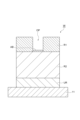
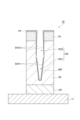
- FIG. 4 is a partial enlarged view of an example substrate to which the method of FIG. 3 may be applied.
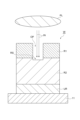
- FIG. 5 is a cross-sectional view illustrating a step of an etching method according to an exemplary embodiment.
- FIG. 6 is a cross-sectional view illustrating a step of an etching method according to an exemplary embodiment.
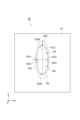
- FIG. 7 is an enlarged partial plan view of an example substrate to which the method of FIG. 3 can be applied.
- FIG. 1 is a diagram for explaining an example of the configuration of a plasma processing system.
- FIG. 2 is a diagram for explaining a configuration example of an inductively coupled plasma processing apparatus.
- FIG. 3 is a flow chart of an etching method according to one
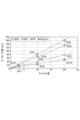
- FIG. 8 is a graph showing an example of the relationship between the number of cycles and the amount of etching.
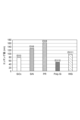
- FIG. 9 is a graph showing an example of the relationship between the film type and the etching amount.
- FIG. 10 is a flow chart of an etching method according to one exemplary embodiment.
- FIG. 11 is a cross-sectional view illustrating a step of an etching method according to one exemplary embodiment.
- FIG. 12 is a cross-sectional view illustrating a step of an etching method according to one exemplary embodiment.
- FIG. 13 is a cross-sectional view illustrating a step of an etching method according to an exemplary embodiment.
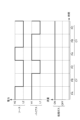
- FIG. 14 is a timing chart showing an example of the change over time in the power and the process gas supplied to the plasma processing apparatus.
- FIG. 1 is a diagram for explaining an example of the configuration of a plasma processing system.
- the plasma processing system includes a plasma processing device 1 and a control unit 2.
- the plasma processing system is an example of a substrate processing system
- the plasma processing device 1 is an example of a substrate processing device.
- the plasma processing device 1 includes a plasma processing chamber 10, a substrate support unit 11, and a plasma generation unit 12.
- the plasma processing chamber 10 has a plasma processing space.
- the plasma processing chamber 10 also has at least one gas supply port for supplying at least one processing gas to the plasma processing space, and at least one gas exhaust port for exhausting gas from the plasma processing space.
- the gas supply port is connected to a gas supply unit 20 described later, and the gas exhaust port is connected to an exhaust system 40 described later.
- the substrate support unit 11 is disposed in the plasma processing space, and has a substrate support surface for supporting a substrate.
- the plasma generating unit 12 is configured to generate plasma from at least one processing gas supplied into the plasma processing space.
- the plasma formed in the plasma processing space may be capacitively coupled plasma (CCP), inductively coupled plasma (ICP), electron-cyclotron-resonance plasma (ECR plasma), helicon wave plasma (HWP), or surface wave plasma (SWP), etc.
- various types of plasma generating units may be used, including AC (Alternating Current) plasma generating units and DC (Direct Current) plasma generating units.
- the AC signal (AC power) used in the AC plasma generating unit has a frequency in the range of 100 kHz to 10 GHz.
- AC signals include RF (Radio Frequency) signals and microwave signals.
- the RF signal has a frequency in the range of 100 kHz to 150 MHz.
- the control unit 2 processes computer-executable instructions that cause the plasma processing apparatus 1 to perform the various steps described in this disclosure.
- the control unit 2 may be configured to control each element of the plasma processing apparatus 1 to perform the various steps described herein. In one embodiment, a part or all of the control unit 2 may be included in the plasma processing apparatus 1.
- the control unit 2 may include a processing unit 2a1, a storage unit 2a2, and a communication interface 2a3.
- the control unit 2 is realized, for example, by a computer 2a.
- the processing unit 2a1 may be configured to perform various control operations by reading a program from the storage unit 2a2 and executing the read program. This program may be stored in the storage unit 2a2 in advance, or may be acquired via a medium when necessary.
- the acquired program is stored in the storage unit 2a2 and is read from the storage unit 2a2 by the processing unit 2a1 and executed.
- the medium may be various storage media readable by the computer 2a, or may be a communication line connected to the communication interface 2a3.
- the processing unit 2a1 may be a CPU (Central Processing Unit).
- the memory unit 2a2 may include a RAM (Random Access Memory), a ROM (Read Only Memory), a HDD (Hard Disk Drive), a SSD (Solid State Drive), or a combination of these.
- the communication interface 2a3 may communicate with the plasma processing device 1 via a communication line such as a LAN (Local Area Network).
- FIG. 1 is a diagram for explaining an example of the configuration of an inductively coupled plasma processing device.
- the inductively coupled plasma processing apparatus 1 includes a plasma processing chamber 10, a gas supply unit 20, a power supply 30, and an exhaust system 40.
- the plasma processing chamber 10 includes a dielectric window 101.
- the plasma processing apparatus 1 also includes a substrate support unit 11, a gas introduction unit, and an antenna 14.
- the substrate support unit 11 is disposed within the plasma processing chamber 10.
- the antenna 14 is disposed on or above the plasma processing chamber 10 (i.e., on or above the dielectric window 101).
- the plasma processing chamber 10 has a plasma processing space 10s defined by the dielectric window 101, a sidewall 102 of the plasma processing chamber 10, and the substrate support unit 11.
- the plasma processing chamber 10 is grounded.
- the substrate support 11 includes a main body 111 and a ring assembly 112.
- the main body 111 has a central region 111a for supporting the substrate W and an annular region 111b for supporting the ring assembly 112.
- a wafer is an example of a substrate W.
- the annular region 111b of the main body 111 surrounds the central region 111a of the main body 111 in a plan view.
- the substrate W is disposed on the central region 111a of the main body 111
- the ring assembly 112 is disposed on the annular region 111b of the main body 111 so as to surround the substrate W on the central region 111a of the main body 111. Therefore, the central region 111a is also called a substrate support surface for supporting the substrate W, and the annular region 111b is also called a ring support surface for supporting the ring assembly 112.
- the main body 111 includes a base 1110 and an electrostatic chuck 1111.
- the base 1110 includes a conductive member.
- the conductive member of the base 1110 may function as a bias electrode.
- the electrostatic chuck 1111 is disposed on the base 1110.
- the electrostatic chuck 1111 includes a ceramic member 1111a and an electrostatic electrode 1111b disposed within the ceramic member 1111a.
- the ceramic member 1111a has a central region 111a. In one embodiment, the ceramic member 1111a also has an annular region 111b. Note that other members surrounding the electrostatic chuck 1111, such as an annular electrostatic chuck or an annular insulating member, may have the annular region 111b.
- the ring assembly 112 may be disposed on the annular electrostatic chuck or the annular insulating member, or may be disposed on both the electrostatic chuck 1111 and the annular insulating member.
- at least one RF/DC electrode coupled to an RF power source 31 and/or a DC power source 32, which will be described later, may be disposed within the ceramic member 1111a.
- the at least one RF/DC electrode functions as a bias electrode.
- the conductive member of the base 1110 and the at least one RF/DC electrode may function as multiple bias electrodes.
- the electrostatic electrode 1111b may function as a bias electrode.
- the substrate support 11 includes at least one bias electrode.
- the ring assembly 112 includes one or more annular members.
- the one or more annular members include one or more edge rings and at least one cover ring.
- the edge rings are formed of a conductive or insulating material, and the cover rings are formed of an insulating material.
- the substrate support 11 may also include a temperature adjustment module configured to adjust at least one of the electrostatic chuck 1111, the ring assembly 112, and the substrate to a target temperature.
- the temperature adjustment module may include a heater, a heat transfer medium, a flow passage 1110a, or a combination thereof.
- a heat transfer fluid such as brine or a gas flows through the flow passage 1110a.
- the flow passage 1110a is formed in the base 1110, and one or more heaters are disposed in the ceramic member 1111a of the electrostatic chuck 1111.
- the substrate support 11 may also include a heat transfer gas supply configured to supply a heat transfer gas to a gap between the back surface of the substrate W and the central region 111a.
- the gas introduction section is configured to introduce at least one processing gas from the gas supply section 20 into the plasma processing space 10s.
- the gas introduction section includes a center gas injector (CGI) 13.
- the center gas injector 13 is disposed above the substrate support section 11 and attached to a central opening formed in the dielectric window 101.
- the center gas injector 13 has at least one gas supply port 13a, at least one gas flow path 13b, and at least one gas inlet port 13c.
- the processing gas supplied to the gas supply port 13a passes through the gas flow path 13b and is introduced into the plasma processing space 10s from the gas inlet port 13c.
- the gas introduction section may include one or more side gas injectors (SGI) attached to one or more openings formed in the sidewall 102.
- SGI side gas injectors
- the gas supply unit 20 may include at least one gas source 21 and at least one flow controller 22.
- the gas supply unit 20 is configured to supply at least one process gas from a corresponding gas source 21 to the gas inlet via a corresponding flow controller 22.
- Each flow controller 22 may include, for example, a mass flow controller or a pressure-controlled flow controller.
- the gas supply unit 20 may include at least one flow modulation device that modulates or pulses the flow rate of the at least one process gas.
- the RF power supply 31 includes a first RF generating unit 31a and a second RF generating unit 31b.
- the first RF generating unit 31a is coupled to the antenna 14 via at least one impedance matching circuit and configured to generate a source RF signal (source RF power) for plasma generation.
- the source RF signal has a frequency in the range of 10 MHz to 150 MHz.
- the first RF generating unit 31a may be configured to generate multiple source RF signals having different frequencies. The generated one or more source RF signals are supplied to the antenna 14.
- the second RF generating unit 31b is coupled to at least one bias electrode via at least one impedance matching circuit and configured to generate a bias RF signal (bias RF power).
- the frequency of the bias RF signal may be the same as or different from the frequency of the source RF signal.
- the bias RF signal has a lower frequency than the frequency of the source RF signal.
- the bias RF signal has a frequency in the range of 100 kHz to 60 MHz.
- the second RF generating unit 31b may be configured to generate multiple bias RF signals having different frequencies.
- the generated one or more bias RF signals are supplied to at least one bias electrode.
- at least one of the source RF signal and the bias RF signal may be pulsed.
- the power supply 30 may also include a DC power supply 32 coupled to the plasma processing chamber 10.
- the DC power supply 32 includes a bias DC generator 32a.
- the bias DC generator 32a is connected to at least one bias electrode and configured to generate a bias DC signal. The generated bias DC signal is applied to the at least one bias electrode.
- the bias DC signal may be pulsed.
- a sequence of voltage pulses is applied to at least one bias electrode.
- the voltage pulses may have a rectangular, trapezoidal, triangular, or combination of these pulse waveforms.
- a waveform generator for generating a sequence of voltage pulses from the DC signal is connected between the bias DC generator 32a and at least one bias electrode.
- the bias DC generator 32a and the waveform generator constitute a voltage pulse generator.
- the voltage pulses may have a positive polarity or a negative polarity.
- the sequence of voltage pulses may include one or more positive voltage pulses and one or more negative voltage pulses within one period.
- the bias DC generator 32a may be provided in addition to the RF power source 31 or may be provided instead of the second RF generator 31b.
- the antenna 14 includes one or more coils.
- the antenna 14 may include an outer coil and an inner coil arranged coaxially.
- the RF power source 31 may be connected to both the outer coil and the inner coil, or to either the outer coil or the inner coil.
- the same RF generator may be connected to both the outer coil and the inner coil, or separate RF generators may be connected separately to the outer coil and the inner coil.
- the exhaust system 40 may be connected to, for example, a gas exhaust port 10e provided at the bottom of the plasma processing chamber 10.
- the exhaust system 40 may include a pressure regulating valve and a vacuum pump. The pressure in the plasma processing space 10s is adjusted by the pressure regulating valve.
- the vacuum pump may include a turbomolecular pump, a dry pump, or a combination thereof.
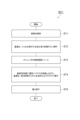
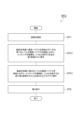
- FIG. 3 is a flow chart of an etching method according to one exemplary embodiment.
- the etching method MT1 shown in FIG. 3 (hereinafter referred to as "method MT1") can be performed by the plasma processing apparatus 1 of the above embodiment.
- Method MT1 can be applied to the substrate W of FIG. 4.
- the substrate W may include a first region R1 and a second region R2.
- the first region R1 may be a mask.
- the substrate W may not include the first region R1.
- the first region R1 has at least one opening OP.
- the at least one opening OP may be a hole or a slit.
- the first region R1 may have multiple openings OP.
- the second region R2 may be below the first region R1.
- the second region R2 may be a film to be etched.
- the substrate W may further include a base region UR.
- the base region UR may be below the second region R2.
- Each of the first region R1, the second region R2, and the base region UR may be a film.
- the first region R1 includes a first material.
- the first material may include a metal or silicon.
- the metal may be a metal other than tungsten, molybdenum, and titanium.
- the first material may include ruthenium (Ru).
- the second region R2 includes a second material.
- the second material is different from the first material.
- the second material may include at least one selected from the group consisting of silicon, carbon, and metal.
- the second material may be at least one silicon-containing material selected from the group consisting of silicon oxide (SiO x ), silicon nitride (SiN x ), silicon oxynitride (SiON), and polysilicon.
- x is a positive real number.
- the second material may be at least one carbon-containing material selected from the group consisting of photoresist (polymer) and amorphous carbon.
- the second material may include at least one metal selected from the group consisting of tungsten (W), molybdenum (Mo), and titanium (Ti).
- the second material may be a compound including a metal element and a nonmetal element.
- the second material may be at least one selected from the group consisting of metal silicide, metal nitride, and metal carbide.
- the second material may be tungsten silicide (WSi).
- the base region UR includes a third material.
- the third material is different from the first material and the second material.
- the third material may include a metal or silicon.
- Method MT1 will be described below with reference to Figs. 3 to 6, taking as an example a case where method MT1 is applied to a substrate W using the plasma processing apparatus 1 of the above embodiment.
- Figs. 5 to 6 are cross-sectional views showing a step of an etching method according to one exemplary embodiment.
- method MT1 can be performed in the plasma processing apparatus 1 by controlling each part of the plasma processing apparatus 1 by the control unit 2.
- a substrate W on a substrate support 11 arranged in a plasma processing chamber 10 is processed, as shown in Fig. 2.
- Step ST1 a substrate W shown in FIG. 4 is provided on a substrate support 11 in a plasma processing chamber 10.
- Step ST2 the substrate W is exposed to a first processing gas containing hydrogen fluoride (HF) gas.
- HF hydrogen fluoride
- plasma may not be generated from the first processing gas.
- the supply of the first processing gas may be stopped at the end of step ST2.
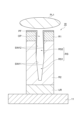
- step ST2 as shown in FIG. 5, hydrogen fluoride molecules are adsorbed on the surface of the substrate W to form an adsorption layer AB.
- the adsorption layer AB may contain hydrogen fluoride.
- the hydrogen fluoride molecules are adsorbed on the surface of the second region R2.
- the hydrogen fluoride molecules may or may not be adsorbed on the surface of the first region R1.
- the adsorption layer AB may be a layer formed by a reaction between hydrogen fluoride and the second region R2.
- the thickness of the adsorption layer AB may increase over time and may saturate at a certain value.
- the first process gas may further include at least one inert gas selected from the group consisting of noble gases and nitrogen (N 2 ) gas.
- noble gases include argon (Ar) gas, helium (He) gas, xenon (Xe) gas, and neon (Ne) gas.
- the flow rate of hydrogen fluoride gas may be the largest.
- the inert gas that may be contained in the first process gas may be the same as or different from the inert gas contained in the second process gas in step ST4.
- the first process gas may not include a fluorine-containing gas other than hydrogen fluoride gas.
- the duration of step ST2 may be 0.1 to 100 seconds, or 30 to 80 seconds.
- the temperature of the substrate support 11 may be controlled in the range of -10°C to 80°C, or in the range of 10°C to 80°C. In such a range, the adsorption of hydrogen fluoride to silicon oxide is not promoted. Therefore, in step ST4, the etching rate of silicon oxide is smaller than the etching rate of silicon nitride.
- the pressure in the plasma processing chamber 10 may be 100 mTorr (13 Pa) or more. Also, the pressure in the plasma processing chamber 10 may be 1000 mTorr (130 Pa) or less.
- Step ST2 may be performed as follows: A first processing gas is supplied into the plasma processing chamber 10 by the gas supply unit 20.
- the control unit 2 controls the gas supply unit 20 and the plasma generation unit 12 so that plasma is not generated.
- Step ST3 the internal space of the plasma processing chamber 10 is purged.
- the purging may be performed by supplying an inert gas into the plasma processing chamber 10, or by evacuating the internal space of the plasma processing chamber 10.
- the purging may be performed by combining the supply of the inert gas and the evacuation.
- Step ST4 In step ST4, as shown in Fig. 6, while supplying an electric bias to the substrate support 11, the substrate W is exposed to a plasma PL generated from a second processing gas.
- the second processing gas may be different from the first processing gas in step ST2.
- the second processing gas includes at least one inert gas selected from the group consisting of a noble gas and nitrogen ( N2 ) gas.
- the flow rate of the inert gas may be the largest among all the flow rates of the gases included in the second processing gas.
- the second processing gas may not include a halogen gas.
- an electrical bias causes ions IN in the plasma PL to collide with the adsorption layer AB.
- the ions IN may be ions of an inert gas.
- the collision energy of the ions IN causes a reaction between the adsorption layer AB and the substrate W (second region R2), thereby etching the substrate W (second region R2).
- a recess RS is formed in the substrate W (second region R2).
- the etching may be stopped by depletion of the adsorption layer AB.
- the supply of the second process gas may be stopped at the end of step ST4.
- the duration of step ST4 may be shorter than the duration of step ST2.
- the duration of step ST4 may be 1/3 or less of the duration of step ST2.
- the duration of step ST4 may be 0.1 to 100 seconds, or 0.1 to 20 seconds. Since the ions IN are collided with the substrate W (second region R2) by the electrical bias, a large collision energy of the ions IN is imparted to the substrate W (second region R2). Therefore, even if the duration of step ST4 is shortened, a high etching rate can be obtained.
- the temperature of the substrate support 11 may be controlled in the range of -10°C to 80°C, or in the range of 10°C to 80°C.
- the pressure in the plasma processing chamber 10 in step ST4 may be lower than the pressure in the plasma processing chamber 10 in step ST2.
- the pressure in the plasma processing chamber 10 may be 10 mTorr (1.3 Pa) or more.
- the pressure in the plasma processing chamber 10 may be 100 mTorr (13 Pa) or less.
- Step ST4 may be performed as follows. First, the gas supply unit 20 supplies the second processing gas into the plasma processing chamber 10. Next, the plasma generation unit 12 generates plasma PL from the second processing gas in the plasma processing chamber 10. The control unit 2 controls the gas supply unit 20 and the plasma generation unit 12 so that the plasma PL is generated. The control unit 2 controls the power supply 30 so that an electrical bias is supplied to the substrate support unit 11.
- Step ST5 steps ST2 to ST4 are repeated. This allows the etching amount of the second region R2 to be increased, and therefore the recess RS can be deepened.
- an adsorption layer AB may be formed on the sidewall and bottom of the recess RS.
- step ST4 of step ST5 ions IN collide with the adsorption layer AB on the bottom of the recess RS, but are unlikely to collide with the adsorption layer AB on the sidewall of the recess RS.
- the method MT1 described above can improve the etching rate of the substrate W (second region R2) in step ST4.
- the mechanism is presumed to be as follows, but is not limited to this.
- step ST2 hydrogen fluoride molecules are adsorbed onto the surface of the substrate W to form an adsorption layer AB.
- the adsorption layer AB may be a layer formed by the reaction of hydrogen fluoride with the substrate W (second region R2).
- ions IN in the plasma PL collide with the adsorption layer AB due to an electrical bias.
- the collision energy of the ions IN causes the adsorption layer AB to react with the substrate W (second region R2), thereby etching the substrate W (second region R2).
- step ST2 no film is formed by plasma CVD in step ST2. Therefore, the effect of loading on the dimensions (CD: Critical Dimension) and depth of the recess RS can be reduced. Also, the in-plane uniformity of the dimensions (CD) and depth of the recess RS can be improved.
- FIG. 7 is a partially enlarged plan view of an example substrate W to which method MT1 can be applied.
- FIG. 7 shows an XYZ Cartesian coordinate system.
- a first direction X and a second direction Y are directions along the main surface of the substrate W.
- a third direction Z is a direction perpendicular to the main surface of the substrate W.
- the substrate W shown in FIG. 7 includes a second region R2 as a film to be etched.
- the second region R2 has at least one recess RS.
- the recess RS corresponds to the opening OP in the first region R1.
- the recess RS may be formed by etching the second region R2 through the opening OP before step ST2.
- the recess RS has a first pair of side walls SW1 that face each other with a first width XCD in the first direction X, and a second pair of side walls SW2 that face each other with a second width YCD in the second direction Y.
- the second direction Y is perpendicular to the first direction X.
- the second width YCD is greater than the first width XCD.
- the recess RS may have, for example, an elliptical shape in the XY plane that includes the first direction X and the second direction Y.
- an adsorption layer AB is formed in the recess RS.
- the adsorption layer AB may be formed on the sidewalls and bottom of the recess RS.
- the adsorption layer AB may be formed on the first sidewall pair SW1 and the second sidewall pair SW2.
- step ST4 the first sidewall pair SW1 and the second sidewall pair SW2 are etched.
- the recess RS expands in the XY plane including the first direction X and the second direction Y (see the recess RS indicated by the dashed line in FIG. 7).
- the etching amount YEA of each of the second sidewall pair SW2 is greater than the etching amount XEA of each of the first sidewall pair SW1. This is believed to be because the flux of ions IN incident on each of the second sidewall pair SW2 is greater than the flux of ions IN incident on each of the first sidewall pair SW1.
- a substrate was provided on a substrate support in a chamber of a plasma processing apparatus (step ST1).
- the substrate had a SiO 2 film on its surface.
- a first processing gas containing HF gas and Ar gas was supplied onto the substrate without generating plasma (step ST2).
- the duration of step ST2 was 60 seconds.
- argon gas was supplied into the chamber to purge the internal space of the chamber (step ST3).
- the duration of step ST3 was 30 seconds.
- plasma generated from Ar gas was supplied to the substrate while supplying an electric bias to the substrate support (step ST4).
- the duration of step ST4 was 10 seconds.
- steps ST2 to ST4 were repeated so that each of steps ST2 to ST4 was performed three times (cycle number) (step ST5).
- the temperature of the substrate support in steps ST2 to ST5 was ⁇ 5° C.
- Example 8 The eighth experiment was carried out in the same manner as the seventh experiment, except that step ST5 was carried out so that the number of cycles was 20.
- the ninth experiment was carried out in the same manner as the second experiment, except that the substrate had a polysilicon film instead of a SiO2 film.
- the number of cycles was 10.
- Example 16 The 16th experiment was performed in the same manner as the 2nd experiment, except that CF4 gas was used instead of HF gas in the process ST2.
- the substrate has a SiO2 film.
- Example 17 The 17th experiment was carried out in the same manner as the 5th experiment, except that CF4 gas was used instead of HF gas in the step ST2.
- the substrate had a SiN film.
- step ST4 (Duration of step ST4) Except for changing the duration of step ST4 to 2 seconds, 5 seconds, and 20 seconds, etching was performed in the same manner as in the second experiment or the fifth experiment, and the etching amount of the film included in the substrate was measured. As a result, the etching amount increased as the duration of step ST4 increased until the duration of step ST4 was 10 seconds. When the duration of step ST4 was longer than 10 seconds, the etching amount hardly changed even if the duration of step ST4 was longer. This indicates that etching automatically stops when the adsorption layer or reaction layer of HF gas is exhausted.
- FIG. 10 is a flowchart of an etching method according to one exemplary embodiment.
- the etching method MT2 shown in FIG. 10 (hereinafter referred to as "method MT2") can be performed by the plasma processing apparatus 1 of the above embodiment.
- Method MT2 can be applied to the substrate W of FIG. 4.
- method MT2 may include steps ST1, ST21, ST41, and ST5. Steps ST1, ST21, ST41, and ST5 may be performed in sequence. Method MT2 may not include step ST5.
- Step ST1 the substrate W shown in FIG. 4 is provided on the substrate support 11 in the plasma processing chamber 10. Then, as shown in FIG. 11, the second region R2 is etched through the opening OP of the first region R1 by the plasma PL1 generated from the processing gas. As a result, the substrate W including the second region R2 having at least one recess RS is provided on the substrate support 11.
- the recess RS may have a first portion RS1 and a second portion RS2 on the first portion RS1.
- the first portion RS1 may have a first sidewall SW11.
- the first portion RS1 may have a bottom of the recess RS.
- the second portion RS2 may have a second sidewall SW12.
- a protective film PF may be formed on the second sidewall SW12.
- the protective film PF may be formed on the first region R1.
- the protective film PF may be formed simultaneously with the recess RS, or may be formed after the recess RS is formed.
- the protective film PF contains carbon and fluorine.
- the protective film PF may be formed without forming the protective film PF.
- the protective film PF may be formed by, for example, ALD or CVD.
- Step ST21 may be performed in the same manner as step ST2 of method MT1.
- the second region R2 is exposed to a third process gas containing hydrogen fluoride gas while supplying no electric bias or a first level electric bias to the substrate support 11.
- the third process gas may be the same as the process gas used in step ST1.
- the third process gas may further contain a fluorocarbon gas or a hydrofluorocarbon gas.
- plasma may not be generated from the third process gas.
- the surface of the first sidewall SW11 may be modified. As a result, a modified layer MR is formed on the surface of the first sidewall SW11.
- the modified layer MR is not formed on the portion of the surface of the second sidewall SW12 that is covered by the protective film PF.
- the modified layer MR may be an adsorption layer AB shown in FIG. 5.
- Step ST41 may be performed in the same manner as step ST4 of method MT1.
- step ST41 as shown in FIG. 13, while supplying a second level of electric bias to the substrate support 11, the second region R2 is exposed to a plasma PL generated from a fourth process gas including hydrogen fluoride gas.
- the fourth process gas may be the same as the third process gas.
- the fourth process gas may further include a fluorocarbon gas or a hydrofluorocarbon gas.
- the second level of the electric bias supplied to the substrate support 11 in step S41 is greater than the first level of the electric bias that may be supplied to the substrate support 11 in step ST21.
- step ST41 as shown in FIG. 13, the surface (modified layer MR) of the first side wall SW11 modified in step ST21 may be removed. This causes the first side wall SW11 to be etched.
- Step ST5 In the process ST5, a cycle including the process ST21 and the process ST41 is repeated. Each cycle may further include an etching process included in the process ST1 before the process ST21.
- step ST21 a modified layer MR can be formed in the first portion RS1 close to the bottom of the recess RS.
- step ST41 etching of the first portion RS1 close to the bottom of the recess RS can be promoted. This makes it possible to improve the etching rate of the recess RS having a high aspect ratio.
- step ST41 since the first sidewall SW11 can be etched, the dimension (CD) of the recess RS at the bottom of the recess RS can be increased.
- FIG. 14 is a timing chart showing an example of the change over time in the power and process gas supplied to the plasma processing apparatus. This timing chart relates to steps ST1, ST21, ST41, and ST5.
- the plasma processing apparatus 1 may be supplied with source power and bias power.
- the source power may be high frequency power HF applied to the counter electrode (upper electrode).
- the bias power may be high frequency power LF or DC bias applied to an electrode in the main body 111 of the substrate support 11.
- the source power and the bias power may be applied periodically with a period CY.
- the period CY may include a first period PA, a second period PB, and a third period PC.
- the second period PB is the period after the first period PA.
- the third period PC is the period after the second period PB.
- the first period PA and the second period PB in the first period CY correspond to the etching process included in the process ST1.
- a recess RS may be formed as shown in FIG. 11.
- the third period PC corresponds to the process ST21.
- a modified layer MR may be formed as shown in FIG. 12.
- the first period PA and the second period PB after the third period PC correspond to the process ST41.
- the first side wall SW11 may be etched as shown in FIG. 13.
- the third period PC and the subsequent period in the second period CY correspond to the process ST5.
- the power level of the source power may be maintained at level H2, and the power level of the bias power may be maintained at level H1.
- Level H1 is lower than level H2.
- the power level of the source power may be maintained at level L2, and the power level of the bias power may be maintained at level H1.
- Level L2 is lower than level H2.
- Level L2 may be 0 W.
- the power level of the source power may be maintained at level L2, and the power level of the bias power may be maintained at level L1.
- Level L1 is lower than level H1.
- Level L1 may be 0 W.
- a DC bias may be supplied to the substrate support 11 as the electric bias instead of the high frequency power LF.
- the DC bias may include a voltage pulse. If the electric bias is bias RF power, the level of the electric bias is the power level (effective value) of the bias RF power. If the electric bias includes a voltage pulse, the level of the electric bias is the absolute value of the negative voltage level of the voltage pulse.
- the processing gas supplied to the plasma processing apparatus may be supplied continuously over all cycles CY.
- the processing gas may include a fluorocarbon gas, a hydrofluorocarbon gas, and a hydrogen fluoride gas.
- the etching method [E1] described above can improve the etching rate of the substrate in (c).
- (b) can prevent the opening from becoming blocked.
- the substrate includes a film to be etched having at least one recess;
- the at least one recess has a first pair of opposing sidewalls with a first width in a first direction, and a second pair of opposing sidewalls with a second width larger than the first width in a second direction perpendicular to the first direction,
- the etching method according to any one of [E1] to [E13], wherein in (c), the first sidewall pair and the second sidewall pair are etched, and an etching amount of the second sidewall pair is greater than an etching amount of the first sidewall pair.
- [E15] (a) providing a substrate on a substrate support in a chamber, the substrate including a film to be etched having at least one recess; (b) exposing the film to be etched to a third process gas comprising hydrogen fluoride gas while applying no electrical bias or a first level of electrical bias to the substrate support; (c) after (b), exposing the film to be etched to a plasma generated from a fourth process gas including hydrogen fluoride gas while supplying an electric bias of a second level to the substrate support, the second level being greater than the first level;
- the etching method includes:
- the recess has a first portion and a second portion on the first portion, the first portion having a first sidewall and the second portion having a second sidewall; (b) includes modifying a surface of the first sidewall; The etching method according to any one of [E15] to [E17], wherein the step (c) includes removing the surface of the modified first sidewall.
- a chamber a substrate support for supporting a substrate within the chamber; a gas supply configured to supply a first process gas and a second process gas into the chamber, the first process gas comprising hydrogen fluoride gas and the second process gas comprising at least one inert gas selected from the group consisting of a noble gas and a nitrogen gas; a plasma generating unit configured to generate a plasma from the second process gas in the chamber; a power supply for providing an electrical bias to the substrate support;
- a control unit Equipped with The control unit is (b) exposing the substrate to the first process gas; (c) after (b), exposing the substrate to the plasma generated from the second process gas while supplying the electrical bias to the substrate support;
- the plasma processing apparatus is configured to control the gas supply unit, the plasma generation unit, and the power supply so as to perform the above.
- 1...plasma processing device 2...control unit, 10...plasma processing chamber, 11...substrate support unit, 12...plasma generation unit, 20...gas supply unit, 30...power supply, PL...plasma, R2...second region (film to be etched), RS...recess, W...substrate.
Landscapes
- Chemical & Material Sciences (AREA)
- Engineering & Computer Science (AREA)
- Materials Engineering (AREA)
- Mechanical Engineering (AREA)
- Metallurgy (AREA)
- Organic Chemistry (AREA)
- Drying Of Semiconductors (AREA)
- Physics & Mathematics (AREA)
- Plasma & Fusion (AREA)
- Analytical Chemistry (AREA)
Priority Applications (3)
| Application Number | Priority Date | Filing Date | Title |
|---|---|---|---|
| JP2025537843A JPWO2025028301A1 (https=) | 2023-08-02 | 2024-07-19 | |
| KR1020267005049A KR20260045816A (ko) | 2023-08-02 | 2024-07-19 | 에칭 방법 및 플라즈마 처리 장치 |
| CN202480047888.6A CN121549087A (zh) | 2023-08-02 | 2024-07-19 | 蚀刻方法及等离子体处理装置 |
Applications Claiming Priority (2)
| Application Number | Priority Date | Filing Date | Title |
|---|---|---|---|
| JP2023126146 | 2023-08-02 | ||
| JP2023-126146 | 2023-08-02 |
Publications (1)
| Publication Number | Publication Date |
|---|---|
| WO2025028301A1 true WO2025028301A1 (ja) | 2025-02-06 |
Family
ID=94395213
Family Applications (1)
| Application Number | Title | Priority Date | Filing Date |
|---|---|---|---|
| PCT/JP2024/025935 Pending WO2025028301A1 (ja) | 2023-08-02 | 2024-07-19 | エッチング方法及びプラズマ処理装置 |
Country Status (5)
| Country | Link |
|---|---|
| JP (1) | JPWO2025028301A1 (https=) |
| KR (1) | KR20260045816A (https=) |
| CN (1) | CN121549087A (https=) |
| TW (1) | TW202520375A (https=) |
| WO (1) | WO2025028301A1 (https=) |
Citations (5)
| Publication number | Priority date | Publication date | Assignee | Title |
|---|---|---|---|---|
| JPH10172957A (ja) * | 1996-12-09 | 1998-06-26 | Central Glass Co Ltd | 酸化膜のドライエッチングガス及びそのエッチング方法及びシリコンのクリーニング方法 |
| WO2021117534A1 (ja) * | 2019-12-12 | 2021-06-17 | 東京エレクトロン株式会社 | 基板処理方法および基板処理装置 |
| JP2022084004A (ja) * | 2020-11-25 | 2022-06-06 | 東京エレクトロン株式会社 | 基板処理方法及び基板処理装置 |
| JP2022170130A (ja) * | 2021-04-28 | 2022-11-10 | ソニーセミコンダクタソリューションズ株式会社 | 半導体装置及びエッチング方法 |
| JP2022172753A (ja) * | 2021-05-07 | 2022-11-17 | 東京エレクトロン株式会社 | 基板処理方法および基板処理装置 |
-
2024
- 2024-07-19 JP JP2025537843A patent/JPWO2025028301A1/ja active Pending
- 2024-07-19 KR KR1020267005049A patent/KR20260045816A/ko active Pending
- 2024-07-19 WO PCT/JP2024/025935 patent/WO2025028301A1/ja active Pending
- 2024-07-19 CN CN202480047888.6A patent/CN121549087A/zh active Pending
- 2024-07-22 TW TW113127299A patent/TW202520375A/zh unknown
Patent Citations (5)
| Publication number | Priority date | Publication date | Assignee | Title |
|---|---|---|---|---|
| JPH10172957A (ja) * | 1996-12-09 | 1998-06-26 | Central Glass Co Ltd | 酸化膜のドライエッチングガス及びそのエッチング方法及びシリコンのクリーニング方法 |
| WO2021117534A1 (ja) * | 2019-12-12 | 2021-06-17 | 東京エレクトロン株式会社 | 基板処理方法および基板処理装置 |
| JP2022084004A (ja) * | 2020-11-25 | 2022-06-06 | 東京エレクトロン株式会社 | 基板処理方法及び基板処理装置 |
| JP2022170130A (ja) * | 2021-04-28 | 2022-11-10 | ソニーセミコンダクタソリューションズ株式会社 | 半導体装置及びエッチング方法 |
| JP2022172753A (ja) * | 2021-05-07 | 2022-11-17 | 東京エレクトロン株式会社 | 基板処理方法および基板処理装置 |
Also Published As
| Publication number | Publication date |
|---|---|
| TW202520375A (zh) | 2025-05-16 |
| KR20260045816A (ko) | 2026-04-03 |
| CN121549087A (zh) | 2026-02-17 |
| JPWO2025028301A1 (https=) | 2025-02-06 |
Similar Documents
| Publication | Publication Date | Title |
|---|---|---|
| TW202316520A (zh) | 蝕刻方法及蝕刻裝置 | |
| WO2024043139A1 (ja) | エッチング方法及びプラズマ処理装置 | |
| CN119234297A (zh) | 蚀刻方法和等离子体处理装置 | |
| TW202333226A (zh) | 蝕刻方法及電漿處理裝置 | |
| WO2025028301A1 (ja) | エッチング方法及びプラズマ処理装置 | |
| WO2024117212A1 (ja) | エッチング方法及びプラズマ処理装置 | |
| WO2023233673A1 (ja) | エッチング方法及びプラズマ処理装置 | |
| JP2023109497A (ja) | エッチング方法及びプラズマ処理装置 | |
| JP2023109496A (ja) | エッチング方法及びプラズマ処理装置 | |
| WO2025028302A1 (ja) | エッチング方法及びプラズマ処理装置 | |
| JP7808529B2 (ja) | 基板処理方法及びプラズマ処理装置 | |
| WO2024203479A1 (ja) | エッチング方法及びプラズマ処理装置 | |
| US20240213031A1 (en) | Etching method and plasma processing apparatus | |
| WO2025173580A1 (ja) | エッチング方法、及び、プラズマ処理装置 | |
| JP2026002318A (ja) | エッチング方法及びプラズマ処理装置 | |
| WO2026038483A1 (ja) | エッチング方法及びプラズマ処理装置 | |
| JP2025026361A (ja) | エッチング方法及びプラズマ処理装置 | |
| WO2025004625A1 (ja) | エッチング方法及びプラズマ処理装置 | |
| WO2025173578A1 (ja) | エッチング方法、及び、プラズマ処理装置 | |
| JP2024064179A (ja) | エッチング方法及びプラズマ処理装置 | |
| WO2025173577A1 (ja) | エッチング方法、及び、プラズマ処理装置 | |
| WO2026070509A1 (ja) | エッチング方法及びプラズマ処理装置 | |
| WO2025089102A1 (ja) | エッチング方法及びプラズマ処理装置 | |
| CN118263120A (zh) | 蚀刻方法和等离子体处理装置 | |
| JP2024039240A (ja) | エッチング方法及びプラズマ処理装置 |
Legal Events
| Date | Code | Title | Description |
|---|---|---|---|
| 121 | Ep: the epo has been informed by wipo that ep was designated in this application |
Ref document number: 24848956 Country of ref document: EP Kind code of ref document: A1 |
|
| ENP | Entry into the national phase |
Ref document number: 2025537843 Country of ref document: JP Kind code of ref document: A |
|
| WWE | Wipo information: entry into national phase |
Ref document number: 2025537843 Country of ref document: JP |
|
| ENP | Entry into the national phase |
Ref document number: 1020267005049 Country of ref document: KR Free format text: ST27 STATUS EVENT CODE: A-0-1-A10-A15-NAP-PA0105 (AS PROVIDED BY THE NATIONAL OFFICE) |
|
| NENP | Non-entry into the national phase |
Ref country code: DE |