WO2025028237A1 - 液体吐出ヘッド、液体吐出ユニット及び記録装置 - Google Patents
液体吐出ヘッド、液体吐出ユニット及び記録装置 Download PDFInfo
- Publication number
- WO2025028237A1 WO2025028237A1 PCT/JP2024/025431 JP2024025431W WO2025028237A1 WO 2025028237 A1 WO2025028237 A1 WO 2025028237A1 JP 2024025431 W JP2024025431 W JP 2024025431W WO 2025028237 A1 WO2025028237 A1 WO 2025028237A1
- Authority
- WO
- WIPO (PCT)
- Prior art keywords
- wiring board
- board
- long edge
- chip
- liquid ejection
- Prior art date
- Legal status (The legal status is an assumption and is not a legal conclusion. Google has not performed a legal analysis and makes no representation as to the accuracy of the status listed.)
- Pending
Links
Images







Classifications
-
- B—PERFORMING OPERATIONS; TRANSPORTING
- B41—PRINTING; LINING MACHINES; TYPEWRITERS; STAMPS
- B41J—TYPEWRITERS; SELECTIVE PRINTING MECHANISMS, i.e. MECHANISMS PRINTING OTHERWISE THAN FROM A FORME; CORRECTION OF TYPOGRAPHICAL ERRORS
- B41J2/00—Typewriters or selective printing mechanisms characterised by the printing or marking process for which they are designed
- B41J2/005—Typewriters or selective printing mechanisms characterised by the printing or marking process for which they are designed characterised by bringing liquid or particles selectively into contact with a printing material
- B41J2/01—Ink jet
-
- B—PERFORMING OPERATIONS; TRANSPORTING
- B41—PRINTING; LINING MACHINES; TYPEWRITERS; STAMPS
- B41J—TYPEWRITERS; SELECTIVE PRINTING MECHANISMS, i.e. MECHANISMS PRINTING OTHERWISE THAN FROM A FORME; CORRECTION OF TYPOGRAPHICAL ERRORS
- B41J2/00—Typewriters or selective printing mechanisms characterised by the printing or marking process for which they are designed
- B41J2/005—Typewriters or selective printing mechanisms characterised by the printing or marking process for which they are designed characterised by bringing liquid or particles selectively into contact with a printing material
- B41J2/01—Ink jet
- B41J2/135—Nozzles
- B41J2/14—Structure thereof only for on-demand ink jet heads
-
- B—PERFORMING OPERATIONS; TRANSPORTING
- B41—PRINTING; LINING MACHINES; TYPEWRITERS; STAMPS
- B41J—TYPEWRITERS; SELECTIVE PRINTING MECHANISMS, i.e. MECHANISMS PRINTING OTHERWISE THAN FROM A FORME; CORRECTION OF TYPOGRAPHICAL ERRORS
- B41J2/00—Typewriters or selective printing mechanisms characterised by the printing or marking process for which they are designed
- B41J2/005—Typewriters or selective printing mechanisms characterised by the printing or marking process for which they are designed characterised by bringing liquid or particles selectively into contact with a printing material
- B41J2/01—Ink jet
- B41J2/135—Nozzles
- B41J2/145—Arrangement thereof
- B41J2/155—Arrangement thereof for line printing
Definitions
- This disclosure relates to a liquid ejection head such as an inkjet head, a liquid ejection unit having the liquid ejection head, and a recording device having the liquid ejection head.
- Liquid ejection heads e.g., inkjet heads
- a recording medium e.g., paper
- Such a head has, for example, a head body and a flexible substrate connected to the head body.
- the head body has a nozzle and an actuator that ejects liquid (e.g., droplets) from the nozzle.
- the flexible substrate contributes, for example, to electrically connecting the actuator to a driving IC (IC: Integrated Circuit) that drives the actuator.
- driving IC Integrated Circuit
- the head also has, for example, multiple head bodies and a frame that supports the multiple head bodies.
- the multiple head bodies are arranged, for example, in a staggered pattern when viewed from the recording medium. This makes it possible to realize, for example, a head that has a length that spans the entire width of the recording medium (a so-called line head) while using a small head body.
- the frame is a purely structural member and plays no role from an electrical perspective.
- a liquid ejection head has a chip and a rigid wiring board.
- the chip has a nozzle and an actuator for ejecting liquid from the nozzle.
- the wiring board supports the chip and is electrically connected to the chip.
- the liquid ejection unit has the liquid ejection head and a control board made of a rigid board that is electrically connected to the liquid ejection head.
- the liquid ejection heads are arranged in the short direction of the wiring board.
- Each of the liquid ejection heads has a flexible board that is connected to the wiring board.
- the flexible boards are connected to the same control board at portions that are located on a first side of the wiring board in the longitudinal direction relative to the connection position to the wiring board, and the control board is folded back so as to overlap the wiring boards.
- a recording device includes the liquid ejection head and a transport device.
- the transport device moves the liquid ejection head relative to a recording medium on which the liquid ejected from the multiple nozzles lands.
- FIG. 1 is a schematic perspective view of a recording apparatus according to an embodiment.
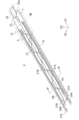
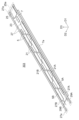
- FIG. 2 is a perspective view showing an outline of a liquid ejection head of the recording apparatus shown in FIG. 1 .
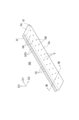
- FIG. 3 is an exploded perspective view of the liquid ejection head of FIG. 2 .
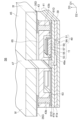
- 4 is a cross-sectional view taken along line IV-IV in FIG. 2 .
- FIG. 3 is a perspective view showing an outline of a chip of the liquid ejection head of FIG. 2 .
- FIG. 6 is an exploded perspective view of the chip of FIG. 5 .
- FIG. 7 is a perspective view of a portion of the chip, showing a cross section taken along line VII-VII in FIG. 5 .
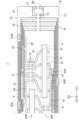
- FIG. 3 is a schematic plan view showing an enlarged view of region VIII in FIG.
- FIG. 11 is a cross-sectional view showing another example of a driver IC.
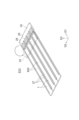
- FIG. 11 is a perspective view showing another example (first example) of a flexible substrate.
- FIG. 11 is a perspective view showing another example (second example) of a flexible substrate.
- FIG. 13 is a perspective view showing another example (third example) of a flexible substrate.
- FIG. 13 is a perspective view showing another example (fourth example) of a flexible substrate.
- drawings may include a Cartesian coordinate system D1D2D3.
- the liquid ejection head and recording device according to the embodiment may be used in any orientation. However, for convenience, terms may be used that assume that the +D3 side is upward.
- FIG. 1 is a perspective view that shows a printer 1 (an example of a recording device) according to an embodiment.
- the printer 1 is configured as a color printer that forms an image on a print paper P. Specifically, when the print paper P is transported in the direction D2, four heads 3 (an example of a liquid ejection head) positioned above the print paper P eject ink (an example of a liquid) toward the print paper P.
- FIG. 2 is a perspective view of the head 3 (all of it or at least a part of it on the side of the printing paper P).
- FIG. 3 is an exploded perspective view of the head 3.
- the head 3 has a number of chips 5 that eject ink droplets (droplets) and contribute directly to printing, and a wiring board 7 (rigid board) that supports the number of chips 5.
- the number of chips 5 When viewed in the D3 direction (when looking at the head 3 from the printing paper P), the number of chips 5 are arranged in two staggered rows along the D1 direction. This allows, for example, a head (so-called line head) that has a length that spans the entire width of the printing paper P while using small chips 5.
- the one on the -D2 side is sometimes called chip 5A
- the one on the +D2 side is sometimes called chip 5B.
- FIG. 5 is a perspective view of the chip 5 (5B) seen from the side of the printing paper P.
- the chip 5 has multiple nozzles 9 that open to the side of the printing paper P. Ink droplets ejected from the multiple nozzles 9 land on the printing paper P to form dots that make up an image on the printing paper P.
- the multiple nozzles 9 may be arranged in any arrangement. In the example of FIG. 5, the multiple nozzles 9 are arranged in a staggered pattern in two rows along the D1 direction when viewed in the D3 direction. This makes it possible to form dots on the printing paper P that are arranged in the D1 direction at a pitch narrower than the pitch (e.g. the distance between the centers) of one row of nozzles 9.
- the one on the -D2 side is sometimes called nozzle 9A
- the one on the +D2 side is sometimes called nozzle 9B.
- FIG. 7 is a perspective view of a portion of the chip 5 (5B) showing a cross section taken along line VII-VII in FIG. 5.
- the chip 5 has an actuator 11 for each nozzle 9.
- the actuator 11 applies pressure to the ink to eject ink droplets from the nozzle 9.
- a flexible substrate was connected to the head body (corresponding to chip 5) having the nozzles and actuators.
- a drive signal (power, from another perspective) was input to the actuator via the flexible substrate.
- the multiple head bodies (5) were supported by a purely structural member (frame).
- the multiple chips 5 are supported by the wiring board 7.
- the wiring board 7 is also electrically connected to the chips 5.
- the wiring board 7 contributes to inputting a drive signal to the actuator 11.
- the wiring board 7 functions as a member that combines the flexible board and frame in the comparative example. This reduces the number of parts. As a result, for example, cost reduction and/or miniaturization can be expected.
- Signal-related circuits 2.7.2. Power-related circuits 3. Other examples 3.1. Other examples of driver IC (FIG. 9) 3.2. Other examples of flexible substrates 3.2.1. First example (Fig. 10) 3.2.2. Second Example ( Figure 11) 3.2.3. Third Example ( Figure 12) 3.2.4. Fourth Example ( Figure 13) 3.3. Others 4. Summary of the embodiment
- the printer 1 illustrated in FIG. 1 is configured as a so-called line printer.
- the printer 1 is not limited to a line printer.
- the printer 1 may be a serial printer.
- a serial printer for example, an operation of moving a head in a direction intersecting the transport direction of the print paper P and transporting the print paper P are performed alternately. Note that, for convenience, in the description of the embodiment, a description may be given on the premise of a line printer, unless otherwise specified.
- the printer 1 has four heads 3. Note that a portion that includes a combination of the four (in other words, multiple) heads 3 and functions as a head may be referred to as a unit 13 (an example of a liquid ejection unit).
- the four heads 3 are arranged, for example, in the transport direction of the printing paper P.
- the four heads 3 correspond to inks of different colors (four color inks).
- the four color inks are, for example, magenta (M), yellow (Y), cyan (C), and black (K). This allows the printer 1 to function as a color printer.
- the printer 1 may print in a single color, or conversely, may print in more than four colors.
- the number of colors is arbitrary.
- two or more heads 3 may correspond to one color. In this case, for example, the resolution can be increased.
- one head 3 may correspond to two or more colors. As can be understood from the above, the number of heads 3 that the printer 1 has is arbitrary.
- the multiple heads 3 of the unit 13 may be fixed to one another by any suitable method.
- the multiple heads 3 are supported by a support member 15 of the unit 13, and are thereby fixed to one another.
- the support member 15 has, for example, four openings (not shown) (i.e., the same number as the number of heads 3) that expose the four heads 3 downward.
- the printer 1 prints, for example, on a sheet of paper as the printing paper P.
- the printing paper P may also be rolled paper.
- the size of the printing paper P (or, from another perspective, the length of the head 3 in the D1 direction) is also arbitrary.
- the printing paper P may be small, like a receipt, or large, like a poster.
- the illustrated sheet of paper as the printing paper P may be the A3 size defined by "ISO 216.”
- the head 3 may be capable of printing over a length of 297 mm in the D1 direction.
- the transport device 17 for transporting the print paper P may have any configuration.
- a configuration is shown in which the print paper P is transported by transporting a belt that adsorbs the print paper P.
- Other configurations include, for example, a configuration in which the print paper P is transported by rotating rollers that pinch the print paper P, and a configuration in which the print paper P is transported by rotating a drum wrapped around the print paper P.
- the printer 1 may have, in addition to the head 3 (or, from another point of view, the unit 13) and transport device 17 already described, a controller 19 that controls the head 3 and transport device 17.
- the controller 19 is, for example, configured to include a computer, and controls the head 3 and transport device 17 (its motor 17a) based on print data that includes image data (which is considered a broad concept that includes text).
- the printer 1 may have any components other than those described above.
- the printer 1 may have a drying device that accelerates drying of the ink, an application device that applies a transparent coating agent evenly to the printing paper P, and a cleaning device that cleans the head 3.
- the printer 1 may use the head 3 to apply a coating agent in addition to or instead of printing with colored ink.
- head (2.1. Overall configuration of head) (2.1.1. Overview of components of head) 2 and 3, as described above, has a plurality of chips 5 and a wiring board 7 on which the plurality of chips 5 are mounted. Unlike the illustrated example, the head (3) may have only one chip 5.
- a head may be used, for example, as a head of a line printer that prints on relatively small printing paper P (e.g., receipts), or as a head of a serial printer that prints on A3- or A4-sized printing paper P.
- the longitudinal direction of the chip 5 (direction D1 in FIG. 2) may be the transport direction of the printing paper P (direction D2 in FIG. 1).
- the head 3 includes the multiple chips 5 and wiring board 7, as well as the following components: At least one (multiple in the illustrated example) drive IC 21 that drives the actuators 11 of the multiple chips 5. A control IC 23 that controls the drive IC 21. A flexible board (signal board 25) that inputs control signals from outside the head 3 (from another perspective, the controller 19) to the control IC 23 via the wiring board 7. At least one (two in the illustrated example) flexible board (power board 27) that applies power (from another perspective, electric potential) from outside the head 3 to the wiring board 7 and electronic components (e.g., drive IC 21) mounted on the wiring board 7.
- At least one (multiple in the illustrated example) drive IC 21 that drives the actuators 11 of the multiple chips 5.
- a control IC 23 that controls the drive IC 21.
- a flexible board (signal board 25) that inputs control signals from outside the head 3 (from another perspective, the controller 19) to the control IC 23 via the wiring board 7.
- the multiple driving ICs 21 are arranged in a staggered pattern in two rows, for example, so as to be positioned between the multiple chips 5 when viewed in the D3 direction. That is, the multiple chips 5 and the multiple ICs 21 are alternately arranged in two rows, forming a first row 29A on the -D2 side and a second row 29B on the +D2 side.
- the multiple driving ICs 21 the one on the -D2 side may be referred to as driving IC 21A, and the one on the +D2 side as driving IC 21B.
- the number of driving ICs 21 is, for example, the same as the multiple chips 5.
- one driving IC 21 controls one chip 5. More specifically, for example, each driving IC 21 controls the chips 5 adjacent to each other in the D2 direction.
- the number of power boards 27 is, for example, two.
- the two power boards 27 are provided, for example, on both sides of the short side direction (D2 direction) of the wiring board 7.
- D2 direction short side direction
- the one on the -D2 side may be referred to as power board 27A
- the one on the +D2 side may be referred to as power board 27B.
- control ICs 23, signal boards 25, and power boards 27 may be different from that shown in the illustrated example.
- control ICs 23 and power boards 27 are located on one side of the wiring board 7 in the longitudinal direction, but two sets of control ICs 23 and power boards 27 may be provided on both sides of the wiring board 7 in the longitudinal direction.
- Figure 4 is a cross-sectional view taken along line IV-IV in Figure 2.
- the multiple chips 5, drive IC 21 and control IC 23 are mounted, for example, on the +D3 side surface of the wiring board 7 (the surface opposite the printing paper P).
- the wiring board 7 has multiple openings 31 ( Figures 3 and 4) that expose the multiple chips 5 to the -D3 side. This allows the chips 5 to eject ink to the -D3 side.
- the signal board 25 and power board 27 are bonded to the +D3 side surface of the wiring board 7.
- the head 3 may have components other than those described above.
- the following components may be provided: A plurality of first flow path members that are individually (one-to-one) stacked on the +D3 side of the plurality of chips 5 to supply liquid.
- a second flow path member that is commonly stacked on the +D3 side of the plurality of first flow path members to supply liquid to the plurality of first flow path members.
- a control board that is connected to the wiring board 7 via the signal board 25 and power board 27.
- a heat sink that cools the control board.
- a housing that is placed over the wiring board 7 from above and contains the various components described above.
- the head when the above-mentioned components not shown are provided, only the combination of the components shown in the figure may be regarded as the head, or only the chip 5 and the wiring board 7 may be regarded as the head. Also, only the combination of the components shown in the figure may be distributed as the head, or only the combination of the chip 5 and the wiring board 7 may be distributed, and the other components may be added later.
- the print data input to the controller 19 is converted into a drive signal (e.g., a pulse) having a waveform corresponding to, for example, the amount of droplets to be ejected (or, from another perspective, the size of the dots to be printed), and input to the actuator 11.
- a drive signal e.g., a pulse
- the division of roles among the various processing units from the controller 19 to the actuator 11 may be set appropriately. An example of the division of roles is described below.
- the controller 19 causes the head 3 to repeatedly eject droplets at a predetermined printing cycle. This operation is combined with the movement of the printing paper P in the direction D2 to form a two-dimensional image.
- the controller 19 (or a circuit located between the controller 19 and the control IC 23) outputs a control signal to the control IC 23, for example, that includes information on the amount of droplets ejected from the multiple nozzles 9 (which may be 0) at each of the above-mentioned printing cycles.
- This control signal may be a serial signal or a parallel signal.
- the control IC 23 converts the serial signal (which may be included in the parallel signal) contained in the input control signal into a parallel signal. This increases the number of control signals transmitted in parallel.
- the number of control signals output in parallel by the control IC 23 is, for example, equal to or greater than the number of drive ICs 21 (or, from another point of view, chips 5) (for example, an integer multiple of the number of drive ICs 21). In other words, one or more control signals are generated for each drive IC 21. In this case, the control IC 23 may be considered to distribute the input control signal to multiple drive ICs 21, regardless of the presence or absence of a conversion circuit 67 described below.
- the wiring board 7 has, for example, a conversion circuit 67 (see FIG. 8, described later) for each driving IC 21.
- the conversion circuit 67 converts the serial signal included in the control signal distributed from the control IC 23 to each driving IC 21 (which may be a serial signal included in the parallel signal distributed to each driving IC 21) into a parallel signal and inputs it to the driving IC 21.
- the conversion circuit 67 increases the number of control signals transmitted in parallel and inputs them to the driving IC 21.
- the number of control signals input in parallel to one driving IC 21 is, for example, the same as the number of actuators 11 controlled by one driving IC 21.
- the driving IC 21 identifies the waveform of the driving signal that corresponds to the input control signal for each actuator 11 by referring to data that associates information on the amount of droplets with information on the waveform of the driving signal. The driving IC 21 then generates a driving signal having the identified waveform, and outputs the driving signal corresponding to each of the multiple actuators 11 approximately simultaneously.
- first row 29A and the second row 29B have different positions in the D2 direction (the transport direction of the print paper P). Furthermore, within each chip 5, the nozzles 9A and 9B have different positions in the D2 direction. Depending on the configuration of the chip 5, nozzles 9 included in the same row may have different positions in the D2 direction. Depending on such differences in the positions of the nozzles 9 in the D2 direction, the timing at which droplets are ejected that correspond to dots on the print paper P that are located at the same position in the D2 direction will differ between the nozzles 9. The division of roles in adjusting for this difference in timing is also arbitrary.
- the chip 5 may have various configurations, and may be a known configuration or a configuration that applies a known configuration, so long as it has the nozzle 9 and the actuator 11.
- the method of ejecting ink may be a piezoelectric type, a thermal type, or another type.
- ink is ejected by applying pressure to the ink through deformation of a piezoelectric body.
- thermal type ink is ejected by applying pressure to the ink by heating the ink to generate bubbles.
- Other methods include, for example, a method that sucks electrically charged ink with electrostatic force, a method that uses ultrasonic energy, and a method that vibrates the wall surface of a pressure chamber that contains ink with electrostatic force.
- the term "actuator” may be interpreted broadly.
- the actuator (11) may have various configurations as long as it can convert an input electrical signal into the movement of ink (liquid).
- the actuator (11) may be one that generates displacement, such as a piezoelectric element of the piezoelectric type, one that generates heat, such as a thermal heater, or one that applies electrostatic force directly to ink.
- the piezoelectric type will be taken as an example.
- the multiple chips 5 are arranged in a staggered pattern in, for example, two rows.
- the total number of chips 5 may be three or more.
- the total number of chips 5 may be an even number (as in the illustrated example) or an odd number.
- the ends of the chips 5 in the D1 direction overlap each other when viewed in the D2 direction. This makes it possible to print without gaps in the D1 direction.
- the pitch e.g., center-to-center distance
- the chips 5 may be arranged in three or more rows.
- the size of the chip 5 is arbitrary.
- the size of the chip 5 may be set from various viewpoints, such as ease of manufacture, processing precision, and ensuring strength.
- the length of the chip 5 (D1 direction) may be 40 mm or more and 60 mm or less.
- the width of the chip 5 (D2 direction) may be 3 mm or more and 5 mm or less.
- the thickness of the chip 5 (D3 direction) may be 0.5 mm or more and 2 mm or less.
- the number of chips 5 is arbitrary.
- the number of chips 5 may be set, for example, according to the length of the chip 5 in the D1 direction (the direction perpendicular to the direction of relative movement with the printing paper P) and the length of the head 3 in the D1 direction (or, from another perspective, the length of the printing paper P in the D1 direction).
- the size of the chip 5 exemplified in the previous paragraph and A3 size printing paper P (length in the D1 direction is 297 mm) four chips 5 are provided in each row, for a total of eight chips 5.
- the dot density (image resolution) achieved by the chip 5 is arbitrary. From another perspective, the arrangement pattern and number of the multiple nozzles 9 are arbitrary. Examples of dot density etc. are as follows. One chip 5 may have multiple nozzles 9 in an arrangement pattern and number such that the dot density in the D1 direction is 600 dpi or more and 2000 dpi or less. Also, in one chip 5, the number of nozzles 9 may be 100 or more and 10,000 or less.
- FIG. 5 is a schematic diagram
- the nozzles 9 are shown large relative to the size of the chip 5, and the number of nozzles 9 in one chip 5 is shown to be small. In reality, the nozzles 9 may be smaller and the number of nozzles 9 may be greater than in FIG. 5.
- the existence of so-called dummy nozzles that do not eject ink is ignored.
- the arrangement pattern of the multiple nozzles 9 is arbitrary, and the arrangement of the nozzles 9 shown in FIG. 5 is merely one example.
- the multiple nozzles 9 may be arranged in one row, or in three or more rows, or may be inclined with respect to the D1 direction. In each row, the multiple nozzles are arranged at a constant pitch, but some randomness may be intentionally imparted.
- the multiple nozzles 9 arranged in two or more rows are arranged, for example, at different positions in the D1 direction, which contributes to improving the resolution.
- the chip 5 may have only one nozzle 9.
- the outer shape of the tip 5 is arbitrary.
- the tip 5 is generally a thin rectangular parallelepiped with the D1 direction as the longitudinal direction and the D3 direction as the thickness direction. More specifically, as shown in Figures 4 and 5, the tip 5 has a rectangular parallelepiped main body 5e and two flanges 5f protruding from the +D3 side (opposite the nozzles 9) of the main body 5e on both sides in the D2 direction.
- the lower surface of the main body 5e constitutes a nozzle surface 5a where the multiple nozzles 9 open.
- the main body portion 5e is inserted into the opening 31 from the +D3 side. This brings the nozzle surface 5a closer to the printing paper P than the upper surface of the wiring board 7.
- the nozzle surface 5a may be located above the lower surface of the wiring board 7 (example of Figure 4), may be flush with it, or may be located below it.
- the main body portion 5e may contribute to the positioning of the chip 5 and the wiring board 7, for example, by abutting against the inner surface of the opening 31, or it may not contribute to such positioning.
- the flange 5f engages with the wiring board 7 from the +D3 side around the opening 31. That is, the flange 5f contributes to positioning the chip 5 in the D3 direction relative to the wiring board 7 while inserting the main body 5e into the opening 31. In addition, as described in detail later, the flange 5f contributes to fixing and/or electrically connecting the chip 5 to the wiring board 7 by bonding its lower surface to the upper surface of the wiring board 7.
- the shape of the chip 5 may be, for example, a rectangular parallelepiped. That is, the nozzle surface 5a may be located above the upper surface of the wiring board 7. Also, in addition to or instead of the D2 direction, a flange may be provided in the D1 direction. In addition to or instead of the flange 5f, the outer peripheral surface of the main body portion 5e and the inner peripheral surface of the opening 31 may be joined to each other to provide a fixed and/or electrical connection.
- the chip 5 and the wiring board 7 may be electrically connected in any manner.
- the terminals of the chip 5 may be provided in any manner.
- the chip 5 has a plurality of terminals 35 (FIG. 5) made of a layered conductor on the lower surface of the flange 5f.
- the wiring board 7 has pads 37 (FIG. 4) around the opening 31 to be joined to the terminals 35. The terminals 35 and the pads 37 are joined to each other while facing each other, thereby electrically connecting the two.
- a terminal located on the upper surface of the chip 5 and a pad located on the upper surface of the wiring board 7 may be connected by a bonding wire.
- a pin-shaped terminal protruding from the chip 5 and a pad located on the upper surface of the wiring board 7 may be joined.
- a pin protruding from the chip 5 may be inserted into the wiring board 7 to perform through-hole mounting.
- the terminal 35 and the pad 37 may be joined by any method.
- an ACF (Anisotropic Conductive Film) connection may be used. More specifically, for example, ACF may be sandwiched between roughly the entire lower surface of the flange 5f and the upper surface of the wiring board 7, and thermocompression bonding may be performed. The portion of the ACF sandwiched between the terminal 35 and the pad 37 may contribute to fixation and electrical connection. The other portion of the ACF may contribute to fixation (and insulation).
- terminals 35 and pads 37 may be joined by solder or a conductive adhesive. Also, as can be seen from the description that bonding wires may be used, the chip 5 and wiring board 7 may be fixed by an insulating adhesive.
- the multiple terminals 35 include, for example, multiple terminals 35D to which drive signals for driving the multiple actuators 11 are input, and at least one terminal 35G (FIG. 4) to which a reference potential is applied. The potential difference between the reference potential and the drive signal is used to drive the actuators 11.
- the number of the multiple terminals 35D is basically (except for special cases) the same as the number of the multiple actuators 11 (from another point of view, the multiple nozzles 9).
- the multiple terminals 35D are individually connected (one-to-one) to the multiple actuators 11. This allows the ejection of liquid for each nozzle 9 to be controlled.
- the number of terminals 35G is arbitrary, and may be one or more. In the latter case, the number of terminals 35G may be the same as the number of the multiple terminals 35D, or may be different (for example, it may be less).
- the specific shape, dimensions, and arrangement of the terminals 35D and 35G are arbitrary. In the example of FIG. 5, all of the terminals 35D are located on the flange 5f adjacent to the driving IC 21 in the D2 direction (-D2 side for chip 5B, +D2 side for chip 5A). All of the terminals 35G are located on the flange 5f on the opposite side.
- the multiple terminals 35D are, for example, of the same shape and dimensions, and are arranged at a constant pitch in the D1 direction (the longitudinal direction of the chip 5).
- the multiple terminals 35G are, for example, of the same shape and dimensions, and are arranged at a constant pitch.
- the shape, dimensions, and/or pitch of the multiple terminals 35G may be the same as or different from that of the terminal 35D.
- One terminal 35G that is long in the D1 direction may be provided.
- the ink flow path (including the nozzle 9) and the actuator 11 may have any configuration. An example will be shown below.
- Figure 6 is an exploded perspective view of tip 5 (5B).
- a common flow path 47 opens on the top surface of the chip 5. Ink is supplied to the common flow path 47 from a flow path member (not shown) that is overlaid on the top surface of the chip 5. As shown in Figure 7, a plurality of individual flow paths 49 communicate with the common flow path 47. Each individual flow path 49 has, in order from the common flow path 47 side, a supply path 49a, a pressure chamber 51, and a nozzle 9. Ink in the common flow path 47 is replenished to the pressure chamber 51 via the supply path 49a. Liquid is ejected from the nozzle 9 when pressure is applied to the pressure chamber 51 by the actuator 11.
- the common flow path 47 and the multiple individual flow paths 49 are arbitrary.
- the common flow path 47 extends linearly in the longitudinal direction of the chip 5 at a position toward the center of the chip 5 in the width direction.
- the multiple individual flow paths 49 generally extend from the common flow path 47 to one or the other side of the chip 5 in the width direction, and a nozzle 9 is located at the tip of each of the individual flow paths. The nozzle 9 opens directly into the pressurized chamber 51.
- two common flow paths 47 may be provided at both sides of the chip 5 in the width direction.
- a plurality of individual flow paths 49 may extend from the common flow path on one or the other side of the chip 5 in the width direction toward the center of the chip 5 in the width direction.
- a flow path may also be interposed between the nozzle 9 and the pressure chamber 51.
- the chip 5 may have a flow path for recovering ink.
- the actuator 11 shown in FIG. 7 is a so-called unimorph type piezoelectric actuator.
- the actuator 11 has, for example, a vibration plate 53, a lower electrode 55, a piezoelectric body 57, and an upper electrode 59, in that order from the pressure chamber 51 side. These, for example, mostly cover the pressure chamber 51.
- the piezoelectric body 57 is polarized in the thickness direction.
- the piezoelectric body 57 When a voltage is applied to the piezoelectric body 57 in the thickness direction by the lower electrode 55 and upper electrode 59, the piezoelectric body 57 expands or contracts in the planar direction. This deformation is regulated by the vibration plate 53, so that the actuator 11 bends toward the pressure chamber 51 or the opposite side like a bimetal. This bending deformation is used to apply pressure to the pressure chamber 51, causing ink to be ejected from the nozzle 9.
- the outer shape of the chip 5, the terminals 35, the flow paths (47 and 49), the actuator 11, and the like described above may be realized by any of various structural forms.
- the chip 5 may be configured by a MEMS (Micro Electro Mechanical Systems) chip.
- the MEMS chip includes, for example, one or more chip substrates on which mechanical elements and/or electrical elements are formed by micromachining technology on a base substrate. Two or more chip substrates are, for example, stacked.
- the base substrate may be, for example, a silicon substrate. However, the material of the base substrate may be a material other than silicon (for example, glass or an organic material).
- the mechanical and electrical elements of the chip substrate are, for example, the flow paths (47 and 49), the actuator 11, and the terminals 35 with respect to the chip 5.
- each chip substrate may have only one of the mechanical elements and the electrical elements. From another perspective, the mechanical elements and the electrical elements may be provided on separate substrates.
- the MEMS chip is a stack of multiple substrates, all of the multiple substrates may be MEMS-related chip substrates, or only some of the substrates may be MEMS-related chip substrates.
- Microfabrication techniques related to MEMS are usually performed on a mother substrate (wafer) from which a large number of base substrates are cut.
- Examples of microfabrication techniques include: thin film formation by PVD (Physical Vapor Deposition, e.g. sputtering), CVD (Chemical Vapor Deposition) or ALD (Atomic Layer Deposition); patterning of the above-mentioned thin films using photolithography; etching of the base substrate using photolithography.
- the precision of the microfabrication may be, for example, 20 ⁇ m or less, 10 ⁇ m or less, or 2 ⁇ m or less in a plan view.
- the chip 5 does not have to be a MEMS chip.
- the chip 5 may be a combination of a flow path member including the nozzle 9 and an actuator substrate including the actuator 11.
- the flow path member may be a combination of multiple stacked plates (metal plates and/or resin plates) bonded together with an adhesive. Each plate may have recesses and/or through holes that become the flow paths formed by wet etching.
- the actuator substrate may be fabricated by stacking and firing ceramic green sheets on which a conductive paste has been applied in a predetermined pattern.
- the chip 5 is formed, for example, by stacking multiple (four in the illustrated example) chip substrates (as mentioned above) in the D3 direction and bonding them together. More specifically, from the -D3 side (the side of the printing paper P), a nozzle substrate 39, an actuator substrate 41, a support substrate 43, and a relay substrate 45 are stacked in this order.
- the nozzle substrate 39 has, for example, a plurality of nozzles 9.
- the actuator substrate 41 has, for example, a plurality of actuators 11, and has a flow path that supplies ink to the plurality of nozzles 9.
- the support substrate 43 for example, contributes to the reinforcement of the nozzle substrate 39 and the actuator substrate 41, and has a flow path and a circuit (which may simply be wiring) that leads to the flow path and circuit of the actuator substrate 41.
- the relay substrate 45 has, for example, a flow path and a circuit that leads to the flow path and circuit of the support substrate 43, and also has a flange 5f.
- each chip substrate may be bonded together by an appropriate bonding method.
- the chip substrates may be bonded directly without adhesive, or may be bonded together via adhesive. Note that in FIG. 7, the adhesive may be omitted regardless of whether direct bonding is used.
- the thickness of each chip substrate may be set appropriately depending on the functions required of each chip substrate.
- the nozzle substrate 39 and the actuator substrate 41 each have a thickness of 20 ⁇ m or more and 100 ⁇ m or less.
- the support substrate 43 and the relay substrate 45 each have a thickness of 200 ⁇ m or more and 1000 ⁇ m or less.
- Each chip substrate (39, 41, 43, and 45) is configured, for example, as follows:
- the nozzle substrate 39 is constructed by forming a plurality of nozzles 9 on a base substrate using microfabrication technology.
- the base substrate is, for example, a silicon substrate.
- the shape and dimensions of the nozzles 9 are arbitrary.
- the actuator substrate 41 (Fig. 7) is constructed by forming a laminated film 41b on a base substrate 41a using microfabrication technology.
- the laminated film 41b includes the actuator 11.
- the base substrate 41a is, for example, a silicon substrate.
- the pressure chamber 51 and a part of the supply path 49a are formed in the base substrate 41a by microfabrication technology.
- the specific shapes and dimensions of the pressure chamber 51 and the supply path 49a are arbitrary.
- the laminated film 41b has, for example, at least four layers including the above-mentioned vibration plate 53, lower electrode 55, piezoelectric body 57, and upper electrode 59.
- the laminated film 41b may include layers other than those mentioned above.
- the laminated film 41b may have an insulating layer that covers the metal layer to prevent ink from contacting the metal layer, or an insulating layer that covers the metal layer including the lower electrode 55 to insulate the former from the metal layer including the upper electrode 59.
- the vibration plate 53 may extend over the entire base substrate 41a (as shown in the example), or may not extend over the entire base substrate 41a. Unlike the example shown in the figure, the vibration plate 53 may be provided for each pressure chamber 51. The vibration plate 53 closes the upper surface of the pressure chamber 51. In the example of FIG. 7, the vibration plate 53 also contributes to closing the portion of the supply path 49a formed in the base substrate 41a.
- the vibration plate 53 (or from another perspective, the laminated film 41b) has a through hole (see also FIG. 6) that constitutes the portion of the supply path 49a that leads to the common flow path 47.
- the material of the vibration plate 53 is arbitrary, and may be, for example, an insulating material or the same material as the piezoelectric body 57.
- the lower electrode 55 is applied with, for example, a reference potential. From another perspective, the lower electrodes 55 of the multiple actuators 11 are applied with a common potential. Therefore, the lower electrodes 55 of the multiple actuators 11 may be connected to each other. In the example of FIG. 7, a lower electrode 55 is provided for each pressure chamber 51. Unlike the illustrated example, the lower electrode 55 may extend across multiple pressure chambers 51.
- the metal layer (reference potential layer) including the lower electrode 55 has, for example, a wiring (reference symbol omitted) extending from the lower electrode 55 to the side of the already-mentioned terminal 35G (the +D2 side in chip 5B), and a terminal 61G (see also FIG. 6) located at its end.
- the terminal 61G is connected to the terminal 35G via the support substrate 34.
- the terminal 61G is common to multiple actuators 11.
- multiple terminals 61G may be formed individually on multiple actuators 11.
- the metal layer including the lower electrode 55 and the terminal 61G may extend over substantially the entire surface of the base substrate 41a.
- the metal layer including the lower electrode 55 and the metal layer including the upper electrode 59 may be insulated via an insulating layer (or a layer including the piezoelectric body 57) not illustrated.
- the piezoelectric body 57 may or may not extend over the entire base substrate 41a (as shown in the example). In the example of FIG. 7, a piezoelectric body 57 is provided for each pressure chamber 51. In a plan view, the shape and size of the piezoelectric body 57 are generally the same as the shape and size of the pressure chamber 51.
- the more specific material of the piezoelectric body 57 is arbitrary, and is, for example, lead zirconate titanate (PZT).
- the upper electrodes 59 (individual electrodes), for example, receive a drive signal. From another perspective, the upper electrodes 59 of the multiple actuators 11 are supplied with different potentials. The upper electrodes 59 of the multiple actuators 11 are provided for each pressure chamber 51 and are not connected to each other. The upper electrodes 59 have, for example, roughly the same shape and size as the pressure chambers 51 in a plan view.
- the metal layer including the upper electrode 59 has, for example, a wiring (reference numeral omitted) extending from the upper electrode 59 to the side of the already-mentioned terminal 35D (the -D2 side in the chip 5B), and a terminal 61D (see also FIG. 6) located at the end of the wiring.
- the terminal 61D is connected to the terminal 35D via the support substrate 34.
- the support substrate 43 is constructed by forming an appropriate shape and conductors on a base substrate (reference numeral omitted) using microfabrication technology.
- the base substrate is, for example, a silicon substrate.
- the shapes formed on the base substrate are, for example, a through hole (slit) that constitutes a part of the lower side of the common flow path 47, and a recess (groove) that accommodates the actuator 11 formed on the underside of the base substrate.
- the conductor formed on the base substrate is, for example, a through conductor 43b that connects the terminals 61D and 61G of the actuator substrate 41 to the terminals 35D and 35G on the underside of the flange 5f.
- the relay substrate 45 is formed wider in the D2 direction than the support substrate 43. As a result, the previously described flange 5f is formed by the edge of the relay substrate 45.
- the relay substrate 45 is formed by forming an appropriate shape and conductors on a base substrate (reference number omitted) using microfabrication technology.
- the base substrate is, for example, a silicon substrate.
- the shape formed on the base substrate is, for example, a through hole (slit) that forms part of the upper side of the common flow path 47.
- the conductors formed on the base substrate are, for example, the previously described terminals 35D and 35G.
- the actuator substrate 41 and the support substrate 43 are joined via, for example, ACF 63. This allows the multiple terminals 61D and 61G of the actuator substrate 41 to be individually and electrically connected to the multiple through conductors 43b of the support substrate 43.
- the support substrate 43 and the relay substrate 45 are joined via, for example, ACF 65. This allows the multiple through conductors 43b of the actuator substrate 41 to be individually and electrically connected to the multiple terminals 35D and 35G of the relay substrate 45.
- the wiring board 7 shown in Figures 2 to 4 may be of any type as long as it is a rigid board.
- the wiring board 7 may be a single-sided board having a conductor layer only on one side of an insulating board, a double-sided board having conductor layers on both sides of an insulating board, or a multi-layer board having three or more conductor layers.
- the wiring board 7 having two or more conductor layers may be a build-up type in which an insulating layer and a conductor layer are sequentially formed on the upper surface of a core insulating board, or may be a type in which a combination of an insulating layer and a conductor layer are bonded together.
- the material of the insulating board may also be any material, and may be, for example, resin, ceramic, or glass.
- the wiring board 7 may be a low temperature polycrystalline silicon (LTPS) substrate.
- An LTPS substrate is produced, for example, by polycrystallizing amorphous silicon formed on a glass substrate at a low temperature of 600°C or less by laser annealing or the like. That is, although not specifically shown, the LTPS substrate has a glass substrate and an LTPS layer overlying the glass substrate.
- a circuit including elements such as a thin film transistor (TFT) may be formed by doping the LTPS layer, forming a thin film (e.g., a metal film and/or an insulating film), and patterning the thin film.
- a circuit including an LTPS layer is sometimes referred to as an LTPS circuit.
- the pattern of the conductor layer of the wiring board 7 (the circuit configuration from another perspective) is arbitrary as long as the chip 5 can be mounted and the chip 5 can be electrically connected to other electrical elements (here, the driving IC 21).
- the wiring board 7 is configured so that the driving IC 21 and the control IC 23 can be mounted.
- the wiring board 7 may be configured to simply mediate between the chip 5 and the flexible board, and the driving IC 21 and the like may be mounted on the flexible board. Even in this case, the degree of freedom in the connection position and shape of the flexible board is improved compared to, for example, a mode in which a flexible board is connected to multiple chips 5.
- the wiring board 7 may simply have wiring, or may have electronic elements.
- the electronic elements may be, for example, passive elements or active elements.
- the electronic elements may also be, for example, switches, registers, latch circuits, ICs, or power circuits.
- the wiring board 7 has electronic elements, the electronic elements may be either built-in or embedded.
- the former electronic elements are, for example, manufactured integrally with the substrate portion of the wiring board 7 when the wiring board 7 is manufactured. In the latter case, for example, a previously manufactured electronic element (e.g., an IC chip) is embedded in the substrate portion of the wiring board 7 when the wiring board 7 is manufactured.
- the wiring board 7 has a conversion circuit 67 that increases the number of control signals transmitted in parallel (performs serial-parallel conversion).
- the conversion circuit 67 may be, for example, a built-in type. More specifically, for example, the conversion circuit 67 may be configured by an LTPS circuit that is included in the LTPS substrate serving as the wiring board 7.
- the shape and size of the wiring board 7 are arbitrary.
- the shape of the wiring board 7 is generally rectangular with the D2 direction as the longitudinal direction. That is, the wiring board 7 has a pair of long edges 7a and a pair of short edges 7b, as indicated by the reference symbols in FIG. 3.
- the length of the wiring board 7 in the D1 direction corresponds to the width of an A3 size, and is 300 mm or more and 400 mm or less.
- the width (D2 direction) is 10 mm or more and 20 mm or less.
- the thickness is 0.5 mm or more and 1 mm or less.
- the shape and dimensions of the opening 31 are generally the same as the shape and dimensions of the main body 5e of the chip 5 in a plan view.
- the wiring board 7 relays signals from the signal board 25 to the chip 5. More specifically, the signal relay includes the following: Relay of a control signal from the signal board 25 to the control IC 23. Relay of a control signal from the control IC 23 to the conversion circuit 67. Relay of a control signal from the conversion circuit 67 to the driver IC 21. Relay of a drive signal from the driver IC 21 to the chip 5.
- the layout of the wiring for these relays is arbitrary. An example will be described later ( Figure 8).
- the wiring board 7 also distributes the power supplied from the power board 27 (from another perspective, a reference potential and a potential having a predetermined potential difference from the reference potential) to, for example, the circuits (e.g., the conversion circuit 67), the driver IC 21, and the control IC 23 that the wiring board 7 has.
- the wiring board 7 also applies, for example, the reference potential provided from the power board 27 to the terminal 35G of the chip 5 (from another perspective, the lower electrode 55).
- the arrangement of the wiring related to these power supplies is arbitrary. An example will be described later (FIG. 8).
- the potential having a predetermined potential difference from the reference potential for power supply may be referred to as the "power supply potential".
- the driving IC 21 shown in FIG. 2 to FIG. 4 is, for example, a chip-type component.
- the driving IC 21 may have a package surrounding a semiconductor substrate, or may be a bare chip without a package.
- the mounting mode of the driving IC 21 is arbitrary.
- the driving IC 21 has a terminal 21a (an example of an input section) made of a layered conductor on the lower surface, and is surface-mounted on the wiring board 7.
- Other modes include, for example, various modes (mounting using bonding wires, surface mounting or through-hole mounting of pin-shaped terminals) mentioned in the description of the chip 5.
- the bonding material in the case of surface mounting is also arbitrary. In the illustrated example, bonding is performed using ACF (not shown) like the chip 5. Of course, solder or conductive adhesive may be used.
- the driving IC 21 may be mounted using COG (Chip On Glass).
- the shape and dimensions of the driving IC 21 are also arbitrary.
- the shape of the driving IC 21 is roughly a thin rectangular parallelepiped with the D1 direction as the longitudinal direction and the D3 direction as the thickness direction.
- the driving IC 21 is arranged between a plurality of chips 5 arranged in a staggered pattern. Therefore, the length of the driving IC 21 in the D1 direction is shorter than the length of the chip 5 in the D1 direction, and is also shorter than the distance between adjacent chips 5 in the D1 direction.
- the width (D2 direction) of the driving IC 21 may be smaller (in the illustrated example), equal to, or larger than the width (D2 direction) of the chip 5.
- the thickness of the driving IC 21 may be thinner, equal to, or thicker than the overall thickness of the chip 5 or the thickness of the flange 5f of the chip 5.
- the driving ICs 21 are provided in the same number as the number of chips 5, for example, and are arranged between the chips 5 arranged in a staggered pattern. Unlike the example shown in the figure, the number of driving ICs 21 may be less than or greater than the number of chips 5. Furthermore, the number of driving ICs 21 may be one. Furthermore, the driving ICs 21 do not have to be located between the chips 5. For example, the driving ICs 21 may be located only at one end or both ends in the longitudinal direction of the wiring substrate 7.
- the pitch of the driving ICs 21 in the D1 direction is, for example, generally constant and is generally the same as the pitch of the chips 5 in the D1 direction.
- the positions of the centers of the driving ICs 21 and chips 5 adjacent to each other in the D2 direction generally coincide with each other in the D1 direction.
- the driving IC 21 may fit within the width (D2 direction) of the chip 5 (as in the illustrated example), or may not fit on the +D2 side and/or -D2 side. In either case, the driving IC 21 may be biased toward the adjacent long edge 7a (for example, the -D2 side in the first row 29A) or the opposite side relative to the width of the chip 5 (as in the illustrated example), or may not be biased.
- the range of placement of the driving ICs 21 in the D2 direction is roughly the range of placement of the chip 5 in the D2 direction narrowed toward the adjacent long edge 7a. This ensures that, for example, the width of each row (29A and 29B) fits within the width of the chip 5, while also providing an area for forming wiring 81 (see FIG. 8) that connects the driving ICs 21 and chips 5 adjacent to each other in the D2 direction.
- the driving IC 21 outputs a driving signal to the upper electrode 59 (individual electrode) of the actuator 11 via the wiring board 7.
- the driving signal is, for example, a signal having a waveform that causes bending deformation in the actuator 11 (and/or releases the bending deformation), and is generally in the form of a pulse. An example of the process by which print data is converted into a driving signal has already been described.
- the driving IC 21 is provided with a reference potential and a power supply potential of a predetermined magnitude via, for example, the power board 27 and the wiring board 7. In other words, a DC voltage of a predetermined magnitude is supplied.
- the driving IC 21 generates a driving signal of a desired waveform from the DC voltage, for example.
- control IC (2.5. Control IC)
- the description of the driver IC 21 may be appropriately applied to the control IC 23, except for its position and role.
- the control IC 23 is a chip-type component, and may or may not be a bare chip.
- the mounting manner is arbitrary, and may or may not be COG mounting.
- the shape, dimensions, and position of the control IC 23 are arbitrary.
- control IC 23 is smaller in size than the chip 5 and the driver IC 21. Of course, this does not have to be the case. Also, in the examples shown, only one control IC 23 is provided. However, two or more control ICs 23 may be provided.
- control IC 23 is located on the longitudinal end side (+D1 side) of the wiring board 7 relative to the chip 5 and the driving IC 21.
- the position of the control IC 23 in the width direction (D2 direction) of the wiring board 7 is the center of the width direction of the wiring board 7.
- the arrangement position of the control IC 23 is not limited to the above.
- the control IC 23 may be adjacent to the +D1 side of the driving IC 21 that is most on the +D1 side among the staggered arrangement, and adjacent to the chip 5 most on the +D1 side in the D2 direction.
- the flexible boards (2.6. Flexible Substrate) (2.6.1. Flexible boards in general)
- the flexible boards (signal board 25 and power board 27 shown in FIGS. 2 and 3) connected to the wiring board 7 may not be provided.
- a connector into which another rigid board is inserted may be mounted on the wiring board 7.
- the flexible boards do not have to be provided in combination with the signal board 25 and the two power boards 27.
- one flexible board having the functions of the signal board 25 and the power board 27 may be provided.
- the type of flexible substrate (25 and 27) is arbitrary.
- the flexible substrate may have a conductor layer on only one side of the film (as shown in the example), may have conductor layers on both sides of the film, or may have three or more conductor layers.
- the flexible substrates (25 and 27) have, for example, only the function of wiring that supplies signals and/or power, and have no electronic components mounted thereon. Contrary to the description here, the flexible substrate may have, for example, a circuit that functions as an active element, or may have electronic components (e.g., ICs) mounted thereon.
- the thickness of the flexible substrates (25 and 27) is arbitrary, for example, 0.2 mm or less.
- the thickness of the conductor layer (from another perspective, the wiring) of the flexible substrate is also arbitrary.
- the thickness of the conductor layer of the flexible substrates (25 and 27) is thicker than the thickness of the conductor layer of the wiring substrate 7 (for example, an LTPS substrate).
- the wiring resistance of the power substrate 27 is smaller than that of the wiring substrate 7, and the likelihood of a drop in the power supply potential is reduced.
- the flexible substrates (25 and 27) may be joined to the wiring substrate 7 by any method.
- ACF connection may be used.
- solder or a conductive adhesive may also be used.
- the signal board 25 inputs a control signal (already described) from the controller 19 (or a circuit located between the controller 19 and the signal board 25) to the control IC 23 via the wiring board 7.
- the signal input to the signal board 25 may be output directly from the signal board 25, or may be output after undergoing a predetermined process (e.g., amplification and/or serial-parallel conversion).
- connection position of the signal board 25 to the wiring board 7 is arbitrary.
- the signal board 25 is joined to the wiring board 7 at a position in the longitudinal direction of the wiring board 7 closer to the short edge 7b on the +D1 side than the control IC 23 (the opposite side to the multiple chips 5 and multiple driver ICs 21). More specifically, the joining area is roughly the end of the +D1 side of the wiring board 7.
- the position of the connection position in the D2 direction is the center position of the width of the wiring board 7.
- the connection position of the signal board 25 may be, for example, on the -D2 side and/or +D2 side of the control IC 23.
- the direction in which the signal board 25 extends (spreads) from the connection position with the wiring board 7 is arbitrary. In the illustrated example, the signal board 25 extends from the connection position toward the +D1 side. From another perspective, the portion (end) of the signal board 25 located on the +D1 side of the joining position of the wiring board 7 is the connection portion 25a (symbol in FIG. 2) that is connected to other components on the controller 19 side. Unlike the illustrated example, the signal board 25 may, for example, spread toward the -D2 side and/or the +D2 side from the connection position.
- the shape and dimensions of the signal board 25 are arbitrary.
- the planar shape of the signal board 25 is roughly rectangular, and more specifically, a rectangular shape with the D1 direction as the longitudinal direction.
- the signal board 25 fits within the width of the wiring board 7 and extends from the short edge 7b on the +D1 side of the wiring board 7 to the +D1 side.
- the signal board 25 does not have to have such a width and length.
- the power board 27 supplies power (e.g., DC power of a predetermined voltage) supplied from a power supply circuit (not shown) included in the main body or head 3 of the printer 1 to the wiring board 7.
- the power input to the power board 27 may be output directly from the power board 27, or may be output after undergoing predetermined processing (e.g., transformation and/or division into powers of different voltages).
- connection position of the power board 27 to the wiring board 7, the direction in which the power board 27 extends from the connection position, and the shape and dimensions of the power board 27 are arbitrary. In the examples of Figures 2 and 3, they are as follows.
- connection positions of the power board 27A on the -D2 side are located in the region between the first row 29A on the -D2 side and the long edge 7a on the -D2 side.
- connection positions of the power board 27B on the +D2 side are located in the region between the second row 29B on the +D2 side and the long edge 7a on the +D2 side.
- multiple connection positions are regularly distributed over a relatively long range in the D1 direction (for example, a length equal to or greater than 2/3 of the length of each row).
- Each power board 27 extends from the multiple connection positions to one side in the longitudinal direction of the wiring board 7 (the -D1 side in the illustrated example). The one side is opposite to the side from which the signal board 25 extends. From another perspective, the portion (end) of each power board 27 located on the -D1 side of the multiple connection positions of the wiring board 7 is a connection portion 27a (number shown in Figure 2) that is connected to other components on the controller 19 side.
- connection portion 27a number shown in Figure 2
- the power board 27 When the power board 27 is not bent and is made flat parallel to the wiring board 7, it has a length that extends beyond the short edge 7b on the -D1 side of the wiring board 7. However, the signal board 27 does not have to have such a length.
- the power board 27A is not bent but is formed into a flat surface parallel to the wiring board 7.
- the power board 27A has a shape that extends linearly in the D1 direction with a constant width (in other words, an elongated shape along the long edge 7a on the -D2 side).
- the power board 27A is contained in the area between the first row 29A (from another perspective, the multiple chips 5A and/or multiple driving ICs 21A) and the long edge 7a on the -D2 side in a plan view (it does not protrude from the long edge 7a on the -D2 side).
- the edge on the -D2 side of the power board 27A may overlap the long edge 7a on the -D2 side, or may protrude beyond the long edge 7a on the -D2 side within the tolerance range.
- the power board 27A may not protrude beyond the long edge 7a on the -D2 side, but may overlap the driving ICs 21 and/or chips 5.
- power board 27B as described above for power board 27A, except that the first column 29A and the word -D2 are replaced with the second column 29B and the word +D2.
- the wiring board 7 relays signals and power.
- the pads and wiring for this purpose can be arranged in various ways. An example is shown below.
- FIG. 8 is a schematic plan view showing the wiring board 7 in region VIII of FIG. 2.
- the chip 5, the driver IC 21, and the control IC 23 are also shown with dotted lines.
- the number of wires on the wiring board 7 may be shown to be significantly less than the actual number. Only a portion of the wiring board 7 is shown in FIG. 8. However, with the exception of some parts (for example, the part related to the control IC 23), roughly the same configuration as that shown in the figure is repeated on the -D1 side.
- the pad 69 to which the signal board 25 is connected is located approximately at the end of the longitudinal direction of the wiring board 7. If the distance between the pad 69 and the short edge 7b is shorter than the length of the pad 69 in the D1 direction, the pad 69 may be considered to be located at the end of the wiring board 7.
- the number of pads 69 (two in FIG. 8 ) may correspond to the number of control signals input in parallel from the signal board 25 to the wiring board 7. In other words, the number of pads 69 may be any number equal to or greater than one.
- the wiring 71 extending from the pad 69 is part of a number of pads 73 to which terminals (not shown) of the control IC 23 are joined, and is connected to the same number of pads 73 as the pads 69.
- the pad 73 to which the wiring 71 is connected is located on the pad 69 side relative to the other pads 73.
- the control IC 23 and the pads 69 are roughly aligned in the D1 direction, and thus the wiring extends roughly in the D1 direction.
- the multiple pads 73 are arranged in two rows in the D2 direction. Unlike the example shown, some of the multiple pads 73 may be located on the +D1 side and/or the -D1 side of the control IC 23. Multiple wirings 75 extend from some of the multiple pads 73 that are not connected to pad 69.
- the multiple wirings 75 transmit the control signals distributed by the control IC 23 to the driving ICs 21.
- the number of wirings 75 is the same as the number of control signals output in parallel from the control IC 23, and is equal to or greater than the number of driving ICs 21. In FIG. 8, the same number of wirings 75 (8) as the number of driving ICs 21 is illustrated as an example.
- the multiple wirings 75 are divided into those that extend to the -D2 side and those that extend to the +D2 side. Specifically, the wirings 75 extending from the multiple pads 73 located on the -D2 side extend to the -D2 side. The wirings 75 extending from the multiple pads 73 located on the +D2 side extend to the +D2 side.
- the wiring 75 generally extends toward the long edge 7a, and then extends along the long edge 7a toward the -D1 side (the side where the driver IC 21 and the like are located).
- the wiring 75 also extends between the first column 29A (and thus the conversion circuit 67 on the -D2 side) and the long edge 7a on the -D2 side, or between the second column 29B (and thus the conversion circuit 67 on the +D2 side) and the long edge 7a on the +D2 side.
- the multiple wirings 75 extending on the +D2 side correspond to the second column 29B and are connected to the conversion circuit 67 corresponding to the second column 29B.
- the multiple wirings 75 on the +D2 side are connected to the conversion circuit 67 in sequence starting from the -D2 side, and extend toward the -D1 side in decreasing numbers.
- the multiple wirings 75 extending on the -D2 side correspond to the first column 29A and are connected to the conversion circuit 67 corresponding to the first column 29A.
- the multiple wirings 75 on the -D2 side are connected to the conversion circuit 67 in sequence starting from the +D2 side, and extend toward the -D1 side in decreasing numbers.
- the conversion circuit 67 is located, for example, between the first column 29A and the long edge 7a on the -D2 side, or between the second column 29B and the long edge 7a on the +D2 side.
- the position of the conversion circuit 67 in the D1 direction is the same as the position of the driving IC 21 located on the same side in the D2 direction (for example, the +D2 side for the conversion circuit 67 on the +D2 side).
- the D1 direction arrangement ranges of the conversion circuit 67 and the driving IC 21 on the same side in the D2 direction overlap with each other at least in part.
- the length of the conversion circuit 67 in the D1 direction may be longer than the length of the driving IC 21 in the D1 direction (as in the illustrated example), or may be the same or shorter.
- wires 77 extend from each conversion circuit 67 towards the widthwise centre of the wiring board 7.
- the multiple wires 77 transmit control signals input in parallel to the driving ICs 21 by the conversion circuits 67.
- the number of wires 77 extending from one conversion circuit 67 is the same as the number of control signals input in parallel to the driving ICs 21, and is the same as the number of actuators 11 (nozzles 9) controlled by one driving IC 21. As mentioned above, this number may be large, for example, between 100 and 10,000. For convenience, an extremely small number of wires 77, four, is shown in FIG. 8.
- the multiple wirings 77 are connected to some of the multiple pads 79 to which the driving IC 21 is bonded, and are located on the outer side in the width direction of the wiring board 7 (the side of the conversion circuit 67 to which the driving IC 21 is adjacent in the D2 direction).
- the multiple wirings 77 extend roughly in the D2 direction.
- the multiple wirings 77 may extend at different angles to each other in the D2 direction (see wiring 81 described below).
- the multiple pads 79 are arranged in two rows in the D2 direction. Unlike the example shown, some of the multiple pads 79 may be located on the +D1 side and/or the -D1 side of the driver IC 21. Multiple wirings 81 extend from some of the multiple pads 79 that are located on the opposite side in the D2 direction from the pads 79 that are connected to the conversion circuit 67.
- the multiple wirings 81 transmit the drive signals input from the driving IC 21 to the chip 5.
- the number of wirings 81 extending from one driving IC 21 is the same as the number of drive signals output in parallel from the driving IC 21 (from another perspective, the number of actuators 11 that one chip 5 has).
- FIG. 8 shows an extremely small number of wirings 81, four.
- the multiple wirings 81 are connected to some of the multiple pads 37 to which the chip 5 is bonded, located at the center of the width of the wiring board 7 (the side of the driving IC 21 to which the chip 5 is adjacent in the D2 direction).
- the pitch of the multiple pads 37 is greater than the pitch of the multiple pads 79. Therefore, the multiple wirings 81 extend at different angles to each other in the D2 direction. In other words, the multiple wirings 81 as a whole are arranged in a roughly trapezoidal area. Of course, if the difference in pitch between the two is in another manner, the multiple wirings 81 may extend in a manner corresponding to that difference.
- pads 79 and 37 are shown as dummy pads that are not connected to any circuitry and are used only to balance the junctions. Such dummy pads do not have to be provided.
- pads 83A and 83B are applied with a reference potential from the power board 27, and the other is applied with a power supply potential from the power board 27.
- the pads 83A and 83B contribute to applying power to the driving IC 21 and the conversion circuit 67.
- the pad 83C is applied with a reference potential from the power board 27.
- the pad 83C contributes to applying a reference potential to the chip 5 (more specifically, the lower electrode 55).
- the paths from pads 83A to 83C to the control IC 23 are omitted.
- Pad 73 related to the paths is also omitted.
- the paths are arbitrary. For example, there may be a line that applies a reference potential from pad 83C closest to the +D1 side to pad 73, and a line that applies a power supply potential from pad 83B closest to the +D1 side to pad 73.
- Pads 83A and 83B are generally located on the edge of the wiring board 7 on the long edge 7a side. For example, if the distance between pads 83A and 83B and the long edge 7a is shorter than the length of pads 83A and 83B in the D2 direction, pads 83A and 83B may be considered to be located on the edge of the wiring board 7. From another perspective, pads 83A and 83B are located on the side of one long edge 7a with respect to multiple wirings 75 that extend along the long edge 7a.
- the multiple wirings 75 extending along the long edge 7a are locally shifted toward the inside of the wiring board 7 to avoid the positions of the pads 83A and 83B located at the edge of the wiring board 7. However, the multiple wirings 75 do not need to move inward to avoid the pad 83A closest to the -D1 side, since their ends are located in front of it (on the +D1 side).
- the multiple wirings 75 may also pass under the pads 83A and 83B via an insulating film.
- the pads 83A and 83B are provided in the same number as the number of driving ICs 21, for example. On both the -D2 side and the +D2 side, pads 83A are located on the -D1 side and pads 83B are located on the +D2 side of each driving IC 21. From another perspective, pads 83A (pads 83B) in the same number as the number of driving ICs 21 are arranged at the same pitch as the pitch of the driving ICs 21. Unlike the above explanation, the multiple pads 83A (multiple pads 83B) may be arranged at a constant pitch, with one more or one less than the number of driving ICs 21.
- the pads 83A and 83B supply power to, for example, the nearest one of the multiple conversion circuits 67 and multiple driving ICs 21.
- FIG. 8 illustrates an example in which power is supplied to one driving IC 21 (and the corresponding conversion circuit 67) from pads 83A and 83B located on both sides of one driving IC 21. That is, two wirings 85 extend from the pads 83A and 83B on both sides of one driving IC 21 and are connected to two pads 79 and the conversion circuit 67.
- the path of the wirings 85 is arbitrary. In FIG. 8, the wiring 85 extends in a three-dimensional intersection with the wiring 75 via an insulating layer (not shown). Either of the wirings 75 and 85 may be located on top.
- Pad 83C is located between chips 5 located on the same side in the D2 direction and long edge 7a, and further between chips 5 located on the same side in the D2 direction and multiple wirings 75. Pad 83C applies a reference potential to adjacent chips 5 in the D2 direction. More specifically, one or more wirings 87 (two in FIG. 8) extend from one pad 83C. The wirings 87 are connected to the pads 37 located on the side of pad 83C in the D2 direction.
- the number of pads 83C is, for example, the same as the number of chips 5.
- the position of the pad 83C in the D1 direction is, for example, located in the center of the chip 5 in the D1 direction. From another perspective, the multiple pads 83C are arranged at the same pitch as the pitch of the multiple chips 5.
- the shape and extension direction of the multiple wirings 87 are arbitrary. Unlike the example shown in the figure, the wirings 87 do not have to have a linear shape. For example, the wirings 87 may extend toward the chip 5 side (D2 direction) with a width in the D1 direction that is the same as the length of the pad 83C in the D1 direction, or the width (D1 direction) may be greater than the length in the D2 direction.
- pads 83A-83C described above is repeated on the -D1 side of the range shown in FIG. 8. Therefore, although not specifically shown, except for the chip 5 (5B) furthest on the -D1 side and the chip 5 (5A) furthest on the +D1 side, pads 83B, 83C, and 83A are lined up at equal intervals between each chip 5 and the adjacent long edge 7a, in that order from the -D1 side. At that position, the multiple wirings 75 bend inward on both sides of pad 83C in the D1 direction toward the inside of the wiring board 7 to avoid pads 83B and 83A.
- the power board 27 has, for example, three types of terminals that are individually bonded to each of the three types of pads 83A to 83C. However, the power board 27 may also have a terminal that is bonded to both pads 83A and 83B to which a reference potential is applied, and pad 83C.
- FIG. 9 is a cross-sectional view showing another example of the driver IC, and corresponds to FIG.
- the driving IC 21 is an electronic component mounted on the wiring board 7.
- the driving IC 221 is included in the wiring board 207. More specifically, the driving IC 221 is built into the wiring board 207.
- Such a driving IC 221 may be constituted, for example, by an LTPS circuit included in the LTPS substrate serving as the wiring board 207.
- the shape and size of the driving IC 221 may be the same as or different from the shape and dimensions of the driving IC 21.
- the example of FIG. 9 illustrates an aspect in which the top surface of the driving IC 221 is lower than the top surface of the driving IC 21, and therefore lower than the top surface of the chip 5.
- the dimension of the driving IC 221 in the D2 direction (and/or the D1 direction, not specifically shown) is larger than that of the driving IC 21.
- the length of the driving IC 221 in the D2 direction is longer than the length of the opening 31 in the D2 direction (and further the length of the chip 5 in the D2 direction).
- the driving IC 221 does not have a terminal (see terminal 21a in FIG. 4) that is joined to the wiring board 207, and the signal input portion is a conductor of the wiring board 207.
- the conversion circuit 67 may be provided in a manner that is distinguishable from the driving IC 221, or in a manner that is not distinguishable from the driving IC 221.
- the control IC may also be provided by the wiring board 207 (e.g., an LTPS circuit) like the driving IC 221. In other words, the driving IC and/or the control IC may be provided by the wiring board.
- FIG. 10 is a diagram showing another example of the power board, and corresponds to FIG.
- the power board 27 extends outward from the wiring board 7 on only one side in the longitudinal direction, and is provided with a connection portion 27a to the outside.
- the power board 27 extends outward from the wiring board 7 on both sides in the longitudinal direction, and is provided with a connection portion 27a to the outside.
- the power board 27 is provided with both a reference potential and a power supply potential (or the power supply potential) at each connection portion 27a.
- head 303 has roughly half the distance between connection 27a and pads 83A-83C ( Figure 8) that are furthest from connection 27a. Also, the width of the wiring in the power board 27 can be doubled. As a result, for example, the likelihood of the power supply potential affecting the power board 27 is reduced. Furthermore, head 3 has the advantage of being more compact than head 303, since the power board 27 is pulled out in only one longitudinal direction.
- FIG. 11 is a diagram showing another example of the power board, and corresponds to FIG.
- the power board 27 is contained between the first row 29A (or the second row 29B) and the long edge 7a adjacent to the first row 29A.
- the power board 427 protrudes outward from the long edge 7a (not shown in FIG. 11 as it is hidden by the power board 427). More detailed information is, for example, as follows.
- the power board 427 is not bent but is made flat and parallel to the wiring board 7 (see power board 427A on the -D2 side).
- the power board 427 has an extension 427e having a portion that extends along the long edge 7a on the outside of the long edge 7a, and a plurality of branch portions 427f that extend from the extension 427e to the inside of the long edge 7a and are connected to the pads 83A to 83C (FIG. 8).
- the entire extension 427e may be located outside the long edge 7a (including a mode in which the inner edge coincides with the long edge 7a), or a portion may be located inside the long edge 7a. For example, at least 1/2 or at least 2/3 of the width (in the D2 direction) of the extension 427e may be located outside the long edge 7a.
- the power board 427 may be used with the extension 427e bent relative to the branch 427f, as shown by the power board 427B on the -D2 side (of course, it may be used without being bent).
- the power board 427 may be bent, for example, so that the extension 427e is aligned with the D3 direction, or until it overlaps the wiring board 7, and may not protrude beyond the long edge 7a in a plan view of the wiring board 7, or may protrude beyond it.
- the power board 427 may be maintained in a bent state by abutting the extension 427e with another member (for example, the flow path member, heat sink, or housing described above).
- the position of the branch 427f corresponds to the positions of the pads 83A to 83C. As explained with reference to FIG. 8, for example, three pads 83A to 83C (or two pads) are lined up in the center of each chip 5 in the D1 direction. FIG. 8 illustrates each branch 427f provided in common to the three pads 83A to 83C. Although not specifically shown, when there is a pad 83A or 83B that is not adjacent to the chip 5, a branch 427f for that purpose may of course be provided. Also, the branch 427f may not be provided in common to the three (or two) pads, but may be provided individually for each pad.
- the shape and dimensions of the branch portion 427f are arbitrary.
- the end of the branch portion 427f on the side of the extension portion 427e (or, from another perspective, the edge of the extension portion 427e on the side of the branch portion 427f) may be located inside the long edge 7a, may be located on the long edge 7a (as shown in the example), or may be located outside the long edge 7a.
- the planar shape of the branch portion 427f may be rectangular (as shown in the example) or trapezoidal.
- the power board 427 has external connection parts 427a on both longitudinal sides, similar to the example in FIG. 10. Unlike the example shown, the power board 427 may have connection parts 427a only on the -D1 side or +D1 side. Also, although not specifically shown, the power board 427 having a portion that protrudes outward from the long edge 7a may have no branch parts 427f. In other words, the power board 427 may simply be a power board 27 that is wider outward from the long edge 7a.
- FIG. 12 is a diagram showing another example of the power board, and corresponds to FIG.
- the power board 27 extends along the long edge 7a and is connected to a number of pads 83A-83C (FIG. 8) that are arranged along the long edge 7a.
- a number of power boards 527 are arranged along the long edge 7a and are connected to a number of pads 83A-83C that are arranged along the long edge 7a.
- power board 527 can be considered as power board 427 in FIG. 11 with extension 427e removed and branch 427f replaced. Therefore, the explanation of branch 427f (e.g., the point that it is provided in correspondence with the positions of pads 83A-83C) may be applied to power board 527 as long as no contradictions arise.
- branch 427f e.g., the point that it is provided in correspondence with the positions of pads 83A-83C
- the power board 527 When the power board 527 is not bent but is made flat and parallel to the wiring board 7, for example, it extends outward from the connection position to the wiring board 7 along the long edge 7a. From another perspective, the portion (end) of the power board 527 located on the -D2 or +D2 side of the joining position of the wiring board 7 serves as the connection portion 527a that is connected to other components on the controller 19 side.
- power board 527 may be used with the portion that protrudes outside long edge 7a folded relative to the portion joined to wiring board 7 (of course, it may also be used without being folded). In this regard, the description of power board 427 may be applied to power board 527.
- Fig. 13 is a perspective view showing another example of a power board.
- a unit 613 having a plurality of heads 603 (four in the illustrated example) is shown, similar to Fig. 1.
- the power board 27 extends out from the same side as the signal board 25.
- the power board 27 and the signal board 25 are connected to the same control board 33.
- the multiple heads 603 are all connected to the same control board 33.
- the power board 27 and the signal board 25 may be used in a state where the control board 33 is folded so as to overlap the wiring board 7 (of course, they may be used without being folded).
- the control board 33 may be in contact with the wiring board 7 and an assembly including electronic elements mounted on the wiring board 7, or may be separated by being supported by another member.
- the control board 33 may be contained within the arrangement area of multiple (four) wiring boards 7 (in the illustrated example), or may protrude on the +D1 side, -D2 side, and/or +D2 side.
- the power board 27 and the signal board 25 may be folded so that the control board 33 is aligned along the D3 direction.
- chip 5 is mounted on the upper surface (+D3 side) of wiring board 7.
- the direction in which chip 5 is bonded to wiring board 7 is the same as the direction in which nozzle 9 opens (towards the -D3 side).
- chip 5 may be mounted on the lower surface of the wiring board.
- the direction in which chip 5 is bonded to wiring board 7 may be opposite to the direction in which nozzle 9 opens.
- a wiring board 7 having a conductor layer on its underside (-D3 side) is used.
- the relay board 45 is eliminated.
- the through conductors 43b of the support board 43 are used as terminals of the chip 5 and are bonded to the pads 37 located on the underside of the wiring board 7.
- the convex portion of the flow path member is inserted from the +D3 side into the opening 31 of the wiring board 7, and ink is supplied from the convex portion to the common flow path 47 that opens on the upper surface of the relay board 45.
- the edges of the relay board 45 on the -D2 side and +D2 side may be removed to expose the through conductor 43b, and the through conductor 43b may be joined to the pad 37 on the underside of the wiring board 7.
- the relay board 45 may be inserted into the opening 31 of the wiring board 7.
- the liquid ejection head (head 3) has a chip 5 and a rigid wiring board 7.
- the chip 5 has a nozzle 9 and an actuator 11 for ejecting liquid from the nozzle 9.
- the wiring board 7 supports the chip 5 and is electrically connected to the chip 5 (i.e., the chip 5 is mounted on the wiring board 7).
- the wiring board 7 functions as a member that combines the flexible board and frame in the comparative example (see the background art section). In other words, the number of parts is reduced. As a result, for example, cost reduction and/or miniaturization can be expected.
- the head 3 may have multiple chips 5 supported on the same wiring board 7.
- a head 3 is realized that can perform band-like printing over a range longer than the length of the tip 5 (D1 direction).
- a line head that can print across the width of the paper is realized by a tip 5 that is shorter than the width of the paper.
- the chip 5 may be a MEMS chip.
- the wiring substrate 7 may be an LTPS substrate.
- the nozzle 9, actuator 11, terminal 35, etc. can be formed with high density and high precision by microfabrication.
- the wiring board 7 is an LTPS board, the pads 37, etc. connected to the terminals 35 can be formed with high density and high precision by microfabrication. Therefore, when the nozzle 9, terminals 35, etc. are densified to miniaturize the chip 5, the likelihood of restrictions being imposed by the dimensional accuracy of the wiring board 7 is reduced. The same is true vice versa, and the likelihood of miniaturization of the wiring board 7 being restricted by the dimensional accuracy of the chip 5 is reduced. Furthermore, when a circuit (e.g., conversion circuit 67) is configured on the wiring board 7, if the wiring board 7 is an LTPS board, the circuit can be miniaturized. Due to these circumstances, the head 3 is miniaturized.
- a circuit e.g., conversion circuit 67
- the head 3 may further include (at least one) driving IC 21 that drives the actuator 11.
- the driving IC 21 may be mounted on the wiring board 7 or may be included in the wiring board 7.
- the wiring board 7 not only contributes to the transmission of signals to the actuator 11, but also contributes to the placement of the driving IC 21.
- the number of parts is further reduced compared to, for example, an embodiment in which the driving IC 21 is mounted and a flexible board connected to the wiring board 7 is included (this embodiment may also be included in the technology related to the present disclosure).
- cost reduction and/or miniaturization can be expected.
- the driving IC 221 ( Figure 9) may be configured by the LTPS circuit of the wiring board 207.
- the process of producing the driver IC 21 separately from the wiring board 7 or mounting the driver IC 21 on the wiring board 7 is not required.
- cost reductions can be expected.
- the driver IC 221 as an LTPS circuit does not need to ensure strength like the driver IC 21 as a chip, so it can be made thinner.
- multiple chips 5 When viewed from a plan view of the wiring board 7 (or from another perspective, when viewed in the direction of the nozzle 9 opening), multiple chips 5 may be arranged in a staggered pattern.
- a driving IC 21 may be located between adjacent chips 5. As mentioned above, the number of chips 5 may be three or more.
- multiple chips When viewed in a plan view of the wiring board 7, multiple chips may be arranged in a staggered pattern in two rows.
- multiple driving ICs 21 e.g., the same number as the number of chips 21
- the above-mentioned dead space can be more effectively utilized. Furthermore, since the chips 5 and the driving ICs 21 are adjacent to each other, the configuration of the wiring 81 of the wiring board 7 for connecting the two can be simplified. As a result, for example, it becomes easier to reduce the size of the wiring board 7 in a plan view.
- the wiring board 7 may connect adjacent chips 5 and driving ICs 21 in a direction (direction D2) intersecting the row (first row 29A or second row 29B) of the multiple chips 5.
- the wiring board 7 may have a first long edge and a second long edge (the long edge 7a on the -D2 side and the long edge on the +D2 side) that extend parallel to each other in the longitudinal direction (D1 direction) of the wiring board 7 in a plan view.
- the multiple chips 5 and multiple driving ICs 21 may be arranged along the D1 direction to form a first row 29A on the -D2 side and a second row 29B on the +D2 side.
- the wiring board 7 may have a first circuit (the conversion circuit 67 on the -D2 side).
- the conversion circuit 67 on the -D2 side may be located between the first row 29A and the long edge 7a on the -D2 side, and may input a signal to the multiple driving ICs 21 in the first row 29A.
- the conversion circuit 67 is built into the wiring board 7, so it is expected to be smaller and have a reduced number of parts compared to an embodiment in which the conversion circuit 67 is provided on another circuit board (this embodiment may also be included in the technology related to the present disclosure). Furthermore, since a conversion circuit 67 is provided for each driving IC 21, the configuration of the wiring board 7 is simplified compared to an embodiment in which conversion circuits 67 corresponding to multiple driving ICs 21 are provided at the end of the wiring board 7 in the D1 direction (this embodiment may also be included in the technology related to the present disclosure).
- the first circuit (conversion circuit 67 on the -D2 side) may include a serial-to-parallel conversion circuit that distributes the signal to the driving IC 21 to multiple input sections (terminals 21a) that the driving IC 21 has.
- the number of wires 81 in the rear stage (driver IC 21 side) of the conversion circuit 67 is greater than the number of wires 75 in the front stage (control IC 23 side) of the conversion circuit 67. Therefore, the area required for the multiple wires 75 and the multiple wires 81 can be reduced compared to an embodiment in which conversion circuits 67 corresponding to multiple drive ICs 21 are provided at the end of the wiring board 7 in the D1 direction. As a result, the wiring board 7 is made smaller in size when viewed in a plane.
- the head 3 may further have a control IC 23 that inputs signals to the multiple driver ICs 21 via the first circuit (the conversion circuit 67 on the -D2 side).
- the control IC 23 may be mounted on the wiring board 7 at a position on the first side (+D1 side) of the wiring board 7 in the longitudinal direction (D1 direction) of the wiring board 7 from the first row 29A, or may be included in the wiring board 7.
- the head 3 is expected to be smaller than in a case where the control IC 23 is provided on another board connected to the wiring board 7 (this case may also be included in the technology of the present disclosure).
- the connection with the external element (signal board 25) for the wiring board 7 is concentrated at one end of the wiring board 7, the area required for the multiple wirings 75 and the multiple wirings 81 can be reduced by the conversion circuit 67 for each driver IC 21 as described above.
- the signal board 25 and wiring board 7 as a whole can be made smaller than in a case where the external element (corresponding to the signal board 25) is directly connected to the conversion circuit 67 (this case may also be included in the technology of the present disclosure).
- the wiring board 7 can be made thinner than in a case where the control IC 23 is located on the side of the long edge 7a with respect to the conversion circuit 67 (this case may also be included in the technology of the present disclosure). As a result, for example, it is easier to arrange multiple heads 3 in a narrow range in the D2 direction. This in turn increases the freedom of configuration of the conveying device 17, for example.
- the head 3 may further have a flexible substrate (signal substrate 25) that inputs a signal to the control IC 22 via the wiring substrate 7.
- the signal substrate 25 may be connected to the wiring substrate 7 at a connection position on the first side (+D1 side) of the control IC 23, and may have a connection portion 25a with the outside in a portion that extends from the connection position to the first side when the signal substrate 25 is not bent and is made flat parallel to the wiring substrate 7.
- the head 3 may further have a flexible substrate (power substrate 27A) that applies a first potential (power supply potential or reference potential) to the multiple driving ICs 21.
- the wiring substrate 7 may have a first long edge and a second long edge (long edge 7a on the -D2 side and long edge 7a on the +D2 side) that extend parallel to each other in the longitudinal direction (D1 direction) of the wiring substrate 7 in a plan view.
- the multiple chips 5 and multiple driving ICs 21 may be arranged along the D1 direction to form a first row 29A on the -D2 side and a second row 29B on the +D2 side.
- the power board 27A When the power board 27A is not bent and is made flat and parallel to the wiring board 7, it may extend along the long edge 7a on the -D2 side, and may be connected to the wiring board 7 at a plurality of first positions in the D1 direction (e.g., a plurality of pads 83A (or 83B or 83C) on the -D2 side) between the first row 29A and the long edge 7a on the -D2 side, for example, for applying the first potential, and may have a connection portion 27a to which the first potential is applied from outside, in a portion extending outward in the D1 direction (-D1 side and/or +D1 side) from the entirety of the plurality of first positions (and/or the first row 29A, and further from the wiring board 7).
- a plurality of first positions in the D1 direction e.g., a plurality of pads 83A (or 83B or 83C) on the -D2 side
- connection portion 27a to which the
- the power board 27 is pulled out to the outside in the longitudinal direction of the wiring board 7, it is easier to make the head 3 including the power board 27 thinner (smaller in the D2 direction) than in a configuration in which the power board 27 is pulled out to the outside in the lateral direction of the wiring board 7 (for example, the example of FIG. 12). As a result, for example, it is easier to arrange multiple heads 3 in a narrow range in the D2 direction.
- the power board 27 is only located at the end of the longitudinal direction of the wiring board 7 like the signal board 25 (such a configuration may also be included in the technology related to the present disclosure), when the wiring resistance of the wiring board 7 is large (for example, when the wiring board 7 is an LTPS board and the wiring is thin), the power supply potential supplied to the driving IC 21 far from the power board 27 may drop.
- the power board 27 extends along the long edge 7a and is connected to the wiring board 7 at multiple positions, thereby reducing the likelihood of such inconvenience.
- the power board 27A when the power board 27A is not bent and is made flat parallel to the wiring board 7, it may extend along the first long edge (long edge 7a on the -D2 side) inside the first long edge in a planar perspective view.
- the effect of making the head 3 including the power board 27 described above thinner is improved.
- the power board 427A when it is not bent and is made flat parallel to the wiring board 7, it may have an extension 427e that is a portion that extends along the first long edge (long edge 7a on the -D2 side) on the outside of the first long edge, and a plurality of branch portions 427f that extend from the extension 427e to the inside of the first long edge and are connected to a plurality of first positions (each first position is at least one of pads 83A to 83C on the -D2 side).
- the wiring width can be made wider and the wiring resistance can be reduced.
- the likelihood of a voltage drop occurring can be reduced.
- the head 503 may have a flexible substrate (power substrate 527) that supplies power to the multiple driving ICs 21.
- the wiring substrate 7 may have a first long edge and a second long edge (the long edge 7a on the -D2 side and the long edge 7a on the +D2 side) that extend parallel to each other in the longitudinal direction (D1 direction) of the wiring substrate 7 in a plan view.
- the multiple chips 5 and the multiple driving ICs 21 may be arranged along the D1 direction to form a first row 29A on the -D2 side and a second row 29B on the +D2 side.
- the multiple power substrates 527 on the -D2 side may be arranged along the long edge 7a on the -D2 side and connected to the wiring substrate 7 between the first row 29A and the long edge 7a on the -D2 side.
- an embodiment having a long power board 27 can reduce the number of external connections 27a compared to an embodiment having multiple power boards 527, which is advantageous for making the head 3 smaller.
- the head 603 may further have a flexible board (power board 27A) that supplies power to the driving IC 21.
- the power board 27A may extend along the first long edge (long edge 7a on the -D2 side) and may be connected to the wiring board 7 at multiple positions in the D1 direction between the first row 29A and the long edge 7a on the -D2 side, and may have a connection part 25a with the outside in a portion that extends toward the first side (+D1 side) beyond the multiple positions (and/or the first row 29A, and further the short edge 7b of the wiring board 7).
- the signal board 25 and the power board 27 can be connected to the same control board 33.
- the number of parts can be reduced.
- costs can be reduced.
- the signal board 25 and the power board 27 are pulled out on opposite sides ( Figure 2), for example, it is easy to make each of the two boards individually connected to the signal board 25 and the power board 27 smaller or more multifunctional.
- the liquid ejection unit (unit 613) may have a liquid ejection head (head 603) and a rigid board (control board 33) electrically connected to the head 603.
- the multiple heads 603 may be arranged in the short direction of the wiring board 7.
- Each of the multiple heads 603 may have a flexible board (signal board 25 and/or power board 27) connected to the wiring board 7.
- the multiple flexible boards may have portions (connection portions 25a and/or 27a) located on the first side (+D1 side) of the longitudinal direction of the wiring board 7 with respect to the connection position to the wiring board 7 connected to the same control board 33, and the control board 33 may be folded back so as to overlap the multiple wiring boards 7.
- the effect of reducing the number of parts as described above can be achieved, and the area of the unit 613 in a plan view can be reduced.
- the printer 1 including the unit 613 can be made more compact.
- the recording device may be a plotter.
- the recording device may be a handheld printer that is held and moved entirely by the user and moves relative to the recording medium.
- the recording device may be one that moves the recording medium and the head relative to each other by moving the head with a robot or the like (a robot is an example of a transport device).
- the recording medium is not limited to paper.
- the recording medium may be cloth, wood, a tile, a printed wiring board (more specifically, an insulating layer on which a conductive pattern is printed), or a car body.
- the head may be used for purposes other than a recording device.
- the head may be used to prepare chemicals.
- the head may eject a predetermined amount of liquid chemical or liquid containing a chemical toward a reaction vessel or the like.
- the liquid is not limited to ink.
- it may be paint or a conductive material printed on a printed wiring board.
Landscapes
- Particle Formation And Scattering Control In Inkjet Printers (AREA)
Priority Applications (1)
| Application Number | Priority Date | Filing Date | Title |
|---|---|---|---|
| JP2025537818A JPWO2025028237A1 (https=) | 2023-07-28 | 2024-07-16 |
Applications Claiming Priority (2)
| Application Number | Priority Date | Filing Date | Title |
|---|---|---|---|
| JP2023-123152 | 2023-07-28 | ||
| JP2023123152 | 2023-07-28 |
Publications (1)
| Publication Number | Publication Date |
|---|---|
| WO2025028237A1 true WO2025028237A1 (ja) | 2025-02-06 |
Family
ID=94395182
Family Applications (1)
| Application Number | Title | Priority Date | Filing Date |
|---|---|---|---|
| PCT/JP2024/025431 Pending WO2025028237A1 (ja) | 2023-07-28 | 2024-07-16 | 液体吐出ヘッド、液体吐出ユニット及び記録装置 |
Country Status (2)
| Country | Link |
|---|---|
| JP (1) | JPWO2025028237A1 (https=) |
| WO (1) | WO2025028237A1 (https=) |
Citations (6)
| Publication number | Priority date | Publication date | Assignee | Title |
|---|---|---|---|---|
| US20060012651A1 (en) * | 2004-07-16 | 2006-01-19 | Lee Young-Su | Inkjet cartridge |
| JP2006315306A (ja) * | 2005-05-13 | 2006-11-24 | Sony Corp | 液体吐出ヘッドの製造方法、液体吐出ヘッド及び液体吐出装置 |
| JP2007069459A (ja) * | 2005-09-07 | 2007-03-22 | Konica Minolta Holdings Inc | インクジェットヘッド |
| JP2010105255A (ja) * | 2008-10-30 | 2010-05-13 | Konica Minolta Holdings Inc | マルチチップインクジェットヘッド |
| WO2021020448A1 (ja) | 2019-07-30 | 2021-02-04 | 京セラ株式会社 | 液体吐出ヘッド、およびそれを用いた記録装置 |
| JP2023098509A (ja) * | 2021-12-28 | 2023-07-10 | 京セラ株式会社 | 液体吐出ヘッドおよび記録装置 |
-
2024
- 2024-07-16 JP JP2025537818A patent/JPWO2025028237A1/ja active Pending
- 2024-07-16 WO PCT/JP2024/025431 patent/WO2025028237A1/ja active Pending
Patent Citations (6)
| Publication number | Priority date | Publication date | Assignee | Title |
|---|---|---|---|---|
| US20060012651A1 (en) * | 2004-07-16 | 2006-01-19 | Lee Young-Su | Inkjet cartridge |
| JP2006315306A (ja) * | 2005-05-13 | 2006-11-24 | Sony Corp | 液体吐出ヘッドの製造方法、液体吐出ヘッド及び液体吐出装置 |
| JP2007069459A (ja) * | 2005-09-07 | 2007-03-22 | Konica Minolta Holdings Inc | インクジェットヘッド |
| JP2010105255A (ja) * | 2008-10-30 | 2010-05-13 | Konica Minolta Holdings Inc | マルチチップインクジェットヘッド |
| WO2021020448A1 (ja) | 2019-07-30 | 2021-02-04 | 京セラ株式会社 | 液体吐出ヘッド、およびそれを用いた記録装置 |
| JP2023098509A (ja) * | 2021-12-28 | 2023-07-10 | 京セラ株式会社 | 液体吐出ヘッドおよび記録装置 |
Also Published As
| Publication number | Publication date |
|---|---|
| JPWO2025028237A1 (https=) | 2025-02-06 |
Similar Documents
| Publication | Publication Date | Title |
|---|---|---|
| JP4404105B2 (ja) | 圧電アクチュエータ、及び、この圧電アクチュエータを備えた液体噴射装置 | |
| JP4616609B2 (ja) | インクジェットヘッド | |
| JPWO2001074591A1 (ja) | マルチノズルインクジエットヘッド | |
| JP4604608B2 (ja) | 複合基板及びインクジェットプリンタ | |
| US8075106B2 (en) | Liquid ejecting head and liquid ejecting apparatus | |
| JP2019130825A (ja) | プリントヘッド | |
| JP4569151B2 (ja) | インクジェットプリンタのヘッドユニット、インクジェットプリンタ及びそれに用いられる信号伝送基板 | |
| CN100357103C (zh) | 喷墨头 | |
| JP5223255B2 (ja) | 圧電アクチュエータ、液体移送装置、及び、液滴噴射装置 | |
| JP2010095005A (ja) | 記録ヘッド及びインクジェットヘッド | |
| WO2025028237A1 (ja) | 液体吐出ヘッド、液体吐出ユニット及び記録装置 | |
| JP2017132050A (ja) | 液体吐出装置 | |
| JP4784191B2 (ja) | インクジェットヘッド及びその製造方法 | |
| JP4492170B2 (ja) | 記録ヘッド | |
| JP4432567B2 (ja) | インクジェットヘッド | |
| JP2007203481A (ja) | インクジェット式記録ヘッド | |
| JP2006205670A (ja) | インクジェットヘッド | |
| EP1493574B1 (en) | Method for manufacturing inkjet printing head | |
| JP4661228B2 (ja) | 液滴吐出ヘッド及び液滴吐出装置 | |
| US8282192B2 (en) | Head chip unit and method of producing the same, inkjet head, and inkjet printer | |
| JP2006218840A (ja) | 液体噴射ヘッド及び液体噴射装置 | |
| WO2025110166A1 (ja) | 液体吐出ヘッド、記録装置及びレベルシフタ | |
| JP2015193083A (ja) | 液体噴射ヘッド及び液体噴射装置 | |
| JPH11309861A (ja) | インクジェット噴射装置 | |
| JP7247764B2 (ja) | 液体吐出ヘッド |
Legal Events
| Date | Code | Title | Description |
|---|---|---|---|
| 121 | Ep: the epo has been informed by wipo that ep was designated in this application |
Ref document number: 24848893 Country of ref document: EP Kind code of ref document: A1 |
|
| ENP | Entry into the national phase |
Ref document number: 2025537818 Country of ref document: JP Kind code of ref document: A |
|
| WWE | Wipo information: entry into national phase |
Ref document number: 2025537818 Country of ref document: JP |
|
| WWE | Wipo information: entry into national phase |
Ref document number: 2024848893 Country of ref document: EP |
|
| NENP | Non-entry into the national phase |
Ref country code: DE |