WO2025027670A1 - 軸受軌道部品、及び軸受軌道部品の製造方法 - Google Patents
軸受軌道部品、及び軸受軌道部品の製造方法 Download PDFInfo
- Publication number
- WO2025027670A1 WO2025027670A1 PCT/JP2023/027685 JP2023027685W WO2025027670A1 WO 2025027670 A1 WO2025027670 A1 WO 2025027670A1 JP 2023027685 W JP2023027685 W JP 2023027685W WO 2025027670 A1 WO2025027670 A1 WO 2025027670A1
- Authority
- WO
- WIPO (PCT)
- Prior art keywords
- raceway
- bearing
- teeth
- workpiece
- power transmission
- Prior art date
- Legal status (The legal status is an assumption and is not a legal conclusion. Google has not performed a legal analysis and makes no representation as to the accuracy of the status listed.)
- Pending
Links
Images



Classifications
-
- C—CHEMISTRY; METALLURGY
- C23—COATING METALLIC MATERIAL; COATING MATERIAL WITH METALLIC MATERIAL; CHEMICAL SURFACE TREATMENT; DIFFUSION TREATMENT OF METALLIC MATERIAL; COATING BY VACUUM EVAPORATION, BY SPUTTERING, BY ION IMPLANTATION OR BY CHEMICAL VAPOUR DEPOSITION, IN GENERAL; INHIBITING CORROSION OF METALLIC MATERIAL OR INCRUSTATION IN GENERAL
- C23C—COATING METALLIC MATERIAL; COATING MATERIAL WITH METALLIC MATERIAL; SURFACE TREATMENT OF METALLIC MATERIAL BY DIFFUSION INTO THE SURFACE, BY CHEMICAL CONVERSION OR SUBSTITUTION; COATING BY VACUUM EVAPORATION, BY SPUTTERING, BY ION IMPLANTATION OR BY CHEMICAL VAPOUR DEPOSITION, IN GENERAL
- C23C8/00—Solid state diffusion of only non-metal elements into metallic material surfaces; Chemical surface treatment of metallic material by reaction of the surface with a reactive gas, leaving reaction products of surface material in the coating, e.g. conversion coatings, passivation of metals
- C23C8/06—Solid state diffusion of only non-metal elements into metallic material surfaces; Chemical surface treatment of metallic material by reaction of the surface with a reactive gas, leaving reaction products of surface material in the coating, e.g. conversion coatings, passivation of metals using gases
- C23C8/08—Solid state diffusion of only non-metal elements into metallic material surfaces; Chemical surface treatment of metallic material by reaction of the surface with a reactive gas, leaving reaction products of surface material in the coating, e.g. conversion coatings, passivation of metals using gases only one element being applied
- C23C8/20—Carburising
- C23C8/22—Carburising of ferrous surfaces
-
- F—MECHANICAL ENGINEERING; LIGHTING; HEATING; WEAPONS; BLASTING
- F16—ENGINEERING ELEMENTS AND UNITS; GENERAL MEASURES FOR PRODUCING AND MAINTAINING EFFECTIVE FUNCTIONING OF MACHINES OR INSTALLATIONS; THERMAL INSULATION IN GENERAL
- F16C—SHAFTS; FLEXIBLE SHAFTS; ELEMENTS OR CRANKSHAFT MECHANISMS; ROTARY BODIES OTHER THAN GEARING ELEMENTS; BEARINGS
- F16C19/00—Bearings with rolling contact, for exclusively rotary movement
- F16C19/02—Bearings with rolling contact, for exclusively rotary movement with bearing balls essentially of the same size in one or more circular rows
- F16C19/04—Bearings with rolling contact, for exclusively rotary movement with bearing balls essentially of the same size in one or more circular rows for radial load mainly
- F16C19/06—Bearings with rolling contact, for exclusively rotary movement with bearing balls essentially of the same size in one or more circular rows for radial load mainly with a single row or balls
-
- F—MECHANICAL ENGINEERING; LIGHTING; HEATING; WEAPONS; BLASTING
- F16—ENGINEERING ELEMENTS AND UNITS; GENERAL MEASURES FOR PRODUCING AND MAINTAINING EFFECTIVE FUNCTIONING OF MACHINES OR INSTALLATIONS; THERMAL INSULATION IN GENERAL
- F16C—SHAFTS; FLEXIBLE SHAFTS; ELEMENTS OR CRANKSHAFT MECHANISMS; ROTARY BODIES OTHER THAN GEARING ELEMENTS; BEARINGS
- F16C33/00—Parts of bearings; Special methods for making bearings or parts thereof
- F16C33/30—Parts of ball or roller bearings
- F16C33/58—Raceways; Race rings
- F16C33/62—Selection of substances
-
- F—MECHANICAL ENGINEERING; LIGHTING; HEATING; WEAPONS; BLASTING
- F16—ENGINEERING ELEMENTS AND UNITS; GENERAL MEASURES FOR PRODUCING AND MAINTAINING EFFECTIVE FUNCTIONING OF MACHINES OR INSTALLATIONS; THERMAL INSULATION IN GENERAL
- F16C—SHAFTS; FLEXIBLE SHAFTS; ELEMENTS OR CRANKSHAFT MECHANISMS; ROTARY BODIES OTHER THAN GEARING ELEMENTS; BEARINGS
- F16C33/00—Parts of bearings; Special methods for making bearings or parts thereof
- F16C33/30—Parts of ball or roller bearings
- F16C33/58—Raceways; Race rings
- F16C33/64—Special methods of manufacture
Definitions
- the present disclosure relates to a bearing raceway component having a power transmission portion with teeth, and a method for manufacturing a bearing raceway component having a power transmission portion with teeth.
- Patent document 1 describes a transmission that includes a first shaft unit connected to a drive shaft of a drive unit, the first shaft unit including a first shaft connected to the drive shaft and having a single-shaft raceway surface on its outer peripheral surface, a first output gear provided on the first shaft and rotating integrally with the first shaft, a first outer ring attached to a first support portion that supports the first shaft and arranged to surround the first shaft raceway surface, the first outer ring having a first outer ring raceway surface on its inner peripheral surface, and a plurality of first rolling elements arranged between the first shaft raceway surface and the first outer ring raceway surface.
- the first shaft of the transmission has an outer circumferential surface having a raceway and an output gear.
- a single shaft member When a single shaft member is provided with a raceway of a bearing part having a raceway and teeth of a power transmission part having teeth such as the teeth of a gear or a toothed pulley, it is difficult to simultaneously satisfy the strength required for the raceway of the bearing part having a raceway and the strength required for the teeth of the power transmission part having teeth.
- a single shaft member when a single shaft member is provided with a raceway of a bearing part having a raceway and teeth of a power transmission part having teeth, it is necessary to compromise on either the strength required for the raceway of the bearing part having a raceway or the strength required for the teeth of the power transmission part having teeth. Therefore, there is a demand for a shaft member that can simultaneously satisfy the required strength of the raceway of a bearing portion having a raceway and the required strength of the teeth of a power transmission portion having teeth.
- the bearing raceway component of the present disclosure comprises: A bearing raceway component comprising a columnar or cylindrical shaft member and having a power transmission portion having teeth,
- the shaft member has a central axis, the shaft member has a first portion on a first side in an axial direction and a second portion on a second side in an axial direction of the first portion, the first portion is integral with the second portion;
- the first portion is made of a first steel material, and the first steel material contains a first alloy component;
- the second portion is made of a second steel material, and the second steel material contains a second alloy component;
- the first alloy component is different from the second alloy component;
- the first portion having a bearing portion with a raceway;
- the second portion having a power transmission portion having teeth;
- the first portion has a first hardened surface layer and a first interior portion, the first hardened surface layer being disposed along a circumferential surface of the first portion, and the first interior portion being disposed on an opposite side of the first hardened surface layer from
- One method of manufacturing a bearing race component of the present disclosure includes: 1.
- a method of manufacturing a bearing raceway component having a power transmission portion having teeth according to the present disclosure comprising: The first portion of the workpiece in the first state and the second portion of the workpiece in the first state are integrated into an integral first workpiece by friction welding or welding; forming a portion to be a bearing portion having a raceway by a first machining process on a first portion of the first workpiece, and forming a portion to be a power transmission portion having teeth by a second machining process on a second portion of the first workpiece, by carrying out one of the above steps first and the other step later to obtain a second workpiece;
- the portion of the second workpiece which will become the bearing portion having the raceway and the portion which will become the power transmission portion having the teeth are simultaneously carburized or carbonitrided, then quenched, and then tempered.
- a method for manufacturing a bearing raceway component having a power transmission portion having teeth includes the steps of: 1.
- a method of manufacturing a bearing raceway component having a power transmission portion having teeth according to the present disclosure comprising: forming a portion to be a bearing portion having a raceway on the first portion of the workpiece in the first state by a first machining process, and forming a portion to be a power transmission portion having teeth on the second portion of the workpiece in the first state by a second machining process, carrying out one of the processes first and the other later, to obtain the first portion of the workpiece in the second state and the second portion of the workpiece in the second state;
- the first portion of the workpiece in the second state and the second portion of the workpiece in the second state are integrated into an integral second workpiece by friction welding or welding;
- the portion of the second workpiece which will become the bearing portion having the raceway and the portion which will become the power transmission portion having the teeth are simultaneously carburized or carbonitrided, then quenched, and then tempered.
- the bearing raceway component of the present disclosure can provide both strength suitable for the raceway of a bearing part having a raceway and strength suitable for the teeth of a power transmission part having teeth, in a single bearing raceway component.
- the manufacturing method of the bearing raceway component of the present disclosure is suitable for manufacturing the above-mentioned bearing raceway component.
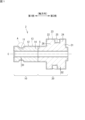
- FIG. 1 is a schematic cross-sectional view of a bearing raceway component according to a first embodiment.
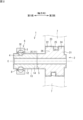
- FIG. 2 is a schematic cross-sectional view of a bearing device having the bearing raceway component of FIG.
- FIG. 3 is a partially enlarged view of FIG.
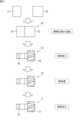
- FIG. 4 is a diagram for explaining a first manufacturing method of a bearing raceway part.
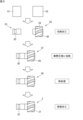
- FIG. 5 is a diagram for explaining a second manufacturing method of a bearing raceway part.
- FIG. 6 is a diagram showing the heat treatment conditions.
- FIG. 7 is a cross-sectional view of a bearing raceway component according to the third embodiment.
- a bearing raceway component includes: A bearing raceway component comprising a columnar or cylindrical shaft member and having a power transmission portion having teeth,
- the shaft member has a central axis, the shaft member has a first portion on a first side in an axial direction and a second portion on a second side in an axial direction of the first portion, the first portion is integral with the second portion;
- the first portion is made of a first steel material, and the first steel material contains a first alloy component;
- the second portion is made of a second steel material, and the second steel material contains a second alloy component;
- the first alloy component is different from the second alloy component;
- the second portion having a power transmission portion having teeth;
- the first portion has a first hardened surface layer and a first interior portion, the first hardened surface layer being disposed along a circumferential surface of the first portion, and the first
- the bearing raceway part has a first part with a raceway and a second part with a power transmission part with teeth, and the first part and the second part are made of different steel materials and are integrated together. Therefore, it is possible to achieve both strength suitable for the raceway of the bearing part with a raceway and strength suitable for the teeth of the power transmission part with teeth.
- the teeth of the power transmission part having teeth are preferably teeth of a gear, teeth of a spline, or teeth of a toothed pulley.
- the first steel material contains carbon as a first alloy component
- the second steel material contains carbon as a second alloy component
- the carbon content (mass %) of the first steel material is greater than the carbon content (mass %) of the second steel material.
- the first steel material contains at least one of manganese, nickel, chromium, and molybdenum as a first alloy component;
- the second steel material contains at least one of manganese, nickel, chromium, and molybdenum as a second alloy component, It is preferable that the total content (mass%) of manganese, nickel, chromium, and molybdenum in the first steel material is more than 1.5 times the total content (mass%) of manganese, nickel, chromium, and molybdenum in the second steel material.
- the depth from the surface of the raceway of the bearing part having the raceway of the first portion in the range having a hardness of 700 HV or more is It is preferable that the depth from the surface of the tooth bottom of a power transmission part having teeth of the second portion is deeper than the depth from the surface of the tooth bottom of a power transmission part having teeth in a range having a hardness of 700 HV or more.
- the first steel material contains silicon as a first alloy component
- the second steel material contains silicon as a second alloy component
- the silicon content (mass %) of the first steel material is less than the silicon content (mass %) of the second steel material.
- the carbon content (mass %) within a range of 50 ⁇ m deep from the surface of the raceway of the bearing part having the raceway of the first part is greater than the carbon content (mass %) within a range of 50 ⁇ m deep from the surface of the bottom of the teeth of the power transmission part having the teeth of the second part.
- a method for manufacturing a bearing raceway component according to the present disclosure includes: A method for manufacturing a bearing raceway component having a power transmission portion having teeth according to any one of (1) to (7), comprising: The first portion of the workpiece in the first state and the second portion of the workpiece in the first state are integrated into an integral first workpiece by friction welding or welding; forming a portion to be a bearing portion having a raceway by a first machining process on a first portion of the first workpiece, and forming a portion to be a power transmission portion having teeth by a second machining process on a second portion of the first workpiece, by carrying out one of the above steps first and the other step later to obtain a second workpiece; The portion of the second workpiece which will become the bearing portion having the raceway and the portion which will become the power transmission portion having the teeth are simultaneously carburized or carbonitrided, then quenched, and then tempered.
- the tempered workpiece is called the third workpiece. It is preferable to carry out one of the following steps first: a third machining process is carried out on a portion of the third workpiece that will become a bearing portion having the raceway; and a fourth machining process is carried out on a portion of the third workpiece that will become a power transmission portion having the teeth; and to carry out the other step later.
- a method for manufacturing a bearing raceway component according to the present disclosure includes: A method for manufacturing a bearing raceway component having a power transmission portion having teeth according to any one of (1) to (7), comprising: forming a portion to be a bearing portion having a raceway on the first portion of the workpiece in the first state by a first machining process, and forming a portion to be a power transmission portion having teeth on the second portion of the workpiece in the first state by a second machining process, carrying out one of the processes first and the other later, to obtain the first portion of the workpiece in the second state and the second portion of the workpiece in the second state;
- the first portion of the workpiece in the second state and the second portion of the workpiece in the second state are integrated into an integral second workpiece by friction welding or welding;
- the portion of the second workpiece which will become the bearing portion having the raceway and the portion which will become the power transmission portion having the teeth are simultaneously carburized or carbonitrided, then quenched, and then tempered.
- the tempered workpiece is called the third workpiece. It is preferable to carry out one of the following steps first: a third machining process is carried out on a portion of the third workpiece that will become a bearing portion having the raceway; and a fourth machining process is carried out on a portion of the third workpiece that will become a power transmission portion having the teeth; and to carry out the other step later.
- bearing raceway components disclosed herein can be manufactured according to the manufacturing method described in (8) above, the manufacturing method described in (9) above, the manufacturing method described in (10) above, and the manufacturing method described in (11) above.
- Fig. 1 is a schematic cross-sectional view of a bearing raceway component according to the present embodiment.
- Fig. 2 is a schematic cross-sectional view of a bearing device having the bearing raceway component of Fig. 1.
- Fig. 3 is a partially enlarged view of Fig. 1.
- Fig. 3 shows a portion of region A in Fig. 1.
- the bearing device 1 includes a bearing raceway component 2, an outer ring 3, a cage 8, and a plurality of balls (rolling elements) 4.
- the bearing raceway component 2 has a central axis C.
- One axial side of the central axis C is defined as a first axial side, and the other axial side is defined as a second axial side.
- the direction perpendicular to the central axis C is referred to as a radial direction.
- the direction rotating around the central axis C is referred to as a circumferential direction. 1 and 2 show cross sections taken along an imaginary plane passing through a central axis C.
- the outer ring 3 has an outer ring raceway 3c.
- the bearing raceway component 2 has an inner ring raceway 2c (raceway groove 11, described below).
- a number of balls 4 are held and arranged between the outer ring raceway 3c and the inner ring raceway 2c by a cage 8.
- the bearing raceway part 2 is a cylindrical shaft member, as shown in FIG. 1.
- the bearing raceway part 2 has a bearing portion 10 having a raceway, and a power transmission portion 20 having teeth for transmitting power.
- the bearing portion 10 having the raceway is on a first axial side of the power transmission portion 20 having teeth.
- the power transmission portion 20 having teeth is on a second axial side of the bearing portion 10 having the raceway.
- the bearing portion 10 having the raceway and the power transmission portion 20 having teeth are joined at a joining surface 5 by friction welding or welding.
- the bearing raceway part 2 is a member in which two portions are integrated.
- the bearing raceway part 2 is a component that has an inner ring raceway of a bearing and teeth of an external gear on the outer circumferential surface of an integrated shaft member. Therefore, by press-fitting the inner ring and/or external gear of the bearing onto the shaft, it is easier to achieve a smaller size than a component that has the same function as the bearing raceway part 2.
- the diameter of the outer circumferential surface 12 of the bearing portion 10 having a raceway is smaller than the root circle diameter of the power transmission portion 20 having teeth. In this case, it is easy to mesh the teeth 21 of the external gear with the teeth 7 of the gear that is paired with the external gear.
- the portion of the power transmission portion 20 having teeth that has a diameter equal to or smaller than the root circle diameter is the root cylindrical portion 26, and the portion of the power transmission portion 20 having teeth that has a diameter larger than the root circle diameter is the tooth 21.
- the bearing portion 10 having the raceway has a raceway groove 11 on part of its outer circumferential surface, which becomes the inner ring raceway 2c. As described above, the bearing portion 10 having the raceway constitutes the rolling bearing 6 when combined with the outer ring 3, the cage 8, and a number of balls 4.
- the material of the bearing part 10 having the raceway is a first steel material.
- the first steel material is preferably a steel material suitable for raceway components of a rolling bearing.
- the first steel material includes, for example, carbon as an alloy component.
- the first steel material includes, for example, at least one of manganese, nickel, chromium, and molybdenum as an alloy component.
- the first steel material includes, for example, silicon as an alloy component.
- the preferred first steel contains the alloying elements carbon, silicon, manganese, nickel, chromium, and molybdenum.
- the first steel material examples include alloy steel materials for machine structures, such as chromium steel, chromium-molybdenum steel, and nickel-chromium-molybdenum steel.
- Specific examples of the first steel material include SCr420, SCM420, SNCM420, SCM440, and SNCM439.
- the power transmission portion 20 having teeth serves to transmit power between the bearing raceway component 2 and an element other than the bearing raceway component 2 by means of teeth.
- the toothed power transmission part 20 has gear teeth 21 for transmitting power on a part of its outer circumferential surface.
- the teeth 21 are teeth of a helical gear. These teeth 21 mesh with the teeth 7, 7 of other gears (see FIG. 2 ), and can transmit power from and to elements other than the bearing raceway part 2.
- the toothed power transmission part 20 is made of a second steel material, which is preferably a steel material suitable for gears, splines, toothed pulleys, etc.
- the second steel material includes, for example, carbon as an alloy component.
- the second steel material includes, for example, at least one of manganese, nickel, chromium, and molybdenum as an alloy component.
- the second steel material includes, for example, silicon as an alloy component.
- the preferred second steel contains the alloying elements carbon, silicon, manganese, nickel, chromium, and molybdenum.
- Examples of the second steel material include alloy steel materials for machine structures, such as chromium steel, chromium-molybdenum steel, and nickel-chromium-molybdenum steel.
- Specific examples of the second steel material include SCr420, SCM420, and SNCM420.
- the alloy components contained in the first steel material are different from the alloy components contained in the second steel material. Therefore, the bearing raceway part 2 can achieve both strength suitable for a raceway in a bearing portion having a raceway and strength suitable for teeth in a power transmission portion having teeth.
- the bearing portion 10 having the raceway has a first hardened surface layer 13 and a first inner portion 14.
- the first hardened surface layer 13 is provided along a surface including the outer peripheral surface 12 of the bearing portion 10 having the raceway.
- the first inner portion 14 is provided on the side of the first hardened surface layer 13 opposite the surface including the outer peripheral surface 12 of the bearing portion 10 having the raceway.
- the first surface-hardened layer 13 is a carburized layer or a carbonitrided layer. Therefore, the first surface-hardened layer 13 refers to a region in which the carbon content is higher than that of the first steel material before the carburizing treatment or the carbonitriding treatment.
- the carbon content of the bearing part 10 having the raceway When the carbon content of the bearing part 10 having the raceway is measured in the depth direction (direction perpendicular to the outer peripheral surface) from the outer peripheral surface, the carbon content gradually decreases, and the carbon content does not change at a certain depth (referred to as the first depth D1 in this disclosure).
- the range from the surface including the outer peripheral surface 12 of the bearing part 10 having the raceway to the first depth D1 corresponds to the first surface-hardened layer 13.
- the average hardness of the first surface-hardened layer 13 is greater than the average hardness of the first inner portion 14. Therefore, the first surface-hardened layer 13 in the bearing portion 10 having the raceway contributes to a longer life of the bearing.
- the power transmission portion 20 having teeth has a second hardened surface layer 23 and a second inner portion 24.
- the second hardened surface layer 23 is provided along a surface including the outer peripheral surface 22 of the power transmission portion 20 having teeth.
- the second inner portion 24 is provided on the side of the second hardened surface layer 23 opposite to the surface including the outer peripheral surface 22 of the power transmission portion 20 having teeth.
- the second surface-hardened layer 23 is a carburized layer or a carbonitrided layer. Therefore, the second surface-hardened layer 23 refers to a region in which the carbon content is higher than that of the second steel material before the carburizing treatment or the carbonitriding treatment.
- the carbon content of the power transmission part 20 having teeth When the carbon content of the power transmission part 20 having teeth is measured in the depth direction (direction perpendicular to the outer peripheral surface) from the outer peripheral surface, the carbon content gradually decreases, and the carbon content does not change at a certain depth (referred to as the second depth D2 in this disclosure).
- the range from the surface including the outer peripheral surface 22 of the power transmission part 20 having teeth to the second depth D2 corresponds to the second surface-hardened layer 23.
- the average hardness of the second surface-hardened layer 23 is higher than the average hardness of the second inner portion 24. Therefore, the second surface-hardened layer 23 in the power transmission portion 20 having teeth contributes to extending the life of the power transmission portion 20 having teeth.
- the first surface-hardened layer 13 and the second surface-hardened layer 23 are connected to each other.
- the bearing raceway component 2 has an entire surface, including the outer peripheral surfaces 12, 22 of the cylindrical shaft member, which is formed of surface hardened layers 13, 23.
- the first surface-hardened layer 13 and the second surface-hardened layer 23 are formed through a carburizing treatment or a carbonitriding treatment. The carburizing treatment and the carbonitriding treatment will be described in detail later.
- the depth D10 from the surface of the inner ring raceway 2c (raceway groove 11) of the bearing part 10 having a raceway of the bearing raceway component 2 in the range having a hardness of 700 HV or more is deeper than the depth D20 from the surface of the tooth bottom 25 of the tooth 21 in the range having a hardness of 700 HV or more of the tooth bottom 25 of the tooth 21 of the power transmission part 20 having teeth.
- the bearing raceway component 2 is likely to have a good bearing life, and compressive stress is applied to the teeth, so that the pitting strength of the gear is likely to be good.
- the depth from the surface of the inner ring raceway 2c in the bearing part 10 having the raceway is the depth in a direction perpendicular to the surface of the inner ring raceway 2c.
- the depth from the surface of a tooth 21 in the toothed power transmission part 20 is the depth from the surface of a tooth bottom 25 of the tooth 21.
- the depth from the surface of the tooth bottom 25 is the depth in a direction perpendicular to the surface of the tooth bottom 25.
- the position for measuring the depth from the surface to measure the hardness of teeth 21 of power transmission part 20 having teeth is tooth bottom 25 of tooth 21. This is because a tooth bottom cylindrical portion 26 exists in the depth direction perpendicular to the surface of tooth bottom 25 of tooth 21, and therefore a position deeper than depth D10 from the surface in the range having a hardness of 700 HV or more always remains.
- a depth D10 from the surface of the inner ring raceway 2c which is preferably in the range having a hardness of 700 HV or more, is 0.2 mm or more and 2.0 mm or less.
- the depth D20 from the surface of the tooth bottom 25 of the tooth 21 preferably in the range having a hardness of 700 HV or more is 0.1 mm or more and 1.0 mm or less.
- the consideration required for the depth from the surface of the raceway of a bearing part having a raceway in a range having a hardness of 700 HV (hard part) or more is as follows. It is required to extend the rolling fatigue life until internal flaking occurs, which originates from non-metallic inclusions inside the raceway, for the raceway of a bearing part having a raceway. When the depth from the surface of the raceway of a bearing part having a raceway with a hardness of 700 HV (hard part) or more is deep, the rolling fatigue life is longer than when this depth is shallow. In addition, it is required to suppress the formation of Brinell indentations on the raceways of the bearing parts having raceways due to the rolling elements being statically pressed against the raceways of the bearing parts having raceways.
- the depth from the surface of the tooth bottom of the power transmission part having teeth in a range having a hardness of 700 HV or more is as follows: The difference between the depth of the tooth surface of the power transmission part having teeth 20 having a hardness of 700 HV or more and the depth of the range of the tooth bottom of the power transmission part having teeth 20 having a hardness of 700 HV or more is smaller than the difference between the depth of the range of the tooth bottom of the power transmission part having teeth 20 having a hardness of 700 HV or more in the inner ring raceway 2c of the bearing part having a raceway 10 and the depth of the range of the tooth bottom of the power transmission part having teeth 20 having a hardness of 700 HV or more.
- the depth of the tooth surface of the power transmission part having teeth 20 having a hardness of 700 HV or more can be substituted by the depth of the range of the tooth bottom of the power transmission part having teeth 20 having a hardness of 700 HV or more. It is required to suppress the tooth surface pitting damage that occurs on the outermost surface of the teeth of the power transmission part having teeth. For this reason, the teeth of the power transmission part having teeth need to have a hardness of 700 HV (hard part) or more on the tooth surface.
- the teeth of the power transmission part having teeth are required to have an uneven shape, and have a core structure (non-carburized structure) inside the teeth of the power transmission part having teeth that are convex, and have a hard part (carburized structure) on the surface of the teeth of the power transmission part having teeth. If the inside of the teeth of the power transmission part having teeth is a hard part (carburized structure), the toughness of the teeth of the power transmission part having teeth is reduced, and the teeth become easily broken. For this reason, it is desirable that the range having a hardness of 700 HV (hard part) or more remains at a shallow position from the surface of the teeth of the power transmission part having teeth.
- the depth D10 in the inner ring raceway 2c of the bearing part 10 having the raceway is measured by the following method.
- the bearing raceway component 2 is cut in a plane including the central axis so as to pass through the inner ring raceway 2c.
- a Vickers indenter is applied to the obtained cut surface from the surface (outer peripheral surface) toward the inside in the depth direction (direction perpendicular to the tangent to the outer peripheral surface in the cross section) at a pitch of 50 ⁇ m to measure the Vickers hardness, plot the change in Vickers hardness, and calculate the depth of the range having a hardness of 700 HV or more by an interpolation method.
- the measurement of the depth D20 at the tooth 21 of the toothed power transmission part 20 is performed in the same manner as the measurement of the depth D10, except that the cutting location is changed.
- the toothed power transmission part 20 is cut through the bearing raceway part 2 in a plane perpendicular to the central axis so as to pass through the tooth 21.
- the first alloy component contained in the first steel material is different from the second alloy component contained in the second steel material.
- the preferred relationship between the first alloy component and the second alloy component is one of the following relationships (a) to (c).
- the carbon content (mass %) of the first steel material is greater than the carbon content (mass %) of the second steel material.
- the penetration depth of carbon that penetrates into the steel material by carburizing or carbonitriding is likely to be deeper in the bearing part 10 having the raceway than in the power transmission part 20 having the teeth. Therefore, the depth of the range having a hardness of 700 HV or more in the bearing part 10 having the raceway is likely to be deeper than the depth of the range having a hardness of 700 HV or more in the power transmission part 20 having the teeth.
- the carbon content of the first steel material is preferably 0.25 mass % or more and 1.10 mass % or less.
- the carbon content of the second steel material is preferably 0.15 mass % or more and 0.25 mass % or less.
- the total content (mass %) of manganese, nickel, chromium, and molybdenum of the first steel product is more than 1.5 times the total content (mass %) of manganese, nickel, chromium, and molybdenum of the second steel product.
- the hardenability of the bearing part 10 having a raceway tends to be superior to the hardenability of the power transmission part 20 having teeth.
- the depth of the range having a hardness of 700 HV or more in the inner ring raceway 2c of the bearing part 10 having a raceway is likely to be deeper than the depth of the range having a hardness of 700 HV or more in the bottom of the teeth of the power transmission part 20 having teeth.
- the total content of manganese, nickel, chromium, and molybdenum is preferably 2.5 mass % or more and 6.5 mass % or less.
- the total content of manganese, nickel, chromium and molybdenum is preferably 1.5 mass % or more and 2.5 mass % or less.
- the silicon content (mass %) of the first steel material is less than the silicon content (mass %) of the second steel material.
- the penetration of carbon into the first steel material which is the material of the bearing part 10 having the raceway, is less inhibited than the penetration of carbon into the second steel material, which is the material of the power transmission part 20 having teeth.
- the silicon content is preferably 0.10 mass % or more and 0.34 mass % or less.
- the silicon content is preferably 0.35 mass % or more and 1.00 mass % or less.
- the number of nonmetallic inclusions having a width of 30 ⁇ m or more contained in the first steel material is smaller than the number of nonmetallic inclusions having a width of 30 ⁇ m or more contained in the second steel material.
- the inner ring raceway 2c of the bearing portion 10 having the raceway in the bearing device 1 can easily improve the bearing life.
- the carbon content (mass %) contained within a range of 50 ⁇ m deep from the surface of the inner ring raceway 2c of the bearing part 10 having a raceway is greater than the carbon content (mass %) contained within a range of 50 ⁇ m deep from the surface of the tooth bottom 25 of the tooth 21 of the power transmission part 20 having teeth.
- the bearing life of the bearing raceway component 2 is likely to be good
- the amount of coarse carbides in the teeth 21 is likely to be small
- the tooth tip strength of the gear is likely to be good.
- the position for measuring the depth of the carbon content included in the range from the surface of a tooth 21 of a toothed power transmission part 20 is the tooth bottom 25 of the tooth 21. This is because a tooth bottom cylindrical portion 26 exists in the depth direction perpendicular to the surface of the tooth bottom 25 of the tooth 21, and therefore a position deeper than 50 ⁇ m from the surface will always remain.
- the preferred carbon content within a range of 50 ⁇ m deep from the surface of the inner ring raceway 2 c of the bearing portion 10 having the raceway is 0.75 mass % or more and 0.95 mass % or less.
- the carbon content in the range from the surface of the tooth bottom 25 of the tooth 21 of the toothed power transmission part 20 to a depth of 50 ⁇ m is preferably 0.55 mass % or more and 0.75 mass % or less.
- the consideration required for the amount of carbon on the surface of the raceway of the bearing part 10 having the raceway is as follows.
- stress is repeatedly applied to the raceway of the bearing part 10 having a raceway, and as a result, internally initiated flaking or surface initiated flaking occurs in the raceway of the bearing part 10 having a raceway.
- It is required to extend the rolling fatigue life until internally initiated flaking or surface initiated flaking occurs.
- the surface carbon amount is high, the rolling fatigue life is longer than when the surface carbon amount is low. For this reason, it is desirable for the surface carbon amount of the raceway of the bearing part 10 having a raceway to be high.
- the required amount of surface carbon at the tooth bottom of the power transmission part 20 having teeth is as follows.
- the amount of surface carbon is large, the bending fatigue strength of the tooth bottom of the toothed power transmission part 20 is lower than when the amount of surface carbon is small.
- the toughness of the tooth tip is lower than when the amount of surface carbon is small due to the precipitation of coarse carbides at the tooth tip of the toothed power transmission part 20. For this reason, it is desirable that the amount of surface carbon of the teeth of the toothed power transmission part 20 is small.
- the amount of carbon contained within a range of 50 ⁇ m deep from the surface of the inner ring raceway 2 c of the bearing part 10 having a raceway is measured by cutting the bearing raceway component 2 along a plane including the central axis so as to pass through the inner ring raceway 2 c, and measuring the amount of carbon within a range of 50 ⁇ m deep from the outer peripheral surface of the obtained cut surface using an electron probe microanalyzer (EPMA).
- EPMA electron probe microanalyzer
- the amount of carbon contained within a range of 50 ⁇ m deep from the tooth bottom 25 of the tooth 21 of the toothed power transmission part 20 is measured by cutting the bearing raceway component 2 along a plane perpendicular to the central axis so as to pass through the tooth 21, and measuring the amount of carbon within a range of 50 ⁇ m deep from the tooth bottom 25 of the tooth 21 of the toothed power transmission part 20 on the obtained cut surface using an electron probe microanalyzer (EPMA).
- EPMA electron probe microanalyzer
- the preferred steel material and preferred quality including the above-mentioned relationships (a) to (c) are suitable for ensuring a balance in performance between the raceway and the teeth when the outer diameter of the teeth is approximately 0.5 to 5 times the smallest outer diameter of the inner raceway or the largest inner diameter of the outer raceway in terms of the dimensional relationship between the raceway of the bearing part having a raceway (which may be an inner raceway or an outer raceway instead of an inner raceway) and the teeth of the power transmission part having teeth.
- the bearing raceway component 2 can be manufactured, for example, by the first manufacturing method or the second manufacturing method.
- FIG. 4 is a diagram for explaining a first manufacturing method of a bearing raceway part.
- a cylindrical workpiece 51 made of a first steel material and a cylindrical workpiece 52 made of a second steel material are prepared, and these works are joined to produce a cylindrical joined workpiece (first workpiece) 53 in which the two works are integrated.
- the first steel material and the second steel material are different steel materials, and their types are as described above.
- the workpieces 51 and 52 are joined by friction welding or welding.
- the workpiece 51 is a workpiece before being subjected to a first machining process to be a bearing part having a raceway through a post-process
- the workpiece 52 is a workpiece before being subjected to a second machining process to be a power transmission part having teeth through a post-process. Friction welding and welding are carried out by known techniques, and processing conditions are appropriately selected depending on the type and size of the steel material, etc.
- a portion 55 that will become the inner ring raceway 2c is formed in a portion of a workpiece 51 made of a first steel material by cutting as a first machining process. Also, a portion 56 that will become the gear teeth 21 is formed in a portion of a workpiece 52 made of a second steel material by cutting as a second machining process. Either the formation of the portion 55 that will become the inner ring raceway or the formation of the portion 56 that will become the gear teeth is performed first, and the other is performed later. In this process, a second workpiece 57 is obtained, on which a portion 55 that will become the inner ring raceway and a portion 56 that will become the gear teeth are formed.
- the second workpiece 57 is subjected to a heat treatment. Specifically, the second workpiece 57 is subjected to carburizing or carbonitriding, followed by quenching, and then by tempering. The entire second workpiece 57 is subjected to the heat treatment. In other words, the portion 55 which will become the inner ring raceway and the portion 56 which will become the gear teeth are simultaneously subjected to the heat treatment.
- the carburizing treatment is carried out under conditions of, for example, a carbon potential of 0.9 to 1.4, a carburizing atmosphere at a temperature of 900 to 1000° C., and holding for 1 to 15 hours.
- the conditions for the carbonitriding treatment are, for example, carbon potential: 0.9 to 1.4, ammonia gas flow rate relative to the carburizing gas flow rate: 1 to 5 mass %, and a carbonitriding atmosphere at a temperature of 830 to 900° C. for 1 to 15 hours.
- the carbon potential, the ammonia gas flow rate, and the temperature may be changed during the treatment.
- the conditions for the above-mentioned quenching treatment are, for example, that the workpiece after carburizing or carbonitriding is held at 820 to 870° C. for 0.5 to 2 hours, and then oil-cooled.
- the conditions for the tempering treatment are, for example, that the workpiece after the quenching treatment is held at 150 to 200° C. for 1 to 5 hours, and then air-cooled.
- This step provides a third workpiece 58 having a carburized layer or a carbonitrided layer formed on its outer circumferential surface. Since the carburized layer or carbonitrided layer formed on the third workpiece 58 is formed by the method described above, the carburized layer or carbonitrided layer formed on the workpiece 51 made of the first steel material is connected to the carburized layer or carbonitrided layer formed on the workpiece 52 made of the second steel material. Also, the inside of the workpiece 51 made of the first steel material is connected to the inside of the workpiece 52 made of the second steel material.
- the carburized layer or carbonitrided layer is a surface-hardened layer whose hardness has been increased through carburizing or carbonitriding, quenching, and tempering.
- the third workpiece 58 is subjected to a polishing process as the third machining process and a polishing process as the fourth machining process.
- the third workpiece 58 is finished to a predetermined accuracy by the polishing process as the third machining process to finish the inner ring raceway 2c and by the polishing process as the fourth machining process to finish the gear teeth 21, respectively.
- one of the polishing process as the third machining process applied to the portion that will become the inner ring raceway and the polishing process as the fourth machining process applied to the portion that will become the gear teeth is performed first and the other is performed later.
- the bearing raceway part 2 is manufactured by carrying out the steps (1) to (4).
- FIG. 5 is a diagram for explaining a second manufacturing method of a bearing raceway part.
- a cylindrical workpiece 61 made of a first steel material is prepared.
- a portion 65 that will become the inner ring raceway 2c is formed in one portion of the workpiece 61 made of the first steel material by cutting as a first machining process.
- a cylindrical workpiece 62 made of a second steel material is prepared.
- a portion 66 that will become the gear teeth 21 is formed in one part of the workpiece 62 made of the second steel material by cutting as a second machining process. This produces a second workpiece 64 having the portion 66 that will become the gear teeth formed therein.
- the first steel material and the second steel material are different steel materials, and their types are as described above. Either the first portion of the workpiece 63 or the second portion of the workpiece 64 is produced first, and the other is produced later.
- the workpiece 61 is an unmachined workpiece that will become a bearing part having a raceway through a later process.
- the workpiece 63 is a workpiece that has been subjected to cutting as a first machining process and will become a bearing part having a raceway through a later process.
- the workpiece 62 is an unmachined workpiece that will become a power transmission part having teeth through a later process.
- the workpiece 64 is a workpiece that has been subjected to cutting as a second machining process and will become a power transmission part having teeth through a later process.
- the first workpiece 63 and the second workpiece 64 are joined together to produce a cylindrical second workpiece 67 in which the two workpieces are integrated.
- the first portion 63 and the second portion 64 are joined by friction welding or welding. Friction welding and welding are performed by known techniques, and processing conditions are appropriately selected depending on the type and size of the steel material, etc.
- the second workpiece 67 is subjected to a heat treatment. Specifically, the second workpiece 67 is subjected to carburizing or carbonitriding, followed by quenching, and then by tempering. This step is carried out in the same manner as step (3) in the first production method. In this case, the bearing portion 65 having the raceway that will become the inner ring raceway and the power transmission portion 66 having the teeth that will become the gear teeth are simultaneously subjected to heat treatment.
- This step provides a third workpiece 68 having a carburized layer or a carbonitrided layer formed on its outer circumferential surface. Since the carburized layer or carbonitrided layer formed on the third workpiece 68 is formed by the method described above, the carburized layer or carbonitrided layer formed on the workpiece 61 made of the first steel material is connected to the carburized layer or carbonitrided layer formed on the workpiece 62 made of the second steel material. Also, the inside of the workpiece 61 made of the first steel material is connected to the inside of the workpiece 62 made of the second steel material.
- the carburized layer or carbonitrided layer is a surface-hardened layer whose hardness has been increased through carburizing or carbonitriding, quenching, and tempering.
- step (4) A third workpiece is polished. This step is carried out in the same manner as step (4) in the first production method.
- the bearing raceway part 2 is also manufactured by the second manufacturing method which includes steps (1) to (4).
- the bearing raceway component 2 according to the first embodiment is a cylindrical shaft member.
- the bearing raceway component 2 according to the embodiment of the present invention may be a columnar shaft member that does not have a hole that the bearing raceway component 2 according to the first embodiment has.
- the bearing raceway part 2 of the embodiment of the present invention may be a hollow shaft member having a sealed hollow hole, the hole of which is sealed at a first axial side position from the joint surface 5 of the bearing raceway part 2 of the first embodiment, and the hole of which is sealed at a second axial side position from the joint surface 5 of the bearing raceway part 2 of the first embodiment.
- the bearing raceway part of this embodiment is manufactured by preparing a cylindrical workpiece made of a first steel material and a cylindrical workpiece made of a second steel material, and then friction welding or welding these works together.
- the bearing raceway part of this embodiment was manufactured and its properties were evaluated as follows. As the properties, the 700 HV depth and the surface carbon amount were measured.
- a plurality of bearing raceway components A to G were manufactured by changing the combination of the first steel material and the second steel material. The properties of the obtained bearing raceway components A to G were evaluated. The bearing raceway components were manufactured by the first manufacturing method described above.
- the first workpiece was cut to make the outer diameter of the entire first workpiece uniform and to align the central axes of the two round bars.
- the portion made of the first steel material was cut to produce a portion that would become the inner raceway of the deep groove ball bearing, and then the portion made of the second steel material was cut to produce a portion that would become the teeth of the gear, thereby obtaining a second workpiece.
- the second workpiece was subjected to heat treatment to become a third workpiece.
- Specific heat treatment conditions are shown in FIG.
- the second workpiece was held in a carburizing atmosphere with a carbon potential of 1.2 and a temperature of 930°C for 3 hours, then the carbon potential was changed to 1.0 and held for 2 hours, subsequently held at 850°C for 30 minutes, and then oil-cooled. Further, as a tempering treatment, the material was held at 180° C. for 2 hours, and then air-cooled.
- a carburized layer was formed on the outer peripheral surface of the second workpiece, and the second workpiece became a third workpiece.
- the third workpiece was subjected to polishing as the third machining process and polishing as the fourth machining process, and the inner ring raceway and gear teeth were finished to become a bearing raceway part.
- the depth of the portion with a Vickers hardness of 700 HV or more was determined by measuring the cross section of the obtained bearing raceway component by applying a Vickers indenter at 50 ⁇ m intervals in the depth direction from the surface (the surface of the inner ring raceway and the surface of the gear tooth root). Measurements were performed at three points on each cross section, and the average of the measured values was used as the result. The results are shown in Table 3.
- the bearing raceway part was cut, and the carbon content of the inner ring raceway and the tooth bottom of the cross section of the obtained bearing raceway part within a range of 50 ⁇ m from the surface in the depth direction was measured.
- the bearing raceway part was cut at two locations. One of the cut locations was the portion where the inner raceway was provided. The other cut location was the portion where the gear teeth were provided. First, the portion where the gear teeth were provided was cut on a plane perpendicular to the central axis, and then the portion where the inner raceway was provided was cut on a plane including the central axis.
- the carbon content was measured using an electron probe microanalyzer (EPMA), and the results are shown in Table 3.
- EPMA electron probe microanalyzer
- bearing raceway components A to G having different characteristics between the bearing portion having a raceway and the power transmission portion having teeth were obtained as embodiments of the present invention.
- the bearing raceway parts A to G when the outer diameter of the teeth is approximately 0.5 to 5 times the smallest outer diameter of the inner ring raceway in terms of the dimensional relationship between the raceway of the bearing part having a raceway and the teeth of the power transmission part having teeth, the bearing raceway parts A, B, and G are bearing raceway parts in which the bearing part having a raceway has properties suitable for a bearing and the power transmission part having teeth has properties suitable for gear teeth.
- a bearing raceway component according to an embodiment of the present invention may have a bearing portion having two or more raceways and a power transmission portion having one or more teeth, or may have a bearing portion having one or more raceways and a power transmission portion having two or more teeth.
- FIG. 7 is a cross-sectional view of a bearing raceway component according to the third embodiment.
- the bearing raceway part 102 according to this embodiment is a cylindrical shaft member as shown in Fig. 7.
- the bearing raceway part 102 has two bearing portions 110A and 110B having raceways and two power transmission portions 120A and 120B having teeth.
- the bearing raceway part 102 includes, from the first side to the second side, a power transmission part with teeth 120B, a bearing part with raceway 110A, a power transmission part with teeth 120A, and a bearing part with raceway 110B.
- the power transmission part with teeth 120B and the bearing part with raceway 110A are joined at a joining surface 105B by friction welding or welding.
- the bearing part with raceway 110A and the power transmission part with teeth 120A are joined at a joining surface 105A by friction welding or welding.
- the power transmission part with teeth 120A and the bearing part with raceway 110B are joined at a joining surface 105C by friction welding or welding.
- the bearing raceway part 102 is a member in which four parts are integrated.
- the configuration of the bearing portion 110A having a raceway is similar to that of the bearing portion 10 having a raceway of the first embodiment.
- the bearing portion 110A having a raceway is combined with the outer ring 3, the cage 8, and a plurality of balls to form a bearing.
- the toothed power transmission part 120A has a configuration similar to that of the toothed power transmission part 20 of the first embodiment.
- the toothed power transmission part 120A has external gear teeth 121A on a part of its outer circumferential surface as the toothed power transmission part 120A.
- the toothed power transmission part 120A has a tooth bottom 125A of the tooth 121A between the teeth 121A.
- the part of the toothed power transmission part 120A having a diameter equal to or smaller than the tooth bottom circle diameter is a tooth bottom cylindrical part 126A, and the part of the toothed power transmission part 20 having a diameter larger than the tooth bottom circle diameter is the tooth 121A.
- the tooth 121A is a helical gear tooth.
- the tooth 121A can transmit power to elements other than the bearing raceway part 2 by meshing with the tooth of another gear.
- the first surface hardened layer 113A of the bearing part 110A having a raceway is connected to the second surface hardened layer 123A of the toothed power transmission part 120A.
- a first interior portion 114A of the bearing portion 110A having the raceways communicates with a second interior portion 124A of the power transmission portion 120A having the teeth.
- the bearing part 110B having a raceway has a raceway groove 111B that constitutes an inner ring raceway on a part of its outer periphery.
- the bearing part 110B having a raceway is combined with an outer ring, a cage, and a plurality of balls to constitute a bearing.
- the material of the bearing part 110B with raceway is the first steel material described above.
- the material of the bearing part 110B with raceway may be the same as or different from the material of the bearing part 110A with raceway.
- the raceway bearing part 110B like the raceway bearing part 10, has a first surface-hardened layer 113B and a first inner part 114B.
- the first surface-hardened layer 113B is provided along a surface including the outer circumferential surface 112B of the raceway bearing part 110B.
- the first inner part 114B is provided on the opposite side of the first surface-hardened layer 113B from the surface including the outer circumferential surface 112B of the raceway bearing part 110B.
- the average hardness of the first surface-hardened layer 113B is harder than the average hardness of the first inner part 114B.
- the first hardened surface layer 113B is a carburized or carbonitrided surface layer.
- the first hardened surface layer 113B communicates with the second hardened surface layer 123A of the adjacent toothed power transmission portion 120A.
- the first inner portion 114B of the raceway bearing portion 110B communicates with the second inner portion 124A of the toothed power transmission portion 120A.
- the preferred configuration of the raceway bearing portion 110B is similar to the raceway bearing portion 10. As shown in FIG.
- the toothed power transmission portion 120B serves to transmit power between the bearing race component 102 and an element other than the bearing race component 102.
- the toothed power transmission part 120B has spline teeth 121B on a part of its outer periphery.
- the spline teeth 121B can transmit power to and from the motor by being connected to, for example, a motor shaft.
- the toothed power transmission part 120B is made of the second steel material described above.
- the toothed power transmission part 120B may be made of the same material as the power transmission part 120A or may be made of a different material.
- the toothed power transmission part 120B has tooth roots 125B between the teeth 121B.
- the toothed power transmission part 120B has a portion having a diameter equal to or smaller than the tooth root circle diameter as a tooth root cylindrical portion 126B, and the toothed power transmission part 120B has a portion having a diameter larger than the tooth root circle diameter as a tooth 121B.
- the toothed power transmission portion 120B like the toothed power transmission portion 20, has a second surface-hardened layer 123B and a second inner portion 124B.
- the second surface-hardened layer 123B is provided along a surface including the outer circumferential surface 112B of the power transmission portion 120B.
- the second inner portion 124B is provided on the opposite side of the second surface-hardened layer 123B to the surface including the outer circumferential surface 122B of the toothed power transmission portion 120B.
- the average hardness of the second surface-hardened layer 123B is harder than the average hardness of the second inner portion 124B.
- the second hardened surface layer 123B is a carburized or carbonitrided layer.
- the second hardened surface layer 123B communicates with the first hardened surface layer 113A of the bearing part 110A having the adjacent raceway.
- the second inner portion 124B of the power transmission part 120B having teeth communicates with the first inner portion 114A of the bearing part 110A having the raceway.
- the preferred configuration of toothed power transmission portion 120B is similar to toothed power transmission portion 20. As shown in FIG.
- the entire outer circumferential surfaces 112A, 112B, 122A, 122B of the cylindrical shaft member are formed with surface hardened layers 113A, 113B, 123A, 123B. Both end faces and the inner circumferential surface of the bearing raceway part 102 are also formed with surface hardened layers.
- the surface hardened layer 123B and the surface hardened layer 113A, the surface hardened layer 113A and the surface hardened layer 123A, and the surface hardened layer 123A and the surface hardened layer 113B are all connected to each other.
- the surface hardened layer 113A, the surface hardened layer 113B, the surface hardened layer 123A, and the surface hardened layer 123B are either all carburized layers or all carbonitrided layers. Additionally, the interiors 124B and 114A, the interiors 114A and 124A, and the interiors 124A and 114B are all connected to each other.
- the bearing part having a raceway and the power transmission part having teeth have a preferable relationship with respect to the range having a hardness of 700 HV or more, the relationship between the first alloy component and the second alloy component, and the carbon content included in the range of a depth of 50 ⁇ m from the outer peripheral surface.
- the preferred relationship between the bearing part having the raceway and the power transmission part having the teeth may be any relationship between a bearing part having a raceway and a power transmission part having the teeth that are adjacent to each other.
- the bearing raceway part 102 can be manufactured in the same manner as in the first embodiment, except for the number of workpieces that are joined by friction welding or welding.
- the bearing raceway component according to the embodiment of the present invention may have teeth of a gear, spline teeth, toothed pulley teeth, or the like as teeth of a power transmission part having teeth.
- the number of bearing parts having a raceway and power transmission parts having teeth is not limited, and there may be a total of three, namely two bearing parts having a raceway and one power transmission part having teeth, or there may be a total of three, namely one bearing part having a raceway and two power transmission parts having teeth, or the total may be five or more.
- the central axis may become misaligned or the bearing raceway components may become distorted, so the total is preferably four or less.
- the bearing portion having the raceway may have a plurality of raceways.
- the bearing portion having the raceway is not limited to the bearing portion having the inner ring raceway, but may be a bearing portion having an outer ring raceway.
- the raceway may be provided on the inner peripheral surface.
- the power transmission portion having teeth may have a plurality of types of teeth as the teeth constituting the power transmission portion.
- the power transmission part having teeth is not limited to a power transmission part having an external gear, but may be a power transmission part having an internal gear.
- the gear may be provided on the inner peripheral surface.
- the preferred steel material and quality have been shown when the outer diameter of the teeth is approximately 0.5 to 5 times the smallest outer diameter of the inner ring raceway, but the value of the outer diameter of the teeth relative to the outer diameter of the raceway outside this range may also be used. If the radius of the tooth base is smaller than 0.5 times the smallest radius of the inner ring raceway and the strength required of the raceway is smaller than the strength required of the tooth base, the values of the steel material and quality of the teeth and the steel material and quality of the raceway may be reversed.
- bearing raceway components according to the embodiments of the present invention is not particularly limited, and they can be used in a variety of applications. Specifically, they can be used, for example, in drive reducers for automobiles.
Landscapes
- Engineering & Computer Science (AREA)
- General Engineering & Computer Science (AREA)
- Mechanical Engineering (AREA)
- Chemical & Material Sciences (AREA)
- Manufacturing & Machinery (AREA)
- Chemical Kinetics & Catalysis (AREA)
- Materials Engineering (AREA)
- Metallurgy (AREA)
- Organic Chemistry (AREA)
- Rolling Contact Bearings (AREA)
- Heat Treatment Of Articles (AREA)
Priority Applications (5)
| Application Number | Priority Date | Filing Date | Title |
|---|---|---|---|
| JP2025537296A JPWO2025027670A1 (https=) | 2023-07-28 | 2023-07-28 | |
| PCT/JP2023/027685 WO2025027670A1 (ja) | 2023-07-28 | 2023-07-28 | 軸受軌道部品、及び軸受軌道部品の製造方法 |
| PCT/JP2024/006361 WO2025027899A1 (ja) | 2023-07-28 | 2024-02-21 | 軸受軌道部品、及び軸受軌道部品の製造方法 |
| PCT/JP2024/026814 WO2025028441A1 (ja) | 2023-07-28 | 2024-07-26 | 軸部品、軸部品の製造方法、軸受軌道部品の製造方法、及び軸受軌道部品 |
| CN202480049015.9A CN121605252A (zh) | 2023-07-28 | 2024-07-26 | 轴部件、轴部件的制造方法、轴承滚道部件的制造方法以及轴承滚道部件 |
Applications Claiming Priority (1)
| Application Number | Priority Date | Filing Date | Title |
|---|---|---|---|
| PCT/JP2023/027685 WO2025027670A1 (ja) | 2023-07-28 | 2023-07-28 | 軸受軌道部品、及び軸受軌道部品の製造方法 |
Publications (1)
| Publication Number | Publication Date |
|---|---|
| WO2025027670A1 true WO2025027670A1 (ja) | 2025-02-06 |
Family
ID=94394345
Family Applications (2)
| Application Number | Title | Priority Date | Filing Date |
|---|---|---|---|
| PCT/JP2023/027685 Pending WO2025027670A1 (ja) | 2023-07-28 | 2023-07-28 | 軸受軌道部品、及び軸受軌道部品の製造方法 |
| PCT/JP2024/006361 Pending WO2025027899A1 (ja) | 2023-07-28 | 2024-02-21 | 軸受軌道部品、及び軸受軌道部品の製造方法 |
Family Applications After (1)
| Application Number | Title | Priority Date | Filing Date |
|---|---|---|---|
| PCT/JP2024/006361 Pending WO2025027899A1 (ja) | 2023-07-28 | 2024-02-21 | 軸受軌道部品、及び軸受軌道部品の製造方法 |
Country Status (2)
| Country | Link |
|---|---|
| JP (1) | JPWO2025027670A1 (https=) |
| WO (2) | WO2025027670A1 (https=) |
Citations (4)
| Publication number | Priority date | Publication date | Assignee | Title |
|---|---|---|---|---|
| JPH09310123A (ja) * | 1996-05-16 | 1997-12-02 | Daihatsu Motor Co Ltd | 低コスト歯車の製造方法 |
| JP2002339041A (ja) * | 2001-05-16 | 2002-11-27 | Sanyo Special Steel Co Ltd | 仕上加工性に優れた高清浄度軸受用鋼 |
| JP2005069022A (ja) * | 2003-08-26 | 2005-03-17 | Honda Motor Co Ltd | スタータギア軸受の潤滑構造 |
| JP2012045592A (ja) * | 2010-08-27 | 2012-03-08 | F C C:Kk | 一体部材及びその製造方法 |
Family Cites Families (7)
| Publication number | Priority date | Publication date | Assignee | Title |
|---|---|---|---|---|
| JPS59232642A (ja) * | 1983-06-16 | 1984-12-27 | Nippon Steel Corp | 温間鍛造法 |
| DE10128544C2 (de) * | 2001-06-13 | 2003-06-05 | Thyssenkrupp Stahl Ag | Höherfestes, kaltumformbares Stahlblech, Verfahren zu seiner Herstellung und Verwendung eines solchen Blechs |
| JP5098486B2 (ja) * | 2007-07-25 | 2012-12-12 | 新日鐵住金株式会社 | 浸炭部品の製造方法 |
| JP6735589B2 (ja) * | 2016-03-30 | 2020-08-05 | 大同特殊鋼株式会社 | 製造性と耐水素脆性に優れた耐環境用軸受鋼 |
| JP7125923B2 (ja) * | 2019-07-25 | 2022-08-25 | Jfeスチール株式会社 | 真空浸炭用高炭素熱延鋼板およびその製造方法並びに浸炭鋼部品 |
| JP7464821B2 (ja) * | 2020-02-14 | 2024-04-10 | 日本製鉄株式会社 | 軸受軌道用鋼材、および軸受軌道 |
| JP2023102175A (ja) * | 2022-01-11 | 2023-07-24 | 日本製鉄株式会社 | 鋼部材 |
-
2023
- 2023-07-28 WO PCT/JP2023/027685 patent/WO2025027670A1/ja active Pending
- 2023-07-28 JP JP2025537296A patent/JPWO2025027670A1/ja active Pending
-
2024
- 2024-02-21 WO PCT/JP2024/006361 patent/WO2025027899A1/ja active Pending
Patent Citations (4)
| Publication number | Priority date | Publication date | Assignee | Title |
|---|---|---|---|---|
| JPH09310123A (ja) * | 1996-05-16 | 1997-12-02 | Daihatsu Motor Co Ltd | 低コスト歯車の製造方法 |
| JP2002339041A (ja) * | 2001-05-16 | 2002-11-27 | Sanyo Special Steel Co Ltd | 仕上加工性に優れた高清浄度軸受用鋼 |
| JP2005069022A (ja) * | 2003-08-26 | 2005-03-17 | Honda Motor Co Ltd | スタータギア軸受の潤滑構造 |
| JP2012045592A (ja) * | 2010-08-27 | 2012-03-08 | F C C:Kk | 一体部材及びその製造方法 |
Also Published As
| Publication number | Publication date |
|---|---|
| WO2025027899A1 (ja) | 2025-02-06 |
| JPWO2025027670A1 (https=) | 2025-02-06 |
Similar Documents
| Publication | Publication Date | Title |
|---|---|---|
| JP3308377B2 (ja) | 歯面強度の優れた歯車およびその製造方法 | |
| WO2022202922A1 (ja) | 軌道輪及びシャフト | |
| JPH10231908A (ja) | トロイダル式無段変速機用転動体およびその製造方法 | |
| JP6562179B1 (ja) | 転がり軸受の軌道輪の製造方法及び転がり軸受の製造方法 | |
| WO2025027670A1 (ja) | 軸受軌道部品、及び軸受軌道部品の製造方法 | |
| JP2009228829A (ja) | 軸棒の製造方法、軸受の製造方法、軸棒および軸受 | |
| WO2025028441A1 (ja) | 軸部品、軸部品の製造方法、軸受軌道部品の製造方法、及び軸受軌道部品 | |
| JPH10103440A (ja) | トロイダル式無段変速機用転動体およびその製造方法 | |
| JP2004169848A (ja) | 転動装置 | |
| JP7749324B2 (ja) | 軸部材 | |
| JP2022189424A (ja) | 転がり軸受の製造方法 | |
| JPWO2025027670A5 (https=) | ||
| JP2025130829A (ja) | 歯車対 | |
| JP7599460B2 (ja) | 機械部品、転がり軸受及びボールねじ | |
| JP3721522B2 (ja) | 車両車軸アセンブリに使用する歯車及びこの歯車を製造する方法 | |
| JP4547795B2 (ja) | 歯車 | |
| JP7662999B2 (ja) | 円筒ころ軸受及びそれを有する多段式圧延機 | |
| JP2024140274A (ja) | シャフト、シャフトの製造工具、およびシャフトの製造方法 | |
| WO2013122100A1 (ja) | 転がり接触部品、転がり軸受、自在継手およびそれらの製造方法 | |
| WO2025004692A1 (ja) | 転がり軸受及び車両用駆動ユニット | |
| JP2006316821A (ja) | プラネタリギヤ機構用転がり軸受 | |
| JP2007071279A (ja) | ボールねじ | |
| JP2023068855A (ja) | 軸部材 | |
| JPH08174340A (ja) | 面疲労強度に優れた機械構造用部品およびその製造方法 | |
| WO2023080064A1 (ja) | 軸部材及び転がり軸受 |
Legal Events
| Date | Code | Title | Description |
|---|---|---|---|
| 121 | Ep: the epo has been informed by wipo that ep was designated in this application |
Ref document number: 23947470 Country of ref document: EP Kind code of ref document: A1 |
|
| ENP | Entry into the national phase |
Ref document number: 2025537296 Country of ref document: JP Kind code of ref document: A |
|
| WWE | Wipo information: entry into national phase |
Ref document number: 2025537296 Country of ref document: JP |
|
| NENP | Non-entry into the national phase |
Ref country code: DE |