WO2025013481A1 - 像ぶれ補正装置および撮像装置 - Google Patents
像ぶれ補正装置および撮像装置 Download PDFInfo
- Publication number
- WO2025013481A1 WO2025013481A1 PCT/JP2024/020690 JP2024020690W WO2025013481A1 WO 2025013481 A1 WO2025013481 A1 WO 2025013481A1 JP 2024020690 W JP2024020690 W JP 2024020690W WO 2025013481 A1 WO2025013481 A1 WO 2025013481A1
- Authority
- WO
- WIPO (PCT)
- Prior art keywords
- imaging element
- support member
- magnet
- blur correction
- imaging
- Prior art date
- Legal status (The legal status is an assumption and is not a legal conclusion. Google has not performed a legal analysis and makes no representation as to the accuracy of the status listed.)
- Ceased
Links
Images





Classifications
-
- G—PHYSICS
- G03—PHOTOGRAPHY; CINEMATOGRAPHY; ANALOGOUS TECHNIQUES USING WAVES OTHER THAN OPTICAL WAVES; ELECTROGRAPHY; HOLOGRAPHY
- G03B—APPARATUS OR ARRANGEMENTS FOR TAKING PHOTOGRAPHS OR FOR PROJECTING OR VIEWING THEM; APPARATUS OR ARRANGEMENTS EMPLOYING ANALOGOUS TECHNIQUES USING WAVES OTHER THAN OPTICAL WAVES; ACCESSORIES THEREFOR
- G03B17/00—Details of cameras or camera bodies; Accessories therefor
- G03B17/55—Details of cameras or camera bodies; Accessories therefor with provision for heating or cooling, e.g. in aircraft
-
- G—PHYSICS
- G03—PHOTOGRAPHY; CINEMATOGRAPHY; ANALOGOUS TECHNIQUES USING WAVES OTHER THAN OPTICAL WAVES; ELECTROGRAPHY; HOLOGRAPHY
- G03B—APPARATUS OR ARRANGEMENTS FOR TAKING PHOTOGRAPHS OR FOR PROJECTING OR VIEWING THEM; APPARATUS OR ARRANGEMENTS EMPLOYING ANALOGOUS TECHNIQUES USING WAVES OTHER THAN OPTICAL WAVES; ACCESSORIES THEREFOR
- G03B30/00—Camera modules comprising integrated lens units and imaging units, specially adapted for being embedded in other devices, e.g. mobile phones or vehicles
-
- G—PHYSICS
- G03—PHOTOGRAPHY; CINEMATOGRAPHY; ANALOGOUS TECHNIQUES USING WAVES OTHER THAN OPTICAL WAVES; ELECTROGRAPHY; HOLOGRAPHY
- G03B—APPARATUS OR ARRANGEMENTS FOR TAKING PHOTOGRAPHS OR FOR PROJECTING OR VIEWING THEM; APPARATUS OR ARRANGEMENTS EMPLOYING ANALOGOUS TECHNIQUES USING WAVES OTHER THAN OPTICAL WAVES; ACCESSORIES THEREFOR
- G03B5/00—Adjustment of optical system relative to image or object surface other than for focusing
-
- H—ELECTRICITY
- H04—ELECTRIC COMMUNICATION TECHNIQUE
- H04N—PICTORIAL COMMUNICATION, e.g. TELEVISION
- H04N23/00—Cameras or camera modules comprising electronic image sensors; Control thereof
- H04N23/50—Constructional details
- H04N23/52—Elements optimising image sensor operation, e.g. for electromagnetic interference [EMI] protection or temperature control by heat transfer or cooling elements
-
- H—ELECTRICITY
- H04—ELECTRIC COMMUNICATION TECHNIQUE
- H04N—PICTORIAL COMMUNICATION, e.g. TELEVISION
- H04N23/00—Cameras or camera modules comprising electronic image sensors; Control thereof
- H04N23/50—Constructional details
- H04N23/54—Mounting of pick-up tubes, electronic image sensors, deviation or focusing coils
-
- H—ELECTRICITY
- H04—ELECTRIC COMMUNICATION TECHNIQUE
- H04N—PICTORIAL COMMUNICATION, e.g. TELEVISION
- H04N23/00—Cameras or camera modules comprising electronic image sensors; Control thereof
- H04N23/60—Control of cameras or camera modules
- H04N23/68—Control of cameras or camera modules for stable pick-up of the scene, e.g. compensating for camera body vibrations
Definitions
- a blur correction device has been proposed that suppresses blurring of captured images caused by camera shake by driving the image sensor inside the camera body (see, for example, Patent Document 1). There is a demand for miniaturization of blur correction devices.
- the image stabilization device includes an imaging element having an imaging surface on which a plurality of pixels are arranged, a first support member that supports the imaging element, a second support member that movably supports the first support member, and a drive unit that drives the first support member relative to the second support member, the drive unit including a first drive unit that drives the first support member in a first direction within the imaging surface, and two second drive units that drive the first support member in a second direction within the imaging surface that is perpendicular to the first direction, the first drive unit including a coil wound in a substantially rectangular shape and a magnet, and when the imaging element is viewed from a third direction perpendicular to the imaging surface, one of the two long sides of the coil overlaps with the imaging element.
- an imaging device includes the image blur correction device.
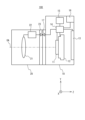
- FIG. 1 is a diagram illustrating a schematic configuration example of a digital camera according to an embodiment.
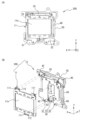
- FIG. 2A is a front view of the image blur correction device
- FIG. 2B is a perspective view of the image sensor and the image sensor drive unit.
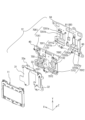
- FIG. 3 is an exploded perspective view of the image sensor and the image sensor drive unit as viewed from the -Z direction.
- FIG. 4 is an exploded perspective view of the image sensor and the image sensor drive unit as viewed from the +Z direction.
- FIG. 5 is a diagram for explaining the connection relationship between the components of the image sensor and the image sensor drive unit.
- FIG. 6 is a diagram for explaining the shape of the coil.
- FIG. 7A is a perspective view showing the range of the imaging element, and FIG.
- FIG. 7B is a plan view for explaining the arrangement of the coils.
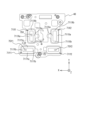
- 8A and 8B are diagrams for explaining the arrangement and polarity of magnets, and are plan views of the second support member as viewed from the -Z direction.
- FIG. 9A is a plan view of an image sensor driving unit to which a flexible printed circuit board is connected, viewed from the +Z direction
- FIG. 9B is a perspective view of the image sensor driving unit to which a flexible printed circuit board is connected.
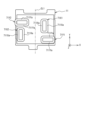
- 10A and 10B are diagrams showing other examples of coil arrangement.
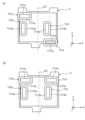
- FIG. 11 is a diagram showing another example of the arrangement of coils.
- 12A and 12B are diagrams showing other examples of coil arrangement.
- FIG. 1 is a diagram showing a schematic configuration example of a digital camera 100 according to one embodiment.
- an XYZ Cartesian coordinate system has been appropriately set up to facilitate explanation and understanding.
- the direction from the subject toward the camera body 10 in the camera position when the photographer takes a landscape image with the optical axis OA horizontal (hereinafter referred to as the normal position) is defined as the +Z direction.
- the direction toward the right side in the normal position is defined as the +X direction.
- the direction toward the upper side in the normal position is defined as the +Y direction.
- the scale of the shape, length, thickness, etc. of each part shown in the embodiment does not necessarily match the actual product, and parts not necessary for explanation have been omitted or simplified as appropriate.
- the digital camera 100 includes an interchangeable lens 20 and a camera body 10.
- the interchangeable lens 20 is attached to the camera body 10 via a lens mount.
- the digital camera 100 may be configured as a camera with an integrated lens rather than an interchangeable lens type.
- the interchangeable lens 20 comprises an imaging optical system 21 including, for example, a zoom lens, a focus lens, an aperture, an anti-vibration lens, etc., a lens control unit 22, and lens-side electronic contacts 23.
- the lens control unit 22 includes a CPU (Central Processing Unit) and peripheral components such as memory.
- the lens control unit 22 performs drive control of the focus lens and aperture, detects the positions of the zoom lens and focus lens, sends lens information to the camera body 10 via the lens-side electronic contacts 23, and receives camera information from the camera body 10.
- the camera body 10 includes, for example, an image sensor 11, an image sensor drive unit 12, a display unit 13, a body control unit 14, a battery 15, an operation unit 16, and body-side electronic contacts 17.
- the operation unit 16 includes a shutter button and operation members for various settings.
- the display unit 13 is, for example, an LCD monitor (also called a rear monitor) mounted on the rear of the camera body 10.
- the body control unit 14 includes a CPU and peripheral components such as memory.
- the body control unit 14 controls the operation of the digital camera 100, such as driving and controlling the image sensor 11, reading out image signals from the image sensor 11, performing focus detection calculations and focus adjustment for the interchangeable lens 20, displaying and recording image data, and driving and controlling the image sensor drive unit 12.
- the body control unit 14 also communicates with the lens control unit 22 via the body-side electronic contacts 17, receiving lens information and sending camera information (such as defocus amount and aperture value).
- the imaging element drive unit 12 suppresses blurring of the captured image caused by camera shake or the like by driving the imaging element 11. That is, the imaging element 11 and the imaging element drive unit 12 realize the image blur correction device 200.
- FIG. 2(A) is a front view of the image blur correction device 200
- FIG. 2(B) is a perspective view of the imaging element 11 and the imaging element drive unit 12.
- FIG. 3 is an exploded perspective view of the imaging element 11 and the imaging element drive unit 12 as viewed from the -Z direction
- FIG. 4 is an exploded perspective view of the imaging element 11 and the imaging element drive unit 12 as viewed from the +Z direction.
- FIG. 5 is an exploded perspective view for explaining the connection relationship between the first unit 30 and the second support member 50.
- the image sensor 11 has an image pickup surface 11a on which multiple pixels are arranged.
- the image pickup surface 11a is parallel to the XY plane.
- the image sensor drive unit 12 includes a first front yoke 31, a second front yoke 32, a metal heat sink 33, a first support member 40, a second support member 50, and a back yoke 60.
- the first front yoke 31 and the second front yoke 32 are fixed to a heat sink 33 (heat dissipation member).
- the first front yoke 31, the second front yoke 32, and the heat sink 33 may be collectively referred to as the first unit 30.
- Heat generated by the imaging element 11 is transferred through the air to the first front yoke 31, the second front yoke 32, and the heat sink 33. Because the first front yoke 31 and the second front yoke 32 are fixed to the heat sink 33, the heat transferred to the first front yoke 31 and the second front yoke 32 is transferred to the heat sink 33 and then transferred to, for example, the housing of the digital camera 100 via a connecting member (not shown), and is dissipated to the outside of the digital camera 100.
- the imaging element 11 is fixed to the first support member 40. Specifically, as shown by the dashed line in FIG. 2(B), the protrusion 43 of the first support member 40 is inserted into the engagement hole 112 of the imaging element 11, and the imaging element 11 is screwed to the protrusion 42 of the first support member 40 with a screw 111 or the like, thereby fixing the first support member 40 and the imaging element 11. As shown in FIG. 2(B), the protrusions 42 and 43 do not overlap with the first unit 30 in the direction perpendicular to the imaging surface 11a of the imaging element 11.
- the first support member 40 is disposed between the first unit 30 and the second support member 50.
- the first unit 30 and the second support member 50 are fixed within the camera body 10 and do not move relative to the camera body 10.
- the first unit 30 is fixed to the second support member 50. Specifically, as shown by the two-dot chain line in FIG. 5, the first unit 30 is fixed to the second support member 50 by screwing the first unit 30 to the protrusions 51a, 51b of the second support member 50 with screws 301 or the like.
- the second support member 50 movably supports the first support member 40 between the first support member 40 and the first unit 30. Specifically, as shown in FIG. 5, the protrusion 51a of the second support member 50 is fixed to the first unit 30 via a hole 41 that is larger than the protrusion 51a of the first support member 40, and the protrusion 51b of the second support member 50 is fixed to the first unit 30 below the first support member 40, so that the first support member 40 is movably supported by the second support member 50. As a result, the image sensor 11 fixed to the first support member 40 can move integrally with the first support member 40 relative to the camera body 10.
- the imaging element driving unit 12 also includes two first driving units 70X1, 70X2 that drive the first support member 40 (the imaging element 11 supported by the first support member 40) in the X direction, and two second driving units 70Y1, 70Y2 that drive the imaging element 11 around the Y and Z directions.
- VCMs Vehicle Coil Motors
- the two first driving units 70X1, 70X2 will be referred to as the first VCM 70X1 and the second VCM 70X2, respectively
- the two second driving units 70Y1, 70Y2 will be referred to as the third VCM 70Y1 and the fourth VCM 70Y2, respectively.
- the first VCM 70X1 includes a coil 71X1 and two magnets 72X1a and 72X1b.
- the second VCM 70X2 includes a coil 71X2 and two magnets 72X2a and 72X2b.
- the third VCM 70Y1 includes a coil 71Y1 and two magnets 72Y1a and 72Y1b.
- the fourth VCM 70Y2 includes a coil 71Y2 and two magnets 72Y2a and 72Y2b.
- the coils 71X1, 71X2, 71Y1, and 71Y2 are supported (fixed) by the first support member 40.
- FIG. 6 is a diagram for explaining the configuration of coils 71X1, 71X2, 71Y1, and 71Y2. Coils 71X1, 71X2, 71Y1, and 71Y2 are each wound in a substantially rectangular shape.
- Each of the coils 71X1 and 71X2 has two long sides 711Xa and two short sides 711Xb.
- the two long sides 711Xa extend in the Y direction, and the two short sides 711Xb extend in the X direction.
- Each of the coils 71Y1 and 71Y2 has two long sides 711Ya and two short sides 711Yb.
- the two long sides 711Ya extend in the X direction
- the two short sides 711Yb extend in the Y direction.
- Fig. 7(A) is a perspective view showing the range of the imaging element 11
- Fig. 7(B) is a plan view for explaining the arrangement of coils 71X1, 71X2, and 71Y1, 71Y2.
- Figs. 7(A) and 7(B) show the imaging element 11 as viewed from the +Z direction.
- the hatched area is the area of the imaging element 11.
- FIG. 7B in this embodiment, when the imaging element 11 is viewed from the Z direction, both of the two long side portions 711Xa of the coil 71X1 and the coil 71X2 overlap with the imaging element 11.
- the coil 71X1 and the coil 71X2 are each arranged within the range of the imaging element 11 in the X direction. This allows the size of the imaging element drive unit 12 in the X direction to be reduced compared to the case in which none of the long side portions of the coil of the VCM that drives the imaging element in the X direction overlaps with the imaging element as in Patent Document 1.
- both of the two short side portions 711Xb also overlap with the imaging element 11.
- the coil 71X1 and the coil 71X2 are each arranged within the range of the imaging element 11 in the Y direction.
- coils 71X1 and 71X2 are arranged on either side of a straight line CL1 that passes through the center of the image sensor 11 in the X direction and extends in the Y direction. By arranging them in this way, it is possible to drive the first support member 40 (image sensor 11) in a well-balanced manner.
- each of the coils 71Y1 and 71Y2 overlaps with the imaging element 11.
- a portion of each of the coils 71Y1 and 71Y2 is disposed within the range of the imaging element 11 in the Y direction.
- the image sensor drive unit 12 can be made smaller.
- FIG. 8(A) is a plan view of the second support member 50 as viewed from the -Z direction.
- the two magnets 72X1a (first magnet) and 72X1b (second magnet) of the first VCM 70X1 are supported (fixed) by the second support member 50.
- the two magnets 72X1a and 72X1b are arranged in sequence from a straight line CL1 that passes through the center of the imaging element 11 in the X direction and extends in the Y direction toward the outside, and the magnet 72X1a is arranged inward (toward the center) of the magnet 72X1b in the X direction.
- the polarities of the surfaces of the two magnets 72X1a and 72X1b that face the coil 71X1 are opposite.
- the two magnets 72X2a (first magnet) and 72X2b (second magnet) of the second VCM 70X2 are supported (fixed) by the second support member 50.
- the two magnets 72X2a and 72X2b are arranged in sequence from a straight line CL1 that passes through the center of the imaging element 11 in the X direction and extends in the Y direction toward the outside.
- the magnet 72X2a is arranged inside (towards the center) the magnet 72X2b.
- the polarities of the surfaces of the two magnets 72X2a and 72X2b that face the coil 71X2 are opposite polarities.
- the polarity of the surface of the central magnet 72X1a of the magnets 72X1a and 72X1b of the first VCM 70X1 that faces the coil 71X1 and the polarity of the surface of the central magnet 72X2a of the magnets 72X2a and 72X2b of the second VCM 70X2 that faces the coil 71X2 are the same, that is, N poles.
- the polarity of the surface of the magnet 72X1b that is furthest from the center and faces the coil 71X1 is opposite (S) to the polarity of the magnet 72X1a.
- the polarity of the surface of the magnet 72X2b that is furthest from the center and faces the coil 71X2 is opposite (S) to the polarity of the magnet 72X2a.
- magnet 72X1a and magnet 72X2a have different polarities, a magnetic flux may flow from magnet 72X1a to magnet 72X2a, or from magnet 72X2a to magnet 72X1a, which may adversely affect the operation of first VCM 70X1 and second VCM 70X2. Therefore, magnet 72X1a and magnet 72X2a near the center have the same polarity.
- the polarity of the surface of magnet 72X1a near the center facing coil 71X1 and the polarity of the surface of magnet 72X2a near the center facing coil 71X2 may be set to a south pole.
- coils 71X1 and 71X2 are subjected to a Lorentz force, which causes the first support member 40 (imaging element 11) to move in the X direction.
- coil 71Y1 By passing a current through coil 71Y1, which is placed in the magnetic circuit formed by magnets 72Y1a and 72Y1b, coil 71Y1 is subjected to Lorentz force. Also, by passing a current through coil 71Y2, which is placed in the magnetic circuit formed by magnets 72Y2a and 72Y2b, coils 71X1 and 71X2 are subjected to Lorentz force.
- the first support member 40 moves parallel to the Y direction.
- the first support member 40 moves rotationally around a rotation axis parallel to the Z direction.
- the imaging element 11 can move parallel to the imaging surface (within the XY plane) and rotate around the Z axis.
- the position of the first support member 40 is detected by position detection sensors 75X, 75Y1, and 75Y2 provided on the first support member 40 (see Figures 3 and 6).
- the position detection sensor 75X detects the position of the first support member 40 in the X direction.
- the position detection sensors 75Y1 and 75Y2 detect the position of the first support member 40 in the Y direction and around the Z direction.
- the position detection sensors 75X, 75Y1, and 75Y2 are, for example, Hall elements, but are not limited to this.
- the image sensor driving unit 12 includes a biasing mechanism 80 that biases the first support member 40 toward the second support member 50.
- the biasing mechanism 80 includes a magnet 81 (third magnet) (see FIG. 3) fixed to the second support member 50, and a magnetic member 82 (see FIG. 4) fixed to the first support member 40 and magnetically attracted to the magnet 81.
- the biasing mechanism 80 allows the first support member 40 to be positioned in the Z direction.
- the magnet 81 is disposed between the magnet 72X1a of the first VCM 70X1 and the magnet 72X2a of the second VCM 70X2 in the X direction.
- the magnets 72X1a and 72X2a close to the magnet 81 have the same polarity. If the magnets 72X1a and 72X2a close to the magnet 81 have the same polarity, the polarity of the magnet 81 of the biasing mechanism 80 does not have a significant effect on the magnetic flux. Therefore, the polarity of the magnet 81 of the biasing mechanism 80 may be the same polarity as the magnets 72X1a and 72X2a close to the magnet 81, or may be the opposite polarity.
- a back yoke 60 is disposed on the +Z side surface of the second support member 50.
- the back yoke 60 has a shape that overlaps with at least the magnets 72X1a, 72X1b, 72X2a, 72X2b, 72Y1a, 72Y1b, 72Y2a, and 72Y2b.
- the back yoke 60 has a cutout portion 61 for accommodating a connector for connecting a flexible printed circuit board.
- Figure 9 (A) is a plan view of the image sensor drive unit 12 to which flexible printed circuit boards 91 and 92 are connected, as viewed from the +Z direction
- Figure 9 (B) is a perspective view of the image sensor drive unit 12 to which flexible printed circuit boards 91 and 92 are connected.
- a connector 93 that connects flexible printed circuit boards 91 and 92 is housed in a cutout portion 61 of the back yoke 60.
- the position of the upper surface of the connector 93 in the Z direction is lower than the position of the upper surface of the back yoke 60 in the Z direction. If the back yoke 60 does not have the cutout portion 61, for example, the connector 93 is disposed on the back yoke 60. In this case, the size of the image sensor drive unit 12 in the Z direction becomes large. In this embodiment, because the back yoke 60 has a cutout portion 61 that houses the connector 93, it is possible to prevent the size of the image sensor drive unit 12 from becoming large in the Z direction.
- the image blur correction device 200 includes an image sensor 11 having an imaging surface 11a on which a plurality of pixels are arranged, a first support member 40 that supports the image sensor 11, and a second support member 50 that movably supports the first support member 40.
- the image blur correction device 200 also includes a first VCM 70X1 and a second VCM 70X2 that drive the first support member 40 in the X direction within the imaging surface 11a (within an XY plane parallel to the imaging surface 11a), and a third VCM 70Y1 and a fourth VCM 70Y2 that drive the first support member 40 in the Y direction orthogonal to the X direction within the imaging surface 11a and around the Z direction orthogonal to the imaging surface 11a.
- the first VCM 70X1 includes a coil 71X1 wound in a substantially rectangular shape and magnets 72X1a and 72X1b, and when the imaging element 11 is viewed from the Z direction, both of the two long side portions 711Xa of the coil 71X1 overlap with the imaging element 11.
- the second VCM 70X2 includes a coil 71X2 wound in a substantially rectangular shape and magnets 72X2a and 72X2b, and when the imaging element 11 is viewed from the Z direction, both of the two long side portions 711Xa of the coil 71X2 overlap with the imaging element 11.
- first VCM 70X1 and the second VCM 70X2 are arranged on either side of a straight line CL1 that passes through the center of the image sensor 11 and extends in the Y direction. This allows the first support member 40 to be driven in the X direction in a well-balanced manner.
- the first VCM 70X1 includes magnets 72X1a and 72X1b arranged in sequence from the center to the outside in the X direction
- the second VCM 70X2 includes magnets 72X2a and 72X2b arranged in sequence from the center to the outside in the X direction.
- the polarity of the surface of magnet 72X1a of the first VCM 70X1 facing coil 71X1 is the same as the polarity of the surface of magnet 72X2a of the second VCM 70X2 facing coil 71X2.
- adjacent magnets 72X1a and 72X2a have different polarities, a magnetic flux flow may be created from magnet 72X1a to magnet 72X2a or from magnet 72X2a to magnet 72X1a, which may adversely affect the operation of the first VCM 70X1 and the second VCM 70X2.
- adjacent magnets 72X1a and 72X2a have the same polarity, the first VCM 70X1 and the second VCM 70X2 can be driven stably.
- the image blur correction device 200 includes a biasing mechanism 80 that biases the first support member 40 toward the second support member 50 in the Z direction.
- the biasing mechanism 80 includes a magnet 81 and a magnetic member 82 that is magnetically attracted to the magnet 81, and the magnet 81 is disposed between the magnet 72X1a of the first VCM 70X1 and the magnet 72X2a of the second VCM 70X2 in the X direction. This allows the first support member 40 to be positioned in the Z direction.
- the third VCM 70Y1 and the fourth VCM 70Y2 each include coils 71Y1 and 71Y2 wound in a substantially rectangular shape, and magnets 72Y1a, 72Y1b and 72Y2a, 72Y2b, respectively, and when the imaging element 11 is viewed from the Z direction, one of the two long sides 711Ya of the coils 71Y1 and 71Y2 of the third VCM 70Y1 and the fourth VCM 70Y2 overlaps with the imaging element 11. This allows the size of the image blur correction device 200 in the Y direction to be smaller than when neither of the two long sides 711Ya overlaps with the imaging element 11.
- the image blur correction device 200 includes a heat sink 33 that dissipates heat generated in the imaging element 11, and the heat sink 33 is disposed between the imaging element 11 and the first support member 40 so that at least a portion of the heat sink 33 faces the imaging element.
- the image blur correction device 200 includes a first front yoke 31 and a second front yoke 32 disposed between the imaging element 11 and the first support member 40, and the heat sink 33 is connected to the first front yoke 31 and the second front yoke 32.
- the first front yoke 31 and the second front yoke 32 are also disposed so as to overlap with the imaging element 11.
- the heat generated in the imaging element 11 is transferred to the first front yoke 31 and the second front yoke 32 through the air.
- the first front yoke 31 and the second front yoke 32 are connected to the heat sink 33, the heat transferred to the first front yoke 31 and the second front yoke 32 can be dissipated via the heat sink 33. This improves the heat dissipation efficiency compared to when the first front yoke 31 and the second front yoke 32 do not overlap with the imaging element 11.
- the image blur correction device 200 includes a back yoke 60 fixed to the surface of the second support member 50 opposite the surface facing the first support member 40.
- the back yoke 60 has a cutout portion 61 that accommodates a connector 93 for connecting the flexible printed circuit boards 91, 92. This allows the size of the image blur correction device 200 in the Z direction to be reduced compared to a case in which the back yoke 60 does not have the cutout portion 61.
- coils 71X1, 71X2, 71Y1, and 71Y2 are fixed to the first support member 40, and magnets 72X1a, 72X1b, 72X2a, 72X2b, 72Y1a, 72Y1b, 72Y2a, and 72Y2b are fixed to the second support member 50, but this is not limited to the above.
- Magnets 72X1a, 72X1b, 72X2a, 72X2b, 72Y1a, 72Y1b, 72Y2a, and 72Y2b may be fixed to the first support member 40, and coils 71X1, 71X2, 71Y1, and 71Y2 may be fixed to the second support member 50.
- coils 71X1, 71X2, 71Y1, and 71Y2 are not limited to the above embodiment.
- FIG. 10A is a diagram showing another example of the arrangement of the coils 71X1, 71X2, 71Y1, and 71Y2.
- the coil 71Y2 may be arranged so that both of the two long side portions 711Ya of one of the coils 71Y1 and 71Y2 overlaps with the imaging element 11. Since the other configurations are the same as those of the embodiment, detailed description is omitted.
- the positions of the coils 71Y1 and 71Y2 in the Y direction are close to the center of the imaging element 11, so that the imaging element 11 can be rotated around the vicinity of the center of the imaging element 11 by the coils 71Y1 and 71Y2.
- FIG. 10B is a diagram showing another example of the arrangement of the coils 71X1, 71X2, 71Y1, and 71Y2.
- the coils 71Y1 and 71Y2 may be arranged so that both of the two long side portions 711Ya of the coils 71Y1 and 71Y2 overlap with the imaging element 11 when the imaging element 11 is viewed from the Z direction. This allows the size of the imaging element drive unit 12 in the Y direction to be further reduced.
- the other configurations are the same as those in the embodiment, so detailed description will be omitted.
- FIG. 11 is a diagram showing another example of the arrangement of the coils 71X1, 71X2, 71Y1, and 71Y2.
- the coils 71X1 and 71X2 may be arranged at different positions in the Y direction as long as they are arranged on both sides of a straight line CL1 that passes through the center of the image sensor 11 and extends in the Y direction within the range of the image sensor 11.
- the coils 71Y1 and 71Y2 may also be arranged at different positions in the Y direction.
- the coils 71Y1 and 71Y2 are arranged so that both of the two long side portions 711Ya of the coils 71Y1 and 71Y2 overlap with the image sensor 11 when the image sensor 11 is viewed from the Z direction. This allows the size of the image sensor drive unit 12 in the Y direction to be further reduced.
- the other configurations are the same as those in the embodiment, so detailed description will be omitted.
- the coils 71X1 and 71X2 may rotate the image sensor 11 around the Z direction. Also, the imaging element 11 may be rotated around the Z direction by the coils 71X1, 71X2 and the coils 71Y1, 71Y2.
- first VCM 70X1 and second VCM 70X2 that drive the image sensor 11 in the X direction are provided, but a single drive unit may be provided that drives the image sensor 11 in the X direction.
- the coil 71X of the drive unit that drives the image sensor 11 in the X direction is arranged so that at least one of the two long side portions 711Xa overlaps with the image sensor 11 when the image sensor 11 is viewed from the Z direction, thereby making it possible to reduce the size of the image sensor drive unit 12.
- the first VCM 70X1 and the second VCM 70X2 drive the imaging element 11 in the X direction
- the third VCM 70Y1 and the fourth VCM 70Y2 drive the imaging element 11 in the Y direction and around the Z direction
- the coils 71 of the VCMs that drive the imaging element 11 may be arranged as shown in Fig. 12(B). Even in the case shown in Fig. 12(B), when the imaging element 11 is viewed from the Z direction, both of the two long side portions 711a of each coil 71 overlap with the imaging element 11, so that the imaging element drive unit 12 can be made smaller.
- both of the two long side portions 711Xa of the coils 71X1, 71X2, and 71X overlap with the imaging element 11, but it is sufficient that at least one of the two long side portions 711Xa overlaps with the imaging element 11. Even in this case, the size of the imaging element drive unit 12 in the X direction can be reduced.
Landscapes
- Engineering & Computer Science (AREA)
- Physics & Mathematics (AREA)
- Multimedia (AREA)
- Signal Processing (AREA)
- General Physics & Mathematics (AREA)
- Electromagnetism (AREA)
- Aviation & Aerospace Engineering (AREA)
- Studio Devices (AREA)
Priority Applications (1)
| Application Number | Priority Date | Filing Date | Title |
|---|---|---|---|
| JP2025532440A JPWO2025013481A1 (https=) | 2023-07-10 | 2024-06-06 |
Applications Claiming Priority (2)
| Application Number | Priority Date | Filing Date | Title |
|---|---|---|---|
| JP2023113087 | 2023-07-10 | ||
| JP2023-113087 | 2023-07-10 |
Publications (1)
| Publication Number | Publication Date |
|---|---|
| WO2025013481A1 true WO2025013481A1 (ja) | 2025-01-16 |
Family
ID=94215426
Family Applications (1)
| Application Number | Title | Priority Date | Filing Date |
|---|---|---|---|
| PCT/JP2024/020690 Ceased WO2025013481A1 (ja) | 2023-07-10 | 2024-06-06 | 像ぶれ補正装置および撮像装置 |
Country Status (2)
| Country | Link |
|---|---|
| JP (1) | JPWO2025013481A1 (https=) |
| WO (1) | WO2025013481A1 (https=) |
Citations (7)
| Publication number | Priority date | Publication date | Assignee | Title |
|---|---|---|---|---|
| WO2008012868A1 (en) * | 2006-07-25 | 2008-01-31 | Tamron Co., Ltd. | Image blur correction device and imaging device with the same |
| JP2011077901A (ja) * | 2009-09-30 | 2011-04-14 | Fujifilm Corp | 撮像装置 |
| JP2016131265A (ja) * | 2015-01-13 | 2016-07-21 | リコーイメージング株式会社 | 撮影装置及び撮影装置を備えた電子機器 |
| JP2020154428A (ja) * | 2019-03-18 | 2020-09-24 | 株式会社リコー | 画像処理装置、画像処理方法、画像処理プログラム、電子機器及び撮影装置 |
| CN112532862A (zh) * | 2019-09-18 | 2021-03-19 | 新思考电机有限公司 | 致动器、照相机模块以及照相机搭载装置 |
| WO2022203285A1 (ko) * | 2021-03-25 | 2022-09-29 | 삼성전자 주식회사 | 이미지 안정화 어셈블리를 포함하는 카메라 모듈 및 상기 카메라 모듈을 포함하는 전자 장치 |
| JP2023155197A (ja) * | 2022-04-07 | 2023-10-20 | 新思考電機有限公司 | 光学部材駆動装置、カメラ装置及び電子機器 |
-
2024
- 2024-06-06 JP JP2025532440A patent/JPWO2025013481A1/ja active Pending
- 2024-06-06 WO PCT/JP2024/020690 patent/WO2025013481A1/ja not_active Ceased
Patent Citations (7)
| Publication number | Priority date | Publication date | Assignee | Title |
|---|---|---|---|---|
| WO2008012868A1 (en) * | 2006-07-25 | 2008-01-31 | Tamron Co., Ltd. | Image blur correction device and imaging device with the same |
| JP2011077901A (ja) * | 2009-09-30 | 2011-04-14 | Fujifilm Corp | 撮像装置 |
| JP2016131265A (ja) * | 2015-01-13 | 2016-07-21 | リコーイメージング株式会社 | 撮影装置及び撮影装置を備えた電子機器 |
| JP2020154428A (ja) * | 2019-03-18 | 2020-09-24 | 株式会社リコー | 画像処理装置、画像処理方法、画像処理プログラム、電子機器及び撮影装置 |
| CN112532862A (zh) * | 2019-09-18 | 2021-03-19 | 新思考电机有限公司 | 致动器、照相机模块以及照相机搭载装置 |
| WO2022203285A1 (ko) * | 2021-03-25 | 2022-09-29 | 삼성전자 주식회사 | 이미지 안정화 어셈블리를 포함하는 카메라 모듈 및 상기 카메라 모듈을 포함하는 전자 장치 |
| JP2023155197A (ja) * | 2022-04-07 | 2023-10-20 | 新思考電機有限公司 | 光学部材駆動装置、カメラ装置及び電子機器 |
Also Published As
| Publication number | Publication date |
|---|---|
| JPWO2025013481A1 (https=) | 2025-01-16 |
Similar Documents
| Publication | Publication Date | Title |
|---|---|---|
| US11852844B2 (en) | Optical system | |
| US8792166B2 (en) | Image blur correction apparatus and image pickup unit having image blur correction apparatus | |
| US8279289B2 (en) | Optical unit with shake correcting function | |
| EP2259571B1 (en) | Optical image stabilizer for camera lens module | |
| WO2010038685A1 (ja) | 像振れ補正装置、撮像レンズユニット、及びカメラユニット | |
| JP2010128384A (ja) | 像振れ補正装置、撮像レンズユニット、及びカメラユニット | |
| CN101526718B (zh) | 图像模糊校正单元、透镜筒装置、以及相机设备 | |
| US11962904B2 (en) | Image blur correction device, imaging device, and lens device | |
| JP7604569B2 (ja) | 防振装置及び撮像装置 | |
| JP4750402B2 (ja) | 光学機器 | |
| JP5117450B2 (ja) | 像振れ補正装置、撮像レンズユニット、及びカメラユニット | |
| JP5483988B2 (ja) | 像振れ補正装置 | |
| JP5254052B2 (ja) | 像振れ補正装置、撮像レンズユニット、及びカメラユニット | |
| JP5295836B2 (ja) | 像振れ補正装置、撮像レンズユニット、及びカメラユニット | |
| JP5117360B2 (ja) | 像振れ補正装置、撮像レンズユニット、及びカメラユニット | |
| JP5021022B2 (ja) | 像振れ補正装置及び撮像ユニット | |
| CN112748507B (zh) | 照相机用透镜驱动装置、照相机及电子设备 | |
| JP7458835B2 (ja) | 駆動装置、像ブレ補正装置及び撮像装置 | |
| JP5117348B2 (ja) | 像振れ補正装置、撮像レンズユニット、及びカメラユニット | |
| JP2010224121A (ja) | レンズ鏡筒及びそれを有する光学機器 | |
| JP5295735B2 (ja) | 像振れ補正装置、撮像レンズユニット、及びカメラユニット | |
| WO2025013481A1 (ja) | 像ぶれ補正装置および撮像装置 | |
| JP2013073201A (ja) | 像振れ補正装置及びそれを備えた撮像装置 | |
| JP4584662B2 (ja) | 像ぶれ補正機構 | |
| JP2008225265A (ja) | レンズ装置 |
Legal Events
| Date | Code | Title | Description |
|---|---|---|---|
| 121 | Ep: the epo has been informed by wipo that ep was designated in this application |
Ref document number: 24839378 Country of ref document: EP Kind code of ref document: A1 |
|
| ENP | Entry into the national phase |
Ref document number: 2025532440 Country of ref document: JP Kind code of ref document: A |
|
| WWE | Wipo information: entry into national phase |
Ref document number: 2025532440 Country of ref document: JP |
|
| NENP | Non-entry into the national phase |
Ref country code: DE |