WO2025013187A1 - 回転電機 - Google Patents
回転電機 Download PDFInfo
- Publication number
- WO2025013187A1 WO2025013187A1 PCT/JP2023/025499 JP2023025499W WO2025013187A1 WO 2025013187 A1 WO2025013187 A1 WO 2025013187A1 JP 2023025499 W JP2023025499 W JP 2023025499W WO 2025013187 A1 WO2025013187 A1 WO 2025013187A1
- Authority
- WO
- WIPO (PCT)
- Prior art keywords
- air introduction
- air
- introduction section
- sensor
- rotating shaft
- Prior art date
- Legal status (The legal status is an assumption and is not a legal conclusion. Google has not performed a legal analysis and makes no representation as to the accuracy of the status listed.)
- Ceased
Links
Images


Classifications
-
- H—ELECTRICITY
- H02—GENERATION; CONVERSION OR DISTRIBUTION OF ELECTRIC POWER
- H02K—DYNAMO-ELECTRIC MACHINES
- H02K5/00—Casings; Enclosures; Supports
- H02K5/04—Casings or enclosures characterised by the shape, form or construction thereof
- H02K5/10—Casings or enclosures characterised by the shape, form or construction thereof with arrangements for protection from ingress, e.g. water or fingers
Definitions
- This disclosure relates to rotating electrical machines.
- the rotating electric machine disclosed herein is a rotating electric machine having electronic components in a space in which a portion of a rotating shaft is disposed, and is provided with a number of air inlet ports that open into the space, and the air introduced from the multiple air inlet ports is blown onto the electronic components or their surroundings from different directions.
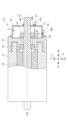
- FIG. 1 is a configuration diagram of an electric motor 1 according to a first embodiment.
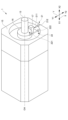
- FIG. 2 is a perspective view showing the configuration of the X2 side of the electric motor 1 in the first embodiment.
- FIG. 11 is a configuration diagram of an electric motor 1A according to a second embodiment.
- FIG. 11 is a configuration diagram of an electric motor 1B according to a third embodiment.
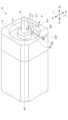
- FIG. 13 is a perspective view showing the configuration of the X2 side of an electric motor 1C in a fourth embodiment.
- the direction parallel to the central axis OA of the electric motor 1 shown in FIG. 1 is the X direction (hereinafter also referred to as the "axial direction X").
- the axial direction X the direction in which rotational force is taken out (to the left in the drawing)
- the X1 direction the direction in which rotational force is taken out (to the left in the drawing)
- the X2 direction the direction opposite to the X1 direction
- the direction perpendicular to the axial direction X is the radial direction Y.
- the radial direction Y perpendicular to the axial direction X is not uniquely specified, but in this specification, the vertical direction shown in FIG. 1 is described as the radial direction Y, the upward direction in the drawing as the Y1 direction, and the downward direction as the Y2 direction.
- “direction” is also referred to as "side” as appropriate.
- Fig. 1 is a configuration diagram of an electric motor 1 in the first embodiment.
- Fig. 2 is a perspective view showing the configuration of the X2 side of the electric motor 1 in the first embodiment. Note that Fig. 2 shows a state in which a sensor cover 18 (described later) is removed.
- the electric motor in the first embodiment is, for example, a rotating electric machine used as a power source for a machine tool or the like, but its application is not limited to machine tools. Also, in each embodiment including the first embodiment, an electric motor (motor) is described as an example of the rotating electric machine, but the rotating electric machine may be a generator.
- the electric motor 1 of the first embodiment includes a stator 11, a rotor 12, a rotating shaft 13, and a bearing 14.
- the electric motor 1 also includes a housing 15, a sensor gear 16, a rotation sensor 17, a sensor cover (outer cover) 18, a first air introduction section 21, and a second air introduction section 22.
- stator 11 and housing 15 which are arranged on the outside in the radial direction Y, are held by a frame (not shown) attached to their outer periphery.
- the frame is an exterior member that covers the outside of the electric motor 1.
- the configuration of the electric motor 1 also includes other parts that are not shown, but here only the main configuration of the electric motor 1 will be described.
- the stator 11 is a member that forms a rotating magnetic field for rotating the rotor 12.
- the stator 11 includes an iron core and a stator frame (neither of which are shown), and is fixed inside a frame.
- a rotating magnetic field is formed in the stator 11, and a rotor 12 (described later) generates a rotational force in the rotor 12 due to magnetic interaction between the stator 11 and the rotor 12, and the rotational force is output to the outside via the rotating shaft 13.
- the rotor 12 is a component that rotates due to magnetic interaction with the rotating magnetic field generated by the stator 11, and includes a sleeve, a permanent magnet, a covering cylinder, etc. (none of which are shown).
- the rotating shaft 13 is a member that supports the rotor 12.
- the rotating shaft 13 is inserted so as to penetrate the axial center of the rotor 12, and is fixed coaxially with the rotor 12.
- the rotating shaft 13 rotates together with the rotor 12.
- a pair of bearings 14 are fitted to both sides of the rotating shaft 13 in the axial direction X (X1 side is not shown).
- the bearings 14 are a member that rotatably supports the rotating shaft 13, and are fixed to a housing 15 (described later).
- the rotating shaft 13 is held rotatably around the axial direction X by the housing 15, bearings 14, etc.
- a sensor gear 16 (described later) is attached to the rotating shaft 13 at a position on the X2 side of the bearings 14.
- the housing 15 is a member that holds the rotating shaft 13 via the bearing 14.
- the housing 15 also holds other components directly or indirectly.
- the housing 15 is provided with a first air introduction section 21 and a second air introduction section 22. Note that while the housing 15 is illustrated as an integrated component in FIG. 1, the housing 15 may be configured as a plurality of components.
- the sensor gear 16 is fixed coaxially to the rotating shaft 13 and is a rotating body whose outer circumferential surface is adjacent to the rotation sensor 17.
- the sensor gear 16 rotates together with the rotating shaft 13.
- the sensor gear 16 is configured in a substantially annular shape.
- a gap g is formed between the sensor gear 16 and the rotation sensor 17 (described below).
- the gap g is approximately 0.1 mm.
- the rotation sensor 17 is an electronic component that detects the rotation angle position and rotation speed around the central axis OA of the sensor gear 16.
- the rotation sensor 17 is provided in the space S on the X1 side of the sensor cover 18 (described below).
- the rotation sensor 17 is also attached to the X2 side of the housing 15 in the space S, and is provided so that the sensor surface 17a faces the outer peripheral surface 16a of the sensor gear 16.
- Figures 1 and 2 show an example in which the rotation sensor 17 is provided on the Y2 side of the radial direction Y (the lower side in the figure), the position at which the rotation sensor 17 is provided is not limited to the example shown.
- the sensor cover (outer cover) 18 is a cover for protecting the sensor gear 16 and the rotation sensor 17.
- the sensor cover 18 is attached to the housing 15 and covers the opening on the X2 side of the electric motor 1.
- the space S formed by the housing 15 and the sensor cover 18 is the space in which a part of the rotating shaft 13 is disposed, and is also the space in which the rotation sensor 17 is provided.
- the sensor cover 18 has a hole 18a through which the rotating shaft 13 passes.
- the first air introduction section 21 and the second air introduction section 22 are injectors of compressed air.
- the compressed air is air having a pressure of, for example, about 0.1 to 0.9 MPa.
- the compressed air is produced by an air compressor and then supplied to the air introduction section via air piping (neither is shown). In FIG. 1, the flow of the compressed air is indicated by dashed arrows.
- the compressed air may be blown onto the periphery of the rotation sensor 17.
- the periphery of the rotation sensor 17 refers to, for example, an area of several tens of mm around the rotation sensor 17.
- the first air introduction section 21 and the second air introduction section 22 of the first embodiment are both provided in the housing 15.
- the first air introduction section 21 and the second air introduction section 22 open toward the space S formed between the housing 15 and the sensor cover 18.
- the first air introduction section 21 is provided on the X2 side of the second air introduction section 22 in the axial direction X of the housing 15.
- the first air introduction section 21 includes a passage section 211 and a joint 212.
- the passage section 211 is a tubular hole formed in the housing 15.
- the joint 212 is a component connected to the passage section 211 on one side and connected to an air pipe (not shown) on the other side.
- the first air introduction section 21 is configured to blow compressed air from the Y2 side toward the Y1 side (the underside of the rotation sensor 17) of the rotation sensor 17.
- the second air introduction section 22 is provided on the X1 side of the first air introduction section 21 in the axial direction X of the sensor cover 18.
- the second air introduction section 22 includes a passage section 221 and a joint 222.
- the passage section 221 is a generally L-shaped hole formed in the housing 15.
- the joint 222 is a component connected to the passage section 221 at one end and connected to an air pipe (not shown) at the other end.
- the second air introduction section 22 is configured to blow compressed air toward the rotation sensor 17 from the X1 side toward the X2 side. According to this configuration, as shown in the partially enlarged view of FIG. 1, the compressed air introduced from the second air introduction section 22 is blown into the gap g between the sensor surface 17a of the rotation sensor 17 and the outer circumferential surface 16a of the sensor gear 16.
- the first air introduction section 21 is configured to blow compressed air from the Y2 side toward the upper side Y1 in the radial direction Y.
- the second air introduction section 22 is configured to blow compressed air from the X1 side toward the X2 side in the axial direction X.
- the first air introduction section 21 and the second air introduction section 22 are configured to blow compressed air toward the rotation sensor 17 from different directions.
- compressed air is continuously supplied to the first air introduction section 21 and the second air introduction section 22 from the air compressor.
- the compressed air introduced from the first air introduction section 21 and the second air introduction section 22 is blown onto the rotation sensor 17 from different directions. Therefore, compared to a configuration in which compressed air is blown onto the rotation sensor 17 from the same direction at multiple air introduction sections, foreign matter adhering to the rotation sensor 17 can be more reliably removed.
- compressed air is configured to be blown onto the periphery of the rotation sensor 17; by blowing compressed air onto the periphery of the rotation sensor 17 from different directions, foreign matter adhering to the periphery of the rotation sensor 17 can be more reliably removed.
- the compressed air introduced from the second air introduction section 22 is blown into the gap between the sensor surface 17a of the rotation sensor 17 and the outer peripheral surface 16a of the sensor gear 16. This makes it possible to more accurately remove foreign matter adhering to the gap between the sensor surface 17a of the rotation sensor 17 and the outer peripheral surface 16a of the sensor gear 16.
- the first air inlet 21 and the second air inlet 22 in the first embodiment are both provided in the housing 15, so compressed air can be blown from a position close to the rotation sensor 17 or its surroundings.
- the air inlet is not provided in the sensor cover 18, the sensor cover 18 can be easily attached and detached, and maintenance is also easy.
- the electric motor 1A of the second embodiment differs from that of the first embodiment in the form of the air introduction portion.
- the other configurations of the electric motor 1A of the second embodiment are the same as those of the first embodiment. Therefore, in the description and drawings of the second embodiment, the same reference numerals as those of the first embodiment are used for the members and the like equivalent to those of the first embodiment, and duplicated descriptions are omitted.
- FIG. 3 is a configuration diagram of the electric motor 1A in the second embodiment.
- the first air introduction section 21 and the second air introduction section 22 are both provided in the sensor cover 18.
- the first air introduction section 21 and the second air introduction section 22 are open toward the space S formed between the housing 15 and the sensor cover 18.
- the first air introduction section 21 is provided on the X2 side of the sensor cover 18.
- the first air introduction section 21 is configured with a joint 212.
- the joint 212 is attached to a hole 18b provided on the X2 side of the sensor cover 18.
- the first air introduction section 21 is configured to blow compressed air from the X2 side toward the X1 side of the rotation sensor 17. According to this configuration, the compressed air introduced from the first air introduction section 21 is blown into the gap g (see FIG. 1) between the sensor surface 17a of the rotation sensor 17 and the outer peripheral surface 16a of the sensor gear 16.
- the second air introduction section 22 is provided on the Y2 side of the sensor cover 18.
- the second air introduction section 22 is configured with a joint 222.
- the joint 222 is attached to a hole 18c provided on the Y2 side of the sensor cover 18.
- the second air introduction section 22 is configured to blow compressed air from the Y2 side toward the Y1 side of the rotation sensor 17.
- the electric motor 1A of the third embodiment shown in Figure 3 is equipped with the first air introduction section 21 and the second air introduction section 22 described above, and therefore, like the electric motor 1 of the first embodiment, can more reliably remove foreign matter adhering to the rotation sensor 17 or its surrounding area while maintaining the effect of the air purging. Since the first air introduction section 21 and the second air introduction section 22 in the second embodiment are both provided on the sensor cover 18, it is possible to easily perform the installation of the air introduction sections and the installation of air piping (not shown), etc.
- the electric motor 1B of the third embodiment differs from the first embodiment in the form of the air introduction portion.
- the other configurations of the electric motor 1B of the third embodiment are the same as those of the first embodiment. Therefore, in the explanation and drawings of the third embodiment, the same reference numerals as those of the first embodiment are used for the same members and the like, and redundant explanations will be omitted.
- FIG. 4 is a configuration diagram of an electric motor 1B in the third embodiment.
- the electric motor 1B in the third embodiment has a first air introduction section 21, a second air introduction section 22, and a third air introduction section 23.
- the first air introduction section 21, the second air introduction section 22, and the third air introduction section 23 are open toward the space S formed between the housing 15 and the sensor cover 18.
- the first air introduction section 21 is configured to blow compressed air toward the rotation sensor 17 from the Y2 side toward the Y1 side (the lower surface side of the rotation sensor 17).
- the second air introduction section 22 is configured to blow compressed air toward the rotation sensor 17 from the X1 side toward the X2 side. According to this configuration, the compressed air introduced from the second air introduction section 22 is blown into the gap g (see FIG. 1) between the sensor surface 17a of the rotation sensor 17 and the outer peripheral surface 16a of the sensor gear 16.
- the configuration of the third air introduction section 23 is the same as that of the first air introduction section 21 in the second embodiment, so a duplicated description will be omitted.
- the third air introduction section 23 is configured to blow compressed air toward the rotation sensor 17 from the X2 side toward the X1 side. According to this configuration, the compressed air introduced from the third air introduction section 23 is blown into the gap g (see FIG. 1) between the sensor surface 17a of the rotation sensor 17 and the outer peripheral surface 16a of the sensor gear 16.
- the electric motor 1B of the third embodiment shown in FIG. 4 is equipped with the first air introduction section 21, the second air introduction section 22, and the third air introduction section 23 described above, and thus, like the electric motor 1 of the first embodiment, can more reliably remove foreign matter adhering to the rotation sensor 17 or its surrounding area while maintaining the effect of the air purge.
- the first air introduction section 21, the second air introduction section 22, and the third air introduction section 23 each blow compressed air onto the rotation sensor 17 from a different direction, so that foreign matter adhering to the rotation sensor 17 can be removed more efficiently.
- the same effect can be obtained even if the compressed air is configured to blow onto the periphery of the rotation sensor 17.
- compressed air is blown into the gap g between the sensor surface 17a of the rotation sensor 17 and the outer peripheral surface 16a of the sensor gear 16 from opposite sides in the axial direction X. Therefore, foreign matter adhering to the gap g between the sensor surface 17a of the rotation sensor 17 and the outer peripheral surface 16a of the sensor gear 16 can be removed more accurately and efficiently.
- the electric motor 1C of the fourth embodiment differs from that of the first embodiment in the configuration of the second air introduction section 22A.
- the other configurations of the electric motor 1C of the fourth embodiment are the same as those of the first embodiment. Therefore, in the description and drawings of the fourth embodiment, the same reference numerals as those of the first embodiment are used for the same members and the like, and redundant description will be omitted.
- Fig. 5 is a diagram of the configuration of the electric motor 1C in the fourth embodiment.
- the second air introduction section 22A includes a joint 222 and an extension tube 223.
- the extension tube 223 is a pipe-shaped member, and one end of the extension tube 223 is connected to the joint 222.
- the other end of the extension tube 223 opens toward the gap g (see Fig. 1) between the sensor surface 17a of the rotation sensor 17 and the outer peripheral surface 16a of the sensor gear 16.
- the first air introduction section 21 is configured to blow compressed air toward the rotation sensor 17 from the Y2 side toward the Y1 side.
- the second air introduction section 22A is configured to blow compressed air in a direction perpendicular to the direction in which the first air introduction section 21 blows compressed air (Y direction) when viewed from the axial direction X.
- the first air introduction section 21 and the second air introduction section 22A are configured to blow compressed air toward the rotation sensor 17 from different directions.
- the electric motor 1C of the fourth embodiment shown in FIG. 5 is equipped with the first air inlet section 21 and the second air inlet section 22A described above, and thus, like the electric motor 1 of the first embodiment, can more reliably remove foreign matter adhering to the rotation sensor 17 or its surrounding area while maintaining the effect of the air purge.
- the second air introduction section 22A of the fourth embodiment is provided with an extension tube 223 that opens toward the gap g between the rotation sensor 17 and the sensor gear 16.
- the compressed air introduced from the extension tube 223 is blown from a position close to the foreign matter attached to the rotation sensor 17, so that a stronger airflow of compressed air can be applied to the foreign matter. Therefore, the foreign matter attached to the gap g between the rotation sensor 17 and the sensor gear 16 can be removed more accurately and quickly.
- compressed air may be introduced from one location, and a passage may be branched inside the housing 15 or outside the sensor cover 18 to distribute the compressed air to the first air introduction section 21 and the second air introduction section 22.
- This embodiment may also be applied to the air introduction sections of the third and fourth embodiments.
- the pressure of the compressed air introduced from the air introduction section may be the same or different.
- the pressure of the compressed air introduced to the second air introduction section 22 may be greater than the pressure of the compressed air introduced to the first air introduction section 21. Since the compressed air introduced to the second air introduction section 22 is blown into the gap g between the rotation sensor 17 and the sensor gear 16, by making the pressure of the compressed air introduced to the second air introduction section 22 greater than the pressure of the compressed air introduced to the first air introduction section 21, foreign matter adhering to the gap between the rotation sensor 17 and the sensor gear 16 can be more accurately removed.
- compressed air may be continuously introduced from the air introduction section while the motor is operating, and the introduction of compressed air from the air introduction section may be stopped while the motor is not operating.
- the introduction or stopping of compressed air may be performed at different times in each air introduction section.
- a rotating electric machine (1) having electronic components (17) in a space formed between a housing (15) that holds a rotating shaft (13) and an outer cover (18) through which the rotating shaft passes, the rotating electric machine (1) has a plurality of air inlet ports (21, 22) that open into the space, and air introduced from the plurality of air inlet ports is blown onto the electronic components or their surroundings from different directions.
- the air introduced from the plurality of air introduction portions is blown onto the electronic component or the periphery thereof from different directions in the radial direction and/or the axial direction of the rotating shaft.
- the space in which a portion of the rotating shaft is disposed is defined by a housing and an outer cover, and the housing and the outer cover each include at least one of the air introduction portions.
- the space in which a portion of the rotating shaft is disposed is defined by a housing and an outer cover, and the housing or the outer cover is provided with a plurality of the air introduction portions.
- the rotating shaft is provided with a rotating body (16) that rotates coaxially with the rotating shaft and has an outer circumferential surface adjacent to the electronic component, and air introduced from at least one of the air introduction ports is blown between the electronic component and the outer circumferential surface of the rotating body.
- Air introduced from at least one of the air introduction parts is blown between the electronic component and the outer circumferential surface of the rotating body via an extension pipe (223) provided in the air introduction part.
Landscapes
- Engineering & Computer Science (AREA)
- Power Engineering (AREA)
- Motor Or Generator Frames (AREA)
Priority Applications (2)
| Application Number | Priority Date | Filing Date | Title |
|---|---|---|---|
| JP2025532277A JPWO2025013187A1 (https=) | 2023-07-10 | 2023-07-10 | |
| PCT/JP2023/025499 WO2025013187A1 (ja) | 2023-07-10 | 2023-07-10 | 回転電機 |
Applications Claiming Priority (1)
| Application Number | Priority Date | Filing Date | Title |
|---|---|---|---|
| PCT/JP2023/025499 WO2025013187A1 (ja) | 2023-07-10 | 2023-07-10 | 回転電機 |
Publications (1)
| Publication Number | Publication Date |
|---|---|
| WO2025013187A1 true WO2025013187A1 (ja) | 2025-01-16 |
Family
ID=94215260
Family Applications (1)
| Application Number | Title | Priority Date | Filing Date |
|---|---|---|---|
| PCT/JP2023/025499 Ceased WO2025013187A1 (ja) | 2023-07-10 | 2023-07-10 | 回転電機 |
Country Status (2)
| Country | Link |
|---|---|
| JP (1) | JPWO2025013187A1 (https=) |
| WO (1) | WO2025013187A1 (https=) |
Citations (6)
| Publication number | Priority date | Publication date | Assignee | Title |
|---|---|---|---|---|
| JPS63105454U (https=) * | 1986-12-25 | 1988-07-08 | ||
| JPH01133538A (ja) * | 1987-11-17 | 1989-05-25 | Fanuc Ltd | 防液対策モータ |
| JP2007105850A (ja) * | 2005-10-14 | 2007-04-26 | Brother Ind Ltd | 主軸装置及び当該装置を備えた工作機械 |
| JP2014143833A (ja) * | 2013-01-24 | 2014-08-07 | Mitsubishi Electric Corp | 回転電機 |
| JP2017093184A (ja) * | 2015-11-12 | 2017-05-25 | 三菱電機株式会社 | 車両用回転電機 |
| JP2021090254A (ja) * | 2019-12-03 | 2021-06-10 | ファナック株式会社 | 電動機 |
-
2023
- 2023-07-10 JP JP2025532277A patent/JPWO2025013187A1/ja active Pending
- 2023-07-10 WO PCT/JP2023/025499 patent/WO2025013187A1/ja not_active Ceased
Patent Citations (6)
| Publication number | Priority date | Publication date | Assignee | Title |
|---|---|---|---|---|
| JPS63105454U (https=) * | 1986-12-25 | 1988-07-08 | ||
| JPH01133538A (ja) * | 1987-11-17 | 1989-05-25 | Fanuc Ltd | 防液対策モータ |
| JP2007105850A (ja) * | 2005-10-14 | 2007-04-26 | Brother Ind Ltd | 主軸装置及び当該装置を備えた工作機械 |
| JP2014143833A (ja) * | 2013-01-24 | 2014-08-07 | Mitsubishi Electric Corp | 回転電機 |
| JP2017093184A (ja) * | 2015-11-12 | 2017-05-25 | 三菱電機株式会社 | 車両用回転電機 |
| JP2021090254A (ja) * | 2019-12-03 | 2021-06-10 | ファナック株式会社 | 電動機 |
Also Published As
| Publication number | Publication date |
|---|---|
| JPWO2025013187A1 (https=) | 2025-01-16 |
Similar Documents
| Publication | Publication Date | Title |
|---|---|---|
| JP4731639B1 (ja) | 回転電機、軸受着脱用治具、および軸受交換方法 | |
| JP5180652B2 (ja) | 蒸気タービンの車室構造 | |
| JP7006768B2 (ja) | アクスル構造 | |
| CN105281476B (zh) | 电动机 | |
| JP2018157715A (ja) | 電動機 | |
| US20240088755A1 (en) | Electrical machine and method for cleaning an air gap in an electrical machine | |
| CN102149950B (zh) | 具有切向引流分配环的转轴密封 | |
| WO2025013187A1 (ja) | 回転電機 | |
| JP5394116B2 (ja) | 貫通孔付き空冷式電動機 | |
| JP6946224B2 (ja) | 軸受装置の冷却構造 | |
| JP2011240416A (ja) | 工作機械の主軸装置 | |
| JP2012139278A (ja) | ミシン | |
| JP4946114B2 (ja) | 回転機械 | |
| JP2016142315A (ja) | ボルト抜け止め構造 | |
| KR20130069536A (ko) | 레일 차량들을 위한 드라이브 유닛 | |
| JP6447724B2 (ja) | 回転機械 | |
| JP4264731B2 (ja) | 静圧空気軸受スピンドル | |
| JP5510052B2 (ja) | 工作機械の主軸装置 | |
| KR20220128288A (ko) | 발전기 보강재 링 | |
| JP2012139281A (ja) | モータカバー及び該モータカバーを備えたミシン | |
| JP7758084B2 (ja) | 回転機 | |
| JP2018202934A (ja) | パワーユニットの製造方法及びその製造方法に用いる組付け治具 | |
| CN109818445B (zh) | 电动机以及机床 | |
| JP7827016B2 (ja) | 回転電機のステータの焼き嵌め構造 | |
| JP2023036351A (ja) | 回転電機 |
Legal Events
| Date | Code | Title | Description |
|---|---|---|---|
| 121 | Ep: the epo has been informed by wipo that ep was designated in this application |
Ref document number: 23945066 Country of ref document: EP Kind code of ref document: A1 |
|
| ENP | Entry into the national phase |
Ref document number: 2025532277 Country of ref document: JP Kind code of ref document: A |
|
| WWE | Wipo information: entry into national phase |
Ref document number: 2025532277 Country of ref document: JP |
|
| NENP | Non-entry into the national phase |
Ref country code: DE |