WO2025009554A1 - 食品組成物及び食品組成物の製造方法 - Google Patents
食品組成物及び食品組成物の製造方法 Download PDFInfo
- Publication number
- WO2025009554A1 WO2025009554A1 PCT/JP2024/024058 JP2024024058W WO2025009554A1 WO 2025009554 A1 WO2025009554 A1 WO 2025009554A1 JP 2024024058 W JP2024024058 W JP 2024024058W WO 2025009554 A1 WO2025009554 A1 WO 2025009554A1
- Authority
- WO
- WIPO (PCT)
- Prior art keywords
- food composition
- fermented
- dried
- putty
- drum
- Prior art date
- Legal status (The legal status is an assumption and is not a legal conclusion. Google has not performed a legal analysis and makes no representation as to the accuracy of the status listed.)
- Ceased
Links
Images


Classifications
-
- A—HUMAN NECESSITIES
- A23—FOODS OR FOODSTUFFS; TREATMENT THEREOF, NOT COVERED BY OTHER CLASSES
- A23J—PROTEIN COMPOSITIONS FOR FOODSTUFFS; WORKING-UP PROTEINS FOR FOODSTUFFS; PHOSPHATIDE COMPOSITIONS FOR FOODSTUFFS
- A23J3/00—Working-up of proteins for foodstuffs
- A23J3/14—Vegetable proteins
- A23J3/16—Vegetable proteins from soybean
-
- A—HUMAN NECESSITIES
- A23—FOODS OR FOODSTUFFS; TREATMENT THEREOF, NOT COVERED BY OTHER CLASSES
- A23J—PROTEIN COMPOSITIONS FOR FOODSTUFFS; WORKING-UP PROTEINS FOR FOODSTUFFS; PHOSPHATIDE COMPOSITIONS FOR FOODSTUFFS
- A23J3/00—Working-up of proteins for foodstuffs
- A23J3/22—Working-up of proteins for foodstuffs by texturising
- A23J3/225—Texturised simulated foods with high protein content
- A23J3/227—Meat-like textured foods
-
- A—HUMAN NECESSITIES
- A23—FOODS OR FOODSTUFFS; TREATMENT THEREOF, NOT COVERED BY OTHER CLASSES
- A23L—FOODS, FOODSTUFFS OR NON-ALCOHOLIC BEVERAGES, NOT OTHERWISE PROVIDED FOR; PREPARATION OR TREATMENT THEREOF
- A23L11/00—Pulses, i.e. fruits of leguminous plants, for production of food; Products from legumes; Preparation or treatment thereof
-
- A—HUMAN NECESSITIES
- A23—FOODS OR FOODSTUFFS; TREATMENT THEREOF, NOT COVERED BY OTHER CLASSES
- A23L—FOODS, FOODSTUFFS OR NON-ALCOHOLIC BEVERAGES, NOT OTHERWISE PROVIDED FOR; PREPARATION OR TREATMENT THEREOF
- A23L5/00—Preparation or treatment of foods or foodstuffs, in general; Food or foodstuffs obtained thereby; Materials therefor
Definitions
- the present invention relates to a food composition and a method for producing a food composition.
- Meat is rich in nutrients such as vitamins, proteins, and minerals, and is a nutritionally important food.
- meat also contains a lot of lipids, especially saturated fatty acids, and has a high energy content compared to other foods, so excessive meat intake can be a cause of various chronic diseases, including metabolic syndrome.
- Meat-like foods are foods made from ingredients that contain less saturated fatty acids and are lower in energy than meat, but about the same amount of protein as meat. Consuming meat-like foods instead of meat can lead to the prevention and improvement of lifestyle-related diseases such as metabolic syndrome.
- Patent Documents 1 and 2 As representative meat-like foods, foods made from grains such as soybeans are processed for various purposes and used in food compositions and foods (Patent Documents 1 and 2).
- meat-like foods made from grain ingredients such as soybeans lack the texture of minced meat, especially the juiciness, and lack the elasticity and fibrous texture of meat.
- meat-like foods that contain grain ingredients rich in dietary fiber, such as soybean pulp tend to have a dry texture, be brittle, and crumble easily.
- the present invention aims to provide a food composition that has a fibrous texture similar to that of meat.
- the inventors conducted extensive research to solve the above problems and discovered that a food composition that exhibits a specific breaking stress value has a fibrous texture similar to that of meat.
- the present invention is as follows. [1] Contains fermented plant materials, When molded into a putty, the breaking stress at a breaking strain rate of 50% is 1.00 N / m 2 or more. Food composition. [2] The food composition according to [1] above, wherein the plant material is a cereal-derived material. [3] The food composition according to the above-mentioned [1] or [2], wherein the fermented product is a koji mold fermented product. [4] The food composition according to [1] or [2] above, wherein in a sieving test using the food composition, the ratio of the mass of particles having a particle size of 1,000 ⁇ m or more and less than 4,500 ⁇ m to the total mass of the food composition is 5% or more.
- the food composition contains moisture, The food composition according to [1] or [2] above, wherein the mass ratio of the fermented product is 5 to 40% and the mass ratio of vegetable protein other than the fermented product is 4 to 40% relative to the total mass of the food composition.
- the food composition does not contain moisture, The food composition according to [1] or [2] above, wherein the mass ratio of the fermented product is 20 to 100% and the mass ratio of vegetable proteins other than the fermented product is 0 to 80% relative to the total mass of the food composition.
- a method for producing a food composition comprising fermenting a plant material with a microorganism, and obtaining a food composition which is the food composition according to [1] or [2] above.
- a method for producing the food composition described in [8] comprising fermenting the plant material with the microorganism and drying the fermented product.
- a food composition that exhibits a specific breaking stress which is one aspect of the present invention, has an excellent fibrous texture similar to that of meat.
- FIG. 1 is a photograph of drum-dried pate-like fermented soybean pulp.
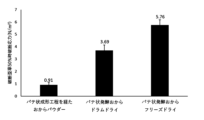
- FIG. 2 is a graph showing the breaking stress at a breaking strain rate of 50% for soybean pulp powder that has been subjected to a putty-like molding process, drum-dried putty-like fermented soybean pulp, and freeze-dried putty-like fermented soybean pulp.
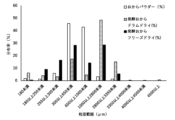
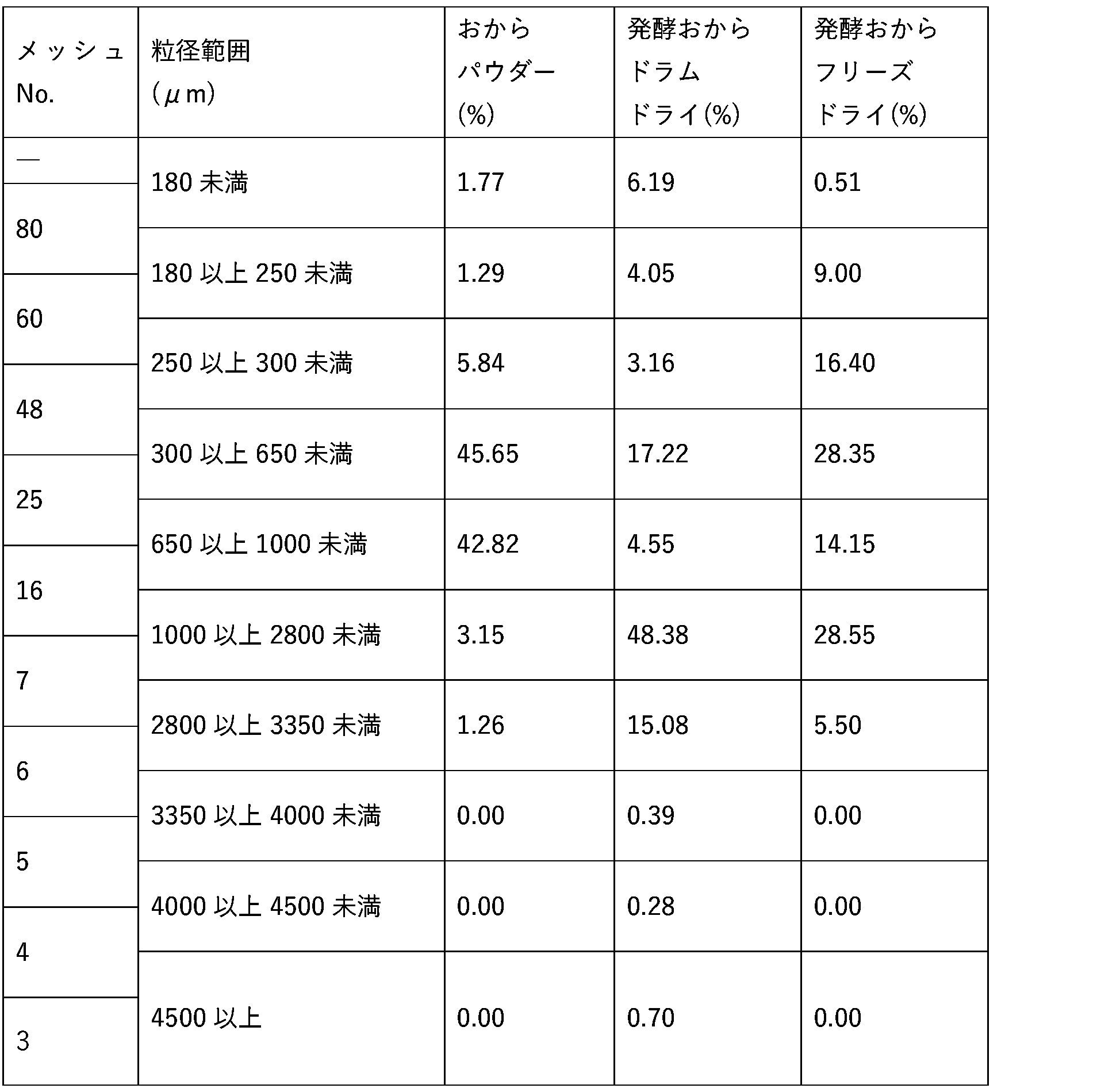
- FIG. 3 is a graph showing the particle size distribution of soybean pulp powder, drum-dried fermented soybean pulp, and freeze-dried fermented soybean pulp.
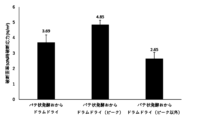
- FIG. 4 is a graph showing the breaking stress at a breaking strain rate of 50% for drum-dried putty-like fermented soybean pulp, freeze-dried putty-like fermented soybean pulp consisting only of particles with a particle size of 1,000 ⁇ m to 2,800 ⁇ m, and freeze-dried putty-like fermented soybean pulp consisting only of particles with a particle size other than 1,000 ⁇ m to 2,800 ⁇ m.
- FIG. 5 is a graph showing the breaking stress at a breaking strain rate of 50% for drum-dried putty-like fermented soybean lees (ATCC22788 strain) and drum-dried putty-like fermented soybean lees (ATCC1011 strain).
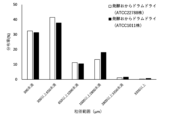
- 6 is a graph showing the particle size distribution of drum-dried fermented soybean lees (ATCC22788 strain) and drum-dried fermented soybean lees (ATCC1011 strain).
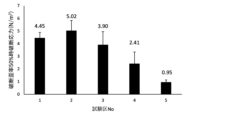
- 7 is a graph showing the breaking stress at a breaking strain rate of 50% for putties No. 1 to 5.
- the present invention will be described in detail below, but these are merely examples of preferred embodiments and the present invention is not limited to these contents.
- the numerical range "to” includes the numerical values before and after it.
- "0% by mass to 100% by mass” means a range from 0% by mass or more to 100% by mass or less.
- a ratio (percentage, part, etc.) based on weight is the same as a ratio (percentage, part, etc.) based on mass.
- a food composition according to one embodiment of the present invention contains a fermented product of a plant material, and when formed into a patty, has a breaking stress of 1.00 N/ m2 or more at a breaking strain rate of 50%. Such a food composition has an excellent fibrous texture similar to that of meat.
- plants raw materials include those containing at least one of a carbon source and a nitrogen source.
- plant materials include grain-derived materials and fruit-derived materials.
- Grain-derived raw materials include, for example, protein-derived raw materials derived from whole soybeans, defatted soybeans, soy protein, wheat gluten, peas, fava beans, red beans, etc., and starch-derived raw materials derived from wheat, barley, rye, bran, rice, rice bran, corn, starch meal, etc.
- Grain-derived raw materials may be bean pomace, wheat bran, brewer's grains, or corn flour.
- Wheat bran is the outer layer of wheat grains and is also called wheat bran. Brewer's grains is the residue left over when making beer, and refers to the solid matter that remains after mixing and stirring crushed malt with hot water and filtering to remove the wort. These can be used alone or in combination.
- the grain-derived raw material is preferably rich in carbon and nitrogen sources.
- the grain-derived raw material is preferably bean pomace, and more preferably soybean pulp. Soybean pulp is soybean pomace.
- a fermented product of a plant material is a product obtained by fermenting a plant material with a microorganism, or a product obtained by fermenting a plant material with a microorganism.
- microorganisms include filamentous fungi including koji mold, lactic acid bacteria, yeast, etc.
- a koji mold fermented product of a plant material is a product obtained by fermenting a plant material with koji mold, or a product obtained by fermenting a plant material with koji mold.
- the type of koji mold is not particularly limited, but from the viewpoint of being a fungus used in food manufacturing, koji molds of the genus Aspergillus are preferred. Among them, Aspergillus oryzae, Aspergillus awamori, Aspergillus inui, Aspergillus usamii, Aspergillus saitoi, etc. are preferred.
- ATCC1011 strain, ATCC22788 strain, NISL1365 strain, NISL2074 strain, NISL1018 strain, etc. are preferred, with ATCC1011 strain and ATCC22788 strain being more preferred.
- Aspergillus awamori JCM22312 strain is preferred.
- NISL1608 strain is preferred.
- ATCC11364 strain is preferred.
- Aspergillus saitoi the NISL1541 strain is preferred.
- the ATCC1011, ATCC22788, and ATCC11364 strains are available from The Global Bioresource Center.
- the JCM22312 strain is available from the National Research and Development Agency, RIKEN.
- the fermented product is preferably a fermented product obtained by fermenting a plant raw material and then drying it, and may be a fermented product obtained by fermenting a plant raw material and then drying it.
- drying methods include drum drying and freeze drying. Details of the drying methods are described below.
- the breaking stress is the force applied per unit cross-sectional area at the time of breaking, and is an index that is independent of the dimensions of the sample and allows comparison of the mechanical action applied to samples of different dimensions.
- the breaking strain rate is a parameter related to fragility and brittleness. In the measurement of breaking stress, the breaking strain rate is expressed as the degree to which the sample is deformed by the breaking load F until it breaks, that is, if the height of the sample is H (mm) and the distance the plunger has advanced is ⁇ H (mm), then the breaking strain rate is expressed as ⁇ H/H ( ⁇ 100%).
- breaking stress is specifically the average value of the breaking stress measured at three points approximately in the center of the top surface at a breaking strain rate of 50% using a texture analyzer (Shimadzu Corporation, EZ-SX) with a wedge-shaped plunger 40 mm wide x 112 mm long and 30 degrees angle, a load cell of 50 N, and a compression (measurement) speed of 1.0 mm/sec., with a putty-like food composition placed on the measurement table as the measurement sample, with a product temperature of 20 ⁇ 5°C, a sample thickness of 1.8 cm, and an inner diameter of 7.5 cm.
- a texture analyzer Shiadzu Corporation, EZ-SX
- the breaking stress is a value measured when the food composition is formed into a putty-like shape.
- the putty-like shape refers to a food composition obtained by adding water to the dried material, kneading, forming, and baking the dried material, and particularly refers to a food composition containing the above-mentioned fermented product of a plant material that is made into a paste and formed into a circular shape with an inner diameter of 5 to 20 cm and a thickness of 1 to 5 cm to a uniform thickness.
- the food composition of one embodiment of the present invention can be formed into a putty-like shape by mixing with water and forming the food composition.
- the state of being molded into a putty shape includes a state molded by the following procedure.
- the food composition contains only a dried material
- 16.7 g of the dried material is used, and mixed so that the dried material and water are in a ratio of 1:2 by mass, and kneaded for 10 seconds with a kneading machine (manufactured by Tiger Corporation, product name "Microcomputer Food Processor SKF-H101").
- the kneaded sample is molded into a circle with a thickness of 1.8 cm and an inner diameter of 7.5 cm.
- the food composition of one embodiment of the present invention has a breaking stress of 1.00 N/m2 or more at a breaking strain rate of 50% measured by a texture analyzer when molded into a patty.
- the breaking stress is 1.00 N/ m2 or more
- the food composition exhibits a highly fibrous texture similar to that of livestock meat, as shown in the examples described later.
- the food composition of one embodiment of the present invention does not easily melt in the mouth even when chewed when eaten, and has a texture similar to that of livestock meat.
- the breaking stress is 1.00 N/m 2 or more, preferably 2.00 N/m 2 or more, more preferably 3.00 N/m 2 or more, and even more preferably 5.00 N/m 2 or more.
- Cultivation using filamentous fungi such as Aspergillus produces fungal bodies of a certain size, and the powder particle size becomes large, resulting in a fibrous texture.
- the culture solution is dried, a powder with a large particle size is obtained, which leads to a meat-like fibrous texture.
- the breaking stress at a breaking strain rate of 50% can be made to be 1.00 N/ m2 or more.
- composition of food composition may contain only the fermented product, but from the standpoint of processing suitability, it may also contain vegetable protein and/or dietary fiber, etc. in addition to the fermented product.
- Vegetable proteins are proteins extracted from plants.
- sources of vegetable proteins include wheat gluten or cereals such as wheat, barley, oats, rice, or corn, isolated soy protein, defatted soybeans or soybeans, legumes such as peas, adzuki beans, chickpeas, lentils, fava beans, or mung beans, and nuts and seeds such as almonds, peanuts, cashew nuts, pistachios, hazelnuts, macadamia nuts, flaxseed, sesame seeds, and rapeseed.
- Examples of vegetable proteins include the pomace of the above plants, for example, legume pomace, in particular soybean pulp.
- the mass ratio of the fermented product is preferably 5-40% and the mass ratio of the vegetable protein other than the fermented product is preferably 4-40%, more preferably 5-40%, relative to the total mass of the food composition. Furthermore, when the food composition of one embodiment of the present invention contains water, the mass ratio of water is preferably 30-70%, more preferably 50-60%, relative to the total mass of the food composition.
- the mass ratio of the fermented product is 20 to 100% and the mass ratio of the vegetable protein other than the fermented product is 0 to 80% relative to the total mass of the food composition.
- the dietary fiber may be either soluble or insoluble.
- the soluble dietary fiber in the present invention may be, for example, at least one selected from the group consisting of soybean dietary fiber, polydextrose, indigestible dextrin, galactomannan, inulin, hydrolyzed guar gum, pectin, gum arabic, etc.
- the insoluble dietary fiber is edible fiber that is insoluble in water, and may be, for example, at least one selected from the group consisting of cellulose, wheat fiber, oat fiber, citrus fiber, soybean fiber, pea fiber, mung bean fiber, etc. From the viewpoint of a strong meat-like fibrous texture, it is preferable that the weight of dietary fiber is 20% to 50% of the total weight of the food composition of one embodiment of the present invention.
- the food composition of one embodiment of the present invention preferably does not contain meat. Even if the food composition of one embodiment of the present invention does not contain meat, it has a fibrous texture similar to that of meat and can be used as a substitute for meat.
- the raw material composition used in the textured soybean processed product of this embodiment may contain seasonings such as salt, animal or vegetable oils and fats, flavorings, and various additives for improving the fluidity of the raw material, suppressing the soybean odor, or improving the taste, as long as the effects of the present invention are not adversely affected.
- the ratio of the mass of particles having a particle size of 1,000 ⁇ m or more and less than 4,500 ⁇ m to the total mass of the food composition is 5% or more.
- Examples of the method for the sieving test include the method described in the Examples below.
- the food composition When the ratio of the mass of particles having a size of 1,000 ⁇ m or more and less than 4,500 ⁇ m to the total mass of the food composition is 5% or more, the food composition exhibits a highly meat-like fibrous texture, as shown in the examples described below.
- the ratio of the mass of the particles having a size of 1,000 ⁇ m or more and less than 4,500 ⁇ m to the total mass of the food composition is preferably 10% to 80%, and more preferably 20% to 50%, from the viewpoint of achieving a fibrous texture similar to that of meat.
- the ratio of the mass of particles having a size of 1,000 ⁇ m or more and less than 3,350 ⁇ m to the total mass of the food composition is 5% or more, even more preferable 10% to 80%, and particularly preferable 20% to 50%. It is also more preferable that the ratio of the mass of particles having a size of 1,000 ⁇ m or more and less than 2,800 ⁇ m to the total mass of the food composition is 5% or more, even more preferable 10% to 80%, and particularly preferable 20% to 50%.
- the content of particles with the above particle sizes can be adjusted as described above by fermenting the grain-derived raw material and preferably drying it.
- the food composition of one embodiment of the present invention can be used as a substitute for livestock meat.
- the food composition of one embodiment of the present invention is preferably a livestock meat-like food composition.
- Livestock meat refers to the edible meat of livestock (such as pigs, cows, sheep, goats, and horses), poultry (such as chickens, quails, ducks, ducks, ducks, geese, and turkeys), and birds and animals such as deer and wild boar.
- livestock meat also includes tissues that are generally used in livestock meat processed foods, such as skin, fat, tendons, cartilage, internal organs, and blood.
- the food composition of one embodiment of the present invention can be processed into minced meat, pate, hamburger steak, paste, ham, etc. using a food processor or mincer.
- the food composition of one embodiment of the present invention may be subjected to cutting processing such as chopping into chunks or irregular cuts in advance.
- the food composition of one embodiment of the present invention may be added to a mixture of plant food materials and vegetables and other food materials that have been subjected to cutting processing, kneaded, and then the kneaded mixture is subjected to heat cooking to obtain heat-cooked products such as fried chicken, simmered meat, hamburger steak, meatballs, meatloaf, minced meat cutlet, gyoza dumplings, shumai, wonton, spring rolls, and meat buns that have a meat-like flavor.
- meat may be added as other food ingredients.
- Heat-cooked products are not limited to those mentioned above, and examples thereof include heat-cooked products that usually use soy sauce as a seasoning component.
- a method for producing a food composition according to one embodiment of the present invention comprises fermenting a plant material with a microorganism.
- plant materials include those mentioned above.
- the plant material may be treated with arabinase and cellulase before being fermented with the microorganism. Treating the plant material with arabinase and cellulase increases the vitamin B content. The reason for this is unclear, but it is speculated that this may be due to factors such as a change in the balance of sugars that can be assimilated by the microorganism, high expression of genes involved in vitamin B metabolism, or an increase in the amount of primary metabolites that serve as substrates for vitamin B.
- cellulases include hemicellulases, glucanases, and glucosidases, and examples of the hemicellulases include xylanases.
- the plant material may be heated and pressurized before treatment with arabinase and cellulase.
- Heating and pressurizing is preferably carried out using an autoclave, extruder, or high-pressure heated tubular reactor. Such heating and pressurizing allows the enzymes to act efficiently on the plant material.
- the ratio of arabinase to cellulase used to treat the plant raw material is preferably 1:3 to 9:1 on an enzyme unit (hereinafter also referred to as "unit” or "U") basis, and more preferably 1:3 to 3:1. Having an arabinase to cellulase ratio of (1 or more):3 on a unit basis has the advantage of further increasing the amount of vitamin B.
- the production method of this embodiment it is more preferable to treat 1 g of plant material with 4 U or more of arabinase and 0.94 U or more of cellulase, and it is even more preferable to treat 1 g of plant material with 4 U or more of arabinase and 1.6 U or more of cellulase. It is even more preferable that the concentrations of the arabinase and the cellulase per 1 g of plant material are 4 to 15 U and 10 to 12.5 U, respectively.
- the concentrations of the arabinase and the cellulase per 1 g of plant material are 4 U or more and 0.94 U or more, respectively, there is an advantage that the raw material is sufficiently decomposed and the amount of vitamin B is increased, and when the concentrations are 15 U or less and 12.5 U or less, respectively, there is an advantage that the cost used during production can be reduced.
- the concentrations of arabinase and cellulase are preferably 250 to 900 mU/ml and 100 to 750 mU/ml, respectively.
- the temperature, pH, processing time, etc., in the treatment of plant raw materials with the above-mentioned arabinase and cellulase can be appropriately determined taking into consideration the concentration of the arabinase and cellulase, etc.
- the temperature is preferably 0 to 80°C, more preferably 20 to 70°C, and even more preferably 30 to 60°C.
- the temperature within the above range has the advantage that the enzyme shows high activity and the raw materials are efficiently decomposed.
- the pH is preferably 2 to 8, more preferably 3 to 7, and even more preferably 4 to 6.
- the pH within the above range has the advantage that the enzyme shows high activity and the raw materials are efficiently decomposed.
- the processing time is preferably 1 to 72 hours, more preferably 1 to 24 hours, and even more preferably 1 to 20 hours.
- a processing time of 72 hours or less has the advantage of shortening the production period.
- a processing time of 1 hour or more has the advantage of allowing the raw materials to be sufficiently decomposed.
- Plant raw materials may be treated with arabinase and then with cellulase, or plant raw materials may be treated with cellulase and then with arabinase.
- arabinase and cellulase may be added to the plant raw materials and the enzyme treatments may be carried out simultaneously.
- the amount of arabinan contained in the plant material treated with arabinase and cellulase is preferably reduced by 80% or more by mass from the amount of arabinan in the plant material before treatment with arabinase and cellulase, and more preferably reduced by 90% or more by mass.
- the method for producing a food composition includes fermenting a plant material with a microorganism. Prior to fermenting the plant material with the microorganism, the method may include adding a carbon source or nitrogen source other than the plant material, metal ions, or an antifoaming agent to eliminate foaming during the culture process in order to create conditions for vigorous growth of the microorganism.
- the pH may be adjusted to 3 to 7.
- microorganisms are as described above.
- the microbial spores are preferably added so that there are 1 ⁇ 10 4 or more spores per gram of plant material, and more preferably 1 ⁇ 10 6 to 1 ⁇ 10 8 spores per gram of plant material.
- the plant raw material may be placed in a container capable of preventing the introduction of harmful microorganisms, and fermentation by microorganisms may be carried out in this container.
- a container capable of preventing the introduction of harmful microorganisms may be any container that has a structure capable of blocking the inside of the container from the outside air.
- sterilized wide-mouthed bottles made of polypropylene or media bottles made of glass can be used, while for industrial purposes, jar fermenters or pressurized fermentation tanks that have the function of supplying sterilized air into the container can be used.
- a filter capable of collecting 99.97% or more of dust particles of 0.3 ⁇ m or more such as a HEPA filter, can be used.
- Fermentation may be carried out at 10 to 40°C, preferably 25 to 37°C, for 1 to 5 days, preferably 2 to 3 days.
- a fermentation temperature within the above range has the advantage that microorganisms grow vigorously.
- a fermentation time of 5 days or less has the advantage of reducing the cost and environmental load associated with fermentation.
- a fermentation time of 1 day or more has the advantage that microorganisms grow sufficiently.
- the post-treatment may be a pulverization treatment, a sterilization treatment, a concentration treatment, a membrane separation treatment, a drying treatment, etc., and a drying treatment is preferably performed.
- the drying treatment include freeze-drying, reduced pressure drying, heat drying, etc., and drum drying or freeze-drying is preferable from the viewpoint of the particle size of the dried product.
- Drum drying is a method in which the liquid fermented material is poured onto a high-temperature drum roll, gelatinized and dried all at once, and the film of fermented material formed on the drum roll is scraped off and pulverized with a scraper knife.
- the dryer or drum dryer used for drum drying there are no particular restrictions on the dryer or drum dryer used for drum drying, and single drum dryers, double drum dryers, twin drum dryers, vacuum drum dryers, etc. can be used. In drum drying, it is preferable to dry at 140 to 160°C for 1 to 2 minutes.
- Freeze-drying is a method of drying frozen fermented products at low temperatures in a vacuum. When freeze-drying, it is preferable to dry the product at -40 to -30°C for 20 to 40 hours, depending on the temperature setting of the machine.
- the post-treatment may be carried out at any stage. Furthermore, these post-treatments may be carried out alone or in combination with multiple treatments.
- the present specification discloses the following: ⁇ 1> Contains fermented plant materials, When molded into a putty, the breaking stress at a breaking strain rate of 50% is 1.00 N / m 2 or more. Food composition. ⁇ 2> The food composition described in ⁇ 1> above, wherein the plant material is a grain-derived material. ⁇ 3> The food composition according to ⁇ 1> or ⁇ 2> above, wherein the fermented product is a koji mold fermented product.
- ⁇ 4> The food composition according to any one of ⁇ 1> to ⁇ 3> above, wherein in a sieving test using the food composition, the ratio of the mass of particles having a particle size of 1,000 ⁇ m or more and less than 4,500 ⁇ m to the total mass of the food composition is 5% or more.
- the food composition contains moisture, The food composition according to any one of ⁇ 1> to ⁇ 4> above, wherein the mass ratio of the fermented product is 5 to 40% and the mass ratio of vegetable protein other than the fermented product is 4 to 40% relative to the total mass of the food composition.
- the food composition does not contain moisture
- ⁇ 8> A method for producing a food composition, comprising fermenting a plant raw material with a microorganism, and obtaining a food composition which is the food composition according to any one of ⁇ 1> to ⁇ 7> above.
- ⁇ 9> A method for producing the food composition described in ⁇ 8>, comprising drying the plant material fermented with the microorganism.
- the soybean pulp powder is made by drying the soybean pulp that is produced during the soybean milk manufacturing process, and we used the dried soybean pulp powder "Kikkoman Soy Milk Soybean Pulp Powder” manufactured by Kikkoman Soy Foods Corporation.
- the arabinase used was "PECLYVE FILTRATION” (manufactured by Soufflet biotechnologies), and the cellulase used was "CELLULYVE 50L” (manufactured by Soufflet biotechnologies).
- Others Commercially available special grade reagents were used.
- Preparation Example 1 Preparation of fermented plant material [Preparation of fermented soybean pulp drum-dried and fermented soybean pulp freeze-dried] Fermentation was carried out in a 300 L jar (Marubishi Bioengineering Co., Ltd.). Water was added to 18 kg of soybean pulp powder to make the volume 170 L, and 27 g of Shin-Etsu Silicone (registered trademark) KM72F (Shin-Etsu Chemical Co., Ltd.), an antifoaming agent, was added and sterilized at 123 ° C. for 60 minutes.
- Shin-Etsu Silicone registered trademark
- KM72F Shin-Etsu Chemical Co., Ltd.
- the enzyme solution filtered through a filter with a pore size of 0.22 ⁇ m was added so that the final concentration of arabinase was 0.6 U / ml and the final concentration of cellulase was 0.1 U / ml, and the mixture was stirred and reacted at 60 ° C. for 2 hours. After the reaction, the mixture was cooled to 30 ° C.
- Preculture was carried out as follows. 5 g of soybean pulp powder and 100 ml of water were added to six 500 ml baffled Erlenmeyer flasks, and the flasks were autoclaved (121° C., 30 min). 0.5 ml of the seed fungus Aspergillus oryzae NISL1365 strain (glycerol stock) was added to each flask, and the preculture liquid was inoculated with an initial spore count of 5 ⁇ 10 5 /ml. This preculture liquid was shake-cultured (30° C., 160 rpm) for 24 hours. Then, this preculture liquid was inoculated into a 300 L jar and cultured at 30° C. for 3 days.
- the aeration rate and the stirring rate were started at 0.5 vvm and 100 rpm, and increased to 1 vvm and 150 rpm after 18 hours. After the culture, the fermented product was heat-sterilized (80° C., 30 min).
- the fermented product that had been heat sterilized was dried for 1 minute in a drum dryer (manufactured by Katsuragi Kogyo Co., Ltd., product name "Drum Dryer D-00") set to an air gap of 0.3 mm and a surface temperature of 150°C. Fermented okara dried in this manner using a drum dryer is also referred to as fermented okara drum drying.
- the heat-sterilized fermented product was pre-frozen at -40°C using a freeze-drying device (manufactured by Kyowa Vacuum Co., Ltd., product name "Freeze Dryer for Testing and Research RL-B10"), and then dried by sublimation and decompression to 25°C. Fermented okara dried in this way is also called fermented okara freeze-dried.
- the okara powder that was not putty-like after the putty-like forming process, the drum-dried fermented okara putty-like, and the freeze-dried fermented okara putty-like are also referred to as okara powder that has been subjected to the putty-like forming process, the drum-dried fermented okara putty-like, and the freeze-dried fermented okara putty-like, respectively.
- a photograph of the drum-dried fermented okara putty-like is shown in Figure 1.
- Example 1-1 Evaluation of breaking stress
- the soybean pulp powder, the drum-dried soybean pulp fermented in the putty-like molding process, and the freeze-dried soybean pulp fermented in the putty-like fermented soybean pulp were each analyzed using a texture analyzer (Shimadzu Corporation, EZ-SX) with a wedge-shaped plunger of 40 mm wide x 112 mm long and 30 degrees angle, a load cell of 50 N, and a compression (measurement) speed of 1 mm/sec.
- the above-mentioned molded sample was placed on the measurement table as a measurement sample at a product temperature of 20 ⁇ 5°C, and the average value of the breaking stress at approximately the center of the upper surface at a breaking strain rate of 50% was calculated.
- the results are shown in Figure 2.
- the error bars indicate the standard deviation.
- both the drum-dried putty-like fermented okara and the freeze-dried putty-like fermented okara showed a high breaking stress of 1.00 N/m2 or more at a breaking strain rate of 50%.
- Example 1-2 Evaluation of meat-like fibrous texture Sensory evaluation was carried out using the soybean pulp powder that had been subjected to the putty-like molding process, the drum-dried putty-like fermented soybean pulp, and the freeze-dried putty-like fermented soybean pulp. The sensory evaluation was carried out by a panel of six or more people with discriminative abilities, and the following two types of evaluation were carried out.
- ⁇ 7 points Much higher than okara powder that has been molded into a putty-like shape ⁇ 6 points: Higher than okara powder that has been molded into a putty-like shape ⁇ 5 points: Slightly higher than okara powder that has been molded into a putty-like shape ⁇ 4 points: Equivalent to okara powder that has been molded into a putty-like shape ⁇ 3 points: Slightly lower than okara powder that has been molded into a putty-like shape ⁇ 2 points: Lower than okara powder that has been molded into a putty-like shape ⁇ 1 point: Much lower than okara powder that has been molded into a putty-like shape
- Example 1-1 and 1-2 showed that the freeze-dried fermented soybean lees and the drum-dried fermented soybean lees obtained using Aspergillus oryzae, which had a breaking stress of 1.00 N/m2 or more at a breaking strain rate of 50% when molded into a putty, had a strong meat-like fibrous texture and were highly evaluated overall as meat-like products.
- Example 1-3 Measurement of particle size distribution> The particle size distribution of the soybean pulp powder, the drum-dried fermented soybean pulp, and the freeze-dried fermented soybean pulp, which had not been subjected to the putty-like molding process, was measured by a sieving test. The sieving test was carried out in the following order (1) to (4).
- the mesh numbers used and particle size distribution are shown in Table 3.
- the particle size distribution is also shown in Figure 3.
- the particle size range of the particles that did not pass through mesh No. 4 was set to less than 4500 ⁇ m.
- the highest proportion of particles has a particle size in the range of 1,000 ⁇ m to less than 2,800 ⁇ m.
- the range of 1,000 ⁇ m to less than 2,800 ⁇ m is also referred to as the peak.
- Example 1-4 Evaluation of breaking stress Fermented Okara drum-dried (peak) consisting of particles having only the peak particle size was prepared from the fermented Okara drum-dried. Also, fermented Okara drum-dried (non-peak) consisting of particles having only the particle size other than the peak was prepared from the fermented Okara drum-dried.
- the fermented okara drum-dried, the fermented okara drum-dried (peak), and the fermented okara drum-dried (other than peak) were formed into a putty-like form in the same manner as in the above-mentioned [Pate-like molding process of okara powder, fermented okara drum-dried, and fermented okara freeze-dried] to prepare putty-like fermented okara drum-dried, putty-like fermented okara drum-dried (peak), and putty-like fermented okara drum-dried (other than peak).
- the breaking stress was highest in the following order: drum-dried putty-like fermented okara (peak), drum-dried putty-like fermented okara, drum-dried putty-like fermented okara (other than peak). This shows that the higher the content of particles with the peak particle size in the sample, the higher the breaking stress.
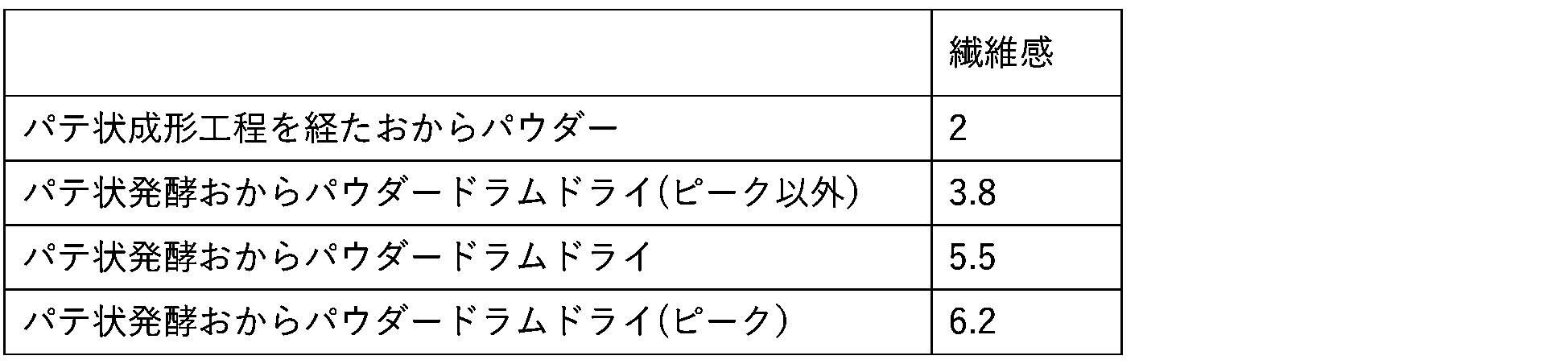
- Example 1-5 Evaluation of meat-like fibrous texture> Using the soybean pulp powder that had been subjected to the putty-like forming process, and the putty-like fermented soybean pulp drum-dried, the putty-like fermented soybean pulp drum-dried (peak), and the putty-like fermented soybean pulp drum-dried (other than peak) prepared in Example 4, a sensory evaluation was performed in the same manner as in Example 2 for the meat-like fibrous texture. The results are shown in Table 3.
- Examples 4 and 5 showed that the higher the content of particles with the peak particle size in the sample, the higher the breaking stress and the stronger the meat-like fibrous texture. In other words, a correlation was observed between the high breaking stress and the strong meat-like fibrous texture.
- Preculture was carried out as follows. For each strain, 5 g of soybean pulp powder and 100 ml of water were added to one 500 ml baffled Erlenmeyer flask, and the mixture was autoclaved (121°C, 30 min). For the seed koji, ATCC22788 strain and ATCC1011 strain were used. 0.5-1 ml of glycerol stock of the seed fungus were added, and the preculture was inoculated so that the initial number of spores in the preculture was 5 x 10⁵ /ml. This preculture was cultured with shaking (30°C, 160 rpm) for 24 hours. Then, this preculture was inoculated into a 300 L jar and cultured at 30°C for 3 days.
- the aeration rate and the stirring rate were started at 0.5 vvm and 250 rpm, and increased to 1 vvm and 330 rpm after 18 hours.
- the fermented product was heat sterilized (80°C, 30 min).
- the heat-sterilized fermented product was dried for 1 minute in a drum dryer (manufactured by Katsuragi Kogyo Co., Ltd., product name "Drum Dryer D-00") set at an air gap of 0.3 mm and a surface temperature of 150°C.
- a putty-like molding was carried out in the same manner as in Preparation Example 1 [Putty-like molding process of soybean pulp powder, drum-dried fermented soybean pulp, and freeze-dried fermented soybean pulp].
- the fermented okara drum-dried products produced using Aspergillus oryzae ATCC22788 strain and ATCC1011 strain are also referred to as “fermented okara drum-dried (ATCC22788 strain)" and “fermented okara drum-dried (ATCC1011 strain)", respectively.
- the putty-like fermented okara drum-dried (ATCC22788 strain) and the putty-like fermented okara drum-dried (ATCC1011 strain) are also referred to as “putty-like fermented okara drum-dried (ATCC22788 strain)” and “putty-like fermented okara drum-dried (ATCC1011 strain)", respectively.
- drum-dried fermented soybean pulp and the drum-dried putty-like fermented soybean pulp produced using Aspergillus oryzae NISL1365 strain are also referred to simply as “drum-dried fermented soybean pulp” and “drum-dried putty-like fermented soybean pulp”, respectively.
- Example 2-1 Evaluation of breaking stress The breaking stress was measured at three points and the average value was calculated in the same manner as in Example 1-1, except that drum-dried putty-like fermented okara (ATCC22788 strain) and drum-dried putty-like fermented okara (ATCC1011 strain) were used instead of the soybean pulp powder that had been subjected to the putty-like molding process, the drum-dried putty-like fermented okara, and the freeze-dried putty-like fermented okara in Example 1-1. The results are shown in Figure 5. In Figure 5, the error bars indicate the standard deviation.
- Example 2-2 Evaluation of meat-like fibrous texture
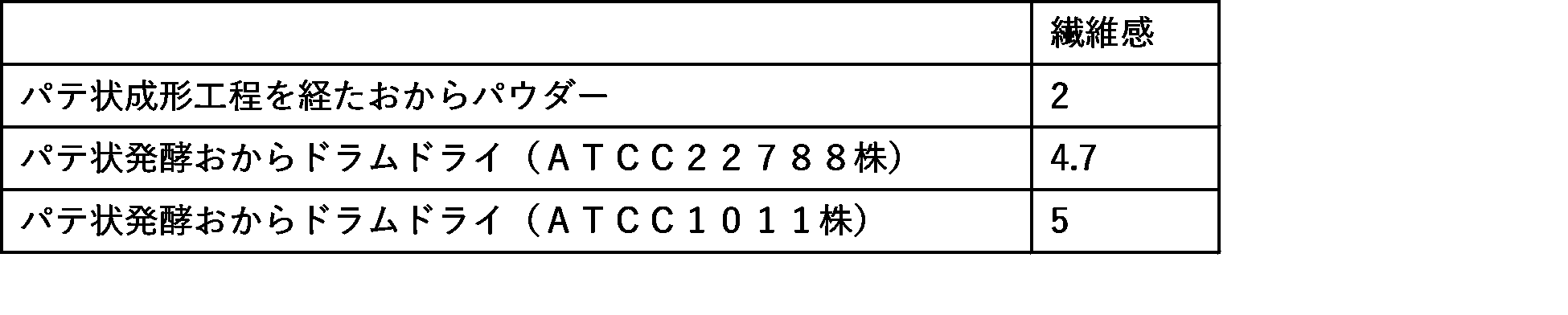
- the soybean pulp powder that had undergone a putty-formed process instead of the soybean pulp powder that had undergone a putty-formed process, the putty-like fermented soybean pulp drum-dried, and the putty-like fermented soybean pulp freeze-dried, the soybean pulp powder that had undergone a putty-formed process, the putty-like fermented soybean pulp drum-dried (ATCC22788 strain), and the putty-like fermented soybean pulp drum-dried (ATCC1011 strain) were used, and the meat-like fibrous texture was evaluated in the same manner as in Example 1-2. The results are shown in Table 4.
- drum-dried putty-like fermented okara (ATCC22788 strain) and drum-dried putty-like fermented okara (ATCC1011 strain) had a more meat-like fibrous texture than okara powder that had been through a putty-like molding process.
- Example 2-3 Measurement of particle size distribution>
- Example 1-3 instead of the soybean pulp powder, the fermented soybean pulp drum-dried, and the fermented soybean pulp freeze-dried, which had not been subjected to the putty-like forming process, fermented soybean pulp drum-dried (ATCC22788 strain) and fermented soybean pulp drum-dried (ATCC1011 strain) which had not been subjected to the putty-like forming process were used, and measurements were performed in the same manner as in Example 1-3, except that the mesh No. used was different.
- the particle size distribution of the fermented soybean pulp drum-dried (ATCC22788 strain) and the fermented soybean pulp drum-dried (ATCC1011 strain) which had not been subjected to the putty-like forming process was measured by a sieving test.
- the mesh numbers and particle size distribution used are shown in Table 5.
- the particle size distribution is shown in Figure 6.
- fermented soybean pulp drum-dried ATCC22788 strain
- fermented soybean pulp drum-dried ATCC1011 strain
- Preparation Example 3 Preparation of fermented product of plant material> A composition was prepared containing dried okara powder "Kikkoman Soymilk Okara Powder” manufactured by Kikkoman Soyfoods Corporation as the okara powder, "Fermented Okara Drum Dry” manufactured in Preparation Example 1 as the fermented okara, and water. Specifically, in Test Plot No. 1, the composition after mixing was taken as 100 mass%, and the dry okara powder, fermented okara, and water were mixed to be 4.3 mass%, 38.7 mass%, and 57.0 mass%, respectively. Test Plots No. 2 to 5 were also mixed in the ratios shown in Table 6. The obtained composition was homogenized and then processed in a food processor.
- compositions of test plots No. 1 to 5 obtained as described above were kneaded for 10 seconds using a kneading machine (Tiger Corporation, product name: Microcomputer Food Processor SKF-H101). The kneaded samples were then formed into circles with a thickness of 1.8 cm and an inner diameter of 7.5 cm. 5 ml of oil was added to a frying pan, and the formed samples were baked over low heat for 1 minute 20 seconds on each side, for a total of 2 minutes 40 seconds.
- Example 3-1 Evaluation of breaking stress The average value of the breaking stress measured at three points was calculated in the same manner as in Example 1-1, except that the putties obtained from test plots 1 to 5 were used instead of the soybean pulp powder that had been subjected to the putty-form molding process, the drum-dried putty-like fermented soybean pulp, and the freeze-dried putty-like fermented soybean pulp in Example 1-1. The results are shown in Figure 7. In Figure 7, the error bars indicate the standard deviation.
- test plots No. 1 to 5 all had a breaking stress of 1.00 N/m2 or more at a breaking strain rate of 50%.
- Example 3-2 Evaluation of meat-like fibrous texture
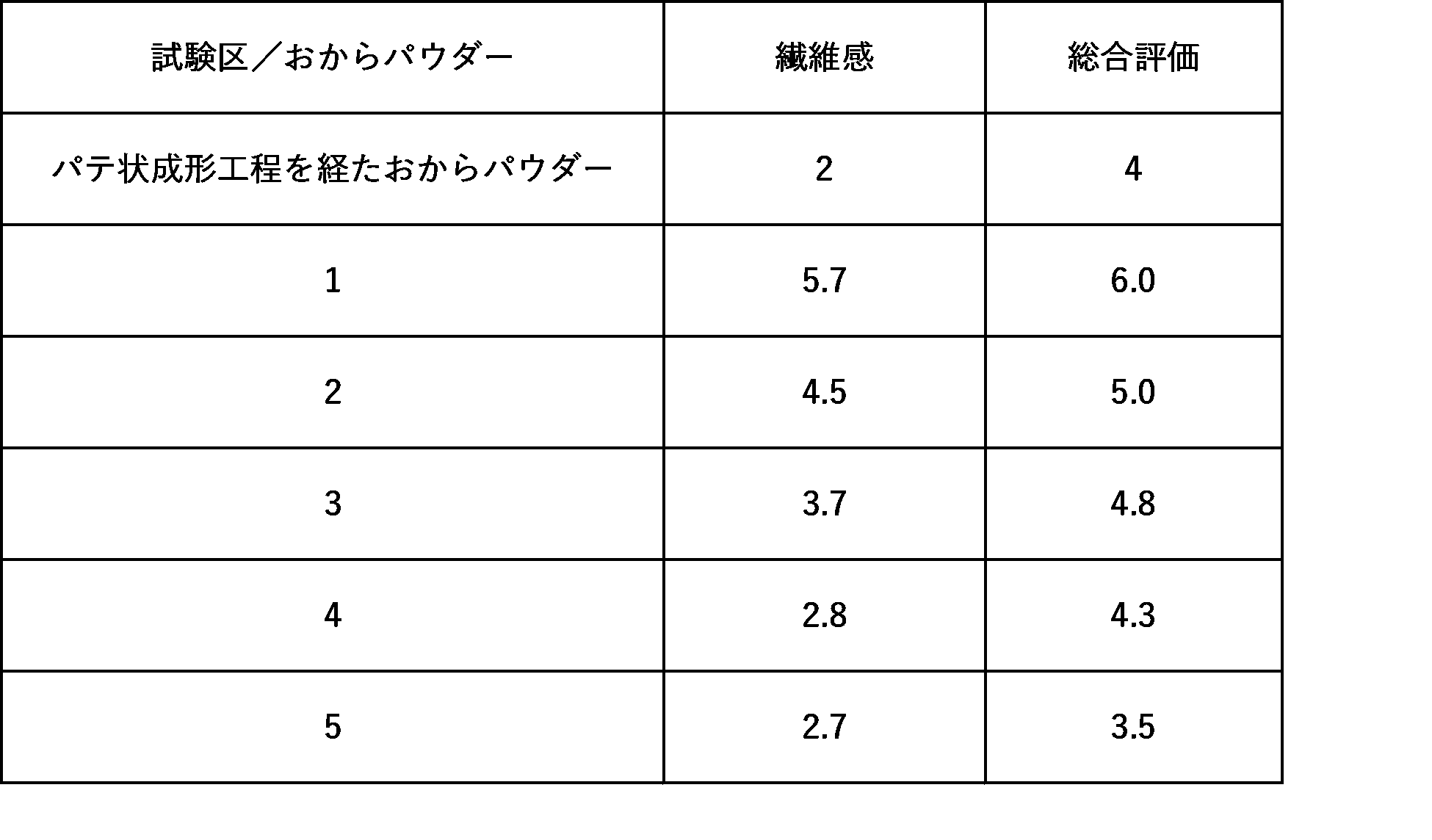
- the putty-like fermented soybean pulp drum-dried, and the putty-like fermented soybean pulp freeze-dried instead of the soybean pulp powder that had been subjected to the putty-formed process, the putty-like fermented soybean pulp drum-dried, and the putty-like fermented soybean pulp freeze-dried, the putty Nos. 1 to 5 putties were used, and the meat-like fibrous texture and overall evaluation were performed in the same manner as in Example 1-2. The results are shown in Table 7.
Landscapes
- Life Sciences & Earth Sciences (AREA)
- Chemical & Material Sciences (AREA)
- Health & Medical Sciences (AREA)
- Engineering & Computer Science (AREA)
- Nutrition Science (AREA)
- Food Science & Technology (AREA)
- Polymers & Plastics (AREA)
- Biochemistry (AREA)
- Molecular Biology (AREA)
- Agronomy & Crop Science (AREA)
- Botany (AREA)
- Beans For Foods Or Fodder (AREA)
- Meat, Egg Or Seafood Products (AREA)
Abstract
Description
[1]
植物原料の発酵物を含み、
パテ状に成形した状態で、破断歪率50%時点の破断応力が1.00N/m2以上である、
食品組成物。
[2]
前記植物原料が穀物由来原料である、上記[1]に記載の食品組成物。
[3]
前記発酵物が麹菌発酵物である、上記[1]又は[2]に記載の食品組成物。
[4]
前記食品組成物を用いたふるい分け試験において、粒径が1,000μm以上4,500μm未満の粒子の質量の、前記食品組成物の全質量に対する割合が5%以上である、上記[1]又は[2]に記載の食品組成物。
[5]
前記食品組成物が水分を含み、
前記食品組成物の全質量に対して、前記発酵物の質量の割合が5~40%であり、前記発酵物以外の植物性タンパク質の質量の割合が4~40%である、上記[1]又は[2]に記載の食品組成物。
[6]
前記食品組成物が水分を含まず、
前記食品組成物の全質量に対して、前記発酵物の質量の割合が20~100%であり、前記発酵物以外の植物性タンパク質の質量の割合が0~80%である、上記[1]又は[2]に記載の食品組成物。
[7]
前記発酵物が、前記植物原料を発酵処理した後に乾燥して得られる発酵物である、上記[1]又は[2]に記載の食品組成物。
[8]
植物原料を微生物で発酵することを含み、得られる食品組成物が上記[1]又は[2]に記載の食品組成物である、食品組成物の製造方法。
[9]
前記植物原料を前記微生物で発酵したものを乾燥させることを含む、[8]に記載の食品組成物の製造方法。
数値範囲の「~」は、その前後の数値を含む範囲であり、例えば、「0質量%~100質量%」は、0質量%以上であり、かつ、100質量%以下である範囲を意味する。
本明細書において、重量基準の割合(百分率、部など)は、質量基準の割合(百分率、部など)と同じである。
本発明の一態様の食品組成物は、植物原料の発酵物を含み、パテ状に成形した状態で、破断歪率50%時点の破断応力が1.00N/m2以上である。このような食品組成物は、優れた畜肉様の繊維感を有する。
本明細書において、植物原料としては、例えば、炭素源及び窒素源の少なくともいずれか一方を含むものが挙げられる。植物原料としては、例えば、穀物由来原料、果物由来原料等が挙げられる。
植物原料の発酵物とは、植物原料を微生物により発酵して得られるもの、又は植物原料を微生物により発酵して得られたものである。本明細書において、微生物としては、例えば、麹菌を含む糸状菌、乳酸菌、酵母等が挙げられる。また、本明細書において、植物原料の麹菌発酵物とは、植物原料を麹菌により発酵して得られるもの、又は植物原料を麹菌により発酵して得られたものである。
破断応力とは、破断時に単位破断面積あたりにかかる力であり、試料の寸法に依存せず、寸法の異なる試料間でも試料にかかる力学的な作用を比較できる指標である。
破断歪率とは、割れやすさ、もろさに関するパラメーターである。破断応力の測定において、破断荷重Fによって破断するまでに試料が変形した程度、すなわち、試料の高さがH(mm)で、プランジャーが進んでいた距離をΔH(mm)とすると、破断歪率はΔH/H(×100%)で表される。
パテ状に成形した状態として、以下の手順で成形した状態が挙げられる。食品組成物が乾燥物のみを含む場合、乾燥物を16.7g用い、乾燥物と水が質量基準で1:2の割合となるように混合し、捏ね機(タイガー魔法瓶株式会社製、製品名「マイコンフードプロセッサー SKF-H101」)で10秒捏ねる。捏ねた試料を厚さ1.8cm、内径7.5cmの円形に成形する。フライパンに5mlの油を入れ、弱火で、成形した試料を、片面1分20秒ずつ、合計2分40秒焼成して、パテ状にする。弱火(low heat)とは、火の尖端がフライパンの底に接触する寸前の火加減をいう。
本発明の一態様の食品組成物は、上記発酵物のみを含有してもよいが、加工適性の観点から、上記発酵物に加えて、植物性タンパク質及び/又は食物繊維等を含有してもよい。
本発明の一態様の食品組成物を用いたふるい分け試験において、粒径が1,000μm以上4,500μm未満の粒子の質量の、前記食品組成物の全質量に対する割合が5%以上であることが好ましい。ふるい分け試験の方法としては、例えば、後述の実施例に記載の方法が挙げられる。
本発明の一態様の食品組成物は、畜肉類の代替物として使用しうる。本発明の一態様の食品組成物は、畜肉様食品組成物であることが好ましい。畜肉とは、家畜(豚、牛、羊、山羊、馬など)や、家禽(鶏、うずら、アヒル、鴨、合鴨、ガチョウ、七面鳥など)や、鹿、猪などの、鳥獣の食肉を意味する。また、畜肉の定義には、いわゆる肉(筋肉)に加えて、皮、脂肪、スジ、軟骨、内臓、血液などの一般的に畜肉加工食品に用いられる組織も含まれる。
本発明の一態様の食品組成物は、事前にぶつ切りや乱切りなどの切り加工に供してもよい。また、切り加工に供した植物性食材と野菜類その他の食材とを混合したものに、本発明の一態様の食品組成物を加えて練り合わせて、次いで練り合わせたものを加熱調理に供することにより、肉らしい風味を呈する唐揚げ、しぐれ煮、ハンバーグ、ミートボール、ミートローフ、メンチカツ、ギョーザ、シューマイ、ワンタン、春巻、肉まんなどの態様の加熱調理物が得られる。この際、その他の食材として肉類を加えてもよい。加熱調理物は、上記したものに限られず、例えば、通常調味料成分としてしょうゆを使用する加熱調理物などが挙げられる。
本発明の一態様の食品組成物の製造方法は、植物原料を微生物で発酵することを含む。
植物原料としては、上述のものが挙げられる。
本実施形態の製造方法においては、植物原料を微生物で発酵する前に、植物原料をアラビナーゼおよびセルラーゼで処理してもよい。植物原料をアラビナーゼおよびセルラーゼで処理することにより、ビタミンBの含有量が増加する。その理由は定かではないが、微生物の資化可能な糖のバランスが変化し、ビタミンB代謝に関与する遺伝子が高発現する、またはビタミンBの基質となる一次代謝産物の量が増加するなどの要因が推測される。
また、植物原料を含む培地基質中において、アラビナーゼおよびセルラーゼはそれぞれ250~900mU/mlおよび100~750mU/mlであることが好ましい。
本発明の一態様の食品組成物の製造方法は、植物原料を微生物で発酵することを含む。植物原料を微生物で発酵することの前に、微生物が旺盛に生育する条件にするため、植物原料以外の炭素源や窒素源、金属イオン、若しくは培養途中の泡を消すため消泡剤を添加することを含んでもよい。pH3~7となるようにpH調整を行ってもよい。
本発明の一態様の製造方法においては、後処理として、粉砕処理、殺菌処理、滅菌処理、濃縮処理、膜分離処理、乾燥処理等の処理を行ってもよく、乾燥処理をすることが好ましい。前記乾燥処理としては、例えば、凍結乾燥、減圧乾燥、加熱乾燥等の方法が挙げられ、乾燥物の粒径の大きさの観点から、ドラムドライ又はフリーズドライが好ましい。
<1>
植物原料の発酵物を含み、
パテ状に成形した状態で、破断歪率50%時点の破断応力が1.00N/m2以上である、
食品組成物。
<2>
前記植物原料が穀物由来原料である、上記<1>に記載の食品組成物。
<3>
前記発酵物が麹菌発酵物である、上記<1>又は<2>に記載の食品組成物。
<4>
前記食品組成物を用いたふるい分け試験において、粒径が1,000μm以上4,500μm未満の粒子の質量の、前記食品組成物の全質量に対する割合が5%以上である、上記<1>~<3>のいずれか1つに記載の食品組成物。
<5>
前記食品組成物が水分を含み、
前記食品組成物の全質量に対して、前記発酵物の質量の割合が5~40%であり、前記発酵物以外の植物性タンパク質の質量の割合が4~40%である、上記<1>~<4>のいずれか1つに記載の食品組成物。
<6>
前記食品組成物が水分を含まず、
前記食品組成物の全質量に対して、前記発酵物の質量の割合が20~100%であり、前記発酵物以外の植物性タンパク質の質量の割合が0~80%である、上記<1>~<4>のいずれか1つに記載の食品組成物。
<7>
前記発酵物が、前記植物原料を発酵処理した後に乾燥して得られる発酵物である、上記<1>~<6>のいずれか1つに記載の食品組成物。
<8>
植物原料を微生物で発酵することを含み、得られる食品組成物が上記<1>~<7>のいずれか1つに記載の食品組成物である、食品組成物の製造方法。
<9>
前記植物原料を前記微生物で発酵したものを乾燥させることを含む、<8>に記載の食品組成物の製造方法。
(おからパウダー)
おからパウダーは、豆乳の製造工程で出てくる豆乳の搾りかすを乾燥したものであり、キッコーマンソイフーズ株式会社製の乾燥おからパウダー「キッコーマン 豆乳おからパウダー」を使用した。
(酵素)
アラビナーゼは「PECLYVE FILTRATION」(Soufflet biotechnologies社製)、セルラーゼは「CELLULYVE 50L」(Soufflet biotechnologies社製)を用いた。
(その他)
各種試薬は市販の特級試薬を用いた。
<調製例1:植物原料の発酵物の調製>
[発酵おからドラムドライ、発酵おからフリーズドライの調製]
発酵は300Lジャー(株式会社丸菱バイオエンジ製)で行った。おからパウダー18kgに水を加えて170Lにメスアップし、消泡剤である信越シリコーン(登録商標)KM72F(信越化学工業株式会社製)27gを加え、123℃、60分で殺菌した。孔径0.22μmのフィルターでろ過した酵素溶液を、アラビナーゼの最終濃度が0.6U/ml、セルラーゼの最終濃度が0.1U/mlとなるように添加し、60℃で2時間撹拌反応させた。反応後30℃に冷却した。
上述の手順で得られたおからパウダー、発酵おからドラムドライ、発酵おからフリーズドライを用いて、各乾燥物を16.7g用い、乾燥物と水が重量基準で1:2の割合となるように混合し、捏ね機(タイガー魔法瓶株式会社製、製品名「マイコンフードプロセッサー SKF-H101」)で10秒捏ねた。その後、捏ねた試料を厚さ1.8cm、内径7.5cmの円形に成形した。フライパンに5mlの油を入れ、弱火で、上記成形した試料を、片面1分20秒ずつ、合計2分40秒焼成した。
このとき、発酵おからドラムドライ及び発酵おからフリーズドライはパテ状に成形できた。一方、おからパウダーは固まらず、パテ状に成形できなかった。
本明細書において、パテ状成形工程を行ったがパテ状にならなかったおからパウダー、パテ状にした発酵おからドラムドライ、及びパテ状にした発酵おからフリーズドライを、それぞれ、パテ状成形工程を経たおからパウダー、パテ状発酵おからドラムドライ、及びパテ状発酵おからフリーズドライとも称する。パテ状発酵おからドラムドライの写真を図1に示す。
パテ状成形工程を経たおからパウダー、パテ状発酵おからドラムドライ、及びパテ状発酵おからフリーズドライを、それぞれ、テクスチャーアナライザー(株式会社島津製作所製、EZ-SX)を用い、横幅40mm×縦幅112mm、角度30度のくさび形プランジャーを使用し、ロードセルは50N、圧縮(測定)速度1mm/秒の条件で、測定試料として、測定テーブルに品温20±5℃、上述の成形した試料を載せ、破断歪率50%時点の、上面の略中心部分の破断応力を3点測定した値の平均値を求めた。結果を図2に示す。図2において、エラーバーは標準偏差を示す。
パテ状成形工程を経たおからパウダー、パテ状発酵おからドラムドライ、及びパテ状発酵おからフリーズドライを用いて、官能評価を行った。官能評価は、識別能力を有する6名以上のパネルにより、以下の2種類の評価を行った。
各試料の畜肉様の繊維感について、以下のように7段階で評価し、その平均値を算出した。結果を表1に示す。
・7点:畜肉様の繊維感が非常に強い
・6点:畜肉様の繊維感が強い
・5点:畜肉様の繊維感が少し強い
・4点:普通
・3点:畜肉様の繊維感が少し弱い
・2点:畜肉様の繊維感が弱い
・1点:畜肉様の繊維感が非常に弱い
パテ状発酵おからドラムドライ及びパテ状発酵おからフリーズドライについて、パテ状成形工程を経たおからパウダーを基準として、畜肉様製品として総合的に優れているかという観点から、以下のように7段階で評価し、その平均値を算出した。結果を表1に示す。
・7点:パテ状成形工程を経たおからパウダーと比べてかなり高い
・6点:パテ状成形工程を経たおからパウダーと比べて高い
・5点:パテ状成形工程を経たおからパウダーと比べてやや高い
・4点:パテ状成形工程を経たおからパウダーと同等
・3点:パテ状成形工程を経たおからパウダーと比べてやや低い
・2点:パテ状成形工程を経たおからパウダーと比べて低い
・1点:パテ状成形工程を経たおからパウダーと比べてかなり低い

パテ状成形工程を経ていない、おからパウダー、発酵おからドラムドライ、及び発酵おからフリーズドライについて、ふるいわけ試験によって粒度分布を測定した。ふるいわけ試験は、以下の(1)~(4)の順に行った。
(2)振盪器に、メッシュを取り付けた。
(3)2000rpmで1分の振盪を2回繰り返した。
(4)メッシュに残ったサンプルの重量を測定した。
(1)~(4)を5回繰り返した。(4)で測定した重量の平均値を350gで除して、サンプル全体における各粒径の割合を算出した。
発酵おからドラムドライのうち、ピークの粒径を有する粒子のみからなる発酵おからドラムドライ(ピーク)を調製した。また、発酵おからドラムドライのうち、ピーク以外の粒径を有する粒子のみからなる発酵おからドラムドライ(ピーク以外)を調製した。
発酵おからドラムドライ、発酵おからドラムドライ(ピーク)、及び発酵おからドラムドライ(ピーク以外)を用いて、上述の[おからパウダー、発酵おからドラムドライ及び発酵おからフリーズドライのパテ状成形工程]と同様の手順でパテ状にして、パテ状発酵おからドラムドライ、パテ状発酵おからドラムドライ(ピーク)、及びパテ状発酵おからドラムドライ(ピーク以外)を調製した。
パテ状成形工程を経たおからパウダー、並びに実施例4で調製したパテ状発酵おからドラムドライ、パテ状発酵おからドラムドライ(ピーク)、及びパテ状発酵おからドラムドライ(ピーク以外)を用いて、実施例2の畜肉様の繊維感と同様に、官能評価を行った。結果を表3に示す。
<調製例2:植物原料の発酵物の調製>
発酵は30Lジャー(株式会社丸菱バイオエンジ製)で行った。おからパウダー1.5kgに水を加えて15Lにメスアップし、消泡剤である信越シリコーン(登録商標)KM72F(信越化学工業株式会社製)2.25gを加え、123℃、60分で殺菌した。孔径0.22μmのフィルターでろ過した酵素溶液を、アラビナーゼの最終濃度が0.6U/ml、セルラーゼの最終濃度が0.1U/mlとなるように添加し、60℃で2時間撹拌反応させた。反応後30℃に冷却した。
上記加熱殺菌処理した発酵物を、空隙0.3mm、表面温度150℃に設定したドラムドライヤー(カツラギ工業株式会社製、製品名「ドラムドライヤーD-00」)で1分乾燥した。
その後、調製例1の[おからパウダー、発酵おからドラムドライ及び発酵おからフリーズドライのパテ状成形工程]と同様の手順で、パテ状成形を行った。
なお、調製例1にて記載したとおり、本明細書において、アスペルギルス オリゼ NISL1365株を用いて製造した発酵おからドラムドライとパテ状発酵おからドラムドライは、それぞれ、単に「発酵おからドラムドライ」及び「パテ状発酵おからドラムドライ」とも称する。
実施例1-1において、パテ状成形工程を経たおからパウダー、パテ状発酵おからドラムドライ、及びパテ状発酵おからフリーズドライの代わりに、パテ状発酵おからドラムドライ(ATCC22788株)及びパテ状発酵おからドラムドライ(ATCC1011株)を用いた以外は実施例1-1と同様に、破断応力を3点測定した値の平均値を求めた。結果を図5に示す。図5において、エラーバーは標準偏差を示す。
実施例1-2において、パテ状成形工程を経たおからパウダー、パテ状発酵おからドラムドライ、及びパテ状発酵おからフリーズドライの代わりに、パテ状成形工程を経たおからパウダー、パテ状発酵おからドラムドライ(ATCC22788株)及びパテ状発酵おからドラムドライ(ATCC1011株)を用いた点以外は、実施例1-2と同様に、畜肉様の繊維感の評価を行った。結果を表4に示す。
実施例1-3において、パテ状成形工程を経ていない、おからパウダー、発酵おからドラムドライ、及び発酵おからフリーズドライの代わりに、パテ状成形工程を経ていない、発酵おからドラムドライ(ATCC22788株)及び発酵おからドラムドライ(ATCC1011株)を用いたことと、用いたメッシュNo.が異なること以外は、実施例1-3と同様の手順の測定を行った。このようにして、パテ状成形工程を経ていない、発酵おからドラムドライ(ATCC22788株)及び発酵おからドラムドライ(ATCC1011株)について、ふるいわけ試験による粒度分布の測定を行った。
用いたメッシュNo.、粒度分布を表5に示す。また、粒度分布を図6に示す。

<調製例3:植物原料の発酵物の調製>
おからパウダーとして、キッコーマンソイフーズ株式会社製の乾燥おからパウダー「キッコーマン 豆乳おからパウダー」と、発酵おからとして調製例1で製造した「発酵おからドラムドライ」と、水とを含む組成物を調製した。具体的には、試験区No.1は、混合後の組成物を100質量%として、乾燥おからパウダーが4.3質量%、発酵おからが38.7質量%、水が57.0質量%となるように混合した。試験区No.2~5も、表6に記載の割合で混合した。得られた組成物を均質な状態にしてからフードプロセッサーにかけた。
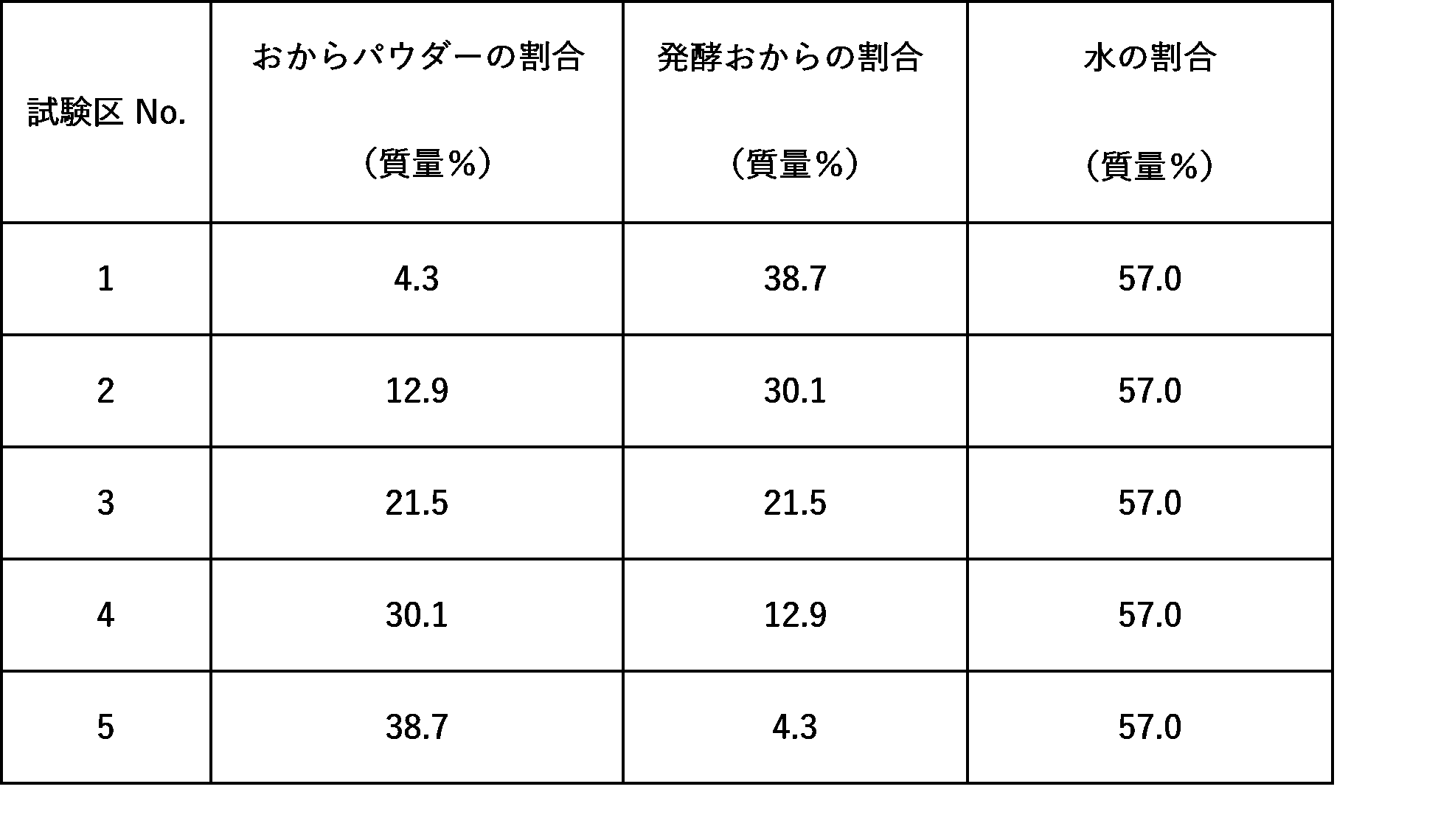
実施例1-1において、パテ状成形工程を経たおからパウダー、パテ状発酵おからドラムドライ、及びパテ状発酵おからフリーズドライの代わりに、試験区No.1~5を用いて得たパテを用いた以外は、実施例1―1と同様に、破断応力を3点測定した値の平均値を求めた。結果を図7に示す。図7において、エラーバーは標準偏差を示す。
実施例1-2において、パテ状成形工程を経たおからパウダー、パテ状発酵おからドラムドライ、及びパテ状発酵おからフリーズドライの代わりに、No.1~5のパテを用いた点以外は、実施例1-2と同様に、畜肉様の繊維感の評価と、総合評価を行った。結果を表7に示す。
Claims (9)
- 植物原料の発酵物を含み、
パテ状に成形した状態で、破断歪率50%時点の破断応力が1.00N/m2以上である、
食品組成物。 - 前記植物原料が穀物由来原料である、請求項1に記載の食品組成物。
- 前記発酵物が麹菌発酵物である、請求項1又は2に記載の食品組成物。
- 前記食品組成物を用いたふるい分け試験において、粒径が1,000μm以上4,500μm未満の粒子の質量の、前記食品組成物の全質量に対する割合が5%以上である、請求項1又は2に記載の食品組成物。
- 前記食品組成物が水分を含み、
前記食品組成物の全質量に対して、前記発酵物の質量の割合が5~40%であり、前記発酵物以外の植物性タンパク質の質量の割合が4~40%である、請求項1又は2に記載の食品組成物。 - 前記食品組成物が水分を含まず、
前記食品組成物の全質量に対して、前記発酵物の質量の割合が20~100%であり、前記発酵物以外の植物性タンパク質の質量の割合が0~80%である、請求項1又は2に記載の食品組成物。 - 前記発酵物が、前記植物原料を発酵処理した後に乾燥して得られる発酵物である、請求項1又は2に記載の食品組成物。
- 植物原料を微生物で発酵することを含み、得られる食品組成物が請求項1又は2に記載の食品組成物である、食品組成物の製造方法。
- 前記植物原料を前記微生物で発酵したものを乾燥させることを含む、請求項8に記載の食品組成物の製造方法。
Priority Applications (4)
| Application Number | Priority Date | Filing Date | Title |
|---|---|---|---|
| AU2024288852A AU2024288852A1 (en) | 2023-07-03 | 2024-07-03 | Food composition and method for producing food composition |
| JP2025531574A JPWO2025009554A1 (ja) | 2023-07-03 | 2024-07-03 | |
| CN202480042474.4A CN121398688A (zh) | 2023-07-03 | 2024-07-03 | 食品组合物和食品组合物的制造方法 |
| EP24836067.9A EP4714268A1 (en) | 2023-07-03 | 2024-07-03 | Food composition and method for producing food composition |
Applications Claiming Priority (2)
| Application Number | Priority Date | Filing Date | Title |
|---|---|---|---|
| JP2023109596 | 2023-07-03 | ||
| JP2023-109596 | 2023-07-03 |
Publications (1)
| Publication Number | Publication Date |
|---|---|
| WO2025009554A1 true WO2025009554A1 (ja) | 2025-01-09 |
Family
ID=94171551
Family Applications (1)
| Application Number | Title | Priority Date | Filing Date |
|---|---|---|---|
| PCT/JP2024/024058 Ceased WO2025009554A1 (ja) | 2023-07-03 | 2024-07-03 | 食品組成物及び食品組成物の製造方法 |
Country Status (5)
| Country | Link |
|---|---|
| EP (1) | EP4714268A1 (ja) |
| JP (1) | JPWO2025009554A1 (ja) |
| CN (1) | CN121398688A (ja) |
| AU (1) | AU2024288852A1 (ja) |
| WO (1) | WO2025009554A1 (ja) |
Citations (7)
| Publication number | Priority date | Publication date | Assignee | Title |
|---|---|---|---|---|
| JPS63263057A (ja) * | 1987-04-20 | 1988-10-31 | Misuzu Toufu Kk | 乾燥おからの製造方法 |
| JP2005269959A (ja) * | 2004-03-24 | 2005-10-06 | Fuji Oil Co Ltd | 乾燥肉様食品及びその製造法 |
| JP2011172552A (ja) * | 2010-02-25 | 2011-09-08 | Yukio Tsunoda | 殆どが産業廃棄物となるおからの保存有効活用方法 |
| JP6396517B2 (ja) | 2017-01-16 | 2018-09-26 | 和光食品株式会社 | オカラ含有組成物及びその製造方法 |
| WO2021200437A1 (ja) * | 2020-03-31 | 2021-10-07 | キッコーマン株式会社 | チーズ様発酵食品の製造方法及びチーズ様発酵食品 |
| JP7216500B2 (ja) | 2018-08-22 | 2023-02-01 | 株式会社ニップン | 肉様食品 |
| JP2023109596A (ja) | 2022-01-27 | 2023-08-08 | 株式会社ディスコ | 被加工物の加工方法 |
-
2024
- 2024-07-03 JP JP2025531574A patent/JPWO2025009554A1/ja active Pending
- 2024-07-03 CN CN202480042474.4A patent/CN121398688A/zh active Pending
- 2024-07-03 AU AU2024288852A patent/AU2024288852A1/en active Pending
- 2024-07-03 EP EP24836067.9A patent/EP4714268A1/en active Pending
- 2024-07-03 WO PCT/JP2024/024058 patent/WO2025009554A1/ja not_active Ceased
Patent Citations (7)
| Publication number | Priority date | Publication date | Assignee | Title |
|---|---|---|---|---|
| JPS63263057A (ja) * | 1987-04-20 | 1988-10-31 | Misuzu Toufu Kk | 乾燥おからの製造方法 |
| JP2005269959A (ja) * | 2004-03-24 | 2005-10-06 | Fuji Oil Co Ltd | 乾燥肉様食品及びその製造法 |
| JP2011172552A (ja) * | 2010-02-25 | 2011-09-08 | Yukio Tsunoda | 殆どが産業廃棄物となるおからの保存有効活用方法 |
| JP6396517B2 (ja) | 2017-01-16 | 2018-09-26 | 和光食品株式会社 | オカラ含有組成物及びその製造方法 |
| JP7216500B2 (ja) | 2018-08-22 | 2023-02-01 | 株式会社ニップン | 肉様食品 |
| WO2021200437A1 (ja) * | 2020-03-31 | 2021-10-07 | キッコーマン株式会社 | チーズ様発酵食品の製造方法及びチーズ様発酵食品 |
| JP2023109596A (ja) | 2022-01-27 | 2023-08-08 | 株式会社ディスコ | 被加工物の加工方法 |
Also Published As
| Publication number | Publication date |
|---|---|
| AU2024288852A1 (en) | 2026-01-22 |
| EP4714268A1 (en) | 2026-03-25 |
| JPWO2025009554A1 (ja) | 2025-01-09 |
| CN121398688A (zh) | 2026-01-23 |
Similar Documents
| Publication | Publication Date | Title |
|---|---|---|
| CN105594811B (zh) | 一种无麸质木薯营养饼干及其制备方法 | |
| EP4307913B1 (en) | A method for manufacturing a protein-rich biomass comprising edible filamentous fungus | |
| JP2002524097A (ja) | 食料調製において使用する接合菌類ケカビ目真菌 | |
| NZ247925A (en) | Fat substitute composition comprising a cereal hydrolysate and a hydrocolloid gum in an amount to form a thermo-irreversible gel; low fat (emulsified) meat products | |
| BR112014013912B1 (pt) | produto alimentício à base de vegetal, seu uso e seu método de preparação | |
| JP5011564B2 (ja) | 醗酵調味料及びその製造方法 | |
| CN116456833A (zh) | 用于生产可食用的真菌菌丝体共混肉和肉类似物组合物的增强的好氧发酵方法 | |
| JPWO2001010242A1 (ja) | 酵素を使用した大豆の加工方法、および同方法により得られる加工大豆、および同加工大豆を含む食品 | |
| KR20160045387A (ko) | 누룽지 분말을 함유하는 고기완자의 제조방법 및 상기 방법으로 제조된 고기완자 | |
| CN101999625B (zh) | 一种固体调味料及其制备工艺 | |
| KR20130048505A (ko) | 동물성 단백질의 발효기술을 이용한 쌀라면 제조방법 | |
| KR102180266B1 (ko) | 아연 콩나물을 이용한 족발 및 이의 제조방법 | |
| CN111202231B (zh) | 用于制备酱牛肉的营养骨汤、酱牛肉及其制备方法 | |
| CN113615825A (zh) | 一种以蘑菇为基底的植物基肉排及其制备方法 | |
| WO2025009554A1 (ja) | 食品組成物及び食品組成物の製造方法 | |
| CN1095557A (zh) | 低脂肪的碎肉组合物 | |
| CN105876648A (zh) | 一种纳豆食品及其制备方法 | |
| CN116172117B (zh) | 一种植物基蛋白纯素灌汤小笼包及其制备方法 | |
| KR101823087B1 (ko) | 콩 유산균을 이용한 빵의 제조방법 | |
| JP2006288341A (ja) | パン生地改良剤 | |
| CN111713643A (zh) | 一种生肉粉的制备方法 | |
| WO2025009555A1 (ja) | 食品組成物、該食品組成物の製造方法、および豆臭のマスキング方法 | |
| KR102779254B1 (ko) | 닭가슴살 단백질 면의 제조방법 | |
| KR102798264B1 (ko) | 된장누룩을 이용한 오리고기 발효방법과 이를 통해 제조된 된장누룩 발효 오리고기 | |
| CN116035175B (zh) | 一种高原型动植物复合功能棒及其制备方法 |
Legal Events
| Date | Code | Title | Description |
|---|---|---|---|
| 121 | Ep: the epo has been informed by wipo that ep was designated in this application |
Ref document number: 24836067 Country of ref document: EP Kind code of ref document: A1 |
|
| ENP | Entry into the national phase |
Ref document number: 2025531574 Country of ref document: JP Kind code of ref document: A |
|
| WWE | Wipo information: entry into national phase |
Ref document number: 2025531574 Country of ref document: JP Ref document number: 2024836067 Country of ref document: EP |
|
| WWE | Wipo information: entry into national phase |
Ref document number: AU2024288852 Country of ref document: AU |
|
| WWE | Wipo information: entry into national phase |
Ref document number: 2501008951 Country of ref document: TH |
|
| ENP | Entry into the national phase |
Ref document number: 2024836067 Country of ref document: EP Effective date: 20251219 |
|
| ENP | Entry into the national phase |
Ref document number: 2024836067 Country of ref document: EP Effective date: 20251219 |
|
| ENP | Entry into the national phase |
Ref document number: 2024288852 Country of ref document: AU Date of ref document: 20240703 Kind code of ref document: A |
|
| ENP | Entry into the national phase |
Ref document number: 2024836067 Country of ref document: EP Effective date: 20251219 |
|
| ENP | Entry into the national phase |
Ref document number: 2024836067 Country of ref document: EP Effective date: 20251219 |
|
| NENP | Non-entry into the national phase |
Ref country code: DE |
|
| ENP | Entry into the national phase |
Ref document number: 2024836067 Country of ref document: EP Effective date: 20251219 |
|
| WWE | Wipo information: entry into national phase |
Ref document number: 11202508926U Country of ref document: SG |
|
| WWP | Wipo information: published in national office |
Ref document number: 11202508926U Country of ref document: SG |
|
| WWP | Wipo information: published in national office |
Ref document number: 2024836067 Country of ref document: EP |