WO2025005189A1 - 目的タンパク質の生産方法 - Google Patents
目的タンパク質の生産方法 Download PDFInfo
- Publication number
- WO2025005189A1 WO2025005189A1 PCT/JP2024/023366 JP2024023366W WO2025005189A1 WO 2025005189 A1 WO2025005189 A1 WO 2025005189A1 JP 2024023366 W JP2024023366 W JP 2024023366W WO 2025005189 A1 WO2025005189 A1 WO 2025005189A1
- Authority
- WO
- WIPO (PCT)
- Prior art keywords
- seq
- fkbp
- gene encoding
- heterologous
- target protein
- Prior art date
- Legal status (The legal status is an assumption and is not a legal conclusion. Google has not performed a legal analysis and makes no representation as to the accuracy of the status listed.)
- Ceased
Links
Classifications
-
- C—CHEMISTRY; METALLURGY
- C12—BIOCHEMISTRY; BEER; SPIRITS; WINE; VINEGAR; MICROBIOLOGY; ENZYMOLOGY; MUTATION OR GENETIC ENGINEERING
- C12N—MICROORGANISMS OR ENZYMES; COMPOSITIONS THEREOF; PROPAGATING, PRESERVING, OR MAINTAINING MICROORGANISMS; MUTATION OR GENETIC ENGINEERING; CULTURE MEDIA
- C12N15/00—Mutation or genetic engineering; DNA or RNA concerning genetic engineering, vectors, e.g. plasmids, or their isolation, preparation or purification; Use of hosts therefor
- C12N15/09—Recombinant DNA-technology
- C12N15/63—Introduction of foreign genetic material using vectors; Vectors; Use of hosts therefor; Regulation of expression
- C12N15/74—Vectors or expression systems specially adapted for prokaryotic hosts other than E. coli, e.g. Lactobacillus, Micromonospora
- C12N15/75—Vectors or expression systems specially adapted for prokaryotic hosts other than E. coli, e.g. Lactobacillus, Micromonospora for Bacillus
-
- C—CHEMISTRY; METALLURGY
- C07—ORGANIC CHEMISTRY
- C07K—PEPTIDES
- C07K16/00—Immunoglobulins [IG], e.g. monoclonal or polyclonal antibodies
-
- C—CHEMISTRY; METALLURGY
- C12—BIOCHEMISTRY; BEER; SPIRITS; WINE; VINEGAR; MICROBIOLOGY; ENZYMOLOGY; MUTATION OR GENETIC ENGINEERING
- C12N—MICROORGANISMS OR ENZYMES; COMPOSITIONS THEREOF; PROPAGATING, PRESERVING, OR MAINTAINING MICROORGANISMS; MUTATION OR GENETIC ENGINEERING; CULTURE MEDIA
- C12N9/00—Enzymes; Proenzymes; Compositions thereof; Processes for preparing, activating, inhibiting, separating or purifying enzymes
- C12N9/90—Isomerases (5.)
-
- C—CHEMISTRY; METALLURGY
- C12—BIOCHEMISTRY; BEER; SPIRITS; WINE; VINEGAR; MICROBIOLOGY; ENZYMOLOGY; MUTATION OR GENETIC ENGINEERING
- C12P—FERMENTATION OR ENZYME-USING PROCESSES TO SYNTHESISE A DESIRED CHEMICAL COMPOUND OR COMPOSITION OR TO SEPARATE OPTICAL ISOMERS FROM A RACEMIC MIXTURE
- C12P21/00—Preparation of peptides or proteins
- C12P21/02—Preparation of peptides or proteins having a known sequence of two or more amino acids, e.g. glutathione
-
- C—CHEMISTRY; METALLURGY
- C12—BIOCHEMISTRY; BEER; SPIRITS; WINE; VINEGAR; MICROBIOLOGY; ENZYMOLOGY; MUTATION OR GENETIC ENGINEERING
- C12Y—ENZYMES
- C12Y502/00—Cis-trans-isomerases (5.2)
- C12Y502/01—Cis-trans-Isomerases (5.2.1)
- C12Y502/01008—Peptidylprolyl isomerase (5.2.1.8), i.e. cyclophilin
-
- C—CHEMISTRY; METALLURGY
- C07—ORGANIC CHEMISTRY
- C07K—PEPTIDES
- C07K2319/00—Fusion polypeptide
- C07K2319/01—Fusion polypeptide containing a localisation/targetting motif
- C07K2319/02—Fusion polypeptide containing a localisation/targetting motif containing a signal sequence
-
- C—CHEMISTRY; METALLURGY
- C07—ORGANIC CHEMISTRY
- C07K—PEPTIDES
- C07K2319/00—Fusion polypeptide
- C07K2319/35—Fusion polypeptide containing a fusion for enhanced stability/folding during expression, e.g. fusions with chaperones or thioredoxin
-
- C—CHEMISTRY; METALLURGY
- C07—ORGANIC CHEMISTRY
- C07K—PEPTIDES
- C07K2319/00—Fusion polypeptide
- C07K2319/70—Fusion polypeptide containing domain for protein-protein interaction
Definitions
- the present invention relates to a method for producing a target protein with improved productivity.
- Industrial production of useful substances using microorganisms covers a wide range of types, including food, amino acids, organic acids, nucleic acid-related substances, antibiotics, carbohydrates, lipids, and proteins, and their uses are also widespread, ranging from everyday items such as food, medicines, detergents, and cosmetics, to raw materials for various chemical products.
- Industrially useful host microorganisms include Escherichia coli, Bacillus subtilis, yeast, and filamentous fungi. In the industrial production of useful substances using such microorganisms, improving productivity is one of the important challenges.
- PPIase Proline isomerase
- FKBP FK506-binding protein
- parbulin the amino acid sequence identity between the three PPIase families is low.
- PPIases from all three families are present in the periplasm of E. coli.
- FkpA which belongs to FKBP, has been well studied, and it has been reported that increasing its expression level can improve the productivity of the target protein (Non-Patent Document 2).
- Non-Patent Document 3 the region of FkpA that contributes to improving the productivity of the target protein in E. coli is the N-terminal chaperone region. It has been reported that the productivity of target proteins can be improved both in cell-free systems and by adding PPIases from any of the three families (Patent Document 1). In the secretory production of target proteins in Gram-positive bacteria, the enhancement of expression of parvulin, including PrsA, has been widely studied (Non-Patent Document 4).
- Non-Patent Document 5 The Gram-positive bacterium Bacillus subtilis has PrsA as an endogenous chaperone and PPIase (Non-Patent Document 5), and it has been reported that increasing the expression level of PrsA improves the productivity of the target protein (Patent Document 2, Non-Patent Documents 6 and 7). PrsA is fixed to the outer surface of the cell membrane and promotes the folding of proteins transported via translocase. Proteins that are not folded correctly are degraded by proteases present in the cell wall and at the cell membrane-cell membrane interface, so they need to be folded correctly immediately after the signal peptide is cleaved (Non-Patent Document 4).
- Patent Document 1 Japanese Patent Application Publication No. 2005-253432 (Patent Document 2) Japanese Patent No. 4202985 (Non-Patent Document 1) Journal of Molecular Biology, 2015, 427(7): 1609-1631 (Non-patent document 2) Biotechnol Prog. 2017, 33(1): 212-220 (Non-patent document 3) Microbial Cell Factories, 2010, volume 9, Article number: 22 (Non-patent document 4) Microbial Cell Factories, 2019, volume 18, Article number: 158 (Non-patent document 5) J Biol Chem. 2004, 279(18):19302-14 (Non-patent document 6) Journal of Bacteriology, 1998, 180(11): 2830-2835 (Non-patent document 7) Journal of Bacteriology, 2001, 183(6): 1881-1890
- the present invention relates to the following 1) and 2).
- 1) A method for producing a target protein comprising culturing a Gram-positive bacterium containing a gene encoding a heterologous FKBP and a gene encoding a target protein, or co-culturing a Gram-positive bacterium containing a gene encoding a heterologous FKBP and a Gram-positive bacterium containing a gene encoding a target protein.
- Gram-positive bacteria containing a gene encoding a heterologous FKBP, or a gene encoding a heterologous FKBP and a gene encoding a protein of interest comprising culturing a Gram-positive bacterium containing a gene encoding a heterologous FKBP and a gene encoding a target protein, or co-culturing a Gram-positive bacterium containing a gene encoding a heterologous FKBP and a Gram-positive bacterium containing a gene
- the identity of a nucleotide sequence or an amino acid sequence is calculated by the Lipman-Pearson method (Science, 1985, 227:1435-1441). Specifically, it is calculated by performing an analysis using the Search homology program of the genetic information processing software Genetyx-Win with a unit size to compare (ktup) of 2.
- amino acid sequence or a nucleotide sequence means identity of 80% or more, preferably 85% or more, more preferably 90% or more, even more preferably 95% or more, even more preferably 96% or more, even more preferably 97% or more, even more preferably 98% or more, even more preferably 99% or more.
- a "corresponding position" or “corresponding region” on an amino acid or nucleotide sequence can be determined by aligning a target sequence with a reference sequence (e.g., the amino acid sequence of SEQ ID NO: 1) to maximize homology. Alignment of amino acid or nucleotide sequences can be performed using known algorithms, the procedures of which are known to those skilled in the art. For example, alignment can be performed using the Clustal W multiple alignment program (Nucleic Acids Res, 1994, 22:4673-4680) with default settings. Alternatively, revised versions of Clustal W, such as Clustal W2 and Clustal omega, can be used.
- Clustal W, Clustal W2 and Clustal omega can be used, for example, on the Clustal website operated by University College Dublin ([www.clustal.org]), the European Bioinformatics Institute (EBI [www.ebi.ac.uk/index.html]), and the website of the DNA Data Bank of Japan operated by the National Institute of Genetics (DDBJ [www.ddbj.nig.ac.jp/searches-j.html]).
- the position of the target sequence aligned to any position of the reference sequence by the above-mentioned alignment is considered to be the "position corresponding to" that any position.
- a region flanked by corresponding positions or a region consisting of a corresponding motif is considered to be a corresponding region.
- amino acid sequences obtained above can further fine-tune the alignment of amino acid sequences obtained above to optimize it.
- Such an optimal alignment is preferably determined taking into consideration the identity or similarity of amino acid sequences, the frequency of gaps to be inserted, and the like.
- identity or similarity of amino acid sequences refers to the percentage (%) of the number of positions at which identical or similar amino acid residues exist in both sequences when two amino acid sequences are aligned, relative to the total number of amino acid residues.
- Similar amino acid residues refer to amino acid residues that have similar properties in terms of polarity and charge among the 20 types of amino acids that make up proteins, and that cause so-called conservative substitutions.
- Such groups of similar amino acid residues are well known to those skilled in the art, and examples include, but are not limited to, arginine and lysine; glutamic acid and aspartic acid; serine and threonine; glutamine and asparagine; leucine and isoleucine.
- amino acid residue refers to the 20 types of amino acid residues that make up proteins: alanine (Ala or A), arginine (Arg or R), asparagine (Asn or N), aspartic acid (Asp or D), cysteine (Cys or C), glutamine (Gln or Q), glutamic acid (Glu or E), glycine (Gly or G), histidine (His or H), isoleucine (Ile or I), leucine (Leu or L), lysine (Lys or K), methionine (Met or M), phenylalanine (Phe or F), proline (Pro or P), serine (Ser or S), threonine (Thr or T), tryptophan (Trp or W), tyrosine (Tyr or Y), and valine (Val or V).
- operably linked between a regulatory region and a gene means that the gene and regulatory region are linked in such a way that the gene can be expressed under the control of the regulatory region.
- the procedure for "operably linked" between a gene and a regulatory region is well known to those skilled in the art.
- upstream and downstream in relation to a gene refer to the upstream and downstream of the transcription direction of the gene.
- a gene located downstream of a promoter means that the gene is present on the 3' side of the promoter in the DNA sense strand
- upstream of a gene means the region on the 5' side of the gene in the DNA sense strand.
- Bacillus subtilis genes described in this specification are based on the Bacillus subtilis genome data published on the Internet at JAFAN: Japan Functional Analysis Network for Bacillus subtilis (BSORF DB) ([bacillus.genome.ad.jp/], updated January 18, 2006).
- BSORF DB Japan Functional Analysis Network for Bacillus subtilis
- the gene numbers of Bacillus subtilis described in this specification refer to the gene numbers registered in the BSORF DB.
- FK506-binding protein refers to an enzyme that constitutes a family of peptidylprolyl isomerases (PPIases, EC 5.1.2.8) that catalyze the isomerization of prolyl bonds and can assist in protein folding.
- PPIases peptidylprolyl isomerases
- FKBP is a group of PPIase enzymes whose activity is inhibited by binding to FK506, an immune inhibitor.
- a "clade” is a grouping of sequences from a common ancestor and all descendants of that common ancestor (evolution.berkeley.edu/evolibrary/article/0_0_0/evo_06). Clades can be visualized as phylogenetic trees and share common characteristics. Subclades that group together within clades in phylogenetic trees can also share common characteristics, and sequences in one subclade are more closely related to each other than sequences in other subclades in the clade.
- BCFK clade refers to a group of sequences belonging to the FKBP family. Sequences belonging to the BCFK clade are defined as sequences having a Hidden Markov Model (HMM) score of 115 or more over the entire length of the amino acid sequence against the Hidden Markov Model (HMM) profile shown in Figure 6. A preferred sequence belonging to the BCFK clade is a sequence having a HMM score of 150 or more over the entire length of the amino acid sequence against the HMM profile shown in Figure 6.
- HMM Hidden Markov Model
- the HMM profile in Figure 6 was created by constructing a multiple alignment using MAFFT v7.471 using FKBP sequences belonging to the BCFK clade, and then using HMMER version 3.3.2 (http://hmmer.org/) with the parameters --pnone --wnone.
- the Uniprot numbers of the FKBP sequences used to create the HMM profile defining the BCFK clade are shown in Table 3 below.
- the HMM profile is binarized using hmmpress, and a homology search is performed using hmmscan, allowing the HMM score of any sequence against the created HMM profile of the BCFK clade to be calculated.
- antibody-related molecule refers to a protein containing an immunoglobulin or a molecular species consisting of a single domain or a combination of two or more domains selected from the domains constituting an immunoglobulin.
- the domains constituting an immunoglobulin include VH, CH1, CH2, and CH3, which are domains of an immunoglobulin heavy chain, and VL and CL, which are domains of an immunoglobulin light chain.
- An antibody-related molecule may be a monomeric protein or a multimeric protein. When an antibody-related molecule is a multimeric protein, it may be a homomultimer consisting of a single type of subunit, or a heteromultimer consisting of two or more types of subunits.
- an antibody-related molecule is a molecule that contains an antigen recognition domain of an immunoglobulin and can specifically bind to a target such as a protein.
- antibody-related molecules include immunoglobulins such as IgG, as well as small molecule antibodies such as Fab, F(ab') 2 , single chain antibodies (scFv), diabodies, and variable domains of heavy chains of heavy chain antibodies (VHH).
- Fab refers to an antibody consisting of the VH-CH1 domain of an immunoglobulin heavy chain and the VL-CL domain of an immunoglobulin light chain.
- VHH refers to the variable domain of heavy chain of heavy chain antibody. Heavy chain antibodies have been found in camelids and cartilaginous fish such as sharks. Those derived from cartilaginous fish such as sharks are also called VNAR (single variable new antigen receptor domain antibody).
- VHH is derived from, for example, camelids or sharks, preferably from camelids.
- VHH is a molecule capable of recognizing an antigen with a single domain, and is the smallest unit of antibody molecules found to date.
- the VHH produced in the present invention can contain one or more heavy chain variable domains derived from a heavy chain antibody, and the number of heavy chain variable domains contained in the VHH is not limited.
- the heavy chain variable domain contained in the VHH produced in the present invention may be a heavy chain variable domain derived from a natural heavy chain antibody or a modified version thereof. Furthermore, the VHH produced by the present invention may contain a fragment other than the heavy chain variable domain derived from the immunoglobulin heavy chain (e.g., a fragment of the constant region of a heavy chain antibody, or a human-derived fragment, a linker sequence, etc.), or an amino acid mutation for stabilization.
- a fragment other than the heavy chain variable domain derived from the immunoglobulin heavy chain e.g., a fragment of the constant region of a heavy chain antibody, or a human-derived fragment, a linker sequence, etc.
- examples of camelids include Bactrian camels, dromedaries, llamas, alpacas, vicunas, and guanacos, with alpacas being preferred.
- the present invention relates to providing a method for producing a target protein using Gram-positive bacteria, such as Bacillus subtilis, with improved productivity.
- the inventors conducted intensive research in light of the above problems and discovered that in the production of a target protein using Gram-positive bacteria, the productivity of the target protein can be improved by expressing a specific PPIase derived from a heterologous organism in the Gram-positive bacteria.
- the present invention makes it possible to efficiently produce target proteins using gram-positive bacteria, such as Bacillus subtilis.
- the method for producing a target protein of the present invention includes culturing a Gram-positive bacterium containing a gene encoding a heterologous FKBP and a gene encoding a target protein, or co-culturing a Gram-positive bacterium containing a gene encoding a heterologous FKBP and a Gram-positive bacterium containing a gene encoding a target protein.
- the FKBP is not particularly limited as long as it is a heterologous FKBP.
- heterologous means a microorganism or organism classified as a species other than that to which the Gram-positive bacterium for producing the target protein belongs.
- such a heterologous FKBP is preferably a polypeptide belonging to the BCFK clade and having prolyl bond isomerization activity, a polypeptide consisting of the amino acid sequence shown in SEQ ID NO: 6, or a polypeptide consisting of an amino acid sequence having at least 80% identity with the amino acid sequence shown in SEQ ID NO: 6 and having prolyl bond isomerization activity, and more preferably a polypeptide consisting of an amino acid sequence shown in any one of SEQ ID NOs: 1 to 6, or a polypeptide consisting of an amino acid sequence having at least 80% identity with the amino acid sequence shown in any one of SEQ ID NOs: 1 to 6 and having prolyl bond isomerization activity.
- the polypeptide consisting of the amino acid sequence shown in SEQ ID NO:6 is MJFKS derived from Methanococcus jannaschii.
- the polypeptide consisting of the amino acid sequence shown in SEQ ID NO:1 is FkpA derived from Escherichia coli.
- the polypeptide consisting of the amino acid sequence shown in SEQ ID NO:2 is FKBP_l derived from Lelliottia amnigena.
- the polypeptide consisting of the amino acid sequence shown in SEQ ID NO:3 is FKBP_K derived from Klebsiella quasipneumoniae.
- the polypeptide consisting of the amino acid sequence shown in SEQ ID NO:4 is FKBP_E derived from Erwinia sp. B116.
- the polypeptide consisting of the amino acid sequence shown in SEQ ID NO:5 is FKBP_P derived from Pantoea sp. Nvir.
- the polypeptide consisting of any of the amino acid sequences shown in SEQ ID NO:1 to 6 is a polypeptide belonging to the FKBP family and has prolyl bond isomerization activity.
- the polypeptide consisting of any of the amino acid sequences shown in SEQ ID NO:1 to 5 is a polypeptide belonging to the BCFK clade.
- Prolyl bond isomerization activity refers to the activity of isomerizing cis-trans prolyl bonds in a protein. Prolyl bond isomerization activity can be evaluated using methods well known in the art. For example, the activity can be determined by measuring the refolding rate of ribonuclease T1 (RNase) by the target polypeptide (Marika Vitikainen et al. Journal of Biological Chemistry, 2004, 279(18): 19302-19314).
- RNase ribonuclease T1
- the gene encoding the heterologous FKBP is a polynucleotide encoding the heterologous FKBP described above.
- a polynucleotide consisting of the nucleotide sequence shown in SEQ ID NO: 35 encoding FkpA a polynucleotide consisting of the nucleotide sequence shown in SEQ ID NO: 40 encoding FKBP_1
- a polynucleotide consisting of the nucleotide sequence shown in SEQ ID NO: 42 encoding FKBP_E a polynucleotide consisting of the nucleotide sequence shown in SEQ ID NO: 43 encoding FKBP_P
- a gene encoding a heterologous FKBP can be prepared according to a conventional method.
- a gene encoding a heterologous FKBP can be prepared by extracting genomic DNA from a microorganism or organism that naturally produces the heterologous FKBP in a conventional manner, or by extracting RNA and synthesizing cDNA by reverse transcription.
- a gene encoding FkpA (SEQ ID NO: 35) can be prepared from Escherichia coli (NBRC 3301) or the like.
- the above microorganisms can be purchased from public microorganism collection institutions.
- a gene encoding a heterologous FKBP into which a mutation has been introduced may be prepared by further performing site-specific mutagenesis on the gene encoding the heterologous FKBP obtained by the above procedure.
- a gene encoding a heterologous FKBP may be chemically synthesized based on the amino acid sequence of the heterologous FKBP.
- a gene encoding a heterologous FKBP may be codon-optimized according to the species of Gram-positive bacteria as the host cell. Information on the codons used by various organisms is available from the Codon Usage Database ([www.kazusa.or.jp/codon/]).
- control region is a region that has the function of controlling the expression in a cell of a gene located downstream thereof, and preferably has the function of constitutively expressing or highly expressing the gene located downstream. More specifically, it can be defined as a region that is located upstream of the coding region of a gene and has the function of controlling the transcription of the coding region by interacting with RNA polymerase.
- control region in this specification refers to a region approximately 200 to 600 nucleotides upstream of the coding region of a gene.
- the control region includes a transcription initiation control region and/or a translation initiation control region, or a region from the transcription initiation control region to the translation initiation control region.
- the transcription initiation control region is a region that includes a promoter and a transcription initiation site
- the translation initiation control region is a region that corresponds to the Shine-Dalgarno (SD) sequence that forms a ribosome binding site together with the initiation codon (Shine, J., Dalgarno, L., Proc. Natl. Acad. Sci. USA., 1974, 71: 1342-1346).
- SD Shine-Dalgarno
- control region include, but are not limited to, a control region that functions in Gram-positive bacteria, preferably bacteria of the genus Bacillus, for example, the control region of the ⁇ -amylase gene, protease gene, aprE gene or spoVG gene derived from bacteria of the genus Bacillus, the control region of the cellulase gene of Bacillus sp. KSM-S237 strain (JP Patent Publication No. 2000-210081), the control region of the cellulase gene of Bacillus sp. KSM-64 strain (JP Patent Publication No.
- control region includes promoters derived from the genus Bacillus, such as the cellulase gene promoter of Bacillus sp. KSM-S237 strain (SEQ ID NO: 94), the cellulase gene promoter of Bacillus sp. KSM-64 strain (SEQ ID NO: 95), and the Bacillus subtilis spoVG gene promoter (SEQ ID NO: 96).
- preferred control regions include promoters consisting of a nucleotide sequence having at least 90% identity with any of SEQ ID NOs: 94 to 96.
- the gene encoding the heterologous FKBP is preferably operably linked to a polynucleotide encoding a secretory signal peptide (referred to as a secretory signal sequence) having the function of secreting the expressed FKBP outside the cell.
- a secretory signal sequence include secretory signal sequences that function in gram-positive bacteria, preferably bacteria of the genus Bacillus, such as secretory signal sequences derived from bacteria of the genus Bacillus.
- Preferred examples of the secretory signal sequence derived from bacteria of the genus Bacillus include the secretory signal sequence of the cellulase gene of Bacillus sp.
- KSM-S237 strain (SEQ ID NO: 97), the secretory signal sequence of the cellulase gene of Bacillus sp. KSM-64 strain (SEQ ID NO: 98), and the secretory signal sequence of the amylase gene amyE of Bacillus subtilis (SEQ ID NO: 99).
- Further examples of the secretory signal sequence derived from bacteria of the genus Bacillus include nucleotide sequences that have at least 80% identity with any of SEQ ID NOs: 97 to 99 and have the function of secreting the expressed protein outside the cell.
- the sequence encoding the heterologous FKBP linked to the secretion signal sequence derived from these Bacillus bacteria may or may not contain the secretion signal sequence of the native heterologous FKBP.
- the gene encoding the heterologous FKBP may contain nucleotide sequences of untranslated regions (UTRs) in addition to the open reading frame (ORF).
- the gene may contain the promoter, secretory signal sequence, and terminator described above.
- the gene encoding the target protein may be a foreign gene (heterologous gene) encoding a heterologous protein, a gene encoding a protein derived from the same species introduced from the outside, or an endogenous gene encoding a protein that the host cell can naturally express.
- the target protein is preferably a protein having at least one prolyl bond isomerization site.
- the prolyl bond isomerization site in the target protein is a site that can be isomerized during the production process of the target protein, i.e., a cis-prolyl bond site, and the presence or absence and/or number of cis-prolyl bond sites in the target protein can be confirmed by referring to the three-dimensional structure of the target protein obtained by X-ray crystal structure analysis.
- the type of target protein is not particularly limited. Examples of target proteins include enzymes involved in the synthesis of a desired protein or a desired target substance, such as antibody-related molecules, cytokines, hormones, other physiologically active peptides, transporters, industrial enzymes such as proteases, and metabolic enzymes.
- the target protein is an antibody-related molecule, more preferably a small molecular weight antibody such as Fab, ScFv, or VHH. Even more preferably, the target protein is selected from the group consisting of Fab, ScFv, and VHH, even more preferably Fab.
- the gene encoding the target protein can be prepared according to standard methods.
- the gene encoding the target protein can be prepared by extracting genomic DNA from a microorganism or organism that naturally produces the target protein, or by extracting RNA and synthesizing cDNA by reverse transcription, according to standard methods.
- the gene encoding the target protein can be chemically synthesized based on the amino acid sequence of the target protein.
- the gene encoding the target protein may also be codon-optimized to suit the species of Gram-positive bacteria used as the host cell.
- the gene encoding the target protein may be operably linked to a control region.
- the gene encoding the target protein is preferably operably linked to a secretion signal sequence that causes the expressed target protein to be secreted outside the cell. Details of the control region and secretion signal are the same as those described for the gene encoding the heterologous FKBP.
- the gene encoding the heterologous FKBP and the gene encoding the target protein may be introduced into the same Gram-positive bacterium, or may be introduced into different Gram-positive bacteria.
- the Gram-positive bacteria may be of the same or different species, but from the viewpoint of culture efficiency, it is preferable that they are of the same species.
- each gene is operably linked to a secretion signal sequence. More preferably, the gene encoding the heterologous FKBP and the gene encoding the target protein are introduced into the same Gram-positive bacterium.
- the gram-positive bacteria used as the host cell are not particularly limited as long as they can be used for protein production, and examples thereof include bacteria of the genus Bacillus such as Bacillus subtilis, Bacillus licheniformis, Bacillus cereus, Bacillus thuringiensis, and Bacillus amyloliquefaciens, and bacteria of the genus Clostridium such as Clostridium butyricum. Of these, bacteria of the genus Bacillus are preferred, and Bacillus subtilis is more preferred.
- the Gram-positive bacteria may be a wild-type strain, or may be a mutant strain that has been mutated.
- a mutant strain of Bacillus subtilis it is preferable to use a Bacillus subtilis strain that is deficient in at least one extracellular protease gene in order to effectively prevent extracellular degradation of proteins secreted outside the cells and improve protein productivity.
- the "deficiency" of an extracellular protease means that the activity of the extracellular protease is reduced compared to the activity of a cell that is not deficient in an extracellular protease (e.g., a wild-type strain).
- a cell that is deficient in an extracellular protease can be produced by partial or complete deletion or inactivation (so-called knockdown or knockout, etc.) of the gene for the extracellular protease in the cell.
- the activity of the extracellular protease in the extracellular protease-deficient strain is reduced to 50% or less, more preferably 25% or less, compared to the wild-type strain.
- the extracellular protease gene that is deficient in the extracellular protease-deficient Bacillus subtilis strain is preferably at least one gene, more preferably three genes, and even more preferably all genes selected from the group consisting of aprE (BSORF DB gene number: BG10190), epr (BG10561), wprA (BG11846), mpr (BG10690), nprB (BG10691), bpr (BG10233), nprE (BG10448), vpr (BG10591) and aprX (BG12567).
- a preferred example of such a Bacillus subtilis mutant strain is the extracellular protease-deficient Bacillus subtilis strain Dpr9 (see Patent No.
- Bacillus subtilis mutant strain may be subjected to deletion of a sigma factor such as sigF (see Patent No. 4336082), deletion of recA involved in homologous recombination activity (see Patent No. 6088282), etc.
- a Bacillus subtilis mutant strain in which one or both of sigF and recA are deleted in the Dpr9 strain can also be used.
- a gene encoding a heterologous FKBP, a gene encoding a target protein, or a gene encoding a heterologous FKBP and a gene encoding a target protein into a Gram-positive bacterium as a host cell can be carried out according to a standard method.
- a gene encoding a heterologous FKBP can be incorporated into the genome of a host Gram-positive bacterial cell by introducing a gene encoding a heterologous FKBP or a vector containing the gene into the host Gram-positive bacterial cell.
- a gene encoding a target protein can be incorporated into the genome of a host Gram-positive bacterial cell by introducing a gene encoding a target protein or a vector containing the gene into the host Gram-positive bacterial cell.
- a gene encoding a heterologous FKBP and a gene encoding a target protein can be incorporated into the genome of a host Gram-positive bacterial cell by introducing a gene encoding a heterologous FKBP or a vector containing the gene and a gene encoding a target protein or a vector containing the gene, or a vector containing both a gene encoding a heterologous FKBP and a gene encoding a target protein into the host Gram-positive bacterial cell.
- an expression vector containing a gene encoding a heterologous FKBP, an expression vector containing a gene encoding a target protein, an expression vector containing a gene encoding a heterologous FKBP and an expression vector containing a gene encoding a target protein, or an expression vector containing both a gene encoding a heterologous FKBP and a gene encoding a target protein may be introduced into a host Gram-positive bacterial cell.
- the order of introduction is not limited, and either may be introduced first, or they may be introduced simultaneously.
- transformation techniques such as the competent cell method, electroporation method, protoplast method, particle gun method, and PEG method can be applied.
- a vector containing a gene encoding a heterologous FKBP, a vector containing a gene encoding a target protein, or a vector containing a gene encoding a heterologous FKBP and a gene encoding a target protein can be constructed by inserting and linking the gene encoding the heterologous FKBP and/or the gene encoding the target protein, and, if necessary, a control region or secretion signal sequence, into any vector by a conventional method.
- the type of vector is not particularly limited, and may be any vector such as a plasmid, phage, phagemid, cosmid, virus, YAC vector, shuttle vector, etc.
- the vector is preferably a vector that can be amplified in a host cell, and more preferably an expression vector.
- preferred vectors include, but are not limited to, shuttle vectors such as pHA3040SP64, pHSP64R or pASP64 (Japanese Patent No. 3492935), pHY300PLK (an expression vector capable of transforming both Escherichia coli and Bacillus subtilis; Jpn J Genet, 1985, 60: 235-243), pHY-S237 (Japanese Patent Publication No.
- Plasmids derived from Escherichia coli e.g., pET22b(+), pBR322, pBR325, pUC57, pUC118, pUC119, pUC18, pUC19, pBluescript, etc. can also be used.
- the gram-positive bacteria containing a gene encoding a heterologous FKBP and a gene encoding a target protein obtained by the above-mentioned procedure are cultured, or the gram-positive bacteria containing a gene encoding a heterologous FKBP and the gram-positive bacteria containing a gene encoding a target protein are mixed and cultured.
- the gram-positive bacteria may be cultured according to a general method for culturing gram-positive bacteria.
- a medium for culturing gram-positive bacteria contains a carbon source and a nitrogen source necessary for the growth of the bacteria. Examples of carbon sources include glucose, dextran, soluble starch, sucrose, and methanol.
- nitrogen sources include ammonium salts, nitrates, amino acids, corn steep liquor, peptone, casein, meat extract, soybean meal, and potato extract.
- the medium may contain other nutrients, such as inorganic salts (e.g., sodium chloride, calcium chloride, sodium dihydrogen phosphate, and magnesium chloride), vitamins, and antibiotics (e.g., tetracycline, neomycin, kanamycin, spectinomycin, and erythromycin).
- Culture conditions such as temperature, aeration and agitation conditions, medium pH, and culture time, can be selected appropriately depending on the bacterial species, characteristics, culture scale, etc.
- the target protein By culturing the Gram-positive bacteria, the target protein is expressed in the cells of the Gram-positive bacteria. Furthermore, if the gene encoding the target protein is linked to a polynucleotide encoding a secretory signal peptide, the expressed target protein is secreted outside the cells.
- the target protein produced by the method of the present invention can be recovered from the culture medium by using general methods used in protein purification, such as cell disruption, centrifugation, ammonium sulfate precipitation, gel chromatography, ion exchange chromatography, affinity chromatography, etc., either alone or in appropriate combinations.
- the productivity of the target protein is greatly improved compared to the case of expression of the target protein alone. Furthermore, the productivity of the target protein is greatly improved compared to the case of coexisting PrsA (Patent Document 2, Non-Patent Documents 5 and 6), which has been reported to contribute to improving the productivity of the target protein in Bacillus subtilis during expression of the target protein in a Gram-positive bacterium.
- PrsA Patent Document 2, Non-Patent Documents 5 and 6
- the method of the present invention can efficiently produce a target protein with high productivity using Gram-positive bacteria, and realizes a reduction in the time and cost required for the production of the target protein.
- the productivity of the target protein is greatly improved compared to when the heterologous FKBP is expressed in a state where it is anchored to the cell membrane during expression of the target protein.
- the proteins produced in Bacillus subtilis are folded in the vicinity of the cell membrane (Non-Patent Document 4 mentioned above), so it was completely unexpected that the productivity of the target protein is improved when an FKBP that can assist in protein folding is secreted and expressed not in the vicinity of the cell membrane but in the vicinity of the cell membrane.
- the present invention also includes the following substances, manufacturing methods, uses, methods, etc. as exemplary embodiments. However, the present invention is not limited to these embodiments.
- a method for producing a target protein comprising culturing a Gram-positive bacterium containing a gene encoding a heterologous FKBP and a gene encoding a target protein, or co-culturing a Gram-positive bacterium containing a gene encoding a heterologous FKBP and a Gram-positive bacterium containing a gene encoding a target protein, preferably comprising culturing a Gram-positive bacterium containing a gene encoding a heterologous FKBP and a gene encoding a target protein.
- a method for improving productivity of a target protein comprising culturing a Gram-positive bacterium containing a gene encoding a heterologous FKBP and a gene encoding a target protein, or co-culturing a Gram-positive bacterium containing a gene encoding a heterologous FKBP and a Gram-positive bacterium containing a gene encoding a target protein, preferably comprising culturing a Gram-positive bacterium containing a gene encoding a heterologous FKBP and a gene encoding a target protein.
- heterologous FKBP is a polypeptide belonging to the BCFK clade and having prolyl bond isomerization activity, a polypeptide consisting of the amino acid sequence shown in SEQ ID NO: 6, or a polypeptide consisting of an amino acid sequence having at least 80% identity to the amino acid sequence shown in SEQ ID NO: 6 and having prolyl bond isomerization activity, preferably a polypeptide belonging to the BCFK clade and having prolyl bond isomerization activity or a polypeptide consisting of the amino acid sequence shown in SEQ ID NO: 6.
- heterologous FKBP is a polypeptide consisting of an amino acid sequence shown in any one of SEQ ID NOs: 1 to 6, or a polypeptide consisting of an amino acid sequence having at least 80% identity with an amino acid sequence shown in any one of SEQ ID NOs: 1 to 6 and having prolyl bond isomerization activity, preferably a polypeptide consisting of an amino acid sequence shown in any one of SEQ ID NOs: 1 to 6.
- the gene encoding the heterologous FKBP is a polynucleotide consisting of a nucleotide sequence shown in any one of SEQ ID NOs: 35, 40 to 43, and 46, or a polynucleotide having at least 80% identity to a nucleotide sequence shown in any one of SEQ ID NOs: 35, 40 to 43, and 46 and encoding a polypeptide having prolyl bond isomerization activity, preferably a polynucleotide consisting of a nucleotide sequence shown in any one of SEQ ID NOs: 35, 40 to 43, and 46.
- the Gram-positive bacterium is a Bacillus subtilis bacterium in which at least one extracellular protease gene has been deleted or inactivated, preferably a Bacillus subtilis bacterium in which at least one extracellular protease gene selected from the group consisting of aprE, epr, wprA, mpr, nprB, bpr, nprE, vpr, and aprX has been deleted or inactivated, and more preferably a Bacillus subtilis bacterium in which aprE, epr, wprA, mpr, nprB, bpr, nprE, vpr, and aprX have been deleted or inactivated.
- a Gram-positive bacterium comprising a gene encoding a heterologous FKBP, or a gene encoding a heterologous FKBP and a gene encoding a target protein.
- the heterologous FKBP is a polypeptide belonging to the BCFK clade and having prolyl bond isomerization activity, a polypeptide consisting of the amino acid sequence shown in SEQ ID NO: 6, or a polypeptide consisting of an amino acid sequence having at least 80% identity to the amino acid sequence shown in SEQ ID NO: 6 and having prolyl bond isomerization activity, preferably a polypeptide belonging to the BCFK clade and having prolyl bond isomerization activity or a polypeptide consisting of the amino acid sequence shown in SEQ ID NO: 6.
- heterologous FKBP is a polypeptide consisting of an amino acid sequence shown in any one of SEQ ID NOs: 1 to 6, or a polypeptide consisting of an amino acid sequence having at least 80% identity to the amino acid sequence shown in any one of SEQ ID NOs: 1 to 6 and having prolyl bond isomerization activity, preferably a polypeptide consisting of an amino acid sequence shown in any one of SEQ ID NOs: 1 to 6.
- the Gram-positive bacterium according to any one of [12] to [16], which is a Bacillus subtilis bacterium in which at least one extracellular protease gene has been deleted or inactivated, preferably a Bacillus subtilis bacterium in which at least one extracellular protease gene selected from the group consisting of aprE, epr, wprA, mpr, nprB, bpr, nprE, vpr, and aprX has been deleted or inactivated, and more preferably aprE, epr, wprA, mpr, nprB, bpr, nprE, vpr, and aprX have been deleted or inactivated.
- the target protein is an antibody-related molecule, preferably selected from the group consisting of Fab, ScFv, and VHH, and more preferably Fab.
- the host Bacillus subtilis used was a derivative of Bacillus subtilis strain 168.
- a sigF gene-deficient strain (Dpr9 ⁇ sigF) was prepared from the extracellular protease-deficient Bacillus subtilis strain Dpr9 (see Japanese Patent No. 4485341, deficient in extracellular proteases epr, wprA, mpr, nprB, bpr, nprE, vpr, aprE, and aprX) according to the method described in Japanese Patent No. 4336082.
- - 2x L-mal medium 2% Bacto TM Tryptone, 1% Bacto TM Yeast Extract, 1% sodium chloride, 7.5% maltose monohydrate, 7.5 ppm manganese sulfate, 15 ppm tetracycline.
- Example 1 High protein production by PPIase expression 1-1. Construction of a plasmid for expressing PPIase Using a recombinant plasmid pHY-S237 (JP Patent Publication No. 2014-158430) prepared based on pHY300PLK as a template, the plasmid sequence was amplified by PCR using a primer set of SEQ ID NO: 7 and SEQ ID NO: 8 and PrimeSTAR Max DNA polymerase (TaKaRa). Using the genome of strain 168 as a template, the promoter DNA derived from the spoVG gene was amplified by PCR using a primer set of SEQ ID NO: 9 and SEQ ID NO: 10.
- the obtained promoter DNA was incorporated into the plasmid sequence using In-Fusion HD Cloning Kit (Takara).
- the cellulase sequence was removed from the obtained plasmid sequence by PCR using a primer set of SEQ ID NO: 11 and SEQ ID NO: 12.
- the plasmid sequence was amplified by PCR using a primer set of SEQ ID NO: 11 and SEQ ID NO: 13.
- the genome of strain 168 was used as a template, and the secretion signal DNA was amplified by PCR using a primer set of SEQ ID NO: 14 and SEQ ID NO: 15.
- the obtained secretion signal DNA was incorporated into a plasmid sequence using In-Fusion HD Cloning Kit (Takara) to construct a plasmid for expressing PPIase.
- the obtained DNA encoding PrsA was incorporated into the plasmid sequence using In-Fusion HD Cloning Kit (Takara) to obtain a PrsA expression plasmid.
- the plasmid sequence was amplified by PCR using the primer set of SEQ ID NO: 13 and SEQ ID NO: 20 and PrimeSTAR Max DNA polymerase (TaKaRa).
- DNAs encoding SurA (SEQ ID NO:29), PpiA (SEQ ID NO:30), Tig (SEQ ID NO:31), and FkpA (SEQ ID NO:1) were amplified by PCR using primer sets of SEQ ID NO:21 and SEQ ID NO:22, SEQ ID NO:23 and SEQ ID NO:24, SEQ ID NO:25 and SEQ ID NO:26, and SEQ ID NO:27 and SEQ ID NO:28 (SEQ ID NO:32 to 35).
- the obtained DNAs encoding PPIase were incorporated into a plasmid sequence using In-Fusion HD Cloning Kit (Takara) to obtain plasmids for expressing SurA, PpiA, Tig, and FkpA, respectively.
- Fab expression strain Using the genome of strain 168 as a template, a DNA fragment (A) containing the ybdO gene region and a DNA fragment (B) containing the ybxG gene region were amplified by PCR using the primer sets of SEQ ID NO: 51 and SEQ ID NO: 52, SEQ ID NO: 53 and SEQ ID NO: 54.
- a chloramphenicol resistance gene region was amplified by PCR using the primer set of SEQ ID NO: 55 and SEQ ID NO: 56.
- Fab_c (Certolizumab Fab) consisting of the heavy chain and light chain shown in SEQ ID NO: 57 and SEQ ID NO: 58 was synthesized by incorporating the base sequence shown in SEQ ID NO: 59, which can be expressed in an operon, between the regions shown in SEQ ID NO: 60 and SEQ ID NO: 50 of the PPIase expression plasmid constructed in 1-1 by GenPlus cloning of Genescript Co., Ltd., to obtain a Fab_c expression plasmid.
- a DNA fragment (D) containing the Fab_c expression region was amplified by PCR using a primer set of SEQ ID NO: 61 and SEQ ID NO: 62 with the Fab_c expression plasmid as a template.
- the above four fragments (A), (B), (C), and (D) were mixed as a template, and SOE-PCR was performed using a primer set of SEQ ID NO: 51 and SEQ ID NO: 54 to ligate the four fragments and obtain a DNA fragment for genome integration of the Fab_c expression region.
- the obtained DNA fragment for genome integration of the Fab_c expression region was transformed into Bacillus subtilis Dpr9 ⁇ sigF strain by the competent cell method. After transformation, colonies grown on LB agar medium containing chloramphenicol (10 ⁇ g/mL) were isolated as transformants. The strain thus obtained was named a Fab_c production strain.
- the pellet from which the supernatant was removed was suspended in 500 ⁇ L of SMMP containing 4 mg/mL of Lysozyme (manufactured by SIGMA) and incubated at 37°C for 1 hour. The mixture was then centrifuged at 3,500 rpm for 10 minutes, and the supernatant was removed. The pellet was suspended in 400 ⁇ L of SMMP. 33 ⁇ L of this suspension was mixed with various plasmids, and 100 ⁇ L of 40% PEG was added and vortexed. 350 ⁇ L of SMMP was added to this solution, and the mixture was mixed by inversion. After shaking at 30°C and 210 rpm for 1 hour, the entire amount was applied to a DM3 agar medium plate and incubated at 30°C for 2 to 3 days.
- Fab production The recombinant Bacillus subtilis prepared in 1-4 was inoculated into 500 ⁇ L of LB medium containing 50 ppm tetracycline and cultured overnight at 30° C. in a 96-well plate to prepare a preculture solution.
- the preculture solution was inoculated at 1% into 800 ⁇ L of 2 ⁇ L-mal medium containing 15 ppm tetracycline and cultured in a 96-well plate at 30° C. for 72 hours. After the culture was completed, the mixture was centrifuged at 4° C., 3000 rpm, and 20 minutes, and the supernatant was collected.
- the detection antibody was diluted 1/5,000 with PBST. 100 ⁇ L of detection antibody was added to each well and incubated at room temperature for 1 hour. After removing the detection antibody, 200 ⁇ L of PBST was added and immediately removed. This washing operation was performed three times.
- the color-developing substrate was prepared by dissolving OPD tablets (Thermo Fisher Scientific) in Stable Peroxide Substrate Buffer (Thermo Fisher Scientific). 100 ⁇ L of color-developing substrate was added to each well and incubated for 10 minutes in the dark. After adding 100 ⁇ L of 0.5 mol/L sulfuric acid, the absorbance at 490 nm was measured using a Microplate Reader.
- the amount of Fab_c produced was calculated based on the dilution series concentration of Certolizumab Recombinant Human Monoclonal Antibody (Invitrogen), and the relative value to the Fab_c producing strain into which pHY300PLK was introduced was shown ( Figure 1). As a result, it was confirmed that the amount of Fab_c produced was greatly improved in the Fab_c producing strain carrying the plasmids for expressing FkpA, FKBP_l, FKBP_K, FKBP_E, FKBP_P, and MJFKS. The amount of Fab_c produced was reduced in the Fab_c producing strain carrying the plasmid for expressing PrsA, an endogenous factor of Bacillus subtilis. Fab_c has a prolyl bond isomerization site, specifically a cis-type prolyl bond.
- Proteins were transferred from SDS-PAGE gel to a PVDF membrane using Trans-Blot Turbo Mini PVDF Transfer Packs (BIO-RAD) and Trans-Blot Turbo System (BIO-RAD).
- Goat anti-Human IgG (H+L) Secondary Antibody, HRP (Invitrogen) was used as the antibody, and iBind Western System (Invitrogen) was used for the antibody reaction.
- the target protein was detected using 1-Step Ultra TMB-Blotting Solution (Thermo Scientific) ( Figure 2).
- Figure 2 As in the ELISA quantification shown in 1-6, it was confirmed that the productivity of the Fab_c production strain harboring the FkpA expression plasmid was improved compared to the Fab_c production strain into which pHY300PLK was introduced. It was also confirmed that the productivity of the Fab_c production strain harboring the PrsA expression plasmid was reduced compared to the Fab_c production strain into which pHY300PLK was introduced.
- Example 2 Verification of domains necessary for high production 2-1. Design of plasmids for expressing each domain Using the FkpA expression plasmid constructed in 1-2 as a template, the C-terminal region or N-terminal region of FkpA was removed by PCR using primer sets of SEQ ID NO: 63 and SEQ ID NO: 64, SEQ ID NO: 65 and SEQ ID NO: 66, and PrimeSTAR Max DNA polymerase (TaKaRa), to obtain an FkpA_N expression plasmid expressing the N-terminal region (SEQ ID NO: 67) of FkpA and an FkpA_C expression plasmid expressing the C-terminal region (SEQ ID NO: 68), respectively.
- the recombinant Bacillus subtilis prepared in 2-2 was inoculated into 500 ⁇ L of LB medium containing 50 ppm tetracycline and cultured overnight at 30° C. in a 96-well plate to prepare a preculture solution.
- the preculture solution was inoculated at 1% into 800 ⁇ L of 2 ⁇ L-mal medium containing 15 ppm tetracycline and cultured in a 96-well plate at 30° C. for 72 hours. After the culture was completed, the mixture was centrifuged at 4° C., 3000 rpm, and 20 minutes, and the supernatant was collected.
- Example 3 Verification of the effect of increasing protein production depending on the location of PPIase 3-1.
- Construction of a plasmid for expressing Fab Using a recombinant plasmid pHY-S237 (JP Patent Publication No. 2014-158430) prepared based on pHY300PLK as a template, the plasmid sequence was amplified by PCR using a primer set of SEQ ID NO: 7 and SEQ ID NO: 8 and PrimeSTAR Max DNA polymerase (TaKaRa).
- the promoter DNA derived from the spoVG gene was amplified by PCR using a primer set of SEQ ID NO: 9 and SEQ ID NO: 10.
- the obtained promoter DNA was incorporated into the plasmid sequence using In-Fusion HD Cloning Kit (Takara). Using the obtained plasmid as a template, the plasmid sequence was amplified by PCR using a primer set of SEQ ID NO: 11 and SEQ ID NO: 13.
- SEQ ID NO: 71 The base sequence shown in SEQ ID NO: 71, which enables expression of Fab_l (Fab against lysozyme) consisting of the heavy chain and light chain shown in SEQ ID NO: 69 and SEQ ID NO: 70 as an operon, was artificially synthesized by Thermo Fisher Scientific, and incorporated into a plasmid sequence using In-Fusion HD Cloning Kit (Takara) to construct a plasmid for expressing Fab_l.
- Fab_l Fab against lysozyme
- a DNA encoding FkpA linked to a secretion signal or a signal for anchoring a protein on a membrane was amplified by PCR using primer sets of SEQ ID NO:78 and SEQ ID NO:79, and SEQ ID NO:79 and SEQ ID NO:80 (E) (E').
- the above five fragments (A), (B), (C), (D), (E) or (A), (B), (C), (D), (E') were mixed as a template, and SOE-PCR was performed using a primer set of SEQ ID NO: 72 and SEQ ID NO: 75 to obtain a DNA fragment for genome integration that ligates the five fragments and expresses FkpA by secreting or anchoring it to a membrane.
- the obtained DNA fragment for genome integration was used to transform Bacillus subtilis Dpr9 ⁇ sigF strain by the competent cell method. After transformation, colonies that grew on LB agar medium containing chloramphenicol (10 ⁇ g/mL) were isolated as transformants.
- the strain thus obtained that can secrete and express FkpA was named FkpA_p strain, and the strain that can express FkpA by anchoring it to a membrane was named FkpA_m strain.
- the recombinant Bacillus subtilis prepared in 3-3 was inoculated into 500 ⁇ L of LB medium containing 50 ppm tetracycline and cultured overnight at 30° C. in a 96-well plate to prepare a preculture solution.
- the preculture solution was inoculated at 1% into 800 ⁇ L of 2 ⁇ L-mal medium containing 15 ppm tetracycline and cultured in a 96-well plate at 30° C. for 72 hours. After the culture was completed, the mixture was centrifuged at 4° C., 3000 rpm, and 20 minutes, and the supernatant was collected.
- the color substrate was prepared by dissolving OPD tablets (Thermo Fisher Scientific) in Stable Peroxide Substrate Buffer (Thermo Fisher Scientific). 100 ⁇ L of the color substrate was added to each well and incubated for 20 minutes under light shielding. After adding 100 ⁇ L of 0.5 mol/L sulfuric acid, the absorbance at 490 nm was measured using a Microplate Reader. The relative value of the absorbance obtained for the strain in which the Fab_l expression plasmid was introduced into Dpr9 ⁇ sigF was shown (FIG. 4).
- Fab_l has a prolyl bond isomerization site, specifically, a cis-type prolyl bond.
- Example 4 Enhancement of Protein Production by Expression of PPIase 4-1 Construction of Plasmid for Expression of RNase T1
- SEQ ID NO: 101 The base sequence shown in SEQ ID NO: 101 encoding the amino acid sequence of RNase T1 (SEQ ID NO: 100) was synthesized by GenPlus cloning from Genescript Inc. in such a way that it was inserted between the regions shown in SEQ ID NO: 49 and SEQ ID NO: 50 of the plasmid for expression of PPIase constructed in 1-1, to obtain a plasmid for expression of RNase T1.
- the recombinant Bacillus subtilis prepared in 4-2 was inoculated into 500 ⁇ L of LB medium containing 50 ppm tetracycline and cultured overnight at 30° C. in a 96-well plate to prepare a preculture solution.
- the preculture solution was inoculated at 1% into 800 ⁇ L of 2 ⁇ L-mal medium containing 15 ppm tetracycline and cultured in a 96-well plate at 30° C. for 72 hours. At the end of the culture, the mixture was centrifuged at 4° C., 3000 rpm, and 20 minutes, and the supernatant was collected.
- FIG. 5 A phylogenetic tree visualized using Figtree (http://tree.bio.ed.ac.uk/software/FigTree/) is shown in FIG. 5.
- Table 3 shows the Uniprot numbers of the FKBP sequences belonging to the BCFK clade in FIG.
- the file BCFK.fasta was prepared by summarizing the FKBP sequences belonging to the BCFK clade shown in Table 3 in Fasta format.
- the command mafft --auto BCFK_mafft.fasta>BCFK.fasta was executed in MAFFT v7.471 to construct a multiple alignment.
- the command hmmbuild --pnone --wnone BCFK_mafft.hmm BCFK_mafft.fasta was executed using HMMER version 3.3.2 to create the HMM profile shown in FIG. 6, and the command hmmpress BCFK_mafft.hmm was executed to binarize it.
- a file Express_PPIase.Fasta was prepared in which the PPIase sequences represented by SEQ ID NOs: 18, 81 to 93 (PrsA, FkpA, FKBP_1, FKBP_K, FKBP_E, FKBP_P, MJFKS, SurA, PpiA, Tig, FKBP2, FK153, FKBP52, CyP40) were compiled in Fasta format.
- tblout BCFK_mafft the PPIase sequences represented by SEQ ID NOs: 18, 81 to 93
- hmm Express_PPIase.Fasta commands were executed to perform a homology search of the PPIase sequence described in Example 1 against the HMM profile defining the BCFK clade.
- the HMM score of sequences with no homology was shown as 0.
- the results are shown in Table 4.
- FkpA, FKBP_1, FKBP_K, FKBP_E, and FKBP_P which showed high productivity improvement effects in 1-6 of Example 1, have HMM scores of 150 or more, and can be said to be FKBP sequences belonging to the BCFK clade. In this way, it is possible to confirm whether an arbitrary PPIase sequence is a PPIase sequence belonging to the BCFK clade.
Landscapes
- Chemical & Material Sciences (AREA)
- Health & Medical Sciences (AREA)
- Life Sciences & Earth Sciences (AREA)
- Organic Chemistry (AREA)
- Genetics & Genomics (AREA)
- Engineering & Computer Science (AREA)
- Zoology (AREA)
- Wood Science & Technology (AREA)
- Bioinformatics & Cheminformatics (AREA)
- General Health & Medical Sciences (AREA)
- General Engineering & Computer Science (AREA)
- Biochemistry (AREA)
- Biotechnology (AREA)
- Molecular Biology (AREA)
- Biomedical Technology (AREA)
- Microbiology (AREA)
- Biophysics (AREA)
- Proteomics, Peptides & Aminoacids (AREA)
- Medicinal Chemistry (AREA)
- Immunology (AREA)
- Chemical Kinetics & Catalysis (AREA)
- General Chemical & Material Sciences (AREA)
- Physics & Mathematics (AREA)
- Plant Pathology (AREA)
- Preparation Of Compounds By Using Micro-Organisms (AREA)
- Micro-Organisms Or Cultivation Processes Thereof (AREA)
Abstract
Description
(特許文献2)特許第4202985号公報
(非特許文献1)Journal of Molecular Biology, 2015, 427(7): 1609-1631
(非特許文献2)Biotechnol Prog. 2017, 33(1): 212-220
(非特許文献3)Microbial Cell Factories, 2010, volume 9, Article number: 22
(非特許文献4)Microbial Cell Factories, 2019, volume 18, Article number: 158
(非特許文献5)J Biol Chem. 2004, 279(18):19302-14
(非特許文献6)Journal of Bacteriology, 1998, 180(11): 2830-2835
(非特許文献7)Journal of Bacteriology, 2001, 183(6): 1881-1890
1)異種FKBPをコードする遺伝子及び目的タンパク質をコードする遺伝子を含むグラム陽性細菌を培養すること、又は異種FKBPをコードする遺伝子を含むグラム陽性細菌及び目的タンパク質をコードする遺伝子を含むグラム陽性細菌を混合培養することを含む、目的タンパク質の生産方法。
2)異種FKBPをコードする遺伝子、又は異種FKBPをコードする遺伝子及び目的タンパク質をコードする遺伝子を含むグラム陽性細菌。
図6のHMMプロファイルは、BCFKクレードに属するFKBP配列群を用いてMAFFT v7.471によりマルチプルアラインメントを構築し、次いで、HMMER バージョン3.3.2(http://hmmer.org/)を用い、パラメーターとして――pnone ――wnoneを指定して作成した。BCFKクレードを定義するHMMプロファイルの作成に用いたFKBP配列群のUniprot番号は、後述の表3に示す。hmmpressを用いてHMMプロファイルをバイナリ化し、hmmscanを用いて相同性検索を行うことで、作成したBCFKクレードのHMMプロファイルに対する任意の配列のHMMスコアを計算することができる。
〔2〕異種FKBPをコードする遺伝子及び目的タンパク質をコードする遺伝子を含むグラム陽性細菌を培養すること、又は異種FKBPをコードする遺伝子を含むグラム陽性細菌及び目的タンパク質をコードする遺伝子を含むグラム陽性細菌を混合培養することを含む、好ましくは異種FKBPをコードする遺伝子及び目的タンパク質をコードする遺伝子を含むグラム陽性細菌を培養することを含む、目的タンパク質の生産性向上方法。
〔3〕前記異種FKBPがBCFKクレードに属しかつプロリル結合の異性化活性を有するポリペプチド、配列番号6で示されるアミノ酸配列からなるポリペプチド、又は配列番号6で示されるアミノ酸配列と少なくとも80%の同一性を有するアミノ酸配列からなりかつプロリル結合の異性化活性を有するポリペプチドであり、好ましくはBCFKクレードに属しかつプロリル結合の異性化活性を有するポリペプチド又は配列番号6で示されるアミノ酸配列からなるポリペプチドである、〔1〕又は〔2〕に記載の方法。
〔4〕前記異種FKBPが配列番号1~6のいずれかで示されるアミノ酸配列からなるポリペプチド、又は配列番号1~6のいずれかで示されるアミノ酸配列と少なくとも80%の同一性を有するアミノ酸配列からなりかつプロリル結合の異性化活性を有するポリペプチドであり、好ましくは配列番号1~6のいずれかで示されるアミノ酸配列からなるポリペプチドである、〔1〕又は〔2〕に記載の方法。
〔5〕前記異種FKBPをコードする遺伝子が配列番号35、40~43及び46のいずれかで示されるヌクレオチド配列からなるポリヌクレオチド、又は配列番号35、40~43及び46のいずれかで示されるヌクレオチド配列と少なくとも80%の同一性を有するヌクレオチド配列からなりかつプロリル結合の異性化活性を有するポリペプチドをコードするポリヌクレオチドであり、好ましくは配列番号35、40~43及び46のいずれかで示されるヌクレオチド配列からなるポリヌクレオチドである、〔1〕又は〔2〕に記載の方法。
〔6〕前記異種FKBPをコードする遺伝子が分泌シグナルペプチドをコードするポリヌクレオチドと作動可能に連結されている、〔1〕~〔5〕のいずれか1項に記載の方法。
〔7〕前記グラム陽性細菌がバチルス属菌であり、好ましくは枯草菌又はその変異株である、〔1〕~〔6〕のいずれか1項に記載の方法。
〔8〕前記グラム陽性細菌が少なくとも1種類の細胞外プロテアーゼ遺伝子が欠失又は不活性化されている枯草菌であり、好ましくはaprE、epr、wprA、mpr、nprB、bpr、nprE、vpr及びaprXからなる群より選択される少なくとも1種の細胞外プロテアーゼ遺伝子が欠失又は不活化されている枯草菌であり、より好ましくはaprE、epr、wprA、mpr、nprB、bpr、nprE、vpr及びaprXが欠失又は不活化されている枯草菌である、〔1〕~〔6〕のいずれか1項に記載の方法。
〔9〕前記目的タンパク質が少なくとも1箇所のプロリル結合異性化部位を有する、〔1〕~〔8〕のいずれか1項に記載の方法。
〔10〕前記目的タンパク質が抗体関連分子であり、好ましくはFab、ScFv及びVHHからなる群より選択されるものであり、より好ましくはFabである、〔1〕~〔9〕のいずれか1項に記載の方法。
〔11〕培養物から目的タンパク質を回収することをさらに含む、〔1〕~〔10〕のいずれか1項に記載の方法。
〔13〕前記異種FKBPがBCFKクレードに属しかつプロリル結合の異性化活性を有するポリペプチド、配列番号6で示されるアミノ酸配列からなるポリペプチド、又は配列番号6で示されるアミノ酸配列と少なくとも80%の同一性を有するアミノ酸配列からなりかつプロリル結合の異性化活性を有するポリペプチドであり、好ましくはBCFKクレードに属しかつプロリル結合の異性化活性を有するポリペプチド又は配列番号6で示されるアミノ酸配列からなるポリペプチドである、〔12〕に記載のグラム陽性細菌。
〔14〕前記異種FKBPが配列番号1~6のいずれかで示されるアミノ酸配列からなるポリペプチド、又は配列番号1~6のいずれかで示されるアミノ酸配列と少なくとも80%の同一性を有するアミノ酸配列からなりかつプロリル結合の異性化活性を有するポリペプチドであり、好ましくは配列番号1~6のいずれかで示されるアミノ酸配列からなるポリペプチドである、〔12〕に記載のグラム陽性細菌。
〔15〕前記異種FKBPをコードする遺伝子が配列番号35、40~43及び46のいずれかで示されるヌクレオチド配列からなるポリヌクレオチド、又は配列番号35、40~43及び46のいずれかで示されるヌクレオチド配列と少なくとも80%の同一性を有するヌクレオチド配列からなりかつプロリル結合の異性化活性を有するポリペプチドをコードするポリヌクレオチドであり、好ましくは配列番号35、40~43及び46のいずれかで示されるヌクレオチド配列からなるポリヌクレオチドである、〔12〕に記載のグラム陽性細菌。
〔16〕前記異種FKBPをコードする遺伝子が分泌シグナルペプチドをコードするポリヌクレオチドと作動可能に連結されている、〔12〕~〔15〕のいずれか1項に記載のグラム陽性細菌。
〔17〕バチルス属菌、好ましくは枯草菌又はその変異株である、〔12〕~〔16〕のいずれか1項に記載のグラム陽性細菌。
〔18〕少なくとも1種類の細胞外プロテアーゼ遺伝子が欠失又は不活性化されている枯草菌であり、好ましくはaprE、epr、wprA、mpr、nprB、bpr、nprE、vpr及びaprXからなる群より選択される少なくとも1種の細胞外プロテアーゼ遺伝子が欠失又は不活化されている枯草菌であり、より好ましくはaprE、epr、wprA、mpr、nprB、bpr、nprE、vpr及びaprXが欠失又は不活化されている枯草菌である、〔12〕~〔16〕のいずれか1項に記載のグラム陽性細菌。
〔19〕前記目的タンパク質が少なくとも1箇所のプロリル結合異性化部位を有する、〔12〕~〔18〕のいずれか1項に記載のグラム陽性細菌。
〔20〕前記目的タンパク質が抗体関連分子であり、好ましくはFab、ScFv及びVHHからなる群より選択されるものであり、より好ましくはFabである、〔12〕~〔19〕のいずれか1項に記載のグラム陽性細菌。
(1)宿主菌株
宿主枯草菌には、Bacillus subtilis 168株の派生株を用いた。細胞外プロテアーゼ欠損枯草菌株Dpr9(特許第4485341号参照、細胞外プロテアーゼepr、wprA、mpr、nprB、bpr、nprE、vpr、aprE及びaprXが欠損)から、特許第4336082号に記載されている方法に従ってsigF遺伝子欠損株(Dpr9ΔsigF)を作製した。
・LB培地:1%BactoTM Tryptone、0.5%BactoTM Yeast Extract、1%塩化ナトリウム。平板培地には1.5%の寒天を加えた。必要に応じてテトラサイクリン(50ppm)を加えた。
・DM3培地:1%CMC(関東化学)、0.5%BactoTM Casamino Acids、0.5%BactoTM Yeast Extract、8.1%コハク酸二ナトリウム・6H2O、0.35%リン酸水素二カリウム、0.15%リン酸二水素カリウム、0.5%グルコース、20mM塩化マグネシウム、0.01%BSA、50ppmテトラサイクリン。平板培地には1%の寒天を加えた。
・2×L-mal培地:2%BactoTM Tryptone、1%BactoTM Yeast Extract、1%塩化ナトリウム、7.5%マルトース一水和物、7.5ppm硫酸マンガン、15ppmテトラサイクリン。
1-1.PPIase発現用プラスミドの構築
pHY300PLKをベースとして作製された組換えプラスミドpHY-S237(特開2014-158430号公報)をテンプレートとし、配列番号7と配列番号8のプライマーセットとPrimeSTAR Max DNAポリメラーゼ(TaKaRa)を用いたPCRによりプラスミド配列を増幅した。168株のゲノムをテンプレートとし、配列番号9と配列番号10のプライマーセットを用いたPCRによりspoVG遺伝子由来のプロモーターDNAを増幅した。得られたプロモーターDNAを、In-Fusion HD Cloning Kit(Takara)を用いてプラスミド配列に組み込んだ。得られたプラスミド配列から配列番号11と配列番号12のプライマーセットを用いたPCRによりセルラーゼ配列を除去した。得られたプラスミドをテンプレートとし、配列番号11と配列番号13のプライマーセットを用いたPCRによりプラスミド配列を増幅した。168株のゲノムをテンプレートとし、配列番号14と配列番号15のプライマーセットを用いたPCRにより分泌シグナルDNAを増幅した。得られた分泌シグナルDNAを、In-Fusion HD Cloning Kit(Takara)を用いてプラスミド配列に組み込むことでPPIase発現用プラスミドを構築した。
1-1で構築したPPIase発現用プラスミドをテンプレートとし、配列番号11と配列番号13のプライマーセットとPrimeSTAR Max DNAポリメラーゼ(TaKaRa)を用いたPCRによりプラスミド配列を増幅した。168株のゲノムをテンプレートとし、配列番号16と配列番号17のプライマーセットを用いたPCRにより配列番号18に示すPrsAをコードするDNAを増幅した(配列番号19)。得られたPrsAをコードするDNAを、In-Fusion HD Cloning Kit(Takara)を用いてプラスミド配列に組み込むことでPrsA発現用プラスミドを得た。1-1で構築したPPIase発現用プラスミドをテンプレートとし、配列番号13と配列番号20のプライマーセットとPrimeSTAR Max DNAポリメラーゼ(TaKaRa)を用いたPCRによりプラスミド配列を増幅した。大腸菌DH5αのゲノムをテンプレートとし、配列番号21と配列番号22、配列番号23と配列番号24、配列番号25と配列番号26、配列番号27と配列番号28のプライマーセットを用いたPCRによりSurA(配列番号29)、PpiA(配列番号30)、Tig(配列番号31)、FkpA(配列番号1)をそれぞれコードするDNAを増幅した(配列番号32~35)。得られたPPIaseをコードするDNAを、In-Fusion HD Cloning Kit(Takara)を用いてプラスミド配列に組み込むことでSurA、PpiA、Tig、FkpA発現用プラスミドをそれぞれ得た。FKBP_l(配列番号2)、FKBP_K(配列番号3)、FKBP_E(配列番号4)、FKBP_P(配列番号5)、FKBP2(配列番号36)、FK153(配列番号37)、MJFKS(配列番号6)、FKBP52(配列番号38)、CyP40(配列番号39)のアミノ酸配列をコードする配列番号40~48に示す塩基配列をGenescript社のGenPlusクローニングによって1-1で構築したPPIase発現用プラスミドの配列番号49と配列番号50に示す領域の間に組み込む形で合成し、FKBP_l、FKBP_K、FKBP_E、FKBP_P、FKBP2、FK153、MJFKS、FKBP52、CyP40発現用プラスミドをそれぞれ得た。
168株のゲノムをテンプレートとし、配列番号51と配列番号52、配列番号53と配列番号54のプライマーセットを用いたPCRによりybdO遺伝子領域を含むDNA断片(A)、ybxG遺伝子領域を含むDNA断片(B)を増幅した。プラスミドpC194 DNAを鋳型とし、配列番号55と配列番号56のプライマーセットを用いたPCRによりクロラムフェニコール耐性遺伝子領域(C)を増幅した。配列番号57と配列番号58に示す重鎖及び軽鎖からなるFab_c(CertolizumabのFab)をオペロンで発現可能な配列番号59に示す塩基配列をGenescript社のGenPlusクローニングによって1-1で構築したPPIase発現用プラスミドの配列番号60と配列番号50に示す領域の間に組み込む形で合成し、Fab_c発現用プラスミドを得た。Fab_c発現用プラスミドを鋳型に配列番号61と配列番号62のプライマーセットを用いたPCRによりFab_c発現領域を含むDNA断片(D)を増幅した。上記(A)(B)(C)(D)の4断片を混合して鋳型とし、配列番号51と配列番号54のプライマーセットを用いたSOE-PCRを行うことによって、4断片を連結しFab_c発現領域のゲノム組み込み用のDNA断片を得た。得られたFab_c発現領域のゲノム組み込み用のDNA断片を用いてコンピテントセル法により枯草菌Dpr9ΔsigF株を形質転換した。形質転換後、クロラムフェニコール(10μg/mL)を含むLB寒天培地上に生育したコロニーを形質転換体として分離した。このようにして得られた菌株をFab_c生産株と命名した。
Fab_c生産株への1-2で構築したPPlase発現用プラスミドの導入は以下に示すプロトプラスト法によって行った。1mLのLB液体培地にグリセロールストックした枯草菌を植菌し、30℃、210rpmで一晩振とう培養した。翌日、新たな1mLのLB液体培地にこの培養液を10μL植菌し、37℃、210rpmで約2時間振とう培養した。この培養液を1.5mLチューブに回収し、1,2000rpmで5分間遠心し、上清を除去したペレットをLysozyme(SIGMA社製)4mg/mLを含むSMMP500μLに懸濁し、37℃で1時間インキュベートした。次いで、3,500rpmで10分間遠心し、上清を除去したペレットをSMMP400μLに懸濁した。この懸濁液33μLを各種プラスミドと混合し、さらに40%PEGを100μL添加してボルテックスした。この液にSMMPを350μL加えて転倒混和し、30℃、210rpmで1時間振とうした後、DM3寒天培地プレートに全量塗布し、30℃で2~3日間インキュベートした。
1-4で作製した組換え枯草菌を500μLの50ppmテトラサイクリンを含むLB培地に植菌し、96穴プレート内で30℃で一晩培養し、前培養液とした。前培養液を800μLの15ppmテトラサイクリンを含む2×L-mal培地に1%接種し、96穴内で30℃で72時間培養した。培養終了時に4℃、3000rpm、20分間遠心し、上清を回収した。
F96 Cert.Maxisorp Nunc-Immuno(商標)Plate(Thermo Fisher Scientific)の各ウェルに100μLの1μg/mL TNF-α(Wako)を添加し、シーリング後、4℃で一晩静置した。ウェルに吸着しなかったTNF-αを取り除いた後200μLのPBST(0.1%(v/v)Tween20含有PBS)を添加し、すぐに取り除いた。この洗浄操作は3回行った。2%のスキムミルクを含むPBSTを添加し、室温で1時間インキュベートした。スキムミルクを含むPBSTを取り除いた後、200μLのPBSTを添加し、すぐに取り除いた。この洗浄操作は3回行った。1-5で回収した培養上清をPBSTで50倍に希釈し、さらに2%のスキムミルクを含むPBSTで10倍に希釈した。Certolizumab Recombinant Human Monoclonal Antibody(Invitrogen)の希釈系列についても同様の希釈操作を実施した。希釈後の溶液をTNF-αを固相化した各ウェルに対して100μLずつ添加し、室温で1時間インキュベートした。希釈した溶液を取り除いた後、200μLのPBSTを添加し、すぐに取り除いた。この洗浄操作は3回行った。検出抗体にはGoat anti-Human IgG (H+L) Secondary Antibody,HRP(Invitrogen)を用いた。PBSTにより検出抗体を1/5,000に希釈した。各ウェルに100μLの検出抗体を添加し、室温で1時間インキュベートした。検出抗体を取り除いた後、200μLのPBSTを添加し、すぐに取り除いた。この洗浄操作は3回行った。発色基質はOPDタブレット(Thermo Fisher Scientific)をStable Peroxide Substrate Buffer(Thermo Fisher Scientific)で溶解し調製した。各ウェルに100μLの発色基質を添加し、遮光下で10分間インキュベートした。100μLの0.5mol/L硫酸を添加したのち、Microplate Readerを用いて吸光度490nmを測定した。Certolizumab Recombinant Human Monoclonal Antibody(Invitrogen)の希釈系列濃度を元にFab_c生産量を算出し、pHY300PLKを導入したFab_c生産株に対する相対値を示した(図1)。その結果、FkpA、FKBP_l、FKBP_K、FKBP_E、FKBP_P、MJFKS発現用プラスミドを保持したFab_c生産株においてFab_cの生産量が大きく向上することが確認された。枯草菌の内在性因子であるPrsA発現用プラスミドを保持したFab_c生産株ではFab_cの生産量が低下した。尚、Fab_cは、プロリル結合異性化部位、具体的にはシス型のプロリル結合を有する。
1-5で得られた培養上清をLaemmli Sample Buffer(BIO-RAD)を等量混和後、99℃で5分間熱処理してサンプルを調製した。ゲルはAny kDTM Mini-PROTEAN TGXTM Precast Gel(BIO-RAD)を用いた。各ウェルに5μLのサンプルをアプライした後に210Vで5分間泳動した。分子量マーカーにはPrecision Plus Blue standard(BIO-RAD)を用い、Certolizumab Recombinant Human Monoclonal Antibody(Invitrogen)も標品として同時に泳動した。SDS-PAGEゲルから、Trans-Blot Turbo Mini PVDF Transfer Packs(BIO-RAD)、及びTrans-Blot Turbo System(BIO-RAD)を用いてタンパク質をPVDF膜へ転写した。抗体はGoat anti-Human IgG (H+L) Secondary Antibody,HRP(Invitrogen)を、抗体反応にはiBind Western System(Invitrogen)を用いた。1-Step Ultra TMB-Blotting Solution(Thermo Scientific)を用いて目的タンパク質を検出した(図2)。1-6に示したELISA法での定量と同様にFkpA発現用プラスミドを保持したFab_c生産株においてpHY300PLKを導入したFab_c生産株よりも生産性が向上していることが確認された。PrsA発現用プラスミドを保持したFab_c生産株においてpHY300PLKを導入したFab_c生産株よりも生産性が低下していることも確認された。
2-1.各ドメイン発現用プラスミドの設計
1-2で構築したFkpA発現用プラスミドをテンプレートとし配列番号63と配列番号64、配列番号65と配列番号66のプライマーセットとPrimeSTAR Max DNAポリメラーゼ(TaKaRa)を用いたPCRによりFkpAのC末端領域またはN末端領域を除去し、FkpAのN末端領域(配列番号67)を発現するFkpA_N発現用プラスミドとC末端領域(配列番号68)を発現するFkpA_C発現用プラスミドをそれぞれ得た。
Fab_c生産株への2-1で構築した各ドメイン発現用プラスミドの導入は1-4に示すプロトプラスト法によって行った。
2-2で作製した組換え枯草菌を500μLの50ppmテトラサイクリンを含むLB培地に植菌し、96穴プレート内で30℃で一晩培養し、前培養液とした。前培養液を800μLの15ppmテトラサイクリンを含む2×L-mal培地に1%接種し、96穴内で30℃で72時間培養した。培養終了時に4℃、3000rpm、20分間遠心し、上清を回収した。
Fab_cの生産量を1-6に示すELISA法によって定量した。Certolizumab Recombinant Human Monoclonal Antibody(Invitrogen)の希釈系列濃度を元にFab_c生産量を算出し、pHY300PLKを導入したFab_c生産株に対する相対値を示した(図3)。その結果、枯草菌生産系において大きな生産性向上効果を得るためには、FkpAのN末端領域とC末端領域を共に発現する必要があることが確認された。
3-1.Fab発現用プラスミドの構築
pHY300PLKをベースとして作製された組換えプラスミドpHY-S237(特開2014-158430号公報)をテンプレートとし、配列番号7と配列番号8のプライマーセットとPrimeSTAR Max DNAポリメラーゼ(TaKaRa)を用いたPCRによりプラスミド配列を増幅した。168株のゲノムをテンプレートとし、配列番号9と配列番号10のプライマーセットを用いたPCRによりspoVG遺伝子由来のプロモーターDNAを増幅した。得られたプロモーターDNAを、In-Fusion HD Cloning Kit(Takara)を用いてプラスミド配列に組み込んだ。得られたプラスミドをテンプレートとし、配列番号11と配列番号13のプライマーセットを用いたPCRによりプラスミド配列を増幅した。配列番号69と配列番号70に示す重鎖及び軽鎖からなるFab_l(リゾチームに対するFab)をオペロンで発現可能な配列番号71に示す塩基配列をサーモフィッシャー社で人工合成し、In-Fusion HD Cloning Kit(Takara)を用いてプラスミド配列に組み込むことでFab_l発現用プラスミドを構築した。
168株のゲノムをテンプレートとし、配列番号72と配列番号73、配列番号74と配列番号75、配列番号76と配列番号77のプライマーセットを用いたPCRによりbglP遺伝子領域を含むDNA断片(A)、yxxE遺伝子領域を含むDNA断片(B)、spoVG遺伝子由来のプロモーターDNA(C)を増幅した。プラスミドpC194 DNAを鋳型とし、配列番号55と配列番号56のプライマーセットを用いたPCRによりクロラムフェニコール耐性遺伝子領域(D)を増幅した。大腸菌DH5αのゲノムを鋳型とし配列番号78と配列番号79、配列番号79と配列番号80のプライマーセットを用いたPCRにより分泌シグナル又は膜上にタンパク質をアンカーするためのシグナルを連結したFkpAをコードするDNAを増幅した(E)(E’)。上記(A)(B)(C)(D)(E)または(A)(B)(C)(D)(E’)の5断片を混合して鋳型とし、配列番号72と配列番号75のプライマーセットを用いたSOE-PCRを行うことによって、5断片を連結しFkpAを分泌又は膜にアンカーして発現するゲノム組み込み用のDNA断片を得た。得られたゲノム組み込み用のDNA断片を用いてコンピテントセル法により枯草菌Dpr9ΔsigF株を形質転換した。形質転換後、クロラムフェニコール(10μg/mL)を含むLB寒天培地上に生育したコロニーを形質転換体として分離した。このようにして得られたFkpAを分泌発現可能な菌株をFkpA_p株、FkpAを膜にアンカーして発現可能な菌株をFkpA_m株と命名した。
FkpA_p株及びFkpA_m株への3-1で構築したFab_l発現用プラスミドの導入は1-4に示すプロトプラスト法によって行った。
3-3で作製した組換え枯草菌を500μLの50ppmテトラサイクリンを含むLB培地に植菌し、96穴プレート内で30℃で一晩培養し、前培養液とした。前培養液を800μLの15ppmテトラサイクリンを含む2×L-mal培地に1%接種し、96穴内で30℃で72時間培養した。培養終了時に4℃、3000rpm、20分間遠心し、上清を回収した。
F96 Cert.Maxisorp Nunc-Immuno(商標)Plate(Thermo Fisher Scientific)の各ウェルに100μLの100μg/mL Lysozyme,from Egg White(Wako)を添加し、シーリング後、4℃で一晩静置した。ウェルに吸着しなかったLysozymeを取り除いた後200μLのPBST(0.1%(v/v)Tween20含有PBS)を添加し、すぐに取り除いた。この洗浄操作は3回行った。2%のスキムミルクを含むPBSTを添加し、室温で1時間インキュベートした。スキムミルクを含むPBSTを取り除いた後、200μLのPBSTを添加し、すぐに取り除いた。この洗浄操作は3回行った。3-4で回収した培養上清を2%のスキムミルクを含むPBSTで10倍に希釈した。希釈後の溶液をLysozymeを固相化した各ウェルに対して100μLずつ添加し、室温で1時間インキュベートした。希釈した溶液を取り除いた後、200μLのPBSTを添加し、すぐに取り除いた。この洗浄操作は3回行った。検出抗体にはMouse IgG Fab Antibody:HRP(biovalley)を用いた。PBSTにより検出抗体を1/5,000に希釈した。各ウェルに100μLの検出抗体を添加し、室温で1時間インキュベートした。検出抗体を取り除いた後、200μLのPBSTを添加し、すぐに取り除いた。この洗浄操作は3回行った。発色基質はOPDタブレット(Thermo Fisher Scientific)をStable Peroxide Substrate Buffer(Thermo Fisher Scientific)で溶解し調製した。各ウェルに100μLの発色基質を添加し、遮光下で20分間インキュベートした。100μLの0.5mol/L硫酸を添加したのち、Microplate Readerを用いて吸光度490nmを測定した。得られた吸光度のFab_l発現用プラスミドをDpr9ΔsigFに導入した株に対する相対値を示した(図4)。その結果、枯草菌は細胞膜付近でタンパク質を折りたたむことが知られているにも関わらず、FkpAを膜にアンカーして発現するよりも分泌発現させる方が目的タンパク質の高生産化に寄与することが明らかとなった。尚、Fab_lは、プロリル結合異性化部位、具体的にはシス型のプロリル結合を有する。
4-1.RNaseT1発現用プラスミドの構築
RNaseT1(配列番号100)のアミノ酸配列をコードする配列番号101に示す塩基配列をGenescript社のGenPlusクローニングによって1-1で構築したPPIase発現用プラスミドの配列番号49と配列番号50に示す領域の間に組み込む形で合成し、RNaseT1発現用プラスミドを得た。
枯草菌Dpr9ΔsigF株及び3-2で構築したFkpA_p株へのRNaseT1発現用プラスミドの導入は1-4に示すプロトプラスト法によって行った。
4-2で作製した組換え枯草菌を500μLの50ppmテトラサイクリンを含むLB培地に植菌し、96穴プレート内で30℃で一晩培養し、前培養液とした。前培養液を800μLの15ppmテトラサイクリンを含む2×L-mal培地に1%接種し、96穴内で30℃で72時間培養した。培養終了時に4℃、3000rpm、20分間遠心し、上清を回収した。
4-3で回収した培養上清とLaemmli Sample Buffer(BIO-RAD)を等量混和後、99℃で5分間熱処理してサンプルを調製した。ゲルはMini-PROTEIN TGX Stain-Free(BIO-RAD)を用いた。各ウェルに5μLのサンプルをアプライし、210Vで25分間泳動した。分子量マーカーにはPrecision Plus protein Unstained standard(BIO-RAD)を用いた。ChemiDoc MP Imaging Systemでタンパク質のバンドを検出した。リゾチーム標品(Sigma-Aldrich)をもとに作成した検量線によって検出したタンパク質を定量した(表1)。その結果、PPIaseの発現によりRNaseT1の生産量が大きく向上することが確認された。尚、RNaseT1は、プロリル結合異性化部位、具体的にはシス型のプロリル結合を有する。

・FKBPの系統解析
表2に示すPfamにPF00254ファミリーのSeed配列として登録されているFKBP配列群に配列番号81に示すFkpA配列を追加した配列群を用いて系統解析を行った。MAFFT v7.471のデフォルトパラメーターを用いてマルチプルアラインメントを構築したのち、trimAl v1.4.rev15によって保存領域を抽出し、ModelTest-NG v0.1.7を用いて進化モデルを選択した。系統解析にはIQ-TREE multicore version 2.0.3を用い、進化モデルにはLG+G4+Fを指定した。Figtree(http://tree.bio.ed.ac.uk/software/FigTree/)を用いて可視化した系統樹を図5に示す。図5のBCFKクレードに属するFKBP配列群のUniprot番号を表3に示す。
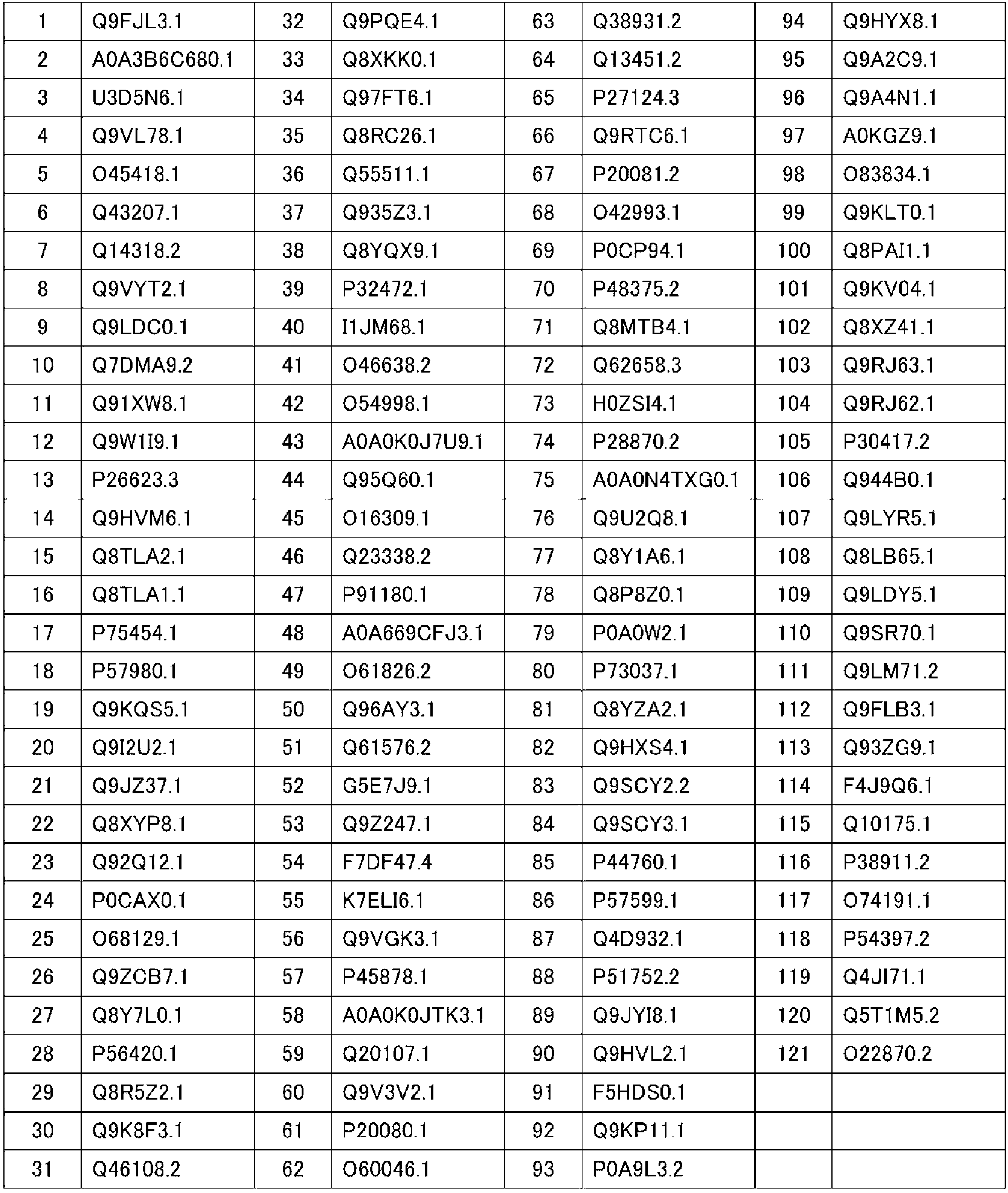
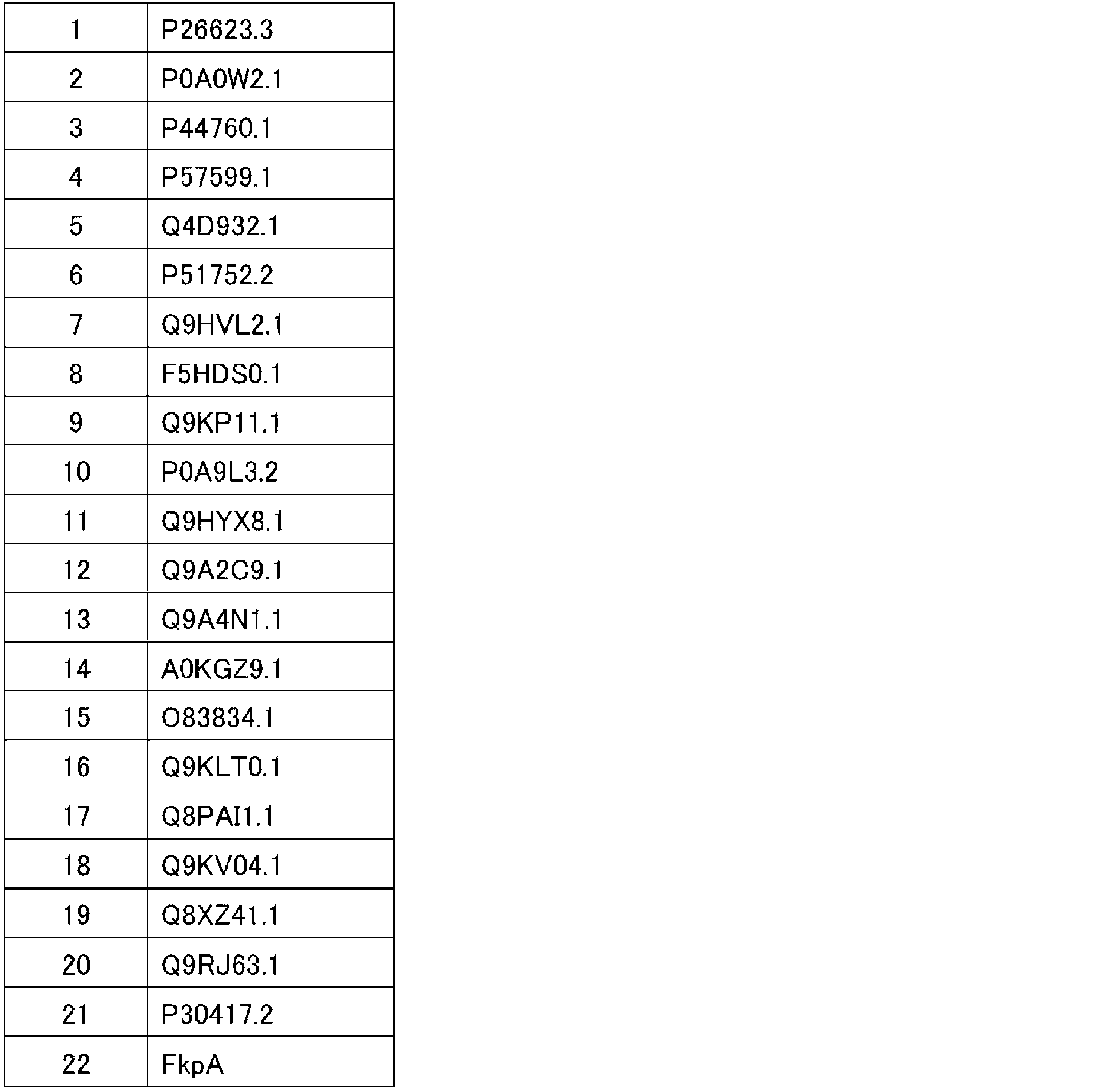
表3に示すBCFKクレードに属するFKBP配列群をFasta形式でまとめたファイルBCFK.fastaを用意した。MAFFT v7.471でmafft ――auto BCFK_mafft.fasta>BCFK.fastaのコマンドを実行し、マルチプルアラインメントを構築した。次に、HMMER バージョン3.3.2を用いて、hmmbuild ――pnone ――wnone BCFK_mafft.hmm BCFK_mafft.fastaのコマンドを実行し、図6に示すHMMプロファイルを作成し、さらにhmmpress BCFK_mafft.hmmのコマンドを実行してバイナリ化した。表2に含まれるFKBP配列群のうち、BCFKクレードに属さないFKBP配列群をFasta形式でまとめたファイルNo_BCFK.Fastaを用意した。hmmscan ――tblout BCFK.tblout BCFK_mafft.hmm No_BCFK.Fastaのコマンドを実行することで、BCFKクレードを定義するHMMプロファイルに対してFKBP配列のうち、BCFKクレードに含まれない配列の相同性検索を行った。その結果、BCFKクレードに含まれない配列は全て112.3以下のHMMスコアとなることが確認された。次に、配列番号18、81~93で表されるPPIase(PrsA、FkpA、FKBP_l、FKBP_K、FKBP_E、FKBP_P、MJFKS、SurA、PpiA、Tig、FKBP2、FK153、FKBP52、CyP40)配列をFasta形式でまとめたファイルExpress_PPIase.Fastaを用意した。hmmscan ――tblout BCFK.tblout BCFK_mafft.hmm Express_PPIase.Fastaのコマンドを実行することで、BCFKクレードを定義するHMMプロファイルに対して実施例1に記載のPPIase配列の相同性検索を行った。相同性が見られない配列のHMMスコアは0として示した。結果を表4に示す。実施例1の1-6で高い生産性向上効果を示したFkpA、FKBP_l、FKBP_K、FKBP_E、FKBP_Pは150以上のHMMスコアを持っており、BCFKクレードに属するFKBP配列であると言える。このように任意のPPIase配列がBCFKクレードに属するPPIase配列かどうかを確認することができる。

Claims (10)
- 異種FK506結合タンパク質(FKBP)をコードする遺伝子及び目的タンパク質をコードする遺伝子を含むグラム陽性細菌を培養すること、又は異種FKBPをコードする遺伝子を含むグラム陽性細菌及び目的タンパク質をコードする遺伝子を含むグラム陽性細菌を混合培養することを含む、目的タンパク質の生産方法。
- 前記異種FKBPがBCFKクレードに属しかつプロリル結合の異性化活性を有するポリペプチド、配列番号6で示されるアミノ酸配列からなるポリペプチド、又は配列番号6で示されるアミノ酸配列と少なくとも80%の同一性を有するアミノ酸配列からなりかつプロリル結合の異性化活性を有するポリペプチドである、請求項1に記載の方法。
- 前記異種FKBPが配列番号1~6のいずれかで示されるアミノ酸配列からなるポリペプチド、又は配列番号1~6のいずれかで示されるアミノ酸配列と少なくとも80%の同一性を有するアミノ酸配列からなりかつプロリル結合の異性化活性を有するポリペプチドである、請求項1に記載の方法。
- 前記異種FKBPをコードする遺伝子が分泌シグナルペプチドをコードするポリヌクレオチドと作動可能に連結されている、請求項1~3のいずれか1項に記載の方法。
- 前記グラム陽性細菌が枯草菌又はその変異株である、請求項1~4のいずれか1項に記載の方法。
- 前記グラム陽性細菌が少なくとも1種類の細胞外プロテアーゼ遺伝子が欠失又は不活性化されている枯草菌である、請求項1~4のいずれか1項に記載の方法。
- 前記目的タンパク質が少なくとも1箇所のプロリル結合異性化部位を有する、請求項1~6のいずれか1項に記載の方法。
- 前記目的タンパク質が抗体関連分子である、請求項1~7のいずれか1項に記載の方法。
- 前記目的タンパク質がFabである、請求項1~7のいずれか1項に記載の方法。
- 異種FKBPをコードする遺伝子、又は異種FKBPをコードする遺伝子及び目的タンパク質をコードする遺伝子を含むグラム陽性細菌。
Priority Applications (1)
| Application Number | Priority Date | Filing Date | Title |
|---|---|---|---|
| EP24832048.3A EP4737583A1 (en) | 2023-06-28 | 2024-06-27 | Method for producing protein of interest |
Applications Claiming Priority (4)
| Application Number | Priority Date | Filing Date | Title |
|---|---|---|---|
| JP2023-105948 | 2023-06-28 | ||
| JP2023105948 | 2023-06-28 | ||
| JP2024-025618 | 2024-02-22 | ||
| JP2024025618A JP2025009766A (ja) | 2023-06-28 | 2024-02-22 | 目的タンパク質の生産方法 |
Publications (1)
| Publication Number | Publication Date |
|---|---|
| WO2025005189A1 true WO2025005189A1 (ja) | 2025-01-02 |
Family
ID=93939198
Family Applications (1)
| Application Number | Title | Priority Date | Filing Date |
|---|---|---|---|
| PCT/JP2024/023366 Ceased WO2025005189A1 (ja) | 2023-06-28 | 2024-06-27 | 目的タンパク質の生産方法 |
Country Status (2)
| Country | Link |
|---|---|
| EP (1) | EP4737583A1 (ja) |
| WO (1) | WO2025005189A1 (ja) |
Citations (13)
| Publication number | Priority date | Publication date | Assignee | Title |
|---|---|---|---|---|
| JP2000210081A (ja) | 1999-01-21 | 2000-08-02 | Kao Corp | 耐熱性アルカリセルラ―ゼ遺伝子 |
| WO2004001041A1 (ja) * | 2002-06-25 | 2003-12-31 | Sekisui Chemical Co., Ltd. | 発現ベクター、宿主、融合タンパク質、融合タンパク質の製造方法及びタンパク質の製造方法 |
| JP3492935B2 (ja) | 1999-04-02 | 2004-02-03 | 花王株式会社 | プラスミドベクター |
| JP2005253432A (ja) | 2004-03-15 | 2005-09-22 | Sekisui Chem Co Ltd | タンパク質の生産方法、並びにそれに使用するための組成物、試薬及びキット |
| JP4202985B2 (ja) | 1993-02-26 | 2008-12-24 | ノボザイムス アクティーゼルスカブ | グラム陽性菌中の商業的に重要な菌体外タンパク質の高められた生産のための方法及び系 |
| JP2009089708A (ja) | 2007-09-20 | 2009-04-30 | Kao Corp | 組換え微生物及びポリ−ガンマ−グルタミン酸の製造方法 |
| JP4336082B2 (ja) | 2001-05-29 | 2009-09-30 | 花王株式会社 | 宿主微生物 |
| JP4485341B2 (ja) | 2004-12-20 | 2010-06-23 | 花王株式会社 | 組換え微生物 |
| JP2011010387A (ja) | 2009-06-23 | 2011-01-13 | Diamond Electric Mfg Co Ltd | フルブリッジ型電力変換回路及びフルブリッジ型dc−dcコンバータ |
| JP2014505482A (ja) * | 2011-02-03 | 2014-03-06 | ゾーマ テクノロジー リミテッド | 細菌中の機能的タンパク質発現を向上させるための方法および物質 |
| JP2014158430A (ja) | 2013-02-19 | 2014-09-04 | Kao Corp | セルラーゼの生産方法 |
| WO2016129637A1 (ja) * | 2015-02-13 | 2016-08-18 | 積水化学工業株式会社 | 核酸、融合タンパク質、組換え細胞、並びに、イソプレン又は環式テルペンの生産方法 |
| JP6088282B2 (ja) | 2013-02-19 | 2017-03-01 | 花王株式会社 | アルカリプロテアーゼの生産方法 |
-
2024
- 2024-06-27 WO PCT/JP2024/023366 patent/WO2025005189A1/ja not_active Ceased
- 2024-06-27 EP EP24832048.3A patent/EP4737583A1/en active Pending
Patent Citations (13)
| Publication number | Priority date | Publication date | Assignee | Title |
|---|---|---|---|---|
| JP4202985B2 (ja) | 1993-02-26 | 2008-12-24 | ノボザイムス アクティーゼルスカブ | グラム陽性菌中の商業的に重要な菌体外タンパク質の高められた生産のための方法及び系 |
| JP2000210081A (ja) | 1999-01-21 | 2000-08-02 | Kao Corp | 耐熱性アルカリセルラ―ゼ遺伝子 |
| JP3492935B2 (ja) | 1999-04-02 | 2004-02-03 | 花王株式会社 | プラスミドベクター |
| JP4336082B2 (ja) | 2001-05-29 | 2009-09-30 | 花王株式会社 | 宿主微生物 |
| WO2004001041A1 (ja) * | 2002-06-25 | 2003-12-31 | Sekisui Chemical Co., Ltd. | 発現ベクター、宿主、融合タンパク質、融合タンパク質の製造方法及びタンパク質の製造方法 |
| JP2005253432A (ja) | 2004-03-15 | 2005-09-22 | Sekisui Chem Co Ltd | タンパク質の生産方法、並びにそれに使用するための組成物、試薬及びキット |
| JP4485341B2 (ja) | 2004-12-20 | 2010-06-23 | 花王株式会社 | 組換え微生物 |
| JP2009089708A (ja) | 2007-09-20 | 2009-04-30 | Kao Corp | 組換え微生物及びポリ−ガンマ−グルタミン酸の製造方法 |
| JP2011010387A (ja) | 2009-06-23 | 2011-01-13 | Diamond Electric Mfg Co Ltd | フルブリッジ型電力変換回路及びフルブリッジ型dc−dcコンバータ |
| JP2014505482A (ja) * | 2011-02-03 | 2014-03-06 | ゾーマ テクノロジー リミテッド | 細菌中の機能的タンパク質発現を向上させるための方法および物質 |
| JP2014158430A (ja) | 2013-02-19 | 2014-09-04 | Kao Corp | セルラーゼの生産方法 |
| JP6088282B2 (ja) | 2013-02-19 | 2017-03-01 | 花王株式会社 | アルカリプロテアーゼの生産方法 |
| WO2016129637A1 (ja) * | 2015-02-13 | 2016-08-18 | 積水化学工業株式会社 | 核酸、融合タンパク質、組換え細胞、並びに、イソプレン又は環式テルペンの生産方法 |
Non-Patent Citations (19)
| Title |
|---|
| BIOTECHNOL PROG, vol. 33, no. 1, 2017, pages 212 - 220 |
| CLUSTAL W, NUCLEIC ACIDS RES, vol. 22, 1994, pages 4673 - 4680 |
| DATABASE UNIPROTKB 14 December 2022 (2022-12-14), ANONYMOUS: " Full=Peptidyl-prolyl cis-trans isomerase {ECO:0000256|RuleBase:RU003915}; DE EC=5.2.1.8 {ECO:0000256|RuleBase:RU003915}", XP093254515, retrieved from UNIPROT Database accession no. A0A0Q4N6E2 * |
| DATABASE UNIPROTKB 14 December 2022 (2022-12-14), ANONYMOUS: "Full=Peptidyl-prolyl cis-trans isomerase {ECO:0000256|RuleBase:RU003915}; DE EC=5.2.1.8 {ECO:0000256|RuleBase:RU003915}", XP093254538, retrieved from UNIPROT Database accession no. A0A7X3MC33 * |
| DATABASE UNIPROTKB 14 December 2022 (2022-12-14), ANONYMOUS: "Full=Peptidyl-prolyl cis-trans isomerase {ECO:0000256|RuleBase:RU003915}; DE EC=5.2.1.8 {ECO:0000256|RuleBase:RU003915};", XP093254512, retrieved from UNIPROT Database accession no. A0A0J4W537 * |
| DATABASE UNIPROTKB 3 August 2022 (2022-08-03), ANONYMOUS: "Full=Peptidyl-prolyl cis-trans isomerase {ECO:0000256|RuleBase:RU003915}; DE EC=5.2.1.8 {ECO:0000256|RuleBase:RU003915}", XP093254508, retrieved from UNIPROT Database accession no. A0A8I0CY20 * |
| J BACTERIOL, vol. 134, 1978, pages 318 - 329 |
| J BIOL CHEM, vol. 279, no. 18, 2004, pages 19302 - 14 |
| JOURNAL OF BACTERIOLOGY, vol. 180, no. 11, 1998, pages 2830 - 2835 |
| JOURNAL OF BACTERIOLOGY, vol. 183, no. 6, 2001, pages 1881 - 1890 |
| JOURNAL OF MOLECULAR BIOLOGY, vol. 427, no. 7, 2015, pages 1609 - 1631 |
| JPN J GENET, vol. 60, 1985, pages 235 - 243 |
| LIPMAN-PEARSON, SCIENCE, vol. 227, 1985, pages 1435 - 1441 |
| MARIKA VITIKAINEN ET AL., JOURNAL OF BIOLOGICAL CHEMISTRY, vol. 279, no. 18, 2004, pages 19302 - 19314 |
| MICROBIAL CELL FACTORIES, vol. 18, no. 158, 2019 |
| MICROBIAL CELL FACTORIES, vol. 9, 2010 |
| NUCLEIC ACIDS RES, vol. 16, 1988, pages 8732 |
| PLASMID, vol. 18, 1987, pages 8 - 15 |
| SHINE, J.DALGARNO, L., PROC. NATL. ACAD. SCI. USA., vol. 71, 1974, pages 1342 - 1346 |
Also Published As
| Publication number | Publication date |
|---|---|
| EP4737583A1 (en) | 2026-05-06 |
Similar Documents
| Publication | Publication Date | Title |
|---|---|---|
| JP7653372B2 (ja) | 重鎖抗体の重鎖可変ドメインの製造方法 | |
| JP4485341B2 (ja) | 組換え微生物 | |
| Yim et al. | High-level secretory production of recombinant single-chain variable fragment (scFv) in Corynebacterium glutamicum | |
| CN112955547B (zh) | 通过使用转录因子来增加蛋白质表达的手段和方法 | |
| WO2024046404A1 (zh) | 一种重组肉毒杆菌毒素及其制备方法 | |
| CN103228787B (zh) | 用于分泌性蛋白表达的融合蛋白 | |
| JP5753419B2 (ja) | 遺伝子欠損株及びそれを用いたタンパク質の製造方法 | |
| CN111601894B (zh) | M23a家族蛋白酶的制造方法 | |
| Koller et al. | Recombinant Streptomyces lividans secretes a fusion protein of tendamistat and proinsulin | |
| JP2025009766A (ja) | 目的タンパク質の生産方法 | |
| WO2009107682A1 (ja) | ヒト型Fcレセプターをコードするポリヌクレオチド、およびそれを利用したヒト型Fcレセプターの製造方法 | |
| EP4737583A1 (en) | Method for producing protein of interest | |
| JP7218090B2 (ja) | タンパク質の製造方法 | |
| Londer et al. | Addressing Shewanella oneidensis “cytochromome”: The first step towards high-throughput expression of cytochromes c | |
| CN111944027B (zh) | mclX基因在苏云金芽胞杆菌母细胞裂解中的应用 | |
| Kusuma et al. | Construction and expression of synthetic gene encoding mpt64 as extracellular protein in Escherichia coli BL21 (DE3) expression system | |
| Kodama et al. | A novel small protein of Bacillus subtilis involved in spore germination and spore coat assembly | |
| JP7634960B2 (ja) | 改変シグナルペプチド | |
| KR102014901B1 (ko) | 단백질에 대한 나노운반체로서의 순도 및 안정성이 증진된 바이러스 유사 입자의 제조방법 | |
| JP5841749B2 (ja) | 組換え微生物 | |
| JP7706628B2 (ja) | 改変5’非翻訳領域及びそれを用いた目的物質の製造方法 | |
| Li et al. | Systematic engineering of Bacillus amyloliquefaciens for efficient bovine lactoferrin production | |
| Ubeidat et al. | Expression and one-step purification of a developmentally regulated protein from Dictyostelium discoideum | |
| KR102688161B1 (ko) | 메틸로루브룸속 균주에서 탄소원 유도 발현이 가능한 발현 벡터 및 이를 이용한 유전자 발현 시스템 | |
| JP5732209B2 (ja) | 遺伝子発現方法 |
Legal Events
| Date | Code | Title | Description |
|---|---|---|---|
| 121 | Ep: the epo has been informed by wipo that ep was designated in this application |
Ref document number: 24832048 Country of ref document: EP Kind code of ref document: A1 |
|
| WWE | Wipo information: entry into national phase |
Ref document number: 2024832048 Country of ref document: EP |
|
| NENP | Non-entry into the national phase |
Ref country code: DE |
|
| ENP | Entry into the national phase |
Ref document number: 2024832048 Country of ref document: EP Effective date: 20260128 |
|
| WWP | Wipo information: published in national office |
Ref document number: 2024832048 Country of ref document: EP |