WO2025004444A1 - 抽選装置及びゲーム装置 - Google Patents
抽選装置及びゲーム装置 Download PDFInfo
- Publication number
- WO2025004444A1 WO2025004444A1 PCT/JP2024/006640 JP2024006640W WO2025004444A1 WO 2025004444 A1 WO2025004444 A1 WO 2025004444A1 JP 2024006640 W JP2024006640 W JP 2024006640W WO 2025004444 A1 WO2025004444 A1 WO 2025004444A1
- Authority
- WO
- WIPO (PCT)
- Prior art keywords
- lottery
- game
- dice
- surface portion
- unit
- Prior art date
- Legal status (The legal status is an assumption and is not a legal conclusion. Google has not performed a legal analysis and makes no representation as to the accuracy of the status listed.)
- Ceased
Links
Images




Classifications
-
- G—PHYSICS
- G07—CHECKING-DEVICES
- G07F—COIN-FREED OR LIKE APPARATUS
- G07F17/00—Coin-freed apparatus for hiring articles; Coin-freed facilities or services
- G07F17/32—Coin-freed apparatus for hiring articles; Coin-freed facilities or services for games, toys, sports, or amusements
- G07F17/3202—Hardware aspects of a gaming system, e.g. components, construction, architecture thereof
- G07F17/3216—Construction aspects of a gaming system, e.g. housing, seats, ergonomic aspects
-
- A—HUMAN NECESSITIES
- A63—SPORTS; GAMES; AMUSEMENTS
- A63F—CARD, BOARD, OR ROULETTE GAMES; INDOOR GAMES USING SMALL MOVING PLAYING BODIES; VIDEO GAMES; GAMES NOT OTHERWISE PROVIDED FOR
- A63F9/00—Games not otherwise provided for
-
- A—HUMAN NECESSITIES
- A63—SPORTS; GAMES; AMUSEMENTS
- A63F—CARD, BOARD, OR ROULETTE GAMES; INDOOR GAMES USING SMALL MOVING PLAYING BODIES; VIDEO GAMES; GAMES NOT OTHERWISE PROVIDED FOR
- A63F9/00—Games not otherwise provided for
- A63F9/04—Dice; Dice-boxes; Mechanical dice-throwing devices
-
- G—PHYSICS
- G07—CHECKING-DEVICES
- G07F—COIN-FREED OR LIKE APPARATUS
- G07F17/00—Coin-freed apparatus for hiring articles; Coin-freed facilities or services
- G07F17/32—Coin-freed apparatus for hiring articles; Coin-freed facilities or services for games, toys, sports, or amusements
- G07F17/326—Game play aspects of gaming systems
- G07F17/3262—Player actions which determine the course of the game, e.g. selecting a prize to be won, outcome to be achieved, game to be played
-
- G—PHYSICS
- G07—CHECKING-DEVICES
- G07F—COIN-FREED OR LIKE APPARATUS
- G07F17/00—Coin-freed apparatus for hiring articles; Coin-freed facilities or services
- G07F17/32—Coin-freed apparatus for hiring articles; Coin-freed facilities or services for games, toys, sports, or amusements
- G07F17/3286—Type of games
- G07F17/329—Regular and instant lottery, e.g. electronic scratch cards
-
- G—PHYSICS
- G07—CHECKING-DEVICES
- G07F—COIN-FREED OR LIKE APPARATUS
- G07F17/00—Coin-freed apparatus for hiring articles; Coin-freed facilities or services
- G07F17/32—Coin-freed apparatus for hiring articles; Coin-freed facilities or services for games, toys, sports, or amusements
- G07F17/3286—Type of games
- G07F17/3297—Fairground games, e.g. Tivoli, coin pusher machines, cranes
Definitions
- the present invention relates to a lottery device and a game device.
- the conventional lottery device disclosed in Patent Document 1 ejects lottery media at a predetermined angle against the peripheral edge of a fixed inverted truncated cone-shaped surface during the lottery process so that the lottery media roll along the inverted truncated cone-shaped surface.
- Such conventional lottery devices are not designed to rotate the inverted truncated cone-shaped surface in the first place, and therefore do not consider the possibility of the lottery media being pressed against the peripheral edge of the surface by the centrifugal force exerted on the lottery media from the rotation of the surface, preventing the lottery media from rolling.
- the lottery media adheres to the surface of the surface, the lottery media will no longer roll relative to the surface of the surface, shortening the time the lottery media rolls on the surface of the surface during the lottery process, which may affect players' expectations for the lottery and the interest of the lottery game.
- the present invention aims to provide a lottery device and game device that can increase players' expectations of the lottery and the interest of the lottery game by varying the movement of the lottery media on the turntable using a simple configuration and extending the time the lottery media rolls on the turntable.
- the lottery device of the present invention comprises a lottery medium having a lottery surface on which lottery contents are displayed, a turntable on which the lottery medium is placed, and a rotation drive unit configured to rotate the turntable to cause the lottery medium placed on the turntable to roll on the turntable, the turntable having a first surface portion and a second surface portion on which the lottery medium can roll and stop after the turntable stops rotating, the first surface portion is annular in plan view, the second surface portion is a portion located on the inner periphery of the first surface portion, and the first surface portion and the second surface portion have different configurations so that the force applied by the first surface portion to the rolling lottery medium and the force applied by the second surface portion to the rolling lottery medium are different.
- the force exerted by the first surface portion on the rolling lottery medium may be greater than the force exerted by the second surface portion on the rolling lottery medium.
- the rolling time of the lottery medium on the first surface portion can be made longer than the rolling time on the second surface portion.
- the first surface portion may have at least one of the following characteristics: it includes a concave portion, it includes a convex portion, and it is made of a material with high friction.
- the frictional force that the first surface portion exerts on the lottery medium can be improved compared to a surface portion that does not have any concave or convex portions, or a surface portion that is made of a material with low friction.
- the first surface portion may have an inverted truncated cone shape.
- the lottery medium can roll toward the inside of the first surface portion by its own weight using a simple structure.
- the second surface portion has an annular connecting portion connected to the first surface portion and a circular central portion located on the inner periphery of the connecting portion, the connecting portion being shaped like an inverted truncated cone, and the central portion may be shaped like any one of a flat surface, a spherical surface, and a conical surface.
- the turntable may further have a protrusion provided in the center.
- the inclination of the connection portion when the turntable is viewed from the side, the inclination of the connection portion may be the same as the inclination of the first surface portion, or may be smaller than the inclination of the first surface portion.
- the lottery medium has a plurality of lottery surfaces and a plurality of curved surfaces arranged around each of the plurality of lottery surfaces, and the plurality of curved surfaces may be interconnected and uniformly distributed on the surface of a single sphere.
- the rolling time of the lottery medium can be extended compared to lottery media in which multiple curved surfaces are not uniformly distributed on the surface of a single sphere.
- each of the multiple lottery surfaces may be a plane or a spherical surface with a curvature smaller than that of a single sphere.
- the present invention makes it possible to provide a lottery device and game device that can increase players' expectations of the lottery and the interest of the lottery game by using a simple configuration to vary the movement of the lottery media on the turntable and extend the time the lottery media rolls on the turntable.
- FIG. 1 is a perspective view showing a configuration of a game device according to an embodiment of the present invention.
- FIG. 1 is a schematic diagram showing a state in which the game device according to the present embodiment is in use.
- 1 is a perspective view showing details of a game section of the game device according to the present embodiment.
- FIG. 2 is a diagram showing the configuration of a medal game section and a first game section of the game device according to the present embodiment.
- FIG. FIG. 4 is a diagram showing the display content of the display unit of the first game section of the game device according to the present embodiment.
- 13A to 13C are diagrams showing other display contents of the display unit of the first game section of the game device according to the present embodiment.
- FIG. 1 is a schematic diagram showing a state in which the game device according to the present embodiment is in use.
- 1 is a perspective view showing details of a game section of the game device according to the present embodiment.
- FIG. 2 is a diagram showing the configuration of a medal game section and a
- FIG. 13 is a diagram showing the display content of the display unit of the second game section of the game device according to the present embodiment.
- FIG. 2 is a diagram showing the configuration of a dice lottery unit of the gaming device according to the present embodiment.
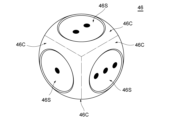
- 1 is a perspective view showing a configuration of dice in the game device according to the present embodiment.
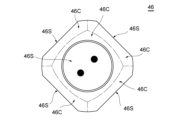
- FIG. 2 is a front view showing the configuration of the dice of the game device according to the present embodiment.
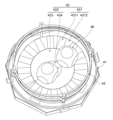
- 2 is a diagram showing the configuration of a wheel of a dice lottery unit of the gaming device according to the present embodiment.
- FIG. 2 is a perspective view showing the configuration of a rotating wheel of a dice lottery unit of the gaming device according to the present embodiment.
- FIG. 13 is a diagram showing a modified example of the center part of the rotating wheel of the dice lottery unit of the gaming device according to the present embodiment.
- FIG. 13A and 13B are diagrams illustrating the effects of modified examples of the center part of the rotating wheel of the dice lottery unit of the gaming device according to the present embodiment.
- 13A and 13B are diagrams showing another modified example of the center part of the rotating wheel of the dice lottery unit of the gaming device according to the present embodiment.
- 13A and 13B are diagrams illustrating the effects of other modified examples of the center part of the rotating wheel of the dice lottery unit of the gaming device according to the present embodiment.
- 5 is a flowchart for explaining control of a game by a control unit of the game device according to the present embodiment.
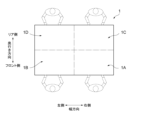
- Figure 1 is a perspective view showing the configuration of the game device 1.
- Figure 2 is a schematic diagram showing the game device 1 in use.
- the game device 1 is an example of a game device in which multiple players can play their own games simultaneously.
- the games according to this embodiment include, for example, a medal game, a first Monopoly game which is an example of a first game, a dice lottery game, and a second Monopoly game which is an example of a second game, all of which are played in each game section described below.
- the medal game and the dice lottery game are, for example, games played physically
- the first Monopoly game and the second Monopoly game are, for example, digital games displayed on a display section.
- the medal game is a lottery game related to the first Monopoly game.
- the dice lottery game is a lottery game related to the first Monopoly game and the second Monopoly game.
- Gaming device 1 is a gaming device for four players. Specifically, as shown in FIG. 2, gaming device 1 includes gaming machines 1A to 1D. Each of gaming machines 1A to 1D has the same configuration. Therefore, by changing the number of gaming machines that make up gaming device 1, the number of players available to gaming device 1 can be changed to a number other than one or four. The following explanation will focus on the configuration of gaming machine 1A.
- FIGS 3 to 7 are diagrams showing the details of the game section of the gaming device 1.
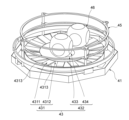
- Figures 8, 11, and 12 are diagrams explaining the configuration of the dice lottery section 40.
- Figures 9 and 10 are diagrams showing the configuration of the dice 46.
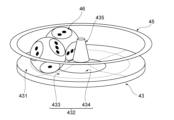
- Figures 13 to 16 are diagrams showing modified examples of the second surface section 432 of the dice lottery section 40.
- the game machine 1A comprises a medal game unit 10 for playing a medal game, a first game unit 20 for playing a first Monopoly game, a second game unit 30 for playing a second Monopoly game, a dice lottery unit 40 for playing a dice lottery game, an operation unit 50 for receiving operations from a player, a payout unit 60 for paying out to the player a number of game result media, such as prize exchange tickets, corresponding to the results of the lottery game, a control unit 70 for executing the lottery game by controlling the operation of each of the medal game unit 10, the first game unit 20, the second game unit 30, the dice lottery unit 40, the operation unit 50, and the payout unit 60, and a housing 80 for supporting or housing the above-mentioned configuration.
- a medal game unit 10 for playing a medal game
- a first game unit 20 for playing a first Monopoly game
- a second game unit 30 for playing a second Monopoly game
- a dice lottery unit 40 for playing a dice lottery game
- an operation unit 50 for receiving operations from
- the medal game unit 10 is an example of a configuration for playing a medal game.
- the medal game includes a medal insertion game, a medal pusher game, a lottery medium pusher game, and a medium lottery game played via a lottery medium.
- the lottery medium may include, for example, a ball with a built-in dice, a dice, etc.
- the medal game unit 10 includes a medal insertion unit 11 (see Figure 1) that inserts medals into the medal game area F based on the player's operation, a placement surface 12 on which medals and lottery media are placed, a pusher table 13 that moves the medals and lottery media placed on the placement surface 12, a drop unit 14 from which the medals and lottery media placed on the placement surface 12 can drop, a lottery medium supply unit 15 that supplies lottery media to the upper surface of the pusher table 13, and a medal supply unit 16 that supplies medals to the upper surface of the pusher table 13.
- the medal game area F is an area formed by the placement surface 12 and the upper surface of the pusher table 13.
- the shape of the medal game area F when viewed from the front is rectangular. Furthermore, the short side of the medal game area F is aligned along the width direction of the game device 1 (see FIG. 1), and the long side is aligned along the depth direction of the game device 1 (see FIG. 1).
- the placement surface 12 is configured to be used in the medal insertion game, medal pusher game, and lottery medium pusher game.
- the placement surface 12 has a rectangular shape in a plan view. As shown in Fig. 3, the placement surface 12 is provided so that its longitudinal direction is aligned with the longitudinal direction of the medal game area. Furthermore, the placement surface 12 can place medals inserted by the medal insertion unit 11, and medals and lottery media dropped from the pusher table 13.
- the pusher table 13 is configured to be used in a medal pusher game and a lottery medium pusher game. As shown in Fig. 3, the pusher table 13 is provided above the placement surface 12 and at the end on the rear side in the longitudinal direction of the placement surface 12. The pusher table 13 can move horizontally back and forth within a predetermined range in a first direction D1 shown in Fig. 3 under the control of the control unit 70.
- the first direction D1 is a direction along the longitudinal direction of the placement surface 12.
- the drop section 14 is configured to be used in a medium lottery game.
- the drop section 14 is provided on the front side of the placement surface 12 in the longitudinal direction of the placement surface 12. As shown in Fig. 4, the drop section 14 has a drop opening 141 and a medium detection sensor and a medal number detection sensor (not shown) provided below the drop opening 141.
- the drop port 141 allows medals and lottery media located at the front end of the placement surface 12, which have been pushed by the pusher table 13, to drop from the placement surface 12.
- the medium detection sensor can detect medium lottery information including the presence or absence of lottery media that have fallen to the bottom of the drop section 14 and the number of dice rolls indicated on the lottery media that have fallen to the bottom of the drop section 14. Furthermore, when the medium detection sensor detects the medium lottery information, it transmits the medium lottery information to the control section 70. Then, the control section 70 can start the first Monopoly game by the first game section 20 based on the medium lottery information.
- the medals that fall into the drop section 14 are transported and stored in a medal storage section (not shown) of the medal supply section 16 via a medal transport configuration (not shown).
- the lottery media that fall into the drop section 14 are transported to the lottery medium supply section 15 via a lottery medium transport configuration (not shown).
- the lottery medium supply unit 15 is configured to supply lottery media for a medal game to the medal game area F.
- the lottery medium supply unit 15 includes, for example, a transport lift that transports the lottery media (not shown), and a transport lift that transports the lottery media. and a guide unit 151 (see FIG. 3 and FIG. 4) that guides the transported lottery medium to the medal game area F.
- the transport lift includes, for example, a lottery medium transporting structure that transports the lottery medium to the lottery medium supply unit 15. The lottery medium is transported to the upper surface of the pusher table 13 each time.
- the medal supply unit 16 is configured to supply medals for a medal game to the medal game area F.
- the medal supply unit 16 has, for example, a medal storage unit that stores medals not shown, and a medal transport unit.
- the medal transport unit is configured to take out a predetermined number of medals from the medal storage unit and supply them to the medal game area F, based on a medal replenishment request from the control unit 70 to the medal game area F, when the number of medals in the medal game area F is below a certain number.
- the first game unit 20 is an example of a game unit for playing the first Monopoly game.
- the first game unit 20 is configured to progress the first Monopoly game based on the control of the control unit 70.
- control unit 70 when the control unit 70 receives medium lottery information transmitted from the medium detection sensor, it transmits first game start information to the first game unit 20. Then, the first game unit 20 starts and progresses the first Monopoly game based on the first game start information.
- the first game start information includes, for example, start information for starting the first Monopoly game, and information on the number of dice rolls shown on the lottery medium that has fallen to the bottom of the drop section 14 and that has been detected by the medium detection sensor and received by the control section 70.
- the first game unit 20 also has a display unit 21 and a physical lottery unit 25, as shown in Figs. 3 and 4.
- the display unit 21 is configured to display the details of the first Monopoly game to the player.
- the physical lottery unit 25 is configured to determine the timing of stopping the rotation of the slot for the first dice slot lottery displayed by the display unit 21, which will be described later.
- the display unit 21 includes a frame-shaped first display area 22 that displays the first Monopoly game, a second display area 23 located inside the first display area 22 that displays information related to the lottery, and a third display area 24 located outside the first display area 22 that displays the game fee paid by the player and game result information of the first Monopoly game, for example.
- the first display area 22 displays, for example, as shown in FIG. 4, a first piece in the first Monopoly game and a first board to which the first piece moves.
- On the first board information about the first Monopoly game, such as land squares, public company squares, railroad squares, chance and community fund squares, prison squares, and buildings built by the player, is displayed.
- the first piece moves a number of steps on the first board corresponding to the total number of pips.
- the second display area 23 can display two dice slot screens, for example, as shown in FIG. 4.
- the first dice slot screen displays the result of a physically performed dice lottery.
- the dice lottery result of the first dice slot is the number of dice that was displayed on the first dice slot screen at the timing at which the rotation of the first dice slot was stopped, as determined by the physical lottery unit 25.
- the second dice slot screen displays the result of a digitally performed dice lottery. The lottery on the second dice slot screen begins when first game start information is received by the first game unit 20.
- the second display area 23 may display other lottery games in addition to displaying the two dice slot screens shown in FIG. 4. For example, when the player's first piece reaches the chance square, the second display area 23 can display the first roulette lottery shown in FIG. 5. When the result of the first roulette lottery hits "challenge,” the second display area 23 can further display the second roulette lottery shown in FIG. 6.
- the first roulette lottery shown in FIG. 5 has a feature that, for example, the higher the price of the land on which the hotel built by the player is located, the higher the possibility of the number of "winning spaces” increasing.
- the second roulette lottery has a feature that, for example, the more hotels the player builds, the higher the possibility of the number of "winning spaces” increasing.
- "Winning spaces" are accumulated in a "Monopoly Challenge” shown in the third display area 24 described below.
- the control unit 70 starts a second Monopoly game by the second game unit 30.
- control unit 70 also starts a second Monopoly game by the second game unit 30.
- the third display area 24 displays, on the outer periphery of the second display area 23, information on the game fee already paid by the player and the credits the player has acquired in the first Monopoly game, "Monopoly Challenge” information for saving the "winning spaces” the player has acquired in the first roulette drawing and/or the second roulette drawing, card information the player has acquired in the first Monopoly game, "GO Bonus” information, and information on the player's use of public utilities.
- the physical lottery unit 25 is configured to physically use a ball to determine the timing for stopping the rotation of the first dice slot. As shown in FIG. 4, the physical lottery unit 25 has a lottery main body 26, a lottery surface 27 that constitutes the upper surface of the lottery main body 26, and a ball drop opening 28 and a ball transport opening 29 provided on both ends of the lottery surface 27.
- the lottery surface 27 has a right end 271 and a left end 272.
- the lottery surface 27 is also inclined so that the right end 271 is lower than the left end 272.
- the ball drop opening 28 is provided at the right end 271, and the ball transport opening 29 is provided at the left end 272. With this configuration, the ball that leaves the ball transport opening 29 can roll and fall along the lottery surface 27 toward the ball drop opening 28 due to its own weight.
- the lottery main body 26 has a storage section (not shown) for storing balls, a transport section for removing the balls from the storage section and transporting them to the ball transport port 29, and a calculation section for calculating the time from when the ball leaves the ball transport port 29 until when it falls into the ball drop port 28.
- a storage section (not shown) for storing balls
- a transport section for removing the balls from the storage section and transporting them to the ball transport port 29, and a calculation section for calculating the time from when the ball leaves the ball transport port 29 until when it falls into the ball drop port 28.
- the transport unit can also transport the ball to the ball drop port 28 so as to change the speed, direction, and other conditions of the ball when it leaves the ball transport port 29. In this way, it is possible to change the timing at which the rotation of the first dice slot stops.
- the second game unit 30 is an example of a game unit for playing the second Monopoly game.
- the second game unit 30 is a game unit that is shared by four players and can be used by each player in a predetermined order.
- the second game unit 30 is configured to progress the second Monopoly game based on the control of the control unit 70.
- control unit 70 when the control unit 70 receives information transmitted from the first game unit 20 that the number of "winning squares” accumulated in the "Monopoly Challenge” in the first roulette lottery and/or the second roulette lottery reaches a predetermined number (e.g., seven), or that the "Big Monopoly" has been won in the second roulette lottery, the control unit 70 transmits second game start information to the second game unit 30 and the dice lottery unit 40. Then, the second game unit 30 and the dice lottery unit 40 start and progress the second Monopoly game based on the second game start information.
- a predetermined number e.g., seven
- the second game unit 30 also has a display unit 31 and a medal payout unit 34, as shown in Figs. 1 and 3.
- the display unit 31 displays details of the second Monopoly game to the player.
- the display unit 31 is configured to be shared by four players and is larger than the display unit 21 of the first game unit 20.
- the display unit 31 also includes, for example, a frame-shaped first display area 32 that displays the second Monopoly game, and a second display area 33 that is inside the first display area 32 and displays information related to the board displayed in the first display area 32 (e.g., buildings, town scenery, etc.), as shown in Figs. 3 and 7.
- the first display area 32 displays, for example, a second piece in the second Monopoly game and a second board to which the second piece moves, as shown in Figs. 3 and 7.
- On the second board information related to the second Monopoly game, such as land squares, points (not shown) corresponding to each land square, and prison squares, is displayed.
- the second piece moves a number of steps on the second board corresponding to the total number of pips based on the result of the lottery by the dice lottery unit 40 described below, i.e., the total number of pips from the results of the roll of two dice by the dice lottery unit 40.
- the medal payout unit 34 is configured to be shared by the four players. When a player acquires a "jackpot" (described below) in the second Monopoly game, the medal payout unit 34 moves above the medal game area F of the medal game unit 10 used by that player, and can pay out to that player a number of medals corresponding to the "jackpot.”
- the second Monopoly game ends in principle after the dice drawing unit 40 has performed a predetermined number of draws (e.g., five draws), or when the second piece reaches the prison square shown on the second board even though the dice drawing unit 40 has not performed the predetermined number of draws. Also, if a player collects a predetermined number of points (e.g., 300 points) before the second Monopoly game ends, that player can obtain a "jackpot.”
- a predetermined number of draws e.g., five draws
- a predetermined number of points e.g. 300 points
- the dice lottery unit 40 is an example of a lottery device for playing a dice lottery game.
- the dice lottery unit 40 is a lottery device that is shared by two players and can be used by each player in a predetermined order.
- the dice lottery unit 40 is configured to play a dice lottery game based on the control of the control unit 70. Specifically, the dice lottery unit 40 starts the dice lottery game when it receives second game start information from the control unit 70.
- the dice lottery game is a physical lottery conducted through two dice 46.
- the dice 46 used in the dice lottery game is an example of a lottery medium having a lottery surface on which the lottery contents for the lottery are displayed.
- the dice 46 has six lottery surfaces 46S and curved surfaces 46C provided around each of the six lottery surfaces 46S.
- Each of the six lottery surfaces 46S is a flat surface or a spherical surface whose curvature is smaller than that of a single sphere on which the six curved surfaces 46C described later are located.
- Each of the six lottery surfaces 46S is printed with the number of pips rolled, which is an example of different lottery contents.
- Each lottery surface 46S may be a display unit that digitally displays different lottery contents.
- the six curved surfaces 46C are connected to each other and are uniformly distributed on the surface of a single sphere. A curved surface 46C with these characteristics can extend the time that the dice 46 rolls on the turntable 43, which will be described later.
- the dice 46 has been described as having six lottery surfaces 46S and six curved surfaces 46C that are interconnected and evenly distributed on the surface of a single sphere, but this is not limited to the above.
- the six curved surfaces 46C of the dice 46 do not have to be interconnected, and do not have to be evenly distributed on the surface of a single sphere.
- the dice 46 may have only one lottery surface 46S, or may have multiple lottery surfaces 46S other than six.
- the lottery content indicated by the lottery surface 46S may be something other than the result, such as a numerical display, a design, or the alphabet.
- the dice lottery unit 40 includes a lottery configuration 401 related to the dice lottery and an identification configuration 402 related to the identification of the dice lottery result.
- the lottery configuration 401 includes a first base portion 41, a turntable 43 rotatably supported by the first base portion 41 and on which the dice 46 are placed, a rotation drive portion 44 configured to rotate the turntable 43 to cause the dice 46 placed on the turntable 43 to roll on the turntable 43, a guide portion 45 provided around the turntable 43, and a protective portion 47 provided on the outer periphery of the guide portion 45 to prevent the dice 46 from jumping out of the guide portion 45 due to the rotation of the turntable 43.
- the identification configuration 402 includes a second base portion 42, an illumination portion 48 supported by the second base portion 42, and a dice recognition portion 49 supported by the second base portion 42.
- the rotating plate 43 is configured to support the two dice 46 and transmit the rotational force from the rotation drive unit 44 to the two dice 46. In other words, each of the two dice 46 can roll on the rotating plate 43 due to the frictional force between the two dice 46 and the rotating plate 43.
- the entire rotating plate 43 has an inverted truncated cone shape, as shown in Fig. 8.
- the expression "inverted truncated cone shape” includes those with spherical sides. The same applies to the following explanation.
- the turntable 43 has a first surface portion 431 and a second surface portion 432 on which the two dice 46 can roll and stop after the turntable 43 stops rotating.
- the first surface portion 431 is annular, and the second surface portion 432 is a circular portion located on the inner periphery side of the first surface portion 431.
- the first surface portion 431 is also shaped like an inverted truncated cone.
- the second surface portion 432 is shaped like an inverted truncated cone with no opening in the center, as shown in FIG. 12.
- the dice 46 when the dice 46 is pressed against the guide portion 45 on the outer periphery of the turntable 43 by the centrifugal force caused by the rotation of the turntable 43, the dice 46 can roll inside the turntable 43 by its own weight, and it is possible to prevent the dice 46 from being pressed against the guide portion 45 by the centrifugal force and being unable to roll.
- first surface portion 431 and the second surface portion 432 have different surface configurations so that the force imparted to the rolling dice 46 by the first surface portion 431 differs from the force imparted to the rolling dice 46 by the second surface portion 432.
- first surface portion 431 is configured so that the force imparted to the two rolling dice 46 by the first surface portion 431 is greater than the force imparted to the two rolling dice 46 by the second surface portion 432.
- the first surface portion 431 has a plurality of convex portions 4311 provided on its surface, for example, as shown in Figs. 11 and 12.
- the shape of the convex portions 4311 in a plan view is rectangular.
- the plurality of convex portions 4311 are provided at equal intervals in the circumferential direction of the first surface portion 431, as shown in Fig. 11. In this way, a concave portion 4312 is formed between two convex portions 4311.
- the second surface portion 432 has a smooth surface without any irregularities, as shown in, for example, Figures 11 and 12. Furthermore, the second surface portion 432 is not made of a material with higher friction than the first surface portion 431.
- the frictional force that the first surface portion 431 exerts on the dice 46 can be made greater than the frictional force that the second surface portion 432 exerts on the dice 46. Therefore, when the turntable 43 rotates, the driving force that the first surface portion 431 exerts on the dice 46 to roll the dice 46 is greater than the driving force that the second surface portion 432 exerts on the dice 46.
- each protrusion 4311 has ridges 4313 on both sides.
- the ridges 4313 of such protrusions 4311 make it possible for the ridges 4313 of the protrusions 4311 to come into contact with the dice 46 when the turntable 43 rotates. Furthermore, such contact allows the ridges 4313 rotating together with the turntable 43 to push the dice 46, providing the dice 46 with the power to roll. As a result, the rolling time of the dice 46 on the turntable 43 can be extended when the turntable 43 rotates.
- the first surface portion 431 has been described as having a plurality of convex portions 4311, but is not limited to this.
- the first surface portion 431 may have only one convex portion 4311, or may have one or more concave portions formed to be recessed from the surface instead of the convex portion 4311, and may be made of a material with high friction.
- the planar shape of the convex portion 4311 may be a circle, a polygon, or an irregular shape other than a rectangle.
- the first surface portion 431 may have at least two of the following characteristics: including a concave portion, including a convex portion, and being made of a material with high friction.
- the second surface portion 432 has been described as having a smooth surface with no irregularities, the present invention is not limited to this.
- the second surface portion 432 may have any configuration that applies a smaller force to the two rolling dice 46 than the first surface portion 431.
- the second surface portion 432 may have shallower irregularities than the first surface portion 431, or may have fewer irregularities than the first surface portion 431.
- the first surface portion 431 is made of a material with high friction
- the second surface portion 432 may be made of a material with lower friction than the first surface portion 431.
- the first surface portion 431 has a ring-shaped planar shape
- the second surface portion 432 has a circular planar shape, but this is not limited thereto.
- the first surface portion 431 and the second surface portion 432 may be configured such that the first surface portion 431 is located closer to the periphery of the turntable 43 than the second surface portion 432, and the first surface portion 431 applies a greater force to the two rolling dice 46 than the second surface portion 432.
- the first surface portion 431 may have a planar shape other than a ring-shaped shape
- the second surface portion 432 may have a planar shape other than a circle-shaped shape.
- the first surface portion 431 may have a planar shape of one or more circumferentially arranged, not connected to each other, on the periphery of the turntable 43.
- the planar shape of the second surface portion 432 may have both a portion located inside each component of the first surface portion 431 and a portion extending to the periphery of the turntable 43 through the unconnected portions of each component of the first surface portion 431.
- the turntable 43 may also have other surface portions in addition to the first surface portion 431 and the second surface portion 432.
- the second surface portion 432 has a connection portion 433 that is connected to the first surface portion 431 and has a ring-shaped shape in a plan view, and a central portion 434 that is located on the inner periphery of the connection portion 433 and has a circular shape in a plan view.
- connection portion 433 has an inverted truncated cone shape.
- the inclination of the connection portion 433 is the same as the inclination of the first surface portion 431.
- the inclination of the connection portion 433 may be smaller than the inclination of the first surface portion 431.
- the central portion 434 has a flat shape.
- the shape of the central portion 434 may be other than flat.
- the shape of the central portion 434 may be a cone-shaped (or spherical) shape that protrudes downward from the connecting portion 433, as shown in FIG. 13. With such a central portion 434, the two dice 46 tend to gather on the central portion 434 side, as shown in FIG. 14. As a result, the two dice 46 tend to stack. In this way, the two dice 46 are less likely to remain leaning against the guide portion 45.
- the central portion 434 may be provided with a protrusion 435, as shown in FIG. 15.
- the shape of the central portion 434 may be a conical or spherical surface that protrudes upward relative to the connection portion 433.
- the rotation drive unit 44 is a component for driving the rotation of the turntable 43. As shown in Fig. 8, the rotation drive unit 44 is attached to the rear surface of the first base unit 41.
- the rotation drive unit 44 can output a rotation force when the dice lottery unit 40 receives second game start information from the control unit 70, for example, and stop outputting the rotation force after a predetermined time has elapsed. With such a rotation drive unit 44, the turntable 43 can stop rotating a predetermined time after it has rotated.
- the guide portion 45 is configured to guide the rolling direction of the dice 46.
- the guide portion 45 is configured as a circular frame.
- the guide portion 45 is provided so as to be able to come into contact with the dice 46 when the dice 46 rotates on the periphery of the turntable 43. In this way, the guide portion 45 can guide the rolling direction of the dice 46 so that the dice 46 does not jump out of the turntable 43.
- the protective portion 47 is configured to prevent the rolling dice 46 from bouncing off the turntable 43 and flying out of the guide portion 45. As shown in Fig. 8, the protective portion 47 has a cylindrical configuration formed higher than the guide portion 45. The protective portion 47 is also made of a transparent material. In this way, the player can visually check the progress of the dice lottery game.
- the second base portion 42 is attached to the peripheral edge side of the first base portion 41.
- the upper end portion of the second base portion 42 supports the lighting unit 48 and the dice recognition unit 49 so that the lighting unit 48 and the dice recognition unit 49 are located above the turntable 43.
- the lighting unit 48 is configured to illuminate the rotating wheel 43. Such lighting unit 48 makes it easier for the player to view the dice lottery game, and also improves the appearance of the dice lottery game.
- the dice recognition unit 49 is configured to recognize the lottery result of the dice lottery game, i.e., the number of digits on each of the two dice 46 after they have stopped. As shown in Fig. 8, the dice recognition unit 49 has an irradiation light source 491 that shines light on the dice 46, and a dice recognition camera 492 that identifies the number of digits on the dice 46 illuminated by the irradiation light source 491.
- the irradiation light source 491 emits, for example, infrared light.
- the dice recognition camera 492 acquires images of the number of digits rolled on the two dice 46 illuminated by the infrared light, and transmits total number of digits rolled corresponding to the two images to the control unit 70. Then, based on the total number of digits rolled information, the control unit 70 can move the second piece related to the second Monopoly game to the second board surface by the number of steps corresponding to the total number of digits rolled.
- the dice recognition unit 49 is not limited to recognizing the number of digits on the dice 46 by the above-mentioned method.
- the dice recognition unit 49 may identify the number of digits on the dice 46 using visible light without using the irradiation light source 491.
- the dice recognition unit 49 may also identify the number of digits on the dice 46 using an RFID method.
- the dice recognition unit 49 may be configured to transmit recognition error information to the control unit 70 when a recognition error occurs in the dice recognition unit 49, for example, when two dice 46 overlap. Based on such recognition error information, the control unit 70 can eliminate the overlap of the two dice 46 by re-spinning the turntable 43 or by spinning the turntable 43 at a slower speed than during the dice drawing.
- the operation unit 50 is an example of a configuration for accepting operations by a player to play the game according to this embodiment.
- the operation unit 50 includes a fee insertion slot 51 for accepting a game fee from a player, an adjustment handle 52 for rotating the medal supply unit 16, a medal insertion button 53 for inserting medals into the medal game area F via the medal insertion unit 11, and an operation button 54 for accepting operations for the first Monopoly game, the second Monopoly game, and the dice lottery game.
- the operation button 54 can accept, for example, game operations by the player related to each of the first and second Monopoly games, such as purchasing land, drawing lots, constructing buildings, and drawing lots operations, such as starting and stopping the dice drawing game.
- Fig. 17 is a flow chart for explaining the control of the lottery game by the control unit 70.
- Step S11 When a player inserts a predetermined game fee into the fee insertion slot 51, the control unit 70 starts the game according to this embodiment. In addition, with the start of the game, the medal pusher game and the lottery medium pusher game of the medal game are started (step S11).
- Step S12, S13, S14, S15 The control unit 70 judges whether or not the player has pressed the medal insertion button 53 (step S12). If the player has pressed the medal insertion button 53 (YES in step S12), the control unit 70 starts a medal insertion game (step S13). Next, the control unit 70 judges whether or not the lottery medium placed on the placement surface 12 has fallen into the drop section 14 (step S14). If the lottery medium placed on the placement surface 12 has fallen into the drop section 14 (YES in step S14), the control unit 70 starts a first Monopoly game (step S15).
- Step S16 After the first Monopoly game is started, a lottery using two dice slots is started. Then, the control unit 70 judges whether the lottery using the two dice slots has ended (step S16). When the lottery using the two dice slots has ended (YES in step S16), the control unit 70 moves the first piece by a number of steps corresponding to the total number of pips related to the lottery using the two dice slots (step S17). Next, the control unit 70 judges whether the first piece has reached a "chance" square (step S18). When the first piece has reached a "chance" square (YES in step S18), the control unit 70 starts a first roulette lottery in the first Monopoly game (step S19).
- Step S20, S21, S22, S23 the control unit 70 judges whether or not "Challenge” has been won in the first roulette drawing (step S20). If “Challenge” has been won (YES in step S20), the control unit 70 starts a second roulette drawing (step S21). Next, the control unit 70 judges whether or not "Big Monopoly” has been won in the second roulette drawing (step S22). If “Big Monopoly” has been won (YES in step S22), the control unit 70 starts a second Monopoly game and a dice drawing game (step S23).
- Step S27, S28, S29, S30 the control unit 70 judges whether the dice lottery game has reached a predetermined number of draws (step S27). If the dice lottery game has not reached a predetermined number of draws (NO in step S27), the control unit 70 judges whether the second piece has reached the "jail" square (step S28). If the second piece has not reached the "jail" square (NO in step S28), the control unit 70 judges whether the player has collected a predetermined number of points in the second Monopoly game (step S29).
- control unit 70 moves the medal payout unit 34 above the medal game unit 10 used by the player so that the player can obtain a jackpot, and pays out a predetermined number of medals to the player (step S30).
- Steps S31 and S32 Thereafter, the control unit 70 judges whether or not the medal payout unit 34 has finished paying out medals to the player (step S31). If the medal payout unit 34 has finished paying out medals to the player (YES in step S31), the control unit 70 ends the second Monopoly game (step S32) and then ends the game.
- step S12 if the player has not pressed the medal insertion button 53 (NO in step S12), the control unit 70 returns the process to step S12. If the lottery medium placed on the placement surface 12 has not fallen into the drop section 14 (NO in step S14), the control unit 70 returns the process to step S14.
- step S16 if the lottery using the two dice slots has not finished (NO in step S16), the control unit 70 returns the process to step S16. If the first piece has not reached the "chance" square (NO in step S18), the control unit 70 returns the process to step S14.
- step S33 judges whether the number of "winning squares” accumulated in the "Monopoly Challenge” has reached a predetermined number (step S33). If the number of "winning squares” accumulated in the "Monopoly Challenge” has reached a predetermined number (YES in step S33), the control unit 70 advances the process to step S23. On the other hand, if the number of "winning squares” accumulated in the "Monopoly Challenge” has not reached a predetermined number (NO in step S33), the control unit 70 returns the process to step S14. If the "Big Monopoly” is not won (NO in step S22), the control unit 70 returns the process to step S14.
- the dice lottery unit 40 which is an example of a lottery device according to the embodiment described above, includes dice 46, which is an example of a lottery medium having a lottery surface on which the lottery contents for the lottery are displayed, a turntable 43 on which the dice 46 are placed, and a rotation drive unit 44 configured to rotate the turntable 43 to cause the two dice 46 placed on the turntable 43 to roll on the turntable.
- the turntable 43 is configured to rotate the two dice 46 after the turntable 43 stops rotating.
- the turntable 43 has a first surface portion 431 and a second surface portion 432 that can be stopped by rotating the turntable 43.
- the first surface portion 431 is annular
- the second surface portion 432 is a portion located on the inner periphery of the first surface portion 431.
- the first surface portion 431 and the second surface portion 432 are configured to have different configurations so that the force applied to the rolling dice 46 by the first surface portion 431 and the force applied to the rolling dice 46 by the second surface portion 432 are different.
- the movement of the dice 46 on the turntable 43 is changed, and the rolling time of the dice 46 on the turntable 43 is extended, thereby improving the player's expectations for the lottery and the interest of the dice lottery game.
- the force applied by the first surface portion 431 to the rolling dice 46 can be made greater than the force applied by the second surface portion 432 to the rolling dice 46.
- the rolling time of the dice 46 on the first surface portion 431 can be made longer than the rolling time of the dice 46 on the second surface portion 432.
- the first surface portion 431 can have at least one of the following characteristics: including a concave portion, including a convex portion, and being made of a material with high friction.
- the frictional force that the first surface portion 431 exerts on the dice 46 can be increased, compared to a surface portion that does not have a concave portion or a convex portion, or a surface portion that is made of a material with low friction.
- the first surface portion 431 can have an inverted truncated cone shape.
- the dice 46 can roll toward the inside of the first surface portion 431 by their own weight using a simple configuration.
- the turntable 43 can further have a protrusion 435 provided in the central portion 434.
- the dice 46 are less likely to gather on the central portion 434 side, making it difficult for the dice 46 to become stacked.
- the inclination of the connection portion 433 can be made the same as the inclination of the first surface portion 431 or smaller than the inclination of the first surface portion 431.
- the effect of the weight of the dice 46 on the second surface portion 432 on the rolling of the dice 46 can be made equal to or smaller than the effect of the weight of the dice 46 on the rolling of the dice 46 on the first surface portion 431, thereby making it possible to change the movement of the dice 46.
- each of the multiple lottery surfaces 46S can be a flat surface or a spherical surface with a curvature smaller than that of a single sphere on which the multiple curved surfaces 46C are located. As a result, the effect of the lottery surface 46S on the rolling of the dice 46 can be reduced.
- the game machine 1A which is an example of the game device according to the embodiment described above, is configured to include at least a first game section 20 that plays a first Monopoly game, which is an example of a first game, and a second game section 30 that plays a second Monopoly game, which is an example of a second game, and any one of the above-mentioned dice lottery sections 40 that plays a dice lottery game, which is an example of a lottery game related to the first Monopoly game and the second Monopoly game, and a control section 70 that controls the first game section 20, the second game section 30, and the dice lottery section 40 so as to start the first Monopoly game by the first game section 20 based on the player's operation, obtain the game result of the first Monopoly game, start the dice lottery game by the dice lottery section 40 based on the game result, obtain the lottery result, and start the second Monopoly game by the second game section based on the lottery result.
- a simple configuration to extend the lottery time of the dice lottery game, it
- the present invention is not limited to the above-mentioned embodiments, and designs modified by a person skilled in the art are also included within the scope of the present invention as long as they have the characteristics of the present invention.
- the elements of the above-mentioned embodiments and their arrangements, materials, conditions, shapes, sizes, etc. are not limited to those exemplified, and can be modified as appropriate.
- the elements of the above-mentioned embodiments can be combined to the extent technically possible, and combinations of these are also included within the scope of the present invention as long as they include the characteristics of the present invention.
- the dice lottery unit 40 having the above-mentioned characteristics is included within the scope of the present invention even if it is used in a game device that plays a game different from the game played by the game device 1 according to this embodiment.
- the dice 46 (lottery medium) having the above-mentioned characteristics is included within the scope of the present invention even if it is used in a lottery device other than the above-mentioned dice lottery unit 40, or is used in a game different from the above-mentioned dice lottery game.
- Game device 20 First game section 30: Second game section 40: Dice lottery section 43: Turntable 44: Rotation drive section 46: Dice 46S: Lottery surface 46C: Curved surface 431: First surface section 432: Second surface section 433: Connection section 434: Central section 435: Projection section 4311: Convex section 4312: Concave section
Landscapes
- Physics & Mathematics (AREA)
- General Physics & Mathematics (AREA)
- Engineering & Computer Science (AREA)
- Multimedia (AREA)
- Time Recorders, Dirve Recorders, Access Control (AREA)
- Credit Cards Or The Like (AREA)
Abstract
Description
まず、図1~図3を参照しつつ、本実施形態に係るゲーム装置1の構成の概要及びゲーム装置1によって行われるゲームについて説明する。図1は、ゲーム装置1の構成を示す斜視図である。図2は、ゲーム装置1の使用状態を示す模式図である。
続いて、図1~図16を参照しつつ、本実施形態に係るゲーム機1Aの構成の詳細について説明する。図3~図7は、ゲーム装置1のゲーム部の詳細を示す図である。図8、図11、及び図12は、サイコロ抽選部40の構成を説明する図である。図9及び図10は、サイコロ46の構成を示す図である。図13~図16は、サイコロ抽選部40の第2表面部432の変形例を示す図である。
まず、図3及び図4を参照しつつ、メダルゲーム部10の構成について説明する。メダルゲーム部10は、メダルゲームを行うための構成の一例である。ここで、メダルゲームは、メダル投入ゲームと、メダルプッシャゲームと、抽選媒体プッシャゲームと、抽選媒体を介して行われる媒体抽選ゲームと、を含む。抽選媒体は、例えば、サイコロが内蔵されたボール及びサイコロ等を含むことができる。
メダル投入部11は、メダル投入ゲームに使用される構成である。メダル投入部11は、図1に示すように、プレイヤが後述する操作部50の調整ハンドル52を操作することによって、メダル投入部11によるメダルゲーム領域F(図3及び図4参照)へ投入するメダルの方向を調整できるように構成されている。こうして、プレイヤがメダルをプレイヤが希望するメダルゲーム領域Fの位置に投入することができる。また、メダル投入部11を介してゲーム領域Fに投入されたメダルは、プッシャテーブル13を経て載置面12に落下するように移動する。
載置面12は、メダル投入ゲーム、メダルプッシャゲーム、及び抽選媒体プッシャゲームに使用される構成である。載置面12の平面視形状は、矩形状である。載置面12は、図3に示すように、その長手方向がメダルゲーム領域の長手方向に沿うように設けられている。また、載置面12は、メダル投入部11によって投入されたメダルと、プッシャテーブル13から落下したメダル及び抽選媒体と、を載置することができる。
プッシャテーブル13は、メダルプッシャゲーム及び抽選媒体プッシャゲームに使用される構成である。プッシャテーブル13は、図3に示すように、載置面12の上方かつ載置面12の長手方向のリア側の端部に設けられている。プッシャテーブル13は、制御部70の制御によって、図3に示す第1方向D1において所定の範囲で往復に水平移動することができる。第1方向D1は、載置面12の長手方向に沿う方向である。
落下部14は、媒体抽選ゲーム使用される構成である。落下部14は、載置面12の長手方向において、載置面12よりもフロント側に設けられている。落下部14は、図4に示すように、落下口141と、その落下口141の下方に設けられた図示されていない媒体検知センサ及びメダル枚数検知センサと、を有する。
抽選媒体供給部15は、メダルゲーム用の抽選媒体をメダルゲーム領域Fに供給する構成である。抽選媒体供給部15は、例えば、図示されていない抽選媒体を搬送する搬送リフトと、搬送リフトによって搬送抽選媒体をメダルゲーム領域Fに案内する案内部151(図3及び図4参照)と、を有する。搬送リフトは、例えば、抽選媒体搬送構成によって抽選媒体が抽選媒体供給部15に搬送された度にその抽選媒体をプッシャテーブル13の上面に搬送するように構成されている。
メダル供給部16は、メダルゲーム用のメダルをメダルゲーム領域Fに供給する構成である。メダル供給部16は、例えば、図示されていないメダルを収容するメダル収容部及びメダル搬送部を有する。メダル搬送部は、例えば、メダルゲーム領域Fにあるメダルが一定の枚数以下にある場合、制御部70からのメダルゲーム領域Fへのメダルの補充要求に基づいて、メダル収容部から所定の枚数のメダルを取り出してメダルゲーム領域Fに供給するように構成されている。
次に、図3~図6を参照しつつ、第1ゲーム部20の構成について説明する。第1ゲーム部20は、第1モノポリーゲームを行うためのゲーム部の一例である。第1ゲーム部20は、制御部70の制御に基づいて、第1モノポリーゲームを進行させるように構成されている。
続いて、図1、図3及び図7を参照しつつ、第1ゲーム部20の構成について説明する。第2ゲーム部30は、第2モノポリーゲームを行うためのゲーム部の一例である。また、第2ゲーム部30は、4人のプレイヤが共有し、かつ、各プレイヤが所定の順番で使用できるゲーム部である。第2ゲーム部30は、制御部70の制御に基づいて、第2モノポリーゲームを進行させるように構成されている。
次に、図8、図11~図16を参照しつつ、サイコロ抽選部40の構成及び後述するサイコロ抽選部40の第2表面部432の変形例について説明する。サイコロ抽選部40は、サイコロ抽選ゲームを行うための抽選装置の一例である。サイコロ抽選部40は、2人のプレイヤが共有し、かつ、各プレイヤが所定の順番で使用できる抽選装置である。サイコロ抽選部40は、制御部70の制御に基づいて、サイコロ抽選ゲームを行うように構成されている。具体的には、サイコロ抽選部40は、制御部70からの第2ゲーム開始情報を受信したとき、サイコロ抽選ゲームを開始する。
回転盤43は、2つのサイコロ46を支持しながら、回転駆動部44からの回転力を2つのサイコロ46に伝達する構成である。言い換えれば、2つのサイコロ46の各々は、回転中の回転盤43との間の摩擦力によって、回転盤43上に転動することができる。回転盤43の全体は、図8に示すように、逆円錐台状を呈している。ここで、逆円錐台状という表現は、側面が球面状のものを含む。以下の説明も同様である。
回転駆動部44は、回転盤43の回転を駆動させるための構成である。回転駆動部44は、図8に示すように、第1ベース部41の裏面に取り付けられている。回転駆動部44は、例えば、サイコロ抽選部40が制御部70からの第2ゲーム開始情報を受信したときに回転力を出力し、所定の時間を経過した後に回転力の出力を停止することができる。このような回転駆動部44によれば、回転盤43が回転してから所定時間後に停止することができる。
ガイド部45は、サイコロ46の転動方向をガイドするための構成である。ガイド部45は、例えば、図8に示すように、円状の枠構成である。ガイド部45は、サイコロ46が回転盤43の周縁部分において回転しているとき、サイコロ46と接触できるように設けられている。このように、ガイド部45は、サイコロ46が回転盤43から飛び出さないように、サイコロ46の転動方向をガイドすることができる。
防護部47は、転動中のサイコロ46が回転盤43で跳ね出すことによってガイド部45の外部へ飛ぶ出すことを防止するための構成である。防護部47は、図8に示すように、ガイド部45よりも高く形成された円筒状構成である。また、防護部47は、透明の材料によって構成されている。こうして、プレイヤがサイコロ抽選ゲームの進行を視認することができる。
第2ベース部42は、図8に示すように、第1ベース部41の周縁側に取り付けられている。第2ベース部42の上方側の端部は、照明部48及びサイコロ認識部49が回転盤43の上方に位置するように、照明部48及びサイコロ認識部49を支持している。
照明部48は、図8に示すように、回転盤43に向かって照明する構成である。このような照明部48によれば、プレイヤがサイコロ抽選ゲームを視認し易くなるとともに、サイコロ抽選ゲームの見栄えを向上させることができる。
サイコロ認識部49は、サイコロ抽選ゲームの抽選結果、すなわち、停止後の2つのサイコロ46のそれぞれの出目数を認識するための構成である。サイコロ認識部49は、図8に示すように、サイコロ46に光を当てる照射光源491と、照射光源491によって照射されたサイコロ46の出目数を識別するためのサイコロ認識カメラ492と、を有する。
次に、図1を参照しつつ、操作部50の構成について説明する。操作部50は、プレイヤによる本実施形態に係るゲームを行うための操作を受け付けるための構成の一例である。操作部50は、図1に示すように、プレイヤからのゲーム料金を受け付けるための料金投入口51と、メダル供給部16を回転するための調整ハンドル52と、メダル投入部11を介して、メダルをメダルゲーム領域Fに投入するためのメダル投入ボタン53と、第1モノポリーゲーム、第2モノポリーゲーム、及びサイコロ抽選ゲームに対する操作を受け付けるための操作ボタン54と、を備える。
続いて、図17を参照しつつ、制御部70による制御、すなわち、制御部70がメモリに記憶されたデータ及びプログラムに基づいて行う本実施形態に係るゲームに係る処理の一例について説明する。なお、設定によって、制御部70は、異なるゲームに係る処理を行うことができる。図17は、制御部70による抽選ゲームへの制御を説明するためのフローチャートである。
プレイヤが料金投入口51に所定のゲーム料金を投入すると、制御部70は、本実施形態に係るゲームを開始させる。また、ゲームの開始に伴い、メダルゲームの、メダルプッシャゲーム及び抽選媒体プッシャゲームが開始される(ステップS11)。
制御部70は、プレイヤがメダル投入ボタン53を押したか否かを判断する(ステップS12)。プレイヤがメダル投入ボタン53を押した場合(ステップS12のYES)、制御部70は、メダル投入ゲームを開始させる(ステップS13)。その次に、制御部70は、載置面12に載置された抽選媒体が落下部14に落下したか否かを判断する(ステップS14)。載置面12に載置された抽選媒体が落下部14に落下した場合(ステップS14のYES)、制御部70は、第1モノポリーゲームを開始させる(ステップS15)。
第1モノポリーゲームが開始された後に、2つのサイコロスロットによる抽選が開始される。そして、制御部70は、2つのサイコロスロットによる抽選が終了したか否かを判断する(ステップS16)。2つのサイコロスロットによる抽選が終了した場合(ステップS16のYES)、制御部70は、2つのサイコロスロットによる抽選に係る合計出目数に基づいて、第1駒をその合計出目数に対応する歩数で移動させる(ステップS17)。続いて、制御部70は、第1駒が「チャンス」マスに至ったか否かを判断する(ステップS18)。第1駒が「チャンス」マスに至った場合(ステップS18のYES)、制御部70は、第1モノポリーゲームにおける第1ルーレット抽選を開始させる(ステップS19)。
次いで、制御部70は、第1ルーレット抽選において、「チャレンジ」に当たったか否かを判断する(ステップS20)。「チャレンジ」に当たった場合(ステップS20のYES)、制御部70は、第2ルーレット抽選を開始させる(ステップS21)。続いて、制御部70は、第2ルーレット抽選において、「ビッグモノポリー」に当たったか否かを判断する(ステップS22)。「ビッグモノポリー」に当たった場合(ステップS22のYES)、制御部70は、第2モノポリーゲーム及びサイコロ抽選ゲームを開始させる(ステップS23)。
サイコロ抽選ゲームが開始された後に、制御部70は、プレイヤが操作ボタン54を押したか否かを判断する(ステップS24)。プレイヤが操作ボタン54を押していない場合(ステップS24のNO)、制御部70は、回転盤43の回転が続く時間が経過したか否かを判断する(ステップS25)。回転盤43の回転が続く時間が経過した場合(ステップS25のYES)、制御部70は、回転盤43の回転を停止させてサイコロの出目数を認識してから、認識した2つのサイコロ46に示された合計出目数に基づいて、第2駒をその合計出目数に対応する歩数で移動させる(ステップS26)。
続いて、制御部70は、サイコロ抽選ゲームが所定の抽選回数に至ったか否かを判断する(ステップS27)。サイコロ抽選ゲームが所定の抽選回数に至らなかった場合(ステップS27のNO)、制御部70は、第2駒が「刑務所」マスに至ったか否かを判断する(ステップS28)。また、第2駒が「刑務所」マスに至らなかった場合(ステップS28のNO)、制御部70は、第2モノポリーゲームにおいて、プレイヤが所定のポイントを集めたか否かを判断する(ステップS29)。プレイヤが所定のポイントを集めた場合(ステップS29のYES)、制御部70は、プレイヤにジャックポットを取得させるように、メダル払出部34をプレイヤが使用するメダルゲーム部10の上方に移動させて、プレイヤに所定の数のメダルを払い出す(ステップS30)。
その後、制御部70は、メダル払出部34によるプレイヤへのメダルの払い出しが終了したか否かを判断する(ステップS31)。メダル払出部34によるプレイヤへのメダルの払い出しが終了した場合(ステップS31のYES)、制御部70は、第2モノポリーゲームを終了させてから(ステップS32)、ゲームを終了させる。
20…第1ゲーム部
30…第2ゲーム部
40…サイコロ抽選部
43…回転盤
44…回転駆動部
46…サイコロ
46S…抽選面
46C…曲面
431…第1表面部
432…第2表面部
433…接続部
434…中央部
435…突起部
4311…凸部
4312…凹部
Claims (10)
- 抽選用の抽選内容が示された抽選面を有する抽選媒体と、
前記抽選媒体を載置する回転盤と、
前記回転盤を回転させることで、前記回転盤に載置された前記抽選媒体を前記回転盤上で転動させるように構成された回転駆動部と、を備え、
前記回転盤は、前記回転盤の回転停止後に前記抽選媒体が転動して停止可能な第1表面部及び第2表面部を有し、
前記回転盤を平面視すると、前記第1表面部は、環状を呈し、前記第2表面部は、前記第1表面部の内周側に位置する部分であり、
前記第1表面部により転動中の前記抽選媒体に与える力と前記第2表面部により転動中の前記抽選媒体に与える力とを異ならせるように、前記第1表面部と前記第2表面部とは、異なる構成を有する、抽選装置。 - 前記第1表面部により転動中の前記抽選媒体に与える力は、前記第2表面部により転動中の前記抽選媒体に与える力よりも大きい、請求項1に記載の抽選装置。
- 前記第1表面部は、凹部を含むことと、凸部を含むことと、摩擦の大きな素材によって構成されることと、のうちの少なくとも1つの特徴を有する、請求項2に記載の抽選装置。
- 前記第1表面部は、逆円錐台状を呈している、請求項3に記載の抽選装置。
- 前記第2表面部は、前記第1表面部に接続している環状の接続部と、前記接続部の内周側に位置する円状の中央部と、を有し、
前記接続部は、逆円錐台状を呈しており、
前記中央部は、平面、球面、及び円錐面のいずれか1つの形状を呈している、請求項4に記載の抽選装置。 - 前記回転盤は、前記中央部に設けられた突起部をさらに有する、請求項5に記載の抽選装置。
- 前記回転盤を側面視すると、前記接続部の傾斜度は、前記第1表面部の傾斜度と同じであるか、又は、前記第1表面部の傾斜度よりも小さい、請求項6に記載の抽選装置。
- 前記抽選媒体は、複数の抽選面と、前記複数の抽選面の各々の周囲に設けられた複数の曲面と、を有し、
前記複数の曲面は、相互に接続し、かつ、1つの球体の表面に均一に分布している、請求項1に記載の抽選装置。 - 前記複数の抽選面の各々は、平面、又は、曲率が前記1つの球体よりも小さい球面である、請求項8に記載の抽選装置。
- 少なくとも第1ゲーム及び第2ゲームを行うゲーム部と、
前記第1ゲーム及び前記第2ゲームに関連する抽選ゲームを行う請求項1~9のいずれか一項に記載の抽選装置と、
プレイヤの操作に基づいて前記ゲーム部による前記第1ゲームを開始させて前記第1ゲームのゲーム結果を取得し、前記ゲーム結果に基づいて前記抽選装置による前記抽選ゲームを開始させて抽選結果を取得し、前記抽選結果に基づいて前記ゲーム部による前記第2ゲームを開始させるように、前記ゲーム部及び前記抽選装置を制御する制御部と、を備える、ゲーム装置。
Priority Applications (2)
| Application Number | Priority Date | Filing Date | Title |
|---|---|---|---|
| EP24831322.3A EP4736968A1 (en) | 2023-06-29 | 2024-02-22 | Lottery device and game device |
| US19/427,238 US20260112230A1 (en) | 2023-06-29 | 2025-12-19 | Lottery device and game device |
Applications Claiming Priority (2)
| Application Number | Priority Date | Filing Date | Title |
|---|---|---|---|
| JP2023-107329 | 2023-06-29 | ||
| JP2023107329A JP7439982B1 (ja) | 2023-06-29 | 2023-06-29 | 抽選装置及びゲーム装置 |
Related Child Applications (1)
| Application Number | Title | Priority Date | Filing Date |
|---|---|---|---|
| US19/427,238 Continuation US20260112230A1 (en) | 2023-06-29 | 2025-12-19 | Lottery device and game device |
Publications (1)
| Publication Number | Publication Date |
|---|---|
| WO2025004444A1 true WO2025004444A1 (ja) | 2025-01-02 |
Family
ID=90011293
Family Applications (1)
| Application Number | Title | Priority Date | Filing Date |
|---|---|---|---|
| PCT/JP2024/006640 Ceased WO2025004444A1 (ja) | 2023-06-29 | 2024-02-22 | 抽選装置及びゲーム装置 |
Country Status (4)
| Country | Link |
|---|---|
| US (1) | US20260112230A1 (ja) |
| EP (1) | EP4736968A1 (ja) |
| JP (2) | JP7439982B1 (ja) |
| WO (1) | WO2025004444A1 (ja) |
Citations (6)
| Publication number | Priority date | Publication date | Assignee | Title |
|---|---|---|---|---|
| JPH09230781A (ja) * | 1996-02-20 | 1997-09-05 | Miwa Tec:Kk | サイコロ学習器 |
| US20040041342A1 (en) * | 2002-08-30 | 2004-03-04 | Shlomo Ruvane Frieman | Dice game apparatus and methods for using same |
| JP2004248690A (ja) | 2003-02-17 | 2004-09-09 | Konami Co Ltd | 抽選装置および遊技機 |
| JP2009066101A (ja) * | 2007-09-12 | 2009-04-02 | Namco Bandai Games Inc | 抽選装置およびゲーム装置 |
| JP2009195691A (ja) * | 2008-02-25 | 2009-09-03 | Aruze Corp | サイドbet可能なゲーム装置及びそのコントロール方法 |
| JP2012205796A (ja) * | 2011-03-30 | 2012-10-25 | Namco Bandai Games Inc | 付属ゲーム装置、及びメダルゲーム装置 |
-
2023
- 2023-06-29 JP JP2023107329A patent/JP7439982B1/ja active Active
-
2024
- 2024-02-02 JP JP2024014791A patent/JP2025009760A/ja active Pending
- 2024-02-22 WO PCT/JP2024/006640 patent/WO2025004444A1/ja not_active Ceased
- 2024-02-22 EP EP24831322.3A patent/EP4736968A1/en active Pending
-
2025
- 2025-12-19 US US19/427,238 patent/US20260112230A1/en active Pending
Patent Citations (6)
| Publication number | Priority date | Publication date | Assignee | Title |
|---|---|---|---|---|
| JPH09230781A (ja) * | 1996-02-20 | 1997-09-05 | Miwa Tec:Kk | サイコロ学習器 |
| US20040041342A1 (en) * | 2002-08-30 | 2004-03-04 | Shlomo Ruvane Frieman | Dice game apparatus and methods for using same |
| JP2004248690A (ja) | 2003-02-17 | 2004-09-09 | Konami Co Ltd | 抽選装置および遊技機 |
| JP2009066101A (ja) * | 2007-09-12 | 2009-04-02 | Namco Bandai Games Inc | 抽選装置およびゲーム装置 |
| JP2009195691A (ja) * | 2008-02-25 | 2009-09-03 | Aruze Corp | サイドbet可能なゲーム装置及びそのコントロール方法 |
| JP2012205796A (ja) * | 2011-03-30 | 2012-10-25 | Namco Bandai Games Inc | 付属ゲーム装置、及びメダルゲーム装置 |
Also Published As
| Publication number | Publication date |
|---|---|
| JP7439982B1 (ja) | 2024-02-28 |
| JP2025006500A (ja) | 2025-01-17 |
| EP4736968A1 (en) | 2026-05-06 |
| US20260112230A1 (en) | 2026-04-23 |
| JP2025009760A (ja) | 2025-01-20 |
Similar Documents
| Publication | Publication Date | Title |
|---|---|---|
| US11508219B2 (en) | Skill-based gaming machine and method that maintain a desired return to player | |
| CN100431648C (zh) | 游戏机 | |
| JP4087538B2 (ja) | 抽選装置及び遊技機 | |
| TWI468209B (zh) | 具紙牌停止功能之紙牌讀取牌盒及使用該牌盒之系統 | |
| US9526978B1 (en) | Vacuum drop arcade game | |
| US20090124323A1 (en) | Roulette game using cards as an indication of game outcome | |
| KR20060117245A (ko) | 룰렛 보드 및 이를 제어하기 위한 방법 | |
| US11395958B2 (en) | Game object randomization apparatus for electronic gaming machine | |
| US6899328B2 (en) | Amusement game | |
| CN101388127A (zh) | 游戏币游戏装置 | |
| JP2006288890A (ja) | 多人数参加型ゲーム装置 | |
| JP5098468B2 (ja) | 抽選ゲーム装置及びそのプログラム | |
| US20140287811A1 (en) | Gaming system and device having multiple wagering outcome systems and an intersection-based win evaluation | |
| TWI351301B (ja) | ||
| US8105148B2 (en) | Amusement game using vertical rotating wheel | |
| JP7439982B1 (ja) | 抽選装置及びゲーム装置 | |
| JP7708053B2 (ja) | 情報処理装置及びプログラム | |
| US8568214B1 (en) | Arcade game with rotating and counter rotating pointer and turntable | |
| JP5622552B2 (ja) | 抽選装置、ゲーム機 | |
| JP5657368B2 (ja) | ゲーム機 | |
| JP2003310817A (ja) | ゲーム機 | |
| US20110057385A1 (en) | Hitting game machine and method for multiple persons | |
| US20080139277A1 (en) | Gaming apparatus and control method thereof | |
| JP2024083153A (ja) | ゲーム装置 | |
| JP2026020013A (ja) | 情報処理装置及びプログラム |
Legal Events
| Date | Code | Title | Description |
|---|---|---|---|
| 121 | Ep: the epo has been informed by wipo that ep was designated in this application |
Ref document number: 24831322 Country of ref document: EP Kind code of ref document: A1 |
|
| WWE | Wipo information: entry into national phase |
Ref document number: 2024831322 Country of ref document: EP |
|
| NENP | Non-entry into the national phase |
Ref country code: DE |
|
| ENP | Entry into the national phase |
Ref document number: 2024831322 Country of ref document: EP Effective date: 20260129 |
|
| ENP | Entry into the national phase |
Ref document number: 2024831322 Country of ref document: EP Effective date: 20260129 |