WO2024252738A1 - 装飾シート、装飾材 - Google Patents
装飾シート、装飾材 Download PDFInfo
- Publication number
- WO2024252738A1 WO2024252738A1 PCT/JP2024/007585 JP2024007585W WO2024252738A1 WO 2024252738 A1 WO2024252738 A1 WO 2024252738A1 JP 2024007585 W JP2024007585 W JP 2024007585W WO 2024252738 A1 WO2024252738 A1 WO 2024252738A1
- Authority
- WO
- WIPO (PCT)
- Prior art keywords
- layer
- decorative sheet
- mass
- range
- decorative
- Prior art date
- Legal status (The legal status is an assumption and is not a legal conclusion. Google has not performed a legal analysis and makes no representation as to the accuracy of the status listed.)
- Ceased
Links
Images


Classifications
-
- B—PERFORMING OPERATIONS; TRANSPORTING
- B32—LAYERED PRODUCTS
- B32B—LAYERED PRODUCTS, i.e. PRODUCTS BUILT-UP OF STRATA OF FLAT OR NON-FLAT, e.g. CELLULAR OR HONEYCOMB, FORM
- B32B5/00—Layered products characterised by the non- homogeneity or physical structure, i.e. comprising a fibrous, filamentary, particulate or foam layer; Layered products characterised by having a layer differing constitutionally or physically in different parts
- B32B5/22—Layered products characterised by the non- homogeneity or physical structure, i.e. comprising a fibrous, filamentary, particulate or foam layer; Layered products characterised by having a layer differing constitutionally or physically in different parts characterised by the presence of two or more layers which are next to each other and are fibrous, filamentary, formed of particles or foamed
- B32B5/30—Layered products characterised by the non- homogeneity or physical structure, i.e. comprising a fibrous, filamentary, particulate or foam layer; Layered products characterised by having a layer differing constitutionally or physically in different parts characterised by the presence of two or more layers which are next to each other and are fibrous, filamentary, formed of particles or foamed one layer being formed of particles, e.g. chips, granules, powder
-
- B—PERFORMING OPERATIONS; TRANSPORTING
- B44—DECORATIVE ARTS
- B44C—PRODUCING DECORATIVE EFFECTS; MOSAICS; TARSIA WORK; PAPERHANGING
- B44C5/00—Processes for producing special ornamental bodies
- B44C5/04—Ornamental plaques, e.g. decorative panels, decorative veneers
-
- B—PERFORMING OPERATIONS; TRANSPORTING
- B32—LAYERED PRODUCTS
- B32B—LAYERED PRODUCTS, i.e. PRODUCTS BUILT-UP OF STRATA OF FLAT OR NON-FLAT, e.g. CELLULAR OR HONEYCOMB, FORM
- B32B3/00—Layered products comprising a layer with external or internal discontinuities or unevennesses, or a layer of non-planar shape; Layered products comprising a layer having particular features of form
- B32B3/26—Layered products comprising a layer with external or internal discontinuities or unevennesses, or a layer of non-planar shape; Layered products comprising a layer having particular features of form characterised by a particular shape of the outline of the cross-section of a continuous layer; characterised by a layer with cavities or internal voids ; characterised by an apertured layer
- B32B3/30—Layered products comprising a layer with external or internal discontinuities or unevennesses, or a layer of non-planar shape; Layered products comprising a layer having particular features of form characterised by a particular shape of the outline of the cross-section of a continuous layer; characterised by a layer with cavities or internal voids ; characterised by an apertured layer characterised by a layer formed with recesses or projections, e.g. hollows, grooves, protuberances, ribs
-
- B—PERFORMING OPERATIONS; TRANSPORTING
- B32—LAYERED PRODUCTS
- B32B—LAYERED PRODUCTS, i.e. PRODUCTS BUILT-UP OF STRATA OF FLAT OR NON-FLAT, e.g. CELLULAR OR HONEYCOMB, FORM
- B32B5/00—Layered products characterised by the non- homogeneity or physical structure, i.e. comprising a fibrous, filamentary, particulate or foam layer; Layered products characterised by having a layer differing constitutionally or physically in different parts
- B32B5/02—Layered products characterised by the non- homogeneity or physical structure, i.e. comprising a fibrous, filamentary, particulate or foam layer; Layered products characterised by having a layer differing constitutionally or physically in different parts characterised by structural features of a fibrous or filamentary layer
- B32B5/022—Non-woven fabric
-
- B—PERFORMING OPERATIONS; TRANSPORTING
- B32—LAYERED PRODUCTS
- B32B—LAYERED PRODUCTS, i.e. PRODUCTS BUILT-UP OF STRATA OF FLAT OR NON-FLAT, e.g. CELLULAR OR HONEYCOMB, FORM
- B32B5/00—Layered products characterised by the non- homogeneity or physical structure, i.e. comprising a fibrous, filamentary, particulate or foam layer; Layered products characterised by having a layer differing constitutionally or physically in different parts
- B32B5/16—Layered products characterised by the non- homogeneity or physical structure, i.e. comprising a fibrous, filamentary, particulate or foam layer; Layered products characterised by having a layer differing constitutionally or physically in different parts characterised by features of a layer formed of particles, e.g. chips, powder or granules
-
- B—PERFORMING OPERATIONS; TRANSPORTING
- B44—DECORATIVE ARTS
- B44C—PRODUCING DECORATIVE EFFECTS; MOSAICS; TARSIA WORK; PAPERHANGING
- B44C5/00—Processes for producing special ornamental bodies
- B44C5/04—Ornamental plaques, e.g. decorative panels, decorative veneers
- B44C5/0438—Ornamental plaques, e.g. decorative panels, decorative veneers containing stone elements
-
- B—PERFORMING OPERATIONS; TRANSPORTING
- B44—DECORATIVE ARTS
- B44F—SPECIAL DESIGNS OR PICTURES
- B44F9/00—Designs imitating natural patterns
- B44F9/04—Designs imitating natural patterns of stone surfaces, e.g. marble
-
- D—TEXTILES; PAPER
- D06—TREATMENT OF TEXTILES OR THE LIKE; LAUNDERING; FLEXIBLE MATERIALS NOT OTHERWISE PROVIDED FOR
- D06B—TREATING TEXTILE MATERIALS USING LIQUIDS, GASES OR VAPOURS
- D06B1/00—Applying liquids, gases or vapours onto textile materials to effect treatment, e.g. washing, dyeing, bleaching, sizing or impregnating
-
- B—PERFORMING OPERATIONS; TRANSPORTING
- B32—LAYERED PRODUCTS
- B32B—LAYERED PRODUCTS, i.e. PRODUCTS BUILT-UP OF STRATA OF FLAT OR NON-FLAT, e.g. CELLULAR OR HONEYCOMB, FORM
- B32B2260/00—Layered product comprising an impregnated, embedded, or bonded layer wherein the layer comprises an impregnation, embedding, or binder material
- B32B2260/02—Composition of the impregnated, bonded or embedded layer
- B32B2260/025—Particulate layer
-
- B—PERFORMING OPERATIONS; TRANSPORTING
- B32—LAYERED PRODUCTS
- B32B—LAYERED PRODUCTS, i.e. PRODUCTS BUILT-UP OF STRATA OF FLAT OR NON-FLAT, e.g. CELLULAR OR HONEYCOMB, FORM
- B32B2260/00—Layered product comprising an impregnated, embedded, or bonded layer wherein the layer comprises an impregnation, embedding, or binder material
- B32B2260/04—Impregnation, embedding, or binder material
- B32B2260/046—Synthetic resin
-
- B—PERFORMING OPERATIONS; TRANSPORTING
- B32—LAYERED PRODUCTS
- B32B—LAYERED PRODUCTS, i.e. PRODUCTS BUILT-UP OF STRATA OF FLAT OR NON-FLAT, e.g. CELLULAR OR HONEYCOMB, FORM
- B32B2264/00—Composition or properties of particles which form a particulate layer or are present as additives
- B32B2264/10—Inorganic particles
-
- B—PERFORMING OPERATIONS; TRANSPORTING
- B32—LAYERED PRODUCTS
- B32B—LAYERED PRODUCTS, i.e. PRODUCTS BUILT-UP OF STRATA OF FLAT OR NON-FLAT, e.g. CELLULAR OR HONEYCOMB, FORM
- B32B2264/00—Composition or properties of particles which form a particulate layer or are present as additives
- B32B2264/30—Particles characterised by physical dimension
- B32B2264/303—Average diameter greater than 1µm
-
- B—PERFORMING OPERATIONS; TRANSPORTING
- B32—LAYERED PRODUCTS
- B32B—LAYERED PRODUCTS, i.e. PRODUCTS BUILT-UP OF STRATA OF FLAT OR NON-FLAT, e.g. CELLULAR OR HONEYCOMB, FORM
- B32B2307/00—Properties of the layers or laminate
- B32B2307/40—Properties of the layers or laminate having particular optical properties
- B32B2307/402—Coloured
- B32B2307/4023—Coloured on the layer surface, e.g. ink
-
- B—PERFORMING OPERATIONS; TRANSPORTING
- B32—LAYERED PRODUCTS
- B32B—LAYERED PRODUCTS, i.e. PRODUCTS BUILT-UP OF STRATA OF FLAT OR NON-FLAT, e.g. CELLULAR OR HONEYCOMB, FORM
- B32B2307/00—Properties of the layers or laminate
- B32B2307/50—Properties of the layers or laminate having particular mechanical properties
- B32B2307/538—Roughness
-
- B—PERFORMING OPERATIONS; TRANSPORTING
- B32—LAYERED PRODUCTS
- B32B—LAYERED PRODUCTS, i.e. PRODUCTS BUILT-UP OF STRATA OF FLAT OR NON-FLAT, e.g. CELLULAR OR HONEYCOMB, FORM
- B32B2307/00—Properties of the layers or laminate
- B32B2307/70—Other properties
- B32B2307/718—Weight, e.g. weight per square meter
-
- B—PERFORMING OPERATIONS; TRANSPORTING
- B32—LAYERED PRODUCTS
- B32B—LAYERED PRODUCTS, i.e. PRODUCTS BUILT-UP OF STRATA OF FLAT OR NON-FLAT, e.g. CELLULAR OR HONEYCOMB, FORM
- B32B2307/00—Properties of the layers or laminate
- B32B2307/70—Other properties
- B32B2307/732—Dimensional properties
- B32B2307/737—Dimensions, e.g. volume or area
- B32B2307/7375—Linear, e.g. length, distance or width
- B32B2307/7376—Thickness
-
- B—PERFORMING OPERATIONS; TRANSPORTING
- B32—LAYERED PRODUCTS
- B32B—LAYERED PRODUCTS, i.e. PRODUCTS BUILT-UP OF STRATA OF FLAT OR NON-FLAT, e.g. CELLULAR OR HONEYCOMB, FORM
- B32B2451/00—Decorative or ornamental articles
-
- B—PERFORMING OPERATIONS; TRANSPORTING
- B32—LAYERED PRODUCTS
- B32B—LAYERED PRODUCTS, i.e. PRODUCTS BUILT-UP OF STRATA OF FLAT OR NON-FLAT, e.g. CELLULAR OR HONEYCOMB, FORM
- B32B2607/00—Walls, panels
-
- E—FIXED CONSTRUCTIONS
- E04—BUILDING
- E04F—FINISHING WORK ON BUILDINGS, e.g. STAIRS, FLOORS
- E04F13/00—Coverings or linings, e.g. for walls or ceilings
- E04F13/07—Coverings or linings, e.g. for walls or ceilings composed of covering or lining elements; Sub-structures therefor; Fastening means therefor
- E04F13/08—Coverings or linings, e.g. for walls or ceilings composed of covering or lining elements; Sub-structures therefor; Fastening means therefor composed of a plurality of similar covering or lining elements
Definitions
- the present invention relates to decorative sheets and decorative materials.
- the decorative material with the configuration disclosed in Patent Document 1 comprises a sheet material containing synthetic resins, aggregate, and a heat absorbing substance, and a surface protective layer laminated on one side of the sheet material and formed using an inorganic resin or an organic resin with added inorganic nanofiller.
- Common decorative materials including the decorative material disclosed in Patent Document 1, include, for example, sheets with stone patterns printed on them and plaster wall materials, but these surface materials are stone-like in appearance and have a different design from natural stone. Therefore, when expressing the atmosphere of natural stone, a method of forming decorative sheets or decorative materials using cut natural stone can be considered. However, it is difficult to form decorative sheets or decorative materials using natural stone due to its weight, etc. In addition, when forming decorative materials using natural stone, the ability to conform to curved surfaces such as cylinders is reduced, which causes damage to the surface (design surface) of the decorative sheet and reduces the design. Therefore, there is a problem that it is difficult to form decorative sheets or decorative materials with high design quality.
- the present invention aims to provide a decorative sheet and decorative material that can prevent deterioration of design.
- one aspect of the present invention is a decorative sheet including a base layer, an aggregate layer, a printed pattern layer, and a surface protective layer.
- the aggregate layer is a layer laminated on one side of the base layer.
- the printed pattern layer is a layer laminated on the side of the aggregate layer opposite the side facing the base layer.
- the surface protective layer is a layer laminated on the side of the printed pattern layer opposite the side facing the aggregate layer.
- the aggregate layer includes a mixture of an acrylic resin whose mixing ratio with respect to 100% by mass of the aggregate layer is in the range of 5% by mass to 15% by mass, and an inorganic filler whose mixing ratio with respect to 100% by mass of the aggregate layer is in the range of 85% by mass to 95% by mass.
- the thickness of the aggregate layer is in the range of 0.2 mm to 4.0 mm.
- the inorganic filler includes a filler whose particle size distribution is in the range of 50 ⁇ m to 500 ⁇ m.
- one aspect of the present invention is a decorative material comprising a substrate and a decorative sheet laminated on at least one surface of the substrate.
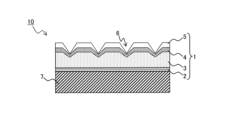
- FIG. 2 is a cross-sectional view showing the configuration of a decorative sheet and a decorative material in the first embodiment.
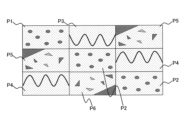
- FIG. 4 is a diagram showing an example of a pattern formed on a printed pattern layer.
- 13A to 13C are diagrams showing modified examples of the pattern formed on the printed pattern layer.
- FIG. 11 is a cross-sectional view showing the configuration of a decorative sheet and a decorative material in a modified example of the first embodiment.
- the decorative sheet 1 includes a base material layer 2, an aggregate layer 3, a print pattern layer 4, and a surface protection layer 5.
- the base layer 2 is a layer that serves as the base material of the decorative sheet 1 .
- a glass nonwoven fabric having a basis weight of 48 [g/m 2 ] is used as the material of the base layer 2 .
- the aggregate layer 3 is a layer laminated on one surface (the upper surface in FIG. 1) of the base material layer 2, and contains a mixture of an acrylic resin and an inorganic filler.
- the mixture of the acrylic resin and the inorganic filler had a basis weight of about 2200 g/m 2 .
- the mixing ratio of the acrylic resin to the aggregate layer 3 (100% by mass) is within a range of 5% by mass to 15% by mass.
- the glass transition point of the acrylic resin is within the range of -40°C to 10°C.
- the mixing ratio of the inorganic filler to the aggregate layer 3 (100% by mass) is within the range of 85% by mass to 95% by mass.
- the inorganic filler includes a filler having a particle size distribution (average particle size distribution) in the range of 50 ⁇ m to 500 ⁇ m. At least one of the components contained in the inorganic filler is a hydrate. In the first embodiment, as an example, a case will be described in which the components contained in the inorganic filler are calcium carbonate and aluminum hydroxide.
- the thickness of the aggregate layer 3 is within a range of 0.2 mm to 4.0 mm.
- the printed pattern layer 4 is a layer that is laminated on one surface of the aggregate layer 3 (the upper surface in FIG. 1).
- the print pattern layer 4 is formed mainly from epoxy resin.
- the print pattern layer 4 contains an inorganic pigment whose mixing ratio with respect to 100% by mass of the epoxy resin is 15% by mass or less.
- the print pattern layer 4 is formed by inkjet printing.
- a pattern is formed on the print pattern layer 4 by printing.
- the pattern formed on the printed pattern layer 4 is formed from at least three different patterns created based on image data formed using a pattern of natural stone (image data formed imitating the pattern of natural stone).
- the pattern formed on the printed pattern layer 4 is formed from six or more different patterns created based on image data, as shown in Figure 2.
- the pattern shown in Fig. 2 is specifically formed from six different patterns (P1, P2, P3, P4, P5, P6) created based on image data formed using natural stone patterns.
- the pattern shown in Fig. 2 is a schematic representation of the patterns created based on image data formed using natural stone patterns. Patterns P1 and P2 are formed by inverting the same pattern horizontally, while patterns P3 and P4 are formed by inverting the same pattern vertically, and patterns P5 and P6 are formed by inverting the same pattern vertically and horizontally.
- the surface protective layer 5 is laminated on one side of the printed pattern layer 4 (the upper side in FIG. 1 ), and is a layer provided to impart functions such as weather resistance, scratch resistance, stain resistance, and design properties to the decorative sheet 1.
- the thickness of the surface protection layer 5 is within a range of 3 ⁇ m to 10 ⁇ m.
- the surface protection layer 5 is formed mainly from acrylic, fluorine, silicone, or a mixture or copolymer of at least two of acrylic, fluorine, and silicone.
- the surface protective layer 5 contains silica (matting agent) whose mixing ratio with respect to 100% by mass of the main component is within the range of 10% by mass to 50% by mass. Furthermore, due to the above-mentioned configuration, the surface of the surface protection layer 5 opposite to the surface facing the printed pattern layer 4 (the upper surface in Figure 1) has a skewness (Ssk) in three-dimensional surface roughness in the range of -0.5 to 2.0. That is, the outermost surface of the decorative sheet 1 has a skewness (Ssk) in three-dimensional surface roughness within the range of -0.5 to 2.0.
- embossments 6 are formed at a plurality of locations on the aggregate layer 3, the printed pattern layer 4, and the surface protective layer 5. That is, the aggregate layer 3, the printed pattern layer 4, and the surface protective layer 5 are embossed.
- the embossing is performed by pressing using an embossing mold.
- the embossing mold is formed by molding a natural stone material as a manuscript.
- the embossing mold may be formed by a 3D printer or a coating material formed by a plasterer. Specifically, the embossing is performed on the aggregate layer 3 of the sheet formed by laminating the aggregate layer 3 on one surface of the base layer 2.
- the decorative material 10 is, for example, a panel for decorating the wall surface of a building, and comprises a decorative sheet 1 and a substrate 7 .
- the substrate 7 is formed into a plate shape using, for example, a wood board, an inorganic board, a metal plate, or the like, and has a decorative sheet 1 laminated on one surface (the upper surface in FIG. 1 ).
- the first embodiment described above is one example of the present invention, and the present invention is not limited to the first embodiment described above.
- Various modifications can be made to the design, etc., even if the modifications are in a form other than the first embodiment, as long as they do not deviate from the technical concept of the present invention.
- the mixing ratio of the mixture of acrylic resin and inorganic filler to the aggregate layer 3 within the above-mentioned range, and further setting the particle size distribution of the inorganic filler within the above-mentioned range, it is possible to impart to the surface of the decorative sheet 1 a luster and texture similar to that of natural stone.
- the thickness of the aggregate layer 3 within the range of 0.2 mm to 4.0 mm, it is possible to improve the ability of the decorative sheet 1 to conform to the curved surface forming a cylinder, etc. As a result, it is possible to suppress the deterioration of the ability to conform to curved surfaces, which in turn makes it possible to suppress the occurrence of damage to the surface (design surface) of the decorative sheet 1 and thus suppress the deterioration of the design.
- the surface of the surface protection layer 5 opposite to the surface facing the print pattern layer 4 has a skewness (Ssk) in three-dimensional surface roughness in the range of -0.5 to 2.0.
- the aggregate layer 3, the printed pattern layer 4, and the surface protective layer 5 are embossed by pressing.
- embossments 6 are formed on the aggregate layer 3, the printed pattern layer 4, and the surface protection layer 5, a concave-convex pattern can be formed on the decorative sheet 1, and it becomes possible to impart a design similar to that of natural stone to the surface of the decorative sheet 1, thereby improving the design of the decorative sheet 1.
- embossing using an embossing die molded from a natural stone material as a template it is possible to impart a design similar to that of natural stone material to the surface of the decorative sheet 1.
- the glass transition point of the acrylic resin is within the range of ⁇ 40° C. or more and 10° C. or less.
- -40°C or higher it is possible to suppress a decrease in the adhesion of the print pattern layer 4 over time, compared to when the glass transition point of the acrylic resin is less than -40°C.
- 10°C or lower it is possible to improve the ability of the decorative sheet 1 to conform to a curved surface, compared to when the glass transition point of the acrylic resin is more than 10°C.
- the surface protective layer 5 is formed mainly from acrylic, fluorine, silicone, or a mixture or copolymer of at least two of acrylic, fluorine, and silicone. As a result, it is possible to impart weather resistance to the surface protective layer 5 .
- the thickness of the surface protection layer 5 is within the range of 3 ⁇ m to 10 ⁇ m. As a result, by making the thickness of the surface protective layer 5 3 ⁇ m or more, it is possible to impart sufficient scratch resistance to the surface protective layer 5, compared to a case in which the thickness of the surface protective layer 5 is less than 3 ⁇ m. In addition, by making the thickness of the surface protective layer 5 10 ⁇ m or less, it is possible to improve the ability of the decorative sheet 1 to conform to a curved surface, compared to a case in which the thickness of the surface protective layer 5 is more than 10 ⁇ m.
- At least one of the components contained in the inorganic filler is a hydrate.
- the print pattern layer 4 is formed using an epoxy resin as a main component, and contains an inorganic pigment whose mixing ratio with respect to 100% by mass of the epoxy resin is 15% by mass or less. As a result, by forming the print pattern layer 4 so as to contain an inorganic pigment, it is possible to impart to the decorative sheet 1 a level of weather resistance which enables it to be used outdoors.
- the pattern formed by printing on the printed pattern layer 4 is formed from six or more different patterns created based on image data formed using patterns of natural stone. As a result, it becomes difficult for a viewer to notice that the same pattern exists in the pattern formed on the printed pattern layer 4, so that when the decorative sheet 1 is applied, the decorative state of a natural design is achieved, and it becomes possible to impart a more natural design feeling.
- the print pattern layer 4 is formed by inkjet printing. As a result, it becomes difficult for a viewer to notice that the same pattern exists in the pattern formed on the printed pattern layer 4, so that when the decorative sheet 1 is applied, the decorative state of a natural design is achieved, and it becomes possible to impart a more natural design feeling.
- the decorative material 10 of the first embodiment can achieve the effects described below.
- the device comprises a substrate 7 and a decorative sheet 1 laminated on at least one surface of the substrate 7. As a result, it is possible to provide a decorative material 10 that is capable of preventing deterioration of the design.
- the pattern formed by printing on the printed pattern layer 4 is configured to be formed from six or more different patterns created based on image data formed using a pattern of natural stone material, but this is not limited to this. That is, for example, as shown in Fig. 3, the pattern formed by printing on the printed pattern layer 4 may be configured to be formed from four different patterns created based on image data formed using a pattern of natural stone material. Therefore, the pattern formed by printing on the printed pattern layer 4 may be configured to be formed from at least three different patterns created based on image data formed using a pattern of natural stone material. Specifically, the design shown in FIG. 3 is formed from four different patterns (P1, P2, P3, P4) created based on image data formed using patterns of natural stone. Even with this configuration, it is difficult for a viewer to notice that the same pattern exists in the pattern formed on the printed pattern layer 4, so when the decorative sheet 1 is applied, the decorative state of a natural design is achieved, and it is possible to impart a more natural design feeling.
- the decorative sheet 1 is configured to have the embossing 7 formed thereon, but this is not limited to the configuration. That is, for example, as shown in FIG. 4, the decorative sheet 1 may be configured to have no embossing formed thereon.
- the configuration of a decorative sheet 1 in the second embodiment will be described below with reference to Figs.
- the decorative sheet 1 of the second embodiment has the same configuration as the decorative sheet 1 of the first embodiment, except for the configuration of the surface protective layer 5. Therefore, the following description will only focus on the surface protective layer 5.
- the surface protective layer 5 is laminated on one side of the printed pattern layer 4 (the upper side in FIG. 1 ), and is a layer provided to impart functions such as weather resistance, scratch resistance, stain resistance, and design properties to the decorative sheet 1.
- the thickness of the surface protection layer 5 is within a range of 3 ⁇ m to 10 ⁇ m.
- the surface protection layer 5 is formed mainly from acrylic, fluorine, silicone, or a mixture or copolymer of at least two of acrylic, fluorine, and silicone.
- the surface protective layer 5 contains silica (matting agent) whose mixing ratio with respect to 100% by mass of the main component is within the range of 10% by mass to 50% by mass.
- the surface of the surface protection layer 5 opposite to the surface facing the printed pattern layer 4 has a surface kurtosis (Sku) in the range of 3.0 to 30.
- surface kurtosis is a value indicating the height distribution, and may also be referred to as "kurtosis.” That is, the outermost surface of the decorative sheet 1 has a surface kurtosis (Sku) in the range of 3.0 or more and 30 or less.
- the decorative sheet 1 of the second embodiment can provide the following effects.
- the surface of the surface protective layer 5 opposite to the surface facing the printed pattern layer 4 has a surface kurtosis (Sku) in the range of 3.0 or more and 30 or less. This makes it possible to impart to the surface of the decorative sheet 1 a luster and texture similar to that of natural stone. This makes it possible to impart to the surface of the decorative sheet 1 a design similar to that of natural products that are primarily made of inorganic matter, such as natural stone, and thus makes it possible to provide a decorative sheet 1 that is capable of suppressing deterioration of the design.
- Sku surface kurtosis
- the decorative sheet 1 of the second embodiment it is possible to prevent the generation of air bubbles, and it is also possible to prepare sheets having the desired design in the desired quantity.
- the decorative sheets of Examples 1 to 12 the decorative sheets of Comparative Examples 1 and 2, and the decorative sheet of the Reference Example will be described below.
- Example 1 The substrate layer was formed using a glass nonwoven fabric having a basis weight of 48 g/m 2 .
- the aggregate layer was formed by adding inorganic filler to acrylic resin (acrylic emulsion) with a glass transition point of 60°C, so that the weight ratio of solids when dried was 10:90. Note that the higher the glass transition point number, the lower the fluidity and the higher the hardness. Conversely, the lower the number, the higher the fluidity and the higher the flexibility.
- the inorganic filler calcium carbonate (CaCO 3 ) having a particle size distribution in the range of 100 ⁇ m to 500 ⁇ m was used. The particle size distribution of calcium carbonate was determined by a sieving method using particles that passed through a 500 ⁇ m sieve but did not pass through a 100 ⁇ m sieve.
- the printed pattern layer was formed by uniformly applying an aggregate layer to the base layer and then drying it to form a sheet with a thickness of 2.0 mm, and then forming the printed pattern layer on the surface of the sheet (aggregate layer) by gravure offset printing using an organic pigment.
- the pattern formed on the print pattern layer was formed using four different patterns (see FIG. 2).
- the surface protection layer was made of acrylic resin and had a thickness of 15 ⁇ m.
- the surface protective layer contains silica in a mixing ratio of 50 mass % relative to 100 mass % of the acrylic resin which is the main component. In this manner, the decorative sheet of Example 1 was formed.
- Example 2 The decorative sheet of Example 2 was formed in the same manner as in Example 1, except that after the aggregate layer was applied to the base layer, the aggregate layer was embossed using a silicone embossing mold before drying.
- Example 3 A decorative sheet of Example 3 was formed in the same manner as in Example 1, except that the aggregate layer was formed using an acrylic resin having a glass transition point of -7°C.
- Example 4 A decorative sheet of Example 4 was formed in the same manner as in Example 1, except that the aggregate layer was formed using an acrylic resin having a glass transition point of -62°C.
- Example 5 A decorative sheet of Example 5 was formed in the same manner as in Example 1, except that the thickness of the surface protective layer was set to 2 ⁇ m.
- Example 6 A decorative sheet of Example 6 was formed in the same manner as in Example 1, except that the thickness of the surface protective layer was set to 3 ⁇ m.
- Example 7 A decorative sheet of Example 7 was formed in the same manner as in Example 1, except that the thickness of the surface protective layer was set to 5 ⁇ m.
- Example 8 A decorative sheet of Example 8 was formed in the same manner as in Example 1, except that the thickness of the surface protective layer was set to 10 ⁇ m.
- Example 9 The decorative sheet of Example 9 was formed in the same manner as in Example 1, except that calcium carbonate ( CaCO3 ) having a particle size distribution in the range of 50 to 500 ⁇ m and aluminum hydroxide (Al(OH) 3 ) having a particle size distribution in the range of 50 to 500 ⁇ m were used as the inorganic fillers, and that calcium carbonate and aluminum hydroxide were added to the acrylic resin so that the weight ratio of the solids when dried was 10:45:45. Note that the particle size distribution of the aluminum hydroxide was set by a sieving method in the same way as for the particle size distribution of calcium carbonate, using particles that passed through the 50 ⁇ m opening but did not pass through the 500 ⁇ m opening.
- CaCO3 calcium carbonate
- Al(OH) 3 aluminum hydroxide
- Example 10 A decorative sheet of Example 10 was formed in the same manner as in Example 1, except that the print pattern layer was formed using an organic pigment.
- Example 11 A decorative sheet of Example 11 was formed in the same manner as in Example 1, except that the pattern formed on the print pattern layer was formed using six different patterns (see FIG. 3).
- Example 12 A decorative sheet of Example 12 was formed in the same manner as in Example 1, except that the print pattern layer was formed by inkjet printing.
- Example 1 A decorative sheet for Comparative Example 1 was formed in the same manner as in Example 1, except that calcium carbonate with a particle size distribution in the range of 1 ⁇ m to 10 ⁇ m was used as the inorganic filler.
- Comparative Example 2 A decorative sheet for Comparative Example 2 was formed in the same manner as in Example 1, except that calcium carbonate with a particle size distribution in the range of more than 500 [ ⁇ m] and not more than 1000 [ ⁇ m] was used as the inorganic filler.
- the decorative sheet of the reference example is a decorative sheet formed using cut natural stone material.
- ⁇ Design> The design was evaluated based on a sensory evaluation and on the sense of incongruity of overlapping patterns (the sense of incongruity felt by the same pattern appearing consecutively). The design was evaluated by a sensory panel of 10 viewers. If 8 or more people answered that the design and the feel were good, the design was evaluated as " ⁇ ”. If 5 or more people answered that the design and the feel were good, the design was evaluated as " ⁇ ”. In addition, if less than 5 people answered that the design and the feel were good, the design was evaluated as " ⁇ ”. The ideal design evaluation based on sensory evaluation is "A”.
- the design quality based on the sense of incongruity of overlapping patterns was evaluated by asking 10 viewers for their opinions. If eight or more people answered that they did not feel any incongruity at all due to the same pattern continuing when the decorative sheet was applied to a wall surface, it was rated as " ⁇ ". If five or more people answered that they did not feel any incongruity at all, it was rated as " ⁇ ”. If less than five people answered that they did not feel any incongruity at all, it was rated as " ⁇ ”.
- the ideal evaluation of design in terms of the sense of incongruity of pattern overlap is an evaluation by 10 people that they do not feel any sense of incongruity at all due to the same pattern being repeated.
- the conformability to curved surfaces was evaluated using the diameter of the sheet at which no cracks or rebound occurred when the decorative sheet was applied to curved surfaces of ⁇ 400, ⁇ 300, ⁇ 200, and ⁇ 100 in an environment of 25°C.
- the adhesive used to apply the decorative sheet to the curved surface was "EFREC STYLE ONE," a modified silicone adhesive from Konishi Co., Ltd.
- the curved surface conformability shown in the table indicates that the smaller the number, the more easily the decorative sheet can be applied to a curved surface with a greater curvature.
- the ideal evaluation of conformability to a curved surface is when the decorative sheet has a diameter of " ⁇ 200" and no cracks or rebounding occurs.
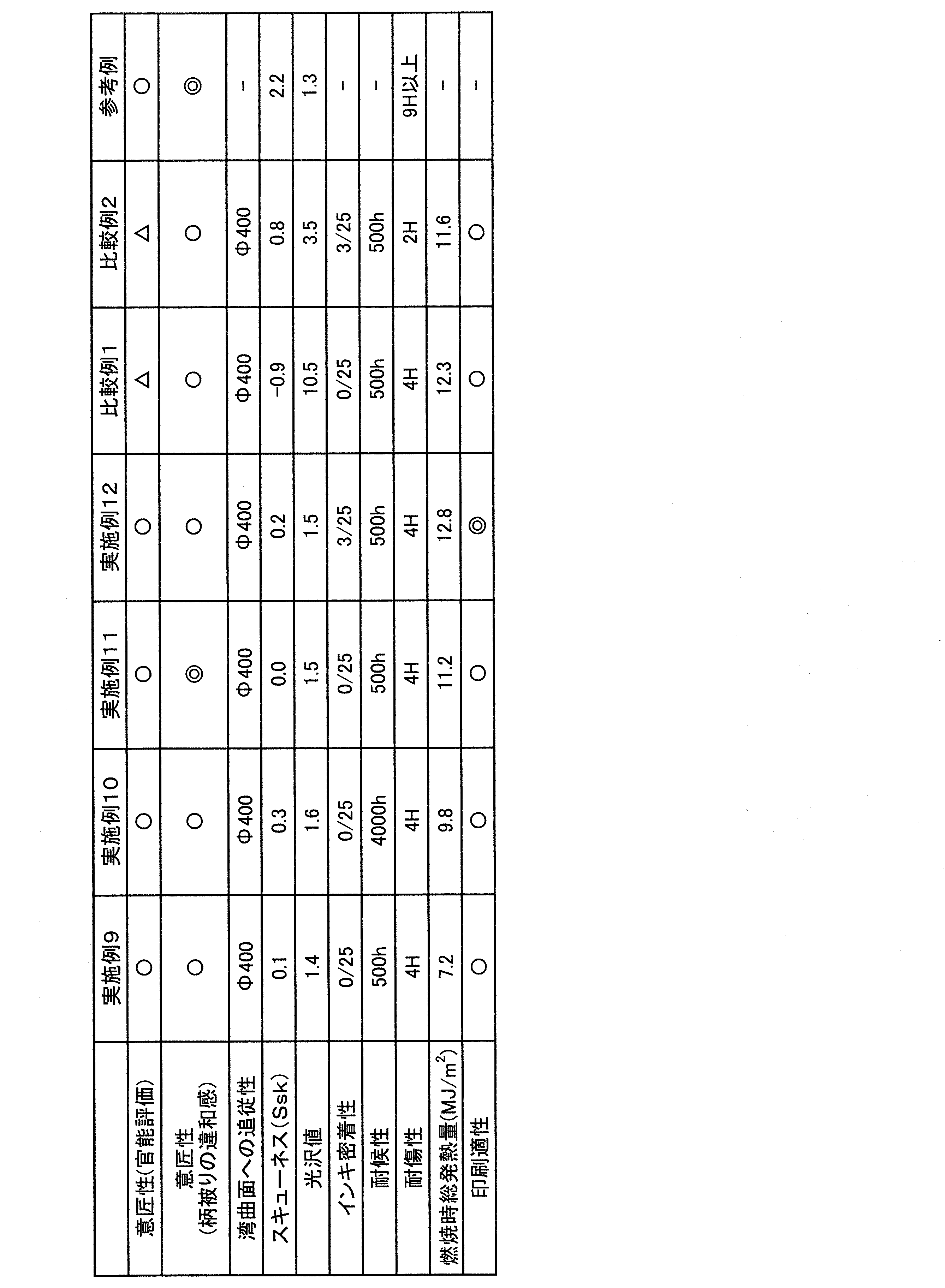
- skewness in Three-Dimensional Surface Roughness (Ssk)> The skewness (Ssk) in the three-dimensional surface roughness was measured using a laser microscope equipped with a 5x objective lens manufactured by Olympus Corporation under measurement conditions of a cutoff value ⁇ c of 250 ⁇ m.
- the ideal evaluation of the skewness (Ssk) in three-dimensional surface roughness is within the range of -0.5 to 2.0.
- the gloss value was measured using a gloss meter manufactured by Horiba Ltd., with the measurement angle set to 60°.
- the ideal evaluation of the gloss value would be the same as that of the reference example, that is, the same as that of natural stone.
- the ink adhesion was evaluated by first taking a sample from the decorative sheet to be evaluated, and using a cutter to make six incisions, each 2 mm apart, vertically and horizontally on the surface of the sample to form 25 grids. Next, the edge of a piece of Cellophane Tape (registered trademark) that had been firmly pressed onto the grids was quickly peeled off at an angle of 45°, and the degree of ink peeling from the grids was visually confirmed. The result was evaluated as the number of grids from which the ink had peeled off divided by 25. The ideal rating for ink adhesion is 0/25.
- Weather resistance was evaluated by first taking samples from the decorative sheet to be evaluated, and testing was performed by leaving the samples for 1000H (hours), 2000H, 3000H, and 4000H using a Sunshine Weather Meter manufactured by Suga Test Instruments Co., Ltd. in a mode in which it rains for the first 18 minutes of the 120 minutes. The samples were then checked after the test, and the evaluation was performed using the time at which no fading was observed.
- the ideal weather resistance rating is 4000H.
- ⁇ Scratch resistance> For scratch resistance, first, a sample is taken from the decorative sheet to be evaluated, and the tip of a "Hi-Uni" pencil made by Mitsubishi Pencil Co., Ltd. is made flat with abrasive paper. A load of 750 g is then applied to the pencil, which is pressed against the surface of the sample over a distance of 7 mm at a speed of 0.8 mm/s, and the hardness (pencil hardness) of the hardest pencil that does not leave a scratch on the surface of the sample is measured. The ideal rating for scratch resistance is 4H.
- Fire resistance was evaluated by first applying a sealer for application to a standard gypsum board (non-combustible or semi-non-combustible) and drying it, then applying glue for application and attaching a test piece of the decorative sheet to be evaluated. The board was then dried in a desiccator for at least 48 hours. The test piece was then heated with a cone heater, the generated gas was ignited and burned with a spark ignition device, and the oxygen concentration of the burned gas was measured to determine the total heat generated during combustion (total heat generated during combustion (MJ/ m2 )).
- the total heat generated during combustion (MJ/ m2 ) is 8.0 (MJ/ m2 ) or less, it falls within the range of non-combustible materials that are certified as fireproof.
- the ideal fire resistance rating is 8.0 (MJ/m 2 ) or less.
- Printability was evaluated as " ⁇ ” when printability was possible under a wide range of printing conditions, and " ⁇ ” when printability was possible under limited conditions.
- the ideal evaluation of printability is a rating of "A”.
- the decorative sheets of Examples 1 to 12 showed excellent performance for each evaluation item.
- the decorative sheets of Comparative Examples 1 and 2 were unable to show excellent performance, particularly with respect to skewness (Ssk) and gloss value in three-dimensional surface roughness.
- the decorative sheets of Examples 1 to 12 the decorative sheets of Comparative Examples 1 and 2, and the decorative sheet of the Reference Example will be described below.
- Example 1 The substrate layer was formed using a glass nonwoven fabric having a basis weight of 48 g/m 2 .
- the aggregate layer was formed by adding inorganic filler to acrylic resin (acrylic emulsion) with a glass transition point of 60°C, so that the weight ratio of solids when dried was 10:90. Note that the higher the glass transition point number, the lower the fluidity and the higher the hardness. Conversely, the lower the number, the higher the fluidity and the higher the flexibility.
- the inorganic filler calcium carbonate (CaCO 3 ) having a particle size distribution in the range of 100 ⁇ m to 500 ⁇ m was used. The particle size distribution of calcium carbonate was determined by a sieving method using particles that passed through a 500 ⁇ m sieve but did not pass through a 100 ⁇ m sieve.
- the printed pattern layer was formed by uniformly applying an aggregate layer to the base layer and then drying it to form a sheet with a thickness of 2.0 mm, and then forming the printed pattern layer on the surface of the sheet (aggregate layer) by gravure offset printing using an organic pigment.
- the print design layer was formed using four different patterns (see FIG. 2).
- the surface protection layer was made of acrylic resin and had a thickness of 15 ⁇ m. Furthermore, the surface protective layer contains silica in a mixing ratio of 50 mass % relative to 100 mass % of the acrylic resin which is the main component. In this manner, the decorative sheet of Example 1 was formed.
- Example 2 The decorative sheet of Example 2 was formed in the same manner as in Example 1, except that after the aggregate layer was applied to the base layer, the aggregate layer was embossed using a silicone embossing mold before drying.
- Example 3 A decorative sheet of Example 3 was formed in the same manner as in Example 1, except that the aggregate layer was formed using an acrylic resin having a glass transition point of -7°C.
- Example 4 A decorative sheet of Example 4 was formed in the same manner as in Example 1, except that the aggregate layer was formed using an acrylic resin having a glass transition point of -62°C.
- Example 5 A decorative sheet of Example 5 was formed in the same manner as in Example 1, except that the thickness of the surface protective layer was set to 2 ⁇ m.
- Example 6 A decorative sheet of Example 6 was formed in the same manner as in Example 1, except that the thickness of the surface protective layer was set to 3 ⁇ m.
- Example 7 A decorative sheet of Example 7 was formed in the same manner as in Example 1, except that the thickness of the surface protective layer was set to 5 ⁇ m.
- Example 8 A decorative sheet of Example 8 was formed in the same manner as in Example 1, except that the thickness of the surface protective layer was set to 10 ⁇ m.
- Example 9 The decorative sheet of Example 9 was formed in the same manner as in Example 1, except that calcium carbonate ( CaCO3 ) having a particle size distribution in the range of 50 to 500 ⁇ m and aluminum hydroxide (Al(OH) 3 ) having a particle size distribution in the range of 50 to 500 ⁇ m were used as the inorganic fillers, and that calcium carbonate and aluminum hydroxide were added to the acrylic resin so that the weight ratio of the solids when dried was 10:45:45. Note that the particle size distribution of the aluminum hydroxide was set by a sieving method in the same way as for the particle size distribution of calcium carbonate, using particles that passed through the 50 ⁇ m opening but did not pass through the 500 ⁇ m opening.
- CaCO3 calcium carbonate
- Al(OH) 3 aluminum hydroxide
- Example 10 A decorative sheet of Example 10 was formed in the same manner as in Example 1, except that the print pattern layer was formed using an organic pigment.
- Example 11 A decorative sheet of Example 11 was formed in the same manner as in Example 1, except that the pattern formed on the print pattern layer was formed using six different patterns (see FIG. 3).
- Example 12 A decorative sheet of Example 12 was formed in the same manner as in Example 1, except that the print pattern layer was formed by inkjet printing.
- Example 1 A decorative sheet for Comparative Example 1 was formed in the same manner as in Example 1, except that calcium carbonate with a particle size distribution in the range of 1 ⁇ m to 10 ⁇ m was used as the inorganic filler.
- Comparative Example 2 A decorative sheet for Comparative Example 2 was formed in the same manner as in Example 1, except that calcium carbonate with a particle size distribution in the range of more than 500 [ ⁇ m] and not more than 1000 [ ⁇ m] was used as the inorganic filler.
- the decorative sheet of the reference example is a decorative sheet formed using cut natural stone material.
- ⁇ Design> The design was evaluated based on a sensory evaluation and on the sense of incongruity caused by overlapping patterns (the sense of incongruity caused by the same pattern appearing consecutively). The design was evaluated by a sensory panel of 10 viewers. If 8 or more people answered that the design and the feel were good, the design was evaluated as " ⁇ ”. If 5 or more people answered that the design and the feel were good, the design was evaluated as " ⁇ ”. In addition, if less than 5 people answered that the design and the feel were good, the design was evaluated as " ⁇ ”. The ideal design evaluation based on sensory evaluation is "A”.
- the design quality based on the sense of incongruity of overlapping patterns was evaluated by asking 10 viewers for their opinions. If eight or more people answered that they did not feel any incongruity at all due to the same pattern continuing when the decorative sheet was applied to a wall surface, it was rated as " ⁇ ". If five or more people answered that they did not feel any incongruity at all, it was rated as " ⁇ ”. If less than five people answered that they did not feel any incongruity at all, it was rated as " ⁇ ”.
- the ideal evaluation of design in terms of the sense of incongruity of pattern overlap is an evaluation by 10 people that they do not feel any sense of incongruity at all due to the same pattern being repeated.
- the conformability to curved surfaces was evaluated using the diameter of the sheet at which no cracks or rebound occurred when the decorative sheet was applied to curved surfaces of ⁇ 400, ⁇ 300, ⁇ 200, and ⁇ 100 in an environment of 25°C.
- the adhesive used to apply the decorative sheet to the curved surface was "EFREC STYLE ONE," a modified silicone adhesive from Konishi Co., Ltd.
- the conformability to curved surfaces shown in the table indicates that the smaller the number, the more easily the decorative sheet can be applied to curved surfaces with greater curvature.
- the ideal evaluation of conformability to a curved surface is when the decorative sheet has a diameter of " ⁇ 200" and no cracks or rebounding occurs.
- Sku Surface kurtosis
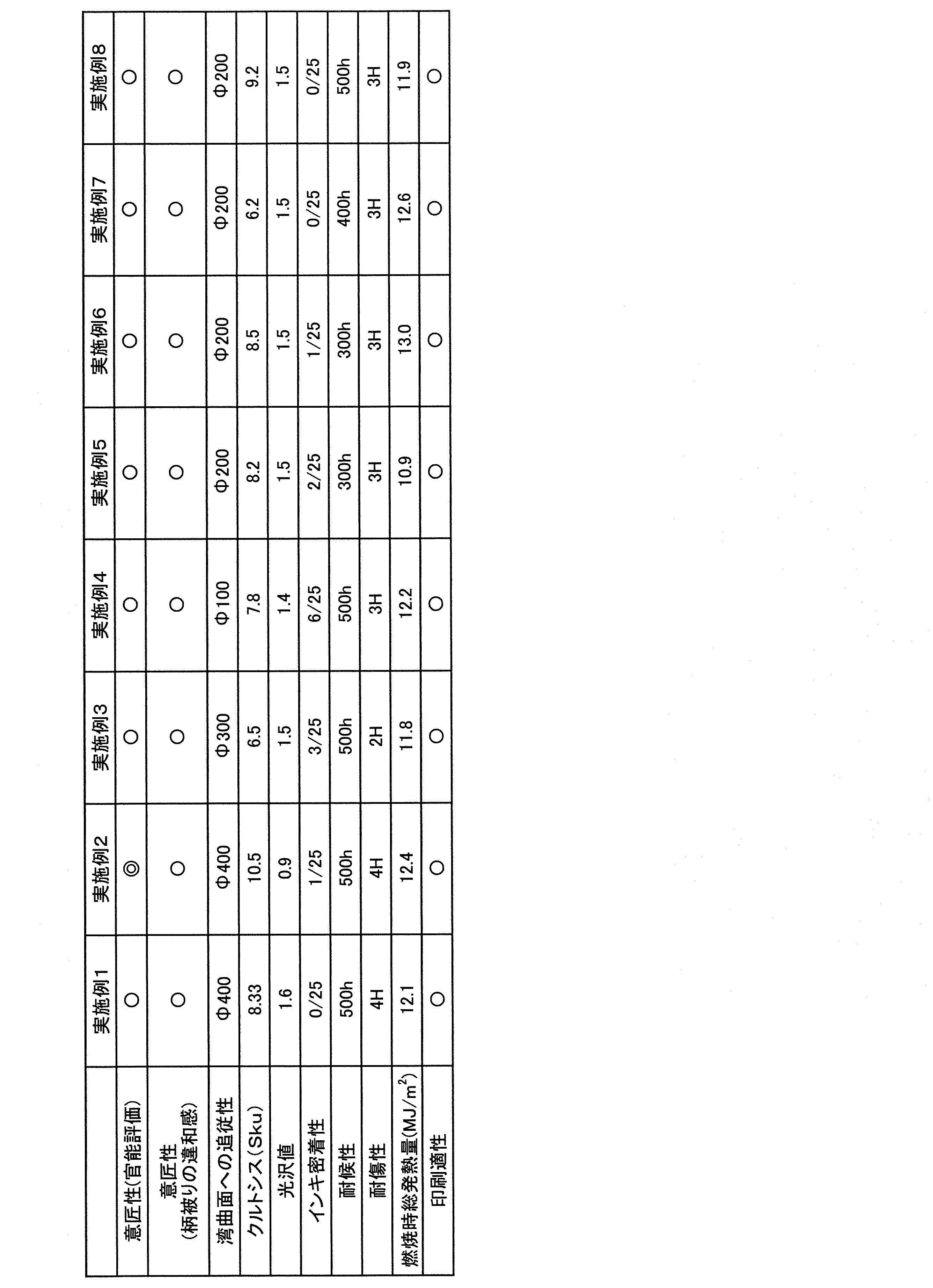
- the surface kurtosis (Sku) was measured using a laser microscope equipped with a 5x objective lens manufactured by Olympus Corporation under measurement conditions of a cutoff value ⁇ c of 250 ⁇ m.
- the ideal evaluation of surface kurtosis (Sku) is within the range of 3.0 or more and 30 or less.
- the gloss value was measured using a gloss meter manufactured by Horiba Ltd., with the measurement angle set to 60°.
- the ideal evaluation of the gloss value would be the same as that of the reference example, that is, the same as that of natural stone.
- the ink adhesion was evaluated by first taking a sample from the decorative sheet to be evaluated, and using a cutter to make six incisions, each 2 mm apart, vertically and horizontally on the surface of the sample to form 25 grids. Next, the edge of a piece of Cellophane Tape (registered trademark) that had been firmly pressed onto the grids was quickly peeled off at an angle of 45°, and the degree of ink peeling from the grids was visually confirmed. The result was evaluated as the number of grids from which the ink had peeled off divided by 25. The ideal rating for ink adhesion is 0/25.
- Weather resistance was evaluated by first taking samples from the decorative sheet to be evaluated, and testing was performed by leaving the samples for 1000H (hours), 2000H, 3000H, and 4000H using a Sunshine Weather Meter manufactured by Suga Test Instruments Co., Ltd. in a mode in which it rains for the first 18 minutes of the 120 minutes. The samples were then checked after the test, and the evaluation was performed using the time at which no fading was observed.
- the ideal weather resistance rating is 4000H.
- ⁇ Scratch resistance> For scratch resistance, first, a sample is taken from the decorative sheet to be evaluated, and the tip of a "Hi-Uni" pencil made by Mitsubishi Pencil Co., Ltd. is made flat with abrasive paper. A load of 750 g is then applied to the pencil, which is pressed against the surface of the sample over a distance of 7 mm at a speed of 0.8 mm/s, and the hardness (pencil hardness) of the hardest pencil that does not leave a scratch on the surface of the sample is measured. The ideal rating for scratch resistance is 4H.
- Fire resistance was evaluated by first applying a sealer for application to a standard gypsum board (non-combustible or semi-non-combustible) and drying it, then applying glue for application and attaching a test piece of the decorative sheet to be evaluated. The board was then dried in a desiccator for at least 48 hours. The test piece was then heated with a cone heater, the generated gas was ignited and burned with a spark ignition device, and the oxygen concentration of the burned gas was measured to determine the total heat generated during combustion (total heat generated during combustion (MJ/ m2 )).
- the total heat generated during combustion (MJ/ m2 ) is 8.0 (MJ/ m2 ) or less, it falls within the range of non-combustible materials that are certified as fireproof.
- the ideal fire resistance rating is 8.0 (MJ/m 2 ) or less.
- Printability was evaluated as " ⁇ ” when printability was possible under a wide range of printing conditions, and " ⁇ ” when printability was possible under limited conditions.
- the ideal evaluation of printability is a rating of "A”.
- the decorative sheets of Examples 1 to 12 showed excellent performance for each evaluation item.
- the decorative sheets of Comparative Examples 1 and 2 were unable to show excellent performance, especially with respect to surface kurtosis (Sku) and gloss value.
- the present technology can be configured as follows. (1) A base layer; An aggregate layer laminated on one surface of the base material layer; a print pattern layer laminated on a surface of the aggregate layer opposite to the surface facing the base material layer; a surface protection layer laminated on a surface of the print pattern layer opposite to the surface facing the aggregate layer,
- the aggregate layer includes a mixture of an acrylic resin having a mixing ratio of 5% by mass or more and 15% by mass or less with respect to 100% by mass of the aggregate layer, and an inorganic filler having a mixing ratio of 85% by mass or more and 95% by mass or less with respect to 100% by mass of the aggregate layer,
- the thickness of the aggregate layer is within a range of 0.2 mm to 4.0 mm
- the decorative sheet includes an inorganic filler having a particle size distribution within the range of 50 ⁇ m or more and 500 ⁇ m or less.
- the surface protective layer is formed mainly from acrylic, fluorine, silicone, or a mixture or copolymer of at least two of the acrylic, fluorine, and silicone.
- a pattern is formed on the print pattern layer by printing, A decorative sheet according to any one of (1) to (9) above, wherein the pattern is formed from at least three different patterns created based on image data formed using a pattern of natural stone material.
Landscapes
- Engineering & Computer Science (AREA)
- Textile Engineering (AREA)
- Life Sciences & Earth Sciences (AREA)
- Wood Science & Technology (AREA)
- Laminated Bodies (AREA)
Abstract
Description
しかしながら、天然石材を用いて装飾シートや装飾材を形成することは、重量等により困難である。また、天然石材を用いて装飾材を形成する場合、円柱等を形成する湾曲面への追従性が低下するため、装飾シートの表面(意匠面)に損傷が発生して、意匠性が低下する。したがって、意匠性の高い装飾シートや装飾材を形成することが困難であるという問題がある。
以下、図1を参照して、第一実施形態における装飾シート1の構成について説明する。
装飾シート1は、図1に示すように、基材層2と、骨材層3と、印刷模様層4と、表面保護層5を備える。
基材層2は、装飾シート1の基材となる層である。
第一実施形態では、一例として、基材層2の材料を、坪量が48[g/m2]のガラス不織布を用いた場合について説明する。
骨材層3は、基材層2の一方の面(図1では、上側の面)に積層された層であり、アクリル樹脂と、無機フィラーとの混合物を含んでいる。
アクリル樹脂と無機フィラーとの混合物の坪量は、約2200[g/m2]である。
アクリル樹脂の、骨材層3の100質量[%]に対する混合比は、5質量[%]以上15質量[%]以下の範囲内である。
アクリル樹脂のガラス転移点は、-40[℃]以上10[℃]以下の範囲内である。
また、無機フィラーは、粒子径分布(平均粒子径分布)が50[μm]以上500[μm]以下の範囲内であるフィラーを含む。
また、無機フィラーが含む成分のうち少なくとも一つは、水和物である。
第一実施形態では、一例として、無機フィラーが含む成分を、炭酸カルシウムと、水酸化アルミニウムとした場合について説明する。
骨材層3の厚さは、0.2[mm]以上4.0[mm]以下の範囲内である。
印刷模様層4は、骨材層3の一方の面(図1では、上側の面)に積層される層である。
また、印刷模様層4は、エポキシ樹脂を主成分として形成されている。
さらに、印刷模様層4は、エポキシ樹脂の100質量[%]に対する混合比が15質量[%]以下の無機顔料を含む。
また、印刷模様層4は、インクジェット印刷により形成されている。
さらに、印刷模様層4には、印刷により模様が形成されている。
印刷模様層4に形成されている模様は、天然石材の柄を用いて形成した画像データ(天然石材の柄を模して形成した画像データ)を基にして作成された、少なくとも三種類の異なるパターンから形成されている。
図2に示す模様は、具体的に、天然石材の柄を用いて形成した画像データを基にして作成された六種類の異なるパターン(P1、P2、P3、P4、P5、P6)から形成されている。なお、図2に示す模様は、天然石材の柄を用いて形成した画像データを基にして作成されたパターンを、模式的に示している。
パターンP1とパターンP2は、同一のパターンを左右に反転させて形成されている。また、パターンP3とパターンP4は、同一のパターンを上下に反転させて形成されている。さらに、パターンP5とパターンP6は、同一のパターンを上下及び左右に反転させて形成されている。
表面保護層5は、印刷模様層4の一方の面(図1では、上側の面)に積層されており、装飾シート1に対して、耐候性、耐傷性、耐汚染性、意匠性等の機能を付与するために設けられた層である。
表面保護層5の厚さは、3[μm]以上10[μm]以下の範囲内である。
また、表面保護層5は、アクリル、フッ素、シリコーン、又は、アクリル、フッ素及びシリコーンのうち少なくとも二つを混合した混合物又は共重合物を主成分として形成されている。
また、表面保護層5の印刷模様層4と対向する面と反対の面(図1では、上側の面)は、上述した構成により、三次元表面粗さにおけるスキューネス(Ssk)が、-0.5以上2.0以下の範囲内である。
すなわち、装飾シート1の最表面は、三次元表面粗さにおけるスキューネス(Ssk)が、-0.5以上2.0以下の範囲内である。
図1に示すように、骨材層3と、印刷模様層4と、表面保護層5には、複数の箇所にエンボス6が形成されている。すなわち、骨材層3と、印刷模様層4と、表面保護層5とに、エンボス加工が施されている。
エンボス加工は、エンボス型を使用した型押しによって施す。また、エンボス型は、天然石材を原稿として型取りして形成する。なお、エンボス型は、3Dプリンターや、左官によって形成した塗り材によって形成してもよい。
なお、エンボス加工は、具体的に、基材層2の一方の面に骨材層3を積層して形成したシートのうち、骨材層3に対して行う。これにより、骨材層3に、エンボス6に対応する凹部を形成した後、印刷模様層4と表面保護層5を形成することで、骨材層3と、印刷模様層4と、表面保護層5とに、エンボス加工が施されている構成となる。したがって、骨材層3と、印刷模様層4と、表面保護層5にエンボス6が形成されている構成となる。
装飾材10は、例えば、建築物の壁面を装飾するパネルであり、装飾シート1と、基板7を備える。
基板7は、例えば、木質ボード類、無機質ボード類、金属板等を用いて板状に形成されており、一方の面(図1では、上側の面)に、装飾シート1が積層されている。すなわち、装飾材10は、基板7と、基板7の一方の面に積層された装飾シート1を備える。
第一実施形態の装飾シート1であれば、以下に記載する効果を奏することが可能となる。
(1)骨材層3が、骨材層3の100質量[%]に対する混合比が5質量[%]以上15質量[%]以下の範囲内であるアクリル樹脂と、骨材層3の100質量[%]に対する混合比が85質量[%]以上95質量[%]以下の範囲内である無機フィラーとの混合物を含む。また、骨材層3の厚さが、0.2[mm]以上4.0[mm]以下の範囲内である。さらに、無機フィラーは、粒子径分布が50[μm]以上500[μm]以下の範囲内であるフィラーを含む。
これにより、装飾シート1の表面に、天然石材のような無機物を主とする天然物に類似した意匠感を付与することが可能となるため、意匠性の低下を抑制することが可能な装飾シート1を提供することが可能となる。
また、骨材層3の厚さを0.2[mm]以上4.0[mm]以下の範囲内とすることで、装飾シート1の、円柱等を形成する湾曲面への追従性を向上させることが可能となる。
その結果、湾曲面への追従性の低下を抑制することが可能となるため、装飾シート1の表面(意匠面)に損傷が発生することを抑制することが可能となり、意匠性の低下を抑制することが可能となる。
これに対し、第一実施形態の装飾シート1であれば、気泡の発生を防止することが可能であるとともに、所望の意匠を有するシートを、要望される数量で用意することが可能となる。
その結果、装飾シート1の表面に、天然石材のような無機物を主とする天然物に類似した触感を付与することが可能となる。
その結果、骨材層3と、印刷模様層4と、表面保護層5にエンボス6を形成することで、装飾シート1に凹凸模様を形成して、装飾シート1の表面に、天然石材に類似した意匠感を付与することが可能となり、装飾シート1の意匠性を向上させることが可能となる。
また、天然石材を原稿として型取りしたエンボス型を使って型押しすることで、装飾シート1の表面に対して、さらに、天然石材に類似した意匠感を付与することが可能となる。
その結果、アクリル樹脂のガラス転移点を-40[℃]以上とすることで、アクリル樹脂のガラス転移点を-40[℃]未満とした場合と比較して、印刷模様層4の経時的な密着力の低下を抑制することが可能となる。これに加え、アクリル樹脂のガラス転移点を10[℃]以下とすることで、アクリル樹脂のガラス転移点を10[℃]を超える値とした場合と比較して、装飾シート1の、湾曲面への追従性を向上させることが可能となる。
その結果、表面保護層5に耐候性を付与することが可能となる。
その結果、表面保護層5の厚さを3[μm]以上とすることで、表面保護層5の厚さを3[μm]未満とした場合と比較して、表面保護層5に充分な耐傷性を付与することが可能となる。これに加え、表面保護層5の厚さを10[μm]以下とすることで、表面保護層5の厚さを10[μm]を超える値とした場合と比較して、装飾シート1の、湾曲面への追従性を向上させることが可能となる。
その結果、無機フィラーの成分に水和物を用いることで、装飾シート1が燃焼した場合であっても、燃焼時に発生する熱で水分を発生させ、発熱量を低下させることが可能となる。
その結果、印刷模様層4を、無機顔料を含んで形成することで、装飾シート1に対し、屋外において使用することが可能なレベルの耐候性を付与することが可能となる。
その結果、印刷模様層4に形成されている模様に同じ柄が存在することを、視認者に対して気付かせることが困難となるため、装飾シート1を施工した際に、自然な意匠の装飾状態となり、より自然な意匠感を付与することが可能となる。
その結果、印刷模様層4に形成されている模様に同じ柄が存在することを、視認者に対して気付かせることが困難となるため、装飾シート1を施工した際に、自然な意匠の装飾状態となり、より自然な意匠感を付与することが可能となる。
(11)基板7と、基板7の少なくとも一方の面に積層された装飾シート1とを備える。
その結果、意匠性の低下を抑制することが可能な、装飾材10を提供することが可能となる。
(1)第一実施形態では、印刷模様層4に印刷により形成されている模様は、天然石材の柄を用いて形成した画像データを基にして作成された六種類以上の異なるパターンから形成されている構成としたが、これに限定するものではない。すなわち、例えば、図3に示すように、印刷模様層4に印刷により形成されている模様を、天然石材の柄を用いて形成した画像データを基にして作成された四種類の異なるパターンから形成されている構成としてもよい。したがって、印刷模様層4に印刷により形成されている模様は、天然石材の柄を用いて形成した画像データを基にして作成された少なくとも三種類の異なるパターンから形成されている構成としてもよい。
なお、図3に示す模様は、具体的に、天然石材の柄を用いて形成した画像データを基にして作成された四種類の異なるパターン(P1、P2、P3、P4)から形成されている。
この構成であっても、印刷模様層4に形成されている模様に同じ柄が存在することを、視認者に対して気付かせることが困難となるため、装飾シート1を施工した際に、自然な意匠の装飾状態となり、より自然な意匠感を付与することが可能となる。
以下、図1から4を参照して、第二実施形態における装飾シート1の構成について説明する。
第二実施形態の装飾シート1は、表面保護層5の構成を除き、第一実施形態の装飾シート1と同様の構成を備える。このため、以降の説明は、表面保護層5についてのみ記載する。
表面保護層5は、印刷模様層4の一方の面(図1では、上側の面)に積層されており、装飾シート1に対して、耐候性、耐傷性、耐汚染性、意匠性等の機能を付与するために設けられた層である。
表面保護層5の厚さは、3[μm]以上10[μm]以下の範囲内である。
また、表面保護層5は、アクリル、フッ素、シリコーン、又は、アクリル、フッ素及びシリコーンのうち少なくとも二つを混合した混合物又は共重合物を主成分として形成されている。
さらに、表面保護層5は、主成分の100質量[%]に対する混合比が10質量[%]以上50質量[%]以下の範囲内であるシリカ(艶消し剤)を含む。
すなわち、装飾シート1の最表面は、表面クルトシス(Sku)が、3.0以上30以下の範囲内である。
第二実施形態の装飾シート1であれば、以下に記載する効果を奏することが可能となる。
(1)表面保護層5の印刷模様層4と対向する面と反対の面が、表面クルトシス(Sku)が3.0以上30以下の範囲内である。
このため、装飾シート1の表面に、天然石材に類似した光沢及び質感を付与することが可能となる。
これにより、装飾シート1の表面に、天然石材のような無機物を主とする天然物に類似した意匠感を付与することが可能となるため、意匠性の低下を抑制することが可能な装飾シート1を提供することが可能となる。
したがって、第二実施形態の装飾シート1であれば、第一実施形態と同様、気泡の発生を防止することが可能であるとともに、所望の意匠を有するシートを、要望される数量で用意することが可能となる。
基材層は、坪量が48[g/m2]のガラス不織布を用いて形成した。
骨材層は、ガラス転移点が60[℃]であるアクリル樹脂(アクリルエマルジョン)に対して、乾燥時における固形分の重量比が10:90になるように、無機フィラーを加えて形成した。なお、ガラス転移点は、数字が大きいほど流動性が低く、硬度が増加する。一方、数字が小さいほど流動性が高く、柔軟性が増加する。
無機フィラーとしては、粒子径分布が100[μm]以上500[μm]以下の範囲内である炭酸カルシウム(CaCO3)を用いた。なお、炭酸カルシウムの粒子径分布は、ふるい分け法を行い、500[μm]の目は通過したが、100[μm]の目は通過しなかったものを用いて設定した。
また、印刷模様層に形成する模様は、四種類のパターン(図2を参照)を用いて形成した。
表面保護層は、アクリル樹脂を用いて、15[μm]の厚さで形成した。
さらに、表面保護層は、主成分であるアクリル樹脂の100質量[%]に対する混合比が50質量[%]であるシリカを含む。
以上により、実施例1の装飾シートを形成した。
骨材層を基材層へ塗布した後、乾燥させる前にシリコーン製のエンボス型を用いて骨材層にエンボス加工を施した点を除き、実施例1と同様に形成して、実施例2の装飾シートを形成した。
(実施例3)
ガラス転移点が-7[℃]であるアクリル樹脂を用いて骨材層を形成した点を除き、実施例1と同様に形成して、実施例3の装飾シートを形成した。
(実施例4)
ガラス転移点が-62[℃]であるアクリル樹脂を用いて骨材層を形成した点を除き、実施例1と同様に形成して、実施例4の装飾シートを形成した。
表面保護層の厚さを2[μm]とした点を除き、実施例1と同様に形成して、実施例5の装飾シートを形成した。
(実施例6)
表面保護層の厚さを3[μm]とした点を除き、実施例1と同様に形成して、実施例6の装飾シートを形成した。
(実施例7)
表面保護層の厚さを5[μm]とした点を除き、実施例1と同様に形成して、実施例7の装飾シートを形成した。
(実施例8)
表面保護層の厚さを10[μm]とした点を除き、実施例1と同様に形成して、実施例8の装飾シートを形成した。
無機フィラーとして、粒子径分布が50[μm]以上500[μm]以下の範囲内である炭酸カルシウム(CaCO3)と、粒子径分布が50[μm]以上500[μm]以下の範囲内である水酸化アルミニウム(Al(OH)3)を用いた点と、アクリル樹脂に対して、炭酸カルシウムと水酸化アルミニウムとを、乾燥時の固形分の重量比が10:45:45となるように加えた点を除き、実施例1と同様に形成して、実施例9の装飾シートを形成した。なお、水酸化アルミニウムの粒子径分布は、炭酸カルシウムの粒子径分布と同様、ふるい分け法を行い、50[μm]の目は通過したが、500[μm]の目は通過しなかったものを用いて設定した。
有機顔料を用いて印刷模様層を形成した点を除き、実施例1と同様に形成して、実施例10の装飾シートを形成した。
(実施例11)
印刷模様層に形成する模様を、六種類のパターン(図3を参照)を用いて形成した点を除き、実施例1と同様に形成して、実施例11の装飾シートを形成した。
(実施例12)
印刷模様層を、インクジェット印刷によって形成した点を除き、実施例1と同様に形成して、実施例12の装飾シートを形成した。
無機フィラーとして、粒子径分布が1[μm]以上10[μm]以下の範囲内である炭酸カルシウムを用いた点を除き、実施例1と同様に形成して、比較例1の装飾シートを形成した。
(比較例2)
無機フィラーとして、粒子径分布が500[μm]を超えるとともに1000[μm]以下の範囲内である炭酸カルシウムを用いた点を除き、実施例1と同様に形成して、比較例2の装飾シートを形成した。
(参考例)
参考例の装飾シートは、切り出した天然石材を用いて形成した装飾シートである。
実施例1から12の装飾シートと、比較例1及び2の装飾シートと、参考例の装飾シートに対し、それぞれ、意匠性と、湾曲面への追従性と、三次元表面粗さにおけるスキューネス(Ssk)を評価した。これに加え、光沢値と、インキ密着性と、耐候性と、耐傷性と、耐火性と、印刷適性を評価した。評価結果は、表1と表2に示す。
評価方法としては、以下に記載した方法を用いた。
意匠性としては、官能評価による意匠性と、柄被りの違和感(同じ絵柄が連続することによって受ける違和感)による意匠性を評価した。
官能評価による意匠性は、10人の視認者から感想を聞き、意匠及び触感が良いという回答が8人以上であった場合を「◎」と評価し、意匠及び触感が良いという回答が5人以上であった場合を「〇」と評価した。これに加え、意匠及び触感が良いという回答が5人未満であった場合を「△」と評価した。
なお、官能評価による意匠性の理想的な評価は、「◎」である。
なお、柄被りの違和感による意匠性の理想的な評価は、同じ柄が続いているという違和感を全く受けないという回答が10人の評価である。
湾曲面(R曲面)への追従性は、Φ400、Φ300、Φ200、Φ100の湾曲面に、それぞれ、25[℃]の環境下で装飾シートを施工した際に、装飾シートにヒビ割れや跳ね返りが発生しなかった状態の、シートの直径を用いて評価した。
なお、湾曲面への装飾シートの施工には、接着剤として、コニシ株式会社の変性シリコン系接着剤である「エフレックスタイルワン」を用いた。
また、表中に示す湾曲面への追従性は、数字が小さいほど、曲率が大きな湾曲面に対しても、装飾シートを施工することが可能であることを示す。
なお、湾曲面への追従性の理想的な評価は、装飾シートにヒビ割れや跳ね返りが発生しなかった状態の、シートの直径が「Φ200」の評価である。
三次元表面粗さにおけるスキューネス(Ssk)は、オリンパス株式会社製の、5倍の対物レンズを備えるレーザー顕微鏡を用いて、カットオフ値λcが250[μm]の測定条件で測定した。
なお、三次元表面粗さにおけるスキューネス(Ssk)の理想的な評価は、-0.5以上2.0以下の範囲内の評価である。
光沢値は、堀場製作所製のグロスメーターを用いて、測定角度を60[°]に設定して測定した。
なお、光沢値の理想的な評価は、参考例と同等の、天然石材と同等の評価である。
インキ密着性は、まず、評価対象となる装飾シートからサンプルを採取し、採取したサンプルの表面に、カッターを用いて2[mm]間隔の切り込みを縦横6本ずつ入れて、25個の碁盤目を形成した。次に、碁盤目の部分に強く圧着させたセロテープ(登録商標)の端を、45[°]の角度で一気に引き剥がし、碁盤目の部分におけるインキの剥がれ具合を目視で確認する。そして、インキが剥がれている碁盤目の数/25の表記で評価した。
なお、インキ密着性の理想的な評価は、0/25の評価である。
耐候性は、まず、評価対象となる装飾シートからサンプルを採取し、スガ試験機株式会社製のサンシャインウェザーメーターを用いて、120分のうち、当初の18分は降雨するモードで、採取したサンプルを、1000H(時間)、2000H、3000H、4000Hかけて放置する試験を行う。そして、試験後のサンプルを確認し、退色が確認されなかった時間を用いて評価した。
なお、耐候性の理想的な評価は、4000Hの評価である。
耐傷性は、まず、評価対象となる装飾シートからサンプルを採取し、三菱鉛筆株式会社製の鉛筆である「ハイユニ」に対して、先端を研磨紙で平坦な状態とする。そして、鉛筆に750[g]の荷重をかけて、採取したサンプルの表面に対して0.8[mm/s]の速度で7[mm]の距離に亘って押し付け、サンプルの表面に傷跡を生じなかった最も硬い鉛筆の硬度(鉛筆硬度)を測定する。
なお、耐傷性の理想的な評価は、4Hの評価である。
耐火性は、まず、標準石膏ボード(不燃又は準不燃)に施工用のシーラーを塗布した後に乾燥させ、次に、施工用の糊を塗布した後に、評価対象となる装飾シートの試験片を貼り付ける。その後、デシケーターの中で48時間以上かけて乾燥させる。さらに、試験片をコーンヒータで加熱することにより、発生したガスをスパーク点火機で点火・燃焼させ、燃焼させたガスの酸素濃度を測定することで、燃焼時における総発熱量(燃焼時総発熱量(MJ/m2))を調べることで評価した。なお、燃焼時総発熱量(MJ/m2)は、8.0(MJ/m2)以下である場合、防火認定を受ける不燃材料の範囲となる。
なお、耐火性の理想的な評価は、8.0(MJ/m2)以下の評価である。
印刷適性は、幅広い印刷条件で印刷可能な場合を「◎」と評価し、条件を限定して印刷が可能な場合を「〇」と評価した。
なお、印刷適性の理想的な評価は、「◎」の評価である。

基材層は、坪量が48[g/m2]のガラス不織布を用いて形成した。
骨材層は、ガラス転移点が60[℃]であるアクリル樹脂(アクリルエマルジョン)に対して、乾燥時における固形分の重量比が10:90になるように、無機フィラーを加えて形成した。なお、ガラス転移点は、数字が大きいほど流動性が低く、硬度が増加する。一方、数字が小さいほど流動性が高く、柔軟性が増加する。
無機フィラーとしては、粒子径分布が100[μm]以上500[μm]以下の範囲内である炭酸カルシウム(CaCO3)を用いた。なお、炭酸カルシウムの粒子径分布は、ふるい分け法を行い、500[μm]の目は通過したが、100[μm]の目は通過しなかったものを用いて設定した。
また、印刷模様層に形成する模様は、四種類のパターン(図2を参照)を用いて形成した。
表面保護層は、アクリル樹脂を用いて、15[μm]の厚さで形成した。
さらに、表面保護層は、主成分であるアクリル樹脂の100質量[%]に対する混合比が50質量[%]であるシリカを含む。
以上により、実施例1の装飾シートを形成した。
骨材層を基材層へ塗布した後、乾燥させる前にシリコン製のエンボス型を用いて骨材層にエンボス加工を施した点を除き、実施例1と同様に形成して、実施例2の装飾シートを形成した。
(実施例3)
ガラス転移点が-7[℃]であるアクリル樹脂を用いて骨材層を形成した点を除き、実施例1と同様に形成して、実施例3の装飾シートを形成した。
(実施例4)
ガラス転移点が-62[℃]であるアクリル樹脂を用いて骨材層を形成した点を除き、実施例1と同様に形成して、実施例4の装飾シートを形成した。
表面保護層の厚さを2[μm]とした点を除き、実施例1と同様に形成して、実施例5の装飾シートを形成した。
(実施例6)
表面保護層の厚さを3[μm]とした点を除き、実施例1と同様に形成して、実施例6の装飾シートを形成した。
(実施例7)
表面保護層の厚さを5[μm]とした点を除き、実施例1と同様に形成して、実施例7の装飾シートを形成した。
(実施例8)
表面保護層の厚さを10[μm]とした点を除き、実施例1と同様に形成して、実施例8の装飾シートを形成した。
無機フィラーとして、粒子径分布が50[μm]以上500[μm]以下の範囲内である炭酸カルシウム(CaCO3)と、粒子径分布が50[μm]以上500[μm]以下の範囲内である水酸化アルミニウム(Al(OH)3)を用いた点と、アクリル樹脂に対して、炭酸カルシウムと水酸化アルミニウムとを、乾燥時の固形分の重量比が10:45:45となるように加えた点を除き、実施例1と同様に形成して、実施例9の装飾シートを形成した。なお、水酸化アルミニウムの粒子径分布は、炭酸カルシウムの粒子径分布と同様、ふるい分け法を行い、50[μm]の目は通過したが、500[μm]の目は通過しなかったものを用いて設定した。
有機顔料を用いて印刷模様層を形成した点を除き、実施例1と同様に形成して、実施例10の装飾シートを形成した。
(実施例11)
印刷模様層に形成する模様を、六種類のパターン(図3を参照)を用いて形成した点を除き、実施例1と同様に形成して、実施例11の装飾シートを形成した。
(実施例12)
印刷模様層を、インクジェット印刷によって形成した点を除き、実施例1と同様に形成して、実施例12の装飾シートを形成した。
無機フィラーとして、粒子径分布が1[μm]以上10[μm]以下の範囲内である炭酸カルシウムを用いた点を除き、実施例1と同様に形成して、比較例1の装飾シートを形成した。
(比較例2)
無機フィラーとして、粒子径分布が500[μm]を超えるとともに1000[μm]以下の範囲内である炭酸カルシウムを用いた点を除き、実施例1と同様に形成して、比較例2の装飾シートを形成した。
(参考例)
参考例の装飾シートは、切り出した天然石材を用いて形成した装飾シートである。
実施例1から12の装飾シートと、比較例1及び2の装飾シートと、参考例の装飾シートに対し、それぞれ、意匠性と、湾曲面への追従性と、表面クルトシス(Sku)を評価した。これに加え、光沢値と、インキ密着性と、耐候性と、耐傷性と、耐火性と、印刷適性を評価した。評価結果は、表1と表2に示す。
評価方法としては、以下に記載した方法を用いた。
意匠性としては、官能評価による意匠性と、柄被りの違和感(同じ絵柄が連続することによって受ける違和感)による意匠性を評価した。
官能評価による意匠性は、10人の視認者から感想を聞き、意匠及び触感が良いという回答が8人以上であった場合を「◎」と評価し、意匠及び触感が良いという回答が5人以上であった場合を「〇」と評価した。これに加え、意匠及び触感が良いという回答が5人未満であった場合を「△」と評価した。
なお、官能評価による意匠性の理想的な評価は、「◎」である。
なお、柄被りの違和感による意匠性の理想的な評価は、同じ柄が続いているという違和感を全く受けないという回答が10人の評価である。
湾曲面(R曲面)への追従性は、Φ400、Φ300、Φ200、Φ100の湾曲面に、それぞれ、25[℃]の環境下で装飾シートを施工した際に、装飾シートにヒビ割れや跳ね返りが発生しなかった状態の、シートの直径を用いて評価した。
なお、湾曲面への装飾シートの施工には、接着剤として、コニシ株式会社の変性シリコン系接着剤である「エフレックスタイルワン」を用いた。
また、表中に示す湾曲面への追従性は、数字が小さいほど、曲率が大きな湾曲面に対しても、装飾シートを施工することが可能であることを示す。
なお、湾曲面への追従性の理想的な評価は、装飾シートにヒビ割れや跳ね返りが発生しなかった状態の、シートの直径が「Φ200」の評価である。
表面クルトシス(Sku)は、オリンパス株式会社製の、5倍の対物レンズを備えるレーザー顕微鏡を用いて、カットオフ値λcが250[μm]の測定条件で測定した。
なお、表面クルトシス(Sku)の理想的な評価は、3.0以上30以下の範囲内の評価である。
光沢値は、堀場製作所製のグロスメーターを用いて、測定角度を60[°]に設定して測定した。
なお、光沢値の理想的な評価は、参考例と同等の、天然石材と同等の評価である。
インキ密着性は、まず、評価対象となる装飾シートからサンプルを採取し、採取したサンプルの表面に、カッターを用いて2[mm]間隔の切り込みを縦横6本ずつ入れて、25個の碁盤目を形成した。次に、碁盤目の部分に強く圧着させたセロテープ(登録商標)の端を、45[°]の角度で一気に引き剥がし、碁盤目の部分におけるインキの剥がれ具合を目視で確認する。そして、インキが剥がれている碁盤目の数/25の表記で評価した。
なお、インキ密着性の理想的な評価は、0/25の評価である。
耐候性は、まず、評価対象となる装飾シートからサンプルを採取し、スガ試験機株式会社製のサンシャインウェザーメーターを用いて、120分のうち、当初の18分は降雨するモードで、採取したサンプルを、1000H(時間)、2000H、3000H、4000Hかけて放置する試験を行う。そして、試験後のサンプルを確認し、退色が確認されなかった時間を用いて評価した。
なお、耐候性の理想的な評価は、4000Hの評価である。
耐傷性は、まず、評価対象となる装飾シートからサンプルを採取し、三菱鉛筆株式会社製の鉛筆である「ハイユニ」に対して、先端を研磨紙で平坦な状態とする。そして、鉛筆に750[g]の荷重をかけて、採取したサンプルの表面に対して0.8[mm/s]の速度で7[mm]の距離に亘って押し付け、サンプルの表面に傷跡を生じなかった最も硬い鉛筆の硬度(鉛筆硬度)を測定する。
なお、耐傷性の理想的な評価は、4Hの評価である。
耐火性は、まず、標準石膏ボード(不燃又は準不燃)に施工用のシーラーを塗布した後に乾燥させ、次に、施工用の糊を塗布した後に、評価対象となる装飾シートの試験片を貼り付ける。その後、デシケーターの中で48時間以上かけて乾燥させる。さらに、試験片をコーンヒータで加熱することにより、発生したガスをスパーク点火機で点火・燃焼させ、燃焼させたガスの酸素濃度を測定することで、燃焼時における総発熱量(燃焼時総発熱量(MJ/m2))を調べることで評価した。なお、燃焼時総発熱量(MJ/m2)は、8.0(MJ/m2)以下である場合、防火認定を受ける不燃材料の範囲となる。
なお、耐火性の理想的な評価は、8.0(MJ/m2)以下の評価である。
印刷適性は、幅広い印刷条件で印刷可能な場合を「◎」と評価し、条件を限定して印刷が可能な場合を「〇」と評価した。
なお、印刷適性の理想的な評価は、「◎」の評価である。

(1)
基材層と、
前記基材層の一方の面に積層された骨材層と、
前記骨材層の前記基材層と対向する面と反対の面に積層された印刷模様層と、
前記印刷模様層の前記骨材層と対向する面と反対の面に積層された表面保護層と、を備え、
前記骨材層は、前記骨材層の100質量%に対する混合比が5質量%以上15質量%以下の範囲内であるアクリル樹脂と、前記骨材層の100質量%に対する混合比が85質量%以上95質量%以下の範囲内である無機フィラーと、の混合物を含み、
前記骨材層の厚さは、0.2mm以上4.0mm以下の範囲内であり、
前記無機フィラーは、粒子径分布が50μm以上500μm以下の範囲内であるフィラーを含む装飾シート。
(2)
前記表面保護層の前記印刷模様層と対向する面と反対の面は、三次元表面粗さにおけるスキューネス(Ssk)が-0.5以上2.0以下の範囲内である前記(1)に記載した装飾シート。
(3)
前記表面保護層の前記印刷模様層と対向する面と反対の面は、表面クルトシス(Sku)が3.0以上30以下の範囲内である前記(1)又は(2)に記載した装飾シート。
(4)
前記骨材層と、前記印刷模様層と、前記表面保護層と、に、型押しによるエンボス加工が施されている前記(1)~(3)のいずれかに記載した装飾シート。
(5)
前記アクリル樹脂のガラス転移点が、-40℃以上10℃以下の範囲内である前記(1)~(4)のいずれかに記載した装飾シート。
(6)
前記表面保護層は、アクリル、フッ素、シリコーン、又は、前記アクリル、前記フッ素及び前記シリコーンのうち少なくとも二つを混合した混合物又は共重合物を主成分として形成されている前記(1)~(5)のいずれかに記載した装飾シート。
(7)
前記表面保護層の厚さが、3μm以上10μm以下の範囲内である前記(1)~(6)のいずれかに記載した装飾シート。
(8)
前記無機フィラーが含む成分のうち少なくとも一つが、水和物である前記(1)~(7)のいずれかに記載した装飾シート。
(9)
前記印刷模様層は、エポキシ樹脂を主成分として形成され、且つ前記エポキシ樹脂の100質量%に対する混合比が15質量%以下の無機顔料を含む前記(1)~(8)のいずれかに記載した装飾シート。
(10)
前記印刷模様層には、印刷により模様が形成され、
前記模様は、天然石材の柄を用いて形成した画像データを基にして作成された少なくとも三種類の異なるパターンから形成されている前記(1)~(9)のいずれかに記載した装飾シート。
(11)
前記模様は、前記画像データを基にして作成された六種類以上の異なるパターンから形成されている前記(10)に記載した装飾シート。
(12)
前記印刷模様層は、インクジェット印刷により形成されている前記(1)~(11)のいずれかに記載した装飾シート。
(13)
基板と、
前記基板の少なくとも一方の面に積層された前記(1)~(12)のいずれかに記載した装飾シートと、を備える装飾材。
Claims (13)
- 基材層と、
前記基材層の一方の面に積層された骨材層と、
前記骨材層の前記基材層と対向する面と反対の面に積層された印刷模様層と、
前記印刷模様層の前記骨材層と対向する面と反対の面に積層された表面保護層と、を備え、
前記骨材層は、前記骨材層の100質量%に対する混合比が5質量%以上15質量%以下の範囲内であるアクリル樹脂と、前記骨材層の100質量%に対する混合比が85質量%以上95質量%以下の範囲内である無機フィラーと、の混合物を含み、
前記骨材層の厚さは、0.2mm以上4.0mm以下の範囲内であり、
前記無機フィラーは、粒子径分布が50μm以上500μm以下の範囲内であるフィラーを含む装飾シート。 - 前記表面保護層の前記印刷模様層と対向する面と反対の面は、三次元表面粗さにおけるスキューネス(Ssk)が-0.5以上2.0以下の範囲内である請求項1に記載した装飾シート。
- 前記表面保護層の前記印刷模様層と対向する面と反対の面は、表面クルトシス(Sku)が3.0以上30以下の範囲内である請求項1又は請求項2に記載した装飾シート。
- 前記骨材層と、前記印刷模様層と、前記表面保護層と、に、型押しによるエンボス加工が施されている請求項1から請求項3のうちいずれか1項に記載した装飾シート。
- 前記アクリル樹脂のガラス転移点が、-40℃以上10℃以下の範囲内である請求項1から請求項4のうちいずれか1項に記載した装飾シート。
- 前記表面保護層は、アクリル、フッ素、シリコーン、又は、前記アクリル、前記フッ素及び前記シリコーンのうち少なくとも二つを混合した混合物又は共重合物を主成分として形成されている請求項1から請求項5のうちいずれか1項に記載した装飾シート。
- 前記表面保護層の厚さが、3μm以上10μm以下の範囲内である請求項1から請求項6のうちいずれか1項に記載した装飾シート。
- 前記無機フィラーが含む成分のうち少なくとも一つが、水和物である請求項1から請求項7のうちいずれか1項に記載した装飾シート。
- 前記印刷模様層は、エポキシ樹脂を主成分として形成され、且つ前記エポキシ樹脂の100質量%に対する混合比が15質量%以下の無機顔料を含む請求項1から請求項7のうちいずれか1項に記載した装飾シート。
- 前記印刷模様層には、印刷により模様が形成され、
前記模様は、天然石材の柄を用いて形成した画像データを基にして作成された少なくとも三種類の異なるパターンから形成されている請求項1から請求項9のうちいずれか1項に記載した装飾シート。 - 前記模様は、前記画像データを基にして作成された六種類以上の異なるパターンから形成されている請求項10に記載した装飾シート。
- 前記印刷模様層は、インクジェット印刷により形成されている請求項1から請求項11のうちいずれか1項に記載した装飾シート。
- 基板と、
前記基板の少なくとも一方の面に積層された請求項1から請求項12のうちいずれか1項に記載した装飾シートと、を備える装飾材。
Priority Applications (2)
| Application Number | Priority Date | Filing Date | Title |
|---|---|---|---|
| EP24818977.1A EP4721977A1 (en) | 2023-06-05 | 2024-02-29 | Decorative sheet and decorative material |
| US19/409,412 US20260084399A1 (en) | 2023-06-05 | 2025-12-04 | Decorative sheet, decorative material |
Applications Claiming Priority (4)
| Application Number | Priority Date | Filing Date | Title |
|---|---|---|---|
| JP2023092349A JP2024174495A (ja) | 2023-06-05 | 2023-06-05 | 装飾シート、装飾材 |
| JP2023-092349 | 2023-06-05 | ||
| JP2023-092350 | 2023-06-05 | ||
| JP2023092350A JP2024174496A (ja) | 2023-06-05 | 2023-06-05 | 装飾シート、装飾材 |
Related Child Applications (1)
| Application Number | Title | Priority Date | Filing Date |
|---|---|---|---|
| US19/409,412 Continuation US20260084399A1 (en) | 2023-06-05 | 2025-12-04 | Decorative sheet, decorative material |
Publications (1)
| Publication Number | Publication Date |
|---|---|
| WO2024252738A1 true WO2024252738A1 (ja) | 2024-12-12 |
Family
ID=93795724
Family Applications (1)
| Application Number | Title | Priority Date | Filing Date |
|---|---|---|---|
| PCT/JP2024/007585 Ceased WO2024252738A1 (ja) | 2023-06-05 | 2024-02-29 | 装飾シート、装飾材 |
Country Status (4)
| Country | Link |
|---|---|
| US (1) | US20260084399A1 (ja) |
| EP (1) | EP4721977A1 (ja) |
| TW (1) | TW202517451A (ja) |
| WO (1) | WO2024252738A1 (ja) |
Citations (6)
| Publication number | Priority date | Publication date | Assignee | Title |
|---|---|---|---|---|
| JPH08199759A (ja) * | 1995-01-25 | 1996-08-06 | Yamamoto Yogyo Kako Kk | 保護カバー付き建築物表面仕上用装飾材、その製造方法及びその取り扱い方法 |
| JP2000153570A (ja) * | 1998-11-19 | 2000-06-06 | Yamamoto Yogyo Kako Kk | 建築物表面仕上用装飾シート |
| JP2013075387A (ja) * | 2011-09-29 | 2013-04-25 | Dainippon Printing Co Ltd | 加飾シート及び加飾成形品 |
| JP2013078945A (ja) * | 2011-09-24 | 2013-05-02 | F Consultant:Kk | 積層体 |
| JP2022102796A (ja) * | 2020-12-25 | 2022-07-07 | 凸版印刷株式会社 | 表装材及びその製造方法 |
| JP2022159907A (ja) * | 2021-04-05 | 2022-10-18 | 凸版印刷株式会社 | 化粧シート及び化粧板 |
Family Cites Families (1)
| Publication number | Priority date | Publication date | Assignee | Title |
|---|---|---|---|---|
| JP2021079630A (ja) | 2019-11-19 | 2021-05-27 | 凸版印刷株式会社 | 表装材、表装材の製造方法 |
-
2024
- 2024-02-29 WO PCT/JP2024/007585 patent/WO2024252738A1/ja not_active Ceased
- 2024-02-29 EP EP24818977.1A patent/EP4721977A1/en active Pending
- 2024-06-05 TW TW113120789A patent/TW202517451A/zh unknown
-
2025
- 2025-12-04 US US19/409,412 patent/US20260084399A1/en active Pending
Patent Citations (6)
| Publication number | Priority date | Publication date | Assignee | Title |
|---|---|---|---|---|
| JPH08199759A (ja) * | 1995-01-25 | 1996-08-06 | Yamamoto Yogyo Kako Kk | 保護カバー付き建築物表面仕上用装飾材、その製造方法及びその取り扱い方法 |
| JP2000153570A (ja) * | 1998-11-19 | 2000-06-06 | Yamamoto Yogyo Kako Kk | 建築物表面仕上用装飾シート |
| JP2013078945A (ja) * | 2011-09-24 | 2013-05-02 | F Consultant:Kk | 積層体 |
| JP2013075387A (ja) * | 2011-09-29 | 2013-04-25 | Dainippon Printing Co Ltd | 加飾シート及び加飾成形品 |
| JP2022102796A (ja) * | 2020-12-25 | 2022-07-07 | 凸版印刷株式会社 | 表装材及びその製造方法 |
| JP2022159907A (ja) * | 2021-04-05 | 2022-10-18 | 凸版印刷株式会社 | 化粧シート及び化粧板 |
Non-Patent Citations (1)
| Title |
|---|
| See also references of EP4721977A1 * |
Also Published As
| Publication number | Publication date |
|---|---|
| US20260084399A1 (en) | 2026-03-26 |
| TW202517451A (zh) | 2025-05-01 |
| EP4721977A1 (en) | 2026-04-08 |
Similar Documents
| Publication | Publication Date | Title |
|---|---|---|
| JP6120207B2 (ja) | 壁紙 | |
| JP2016069800A (ja) | 化粧シート及び化粧材 | |
| JP6569202B2 (ja) | 化粧シート、化粧材及び化粧シートの製造方法 | |
| JP7768309B2 (ja) | 化粧材及び化粧材の製造方法 | |
| JP6365161B2 (ja) | 化粧シート及び化粧材 | |
| JP6221288B2 (ja) | 化粧シート及びこれを用いた化粧板 | |
| JP2023155666A (ja) | 不燃シート | |
| JP2024174495A (ja) | 装飾シート、装飾材 | |
| JP2024174496A (ja) | 装飾シート、装飾材 | |
| JP2022157482A (ja) | 化粧材 | |
| WO2019189570A1 (ja) | 化粧材 | |
| US20260084399A1 (en) | Decorative sheet, decorative material | |
| JP4417474B2 (ja) | 化粧材 | |
| JP2018122575A (ja) | パール意匠化粧用シート | |
| JP2024029828A (ja) | 壁紙 | |
| JP5787134B2 (ja) | 不燃化粧板 | |
| JP7222291B2 (ja) | 不燃性装飾シート | |
| JPH08132578A (ja) | 内装用化粧シート | |
| JP2018202661A (ja) | 木目意匠壁紙 | |
| JP7753667B2 (ja) | 発泡壁紙 | |
| JP2024168395A (ja) | 壁紙及び壁紙の製造方法 | |
| JP3103795B2 (ja) | 阻燃材及びそれを用いた耐火材並びに阻燃材の製造方法 | |
| JP2025150896A (ja) | 発泡壁紙 | |
| JP2018122577A (ja) | パールグロスマット化粧用シート | |
| JP2018122576A (ja) | パールグロスマット化粧用シート |
Legal Events
| Date | Code | Title | Description |
|---|---|---|---|
| 121 | Ep: the epo has been informed by wipo that ep was designated in this application |
Ref document number: 24818977 Country of ref document: EP Kind code of ref document: A1 |
|
| ENP | Entry into the national phase |
Ref document number: 2024818977 Country of ref document: EP Effective date: 20260105 |
|
| WWE | Wipo information: entry into national phase |
Ref document number: 2024818977 Country of ref document: EP |
|
| NENP | Non-entry into the national phase |
Ref country code: DE |
|
| ENP | Entry into the national phase |
Ref document number: 2024818977 Country of ref document: EP Effective date: 20260105 |
|
| ENP | Entry into the national phase |
Ref document number: 2024818977 Country of ref document: EP Effective date: 20260105 |
|
| ENP | Entry into the national phase |
Ref document number: 2024818977 Country of ref document: EP Effective date: 20260105 |
|
| ENP | Entry into the national phase |
Ref document number: 2024818977 Country of ref document: EP Effective date: 20260105 |
|
| ENP | Entry into the national phase |
Ref document number: 2024818977 Country of ref document: EP Effective date: 20260105 |
|
| WWP | Wipo information: published in national office |
Ref document number: 2024818977 Country of ref document: EP |