WO2024242013A1 - フッ素ゴム組成物及びその架橋成形体 - Google Patents
フッ素ゴム組成物及びその架橋成形体 Download PDFInfo
- Publication number
- WO2024242013A1 WO2024242013A1 PCT/JP2024/018101 JP2024018101W WO2024242013A1 WO 2024242013 A1 WO2024242013 A1 WO 2024242013A1 JP 2024018101 W JP2024018101 W JP 2024018101W WO 2024242013 A1 WO2024242013 A1 WO 2024242013A1
- Authority
- WO
- WIPO (PCT)
- Prior art keywords
- hollow particles
- fluororubber
- mass
- particles
- less
- Prior art date
- Legal status (The legal status is an assumption and is not a legal conclusion. Google has not performed a legal analysis and makes no representation as to the accuracy of the status listed.)
- Ceased
Links
Images
Classifications
-
- C—CHEMISTRY; METALLURGY
- C08—ORGANIC MACROMOLECULAR COMPOUNDS; THEIR PREPARATION OR CHEMICAL WORKING-UP; COMPOSITIONS BASED THEREON
- C08J—WORKING-UP; GENERAL PROCESSES OF COMPOUNDING; AFTER-TREATMENT NOT COVERED BY SUBCLASSES C08B, C08C, C08F, C08G or C08H
- C08J9/00—Working-up of macromolecular substances to porous or cellular articles or materials; After-treatment thereof
- C08J9/32—Working-up of macromolecular substances to porous or cellular articles or materials; After-treatment thereof from compositions containing microballoons, e.g. syntactic foams
-
- C—CHEMISTRY; METALLURGY
- C08—ORGANIC MACROMOLECULAR COMPOUNDS; THEIR PREPARATION OR CHEMICAL WORKING-UP; COMPOSITIONS BASED THEREON
- C08F—MACROMOLECULAR COMPOUNDS OBTAINED BY REACTIONS ONLY INVOLVING CARBON-TO-CARBON UNSATURATED BONDS
- C08F2/00—Processes of polymerisation
- C08F2/12—Polymerisation in non-solvents
- C08F2/16—Aqueous medium
- C08F2/18—Suspension polymerisation
-
- C—CHEMISTRY; METALLURGY
- C08—ORGANIC MACROMOLECULAR COMPOUNDS; THEIR PREPARATION OR CHEMICAL WORKING-UP; COMPOSITIONS BASED THEREON
- C08F—MACROMOLECULAR COMPOUNDS OBTAINED BY REACTIONS ONLY INVOLVING CARBON-TO-CARBON UNSATURATED BONDS
- C08F212/00—Copolymers of compounds having one or more unsaturated aliphatic radicals, each having only one carbon-to-carbon double bond, and at least one being terminated by an aromatic carbocyclic ring
- C08F212/34—Monomers containing two or more unsaturated aliphatic radicals
- C08F212/36—Divinylbenzene
-
- C—CHEMISTRY; METALLURGY
- C08—ORGANIC MACROMOLECULAR COMPOUNDS; THEIR PREPARATION OR CHEMICAL WORKING-UP; COMPOSITIONS BASED THEREON
- C08F—MACROMOLECULAR COMPOUNDS OBTAINED BY REACTIONS ONLY INVOLVING CARBON-TO-CARBON UNSATURATED BONDS
- C08F222/00—Copolymers of compounds having one or more unsaturated aliphatic radicals, each having only one carbon-to-carbon double bond, and at least one being terminated by a carboxyl radical and containing at least one other carboxyl radical in the molecule; Salts, anhydrides, esters, amides, imides, or nitriles thereof
- C08F222/10—Esters
- C08F222/1006—Esters of polyhydric alcohols or polyhydric phenols
- C08F222/102—Esters of polyhydric alcohols or polyhydric phenols of dialcohols, e.g. ethylene glycol di(meth)acrylate or 1,4-butanediol dimethacrylate
-
- C—CHEMISTRY; METALLURGY
- C08—ORGANIC MACROMOLECULAR COMPOUNDS; THEIR PREPARATION OR CHEMICAL WORKING-UP; COMPOSITIONS BASED THEREON
- C08F—MACROMOLECULAR COMPOUNDS OBTAINED BY REACTIONS ONLY INVOLVING CARBON-TO-CARBON UNSATURATED BONDS
- C08F222/00—Copolymers of compounds having one or more unsaturated aliphatic radicals, each having only one carbon-to-carbon double bond, and at least one being terminated by a carboxyl radical and containing at least one other carboxyl radical in the molecule; Salts, anhydrides, esters, amides, imides, or nitriles thereof
- C08F222/10—Esters
- C08F222/1006—Esters of polyhydric alcohols or polyhydric phenols
- C08F222/103—Esters of polyhydric alcohols or polyhydric phenols of trialcohols, e.g. trimethylolpropane tri(meth)acrylate
-
- C—CHEMISTRY; METALLURGY
- C08—ORGANIC MACROMOLECULAR COMPOUNDS; THEIR PREPARATION OR CHEMICAL WORKING-UP; COMPOSITIONS BASED THEREON
- C08K—Use of inorganic or non-macromolecular organic substances as compounding ingredients
- C08K3/00—Use of inorganic substances as compounding ingredients
- C08K3/02—Elements
- C08K3/04—Carbon
-
- C—CHEMISTRY; METALLURGY
- C08—ORGANIC MACROMOLECULAR COMPOUNDS; THEIR PREPARATION OR CHEMICAL WORKING-UP; COMPOSITIONS BASED THEREON
- C08K—Use of inorganic or non-macromolecular organic substances as compounding ingredients
- C08K3/00—Use of inorganic substances as compounding ingredients
- C08K3/34—Silicon-containing compounds
- C08K3/36—Silica
-
- C—CHEMISTRY; METALLURGY
- C08—ORGANIC MACROMOLECULAR COMPOUNDS; THEIR PREPARATION OR CHEMICAL WORKING-UP; COMPOSITIONS BASED THEREON
- C08K—Use of inorganic or non-macromolecular organic substances as compounding ingredients
- C08K5/00—Use of organic ingredients
- C08K5/04—Oxygen-containing compounds
- C08K5/14—Peroxides
-
- C—CHEMISTRY; METALLURGY
- C08—ORGANIC MACROMOLECULAR COMPOUNDS; THEIR PREPARATION OR CHEMICAL WORKING-UP; COMPOSITIONS BASED THEREON
- C08K—Use of inorganic or non-macromolecular organic substances as compounding ingredients
- C08K7/00—Use of ingredients characterised by shape
- C08K7/22—Expanded, porous or hollow particles
-
- C—CHEMISTRY; METALLURGY
- C08—ORGANIC MACROMOLECULAR COMPOUNDS; THEIR PREPARATION OR CHEMICAL WORKING-UP; COMPOSITIONS BASED THEREON
- C08K—Use of inorganic or non-macromolecular organic substances as compounding ingredients
- C08K9/00—Use of pretreated ingredients
- C08K9/04—Ingredients treated with organic substances
- C08K9/06—Ingredients treated with organic substances with silicon-containing compounds
-
- C—CHEMISTRY; METALLURGY
- C08—ORGANIC MACROMOLECULAR COMPOUNDS; THEIR PREPARATION OR CHEMICAL WORKING-UP; COMPOSITIONS BASED THEREON
- C08L—COMPOSITIONS OF MACROMOLECULAR COMPOUNDS
- C08L25/00—Compositions of, homopolymers or copolymers of compounds having one or more unsaturated aliphatic radicals, each having only one carbon-to-carbon double bond, and at least one being terminated by an aromatic carbocyclic ring; Compositions of derivatives of such polymers
- C08L25/02—Homopolymers or copolymers of hydrocarbons
-
- C—CHEMISTRY; METALLURGY
- C08—ORGANIC MACROMOLECULAR COMPOUNDS; THEIR PREPARATION OR CHEMICAL WORKING-UP; COMPOSITIONS BASED THEREON
- C08L—COMPOSITIONS OF MACROMOLECULAR COMPOUNDS
- C08L27/00—Compositions of homopolymers or copolymers of compounds having one or more unsaturated aliphatic radicals, each having only one carbon-to-carbon double bond, and at least one being terminated by a halogen; Compositions of derivatives of such polymers
- C08L27/02—Compositions of homopolymers or copolymers of compounds having one or more unsaturated aliphatic radicals, each having only one carbon-to-carbon double bond, and at least one being terminated by a halogen; Compositions of derivatives of such polymers not modified by chemical after-treatment
- C08L27/12—Compositions of homopolymers or copolymers of compounds having one or more unsaturated aliphatic radicals, each having only one carbon-to-carbon double bond, and at least one being terminated by a halogen; Compositions of derivatives of such polymers not modified by chemical after-treatment containing fluorine atoms
-
- C—CHEMISTRY; METALLURGY
- C08—ORGANIC MACROMOLECULAR COMPOUNDS; THEIR PREPARATION OR CHEMICAL WORKING-UP; COMPOSITIONS BASED THEREON
- C08L—COMPOSITIONS OF MACROMOLECULAR COMPOUNDS
- C08L35/00—Compositions of homopolymers or copolymers of compounds having one or more unsaturated aliphatic radicals, each having only one carbon-to-carbon double bond, and at least one being terminated by a carboxyl radical, and containing at least one other carboxyl radical in the molecule, or of salts, anhydrides, esters, amides, imides or nitriles thereof; Compositions of derivatives of such polymers
- C08L35/02—Homopolymers or copolymers of esters
-
- C—CHEMISTRY; METALLURGY
- C08—ORGANIC MACROMOLECULAR COMPOUNDS; THEIR PREPARATION OR CHEMICAL WORKING-UP; COMPOSITIONS BASED THEREON
- C08J—WORKING-UP; GENERAL PROCESSES OF COMPOUNDING; AFTER-TREATMENT NOT COVERED BY SUBCLASSES C08B, C08C, C08F, C08G or C08H
- C08J2201/00—Foams characterised by the foaming process
- C08J2201/02—Foams characterised by the foaming process characterised by mechanical pre- or post-treatments
- C08J2201/026—Crosslinking before of after foaming
-
- C—CHEMISTRY; METALLURGY
- C08—ORGANIC MACROMOLECULAR COMPOUNDS; THEIR PREPARATION OR CHEMICAL WORKING-UP; COMPOSITIONS BASED THEREON
- C08J—WORKING-UP; GENERAL PROCESSES OF COMPOUNDING; AFTER-TREATMENT NOT COVERED BY SUBCLASSES C08B, C08C, C08F, C08G or C08H
- C08J2203/00—Foams characterized by the expanding agent
- C08J2203/22—Expandable microspheres, e.g. Expancel®
-
- C—CHEMISTRY; METALLURGY
- C08—ORGANIC MACROMOLECULAR COMPOUNDS; THEIR PREPARATION OR CHEMICAL WORKING-UP; COMPOSITIONS BASED THEREON
- C08J—WORKING-UP; GENERAL PROCESSES OF COMPOUNDING; AFTER-TREATMENT NOT COVERED BY SUBCLASSES C08B, C08C, C08F, C08G or C08H
- C08J2327/00—Characterised by the use of homopolymers or copolymers of compounds having one or more unsaturated aliphatic radicals, each having only one carbon-to-carbon double bond, and at least one being terminated by a halogen; Derivatives of such polymers
-
- C—CHEMISTRY; METALLURGY
- C08—ORGANIC MACROMOLECULAR COMPOUNDS; THEIR PREPARATION OR CHEMICAL WORKING-UP; COMPOSITIONS BASED THEREON
- C08J—WORKING-UP; GENERAL PROCESSES OF COMPOUNDING; AFTER-TREATMENT NOT COVERED BY SUBCLASSES C08B, C08C, C08F, C08G or C08H
- C08J2327/00—Characterised by the use of homopolymers or copolymers of compounds having one or more unsaturated aliphatic radicals, each having only one carbon-to-carbon double bond, and at least one being terminated by a halogen; Derivatives of such polymers
- C08J2327/02—Characterised by the use of homopolymers or copolymers of compounds having one or more unsaturated aliphatic radicals, each having only one carbon-to-carbon double bond, and at least one being terminated by a halogen; Derivatives of such polymers not modified by chemical after-treatment
- C08J2327/10—Characterised by the use of homopolymers or copolymers of compounds having one or more unsaturated aliphatic radicals, each having only one carbon-to-carbon double bond, and at least one being terminated by a halogen; Derivatives of such polymers not modified by chemical after-treatment containing bromine or iodine atoms
-
- C—CHEMISTRY; METALLURGY
- C08—ORGANIC MACROMOLECULAR COMPOUNDS; THEIR PREPARATION OR CHEMICAL WORKING-UP; COMPOSITIONS BASED THEREON
- C08K—Use of inorganic or non-macromolecular organic substances as compounding ingredients
- C08K2201/00—Specific properties of additives
- C08K2201/002—Physical properties
- C08K2201/006—Additives being defined by their surface area
-
- C—CHEMISTRY; METALLURGY
- C08—ORGANIC MACROMOLECULAR COMPOUNDS; THEIR PREPARATION OR CHEMICAL WORKING-UP; COMPOSITIONS BASED THEREON
- C08L—COMPOSITIONS OF MACROMOLECULAR COMPOUNDS
- C08L2205/00—Polymer mixtures characterised by other features
- C08L2205/14—Polymer mixtures characterised by other features containing polymeric additives characterised by shape
- C08L2205/18—Spheres
- C08L2205/20—Hollow spheres
Definitions
- This disclosure relates to a fluororubber composition containing hollow particles and a cross-linked molded article thereof.
- Rubber is used in a wide range of fields for a variety of applications, including shock absorbing materials, packings, tubes, O-rings, gaskets, and sealing materials. For example, there is a demand for lightweight rubber products for automobiles to improve fuel efficiency.
- a method for reducing the weight of rubber products a method is known in which a foaming agent is mixed into rubber and foamed by heating during the molding process to produce a foamed elastomer molded product (for example, Patent Document 1).
- a foaming agent is mixed into rubber and foamed by heating during the molding process to produce a foamed elastomer molded product
- the cavities of the hollow particles contained in the molding material become the pores, so there is no problem of controlling the size of the pores formed by foaming, as occurs when a foaming agent is used.
- fluororubber has superior heat resistance and chemical resistance compared to other rubbers, and is therefore used in applications that require heat resistance, such as automobile engine parts, and applications that require chemical resistance, such as in the chemical field.
- Patent Document 4 discloses a fluororubber composition that uses two specific types of processing aids in combination to improve the crosslinking speed, releasability, hardness, and compression set resistance properties required for molding processability.
- the present disclosure has been made in consideration of the above problems, and aims to provide a fluororubber composition capable of providing a cross-linked molded article that is lightweight and has reduced permanent compression set, and a cross-linked molded article obtained by cross-linking the fluororubber composition.
- the present disclosure provides the following fluororubber composition.
- a material including hollow particles and a fluororubber the hollow particles have a shell containing a resin and a hollow portion surrounded by the shell, and have an iodine value measured in accordance with JIS K 0070 of 10 g/100 g or more and 100 g/100 g or less;
- the fluororubber composition wherein the fluororubber is a peroxide-crosslinkable fluororubber.
- the reinforcing agent is at least one selected from carbon black and silica
- the present disclosure also provides the following crosslinked molded article.
- [11] A crosslinked molded article obtained by crosslinking the fluororubber composition according to any one of [1] to [10] with an organic peroxide.
- the present disclosure provides a fluororubber composition capable of producing a cross-linked molded article that is lightweight and has reduced permanent compression set, and a cross-linked molded article made from the same.
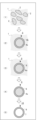
- FIG. 2 is a diagram illustrating an example of a method for producing hollow particles used in the present disclosure.
- (meth)acrylate refers to each of acrylate and methacrylate
- (meth)acrylic refers to each of acrylic and methacrylic
- (meth)acryloyl refers to each of acryloyl and methacryloyl.
- the fluororubber composition of the present disclosure contains hollow particles and a fluororubber, the hollow particles have a shell containing a resin and a hollow portion surrounded by the shell, and have an iodine value measured in accordance with JIS K 0070 of 10 g/100 g or more and 100 g/100 g or less;
- the fluororubber is characterized in that it is a fluororubber that can be crosslinked with a peroxide.
- the fluororubber composition of the present disclosure is used as a molding material for producing a crosslinked molded article.
- the fluororubber composition of the present disclosure can provide a crosslinked molded article that is lightweight and has reduced compression set.
- the hollow particles, the fluororubber, and other components contained in the fluororubber composition of the present disclosure will be described in detail below.
- the hollow particles used in the present disclosure are hollow particles having a shell containing a resin and a hollow portion surrounded by the shell, and are characterized in that the iodine value measured in accordance with JIS K 0070 is 10 g/100 g or more and 100 g/100 g or less.
- the iodine value measured in accordance with JIS K 0070 may be simply referred to as the iodine value.
- the iodine value of the hollow particles can be used as an index of the amount of reactive unsaturated bonds present on the outer surface of the hollow particles.
- the reactive unsaturated bonds are usually radical reactive unsaturated bonds that undergo an addition reaction by radicals.
- the hollow particles used in the present disclosure have an iodine value of 10 g/100 g or more, and therefore have a specific amount or more of reactive unsaturated bonds on the outer surface.
- the outer surface of the hollow particles and the fluororubber are crosslinked, so that the adhesion of the interface between the hollow particles and the fluororubber is excellent, and the interface between the hollow particles and the fluororubber is not easily peeled off.
- the hollow particles have a higher restoring force when an external force is applied than the fluororubber, and are not easily plastically deformed.
- the compression set is reduced because the fluororubber is crosslinked to the hollow particles, and when an external force is applied, the fluororubber follows the restoration of the hollow particles. If the outer surface of the hollow particles is not crosslinked to the fluororubber, the plastic deformation of the fluororubber is not suppressed, and the compression set is thought to be large.
- the crosslinked molded article of the fluororubber composition of the present disclosure the hollow particles are not easily crushed and the voids are easily maintained, so that the hollow particles have an excellent weight reduction effect.
- the hollow particles have the effect of reducing the weight of the crosslinked molded article of the fluororubber composition of the present disclosure and reducing the compression set of the crosslinked molded article.
- the hollow particles can also impart various properties to the crosslinked molded article, such as heat insulation and retention of functional components such as antibacterial agents.
- the iodine value of the hollow particles used in the present disclosure is preferably 12 g/100 g or more, more preferably 15 g/100 g or more, even more preferably 20 g/100 g or more, and even more preferably 30 g/100 g or more.
- the iodine value of the hollow particles used in the present disclosure is 100g/100g or less, a sufficient amount of cross-linking bonds are formed between the hollow particles and the fluororubber, and the compression set of the cross-linked molded body can be reduced.
- the iodine value of the hollow particles used in the present disclosure is preferably 80g/100g or less, more preferably 70g/100g or less, and even more preferably 40g/100g or less.
- the hollow particles used in the present disclosure are particles that include a shell (outer shell) containing a resin and a hollow portion surrounded by the shell, and have reactive unsaturated bonds on the outer surface of the shell.
- the reactive unsaturated bond include reactive unsaturated bonds contained in vinyl groups, (meth)acryloyl groups, allyl groups, butenyl groups, maleimide groups, nadimide groups, propargyl groups, or ethynyl groups, etc., and are preferably ethylenically unsaturated bonds, more preferably ethylenically unsaturated bonds contained in at least one selected from the group consisting of vinyl groups, (meth)acryloyl groups, and allyl groups, and even more preferably ethylenically unsaturated bonds contained in at least one selected from vinyl groups and (meth)acryloyl groups.
- the (meth)acryloyl group refers to each of an acryloyl group and a methacryloyl group.
- the reactive unsaturated bond on the outer surface of the shell may be a reactive unsaturated bond of a crosslinkable monomer unit or a reactive unsaturated bond of a coupling agent used for surface treatment, but is preferably a reactive unsaturated bond of a crosslinkable monomer unit. That is, it is preferable that at least one polymerizable functional group of the crosslinkable monomer is present unreacted on the surface of the shell.
- the crosslinkable monomer, coupling agent, and the like used in the production of hollow particles will be described in detail in the "Production method of hollow particles" described later.
- the resin contained in the shell of the hollow particles used in this disclosure is typically a polymer of a polymerizable monomer used in the manufacturing method of hollow particles described below.
- the shell of the hollow particles may further contain a surface treatment agent or an additive, etc., within the scope of not impairing the purpose of this disclosure.
- the content of the resin contained in the shell is preferably 80% by mass or more, more preferably 90% by mass or more, even more preferably 95% by mass or more, and even more preferably 98% by mass or more, and the shell may be made of resin.
- the shell of the hollow particles used in the present disclosure may be a resin layer containing a polymer of a polymerizable monomer, the outer surface of which is surface-treated with a coupling agent. If the shell of the hollow particles used in the present disclosure is surface-treated, this is preferable in that the mechanical properties such as tensile strength, tear strength, and abrasion resistance are improved in the crosslinked molded article of the present disclosure.
- the hollow particles used in the present disclosure may also have polar groups, such as amino groups or acidic groups, on the particle surface.
- Methods for introducing polar groups onto the surface of hollow particles include, for example, a method of reacting a modifier for introducing polar groups, a method of performing surface treatment with a coupling agent having a polar group, and a method of using a polymerizable monomer having a polar group.
- the hollow portion is a cavity-like space that is clearly distinguished from the shell.
- the shell of the hollow particle may have a porous structure, but in that case, the hollow portion has a size that is clearly distinguishable from the numerous minute spaces uniformly distributed within the porous structure.
- the hollow particles used in the present disclosure preferably have hollow portions filled with a gas such as air.
- the hollow particles used in the present disclosure may have one or more hollow portions, but from the viewpoint of maintaining a good balance between high porosity and mechanical strength, those having only one or two hollow portions are preferred, and those having only one hollow portion are preferred.
- the hollow particles used in the present disclosure preferably have a number ratio of particles having only one hollow portion of 90% or more, more preferably 95% or more, and even more preferably more than 95%.
- the shell of the hollow particle used in the present disclosure, and the partition walls separating adjacent hollow portions when the particle has two or more hollow portions may be porous.
- the shell be solid.
- the shape of the hollow particles used in the present disclosure may be, for example, spherical, oval spherical, or irregular, but from the viewpoint of dispersibility and pressure resistance of the hollow particles, a spherical shape is preferable.
- An example of the shape of a hollow particle used in the present disclosure is a bag made of a thin membrane and inflated with gas, and its cross-sectional view is shown in hollow particle 10 in (5) of Figure 1.
- a thin membrane is provided on the outside, and the inside is filled with gas.
- the hollow portion of the hollow particles can be confirmed, for example, by observing the cross section of the particles with an SEM or by observing the particles as they are with a TEM.
- the shape of the hollow particles can be confirmed, for example, by observing the hollow particles with an SEM or TEM.
- the hollow particles used in the present disclosure may contain, as impurities, a small amount of particles with a low circularity due to particle cracking, deformation, or the like.
- the proportion of particles with a circularity of 0.85 or less in 100% by mass of hollow particles is preferably less than 15% by mass, more preferably less than 10% by mass, and even more preferably less than 8% by mass.
- Particles with a circularity of 0.85 or less are typically particles that have deformations such as dents or cracks, and may be referred to as "irregularly shaped particles" in the present disclosure.
- Such irregularly shaped particles have a lower porosity than spherical hollow particles, and therefore have a poorer weight-reducing effect. Therefore, by reducing the proportion of irregularly shaped particles contained in the hollow particles, the weight-reducing effect of the hollow particles can be improved. In addition, irregularly shaped particles are more likely to aggregate when dispersed in fluororubber than spherical particles, and have poor dispersibility. Therefore, by reducing the proportion of irregularly shaped particles contained in the hollow particles, the dispersibility of the hollow particles can be improved, and as a result, the compression set of the crosslinked molded product can be further reduced.
- irregularly shaped particles are more likely to be locally subjected to external pressure, and therefore have a problem of poorer pressure resistance than spherical particles.
- irregularly shaped particles are dispersed in fluororubber, aggregates are more likely to be formed, and the aggregates are more likely to be subjected to external pressure, which further reduces the pressure resistance. Therefore, by reducing the proportion of irregularly shaped particles contained in the hollow particles, the pressure resistance of the hollow particles can be improved.
- the circularity is defined as the diameter of a circle having the same area as the projected image of a particle (equivalent circle area diameter) divided by the diameter of a circle having the same perimeter as the projected image of a particle (equivalent circumferential diameter).
- the circularity is 1, and the more complex the surface shape of the particle, the smaller the circularity value.
- the hollow particles used in the present disclosure may have an average circularity of 0.950 to 0.995.
- circularity is measured using a flow type particle image measuring device with an image resolution of 0.185 ⁇ m/pixel.
- a flow type particle image measuring device for example, a product named "IF-3200" manufactured by Jasco International Co., Ltd. can be preferably used.
- a measurement sample is prepared, for example, by dispersing a mixture of 0.10 to 0.12 g of hollow particles in an aqueous solution of linear alkylbenzenesulfonate (concentration: 0.3%) for 5 minutes in an ultrasonic cleaner.
- the average circularity is defined as the average value of the circularities of 1,000 to 3,000 arbitrarily selected particles.
- the porosity of the hollow particles used in the present disclosure is not particularly limited, but from the viewpoint of weight reduction effect, it is preferably 60% or more, more preferably 65% or more, and even more preferably 70% or more.
- the upper limit of the porosity of the hollow particles is not particularly limited, but from the viewpoint of suppressing a decrease in the strength of the hollow particles and making them less likely to be crushed, it is preferably 90% or less, more preferably 85% or less, and even more preferably 80% or less.
- the porosity of the hollow particles is calculated from the apparent density D1 and the true density D0 of the hollow particles.
- the method for measuring the apparent density D1 of the hollow particles is as follows. First, fill a 100 cm3 volumetric flask with about 30 cm3 of hollow particles, and accurately weigh the mass of the hollow particles. Next, fill the volumetric flask filled with the hollow particles with isopropanol precisely up to the mark, taking care not to introduce air bubbles. The mass of isopropanol added to the volumetric flask is accurately weighed, and the apparent density D1 (g/ cm3 ) of the hollow particles is calculated based on the following formula (I).
- the method for measuring the true density D0 of hollow particles is as follows. After crushing the hollow particles in advance, about 10 g of crushed pieces of the hollow particles are filled into a measuring flask with a capacity of 100 cm3 , and the mass of the crushed pieces filled is accurately weighed. Then, in the same manner as in the measurement of the apparent density, isopropanol is added to the measuring flask, the mass of isopropanol is accurately weighed, and the true density D0 (g/ cm3 ) of the hollow particles is calculated based on the following formula (II).
- True density D 0 [mass of crushed pieces of hollow particles]/(100-[mass of isopropanol]/[specific gravity of isopropanol at measurement temperature])
- the true density D0 corresponds to the specific gravity of only the shell portion of the hollow particle.
- the hollow portion is not considered to be part of the hollow particle when calculating the true density D0 .
- the porosity (%) of the hollow particles is calculated from the apparent density D1 and the true density D0 of the hollow particles by the following formula (III).
- Formula (III) Porosity (%) 100 ⁇ (apparent density D 1 /true density D 0 ) ⁇ 100
- the volume average particle diameter of the hollow particles used in this disclosure is not particularly limited, but the lower limit is preferably 0.1 ⁇ m or more, more preferably 1 ⁇ m or more, and the upper limit is preferably 100 ⁇ m or less, more preferably 80 ⁇ m or less, and even more preferably 50 ⁇ m or less.
- the volume average particle diameter of the hollow particles used in this disclosure is equal to or greater than the above lower limit, the aggregation of the hollow particles is suppressed and the dispersibility is improved, thereby improving the effect of reducing the compression set of the crosslinked molded body.
- the volume average particle diameter of the hollow particles used in this disclosure is equal to or less than the above upper limit, the reduction in the specific surface area of the hollow particles is suppressed, and as a result, the reduction in the interface between the hollow particles and the fluororubber is suppressed, and the amount of crosslinking bonds formed between the hollow particles and the fluororubber increases, improving the effect of reducing the compression set of the crosslinked molded body.
- the volume average particle diameter (Dv) and number average particle diameter (Dp) of hollow particles can be determined by, for example, measuring the particle diameter of hollow particles using a particle size distribution measuring device based on the Coulter counter method, calculating the number average and volume average, and using the obtained values as the number average particle diameter (Dp) and volume average particle diameter (Dv) of the particles.
- the particle size distribution is the value obtained by dividing the volume average particle diameter by the number average particle diameter.
- the Coulter counter method is a method for measuring particle diameter by an electrical resistance method called the Coulter principle.
- the hollow particles used in the present disclosure are not particularly limited, but preferably have a residual volatile content of less than 100 ppm. If the residual volatile content of the hollow particles is high, the residual volatile content is present on the outer surface of the hollow particles. The residual volatile content present on the outer surface of the hollow particles inhibits the crosslinking reaction between the reactive unsaturated bonds on the outer surface of the hollow particles and the fluororubber. Therefore, if the residual volatile content of the hollow particles is high, the adhesion between the hollow particles contained in the crosslinked molded body and the fluororubber deteriorates, and as a result, the compression set of the crosslinked molded body increases.
- the residual volatile content of the hollow particles used in the present disclosure is more preferably less than 50 ppm, and even more preferably less than 30 ppm.
- the residual volatile components are usually organic compounds having a molecular weight of 500 or less, and specific examples thereof include residual polymerizable monomers, residual hydrophobic solvents, decomposition products of polymerization initiators, etc.
- the content of the residual volatile components is the ratio of the mass of the residual volatile components contained in the hollow particles to the mass of the hollow particles.
- the lower limit of the residual volatile component content of the hollow particles used in the present disclosure is not particularly limited, but from the viewpoint of ease of production, it may be, for example, 1 ppm or more, 2 ppm or more, or 3 ppm or more.
- the residual volatile component content of the hollow particles can be measured by purge and trap/gas chromatography (P&T/GC). Specifically, the measurement method described in the Examples below can be adopted.
- the content of surfactants, etc. present on the hollow particle surface can be made less than the measurement limit.
- the content of surfactants, etc. present on the outer surface of hollow particles refers to the ratio of the mass of surfactants, etc. present on the outer surface of hollow particles to the mass of the hollow particles.
- the surfactants, etc. present on the outer surface of hollow particles can be extracted, for example, by ultrasonicating the hollow particles in water.
- the type and mass of the surfactants, etc. extracted into water can be identified from the peak position and peak intensity of the 1 H-NMR spectrum.
- the measurement limit of the amount of surfactants, etc. present on the hollow particle surface is usually 0.05 ppm.
- the thermal decomposition initiation temperature of the hollow particles used in the present disclosure is not particularly limited, but from the viewpoint of heat resistance, it is preferably 345° C. or higher, more preferably 350° C. or higher.
- the upper limit of the thermal decomposition initiation temperature of the hollow particles is not particularly limited, but may be, for example, 400° C. or lower.
- the thermal decomposition onset temperature of hollow particles is the temperature at which a 5% weight loss occurs, and can be measured using a TG-DTA device under conditions of a nitrogen atmosphere, a nitrogen flow rate of 230 mL/min, and a heating rate of 10° C./min.
- the content of the hollow particles is not particularly limited, but on a mass basis, the lower limit is preferably 1 part by mass or more, more preferably 2 parts by mass or more, even more preferably 3 parts by mass or more, and still more preferably 10 parts by mass or more, and the upper limit is preferably 50 parts by mass or less, more preferably 40 parts by mass or less, even more preferably 30 parts by mass or less, and still more preferably 20 parts by mass or less, relative to 100 parts by mass of the fluororubber.
- the content of the hollow particles on a volume basis is not particularly limited, but the lower limit is preferably 15 vol% or more, more preferably 20 vol% or more, and even more preferably 30 vol% or more, and the upper limit is preferably 70 vol% or less, more preferably 60 vol% or less, and even more preferably 50 vol% or less.
- the content of hollow particles is equal to or more than the lower limit, the hollow particles have excellent effects of weight reduction and compression set reduction.
- the content of hollow particles is equal to or less than the upper limit, the fluororubber composition is easily kneaded. Furthermore, the hollow particles are prevented from deteriorating in dispersibility, so that the hollow particles have excellent effects of compression set reduction.
- the fluororubber can be contained in a sufficient amount, the inherent properties of the fluororubber can be sufficiently maintained in the fluororubber composition.
- a method for producing the hollow particles includes the steps of: preparing a mixed solution containing a polymerizable monomer, a hydrophobic solvent, a polymerization initiator, a dispersion stabilizer, and an aqueous medium; a step of suspending the mixed liquid to prepare a suspension in which droplets of a monomer composition containing the polymerizable monomer, the hydrophobic solvent, and the polymerization initiator are dispersed in the aqueous medium; a step of subjecting the suspension to a polymerization reaction to prepare a precursor composition in which precursor particles having a hollow portion surrounded by a shell containing a resin and the hollow portion filled with the hydrophobic solvent are dispersed in the aqueous medium; and removing the hydropho
- hollow particles having a hollow portion filled with a hydrophobic solvent are considered to be intermediates of hollow particles having a hollow portion filled with a gas, and may be referred to as "precursor particles.”
- a "precursor composition” refers to a composition containing precursor particles.
- a mixture containing a polymerizable monomer, a hydrophobic solvent, a polymerization initiator, a dispersion stabilizer, and an aqueous medium is suspended, whereby the polymerizable monomer and the hydrophobic solvent are phase-separated, and a suspension is prepared in which droplets of the monomer composition having a distribution structure in which the polymerizable monomer is unevenly distributed on the surface side and the hydrophobic solvent is unevenly distributed in the center are dispersed in the aqueous medium.
- the above manufacturing method includes a step of preparing a mixed liquid, a step of preparing a suspension, a step of subjecting the suspension to a polymerization reaction, and a step of removing the hydrophobic solvent, and may further include other steps. Furthermore, as far as technically possible, two or more of the above steps and other additional steps may be carried out simultaneously as one step, or the order may be changed. For example, the preparation of the mixed liquid and the suspension may be carried out simultaneously in one step, such as adding the materials for preparing the mixed liquid and suspending them at the same time.
- a preferred example of the method for producing hollow particles includes the following steps.
- Mixture preparation step A step of preparing a mixture containing a polymerizable monomer, a hydrophobic solvent, a polymerization initiator, a dispersion stabilizer, and an aqueous medium;
- Suspension step A step of suspending the mixed liquid to prepare a suspension in which droplets of a monomer composition containing a polymerizable monomer, a hydrophobic solvent, and a polymerization initiator are dispersed in an aqueous medium;
- a polymerization step a step of subjecting the suspension to a polymerization reaction to prepare a precursor composition in which precursor particles having a hollow portion surrounded by a shell containing a resin and the hollow portion filled with the hydrophobic solvent are dispersed in the aqueous medium;
- a solid-liquid separation step which is a step of obtaining a solid fraction containing precursor particles or hollow particles by solid-liquid separation; and (5) a solvent removal step, which
- FIG. 1 is a schematic diagram showing an example of the manufacturing method of the present disclosure.
- (1) to (5) in FIG. 1 correspond to the above steps (1) to (5).
- the solvent removal step is performed after the solid-liquid separation step, but the solid-liquid separation step may be performed after the solvent removal step.
- the white arrows between the figures indicate the order of each step.
- FIG. 1 is merely a schematic diagram for explanation, and the manufacturing method of the present disclosure is not limited to that shown in the figure.
- the structure, dimensions, and shape of the materials used in the manufacturing method of the present disclosure are not limited to the structure, dimensions, and shapes of the various materials in these figures.
- FIG. 1(1) is a cross-sectional schematic diagram showing one embodiment of a mixed solution in a mixed solution preparation step.
- the mixed solution contains an aqueous medium 1 and a low-polarity material 2 dispersed in the aqueous medium 1.
- the low-polarity material 2 means a material that has low polarity and is difficult to mix with the aqueous medium 1.
- the low-polarity material 2 contains a polymerizable monomer, a hydrophobic solvent, and a polymerization initiator.
- FIG. 1 (2) is a cross-sectional schematic diagram showing one embodiment of the suspension in the suspension step.
- the suspension includes an aqueous medium 1 and droplets 8 of a monomer composition dispersed in the aqueous medium 1.
- the droplets 8 of the monomer composition include a polymerizable monomer, a hydrophobic solvent, and a polymerization initiator, but the distribution within the droplets is non-uniform.
- the droplets 8 of the monomer composition have a structure in which the hydrophobic solvent 4a and a material other than the hydrophobic solvent including the polymerizable monomer 4b are phase-separated, the hydrophobic solvent 4a is unevenly distributed in the center, the material other than the hydrophobic solvent 4b is unevenly distributed on the surface side, and a dispersion stabilizer (not shown) is attached to the surface.
- FIG. 1(3) is a cross-sectional schematic diagram showing one embodiment of a precursor composition containing precursor particles having a hydrophobic solvent encapsulated in a hollow portion thereof, obtained by a polymerization step.
- the precursor composition contains an aqueous medium 1 and precursor particles 9 having a hydrophobic solvent 4a encapsulated in a hollow portion thereof, dispersed in the aqueous medium 1.
- a shell 6 forming an outer surface of the precursor particles 9 is formed by polymerization of a polymerizable monomer in droplets 8 of the monomer composition, and contains a polymer of the polymerizable monomer as a resin.
- Fig. 1(4) is a schematic cross-sectional view showing one embodiment of precursor particles after the solid-liquid separation step, in which the aqueous medium 1 has been removed from the state shown in Fig. 1(3).
- Fig. 1 (5) is a schematic cross-sectional view showing one embodiment of hollow particles after the solvent removal step.
- Fig. 1 (5) shows a state in which the hydrophobic solvent 4a has been removed from the state shown in Fig. 1 (4).
- hollow particles 10 having a hollow portion 7 filled with gas inside a shell 6 are obtained.
- This step is a step of preparing a mixture containing a polymerizable monomer, a hydrophobic solvent, a polymerization initiator, a dispersion stabilizer, and an aqueous medium.
- the mixture may further contain other materials as long as the purpose of the present disclosure is not impaired.
- the materials of the mixed liquid will be described in the following order: (A) polymerizable monomer, (B) hydrophobic solvent, (C) polymerization initiator, (D) dispersion stabilizer, and (E) aqueous medium.
- the polymerizable monomer is a compound having a functional group capable of addition polymerization (sometimes simply referred to as a polymerizable functional group in the present disclosure).
- a compound having an ethylenically unsaturated bond as a functional group capable of addition polymerization is generally used as the polymerizable monomer.
- a radical polymerizable group is preferred, and from the viewpoint of excellent reactivity, at least one selected from the group consisting of a (meth)acryloyl group, a vinyl group, and an allyl group is preferred, and at least one selected from a (meth)acryloyl group and a vinyl group is more preferred.
- a polymerizable monomer having only one polymerizable functional group is referred to as a non-crosslinkable monomer
- a polymerizable monomer having two or more polymerizable functional groups is referred to as a crosslinkable monomer.
- the crosslinkable monomer can form a crosslinked bond in the polymer by a polymerization reaction.
- the crosslinkable monomer becomes a crosslinkable monomer unit in the shell
- the non-crosslinkable monomer becomes a non-crosslinkable monomer unit in the shell.
- a polymerizable monomer consisting of carbon and hydrogen is referred to as a hydrocarbon monomer
- a crosslinkable monomer consisting of carbon and hydrogen is referred to as a crosslinkable hydrocarbon monomer
- a non-crosslinkable monomer consisting of carbon and hydrogen is referred to as a non-crosslinkable hydrocarbon monomer.
- a polymerizable monomer having a (meth)acryloyl group as a polymerizable functional group is referred to as an acrylic monomer
- a crosslinkable monomer having a (meth)acryloyl group as a polymerizable functional group is referred to as a crosslinkable acrylic monomer
- a non-crosslinkable monomer having a (meth)acryloyl group as a polymerizable functional group is referred to as a non-crosslinkable acrylic monomer.
- at least one polymerizable functional group may be a (meth)acryloyl group, but it is preferable that all polymerizable functional groups are (meth)acryloyl groups.
- the polymerizable monomer may be any known polymerizable monomer conventionally used for producing hollow particles, and is not particularly limited, but preferably contains at least a crosslinkable monomer in order to set the iodine value of the hollow particles within the above range.
- the iodine value of the hollow particles can be set within the above range by leaving a part of the reactive unsaturated bonds of the crosslinkable monomer unreacted on the outer surface of the shell.
- the polymerizable monomer contains a crosslinkable monomer
- the crosslink density of the polymer precipitated on the surface of the droplets increases when the suspension is subjected to a polymerization reaction, and the precipitates are also crosslinked with each other, so that the crosslink density of the shell can be increased.
- a shell with excellent strength is easily formed, and the hollow particles are easily spherical, and a hollow part that is clearly distinguished from the shell is easily formed in the particle.
- crosslinkable monomers include crosslinkable hydrocarbon monomers such as aromatic divinyl monomers, such as divinylbenzene, divinylbiphenyl, and divinylnaphthalene; linear or branched diolefins, such as butadiene, isoprene, 2,3-dimethylbutadiene, pentadiene, and hexadiene; and diene monomers, such as alicyclic diolefins, such as dicyclopentadiene, cyclopentadiene, and ethylidenetetracyclododecene; allyl (meth)acrylate, vinyl (meth)acrylate, and ethylene glycol.
- crosslinkable hydrocarbon monomers such as aromatic divinyl monomers, such as divinylbenzene, divinylbiphenyl, and divinylnaphthalene
- linear or branched diolefins such as butadiene, isoprene, 2,3
- the crosslinkable monomer contains at least one selected from a crosslinkable acrylic monomer and a crosslinkable hydrocarbon monomer, and it is more preferable that the crosslinkable monomer contains a combination of a crosslinkable acrylic monomer and a crosslinkable hydrocarbon monomer.
- crosslinkable acrylic monomers are preferred from the viewpoint of improving the strength of the shell, while crosslinkable hydrocarbon monomers are preferred from the viewpoint of easily introducing reactive unsaturated bonds into the outer surface of the shell.
- crosslinkable hydrocarbon monomer among others, aromatic divinyl monomers are preferred, and divinylbenzene is particularly preferred.
- crosslinkable acrylic monomer both the bifunctional crosslinkable acrylic monomer and the trifunctional or higher crosslinkable acrylic monomer are preferred. From the viewpoint of improving the shell strength and reducing the compression set of the crosslinked molded body, it is preferred to include at least a bifunctional crosslinkable acrylic monomer, and it is more preferred to include a combination of a bifunctional crosslinkable acrylic monomer and a trifunctional or higher crosslinkable acrylic monomer.
- bifunctional crosslinkable acrylic monomer at least one selected from the group consisting of ethylene glycol di(meth)acrylate, diethylene glycol di(meth)acrylate, and pentaerythritol di(meth)acrylate is preferred.
- trifunctional or higher crosslinkable acrylic monomer at least one selected from the group consisting of trimethylolpropane tri(meth)acrylate, ditrimethylolpropane tetra(meth)acrylate, pentaerythritol tri(meth)acrylate, and pentaerythritol tetra(meth)acrylate is preferred.
- the content of the crosslinkable monomer in 100% by mass of the polymerizable monomer is preferably 50% by mass or more, more preferably 70% by mass or more, even more preferably 90% by mass or more, and even more preferably 95% by mass or more.
- the polymerizable monomer may be composed of a crosslinkable monomer, but may further contain a non-crosslinkable monomer described later as the polymerizable monomer.
- the content of the crosslinkable monomer in 100% by mass of the polymerizable monomer may be, for example, 99% by mass or less, 98% by mass or less, or 97% by mass or less.
- the content of each monomer in 100% by mass of the polymerizable monomer corresponds to the content of each monomer unit in 100% by mass of all monomer units constituting the polymer contained in the shell.
- the content of the crosslinkable hydrocarbon monomer in 100% by mass of the polymerizable monomer is, as a lower limit, preferably 10% by mass or more, more preferably 30% by mass or more, and even more preferably 40% by mass or more, and the upper limit is not particularly limited and may be 100% by mass, but is preferably 90% by mass or less, more preferably 80% by mass or less, even more preferably 70% by mass or less, and even more preferably 60% by mass or less.
- the content of the crosslinkable acrylic monomer in 100% by mass of the polymerizable monomer is not particularly limited as a lower limit and may be 0% by mass, but is preferably 10% by mass or more, more preferably 20% by mass or more, even more preferably 30% by mass or more, and still more preferably 40% by mass or more, and the upper limit is preferably 90% by mass or less, more preferably 70% by mass or less, and even more preferably 60% by mass or less.
- the content of the bifunctional crosslinkable acrylic monomer relative to the total 100 mass% of the bifunctional crosslinkable acrylic monomer and the trifunctional or higher crosslinkable acrylic monomer is preferably 20 mass% or more, more preferably 30 mass% or more, and even more preferably 40 mass% or more, and the upper limit is preferably 70 mass% or less, more preferably 60 mass% or less, and even more preferably 50 mass% or less.
- the content of the crosslinkable acrylic monomer relative to 100 parts by mass of the total of the crosslinkable acrylic monomer and the crosslinkable hydrocarbon monomer is preferably 10 parts by mass or more, more preferably 20 parts by mass or more, even more preferably 30 parts by mass or more, and even more preferably 40 parts by mass or more as the lower limit, and preferably 90 parts by mass or less, preferably 70 parts by mass or less, and more preferably 60 parts by mass or less as the upper limit.
- the total content of the crosslinkable acrylic monomer and the crosslinkable hydrocarbon monomer in 100 parts by mass of the crosslinkable monomer is preferably 80 parts by mass or more, more preferably 90 parts by mass or more, even more preferably 95 parts by mass or more, and even more preferably 99 parts by mass or more.
- the polymerizable monomer may further include a non-crosslinkable monomer.
- the non-crosslinkable monomer include aromatic monovinyl monomers such as styrene, vinyltoluene, ⁇ -methylstyrene, p-methylstyrene, ethylvinylbenzene, ethylvinylbiphenyl, and ethylvinylnaphthalene; linear or branched monoolefins such as ethylene, propylene, and butylene; and alicyclic monoolefins such as vinylcyclohexane, norbornene, tricyclododecene, and 1,4-methano-1,4,4a,9a-tetrahydrofluorene; non-crosslinkable hydrocarbon monomers such as methyl (meth)acrylate, ethyl (meth)acrylate, butyl (meth)acrylate, 2-methyl-2-propan
- the content of the non-crosslinkable monomer in 100% by mass of the polymerizable monomer is preferably 50% by mass or less, more preferably 30% by mass or less, even more preferably 10% by mass or less, and more preferably 5% by mass or less, in order to keep the iodine value of the hollow particles within the above range and to prevent a decrease in shell strength.
- the lower limit of the content of the non-crosslinkable monomer in 100% by mass of the polymerizable monomer is not particularly limited, and may be, for example, 1% by mass or more, 2% by mass or more, or 3% by mass or more.
- the content of the polymerizable monomer in the mixed solution is not particularly limited, but from the viewpoint of the balance between the porosity, particle size, and mechanical strength of the hollow particles, it is preferably 15 to 50 mass%, more preferably 20 to 40 mass%, relative to 100 mass% of the total mass of the components in the mixed solution excluding the aqueous medium.
- the content of the polymerizable monomer relative to 100% by mass of the total mass of the solids excluding the hydrophobic solvent among the materials that form the oil phase in the mixed liquid is preferably 96% by mass or more, and more preferably 97% by mass or more.
- the solid content refers to all components excluding the solvent, and liquid polymerizable monomers and the like are considered to be included in the solid content.
- the hydrophobic solvent used in the production method of the present disclosure is a non-polymerizable and poorly water-soluble organic solvent.
- the hydrophobic solvent acts as a spacer material that forms a hollow space inside the particle.
- a suspension is obtained in which droplets of the monomer composition containing the hydrophobic solvent are dispersed in an aqueous medium.
- phase separation occurs in the droplets of the monomer composition, and the hydrophobic solvent with low polarity tends to collect inside the droplets.
- the hydrophobic solvent is distributed inside the droplets, and other materials other than the hydrophobic solvent are distributed around the droplets according to their respective polarities.
- an aqueous dispersion containing precursor particles encapsulating the hydrophobic solvent is obtained. That is, the hydrophobic solvent collects inside the particles, and hollow portions filled with the hydrophobic solvent are formed inside the obtained precursor particles.
- the hydrophobic solvent can be appropriately selected from known hydrophobic solvents, and is not particularly limited, and examples thereof include esters such as ethyl acetate and butyl acetate, ether esters such as propylene glycol monomethyl ether acetate and propylene glycol monoethyl ether acetate, and hydrocarbon solvents. Among these, hydrocarbon solvents are preferred, and hydrocarbon solvents having 5 to 8 carbon atoms are more preferred.
- hydrocarbon solvent examples include aliphatic hydrocarbons including chain hydrocarbon solvents such as pentane, hexane, heptane, octane, 2-methylbutane, 2-methylpentane, and paraffin solvents, and cyclic hydrocarbon solvents such as cyclohexane, methylcyclohexane, and cycloheptane; and aromatic hydrocarbons such as benzene, toluene, and xylene.
- chain hydrocarbon solvents such as pentane, hexane, heptane, octane, 2-methylbutane, 2-methylpentane, and paraffin solvents
- cyclic hydrocarbon solvents such as cyclohexane, methylcyclohexane, and cycloheptane
- aromatic hydrocarbons such as benzene, toluene, and xylene.
- the hydrophobic solvent is preferably a hydrocarbon solvent, more preferably a chain hydrocarbon solvent, even more preferably a chain hydrocarbon solvent having 5 to 8 carbon atoms, and even more preferably at least one selected from the group consisting of pentane, hexane, heptane, and octane.
- the boiling point of the hydrophobic solvent is preferably 130° C. or lower, more preferably 100° C. or lower, in order that the hydrophobic solvent is easily removed in the solvent removal step described below, while it is preferably 50° C. or higher, more preferably 60° C. or higher, in order that the hydrophobic solvent is easily encapsulated in the precursor particles.
- the hydrophobic solvent is a mixed solvent containing multiple types of hydrophobic solvents and has multiple boiling points
- the boiling point of the solvent with the highest boiling point among the solvents contained in the mixed solvent is not more than the above upper limit value, and it is preferable that the boiling point of the solvent with the lowest boiling point among the solvents contained in the mixed solvent is not less than the above lower limit value.
- the hydrophobic solvent preferably has a relative dielectric constant of 2.5 or less at 20° C.
- the relative dielectric constant is one of the indices showing the degree of polarity of a compound.
- the relative dielectric constant of the hydrophobic solvent is sufficiently small, 2.5 or less, it is considered that phase separation proceeds quickly in the droplets of the monomer composition, and hollow portions are easily formed.
- Examples of hydrophobic solvents having a relative dielectric constant of 2.5 or less at 20° C. are as follows. The value in parentheses is the value of the relative dielectric constant. Pentane (1.8), hexane (1.9), heptane (1.9), octane (1.9), cyclohexane (2.0).
- the porosity of the hollow particles can be adjusted by changing the amount of the hydrophobic solvent in the mixture.
- the polymerization reaction proceeds in a state in which the oil droplets containing the polymerizable monomers and the like contain the hydrophobic solvent, so that the porosity of the obtained hollow particles tends to increase as the content of the hydrophobic solvent increases.
- the content of the hydrophobic solvent in the mixed solution is preferably 100 parts by mass or more and 650 parts by mass or less relative to 100 parts by mass of the polymerizable monomer, since it is easy to control the particle size of the hollow particles, it is easy to increase the porosity while maintaining the strength of the hollow particles, and it is easy to reduce the amount of residual hydrophobic solvent in the particles.
- the content of the hydrophobic solvent in the mixed solution is more preferably 120 parts by mass or more and 500 parts by mass or less, and even more preferably 140 parts by mass or more and 300 parts by mass or less relative to 100 parts by mass of the polymerizable monomer.
- the mixed liquid preferably contains an oil-soluble polymerization initiator as a polymerization initiator.
- the oil-soluble polymerization initiator is not particularly limited as long as it is lipophilic and has a solubility in water of 0.2 mass% or less, and examples thereof include organic peroxides such as benzoyl peroxide, lauroyl peroxide, t-butylperoxy-2-ethylhexanoate, t-butylperoxydiethylacetate, and t-butylperoxypivalate; and azo compounds such as 2,2'-azobis(2,4-dimethylvaleronitrile), azobisisobutyronitrile, and 2,2'-azobis(4-methoxy-2,4-dimethylvaleronitrile).
- the content of the polymerization initiator is preferably 0.1 to 10 parts by mass, more preferably 0.5 to 7 parts by mass, and even more preferably 1 to 5 parts by mass, per 100 parts by mass of the polymerizable monomer in the mixed liquid. If the content of the polymerization initiator is equal to or greater than the lower limit, the polymerization reaction can proceed sufficiently, and if it is equal to or less than the upper limit, there is little risk of the polymerization initiator remaining after completion of the polymerization reaction, and there is also little risk of an unexpected side reaction proceeding.
- the dispersion stabilizer is an agent that disperses droplets of the monomer composition in an aqueous medium in the suspension step.
- the dispersion stabilizer include inorganic dispersion stabilizers, organic or inorganic water-soluble polymer stabilizers, and surfactants.
- it is preferable to use an inorganic dispersion stabilizer as the dispersion stabilizer because it is easy to control the particle size of the droplets in the suspension, the dispersion stabilizer can be easily removed by a washing step, and the shell is prevented from becoming too thin, thereby preventing a decrease in the strength of the hollow particles.
- inorganic dispersion stabilizers examples include sulfates such as barium sulfate and calcium sulfate, carbonates such as barium carbonate, calcium carbonate, and magnesium carbonate, phosphates such as calcium phosphate, metal oxides such as aluminum oxide and titanium oxide, metal hydroxides such as aluminum hydroxide, magnesium hydroxide, calcium hydroxide, barium hydroxide, and ferric hydroxide, and inorganic compounds such as silicon dioxide.
- sulfates such as barium sulfate and calcium sulfate
- carbonates such as barium carbonate, calcium carbonate, and magnesium carbonate
- phosphates such as calcium phosphate
- metal oxides such as aluminum oxide and titanium oxide
- metal hydroxides such as aluminum hydroxide, magnesium hydroxide, calcium hydroxide, barium hydroxide, and ferric hydroxide
- inorganic compounds such as silicon dioxide.
- poorly water-soluble inorganic dispersion stabilizers preferably have a solubility in water at 25° C. of less than 1 g/L.
- metal hydroxides are preferred, and magnesium hydroxide is more preferred.
- the poorly water-soluble inorganic dispersion stabilizer in a state where it is dispersed in an aqueous medium in the form of colloidal particles, i.e., in the form of a colloidal dispersion liquid containing poorly water-soluble inorganic dispersion stabilizer colloidal particles, which allows the inorganic dispersion stabilizer to be easily removed by a washing step described later.
- a colloidal dispersion liquid containing poorly water-soluble inorganic dispersion stabilizer colloidal particles can be prepared, for example, by reacting at least one selected from an alkali metal hydroxide and an alkaline earth metal hydroxide with a water-soluble polyvalent metal salt (excluding an alkaline earth metal hydroxide) in an aqueous medium.
- alkali metal hydroxide include lithium hydroxide, sodium hydroxide, potassium hydroxide, etc.
- Examples of the alkaline earth metal hydroxide include barium hydroxide, calcium hydroxide, etc.
- the water-soluble polyvalent metal salt may be any water-soluble polyvalent metal salt other than the above-mentioned alkaline earth metal hydroxides, and examples thereof include magnesium metal salts such as magnesium chloride, magnesium phosphate, and magnesium sulfate; calcium metal salts such as calcium chloride, calcium nitrate, calcium acetate, and calcium sulfate; aluminum metal salts such as aluminum chloride and aluminum sulfate; barium salts such as barium chloride, barium nitrate, and barium acetate; zinc salts such as zinc chloride, zinc nitrate, and zinc acetate; etc.
- magnesium metal salts such as magnesium chloride, magnesium phosphate, and magnesium sulfate
- calcium metal salts such as calcium chloride, calcium nitrate, calcium acetate, and calcium sulfate
- aluminum metal salts such as aluminum chloride and aluminum sulfate
- barium salts such as barium chloride, barium nitrate, and barium a
- magnesium metal salts, calcium metal salts, and aluminum metal salts are preferred, magnesium metal salts are more preferred, and magnesium chloride is particularly preferred.
- the method for reacting at least one selected from the above-mentioned alkali metal hydroxides and alkaline earth metal hydroxides with the above-mentioned water-soluble polyvalent metal salt in an aqueous medium is not particularly limited, but for example, an aqueous solution of at least one selected from the above-mentioned alkali metal hydroxides and alkaline earth metal hydroxides may be mixed with an aqueous solution of the water-soluble polyvalent metal salt.
- colloidal silica can also be used as the colloidal dispersion liquid containing poorly water-soluble inorganic dispersion stabilizer colloidal particles.
- organic water-soluble polymer stabilizer examples include polyvinyl alcohol, polycarboxylic acids (polyacrylic acid, etc.), celluloses (hydroxyethyl cellulose, carboxymethyl cellulose, methyl cellulose, ethyl cellulose, etc.), polyvinylpyrrolidone, polyacrylimide, polyethylene oxide, and poly(hydroxystearic acid-g-methyl methacrylate-co-methacrylic acid) copolymers.
- An example of the inorganic water-soluble polymer stabilizer is sodium tripolyphosphate.
- a surfactant is a compound having both a hydrophilic group and a hydrophobic group in one molecule, and examples of such surfactants include known ionic surfactants such as anionic surfactants, cationic surfactants, and amphoteric surfactants, as well as nonionic surfactants.
- the water-soluble polymer stabilizer and surfactant usually have a solubility in water at 25° C. of 1 g/L or more.
- the content of the dispersion stabilizer is not particularly limited, but is preferably 0.5 to 15 parts by mass, more preferably 1 to 10 parts by mass, relative to 100 parts by mass of the total mass of the polymerizable monomer and the hydrophobic solvent.
- the content of the dispersion stabilizer is preferably 0.5 to 15 parts by mass, and more preferably 0.5 to 10 parts by mass, based on 100 parts by mass of the aqueous medium.
- an inorganic dispersion stabilizer as the dispersion stabilizer, hollow particles can be obtained in which both the water-soluble polymer stabilizer and the surfactant are below the detection limit.
- an aqueous medium means a medium selected from the group consisting of water, a hydrophilic solvent, and a mixture of water and a hydrophilic solvent.
- a mixture of water and a hydrophilic solvent it is important that the polarity of the entire mixture is not too low from the viewpoint of forming droplets of the monomer composition.
- the mass ratio of water to the hydrophilic solvent may be 99:1 to 50:50.
- the hydrophilic solvent in the present disclosure is not particularly limited as long as it is sufficiently miscible with water and does not cause phase separation.
- the hydrophilic solvent include alcohols such as methanol and ethanol, tetrahydrofuran (THF), and dimethyl sulfoxide (DMSO).
- the amount of the aqueous medium is not particularly limited, but from the viewpoint of setting the particle size and porosity of the hollow particles within the preferred ranges described below, the lower limit is preferably 200 parts by mass or more, more preferably 400 parts by mass or more, and even more preferably 600 parts by mass or more, relative to 100 parts by mass of the polymerizable monomer contained in the mixed liquid, and the upper limit is preferably 1000 parts by mass or less, and more preferably 800 parts by mass or less.
- the mixture may further contain other materials different from the above-mentioned materials (A) to (E) as long as the purpose of this disclosure is not impaired.
- the above-mentioned materials and other materials as necessary are mixed and appropriately stirred to obtain a mixed liquid.
- the oil phase containing the above-mentioned (A) polymerizable monomer, (B) hydrophobic solvent, and (C) lipophilic materials such as a polymerization initiator is dispersed with a particle size of about several mm in an aqueous phase containing (D) a dispersion stabilizer and (E) an aqueous medium.
- the dispersion state of these materials in the mixed liquid can be observed with the naked eye depending on the type of material.
- the mixed solution may be obtained by simply mixing the above-mentioned materials and other materials as necessary and appropriately stirring, etc., but in terms of facilitating the formation of a uniform shell, it is preferable to prepare a mixed solution by separately preparing an oil phase containing a polymerizable monomer, a hydrophobic solvent, and a polymerization initiator, and an aqueous phase containing a dispersion stabilizer and an aqueous medium in advance, and mixing these.
- a colloidal dispersion in which a poorly water-soluble inorganic dispersion stabilizer is dispersed in the form of colloidal particles in an aqueous medium can be preferably used as the aqueous phase.
- the suspension step is a step of suspending the above-mentioned mixed liquid to prepare a suspension in which droplets of the monomer composition containing a hydrophobic solvent are dispersed in an aqueous medium.
- the suspension method for forming droplets of the monomer composition is not particularly limited, and any known suspension method can be used.
- dispersing machines used in preparing the suspension include horizontal or vertical in-line dispersing machines such as Milder manufactured by Pacific Machinery Works, Ltd., Cavitron manufactured by Eurotech Co., Ltd., and in-line dispersing machines manufactured by IKA (e.g., DISPAX-REACTOR (registered trademark) DRS); and emulsifying dispersing machines such as the homomixer MARK II series manufactured by Primix Corporation.
- horizontal or vertical in-line dispersing machines such as Milder manufactured by Pacific Machinery Works, Ltd., Cavitron manufactured by Eurotech Co., Ltd.
- IKA e.g., DISPAX-REACTOR (registered trademark) DRS
- emulsifying dispersing machines such as the homomixer MARK II series manufactured by Primix Corporation.
- the rotation speed of the disperser is preferably 100 rpm or more, more preferably 200 rpm or more, and even more preferably 300 rpm or more, from the viewpoint of forming hollow portions and setting the volume average particle size of the hollow particles within the above-mentioned preferred range, while it is preferably 30,000 rpm or less, more preferably 10,000 rpm or less, and even more preferably 5,000 rpm or less, from the viewpoint of reducing the proportion of irregularly shaped particles.
- droplets of the monomer composition containing the lipophilic material and having a particle size of about 0.1 to 100 ⁇ m are uniformly dispersed in the aqueous medium.
- Such droplets of the monomer composition are difficult to observe with the naked eye, but can be observed using a known observation device such as an optical microscope.
- phase separation occurs in the droplets of the monomer composition, and the hydrophobic solvent, which has low polarity, tends to collect inside the droplets.
- the resulting droplets have the hydrophobic solvent distributed inside and materials other than the hydrophobic solvent distributed around the periphery.
- the droplets of the monomer composition dispersed in the aqueous medium are constituted by the oil-soluble monomer composition surrounded by the dispersion stabilizer.
- the droplets of the monomer composition contain an oil-soluble polymerization initiator, a polymerizable monomer, and a hydrophobic solvent.
- the droplets of the monomer composition are minute oil droplets, and the oil-soluble polymerization initiator generates polymerization initiation radicals inside the minute oil droplets, so that precursor particles of the desired particle size can be produced without causing the minute oil droplets to grow too large.
- This step is a step of preparing a precursor composition in which precursor particles having a hollow portion surrounded by a shell containing a resin and filled with a hydrophobic solvent are dispersed in an aqueous medium by subjecting the suspension obtained in the above-mentioned suspension step to a polymerization reaction.
- the precursor particles are formed by polymerization of a polymerizable monomer contained in droplets of the monomer composition, and the shell of the precursor particles contains a polymer of the polymerizable monomer as a resin.
- the polymerization method is not particularly limited, and for example, a batch system, a semi-continuous system, or a continuous system can be used.
- the polymerization temperature is preferably from 40 to 90°C, more preferably from 50 to 80°C.
- the polymerization reaction time is preferably 1 to 48 hours, more preferably 1 to 36 hours.
- the shell portion of the droplets of the monomer composition containing the hydrophobic solvent therein is polymerized, and as described above, a hollow portion filled with the hydrophobic solvent is formed inside the obtained precursor particles.
- Solid-liquid separation step This step is a step of obtaining a solid content containing precursor particles or hollow particles by solid-liquid separation of a slurry containing precursor particles or hollow particles.
- the solid-liquid separation step may be performed on a precursor composition containing precursor particles obtained by the above-mentioned polymerization step, or on an aqueous dispersion of hollow particles obtained after a solvent removal step described below.
- the method of solid-liquid separation is not particularly limited, and a known method can be used. Examples of the method of solid-liquid separation include centrifugation, filtration, and static separation. Among them, the filtration method is preferred because it is easy to operate and has a high efficiency of removing the dispersion stabilizer.
- an optional step such as a preliminary drying step may be carried out after the solid-liquid separation step and before the solvent removal step.
- an optional step such as a drying step for removing the remaining aqueous medium may be carried out after the solid-liquid separation step.
- the drying method in the preliminary drying step or the drying step is not particularly limited, and examples thereof include a method in which the solid obtained in the solid-liquid separation step is dried using a drying device such as a dryer or a drying tool such as a hand dryer.
- This step is a step for removing the hydrophobic solvent contained in the precursor particles. For example, by removing the hydrophobic solvent contained in the precursor particles in air after the above-mentioned solid-liquid separation step, the hydrophobic solvent inside the precursor particles is replaced with air, and hollow particles filled with gas are obtained.
- in the air strictly speaking means an environment in which there is absolutely no liquid outside the precursor particles, and an environment in which there is only a very small amount of liquid outside the precursor particles that does not affect the removal of the hydrophobic solvent.
- “In the air” can also be expressed as a state in which the precursor particles are not present in a slurry, or a state in which the precursor particles are present in a dry powder.
- the method for removing the hydrophobic solvent from the precursor particles in air is not particularly limited, and any known method can be used, such as reduced pressure drying, heat drying, air flow drying, or a combination of these methods.
- the heating temperature must be equal to or higher than the boiling point of the hydrophobic solvent and equal to or lower than the maximum temperature at which the shell structure of the precursor particles does not collapse. Therefore, depending on the composition of the shell in the precursor particles and the type of the hydrophobic solvent, the heating temperature may be, for example, 50 to 200°C, 70 to 200°C, or 100 to 200°C.
- the drying atmosphere is not particularly limited and can be selected appropriately depending on the application of the hollow particles.
- Examples of the drying atmosphere include air, oxygen, nitrogen, argon, etc.
- hollow particles with a temporary vacuum inside can be obtained by filling the inside of the hollow particles with a gas and then drying under reduced pressure.
- the hydrophobic solvent contained in the precursor particles may be removed from the slurry containing the precursor particles and the aqueous medium without subjecting the slurry-like precursor composition obtained in the polymerization step to solid-liquid separation.
- the hydrophobic solvent contained in the precursor particles can be removed by bubbling an inert gas through the precursor composition at a temperature equal to or higher than the boiling point of the hydrophobic solvent minus 35°C.
- the boiling point of the hydrophobic solvent in the solvent removal process is the boiling point of the solvent with the highest boiling point among the solvents contained in the mixed solvent, i.e., the highest boiling point among the multiple boiling points.
- the temperature at which the inert gas is bubbled into the precursor composition is preferably a temperature equal to or higher than the boiling point of the hydrophobic solvent minus 30° C., more preferably equal to or higher than the boiling point of the hydrophobic solvent, in order to reduce the amount of the hydrophobic solvent remaining in the hollow particles.
- the bubbling temperature is usually equal to or higher than the polymerization temperature in the polymerization step.
- the bubbling temperature may be 50° C. or higher and 100° C. or lower.
- the inert gas to be bubbled is not particularly limited, but examples thereof include nitrogen and argon.
- the bubbling conditions are appropriately adjusted depending on the type and amount of the hydrophobic solvent so as to remove the hydrophobic solvent contained in the precursor particles, and are not particularly limited.
- an inert gas may be bubbled at a rate of 1 to 3 L/min for 1 to 10 hours.
- a slurry of hollow particles containing an inert gas is obtained.
- the slurry is subjected to solid-liquid separation to obtain hollow particles, which are then dried to remove the aqueous medium remaining in the hollow particles, thereby obtaining hollow particles whose hollow spaces are filled with gas.
- Other methods for removing the hydrophobic solvent contained in the precursor particles without subjecting the slurry-like precursor composition obtained in the polymerization step to solid-liquid separation may include, for example, a method in which the hydrophobic solvent contained in the precursor particles is evaporated and removed from the precursor composition under a predetermined pressure (high pressure, normal pressure, or reduced pressure); or a method in which an inert gas such as nitrogen, argon, helium, or the like, or water vapor is introduced into the precursor composition under a predetermined pressure (high pressure, normal pressure, or reduced pressure), and the solvent is evaporated and removed.
- a predetermined pressure high pressure, normal pressure, or reduced pressure
- an inert gas such as nitrogen, argon, helium, or the like, or water vapor
- steps other than the above steps (1) to (5) for example, the following steps (6-a) a surface treatment step, (6-b) a sieving step, (6-c) a washing step, and (6-d) a particle interior substitution step may be added.
- the method for producing hollow particles used in the present disclosure may have a surface treatment step of treating the outer surface of the shell with a coupling agent after the above-mentioned polymerization step.
- a coupling agent has, in one molecule, a functional group capable of bonding with an organic substance and a functional group capable of bonding with an inorganic substance, and is capable of increasing the affinity between the organic material and the inorganic material.
- the coupling agent include a silane coupling agent, a titanium coupling agent, and an aluminum coupling agent, and among these, the silane coupling agent is preferable.
- silane coupling agent examples include alkoxysilanes having a vinyl group, such as vinyltrimethoxysilane, vinyltriethoxysilane, and vinyltris( ⁇ -methoxyethoxy)silane; alkoxysilanes having a methacryloyl group or an acryloyl group, such as ⁇ -acryloxypropyltrimethoxysilane and ⁇ -methacryloxypropyltrimethoxysilane; and alkoxysilanes having an epoxy group, such as ⁇ -glycidoxypropyltrimethoxysilane, ⁇ -(3,4-epoxycyclohexyl)ethyltrimethoxysilane, and ⁇ -glycidoxypropylmethyldiethoxysilane.
- alkoxysilanes having a vinyl group such as vinyltrimethoxysilane, vinyltriethoxysilane, and vinyltris( ⁇ -methoxyethoxy)silane
- alkoxysilanes having an amino group such as ⁇ -aminopropyltriethoxysilane, N- ⁇ -(aminoethyl) ⁇ -aminopropyltrimethoxysilane, and N- ⁇ -(aminoethyl) ⁇ -aminopropylmethyldimethoxysilane; alkoxysilanes having a mercapto group, such as ⁇ -mercaptopropyltrimethoxysilane; alkoxysilanes having a halogen group, such as ⁇ -chloropropyltrimethoxysilane; silanes having a vinyl group and a halogen group, such as vinyltrichlorosilane; methyltriacetoxysilane; and the like.
- alkoxysilanes having a mercapto group such as ⁇ -mercaptopropyltrimethoxysilane
- alkoxysilanes having a halogen group such as
- titanium coupling agent examples include isopropyl triisostearoyl titanate, isopropyl tridodecylbenzenesulfonyl titanate, isopropyl tris(dioctyl pyrophosphate) titanate, tetraisopropyl bis(dioctyl phosphite) titanate, tetraoctyl bis(ditridecyl phosphite) titanate, tetra(2,2-diallyloxymethyl-1-butyl)bis(ditridecyl)phosphite titanate, bis(dioctyl pyrophosphate), bis(dioctylpyrophosphate)ethylene titanate, isopropyl trioctanoyl titanate, isopropyl dimethacryl isostearoyl titanate, isopropyl isostearoyl diacryl titanate, isopropyl tri(dioo
- the aluminum coupling agent is acetoalkoxyaluminum diisopropylate.
- the coupling agent used in the present disclosure is preferably one in which the functional group in its molecular structure is a functional group capable of undergoing a crosslinking reaction with the fluororubber.
- the functional group capable of undergoing a crosslinking reaction with the fluororubber include a vinyl group and a (meth)acryloyl group.
- the coupling agent may be used as it is or dissolved in a solvent.
- the method for producing hollow particles used in the present disclosure preferably includes a sieving step after the above-mentioned solvent removal step.
- the sieving method may be any known method, and is not particularly limited.
- sieving may be performed using a metal mesh such as a stainless steel mesh or a resin mesh such as a nylon mesh. More specifically, the mesh carrying the hollow particles is vibrated to obtain the hollow particles that have passed through the mesh, thereby obtaining the sieved hollow particles.
- the mesh opening used in the sieving step is appropriately selected according to the size of the hollow particles. It is preferable that the mesh opening is such that the proportion of particles having a circularity of 0.85 or less in the obtained hollow particles is less than 15 mass%.
- the washing step is a step of adding an acid or an alkali to wash the precursor particles or hollow particles to remove the dispersion stabilizer remaining in the precursor particles or hollow particles.
- the dispersion stabilizer used is an inorganic dispersion stabilizer soluble in acid
- an inorganic dispersion stabilizer soluble in acid it is preferable to add an acid to a slurry containing precursor particles or hollow particles to adjust the pH of the slurry to preferably 6.5 or less, more preferably 6 or less.
- an acid to be added inorganic acids such as sulfuric acid, hydrochloric acid, nitric acid, etc., and organic acids such as formic acid, acetic acid, etc. can be used, but sulfuric acid is particularly preferable because it has a high efficiency of removing the dispersion stabilizer and places a small burden on the production equipment.
- the particle interior substitution process is a process in which the gas or liquid inside the hollow particles is replaced with another gas or liquid. This substitution can change the environment inside the hollow particles, selectively confine molecules inside the hollow particles, or modify the chemical structure inside the hollow particles according to applications.
- the fluororubber used in the present disclosure is a fluororubber that can be crosslinked with a peroxide.
- a fluororubber containing a halogen atom with an atomic weight of 35 or more in the molecular chain can be used, and among them, a fluororubber containing at least one halogen atom selected from iodine and bromine in the molecular chain is preferably used, and a fluororubber containing bromine in the molecular chain is particularly preferably used.
- a halogen atom with an atomic weight of 35 or more is easily released from the molecular chain by the radical generated from the organic peroxide during crosslinking, and the fluororubber generates a highly active radical, which can be added to a crosslinking aid such as triallyl isocyanurate (TAIC) to efficiently form a crosslinking bond.
- TAIC triallyl isocyanurate
- the hollow particles have a reactive unsaturated bond on the outer surface, so that they function similarly to a crosslinking aid, and when the fluororubber is crosslinked by an organic peroxide, the fluororubber also forms a crosslinking bond with the reactive unsaturated bond on the surface of the hollow particles.
- fluorine-containing polymerizable monomer examples include vinylidene fluoride, hexafluoropropylene, tetrafluoroethylene, pentafluoropropylene, trifluoroethylene, trifluorochloroethylene, vinyl fluoride, perfluoromethyl vinyl ether, perfluoroethyl vinyl ether, perfluoropropyl vinyl ether, perfluoroacrylic esters, and perfluoroalkyl acrylates.
- the fluororubber used in the present disclosure may be one in which a non-fluorine-containing polymerizable monomer is copolymerized.
- the non-fluorine-containing polymerizable monomer copolymerizable with the fluorine-containing polymerizable monomer include ethylene, propylene, butylene, alkyl carboxylate vinyl ester, alkyl vinyl ether, vinyl chloride, vinylidene chloride, acrylic acid, and methacrylic acid.
- the fluorororubber used in the present disclosure includes, for example, fluororubbers in which halogen atoms with an atomic weight of 35 or more have been introduced into fluororubbers such as tetrafluoroethylene propylene rubber (FEPM), vinylidene fluoride rubber (FKM), tetrafluoroethylene-perfluoromethyl vinyl ether rubber (FFKM), and tetrafluoroethylene rubber (TFE).
- fluororubbers in which halogen atoms with an atomic weight of 35 or more have been introduced into vinylidene fluoride rubber (FKM) are preferred.
- the fluororubber used in the present disclosure is preferably a copolymer of a fluorine-containing polymerizable monomer into which a halogen atom having an atomic weight of 35 or more has been introduced as a crosslinking reaction active site, more preferably at least one halogen atom selected from iodine and bromine has been introduced, and even more preferably bromine has been introduced.
- the method for introducing the halogen atom into the copolymer of the fluorine-containing polymerizable monomer is not particularly limited.
- the halogen atom can be introduced into the main chain end of the copolymer of the fluorine-containing polymerizable monomer.
- terminally halogenated fluoroalkyl or alkylene compound further include 1-bromo-2-iodotetrafluoroethane, 1-bromo-3-iodoperfluoropropane, 1-bromo-4-iodoperfluorobutane, 2-bromo-3-iodoperfluorobutane, monobromomonoiodoperfluoropentane, monobromomonoiodoperfluoro-n-hexane, 1,2-dibromoperfluoroethane, 1,3-dibromoperfluoropropane, 1,4-diiodooctafluorobutane, 1,4-dibromoperfluorobutane, 1,5-dibromoperfluoropentane, 1,6-dibromoperfluorohexane, 1,2-diiodoperfluoroethane, 1,3-d
- halogenated olefin By carrying out the polymerization reaction in the presence of a halogenated olefin, the halogen atom can be introduced into the inside or end of the main chain or into the side chain of a copolymer of a fluorine-containing polymerizable monomer.
- halogenated olefin examples include 1-iodotrifluoroethylene, 1,1-difluoro-2-iodoethylene, 1,1-difluoro-2-bromoethylene, bromotrifluoroethylene, dibromotetrafluoropropylene, dibromodifluoroethylene, tribromotrifluoropropylene, hexabromopropylene, hexaiodopropylene, diiodotetrafluoropropylene, iodotetrafluorobutene, perfluoro(2-bromoethyl vinyl ether), and perfluoro(2-iodoethyl vinyl ether).
- the fluororubber used in the present disclosure preferably has the above-mentioned halogen atoms at the molecular chain terminals in order to improve reactivity.
- the content of halogen atoms with an atomic weight of 35 or more is not particularly limited, but from the viewpoint of reactivity, it is preferably 0.001 mass% or more, more preferably 0.01 mass% or more, and from the viewpoint of suppressing deterioration of the properties of the fluororubber, it is preferably 5 mass% or less, more preferably 3 mass% or less.
- the fluorine content of the fluororubber used in this disclosure is not particularly limited, but is preferably 60 to 75% by mass, and more preferably 64 to 70% by mass.
- fluororubber crosslinkable with peroxide examples include the GAL series, GBL series, GF series, GLT series, GFLT series, and ETP series of Viton (registered trademark) from Chemours Inc.; and the G-800 series, G-900 series, and LT series of Dai-El (registered trademark) from Daikin Industries, Ltd.
- These commercially available products contain halogen atoms with an atomic weight of 35 or more as crosslinking reaction active sites in the molecular chain of the fluororubber.
- the Mooney viscosity of the fluororubber used in this disclosure is not particularly limited, but from the viewpoint of ease of kneading, the Mooney viscosity (ML(1+10)) at 121°C is preferably 10 to 150, more preferably 15 to 100, and even more preferably 20 to 70.
- the content of the fluororubber is not particularly limited, but the lower limit is preferably 70% by mass or more, more preferably 80% by mass or more, and the upper limit is preferably 99% by mass or less, more preferably 96% by mass or less, and even more preferably 90% by mass or less, based on 100% by mass of the fluororubber composition.
- the content of the fluororubber is equal to or more than the lower limit, the kneading of the fluororubber composition becomes easy, and the inherent properties of the fluororubber can be sufficiently maintained in the fluororubber composition.
- the fluorororubbers When the content of the fluorororubber is equal to or less than the upper limit, hollow particles can be sufficiently contained, so that the hollow particles have excellent effects of reducing weight and reducing compression set.
- the fluororubbers may be used alone or in combination of two or more.
- an organic peroxide is used as a crosslinking agent for the fluororubber.
- the fluororubber composition of the present disclosure may or may not contain an organic peroxide.
- an organic peroxide may be added to the fluororubber composition of the present disclosure during crosslinking molding.
- the content of the organic peroxide is not particularly limited, but the lower limit is preferably 0.1 parts by mass or more, more preferably 0.2 parts by mass or more, and even more preferably 0.5 parts by mass or more, and the upper limit is preferably 10 parts by mass or less, more preferably 7 parts by mass or less, and even more preferably 5 parts by mass or less, relative to 100 parts by mass of the fluororubber.
- the content of the organic peroxide is equal to or more than the lower limit, sufficient crosslinking can be achieved, and when the content is equal to or less than the upper limit, deterioration of the physical properties such as rubber elasticity of the crosslinked product is suppressed.
- a crosslinking aid is usually used to crosslink the fluororubber.
- the crosslinking aid may or may not be included in the fluororubber composition of the present disclosure, similar to the above-mentioned organic peroxide.
- a crosslinking aid may be added to the fluororubber composition of the present disclosure during crosslinking molding.
- crosslinking aid examples include polyfunctional unsaturated compounds such as triallyl isocyanurate, trimethallyl isocyanurate, triallyl cyanurate, triallyl trimellitate, N,N-m-phenylene bismaleimide, diallyl phthalate, tris(diallylamine)-s-triazine, triallyl phosphite, 1,2-polybutadiene, ethylene glycol diacrylate, and diethylene glycol diacrylate.
- triallyl isocyanurate and trimethallyl isocyanurate are particularly preferred.
- These crosslinking assistants may be used alone or in combination of two or more kinds.
- the amount of the cross-linking aid is not particularly limited, but the lower limit is preferably 0.1 parts by mass or more, more preferably 0.5 parts by mass or more, and even more preferably 1 part by mass or more, per 100 parts by mass of fluororubber. This allows sufficient cross-linking to be performed.
- the upper limit of the amount of the cross-linking aid is not particularly limited, but from the viewpoint of cost and from the viewpoint of suppressing deterioration of the physical properties such as rubber elasticity of the cross-linked product, it is preferably 10 parts by mass or less, more preferably 7 parts by mass or less, and even more preferably 5 parts by mass or less.
- the fluororubber composition of the present disclosure may contain additives such as plasticizers (softeners), reinforcing agents, fillers, processing aids, lubricants, antioxidants, UV absorbers, foaming agents, foaming assistants, pigments, colorants, dispersants, and flame retardants, as necessary, within the scope that does not impair the object of the present disclosure.
- the reinforcing agent and filler contained in the fluororubber composition of the present disclosure may be surface-treated with the above-mentioned coupling agent that can be used for the hollow particles used in the present disclosure.
- At least one selected from the reinforcing agent and filler contained in the fluororubber composition of the present disclosure is surface-treated with the above-mentioned coupling agent, it is preferable in terms of improving the mechanical properties such as tensile strength, tensile stress, tear strength, and abrasion resistance of the crosslinked molded product. It is more preferable that the hollow particles used in the present disclosure and at least one selected from the reinforcing agent and filler are surface-treated with the above-mentioned coupling agent.
- plasticizer any of those generally used as a plasticizer or softener in rubber products, or those that impart flexibility, can be used.
- petroleum-based softeners such as process oil, lubricating oil, paraffin, liquid paraffin, petroleum asphalt, and Vaseline
- coal tar-based softeners such as coal tar and coal tar pitch
- fatty oil-based softeners such as castor oil, linseed oil, rapeseed oil, and coconut oil
- tall oil waxes such as beeswax, carnauba wax, and lanolin
- fatty acids and fatty acid salts such as ricinoleic acid, palmitic acid, barium stearate, calcium stearate, and zinc laurate
- synthetic polymer substances such as petroleum resin, atactic polypropylene, and coumarone-indene resin
- ester-based plasticizers such as dioctyl phthalate, dioctyl adipate, and diocty
- plasticizers can be used alone or in combination of two or more.
- the content of the plasticizer (softener) in the fluororubber composition is not particularly limited, and is usually 10 to 200 parts by mass, preferably 35 to 100 parts by mass, and more preferably 45 to 90 parts by mass, per 100 parts by mass of the fluororubber.
- the reinforcing agent has the effect of enhancing the mechanical properties of the crosslinked molded article, such as tensile strength, tensile stress, tear strength, abrasion resistance, etc. It is presumed that in the crosslinked molded article containing the reinforcing agent, bound rubber is formed at the interface of the reinforcing agent, thereby enhancing these mechanical properties.
- specific examples of such reinforcing agents include carbon black such as SRF, GPF, FEF, FF, HAF, HAF-LS, HAF-HS, ISAF, ISAF-LS, ISAF-HS, SAF, FT, and MT, and silica.
- silica examples include natural silica such as quartz powder and silica stone powder, and synthetic silica such as silicic anhydride (silica gel, aerosil, etc.), silicic acid hydrate, silicate hydrate, and silicic acid powder.
- These reinforcing agents can be used alone or in combination of two or more.
- the amount of the reinforcing agent is not particularly limited, and is usually less than 230 parts by mass relative to 100 parts by mass of the fluororubber.
- the content of the reinforcing agent relative to 100 parts by mass of the fluororubber is preferably 1 part by mass or more, more preferably 3 parts by mass or more, and even more preferably 5 parts by mass or more from the viewpoint of improving the mechanical properties of the crosslinked molded product, while it is preferably 15 parts by mass or less, more preferably 12 parts by mass or less, and even more preferably 10 parts by mass or less from the viewpoint of facilitating kneading of the fluororubber composition.
- carbon black having a nitrogen adsorption specific surface area of 5 m2 /g to 150 m2 /g is preferably used, and among them, from the viewpoint of excellent compatibility with fluororubber, carbon black having a nitrogen adsorption specific surface area of 5 m2 /g to less than 25 m2 /g is more preferably used.
- the nitrogen adsorption specific surface area of carbon black is more preferably 5 m2 /g to 20 m2 /g, even more preferably 5 m2 /g to 15 m2 /g, and particularly preferably 5 m2 /g to 10 m2 /g.
- the specific examples of carbon black described above all have a nitrogen adsorption specific surface area in the range of 5 m 2 /g to 150 m 2 /g.
- FT carbon nitrogen adsorption specific surface area: 13 m 2 /g
- MT carbon nitrogen adsorption specific surface area: 7 m 2 /g
- the nitrogen adsorption specific surface area of carbon black is measured in accordance with JIS K6217-2.
- the reinforcing agent at least one selected from carbon black and silica can be preferably used because of its excellent effect of enhancing the mechanical properties of the crosslinked molded body.
- Carbon black is particularly effective in enhancing the mechanical properties of the crosslinked molded body, and is also preferable because it has the effect of reducing the compression set of the crosslinked molded body.
- the crosslinked molded body turns black when it contains carbon black. Therefore, in applications where blackening is acceptable, carbon black is preferably used as the reinforcing agent, while in applications where blackening is not acceptable, silica is preferably used as the reinforcing agent. In this way, the type of reinforcing agent may be appropriately selected depending on the application of the crosslinked molded body.
- the reinforcing agent may be surface-treated with the above-mentioned coupling agent that can be used for hollow particles, as described above.
- coupling agent-treated silica is particularly preferably used as the reinforcing agent.
- the filler examples include inorganic fillers such as calcium carbonate, light calcium carbonate, heavy calcium carbonate, magnesium carbonate, talc, clay, glass beads, glass balloons, etc.; and organic fillers such as high styrene resin, coumarone-indene resin, phenol resin, lignin, modified melamine resin, petroleum resin, etc., and inorganic fillers are particularly preferred. These fillers can be used alone or in combination of two or more.
- the amount of the filler to be mixed is not particularly limited, and is usually 30 to 200 parts by mass per 100 parts by mass of the fluororubber.
- processing aids include higher fatty acids such as ricinoleic acid, stearic acid, palmitic acid, and lauric acid; salts of higher fatty acids such as barium stearate, zinc stearate, and calcium stearate; and esters of higher fatty acids such as ricinoleic acid, stearic acid, palmitic acid, and lauric acid.
- the antioxidant include amine-based, hindered phenol-based, and sulfur-based antioxidants.
- lubricants include compounds or mixtures of hydrocarbons such as liquid paraffin, fatty acids such as stearic acid, fatty acid amides such as stearic acid amide, esters such as butyl stearate, and alcohols such as stearyl alcohol, as well as metal soaps.
- pigments include inorganic pigments such as titanium dioxide, zinc oxide, ultramarine, red iron oxide, lithopone, lead, cadmium, iron, cobalt, aluminum, hydrochlorides, and nitrates; and organic pigments such as azo pigments, phthalocyanine pigments, quinacridone pigments, quinacridonequinone pigments, dioxazine pigments, anthrapyrimidine pigments, anthanthrone pigments, indanthrone pigments, flavanthrone pigments, perylene pigments, perinone pigments, diketopyrrolopyrrole pigments, quinonaphthalone pigments, anthraquinone pigments, thioindigo pigments, benzimidazolone pigments, isoindoline pigments, and carbon black.
- organic pigments such as azo pigments, phthalocyanine pigments, quinacridone pigments, quinacridonequinone pigments, dioxazine pigments,
- the fluororubber composition of the present disclosure is used as a molding material for producing a crosslinked molded article.
- the crosslinked molded article obtained by using the fluororubber composition of the present disclosure as a molding material and subjecting it to a melt molding method or the like may be, for example, a fluororubber member, an elastomer member integrally molded with a part made of another material, a coating, or a filler chip material.
- the crosslinked molded article obtained by crosslinking and molding the fluororubber composition of the present disclosure is a rubber product having excellent heat resistance, chemical resistance, and oil resistance due to the fact that it contains fluororubber as a main component, and further, due to the inclusion of hollow particles, it is lightweight and has reduced compression set.
- Examples of applications of the crosslinked molded article produced using the fluororubber composition of the present disclosure include various rubber members used in various fields such as automobiles, electricity, electronics, construction, aviation, and space.
- examples include automobile parts such as hoses, packings, tubes, O-rings, gaskets, sealing materials, vibration-proof rubber, and weather strips; construction materials such as waterproof sheets and sealing materials; high-pressure cables and connectors and other electrical rubber parts; industrial products such as heat-resistant conveyor belts, chemical-resistant rolls, and heat-resistant hoses, and sealing materials for semiconductor manufacturing equipment, chemical plants, and housing.
- Sealing materials are particularly required to have small compression set because their sealing properties decrease when they are plastically deformed.
- the crosslinked molded article containing the hollow particles used in the present disclosure has reduced compression set, and is therefore particularly suitable for use in applications where small compression set is required, such as sealing materials.
- applications of the crosslinked molded article of the present disclosure include overcoat materials or undercoat materials that require heat insulation, shock-absorbing properties (cushioning properties), and the like, shock-absorbing materials (cushioning materials) for footwear such as sports shoes and sandals, home appliance parts, stationery, tools, and the like.
- the method for producing the fluororubber composition of the present disclosure may be a general method, and is not particularly limited, and may include, for example, a method in which hollow particles, an organic peroxide, a crosslinking aid, and other components added as needed are added to the fluororubber while kneading the fluororubber, and then the mixture is kneaded.
- a method in which a raw material mixture containing the fluororubber, hollow particles, an organic peroxide, a crosslinking aid, and other components added as needed is prepared, and then the raw material mixture is kneaded may be used.
- the kneading of the fluororubber or the raw material mixture is carried out at a temperature at which the fluororubber softens.
- a kneading machine used for the kneading for example, a single-screw kneader, a twin-screw kneader, a kneader, a Banbury mixer, a pressure kneader, a roll kneader, or other known kneaders can be used. Among them, it is preferable to perform kneading that applies a high shear force such as roll kneading.
- the kneader used for roll kneading for example, a twin mixing roll can be used, and more specifically, a mixing roll DY6-15 (manufactured by Daihan Co., Ltd.) can be mentioned.
- the components may be homogenized by pre-kneading at a temperature at which the fluororubber softens, and then finish kneading may be performed by applying a high shear force such as roll kneading, thereby obtaining a fluororubber composition in which the components are further homogenized and finely divided.
- the fluororubber composition before crosslinking recovered from the molding device can be reused as a raw material mixture.
- the conditions for kneading the fluorororubber or the raw material mixture are not particularly limited, but when an organic peroxide is contained, the kneading temperature is preferably lower than the 10-hour half-life temperature of the organic peroxide.
- the kneading temperature here refers to the set temperature of the kneading device.
- the kneading time is preferably within 1 hour.
- kneading can be performed by the following method: A roll kneader is used, the kneading temperature is set to 70 to 90°C, and the fluororubber is added after the temperature of the kneader has stabilized, and then the hollow particles, organic peroxide, and other components are added in any order while the rotor of the kneader is rotating at a rotation speed of 10 to 35 rpm, and kneading is continued for 10 to 30 minutes after all materials have been added.
- This provides the fluororubber composition of the present disclosure.
- the crosslinked molded article of the present disclosure is a molded article obtained by crosslinking the above-mentioned fluororubber composition of the present disclosure with an organic peroxide.
- the crosslinking reaction of the fluororubber proceeds, and at the same time, the crosslinking reaction between the reactive unsaturated bonds of the hollow particles and the fluororubber proceeds, thereby obtaining the crosslinked molded article of the present disclosure.
- the method for crosslinking and molding the fluororubber composition can be appropriately selected from known methods depending on the shape of the desired molded article, and is not particularly limited.
- Examples of the method include melt molding methods such as extrusion molding, compression molding, extrusion lamination, injection molding, press molding, and blow molding.
- the temperature at which the fluororubber composition is crosslinked and molded is not particularly limited, but is preferably equal to or higher than the 10-hour half-life temperature of the organic peroxide from the viewpoint of sufficiently advancing the crosslinking reaction of the fluororubber and the crosslinking reaction between the hollow particles and the fluororubber.
- the upper limit of the temperature at which the fluororubber composition of the present disclosure is crosslinked and molded is not particularly limited, but is preferably equal to or lower than the 1-minute half-life temperature of the organic peroxide.
- secondary vulcanization may be performed by post-curing at a temperature higher than the temperature of the primary vulcanization and not higher than 300 ° C.
- the time of the primary vulcanization can be, for example, 1 to 180 minutes, and the time of the secondary vulcanization can be, for example, 1 to 30 hours.
- the pressure to be applied during heating and pressing for crosslinking and molding the fluororubber composition is not particularly limited, but may be, for example, 1 MPa to 20 MPa.
- the form of the crosslinked molded article of the present disclosure is not particularly limited, and for example, the fluororubber composition in a molten state may be molded into a long sheet, a block, a filler, or the like, or the long sheet may be wound up into a roll, or the long sheet may be cut to a predetermined length and then secondary processed into a strip, or the like.
- the crosslinked molded article of the present disclosure preferably has a compression set of less than 60%, more preferably less than 40%, and even more preferably less than 25%, as measured in accordance with the room temperature test of JIS K 6262: 2013.
- the lower limit of the compression set of the crosslinked molded article of the present disclosure is not particularly limited, but is usually 10% or more.
- the fluororubber composition of the present disclosure used as a molding material for the crosslinked molded article of the present disclosure usually has a compression set of 60% or more before crosslinking molding.
- the crosslinked molded article of the present disclosure preferably has a tensile stress at 100% elongation measured in accordance with JIS K 6251:2017 of 2 MPa or more, more preferably 4 MPa or more, and even more preferably 6 MPa or more.
- the upper limit of the tensile stress at 100% elongation of the crosslinked molded article of the present disclosure is not particularly limited, but is usually 30 MPa or less.
- Comparative production example 1 (dense particles A)
- the dense solid particles of Comparative Production Example 1 (Dense Solid Particles) were prepared in the same manner as in Production Example 1, except that the rotation speed of the dispersing machine was changed to 10 rpm in the above "(2) Suspension Step". A) was obtained.
- the iodine value of the particles was measured in accordance with JIS K 0070.
- the specific measurement method is as follows. 0.7-2g particles (sample) and 10mL chloroform were added to a 300mL iodine flask, and 25mL of Wiess solution was added as a reaction solution, stirred gently, sealed, and left to stand in a dark place at 25°C for 30 minutes. Next, 20mL of 100g/L potassium iodide solution and 100mL of purified water were added and stirred.
- Titration was performed using a burette with a titrant (0.1mol/L sodium thiosulfate solution), and when the solution turned light yellow, an indicator (1% starch solution) was added, and the titration was continued until the blue color disappeared, which was the end point.
- a blank test was performed on a solution to which no particles were added, and the iodine value of the particles was calculated using the following formula.
- the iodine value is the value obtained by converting the amount of halogen bonded to the number of grams of iodine when a halogen is reacted with 100g of sample.
- V 1 Volume of titrant in this test (mL)
- V 0 Volume of titration solution in blank test (mL)
- f titrant factor
- Proportion of particles with one hollow part Particles immobilized on carbon tape were rubbed with a cotton swab to intentionally break the particles.
- the interiors of 100 of the broken particles were observed with a SEM to identify the number of hollow parts per particle, and the percentage of particles with only one hollow part was calculated.
- Proportion of irregularly shaped particles A measurement sample was prepared by dispersing 0.10 to 0.12 g of particles in an aqueous solution of linear alkylbenzenesulfonate sodium (concentration 0.3%) for 5 minutes in an ultrasonic cleaner.
- the circularity of each particle contained in the measurement sample was measured under the following measurement conditions using a flow-type particle image analyzer (manufactured by Jasco International Co., Ltd., product name: IF-3200).
- the mass ratio of particles with a circularity of 0.85 or less was calculated, and this was taken as the proportion of irregularly shaped particles.
- the number of particles contained in the measurement sample increased as the particle diameter decreased, but was within the range of 1,000 to 3,000 in all production examples.
- Residual Volatile Component Content The residual volatile component content of the particles was determined by the purge and trap/gas chromatography (P&T/GC) method described below. 0.1 g of particles was placed in a purge vessel, and while flowing helium gas as a carrier gas at 50 ml/min, the purge vessel was started to be heated from room temperature at a rate of 10° C./min, and held at a temperature of 200° C. for 30 minutes, and the generated volatile components were collected in a trap tube at ⁇ 130° C. The amount of the collected residual volatile components was determined, and the content of the residual volatile components contained in the particles was calculated.
- P&T/GC purge and trap/gas chromatography
- the measurement device was a gas chromatograph 6890 (FID method) manufactured by Agilent Technologies
- the analytical measuring device was a C-R7A Chromatopack manufactured by Shimadzu Corporation
- the purge & trap sampler was a TDS manufactured by Agilent Technologies
- Carrier gas helium gas, flow rate: 1 ml/min
- Particle size and particle size distribution The particle size of the particles was measured using a particle size distribution measuring device (product name: Multisizer 4e, manufactured by Beckman Coulter, Inc.) using the Coulter counter method, and the number average and volume average were calculated to obtain the number average particle size (Dp) and volume average particle size (Dv).
- the particle size distribution (Dv/Dp) was calculated by dividing the volume average particle size by the number average particle size.
- the measurement conditions were: aperture diameter: 50 ⁇ m, dispersion medium: Isoton II (product name), concentration: 10%, number of particles measured: 100,000.
- a particle sample was placed in a beaker, and a surfactant aqueous solution (product name: Drywell, manufactured by Fujifilm Corporation) was added as a dispersant. 2 ml of dispersion medium was further added thereto to wet the particles, and then 10 ml of dispersion medium was added, and the particles were dispersed for 1 minute using an ultrasonic disperser, after which the measurement was performed using the particle size distribution measuring instrument.
- a surfactant aqueous solution product name: Drywell, manufactured by Fujifilm Corporation
- Porosity 6-1 Measurement of apparent density of hollow particles First, about 30 cm3 of hollow particles was filled into a measuring flask with a capacity of 100 cm3 , and the mass of the filled hollow particles was precisely weighed. Next, the measuring flask filled with the hollow particles was precisely filled with isopropanol up to the marked line, while being careful not to introduce air bubbles. The mass of isopropanol added to the measuring flask was precisely weighed, and the apparent density D1 (g/ cm3 ) of the hollow particles was calculated based on the following formula (I).
- Apparent density D 1 [mass of hollow particles]/(100-[mass of isopropanol]/[specific gravity of isopropanol at measurement temperature])
- Example 1 As a peroxide-crosslinkable fluororubber, 100 parts of a fluorororubber in which bromine has been introduced into the molecular chain by further copolymerizing a brominated olefin with a terpolymer of vinylidene fluoride, hexafluoropropylene, and tetrafluoroethylene (product name: Viton (registered trademark) GBL-200S, manufactured by Chemours Inc., fluorine content: 67 mass%, Mooney viscosity at 121°C (ML(1+10)): 25, specific gravity: 1.84) was charged into a twin mixing roll kneader (model name: DY6-15, roll diameter: 6 inches, roll clearance: 0.5 mm, manufactured by Daihan Co., Ltd.) kept at a temperature of 80°C.
- a twin mixing roll kneader model name: DY6-15, roll diameter: 6 inches, roll clearance: 0.5 mm, manufactured by
- the rotation speed of the rotor of the kneader was set to 10 to 35 rpm, and the fluororubber was wound around the roll. Then, 17.5 parts of the hollow particles A obtained in Production Example 1 were added to the kneader, followed by adding 2 parts of Perhexa (registered trademark) 25B-40 (manufactured by NOF Corporation, compound name: 2,5-dimethyl-2,5-di(t-butylperoxy)hexane, 10-hour half-life temperature: 117.9°C, 1-minute half-life temperature: 179.8°C) as a crosslinking agent and 4 parts of triallyl isocyanurate (TAIC) as a crosslinking aid to obtain a mixture. The resulting mixture was kneaded for 15 minutes to obtain the fluororubber composition of Example 1.
- Perhexa registered trademark
- 25B-40 manufactured by NOF Corporation, compound name: 2,5-dimethyl-2,5-di(t-butyl
- the obtained fluororubber composition was press-molded for 10 minutes at a pressure of 10 MPa using a hot press at 160°C to form a cylindrical shape having a diameter of 29 ⁇ 0.5 mm and a height of 12.5 ⁇ 0.5 mm, and then subjected to a secondary vulcanization treatment (180°C, 4 hours) to obtain a cylindrical crosslinked molded article of Example 1.
- the cylindrical crosslinked molded article thus obtained was used as a test piece for the compression set measurement (JIS K 6262) described later.
- the obtained fluororubber composition was press-molded for 10 minutes at a pressure of 10 MPa using a hot press at 160°C to mold it into a dumbbell-shaped No.
- dumbbell-shaped crosslinked molded article of Example 1 was used as a test piece for the tensile stress at 100% elongation (JIS K 6251) described later.
- Example 2 to 3 The fluororubber compositions and crosslinked molded articles of Examples 2 and 3 were obtained in the same manner as in Example 1, except that the amount of hollow particles A obtained in Production Example 1 was changed according to Table 2.
- Example 4 to 7 The fluororubber compositions and crosslinked molded articles of Examples 4 to 7 were obtained in the same manner as in Example 1, except that hollow particles B obtained in Production Example 2, hollow particles C obtained in Production Example 3, hollow particles D obtained in Production Example 4, or hollow particles E obtained in Production Example 5 were used in place of hollow particles A obtained in Production Example 1 according to Table 2.
- Comparative Example 1 A fluororubber composition and a crosslinked molded product of Comparative Example 1 were obtained in the same manner as in Example 1, except that the dense solid particles A obtained in Comparative Production Example 1 were used instead of the hollow particles A obtained in Production Example 1, and the amount of the dense solid particles A added was as shown in Table 2.
- Comparative Example 2 A fluorororubber composition and a crosslinked molded article of Comparative Example 2 were obtained in the same manner as in Example 1, except that in Example 1, Viton (registered trademark) A-200 (manufactured by Chemours Inc., specific gravity: 1.82) was used as the fluororubber instead of Viton (registered trademark) GBL-200S, VC No. 30 (manufactured by Chemours Inc., compound name: bisphenol AF) was used as the crosslinking agent instead of Perhexa (registered trademark) 25B-40, and TAIC was not used as the crosslinking aid.
- Viton registered trademark
- A-200 manufactured by Chemours Inc., specific gravity: 1.82
- VC No. 30 manufactured by Chemours Inc., compound name: bisphenol AF
- TAIC was not used as the crosslinking aid.
- Comparative Example 3 A fluororubber composition and a crosslinked molded article of Comparative Example 3 were obtained in the same manner as in Example 1, except that in Example 1, Viton (registered trademark) B-202 (manufactured by Chemours, specific gravity: 1.84) was used as the fluororubber instead of Viton (registered trademark) GBL-200S, Diak No. 1 (manufactured by DuPont, compound name: hexamethylenediamine carbamate) was used as the crosslinking agent instead of Perhexa (registered trademark) 25B-40, and TAIC was not used as the crosslinking aid.
- Viton registered trademark
- GBL-200S Viton (registered trademark) GBL-200S
- Diak No. 1 manufactured by DuPont, compound name: hexamethylenediamine carbamate
- TAIC was not used as the crosslinking aid.
- Reference Example 1 A fluororubber composition and a crosslinked molded article of Reference Example 1 were obtained in the same manner as in Example 1, except that the hollow particles A obtained in Production Example 1 were not added.
- Example 8 to 9 The fluororubber compositions and crosslinked molded articles of Examples 8 to 9 were obtained in the same manner as in Example 1, except that the amount of hollow particles A added was changed according to Table 3, and MT carbon (nitrogen adsorption specific surface area: 7 m2 /g) was added as a reinforcing agent in the amount shown in Table 3 when hollow particles A was added.
- MT carbon nitrogen adsorption specific surface area: 7 m2 /g
- Example 10 The fluororubber composition and crosslinked molded article of Example 10 were obtained in the same manner as in Example 1, except that the hollow particles B obtained in Production Example 2 were added in the amount shown in Table 3 instead of the hollow particles A obtained in Production Example 1 in Example 1, and MT carbon was also added as a reinforcing agent in the amount shown in Table 3 when the hollow particles B were added.
- Example 11 In Example 1, Viton (registered trademark) GBL-600S (manufactured by Chemours Inc., fluorine content: 67 mass%, Mooney viscosity at 121°C (ML(1+10)): 65, specific gravity: 1.84, VdF-HFP-TFE ternary copolymer system) was used instead of Viton (registered trademark) GBL-200S as the fluororubber, the amount of hollow particles A added was changed according to Table 3, and MT carbon was added as a reinforcing agent in the amount shown in Table 3 when hollow particles A was added. Except for this, the fluororubber compositions and crosslinked molded articles of Examples 11 and 12 were obtained in the same manner as in Example 1.
- Example 13 In Example 1, instead of Viton (registered trademark) GBL-200S, Viton (registered trademark) GF-200S (manufactured by Chemours Corporation, fluorine content: 70 mass%, Mooney viscosity at 121°C (ML(1+10)): 25, specific gravity: 1.90, VdF-HFP-TFE ternary copolymer system) was used as the fluororubber, the amount of hollow particles A added was changed according to Table 3, and MT carbon was added as a reinforcing agent in the amount shown in Table 3 when hollow particles A was added. Except for this, the fluororubber compositions and crosslinked molded articles of Examples 13 and 14 were obtained in the same manner as in Example 1.
- Viton registered trademark
- GF-200S manufactured by Chemours Corporation, fluorine content: 70 mass%, Mooney viscosity at 121°C (ML(1+10)): 25, specific gravity: 1.90, VdF-HFP-TFE ternary copo
- Example 15 A fluororubber composition and a crosslinked molded article of Example 15 were obtained in the same manner as in Example 1, except that the amount of hollow particles A added in Example 1 was changed according to Table 3, and coupling agent-treated silica was added as a reinforcing agent in the amount shown in Table 3 when hollow particles A was added.
- the coupling agent-treated silica silica surface-treated with a silane coupling agent (vinyltrimethoxysilane, product name: KBM-1003, manufactured by Shin-Etsu Chemical Co., Ltd.) was used.
- Weight Reduction Rate The specific gravity of a crosslinked molded article was measured by the underwater displacement method in accordance with JIS K 7112:1999 using a sample cut into a size of 1 cm square and 2 mm thick from the crosslinked molded article. The weight reduction rate (%) was calculated from the specific gravity of the crosslinked molded article measured above and the specific gravity of the fluororubber used in the crosslinked molded article according to the following formula (1).
- Weight reduction rate (%) ⁇ (specific gravity of fluororubber - specific gravity of cross-linked molded body) / specific gravity of fluororubber ⁇ x 100
- Compression set In accordance with the room temperature test of JIS K 6262:2013, a cylindrical cross-linked molded body having a diameter of 29 ⁇ 0.5 mm and a height of 12.5 ⁇ 0.5 mm was used as a test piece, and the compression set (%) of the cross-linked molded body was measured under the conditions of a standard temperature of 23 ⁇ 2°C, a test temperature of 30°C, a test time of 168 hours, and a compression ratio of the test piece of 25%, and evaluated based on the following evaluation criteria. (Compression set evaluation criteria) S: Compression set less than 25% A: Compression set 25% to less than 40% B: Compression set 40% to less than 60% C: Compression set 60% or more
- the compression set was measured using the following procedure. First, the thickness of the center of the test piece was measured at standard temperature. The test piece was placed on a compression plate (smooth stainless steel plate) and a spacer (9.3 mm thick) was placed on the outside of the test piece, after which the compression plate was compressed until it was in close contact with the spacer. The device compressing the test piece was kept in a thermostatic chamber at the test temperature for the test time. After the test time had elapsed, the device was removed and the test piece was immediately released from the compressed state. After leaving it at standard temperature for 30 minutes, the thickness of the center of the test piece was measured. The compression set (%) was calculated from the thickness of the test piece and the thickness of the spacer before and after compression using the following formula (2).
- the crosslinked molded articles obtained in Examples 1 to 7 were obtained by crosslinking a fluororubber composition containing hollow particles having an iodine value of 10 g/100 g or more and 100 g/100 g or less and a fluororubber that can be crosslinked with a peroxide, using an organic peroxide.
- the crosslinked molded articles obtained in Examples 1 to 7 were lighter in weight and had smaller compression set.
- a comparison of Examples 1 to 3 showed that the greater the amount of hollow particles contained in the crosslinked molding, the higher the weight reduction rate and the smaller the compression set.
- Example 1 The compression set in Example 1 was smaller than that in Example 4. This is presumably because the iodine value of the hollow particles in Example 1 was appropriately low, which suppressed aggregation of the hollow particles and allowed them to disperse uniformly, and because the residual volatile component content of the hollow particles in Example 1 was low, which resulted in good reactivity between the hollow particles and the fluororubber, and as a result, the hollow particles were able to uniformly suppress plastic deformation of the crosslinked molded body.
- the compression set in Example 1 was smaller than that in Example 5.
- Example 1 This is presumably because the particle size of the hollow particles in Example 1 was appropriately small, which increased the number of interfaces between the hollow particles and the fluororubber, and resulted in the formation of more cross-links between the hollow particles and the fluororubber.
- the compression set in Example 1 was smaller than that in Example 6. This is presumably because the iodine value of the hollow particles in Example 1 was higher, resulting in more cross-linking bonds being formed between the hollow particles and the fluororubber.
- the compression set in Example 1 was smaller than that in Example 7.
- Example 1 This is presumably because the iodine value of the hollow particles in Example 1 was appropriately low, suppressing the aggregation of the hollow particles and resulting in uniform dispersion, which allowed the hollow particles to uniformly suppress the plastic deformation of the crosslinked molded body.
- the crosslinked molded body obtained in Comparative Example 1 contained solid particles instead of hollow particles. Since the solid particles A used in Comparative Example 1 had a smaller specific gravity than the fluororubber, the crosslinked molded body obtained in Comparative Example 1 was lighter than the crosslinked molded body of Reference Example 1. However, compared with the crosslinked molded body of Example 2 containing the same mass of hollow particles A as Comparative Example 1 and the crosslinked molded body of Example 3 containing the same volume of hollow particles A as Comparative Example 1, the weight reduction rate was low and the weight reduction effect was inferior.
- the crosslinked molded bodies obtained in Examples 8 to 15 were obtained by crosslinking a fluororubber composition containing hollow particles having an iodine value of 10 g/100 g or more and 100 g/100 g or less, a fluororubber that can be crosslinked with a peroxide, and further containing a reinforcing agent, by using an organic peroxide.
- the crosslinked molded bodies obtained in Examples 8 to 15 were lighter in weight and had a smaller compression set than the crosslinked molded body of Reference Example 1, which is a crosslinked molded body of fluororubber that does not contain hollow particles.
- the crosslinked molded bodies obtained in Examples 8 to 15, which contain a reinforcing agent had improved tensile stress at 100% elongation compared to the crosslinked molded bodies obtained in Examples 1 to 7, which do not contain a reinforcing agent.
- the crosslinked molded bodies obtained in Examples 8 to 14, which use carbon black as a reinforcing agent, also had an improved effect of reducing compression set compared to the crosslinked molded bodies obtained in Examples 1 to 7, which do not contain a reinforcing agent.
Landscapes
- Chemical & Material Sciences (AREA)
- Health & Medical Sciences (AREA)
- Chemical Kinetics & Catalysis (AREA)
- Medicinal Chemistry (AREA)
- Polymers & Plastics (AREA)
- Organic Chemistry (AREA)
- Engineering & Computer Science (AREA)
- Materials Engineering (AREA)
- Compositions Of Macromolecular Compounds (AREA)
- Addition Polymer Or Copolymer, Post-Treatments, Or Chemical Modifications (AREA)
Priority Applications (4)
| Application Number | Priority Date | Filing Date | Title |
|---|---|---|---|
| EP24811020.7A EP4722290A1 (en) | 2023-05-25 | 2024-05-16 | Fluororubber composition and crosslinked molded object formed therefrom |
| KR1020257036830A KR20260012707A (ko) | 2023-05-25 | 2024-05-16 | 불소 고무 조성물 및 그 가교 성형체 |
| JP2025522359A JPWO2024242013A1 (https=) | 2023-05-25 | 2024-05-16 | |
| CN202480032144.7A CN121152839A (zh) | 2023-05-25 | 2024-05-16 | 氟橡胶组合物及其交联成型体 |
Applications Claiming Priority (4)
| Application Number | Priority Date | Filing Date | Title |
|---|---|---|---|
| JP2023086057 | 2023-05-25 | ||
| JP2023-086057 | 2023-05-25 | ||
| JP2023-200672 | 2023-11-28 | ||
| JP2023200672 | 2023-11-28 |
Publications (1)
| Publication Number | Publication Date |
|---|---|
| WO2024242013A1 true WO2024242013A1 (ja) | 2024-11-28 |
Family
ID=93589365
Family Applications (1)
| Application Number | Title | Priority Date | Filing Date |
|---|---|---|---|
| PCT/JP2024/018101 Ceased WO2024242013A1 (ja) | 2023-05-25 | 2024-05-16 | フッ素ゴム組成物及びその架橋成形体 |
Country Status (5)
| Country | Link |
|---|---|
| EP (1) | EP4722290A1 (https=) |
| JP (1) | JPWO2024242013A1 (https=) |
| KR (1) | KR20260012707A (https=) |
| CN (1) | CN121152839A (https=) |
| WO (1) | WO2024242013A1 (https=) |
Citations (6)
| Publication number | Priority date | Publication date | Assignee | Title |
|---|---|---|---|---|
| US20070135577A1 (en) * | 2005-12-09 | 2007-06-14 | Shefelbine Terri A | Intermediate elastomer compositions |
| JP2012126809A (ja) * | 2010-12-15 | 2012-07-05 | Mitsubishi Cable Ind Ltd | ゴム組成物、およびそれを用いてなるゴム部材、搬送ローラ |
| WO2017014064A1 (ja) * | 2015-07-23 | 2017-01-26 | 松本油脂製薬株式会社 | 加硫成形用ゴム組成物、その製造方法及び用途 |
| CN109721898A (zh) * | 2017-10-30 | 2019-05-07 | 中国石油化工股份有限公司 | 一种四丙氟硫化胶及其制备方法 |
| JP2020183490A (ja) * | 2019-05-09 | 2020-11-12 | タイガースポリマー株式会社 | オープン架橋用フッ素ゴム組成物およびフッ素ゴム組成物の架橋方法 |
| WO2023234162A1 (ja) * | 2022-05-30 | 2023-12-07 | 日本ゼオン株式会社 | 中空粒子含有エラストマー組成物及びその製造方法 |
Family Cites Families (3)
| Publication number | Priority date | Publication date | Assignee | Title |
|---|---|---|---|---|
| US20210206955A1 (en) | 2018-05-30 | 2021-07-08 | Nok Corporation | Peroxide crosslinkable fluororubber composition |
| CN113993918B (zh) | 2019-06-27 | 2024-01-16 | 日本瑞翁株式会社 | 中空树脂颗粒的制造方法 |
| WO2021112110A1 (ja) | 2019-12-06 | 2021-06-10 | 日本ゼオン株式会社 | 中空粒子、樹脂組成物及び成形体 |
-
2024
- 2024-05-16 KR KR1020257036830A patent/KR20260012707A/ko active Pending
- 2024-05-16 CN CN202480032144.7A patent/CN121152839A/zh active Pending
- 2024-05-16 WO PCT/JP2024/018101 patent/WO2024242013A1/ja not_active Ceased
- 2024-05-16 EP EP24811020.7A patent/EP4722290A1/en active Pending
- 2024-05-16 JP JP2025522359A patent/JPWO2024242013A1/ja active Pending
Patent Citations (7)
| Publication number | Priority date | Publication date | Assignee | Title |
|---|---|---|---|---|
| US20070135577A1 (en) * | 2005-12-09 | 2007-06-14 | Shefelbine Terri A | Intermediate elastomer compositions |
| JP2012126809A (ja) * | 2010-12-15 | 2012-07-05 | Mitsubishi Cable Ind Ltd | ゴム組成物、およびそれを用いてなるゴム部材、搬送ローラ |
| WO2017014064A1 (ja) * | 2015-07-23 | 2017-01-26 | 松本油脂製薬株式会社 | 加硫成形用ゴム組成物、その製造方法及び用途 |
| JP6116787B1 (ja) | 2015-07-23 | 2017-04-19 | 松本油脂製薬株式会社 | 加硫成形用ゴム組成物、その製造方法及び用途 |
| CN109721898A (zh) * | 2017-10-30 | 2019-05-07 | 中国石油化工股份有限公司 | 一种四丙氟硫化胶及其制备方法 |
| JP2020183490A (ja) * | 2019-05-09 | 2020-11-12 | タイガースポリマー株式会社 | オープン架橋用フッ素ゴム組成物およびフッ素ゴム組成物の架橋方法 |
| WO2023234162A1 (ja) * | 2022-05-30 | 2023-12-07 | 日本ゼオン株式会社 | 中空粒子含有エラストマー組成物及びその製造方法 |
Also Published As
| Publication number | Publication date |
|---|---|
| EP4722290A1 (en) | 2026-04-08 |
| KR20260012707A (ko) | 2026-01-27 |
| JPWO2024242013A1 (https=) | 2024-11-28 |
| CN121152839A (zh) | 2025-12-16 |
Similar Documents
| Publication | Publication Date | Title |
|---|---|---|
| JP7791447B2 (ja) | フルオロポリマーの製造方法 | |
| JP7719404B2 (ja) | フルオロポリマーの製造方法、ポリテトラフルオロエチレンの製造方法、パーフルオロエラストマーの製造方法および組成物 | |
| CN111836835A (zh) | 含氟聚合物的制造方法 | |
| CN112739780B (zh) | 树脂组合物及其成型体 | |
| EP3604349B1 (en) | Production method for fluoropolymer, surfactant for polymerization, and use of surfactant | |
| KR102787214B1 (ko) | 수지 조성물 및 그 성형체 | |
| CN110461883A (zh) | 含氟聚合物的制造方法、聚合用表面活性剂和表面活性剂的使用 | |
| JP6018444B2 (ja) | 含フッ素エラストマー組成物およびゴム部材 | |
| WO2024021307A1 (zh) | 一种含有亲水有机改性胶体二氧化硅的可热膨胀微球的制备方法 | |
| CN116323696A (zh) | 中空颗粒的制造方法及中空颗粒 | |
| EP4458868A1 (en) | Hollow particle | |
| JP5742896B2 (ja) | フッ素化ナノダイヤモンドを含むフッ素樹脂組成物 | |
| WO2024242013A1 (ja) | フッ素ゴム組成物及びその架橋成形体 | |
| JP2007137994A (ja) | 含フッ素アロイ化共重合体 | |
| JP2010037365A (ja) | 含フッ素ポリマーの製造方法。 | |
| JP2014114383A (ja) | 含フッ素エラストマー組成物およびゴム部材 | |
| WO2025094928A1 (ja) | 中空粒子、中空粒子の製造方法、塗料組成物、及び塗装物品 | |
| WO2024161932A1 (ja) | 中空粒子、エラストマー組成物、及びエラストマー架橋成形体 | |
| JP2020105249A (ja) | 熱可塑性エラストマー組成物および成形品、ならびに熱可塑性エラストマー組成物の製造方法 | |
| WO2007111730A2 (en) | Intermediate elastomer compositions | |
| WO2025009411A1 (ja) | ニトリルゴム組成物及び架橋成形体 | |
| JPH01242650A (ja) | シリコーンゴム微粒子含有フッ素ゴム組成物 | |
| JP2005154661A (ja) | 樹脂組成物の製造方法 | |
| JP4653325B2 (ja) | 更生管用塩化ビニル系樹脂組成物及び塩化ビニル系樹脂更生管 | |
| WO2023163084A1 (ja) | 中空粒子、樹脂組成物、及び樹脂成形体 |
Legal Events
| Date | Code | Title | Description |
|---|---|---|---|
| 121 | Ep: the epo has been informed by wipo that ep was designated in this application |
Ref document number: 24811020 Country of ref document: EP Kind code of ref document: A1 |
|
| ENP | Entry into the national phase |
Ref document number: 2025522359 Country of ref document: JP Kind code of ref document: A |
|
| WWE | Wipo information: entry into national phase |
Ref document number: 2025522359 Country of ref document: JP |
|
| NENP | Non-entry into the national phase |
Ref country code: DE |
|
| WWE | Wipo information: entry into national phase |
Ref document number: 2024811020 Country of ref document: EP |
|
| ENP | Entry into the national phase |
Ref document number: 2024811020 Country of ref document: EP Effective date: 20260102 |
|
| ENP | Entry into the national phase |
Ref document number: 2024811020 Country of ref document: EP Effective date: 20260102 |
|
| ENP | Entry into the national phase |
Ref document number: 2024811020 Country of ref document: EP Effective date: 20260102 |
|
| ENP | Entry into the national phase |
Ref document number: 2024811020 Country of ref document: EP Effective date: 20260102 |
|
| ENP | Entry into the national phase |
Ref document number: 2024811020 Country of ref document: EP Effective date: 20260102 |
|
| ENP | Entry into the national phase |
Ref document number: 2024811020 Country of ref document: EP Effective date: 20260102 |
|
| WWP | Wipo information: published in national office |
Ref document number: 2024811020 Country of ref document: EP |