WO2024237207A1 - ポリアリレート樹脂 - Google Patents
ポリアリレート樹脂 Download PDFInfo
- Publication number
- WO2024237207A1 WO2024237207A1 PCT/JP2024/017456 JP2024017456W WO2024237207A1 WO 2024237207 A1 WO2024237207 A1 WO 2024237207A1 JP 2024017456 W JP2024017456 W JP 2024017456W WO 2024237207 A1 WO2024237207 A1 WO 2024237207A1
- Authority
- WO
- WIPO (PCT)
- Prior art keywords
- polyarylate resin
- mass
- formate
- content
- sodium
- Prior art date
- Legal status (The legal status is an assumption and is not a legal conclusion. Google has not performed a legal analysis and makes no representation as to the accuracy of the status listed.)
- Ceased
Links
Classifications
-
- C—CHEMISTRY; METALLURGY
- C08—ORGANIC MACROMOLECULAR COMPOUNDS; THEIR PREPARATION OR CHEMICAL WORKING-UP; COMPOSITIONS BASED THEREON
- C08G—MACROMOLECULAR COMPOUNDS OBTAINED OTHERWISE THAN BY REACTIONS ONLY INVOLVING UNSATURATED CARBON-TO-CARBON BONDS
- C08G63/00—Macromolecular compounds obtained by reactions forming a carboxylic ester link in the main chain of the macromolecule
- C08G63/02—Polyesters derived from hydroxycarboxylic acids or from polycarboxylic acids and polyhydroxy compounds
- C08G63/12—Polyesters derived from hydroxycarboxylic acids or from polycarboxylic acids and polyhydroxy compounds derived from polycarboxylic acids and polyhydroxy compounds
- C08G63/16—Dicarboxylic acids and dihydroxy compounds
- C08G63/18—Dicarboxylic acids and dihydroxy compounds the acids or hydroxy compounds containing carbocyclic rings
- C08G63/19—Hydroxy compounds containing aromatic rings
- C08G63/193—Hydroxy compounds containing aromatic rings containing two or more aromatic rings
-
- C—CHEMISTRY; METALLURGY
- C08—ORGANIC MACROMOLECULAR COMPOUNDS; THEIR PREPARATION OR CHEMICAL WORKING-UP; COMPOSITIONS BASED THEREON
- C08G—MACROMOLECULAR COMPOUNDS OBTAINED OTHERWISE THAN BY REACTIONS ONLY INVOLVING UNSATURATED CARBON-TO-CARBON BONDS
- C08G63/00—Macromolecular compounds obtained by reactions forming a carboxylic ester link in the main chain of the macromolecule
- C08G63/02—Polyesters derived from hydroxycarboxylic acids or from polycarboxylic acids and polyhydroxy compounds
- C08G63/12—Polyesters derived from hydroxycarboxylic acids or from polycarboxylic acids and polyhydroxy compounds derived from polycarboxylic acids and polyhydroxy compounds
- C08G63/16—Dicarboxylic acids and dihydroxy compounds
- C08G63/18—Dicarboxylic acids and dihydroxy compounds the acids or hydroxy compounds containing carbocyclic rings
- C08G63/181—Acids containing aromatic rings
-
- C—CHEMISTRY; METALLURGY
- C08—ORGANIC MACROMOLECULAR COMPOUNDS; THEIR PREPARATION OR CHEMICAL WORKING-UP; COMPOSITIONS BASED THEREON
- C08G—MACROMOLECULAR COMPOUNDS OBTAINED OTHERWISE THAN BY REACTIONS ONLY INVOLVING UNSATURATED CARBON-TO-CARBON BONDS
- C08G63/00—Macromolecular compounds obtained by reactions forming a carboxylic ester link in the main chain of the macromolecule
- C08G63/02—Polyesters derived from hydroxycarboxylic acids or from polycarboxylic acids and polyhydroxy compounds
- C08G63/12—Polyesters derived from hydroxycarboxylic acids or from polycarboxylic acids and polyhydroxy compounds derived from polycarboxylic acids and polyhydroxy compounds
- C08G63/16—Dicarboxylic acids and dihydroxy compounds
- C08G63/18—Dicarboxylic acids and dihydroxy compounds the acids or hydroxy compounds containing carbocyclic rings
- C08G63/19—Hydroxy compounds containing aromatic rings
-
- C—CHEMISTRY; METALLURGY
- C08—ORGANIC MACROMOLECULAR COMPOUNDS; THEIR PREPARATION OR CHEMICAL WORKING-UP; COMPOSITIONS BASED THEREON
- C08G—MACROMOLECULAR COMPOUNDS OBTAINED OTHERWISE THAN BY REACTIONS ONLY INVOLVING UNSATURATED CARBON-TO-CARBON BONDS
- C08G63/00—Macromolecular compounds obtained by reactions forming a carboxylic ester link in the main chain of the macromolecule
- C08G63/78—Preparation processes
-
- C—CHEMISTRY; METALLURGY
- C08—ORGANIC MACROMOLECULAR COMPOUNDS; THEIR PREPARATION OR CHEMICAL WORKING-UP; COMPOSITIONS BASED THEREON
- C08K—Use of inorganic or non-macromolecular organic substances as compounding ingredients
- C08K5/00—Use of organic ingredients
- C08K5/04—Oxygen-containing compounds
- C08K5/09—Carboxylic acids; Metal salts thereof; Anhydrides thereof
-
- C—CHEMISTRY; METALLURGY
- C08—ORGANIC MACROMOLECULAR COMPOUNDS; THEIR PREPARATION OR CHEMICAL WORKING-UP; COMPOSITIONS BASED THEREON
- C08K—Use of inorganic or non-macromolecular organic substances as compounding ingredients
- C08K5/00—Use of organic ingredients
- C08K5/04—Oxygen-containing compounds
- C08K5/09—Carboxylic acids; Metal salts thereof; Anhydrides thereof
- C08K5/098—Metal salts of carboxylic acids
-
- C—CHEMISTRY; METALLURGY
- C08—ORGANIC MACROMOLECULAR COMPOUNDS; THEIR PREPARATION OR CHEMICAL WORKING-UP; COMPOSITIONS BASED THEREON
- C08L—COMPOSITIONS OF MACROMOLECULAR COMPOUNDS
- C08L67/00—Compositions of polyesters obtained by reactions forming a carboxylic ester link in the main chain; Compositions of derivatives of such polymers
- C08L67/02—Polyesters derived from dicarboxylic acids and dihydroxy compounds
- C08L67/03—Polyesters derived from dicarboxylic acids and dihydroxy compounds the dicarboxylic acids and dihydroxy compounds having the carboxyl- and the hydroxy groups directly linked to aromatic rings
Definitions
- the present invention relates to polyarylate resin and a method for producing the same.
- Polyarylate resins which are made up of aromatic dicarboxylic acid components and dihydric phenol components, are amorphous, transparent, and have excellent heat resistance, and are used in a variety of applications.
- amorphous polyarylate resins which are made up of residues of terephthalic acid and isophthalic acid and residues of 2,2-bis(4-hydroxyphenyl)propane (bisphenol A) are one of the few super engineering plastics, and because they are transparent, highly heat resistant, and have excellent mechanical strength and dimensional stability, their molded articles are widely used in fields such as electrical and electronics, automobiles, and machinery.
- polyarylate resins are often processed at higher melt molding temperatures than general-purpose polymers, and are prone to thermal degradation and discoloration when melted. Molded products also tend to yellow when used for long periods at high temperatures. For this reason, their use has sometimes been restricted in applications where color tone and transparency are required and color changes over time are undesirable, such as automobile lamp lenses and camera lenses for in-car or mobile phone use.
- Patent Document 1 proposes a method of melt-kneading a dye, pigment, and sulfur-containing carboxylate ester into a polycarbonate resin.
- Patent Document 2 proposes a method of melt-kneading a polyarylate resin with a phenol-based compound, a phosphorus-based compound, and a lactone-based compound.
- polyarylate resin In order to improve the color tone and thermal discoloration of polyarylate resin itself, ingenuity is required at the stage of manufacturing polyarylate resin from raw materials.
- Known polymerization methods for polyarylate resin include melt polymerization, solution polymerization, and interfacial polymerization. Interfacial polymerization in particular allows the reaction to proceed to a high degree of polymerization at temperatures close to room temperature, even for polymers with high heat resistance, so the resulting resin has excellent color tone and is ideal for making full use of the inherent characteristics of polyarylate resin, such as transparency and heat resistance.
- adding a reducing agent such as sodium hydrosulfite during the polymerization process is effective in preventing discoloration of the dihydric phenol compound monomer and further coloring of the resulting polyarylate resin.
- Patent Document 4 discloses a technology for producing aromatic polycarbonate with excellent color tone and heat resistance by using sodium hydrosulfite as a reducing agent added during the polymerization process.
- Patent Document 5 also discloses a technology for producing polycarbonate with excellent hue by limiting the amount of sodium formate contained in the sodium hydrosulfite used to produce the polycarbonate to 0.3% by weight or less.
- Patent Document 5 proposes that if the amount of sodium formate contained in the sodium hydrosulfite used to produce the polycarbonate is more than 0.3% by weight, this will cause the hue of the resin to deteriorate when heated.
- the conventional techniques sometimes have the following problems. It is not possible to obtain a polyarylate resin having a sufficiently excellent color tone. When polyarylate resin is used for molding, coloration due to thermal deterioration during melt molding cannot be sufficiently suppressed.
- the present invention aims to provide a polyarylate resin that has excellent color tone and can more adequately suppress discoloration due to thermal degradation during melt molding.
- the gist of the present invention is as follows.
- ⁇ 1> Contains an aromatic dicarboxylic acid component and a dihydric phenol component as monomer components, A polyarylate resin having a formate content of 0.1 to 2.0 ppm.
- ⁇ 2> The polyarylate resin according to ⁇ 1>, wherein the polyarylate resin has a color difference a value of ⁇ 1.0 to 0.5.
- ⁇ 3> The polyarylate resin according to ⁇ 1> or ⁇ 2>, wherein the polyarylate resin has a powdery or granular shape.
- ⁇ 4> The polyarylate resin according to any one of ⁇ 1> to ⁇ 3>, wherein the formate is sodium formate.
- ⁇ 5> The polyarylate resin according to any one of ⁇ 1> to ⁇ 4>, wherein a molded plate having a thickness of 3 mm obtained by injection molding the polyarylate resin has a YI value of 22 or less.
- ⁇ 6> A method for producing a polyarylate resin by polymerizing an aromatic dicarboxylic acid component and a dihydric phenol component, A method for producing a polyarylate resin, comprising adding a dithionite having a formate content of 0.4 to 1.5% by mass in an amount of 0.05 to 4.0% by mass based on the dihydric phenol component.
- ⁇ 7> The method for producing a polyarylate resin according to ⁇ 6>, wherein the dithionite is sodium dithionite (also known as sodium hydrosulfite) produced by a sodium formate method.
- the polyarylate resin of the present invention has a sufficiently good color tone of the polyarylate resin itself, and can more sufficiently suppress coloration due to thermal degradation during melt molding.
- the polyarylate resin of the present invention is an aromatic polyester resin obtained from an aromatic dicarboxylic acid component (including its functional derivative) and a dihydric phenol component, and contains these components as monomer components. Therefore, the polyarylate resin of the present invention can also be expressed as containing residues of an aromatic dicarboxylic acid component and a dihydric phenol component.
- the structure of the polyarylate resin of the present invention is not particularly limited, and the present invention is applicable to polyarylate resins of any structure.
- the functional derivative means an organic compound in which the carboxy group of an aromatic dicarboxylic acid is replaced with a more reactive substituent, and includes, for example, an acid halide compound having an acid halide group described below.
- the aromatic dicarboxylic acid component for introducing aromatic dicarboxylic acid residues that constitute the polyarylate resin is an organic compound that contains an aromatic ring and two carboxyl groups per molecule.
- the carboxyl group may be an acid halide group.
- An acid halide group is a group in which the hydroxyl group of a carboxyl group is replaced with a halogen atom.
- aromatic dicarboxylic acid components include terephthalic acid, isophthalic acid, phthalic acid, chlorophthalic acid, nitrophthalic acid, 2,5-naphthalenedicarboxylic acid, 2,6-naphthalenedicarboxylic acid, 2,7-naphthalenedicarboxylic acid, 1,5-naphthalenedicarboxylic acid, methylterephthalic acid, 4,4'-biphenyldicarboxylic acid, 2,2'-biphenyldicarboxylic acid, 4,4'-diphenyletherdicarboxylic acid, 4,4'-diphenylmethanedicarboxylic acid, 4,4'-diphenylsulfonedicarboxylic acid, 4,4'-diphenylisopropylidenedicarboxylic acid, 1,2-bis(4-carboxyphenoxy)ethane, 5-sodium sulfoisophthalic acid, diphenic acid, and derivatives thereof (e.
- aromatic dicarboxylic acids can be used alone or in combination of two or more.
- the polyarylate resin contains at least one of terephthalic acid and isophthalic acid, and preferably both, from the viewpoint of further improving color tone and resistance to discoloration.
- the color tone refers to the color tone of the polyarylate resin itself, and is the characteristic that has a smaller color difference a value measured by a color difference meter.
- Discoloration resistance is a property that more sufficiently suppresses discoloration due to thermal deterioration during melt molding of a polyarylate resin, and refers to a property in which the yellow index (YI) value of the obtained molded product measured with a color tone measuring device is smaller.
- the total content of terephthalic acid and isophthalic acid in the polyarylate resin is not particularly limited, and from the viewpoint of further improving color tone and discoloration resistance, it is preferably 50% by mass or more, more preferably 70% by mass or more, even more preferably 90% by mass or more, particularly preferably 95% by mass or more, and sufficiently preferably 100% by mass, based on the total amount of aromatic dicarboxylic acid components.
- the total content of terephthalic acid and isophthalic acid may be the total content of residues of terephthalic acid and isophthalic acid.
- the polyarylate resin contains at least one of terephthalic acid (e.g., terephthalic acid chloride) and isophthalic acid (e.g., isophthalic acid chloride) as an aromatic dicarboxylic acid component
- the mass ratio of terephthalic acid/isophthalic acid is preferably 0/100 to 100/0, more preferably 10/90 to 90/10, even more preferably 20/80 to 80/20, sufficiently preferably 30/70 to 70/30, still more preferably 40/60 to 60/40, particularly preferably 45/55 to 55/45, and most preferably 50/50.
- the content ratio of terephthalic acid and isophthalic acid may be the content ratio of residues of terephthalic acid and isophthalic acid.
- the dihydric phenol component for introducing the dihydric phenol residues that constitute the polyarylate resin is an organic compound containing two phenolic hydroxyl groups per molecule.
- a phenolic hydroxyl group is a hydroxyl group that is directly bonded to an aromatic ring.
- dihydric phenol components include, for example, 2,2-bis(4-hydroxyphenyl)propane (bisphenol A), 2,2-bis(3-methyl-4-hydroxyphenyl)propane (bisphenol C), 1,1-bis(4-hydroxyphenyl)cyclohexane (bisphenol Z), 1,1-bis(4-hydroxyphenyl)-1-phenylethane (bisphenol AP), 2,2-bis(4-hydroxy-3-methylphenyl)propane, 2,2-bis(3,5-dimethyl-4-hydroxyphenyl)propane, 2,2-bis(4-hydroxy-3,5-dibromophenyl)propane, Examples of the compounds include 2,2-bis(4-hydroxy-3,5-dichlorophenyl)propane, 4,4'-dihydroxydiphenyl sulfone (bisphenol S), 4,4'-dihydroxydiphenyl ether, 4,4'-dihydroxydiphenyl sulfide, 4,4'-dihydroxydip
- the polyarylate resin preferably contains one or more dihydric phenol components selected from the group consisting of bisphenol A, bisphenol C, bisphenol Z, 2,2-bis(3,5-dimethyl-4-hydroxyphenyl)propane, and bisphenol TMC, and more preferably contains bisphenol A.
- the polyarylate resin preferably contains, as the dihydric phenol component, one or more dihydric phenol components selected from the group consisting of bisphenol A, bisphenol TMC, and bisphenol S (particularly at least one of bisphenol A and bisphenol TMC).
- the content of bisphenol A in the polyarylate resin is not particularly limited, and from the viewpoint of further improving color tone and resistance to discoloration, it is preferably 0 to 100 mass%, more preferably 40 to 100 mass%, even more preferably 60 to 100 mass%, particularly preferably 80 to 100 mass%, and sufficiently preferably 100 mass% based on the total amount of dihydric phenol components.
- the content of bisphenol A may be the content of bisphenol A residues.
- the total content of bisphenol A and bisphenol TMC in the polyarylate resin is not particularly limited, and from the viewpoint of further improving color tone and discoloration resistance, it is preferably 50 mol% or more, more preferably 70 mol% or more, even more preferably 90 mol% or more, particularly preferably 95 mol% or more, and sufficiently preferably 100 mol% based on the total amount of dihydric phenol components.
- the total content of bisphenol A and bisphenol TMC may be the total content of residues of bisphenol A and bisphenol TMC.
- the content ratio of these is not particularly limited, and from the viewpoint of further improving the color tone and discoloration resistance, the molar ratio of bisphenol A/bisphenol TMC is preferably 0/100 to 100/0, more preferably 20/80 to 100/0, even more preferably 50/50 to 100/0, sufficiently preferably 70/30 to 100/0, even more preferably 80/20 to 100/0, particularly preferably 95/5 to 100/0, and most preferably 100/0.
- the content ratio of bisphenol A and bisphenol TMC may be the content ratio of residues of bisphenol A and bisphenol TMC.
- the polyarylate resin may contain at least one dihydric alcohol component selected from the group consisting of ethylene glycol, propylene glycol, butanediol, pentanediol, hexanediol, heptanediol, octanediol, dodecanediol, neopentyl glycol, cyclohexanediol, 1,4-dihydroxymethylcyclohexane, etc., replacing part of the dihydric phenol component, as long as the characteristics and effects of the present invention are not impaired.
- dihydric alcohol component selected from the group consisting of ethylene glycol, propylene glycol, butanediol, pentanediol, hexanediol, heptanediol, octanediol, dodecanediol, neopentyl glycol, cyclohexane
- the content of the dihydric alcohol component in the polyarylate resin is not particularly limited, and may be, for example, 50% by mass or less relative to the total amount of dihydric phenol components, and from the viewpoint of further improving color tone and discoloration resistance, is preferably 20% by mass or less, more preferably 10% by mass or less, even more preferably 5% by mass or less, particularly preferably 1% by mass or less, and sufficiently preferably 0% by mass.
- the content of the dihydric alcohol component may be the content of residues of the dihydric alcohol component.
- the polyarylate resin may further contain a polyvalent monomer component having three or more functionalities, provided that the characteristics and effects of the present invention are not impaired.
- a polyvalent monomer component having three or more functionalities When the polyarylate resin contains a polyvalent monomer component having three or more functionalities, a branched structure is introduced into the polyarylate resin.
- polyvalent monomer components having three or more functionalities include tricarboxylic acid components such as 1,3,5-benzenecarboxylic acid; triol components such as 4,4',4''-trihydroxytriphenylmethane, etc.
- the content of the polyvalent monomer component in the polyarylate resin is not particularly limited, and may be, for example, 20% by mass or less relative to the total amount of the dihydric phenol component and the aromatic dicarboxylic acid component, and from the viewpoint of further improving color tone and discoloration resistance, is preferably 10% by mass or less, more preferably 5% by mass or less, even more preferably 2% by mass or less, particularly preferably 1% by mass or less, and sufficiently preferably 0% by mass.
- the content of the polyvalent monomer component may be the content of residues of the polyvalent monomer component.
- the polyarylate resin may contain a terminal blocking agent and have an adjusted molecular weight.
- the terminal blocking agent include one or more compounds selected from the group consisting of monohydric phenols such as phenol, cresol, p-tert-butylphenol, 2,3,5-trimethylphenol, 2,3,6-trimethylphenol, and cumylphenol; monohydric acid chlorides such as benzoic acid chloride, methanesulfonyl chloride, and phenyl chloroformate; monohydric alcohols such as methanol, ethanol, n-propanol, isopropanol, n-butanol, 2-butanol, pentanol, hexanol, dodecyl alcohol, stearyl alcohol, benzyl alcohol, and phenethyl alcohol; and monohydric carboxylic acids such as acetic acid, propionic acid, octanoic acid, cyclohexane carboxylic acid, benzoic acid, to
- the content of the terminal blocking agent in the polyarylate resin is not particularly limited, and from the viewpoint of further improving color tone and discoloration resistance, it is preferably 0.2 to 20 parts by mass, more preferably 0.6 to 10 parts by mass, even more preferably 1.2 to 6 parts by mass, and particularly preferably 2 to 5 parts by mass, per 100 parts by mass of the dihydric phenol component.
- the content of the terminal blocking agent may be the content of residues of the terminal blocking agent.
- the polyarylate resin of the present invention contains 0.1 to 2.0 ppm of formate, and from the viewpoint of further improving color tone and discoloration resistance, the content of formate is preferably 0.1 to 1.5 ppm, more preferably 0.1 to 0.8 ppm, even more preferably 0.1 to 0.5 ppm, and particularly preferably 0.2 to 0.4 ppm.
- the formate in the polyarylate resin in the appropriate amount as described above, not only is the color tone of the polyarylate resin itself sufficiently excellent, but the discoloration resistance of the molded product containing the polyarylate resin is also sufficiently excellent. If the formate content exceeds 2 ppm, thermal deterioration during melt molding is promoted, and yellowing of the resin molded product becomes significant.
- the formate content of the polyarylate resin is less than 0.1 ppm, the color difference a value of the powder or granule is very low, but the effect of suppressing thermal discoloration during melt molding becomes insufficient, and yellowing of the resin molded product becomes significant.
- the formate may be an alkali metal salt of formic acid, such as sodium formate or potassium formate.
- the formate is preferably sodium formate, and the above content is preferably the content of sodium formate.
- the formate content was measured by extracting formate from 0.5 g of polyarylate resin with 50 mL of ultrapure water and quantitatively analyzing it using ion chromatography (IC).
- the formate contained in the polyarylate resin of the present invention may be a residue of the formate contained in the reducing agent (e.g., dithionite (particularly sodium hydrosulfite)) used during the production of the polyarylate resin, or it may be an additive newly added after the production of the polyarylate resin.
- the reducing agent e.g., dithionite (particularly sodium hydrosulfite)
- the formate content can be controlled by the following methods:
- the polyarylate resin is dissolved and washed with an organic solvent capable of dissolving the polyarylate resin. This can reduce the content of formate.
- organic solvents capable of dissolving the polyarylate resin depending on the monomer components constituting the polyarylate resin, and examples of the organic solvent include aliphatic chlorine-based solvents such as dichloromethane, 1,2-dichloroethane, chloroform, 1,1,1-trichloroethane, 1,1,2,2-tetrachloroethane, dibromomethane, tribromomethane, bromoethane, 1,1-dibromoethane, and 1-bromopropane, aromatic chlorine-based solvents such as chlorobenzene, o-dichlorobenzene, m-dichlorobenzene, and p-dichlorobenzene, amide-based solvents such as N,N-dimethylformamide, N,N
- the content of formate contained in a dithionite (particularly sodium hydrosulfite) as a reducing agent is adjusted. For example, by reducing the formate content of a dithionite (particularly sodium hydrosulfite), the formate content of the polyarylate resin can be reduced. Also, by increasing the formate content of a dithionite (particularly sodium hydrosulfite), the formate content of the polyarylate resin can be increased.
- the amount of dithionite (particularly sodium hydrosulfite) used as a reducing agent is adjusted. For example, by reducing the amount of dithionite (particularly sodium hydrosulfite) used, the formate content of the polyarylate resin can be reduced.
- the formate content of the polyarylate resin can be increased.
- the formate content of the polyarylate resin can be reduced by strengthening the washing step with pure water (for example, by extending the washing time).
- the color difference a value of the polyarylate resin of the present invention is usually -1.0 to 0.5, and from the viewpoint of further improving color tone and resistance to discoloration, it is preferably -1.0 to 0.2, more preferably -1.0 to -0.1, even more preferably -1.0 to -0.4, and particularly preferably -0.8 to -0.45.
- the color difference a value is obtained by filling a measurement container with polyarylate resin so that there are no gaps, and measuring in reflection mode with a colorimeter (for example, a colorimeter (ZE6000) manufactured by Nippon Denshoku Industries Co., Ltd.).
- a colorimeter for example, a colorimeter (ZE6000) manufactured by Nippon Denshoku Industries Co., Ltd.
- the polyarylate resin used in the measurement has a particulate shape, and the particle diameter of the particles is 0.7 to 5.0 mm (some may contain fine powder).
- the YI value of a 3 mm thick plate obtained by injection molding the polyarylate resin of the present invention is usually 22 or less, and from the viewpoint of further improving color tone and discoloration resistance, it is preferably 19.5 or less, more preferably 14 or less, even more preferably 10 or less, and particularly preferably 9 or less. There is no particular lower limit for the YI value, and the YI value is usually 1 or more, particularly 4 or more.
- the YI value is measured by subjecting a 3 mm thick plate obtained by injection molding polyarylate resin at a resin temperature of 360°C using a general injection molding machine (e.g., JSW J110AD injection molding machine) to a color tone measurement device (e.g., Nippon Denshoku Industries SZ- ⁇ 90 colorimeter).
- the polyarylate resin used in molding has a particulate shape, and the particle diameter of the particles is 0.7 to 5.0 mm (some may contain fine powder).
- the polyarylate resin of the present invention preferably has an inherent viscosity of 0.40 to 1.30 dl/g, more preferably 0.45 to 1.10 dl/g, even more preferably 0.45 to 0.90 dl/g, particularly preferably 0.50 to 0.80 dl/g, and most preferably 0.50 to 0.60 dl/g.
- the inherent viscosity ( ⁇ inh) is an index of molecular weight, and a value measured by the following method is used.
- a resin solution of a polyarylate resin is prepared using 1,1,2,2-tetrachloroethane as a solvent so that the concentration is 1 g/dl, and the relative viscosity ( ⁇ rel) is measured at a temperature of 25° C.
- the inherent viscosity is calculated from the obtained relative viscosity using the following formula.
- ⁇ inh (dl/g) Ln( ⁇ rel)/c (c: concentration)
- the polymerization method for the polyarylate resin is not particularly limited as long as the resulting polyarylate resin has the above-mentioned characteristic values, and may be a known method, for example, the following method: A solution polymerization method in which a dicarboxylic acid halide containing an aromatic dicarboxylic acid component is reacted with a diol containing a dihydric phenol component in an organic solvent; A melt polymerization method in which the above dicarboxylic acid and diol are heated in the presence of acetic anhydride or diallyl carbonate; and an interfacial polymerization method in which a dicarboxylic acid halide dissolved in an organic solvent that is not compatible with water is mixed with a diol dissolved in an aqueous alkali solution.
- the polymerization method for the polyarylate resin used in the present invention is preferably an interfacial polymerization method, since the reaction proceeds to a high degree of polymerization at a relatively low temperature, from the viewpoint of further improving color tone and resistance to discoloration.
- the organic solvent used is not particularly limited as long as it is incompatible with water and dissolves the divalent carboxylic acid halide used and the polyarylate resin produced.
- Suitable organic solvents include, for example, aliphatic chlorine-based solvents such as dichloromethane, 1,2-dichloroethane, chloroform, 1,1,1-trichloroethane, and tetrachloroethane; aromatic chlorine-based solvents such as chlorobenzene and o-dichlorobenzene; and mixtures thereof.
- aliphatic chlorine-based solvents especially dichloromethane
- the interfacial polymerization method it is preferable to use a dithionite produced by the sodium formate method as the reducing agent. This is because the formate content in the polyarylate resin described above can be easily achieved, and as a result, the polyarylate resin of the present invention, which has excellent color tone and resistance to discoloration, can be easily produced.
- the dithionite may be an alkali metal salt of dithionite, such as sodium dithionite (also known as sodium hydrosulfite) or potassium dithionite. From the viewpoint of further improving color tone and resistance to discoloration, the dithionite is preferably sodium hydrosulfite.
- sodium hydrosulfite produced by the sodium formate method is preferred as the dithionite.
- Dithionite produced by methods other than the sodium formate method e.g., electrolysis
- does not contain formate itself does not contain formate itself.
- the sodium formate method is a method for producing sodium hydrosulfite using sodium formate. More specifically, sodium formate is dissolved in aqueous alcohol (e.g. aqueous methanol), and sodium hydroxide and sulfurous anhydride are added to cause a reaction.
- aqueous alcohol e.g. aqueous methanol
- the content of formate contained in the dithionite is preferably 0.4 to 1.5 mass%, more preferably 0.4 to 1.0 mass%, even more preferably 0.5 to 1.0 mass%, and particularly preferably 0.5 to 0.8 mass%, from the viewpoint of further improving color tone and discoloration resistance. If the content of the formate (particularly sodium formate) is too small or too large, it becomes difficult for the obtained polyarylate resin to achieve the formate content of the polyarylate resin of the present invention, and coloration due to thermal degradation during melt molding cannot be sufficiently suppressed.
- the content of the formate is a ratio to the total amount of dithionite (particularly the total amount of sodium hydrosulfite).
- the total amount of dithionite refers to the total amount of dithionite and formate contained in said dithionite, and in particular, when the dithionite contains by-products and decomposition products, the total amount includes the by-products and decomposition products.
- the total amount of sodium hydrosulfite refers to the total amount of sodium hydrosulfite and sodium formate contained in said sodium hydrosulfite, and in particular, when the sodium hydrosulfite contains by-products and decomposition products, the total amount includes the by-products and decomposition products.
- Methods for quantifying formate contained in dithionite include the method specified in "Specifications and Criteria for Food Additives, etc. (Ministry of Health and Welfare Notification No. 370 of 1959) - Section 2 - Additives (as of November 30, 2017)" and methods for detecting organic acids using ion chromatography.
- a method for detecting organic acids using ion chromatography is adopted.
- the content of formate contained in the dithionite can be controlled, for example, by washing and purifying the dithionite (particularly the obtained sodium hydrosulfite) with an aqueous methanol solution.
- the content of formate (particularly sodium formate) can be controlled by adjusting the number of washings with the aqueous methanol solution and the methanol concentration of the aqueous methanol solution. For example, the more the number of washings, the lower the content of formate (especially sodium formate), whereas the less the number of washings, the higher the content of formate (especially sodium formate).
- the amount of reducing agent e.g., dithionite (particularly sodium hydrosulfite produced by the sodium formate method)
- the amount of reducing agent added is preferably 0.05 to 4.0 mass% relative to the mass of the dihydric phenol component used, more preferably 0.1 to 2.0 mass%, even more preferably 0.2 to 1.5 mass%, sufficiently preferably 0.2 to 1.1 mass%, and even more preferably 0.3 to 0.8 mass% from the viewpoint of further improving color tone and discoloration resistance. If the amount of reducing agent added is too small or too large, it becomes difficult to achieve the formate content of the polyarylate resin of the present invention.
- the amount added is less than 0.05 mass%, the effect of preventing discoloration of the dihydric phenol component is insufficient, and discoloration due to thermal deterioration during melt molding cannot be sufficiently suppressed.
- the amount added is increased to more than 4.0 mass%, the formate content of the polyarylate resin of the present invention is too high, and discoloration due to thermal deterioration during melt molding cannot be sufficiently suppressed.
- a polymerization catalyst may be used in the interfacial polymerization method.
- polymerization catalysts for the interfacial polymerization method include tertiary amines such as trimethylamine, triethylamine, tri-n-butylamine, tri-n-propylamine, tri-isopropylamine, trihexylamine, tridecylamine, N,N-dimethylcyclohexylamine, pyridine, quinoline, and dimethylaniline; quaternary ammonium salts such as trimethylbenzylammonium halide, triethylbenzylammonium halide, tri-n-propylbenzylammonium halide, and tri-n-butylbenzylammonium halide; quaternary phosphonium salts such as trimethylbenzylphosphonium halide, tetramethylbenzylphosphonium halide, triethylbenzylphosphonium halide
- the amount of polymerization catalyst used is not particularly limited, but from the viewpoint of further improving color tone and resistance to discoloration, it is preferably 0.1 to 5 mass % relative to the dihydric phenol component, more preferably 0.1 to 3 mass %, and even more preferably 0.1 to 1.5 mass %.
- the polyarylate resin of the present invention is produced by the interfacial polymerization method, it is preferable to employ the following method.
- a dihydric phenol component, a terminal blocking agent, a reducing agent, and a polymerization catalyst are dissolved in an alkaline aqueous solution to obtain an aqueous layer.
- an aromatic dicarboxylic acid component is dissolved in an organic solvent to obtain an organic layer.
- the two incompatible liquids (the aqueous layer and the organic layer described above) are mixed under strong stirring, and a polymerization reaction is carried out until a high degree of polymerization is reached due to interlayer movement of the dihydric phenol component and the terminal blocking agent component in the aqueous layer.
- the organic layer after neutralization contains unreacted monomers, low molecular weight polyarylate resin, salt by-products, and other impurities, and in order to remove these, the organic layer is thoroughly washed with pure water using means such as static separation or centrifugation. Both static separation and centrifugation involve the extraction of various impurities contained in the organic layer into pure water, and either method may be used as appropriate. Washing with pure water can reduce the formate content in the polyarylate resin. Furthermore, the formate content can be further reduced by increasing the number of times washing with pure water or the washing time.
- the process of granulating polyarylate resin from the organic layer in which the thoroughly washed polyarylate resin is dissolved includes the hot water granulation method, in which the organic solvent is distilled off in hot water, the kneader method, in which the organic solvent is evaporated by heating in a kneader or the like and the residual polymer is pulverized, the spray dry method, in which the organic solvent is sprayed with a spray to instantly evaporate the organic solvent, and the reprecipitation method, in which the organic solvent solution is poured into a poor solvent for the polyarylate resin to precipitate and precipitate the polymer content.
- Any method may be used as appropriate, but in the present invention, it is preferable to use the hot water granulation method because of the properties of the particles obtained and the simplicity of the equipment.
- the granulated polyarylate resin powder is dried in an appropriate manner using a suitable dryer depending on the production volume, etc.
- the drying temperature exceeds 140°C, the vaporized dichloromethane will undergo thermal decomposition, generating hydrogen chloride that will severely corrode the inner walls of the dryer, so it is desirable to operate at 140°C or less (especially 120-135°C).
- the drying temperature By setting the drying temperature to 120-135°C, it is possible to sufficiently remove moisture and dichloromethane while keeping the formate content of the polyarylate resin within the above-mentioned range.
- the particle diameter of the particles is 0.7 to 5.0 mm (some particles may be fine powders). Furthermore, the polyarylate resin of the present invention may contain some particles in which two or more particles are pressed together.
- the particle size of the polyarylate resin was determined by measuring 50 random particles of the polyarylate resin using a Keyence microscope (VHX-6000).
- the polyarylate resin of the present invention can be melt-kneaded with various thermoplastic resins and various additives to form a polyarylate resin composition with characteristic properties.
- a kneading method there are methods using a general extruder, such as a single-screw extruder, a twin-screw extruder, a roll kneader, a Brabender, etc., but among them, a method using a twin-screw extruder is preferable because it improves the kneading state of multiple raw materials. It is also preferable to use a static mixer or a dynamic mixer in combination. The raw materials may be added from a hopper or a side feeder.
- the resin composition obtained by melt kneading is preferably in the form of pellets.
- the polyarylate resin composition contains the polyarylate resin of the present invention and may further contain at least one selected from a thermoplastic resin and an additive.
- the polyarylate resin composition may contain only a polyarylate resin, a thermoplastic resin, and an additive. In this case, the polyarylate resin composition may or may not contain a thermoplastic resin and an additive independently.
- thermoplastic resins include nylon resin, polycarbonate resin, polyester resin, polyphenylene ether resin, polystyrene resin, etc.
- Polyester resin refers to polyesters other than the polyarylate resin of the present invention.
- the content of the thermoplastic resin in the polyarylate resin composition is not particularly limited, and may be, for example, 100% by mass or less, particularly 50% by mass or less, relative to the polyarylate resin, and from the viewpoint of further improving color tone and discoloration resistance, is preferably 10% by mass or less, more preferably 5% by mass or less, and even more preferably 1% by mass or less.
- the lower limit of the content of the thermoplastic resin is not particularly limited, and the content of the thermoplastic resin may be 0% by mass.
- additives that may be conventionally added to polyarylate resins can be used, such as antioxidants, lubricants, dyes and pigments, flow improvers, flame retardants, and fillers.
- antioxidants include various antioxidants such as hindered phenol-based, hindered amine-based, thioether-based, and phosphorus-based antioxidants.
- the lubricant may be, for example, a fatty acid salt such as a stearate salt.
- the dyes and pigments include metal complex dyes, anthraquinone dyes, perinone dyes, inorganic pigments such as carbon black and inorganic metals, and organic pigments containing organic compounds such as azo pigments and polycyclic pigments.
- Examples of the flow improver include inorganic compounds such as fatty acid salts, and organic compounds including fluorine-based and amide-based compounds.
- Examples of the flame retardant include various types of halogen-based, phosphorus-based, nitrogen-based and hydrated metal-based flame retardants.
- Examples of the filler include inorganic fillers such as glass, mica, talc, and silica.
- the content of additives in the polyarylate resin composition is not particularly limited, and may be, for example, 50% by mass or less, particularly 30% by mass or less, relative to the polyarylate resin, and from the viewpoint of further improving color tone and discoloration resistance, is preferably 10% by mass or less, more preferably 5% by mass or less, even more preferably 1% by mass or less, particularly preferably 0.8% by mass or less, sufficiently preferably 0.4% by mass or less, and even more preferably 0% by mass.
- the total content thereof may be within the above range.
- the lower limit of the additive content is not particularly limited, and the additive content may be 0% by mass.
- the content of the antioxidant in the polyarylate resin composition is not particularly limited, but the polyarylate resin composition of the present invention is sufficiently excellent in color tone and discoloration resistance even without containing an antioxidant. Therefore, the content of the antioxidant in the polyarylate resin composition may be 20% by mass or less, particularly 10% by mass or less, relative to the polyarylate resin, and from the viewpoint of further improving the color tone and discoloration resistance, it is preferably 5% by mass or less, more preferably 1% by mass or less, even more preferably 0.4% by mass or less, particularly preferably 0.2% by mass or less, and is sufficiently preferably 0% by mass. When two or more types of antioxidants are contained, the total content thereof may be within the above range.
- ⁇ Method for quantifying formate in sodium hydrosulfite> Quantitative analysis of sodium formate in sodium hydrosulfite Approximately 0.1 g of sodium hydrosulfite was weighed in a PP container, and 20 mL of ultrapure water was added and the mixture was left to stand overnight at room temperature to dissolve. The solution was then diluted 100 times with ultrapure water, and the diluted solution was filtered through a 0.2 ⁇ m membrane filter to perform quantitative analysis by ion chromatography (IC). A calibration curve method (multiple calibration curve) was used for quantification.
- ⁇ Evaluation method of polyarylate resin powder (1) Quantitative analysis of residual sodium formate in polyarylate resin powders About 0.5 g of frozen and crushed polyarylate resin powders was weighed in a PP (polypropylene) container. The frozen and crushed polyarylate resin was composed of particles with a particle diameter of 0.3 to 1.5 mm, including fine powder of 0.3 mm or less. The particle diameter was measured by measuring 50 random particles using a Keyence microscope (VHX-6000). Next, 50 mL of ultrapure water was added, and extraction was performed by heating for 1 hour in a dryer set at 120°C. After that, the mixture was filtered through a 0.2 ⁇ m membrane filter, and quantitative analysis was performed by ion chromatography (IC). For quantification, a calibration curve method (single calibration curve) was used to calculate the amount of formate ions from the following formula 1, and converted to the amount of sodium formate from formula 2.
- VHX-6000 Keyence microscope
- IC ion chromatography
- A Concentration of calibration standard sample (formic acid)
- B IC peak area of the sample to be analyzed
- C IC peak area of blank
- D Dilution ratio
- E IC peak area of calibration standard sample
- F Weight of sample to be analyzed
- I formate ion formula weight (45.02)
- Sodium hydrosulfite was prepared by the following method.
- sodium hydrosulfite A (manufacturing method: sodium formate method) (sodium formate content: 0.7% by mass) and sodium hydrosulfite B (manufacturing method: sodium formate method) (sodium formate content: 0.9% by mass).
- Sodium hydrosulfite was produced by the sodium formate method.
- the amount of sodium formate contained in the produced sodium hydrosulfite was quantitatively analyzed by ion chromatography (IC).
- the sodium formate content differed slightly depending on the production lot, and the one with a sodium formate content of 0.7% by mass was designated sodium hydrosulfite A, and the one with a sodium formate content of 0.9% by mass was designated sodium hydrosulfite B.
- Sodium hydrosulfite C (manufacturing method: sodium formate method): sodium formate content 3.0 mass% (used in Comparative Examples 1, 2, 6, and 7).
- Sodium hydrosulfite C was produced by blending commercially available sodium formate with sodium hydrosulfite A (sodium formate content: 0.7% by mass) so that the sodium formate content was 3.0% by mass.
- Sodium hydrosulfite D (manufacturing method: electrolysis): sodium formate content 0 mass% (used in Comparative Examples 5, 10, and 11). Sodium hydrosulfite D was produced by electrolysis.
- Example 1 Metal of synthesizing polyarylate resin powder
- a reaction vessel equipped with a stirrer 100 parts by mass of 2,2-bis(4-hydroxyphenyl)propane (bisphenol A), 3.8 parts by mass of p-tert-butylphenol, 37 parts by mass of sodium hydroxide, 0.6 parts by mass of trimethylbenzylammonium chloride, and sodium hydrosulfite A were charged in an amount of 0.5% by mass relative to the mass of the dihydric phenol component, and dissolved in 1103 parts by mass of water to obtain an aqueous layer.
- bisphenol A 2,2-bis(4-hydroxyphenyl)propane
- sodium hydroxide 0.6 parts by mass of trimethylbenzylammonium chloride
- sodium hydrosulfite A sodium hydrosulfite A
- the dichloromethane solution of polyarylate was granulated by a hot water granulation method, and the water and dichloromethane were thoroughly dried using a paddle-type hot air dryer at 120 to 135°C to obtain the polyarylate resin powder of Example 1.
- the particle diameter of the particles was 0.7 to 5.0 mm (some fine powder may be included).
- Other characteristic values of the obtained polyarylate resin powder were as shown in Table 1.
- Example 2 A polyarylate resin powder was synthesized in the same manner as in the "method of synthesizing polyarylate resin powder" carried out in Example 1, except that sodium hydrosulfite A was added in an amount of 1.0 mass% relative to the mass of the dihydric phenol component, and p-tert-butylphenol was 1.6 mass parts. The particle diameter of the particles was 0.7 to 5.0 mm (some fine powder may be included). Other characteristic values of the obtained polyarylate resin powder were as shown in Table 1.
- Example 3 A polyarylate resin powder was synthesized in the same manner as in the "method of synthesizing polyarylate resin powder" carried out in Example 1, except that sodium hydrosulfite B was added in an amount of 1.2 mass% relative to the mass of the dihydric phenol component, and p-tert-butylphenol was added in an amount of 1.2 mass parts.
- the particle diameter of the particles was 0.7 to 5.0 mm (some particles may contain fine powder).
- Other characteristic values of the obtained polyarylate resin powder were as shown in Table 1.
- Example 4 Polyarylate resin powder particles were synthesized in the same manner as in the "method of synthesizing polyarylate resin powder particles" carried out in Example 1, except that sodium hydrosulfite B was added in an amount of 3.0% by mass relative to the mass of the dihydric phenol component, and p-tert-butylphenol was 0.9 parts by mass.
- the particle diameter of the particles was 0.7 to 5.0 mm (some particles may contain fine powder).
- Other characteristic values of the obtained polyarylate resin powder particles were as shown in Table 1.
- Example 7 A polyarylate resin powder was synthesized in the same manner as in the "method of synthesizing polyarylate resin powder" carried out in Example 1, except that bisphenol A/bisphenol TMC was 9/1 (mol%), sodium hydrosulfite A was added in an amount of 0.5 mass% relative to the mass of the dihydric phenol component, and p-tert-butylphenol was 1.2 mass parts. The particle diameter of the particles was 0.7 to 5.0 mm (some may contain fine powder). Other characteristic values of the obtained polyarylate resin powder were as shown in Table 1.
- Example 8 A polyarylate resin powder was synthesized in the same manner as in the "method of synthesizing polyarylate resin powder" carried out in Example 1, except that bisphenol A/bisphenol TMC was 6/4 (mol%), sodium hydrosulfite A was added in an amount of 0.5 mass% relative to the mass of the dihydric phenol component, and p-tert-butylphenol was 1.2 mass parts. The particle diameter of the particles was 0.7 to 5.0 mm (some may contain fine powder). Other characteristic values of the obtained polyarylate resin powder were as shown in Table 1.
- Example 9 A polyarylate resin powder was synthesized in the same manner as in the "method of synthesizing polyarylate resin powder" carried out in Example 1, except that bisphenol A/bisphenol TMC was 3/7 (mol%), sodium hydrosulfite A was added in an amount of 0.5 mass% relative to the mass of the dihydric phenol component, and p-tert-butylphenol was 1.2 mass parts. The particle diameter of the particles was 0.7 to 5.0 mm (some may contain fine powder). Other characteristic values of the obtained polyarylate resin powder were as shown in Table 1.
- Example 10 A polyarylate resin powder was synthesized in the same manner as in the "method of synthesizing polyarylate resin powder" carried out in Example 1, except that bisphenol TMC was 100 mol%, sodium hydrosulfite A was added in an amount of 0.5 mass% relative to the mass of the dihydric phenol component, and p-tert-butylphenol was 1.2 mass parts. The particle diameter of the particles was 0.7 to 5.0 mm (some may contain fine powder). Other characteristic values of the obtained polyarylate resin powder were as shown in Table 1.
- Example 11 A polyarylate resin powder was synthesized in the same manner as in the "method of synthesizing polyarylate resin powder" carried out in Example 1, except that bisphenol TMC was 100 mol%, sodium hydrosulfite B was added in an amount of 1.2 mass% relative to the mass of the dihydric phenol component, and p-tert-butylphenol was 0.5 mass parts. The particle diameter of the particles was 0.7 to 5.0 mm (some may contain fine powder). Other characteristic values of the obtained polyarylate resin powder were as shown in Table 1.
- Example 12 A polyarylate resin powder was synthesized in the same manner as in the "method of synthesizing polyarylate resin powder" carried out in Example 1, except that bisphenol TMC was 100 mol%, sodium hydrosulfite B was added in an amount of 3.0 mass% relative to the mass of the dihydric phenol component, and p-tert-butylphenol was 0.8 mass parts. The particle diameter of the particles was 0.7 to 5.0 mm (some may contain fine powder). Other characteristic values of the obtained polyarylate resin powder were as shown in Table 1.
- Example 2 Polyarylate resin powder particles were synthesized in the same manner as in the "method of synthesizing polyarylate resin powder particles" carried out in Example 1, except that sodium hydrosulfite C was added in an amount of 0.5% by mass relative to the mass of the dihydric phenol component.
- the particle diameter of the particles was 0.7 to 5.0 mm (some fine powder may be included).
- Other characteristic values of the obtained polyarylate resin powder particles were as shown in Table 2.
- Example 6 A polyarylate resin powder was synthesized in the same manner as in the "method of synthesizing polyarylate resin powder" carried out in Example 1, except that bisphenol TMC was 100 mol%, sodium hydrosulfite C was added in an amount of 4.0 mass% relative to the mass of the dihydric phenol component, and p-tert-butylphenol was 1.2 mass parts. The particle diameter of the particles was 0.7 to 5.0 mm (some may contain fine powder). Other characteristic values of the obtained polyarylate resin powder were as shown in Table 2.
- Example 7 A polyarylate resin powder was synthesized in the same manner as in the "method of synthesizing polyarylate resin powder" carried out in Example 1, except that bisphenol TMC was 100 mol%, sodium hydrosulfite C was added in an amount of 0.5 mass% relative to the mass of the dihydric phenol component, and p-tert-butylphenol was 1.2 mass parts. The particle diameter of the particles was 0.7 to 5.0 mm (some may contain fine powder). Other characteristic values of the obtained polyarylate resin powder were as shown in Table 2.
- Example 8 A polyarylate resin powder was synthesized in the same manner as in the "method of synthesizing polyarylate resin powder" carried out in Example 1, except that bisphenol TMC was 100 mol%, sodium hydrosulfite B was added in an amount of 8.0 mass% relative to the mass of the dihydric phenol component, and p-tert-butylphenol was 1.2 mass parts. The particle diameter of the particles was 0.7 to 5.0 mm (some may contain fine powder). Other characteristic values of the obtained polyarylate resin powder were as shown in Table 2.
- Example 9 A polyarylate resin powder was synthesized in the same manner as in the "method of synthesizing polyarylate resin powder" carried out in Example 1, except that bisphenol TMC was 100 mol%, sodium hydrosulfite A was added in an amount of 0.1 mass% relative to the mass of the dihydric phenol component, and p-tert-butylphenol was 1.2 mass parts. The particle diameter of the particles was 0.7 to 5.0 mm (some may contain fine powder). Other characteristic values of the obtained polyarylate resin powder were as shown in Table 2.
- a polyarylate resin powder was synthesized in the same manner as in the "method of synthesizing polyarylate resin powder" carried out in Example 1, except that bisphenol TMC was 100 mol%, sodium hydrosulfite D was added in an amount of 0.5 mass% relative to the mass of the dihydric phenol component, and p-tert-butylphenol was 1.2 mass parts.
- the particle diameter of the particles was 0.7 to 5.0 mm (some may contain fine powder).
- Other characteristic values of the obtained polyarylate resin powder were as shown in Table 2.
- a polyarylate resin powder was synthesized in the same manner as in the "method of synthesizing polyarylate resin powder" carried out in Example 1, except that bisphenol TMC/bisphenol S was 7/3 (mol%), sodium hydrosulfite D was added in an amount of 0.5 mass% relative to the mass of the dihydric phenol component, and p-tert-butylphenol was 2.8 mass parts.
- the particle diameter of the particles was 0.7 to 5.0 mm (some may contain fine powder).
- Other characteristic values of the obtained polyarylate resin powder were as shown in Table 2.
- Each of the polyarylate resins obtained in the examples and comparative examples had a monomer composition ratio similar to the monomer charging ratio.
- the above examples and comparative examples reveal the following: By adjusting the amount of sodium formate contained in the polyarylate resin to an appropriate amount, the color tone of the polyarylate resin itself becomes good, and yellowing of molded products caused by thermal deterioration due to heating and melting can be more sufficiently reduced; and the polyarylate resin of the present invention can be produced by using a specific amount of sodium hydrosulfite having a specific sodium formate content.
- the polyarylate resin of the present invention is useful in various applications where prevention of yellowing of molded products is required. Examples of such applications include lamp covers and camera lenses mounted on automobiles, camera lenses mounted on mobile phones and smartphones, modules that constitute electronic boards, and replacement of plastic materials for parts that are primarily made of glass components.
Landscapes
- Chemical & Material Sciences (AREA)
- Health & Medical Sciences (AREA)
- Chemical Kinetics & Catalysis (AREA)
- Medicinal Chemistry (AREA)
- Polymers & Plastics (AREA)
- Organic Chemistry (AREA)
- Compositions Of Macromolecular Compounds (AREA)
- Polyesters Or Polycarbonates (AREA)
Abstract
本発明は、溶融成形時の熱劣化による着色をより十分に抑制できる、色調により十分に優れたポリアリレート樹脂を提供する。本発明は、芳香族ジカルボン酸成分および二価フェノール成分をモノマー成分として含有し、ギ酸塩の含有量が0.1~2.0ppmである、ポリアリレート樹脂に関する。
Description
本発明は、ポリアリレート樹脂およびその製造方法に関する。
芳香族ジカルボン酸成分と二価フェノール成分とから成るポリアリレート樹脂は、非晶性であり、透明でかつ優れた耐熱性を有する樹脂として、様々な用途に展開されている。なかでも、テレフタル酸およびイソフタル酸の残基と、2,2-ビス(4-ヒドロキシフェニル)プロパン(ビスフェノールA)の残基からなる非晶性ポリアリレート樹脂は、数少ないスーパーエンジニアリングプラスチックの1つであり、透明で、耐熱性が高く、機械的強度や寸法安定性に優れることから、その成形体は電気・電子、自動車、機械などの分野に幅広く応用されている。
しかし、ポリアリレート樹脂は、その優れた耐熱性のため、汎用ポリマーと比較して溶融成形加工温度は高温になることが多く、溶融時に熱劣化し、着色しやすい性質を有している。また、成形品を高温下で長時間使用すると黄変する傾向もある。そのため、自動車ランプのレンズや、車載用または携帯電話搭載用のカメラレンズなど、色調や透明性が要求されかつ経時での色調変化が望ましくない用途には使用が制限される場合があった。
上記のような問題を解決するために、溶融成形時または溶融混錬時に染顔料や酸化防止剤などの改質剤を添加する方法が種々検討されている。
例えば、特許文献1では、ポリカーボネート樹脂に染顔料と含イオウカルボン酸エステル類を溶融混錬する方法が提案されている。
また例えば、特許文献2では、ポリアリレート樹脂にフェノール系化合物、リン系化合物、およびラクトン系化合物を溶融混錬する方法が提案されている。
しかし、これらの方法はあくまで溶融混錬時に添加する添加剤による改質であるため、使用する添加剤の種類数や使用量の削減などの観点からも、ポリアリレート樹脂そのものの色調や熱変色性を改善することが求められている。
例えば、特許文献1では、ポリカーボネート樹脂に染顔料と含イオウカルボン酸エステル類を溶融混錬する方法が提案されている。
また例えば、特許文献2では、ポリアリレート樹脂にフェノール系化合物、リン系化合物、およびラクトン系化合物を溶融混錬する方法が提案されている。
しかし、これらの方法はあくまで溶融混錬時に添加する添加剤による改質であるため、使用する添加剤の種類数や使用量の削減などの観点からも、ポリアリレート樹脂そのものの色調や熱変色性を改善することが求められている。
ポリアリレート樹脂そのものの色調や熱変色性を改善するには、原料からポリアリレート樹脂を製造する段階での工夫が必要である。ポリアリレート樹脂の重合方法としては、溶融重合法、溶液重合法、界面重合法が知られている。特に界面重合法は、高い耐熱性を有するポリマーであっても、室温に近い温度で高重合度まで反応が進行するため、得られる樹脂は色調に優れたものとなり、ポリアリレート樹脂の本来持つ特徴である透明性や耐熱性を十分に生かすために、好適である。
また、特許文献3にあるように、界面重合法に限定されるわけではないが、ハイドロサルファイトナトリウムなどの還元剤を重合工程中に添加することは、モノマーである二価フェノール系化合物の変色、さらには得られるポリアリレート樹脂の着色を防止するために、効果的である。
一方、特許文献4では、重合工程中に添加する還元剤として、ハイドロサルファイトナトリウムを使用することにより、色調および耐熱性に優れた芳香族ポリカーボネートを製造する技術が開示されている。
また、特許文献5では、ポリカーボネートの製造に使用するハイドロサルファイトナトリウム中に含まれるギ酸ナトリウムを0.3重量%以下とすることにより、色相に優れたポリカーボネートを製造する技術が開示されている。特に特許文献5には、ポリカーボネートの製造に使用するハイドロサルファイトナトリウム中に含まれるギ酸ナトリウムが0.3重量%より多いと、加熱時の樹脂の色相の悪化を引き起こすことが提唱されている。
しかしながら、従来の技術では、以下の問題が生じることがあった。
・十分に色調に優れたポリアリレート樹脂を得ることができない。
・ポリアリレート樹脂を用いて成形するとき、溶融成形時の熱劣化による着色を十分に抑制できない。
・十分に色調に優れたポリアリレート樹脂を得ることができない。
・ポリアリレート樹脂を用いて成形するとき、溶融成形時の熱劣化による着色を十分に抑制できない。
本発明は、溶融成形時の熱劣化による着色をより十分に抑制できる、色調により十分に優れたポリアリレート樹脂を提供することを目的とする。
本発明者らは、本課題を解決すべく鋭意検討を重ねた結果、ポリアリレート樹脂がギ酸塩を適量で含有することにより、ポリアリレート樹脂の色調がより十分に優れ、溶融成形時の熱劣化による着色をより十分に抑制できることを見出した。
本発明の要旨は、以下の通りである。
<1> 芳香族ジカルボン酸成分および二価フェノール成分をモノマー成分として含有し、
ギ酸塩の含有量が0.1~2.0ppmである、ポリアリレート樹脂。
<2> 前記ポリアリレート樹脂が-1.0~0.5の色差a値を有する、<1>に記載のポリアリレート樹脂。
<3> 前記ポリアリレート樹脂が粉粒状の形状を有する、<1>または<2>に記載のポリアリレート樹脂。
<4> 前記ギ酸塩がギ酸ナトリウムである、<1>~<3>のいずれかに記載のポリアリレート樹脂。
<5> 前記ポリアリレート樹脂を射出成形により成形した厚み3mmの成形品プレートが22以下のYI値を有する、<1>~<4>のいずれかに記載のポリアリレート樹脂。
<6> 芳香族ジカルボン酸成分および二価フェノール成分を重合させるポリアリレート樹脂の製造方法であって、
ギ酸塩の含有量0.4~1.5質量%の亜ジチオン酸塩を前記二価フェノール成分に対して0.05~4.0質量%で添加する、ポリアリレート樹脂の製造方法。
<7> 前記亜ジチオン酸塩がギ酸ソーダ法により製造された亜ジチオン酸ナトリウム(別名:ハイドロサルファイトナトリウム)である、<6>に記載のポリアリレート樹脂の製造方法。
<8> <1>~<5>のいずれかに記載のポリアリレート樹脂を製造する、<6>または<7>に記載のポリアリレート樹脂の製造方法。
<1> 芳香族ジカルボン酸成分および二価フェノール成分をモノマー成分として含有し、
ギ酸塩の含有量が0.1~2.0ppmである、ポリアリレート樹脂。
<2> 前記ポリアリレート樹脂が-1.0~0.5の色差a値を有する、<1>に記載のポリアリレート樹脂。
<3> 前記ポリアリレート樹脂が粉粒状の形状を有する、<1>または<2>に記載のポリアリレート樹脂。
<4> 前記ギ酸塩がギ酸ナトリウムである、<1>~<3>のいずれかに記載のポリアリレート樹脂。
<5> 前記ポリアリレート樹脂を射出成形により成形した厚み3mmの成形品プレートが22以下のYI値を有する、<1>~<4>のいずれかに記載のポリアリレート樹脂。
<6> 芳香族ジカルボン酸成分および二価フェノール成分を重合させるポリアリレート樹脂の製造方法であって、
ギ酸塩の含有量0.4~1.5質量%の亜ジチオン酸塩を前記二価フェノール成分に対して0.05~4.0質量%で添加する、ポリアリレート樹脂の製造方法。
<7> 前記亜ジチオン酸塩がギ酸ソーダ法により製造された亜ジチオン酸ナトリウム(別名:ハイドロサルファイトナトリウム)である、<6>に記載のポリアリレート樹脂の製造方法。
<8> <1>~<5>のいずれかに記載のポリアリレート樹脂を製造する、<6>または<7>に記載のポリアリレート樹脂の製造方法。
本発明のポリアリレート樹脂は、ポリアリレート樹脂自体の色調がより十分に良好であり、かつ溶融成形時の熱劣化による着色をより十分に抑制できる。
以下、本発明を詳細に説明する。本発明のポリアリレート樹脂は、芳香族ジカルボン酸成分(その機能誘導体含む)および二価フェノール成分とから得られる芳香族系ポリエステル樹脂であり、これらの成分をモノマー成分として含有する。従って、本発明のポリアリレート樹脂は、芳香族ジカルボン酸成分および二価フェノール成分の残基を含有する、と表現することもできる。本発明のポリアリレート樹脂の構造は、特に限定されず、本発明はいかなる構造のポリアリレート樹脂にも適用可能である。機能誘導体は、芳香族ジカルボン酸のカルボキシ基を、より反応性の高い置換基に置き換えた有機化合物を意味し、例えば、後述の酸ハライド基を有する酸ハライド化物を含む。
ポリアリレート樹脂を構成する芳香族ジカルボン酸残基を導入するための芳香族ジカルボン酸成分は、芳香族環および1分子あたり2つのカルボキシル基を含有する有機化合物である。カルボキシル基は酸ハライド基であってもよい。酸ハライド基は、カルボキシル基の水酸基がハロゲン原子で置換された基のことである。このような芳香族ジカルボン酸成分の具体例として、例えば、テレフタル酸、イソフタル酸、フタル酸、クロルフタル酸、ニトロフタル酸、2,5-ナフタレンジカルボン酸、2,6-ナフタレンジカルボン酸、2,7-ナフタレンジカルボン酸、1,5-ナフタレンジカルボン酸、メチルテレフタル酸、4,4’-ビフェニルジカルボン酸、2,2’-ビフェニルジカルボン酸、4,4’-ジフェニルエーテルジカルボン酸、4,4’-ジフェニルメタンジカルボン酸、4,4’-ジフェニルスルフォンジカルボン酸、4,4’-ジフェニルイソプロピリデンジカルボン酸、1,2-ビス(4-カルボキシフェノキシ)エタン、5-ナトリウムスルホイソフタル酸、ジフェン酸ならびにそれらの誘導体(例えば、酸ハライド化物)などが挙げられる。これらの芳香族ジカルボン酸は、1種類で用いることもできるし、2種類以上で併用することもできる。これらの中では、ポリアリレート樹脂は、色調と耐変色性のさらなる向上の観点から、テレフタル酸およびイソフタル酸の少なくとも一方、好ましくは両方を含有することが好ましい。
本明細書中、色調は、ポリアリレート樹脂自体の色調であって、測色色差計による色差a値がより小さい特性のことである。
耐変色性は、ポリアリレート樹脂の溶融成形時の熱劣化による着色をより十分に抑制する特性であって、得られた成形品の色調測定装置によるイエローインデックス(YI)値がより小さい特性のことである。
耐変色性は、ポリアリレート樹脂の溶融成形時の熱劣化による着色をより十分に抑制する特性であって、得られた成形品の色調測定装置によるイエローインデックス(YI)値がより小さい特性のことである。
ポリアリレート樹脂におけるテレフタル酸およびイソフタル酸の合計含有量は特に限定されず、色調と耐変色性のさらなる向上の観点から、芳香族ジカルボン酸成分全量に対して、好ましくは50質量%以上、より好ましくは70質量%以上、さらに好ましくは90質量%以上、特に好ましくは95質量%以上、十分に好ましくは100質量%である。テレフタル酸およびイソフタル酸の合計含有量はテレフタル酸とイソフタル酸の残基の合計含有量であってもよい。
ポリアリレート樹脂が芳香族ジカルボン酸成分としてテレフタル酸(例えばテレフタル酸クロライド)およびイソフタル酸(例えばイソフタル酸クロライド)の少なくとも一方を含有する場合、これらの含有割合は特に限定されず、色調と耐変色性のさらなる向上の観点から、テレフタル酸/イソフタル酸の質量比率で、好ましくは0/100~100/0であり、より好ましくは10/90~90/10であり、さらに好ましくは20/80~80/20であり、十分に好ましくは30/70~70/30であり、より十分に好ましくは40/60~60/40であり、特に好ましくは45/55~55/45であり、最も好ましくは50/50である。テレフタル酸およびイソフタル酸の含有割合はテレフタル酸およびイソフタル酸の残基の含有割合であってもよい。
ポリアリレート樹脂を構成する二価フェノール残基を導入するための二価フェノール成分は、フェノール性水酸基を1分子あたり2つ含有する有機化合物である。フェノール性水酸基は、芳香族環に直接的に結合する水酸基のことである。このような二価フェノール成分の具体例として、例えば、2,2-ビス(4-ヒドロキシフェニル)プロパン(ビスフェノールA)、2,2-ビス(3-メチル-4-ヒドロキシフェニル)プロパン(ビスフェノールC)、1,1-ビス(4-ヒドロキシフェニル)シクロヘキサン(ビスフェノールZ)、1,1-ビス(4-ヒドロキシフェニル)-1-フェニルエタン(ビスフェノールAP)、2,2-ビス(4-ヒドロキシ-3-メチルフェニル)プロパン、2,2-ビス(3,5-ジメチル-4-ヒドロキシフェニル)プロパン、2,2-ビス(4-ヒドロキシ-3,5-ジブロモフェニル)プロパン、2,2-ビス(4-ヒドロキシ-3,5-ジクロロフェニル)プロパン、4,4’-ジヒドロキシジフェニルスルホン(ビスフェノールS)、4,4’-ジヒドロキシジフェニルエーテル、4,4’-ジヒドロキシジフェニルスルフィド、4,4’-ジヒドロキシジフェニルケトン、4,4’-ジヒドロキシジフェニルメタン、4,4’-ジヒドロキシビフェニル〔4,4’-ビフェノール〕、1,1-ビス(4-ヒドロキシフェニル)-3,3,5-トリメチルシクロヘキサン(ビスフェノールTMC)、4,4’-(1,3-ジメチルブチリデン)ジフェノール、レゾルシノール等を挙げることができる。これらの化合物は単独で使用してもよいし、あるいは2種類以上混合して使用してもよい。ポリアリレート樹脂は、色調と耐変色性のさらなる向上の観点から、ビスフェノールA、ビスフェノールC、ビスフェノールZ、2,2-ビス(3,5-ジメチル-4-ヒドロキシフェニル)プロパン、ビスフェノールTMCからなる群から選択される1種類以上の二価フェノール成分を含有することが好ましく、ビスフェノールAを含有することがより好ましい。より好ましい実施態様において、ポリアリレート樹脂は、色調と耐変色性のさらなる向上の観点から、二価フェノール成分として、ビスフェノールA、ビスフェノールTMC、およびビスフェノールSからなる群から選択される1種類以上の二価フェノール成分(特にビスフェノールAおよびビスフェノールTMCの少なくとも一方)を含有することが好ましい。
ポリアリレート樹脂におけるビスフェノールAの含有量は特に限定されず、色調と耐変色性のさらなる向上の観点から、二価フェノール成分全量に対して、好ましくは0~100質量%、より好ましくは40~100質量%、さらに好ましくは60~100質量%、特に好ましくは80~100質量%、十分に好ましくは100質量%である。ビスフェノールAの含有量はビスフェノールAの残基の含有量であってもよい。
ポリアリレート樹脂におけるビスフェノールAおよびビスフェノールTMCの合計含有量は特に限定されず、色調と耐変色性のさらなる向上の観点から、二価フェノール成分全量に対して、好ましくは50モル%以上、より好ましくは70モル%以上、さらに好ましくは90モル%以上、特に好ましくは95モル%以上、十分に好ましくは100モル%である。ビスフェノールAおよびビスフェノールTMCの合計含有量はビスフェノールAおよびビスフェノールTMCの残基の合計含有量であってもよい。
ポリアリレート樹脂が二価フェノール成分としてビスフェノールAおよびビスフェノールTMCの少なくとも一方を含有する場合、これらの含有割合は特に限定されず、色調と耐変色性のさらなる向上の観点から、ビスフェノールA/ビスフェノールTMCのモル比率で、好ましくは0/100~100/0であり、より好ましくは20/80~100/0であり、さらに好ましくは50/50~100/0であり、十分に好ましくは70/30~100/0であり、より十分に好ましくは80/20~100/0であり、特に好ましくは95/5~100/0であり、最も好ましくは100/0である。ビスフェノールAおよびビスフェノールTMCの含有割合はビスフェノールAおよびビスフェノールTMCの残基の含有割合であってもよい。
ポリアリレート樹脂は、本発明の特性や効果を損なわない範囲で、二価フェノール成分の一部をエチレングリコール、プロピレングリコール、ブタンジオール、ペンタンジオール、ヘキサンジオール、ヘプタンジオール、オクタンジオール、ドデカンジオール、ネオペンチルグリコール、シクロヘキサンジオール、1,4-ジヒドロキシメチルシクロヘキサン等からなる群から選択される少なくとも1種類の二価アルコール成分で置き換えて含有してもよい。
ポリアリレート樹脂における上記二価アルコール成分の含有量は特に限定されず、例えば、二価フェノール成分全量に対して、50質量%以下であってもよく、色調と耐変色性のさらなる向上の観点から、好ましくは20質量%以下、より好ましくは10質量%以下、さらに好ましくは5質量%以下、特に好ましくは1質量%以下、十分に好ましくは0質量%である。二価アルコール成分の含有量は二価アルコール成分の残基の含有量であってもよい。
ポリアリレート樹脂は、本発明の特性や効果を損なわない範囲で、3官能以上の多価モノマー成分をさらに含有してもよい。ポリアリレート樹脂が3官能以上の多価モノマー成分を含有する場合、ポリアリレート樹脂には分岐構造が導入される。3官能以上の多価モノマー成分としては、例えば、1,3,5-ベンゼンカルボン酸等のトリカルボン酸成分;4,4’,4’’-トリヒドロキシトリフェニルメタン等のトリオール成分等が挙げられる。
ポリアリレート樹脂における多価モノマー成分の含有量は特に限定されず、例えば、二価フェノール成分および芳香族ジカルボン酸成分の合計量に対して、20質量%以下であってもよく、色調と耐変色性のさらなる向上の観点から、好ましくは10質量%以下、より好ましくは5質量%以下、さらに好ましくは2質量%以下、特に好ましくは1質量%以下、十分に好ましくは0質量%である。多価モノマー成分の含有量は多価モノマー成分の残基の含有量であってもよい。
ポリアリレート樹脂は末端封止剤を含有し、分子量が調節されていてもよい。末端封止剤として、フェノール、クレゾール、p-tert-ブチルフェノール、2,3,5-トリメチルフェノール、2,3,6-トリメチルフェノール、クミルフェノールなどの一価のフェノール類;安息香酸クロライド、メタンスルホニルクロライド、フェニルクロロホルメートなどの一価の酸クロライド類;メタノール、エタノール、n-プロパノール、イソプロパノール、n-ブタノール、2-ブタノール、ペンタノール、ヘキサノール、ドデシルアルコール、ステアリルアルコール、ベンジルアルコール、フェネチルアルコールなどの一価のアルコール類;酢酸、プロピオン酸、オクタン酸、シクロヘキサンカルボン酸、安息香酸、トルイル酸、フェニル酢酸、p-tert-ブチル安息香酸、p-メトキシフェニル酢酸などの一価のカルボン酸などからなる群から選択される1種類以上の化合物が挙げられる。末端封止剤は、色調と耐変色性のさらなる向上の観点から、一価フェノール類(特にp-tert-ブチルフェノール)が好ましい。
ポリアリレート樹脂における末端封止剤の含有量は特に限定されず、色調と耐変色性のさらなる向上の観点から、二価フェノール成分100質量部に対して、好ましくは0.2~20質量部、より好ましくは0.6~10質量部、さらに好ましくは1.2~6質量部、特に好ましくは2~5質量部である。末端封止剤の含有量は末端封止剤の残基の含有量であってもよい。
本発明のポリアリレート樹脂はギ酸塩を0.1~2.0ppmで含み、色調と耐変色性のさらなる向上の観点から、ギ酸塩の含有量は好ましくは0.1~1.5ppm、より好ましくは0.1~0.8ppm、さらに好ましくは0.1~0.5ppm、特に好ましくは0.2~0.4ppmである。本発明においては、ポリアリレート樹脂がギ酸塩を上記のような適量で含有することにより、ポリアリレート樹脂自体の色調が十分に優れるだけでなく、当該ポリアリレート樹脂を含む成形品の耐変色性も十分に優れる。ギ酸塩の含有量が2ppmを超える場合、溶融成形時の熱劣化が促進され、樹脂成形品の黄変が顕著となる。一方、ポリアリレート樹脂のギ酸塩の含有量が0.1ppmを下回ると、粉粒体の色差a値は大変低い値となるが、溶融成形時の熱変色に対する抑制効果が不十分となり、樹脂成形品の黄変が顕著となる。
ギ酸塩はギ酸のアルカリ金属塩であってよく、例えば、ギ酸ナトリウム、ギ酸カリウム等が挙げられる。ギ酸塩は、色調と耐変色性のさらなる向上の観点から、ギ酸ナトリウムであることが好ましく、上記含有量はギ酸ナトリウムの含有量であることが好ましい。
ギ酸塩の含有量は、ポリアリレート樹脂0.5gから超純水50mLにてギ酸塩を抽出し、イオンクロマトグラフィー(IC)にて定量分析することにより測定された値を用いている。
本発明のポリアリレート樹脂に含有されるギ酸塩は、当該ポリアリレート樹脂の製造時に使用された還元剤(例えば亜ジチオン酸塩(特にハイドロサルファイトナトリウム))に含有されていたギ酸塩の残留物であってもよいし、またはポリアリレート樹脂の製造後、新たに添加された添加物であってもよい。
ギ酸塩の含有量は以下の方法により制御することができる;
・ポリアリレート樹脂を、当該ポリアリレート樹脂を溶解可能な有機溶剤により溶解および洗浄する。これにより、ギ酸塩の含有量を低減することができる。ポリアリレート樹脂を構成するモノマー成分によって溶解可能な有機溶剤はさまざまあるが、例えば、ジクロロメタン、1,2-ジクロロエタン、クロロホルム、1,1,1-トリクロロエタン、1,1,2,2-テトラクロロエタン、ジブロモメタン、トリブロモメタン、ブロモエタン、1,1-ジブロモエタン、1-ブロモプロパンなどの脂肪族塩素系溶媒、クロロベンゼン、o-ジクロロベンゼン、m-ジクロロベンゼン、p-ジクロロベンゼンなどの芳香族塩素系溶媒、N,N-ジメチルホルムアミド、N,N-ジメチルアセトアミド、N-メチル-2-ピロリドンなどのアミド系溶媒、1,4-ジオキサン、1,3-ジオキソラン、テトラヒドロフランなどのエーテル系溶媒、ベンゼン、トルエン、キシレンなどの芳香族炭化水素系溶媒や、それらの混合物等が挙げられる。
・ポリアリレート樹脂の製造に際し、還元剤としての亜ジチオン酸塩(特にハイドロサルファイトナトリウム)に含まれるギ酸塩の含有量を調整する。例えば、亜ジチオン酸塩(特にハイドロサルファイトナトリウム)のギ酸塩含有量を低減すると、ポリアリレート樹脂のギ酸塩含有量を低減することができる。また例えば、亜ジチオン酸塩(特にハイドロサルファイトナトリウム)のギ酸塩含有量を増加させると、ポリアリレート樹脂のギ酸塩の含有量を増加させることができる。
・ポリアリレート樹脂の製造に際し、還元剤としての亜ジチオン酸塩(特にハイドロサルファイトナトリウム)の使用量を調整する。例えば、亜ジチオン酸塩(特にハイドロサルファイトナトリウム)の使用量を低減すると、ポリアリレート樹脂のギ酸塩含有量を低減することができる。また例えば、亜ジチオン酸塩(特にハイドロサルファイトナトリウム)の使用量を増加させると、ポリアリレート樹脂のギ酸塩含有量を増加させることができる。
・ポリアリレート樹脂の製造に際し、純水による洗浄工程を強化する(例えば、洗浄時間の延長など)ことで、ポリアリレート樹脂のギ酸塩含有量を低減することができる。
上記した方法のうち、1つ以上を採用するか、または2つ以上複合的に採用することにより、ポリアリレート樹脂のギ酸塩の含有量を制御することができる。
・ポリアリレート樹脂を、当該ポリアリレート樹脂を溶解可能な有機溶剤により溶解および洗浄する。これにより、ギ酸塩の含有量を低減することができる。ポリアリレート樹脂を構成するモノマー成分によって溶解可能な有機溶剤はさまざまあるが、例えば、ジクロロメタン、1,2-ジクロロエタン、クロロホルム、1,1,1-トリクロロエタン、1,1,2,2-テトラクロロエタン、ジブロモメタン、トリブロモメタン、ブロモエタン、1,1-ジブロモエタン、1-ブロモプロパンなどの脂肪族塩素系溶媒、クロロベンゼン、o-ジクロロベンゼン、m-ジクロロベンゼン、p-ジクロロベンゼンなどの芳香族塩素系溶媒、N,N-ジメチルホルムアミド、N,N-ジメチルアセトアミド、N-メチル-2-ピロリドンなどのアミド系溶媒、1,4-ジオキサン、1,3-ジオキソラン、テトラヒドロフランなどのエーテル系溶媒、ベンゼン、トルエン、キシレンなどの芳香族炭化水素系溶媒や、それらの混合物等が挙げられる。
・ポリアリレート樹脂の製造に際し、還元剤としての亜ジチオン酸塩(特にハイドロサルファイトナトリウム)に含まれるギ酸塩の含有量を調整する。例えば、亜ジチオン酸塩(特にハイドロサルファイトナトリウム)のギ酸塩含有量を低減すると、ポリアリレート樹脂のギ酸塩含有量を低減することができる。また例えば、亜ジチオン酸塩(特にハイドロサルファイトナトリウム)のギ酸塩含有量を増加させると、ポリアリレート樹脂のギ酸塩の含有量を増加させることができる。
・ポリアリレート樹脂の製造に際し、還元剤としての亜ジチオン酸塩(特にハイドロサルファイトナトリウム)の使用量を調整する。例えば、亜ジチオン酸塩(特にハイドロサルファイトナトリウム)の使用量を低減すると、ポリアリレート樹脂のギ酸塩含有量を低減することができる。また例えば、亜ジチオン酸塩(特にハイドロサルファイトナトリウム)の使用量を増加させると、ポリアリレート樹脂のギ酸塩含有量を増加させることができる。
・ポリアリレート樹脂の製造に際し、純水による洗浄工程を強化する(例えば、洗浄時間の延長など)ことで、ポリアリレート樹脂のギ酸塩含有量を低減することができる。
上記した方法のうち、1つ以上を採用するか、または2つ以上複合的に採用することにより、ポリアリレート樹脂のギ酸塩の含有量を制御することができる。
本発明のポリアリレート樹脂の色差a値は通常、-1.0~0.5であり、色調と耐変色性のさらなる向上の観点から、好ましくは-1.0~0.2、より好ましくは-1.0~-0.1、さらに好ましくは-1.0~-0.4、特に好ましくは-0.8~-0.45である。
色差a値は、ポリアリレート樹脂を測定容器に間隙がないように詰め、測色色差計(例えば、日本電色工業(株)製の測色色差計(ZE6000))により反射モードにて測定することにより得られた値を用いている。測定に用いられるポリアリレート樹脂は粒子形状を有しており、当該粒子の粒子径は0.7~5.0mmである(一部、微粉を含む場合がある)。
本発明のポリアリレート樹脂を射出成形して得られた厚さ3mmのプレートのYI値は通常、22以下であり、色調と耐変色性のさらなる向上の観点から、好ましくは19.5以下、より好ましくは14以下、さらに好ましくは10以下、特に好ましくは9以下である。当該YI値の下限値は特に限定されず、YI値は通常、1以上、特に4以上である。
YI値は、ポリアリレート樹脂を、一般的な射出成形機(例えば、JSW社製J110AD射出成形機)により、樹脂温度360℃で射出成形して得られた厚さ3mmのプレートを、色調測定装置(例えば、日本電色工業(株)製SZ-Σ90型測色器)に供して測定された値を用いている。成形に用いられるポリアリレート樹脂は粒子形状を有しており、当該粒子の粒子径は0.7~5.0mmである(一部、微粉を含む場合がある)。
本発明のポリアリレート樹脂は通常、機械的物性ならびに溶融成形時および溶融混錬時の作業性の観点から、インヘレント粘度が、0.40~1.30dl/gであることが好ましく、より好ましくは0.45~1.10dl/g、さらに好ましくは0.45~0.90dl/g、特に好ましくは0.50~0.80dl/g、十分に好ましくは0.50~0.60dl/gである。
インヘレント粘度(ηinh)は分子量の指標であり、以下の方法により測定された値を用いている。1,1,2,2-テトラクロロエタンを溶媒に用いて、濃度1g/dlとなるように、ポリアリレート樹脂の樹脂溶液を調製し、温度25℃の条件で相対粘度(ηrel)を測定する。得られた相対粘度より下記式にてインヘレント粘度を算出する。
ηinh(dl/g) = Ln(ηrel)/c (c:濃度)
ηinh(dl/g) = Ln(ηrel)/c (c:濃度)
ポリアリレート樹脂の重合方法は、得られるポリアリレート樹脂が上記した特性値を有する限り、特に限定されず、公知の方法であってよく、例えば、以下の方法が挙げられる;
・芳香族ジカルボン酸成分を含む二価のカルボン酸ハライドと、二価フェノール成分を含むジオールを有機溶剤中で反応させる溶液重合法;
・上記二価のカルボン酸とジオールを無水酢酸やジアリルカーボネートの存在下で加熱する溶融重合法;および
・水と相溶しない有機溶剤に溶解せしめた二価のカルボン酸ハライドとアルカリ水溶液に溶解せしめたジオールとを混合する界面重合法。
・芳香族ジカルボン酸成分を含む二価のカルボン酸ハライドと、二価フェノール成分を含むジオールを有機溶剤中で反応させる溶液重合法;
・上記二価のカルボン酸とジオールを無水酢酸やジアリルカーボネートの存在下で加熱する溶融重合法;および
・水と相溶しない有機溶剤に溶解せしめた二価のカルボン酸ハライドとアルカリ水溶液に溶解せしめたジオールとを混合する界面重合法。
本発明に用いるポリアリレート樹脂の重合方法は、色調と耐変色性のさらなる向上の観点から、比較的低温で高重合度まで反応が進行することから、界面重合法が好適である。
界面重合法を適用する場合、使用する有機溶剤は、水と相溶せず、使用する二価のカルボン酸ハライドおよび生成するポリアリレート樹脂が可溶であれば特に限定されるものではない。そのような有機溶剤としては、例えばジクロロメタン、1,2-ジクロロエタン、クロロホルム、1,1,1-トリクロロエタン、テトラクロロエタンなどの脂肪族塩素系溶媒;クロロベンゼン、o-ジクロロベンゼンなどの芳香族塩素系溶媒;それらの混合物が適している。生成したポリアリレート樹脂の単離・乾燥工程においては、沸点が高すぎる有機溶剤は避けた方がよい。有機溶剤としては、中でも、脂肪族塩素系溶媒(特にジクロロメタン)が好ましい。
界面重合法においては、還元剤として、ギ酸ソーダ法で製造された亜ジチオン酸塩を使用することが好ましい。前記したポリアリレート樹脂におけるギ酸塩含有量を容易に達成し、結果として、色調および耐変色性に優れた本発明のポリアリレート樹脂を容易に製造できるためである。
亜ジチオン酸塩は、亜ジチオン酸のアルカリ金属塩であってよく、例えば、亜ジチオン酸ナトリウム(別名:ハイドロサルファイトナトリウム)、亜ジチオン酸カリウム等が挙げられる。亜ジチオン酸塩は、色調と耐変色性のさらなる向上の観点から、ハイドロサルファイトナトリウムであることが好ましい。
亜ジチオン酸塩は、色調と耐変色性のさらなる向上の観点から、ギ酸ソーダ法で製造されたハイドロサルファイトナトリウムが好適である。ギ酸ソーダ法以外の方法(例えば、電解法)で製造された亜ジチオン酸塩は、それ自身にギ酸塩を含有しない。
ギ酸ソーダ法とは、ギ酸ナトリウムを用いてハイドロサルファイトナトリウムを製造する方法である。詳しくは、含水アルコール(例えば含水メタノール)中にギ酸ナトリウムを溶解し、水酸化ナトリウムと無水亜硫酸とを添加し、反応させる方法である。
亜ジチオン酸塩に含まれるギ酸塩の含有量(特に、ギ酸ソーダ法で製造されたハイドロサルファイトナトリウムに含まれるギ酸ナトリウムの含有量)は、色調および耐変色性のさらなる向上の観点から、0.4~1.5質量%が好ましく、0.4~1.0質量%がより好ましく、0.5~1.0質量%がさらに好ましく、0.5~0.8質量%が特に好ましい。当該ギ酸塩(特に、ギ酸ナトリウム)の含有量が少なすぎても、または多すぎても、得られるポリアリレート樹脂が本発明のポリアリレート樹脂のギ酸塩含有量を達成することが困難となり、溶融成形時の熱劣化による着色を十分に抑制できない。当該ギ酸塩(特に、ギ酸ナトリウム)の含有量は、亜ジチオン酸塩全量(特にハイドロサルファイトナトリウム全量)に対する割合である。亜ジチオン酸塩全量とは、亜ジチオン酸塩および当該亜ジチオン酸塩に含まれるギ酸塩の合計量のことであり、特に亜ジチオン酸塩に副生成物および分解生成物が含まれる場合、当該副生成物および分解生成物も含む合計量のことである。ハイドロサルファイトナトリウム全量とは、ハイドロサルファイトナトリウムおよび当該ハイドロサルファイトナトリウムに含まれるギ酸ナトリウムの合計量のことであり、特にハイドロサルファイトナトリウムに副生成物および分解生成物が含まれる場合、当該副生成物および分解生成物も含む合計量のことである。
亜ジチオン酸塩に含まれるギ酸塩の定量方法(特に、ギ酸ソーダ法で製造されたハイドロサルファイトナトリウムに含まれるギ酸塩の定量方法)には、「食品添加物等の規格基準(昭和34年厚生省告示第370号) 第2 添加物(平成29年11月30日現在)」に定められた方法や、イオンクロマトグラフィーによる有機酸の検出方法などが挙げられる。本発明では、イオンクロマトグラフィーによる有機酸の検出方法を採用する。
亜ジチオン酸塩(特に、ハイドロサルファイトナトリウム)に含まれるギ酸塩の含有量は、例えば、亜ジチオン酸塩(特に、得られたハイドロサルファイトナトリウム)をメタノール水溶液で洗浄精製することで制御することができる。詳しくは、メタノール水溶液での洗浄回数およびメタノール水溶液のメタノール濃度を調整することにより、ギ酸塩(特に、ギ酸ナトリウム)の含有量を制御することができる。
例えば、洗浄回数を多くするほど、ギ酸塩(特に、ギ酸ナトリウム)の含有量は少なくなる。他方、洗浄回数を少なくするほど、ギ酸塩(特に、ギ酸ナトリウム)の含有量は多くなる。
また例えば、メタノール水溶液のメタノール濃度を高くするほど、ギ酸塩(特に、ギ酸ナトリウム)の含有量は少なくなる。他方、メタノール水溶液のメタノール濃度を低くするほど、ギ酸塩(特に、ギ酸ナトリウム)の含有量は多くなる。
例えば、洗浄回数を多くするほど、ギ酸塩(特に、ギ酸ナトリウム)の含有量は少なくなる。他方、洗浄回数を少なくするほど、ギ酸塩(特に、ギ酸ナトリウム)の含有量は多くなる。
また例えば、メタノール水溶液のメタノール濃度を高くするほど、ギ酸塩(特に、ギ酸ナトリウム)の含有量は少なくなる。他方、メタノール水溶液のメタノール濃度を低くするほど、ギ酸塩(特に、ギ酸ナトリウム)の含有量は多くなる。
還元剤(例えば、亜ジチオン酸塩(特にギ酸ソーダ法で製造されたハイドロサルファイトナトリウム))の添加量は、色調および耐変色性のさらなる向上の観点から、使用する二価フェノール成分の質量に対して、0.05~4.0質量%が好ましく、0.1~2.0質量%がより好ましく、0.2~1.5質量%がさらに好ましく、0.2~1.1質量%であることが十分に好ましく、0.3~0.8質量%であることがより十分に好ましい。還元剤の添加量が少なすぎても、または多すぎても、本発明のポリアリレート樹脂のギ酸塩含有量を達成することが困難となる。例えば、当該添加量が0.05質量%未満では、二価フェノール成分に対する着色防止の効果が不十分であり、溶融成形時の熱劣化による着色を十分に抑制できない。一方で、当該添加量を4.0質量%超に増量すると、本発明のポリアリレート樹脂のギ酸塩含有量が多すぎて、溶融成形時の熱劣化による着色を十分に抑制できない。
界面重合法において重合触媒が使用されてもよい。界面重合法の重合触媒としては、トリメチルアミン、トリエチルアミン、トリ-n-ブチルアミン、トリ-n-プロピルアミン、トリ-イソプロピルアミン、トリヘキシルアミン、トリデシルアミン、N,N-ジメチルシクロヘキシルアミン、ピリジン、キノリン、ジメチルアニリン等の第3級アミン類;トリメチルベンジルアンモニウムハライド、トリエチルベンジルアンモニウムハライド、トリ-n-プロピルベンジルアンモニウムハライド、トリ-n-ブチルベンジルアンモニウムハライド等の第4級アンモニウム塩類;トリメチルベンジルホスホニウムハライド、テトラメチルベンジルホスホニウムハライド、トリエチルベンジルホスホニウムハライド、トリ-n-ブチルベンジルホスホニウムハライド、テトラ-n-ブチルホスホニウムハライド、トリフェニルベンジルホスホニウムハライド、テトラフェニルホスホニウムハライド等の第4級ホスホニウム塩類;18-クラウン-6、18-ベンゾクラウン-6、18-ジベンゾクラウン-6、15-クラウン-5等のクラウンエーテル類が挙げられる。特に重合速度と価格の面から第4級アンモニウム塩類(特にトリメチルベンジルアンモニウムハライド、トリ-n-ブチルベンジルアンモニウムハライド)が好ましい。
重合触媒の使用量は特に限定されず、色調と耐変色性のさらなる向上の観点から、二価フェノール成分に対して、好ましくは0.1~5質量%、より好ましくは0.1~3質量%、さらに好ましくは0.1~1.5質量%である。
本発明のポリアリレート樹脂を界面重合法により製造するに際し、以下の方法を採用することが好ましい。
二価フェノール成分、末端封止剤、還元剤、および重合触媒をアルカリ性水溶液に溶解して水層を得る。これとは別に有機溶剤に芳香族ジカルボン酸成分を溶解し有機層を得る。非相溶の2液(前記した水層および有機層)を強撹拌下で混合し、水層中の二価フェノール成分および末端封止剤成分の層間移動により、高重合度に達するまで重合反応を行う。反応終了後、撹拌を停止し、生成したポリアリレート樹脂が溶解した状態の有機層と、副生成物である塩や未反応モノマーなどが溶解した水層に分離したのち、有機層を、酢酸やリン酸などの無機酸で中和する。
二価フェノール成分、末端封止剤、還元剤、および重合触媒をアルカリ性水溶液に溶解して水層を得る。これとは別に有機溶剤に芳香族ジカルボン酸成分を溶解し有機層を得る。非相溶の2液(前記した水層および有機層)を強撹拌下で混合し、水層中の二価フェノール成分および末端封止剤成分の層間移動により、高重合度に達するまで重合反応を行う。反応終了後、撹拌を停止し、生成したポリアリレート樹脂が溶解した状態の有機層と、副生成物である塩や未反応モノマーなどが溶解した水層に分離したのち、有機層を、酢酸やリン酸などの無機酸で中和する。
中和後の有機層には、未反応モノマーやポリアリレート樹脂の低分子量体、副生成物の塩やその他の不純物が含まれており、それらを除去するために、静置分離法や遠心分離法などの手段を利用し、有機層を純水で十分に洗浄する。静置分離法も遠心分離法も、有機層中に含まれる各種不純物の純水への抽出を利用しており、適宜どちらの方法を用いてもよい。純水による洗浄により、ポリアリレート樹脂におけるギ酸塩の含有量を低減することができる。また当該純水による洗浄の回数や洗浄時間を増やすことにより、ギ酸塩の含有量をさらに低減することができる。
十分に洗浄されたポリアリレート樹脂が溶解した有機層からポリアリレート樹脂を造粒する工程には、温水中で有機溶剤を留去する温水造粒法、ニーダー等で加熱して有機溶剤を蒸発させて残留ポリマーを粉砕するニーダー法、スプレーにより有機溶剤を噴霧させて有機溶剤を瞬間的に蒸発させるスプレードライ法や、ポリアリレート樹脂に対する貧溶媒中に有機溶剤溶液を投入してポリマー分を析出、沈殿させる再沈殿法などがある。適宜どの方法を採用しても良いが、本発明では得られる粒子の性状や装置の簡便さなどから、温水造粒法にて実施することが好ましい。
有機溶剤にジクロロメタンを使用した場合、温水造粒では、攪拌機付き温水ジャケットタンクに50℃の温水を入れ、撹拌し、さらにタンクの底部から温水を抜き出して湿式粉砕機に導入して再度同じタンクに戻す循環を行いながら、ポリアリレート樹脂が溶解した有機溶剤溶液を供給し、タンク内の液温度を50℃に保ちながら、有機溶剤を留去してポリアリレート樹脂を造粒し、循環ラインの湿式粉砕機で大きな粒子が発生しないように注意しながらポリアリレート/温水スラリーを得、このスラリーをフィルターを通して抜き出して、ポリアリレート樹脂粉粒体のみを得る。
造粒されたポリアリレート樹脂粉粒体は、生産量等に応じて適切な乾燥機を使用して、適切な方法で乾燥する。この時、乾燥温度が140℃超では、気化するジクロロメタンが熱分解を起こし、塩化水素が発生することで乾燥機内壁が激しく腐食するため、140℃以下(特に120~135℃)での運転が望ましい。乾燥温度を120~135℃とすることにより、ポリアリレート樹脂のギ酸塩含有量を前記した範囲としつつ、水分およびジクロロメタン分を十分に取り除くことができる。
本発明のポリアリレート樹脂が粉粒状の形状(または粉粒体の形態)を有する場合、当該粒子の粒子径は0.7~5.0mmである(一部、微粉を含む場合がある)。さらに、本発明のポリアリレート樹脂には、2個以上の粒子同士が圧着したものが一部含まれていてもよい。
ポリアリレート樹脂の粒子径は、ポリアリレート樹脂の任意の50個の粒子をキーエンス社製マイクロスコープ(VHX-6000)により測定して得られた値を用いている。
本発明のポリアリレート樹脂は、さまざまな熱可塑性樹脂や各種添加剤と溶融混錬することで、特徴的な性能が付与されたポリアリレート樹脂組成物となり得る。混錬方法としては、一般的な押出機、例えば一軸押出機、二軸押出機、ロール混練機、ブラベンダー等を用いた方法があるが、なかでも二軸押出機を使用する方法が、複数の原料の混練状態を良好とするため、好ましい。また、スタティックミキサーやダイナミックミキサーを併用することも好ましい。原料は、ぞれぞれ、ホッパーから、または、サイドフィーダーから添加してもよい。溶融混錬し、得られた樹脂組成物は、ペレットの形態とすることが好ましい。ポリアリレート樹脂組成物は、本発明のポリアリレート樹脂を含み、熱可塑性樹脂および添加剤から選択される少なくとも1種をさらに含んでいてもよい。例えば、ポリアリレート樹脂組成物は、ポリアリレート樹脂、熱可塑性樹脂および添加剤のみを含んでいてもよい。このとき、ポリアリレート樹脂組成物は熱可塑性樹脂および添加剤をそれぞれ独立して、含んでいてもよいし、または含んでいなくてもよい。
熱可塑性樹脂として、例えば、ナイロン樹脂、ポリカーボネート樹脂、ポリエステル樹脂、ポリフェニレンエーテル樹脂、ポリスチレン樹脂等が挙げられる。ポリエステル樹脂は本発明のポリアリレート樹脂以外のポリエステルのことである。
ポリアリレート樹脂組成物における熱可塑性樹脂の含有量は特に限定されず、例えば、ポリアリレート樹脂に対して、100質量%以下、特に50質量%以下であってもよく、色調および耐変色性のさらなる向上の観点から、好ましくは10質量%以下、より好ましくは5質量%以下、さらに好ましくは1質量%以下である。熱可塑性樹脂の含有量の下限値は特に限定されず、熱可塑性樹脂の含有量は0質量%であってもよい。
添加剤としては、従来から、ポリアリレート樹脂に添加されてよい添加剤が使用可能であり、例えば、酸化防止剤、滑剤、染顔料、流動性改良剤、難燃剤、フィラー等が挙げられる。
酸化防止剤として、例えば、ヒンダードフェノール系、ヒンダードアミン系、チオエーテル系、燐系等の各種酸化防止剤が挙げられる。
滑剤として、例えば、ステアリン酸塩に代表される脂肪酸塩等が挙げられる。
染顔料として、例えば、金属錯体染料、アンスラキノン系染料、ペリノン系染料や、カーボンブラックや無機金属系の無機顔料、アゾ顔料や多環顔料に代表される有機化合物を成分とする有機顔料等が挙げられる。
流動性改良剤として、例えば、脂肪酸塩のような無機系化合物や、フッ素系、アミド系化合物を含む有機系化合物等が挙げられる。
難燃剤として、例えば、ハロゲン系、リン系、窒素系、水和金属系の各種難燃剤等が挙げられる。
フィラーとして、例えば、ガラス、マイカ、タルク、シリカなどの無機フィラー等が挙げられる。
酸化防止剤として、例えば、ヒンダードフェノール系、ヒンダードアミン系、チオエーテル系、燐系等の各種酸化防止剤が挙げられる。
滑剤として、例えば、ステアリン酸塩に代表される脂肪酸塩等が挙げられる。
染顔料として、例えば、金属錯体染料、アンスラキノン系染料、ペリノン系染料や、カーボンブラックや無機金属系の無機顔料、アゾ顔料や多環顔料に代表される有機化合物を成分とする有機顔料等が挙げられる。
流動性改良剤として、例えば、脂肪酸塩のような無機系化合物や、フッ素系、アミド系化合物を含む有機系化合物等が挙げられる。
難燃剤として、例えば、ハロゲン系、リン系、窒素系、水和金属系の各種難燃剤等が挙げられる。
フィラーとして、例えば、ガラス、マイカ、タルク、シリカなどの無機フィラー等が挙げられる。
ポリアリレート樹脂組成物における添加剤の含有量は特に限定されず、例えば、ポリアリレート樹脂に対して、50質量%以下、特に30質量%以下であってもよく、色調および耐変色性のさらなる向上の観点から、好ましくは10質量%以下、より好ましくは5質量%以下、さらに好ましくは1質量%以下であり、特に好ましくは0.8質量%以下であり、十分に好ましくは0.4質量%以下であり、より十分に好ましくは0質量%である。2種以上の添加剤が含まれる場合、それらの合計含有量が上記範囲内であればよい。添加剤の含有量の下限値は特に限定されず、添加剤の含有量は0質量%であってもよい。
特にポリアリレート樹脂組成物における酸化防止剤の含有量は特に限定されないが、本発明のポリアリレート樹脂組成物は、酸化防止剤を含まなくても、色調および耐変色性に十分に優れる。このため、ポリアリレート樹脂組成物における酸化防止剤の含有量は、ポリアリレート樹脂に対して、20質量%以下、特に10質量%以下であってもよく、色調および耐変色性のさらなる向上の観点から、好ましくは5質量%以下、より好ましくは1質量%以下、さらに好ましくは0.4質量%以下であり、特に好ましくは0.2質量%以下であり、十分に好ましくは0質量%である。2種以上の酸化防止剤が含まれる場合、それらの合計含有量が上記範囲内であればよい。
本発明を実施例により詳細に説明するが、本発明はこれらの実施例に限定されるものではなく、本発明の思想を逸脱しない範囲で種々の変形および応用が可能である。
<ハイドロサルファイトナトリウム中のギ酸塩の定量方法>
(1)ハイドロサルファイトナトリウム中のギ酸ナトリウムの定量方法
ハイドロサルファイトナトリウム約0.1gをPP製容器に入れて秤量し、超純水20mLを加えて室温で一晩静置し溶解させた。その後、溶液を超純水で100倍希釈し、その希釈液を0.2μmのメンブランフィルターでろ過してイオンクロマトグラフィー(IC)による定量分析を行った。定量には、検量線法(多点検量線)を用いた。
(1)ハイドロサルファイトナトリウム中のギ酸ナトリウムの定量方法
ハイドロサルファイトナトリウム約0.1gをPP製容器に入れて秤量し、超純水20mLを加えて室温で一晩静置し溶解させた。その後、溶液を超純水で100倍希釈し、その希釈液を0.2μmのメンブランフィルターでろ過してイオンクロマトグラフィー(IC)による定量分析を行った。定量には、検量線法(多点検量線)を用いた。
<ポリアリレート樹脂粉粒体の評価方法>
(1)ポリアリレート樹脂粉粒体中の残留ギ酸ナトリウムの定量方法
凍結粉砕したポリアリレート樹脂粉粒体約0.5gをPP(ポリプロピレン)製容器に入れて秤量した。凍結粉砕したポリアリレート樹脂の形状は、その粒子径が0.3~1.5mmの粒子からなり、0.3mm以下の微粉を含む。なお、粒子径は、任意の50個の粒子をキーエンス社製マイクロスコープ(VHX―6000)により測定して得られたものである。次に超純水50mLを加えて、120℃に設定した乾燥機で1時間加温抽出を行った。その後、0.2μmのメンブランフィルターでろ過し、イオンクロマトグラフィー(IC)による定量分析を行った。定量には、検量線法(一点検量線)を用い、以下の式1よりギ酸イオン量を算出し、式2でギ酸ナトリウム量に換算した。
(1)ポリアリレート樹脂粉粒体中の残留ギ酸ナトリウムの定量方法
凍結粉砕したポリアリレート樹脂粉粒体約0.5gをPP(ポリプロピレン)製容器に入れて秤量した。凍結粉砕したポリアリレート樹脂の形状は、その粒子径が0.3~1.5mmの粒子からなり、0.3mm以下の微粉を含む。なお、粒子径は、任意の50個の粒子をキーエンス社製マイクロスコープ(VHX―6000)により測定して得られたものである。次に超純水50mLを加えて、120℃に設定した乾燥機で1時間加温抽出を行った。その後、0.2μmのメンブランフィルターでろ過し、イオンクロマトグラフィー(IC)による定量分析を行った。定量には、検量線法(一点検量線)を用い、以下の式1よりギ酸イオン量を算出し、式2でギ酸ナトリウム量に換算した。

A=校正用標準試料(ギ酸)濃度
B=分析対象試料のICピーク面積
C=BlankのICピーク面積
D=希釈倍率
E=校正用標準試料のICピーク面積
F=分析対象試料重量
B=分析対象試料のICピーク面積
C=BlankのICピーク面積
D=希釈倍率
E=校正用標準試料のICピーク面積
F=分析対象試料重量

G=ギ酸イオン量
H=ギ酸ナトリウム式量(68.01)
I=ギ酸イオン式量(45.02)
H=ギ酸ナトリウム式量(68.01)
I=ギ酸イオン式量(45.02)
(2)ポリアリレート樹脂粉粒体の色差a値
日本電色工業(株)製の測色色差計(ZE6000)を使用した。ポリアリレート樹脂粉粒体を、測定容器に間隙がないように詰め、試料台受けにセットし、反射モードにて測定を行った。当該粒子の粒子径は0.7~5.0mmである(一部、微粉を含む場合がある)。
日本電色工業(株)製の測色色差計(ZE6000)を使用した。ポリアリレート樹脂粉粒体を、測定容器に間隙がないように詰め、試料台受けにセットし、反射モードにて測定を行った。当該粒子の粒子径は0.7~5.0mmである(一部、微粉を含む場合がある)。
(3)ポリアリレート樹脂粉粒体の射出成形体のイエローインデックスYI値
得られたポリアリレート樹脂粉粒体を一般的な射出成形機(例えば、JSW社製J110AD射出成形機)を用いて、樹脂温度360℃で、厚さ3mmの見本板(プレート)を成形し、色調測定装置(日本電色工業(株)製SZ-Σ90型測色器)により測定した。以下の基準に従って評価した。
◎◎:10以下(優秀);
◎:10超、14以下(優良);
○:14超、19.5以下(良);
△:19.5超、22以下(合格:実用上問題なし);
×:22超(不合格:実用上問題あり)。
得られたポリアリレート樹脂粉粒体を一般的な射出成形機(例えば、JSW社製J110AD射出成形機)を用いて、樹脂温度360℃で、厚さ3mmの見本板(プレート)を成形し、色調測定装置(日本電色工業(株)製SZ-Σ90型測色器)により測定した。以下の基準に従って評価した。
◎◎:10以下(優秀);
◎:10超、14以下(優良);
○:14超、19.5以下(良);
△:19.5超、22以下(合格:実用上問題なし);
×:22超(不合格:実用上問題あり)。
<ハイドロサルファイトナトリウム>
ハイドロサルファイトナトリウムを以下の方法により製造した。
ハイドロサルファイトナトリウムを以下の方法により製造した。
・ハイドロサルファイトナトリウムA(製法:ギ酸ソーダ法)(ギ酸Na含有量0.7質量%)およびハイドロサルファイトナトリウムB(製法:ギ酸ソーダ法)(ギ酸Na含有量0.9質量%)。
ギ酸ソーダ法により、ハイドロサルファイトナトリウムを製造した。製造したハイドロサルファイトナトリウムの含有ギ酸ナトリウム量をイオンクロマトグラフィー(IC)で定量分析した。ギ酸ナトリウムの含有量は、製造ロットごとに若干異なり、含有量が0.7質量%のものをハイドロサルファイトナトリウムAとしとし、含有量が0.9質量%のものをハイドロサルファイトナトリウムBとした。
ギ酸ソーダ法により、ハイドロサルファイトナトリウムを製造した。製造したハイドロサルファイトナトリウムの含有ギ酸ナトリウム量をイオンクロマトグラフィー(IC)で定量分析した。ギ酸ナトリウムの含有量は、製造ロットごとに若干異なり、含有量が0.7質量%のものをハイドロサルファイトナトリウムAとしとし、含有量が0.9質量%のものをハイドロサルファイトナトリウムBとした。
・ハイドロサルファイトナトリウムC(製法:ギ酸ソーダ法):ギ酸Na含有量3.0質量%(比較例1,2,6,7で使用)。
ギ酸Naの含有量が3.0質量%となるように、ハイドロサルファイトナトリウムA(ギ酸Na含有量0.7質量%)に、市販のギ酸ナトリウムをブレンドし、ハイドロサルファイトナトリウムCを製造した。
ギ酸Naの含有量が3.0質量%となるように、ハイドロサルファイトナトリウムA(ギ酸Na含有量0.7質量%)に、市販のギ酸ナトリウムをブレンドし、ハイドロサルファイトナトリウムCを製造した。
・ハイドロサルファイトナトリウムD(製法:電解法):ギ酸Na含有量0質量%(比較例5,10,11で使用)。
電解法により、ハイドロサルファイトナトリウムDを製造した。
電解法により、ハイドロサルファイトナトリウムDを製造した。
<ポリアリレート樹脂のインヘレント粘度>
1,1,2,2-テトラクロロエタンを溶媒に用いて、濃度1g/dlとなるように樹脂溶液を調製し、温度25℃の条件で相対粘度(ηrel)を測定した。得られた相対粘度より下記式よりインヘレント粘度を算出した。
ηinh(dl/g) = Ln(ηrel)/c (c:濃度)
1,1,2,2-テトラクロロエタンを溶媒に用いて、濃度1g/dlとなるように樹脂溶液を調製し、温度25℃の条件で相対粘度(ηrel)を測定した。得られた相対粘度より下記式よりインヘレント粘度を算出した。
ηinh(dl/g) = Ln(ηrel)/c (c:濃度)
(実施例1)
(ポリアリレート樹脂粉粒体の合成方法)
攪拌装置を備えた反応容器中に2,2-ビス(4-ヒドロキシフェニル)プロパン(ビスフェノールA) 100質量部、p-tert-ブチルフェノール 3.8質量部、水酸化ナトリウム 37質量部、トリメチルベンジルアンモニウムクロライド0.6質量部、ハイドロサルファイトナトリウムAを、二価フェノール成分の質量に対して0.5質量%を仕込み、水 1103質量部に溶解し、水層とした。これとは別にジクロロメタン 895質量部にテレフタル酸クロライド/イソフタル酸クロライド=1/1混合物 92質量部を溶解し、有機層とした。この有機層を、先に調製した水層中に強攪拌下で添加し、15℃にて2時間重合反応を行った。この後、水層と有機層を分離したのち、有機層に酢酸10質量部を添加して反応を停止し、さらに中性となるまで水洗を繰り返し、17質量%のポリアリレートのジクロロメタン溶液を得た。ポリアリレートのジクロロメタン溶液は、温水造粒法にて造粒し、120~135℃のパドル式熱風ドライヤーにて水分とジクロロメタン分を十分に乾燥し、実施例1のポリアリレート樹脂粉粒体を得た。当該粒子の粒子径は0.7~5.0mmである(一部、微粉を含む場合がある)。得られたポリアリレート樹脂粉粒体の他の各特性値は、表1に示した通りであった。
(ポリアリレート樹脂粉粒体の合成方法)
攪拌装置を備えた反応容器中に2,2-ビス(4-ヒドロキシフェニル)プロパン(ビスフェノールA) 100質量部、p-tert-ブチルフェノール 3.8質量部、水酸化ナトリウム 37質量部、トリメチルベンジルアンモニウムクロライド0.6質量部、ハイドロサルファイトナトリウムAを、二価フェノール成分の質量に対して0.5質量%を仕込み、水 1103質量部に溶解し、水層とした。これとは別にジクロロメタン 895質量部にテレフタル酸クロライド/イソフタル酸クロライド=1/1混合物 92質量部を溶解し、有機層とした。この有機層を、先に調製した水層中に強攪拌下で添加し、15℃にて2時間重合反応を行った。この後、水層と有機層を分離したのち、有機層に酢酸10質量部を添加して反応を停止し、さらに中性となるまで水洗を繰り返し、17質量%のポリアリレートのジクロロメタン溶液を得た。ポリアリレートのジクロロメタン溶液は、温水造粒法にて造粒し、120~135℃のパドル式熱風ドライヤーにて水分とジクロロメタン分を十分に乾燥し、実施例1のポリアリレート樹脂粉粒体を得た。当該粒子の粒子径は0.7~5.0mmである(一部、微粉を含む場合がある)。得られたポリアリレート樹脂粉粒体の他の各特性値は、表1に示した通りであった。
(実施例2)
ハイドロサルファイトナトリウムAを、二価フェノール成分の質量に対して1.0質量%添加し、p-tert-ブチルフェノールを1.6質量部とする以外、実施例1で実施した「ポリアリレート樹脂粉粒体の合成方法」と同様の方法で、ポリアリレート樹脂粉粒体を合成した。当該粒子の粒子径は0.7~5.0mmである(一部、微粉を含む場合がある)。得られたポリアリレート樹脂粉粒体の他の各特性値は、表1に示した通りであった。
ハイドロサルファイトナトリウムAを、二価フェノール成分の質量に対して1.0質量%添加し、p-tert-ブチルフェノールを1.6質量部とする以外、実施例1で実施した「ポリアリレート樹脂粉粒体の合成方法」と同様の方法で、ポリアリレート樹脂粉粒体を合成した。当該粒子の粒子径は0.7~5.0mmである(一部、微粉を含む場合がある)。得られたポリアリレート樹脂粉粒体の他の各特性値は、表1に示した通りであった。
(実施例3)
ハイドロサルファイトナトリウムBを、二価フェノール成分の質量に対して1.2質量%添加し、p-tert-ブチルフェノールを1.2質量部とする以外、実施例1で実施した「ポリアリレート樹脂粉粒体の合成方法」と同様の方法で、ポリアリレート樹脂粉粒体を合成した。当該粒子の粒子径は0.7~5.0mmである(一部、微粉を含む場合がある)。得られたポリアリレート樹脂粉粒体の他の各特性値は、表1に示した通りであった。
ハイドロサルファイトナトリウムBを、二価フェノール成分の質量に対して1.2質量%添加し、p-tert-ブチルフェノールを1.2質量部とする以外、実施例1で実施した「ポリアリレート樹脂粉粒体の合成方法」と同様の方法で、ポリアリレート樹脂粉粒体を合成した。当該粒子の粒子径は0.7~5.0mmである(一部、微粉を含む場合がある)。得られたポリアリレート樹脂粉粒体の他の各特性値は、表1に示した通りであった。
(実施例4)
ハイドロサルファイトナトリウムBを、二価フェノール成分の質量に対して3.0質量%添加し、p-tert-ブチルフェノールを0.9質量部とする以外、実施例1で実施した「ポリアリレート樹脂粉粒体の合成方法」と同様の方法で、ポリアリレート樹脂粉粒体を合成した。当該粒子の粒子径は0.7~5.0mmである(一部、微粉を含む場合がある)。得られたポリアリレート樹脂粉粒体の他の各特性値は、表1に示した通りであった。
ハイドロサルファイトナトリウムBを、二価フェノール成分の質量に対して3.0質量%添加し、p-tert-ブチルフェノールを0.9質量部とする以外、実施例1で実施した「ポリアリレート樹脂粉粒体の合成方法」と同様の方法で、ポリアリレート樹脂粉粒体を合成した。当該粒子の粒子径は0.7~5.0mmである(一部、微粉を含む場合がある)。得られたポリアリレート樹脂粉粒体の他の各特性値は、表1に示した通りであった。
(実施例5)
テレフタル酸クロライド/イソフタル酸クロライド=4/1混合物を使用し、ハイドロサルファイトナトリウムAを、二価フェノール成分の質量に対して0.5質量%添加し、p-tert-ブチルフェノールを1.2質量部とする以外、実施例1で実施した「ポリアリレート樹脂粉粒体の合成方法」と同様の方法で、ポリアリレート樹脂粉粒体を合成した。当該粒子の粒子径は0.7~5.0mmである(一部、微粉を含む場合がある)。得られたポリアリレート樹脂粉粒体の他の各特性値は、表1に示した通りであった。
テレフタル酸クロライド/イソフタル酸クロライド=4/1混合物を使用し、ハイドロサルファイトナトリウムAを、二価フェノール成分の質量に対して0.5質量%添加し、p-tert-ブチルフェノールを1.2質量部とする以外、実施例1で実施した「ポリアリレート樹脂粉粒体の合成方法」と同様の方法で、ポリアリレート樹脂粉粒体を合成した。当該粒子の粒子径は0.7~5.0mmである(一部、微粉を含む場合がある)。得られたポリアリレート樹脂粉粒体の他の各特性値は、表1に示した通りであった。
(実施例6)
テレフタル酸クロライド/イソフタル酸クロライド=1/4混合物を使用し、ハイドロサルファイトナトリウムAを、二価フェノール成分の質量に対して0.5質量%添加し、p-tert-ブチルフェノールを1.2質量部とする以外、実施例1で実施した「ポリアリレート樹脂粉粒体の合成方法」と同様の方法で、ポリアリレート樹脂粉粒体を合成した。当該粒子の粒子径は0.7~5.0mmである(一部、微粉を含む場合がある)。得られたポリアリレート樹脂粉粒体の他の各特性値は、表1に示した通りであった。
テレフタル酸クロライド/イソフタル酸クロライド=1/4混合物を使用し、ハイドロサルファイトナトリウムAを、二価フェノール成分の質量に対して0.5質量%添加し、p-tert-ブチルフェノールを1.2質量部とする以外、実施例1で実施した「ポリアリレート樹脂粉粒体の合成方法」と同様の方法で、ポリアリレート樹脂粉粒体を合成した。当該粒子の粒子径は0.7~5.0mmである(一部、微粉を含む場合がある)。得られたポリアリレート樹脂粉粒体の他の各特性値は、表1に示した通りであった。
(実施例7)
ビスフェノールA/ビスフェノールTMC=9/1(モル%)とし、ハイドロサルファイトナトリウムAを、二価フェノール成分の質量に対して0.5質量%添加し、p-tert-ブチルフェノールを1.2質量部とする以外、実施例1で実施した「ポリアリレート樹脂粉粒体の合成方法」と同様の方法で、ポリアリレート樹脂粉粒体を合成した。当該粒子の粒子径は0.7~5.0mmである(一部、微粉を含む場合がある)。得られたポリアリレート樹脂粉粒体の他の各特性値は、表1に示した通りであった。
ビスフェノールA/ビスフェノールTMC=9/1(モル%)とし、ハイドロサルファイトナトリウムAを、二価フェノール成分の質量に対して0.5質量%添加し、p-tert-ブチルフェノールを1.2質量部とする以外、実施例1で実施した「ポリアリレート樹脂粉粒体の合成方法」と同様の方法で、ポリアリレート樹脂粉粒体を合成した。当該粒子の粒子径は0.7~5.0mmである(一部、微粉を含む場合がある)。得られたポリアリレート樹脂粉粒体の他の各特性値は、表1に示した通りであった。
(実施例8)
ビスフェノールA/ビスフェノールTMC=6/4(モル%)とし、ハイドロサルファイトナトリウムAを、二価フェノール成分の質量に対して0.5質量%添加し、p-tert-ブチルフェノールを1.2質量部とする以外、実施例1で実施した「ポリアリレート樹脂粉粒体の合成方法」と同様の方法で、ポリアリレート樹脂粉粒体を合成した。当該粒子の粒子径は0.7~5.0mmである(一部、微粉を含む場合がある)。得られたポリアリレート樹脂粉粒体の他の各特性値は、表1に示した通りであった。
ビスフェノールA/ビスフェノールTMC=6/4(モル%)とし、ハイドロサルファイトナトリウムAを、二価フェノール成分の質量に対して0.5質量%添加し、p-tert-ブチルフェノールを1.2質量部とする以外、実施例1で実施した「ポリアリレート樹脂粉粒体の合成方法」と同様の方法で、ポリアリレート樹脂粉粒体を合成した。当該粒子の粒子径は0.7~5.0mmである(一部、微粉を含む場合がある)。得られたポリアリレート樹脂粉粒体の他の各特性値は、表1に示した通りであった。
(実施例9)
ビスフェノールA/ビスフェノールTMC=3/7(モル%)とし、ハイドロサルファイトナトリウムAを、二価フェノール成分の質量に対して0.5質量%添加し、p-tert-ブチルフェノールを1.2質量部とする以外、実施例1で実施した「ポリアリレート樹脂粉粒体の合成方法」と同様の方法で、ポリアリレート樹脂粉粒体を合成した。当該粒子の粒子径は0.7~5.0mmである(一部、微粉を含む場合がある)。得られたポリアリレート樹脂粉粒体の他の各特性値は、表1に示した通りであった。
ビスフェノールA/ビスフェノールTMC=3/7(モル%)とし、ハイドロサルファイトナトリウムAを、二価フェノール成分の質量に対して0.5質量%添加し、p-tert-ブチルフェノールを1.2質量部とする以外、実施例1で実施した「ポリアリレート樹脂粉粒体の合成方法」と同様の方法で、ポリアリレート樹脂粉粒体を合成した。当該粒子の粒子径は0.7~5.0mmである(一部、微粉を含む場合がある)。得られたポリアリレート樹脂粉粒体の他の各特性値は、表1に示した通りであった。
(実施例10)
ビスフェノールTMCを100モル%とし、ハイドロサルファイトナトリウムAを、二価フェノール成分の質量に対して0.5質量%添加し、p-tert-ブチルフェノールを1.2質量部とする以外、実施例1で実施した「ポリアリレート樹脂粉粒体の合成方法」と同様の方法で、ポリアリレート樹脂粉粒体を合成した。当該粒子の粒子径は0.7~5.0mmである(一部、微粉を含む場合がある)。得られたポリアリレート樹脂粉粒体の他の各特性値は、表1に示した通りであった。
ビスフェノールTMCを100モル%とし、ハイドロサルファイトナトリウムAを、二価フェノール成分の質量に対して0.5質量%添加し、p-tert-ブチルフェノールを1.2質量部とする以外、実施例1で実施した「ポリアリレート樹脂粉粒体の合成方法」と同様の方法で、ポリアリレート樹脂粉粒体を合成した。当該粒子の粒子径は0.7~5.0mmである(一部、微粉を含む場合がある)。得られたポリアリレート樹脂粉粒体の他の各特性値は、表1に示した通りであった。
(実施例11)
ビスフェノールTMCを100モル%とし、ハイドロサルファイトナトリウムBを、二価フェノール成分の質量に対して1.2質量%添加し、p-tert-ブチルフェノールを0.5質量部とする以外、実施例1で実施した「ポリアリレート樹脂粉粒体の合成方法」と同様の方法で、ポリアリレート樹脂粉粒体を合成した。当該粒子の粒子径は0.7~5.0mmである(一部、微粉を含む場合がある)。得られたポリアリレート樹脂粉粒体の他の各特性値は、表1に示した通りであった。
ビスフェノールTMCを100モル%とし、ハイドロサルファイトナトリウムBを、二価フェノール成分の質量に対して1.2質量%添加し、p-tert-ブチルフェノールを0.5質量部とする以外、実施例1で実施した「ポリアリレート樹脂粉粒体の合成方法」と同様の方法で、ポリアリレート樹脂粉粒体を合成した。当該粒子の粒子径は0.7~5.0mmである(一部、微粉を含む場合がある)。得られたポリアリレート樹脂粉粒体の他の各特性値は、表1に示した通りであった。
(実施例12)
ビスフェノールTMCを100モル%とし、ハイドロサルファイトナトリウムBを、二価フェノール成分の質量に対して3.0質量%添加し、p-tert-ブチルフェノールを0.8質量部とする以外、実施例1で実施した「ポリアリレート樹脂粉粒体の合成方法」と同様の方法で、ポリアリレート樹脂粉粒体を合成した。当該粒子の粒子径は0.7~5.0mmである(一部、微粉を含む場合がある)。得られたポリアリレート樹脂粉粒体の他の各特性値は、表1に示した通りであった。
ビスフェノールTMCを100モル%とし、ハイドロサルファイトナトリウムBを、二価フェノール成分の質量に対して3.0質量%添加し、p-tert-ブチルフェノールを0.8質量部とする以外、実施例1で実施した「ポリアリレート樹脂粉粒体の合成方法」と同様の方法で、ポリアリレート樹脂粉粒体を合成した。当該粒子の粒子径は0.7~5.0mmである(一部、微粉を含む場合がある)。得られたポリアリレート樹脂粉粒体の他の各特性値は、表1に示した通りであった。
(比較例1)
ハイドロサルファイトナトリウムCを、二価フェノール成分の質量に対して3.0質量%添加する以外、実施例1で実施した「ポリアリレート樹脂粉粒体の合成方法」と同様の方法で、ポリアリレート樹脂粉粒体を合成した。当該粒子の粒子径は0.7~5.0mmである(一部、微粉を含む場合がある)。得られたポリアリレート樹脂粉粒体の他の各特性値は、表2に示した通りであった。
ハイドロサルファイトナトリウムCを、二価フェノール成分の質量に対して3.0質量%添加する以外、実施例1で実施した「ポリアリレート樹脂粉粒体の合成方法」と同様の方法で、ポリアリレート樹脂粉粒体を合成した。当該粒子の粒子径は0.7~5.0mmである(一部、微粉を含む場合がある)。得られたポリアリレート樹脂粉粒体の他の各特性値は、表2に示した通りであった。
(比較例2)
ハイドロサルファイトナトリウムCを、二価フェノール成分の質量に対して0.5質量%添加する以外、実施例1で実施した「ポリアリレート樹脂粉粒体の合成方法」と同様の方法で、ポリアリレート樹脂粉粒体を合成した。当該粒子の粒子径は0.7~5.0mmである(一部、微粉を含む場合がある)。得られたポリアリレート樹脂粉粒体の他の各特性値は、表2に示した通りであった。
ハイドロサルファイトナトリウムCを、二価フェノール成分の質量に対して0.5質量%添加する以外、実施例1で実施した「ポリアリレート樹脂粉粒体の合成方法」と同様の方法で、ポリアリレート樹脂粉粒体を合成した。当該粒子の粒子径は0.7~5.0mmである(一部、微粉を含む場合がある)。得られたポリアリレート樹脂粉粒体の他の各特性値は、表2に示した通りであった。
(比較例3)
ハイドロサルファイトナトリウムBを、二価フェノール成分の質量に対して7.0質量%添加する以外、実施例1で実施した「ポリアリレート樹脂粉粒体の合成方法」と同様の方法で、ポリアリレート樹脂粉粒体を合成した。当該粒子の粒子径は0.7~5.0mmである(一部、微粉を含む場合がある)。得られたポリアリレート樹脂粉粒体の他の各特性値は、表2に示した通りであった。
ハイドロサルファイトナトリウムBを、二価フェノール成分の質量に対して7.0質量%添加する以外、実施例1で実施した「ポリアリレート樹脂粉粒体の合成方法」と同様の方法で、ポリアリレート樹脂粉粒体を合成した。当該粒子の粒子径は0.7~5.0mmである(一部、微粉を含む場合がある)。得られたポリアリレート樹脂粉粒体の他の各特性値は、表2に示した通りであった。
(比較例4)
ハイドロサルファイトナトリウムAを、二価フェノール成分の質量に対して0.1質量%添加する以外、実施例1で実施した「ポリアリレート樹脂粉粒体の合成方法」と同様の方法で、ポリアリレート樹脂粉粒体を合成した。当該粒子の粒子径は0.7~5.0mmである(一部、微粉を含む場合がある)。得られたポリアリレート樹脂粉粒体の他の各特性値は、表2に示した通りであった。
ハイドロサルファイトナトリウムAを、二価フェノール成分の質量に対して0.1質量%添加する以外、実施例1で実施した「ポリアリレート樹脂粉粒体の合成方法」と同様の方法で、ポリアリレート樹脂粉粒体を合成した。当該粒子の粒子径は0.7~5.0mmである(一部、微粉を含む場合がある)。得られたポリアリレート樹脂粉粒体の他の各特性値は、表2に示した通りであった。
(比較例5)
ハイドロサルファイトナトリウムDを、二価フェノール成分の質量に対して0.5質量%添加する以外、実施例1で実施した「ポリアリレート樹脂粉粒体の合成方法」と同様の方法で、ポリアリレート樹脂粉粒体を合成した。当該粒子の粒子径は0.7~5.0mmである(一部、微粉を含む場合がある)。得られたポリアリレート樹脂粉粒体の他の各特性値は、表2に示した通りであった。
ハイドロサルファイトナトリウムDを、二価フェノール成分の質量に対して0.5質量%添加する以外、実施例1で実施した「ポリアリレート樹脂粉粒体の合成方法」と同様の方法で、ポリアリレート樹脂粉粒体を合成した。当該粒子の粒子径は0.7~5.0mmである(一部、微粉を含む場合がある)。得られたポリアリレート樹脂粉粒体の他の各特性値は、表2に示した通りであった。
(比較例6)
ビスフェノールTMCを100モル%とし、ハイドロサルファイトナトリウムCを、二価フェノール成分の質量に対して4.0質量%添加し、p-tert-ブチルフェノールを1.2質量部とする以外、実施例1で実施した「ポリアリレート樹脂粉粒体の合成方法」と同様の方法で、ポリアリレート樹脂粉粒体を合成した。当該粒子の粒子径は0.7~5.0mmである(一部、微粉を含む場合がある)。得られたポリアリレート樹脂粉粒体の他の各特性値は、表2に示した通りであった。
ビスフェノールTMCを100モル%とし、ハイドロサルファイトナトリウムCを、二価フェノール成分の質量に対して4.0質量%添加し、p-tert-ブチルフェノールを1.2質量部とする以外、実施例1で実施した「ポリアリレート樹脂粉粒体の合成方法」と同様の方法で、ポリアリレート樹脂粉粒体を合成した。当該粒子の粒子径は0.7~5.0mmである(一部、微粉を含む場合がある)。得られたポリアリレート樹脂粉粒体の他の各特性値は、表2に示した通りであった。
(比較例7)
ビスフェノールTMCを100モル%とし、ハイドロサルファイトナトリウムCを、二価フェノール成分の質量に対して0.5質量%添加し、p-tert-ブチルフェノールを1.2質量部とする以外、実施例1で実施した「ポリアリレート樹脂粉粒体の合成方法」と同様の方法で、ポリアリレート樹脂粉粒体を合成した。当該粒子の粒子径は0.7~5.0mmである(一部、微粉を含む場合がある)。得られたポリアリレート樹脂粉粒体の他の各特性値は、表2に示した通りであった。
ビスフェノールTMCを100モル%とし、ハイドロサルファイトナトリウムCを、二価フェノール成分の質量に対して0.5質量%添加し、p-tert-ブチルフェノールを1.2質量部とする以外、実施例1で実施した「ポリアリレート樹脂粉粒体の合成方法」と同様の方法で、ポリアリレート樹脂粉粒体を合成した。当該粒子の粒子径は0.7~5.0mmである(一部、微粉を含む場合がある)。得られたポリアリレート樹脂粉粒体の他の各特性値は、表2に示した通りであった。
(比較例8)
ビスフェノールTMCを100モル%とし、ハイドロサルファイトナトリウムBを、二価フェノール成分の質量に対して8.0質量%添加し、p-tert-ブチルフェノールを1.2質量部とする以外、実施例1で実施した「ポリアリレート樹脂粉粒体の合成方法」と同様の方法で、ポリアリレート樹脂粉粒体を合成した。当該粒子の粒子径は0.7~5.0mmである(一部、微粉を含む場合がある)。得られたポリアリレート樹脂粉粒体の他の各特性値は、表2に示した通りであった。
ビスフェノールTMCを100モル%とし、ハイドロサルファイトナトリウムBを、二価フェノール成分の質量に対して8.0質量%添加し、p-tert-ブチルフェノールを1.2質量部とする以外、実施例1で実施した「ポリアリレート樹脂粉粒体の合成方法」と同様の方法で、ポリアリレート樹脂粉粒体を合成した。当該粒子の粒子径は0.7~5.0mmである(一部、微粉を含む場合がある)。得られたポリアリレート樹脂粉粒体の他の各特性値は、表2に示した通りであった。
(比較例9)
ビスフェノールTMCを100モル%とし、ハイドロサルファイトナトリウムAを、二価フェノール成分の質量に対して0.1質量%添加し、p-tert-ブチルフェノールを1.2質量部とする以外、実施例1で実施した「ポリアリレート樹脂粉粒体の合成方法」と同様の方法で、ポリアリレート樹脂粉粒体を合成した。当該粒子の粒子径は0.7~5.0mmである(一部、微粉を含む場合がある)。得られたポリアリレート樹脂粉粒体の他の各特性値は、表2に示した通りであった。
ビスフェノールTMCを100モル%とし、ハイドロサルファイトナトリウムAを、二価フェノール成分の質量に対して0.1質量%添加し、p-tert-ブチルフェノールを1.2質量部とする以外、実施例1で実施した「ポリアリレート樹脂粉粒体の合成方法」と同様の方法で、ポリアリレート樹脂粉粒体を合成した。当該粒子の粒子径は0.7~5.0mmである(一部、微粉を含む場合がある)。得られたポリアリレート樹脂粉粒体の他の各特性値は、表2に示した通りであった。
(比較例10)
ビスフェノールTMCを100モル%とし、ハイドロサルファイトナトリウムDを、二価フェノール成分の質量に対して0.5質量%添加し、p-tert-ブチルフェノールを1.2質量部とする以外、実施例1で実施した「ポリアリレート樹脂粉粒体の合成方法」と同様の方法で、ポリアリレート樹脂粉粒体を合成した。当該粒子の粒子径は0.7~5.0mmである(一部、微粉を含む場合がある)。得られたポリアリレート樹脂粉粒体の他の各特性値は、表2に示した通りであった。
ビスフェノールTMCを100モル%とし、ハイドロサルファイトナトリウムDを、二価フェノール成分の質量に対して0.5質量%添加し、p-tert-ブチルフェノールを1.2質量部とする以外、実施例1で実施した「ポリアリレート樹脂粉粒体の合成方法」と同様の方法で、ポリアリレート樹脂粉粒体を合成した。当該粒子の粒子径は0.7~5.0mmである(一部、微粉を含む場合がある)。得られたポリアリレート樹脂粉粒体の他の各特性値は、表2に示した通りであった。
(比較例11)
ビスフェノールTMC/ビスフェノールS=7/3(モル%)とし、ハイドロサルファイトナトリウムDを、二価フェノール成分の質量に対して0.5質量%添加し、p-tert-ブチルフェノールを2.8質量部とする以外、実施例1で実施した「ポリアリレート樹脂粉粒体の合成方法」と同様の方法で、ポリアリレート樹脂粉粒体を合成した。当該粒子の粒子径は0.7~5.0mmである(一部、微粉を含む場合がある)。得られたポリアリレート樹脂粉粒体の他の各特性値は、表2に示した通りであった。
ビスフェノールTMC/ビスフェノールS=7/3(モル%)とし、ハイドロサルファイトナトリウムDを、二価フェノール成分の質量に対して0.5質量%添加し、p-tert-ブチルフェノールを2.8質量部とする以外、実施例1で実施した「ポリアリレート樹脂粉粒体の合成方法」と同様の方法で、ポリアリレート樹脂粉粒体を合成した。当該粒子の粒子径は0.7~5.0mmである(一部、微粉を含む場合がある)。得られたポリアリレート樹脂粉粒体の他の各特性値は、表2に示した通りであった。
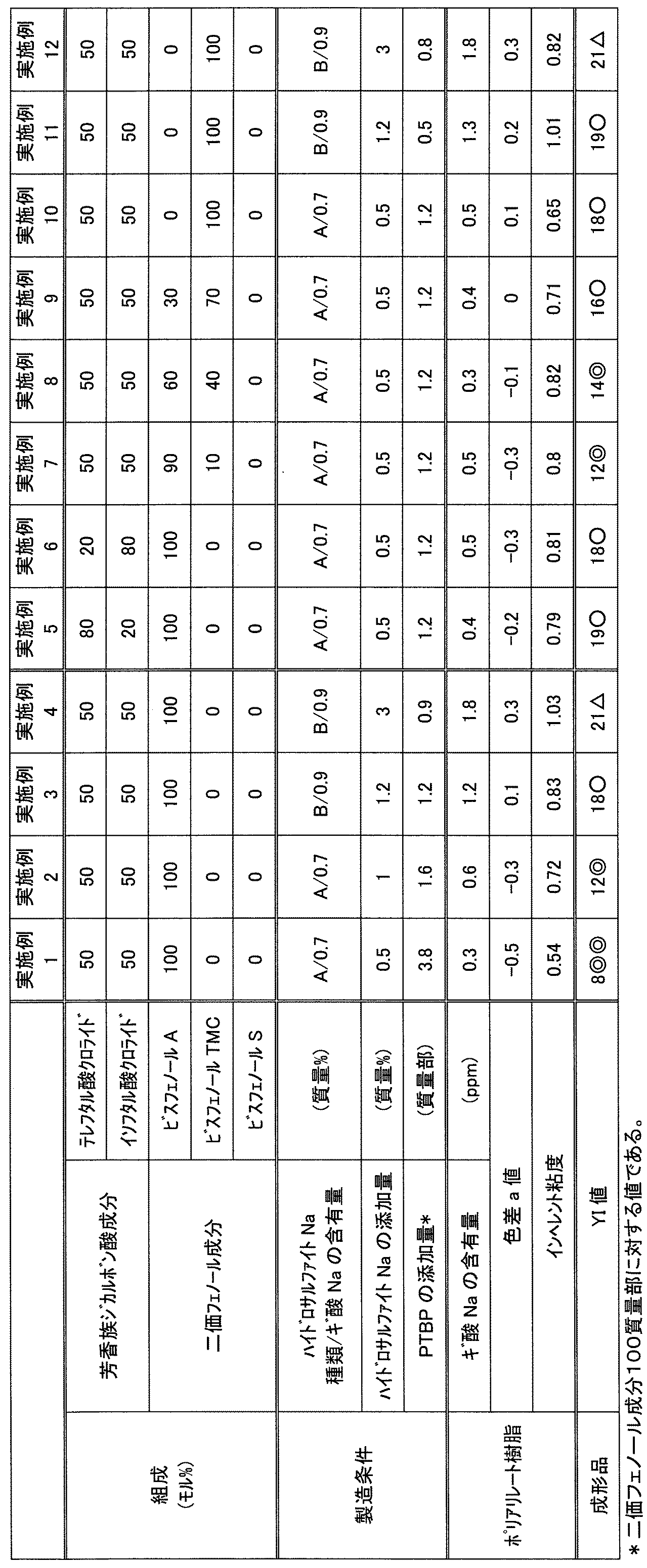
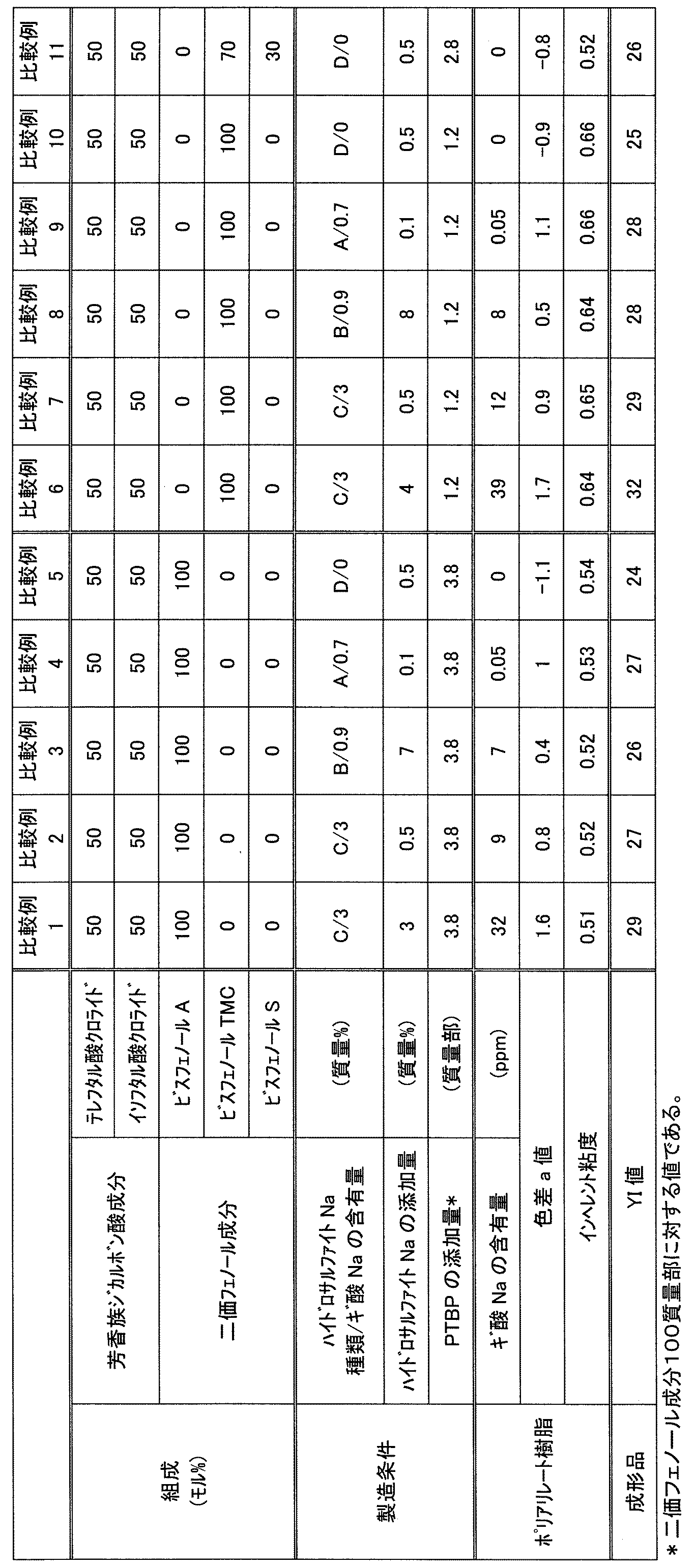
実施例/比較例で得られたポリアリレート樹脂の各々は、モノマーの仕込比率と同様のモノマー組成比を有していた。
上記の実施例および比較例から、以下の事項が明らかとなった:
・ポリアリレート樹脂に含有されるギ酸ナトリウム量を適量とすることで、ポリアリレート樹脂自体の色調が良好となり、加熱溶融による熱劣化に起因する成形加工品の黄変をより十分に低減できる;および
・本発明のポリアリレート樹脂は、特定のギ酸ナトリウム含有量のハイドロサルファイトナトリウムを特定量で用いることにより製造できる。
・ポリアリレート樹脂に含有されるギ酸ナトリウム量を適量とすることで、ポリアリレート樹脂自体の色調が良好となり、加熱溶融による熱劣化に起因する成形加工品の黄変をより十分に低減できる;および
・本発明のポリアリレート樹脂は、特定のギ酸ナトリウム含有量のハイドロサルファイトナトリウムを特定量で用いることにより製造できる。
本発明のポリアリレート樹脂は、成形加工品の黄変防止が要求される種々の用途で有用である。そのような用途として、例えば、自動車に搭載されるランプカバーやカメラレンズ、携帯電話やスマートフォン搭載用のカメラレンズ、電子基板を構成するモジュール、ガラス部材が主流である部品のプラスチック材料への代替使用等が挙げられる。
Claims (8)
- 芳香族ジカルボン酸成分および二価フェノール成分をモノマー成分として含有し、
ギ酸塩の含有量が0.1~2.0ppmである、ポリアリレート樹脂。 - 前記ポリアリレート樹脂が-1.0~0.5の色差a値を有する、請求項1に記載のポリアリレート樹脂。
- 前記ポリアリレート樹脂が粉粒状の形状を有する、請求項1に記載のポリアリレート樹脂。
- 前記ギ酸塩がギ酸ナトリウムである、請求項1に記載のポリアリレート樹脂。
- 前記ポリアリレート樹脂を射出成形により成形した厚み3mmの成形品プレートが22以下のYI値を有する、請求項1記載のポリアリレート樹脂。
- 芳香族ジカルボン酸成分および二価フェノール成分を重合させるポリアリレート樹脂の製造方法であって、
ギ酸塩の含有量0.4~1.5質量%の亜ジチオン酸塩を前記二価フェノール成分に対して0.05~4.0質量%で添加する、ポリアリレート樹脂の製造方法。 - 前記亜ジチオン酸塩がギ酸ソーダ法により製造された亜ジチオン酸ナトリウムである、請求項6に記載のポリアリレート樹脂の製造方法。
- 請求項1~5のいずれかに記載のポリアリレート樹脂を製造する、請求項6に記載のポリアリレート樹脂の製造方法。
Priority Applications (2)
| Application Number | Priority Date | Filing Date | Title |
|---|---|---|---|
| KR1020257036176A KR20260009279A (ko) | 2023-05-18 | 2024-05-10 | 폴리아릴레이트 수지 |
| CN202480028801.0A CN121039200A (zh) | 2023-05-18 | 2024-05-10 | 聚芳酯树脂 |
Applications Claiming Priority (4)
| Application Number | Priority Date | Filing Date | Title |
|---|---|---|---|
| JP2023082273 | 2023-05-18 | ||
| JP2023-082273 | 2023-05-18 | ||
| JP2023-104830 | 2023-06-27 | ||
| JP2023104830A JP7431481B1 (ja) | 2023-05-18 | 2023-06-27 | ポリアリレート樹脂 |
Publications (1)
| Publication Number | Publication Date |
|---|---|
| WO2024237207A1 true WO2024237207A1 (ja) | 2024-11-21 |
Family
ID=89852812
Family Applications (1)
| Application Number | Title | Priority Date | Filing Date |
|---|---|---|---|
| PCT/JP2024/017456 Ceased WO2024237207A1 (ja) | 2023-05-18 | 2024-05-10 | ポリアリレート樹脂 |
Country Status (4)
| Country | Link |
|---|---|
| JP (2) | JP7431481B1 (ja) |
| KR (1) | KR20260009279A (ja) |
| CN (1) | CN121039200A (ja) |
| WO (1) | WO2024237207A1 (ja) |
Citations (6)
| Publication number | Priority date | Publication date | Assignee | Title |
|---|---|---|---|---|
| JPS59206404A (ja) * | 1983-03-29 | 1984-11-22 | アモコ、コ−ポレ−ション | 熱可塑性ポリアリーレート重合体の改良処理方法 |
| US4978739A (en) * | 1989-08-03 | 1990-12-18 | Amoco Corporation | Process for preparing polyarylate from an ester derivative of a dihydric phenol |
| JP2009096937A (ja) * | 2007-10-19 | 2009-05-07 | Mitsubishi Gas Chem Co Inc | ポリカーボネートの製造方法 |
| JP2010083986A (ja) * | 2008-09-30 | 2010-04-15 | Unitika Ltd | ポリアリレートおよびその製造方法 |
| JP2011132380A (ja) * | 2009-12-25 | 2011-07-07 | Unitika Ltd | ポリアリレート樹脂、ポリアリレート樹脂組成物および該ポリアリレート樹脂組成物からなる成形体 |
| JP2017145368A (ja) * | 2016-02-19 | 2017-08-24 | ユニチカ株式会社 | ポリアリレート樹脂およびそれからなるフィルム |
Family Cites Families (4)
| Publication number | Priority date | Publication date | Assignee | Title |
|---|---|---|---|---|
| DE3722130A1 (de) | 1987-07-02 | 1989-01-12 | Schott Glaswerke | Borosilikatglas |
| JPH04120164A (ja) | 1990-09-11 | 1992-04-21 | Mitsubishi Gas Chem Co Inc | 着色ポリカーボネート樹脂組成物 |
| JPH07233253A (ja) | 1994-02-25 | 1995-09-05 | Mitsui Toatsu Chem Inc | 芳香族ポリカーボネートの製造方法 |
| JP2002265766A (ja) | 2001-03-09 | 2002-09-18 | Unitika Ltd | ポリアリレート樹脂組成物 |
-
2023
- 2023-06-27 JP JP2023104830A patent/JP7431481B1/ja active Active
- 2023-12-07 JP JP2023206772A patent/JP2024166046A/ja active Pending
-
2024
- 2024-05-10 CN CN202480028801.0A patent/CN121039200A/zh active Pending
- 2024-05-10 WO PCT/JP2024/017456 patent/WO2024237207A1/ja not_active Ceased
- 2024-05-10 KR KR1020257036176A patent/KR20260009279A/ko active Pending
Patent Citations (6)
| Publication number | Priority date | Publication date | Assignee | Title |
|---|---|---|---|---|
| JPS59206404A (ja) * | 1983-03-29 | 1984-11-22 | アモコ、コ−ポレ−ション | 熱可塑性ポリアリーレート重合体の改良処理方法 |
| US4978739A (en) * | 1989-08-03 | 1990-12-18 | Amoco Corporation | Process for preparing polyarylate from an ester derivative of a dihydric phenol |
| JP2009096937A (ja) * | 2007-10-19 | 2009-05-07 | Mitsubishi Gas Chem Co Inc | ポリカーボネートの製造方法 |
| JP2010083986A (ja) * | 2008-09-30 | 2010-04-15 | Unitika Ltd | ポリアリレートおよびその製造方法 |
| JP2011132380A (ja) * | 2009-12-25 | 2011-07-07 | Unitika Ltd | ポリアリレート樹脂、ポリアリレート樹脂組成物および該ポリアリレート樹脂組成物からなる成形体 |
| JP2017145368A (ja) * | 2016-02-19 | 2017-08-24 | ユニチカ株式会社 | ポリアリレート樹脂およびそれからなるフィルム |
Also Published As
| Publication number | Publication date |
|---|---|
| JP2024166046A (ja) | 2024-11-28 |
| JP2024165999A (ja) | 2024-11-28 |
| CN121039200A (zh) | 2025-11-28 |
| JP7431481B1 (ja) | 2024-02-15 |
| KR20260009279A (ko) | 2026-01-19 |
Similar Documents
| Publication | Publication Date | Title |
|---|---|---|
| JP6163644B2 (ja) | ポリカーボネート樹脂及びその組成物 | |
| CN102027040A (zh) | 用于调节分子量的烷基酚和具有改进性质的共聚碳酸酯 | |
| CN110945075B (zh) | 聚酯树脂组合物及其制造方法 | |
| JP6946950B2 (ja) | ポリエステル樹脂組成物及びその製造方法 | |
| CN101945920B (zh) | 用于调节分子量的烷基酚和具有改进性质的聚碳酸酯组合物 | |
| JP5355330B2 (ja) | 射出成形用ポリアリレート樹脂、およびポリアリレート樹脂組成物 | |
| KR102175848B1 (ko) | 내열성 및 유동성이 우수한 폴리카보네이트 수지 조성물 및 이를 포함하는 성형품 | |
| JP7431481B1 (ja) | ポリアリレート樹脂 | |
| JP2011132380A (ja) | ポリアリレート樹脂、ポリアリレート樹脂組成物および該ポリアリレート樹脂組成物からなる成形体 | |
| JP2025115348A (ja) | ポリアリレート樹脂 | |
| JP2025115349A (ja) | ポリアリレート樹脂とポリアミド樹脂とを含有する樹脂組成物 | |
| KR20250116565A (ko) | 폴리아릴레이트 수지와 폴리카보네이트 수지를 함유하는 수지 조성물 | |
| CN120365539A (zh) | 聚芳酯树脂 | |
| JP2025115351A (ja) | ポリアリレート樹脂とポリカーボネート樹脂とを含有する樹脂組成物 | |
| JP2025115350A (ja) | ポリアリレート樹脂とポリエステル樹脂とを含有する樹脂組成物 | |
| JPH0668066B2 (ja) | 安定化芳香族ポリエステル組成物 | |
| CN104583318B (zh) | 着色剂组合物、芳香族聚碳酸酯树脂组合物、成型品和芳香族聚碳酸酯树脂用增塑剂 | |
| JP2010159366A (ja) | ポリアリレート樹脂組成物およびそれから得られる成形体 | |
| JP3778756B2 (ja) | ハロゲン化カーボネート化合物、その製造方法およびそれを用いた難燃性樹脂組成物 | |
| KR100687984B1 (ko) | 저휘발성 방향족 폴리에스테르 수지조성물 | |
| JP2011068735A (ja) | ポリアリレート樹脂、およびポリアリレート樹脂組成物 | |
| KR102528747B1 (ko) | 향상된 내열성 및 내충격성을 가진 바이오 유래 고분자 수지 조성물 및 그 제조방법 | |
| JP4169433B2 (ja) | ポリカーボネート樹脂粉粒体の製造方法 | |
| JP3385734B2 (ja) | 液晶ポリエステル、その組成物およびその成形品 | |
| JP2024144155A (ja) | ポリアリレート樹脂ならびにそれを含む塗膜および積層体 |
Legal Events
| Date | Code | Title | Description |
|---|---|---|---|
| 121 | Ep: the epo has been informed by wipo that ep was designated in this application |
Ref document number: 24807159 Country of ref document: EP Kind code of ref document: A1 |
|
| NENP | Non-entry into the national phase |
Ref country code: DE |