WO2024232342A1 - 有機リチウム塩の製造方法、当該有機リチウム塩を含む組成物、及び重合体 - Google Patents
有機リチウム塩の製造方法、当該有機リチウム塩を含む組成物、及び重合体 Download PDFInfo
- Publication number
- WO2024232342A1 WO2024232342A1 PCT/JP2024/016899 JP2024016899W WO2024232342A1 WO 2024232342 A1 WO2024232342 A1 WO 2024232342A1 JP 2024016899 W JP2024016899 W JP 2024016899W WO 2024232342 A1 WO2024232342 A1 WO 2024232342A1
- Authority
- WO
- WIPO (PCT)
- Prior art keywords
- formula
- compound
- group
- represented
- monovalent
- Prior art date
- Legal status (The legal status is an assumption and is not a legal conclusion. Google has not performed a legal analysis and makes no representation as to the accuracy of the status listed.)
- Ceased
Links
Images

Classifications
-
- H—ELECTRICITY
- H01—ELECTRIC ELEMENTS
- H01M—PROCESSES OR MEANS, e.g. BATTERIES, FOR THE DIRECT CONVERSION OF CHEMICAL ENERGY INTO ELECTRICAL ENERGY
- H01M10/00—Secondary cells; Manufacture thereof
- H01M10/05—Accumulators with non-aqueous electrolyte
- H01M10/056—Accumulators with non-aqueous electrolyte characterised by the materials used as electrolytes, e.g. mixed inorganic/organic electrolytes
- H01M10/0564—Accumulators with non-aqueous electrolyte characterised by the materials used as electrolytes, e.g. mixed inorganic/organic electrolytes the electrolyte being constituted of organic materials only
- H01M10/0565—Polymeric materials, e.g. gel-type or solid-type
-
- C—CHEMISTRY; METALLURGY
- C07—ORGANIC CHEMISTRY
- C07D—HETEROCYCLIC COMPOUNDS
- C07D207/00—Heterocyclic compounds containing five-membered rings not condensed with other rings, with one nitrogen atom as the only ring hetero atom
- C07D207/02—Heterocyclic compounds containing five-membered rings not condensed with other rings, with one nitrogen atom as the only ring hetero atom with only hydrogen or carbon atoms directly attached to the ring nitrogen atom
- C07D207/44—Heterocyclic compounds containing five-membered rings not condensed with other rings, with one nitrogen atom as the only ring hetero atom with only hydrogen or carbon atoms directly attached to the ring nitrogen atom having three double bonds between ring members or between ring members and non-ring members
- C07D207/444—Heterocyclic compounds containing five-membered rings not condensed with other rings, with one nitrogen atom as the only ring hetero atom with only hydrogen or carbon atoms directly attached to the ring nitrogen atom having three double bonds between ring members or between ring members and non-ring members having two doubly-bound oxygen atoms directly attached in positions 2 and 5
- C07D207/448—Heterocyclic compounds containing five-membered rings not condensed with other rings, with one nitrogen atom as the only ring hetero atom with only hydrogen or carbon atoms directly attached to the ring nitrogen atom having three double bonds between ring members or between ring members and non-ring members having two doubly-bound oxygen atoms directly attached in positions 2 and 5 with only hydrogen atoms or radicals containing only hydrogen and carbon atoms directly attached to other ring carbon atoms, e.g. maleimide
- C07D207/452—Heterocyclic compounds containing five-membered rings not condensed with other rings, with one nitrogen atom as the only ring hetero atom with only hydrogen or carbon atoms directly attached to the ring nitrogen atom having three double bonds between ring members or between ring members and non-ring members having two doubly-bound oxygen atoms directly attached in positions 2 and 5 with only hydrogen atoms or radicals containing only hydrogen and carbon atoms directly attached to other ring carbon atoms, e.g. maleimide with hydrocarbon radicals, substituted by hetero atoms, directly attached to the ring nitrogen atom
-
- C—CHEMISTRY; METALLURGY
- C08—ORGANIC MACROMOLECULAR COMPOUNDS; THEIR PREPARATION OR CHEMICAL WORKING-UP; COMPOSITIONS BASED THEREON
- C08F—MACROMOLECULAR COMPOUNDS OBTAINED BY REACTIONS ONLY INVOLVING CARBON-TO-CARBON UNSATURATED BONDS
- C08F212/00—Copolymers of compounds having one or more unsaturated aliphatic radicals, each having only one carbon-to-carbon double bond, and at least one being terminated by an aromatic carbocyclic ring
- C08F212/02—Monomers containing only one unsaturated aliphatic radical
- C08F212/04—Monomers containing only one unsaturated aliphatic radical containing one ring
- C08F212/06—Hydrocarbons
- C08F212/08—Styrene
-
- C—CHEMISTRY; METALLURGY
- C08—ORGANIC MACROMOLECULAR COMPOUNDS; THEIR PREPARATION OR CHEMICAL WORKING-UP; COMPOSITIONS BASED THEREON
- C08F—MACROMOLECULAR COMPOUNDS OBTAINED BY REACTIONS ONLY INVOLVING CARBON-TO-CARBON UNSATURATED BONDS
- C08F22/00—Homopolymers and copolymers of compounds having one or more unsaturated aliphatic radicals each having only one carbon-to-carbon double bond, and at least one being terminated by a carboxyl radical and containing at least one other carboxyl radical in the molecule; Salts, anhydrides, esters, amides, imides or nitriles thereof
- C08F22/36—Amides or imides
- C08F22/40—Imides, e.g. cyclic imides
-
- C—CHEMISTRY; METALLURGY
- C08—ORGANIC MACROMOLECULAR COMPOUNDS; THEIR PREPARATION OR CHEMICAL WORKING-UP; COMPOSITIONS BASED THEREON
- C08F—MACROMOLECULAR COMPOUNDS OBTAINED BY REACTIONS ONLY INVOLVING CARBON-TO-CARBON UNSATURATED BONDS
- C08F222/00—Copolymers of compounds having one or more unsaturated aliphatic radicals, each having only one carbon-to-carbon double bond, and at least one being terminated by a carboxyl radical and containing at least one other carboxyl radical in the molecule; Salts, anhydrides, esters, amides, imides, or nitriles thereof
- C08F222/36—Amides or imides
- C08F222/40—Imides, e.g. cyclic imides
- C08F222/408—Imides, e.g. cyclic imides substituted imides comprising other heteroatoms
-
- H—ELECTRICITY
- H01—ELECTRIC ELEMENTS
- H01M—PROCESSES OR MEANS, e.g. BATTERIES, FOR THE DIRECT CONVERSION OF CHEMICAL ENERGY INTO ELECTRICAL ENERGY
- H01M10/00—Secondary cells; Manufacture thereof
- H01M10/05—Accumulators with non-aqueous electrolyte
- H01M10/052—Li-accumulators
-
- H—ELECTRICITY
- H01—ELECTRIC ELEMENTS
- H01M—PROCESSES OR MEANS, e.g. BATTERIES, FOR THE DIRECT CONVERSION OF CHEMICAL ENERGY INTO ELECTRICAL ENERGY
- H01M10/00—Secondary cells; Manufacture thereof
- H01M10/05—Accumulators with non-aqueous electrolyte
- H01M10/052—Li-accumulators
- H01M10/0525—Rocking-chair batteries, i.e. batteries with lithium insertion or intercalation in both electrodes; Lithium-ion batteries
-
- H—ELECTRICITY
- H01—ELECTRIC ELEMENTS
- H01M—PROCESSES OR MEANS, e.g. BATTERIES, FOR THE DIRECT CONVERSION OF CHEMICAL ENERGY INTO ELECTRICAL ENERGY
- H01M10/00—Secondary cells; Manufacture thereof
- H01M10/05—Accumulators with non-aqueous electrolyte
- H01M10/056—Accumulators with non-aqueous electrolyte characterised by the materials used as electrolytes, e.g. mixed inorganic/organic electrolytes
- H01M10/0564—Accumulators with non-aqueous electrolyte characterised by the materials used as electrolytes, e.g. mixed inorganic/organic electrolytes the electrolyte being constituted of organic materials only
- H01M10/0566—Liquid materials
- H01M10/0567—Liquid materials characterised by the additives
-
- Y—GENERAL TAGGING OF NEW TECHNOLOGICAL DEVELOPMENTS; GENERAL TAGGING OF CROSS-SECTIONAL TECHNOLOGIES SPANNING OVER SEVERAL SECTIONS OF THE IPC; TECHNICAL SUBJECTS COVERED BY FORMER USPC CROSS-REFERENCE ART COLLECTIONS [XRACs] AND DIGESTS
- Y02—TECHNOLOGIES OR APPLICATIONS FOR MITIGATION OR ADAPTATION AGAINST CLIMATE CHANGE
- Y02E—REDUCTION OF GREENHOUSE GAS [GHG] EMISSIONS, RELATED TO ENERGY GENERATION, TRANSMISSION OR DISTRIBUTION
- Y02E60/00—Enabling technologies; Technologies with a potential or indirect contribution to GHG emissions mitigation
- Y02E60/10—Energy storage using batteries
Definitions
- the present disclosure relates to a method for producing an organic lithium salt, a composition containing the organic lithium salt, and a polymer.
- Organic lithium salts are used in many fields (Patent Document 1).
- organic lithium salts having ethylenically unsaturated groups are used as raw materials (monomers) for producing polymers used as single ion conductors for conducting lithium ions in lithium ion batteries.
- organic lithium salts may contain cations other than lithium ions as impurities.
- lithium ions are directly linked to the function of the battery, such as lithium ion batteries, which charge and discharge by transferring lithium ions between the positive and negative electrodes, it is preferable to increase the concentration of lithium ions among all the cations contained in the electrolyte, etc., as this leads to improved performance.
- the present disclosure has been made in consideration of the above circumstances, and aims to provide a method for producing an organic lithium salt having a low content of cations other than lithium ions.
- the present disclosure also aims to provide a composition containing an organic lithium salt and having an excellent lithium ion transport number.
- a method for producing a compound (A1) represented by the following formula (A1) A production method comprising a step of reacting a compound (D) represented by the following formula (D) with a compound (E1) represented by the following formula (E1) in the presence of at least two kinds of lithium salts.
- R 1 is a hydrogen atom or a monovalent substituent
- R 3 is a hydrogen atom or a monovalent substituent
- Y is a halogen atom or a monovalent organic group having 1 to 20 carbon atoms
- X and R 2 satisfy the following (1) or (2).
- (1) X is a divalent organic group having 1 to 20 carbon atoms and R2 is a monovalent organic group.
- a composition comprising a compound (A) represented by the following formula (A), wherein the proportion of the compound (A) is 50 mol % or more relative to the total substance amount of the compound (A) and a compound (B) represented by the following formula (B) in the composition.
- R 1 is a hydrogen atom or a monovalent substituent
- R 3 is a hydrogen atom or a monovalent substituent
- R 2 and Z 1 satisfy the following (3) or (4).
- R 2 is a hydrogen atom or a monovalent substituent
- Z 1 ⁇ is a monovalent group having a ⁇ 1-valent anionic functional group.
- R2 and Z- together form a divalent group having a -1-valent anionic functional group.
- R 1 to R 3 and Z ⁇ are the same as R 1 to R 3 and Z ⁇ in formula (A), respectively, and M + is a monovalent cation other than H + and Li + .
- M + is a monovalent cation other than H + and Li + .
- Y is a halogen atom or a monovalent organic group having 1 to 20 carbon atoms
- X and R2 satisfy the following (1) or (2).
- X is a divalent organic group having 1 to 20 carbon atoms and R2 is a monovalent organic group.
- R2 and X together form a trivalent group.
- (X and Y in formula (B1) are the same as X and Y in formula (A1), respectively.)
- [8] The composition according to [6] or [7], wherein the compound (A) includes a compound (A2) represented by the following formula (A2), and the compound (B) includes a compound (B2) represented by the following formula (B2).
- a polymer comprising a structural unit (PA) represented by the following formula (PA), wherein a ratio of the structural unit (PA) to a total substance amount of the structural unit (PA) and a structural unit (PB) represented by the following formula (PB) in the polymer is 50 mol % or more.
- PA structural unit represented by the following formula
- R 1 is a hydrogen atom or a monovalent substituent
- R 3 is a hydrogen atom or a monovalent substituent
- R 2 and Z 1 satisfy the following (3) or (4).
- R 2 is a hydrogen atom or a monovalent substituent
- Z 1 ⁇ is a monovalent group having a ⁇ 1-valent anionic functional group.
- R2 and Z- together form a divalent group having a -1-valent anionic functional group.
- R 1 to R 3 and Z ⁇ are the same as R 1 to R 3 and Z ⁇ in formula (PA), respectively, and M + is a monovalent cation other than H + and Li + .
- PA1 structural unit represented by the following formula
- PB1 structural unit represented by the following formula (PB1)
- Y is a halogen atom or a monovalent organic group having 1 to 20 carbon atoms
- X and R2 satisfy the following (1) or (2).
- X is a divalent organic group having 1 to 20 carbon atoms and R2 is a monovalent organic group.
- R2 and X together form a trivalent group.
- X and Y in formula (PB1) are the same as X and Y in formula (PA1), respectively.
- PB1 The polymer according to [10] or [11], wherein the structural unit (PA) includes a structural unit (PA2) represented by the following formula (PA2), and the structural unit (PB) includes a structural unit (PB2) represented by the following formula (PB2):
- (X and Y in formula (PB2) are the same as X and Y in formula (PA2), respectively.)
- An electrolyte composition comprising the polymer according to any one of [10] to [12].
- a battery comprising the electro
- the present disclosure has been made in consideration of the above circumstances, and can provide a method for producing an organic lithium salt having a low content of cations other than lithium ions.
- the present disclosure can also provide a composition containing an organic lithium salt and having an excellent lithium ion transport number.
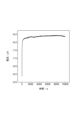
- FIG. 1 is a graph showing the results of measuring the lithium ion transport number for an electrolyte composition containing the copolymer of Example A1.
- FIG. 2 is a graph showing the results of measuring the lithium ion transport number for an electrolyte composition containing the copolymer of Comparative Example A1.
- compositions Containing Organic Lithium Salts The composition of the present embodiment includes a compound (A) represented by the following formula (A), and the ratio of the compound (A) to the total amount of the compound (A) and the compound (B) represented by the following formula (B) in the composition is 50 mol% or more.
- the organic lithium salt included in the composition of the present embodiment is a compound having an ethylenically unsaturated group and an anionic functional group having a lithium ion as a counter cation.
- the ratio of the compound (A) may be 55 mol% or more, 60 mol% or more, 65 mol% or more, 70 mol% or more, or 75 mol% or more.
- R 1 is a hydrogen atom or a monovalent substituent
- R 3 is a hydrogen atom or a monovalent substituent
- R 2 and Z 1 satisfy the following (3) or (4).
- (3) R 2 is a hydrogen atom or a monovalent substituent
- Z 1 ⁇ is a monovalent group having a ⁇ 1-valent anionic functional group.
- R2 and Z- together form a divalent group having a -1-valent anionic functional group.
- R 1 to R 3 and Z ⁇ are the same as R 1 to R 3 and Z ⁇ in formula (A), respectively, and M + is a monovalent cation other than H + and Li + .
- the content of compound (A) is 50 mol% or more with respect to the total amount of compound (A) and compound (B) which is different from compound (A) only in the type of cation.
- the content of compound (B) may be 0 (the composition of this embodiment may not contain compound (B).
- compound (A) is one of the compounds represented by formula (A), and compound (B) may be a compound corresponding to the above compound (A) (a compound in which Li + of compound (A) is replaced with M + ).
- the salt contained in the composition of this embodiment may be composed of compound (A) and compound (B), or may be composed only of compound (A).
- the above composition can be read as a compound.
- the above composition may contain components other than compound (A) and compound (B) (excluding salts) as long as it is not contrary to the purpose of this disclosure.
- the present disclosure can provide lithium salts with high lithium concentrations (lithium salt compositions having a low proportion of compounds in which Li + is replaced by M + ) that have not previously been available.
- one or more may be a hydrogen atom, and one or two may be a hydrogen atom.
- examples of the monovalent substituent include monovalent organic groups and monovalent electron-withdrawing groups (excluding the above monovalent organic groups).
- examples of the monovalent organic group include organic groups having 1 to 20 carbon atoms. The number of carbon atoms contained in the monovalent organic group may be 1 to 10, 1 to 8, or 1 to 5.
- the monovalent organic group is not particularly limited, and may be a hydrocarbon group or a group having a heteroatom, or may have a heterocycle.
- the linking groups are not adjacent to each other.
- the monovalent organic group may have a substituent that replaces a hydrogen atom bonded to a carbon atom.
- the substituent may be a monovalent substituent, for example, a halogen atom.
- the halogen atom may be any of F, Cl, Br, and I, and may be F.
- the hydrocarbon group is not particularly limited, and may be an aliphatic hydrocarbon group or an aromatic hydrocarbon group.
- the aliphatic hydrocarbon group may be any of a linear hydrocarbon group, a branched hydrocarbon group, and a cyclic hydrocarbon group.
- the hydrocarbon group may be any of a saturated hydrocarbon group and an unsaturated hydrocarbon group.
- an aromatic hydrocarbon group is a group that contains an aromatic portion and may also contain an aliphatic portion.
- a cyclic hydrocarbon group is a group that contains a cyclic hydrocarbon portion and may also contain a linear or branched hydrocarbon portion.
- Examples of the monovalent electron-withdrawing group include a halogen atom, a sulfonic acid group or a salt thereof, a sulfonic acid ester, a nitro group, a nitrile group, a carbonyl group, an ester group, and an amide group.
- the halogen atom may be any of F, Cl, Br, and I, or may be F.
- Z 1 - is a monovalent group having a -1-valent anionic functional group.
- the -1-valent anionic functional group include a carboxylate group (-COO - ), a conjugated anion of a sulfonic acid group (-SO 3 - ), a conjugated anion of a sulfonylimide group (-SO 2 -N - -SO 2 - ), and a conjugated anion of a phenolic hydroxyl group (-C 6 H 5 -O - ).
- the conjugated anion of the sulfonylimide group may be contained in an anionic functional group represented by -SO 2 -N - -SO 2 -Y using Y described later.
- Z 1 - may be, for example, a monovalent organic group having 1 to 30 carbon atoms, or may be the anionic functional group itself. The number of carbon atoms in the monovalent organic group may be 1 to 25, 2 to 20, or 3 to 15.
- the compound having a carboxylate group may be an unsaturated lithium carboxylate, an unsaturated lithium monocarboxylate, or lithium (meth)acrylate.
- the compound having a conjugated anion of a phenolic hydroxyl group may be a compound having a vinyl group and a benzene skeleton, a naphthalene skeleton, or an anthracene skeleton, and may be lithium 4-vinylphenolate, lithium 3-vinylphenolate, or lithium 2-vinylphenolate, or may be lithium 4-vinylphenolate.
- examples of the compound (A) include a compound (A') represented by the following formula (A').
- Z'- is a divalent group having a -1-valent anionic functional group.
- Examples of the monovalent anionic functional group possessed by Z'- include the monovalent anionic functional group possessed by Z- described above.
- Z'- may be, for example, a divalent organic group having 1 to 30 carbon atoms.
- the number of carbon atoms possessed by the divalent organic group may be 1 to 25, 2 to 20, or 3 to 15.
- Z'- forms a ring together with the two carbon atoms having an unsaturated bond in formula (A').
- the number of ring members of the ring may be 4 to 10, 4 to 8, or 5 or 6.
- Z'- may have a cyclic imide structure.
- M + is a monovalent cation other than H + and Li + .
- the monovalent cation include metal cations, organic cations, inorganic cations other than metal cations such as NH 4 +, and the like.
- the metal cation include alkali metal ions and the like.
- the alkali metal ion may be any of Na + , K + , Rb + , and Cs + .
- the monovalent metal cation may be a complex cation.
- Examples of the monovalent organic cation include cations containing N, P, S, I, etc. having a positive formal charge, and specifically include quaternary organic ammonium ions, quaternary phosphonium ions, sulfonium ions, iodonium ions, and the like.
- M + may include Na + .
- the composition may contain one or more types of compound (A).
- the content of compound (A) in the composition may be 40% by mass or more, 50% by mass or more, 55% by mass or more, 60% by mass or more, 65% by mass or more, or 70% by mass or more, based on the total amount of the composition.
- the compound (A) may include a compound (A1) represented by the following formula (A1).
- the compound (B) corresponding to the compound (A1) is a compound (B1) represented by the following formula (B1).
- Y is a halogen atom or a monovalent organic group having 1 to 20 carbon atoms
- X and R2 satisfy the following (1) or (2).
- (1) X is a divalent organic group having 1 to 20 carbon atoms and R2 is a monovalent organic group.
- R2 and X together form a trivalent group.
- (X and Y in formula (B1) are the same as X and Y in formula (A1), respectively.)
- the divalent group may have a substituent that replaces a hydrogen atom bonded to a carbon atom.
- the substituent may be a monovalent substituent, and examples of the substituent include a halogen atom.
- the hydrocarbon group is not particularly limited, and may be an aliphatic hydrocarbon group or an aromatic hydrocarbon group.
- the aliphatic hydrocarbon group may be any of a linear hydrocarbon group, a branched hydrocarbon group, and a cyclic hydrocarbon group.
- the hydrocarbon group may be either a saturated hydrocarbon group or an unsaturated hydrocarbon group.
- the number of carbon atoms that X has may be 1 to 15, 2 to 10, or 3 to 8.
- X may be a group having an aromatic ring, or may be a group having an aromatic carbon ring such as a benzene ring.
- a substituent may be bonded to the carbon atom that is a member of the carbon ring, and the substituent may be a monovalent substituent.
- the monovalent substituent may be a substituted or unsubstituted alkyl group, an electron-withdrawing group, or the like.
- the hydrocarbon group represented by X is preferably a phenylene group, an alkylene group having 1 to 8 carbon atoms, a polyoxyalkylene group, or a group in which some or all of the hydrogen atoms bonded to the carbon atoms of these groups are substituted with a halogen atom such as a fluorine atom, or the like, and may be a phenylene group or a substituted phenylene group substituted with an alkyl group, a halogen atom, an electron-withdrawing group, or the like.
- Examples of the electron-withdrawing group include a halogen atom, a sulfonic acid group or a salt thereof, a sulfonic acid ester, a nitro group, a nitrile group, a carbonyl group, an ester group, and an amide group.
- Y is a monovalent organic group
- the monovalent group may have a substituent that replaces a hydrogen atom bonded to a carbon atom.
- the substituent may be a monovalent substituent, and examples thereof include halogen atoms.
- the hydrocarbon group is not particularly limited, and may be an aliphatic hydrocarbon group or an aromatic hydrocarbon group.
- the aliphatic hydrocarbon group may be any of a linear hydrocarbon group, a branched hydrocarbon group, and a cyclic hydrocarbon group.
- the hydrocarbon group may be either a saturated hydrocarbon group or an unsaturated hydrocarbon group.
- the number of carbon atoms that Y has may be 1 to 25, 1 to 20, 1 to 15, 1 to 10, 1 to 8, 1 to 5, or 1 to 3.
- the hydrocarbon group represented by Y may be a substituted or unsubstituted phenyl group, an alkyl group having 1 to 5 carbon atoms, or a group in which some or all of the hydrogen atoms bonded to the carbon atoms of these groups have been replaced with halogen atoms such as fluorine atoms, a fluorinated alkyl group having 1 to 5 carbon atoms, or a fluorinated alkyl group having 1 to 3 carbon atoms such as a trifluoromethyl group.
- the fluorinated alkyl group may be a fully fluorinated alkyl group.
- Y is a halogen atom
- the halogen atom may be a fluorine atom or a chlorine atom, or may be a fluorine atom.
- the compound represented by formula (A1) may be a compound (A1') represented by the following formula (A1').
- the corresponding compound (B1) is a compound (B1') represented by the following formula (B1').
- (X′ in formula (A1′) is a trivalent organic group.)
- (X' in formula (B1') is the same as X' in formula (A1').)
- X' has a ring containing two carbon atoms having an unsaturated bond in formula (A1').
- the number of ring members in the ring may be 4 to 10, 4 to 8, or 5 or 6.
- the ring may have a cyclic imide structure.
- the structure other than the ring contained in X' is not particularly limited, and may be a divalent group or a covalent bond bonded to X' and the S atom of the sulfonylimide group, and the divalent group may be a hydrocarbon group or a group having a heteroatom, or may have a heterocyclic ring.
- the linking groups are not adjacent to each other.
- the trivalent group may have a substituent that replaces a hydrogen atom bonded to a carbon atom.
- the substituent may be a monovalent substituent, for example, a halogen atom, etc.
- the above-mentioned hydrocarbon group is not particularly limited, and may be an aliphatic hydrocarbon group or an aromatic hydrocarbon group.
- the aliphatic hydrocarbon group may be any of a linear hydrocarbon group, a branched hydrocarbon group, and a cyclic hydrocarbon group.
- the hydrocarbon group may be any of a saturated hydrocarbon group and an unsaturated hydrocarbon group.
- the compound (A) may contain a compound (A2) represented by the following formula (A2).
- the compound (B) corresponding to the compound (A2) is a compound (B2) represented by the following formula (B2).
- X is a divalent organic group having 1 to 20 carbon atoms
- Y is a halogen atom or a monovalent organic group having 1 to 20 carbon atoms.
- X and Y in formula (B2) are the same as X and Y in formula (A2), respectively.
- X in formula (A2) can be exemplified as X in formula (A1).
- Y in formula (A2) can be exemplified as Y in formula (A1).
- X may be bonded to one or both of the nitrogen atom of the maleimide group and the sulfur atom of the sulfonyl group through a carbon atom contained in X.
- the composition of this embodiment can be used, for example, to produce a polymer (lithium-containing polymer) by a polymerization reaction of the ethylenically unsaturated group of compound (A). That is, the composition of this embodiment can be used as a monomer composition, and may be a monomer composition for forming a polymer for use as an electrolyte in a lithium-ion battery.
- the polymerization reaction may be a radical addition polymerization reaction, a radical ring-opening polymerization reaction, a cationic polymerization reaction, or an anionic polymerization reaction, or may be a radical addition polymerization.
- Compound (A) may be polymerized alone, or may be polymerized together with other monomers to form a copolymer.
- the other monomers include compounds having an ethylenically unsaturated group other than compound (A) and compound (B).
- Examples of the other monomers include unsaturated fatty acids such as (meth)acrylic acid and maleic acid, unsaturated fatty acid esters such as (meth)acrylic acid esters, vinyl ether compounds such as isobutyl vinyl ether and n-dodecyl vinyl ether, vinyl ester compounds such as vinyl acetate, olefin compounds such as ethylene and propylene, aromatic vinyl compounds such as styrene or styrene derivatives, unsaturated aldehydes, acrylonitrile or derivatives thereof, and acrylamide or derivatives thereof.
- unsaturated fatty acids such as (meth)acrylic acid and maleic acid
- unsaturated fatty acid esters such as (meth)acrylic acid esters
- vinyl ether compounds such as isobutyl vinyl ether and n-dodecyl vinyl ether
- vinyl ester compounds such as vinyl acetate
- olefin compounds such as ethylene and propylene
- aromatic vinyl compounds
- the above polymer can be produced by subjecting a polymerizable composition to a polymerization reaction.
- the polymerizable composition includes a composition containing the compound (A) of this embodiment, and may optionally contain other components such as other monomers and a radical polymerization initiator.
- m may be 0.1 to 0.9, 0.2 to 0.8, 0.3 to 0.7, or 0.4 to 0.6.
- the content of the structural unit (PA) relative to the total amount of monomers contained in the polymerizable composition may be 10 to 90% by mass, or 25 to 70% by mass.
- the radical polymerization initiator may be either a thermal initiator or a photoinitiator.
- thermal initiators include azo initiators such as 2,2-azobis(isobutyronitrile) (AIBN); 2,2-azobis(2-methylbutyronitrile) (AMBN), 2,2-azobis(2,4-dimethylvaleronitrile) (ADVN), 1,1-azobis(1-cyclohexanecarbonitrile) (ACHN, V-40), and dimethyl-2,2-azobisisobutyrate (MAIB); and organic peroxides such as dibenzoyl peroxide, di-8,5,5-trimethylhexanoyl peroxide, dilauroyl peroxide, didecanoyl peroxide, and di(2,4-dichlorobenzoyl) peroxide.
- Photoinitiators include oxime compounds, metallocene compounds, acylphosphine compounds, and aminoacetophenone compounds. One or more initiators may be used.
- the polymerizable composition may contain a chain transfer agent such as carbon tetrachloride. If necessary, the polymerizable composition may contain a crosslinking agent. The polymerizable composition may also contain a solvent.
- the polymer of the present embodiment is a lithium-containing polymer containing an anionic functional group and a lithium ion as a counter cation of the anionic functional group.
- the polymer contains a structural unit (PA) represented by the following formula (PA), and the proportion of the structural unit (PA) is 50 mol% or more with respect to the total substance amount of the structural unit (PA) and the structural unit (PB) represented by the following formula (PB) in the polymer.
- the proportion of the structural unit (PA) may be 55 mol% or more, 60 mol% or more, 65 mol% or more, 70 mol% or more, or 75 mol% or more.
- R 1 is a hydrogen atom or a monovalent substituent
- R 3 is a hydrogen atom or a monovalent substituent
- R 2 and Z 1 satisfy the following (3) or (4).
- (3) R 2 is a hydrogen atom or a monovalent substituent
- Z 1 ⁇ is a monovalent group having a ⁇ 1-valent anionic functional group.
- R 1 to R 3 and Z ⁇ are the same as R 1 to R 3 and Z ⁇ in formula (PA), respectively, and M is a monovalent cation other than Li + .
- M + is a monovalent cation other than H + and Li + .
- the monovalent cation include metal cations, organic cations, inorganic cations other than metal cations such as NH 4 +, and the like.
- the metal cation include alkali metal ions and the like.
- the alkali metal ion may be any of Na + , K + , Rb + , and Cs + .
- the monovalent metal cation may be a complex cation.
- Examples of the monovalent organic cation include cations containing N, P, S, I, etc. having a positive formal charge, and specifically include quaternary organic ammonium ions, quaternary phosphonium ions, sulfonium ions, iodonium ions, and the like.
- M + may include Na + .
- Such a polymer can be produced from a composition containing the above-mentioned compound (A).
- the polymer may contain structural units other than the structural unit (PA) and the structural unit (PB), and examples of such structural units include structural units derived from the above-mentioned other monomers (structural units obtained by radical polymerization of the above-mentioned other monomers).
- R 1 to R 3 and Z - in formula (PA) those exemplified as R 1 to R 3 and Z - in formula (A) can be mentioned, respectively.
- examples of the structural unit (PA) include a structural unit (PA') represented by the following formula (PA').
- PA' structural unit represented by the following formula
- PB structural unit represented by the following formula
- * in a chemical formula representing a structural unit represents the bonding position of the structural unit to another structural unit.
- Z'- is a divalent group having a -1-valent anionic functional group.
- PB' Z'- is the same as Z'- in formula (PA').
- the structural unit (PA) may contain a structural unit (PA1) represented by the following formula (PA1):
- PA1 structural unit represented by the following formula (PA1)
- PB1 structural unit represented by the following formula (PB1)
- Y is a halogen atom or a monovalent organic group having 1 to 20 carbon atoms
- X and R2 satisfy the following (1) or (2).
- (1) X is a divalent organic group having 1 to 20 carbon atoms and R2 is a monovalent organic group.
- R2 and X together form a trivalent group.
- (X and Y in formula (PB1) are the same as X and Y in formula (PA1), respectively.)
- X and Y in formula (PA1) include those exemplified as X and Y in formula (A1).
- the structural unit represented by formula (PA1) may be a structural unit (A1') represented by the following formula (PA1').
- the corresponding structural unit (PB1) is a structural unit (PB1') represented by the following formula (PB1').
- (X' in formula (PA1') is a trivalent organic group.)
- (X' in formula (PB1') is the same as X' in formula (PA1').)
- X' in formula (PA1') can be any of the examples given as X' in formula (A1').
- the structural unit (PA) may contain a structural unit (PA2) represented by the following formula (PA2):
- PA2 structural unit
- PB2 structural unit represented by the following formula (PB2).
- X is a divalent organic group having 1 to 20 carbon atoms
- Y is a halogen atom or a monovalent organic group having 1 to 20 carbon atoms.
- X and Y in formula (PB2) are the same as X and Y in formula (PA2), respectively.
- X and Y in formula (PA2) include those exemplified as X and Y in formula (A2).
- m may be 0.1 to 0.9, 0.2 to 0.8, 0.3 to 0.7, or 0.4 to 0.6.
- the content of the structural unit (PA) relative to the total amount of the polymer may be 10 to 90% by mass, or 25 to 70% by mass.
- the number average molecular weight (Mn) of the polymer may be 5,000 to 400,000, 8,000 to 200,000, 10,000 to 150,000, or 10,000 to 100,000.
- the weight average molecular weight (Mw) of the polymer may be 5,000 to 600,000, 10,000 to 450,000, 20,000 to 200,000, or 20,000 to 100,000.
- the molecular weight distribution (Mw/Mn) of the polymer may be 1.0 to 5.0, 1.2 to 3.0, or 1.3 to 2.5.
- the number average molecular weight and weight average molecular weight of the polymer can be measured, for example, by gel permeation chromatography.
- the gel permeation chromatography is performed under the following conditions.
- a standard sample of polymethyl methacrylate manufactured by Polymer Laboratories, Mn 800 to 2,200,000 is used as the standard substance.
- the polymer of this embodiment can be used, for example, as a lithium ion conductor. Since the polymer of this embodiment has a large ratio of lithium ions to cations other than lithium ions, it can be used as at least one material of the positive electrode, negative electrode, and electrolyte of a lithium ion battery, and may be used as an electrolyte.
- the lithium ion battery of this embodiment includes a positive electrode, a negative electrode, and an electrolyte disposed between the positive electrode and the negative electrode.
- the positive electrode may be a layer including a positive electrode material containing a positive electrode active material formed on a current collector.
- the positive electrode material may include the polymer of this embodiment, a binder resin, a conductive assistant, etc., in addition to the positive electrode active material.
- the negative electrode may be a layer including a negative electrode material containing a negative electrode active material formed on a current collector.
- the negative electrode material may include the polymer of this embodiment, a binder resin, a conductive assistant, etc., in addition to the negative electrode active material.
- the electrolyte in the lithium ion battery may be formed from an electrolyte composition.
- the electrolyte composition may include the polymer of this embodiment.
- the electrolyte composition may further include an ion-conductive inorganic solid electrolyte containing lithium ions, an organic solvent, an ionic liquid, etc.
- the ion-conductive inorganic solid electrolyte is not particularly limited, and may be an oxide (oxide-based solid electrolyte), a sulfide (sulfide-based solid electrolyte), a hydride (hydride-based solid electrolyte), or a halide (halide-based solid electrolyte).
- the electrolyte can be formed by applying or laminating the electrolyte composition on the positive electrode or negative electrode.
- the battery may have a separator.
- the separator may be a porous material, or may be a porous material made of resin. Specific examples include a porous polyolefin membrane and a porous ceramic membrane.
- Production method 1 A method comprising a step of reacting a compound (D) represented by the following formula (D) with a compound (E1) represented by the following formula (E1) in the presence of at least two kinds of lithium salts (also referred to as step 1-2).
- Y in formula (D) and X in formula (E1) are selected according to X and Y contained in the compound desired as compound (A1).
- compound (E1') represented by the following formula (E1') can be used as compound (E1).
- the compound (E1') may be a compound (E2) represented by the following formula (E2): Thereby, the compound (A2) can be obtained.
- the lithium salt is added to the reaction system as a base.
- the base may be only a lithium salt.
- the base does not include sodium salts such as sodium acetate.
- the lithium salt may be Li2CO3 , LiOH, lithium acetate, etc., and Li2CO3 and LiOH may be used in combination.
- the combination of two or more kinds of lithium salts may be one or more salts of lithium ions and strong bases, and one or more salts of lithium ions and weak bases. By using two kinds of lithium salts, it is possible to suppress side reactions and to carry out the desired reaction at a sufficient reaction rate.
- the difference in pKa between the conjugate acids of the anions of the two lithium salts is preferably 2 or more, more preferably 3 or more, and even more preferably 5 or more.
- the difference in pKa between the conjugate acids of the anions of the lithium salts used is checked, and the minimum difference is preferably 2 or more, more preferably 3 or more, and even more preferably 5 or more.
- the reaction temperature in step 1-2 may be, for example, -50°C or higher, -30°C or higher, or -10°C or higher.
- the reaction temperature may be 50°C or lower, 30°C or lower, or 10°C or lower. It may be -50 to 50°C, -30 to 30°C, or -10 to 10°C.
- the reaction time may be, for example, 0.1 to 10 hours, 0.5 to 8 hours, or 1 to 5 hours.
- Step 1-2 may be carried out in a solution.
- the solvent is not particularly limited, but examples of the solvent include aprotic solvents. Examples of aprotic solvents include acetonitrile, DMF, DMSO, and THF.
- the production method 1 may include a step of synthesizing a compound (E1) (also referred to as step 1-1) before step 1-2.
- Step 1-1 is not particularly limited, and may be, for example, a step of introducing a -SO 2 Cl group into a precursor of the compound (E1).
- the introduction of the -SO 2 Cl group can be, for example, a step of reacting the precursor with chlorosulfonic acid.
- the reaction temperature in step 1-1 may be, for example, 20 to 80°C, or 30 to 60°C.
- the reaction time may be, for example, 1 to 24 hours, or 3 to 18 hours.
- Production method 2 A method comprising a step (also referred to as step 2-2) of reacting a compound (C) represented by the following formula (C) in a solvent in the presence of a base containing lithium.
- step 2-2 of production method 2 it is preferable that the counter cation of the base is only a lithium ion.
- the base in the step 2-2 is only a lithium salt.
- the base does not include a sodium salt such as sodium acetate.
- X and Y in formula (C) can be appropriately selected to match X and Y in the compound desired as compound (A2).
- examples of the lithium-containing base include lithium salts, more specifically lithium carboxylate, lithium acetate, lithium carbonate, and lithium hydrogen carbonate.
- the reaction temperature in step 2-2 may be 30 to 100°C, or 50 to 90°C.
- the reaction time may be 0.1 to 20 hours, or 0.5 to 10 hours, or 1 to 5 hours.
- Step 2-2 may be carried out in a solution.
- the solvent may be an aprotic solvent such as 1,4-dioxane.
- the solvent can be an acid anhydride, such as acetic anhydride.
- step 2-2 a step of synthesizing compound (C) (also called step 2-1) may be included.
- Patent Document 1 describes a method for synthesizing the following compound (X):
- the synthesis method of Patent Document 1 consists of three steps (see also Comparative Example A1 in this specification; Step 3 in the synthesis method of Patent Document 1 corresponds to Step 4 in Comparative Example A1 in this specification).
- step 3 of the synthesis method of Patent Document 1 the following compound (X1) is reacted in acetic anhydride in the presence of sodium acetate to form a cyclic imide bond to obtain compound (X).
- the inventors have conducted intensive research and found that the product produced by the method of Patent Document 1 contains a large amount of sodium salt of compound (X).
- the sodium ion is thought to be derived from the sodium salt (sodium acetate) in the fourth step. Therefore, when lithium salt was used instead of sodium salt, it was found that the synthesis of compound (X) could be smoothly carried out and the purity of the lithium salt could be increased (production methods 2 and 3).
- the method of Patent Document 1 consists of four steps, and since the product is an ionic compound from the first step, purification, handling, etc. are not easy. Therefore, in consideration of shortening the synthesis route and introducing an ionic functional group, we were able to arrive at production method 1.
- a lithium salt with high purity i.e., the composition of this embodiment
- an alkali metal other than lithium is introduced once in the process of synthesizing the lithium salt, it is necessary to perform cation exchange using a dialysis membrane or the like in order to increase the lithium concentration in the lithium salt (or a composition containing the desired lithium salt and a salt substituted with another alkali metal).
- this is not preferred because the cation exchange increases the number of steps, making the process more complicated and increasing the manufacturing cost of the lithium salt.
- Example A1 The above compound (X) (monomer of Example A1) and copolymer were synthesized by the following method.
- ⁇ Fourth step synthesis of compound (X)> Under a nitrogen atmosphere, a solid containing intermediate 3 (14.0 mmol, 5.70 g) and an aqueous lithium acetate solution (14.0 mmol, 0.92 g) were added to acetic anhydride (12.3 mL, manufactured by Tokyo Chemical Industry Co., Ltd.) and stirred at 70 ° C. for 3 hours. The entire solution after the reaction was dropped into an excess amount of diethyl ether (manufactured by Kanto Chemical Co., Ltd.) at 0 ° C., and the precipitate was collected by filtration. Under an inert atmosphere, the precipitate was extracted with dehydrated acetonitrile (manufactured by Kanto Chemical Co., Ltd.) and dried under reduced pressure to obtain a monomer of Example A1. The yield through all steps was 72.8%.
- the resulting copolymer had a number average molecular weight Mn of 9.4 ⁇ 10 4 , a weight average molecular weight Mw of 4.2 ⁇ 10 5 , and a molecular weight distribution Mw/Mn of 4.45.
- the number average molecular weight and the weight average molecular weight were measured by gel permeation chromatography.
- the lithium ion transport number of the above electrolyte composition was measured using the following method. Three samples were prepared for measurement, and the lithium ion transport number was measured for each. The results are shown in Table 1.
- Lithium ion transport number In a glove box under a dry argon atmosphere, an evaluation cell of a coin-type lithium battery CR2032 was assembled. Specifically, each layer was laminated in the evaluation cell in the following order to prepare a test laminate: (lithium/electrolyte composition/lithium)
- FIG. 1 shows the results of measuring the lithium ion transport number for one sample of the electrolyte composition containing the copolymer of Example A1.
- Comparative Example A1 The reaction and production were carried out in the same manner as in Example A1, except that a sodium acetate aqueous solution (13.3 mmol, 1.09 g, manufactured by Tokyo Chemical Industry Co., Ltd.) was used instead of the lithium acetate aqueous solution in the fourth step of Example A1, to obtain a monomer of Comparative Example A1.
- the synthesis method of the monomer of Comparative Example 1A corresponds to the synthesis method of Patent Document 1.
- the copolymer of Comparative Example A1 was produced using the monomer of Comparative Example A1 in the same manner as in Example A1, and the lithium ion transport number was measured.
- Example A1 and Comparative Example A1 were analyzed using an ICP (inductively coupled plasma) emission spectrometer. From the measurement results, the amounts of sodium and lithium were calculated assuming that half the amount of sulfur contained in the product is 1 (i.e., the molar ratios of lithium and sodium to sulfonylimide groups were calculated). The same analysis was also performed on Intermediate 2 and the copolymers of Example A1 and Comparative Example A1, and the respective sodium and lithium contents were calculated. The results are shown in Table 1.
- the synthesis method of intermediate 1 was the same in Example A1 and Comparative Example A1, and therefore the results were the same.
- the purity of the lithium salt was maintained in the final product, the monomer of Example A1.
- the copolymer obtained using the monomer maintained a sufficient lithium content.
- Comparative Example A1 in which sodium acetate was used in the fourth step, most of the monomer was converted to sodium salt.
- the electrolyte composition using the copolymer produced using the monomer of Example A1 had a high lithium ion transport number, and the values were stable over three measurements.
- the electrolyte composition using the copolymer prepared using the monomer of Comparative Example A1 had a lower lithium ion transport number than that of Example A1, and the measured value was not stable.
- the measurement result of the lithium ion transport number for one sample of the electrolyte composition containing the copolymer of Comparative Example A1 is shown in FIG. 2.
- Example B1 The monomer of Example B1 was prepared by the following method.
- Examples B2 to B4 Comparative Examples B1 to B4
- the synthesis was carried out in the same manner as in Example B1 to obtain a product, except that the amount of lithium salt used and the reaction conditions (reaction temperature and reaction time) were changed as shown in Table 2.
- the product was analyzed by 1 H-NMR. The results are shown in Table 2.
- Comparative Example B1 in which only lithium carbonate was used as the lithium salt, the reaction did not proceed, and the target product (compound (X)) could not be confirmed by 1 H-NMR.
- Comparative Example 2B in which only lithium hydroxide was used as the lithium salt and the reaction was carried out under reflux, the reaction proceeded, but a complicated mixture containing many by-products was obtained. Many peaks were observed in the 1 H-NMR spectrum, making it difficult to identify the by-products, and the production of compound (X) could not be confirmed because many peaks were overlapped.
- Comparative Examples B3 and B4 in which the reaction temperature was lower than that of Comparative Example 2B, the production of compound (X) was confirmed, but the amount of by-products was so large that the content could not be specified.
- Example B3 the reaction proceeded smoothly, and about 10 to 25 mol % of unreacted materials and by-reactants (the maleimide group of intermediate B1 was opened) were contained relative to 100 mol % of compound (X).
- Example B4 no unreacted materials or by-reactants were observed, and only compound (X) was obtained.
- the detailed reaction mechanism has not been elucidated, it is speculated that a complex salt is formed by using a strong basic salt and a weak basic salt in combination.
- the basicity of the complex salt changed by changing the amount of LiOH, which is a strong base, and the optimal basicity for the reaction was achieved under the conditions of Example B4.
Landscapes
- Chemical & Material Sciences (AREA)
- Organic Chemistry (AREA)
- Chemical Kinetics & Catalysis (AREA)
- Engineering & Computer Science (AREA)
- Manufacturing & Machinery (AREA)
- General Chemical & Material Sciences (AREA)
- Electrochemistry (AREA)
- Medicinal Chemistry (AREA)
- Health & Medical Sciences (AREA)
- Polymers & Plastics (AREA)
- Inorganic Chemistry (AREA)
- General Physics & Mathematics (AREA)
- Physics & Mathematics (AREA)
- Condensed Matter Physics & Semiconductors (AREA)
- Dispersion Chemistry (AREA)
- Materials Engineering (AREA)
- Secondary Cells (AREA)
Priority Applications (4)
| Application Number | Priority Date | Filing Date | Title |
|---|---|---|---|
| JP2025519429A JPWO2024232342A1 (https=) | 2023-05-08 | 2024-05-02 | |
| EP24803454.8A EP4707309A1 (en) | 2023-05-08 | 2024-05-02 | Method for producing organic lithium salt, composition containing said organic lithium salt, and polymer |
| CN202480030263.9A CN121263454A (zh) | 2023-05-08 | 2024-05-02 | 有机锂盐的制造方法、包含该有机锂盐的组合物及聚合物 |
| KR1020257039829A KR20260007228A (ko) | 2023-05-08 | 2024-05-02 | 유기 리튬염의 제조 방법, 당해 유기 리튬염을 포함하는 조성물 및 중합체 |
Applications Claiming Priority (2)
| Application Number | Priority Date | Filing Date | Title |
|---|---|---|---|
| JP2023076654 | 2023-05-08 | ||
| JP2023-076654 | 2023-05-08 |
Publications (1)
| Publication Number | Publication Date |
|---|---|
| WO2024232342A1 true WO2024232342A1 (ja) | 2024-11-14 |
Family
ID=93430151
Family Applications (1)
| Application Number | Title | Priority Date | Filing Date |
|---|---|---|---|
| PCT/JP2024/016899 Ceased WO2024232342A1 (ja) | 2023-05-08 | 2024-05-02 | 有機リチウム塩の製造方法、当該有機リチウム塩を含む組成物、及び重合体 |
Country Status (5)
| Country | Link |
|---|---|
| EP (1) | EP4707309A1 (https=) |
| JP (1) | JPWO2024232342A1 (https=) |
| KR (1) | KR20260007228A (https=) |
| CN (1) | CN121263454A (https=) |
| WO (1) | WO2024232342A1 (https=) |
Cited By (1)
| Publication number | Priority date | Publication date | Assignee | Title |
|---|---|---|---|---|
| WO2026014389A1 (ja) * | 2024-07-12 | 2026-01-15 | 住友化学株式会社 | 重合体、電解質組成物、及び電池 |
Citations (5)
| Publication number | Priority date | Publication date | Assignee | Title |
|---|---|---|---|---|
| JP2014529863A (ja) * | 2011-09-05 | 2014-11-13 | ユニヴェルシテ デクス−マルセイユ | 電池電解液としてTFSI−Liアニオンモノマーに基づくポリアニオンを含むブロックコポリマー |
| WO2015029248A1 (ja) * | 2013-09-02 | 2015-03-05 | 株式会社日立製作所 | 負極活物質被覆材並びにこれを用いた負極材料、負極、リチウムイオン二次電池及び電池システム並びにモノマー及びその合成方法 |
| WO2018176134A1 (en) | 2017-03-27 | 2018-10-04 | HYDRO-QUéBEC | Salts for use in electrolyte compositions or as electrode additives |
| JP2021088695A (ja) * | 2019-12-03 | 2021-06-10 | ベレノス・クリーン・パワー・ホールディング・アーゲー | 電気化学的デバイス用の単一導電性高分子 |
| JP2023077153A (ja) * | 2021-11-24 | 2023-06-05 | 住友化学株式会社 | 電解質組成物、電解質組成物の製造方法、及び電池 |
-
2024
- 2024-05-02 WO PCT/JP2024/016899 patent/WO2024232342A1/ja not_active Ceased
- 2024-05-02 KR KR1020257039829A patent/KR20260007228A/ko active Pending
- 2024-05-02 JP JP2025519429A patent/JPWO2024232342A1/ja active Pending
- 2024-05-02 EP EP24803454.8A patent/EP4707309A1/en active Pending
- 2024-05-02 CN CN202480030263.9A patent/CN121263454A/zh active Pending
Patent Citations (5)
| Publication number | Priority date | Publication date | Assignee | Title |
|---|---|---|---|---|
| JP2014529863A (ja) * | 2011-09-05 | 2014-11-13 | ユニヴェルシテ デクス−マルセイユ | 電池電解液としてTFSI−Liアニオンモノマーに基づくポリアニオンを含むブロックコポリマー |
| WO2015029248A1 (ja) * | 2013-09-02 | 2015-03-05 | 株式会社日立製作所 | 負極活物質被覆材並びにこれを用いた負極材料、負極、リチウムイオン二次電池及び電池システム並びにモノマー及びその合成方法 |
| WO2018176134A1 (en) | 2017-03-27 | 2018-10-04 | HYDRO-QUéBEC | Salts for use in electrolyte compositions or as electrode additives |
| JP2021088695A (ja) * | 2019-12-03 | 2021-06-10 | ベレノス・クリーン・パワー・ホールディング・アーゲー | 電気化学的デバイス用の単一導電性高分子 |
| JP2023077153A (ja) * | 2021-11-24 | 2023-06-05 | 住友化学株式会社 | 電解質組成物、電解質組成物の製造方法、及び電池 |
Cited By (1)
| Publication number | Priority date | Publication date | Assignee | Title |
|---|---|---|---|---|
| WO2026014389A1 (ja) * | 2024-07-12 | 2026-01-15 | 住友化学株式会社 | 重合体、電解質組成物、及び電池 |
Also Published As
| Publication number | Publication date |
|---|---|
| JPWO2024232342A1 (https=) | 2024-11-14 |
| EP4707309A1 (en) | 2026-03-11 |
| KR20260007228A (ko) | 2026-01-13 |
| CN121263454A (zh) | 2026-01-02 |
Similar Documents
| Publication | Publication Date | Title |
|---|---|---|
| Hu et al. | Poly (ethylene oxide)-based composite polymer electrolytes embedding with ionic bond modified nanoparticles for all-solid-state lithium-ion battery | |
| CN105693566B (zh) | 用于制备用于电化学器件的新型单离子导电聚合物家族的新型交联剂以及所述聚合物 | |
| JP5954798B2 (ja) | 高純度パラスチレンスルホン酸(塩)、それを用いたポリスチレンスルホン酸(塩)、およびポリスチレンスルホン酸(塩)を用いた、分散剤、導電性ポリマードーパント、ナノカーボン材料水性分散体、導電性ポリマー水性分散体、ならびにポリスチレンスルホン酸(塩)の製造方法 | |
| CN1961006B (zh) | 交联聚(甲基)丙烯酸化合物的制造方法 | |
| JP2000508677A (ja) | マロン酸ニトリル誘導体アニオン塩、及びイオン伝導性材料としてのそれらの使用 | |
| CN110172115A (zh) | 一种聚合物电解质的制备方法及其应用 | |
| JPH06503842A (ja) | ビス(ペルフルオロスルホニル)メタン誘導体、それらの製造方法及びそれらの利用 | |
| Pirnat et al. | Synthesis of redox polymer nanoparticles based on poly (vinyl catechols) and their electroactivity | |
| WO2008007709A1 (en) | Star polymer and method for producing the same | |
| WO2024232342A1 (ja) | 有機リチウム塩の製造方法、当該有機リチウム塩を含む組成物、及び重合体 | |
| US20220045361A1 (en) | Solid electrolyte for organic batteries | |
| CA3260303A1 (en) | SINGLE ION CONDUCTING POLYMERS AND THEIR MANUFACTURING PROCESSES | |
| JP4389454B2 (ja) | 高分子固体電解質 | |
| JP7716965B2 (ja) | 電解質組成物、及び電池 | |
| CN116259752B (zh) | 一种水溶性聚离子液体粘结剂 | |
| US9221844B2 (en) | Metal bis(malonato) borate monomers, polymers and copolymers derived therefrom, methods of making the monomers and polymers, and articles derived therefrom | |
| JP7373008B2 (ja) | アルカリ金属含有重合体、並びにそれを含む電解質組成物及び電池 | |
| JPWO2019188430A1 (ja) | 電極用バインダー、電極合剤、エネルギーデバイス用電極、エネルギーデバイス、エネルギーデバイス用樹脂、炭素材料分散液及び炭素材料分散液の製造方法 | |
| JP2020117647A (ja) | 共重合体、及び共重合体の製造方法 | |
| JP4139735B2 (ja) | 新規なデンドリマーおよびそれらを有するイオン伝導性ポリマー電解質 | |
| JP4788121B2 (ja) | 重合性イミダゾール塩 | |
| JP2003327687A (ja) | 新規なデンドリマーおよびそれらを有するイオン伝導性ポリマー電解質 | |
| KR20240108424A (ko) | 중합체 및 그 제조 방법, 전해질 조성물, 그리고 전지 | |
| JP2008088330A (ja) | (メタ)アクリル酸系架橋重合体およびそれを用いた二次電池の電極 | |
| US20230303777A1 (en) | Improved synthesis for producing ordered polyblock copolymers having a controllable molecular weight distribution |
Legal Events
| Date | Code | Title | Description |
|---|---|---|---|
| 121 | Ep: the epo has been informed by wipo that ep was designated in this application |
Ref document number: 24803454 Country of ref document: EP Kind code of ref document: A1 |
|
| ENP | Entry into the national phase |
Ref document number: 2025519429 Country of ref document: JP Kind code of ref document: A |
|
| WWE | Wipo information: entry into national phase |
Ref document number: 2025519429 Country of ref document: JP |
|
| ENP | Entry into the national phase |
Ref document number: 1020257039829 Country of ref document: KR Free format text: ST27 STATUS EVENT CODE: A-0-1-A10-A15-NAP-PA0105 (AS PROVIDED BY THE NATIONAL OFFICE) |
|
| WWE | Wipo information: entry into national phase |
Ref document number: 2024803454 Country of ref document: EP |
|
| NENP | Non-entry into the national phase |
Ref country code: DE |
|
| ENP | Entry into the national phase |
Ref document number: 2024803454 Country of ref document: EP Effective date: 20251127 |
|
| ENP | Entry into the national phase |
Ref document number: 2024803454 Country of ref document: EP Effective date: 20251127 |
|
| ENP | Entry into the national phase |
Ref document number: 2024803454 Country of ref document: EP Effective date: 20251127 |
|
| ENP | Entry into the national phase |
Ref document number: 2024803454 Country of ref document: EP Effective date: 20251127 |
|
| ENP | Entry into the national phase |
Ref document number: 2024803454 Country of ref document: EP Effective date: 20251127 |
|
| ENP | Entry into the national phase |
Ref document number: 2024803454 Country of ref document: EP Effective date: 20251127 |
|
| ENP | Entry into the national phase |
Ref document number: 2024803454 Country of ref document: EP Effective date: 20251127 |
|
| ENP | Entry into the national phase |
Ref document number: 2024803454 Country of ref document: EP Effective date: 20251127 |
|
| WWP | Wipo information: published in national office |
Ref document number: 2024803454 Country of ref document: EP |