WO2024228233A1 - 活性ガス生成装置 - Google Patents
活性ガス生成装置 Download PDFInfo
- Publication number
- WO2024228233A1 WO2024228233A1 PCT/JP2023/017030 JP2023017030W WO2024228233A1 WO 2024228233 A1 WO2024228233 A1 WO 2024228233A1 JP 2023017030 W JP2023017030 W JP 2023017030W WO 2024228233 A1 WO2024228233 A1 WO 2024228233A1
- Authority
- WO
- WIPO (PCT)
- Prior art keywords
- electrode
- dielectric film
- space
- active gas
- region
- Prior art date
- Legal status (The legal status is an assumption and is not a legal conclusion. Google has not performed a legal analysis and makes no representation as to the accuracy of the status listed.)
- Ceased
Links
Images
















Classifications
-
- H—ELECTRICITY
- H05—ELECTRIC TECHNIQUES NOT OTHERWISE PROVIDED FOR
- H05H—PLASMA TECHNIQUE; PRODUCTION OF ACCELERATED ELECTRICALLY-CHARGED PARTICLES OR OF NEUTRONS; PRODUCTION OR ACCELERATION OF NEUTRAL MOLECULAR OR ATOMIC BEAMS
- H05H1/00—Generating plasma; Handling plasma
- H05H1/24—Generating plasma
- H05H1/2406—Generating plasma using dielectric barrier discharges, i.e. with a dielectric interposed between the electrodes
-
- H—ELECTRICITY
- H01—ELECTRIC ELEMENTS
- H01J—ELECTRIC DISCHARGE TUBES OR DISCHARGE LAMPS
- H01J37/00—Discharge tubes with provision for introducing objects or material to be exposed to the discharge, e.g. for the purpose of examination or processing thereof
- H01J37/32—Gas-filled discharge tubes
- H01J37/32009—Arrangements for generation of plasma specially adapted for examination or treatment of objects, e.g. plasma sources
- H01J37/32348—Dielectric barrier discharge
-
- H—ELECTRICITY
- H01—ELECTRIC ELEMENTS
- H01J—ELECTRIC DISCHARGE TUBES OR DISCHARGE LAMPS
- H01J37/00—Discharge tubes with provision for introducing objects or material to be exposed to the discharge, e.g. for the purpose of examination or processing thereof
- H01J37/32—Gas-filled discharge tubes
- H01J37/32431—Constructional details of the reactor
- H01J37/3244—Gas supply means
-
- H—ELECTRICITY
- H01—ELECTRIC ELEMENTS
- H01J—ELECTRIC DISCHARGE TUBES OR DISCHARGE LAMPS
- H01J37/00—Discharge tubes with provision for introducing objects or material to be exposed to the discharge, e.g. for the purpose of examination or processing thereof
- H01J37/32—Gas-filled discharge tubes
- H01J37/32431—Constructional details of the reactor
- H01J37/32532—Electrodes
- H01J37/32568—Relative arrangement or disposition of electrodes; moving means
-
- H—ELECTRICITY
- H05—ELECTRIC TECHNIQUES NOT OTHERWISE PROVIDED FOR
- H05H—PLASMA TECHNIQUE; PRODUCTION OF ACCELERATED ELECTRICALLY-CHARGED PARTICLES OR OF NEUTRONS; PRODUCTION OR ACCELERATION OF NEUTRAL MOLECULAR OR ATOMIC BEAMS
- H05H1/00—Generating plasma; Handling plasma
- H05H1/24—Generating plasma
Definitions
- This disclosure relates to an active gas generator that has a parallel plate electrode structure and uses dielectric barrier discharge to generate active gas.
- Conventional activated gas generators use a parallel plate dielectric barrier discharge method, which generates a dielectric barrier discharge in a discharge space and activates the raw material gas introduced into this discharge space to generate activated gas.
- An example of an active gas generator that uses parallel plate dielectric barrier discharge is the active gas generator disclosed in Patent Document 1.
- Activated gases generally have a short lifespan (the period during which they remain highly reactive) and must be supplied to the space in which they are used in a short period of time.
- active gases are deactivated by collision with other substances, it is not desirable to supply them to the space in which they are used via winding pipes, etc.
- the first improved structure described above employs a method of providing multiple gas outlets for one dielectric film.
- the active gas ejected from each of the multiple gas outlets basically only has one directionality, there is a problem in that the active gas cannot be uniformly supplied to the processing space inside which the object to be processed is placed.
- the second improved structure described above like the first improved structure, has the problem that the active gas ejected from each of the multiple gas ejection ports basically has only one directionality, making it impossible to supply a uniform amount of active gas to the processing space.
- the purpose of this disclosure is to provide an active gas generating device that can solve the above problems and supply a uniform amount of active gas to the processing space.
- the active gas generating device disclosed herein is an active gas generating device that generates an active gas by activating a raw material gas supplied to a discharge space, and includes an electrode unit and a conductive housing that houses the electrode unit in a space within the housing, the housing having a housing bottom including a flat surface and a conductor accommodating space recessed in a depth direction from the flat surface, the electrode unit includes a first electrode configuration, a second electrode configuration provided below the first electrode configuration, and a reference potential conductor that is provided below the second electrode configuration and accommodated in the conductor accommodating space, the first electrode configuration includes a first electrode dielectric film and a first electrode conductor formed on an upper surface of the first electrode dielectric film.
- the second electrode configuration portion includes a second electrode dielectric film and a second electrode conductive film formed on a lower surface of the second electrode dielectric film
- the reference potential conductor has an active gas buffer space at an upper portion
- the second electrode configuration portion is disposed to close the active gas buffer space
- the second electrode dielectric film has a dielectric through hole penetrating the second electrode dielectric film in a region overlapping with the active gas buffer space in a plan view
- the second electrode conductive film has a conductive film opening in a region overlapping with the active gas buffer space in a plan view
- the conductive film opening overlaps with the dielectric through hole in a plan view
- a space where the first and second electrode conductive films face each other is defined as a main dielectric space
- the discharge space includes a main discharge space which is a region in the main dielectric space where the first and second electrode conductive films overlap in a plan view
- an AC voltage is applied to the first electrode conductive film
- the second electrode conductive film is set to a reference potential
- the device has an auxiliary discharge space including a portion of the discharge space, and the active gas output from the gas outlets is defined as a plurality of partially active gases, the bottom of the device has an opening in an area that overlaps with the active gas buffer space in a plan view, the partially active gases are guided downward through the opening, the opening includes a tapered region whose opening area becomes wider as it goes downward, the gas outlets are arranged in such a manner that they approach each other as they go downward so that the partially active gases collide in a collision region, and the collision region is located within the tapered region or above the tapered region.
- the multiple gas outlets in the active gas generating device disclosed herein have the above-mentioned characteristics. Therefore, as multiple partially activated gases collide in the collision region, the flow direction of each of the multiple partially activated gases is dispersed from one direction to multiple diffusion directions.
- the multiple partially activated gases that have each diffused flow downward in a direction that follows the tapered shape of the tapered region.
- the active gas containing multiple partially activated gases flows from the tapered region toward the processing space below while diffusing in a direction along the tapered shape.
- the active gas generating device disclosed herein can supply a uniform active gas to the processing space.
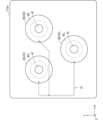
- FIG. 1 is a plan view that illustrates a schematic planar structure of an active gas generation device according to a first embodiment of the present disclosure.
- FIG. 2 is a cross-sectional view showing a cross-sectional structure taken along line AA of FIG. 1.
- FIG. 1 is a first explanatory diagram illustrating a planar structure of an electrode unit.
- FIG. 4 is an explanatory diagram showing a cross-sectional structure taken along line BB of FIG. 3.
- FIG. 2 is a second explanatory diagram illustrating a schematic planar structure of the electrode unit.
- 6 is an explanatory diagram showing a cross-sectional structure taken along the line CC of FIG. 5.
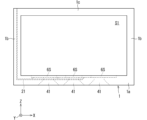
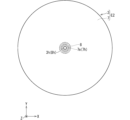
- FIG. 2 is an explanatory diagram illustrating a planar structure of a housing.
- FIG. 1 is a plan view that illustrates a schematic planar structure of an active gas generation device according to a first embodiment of the present disclosure.
- FIG. 2 is a cross-sectional view showing a cross-sectional structure taken along line
- FIG. 2 is an explanatory diagram illustrating a cross-sectional structure of a housing.
- FIG. 2 is an explanatory diagram illustrating a planar structure of a high-voltage side dielectric film.
- FIG. 4 is an explanatory diagram illustrating a cross-sectional structure of a high-voltage side dielectric film.
- 4 is an explanatory diagram illustrating a planar structure of a ground-side dielectric film;
- FIG. 4 is an explanatory diagram illustrating a cross-sectional structure of a ground-side dielectric film.
- FIG. FIG. 2 is an explanatory diagram illustrating a planar structure of a power supply body.
- FIG. 2 is an explanatory diagram illustrating a cross-sectional structure of a power supply body.
- FIG. 2 is an explanatory diagram illustrating a planar structure of a ground conductor.
- FIG. 4 is an explanatory diagram illustrating a cross-sectional structure of a ground conductor.
- FIG. 17 is an explanatory diagram showing details of a region of interest in FIG. 16 .
- FIG. 2 is an explanatory diagram illustrating a planar structure of a cover dielectric film.
- FIG. 2 is an explanatory view illustrating a cross-sectional structure of a cover dielectric film.
- FIG. 4 is an explanatory diagram illustrating a planar structure of a ground-side electrode configuration portion.
- FIG. 4 is an explanatory diagram illustrating a cross-sectional structure of a ground-side electrode configuration portion.
- FIG. 4 is an explanatory diagram illustrating a cross-sectional structure of a ground-side electrode configuration portion.
- FIG. 2 is an explanatory diagram illustrating a planar structure of a shielding dielectric film.
- FIG. 2 is an explanatory diagram illustrating a cross-sectional structure of a shielding dielectric film.
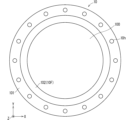
- 3 is an explanatory diagram illustrating a planar structure of a dielectric film support member;
- FIG. 3 is an explanatory diagram illustrating a schematic cross-sectional structure of a dielectric film support member.
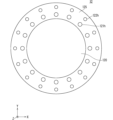
- FIG. 3 is an explanatory diagram illustrating a planar structure of a dielectric film suppressing member;
- FIG. 3 is an explanatory diagram illustrating a schematic cross-sectional structure of a dielectric film suppressing member.
- FIG. FIG. 28 is an explanatory diagram showing details of a region of interest in FIG. 27 .
- FIG. 4 is an explanatory diagram illustrating a planar structure of a pressing member.
- FIG. 4 is an explanatory diagram illustrating a cross-sectional structure of a pressing member.
- 3 is an explanatory diagram illustrating a typical ejection form of active gas from an electrode unit in the active gas generation device of the first embodiment.
- FIG. 4 is an explanatory diagram illustrating an ideal form of active gas ejection in the electrode unit of embodiment 1.
- FIG. 10 is an explanatory diagram showing a cross-sectional structure of an electrode unit in an active gas generation device of embodiment 2.
- FIG. FIG. 13 is a schematic explanatory diagram (part 1) showing the structure of a ground conductor according to the second embodiment.
- FIG. 2 is a second explanatory diagram illustrating a structure of a ground conductor according to the second embodiment.
- FIG. 11 is a first explanatory diagram illustrating a cross-sectional structure of a plurality of gas ejection ports according to the second embodiment.
- FIG. 13 is a second explanatory diagram illustrating a cross-sectional structure of a plurality of gas ejection ports according to the second embodiment.
- FIG. 11 is an explanatory diagram (part 1) showing the form of active gas ejection within the housing opening of the electrode unit of embodiment 2.
- FIG. 11 is an explanatory diagram (part 2) showing the form of active gas ejection within the housing opening of the electrode unit of embodiment 2.
- FIG. 11 is an explanatory diagram (part 3) showing the form of active gas ejection within the housing opening of the electrode unit of embodiment 2.
- FIG. 11 is an explanatory diagram (part 4) showing the form of active gas ejection within the housing opening of the electrode unit of embodiment 2.
- FIG. 1 is a plan view that typically illustrates a planar structure of an active gas generation device 71 according to a first embodiment of the present disclosure.
- the active gas generating device 71 As shown in the figure, in the active gas generating device 71, three electrode units 51 to 53 are housed in a housing 1. A raw material gas G1 is supplied to each of the electrode units 51 to 53 via a gas flow path 21. Each of the electrode units 51 to 53 activates the raw material gas G1 supplied to the discharge space 4 to generate an active gas G2.
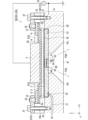
- FIG. 2 is a cross-sectional view showing the cross-sectional structure of the A-A section in FIG. 1.
- FIGS. 3 to 6 are explanatory diagrams partially explaining the structure of the electrode unit 50. Note that the electrode unit 50 corresponds to any one of the electrode units 51 to 53. Note that the electrode units 51 to 53 have the same structure.
- FIG. 3 is an explanatory diagram showing a schematic planar structure of the electrode unit 50.
- FIG. 4 is an explanatory diagram showing the cross-sectional structure of the B-B cross section of FIG. 3.
- FIGS. 3 and 4 are the first explanatory diagrams showing the structure of the ground conductor 6 and its surroundings.
- FIG. 5 is an explanatory diagram showing a schematic planar structure of the electrode unit 50.
- FIG. 6 is an explanatory diagram showing the cross-sectional structure of the C-C section of FIG. 5.
- FIGS. 5 and 6 are the second explanatory diagrams showing the detailed structure of the ground conductor 6 and its surroundings.
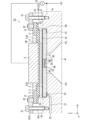
- FIGS. 7 to 30 are explanatory diagrams showing the details of the components of the electrode unit 50.
- FIG. 7 and FIG. 8 are explanatory diagrams showing the structure of the housing 1 in schematic form.
- FIG. 7 shows the planar structure of the housing 1
- FIG. 8 shows the cross-sectional structure of the housing 1.
- Figures 9 and 10 are explanatory diagrams each showing a schematic structure of the high-voltage side dielectric film 2.
- Figure 9 shows the planar structure of the high-voltage side dielectric film 2
- Figure 10 shows the cross-sectional structure of the high-voltage side dielectric film 2.
- FIGS. 11 and 12 are explanatory diagrams each showing a schematic structure of the ground side dielectric film 3.
- FIG. 11 shows the planar structure of the ground side dielectric film 3
- FIG. 12 shows the cross-sectional structure of the ground side dielectric film 3.
- FIGS. 13 and 14 are explanatory diagrams each showing a schematic structure of the power feeder 5.
- FIG. 13 shows the planar structure of the power feeder 5
- FIG. 14 shows the cross-sectional structure of the power feeder 5.
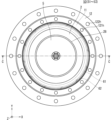
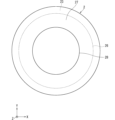
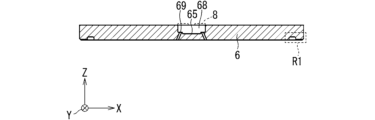
- FIGS. 15 to 17 are explanatory diagrams each showing a schematic structure of the ground conductor 6.
- FIG. 15 shows the planar structure of the ground conductor 6
- FIG. 16 shows the cross-sectional structure of the ground conductor 6
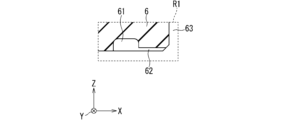
- FIG. 17 shows details of the region of interest R1 in FIG. 16.
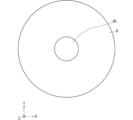
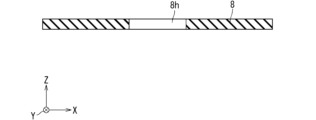
- FIGS. 18 and 19 are explanatory diagrams each showing a schematic structure of the cover dielectric film 8.
- FIG. 18 shows the planar structure of the cover dielectric film 8
- FIG. 19 shows the cross-sectional structure of the cover dielectric film 8.
- FIGS. 20 and 21 are explanatory diagrams each showing a schematic structure of the ground side electrode configuration part E2.
- FIG. 20 shows the planar structure of the ground side electrode configuration part E2
- FIG. 21 shows the cross-sectional structure of the ground side electrode configuration part E2.
- the ground side electrode configuration part E2 includes a combined structure of the ground side dielectric film 3, the conductive film 7, and the cover dielectric film 8.
- FIGS. 22 and 23 are explanatory diagrams each showing a schematic structure of the shielding dielectric film 9.
- FIG. 22 shows the planar structure of the shielding dielectric film 9
- FIG. 23 shows the cross-sectional structure of the shielding dielectric film 9.
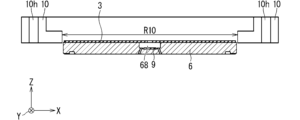
- Figures 24 and 25 are explanatory diagrams each showing a schematic structure of the dielectric film support member 10.
- Figure 24 shows the planar structure of the dielectric film support member 10
- Figure 25 shows the cross-sectional structure of the dielectric film support member 10.
- Figures 26 to 28 are explanatory diagrams each showing a schematic structure of the dielectric film suppression member 11.
- Figure 26 shows the planar structure of the dielectric film suppression member 11
- Figure 27 shows the cross-sectional structure of the dielectric film suppression member 11
- Figure 28 shows details of the region of interest R2 in Figure 27.
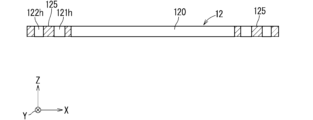
- FIGS. 29 and 30 are explanatory diagrams each showing a schematic structure of the pressing member 12.
- FIG. 29 shows the planar structure of the pressing member 12
- FIG. 30 shows the cross-sectional structure of the pressing member 12.
- Figures 1 to 30 each show a schematic representation of the active gas generator 71, the electrode unit 50, or components of the electrode unit 50, and the shapes, including the scale, do not necessarily match between Figures 1 to 30. Also, an XYZ Cartesian coordinate system is shown in each of Figures 1 to 30.
- the active gas generator 71 includes a plurality of electrode units 51 to 53, and a conductive housing 1 that houses the electrode units 51 to 53 in a housing internal space S1 (see FIG. 8).
- the housing 1 has a housing bottom 1a that includes a flat surface 1F and a conductor accommodating space 6S recessed in the depth direction from the flat surface 1F.
- the housing 1 has a housing bottom 1a, a housing side 1b, and a housing top 1c, and the housing bottom 1a, the housing side 1b, and the housing top 1c form an internal housing space S1 that houses the electrode units 51 to 53.
- the electrode units 51 to 53 are each housed in the housing interior space S1 of the housing 1 with the ground conductor 6 disposed within the conductor housing space 6S. As shown in FIG. 7, the raw material gas G1 supplied from the outside is supplied to the raw material gas flow space provided on the underside and side of the ground conductor 6 disposed within the conductor housing space 6S via a gas flow path 21 provided within the housing bottom 1a.
- the electrode unit 51 (50) includes a high-voltage side electrode component E1, which is a first electrode component, and a ground side electrode component E2, which is a second electrode component provided below the high-voltage side electrode component E1.
- the electrode unit 51 is provided below the ground side electrode component E2, which is the second electrode component, and further includes a ground conductor 6, which is a reference potential conductor housed in the conductor housing space 6S.
- the ground conductor 6 is made of a conductor such as a metal.
- the high-voltage side electrode component E1 which is the first electrode component, includes the high-voltage side dielectric film 2, which is the dielectric film for the first electrode, and the power supply body 5, which is the conductive film for the first electrode formed on the upper surface of the high-voltage side dielectric film 2.
- the power supply body 5, which is the conductive film for the first electrode, is provided on the power supply body placement recess 28 provided in the center of the high-voltage side dielectric film 2, which is the dielectric film for the first electrode.
- the high-voltage side dielectric film 2 is made of a dielectric material, and the power supply 5 is made of a conductor such as a metal.
- the power supply 5 is made of a metal.
- the ground side electrode configuration portion E2 includes a ground side dielectric film 3 which is a dielectric film for the second electrode, and a conductive film 7 which is a conductive film for the second electrode formed on the lower surface of the ground side dielectric film 3. Note that since the conductive film 7 is thin, it is not shown in Figure 2 and other figures, and the formation area of the conductive film 7 is shown in Figures 20 and 21.
- the ground side dielectric film 3 is made of a dielectric material
- the conductive film 7 is made of a conductor such as a metal.
- the ground conductor 6 which is a reference potential conductor, has a non-penetrating active gas buffer space 68 at the top, and the ground side electrode component E2 is arranged to block the active gas buffer space 68. Therefore, outside the active gas buffer space 68, the lower surface of the conductive film 7 and the upper surface of the ground conductor 6 are in contact with each other.
- the ground side dielectric film 3, which is the dielectric film for the second electrode, has a dielectric through hole 3h penetrating the ground side dielectric film 3 in a region overlapping with the active gas buffer space 68 in a planar view
- the conductive film 7, which is the conductive film for the second electrode has a conductive film opening 7h in a region overlapping with the active gas buffer space 68 in a planar view, and the conductive film opening 7h overlaps with the dielectric through hole 3h in a planar view.
- the housing bottom 1a of the housing 1 has a gas flow path 21 that receives the raw material gas G1 from the outside, and a raw material gas flow space is provided between the ground conductor 6 and the conductor storage space 6S of the housing 1.
- the raw material gas flow space includes a raw material gas buffer space 61, a slit space 62, and a side space 63.
- the raw gas G1 is introduced into the main discharge space of the discharge space 4 via the gas flow path 21 and the raw gas flow space.
- the main discharge space refers to the discharge space 4 in the dielectric space 18 between the high-voltage side dielectric film 2 and the ground side dielectric film 3, as described below.
- the AC voltage applied from the AC power source 15 is applied to the power supply 5, which is the conductive film for the first electrode, via electrical connection means such as electrical wiring or a lead-in terminal. Note that the illustration showing the electrical connection means is omitted in Figure 2 and other figures.
- the housing 1 is set to the ground potential, which is the reference potential. Therefore, the conductive film 7, which is the conductive film for the second electrode, is set to the ground potential via the housing 1 and the ground conductor 6.
- the electrode unit 51 (50) further includes auxiliary members such as a dielectric film support member 10, a dielectric film suppression member 11, and a pressing member 12.
- the step portion 102 of the dielectric film support member 10 is provided on the flat surface 1F of the housing 1, and has an upper surface that serves as a support surface 10F that supports the high-voltage side dielectric film 2 from below. At this time, the dielectric film support member 10 is placed on the flat surface 1F so that the side surface of the dielectric film support member 10 coincides with the side surface of the conductor accommodating space 6S of the housing bottom 1a of the housing 1.
- the dielectric film suppression member 11 is a member for suppressing the high-voltage side dielectric film 2 from above, and does not overlap with the power supply body 5 in a plan view. In other words, there is an exposed area EX2 on the upper surface of the high-voltage side dielectric film 2 where the dielectric film suppression member 11 and the power supply body 5 are not formed.
- the bottom surface of the dielectric film suppression member 11 has a dielectric contact region 112 that contacts the top surface of the high-voltage side dielectric film 2 and a dielectric non-contact region 111 that does not contact the top surface of the high-voltage side dielectric film 2.
- the dielectric contact region 112 is a region that contacts the high-voltage side dielectric film 2 and applies a load
- the dielectric non-contact region 111 is a region that does not come into contact with the high-voltage side dielectric film 2 and protrudes toward the power supply 5 on the top surface of the high-voltage side dielectric film 2.
- the dielectric contact area 112 overlaps with the peripheral area of the high-voltage side dielectric film 2 and the support surface 10F of the dielectric film support member 10 in a planar view, while the dielectric non-contact area 111 overlaps with the middle area inside the peripheral area of the high-voltage side dielectric film 2 in a planar view.
- the middle area is the area adjacent to the power supply 5 side from the peripheral area of the high-voltage side dielectric film 2.
- the dielectric film suppression member 11 is made of metal or the like, is conductive, and is set to the ground potential, which is the reference potential, via the housing 1, the mounting bolt 31, and the pressing member 12.
- the mounting bolt 31 and the pressing member 12 are also conductive.
- the high-voltage side dielectric film 2 is suppressed from above by the dielectric film suppressing member 11 in the dielectric contact area 112.
- the combined structure of the dielectric film support member 10, the dielectric film suppressing member 11, and the pressing member 12 will be described in detail below.
- the pressing member 12 is placed on the top surface of the dielectric film support member 10, and the pressing member 12 and the dielectric film support member 10 are fixed onto the housing bottom 1a of the housing 1 by mounting bolts 31.
- the dielectric film support member 10 has a circular shape with a central opening 100 in the center when viewed from above.
- a step structure consisting of a step portion 102 and a peripheral upper surface 101 is provided in an annular shape around the central opening 100.
- the upper surface of the step portion 102 becomes the support surface 10F.
- a plurality of through holes 10h are provided in a circular shape on the peripheral upper surface 101 on the outer periphery side of the step portion 102 (support surface 10F).
- the high-voltage side dielectric film 2 has a circular shape with a power supply placement recess 28 in the center when viewed from above.
- a peripheral surface area 27 is provided in an annular shape around the power supply placement recess 28.
- the high-voltage side dielectric film 2 also has a circular recess bottom surface 26 when viewed from above, and the bottom surface around the recess bottom surface 26 becomes a circular protrusion bottom surface 23 when viewed from above.
- the power supply 5 has a cylindrical shape.
- the power supply 5 is placed on the upper surface of the high-voltage side dielectric film 2 with the bottom surface of the power supply 5 positioned on the power supply placement recess 28 of the high-voltage side dielectric film 2.
- the power supply placement recess 28 includes the power supply 5 in a plan view and has a planar shape that is slightly wider than the power supply 5.
- the high-voltage side dielectric film 2 is arranged on the dielectric film support member 10 in such a manner that the support surface 10F of the dielectric film support member 10 contacts the convex bottom surface 23 of the high-voltage side dielectric film 2.
- the high-voltage side dielectric film 2 and the dielectric film support member 10 are in contact with each other via a sealing material such as an O-ring (not shown).
- the dielectric film suppression member 11 has a circular shape with a central opening 110 in the center when viewed from above.
- the annular lower surface region provided on the outer periphery of the central opening 110 becomes the dielectric non-contact region 111
- the annular lower surface region provided on the outer periphery of the dielectric non-contact region 111 becomes the dielectric contact region 112.
- the dielectric contact region 112 protrudes downward (in the -Z direction) from the dielectric non-contact region 111, and is in contact with the upper surface U2 of the high-voltage side dielectric film 2.
- the dielectric non-contact region 111 is not in contact with the upper surface U2 of the high-voltage side dielectric film 2.
- the pressing member 12 has a circular shape with a central opening 120 in the center when viewed from above.
- a plurality of inner through holes 121h are provided in a circular pattern in an outer peripheral region 125 on the outer periphery side of the central opening 120, and a plurality of outer through holes 122h are provided in a circular pattern on the outer periphery side of the plurality of inner through holes 121h.
- a plurality of inner through holes 121h and a plurality of outer through holes 122h are provided in the outer peripheral region 125 of the pressing member 12.
- Each of the plurality of inner through holes 121h is a tapped through hole.
- a portion of the outer peripheral region 125 of the pressing member 12 having the above-described structure is placed on the dielectric film support member 10, and the dielectric film support member 10 and pressing member 12 are fixed to the housing bottom 1a of the housing 1 by a plurality of mounting bolts 31.
- the threaded portions of the plurality of mounting bolts 31 pass through the plurality of outer through-holes 122h and the plurality of through-holes 10h, and are attached to the housing bottom 1a.
- the pressing member 12 is arranged in a region that overlaps with the dielectric film support member 10 and the dielectric film suppression member 11 in a plan view.
- a plurality of suppression auxiliary members 32 are attached to the pressing member 12 in a manner that the suppression auxiliary members 32 penetrate the plurality of inner through holes 121h of the pressing member 12.
- the suppression auxiliary members 32 may be bolts or set screws.
- the suppression auxiliary members 32 are attached within the plurality of inner through holes 121h so that the dielectric film suppression member 11 is pressed by the suppression auxiliary members 32.
- the suppression auxiliary members 32 are provided at positions that overlap the dielectric contact region 112 of the dielectric film suppression member 11 and the convex bottom surface 23 of the high-voltage side dielectric film 2 in a plan view.
- the high-voltage side dielectric film 2 is suppressed from the upper dielectric contact area 112 by the dielectric film suppression member 11, which receives the pressing force of the multiple suppression auxiliary members 32.
- the high-voltage side dielectric film 2 which is the first electrode dielectric film
- the dielectric film suppression member 11 which receives the pressing force of the multiple suppression auxiliary members 32. Therefore, the area where the load is applied to the high-voltage side dielectric film 2 by the dielectric film suppression member 11 can be limited to only the area below the dielectric contact area 112.
- the active gas generating device 71 of embodiment 1 can stably fix the high-pressure side dielectric film 2 between the dielectric contact area 112 of the dielectric film suppressing member 11 and the support surface 10F of the dielectric film support member 10 without applying unnecessary bending stress to the high-pressure side dielectric film 2.
- the dielectric film suppression member 11 is set to a ground potential, which is a reference potential, and is conductive.
- the dielectric non-contact region 111 of the dielectric film suppression member 11 overlaps with the middle region of the high-voltage side dielectric film 2 in a plan view.
- the electrode unit 50 can reduce the electric field strength of the power supply 5 by using the dielectric film suppression member 11 having the dielectric non-contact area 111 to reduce the potential of the intermediate area of the high-voltage side dielectric film 2, thereby reducing the potential in the outer diameter direction between the high-voltage side dielectric film 2 and the ground side dielectric film 3.
- the electrode unit 50 in the active gas generator 71 of embodiment 1 can reliably prevent dielectric breakdown in the gap 20 between the high-voltage side dielectric film 2 and the dielectric film support member 10.
- the ground conductor 6 accommodated in the conductor accommodating space 6S of the housing 1 has a circular shape when viewed in a plane, and has a raw material gas buffer space 61 and a slit space 62 in the end region of the bottom surface.
- the raw material gas buffer space 61 is formed in a flat circular shape and is connected to the gas flow path 21 as shown in FIG. 2, so that the raw material gas G1 supplied from the outside can be taken into the raw material gas buffer space 61 via the gas flow path 21.
- a plurality of slit spaces 62 are provided at intervals around the raw material gas buffer space 61. As shown in FIG. 17, each of the plurality of slit spaces 62 is connected to the raw material gas buffer space 61, and raw material gas G1 can be circulated from the raw material gas buffer space 61 to the slit space 62.
- the side space 63 is a gap space between the inner peripheral side surface of the conductor accommodating space 6S and the outer peripheral side surface of the ground conductor 6, and is arranged in a circular ring shape when viewed in a plane.
- the dielectric film support member 10 and the ground conductor 6 have the positional relationship shown in Figures 3 and 4, so that the raw material gas G1 that passes through the side space 63 is supplied to the lower side region R10 of the dielectric film support member 10.
- the raw material gas buffer space 61 is provided on the lower surface side of the ground conductor 6 and receives the raw material gas G1 via the gas flow path 21.
- Each of the multiple slit spaces 62 is provided on the lower surface side of the ground conductor 6 and is connected to the raw material gas buffer space 61.
- the side space 63 is provided on the side of the ground conductor 6 and is connected to the multiple slit spaces.
- the raw material gas flow space includes the raw material gas buffer space 61, the multiple slit spaces 62, and the side space 63.
- the raw material gas G1 supplied from the outside to the gas flow path 21 is guided to the discharge space 4 via the raw material gas buffer space 61, the slit space 62, and the side space 63.
- Each of the multiple slit spaces 62 is set to a narrow space through which the raw material gas does not flow easily compared to the raw material gas buffer space 61 so that the raw material gas G1 flows into each of the multiple slit spaces 62 after being temporarily retained in the raw material gas buffer space 61.
- the multiple slit spaces 62 have a smaller conductance, which is a coefficient that indicates the ease with which the raw material gas G1 flows, compared to the raw material gas buffer space 61 and the side space 63.
- the active gas generator 71 of the first embodiment can supply the raw material gas G1 spatially uniformly to the discharge space 4.
- the raw material gas G1 is supplied uniformly from the periphery of the circular dielectric space 18 in plan view toward the central discharge space 4.
- the pressure difference between the raw material gas buffer space 61 and the side space 63 increases, and the variation in the flow rate of the raw material gas G1 flowing through each of the multiple slit spaces 62 is reduced. Therefore, the raw material gas G1 is supplied uniformly toward the discharge space 4.
- the flow rate of the raw material gas G1 is adjusted, for example, by a mass flow controller (MFC) or the like provided upstream of the gas flow path 21.
- MFC mass flow controller
- the active gas generating device 71 of embodiment 1 can supply the raw material gas G1 uniformly, so the above-mentioned problem does not occur.
- the ground side electrode configuration portion E2 which is the second electrode configuration portion, includes the ground side dielectric film 3 and the conductive film 7.
- the ground side dielectric film 3 is circular in plan view and has a circular dielectric through hole 3h in the center.
- the cover dielectric film 8 is circular in plan view and has a circular cover through hole 8h in the center. It is preferable that the cover dielectric film 8 is made of the same material as the ground side dielectric film 3. This is to prevent distortion when the thermal expansion coefficients of the cover dielectric film 8 and the ground side dielectric film 3 differ. Materials with similar thermal expansion coefficients may also be selected as the materials for the cover dielectric film 8 and the ground side dielectric film 3.
- the conductive film 7 is circular in plan view and has a conductive film opening 7h in the center that is also circular in plan view.
- the dielectric through hole 3h and the conductive film opening 7h each overlap with the active gas buffer space 68 in plan view, and as shown in FIG. 21, the conductive film opening 7h includes the dielectric through hole 3h in plan view and has a wider shape than the dielectric through hole 3h.
- the conductive film 7 is provided on the lower surface of the ground side dielectric film 3 with the center positions of the ground side dielectric film 3 and the conductive film 7 aligned.
- the diameter of the conductive film 7 is set to be approximately the same as the diameter of the ground side dielectric film 3, but the formation area of the conductive film 7 is narrower than the formation area of the ground side dielectric film 3 because a conductive film opening 7h wider than the dielectric through hole 3h is provided in the center.
- the conductive film inner boundary 7e which is the circumferential outer periphery of the conductive film opening 7h, is the end of the conductive film 7 on the dielectric through hole 3h side, and the conductive film 7 is not formed in the area inside the conductive film inner boundary 7e.
- the conductive film inner boundary 7e becomes the electrode boundary line of the conductive film 7. Therefore, as shown in FIG. 21, the conductive film 7 formation area A7 on the lower surface of the ground side dielectric film 3 is the area from the outer periphery of the ground side dielectric film 3 to the conductive film inner boundary 7e.
- the cover dielectric film 8 is provided in a circular shape from above the lower surface of the ground side dielectric film 3 to above the lower surface of the conductive film 7, including the conductive film inner boundary 7e.
- the cover dielectric film 8 has a cover through hole 8h in the center. In other words, the outer diameter of the conductive film opening 7h of the conductive film 7 is shorter than the outer diameter of the cover dielectric film 8.
- the cover through hole 8h has a shape similar to that of the dielectric through hole 3h, and the cover through hole 8h is included in the conductive film opening 7h and has a narrower shape than the conductive film opening 7h. Therefore, the cover dielectric film 8 covers the conductive film inner boundary 7e (electrode boundary line) of the conductive film 7. And, the lower surface of the conductive film 7 that is not covered by the cover dielectric film 8 and the upper surface of the ground conductor 6 are in contact with each other.
- the active gas buffer space 68 provided above the ground conductor 6 is circular in plan view, and multiple gas outlets 69 are provided around the bottom surface 65 of the active gas buffer space 68.
- the formation area of the cover dielectric film 8 is also shown in Figures 15 and 16. As shown in these figures, the outer periphery of the cover dielectric film 8 is approximately the same as the outer periphery of the active gas buffer space 68.
- a shielding dielectric film 9 is provided on the bottom surface 65 of the active gas buffer space 68.
- the shielding dielectric film 9 is formed to a predetermined thickness and has a circular shape when viewed in a plan view.
- the shielding dielectric film 9 is provided on the bottom surface 65 of the active gas buffer space 68 such that the central positions of the active gas buffer space 68 and the shielding dielectric film 9 are aligned.
- the multiple gas outlets 69 overlap with the cover dielectric film 8 in plan view, but do not overlap with the dielectric through holes 3h and the cover through holes 8h in plan view.
- a plurality of gas outlets 69 are provided around the bottom surface 65 of the active gas buffer space 68, penetrating the ground conductor 6. That is, a plurality of gas outlets 69 are provided in the peripheral region of the shielding dielectric film 9 in plan view.
- the raw material gas G1 is supplied from outside the metal housing 2 to the discharge space 4 via the gas flow path 21 and the raw material gas flow space, as described above.
- the raw material gas G1 When raw material gas G1 is supplied to the discharge space 4 where the dielectric barrier discharge is occurring, the raw material gas G1 is activated to become active gas G2, which passes through the dielectric through hole 3h and the cover through hole 8h and is introduced into the active gas buffer space 68.
- the active gas G2 that has entered the active gas buffer space 68 passes through multiple gas outlets 69 provided on the bottom surface of the active gas buffer space 68 and is supplied to the subsequent processing space.
- the main dielectric space where the high-voltage side dielectric film 2, which is the dielectric film for the first electrode, and the ground side dielectric film 3, which is the dielectric film for the second electrode, face each other becomes the dielectric space 18.
- the dielectric space 18 has a circular shape in a plan view.
- the space where the high-voltage side dielectric film 2 and the shield dielectric film 9 face each other is defined as the auxiliary dielectric space.
- the discharge space 4 includes a main discharge space where the power supply 5 and the conductive film 7 overlap in a plan view within the dielectric space 18.
- the high-voltage side dielectric film 2 and the ground side dielectric film 3 are installed in correspondence with each other at a fixed distance in the height direction (Z direction), and the main discharge space of the discharge space 4 exists in the dielectric space 18 between the high-voltage side dielectric film 2 and the ground side dielectric film 3.
- the discharge space 4 further includes an auxiliary discharge space 44 consisting of the dielectric through hole 3h, the cover through hole 8h, and a part of the active gas buffer space 68 on the shield dielectric film 9 within the auxiliary dielectric space.
- the bottom surface area below the bottom surface 65 of the ground conductor 6 is used as a conductive film for the ground electrode set to ground potential, and a discharge voltage is applied between the power supply 5, which receives an AC voltage from the AC power source 15, and the conductive film for the ground electrode, thereby generating an auxiliary discharge space 44.
- the auxiliary discharge space 44 includes the dielectric through hole 3h, the cover through hole 8h, and a part of the active gas buffer space 68.
- the discharge space 4 formed in embodiment 1 includes the main discharge space in the dielectric space 18 and the auxiliary discharge space 44.
- the paths leading from the auxiliary discharge space 44 to each of the multiple gas outlets 69 are defined as active gas flow paths.
- the auxiliary discharge space 44 which is part of the discharge space 4, includes the dielectric through hole 3h, the cover through hole 8h, and part of the active gas buffer space 68, so that the volume of the active gas flow path from the auxiliary discharge space 44 to the multiple gas outlets 69 can be kept to a minimum necessary, thereby suppressing the amount of deactivation of the active gas G2.
- the cover dielectric film 8 in the ground side electrode configuration part E2 of the electrode unit 50 covers the conductive film inner boundary 7e, which is the electrode boundary line of the conductive film 7, within the active gas buffer space 68, and overlaps with the multiple gas outlets 69 in a plan view, thereby suppressing the surface deactivation phenomenon in which the active gas G2 disappears as the active gas G2 collides with the conductive film 7.
- the active gas generating device 71 of embodiment 1 can supply high-concentration active gas G2 from multiple gas outlets 69 to the downstream processing space.
- the electrode unit 50 of embodiment 1 has the structure described above, so that the parts facing the discharge space 4 are only the parts made of dielectric materials, which are insulators (high voltage side dielectric film 2, ground side dielectric film 3, cover dielectric film 8, and shield dielectric film 9).
- dielectric materials which are insulators (high voltage side dielectric film 2, ground side dielectric film 3, cover dielectric film 8, and shield dielectric film 9).
- the housing bottom 1a of the housing 1 has a housing opening 41.
- the housing opening 41 is provided in a region overlapping with the active gas buffer space 68 in a plan view, and penetrates the housing bottom 1a.
- the active gas G2 ejected from the multiple gas ejection ports 69 is guided to the processing space below through the housing opening 41.
- the housing opening 41 provided in the housing bottom 1a has an opening area that increases downward, and has a tapered shape with a bottom outer edge 41L, as shown in FIG. 2 and FIG. 7.
- the housing opening 41 provided in the housing bottom 1a of the housing 1 has a tapered shape in which the opening area becomes wider as it goes downward.
- the active gas generating device 71 of embodiment 1 can minimize losses caused by the active gas G2 ejected from the multiple gas ejection ports 69 colliding with the bottom part 1a of the housing, and can supply a high concentration of active gas G2 to the processing space below.
- the active gas G2 is supplied from the active gas buffer space 68 to the downstream processing space located below via the multiple gas outlets 69.
- the active gas G2 from the multiple gas outlets 69 is defined as multiple partially activated gases.
- FIG. 31 is an explanatory diagram that shows a schematic diagram of the ejection form of active gas G2 from electrode unit 50 (51-53) in active gas generating device 71 of embodiment 1.
- FIG. 32 is an explanatory diagram that shows a schematic diagram of an ideal ejection form of active gas G2 in electrode unit 50.
- FIG. 31 and FIG. 32 correspond to, for example, cross section A-A in FIG. 1.
- XYZ Cartesian coordinate systems are depicted in each of FIG. 31 and FIG. 32.
- the multiple gas outlets 69 are arranged so that they move away from each other in the downward direction to prevent collisions between the multiple partially activated gases.
- the spatial pressure p0 in the active gas buffer space 68 is significantly different from the spatial pressure p1 in the downstream processing space, for example, if ⁇ (p1/p0) ⁇ 0.5 ⁇ , the multiple partially active gases ejected from the multiple gas ejection ports 69 will flow in only one direction, called a choke flow, as shown by the gas flow FGX in Figure 31, and the multiple partially active gases will each proceed in a straight line without diffusing.
- the active gas generating device 71 of the first embodiment has multiple gas outlets 69 for each electrode unit 50 in order to supply a uniform amount of active gas G2 to the downstream processing space, and further has a structure in which multiple electrode units 50 are provided as electrode units 51 to 53 in order to supply active gas G2 to a processing space having a relatively wide area.
- the multiple partially activated gases ejected from each electrode unit 50 are each supplied to the processing space in the linear gas flow FGX shown in FIG. 31, and do not become the multi-directionally diffused gas flow FGY shown in FIG. 32.
- the partially activated gas ejected from each of the multiple gas ejection ports 69 of the electrode unit 50 basically has only one directionality.
- the activated gas generating device 71 of embodiment 1 still has the problem of being unable to supply a uniform amount of activated gas G2 to the processing space, similar to the first and second improved structures described in the section titled "Problems to be Solved by the Invention.”
- the active gas generating device 75 of the second embodiment described below aims to solve the above problems.
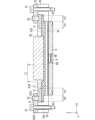
- FIG. 33 is an explanatory diagram showing a cross-sectional structure of an electrode unit 55 in an active gas generation device 75 according to the second embodiment.
- the overall configuration of the active gas generator 75 is similar to that of the active gas generator 71 shown in FIG. 1. Therefore, the electrode unit 55 shown in FIG. 33 corresponds to any one of the electrode units 51 to 53 in the active gas generator 75 having the overall configuration shown in FIG. 1.
- the active gas generator 75 of the second embodiment includes electrode units 51 to 53 as multiple electrode units, and a conductive housing 1 that houses the electrode units 51 to 53 in the housing space S1 (see FIG. 8).
- the electrode unit 55 of the second embodiment is characterized in that the ground conductor 6 of the electrode unit 50 of the first embodiment is replaced with a ground conductor 60.
- the electrode unit 55 is provided below the ground side electrode component E2 including the ground side dielectric film 3, and includes a ground conductor 60, which is a reference potential conductor housed in the conductor housing space 6S.
- the ground conductor 60 is made of a conductor such as a metal.
- the electrode unit 55 of the second embodiment is accommodated in the housing space S1 of the housing 1 in such a manner that the ground conductor 60 is arranged in the conductor accommodation space 6S.
- the raw material gas G1 supplied from the outside is supplied to the raw material gas flow space provided on the underside and side of the ground conductor 60 arranged in the conductor accommodation space 6S via the gas flow passage 21 provided in the housing bottom 1a.
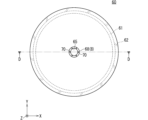
- FIG. 34 and Fig. 35 are explanatory diagrams each showing a schematic structure of the ground conductor 60.
- Fig. 34 shows the planar structure of the ground conductor 60
- Fig. 35 shows the cross-sectional structure of the ground conductor 60.
- Each of Fig. 34 and Fig. 35 shows an XYZ orthogonal coordinate system.
- the ground conductor 60 which is a reference potential conductor, has a non-penetrating active gas buffer space 68 at the top, and the ground side electrode component E2 including the ground side dielectric film 3 is arranged to block the active gas buffer space 68. Therefore, outside the active gas buffer space 68, the lower surface of the conductive film 7 and the upper surface of the ground conductor 60 are in contact with each other.
- the housing 1 is set to the ground potential, which is the reference potential. Therefore, the conductive film 7 is set to the ground potential via the housing 1 and the ground conductor 60.
- the ground conductor 60 accommodated in the conductor accommodation space 6S of the housing 1 is circular in plan view as shown in FIG. 34, and has a raw material gas buffer space 61 and a slit space 62 in the end region of the bottom surface.
- a source gas flow space including a source gas buffer space 61, a plurality of slit spaces 62, and a side space 63 is provided for the ground conductor 60.
- the raw material gas G1 supplied from the outside to the gas flow path 21 is guided to the discharge space 4 via the raw material gas buffer space 61, the slit space 62, and the side space 63.
- the active gas generator 75 of the second embodiment can supply the source gas G1 to the discharge space 4 in a spatially uniform manner.
- the active gas buffer space 68 provided above the ground conductor 60 is circular in plan view, and multiple gas outlets 70 are provided around the bottom surface 65 of the active gas buffer space 68.
- the multiple gas outlets 70 overlap with the cover dielectric film 8 in plan view, but do not overlap with the dielectric through hole 3h and the cover through hole 8h in plan view.
- a plurality of gas outlets 70 are provided around the bottom surface 65 of the active gas buffer space 68, penetrating the ground conductor 60.
- a plurality of gas outlets 70 are provided in the peripheral region of the shielding dielectric film 9 in plan view.
- the raw material gas G1 When raw material gas G1 is supplied to the discharge space 4 where the dielectric barrier discharge is occurring, the raw material gas G1 is activated to become active gas G2, which passes through the dielectric through hole 3h and the cover through hole 8h and is introduced into the active gas buffer space 68.
- the active gas G2 that has entered the active gas buffer space 68 passes through multiple gas outlets 70 provided on the bottom surface of the active gas buffer space 68 and is supplied to the subsequent processing space.
- the paths leading from the auxiliary discharge space 44 to each of the multiple gas outlets 70 are defined as active gas flow paths.
- the auxiliary discharge space 44 which is part of the discharge space 4 includes the dielectric through hole 3h, the cover through hole 8h, and part of the active gas buffer space 68, so that the volume of the active gas flow path from the auxiliary discharge space 44 to the multiple gas outlets 70 can be kept to the minimum necessary, thereby suppressing the amount of deactivation of the active gas G2.
- the cover dielectric film 8 in the ground side electrode configuration part E2 of the electrode unit 55 covers the conductive film inner boundary 7e, which is the electrode boundary line of the conductive film 7 within the active gas buffer space 68, and overlaps with the multiple gas outlets 70 in a plan view, so that the surface deactivation phenomenon in which the active gas G2 disappears as the active gas G2 collides with the conductive film 7 can be suppressed.
- the active gas generating device 75 of the second embodiment can supply high-concentration active gas G2 from multiple gas outlets 70 to the downstream processing space.
- the housing bottom 1a of the housing 1 has a housing opening 41 in an area that overlaps with the active gas buffer space 68 in a plan view, and the active gas G2 ejected from the multiple gas ejection ports 70 is guided through the housing opening 41 to the processing space below.
- the housing opening 41 provided in the housing bottom 1a of the housing 1 has a tapered shape in which the opening area becomes wider as it goes downward.
- the active gas generating device 75 of the second embodiment is able to suppress losses caused by the active gas G2 ejected from the multiple gas ejection ports 70 colliding with the bottom part 1a of the housing, and is able to supply a relatively high concentration of active gas G2 to the processing space below.
- the active gas G2 ejected from the gas outlets 70 provided in the electrode unit 55 of the second embodiment is supplied to a downstream processing space located below.
- the active gas ejected from the gas outlets 70 is defined as a plurality of partially activated gases.
- the multiple partially activated gases ejected from the multiple gas ejection ports 70 are guided downward through the housing opening 41.
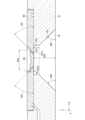
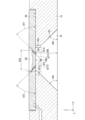
- Figures 36 and 37 are explanatory diagrams that show the cross-sectional structure of multiple gas nozzles 70, and each of Figures 36 and 37 corresponds to the D-D cross-sectional structure in Figure 34.
- Each of Figures 36 and 37 shows an XYZ orthogonal coordinate system.
- the housing opening 41 includes an upper region 41a with a constant opening area in the height direction (Z direction), and a lower tapered region 41t that is a tapered region whose opening area becomes wider toward the bottom.
- the lower tapered region 41t is a tapered region that is located lower than the upper region 41a.
- collision point P80 a coordinate position slightly lower than the center position of the boundary line between the upper region 41a and the lower tapered region 41t is shown as collision point P80.
- Collision point P80 exists within a collision region 80, which will be described later, and is the center of the collision region 80.
- the multiple gas outlets 70 are arranged in such a way that they approach each other downwards so that the multiple partially activated gases collide at the collision point P80.
- multiple gas outlets 70 The structure of the multiple gas outlets 70 will be described in detail below. Two gas outlets 70 are shown in Figures 36 and 37, but as shown in Figure 34, three or more multiple gas outlets 70 are provided.
- gas outlet 70 (1) the gas outlet 70 on the right side (+X direction) in the figure
- gas outlet 70 (2) the gas outlet 70 on the left side (-X direction) in the figure
- the multiple gas outlets 70 are arranged in a circular shape, spaced apart from one another, in a plan view.
- the circular imaginary line connecting the centers of the multiple gas outlets 70 is referred to as the "imaginary gas outlet circle.”
- Gas outlets 70(1) and 70(2) correspond to a pair of gas outlets 70, 70 that face each other in the diametric direction in the imaginary gas outlet circle.
- the partially active gas ejected from gas outlet 70(1) is referred to as partially active gas g2(1)
- the partially active gas ejected from gas outlet 70(2) is referred to as partially active gas g2(2).
- Gas nozzle 70(1) has a constant nozzle inclination A71 that exceeds "0" and is less than 90° with respect to the horizontal direction (X direction), which is the reference direction.
- the nozzle inclination A71 is set in the direction in which the partially activated gas g2(1) ejected from gas nozzle 70(1) heads toward collision point P80.
- gas nozzle 70(2) has a constant nozzle inclination A72 that exceeds "0" and is less than 90° with respect to the horizontal direction.
- the nozzle inclination A72 is set in the direction in which the partially activated gas g2(2) ejected from gas nozzle 70(2) heads toward collision point P80.
- the nozzle inclinations A71 and A72 are set to the same angle, for example, 45°.
- the remaining film thickness T6 of the ground conductor 60 below the active gas buffer space 68, where the gas outlets 70(1) and 70(2) are provided, is set to, for example, 3 mm.
- the formation interval R70 between the center positions of the gas outlets 70(1) and 70(2) at the top is set to, for example, 16.4 mm.
- the formation interval R70 corresponds to the length of the diameter ⁇ of the imaginary gas outlet circle.
- the overall depth DTA of the housing opening 41 along the Z direction is set to, for example, 18.5 mm
- the upper depth DT1 of the upper region 41a of the housing opening 41 along the Z direction is set to, for example, 5.0 mm.
- the side of the lower taper region 41t which is the taper region of the housing opening 41, expands in a cone shape along the taper inclination A41.
- the taper inclination A41 is set to, for example, 45°.
- the partially activated gases g2(1) and g2(2) collide at a collision point P80.
- the depth of the collision point P80 from the surface of the ground conductor 60 is the collision depth DTX.
- the collision depth DTX of collision point P80 is 5.2 mm.
- the collision region 80 is formed from the upper region of the lower taper region 41t to the lower region of the upper region 41a. In other words, the collision region 80 exists within the lower taper region 41t or within the upper region 41a above the lower taper region 41t.
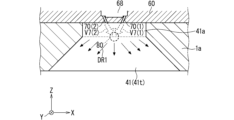
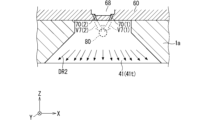
- Figures 38 to 41 are explanatory diagrams each showing a typical ejection form of active gas G2 in housing opening 41 of electrode unit 55 of embodiment 2.
- Each of Figures 38 to 41 corresponds to a part of cross section DD of Figure 34.
- Each of Figures 38 to 41 shows an XYZ orthogonal coordinate system.
- the direction of the partially activated gas g2(1) ejected from the gas outlet 70(1) is defined as the partially activated gas ejection direction V7(1)
- the direction of the partially activated gas g2(2) ejected from the gas outlet 70(2) is defined as the partially activated gas ejection direction V7(2).
- the partially activated gas g2(1) is ejected along the partially activated gas ejection direction V7(1) so as to reach the collision point P80
- the partially activated gas g2(2) is ejected along the partially activated gas ejection direction V7(2) so as to reach the collision point P80.
- the flow direction of the partially activated gas g2(1) is only in one direction, the partially activated gas ejection direction V7(1), and the flow direction of the partially activated gas g2(2) is only in one direction, the partially activated gas ejection direction V7(2).
- the partially activated gas g2(1) and the partially activated gas g2(2) collide in a collision region 80 including a collision point P80, and the partially activated gas g2(1) and g2(2) diffuse in multiple diffusion directions DK.
- the flow direction of the partially activated gas g2(1) diverges from one partially activated gas ejection direction V7(1) into multiple diffusion directions DK
- the flow direction of the partially activated gas g2(2) diverges from one partially activated gas ejection direction V7(2) into multiple diffusion directions DK.
- the flow direction of each of the multiple partially activated gases in the collision region 80 diverges from one direction into multiple diffusion directions.
- the intermediate supply direction DR1 of the multiple partially activated gases is influenced by the side of the lower taper region 41t and is restricted to approach the taper slope A41.
- the collision region 80 exists in the lower tapered region 41t and in the upper region 41a above the lower tapered region 41t, so that as each of the diffused partially activated gases heads downward, they flow in a direction that follows the tapered shape of the side surface of the lower tapered region 41t.
- the multiple partially activated gases are supplied to a downstream processing space located below along the final supply direction DR2 of the expansion along the taper gradient A41.
- the active gas generating device 75 of the second embodiment accommodates an electrode unit 55 having the above-mentioned ground conductor 60 in the housing space 1S of the housing 1.
- the multiple gas outlets 70 provided in the ground conductor 60 of the electrode unit 55 of the second embodiment are provided in such a manner that they approach each other as they move downward so that the multiple partially activated gases collide in a collision region 80 including a collision point P80, and the collision region 80 is located within the lower taper region 41t or above the lower taper region 41t.
- multiple partially activated gases collide in the collision region 80, and the flow direction of each of the multiple partially activated gases is dispersed from one direction to multiple diffusion directions DK.
- the collision region 80 exists within the lower tapered region 41t or above the lower tapered region 41t. Therefore, as each of the diffused partially activated gases flows downward, they flow in a direction along the tapered shape of the side surface of the lower tapered region 41t, i.e., in the intermediate supply direction DR1 shown in FIG. 40.
- the active gas G2 containing multiple partially activated gases flows from the lower taper region 41t toward the processing space below in a direction along the tapered shape of the side surface of the lower taper region 41t, that is, along the final supply direction DR2 shown in FIG. 41, while diffusing.
- the active gas generating device 75 of embodiment 1 can supply a uniform active gas G2 to the downstream processing space.
- the multiple gas nozzles 70 provided in the electrode unit 55 of the second embodiment are formed with an inclination in the direction approaching the collision region 80 including the collision point P80 as they go downward, and the nozzle inclination A70, which is the inclination of the nozzles 70 relative to the horizontal direction, which is the reference direction, is set to the same value.
- the active gas generating device 75 of the second embodiment can supply a more uniform active gas G2 to the downstream processing space by dispersing multiple partial active gases in multiple diffusion directions in one collision region 80.
- the active gas generator 75 of the second embodiment employs a structure in which a plurality of electrode units 55 are provided as electrode units 51 to 53, as shown in FIG. 1.
- the active gas generating device 75 of the second embodiment can uniformly supply active gas G2 to the downstream processing space having a relatively wide area by ejecting multiple partial active gases from each of multiple electrode units 51 to 53, each of which has a structure similar to that of the electrode unit 55.
- multiple partially activated gases are collided in one collision region 80, but multiple partially activated gases may be selectively collided in two or more collision regions.
Landscapes
- Physics & Mathematics (AREA)
- Engineering & Computer Science (AREA)
- Plasma & Fusion (AREA)
- Spectroscopy & Molecular Physics (AREA)
- Chemical & Material Sciences (AREA)
- Analytical Chemistry (AREA)
- Physical Or Chemical Processes And Apparatus (AREA)
- Plasma Technology (AREA)
Priority Applications (7)
| Application Number | Priority Date | Filing Date | Title |
|---|---|---|---|
| CN202380039675.4A CN119256626A (zh) | 2023-05-01 | 2023-05-01 | 活性气体生成装置 |
| PCT/JP2023/017030 WO2024228233A1 (ja) | 2023-05-01 | 2023-05-01 | 活性ガス生成装置 |
| KR1020247038763A KR20250002602A (ko) | 2023-05-01 | 2023-05-01 | 활성 가스 생성 장치 |
| US18/868,181 US20250331093A1 (en) | 2023-05-01 | 2023-05-01 | Active gas generation apparatus |
| JP2023562753A JP7493905B1 (ja) | 2023-05-01 | 2023-05-01 | 活性ガス生成装置 |
| EP23935748.6A EP4709056A1 (en) | 2023-05-01 | 2023-05-01 | Active gas generation device |
| TW113104754A TWI875468B (zh) | 2023-05-01 | 2024-02-06 | 活性氣體生成裝置 |
Applications Claiming Priority (1)
| Application Number | Priority Date | Filing Date | Title |
|---|---|---|---|
| PCT/JP2023/017030 WO2024228233A1 (ja) | 2023-05-01 | 2023-05-01 | 活性ガス生成装置 |
Publications (1)
| Publication Number | Publication Date |
|---|---|
| WO2024228233A1 true WO2024228233A1 (ja) | 2024-11-07 |
Family
ID=91321816
Family Applications (1)
| Application Number | Title | Priority Date | Filing Date |
|---|---|---|---|
| PCT/JP2023/017030 Ceased WO2024228233A1 (ja) | 2023-05-01 | 2023-05-01 | 活性ガス生成装置 |
Country Status (7)
| Country | Link |
|---|---|
| US (1) | US20250331093A1 (https=) |
| EP (1) | EP4709056A1 (https=) |
| JP (1) | JP7493905B1 (https=) |
| KR (1) | KR20250002602A (https=) |
| CN (1) | CN119256626A (https=) |
| TW (1) | TWI875468B (https=) |
| WO (1) | WO2024228233A1 (https=) |
Citations (5)
| Publication number | Priority date | Publication date | Assignee | Title |
|---|---|---|---|---|
| JP2007090209A (ja) * | 2005-09-28 | 2007-04-12 | Chugoku Electric Power Co Inc:The | 複合トーチ型プラズマ溶射装置 |
| JP2012112549A (ja) * | 2010-11-22 | 2012-06-14 | Ihi Corp | 微粉炭バーナ |
| WO2019138456A1 (ja) | 2018-01-10 | 2019-07-18 | 東芝三菱電機産業システム株式会社 | 活性ガス生成装置 |
| WO2021106100A1 (ja) * | 2019-11-27 | 2021-06-03 | 東芝三菱電機産業システム株式会社 | 活性ガス生成装置 |
| JP7297399B1 (ja) * | 2022-05-18 | 2023-06-26 | 東芝三菱電機産業システム株式会社 | 活性ガス生成装置 |
Family Cites Families (3)
| Publication number | Priority date | Publication date | Assignee | Title |
|---|---|---|---|---|
| US11532458B2 (en) * | 2018-05-30 | 2022-12-20 | Toshiba Mitsubishi-Electric Industrial Systems Corporation | Active gas generation apparatus |
| KR102510329B1 (ko) * | 2018-06-25 | 2023-03-17 | 도시바 미쓰비시덴키 산교시스템 가부시키가이샤 | 활성 가스 생성 장치 및 성막 처리 장치 |
| CN113170567B (zh) * | 2019-11-12 | 2023-11-28 | 东芝三菱电机产业系统株式会社 | 活性气体生成装置 |
-
2023
- 2023-05-01 KR KR1020247038763A patent/KR20250002602A/ko active Pending
- 2023-05-01 CN CN202380039675.4A patent/CN119256626A/zh active Pending
- 2023-05-01 JP JP2023562753A patent/JP7493905B1/ja active Active
- 2023-05-01 EP EP23935748.6A patent/EP4709056A1/en active Pending
- 2023-05-01 US US18/868,181 patent/US20250331093A1/en active Pending
- 2023-05-01 WO PCT/JP2023/017030 patent/WO2024228233A1/ja not_active Ceased
-
2024
- 2024-02-06 TW TW113104754A patent/TWI875468B/zh active
Patent Citations (5)
| Publication number | Priority date | Publication date | Assignee | Title |
|---|---|---|---|---|
| JP2007090209A (ja) * | 2005-09-28 | 2007-04-12 | Chugoku Electric Power Co Inc:The | 複合トーチ型プラズマ溶射装置 |
| JP2012112549A (ja) * | 2010-11-22 | 2012-06-14 | Ihi Corp | 微粉炭バーナ |
| WO2019138456A1 (ja) | 2018-01-10 | 2019-07-18 | 東芝三菱電機産業システム株式会社 | 活性ガス生成装置 |
| WO2021106100A1 (ja) * | 2019-11-27 | 2021-06-03 | 東芝三菱電機産業システム株式会社 | 活性ガス生成装置 |
| JP7297399B1 (ja) * | 2022-05-18 | 2023-06-26 | 東芝三菱電機産業システム株式会社 | 活性ガス生成装置 |
Also Published As
| Publication number | Publication date |
|---|---|
| JP7493905B1 (ja) | 2024-06-03 |
| JPWO2024228233A1 (https=) | 2024-11-07 |
| US20250331093A1 (en) | 2025-10-23 |
| EP4709056A1 (en) | 2026-03-11 |
| CN119256626A (zh) | 2025-01-03 |
| TWI875468B (zh) | 2025-03-01 |
| KR20250002602A (ko) | 2025-01-07 |
| TW202444955A (zh) | 2024-11-16 |
Similar Documents
| Publication | Publication Date | Title |
|---|---|---|
| EP3806586B1 (en) | Active gas generation device | |
| JP6858477B1 (ja) | 活性ガス生成装置 | |
| EP3879946B1 (en) | Activated gas generation device | |
| JP3399887B2 (ja) | プラズマ処理装置 | |
| KR102421455B1 (ko) | 활성 가스 생성 장치 | |
| US12424418B2 (en) | Active gas generation apparatus | |
| WO2020165964A1 (ja) | 活性ガス生成装置 | |
| JP7481786B1 (ja) | 活性ガス生成装置 | |
| JPWO2008123142A1 (ja) | プラズマ処理装置 | |
| JP7493905B1 (ja) | 活性ガス生成装置 | |
| KR20200130416A (ko) | 챔버 어셈블리 및 반응 챔버 | |
| JP4861387B2 (ja) | プラズマ処理装置 | |
| KR102858462B1 (ko) | 활성 가스 생성 장치 | |
| KR20250090329A (ko) | 활성 가스 생성 장치 | |
| KR102518875B1 (ko) | 대기압 플라즈마 기판처리장치 | |
| KR20210136678A (ko) | 기판 처리 장치 | |
| EP4640624A1 (en) | Gas generation device | |
| CN218160306U (zh) | 偏压装置及基片处理设备 | |
| JP7305863B1 (ja) | ガス生成装置 | |
| WO2023120245A1 (ja) | 基板支持器及びプラズマ処理装置 |
Legal Events
| Date | Code | Title | Description |
|---|---|---|---|
| WWE | Wipo information: entry into national phase |
Ref document number: 2023562753 Country of ref document: JP |
|
| WWE | Wipo information: entry into national phase |
Ref document number: 202380039675.4 Country of ref document: CN |
|
| ENP | Entry into the national phase |
Ref document number: 20247038763 Country of ref document: KR Kind code of ref document: A |
|
| WWE | Wipo information: entry into national phase |
Ref document number: 1020247038763 Country of ref document: KR |
|
| WWE | Wipo information: entry into national phase |
Ref document number: 18868181 Country of ref document: US |
|
| 121 | Ep: the epo has been informed by wipo that ep was designated in this application |
Ref document number: 23935748 Country of ref document: EP Kind code of ref document: A1 |
|
| WWP | Wipo information: published in national office |
Ref document number: 202380039675.4 Country of ref document: CN |
|
| WWP | Wipo information: published in national office |
Ref document number: 18868181 Country of ref document: US |
|
| WWE | Wipo information: entry into national phase |
Ref document number: 2023935748 Country of ref document: EP |
|
| NENP | Non-entry into the national phase |
Ref country code: DE |
|
| ENP | Entry into the national phase |
Ref document number: 2023935748 Country of ref document: EP Effective date: 20251201 |
|
| ENP | Entry into the national phase |
Ref document number: 2023935748 Country of ref document: EP Effective date: 20251201 |
|
| ENP | Entry into the national phase |
Ref document number: 2023935748 Country of ref document: EP Effective date: 20251201 |
|
| ENP | Entry into the national phase |
Ref document number: 2023935748 Country of ref document: EP Effective date: 20251201 |
|
| ENP | Entry into the national phase |
Ref document number: 2023935748 Country of ref document: EP Effective date: 20251201 |
|
| ENP | Entry into the national phase |
Ref document number: 2023935748 Country of ref document: EP Effective date: 20251201 |
|
| ENP | Entry into the national phase |
Ref document number: 2023935748 Country of ref document: EP Effective date: 20251201 |
|
| ENP | Entry into the national phase |
Ref document number: 2023935748 Country of ref document: EP Effective date: 20251201 |
|
| ENP | Entry into the national phase |
Ref document number: 2023935748 Country of ref document: EP Effective date: 20251201 |
|
| WWP | Wipo information: published in national office |
Ref document number: 2023935748 Country of ref document: EP |