WO2024225363A1 - 積層体、積層体の製造方法、及び半導体装置の製造方法 - Google Patents
積層体、積層体の製造方法、及び半導体装置の製造方法 Download PDFInfo
- Publication number
- WO2024225363A1 WO2024225363A1 PCT/JP2024/016178 JP2024016178W WO2024225363A1 WO 2024225363 A1 WO2024225363 A1 WO 2024225363A1 JP 2024016178 W JP2024016178 W JP 2024016178W WO 2024225363 A1 WO2024225363 A1 WO 2024225363A1
- Authority
- WO
- WIPO (PCT)
- Prior art keywords
- laminate
- adhesive layer
- laser
- layer
- semiconductor
- Prior art date
- Legal status (The legal status is an assumption and is not a legal conclusion. Google has not performed a legal analysis and makes no representation as to the accuracy of the status listed.)
- Ceased
Links
Images















Classifications
-
- H—ELECTRICITY
- H10—SEMICONDUCTOR DEVICES; ELECTRIC SOLID-STATE DEVICES NOT OTHERWISE PROVIDED FOR
- H10W—GENERIC PACKAGES, INTERCONNECTIONS, CONNECTORS OR OTHER CONSTRUCTIONAL DETAILS OF DEVICES COVERED BY CLASS H10
- H10W72/00—Interconnections or connectors in packages
- H10W72/071—Connecting or disconnecting
Definitions
- the present invention relates to a laminate, a method for manufacturing the laminate, and a method for manufacturing a semiconductor device using the laminate. More specifically, the present invention relates to a laminate including a laser-absorbent temporary adhesive layer that is preferably used when mounting a semiconductor element by laser transfer, a laminate including an adhesive layer that is an adherend for the semiconductor element after laser transfer, a method for manufacturing the laminate, and a method for manufacturing a semiconductor device that mounts a semiconductor element using the laminate.
- semiconductor elements incorporated into semiconductor devices are transferred and mounted on circuit boards by pick-and-place methods using a flip-chip bonder or similar.
- semiconductor devices have become more compact and sophisticated, and as a result, the semiconductor elements incorporated into semiconductor devices have also become smaller and thinner, and the number of them being mounted has increased.
- III-V group compound semiconductor chips such as gallium arsenide and indium phosphide have been facing the issue of heat generated when the device is operated.
- substrates with different heat dissipation properties such as silicon substrates
- Patent Document 1 In silicon photonics, III-V group compound semiconductor laser chips are directly bonded to SOI (Silicon On Insulator) wafers on which optical waveguides are formed, in an attempt to achieve miniaturization and cost reduction through integration (Patent Document 2, Non-Patent Documents 1, 2, 3).
- a method of transferring and mounting chips using the stamp method has been implemented as a technology for processing a large number of semiconductor elements at once.
- a pattern sheet made of silicone rubber material or adhesive resin such as polydimethylsiloxane resin is mounted on a stamp head, making it possible to transfer and mount a large number of semiconductor elements at once (Patent Documents 3 and 4, Non-Patent Documents 2 and 3).
- such adhesive resins are also used as adhesive layers for bonding substrates together, in addition to the transfer and mounting technology of semiconductor elements.
- the substrate in order to prevent warping and cracking of the substrate during thin-film processing of the device substrate, the substrate is passed through the process after being bonded to a support substrate.
- a support substrate in order to prevent warping and cracking of the substrate during thin-film processing of the device substrate, the substrate is passed through the process after being bonded to a support substrate.
- a polyimide copolymer having siloxanes of different chain lengths in its structure as an adhesive layer it is possible to suppress the generation of voids during high-temperature processing such as ion implantation, which is essential in the manufacture of power semiconductors, and furthermore, it can be easily removed with a solvent after processing (Patent Document 5).
- Patent Documents 1 and 2 the semiconductor element and the heat dissipation substrate are directly bonded, so high temperature and pressure must be applied for bonding.
- This requires the semiconductor elements to be transferred and mounted one by one (transfer and mounting speed: 0.1 to 1 piece per second) using a flip chip (hereinafter also referred to as "FC") bonder capable of high-temperature bonding, which poses the problem of the time required for transfer and mounting.
- FC flip chip
- Non-Patent Documents 1 and 2 it is desired to transfer epitaxially grown thin film crystals, but there is a problem that the thin film crystals are fragile and break during transportation. Therefore, a process of transporting them together with the substrate and then peeling off the substrate is required.
- Patent Documents 3 and 4 and Non-Patent Document 2 make it possible to transfer and mount many semiconductor elements at once, but because the size of the stamp depends on the wafer size, there is a limit to the number of semiconductor elements that can be transferred simultaneously.
- a stamp must be created each time according to the design of the circuit board, which creates issues such as the possibility of transferring defective chips at the same time.
- the resin used in the stamp head has insufficient heat resistance, making it unapplicable to technologies that require mounting at high temperatures, such as direct bonding.
- the polyimide copolymers presented in Patent Documents 5 and 6 have high heat resistance, but because they are specialized for processability after bonding to a substrate or copper foil, their adhesiveness is very high, making them difficult to apply when trying to transfer microdevices such as semiconductor elements, as the transfer itself is difficult and there is a large amount of adhesive residue on the chip surface after transfer.
- the issues are the long process time required to mount semiconductor chips using an FC bonder, and the risk of damage to thin-film semiconductor chips during transfer and mounting, and the inability to achieve both at the same time is an additional issue.
- the inventors have found that the above problems can be solved by manufacturing a semiconductor device by laser lift-off (LLO) technology using a laminate 1 in which a laser-absorbent temporary adhesive layer 1, a protective layer 1, and a semiconductor layer 1 are laminated in this order on a laser-transparent substrate 1, and a laminate 2 in which an adhesive layer is laminated on a support substrate 2.
- LLO laser lift-off
- the present invention is characterized by the following (1) to (14).
- the protective layer 1 is at least one of an oxide film and a nitride film.
- the structure 1 is a structure 2 in which the laser-absorbent temporary adhesive layer 1, the protective layer 1, and the semiconductor layer 1 are laminated
- the laminate 3 is a laminate 4 in which the adhesive layer, the semiconductor layer 1, the protective layer 1 and the laser-absorbent temporary adhesive layer 1 are laminated in this order on the support substrate 2,
- a method for producing the laminate described in (6) above. (8) The method for producing a laminate according to (6) above, further comprising the step (III) of removing a part of the adhesive layer of the laminate 3 to pattern the adhesive layer.
- a method for producing a laminate according to the above (12) comprising a step (V) of placing a surface of the laminate on the semiconductor layer 1 side against a surface of a circuit board on which a circuit is formed, and bonding the semiconductor layer 1 of the laminate to the circuit board by thermocompression bonding.
- a method for manufacturing a semiconductor device comprising a step (V) of placing a surface of the laminate on the semiconductor layer 1 side against a surface of a circuit board on which a circuit is formed, and bonding the semiconductor layer 1 of the laminate to the circuit board by thermocompression bonding.
- the manufacturing method of the laminate and semiconductor device of the present invention uses laser lift-off (LLO) technology, so that the semiconductor device can be manufactured in a shorter time than before.
- LLO laser lift-off
- the laminate of the present invention allows the transfer of epitaxially grown crystal films to semiconductor chips using laser lift-off (LLO) technology to be performed without damaging the semiconductor chips and with a wide processing margin, i.e., a wide range of processing conditions, which can contribute to mass production. Also, unlike conventional technology, transfer is possible without a base substrate for the epitaxially grown crystals, which eliminates the need to remove the substrate after transfer and allows the reuse of expensive substrates. Another advantage is that the mounting time per chip is significantly shorter and the number of mounting devices required is significantly reduced compared to FC mounting.
- LLO laser lift-off
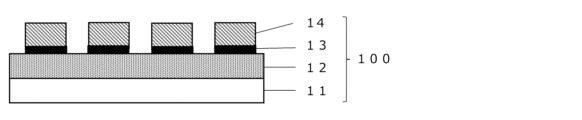
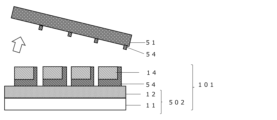
- FIG. 1A is a schematic cross-sectional view showing an example of a laminate 1.
- FIG. 1B is a schematic cross-sectional view showing an example of the laminate 1.
- FIG. 1C is a schematic cross-sectional view showing an example of the laminate 1.
- FIG. 2A is a schematic cross-sectional view showing an example of the laminate 2.
- FIG. 2B is a schematic cross-sectional view showing an example of the laminate 2.
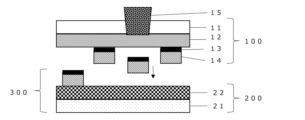
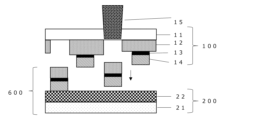
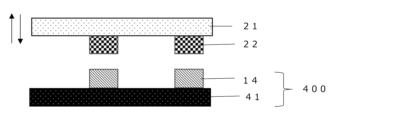
- FIG. 3A is a schematic cross-sectional view showing an example of a laminate 1 and a laminate 3, illustrating an example of the production of the laminate 3 by laser transfer.
- FIG. 3B is a schematic cross-sectional view showing an example of the laminate 1 and the laminate 4, illustrating an example of the production of the laminate 4 by laser transfer.
- FIG. 1A is a schematic cross-sectional view showing an example of a laminate 1.
- FIG. 1B is a schematic cross-sectional view showing an example of the laminate 1.
- FIG. 1B is a schematic cross-sectional view showing
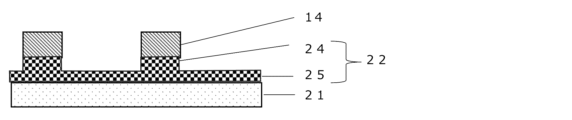
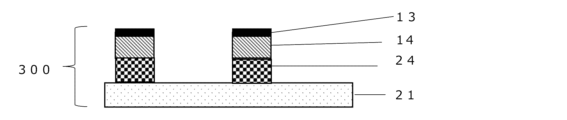
- FIG. 4A is a schematic cross-sectional view showing an example of a state in which the protective layer 1 has been removed from the laminate 3 after patterning.
- FIG. 4B is a schematic cross-sectional view showing an example of a state in which the protective layer 1 has been removed from the laminate 3 after patterning.
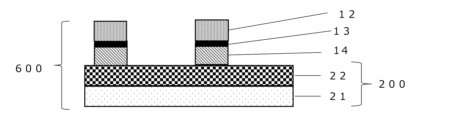
- FIG. 5 is a schematic cross-sectional view showing an example of the transfer of the semiconductor layer 1 onto a circuit board.
- FIG. 6A is a schematic cross-sectional view showing an example of a manufacturing process of a stack 0'' having a Terther structure.
- FIG. 6B is a schematic cross-sectional view showing an example of a manufacturing process of a stack 0′′ having a Terther structure.
- FIG. 6C is a schematic cross-sectional view showing an example of a manufacturing process of a stack 0'' having a Terther structure.
- FIG. 6D is a schematic cross-sectional view showing an example of a manufacturing process of a stack 0′′ having a Terther structure.
- FIG. 6E is a schematic cross-sectional view showing an example of a manufacturing process of a stack 0′′ having a Terther structure.
- FIG. 6F is a schematic cross-sectional view showing an example of a process for manufacturing a laminate 1' from a laminate 0'' having a Terther structure.
- FIG. 6G is a schematic cross-sectional view showing an example of a process for manufacturing a laminate 1' from a laminate 0" having a Terther structure.
- FIG. 7A is a schematic cross-sectional view showing an example of a process for producing a laminate 1 from a laminate 0 having a Terther structure.
- FIG. 7B is a schematic cross-sectional view showing an example of a process for producing the laminate 1 from the laminate 0 having a Terther structure.
- FIG. 8A is a schematic cross-sectional view showing an example of the laminate 4.
- FIG. 8B is a schematic cross-sectional view showing an example of a state in which the laser-absorbent temporary adhesive layer 1 has been removed from the laminate 4.
- FIG. 9A is a schematic cross-sectional view showing an example of a laminate 3 in which the adhesive layer has been patterned.
- FIG. 9B is a schematic cross-sectional view showing an example of the laminate 3 after patterning of the adhesive layer.
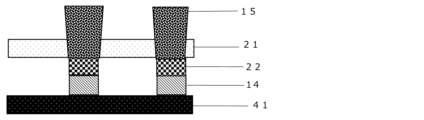
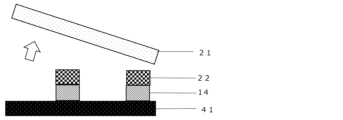
- FIG. 10A is a schematic cross-sectional view showing an example of a process for removing the supporting substrate 2 in step (VI).
- FIG. 10B is a schematic cross-sectional view showing an example of a process for removing the supporting substrate 2 in step (VI).
- FIG. 10C is a schematic cross-sectional view showing an example of a process for removing the supporting substrate 2 in step (VI).
- the "to” in a numerical range includes the numerical values before and after it.
- "0 to 100” means a range that is 0 or more and 100 or less.
- the method for producing the laminate according to this embodiment includes the steps of: A laminate 1 in which a laser-absorbent temporary adhesive layer 1, a protective layer 1, and a semiconductor layer 1 are laminated in this order on a laser-transmittable substrate 1; A laminate 2 having an adhesive layer laminated on a support substrate 2 is used.
- the laser-transmitting substrate 1 is preferably a substrate having an absorbance of 0.1 or less at at least one of the wavelengths of 248 nm, 266 nm, and 355 nm.
- Substrates having such absorbance include inorganic substrates such as quartz, sapphire, alkali glass, non-alkali glass, and borosilicate glass.
- the thickness of the substrate can be selected within a range that does not impair the absorbance, and is preferably 0.1 mm to 5.0 mm. From the viewpoint of substrate strength, the thickness of the substrate is more preferably 0.3 mm or more, and from the viewpoint of handling of the substrate, for example, the weight and the substrate thickness limit of the device, the thickness of the substrate is more preferably 2.0 mm or less.
- the thickness of the substrate can be selected within a range that does not impair the absorbance described above, and is preferably 0.05 mm to 3.0 mm. From the viewpoint of handling the substrate, a substrate thickness of 0.1 mm or more is more preferable, and a substrate thickness of 1.0 mm or less is more preferable since light scattering during laser irradiation can be suppressed.
- the laser-absorbent temporary adhesive layer 1 is a resin film that is absorptive to laser and has adhesiveness that can hold an article on the surface of the resin film.
- the laser-absorbent temporary adhesive layer 1 can be provided with the laser-absorbent property by containing an additive such as an ultraviolet absorber or a dye, a resin having laser absorbency, etc.
- the adhesiveness for holding an article in the laser-absorbent temporary adhesive layer 1 can be provided by containing a resin having adhesive properties, and may be provided together with a resin or component having laser absorbency, or a resin or component specialized for adhesiveness may be added.
- the laser-absorbent temporary adhesive layer 1 may contain a component that increases flexibility or bending, a crosslinking agent, an additive, a curing accelerator, a silane compound, etc.
- the laser-absorbent temporary adhesive layer 1 may be formed by forming a film of a solution-like resin composition that further contains a solvent.
- the laser-absorbent temporary adhesive layer 1 preferably has an absorbance of 0.4 or more and 6.0 or less when converted into a film thickness of 1.0 ⁇ m at at least one of the wavelengths of 248 nm, 266 nm, and 355 nm.
- the absorbance of 0.4 or more when a laser is irradiated from the laser-transparent substrate 1 side to the laser-absorbent temporary adhesive layer 1 side in the step (II) to transfer the semiconductor element to the opposing substrate (also called laser lift-off (LLO)), the irradiated laser can be absorbed intensively by the laser-absorbent temporary adhesive layer 1, and the semiconductor element can be efficiently transferred.
- the absorbance is more preferably 0.6 or more. From the viewpoint of material design, the absorbance is preferably 6.0 or less, more preferably 5.0 or less, and even more preferably 4.0 or less because a versatile resin can be used.
- the thickness of the laser-absorbent temporary adhesive layer 1 is preferably 1.0 ⁇ m to 15 ⁇ m, more preferably 3.0 ⁇ m to 10 ⁇ m.
- the laser-absorbent temporary adhesive layer 1 has a thickness of 1.0 ⁇ m or more, the laser is completely absorbed by the laser-absorbent temporary adhesive layer 1, and it is possible to prevent the protective layer 1 and the semiconductor layer 1 from being directly ablated by the laser and being damaged.
- the laser-absorbent temporary adhesive layer 1 has a thickness of 15 ⁇ m or less, the force generated by the laser irradiation is sufficiently transmitted to the semiconductor layer 1, and the yield of the laser transfer is improved.
- the laser-absorbent temporary adhesive layer 1 When the laser-absorbent temporary adhesive layer 1 has a thickness of 3.0 ⁇ m or more, the laser-absorbent temporary adhesive layer 1 absorbs excessive impact caused by the laser irradiation, and damage to the semiconductor layer 1 can be prevented. In addition, when the laser-absorbent temporary adhesive layer 1 has a thickness of 10 ⁇ m or less, it is possible to transfer the semiconductor layer 1 with good positional accuracy. The thickness of the laser-absorbent temporary adhesive layer 1 can be measured by cutting a laminate including this layer and observing the cross section with a scanning electron microscope.
- Resins contained in the laser-absorbing temporary adhesive layer 1 include, but are not limited to, polyimide-based resins such as polyimide, polyimide precursor, polybenzoxazole, and polybenzoxazole precursor, urethane resin, novolac resin, polyhydroxystyrene, polyester resin, acrylic resin, aramid resin, polysiloxane, and polyimidesiloxane.
- the laser-absorbent temporary adhesive layer 1 preferably contains the above resin in an amount of 10 to 100% by mass.
- the layer contains an acrylic resin, a polysiloxane, or a polyimide siloxane.
- these resins have a conjugated structure in the structure.
- the absorbance of the laser-absorbent temporary adhesive layer 1 at at least one of the wavelengths of 248 nm, 266 nm, and 355 nm converted into a film thickness of 1.0 ⁇ m can be adjusted to a range of 0.4 to 6.0.
- structures having a conjugated structure include aromatic structures, and among them, it is preferable to have at least one structure of biphenyl, imide, benzoxazole, and benzophenone.
- the above absorbance can be achieved by making 60 mol % or more of the monomer residues in the resin contained in the laser-absorbent temporary adhesive layer 1 a monomer residue having a conjugated structure, relative to 100 mol % of all monomer residues. Only one type of these resins may be contained in the laser-absorbent temporary adhesive layer 1, or multiple types may be contained.
- the resin contained in the laser-absorbing temporary adhesive layer 1 is preferably a polyimide having a structure of the following formula (1), a polyimide precursor having a structure of the following formula (2), a polybenzoxazole having a structure of the following formula (3), a polybenzoxazole precursor having a structure of the following formula (4), and a copolymer thereof.
- the resin preferably contains one or more types of resin (X) having a structure selected from the group consisting of these. From the viewpoint of temporary adhesion, it is preferable that the resin (X) is contained in an amount of 10 to 100% by mass in the laser-absorbent temporary adhesive layer 1.
- temporary adhesion refers to a state in which an article is temporarily held on the surface of the laser-absorbent temporary adhesive layer 1 by the adhesiveness of the laser-absorbent temporary adhesive layer 1. At this time, the held article is characterized in that it can be finally detached from the surface of the laser-absorbent temporary adhesive layer 1 using a peeling method such as laser irradiation described later.
- R 1 , R 3 , R 7 and R 9 each independently represent a tetravalent organic group having 6 to 40 carbon atoms
- R 2 , R 4 , R 6 and R 8 each independently represent a divalent organic group having 2 to 40 carbon atoms
- R 5 represents a hydrogen atom or a monovalent organic group having 1 to 20 carbon atoms.
- Polyimide and polybenzoxazole are resins having a cyclic structure of an imide ring or an oxazole ring within the main chain structure.
- Their precursors, polyimide precursor and polybenzoxazole precursor are resins that form an imide ring or a benzoxazole ring structure by dehydration and ring closure. It is preferable that one or more structures selected from the group consisting of formulas (1) to (4) above are contained as repeating units in one molecule of resin (X) in an amount of 10 to 100,000. Within this range, the laser-absorbent temporary adhesive layer 1 can be applied with an appropriate film thickness.
- Polyimides can be obtained by reacting tetracarboxylic acids, corresponding tetracarboxylic dianhydrides, tetracarboxylic diester dichlorides, etc. with diamines, corresponding diisocyanate compounds, trimethylsilylated diamines, etc., and preferably have tetracarboxylic acid residues and diamine residues.
- polyamic acid which is one of the polyimide precursors obtained by reacting tetracarboxylic dianhydrides with diamines, can be obtained by dehydrating and ring-closing the polyimide by heat treatment.
- polyimides can be obtained by adding a ring-closing catalyst, such as a dehydrating condensing agent such as a carboxylic anhydride or dicyclohexylcarbodiimide, or a base such as triethylamine, and dehydrating and ring-closing the polyimide by chemical heat treatment.
- a ring-closing catalyst such as a dehydrating condensing agent such as a carboxylic anhydride or dicyclohexylcarbodiimide, or a base such as triethylamine
- polyimides can be obtained by adding a weakly acidic carboxylic acid compound and dehydrating and ring-closing the polyimide by heat treatment at a low temperature of 100°C or less.
- Polybenzoxazole can be obtained by reacting a bisaminophenol compound with a dicarboxylic acid, the corresponding dicarboxylic acid chloride, a dicarboxylic acid activated ester, or the like, and preferably has a dicarboxylic acid residue and a bisaminophenol residue.
- it can be obtained by dehydrating and ring-closing polyhydroxyamide, which is one of the polybenzoxazole precursors obtained by reacting a bisaminophenol compound with a dicarboxylic acid, through a heat treatment.
- it can be obtained by adding phosphoric anhydride, a base, a carbodiimide compound, or the like, and dehydrating and ring-closing through a chemical treatment.
- R 1 and R 3 (COOR 5 ) 2 preferably represent a tetracarboxylic acid residue.
- the tetracarboxylic acid residue constituting R 1 or R 3 (COOR 5 ) 2 include aromatic tetracarboxylic acid residues such as pyromellitic acid, 3,3',4,4'-biphenyltetracarboxylic acid, 3,3',4,4'-benzophenonetetracarboxylic acid, 2,2-bis(3,4-dicarboxyphenyl)hexafluoropropane, bis(3,4-dicarboxyphenyl)sulfone, and bis(3,4-dicarboxyphenyl)ether, and aliphatic tetracarboxylic acid residues such as 1,2,3,4-cyclopentanetetracarboxylic acid. Two or more of these tetracarboxylic acid residues may be contained.
- the tetracarboxylic acid residues may be contained.
- R2 and R4 preferably represent a diamine derivative residue.
- diamine derivative residues constituting 4 include hydroxyl group-containing diamine residues such as 2,2-bis(3-amino-4-hydroxyphenyl)hexafluoropropane, bis(3-amino-4-hydroxyphenyl)sulfone, and 2,2-bis(3-amino-4-hydroxyphenyl)propane; sulfonic acid group-containing diamine residues such as 3-sulfonic acid-4,4'-diaminodiphenyl ether; thiol group-containing diamine residues such as dimercaptophenylenediamine; aromatic diamine residues such as 3,4'-diaminodiphenyl ether, 3,4'-diaminodiphenyl sulfone, p-phenylenediamine, and 2,2'-bis(trifluoromethyl)-4,4'-diaminobiphenyl; compounds
- R5 represents a hydrogen atom or a monovalent organic group having 1 to 20 carbon atoms.
- the organic group having 1 to 20 carbon atoms include a methyl group, an ethyl group, a propyl group, an isopropyl group, a butyl group, a pentyl group, a hexyl group, a cyclohexyl group, an octyl group, a dodecyl group, and a phenyl group.
- a methyl group or an ethyl group is preferred.
- R6 and R8 preferably represent a dicarboxylic acid residue, a tricarboxylic acid residue, or a tetracarboxylic acid residue.
- dicarboxylic acid residues include residues of terephthalic acid, isophthalic acid, diphenyl ether dicarboxylic acid, bis(carboxyphenyl)hexafluoropropane, biphenyl dicarboxylic acid, benzophenone dicarboxylic acid, triphenyl dicarboxylic acid, etc.
- Examples of tricarboxylic acid residues include residues of trimellitic acid, trimesic acid, diphenyl ether tricarboxylic acid, biphenyl tricarboxylic acid, etc.
- Examples of tetracarboxylic acid residues are the same as the examples of tetracarboxylic acid residues given as examples of R1 and R3 ( COOR5 ) 2 . Two or more of these may be used.
- R 7 and R 9 (OH) 2 preferably represent a bisaminophenol derivative residue.
- the bisaminophenol derivative residue include residues of bis(3-amino-4-hydroxyphenyl)propane, bis(3-amino-4-hydroxyphenyl)sulfone, 2,2-bis(3-amino-4-hydroxyphenyl)-1,1,1,3,3,3-hexafluoropropane, 2,2-bis(4-amino-3-hydroxyphenyl)-1,1,1,3,3,3-hexafluoropropane, etc., but are not limited thereto. These compounds may be contained alone or in combination of two or more kinds.
- Preferred examples of such monoamines include 2-aminophenol, 3-aminophenol, 4-aminophenol, etc. Two or more of these may be used.
- Preferred examples of such acid anhydrides, acid chlorides, and monocarboxylic acids include known ones such as phthalic anhydride, maleic anhydride, and nadic anhydride.
- di-tert-butyl dicarbonate is also preferably used. Two or more of these may be used.
- the aforementioned resin (X) preferably has one or more structures selected from the group consisting of a dimethylsiloxane structure represented by formula (5), a diphenylsiloxane structure represented by formula (6), an alkylene glycol structure represented by formula (7), and an alkylene structure represented by formula (8).
- a dimethylsiloxane structure represented by formula (5) a dimethylsiloxane structure represented by formula (6)
- an alkylene glycol structure represented by formula (7) an alkylene structure represented by formula (8).
- R 10 to R 13 each independently represent a hydrogen atom or a monovalent organic group having 1 to 20 carbon atoms.
- l, m, and n each independently represent an integer of 4 to 40.
- p represents an integer of 10 to 40.
- o represents an integer of 1 to 16.
- R 10 to R 13 are the same as those described for R 5 .
- aliphatic diamine residues such as diamine residues containing polyethylene oxide groups, such as Jeffamine (registered trademark) KH-511, Jeffamine (registered trademark) ED-600, Jeffamine (registered trademark) ED-900, and polyoxypropylene diamines D-400 and D-2000 (manufactured by Huntsman Japan Co., Ltd.); diamine residues having polyalkylene oxide groups, such as Elasmer (registered trademark) 250P, Elasmer (registered trademark) 1000P, and Porea (registered trademark) SL100A (manufactured by Kumiai Chemical Industry Co., Ltd.); and siloxane diamine residues, such as propylamine-terminated siloxane diamines LP-7100, KF-8010, KF-8012, and X22-161A (manufact
- the resin (X) is a polyimide siloxane.
- a polyimide siloxane is a resin having a siloxane structure in the repeating structure of a polyimide, and it is particularly preferable that the polyimide siloxane of the resin (X) has a siloxane diamine residue represented by formula (9) in the structure.
- R 14 and R 15 may be the same or different and each represents an alkylene group or a phenylene group having 1 to 30 carbon atoms.
- R 16 to R 19 may be the same or different and each represents an alkyl group, a phenyl group, or a phenoxy group having 1 to 30 carbon atoms.
- the siloxane diamine residue represented by the above formula (9) includes those derived from the following diamines. Specific examples include residues of ⁇ , ⁇ -bis(3-aminopropyl)polydimethylsiloxane, ⁇ , ⁇ -bis(3-aminopropyl)polydiphenoxysiloxane, ⁇ , ⁇ -bis(4-aminophenyl)polydimethylsiloxane, and ⁇ , ⁇ -bis(4-aminophenyl)polydiphenoxysiloxane. Only one type of the above siloxane diamine residue may be contained, or two or more types may be contained. Polyimide siloxanes are characterized by high adhesive strength and high absorbance derived from polyimide, and can particularly increase absorbance at 355 nm.
- the 1% mass reduction temperature of at least one of the resins contained in the laser-absorbent temporary adhesive layer 1 is 300°C or higher, and it is more preferable that the 1% mass reduction temperature of all the resins contained in the laser-absorbent temporary adhesive layer 1 is 300°C or higher.
- the 1% mass reduction temperature is defined as the temperature at which the mass at 100°C is reduced by 1% when the resin is heated at 250°C for 30 minutes and then heated at 10°C/min under nitrogen using thermogravimetric analysis (TGA).
- TGA thermogravimetric analysis
- the mass at 100°C is defined as 100%. It can also be confirmed from the resin that has already been heat-treated by further heat-treating it at 250°C for 30 minutes.
- the resin contains a component with high thermal stability.
- Specific components with high thermal stability include rigid components such as aromatic rings, siloxanes that have relatively high thermal stability even among flexible structures, or combinations of these.
- the 1% mass loss temperature can be set to 300°C or higher by having 50% or more of the monomer residues with high thermal stability described above out of 100 mol% of all monomer residues constituting the resin contained in the laser-absorbing temporary adhesive layer 1. From the viewpoint of versatility of the resin, it is preferable that the 1% mass loss temperature is 600°C or lower.
- the above absorbance can also be achieved by incorporating additives such as ultraviolet absorbers and dyes into the laser-absorbent temporary adhesive layer 1.
- additives such as ultraviolet absorbers and dyes into the laser-absorbent temporary adhesive layer 1.
- ultraviolet absorbers such as Tinuvin (registered trademark) PS (manufactured by BASF Japan Ltd.), DAINSORB (registered trademark) T-0, DAINSORB (registered trademark) T-7, etc. (manufactured by Daiwa Kasei Co., Ltd.), and dyes such as Solvent Yellow 93 (manufactured by Tokyo Chemical Industry Co., Ltd.).
- additives may be contained in the laser-absorbent temporary adhesive layer 1 in one type or in multiple types.
- the content of the additives to bring the absorbance into the above range is preferably 0.1 parts by mass or more per 100 parts by mass of the entire laser-absorbent temporary adhesive layer 1, and is preferably 70 parts by mass or less from the viewpoint of stability in the varnish state before forming the laminate.
- the laser-absorbent temporary adhesive layer 1 preferably has an adhesive strength of 0.02 N/cm or more and 0.3 N/cm or less at the interface with the adjacent photoresist or protective layer 1 described later.
- the adhesive strength mentioned here indicates a value obtained by removing the structure in which the photoresist, protective layer 1 and semiconductor layer 1 are laminated from the laminate 1, and performing a 90° peel test on the exposed surface of the laser-absorbent temporary adhesive layer 1 and the polyimide film.
- the laminate 1 does not contain photoresist, the value obtained by removing the structure in which the protective layer 1 and the semiconductor layer 1 are laminated from the laminate 1 and performing the above-mentioned 90° peel test is indicated.
- a specific measurement method is to bond a polyimide film, Kapton (registered trademark) 100EN (manufactured by DuPont-Toray Co., Ltd.), cut to 1 cm x 9 cm, to the laser-absorbent temporary adhesive layer 1 using a vacuum laminator at 0.1 MPa and 25°C, and then perform a peel test on the bonded polyimide film in a direction perpendicular to the laser-absorbent temporary adhesive layer 1 at a constant speed of 2 mm/sec using a tensile tester.
- Kapton registered trademark
- 100EN manufactured by DuPont-Toray Co., Ltd.
- the adhesive strength is 0.02 N/cm or more
- the structure in which the protective layer 1 and the semiconductor layer 1 are laminated can be stably held on the laser-absorbent temporary adhesive layer 1.
- the adhesive strength is 0.3 N/cm or less
- the structure in which the protective layer 1 and the semiconductor layer 1 are laminated can be transferred to the laminate 2 described below by low-energy laser irradiation. More preferably, the adhesive strength is 0.2 N/cm or less, at which time the laser irradiation energy during the transfer can be further suppressed, and the risk of damage to the semiconductor element can be reduced.
- the laser-absorbent temporary adhesive layer 1 contains a component that increases flexibility and flexibility.
- a component that increases flexibility and flexibility By introducing a component that increases flexibility and flexibility, the glass transition temperature is lowered and the adhesive strength can be increased.
- components that increase flexibility and flexibility include flexible structures derived from aliphatic groups such as alkylene groups and siloxanes, and silanes; flexible structures derived from ether groups such as alkylene glycols and biphenyl ethers; alicyclic structures, and flexible structures such as olefins.
- the adhesive strength can be set to 0.02 N/cm or more, and by setting the monomer residues to 70 mol% or less, the adhesive strength can be set to 0.3 N/cm or less.
- crosslinking agents that may be contained in the laser-absorbent temporary adhesive layer 1 include compounds having an alkoxymethyl group or a methylol group, such as NIKALAC (registered trademark) and MW-100LM (manufactured by Sanwa Chemical Co., Ltd.).
- a compound having an epoxy group is also preferred, and examples thereof include bisphenol A type epoxy resin, bisphenol F type epoxy resin, epoxy group-containing silicone such as propylene glycol diglycidyl ether, polypropylene glycol diglycidyl ether, polymethyl(glycidyloxypropyl)siloxane, and dimer acid modified epoxy resin, but the crosslinking agent used in this embodiment is not limited to these.
- Specific examples include JER (registered trademark) 871 (manufactured by Mitsubishi Chemical Corporation), Showfree (registered trademark) PETG (Resonac Co., Ltd.), and the like.
- crosslinking agent Only one type of crosslinking agent may be contained, or two or more types may be contained in the laser-absorbent temporary adhesive layer 1.
- the crosslinking agent is preferably contained in an amount of 1 to 30 parts by mass per 100 parts by mass of the laser-absorbent temporary adhesive layer 1.
- a crosslinking agent preferably at least 1 part by mass in 100 parts by mass of the laser-absorbent temporary adhesive layer 1
- adhesive residue can be reduced.
- a high adhesive residue suppression effect can be obtained.
- the crosslinking agent is preferably contained at 30 parts by mass or less in 100 parts by mass of the laser-absorbent temporary adhesive layer 1. Within this range, a certain degree of flexibility is maintained in the laser-absorbent temporary adhesive layer 1. In addition, from the viewpoint of storage stability in the varnish state before forming the laminate, the crosslinking agent is more preferably contained at 20 parts by mass or less in 100 parts by mass of the laser-absorbent temporary adhesive layer 1.
- the laser-absorbent temporary adhesive layer 1 may also contain a curing accelerator for the purpose of promoting curing by the crosslinking agent.
- a curing accelerator examples include imidazoles, tertiary amines or their salts, and organic boron salt compounds, among which imidazoles are preferred.
- imidazoles include imidazole, 1,2-dimethylimidazole, 2-ethyl-4-methylimidazole, 2-phenyl-1H-imidazole, 2,4-diamino-6-[2'-ethyl-4-methylimidazolyl-(1')]-ethyl-s-triazine, and 2-methylimidazole isocyanuric acid adduct.
- Preferred commercially available imidazoles include Curesol (registered trademark) 2E4MZ and Curesol (registered trademark) 2E4MZ-CN (manufactured by Shikoku Chemical Industry Co., Ltd.).
- the preferred content of the curing accelerator is 0.1 parts by mass or more and 5.0 parts by mass or less per 100 parts by mass of the crosslinking agent. This range ensures a sufficient crosslinking promotion effect. Furthermore, from the viewpoint of maintaining the stability of the varnish in its state before the laminate 1 is formed, the content of the curing accelerator is more preferably 0.5 parts by mass or more and 2.0 parts by mass or less per 100 parts by mass of the crosslinking agent.
- the laser-absorbent temporary adhesive layer 1 may further contain a silane compound, if necessary.
- a silane compound By containing a silane compound, the adhesion between the laser-absorbent temporary adhesive layer 1 and the laser-transparent substrate 1 can be adjusted. This makes it possible to prevent the laser-unirradiated portion of the laser-absorbent temporary adhesive layer 1 from peeling off from the laser-transparent substrate 1.
- silane compounds include N-phenylaminoethyltriethoxysilane, vinyltriethoxysilane, 3-methacryloxypropyltrimethoxysilane, and p-styryltrimethoxysilane.
- the content of the silane compound is preferably 0.01 parts by mass or more and 15 parts by mass or less, relative to 100 parts by mass of the laser-absorbent temporary adhesive layer 1.
- the laser-absorbent temporary adhesive layer 1 may contain a surfactant, if necessary, for the purpose of improving wettability with the laser-transmitting substrate 1 during film formation and forming a laser-absorbent temporary adhesive layer 1 with a uniform film thickness.
- the laser-absorbent temporary adhesive layer 1 has a structure of two or more layers including the laser absorbing layer 1 and the temporary adhesive layer 2. In this case, it is preferable that the laser absorbing layer 1 does not have adhesiveness. At this time, as shown in FIG.
- the laminate 1 (reference number 100) is a laminate in this order of the laser absorbing layer 1 (reference number 17) and the laser absorbing temporary adhesive layer 2 (reference number 16) including the laser absorbing layer 1 (reference number 12), the protective layer 1 (reference number 13), and the semiconductor layer 1 (reference number 14) on the laser-transmitting substrate 1 (reference number 11).
- the thickness of the laser absorbing layer 1 is preferably 0.1 ⁇ m to 5 ⁇ m, preferably 0.1 ⁇ m or more, more preferably 0.3 ⁇ m or more, and preferably 5 ⁇ m or less, more preferably 3 ⁇ m or less.
- the thickness of the temporary adhesive layer 2 is preferably 0.1 ⁇ m to 10 ⁇ m, preferably 0.1 ⁇ m or more, more preferably 0.3 ⁇ m or more, and preferably 10 ⁇ m or less, more preferably 5 ⁇ m or less.
- the total thickness of the laser absorption layer 1 and the temporary adhesive layer 2 is preferably 1.0 ⁇ m or more and 15 ⁇ m or less.
- the thicknesses of the laser absorbing layer 1 and the temporary adhesive layer 2 can be measured by cutting a laminate including these layers and observing the cross section with a scanning electron microscope.
- the laser absorbing layer 1 is an inorganic film or an organic film.
- the laser absorbing layer 1 preferably has an absorbance of 0.4 or more and 6.0 or less in terms of a film thickness of 1.0 ⁇ m at at least one of the wavelengths of 248 nm, 266 nm, and 355 nm.
- the absorbance is 0.4 or more, when the semiconductor layer 1 is transferred to the opposing substrate by irradiating the laser from the laser transparent substrate 1 side to the laser absorbing layer 1 side in the above step (II), the irradiated laser can be absorbed intensively by the laser absorbing layer 1, and the semiconductor layer 1 can be efficiently transferred.
- the absorbance is more preferably 0.6 or more. From the viewpoint of material design, the absorbance is preferably 6.0 or less, and more preferably 5.0 or less since a versatile inorganic film or organic film can be used.
- polyimide, polyimide precursor, polybenzoxazole, polybenzoxazole precursor, urethane resin, novolac resin, polyhydroxystyrene, polyester resin, acrylic resin, aramid resin, etc. can be suitably used. These may also be contained in the temporary adhesive layer 2.
- inorganic film contained in the laser absorption layer for example, one or more types of inorganic material selected from the group consisting of metals, metal compounds, and carbon can be suitably used.
- the metal is preferably at least one selected from the group consisting of gold, silver, copper, iron, nickel, aluminum, titanium, chromium, and alloys thereof.
- the alloy is preferably silver-tin.
- a metal compound refers to a compound that contains a metal atom, and can be, for example, a metal oxide or a metal nitride.
- the term "carbon" is a concept that may include allotropes of carbon, such as diamond, fullerene, diamond-like carbon, and carbon nanotubes.
- inorganic substances include, but are not limited to, one or more inorganic substances selected from the group consisting of metals such as gold, platinum, palladium, cobalt, rhodium, iridium, calcium, ruthenium, osmium, manganese, molybdenum, tungsten, niobium, tantalum, bismuth, antimony, lead, silver, copper, iron, nickel, aluminum, titanium, chromium, tin, and alloys thereof; metal compounds such as SiO2 , SiN, Si3N4 , and TiN ; and carbon.
- metals such as gold, platinum, palladium, cobalt, rhodium, iridium, calcium, ruthenium, osmium, manganese, molybdenum, tungsten, niobium, tantalum, bismuth, antimony, lead, silver, copper, iron, nickel, aluminum, titanium, chromium, tin, and alloys thereof; metal compounds
- the organic film has a conjugated structure, so that the absorbance of the laser absorbing layer 1 at a film thickness of 1.0 ⁇ m at at least one of the wavelengths of 248 nm, 266 nm, and 355 nm can be adjusted to a range of 0.4 to 6.0.
- structures having a conjugated structure include aromatic structures, and among them, it is preferable to have at least one structure of biphenyl, imide, benzoxazole, and benzophenone.
- the absorbance can be adjusted to the above range by making 60 mol % or more of the monomer residues have a conjugated structure relative to 100 mol % of all monomer residues of the resin contained in the laser absorbing layer 1. Only one type of these resins may be contained in the laser absorbing layer 1, or multiple types may be contained.
- the above absorbance can also be achieved by including additives such as ultraviolet absorbers and dyes.
- additives such as ultraviolet absorbers and dyes.
- additives that may be included in the laser absorption layer 1 include ultraviolet absorbers such as Tinuvin (registered trademark) 477, Tinuvin (registered trademark) 479 (manufactured by BASF Japan Ltd.), Tinuvin (registered trademark) 400, and DAINSORB (registered trademark, manufactured by Daiwa Kasei Co., Ltd.), and dyes such as Violet 36 (manufactured by Tokyo Chemical Industry Co., Ltd.).
- additives may be contained in the laser absorbing layer 1 in the form of one type or in the form of multiple types.
- the content of the additives to bring the absorbance into the above range is preferably 0.1 parts by mass or more per 100 parts by mass of the laser absorbing layer 1, and is preferably 50 parts by mass or less from the viewpoint of stability in the varnish state before forming the laminate.
- the laser absorbing layer 1 may further contain a silane compound, if necessary.
- a silane compound By containing a silane compound, the adhesion between the laser absorbing layer 1 and the laser-transmitting substrate 1 can be adjusted. This makes it possible to prevent the laser absorbing layer 1 in the non-laser-irradiated portion from peeling off from the laser-transmitting substrate 1.
- silane compounds include the silane compounds exemplified as those that can be contained in the laser-absorbing temporary adhesive layer 1, and an equivalent content is preferable.
- the laser absorbing layer 1 may contain a surfactant for the purpose of improving wettability with the laser-transmitting substrate 1 during deposition and forming a laser absorbing layer 1 with a uniform thickness. It is preferable that the laser absorbing layer 1 does not have pressure-sensitive adhesive properties, and when the laser absorbing layer 1 moves toward the supporting substrate 2 together with the semiconductor layer 1 etc. after the LLO in step (II), it is preferable that it can be easily removed from the supporting substrate 2.
- the temporary adhesive layer 2 may be a layer having the same composition and physical properties as the laser-absorbent temporary adhesive layer 1 defined above, a layer not having laser absorbing properties, or a layer having the same composition and physical properties as the adhesive layer described below.
- the temporary adhesive layer 2 contains a resin (X)
- the resin (X) contains the structure of the above formula (9).
- the temporary adhesive layer 2 is a layer having the same composition and physical properties as the adhesive layer described below.
- the semiconductor layer 1 preferably includes an epitaxially grown crystal film.
- the epitaxially grown crystal film is preferably made of a compound semiconductor, particularly a III-V group compound semiconductor.
- the epitaxially grown crystal film is preferably made of a compound semiconductor such as AlGaInAs, InGaAs, InP, InGaAsP, AlAs, InAs, GaAs, AlN, AlP, GaN, InN, SiC, or AlGaS.
- the semiconductor element using these epitaxially grown crystal films may contain only one type of compound semiconductor, or may contain two or more types of compound semiconductors, or may further contain different types of semiconductors stacked, or may have a semiconductor base material, an electrode material, a sapphire substrate, a glass substrate, wiring, or the like stacked.
- the size of the semiconductor layer 1 is preferably 5 ⁇ m or more and 5.0 mm or less, more preferably 1.0 mm or less, in terms of the maximum side.
- the thickness of the epitaxially grown crystal film is preferably 0.005 ⁇ m or more and 10 ⁇ m or less.
- the thickness of the epitaxially grown crystal film is less than 0.005 ⁇ m, there is a risk of damage during transfer, and if it exceeds 10 ⁇ m, it takes a huge amount of time to form the epitaxially grown crystal film, which is not practical.
- the size of the epitaxially grown crystal film can be adjusted, for example, by the method described in Non-Patent Document 2 (Jing Zhang et al., III-V-on-Si photonic integrated circuits realized using micro-transfer-printing, APL Photon., 2019, 4, 110803).
- the laminate 1 preferably has a photoresist between the laser-absorbent temporary adhesive layer 1 and the protective layer 1.
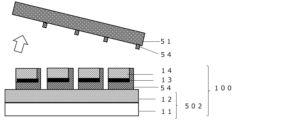
- the laminate 1 (reference number 100) is a laminate in which a laser-absorbent temporary adhesive layer 1 (reference number 12), a photoresist layer (reference number 54), a protective layer 1 (reference number 13), and a semiconductor layer 1 (reference number 14) are laminated on a laser-transmitting substrate 1 (reference number 11).
- Photoresist is a material that has photosensitivity and can be patterned by imagewise exposure and development to form an image layer on the surface, and contains a photosensitive agent and a resin. It can be applied to both positive and negative types.
- Non-Patent Document 2 Jing Zhang et al., III-V-on-Si photonic integrated circuits realized using micro-transfer-printing, APL Photon., 2019, 4, 110803 describes the use of photoresist as "Tether" to hold the wafer and the epitaxially grown crystal film in the air.
- the photoresist is also applied as Tether. This photoresist can also be used as the protective layer 1 itself.
- the protective layer 1 is a layer formed adjacent to the semiconductor layer 1 in order to protect the semiconductor layer 1.
- the semiconductor layer 1, which may include an epitaxially grown crystal film, is formed on the semiconductor wafer, and then the protective layer 1 is formed.
- the protective layer 1 may be an organic film or an inorganic film. Examples of the organic film include the above-mentioned photoresist and soluble polyimide resin, and a photoresist is preferable in order to easily form the laminate 1, and is also preferable because it can be used as the above-mentioned Tether.
- the inorganic film may be a film formed by vapor phase growth or a film formed by a coating method.
- the protective layer 1 is preferably at least one of an oxide film and a nitride film from the viewpoint of ease of film formation, and is more preferably a layer containing at least one of silicon oxide and silicon nitride from the viewpoint of workability when partially removing the adhesive layer described later, and is particularly preferably silicon dioxide (SiO 2 ).
- the thickness of the protective layer 1 is preferably 0.1 ⁇ m or more and less than 5 ⁇ m, preferably 0.1 ⁇ m or more, and more preferably 0.3 ⁇ m or more.
- the thickness of the protective layer 1 is 0.1 ⁇ m or more, it becomes easier to obtain the effect of preventing damage to the semiconductor layer 1 when a layer including the semiconductor layer 1 is laminated on the laser-absorbent temporary adhesive layer 1.
- the thickness of the protective layer 1 is 0.3 ⁇ m or more, the effect of suppressing damage to the semiconductor layer 1 when the semiconductor layer 1 is laser-transferred from the laminate 1 to the laminate 2 is enhanced.
- the thickness of the protective layer 1 is preferably thinner than 5 ⁇ m, and the time required for film formation can be shortened, especially when the protective layer 1 is an inorganic film.
- the protective layer 1 When the protective layer 1 is prepared as an inorganic film, it can be manufactured by a known method such as CVD technology.
- the number of the small pieces of the semiconductor layer 1 mounted on the laminate 1 of this embodiment is preferably 5 pieces/cm 2 to 50,000 pieces/cm 2 , preferably 5 pieces/cm 2 or more, and more preferably 10 pieces/cm 2 or more.
- the number of the semiconductor layer 1 5 pieces/cm 2 or more, the effect of improving the throughput by using the laser transfer becomes large.
- the number of the small pieces of the semiconductor layer 1 mounted on the laminate 1 of this embodiment is preferably 50,000 pieces/cm 2 or less, and more preferably 10,000 pieces/cm 2 or less.
- the laminate 1 of this embodiment may have another layer between the laser-absorbent temporary adhesive layer 1, the protective layer 1, and the semiconductor layer 1, so long as they are laminated in this order on the laser-transmissive substrate 1.
- the laminate 1 preferably has the above-mentioned photoresist between the laser-absorbent temporary adhesive layer 1 and the protective layer 1.
- the protective layer 1 is formed adjacent to the semiconductor layer 1, and the laser-transmissive substrate 1 and the semiconductor layer 1 are located on the outermost surface of the laminate 1.
- the laminate 1 can be formed by forming a laser-absorbent temporary adhesive layer 1 on a laser-transmissive substrate 1, and then pressing the laser-absorbent temporary adhesive layer 1 and the semiconductor layer 1 with the protective layer 1 described above together.
- a varnish in which the material components of the laser-absorbent temporary adhesive layer 1 are dissolved in a solvent is applied onto the laser-transmitting substrate 1, and the varnish is heated and cured to produce the laser-absorbent temporary adhesive layer 1.
- a laminate having one layer of the laser-absorbent temporary adhesive layer 1 on the laser-transmitting substrate 1 is hereinafter referred to as a laminate ⁇ .
- any coating method can be selected, and methods such as spin coating using a spinner, spray coating, roll coating, and slit die coating can be mentioned.
- the laser-absorbent temporary adhesive layer 1 after coating is preferably dried for 1 minute to several tens of minutes at a range of 50°C to 150°C using a hot plate, a drying oven, infrared rays, etc. Then, if necessary, the layer is heated and cured for several minutes to several hours at a range of 100°C to 500°C.
- the thickness of the laser-absorbent temporary adhesive layer 1 at this time is preferably 1.0 ⁇ m or more and 30 ⁇ m or less. The thickness can be measured using a scanning electron microscope, an optical thickness gauge, a step gauge, etc.
- the laser absorbing layer 1 and the temporary adhesive layer 2 can be manufactured using a varnish in which the material components of the laser absorbing layer 1 are dissolved in a solvent, and a varnish in which the material components of the temporary adhesive layer 2 are dissolved in a solvent, respectively, in the same manner as for the laser-absorbent temporary adhesive layer 1.
- a laminate having the laser-absorbent temporary adhesive layer 1 consisting of two layers, the laser absorbing layer 1 and the temporary adhesive layer 2, on the laser-transmitting substrate 1 in this manner is hereinafter referred to as a laminate ⁇ .
- the semiconductor layer 1 with protective layer 1 can be directly arranged and laminated on the laser-absorbent temporary adhesive layer 1 or temporary adhesive layer 2 on the laminate ⁇ or ⁇ using a mounter or flip chip mounting machine, but if necessary, it can also be pressed with a vacuum laminator, wafer bonder, or press machine.
- Non-Patent Document 2 Jing Zhang et al., III-V-on-Si photonic integrated circuits realized using micro-transfer-printing, APL Photon., 2019, 4, 110803
- This lamination method will be described with reference to Figures 6A, 6B, 6C, 6D, 6E, 6F, and 6G.
- a sacrificial layer (52) and a semiconductor layer 1 (14) are formed in this order on a semiconductor wafer (51) (FIG. 6A), the semiconductor layer 1 (14) and the sacrificial layer (52) are divided into small pieces (FIG.
- a photoresist layer (54) is formed to cover the small pieces consisting of the semiconductor layer 1 (14) and the sacrificial layer (52) (FIG. 6C).
- the photoresist layer (54) is partially patterned so that the sacrificial layer can be removed (FIG. 6D).
- the sacrificial layer (reference number 52) is removed with a chemical solution, and the photoresist layer (reference number 54) is used as a tertiary layer to form a laminate 0′′ (reference number 501) which is a bridge structure in which the semiconductor layer 1 (reference number 14) and the semiconductor wafer (reference number 51) are connected by a hollow space (reference number 55) (FIG. 6E).
- the laminate ⁇ may be used instead of the laminate ⁇ .
- the bridge structure of the photoresist is broken and separated, and the laminate 1' in which the photoresist and the semiconductor layer 1 are laminated in this order on the laminate ⁇ is obtained.
- a sacrificial layer (52), a semiconductor layer 1 (14), and a protective layer 1 (13) are formed in that order on a semiconductor wafer (51), and the semiconductor layer 1 (14), the sacrificial layer (52), and the protective layer 1 (13) are divided into small pieces.
- a photoresist layer (54) is formed to cover the small pieces consisting of the semiconductor layer 1 (14), the sacrificial layer (52), and the protective layer 1 (13), and the laminate 0 (503), which is a bridge structure prior to obtaining the laminate 1 of the present invention, can be produced by the same method as described above, as shown in Figures 7A and 7B ( Figure 7A).
- laminate 0 (503) is used to press the photoresist layer (54) side of laminate 0 (503), which is the bridge structure, onto the laser-absorbent temporary adhesive layer 1 (12) side of laminate ⁇ (502). This breaks the bridge structure of the photoresist layer (54), separating the bridge structure of the photoresist layer (54) from the semiconductor wafer (51). This gives laminate 1 (100) in which the photoresist layer (54), protective layer 1 (13), and semiconductor layer 1 (14) are stacked in this order on laminate ⁇ (502) (FIG. 7B).
- the protective layer 1 can be used as a mask for dry etching.
- the protective layer 1 is a photoresist, the selectivity of the dry etching rate will be insufficient, so it is preferable that the protective layer 1 contains an inorganic film that has a dry etching selectivity with the adhesive layer.
- the inorganic film is preferably formed immediately after the formation of the semiconductor layer 1 that contains an epitaxial crystal growth film.
- the protective layer 1 is not limited to the above.
- the pressure applied when laminating the semiconductor layer 1 with the protective layer 1 can be optimally selected depending on the adhesive strength of the laser-absorbent temporary adhesive layer 1, and is selected in the range of 0.05 MPa to 5.0 MPa.
- the above pressure is preferably 2.0 MPa or less, since this avoids damage to the semiconductor layer 1 and prevents the semiconductor layer 1 from being embedded in the laser-absorbent temporary adhesive layer 1.
- the support substrate 2 included in the laminate 2 is not particularly limited, but may be a substrate such as glass, quartz, a silicon wafer, a sapphire substrate, a ceramic substrate, a metal substrate, a semiconductor substrate, or a ceramic substrate, or a circuit substrate having a circuit component disposed on such a substrate.
- the thickness of the support substrate 2 is preferably 0.3 mm to 5 mm from the viewpoint of handling the substrate.
- the adhesive layer retains its adhesiveness even after undergoing heat curing or a curing treatment in which a crosslinking agent or a curing agent reacts, and an article held by the adhesive layer can be reversibly held and detached.
- the adhesive layer is an adhesive resin layer.
- Resins that can be contained in the adhesive layer include, but are not limited to, polyimide, polyimide precursor, polybenzoxazole, polybenzoxazole precursor, urethane resin, novolac resin, polyhydroxystyrene, polyester resin, acrylic resin, aramid resin, silicone, polyimide silicone resin, etc., which have a glass transition temperature of 100°C or less.
- the adhesive layer adheres to the semiconductor layer 1 when the laminate 3 is formed.
- the adhesive layer has heat resistance and mechanical properties that allow the semiconductor layer 1 to be directly bonded to the circuit board when the adhesive layer and semiconductor layer 1 are in adhesion to each other.
- the heat resistance is preferably 200°C or higher, and more preferably 250°C or higher.
- the above heat resistance refers to the temperature at which the film formed by curing the adhesive layer loses 1% mass.
- Possessing mechanical properties means that when the semiconductor layer 1 is directly bonded to the circuit board at high temperatures, the adhesive layer does not melt and protrude, which has an adverse effect on the direct bond.
- the elastic modulus of the adhesive layer at 200°C is preferably 0.1 MPa or more, more preferably 0.3 MPa or more, and even more preferably 0.5 MPa or more. Since the semiconductor layer 1 may be subjected to solvent etching processing, or the photoresist or protective layer 1 may be removed while the adhesive layer and the semiconductor layer 1 are in a state of adhesion, it is preferable for the adhesive layer to have chemical resistance.
- Solvents that can be used include acids such as hydrofluoric acid, buffered hydrofluoric acid, hydrochloric acid, sulfuric acid, ferric chloride, and SC-2 (hydrochloric acid hydrogen peroxide aqueous solution), which are etching solvents, resist solvents, developer (2.38% TMAH), SC-1 (aqueous ammonia hydrogen peroxide solution), and resist stripping solvents.
- acids such as hydrofluoric acid, buffered hydrofluoric acid, hydrochloric acid, sulfuric acid, ferric chloride, and SC-2 (hydrochloric acid hydrogen peroxide aqueous solution), which are etching solvents, resist solvents, developer (2.38% TMAH), SC-1 (aqueous ammonia hydrogen peroxide solution), and resist stripping solvents.
- the elastic modulus can be calculated by dynamic mechanical analysis (DMA) measurements, as detailed in the examples below.
- DMA dynamic mechanical analysis
- the adhesive layer preferably contains a polyimide resin.
- the polyimide resin preferably contains a polyimide copolymer (A) having at least an acid dianhydride residue and a diamine residue.
- the diamine residue preferably has a diamine residue (A0) represented by formula (10), where n is preferably a natural number of 1 to 100, more preferably 1 to 50.
- the diamine residue (A0) is preferably contained in an amount of 50.0 to 95.0 mol % of the total diamine residues in the polyimide copolymer (A), ie, 100.0 mol %.
- the polyimide copolymer (A) preferably has a diamine residue (A3) having a phenolic hydroxyl group, and preferably contains 1.0 to 30.0 mol % of the diamine residue (A3) relative to 100.0 mol % of all diamine residues in the polyimide copolymer (A).
- R 21 and R 22 may be the same or different and each represents an alkylene group or a phenylene group having 1 to 30 carbon atoms.
- R 23 to R 26 may be the same or different and each represents an alkyl group, a phenyl group, or a phenoxy group having 1 to 30 carbon atoms.
- the polyimide copolymer (A) has an acid dianhydride residue and a diamine residue, and can be produced by copolymerizing these. In order to impart adhesion at room temperature, it can be produced by copolymerizing a diamine residue (A0) as a diamine component.
- the polyimide copolymer (A) may also be produced by copolymerizing a diamine having a diamine residue (A0) with a diamine having a diamine residue (A3).
- polyimide copolymer (A) can be crosslinked with a crosslinking agent described later.
- a crosslinking agent described later.
- the diamine residue (A0) is contained at 50.0 to 95.0 mol% out of 100.0 mol% of all diamine residues.
- the adhesive layer exhibits good adhesion, and the semiconductor layer 1 can be laminated to the adhesive layer with a high probability.
- 95.0 mol% or less of the diamine residue (A0) out of 100 mol% of all diamine residues the stability over time of the adhesive layer is improved, and the semiconductor layer 1 can be reduced from being displaced when stored in the state of the laminate 3 described later.
- the diamine residue (A0) is contained at 80.0 to 93.0 mol% out of 100.0 mol% of all diamine residues.
- the adhesive layer exhibits good flexibility, and when the semiconductor layer 1 is transferred from the laminate 1 described later by a laser, the semiconductor layer 1 can be laminated with good positional accuracy. Also, by being 93 mol% or less, it can go through processes that involve heat and pressure, such as direct bonding.
- the polyimide copolymer (A) constituting the adhesive layer of this embodiment preferably contains a diamine residue (A3) having a phenolic hydroxyl group.
- the hydroxyl group of the diamine (A3) forms a hydrogen bond, so that the elastic modulus at high temperatures can be kept constant, and the protrusion of the adhesive layer during the direct bonding process can be suppressed.
- a crosslinking agent is added, the resin on the surface of the adhesive layer is crosslinked, and when the semiconductor layer 1 laminated on the adhesive layer is separated from the adhesive layer, the cohesive failure of the adhesive layer is reduced, and adhesive residue on the surface of the semiconductor layer 1 can be prevented.
- adhesive residue refers to the adhesive layer remaining on the surface of the semiconductor layer 1 after the semiconductor 1 is separated.
- the preferred content of the diamine residue (A3) having a phenolic hydroxyl group is 1.0 mol to 30.0 mol % relative to 100.0 mol % of all diamine residues in the polyimide copolymer (A). This stabilizes the elastic modulus at high temperatures, thereby stably holding the semiconductor element, and when crosslinked with a crosslinking agent, improves the adhesive residue suppression effect.
- the more preferred content of diamine residues (A3) having a phenolic hydroxyl group is 5.0 mol% to 20.0 mol% relative to 100.0 mol% of all diamine residues in the polyimide copolymer (A).
- the polyimide copolymer (A) contains 5.0 mol% or more of diamine residues (A3) having a phenolic hydroxyl group relative to 100.0 mol% of all diamine residues in the polyimide copolymer (A)
- crosslinking of the film surface proceeds uniformly, further suppressing adhesive residue and improving chemical resistance.
- the polyimide copolymer (A) contains 20.0 mol% or less of diamine residues (A3) relative to 100.0 mol% of all diamine residues in the polyimide copolymer (A), semiconductor elements can be stably held.
- diamine residue (A3) having a phenolic hydroxyl group examples include the bisaminophenol derivative residues listed as specific examples in the case where R7 and R9 (OH) 2 represent bisaminophenol derivative residues in formulas (3) and (4) shown in the description of the laser-absorbing temporary adhesive layer 1 above.
- the polyimide copolymer (A) may have diamine residues other than the diamine residue (A0) and the diamine residue (A3) having a phenolic hydroxyl group.
- the diamine residues other than the diamine residue (A0) and the diamine residue (A3) having a phenolic hydroxyl group are preferably contained in an amount of 0.1 mol % or more and 40.0 mol % or less out of 100.0 mol % of all diamine residues in the polyimide copolymer (A).
- diamine residues other than the diamine residues (A0) and (A3) include residues of p-phenylenediamine, 9,9-bis(4-aminophenyl)fluorene, 4'-bis(4-aminophenoxy)biphenyl, 4,4'-diaminodiphenyl ether, 4,4'-diaminodiphenyl sulfone, 4,4'-diaminobenzophenone, 2,2-bis[4-(4-aminophenoxy)phenyl]propane, 2,2-bis[4-(4-aminophenoxy)phenyl]hexafluoropropane, etc.
- the polyimide copolymer (A) may contain only one type of diamine residue other than the diamine residues (A0) and (A3) above, or may contain two or more types.
- the polyimide copolymer (A) contains an acid dianhydride residue, preferably an aromatic tetracarboxylic dianhydride residue.
- the acid dianhydride residue may contain a known acid dianhydride residue.
- Specific examples of the aromatic tetracarboxylic dianhydride residue include the tetracarboxylic acid residues constituting R 1 or R 3 (COOR 5 ) 2 in the formula (1) and formula ( 2 ) described above in the description of the laser-absorbing temporary adhesive layer 1.
- the polyimide copolymer (A) may contain only one type of aromatic tetracarboxylic dianhydride residue, or may contain two or more types.
- the polyimide copolymer (A) may contain residues of tetracarboxylic dianhydrides having an aliphatic ring to the extent that the heat resistance of the polyimide copolymer (A) is not impaired.
- residues of tetracarboxylic dianhydrides having an aliphatic ring include residues of 1,2,3,4-cyclobutane tetracarboxylic dianhydride and 1,2,3,4-cyclopentane tetracarboxylic dianhydride.
- the polyimide copolymer (A) may contain only one type of residue of the above tetracarboxylic dianhydride, or may contain two or more types.
- the weight average molecular weight of the polyimide copolymer (A) is preferably 500 to 1,000,000 from the viewpoint of adhesion.
- This weight average molecular weight is a value measured by gel permeation chromatography (hereinafter sometimes abbreviated as GPC) and converted into polystyrene equivalent.
- the molecular weight of the polyimide copolymer (A) can be adjusted by using equimolar amounts of the acid dianhydride component and the diamine component used in the synthesis, or by using an excess of either one. Either the acid dianhydride component or the diamine component can be used in excess, and the polymer chain ends can be blocked with an end-capping agent such as an acid component or an amine component. Dicarboxylic acids or their anhydrides are preferably used as end-capping agents for the acid component, and monoamines are preferably used as end-capping agents for the amine component. In this case, it is preferable to use equimolar amounts of the acid equivalent of the tetracarboxylic acid component, including the end-capping agent for the acid component or amine component, and the amine equivalent of the diamine component.
- the monoamines that can be used as the terminal blocking agent for the amine component can be any known monoamine, and among these, aniline, aminophenol, etc. are preferred. Two or more of these may be used as the terminal blocking agent for the amine component.
- monocarboxylic acids such as phthalic anhydride, maleic anhydride, nadic anhydride, and cyclohexanedicarboxylic anhydride, monocarboxylic acids such as 3-carboxyphenol, and monoacid chloride compounds in which the carboxyl groups of these are converted to acid chlorides, monoacid chloride compounds in which only one carboxyl group of dicarboxylic acids such as phthalic acid and maleic acid is converted to acid chloride, and active ester compounds obtained by reacting a monoacid chloride compound with N-hydroxybenzotriazole. Two or more of these may be used as the end-capping agent for the acid component.
- the molar ratio of the dianhydride component/diamine component in the polyimide copolymer (A) can be adjusted as appropriate so that the viscosity of the resin composition falls within a range that is easy to use in coating, etc. It is common to adjust the molar ratio of the dianhydride component/diamine component to a range of 100/100 to 100/95, or 100/100 to 95/100.
- the molar ratio of the dianhydride component/diamine component in the polyimide copolymer (A) is outside the above range, the molecular weight of the resin decreases, the mechanical strength of the formed film decreases, and there is a tendency for uneven adhesion to occur, so it is preferable to adjust the molar ratio within a range in which the adhesion is stable.
- the polyimide copolymer (A) may be a polyimide precursor that undergoes ring closure upon heating to become a polyimide copolymer, a polyimide copolymer that has undergone ring closure upon heating, or a polyimide precursor in which a portion of the polyimide copolymer has undergone ring closure upon heating.
- polyimide copolymer (A) there are no particular limitations on the method for polymerizing the polyimide copolymer (A).
- polyamic acid which is a polyimide precursor
- an acid dianhydride and a diamine are stirred in a solvent at 0 to 100°C for 1 to 100 hours to obtain a polyamic acid resin solution.
- the polyimide resin is soluble in the solvent, after polymerization of the polyamic acid, the temperature is raised to 120 to 300°C and the mixture is stirred for 1 to 100 hours to convert it to polyimide, obtaining a polyimide resin solution.
- toluene, o-xylene, m-xylene, p-xylene, etc. may be added to the reaction solution, and the water produced by the imidization reaction may be removed by azeotroping it with the solvent.
- the adhesive layer may contain a crosslinking agent.
- crosslinking agents include polyfunctional acrylics, polyfunctional epoxies, polyfunctional methylol compounds, and polyfunctional styrene compounds.
- a particularly preferred crosslinking agent is dimer acid modified epoxy resin. Dimer acid modified epoxy resin has a structure in which the terminals of dimer acid are epoxidized, and has a flexible skeleton. Therefore, even when crosslinked with the phenolic hydroxyl groups contained in the polyimide copolymer (A), it is preferable because it can improve the chemical resistance and heat resistance without reducing the flexibility of the adhesive layer.
- Dimer acid modified epoxy resins are those in which a glycidyl group has been introduced into a dibasic acid obtained by dimerizing an unsaturated fatty acid.
- dimer acid modified epoxy resins include oleic acid, elaidic acid, octadecenoic acid, linoleic acid, palmitoleic acid, myristoleic acid, linolenic acid, isooleic acid, eicosenoic acid, docosenoic acid, branched octadecenoic acid, branched hexadecenoic acid, and undecylenic acid.
- JER registered trademark
- JER registered trademark
- JER registered trademark
- ERISSYSGS-120 manufactured by CVC Corporation
- the preferred amount of crosslinking agent to be added is 0.1 to 20 parts by mass per 100 parts by mass of polyimide copolymer (A).
- An amount of 0.1 part by mass or more can impart chemical resistance to the adhesive layer.
- An amount of 20 parts by mass or less can adequately maintain the adhesiveness and flexibility of the adhesive layer, and can stably hold the semiconductor layer 1 in the state of laminates 3 and 4 described below.
- the adhesive layer may contain a curing accelerator as necessary to promote the curing of the polyimide copolymer (A) and the crosslinking agent.
- Cure accelerators include imidazoles, tertiary amines or their salts, and organic boron salt compounds, with imidazoles being preferred.
- Specific examples of imidazoles include imidazole, 1,2-dimethylimidazole, 2-ethyl-4-methylimidazole, 2-phenyl-1H-imidazole, 2,4-diamino-6-[2'-ethyl-4-methylimidazolyl-(1')]-ethyl-s-triazine, and 2-methylimidazole isocyanuric acid adduct.
- Preferred commercially available imidazoles include Curesol (registered trademark) 2E4MZ and Curesol (registered trademark) 2E4MZ-CN (manufactured by Shikoku Chemical Industry Co., Ltd.).
- the preferred amount of the curing accelerator to be added is 0.1 to 5.0 parts by mass per 100 parts by mass of the polyimide copolymer (A).
- the more preferred amount of the curing accelerator to be added is 0.3 to 1.0 part by mass per 100 parts by mass of the polyimide copolymer (A).
- the adhesive layer may also contain an imidization accelerator.
- the imidization accelerator can convert it to a polyimide resin by heating at a low temperature for a short period of time. The conversion of the polyamic acid resin to a polyimide resin improves heat resistance.
- imidization accelerators include, but are not limited to, pyridine, ⁇ -picoline, quinoline, imidazole, 2-methylimidazole, 1,2-dimethylimidazole, 2-phenylimidazole, triethylamine, m-hydroxybenzoic acid, 4-hydroxyphenylpropionic acid, p-phenolsulfonic acid, p-aminophenol, and p-aminobenzoic acid.
- the content of the imidization accelerator is preferably 3 parts by mass or more and 10 parts by mass or less per 100 parts by mass of polyimide copolymer (A). If the content of the imidization accelerator is within this range, imidization can be completed even with heat treatment at a lower temperature, and the amount of imidization accelerator remaining in the adhesive layer after heat treatment can be minimized, thereby suppressing the generation of volatile matter.
- the imidization accelerator may be added during or after polymerization of the polyimide copolymer (A).
- the adhesive layer may contain an ultraviolet absorber or a dye. This allows the substrate to be peeled off using a laser in the substrate peeling step (VI) described below.
- Preferred examples of ultraviolet absorbers and dyes used in the adhesive layer are the same as those described above for the laser-absorbent temporary adhesive layer 1.
- the thickness of the adhesive layer formed on the support substrate 2 is preferably 1.0 to 30 ⁇ m.
- the transferred semiconductor layer 1 can be laminated onto the adhesive layer in the process of transferring the semiconductor layer 1 by laser irradiation, which will be described later.
- the thickness of the adhesive layer is 30 ⁇ m or less, the unevenness of the in-plane uniformity of the adhesive layer is reduced, and the semiconductor element can be held uniformly.
- a more preferable range for the thickness of the adhesive layer is 2.5 to 10 ⁇ m.
- the semiconductor layer 1 can be laminated onto the adhesive layer with good positional accuracy in the process of laser transfer of the semiconductor layer 1.
- the thickness of the adhesive layer is 10 ⁇ m or less, poor bonding due to protrusion of the adhesive layer and positional deviation of the semiconductor layer 1 due to flow of the adhesive layer can be reduced in the direct bonding process, which will be described later.
- the thickness of the adhesive layer can be measured using a scanning electron microscope, optical film thickness gauge, step gauge, laser microscope, etc.
- the aforementioned laser absorbing layer 2 may be present between the support substrate 2 and the adhesive layer.
- the laminate 2 reference number 200
- the laminate 2 reference number 23
- the adhesive layer reference number 22
- a detailed explanation of the laser absorbing layer 2 is the same as that of the laser absorbing layer 1 described above.
- a method for forming an adhesive layer on the support substrate 2 a method in which a varnish in which the above-mentioned components that the adhesive layer may contain are dissolved in a solvent can be applied to the support substrate 2. After application, the varnish may be heated and cured.
- the laminate 2 can be produced by forming an adhesive layer on a supporting substrate 2 .
- the adhesive layer can be formed by applying a varnish in which the above-mentioned components that the adhesive layer may contain are dissolved in a solvent on the support substrate 2 and then heating and curing the varnish.
- any coating method can be selected, and examples of the method include spin coating using a spinner, spray coating, roll coating, and slit die coating.
- the adhesive layer after coating is preferably dried at a range of 50°C to 150°C for 1 minute to several tens of minutes using a hot plate, drying oven, infrared rays, etc.
- the adhesive layer is heated and cured for several minutes to several hours at a range of 100°C to 500°C.
- the thickness of the adhesive layer at this time is preferably 1.0 ⁇ m to 30 ⁇ m. The thickness can be measured using a scanning electron microscope, an optical film thickness gauge, a step gauge, etc.
- the laser absorption layer 2 when the laser absorption layer 2 is between the support substrate 2 and the adhesive layer, it can be produced by forming the laser absorption layer 2 on the support substrate 2 and then forming an adhesive layer on top of that.
- the laminate 3 is preferably a laminate in which a support substrate 2, an adhesive layer, a semiconductor layer 1, and a protective layer 1 are laminated in this order, and the adhesive layer has a patterned shape.
- a laminate 1 (reference number 100) in which a laser-absorbent temporary adhesive layer 1 (reference number 12), a protective layer 1 (reference number 13), and a semiconductor layer 1 (reference number 14) are laminated in this order on a laser-transmitting substrate 1 (reference number 11);
- a laminate 2 (reference number 200) in which an adhesive layer (reference number 22) is laminated on a support substrate 2 (reference number 21) is used.
- a laminate 3 (reference number 300) is obtained in which a support substrate 2 (reference number 21), an adhesive layer (reference number 22), a semiconductor layer 1 (reference number 14), and a protective layer 1 (reference number 13) are laminated in this order.
- step (I) it is preferable to fix the laminate 1 and laminate 2 prepared by the above-mentioned method so that the surface of the laminate 1 facing the semiconductor layer 1 and the surface of the laminate 2 facing the adhesive layer are parallel to each other.
- the opposed laminates 1 and 2 are preferably arranged so that the laminate 1 is on top.
- the laminates 1 and 2 are arranged with a certain distance between them, and the distance between the semiconductor layer 1 of the laminate 1 and the adhesive layer of the laminate 2 can be selected depending on the size and thickness of the semiconductor layer 1, and is preferably in the range of 0 ⁇ m to 100 ⁇ m.
- the semiconductor layer 1 is a thin film with a thickness of 10 ⁇ m or less, even a slight impact generated during laser irradiation may damage the thin semiconductor layer 1. For this reason, it is preferable that the laser-absorbing temporary adhesive layer 1 has a structure of two or more layers including a laser absorbing layer 1 and a temporary adhesive layer 2.
- the laser-transparent substrate 1 and the supporting substrate 2 may have alignment marks for the purpose of aligning the transfer position.
- step (II) will be described.
- a laser is irradiated onto the laser-absorbent temporary adhesive layer 1 from the surface side of the laminate 1 opposite the surface on the semiconductor layer 1 side, while transmitting the laser through the laser-transmissive substrate 1.
- the laminate 3 produced in step (II) may include layers other than the protective layer 1, the semiconductor layer 1, the adhesive layer, and the support substrate 2.
- a laminate 4 (600) in which at least the laser-absorbent temporary adhesive layer 1 (12), the protective layer 1 (13), and the semiconductor layer 1 (14) are integrated and transferred simultaneously on the support substrate 2 (21) as shown in FIG. 3B, since this allows the thin semiconductor layer 1 (14) to be transferred without damage.
- the type of laser may be a solid laser such as a YAG laser, a YVO4 laser, a fiber laser, or a semiconductor laser, or a gas laser such as a carbon dioxide laser, an excimer laser, or an argon laser, and may be selected according to the wavelength used.
- the beam shape of the laser to be irradiated is not limited, and the laser spot size may be smaller than the size of the semiconductor layer 1. However, it is preferable that the laser is a size that does not hit the semiconductor layer 1 adjacent to the semiconductor layer 1 to be transferred.
- the laser can be selected with any energy amount.
- the energy amount of the laser is preferably 1 mJ/cm2 or more , and from the viewpoint of preventing damage to the semiconductor layer 1 and shortening the processing time, it is preferably 1000 mJ/ cm2 or less. More preferably, the energy amount of the laser is 10 mJ/ cm2 or more and 500 mJ/cm2 or less.
- the laminate 1 according to one embodiment of the present invention transfer is possible even with low laser irradiation energy, and further, even when the amount of laser irradiation energy is changed, the effect of positional accuracy can be reduced.
- step (II) when the structure in which the protective layer 1 and the semiconductor layer 1 are laminated is transferred to the laminate 2, the laminate 2 may be heated. Heating the laminate 2 improves the retention of the semiconductor layer 1 to the adhesive layer after transfer.
- the heating temperature is preferably 100°C or less, since this prevents warping of the laminate 2 due to heat and allows for transfer with good positional accuracy.
- step (II) the transfer of the structure in which the protective layer 1 and the semiconductor layer 1 are laminated to the laminate 2 is preferably performed while adjusting the position to match the actual mounting location of the semiconductor layer 1 in the semiconductor device to be manufactured.
- the semiconductor layer 1 is transferred to the laminate 2 while shifting the pitch in accordance with the size and arrangement of the waveguide of the optical circuit board.
- the laminate 3 onto which the semiconductor layer 1 has been transferred is placed face-to-face with the optical circuit board, and the semiconductor layer 1 is pressure-bonded and transferred to the circuit board, thereby producing an optical circuit board on which the semiconductor layer 1 is mounted.
- step (II) when a laminate 4 (600) is formed in which an adhesive layer (22), a semiconductor layer 1 (14), a protective layer 1 (13), and a laser-absorbent temporary adhesive layer 1 (12) are laminated in this order on a support substrate 2 (21) in which a structure 2 in which a laser-absorbent temporary adhesive layer 1 (12), a protective layer 1 (13), and a semiconductor layer 1 (14) are laminated is transferred to a laminate 2 (200), the laser-absorbent temporary adhesive layer 1 (12) is then removed from the laminate 4 (600) (FIG. 8B).
- the laser-absorbent temporary adhesive layer 1 may be removed by wet cleaning with a solvent or a peeling solution, or by dry etching. At this time, it is preferable to perform step (III') of removing a part of the adhesive layer to form a pattern, which will be described later, at the same time, since this simplifies the process.
- the method for producing the laminate 3 according to one embodiment of the present invention preferably includes a step (III) of removing a portion of the adhesive layer of the laminate 3 obtained in the step (II) of forming the laminate 3, and patterning the adhesive layer.
- the laminate 3 preferably has a shape in which a part of the adhesive layer is removed and the adhesive layer is patterned.
- the patterning here means that, as shown in FIG. 9A, for the adhesive layer (22), there may be a difference between the thickness of the adhesive layer (24) present between the semiconductor layer 1 (14) and the support substrate 2 (21) and the thickness of the adhesive layer (25) on the support substrate 2 (21) in a portion not having the semiconductor layer 1 (14).
- the thickness difference between the adhesive layer (24) present between the semiconductor layer 1 (14) and the support substrate 2 (21) and the adhesive layer (25) on the support substrate 2 (21) in a portion not having the semiconductor layer 1 (14) is at least 0.5 ⁇ m or more.
- FIG. 9A for the adhesive layer (22), there may be a difference between the thickness of the adhesive layer (24) present between the semiconductor layer 1 (14) and the support substrate 2 (21) and the thickness of the adhesive layer (25) on the support substrate 2 (21) in a portion not having the semiconductor layer 1 (14).
- the adhesive layer has only the adhesive layer (24) present between the semiconductor layer 1 (14) and the support substrate 2 (21). That is, in the laminate 3, the adhesive layer is preferably removed except for the portion between the semiconductor layer 1 and the support substrate 2. Simultaneously with or after the removal of the adhesive layer, it is preferable to remove the protective layer 1 from the laminate 3 to expose the surface of the semiconductor layer 1. This is to facilitate the bonding of the laminate 3 to the circuit board and the removal of the support substrate 2 with the adhesive layer in the subsequent steps (V) and (VI).
- the step of removing a part of the adhesive layer of the laminate 4 and patterning the adhesive layer is also referred to as step (III').
- the manufacturing method of the laminate 3 of one embodiment of the present invention in the step (III) of removing a part of the adhesive layer of the laminate 3 and patterning the adhesive layer, it is preferable to have a step (III-A) of performing dry etching or wet etching of the adhesive layer of the laminate 3 using the semiconductor layer 1 or protective layer 1 of the laminate 3 as a mask.
- the manufacturing method of the laminate 3 of one embodiment of the present invention preferably has a step (III'-A) of performing dry etching or wet etching of the adhesive layer of the laminate 4 using the semiconductor layer 1, protective layer 1 or laser-absorbent temporary adhesive layer 1 of the laminate 4 as a mask.
- dry etching and wet etching there are no other limitations on the dry etching and wet etching as long as the adhesive layer can be removed. In the case of dry etching, it is preferable to perform the dry etching in a state where the protective layer 1 remains on the semiconductor layer 1 in order to suppress damage to the semiconductor layer 1.
- the gas species used for dry etching preferably has a selectivity ratio of the protective layer 1 to the dry etching rate.
- CF or SF fluorine gas, or oxygen is preferred, and more preferably, a mixture of fluorine gas, particularly at least one of CF 4 or CHF 3 , and oxygen is preferred because it provides a high selectivity and a high dry etching rate.
- the oxygen concentration (volume %) in the entire gas is preferably 5 to 98%, more preferably 50 to 95%, and even more preferably 75 to 90%.
- the etching rate of the organic resin component of the protective layer 1 may be insufficient, and if it is more than 98 volume%, the etching rate of the inorganic component (particularly silicon, siloxane, and silicone-based composition) may be insufficient.
- the chemical liquid used for wet etching is not particularly limited as long as it dissolves the adhesive layer and does not damage the semiconductor layer 1.
- Specific examples include a solvent used as a solvent for the resin component of the adhesive layer when forming the adhesive layer, and a resist remover. In this case, if the laminate 3 has a structure including a laser-absorbent temporary adhesive layer 1 and a photoresist, these may be removed at the same time.
- the laminate manufacturing method of one embodiment of the present invention preferably has a step (IV) of removing the protective layer 1 of the laminate 3.
- a step (IV) of removing the protective layer 1 of the laminate 3 it is preferable to remove the protective layer 1 on the semiconductor layer 1 after removing the adhesive layer by dry etching or wet etching in the step (III-A) in order to proceed with the direct bonding step of the semiconductor layer 1 in the next step.
- the laminate 3 has a photoresist
- the laminate manufacturing method of one embodiment of the present invention preferably has a step of removing the laser-absorbent temporary adhesive layer 1 and the protective layer 1 from the laminate 4, and this step is also referred to as step (IV').
- the laser-absorbent temporary adhesive layer 1 and the photoresist can be removed at the same time during dry etching or wet etching of the adhesive layer in step (III-A).
- the photoresist can be removed by using a resist stripper for photoresist.
- the protective layer 1 can be removed with an etchant liquid that dissolves the protective layer 1. Examples of the etchant liquid include hydrofluoric acid and phosphoric acid.
- a semiconductor device (400) is produced by making the surface of the semiconductor layer 1 (14) side of the laminate obtained in the above step (IV) in which the adhesive layer (22) and the semiconductor layer 1 (14) are laminated in this order on the support substrate 2 (21) from which the protective layer 1 has been removed from the laminate 3, face the surface of the semiconductor layer 1 (14) side of the laminate to the surface of the circuit board (41) on which the circuit is formed, and bonding the semiconductor layer 1 (14) of the laminate to the circuit board (41) by thermocompression bonding.
- the method for producing the semiconductor device preferably includes, after the above step (V), a step (VI) of removing the support substrate 2 (21) with the adhesive layer (22) from the structure in which the semiconductor layer 1 of the laminate and the circuit board are bonded.
- the adhesive layer in the laminate 3 in step (III) and removing the protective layer 1 in step (IV) can be improved in adhesion to the circuit board by thermocompression bonding in step (V), and the adhesive layer and the semiconductor layer 1 can be improved in peelability in step (VI). That is, by reducing the thickness of the adhesive layer other than the adhesive layer directly below the semiconductor layer 1 from the laminate 3 in step (III) or completely removing it, only the semiconductor layer 1 can be brought into contact with and bonded to the opposing circuit board during bonding by thermocompression in step (V).
- a schematic cross-sectional view of the laminate from which the adhesive layer is patterned in the laminate 3 and the protective layer is removed has a patterned adhesive layer (reference number 22) and semiconductor layer 1 (14) on a support substrate 2 (reference number 21), as shown in, for example, Figures 4A and 4B.
- step (V) the support substrate 2 with the adhesive layer is peeled off and removed from the semiconductor layer 1.
- the adhesive layer is immersed in a solvent and swelled or dissolved, which makes it easier to peel off and remove the support substrate 2 with the adhesive layer from the semiconductor layer 1.
- laser irradiation (15) may be performed from the support substrate 2 (21) side to peel the support substrate 2 (21) from the semiconductor layer 1 (14) (FIG. 10B).
- the support substrate 2 can be peeled off by irradiating only the semiconductor layer 1 with a laser without irradiating the entire surface of the support substrate 2 with a laser.
- the adhesive layer can be removed to obtain a semiconductor device (400) in which the semiconductor layer 1 (14) is bonded to the circuit substrate (41) (FIG. 8C).
- the support substrate 2 with the adhesive layer can be peeled off from the semiconductor layer 1 by irradiating a laser from the support substrate 2 side. In this case, after removing the support substrate 2, the laser absorption layer 2 is removed together with the adhesive layer.
- the semiconductor layer 1 can be bonded to the circuit board by thermocompression to produce a semiconductor device.
- the circuit board can be formed by bonding the semiconductor layer 1 to the circuit board using the method described in Non-Patent Documents 1 to 3 (Alexander W. Fang et al., Electrically pumped hybrid AlGaInAs-silicon evanescent laser, OPTICS EXPRESS, 2006, Vol. 14, No. 20, p.
- the substrate may be an SOI wafer on which an optical waveguide is formed, or a substrate such as Si, Cu or Al may be used to prioritize heat dissipation.
- non-patent literature 1 and 2 Alexander W.
- the circuit board with the semiconductor layer 1 can be suitably used as a semiconductor device.
- a semiconductor device it is suitable for use in semiconductor communication elements, image capture elements, amplifier elements, etc. These are suitable for silicon photonics semiconductor devices that apply silicon photonics technology, such as for high-speed communication and high-speed processing in data centers and machine learning, distance sensors (Lidar), healthcare (health monitors mounted on smart watches), and sensor applications for gas detection.
- silicon photonics semiconductor devices that apply silicon photonics technology, such as for high-speed communication and high-speed processing in data centers and machine learning, distance sensors (Lidar), healthcare (health monitors mounted on smart watches), and sensor applications for gas detection.
- step (V) after bonding the semiconductor layer 1 and the circuit board in step (V), it is preferable to remove the adhesive layer remaining after step (VI), but it does not have to be removed. Since the above-mentioned adhesive layer is insulating, if it remains on the semiconductor device, it can prevent a short circuit in the circuit board. When removing the adhesive layer, it can be removed by dissolving it with a solvent or by dry etching.
- the transfer can be performed with high positional accuracy, so the semiconductor layer 1 can be transferred without misalignment with the circuit board on which it is ultimately mounted, reducing mounting defects caused by misalignment.
- a silicon photonics semiconductor device can be manufactured by mounting and integrating elements such as light-emitting devices, light-receiving devices, and optical modulators on a silicon substrate.
- one aspect of the present invention relates to a silicon photonics semiconductor device manufactured by transferring a compound semiconductor chip using a laser transfer method, and a manufacturing method thereof.
- the present specification discloses the following: [1] A laminate in which a laser-absorbent temporary adhesive layer 1, a protective layer 1, and a semiconductor layer 1 are laminated in this order on a laser-transmittable substrate 1. [2] The laminate according to the above [1], wherein the semiconductor layer 1 is a compound semiconductor. [3] The laminate according to the above [2], wherein the compound semiconductor is AlGaInAs, InGaAs, InP, InGaAsP, AlAs, InAs, GaAs, AlN, AlP, GaN, InN or SiC.
- the structure 1 is a structure 2 in which the laser-absorbent temporary adhesive layer 1, the protective layer 1, and the semiconductor layer 1 are laminated
- the laminate 3 is a laminate 4 in which the adhesive layer, the semiconductor layer 1, the protective layer 1 and the laser-absorbent temporary adhesive layer 1 are laminated in this order on the support substrate 2,
- a method for manufacturing a semiconductor device. [15] The method for manufacturing a semiconductor device according to the above [14], further comprising, after the step (V), a step (VI) of removing a support substrate 2 with an adhesive layer from a structure in which the semiconductor layer 1 of the laminate and the circuit board are joined.
- varnish a prepared by the method described below was applied to a 4-inch quartz substrate with a thickness of 0.5 mm and an alignment mark using a spinner, pre-baked on a hot plate at 120°C for 3 minutes, and then heated and cured at 225°C for 5 minutes to prepare a laminate ⁇ -1 in which a laser-absorbent temporary adhesive layer 1 was laminated on a quartz substrate (laser-transmissive substrate 1).
- varnish b prepared by the method described later was applied to another quartz substrate using a spinner, pre-baked on a hot plate at 120° C. for 3 minutes, and then heated and cured at 250° C.
- varnish c prepared by the method described later was applied on the laser absorbing layer 1 using a spinner, pre-baked on a hot plate at 120° C. for 3 minutes, and then further heated and cured at 225° C. for 5 minutes, thereby producing a laminate ⁇ -1 in which the laser absorbing layer 1 and the temporary adhesive layer 2 were laminated in this order on the quartz substrate (laser-transmitting substrate 1).
- the film thicknesses of the laser-absorbing temporary adhesive layer 1 of the laminate ⁇ -1, and the laser-absorbing layer 1 and temporary adhesive layer 2 of the laminate ⁇ -1 were measured by fracturing each laminate and observing the cross section with a scanning electron microscope (S-4800, manufactured by Hitachi High-Tech Corporation). Furthermore, laminates ⁇ -2 to ⁇ -6 were prepared by varying the type of varnish and the thickness of the laminate ⁇ -1, and laminates ⁇ -2 to ⁇ -11 were prepared by varying the type of varnish and the thickness of the laminate ⁇ -1.
- the MQW with SiO 2 was separated into small pieces (size: 50 ⁇ m ⁇ 400 ⁇ m). The distance between the small pieces was set to 200 ⁇ m. Then, a photoresist was formed to cover the small pieces, and the sacrificial layer was removed to form a laminate 0-1 having a bridge structure in which the photoresist connected the InP substrate and the epitaxially grown crystal film as Tether. That is, as illustrated in FIG.
- the above-mentioned bridge structure has a structure in which there is a space, i.e., a hollow (reference number 55), where the sacrificial layer was present, on the InP substrate, i.e., the semiconductor wafer (reference number 51), and the semiconductor layer 1 (reference number 14) (epitaxially grown crystal film) and the protective layer 1 (reference number 13) laminated thereon are supported from the sides by the photoresist layer (reference number 54), and the small pieces consisting of the semiconductor layer 1 (reference number 14) and the protective layer 1 (reference number 13) are covered on the upper surface and the side surface by the photoresist layer (reference number 54).
- the thickness of the photoresist on the upper surface of the MQW layer was 2 ⁇ m. Then, the bridge structure was cut together with the InP substrate, and a laminate 0-1 in which 100 pieces of MQW with SiO 2 were mounted on the InP substrate was created.
- the thickness of the MQW was set to 2.0 ⁇ m, and a Tether structure was formed after forming a photoresist layer without forming a SiO 2 layer. Then, the photoresist on the upper surface of the MQW was removed by dry etching, so that the photoresist layer was formed only on the side of the sacrificial layer and the semiconductor layer 1 (MQW), and no photoresist remained on the MQW. Then, the sacrificial layer was removed and the substrate was cut to make the number of small pieces of MQW on the InP substrate 100. As a result, a stack 0-3 was prepared that did not have a protective layer 1 on the upper surface of the MQW.
- a laminate 0-4 having only 2 ⁇ m of photoresist as protective layer 1 was prepared in the same manner as in the preparation of laminate 0-1, except that the inorganic protective layer 1 (SiO 2 ) was not prepared.
- a 0.08 ⁇ m SiN layer was prepared instead of the SiO 2 layer. Then, after preparing the photoresist layer, the photoresist layer on the SiN layer was removed by dry etching, so that the photoresist layer was formed only on the side surfaces of the insulating layer, the semiconductor layer 1 (MQW) and the protective layer 1 (SiN), and no photoresist was left on the SiN. After that, the sacrificial layer was removed and the substrate was cut, and the number of small pieces of MQW with SiN on the InP substrate was set to 100. A stack 0-5 was prepared having 0.08 ⁇ m SiN as the protective layer 1 on the upper surface of the MQW.
- the laminate 0-1 was stacked with the photoresist side on the protective layer 1 of the laminate 0-1 facing the temporary adhesive layer 2 side of the laminate ⁇ -1 described above, and then pressure-bonded and temporarily bonded with a vacuum laminator. Thereafter, the InP substrate in the laminate 0-1 was peeled off, and a laminate 1-1 was produced in which a quartz substrate, a laser absorption layer 1, a temporary adhesive layer 2, a photoresist, a protective layer 1 (SiO 2 ), and a semiconductor layer 1 (MQW) were laminated in this order.
- a quartz substrate, a laser absorption layer 1, a temporary adhesive layer 2, a photoresist, a protective layer 1 (SiO 2 ), and a semiconductor layer 1 (MQW) were laminated in this order.
- the MQW on the laminate 1-1 was observed with an optical microscope, and the number of pieces of the semiconductor layer 1 (MQW) that could be laminated on the temporary adhesive layer 2 and the presence or absence of cracks in each chip were confirmed. That is, the number of pieces of the semiconductor layer 1 (MQW) is the number on a 4-inch quartz substrate.
- the semiconductor layer 1 was temporarily bonded in the same manner for each combination of laminate 0-1, laminate 0-3 to 0-6, and the aforementioned laminates ⁇ -1 to ⁇ -6, and ⁇ -1 to ⁇ -11 to create laminates 1-3 to 1-25.
- the combinations of each laminate and the temporary bonding results of the semiconductor layer 1 are summarized in Tables 4 and 5.
- a laminate 1-2 was produced in which a quartz substrate, a laser-absorbent temporary adhesive layer 1, a protective layer 1 (SiO 2 ), a semiconductor layer 1 (HEMT), and a GaAs substrate were laminated in this order on the laser-absorbent temporary adhesive layer 1 side of the laminate ⁇ -1.
- the semiconductor layer 1 on the laminate 1-2 was visually observed with an optical microscope from the quartz substrate side, and the number of pieces of the semiconductor layer 1 (MQW) that could be laminated on the temporary adhesive layer 2 and the presence or absence of cracks in each chip were confirmed. That is, the number of pieces of the semiconductor layer 1 (MQW) is the number on a 4-inch quartz substrate.
- the configuration and evaluation results of the laminate 1-2 are summarized in Table 4 above.
- a polyimide film cut into a strip of 1 cm x 9 cm, Kapton (registered trademark) 100EN (registered trademark) (manufactured by DuPont Toray Co., Ltd.) was pressure-bonded at 0.1 MPa and 25 ° C. using a vacuum laminator.
- the sample was set in a tensile tester (manufactured by Nidec-Shimpo Corporation, FGS-VC), and the pressure-bonded Kapton film was peeled off in the vertical direction at a constant speed of 2 mm / sec.
- the peel strength at this time was measured with a digital force gauge (manufactured by Nidec-Shimpo Corporation, FGJN-5). The measurement was performed three times with different samples, and the average value was taken as the adhesive strength. The results of the adhesive strength measured for each laminate 1 are summarized in Tables 4 and 5 above.
- Laminate 2 A 4-inch quartz substrate with a thickness of 0.5 mm and an alignment mark, which was to be used as a support substrate 2, was coated with a varnish d for adhesive layer, which will be described later, using a spinner, and pre-baked on a hot plate at 120° C. for 3 minutes, and then heated and cured at 225° C. for 10 minutes to form an adhesive layer with a thickness of about 5 ⁇ m on the quartz substrate, thereby preparing a support substrate 2 with an adhesive layer (laminate 2-1).
- Laminates 2-2 to 2-11 were prepared in the same manner as above, except that the varnish used for the adhesive layer and the thickness of the adhesive layer were changed.
- the configuration of laminate 2 is summarized in Table 6.
- the laser spot size was a square shape of 90 ⁇ m ⁇ 440 ⁇ m, and the positions of the laser light source and the laminate 1-1 were adjusted so that one MQW piece was placed in the center of the laser spot, and the laser was not irradiated to the adjacent semiconductor layer 1.
- the MQW placed at the laser irradiation position was irradiated with a laser having a wavelength of 355 nm at an energy dose of 100 mJ/cm 2, and the laminate 4-1 was prepared by laminating the support substrate 2, adhesive layer, semiconductor layer 1 (MQW), protective layer 1 (SiO 2 ), photoresist, temporary adhesive layer 2, and laser absorption layer 1 in this order.
- Ten LLOs of the semiconductor layer 1 were performed for each sample, and then observed with an optical microscope to confirm the presence or absence of cracks and damage to the MQW and SiO 2 layers.
- the position of the small pieces of the semiconductor layer 1 before and after transfer was calculated from the alignment mark and compared with the position in the laminate 1.
- the laminate 4-1 produced in (6)-2 was treated by dry etching using a high-throughput ashing and etching device (MAS-8220AT; manufactured by Canon Inc.) under the following conditions, and the protective layer 1 (SiO 2 ) was used as a mask to remove the temporary adhesive layer 2, the laser absorbing layer 1, the photoresist, and the adhesive layer in the area other than the protective layer 1 (SiO 2 ). Removal of the adhesive layer and the temporary adhesive layer 2, the laser absorbing layer 1, and the photoresist thereon was confirmed by confirming with a microscopic IR spectrophotometer that the peaks of the temporary adhesive layer 2, the laser absorbing layer 1, the photoresist, and the adhesive layer disappeared.
- MAS-8220AT high-throughput ashing and etching device
- the protective layer 1 (SiO 2 ) was used as a mask to remove the adhesive layer from the areas other than the laser-absorbent temporary adhesive layer 1 and the protective layer 1 (SiO 2 ). Removal of the adhesive layer was confirmed by confirming with a microscopic IR spectrophotometer that the peaks of the laser-absorbent temporary adhesive layer 1 and the adhesive layer disappeared.
- the bonded substrate in the laminate 4-9 that was thermocompression bonded without patterning the adhesive layer was immersed in cyclohexanone overnight, cyclohexane was soaked in from the edge, and the adhesive layer was dissolved to peel off the substrate (solvent peeling).
- semiconductor layer 1 with a deviation in both the short axis direction and the long axis direction compared to before bonding was rated A, while semiconductor layer 1 with a deviation of ⁇ 2 ⁇ m or more and less than ⁇ 5 ⁇ m was rated B, and semiconductor layer 1 with a deviation of ⁇ 5 ⁇ m or more was rated C.
- semiconductor layer 1 that was bonded but had cracks or chips was rated E. The results are summarized in Table 8.
- This sample was measured using a dynamic viscoelasticity measuring device (DVA-200 manufactured by IT Measurement and Control Co., Ltd.) in a tensile mode, at a frequency of 1 Hz, and in a temperature range of 25°C to 250°C, and the storage modulus at 200°C was obtained from the obtained temperature-storage modulus curve.
- DVA-200 dynamic viscoelasticity measuring device manufactured by IT Measurement and Control Co., Ltd.
- PDA p-phenylenediamine (Tokyo Chemical Industry Co., Ltd.)
- BAHF 2,2-bis(3-amino-4-hydroxyphenyl)-1,1,1,3,3,3-hexafluoropropane (Merck Co., Ltd.) FDA: 9,9-bis(3-amino-4-hydroxyphenyl)fluorene (Merck Co., Ltd.)
- APPS2 ⁇ , ⁇ -bis(3-aminopropyl)polydimethylsiloxane (number average molecular weight 860)
- APPS3 ⁇ , ⁇ -bis(3-aminopropyl)polydimethylsiloxane (number average molecular weight 1550)
- APPS4 ⁇ , ⁇ -bis(3-aminopropyl)polydimethylsiloxane (number average molecular weight 3000)
- NMP 2-methyl-1-pyrrolidone (manufactured by Mitsubishi Chemical Corporation)
- CHN Cyclohexanone (manufactured by Toyo Gosei Co., Ltd.)
- BDM Diethylene glycol butyl methyl ether (manufactured by Toho Chemical Industry Co., Ltd.)
- JER (registered trademark) 871 Dimer acid modified epoxy resin (manufactured by Mitsubishi Chemical Corporation)
- PETG Pentaerythritol-based epoxy resin (manufactured by Showa Denko K.K.) 2E4MZ: 2-ethyl-4-methylimidazole (manufactured by Shikoku Chemical Industry Co., Ltd.)
- 100LM A crosslinking agent having a methylol group represented by the structure of the following formula (11). (Product name: Nikalac (registered trademark) MW-100LM, manufactured by Sanwa Chemical Co., Ltd.)
- Tinuvin (registered trademark) 477; UV absorber (manufactured by BASF Japan Ltd.)
- Production Example 1 Polymerization of Resin Contained in Laser Absorbing Layer 1
- a reaction vessel equipped with a thermometer, a dry nitrogen inlet, a heating/cooling device using hot water/cooling water, and a stirrer 11.82 g (109 mmol) of PDA and 195.80 g of NMP were charged together and dissolved.
- a solution of 0.48 g (2.19 mmol) of DIBOC and 26.10 g of NMP was dropped into the reaction vessel while stirring, and the mixture was stirred at 40 ° C. for 1 hour.
- 12.87 g (43.7 mmol) of BPDA and 13.05 g of NMP were added, and the mixture was stirred at 60 ° C. for 30 minutes.
- Production Example 2 (Polymerization of Resins Contained in Laser-Absorbable Temporary Adhesive Layer 1 and Temporary Adhesive Layer 2)
- a reaction vessel equipped with a thermometer, a dry nitrogen inlet, a heating/cooling device using hot water/cooling water, and a stirrer 344.00g (400mmol) of APPS2, 37.50g (25mmol) of APPS3, 27.47g (75mmol) of BAHF and 481.40g of CHN were charged and dissolved, and then 14.81g (100mmol) of PA and 20.00g of CHN were added and stirred for 15 minutes at 60° C.
- Production Example 3 Polymerization of Resin Contained in Adhesive Layer
- Polymerization was carried out in the same manner as in Production Example 2, except that the amounts of APPS2, APPS3, BAHF, and CHN were 340.56 g (396 mmol), 44.95 g (29 mmol), 27.47 g (75 mmol), and 482.00 g, respectively, to obtain a PIS-2-containing solution containing 50 parts by weight of polyimidesiloxane PIS-2 per 100 parts by weight of the total volume.
- Formulation Example 1 (Preparation of Varnish a) 2.82 g of the PIS-1-containing solution (1.41 g of polyimidesiloxane PIS-1 and 1.41 g of CHN) was placed in a vial, and 0.28 g of PETG, 0.01 g of 100LM, 0.01 g of 2E4MZ, 0.28 g of Tinuvin (registered trademark) 477, and 6.59 g of CHN were added and stirred to prepare varnish a.
- Formulation Example 2 (Preparation of Varnish b) 5.0 g of the PAA-1-containing solution (0.65 g of the polyimide precursor PAA-1 and 4.35 g of NMP) was placed in a vial, 5.0 g of NMP was added, and the mixture was stirred to prepare varnish b.
- Formulation Example 4 (Preparation of Varnish d) 41 g of the PIS-2-containing solution (20.5 g of polyimidesiloxane PIS-2 and 20.5 g of CHN) was placed in a vial, and 4 g of JER (registered trademark) 871, 0.2 g of 100LM, 0.2 g of 2E4EMZ, and 4.5 g of CHN were added and stirred to prepare varnish d.
- JER registered trademark
- Varnishes e to g were prepared as described in Table 9 below.
- varnishes a to g were filtered through a polytetrafluoroethylene (PTFE) filter with a pore size of 0.2 ⁇ m. These varnishes were used to prepare laminates ⁇ and ⁇ using the method described above.
- PTFE polytetrafluoroethylene
- the storage modulus of the adhesive layer at 200°C was evaluated using the varnish as described in (9) Evaluation of storage modulus at 200°C above. The results are shown in Table 10.
Landscapes
- Laminated Bodies (AREA)
- Adhesives Or Adhesive Processes (AREA)
Priority Applications (3)
| Application Number | Priority Date | Filing Date | Title |
|---|---|---|---|
| JP2024527679A JPWO2024225363A1 (https=) | 2023-04-26 | 2024-04-24 | |
| CN202480027617.4A CN121079761A (zh) | 2023-04-26 | 2024-04-24 | 层叠体、层叠体的制造方法、半导体装置的制造方法 |
| EP24797108.8A EP4704142A1 (en) | 2023-04-26 | 2024-04-24 | Laminate, method for manufacturing laminate, and method for manufacturing semiconductor device |
Applications Claiming Priority (2)
| Application Number | Priority Date | Filing Date | Title |
|---|---|---|---|
| JP2023072581 | 2023-04-26 | ||
| JP2023-072581 | 2023-04-26 |
Publications (1)
| Publication Number | Publication Date |
|---|---|
| WO2024225363A1 true WO2024225363A1 (ja) | 2024-10-31 |
Family
ID=93256590
Family Applications (1)
| Application Number | Title | Priority Date | Filing Date |
|---|---|---|---|
| PCT/JP2024/016178 Ceased WO2024225363A1 (ja) | 2023-04-26 | 2024-04-24 | 積層体、積層体の製造方法、及び半導体装置の製造方法 |
Country Status (5)
| Country | Link |
|---|---|
| EP (1) | EP4704142A1 (https=) |
| JP (1) | JPWO2024225363A1 (https=) |
| CN (1) | CN121079761A (https=) |
| TW (1) | TW202443636A (https=) |
| WO (1) | WO2024225363A1 (https=) |
Citations (11)
| Publication number | Priority date | Publication date | Assignee | Title |
|---|---|---|---|---|
| JPH10226778A (ja) | 1990-11-30 | 1998-08-25 | Ube Ind Ltd | 耐熱性樹脂接着剤シ−トおよび基板 |
| JP2006108556A (ja) | 2004-10-08 | 2006-04-20 | Nippon Telegr & Teleph Corp <Ntt> | 半導体装置及び半導体モジュール |
| JP2015140372A (ja) | 2014-01-28 | 2015-08-03 | 信越化学工業株式会社 | 有機変性シリコーン樹脂組成物 |
| WO2016021646A1 (ja) | 2014-08-08 | 2016-02-11 | 東レ株式会社 | 仮貼り用接着剤、接着剤層、ウエハ加工体およびこれを用いた半導体装置の製造方法、リワーク溶剤、ポリイミド共重合体、ポリイミド混合樹脂、ならびに樹脂組成物 |
| JP2017500735A (ja) | 2013-12-27 | 2017-01-05 | インテル・コーポレーション | 非対称光導波路格子共振器及びdbrレーザ |
| JP2019172970A (ja) * | 2018-03-26 | 2019-10-10 | 東レ株式会社 | 表示デバイスまたは受光デバイスの基板用樹脂組成物、並びに、それを用いた表示デバイスまたは受光デバイスの基板、表示デバイス、受光デバイス、表示デバイスまたは受光デバイスの製造方法。 |
| JP2020050734A (ja) * | 2018-09-26 | 2020-04-02 | 東レ株式会社 | 犠牲層用樹脂組成物、およびこれを用いた半導体電子部品の製造方法 |
| JP2020129638A (ja) | 2019-02-12 | 2020-08-27 | 信越化学工業株式会社 | 微小構造体移載装置、スタンプヘッドユニット、微小構造体移載用スタンプ部品及び微小構造体集積部品の移載方法 |
| WO2022210154A1 (ja) * | 2021-04-01 | 2022-10-06 | 東レ株式会社 | 積層体および半導体装置の製造方法 |
| WO2022210155A1 (ja) * | 2021-04-01 | 2022-10-06 | 東レ株式会社 | 積層体、樹脂組成物、および半導体装置の製造方法 |
| JP2023072581A (ja) | 2021-11-12 | 2023-05-24 | キヤノン株式会社 | 撮像装置およびその制御方法、レンズ装置、像倍率補正用データ、画像処理装置および画像処理方法、ならびにアクセサリ装置 |
-
2024
- 2024-04-24 JP JP2024527679A patent/JPWO2024225363A1/ja active Pending
- 2024-04-24 CN CN202480027617.4A patent/CN121079761A/zh active Pending
- 2024-04-24 EP EP24797108.8A patent/EP4704142A1/en active Pending
- 2024-04-24 WO PCT/JP2024/016178 patent/WO2024225363A1/ja not_active Ceased
- 2024-04-25 TW TW113115503A patent/TW202443636A/zh unknown
Patent Citations (11)
| Publication number | Priority date | Publication date | Assignee | Title |
|---|---|---|---|---|
| JPH10226778A (ja) | 1990-11-30 | 1998-08-25 | Ube Ind Ltd | 耐熱性樹脂接着剤シ−トおよび基板 |
| JP2006108556A (ja) | 2004-10-08 | 2006-04-20 | Nippon Telegr & Teleph Corp <Ntt> | 半導体装置及び半導体モジュール |
| JP2017500735A (ja) | 2013-12-27 | 2017-01-05 | インテル・コーポレーション | 非対称光導波路格子共振器及びdbrレーザ |
| JP2015140372A (ja) | 2014-01-28 | 2015-08-03 | 信越化学工業株式会社 | 有機変性シリコーン樹脂組成物 |
| WO2016021646A1 (ja) | 2014-08-08 | 2016-02-11 | 東レ株式会社 | 仮貼り用接着剤、接着剤層、ウエハ加工体およびこれを用いた半導体装置の製造方法、リワーク溶剤、ポリイミド共重合体、ポリイミド混合樹脂、ならびに樹脂組成物 |
| JP2019172970A (ja) * | 2018-03-26 | 2019-10-10 | 東レ株式会社 | 表示デバイスまたは受光デバイスの基板用樹脂組成物、並びに、それを用いた表示デバイスまたは受光デバイスの基板、表示デバイス、受光デバイス、表示デバイスまたは受光デバイスの製造方法。 |
| JP2020050734A (ja) * | 2018-09-26 | 2020-04-02 | 東レ株式会社 | 犠牲層用樹脂組成物、およびこれを用いた半導体電子部品の製造方法 |
| JP2020129638A (ja) | 2019-02-12 | 2020-08-27 | 信越化学工業株式会社 | 微小構造体移載装置、スタンプヘッドユニット、微小構造体移載用スタンプ部品及び微小構造体集積部品の移載方法 |
| WO2022210154A1 (ja) * | 2021-04-01 | 2022-10-06 | 東レ株式会社 | 積層体および半導体装置の製造方法 |
| WO2022210155A1 (ja) * | 2021-04-01 | 2022-10-06 | 東レ株式会社 | 積層体、樹脂組成物、および半導体装置の製造方法 |
| JP2023072581A (ja) | 2021-11-12 | 2023-05-24 | キヤノン株式会社 | 撮像装置およびその制御方法、レンズ装置、像倍率補正用データ、画像処理装置および画像処理方法、ならびにアクセサリ装置 |
Non-Patent Citations (4)
| Title |
|---|
| ALEXANDER W. FANG ET AL.: "Electrically pumped hybrid AlGaInAs-silicon evanescent laser", OPTICS EXPRESS, vol. 14, no. 20, 2006, pages 9203 |
| JING ZHANG ET AL.: "III-V-on-Si photonic integrated circuits realized using micro-transfer-printing", APL PHOTON., vol. 4, 2019, pages 110803 |
| LUO ET AL.: "Wafer-scale dies-transfer bonding technology for hybrid III/V-on-silicon photonic integrated circuit", IEEE JOURNAL OF SELECTED TOPICS IN QUANTUM ELECTRONICS, vol. 22, no. 6, 2016, pages 8200612 |
| See also references of EP4704142A1 |
Also Published As
| Publication number | Publication date |
|---|---|
| EP4704142A1 (en) | 2026-03-04 |
| JPWO2024225363A1 (https=) | 2024-10-31 |
| TW202443636A (zh) | 2024-11-01 |
| CN121079761A (zh) | 2025-12-05 |
Similar Documents
| Publication | Publication Date | Title |
|---|---|---|
| KR102260081B1 (ko) | 가부착용 접착제, 접착제층, 웨이퍼 가공체 및 이를 사용한 반도체 장치의 제조 방법, 폴리이미드 공중합체, 폴리이미드 혼합 수지, 및 수지 조성물 | |
| JP6819293B2 (ja) | 仮貼り用積層体フィルム、仮貼り用積層体フィルムを用いた基板加工体および積層基板加工体の製造方法、ならびにこれらを用いた半導体装置の製造方法 | |
| US10026637B2 (en) | Polyimide resin, resin composition using same, and laminated film | |
| JP7790341B2 (ja) | 積層体および半導体装置の製造方法 | |
| JP5447205B2 (ja) | 薄型ウエハの製造方法 | |
| JP7230398B2 (ja) | 犠牲層用樹脂組成物、およびこれを用いた半導体電子部品の製造方法 | |
| TWI911422B (zh) | 積層體、樹脂組成物、及半導體裝置的製造方法 | |
| JP7183840B2 (ja) | 仮貼り用接着剤組成物およびこれを用いた半導体電子部品の製造方法 | |
| JP2019131704A (ja) | 仮保護膜用樹脂組成物、およびこれを用いた半導体電子部品の製造方法 | |
| WO2024225363A1 (ja) | 積層体、積層体の製造方法、及び半導体装置の製造方法 | |
| WO2023032888A1 (ja) | 粘着剤、粘着剤付き基板、粘着剤層付き回路基板、積層体、積層体の製造方法、および半導体装置の製造方法 | |
| CN103515279A (zh) | 半导体元件的制造方法 | |
| WO2024204181A1 (ja) | 樹脂組成物、硬化物、積層体、半導体装置、および半導体装置の製造方法 | |
| WO2024204336A1 (ja) | 樹脂組成物、硬化物、硬化物付き基板、積層体、および半導体装置の製造方法 | |
| TW201810494A (zh) | 光電元件的製備方法 | |
| JP2024139736A (ja) | 積層体および半導体装置の製造方法 | |
| KR20240161594A (ko) | 반도체 패키지용 필름 제작 방법 | |
| KR20250165303A (ko) | 전사용 적층체의 제조 방법, 전사용 적층체 및 반도체 장치의 제조 방법 |
Legal Events
| Date | Code | Title | Description |
|---|---|---|---|
| WWE | Wipo information: entry into national phase |
Ref document number: 2024527679 Country of ref document: JP |
|
| 121 | Ep: the epo has been informed by wipo that ep was designated in this application |
Ref document number: 24797108 Country of ref document: EP Kind code of ref document: A1 |
|
| WWE | Wipo information: entry into national phase |
Ref document number: 2024797108 Country of ref document: EP |
|
| NENP | Non-entry into the national phase |
Ref country code: DE |
|
| WWE | Wipo information: entry into national phase |
Ref document number: 11202507187R Country of ref document: SG |
|
| WWP | Wipo information: published in national office |
Ref document number: 11202507187R Country of ref document: SG |
|
| ENP | Entry into the national phase |
Ref document number: 2024797108 Country of ref document: EP Effective date: 20251126 |
|
| ENP | Entry into the national phase |
Ref document number: 2024797108 Country of ref document: EP Effective date: 20251126 |
|
| ENP | Entry into the national phase |
Ref document number: 2024797108 Country of ref document: EP Effective date: 20251126 |
|
| ENP | Entry into the national phase |
Ref document number: 2024797108 Country of ref document: EP Effective date: 20251126 |
|
| ENP | Entry into the national phase |
Ref document number: 2024797108 Country of ref document: EP Effective date: 20251126 |
|
| ENP | Entry into the national phase |
Ref document number: 2024797108 Country of ref document: EP Effective date: 20251126 |
|
| ENP | Entry into the national phase |
Ref document number: 2024797108 Country of ref document: EP Effective date: 20251126 |
|
| ENP | Entry into the national phase |
Ref document number: 2024797108 Country of ref document: EP Effective date: 20251126 |
|
| ENP | Entry into the national phase |
Ref document number: 2024797108 Country of ref document: EP Effective date: 20251126 |
|
| WWP | Wipo information: published in national office |
Ref document number: 2024797108 Country of ref document: EP |