WO2024204550A1 - ホログラム記録用感光性組成物、ホログラム記録媒体、重合体、大容量メモリ、光学素子、ar導光板、並びにarグラス - Google Patents
ホログラム記録用感光性組成物、ホログラム記録媒体、重合体、大容量メモリ、光学素子、ar導光板、並びにarグラス Download PDFInfo
- Publication number
- WO2024204550A1 WO2024204550A1 PCT/JP2024/012676 JP2024012676W WO2024204550A1 WO 2024204550 A1 WO2024204550 A1 WO 2024204550A1 JP 2024012676 W JP2024012676 W JP 2024012676W WO 2024204550 A1 WO2024204550 A1 WO 2024204550A1
- Authority
- WO
- WIPO (PCT)
- Prior art keywords
- ring
- group
- compound
- formula
- light
- Prior art date
- Legal status (The legal status is an assumption and is not a legal conclusion. Google has not performed a legal analysis and makes no representation as to the accuracy of the status listed.)
- Ceased
Links
Images
Classifications
-
- G—PHYSICS
- G11—INFORMATION STORAGE
- G11B—INFORMATION STORAGE BASED ON RELATIVE MOVEMENT BETWEEN RECORD CARRIER AND TRANSDUCER
- G11B7/00—Recording or reproducing by optical means, e.g. recording using a thermal beam of optical radiation by modifying optical properties or the physical structure, reproducing using an optical beam at lower power by sensing optical properties; Record carriers therefor
- G11B7/24—Record carriers characterised by shape, structure or physical properties, or by the selection of the material
- G11B7/241—Record carriers characterised by shape, structure or physical properties, or by the selection of the material characterised by the selection of the material
- G11B7/242—Record carriers characterised by shape, structure or physical properties, or by the selection of the material characterised by the selection of the material of recording layers
- G11B7/244—Record carriers characterised by shape, structure or physical properties, or by the selection of the material characterised by the selection of the material of recording layers comprising organic materials only
- G11B7/245—Record carriers characterised by shape, structure or physical properties, or by the selection of the material characterised by the selection of the material of recording layers comprising organic materials only containing a polymeric component
-
- G—PHYSICS
- G03—PHOTOGRAPHY; CINEMATOGRAPHY; ANALOGOUS TECHNIQUES USING WAVES OTHER THAN OPTICAL WAVES; ELECTROGRAPHY; HOLOGRAPHY
- G03F—PHOTOMECHANICAL PRODUCTION OF TEXTURED OR PATTERNED SURFACES, e.g. FOR PRINTING, FOR PROCESSING OF SEMICONDUCTOR DEVICES; MATERIALS THEREFOR; ORIGINALS THEREFOR; APPARATUS SPECIALLY ADAPTED THEREFOR
- G03F7/00—Photomechanical, e.g. photolithographic, production of textured or patterned surfaces, e.g. printing surfaces; Materials therefor, e.g. comprising photoresists; Apparatus specially adapted therefor
- G03F7/004—Photosensitive materials
- G03F7/027—Non-macromolecular photopolymerisable compounds having carbon-to-carbon double bonds, e.g. ethylenic compounds
- G03F7/028—Non-macromolecular photopolymerisable compounds having carbon-to-carbon double bonds, e.g. ethylenic compounds with photosensitivity-increasing substances, e.g. photoinitiators
- G03F7/031—Organic compounds not covered by group G03F7/029
-
- C—CHEMISTRY; METALLURGY
- C08—ORGANIC MACROMOLECULAR COMPOUNDS; THEIR PREPARATION OR CHEMICAL WORKING-UP; COMPOSITIONS BASED THEREON
- C08F—MACROMOLECULAR COMPOUNDS OBTAINED BY REACTIONS ONLY INVOLVING CARBON-TO-CARBON UNSATURATED BONDS
- C08F2/00—Processes of polymerisation
- C08F2/46—Polymerisation initiated by wave energy or particle radiation
- C08F2/48—Polymerisation initiated by wave energy or particle radiation by ultraviolet or visible light
- C08F2/50—Polymerisation initiated by wave energy or particle radiation by ultraviolet or visible light with sensitising agents
-
- C—CHEMISTRY; METALLURGY
- C08—ORGANIC MACROMOLECULAR COMPOUNDS; THEIR PREPARATION OR CHEMICAL WORKING-UP; COMPOSITIONS BASED THEREON
- C08F—MACROMOLECULAR COMPOUNDS OBTAINED BY REACTIONS ONLY INVOLVING CARBON-TO-CARBON UNSATURATED BONDS
- C08F20/00—Homopolymers and copolymers of compounds having one or more unsaturated aliphatic radicals, each having only one carbon-to-carbon double bond, and only one being terminated by only one carboxyl radical or a salt, anhydride, ester, amide, imide or nitrile thereof
- C08F20/02—Monocarboxylic acids having less than ten carbon atoms, Derivatives thereof
- C08F20/10—Esters
- C08F20/26—Esters containing oxygen in addition to the carboxy oxygen
- C08F20/30—Esters containing oxygen in addition to the carboxy oxygen containing aromatic rings in the alcohol moiety
-
- C—CHEMISTRY; METALLURGY
- C08—ORGANIC MACROMOLECULAR COMPOUNDS; THEIR PREPARATION OR CHEMICAL WORKING-UP; COMPOSITIONS BASED THEREON
- C08F—MACROMOLECULAR COMPOUNDS OBTAINED BY REACTIONS ONLY INVOLVING CARBON-TO-CARBON UNSATURATED BONDS
- C08F20/00—Homopolymers and copolymers of compounds having one or more unsaturated aliphatic radicals, each having only one carbon-to-carbon double bond, and only one being terminated by only one carboxyl radical or a salt, anhydride, ester, amide, imide or nitrile thereof
- C08F20/02—Monocarboxylic acids having less than ten carbon atoms, Derivatives thereof
- C08F20/10—Esters
- C08F20/34—Esters containing nitrogen, e.g. N,N-dimethylaminoethyl (meth)acrylate
-
- C—CHEMISTRY; METALLURGY
- C08—ORGANIC MACROMOLECULAR COMPOUNDS; THEIR PREPARATION OR CHEMICAL WORKING-UP; COMPOSITIONS BASED THEREON
- C08F—MACROMOLECULAR COMPOUNDS OBTAINED BY REACTIONS ONLY INVOLVING CARBON-TO-CARBON UNSATURATED BONDS
- C08F20/00—Homopolymers and copolymers of compounds having one or more unsaturated aliphatic radicals, each having only one carbon-to-carbon double bond, and only one being terminated by only one carboxyl radical or a salt, anhydride, ester, amide, imide or nitrile thereof
- C08F20/02—Monocarboxylic acids having less than ten carbon atoms, Derivatives thereof
- C08F20/10—Esters
- C08F20/38—Esters containing sulfur
-
- G—PHYSICS
- G02—OPTICS
- G02B—OPTICAL ELEMENTS, SYSTEMS OR APPARATUS
- G02B5/00—Optical elements other than lenses
- G02B5/32—Holograms used as optical elements
-
- G—PHYSICS
- G03—PHOTOGRAPHY; CINEMATOGRAPHY; ANALOGOUS TECHNIQUES USING WAVES OTHER THAN OPTICAL WAVES; ELECTROGRAPHY; HOLOGRAPHY
- G03F—PHOTOMECHANICAL PRODUCTION OF TEXTURED OR PATTERNED SURFACES, e.g. FOR PRINTING, FOR PROCESSING OF SEMICONDUCTOR DEVICES; MATERIALS THEREFOR; ORIGINALS THEREFOR; APPARATUS SPECIALLY ADAPTED THEREFOR
- G03F7/00—Photomechanical, e.g. photolithographic, production of textured or patterned surfaces, e.g. printing surfaces; Materials therefor, e.g. comprising photoresists; Apparatus specially adapted therefor
- G03F7/0005—Production of optical devices or components in so far as characterised by the lithographic processes or materials used therefor
- G03F7/001—Phase modulating patterns, e.g. refractive index patterns
-
- G—PHYSICS
- G03—PHOTOGRAPHY; CINEMATOGRAPHY; ANALOGOUS TECHNIQUES USING WAVES OTHER THAN OPTICAL WAVES; ELECTROGRAPHY; HOLOGRAPHY
- G03F—PHOTOMECHANICAL PRODUCTION OF TEXTURED OR PATTERNED SURFACES, e.g. FOR PRINTING, FOR PROCESSING OF SEMICONDUCTOR DEVICES; MATERIALS THEREFOR; ORIGINALS THEREFOR; APPARATUS SPECIALLY ADAPTED THEREFOR
- G03F7/00—Photomechanical, e.g. photolithographic, production of textured or patterned surfaces, e.g. printing surfaces; Materials therefor, e.g. comprising photoresists; Apparatus specially adapted therefor
- G03F7/004—Photosensitive materials
- G03F7/0048—Photosensitive materials characterised by the solvents or agents facilitating spreading, e.g. tensio-active agents
-
- G—PHYSICS
- G03—PHOTOGRAPHY; CINEMATOGRAPHY; ANALOGOUS TECHNIQUES USING WAVES OTHER THAN OPTICAL WAVES; ELECTROGRAPHY; HOLOGRAPHY
- G03F—PHOTOMECHANICAL PRODUCTION OF TEXTURED OR PATTERNED SURFACES, e.g. FOR PRINTING, FOR PROCESSING OF SEMICONDUCTOR DEVICES; MATERIALS THEREFOR; ORIGINALS THEREFOR; APPARATUS SPECIALLY ADAPTED THEREFOR
- G03F7/00—Photomechanical, e.g. photolithographic, production of textured or patterned surfaces, e.g. printing surfaces; Materials therefor, e.g. comprising photoresists; Apparatus specially adapted therefor
- G03F7/004—Photosensitive materials
- G03F7/027—Non-macromolecular photopolymerisable compounds having carbon-to-carbon double bonds, e.g. ethylenic compounds
-
- G—PHYSICS
- G03—PHOTOGRAPHY; CINEMATOGRAPHY; ANALOGOUS TECHNIQUES USING WAVES OTHER THAN OPTICAL WAVES; ELECTROGRAPHY; HOLOGRAPHY
- G03F—PHOTOMECHANICAL PRODUCTION OF TEXTURED OR PATTERNED SURFACES, e.g. FOR PRINTING, FOR PROCESSING OF SEMICONDUCTOR DEVICES; MATERIALS THEREFOR; ORIGINALS THEREFOR; APPARATUS SPECIALLY ADAPTED THEREFOR
- G03F7/00—Photomechanical, e.g. photolithographic, production of textured or patterned surfaces, e.g. printing surfaces; Materials therefor, e.g. comprising photoresists; Apparatus specially adapted therefor
- G03F7/004—Photosensitive materials
- G03F7/027—Non-macromolecular photopolymerisable compounds having carbon-to-carbon double bonds, e.g. ethylenic compounds
- G03F7/028—Non-macromolecular photopolymerisable compounds having carbon-to-carbon double bonds, e.g. ethylenic compounds with photosensitivity-increasing substances, e.g. photoinitiators
- G03F7/029—Inorganic compounds; Onium compounds; Organic compounds having hetero atoms other than oxygen, nitrogen or sulfur
-
- G—PHYSICS
- G03—PHOTOGRAPHY; CINEMATOGRAPHY; ANALOGOUS TECHNIQUES USING WAVES OTHER THAN OPTICAL WAVES; ELECTROGRAPHY; HOLOGRAPHY
- G03H—HOLOGRAPHIC PROCESSES OR APPARATUS
- G03H1/00—Holographic processes or apparatus using light, infrared or ultraviolet waves for obtaining holograms or for obtaining an image from them; Details peculiar thereto
- G03H1/02—Details of features involved during the holographic process; Replication of holograms without interference recording
-
- G—PHYSICS
- G11—INFORMATION STORAGE
- G11B—INFORMATION STORAGE BASED ON RELATIVE MOVEMENT BETWEEN RECORD CARRIER AND TRANSDUCER
- G11B7/00—Recording or reproducing by optical means, e.g. recording using a thermal beam of optical radiation by modifying optical properties or the physical structure, reproducing using an optical beam at lower power by sensing optical properties; Record carriers therefor
- G11B7/004—Recording, reproducing or erasing methods; Read, write or erase circuits therefor
- G11B7/0065—Recording, reproducing or erasing by using optical interference patterns, e.g. holograms
-
- G—PHYSICS
- G11—INFORMATION STORAGE
- G11B—INFORMATION STORAGE BASED ON RELATIVE MOVEMENT BETWEEN RECORD CARRIER AND TRANSDUCER
- G11B7/00—Recording or reproducing by optical means, e.g. recording using a thermal beam of optical radiation by modifying optical properties or the physical structure, reproducing using an optical beam at lower power by sensing optical properties; Record carriers therefor
- G11B7/24—Record carriers characterised by shape, structure or physical properties, or by the selection of the material
- G11B7/2403—Layers; Shape, structure or physical properties thereof
- G11B7/24035—Recording layers
- G11B7/24044—Recording layers for storing optical interference patterns, e.g. holograms; for storing data in three dimensions [3D], e.g. volume storage
Definitions
- the present invention relates to a photosensitive composition for hologram recording that contains a combination of at least two different photopolymerizable monomers and a photopolymerization initiator, and that has high transparency, easy polymerization, and excellent chemical stability.
- the present invention also relates to hologram recording media, polymers, optical materials, optical components, large-capacity memories, optical elements, AR light guide plates, and AR glasses that use this photosensitive composition for hologram recording.
- photocompositions containing photopolymerization initiators generally form phosphors after they are exposed to light and cured. It is also known that photopolymerizable holographic recording materials produce phosphors as by-products due to the recording material as a result of the formation of a refractive index modulation structure by holographic recording. These phosphors become noise during holographic recording, reducing the recording density (S/N), and have been a major technical issue.
- AR glasses which are glasses that enable AR.
- AR glasses use optical elements with recorded holograms as light guide plates for image display, and are required to be able to display images output from a projector for a long period of time while achieving high color reproducibility and low power consumption.
- hologram recording materials that achieve a high refractive index modulation amount ( ⁇ n), have low optical noise such as fluorescence, and have excellent record storage properties.
- the refractive index modulation amount ( ⁇ n) is widely used as an index of the diffraction efficiency and diffraction characteristics of holograms, and it is generally considered that the higher the ⁇ n value, the better the hologram characteristics.
- Patent Document 2 discloses that a hologram composition containing fluorinated urethane as a plasticizer and combining different types of polymerizable monomers can achieve a high ⁇ n value. On the other hand, it is unclear whether a composition that does not contain fluorinated urethane can form a large refractive index modulation amount ⁇ n, and there is no explicit statement about the recordability of ⁇ n or the suppression of the fluorescence phenomenon.
- Patent Document 3 describes that a composition containing a copolymer having a structural unit of a monofunctional photopolymerizable monomer characterized by a styrene-type vinyl monomer and a bifunctional monomer can provide a hologram recording material with high sensitivity and high record storage properties.
- polymers obtained from styrene-type vinyl monomers contain benzyl positions that are easily oxidized. For this reason, there are always concerns about the poor weather resistance and coloring, typically yellowing, of optical materials that use these.
- Patent Document 4 gives an example of a composition that is a recording material that exhibits an extremely high ⁇ n value, the composition being made up of a combination of at least two types of cationic polymerizable monomers, including a monofunctional photopolymerizable monomer and a polyfunctional photopolymerizable monomer, a photocationic polymerization initiator, a polymerization inhibitor, and a binder resin.
- this composition is a hologram recording composition with excellent diffraction characteristics
- the polymerizable monomer used has a dinaphthothiophene structure. For this reason, the composition is inherently prone to yellowing, and there are significant limitations to its use in optical materials that require high transparency in the visible light region.
- Patent No. 4185939 Special table 2013-510204 publication International Publication No. 2008/123094 International Publication No. 2018/043593
- the objective of the present invention is to provide a photosensitive composition for hologram recording that is useful as a hologram recording medium, optical material, or optical component, has high transparency, is easily polymerizable, has high chemical stability, and has excellent record storage properties and low fluorescence.
- the inventors have discovered that by introducing a specific molecular structure into at least two different photopolymerizable monomers, which are a combination of a monofunctional photopolymerizable monomer and a polyfunctional photopolymerizable monomer, it is possible to improve the archival properties and suppress the fluorescence phenomenon while imparting high transparency, easy polymerization, and high chemical stability.
- a high-performance holographic recording medium can be obtained by using a composition that contains at least a monofunctional or polyfunctional photopolymerizable monomer represented by the following formula (1-1) or (1-2).
- the gist of the present invention is as follows:
- a photosensitive composition for holographic recording comprising a photopolymerization initiator and at least two different photopolymerizable monomers that are a combination of a monofunctional photopolymerizable monomer and a polyfunctional photopolymerizable monomer, wherein at least one of the photopolymerizable monomers is a compound selected from the group consisting of a compound represented by the following formula (1-1) and a compound represented by the following formula (1-2).
- a 1 represents a photopolymerizable group.
- L 1 represents a single bond or an optionally branched divalent linking group.
- R 1 represents a fused aromatic ring group which may have a substituent.
- m1 is an integer of 2 to 5, and multiple R1's may be the same or different.
- the benzene ring having R 1 in formula (1-1) may further have a substituent in addition to A 1 -L 1 -O and R 1.
- A2 represents a photopolymerizable group.
- L2 represents a single bond or an optionally branched divalent linking group.
- R2 represents a fused aromatic ring group which may have a substituent.
- m2 is an integer of 2 to 4, and multiple R2 's may be the same or different.
- n represents an integer of 2 to 4.
- X represents a single bond or a divalent group selected from the group consisting of structures represented by the following formulas (1a) to (1g).
- X represents a trivalent organic group.
- X represents a carbon atom or a silicon atom.
- a plurality of A 2 , L 2 , R 2 and m 2 may be the same or different.
- the benzene ring having R 2 in formula (1-2) may further have a substituent in addition to A 2 -L 2 -O, R 2 and X.
- R 3 and R 4 each independently represent a hydrogen atom or an alkyl group having 1 to 4 carbon atoms.
- a holographic recording medium comprising the photosensitive composition for holographic recording according to any one of [1] to [6].
- An optical material comprising the polymer according to [8].
- An optical component comprising the polymer according to [8].
- a large-capacity memory including the holographic recording medium according to [7].
- An AR light guide plate (wave guide plate) comprising the optical element according to [12].
- AR glasses including the optical element according to [12].
- the present invention provides a photosensitive composition for hologram recording that is useful as a hologram recording material and has high transparency, high solubility, easy polymerization, low fluorescence, and excellent chemical stability and archival properties.
- the photosensitive composition for hologram recording of the present invention is particularly useful as a reactive composition for use in a hard coat layer of an optical lens or an optical member, or in a hologram recording medium.
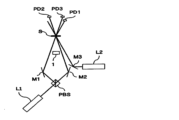
- FIG. 1 is a schematic diagram showing an outline of the configuration of an apparatus used for holographic recording.
- (meth)acrylate is a general term for acrylate and methacrylate.
- (meth)acryloyl group is a general term for acryloyl group and methacryloyl group. The same applies to "(meth)acryloyloxy group” and "(meth)acrylic.”
- aromatic ring is a general term for "aromatic hydrocarbon ring” and "aromatic heterocyclic ring”.
- aromatic ring group is a general term for "aromatic hydrocarbon group” and "aromatic heterocyclic group”.
- phrase “optionally having a substituent” means that the group may have one or more substituents.
- composition of the present invention is a photosensitive composition comprising a photopolymerization initiator, and at least two different photopolymerizable monomers which are a combination of a monofunctional photopolymerizable monomer and a polyfunctional photopolymerizable monomer, characterized in that at least one of the photopolymerizable monomers is a compound selected from a compound represented by the following formula (1-1) (hereinafter may be referred to as “compound (1-1)”) and a compound represented by the following formula (1-2) (hereinafter may be referred to as "compound (1-2)”):
- a 1 represents a photopolymerizable group.
- L 1 represents a single bond or an optionally branched divalent linking group.
- R 1 represents a fused aromatic ring group which may have a substituent.
- m1 is an integer of 2 to 5, and multiple R1's may be the same or different.
- the benzene ring having R 1 in formula (1-1) may further have a substituent in addition to A 1 -L 1 -O and R 1.
- A2 represents a photopolymerizable group.
- L2 represents a single bond or an optionally branched divalent linking group.
- R2 represents a fused aromatic ring group which may have a substituent.
- m2 is an integer of 2 to 4, and multiple R2 's may be the same or different.
- n represents an integer of 2 to 4.
- X represents a single bond or a divalent group selected from the group consisting of structures represented by the following formulas (1a) to (1g).
- X represents a trivalent organic group.
- X represents a carbon atom or a silicon atom.
- a plurality of A 2 , L 2 , R 2 and m 2 may be the same or different.
- the benzene ring having R 2 in formula (1-2) may further have a substituent in addition to A 2 -L 2 -O, R 2 and X.
- R 3 and R 4 each independently represent a hydrogen atom or an alkyl group having 1 to 4 carbon atoms.
- the photosensitive composition for holographic recording of the present invention provides a holographic recording medium that is highly transparent, has low fluorescence, and has excellent diffraction characteristics that allow stable use over a long period of time.
- compound (1) compound (1-1) and compound (1-2) will be collectively referred to as “compound (1).”
- Photopolymerizable Monomers The at least two different photopolymerizable monomers contained in the photosensitive composition for hologram recording of the present invention are a monofunctional photopolymerizable monomer and a polyfunctional photopolymerizable monomer, as described above.
- the composition of the present invention contains two types of photopolymerizable monomers, one type of monofunctional photopolymerizable monomer and one type of polyfunctional photopolymerizable monomer are contained in the photosensitive composition for hologram recording.
- composition of the present invention contains three or more types of photopolymerizable monomers, one type of monofunctional photopolymerizable monomer and one type of polyfunctional photopolymerizable monomer are contained, and the other one or more photopolymerizable monomers may be a monofunctional photopolymerizable monomer or a polyfunctional photopolymerizable monomer.
- the photosensitive composition for hologram recording of the present invention necessarily contains the compound (1) as a photopolymerizable monomer.
- compound (1-1) is a monofunctional photopolymerizable monomer.
- compound (1-2) is a polyfunctional photopolymerizable monomer.
- the polyfunctional photopolymerizable monomer is compound (1).
- the shrinkage rate upon curing tends to be low, which is preferable.
- the monofunctional photopolymerizable monomer is compound (1).
- both the monofunctional photopolymerizable monomer and the polyfunctional photopolymerizable monomer are compound (1). That is, the monofunctional photopolymerizable monomer is a compound represented by the above formula (1-1), and the polyfunctional photopolymerizable monomer is a compound represented by formula (1-2). In this case, a high refractive index modulation amount ⁇ n can be realized, which is preferable.
- the content of compound (1) in the composition of the present invention is preferably 1% by mass or more and 99% by mass or less, and more preferably 5% by mass or more and 95% by mass or less, based on the total solid content of the composition of the present invention. If the content of compound (1) is less than 1% by mass, the effect of using compound (1) is not fully exerted. If the content of compound (1) exceeds 99% by mass, the curing speed tends to decrease.
- composition of the present invention may contain a photopolymerizable monomer other than compound (1) as described below.
- the total content of compound (1) and the photopolymerizable monomer other than compound (1) is as described below.
- the content ratio of the monofunctional photopolymerizable monomer and the polyfunctional photopolymerizable monomer contained in the composition of the present invention is not particularly limited, but it is preferable that the composition contains 10 to 99 mol % of the monofunctional photopolymerizable monomer and 1 to 90 mol % of the polyfunctional photopolymerizable monomer relative to the total (100 mol %) of the monofunctional photopolymerizable monomer and the polyfunctional photopolymerizable monomer, it is more preferable that the composition contains 30 to 97 mol % of the monofunctional photopolymerizable monomer and 3 to 70 mol % of the polyfunctional photopolymerizable monomer, and it is even more preferable that the composition contains 50 to 95 mol % of the monofunctional photopolymerizable monomer and 5 to 50 mol % of the polyfunctional photopolymerizable monomer.
- the amount of the monofunctional photopolymerizable monomer is equal to or less than the upper limit of the above range and the amount of the polyfunctional photopolymerizable monomer is equal to or more than the lower limit of the above range, the hologram recording storability is good, which is preferable.
- the amount of the monofunctional photopolymerizable monomer is equal to or more than the lower limit of the above range and the amount of the polyfunctional photopolymerizable monomer is equal to or less than the upper limit of the above range, the viscosity of the composition is unlikely to become high, which is preferable.
- Compound (1-1) is characterized in that it has a partial structure in which two or more condensed aromatic ring groups R1 are bonded to a benzene ring (hereinafter sometimes referred to as a "phenoxy ring” or “phenoxy skeleton") in which a photopolymerizable group A1 is substituted with an oxygen atom via a single bond or a linking group L1 .
- a benzene ring hereinafter sometimes referred to as a "phenoxy ring” or "phenoxy skeleton” in which a photopolymerizable group A1 is substituted with an oxygen atom via a single bond or a linking group L1 .
- compound (1-2) is characterized in having a partial structure in which two or more condensed aromatic ring groups R2 are bonded to a benzene ring (hereinafter sometimes referred to as a "phenoxy ring” or “phenoxy skeleton") in which a photopolymerizable group A2 is substituted with an oxygen atom via a single bond or a linking group L2 .
- a benzene ring hereinafter sometimes referred to as a "phenoxy ring” or "phenoxy skeleton”
- a photopolymerizable group A2 is substituted with an oxygen atom via a single bond or a linking group L2 .
- high refractive index polymerizable monomers are often used to improve the refractive index modulation amount ⁇ n, and organic compounds with aromatic ring groups are sometimes used to improve the refractive index.
- organic compounds with highly planar aromatic ring groups generally have poor solubility in various solvents, making it difficult to use them as high-concentration solutions that achieve high refractive indexes or high ⁇ n values. Even if a high-concentration solution can be prepared, there is an issue that the organic compounds are highly crystalline and tend to precipitate out of the storage solution over time.
- aromatic organic compounds used in optical materials with a refractive index of more than 1.65 have multiple aromatic rings as substituents, and their solubility in various solvents tends to decrease as their molecular weight increases.
- Compound (1) is characterized by having a phenoxy skeleton in which a large number of condensed aromatic ring groups R 1 and R 2 are densely connected as a partial structure. This creates molecular twist between the substituents on the phenoxy skeleton, and can greatly reduce the crystallinity of compound (1).
- the more condensed aromatic ring groups R 1 and R 2 with high refractive index are substituted the higher the refractive index of compound (1) becomes and the larger the molecular weight becomes, but the symmetry and planarity of the entire molecule also tend to decrease, and high solubility in solvents can be achieved.
- the flexibility of the compound (1) can be significantly improved while the photopolymerizable groups A1 and A2 exhibit high polymerizability, thereby realizing a high refractive index and improved chemical stability of the resulting polymer.
- the photopolymerizable groups A1 and A2 are bonded to a phenoxy skeleton substituted with a large number of condensed aromatic ring groups R1 and R2 via linking groups L1 and L2 , so that the fluorescence phenomenon originating from the photopolymerization initiator can be suppressed and low fluorescence can be achieved.
- L 1 and L 2 each represent a single bond or a divalent linking group which may be branched.
- L 1 and L 2 each may have an oxygen atom, a sulfur atom, or a nitrogen atom which may have a substituent.
- a plurality of L 2s are present in the compound (1-2), and each L 2 may be the same or different.
- an aliphatic hydrocarbon group which may have a substituent is preferable from the viewpoint of ease of synthesis and availability.
- the number of carbon atoms of the aliphatic hydrocarbon group (not including the number of carbon atoms of the substituent) is preferably 1 to 8.
- the aliphatic hydrocarbon group constituting L 1 and L 2 may be either a cyclic aliphatic hydrocarbon group or a chain aliphatic hydrocarbon group, or these structures may be combined. From the viewpoint of reducing steric hindrance around the photopolymerizable groups A 1 and A 2 , a chain aliphatic hydrocarbon group is preferable.
- L 1 and L 2 are preferably linking groups having an oxygen atom, a sulfur atom, or a nitrogen atom which may have a substituent. These linking groups may have a substituent, and the number of carbon atoms (not including the number of carbon atoms of the substituent) is preferably 1 to 8. If the number of carbon atoms of the linking group is 8 or less, the refractive index of the compound (1) is unlikely to decrease, and the viscosity is decreased due to the small molecular weight, and the processability tends to improve.
- the linking groups constituting L 1 and L 2 may be either a cyclic linking group or a chain linking group, or these structures may be combined. From the viewpoint of alleviating steric hindrance around the photopolymerizable groups A 1 and A 2 , a chain linking group is preferable.
- Examples of the chain linking group having an oxygen atom, a sulfur atom or a nitrogen atom which may have a substituent constituting L 1 and L 2 include -CH 2 CH 2 OCH 2 CH 2 -, -CH 2 CH 2 OCH 2 CH 2 OCH 2 CH 2 -, -CH 2 CH 2 SCH 2 CH 2 -, -CH 2 CH 2 (CO)-, -CH 2 CH 2 CH 2 (CO)-, -CH 2 CH 2 CH 2 CH 2 ( CO ) -, -CH 2 CH 2 CH 2 CH 2 CH 2 (CO)-, -CH 2 CH 2 OCH 2 CH 2 (CO)-, -CH 2 CH 2 NH(CO)-, -CH 2 CH 2 CH 2 NH(CO)-, -CH 2 CH 2 CH 2 CH 2 NH(CO)-, -CH 2 CH 2 OCH 2 CH 2 NH(CO)-, -OCH 2 CH 2 -, -OCH 2 CH 2 OCH 2 CH 2 -, -OCH 2 CH 2
- L 1 and L 2 preferably contain a cyclic group, and the ring contained in the cyclic group constituting L 1 and L 2 may be a monocyclic structure or a condensed ring structure.
- the number of rings contained in L 1 and L 2 is preferably 1 to 4, more preferably 1 to 3, and even more preferably 1 to 2.
- the rings contained in L 1 and L 2 do not necessarily need to be aromatic, but are preferably aromatic hydrocarbon rings in order to maintain a high refractive index while keeping the size of the entire molecule small.
- Examples of the aromatic hydrocarbon rings constituting L 1 and L 2 include a benzene ring, an indene ring, a naphthalene ring, an azulene ring, a fluorene ring, an acenaphthylene ring, an anthracene ring, a phenanthrene ring, and a pyrene ring.
- the linking groups L 1 and L 2 may have a substituent.
- substituents that L 1 and L 2 may have include a halogen atom (chlorine atom, bromine atom, iodine atom), a hydroxyl group, a mercapto group, an alkyl group having 1 to 8 carbon atoms, an alkenyl group having 2 to 8 carbon atoms, an alkoxy group having 1 to 8 carbon atoms, a phenyl group, a mesityl group, a tolyl group, a naphthyl group, a cyano group, an acetyloxy group, an alkylcarbonyloxy group having 2 to 9 carbon atoms, an alkoxycarbonyl group having 2 to 9 carbon atoms, a sulfamoyl group, an alkylsulfamoyl group having 2 to 9 carbon atoms, an alkylcarbonyl group having 2 to 9 carbon atoms, a phenethy
- R 1 and R 2 each represent a fused aromatic ring group which may have a substituent.
- the fused aromatic ring of the fused aromatic ring group is roughly classified into a fused aromatic hydrocarbon ring and a fused aromatic heterocycle.
- Fused aromatic hydrocarbon rings include a naphthalene ring, a phenanthrene ring, a perylene ring, a tetracene ring, a pyrene ring, a benzpyrene ring, a chrysene ring, a triphenylene ring, an acenaphthene ring, a fluoranthene ring, a fluorene ring, and an anthracene ring.
- the fused aromatic hydrocarbon ring constituting R 1 and R 2 is preferably a naphthalene ring, a phenanthrene ring, a pyrene ring, or a fluorene ring from the viewpoint of ease of synthesis and availability, and more preferably a naphthalene ring, a phenanthrene ring, or a fluorene ring from the viewpoint of suppressing the fluorescence of compound ( 1 ) .
- a fused sulfur-containing aromatic heterocycle is preferred since it tends to increase the refractive index of compound (1).
- the fused sulfur-containing aromatic heterocycle has at least a sulfur atom as a heteroatom constituting the fused aromatic heterocycle.
- the heteroatom may have an oxygen atom, a nitrogen atom, or an oxygen atom and a nitrogen atom.
- the number of heteroatoms constituting the fused sulfur-containing aromatic heterocycle is preferably 1 to 3, more preferably 1 to 2.
- Fused sulfur-containing aromatic heterocycles include fused aromatic heterocycles containing one sulfur atom, such as a benzothiophene ring, a dibenzothiophene ring, a benzonaphthothiophene ring, a dinaphthothiophene ring, a naphthothiophene ring, a dinaphthothiophene ring, and a dibenzothiopyran ring; fused aromatic heterocycles containing two or more sulfur atoms, such as a thianthrene ring; and fused aromatic heterocycles containing two or more types of heteroatoms, such as a benzothiazole ring, a naphthothiazole ring, a phenothiazine ring, a thiazoloimidazole ring, a thiazolopyridine ring, a thiazolopyridazine ring, a thiazolopyrimidine ring
- the number of rings constituting the condensed sulfur-containing aromatic heterocycle is preferably 2 to 8, more preferably 2 to 6, and particularly preferably 2 to 5 in terms of facilitating the availability of raw materials and synthesis.
- the condensed sulfur-containing aromatic heterocycle is preferably a benzothiazole ring, a dibenzothiophene ring, a benzothiophene ring, a benzonaphthothiophene ring, or a thianthrene ring.
- the fused aromatic heterocycle constituting R 1 and R 2 may be a fused nitrogen-containing aromatic heterocycle from the viewpoint of ease of synthesis.
- the fused nitrogen-containing aromatic heterocycle has at least a nitrogen atom as a heteroatom constituting the fused aromatic heterocycle.
- the heteroatom may have an oxygen atom, a sulfur atom, or an oxygen atom and a sulfur atom.
- the number of heteroatoms constituting the fused nitrogen-containing aromatic heterocycle is preferably 1 to 3, more preferably 1 to 2.
- Fused nitrogen-containing aromatic heterocycles include condensed aromatic heterocycles containing one nitrogen atom, such as an indole ring, a carbazole ring, a benzocarbazole ring, a dibenzocarbazole ring, a quinoline ring, an isoquinoline ring, a benzoxazole ring, a naphthoxazole ring, a benzothiazole ring, a naphthothiazole ring, a phenoxazine ring, a phenothiazine ring, a thienoxazole ring, a thiazolooxazole ring, an oxazolooxazole ring, a furothiazole ring, a thienothiazole ring, and a thiazolothiazole ring.
- condensed aromatic heterocycles containing one nitrogen atom such as an indole ring, a carbazole
- Ring Benzimidazole ring, oxazoloimidazole ring, oxazolopyridine ring, oxazolopyridazine ring, oxazolopyrimidine ring, oxazolopyrazine ring, quinolinoxazole ring, dioxazolopyrazine ring, thiazoloimidazole ring, thienothiadiazole ring, thiazolothiadiazole ring, thiazolopyridine ring, thiazolopyridazine ring, thiazolopyrimidine ring, thiazolopyrazine ring, quinolinothiazole ring, etc. are examples of condensed aromatic heterocycles containing two or more nitrogen atoms.
- the number of rings constituting the condensed nitrogen-containing aromatic heterocycle is preferably 2 to 8, more preferably 2 to 6, and particularly preferably 2 to 5 in terms of facilitating the availability of raw materials and synthesis.
- the fused nitrogen-containing aromatic heterocycle is preferably a carbazole ring, a benzocarbazole ring, a dibenzocarbazole ring, a quinoline ring, an isoquinoline ring, a benzoxazole ring, a benzothiazole ring, a benzimidazole ring, or a thiadiazole ring, and more preferably a carbazole ring, a benzocarbazole ring, a dibenzocarbazole ring, a benzothiazole ring, a benzimidazole ring, or a thiadiazole ring.
- the fused aromatic heterocycle constituting R 1 and R 2 may be a fused oxygen-containing aromatic heterocycle.
- the fused oxygen-containing aromatic heterocycle tends to improve the heat resistance and weather resistance of the polymer containing the compound (1).
- the fused oxygen-containing aromatic heterocycle has at least an oxygen atom as a heteroatom constituting the fused aromatic heterocycle.
- the heteroatom may have a nitrogen atom, a sulfur atom, or a nitrogen atom and a sulfur atom. From the viewpoint of ensuring heat resistance, the number of oxygen atoms constituting the fused oxygen-containing aromatic heterocycle is preferably 1 to 3, more preferably 1 to 2.
- Fused oxygen-containing aromatic heterocycles include condensed aromatic heterocycles containing one oxygen atom, such as a benzofuran ring, a dibenzofuran ring, a naphthofuran ring, a benzonaphthofuran ring, a dinaphthofuran ring, a phenoxazine ring, an oxazole ring, an isoxazole ring, a benzoxazole ring, a benzisoxazole ring, a naphthoxazole ring, a thienoxazole ring, a thiazolooxazole ring, an oxazoloimidazole ring, and a furothiazole ring; and condensed aromatic heterocycles containing two or more oxygen atoms, such as a dibenzodioxine ring, an oxazolooxazole ring, and a dioxazolopy
- the number of rings constituting the condensed oxygen-containing aromatic heterocycle is preferably 2 to 8, more preferably 2 to 6, and particularly preferably 2 to 5 in terms of facilitating the availability of raw materials and synthesis.
- the fused oxygen-containing aromatic heterocycle is preferably a dibenzofuran ring, a benzonaphthofuran ring, a dinaphthofuran ring, an oxazole ring, an isoxazole ring, a benzoxazole ring, a benzisoxazole ring, or a naphthoxazole ring, and more preferably a dibenzofuran ring, a benzonaphthofuran ring, a dinaphthofuran ring, or a benzoxazole ring.
- the condensed aromatic rings constituting these R 1 and R 2 may have a substituent.
- substituents include a halogen atom such as chlorine, bromine, or iodine, an alkyl group having 1 to 8 carbon atoms, an alkenyl group having 2 to 8 carbon atoms, an alkynyl group having 2 to 8 carbon atoms, an alkoxyl group, a cyano group, an acetyloxy group, an alkylcarbonyloxy group having 2 to 9 carbon atoms, an alkoxycarbonyl group having 2 to 9 carbon atoms, a sulfamoyl group, an alkylsulfamoyl group having 2 to 9 carbon atoms, an alkylcarbonyl group having 2 to 9 carbon atoms, a phenethyl group, a hydroxyethyl group, an acetylamide group, a dialkylaminoethyl group formed by bonding alkyl groups
- an alkyl group having 1 to 8 carbon atoms preferred are an alkyl group having 1 to 8 carbon atoms, an alkoxy group having 1 to 8 carbon atoms, an alkylthio group having 1 to 8 carbon atoms, an aromatic ring thio group having 6 to 10 carbon atoms, a cyano group, an acetyloxy group, an alkylcarboxyl group having 2 to 8 carbon atoms, a sulfamoyl group, an alkylsulfamoyl group having 2 to 9 carbon atoms, and a nitro group.
- the fused aromatic rings constituting these R 1 and R 2 preferably have a group containing an aromatic ring as a substituent.
- the aromatic rings contained in the substituents include a benzene ring, a furan ring, a thiophene ring, a pyrrole ring, and a pyridine ring.
- the aromatic rings contained in these substituents may be directly bonded to the fused aromatic rings constituting R 1 and R 2 at any position, or may be bonded via an oxygen atom, a sulfur atom, or a nitrogen atom that may have a substituent, or may be bonded via an arbitrary linking group.
- the substituent is directly bonded to the fused aromatic rings constituting R 1 and R 2 .
- the aromatic ring contained in this substituent a sulfur-containing aromatic heterocycle, the refractive index of compound (1) tends to be higher.
- the definition of the sulfur-containing aromatic heterocycle is the same as that of R 1 and R 2.
- a condensed sulfur-containing aromatic heterocycle is more preferable, and in particular, a benzothiazole ring, a dibenzothiophene ring, a benzothiophene ring, a benzonaphthothiophene ring, a dinaphthothiophene ring, and a thianthrene ring are preferable.
- R 1 and R 2 have as substituents is not particularly limited, but from the viewpoints of ease of synthesis and solubility, 1 to 4 is preferred, and 1 or 2 is more preferred.
- the fused aromatic rings which may have a substituent and constitute R 1 and R 2 are preferably a naphthalene ring, a fluorene ring, a thianthrene ring, a phenanthrene ring, or a dibenzothiophene ring, more preferably a dibenzothiophene ring or a phenanthrene ring, and among these, a naphthalene ring, a phenanthrene ring, a dibenzothiophene ring, or a thianthrene ring is preferable.
- the fused aromatic rings constituting R 1 and R 2 may have two or more selected from the above-mentioned fused aromatic hydrocarbon rings, fused sulfur-containing aromatic heterocycles, fused nitrogen-containing aromatic heterocycles, and fused oxygen-containing aromatic heterocycles.
- m1 is 2 to 4 and m2 is 3 to 4, so that a plurality of R 1 and R 2 are present, and the plurality of R 1 and R 2 may be the same or different.
- m 1 and m 2 in formulae (1-1) and (1-2) m 1 represents an integer of 2 to 5.
- m 2 represents an integer of 2 to 4.
- m 1 and m 2 can be appropriately selected.
- m 1 is preferably 2 or 3, and more preferably 3.
- m 2 is preferably 2 or 3.
- n is an integer of 2 to 4, and there are a plurality of (R 2 ) m2 , and R 2 and m 2 in each (R 2 ) m2 may be the same or different.
- n represents an integer of 2 to 4.
- X represents a single bond or a divalent group selected from the group consisting of structures represented by the following formulas (1a) to (1g).
- n represents a trivalent organic group.
- X represents a carbon atom or a silicon atom.
- R 3 and R 4 each independently represent a hydrogen atom or an alkyl group having 1 to 4 carbon atoms.
- n is preferably an integer of 2 to 3, and more preferably 2.
- X is preferably a single bond, or a divalent oxygen atom or sulfur atom.
- X is a single bond, this is more preferable from the viewpoint of the chemical stability of the intermediate compound.
- X is particularly preferably a dimethylmethylene group (in formula (1a) above, R 3 and R 4 are methyl groups), a phthalidenylene group (formula (1d) above), or a sulfonyl group (formula (1f) above).
- n is 3
- X is preferably a methylmethine group or a methine group from the viewpoint of availability of raw materials.
- X is preferably a carbon atom from the viewpoint of compound stability.
- a 1 and A 2 in formulae (1-1) and (1-2) A 1 and A 2 represent photopolymerizable groups.
- Photopolymerizable groups are groups that are polymerizable by a photopolymerization initiator, and examples of such groups include oxiranyl groups, oxetanyl groups, vinyl groups, allyl groups, and (meth)acryloyl groups. Of these, allyl groups and (meth)acryloyl groups are preferred from the perspective of ease of synthesis, and (meth)acryloyl groups are particularly preferred from the perspective of high reactivity.
- each A 2 may be the same or different.
- Substituents that the phenoxy ring may have include, for example, halogen atoms such as fluorine, chlorine, bromine, and iodine, alkyl groups having 1 to 8 carbon atoms, alkenyl groups having 2 to 8 carbon atoms, alkynyl groups having 2 to 8 carbon atoms, alkoxyl groups, cyano groups, acetyloxy groups, alkylcarbonyloxy groups having 2 to 9 carbon atoms, alkoxycarbonyl groups having 2 to 9 carbon atoms, sulfamoyl groups, alkylsulfamoyl groups having 2 to 9 carbon atoms, alkylcarbonyl groups having 2 to 9 carbon atoms, phenethyl groups, hydroxyethyl groups, acetylamide groups, dialkylaminoethyl groups formed by bonding alkyl groups having 1 to 4 carbon atoms, trifluoromethyl groups, alkylthio groups having 1 to 8 carbon
- the phenoxy ring has no substituents other than R1 or R2 and X.
- the phenoxy ring has, as a substituent, an alkyl group having 1 to 8 carbon atoms, an alkoxyl group having 1 to 8 carbon atoms, an alkylthio group having 1 to 8 carbon atoms, an aromatic ring thio group having 6 to 10 carbon atoms, a cyano group, an acetyloxy group, an alkylcarboxyl group having 2 to 8 carbon atoms, a sulfamoyl group, an alkylsulfamoyl group having 2 to 9 carbon atoms, or a nitro group.
- the compound (1) preferably has a molecular weight of 2500 or less, more preferably 2200 or less, and even more preferably 2000 or less. From the viewpoint of reducing the shrinkage rate during polymerization, the compound (1) preferably has a molecular weight of 500 or more, more preferably 600 or more, and even more preferably 700 or more.
- the molecular weight of the compound (1-1), which is a monofunctional photopolymerizable monomer is preferably 2000 or less, more preferably 1800 or less, and even more preferably 1500 or less, and is preferably 500 or more, more preferably 600 or more, and even more preferably 700 or more.
- the molecular weight of the compound (1-2) which is a polyfunctional photopolymerizable monomer is preferably 2,500 or less, more preferably 2,200 or less, and even more preferably 2,000 or less, and is preferably 500 or more, more preferably 600 or more, and even more preferably 700 or more.
- Compound (1) can appropriately introduce a molecular twist in which the dihedral angle at the linking site between the phenoxy ring and the fused aromatic ring groups R 1 and R 2 is 1 degree or more into the monomer and polymer by bonding two or more highly planar fused aromatic ring groups R 1 and R 2 to the phenoxy skeleton.
- the fused aromatic ring groups R 1 and R 2 are fused aromatic ring groups having a substituent or ring structure at the ortho position of the linking site with the phenoxy ring, such as 9-naphthalenyl group, 9-phenanthrenyl group, 1-thianthrenyl group, 4-dibenzofuranyl group, and 4-dibenzothiophenyl group
- the dihedral angle tends to be larger. This allows the compound to be used as a polymerizable monomer having a super-high refractive index, realizing high solubility in various media while suppressing aggregation of the high refractive index structure.
- the above-mentioned molecular twisting also has the effect of suppressing excessive conjugation extension between the condensed aromatic ring groups R 1 and R 2 and the phenoxy ring, and suppressing the absorption wavelength of compound (1) from becoming longer, which can realize, for example, a colorless and transparent optical material in the visible light region and improve the stability of the compound against heating, light irradiation, oxidation, etc.
- the intermolecular distance may be shortened compared to a derivative without a linker due to molecular interactions such as van der Waals forces and hydrogen bonds. This can be expected to further increase the refractive index of the same high refractive index structure.
- the photopolymerizable groups A 1 and A 2 of the compound (1) are bonded to a phenoxy skeleton substituted with a large number of condensed aromatic ring groups R 1 and R 2 via a linking group L as described above. Therefore, the photopolymerizable groups A 1 and A 2 are in an environment spatially covered by the condensed aromatic ring substituents R 1 and R 2.
- the composition of the present invention containing the compound (1) as a photopolymerizable monomer was able to suppress the fluorescence phenomenon derived from the photopolymerization initiator.
- the activated photopolymerization initiator can bond to the photopolymerizable groups A 1 and A 2 under a variety of environments, and it is believed that overlap between the absorption structures of the photopolymerization initiators due to ⁇ - ⁇ interactions, etc. is greatly reduced.
- Compound (1) can be synthesized by combining various known methods.
- compound (1) can be synthesized by reacting a compound represented by the following formula (2) (hereinafter sometimes referred to as "compound (2)") with a compound having a group capable of reacting with a hydroxy group.
- R corresponds to R 1 in formula (1-1) and R 2 in formula (1-2).
- m corresponds to m 1 in formula (1-1) and m 2 in formula (1-2).
- na is 1 when producing compound (1-1), and represents an integer of 2 to 4 when producing compound (1-2).
- Xa is a hydrogen atom or R 1 when producing compound (1-1), and corresponds to X in formula (1-2) when producing compound (1-2). The same applies to the following reaction formulas.
- L corresponds to L 1 in the above formula (1-1) and L 2 in the above formula (1-2).
- A corresponds to A 1 in the above formula (1-1) and A 2 in the above formula (1-2).
- Y represents a leaving group such as a halogen atom, a sulfonic acid group such as a methanesulfonic acid group, a tosylic acid group, or a trifluoromethanesulfonic acid group, a carboxyl group, a dimethylpyrazolyl group, or a 1-methylpropylideneaminooxy group.
- L' and A' represent precursor structures that become L and A, respectively, through chemical reactions. In the following reaction formulas, the same symbols represent the same things.
- compound (1) is compound (1A) in which photopolymerizable groups A 1 and A 2 in formulae (1-1) and (1-2) are (meth)acryloyl groups.
- Compound (1A) can be produced by reacting a hydroxyl group of compound (2) with a (meth)acrylate reagent having a polymerizable group represented by formula (i) (hereinafter, sometimes referred to as (meth)acrylate reagent (i)).
- Examples of the (meth)acrylating reagent (i) include alkylating reagents such as 2-methanesulfonylethyl (meth)acrylate, glycidyl (meth)acrylate, and 2,3-dibromopropyl acrylate.
- Examples of the (meth)acrylate reagent (i) include isocyanates such as 2-acryloyloxyethyl isocyanate, 2-methacryloyloxyethyl isocyanate, 2-(2-methacryloyloxyethyloxy)ethyl isocyanate, and 1,1-(bisacryloyloxymethyl)ethyl isocyanate, as well as carbonylation reagents such as 2-[(3,5-dimethylpyrazolyl)carbonylamino]ethyl methacrylate and 2-[0-(1'-methylpropylideneamino)carboxyamino]ethyl methacrylate.
- isocyanates such as 2-acryloyloxyethyl isocyanate, 2-methacryloyloxyethyl isocyanate, 2-(2-methacryloyloxyethyloxy)ethyl isocyanate, and 1,1-(bisacryloyloxymethyl)e
- compound (1A) can also be produced by subjecting a compound represented by formula (3) (hereinafter sometimes referred to as "compound (3)") obtained by the reaction of compound (2) with a compound having a linking group represented by formula (ii) to a polymerizable group-forming reaction with a (meth)acryloylating reagent represented by formula (iii).
- compound (3) a compound represented by formula (3) (hereinafter sometimes referred to as "compound (3)”) obtained by the reaction of compound (2) with a compound having a linking group represented by formula (ii) to a polymerizable group-forming reaction with a (meth)acryloylating reagent represented by formula (iii).
- reaction of the active hydrogen of the hydroxyl group in formula (2) with the reagents represented by (i) and (ii) above, and the reaction of compound (3) with the reagent represented by formula (iii) can be carried out by applying known techniques.
- compound (1A) can be obtained by reacting compound (2) with an isocyanate in the presence of a basic compound.
- the basic compound may be one or more organic basic compounds (triethylamine, diisopropylethylamine, 1,1,3,3-tetramethylguanidine, diazabicycloundecene, diazabicyclononene, pyridine, imidazole, etc.), one or more inorganic basic compounds (sodium carbonate, potassium carbonate, sodium hydride, potassium hydride, potassium tert-butoxide, etc.), or a combination of one or more organic basic compounds and one or more inorganic basic compounds.
- organic basic compounds triethylamine, diisopropylethylamine, 1,1,3,3-tetramethylguanidine, diazabicycloundecene, diazabicyclononene, pyridine, imidazole, etc.
- inorganic basic compounds sodium carbonate, potassium carbonate, sodium hydride, potassium hydride, potassium tert-butoxide, etc.
- organic solvents include dichloromethane, tetrahydrofuran (THF), dimethoxyethane, toluene, and N,N-dimethylformamide (DMF).
- THF tetrahydrofuran
- DMF N,N-dimethylformamide
- reaction product obtained in the synthesis reaction.
- purifying and removing impurities low coloration can be achieved.
- purification method a known method can be applied. For example, purification can be performed by extraction, column chromatography, recrystallization, distillation, etc. These purification methods may be performed alone or in combination.
- compound (1A) is a solid at room temperature, it is preferable to use a recrystallization method, since this makes it easier to remove colored substances.
- recrystallization solvents include aliphatic hydrocarbons such as n-pentane, n-hexane, and n-heptane; alicyclic hydrocarbons such as cyclopentane and cyclohexane; aromatic hydrocarbons such as toluene, ethylbenzene, xylene, and mesitylene; halogenated hydrocarbons such as methylene chloride, chloroform, and 1,2-dichloroethane; ethers such as diethyl ether, diisopropyl ether, tetrahydrofuran, t-butyl methyl ether, and 1,4-dioxane; ketones such as acetone, methyl ethyl ketone, and methyl isobutyl ketone; esters such as ethyl acetate, n-butyl acetate, and propylene glycol monomethyl ether acetate; nitriles such as
- the raw material compounds (2) and intermediate compound (3) used in the production of compound (1A) can be produced by the following reaction.
- Q represents a leaving group such as a halogen atom or a trifluoromethanesulfonic acid group.
- R-M represents an organometallic reagent that can react with Q to form a carbon-carbon bond, such as an organolithium reagent, an organomagnesium reagent, an organocerium reagent, an organosilicon reagent, an organoboron reagent, or an organotin reagent, or an aromatic ring compound that directly utilizes a carbon-hydrogen bond to cause a cross-coupling reaction.
- compound (2) can be synthesized by linking a plurality of condensed aromatic ring groups R simultaneously or sequentially through a linking reaction between an aromatic halide represented by formula (4) (hereinafter, sometimes referred to as “compound (4)”) and an organic reagent represented by formula (iv).
- Compound (3) can also be synthesized by simultaneously or sequentially linking a plurality of fused aromatic ring groups R to a compound represented by formula (5) (hereinafter, sometimes referred to as “compound (5)”) obtained by reacting compound (4) with a compound having a linking group represented by formula (ii) through a linking reaction with an organic reagent represented by formula (iv).
- Photosensitive composition for hologram recording of the present invention contains a photopolymerization initiator, which causes a polymerization reaction of the photopolymerizable groups A 1 and A 2 of compound (1) to give the polymer of the present invention.
- the composition of the present invention may contain a photopolymerizable monomer other than compound (1).
- the composition of the present invention which is a photosensitive composition for hologram recording, is preferably a photocomposition containing a matrix resin, a radical scavenger, and other additives in addition to a photopolymerizable monomer and a photopolymerization initiator.
- the composition of the present invention used as a material for hologram recording media will be described in detail below.
- Photopolymerization Initiator As the photopolymerization initiator contained in the composition of the present invention, a photoradical polymerization initiator, a photocationic polymerization initiator, etc. can be used.
- the examples of photopolymerization initiators given below include those generally called polymerization catalysts.
- the content of the photopolymerization initiator in the composition of the present invention is preferably 0.5 ⁇ mol/g or more, in terms of molar amount per unit weight of the composition. More preferably, it is 1 ⁇ mol/g or more.
- the content of the photopolymerization initiator in the composition of the present invention is preferably 100 ⁇ mol/g or less, in terms of molar amount per unit weight of the composition. More preferably, it is 50 ⁇ mol/g or less.
- the content of the photopolymerization initiator is too low, the amount of radicals generated will be small. This will slow down the photopolymerization rate, and the recording sensitivity of the holographic recording medium may be reduced. If the content of the photopolymerization initiator is too high, the radicals generated by light irradiation may recombine with each other or undergo disproportionation. This will reduce the contribution to photopolymerization, and the recording sensitivity of the holographic recording medium may also be reduced. When using two or more photopolymerization initiators in combination, it is preferable that their total amount falls within the above range.
- Photoradical polymerization initiator that assists the polymerization of the composition of the present invention can be any known photoradical polymerization initiator. Examples include azo compounds, azide compounds, organic peroxides, organic borates, bisimidazole derivatives, titanocene compounds, iodonium salts, organic thiol compounds, halogenated hydrocarbon derivatives, acetophenones, benzophenones, hydroxybenzenes, thioxanthones, anthraquinones, ketals, acylphosphine oxides, sulfone compounds, carbamic acid derivatives, sulfonamides, triarylmethanols, and oxime esters.
- titanocene compounds as the photoradical polymerization initiator, titanocene compounds, acylphosphine oxide compounds, and oxime ester compounds are preferred because they undergo polymerization reaction with light in the visible range, and benzophenones, acylphosphine oxide compounds, and oxime ester compounds are preferred from the viewpoints of compatibility and availability.
- the type is not particularly limited.
- it can be appropriately selected from the various titanocene compounds described in JP-A-59-152396, JP-A-61-151197, etc.
- titanocene compounds include dicyclopentadienyl-Ti-dichloride, dicyclopentadienyl-Ti-bis-phenyl, dicyclopentadienyl-Ti-bis-2,3,4,5,6-pentafluorophenyl-1-yl, dicyclopentadienyl-Ti-bis-2,3,5,6-tetrafluorophenyl-1-yl, dicyclopentadienyl-Ti-bis-2,4,6-trifluorophenyl-1-yl, and dicyclopentadienyl-Ti-bis-2,6-difluorophenyl-1-yl.
- di-cyclopentadienyl-Ti-bis-2,4-di-fluorophenyl-1-yl di-methylcyclopentadienyl-Ti-bis-2,3,4,5,6-pentafluorophenyl-1-yl, di-methylcyclopentadienyl-Ti-bis-2,3,5,6-tetrafluorophenyl-1-yl, di-methylcyclopentadienyl-Ti-bis-2,6-difluorophenyl-1-yl, di-cyclopentadienyl-Ti-bis-2,6-difluoro-3-(pyr-1-yl)-phenyl-1-yl, etc.
- acylphosphine oxide compounds include monofunctional initiators, which have only one photocleavage point per molecule, and bifunctional initiators, which have two photocleavage points per molecule.
- monofunctional initiators include triphenylphosphine oxide, diphenyl(2,4,6-trimethylbenzoyl)phosphine oxide, and 2,6-dichlorobenzoyldiphenylphosphine oxide.
- bifunctional initiators include bis(2,4,6-trimethylbenzoyl)-phenylphosphine oxide, bis(2,6-dimethoxybenzoyl)-2,4,4-trimethylpentylphosphine oxide, bis(2,6-dichlorobenzoyl)-4-propylphenylphosphine oxide, and bis(2,6-dichlorobenzoyl)-2,5-dimethylphenylphosphine oxide.
- oxime ester compounds include 1-[4-(phenylthio)-2-(O-benzoyloxime)]-1,2-octanedione, 1-[9-ethyl-6-(2-methylbenzoyl)-9H-carbazol-3-yl]-1-(O-acetyloxime)ethanone, 4-(acetoxyimino)-5-[9-ethyl-6-(2-methylbenzoyl)-9H-carbazol-3-yl]-5 -Oxopentanoic acid methyl, 1-(9-ethyl-6-cyclohexanoyl-9H-carbazol-3-yl)-1-(O-acetyloxime)glutarate methyl, 1-(9-ethyl-9H-carbazol-3-yl)-1-(O-acetyloxime)glutarate methyl, 1-(9-ethyl-9H-carbazol-3-yl)-1-(O-acetyloxime)glutarate
- photoradical polymerization initiators include benzophenone, 2,4,6-trimethylbenzophenone, methyl orthobenzoylbenzoate, 4-phenylbenzophenone, t-butylanthraquinone, 2-ethylanthraquinone, diethoxyacetophenone, 2-hydroxy-2-methyl-1-phenylpropan-1-one, oligo ⁇ 2-hydroxy-2-methyl-1-[4-(1-methylvinyl)phenyl]propanone ⁇ , benzyl dimethyl ketal, 1-hydroxycyclohexyl phenyl ketone, benzoin methyl ether, benzoin ethyl ether, benzoin isopropyl ether, benzoin isobutyl ether, 2-methyl-[4-(methylthio)phenyl]-2-morpholino-1-propanone, 2-benzyl-2-dimethylamino-1- (4-morpholinophenyl)-butanone-1, diethyl
- photoradical polymerization initiators may be used alone, or two or more of them may be used in any combination and ratio.
- the photocationic polymerization initiator in the present invention is an initiator that generates cationic species by light.
- the photocationic polymerization initiator is not particularly limited as long as it is a compound that generates cationic species by light irradiation, but onium salts are generally well known.
- Onium salts include diazonium salts of Lewis acids, iodonium salts of Lewis acids, and sulfonium salts of Lewis acids. Specific examples include phenyldiazonium salt of boron tetrafluoride, diphenyliodonium salt of phosphorus hexafluoride, diphenyliodonium salt of antimony hexafluoride, tri-4-methylphenylsulfonium salt of arsenic hexafluoride, and tri-4-methylphenylsulfonium salt of antimony tetrafluoride. Aromatic sulfonium salts are preferably used.
- photocationic polymerization initiators include S,S,S',S'-tetraphenyl-S,S'-(4,4'-thiodiphenyl)disulfonium bishexafluorophosphate, diphenyl-4-phenylthiophenylsulfonium hexafluorophosphate, diphenyl-4-phenylthiophenylsulfonium hexafluoroantimonate, etc.
- Examples include Dow Chemical's UVI-6992, San-Apro's CPI-100P, San-Apro's CPI-101A, San-Apro's CPI-200K, and IGM Resins' Omnicat 270.
- photocationic polymerization initiators may be used alone, or two or more of them may be used in any combination and ratio.
- the amount of photocationic polymerization initiator in the composition of the present invention is preferably 0.02 parts by mass or more and 20 parts by mass or less, more preferably 0.1 parts by mass or more and 10 parts by mass or less, relative to 100 parts by mass of the total of all photocationic polymerization compounds in the composition. If the amount of photocationic polymerization initiator is less than 0.02 parts by mass, a sufficient reaction does not occur. If the amount of photocationic polymerization initiator is more than 20 parts by mass, it becomes difficult to achieve both pot life and polymerization speed.
- a cationic photopolymerization sensitizer When using a cationic photopolymerization initiator, a cationic photopolymerization sensitizer can also be used in combination.
- a cationic photopolymerization sensitizer is a prescription for efficiently transferring the energy of the irradiated light to the cationic photopolymerization initiator when the light emitted from the light source used in cationic photopolymerization does not match well with the absorption wavelength of the cationic photopolymerization initiator.
- Known examples of cationic photopolymerization sensitizers include phenolic compounds such as methoxyphenol (JP Patent Publication No. 5-230189), thioxanthone compounds (JP Patent Publication No. 2000-204284), and dialkoxyanthracene compounds (JP Patent Publication No. 2000-119306).
- the photocationic polymerization sensitizer is usually used in the range of 0.2 to 5 parts by mass, preferably 0.5 to 1 part by mass, per 1 part by mass of the photocationic polymerization initiator. If there is too little photocationic polymerization sensitizer, it may be difficult to achieve the sensitization effect. If there is too much photocationic polymerization sensitizer, the physical properties of the polymer may be reduced.
- composition of the present invention may contain a photopolymerizable monomer other than compound (1) (hereinafter, may be referred to as a “concomitant monomer”).
- co-monomer other than compound (1) examples include photocationically polymerizable monomers and photoradically polymerizable monomers. These co-monomers may be used alone or in any combination and ratio of two or more.
- the co-monomer includes a polyfunctional photopolymerizable monomer other than the compound (1).
- the co-monomer is preferably a trifunctional or higher functional monomer in that the recording and storage stability of the hologram can be significantly improved.
- the composition of the present invention contains a monofunctional photopolymerizable monomer as a co-monomer since molding processability can be improved.
- the combined monomer may be either a monofunctional photopolymerizable monomer or a polyfunctional photopolymerizable monomer.
- the content of the co-monomer is preferably 0.1% by mass or more and 90% by mass or less, and more preferably 0.3% by mass or more and 80% by mass or less, based on the total solid content of the composition of the present invention. If the content of the co-monomer is less than 0.1% by mass, the effect of imparting characteristics due to its addition is not fully exerted. If the content of the co-monomer exceeds 90% by mass, problems such as impairing the effect of compound (1) in suppressing the fluorescence phenomenon tend to occur.
- the content of the photopolymerizable monomer in the composition of the present invention is arbitrary as long as it is not contrary to the gist of the present invention, but based on the molar amount per unit mass of the composition, the content of all photopolymerizable monomers including compound (1) is preferably 5 ⁇ mol/g or more, more preferably 10 ⁇ mol/g or more, and even more preferably 100 ⁇ mol/g or more.
- the content of all photopolymerizable monomers is preferably 1000 ⁇ mol/g or less, more preferably 800 ⁇ mol/g or less, and even more preferably 500 ⁇ mol/g or less.
- the content of the photopolymerizable monomer By setting the content of the photopolymerizable monomer to be equal to or greater than the lower limit, sufficient diffraction efficiency can be obtained in the holographic recording medium.
- the content of the copolymerizable monomer By setting the content of the copolymerizable monomer to be equal to or less than the upper limit, compatibility with the resin matrix in the recording layer is maintained, and shrinkage of the recording layer due to recording tends to be kept low.
- photocationically polymerizable co-monomers include compounds having an oxirane ring, styrene and its derivatives, vinylnaphthalene and its derivatives, vinyl ethers, N-vinyl compounds, and compounds having an oxetane ring. Among these, it is preferable to use a compound having at least an oxetane ring, and it is further preferable to use a compound having an oxirane ring in combination with a compound having an oxetane ring.
- the compound having an oxirane ring includes a prepolymer containing two or more oxirane rings in one molecule.
- prepolymers include alicyclic polyepoxies, polyglycidyl esters of polybasic acids, polyglycidyl ethers of polyhydric alcohols, polyglycidyl ethers of polyoxyalkylene glycols, polyglycidyl ethers of aromatic polyols, hydrogenated compounds of polyglycidyl ethers of aromatic polyols, urethane polyepoxy compounds, and epoxidized polybutadienes.
- styrene and its derivatives examples include styrene, p-methylstyrene, p-methoxystyrene, ⁇ -methylstyrene, p-methyl- ⁇ -methylstyrene, ⁇ -methylstyrene, p-methoxy- ⁇ -methylstyrene, and divinylbenzene.
- vinylnaphthalene and its derivatives examples include 1-vinylnaphthalene, ⁇ -methyl-1-vinylnaphthalene, ⁇ -methyl-1-vinylnaphthalene, 4-methyl-1-vinylnaphthalene, 4-methoxy-1-vinylnaphthalene, etc.
- vinyl ethers examples include isobutyl ether, ethyl vinyl ether, phenyl vinyl ether, p-methylphenyl vinyl ether, and p-methoxyphenyl vinyl ether.
- N-vinyl compounds include N-vinylcarbazole, N-vinylpyrrolidone, N-vinylindole, N-vinylpyrrole, and N-vinylphenothiazine.
- Examples of compounds having an oxetane ring include various known oxetane compounds described in JP-A-2001-220526, JP-A-2001-310937, etc.
- photocationically polymerizable co-monomers may be used alone, or two or more of them may be used in any combination and ratio.
- the photoradical polymerizable co-monomer is a compound having one or more ethylenically unsaturated double bonds in one molecule, and examples thereof include (meth)acrylic acid esters, (meth)acrylamides, vinyl esters, and styrenes.
- Examples of (meth)acrylic acid esters include methyl (meth)acrylate, ethyl (meth)acrylate, (n- or i-)propyl (meth)acrylate, (n-, i-, sec- or t-)butyl (meth)acrylate, amyl (meth)acrylate, adamantyl (meth)acrylate, chloroethyl (meth)acrylate, 2-hydroxyethyl (meth)acrylate, 2-hydroxypropyl (meth)acrylate, 2-hydroxypentyl (meth)acrylate, cyclohexyl (meth)acrylate, allyl (meth)acrylate, trime Tyrolpropane mono(meth)acrylate, pentaerythritol mono(meth)acrylate, benzyl (meth)acrylate, methoxybenzyl (meth)acrylate, chlorobenzyl (meth)acrylate, hydroxybenzyl (meth)acrylate,
- Examples of (meth)acrylamides include (meth)acrylamide, N-methyl(meth)acrylamide, N-ethyl(meth)acrylamide, N-propyl(meth)acrylamide, N-butyl(meth)acrylamide, N-benzyl(meth)acrylamide, N-hydroxyethyl(meth)acrylamide, N-phenyl(meth)acrylamide, N-tolyl(meth)acrylamide, N-(hydroxyphenyl)(meth)acrylamide, N-(sulfamoylphenyl)(meth)acrylamide, N-(phenylsulfonyl)(meth)acrylamide, N-(tolylsulfonyl)(meth)acrylamide, N,N-dimethyl(meth)acrylamide, N-methyl-N-phenyl(meth)acrylamide, and N-hydroxyethyl-N-methyl(meth)acrylamide.
- vinyl esters examples include vinyl acetate, vinyl butyrate, vinyl benzoate, vinyl benzoate, vinyl t-butylbenzoate, vinyl chlorobenzoate, vinyl 4-ethoxybenzoate, vinyl 4-ethylbenzoate, vinyl 4-methylbenzoate, vinyl 3-methylbenzoate, vinyl 2-methylbenzoate, vinyl 4-phenylbenzoate, and vinyl pivalate.
- styrenes examples include styrene, p-acetylstyrene, p-benzoylstyrene, 2-butoxymethylstyrene, 4-butylstyrene, 4-sec-butylstyrene, 4-tert-butylstyrene, 2-chlorostyrene, 3-chlorostyrene, 4-chlorostyrene, dichlorostyrene, 2,4-diisopropylstyrene, dimethylstyrene, p-ethoxystyrene, 2-ethylstyrene, 2-methoxystyrene, 4-methoxystyrene, 2-methylstyrene, 3-methylstyrene, 4-methylstyrene, p-methylstyrene, p-phenoxystyrene, p-phenylstyrene, and divinylbenzene.
- photo-radical polymerizable co-monomers may be used alone, or two or more of them may be used in any combination and ratio.
- any of the photocationically polymerizable co-monomers and photoradical polymerizable co-monomers exemplified above may be used, and two or more of them may be used in combination.
- a photoradically polymerizable co-monomer as the other photopolymerizable monomer to be used in combination with compound (1).
- composition of the present invention may contain a solvent for adjusting the viscosity.
- solvents include, for example, alcohols such as ethanol, propanol, isopropanol, ethylene glycol, and propylene glycol; aliphatic hydrocarbons such as hexane, pentane, and heptane; alicyclic hydrocarbons such as cyclopentane and cyclohexane; aromatic hydrocarbons such as toluene and xylene; halogenated hydrocarbons such as methylene chloride and chloroform; chain ethers such as dimethyl ether and diethyl ether; cyclic ethers such as dioxane and tetrahydrofuran; esters such as methyl acetate, ethyl acetate, butyl acetate, ethyl lactate, and ethyl butyrate; ketones such as acetone, ethyl methyl ketone, methyl isobutyl ketone, and
- solvents can be used alone or as a mixed solvent.
- water can also be used.
- a solvent or dispersion medium
- amount there is no particular limit to the amount, and it may be adjusted to obtain a composition with an appropriate viscosity depending on the polymerization method, processing method, and application.
- the composition of the present invention preferably contains a matrix resin.
- the matrix resin constituting the recording layer of the holographic recording medium is an organic material that does not change significantly chemically or physically when irradiated with light, and is mainly composed of a polymer of an organic compound.
- the matrix resin constitutes the composition of the present invention together with the polymerizable compound and the photopolymerization initiator described below, it is strongly required that the matrix resin has excellent compatibility with the polymerizable compound and the photopolymerization initiator. If the matrix resin has low compatibility with the other components, an interface is created between the materials, and light is refracted or reflected at the interface, causing light to leak to unnecessary areas. This can cause the interference fringes to become distorted or cut and recorded in inappropriate areas, resulting in degradation of information.
- the compatibility of the matrix resin with the other components can be evaluated based on the scattered light intensity obtained by placing a detector in a direction different from the light passing through the sample, as described in Patent Publication No. 3737306, for example.
- the matrix resin of the composition of the present invention may be a resin that is made of multiple materials that are soluble in a solvent and that are three-dimensionally crosslinked after being formed into a usable state.
- resins include thermoplastic resins, thermosetting resins, and photocurable resins, which are described below.
- the three-dimensionally crosslinked resin is insoluble in solvents and is a reaction cured product of a polymerizable compound that is liquid at room temperature and a compound that is reactive to the polymerizable compound.
- the three-dimensionally crosslinked resin acts as a physical obstacle and suppresses volumetric changes during recording. That is, in the recording layer after recording, the bright areas expand and the dark areas shrink, tending to cause unevenness on the surface of the holographic recording medium. In order to suppress this volumetric change, it is more preferable to use a composition containing a three-dimensionally crosslinked resin matrix for the recording layer.
- thermosetting resins are preferred as the matrix resin. Resin materials that can be used as the matrix resin will be described in detail below.
- thermoplastic resin materials include chlorinated polyethylene, polymethyl methacrylate resin (PMMA), copolymers of methyl methacrylate and other alkyl acrylate esters, copolymers of vinyl chloride and acrylonitrile, polyvinyl acetate resin (PVAC), polyvinyl alcohol, polyvinyl formal, polyvinylpyrrolidone, cellulose resins such as ethyl cellulose and nitrocellulose, polystyrene resins, polycarbonate resins, etc. These may be used alone or in combination of two or more.
- solvents include ketones such as acetone and methyl ethyl ketone, esters such as butyl acetate and propylene glycol methyl ether acetate, aromatic hydrocarbons such as toluene and xylene, ethers such as tetrahydrofuran and 1,2-dimethoxyethane, and amides such as N,N-dimethylacetamide and N-methylpyrrolidone. These may be used alone or in combination of two or more.
- thermosetting resin When using a thermosetting resin as the matrix resin, the curing temperature varies depending on the type of crosslinking agent and catalyst.
- Typical examples of functional group combinations that cure at room temperature include epoxy and amine, epoxy and thiol, and isocyanate and amine.
- Typical examples of combinations that use a catalyst include epoxy and phenol, epoxy and acid anhydride, and isocyanate and polyol.
- the former is convenient because it reacts immediately when mixed, but when molding is involved such as in a holographic recording medium, the adjustment is difficult due to the lack of time.
- the latter is suitable for curing accompanied by molding such as holographic recording media, since the curing temperature and curing time can be freely selected by appropriately selecting the type and amount of catalyst used.
- Various types of resin raw materials are commercially available, from low molecular weight to high molecular weight, and can be selected while maintaining compatibility with polymerizable reactive compounds and photoinitiators, adhesion to the substrate, etc. Each of the raw materials will be described below. Each of the raw materials may be used alone or in combination of two or more.
- epoxy examples include polyglycidyl ether compounds of polyols such as (poly)ethylene glycol, (poly)propylene glycol, (poly)tetramethylene glycol, trimethylolpropane, and glycerin; alicyclic epoxy compounds having a cyclic aliphatic group with a 4- to 7-membered ring such as 3,4-epoxycyclohexylmethyl-3,4-epoxycyclohexanecarboxylate and 3,4-epoxy-1-methylcyclohexyl-3,4-epoxy-1-methylhexanecarboxylate; bisphenol A type epoxy compounds, hydrogenated bisphenol A type epoxy compounds, bisphenol F type epoxy compounds, and phenol or cresol novolac type epoxy compounds.
- polyglycidyl ether compounds of polyols such as (poly)ethylene glycol, (poly)propylene glycol, (poly)tetramethylene glycol, trimethylolpropane, and
- the epoxy preferably has two or more epoxy groups in one molecule, but there are no particular restrictions on the type. If the number of epoxy groups is small, the hardness required for the matrix may not be obtained. There is no particular upper limit on the number of epoxy groups in one molecule, but it is usually 8 or less, and 4 or less is particularly preferred. If there are too many epoxy groups, it may take a long time to consume the epoxy groups, and the formation of the matrix resin may take too long.
- the amine may be one containing a primary amino group or a secondary amino group.
- examples of such amines include aliphatic polyamines such as ethylenediamine, diethylenetriamine and derivatives thereof, alicyclic polyamines such as isophoronediamine, menthanediamine, N-aminoethylpiperazine and derivatives thereof, aromatic polyamines such as m-xylylenediamine, diaminodiphenylmethane and derivatives thereof, polyamides such as condensates of dicarboxylic acids such as dimer acid and the above-mentioned polyamines, imidazole compounds such as 2-methylimidazole and derivatives thereof, and other dicyandiamide, adipic dihydrazide, etc.
- thiols include thiol compounds such as dithiols such as 1,3-butanedithiol, 1,4-butanedithiol, 2,3-butanedithiol, 1,2-benzeneedithiol, 1,3-benzeneedithiol, 1,4-benzeneedithiol, 1,10-decanedithiol, 1,2-ethaneedithiol, 1,6-hexaneedithiol, and 1,9-nonanedithiol, and polythiols such as Thiokol (manufactured by Toray Fine Chemicals Co., Ltd.) and jER Cure QX40 (manufactured by Mitsubishi Chemical Corporation). Of these, a commercially available fast-curing polythiol such as jER Cure QX40 is preferably used.
- dithiols such as 1,3-butanedithiol, 1,4-butanedithiol, 2,3-butanedithiol, 1,
- phenols include bisphenol A, novolak-type phenolic resins, and resol-type phenolic resins.
- acid anhydride examples include monofunctional acid anhydrides such as phthalic anhydride, tetrahydrophthalic anhydride and derivatives thereof, and examples of the difunctional acid anhydrides include pyromellitic anhydride, benzophenonetetracarboxylic anhydride and derivatives thereof.
- the amount of amine, thiol, phenol, and acid anhydride used is usually 0.1 equivalent or more, preferably 0.7 equivalent or more, and usually 2.0 equivalent or less, preferably 1.5 equivalent or less, in terms of the ratio to the number of moles of epoxy groups. If the amount of amine, thiol, phenol, or acid anhydride used is too small or too large, the number of unreacted functional groups is large, and storage stability may be impaired.
- thermosetting resin As a catalyst for curing the thermosetting resin, an anionic polymerization initiator or a cationic polymerization initiator can be used depending on the curing temperature and curing time.
- Anionic polymerization initiators generate anions when exposed to heat or active energy rays.
- Examples include amines.
- Examples of amines include amino group-containing compounds such as dimethylbenzylamine, dimethylaminomethylphenol, 1,8-diazabicyclo[5.4.0]undecene-7, and their derivatives; imidazole compounds such as imidazole, 2-methylimidazole, and 2-ethyl-4-methylimidazole, and their derivatives. These can be used alone or in combination depending on the curing temperature and curing time.
- the cationic polymerization initiator generates cations by heat or irradiation with active energy rays.
- aromatic onium salts include compounds consisting of an anion component such as SbF 6 -, BF 4 -, AsF 6 -, PF 6 -, CF 3 SO 3 -, B(C 6 F 5 ) 4 -, and an aromatic cation component containing atoms such as iodine, sulfur, nitrogen, and phosphorus.
- diaryliodonium salts, triarylsulfonium salts, and the like are preferred. These can be used alone or in combination depending on the curing temperature and curing time.
- the amount of these thermosetting resin polymerization initiators used is usually 0.001% by mass or more, preferably 0.01% by mass or more, and usually 50% by mass or less, preferably 10% by mass or less, relative to the matrix resin. If the amount of these thermosetting resin polymerization initiators used is too small, the concentration of the thermosetting resin polymerization initiator is too low. As a result, the polymerization reaction may take too long. On the other hand, if the amount of thermosetting resin polymerization initiator used is too large, the polymerization reaction may not result in a continuous ring-opening reaction.
- the isocyanate is preferably one having two or more isocyanate groups in one molecule, but the type is not particularly limited. If the number of isocyanate groups in one molecule is small, the hardness required for the matrix resin may not be obtained.
- the upper limit of the number of isocyanate groups in one molecule is not particularly limited, but is usually 8 or less, and preferably 4 or less. If the number of isocyanate groups in one molecule is too large, it may take a long time to consume the isocyanate groups, and the formation of the matrix resin may take too long.
- the upper limit of the number of isocyanate groups in one molecule is not particularly limited, but is usually about 20 or less.
- isocyanates include aliphatic isocyanates such as hexamethylene diisocyanate, lysine methyl ester diisocyanate, and 2,4,4-trimethylhexamethylene diisocyanate; alicyclic isocyanates such as isophorone diisocyanate and 4,4'-methylenebis(cyclohexyl isocyanate); aromatic isocyanates such as tolylene diisocyanate, 4,4'-diphenylmethane diisocyanate, xylylene diisocyanate, and naphthalene-1,5'-diisocyanate; and oligomers of these. Among these, 3- to 7-mers are preferred.
- reaction products of the above-mentioned isocyanates with polyhydric alcohols such as water, trimethylolethane, and trimethylolpropane, and polymers of hexamethylene diisocyanate or derivatives thereof.
- the molecular weight of the isocyanate is preferably 100 to 50,000 in number average molecular weight, more preferably 150 to 10,000, and even more preferably 150 to 5,000. If the number average molecular weight is too small, the crosslinking density increases, which can make the matrix resin too hard and reduce the recording speed. If the number average molecular weight is too large, the compatibility with other components decreases and the crosslinking density decreases, which can make the matrix resin too hard and cause the recorded content to disappear.
- polyol examples include polypropylene polyol, polycaprolactone polyol, polyester polyol, and polycarbonate polyol.
- Polypropylene polyol is obtained by reacting propylene oxide with a diol or polyhydric alcohol.
- the diol or polyhydric alcohol include ethylene glycol, propylene glycol, 1,4-butanediol, 1,5-pentanediol, 3-methyl-1,5-pentanediol, 1,6-hexanediol, neopentyl glycol, diethylene glycol, 1,4-cyclohexanediol, 1,4-cyclohexanedimethanol, decamethylene glycol, polyethylene glycol, and polytetramethylene glycol.
- polypropylene polyols include Sannix GP-400 and GP-1000 (all manufactured by Sanyo Chemical Industries, Ltd., trade names), Adeka Polyether G400, G700, and G1500 (all manufactured by ADEKA Corporation, trade names), and the like.
- Polycaprolactone polyols can be obtained by reacting lactones with diols or polyhydric alcohols, such as ⁇ -caprolactone, ⁇ -caprolactone, ⁇ -caprolactone, ⁇ -caprolactone, ⁇ -methyl- ⁇ -caprolactone, and ⁇ -methyl- ⁇ -caprolactone.
- diols or polyhydric alcohols examples include ethylene glycol, propylene glycol, 1,4-butanediol, 1,5-pentanediol, 3-methyl-1,5-pentanediol, 1,6-hexanediol, neopentyl glycol, diethylene glycol, 1,4-cyclohexanediol, 1,4-cyclohexanedimethanol, decamethylene glycol, polyethylene glycol, polytetramethylene glycol, etc.
- polycaprolactone polyols obtained from the reaction of ⁇ -caprolactone include Plaxel 205, Plaxel 205H, Plaxel 205U, Plaxel 205UT, Plaxel 210, Plaxel 210N, Plaxel 210CP, Plaxel 220, Plaxel 230, Plaxel 230N, Plaxel 240, Plaxel 220EB, Plaxel 220EC, Plaxel 220E, Plaxel 220F, Plaxel 220G, Plaxel 220H, Plaxel 205U, Plaxel 205UT, Plaxel 210, Plaxel 210N, Plaxel 210CP, Plaxel 220, Plaxel 230, Plaxel 230N, Plaxel 240, Plaxel 220EB, Plaxel 220EC, Plaxel 220G, Plaxel 220H ...
- PLAXEL 303 PLAXEL 305
- PLAXEL 308 PLAXEL 309
- PLAXEL 312 PLAXEL 320
- PLAXEL 401 PLAXEL L205AL
- PLAXEL L212AL PLAXEL L220AL
- PLAXEL L320AL PLAXEL T2103, PLAXEL T2205
- PLAXEL P3403, and PLAXEL 410 all trade names manufactured by Daicel Corporation.
- polyester polyols include those obtained by polycondensing dicarboxylic acids or their anhydrides with polyols.
- dicarboxylic acids examples include succinic acid, adipic acid, sebacic acid, azelaic acid, dimer acid, maleic anhydride, isophthalic acid, terephthalic acid, and trimellitic acid.
- polyols examples include ethylene glycol, propylene glycol, 1,4-butanediol, 1,5-pentanediol, 3-methyl-1,5-pentanediol, 1,6-hexanediol, neopentyl glycol, diethylene glycol, 1,4-cyclohexanediol, 1,4-cyclohexanedimethanol, decamethylene glycol, polyethylene glycol, and polytetramethylene glycol.
- polyester polyols examples include polyethylene adipate, polybutylene adipate, and polyhexamethylene adipate.
- Commercially available polyester polyols include the ADEKA New Ace F series, ADEKA New Ace Y series, and ADEKA New Ace NS series (product names manufactured by ADEKA Corporation), as well as Kuraray Polyol N-2010, P-4011, and P-1020 (all product names manufactured by Kuraray Co., Ltd.).
- polycarbonate polyol examples include those obtained by a dealcoholization condensation reaction between glycols and dialkyl carbonates (e.g., dimethyl carbonate, diethyl carbonate, etc.), those obtained by a phenol removal condensation reaction between glycols and diphenyl carbonates, and those obtained by a glycol removal condensation reaction between glycols and carbonates (e.g., ethylene carbonate, diethyl carbonate, etc.).
- glycols examples include aliphatic diols such as 1,6-hexanediol, diethylene glycol, propylene glycol, 1,4-butanediol, 3-methyl-1,5-pentanediol, and neopentyl glycol, and alicyclic diols such as 1,4-cyclohexanediol and 1,4-cyclohexanedimethanol.
- polycarbonate polyols examples include poly(hexamethylene carbonate) polyol obtained by the condensation reaction of 1,6-hexanediol and diethyl carbonate, poly(pentylene carbonate) obtained by the condensation reaction of pentanediol and diethyl carbonate, and poly(butylene carbonate) obtained by the condensation reaction of 1,4-butanediol and diethyl carbonate.
- polycarbonate polyols include Plaxel CD CD205, Plaxel CD CD210, Plaxel CD CD220 (all trade names manufactured by Daicel Corporation), Duranol T5651, Duranol T5652, Duranol T5650J (all trade names manufactured by Asahi Kasei Corporation), etc.
- the molecular weight of the polyol described above is preferably 100 to 50,000 in number average molecular weight, more preferably 150 to 10,000, and even more preferably 150 to 5,000. If the number average molecular weight is too small, the crosslinking density increases, so that the hardness of the matrix resin becomes too high, and the recording speed may decrease. If the number average molecular weight is too large, the compatibility with other components decreases or the crosslinking density decreases, so that the hardness of the matrix resin becomes too low, and the recorded contents may be lost.
- the matrix resin in the present embodiment may contain other components in addition to the above-mentioned components, as long as it is not contrary to the spirit of the present invention.
- Such other components include, for example, compounds having hydroxyl groups, such as ethylene glycol, propylene glycol, 1,4-butanediol, 1,5-pentanediol, 3-methyl-1,5-pentanediol, 1,6-hexanediol, neopentyl glycol, diethylene glycol, 1,4-cyclohexanediol, 1,4-cyclohexanedimethanol, decamethylene glycol, trimethylolpropane, polyethylene glycol, and polytetramethylene glycol, which are used to change the physical properties of the matrix resin.
- compounds having hydroxyl groups such as ethylene glycol, propylene glycol, 1,4-butanediol, 1,5-pentanediol, 3-methyl-1,5-pentanediol, 1,6-hexanediol, neopentyl glycol, diethylene glycol, 1,4-cyclohexan
- a suitable urethane polymerization catalyst may be included to promote the reaction of the isocyanate and polyol.
- urethane polymerization catalyst examples include onium salts such as bis(4-t-butylphenyl)iodonium perfluoro-1-butanesulfonic acid, bis(4-t-butylphenyl)iodonium p-toluenesulfonic acid, bis(4-t-butylphenyl)iodonium trifluoromethanesulfonic acid, (4-bromophenyl)diphenylsulfonium triflate, (4-t-butylphenyl)diphenylsulfonium trifluoromethanesulfonic acid, diphenyliodonium perfluoro-1-butanesulfonic acid, (4-fluorophenyl)diphenylsulfonium trifluoromethanesulfonic acid, diphenyl-4-methylphenylsulfonium trifluoromethanesulfonic acid, triphenylsulfonium trifluorome
- bismuth catalysts and zirconium catalysts are preferred for improving storage stability.
- bismuth catalyst there are no particular limitations on the bismuth catalyst, so long as it is a catalyst containing elemental bismuth and is a compound that promotes the reaction between isocyanate and polyol.
- bismuth-based catalysts include tris(2-ethylhexanoate)bismuth, tribenzoyloxybismuth, bismuth triacetate, bismuth tris(dimethyldicarbamate), bismuth hydroxide, triphenylbismuth(V) bis(trichloroacetate), tris(4-methylphenyl)oxobismuth(V), triphenylbis(3-chlorobenzoyloxy)bismuth(V), and the like.
- bismuth carboxylate which is represented by the general formula Bi(OCOR) 3 (R is a linear or branched alkyl group, a cycloalkyl group, or a substituted or unsubstituted aromatic group), is more preferred.
- the above bismuth catalysts may be used alone or in any combination and ratio of two or more kinds.
- zirconium catalyst there are no particular limitations on the zirconium catalyst, so long as it is a catalyst containing zirconium element and is a compound that promotes the reaction between isocyanate and polyol.
- examples of such compounds include cyclopentadienyl zirconium trichloride, decamethyl zirconocene dichloride, 1,1'-dibutyl zirconocene dichloride, 1,1'-isopropylidene zirconocene dichloride, tetrakis(2,4-pentanedionato)zirconium, tetrakis(trifluoro-2,4-pentanedionato)zirconium, tetrakis(hexafluoro-2,4-pentanedionato)zirconium, zirconium butoxide, zirconium
- the zirconium oxide include zirconium t-butoxide, zirconium propoxide, zi
- compounds having organic ligands are preferred in terms of compatibility with other components, and are more preferred than compounds having an alkoxide or acetylacetonate (2,4-pentanedionato) structure.
- Any one of the above zirconium compounds may be used alone, or two or more may be used in any combination and ratio.
- the bismuth-based catalyst and the zirconium-based catalyst may be used alone or in combination.
- the amount of urethane polymerization catalyst used is, in terms of the ratio to the matrix resin, usually 0.0001% by mass or more, preferably 0.001% by mass or more, and usually 10% by mass or less, preferably 5% by mass or less. If the amount of urethane polymerization catalyst used is too small, curing may take too long. If the amount of urethane polymerization catalyst used is too large, it may be difficult to control the curing reaction.
- a urethane polymerization catalyst allows it to harden at room temperature, but it can also be hardened by raising the temperature.
- the temperature at this time is preferably between 40°C and 90°C.
- Photocurable resin When using a photocurable resin as the matrix resin, it is necessary to use a photoinitiator for the matrix resin that corresponds to the wavelength to be used for curing. Since curing during light irradiation can cause problems in molding and adhesion, it is desirable for the curing reaction to be stable around room temperature, which is the temperature at which the material is mainly used. Considering this, catalytic curing using a photoinitiator for the matrix resin is a desirable choice.
- matrix resin photoinitiators it is considered best to select a material that will harden using these active substrates and then harden it to produce a matrix resin.
- Functional groups that react with cations such as protons include epoxy groups and oxetanyl groups.
- Specific examples of compounds having these include polyglycidyl ether compounds of polyols such as (poly)ethylene glycol, (poly)propylene glycol, (poly)tetramethylene glycol, trimethylolpropane, and glycerin, which have epoxy groups; alicyclic epoxy compounds having 4- to 7-membered cyclic aliphatic groups such as 3,4-epoxycyclohexylmethyl-3,4-epoxycyclohexanecarboxylate and 3,4-epoxy-1-methylcyclohexyl-3,4-epoxy-1-methylhexanecarboxylate; bisphenol A type epoxy compounds, hydrogenated bisphenol A type epoxy compounds, bisphenol F type epoxy compounds, and phenol or cresol novolac type epoxy compounds.
- Examples of compounds having oxetanyl groups include 2-ethyl-2-oxetanyl ether of bisphenol A and 1,6-bis(2-ethyl-2-oxetanyloxy)hexane.
- (poly)ethylene glycol refers to both “ethylene glycol” and its polymer, “polyethylene glycol.”
- Functional groups that react with anions include epoxy groups and episulfide groups.
- Specific examples of compounds that have an episulfide group include phenyl episulfide and diepisulfide methyl ether of bisphenol A.
- the amount of the matrix resin photoinitiator used when photocuring the above-mentioned matrix resin is, in terms of the ratio to the polymerizable compound, usually 0.01% by mass or more, preferably 0.1% by mass or more, and usually 1% by mass or less, preferably 0.5% by mass or less. If the amount of matrix resin photoinitiator used is too small, curing may take too long. If the amount of matrix resin photoinitiator used is too large, it may be difficult to control the curing reaction.
- the wavelength during curing is different from the wavelength during recording.
- the difference in wavelength is at least 10 nm, and preferably 30 nm.
- the selection of a photoinitiator for the matrix resin can be roughly predicted from the absorption wavelength of the initiator.
- the matrix resin content in the composition of the present invention may be any content as long as it is not contrary to the gist of the present invention.
- the total content of these is usually 0.1% by mass or more, preferably 10% by mass or more, more preferably 35% by mass or more, and usually 99.9% by mass or less, preferably 99% by mass or less.
- the ratio of the number of isocyanate-reactive functional groups of the polyol to the number of isocyanate groups of the isocyanate is preferably 0.1 or more, more preferably 0.5 or more, and usually 10.0 or less, preferably 2.0 or less. By keeping this ratio within the above range, there are fewer unreacted functional groups, and storage stability is improved.
- the content of the urethane polymerization catalyst is preferably determined taking into consideration the reaction rate of the isocyanate and the polyol.
- the content of the urethane polymerization catalyst is preferably 5% by mass or less, more preferably 4% by mass or less, even more preferably 1% by mass or less, and preferably 0.003% by mass or more.
- a radical scavenger may be added to accurately fix the interference light intensity pattern as a polymer distribution in the holographic recording medium.
- the radical scavenger preferably has both a functional group that captures radicals and a reactive group that is covalently fixed to the matrix resin.
- An example of the functional group that captures radicals is a stable nitroxyl radical group.
- radical scavengers that are covalently fixed to the matrix resin include hydroxyl groups, amino groups, isocyanate groups, and thiol groups.
- examples of such radical scavengers include 4-hydroxy-2,2,6,6-tetramethylpiperidine-1-oxyl free radical (TEMPOL), 3-hydroxy-9-azabicyclo[3.3.1]nonane N-oxyl, 3-hydroxy-8-azabicyclo[3.2.1]octane N-oxyl, and 5-HO-AZADO: 5-hydroxy-2-azatricyclo[3.3.1.1 3,7 ]decane N-oxyl.
- TMPOL 4-hydroxy-2,2,6,6-tetramethylpiperidine-1-oxyl free radical
- 3-hydroxy-9-azabicyclo[3.3.1]nonane N-oxyl 3-hydroxy-8-azabicyclo[3.2.1]octane N-oxyl
- 5-HO-AZADO 5-hydroxy-2-azatricyclo[3.3.1.1 3,7 ]decane N-oxyl.
- the content of the radical scavenger in the composition of the present invention is, in terms of molar amount per unit weight of the composition, preferably 0.5 ⁇ mol/g or more, more preferably 1 ⁇ mol/g or more, and is preferably 100 ⁇ mol/g or less, more preferably 50 ⁇ mol/g or less.
- radical scavenger content is too low, the radical scavenging efficiency will be low, and the polymer with a low degree of polymerization will tend to diffuse, resulting in an increase in components that do not contribute to the signal. If the radical scavenger content is too high, the polymer polymerization efficiency will tend to decrease, making it impossible to record a signal. When using two or more radical scavengers in combination, it is preferable that their total amount falls within the above range.
- composition of the present invention may contain other components in addition to the above-mentioned components, so long as they do not go against the spirit of the present invention.
- Other components include plasticizers, dispersants, leveling agents, defoamers, adhesion promoters, any organic or inorganic fillers, diffusing agents, wavelength conversion materials such as pigments, and chain transfer agents, polymerization terminators (polymerization inhibitors), compatibilizers, reaction aids, sensitizers, etc. for controlling the recording reaction.
- additives that may be required to improve other characteristics include preservatives, stabilizers, antioxidants, ultraviolet absorbers, light stabilizers, etc. These components may be used alone or in any combination and ratio of two or more.
- composition of the present invention preferably contains an antioxidant and a light stabilizer in order to improve the heat yellowing resistance and weather resistance of the resulting polymer.
- antioxidants include phenolic antioxidants such as 2,6-di-t-butylphenol, 2,6-di-t-butyl-p-cresol, n-octadecyl-3-(3',5'-di-t-butyl-4'-hydroxyphenyl)propionate, tetrakis-[methylene-3-(3',5'-di-t-butyl-4'-hydroxyphenyl)propionate]methane, triethylene glycol bis[3-(3-t-butyl-5-methyl-4-hydroxyphenyl)propionate], 1,6-hexanediol bis[3-(3,5-di-t-butyl-4-hydroxyphenyl)propionate]; and triphenyl phosphite, trisisodecyl phosphite, isodecyl diphenyl phosphite, 2-ethylhexyl diphenyl Phosphi
- a preferred combination of a phenol-based antioxidant and a phosphorus-based antioxidant is a combination of at least one selected from tetrakis-[methylene-3-(3',5'-di-t-butyl-4'-hydroxyphenyl)propionate]methane and n-octadecyl-3-(3',5'-di-t-butyl-4'-hydroxyphenyl)propionate as the phenol-based antioxidant and tris(2,4-di-t-butylphenyl)phosphite as the phosphorus-based antioxidant.
- the content of the antioxidant in the composition of the present invention is preferably 0.01 to 5 parts by mass, more preferably 0.05 to 3 parts by mass, and even more preferably 0.1 to 2 parts by mass, per 100 parts by mass of the total amount of the composition, in order to improve the heat yellowing resistance of the resulting polymer.
- HALS hindered amine light stabilizer
- Specific examples of HALS include 2,2,6,6-tetramethyl-4-piperidinyl stearate, 2,2,6,6-tetramethyl-4-piperidyl methacrylate, 1,2,2,6,6-pentamethyl-4-piperidyl methacrylate, bis(2,2,6,6-tetramethyl-1-undecyloxypiperidin-4-yl)carbonate, bis(2,2,6,6-tetramethyl-4-piperidyl)sebacic acid, bis(1,2,2,6,6-pentamethyl-4-piperidyl)sebacic acid, and Adekastab L.
- A-68 (manufactured by ADEKA CORPORATION), Adeka STAB LA-63P (manufactured by ADEKA CORPORATION), butane-1,2,3,4-tetracarboxylic acid tetrakis(1,2,2,6,6-pentamethyl-4-piperidinyl), 1,2,3,4-butanetetracarboxylic acid tetrakis(2,2,6,6-tetramethyl-4-piperidinyl), TINUVIN 111FDL, TINUVIN 123, TINUVIN 144, TINUVIN 152, TINUVIN 249, TINUVIN 292, TINUVIN 5100 (all manufactured by BASF), etc. These can be used alone or in combination of two or more kinds.
- the content of the light stabilizer in the composition of the present invention is preferably 0.01 to 5 parts by mass, more preferably 0.05 to 3 parts by mass, and even more preferably 0.1 to 2 parts by mass, per 100 parts by mass of the total amount of the composition, in order to improve the heat yellowing resistance and weather resistance of the resulting polymer.
- Antioxidants and light stabilizers can be used alone or in combination of two or more.
- composition of the present invention may contain a compound that controls the excitation of the photopolymerization initiator.
- examples of such compounds include a sensitizer and a sensitizer assistant.
- colored compounds such as dyes are used as sensitizers to absorb visible and ultraviolet laser light.
- specific examples of preferred sensitizers in systems using green lasers include compounds described in JP-A-5-241338, JP-A-2-69, JP-B-2-55446, etc.
- compounds described in JP-A-2000-10277, JP-A-2004-198446, etc. may be used. Any one of these sensitizers may be used alone, or two or more may be used in any combination and ratio.
- a cyanine dye is generally easily decomposed by light, so post-exposure is performed. In other words, by leaving the holographic recording medium under indoor light or sunlight for several hours to several days, the cyanine dye in the holographic recording medium is decomposed and no longer absorbs in the visible range, resulting in a colorless and transparent holographic recording medium.
- the amount of sensitizer needs to be increased or decreased depending on the thickness of the recording layer to be formed, but it is preferable that the ratio to the photopolymerization initiator as described above in 2-1. is usually 0.01% by mass or more, preferably 0.1% by mass or more, and usually 10% by mass or less, preferably 5% by mass or less. If too little sensitizer is used, the initiation efficiency decreases and recording may take a long time. If too much sensitizer is used, the absorption of the light used for recording and playback may increase, making it difficult for the light to reach the depth direction. When two or more sensitizers are used in combination, the total amount should be within the above range.
- composition of the present invention may contain a plasticizer in order to improve the reaction efficiency and adjust the physical properties of the recording layer of the holographic recording medium.
- plasticizers include phthalates such as dioctyl phthalate, diisononyl phthalate, diisodecyl phthalate, and diundecyl phthalate; adipates such as bis(2-ethylhexyl) adipate, diisononyl adipate, and di-n-butyl adipate; sebacates such as dioctyl sebacate and dibutyl sebacate; phosphates such as tricresyl phosphate; citric acid esters such as acetyl tributyl citrate; trimellitic acid esters such as trioctyl trimellitate; epoxidized soybean oil, chlorinated paraffin, alkoxylated (poly)alkylene glycol esters such as acetoxymethoxypropane; and terminally alkoxylated polyalkylene glycols such as dimethoxypolyethylene glycol.
- phthalates such as dioc
- plasticizers containing fluorine elements such as those exemplified in Japanese Patent No. 6069294.
- plasticizers containing fluorine elements include 2,2,2-trifluoroethyl butyl carbamate, bis(2,2,2-trifluoroethyl)-(2,2,4-trimethylhexane-1,6-diyl) biscarbamate, bis(2,2,2-trifluoroethyl)-[4-( ⁇ [(2,2,2-trifluoroethoxy)carbonyl]amino ⁇ -methyl)octane-1,8-diyl]biscarbamate, 2,2,3,3,4,4,5,5,6,6,7,7,8,8,9,9-hexadecafluorononyl butyl carbamate, and 2,2,2-trifluoroethyl phenyl carbamate.
- plasticizers are usually used in a ratio of 0.01% by mass to 50% by mass, and preferably 0.05% by mass to 20% by mass, relative to the total solid content of the composition of the present invention. If the plasticizer content is less than this range, the effects of improving reaction efficiency and adjusting physical properties will not be achieved. If the plasticizer content is high, the transparency of the recording layer will decrease and the plasticizer will bleed out significantly.
- a leveling agent can be used in the composition of the present invention.
- the leveling agent include sodium polycarboxylate, ammonium polycarboxylate, amine polycarboxylate, silicon-based leveling agent, acrylic-based leveling agent, ester compound, ketone compound, fluorine compound, etc. Any one of these may be used alone, or two or more may be used in any combination and ratio.
- a chain transfer agent can be used in the composition of the present invention.
- the chain transfer agent include phosphinates such as sodium phosphite and sodium hypophosphite, mercaptans such as mercaptoacetic acid, mercaptopropionic acid, 2-propanethiol, 2-mercaptoethanol, and thiophenol, aldehydes such as acetaldehyde and propionaldehyde, ketones such as acetone and methyl ethyl ketone, halogenated hydrocarbons such as trichloroethylene and perchloroethylene, terpenes such as terpinolene, ⁇ -terpinene, ⁇ -terpinene, and ⁇ -terpinene, 1,4-cyclohexadiene, 1,4-cycloheptadiene, 1,4-cyclooctadiene, 1,4-heptadiene, and 1,4-cyclohexadiene.
- non-conjugated dienes such as 1,4-hexadiene, 2-methyl-1,4-pentadiene, 3,6-nonanedien-1-ol, and 9,12-octadecadienol
- linoleic acids such as linoleic acid, ⁇ -linolenic acid, methyl linolenate, ethyl linolenate, isopropyl linoleate, and linoleic acid anhydride
- linoleic acids such as linoleic acid, methyl linoleate, ethyl linoleate, isopropyl linoleate, and linoleic acid anhydride
- eicosapentaenoic acids such as eicosapentaenoic acid and ethyl eicosapentaenoate
- the amount of these additives used is, relative to the total solid content of the composition of the present invention, usually 0.001% by mass or more, and preferably 0.01% by mass or more, and usually 30% by mass or less, preferably 15% by mass or less, more preferably 10% by mass or less, and particularly preferably 5% by mass or less. When two or more additives are used in combination, their total amount should be within the above range.
- the composition of the present invention may be produced by mixing the respective components, or by premixing the components other than the photopolymerization initiator and adding the photopolymerization initiator immediately before the photopolymerization reaction.
- the method for producing the composition containing the photopolymerizable monomer, the matrix resin, and the photopolymerization initiator is not particularly limited, and the order of mixing can be appropriately adjusted. When the composition contains components other than those described above, the components may be mixed in any combination and order.
- composition of the present invention using an isocyanate and a polyol as the matrix resin can be obtained, for example, by the following method, although the present invention is not limited thereto.
- all components other than the isocyanate and the urethane polymerization catalyst are mixed to obtain a photoreactive composition (liquid A).
- the mixture of the isocyanate and the urethane polymerization catalyst is obtained as liquid B. It is also possible to prepare a photoreactive composition (liquid A) by mixing the photopolymerizable monomer and the photopolymerization initiator with all the components other than the isocyanate.
- dehydrate and degas each liquid it is preferable to dehydrate and degas each liquid. If dehydration and degassing are insufficient, air bubbles may form during the production of the holographic recording medium, making it impossible to obtain a uniform recording layer. During this dehydration and degassing process, heating and decompression may be performed as long as the individual components are not damaged.
- the composition obtained by mixing liquids A and B is preferably produced immediately before molding the holographic recording medium.
- degassing may be performed as necessary to remove residual gas.
- liquids A and B are preferably subjected to a filtration process to remove foreign matter and impurities, either separately or after mixing. In this case, it is more preferable to filter each liquid separately.
- an isocyanate-functional prepolymer obtained by reacting an isocyanate having an excess of isocyanate groups with a polyol can also be used as the matrix resin.
- an isocyanate-reactive prepolymer obtained by reacting an isocyanate with a polyol having an excess of isocyanate-reactive functional groups can also be used as the matrix resin.
- the method for polymerizing the composition of the present invention is not particularly limited, but includes a method of polymerizing by irradiating with active energy rays and a method of polymerizing by heating together with irradiating with active energy rays.
- Photopolymerization initiation method When the composition of the present invention is photopolymerized, it is carried out by irradiating it with active energy rays.
- the active energy rays used are preferably electron beams or light in the wavelength range from ultraviolet to infrared.
- the light source for example, if the active energy rays are ultraviolet rays, an extra-high pressure mercury light source or a metal halide light source can be used. If the active energy rays are visible light, a metal halide light source or a halogen light source can be used. If the active energy rays are infrared rays, a halogen light source can be used. In addition, light sources such as lasers and LEDs can also be used.
- the amount of irradiation of the active energy rays is appropriately set depending on the type of light source, the thickness of the coating film, etc., but is preferably appropriately set so that the reaction rate of the total amount of polymerizable functional groups of compound (1) and other polymerizable compounds is 80% or more, more preferably 90% or more.
- the reaction rate is calculated from the change in absorption peak intensity of the polymerizable functional groups before and after the reaction by infrared absorption spectroscopy.
- the polymerization may be further promoted by a heat treatment or annealing treatment, if necessary.
- the heating temperature in this case is preferably in the range of 80 to 200° C.
- the heating time is preferably in the range of 10 to 60 minutes.
- the heating temperature is preferably in the range of 80 to 200° C., more preferably in the range of 100 to 150° C. If the heating temperature is lower than 80° C., the heating time needs to be extended, which tends to be uneconomical. If the heating temperature is higher than 200° C., it requires high energy costs and takes a long time to heat up and cool down, which tends to be uneconomical.
- Refractive index Generally, the overall density increases through a polymerization reaction, so the refractive index of the polymer tends to be higher than that of its precursor, the photopolymerizable monomer. By allowing the polymerization reaction to proceed sufficiently using a monomer with a high refractive index, the refractive index of the resulting polymer can be increased. For this reason, it is considered important to improve the refractive index of the polymer by designing the molecular structure of the monomer.
- the refractive index shows a large value when evaluated with irradiation light of a short wavelength, but samples that show a relatively large refractive index at short wavelengths also show a relatively large refractive index at long wavelengths, and this relationship is not reversed. Therefore, by evaluating and comparing the refractive index at a fixed wavelength, it is possible to compare the intrinsic refractive index of the material.
- the value at an irradiation light wavelength of 587 nm is used as the standard.
- the refractive index of the composition of the present invention and the polymer of the present invention is preferably 1.60 or more, more preferably 1.63 or more, particularly preferably 1.65 or more, and most preferably 1.67 or more.
- the refractive index of compound (1) and the polymer of the present invention is usually in the range of 1.65 or more and 1.78 or less, preferably 1.77 or less. If the refractive index is less than 1.65, the diffraction efficiency is low and the multiplicity is insufficient. If the refractive index is more than 1.78, the difference in refractive index with the matrix resin becomes too large, causing increased scattering and reducing transmittance, requiring more energy for recording and reproduction.
- the glass transition temperature of the polymer of the present invention is preferably 90°C or higher, more preferably 100°C or higher, even more preferably 110°C or higher, particularly preferably 120°C or higher, and preferably 250°C or lower, more preferably 220°C or lower, and even more preferably 200°C or lower. If it is below this range, the optical properties may change from the designed values under the usage environment, and the practically required heat resistance may not be satisfied. If it exceeds this range, the processability of the polymer may decrease, and a molded product with good appearance and high dimensional accuracy may not be obtained. Furthermore, the polymer may become brittle, the mechanical strength may decrease, and the handleability of the molded product may deteriorate.
- composition and polymer of the present invention have properties such as high transparency, high refractive index, ease of polymerization, ease of processability, high chemical stability, record storage properties, and low fluorescence, and therefore can be applied to various optical materials and optical components.
- Optical materials include optical overcoats, hard coat agents, adhesives for optical components, resins for optical fibers, acrylic resin modifiers, etc.
- optical components include lenses, filters, diffraction gratings, prisms, light guides, cover glass for display devices, photosensors, photoswitches, LEDs, light-emitting elements, optical waveguides, optical splitters, optical fiber adhesives, display element substrates, color filter substrates, touch panel substrates, polarizing plates, display backlights, light guide plates, anti-reflective films, viewing angle expansion films, optical recording, optical modeling, optical relief printing, etc.
- These layers can also be used as protective films for displays, for example.
- composition and polymer of the present invention are particularly suitable for use in plastic lenses due to their high refractive index properties.
- lenses include imaging lenses for cameras (vehicle cameras, digital cameras, PC cameras, mobile phone cameras, surveillance cameras, etc.), eyeglass lenses, light beam focusing lenses, and light diffusing lenses.
- Lenses made using the compositions and polymers of the present invention can be subjected to physical or chemical treatments such as surface polishing, antistatic treatment, hard coating treatment, anti-reflective coating treatment, dyeing treatment, etc., to improve the properties such as anti-reflection, impart high hardness, improve abrasion resistance, improve chemical resistance, impart anti-fogging properties, or impart fashionability, as required.
- physical or chemical treatments such as surface polishing, antistatic treatment, hard coating treatment, anti-reflective coating treatment, dyeing treatment, etc.
- the holographic recording medium of the present invention using the composition of the present invention comprises a recording layer and, if necessary, a support or other layers.
- the holographic recording medium has a support, and the recording layer and other layers are laminated on the support to form the holographic recording medium. If the recording layer or other layers have the strength and durability required for the medium, the holographic recording medium does not need to have a support. Examples of other layers include a protective layer, a reflective layer, an anti-reflective layer (anti-reflective film), etc.
- the recording layer of the holographic recording medium of the present invention is a layer formed by the composition of the present invention, and is a layer in which information is recorded. Information is usually recorded as a hologram.
- the polymerizable compound (hereinafter referred to as polymerizable monomer) contained in the recording layer undergoes a chemical change such as polymerization in part due to holographic recording or the like. Therefore, in the holographic recording medium after recording, a part of the polymerizable monomer is consumed, and exists as a compound after reaction such as a polymerized product.
- the thickness of the recording layer is preferably 1 ⁇ m or more, more preferably 10 ⁇ m or more, and preferably 1 cm or less, more preferably 3 mm or less.
- the thickness of the recording layer is preferably 1 ⁇ m or more, more preferably 10 ⁇ m or more, and preferably 1 cm or less, more preferably 3 mm or less.
- the shrinkage rate of the recording layer due to exposure when recording and reproducing information is preferably 0.25% or less from the viewpoint of recording reproducibility.
- Support There are no particular limitations on the details of the support, and any support can be used as long as it has the strength and durability required for the holographic recording medium.
- the shape of the support is not limited, but is usually formed into a flat plate or film.
- Transparent materials for the support include organic materials such as acrylic, polyethylene terephthalate, polyethylene naphthoate, polycarbonate, polyethylene, polypropylene, amorphous polyolefin, polystyrene, polycycloolefin, and cellulose acetate; and inorganic materials such as glass, silicon, and quartz.
- organic materials such as acrylic, polyethylene terephthalate, polyethylene naphthoate, polycarbonate, polyethylene, polypropylene, amorphous polyolefin, polystyrene, polycycloolefin, and cellulose acetate
- inorganic materials such as glass, silicon, and quartz.
- polycarbonate, acrylic, polyester, amorphous polyolefin, and glass are preferred, with polycarbonate, acrylic, amorphous polyolefin, polycycloolefin, and glass being particularly preferred.
- opaque support materials include metals such as aluminum, and the above-mentioned transparent supports coated with metals such as gold, silver, and aluminum, or with dielectrics such as magnesium fluoride and zirconium oxide.
- the thickness of the support is preferably in the range of 0.05 mm or more and 1 mm or less. If the thickness of the support is equal to or more than the lower limit above, the mechanical strength of the holographic recording medium can be obtained and warping of the substrate can be prevented. If the thickness of the support is equal to or less than the upper limit above, advantages such as an increase in the amount of light transmission and reduction in the weight and cost of the holographic recording medium can be obtained.
- the surface of the support may be subjected to a surface treatment.
- This surface treatment is usually performed to improve the adhesion between the support and the recording layer.
- Examples of surface treatments include subjecting the support to a corona discharge treatment, or forming a primer layer on the support in advance.
- Examples of compositions for the primer layer include halogenated phenols, partially hydrolyzed vinyl chloride-vinyl acetate copolymers, polyurethane resins, etc.
- the surface treatment of the support may be carried out for purposes other than improving adhesion.
- Examples include reflective coating treatments that form a reflective coating layer made of a metal such as gold, silver, or aluminum; and dielectric coating treatments that form a dielectric layer made of magnesium fluoride, zirconium oxide, or the like. These layers may be formed as a single layer, or two or more layers.
- These surface treatments may be applied for the purpose of controlling the gas and moisture permeability of the substrate.
- the support sandwiching the recording layer may also be given the function of suppressing the gas and moisture permeability, thereby improving the reliability of the holographic recording medium.
- the support may be provided on only one of the upper and lower sides of the recording layer of the holographic recording medium of the present invention, or on both sides.
- at least one of the supports is configured to be transparent so as to transmit active energy rays (excitation light, reference light, reproduction light, etc.).
- a transmission type or reflection type hologram can be recorded.
- a support having reflective properties is used on one side of the recording layer, a reflection type hologram can be recorded.
- the support may be provided with a pattern for data addresses.
- the patterning method there are no limitations on the patterning method.
- the support itself may be provided with unevenness, a pattern may be formed in the reflective layer described below, or a combination of these methods may be used.
- the protective layer is a layer for preventing deterioration of the recording and reproducing characteristics of the recording layer.
- the protective layer is a layer for preventing deterioration of the recording and reproducing characteristics of the recording layer.
- any known material can be applied.
- a layer made of a water-soluble polymer, an organic/inorganic material, etc. can be formed as the protective layer.
- the protective layer may be formed, for example, on the surface of the recording layer, between the recording layer and the support, or on the outer surface side of the support.
- the protective layer may also be formed between the support and another layer.
- Reflective layer The reflective layer is formed when the holographic recording medium is configured to be a reflective type. In the case of a reflective type holographic recording medium, the reflective layer may be formed between the support and the recording layer, or may be formed on the outer surface of the support. Usually, it is preferable that the reflective layer is between the support and the recording layer.
- the reflective layer any known material can be used, for example, a thin metal film or the like can be used.
- an anti-reflection film may be provided on the side where the information light, reference light, and reproduction light enter and exit, or between the recording layer and the support.
- the anti-reflection film improves the light utilization efficiency and suppresses the generation of noise.
- any known anti-reflection film can be used as the anti-reflection film.
- the holographic recording medium of the present invention can be manufactured by applying the composition of the present invention onto a support without a solvent to form a recording layer.
- any method can be used as the coating method. Specific examples include a spray method, a spin coating method, a wire bar method, a dip method, an air knife coating method, a roll coating method, a blade coating method, a doctor roll coating method, and the like.
- a recording layer When forming a recording layer, particularly when a thick recording layer is to be formed, a method of casting in a mold or a method of applying the composition onto a release film and punching out a mold can be used.
- a recording layer can also be manufactured by preparing a coating liquid made of the composition of the present invention containing a solvent, applying this to a support, and drying the support.
- any coating method can be used. For example, the same method as described above can be adopted.
- solvent used in the coating solution there are no limitations to the solvent used in the coating solution, and examples are given in 2-3. Solvents. In general, it is preferable to use a solvent that has sufficient solubility for the components used, provides good coating properties, and does not attack supports such as resin substrates. A single solvent may be used, or two or more solvents may be used in any combination and ratio. There are no limitations to the amount of solvent used. However, from the standpoint of coating efficiency and handleability, it is preferable to prepare a coating solution with a solids concentration of about 1 to 100% by mass.
- solvents examples include ketone-based solvents such as acetone, methyl ethyl ketone, methyl isobutyl ketone, cyclohexanone, and methyl amyl ketone; aromatic solvents such as toluene and xylene; alcohol-based solvents such as methanol, ethanol, propanol, n-butanol, heptanol, hexanol, diacetone alcohol, and furfuryl alcohol; ketone alcohol-based solvents such as diacetone alcohol and 3-hydroxy-3-methyl-2-butanone; ether-based solvents such as tetrahydrofuran and dioxane; halogen-based solvents such as dichloromethane, dichloroethane, and chloroform; cellosolve-based solvents such as methyl cellosolve, ethyl cellosolve, butyl cellosolve, methyl cellosolve acetate, and ethyl cell
- Propylene glycol solvents such as cholesteryl monobutyl ether acetate and dipropylene glycol dimethyl ether; ester solvents such as ethyl acetate, butyl acetate, amyl acetate, butyl acetate, ethylene glycol diacetate, diethyl oxalate, ethyl pyruvate, ethyl-2-hydroxybutyrate ethyl acetoacetate, methyl lactate, ethyl lactate, methyl 2-hydroxyisobutyrate, and methyl 3-methoxypropionate; perfluoroalkyl alcohol solvents such as tetrafluoropropanol, octafluoropentanol, and hexafluorobutanol; highly polar solvents such as dimethylformamide, dimethylacetamide, N-methylpyrrolidone, and dimethylsulfoxide; chain hydrocarbon solvents such as n-hexane
- Examples of methods for manufacturing holographic recording media include a method in which a thermally melted composition is applied to a support, and then cooled and solidified to form a recording layer; a method in which a liquid composition is applied to a support, and then thermally polymerized to harden the composition to form a recording layer; and a method in which a liquid composition is applied to a support, and then photopolymerized to harden the composition to form a recording layer.
- the holographic recording media thus produced can take the form of a free-standing slab or disc and can be used in three-dimensional image displays, diffractive optical elements, mass memories, and the like.
- the holographic recording medium of the present invention using the composition of the present invention has high refractive index modulation and is also useful as an AR glass light guide plate (waveguide plate), where AR is an abbreviation of augmented reality.
- object light When recording information, light capable of causing a chemical change in the polymerizable monomer, i.e., its polymerization and change in concentration, is used as object light (also called recording light).
- an object beam is irradiated onto the recording layer together with a reference beam, causing the object beam and the reference beam to interfere with each other in the recording layer.
- a specified reproduction light (usually a reference light) is irradiated onto the recording layer.
- the irradiated reproduction light is diffracted according to the interference fringes.
- This diffracted light contains the same information as the recording layer, so the information recorded in the recording layer can be reproduced by reading the diffracted light with an appropriate detection means.
- the wavelength regions of the object light, the reproduction light, and the reference light are arbitrary depending on the respective applications, and may be either the visible light region or the ultraviolet region.
- suitable ones include solid-state lasers such as ruby, glass, Nd-YAG, and Nd- YVO4 ; diode lasers such as GaAs, InGaAs, and GaN; gas lasers such as helium-neon, argon, krypton, excimer, and CO2; and lasers with excellent monochromaticity and directivity, such as dye-containing dye lasers.
- the amount of irradiation of the object light, the reproduction light and the reference light there is no limit to the amount of irradiation of the object light, the reproduction light and the reference light, and the amount of irradiation is arbitrary as long as recording and reproduction are possible. If the amount of irradiation is extremely small, the chemical change of the polymerizable monomer is incomplete, and the heat resistance and mechanical properties of the recording layer may not be fully expressed. On the other hand, if the amount of irradiation is extremely large, the components of the recording layer (components of the composition of the present invention) may deteriorate.
- the object light, the reproduction light and the reference light are usually irradiated in the range of 0.1 J/ cm2 or more and 20 J/cm2 or less according to the composition of the composition of the present invention used to form the recording layer, the type of photopolymerization initiator, and the amount of compounding.
- Hologram recording methods include polarized collinear hologram recording and reference beam incident angle multiplexing hologram recording.
- the hologram recording medium of the present invention is used as a recording medium, it is possible to provide good recording quality with either recording method.
- a volume hologram is recorded in the holographic recording medium of the present invention in the same manner as in the case of the large-capacity memory application described above.
- a specific reproduction light is irradiated onto the recording layer.
- the irradiated reproduction light is diffracted according to the interference fringes.
- the wavelength of the reproduction light does not match the wavelength of the recording light, diffraction occurs if the interference fringes and the Bragg condition are established. Therefore, if the corresponding interference fringes are recorded according to the wavelength and incident angle of the reproduction light to be diffracted, it is possible to cause diffraction for reproduction light over a wide wavelength range. This makes it possible to expand the display color gamut of AR glasses.
- the wavelength range of the object light and the reproduction light is arbitrary depending on the respective applications, and may be either the visible light range or the ultraviolet range.
- the aforementioned laser is a suitable example.
- the reproduction light is not limited to lasers, and display devices such as liquid crystal displays (LCDs) and organic electroluminescence displays (OLEDs) are also suitable examples.
- the amount of irradiation of the object light, the reproduction light and the reference light there is no limit to the amount of irradiation of the object light, the reproduction light and the reference light, and the amount of irradiation is arbitrary as long as recording and reproduction are possible. If the amount of irradiation is extremely small, the chemical change of the polymerizable monomer is incomplete, and the heat resistance and mechanical properties of the recording layer may not be fully expressed. On the other hand, if the amount of irradiation is extremely large, the components of the recording layer (components of the composition of the present invention) may deteriorate.
- the object light, the reproduction light and the reference light are usually irradiated in the range of 0.1 J/ cm2 or more and 20 J/cm2 or less according to the composition of the composition of the present invention used to form the recording layer, the type of photopolymerization initiator, and the amount of compounding.
- Performance index of holographic recording medium The performance of a holographic recording medium is indexed by total ⁇ n, which is calculated using the sum of the diffraction efficiencies over the entire multiplexed recording.
- ⁇ n the diffraction efficiency of the hologram is given by the ratio of the intensity of the diffracted light to the sum of the intensity of the transmitted light and the intensity of the diffracted light. From the obtained diffraction efficiency, ⁇ n is calculated using the following formula according to Coupled Wave Theory (H. Kogelnik, The Bell System Technical Journal (1969), 48, 2909-2947), and the sum over the entire multiplexed recording is taken as total ⁇ n.
- ⁇ is the diffraction efficiency
- T is the thickness of the medium
- ⁇ is the wavelength of the reference light
- ⁇ is the angle of incidence of the reference light
- a higher total ⁇ n is preferable because it means that more information can be recorded per unit volume.
- a higher total ⁇ n is preferable because it allows the projector to deliver a brighter image to the pupil, reduces power consumption, and widens the viewing angle.
- composition raw materials used in the examples and comparative examples are as follows.
- Plaxel PCL-205U Polycaprolactone diol (molecular weight 530) (manufactured by Daicel Corporation)
- Plaxel PCL-305 Polycaprolactone triol (molecular weight 550) (manufactured by Daicel Corporation)
- TEMPOL 4-hydroxy-2,2,6,6-tetramethylpiperidine-1-oxyl free radical (Tokyo Chemical Industry Co., Ltd.)
- ⁇ Urethane polymerization catalyst Bismuth tris(2-ethylhexanoate) in octylic acid solution (active ingredient amount: 56% by mass)
- the NMR measurement data of the compound S-1 was as follows. 1H -NMR (400MHz, CDCl 3 , ⁇ , ppm) 8.84-8.66 (Ar, 6H), 8.32 (dd, Ar, 1H), 8.11 (dd, Ar, 1H), 8.07 (dd, Ar, 1H), 8.04-7.86 (Ar, 8H), 7.75-7.57 (Ar , 12H), 5.18-5.13 (OH, 1H)
- Tetrabromobisphenol A (10.0 g), phenanthrene-9-boronic acid (18.1 g), and sodium carbonate (9.9 g) were suspended in 250 mL of toluene, 250 mL of ethanol, and 125 mL of water, and degassed by passing nitrogen gas through the solution.
- 1.4 mg of dichlorobis[di-t-butyl(p-dimethylaminophenyl)phosphino]palladium(II) was added to the reaction solution, and nitrogen gas was passed through the solution for an additional 10 minutes.
- the reaction solution was heated under a nitrogen atmosphere and stirred under reflux for 4 hours. After cooling to room temperature, 100 mL of water was added, and the solution was extracted with toluene. The organic layer was dried over sodium sulfate, and then the obtained organic layer was concentrated. 19.9 g of crude compound S-2 was obtained by the above concentration.
- Liquid A was prepared by dissolving 0.2938 g of a mixture (molar ratio 90:10) of compound M-1 (0.1789 g) and compound M-2 (0.1149 g) as polymerizable monomers, 0.0096 g of a photopolymerization initiator HLI02, and 3.30 mg of a radical scavenger TEMPOL in 2.51 g of Duranate (registered trademark) TSS-100.
- holographic recording and evaluation> Using the holographic recording medium prepared as the evaluation sample, holographic recording and evaluation of the holographic recording performance of the holographic recording medium were performed according to the procedure described below.
- Holographic recording was performed using a semiconductor laser with a wavelength of 405 nm and an exposure power density of 10.2 mW/ cm2 per beam using the exposure device shown in FIG. 1, where two-beam plane wave holographic recording was performed.
- the medium was rotated from -22.5° to 22.5°, and angle multiplex recording was performed at the same location.
- the diffraction efficiency for each multiplex recording was measured.
- ⁇ n was calculated from the obtained diffraction efficiency, and the sum of the entire multiplex recording was taken as total ⁇ n. This will be explained in detail below.
- FIG. 1 is a diagram showing an outline of the device used for holographic recording.
- S denotes a sample of a holographic recording medium, and M1 to M3 all denote mirrors.
- PBS denotes a polarizing beam splitter.
- L1 denotes a recording light laser light source that emits light with a wavelength of 405 nm (a single mode laser manufactured by TOPTICA Photonics ("L1" in Fig. 1) that can obtain light with a wavelength of about 405 nm).
- L2 denotes a reproducing light laser light source that emits light with a wavelength of 633 nm.
- PD1, PD2, and PD3 denote photodetectors. 1 denotes an LED unit.
- a He-Ne laser capable of producing light with a wavelength of 633 nm (V05-LHP151 manufactured by Melles Griot: “L2” in the figure) was used. This light was irradiated onto the hologram recording medium at an angle of 50.7°, and the diffracted light was detected using a photodiode and photosensor amplifier (S2281, C9329 manufactured by Hamamatsu Photonics: "PD1" in the figure) to determine whether the hologram was recorded correctly.
- the angle at which the sample was moved relative to the optical axis was changed from -22.5° to 22.5° in 0.3° increments, and 151 multiplexed recordings were performed.
- the LED unit (1 in the figure, central wavelength 405 nm) was turned on for a certain period of time to consume the remaining initiator and monomer. This process is called post-exposure.
- the LED power was 30 mW/ cm2 , and irradiation was performed so that the cumulative energy was 3.6 J/ cm2 .
- the diffraction efficiency of a hologram is given by the ratio of the intensity of the diffracted light to the sum of the intensity of the transmitted light and the intensity of the diffracted light.
- Light (wavelength 405 nm) from mirror M1 in Figure 1 was irradiated, and the diffraction efficiency was measured from angles of -23° to 23°. From the obtained diffraction efficiency, ⁇ n was calculated using the following formula from Coupled Wave Theory (H. Kogelnik, The Bell System Technical Journal (1969), 48, 2909-2947), and the sum of the entire multiplex recording was taken as total ⁇ n.
- ⁇ is the diffraction efficiency
- T is the thickness of the medium
- ⁇ is the wavelength of the reference light
- ⁇ is the angle of incidence of the reference light (29.65°).
- Example 2 A holographic recording medium was prepared and evaluated in the same manner as in Example 1, except that a mixture of compound M-1 (0.2264 g) and compound M-2 (0.0379 g) (molar ratio 90:10) was used as the polymerizable monomer.
- Example 1 A holographic recording medium was prepared in the same manner as in Example 1, except that the compound M-1 (0.2515 g) was used alone as the polymerizable monomer, and the holographic recording medium was evaluated.
- Example 2 A holographic recording medium was prepared in the same manner as in Example 1, except that the compound M-2 (0.3821 g) was used alone as the polymerizable monomer, and the holographic recording medium was evaluated.
- test solution was prepared by dissolving the sample in a mixture of 3-phenoxybenzyl acrylate and trimethylolpropane trimethacrylate in a mass ratio of 4:1 to obtain a specified concentration.
- Two types of test solutions were prepared, with sample concentrations of 10% and 20% by mass.
- the refractive index of each test solution was measured using a Kalnew precision refractometer (Shimadzu Corporation, product name: KPR-2000).
- the temperature of the test solution was 23°C, and the measurement wavelength was helium lamp d-line (587.6 nm).
- a calibration curve showing the correlation between sample concentration and refractive index was created based on the measurement results, and the refractive index when the sample concentration was 100% by mass was calculated from the resulting calibration curve, and this was used as the refractive index of the sample.
- a hologram recording medium other than the hologram recording medium for which total ⁇ n was measured was irradiated with an LED unit (1 in the figure, central wavelength 405 nm) so that the light irradiation power was 80 mW/cm 2 and the light irradiation energy was 48 J/cm 2. Thereafter, the fluorescence intensity was measured using a fluorescence spectrophotometer (Hitachi High-Tech Science Corporation F-7000). The measurement conditions for the fluorescence intensity were an excitation wavelength of 450 nm, a fluorescence measurement wavelength range of 465 nm to 700 nm, and a measurement wavelength interval of 0.2 nm.
- the fluorescence intensity of only the same slide glass used in the hologram recording medium was subtracted from the fluorescence intensity of the hologram recording medium.
- the fluorescence intensity over the entire measurement range was integrated to obtain the integrated fluorescence intensity.
- the integrated fluorescence intensity was evaluated as ⁇ when it was less than 7000, and ⁇ when it was 7000 or more. The results are shown in Table 2.
- a holographic recording medium with a higher total ⁇ n can brighten the projected image and widen the viewing angle.
- improved total ⁇ n can improve recording capacity.
- holographic recording media with high total ⁇ n have better record preservation properties and can continue to demonstrate the above-mentioned performance for a long period of time. Compared to the comparative examples, the examples of this study have superior record preservation properties, and it can be said that the photosensitive composition for holographic recording of the present invention is superior.
- holographic recording media are required to have high transparency, and turbidity and noise due to the inclusion and generation of insoluble matter form unintended interference fringes during holographic recording, leading to a decrease in the performance of the holographic recording media.
- these unintended light scatterings reduce the light utilization efficiency and aesthetics.
- insoluble matter precipitates in the waveguide plate over time the absorption intensity of the guided light also changes over time, leading to a decrease in the performance stability of the waveguide plate.
- composition of the present invention which can suppress the fluorescence phenomenon caused by phosphors that are generally produced as a by-product with the progress of photopolymerization of polymerizable monomers, it is possible to produce an AR glass light guide plate with excellent light utilization efficiency, aesthetics, and long-term performance stability. From the above, it can be said that the compositions of the present invention used in the examples are superior to the compounds of the comparative examples.
Landscapes
- Physics & Mathematics (AREA)
- Chemical & Material Sciences (AREA)
- General Physics & Mathematics (AREA)
- Health & Medical Sciences (AREA)
- Chemical Kinetics & Catalysis (AREA)
- Medicinal Chemistry (AREA)
- Polymers & Plastics (AREA)
- Organic Chemistry (AREA)
- Spectroscopy & Molecular Physics (AREA)
- Optics & Photonics (AREA)
- Inorganic Chemistry (AREA)
- Holo Graphy (AREA)
Priority Applications (4)
| Application Number | Priority Date | Filing Date | Title |
|---|---|---|---|
| JP2025511157A JPWO2024204550A1 (https=) | 2023-03-29 | 2024-03-28 | |
| CN202480023119.2A CN121195304A (zh) | 2023-03-29 | 2024-03-28 | 全息记录用感光性组合物、全息记录介质、聚合物、大容量存储器、光学元件、ar导光板以及ar眼镜 |
| EP24780650.8A EP4693286A1 (en) | 2023-03-29 | 2024-03-28 | Photosensitive composition for hologram recording, hologram recording medium, polymer, large capacity memory, optical element, ar light guide plate, and ar glasses |
| US19/340,084 US20260023321A1 (en) | 2023-03-29 | 2025-09-25 | Photosensitive composition for hologram recording, hologram recording medium, polymer, large capacity memory, optical element, ar light guide plate, and ar glasses |
Applications Claiming Priority (2)
| Application Number | Priority Date | Filing Date | Title |
|---|---|---|---|
| JP2023053748 | 2023-03-29 | ||
| JP2023-053748 | 2023-03-29 |
Related Child Applications (1)
| Application Number | Title | Priority Date | Filing Date |
|---|---|---|---|
| US19/340,084 Continuation US20260023321A1 (en) | 2023-03-29 | 2025-09-25 | Photosensitive composition for hologram recording, hologram recording medium, polymer, large capacity memory, optical element, ar light guide plate, and ar glasses |
Publications (1)
| Publication Number | Publication Date |
|---|---|
| WO2024204550A1 true WO2024204550A1 (ja) | 2024-10-03 |
Family
ID=92906778
Family Applications (1)
| Application Number | Title | Priority Date | Filing Date |
|---|---|---|---|
| PCT/JP2024/012676 Ceased WO2024204550A1 (ja) | 2023-03-29 | 2024-03-28 | ホログラム記録用感光性組成物、ホログラム記録媒体、重合体、大容量メモリ、光学素子、ar導光板、並びにarグラス |
Country Status (6)
| Country | Link |
|---|---|
| US (1) | US20260023321A1 (https=) |
| EP (1) | EP4693286A1 (https=) |
| JP (1) | JPWO2024204550A1 (https=) |
| CN (1) | CN121195304A (https=) |
| TW (1) | TW202442631A (https=) |
| WO (1) | WO2024204550A1 (https=) |
Citations (22)
| Publication number | Priority date | Publication date | Assignee | Title |
|---|---|---|---|---|
| JPS59152396A (ja) | 1983-02-11 | 1984-08-31 | チバ−ガイギ− アクチエンゲゼルシヤフト | メタロセン,その製造方法およびメタロセンを含む光重合性組成物 |
| JPS61151197A (ja) | 1984-12-20 | 1986-07-09 | チバ‐ガイギー アーゲー | チタノセン類およびこれらのチタノセン類を含有する照射重合開始剤 |
| JPH0269A (ja) | 1987-07-21 | 1990-01-05 | Mitsubishi Kasei Corp | 光重合性組成物 |
| JPH0255446B2 (https=) | 1980-07-14 | 1990-11-27 | Mitsubishi Chem Ind | |
| JPH05230189A (ja) | 1992-02-25 | 1993-09-07 | Nippon Soda Co Ltd | スルホニウム塩及び増感剤を含有する硬化性組成物 |
| JPH05241338A (ja) | 1992-02-26 | 1993-09-21 | Mitsubishi Kasei Corp | 光重合性組成物 |
| JP2000010277A (ja) | 1998-06-19 | 2000-01-14 | Mitsubishi Chemicals Corp | 光重合性組成物 |
| JP2000119306A (ja) | 1998-03-20 | 2000-04-25 | Nippon Soda Co Ltd | ヨ―ドニウム塩化合物を含有する光硬化性組成物 |
| JP2000204284A (ja) | 1999-01-18 | 2000-07-25 | Kansai Paint Co Ltd | 活性エネルギ―線硬化型組成物およびその被膜形成方法 |
| JP2001220526A (ja) | 2000-02-09 | 2001-08-14 | Brother Ind Ltd | インクジェット記録方式用エネルギー線硬化型組成物 |
| JP2001310937A (ja) | 2000-04-27 | 2001-11-06 | Hitachi Chem Co Ltd | 硬化性オキセタン組成物およびその硬化方法ならびにその方法により得られる硬化物 |
| JP2004198446A (ja) | 2002-04-24 | 2004-07-15 | Mitsubishi Chemicals Corp | 光重合性組成物、並びにそれを用いた画像形成材料、画像形成材、及び画像形成方法 |
| JP2005114849A (ja) * | 2003-10-03 | 2005-04-28 | Mitsubishi Chemicals Corp | ホログラム記録用組成物及びホログラム記録媒体 |
| JP3737306B2 (ja) | 1998-03-24 | 2006-01-18 | ルーセント テクノロジーズ インコーポレーテッド | 光学製品およびその製造法 |
| WO2008123094A1 (ja) | 2007-03-22 | 2008-10-16 | Nippon Steel Chemical Co., Ltd. | 体積位相型ホログラム記録材料及びそれを用いた光情報記録媒体 |
| JP4185939B2 (ja) | 2006-03-15 | 2008-11-26 | オムロン株式会社 | 紫外線硬化樹脂の状態推定方法 |
| JP2013510204A (ja) | 2009-11-03 | 2013-03-21 | バイエル・マテリアルサイエンス・アクチェンゲゼルシャフト | 異なった書込コモノマーを含有する感光性ポリマー組成物 |
| JP6069294B2 (ja) | 2009-11-03 | 2017-02-01 | コベストロ、ドイチュラント、アクチエンゲゼルシャフトCovestro Deutschland Ag | 感光性ポリマー組成物における添加剤としてのフルオロウレタン |
| WO2018043593A1 (ja) | 2016-08-30 | 2018-03-08 | ソニー株式会社 | ホログラム記録用感光性組成物、ホログラム記録媒体及びホログラム |
| WO2019167947A1 (ja) * | 2018-02-27 | 2019-09-06 | ソニー株式会社 | 化合物、ポリマー及び有機材料 |
| WO2020121653A1 (ja) * | 2018-12-11 | 2020-06-18 | ソニー株式会社 | ホログラム記録用組成物、ホログラム記録媒体、回折光学素子、及びこれを用いた光学装置、光学部品、画像表示装置 |
| JP2023053748A (ja) | 2021-10-01 | 2023-04-13 | デクセリアルズ株式会社 | 光学積層体、反射防止膜 |
-
2024
- 2024-03-28 CN CN202480023119.2A patent/CN121195304A/zh active Pending
- 2024-03-28 WO PCT/JP2024/012676 patent/WO2024204550A1/ja not_active Ceased
- 2024-03-28 EP EP24780650.8A patent/EP4693286A1/en active Pending
- 2024-03-28 JP JP2025511157A patent/JPWO2024204550A1/ja active Pending
- 2024-03-29 TW TW113112113A patent/TW202442631A/zh unknown
-
2025
- 2025-09-25 US US19/340,084 patent/US20260023321A1/en active Pending
Patent Citations (22)
| Publication number | Priority date | Publication date | Assignee | Title |
|---|---|---|---|---|
| JPH0255446B2 (https=) | 1980-07-14 | 1990-11-27 | Mitsubishi Chem Ind | |
| JPS59152396A (ja) | 1983-02-11 | 1984-08-31 | チバ−ガイギ− アクチエンゲゼルシヤフト | メタロセン,その製造方法およびメタロセンを含む光重合性組成物 |
| JPS61151197A (ja) | 1984-12-20 | 1986-07-09 | チバ‐ガイギー アーゲー | チタノセン類およびこれらのチタノセン類を含有する照射重合開始剤 |
| JPH0269A (ja) | 1987-07-21 | 1990-01-05 | Mitsubishi Kasei Corp | 光重合性組成物 |
| JPH05230189A (ja) | 1992-02-25 | 1993-09-07 | Nippon Soda Co Ltd | スルホニウム塩及び増感剤を含有する硬化性組成物 |
| JPH05241338A (ja) | 1992-02-26 | 1993-09-21 | Mitsubishi Kasei Corp | 光重合性組成物 |
| JP2000119306A (ja) | 1998-03-20 | 2000-04-25 | Nippon Soda Co Ltd | ヨ―ドニウム塩化合物を含有する光硬化性組成物 |
| JP3737306B2 (ja) | 1998-03-24 | 2006-01-18 | ルーセント テクノロジーズ インコーポレーテッド | 光学製品およびその製造法 |
| JP2000010277A (ja) | 1998-06-19 | 2000-01-14 | Mitsubishi Chemicals Corp | 光重合性組成物 |
| JP2000204284A (ja) | 1999-01-18 | 2000-07-25 | Kansai Paint Co Ltd | 活性エネルギ―線硬化型組成物およびその被膜形成方法 |
| JP2001220526A (ja) | 2000-02-09 | 2001-08-14 | Brother Ind Ltd | インクジェット記録方式用エネルギー線硬化型組成物 |
| JP2001310937A (ja) | 2000-04-27 | 2001-11-06 | Hitachi Chem Co Ltd | 硬化性オキセタン組成物およびその硬化方法ならびにその方法により得られる硬化物 |
| JP2004198446A (ja) | 2002-04-24 | 2004-07-15 | Mitsubishi Chemicals Corp | 光重合性組成物、並びにそれを用いた画像形成材料、画像形成材、及び画像形成方法 |
| JP2005114849A (ja) * | 2003-10-03 | 2005-04-28 | Mitsubishi Chemicals Corp | ホログラム記録用組成物及びホログラム記録媒体 |
| JP4185939B2 (ja) | 2006-03-15 | 2008-11-26 | オムロン株式会社 | 紫外線硬化樹脂の状態推定方法 |
| WO2008123094A1 (ja) | 2007-03-22 | 2008-10-16 | Nippon Steel Chemical Co., Ltd. | 体積位相型ホログラム記録材料及びそれを用いた光情報記録媒体 |
| JP2013510204A (ja) | 2009-11-03 | 2013-03-21 | バイエル・マテリアルサイエンス・アクチェンゲゼルシャフト | 異なった書込コモノマーを含有する感光性ポリマー組成物 |
| JP6069294B2 (ja) | 2009-11-03 | 2017-02-01 | コベストロ、ドイチュラント、アクチエンゲゼルシャフトCovestro Deutschland Ag | 感光性ポリマー組成物における添加剤としてのフルオロウレタン |
| WO2018043593A1 (ja) | 2016-08-30 | 2018-03-08 | ソニー株式会社 | ホログラム記録用感光性組成物、ホログラム記録媒体及びホログラム |
| WO2019167947A1 (ja) * | 2018-02-27 | 2019-09-06 | ソニー株式会社 | 化合物、ポリマー及び有機材料 |
| WO2020121653A1 (ja) * | 2018-12-11 | 2020-06-18 | ソニー株式会社 | ホログラム記録用組成物、ホログラム記録媒体、回折光学素子、及びこれを用いた光学装置、光学部品、画像表示装置 |
| JP2023053748A (ja) | 2021-10-01 | 2023-04-13 | デクセリアルズ株式会社 | 光学積層体、反射防止膜 |
Non-Patent Citations (2)
| Title |
|---|
| H. KOGELNIK, THE BELL SYSTEM TECHNICAL JOURNAL, vol. 48, 1969, pages 2909 - 2947 |
| See also references of EP4693286A1 |
Also Published As
| Publication number | Publication date |
|---|---|
| TW202442631A (zh) | 2024-11-01 |
| CN121195304A (zh) | 2025-12-23 |
| JPWO2024204550A1 (https=) | 2024-10-03 |
| EP4693286A1 (en) | 2026-02-11 |
| US20260023321A1 (en) | 2026-01-22 |
Similar Documents
| Publication | Publication Date | Title |
|---|---|---|
| JP5664707B2 (ja) | 化合物、光反応性組成物、光学材料、ホログラム記録材料、及びホログラム記録媒体 | |
| EP4317155A1 (en) | Compound, method for producing same, polymerizable composition, polymer, holographic recording medium, optical material, and optical component | |
| JP6711178B2 (ja) | (メタ)アクリレート化合物、及び重合性組成物 | |
| JP7371699B2 (ja) | 化合物、重合性組成物、重合体、ホログラム記録媒体、光学材料、及び光学部品 | |
| US20250206731A1 (en) | Compound, polymerizable composition, polymer, holographic recording medium, optical material, and optical component | |
| JP6458645B2 (ja) | 含チオフェン環スルフィド基を有する化合物、及び光反応性組成物 | |
| JP6572608B2 (ja) | ホログラム記録媒体用組成物及びこれを用いたホログラム記録媒体、並びに化合物 | |
| EP4606785A1 (en) | Compound, polymerizable composition, polymer, hologram recording medium, optical material, and optical component | |
| WO2024204550A1 (ja) | ホログラム記録用感光性組成物、ホログラム記録媒体、重合体、大容量メモリ、光学素子、ar導光板、並びにarグラス | |
| EP4549430A1 (en) | Compound, polymerizable composition, polymer, holographic recording medium, optical material and optical component | |
| EP4692042A1 (en) | Compound, polymerizable composition, hologram recording medium, polymer, optical material, and optical component | |
| WO2026005044A1 (ja) | 化合物、重合性組成物、ホログラム記録媒体、重合体、光学材料、並びに光学部品 | |
| WO2026004955A1 (ja) | 組成物、重合体、ホログラム記録媒体、光学材料、並びに光学部品 | |
| JP6677330B2 (ja) | カルバゾール化合物 |
Legal Events
| Date | Code | Title | Description |
|---|---|---|---|
| 121 | Ep: the epo has been informed by wipo that ep was designated in this application |
Ref document number: 24780650 Country of ref document: EP Kind code of ref document: A1 |
|
| WWE | Wipo information: entry into national phase |
Ref document number: 2025511157 Country of ref document: JP |
|
| WWE | Wipo information: entry into national phase |
Ref document number: 2024780650 Country of ref document: EP |
|
| NENP | Non-entry into the national phase |
Ref country code: DE |
|
| ENP | Entry into the national phase |
Ref document number: 2024780650 Country of ref document: EP Effective date: 20251029 |
|
| ENP | Entry into the national phase |
Ref document number: 2024780650 Country of ref document: EP Effective date: 20251029 |
|
| ENP | Entry into the national phase |
Ref document number: 2024780650 Country of ref document: EP Effective date: 20251029 |
|
| ENP | Entry into the national phase |
Ref document number: 2024780650 Country of ref document: EP Effective date: 20251029 |
|
| ENP | Entry into the national phase |
Ref document number: 2024780650 Country of ref document: EP Effective date: 20251029 |
|
| ENP | Entry into the national phase |
Ref document number: 2024780650 Country of ref document: EP Effective date: 20251029 |
|
| ENP | Entry into the national phase |
Ref document number: 2024780650 Country of ref document: EP Effective date: 20251029 |
|
| ENP | Entry into the national phase |
Ref document number: 2024780650 Country of ref document: EP Effective date: 20251029 |
|
| WWP | Wipo information: published in national office |
Ref document number: 2024780650 Country of ref document: EP |