WO2024203431A1 - 硬化性樹脂組成物およびその硬化物 - Google Patents
硬化性樹脂組成物およびその硬化物 Download PDFInfo
- Publication number
- WO2024203431A1 WO2024203431A1 PCT/JP2024/010167 JP2024010167W WO2024203431A1 WO 2024203431 A1 WO2024203431 A1 WO 2024203431A1 JP 2024010167 W JP2024010167 W JP 2024010167W WO 2024203431 A1 WO2024203431 A1 WO 2024203431A1
- Authority
- WO
- WIPO (PCT)
- Prior art keywords
- resin composition
- curable resin
- biomass
- acid anhydride
- composition according
- Prior art date
- Legal status (The legal status is an assumption and is not a legal conclusion. Google has not performed a legal analysis and makes no representation as to the accuracy of the status listed.)
- Ceased
Links
Images
Classifications
-
- C—CHEMISTRY; METALLURGY
- C08—ORGANIC MACROMOLECULAR COMPOUNDS; THEIR PREPARATION OR CHEMICAL WORKING-UP; COMPOSITIONS BASED THEREON
- C08L—COMPOSITIONS OF MACROMOLECULAR COMPOUNDS
- C08L63/00—Compositions of epoxy resins; Compositions of derivatives of epoxy resins
-
- C—CHEMISTRY; METALLURGY
- C08—ORGANIC MACROMOLECULAR COMPOUNDS; THEIR PREPARATION OR CHEMICAL WORKING-UP; COMPOSITIONS BASED THEREON
- C08G—MACROMOLECULAR COMPOUNDS OBTAINED OTHERWISE THAN BY REACTIONS ONLY INVOLVING UNSATURATED CARBON-TO-CARBON BONDS
- C08G59/00—Polycondensates containing more than one epoxy group per molecule; Macromolecules obtained by polymerising compounds containing more than one epoxy group per molecule using curing agents or catalysts which react with the epoxy groups
- C08G59/02—Polycondensates containing more than one epoxy group per molecule
- C08G59/04—Polycondensates containing more than one epoxy group per molecule of polyhydroxy compounds with epihalohydrins or precursors thereof
- C08G59/06—Polycondensates containing more than one epoxy group per molecule of polyhydroxy compounds with epihalohydrins or precursors thereof of polyhydric phenols
- C08G59/08—Polycondensates containing more than one epoxy group per molecule of polyhydroxy compounds with epihalohydrins or precursors thereof of polyhydric phenols from phenol-aldehyde condensates
-
- C—CHEMISTRY; METALLURGY
- C08—ORGANIC MACROMOLECULAR COMPOUNDS; THEIR PREPARATION OR CHEMICAL WORKING-UP; COMPOSITIONS BASED THEREON
- C08G—MACROMOLECULAR COMPOUNDS OBTAINED OTHERWISE THAN BY REACTIONS ONLY INVOLVING UNSATURATED CARBON-TO-CARBON BONDS
- C08G59/00—Polycondensates containing more than one epoxy group per molecule; Macromolecules obtained by polymerising compounds containing more than one epoxy group per molecule using curing agents or catalysts which react with the epoxy groups
- C08G59/18—Macromolecules obtained by polymerising compounds containing more than one epoxy group per molecule using curing agents or catalysts which react with the epoxy groups ; e.g. general methods of curing
- C08G59/20—Macromolecules obtained by polymerising compounds containing more than one epoxy group per molecule using curing agents or catalysts which react with the epoxy groups ; e.g. general methods of curing characterised by the epoxy compounds used
- C08G59/22—Di-epoxy compounds
- C08G59/26—Di-epoxy compounds heterocyclic
-
- C—CHEMISTRY; METALLURGY
- C08—ORGANIC MACROMOLECULAR COMPOUNDS; THEIR PREPARATION OR CHEMICAL WORKING-UP; COMPOSITIONS BASED THEREON
- C08G—MACROMOLECULAR COMPOUNDS OBTAINED OTHERWISE THAN BY REACTIONS ONLY INVOLVING UNSATURATED CARBON-TO-CARBON BONDS
- C08G59/00—Polycondensates containing more than one epoxy group per molecule; Macromolecules obtained by polymerising compounds containing more than one epoxy group per molecule using curing agents or catalysts which react with the epoxy groups
- C08G59/18—Macromolecules obtained by polymerising compounds containing more than one epoxy group per molecule using curing agents or catalysts which react with the epoxy groups ; e.g. general methods of curing
- C08G59/20—Macromolecules obtained by polymerising compounds containing more than one epoxy group per molecule using curing agents or catalysts which react with the epoxy groups ; e.g. general methods of curing characterised by the epoxy compounds used
- C08G59/32—Epoxy compounds containing three or more epoxy groups
- C08G59/3236—Heterocylic compounds
-
- C—CHEMISTRY; METALLURGY
- C08—ORGANIC MACROMOLECULAR COMPOUNDS; THEIR PREPARATION OR CHEMICAL WORKING-UP; COMPOSITIONS BASED THEREON
- C08G—MACROMOLECULAR COMPOUNDS OBTAINED OTHERWISE THAN BY REACTIONS ONLY INVOLVING UNSATURATED CARBON-TO-CARBON BONDS
- C08G59/00—Polycondensates containing more than one epoxy group per molecule; Macromolecules obtained by polymerising compounds containing more than one epoxy group per molecule using curing agents or catalysts which react with the epoxy groups
- C08G59/18—Macromolecules obtained by polymerising compounds containing more than one epoxy group per molecule using curing agents or catalysts which react with the epoxy groups ; e.g. general methods of curing
- C08G59/40—Macromolecules obtained by polymerising compounds containing more than one epoxy group per molecule using curing agents or catalysts which react with the epoxy groups ; e.g. general methods of curing characterised by the curing agents used
- C08G59/42—Polycarboxylic acids; Anhydrides, halides or low molecular weight esters thereof
-
- C—CHEMISTRY; METALLURGY
- C08—ORGANIC MACROMOLECULAR COMPOUNDS; THEIR PREPARATION OR CHEMICAL WORKING-UP; COMPOSITIONS BASED THEREON
- C08G—MACROMOLECULAR COMPOUNDS OBTAINED OTHERWISE THAN BY REACTIONS ONLY INVOLVING UNSATURATED CARBON-TO-CARBON BONDS
- C08G59/00—Polycondensates containing more than one epoxy group per molecule; Macromolecules obtained by polymerising compounds containing more than one epoxy group per molecule using curing agents or catalysts which react with the epoxy groups
- C08G59/18—Macromolecules obtained by polymerising compounds containing more than one epoxy group per molecule using curing agents or catalysts which react with the epoxy groups ; e.g. general methods of curing
- C08G59/40—Macromolecules obtained by polymerising compounds containing more than one epoxy group per molecule using curing agents or catalysts which react with the epoxy groups ; e.g. general methods of curing characterised by the curing agents used
- C08G59/50—Amines
- C08G59/5046—Amines heterocyclic
- C08G59/5053—Amines heterocyclic containing only nitrogen as a heteroatom
- C08G59/5073—Amines heterocyclic containing only nitrogen as a heteroatom having two nitrogen atoms in the ring
-
- C—CHEMISTRY; METALLURGY
- C08—ORGANIC MACROMOLECULAR COMPOUNDS; THEIR PREPARATION OR CHEMICAL WORKING-UP; COMPOSITIONS BASED THEREON
- C08G—MACROMOLECULAR COMPOUNDS OBTAINED OTHERWISE THAN BY REACTIONS ONLY INVOLVING UNSATURATED CARBON-TO-CARBON BONDS
- C08G59/00—Polycondensates containing more than one epoxy group per molecule; Macromolecules obtained by polymerising compounds containing more than one epoxy group per molecule using curing agents or catalysts which react with the epoxy groups
- C08G59/18—Macromolecules obtained by polymerising compounds containing more than one epoxy group per molecule using curing agents or catalysts which react with the epoxy groups ; e.g. general methods of curing
- C08G59/40—Macromolecules obtained by polymerising compounds containing more than one epoxy group per molecule using curing agents or catalysts which react with the epoxy groups ; e.g. general methods of curing characterised by the curing agents used
- C08G59/50—Amines
- C08G59/56—Amines together with other curing agents
- C08G59/58—Amines together with other curing agents with polycarboxylic acids or with anhydrides, halides, or low-molecular-weight esters thereof
-
- C—CHEMISTRY; METALLURGY
- C08—ORGANIC MACROMOLECULAR COMPOUNDS; THEIR PREPARATION OR CHEMICAL WORKING-UP; COMPOSITIONS BASED THEREON
- C08G—MACROMOLECULAR COMPOUNDS OBTAINED OTHERWISE THAN BY REACTIONS ONLY INVOLVING UNSATURATED CARBON-TO-CARBON BONDS
- C08G8/00—Condensation polymers of aldehydes or ketones with phenols only
- C08G8/04—Condensation polymers of aldehydes or ketones with phenols only of aldehydes
- C08G8/06—Condensation polymers of aldehydes or ketones with phenols only of aldehydes of furfural
-
- C—CHEMISTRY; METALLURGY
- C08—ORGANIC MACROMOLECULAR COMPOUNDS; THEIR PREPARATION OR CHEMICAL WORKING-UP; COMPOSITIONS BASED THEREON
- C08J—WORKING-UP; GENERAL PROCESSES OF COMPOUNDING; AFTER-TREATMENT NOT COVERED BY SUBCLASSES C08B, C08C, C08F, C08G or C08H
- C08J5/00—Manufacture of articles or shaped materials containing macromolecular substances
- C08J5/04—Reinforcing macromolecular compounds with loose or coherent fibrous material
-
- H—ELECTRICITY
- H05—ELECTRIC TECHNIQUES NOT OTHERWISE PROVIDED FOR
- H05K—PRINTED CIRCUITS; CASINGS OR CONSTRUCTIONAL DETAILS OF ELECTRIC APPARATUS; MANUFACTURE OF ASSEMBLAGES OF ELECTRICAL COMPONENTS
- H05K1/00—Printed circuits
- H05K1/02—Details
- H05K1/03—Use of materials for the substrate
-
- H—ELECTRICITY
- H05—ELECTRIC TECHNIQUES NOT OTHERWISE PROVIDED FOR
- H05K—PRINTED CIRCUITS; CASINGS OR CONSTRUCTIONAL DETAILS OF ELECTRIC APPARATUS; MANUFACTURE OF ASSEMBLAGES OF ELECTRICAL COMPONENTS
- H05K1/00—Printed circuits
- H05K1/02—Details
- H05K1/03—Use of materials for the substrate
- H05K1/0313—Organic insulating material
-
- H—ELECTRICITY
- H05—ELECTRIC TECHNIQUES NOT OTHERWISE PROVIDED FOR
- H05K—PRINTED CIRCUITS; CASINGS OR CONSTRUCTIONAL DETAILS OF ELECTRIC APPARATUS; MANUFACTURE OF ASSEMBLAGES OF ELECTRICAL COMPONENTS
- H05K1/00—Printed circuits
- H05K1/02—Details
- H05K1/03—Use of materials for the substrate
- H05K1/0313—Organic insulating material
- H05K1/032—Organic insulating material consisting of one material
- H05K1/0326—Organic insulating material consisting of one material containing O
-
- H—ELECTRICITY
- H05—ELECTRIC TECHNIQUES NOT OTHERWISE PROVIDED FOR
- H05K—PRINTED CIRCUITS; CASINGS OR CONSTRUCTIONAL DETAILS OF ELECTRIC APPARATUS; MANUFACTURE OF ASSEMBLAGES OF ELECTRICAL COMPONENTS
- H05K1/00—Printed circuits
- H05K1/02—Details
- H05K1/03—Use of materials for the substrate
- H05K1/0313—Organic insulating material
- H05K1/0353—Organic insulating material consisting of two or more materials, e.g. two or more polymers, polymer + filler, + reinforcement
- H05K1/0366—Organic insulating material consisting of two or more materials, e.g. two or more polymers, polymer + filler, + reinforcement reinforced, e.g. by fibres, fabrics
-
- H—ELECTRICITY
- H10—SEMICONDUCTOR DEVICES; ELECTRIC SOLID-STATE DEVICES NOT OTHERWISE PROVIDED FOR
- H10W—GENERIC PACKAGES, INTERCONNECTIONS, CONNECTORS OR OTHER CONSTRUCTIONAL DETAILS OF DEVICES COVERED BY CLASS H10
- H10W74/00—Encapsulations, e.g. protective coatings
- H10W74/40—Encapsulations, e.g. protective coatings characterised by their materials
- H10W74/47—Encapsulations, e.g. protective coatings characterised by their materials comprising organic materials, e.g. plastics or resins
-
- C—CHEMISTRY; METALLURGY
- C08—ORGANIC MACROMOLECULAR COMPOUNDS; THEIR PREPARATION OR CHEMICAL WORKING-UP; COMPOSITIONS BASED THEREON
- C08G—MACROMOLECULAR COMPOUNDS OBTAINED OTHERWISE THAN BY REACTIONS ONLY INVOLVING UNSATURATED CARBON-TO-CARBON BONDS
- C08G2650/00—Macromolecular compounds obtained by reactions forming an ether link in the main chain of the macromolecule
- C08G2650/28—Macromolecular compounds obtained by reactions forming an ether link in the main chain of the macromolecule characterised by the polymer type
- C08G2650/38—Macromolecular compounds obtained by reactions forming an ether link in the main chain of the macromolecule characterised by the polymer type containing oxygen in addition to the ether group
-
- C—CHEMISTRY; METALLURGY
- C08—ORGANIC MACROMOLECULAR COMPOUNDS; THEIR PREPARATION OR CHEMICAL WORKING-UP; COMPOSITIONS BASED THEREON
- C08G—MACROMOLECULAR COMPOUNDS OBTAINED OTHERWISE THAN BY REACTIONS ONLY INVOLVING UNSATURATED CARBON-TO-CARBON BONDS
- C08G8/00—Condensation polymers of aldehydes or ketones with phenols only
- C08G8/28—Chemically modified polycondensates
- C08G8/36—Chemically modified polycondensates by etherifying
-
- C—CHEMISTRY; METALLURGY
- C08—ORGANIC MACROMOLECULAR COMPOUNDS; THEIR PREPARATION OR CHEMICAL WORKING-UP; COMPOSITIONS BASED THEREON
- C08J—WORKING-UP; GENERAL PROCESSES OF COMPOUNDING; AFTER-TREATMENT NOT COVERED BY SUBCLASSES C08B, C08C, C08F, C08G or C08H
- C08J2363/00—Characterised by the use of epoxy resins; Derivatives of epoxy resins
Definitions
- the present invention relates to a curable resin composition containing a specific epoxy resin and a specific acid anhydride, and a cured product thereof, which is suitable for use in sealing materials for semiconductor elements, electrical and electronic components such as printed wiring boards and build-up laminates, lightweight, high-strength materials such as carbon fiber reinforced plastics and glass fiber reinforced plastics, 3D printing applications, and adhesives.
- Epoxy resins are widely used in fields such as electrical and electronic parts, structural materials, adhesives, and paints due to their workability and the excellent electrical properties, heat resistance, adhesiveness, and moisture resistance (water resistance) of the cured products.
- electrical and electronic fields there has been a demand for further improvements in the properties of resins, such as heat resistance, low dielectric constant, and low dielectric tangent.
- structural materials there is a demand for lightweight materials with excellent mechanical properties for aerospace materials and leisure and sports equipment applications.
- Furfural is known as a compound derived from biomass
- Patent Document 1 discloses an epoxy resin that uses furfural as a raw material.
- the epoxy resin composition is made by mixing an epoxy resin made from furfural as a raw material with a phenol novolac resin, which is a petrochemical-derived hardener, so the biomass content of the composition is low.
- the present invention was made in consideration of the above situation, and aims to provide a curable resin composition with a high biomass content, high heat resistance, and low dielectric properties, as well as a cured product thereof.
- a curable resin composition comprising an epoxy resin represented by the following formula (1) and a biomass-modified acid anhydride:
- n is the average number of repetitions and is a real number in the range of 1 ⁇ n ⁇ 15.
- n is the average number of repetitions and is a real number in the range of 1 ⁇ n ⁇ 15.
- the present invention relates to a curable resin composition that has a high biomass content and is excellent in heat resistance and low dielectric properties. Therefore, the present invention is useful for insulating materials for electric and electronic components (highly reliable semiconductor encapsulation materials, etc.), laminates (printed wiring boards, build-up boards, etc.), various composite materials including CFRP, adhesives, etc.
- the curable resin composition of this embodiment contains an epoxy resin represented by the following formula (1) and a biomass-modified acid anhydride.
- n is the average number of repetitions and is a real number between 1 and 15.
- n can be calculated from the number average molecular weight determined by measuring the epoxy resin with gel permeation chromatography (GPC, detector: RI) or from the area ratio of each of the separated peaks.
- n is preferably a real number in the range of 1 ⁇ n ⁇ 15, more preferably 1 ⁇ n ⁇ 10, and particularly preferably 1 ⁇ n ⁇ 5.
- the epoxy resin represented by the formula (1) above can be obtained by reacting a phenolic resin represented by the following formula (2) with epihalohydrin.
- n is the average number of repetitions and is a real number in the range 1 ⁇ n ⁇ 15.
- n in formula (2) is the same as that in formula (1).
- the epihalohydrin is readily available on the market.
- the amount of epihalohydrin used is preferably 2.0 to 10 moles per mole of hydroxyl groups in the raw phenol mixture, more preferably 3.0 to 8.0 moles, and even more preferably 3.5 to 6.0 moles.
- an alkali metal hydroxide can be used as a catalyst for promoting the epoxidation step.
- alkali metal hydroxides that can be used include sodium hydroxide, potassium hydroxide, etc., and a solid or an aqueous solution thereof can be used. In this embodiment, however, it is particularly preferable to use a solid formed into a flake shape in terms of solubility and handling.
- the amount of the alkali metal hydroxide used is preferably 0.90 to 1.5 mol, more preferably 0.95 to 1.25 mol, and even more preferably 0.99 to 1.15 mol, per mol of hydroxyl groups in the raw phenol mixture.
- quaternary ammonium salt such as tetramethylammonium chloride, tetramethylammonium bromide, or trimethylbenzylammonium chloride may be added as a catalyst.
- the amount of quaternary ammonium salt used is preferably 0.1 to 15 g, more preferably 0.2 to 10 g, per mole of hydroxyl groups in the raw phenol mixture.
- the reaction temperature is preferably 30 to 90° C., more preferably 35 to 80° C.
- the reaction temperature is preferably 50° C. or higher, and particularly preferably 60° C. or higher.
- the reaction time is preferably 0.5 to 10 hours, more preferably 1 to 8 hours, and particularly preferably 1 to 3 hours. If the reaction time is short, the reaction does not proceed to completion, and if the reaction time is long, by-products are produced, which are not preferred.
- the reaction product of these epoxidation reactions is washed with water or heated under reduced pressure to remove epihalohydrin and solvent.
- the recovered epoxy resin can be dissolved in a ketone compound having 4 to 7 carbon atoms (e.g., methyl isobutyl ketone, methyl ethyl ketone, cyclopentanone, cyclohexanone, etc.) as a solvent, and an aqueous solution of an alkali metal hydroxide such as sodium hydroxide or potassium hydroxide is added to carry out the reaction to ensure ring closure.
- a ketone compound having 4 to 7 carbon atoms e.g., methyl isobutyl ketone, methyl ethyl ketone, cyclopentanone, cyclohexanone, etc.
- an alkali metal hydroxide such as sodium hydroxide or potassium hydroxide
- the amount of the alkali metal hydroxide used is preferably 0.01 to 0.3 mol, more preferably 0.05 to 0.2 mol, per mol of hydroxyl groups in the raw material phenol mixture used in the epoxidation.
- the reaction temperature is preferably 50 to 120° C., and the reaction time is preferably 0.5 to 2 hours.
- the salt formed is removed by filtration, washing with water, etc., and the solvent is then distilled off under heating and reduced pressure to obtain the epoxy resin represented by formula (1).
- the amount of the phenol is preferably 1.5 to 20 moles, and more preferably 3 to 10 moles, per mole of furfural.
- Phenols include catechol, resorcinol, and hydroquinone as disubstituted phenols, and phenol as monosubstituted phenols, and may be used alone or in combination of two or more types.
- Solvents include, but are not limited to, methanol, ethanol, propanol, isopropanol, toluene, xylene, etc., and may be used alone or in combination of two or more.
- the amount used is preferably 5 to 500 parts by weight, more preferably 10 to 300 parts by weight, per 100 parts by weight of phenol.
- base catalysts include alkali metal hydroxides such as lithium hydroxide, sodium hydroxide, and potassium hydroxide, alkaline earth metal hydroxides such as magnesium hydroxide and calcium hydroxide, alkali metal alkoxides such as sodium methoxide, sodium ethoxide, potassium methoxide, potassium ethoxide, and potassium tert-butoxide, and alkaline earth metal alkoxides such as magnesium methoxide and magnesium ethoxide, but the invention is not limited to these, and the catalyst may be used alone or in combination of two or more kinds.
- the amount of catalyst used is preferably 0.005 to 2.0 times the moles of phenol, and more preferably 0.01 to 1.1 times the moles.
- the condensation reaction in the presence of these base catalysts is preferably carried out in the range of 40 to 180°C, particularly preferably in the range of 80 to 165°C, and the reaction time is preferably selected in the range of 0.5 to 10 hours.
- the reaction product thus obtained is neutralized so that the system becomes neutral, or repeatedly washed with water in the presence of a solvent, and the water is separated and drained, and the solvent and unreacted materials are removed under heating and reduced pressure to obtain the phenolic resin represented by formula (2).
- the curable resin composition of the present embodiment contains a biomass-modified acid anhydride in addition to the epoxy resin represented by formula (1).
- the biomass-modified acid anhydride is an acid anhydride modified using a biomass raw material, and examples of such an acid anhydride include myrcene-modified acid anhydride, farnesene-modified acid anhydride, and ⁇ -terpinene-modified acid anhydride. These can be obtained by reacting a terpene compound such as myrcene, farnesene, or ⁇ -terpinene with an acid anhydride such as maleic anhydride, itaconic anhydride, or citraconic anhydride.
- the curable resin composition of the present embodiment may also contain an acid anhydride other than the biomass-modified acid anhydride, and examples of such an anhydride include phthalic anhydride, trimellitic anhydride, pyromellitic anhydride, maleic anhydride, tetrahydrophthalic anhydride, methyltetrahydrophthalic anhydride, methylnadic anhydride, hexahydrophthalic anhydride, and methylhexahydrophthalic anhydride. These can be used in any ratio, but it is preferable that the ratio of biomass-modified acid anhydride in the total amount of acid anhydride used is 30 to 100% by weight, as this increases the biomass content.
- the acid anhydride is preferably 0.7 to 1.2 equivalents per equivalent of epoxy group in the epoxy resin represented by formula (1) above. If the amount is less than 0.7 equivalents per equivalent of epoxy group, or if it exceeds 1.2 equivalents, curing may be incomplete and good cured properties may not be obtained.
- the biomass degree of the epoxy resin represented by the formula (1) is preferably 20% or more.
- the biomass degree of the biomass-modified acid anhydride is preferably 20% or more, more preferably 40% or more, and particularly preferably 60% or more.
- the biomass degree of the curable resin composition of this embodiment is preferably 20% or more, more preferably 30% or more, and particularly preferably 40% or more.
- the upper limit of the biomass degree is not particularly limited and may be 100%, but in consideration of the cured physical properties, it is preferably 60%.
- a high biomass degree can also reduce the amount of fossil resource-based materials used, such as petroleum, and is therefore meaningful in terms of sustainable resource use.
- the biomass content of each material and curable resin composition can be determined by accelerator gravimetric analysis in accordance with ASTM D6866-21.
- the epoxy resin represented by formula (1) may be used alone or in combination with other epoxy resins.
- the proportion of the epoxy resin represented by formula (1) in the total epoxy resin is preferably 5 to 95% by weight, more preferably 10 to 95% by weight, and even more preferably 15 to 95% by weight. If the amount added is small, sufficient heat resistance may not be achieved.
- epoxy resins that can be used in combination with the epoxy resin represented by formula (1) include polycondensates of bisphenols (bisphenol A, bisphenol F, bisphenol S, biphenol, bisphenol AD, etc.) or phenols (phenol, alkyl-substituted phenols, aromatic-substituted phenols, naphthol, alkyl-substituted naphthol, dihydroxybenzene, alkyl-substituted dihydroxybenzene, dihydroxynaphthalene, etc.) with various aldehydes (formaldehyde, acetaldehyde, alkyl aldehyde, benzaldehyde, alkyl-substituted benzaldehyde, hydroxybenzaldehyde, naphthaldehyde, glutaraldehyde, phthalaldehyde, crotonaldehyde, cinnamaldehyde, etc.); polycondensates of the
- polycondensates of the phenols and aromatic dimethanols (benzene dimethanol, biphenyl dimethanol, etc.); polycondensates of the phenols and aromatic dichloromethyls ( ⁇ , ⁇ '-dichloroxylene, bischloromethylbiphenyl, etc.); polycondensates of the phenols and aromatic bisalkoxymethyls (bismethoxymethylbenzene, bismethoxymethylbiphenyl, bisphenoxymethylbiphenyl, etc.); polycondensates of the bisphenols and various aldehydes or alcohols, etc., glycidyl ether epoxy resins, alicyclic epoxy resins, glycidylamine epoxy resins, glycidyl ester epoxy resins, etc.
- epoxy resins containing plant-derived components include compounds obtained by epoxidizing polycondensates obtained by polycondensing various aldehydes with cardanol derived from cashew oil as the phenol, and compounds obtained by epoxidizing linseed oil or soybean oil. There is no limitation to these, as long as they are commonly used epoxy resins. These may be used alone or in combination with two or more kinds. In particular, it is preferable to use them in combination with epoxy resins containing plant-derived components, as this can increase the biomass ratio.
- the curable resin composition of this embodiment may be used in combination with a curing agent other than an acid anhydride.
- a curing agent other than an acid anhydride.
- examples include amine compounds, amide compounds, phenolic compounds, and active ester compounds.
- Specific examples of curing agents that can be used in combination include amide compounds such as dicyandiamide and polyamide resins synthesized from a dimer of linoleic acid and ethylenediamine; o-phenylenediamine, m-phenylenediamine, p-phenylenediamine, 4,4'-diaminodiphenylsulfone, 3,4'-diaminodiphenylsulfone, 3,3'-diaminodiphenylsulfone, 2,2'-diaminodiphenylsulfone, diethyltoluenediamine, dimethylthiotoluenediamine, diaminodiphenylsulf
- aliphatic amine compounds such as amine, dimer diamine, and triethylenetetramine; polycondensates of bisphenols (bisphenol A, bisphenol F, bisphenol S, biphenol, bisphenol AD, etc.) or phenols (phenol, alkyl-substituted phenol, aromatic-substituted phenol, naphthol, alkyl-substituted naphthol, dihydroxybenzene, alkyl-substituted dihydroxybenzene, dihydroxynaphthalene, etc.) and various aldehydes (formaldehyde, acetaldehyde, alkylaldehyde, benzaldehyde, alkyl-substituted benzaldehyde, hydroxybenzaldehyde, naphthaldehyde, glutaraldehyde, phthalaldehyde, crotonaldehyde, cinnamaldehyde, etc.), or polyconden
- phenol-based compounds such as polymers of the phenols and ketones (acetone, methyl ethyl ketone, methyl isobutyl ketone, acetophenone, benzophenone, etc.), polycondensates of the phenols and aromatic dimethanols (benzene dimethanol, biphenyl dimethanol, etc.), polycondensates of the phenols and aromatic dichloromethyls ( ⁇ , ⁇ '-dichloroxylene, bischloromethylbiphenyl, etc.), polycondensates of the phenols and aromatic bisalkoxymethyls (bismethoxymethylbenzene, bismethoxymethylbiphenyl, bisphenoxymethylbiphenyl, etc.), polycondensates of the bisphenols and various aldehydes, and modified products thereof; active ester compounds such as phenol esters, thiophenol esters, N-hydroxyamine esters, and esters of heterocyclic hydroxy compounds; and the like, but are not limited to these.
- the curable resin composition of this embodiment may be used in combination with a curing accelerator.
- the curing accelerator that can be used include imidazoles such as 2-methylimidazole, 2-ethylimidazole, 2-phenylimidazole, and 2-ethyl-4-methylimidazole; tertiary amines such as 2-(dimethylaminomethyl)phenol, triethylenediamine, triethanolamine, and 1,8-diazabicyclo[5,4,0]undecene-7; organic phosphines such as triphenylphosphine, diphenylphosphine, and tributylphosphine; metal compounds such as tin octylate; tetra-substituted phosphonium tetra-substituted borates such as tetraphenylphosphonium tetraphenylborate and tetraphenylphosphonium ethyltriphenylborate;
- the curable resin composition of this embodiment may contain an inorganic filler as needed.
- inorganic fillers include, but are not limited to, powders such as crystalline silica, fused silica, alumina, zircon, calcium silicate, calcium carbonate, silicon carbide, silicon nitride, boron nitride, zirconia, fosterite, steatite, spinel, titania, and talc, or beads obtained by shaping these into spherical form. These may be used alone or in combination of two or more.
- the amount of these inorganic fillers used varies depending on the application, but when used as an encapsulant for semiconductor elements, it is preferable to use the inorganic fillers in a proportion of 20% by weight or more in the curable resin composition in terms of the heat resistance, moisture resistance, mechanical properties, and flame retardancy of the cured product of the curable resin composition, more preferably 30% by weight or more, and more preferably 70 to 95% by weight in order to improve the linear expansion coefficient with the lead frame.
- the curable resin composition of this embodiment can be blended with a release agent to improve release from the mold during molding.
- a release agent to improve release from the mold during molding.
- Any of the conventionally known release agents can be used, including, for example, ester waxes such as carnauba wax and montan wax, fatty acids such as stearic acid and palmitic acid and their metal salts, and polyolefin waxes such as oxidized polyethylene and non-oxidized polyethylene. These may be used alone or in combination of two or more.
- the amount of these release agents blended is preferably 0.5 to 3% by weight of the total organic components. If it is less than this, release from the mold is poor, and if it is too much, adhesion to the lead frame and the like is poor.
- the curable resin composition of this embodiment can be blended with a coupling agent to improve adhesion between the inorganic filler and the resin component.
- a coupling agent to improve adhesion between the inorganic filler and the resin component.
- Any of the conventionally known coupling agents can be used, including, for example, various alkoxysilane compounds such as vinylalkoxysilane, epoxyalkoxysilane, styrylalkoxysilane, methacryloxyalkoxysilane, acryloxyalkoxysilane, aminoalkoxysilane, mercaptoalkoxysilane, and isocyanatoalkoxysilane, alkoxytitanium compounds, and aluminum chelates. These may be used alone or in combination of two or more.
- the coupling agent may be added by treating the surface of the inorganic filler with the coupling agent beforehand and then kneading it with the resin, or by mixing the coupling agent with the resin and then kneading the inorganic filler.
- the curable resin composition of this embodiment may contain known additives as necessary.
- additives include polybutadiene and modified products thereof, modified acrylonitrile copolymers, polyphenylene ether, polystyrene, polyethylene, polyimide, fluororesin, maleimide-based compounds, cyanate ester-based compounds, silicone gel, silicone oil, and colorants such as carbon black, phthalocyanine blue, and phthalocyanine green.
- the curable resin composition of this embodiment is obtained by uniformly mixing the above components.
- the obtained curable resin composition can be formed into various forms such as a resin sheet or a prepreg, depending on the molding method.
- a prepreg form can be obtained, for example, by heating and melting the curable resin composition and/or the resin sheet of this embodiment to reduce the viscosity and impregnating the composition into a fiber substrate.
- the curable resin composition of this embodiment can be dissolved in a solvent such as toluene, xylene, acetone, methyl ethyl ketone, methyl isobutyl ketone, dimethylformamide, dimethylacetamide, or N-methylpyrrolidone as necessary to form a varnish-like composition (hereinafter simply referred to as varnish), which can then be impregnated into a substrate such as glass fiber, carbon fiber, polyester fiber, polyamide fiber, alumina fiber, or paper, and dried by heating to produce a prepreg.
- the solvent used in this case is in an amount that occupies 10 to 70% by weight, preferably 15 to 70% by weight, of the mixture of the curable resin composition of this embodiment and the solvent.
- the prepreg is cut into the desired shape and laminated, and then the laminate is heated and cured by applying pressure to it using a press molding method, autoclave molding method, sheet winding molding method, or other method to obtain carbon fiber reinforced plastic (CFRP). Copper foil or organic film can also be laminated when laminating the prepregs.
- CFRP carbon fiber reinforced plastic
- CFRP can also be obtained by molding using known methods.
- resin transfer molding technology RTM method
- a carbon fiber substrate usually woven carbon fiber fabric
- preform a preliminary molded body before being impregnated with resin
- the preform is placed in a mold and the mold is closed, resin is injected to impregnate the preform and harden it, and the mold is then opened to remove the molded product.
- RTM method such as the VaRTM method, the SCRIMP (Seeman's Composite Resin Infusion Molding Process) method, or the CAPRI (Controlled Atmospheric Pressure Resin Infusion) method, which more appropriately controls the resin injection process, particularly the VaRTM method, by evacuating the resin supply tank described in JP-A-2005-527410 to a pressure lower than atmospheric pressure, using circulatory compression, and controlling the net molding pressure.
- VaRTM method such as the VaRTM method, the SCRIMP (Seeman's Composite Resin Infusion Molding Process) method, or the CAPRI (Controlled Atmospheric Pressure Resin Infusion) method, which more appropriately controls the resin injection process, particularly the VaRTM method, by evacuating the resin supply tank described in JP-A-2005-527410 to a pressure lower than atmospheric pressure, using circulatory compression, and controlling the net molding pressure.
- SCRIMP Seeman's Composite Resin Infusion Molding Process
- CAPRI Controlled Atmospheric Pressure Resin Infusion
- other methods that can be used include the film stacking method, in which the fiber substrate is sandwiched between resin sheets (films), the method of attaching powdered resin to the reinforced fiber substrate to improve impregnation, the molding method (Powder Impregnated Yarn) that uses a fluidized bed or fluid slurry method in the process of mixing the resin into the fiber substrate, and the method of blending resin fibers into the fiber substrate.
- Carbon fibers include acrylic, pitch, and rayon carbon fibers, with acrylic carbon fibers being preferred due to their high tensile strength.
- the carbon fibers can be in the form of twisted yarn, untwisted yarn, or non-twisted yarn, but untwisted yarn or non-twisted yarn is preferred due to the good balance between the formability and strength properties of the fiber-reinforced composite material.
- the cured product of the curable resin composition of this embodiment can be used for various applications other than the above-mentioned applications such as CFRP, such as adhesives, paints, coating agents, molding materials (including sheets, films, CFRP, etc.), encapsulants for semiconductor elements, encapsulants for liquid crystal display elements, encapsulants for organic EL elements, printed wiring boards (BGA substrates, build-up substrates, etc.), and other electric and electronic parts, 3D printing, as well as additives for other resins, etc.
- CFRP such as adhesives, paints, coating agents, molding materials (including sheets, films, CFRP, etc.)
- encapsulants for semiconductor elements encapsulants for liquid crystal display elements
- encapsulants for organic EL elements encapsulants for organic EL elements
- printed wiring boards BGA substrates, build-up substrates, etc.
- the adhesives include adhesives for civil engineering, construction, automotive, general office, and medical use, as well as adhesives for electronic materials.
- adhesives for electronic materials include interlayer adhesives for multilayer boards such as build-up boards, die bonding agents, semiconductor adhesives such as underfills, underfills for reinforcing BGAs, and mounting adhesives such as anisotropic conductive films (ACFs) and anisotropic conductive pastes (ACPs), and can be used for a variety of purposes.
- ACFs anisotropic conductive films
- ACPs anisotropic conductive pastes
- the curable resin composition of this embodiment When the curable resin composition of this embodiment is applied to an encapsulant for semiconductor elements, the curable resin composition of this embodiment is placed in a mold along with a lead frame equipped with a semiconductor element and a semiconductor package substrate, and molded by melt casting, transfer molding, injection molding, compression molding, or the like, and then heated at 80 to 200°C for 2 to 10 hours to obtain a cured product.
- Examples of semiconductor devices manufactured using this encapsulant include potting, dipping, and transfer mold encapsulation for capacitors, transistors, diodes, light-emitting diodes, ICs, and LSIs, potting encapsulation for COB, COF, TAB, and the like for ICs and LSIs, underfill for flip chips, and encapsulation (including reinforcing underfill) when mounting IC packages such as QFP, BGA, and CSP.
- a prepreg can be obtained by heating and melting the composition to reduce the viscosity and impregnating the composition into reinforcing fibers such as glass fibers and polyamide fibers.
- the composition include, but are not limited to, glass fibers such as E glass cloth, D glass cloth, S glass cloth, Q glass cloth, spherical glass cloth, NE glass cloth, and T glass cloth, and/or organic fibers.
- the shape of the substrate is not particularly limited, but examples include woven fabric, nonwoven fabric, roving, chopped strand mat, and the like.
- the weaving method of the woven fabric includes plain weave, saddle weave, twill weave, and the like, and these known methods can be appropriately selected and used depending on the intended application and performance.
- woven fabrics that have been opened and glass woven fabrics that have been surface-treated with a silane coupling agent are preferably used.
- the thickness of the substrate is not particularly limited, but is preferably about 0.01 to 0.4 mm.
- the varnish can be impregnated into reinforcing fibers and dried by heating to obtain a prepreg, which can then be used to create a copper clad laminate (CCL).
- the obtained prepreg and CCL can be hot-press molded to create a laminate using the curable resin composition of this embodiment.
- Epoxy equivalent Measured by the method described in JIS K-7236, and the unit is g/eq.
- Softening point Measured according to a method in accordance with JIS K-7234, and the unit is °C.
- Melt Viscosity ICI melt viscosity (150° C.) was measured by the cone-plate method, and the unit is Pa ⁇ s.
- -Biomass content analysis (accelerator gravimetric analysis) The measurement was carried out in accordance with ASTM D6866-21 and the calculation was carried out in units of %.
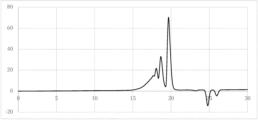
- the epoxy equivalent was 214 g/eq., the softening point was 49°C, the ICI melt viscosity was 0.04 Pa s, the average repeat number n was 2.1 from GPC, and the biomass degree was 25%.
- the GPC chart of epoxy resin A is shown in Figure 1.
- Example 1 The epoxy resin A obtained in Synthesis Example 1 was used as the base resin, the acid anhydride A obtained in Synthesis Example 2 was used as the curing agent, and 2E4MZ (2-ethyl-4-methylimidazole, manufactured by Shikoku Kasei Corporation) was used as the anionic polymerization initiator. These were mixed and kneaded in the weight ratio shown in the composition in Table 1, and cured at 160°C for 6 hours to produce a cured product. The biomass degree of the cured product was 48.6%.
- Tg Heat resistance
- Dynamic viscoelasticity measuring instrument TA-instruments, DMA-Q800 Measurement temperature range: 25 to 300°C Temperature rise rate: 2° C./min.
- Tg The peak point of Tan ⁇ was taken as Tg.
- Example 1 has a high biomass content, high heat resistance, and low dielectric properties.
Landscapes
- Chemical & Material Sciences (AREA)
- Health & Medical Sciences (AREA)
- Chemical Kinetics & Catalysis (AREA)
- Medicinal Chemistry (AREA)
- Polymers & Plastics (AREA)
- Organic Chemistry (AREA)
- Engineering & Computer Science (AREA)
- Microelectronics & Electronic Packaging (AREA)
- Manufacturing & Machinery (AREA)
- Materials Engineering (AREA)
- Epoxy Resins (AREA)
Priority Applications (5)
| Application Number | Priority Date | Filing Date | Title |
|---|---|---|---|
| CN202480017341.1A CN120858126A (zh) | 2023-03-30 | 2024-03-15 | 硬化性树脂组合物及其硬化物 |
| JP2024539608A JP7594711B1 (ja) | 2023-03-30 | 2024-03-15 | 硬化性樹脂組成物およびその硬化物 |
| EP24779560.2A EP4692159A1 (en) | 2023-03-30 | 2024-03-15 | Curable resin composition and cured product thereof |
| US19/161,307 US20260117017A1 (en) | 2023-03-30 | 2024-03-15 | Curable resin composition and cured product thereof |
| KR1020257029333A KR20250164172A (ko) | 2023-03-30 | 2024-03-15 | 경화성 수지 조성물 및 그 경화물 |
Applications Claiming Priority (2)
| Application Number | Priority Date | Filing Date | Title |
|---|---|---|---|
| JP2023055545 | 2023-03-30 | ||
| JP2023-055545 | 2023-03-30 |
Publications (1)
| Publication Number | Publication Date |
|---|---|
| WO2024203431A1 true WO2024203431A1 (ja) | 2024-10-03 |
Family
ID=92906069
Family Applications (1)
| Application Number | Title | Priority Date | Filing Date |
|---|---|---|---|
| PCT/JP2024/010167 Ceased WO2024203431A1 (ja) | 2023-03-30 | 2024-03-15 | 硬化性樹脂組成物およびその硬化物 |
Country Status (7)
| Country | Link |
|---|---|
| US (1) | US20260117017A1 (https=) |
| EP (1) | EP4692159A1 (https=) |
| JP (1) | JP7594711B1 (https=) |
| KR (1) | KR20250164172A (https=) |
| CN (1) | CN120858126A (https=) |
| TW (1) | TW202500619A (https=) |
| WO (1) | WO2024203431A1 (https=) |
Citations (9)
| Publication number | Priority date | Publication date | Assignee | Title |
|---|---|---|---|---|
| JPS53120800A (en) * | 1977-03-30 | 1978-10-21 | Mitsubishi Chem Ind Ltd | Curing agent for epoxy resin |
| JPH01163211A (ja) * | 1987-12-21 | 1989-06-27 | Sumitomo Bakelite Co Ltd | エポキシ樹脂組成物 |
| JPH1121421A (ja) * | 1997-06-27 | 1999-01-26 | Yuka Shell Epoxy Kk | 半導体封止用液状エポキシ樹脂組成物 |
| JP2000319345A (ja) * | 1999-05-14 | 2000-11-21 | Nippon Kayaku Co Ltd | 熱硬化性樹脂組成物及びその硬化物 |
| CN1562990A (zh) * | 2004-04-16 | 2005-01-12 | 哈尔滨商业大学 | 1-甲基-4-异丙基-二环[2,2,2]辛烯-2,3-二酸酐制法 |
| JP2005527410A (ja) | 2002-05-29 | 2005-09-15 | ザ・ボーイング・カンパニー | 制御された大気圧樹脂注入プロセス |
| JP2007211254A (ja) | 1997-01-10 | 2007-08-23 | Nippon Kayaku Co Ltd | エポキシ樹脂組成物およびエポキシ樹脂の製造方法 |
| JP2013082785A (ja) * | 2011-10-07 | 2013-05-09 | Nippon Kayaku Co Ltd | フェノール樹脂、エポキシ樹脂及びその硬化物 |
| JP2014201639A (ja) * | 2013-04-03 | 2014-10-27 | 日本化薬株式会社 | エポキシ樹脂組成物及びその硬化物 |
Family Cites Families (8)
| Publication number | Priority date | Publication date | Assignee | Title |
|---|---|---|---|---|
| JP4026733B2 (ja) * | 1997-01-10 | 2007-12-26 | 日本化薬株式会社 | エポキシ樹脂、エポキシ樹脂組成物及びその硬化物 |
| JP5382761B2 (ja) * | 2005-03-15 | 2014-01-08 | 日本化薬株式会社 | エポキシ樹脂、エポキシ樹脂組成物、これを用いたプリプレグ及び積層板 |
| WO2008047613A1 (fr) * | 2006-10-11 | 2008-04-24 | Nipponkayaku Kabushikikaisha | Résine époxyde, procédé servant à produire la résine époxyde, composition de résine époxyde utilisant la résine époxyde et produit durci de la composition de résine époxyde |
| KR101966878B1 (ko) * | 2018-06-22 | 2019-04-08 | 국도화학 주식회사 | 퍼퓨릴 알코올 유래 2 관능성 퓨란 에폭시 및 이의 제조방법 |
| WO2020117366A2 (en) * | 2018-10-11 | 2020-06-11 | Paquette Craig Michael | Renewable bio-based non-toxic aromatic-furanic monomers for use in thermosetting and thermoplastic polymers |
| KR20210074802A (ko) * | 2019-12-12 | 2021-06-22 | 국도화학 주식회사 | 다관능성 노볼락 수지를 제조하는 방법, 에폭시 수지를 제조하는 방법, 이를 통해 제조된 다관능성 노볼락 수지 및 에폭시 수지 |
| JP6924292B2 (ja) * | 2020-01-22 | 2021-08-25 | 日本化薬株式会社 | エポキシ樹脂混合物、エポキシ樹脂組成物およびその硬化物 |
| JP7128598B1 (ja) * | 2021-08-04 | 2022-08-31 | 日本化薬株式会社 | エポキシ樹脂混合物、エポキシ樹脂組成物およびその硬化物 |
-
2024
- 2024-03-15 KR KR1020257029333A patent/KR20250164172A/ko active Pending
- 2024-03-15 CN CN202480017341.1A patent/CN120858126A/zh active Pending
- 2024-03-15 JP JP2024539608A patent/JP7594711B1/ja active Active
- 2024-03-15 EP EP24779560.2A patent/EP4692159A1/en active Pending
- 2024-03-15 US US19/161,307 patent/US20260117017A1/en active Pending
- 2024-03-15 WO PCT/JP2024/010167 patent/WO2024203431A1/ja not_active Ceased
- 2024-03-15 TW TW113109754A patent/TW202500619A/zh unknown
Patent Citations (9)
| Publication number | Priority date | Publication date | Assignee | Title |
|---|---|---|---|---|
| JPS53120800A (en) * | 1977-03-30 | 1978-10-21 | Mitsubishi Chem Ind Ltd | Curing agent for epoxy resin |
| JPH01163211A (ja) * | 1987-12-21 | 1989-06-27 | Sumitomo Bakelite Co Ltd | エポキシ樹脂組成物 |
| JP2007211254A (ja) | 1997-01-10 | 2007-08-23 | Nippon Kayaku Co Ltd | エポキシ樹脂組成物およびエポキシ樹脂の製造方法 |
| JPH1121421A (ja) * | 1997-06-27 | 1999-01-26 | Yuka Shell Epoxy Kk | 半導体封止用液状エポキシ樹脂組成物 |
| JP2000319345A (ja) * | 1999-05-14 | 2000-11-21 | Nippon Kayaku Co Ltd | 熱硬化性樹脂組成物及びその硬化物 |
| JP2005527410A (ja) | 2002-05-29 | 2005-09-15 | ザ・ボーイング・カンパニー | 制御された大気圧樹脂注入プロセス |
| CN1562990A (zh) * | 2004-04-16 | 2005-01-12 | 哈尔滨商业大学 | 1-甲基-4-异丙基-二环[2,2,2]辛烯-2,3-二酸酐制法 |
| JP2013082785A (ja) * | 2011-10-07 | 2013-05-09 | Nippon Kayaku Co Ltd | フェノール樹脂、エポキシ樹脂及びその硬化物 |
| JP2014201639A (ja) * | 2013-04-03 | 2014-10-27 | 日本化薬株式会社 | エポキシ樹脂組成物及びその硬化物 |
Also Published As
| Publication number | Publication date |
|---|---|
| KR20250164172A (ko) | 2025-11-24 |
| JP7594711B1 (ja) | 2024-12-04 |
| JPWO2024203431A1 (https=) | 2024-10-03 |
| TW202500619A (zh) | 2025-01-01 |
| US20260117017A1 (en) | 2026-04-30 |
| CN120858126A (zh) | 2025-10-28 |
| EP4692159A1 (en) | 2026-02-11 |
Similar Documents
| Publication | Publication Date | Title |
|---|---|---|
| KR102787189B1 (ko) | 에폭시 수지 혼합물, 에폭시 수지 조성물 및 그 경화물 | |
| JP2024143063A (ja) | フェノール樹脂、エポキシ樹脂、硬化性樹脂組成物、及び炭素繊維強化複合材料 | |
| JP2017082213A (ja) | エポキシ樹脂組成物、硬化物、半導体素子、樹脂シート、プリプレグ及び炭素繊維強化複合材料 | |
| JP2020176189A (ja) | エポキシ樹脂、硬化性樹脂組成物、およびその硬化物 | |
| JP7550910B1 (ja) | エポキシ樹脂、硬化性樹脂組成物、及び硬化物 | |
| JP7240989B2 (ja) | 硬化性樹脂組成物およびその硬化物 | |
| JP2025036791A (ja) | 硬化性樹脂組成物およびその硬化物 | |
| JP7594711B1 (ja) | 硬化性樹脂組成物およびその硬化物 | |
| JP7614458B1 (ja) | 硬化性樹脂組成物およびその硬化物 | |
| KR102890723B1 (ko) | 에폭시 수지, 경화성 수지 조성물 및 그 경화물 | |
| JP7835721B2 (ja) | 硬化性樹脂組成物およびその硬化物 | |
| JP7230285B1 (ja) | エポキシ樹脂、硬化性樹脂組成物、およびその硬化物 | |
| WO2024203145A1 (ja) | 硬化性樹脂組成物およびその硬化物 | |
| KR102827934B1 (ko) | 에폭시 수지 및 그 제조 방법, 경화성 수지 조성물, 및 그 경화물 | |
| WO2025033103A1 (ja) | エポキシ樹脂、硬化性樹脂組成物、硬化物及び炭素繊維強化複合材料 | |
| JP2025118710A (ja) | エポキシ樹脂、硬化性樹脂組成物、およびその硬化物 | |
| CN116234851A (zh) | 环氧树脂、硬化性树脂组合物、及其硬化物 |
Legal Events
| Date | Code | Title | Description |
|---|---|---|---|
| WWE | Wipo information: entry into national phase |
Ref document number: 2024539608 Country of ref document: JP |
|
| 121 | Ep: the epo has been informed by wipo that ep was designated in this application |
Ref document number: 24779560 Country of ref document: EP Kind code of ref document: A1 |
|
| ENP | Entry into the national phase |
Ref document number: 1020257029333 Country of ref document: KR Free format text: ST27 STATUS EVENT CODE: A-0-1-A10-A15-NAP-PA0105 (AS PROVIDED BY THE NATIONAL OFFICE) |
|
| WWE | Wipo information: entry into national phase |
Ref document number: 202480017341.1 Country of ref document: CN |
|
| WWE | Wipo information: entry into national phase |
Ref document number: 2501006369 Country of ref document: TH |
|
| WWP | Wipo information: published in national office |
Ref document number: 202480017341.1 Country of ref document: CN |
|
| WWE | Wipo information: entry into national phase |
Ref document number: 2024779560 Country of ref document: EP |
|
| NENP | Non-entry into the national phase |
Ref country code: DE |
|
| WWE | Wipo information: entry into national phase |
Ref document number: 11202506131U Country of ref document: SG |
|
| WWP | Wipo information: published in national office |
Ref document number: 11202506131U Country of ref document: SG |
|
| ENP | Entry into the national phase |
Ref document number: 2024779560 Country of ref document: EP Effective date: 20251030 |
|
| ENP | Entry into the national phase |
Ref document number: 2024779560 Country of ref document: EP Effective date: 20251030 |
|
| ENP | Entry into the national phase |
Ref document number: 2024779560 Country of ref document: EP Effective date: 20251030 |
|
| ENP | Entry into the national phase |
Ref document number: 2024779560 Country of ref document: EP Effective date: 20251030 |
|
| ENP | Entry into the national phase |
Ref document number: 2024779560 Country of ref document: EP Effective date: 20251030 |
|
| ENP | Entry into the national phase |
Ref document number: 2024779560 Country of ref document: EP Effective date: 20251030 |
|
| ENP | Entry into the national phase |
Ref document number: 2024779560 Country of ref document: EP Effective date: 20251030 |
|
| ENP | Entry into the national phase |
Ref document number: 2024779560 Country of ref document: EP Effective date: 20251030 |
|
| WWP | Wipo information: published in national office |
Ref document number: 2024779560 Country of ref document: EP |