WO2024202136A1 - エポキシ樹脂組成物、電子部品、半導体装置、半導体装置の製造方法 - Google Patents
エポキシ樹脂組成物、電子部品、半導体装置、半導体装置の製造方法 Download PDFInfo
- Publication number
- WO2024202136A1 WO2024202136A1 PCT/JP2023/035949 JP2023035949W WO2024202136A1 WO 2024202136 A1 WO2024202136 A1 WO 2024202136A1 JP 2023035949 W JP2023035949 W JP 2023035949W WO 2024202136 A1 WO2024202136 A1 WO 2024202136A1
- Authority
- WO
- WIPO (PCT)
- Prior art keywords
- epoxy resin
- resin composition
- elastomer
- composition according
- polishing
- Prior art date
- Legal status (The legal status is an assumption and is not a legal conclusion. Google has not performed a legal analysis and makes no representation as to the accuracy of the status listed.)
- Ceased
Links
Classifications
-
- C—CHEMISTRY; METALLURGY
- C08—ORGANIC MACROMOLECULAR COMPOUNDS; THEIR PREPARATION OR CHEMICAL WORKING-UP; COMPOSITIONS BASED THEREON
- C08L—COMPOSITIONS OF MACROMOLECULAR COMPOUNDS
- C08L63/00—Compositions of epoxy resins; Compositions of derivatives of epoxy resins
-
- B—PERFORMING OPERATIONS; TRANSPORTING
- B29—WORKING OF PLASTICS; WORKING OF SUBSTANCES IN A PLASTIC STATE IN GENERAL
- B29C—SHAPING OR JOINING OF PLASTICS; SHAPING OF MATERIAL IN A PLASTIC STATE, NOT OTHERWISE PROVIDED FOR; AFTER-TREATMENT OF THE SHAPED PRODUCTS, e.g. REPAIRING
- B29C43/00—Compression moulding, i.e. applying external pressure to flow the moulding material; Apparatus therefor
- B29C43/003—Compression moulding, i.e. applying external pressure to flow the moulding material; Apparatus therefor characterised by the choice of material
-
- B—PERFORMING OPERATIONS; TRANSPORTING
- B29—WORKING OF PLASTICS; WORKING OF SUBSTANCES IN A PLASTIC STATE IN GENERAL
- B29C—SHAPING OR JOINING OF PLASTICS; SHAPING OF MATERIAL IN A PLASTIC STATE, NOT OTHERWISE PROVIDED FOR; AFTER-TREATMENT OF THE SHAPED PRODUCTS, e.g. REPAIRING
- B29C43/00—Compression moulding, i.e. applying external pressure to flow the moulding material; Apparatus therefor
- B29C43/02—Compression moulding, i.e. applying external pressure to flow the moulding material; Apparatus therefor of articles of definite length, i.e. discrete articles
- B29C43/18—Compression moulding, i.e. applying external pressure to flow the moulding material; Apparatus therefor of articles of definite length, i.e. discrete articles incorporating preformed parts or layers, e.g. compression moulding around inserts or for coating articles
-
- C—CHEMISTRY; METALLURGY
- C08—ORGANIC MACROMOLECULAR COMPOUNDS; THEIR PREPARATION OR CHEMICAL WORKING-UP; COMPOSITIONS BASED THEREON
- C08G—MACROMOLECULAR COMPOUNDS OBTAINED OTHERWISE THAN BY REACTIONS ONLY INVOLVING UNSATURATED CARBON-TO-CARBON BONDS
- C08G59/00—Polycondensates containing more than one epoxy group per molecule; Macromolecules obtained by polymerising compounds containing more than one epoxy group per molecule using curing agents or catalysts which react with the epoxy groups
- C08G59/18—Macromolecules obtained by polymerising compounds containing more than one epoxy group per molecule using curing agents or catalysts which react with the epoxy groups ; e.g. general methods of curing
- C08G59/40—Macromolecules obtained by polymerising compounds containing more than one epoxy group per molecule using curing agents or catalysts which react with the epoxy groups ; e.g. general methods of curing characterised by the curing agents used
- C08G59/42—Polycarboxylic acids; Anhydrides, halides or low molecular weight esters thereof
-
- C—CHEMISTRY; METALLURGY
- C08—ORGANIC MACROMOLECULAR COMPOUNDS; THEIR PREPARATION OR CHEMICAL WORKING-UP; COMPOSITIONS BASED THEREON
- C08G—MACROMOLECULAR COMPOUNDS OBTAINED OTHERWISE THAN BY REACTIONS ONLY INVOLVING UNSATURATED CARBON-TO-CARBON BONDS
- C08G59/00—Polycondensates containing more than one epoxy group per molecule; Macromolecules obtained by polymerising compounds containing more than one epoxy group per molecule using curing agents or catalysts which react with the epoxy groups
- C08G59/18—Macromolecules obtained by polymerising compounds containing more than one epoxy group per molecule using curing agents or catalysts which react with the epoxy groups ; e.g. general methods of curing
- C08G59/40—Macromolecules obtained by polymerising compounds containing more than one epoxy group per molecule using curing agents or catalysts which react with the epoxy groups ; e.g. general methods of curing characterised by the curing agents used
- C08G59/50—Amines
-
- C—CHEMISTRY; METALLURGY
- C08—ORGANIC MACROMOLECULAR COMPOUNDS; THEIR PREPARATION OR CHEMICAL WORKING-UP; COMPOSITIONS BASED THEREON
- C08G—MACROMOLECULAR COMPOUNDS OBTAINED OTHERWISE THAN BY REACTIONS ONLY INVOLVING UNSATURATED CARBON-TO-CARBON BONDS
- C08G59/00—Polycondensates containing more than one epoxy group per molecule; Macromolecules obtained by polymerising compounds containing more than one epoxy group per molecule using curing agents or catalysts which react with the epoxy groups
- C08G59/18—Macromolecules obtained by polymerising compounds containing more than one epoxy group per molecule using curing agents or catalysts which react with the epoxy groups ; e.g. general methods of curing
- C08G59/40—Macromolecules obtained by polymerising compounds containing more than one epoxy group per molecule using curing agents or catalysts which react with the epoxy groups ; e.g. general methods of curing characterised by the curing agents used
- C08G59/62—Alcohols or phenols
- C08G59/621—Phenols
-
- C—CHEMISTRY; METALLURGY
- C08—ORGANIC MACROMOLECULAR COMPOUNDS; THEIR PREPARATION OR CHEMICAL WORKING-UP; COMPOSITIONS BASED THEREON
- C08G—MACROMOLECULAR COMPOUNDS OBTAINED OTHERWISE THAN BY REACTIONS ONLY INVOLVING UNSATURATED CARBON-TO-CARBON BONDS
- C08G59/00—Polycondensates containing more than one epoxy group per molecule; Macromolecules obtained by polymerising compounds containing more than one epoxy group per molecule using curing agents or catalysts which react with the epoxy groups
- C08G59/18—Macromolecules obtained by polymerising compounds containing more than one epoxy group per molecule using curing agents or catalysts which react with the epoxy groups ; e.g. general methods of curing
- C08G59/68—Macromolecules obtained by polymerising compounds containing more than one epoxy group per molecule using curing agents or catalysts which react with the epoxy groups ; e.g. general methods of curing characterised by the catalysts used
- C08G59/686—Macromolecules obtained by polymerising compounds containing more than one epoxy group per molecule using curing agents or catalysts which react with the epoxy groups ; e.g. general methods of curing characterised by the catalysts used containing nitrogen
-
- C—CHEMISTRY; METALLURGY
- C08—ORGANIC MACROMOLECULAR COMPOUNDS; THEIR PREPARATION OR CHEMICAL WORKING-UP; COMPOSITIONS BASED THEREON
- C08K—Use of inorganic or non-macromolecular organic substances as compounding ingredients
- C08K3/00—Use of inorganic substances as compounding ingredients
- C08K3/01—Use of inorganic substances as compounding ingredients characterized by their specific function
- C08K3/013—Fillers, pigments or reinforcing additives
-
- C—CHEMISTRY; METALLURGY
- C08—ORGANIC MACROMOLECULAR COMPOUNDS; THEIR PREPARATION OR CHEMICAL WORKING-UP; COMPOSITIONS BASED THEREON
- C08K—Use of inorganic or non-macromolecular organic substances as compounding ingredients
- C08K3/00—Use of inorganic substances as compounding ingredients
- C08K3/34—Silicon-containing compounds
- C08K3/36—Silica
-
- C—CHEMISTRY; METALLURGY
- C08—ORGANIC MACROMOLECULAR COMPOUNDS; THEIR PREPARATION OR CHEMICAL WORKING-UP; COMPOSITIONS BASED THEREON
- C08L—COMPOSITIONS OF MACROMOLECULAR COMPOUNDS
- C08L51/00—Compositions of graft polymers in which the grafted component is obtained by reactions only involving carbon-to-carbon unsaturated bonds; Compositions of derivatives of such polymers
- C08L51/08—Compositions of graft polymers in which the grafted component is obtained by reactions only involving carbon-to-carbon unsaturated bonds; Compositions of derivatives of such polymers grafted on to macromolecular compounds obtained otherwise than by reactions only involving unsaturated carbon-to-carbon bonds
- C08L51/085—Compositions of graft polymers in which the grafted component is obtained by reactions only involving carbon-to-carbon unsaturated bonds; Compositions of derivatives of such polymers grafted on to macromolecular compounds obtained otherwise than by reactions only involving unsaturated carbon-to-carbon bonds on to polysiloxanes
-
- C—CHEMISTRY; METALLURGY
- C08—ORGANIC MACROMOLECULAR COMPOUNDS; THEIR PREPARATION OR CHEMICAL WORKING-UP; COMPOSITIONS BASED THEREON
- C08L—COMPOSITIONS OF MACROMOLECULAR COMPOUNDS
- C08L9/00—Compositions of homopolymers or copolymers of conjugated diene hydrocarbons
- C08L9/02—Copolymers with acrylonitrile
-
- H—ELECTRICITY
- H10—SEMICONDUCTOR DEVICES; ELECTRIC SOLID-STATE DEVICES NOT OTHERWISE PROVIDED FOR
- H10W—GENERIC PACKAGES, INTERCONNECTIONS, CONNECTORS OR OTHER CONSTRUCTIONAL DETAILS OF DEVICES COVERED BY CLASS H10
- H10W74/00—Encapsulations, e.g. protective coatings
- H10W74/10—Encapsulations, e.g. protective coatings characterised by their shape or disposition
-
- H—ELECTRICITY
- H10—SEMICONDUCTOR DEVICES; ELECTRIC SOLID-STATE DEVICES NOT OTHERWISE PROVIDED FOR
- H10W—GENERIC PACKAGES, INTERCONNECTIONS, CONNECTORS OR OTHER CONSTRUCTIONAL DETAILS OF DEVICES COVERED BY CLASS H10
- H10W74/00—Encapsulations, e.g. protective coatings
- H10W74/40—Encapsulations, e.g. protective coatings characterised by their materials
-
- H—ELECTRICITY
- H10—SEMICONDUCTOR DEVICES; ELECTRIC SOLID-STATE DEVICES NOT OTHERWISE PROVIDED FOR
- H10W—GENERIC PACKAGES, INTERCONNECTIONS, CONNECTORS OR OTHER CONSTRUCTIONAL DETAILS OF DEVICES COVERED BY CLASS H10
- H10W74/00—Encapsulations, e.g. protective coatings
- H10W74/40—Encapsulations, e.g. protective coatings characterised by their materials
- H10W74/47—Encapsulations, e.g. protective coatings characterised by their materials comprising organic materials, e.g. plastics or resins
- H10W74/473—Encapsulations, e.g. protective coatings characterised by their materials comprising organic materials, e.g. plastics or resins containing a filler
-
- B—PERFORMING OPERATIONS; TRANSPORTING
- B29—WORKING OF PLASTICS; WORKING OF SUBSTANCES IN A PLASTIC STATE IN GENERAL
- B29C—SHAPING OR JOINING OF PLASTICS; SHAPING OF MATERIAL IN A PLASTIC STATE, NOT OTHERWISE PROVIDED FOR; AFTER-TREATMENT OF THE SHAPED PRODUCTS, e.g. REPAIRING
- B29C43/00—Compression moulding, i.e. applying external pressure to flow the moulding material; Apparatus therefor
- B29C43/02—Compression moulding, i.e. applying external pressure to flow the moulding material; Apparatus therefor of articles of definite length, i.e. discrete articles
- B29C43/18—Compression moulding, i.e. applying external pressure to flow the moulding material; Apparatus therefor of articles of definite length, i.e. discrete articles incorporating preformed parts or layers, e.g. compression moulding around inserts or for coating articles
- B29C2043/181—Compression moulding, i.e. applying external pressure to flow the moulding material; Apparatus therefor of articles of definite length, i.e. discrete articles incorporating preformed parts or layers, e.g. compression moulding around inserts or for coating articles encapsulated
-
- C—CHEMISTRY; METALLURGY
- C08—ORGANIC MACROMOLECULAR COMPOUNDS; THEIR PREPARATION OR CHEMICAL WORKING-UP; COMPOSITIONS BASED THEREON
- C08L—COMPOSITIONS OF MACROMOLECULAR COMPOUNDS
- C08L2207/00—Properties characterising the ingredient of the composition
- C08L2207/53—Core-shell polymer
Definitions
- the present invention relates to an epoxy resin composition, an electronic component, a semiconductor device, and a method for manufacturing a semiconductor device.
- Wafer-level chip size packaging technology involves a process of encapsulating semiconductor elements with an encapsulant.
- One encapsulation method suitable for wafer-level chip size packaging technology is compression molding.
- Compression molding is a method in which a liquid encapsulant called liquid compression molding material is poured into the gap below the semiconductor element and the encapsulant is then hardened.
- Patent Documents 1 and 2 propose a composition containing an epoxy resin, a hardener, and a filler.
- a rewiring layer is formed on the portion of the hardened encapsulant that corresponds to the circuit surface of the semiconductor element.
- the surface of the hardened encapsulant is polished using a method such as chemical mechanical polishing (CMP) to flatten the surface of the hardened encapsulant.
- CMP chemical mechanical polishing
- the present invention aims to provide an epoxy resin composition that can suppress the formation of small holes when the surface of a cured product is polished, an electronic component that uses the epoxy resin composition, and a semiconductor device that uses the epoxy resin composition and a method for manufacturing the same.
- An epoxy resin composition comprising an epoxy resin, a curing accelerator, a filler, and an elastomer,
- the elastomer is at least one selected from a solid elastomer and a liquid elastomer,
- the solid elastomer is an epoxy resin composition having a structure having no double bond in the main chain.
- An electronic part comprising a support and a cured product of the epoxy resin composition according to any one of (1) to (11).
- a method for producing a semiconductor device comprising the steps of: filling a gap between a support and a semiconductor element disposed on the support with the epoxy resin composition according to any one of (1) to (11); curing the epoxy resin composition; and polishing the cured product of the epoxy resin composition.
- the present invention provides an epoxy resin composition that can suppress the formation of small holes when the surface of a cured product is polished, an electronic component that uses the epoxy resin composition, and a semiconductor device that uses the epoxy resin composition and a method for manufacturing the same.
- FIG. 1 is an SEM image of the surface of the cured epoxy resin material after the second polishing in Example 1.
- FIG. 2 is an SEM image of the surface of the cured epoxy resin material after the second polishing in Comparative Example 1.
- Epoxy resin composition contains an epoxy resin, a curing accelerator, a filler, and an elastomer, and preferably further contains a curing agent, and further contains other components as necessary.
- the epoxy resin is not particularly limited as long as it is any of various epoxy resins generally used for semiconductor encapsulation and can be appropriately selected depending on the purpose, and examples thereof include aliphatic epoxy resins, aromatic epoxy resins, etc. These may be used alone or in combination of two types.
- the aliphatic epoxy resin is contained in order to impart flexibility to the cured product of the epoxy resin composition (hereinafter also simply referred to as "cured product"), and examples thereof include monofunctional aliphatic epoxy resins, difunctional aliphatic epoxy resins, polyfunctional aliphatic epoxy resins, etc. These may be used alone or in combination of two or more.
- Monofunctional aliphatic epoxy resins are compounds that have one epoxy group in the molecule, and examples include alkyl alcohol glycidyl ethers such as butyl glycidyl ether and 2-ethylhexyl glycidyl ether; and alkenyl alcohol glycidyl ethers such as vinyl glycidyl ether and allyl glycidyl ether.
- Difunctional aliphatic epoxy resins are compounds that have two epoxy groups in the molecule, such as alkylene glycol diglycidyl ether, poly(alkylene glycol) diglycidyl ether, and alkenylene glycol diglycidyl ether.
- the polyfunctional aliphatic epoxy resin is a compound having three or more epoxy groups in the molecule, and examples thereof include polyglycidyl ethers of trifunctional or higher alcohols such as trimethylolpropane triglycidyl ether, pentaerythritol (tri- or tetra-)glycidyl ether, and dipentaerythritol (tri-, tetra-, penta- or hexa-)glycidyl ether, pentaerythritol, and dipentaerythritol.
- the upper limit of the number of epoxy groups is not particularly limited and can be appropriately selected depending on the purpose, but it is preferably 5 or less.
- multifunctional epoxy resins are preferred from the standpoint of reliability (thermal cycle resistance) and other factors.
- the number average molecular weight of the aliphatic epoxy resin is not particularly limited and can be appropriately selected depending on the purpose, but is preferably 200 to 2,000 from the viewpoint of imparting flexibility to the cured product of the epoxy resin composition.
- the number average molecular weight of the aliphatic epoxy resin can be measured by a general method for measuring number average molecular weight.
- the aliphatic epoxy resin may be a synthetic product or a commercially available product.
- Examples of commercially available products include Epogosey PT (general grade) (manufactured by Yokkaichi Synthetic Co., Ltd.), YX7400 (manufactured by Mitsubishi Chemical Corporation), SR-8EGS (manufactured by Sakamoto Pharmaceutical Co., Ltd.), and PG-207GS (manufactured by Nippon Steel Chemical & Material Co., Ltd.).
- aromatic epoxy resins include glycidyl ethers of phenols, glycidyl ether esters of hydroxycarboxylic acids, monoglycidyl esters or polyglycidyl esters of carboxylic acids, glycidylamine type epoxy resins, aminophenol type epoxy resins, epoxy resins having a naphthalene skeleton, novolac resins, etc. These may be used alone or in combination of two or more.
- Examples of glycidyl ethers of phenols include bisphenol A, bisphenol F, bisphenol AD, bisphenol S, catechol, and resorcinol.
- the glycidyl ethers of phenols may be synthesized or commercially available.
- Examples of commercially available products include YDF8170 (manufactured by Nippon Steel Chemical & Material Co., Ltd.), YDF870GS (manufactured by Nippon Steel Chemical & Material Co., Ltd.), EXA-850CRP (manufactured by DIC Corporation), EXA-835LV (manufactured by DIC Corporation), and EP4005 (manufactured by ADEKA Corporation).
- Examples of glycidyl ether esters of hydroxycarboxylic acids include p-hydroxybenzoic acid.
- the glycidyl ether esters of hydroxycarboxylic acids may be either synthesized or commercially available.
- monoglycidyl esters or polyglycidyl esters of carboxylic acids examples include benzoic acid, phthalic acid, and terephthalic acid.
- the monoglycidyl esters or polyglycidyl esters of carboxylic acids may be either synthesized or commercially available.
- Examples of glycidylamine type epoxy resins include diglycidyl aniline, diglycidyl toluidine, and tetraglycidyl-m-xylylenediamine.
- the glycidylamine type epoxy resin may be a synthetic product or a commercially available product. Examples of commercially available products include EP3980S (manufactured by ADEKA Corporation) and ZX1059 (manufactured by Nippon Steel Chemical & Material Co., Ltd.).
- aminophenol type epoxy resins examples include triglycidyl-p-aminophenol.
- the aminophenol type epoxy resins may be synthetic or commercially available.
- commercially available products include jER630 and jER630LSD (both manufactured by Mitsubishi Chemical Corporation) and EP3950L (manufactured by ADEKA Corporation).
- Epoxy resins having a naphthalene skeleton include, for example, glycidyl esters of naphthol and glycidyl ether esters of ⁇ -hydroxynaphthoic acid.
- the epoxy resins having a naphthalene skeleton may be synthesized or commercially available products. Examples of commercially available products include HP4032, HP4032D, and HP4032SS (all manufactured by DIC Corporation).
- Novolac resins include, for example, compounds obtained by converting phenols such as phenol, catechol, and resorcinol into novolacs.
- the novolac resin may be a synthetic product or a commercially available product.
- An example of a commercially available product is jER152 (manufactured by Mitsubishi Chemical Corporation).
- the epoxy resin is a mixture of an aliphatic epoxy resin and an aromatic epoxy resin, in order to improve the curing properties while maintaining the hardness of the cured epoxy resin.
- the curing accelerator is contained in order to accelerate the crosslinking reaction between the epoxy resins and increase the curing rate of the epoxy resin.
- the curing accelerator is homopolymerized with the epoxy resin. That is, the curing accelerator does not remain in the crosslinked structure formed by the epoxy resin.
- the curing accelerator is not particularly limited as long as it can cure the epoxy resin, and can be appropriately selected depending on the purpose. From the viewpoint of reliability (thermal cycle resistance), however, a heterocyclic compound containing a nitrogen atom is preferable.
- Heterocyclic compounds containing nitrogen atoms examples include imidazole derivatives and microencapsulated heterocyclic compounds containing a nitrogen atom.
- imidazole derivative examples include 2-methylimidazole, 2-undecylimidazole, 2-heptadecylimidazole, 2-ethyl-4-methylimidazole, 2-phenylimidazole, 2-phenyl-4-methylimidazole, 2-phenyl-4,5-dihydroxymethylimidazole, 2-phenyl-4-methyl-5-hydroxymethylimidazole, 1-cyanoethyl-2-undecylimidazole, 1-cyanoethyl-2-ethyl-4-imidazole, 2-phenylimidazole, 1-benzyl-2-phenylimidazole, benzimidazole, 2,4-diamino-6-[2'-methylimidazolyl-(1')]ethyl-s-triazine, 2-phenyl-4,5-dihydroxymethylimidazole, and 2,3-dihydro-1H-pyrrolo[1,2-a]benzimidazole.
- the imidazole derivative may be a commercially available product or may be appropriately synthesized.
- Examples of commercially available products include 2P4MZ (2-phenyl-4-methylimidazole), 2MZA (2,4-diamino-6-[2'-methylimidazolyl-(1')]ethyl-s-triazine, 2-phenyl-4-methylimidazole) (both manufactured by Shikoku Chemical Industry Co., Ltd.).
- the microencapsulated nitrogen-containing heterocyclic compound may be a commercially available product or may be appropriately synthesized.
- Commercially available products include, for example, Novacure HX3941HP, Novacure HXA3042HP, Novacure HXA3922HP, Novacure HXA3792, Novacure HX3748, Novacure HX3721, Novacure HX3722, Novacure HX3088, Novacure HX3741, Novacure HX3742, Novacure HX3613 (all manufactured by Asahi Kasei Corporation), Amicure PN-23J, Amicure PN-40J (all manufactured by Ajinomoto Fine-Techno Co., Ltd.), and Fujicure FXR-1121 (manufactured by Fuji Kasei Kogyo Co., Ltd.). These may be used alone or in combination of two or more types.
- the nitrogen-containing heterocyclic compounds are preferably 2-phenyl-4-methylimidazole and 2,4-diamino-6-[2'-methylimidazolyl-(1')]ethyl-s-triazine in terms of reactivity and storage stability.
- the content of the nitrogen-containing heterocyclic compound is not particularly limited and can be appropriately selected depending on the purpose, but is preferably 2.0% by mass to 8.0% by mass, and more preferably 2.5% by mass to 6.0% by mass, based on the epoxy resin composition excluding the filler described below.
- the content of the nitrogen-containing heterocyclic compound is 2.0% by mass or more, the curing time of the epoxy resin composition can be shortened, and the productivity of electronic component devices is improved.
- the content of the nitrogen-containing heterocyclic compound is 8.0% by mass or less, the storage stability of the epoxy resin composition is improved.
- the content of the microencapsulated nitrogen-containing heterocyclic compound is preferably 3% by mass to 25% by mass, more preferably 5% by mass to 20% by mass, based on the epoxy resin composition excluding the filler as the active ingredient (heterocyclic compound containing nitrogen).
- the content of the microencapsulated nitrogen-containing heterocyclic compound is 3% by mass or more, the curing time of the epoxy resin composition can be accelerated, and the productivity of the electronic component device can be improved.
- the content of the microencapsulated nitrogen-containing heterocyclic compound is 25% by mass or less, the viscosity does not increase and the workability can be prevented from decreasing.
- the filler is contained in the epoxy resin composition in order to adjust the properties of the cured product (mainly the linear expansion coefficient, elastic modulus, and water absorption).
- the filler is not particularly limited and can be selected appropriately depending on the purpose.
- the filler include silica such as fused silica and crystalline silica; calcium carbonate, clay, alumina, silicon nitride, silicon carbide, boron nitride, calcium silicate, potassium titanate, aluminum nitride, beryllia, zirconia, zircon, fosterite, steatite, spinel, mullite, titania, aluminum hydroxide, magnesium hydroxide, zinc borate, and zinc molybdate. These may be used alone or in combination of two or more. Among these, silica filler and alumina filler are preferred because they can increase the loading amount.
- the filler may be a synthetic product or a commercially available product.
- Examples of commercially available products include silica fillers such as SE101G-SMO (manufactured by Admatechs Co., Ltd.), SE605G-SMG (manufactured by Admatechs Co., Ltd.), and STW7010-20 (manufactured by Nippon Steel Chemical & Material Co., Ltd.), and alumina fillers such as AG2051-SXM (manufactured by Admatechs Co., Ltd.).
- silica fillers such as SE101G-SMO (manufactured by Admatechs Co., Ltd.), SE605G-SMG (manufactured by Admatechs Co., Ltd.), and STW7010-20 (manufactured by Nippon Steel Chemical & Material Co., Ltd.)
- alumina fillers such as AG2051-SXM (manufactured by Admatechs Co., Ltd.
- the filler may be surface-treated.
- the surface treatment agent there are no particular limitations on the surface treatment agent, and it can be selected appropriately depending on the purpose.
- a silane coupling agent can be used.
- silane coupling agent there are no particular limitations on the silane coupling agent, and it can be selected appropriately depending on the purpose. Examples include epoxy, methacrylic, amino, vinyl, glycidoxy, and mercapto types. Commercially available products include KBM403, KBE403, KBM503, and KBM573 (all manufactured by Shin-Etsu Chemical Co., Ltd.).
- the volume average particle size of the filler is not particularly limited and can be appropriately selected depending on the purpose, but is preferably 0.1 ⁇ m to 15.0 ⁇ m, and more preferably 0.3 ⁇ m to 10.0 ⁇ m.
- the volume average particle size refers to a particle size at which the volume cumulative particle size distribution measured by laser diffraction method is 50%.
- the shape of the filler is not particularly limited and can be selected appropriately depending on the purpose. Examples include spherical, irregular, and flaky shapes.
- the filler content is preferably 73.0% by mass to 87.5% by mass, and more preferably 75.0% by mass to 85.0% by mass, from the viewpoint of reducing the linear expansion coefficient of the cured product of the epoxy resin composition and workability. If the filler content is 73.0% by mass or less, the linear expansion coefficient of the cured product of the epoxy resin composition will be high, and warping may become significant. If the filler content is 87.5% by mass or more, the viscosity of the epoxy resin composition will be high, which may reduce workability.
- the elastomer is contained in order to impart injectability to the epoxy resin composition and to improve the adhesive strength of the cured product of the epoxy resin composition.
- the elastomer is at least one selected from a solid elastomer having a structure without a double bond in the main chain and a liquid elastomer, from the viewpoint of suppressing the generation of small holes when the surface of the cured product is polished. These may be used alone or in combination of two kinds.
- the first is the falling off of the elastomer portion present in the cured product of the epoxy resin composition.
- cured products of elastomers have high abrasion resistance.
- the elastomer portion in the cured product of the epoxy resin composition is polished together with the epoxy resin and filler, etc., and falls off from the surface of the cured product of the epoxy resin composition. This fallen elastomer portion becomes a small hole.
- the second is the falling off of the filler present in the cured product of the epoxy resin composition.
- the filler falls off without being polished, similar to the elastomer portion described above.
- the third is damage to the polished surface of the cured product of the epoxy resin composition.
- the surface of the cured product of the epoxy resin composition is not polished, but a physical impact is applied, resulting in small holes. Therefore, in the present embodiment, an elastomer having low abrasion resistance is used, which is believed to be able to suppress the generation of small holes when the surface of the cured product is polished.
- a solid elastomer is an elastomer that is solid at room temperature (25°C) and has a structure that does not have a double bond in the main chain.
- An example of an elastomer that does not have a double bond in the main chain is silicone. Silicone has a siloxane bond and has low surface abrasion resistance due to polishing, etc., so that it can suppress small holes that occur when the surface of the cured product is polished and flattened.
- the solid elastomer is preferably a core-shell type elastomer, which means that the outside of the core is covered with a material different from that of the core.
- the core-shell type elastomer used in the embodiments is preferably an elastomer using a silicone resin for the core and an acrylic copolymer for the shell, since it exhibits a low elastic modulus within the temperature range in which the epoxy resin composition is used and can reduce the shrinkage stress of the epoxy resin composition.
- the components of the epoxy resin composition may be mixed together at the same time, but it is preferable to disperse the elastomer in the epoxy resin before mixing, i.e., to carry out master batch processing and then mix it with other epoxy resin composition components to produce the epoxy resin composition.
- the liquid elastomer is also called a liquid elastomer, and is an elastomer that is liquid at room temperature (25° C.).
- the liquid elastomer is not particularly limited and can be appropriately selected depending on the purpose, and examples thereof include a copolymer of butadiene and acrylonitrile (butadiene-acrylonitrile copolymer).
- the elastomer content is preferably 5.0% by mass or more, more preferably 5.0% by mass to 20.0% by mass, and even more preferably 8.0% by mass to 17.0% by mass, based on the components excluding the filler from the epoxy resin composition. If the elastomer content falls within this range, the adhesive strength can be improved and a decrease in workability due to high viscosity can be prevented.
- the curing agent is contained in order to cure the epoxy resin.
- the curing agent undergoes addition polymerization with the epoxy resin. That is, the curing agent enters into the crosslinked structure formed by the epoxy resin.
- the curing agent is not particularly limited as long as it can cure the epoxy resin, and can be appropriately selected according to the purpose, and examples thereof include phenol-based curing agents, amine-based curing agents, and acid anhydride-based curing agents. These may be used alone or in combination of two or more.
- the content of the curing agent is not particularly limited and can be appropriately selected depending on the purpose, but the stoichiometric equivalent ratio with the epoxy resin (curing agent equivalent/epoxy group equivalent) is preferably 0.01 to 1.00, more preferably 0.01 to 0.50, and even more preferably 0.08 to 0.30.
- the content of the curing agent is not particularly limited and can be appropriately selected depending on the purpose, but is preferably 0.5% by mass to 2.0% by mass, and more preferably 0.5% by mass to 1.0% by mass.
- the other components are not particularly limited as long as they are those used in ordinary epoxy resin compositions and can be appropriately selected depending on the purpose, and examples thereof include colorants such as coupling agents, dyes, pigments, and carbon black; silicone oils; surfactants; antioxidants; conventionally known flame retardants such as antimony oxides such as antimony trioxide, antimony tetraoxide, and antimony pentoxide, and brominated epoxy resins; ion trapping agents; leveling agents; antifoaming agents; reactive diluents, etc. These may be used alone or in combination of two or more.
- the content of other ingredients is not particularly limited and can be selected appropriately depending on the purpose.
- the viscosity of the epoxy resin composition at 25° C. is preferably 1,000 Pa ⁇ s or less, more preferably 700 Pa ⁇ s or less, and even more preferably 500 Pa ⁇ s or less. From the viewpoint of handling, the viscosity of the epoxy resin composition at 25° C. is preferably 150 Pa ⁇ s or more. In this specification, the viscosity is measured using an HB-DV type viscometer at a rotation speed of 10 rpm.
- the viscosity of the epoxy resin composition in the embodiment at 120° C. is preferably 0.5 Pa ⁇ s to 40.0 Pa ⁇ s.
- the viscosity at 120° C. can be measured by a rheometer.
- the number of small holes per given area after the surface of the cured product is polished by the first polishing and the second polishing is 10 or less.
- the small holes referred to here are holes with a diameter of 0.05 ⁇ m to 0.5 ⁇ m among the holes on the surface of the cured material after polishing.
- the diameter refers to the maximum length of a line connecting two points on the periphery of the small hole, and the same applies when the hole is elliptical rather than circular.
- the depth of the holes is set to 0.03 ⁇ m to 0.3 ⁇ m.
- the first polishing is performed by roughly polishing (grinding) the surface of the cured product. Specifically, it is performed using waterproof abrasive paper. Examples of the abrasive grain size of the abrasive paper include #600, #800, and #1200. Examples of the polishing conditions when forming a polished surface by the first polishing include the following conditions.
- the surface of the cured product is polished using a Struers automatic polishing machine (Tegramin-20, manufactured by Struers) under the following conditions.
- Abrasive material Water-resistant abrasive paper #600 Polishing time: 3 minutes.
- the rotation speed and polishing load were as follows. Rotation speed: 150 rpm Polishing load: 10N
- the second polishing is performed by a liquid containing an abrasive after the first polishing.
- the liquid containing an abrasive may be, for example, a liquid in which abrasive grains are dispersed in water.
- the liquid containing an abrasive may also be an abrasive slurry.
- the second polishing is chemical mechanical polishing (CMP), that is, polishing by a polishing pad and a polishing slurry.
- CMP chemical mechanical polishing
- the polishing conditions when forming a polished surface by the second polishing include, for example, the following conditions.
- Step 1 Polishing material Diamond slurry (Engis Japan Co., Ltd., 6-PC, 6 ⁇ slurry (particle size range: 4 ⁇ m to 8 ⁇ m)) Polishing time: 6 minutes
- Step 2 Polishing material Diamond slurry (Engis Japan Co., Ltd., 1-PC, 1 ⁇ slurry (particle size range: 0 ⁇ m to 2 ⁇ m)) Polishing time: 3 minutes
- Step 3 Polishing member Diamond slurry (Master prep, manufactured by BUEHLER, average particle size 0.05 ⁇ m) Polishing time: 2 minutes.
- the rotation speed and polishing load in steps 1 to 3 are as follows. Rotation speed: 150 rpm Polishing load: 10N
- the arithmetic mean roughness Ra of the polished surface of the cured product after the second polishing is preferably 500 nm or less, more preferably 300 nm or less, and even more preferably 100 nm or less.
- There is no particular lower limit for the arithmetic mean roughness Ra of the polished surface and examples include 10 nm or more, 20 nm or more, etc.
- the arithmetic surface roughness Ra of the polished surface can be calculated, for example, by measuring the surface of the cured epoxy resin composition after the second polishing using a confocal scanning electron microscope (OPTELICS H1200, manufactured by Lasertec Corporation) and using the method specified in JIS B 0601:2001.
- OTELICS H1200 manufactured by Lasertec Corporation
- the number of small holes on the surface of the cured epoxy resin composition polished by the first polishing and the second polishing can be measured by observing the surface with a scanning electron microscope (SEM) at a magnification of 5,000 times.
- the predetermined area in the above refers to one visual field in SEM observation, and is about 3.9 ⁇ m2 .
- the shading of the image obtained is determined according to the electron density, i.e., the shading in the SEM image is determined according to the type of compound.
- the method for producing the epoxy resin composition according to the embodiment is not particularly limited and can be appropriately selected depending on the purpose.
- the method includes mixing and stirring the above-mentioned components.
- the epoxy resin is in a solid state, it is preferable to liquefy and fluidize it by heating or the like before mixing.
- the components may be mixed simultaneously, or some of the components may be mixed first and the remaining components may be mixed later. If it is difficult to uniformly disperse the filler in the epoxy resin, the epoxy resin and filler may be mixed first and the remaining components may be mixed later.
- the equipment used for mixing and stirring is not particularly limited and can be selected appropriately depending on the purpose. Examples include roll mills, ball mills, planetary mixers, bead mills, Henschel mixers, and Raikai machines equipped with a stirrer and a heater.
- the epoxy resin composition according to the embodiment is an epoxy resin composition that can suppress the generation of small holes when the surface of a cured product is polished, and therefore can be suitably used as a liquid compression molding material.
- the electronic component according to this embodiment has a support and a cured product of the above-mentioned epoxy resin composition.
- the electronic component may be, for example, one in which a semiconductor element and a support are sealed with an epoxy resin composition.
- the support is not particularly limited as long as it is capable of fixing a semiconductor element, and can be appropriately selected depending on the purpose.
- a substrate and the like can be mentioned.
- the substrate is not particularly limited and can be appropriately selected depending on the purpose.
- the substrate include a lead frame, a pre-wired tape carrier, a wiring board, glass, and a silicon wafer.
- the size, shape and material of the substrate are not particularly limited as long as they are commonly used as substrates, and can be appropriately selected depending on the purpose.
- the semiconductor element is not particularly limited and can be appropriately selected depending on the purpose.
- Examples of the semiconductor element include active elements such as semiconductor chips, transistors, diodes, and thyristors; and passive elements such as capacitors, resistors, resistor arrays, coils, and switches. There are no particular limitations on the size, shape, and material of the semiconductor element, so long as they are used as ordinary semiconductor elements, and they can be appropriately selected depending on the purpose.
- the cured epoxy resin composition is provided between the support and the semiconductor element.
- the thickness of the cured product of the epoxy resin composition is not particularly limited and can be appropriately selected depending on the purpose.
- the thickness is from 10 ⁇ m to 800 ⁇ m.
- the shape of the cured product of the epoxy resin composition is not particularly limited and can be appropriately selected depending on the purpose.
- the semiconductor device (semiconductor package) according to this embodiment includes the above-mentioned electronic components, and further includes other members as necessary.
- the other members are not particularly limited and can be appropriately selected depending on the purpose.
- the method for manufacturing a semiconductor device includes a step of filling with an epoxy resin composition, a step of curing the epoxy resin composition, and a step of polishing the cured product of the epoxy resin composition, and may further include other steps as necessary.
- the step of filling the epoxy resin composition is a step of filling the gap between the support and the semiconductor element disposed on the support with the epoxy resin composition.
- the method of filling the epoxy resin composition is not particularly limited and can be appropriately selected depending on the purpose, and examples thereof include a dispense method, a casting method, a printing method, and the like.
- the amount of the epoxy resin composition to be filled is not particularly limited and can be appropriately selected depending on the purpose. For example, the amount is such that the thickness of the cured product of the epoxy resin composition is 10 ⁇ m or more and 800 ⁇ m or less.
- the step of curing the epoxy resin composition is a step of curing the epoxy resin composition between the support and the semiconductor element.
- the method for curing the epoxy resin composition is not particularly limited and can be appropriately selected depending on the purpose. Examples of the method include a method in which a support, an epoxy resin composition, and a semiconductor element are heated and cured while being compressed under reduced pressure (compression molding), a method in which a dispensed epoxy resin composition is heated and cured in a dryer, and a method in which a stencil-printed epoxy resin composition is heated and cured in a dryer.
- the step of polishing the cured product of the epoxy resin composition is a step of polishing the surface of the obtained cured product of the epoxy resin composition to make the surface of the cured product flat.
- the polishing method is not particularly limited and can be appropriately selected depending on the purpose. For example, the above-mentioned first polishing method and second polishing method can be mentioned.
- the other steps are not particularly limited and can be appropriately selected depending on the purpose. For example, there are a step of disposing a semiconductor element on a support, a step of forming a rewiring layer, and the like.
- Epoxy resin compositions were prepared according to the formulations shown in Tables 1 to 4.
- the epoxy resin, curing accelerator, filler, elastomer, curing agent, and coupling agent were weighed, dispersed in a ceramic triple roll mill (manufactured by Inoue Seisakusho Co., Ltd.), and made into a paste to prepare the epoxy resin composition. Unless otherwise specified, the values in the tables represent parts by mass.
- the epoxy resins used in the examples and comparative examples are as follows.
- Bisphenol F type epoxy resin (YDF8170, epoxy equivalent 158 g/eq., manufactured by Nippon Steel Chemical & Material Co., Ltd.)
- Aminophenol type epoxy resin (jER 630, epoxy equivalent 98 g/eq., manufactured by Mitsubishi Chemical Corporation)
- Aliphatic epoxy resin (Epogose PT (general grade), epoxy equivalent 435 g/eq., manufactured by Yokkaichi Synthetic Co., Ltd.)
- the curing accelerators used in the examples and comparative examples are as follows.
- Imidazole compound (2P4MHZ, manufactured by Shikoku Chemical Industries Co., Ltd.)
- the fillers used in the examples and comparative examples are as follows.
- Silica filler 1 SE605G-SMG, surface treated with 3-methacryloxypropyltrimethoxysilane, average particle size 1.8 ⁇ m, top cut diameter 5 ⁇ m, manufactured by Admatechs Co., Ltd.
- Silica filler 2 SE101G-SMO, surface treated with 3-methacryloxypropyltrimethoxysilane, average particle size 0.3 ⁇ m, top cut diameter 1 ⁇ m, manufactured by Admatechs Co., Ltd.
- the elastomers used in the examples and comparative examples are as follows. Silicone rubber (core-shell type) (core-shell type silicone rubber particles, MX-965, manufactured by Kaneka Corporation, elastomer component 25%) Silicone composite powder (KMP605, manufactured by Shin-Etsu Chemical Co., Ltd., 100% elastomer component) - Butadiene-acrylonitrile copolymer (carboxyl-terminated butadiene-acrylonitrile copolymer, CTBN1008SP, manufactured by Chori GLEX Co., Ltd., elastomer component 100%) Butadiene rubber (core-shell type) (core-shell type butadiene rubber particles, MX-137, manufactured by Kaneka Corporation, elastomer component 33%) Polybutyl acrylate rubber (core-shell type) (core-shell type polybutyl acrylate rubber particles, ALBIDURE EP XP powder, manufactured by EVONIK, elastomer component 100%) Silicone-acrylic
- the curing agents used in the examples and comparative examples are as follows. Phenol-based hardener (MEH-8005, hydroxyl equivalent 139 g/eq. to 143 g/eq., manufactured by Meiwa Kasei Co., Ltd.) Amine-based hardener (ETHACURE 100 PLUS, manufactured by Albemarle) ⁇ Acid anhydride curing agent (HN-2200, manufactured by Showa Denko Materials Co., Ltd.)
- Coupling agent (3-isocyanatepropyltriethoxysilane, KBE-9007, manufactured by Shin-Etsu Chemical Co., Ltd.)
- the obtained epoxy resin composition was measured and evaluated for viscosity, hot viscosity, adhesive strength, number of holes on the surface after polishing, and surface roughness. The measurement and evaluation results are shown in Tables 1 to 4.
- HB-DV HB-DV type viscometer
- Viscosity is 1,000 Pa ⁇ s or less
- B Viscosity is more than 1,000 Pa ⁇ s
- the hot viscosity at 120°C was measured using a rheometer (MARSIII, manufactured by HAAKE Corporation).
- Each epoxy resin composition (0.3 mL ⁇ 0.1 mL) was placed on a plate heated to 120°C, and measurement was started with a measurement frequency of 10 Hz, a strain amount of 0.5, a gap of 0.5 mm, and a measurement frequency of 1 second. The hot viscosity after 40 seconds was measured, and this was taken as the measurement result of the hot viscosity at 120°C.
- ⁇ Adhesive strength> Each epoxy resin composition was attached to a 10 mm square silicon chip using a mold so as to form a truncated cone shape with a bottom diameter of 5 mm, a top diameter of 3 mm, and a height of 6 mm, and then cured for 2 hours at 150° C. to prepare a test specimen.
- the resin portion of the test specimen was peeled off with a bond tester (Dage 4000, manufactured by Nordson Advanced Technologies) to measure the shear bond strength.
- the adhesive strength was evaluated based on the shear adhesive strength value and the following evaluation criteria.
- B Shear adhesive strength is 6 MPa or more and less than 8 MPa.
- C Shear adhesive strength is less than 6 MPa.
- Each epoxy resin composition was compression molded onto a 12-inch silicon wafer to a thickness of 300 ⁇ m. The wafer was then cut into approximately 50 individual pieces, and the surface of the cured epoxy resin composition on each individual silicon wafer was polished by the first polishing method and then by the second polishing method.
- the first polishing method was polishing with a waterproof abrasive paper (#600) using a polishing machine (Tegramin-20, manufactured by Struers).
- the polishing time was 3 minutes, the rotation speed was 150 rpm, and the polishing load was 10 N.
- the second polishing method was carried out using a polishing machine (Tegramin-20, manufactured by Struers) in the order of steps 1 to 3 shown below.
- Step 1 Polishing material Diamond slurry (Engis Japan Co., Ltd., 6-PC, 6 ⁇ slurry (particle size range: 4 ⁇ m to 8 ⁇ m)) Polishing time: 6 minutes
- Step 2 Polishing material Diamond slurry (Engis Japan Co., Ltd., 1-PC, 1 ⁇ slurry (particle size range: 0 ⁇ m to 2 ⁇ m)) Polishing time: 3 minutes
- Step 3 Polishing member Diamond slurry (Master prep, manufactured by BUEHLER, average particle size 0.05 ⁇ m) Polishing time: 2 minutes
- the rotation speed and polishing load in steps 1 to 3 were as follows. Rotation speed: 150 rpm Polishing load: 10N
- the polished surface of the cured epoxy resin composition was observed with a SEM (MERLIN, manufactured by ZEISS) at a magnification of 50,000 times, the number of holes with diameters of 0.05 ⁇ m to 0.50 ⁇ m present in one field of view was counted, and the surface condition after polishing was evaluated based on the following evaluation criteria.
- the SEM image of Example 1 is shown in FIG. 1, and the SEM image of Comparative Example 1 is shown in FIG. 2.
- the area of one field of view in 50,000x SEM observation is approximately 3.9 ⁇ m2 .
- B The number of holes of 0.05 ⁇ m to 0.50 ⁇ m on the polished surface is 10 or more.
- Ra surface roughness
- the surface of the cured epoxy resin composition after the second polishing was measured using a confocal scanning electron microscope (OPTELICS H1200, manufactured by Lasertec Corporation), and Ra was calculated according to the method specified in JIS B 0601:2001.
- the measurement conditions were as follows: scan width was 100 ⁇ m, scan type was area, light source was Blue, cutoff value was 1/5, object lens was x100, contact lens was x14, digital zoom was x1, and Z pitch was 10 nm.
- the Ra value was measured at three locations and the average value was calculated.
- the epoxy resin compositions of the Examples were all rated as "A" for the number of pores on the polished surface. These epoxy resin compositions were epoxy resin compositions that could suppress the generation of small pores when the surface of a cured product was polished.
- Comparative Examples 1 to 4 in which a solid elastomer having a double bond in the main chain was used as the elastomer, the number of pores on the surface after polishing was all rated as "B.” From these results, it became clear that an epoxy resin composition containing a solid elastomer or liquid elastomer having no double bond in the main chain as the elastomer can suppress the generation of small pores when the surface of the cured product is polished.
Landscapes
- Chemical & Material Sciences (AREA)
- Health & Medical Sciences (AREA)
- Chemical Kinetics & Catalysis (AREA)
- Medicinal Chemistry (AREA)
- Polymers & Plastics (AREA)
- Organic Chemistry (AREA)
- Engineering & Computer Science (AREA)
- Mechanical Engineering (AREA)
- Epoxy Resins (AREA)
- Compositions Of Macromolecular Compounds (AREA)
- Structures Or Materials For Encapsulating Or Coating Semiconductor Devices Or Solid State Devices (AREA)
Abstract
Description
従来、パッケージは、半導体素子を個片化してから作製されていたため、パッケージの大きさは必ず半導体素子より大きくなる。このため、従来のパッケージの作製方法により得られたパッケージは、小型の半導体装置には搭載できなかった。
そこで、半導体素子を個片化する前のウェハーの状態でパッケージを作製する技術(以下、ウェハーレベルチップサイズパッケージ技術)が用いられるようになっている。
(1) エポキシ樹脂、硬化促進剤、フィラー、及びエラストマーを含有するエポキシ樹脂組成物であって、
前記エラストマーが、固体エラストマー、及び液体エラストマーから選択される少なくとも1種であり、
前記固体エラストマーが、主鎖に二重結合を有さない構造であるエポキシ樹脂組成物である。
(2) エポキシ樹脂組成物の硬化物表面を、粗く研磨する第一の研磨及び研磨剤を含有する液体により研磨する第二の研磨にて研磨した後に、硬化物表面に存在する直径0.05μm~0.5μmの孔の数が、所定面積あたり10個以下である前記(1)に記載のエポキシ樹脂組成物である。
(3) エラストマーの含有量が、前記エポキシ樹脂組成物から前記フィラーを除いた成分に対して、5.0質量%以上である前記(1)又は(2)に記載のエポキシ樹脂組成物である。
(4) 固体エラストマーが、コアシェル型である前記(1)から(3)のいずれか一つに記載のエポキシ樹脂組成物である。
(5) エラストマーの含有量が、前記エポキシ樹脂組成物から前記フィラーを除いた成分に対して、5.0質量%~20.0質量%である前記(1)から(4)のいずれか一つに記載のエポキシ樹脂組成物である。
(6) フィラーの含有量が、73.0質量%~87.5質量%である前記(1)から(5)のいずれか一つに記載のエポキシ樹脂組成物である。
(7) 120℃での粘度が、0.5Pa・s~40.0Pa・sである前記(1)から(6)のいずれか一つに記載のエポキシ樹脂組成物である。
(8) 硬化促進剤が、窒素原子を含有する複素環化合物である前記(1)から(7)のいずれか一つに記載のエポキシ樹脂組成物である。
(9) フェノール系硬化剤、アミン系硬化剤、及び酸無水物系硬化剤から選択される少なくとも1種の硬化剤を含有する前記(1)から(8)のいずれか一つに記載のエポキシ樹脂組成物である。
(10) エポキシ樹脂が、脂肪族エポキシ樹脂、及び芳香族エポキシ樹脂から選択される少なくとも1種である前記(1)から(9)のいずれか一つに記載のエポキシ樹脂組成物である。
(11) 液状コンプレッションモールド材として用いられる前記(1)から(10)のいずれか一つに記載のエポキシ樹脂組成物である。
(12) 支持体と、前記(1)から(11)のいずれか一つに記載のエポキシ樹脂組成物の硬化物を有する電子部品である。
(13) 前記(12)に記載の電子部品を有する半導体装置である。
(14) 支持体と、前記支持体に配されている半導体素子との間の空隙を前記(1)から(11)のいずれか一つに記載のエポキシ樹脂組成物により充填する工程、前記エポキシ樹脂組成物を硬化させる工程、及び前記エポキシ樹脂組成物の硬化物を研磨する工程を有することを特徴とする半導体装置の製造方法である。
実施形態に係るエポキシ樹脂組成物は、エポキシ樹脂、硬化促進剤、フィラー、及びエラストマーを含有し、硬化剤を更に含有することが好ましく、更に必要に応じてその他の成分を含有する。
エポキシ樹脂は、一般的に半導体封止用として使用される各種のエポキシ樹脂であれば、特に制限はなく、目的に応じて適宜選択でき、例えば、脂肪族エポキシ樹脂、芳香族エポキシ樹脂などが挙げられる。これらは、1種単独で使用しても、2種を併用してもよい。
脂肪族エポキシ樹脂は、エポキシ樹脂組成物の硬化物(以下、単に「硬化物」とも称する)に柔軟性を付与するために含有され、例えば、単官能脂肪族エポキシ樹脂、二官能脂肪族エポキシ樹脂、多官能脂肪族エポキシ樹脂などが挙げられる。これらは、1種単独で使用しても、2種以上を併用してもよい。
なお、エポキシ基の数の上限は、特に制限はなく、目的に応じて適宜選択できるが、5以下が好ましい。
脂肪族エポキシ樹脂の数平均分子量の測定方法としては、一般的な数平均分子量の測定方法を用いることができる。
芳香族エポキシ樹脂は、例えば、フェノール類のグリシジルエーテル、ヒドロキシカルボン酸のグリシジルエーテルエステル、カルボン酸のモノグリシジルエステル又はポリグリシジルエステル、グリシジルアミン型エポキシ樹脂、アミノフェノール型エポキシ樹脂、ナフタレン骨格を有するエポキシ樹脂、ノボラック樹脂などが挙げられる。これらは、1種単独で使用しても、2種以上を併用してもよい。
硬化促進剤は、エポキシ樹脂とエポキシ樹脂との架橋反応を促進させ、エポキシ樹脂の硬化速度を上昇させるために含有される。エポキシ樹脂組成物の硬化にあたり、硬化促進剤は、エポキシ樹脂と単重合する。即ち、硬化促進剤は、エポキシ樹脂が形成する架橋構造内に残らない。
硬化促進剤は、エポキシ樹脂を硬化させることができれば、特に制限はなく、目的に応じて適宜選択することができるが、信頼性(耐サーマルサイクル性)の点から、窒素原子を含有する複素環化合物が好ましい。
窒素原子を含有する複素環化合物は、例えば、イミダゾール誘導体、マイクロカプセル化された窒素原子を含有する複素環化合物などが挙げられる。
イミダゾール誘導体は、市販品を用いても、適宜合成したものを用いてもよい。市販品は、例えば、2P4MZ(2-フェニル-4-メチルイミダゾール)、2MZA(2,4-ジアミノ-6-〔2’-メチルイミダゾリル-(1’)]エチル-s-トリアジン、2-フェニル-4-メチルイミダゾール)(いずれも四国化成工業株式会社製)などが挙げられる。
マイクロカプセル化された窒素を含有する複素環化合物の含有量は、有効成分(窒素を含有する複素環化合物)がフィラーを除いたエポキシ樹脂組成物に対し、3質量%~25質量%が好ましく、5質量%~20質量%がより好ましい。マイクロカプセル化された窒素を含有する複素環化合物の含有量が、3質量%以上であると、エポキシ樹脂組成物の硬化時間を早めることができ、電子部品装置の生産性が向上する。マイクロカプセル化された窒素を含有する複素環化合物の含有量が、25質量%以下であると、高粘度化せず作業性の低下を防ぐことができる。
フィラーは、エポキシ樹脂組成物の硬化物特性(主に線膨張係数、弾性率、吸水率)を調整するために含有される。
本実施形態において、体積平均粒径は、レーザー回折法を用いて測定される体積累積粒度分布が50%となる粒子径をいう。
エラストマーは、エポキシ樹脂組成物に注入性を付与し、かつエポキシ樹脂組成物の硬化物の接着強度を向上させるために含有される。
エラストマーは、硬化物表面を研磨した場合に発生する小孔を抑制する点から、主鎖に二重結合を有さない構造である固体エラストマー、及び液体エラストマーから選択される少なくとも1種である。これらは、1種単独でも、2種を併用してもよい。
そこで、本実施形態においては、エラストマー中において、耐摩耗性が低いエラストマーを用いる。このようなエラストマーを用いることで、硬化物表面を研磨した場合に発生する小孔を抑制できると考えられる。
固体エラストマーは、常温(25℃)において固体であるエラストマーであり、主鎖に二重結合を有さない構造である。主鎖に二重結合を有さない構造のエラストマーとは、例えば、シリコーンなどが挙げられる。シリコーンはシロキサン結合を有しており、研磨などによる表面の耐摩耗性が低いことで硬化物表面を研磨した平坦化する場合に発生する小孔を抑制できる。
実施形態において用いられるコアシェル型のエラストマーは、エポキシ樹脂組成物を使用する温度領域内において低い弾性率を示し、エポキシ樹脂組成物の収縮応力を低減させることができる点から、コアにシリコーン樹脂、シェルにアクリル共重合体を用いたエラストマーが好ましい。
液体エラストマーは、液状エラストマーとも称され、常温(25℃)において液体であるエラストマーである。液体エラストマーは、特に制限はなく、目的に応じて適宜選択することができ、例えば、ブタジエンとアクリロニトリルとの共重合体(ブタジエン・アクリロニトリル共重合体)などが挙げられる。
硬化剤は、エポキシ樹脂を硬化させるために含有される。エポキシ樹脂組成物の硬化にあたり、硬化剤は、エポキシ樹脂に付加重合する。即ち、硬化剤は、エポキシ樹脂が形成する架橋構造内に入る。
硬化剤は、エポキシ樹脂を硬化させることができれば、特に制限はなく、目的に応じて適宜選択することができ、例えば、フェノール系硬化剤、アミン系硬化剤、及び酸無水物系硬化剤などが挙げられる。これらは、1種単独で使用しても、2種以上を併用してもよい。
硬化剤の含有量は、特に制限はなく、目的応じて適宜選択できるが、0.5質量%~2.0質量%が好ましく、0.5質量%~1.0質量%がより好ましい。
その他の成分としては、通常のエポキシ樹脂組成物に用いられるものであれば、特に制限はなく、目的に応じて適宜選択でき、例えば、カップリング剤、染料、顔料、カーボンブラック等の着色剤;シリコーンオイル;界面活性剤;酸化防止剤;三酸化アンチモン、四酸化アンチモン、五酸化アンチモン等の酸化アンチモン、ブロム化エポキシ樹脂等の従来公知の難燃剤;イオントラップ剤;レベリング剤;消泡剤;反応性希釈剤などが挙げられる。これらは、1種単独でも、2種以上を併用してもよい。
<<粘度>>
実施態形態おけるエポキシ樹脂組成物の25℃における粘度は、1,000Pa・s以下が好ましく、700Pa・s以下がより好ましく、500Pa・s以下が更に好ましい。また、取り扱いの観点から、エポキシ樹脂組成物の25℃における粘度は、150Pa・s以上が好ましい。
本明細書において、粘度は、HB-DV型粘度計を用いて、回転数10rpmで測定して測定する。
実施形態におけるエポキシ樹脂組成物の120℃における粘度は、0.5Pa・s~40.0Pa・sが好ましい。
120℃における粘度は、レオメーターにより測定できる。
実施形態に係るエポキシ樹脂組成物の硬化物は、硬化物表面を第一の研磨及び第二の研磨により研磨した後の小孔の数が、所定面積あたり10個以下である。
ここでの小孔とは、研磨後の硬化物表面にある孔のうち、直径0.05μm~0.5μmの孔である。直径とは小孔の外周の二点を結んだ線の最大長さを示しており、孔が真円形ではなく楕円形である場合も同様である。
また、孔の深さは、0.03μm~0.3μmとする。
第一の研磨は、硬化物表面を粗く研磨(グラインディング)することにより行われる。具体的には、耐水研磨紙により行われる。研磨紙の砥粒粒度は、例えば、#600、#800、#1200などが挙げられる。第一の研磨によって研磨面を形成する際の研磨条件は、一例として以下の条件が挙げられる。
硬化物表面を、ストルアス自動研磨装置(テグラミン-20、struers社製)を用いて、以下の条件にて研磨処理を行う。
研磨用部材:耐水研磨紙 #600
研磨時間:3分間
なお、回転数及び研磨荷重は以下の通りである。
回転数:150rpm
研磨荷重:10N
第二の研磨は、第一の研磨の後、研磨剤を含有する液体により行われる。研磨剤を含有する液体は、例えば、砥粒を水に分散させたものが挙げられる。また、研磨剤を含有する液体は、研磨剤スラリーであってもよい。第二の研磨は、具体的には、化学的機械研磨(CMP)、即ち、研磨パッドと研磨スラリーとによるポリッシングである。第二の研磨によって研磨面を形成する際の研磨条件は、一例として以下の条件が挙げられる。
硬化物表面を、ストルアス自動研磨装置(テグラミン-20、struers社製)を用いて、ステップ1からステップ3の順に以下の条件にて研磨処理を行う。
ステップ1
研磨用部材:ダイヤモンドスラリー(日本エンギス株式会社製、6-PC、6μスラリー(粒径レンジ:4μm~8μm))
研磨時間:6分間
ステップ2
研磨用部材:ダイヤモンドスラリー(日本エンギス株式会社製、1-PC、1μスラリー(粒径レンジ:0μm~2μm))
研磨時間:3分間
ステップ3
研磨用部材:ダイヤモンドスラリー(BUEHLER社製、Master prep、平均粒径0.05μm)
研磨時間:2分間
なお、ステップ1~3における回転数及び研磨荷重は以下の通りである。
回転数:150rpm
研磨荷重:10N
なお、SEM観察においては、電子密度の高さに応じて、得られる画像の濃淡が決まる。即ち、化合物の種類によってSEM画像中の濃淡が決定される。
実施形態に係るエポキシ樹脂組成物の製造方法は、特に制限はなく、目的に応じて適宜選択でき、例えば、上記の成分を混合撹拌する方法が挙げられる。
なお、上記エポキシ樹脂が固形の場合には、加熱などにより液状化、及び流動化した後に混合することが好ましい。
実施形態に係るエポキシ樹脂組成物は、硬化物表面を研磨した場合に発生する小孔を抑制できるエポキシ樹脂組成物であるため、液状コンプレッションモールド材として好適に用いることができる。
本実施形態に係る電子部品は、支持体と、上述のエポキシ樹脂組成物の硬化物とを有する。
電子部品は、例えば、半導体素子と、支持体とをエポキシ樹脂組成物により封止させたものなどが挙げられる。
支持体は、半導体素子を固定できるものであれば、特に制限はなく、目的に応じて適宜選択でき、例えば、基板などが挙げられる。
基板は、特に制限はなく、目的に応じて適宜選択でき、例えば、リードフレーム、配線済みのテープキャリア、配線板、ガラス、シリコンウェハーなどが挙げられる。
基板の大きさ、形状、材質については、通常の基板として用いられるものであれば、特に制限はなく、目的に応じて適宜選択できる。
半導体素子は、特に制限はなく、目的に応じて適宜選択でき、例えば、半導体チップ、トランジスタ、ダイオード、サイリスタ等の能動素子;コンデンサ、抵抗体、抵抗アレイ、コイル、スイッチ等の受動素子などが挙げられる。
半導体素子の大きさ、形状、材質については、通常の半導体素子として用いられるものであれば、特に制限はなく、目的に応じて適宜選択できる。
エポキシ樹脂組成物の硬化物の厚みとしては、特に制限はなく、目的に応じて適宜選択でき、例えば、10μm以上800μm以下が挙げられる。
エポキシ樹脂組成物の硬化物の形状は、特に制限はなく、目的に応じて適宜選択できる。
本実施形態に係る半導体装置(半導体パッケージ)は、上述の電子部品を有し、更に必要に応じてその他の部材を有する。
その他の部材は、特に制限はなく、目的に応じて適宜選択できる。
本実施形態に係る半導体装置の製造方法は、エポキシ樹脂組成物を充填する工程、エポキシ樹脂組成物を硬化する工程、及びエポキシ樹脂組成物の硬化物を研磨する工程を有し、更に必要に応じてその他の工程を有する。
エポキシ樹脂組成物を充填する工程は、支持体と支持体上に配されている半導体素子との間の空隙にエポキシ樹脂組成物を充填する工程である。エポキシ樹脂組成物を充填する方法としては、特に制限はなく、目的に応じて適宜選択でき、例えば、ディスペンス方式、注型方式、印刷方式などが挙げられる。
エポキシ樹脂組成物を充填する量は、特に制限はなく、目的に応じて適宜選択でき、例えば、エポキシ樹脂組成物の硬化物の厚みが10μm以上800μm以下となるような量が挙げられる。
エポキシ樹脂組成物を硬化する工程は、支持体上と半導体素子との間のエポキシ樹脂組成物を硬化させる工程である。
エポキシ樹脂組成物を硬化させる方法は、特に制限はなく、目的に応じて適宜選択でき、例えば、支持体、エポキシ樹脂組成物、及び半導体素子を減圧して圧縮しながら加熱硬化する方法(圧縮成形)、ディスペンスしたエポキシ樹脂組成物を乾燥機で加熱硬化する方法、孔版印刷したエポキシ樹脂組成物を乾燥機で加熱硬化する方法が挙げられる。
エポキシ樹脂組成物の硬化物を研磨する工程は、得られたエポキシ樹脂組成物の硬化物表面を研磨し、硬化物表面を平坦にする工程である。
研磨する方法は、特に制限はなく、目的に応じて適宜選択でき、例えば、前述の第一の研磨方法、第二の研磨方法などが挙げられる。
その他の工程としては、特に制限はなく、目的に応じて適宜選択でき、例えば、支持体上に半導体素子を配する工程、再配線層形成工程などが挙げられる。
表1~4に記載の配合において、エポキシ樹脂組成物を作製した。エポキシ樹脂、硬化促進剤、フィラー、エラストマー、硬化剤、及びカップリング剤を計量し、セラミック3本ロールミル(株式会社井上製作所製)により分散し、ペースト化し、エポキシ樹脂組成物を作製した。
なお、表中の数値は断りのない限り、質量部を表す。

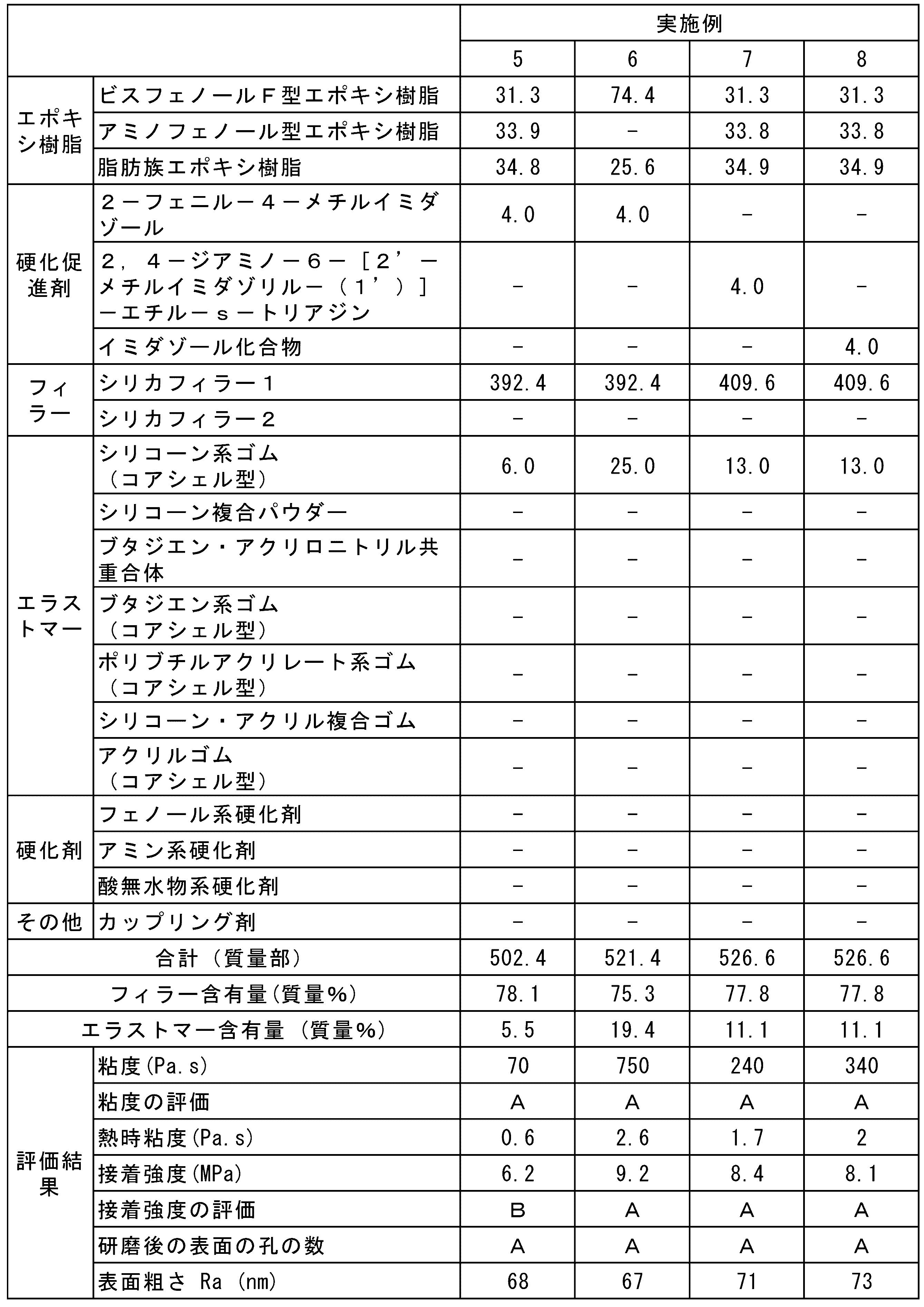
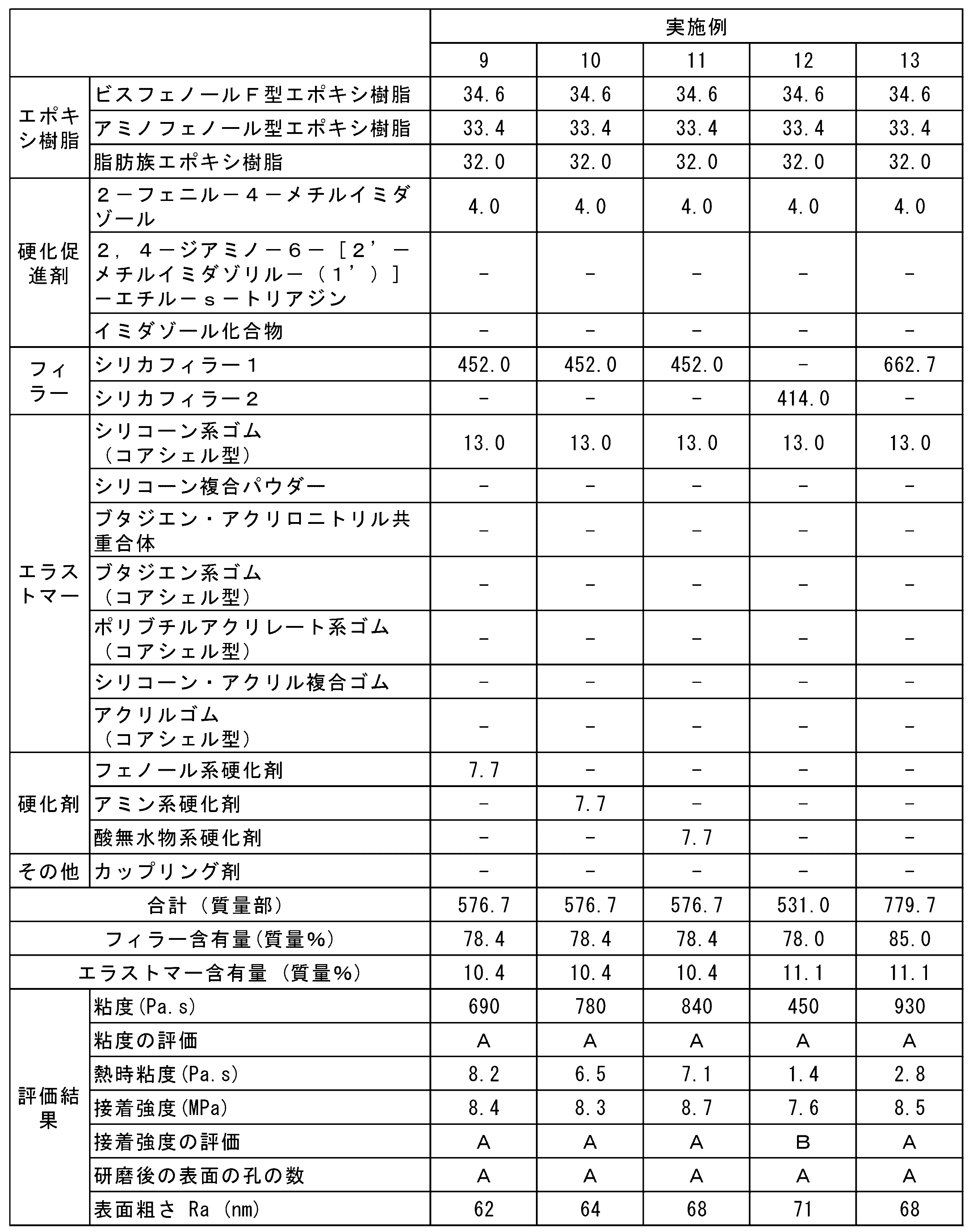
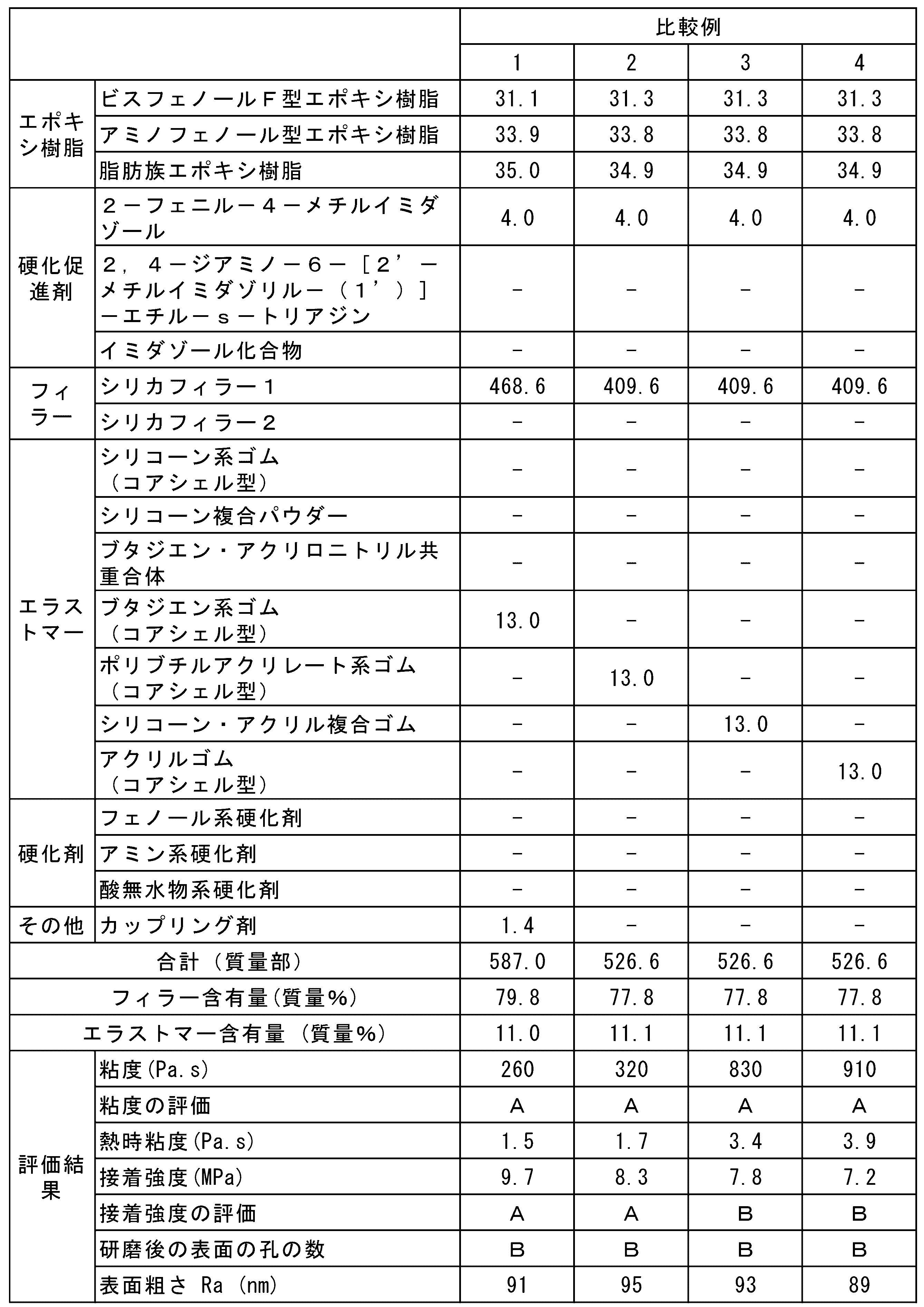
・ビスフェノールF型エポキシ樹脂(YDF8170、エポキシ当量158g/eq.、日鉄ケミカル&マテリアル株式会社製)
・アミノフェノール型エポキシ樹脂(jER 630、エポキシ当量98g/eq.、三菱ケミカル株式会社製)
・脂肪族エポキシ樹脂(エポゴーセーPT(一般グレード)、エポキシ当量435g/eq.、四日市合成社製)
・2-フェニル-4-メチルイミダゾール(2P4MZ、四国化成工業株式会社製)
・2,4-ジアミノ-6-[2’-メチルイミダゾリル-(1’)]-エチル-s-トリアジン(2MZA、四国化成工業株式会社製)
・イミダゾール化合物(2P4MHZ、四国化成工業株式会社製)
・シリカフィラー1(SE605G-SMG、3-メタクリロキシプロピルトリメトキシシラン表面処理、平均粒径1.8μm、トップカット径5μm、株式会社アドマテックス製)
・シリカフィラー2(SE101G-SMO、3-メタクリロキシプロピルトリメトキシシラン表面処理、平均粒径0.3μm、トップカット径1μm、株式会社アドマテックス製)
・シリコーン系ゴム(コアシェル型)(コアシェル型シリコーン系ゴム粒子、MX―965、株式会社カネカ製、エラストマー成分25%)
・シリコーン複合パウダー(KMP605、信越化学工業株式会社製、エラストマー成分100%)
・ブタジエン・アクリロニトリル共重合体(カルボキシル基末端ブタジエン・アクリロニトリル共重合体、CTBN1008SP、蝶理GLEX社製、エラストマー成分100%)
・ブタジエン系ゴム(コアシェル型)(コアシェル型ブタジエン系ゴム粒子、MX-137、株式会社カネカ製、エラストマー成分33%)
・ポリブチルアクリレート系ゴム(コアシェル型)(コアシェル型ポリブチルアクリレート系ゴム粒子、ALBIDURE EP XP powder、EVONIK社製、エラストマー成分100%)
・シリコーン・アクリル複合ゴム(メタブレンS-2501、三菱ケミカル株式会社製、エラストマー成分100%)
・アクリルゴム(コアシェル型)(コアシェル型アクリルゴム粒子、スタフィロイドAC3355、アイカ工業株式会社製、エラストマー成分100%)
・フェノール系硬化剤(MEH-8005、水酸基当量139g/eq.~143g/eq.、明和化成株式会社製)
・アミン系硬化剤(ETHACURE100PLUS、アルベマール社製)
・酸無水物系硬化剤(HN-2200、昭和電工マテリアルズ株式会社製)
・カップリング剤(3-イソシアネートプロピルトリエトキシシラン、KBE-9007、信越化学工業株式会社製)
HB-DV型粘度計(HB-DV1、ブルックフィールド社製)を用いて、液温25℃、10rpm又は5rpmにおいて、調製直後の各エポキシ樹脂組成物の粘度を測定し、下記評価基準に基づき、評価した。
-評価基準-
A:粘度が、1,000Pa・s以下
B:粘度が、1,000Pa・s超
また、レオメーター(MARSIII、HAAKE社製)を用いて、120℃における熱時粘度を測定した。120℃に加熱されたプレート上に各エポキシ樹脂組成物(0.3mL±0.1mL)を投入し、測定周波数10Hz、ひずみ量0.5、ギャップ0.5mm、測定頻度1秒間で測定を開始し、40秒間後の熱時粘度を測定し、120℃における熱時粘度の測定結果とした。
10mm角のシリコンチップ上に、各エポキシ樹脂組成物を底面の直径5mm、上面の直径3mm、高さ6mmの円すい台形状になるように型を用いて接着させ、150℃、2時間硬化させて試験片を作成した。この試験片の樹脂部分をボンドテスター(Dage 4000、ノードソン アドバンスドテクノロジー社製)によってはじき、せん断接着強度を測定した。
せん断接着強度の値から、以下の評価基準に基づき、接着強度を評価した。
-評価基準-
A:せん断接着強度が、8MPa以上
B:せん断接着強度が、6MPa以上8MPa未満
C:せん断接着強度が、6MPa未満
12インチのシリコンウェハー上に、厚みが300μmとなるように、各エポキシ樹脂組成物をコンプレッションモールド(圧縮成形)した。その後、約50個分に個片化し、個片化したシリコンウェハー上のエポキシ樹脂組成物の硬化物表面を第一の研磨方法による研磨の後、第二の研磨方法により研磨した。
第二の研磨方法は、研磨装置(テグラミン-20、struers社製)を用いて、以下に示すステップ1からステップ3の順に行った研磨である。
ステップ1
研磨用部材:ダイヤモンドスラリー(日本エンギス株式会社製、6-PC、6μスラリー(粒径レンジ:4μm~8μm))
研磨時間:6分間
ステップ2
研磨用部材:ダイヤモンドスラリー(日本エンギス株式会社製、1-PC、1μスラリー(粒径レンジ:0μm~2μm))
研磨時間:3分間
ステップ3
研磨用部材:ダイヤモンドスラリー(BUEHLER社製、Master prep、平均粒径0.05μm)
研磨時間:2分間
なお、ステップ1~3における回転数及び研磨荷重は以下の通りとした。
回転数:150rpm
研磨荷重:10N
なお、50,000倍のSEM観察における一視野の面積は、約3.9μm2である。
-評価基準-
A:研磨面における0.05μm~0.50μmの孔の数が9個以下
B:研磨面における0.05μm~0.50μmの孔の数が10個以上
第二の研磨後のエポキシ樹脂組成物の硬化物表面を、共焦点走査電子顕微鏡(OPTELICS H1200、レーザーテック株式会社製)を用いて測定し、JIS B 0601:2001に定められた方法によりRaを算出した。
測定条件は、次の通りとした。スキャン幅は、100μm、スキャンタイプは、エリアとし、Light sourceは、Blue、カットオフ値は、1/5、オブジェクトレンズは、x100、コンタクトレンズは、x14、デジタルズームは、x1、Zピッチは、10nmの設定とした。なお、Ra値は、3箇所測定し、その平均値とした。
一方、エラストマーとして主鎖に二重結合を有する固体エラストマーを用いた比較例1~4は、いずれも研磨後の表面の孔の数の評価が「B」であった。これらのことから、エラストマーとして主鎖に二重結合を有しない固体エラストマー又は液体エラストマーを含有するエポキシ樹脂組成物は、硬化物表面を研磨した場合に発生する小孔を抑制できることが明らかになった。
Claims (14)
- エポキシ樹脂、硬化促進剤、フィラー、及びエラストマーを含有するエポキシ樹脂組成物であって、
前記エラストマーが、固体エラストマー、及び液体エラストマーから選択される少なくとも1種であり、
前記固体エラストマーが、主鎖に二重結合を有さない構造であることを特徴とするエポキシ樹脂組成物。 - 前記エポキシ樹脂組成物の硬化物表面を、粗く研磨する第一の研磨及び研磨剤を含有する液体により研磨する第二の研磨にて研磨した後に、硬化物表面に存在する直径0.05μm~0.5μmの孔の数が、所定面積あたり10個以下である請求項1に記載のエポキシ樹脂組成物。
- 前記エラストマーの含有量が、前記エポキシ樹脂組成物から前記フィラーを除いた成分に対して、5.0質量%以上である請求項1又は2に記載のエポキシ樹脂組成物。
- 前記固体エラストマーが、コアシェル型である請求項1から3のいずれか一項に記載のエポキシ樹脂組成物。
- 前記エラストマーの含有量が、前記エポキシ樹脂組成物から前記フィラーを除いた成分に対して、5.0質量%~20.0質量%である請求項1から4のいずれか一項に記載のエポキシ樹脂組成物。
- 前記フィラーの含有量が、73.0質量%~87.5質量%である請求項1から5のいずれか一項に記載のエポキシ樹脂組成物。
- 120℃での粘度が、0.5Pa・s~40.0Pa・sである請求項1から6のいずれか一項に記載のエポキシ樹脂組成物。
- 前記硬化促進剤が、窒素原子を含有する複素環化合物である請求項1から7のいずれか一項に記載のエポキシ樹脂組成物。
- フェノール系硬化剤、アミン系硬化剤、及び酸無水物系硬化剤から選択される少なくとも1種の硬化剤を含有する請求項1から8のいずれか一項に記載のエポキシ樹脂組成物。
- 前記エポキシ樹脂が、脂肪族エポキシ樹脂、及び芳香族エポキシ樹脂から選択される少なくとも1種である請求項1から9のいずれか一項に記載のエポキシ樹脂組成物。
- 液状コンプレッションモールド材として用いられる請求項1から10のいずれか一項に記載のエポキシ樹脂組成物。
- 支持体と、
請求項1から11のいずれか一項に記載のエポキシ樹脂組成物の硬化物と、を有する電子部品。 - 請求項12に記載の電子部品を有する半導体装置。
- 支持体と、前記支持体に配されている半導体素子との間の空隙を請求項1から11のいずれか一項に記載のエポキシ樹脂組成物により充填する工程、前記エポキシ樹脂組成物を硬化させる工程、及び前記エポキシ樹脂組成物の硬化物を研磨する工程を有することを特徴とする半導体装置の製造方法。
Priority Applications (3)
| Application Number | Priority Date | Filing Date | Title |
|---|---|---|---|
| JP2025509673A JPWO2024202136A1 (ja) | 2023-03-28 | 2023-10-02 | |
| CN202380092949.6A CN120641488A (zh) | 2023-03-28 | 2023-10-02 | 环氧树脂组合物、电子部件、半导体装置、半导体装置的制造方法 |
| KR1020257022552A KR20250162492A (ko) | 2023-03-28 | 2023-10-02 | 에폭시 수지 조성물, 전자 부품, 반도체 장치, 반도체 장치의 제조 방법 |
Applications Claiming Priority (2)
| Application Number | Priority Date | Filing Date | Title |
|---|---|---|---|
| JP2023-052250 | 2023-03-28 | ||
| JP2023052250 | 2023-03-28 |
Publications (1)
| Publication Number | Publication Date |
|---|---|
| WO2024202136A1 true WO2024202136A1 (ja) | 2024-10-03 |
Family
ID=92903763
Family Applications (1)
| Application Number | Title | Priority Date | Filing Date |
|---|---|---|---|
| PCT/JP2023/035949 Ceased WO2024202136A1 (ja) | 2023-03-28 | 2023-10-02 | エポキシ樹脂組成物、電子部品、半導体装置、半導体装置の製造方法 |
Country Status (5)
| Country | Link |
|---|---|
| JP (1) | JPWO2024202136A1 (ja) |
| KR (1) | KR20250162492A (ja) |
| CN (1) | CN120641488A (ja) |
| TW (1) | TW202440783A (ja) |
| WO (1) | WO2024202136A1 (ja) |
Cited By (1)
| Publication number | Priority date | Publication date | Assignee | Title |
|---|---|---|---|---|
| WO2025254026A1 (ja) * | 2024-06-05 | 2025-12-11 | ナミックス株式会社 | エポキシ樹脂組成物、硬化物、及び半導体装置 |
Citations (9)
| Publication number | Priority date | Publication date | Assignee | Title |
|---|---|---|---|---|
| JP2011233452A (ja) * | 2010-04-30 | 2011-11-17 | Namics Corp | 外部電極用導電性ペースト、及びそれを用いて形成した外部電極を備えた積層セラミック電子部品 |
| JP2014019823A (ja) * | 2012-07-20 | 2014-02-03 | Namics Corp | 液状封止材、それを用いた電子部品 |
| WO2016136741A1 (ja) * | 2015-02-26 | 2016-09-01 | 日立化成株式会社 | 封止用フィルム及びそれを用いた電子部品装置 |
| WO2017022721A1 (ja) * | 2015-08-03 | 2017-02-09 | 日立化成株式会社 | エポキシ樹脂組成物、フィルム状エポキシ樹脂組成物及び電子装置 |
| JP2017145357A (ja) * | 2016-02-19 | 2017-08-24 | ナミックス株式会社 | 液状エポキシ樹脂組成物、半導体封止剤、および半導体装置 |
| JP2018024774A (ja) * | 2016-08-10 | 2018-02-15 | 味の素株式会社 | 樹脂組成物 |
| WO2020111244A1 (ja) * | 2018-11-30 | 2020-06-04 | 日立化成株式会社 | アンダーフィル材、半導体パッケージ及び半導体パッケージの製造方法 |
| JP2021183675A (ja) * | 2020-05-22 | 2021-12-02 | 住友ベークライト株式会社 | 熱硬化性樹脂組成物、半導体封止材、熱伝導性シート、および電子装置 |
| WO2023047702A1 (ja) * | 2021-09-22 | 2023-03-30 | ナミックス株式会社 | 液状コンプレッションモールド材、電子部品、半導体装置、および半導体装置の製造方法 |
Family Cites Families (2)
| Publication number | Priority date | Publication date | Assignee | Title |
|---|---|---|---|---|
| JP6196138B2 (ja) | 2013-11-29 | 2017-09-13 | ナミックス株式会社 | 半導体封止剤および半導体装置 |
| PT3620481T (pt) | 2017-05-31 | 2024-04-08 | Namics Corp | Composição de resina líquida para selagem e dispositivo de componentes eletrónicos |
-
2023
- 2023-10-02 WO PCT/JP2023/035949 patent/WO2024202136A1/ja not_active Ceased
- 2023-10-02 KR KR1020257022552A patent/KR20250162492A/ko active Pending
- 2023-10-02 CN CN202380092949.6A patent/CN120641488A/zh active Pending
- 2023-10-02 JP JP2025509673A patent/JPWO2024202136A1/ja active Pending
- 2023-10-13 TW TW112139057A patent/TW202440783A/zh unknown
Patent Citations (9)
| Publication number | Priority date | Publication date | Assignee | Title |
|---|---|---|---|---|
| JP2011233452A (ja) * | 2010-04-30 | 2011-11-17 | Namics Corp | 外部電極用導電性ペースト、及びそれを用いて形成した外部電極を備えた積層セラミック電子部品 |
| JP2014019823A (ja) * | 2012-07-20 | 2014-02-03 | Namics Corp | 液状封止材、それを用いた電子部品 |
| WO2016136741A1 (ja) * | 2015-02-26 | 2016-09-01 | 日立化成株式会社 | 封止用フィルム及びそれを用いた電子部品装置 |
| WO2017022721A1 (ja) * | 2015-08-03 | 2017-02-09 | 日立化成株式会社 | エポキシ樹脂組成物、フィルム状エポキシ樹脂組成物及び電子装置 |
| JP2017145357A (ja) * | 2016-02-19 | 2017-08-24 | ナミックス株式会社 | 液状エポキシ樹脂組成物、半導体封止剤、および半導体装置 |
| JP2018024774A (ja) * | 2016-08-10 | 2018-02-15 | 味の素株式会社 | 樹脂組成物 |
| WO2020111244A1 (ja) * | 2018-11-30 | 2020-06-04 | 日立化成株式会社 | アンダーフィル材、半導体パッケージ及び半導体パッケージの製造方法 |
| JP2021183675A (ja) * | 2020-05-22 | 2021-12-02 | 住友ベークライト株式会社 | 熱硬化性樹脂組成物、半導体封止材、熱伝導性シート、および電子装置 |
| WO2023047702A1 (ja) * | 2021-09-22 | 2023-03-30 | ナミックス株式会社 | 液状コンプレッションモールド材、電子部品、半導体装置、および半導体装置の製造方法 |
Cited By (1)
| Publication number | Priority date | Publication date | Assignee | Title |
|---|---|---|---|---|
| WO2025254026A1 (ja) * | 2024-06-05 | 2025-12-11 | ナミックス株式会社 | エポキシ樹脂組成物、硬化物、及び半導体装置 |
Also Published As
| Publication number | Publication date |
|---|---|
| KR20250162492A (ko) | 2025-11-18 |
| JPWO2024202136A1 (ja) | 2024-10-03 |
| CN120641488A (zh) | 2025-09-12 |
| TW202440783A (zh) | 2024-10-16 |
Similar Documents
| Publication | Publication Date | Title |
|---|---|---|
| JP7531557B2 (ja) | 封止用液状樹脂組成物及び電子部品装置 | |
| JP7531558B2 (ja) | 圧縮成型用液状樹脂組成物及び電子部品装置 | |
| JP4965715B1 (ja) | エポキシ樹脂組成物およびそれを用いた半導体封止材 | |
| JP2009097014A (ja) | 封止用液状樹脂組成物、電子部品装置及びウエハーレベルチップサイズパッケージ | |
| JP2009097013A (ja) | 封止用液状樹脂組成物、電子部品装置及びウエハーレベルチップサイズパッケージ | |
| JPWO2009142065A1 (ja) | 電子部品封止用エポキシ樹脂組成物 | |
| TW201723073A (zh) | 液狀環氧樹脂組成物 | |
| CN105838030A (zh) | 液态封装材料、使用该材料的电子部件 | |
| JP7167912B2 (ja) | 液状封止樹脂組成物、電子部品装置及び電子部品装置の製造方法 | |
| JP7337462B2 (ja) | エポキシ樹脂組成物 | |
| WO2024134951A1 (ja) | エポキシ樹脂組成物、硬化物、及び半導体装置 | |
| TW202440783A (zh) | 環氧樹脂組成物、電子零件、半導體裝置、半導體裝置之製造方法 | |
| WO2023062877A1 (ja) | 液状封止剤、電子部品及びその製造方法、並びに半導体装置 | |
| JP7606797B1 (ja) | 液状コンプレッションモールド材、電子部品、半導体装置および電子部品の製造方法 | |
| JP7683185B2 (ja) | エポキシ樹脂組成物及び電子部品装置 | |
| JP2022060062A (ja) | エポキシ樹脂組成物及び電子部品装置 | |
| WO2024247416A1 (ja) | 液状コンプレッションモールド材、電子部品および半導体装置 | |
| WO2025004453A1 (ja) | 液状コンプレッションモールド材、電子部品、半導体装置および電子部品の製造方法 | |
| WO2026009778A1 (ja) | エポキシ樹脂組成物、硬化物、半導体装置、及び半導体装置の製造方法 | |
| WO2026009780A1 (ja) | エポキシ樹脂組成物、硬化物、半導体装置、及び半導体装置の製造方法 | |
| TW202611226A (zh) | 環氧樹脂組成物、硬化物、半導體裝置及半導體裝置之製造方法 | |
| WO2024075342A1 (ja) | エポキシ樹脂組成物、半導体装置、及び半導体装置の製造方法 |
Legal Events
| Date | Code | Title | Description |
|---|---|---|---|
| 121 | Ep: the epo has been informed by wipo that ep was designated in this application |
Ref document number: 23930767 Country of ref document: EP Kind code of ref document: A1 |
|
| WWE | Wipo information: entry into national phase |
Ref document number: 2025509673 Country of ref document: JP |
|
| ENP | Entry into the national phase |
Ref document number: 1020257022552 Country of ref document: KR Free format text: ST27 STATUS EVENT CODE: A-0-1-A10-A15-NAP-PA0105 (AS PROVIDED BY THE NATIONAL OFFICE) |
|
| WWE | Wipo information: entry into national phase |
Ref document number: 202380092949.6 Country of ref document: CN |
|
| WWP | Wipo information: published in national office |
Ref document number: 202380092949.6 Country of ref document: CN |
|
| NENP | Non-entry into the national phase |
Ref country code: DE |
|
| 122 | Ep: pct application non-entry in european phase |
Ref document number: 23930767 Country of ref document: EP Kind code of ref document: A1 |