WO2024201700A1 - 測定装置 - Google Patents
測定装置 Download PDFInfo
- Publication number
- WO2024201700A1 WO2024201700A1 PCT/JP2023/012443 JP2023012443W WO2024201700A1 WO 2024201700 A1 WO2024201700 A1 WO 2024201700A1 JP 2023012443 W JP2023012443 W JP 2023012443W WO 2024201700 A1 WO2024201700 A1 WO 2024201700A1
- Authority
- WO
- WIPO (PCT)
- Prior art keywords
- probes
- component
- measuring
- measuring device
- contact
- Prior art date
- Legal status (The legal status is an assumption and is not a legal conclusion. Google has not performed a legal analysis and makes no representation as to the accuracy of the status listed.)
- Ceased
Links
Images





Classifications
-
- G—PHYSICS
- G01—MEASURING; TESTING
- G01R—MEASURING ELECTRIC VARIABLES; MEASURING MAGNETIC VARIABLES
- G01R31/00—Arrangements for testing electric properties; Arrangements for locating electric faults; Arrangements for electrical testing characterised by what is being tested not provided for elsewhere
- G01R31/26—Testing of individual semiconductor devices
-
- G—PHYSICS
- G01—MEASURING; TESTING
- G01R—MEASURING ELECTRIC VARIABLES; MEASURING MAGNETIC VARIABLES
- G01R31/00—Arrangements for testing electric properties; Arrangements for locating electric faults; Arrangements for electrical testing characterised by what is being tested not provided for elsewhere
- G01R31/28—Testing of electronic circuits, e.g. by signal tracer
Definitions
- This disclosure relates to a measuring device that measures electrical characteristics of components.
- Patent Document 1 describes a measuring device in which a pair of probes are arranged side by side, and the electrode parts on both sides of a component are brought into contact with the respective probes to measure the electrical characteristics of the component.
- the pair of probes are arranged so that they can rotate about the parts opposite to the sides that face each other, and the parts that face each other are provided with an upward elastic force by a spring member. Therefore, even if the heights of the electrode parts on both sides of the component vary from left to right or the component is picked up at an angle to the suction nozzle [0054], the electrode parts on both sides of the component can be brought into contact with the respective probes to measure the electrical characteristics of the component.
- the objective of this disclosure is to improve a measuring device that measures the electrical characteristics of components, for example, by making it possible to measure the electrical characteristics of components effectively.
- the contact portions of the multiple probes come into contact with the electrode portions on both sides of the component to measure the electrical characteristics of the component. Furthermore, the multiple contact portions of the multiple probes form a generally V-shaped recess. In the generally V-shaped recess, the spacing between the opposing contact portions is narrow in the center and wide in the periphery. Therefore, even if each of the multiple probes is not rotatable as described in Patent Document 1, the electrode portions on both sides of the component can be brought into good contact with the multiple probes, and the electrical characteristics of the component can be well measured.
- FIG. 1 is a perspective view of a mounting machine including a measurement device according to an embodiment of the present disclosure.
- FIG. 1 is a perspective view conceptually illustrating a measurement device according to a first embodiment of the present disclosure.
- FIG. 2 is a perspective view conceptually showing the main portion and components of the measuring device.
- FIG. 2 is a front view conceptually showing the measuring device.
- FIG. 2 is a diagram showing an electrical characteristic measuring circuit of the measuring device.
- FIG. 2 is a diagram showing a coaxial cable of the measuring device.
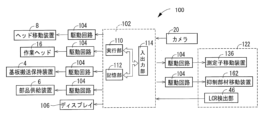
- FIG. 2 is a diagram showing the periphery of a control device of the placement machine.
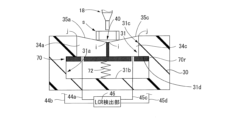
- FIG. 4 is a front view conceptually showing another aspect of the main part of the measuring device.
- FIG. 1 is a perspective view conceptually illustrating a measurement device according to a first embodiment of the present disclosure.
- FIG. 2 is a perspective view conceptually showing the main portion and components of the measuring device.
- FIG. 2 is a front view conceptually showing the measuring device.
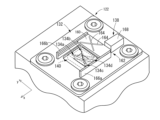
- FIG. 11 is a perspective view conceptually illustrating a measurement device according to a second embodiment of the present disclosure.
- FIG. 2 is a perspective view conceptually showing a main part of the measuring device.
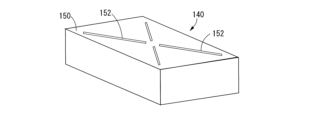
- FIG. 2 is a perspective view conceptually showing a holding portion of the measuring device.
- 2 is a front view (partially sectional view) conceptually showing a state in which electrical characteristics of a component are measured by the measuring device.
- FIG. FIG. 2 is a diagram showing the periphery of a control device of the placement machine.
- FIG. 2 is a perspective view conceptually showing another aspect of the main part of the measuring device.
- the measuring device can be called an electrical characteristic acquisition device.
- the mounting machine shown in FIG. 1 mounts electronic components (hereinafter simply referred to as components) s onto a circuit board, and includes a main body 2, a circuit board conveying and holding device 4, a component supplying device 6, a head moving device 8, and the like.
- the circuit board transport and holding device 4 transports and holds the circuit board P (hereinafter, abbreviated as board P) in a horizontal position, and in FIG. 1, the transport direction of the board P is the x direction, the width direction of the board P is the y direction, and the thickness direction of the board P is the z direction.
- the y direction and the z direction are the front-to-back and up-to-down directions of the mounting machine, respectively.
- the component supply device 6 supplies components (e.g., elements) s to be mounted on the board P, and includes a plurality of tape feeders 14, etc.
- the head moving device 8 holds the working head 16 and moves it in the x, y, and z directions.
- the working head 16 includes a component holder 18 that holds the components s, etc.
- the reference numeral 20 denotes a camera.
- the camera 20 captures an image of the component s held by the suction nozzle 18, and based on the image captured by the camera 20, it is determined whether or not the component s is to be mounted on the circuit board P.
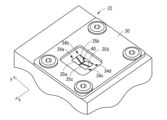
- the reference numeral 22 denotes a measuring device.
- the measuring device 22 measures the electrical characteristics of the component s, and is held by the substrate transport and holding device 4 via the storage section 26.
- the electrical characteristics of the component s include L (inductance), C (capacitance), R (resistance), X (reactance), Z' (impedance), etc., and the measuring device 22 measures one or more of these.
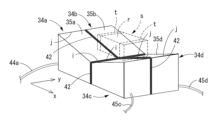
- the component s whose electrical characteristics are measured by the measuring device 22, is a square chip having a functional part r provided in the middle and electrode parts t provided at both ends, as shown in Figure 3 etc.
- the functional part r is covered on the outside with an insulating material.
- the measuring device 22 includes a main body 30 and one or more measuring units 32 provided on the main body 30.
- the measuring unit 32 includes four measuring elements 34a, 34b, 34c, and 34d as a plurality of measuring elements (which can be referred to as measuring terminals), a measuring element moving device 36 for moving the four measuring elements 34a, 34b, 34c, and 34d as a unit, and the like.
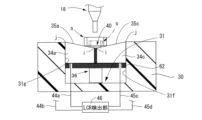
- a recess 31 is provided on the main body 30, and the four measuring elements 34a, 34b, 34c, and 34d, the measuring element moving device 36, and the like are provided in the recess 31.
- the probes 34a, 34b, 34c, and 34d are collectively referred to or described without distinction, they will be simply referred to as the probe 34. The same applies to the contact portion, the coaxial cable, and the like.
- Each of the four probes 34 is generally rectangular, with its upper surface serving as a contact portion 35 (35a, 35b, 35c, 35d) that comes into contact with the part s.
- the upper surface of the contact portion 35 is generally rectangular, with a first side i, one of the sides that make up the rectangle, positioned lower than a second side j that faces the first side i, and is inclined in one direction.
- the upper surface can be referred to as a contact surface.
- a generally V-shaped recess 40 is formed by the contact portions 35a, 35b of the probes 34a, 34b and the contact portions 35c, 35d of the probes 34c, 34d. This V-shaped recess 40 functions as a component placement portion 40 on which the component s is placed.
- an insulator portion 42 made of an insulating material is interposed between each of the four probes 34. Since the four probes 34 are arranged in two rows and two columns, the insulator portions 42 are arranged generally in a cross shape.
- the insulator portion 42 may be a gas such as air or a solid material such as glass. However, if it is a solid material, the spacing between the probes 34 can be narrowed, making it possible to measure the electrical characteristics of smaller components s.
- two of the four probes 34, 34a and 34b are connected to coaxial cables 44a and 44b, respectively, and the two probes 34c and 34d are connected to coaxial cables 45c and 45d, respectively.
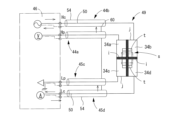
- the coaxial cables 44 and 45 are connected to an LCR detector 46, and an electrical characteristic measuring circuit 49 is formed by these coaxial cables 44 and 45, the four probes 34, the LCR detector 46, etc.
- the coaxial cables 44a, 44b, 45c, and 45d described above each have the same structure, and as shown in FIG. 6, each include an inner conductor 50, an insulator (dielectric) 52, an outer conductor 54, and a protective coating 56, which are arranged coaxially.
- the provision of the outer conductor 54 prevents the transmitted signal from leaking to the outside.
- One end of each of the coaxial cables 44a, 44b, 45c, and 45d (one end of the inner conductor 50) is connected to the probes 34a, 34b, 34c, and 34d, respectively, and the other end is connected to the LCR detector 46.
- the coaxial cables 44 and 45 are connected by a four-terminal pair connection method, and the electrical characteristics of the component s are measured by the automatic balancing bridge method.
- the other end of the coaxial cable 44b is connected to the Hc terminal and is connected to an AC power source.
- the output of the AC power source is supplied to the inner conductor 50 of the coaxial cable 44b and returned via the outer conductor 54.
- the other end of the coaxial cable 44a is connected to the Hp terminal and is connected to a voltage sensor.
- the potential difference between the inner conductor 50 and the outer conductor 54 is detected as a voltage value applied to the component s.
- the other end of the coaxial cable 45d is connected to the Lc terminal and then to a current sensor.
- the current flowing between the inner conductor 50 and the outer conductor 54 is obtained as the current value flowing through the component s.
- the potential difference of a resistor (not shown) provided between the inner conductor 50 and the outer conductor 54 is obtained, and the current flowing through the resistor is obtained based on the potential difference and the resistance value Rx of the resistor.
- the other end of the coaxial cable 45c is connected to the Lp terminal.
- the potential difference between the inner conductor 50 and the outer conductor 54 is detected, and the components (oscillator, etc.) of the LCR detection unit 46 (not shown) are controlled so that the detected potential difference becomes zero.
- the current flowing through the resistor and the current flowing through the component s become the same, and the current flowing through the resistor obtained at the terminal Lc in this state becomes the current value flowing through the component s.
- 60 indicates an identical potential portion.
- the outer conductors 54 of the coaxial cable portions 44 and 45 are at the same ground potential, making it possible to reduce noise and stably measure the electrical characteristics of the component s.
- the current flowing through the component s and the voltage applied to the component s are measured by separate circuits, and the currents flowing through the internal conductor 50 and the external conductor 54 are made to flow in opposite directions. This makes it possible to suppress the generation of magnetic flux in each of the internal conductor 50 and the external conductor 54, and allows the current and voltage flowing through the component s to be measured with high accuracy.
- the method of connecting the coaxial cable and the method of measuring the electrical characteristics of the component s are not important.
- the probe moving device 36 moves the four probes 34 as a whole in the vertical direction (z direction) relative to the main body 30.
- the probe moving device 36 can include a drive source such as an electric motor, a solenoid, or a fluid pressure cylinder.
- the four probes 34 are arranged in two rows and two columns and held by a holding plate 62.
- the holding plate 62 is moved vertically by the probe moving device 36, whereby the four probes 34 are moved vertically as a unit.
- the opposing side surfaces 31f, 31g extending in the vertical direction of the recess 31 of the main body 30 function as a guide for at least one of the holding plate 62 and the probes 34.
- the holding plate 62 may be made of an insulating material.
- the placement machine includes a control device 100.
- the control device 100 includes a controller 102, which is mainly a computer, and multiple drive circuits 104.
- the controller 102 includes an execution unit 110, a memory unit 112, an input/output unit 114, etc., to which the board transport and holding device 4, the component supply device 6, the head moving device 8, the work head 16, the probe moving device 36 of the measuring device 22, etc. are each connected via the drive circuits 104, as well as to an LCR detection unit 46, a display 106, a camera 20, etc. These are controlled by the execution of multiple programs, such as an LCR measurement program (not shown) stored in the memory unit 112.
- an LCR measurement program not shown
- the placement machine including the measuring device 22 configured as above will be described. For example, when a command to measure the electrical characteristics of component s is issued, such as when a new tape feeder 14 is set or when a tape feeder 14 is replaced, the electrical characteristics of component s held by that tape feeder 14 are measured.
- the component s is held by the component holder 18 of the work head 16, transported from the component supply device 6 to the measuring device 22, released from the component holder 18, and placed on the component placement section 40.
- the (pair of) electrode portions t on both sides of the component s are considered to be in contact with the contact portions 35 of the four probes 34.
- each of a pair of bottom portions (bottom portions of a pair of electrode portions t) constituting the bottom surface of the component s is considered to be in line contact with the contact portions 35 of two probes 34.
- the electrical characteristics of the component s can be obtained by the four-terminal contact method.
- the component s and the contact portions 35 are in line contact, it is possible to prevent dirt from adhering to the contact portions 35, thereby improving the measurement accuracy of the electrical characteristics.
- the four contact portions 35 form a generally V-shaped recess, making it easier for the pair of electrode portions t to come into contact with the contact portions 35 of the four probes 34. This makes it possible to satisfactorily measure the electrical characteristics of the component s.
- the electrical characteristics can be measured even if the size of the component s is different.
- the contact portion 35 forms a generally V-shaped recess, and the bottom edge of each of the pair of electrode portions t of the component s is in line contact with the contact portion 35, the contact pressure between the component s and the contact portion 35 can be increased compared to when the bottom surface of each of the pair of electrode portions t of the component s is in surface contact with the contact portion 35, making it possible to measure electrical characteristics more accurately.
- the electrical characteristics of the component s can be measured while the component s is held by the component holder 18. In that case, the component holder 18 presses the component s against the contact parts 35 of the four probes 34, so that the pair of electrode parts t of the component s can be brought into better contact with the contact parts 35 of the four probes 34.
- the four probes 34 can be moved upward by the probe moving device 36. Even when the four probes 34 are moved upward, the upward movement of the component s is suppressed by the component holder 18. As a result, it becomes possible to press the contact portions 35 of the four probes 34 against the pair of electrode portions t of the component s, and the contact portions 35 of the four probes 34 can be brought into better contact with the pair of electrode portions t of the component s.
- the probe moving device 36 is not essential. Instead, the probe moving device 36 can be configured to move each of the four probes 34 separately and independently in the vertical direction.
- an elastic member can be provided instead of the probe moving device 36.
- the four probes 34 are held in the center of the holding plate 70. Therefore, the peripheral portion 70r of the holding plate 70 is located outside the four probes 34.
- One or more spring members 72 serving as elastic members are provided between the lower surface of the holding plate 70 and the bottom surface 31b of the recess 31 of the main body 30. The spring members 72 apply an elastic force in the vertical direction to the four probes 34.
- the recess 31 of the main body 30 generally has a stepped shape and includes a wide recess 31a on the bottom side and a narrow recess 31c on the opening side.
- the bottom surface 31b is the bottom surface of the wide recess 31a.
- the retaining plate 70 is located in the wide recess 31a, and functions as a stopper by the step surface 31d between the wide recess 31a and the narrow recess 31c abutting against the upper surface of the peripheral portion 70r of the retaining plate 70. In the normal state (non-measurement state), the upper surface of the peripheral portion 70r of the retaining plate 70 is in abutment against the step surface 31d of the main body 30.
- the component holder 18 presses the component s against the four probes 34.
- the component holder 18 elastically deforms the spring member 72 and moves the four probes 34 downward.
- the spring member 72 applies an upward force to the four probes 34.
- the four probes 34 are pressed firmly against a pair of electrode portions t of the component s held by the component holder 18, and the contact portions 35 make good contact with the electrode portions t of the component s.
- four probes 34 are provided, but two probes 34 may be provided. In that case, the two probes 34 are connected to the LCR detection unit by the two-terminal method.
- the measuring section 132 of the measuring device 122 includes four measuring probes 134 (134a, 134b, 134c, 134d), a measuring probe moving device 136 (see Figure 13), a movement suppression device 138, a holding table 140 as a holding section, etc.
- Each of the four probes 134 is generally blade-shaped as a plate, and the upper edge of the blade-shaped probe 134 is the contact portion 135.
- the contact portion 135 is inclined in one direction, in other words, in such a direction that the first end m is located lower than the second end n.
- Each of the four probes 134 is generally trapezoidal or triangular in side view.
- the four probes 134 are radially arranged with the first end m as the center, in other words, with the first ends m facing each other and each plate surface extending substantially vertically.
- the four probes 134 are positioned roughly in an X-shape when viewed from above.
- a roughly conical or pyramidal recess 143 is formed by the four contact portions 135.
- An insulator portion 142 is provided between the four probes 134, in other words, in the central portion of the four probes 134 (in the vicinity of the first end m of each of the four probes 134).
- coaxial cables 144, 145 are connected to each of the four probes 134, respectively, and are connected using the four-terminal pair connection method, as in Example 1.
- the sensor head moving device 136 moves the four sensor heads 134 vertically, either together or separately.
- the sensor head moving device 136 can include a driving source such as an electric motor, a solenoid, or a fluid pressure cylinder.
- the holding table 140 holds the component s. Because the four probes 134 are blade-shaped, it may be difficult to stably hold the component s (the component before its electrical characteristics are measured) which is the object whose electrical characteristics are to be measured. Therefore, in this embodiment, the component s which is the object whose electrical characteristics are to be measured is placed on the holding table 140.
- the holding table 140 is generally cylindrical (box-shaped) with a bottom, and is disposed with the bottom facing up.
- the four probes 134 are located in the space inside the cylindrical portion (side portion) of the holding table 140.
- the upper surface of the bottom portion of the holding table 140 is made into a component placement portion 150.
- the component placement portion 150 is formed with four holding table through holes 152, which are through holes corresponding to the four probes 134, respectively.
- Each of the four holding table through holes 152 is an elongated hole (slit) extending in one direction.
- Each of the four holding table through holes 152 has a width larger than the width (thickness) of each of the four probes 134, a length longer than the length of the four probes 134, and is provided generally in an X shape. Therefore, when the four probes 134 are moved upward by the probe moving device 136, they can protrude above the component mounting portion 150 through the holder through-holes 152. The four probes 134 protrude from the second end n.
- the movement suppression device 138 includes a movement suppression member 160 and a suppression member moving device 162 that moves the movement suppression member 160 between an active position above the component s and a retracted position away from the position above the component s.
- the movement suppression member 160 is a generally plate-shaped member in which four suppression member through holes 164 that extend radially (in an X-shape) are formed. Each of the suppression member through holes 164 is an elongated hole that extends in one direction and is provided to correspond to the four measuring probes 134.
- the suppression member moving device 162 moves the movement suppression member 160 along a pair of guides 166a, 166b.
- the suppression member moving device 162 can include a driving source such as an electric motor, a solenoid, or a fluid pressure cylinder.
- the component s is placed on the component placement section 150 of the holding table 140, and the movement suppression member 160 is moved to the operating position.
- the movement suppression member 160 is positioned on the opposite side of the four measuring probes 134 of the component s. In other words, the movement suppression member 160 is positioned above the component placement section 150 (component s), and the four measuring probes 134 are positioned below the component placement section 150.
- the four probes 134 are moved upward.
- Each of the four probes 134 passes through the holder through-hole 152, protrudes upward from the component mounting surface 150, and comes into contact with the component s.
- the component s is moved upward and comes into contact with the movement suppressing member 160.
- the contact portions 135 of the four probes 134 are pressed against a pair of electrode portions t of the component s, and the contact portions 135 come into good contact with the electrode portions t of the component s.
- a portion (near the second end n) of the four probes 134 may pass through the suppression member through-hole 164 and protrude upward.
- the four probes 134 may pierce the electrode portion t of the component s.
- the contact portions 135 of the four probes 134 are the edges of the blade-shaped members, they are less susceptible to oxidation and are less susceptible to adhesion of dirt.
- the suppression member moving device 162 moves the movement suppression member 160 linearly between the retracted position and the operating position, but the suppression member moving device 162 may rotate the movement suppression member 160 between the retracted position and the operating position.
- the movement suppression member 160 is not essential.
- the component s can also be held from above by the component holder 18 of the work head 16.
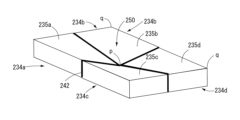
- each of the four probes 234 may be formed and arranged in the shape shown in FIG.
- Each of the four probes 234 is generally rectangular parallelepiped-shaped, with the contact portion 235, which is the upper surface, tilted in one direction with a first corner p, one of the four corners, located lower than a second corner q, which is the corner diagonally opposite the first corner p.
- the four probes 234 are arranged in two rows and two columns with the first corner p at the center via the insulator portion 242.
- the four contact portions 235 form a generally pyramidal recess 250.
- the pyramidal recess 250 functions as a component mounting portion.
- the measuring device 22, 122 can be provided with multiple measuring units 32, 132, and the present disclosure can be implemented in a variety of forms with various modifications and improvements based on the knowledge of those skilled in the art, in addition to the aspects described in the above embodiments.
- Measuring device 34, 134, 234 Measuring element 35, 135, 235: Contact part 36, 136: Measuring element moving device 40, 250: Part placement part 46: LCR detection part 72: Elastic member 138: Movement suppression device 140: Holder 143: Recess 152: Holder through hole 160: Movement suppression member 162: Suppression member moving device 164: Suppression member through hole
- a measuring apparatus for measuring electrical characteristics of a component comprising: a plurality of probes each including a contact portion that is a portion capable of contacting the component; A measuring device in which the plurality of probes are arranged such that a V-shaped recess is formed by the plurality of contact portions.
- each of the multiple probes, the relative positions (arrangement) of the multiple probes, etc. are determined so that a generally V-shaped recess is formed by the multiple contact portions.
- the multiple probes may have different shapes or the same shape.
- V-shaped recess refers to a recess that is generally V-shaped. In the V-shaped recess, the distance between the opposing contact portions is narrow in the center and wide in the peripheral portions (portions away from the center).
- V-shaped recesses also include cone-shaped or pyramidal recesses.
- a recess that forms a V-shape when viewed from at least one direction is a "V-shaped recess," and among V-shaped recesses, recesses that form a V-shape when viewed from mutually different directions can be considered to be cone-shaped or pyramidal recesses.
- Each of the plurality of contact portions has a shape inclined in one direction, 2.
- Each of the plurality of probes has a rectangular parallelepiped shape
- the contact portion is an upper surface of the rectangular parallelepiped measuring element, the upper surface is inclined in a state in which a first side portion, which is one of a plurality of side portions constituting the upper surface, is located lower than a second side portion opposed to the first side portion,
- the measuring device according to claim 1 or 2, wherein two of the plurality of measuring probes are arranged with the first side portions facing each other, so that the V-shaped recess is formed by the plurality of upper surfaces.
- the distance between opposing upper surfaces is narrow near the first side and wide near the second side.
- Forming a rectangular parallelepiped means “forming roughly a rectangular parallelepiped.”
- Each of the six faces forms roughly a rectangle, and for example, the angle between two adjacent sides that make up a face does not necessarily have to be a right angle.
- Each of the plurality of probes has a rectangular parallelepiped shape
- the contact portion is an upper surface of the rectangular parallelepiped measuring element, the upper surface is inclined such that a first corner portion, which is one corner portion constituting the upper surface, is positioned lower than a second corner portion diagonally opposite the first corner portion,
- the measuring device according to claim 1 or 2, wherein the plurality of probes are arranged with the first corners facing each other, so that the plurality of upper surfaces form a pyramidal recess as the V-shaped recess.
- Each of the plurality of probes has a plate shape,
- the contact portion is an upper portion of the plate-shaped measuring element, the upper portion is inclined with a first end being located lower than a second end being the other end,
- the measuring device according to claim 1 or 2 wherein the plurality of measuring probes are radially arranged with the first ends facing each other, so that the plurality of upper portions form a conical recess as the V-shaped recess.
- each of the plurality of measuring probes is in the form of a blade as the plate.
- the term "formed in a plate shape” means "formed in a generally plate shape.”
- the blade shape is a very thin plate shape.
- the plate thickness of each of the multiple probes may or may not be uniform.
- the four probes can be arranged in an X-shape or a cross shape when viewed from above.
- the measuring device according to any one of items (1) to (6), which includes a probe moving device that moves the multiple probes in the vertical direction.
- the up-down direction is the direction that intersects with the contact part of the probe, and if the bottom surface of the part that is in contact with the contact part is nearly horizontal, it can be considered to be the direction that is nearly perpendicular to that bottom surface.
- the measuring device includes an elastic member that applies an elastic force in the vertical direction to the multiple measuring probes.
- the measuring device according to any one of items (1) to (8), further comprising a movement suppressing member that is located on the side of the part opposite to the side on which the plurality of measuring probes are located and that suppresses movement of the part.
- the movement suppressing member may be a pressing member that presses the component against the multiple probes.
- the movement suppression member may or may not be in contact with the part when in the operating position.
- the measuring device is provided in a mounting machine that picks up components supplied by a component supplying device and mounts the components on a circuit board, the placement machine includes a work head including a component holder for holding the component supplied by the component supply device; a head moving device for moving the working head, the measuring device measures the electrical characteristics of the component held by the component holder,
- the measuring apparatus according to claim 9 or 10, wherein the component holder functions as the movement suppressing member for pressing the component against the plurality of measuring probes while the electrical characteristics of the component are being measured.
- the head moving device can be considered to correspond to a suppressing member moving device that moves the movement suppressing member between the operative position and the retracted position.
- the working head may include a suppression member holding portion that holds a movement suppression member, and the head moving device may function as a suppression member moving device that moves the working head to place the movement suppression member held by the suppression member holding portion on a component placed on the measuring device.
- the position of the movement suppression member placed on the component corresponds to an active position, and a position away from the component corresponds to a retracted position.
- a measuring device according to any one of items (9) to (11), in which the movement suppression member is made of an insulating material.
- a measuring device according to any one of items (9) to (12), in which the movement suppression member has a plurality of suppression member through-holes that correspond to the plurality of measuring probes.
- the measuring device includes a holding unit having a component placement portion on which a component is placed, The measuring device according to any one of items (1) to (13), wherein the component mounting portion is formed with a plurality of holding portion through holes, which are through holes corresponding to the plurality of measuring elements.
- Each of the plurality of probes is generally plate-shaped, and the plurality of probes are radially arranged,
- the measurement device includes four probes as the plurality of probes, The measuring device according to any one of (1) to (15), wherein the four measuring elements are arranged with an insulator between them.
- the measurement device includes four probes as the plurality of probes, The measuring device according to any one of (1) to (16), wherein the four probes are arranged in two rows and two columns, with insulators arranged in a cross shape between them.
- the measurement device includes four probes as the plurality of probes, The measuring device according to any one of claims (1) to (17), wherein the four probes are connected by a four-terminal method.
- the four-terminal pair connection method is a four-terminal method that separates the current signal path and the voltage signal path.
- the four-terminal connection method is a connection method in which the measurement current flows only through the inner conductor, while the four-terminal pair connection method is a connection method in which the measurement current flows through the inner conductor of the coaxial cable and an equal but opposite current flows through the outer conductor.
- the measurement device includes two probes as the plurality of probes, The measuring device according to any one of claims (1) to (17), wherein the two probes are connected by a two-terminal method.
- a measuring device for measuring electrical characteristics of a component comprising: a plurality of probes each including a contact portion that is a portion capable of contacting the component; A measuring device in which the contact portion of each of the plurality of probes is shaped to be inclined in one direction.
- the measuring device described in this section may employ any one of the technical features described in sections (1) to (19).
- a measuring device in which the multiple probes are arranged so that the multiple contact portions form a V-shaped recess.
Landscapes
- Physics & Mathematics (AREA)
- General Physics & Mathematics (AREA)
- Engineering & Computer Science (AREA)
- General Engineering & Computer Science (AREA)
- Testing Of Individual Semiconductor Devices (AREA)
Priority Applications (2)
| Application Number | Priority Date | Filing Date | Title |
|---|---|---|---|
| JP2025509323A JPWO2024201700A1 (https=) | 2023-03-28 | 2023-03-28 | |
| PCT/JP2023/012443 WO2024201700A1 (ja) | 2023-03-28 | 2023-03-28 | 測定装置 |
Applications Claiming Priority (1)
| Application Number | Priority Date | Filing Date | Title |
|---|---|---|---|
| PCT/JP2023/012443 WO2024201700A1 (ja) | 2023-03-28 | 2023-03-28 | 測定装置 |
Publications (1)
| Publication Number | Publication Date |
|---|---|
| WO2024201700A1 true WO2024201700A1 (ja) | 2024-10-03 |
Family
ID=92904291
Family Applications (1)
| Application Number | Title | Priority Date | Filing Date |
|---|---|---|---|
| PCT/JP2023/012443 Ceased WO2024201700A1 (ja) | 2023-03-28 | 2023-03-28 | 測定装置 |
Country Status (2)
| Country | Link |
|---|---|
| JP (1) | JPWO2024201700A1 (https=) |
| WO (1) | WO2024201700A1 (https=) |
Citations (9)
| Publication number | Priority date | Publication date | Assignee | Title |
|---|---|---|---|---|
| JPS56159769U (https=) * | 1980-04-30 | 1981-11-28 | ||
| JPS62106170U (https=) * | 1985-12-23 | 1987-07-07 | ||
| JPS63172969A (ja) * | 1987-01-12 | 1988-07-16 | Matsushita Electric Ind Co Ltd | チツプ抵抗器の抵抗値測定方法 |
| JP2001153907A (ja) * | 1999-11-24 | 2001-06-08 | Hitachi Metals Ltd | 電気特性測定方法及びワーク保持具 |
| JP2005274561A (ja) * | 2004-02-25 | 2005-10-06 | Sanyo Electric Co Ltd | 固体電解コンデンサの測定装置 |
| JP2006030028A (ja) * | 2004-07-16 | 2006-02-02 | Jsr Corp | 回路基板の検査装置および回路基板の検査方法 |
| CN206362826U (zh) * | 2016-12-09 | 2017-07-28 | 北京元六鸿远电子科技股份有限公司 | 一种用于片式电子元器件测试的通用测试座 |
| JP2021012201A (ja) * | 2020-09-22 | 2021-02-04 | 株式会社Fuji | 電子部品実装機 |
| CN213423260U (zh) * | 2020-10-31 | 2021-06-11 | 惠州市德立电子有限公司 | 一种可靠性高的底部测试接触治具 |
-
2023
- 2023-03-28 JP JP2025509323A patent/JPWO2024201700A1/ja active Pending
- 2023-03-28 WO PCT/JP2023/012443 patent/WO2024201700A1/ja not_active Ceased
Patent Citations (9)
| Publication number | Priority date | Publication date | Assignee | Title |
|---|---|---|---|---|
| JPS56159769U (https=) * | 1980-04-30 | 1981-11-28 | ||
| JPS62106170U (https=) * | 1985-12-23 | 1987-07-07 | ||
| JPS63172969A (ja) * | 1987-01-12 | 1988-07-16 | Matsushita Electric Ind Co Ltd | チツプ抵抗器の抵抗値測定方法 |
| JP2001153907A (ja) * | 1999-11-24 | 2001-06-08 | Hitachi Metals Ltd | 電気特性測定方法及びワーク保持具 |
| JP2005274561A (ja) * | 2004-02-25 | 2005-10-06 | Sanyo Electric Co Ltd | 固体電解コンデンサの測定装置 |
| JP2006030028A (ja) * | 2004-07-16 | 2006-02-02 | Jsr Corp | 回路基板の検査装置および回路基板の検査方法 |
| CN206362826U (zh) * | 2016-12-09 | 2017-07-28 | 北京元六鸿远电子科技股份有限公司 | 一种用于片式电子元器件测试的通用测试座 |
| JP2021012201A (ja) * | 2020-09-22 | 2021-02-04 | 株式会社Fuji | 電子部品実装機 |
| CN213423260U (zh) * | 2020-10-31 | 2021-06-11 | 惠州市德立电子有限公司 | 一种可靠性高的底部测试接触治具 |
Also Published As
| Publication number | Publication date |
|---|---|
| JPWO2024201700A1 (https=) | 2024-10-03 |
Similar Documents
| Publication | Publication Date | Title |
|---|---|---|
| TWI821332B (zh) | 檢查工具及檢查裝置 | |
| US6201398B1 (en) | Non-contact board inspection probe | |
| JPH10239371A (ja) | 基板検査装置および基板検査方法 | |
| CN110383091A (zh) | 测试装置与用于测试电路板的方法 | |
| JP2010002302A (ja) | 検査用接触構造体 | |
| US20080116917A1 (en) | Probe support and process for the examination of test substrates under use of probe supports | |
| JP2023507916A (ja) | 自動テスト機器用のプローブカード内の移設されたビア配置 | |
| WO2024201700A1 (ja) | 測定装置 | |
| CN118223101A (zh) | 镀覆装置 | |
| JP2008082734A (ja) | 電気的接触装置、高周波測定システムおよび高周波測定方法 | |
| KR100186795B1 (ko) | Ic소자 인터페이스부 유닛 구조 | |
| KR100272715B1 (ko) | 프로브유닛 및 검사용 헤드 | |
| US6486688B2 (en) | Semiconductor device testing apparatus having a contact sheet and probe for testing high frequency characteristics | |
| US9915682B2 (en) | Non-permanent termination structure for microprobe measurements | |
| JPH04115544A (ja) | 半導体試験装置とその試験方法 | |
| KR960003986B1 (ko) | 범프가 부착된 반도체소자의 전기특성 측정방법 및 장치, 그리고 반도체디바이스의 제조방법 및 장치 | |
| JPH04363671A (ja) | プローブボード | |
| JP2575643B2 (ja) | 電子素子の表面実装装置 | |
| JP2002164700A (ja) | 測定端子付き吸着ノズル及び該吸着ノズルを用いた装着方法 | |
| JPWO2019130411A1 (ja) | 測定装置 | |
| US7352197B1 (en) | Octal/quad site docking compatibility for package test handler | |
| KR101376841B1 (ko) | 기판 검사 장치 및 기판 검사 방법 | |
| JP2003121519A (ja) | 磁界検出素子及び磁界計測装置並びに磁界計測方法 | |
| JP2004361249A (ja) | 基板検査装置 | |
| JPH0329335A (ja) | 半導体チッププローバ |
Legal Events
| Date | Code | Title | Description |
|---|---|---|---|
| 121 | Ep: the epo has been informed by wipo that ep was designated in this application |
Ref document number: 23930340 Country of ref document: EP Kind code of ref document: A1 |
|
| WWE | Wipo information: entry into national phase |
Ref document number: 2025509323 Country of ref document: JP |
|
| NENP | Non-entry into the national phase |
Ref country code: DE |
|
| 122 | Ep: pct application non-entry in european phase |
Ref document number: 23930340 Country of ref document: EP Kind code of ref document: A1 |