WO2024190860A1 - 点眼剤 - Google Patents
点眼剤 Download PDFInfo
- Publication number
- WO2024190860A1 WO2024190860A1 PCT/JP2024/009965 JP2024009965W WO2024190860A1 WO 2024190860 A1 WO2024190860 A1 WO 2024190860A1 JP 2024009965 W JP2024009965 W JP 2024009965W WO 2024190860 A1 WO2024190860 A1 WO 2024190860A1
- Authority
- WO
- WIPO (PCT)
- Prior art keywords
- less
- eye drops
- eye
- formula
- copolymer
- Prior art date
- Legal status (The legal status is an assumption and is not a legal conclusion. Google has not performed a legal analysis and makes no representation as to the accuracy of the status listed.)
- Ceased
Links
Classifications
-
- A—HUMAN NECESSITIES
- A61—MEDICAL OR VETERINARY SCIENCE; HYGIENE
- A61P—SPECIFIC THERAPEUTIC ACTIVITY OF CHEMICAL COMPOUNDS OR MEDICINAL PREPARATIONS
- A61P27/00—Drugs for disorders of the senses
- A61P27/02—Ophthalmic agents
-
- A—HUMAN NECESSITIES
- A61—MEDICAL OR VETERINARY SCIENCE; HYGIENE
- A61K—PREPARATIONS FOR MEDICAL, DENTAL OR TOILETRY PURPOSES
- A61K31/00—Medicinal preparations containing organic active ingredients
- A61K31/74—Synthetic polymeric materials
- A61K31/785—Polymers containing nitrogen
-
- A—HUMAN NECESSITIES
- A61—MEDICAL OR VETERINARY SCIENCE; HYGIENE
- A61K—PREPARATIONS FOR MEDICAL, DENTAL OR TOILETRY PURPOSES
- A61K47/00—Medicinal preparations characterised by the non-active ingredients used, e.g. carriers or inert additives; Targeting or modifying agents chemically bound to the active ingredient
- A61K47/02—Inorganic compounds
-
- A—HUMAN NECESSITIES
- A61—MEDICAL OR VETERINARY SCIENCE; HYGIENE
- A61K—PREPARATIONS FOR MEDICAL, DENTAL OR TOILETRY PURPOSES
- A61K47/00—Medicinal preparations characterised by the non-active ingredients used, e.g. carriers or inert additives; Targeting or modifying agents chemically bound to the active ingredient
- A61K47/06—Organic compounds, e.g. natural or synthetic hydrocarbons, polyolefins, mineral oil, petrolatum or ozokerite
- A61K47/08—Organic compounds, e.g. natural or synthetic hydrocarbons, polyolefins, mineral oil, petrolatum or ozokerite containing oxygen, e.g. ethers, acetals, ketones, quinones, aldehydes, peroxides
- A61K47/10—Alcohols; Phenols; Salts thereof, e.g. glycerol; Polyethylene glycols [PEG]; Poloxamers; PEG/POE alkyl ethers
-
- A—HUMAN NECESSITIES
- A61—MEDICAL OR VETERINARY SCIENCE; HYGIENE
- A61K—PREPARATIONS FOR MEDICAL, DENTAL OR TOILETRY PURPOSES
- A61K9/00—Medicinal preparations characterised by special physical form
- A61K9/0012—Galenical forms characterised by the site of application
- A61K9/0048—Eye, e.g. artificial tears
-
- A—HUMAN NECESSITIES
- A61—MEDICAL OR VETERINARY SCIENCE; HYGIENE
- A61K—PREPARATIONS FOR MEDICAL, DENTAL OR TOILETRY PURPOSES
- A61K9/00—Medicinal preparations characterised by special physical form
- A61K9/08—Solutions
Definitions
- the present invention relates to eye drops.
- eye drops are used repeatedly for several weeks after opening, so they contain preservatives to prevent bacterial contamination inside the container.
- preservatives to prevent bacterial contamination inside the container.
- it is important that the preservative used in eye drops has sufficient preservative effect, and for example, polyhexamethylene biguanide is often used as a preservative.
- Patent Document 1 discloses an eye drop blended with a phosphorylcholine group-containing polymer.
- Patent Document 2 discloses an eye drop blended with a phosphorylcholine group-containing polymer and polyhexamethylene biguanide.
- Patent Document 1 reports that the phosphorylcholine group-containing polymer is blended into the eye drop to impart sufficient lubricity, but does not specify preservative efficacy.
- Patent Document 2 discloses a method of imparting lubricity and moisture retention to an eye drop blended with a phosphorylcholine group-containing polymer, polyhexamethylene biguanide, and polyoxyethylene polyoxypropylene glycol, and exerting sufficient preservative efficacy.
- Patent Document 2 discloses a method of imparting lubricity and moisture retention to an eye drop blended with a phosphorylcholine group-containing polymer, polyhexamethylene biguanide, and polyoxyethylene polyoxypropylene glycol, and exerting sufficient preservative efficacy.
- sodium chloride there is no specification of the case where only a sufficient amount of a ternary copolymer that contributes significantly to improving lubricity is blended, and there is no description of sodium chloride.
- eye drops containing a preservative with high preservative effect may cause irritation in some patients on a cornea with reduced barrier function or damaged by cornea. Therefore, there is a demand for eye drops with low eye irritation that can be applied to a cornea with reduced barrier function or damaged by cornea. That is, for the treatment of dry eye, there is a demand for eye drops that have high lubricity, sufficient preservative effectiveness, and low eye irritation.
- the present invention has been made in consideration of the above problems, and aims to provide an eye drop that has high lubricity and preservative efficacy, and can reduce eye irritation.
- an eye drop containing a terpolymer containing phosphorylcholine groups, 2-methacryloyloxyethyl phosphorylcholine/dimethylacrylamide/stearyl methacrylate copolymer (hereinafter sometimes referred to as "copolymer (P)"), a specific preservative, and a specific surfactant in specific ratios, has high lubricity and preservative efficacy, and is capable of reducing eye irritation, based on the new knowledge that sodium chloride, a component of tears contained in eye drops, reduces the preservative activity of polyhexamethylene biguanide. This has led to the completion of the present invention.
- d is a number indicating a repeating unit and is an integer of 3 to 40.
- the eye drops of the present invention contain a terpolymer containing phosphorylcholine groups, a 2-methacryloyloxyethyl phosphorylcholine-dimethylacrylamide-stearyl methacrylate copolymer, polyhexamethylene biguanide, and polyoxyethylene polyoxypropylene glycol, and contain no more than 0.3 w/w% sodium chloride, so that they can provide lubricity to the cornea while exerting sufficient preservative efficacy and reducing eye irritation.
- the present invention can provide an eye drop that has excellent lubricity and sufficient preservative efficacy, and is low in eye irritation.
- component (A) 0.02 w/w% to 0.15 w/w% of 2-methacryloyloxyethyl phosphorylcholine-dimethylacrylamide-stearyl methacrylate copolymer represented by formula (1)
- d is a number indicating a repeating unit and is an integer of 3 to 40.
- the weight average molecular weight of the copolymer (P) is 5,000 to 2,000,000. If the weight average molecular weight is less than 5,000, the polymer will not have sufficient adhesive power to the contact lens surface, and there is a risk that improved lubricity cannot be expected. If the weight average molecular weight is more than 2,000,000, there is a risk that the sterile filtration required for producing the eye drop will be difficult. From the viewpoint of improving lubricity, the weight average molecular weight of the copolymer (P) is preferably 100,000 to 1,500,000.
- the weight average molecular weight refers to a value calculated as polyethylene glycol (PEG) by gel permeation chromatography (GPC).
- the copolymer (P) represented by formula (1) has constituent units derived from 2-methacryloyloxyethyl phosphorylcholine, dimethylacrylamide, and stearyl methacrylate, but the arrangement of the constituent units in the copolymer (P) is not particularly limited and may be random or block.
- the copolymer (P) of component (A) can be produced, for example, as follows.
- 2-methacryloyloxyethyl phosphorylcholine, dimethylacrylamide, and stearyl methacrylate can be produced by radical polymerization in the presence of a radical polymerization initiator and in an inert gas replacement or atmosphere such as nitrogen, carbon dioxide, argon, or helium.
- the polymerization method can be a known method such as bulk polymerization, suspension polymerization, emulsion polymerization, or solution polymerization.
- the copolymer (P) can be purified by a known method such as reprecipitation, dialysis, or ultrafiltration.
- the amount of component (A) in the eye drops of the present invention is 0.02 w/w% or more and 0.15 w/w% or less. If this amount is less than 0.02 w/w%, the lubricating properties may not be fully exhibited, and if it is more than 0.15 w/w%, the preservative effect of the preservative may be hindered. From the viewpoint of exhibiting the preservative effect and lubricating properties of the preservative, the amount of component (A) is preferably 0.075 w/w% or more and 0.125 w/w% or less.
- Component (B) is a compound represented by the above formula (2) and is called polyhexamethylene biguanide. It may also be a salt thereof.
- d is a number representing a repeating unit and is an integer of 3 to 40. If the value of d is less than 3 or more than 40, the preservative effect as an eye drop may not be fully exerted. From the viewpoint of exerting a more sufficient preservative effect, the value of d is preferably 10 to 18.
- salts of polyhexamethylene biguanide include hydrochloride, borate, acetate, gluconate, sulfonate, tartrate, and citrate.
- Specific examples include commercially available products such as Cosmocil CQ (registered trademark) manufactured by Arch UK Biocides, Vantcil IB (registered trademark) manufactured by Sanyo Chemical Industries, Ltd., and BG-1 manufactured by Sanyo Chemical Industries, Ltd. One of these may be selected and used alone, or two or more types may be used in any combination.
- the amount of component (B) in the eye drops of the present invention is 0.000001 w/w% or more and 0.0001 w/w% or less. If this is less than 0.000001 w/w%, the eye drops may not be able to fully exert their preservative effect, and if it is more than 0.0001 w/w%, the improvement in preservative effect commensurate with the amount added cannot be expected, and there is a risk of a decrease in cell viability.
- the amount of polyhexamethylene biguanide or a salt thereof is preferably 0.00001 w/w% or more and 0.00002 w/w% or less.
- the polyoxyethylene polyoxypropylene glycol of component (C) may be any that is commonly used in pharmaceuticals, such as products listed in the Japanese Pharmacopoeia. Specific examples include commercially available products such as Unilube (registered trademark) 70DP-950B manufactured by NOF Corp., Yakuzoki Pronon (registered trademark) 188P manufactured by NOF Corp., and Newpol (registered trademark) PE-68 manufactured by Sanyo Chemical Industries, Ltd.
- the amount of component (C) in the eye drops of the present invention is 0.02 w/w% or more and 2.0 w/w% or less. If the amount of component (C) is less than 0.02 w/w%, the preservative effect may decrease, and if the amount is more than 2.0 w/w%, the preservative effect may decrease and the cell viability may decrease. From the viewpoint of not decreasing the preservative effect and not decreasing the cell viability, the amount of polyoxyethylene polyoxypropylene glycol is preferably 0.1 w/w% or more and 1.0 w/w% or less.
- the sodium chloride content in the eye drops of the present invention is 0.3 w/w% or less. If the sodium chloride content exceeds 0.3 w/w%, the preservative effectiveness may decrease.
- the eye drops of the present invention may not contain sodium chloride, but if the sodium chloride content is 0.1 w/w% or more and 0.3 w/w% or less, eye irritation is further reduced.
- the eye drop of the present invention may contain other components in addition to the above components (A) to (C), such as polyhydric alcohols, cooling agents, inorganic salts, salts of organic acids, acids, bases, and antioxidants.
- polyhydric alcohols include propylene glycol, glycerin, glucose, mannitol, sorbitol, xylitol, and trehalose.
- cooling agents include menthol and camphor.
- inorganic salts include potassium chloride, borax, sodium bicarbonate, sodium hydrogen phosphate, and anhydrous sodium dihydrogen phosphate.
- salts of organic acids include sodium citrate and sodium acetate.
- Examples of the acid include boric acid, phosphoric acid, citric acid, sulfuric acid, acetic acid, and hydrochloric acid.
- Examples of the base include sodium hydroxide, potassium hydroxide, trometamol, and monoethanolamine.
- Examples of the antioxidant include tocopherol acetate and dibutylhydroxytoluene.
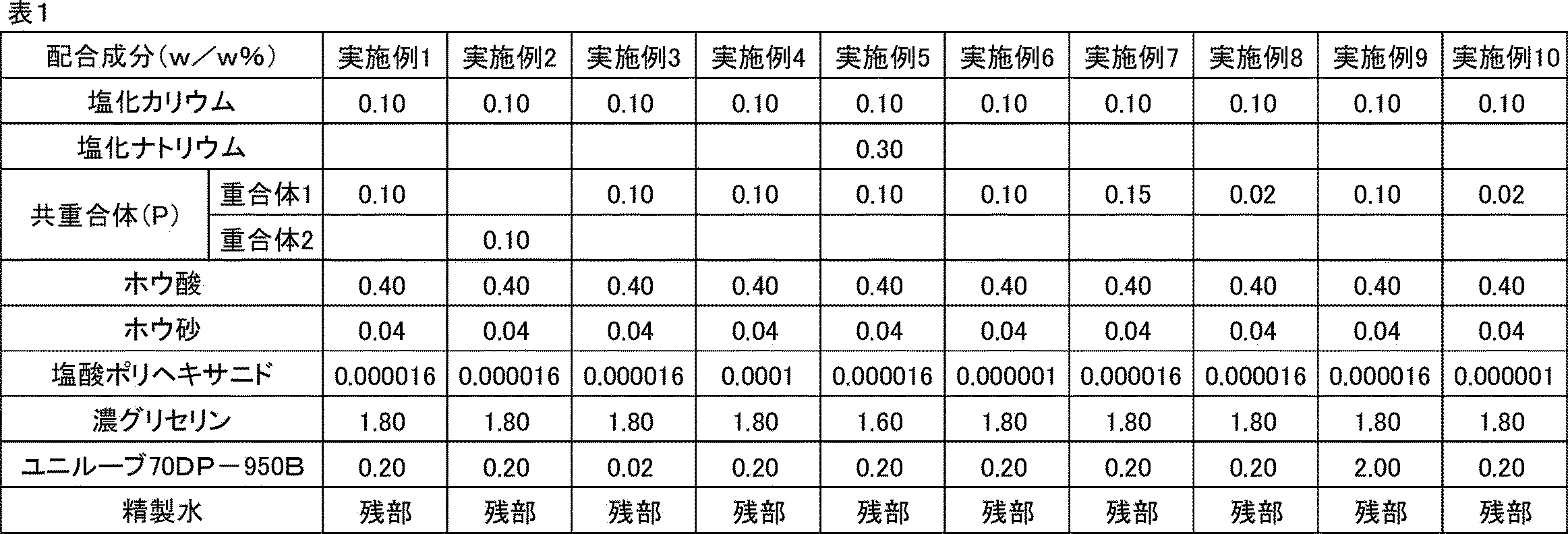
- Example 1 About 50 g of purified water was heated to 45°C, and 0.1 g of potassium chloride, 0.4 g of boric acid, 0.04 g of borax, 0.00008 g of Cosmocil CQ (registered trademark) as component (B) (since it is a 20% aqueous solution, it contains 0.000016 g of polyhexanide hydrochloride [hydrochloride of polyhexamethylene biguanide]), 1.8 g of concentrated glycerin, 0.2 g of Unilube 70DP-950B as component (C), and 10 g of copolymer (P) as component (A) (since it is a 1% aqueous solution, it contains 0.1 g of 2-methacryloyloxyethyl phosphorylcholine-dimethylacrylamide-stearyl methacrylate copolymer) were added in that order and stirred.
- Example 2 The ingredients were prepared in the same manner as in Example 1, except that the ingredients were of the types and amounts shown in Table 1.
- the slipperiness of the gel plate is good: 3 points
- the slipperiness of the gel plate is somewhat good: 2 points
- the slipperiness of the gel plate is somewhat poor: 1 point
- the slipperiness of the gel plate is poor: 0 points (criteria) When the average score was between 2 and 3, it was rated as good (A); when it was between 1.5 and 2, it was rated as fair (B); and when it was between 0 and 1.5, it was rated as poor (C).
- E.c. Escherichia coli
- P.a. Pseudomonas aeruginosa
- S.a. Staphylococcus aureus
- C.a. Candida albicans
- A.b. Aspergillus brasiliensis
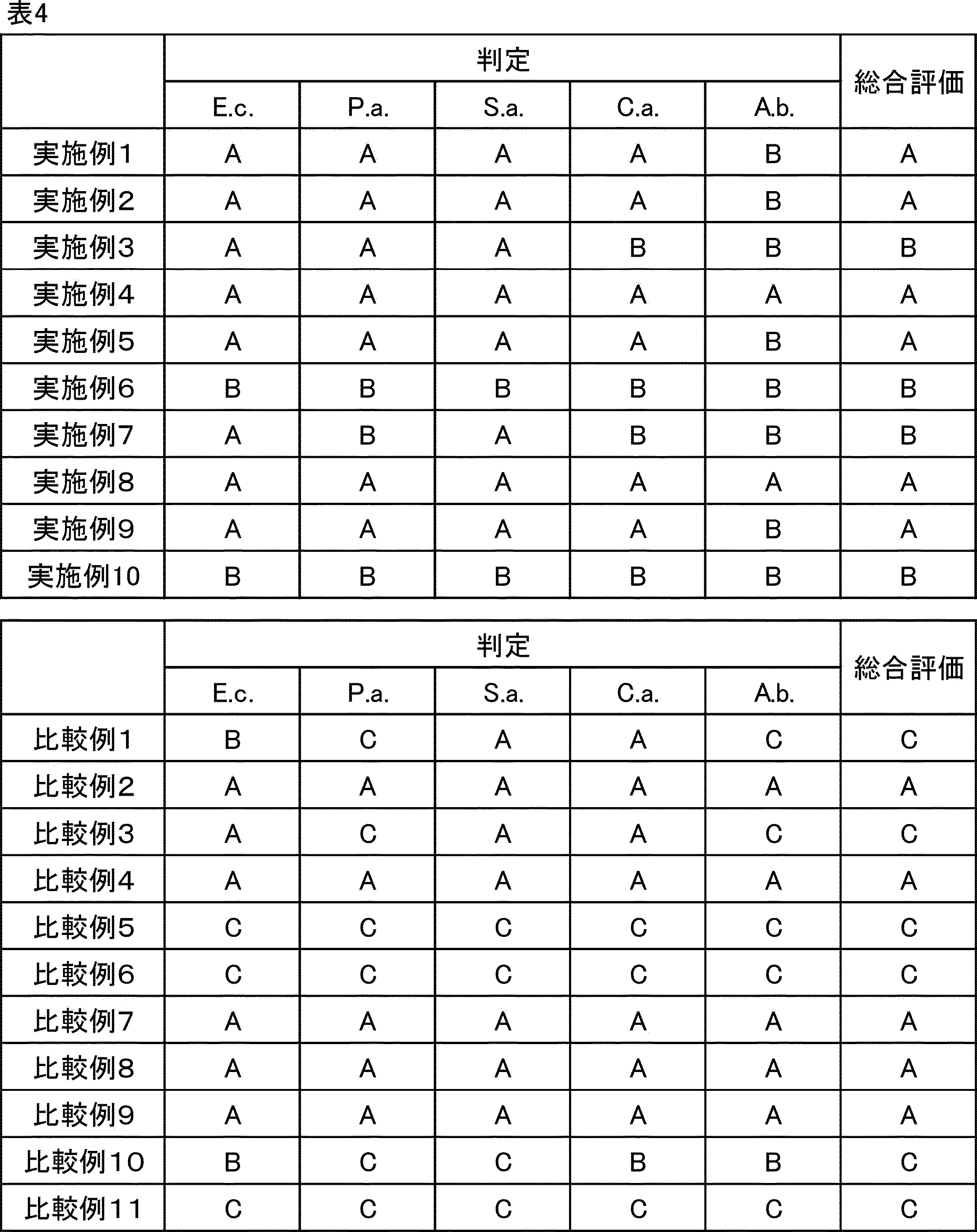
- This test bacterial solution was added to Examples 1 to 10 and Comparative Examples 1 to 11 at 1 v/v%, and the inoculum number was adjusted to 10 6 CFU per mL, and stored at 25°C. Sampling was performed 14 and 28 days after inoculation, and the viable bacterial count was measured after culturing. Those that did not develop colonies after 28 days were rated as good (A), those that developed colonies after 28 days but the bacterial count after 28 days did not increase from the bacterial count after 14 days were rated as acceptable (B), and those that had an increase in the bacterial count after 28 days from the bacterial count after 14 days were rated as unacceptable (C).
- the overall evaluation was as follows: when no colonies were generated for any of the bacterial species after 28 days, it was rated as good (A); when colonies were generated for at least two or more bacterial species after 28 days but the number of bacteria was less than that after 14 days, it was rated as fair (B); and when the number of bacteria for at least one or more bacterial species after 28 days was higher than that after 14 days, it was rated as unacceptable (C).
- SIRC cells rabbit corneal epithelial cells
- SIRC cells pre-cultured in Dulbecco's modified Eagle medium (DMEM) supplemented with 10 v/v% FBS (fetal bovine serum) were trypsinized to prepare a cell suspension of 1.0 x 10 5 cells/mL.
- DMEM Dulbecco's modified Eagle medium
- FBS fetal bovine serum
- the medium was removed, and a 50 ⁇ g/mL neutral red solution was added to allow the neutral red to be incorporated into the live cells.
- the cells were washed with PBS (phosphate buffered saline), neutral red was extracted with 1 v/v% acetic acid/50 v/v% ethanol aqueous solution, and the absorbance at 540 nm was measured.
- the absorbance without addition of the sample solution was taken as 100% cell viability, and the cell viability was calculated with the addition of Examples 1 to 10 and Comparative Examples 1 to 11, and the 50% inhibitory concentration (IC 50 ) was calculated.
- the cell viability was judged to be high and rated as "A,” when IC 50 was 40% or more and less than 50%, the cell viability was judged to be medium and rated as "B,” and when IC 50 was more than 0% and less than 40%, the cell viability was judged to be low and rated as "C.”
- LDH Cytotoxicity Detection kit manufactured by Takara Bio Co., Ltd.
- a reaction solution of LDH Cytotoxicity Detection kit manufactured by Takara Bio Co., Ltd.
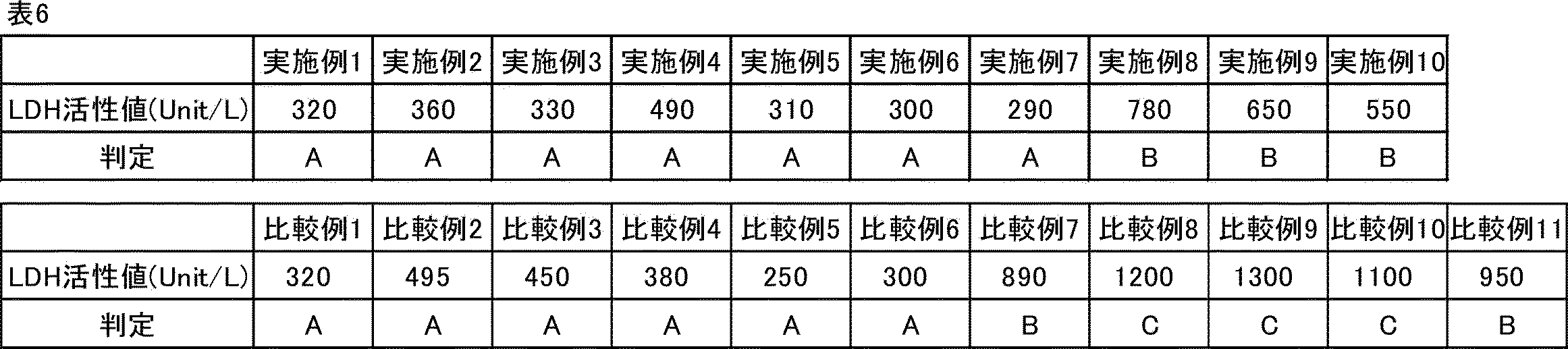
- a reaction stop solution was added, and the absorbance at 490 nm was measured. From the absorbance, the LDH activity value, which is an index of the number of damaged cells, was calculated, and the cell viability after instillation was evaluated.
- the cell viability after instillation was deemed high and rated as "A.”
- the cell viability after instillation was deemed moderate and rated as “B.”
- the LDH activity value was 1,000 Units/L or more, the cell viability after instillation was deemed low and rated as "C.”
- Example 1 The results are shown in Table 6.
- the LDH activity values were low in Examples 1 to 10.
- the results in Example 1 were comparable to those in Comparative Example 6, which did not contain polyhexanide hydrochloride. From the above, the eye drops of the present invention further reduce eye irritation by being mixed with tears.
- the present invention makes it possible to obtain an eye drop that provides lubricity to the corneal surface, has sufficient preservative efficacy, and is less irritating to the eyes.
Landscapes
- Health & Medical Sciences (AREA)
- Chemical & Material Sciences (AREA)
- Veterinary Medicine (AREA)
- Life Sciences & Earth Sciences (AREA)
- Public Health (AREA)
- General Health & Medical Sciences (AREA)
- Animal Behavior & Ethology (AREA)
- Medicinal Chemistry (AREA)
- Pharmacology & Pharmacy (AREA)
- Epidemiology (AREA)
- General Chemical & Material Sciences (AREA)
- Chemical Kinetics & Catalysis (AREA)
- Engineering & Computer Science (AREA)
- Ophthalmology & Optometry (AREA)
- Organic Chemistry (AREA)
- Nuclear Medicine, Radiotherapy & Molecular Imaging (AREA)
- Bioinformatics & Cheminformatics (AREA)
- Inorganic Chemistry (AREA)
- Oil, Petroleum & Natural Gas (AREA)
- Medicinal Preparation (AREA)
- Pharmaceuticals Containing Other Organic And Inorganic Compounds (AREA)
Abstract
Description
また、ポリヘキサメチレンビグアニドは前述の通り十分な保存効力を有しているものの、ドライアイにより涙液量が低下し、バリア機能が低下したまたは傷ついた角膜にポリヘキサメチレンビグアニドを配合したマルチパーパスソリューションで洗浄したコンタクトレンズを装用すると、角膜障害や角膜感染を引き起こす可能性がある(例えば、非特許文献1参照)。具体的には、マルチパーパスソリューションに限らず、バリア機能が低下したまたは傷ついた角膜では、保存効力の高い防腐剤を配合した点眼剤であっても、場合によっては一部の患者において、刺激を感じる可能性がある。そのため、バリア機能が低下したまたは傷ついた角膜においても点眼可能な眼刺激性の低い点眼剤が求められている。
すなわち、ドライアイ治療には、潤滑性が高く、十分な保存効力を有し、かつ眼刺激性の低い点眼剤が求められている。
[1]式(1)で示される各構成単位のモル比率がa:b:c=100:10~400:2~50である2-メタクリロイルオキシエチルホスホリルコリン・ジメチルアクリルアミド・メタクリル酸ステアリル共重合体0.02w/w%以上0.15w/w%以下と、式(2)で示されるポリヘキサメチレンビグアニドまたはその塩0.000001w/w%以上0.0001w/w%以下と、ポリオキシエチレンポリオキシプロピレングリコール0.02w/w%以上2.0w/w%以下を含有し、塩化ナトリウムの含有量が0.3w/w%以下である点眼剤。
多価アルコールとしては、例えば、プロピレングリコール、グリセリン、ブドウ糖、マンニトール、ソルビトール、キシリトール、トレハロースが挙げられる。
清涼化剤としては、例えば、メントール、カンフルが挙げられる。
無機塩としては、例えば、塩化カリウム、ホウ砂、炭酸水素ナトリウム、リン酸水素ナトリウム、無水リン酸二水素ナトリウムが挙げられる。
有機酸の塩としては、例えば、クエン酸ナトリウム、酢酸ナトリウムが挙げられる。
酸としては、例えば、ホウ酸、リン酸、クエン酸、硫酸、酢酸、塩酸が挙げられる。
塩基としては、例えば、水酸化ナトリウム、水酸化カリウム、トロメタモール、モノエタノールアミンが挙げられる。
酸化防止剤としては、例えば、酢酸トコフェロール、ジブチルヒドロキシトルエンが挙げられる。
共重合体(P)
重合体1:2-メタクリロイルオキシエチルホスホリルコリン(MPC)、ジメチルアクリルアミドおよびメタクリル酸ステアリルの共重合体(MPC、ジメチルアクリルアミドおよびメタクリル酸ステアリルの共重合組成比[MPC/ジメチルアクリルアミド/メタクリル酸ステアリル(モル比)=10/9/1]、重量平均分子量:100,000)
重合体2:2-メタクリロイルオキシエチルホスホリルコリン(MPC)、ジメチルアクリルアミドおよびメタクリル酸ステアリルの共重合体(MPC、ジメチルアクリルアミドおよびメタクリル酸ステアリルの共重合組成比[MPC/ジメチルアクリルアミド/メタクリル酸ステアリル(モル比)=5/4/1]、重量平均分子量:100,000)
(実施例1)
精製水約50gを45℃に加温し、これに、塩化カリウム0.1g、ホウ酸0.4g、ホウ砂0.04g、(B)成分としてCosmocil CQ(登録商標)0.00008g(20%水溶液であるため、塩酸ポリヘキサニド[ポリヘキサメチレンビグアニドの塩酸塩]としては0.000016gを含む)、濃グリセリン1.8g、(C)成分としてユニルーブ70DP-950B 0.2g、(A)成分として共重合体(P)10g(1%水溶液であるため、2-メタクリロイルオキシエチルホスホリルコリン・ジメチルアクリルアミド・メタクリル酸ステアリル共重合体としては0.1gを含む)を順次加え、攪拌した。その後、これに全量100gとなるよう精製水を加えた。この後、濾過滅菌を行い、無菌の点眼剤とした。
なお、上記Cosmocil CQ(登録商標)は、式(2)で表される化合物であり、d=14である。
表1に示す種類および量の成分を使用し、実施例1と同様の手順で製造した。
表2に示す種類および量の成分を使用し、実施例1と同様の手順で製造した。なお、ヒアルロン酸は、BIO-SODIUM HYALURONATE POWDER(MMW)粉末(HYUNDAI BIOLAND社製)を使用した。

上記実施例および比較例について、下記の通りに評価を行った。
実施例1~10および比較例1~11の点眼剤に浸漬したゲル板を、指で擦ったときの滑り性について、官能評価により評価した。
(1)褐色スクリュー管に、2-ヒドロキシエチルメタクリレート(HEMA)(三菱ケミカル(株)製)19.8166g、メタクリル酸(MAA)(東京化成工業(株)製)0.2011g、エチレングリコールジメタクリレート(東京化成工業(株)製)0.1429g、2,2-アゾビス(イソブチロニトリル)(富士フイルム和光純薬(株)製)0.1005gを加え、ウェーブローターで1時間攪拌混合した。
(2)板材作製用セルへピペッターで分注した。
(3)100℃1時間の条件で硬化した。
(4)硬化後のゲルをISO生理食塩水に浸漬させ、HEMA-MAAゲルを得た。
(評価基準)
ゲル板の滑り性が良い:3点
ゲル板の滑り性がやや良い:2点
ゲル板の滑り性がやや悪い:1点
ゲル板の滑り性が悪い:0点
(判定基準)
評価点の平均点が2点以上3点未満の場合は良好「A」、1.5点以上2点未満の場合は可「B」、0点以上1.5点未満の場合は不可「C」とした。

保存効力試験は、「第18改正 日本薬局方 参考情報 保存効力試験法」の項に従い、実施した。細菌として、Escherichia coli(大腸菌、以下E.c.と略記)(NBRC3972)、Pseudomonas aeruginosa(緑膿菌、以下P.a.と略記)(NBRC13275)、Staphylococcus aureus(黄色ブドウ球菌、以下S.a.と略記)(NBRC13276)の3種を用い、真菌として、Candida albicans(カンジダ菌、以下C.a.と略記)(NBRC1594)、Aspergillus brasiliensis(クロコウジカビ、以下A.b.と略記)(NBRC9455)の2種を用いた。
上記、E.c.、P.a.、S.a.、C.a.、A.b.のBIOBALL(登録商標)(ビオメリュー・ジャパン(株)製)を再溶解し、1mLあたり108CFU(Colony Forming Unit、コロニーを形成する能力がある単位数)とし、試験菌液とした。この試験菌液を、1v/v%となるように実施例1~10および比較例1~11に対して添加し、接種菌数が1mLあたり106CFUとなるように調整し、25℃で保管した。
接種から14日後、28日後にサンプリングを行い、培養して生菌数を測定した。28日後にコロニーが発生しなかったものは良好「A」、28日後にコロニーが発生したが、28日後の菌数が14日後の菌数から増加しなかったものは可「B」、28日後の菌数が14日後の菌数から増加したものは不可「C」として判定した。
また、総合評価は、28日後に全ての菌種でコロニーが発生しなかったものを良好「A」、28日後に少なくとも2菌種以上でコロニーが発生したが、14日後の菌数より少なかったものを可「B」、少なくとも1菌種以上で28日後の菌数が14日後の菌数より増加したものを不可「C」として判定した。
ウサギ角膜上皮細胞(SIRC細胞)を用いて、細胞生存率の評価を行った。10v/v%FBS(ウシ胎児血清)添加ダルベッコ改変イーグル培地(DMEM)にて予め前培養したSIRC細胞をトリプシン処理し、1.0×105cells/mLの細胞懸濁液を調整した。96wellプレートに細胞懸濁液を0.1mL/wellずつ播種し、24時間培養して細胞を接着させた後、実施例1~10および比較例1~11を各0.1mL/well添加し、さらに24時間培養した。培地を除去し、50μg/mLのニュートラルレッド溶液を添加して生細胞にニュートラルレッドを取り込ませた。3時間後、細胞をPBS(リン酸緩衝生理食塩水)で洗浄し、1v/v%酢酸/50v/v%エタノール水溶液にてニュートラルレッドを抽出し、540nmの吸光度を測定した。試料溶液を無添加の場合の吸光度を細胞生存率100%として、実施例1~10および比較例1~11を添加したものの細胞生存率を算出し、50%阻害濃度(IC50)を計算した。IC50が50%以上100%未満の場合は、細胞生存率が高いとして「A」、IC50が40%以上50%未満の場合は細胞生存率が中程度として「B」、IC50が0%より大きく40%未満の場合は、細胞生存率が低いとして「C」と判定した。

点眼後の細胞生存率を評価するため、本発明の点眼剤が涙液と混和した点眼後の状態を模倣し、実施例1~10および比較例1~11の点眼液に塩化ナトリウム0.55gを添加した試料溶液について、ヒト重層化角膜上皮モデル(角膜モデル)((株)ジャパン・ティッシュ・エンジニアリング製)を用いて、細胞生存率の評価を行った。予めアッセイ培地((株)ジャパン・ティッシュ・エンジニアリング製)で培養した角膜モデルに、試料溶液を各0.1mL添加し、24時間培養した。その後、LDH Cytotoxicity Detection kit(タカラバイオ(株)製)の反応液を加えた。30分後に反応停止液を加え、490nmの吸光度を測定した。吸光度から、障害を受けた細胞数の指標となるLDH活性値を算出し、点眼後の細胞生存率を評価した。LDH活性値が500Unit/L未満の場合、点眼後の細胞生存率が高いとして「A」、LDH活性値が500以上1,000Unit/L未満の場合、点眼後の細胞生存率が中程度として「B」、LDH活性値が1,000Unit/L以上の場合、点眼後の細胞生存率が低いとして「C」とした。

Claims (1)
- (A) 式(1)で示される各構成単位のモル比率がa:b:c=100:10~400:2~50である2-メタクリロイルオキシエチルホスホリルコリン・ジメチルアクリルアミド・メタクリル酸ステアリル共重合体0.02w/w%以上0.15w/w%以下と、
(B) 式(2)で示されるポリヘキサメチレンビグアニドまたはその塩0.000001w/w%以上0.0001w/w%以下と、
(C) ポリオキシエチレンポリオキシプロピレングリコール0.02w/w%以上2.0w/w%以下を含有し、塩化ナトリウムの含有量が0.3w/w%以下である点眼剤。
Priority Applications (3)
| Application Number | Priority Date | Filing Date | Title |
|---|---|---|---|
| EP24770963.7A EP4681717A1 (en) | 2023-03-16 | 2024-03-14 | Eye drops |
| JP2025506924A JPWO2024190860A1 (ja) | 2023-03-16 | 2024-03-14 | |
| CN202480017091.1A CN120826231A (zh) | 2023-03-16 | 2024-03-14 | 滴眼剂 |
Applications Claiming Priority (2)
| Application Number | Priority Date | Filing Date | Title |
|---|---|---|---|
| JP2023-042003 | 2023-03-16 | ||
| JP2023042003 | 2023-03-16 |
Publications (1)
| Publication Number | Publication Date |
|---|---|
| WO2024190860A1 true WO2024190860A1 (ja) | 2024-09-19 |
Family
ID=92755271
Family Applications (1)
| Application Number | Title | Priority Date | Filing Date |
|---|---|---|---|
| PCT/JP2024/009965 Ceased WO2024190860A1 (ja) | 2023-03-16 | 2024-03-14 | 点眼剤 |
Country Status (4)
| Country | Link |
|---|---|
| EP (1) | EP4681717A1 (ja) |
| JP (1) | JPWO2024190860A1 (ja) |
| CN (1) | CN120826231A (ja) |
| WO (1) | WO2024190860A1 (ja) |
Citations (5)
| Publication number | Priority date | Publication date | Assignee | Title |
|---|---|---|---|---|
| WO2015029717A1 (ja) * | 2013-08-30 | 2015-03-05 | 日油株式会社 | 点眼剤 |
| WO2016140242A1 (ja) | 2015-03-03 | 2016-09-09 | 日油株式会社 | 点眼剤 |
| JP2021020856A (ja) | 2019-07-24 | 2021-02-18 | 日油株式会社 | 点眼剤 |
| WO2022113970A1 (ja) * | 2020-11-30 | 2022-06-02 | 学校法人近畿大学 | 涙液層破壊時間短縮型ドライアイ治療剤および該治療剤を含む点眼剤 |
| JP2023038930A (ja) * | 2021-09-07 | 2023-03-17 | 学校法人近畿大学 | 眼表面薬物滞留化剤およびこれを含む点眼剤、並びに、これらの剤を用いた眼表面薬物滞留方法および眼科疾患治療方法 |
-
2024
- 2024-03-14 WO PCT/JP2024/009965 patent/WO2024190860A1/ja not_active Ceased
- 2024-03-14 JP JP2025506924A patent/JPWO2024190860A1/ja active Pending
- 2024-03-14 EP EP24770963.7A patent/EP4681717A1/en active Pending
- 2024-03-14 CN CN202480017091.1A patent/CN120826231A/zh active Pending
Patent Citations (5)
| Publication number | Priority date | Publication date | Assignee | Title |
|---|---|---|---|---|
| WO2015029717A1 (ja) * | 2013-08-30 | 2015-03-05 | 日油株式会社 | 点眼剤 |
| WO2016140242A1 (ja) | 2015-03-03 | 2016-09-09 | 日油株式会社 | 点眼剤 |
| JP2021020856A (ja) | 2019-07-24 | 2021-02-18 | 日油株式会社 | 点眼剤 |
| WO2022113970A1 (ja) * | 2020-11-30 | 2022-06-02 | 学校法人近畿大学 | 涙液層破壊時間短縮型ドライアイ治療剤および該治療剤を含む点眼剤 |
| JP2023038930A (ja) * | 2021-09-07 | 2023-03-17 | 学校法人近畿大学 | 眼表面薬物滞留化剤およびこれを含む点眼剤、並びに、これらの剤を用いた眼表面薬物滞留方法および眼科疾患治療方法 |
Non-Patent Citations (2)
| Title |
|---|
| KAZUYUKI ISENOUMI ET AL.: "New Ophthalmology", vol. 28, 31 March 2011, MEDICAL AOI PUBLICATIONS, INC., pages: 421 - 424 |
| See also references of EP4681717A1 |
Also Published As
| Publication number | Publication date |
|---|---|
| JPWO2024190860A1 (ja) | 2024-09-19 |
| CN120826231A (zh) | 2025-10-21 |
| EP4681717A1 (en) | 2026-01-21 |
Similar Documents
| Publication | Publication Date | Title |
|---|---|---|
| JP6130741B2 (ja) | ソフトコンタクトレンズ用眼科組成物 | |
| EP3266468B1 (en) | Eyedrops | |
| US20030186825A1 (en) | Contact lens wetting solution | |
| JP7218689B2 (ja) | 点眼剤 | |
| JP2008519846A (ja) | 眼科用溶液 | |
| US20200385653A1 (en) | Soft contact lens treatment solution | |
| JP6394957B2 (ja) | 点眼剤 | |
| US9926515B2 (en) | Contact lens care solution | |
| JP7017030B2 (ja) | シリコーンハイドロゲルコンタクトレンズ用溶液 | |
| JP5729991B2 (ja) | シリコーンハイドロゲルコンタクトレンズ用眼科組成物 | |
| WO2021070862A1 (ja) | ソフトコンタクトレンズ用表面処理剤 | |
| WO2024190860A1 (ja) | 点眼剤 | |
| ES2939641T3 (es) | Solvente anti-Acanthamoeba para lentes de contacto | |
| JP2019060917A (ja) | ソフトコンタクトレンズ保存用溶液 | |
| JP2015034166A (ja) | 眼科組成物 | |
| JP6413658B2 (ja) | 点眼剤 | |
| WO2025063174A1 (ja) | 眼科組成物 | |
| JP2011084520A (ja) | ソフトコンタクトレンズ用眼科組成物 | |
| JP2007302674A (ja) | 眼科用組成物 | |
| WO2024135647A1 (ja) | 共重合体及びそれを用いた眼用組成物 | |
| JP2019219620A (ja) | コンタクトレンズ用溶液 | |
| JP2003300871A (ja) | 眼科用組成物 | |
| WO2026083884A1 (ja) | コンタクトレンズ用処理液 | |
| WO2023074596A1 (ja) | ソフトコンタクトレンズ用処理液 | |
| JP2016183186A (ja) | 眼科組成物 |
Legal Events
| Date | Code | Title | Description |
|---|---|---|---|
| 121 | Ep: the epo has been informed by wipo that ep was designated in this application |
Ref document number: 24770963 Country of ref document: EP Kind code of ref document: A1 |
|
| ENP | Entry into the national phase |
Ref document number: 2025506924 Country of ref document: JP Kind code of ref document: A |
|
| WWE | Wipo information: entry into national phase |
Ref document number: 2025506924 Country of ref document: JP |
|
| WWE | Wipo information: entry into national phase |
Ref document number: 202480017091.1 Country of ref document: CN |
|
| WWE | Wipo information: entry into national phase |
Ref document number: 2024770963 Country of ref document: EP |
|
| NENP | Non-entry into the national phase |
Ref country code: DE |
|
| WWP | Wipo information: published in national office |
Ref document number: 202480017091.1 Country of ref document: CN |
|
| ENP | Entry into the national phase |
Ref document number: 2024770963 Country of ref document: EP Effective date: 20251016 |
|
| ENP | Entry into the national phase |
Ref document number: 2024770963 Country of ref document: EP Effective date: 20251016 |
|
| ENP | Entry into the national phase |
Ref document number: 2024770963 Country of ref document: EP Effective date: 20251016 |
|
| ENP | Entry into the national phase |
Ref document number: 2024770963 Country of ref document: EP Effective date: 20251016 |
|
| ENP | Entry into the national phase |
Ref document number: 2024770963 Country of ref document: EP Effective date: 20251016 |