WO2024185458A1 - 樹脂組成物、硬化膜、硬化膜のパターン付き基板の製造方法、光学素子、およびポリシロキサンの製造方法 - Google Patents
樹脂組成物、硬化膜、硬化膜のパターン付き基板の製造方法、光学素子、およびポリシロキサンの製造方法 Download PDFInfo
- Publication number
- WO2024185458A1 WO2024185458A1 PCT/JP2024/005445 JP2024005445W WO2024185458A1 WO 2024185458 A1 WO2024185458 A1 WO 2024185458A1 JP 2024005445 W JP2024005445 W JP 2024005445W WO 2024185458 A1 WO2024185458 A1 WO 2024185458A1
- Authority
- WO
- WIPO (PCT)
- Prior art keywords
- resin composition
- polysiloxane
- general formula
- group
- acid
- Prior art date
- Legal status (The legal status is an assumption and is not a legal conclusion. Google has not performed a legal analysis and makes no representation as to the accuracy of the status listed.)
- Ceased
Links
Classifications
-
- G—PHYSICS
- G03—PHOTOGRAPHY; CINEMATOGRAPHY; ANALOGOUS TECHNIQUES USING WAVES OTHER THAN OPTICAL WAVES; ELECTROGRAPHY; HOLOGRAPHY
- G03F—PHOTOMECHANICAL PRODUCTION OF TEXTURED OR PATTERNED SURFACES, e.g. FOR PRINTING, FOR PROCESSING OF SEMICONDUCTOR DEVICES; MATERIALS THEREFOR; ORIGINALS THEREFOR; APPARATUS SPECIALLY ADAPTED THEREFOR
- G03F7/00—Photomechanical, e.g. photolithographic, production of textured or patterned surfaces, e.g. printing surfaces; Materials therefor, e.g. comprising photoresists; Apparatus specially adapted therefor
- G03F7/004—Photosensitive materials
- G03F7/075—Silicon-containing compounds
- G03F7/0757—Macromolecular compounds containing Si-O, Si-C or Si-N bonds
-
- C—CHEMISTRY; METALLURGY
- C08—ORGANIC MACROMOLECULAR COMPOUNDS; THEIR PREPARATION OR CHEMICAL WORKING-UP; COMPOSITIONS BASED THEREON
- C08F—MACROMOLECULAR COMPOUNDS OBTAINED BY REACTIONS ONLY INVOLVING CARBON-TO-CARBON UNSATURATED BONDS
- C08F2/00—Processes of polymerisation
- C08F2/44—Polymerisation in the presence of compounding ingredients, e.g. plasticisers, dyestuffs, fillers
-
- C—CHEMISTRY; METALLURGY
- C08—ORGANIC MACROMOLECULAR COMPOUNDS; THEIR PREPARATION OR CHEMICAL WORKING-UP; COMPOSITIONS BASED THEREON
- C08F—MACROMOLECULAR COMPOUNDS OBTAINED BY REACTIONS ONLY INVOLVING CARBON-TO-CARBON UNSATURATED BONDS
- C08F290/00—Macromolecular compounds obtained by polymerising monomers on to polymers modified by introduction of aliphatic unsaturated end or side groups
- C08F290/08—Macromolecular compounds obtained by polymerising monomers on to polymers modified by introduction of aliphatic unsaturated end or side groups on to polymers modified by introduction of unsaturated side groups
- C08F290/14—Polymers provided for in subclass C08G
- C08F290/148—Polysiloxanes
-
- C—CHEMISTRY; METALLURGY
- C08—ORGANIC MACROMOLECULAR COMPOUNDS; THEIR PREPARATION OR CHEMICAL WORKING-UP; COMPOSITIONS BASED THEREON
- C08G—MACROMOLECULAR COMPOUNDS OBTAINED OTHERWISE THAN BY REACTIONS ONLY INVOLVING UNSATURATED CARBON-TO-CARBON BONDS
- C08G59/00—Polycondensates containing more than one epoxy group per molecule; Macromolecules obtained by polymerising compounds containing more than one epoxy group per molecule using curing agents or catalysts which react with the epoxy groups
- C08G59/18—Macromolecules obtained by polymerising compounds containing more than one epoxy group per molecule using curing agents or catalysts which react with the epoxy groups ; e.g. general methods of curing
- C08G59/20—Macromolecules obtained by polymerising compounds containing more than one epoxy group per molecule using curing agents or catalysts which react with the epoxy groups ; e.g. general methods of curing characterised by the epoxy compounds used
-
- C—CHEMISTRY; METALLURGY
- C08—ORGANIC MACROMOLECULAR COMPOUNDS; THEIR PREPARATION OR CHEMICAL WORKING-UP; COMPOSITIONS BASED THEREON
- C08G—MACROMOLECULAR COMPOUNDS OBTAINED OTHERWISE THAN BY REACTIONS ONLY INVOLVING UNSATURATED CARBON-TO-CARBON BONDS
- C08G77/00—Macromolecular compounds obtained by reactions forming a linkage containing silicon with or without sulfur, nitrogen, oxygen or carbon in the main chain of the macromolecule
- C08G77/04—Polysiloxanes
- C08G77/14—Polysiloxanes containing silicon bound to oxygen-containing groups
- C08G77/16—Polysiloxanes containing silicon bound to oxygen-containing groups to hydroxy groups
-
- C—CHEMISTRY; METALLURGY
- C08—ORGANIC MACROMOLECULAR COMPOUNDS; THEIR PREPARATION OR CHEMICAL WORKING-UP; COMPOSITIONS BASED THEREON
- C08G—MACROMOLECULAR COMPOUNDS OBTAINED OTHERWISE THAN BY REACTIONS ONLY INVOLVING UNSATURATED CARBON-TO-CARBON BONDS
- C08G77/00—Macromolecular compounds obtained by reactions forming a linkage containing silicon with or without sulfur, nitrogen, oxygen or carbon in the main chain of the macromolecule
- C08G77/04—Polysiloxanes
- C08G77/20—Polysiloxanes containing silicon bound to unsaturated aliphatic groups
-
- C—CHEMISTRY; METALLURGY
- C08—ORGANIC MACROMOLECULAR COMPOUNDS; THEIR PREPARATION OR CHEMICAL WORKING-UP; COMPOSITIONS BASED THEREON
- C08K—Use of inorganic or non-macromolecular organic substances as compounding ingredients
- C08K3/00—Use of inorganic substances as compounding ingredients
- C08K3/18—Oxygen-containing compounds, e.g. metal carbonyls
- C08K3/20—Oxides; Hydroxides
- C08K3/22—Oxides; Hydroxides of metals
-
- C—CHEMISTRY; METALLURGY
- C08—ORGANIC MACROMOLECULAR COMPOUNDS; THEIR PREPARATION OR CHEMICAL WORKING-UP; COMPOSITIONS BASED THEREON
- C08L—COMPOSITIONS OF MACROMOLECULAR COMPOUNDS
- C08L83/00—Compositions of macromolecular compounds obtained by reactions forming in the main chain of the macromolecule a linkage containing silicon with or without sulfur, nitrogen, oxygen or carbon only; Compositions of derivatives of such polymers
- C08L83/04—Polysiloxanes
-
- G—PHYSICS
- G03—PHOTOGRAPHY; CINEMATOGRAPHY; ANALOGOUS TECHNIQUES USING WAVES OTHER THAN OPTICAL WAVES; ELECTROGRAPHY; HOLOGRAPHY
- G03F—PHOTOMECHANICAL PRODUCTION OF TEXTURED OR PATTERNED SURFACES, e.g. FOR PRINTING, FOR PROCESSING OF SEMICONDUCTOR DEVICES; MATERIALS THEREFOR; ORIGINALS THEREFOR; APPARATUS SPECIALLY ADAPTED THEREFOR
- G03F7/00—Photomechanical, e.g. photolithographic, production of textured or patterned surfaces, e.g. printing surfaces; Materials therefor, e.g. comprising photoresists; Apparatus specially adapted therefor
- G03F7/0002—Lithographic processes using patterning methods other than those involving the exposure to radiation, e.g. by stamping
Definitions
- the present invention relates to a resin composition, a resin composition for imprinting, a cured film, a method for producing a patterned substrate, an optical element, and a method for producing polysiloxane.
- imprinting has been attracting attention as a technique that allows simpler and lower-cost patterning compared to photolithography.
- a resin composition is formed into a film, then sandwiched between a mold and a substrate, and heated and/or photocured to transfer a pattern.
- This method is environmentally friendly because it does not require the development process using chemicals that was necessary in conventional photolithography.
- it is possible to process complex shapes such as multi-stage patterns, lens-shaped patterns, and slant patterns that are difficult to form using photolithography, as well as nanoscale microfabrication, and is therefore expected to be applied to new applications (Patent Documents 1 and 2).
- one recent application that has been considered is the application to light guide plates used in wearable devices for AR (augmented reality)/MR (mixed reality), and it has been proposed to coat the surface of a high refractive index glass plate with a resin composition and then form a high-definition diffraction grating by an imprinting method (Patent Documents 3 and 4).
- the imprinting resin composition for this application requires properties such as flatness, transparency, weather resistance, bendability, and solvent resistance.
- imprinting resin composition can be broadly divided into “solvent type” that contains a solvent in the resin composition, and “solventless type” that contains almost no solvent.
- Solventless imprinting resin composition does not require a heating step to volatilize the solvent after film formation, and not only does it not affect the substrate due to the solvent, but it can also be expected to produce thick films, and can meet a wide range of needs (Patent Document 5).
- the inventors focused on polysiloxane, a resin with excellent flatness, transparency, and weather resistance, and aimed to develop a siloxane resin composition that enables thick-film patterning by the imprinting method. Furthermore, they aimed to develop a solventless imprinting resin composition with a solid content of 90% by mass or more.
- Patent Document 5 proposes a solvent-free curable composition for nanoimprinting that uses a silsesquioxane compound.
- silsesquioxane has a relatively rigid skeleton, there are problems with flexibility and bendability, such as the occurrence of cracks due to stress during the photo- or heat-curing process when forming a thick film of 10 ⁇ m or more (e.g., this corresponds to Comparative Example 7 described later).
- Patent Document 6 proposes an imprint material using a silicone compound with a flexible dimethyl silicone skeleton.
- a silicone compound with a dimethyl silicone skeleton By using a silicone compound with a dimethyl silicone skeleton, a film with good foldability can be obtained, but the photo- and heat-curing properties are poor, and there are issues with solvent resistance (e.g., this corresponds to Comparative Example 8 described later).
- the present invention provides a resin composition that has polysiloxane with excellent storage stability even when designed with a high solids content of 90% by mass or more, and gives a cured film with excellent weather resistance, bending property, and solvent resistance. It also provides a siloxane resin composition for imprinting that enables thick film patterning by the imprinting method. It is a further object of the present invention to produce polysiloxane with good storage stability even without a catalyst removal process.
- the present invention is as follows. [1] (a) a resin composition containing a polysiloxane, The resin composition, wherein the (a) polysiloxane contains at least a repeating unit represented by the following general formula (1) and/or the following general formula (2), and an (a1) polysiloxane having a terminal structure represented by the following general formula (3) and a silanol terminal structure:
- R1 and R2 may be the same or different and each represent a monovalent organic group having 1 to 20 carbon atoms.
- R3 represents a monovalent organic group having 1 to 20 carbon atoms.
- R4 , R5 , and R6 may be the same or different and each represent a monovalent organic group having 1 to 3 carbon atoms.
- Organic acids organic acids selected from the group consisting of methanesulfonic acid, ethanesulfonic acid, propanesulfonic acid, benzenesulfonic acid, p-toluenesulfonic acid, xylenesulfonic acid, trifluoromethanesulfonic acid, trifluoroethanesulfonic acid, trifluoropropanesulfonic acid, and trifluoroacetic acid.
- Amines amines selected from heterocyclic amines and/or aromatic amines.
- R 4 , R 5 and R 6 may be the same or different and each represent a monovalent organic group having 1 to 3 carbon atoms.
- R 7 represents hydrogen, a methyl group, or an ethyl group.
- (a1) polysiloxane means the following.
- R1 and R2 may be the same or different and each represent a monovalent organic group having 1 to 20 carbon atoms.
- R3 represents a monovalent organic group having 1 to 20 carbon atoms.
- R4 , R5 , and R6 may be the same or different and each represent a monovalent organic group having 1 to 3 carbon atoms.
- the present invention provides a siloxane resin composition that has excellent storage stability even when designed with a high solids content of 90% by mass or more, and gives a cured film that has excellent weather resistance, bending property, and solvent resistance. It also provides a siloxane resin composition for imprinting that enables thick film patterning by the imprinting method. It also provides a method for producing polysiloxane that produces polysiloxane with good storage stability even without a catalyst removal step.
- the resin composition of the present invention is a resin composition containing (a) a polysiloxane, and includes (a1) a polysiloxane having a repeating unit with a specific structure and a terminal structure with a specific structure.
- the resin composition of the present invention contains (a) a polysiloxane.
- a polysiloxane refers to a polymer having siloxane bonds (-Si-O-Si-) in its main chain and having organic groups in all or some of its side chains.
- the resin composition of the present invention contains, as the polysiloxane (a), a polysiloxane (a1) having a repeating unit represented by general formula (1) and/or general formula (2), and a terminal structure represented by general formula (3) and a silanol terminal structure.
- a polysiloxane (a1) is preferably a hydrolysis/dehydration condensation product of an alkoxysilane compound.
- the content of (a) polysiloxane in the resin composition of the present invention is not particularly limited, but from the viewpoint of improving weather resistance, it is preferably 50% by mass or more, and more preferably 70% by mass or more, based on 100% by mass of the solid content of the resin composition.
- the content of (a) polysiloxane in the resin composition of the present invention is preferably 95% by mass or less, and more preferably 90% by mass or less, based on 100% by mass of the solid content of the resin composition.
- the proportion of (a1) polysiloxane in 100% by mass of (a) polysiloxane in the resin composition of the present invention is preferably 60% by mass or more, more preferably 80% by mass or more, and even more preferably 100% from the viewpoint of improving curability and adhesion to the base substrate such as a glass substrate.
- the (a1) polysiloxane contains a repeating unit derived from a bifunctional alkoxysilane compound represented by general formula (1).
- a repeating unit derived from a bifunctional alkoxysilane compound represented by general formula (1) By containing a repeating unit derived from a bifunctional alkoxysilane compound represented by general formula (1) in the (a1) polysiloxane, excessive thermal reaction (condensation) of the polysiloxane due to heating can be suppressed, and the crack resistance of the cured film can be improved.
- the crosslink density of the polysiloxane after film formation can be increased, and the hardness of the cured film can be improved.
- a terminal structure represented by general formula (3) in which the silanol terminal structure is modified the reaction between silanol groups is less likely to proceed over time, and storage stability can be improved.
- the silanol terminal structure in the (a1) polysiloxane, it is given thermosetting properties, and after film formation and heating, the silanol groups react with each other to increase the crosslinking density, improving the degree of hardening of the cured film and improving the solvent resistance, and also improving the adhesion to the base substrate such as a glass substrate.
- R 1 and R 2 may be the same or different and represent a monovalent organic group having 1 to 20 carbon atoms.
- R 1 and R 2 may be partially substituted with a radically polymerizable group.
- the radically polymerizable group in the cured product of the resin composition, the radically polymerizable group may be radically polymerized.
- the radically polymerizable group include a vinyl group, a (meth)acrylic group, and a styryl group.
- the polysiloxane may contain two or more types of repeating units represented by the general formula (1) having different R 1 and R 2 .
- R 3 represents a monovalent organic group having 1 to 20 carbon atoms.
- R 3 may be partially substituted with a radically polymerizable group.
- the radically polymerizable group in the cured product of the resin composition, may be radically polymerized.
- the radically polymerizable group include a vinyl group, a (meth)acrylic group, and a styryl group.
- the polysiloxane may contain two or more types of repeating units represented by the general formula (2) having different R 3 .
- R 4 , R 5 and R 6 may be the same or different and each represent a monovalent organic group having 1 to 3 carbon atoms.
- the polysiloxane may contain two or more types of terminal structures represented by general formula (3) having different R 4 , R 5 and R 6 .
- the repeating units represented by the above general formulas (1) and (2) and the terminal structure represented by the above general formula (3) are derived from alkoxysilane compounds represented by the following general formulas (5), (6) and (4), respectively. That is, a polysiloxane containing the repeating units represented by the above general formulas (1) and (2) and the terminal structure represented by the above general formula (3) can be obtained by hydrolyzing and polycondensing an alkoxysilane compound containing an alkoxysilane compound represented by the following general formulas (5) and (6), and modifying the terminals with an alkoxysilane compound represented by the following general formula (4). Other alkoxysilane compounds may also be used.
- R 1 to R 6 represent the same groups as R 1 to R 6 in the general formulae (1), (2) and (3), respectively.
- R 7 represents hydrogen, a methyl group or an ethyl group.
- R 8 may be the same or different and represents hydrogen or a monovalent organic group having 1 to 20 carbon atoms, preferably an alkyl group having 1 to 3 carbon atoms.
- bifunctional alkoxysilane compounds represented by the general formula (5) include dimethyldimethoxysilane, dimethyldiethoxysilane, ethylmethyldimethoxysilane, ethylmethyldiethoxysilane, methylpropyldimethoxysilane, methylpropyldiethoxysilane, diphenyldimethoxysilane, diphenyldiethoxysilane, diphenylsilanediol, methylphenyldimethoxysilane, methylphenyldiethoxysilane, cyclohexylmethyldimethoxysilane, cyclohexylmethyldiethoxysilane, dicyclopentyldimethoxysilane, dicyclopentyldiethoxysilane, vinylmethyldimethoxysilane, , vinylmethyldiethoxysilane, allylmethyldimethoxysilane, allylmethyldiethoxysilane, st
- trifunctional alkoxysilane compounds represented by general formula (6) include methyltrimethoxysilane, methyltriethoxysilane, ethyltrimethoxysilane, ethyltriethoxysilane, propyltrimethoxysilane, propyltriethoxysilane, isobutyltrimethoxysilane, isobutyltriethoxysilane, cyclohexyltrimethoxysilane, 3-isocyanatepropyltrimethoxysilane, 3-aminopropyltrimethoxysilane, 3-ureidopropyltrimethoxysilane, 3-ureidopropyltriethoxysilane, 3-glycidoxypropyltrimethoxy ...
- i-ethoxysilane 2-(3,4-epoxycyclohexyl)ethyltrimethoxysilane, 2-(3,4-epoxycyclohexyl)ethyltriethoxysilane, 3-ethyl-3- ⁇ [3-(trimethoxysilyl)propoxy]methyl ⁇ oxetane, 3-ethyl-3- ⁇ [3-(triethoxysilyl)propoxy]methyl ⁇ oxetane, phenyltrimethoxysilane, 1-naphthyltrimethoxysilane, 2-naphthyltrimethoxysilane, 2-naphthyltrimethoxysilane, tolyltrimethoxysilane, 1-phenylethyltrimethoxysilane, 2-phenylethyltrimethoxysilane, 3-trimethoxysilylpropylfurane phthalic anhydride, 3-triethoxy
- Examples of monofunctional alkoxysilane compounds represented by general formula (4) include trimethylmethoxysilane, trimethylethoxysilane, trimethylsilanol, triethylmethoxysilane, triethylethoxysilane, triethylsilanol, tripropylmethoxysilane, tripropylethoxysilane, tripropylsilanol, triisopropylmethoxysilane, triisopropylethoxysilane, triisopropylsilanol, etc. Two or more of these may be used.
- alkoxysilane compounds include, for example, tetrafunctional alkoxysilane compounds such as tetramethoxysilane, tetraethoxysilane, and silicate 51 (tetraethoxysilane oligomer). Two or more of these may be used.
- the (a1) polysiloxane has a photopolymerizable group.
- photocurability can be imparted to the resin composition of the present invention.
- the photopolymerizable group include the above-mentioned radical polymerizable group and cationic polymerizable group.
- the cationic polymerizable group include an epoxy group, an oxetanyl group, and a vinyl ether group.
- the alkoxysilane compound represented by the general formula (5) and/or (6) contains at least one type of alkoxysilane compound containing a photopolymerizable group.
- photopolymerizable group-containing alkoxysilane compound from the viewpoint of photocurability, vinyltrimethoxysilane, allyltrimethoxysilane, ⁇ -acryloylpropyltrimethoxysilane, ⁇ -methacryloylpropyltrimethoxysilane, styryltrimethoxysilane, vinylmethyldimethoxysilane, styrylmethyldimethoxysilane, ⁇ -methacryloylpropylmethyldimethoxysilane, ⁇ -acryloylpropylmethyldimethoxysilane, 3-glycidoxypropyltrimethoxysilane, 3-glycidoxypropyltriethoxysilane, 2-(3,4-epoxycyclohexyl)ethyltrimethoxysilane, 2-(3,4-epoxycyclohexyl)ethyltriethoxysilane, and 3-ethyl-3
- the alkoxysilane compound represented by general formula (5) and/or (6) contains at least one of the above-mentioned photopolymerizable group-containing alkoxysilane compounds and at least one carboxyl group-containing alkoxysilane compound.
- a crosslinking reaction proceeds with radicals or acids and bases generated in the exposed areas, and the degree of hardening of the exposed areas can be increased.
- the solubility of the unexposed areas is improved, and the resolution can be improved during pattern processing.
- the photopolymerizable group-containing alkoxysilane compound the above-mentioned alkoxysilane compounds are preferred, and as the carboxyl group-containing alkoxysilane compound, from the viewpoint of development solubility, 3-trimethoxysilylpropyl succinic anhydride, 3-triethoxysilylpropyl succinic anhydride, 3-trimethoxysilylpropyl cyclohexyl dicarboxylic anhydride, 3-triethoxysilylpropyl cyclohexyl dicarboxylic anhydride, 3-trimethoxysilylpropyl phthalic anhydride, 3-triethoxysilylpropyl phthalic anhydride, 3-dimethylmethoxysilylpropyl succinic anhydride, and 3-d
- the alkoxysilane compound represented by the general formula (5) and/or (6) contains at least an aromatic group-containing alkoxysilane compound.
- the compatibility of the (a1) polysiloxane with the photosensitizer can be increased.
- aromatic group-containing alkoxysilane compound from the viewpoint of compatibility with the photosensitizer, diphenyldimethoxysilane, diphenyldiethoxysilane, diphenylsilanediol, phenyltrimethoxysilane, 1-naphthyltrimethoxysilane, 2-naphthyltrimethoxysilane, 2-naphthyltrimethoxysilane, tolyltrimethoxysilane, 1-phenylethyltrimethoxysilane, and 2-phenylethyltrimethoxysilane are preferred.
- the mass average molecular weight (Mw) of the (a1) polysiloxane is preferably 1,000 or more, more preferably 1,500 or more, from the viewpoint of coatability.
- the Mw of the polysiloxane is preferably 200,000 or less, more preferably 150,000 or less.
- the Mw of the polysiloxane in the present invention refers to the polystyrene equivalent value measured by gel permeation chromatography (GPC).
- Polysiloxane can be obtained by hydrolyzing the above-mentioned alkoxysilane compound and then subjecting the hydrolyzate to a dehydration condensation reaction. In addition, it is preferable to carry out the terminal modification reaction described below.
- Various conditions for hydrolysis can be set according to the physical properties suitable for the intended use, taking into consideration the reaction scale, size and shape of the reaction vessel, etc. Examples of various conditions include catalyst concentration, reaction temperature, reaction time, etc.
- catalysts include acids such as hydrochloric acid, acetic acid, formic acid, nitric acid, oxalic acid, hydrochloric acid, sulfuric acid, phosphoric acid, picolinic acid, polyphosphoric acid, polycarboxylic acids and their anhydrides, and bases such as monoethanolamine, diethanolamine, triethanolamine, 3,3-dimethylbutylamine, methylpentylamine, n-butylethylamine, dibutylamine, n-butylamine, pentylamine, isopentylamine, cyclopentylamine, hexylamine, cyclohexylamine, dimethylhexylamine, N,N-dimethylbutylamine, N,N-dimethylhexadecylamine, and N,N-dimethyl-n-octylamine, and bases such as me
- Organic salts such as pyridine salt of p-toluenesulfonate, pyridine salt of xylenesulfonate, pyridine salt of trifluoromethanesulfonate, aniline salt of trifluoromethanesulfonate, pyridine salt of trifluoroethanesulfonate, pyridine salt of trifluoropropanesulfonate, pyridine salt of trifluoroacetate, pyridine salt of difluoroacetate, aniline salt of difluoroacetate, pyridine salt of fluoroacetate, aniline salt of fluoroacetate, 2,4,6-trimethylpyridine salt of p-toluenesulfonate, aniline salt of p-toluenesulfonate, tetramethylammonium p-toluenesulfonate, tetraethylammonium p-toluenesulfonate, t
- organic salts are preferred, and it is more preferred to use an organic salt having a pH value of 3.0 to 5.5 in a 1.0% by mass aqueous solution.
- an organic salt having a pH value of 3.0 to 5.5 in a 1.0% by mass aqueous solution as a catalyst, a polysiloxane having good storage stability can be produced even without the catalyst removal or neutralization process described below.
- silanol terminal groups can be modified by carrying out a hydrolysis/dehydration condensation reaction of an alkoxysilane compound using an organic salt having a pH value of 3.0 to 5.5 in a 1.0% by mass aqueous solution as a catalyst, and then adding a monofunctional alkoxysilane compound represented by general formula (4).
- the method for producing polysiloxane (a1) of the present invention is a method for producing polysiloxane (a1) in which an organic salt and a silane compound represented by general formula (4) are added to a polysiloxane having silanol terminal groups to modify a portion of the silanol terminal groups, and the pH value of a 1.0 mass% aqueous solution of the organic salt is 3.0 to 5.5.
- R 4 , R 5 and R 6 may be the same or different and each represents a monovalent organic group having 1 to 3 carbon atoms.
- R 7 represents hydrogen, a methyl group, or an ethyl group.
- organic salts having a pH value of 3.0 to 5.5 in a 1.0% by mass aqueous solution include pyridine benzenesulfonate, pyridine methanesulfonate, pyridine ethanesulfonate, pyridine p-toluenesulfonate, pyridine xylenesulfonate, pyridine trifluoromethanesulfonate, pyridine trifluoroethanesulfonate, pyridine trifluoropropanesulfonate, pyridine trifluoroacetate, aniline difluoroacetate, pyridine difluoroacetate, pyridine fluoroacetate, 2,4,6-trimethylpyridine p-toluenesulfonate, aniline p-toluenesulfonate, etc. Pyridine methanesulfonate, pyridine ethanesulfonate, and pyridine p-tol
- the amount of catalyst added is preferably 0.05 parts by mass or more, more preferably 0.1 parts by mass or more, per 100 parts by mass of all alkoxysilane compounds used in the reaction, from the viewpoint of proceeding the reaction more quickly.
- the amount of catalyst added is preferably 5.00 parts by mass or less, more preferably 3.00 parts by mass or less, per 100 parts by mass of all alkoxysilane compounds.
- the amount of all alkoxysilane compounds refers to the amount including all of the alkoxysilane compounds, their hydrolysates, and their condensates. The same applies hereinafter.
- the hydrolysis reaction and the dehydration condensation reaction may be carried out in a solvent.
- the solvent can be appropriately selected taking into consideration the stability, wettability, volatility, etc. of the resin composition.
- a solvent having a boiling point of 110°C or less examples include methanol, ethanol, isopropanol, and methyl ethyl ketone.
- the resin composition of the present invention preferably has a solid content of 90% by mass or more. By having a solid content of 90% by mass or more, it is possible to reduce the amount of volatile organic compounds (VOCs) emitted during the formation of the cured film described below, and to provide a resin composition that is excellent in environmental friendliness.
- VOCs volatile organic compounds
- the resin composition of the present invention can be used for photolithography and imprinting applications.
- the resin composition of the present invention is preferably used for imprinting applications because it has excellent flatness, transparency, weather resistance, bending property, solvent resistance, and release property.
- the water used in the hydrolysis reaction is preferably ion-exchanged water.
- the amount of water can be set at will, but it is preferable to use 1.0 to 4.0 moles per mole of the total alkoxysilane compounds.
- the dehydration condensation reaction can be carried out, for example, by heating the silanol compound solution obtained by the hydrolysis reaction of the alkoxysilane compound as is.
- the heating temperature is preferably 50°C or higher and the boiling point of the solvent or lower, and the heating time is preferably 1 to 100 hours.
- an appropriate amount of the produced alcohol, etc. may be distilled and removed under heating and/or reduced pressure, and then a suitable solvent may be added.
- a catalyst removal or neutralization step may be carried out as necessary.
- preferred catalyst removal methods include washing with water and treatment with ion exchange resin.
- Water washing is a method in which the polysiloxane solution is diluted with an appropriate hydrophobic solvent, washed several times with water, and the resulting organic layer is then concentrated using an evaporator or the like.
- Treatment with ion exchange resin is a method in which the polysiloxane solution is brought into contact with an appropriate ion exchange resin.
- the modification of the silanol end group can be confirmed, for example, by 29Si NMR measurement or infrared spectroscopy (FT-IR measurement). From the viewpoint of simplicity of analysis, infrared spectroscopy is preferred. For example, when a polysiloxane sample is subjected to FT-IR measurement by the ATR method, peaks derived from silanol end groups (Si-OH) are observed at 860 cm -1 to 940 cm -1 . The modification of the silanol end group can be confirmed from the change in the intensity of these peak tops by measuring the polysiloxane before and after the modification reaction.
- FT-IR measurement infrared spectroscopy
- the resin composition of the present invention preferably further contains (b) an organic salt.
- the (b) organic salt is an organic salt compound consisting of an acid and a base.
- the (b) organic salt acts as a condensation catalyst that promotes the condensation reaction of the silanol groups remaining in the polysiloxane.
- Methods for introducing the (b) organic salt into the resin composition include, as described above, using the (b) organic salt as a catalyst in the process for producing the (a1) polysiloxane and using the polysiloxane solution obtained without carrying out a catalyst removal process, and a method in which the (b) organic salt is added post-additionally to the (a1) polysiloxane after the catalyst has been removed. From the viewpoint of process simplicity, the former method is preferred.
- the (b) organic salt preferably has a pH value of 3.0 to 5.5 in a 1.0% by mass aqueous solution of the (b) organic salt.
- a pH value of 3.0 to 5.5 in a 1.0% by mass aqueous solution By setting the pH value in this range, it is possible to achieve both the storage stability of the resin composition and the improvement of the chemical resistance of the film due to the improvement of the degree of hardening of the film.
- organic salts having a pH value of 3.0 to 5.5 in a 1.0% by mass aqueous solution include the organic salts described above as suitable catalysts.
- the pH value of the (b) organic salt in a 1.0% by mass aqueous solution is preferably 3.0 to 5.0, more preferably 3.0 to 4.5.
- the content of the (b) organic salt in the resin composition of the present invention is preferably 0.01 parts by mass or more, more preferably 0.05 parts by mass or more, and even more preferably 0.1 parts by mass or more, per 100 parts by mass of the (a1) polysiloxane.
- the content of the (b) organic salt in the resin composition of the present invention is preferably 5.00 parts by mass or less, more preferably 3.00 parts by mass or less, per 100 parts by mass of the (a1) polysiloxane.
- the (b) organic salt is preferably a salt consisting of a strong acid and a weak base so that the pH value in a 1.0% by mass aqueous solution falls within the aforementioned preferred range. Therefore, the (b) organic salt is preferably an organic salt consisting of organic acids selected from the group consisting of methanesulfonic acid, ethanesulfonic acid, propanesulfonic acid, benzenesulfonic acid, p-toluenesulfonic acid, xylenesulfonic acid, trifluoromethanesulfonic acid, trifluoroethanesulfonic acid, trifluoropropanesulfonic acid, and trifluoroacetic acid, and amines selected from heterocyclic amines and/or aromatic amines.
- siloxane resin composition of the present invention when used for a low refractive index film, pyridine trifluoromethanesulfonate, pyridine trifluoroethanesulfonate, pyridine trifluoropropanesulfonate, pyridine trifluoroacetate, aniline difluoroacetate, pyridine difluoroacetate, or pyridine fluoroacetate is preferred, and pyridine trifluoromethanesulfonate or pyridine trifluoroacetate is preferably used, from the viewpoint of lowering the refractive index.
- the organic salts to be used may be commercially available or may be synthesized.
- the organic acids and dehydrated THF are stirred under nitrogen, and the amines are added dropwise while cooling with ice to precipitate a salt, which is then filtered and vacuum dried to obtain the salt.
- the resin composition of the present invention preferably contains a photopolymerization initiator.
- photopolymerization initiators include photoradical generators, photoacid generators, photobase generators, and the like.
- the photopolymerizable group or silanol group in the above-mentioned (a1) polysiloxane can be reacted with radicals, acids, or bases generated by irradiation with light (including ultraviolet rays and electron beams), and photocuring can be performed.
- the photopolymerizable group in the (a1) polysiloxane contains a radical polymerizable group
- a photoradical generator as a photopolymerization initiator
- a photoacid generator and/or a photobase generator as a photopolymerization initiator
- the photoradical generator may be any that decomposes and/or reacts upon irradiation with light (including ultraviolet light and electron beams) to generate radicals. More specifically, compounds that generate radicals upon irradiation with an exposure wavelength of 365 nm (i-line), 405 nm (h-line), 436 nm (g-line), or a mixture of these rays are preferred.
- ⁇ -aminoalkylphenone compounds such as 2-methyl-[4-(methylthio)phenyl]-2-morpholinopropan-1-one, 2-dimethylamino-2-(4-methylbenzyl)-1-(4-morpholin-4-yl-phenyl)-butan-1-one, and 2-benzyl-2-dimethylamino-1-(4-morpholinophenyl)-butanone-1; acyl compounds such as 2,4,6-trimethylbenzoylphenylphosphine oxide, bis(2,4,6-trimethylbenzoyl)-phenylphosphine oxide, and bis(2,6-dimethoxybenzoyl)-(2,4,4-trimethylpentyl)-phosphine oxide.
- Phosphine oxide compounds Phosphine oxide compounds; oxime ester compounds such as 1-phenyl-1,2-propanedione-2-(O-ethoxycarbonyl)oxime, 1,2-octanedione-1-[4-(phenylthio)-2-(O-benzoyloxime)], 1-phenyl-1,2-butadione-2-(O-methoxycarbonyl)oxime, 1,3-diphenylpropanetrione-2-(O-ethoxycarbonyl)oxime, and ethanone-1-[9-ethyl-6-(2-methylbenzoyl)-9H-carbazol-3-yl]-1-(O-acetyloxime); benzil ketal compounds such as benzil dimethyl ketal; 2-hydroxy-2-methyl ⁇ -hydroxyketone compounds such as 1-(4-isopropylphenyl)-1-phenylpropan-1-one, 1-(4-isopropylphenyl)-2-
- the photoacid generator may be any that decomposes and/or reacts upon exposure to light (including ultraviolet light and electron beams) to generate an acid. More specifically, compounds that generate an acid upon exposure to light with an exposure wavelength of 365 nm (i-line), 405 nm (h-line), 436 nm (g-line), or a mixture of these rays are preferred.
- the acid to be generated is preferably a strong acid such as perfluoroalkylsulfonic acid or p-toluenesulfonic acid.
- the photobase generator may be any compound that decomposes and/or reacts upon irradiation with light (including ultraviolet light and electron beams) to generate a base. More specifically, compounds that generate a base upon irradiation with an exposure wavelength of 365 nm (i-line), 405 nm (h-line), 436 nm (g-line) or a mixture of these rays are preferred.
- the content of the (c) photopolymerization initiator in the resin composition of the present invention is preferably 0.01 mass% or more, more preferably 0.5 mass% or more, based on the solid content, from the viewpoint of effectively promoting photocuring.
- the content of the (c) photopolymerization initiator is preferably 5.0 mass% or less, more preferably 3.0 mass% or less, based on the solid content.
- the resin composition of the present invention preferably contains (d) a reactive diluent.
- the reactive diluent may be any liquid compound that has a functional group that reacts with light and/or heat and is capable of diluting other components in the resin composition.
- Functional groups that react with light and/or heat include, for example, radical polymerizable groups, cationically polymerizable groups, silanol groups, and thiol groups. From the viewpoint of photoreactivity, radical polymerizable groups and cationically polymerizable groups are preferred.
- radical polymerizable groups include, for example, vinyl groups, (meth)acrylic groups, and styryl groups.
- cationically polymerizable groups include, for example, epoxy groups, oxetanyl groups, and vinyl ether groups. Among these, from the viewpoint of photoreactivity, (meth)acrylic groups, epoxy groups, and oxetanyl groups are preferred.
- the reactive diluent contains a reactive diluent having a viscosity of 3,000 cP or less.
- the viscosity is more preferably 300 cP or less, and even more preferably 150 cP or less.
- reactive diluents having a (meth)acrylic group examples include 2-hydroxyethyl (meth)acrylate, phenoxyethyl (meth)acrylate, diethylene glycol mono(meth)acrylate, 2-hydroxy-3-phenoxypropyl (meth)acrylate, ethyl (meth)acrylate, n-butyl (meth)acrylate, isobutyl (meth)acrylate, t-butyl (meth)acrylate, 2-ethylhexyl (meth)acrylate, isodecyl (meth)acrylate, n-lauryl (meth)acrylate, n-stearyl (meth)acrylate, and the like.
- Monofunctional (meth)acrylate compounds such as acrylate, methoxypolyethylene glycol (meth)acrylate, cyclohexyl (meth)acrylate, tetrahydrofuryl (meth)acrylate, tetrabenzyl (meth)acrylate, phenoxyethyl (meth)acrylate, isobornyl (meth)acrylate, 2-hydroxypropyl (meth)acrylate, M-101A, M-102, M-106, M-110, M-111, M-113, M-117, and M-120 (all trade names, manufactured by Toagosei Co., Ltd.); 1,4-butanediol di(meth)acrylate difunctional (meth)acrylate compounds such as 1,6-hexanediol di(meth)acrylate, neopentyl glycol di(meth)acrylate, diethylene glycol di(meth)acrylate, neopentyl glycol adipate di(
- reactive diluents having an epoxy group include monofunctional epoxy compounds such as ethyl glycidyl ether, propyl glycidyl ether, butyl glycidyl ether, 2-ethylhexyl glycidyl ether, phenyl glycidyl ether, allyl phenyl glycidyl ether, lauryl glycidyl ether, cresyl glycidyl ether, 2-biphenyl glycidyl ether, and p-tert-butoxyphenyl glycidyl ether; 1,4-butanediol diglycidyl ether, 1,6-hexanediol diglycidyl ether, and neopentyl glycidyl ether.
- monofunctional epoxy compounds such as ethyl glycidyl ether, propyl glycidyl ether, buty
- epoxy compounds having two or more functional groups include ricol diglycidyl ether, polypropylene glycol (400) diglycidyl ether, polyethylene glycol diglycidyl ether, dimer acid glycidyl ester, 1,4-cyclohexanedimethanol diglycidyl ether, hydrogenated bisphenol A diglycidyl ether, 2-butyl-2-ethyl-1,3-pentanediol diglycidyl ether, Celloxide 2021P, Celloxide 2081, Epolead GT401, and Cyclomer M100 (all trade names, manufactured by Daicel Corporation). Two or more of these may be used.
- reactive diluents having an oxetanyl group include monofunctional oxetane compounds such as 3-ethyl-3-hydroxymethyloxetane, 3-ethyl-3-(4-hydroxybutyloxymethyl)oxetane, (3-ethyl-3-oxetanyl)methyl methacrylate, and 2-ethylhexyloxetane; and bifunctional or higher oxetane compounds such as 3-ethyl-3-( ⁇ -ethyloxetan-3-ylmethoxymethyl)oxetane and bis[(3-ethyl-3-oxetanyl)methyl]isophthalate. Two or more of these may be used.
- the content of the (d) reactive diluent in the resin composition of the present invention is preferably 3.0 mass% or more, more preferably 5.0 mass% or more, based on the solid content, from the viewpoint of effectively promoting photocuring.
- the content of the (d) reactive diluent is preferably 50 mass% or less, more preferably 40 mass% or less, based on the solid content.
- Nanoparticles The resin composition of the present invention may contain (e) nanoparticles in order to adjust the refractive index, reflectance, or transmittance of the cured film.
- Nanoparticles refer to particles having a number-based and/or volume-based median diameter D50 value of 1 to 400 nm as a result of measuring the particle size distribution of a solution (or dispersion) containing the particles by dynamic light scattering using a particle size distribution measuring device (nanoPartica SZ-100S2; manufactured by HORIBA) or the like.
- the (e) nanoparticles may be bonded to the (a1) polysiloxane.
- the (e) nanoparticles bonded to the (a1) polysiloxane can be obtained, for example, by copolymerization using the method described in JP 2012-87316 A.
- the (e) nanoparticles in the resin composition of the present invention preferably contain at least one selected from the group consisting of titanium oxide, zirconium oxide, zinc oxide, aluminum oxide, and composite oxides thereof. From the viewpoint of increasing the refractive index of the cured film, it is more preferable to contain at least one selected from the group consisting of titanium oxide, zirconium oxide, and composite oxides thereof. Two or more of these may be contained.
- the median diameter D 50 of these particles is preferably 1 to 90 nm, more preferably 5 to 70 nm, from the viewpoint of the transparency of the cured film.
- the (e) nanoparticles in the resin composition of the present invention preferably contain silicon oxide (silica), magnesium fluoride, or particles having a hollow structure.
- Particles having a hollow structure refer to particles that have an air layer (refractive index: 1) inside the particle and thus exhibit a low refractive index, and the components of the particles are not particularly limited. From the viewpoint of lowering the refractive index of the cured film, it is preferable to contain particles having a hollow structure, and silicon oxide (silica) having a hollow structure is more preferable. Two or more of these may be contained.
- the median diameter D 50 of these nanoparticles is preferably 1 to 80 nm from the viewpoint of the transparency of the cured film.
- the (e) nanoparticles in the resin composition of the present invention preferably contain at least one selected from the group consisting of titanium oxide, zirconium oxide, zinc oxide, zinc oxide, aluminum oxide, and composite oxides thereof. From the viewpoint of increasing the reflectance of the cured film, it is preferable to contain at least one selected from the group consisting of titanium oxide, zirconium oxide, and composite oxides thereof. Two or more of these may be contained. From the viewpoint of the transparency of the cured film, the median diameter D 50 of these nanoparticles is preferably 100 to 400 nm.
- the (e) nanoparticles in the resin composition of the present invention contain a light blocking pigment such as a red pigment, a blue pigment, a black pigment, a green pigment, or a yellow pigment.
- red pigments examples include Pigment Red (hereinafter abbreviated as PR), PR177, PR179, PR180, PR192, PR209, PR227, PR228, PR240, and PR254. Two or more of these may be contained.
- PR Pigment Red
- PR177 examples include Pigment Red (hereinafter abbreviated as PR), PR177, PR179, PR180, PR192, PR209, PR227, PR228, PR240, and PR254. Two or more of these may be contained.
- blue pigments examples include Pigment Blue (hereinafter abbreviated as PB) 15, PB15:3, PB15:4, PB15:6, PB22, PB60, and PB64. Two or more of these may be contained.
- PB Pigment Blue
- PB15:3, PB15:4, PB15:6, PB22, PB60, and PB64 Two or more of these may be contained.
- Black pigments include, for example, black organic pigments, mixed-color organic pigments, black inorganic pigments, etc.
- Black organic pigments include, for example, carbon black, perylene black, aniline black, benzofuranone-based pigments, etc. These may be coated with resin.
- Mixed-color organic pigments include, for example, pseudo-black pigments made by mixing two or more pigments selected from red, blue, green, purple, yellow, magenta, cyan, etc. Among these, mixed pigments of red and blue pigments are preferred from the viewpoint of achieving both a moderately high OD value and pattern processability.
- the mass ratio of the red and blue pigments in the mixed pigment is preferably 20/80 to 80/20, and more preferably 30/70 to 70/30.
- black inorganic pigments include graphite; fine particles of metals such as titanium, copper, iron, manganese, cobalt, chromium, nickel, zirconium, zinc, calcium, silver, gold, platinum, and palladium; metal oxides; metal composite oxides; metal sulfides; metal nitrides; metal oxynitrides; and metal carbides. Two or more of these may be contained.
- green pigments examples include C.I. Pigment Green (hereinafter abbreviated as PG) 7, PG36, PG58, PG37, and PG59. Two or more of these may be contained.
- yellow pigments examples include pigment yellow (hereinafter abbreviated as PY), PYPY150, PY153, PY154, PY166, PY168, and PY185. Two or more of these may be contained.
- the resin composition of the present invention When the resin composition of the present invention is used for imprinting, it may contain a release agent (f). By containing a release agent in the resin composition, it is possible to exhibit high releasability from the mold (mold) after the transfer of the pattern by the imprinting method.
- the release agent (f) include silicone-based release agents, fluorine-based release agents, polyethylene-based release agents, polypropylene-based release agents, paraffin-based release agents, montan-based release agents, and carnauba-based release agents. Among these, silicone-based release agents and fluorine-based release agents are preferred.
- the release agent (f) preferably has a photopolymerizable group from the viewpoint of improving releasability, and is preferably a silicone-based release agent having a photopolymerizable group or a fluorine-based release agent having a photopolymerizable group.
- release agents examples include silicone-based release agents having a photopolymerizable group, such as BYK-UV3500, BYK-UV3505, BYK-UV3530, and BYK-UV3570 (all trade names, manufactured by Shin-Etsu Chemical Co., Ltd.), and fluorine-based release agents having a photopolymerizable group, such as "Megafac” (registered trademark) RS-72-A, RS-75-A, RS-56, and RS-90 (all trade names, manufactured by DIC Corporation).
- One type of release agent may be used alone, or two or more types may be used in combination.
- the resin composition of the present invention may contain (a) a resin other than polysiloxane.
- a resin other than polysiloxane By containing (a) a resin other than polysiloxane, it is possible to complement the film properties that are insufficient with polysiloxane, for example, improving the tacklessness after pre-baking.
- the resin other than polysiloxane include polyimide, polyimide precursor, polybenzoxazole, polybenzoxazole precursor, (meth)acrylic polymer, cardo resin, etc.
- the resin composition of the present invention may also contain ultraviolet absorbers, surfactants, adhesion improvers, polymerization inhibitors, quinone diazide compounds, solvents, etc., as necessary.
- an ultraviolet absorber in the resin composition of the present invention can improve weather resistance.
- ultraviolet absorbers from the viewpoints of transparency and non-coloring, benzotriazole-based compounds such as 2-(2H-benzotriazol-2-yl)phenol, 2-(2H-benzotriazol-2-yl)-4,6-tert-pentylphenol, 2-(2H-benzotriazol-2-yl)-4-(1,1,3,3-tetramethylbutyl)phenol, 2(2H-benzotriazol-2-yl)-6-dodecyl-4-methylphenol, and 2-(2'-hydroxy-5'-methacryloxyethylphenyl)-2H-benzotriazole; benzophenone-based compounds such as 2-hydroxy-4-methoxybenzophenone; and triazine-based compounds such as 2-(4,6-diphenyl-1,3,5-triazin-2-yl)-5-[(hexyl)oxy]-phenol are preferred.
- surfactants include fluorosurfactants such as "Megafac” (registered trademark) F142D, F172, F173, F183, F445, F470, F475, F477 (all trade names, manufactured by Dainippon Ink and Chemicals, Inc.), NBX-15, FTX-218 (all trade names, manufactured by Neos Co., Ltd.); silicone-based surfactants such as "BYK” (registered trademark)-333, 301, 331, 345, 307 (all trade names, manufactured by BYK Japan Co., Ltd.); polyalkylene oxide-based surfactants; poly(meth)acrylate-based surfactants, etc. Two or more of these may be included.
- fluorosurfactants such as "Megafac” (registered trademark) F142D, F172, F173, F183, F445, F470, F475, F477 (all trade names, manufactured by Dainippon Ink and Chemicals, Inc.), NBX-15, FT
- the resin composition of the present invention may contain a metal chelating agent.
- a metal chelating agent refers to a complex compound having a structure in which one or more ligands are chelated to a metal atom. By containing a metal chelating agent, the hardness of the cured film can be improved.
- Metal chelating agents include, for example, zirconium tetra-normal propoxide, zirconium tetra-normal butoxide, zirconium tetraphenoxide, zirconium tetraacetylacetonate, zirconium tetra(2,2,6,6-tetramethyl-3,5-heptanedionate), zirconium tetramethyl malonate, zirconium tetraethyl malonate, zirconium tetraethyl acetoacetate, zirconium di-normal butoxy bis(ethyl acetoacetate), zirconium mono-normal butoxy acetylacetonate bis(ethyl acetoacetate), titanium tetra-normal propoxide, titanium tetra-normal butoxide, titanium tetraphenoxide, titanium tetraacetylacetonate, titanium tetra(2,2,6,6-tetramethyl-3,
- adhesion improver By including an adhesion improver in the resin composition of the present invention, it is possible to improve adhesion to the underlying substrate.
- adhesion improvers include alicyclic epoxy compounds and silane coupling agents. Among these, alicyclic epoxy compounds are preferred from the viewpoint of heat resistance.
- Examples of alicyclic epoxy compounds include 3',4'-epoxycyclohexymethyl-3,4-epoxycyclohexanecarboxylate, 1,2-epoxy-4-(2-oxiranyl)cyclohexane adduct of 2,2-bis(hydroxymethyl)-1-butanol, ⁇ -caprolactone-modified 3',4'-epoxycyclohexylmethyl 3',4'-epoxycyclohexanecarboxylate, 1,2-epoxy-4-vinylcyclohexane, and butanetetracarboxylate tetra(3,4-epoxycyclohexylmethyl)
- Examples include modified ⁇ -caprolactone, 3,4-epoxycyclohexylmethyl methacrylate, hydrogenated bisphenol A diglycidyl ether, hydrogenated bisphenol F diglycidyl ether, hydrogenated bisphenol E diglycidyl ether, hydrogenated bisphenol A bis(propylene glyco
- the resin composition of the present invention When the resin composition of the present invention is applied to a negative photosensitive material, it may contain a polymerization inhibitor.
- a polymerization inhibitor By containing a polymerization inhibitor in the resin composition, the resolution can be further improved during patterning by photolithography.
- polymerization inhibitors include di-t-butylhydroxytoluene, butylhydroxyanisole, 4-methoxyphenol, 1,4-benzoquinone, and t-butylcatechol.
- examples of commercially available polymerization inhibitors include "IRGANOX” (registered trademark) 1010, 1035, 1076, 1098, 1135, 1330, 1726, 1425, 1520, 245, 259, 3114, 565, and 295 (all of which are product names, manufactured by BASF Japan Ltd.). Two or more of these may be contained.
- the resin composition of the present invention When the resin composition of the present invention is applied to a positive-type photosensitive material, it may contain a quinone diazide compound.
- a quinone diazide compound By containing a quinone diazide compound in the resin composition, indene carboxylic acid is generated upon exposure to light, exhibiting development solubility, making it possible to perform patterning by photolithography.
- the quinone diazide compound a compound in which a sulfonic acid of naphthoquinone diazide is bonded to a compound having a phenolic hydroxyl group via an ester bond is preferred.
- Examples of the compound having a phenolic hydroxyl group used herein include BIs-Z, TekP-4HBPA (tetrakisP-DO-BPA), TrIsP-HAP, TrIsP-PA, BIsRS-2P, BIsRS-3P (all trade names, manufactured by Honshu Chemical Industry Co., Ltd.), BIR-PC, BIR-PTBP, BIR-BIPC-F (all trade names, manufactured by Asahi Organic Chemicals Co., Ltd.), 4,4'-sulfonyldiphenol, BPFL (trade name, manufactured by JFE Chemical Co., Ltd.), and the like.
- a compound having a phenolic hydroxyl group and 4-naphthoquinone diazide sulfonic acid or 5-naphthoquinone diazide sulfonic acid introduced via an ester bond is preferred, examples of which include THP-17, TDF-517 (trade name, manufactured by Toyo Gosei Co., Ltd.), and SBF-525 (trade name, manufactured by AZ Electronic Materials Co., Ltd.).
- the viscosity of the resin composition can be adjusted and the coating uniformity can be improved.
- the solvent include alcohols such as ethanol, propanol, isopropanol, and diacetone alcohol; glycols such as ethylene glycol and propylene glycol; ethers such as ethylene glycol monomethyl ether, ethylene glycol monoethyl ether, propylene glycol monomethyl ether, propylene glycol monoethyl ether, propylene glycol monopropyl ether, and propylene glycol monobutyl ether; methyl ethyl ketone, acetylacetone, methyl propyl ketone, methyl butyl ketone, methyl isobutyl ketone, diisobutyl ketone, cyclohexane ...
- Suitable amines include ketones such as pentanone; amides such as dimethylformamide and dimethylacetamide; acetates such as ethyl acetate, propyl acetate, butyl acetate, isobutyl acetate, ethylene glycol monoethyl ether acetate, propylene glycol monomethyl ether acetate, 3-methoxybutyl acetate, 3-methyl-3-methoxybutyl acetate, methyl lactate, ethyl lactate, and butyl lactate; aromatic or aliphatic hydrocarbons such as toluene, xylene, hexane, and cyclohexane; ⁇ -butyrolactone, N-methyl-2-pyrrolidone, and dimethyl sulfoxide. Two or more of these may be used.
- the resin composition of the present invention is preferably used as a resin composition for forming a pattern by a photolithography method or an imprint method. It is more preferable to use it for imprinting purposes. A pattern can be formed as described in the manufacturing method of a patterned substrate described later.
- the solid content of the resin composition is preferably 90% by mass or more, and more preferably 95% by mass or more. From the viewpoint of reducing the viscosity of the resin composition and improving the coatability, the solid content is preferably 99.9% by mass or less, and more preferably 99.0% by mass or less.
- the cured film of the present invention is obtained by curing the resin composition of the present invention.
- the cured film of the present invention is preferably used as a permanent film.
- the cured film of the present invention can be obtained by curing the above-mentioned resin composition of the present invention by the method described below.
- the cured film of the present invention is suitable for use in a variety of hard coat films, such as protective films for touch panels, as well as insulating films for touch sensors, planarizing films for TFTs in liquid crystal and organic EL displays, protective films for metal wiring, insulating films, anti-reflection films, optical filters, overcoats for color filters, pillar materials, optical elements, etc.
- hard coat films such as protective films for touch panels, as well as insulating films for touch sensors, planarizing films for TFTs in liquid crystal and organic EL displays, protective films for metal wiring, insulating films, anti-reflection films, optical filters, overcoats for color filters, pillar materials, optical elements, etc.
- the thickness of the cured film varies depending on the application, but is preferably 0.1 to 500 ⁇ m, and more preferably 0.5 to 300 ⁇ m.
- the method for forming a cured film of the present invention preferably includes a film-forming step in which the resin composition of the present invention is applied onto a base substrate and, if necessary, dried to obtain a dry film, and a heating step in which the dry film is heated to thermally cure it. After the film-forming step, an exposure step in which the obtained dry film is exposed to light may also be included.
- Examples of the base substrate include glass plates, resin plates, resin films, and driving substrates such as TFTs and PCBs.
- materials for the glass plates include soda glass and alkali-free glass.
- materials for the resin plates and resin films include polyester, (meth)acrylic polymers, transparent polyimides, polyethersulfones, and the like. There are no particular limitations on the thickness of the glass plates and resin plates.
- Examples of the method for applying the resin composition in the film-forming process include bar coating, dispenser coating, slit coating, spin coating, spray coating, inkjet coating, and roll coating.
- Examples of drying devices include hot air ovens and hot plates. The drying time is preferably 80 to 130°C, and the drying time is preferably 1 to 30 minutes.
- the exposure device used in the exposure process may be, for example, a proximity exposure machine.
- the actinic rays irradiated in the exposure process may be, for example, near-infrared rays, visible rays, or ultraviolet rays, with ultraviolet rays being preferred.
- the light source may be, for example, a low-pressure mercury lamp, a high-pressure mercury lamp, an ultra-high-pressure mercury lamp, a metal halide lamp, a halogen lamp, or a germicidal lamp, with ultra-high-pressure mercury lamps being preferred.
- the exposure conditions can be appropriately selected depending on the thickness of the dried film to be exposed.
- the heating process is a process for heating and curing the film.
- Examples of heating devices include a hot plate and an oven.
- the heating temperature during the heating process is preferably 250°C or lower, more preferably 240°C or lower, from the viewpoint of suppressing the occurrence of cracks in the film being heated.
- On the other hand from the viewpoint of the degree of hardness of the cured film, it is preferably 100°C or higher, more preferably 120°C or higher.
- the heating time is preferably 15 minutes to 2 hours.
- the method for producing a substrate having a pattern of the cured film of the present invention preferably includes a step of patterning the resin composition of the present invention on a base substrate by an imprinting method to form a substrate having a pattern of the cured film.
- the base substrate is as described above in the method for forming the cured film.
- the process of forming a patterned substrate of a cured film by patterning using an imprinting method preferably includes a film-forming step of applying the resin composition of the present invention onto a base substrate and drying it as necessary to obtain a dry film, a transfer step of pressing a mold onto the dried film on the base substrate, performing heat and/or light curing, and then peeling off the mold to transfer the pattern, and a heating step of subsequently heating to thermally cure. After the transfer step, there may be an exposure step of exposing the obtained pattern to light.
- thermo imprinting method a method that uses only heat curing in the transfer step
- photoimprinting method a method that uses light curing
- the transfer step may involve heating before pressing the mold, and it is preferable to cool before peeling off the mold.
- Examples of the method for applying the resin composition in the film-forming process include bar coating, dispenser coating, slit coating, spin coating, spray coating, inkjet coating, and roll coating.
- Examples of drying devices include hot air ovens and hot plates. The drying time is preferably 80 to 130°C, and the drying time is preferably 1 to 30 minutes. If the resin composition of the present invention is designed to have a high solid content of 90% by mass or more, drying may not be necessary.
- the mold used in the transfer step has a concave-convex pattern.
- the material and pattern shape of the mold are not particularly limited.
- the mold material include quartz, silicon, polycarbonate resin, polymethyl methacrylate, glass, nickel, etc.
- quartz, polycarbonate resin, and polymethyl methacrylate glass are preferred because of their excellent ultraviolet transmittance.
- the mold pattern shape include hole patterns, line patterns, space patterns, stripe patterns, lattice patterns, multi-stage patterns, lens-shaped patterns, and slant patterns, and can be selected according to the purpose.
- the pressure for pressing the mold is preferably 10 MPa or less, more preferably 5 MPa or less, and even more preferably 1 MPa or less.
- the thermal curing in the transfer step can be performed by heating in the same manner as in the heating step in the method for forming the cured film described above.
- the photocuring in the transfer step can be performed by exposure in the same manner as in the exposure step in the method for forming the cured film described above.
- the heating and exposure steps can be carried out in the same manner as the heating and exposure steps in the method for forming a cured film described above.
- optical elements Next, the optical element of the present invention will be described.
- the optical element of the present invention has the cured film of the present invention.
- the optical element of the present invention preferably has a pattern formed by the method for manufacturing a patterned substrate of the present invention.
- optical elements examples include lenses, prisms, reflectors, filters, and diffraction gratings.
- Lenses are suitable for use as microlenses in OLED displays, micro OLED displays, mini-micro LED displays, and the like.
- Diffraction gratings are suitable for use as light guide plates, and can be applied to wearable devices for AR/MR, etc.
- the weight average molecular weight of the polysiloxane in Synthesis Examples 1 to 18 was determined in terms of polystyrene by the following method.
- Apparatus Waters GPC measuring device with RI detector (2695) Column: PLgelMIXED-C column (Polymer Laboratories, 300 mm) x 2 (connected in series) Measurement temperature: 40°C Flow rate: 1mL/min Solvent: tetrahydrofuran (THF) 0.5% by mass solution Standard substance: polystyrene Detection mode: RI.
- the flask was immersed in an oil bath at 60 ° C. and stirred for 60 minutes, and then the set temperature of the oil bath was raised to 120 ° C. Since the solution temperature (internal temperature) reached 100°C one hour after the start of the temperature rise, the set temperature of the oil bath was lowered to 110°C, and the mixture was heated and stirred for 2 hours (internal temperature: 100-110°C). After that, the mixture was ice-cooled until the internal temperature dropped to 40°C, and 208.44g (2.00mol) of trimethylmethoxysilane was added for terminal modification, and the mixture was stirred at 40°C for 2 hours.
- polysiloxane (A-1) was obtained without removing any particular catalyst.
- the weight average molecular weight of the obtained polysiloxane (A-1) was 4,000.
- the flask was immersed in an oil bath at 60 ° C. and stirred for 60 minutes, after which the set temperature of the oil bath was raised to 120 ° C.
- the solution temperature (internal temperature) reached 100°C, so the set temperature of the oil bath was lowered to 110°C, and the mixture was heated and stirred for 2 hours (internal temperature: 100-110°C) to obtain polysiloxane (A-2).
- a mixed gas of 95% by volume of nitrogen and 5% by volume of oxygen was flowed at 0.05 liters/minute.
- Synthesis Example 3 Polysiloxane (A-3) Polysiloxane (A-3) was obtained in the same manner as in Synthesis Example 1, except that the amount of trimethylmethoxysilane added was changed to 52.11 g (0.50 mol). The weight average molecular weight of the obtained polysiloxane (A-3) was 4,000.
- Synthesis Example 4 Polysiloxane (A-4) Polysiloxane (A-4) was obtained in the same manner as in Synthesis Example 1, except that the amount of trimethylmethoxysilane added was changed to 104.22 g (1.00 mol). The weight average molecular weight of the obtained polysiloxane (A-4) was 4,000.
- Synthesis Example 5 Polysiloxane (A-5) Polysiloxane (A-5) was obtained in the same manner as in Synthesis Example 1, except that the amount of trimethylmethoxysilane added was changed to 156.33 g (1.50 mol). The weight average molecular weight of the obtained polysiloxane (A-5) was 4,000.
- Synthesis Example 6 Polysiloxane (A-6) Polysiloxane (A-6) was obtained in the same manner as in Synthesis Example 1, except that 2.363 g (0.50 mass % based on the charged monomers) of p-toluenesulfonic acid pyridine salt was used as the catalyst instead of methanesulfonic acid pyridine salt.
- the weight average molecular weight of the obtained polysiloxane (A-6) was 4,000.
- Synthesis Example 7 Polysiloxane (A-7) Polysiloxane (A-7) was obtained in the same manner as in Synthesis Example 1, except that 2.363 g (0.50 mass % based on the charged monomers) of tetraethylammonium p-toluenesulfonate was used as the catalyst instead of pyridine methanesulfonate.
- the weight average molecular weight of the obtained polysiloxane (A-7) was 3,500.
- Synthesis Example 8 Polysiloxane (A-8) In a 1000 ml three-neck flask, 207.71 g (0.850 mol) of diphenyldimethoxysilane, 54.48 g (0.400 mol) of methyltrimethoxysilane, 86.24 g (0.350 mol) of 3-(3,4-epoxycyclohexyl)propyltrimethoxysilane, 79.32 g (0.400 mol) of phenyltrimethoxysilane, 1.557 g of BHT, and 185.40 g of methanol were charged, and an aqueous catalyst solution in which 2.139 g of methanesulfonic acid pyridine salt (0.50 mass% relative to the charged monomer) was dissolved in 92.70 g of water as a catalyst was added over 30 minutes while stirring at 40 ° C.
- the flask was immersed in an oil bath at 60 ° C. and stirred for 60 minutes, after which the set temperature of the oil bath was raised to 120 ° C.
- the solution temperature (internal temperature) reached 100°C, so the set temperature of the oil bath was lowered to 110°C, and the mixture was heated and stirred for 2 hours (internal temperature: 100-110°C).
- the mixture was ice-cooled until the internal temperature dropped to 40°C, and 208.44g (2.00mol) of trimethylmethoxysilane was added for terminal modification, and the mixture was stirred at 40°C for 2 hours.
- polysiloxane (A-8) was obtained without removing any particular catalyst.
- the weight average molecular weight of the obtained polysiloxane (A-8) was 5,000.
- the flask was immersed in a 60 ° C. oil bath and stirred for 60 minutes, after which the set temperature of the oil bath was raised to 120 ° C.
- the solution temperature (internal temperature) reached 100 ° C.
- the set temperature of the oil bath was lowered to 110 ° C.
- the mixture was heated and stirred for 2 hours from there (internal temperature was 100 to 110 ° C.).
- the mixture was ice-cooled until the internal temperature was reduced to 40°C, and 208.44g (2.00mol) of trimethylmethoxysilane was added for terminal modification, and the mixture was stirred at 40°C for 2 hours.
- polysiloxane (A-9) The oil bath temperature was then raised to 120°C, and the mixture was stirred for 1 hour to remove unreacted trimethylmethoxysilane, thereby obtaining polysiloxane (A-9).
- a mixed gas of 95% by volume of nitrogen and 5% by volume of oxygen was flowed at 0.05 liters/minute.
- Polysiloxane (A-9) was obtained without removing any particular catalyst.
- the weight average molecular weight of the obtained polysiloxane (A-9) was 5,000.
- the flask was immersed in a 60 ° C. oil bath and stirred for 60 minutes, and the set temperature of the oil bath was raised to 120 ° C.
- the solution temperature (internal temperature) reached 100 ° C.
- the set temperature of the oil bath was lowered to 110 ° C.
- the mixture was heated and stirred for 2 hours from there (internal temperature was 100-110 ° C.).
- 104.22 g (1.00 mol) of trimethylmethoxysilane was added for terminal modification, and the mixture was stirred at 40 ° C. for 2 hours.
- the set temperature of the oil bath was raised to 120 ° C., and the mixture was stirred for 1 hour to remove unreacted trimethylmethoxysilane, and polysiloxane nanoparticle copolymer (A-10) was obtained.
- a mixed gas of 95 vol. % nitrogen and 5 vol. % oxygen was flowed at 0.05 liters / min.
- the polysiloxane nanoparticle copolymer (A-10) was obtained without removing the catalyst.
- Synthesis Example 11 Polysiloxane nanoparticle copolymer (A-11) A polysiloxane nanoparticle copolymer (A-11) was obtained in the same manner as in Synthesis Example 11, except that 254.66 g of nanozirconium oxide dispersion "Nanouse” OZ-S30M (manufactured by Nissan Chemical Industries, Ltd.; solid content 30 wt %, methanol dispersion) was added instead of nanotitanium oxide dispersion "Optlake” TR-527. During the reaction, a total of 283.83 g of methanol and water, which are by-products, was distilled off.
- Synthesis Example 12 Polysiloxane (A-12) Polysiloxane (A-12) was obtained in the same manner as in Synthesis Example 1, except that 2.363 g (0.50 mass % based on the charged monomers) of p-toluenesulfonic acid aniline salt was used instead of methanesulfonic acid pyridine salt as the catalyst. The weight average molecular weight of the obtained polysiloxane (A-12) was 4,000.
- Synthesis Example 13 Polysiloxane (A-13) Polysiloxane (A-13) was obtained in the same manner as in Synthesis Example 1, except that 2.363 g (0.50 mass % based on the charged monomers) of aniline difluoroacetate was used instead of pyridine methanesulfonate as the catalyst. The weight average molecular weight of the obtained polysiloxane (A-13) was 3,000.
- Synthesis Example 14 Polysiloxane (A-14) Polysiloxane (A-14) was obtained in the same manner as in Synthesis Example 1, except that 2.363 g (0.50 mass % based on the charged monomers) of pyridine difluoroacetate was used instead of pyridine methanesulfonate as the catalyst. The weight average molecular weight of the obtained polysiloxane (A-14) was 3,200.
- Synthesis Example 15 Polysiloxane (A-15) Polysiloxane (A-15) was obtained in the same manner as in Synthesis Example 1, except that 2.363 g (0.50 mass % based on the charged monomers) of fluoroacetic acid pyridine salt was used instead of methanesulfonic acid pyridine salt as the catalyst. The weight average molecular weight of the obtained polysiloxane (A-15) was 2,500.
- Synthesis Example 16 Polysiloxane (A-16) Polysiloxane (A-16) was obtained in the same manner as in Synthesis Example 1, except that 2.363 g (0.50% by mass based on the charged monomers) of picolinic acid was used as the catalyst instead of methanesulfonic acid pyridine salt. The weight average molecular weight of the obtained polysiloxane (A-16) was 4,000.
- Synthesis Example 17 Polysiloxane (A-17) Polysiloxane (A-17) was obtained in the same manner as in Synthesis Example 1, except that 2.363 g (0.50 mass % based on the charged monomers) of aniline trifluoromethanesulfonate was used instead of pyridine methanesulfonate as the catalyst. The weight average molecular weight of the obtained polysiloxane (A-17) was 4,500.
- Synthesis Example 18 Polysiloxane (A-18) Polysiloxane (A-18) was obtained in the same manner as in Synthesis Example 1, except that 2.363 g (0.50 mass % based on the charged monomers) of ammonium nitrate was used as the catalyst instead of methanesulfonic acid pyridine salt. The weight average molecular weight of the obtained polysiloxane (A-18) was 2,500.
- the "pH value of a 1.0 wt% aqueous solution" of the catalysts used in Synthesis Examples 1 to 18 was measured as follows. Each catalyst was dissolved in ultrapure water to prepare a 1.0 wt% aqueous solution of the catalyst. The pH value was then measured three times at room temperature of 25°C using a compact pH meter LAQUA Twin (manufactured by Horiba, Ltd.), and the average value was taken as the "pH value of a 1.0 wt% aqueous solution.”
- the polysiloxanes obtained in Synthesis Examples 1 to 18 were evaluated for solid content, silanol end group modification rate, and storage stability using the following methods.
- ⁇ Storage stability> The viscosity (viscosity before storage) of the (a1) polysiloxane and polysiloxane-nanoparticle copolymer obtained in Synthesis Examples 1 to 18 was measured. The viscosity was measured at 23°C using an E-type rotational viscometer (VISCOMETER TVE-25H (manufactured by TOKI SANGYO)). Each sample was placed in a sealed container, and after storage at room temperature (23°C) for 7 days, the viscosity was measured in the same manner. The storage stability was evaluated according to the following criteria based on the viscosity change rate ( ⁇
- Viscosity change rate less than 5% B: Viscosity change rate 5% or more but less than 10%
- C Viscosity change rate 10% or more
- D After storage at room temperature (23° C.) for 7 days, gelation occurred and viscosity measurement was impossible.
- Example 1 Resin composition (P-1) Under yellow light, 38.5 g of (a1) polysiloxane (A-1) solution containing a methanesulfonate pyridine salt as an organic salt, 0.50 g of 2-hydroxy-1-(4-(4-(2-hydroxy-2-methylpropionyl)benzyl)phenyl)-2-methylpropan-1-one ("Omnirad” (registered trademark) 127, manufactured by IGM Resins B.V.
- Optirad-127 As a photopolymerization initiator, and 2.0 g of bis(2,4,6-trimethylbenzoyl)-phenylphosphine oxide (“Omnirad” 819, manufactured by IGM Resins B.V. (hereinafter referred to as "Omnirad-127”)) were mixed together to obtain a 1000- ⁇ L ... 1.00 g of 1,000 g of pentaerythritol triacrylate (“Light Acrylate” (registered trademark) PE-3A, manufactured by Kyoeisha Chemical Co., Ltd.
- Light Acrylate (registered trademark) PE-3A, manufactured by Kyoeisha Chemical Co., Ltd.
- PE-3A a reactive diluent
- 3phenoxybenzyl acrylate (“Light Acrylate” (registered trademark) POB-A, manufactured by Kyoeisha Chemical Co., Ltd. (hereinafter "POB-A”)
- BYK registered trademark
- BYK-301 a silicone surfactant
- Resin compositions (P-2) to (P-7) were obtained in the same manner as in Example 1, except that the polysiloxane (A-1) was replaced with polysiloxanes (A-3) to (A-8), respectively.
- Example 8 Resin composition (P-8) A resin composition (P-8) was obtained in the same manner as in Example 1, except that 1.50 g of 1,3-dioxohexahydro-2H-4,7-methanoisoindol-2-yltrifluoromethanesulfonic acid ("CGI-MDT (trade name)", manufactured by Ciba Japan Co., Ltd. (hereinafter referred to as "CGI-MDT”)) was added as a photopolymerization initiator instead of the Omnirad-127 and Omnirad-819, and polysiloxane (A-8) was added instead of the polysiloxane (A-1).
- CGI-MDT 1,3-dioxohexahydro-2H-4,7-methanoisoindol-2-yltrifluoromethanesulfonic acid
- CGI-MDT 1,3-dioxohexahydro-2H-4,7-methanoisoindol-2-yl
- Example 9 Resin composition (P-9) A resin composition (P-9) was obtained in the same manner as in Example 1, except that the polysiloxane (A-1) was changed to polysiloxane (A-9).
- Resin compositions (P-10) to (P-16) were obtained in the same manner as in Example 1, except that the polysiloxane (A-1) was changed to polysiloxanes (A-12) to (A-18), respectively.
- Examples 17 to 18 Resin compositions (P-17) to (P-18) Resin compositions (P-17) to (P-18) were obtained in the same manner as in Example 1, except that the polysiloxane (A-1) was changed to the polysiloxane nanoparticle copolymers (A-10) to (A-11), respectively.
- Example 19 Resin composition (P-19) A resin composition (P-19) was obtained in the same manner as in Example 18, except that the amount of the polysiloxane nanoparticle copolymer (A-11) added was 38.0 g and 0.50 g of a silicone surfactant having a photopolymerizable group "BYK-UV3500 (product name)" (manufactured by Shin-Etsu Chemical Co., Ltd.) was added as a release agent.
- a silicone surfactant having a photopolymerizable group "BYK-UV3500 (product name)" (manufactured by Shin-Etsu Chemical Co., Ltd.
- Example 20 Resin composition (P-20) A resin composition (P-20) was obtained in the same manner as in Example 19, except that 0.50 g of a fluorosurfactant having a photopolymerizable group “RS-56 (product name)” (manufactured by DIC Corporation) was added instead of BYK-UV3500 as a release agent.
- a fluorosurfactant having a photopolymerizable group “RS-56 (product name)” manufactured by DIC Corporation
- Example 21 Resin composition (P-21) A resin composition (P-20) was obtained in the same manner as in Example 19, except that 0.50 g of a fluorosurfactant having no photopolymerizable group "F-444 (product name)" (manufactured by DIC Corporation) was added instead of BYK-UV3500 as a release agent. Comparative Example 1 Resin Composition (P-22) A resin composition (P-22) was obtained in the same manner as in Example 1, except that the polysiloxane (A-1) was changed to the polysiloxane (A-2).
- compositions of Examples 1 to 21 and Comparative Examples 1 to 4 are summarized in Table 2.
- the mold was a transparent quartz mold having a uniform lens-shaped groove pattern (lens diameter 35 ⁇ m, lens gap 10 ⁇ m, groove depth (lens height) 10 ⁇ m), and a lens-patterned substrate was obtained.
- the pattern shape after transfer was observed under an optical microscope, and the pattern transfer accuracy was evaluated according to the following criteria. Evaluations A and B were judged to be preferable.
- the polysiloxane (A-9) did not have a photopolymerizable group, and therefore the photocurability was somewhat insufficient.
- the pattern transfer accuracy was "C” in the photoimprinting method of this example, but was "B” when the pattern was transferred by the thermal imprinting method (for example, the method described in JP 2012-61599 A).
- A The shape of the pattern after transfer is almost identical to the lens pattern of the master which is the basis for the shape of the mold pattern.
- B The pattern shape after transfer is partially different from the pattern shape of the original plate on which the mold pattern shape is based (within a range of less than 10% from the original plate pattern).
- C The pattern shape after transfer is partially different from the pattern shape of the original plate on which the mold pattern shape is based (difference from the pattern of the original plate by 10% or more and less than 50%).
- D The pattern shape after transfer is clearly different from the original pattern on which the mold pattern shape is based.
- Example 30 the polysiloxane (A-9) did not have a photopolymerizable group, and therefore the photocurability was somewhat insufficient.
- the releasability was rated as "D.”
- the result was "C.”
- a cured film having a thickness of 50 ⁇ m was prepared on a silicon wafer in the same manner as in the evaluation of ⁇ Transparency>.
- the silicon wafer having the obtained cured film was irradiated with light having a wavelength of 633 nm from a direction perpendicular to the cured film surface under atmospheric pressure and at 20° C. using a prism coupler (PC-2000 (manufactured by Metricon Co., Ltd.)), and the refractive index was measured, and the value was rounded off to two decimal places.
- PC-2000 manufactured by Metricon Co., Ltd.
- a cured film having a thickness of 10 ⁇ m was prepared on a glass substrate by the same operation as in the evaluation of ⁇ Transparency>.
- the obtained glass substrate with the cured film was measured for chromaticity (L* value, a* and b* value) from the cured film side in SCI mode using a spectrophotometer (product name CM-2600d, manufactured by Konica Minolta, Inc.).
- each glass substrate with the cured film was set in a tabletop xenon accelerated weather resistance tester (product name Q-SUN Xe-1, manufactured by Q-Lab Co., Ltd.), and a weather resistance test was performed for 100 hours under conditions of an irradiation amount of 0.42 W/m 2 of light with a wavelength of 340 nm and a chamber temperature of 45° C. Then, the chromaticity (L* value, a* and b* value) of each glass substrate having the cured film was measured again from the cured film side in SCI mode, and the change amount ⁇ E of the reflection chromaticity coordinate was calculated by the following formula.
- ⁇ E ⁇ ( ⁇ L*) 2 + ( ⁇ a*) 2 + ( ⁇ b*) 2 ⁇ 1/2
- the weather resistance was evaluated based on the calculated ⁇ E according to the following criteria. The smaller the ⁇ E, the higher the weather resistance. Evaluations A and B were judged to be acceptable. A: ⁇ E ⁇ 3.0 B: 3.0 ⁇ E ⁇ 10 C: 10 ⁇ E.
- a cured film having a thickness of 50 ⁇ m was prepared on a glass substrate in the same manner as in the evaluation of ⁇ Transparency>.
- Propylene glycol monomethyl ether acetate was selected as the solvent for the chemical resistance test, and the cured film was immersed in this at 25° C. for 10 minutes to perform the chemical resistance test.
- the film thickness was measured before and after the chemical resistance test, and the chemical resistance was evaluated based on the film thickness change rate ( ⁇
- B The rate of change in film thickness is 5% or more and less than 10%.
- C The rate of change in film thickness is 10% or more.
Landscapes
- Chemical & Material Sciences (AREA)
- Health & Medical Sciences (AREA)
- Chemical Kinetics & Catalysis (AREA)
- Medicinal Chemistry (AREA)
- Polymers & Plastics (AREA)
- Organic Chemistry (AREA)
- Physics & Mathematics (AREA)
- General Physics & Mathematics (AREA)
- Spectroscopy & Molecular Physics (AREA)
- Silicon Polymers (AREA)
- Compositions Of Macromolecular Compounds (AREA)
Abstract
Description
[1]
(a)ポリシロキサンを含有する樹脂組成物であって、
前記(a)ポリシロキサンが、少なくとも下記一般式(1)および/または下記一般式(2)で表される繰り返し単位と、下記一般式(3)で表される末端構造およびシラノール末端構造を有する(a1)ポリシロキサンを含む、樹脂組成物。
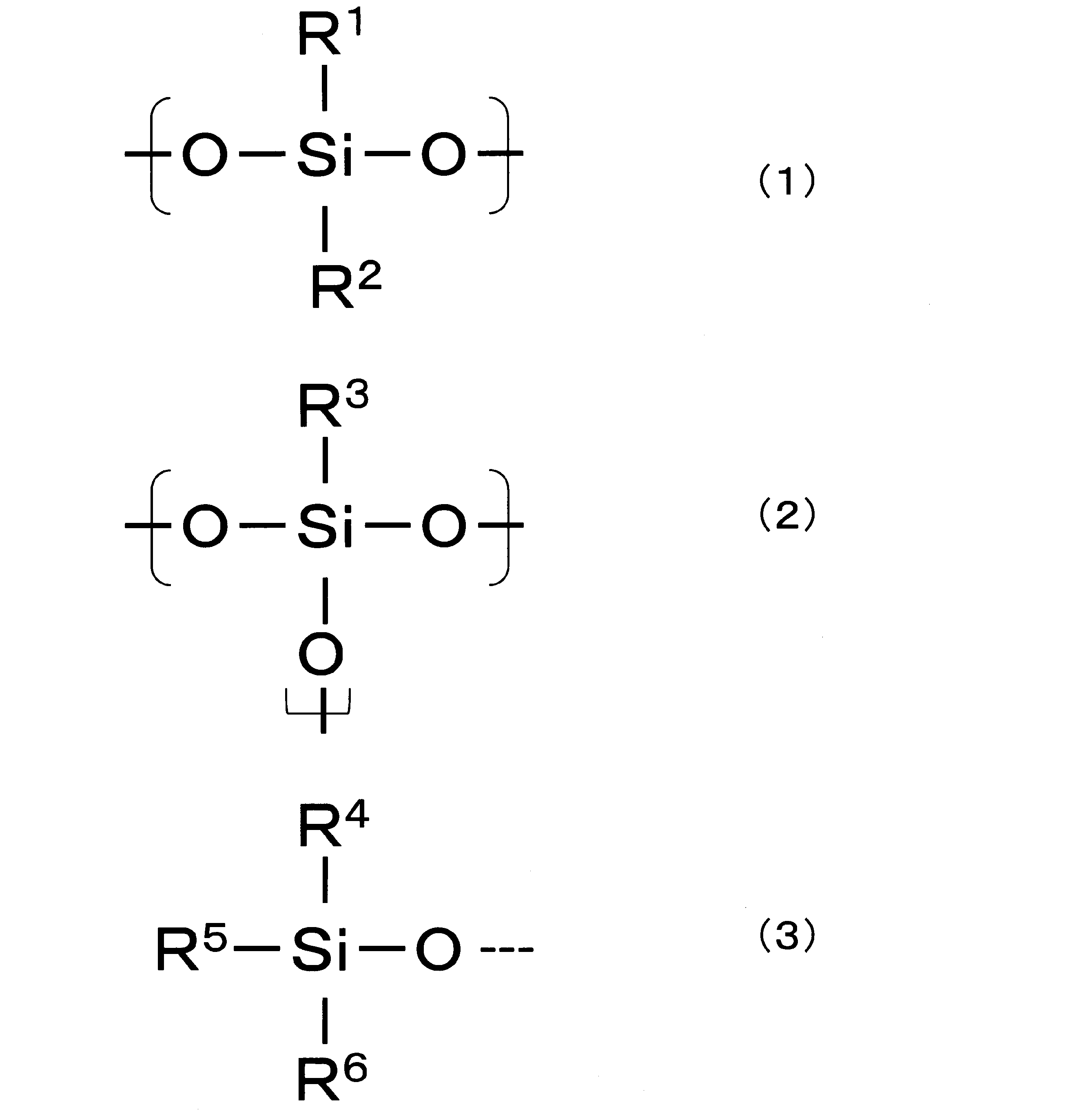
[2]
さらに、(b)有機塩を含有する[1]に記載の樹脂組成物。
[3]
前記(b)有機塩は、(b)有機塩の1.0質量%水溶液におけるpH値が3.0~5.5である、[2]に記載の樹脂組成物。
[4]
前記(b)有機塩は、以下の有機酸類と以下のアミン類から成る有機塩である、[2]又は[3]に記載の樹脂組成物。
アミン類:複素環アミン類および/または芳香族アミン類から選ばれるアミン類
[5]
前記(a1)ポリシロキサンが光重合性基を有する、[1]~[4]のいずれかに記載の樹脂組成物。
[6]
さらに、(c)光重合開始剤を含有する、[1]~[5]のいずれかに記載の樹脂組成物。
[7]
さらに、(d)反応性希釈剤を含有する、[1]~[6]のいずれかに記載の樹脂組成物。
[8]
さらに、(e)ナノ粒子を含有する、[1]~[7]のいずれかに記載の樹脂組成物。
[9]
前記(e)ナノ粒子が、酸化チタン、酸化ジルコニウム、酸化亜鉛、酸化亜鉛、酸化アルミニウム、及びそれらの複合酸化物からなる群より選ばれる少なくとも1つを含有する、[8]に記載の樹脂組成物。
[10]
さらに、(f)離型剤を含有する、[1]~[9]のいずれかに記載の樹脂組成物。
[11]
前記(f)離型剤が光重合性基を有するシリコーン系離型剤または光重合性基を有するフッ素系離型剤である[10]に記載の樹脂組成物。
[12]
固形分が90質量%以上である、[1]~[11]のいずれかに記載の樹脂組成物。
[13]
インプリント用途に用いることを特徴とする、[1]~[12]のいずれかに記載の樹脂組成物。
[14]
[1]~[13]のいずれかに記載の樹脂組成物を硬化させてなる硬化膜。
[15]
以下の工程を有する、硬化膜のパターン付き基板の製造方法。
[16]
[14]に記載の硬化膜を有する光学素子。
[17]
シラノール末端基を有するポリシロキサンに、有機塩と下記一般式(4)で表されるシラン化合物を添加することでシラノール末端基の一部を修飾する、(a1)ポリシロキサンの製造方法であって、前記有機塩の1.0質量%水溶液におけるpH値が3.0~5.5である(a1)ポリシロキサンの製造方法。
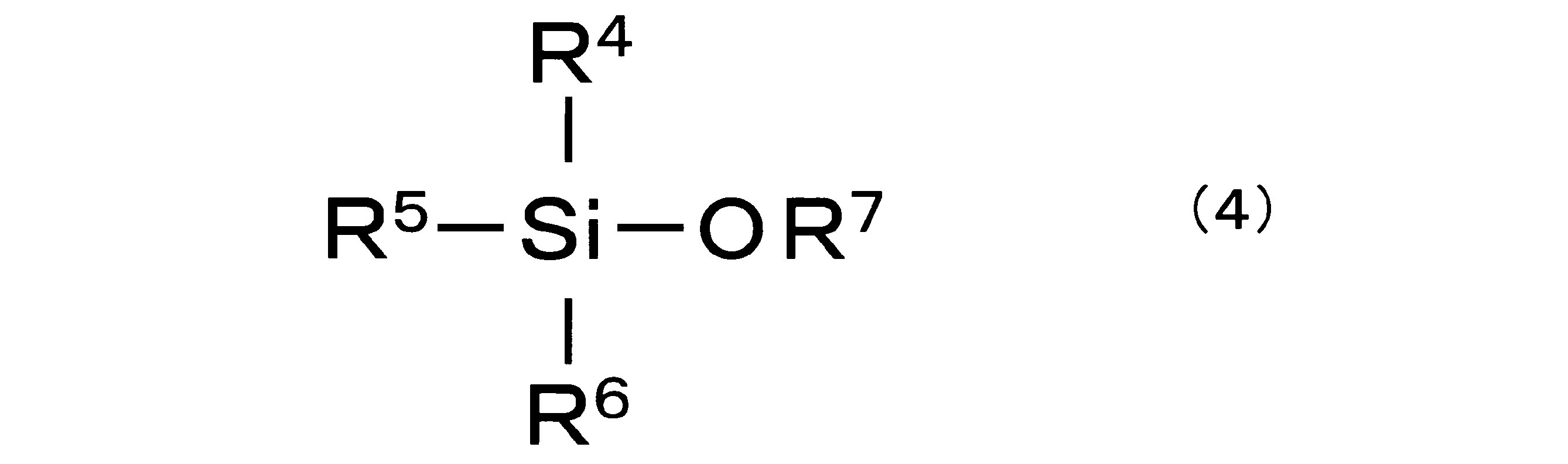
ここで(a1)ポリシロキサンは、以下を意味する。
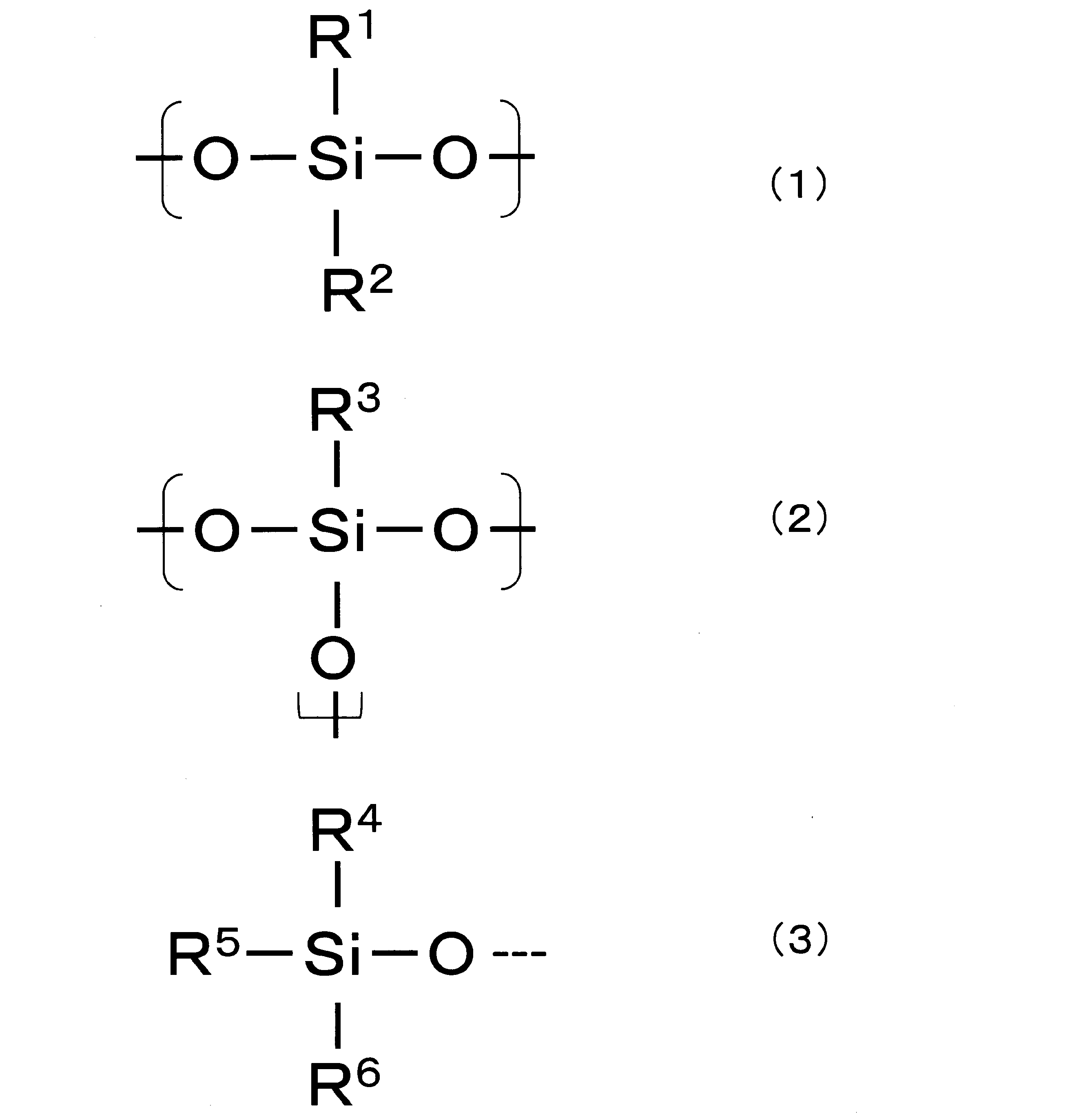
本発明の樹脂組成物は(a)ポリシロキサンを含有する。(a)ポリシロキサンは、シロキサン結合(-Si-O-Si-)を主鎖骨格に持ち、全部または一部の側鎖に有機基をもつポリマーを指す。

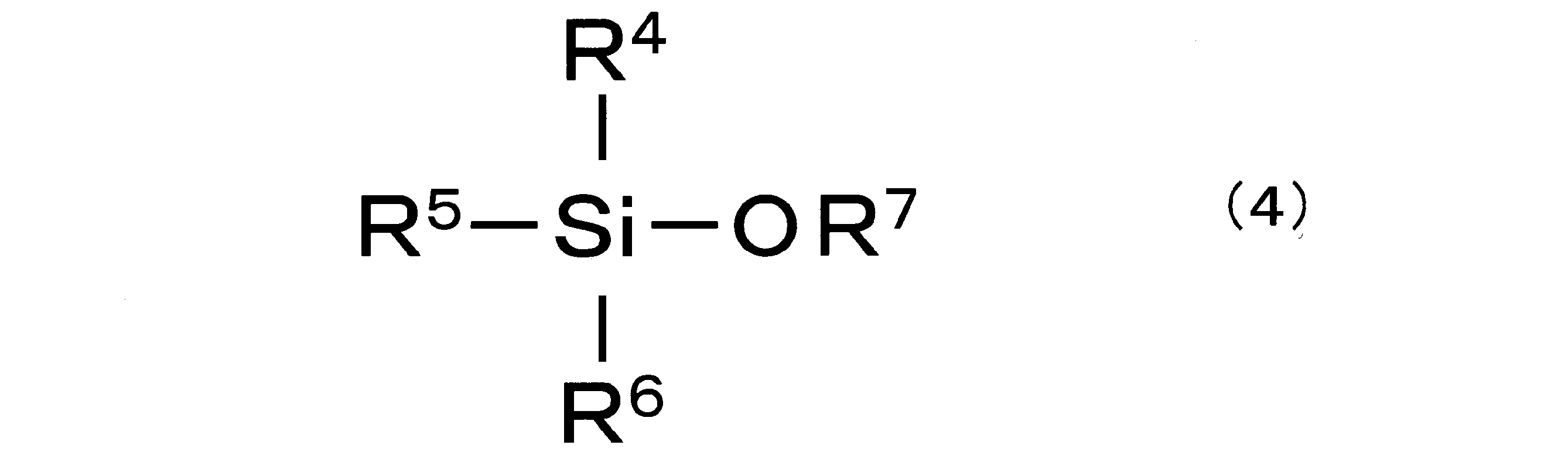
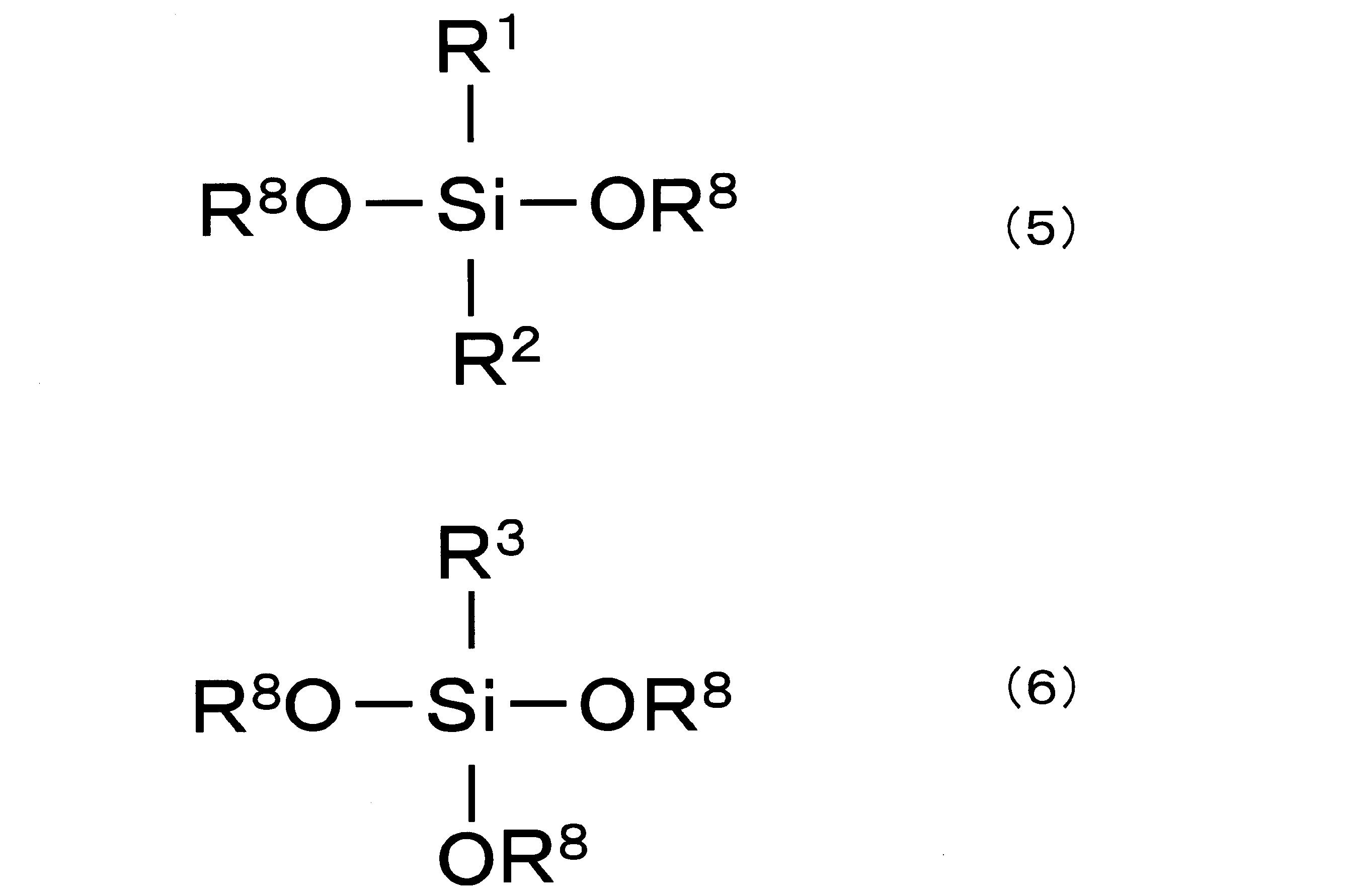
本発明の樹脂組成物は、さらに、(b)有機塩を含有することが好ましい。(b)有機塩は、酸と塩基からなる有機の塩化合物である。(b)有機塩は、ポリシロキサン中に残存するシラノール基の縮合反応を促進する縮合触媒として作用する。樹脂組成物中に(a1)ポリシロキサンと(b)有機塩を含有することで、ポリシロキサン中のシラノール基同士の反応が促進されて膜中の架橋密度が高くなり、硬化膜の硬化度を向上させ、膜の耐溶剤性と耐薬品性を向上することができる。
本発明の樹脂組成物は、光重合開始剤を含有することが好ましい。光重合開始剤としては、光ラジカル発生剤、光酸発生剤、光塩基発生剤等が挙げられる。樹脂組成物中に光重合開始剤を含有することで、光(紫外線、電子線を含む)の照射により発生したラジカル、酸、または塩基等によって、前述の(a1)ポリシロキサン中の光重合性基やシラノール基が反応し、光硬化することができる。(a1)ポリシロキサン中の光重合性基にラジカル重合性基を含む場合、光重合開始剤として光ラジカル発生剤を含むことが好ましく、(a1)ポリシロキサン中の光重合性基にカチオン重合性基を含む場合、光重合開始剤として光酸発生剤および/または光塩基発生剤を含むことが好ましい。これらは同時に含んでもよい。
本発明の樹脂組成物は、(d)反応性希釈剤を含有することが好ましい。(d)反応性希釈剤は、光および/または熱によって反応する官能基を有し、樹脂組成物中のその他の成分を希釈することができる液体の化合物であればどのようなものでもよい。
本発明の樹脂組成物は、硬化膜の屈折率、反射率、または透過率を調整するために、(e)ナノ粒子を含有してもよい。(e)ナノ粒子は、粒子を含む溶液(または分散液)を粒度分布測定装置(nanoParticaSZ-100S2;HORIBA製)などを用いて、動的光散乱法で粒度分布を測定した結果、個数基準および/または体積基準のメジアン径D50の値が1~400nmとなる粒子を指す。
本発明の樹脂組成物をインプリント用途に用いる場合、(f)離型剤を含有してもよい。樹脂組成物中に離型剤を含有することにより、インプリント法によるパターンの転写後に、モールド(型)に対して高い離型性を発現することができる。(f)離型剤としては、例えば、シリコーン系離型剤、フッ素系離型剤、ポリエチレン系離型剤、ポリプロピレン系離型剤、パラフィン系離型剤、モンタン系離型剤、カルナバ系離型剤等が挙げられる。これらの中でも、シリコーン系離型剤、フッ素系離型剤が好ましい。また、(f)離型剤としては、離型性向上の観点から、光重合性基を有することが好ましく、光重合性基を有するシリコーン系離型剤または光重合性基を有するフッ素系離型剤であることが好ましい。例えば、BYK-UV3500、BYK-UV3505、BYK-UV3530、BYK-UV3570(以上商品名、信越化学工業(株)製)等の光重合性基を有するシリコーン系離型剤や、“メガファック”(登録商標)RS-72-A、RS-75-A、RS-56、RS-90(以上商品名、DIC(株)製)等の光重合性基を有するフッ素系離型剤が挙げられる。離型剤は、1種類を単独で用いてもよいし、2種類以上を併用してもよい。
本発明の樹脂組成物は、(a)ポリシロキサン以外の樹脂を含有してもよい。(a)ポリシロキサン以外の樹脂を含有することにより、例えば、プリベーク後のタックレス性を向上するなど、ポリシロキサンでは不足する膜特性を補完することができる。ポリシロキサン以外の樹脂としては、例えば、ポリイミド、ポリイミド前駆体、ポリベンゾオキサゾール、ポリベンゾオキサゾール前駆体、(メタ)アクリルポリマ、カルド系樹脂などが挙げられる。
次に、本発明の硬化膜について説明する。
次に、本発明の硬化膜のパターン付き基板の製造方法について説明する。
次に、本発明の光学素子について説明する。
装置:Waters社製 RI検出器付きGPC測定装置(2695)
カラム:PLgelMIXED-Cカラム(ポリマーラボラトリーズ社製,300mm)×2本(直列連結)
測定温度:40℃
流速:1mL/min
溶媒:テトラヒドロフラン(THF) 0.5質量%溶液
標準物質:ポリスチレン
検出モード:RI。
1000mlの三口フラスコに、ジフェニルジメトキシシランを207.71g(0.850mol)、3-メタクリロキシプロピルトリメトキシシランを99.34g(0.400mol)、3-(3,4-エポキシシクロヘキシル)プロピルトリメトキシシランを86.24g(0.350mol)、フェニルトリメトキシシランを79.32g(0.400mol)、ジブチルヒドロキシトルエン(以下、「BHT」)を1.783g、およびメタノールを185.40g仕込み、40℃で撹拌しながら水92.70gに触媒としてメタンスルホン酸ピリジン塩2.363g(仕込みモノマーに対して0.50質量%)を溶かした触媒水溶液を30分間かけて添加した。その後、フラスコを60℃のオイルバスに浸けて60分間撹拌した後、オイルバスの設定温度を120℃に上げた。昇温開始1時間後に溶液温度(内温)が100℃に到達したため、オイルバスの設定温度を110℃に下げ、そこから2時間加熱撹拌した(内温は100~110℃)。その後、内温が40℃まで下がるまで氷冷した後、末端修飾のためトリメチルメトキシシランを208.44g(2.00mol)添加し、40℃で2時間撹拌した。その後、オイルバスの設定温度を120℃に上げ、1時間撹拌することで未反応のトリメチルメトキシシランを除去し、ポリシロキサン(A-1)を得た。なお、昇温および加熱撹拌中、窒素95体積%、酸素5体積%の混合気体を0.05リットル/分流した。反応中に副生成物であるメタノールおよび水が合計396.55g留出した。ポリシロキサン(A-1)は、特に触媒を除去することなく得た。なお、得られたポリシロキサン(A-1)の重量平均分子量は4,000であった。
1000mlの三口フラスコに、ジフェニルジメトキシシランを207.71g(0.850mol)、3-メタクリロキシプロピルトリメトキシシランを99.34g(0.400mol)、3-(3,4-エポキシシクロヘキシル)プロピルトリメトキシシランを86.24g(0.350mol)、フェニルトリメトキシシランを79.32g(0.400mol)、BHTを1.783g、およびメタノールを185.40g仕込み、40℃で撹拌しながら水92.70gにメタンスルホン酸ピリジン塩2.363g(仕込みモノマーに対して0.50質量%)を溶かした触媒水溶液を30分間かけて添加した。その後、フラスコを60℃のオイルバスに浸けて60分間撹拌した後、オイルバスの設定温度を120℃に上げた。昇温開始1時間後に溶液温度(内温)が100℃に到達したため、オイルバスの設定温度を110℃に下げ、そこから2時間加熱撹拌し(内温は100~110℃)、ポリシロキサン(A-2)を得た。なお、昇温および加熱撹拌中、窒素95体積%、酸素5体積%の混合気体を0.05リットル/分流した。反応中に副生成物であるメタノールおよび水が合計396.55g留出した。ポリシロキサン(A-2)は、特に触媒を除去することなく得た。なお、得られたポリシロキサン(A-2)の重量平均分子量は4,000であった。
トリメチルメトキシシランの添加量を52.11g(0.50mol)に変更した以外は、合成例1と同様に合成し、ポリシロキサン(A-3)を得た。なお、得られたポリシロキサン(A-3)の重量平均分子量は4,000であった。
トリメチルメトキシシランの添加量を104.22g(1.00mol)に変更した以外は、合成例1と同様に合成し、ポリシロキサン(A-4)を得た。なお、得られたポリシロキサン(A-4)の重量平均分子量は4,000であった。
トリメチルメトキシシランの添加量を156.33g(1.50mol)に変更した以外は、合成例1と同様に合成し、ポリシロキサン(A-5)を得た。なお、得られたポリシロキサン(A-5)の重量平均分子量は4,000であった。
触媒として、メタンスルホン酸ピリジン塩の代わりにp-トルエンスルホン酸ピリジン塩2.363g(仕込みモノマーに対して0.50質量%)を使用した以外は合成例1と同様に合成し、ポリシロキサン(A-6)を得た。なお、得られたポリシロキサン(A-6)の重量平均分子量は4,000であった。
触媒として、メタンスルホン酸ピリジン塩の代わりにp-トルエンスルホン酸テトラエチルアンモニウム2.363g(仕込みモノマーに対して0.50質量%)を使用した以外は合成例1と同様に合成し、ポリシロキサン(A-7)を得た。なお、得られたポリシロキサン(A-7)の重量平均分子量は3,500であった。
1000mlの三口フラスコに、ジフェニルジメトキシシランを207.71g(0.850mol)、メチルトリメトキシシランを54.48g(0.400mol)、3-(3,4-エポキシシクロヘキシル)プロピルトリメトキシシランを86.24g(0.350mol)、フェニルトリメトキシシランを79.32g(0.400mol)、BHTを1.557g、およびメタノールを185.40g仕込み、40℃で撹拌しながら水92.70gに触媒としてメタンスルホン酸ピリジン塩2.139g(仕込みモノマーに対して0.50質量%)を溶かした触媒水溶液を30分間かけて添加した。その後、フラスコを60℃のオイルバスに浸けて60分間撹拌した後、オイルバスの設定温度を120℃に上げた。昇温開始1時間後に溶液温度(内温)が100℃に到達したため、オイルバスの設定温度を110℃に下げ、そこから2時間加熱撹拌した(内温は100~110℃)。その後、内温が40℃まで下がるまで氷冷した後、末端修飾のためトリメチルメトキシシランを208.44g(2.00mol)添加し、40℃で2時間撹拌した。その後、オイルバスの設定温度を120℃に上げ、1時間撹拌することで未反応のトリメチルメトキシシランを除去し、ポリシロキサン(A-8)を得た。なお、昇温および加熱撹拌中、窒素95体積%、酸素5体積%の混合気体を0.05リットル/分流した。反応中に副生成物であるメタノールおよび水が合計396.55g留出した。ポリシロキサン(A-8)は、特に触媒を除去することなく得た。なお、得られたポリシロキサン(A-8)の重量平均分子量は5,000であった。
1000mlの三口フラスコに、ジフェニルジメトキシシランを207.71g(0.850mol)、メチルトリメトキシシランを102.15g(0.750mol)、フェニルトリメトキシシランを79.32g(0.400mol)、BHTを1.363g、およびメタノールを185.40g仕込み、40℃で撹拌しながら水92.70gに触媒としてメタンスルホン酸ピリジン塩1.946g(仕込みモノマーに対して0.50質量%)を溶かした触媒水溶液を30分間かけて添加した。その後、フラスコを60℃のオイルバスに浸けて60分間撹拌した後、オイルバスの設定温度を120℃に上げた。昇温開始1時間後に溶液温度(内温)が100℃に到達したため、オイルバスの設定温度を110℃に下げ、そこから2時間加熱撹拌した(内温は100~110℃)。その後、内温が40℃まで下がるまで氷冷した後、末端修飾のためトリメチルメトキシシランを208.44g(2.00mol)添加し、40℃で2時間撹拌した。その後、オイルバスの設定温度を120℃に上げ、1時間撹拌することで未反応のトリメチルメトキシシランを除去し、ポリシロキサン(A-9)を得た。なお、昇温および加熱撹拌中、窒素95体積%、酸素5体積%の混合気体を0.05リットル/分流した。反応中に副生成物であるメタノールおよび水が合計396.55g留出した。ポリシロキサン(A-9)は、特に触媒を除去することなく得た。なお、得られたポリシロキサン(A-9)の重量平均分子量は5,000であった。
1000mlの三口フラスコに、ジフェニルジメトキシシランを103.85g(0.425mol)、3-メタクリロキシプロピルトリメトキシシランを49.67g(0.200mol)、3-(3,4-エポキシシクロヘキシル)プロピルトリメトキシシランを43.12g(0.175mol)、フェニルトリメトキシシランを39.66g(0.200mol)、ナノ酸化チタン分散液“オプトレイク”TR-527(日揮触媒化成(株)製;固形分20重量%、メタノール分散液)を381.98g、BHTを0.891g仕込み、40℃で撹拌しながら水46.35gに触媒としてメタンスルホン酸ピリジン塩1.182g(仕込みモノマーに対して0.50質量%)を溶かした触媒水溶液を30分間かけて添加した。その後、フラスコを60℃のオイルバスに浸けて60分間撹拌した後、オイルバスの設定温度を120℃に上げた。昇温開始1時間後に溶液温度(内温)が100℃に到達したため、オイルバスの設定温度を110℃に下げ、そこから2時間加熱撹拌した(内温は100~110℃)。その後、内温が40℃まで下がるまで氷冷した後、末端修飾のためトリメチルメトキシシランを104.22g(1.00mol)添加し、40℃で2時間撹拌した。その後、オイルバスの設定温度を120℃に上げ、1時間撹拌することで未反応のトリメチルメトキシシランを除去し、ポリシロキサン・ナノ粒子共重合体(A-10)を得た。なお、昇温および加熱撹拌中、窒素95体積%、酸素5体積%の混合気体を0.05リットル/分流した。反応中に副生成物であるメタノールおよび水が合計411.16g留出した。ポリシロキサン・ナノ粒子共重合体(A-10)は、特に触媒を除去することなく得た。
ナノ酸化チタン分散液“オプトレイク”TR-527の代わりに、ナノ酸化ジルコニウム分散液“ナノユース”OZ-S30M(日産化学(株)製;固形分30重量%、メタノール分散液)を254.66g添加した以外は合成例11と同様に合成し、ポリシロキサン・ナノ粒子共重合体(A-11)を得た。反応中に副生成物であるメタノールおよび水が合計283.83g留出した。
触媒として、メタンスルホン酸ピリジン塩の代わりにp-トルエンスルホン酸アニリン塩2.363g(仕込みモノマーに対して0.50質量%)を使用した以外は合成例1と同様に合成し、ポリシロキサン(A-12)を得た。なお、得られたポリシロキサン(A-12)の重量平均分子量は4,000であった。
触媒として、メタンスルホン酸ピリジン塩の代わりにジフルオロ酢酸アニリン塩2.363g(仕込みモノマーに対して0.50質量%)を使用した以外は合成例1と同様に合成し、ポリシロキサン(A-13)を得た。なお、得られたポリシロキサン(A-13)の重量平均分子量は3,000であった。
触媒として、メタンスルホン酸ピリジン塩の代わりにジフルオロ酢酸ピリジン塩2.363g(仕込みモノマーに対して0.50質量%)を使用した以外は合成例1と同様に合成し、ポリシロキサン(A-14)を得た。なお、得られたポリシロキサン(A-14)の重量平均分子量は3,200であった。
触媒として、メタンスルホン酸ピリジン塩の代わりにフルオロ酢酸ピリジン塩2.363g(仕込みモノマーに対して0.50質量%)を使用した以外は合成例1と同様に合成し、ポリシロキサン(A-15)を得た。なお、得られたポリシロキサン(A-15)の重量平均分子量は2,500であった。
触媒として、メタンスルホン酸ピリジン塩の代わりにピコリン酸2.363g(仕込みモノマーに対して0.50質量%)を使用した以外は合成例1と同様に合成し、ポリシロキサン(A-16)を得た。なお、得られたポリシロキサン(A-16)の重量平均分子量は4,000であった。
触媒として、メタンスルホン酸ピリジン塩の代わりにトリフルオロメタンスルホン酸アニリン塩2.363g(仕込みモノマーに対して0.50質量%)を使用した以外は合成例1と同様に合成し、ポリシロキサン(A-17)を得た。なお、得られたポリシロキサン(A-17)の重量平均分子量は4,500であった。
触媒として、メタンスルホン酸ピリジン塩の代わりに硝酸アンモニウム2.363g(仕込みモノマーに対して0.50質量%)を使用した以外は合成例1と同様に合成し、ポリシロキサン(A-18)を得た。なお、得られたポリシロキサン(A-18)の重量平均分子量は2,500であった。
アルミカップに、合成例1~18で得た(a1)ポリシロキサンおよびポリシロキサン・ナノ粒子共重合体を1.0g秤取し、ホットプレートを用いて250℃で30分間加熱して液分を蒸発させた。加熱後のアルミカップに残った固形分の質量を秤量して、加熱前の質量に対する割合から固形分を求めた。
合成例1~18において、トリメチルメトキシシラン添加前に5.0gサンプリングし、ATR法でFT-IR測定した。測定は、フーリエ変換赤外分光光度計(FT/IR-4600(日本分光株式会社製))を用いて行った。1428cm-1のフェニル基に由来するピークで規格化した後、シラノール末端基(Si-OH)由来の860cm-1~940cm-1のピークトップの吸光度をA0とした。次に、合成例1~18で得た(a1)ポリシロキサンおよびポリシロキサン・ナノ粒子共重合体について、同様にATR法で測定し、1428cm-1のフェニル基に由来するピークで規格化した後、A0における波数と同じ波数におけるピークの吸光度をA1とした。シラノール末端基の修飾率は以下の式で算出した。なお、合成例2では、トリメチルメトキシシランを添加していないため、シラノール末端基の修飾率は0%とした。
シラノール末端基の修飾率(%)=(A0-A1)×100/A0。
合成例1~18で得た(a1)ポリシロキサンおよびポリシロキサン・ナノ粒子共重合体について、粘度(保管前粘度)を測定した。粘度測定は、E型回転粘度計(VISCOMETER TVE-25H(TOKI SANGYO社製))をもちいて23℃で行った。各サンプルを密封容器に入れ、室温(23℃)で7日保管後に粘度を同様に測定した。粘度変化率({|保管後粘度-保管前粘度|/保管前粘度}×100)などから、以下の基準により保存安定性を評価した。
A:粘度変化率5%未満
B:粘度変化率5%以上10%未満
C:粘度変化率10%以上
D:室温(23℃)で7日保管後にゲル化し粘度測定不可。
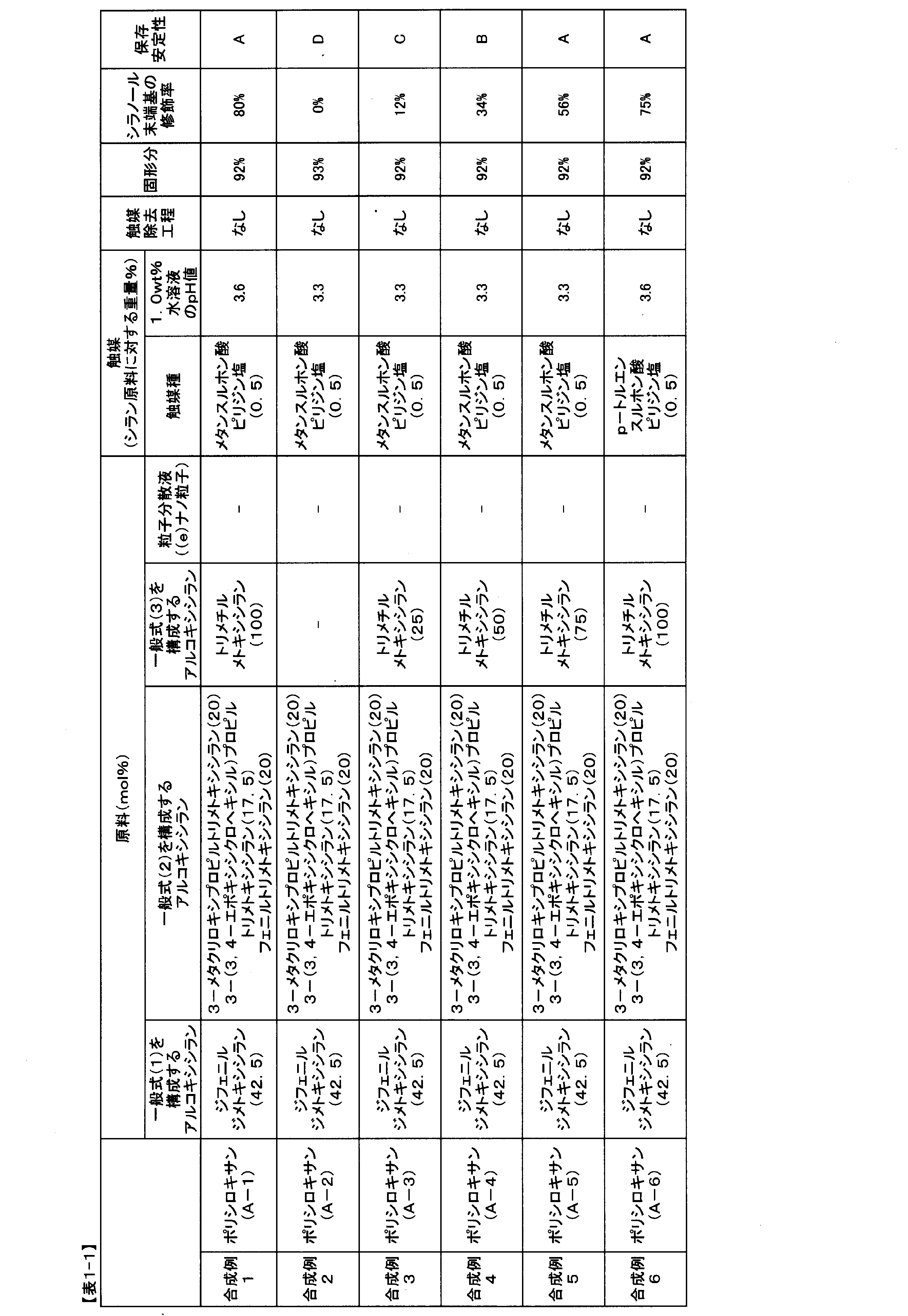

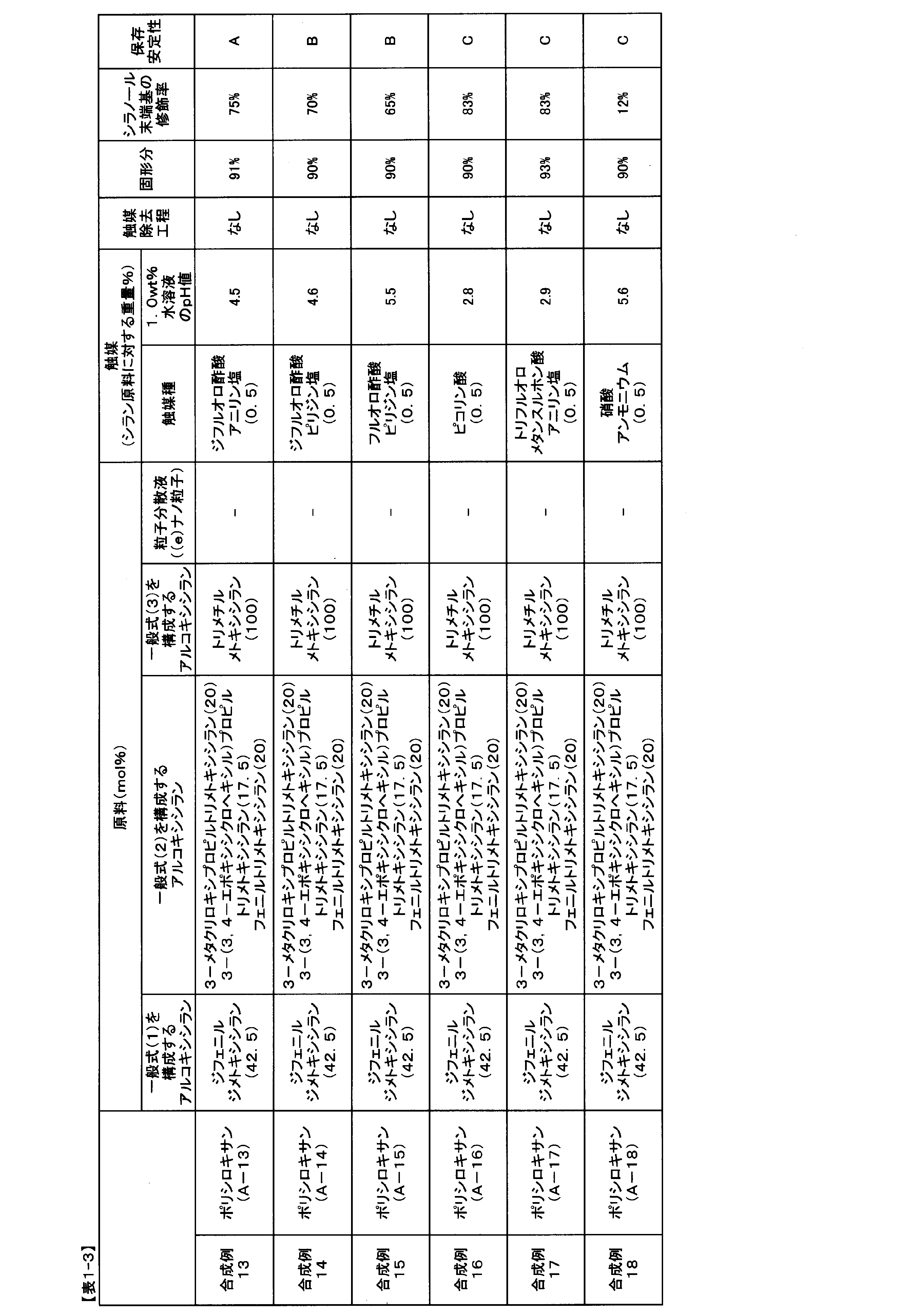
1000mlの三口フラスコに、トリシクロ[5.2.1.0(2,6)]デカンジメタノールを39.26g、イソボニルアクリレート(IBXA、大阪有機化学工業(株)製(以下「IBXA」))を116.44g、ポリテトラメチレンエーテルグリコール(PTMG650、三菱ケミカル(株)製(以下「PTMG650」))を130.0g、フェノチアジンを0.018g、BHTを0.053g仕込み、60℃で10分間撹拌し、均一な透明溶液になったことを確認し室温まで放熱した。次に、ジイソシアン酸イソホロン(異性体混合物)(IPDI、東京化成工業(株)製(以下「IPDI」))133.38gを滴下し、氷冷した後、触媒としてジラウリン酸ジブチルスズを0.18g滴下し、40℃で90分間撹拌した。その後、ヒドロキシエチルアクリレート46.44gを30分かけて滴下し、60℃で3時間撹拌することで、ウレタンアクリレート(U-1)を得た。
黄色灯下にて、有機塩としてメタンスルホン酸ピリジン塩を含有する(a1)ポリシロキサン(A-1)溶液を38.5g、光重合開始剤として2-ヒドロキシ-1-(4-(4-(2-ヒドロキシ-2-メチルプロピオニル)ベンジル)フェニル)-2-メチルプロパン-1-オン(“Omnirad”(登録商標)127、IGM Resins B.V.製(以下「Omnirad-127」))を0.50g、ビス(2,4,6-トリメチルベンゾイル)-フェニルフォスフィンオキサイド(“Omnirad”819、IGM Resins B.V.製(以下「Omnirad-819」))1・00g、反応性希釈剤としてペンタエリスリトールトリアクリレート(“ライトアクリレート”(登録商標)PE-3A、共栄社化学(株)製(以下「PE-3A」))を10.0g、3-フェノキシベンジルアクリレート(“ライトアクリレート”(登録商標)POB-A、共栄社化学(株)製(以下「POB-A」))を10.0g、シリコーン系界面活性剤(“BYK”(登録商標)301、ビックケミージャパン(株)製(以下「BYK-301」))0.025g(濃度500ppmに相当)を添加し撹拌することで、樹脂組成物(P-1)を得た。
前記ポリシロキサン(A-1)を、それぞれポリシロキサン(A-3)~(A-8)に変更した以外は、実施例1と同様にして樹脂組成物(P-2)~(P-7)を得た。
光重合開始剤として、前記Omnirad-127とOmnirad-819の代わりに、1,3-ジオキソヘキサヒドロ-2H-4,7-メタノイソインドール-2-イルトリフルオロメタンスルホン酸(「CGI-MDT(商品名)」、チ
バジャパン(株)製(以下「CGI-MDT」))を1.50g添加し、前記ポリシロキサン(A-1)の代わりにポリシロキサン(A-8)を添加した以外は、実施例1と同様にして樹脂組成物(P-8)を得た。
前記ポリシロキサン(A-1)を、ポリシロキサン(A-9)に変更した以外は、実施例1と同様にして樹脂組成物(P-9)を得た。
前記ポリシロキサン(A-1)を、それぞれポリシロキサン(A-12)~(A-18)に変更した以外は、実施例1と同様にして樹脂組成物(P-10)~(P-16)を得た。
前記ポリシロキサン(A-1)を、それぞれポリシロキサン・ナノ粒子共重合体(A-10)~(A-11)に変更した以外は、実施例1と同様にして樹脂組成物(P-17)~(P-18)を得た。
前記ポリシロキサン・ナノ粒子共重合体(A-11)の添加量を38.0gとし、離型剤として、光重合性基を有するシリコーン系界面活性剤「BYK-UV3500(商品名)」(信越化学工業(株)製)を0.50g添加した以外は、実施例18と同様にして樹脂組成物(P-19)を得た。
離型剤として、BYK-UV3500の代わりに、光重合性基を有するフッ素系界面活性剤「RS-56(商品名)」(DIC(株)製)を0.50g添加した以外は、実施例19と同様にして樹脂組成物(P-20)を得た。
離型剤として、BYK-UV3500の代わりに、光重合性基を有さないフッ素系界面活性剤「F-444(商品名)」(DIC(株)製)を0.50g添加した以外は、実施例19と同様にして樹脂組成物(P-20)を得た
比較例1 樹脂組成物(P-22)
前記ポリシロキサン(A-1)を、それぞれポリシロキサン(A-2)に変更した以外は、実施例1と同様にして樹脂組成物(P-22)を得た。
黄色灯下にて、調製例1で得たウレタンアクリレート(U-1)を43.3g、有機塩としてメタンスルホン酸ピリジン塩を0.20g、光重合開始剤としてOmnirad-127を0.50g、Omnirad-819を1・00g、反応性希釈剤としてIBXAを3.67g、POB-Aを1.30g、シリコーン系界面活性剤BYK-301を0.025g(濃度500ppmに相当)添加し撹拌することで、樹脂組成物(P-23)を得た。
前記ポリシロキサン(A-1)の代わりに、シルセスキオキサン誘導体「AC-SQ TA-100(商品名)」(東亜合成(株)製(以下「AC-SQ」))を38.3g、有機塩としてメタンスルホン酸ピリジン塩を0.20g添加した以外は、実施例1と同様にして樹脂組成物(P-24)を得た。
前記ポリシロキサン(A-1)の代わりに、メタクリル変性シリコーンオイル「X-22-164E」(信越化学工業(株)製(以下「X-22-164E」))を38.3g、有機塩としてメタンスルホン酸ピリジン塩を0.20g添加した以外は、実施例1と同様にして樹脂組成物(P-25)を得た。
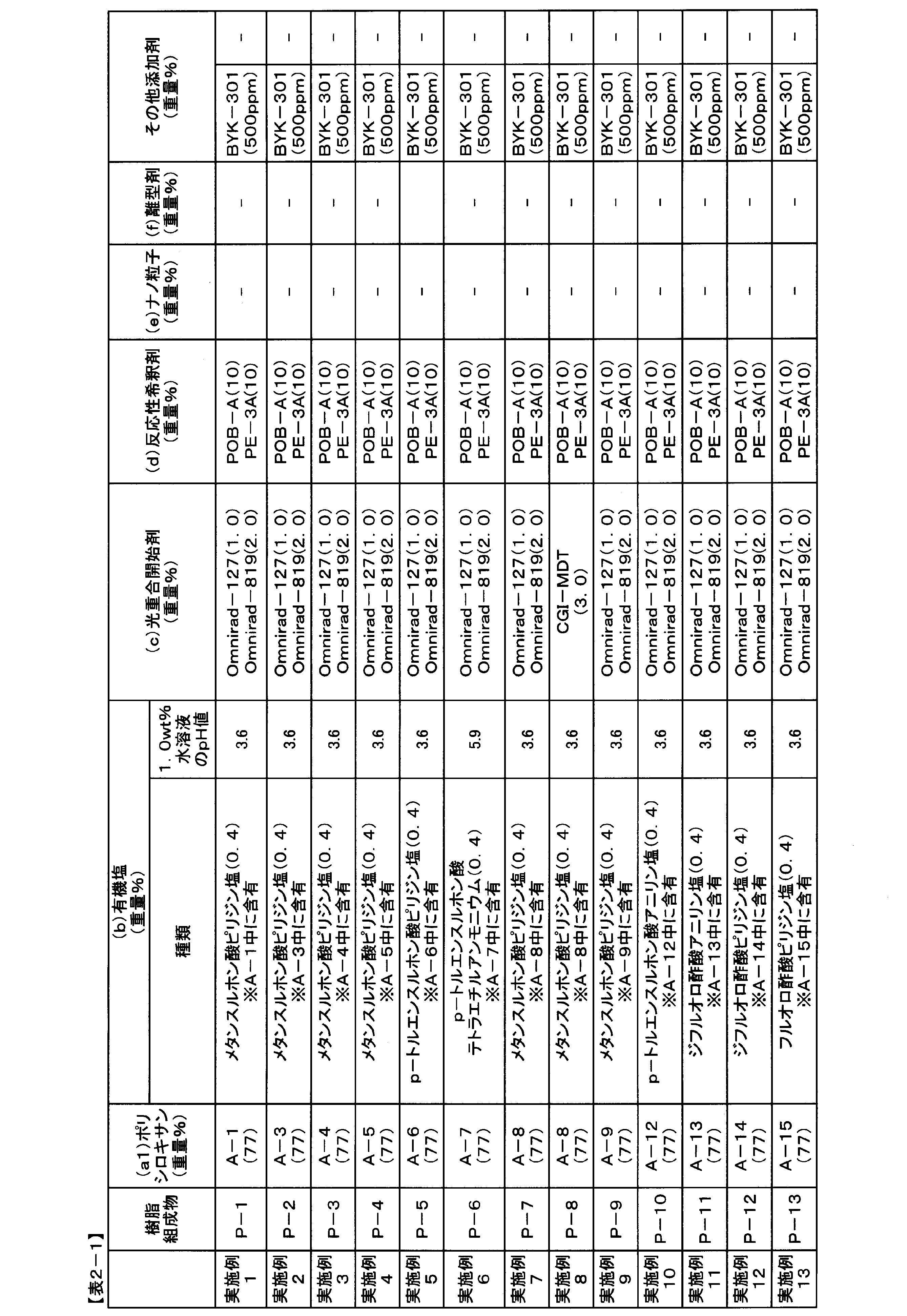

各実施例および比較例の樹脂組成物を、粘度(保管前粘度)を測定した。粘度測定は、E型回転粘度計(VISCOMETER TVE-25H(TOKI SANGYO社製))をもちいて23℃で行った。各サンプルを密封容器に入れ、室温(23℃)で3日保管後に粘度を同様に測定した。粘度変化率({|保管後粘度-保管前粘度|/保管前粘度}×100)などから、以下の基準により保存安定性を評価した。なお、保存安定性の評価がEのサンプルは、その他の評価を実施することができなかったため、その他の評価の欄に「-」と記載した。評価A、B、Cが合格と判断した。
A:粘度変化率3%未満
B:粘度変化率3%以上5%未満
C:粘度変化率5%以上10%未満
D:粘度変化率10%以上
E:室温(23℃)で3日保管後にゲル化し粘度測定不可。
各実施例および比較例の樹脂組成物を、ガラス基板上に滴下した後、B形フィルムアプリケーター50mm/100μm(オールグッド(株)製)を用いて製膜した。得られた塗布膜に、モールドを圧着した。モールドが付着した塗布膜付きガラス基板を、コンベア式UV照射装置(へレウス(株)製)内に移し、窒素雰囲気下でメタルハライドランプを光源とする露光機により、モールド側から400mJ/cm2の条件で露光した。露光後、モールドを離し、パターン付き基板を得た。なお、モールドは、一様のレンズ状の溝パターン(レンズ径35μm・レンズ間ギャップ10μm、溝深さ(レンズ高さ)10μm)を有する透明な石英製モールドを使用し、レンズパターン付き基板が得られた。
転写後のパターン形状を光学顕微鏡にて観察し、以下の基準によりパターン転写精度を評価した。評価A,Bが好ましいと判断した。
なお、実施例30は、ポリシロキサン(A-9)が光重合性基をもたないため光硬化性がやや不足し、本実施例の光インプリント法ではパターン転写精度が「C」であったが、熱インプリント法(例えば、特開2012-61599に記載の方法)でパターン転写を行うと「B」であった。
A:転写後のパターン形状が、モールドのパターン形状の元となる原版のレンズパターンとほぼ同一である。
B:転写後のパターン形状が、モールドのパターン形状の元となる原版のパターン形状と一部異なる部分(原版のパターンと10%未満の範囲)がある。
C:転写後のパターン形状が、モールドのパターン形状の元となる原版のパターン形状と一部異なる部分(原版のパターンと10%以上50%未満の範囲)がある。
D:転写後のパターン形状が、モールドのパターン形状の元となる原版のパターンとが明らかに異なる。
各実施例および比較例により得られた樹脂組成物を用いて、<パターン転写精度>の評価と同様にパターン付き基板を5枚作製した。モールドに樹脂組成物の成分が付着しているか否かを目視および光学顕微鏡にて観察し、以下の基準により離型性を評価した。評価A,B、Cが好ましいと判断した。
A:5枚全てにおいて、目視および光学顕微鏡にて観察し、モールドに樹脂組成物の付着がまったく認められなかった。
B:一部の基板について、目視での観察ではモールドに樹脂組成物の付着が認められなかったが、光学顕微鏡にて観察するとモールドにわずかな樹脂組成物の付着が認められた。
C:5枚全てにおいて、目視での観察ではモールドに樹脂組成物の付着が認められなかったが、光学顕微鏡にて観察するとモールドにわずかな樹脂組成物の付着が認められた。
D:5枚全てにおいて、目視でモールドの樹脂組成物の付着が明らかに認められた。
各実施例および比較例の樹脂組成物を、ガラス基板上に滴下した後、B形フィルムアプリケーター50mm/100μm(オールグッド(株)製)を用いて膜厚10μmになるように製膜した。得られた塗布膜付き基板について、モールドを圧着せず、コンベア式UV照射装置(へレウス(株)製)内に移し、窒素雰囲気下でメタルハライドランプを光源とする露光機により、モールド側から400mJ/cm2の条件で露光した。得られた硬化膜付きガラス基板について、分光光度計(U-4100(日立ハイテクサイエンス社製))を用いて、使用したガラス基板をリファレンスとして、紫外光および可視光(300nm~800nm)の透過率を測定した。波長400nmの透過率の値から、以下の基準により硬化膜の透過性を評価した。評価Aが好ましいと判断した。
A:透過率90%以上
B:透過率90%未満。
各実施例および比較例の樹脂組成物を用いて、それぞれシリコンウェハ上に、<透明性>の評価と同様の操作で、厚み50μmの硬化膜を作製した。得られた硬化膜を有するシリコンウェハについて、プリズムカプラー(PC-2000(Metricon(株)製))を用いて、大気圧下、20℃の条件で、硬化膜面に対し垂直方向から波長633nmの光を照射して、屈折率を測定し、小数点以下第三位を四捨五入した。
各実施例および比較例の樹脂組成物を用いて、それぞれガラス基板上に、<透明性>の評価と同様の操作で、厚み10μmの硬化膜を作製した。得られた硬化膜付きガラス基板について、分光測色計(商品名CM-2600d、コニカミノルタ(株)製)を用いて、硬化膜側からSCIモードで、色度(L*値、a*およびb*値)を測定した。その後、各硬化膜付きガラス基板を、卓上型キセノン促進耐候性試験機(商品名Q-SUN Xe-1、Q-Lab社製)にセットし、波長340nmの光を照射量0.42W/m2、チャンバー温度45℃の条件で耐候性試験を100h行った。その後、各硬化膜を有するガラス基板を、再び硬化膜側からSCIモードで、色度(L*値、a*およびb*値)を測定して、反射色度座標の変化量ΔEを以下の式により求めた。
ΔE = {(ΔL*)2+(Δa*)2+(Δb*)2}1/2
算出したΔEについて、下記基準により耐候性を評価した。ΔEが小さいほど、耐候性が高いことを示す。評価A,Bが合格と判断した。
A:ΔE<3.0
B:3.0≦ΔE<10
C:10≦ΔE。
各実施例および比較例の樹脂組成物を用いて、それぞれガラス基板上に、<透明性>の評価と同様の操作で、厚み50μmの硬化膜を作製した後、ガラス基板から硬化膜を剥がし、硬化膜フィルムを得た。得られた硬化膜フィルムを180°折り曲げ、割れなかったものをA、割れたものをBと判定した。評価Aが合格と判断した。
各実施例および比較例の樹脂組成物を用いて、それぞれガラス基板上に、<透明性>の評価と同様の操作で、厚み50μmの硬化膜を作製した。作製した硬化膜上に、アセトンを垂らして外観を目視で観察し、以下の基準により硬化膜の耐溶剤性を評価した。評価A,Bが合格と判断した。
A:アセトン滴下部分に痕が残らない
B:アセトン滴下部分にうっすら痕が残るが、透明性は高い。
C:アセトン滴下部分に痕が残り、白濁した。
各実施例および比較例の樹脂組成物を用いて、それぞれガラス基板上に、<透明性>の評価と同様の操作で、厚み50μmの硬化膜を作製した。耐薬品性試験用の溶剤として、プロピレングリコールモノメチルエーテルアセテートを選び、これに25℃で10分間、硬化膜を浸漬することで耐薬品性試験を行った。耐薬品性試験前後の膜厚を測定し、膜厚変化率({|耐薬品性試験後の膜厚-耐薬品性試験前の膜厚|/耐薬品性試験前の膜厚}×100)から、以下の基準により耐薬品性を評価した。評価A,Bが好ましいと判断した。
A:膜厚変化率5%未満
B:膜厚変化率5%以上10%未満
C:膜厚変化率10%以上。
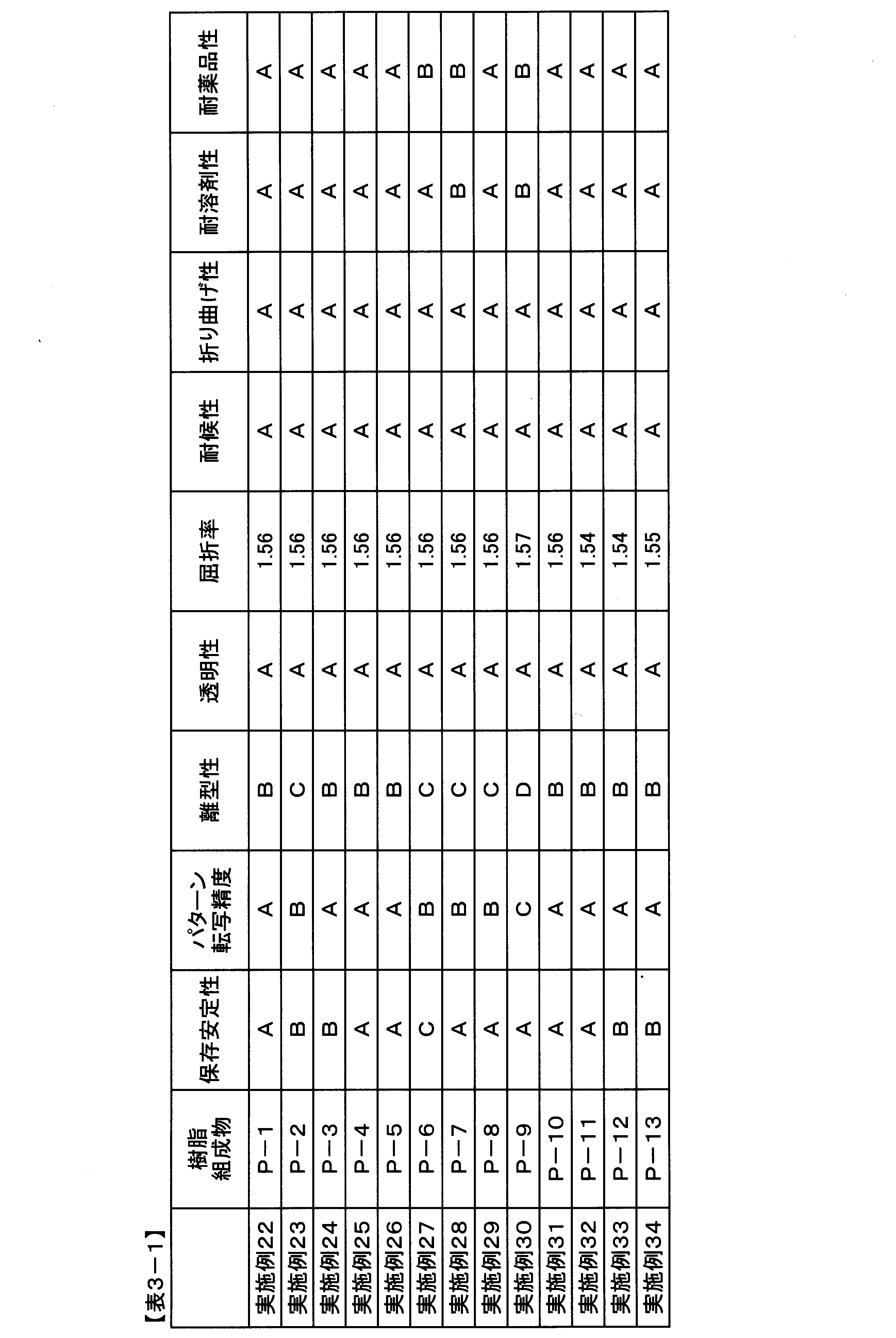
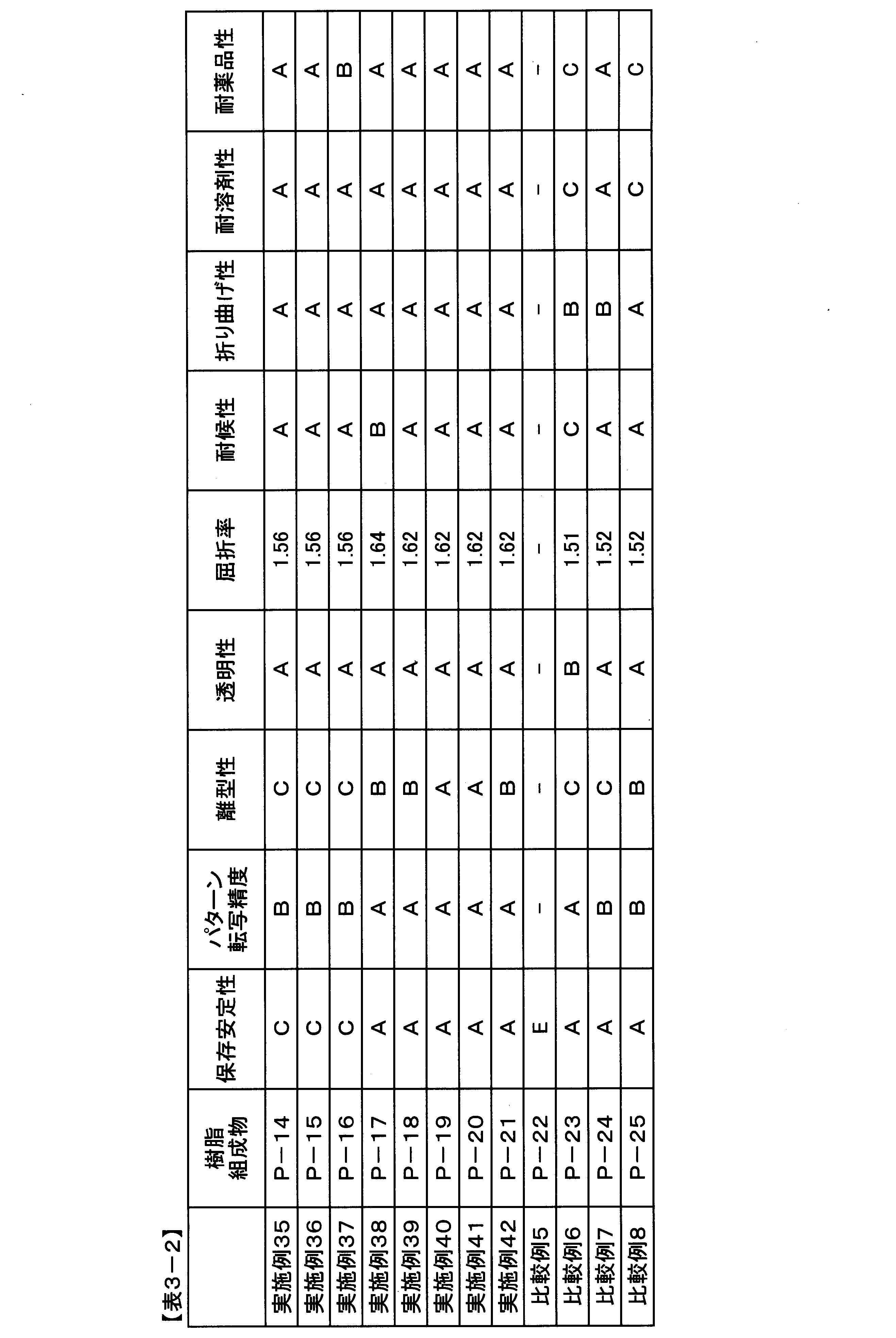
Claims (17)
- (a)ポリシロキサンを含有する樹脂組成物であって、
前記(a)ポリシロキサンが、一般式(1)および/または一般式(2)で表される繰り返し単位、並びに、一般式(3)で表される末端構造およびシラノール末端構造を有する(a1)ポリシロキサンを含む、樹脂組成物。

- さらに、(b)有機塩を含有する、請求項1に記載の樹脂組成物。
- 前記(b)有機塩は、(b)有機塩の1.0質量%水溶液におけるpH値が3.0~5.5である、請求項2に記載の樹脂組成物。
- 前記(b)有機塩は、以下の有機酸類と以下のアミン類から成る有機塩である、請求項2に記載の樹脂組成物。
有機酸類:メタンスルホン酸、エタンスルホン酸、プロパンスルホン酸、ベンゼンスルホン酸、p-トルエンスルホン酸、キシレンスルホン酸、トリフルオロメタンスルホン酸、トリフルオロエタンスルホン酸、トリフルオロプロパンスルホン酸、及びトリフルオロ酢酸からなる群より選ばれる有機酸類
アミン類:複素環アミン類および/または芳香族アミン類から選ばれるアミン類 - 前記(a1)ポリシロキサンが光重合性基を有する、請求項1に記載の樹脂組成物。
- さらに、(c)光重合開始剤を含有する、請求項1に記載の樹脂組成物。
- さらに、(d)反応性希釈剤を含有する、請求項1に記載の樹脂組成物。
- さらに、(e)ナノ粒子を含有する、請求項1に記載の樹脂組成物。
- 前記(e)ナノ粒子が、酸化チタン、酸化ジルコニウム、酸化亜鉛、酸化アルミニウム、及びそれらの複合酸化物からなる群より選ばれる少なくとも1つを含有する、請求項8に記載の樹脂組成物。
- さらに、(f)離型剤を含有する、請求項1に記載の樹脂組成物。
- 前記(f)離型剤が光重合性基を有するシリコーン系離型剤または光重合性基を有するフッ素系離型剤である請求項10に記載の樹脂組成物。
- 固形分が90質量%以上である、請求項1に記載の樹脂組成物。
- インプリント用途に用いることを特徴とする、請求項1に記載の樹脂組成物。
- 請求項1~13のいずれかに記載の樹脂組成物を硬化させてなる硬化膜。
- 以下の工程を有する、硬化膜のパターン付き基板の製造方法。
工程:下地基板上に、請求項1~13のいずれかに記載の樹脂組成物をインプリント法によってパターニングを行い、硬化膜のパターン付き基板を形成する工程。 - 請求項14に記載の硬化膜を有する光学素子。
- シラノール末端基を有するポリシロキサンに、有機塩と一般式(4)で表されるシラン化合物を添加することでシラノール末端基の一部を修飾する、(a1)ポリシロキサンの製造方法であって、
前記有機塩の1.0質量%水溶液におけるpH値が3.0~5.5である、(a1)ポリシロキサンの製造方法。
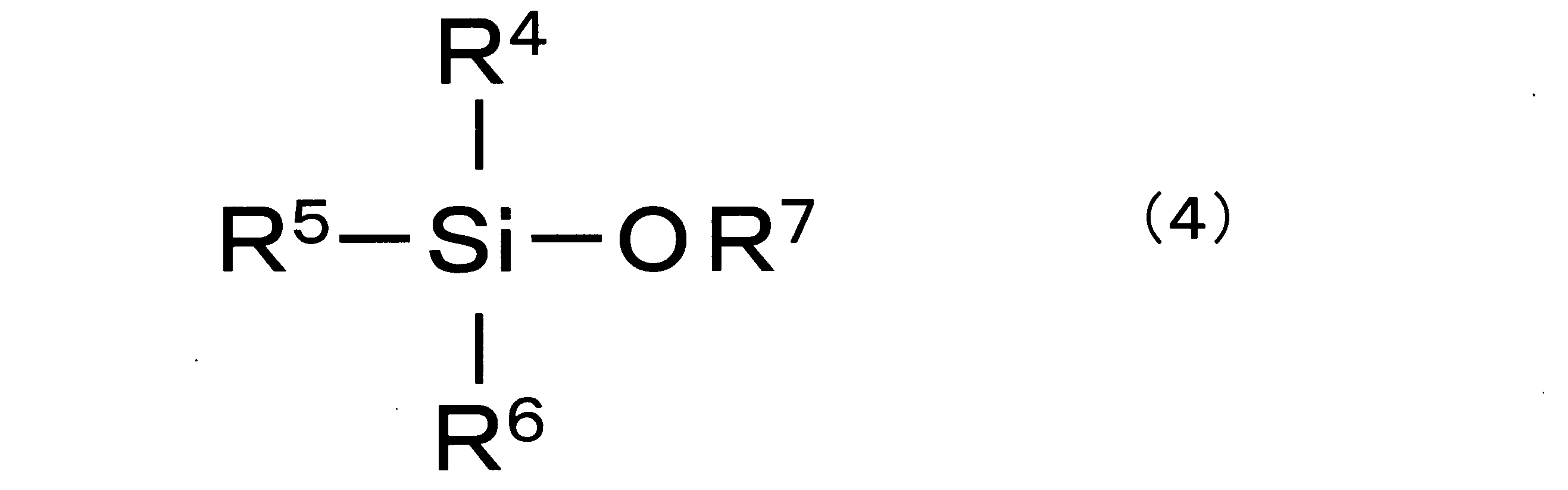
ここで(a1)ポリシロキサンは、以下を意味する。
一般式(1)および/または一般式(2)で表される繰り返し単位、並びに、一般式(3)で表される末端構造およびシラノール末端構造を有する(a1)ポリシロキサン。

Priority Applications (2)
| Application Number | Priority Date | Filing Date | Title |
|---|---|---|---|
| KR1020257028062A KR20250159001A (ko) | 2023-03-07 | 2024-02-16 | 수지 조성물, 경화막, 경화막의 패턴 형성 기판의 제조 방법, 광학 소자, 및 폴리실록산의 제조 방법 |
| JP2024510640A JPWO2024185458A1 (ja) | 2023-03-07 | 2024-02-16 |
Applications Claiming Priority (2)
| Application Number | Priority Date | Filing Date | Title |
|---|---|---|---|
| JP2023-034340 | 2023-03-07 | ||
| JP2023034340 | 2023-03-07 |
Publications (1)
| Publication Number | Publication Date |
|---|---|
| WO2024185458A1 true WO2024185458A1 (ja) | 2024-09-12 |
Family
ID=92674508
Family Applications (1)
| Application Number | Title | Priority Date | Filing Date |
|---|---|---|---|
| PCT/JP2024/005445 Ceased WO2024185458A1 (ja) | 2023-03-07 | 2024-02-16 | 樹脂組成物、硬化膜、硬化膜のパターン付き基板の製造方法、光学素子、およびポリシロキサンの製造方法 |
Country Status (4)
| Country | Link |
|---|---|
| JP (1) | JPWO2024185458A1 (ja) |
| KR (1) | KR20250159001A (ja) |
| TW (1) | TW202442765A (ja) |
| WO (1) | WO2024185458A1 (ja) |
Citations (10)
| Publication number | Priority date | Publication date | Assignee | Title |
|---|---|---|---|---|
| JP2002129103A (ja) * | 2000-10-23 | 2002-05-09 | Jsr Corp | 膜形成用組成物および絶縁膜形成用材料 |
| JP2002201243A (ja) * | 2000-12-28 | 2002-07-19 | Jsr Corp | ポリオルガノシロキサン/有機ポリマー複合粒子の水系分散体およびその製造方法 |
| JP2004010751A (ja) * | 2002-06-06 | 2004-01-15 | Shin Etsu Chem Co Ltd | 水性シリコーン樹脂組成物 |
| JP2005298796A (ja) * | 2003-09-29 | 2005-10-27 | Sanyo Electric Co Ltd | 有機金属ポリマー材料及びその製造方法 |
| JP2007177243A (ja) * | 2005-12-22 | 2007-07-12 | Rohm & Haas Co | シロキサンカプセル材料 |
| JP2007523964A (ja) * | 2003-07-16 | 2007-08-23 | ダウ・コーニング・コーポレイション | エポキシ樹脂及びアミノ官能性シリコーン樹脂を含むコーティング組成物 |
| JP2010113328A (ja) * | 2008-10-07 | 2010-05-20 | Jsr Corp | 多層レジストプロセス用シリコン含有膜形成用組成物及びシリコン含有膜並びにパターン形成方法 |
| JP2011126994A (ja) * | 2009-12-17 | 2011-06-30 | Asahi Kasei E-Materials Corp | シリカ粒子含有縮合反応物、樹脂組成物、封止樹脂、レンズ及びアンダーフィル材 |
| WO2015137438A1 (ja) * | 2014-03-14 | 2015-09-17 | Dic株式会社 | 酸素プラズマエッチング用レジスト材料、レジスト膜、及びそれを用いた積層体 |
| WO2023048062A1 (ja) * | 2021-09-24 | 2023-03-30 | 東レ株式会社 | 硬化膜形成用シロキサン樹脂組成物、硬化膜およびポリシロキサンの製造方法 |
Family Cites Families (6)
| Publication number | Priority date | Publication date | Assignee | Title |
|---|---|---|---|---|
| JP2000323461A (ja) | 1999-05-11 | 2000-11-24 | Nec Corp | 微細パターン形成装置、その製造方法、および形成方法 |
| JP2009206197A (ja) | 2008-02-26 | 2009-09-10 | Fujifilm Corp | ナノインプリント用硬化性組成物、硬化物およびその製造方法 |
| JP5549245B2 (ja) | 2010-02-01 | 2014-07-16 | 住友電気工業株式会社 | ナノインプリント法による回折格子の形成方法 |
| CN104246975B (zh) | 2012-04-27 | 2018-03-30 | 日产化学工业株式会社 | 具有低脱模力性的压印材料 |
| JP7096084B2 (ja) | 2018-07-02 | 2022-07-05 | 株式会社日立エルジーデータストレージ | 導光板、導光板モジュール、画像表示装置および導光板の製造方法 |
| JP7594238B2 (ja) | 2020-12-21 | 2024-12-04 | 日本電気硝子株式会社 | 導光板 |
-
2024
- 2024-02-16 WO PCT/JP2024/005445 patent/WO2024185458A1/ja not_active Ceased
- 2024-02-16 KR KR1020257028062A patent/KR20250159001A/ko active Pending
- 2024-02-16 JP JP2024510640A patent/JPWO2024185458A1/ja active Pending
- 2024-03-01 TW TW113107411A patent/TW202442765A/zh unknown
Patent Citations (10)
| Publication number | Priority date | Publication date | Assignee | Title |
|---|---|---|---|---|
| JP2002129103A (ja) * | 2000-10-23 | 2002-05-09 | Jsr Corp | 膜形成用組成物および絶縁膜形成用材料 |
| JP2002201243A (ja) * | 2000-12-28 | 2002-07-19 | Jsr Corp | ポリオルガノシロキサン/有機ポリマー複合粒子の水系分散体およびその製造方法 |
| JP2004010751A (ja) * | 2002-06-06 | 2004-01-15 | Shin Etsu Chem Co Ltd | 水性シリコーン樹脂組成物 |
| JP2007523964A (ja) * | 2003-07-16 | 2007-08-23 | ダウ・コーニング・コーポレイション | エポキシ樹脂及びアミノ官能性シリコーン樹脂を含むコーティング組成物 |
| JP2005298796A (ja) * | 2003-09-29 | 2005-10-27 | Sanyo Electric Co Ltd | 有機金属ポリマー材料及びその製造方法 |
| JP2007177243A (ja) * | 2005-12-22 | 2007-07-12 | Rohm & Haas Co | シロキサンカプセル材料 |
| JP2010113328A (ja) * | 2008-10-07 | 2010-05-20 | Jsr Corp | 多層レジストプロセス用シリコン含有膜形成用組成物及びシリコン含有膜並びにパターン形成方法 |
| JP2011126994A (ja) * | 2009-12-17 | 2011-06-30 | Asahi Kasei E-Materials Corp | シリカ粒子含有縮合反応物、樹脂組成物、封止樹脂、レンズ及びアンダーフィル材 |
| WO2015137438A1 (ja) * | 2014-03-14 | 2015-09-17 | Dic株式会社 | 酸素プラズマエッチング用レジスト材料、レジスト膜、及びそれを用いた積層体 |
| WO2023048062A1 (ja) * | 2021-09-24 | 2023-03-30 | 東レ株式会社 | 硬化膜形成用シロキサン樹脂組成物、硬化膜およびポリシロキサンの製造方法 |
Also Published As
| Publication number | Publication date |
|---|---|
| TW202442765A (zh) | 2024-11-01 |
| KR20250159001A (ko) | 2025-11-07 |
| JPWO2024185458A1 (ja) | 2024-09-12 |
Similar Documents
| Publication | Publication Date | Title |
|---|---|---|
| JP5867083B2 (ja) | ネガ型感光性樹脂組成物およびそれを用いた保護膜 | |
| TWI597265B (zh) | A photosensitive resin composition, a protective film or an insulating film, a touch panel, and a method of manufacturing the same | |
| CN104345567B (zh) | 感光性聚硅氧烷组合物及其应用 | |
| JP7428269B2 (ja) | 硬化膜形成用シロキサン樹脂組成物および硬化膜 | |
| US12351733B2 (en) | Flexible and foldable abrasion resistant photopatternable siloxane hard coat | |
| CN103765313A (zh) | 感光性碱可溶有机硅树脂组合物 | |
| TW200846824A (en) | Curing composition for photonano-imprinting lithography and pattern forming method by using the same | |
| JP5003081B2 (ja) | 感光性シロキサン組成物、それから形成された硬化膜、および硬化膜を有する素子 | |
| CN104245846B (zh) | 具有自由基交联性基团的聚硅氧烷组合物 | |
| CN103348289B (zh) | 感放射线性组成物以及硬化膜及其形成方法 | |
| JP4913129B2 (ja) | 低屈折率膜形成用コーティング組成物及びこれから製造された膜 | |
| JP2008020898A (ja) | 感光性シロキサン組成物、それから形成された硬化膜、および硬化膜を有する素子 | |
| CN106104753A (zh) | 氧等离子体蚀刻用抗蚀材料、抗蚀膜和使用抗蚀膜的层叠体 | |
| TW202348433A (zh) | 柔性單層聚矽氧烷硬塗層 | |
| JP2001281475A (ja) | 光導波路用有機・無機複合材料及びそれを用いた光導波路の製造方法 | |
| TW200904899A (en) | Composition and method of forming protecting film, laminate and method for manufacturing same | |
| KR102425737B1 (ko) | 감광성 수지 조성물, 이를 이용하는 패턴형성 방법 및 이를 이용하는 기판보호용 피막의 제조방법 | |
| WO2021187324A1 (ja) | ネガ型感光性樹脂組成物、パターン構造、及びパターン硬化膜の製造方法 | |
| KR20250159001A (ko) | 수지 조성물, 경화막, 경화막의 패턴 형성 기판의 제조 방법, 광학 소자, 및 폴리실록산의 제조 방법 | |
| WO2022131277A1 (ja) | 樹脂組成物、硬化膜、硬化膜の製造方法、多層膜付き基板、パターン付き基板の製造方法、感光性樹脂組成物、パターン硬化膜の製造方法、重合体の製造方法及び樹脂組成物の製造方法 | |
| JPWO2022131277A5 (ja) | ||
| JP2023111348A (ja) | 被膜形成用組成物 | |
| TW202039608A (zh) | 光硬化性聚矽氧樹脂組成物及由其硬化成的聚矽氧樹脂成形體以及該成形體的製造方法 | |
| WO2024200325A1 (en) | Composition | |
| WO2025153618A1 (en) | Fluorine-free polysiloxane hard coating |
Legal Events
| Date | Code | Title | Description |
|---|---|---|---|
| WWE | Wipo information: entry into national phase |
Ref document number: 2024510640 Country of ref document: JP |
|
| 121 | Ep: the epo has been informed by wipo that ep was designated in this application |
Ref document number: 24766829 Country of ref document: EP Kind code of ref document: A1 |
|
| ENP | Entry into the national phase |
Ref document number: 1020257028062 Country of ref document: KR Free format text: ST27 STATUS EVENT CODE: A-0-1-A10-A15-NAP-PA0105 (AS PROVIDED BY THE NATIONAL OFFICE) |
|
| NENP | Non-entry into the national phase |
Ref country code: DE |
|
| 122 | Ep: pct application non-entry in european phase |
Ref document number: 24766829 Country of ref document: EP Kind code of ref document: A1 |