WO2024185336A1 - シート、シール材、燃料電池、電解セル、シートの製造方法及びシール材の製造方法 - Google Patents
シート、シール材、燃料電池、電解セル、シートの製造方法及びシール材の製造方法 Download PDFInfo
- Publication number
- WO2024185336A1 WO2024185336A1 PCT/JP2024/002513 JP2024002513W WO2024185336A1 WO 2024185336 A1 WO2024185336 A1 WO 2024185336A1 JP 2024002513 W JP2024002513 W JP 2024002513W WO 2024185336 A1 WO2024185336 A1 WO 2024185336A1
- Authority
- WO
- WIPO (PCT)
- Prior art keywords
- component
- weight
- sheet
- less
- clay
- Prior art date
- Legal status (The legal status is an assumption and is not a legal conclusion. Google has not performed a legal analysis and makes no representation as to the accuracy of the status listed.)
- Ceased
Links
Images


Classifications
-
- C—CHEMISTRY; METALLURGY
- C25—ELECTROLYTIC OR ELECTROPHORETIC PROCESSES; APPARATUS THEREFOR
- C25B—ELECTROLYTIC OR ELECTROPHORETIC PROCESSES FOR THE PRODUCTION OF COMPOUNDS OR NON-METALS; APPARATUS THEREFOR
- C25B9/00—Cells or assemblies of cells; Constructional parts of cells; Assemblies of constructional parts, e.g. electrode-diaphragm assemblies; Process-related cell features
- C25B9/60—Constructional parts of cells
-
- C—CHEMISTRY; METALLURGY
- C01—INORGANIC CHEMISTRY
- C01B—NON-METALLIC ELEMENTS; COMPOUNDS THEREOF; METALLOIDS OR COMPOUNDS THEREOF NOT COVERED BY SUBCLASS C01C
- C01B33/00—Silicon; Compounds thereof
- C01B33/20—Silicates
- C01B33/36—Silicates having base-exchange properties but not having molecular sieve properties
- C01B33/38—Layered base-exchange silicates, e.g. clays, micas or alkali metal silicates of kenyaite or magadiite type
- C01B33/40—Clays
-
- B—PERFORMING OPERATIONS; TRANSPORTING
- B28—WORKING CEMENT, CLAY, OR STONE
- B28B—SHAPING CLAY OR OTHER CERAMIC COMPOSITIONS; SHAPING SLAG; SHAPING MIXTURES CONTAINING CEMENTITIOUS MATERIAL, e.g. PLASTER
- B28B1/00—Producing shaped prefabricated articles from the material
- B28B1/30—Producing shaped prefabricated articles from the material by applying the material on to a core or other moulding surface to form a layer thereon
-
- C—CHEMISTRY; METALLURGY
- C25—ELECTROLYTIC OR ELECTROPHORETIC PROCESSES; APPARATUS THEREFOR
- C25B—ELECTROLYTIC OR ELECTROPHORETIC PROCESSES FOR THE PRODUCTION OF COMPOUNDS OR NON-METALS; APPARATUS THEREFOR
- C25B13/00—Diaphragms; Spacing elements
- C25B13/04—Diaphragms; Spacing elements characterised by the material
- C25B13/05—Diaphragms; Spacing elements characterised by the material based on inorganic materials
-
- C—CHEMISTRY; METALLURGY
- C25—ELECTROLYTIC OR ELECTROPHORETIC PROCESSES; APPARATUS THEREFOR
- C25B—ELECTROLYTIC OR ELECTROPHORETIC PROCESSES FOR THE PRODUCTION OF COMPOUNDS OR NON-METALS; APPARATUS THEREFOR
- C25B9/00—Cells or assemblies of cells; Constructional parts of cells; Assemblies of constructional parts, e.g. electrode-diaphragm assemblies; Process-related cell features
- C25B9/70—Assemblies comprising two or more cells
- C25B9/73—Assemblies comprising two or more cells of the filter-press type
-
- H—ELECTRICITY
- H01—ELECTRIC ELEMENTS
- H01M—PROCESSES OR MEANS, e.g. BATTERIES, FOR THE DIRECT CONVERSION OF CHEMICAL ENERGY INTO ELECTRICAL ENERGY
- H01M8/00—Fuel cells; Manufacture thereof
- H01M8/02—Details
- H01M8/0271—Sealing or supporting means around electrodes, matrices or membranes
- H01M8/028—Sealing means characterised by their material
- H01M8/0282—Inorganic material
-
- H—ELECTRICITY
- H01—ELECTRIC ELEMENTS
- H01M—PROCESSES OR MEANS, e.g. BATTERIES, FOR THE DIRECT CONVERSION OF CHEMICAL ENERGY INTO ELECTRICAL ENERGY
- H01M8/00—Fuel cells; Manufacture thereof
- H01M8/10—Fuel cells with solid electrolytes
- H01M8/12—Fuel cells with solid electrolytes operating at high temperature, e.g. with stabilised ZrO2 electrolyte
-
- C—CHEMISTRY; METALLURGY
- C25—ELECTROLYTIC OR ELECTROPHORETIC PROCESSES; APPARATUS THEREFOR
- C25B—ELECTROLYTIC OR ELECTROPHORETIC PROCESSES FOR THE PRODUCTION OF COMPOUNDS OR NON-METALS; APPARATUS THEREFOR
- C25B1/00—Electrolytic production of inorganic compounds or non-metals
- C25B1/01—Products
- C25B1/02—Hydrogen or oxygen
- C25B1/04—Hydrogen or oxygen by electrolysis of water
- C25B1/042—Hydrogen or oxygen by electrolysis of water by electrolysis of steam
-
- Y—GENERAL TAGGING OF NEW TECHNOLOGICAL DEVELOPMENTS; GENERAL TAGGING OF CROSS-SECTIONAL TECHNOLOGIES SPANNING OVER SEVERAL SECTIONS OF THE IPC; TECHNICAL SUBJECTS COVERED BY FORMER USPC CROSS-REFERENCE ART COLLECTIONS [XRACs] AND DIGESTS
- Y02—TECHNOLOGIES OR APPLICATIONS FOR MITIGATION OR ADAPTATION AGAINST CLIMATE CHANGE
- Y02E—REDUCTION OF GREENHOUSE GAS [GHG] EMISSIONS, RELATED TO ENERGY GENERATION, TRANSMISSION OR DISTRIBUTION
- Y02E60/00—Enabling technologies; Technologies with a potential or indirect contribution to GHG emissions mitigation
- Y02E60/30—Hydrogen technology
- Y02E60/50—Fuel cells
Definitions
- the present invention relates to a sheet, a sealing material, a fuel cell, an electrolytic cell, a method for manufacturing a sheet, and a method for manufacturing a sealing material.
- Sealing materials such as gaskets and packings are used in equipment and piping flanges in various industries.
- Well-known gaskets include sheet gaskets, spiral wound gaskets, and serrated gaskets.
- Sheets containing clay as the main component are used, particularly for high-temperature gaskets. Clay sheets are classified into those that use non-swelling clay and those that use swelling clay.
- Patent Document 1 describes a sealing material that contains talc as a non-swelling clay and is blended with inorganic fibers and a binder.
- Patent Document 2 describes a sheet that contains modified vermiculite as a swelling clay, and a sealing material using said sheet.
- Patent Document 3 describes a sheet that contains montmorillonite, a type of smectite, as a swelling clay, and a sealing material using said sheet.
- Patent Document 4 describes a sealing material that is heated after exchanging the interlayer Na contained in montmorillonite for Li.
- fuel cells and electrolytic cells are maintained at a temperature of 300° C. or higher after stack assembly to remove organic matter (binder) from the raw materials (see, for example, Patent Document 5).
- organic matter binder
- gaskets used in fuel cells and electrolytic cells pass aqueous fluids that contain water vapor, it is desirable for gaskets used in fuel cells and electrolytic cells to be water resistant when heat-treated at about 300° C. Sealing materials used in such high-temperature environments are required to have high water resistance and steam resistance, but if a conventional clay sheet using swelling clay is used as a sealing material, there is a risk that the water resistance will not be maintained after heating to 300°C.
- the sealing material containing non-swelling clay, fiber, and binder shown in Patent Document 1 does not have sufficient sealing properties due to the inclusion of fiber. Furthermore, when organic binders or organic fibers are used, the organic components are burned away in high-temperature environments, creating voids and deteriorating sealing properties. Silicone is also sometimes used as an inorganic binder, but siloxane-based outgassing occurs in high-temperature environments, making it impossible to use it near electronic components or electrodes.
- the modified vermiculite shown in Patent Document 2 can be made into a sheet without using fibers or binders, and has sealing properties in high-temperature environments. However, since it contains a large amount of iron, it becomes conductive, and its use in the vicinity of electronic components or electrodes where insulation is required is limited.
- the smectite shown in Patent Document 3 can be made into a sheet without using fibers or binders. However, warping and significant shrinkage occur in high-temperature environments, and dimensional stability is an issue. In addition, since the smectite gels at a relatively low concentration during production, warping is likely to occur during drying, and there are issues with the formability of thick films.
- Patent Document 4 describes a sheet in which interlayer Na contained in montmorillonite is exchanged for Li and then heated to move the Li between the layers to the octahedral layers, thereby imparting water resistance.
- the sheet has insufficient heat resistance in a high-temperature environment, is prone to warping, and has issues with the formability of a thick film.
- the object of the present invention is to provide a sheet and sealing material that are based on swelling clay, have excellent water resistance in high-temperature environments, and have improved manufacturability, as well as a fuel cell and electrolytic cell that use the sealing material, a method for manufacturing the sheet, and a method for manufacturing the sealing material.
- the present invention relates to a sheet, a sealing material, a fuel cell and an electrolytic cell each using the sealing material, a method for producing a sheet, and a method for producing a sealing material, as described below.
- a swelling clay and a non-swelling clay comprises a first component and a second component having a structure different from that of the first component;
- the non-swelling clay is a clay in which the ions of the first component and the second component are exchanged in a dispersion medium, and is a clay that exhibits non-swelling properties when heated.
- [2] comprising the first component, the second component, and optionally a third component;
- the first component is a swelling clay in which the interlayer is substituted with Li
- the second component is Na-montmorillonite or K-montmorillonite
- the third component is a filler;
- a method for manufacturing a sealing material comprising the steps of: A method for producing a sealing material, comprising a step of incorporating a sheet produced by the method for producing a sheet according to [12] as a part of a gasket or packing.
- the sheet of the present invention contains a swelling clay and a non-swelling clay.
- a swelling clay in which the interlayer is substituted with Li a smectite Na-montmorillonite or K-montmorillonite
- the non-swelling clay a clay in which the ions of the first component and the second component are exchanged in a dispersion medium and which shows non-swelling properties when heated, are contained, thereby obtaining a sheet with low water absorption and high water resistance. And, even if it is formed as a thick sheet, it does not warp and has high manufacturability.
- the smectite acts as a binder, it has high handling strength. Therefore, it is possible to achieve high heat resistance, high water resistance, high manufacturability, high sealing performance, and reduced outgassing, which could not be achieved with conventional techniques.
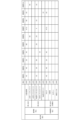
- 1 is a table showing the types and amounts of components used in blending in Experimental Examples 1 to 10.
- 1 is a table showing the types and amounts of components when blended in Experimental Examples 10-1 to 10-4.
- 1 is a table showing the types and amounts of components used in blending in Experimental Examples 11 to 20.
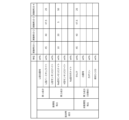
- 1 is a table showing the types and amounts of components used in forming sheets in Experimental Examples 1 to 10.
- 1 is a table showing the types and amounts of components used in forming sheets in Experimental Examples 10-1 to 10-4.
- 1 is a table showing the types and amounts of components used in forming sheets in Experimental Examples 11 to 20.
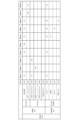
- 1 is a table showing sheet evaluation results in Experimental Examples 1 to 10.
- 1 is a table showing sheet evaluation results in Experimental Examples 10-1 to 10-4.
- 1 is a table showing sheet evaluation results in Experimental Examples 11 to 20.
- the present embodiment relates to a sheet, a sealing material, a fuel cell, an electrolytic cell, a method for manufacturing a sheet, and a method for manufacturing a sealing material.
- O to ⁇ means from O to ⁇ (from O weight % to ⁇ weight %).
- the term "comprise” or “comprising” means that the specified components are included, but does not exclude the presence of other components.
- the sheet of this embodiment can be used, for example, as a sealing material.
- the sheet of this embodiment includes a swelling clay and a non-swelling clay.
- the swelling clay includes a first component and a second component having a structure different from that of the first component.
- the non-swelling clay is a clay in which the ions of the first component and the second component are exchanged in a dispersion medium, and is a clay that exhibits non-swelling properties when heated.
- the first component is a swelling clay such as swollen muscovite (Li-type muscovite) or swollen vermiculite (Li-type vermiculite) in which the interlayer is substituted with Li
- the second component is a swelling smectite such as Na-type montmorillonite or K-type montmorillonite.
- the sheet contains a swelling clay as a compounding component.
- the sheet has a composition containing both a clay layer (hereinafter referred to as a Li-type clay layer) which is a swelling clay in which the interlayer of Li-type muscovite, Li-type vermiculite, or the like is substituted with Li, and a swelling clay smectite such as Na-type montmorillonite or K-type montmorillonite.
- the Li-type clay layer and smectite which are the raw materials of the present invention, are both swelling clays, and are not water-resistant by themselves.
- Li-type montmorillonite is obtained by supplying interlayer Li + ions from Li-type muscovite to Na-type montmorillonite.
- Na-type muscovite is obtained by moving interlayer Na + ions of Na-type montmorillonite to the interlayer of Li-type muscovite. After that, water is removed from the obtained mixture and heated, and Li + ions of Li-type montmorillonite move to the octahedral layer, thereby imparting water resistance.
- the interlayer ions of smectite are preferably other than Li + ions. If they are other than Li + ions, the ions introduced from smectite into the Li-type clay layer can also make the Li-type clay layer water-resistant.
- the interlayer ions are particularly preferably K + ions, Na + ions, Ca 2+ ions, and Mg 2+ ions. This is because K + ions, Na + ions, Ca 2+ ions, and Mg 2+ ions are inexpensive and have high solubility in water, and can be easily ion-exchanged. Among them, Na + ions and Ca 2+ ions are particularly preferable. This is because Na + ions and Ca 2+ ions exist in natural smectite, so prior ion exchange treatment can be omitted.
- the sheet contains a non-swelling clay as a compounding component.
- the non-swelling clay is obtained by ion exchange of a Li-type clay layer and smectite in a dispersion medium, and is a clay that exhibits non-swelling properties when heated.
- Table 1 shows whether the clay layer becomes swellable or non-swellable when heat-treated.
- the clay layer that exhibits swelling properties is marked with " ⁇ " and the clay layer that exhibits non-swelling properties is marked with "X”.
- the sheet of the present invention is formed by mixing a swelling clay, Li-type muscovite or Li-type vermiculite (first component), with a swelling smectite (second component), carrying out interlayer ion exchange, and heating, to form a sheet containing a swelling clay and a non-swelling clay.
- the first component is preferably a clay layer having Li + ions as interlayer ions and exhibiting swelling properties.
- the type of clay layer in the sheet of the present invention is not limited, and examples of the clay material that contains Li + ions between layers and is a swelling clay material include Li-type muscovite, Li-type vermiculite, and Li-type phlogopite.
- Li-type muscovite for use as a gasket for industrial equipment, it is preferable to use Li-type muscovite because it contains less iron and impurities.
- the first component is, for example, a swelling clay with Li substituted between layers, preferably swollen muscovite (swollen muscovite).
- muscovite is a concept including "sericite”, which is another name for fine particles.
- swollen muscovite swollen muscovite
- sericite swollen sericite
- the swollen muscovite is a clay in which at least a part of the K + ions between the layers of muscovite (muscovite) are exchanged with at least one or more ions (ions that impart swelling) selected from the group consisting of Li + ions, Ca 2+ ions, and Mg 2+ ions.
- the swollen sericite is a clay in which at least a part of the K + ions between the layers of sericite (sericite) are exchanged with at least one or more ions (ions that impart swelling) selected from the group consisting of Li + ions, Ca 2+ ions, and Mg 2+ ions.
- the swelling clay in which the interlayer is substituted with Li is not limited to swelling muscovite, but may be modified vermiculite (swelling vermiculite).
- Muscovite is a type of silicate mineral (phyllosilicate mineral), and is represented by the chemical formula K2Al4 ( Si6.Al2 ) O20 (OH) 4 , and has a triple structure containing Al and K between layers of silicate tetrahedrons.
- Sericite is a fine grain of muscovite, which is a layered silicate mineral. From the viewpoint of preventing the generation of fluorine-based gas, it is preferable that the muscovite used in this embodiment is not a fluorine mica type muscovite that contains fluorine.
- the first component, the swelling clay with Li substituted between layers, can be obtained by exchanging at least a part of the K + ions between the clay layers with ions such as Li + ions by modification.
- the modification of muscovite is not particularly limited, but can be achieved, for example, by mixing muscovite or sericite with lithium nitrate melted by heating and reacting for a certain period of time.
- the dispersion of swollen muscovite in water can be achieved, for example, by removing lithium nitrate by filtration and washing, adding pure water, and stirring.
- the ratio is similar when the ions to be exchanged are Ca 2+ or Mg 2+ instead of K + .
- the second component is smectite, preferably montmorillonite, saponite, hectorite, or beidellite.
- Smectite is a 2:1 type mineral having a structure containing an Al octahedron layer between layers of silica tetrahedron.
- Al in the Al octahedron layer is replaced by a cation such as Mg 2+ ion, Fe 2+ ion, or Fe 3+ ion, so that a negative charge is generated. Therefore, since the distance between the crystal lattice layers is long and the retention of the cations is weak, water easily enters between the layers, and the layer lattice easily expands.
- montmorillonite and saponite are preferred, montmorillonite is more preferred, and Na-montmorillonite or K-montmorillonite is particularly preferred.
- the octahedral layer of montmorillonite is composed of Al and Mg, and has many crystal defects, making it easy for Li + ions to move to the octahedral layer.
- montmorillonite exists naturally, it is available at low cost.
- the weight ratio of smectite to the sheet weight is preferably 5 to 55 wt %, more preferably 10 to 50 wt %, and particularly preferably 20 wt %.
- the third component is a filler, preferably a clay or oxide filler.
- the third component is optionally included in the sheet.
- the clay or oxide filler is at least one selected from the group consisting of muscovite, sericite, talc, kaolinite, and fused silica. It is also possible to use fired fillers as these fillers. By including a non-swelling filler such as muscovite, the content of smectite required for water resistance can be reduced.
- the sheet of the present invention preferably contains a third component, a filler, in addition to the first component, the Li-type clay layer, and the second component, smectite.
- a filler such as talc do not swell, so water resistance can be increased even if the weight ratio of smectite to the entire sheet is small.
- the heat resistance of the sheet can be increased by using a highly heat-resistant filler.
- the weight percentage of the filler is preferably 0 to 80 wt %. More preferably, it is 50 wt %. For the same weight percentage in the smectite sheet, the more filler there is, the better the water resistance will be. On the other hand, if there is too much filler, the handling strength will decrease.
- Total ratio of first component, second component, and third component in the sheet When the weight of the entire sheet is taken as 100% by weight, the total of the first component, the second component, and the third component is 90% by weight or more, preferably 92% by weight or more, more preferably 93% by weight or more, even more preferably 95% by weight or more, even more preferably 96% by weight or more, and particularly preferably 97% by weight or more.
- the first component is preferably 25% by weight or more and 80% by weight or less when the total weight of the first component, the second component, and the third component is 100% by weight.
- the first component is contained at least 25% by weight or more, preferably 30% by weight or more, more preferably 50% by weight or more, even more preferably 60% by weight or more, particularly preferably 75% by weight or more, and particularly preferably 80% by weight or more.
- the first component is also contained at most 100% by weight or less, 90% by weight or less, 80% by weight or less, 70% by weight or less, 65% by weight or less, or 50% by weight or less.
- the first component is contained in the following amounts: 25-100% by weight, 30-100% by weight, 40-100% by weight, 50-100% by weight, 60-100% by weight, 65-100% by weight, 70-100% by weight, 75-100% by weight, 80-100% by weight, 25-95% by weight, 25-90% by weight, 25-80% by weight, 25-75% by weight, 25-70% by weight, 25-65% by weight, 25-60% by weight and 25-50% by weight.
- the second component is preferably present in an amount of 10% by weight or more and 50% by weight or less when the total weight of the first component, second component, and third component is taken as 100% by weight.
- the second component is present in an amount of at least 5% by weight or more, preferably 7% by weight or more, and more preferably 10% by weight or more.
- the second component is present in an amount of at most 50% by weight or less, 40% by weight or less, 30% by weight or less, 20% by weight or less, 10% by weight or less, or 5% by weight or less.
- the second component is contained in the following amounts: 25-100% by weight, 30-100% by weight, 40-100% by weight, 50-100% by weight, 60-100% by weight, 65-100% by weight, 70-100% by weight, 75-100% by weight, 80-100% by weight, 25-95% by weight, 25-90% by weight, 25-80% by weight, 25-75% by weight, 25-70% by weight, 25-65% by weight, 25-60% by weight, 25-50% by weight.
- the third component is preferably present in an amount of 0% by weight or more and 80% by weight or less when the total weight of the first, second and third components is taken as 100% by weight.
- the third component is present in an amount of at least 10% by weight or more, preferably 20% by weight or more, more preferably 25% by weight or more, even more preferably 30% by weight or more, particularly preferably 40% by weight or more, and especially preferably 50% by weight or more.
- the third component is present in an amount of at most 80% by weight or less, 75% by weight or less, 70% by weight or less, 65% by weight or less, 60% by weight or less, 55% by weight or less, or 50% by weight or less.
- the third component is contained in the following amounts: 0-80% by weight, 0-75% by weight, 0-70% by weight, 0-60% by weight, 0-50% by weight, 0-40% by weight, 0-35% by weight, 0-30% by weight, 0-25% by weight, 0-20% by weight, 5-80% by weight, 10-80% by weight, 20-80% by weight, 25-80% by weight, 30-80% by weight, 35-80% by weight, 40-80% by weight and 50-80% by weight.
- the weight loss rate of the third component when heated to 1000°C is 15% by weight or less, preferably 13% by weight or less, more preferably 10% by weight or less, even more preferably 8% by weight or less, even more preferably 7% by weight or less, and particularly preferably 6% by weight or less, based on 100% by weight of the weight before heating.
- the third component has a low iron content.
- the iron content of the third component calculated as iron oxide (Fe 2 O 3 ) is 3 wt % or less, preferably 2 wt % or less, more preferably 1.5 wt % or less, even more preferably 1.0 wt % or less, even more preferably 0.8 wt % or less, and particularly preferably 0.5 wt % or less.
- XRF X-ray fluorescence analysis
- the ratio (weight ratio) of the content of the first component to the content of the second component is 10:90 to 100:0, 15:85 to 100:0, 20:80 to 100:0, 25:75 to 100:0, 30:70 to 100:0, 40:60 to 100:0, 50:50 to 100:0, 60:40 to 100:0, 65:35 to 100: 0, 70:30-100:0, 75:25-100:0, 80:20-100:0, 25:75-95:5, 25:75-90:10, 25:75-80:20, 25:75-75:25, 25:75-70:30, 25:75-65:35, 25:75-60:40, 25:75-50:50.
- the content of the swelling clay in the first component is preferably 5% by weight or more and 90% by weight or less, and more preferably 10% by weight or more and 70% by weight or less.
- the content of the swelling clay in the second component is preferably 2% by weight or more and 50% by weight or less, and more preferably 5% by weight or more and 40% by weight or less.
- the non-swelling clay (clay that exhibits non-swelling properties when heated) is preferably 5% by weight or more and 30% by weight or less, and more preferably 10% by weight or more and 25% by weight or less.
- the method of making the sheet of this embodiment includes mixing a first component, a second component, and optionally a third component to form a mixture, exchanging ions between the first and second components, and forming and heating the mixture into a sheet.
- a solvent such as water is added to the mixture to adjust the viscosity of the slurry to suit the molding method, and the mixture is molded using extrusion molding, calendar rolls, film applicators, doctor blades, bar coaters, screen printing, etc., and then dried to obtain a sheet.
- the sheet of the present embodiment can be used as a sealing material, for example, a gasket, packing, etc., for various pipes in various industries, fuel cells such as solid oxide fuel cells (SOFC), electrolytic cells such as solid oxide electrolytic cells (SOEC), and exhaust pipes of automobiles.
- the sheet of the present embodiment can be used as a sealing material itself, or can be incorporated as a part of a sealing material such as a gasket or packing. Examples of the shape of the sealing material as a product include, but are not limited to, a sheet gasket, a spiral gasket, and a sawtooth gasket.
- the sheet of the present embodiment and the sealing material including the sheet do not substantially include a binder.
- the binder is not particularly limited, but examples thereof include rubber and adhesives. More specifically, examples thereof include acrylonitrile butadiene rubber, styrene butadiene rubber, polybutadiene rubber, silicone rubber, acrylic rubber, natural rubber, butyl rubber, chloroprene rubber, ethylene propylene rubber, fluororubber, urethane rubber, acrylic adhesives, and silicone adhesives.
- substantially binder-free means that, when the total weight of the sheet is taken as 100% by weight, the binder content is less than 0.1% by weight (0.1% by weight or less), preferably less than 0.05% by weight (0.05% by weight or less), more preferably less than 0.01% by weight (0.01% by weight or less), even more preferably less than 0.001% by weight (0.001% by weight or less), and particularly preferably less than 0.0001% by weight (0.0001% by weight or less). Since the sheet of this embodiment does not contain a binder, when used as a sealing material, it has high sealing properties and does not generate outgassing.
- the sheet of the present embodiment and the sealing material including the sheet preferably have a low iron content.
- the iron content, calculated as iron oxide ( Fe2O3 ) , contained in the sheet of the present embodiment and the sealing material including the sheet is 6% by weight or less, preferably 3% by weight or less, more preferably 2% by weight or less, even more preferably 1.5% by weight or less, even more preferably 1.0% by weight or less, and particularly preferably 0.8% by weight or less, when the weight of the entire sheet is 100% by weight.
- the sheet of this embodiment and the sealing material including the sheet preferably use muscovite as the Li-type film-forming material.
- Sheets using muscovite as the Li-type film-forming material have a lower iron content than sheets using vermiculite and phlogopite, and therefore have high insulation properties. Therefore, sheets using muscovite as the Li-type film-forming material are suitable for fuel cell applications such as solid oxide fuel cells (SOFCs) and electrolysis cell applications such as solid oxide electrolysis cells (SOECs), which require high insulation properties.
- SOFCs solid oxide fuel cells
- SOECs solid oxide electrolysis cells
- the sheet of this embodiment and the sealing material containing the sheet preferably have a basis weight of 700 to 1300 g/m 2 , more preferably 700 to 1200 g/m 2 , still more preferably 750 to 1100 g/m 2 , and particularly preferably 800 to 1050 g/m 2 .
- the density of the sealing material of this embodiment is preferably 0.5 to 2.5 g/cm 3 at 2 MPa, more preferably 1.0 to 2.2 g/cm 3 , and even more preferably 1.2 to 2.0 g/cm 3.
- the sealing material may have a density of more than 1.4 g/cm 3. The lower the density at 2 MPa, the easier it is to conform to the irregularities of the mating member when compressed, reducing surface contact leakage.
- the density of the sealing material of this embodiment is preferably 0.5 to 2.8 g/cm 3 at 20 MPa, more preferably 1.0 to 2.8 g/cm 3 , and even more preferably 1.2 to 2.8 g/cm 3.
- the sealing material may have a density of more than 1.4 g/cm 3. The higher the density at 20 MPa, the denser the material is when fastened, and the less substance leakage occurs.
- the sealing material of the present embodiment has a compression ratio of 15% or more, preferably 20% or more, more preferably 25% or more, even more preferably 30% or more, and particularly preferably 40% or more.
- the higher the compression ratio the easier it is to conform to the irregularities of the mating member when compressed, and the less surface leakage occurs.
- the sealing material of this embodiment has a recovery rate of 5% or more, preferably 6% or more, more preferably 7% or more, even more preferably 8% or more, and particularly preferably 10% or more. The higher the recovery rate, the greater the reaction force when tightening, and the less surface leakage.
- the sealing material of this embodiment has high heat resistance; specifically, the diameter change rate is 10% or less, preferably 8% or less, more preferably 5% or less, even more preferably 3% or less, and particularly preferably 1% or less.
- the sheet of the present embodiment and the sealing material including the sheet have excellent electrical insulation properties in a high-temperature environment.
- the sheet of the present embodiment and the sealing material including the sheet have an insulating performance in a high-temperature environment, and the volume resistivity is preferably more than 2.0 ⁇ 10 ⁇ cm when measured at 600° C. and an applied voltage of 100 V, and is preferably 3.8 ⁇ 10 ⁇ cm or more when measured at 600° C. and an applied voltage of 300 V.
- the sealing material of the present embodiment Since the sealing material of the present embodiment has the above-mentioned characteristics, it can be used for fuel cells. In other words, it is possible to provide a fuel cell including the sealing material of the present embodiment.
- An example of the fuel cell is a planar SOFC, but is not limited thereto.
- an example of the electrolysis cell is a solid oxide electrolysis cell (SOEC), but is not limited thereto.
- the method for producing a sealing material of the present embodiment includes a step of incorporating the sheet produced by the above-described sheet production method as a part of a gasket and packing.
- Li-type muscovite and Li-type vermiculite were used as swelling clays (first component Li-type clay layer).
- Na-type montmorillonite, K-type montmorillonite, Li-type montmorillonite, and Na-type saponite were used as swelling clays (second component smectite).
- Talc, muscovite, kaolin, and plate-like silica were used as the third component filler.
- sheets were produced with different types and blending ratios of the first component swelling clay, the second component swelling clay, and the third component (filler).
- the types and amounts of the components at the time of blending for each experimental example are shown in Figures 1A, 1B, and 2.
- a sheet containing a swelling clay and a non-swelling clay was produced by mixing and heating the swelling clay and performing interlayer ion exchange.
- the component types and amounts of the sheets are shown in Figures 3A, 3B, and 4.
- the component amounts of the sheets shown in Figures 3A, 3B, and 4 are calculated values calculated from the amounts of the components at the time of blending, not the actual measured values of the produced sheets.
- the sheet was punched out to obtain a test piece having an outer diameter of 20 mm.
- the test piece was dried at 100° C. for 24 hours to prepare a sheet sample having a thickness of 0.5 mm. If no warping was observed in the sample after the test, it was marked as “ ⁇ ”, and if warping was observed, it was marked as “ ⁇ ”.
- the sheet was punched out to obtain a test piece with an outer diameter of 20 mm.
- the test piece was heat-treated at 300°C, 600°C, and 700°C for 24 hours, and then dried at 100°C for 15 hours.
- the test piece was then placed in a desiccator and allowed to cool, and the mass (m1) was measured using a top-loading balance.
- the test piece was immersed in pure water for 24 hours, after which the surface moisture was wiped off with a rag, and the mass (m2) was measured using a top-loading balance.
- the value calculated using the following formula (1) was taken as the water absorption rate.
- Water absorption rate (mass%) ((m2-m1)/m2) x 100...Formula (1)
- the sheet was punched out to obtain a test piece having an outer diameter of 20 mm.
- the test piece was heat-treated at 300°C, 600°C, and 700°C for 24 hours, and then immersed in pure water for 24 hours to prepare a sheet sample.
- those that could be handled without collapsing were marked with " ⁇ "
- those that collapsed and could not be handled were marked with "X”.
- FIG. 5A, 5B, and 6 The evaluation results for the sheets of Experimental Examples 1 to 20 are shown in FIGS. 5A, 5B, and 6.
- FIG. 5A, 5B, and 6 The evaluation results for the sheets of Experimental Examples 1 to 20 are shown in FIGS. 5A, 5B, and 6.
- the water absorption rate was 40 wt % or less in a 24-hour pure water immersion test after heating at 300°C
- the water absorption rate was 25 wt % or less in a 24-hour pure water immersion test after heating at 600°C
- the water absorption rate was 20 wt % or less in a 24-hour pure water immersion test after heating at 700°C.
- Experimental Example 1 containing talc as the third component Comparing Experimental Example 1 containing talc as the third component with Experimental Example 14, Experimental Example 1 containing Na-montmorillonite as the second component of the swelling clay had a water absorption rate of 31% in a 24-hour pure water immersion test after heating at 300°C, and had a water absorption rate of 18 wt% in a 24-hour pure water immersion test after heating at 600°C and 700°C. In contrast, in Experimental Example 14, which did not contain Na-montmorillonite as the second component of the swelling clay, the sample collapsed in the 24-hour pure water immersion test after heating at 300°C and 600°C, and the water absorption rate was 20 wt% or more in the 24-hour pure water immersion test after heating at 700°C.
- a sheet containing a Li-type clay layer as the first component of the swelling clay, smectite as the second component of the swelling clay, and clay that shows no swelling when heated has low water absorption and high water resistance.
- Experimental Example 1 containing talc as the third component when comparing Experimental Example 1 containing talc as the third component with Experimental Example 14, Experimental Example 1 containing Na-montmorillonite as the second component of the swelling clay was able to be handled in a 24-hour pure water immersion test after heating at 300°C, 600°C, and 700°C. In contrast, in Experimental Example 14, which did not contain Na-montmorillonite as the second component of the swelling clay, the sample collapsed in the pure water immersion test for 24 hours after heating at 300°C and after heating at 600°C.
- a sheet containing a Li-type clay layer as the first component of the swelling clay, smectite as the second component of the swelling clay, and clay that exhibits non-swelling properties when heated has low water absorption and high handleability.
- Experimental Example 1 Comparing Experimental Example 1, in which Li-type muscovite was mixed as the first component and Na-type montmorillonite was mixed as the second component, with Experimental Examples 12 and 15, in which Na-type montmorillonite and Li-type muscovite were used as the single raw materials without mixing, Experimental Example 1 had a water absorption rate of 40 wt % or less in a pure water immersion test for 24 hours after heating at 300°C, and was therefore handleable.
- the sheets of Experimental Examples 1 to 4 which contained Li-type muscovite as the first component, Na-type montmorillonite as the second component, and talc as the third component, had a water absorption rate of 20% or less in a 24-hour pure water immersion test after heating at 700°C for 24 hours, and the samples could be handled without disintegrating.
- the sheets of Experimental Examples 1 to 3 containing 10 wt % or more of Na-montmorillonite as the second component showed water absorption rates of 20% or less in a 24-hour pure water immersion test after heating at 700°C and 600°C for 24 hours, and the samples could be handled without disintegrating.
- the sheet of Experimental Example 2 containing 20 wt % of Na-montmorillonite had a water absorption rate of 20% or less in a pure water immersion test for 24 hours after heating at 300° C. for 24 hours.
- the sheet of Experimental Example 3 containing 50 wt % Na-montmorillonite had a water absorption rate of 10% or less in a pure water immersion test for 24 hours after heating at 600° C. for 24 hours, which was the lowest water absorption rate among Experimental Examples 1 to 3. Therefore, it was revealed that the water resistance can be controlled in accordance with the required temperature conditions by adjusting the content of the second component.
- the sheet of Experimental Example 1 containing talc as the third component had a water absorption rate of 40% or less at 300° C., and the sample was able to be handled without disintegrating.
- the sheets of Experimental Example 8, which did not contain talc as the third component all had water absorption rates of 40% or more at 300° C., and the samples collapsed and could not be handled. Therefore, it became clear that in the absence of a filler, a larger amount of the second component was required to impart water resistance at 300°C.
- the sheet of Experimental Example 11 containing Li-type montmorillonite as the second component had a water absorption rate of 40% or less in a 24-hour pure water immersion test after heating at 600°C for 24 hours, and the sample collapsed and could not be handled in a 24-hour pure water immersion test after heating at 300°C for 24 hours. Therefore, it was revealed that sheets containing Na- and K-type montmorillonite, which exhibit swelling properties, have a higher water resistance effect at 600°C and 300°C than sheets containing Li-type montmorillonite, which exhibits non-swelling properties.
- experimental examples 10-1 to 10-4 in which Li-type vermiculite was included as the first component, Na-type montmorillonite was included as the second component, and talc was included as the third component.
- experimental examples 10-1 and 10-2 had a high water resistance effect at 700°C, 600°C, and 300°C.
- a sheet containing a Li-type clay layer as the first component of the swelling clay and smectite as the second component of the swelling clay which exhibits non-swelling properties when heated, does not warp and has sufficient manufacturability as a sheet, compared to a sheet containing only smectite.
- the sheets of Experimental Examples 1 to 10 and 10-1 to 10-4 are mainly composed of the first component (Li-type clay layer), the second component (smectite), and the third component (filler), and do not contain resins such as fluorine or binders, and therefore it was revealed that they generate little outgassing.
- the sheet containing a mixture of Li-type vermiculite, smectite and talc had a high water resistance effect at 700°C, 600°C and 300°C. Furthermore, it was revealed that a sheet containing a Li-type clay layer as the first component of the swelling clay and smectite as the second component of the swelling clay, which exhibits non-swelling properties when heated, does not warp compared to a sheet containing only smectite, and has sufficient manufacturability as a sheet.
- Li-type clay layer which can be manufactured into thick sheets
- smectite Li is supplied from the Li-type clay layer to the smectite during mixing, and Li is migrated from between the smectite layers to the octahedral layers by heating, thereby reducing hydrophilicity. Therefore, it has high water resistance and easy handling, no warping is observed during sheet production, and it has been revealed that the sheet has sufficient performance in high temperature environments.
- both the Li-type clay layer and the smectite are swelling clays when the sheet is formed, the layer structure of the swelling clay is densely overlapped to form the sheet.
- the smectite peels off very thinly, at about 1 nm, the number of particles per unit weight increases, and the number of contact points between particles also increases.
Landscapes
- Chemical & Material Sciences (AREA)
- Engineering & Computer Science (AREA)
- Organic Chemistry (AREA)
- Chemical Kinetics & Catalysis (AREA)
- Electrochemistry (AREA)
- Inorganic Chemistry (AREA)
- Manufacturing & Machinery (AREA)
- Life Sciences & Earth Sciences (AREA)
- Sustainable Development (AREA)
- Sustainable Energy (AREA)
- General Chemical & Material Sciences (AREA)
- Metallurgy (AREA)
- Materials Engineering (AREA)
- Dispersion Chemistry (AREA)
- Ceramic Engineering (AREA)
- Mechanical Engineering (AREA)
- Sealing Material Composition (AREA)
- Fuel Cell (AREA)
Priority Applications (4)
| Application Number | Priority Date | Filing Date | Title |
|---|---|---|---|
| CN202480012258.5A CN120677047A (zh) | 2023-03-09 | 2024-01-26 | 片、密封材、燃料电池、电解池、片的制造方法及密封材的制造方法 |
| KR1020257027727A KR20250141733A (ko) | 2023-03-09 | 2024-01-26 | 시트, 시일재, 연료 전지, 전해 셀, 시트의 제조 방법 및 시일재의 제조 방법 |
| JP2025505118A JPWO2024185336A1 (https=) | 2023-03-09 | 2024-01-26 | |
| EP24766711.6A EP4678364A1 (en) | 2023-03-09 | 2024-01-26 | Sheet, sealing material, fuel cell, electrolytic cell, method for producing sheet, and method for producing sealing material |
Applications Claiming Priority (2)
| Application Number | Priority Date | Filing Date | Title |
|---|---|---|---|
| JP2023036729 | 2023-03-09 | ||
| JP2023-036729 | 2023-03-09 |
Publications (1)
| Publication Number | Publication Date |
|---|---|
| WO2024185336A1 true WO2024185336A1 (ja) | 2024-09-12 |
Family
ID=92674378
Family Applications (1)
| Application Number | Title | Priority Date | Filing Date |
|---|---|---|---|
| PCT/JP2024/002513 Ceased WO2024185336A1 (ja) | 2023-03-09 | 2024-01-26 | シート、シール材、燃料電池、電解セル、シートの製造方法及びシール材の製造方法 |
Country Status (6)
| Country | Link |
|---|---|
| EP (1) | EP4678364A1 (https=) |
| JP (1) | JPWO2024185336A1 (https=) |
| KR (1) | KR20250141733A (https=) |
| CN (1) | CN120677047A (https=) |
| TW (1) | TWI892502B (https=) |
| WO (1) | WO2024185336A1 (https=) |
Citations (9)
| Publication number | Priority date | Publication date | Assignee | Title |
|---|---|---|---|---|
| JPH06100315A (ja) * | 1984-03-02 | 1994-04-12 | Paul H Nadeau | 飽和クレー懸濁物 |
| JP3855003B2 (ja) | 2003-09-08 | 2006-12-06 | 独立行政法人産業技術総合研究所 | 粘土配向膜及びその製造方法 |
| JP2011236065A (ja) * | 2010-05-06 | 2011-11-24 | Tomoegawa Paper Co Ltd | 粘土膜、粘土分散液および粘土分散液の製造方法 |
| JP4973856B2 (ja) | 2007-03-30 | 2012-07-11 | クニミネ工業株式会社 | 粘土フィルム及びその製造方法 |
| JP2012177102A (ja) * | 2011-01-31 | 2012-09-13 | Sumitomo Chemical Co Ltd | 無機層状化合物分散液および多層構造体の製造方法 |
| JP2012193750A (ja) * | 2011-03-14 | 2012-10-11 | Japan Matekkusu Kk | 無機繊維粘土複合材及びその製造方法、並びにこの複合材からなるガスケット又はパッキン |
| WO2016125486A1 (ja) * | 2015-02-02 | 2016-08-11 | ニチアス株式会社 | ガスケット及びその製造方法 |
| WO2019221196A1 (ja) * | 2018-05-16 | 2019-11-21 | Dic株式会社 | 組成物、ガスバリア材、コーティング材、接着剤、成形体、積層体及び成形体の製造方法 |
| JP6999649B2 (ja) | 2016-09-02 | 2022-01-18 | フレキシタリック インベストメンツ インコーポレイテッド | ガスケットシール材料 |
Family Cites Families (6)
| Publication number | Priority date | Publication date | Assignee | Title |
|---|---|---|---|---|
| US4997695A (en) * | 1988-11-21 | 1991-03-05 | James Clem Corporation | Clay mixture having contamination resistance |
| GB2243804A (en) * | 1990-03-06 | 1991-11-13 | Naue Fasertechnik | A water and/or oil-impermeable sealing mat |
| ATE127188T1 (de) * | 1992-04-02 | 1995-09-15 | Naue Fasertechnik | Verfahren zur herstellung einer wasser- und/oder ölundurchlässigen quellfähigen ton enthaltenden dichtungsmatte. |
| WO2017115399A1 (ja) | 2015-12-28 | 2017-07-06 | 日本バルカー工業株式会社 | うず巻形ガスケット |
| JP6754746B2 (ja) * | 2017-10-31 | 2020-09-16 | ニチアス株式会社 | シール材 |
| US20220231317A1 (en) | 2021-01-15 | 2022-07-21 | Bloom Energy Corporation | Method of manufacturing solid oxide electrolyzer cells using a continuous furnace |
-
2024
- 2024-01-26 JP JP2025505118A patent/JPWO2024185336A1/ja active Pending
- 2024-01-26 CN CN202480012258.5A patent/CN120677047A/zh active Pending
- 2024-01-26 WO PCT/JP2024/002513 patent/WO2024185336A1/ja not_active Ceased
- 2024-01-26 EP EP24766711.6A patent/EP4678364A1/en active Pending
- 2024-01-26 KR KR1020257027727A patent/KR20250141733A/ko active Pending
- 2024-03-08 TW TW113108623A patent/TWI892502B/zh active
Patent Citations (9)
| Publication number | Priority date | Publication date | Assignee | Title |
|---|---|---|---|---|
| JPH06100315A (ja) * | 1984-03-02 | 1994-04-12 | Paul H Nadeau | 飽和クレー懸濁物 |
| JP3855003B2 (ja) | 2003-09-08 | 2006-12-06 | 独立行政法人産業技術総合研究所 | 粘土配向膜及びその製造方法 |
| JP4973856B2 (ja) | 2007-03-30 | 2012-07-11 | クニミネ工業株式会社 | 粘土フィルム及びその製造方法 |
| JP2011236065A (ja) * | 2010-05-06 | 2011-11-24 | Tomoegawa Paper Co Ltd | 粘土膜、粘土分散液および粘土分散液の製造方法 |
| JP2012177102A (ja) * | 2011-01-31 | 2012-09-13 | Sumitomo Chemical Co Ltd | 無機層状化合物分散液および多層構造体の製造方法 |
| JP2012193750A (ja) * | 2011-03-14 | 2012-10-11 | Japan Matekkusu Kk | 無機繊維粘土複合材及びその製造方法、並びにこの複合材からなるガスケット又はパッキン |
| WO2016125486A1 (ja) * | 2015-02-02 | 2016-08-11 | ニチアス株式会社 | ガスケット及びその製造方法 |
| JP6999649B2 (ja) | 2016-09-02 | 2022-01-18 | フレキシタリック インベストメンツ インコーポレイテッド | ガスケットシール材料 |
| WO2019221196A1 (ja) * | 2018-05-16 | 2019-11-21 | Dic株式会社 | 組成物、ガスバリア材、コーティング材、接着剤、成形体、積層体及び成形体の製造方法 |
Non-Patent Citations (1)
| Title |
|---|
| See also references of EP4678364A1 |
Also Published As
| Publication number | Publication date |
|---|---|
| CN120677047A (zh) | 2025-09-19 |
| EP4678364A1 (en) | 2026-01-14 |
| KR20250141733A (ko) | 2025-09-29 |
| TW202440320A (zh) | 2024-10-16 |
| TWI892502B (zh) | 2025-08-01 |
| JPWO2024185336A1 (https=) | 2024-09-12 |
Similar Documents
| Publication | Publication Date | Title |
|---|---|---|
| Naguib et al. | Ti 3 C 2 T x (MXene)–polyacrylamide nanocomposite films | |
| JP5099412B2 (ja) | 変性粘土を用いた膜 | |
| Tetsuka et al. | Highly transparent flexible clay films modified with organic polymer: structural characterization and intercalation properties | |
| CN101434481B (zh) | 粘土分散液及其制造方法、以及粘土薄膜 | |
| Ebina | Development of Clay‐Based Films | |
| KR20140070541A (ko) | 수증기 배리어 필름, 수증기 배리어 필름용 분산액, 수증기 배리어 필름의 제조 방법, 태양 전지 백 시트, 및, 태양 전지 | |
| JPH07502562A (ja) | 流体封止用ガスケット・シート材料 | |
| Yang et al. | Highly electrically conductive rGO/PVA composites with a network dispersive nanostructure | |
| Sadroddini et al. | Silica-decorated reduced graphene oxide (SiO2@ rGO) as hybrid fillers for enhanced dielectric and actuation behavior of polydimethylsiloxane composites | |
| EP0299351B1 (en) | Aqueous mineral dispersions | |
| WO2006137475A1 (ja) | 表面改質ナノフィラー及び高分子複合材料 | |
| Suzuki et al. | Heat-resistant insulation film containing clay and wood components | |
| Chang et al. | Preparation and properties of styrene–ethylene/butylene–styrene (SEBS)–clay hybrids | |
| JP5582731B2 (ja) | 耐熱性シール部材 | |
| WO2024185336A1 (ja) | シート、シール材、燃料電池、電解セル、シートの製造方法及びシール材の製造方法 | |
| JP6999649B2 (ja) | ガスケットシール材料 | |
| JP4909969B2 (ja) | ガスケット用フッ素樹脂シート、その製造方法及びシートガスケット | |
| Aliyari et al. | Hybridized 2D-Ti-based MXene/Zn-dopamine-loaded ZIF-67 MOF reinforced epoxy composite for advanced intelligent anti-corrosion application | |
| JP2012193750A (ja) | 無機繊維粘土複合材及びその製造方法、並びにこの複合材からなるガスケット又はパッキン | |
| CN108997617A (zh) | 一种聚多巴胺包覆红磷微胶囊阻燃剂的制备及其使用方法 | |
| KR20070101273A (ko) | 개스킷 소재 및 그 제조방법 | |
| JP5190905B2 (ja) | 表面処理粘土膜 | |
| JP2024017919A (ja) | シート、シール材、燃料電池、電解セル、シートの製造方法およびシール材の製造方法 | |
| JP6491912B2 (ja) | 粘土スラリー及び粘土膜 | |
| CN111868303B (zh) | 方向性电磁钢板的制造方法及方向性电磁钢板 |
Legal Events
| Date | Code | Title | Description |
|---|---|---|---|
| 121 | Ep: the epo has been informed by wipo that ep was designated in this application |
Ref document number: 24766711 Country of ref document: EP Kind code of ref document: A1 |
|
| ENP | Entry into the national phase |
Ref document number: 2025505118 Country of ref document: JP Kind code of ref document: A |
|
| WWE | Wipo information: entry into national phase |
Ref document number: 2025505118 Country of ref document: JP |
|
| WWE | Wipo information: entry into national phase |
Ref document number: 202480012258.5 Country of ref document: CN |
|
| ENP | Entry into the national phase |
Ref document number: 1020257027727 Country of ref document: KR Free format text: ST27 STATUS EVENT CODE: A-0-1-A10-A15-NAP-PA0105 (AS PROVIDED BY THE NATIONAL OFFICE) |
|
| WWE | Wipo information: entry into national phase |
Ref document number: 1020257027727 Country of ref document: KR |
|
| WWP | Wipo information: published in national office |
Ref document number: 202480012258.5 Country of ref document: CN |
|
| WWE | Wipo information: entry into national phase |
Ref document number: 2024766711 Country of ref document: EP |
|
| NENP | Non-entry into the national phase |
Ref country code: DE |
|
| ENP | Entry into the national phase |
Ref document number: 2024766711 Country of ref document: EP Effective date: 20251009 |
|
| ENP | Entry into the national phase |
Ref document number: 2024766711 Country of ref document: EP Effective date: 20251009 |
|
| ENP | Entry into the national phase |
Ref document number: 2024766711 Country of ref document: EP Effective date: 20251009 |
|
| ENP | Entry into the national phase |
Ref document number: 2024766711 Country of ref document: EP Effective date: 20251009 |
|
| WWP | Wipo information: published in national office |
Ref document number: 2024766711 Country of ref document: EP |