WO2024181393A1 - 官能性ブロック共重合体含有エポキシ系接着剤組成物及びその製造方法並びに官能性ブロック共重合体含有エポキシ系接着剤硬化物 - Google Patents
官能性ブロック共重合体含有エポキシ系接着剤組成物及びその製造方法並びに官能性ブロック共重合体含有エポキシ系接着剤硬化物 Download PDFInfo
- Publication number
- WO2024181393A1 WO2024181393A1 PCT/JP2024/006923 JP2024006923W WO2024181393A1 WO 2024181393 A1 WO2024181393 A1 WO 2024181393A1 JP 2024006923 W JP2024006923 W JP 2024006923W WO 2024181393 A1 WO2024181393 A1 WO 2024181393A1
- Authority
- WO
- WIPO (PCT)
- Prior art keywords
- block copolymer
- functional
- mass
- polystyrene
- group
- Prior art date
- Legal status (The legal status is an assumption and is not a legal conclusion. Google has not performed a legal analysis and makes no representation as to the accuracy of the status listed.)
- Ceased
Links
Images




Classifications
-
- C—CHEMISTRY; METALLURGY
- C09—DYES; PAINTS; POLISHES; NATURAL RESINS; ADHESIVES; COMPOSITIONS NOT OTHERWISE PROVIDED FOR; APPLICATIONS OF MATERIALS NOT OTHERWISE PROVIDED FOR
- C09J—ADHESIVES; NON-MECHANICAL ASPECTS OF ADHESIVE PROCESSES IN GENERAL; ADHESIVE PROCESSES NOT PROVIDED FOR ELSEWHERE; USE OF MATERIALS AS ADHESIVES
- C09J153/00—Adhesives based on block copolymers containing at least one sequence of a polymer obtained by reactions only involving carbon-to-carbon unsaturated bonds; Adhesives based on derivatives of such polymers
-
- C—CHEMISTRY; METALLURGY
- C09—DYES; PAINTS; POLISHES; NATURAL RESINS; ADHESIVES; COMPOSITIONS NOT OTHERWISE PROVIDED FOR; APPLICATIONS OF MATERIALS NOT OTHERWISE PROVIDED FOR
- C09J—ADHESIVES; NON-MECHANICAL ASPECTS OF ADHESIVE PROCESSES IN GENERAL; ADHESIVE PROCESSES NOT PROVIDED FOR ELSEWHERE; USE OF MATERIALS AS ADHESIVES
- C09J153/00—Adhesives based on block copolymers containing at least one sequence of a polymer obtained by reactions only involving carbon-to-carbon unsaturated bonds; Adhesives based on derivatives of such polymers
- C09J153/02—Vinyl aromatic monomers and conjugated dienes
-
- C—CHEMISTRY; METALLURGY
- C09—DYES; PAINTS; POLISHES; NATURAL RESINS; ADHESIVES; COMPOSITIONS NOT OTHERWISE PROVIDED FOR; APPLICATIONS OF MATERIALS NOT OTHERWISE PROVIDED FOR
- C09J—ADHESIVES; NON-MECHANICAL ASPECTS OF ADHESIVE PROCESSES IN GENERAL; ADHESIVE PROCESSES NOT PROVIDED FOR ELSEWHERE; USE OF MATERIALS AS ADHESIVES
- C09J163/00—Adhesives based on epoxy resins; Adhesives based on derivatives of epoxy resins
Definitions
- the present invention relates to a functional block copolymer-containing epoxy adhesive composition that can be used in applications such as automotive structural adhesives, a method for producing the same, and a cured product of a functional block copolymer-containing epoxy adhesive, and in particular to a functional block copolymer-containing epoxy adhesive composition that enables improved toughness, a method for producing the same, and a cured product of a functional block copolymer-containing epoxy adhesive.
- the cured product of the epoxy resin is hard and has poor flexibility.
- one-component epoxy resins generally have low peel adhesive strength and impact adhesive strength because they are insufficient in elongation and difficult to bend, although they exhibit high shear adhesive strength.
- a modification technique using core-shell rubber particles as shown in Patent Document 1, for example, is known.
- the present invention aims to provide a functional block copolymer-containing epoxy adhesive composition that enables improved toughness, a method for producing the same, and a cured product of the functional block copolymer-containing epoxy adhesive.
- the functional block copolymer-containing epoxy adhesive composition of the invention of claim 1 contains an epoxy resin, a curing agent, and a functional block copolymer consisting of a rubber-like polymer that is incompatible with the epoxy resin and has a non-covalent functional group with a glass transition temperature of 25°C or less, and a polymer that is compatible with the epoxy resin.
- epoxy resin general-purpose epoxy resins such as bisphenol A type epoxy resins and bisphenol F type epoxy resins, urethane-modified epoxy resins, rubber-modified epoxy resins, etc. can be used, with general-purpose epoxy resins such as bisphenol A type epoxy resins being preferred.
- the curing agent may be any agent having an active group that reacts with an epoxy group, and for example, a latent curing agent such as an imidazole compound such as dicyandiamide, which has excellent storage stability, is preferably used.
- the functional block copolymer is a polymer in which different polymer chains, a rubber-like polymer that is incompatible with the epoxy resin, has a glass transition temperature (T g ) of 25° C. or lower, and has a non-covalent functional group, and a polymer that is compatible with the epoxy resin, are chemically bonded to each other.
- the rubbery polymer having a non-covalent functional group in the functional block copolymer is a polymer that is incompatible with the epoxy resin and has a glass transition temperature (T g ) of 25° C. or less, which is lower than room temperature, and corresponds to a soft segment at room temperature.
- the lower limit of the glass transition temperature (T g ) is a finite value determined by the type of rubbery polymer, and is, for example, at its minimum , about ⁇ 120° C.
- the glass transition temperature (glass transition point: T g ) can be determined by differential scanning calorimetry (DSC).
- the rubber-like polymer having a non-covalent functional group may contain a monomer having a non-covalent functional group, and the non-covalent functional group may be directly bonded to the block copolymer or may be bonded via a linking group. It is preferably a conjugated diene polymer having a non-covalent functional group, and more preferably, it is a polymer having a portion in which a monomer having a non-covalent functional group is polymerized in a main polymer chain consisting of a polymerization of a hydrocarbon monomer unit such as isoprene, butadiene, hydrogenated isoprene, or hydrogenated butadiene.
- a hydrocarbon monomer unit such as isoprene, butadiene, hydrogenated isoprene, or hydrogenated butadiene.
- the non-covalent functional group refers to a functional group capable of non-covalent bonding, and may be any functional group capable of intermolecular or intramolecular non-covalent bonding that can form a pseudo-crosslinking point or a physical crosslinking point.
- functional groups include hydrogen-bonding functional groups such as amide groups, imide groups, carboxyl groups, phenol groups, pyridyl groups, imidazolyl groups, pyrazolyl groups, and urethane groups, and ionic-bonding functional groups such as carboxylate groups, phosphonate groups, sulfonate groups, ammonium groups, pyridinium groups, imidazolium groups, and pyrazolium groups.
- the non-covalent bond includes a hydrogen bond and an ionic bond
- the hydrogen-bonding functional group refers to a functional group capable of forming a hydrogen bond
- the ionic-bonding functional group refers to a functional group capable of forming an ionic bond that generates an ionic interaction
- rubbery in the rubbery polymer means that the glass transition temperature (T g ) of the polymer is 25° C. or lower, and therefore the segments in the polymer behave as soft segments at room temperature.
- T g glass transition temperature
- a soft segment is one in which segment motion (micro-Brownian motion of segments) occurs actively, and a hard segment is one in which segment motion has essentially stopped.
- a segment is a unit related to the motion of a polymer chain, and is a unit that groups together several to a dozen or so monomer units.
- the polymer compatible with the epoxy resin in the functional block copolymer is a block chain having a glass transition temperature (T g ) higher than room temperature and corresponds to a hard segment at room temperature, and is preferably an aromatic vinyl polymer.
- the above-mentioned functional block copolymers include, for example, polystyrene-functional polyisoprene-polystyrene block copolymers in which non-covalently bonded functional groups are introduced into the polyisoprene chain of polystyrene-polyisoprene-polystyrene block copolymer (SIS), a styrene-based thermoplastic elastomer (Thermoplastic Styrene Elastomer: TPS), polystyrene-functional polybutadiene-polystyrene block copolymers in which non-covalently bonded functional groups are introduced into the polybutadiene chain of polystyrene-polybutadiene-polystyrene block copolymer (SBS), a styrene-based thermoplastic elastomer, and polystyrene-polyethylene propylene-polystyrene block copo
- Examples of usable block copolymers include polystyrene-functionalized polyethylene-propylene-polystyrene block copolymers (SEPS) in which a non-covalent functional group is introduced into the polyethylene-propylene chains, polystyrene-functionalized polyethylene-butylene-polystyrene block copolymers (SEBS) in which a non-covalent functional group is introduced into the polyethylene-butylene chains, and polystyrene-functionalized polyisobutylene-polystyrene block copolymers (SIBS) in which a non-covalent functional group is introduced into the polyisobutylene chains of polystyrene-polyisobutylene-polystyrene block copolymers (SIBS), which are styrene-based thermoplastic elastomers containing polyisobutylene.
- SIBS polystyrene-based thermoplastic elastomers containing poly
- the non-covalent functional group in the rubber-like polymer having a non-covalent functional group in the functional block copolymer of the epoxy adhesive composition according to claim 2 is a hydrogen-bonding functional group and/or an ionic-bonding functional group.
- the hydrogen-bonding functional group is a functional group capable of forming a hydrogen bond, and is preferably an amide group, an imide group, a carboxyl group, a phenol group, a pyridyl group, an imidazolyl group, a pyrazolyl group, or a urethane group (urethane bond), and more preferably an amide group or a carboxyl group.
- the ion-bonding functional group is a functional group capable of forming an ion bond that generates an ionic interaction, and is preferably a carboxylate group (carboxylate salt), a phosphonate group (phosphate salt), a sulfonate group (sulfonate salt), an ammonium group (ammonium salt), a pyridinium group (pyridinium salt), an imidazolium group (imidazolium salt), or a pyrazolium (pyrazolium salt), and more preferably a carboxylate group.
- the non-covalent functional group in the rubber-like polymer having the non-covalent functional group in the functional block copolymer of the functional block copolymer-containing epoxy adhesive composition of the invention of claim 3 is one or more of an amide group, an imide group, a carboxyl group, a phenol group, a pyridyl group, an imidazolyl group, a pyrazolyl group, a urethane group, a carboxylate group, a phosphonate group, a sulfonate group, an ammonium group, a pyridinium group, an imidazolium group, or a pyrazolium group.
- the rubber-like polymer having a non-covalent functional group in the functional block copolymer of the epoxy adhesive composition containing a functional block copolymer of the invention of claim 4 contains a monomer unit of isoprene, butadiene, hydrogenated isoprene (ethylene-propylene), or hydrogenated butadiene (ethylene-butylene), and the polymer compatible with the epoxy resin in the functional block copolymer contains a monomer unit having a styrene skeleton, a methacrylic skeleton, an acrylic skeleton, or an ether skeleton.
- the monomer unit of isoprene is a monomer unit formed by polymerizing CH 2 ⁇ C(CH 3 )CH ⁇ CH 2 and is represented by the chemical structural formula, for example, --CH 2 --C(CH 3 ) ⁇ CH--CH 2 --.
- the hydrogenated isoprene monomer unit is an isoprene monomer unit in which hydrogen has been added to the double bond of the isoprene, and is represented by the chemical structural formula, for example, --CH 2 --CH(CH 3 )--CH 2 --CH 2 --.
- the butadiene monomer unit is a monomer unit formed by polymerizing CH 2 ⁇ CH-CH ⁇ CH 2 and is represented by the chemical structural formula, for example, --CH 2 --CH ⁇ CH--CH 2 -- or --CH 2 --CH(CH ⁇ CH 2 )--.
- the hydrogenated butadiene monomer unit is a butadiene monomer unit in which hydrogen has been added to the double bond moiety of butadiene, and is represented by the chemical structural formula, for example, --CH 2 --CH 2 --CH 2 --CH 2 -- or --CH 2 --CH(CH 2 --CH 3 )--.
- the rubbery polymer having the non-covalent functional group may have these conjugated diene or hydrogenated conjugated diene units as the main repeating units, and the main repeating units of these conjugated dienes or hydrogenated conjugated dienes are preferably contained in the rubbery polymer in an amount of 50% by mass or more, more preferably 60% by mass or more, and even more preferably 80% by mass or more, and may further contain monomers having non-covalent functional groups in an amount of preferably less than 50% by mass, preferably 40% by mass or less, and even more preferably 30% by mass or less.
- the styrene skeleton is represented by the chemical structural formula -CH 2 -CH(C 6 H 4 R)- [R is H or an organic functional group], and examples thereof include polystyrene, polystyrenes having an alkyl group with 1 to 12 carbon atoms as a substituent, and polystyrenes having an ether group or an ester group as a substituent.
- More specific examples thereof include polystyrene, polyacetylstyrene, polymethylstyrene, polydimethylstyrene, polybiphenylstyrene, polyphenylacetylstyrene, polyphenylstyrene, polybromoethoxystyrene, polybromomethoxystyrene, polybromostyrene, polybutoxymethylstyrene, poly-tert-butylstyrene, and polybutyryl.
- styrenes examples include styrene, polychlorofluorostyrene, polychloromethylstyrene, polychlorostyrene, polydichlorostyrene, polydifluorostyrene, polyethoxymethylstyrene, polycyanostyrene, polyethoxystyrene, polyfluoromethylstyrene, polyfluorostyrene, polyiodostyrene, polymethoxycarbonylstyrene, polymethoxymethylstyrene, polyanisoylstyrene, polybenzoylstyrene, polymethoxystyrene, polyperfluorostyrene, polyphenoxystyrene, polypropoxystyrene, polytoluoylstyrene, and polytrimethylstyrene. Polystyrene is preferred.
- the methacryl skeleton is —CH 2 —C(CH 3 ) (COOR)- [R is H or an organic functional group], and examples thereof include polymethacrylic acid esters such as polymethyl methacrylate, polyethyl methacrylate, polymethacrylonitrile, polyadamantyl methacrylate, polybenzyl methacrylate, polytert-butyl methacrylate, polytert-butylphenyl methacrylate, polycycloethyl methacrylate, polycyanoethyl methacrylate, polycyanomethylphenyl methacrylate, polycyanophenyl methacrylate, polycyclodecyl methacrylate, polycyclododecyl methacrylate, polycyclobutyl methacrylate, polycyclohexyl methacrylate, polycyclooctyl methacrylate, polyfluoroalkyl methacrylate, polyglycidyl methacrylate, poly
- the acrylic skeleton is represented by the chemical structural formula -CH2 -CH(COOR)- [R is H or an organic functional group], and examples include polyacrylic esters such as polyadamantyl acrylate, polytert-butyl acrylate, polytert-butylphenyl acrylate, cyanoheptyl polyacrylate, cyanohexyl polyacrylate, cyanomethyl polyacrylate, cyanophenyl polyacrylate, fluoromethyl polyacrylate, methoxycarbonylphenyl polyacrylate, methoxyphenyl polyacrylate, naphthyl polyacrylate, pentachlorophenyl polyacrylate, and phenyl polyacrylate.
- polyacrylic esters such as polyadamantyl acrylate, polytert-butyl acrylate, polytert-butylphenyl acrylate, cyanoheptyl polyacrylate, cyanohexyl polyacrylate, cyanomethyl polyacrylate,
- the above ether skeleton is represented by the chemical structural formula -( CH2 ) n -O- [n is a natural number from 1 to 8], and examples include polyvinyl ethers such as polybutoxyethylene, polydecyloxyethylene, polyethoxyethylene, polyhexyloxyethylene, polyisobutoxyethylene, polymethoxyethylene, and polypropoxyethylene.
- the styrene skeleton, methacryl skeleton, acrylic skeleton, or ether skeleton is preferably 80% by mass or more, more preferably 90% by mass or more, and even more preferably substantially 100% by mass or more in the polymer compatible with the epoxy resin in the functional block copolymer, but other monomer units may be included as long as the styrene skeleton, methacryl skeleton, acrylic skeleton, or ether skeleton is the main repeating unit.
- the non-covalent functional group in the rubbery polymer having the non-covalent functional group in the functional block copolymer of the functional block copolymer of the epoxy-based adhesive composition according to the invention of claim 5 has an introduction rate within the range of, relative to 100 mol % of the monomer units constituting the rubbery polymer having the non-covalent functional group, a lower limit of preferably 1 mol % or more, more preferably 1.5 mol % or more, and even more preferably 2.0 mol % or more, and an upper limit of preferably 30 mol % or less, more preferably 25 mol % or less, and even more preferably 20 mol % or less.
- the introduction rate of the non-covalent functional group is calculated using 1 H-NMR.
- the rubber-like polymer having a non-covalent functional group in the functional block copolymer of the epoxy adhesive composition containing a functional block copolymer according to the invention of claim 6 is contained in an amount within the range of 0.5 parts by mass or more and 3000 parts by mass or less, more preferably 0.8 parts by mass or more and 2800 parts by mass or less, even more preferably 1.0 parts by mass or more and 2500 parts by mass or less, and particularly preferably 1.5 parts by mass or more and 2000 parts by mass or less, relative to 100 parts by mass of the epoxy resin.
- the content of the polymer compatible with the epoxy resin in the functional block copolymer of the epoxy adhesive composition containing the functional block copolymer of the invention of claim 7 is preferably in the range of 3 mass % or more and 80 mass % or less, more preferably 5 mass % or more and 70 mass % or less, and even more preferably 10 mass % or more and 50 mass % or less.
- the polymer compatible with the epoxy resin in the functional block copolymer of the functional block copolymer-containing epoxy adhesive composition of the invention of claim 8 has a number average molecular weight (Mn) preferably in the range of 1000 or more and 50,000 or less, more preferably 1000 or more and 40,000 or less, and even more preferably 1500 or more and 30,000 or less.
- Mn number average molecular weight
- the number average molecular weight (Mn) is determined by gel permeation chromatography (GPC) using standard polystyrene.
- the functional block copolymer of the functional block copolymer-containing epoxy adhesive composition of the invention of claim 9 is preferably blended in an amount of 1 part by mass or more and 3,500 parts by mass or less, more preferably 1.5 parts by mass or more and 3,400 parts by mass or less, even more preferably 2 parts by mass or more and 3,200 parts by mass or less, and particularly preferably 3 parts by mass or more and 3,000 parts by mass or less, per 100 parts by mass of the epoxy resin.
- the functional block copolymer of the functional block copolymer-containing epoxy adhesive composition of the invention of claim 10 is a functional styrene-based thermoplastic elastomer containing a functional polyisoprene obtained by introducing the non-covalent functional group into polyisoprene, a functional styrene-based thermoplastic elastomer containing a functional polybutadiene obtained by introducing the non-covalent functional group into polybutadiene, a functional styrene-based thermoplastic elastomer containing a functional hydrogenated polyisoprene obtained by introducing the non-covalent functional group into hydrogenated polyisoprene, or a functional styrene-based thermoplastic elastomer containing a functional hydrogenated polybutadiene obtained by introducing the non-covalent functional group into hydrogenated polybutadiene.
- the functional block copolymer-containing epoxy adhesive composition of the invention of claim 11 contains an epoxy resin, a curing agent, and a polystyrene-functional polyisoprene-polystyrene block copolymer in which a non-covalent functional group has been introduced into the polyisoprene chain, or a polystyrene-functional hydrogenated polyisoprene-polystyrene block copolymer in which a non-covalent functional group has been introduced into the hydrogenated polyisoprene chain.
- the polystyrene-functionalized polyisoprene-polystyrene block is a block copolymer in which a non-covalent functional group is introduced into the polyisoprene chain of a polystyrene-polyisoprene-polystyrene block copolymer (SIS), which is a styrene-based thermoplastic elastomer (TPS), and has polystyrene blocks at both ends that behave as hard segments at room temperature and a functionalized polyisoprene block in the center that behaves as a soft segment at room temperature.
- SIS polystyrene-polyisoprene-polystyrene block copolymer
- TPS thermoplastic elastomer
- the polystyrene-functionalized hydrogenated polyisoprene-polystyrene block is a hydrogenated polyisoprene chain of a polystyrene-polyethylene propylene-polystyrene block copolymer (SEPS) obtained by hydrogenating the polyisoprene portion of a polystyrene-polyisoprene-polystyrene block copolymer (SIS), i.e., a polystyrene-functionalized polyethylene propylene-polystyrene block obtained by introducing a non-covalent functional group into a polyethylene propylene chain, and is a block copolymer having polystyrene blocks that behave as hard segments at both ends and a functional polyethylene propylene block that behaves as a soft segment at room temperature in the center.
- SEPS polystyrene-polyethylene propylene-polystyrene block copolymer
- the functional block copolymer-containing epoxy adhesive composition of the invention of claim 12 contains an epoxy resin, a curing agent, and a polystyrene-functional polybutadiene-polystyrene block copolymer in which a non-covalent functional group has been introduced into the polybutadiene chain, or a polystyrene-functional hydrogenated polybutadiene-polystyrene block copolymer in which a non-covalent functional group has been introduced into the hydrogenated polybutadiene chain.
- the polystyrene-functionalized polybutadiene-polystyrene block is a block copolymer in which a non-covalently bonded functional group is introduced into the polybutadiene chain of a polystyrene-polybutadiene-polystyrene block copolymer (SBS), which is a styrene-based thermoplastic elastomer (TPS), and has polystyrene blocks at both ends that behave as hard segments at room temperature and a functionalized polybutadiene block in the center that behaves as a soft segment at room temperature.
- SBS polystyrene-polybutadiene-polystyrene block copolymer
- TPS thermoplastic elastomer
- the polystyrene-functional hydrogenated polybutadiene-polystyrene block is a hydrogenated polybutadiene chain of a polystyrene-polyethylene butylene-polystyrene block copolymer (SEBS) obtained by hydrogenating the polybutadiene portion of a polystyrene-polybutadiene-polystyrene block copolymer (SBS), i.e., a polystyrene-functional polyethylene butylene-polystyrene block obtained by introducing a non-covalent functional group into a polyethylene butylene chain, and is a block copolymer having polystyrene blocks at both ends that behave as hard segments at room temperature and a functional polyethylene butylene block in the center that behaves as a soft segment at room temperature.
- SEBS polystyrene-polyethylene butylene-polystyrene block copolymer
- the method for producing an epoxy adhesive composition containing a functional block copolymer according to the invention of claim 13 is a method for producing an epoxy adhesive composition containing an epoxy resin, a curing agent, and a functional block copolymer consisting of a rubber-like polymer that is incompatible with the epoxy resin and has a non-covalent functional group and a glass transition temperature of 25°C or lower, and a polymer that is compatible with the epoxy resin, in which at least the epoxy resin and the functional block copolymer are mixed with a solvent in a mixing step, and then the solvent is removed in a solvent removal step.
- the term "at least" in the above mixing step means that the curing agent and other additives may be mixed in the mixing step.
- the curing agent and other additives may be mixed after the solvent removal step, not necessarily in the mixing step.
- the solvent include tetrahydrofuran (THF), 2-methyltetrahydrofuran, toluene, acetone, cyclohexane, normal hexane, ethyl acetate, methanol, methylene chloride (dichloromethane), methyl ethyl ketone (MEK), butyl acetate, methylcyclohexane (MCH), N,N-dimethylformamide (DMF), and N-methyl-2-pyrrolidone (NMP).
- THF tetrahydrofuran
- 2-methyltetrahydrofuran toluene
- acetone cyclohexane
- normal hexane ethyl acetate
- methanol methylene chloride (dichloromethane)
- MEK methyl ethyl ketone
- the cured epoxy adhesive containing functional block copolymer of the invention of claim 14 is obtained by heating and curing an epoxy adhesive composition containing an epoxy resin, a curing agent, and a functional block copolymer consisting of a rubber-like polymer that is incompatible with the epoxy resin and has a non-covalent functional group with a glass transition temperature of 25°C or less, and a polymer that is compatible with the epoxy resin.
- the functional block copolymer-containing epoxy adhesive composition contains an epoxy resin, a curing agent, and a functional block copolymer consisting of a rubbery polymer having a non-covalent functional group that is incompatible with the epoxy resin and has a glass transition temperature ( Tg ) of 25°C or less, and a polymer compatible with the epoxy resin, so that the polymer compatible with the epoxy resin in the functional block copolymer is compatible with the epoxy resin, while the rubbery polymer having the non-covalent functional group is incompatible with the epoxy resin, and therefore the elongation, flexibility and elastic modulus due to the rubbery polymer having the non-covalent functional group are expressed. Therefore, the adhesive cured product becomes tough.
- the non-covalent functional groups between polymer chains form non-covalent bonds that can dissociate and recombine freely, forming pseudo-crosslinking points and physical crosslinking points, thereby enabling the toughness to be improved.
- the non-covalent functional group in the rubber-like polymer having the non-covalent functional group of the functional block copolymer is a hydrogen-bonding functional group and/or an ionic-bonding functional group, and therefore, in addition to the effect described in claim 1, the impact resistance can be improved by improving the stress relaxation property.
- the non-covalent functional group in the rubber-like polymer having the non-covalent functional group of the functional block copolymer is one or more of amide groups, imide groups, carboxyl groups, phenol groups, pyridyl groups, imidazolyl groups, pyrazolyl groups, urethane groups, carboxylate groups, phosphonate groups, sulfonate groups, ammonium groups, pyridinium groups, imidazolium groups, and pyrazolium groups, so that the functional block copolymer is relatively easy to manufacture and has a good yield, thereby enabling cost reduction in addition to the effect of claim 1.
- the rubber-like polymer having a non-covalent functional group in the functional block copolymer contains a monomer unit of isoprene, butadiene, hydrogenated isoprene, or hydrogenated butadiene
- the polymer compatible with the epoxy resin in the block copolymer contains a monomer unit having a styrene skeleton, a methacrylic skeleton, an acrylic skeleton, or an ether skeleton, thereby enabling improvements in properties such as rubber elasticity, heat aging resistance, and weather resistance in addition to the effect described in claim 1.
- the introduction rate of the non-covalent functional group in the rubbery polymer having the non-covalent functional group is within the range of 1 mol% or more and 30 mol% or less relative to 100 mol% of the monomer units constituting the rubbery polymer having the non-covalent functional group, so in addition to the effect described in claim 1, improved toughness can be stably ensured.
- the rubber-like polymer having a non-covalent functional group in the functional block copolymer is contained in the range of 0.5 parts by mass or more and 3,000 parts by mass or less per 100 parts by mass of the epoxy resin, so that the toughness and durability can be improved. Therefore, in addition to the effect of claim 1, a highly reliable adhesive strength can be obtained even when applied to the adhesion of different materials.
- the content of the polymer compatible with the epoxy resin in the functional block copolymer is in the range of 3% by mass or more and 80% by mass or less, so that compatibility with the epoxy resin can be improved and the mixture can be mixed homogeneously. Therefore, in addition to the effect of claim 1, stable properties of the adhesive cured product can be obtained.
- the functional block copolymer-containing epoxy adhesive composition has a polymer in the functional block copolymer that is compatible with the epoxy resin, and has a number average molecular weight in the range of 1,000 to 50,000, so that compatibility with the epoxy resin can be improved and the mixture can be homogeneously mixed. Therefore, in addition to the effect of claim 1, stable properties of the adhesive cured product can be obtained.
- the functional block copolymer-containing epoxy adhesive composition contains the block copolymer in an amount ranging from 1 part by mass to 3,500 parts by mass per 100 parts by mass of the epoxy resin, which makes it possible to achieve both good coatability and improved toughness in addition to the effect of claim 1.
- the functional block copolymer according to the invention of claim 10 is a functional styrene-based thermoplastic elastomer containing a functional polyisoprene obtained by introducing the non-covalent functional group into polyisoprene, a functional styrene-based thermoplastic elastomer containing a functional polybutadiene obtained by introducing the non-covalent functional group into polybutadiene, a functional styrene-based thermoplastic elastomer containing a functional hydrogenated polyisoprene obtained by introducing the non-covalent functional group into hydrogenated polyisoprene, or a functional styrene-based thermoplastic elastomer containing a functional hydrogenated polybutadiene obtained by introducing the non-covalent functional group into hydrogenated polybutadiene, and therefore can be produced at low cost and has excellent elongation, flexibility, and elastic modulus, thereby improving toughness at low cost in addition to the effect described in claim 1.
- the epoxy adhesive composition containing a functional block copolymer contains an epoxy resin, a curing agent, and a polystyrene-functional polyisoprene-polystyrene block copolymer having a non-covalent functional group introduced into a polyisoprene chain or a polystyrene-functional hydrogenated polyisoprene-polystyrene block copolymer having a non-covalent functional group introduced into a hydrogenated polyisoprene chain, so that the polystyrene portion in the polystyrene-functional polyisoprene-polystyrene block copolymer or the polystyrene-functional hydrogenated polyisoprene-polystyrene block copolymer is compatible with the epoxy resin, while the functional polyisoprene portion and the functional hydrogenated isoprene portion are incompatible with the epoxy resin, and therefore the elongation, flexibility and elastic modul
- the adhesive cured product becomes tough.
- the functional polyisoprene portion of the polystyrene-functionalized polyisoprene-polystyrene block copolymer or the functional hydrogenated polyisoprene portion of the polystyrene-functionalized hydrogenated polyisoprene-polystyrene block copolymer has a non-covalent functional group, the non-covalent functional groups between the polymer chains form non-covalent bonds that can be freely dissociated and recombined to form pseudo-crosslinking points and physical crosslinking points, thereby enabling improvement in toughness.
- the epoxy adhesive composition containing a functional block copolymer contains an epoxy resin, a curing agent, and a polystyrene-functional polybutadiene-polystyrene block copolymer having a non-covalent functional group introduced into a polybutadiene chain or a polystyrene-functional hydrogenated polybutadiene-polystyrene block copolymer having a non-covalent functional group introduced into a hydrogenated polybutadiene chain, so that the polystyrene portion of the polystyrene-functional polybutadiene-polystyrene block copolymer or the polystyrene-functional hydrogenated polybutadiene-polystyrene block copolymer is compatible with the epoxy resin, while the functional polybutadiene portion and the functional hydrogenated polybutadiene portion are incompatible with the epoxy resin, and therefore the elongation, flexibility and elastic modulus due to the functional polybut
- the adhesive cured product becomes tough.
- the functional polybutadiene portion of the polystyrene-functional polybutadiene-polystyrene block copolymer or the functional hydrogenated polybutadiene portion of the polystyrene-functional hydrogenated polybutadiene-polystyrene block copolymer has a non-covalent functional group, the non-covalent functional groups between the polymer chains form non-covalent bonds that can be freely dissociated and recombined to form pseudo-crosslinking points and physical crosslinking points, thereby enabling improvement in toughness.
- an epoxy adhesive composition containing a functional block copolymer which contains an epoxy resin, a curing agent, a rubber-like polymer having a non-covalent functional group that is incompatible with the epoxy resin and has a glass transition temperature of 25° C.
- the adhesive cured product is tough.
- the non-covalent functional groups between polymer chains form non-covalent bonds that can dissociate and recombine freely, forming pseudo-crosslinking points and physical crosslinking points, thereby enabling the toughness to be improved.
- the cured epoxy adhesive containing functional block copolymer is obtained by curing an epoxy adhesive composition containing an epoxy resin, a curing agent, and a functional block copolymer consisting of a rubber-like polymer having a non-covalent functional group that is incompatible with the epoxy resin and has a glass transition temperature of 25°C or less, and a polymer compatible with the epoxy resin, and since the polymer compatible with the epoxy resin in the functional block copolymer is compatible with the epoxy resin while the rubber-like polymer having a non-covalent functional group is incompatible with the epoxy resin, the elongation, flexibility and elastic modulus due to the rubber-like polymer having a non-covalent functional group are expressed. Therefore, the cured adhesive is tough.
- the non-covalent functional groups between polymer chains form non-covalent bonds that can dissociate and recombine freely, forming pseudo-crosslinking points and physical crosslinking points, thereby enabling the toughness to be improved.
- FIG. 1(a) is a chemical reaction formula showing a method for synthesizing a polystyrene-functionalized polyisoprene-polystyrene block copolymer (h- SIS ) in which a carboxyl group and an amino group, which are hydrogen-bonding functional groups, are introduced as non-covalent functional groups into the polyisoprene chain of a polystyrene-polyisoprene-polystyrene block copolymer (SIS), as an example of a functional block copolymer consisting of a rubber-like polymer that is incompatible with epoxy resins, has a glass transition temperature (T g ) of 25° C.
- T g glass transition temperature
- FIG. 1(b) is a chemical reaction formula showing a method for synthesizing polystyrene-functionalized polyisoprene-polystyrene block copolymer (i- SIS ) in which a carboxylate group, which is an ionic bonding functional group, and an amino group, which is a hydrogen bonding functional group, are introduced as non-covalent functional groups into the polyisoprene chain of polystyrene-polyisoprene-polystyrene block copolymer (SIS), as an example of a functional block copolymer consisting of a rubber-like polymer that is incompatible with epoxy resins, has a glass transition temperature (T g ) of 25° C.
- T g glass transition temperature
- FIG. 2(a) is a conceptual diagram showing the molecular structure of a polystyrene-functionalized polyisoprene-polystyrene block copolymer (h- SIS ) in which carboxyl groups and amino groups, which are hydrogen-bonding functional groups, are introduced as non-covalent functional groups into the polyisoprene chain of a polystyrene-polyisoprene-polystyrene block copolymer (SIS), as an example of a functional block copolymer consisting of a rubber-like polymer that is incompatible with epoxy resins, has a glass transition temperature (T g ) of 25°C or less, and has a non-covalent functional group, and a polymer that is compatible with epoxy resins.
- T g glass transition temperature
- Fig. 2(b) is a conceptual diagram showing the phase-separated structure of a polystyrene-functionalized polyisoprene-polystyrene block copolymer (h-SIS) in which carboxyl groups and amino groups, which are hydrogen-bonding functional groups, are introduced as non-covalent functional groups into the polyisoprene chain.
- h-SIS polystyrene-functionalized polyisoprene-polystyrene block copolymer
- FIG. 2(c) is a conceptual diagram showing the structure of polystyrene-functionalized polyisoprene-polystyrene block copolymer (h-SIS) in an epoxy resin when polystyrene-functionalized polyisoprene-polystyrene block copolymer (h-SIS) in which a carboxyl group and an amino group, which are hydrogen-bonding functional groups, are introduced as non-covalent functional groups in a polyisoprene chain, is mixed with an epoxy resin.
- h-SIS polystyrene-functionalized polyisoprene-polystyrene block copolymer
- 3(a) is a conceptual diagram showing the molecular structure of polystyrene-functionalized polyisoprene-polystyrene block copolymer (i- SIS ) in which a carboxylate group, which is an ionic bonding functional group, and an amino group, which is a hydrogen-bonding functional group, are introduced as non-covalent functional groups into the polyisoprene chain of polystyrene-polyisoprene-polystyrene block copolymer (SIS) as an example of a functional block copolymer consisting of a rubber-like polymer that is incompatible with epoxy resins, has a glass transition temperature (T g ) of 25°C or less, and has a non-covalent functional group, and a polymer that is compatible with epoxy resins.
- T g glass transition temperature
- Fig. 3(b) is a conceptual diagram showing the phase-separated structure of polystyrene-functionalized polyisoprene-polystyrene block copolymer (i-SIS) in which a carboxyl group, which is a hydrogen-bonding functional group, and an amino group, which is a hydrogen-bonding functional group, are introduced as non-covalent functional groups into the polyisoprene chain.
- i-SIS polystyrene-functionalized polyisoprene-polystyrene block copolymer
- FIG. 3(c) is a conceptual diagram showing the structure of polystyrene-functional polyisoprene-polystyrene block copolymer (i-SIS) in an epoxy resin when polystyrene-functional polyisoprene-polystyrene block copolymer (i-SIS) in which a carboxylate group, which is an ionic bonding functional group, and an amino group, which is a hydrogen bonding functional group, are introduced as non-covalent bonding functional groups into a polyisoprene chain, is mixed with an epoxy resin.
- FIG. 4 is a 1 H-NMR spectrum of the liquid functional block copolymer-containing epoxy adhesive composition according to Example 1 of the embodiment of the present invention.
- FIG. 5 is a 1 H-NMR spectrum of the liquid functional block copolymer-containing epoxy adhesive composition according to Example 9 of the embodiment of the present invention.
- FIG. 6 is a FT-IR spectrum diagram of the liquid functional block copolymer-containing epoxy adhesive composition according to Example 24 of an embodiment of the present invention, the liquid epoxy adhesive compositions according to Comparative Examples 6 and 10, the polystyrene-polyisoprene-polystyrene block copolymer (SIS), and the polystyrene-functional polyisoprene-polystyrene block copolymer (h-SIS-3) used in Example 24.
- SIS polystyrene-polyisoprene-polystyrene block copolymer
- h-SIS-3) polystyrene-functional polyisoprene-polystyrene block copolymer
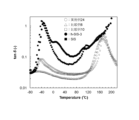
- FIG. 7 is a graph showing loss tangent (tan ⁇ ) data in dynamic viscoelasticity measurement of the liquid functional block copolymer-containing epoxy adhesive composition according to Example 24 of an embodiment of the present invention, and the liquid epoxy adhesive compositions according to Comparative Examples 6 and 10.
- FIG. 8(a) is a TEM image of a polystyrene-polyisoprene-polystyrene block copolymer (SIS)
- FIG. 8(b) is a TEM image of a polystyrene-functional polyisoprene-polystyrene block copolymer (h-SIS-3) used in Example 24
- FIG. 8(c) is a TEM image of a liquid epoxy adhesive composition according to Comparative Example 10, and FIG.
- FIG. 8(d) is a TEM image of a cured product of the liquid functional block copolymer-containing epoxy adhesive composition according to Example 24.
- FIG. 9(a) is a DSC thermogram of polystyrene-polyisoprene-polystyrene block copolymer (SIS), a cured product of a liquid epoxy adhesive composition according to Comparative Example 6, and a cured product of an epoxy adhesive composition according to Comparative Examples 7 to 11 containing a polystyrene-polyisoprene-polystyrene block copolymer (SIS); FIG.
- 9(b) is a DSC thermogram of a polystyrene-functional polyisoprene-polystyrene block copolymer (h-SIS-2) used in Examples 15 to 19, and a cured product of a functional block copolymer-containing epoxy adhesive composition according to Examples 15 to 19 containing the polystyrene-functional polyisoprene-polystyrene block copolymer; and FIG.
- 9(c) is a DSC thermogram of a polystyrene-functional polyisoprene-polystyrene block copolymer (h-SIS-3) used in Examples 21 to 25, and a cured product of a functional block copolymer-containing epoxy adhesive composition according to Examples 21 to 25 containing the polystyrene-functional polyisoprene-polystyrene block copolymer.
- h-SIS-3 polystyrene-functional polyisoprene-polystyrene block copolymer
- FIG. 10 is a graph showing the peel adhesion strength versus weight fraction of the block copolymer in the adhesive for cured products of functional block copolymer-containing epoxy adhesive compositions of Examples 15 to 25 and 27 to 31, which contain a functional block copolymer, and for cured products of liquid epoxy adhesive compositions of Comparative Examples 6 to 11, which contain a polystyrene-polyisoprene-polystyrene block copolymer (SIS).
- SIS polystyrene-polyisoprene-polystyrene block copolymer
- FIG. 11 is a graph showing dynamic splitting resistance versus weight fraction of the block copolymer in the adhesive for cured products of functional block copolymer-containing epoxy adhesive compositions of Examples 15 to 25 and 27 to 31, which contain a functional block copolymer, and for cured products of liquid epoxy adhesive compositions of Comparative Examples 6 to 11, which contain a polystyrene-polyisoprene-polystyrene block copolymer (SIS).
- FIG. 12 is an optical microscope photograph showing the phase separation state between polyisoprene and epoxy resin.
- the functional block copolymer-containing epoxy adhesive composition according to an embodiment of the present invention is a thermosetting epoxy resin composition having as its basic composition an epoxy resin and a curing agent for the epoxy resin, i.e., an epoxy resin having two or more epoxy groups (oxirane rings) in the molecule and a curing agent component having active hydrogen and catalytic action, blended with a functional block copolymer (hereinafter, sometimes simply referred to as "functional block copolymer”) consisting of a rubber-like polymer having a non-covalent functional group that is incompatible with the epoxy resin and has a glass transition temperature of 25°C or less, and a polymer that is compatible with the epoxy resin.
- a functional block copolymer consisting of a rubber-like polymer having a non-covalent functional group that is incompatible with the epoxy resin and has a glass transition temperature of 25°C or less, and a polymer that is compatible with the epoxy resin.
- Epoxy resins are generally compounds that have two or more epoxy groups (oxirane rings) in one molecule and give a three-dimensional cured product when cured with a curing agent.
- epoxy compounds having bisphenyl groups such as bisphenol A type, bisphenol F type, brominated bisphenol A type, hydrogenated bisphenol A type, bisphenol S type, bisphenol AD type, bisphenol AF type, and biphenyl type, epoxy compounds such as polyalkylene glycol type and alkylene glycol type, bifunctional glycidyl ether type epoxy resins such as epoxy compounds having a naphthalene ring and epoxy compounds having a fluorene group, novolac type epoxy resins such as phenol novolac type and orthocresol novolac type, multifunctional glycidyl ether and tetraphenylolethane type multifunctional glycidyl ether type epoxy resins, glycidyl ester type epoxy resins of synthetic fatty acids such as dimer acid, and N,N,
- modified epoxy resins such as urethane-modified epoxy resins, dimer acid-modified epoxy resins, and rubber-modified epoxy resins can also be used as the epoxy resin.
- the structure of the urethane-modified epoxy resin is not particularly limited as long as it is a resin having a urethane bond and two or more epoxy groups in the molecule, but it is preferable that the resin is obtained by reacting a urethane bond-containing compound having an isocyanate group with a hydroxyl group-containing epoxy compound, since the urethane bond and the epoxy group can be efficiently introduced into one molecule.
- the rubber-modified epoxy resin has two or more epoxy groups, and examples of the rubber skeleton include polybutadiene, acrylonitrile butadiene rubber (NBR), butadiene-acrylonitrile rubber (CTBN), etc. Two or more of these epoxy resins can also be used in combination.
- epoxy resins undergo a ring-opening polymerization curing reaction, so they experience less shrinkage during curing compared to other thermosetting resins.
- hydrophilic and hydrophobic groups within the molecule provides high adhesion to a variety of substrates.
- functional block copolymers consisting of a rubber-like polymer that is incompatible with epoxy resins, has a glass transition temperature of 25°C or less, and has a non-covalent functional group, and a polymer that is compatible with epoxy resins, are preferred from the viewpoint of high compatibility with functional styrene-based thermoplastic elastomers such as polystyrene-functional polyisoprene-polystyrene block copolymers.
- functional styrene-based thermoplastic elastomers such as polystyrene-functional polyisoprene-polystyrene block copolymers.
- DGEBA diglycidyl ether
- the benzene ring of bisphenol A also confers favorable properties such as adhesion, heat resistance, and chemical resistance.
- Bisphenol A type epoxy resins and the like can be used in liquid or solid form depending on the molecular weight, but due to their compatibility with functional styrene-based thermoplastic elastomers such as polystyrene-functional polyisoprene-polystyrene block copolymers, it is preferable to use high molecular weight ones that are solid at room temperature or low molecular weight ones that are liquid to semi-solid at room temperature.
- General-purpose epoxy resins that are solid at room temperature usually have a number average molecular weight of about 900 to 3000, and an epoxy equivalent in the range of 400 to 2500 g/eq, preferably 450 to 2200 g/eq.
- General-purpose epoxy resins that are liquid at room temperature usually have a number average molecular weight of about 300 to 500, and an epoxy equivalent in the range of 150 to 400 g/eq, preferably 180 to 300 g/eq.
- the epoxy equivalent means the number of grams of resin containing 1 gram equivalent of epoxy groups (unit: g/eq). If it is a liquid epoxy resin, it is preferable that the viscosity is within the range of 5,000 to 30,000 mPa ⁇ s/25°C, and more preferably within the range of 10,000 to 20,000 mPa ⁇ s/25°C.
- the curing agent may be any of those normally used for curing epoxy resins, i.e., any of those having an active group that reacts with an epoxy group, such as dicyandiamide, polyaminoamide, 4,4'-diaminodiphenyl sulfone, imidazole compounds such as 2-n-heptadecylimidazole, organic acid hydrazide compounds such as adipic acid dihydrazide, stearic acid dihydrazide, isophthalic acid dihydrazide, and dibasic acid hydrazide, urea compounds such as N,N-dialkyl urea derivatives and N,N-dialkyl thiourea derivatives, acid anhydrides such as tetrahydrophthalic anhydride, semicarbazide, cyanoacetamide, diaminodiphenyl sulfone, and the like.
- an epoxy group such as dicyandiamide, polyaminoamide, 4,4
- amine compounds include phenylmethane, aliphatic and aromatic tertiary amines, polyamines, amine compounds such as isophoronediamine and m-phenylenediamine, aminotriazoles such as 3-amino-1,2,4-triazole, N-aminoethylpiperazine, melamines, guanamines such as acetoguanamine and benzoguanamine, guanidines, dimethylureas, boron trifluoride complex compounds, boron trichloride complex compounds, Lewis acid complexes, polymercaptan, liquid phenols such as trisdimethylaminomethylphenol, polythiols, triphenylphosphine, ketimine compounds, sulfonium salts, onium salts, and phenol novolac resins. These may be used alone or in combination of two or more.
- heat-activated dispersion-type latent hardeners such as dicyandiamide, imidazole compounds, and organic acid hydrazides, which do not undergo chemical reactions with epoxy resins at room temperature, are preferred.
- dicyandiamide including derivatives such as polyepoxide addition modified products, amidation modified products, Mannich modified products, and Michael addition modified products
- thermal dissolution reaction type is more preferred.
- the hardener components dissolve and are activated by heat, and epoxy resins can be hardened at temperatures of 160 to 180°C.
- the amount of hardener to be added is set based on the amine equivalent and epoxy equivalent if the hardener is an amine such as dicyandiamide.
- the hardener such as dicyandiamide is added in an amount of 1 to 20 parts by weight, preferably 2 to 15 parts by weight, and more preferably 5 to 10 parts by weight per 100 parts by weight of epoxy resin.
- a curing accelerator may be blended to accelerate the chemical reaction between the epoxy resin and the curing agent by shortening the curing time or lowering the curing temperature.
- the curing accelerator curing accelerator
- examples of the curing accelerator (curing accelerator) that can be used include urea-based (dimethylurea, etc.), imidazole-based, amine-based, triphenylphosphine, etc.
- the amount is preferably within a range of 0.5 to 10 parts by mass, more preferably 0.7 to 8 parts by mass, and even more preferably 1 to 5 parts by mass, relative to 100 parts by mass of the epoxy resin. Within this range, the curing acceleration effect can be obtained without impairing the coatability, viscosity characteristics, adhesiveness, etc.
- the functional block copolymer consisting of a rubber-like polymer that is incompatible with epoxy resins, has a glass transition temperature (T g ) of 25° C. or lower, and has a non-covalent functional group, and a polymer that is compatible with epoxy resins, is a diblock copolymer or triblock polymer that is a two-component block copolymer consisting of a polymer block that is incompatible with epoxy resins and a polymer block that is compatible with epoxy resins, and is preferably a triblock polymer having polymer blocks that are compatible with epoxy resins at both ends and a polymer block that is incompatible with epoxy resins inside.
- T g glass transition temperature
- the functional block copolymer consisting of a rubber-like polymer that is incompatible with epoxy resins, has a glass transition temperature (T g ) of 25° C. or less, and has a non-covalent functional group, and a polymer that is compatible with epoxy resins, is preferably a functional block copolymer in which a non-covalent functional group has been introduced into a block copolymer of an aromatic vinyl polymer and a conjugated diene polymer, and examples of such functional block copolymers include polystyrene-functional polyisoprene-polystyrene block copolymers and polystyrene-functional polyisoprene-polystyrene block copolymers obtained by introducing a non-covalent functional group into a styrene-based thermoplastic elastomer such as polystyrene-polyisoprene-polystyrene block copolymer (SIS) or polystyrene
- Examples of the functional styrene-based thermoplastic elastomers that can be used include functional styrene-based thermoplastic elastomers such as styrene-functional polybutadiene-polystyrene block copolymers, and functional hydrogenated styrene-based thermoplastic elastomers such as polystyrene-functional polyethylene-propylene-polystyrene block copolymers and polystyrene-functional polyethylene-butylene-polystyrene block copolymers, which are obtained by introducing non-covalent functional groups into hydrogenated styrene-based thermoplastic elastomers such as polystyrene-polyethylene-propylene-polystyrene block copolymers (SEPS) and polystyrene-polyethylene-butylene-polystyrene block copolymers (SEBS) by modification treatment or the like.
- examples of the functional block copolymer include polystyrene-functional polyisoprene-polystyrene block copolymers in which the polyisoprene chain of the polystyrene-polyisoprene-polystyrene block copolymer (SIS) contains a polymerized portion of a monomer having a non-covalently bonded functional group, preferably a hydrogen-bonding or ionic-bonding functional group; polystyrene-functional polyethylene-propylene-polystyrene block copolymers in which the polyethylene-propylene chain of the polystyrene-polyisoprene-polystyrene block copolymer (SEPS), which is a hydrogenated product of the polystyrene-polyisoprene-polystyrene block copolymer (SIS), contains a polymerized portion of a monomer having a non-covalently
- block copolymer examples include polystyrene-functionalized polybutadiene-polystyrene block copolymers containing a polymerized portion of a monomer having a functional group capable of bonding with another polymer, polystyrene-functionalized polyethylene-butylene-polystyrene block copolymers (SEBS) which are hydrogenated products of polystyrene-polybutadiene-polystyrene block copolymers (SBS) in which the polyethylene-butylene chains of the SEBS block copolymers contain a polymerized portion of a monomer having a non-covalently bonded functional group, preferably a hydrogen-bonding or ionic-bonding functional group, and polystyrene-functionalized polyisobutylene-polystyrene block copolymers (SIBS) which are styrene-based thermoplastic elastomers containing polyisobuty
- triblock polymers having blocks at both ends that have a glass transition temperature (T g ) exceeding 25°C and are compatible with epoxy resins, and an internal block with a rubber structure that has a glass transition temperature (T g ) of 25°C or lower and is incompatible with epoxy resins.
- polystyrene-polyisoprene-polystyrene block copolymer is a type of styrene-based thermoplastic elastomer (TPS) among thermoplastic elastomers (TPE), and is a triblock copolymer made of styrene (S) and isoprene (I), which are incompatible with each other, and is a thermoplastic block copolymer having, as basic structural units, a block (hard segment) made of polystyrene having a glass transition temperature (T g ) of about 100°C and a block (soft segment) made of isoprene having a glass transition temperature (T g ) of about -20 to -80°C.
- TPS thermoplastic elastomer
- I isoprene
- polystyrene-polyisoprene-polystyrene block copolymers which are functional block copolymers in which non-covalent functional groups have been introduced into the polyisoprene chains
- thermoplastic block copolymers having, as basic structural units, mutually incompatible polystyrene blocks (hard segments) having a glass transition temperature (T g ) of about 100° C. and functionalized polyisoprene blocks (soft segments) containing polymerized portions of monomers having non-covalent functional groups in the polyisoprene chains and having a glass transition temperature (T g ) of 25° C. or lower.
- polystyrene-polybutadiene-polystyrene block copolymer is also a type of styrene-based thermoplastic elastomer (TPS) among thermoplastic elastomers (TPE), and is a triblock copolymer made of styrene (S) and butadiene (B), which are incompatible with each other, and is a thermoplastic block copolymer having, as basic structural units, a block (hard segment) made of polystyrene having a glass transition temperature (T g ) of about 100°C and a block (soft segment) made of butadiene having a glass transition temperature (T g ) of about -30 to -80°C.
- TPS thermoplastic elastomer
- TPE thermoplastic elastomers
- B butadiene
- polystyrene-polybutadiene-polystyrene block copolymers which are functional block copolymers in which non-covalent functional groups have been introduced into the polybutadiene chains
- thermoplastic block copolymers having, as basic structural units, mutually incompatible polystyrene blocks (hard segments) having a glass transition temperature (T g ) of about 100° C. and functional polybutadiene blocks (soft segments) containing polymerized portions of monomers having non-covalent functional groups in the polybutadiene chains and having a glass transition temperature (T g ) of 25° C. or lower.
- saturated TPS hydrogenated TPS
- SEPS saturated TPS polystyrene-polyethylene propylene-polystyrene block copolymer
- SEBS saturated TPS polystyrene-polyethylene butylene-polystyrene block copolymer
- the polystyrene-functional polyethylene propylene-polystyrene block copolymer is a thermoplastic block copolymer having, as basic structural units, a polystyrene block (hard segment) having a glass transition temperature (T g ) of about 100°C and a functional polyethylene propylene block (soft segment) which contains a polymerized portion of a monomer having a non-covalent functional group in the polyethylene propylene chain and has a glass transition temperature (T g ) of 25°C or lower, which are mutually incompatible.
- SEPS polystyrene-polyethylene propylene-polystyrene block copolymer
- the functional block copolymer is a thermoplastic block copolymer having, as basic structural units, a polystyrene block (hard segment) having a glass transition temperature (T g ) of about 100°C, which are incompatible with each other, and a functionalized polyethylene butylene block (soft segment) having a glass transition temperature (T g ) of 25°C or lower, which contains a polymerized portion of a monomer having a non-covalent functional group in the polyethylene butylene chain and is made of functionalized polyethylene butylene.
- SEBS polystyrene-functionalized polyethylene butylene-polystyrene block copolymer
- polystyrene-polyisobutylene-polystyrene block copolymer is a type of isobutylene-based thermoplastic elastomer among thermoplastic elastomers (TPE), and is a triblock copolymer consisting of styrene (S) and isobutylene (IB), and is a thermoplastic block copolymer having, as basic structural units, a block (hard segment) consisting of polystyrene having a glass transition temperature (T g ) of about 100°C, and a block (soft segment) consisting of polyisobutylene having a glass transition temperature (T g ) of about -80°C.
- TPE thermoplastic elastomers
- IB isobutylene
- polystyrene-functional polyisobutylene-polystyrene block copolymers which are functional block copolymers in which non-covalent functional groups have been introduced into the polyisobutylene chains
- thermoplastic block copolymers having, as basic structural units, a polymer (hard segment) made of a styrene block made of polystyrene having a glass transition temperature (T g ) of about 100°C, which are incompatible with each other, and a polymer (soft segment) made of functional polyisobutylene containing a polymerized portion of a monomer having a non-covalent functional group in the polyisobutylene chain and having a glass transition temperature (T g ) of 25°C or lower.
- T g glass transition temperature
- the functional (hydrogenated) styrene-based thermoplastic elastomer of the present embodiment which is a functional block copolymer consisting of a rubber-like polymer that is incompatible with the epoxy resin, has a glass transition temperature (T g ) of 25° C.
- a non-covalent functional group such as a polyisoprene chain, polybutadiene chain, polyethylene-propylene chain, polyethylene-butylene chain, or polyisobutylene chain of a (hydrogenated) styrene-based thermoplastic elastomer by a modification method using a modifier or a functional group conversion reaction of an alkene.
- a rubber-like polymer such as a polyisoprene chain, polybutadiene chain, polyethylene-propylene chain, polyethylene-butylene chain, or polyisobutylene chain of a (hydrogenated) styrene-based thermoplastic elastomer
- the non-covalently bonding functional group contained in the rubbery polymer is preferably a hydrogen-bonding functional group or an ionic-bonding functional group, excluding a functional group having an oxirane ring skeleton, such as an epoxy group or a glycidyl group, or a hydroxyl group obtained by ring-opening thereof.
- the hydrogen-bonding functional group is preferably an amide group, an imide group, a carboxyl group, a phenol group, a pyridyl group, an imidazolyl group, a pyrazolyl group, or a urethane group
- the ionic-bonding functional group is preferably a carboxylate group, a phosphonate group, a sulfonate group, an ammonium group, a pyridinium group, an imidazolium group, or a pyrazolium group.
- the non-covalent functional group contained in the monomer of the rubber polymer may be any one of the above-mentioned types, or two or more of the above-mentioned types of functional groups may be introduced.
- a method for producing a functional styrenic thermoplastic elastomer which is a functional block copolymer consisting of a rubber-like polymer that is incompatible with epoxy resins, has a glass transition temperature (T g ) of 25° C. or less, and has a non-covalent functional group, and a polymer that is compatible with epoxy resins, by introducing a non-covalent functional group into a (hydrogenated) styrenic thermoplastic elastomer, will be described using an example in which a non-covalent functional group is introduced into a (hydrogenated) styrenic thermoplastic elastomer by modification treatment with a modifying agent, etc.
- a non-covalent functional group can be introduced into the rubber-like polymer of a (hydrogenated) styrene-based thermoplastic elastomer by a modification method using a modifying agent such as an unsaturated carboxylic acid or an unsaturated dicarboxylic acid anhydride.
- a modifying agent such as an unsaturated carboxylic acid or an unsaturated dicarboxylic acid anhydride.
- an unsaturated carboxylic acid as a modifying agent (for example, an ethylenically unsaturated carboxylic acid having 8 or less carbon atoms, such as acrylic acid, methacrylic acid, crotonic acid, maleic acid, fumaric acid, itaconic acid, or citraconic acid, or a Diels-Alder adduct of a conjugated diene, such as 3,6-endomethylene-1,2,3,6-tetrahydrophthalic acid, with an ⁇ , ⁇ -unsaturated dicarboxylic acid having 8 or less carbon atoms, a carboxyl group (hydrogen-bonding functional group) derived from the unsaturated carboxylic acid can be introduced as a non-covalently bonding functional group.
- an unsaturated carboxylic acid for example, an ethylenically unsaturated carboxylic acid having 8 or less carbon atoms, such as acrylic acid, methacrylic acid, crotonic acid, maleic acid, fuma
- a further non-covalent functional group e.g., an amide group which is a hydrogen-bonding functional group, or a metal salt of a carboxylic acid, i.e., a carboxylate group which is an ionic-bonding functional group
- a further non-covalent functional group e.g., an amide group which is a hydrogen-bonding functional group, or a metal salt of a carboxylic acid, i.e., a carboxylate group which is an ionic-bonding functional group
- an unsaturated dicarboxylic anhydride e.g., an ⁇ , ⁇ -unsaturated dicarboxylic anhydride having 8 or less carbon atoms, such as maleic anhydride, itaconic anhydride, or citraconic anhydride, or a Diels-Alder adduct of a conjugated diene, such as 3,6-endomethylene-1,2,3,6-tetrahydrophthalic anhydride, with an ⁇ , ⁇ -unsaturated dicarboxylic anhydride having 8 or less carbon atoms
- an acid anhydride group derived from the unsaturated dicarboxylic anhydride is introduced, and this is further treated with a base to react a part or all of the acid anhydride group with a base, thereby introducing a non-covalent functional group (e.g., an amide group, which is a hydrogen-bonding functional group, or a metal salt of a carboxylic acid,
- an acid anhydride group derived from an unsaturated dicarboxylic anhydride may be introduced by a modification treatment using an unsaturated dicarboxylic anhydride as a modifier, and the acid anhydride group may be reacted with a base by a base treatment to form an amide group and a carboxyl group, and then the carboxyl group may be reacted with a base by a further base treatment to form the carboxyl group into a salt of a carboxylic acid, i.e., a carboxylate group which is an ionic functional group.
- a carboxyl group which is a hydrogen-bonding functional group
- the acid anhydride group introduced by the modification treatment using an unsaturated dicarboxylic anhydride as a modifier may be hydrolyzed with a base to form a carboxyl group, and then the carboxyl group may be reacted with a base by a further base treatment to form a salt of a carboxylic acid, i.e., a carboxylate group which is an ionic functional group.
- a base is mixed in and neutralized to introduce an ion-bonding functional group (such as a salt of a carboxylic acid) generated by the reaction between an acidic group (e.g., a carboxyl group, etc.) derived from the Arrhenius acid introduced by modification and an Arrhenius base (e.g., a metal-containing compound, ammonium, an amine compound, pyridine, imidazole, etc.).
- an ion-bonding functional group such as a salt of a carboxylic acid generated by the reaction between an acidic group derived from the Bronsted acid introduced by modification and a Bronsted base can be introduced.
- the non-covalent functional group When a non-covalent functional group is introduced by a modification treatment using such a modifying agent, the non-covalent functional group will contain a residue of the modifying agent (e.g., a residue of an unsaturated carboxylic acid or a residue of an unsaturated dicarboxylic acid anhydride).
- a residue of the modifying agent e.g., a residue of an unsaturated carboxylic acid or a residue of an unsaturated dicarboxylic acid anhydride.
- an unsaturated carboxylic acid or an unsaturated dicarboxylic acid anhydride is preferable, an unsaturated dicarboxylic acid anhydride is more preferable, an ⁇ , ⁇ -unsaturated aliphatic dicarboxylic acid anhydride having 8 or less carbon atoms is even more preferable, and maleic anhydride is particularly preferable.
- an alkali metal-containing compound e.g., oxides, hydroxides, carbonates, hydrogen carbonates, acetates, sulfates, phosphates, etc. of alkali metals such as sodium, lithium, and potassium
- an alkaline earth metal-containing compound e.g., oxides, hydroxides, carbonates, hydrogen carbonates, acetates, sulfates, phosphates, etc.
- an amine compound e.g., aliphatic amines, aromatic amines, alicyclic amines, heterocyclic amines, etc.
- ammonia etc.
- an amide group which is a hydrogen-bonding functional group, is generated (introduced) as a non-covalent functional group.
- the functional block copolymer is one in which an acid anhydride group is formed by the modification treatment, and two types of hydrogen-bonding functional groups, an amide group and a carboxyl group, are introduced as non-covalent functional groups by the reaction with the amine compound of the base.
- the rubber-like polymer can contain non-covalent functional groups, such as carboxyl groups (hydrogen-bonding functional groups) generated by modification with an unsaturated carboxylic acid or the like modifying agent, functional groups generated by reacting the carboxyl groups with a base such as an alkali metal-containing compound, an alkaline earth metal-containing compound, ammonia, or an amine compound (e.g., amide groups, which are hydrogen-bonding functional groups, or metal salts of carboxyl acids, i.e., carboxylate groups, which are ionic-bonding functional groups), functional groups generated by reacting an acid anhydride group (a group derived from an unsaturated dicarboxylic acid anhydride) generated by modification with an unsaturated dicarboxylic acid anhydride or the like modifying agent with a base such as an alkali metal-containing compound, an alkaline earth metal-containing compound, ammonia, or an amine compound or hydrolyzing the acid anhydr
- a base such as an alkali metal
- the rubbery polymer may contain one monomer having one or more types of non-covalent functional groups, or may contain two or more monomers having one or more types of non-covalent functional groups.
- the non-covalent functional group is not limited to being directly bonded to the main chain of the rubber polymer, but may be bonded via a linking group.
- the introduction rate of the non-covalent functional group of the rubber-like polymer in the functional block copolymer is preferably within a range of 1 mol % or more and 30 mol % or less, more preferably 2.5 mol % or more and 25 mol % or less, and even more preferably 5 mol % or more and 20 mol % or less, relative to 100 mol % of the monomer units constituting the rubber-like polymer having the non-covalent functional group.
- the non-covalent bonds between the non-covalent functional groups within or between molecules can be rearranged, and the concentration of stress at the non-covalent crosslinking points is not caused, so that improvement in toughness can be stably ensured.
- the functional block copolymer preferably has a weight average molecular weight (Mw) in the range of 30,000 to 500,000, more preferably 60,000 to 480,000, and even more preferably 90,000 to 450,000. Furthermore, the weight average molecular weight (Mw) of the rubbery polymer in the functional block copolymer is preferably in the range of 10,000 to 500,000, more preferably in the range of 40,000 to 400,000, and the weight average molecular weight (Mw) of the polymer compatible with the epoxy resin in the functional block copolymer is preferably in the range of 3,000 to 50,000, more preferably in the range of 6,000 to 20,000.
- Mw weight average molecular weight
- the method for producing polystyrene-polyisoprene-polystyrene block copolymer (SIS) into which the above-mentioned non-covalent functional groups are introduced generally involves first filling a polymerization vessel with a solvent such as purified cyclohexane (e.g., hexane, cyclohexane, etc.), then adding purified styrene, and adding a lithium catalyst such as butyllithium as a polymerization initiator, and polymerizing the polystyrene block under nitrogen to produce polystyrene lithium.
- a solvent such as purified cyclohexane (e.g., hexane, cyclohexane, etc.)
- a lithium catalyst such as butyllithium as a polymerization initiator
- isoprene is added to produce polystyrene-polyisoprene lithium
- styrene is added to produce polystyrene-polyisoprene-polystyrene lithium
- the active end is deactivated with water, acid, alcohol, etc.
- polystyrene-polyisoprene-polystyrene block copolymer SIS
- such a production method using living anionic polymerization allows control of the content, molecular weight, and molecular weight distribution of styrene and isoprene, as well as the monomer arrangement such as the chain of styrene and isoprene, the branched structure, and the isomer composition of the isoprene portion, and thus allows for a high degree of freedom in polymer structure design.
- Polystyrene-polyisoprene-polystyrene block copolymers produced by known methods such as solution polymerization (batch) can also be used, and commercially available products such as Quintack (registered trademark) from Zeon Corporation, VECTOR (registered trademark) from TSRC Corporation, Hypler from Kuraray Corporation, and Kraton D from Kraton Polymer Japan can also be used.
- polystyrene-polyisoprene-polystyrene block copolymers are usually symmetrical in that the molecular weights of the two styrene blocks at both ends are the same, but they may also be asymmetrical in that the molecular weights of the two styrene blocks at both ends are different.
- polystyrene-polybutadiene-polystyrene block copolymer similarly to the polystyrene-polyisoprene-polystyrene block copolymer (SIS), a polystyrene-polybutadiene-polystyrene block copolymer produced by the above-mentioned production method using butadiene instead of isoprene can be used.
- polystyrene-polybutadiene-polystyrene block copolymers such as Tufprene (registered trademark) and Asaprene (registered trademark) manufactured by Asahi Kasei Chemicals Corporation and Epofriend manufactured by Daicel Chemical Industries, Ltd.
- SEPS polystyrene-polyethylene propylene-polystyrene block copolymer
- SEPS commercially available products such as SEPTON from Kuraray Co., Ltd.
- SEBS polystyrene-polyethylene butylene-polystyrene block copolymer
- SEBS polystyrene-polyethylene butylene-polystyrene block copolymer
- TUFTEC polystyrene-polyethylene butylene-polystyrene block copolymer
- RAVALON from Mitsubishi Chemical Corporation
- ACTIMER from Riken Technos Corporation
- ELASTOMER AR from Aronkasei Corporation
- CRAYTON G from Kraton Polymer Japan Co., Ltd.
- SIBS polystyrene-polyisobutylene-polystyrene block copolymer
- SIBSTAR registered trademark
- non-covalent functional groups such as hydrogen-bonding functional groups or ionic-bonding functional groups have been introduced
- the non-covalent functional groups are non-covalently bonded between molecules or within molecules, and these non-covalent bonds can be freely dissociated and recombined. This allows for reversible pseudo-crosslinking points and physical crosslinking points due to non-covalent bonds, i.e., dynamic bonding ability between molecules and within molecules, resulting in high toughness.
- a functional block copolymer consisting of a rubbery polymer having a non-covalent functional group that is incompatible with epoxy resin and has a glass transition temperature ( Tg ) of 25°C or less, and a polymer compatible with epoxy resin
- the polymer compatible with epoxy resin in the functional block copolymer is compatible with epoxy resin
- the rubbery polymer having a non-covalent functional group is incompatible with epoxy resin, so that the rubbery polymer incompatible with epoxy resin is dispersed in the epoxy resin, and the elongation, flexibility and elastic modulus of the rubbery polymer are exhibited, thereby toughening the adhesive cured product.
- the rubber-like polymer incompatible with the epoxy resin in the functional block copolymer has a non-covalent functional group
- the non-covalent functional groups bond non-covalently between molecules or within molecules to form reversible pseudo-crosslinking points and physical crosslinking points, so that elasticity and flexibility such as breaking elongation, maximum stress, and toughness are improved, and toughness can be further increased.
- the peel strength and impact resistance of the cured epoxy resin can be improved.
- this functional block copolymer consisting of a rubber-like polymer with non-covalent functional groups that is incompatible with epoxy resin and has a glass transition temperature of 25°C or less, and a polymer that is compatible with epoxy resin, it is possible to reduce internal stresses caused by cure shrinkage and thermal shrinkage when the adhesive composition is cured, and stresses that occur at the interface between the adhesive and adherend after adhesion due to differences in the thermal expansion coefficients between them, thereby improving the durability of the cured adhesive, which is a cured epoxy resin product.
- the content of the polymer compatible with the epoxy resin in the functional block copolymer is within the range of 3% by mass or more and 80% by mass or less, so that the compatibility with the epoxy resin can be increased and the mixture can be mixed homogeneously, and therefore, more stable properties of the cured adhesive can be obtained. More preferably, it is within the range of 5% by mass or more and 70% by mass or less, and even more preferably, it is within the range of 10% by mass or more and 50% by mass or less.
- chemical manufacturers that handle TPS generally sell products with a polystyrene weight fraction of 10 to 50 wt%, so if it is within this range, production is easy and a cured adhesive with more stable properties can be obtained.
- the content of the rubber-like polymer having a non-covalent functional group if the content of the rubber-like polymer having a non-covalent functional group in the functional block copolymer is within the range of 20% by mass or more and 97% by mass or less, the elongation, flexibility and elastic modulus can be stably increased, and the peel strength and impact resistance can be increased. More preferably, it is within the range of 30% by mass or more and 95% by mass or less, and even more preferably, it is within the range of 50% by mass or more and 90% by mass or less.
- the functional block copolymer can effectively toughen the epoxy resin cured product without impairing the coatability, preferably in the range of 1 part by mass or more and 3,500 parts by mass or less per 100 parts by mass of the epoxy resin. More preferably, it is in the range of 1.5 parts by mass or more and 3,400 parts by mass or less, even more preferably 2 parts by mass or more and 3,200 parts by mass or less, and particularly preferably 3.0 parts by mass or more and 3,000 parts by mass or less.
- the rubber-like polymer having a non-covalent functional group in the functional block copolymer is preferably in the range of 0.5 parts by mass or more and 3000 parts by mass or less relative to 100 parts by mass of the epoxy resin, the elongation, flexibility and elastic modulus can be stably increased, and the peel strength and impact resistance can be increased, more preferably in the range of 0.8 parts by mass or more and 2800 parts by mass or less, even more preferably in the range of 1.0 parts by mass or more and 2500 parts by mass or less, and particularly preferably in the range of 1.5 parts by mass or more and 2000 parts by mass or less.
- the content of the polymer compatible with the epoxy resin in the block copolymer is within the range of 0.1 parts by mass or more and 650 parts by mass or less per 100 parts by mass of the epoxy resin, compatibility with the epoxy resin can be increased and the mixture can be homogeneously mixed, so that more stable properties of the adhesive cured product can be obtained, more preferably within the range of 0.15 parts by mass or more and 620 parts by mass or less, and more preferably within the range of 0.2 parts by mass or more and 600 parts by mass or less.
- the rubber-like polymer having a non-covalent functional group in the functional block copolymer preferably contains a monomer unit of a functional polyisoprene in which a non-covalent functional group is introduced into a polyisoprene chain, a functional polybutadiene in which a non-covalent functional group is introduced into a polybutadiene chain, a functional hydrogenated polyisoprene in which a non-covalent functional group is introduced into a hydrogenated isoprene chain, a polyethylene-propylene chain, or a functional hydrogenated polybutadiene in which a non-covalent functional group is introduced into a hydrogenated butadiene chain, a polyethylene-butylene chain, and the content of these monomer units is preferably 50 mol% or more, more preferably 70 mol% or more, and even more preferably 90 mol% or more.
- the polymer compatible with the epoxy resin preferably contains a monomer unit having a styrene skeleton, a methacrylic skeleton, an acrylic skeleton, or an ether skeleton, and the content of these monomer units is preferably 50 mol % or more, more preferably 70 mol % or more, and even more preferably 90 mol % or more. This makes it possible to improve properties such as rubber elasticity, heat aging resistance, and weather resistance.
- the functional block copolymer is a functional styrene-based thermoplastic elastomer containing a functional polyisoprene obtained by introducing a non-covalent functional group into polyisoprene, a functional styrene-based thermoplastic elastomer containing a functional polybutadiene obtained by introducing a non-covalent functional group into polybutadiene, a functional styrene-based thermoplastic elastomer containing a functional hydrogenated polyisoprene obtained by introducing a non-covalent functional group into hydrogenated polyisoprene, or a functional styrene-based thermoplastic elastomer containing a functional hydrogenated polybutadiene obtained by introducing a non-covalent functional group into hydrogenated polybutadiene.
- Such functional (hydrogenated) styrene-based thermoplastic elastomers can be produced at a relatively low cost, since styrene-based thermoplastic elastomers are easily available and produced. Furthermore, because of their high elastic modulus, they can increase the toughness of the cured epoxy resin material at low cost, thereby improving the peel strength and impact resistance.
- the method for producing the epoxy adhesive composition is not particularly limited, but for example, a masterbatch epoxy adhesive composition is produced by carrying out a mixing step in which the epoxy resin and the functional block copolymer are mixed with a solvent, and a solvent removal step in which the solvent is removed by evaporating it by heating or the like.
- the curing agent may be mixed together with the epoxy resin, the functional block copolymer, and the solvent in the mixing step, or may be mixed after the solvent removal step.
- a mixer for mixing (including kneading) the epoxy resin, the functional block copolymer, and the solvent
- a mixer for mixing (including kneading) the epoxy resin, the functional block copolymer, and the solvent
- a planetary mixer, Disper (Dissolver), Henschel mixer, kneader, roll mill, homogenizer, intermixer, kneader, roll, etc. can be used.
- Solvents that can be used in this case include, for example, tetrahydrofuran (THF), 2-methyltetrahydrofuran, toluene, acetone, cyclohexane, normal hexane, ethyl acetate, methanol, methylene chloride (dichloromethane), methyl ethyl ketone (MEK), butyl acetate, methylcyclohexane (MCH), N,N-dimethylformamide (DMF), and N-methyl-2-pyrrolidone (NMP).
- THF tetrahydrofuran
- 2-methyltetrahydrofuran 2-methyltetrahydrofuran
- toluene acetone
- cyclohexane normal hexane
- ethyl acetate methanol
- methylene chloride dimethyl ketone
- MEK methyl ethyl ketone
- NMP N-
- the epoxy adhesive composition of this embodiment thus prepared is in liquid, paste, or film (sheet) form. If it is in liquid or paste form, it can be applied to the object to be bonded (adherend) by a known method, such as spraying using a pump or the like, applying with a gun, or applying with a brush. For example, if the object to be bonded is a car body, it is applied to the joints of the car body by spraying using a pump or the like, applying with a gun, or the like, in a car body manufacturing process. If it is in film (sheet) form, it can be applied to the adherend by applying a solution of a resin or functional block copolymer mixed in a solvent to the adherend and drying it, or it can be attached to the adherend.
- a liquid or paste-like epoxy adhesive composition can be obtained.
- a liquid or paste-like epoxy adhesive composition can be obtained by volatilizing and removing the solvent from a liquid or paste-like mixture prepared by mixing a functional block copolymer, a solvent, and an epoxy resin.
- the functional block copolymer is preferably blended in an amount of 2.0 parts by mass or more and 56 parts by mass or less, more preferably 3.0 parts by mass or more and 55 parts by mass or less, per 100 parts by mass of the epoxy resin.
- a film-like epoxy adhesive composition can be obtained.
- a film-like epoxy adhesive composition can be obtained by spreading a solution prepared by mixing a functional block copolymer, a solvent, and an epoxy resin on a sheet (substrate) such as a board or pad on which a sheet is laid, and volatilizing and removing the solvent.
- the functional block copolymer is preferably blended in an amount of 80 parts by mass or more and 3,500 parts by mass or less, more preferably 100 parts by mass or more and 3,000 parts by mass or less, per 100 parts by mass of the epoxy resin.
- additives such as reactive diluents (epoxy-based reactive diluents having epoxy groups, etc.) for reducing viscosity and improving fluidity
- fillers such as heavy calcium carbonate and talc, silica fine powder, carbon black such as Ketjen black, colloidal calcium carbonate (fine calcium carbonate), sepiolite, thixotropy-imparting agents (thixotropic agents, thixotropic agents) such as colloidal hydrated aluminum silicate/organic complexes, viscosity adjusters (thickeners), heat resistance-imparting agents such as multifunctional epoxy resins (e.g.
- novolac-type epoxy resins novolac-type epoxy resins
- glycidyl amine resins glycidyl ether resins
- acrylic resins as adhesion improvers, coupling agents, etc. may be blended as necessary, i.e. depending on the object to be bonded (adherend), the environment of the bonding location, the desired properties, etc.
- additives such as pigments, dyes, colorants, defoamers, leveling agents, tackifiers (adhesion promoters), flame retardants, catalysts, plasticizers, reaction retarders, antioxidants, antioxidants, antistatic agents, conductivity promoters, lubricants, sliding agents, UV absorbers, surfactants, dispersants, dispersion stabilizers, dehydrating agents, crosslinking agents, rust inhibitors, solvents, etc. can also be added.
- tackifiers as flame retardants, catalysts, plasticizers, reaction retarders, antioxidants, antioxidants, antistatic agents, conductivity promoters, lubricants, sliding agents, UV absorbers, surfactants, dispersants, dispersion stabilizers, dehydrating agents, crosslinking agents, rust inhibitors, solvents, etc.
- the epoxy adhesive composition of this embodiment by containing an epoxy resin, a curing agent, and a functional block copolymer consisting of a rubber-like polymer that is incompatible with the epoxy resin and has a non-covalent functional group having a glass transition temperature ( Tg ) of 25°C or lower, and a polymer that is compatible with the epoxy resin, the low toughness of the epoxy resin, which is poor in flexibility and hard and brittle, is improved by the blending of the functional block copolymer consisting of a rubber-like polymer that is incompatible with the epoxy resin and has a non-covalent functional group having a glass transition temperature ( Tg ) of 25°C or lower, and a polymer that is compatible with the epoxy resin, and a tough adhesive cured product is obtained.
- Tg glass transition temperature
- the polymer compatible with the epoxy resin in the functional block copolymer is compatible with the epoxy resin, and the polymer compatible with the epoxy resin in the functional block copolymer and the rubbery polymer having non-covalent functional groups that is incompatible with the epoxy resin in the functional block copolymer are linked by chemical bonds, so that even at room temperature, the rubbery polymer having non-covalent functional groups is dispersed and present in the epoxy resin, and the elongation, flexibility and elastic modulus due to the rubbery polymer having non-covalent functional groups are expressed.
- functional block copolymers containing rubber-like polymers with non-covalent functional groups such as hydrogen-bonding functional groups or ionic-bonding functional groups form non-covalent bonds between or within molecules, and these non-covalent bonds can be freely dissociated and recombined.
- the rubber-like polymer having the non-covalent functional group of the functional block copolymer exhibits elongation, flexibility and elastic modulus, which makes it easier to absorb impact energy, thereby improving the impact resistance of the obtained cured adhesive.
- the formation of reversible pseudo-crosslinking points and physical crosslinking points due to non-covalent bonds between the non-covalent functional groups of the rubber-like polymer of the functional block copolymer and their rearrangement, i.e., the rearrangement of the non-covalent bonds between the non-covalent functional groups enables the dispersion and alleviation of stress, thereby obtaining high impact resistance. Therefore, by incorporating a functional block copolymer, it is possible to reduce these stresses and impact energies, thereby improving the durability of the cured adhesive.
- an epoxy resin is thermosetting
- a functional block copolymer consisting of a rubber-like polymer having a non-covalent functional group that is incompatible with the epoxy resin and has a glass transition temperature ( Tg ) of 25°C or lower and a polymer compatible with the epoxy resin is a thermoplastic elastomer
- Tg glass transition temperature
- the epoxy resin and the functional block copolymer can be mixed without separation.
- the epoxy resin and the functional block copolymer can be mixed more easily and homogeneously.
- liquid rubber e.g., butadiene acrylonitrile copolymer
- liquid rubbers are poorly compatible with epoxy resins and difficult to mix, so that the mixing reaction between them requires time and effort, and in addition, they do not show sufficient compatibility in the cured epoxy resin, so that dispersibility is poor and there is a limit to how much toughening can be achieved.
- phase separation occurs and large domains (dispersed rubber particle phases) of several to several tens of micrometers or more are formed, and the formation of such domains also strongly depends on the curing conditions, making it difficult to obtain stable properties.
- core-shell rubber particles can be used to improve these problems with liquid rubber, but it is difficult to mix and disperse powdered core-shell rubber particles uniformly into thermosetting resins without destroying them, and because of the shell content, the effect of improving toughness relative to the amount of rubber component added is small, so there is a limit to how much the adhesive composition can be toughened by improving its flexibility and elongation without impairing its applicability. Furthermore, such core-shell rubber particles are labor-intensive to produce and are expensive.
- the epoxy adhesive composition of the present embodiment imparts toughness by blending a functional block copolymer consisting of a rubbery polymer having a non-covalent functional group that is incompatible with epoxy resin and has a glass transition temperature ( Tg ) of 25° C. or lower, and a polymer that is compatible with epoxy resin. That is, because the polymer that is compatible with epoxy resin in the functional block copolymer is compatible with epoxy resin, no domains are formed even at room temperature, and the elongation, flexibility and elastic modulus due to the rubbery polymer having a non-covalent functional group are expressed.
- Tg glass transition temperature
- the non-covalent functional groups are non-covalently bonded between molecules or within molecules, and the non-covalent bonds can be freely dissociated and recombined.
- This allows for reversible pseudo-crosslinking points and physical crosslinking points due to the non-covalent bonds, i.e., dynamic bonding ability between molecules or within molecules, thereby providing high toughness. This makes it possible to improve the peel strength and impact resistance of the cured adhesive made of epoxy resin.
- a functional block copolymer consisting of a rubber-like polymer having a non-covalent functional group that is incompatible with epoxy resin and has a glass transition temperature (T g ) of 25° C. or less, and a polymer compatible with epoxy resin
- the polymer compatible with epoxy resin in the functional block copolymer is compatible with epoxy resin, so that the rubber-like polymer having a non-covalent functional group has good dispersibility in epoxy resin, and the elongation, flexibility and elastic modulus due to the rubber-like polymer having a non-covalent functional group are expressed, and in particular, high toughness that improves peel strength and impact resistance is exhibited by non-covalent bonding between molecules or intramolecularly between the non-covalent functional groups of the rubber-like polymer.
- the functional block copolymer consisting of a rubber-like polymer having a non-covalent functional group that is incompatible with epoxy resin and has a glass transition temperature (T g ) of 25° C. or less, and a polymer compatible with epoxy resin can be synthesized relatively easily, and can be reduced in cost.
- a functional block copolymer consisting of a rubber-like polymer having a non-covalent functional group that is incompatible with epoxy resins and has a glass transition temperature (T g ) of 25° C. or lower, and a polymer that is compatible with epoxy resins, can improve toughness without impairing coatability and while maintaining the original properties of epoxy resins (heat resistance, adhesiveness, mechanical properties, durability, etc.), and can also improve crack resistance, fatigue resistance, and durability by reducing stress, which allows the absorption of residual strain associated with shrinkage caused by curing and heat.
- T g glass transition temperature
- a functional block copolymer consisting of a rubbery polymer having a non-covalent functional group that is incompatible with epoxy resins and has a glass transition temperature ( Tg ) of 25°C or lower, and a polymer that is compatible with epoxy resins
- the rubbery polymer having a non-covalent functional group and the polymer that is compatible with epoxy resins are incompatible with each other, so that it is easy to produce a functional block copolymer in which the ratio between them is changed, and it is also easy to control the physical properties of the adhesive cured product by controlling the ratio between the rubbery polymer having a non-covalent functional group and the polymer that is compatible with epoxy resins.
- a vibration damping effect can be expected due to the improvement in flexibility, elongation and elastic modulus.
- Example 1 As a functional block copolymer consisting of a rubber-like polymer having a non-covalent functional group that is incompatible with epoxy resin and has a glass transition temperature (T g ) of 25° C.
- SIS polystyrene-polyisoprene-polystyrene block copolymer
- h-SIS hydrogen-bonding functional groups, amide groups and carboxyl groups, as non-covalent functional groups, into the polyisoprene chain
- Example 1 a liquid adhesive composition (hereinafter referred to as "adhesive”) was prepared containing a functional block copolymer having an amide group (hydrogen-bonding functional group) and a carboxyl group (hydrogen-bonding functional group) obtained by modifying SIS with maleic anhydride and n-butylamine in this manner, i.e., h-SIS, a bisphenol A type epoxy resin (bisphenol A diglycidyl ether: DGEBA, a bifunctional epoxy resin) (hereinafter also referred to as "EP resin”) which is a general-purpose epoxy resin that is liquid at room temperature, dicyandiamide (hereinafter also referred to as "DICY”) which is a latent curing agent, phenyl-1,1-dimethylurea A (hereinafter also referred to as "DCMU”) as a curing accelerator, colloidal calcium carbonate (ViscoExcel (registered trademark) 30HV, manufactured by Shiraishi Kogyo Co.
- h-SIS has a polystyrene block (hereinafter also referred to as "S block”) as a polymer compatible with EP resin, and a polyisoprene block (hereinafter also referred to as “h-I block “ ) having non-covalent functional groups, amide groups (hydrogen-bonding functional groups) and carboxyl groups (hydrogen-bonding functional groups), as a rubbery polymer having a glass transition temperature (T g ) of 25° C. or lower, and the rubbery polymer is a polymer that is incompatible (insoluble) with EP resin.
- S block content of SIS which is the base polymer of h-SIS-1, is 19 wt %, and the I block content is 81 wt %.
- Example 1 a relatively homogeneous liquid mixture was prepared by mixing 3 parts by mass of h-SIS with 100 parts by mass of EP resin. Next, 6 parts by mass of DICY, 1 part by mass of DCMU, 35 parts by mass of CaCO3 , and 1 part by mass of CaO were added to 100 parts by mass of EP resin in the obtained liquid mixture, and the mixture was mixed while degassing and stirring to obtain an adhesive.
- Example 1 24 g of h-SIS-1, 150 g of THF, and 0.017 g of Irganox (registered trademark) 565 (hindered phenol-based antioxidant, manufactured by BASF) and 0.024 g of Irgafos (registered trademark) 168 (phosphorus-based processing stabilizer, manufactured by BASF) as antioxidants were added and stirred. 120 g of EP resin was further added and thoroughly stirred at room temperature using a mechanical stirrer to obtain a homogeneous solution. The resulting mixed solution was then rotary evaporated to evaporate the THF. The mixture was further stirred at 55°C for 8 hours using a mechanical stirrer and vacuum dried to evaporate most of the THF. The resulting mixture of h-SIS-1 and EP resin was relatively homogeneous and liquid.
- Irganox registered trademark
- Irgafos registered trademark 168
- h-SIS-1 was 3 parts by mass per 100 parts by mass of EP resin, DICY 6 parts by mass, DCMU 1 part by mass, CaCO3 35 parts by mass, and CaO 1 part by mass were added and degassed and stirred to obtain a mixture (adhesive composition).
- the obtained mixture is a relatively homogeneous liquid, and is a one-part thermosetting epoxy adhesive composition.
- Example 2 a liquid mixture consisting of h-SIS-1, EP resin, DICY, DCMU, CaCO3 , and CaO was prepared in the same manner as in Example 1, except that 6 parts by mass of h-SIS-1, 6 parts by mass of DICY, 2 parts by mass of DCMU, 36 parts by mass of CaCO3, and 2 parts by mass of CaO were blended relative to 100 parts by mass of EP resin, and this was used as an adhesive.
- Example 3 a liquid mixture consisting of h-SIS-1, EP resin, DICY, DCMU, CaCO3 , and CaO was prepared in the same manner as in Example 1, except that 10 parts by mass of h-SIS-1, 6 parts by mass of DICY, 2 parts by mass of DCMU, 38 parts by mass of CaCO3, and 2 parts by mass of CaO were blended relative to 100 parts by mass of EP resin, and this was used as an adhesive.
- Example 4 a liquid mixture consisting of h-SIS-1, EP resin, DICY, DCMU, CaCO3 , and CaO was prepared in the same manner as in Example 1, except that 100 parts by mass of EP resin were blended with 13 parts by mass of h-SIS-1, 6 parts by mass of DICY, 2 parts by mass of DCMU, 39 parts by mass of CaCO3, and 2 parts by mass of CaO, and this was used as an adhesive.
- Example 5 a liquid mixture consisting of h-SIS-1, EP resin, DICY, DCMU, CaCO3 , and CaO was prepared in the same manner as in Example 1, except that 17 parts by mass of h-SIS-1, 6 parts by mass of DICY, 2 parts by mass of DCMU, 40 parts by mass of CaCO3, and 2 parts by mass of CaO were blended relative to 100 parts by mass of EP resin, and this was used as an adhesive.
- Example 6 In Example 6, 13.3 g of h-SIS, 6.68 g of EP resin, and 0.466 g of DICY were dissolved in 133 g of a mixed solvent of THF and methanol (weight ratio 8:2). 0.0093 g of Irganox (registered trademark) 565 and 0.0133 g of Irgafos (registered trademark) 168 were added as antioxidants and stirred. The resulting solution was then transferred to a 20 x 16.5 cm tray covered with a Teflon (registered trademark) sheet and solvent cast at 35 ° C. for one day.
- Irganox registered trademark
- Irgafos registered trademark
- the mixture was then vacuum dried at room temperature for more than two days, and the volatile solvents (THF and methanol) were evaporated to obtain a mixture (adhesive composition).
- the obtained mixture was in the form of a relatively homogeneous film (sheet), and was a one-component thermosetting epoxy adhesive composition consisting of h-SIS, EP resin, and DICY, with a blend ratio of 200 parts by mass of h-SIS-1 and 7 parts by mass of DICY per 100 parts by mass of EP resin.
- Example 7 a mixed film consisting of h-SIS-1, EP resin, and DICY was prepared in the same manner as in Example 6, except that 100 parts by mass of h-SIS-1 was mixed with 100 parts by mass of EP resin, and this was used as an adhesive.
- Example 8 a mixed film consisting of h-SIS-1, EP resin, and DICY was prepared in the same manner as in Example 6, except that 600 parts by mass of h-SIS-1 was mixed with 100 parts by mass of EP resin, and this was used as an adhesive.
- Example 9 a functional block copolymer consisting of a rubber-like polymer having a non-covalent functional group that is incompatible with epoxy resin and has a glass transition temperature (T g ) of 25° C. or lower, and a polymer compatible with epoxy resin, was used.
- T g glass transition temperature
- the functional block copolymer used in Example 9 was a polystyrene-functional polyisoprene-polystyrene block copolymer (hereinafter also referred to as "i-SIS") obtained by modifying a polystyrene-polyisoprene-polystyrene block copolymer (SIS), which is a styrene-based thermoplastic elastomer, with a modifying agent and a base, and further neutralizing it with a base, to introduce an amide group, which is a hydrogen-bonding functional group, and a carboxylate group, which is an ionic functional group, as non-covalent functional groups into the polyisoprene chain of the SIS.
- SIS polystyrene-functional polyisoprene-polystyrene block copolymer
- i-SIS having an ionic functional group is synthesized by neutralizing the carboxyl group in the above h-SIS with sodium methoxide, which is a base. That is, i-SIS was obtained by reacting h-SIS-1 of Example 1 with sodium methoxide.
- h-SIS-1 obtained in Example 1, 160 g of THF, and 40 g of methanol (weight ratio of THF to methanol: 8/2) were added to a round-bottom flask, and the mixture was stirred well at room temperature using a mechanical stirrer to obtain a homogeneous solution. Then, 3.0 mL of a methanol solution of sodium methoxide (concentration 5 mol/L) was added. At this time, the amount of succinic anhydride unit introduced in h-SIS-1 and the amount of sodium methoxide were approximately equimolar.
- a functional block copolymer (hereinafter also referred to as "i-SIS-1") was obtained in which the carboxylic acid of the carboxyl group of h-SIS-1, a functional block copolymer obtained by modifying SIS with maleic anhydride and n-butylamine, was neutralized with sodium methoxide, a base, to be modified into a carboxylate group. That is, since the carboxyl group in h-SIS is acidic, it reacts with sodium methoxide, a basic compound, to form a salt or a carboxylate, which is an acid-base complex, in the above-mentioned process.
- the product obtained by modifying the h-SIS with maleic anhydride (modifier) and n-butylamine (base) and further neutralizing the carboxylic acid with sodium methoxide (base) is a functional block copolymer containing a portion in which a monomer having a carboxylate group (ionic bond functional group) and an amide group (hydrogen bond functional group) is polymerized in the polyisoprene chain of the SIS.
- the chemical reaction formula of the functional block copolymer (i-SIS) having an amide group (hydrogen bond functional group) and a carboxylate group (ionic bond functional group) obtained by modifying and base-treating the SIS to form h-SIS and further base-treating the h-SIS is shown in FIG.
- i-SIS-1 has a polystyrene block (S block) as a polymer compatible with EP resin, and a polyisoprene block (hereinafter also referred to as "i-I block” ) having non-covalent functional groups, an amide group (hydrogen-bonding functional group) and a carboxylate group (ionic-bonding functional group), as a rubbery polymer having a glass transition temperature (T g ) of 25° C. or lower, and the rubbery polymer is a polymer that is incompatible (insoluble) with EP resin.
- S block content of SIS which is the base of i-SIS, is 19 wt %, and the I block content is 81 wt %.
- Example 9 EP resin was added to the liquid mixture containing i-SIS-1 described above so that the amount of i-SIS-1 was 3 parts by mass per 100 parts by mass of EP resin, and then 6 parts by mass of DICY, 1 part by mass of DCMU, 35 parts by mass of CaCO 3 and 1 part by mass of CaO were added to 100 parts by mass of EP resin in the resulting liquid mixture, and the mixture was mixed by degassing and stirring to obtain a liquid mixture (adhesive composition).
- the resulting mixture was a relatively homogeneous liquid, and was a one-part thermosetting epoxy adhesive composition consisting of i-SIS, EP resin, DICY, DCMU, CaCO 3 and CaO.
- Example 10 a liquid mixture consisting of i-SIS, EP resin, DICY, DCMU, CaCO3, and CaO was prepared in the same manner as in Example 7, except that 100 parts by mass of EP resin were mixed with 6 parts by mass of i-SIS, 6 parts by mass of DICY, 2 parts by mass of DCMU, 36 parts by mass of CaCO3, and 2 parts by mass of CaO, and this was used as an adhesive.
- Example 11 a liquid mixture consisting of i-SIS, EP resin, DICY, DCMU, CaCO3, and CaO was prepared in the same manner as in Example 7, except that 100 parts by mass of EP resin were mixed with 9 parts by mass of i-SIS, 6 parts by mass of DICY, 2 parts by mass of DCMU, 37 parts by mass of CaCO3, and 2 parts by mass of CaO, and this was used as an adhesive.
- Example 12 a liquid mixture consisting of i-SIS, EP resin, DICY, DCMU, CaCO3, and CaO was prepared in the same manner as in Example 7, except that 100 parts by mass of EP resin were mixed with 13 parts by mass of i-SIS, 6 parts by mass of DICY, 2 parts by mass of DCMU, 39 parts by mass of CaCO3, and 2 parts by mass of CaO, and this was used as an adhesive.
- Example 13 a liquid mixture consisting of i-SIS, EP resin, DICY, DCMU, CaCO3 , and CaO was prepared in the same manner as in Example 7, except that 17 parts by mass of i-SIS, 6 parts by mass of DICY, 2 parts by mass of DCMU, 40 parts by mass of CaCO3, and 2 parts by mass of CaO were blended relative to 100 parts by mass of EP resin, and this was used as an adhesive.
- Example 14 In Example 14, 13.4 g of h-SIS-1 was dissolved in 130 g of a mixed solvent of THF and methanol (weight ratio 8:2), and 1.74 mL of a methanol solution of sodium methoxide (concentration 5 mol/L) was added to obtain i-SIS-1, and then 6.67 g of EP resin and 0.467 g of DICY were added and dissolved. An anti-aging agent was further added appropriately and stirred. The resulting solution was then transferred to a 20 x 16.5 cm tray covered with a Teflon (registered trademark) sheet and solvent cast at 35 ° C. for one day.
- Teflon registered trademark
- the mixture was then vacuum dried at room temperature for more than two days, and the volatile solvents (THF and methanol) were evaporated to obtain a mixture (adhesive composition).
- the obtained mixture was in the form of a relatively homogeneous film (sheet), and was a one-component thermosetting epoxy adhesive composition consisting of i-SIS-1, EP resin, and DICY, with a blend ratio of 200 parts by mass of i-SIS-1 and 7 parts by mass of DICY per 100 parts by mass of EP resin.
- Example 15 h-SIS (hereinafter also referred to as "h-SIS-2”) having a succinic anhydride unit introduction rate of 2.1 mol% was synthesized in the same manner as in Example 1, and a relatively homogeneous liquid mixture containing 4.8 parts by mass of h-SIS-2 per 100 parts by mass of EP resin was prepared. 7 parts by mass of DICY, 1 part by mass of an amine adduct accelerator (Amicure TMMY-24, hereinafter also referred to as "AA”), and 19.9 parts by mass of CaCO3 (15 parts by mass when the entire mixture is taken as 100 parts by mass) were added to 100 parts by mass of EP resin in the obtained liquid mixture, and the resulting liquid mixture was used as an adhesive by thoroughly stirring.
- AA amine adduct accelerator
- Example 16 a relatively homogeneous liquid mixture containing 9.8 parts by mass of h-SIS-2 per 100 parts by mass of EP resin was prepared in the same manner as in Example 15, and 7 parts by mass of DICY, 1 part by mass of AA, and 20.8 parts by mass of CaCO 3 (15 parts by mass when the entire mixture is taken as 100 parts by mass) were added thereto and mixed well to obtain a liquid mixture as an adhesive.
- Example 17 a relatively homogeneous liquid mixture containing 15 parts by mass of h-SIS-2 for 100 parts by mass of EP resin was prepared in the same manner as in Example 15, and 7 parts by mass of DICY, 1 part by mass of AA, and 21.7 parts by mass of CaCO 3 (15 parts by mass when the entire mixture is taken as 100 parts by mass) were added thereto and mixed well to obtain a liquid mixture as an adhesive.
- Example 18 In Example 18, a relatively homogeneous liquid mixture containing 21 parts by mass of h-SIS-2 per 100 parts by mass of EP resin was prepared in the same manner as in Example 15, and 7 parts by mass of DICY, 1 part by mass of AA, and 22.8 parts by mass of CaCO 3 (15 parts by mass when the entire mixture is taken as 100 parts by mass) were added thereto and mixed well to obtain a liquid mixture as an adhesive.
- Example 19 a relatively homogeneous liquid mixture containing 24 parts by mass of h-SIS-2 per 100 parts by mass of EP resin was prepared in the same manner as in Example 15, and 7 parts by mass of DICY, 1 part by mass of AA, and 23.3 parts by mass of CaCO 3 (15 parts by mass when the entire mixture is taken as 100 parts by mass) were added thereto and mixed well to obtain a liquid mixture as an adhesive.
- Example 20 a relatively homogeneous liquid mixture containing 28 parts by mass of h-SIS-2 per 100 parts by mass of EP resin was prepared in the same manner as in Example 15, and 7 parts by mass of DICY, 1 part by mass of AA, and 24.0 parts by mass of CaCO 3 (15 parts by mass when the entire mixture is taken as 100 parts by mass) were added thereto and mixed well to obtain a liquid mixture as an adhesive.
- Example 21 h-SIS (hereinafter also referred to as h-SIS-3) having a succinic anhydride unit introduction rate of 4.4 mol% was synthesized in the same manner as in Example 1, and a relatively homogeneous liquid mixture containing 6.0 parts by mass of h-SIS-3 per 100 parts by mass of EP resin was prepared in the same manner as in Example 1, and 7 parts by mass of DICY, 1 part by mass of AA, and 20.1 parts by mass of CaCO3 (15 parts by mass when the entire mixture is taken as 100 parts by mass) were added thereto and mixed well to obtain a liquid mixture to be used as an adhesive.
- h-SIS-3 having a succinic anhydride unit introduction rate of 4.4 mol% was synthesized in the same manner as in Example 1, and a relatively homogeneous liquid mixture containing 6.0 parts by mass of h-SIS-3 per 100 parts by mass of EP resin was prepared in the same manner as in Example 1, and 7 parts by mass of DICY, 1 part by mass of AA, and 2
- Example 22 a relatively homogeneous liquid mixture containing 9.0 parts by mass of h-SIS-3 per 100 parts by mass of EP resin was prepared in the same manner as in Example 21, and 7 parts by mass of DICY, 1 part by mass of AA, and 20.6 parts by mass of CaCO 3 (15 parts by mass when the entire mixture is taken as 100 parts by mass) were added thereto and mixed well to obtain a liquid mixture as an adhesive.
- Example 23 a relatively homogeneous liquid mixture containing 16 parts by mass of h-SIS-3 per 100 parts by mass of EP resin was prepared in the same manner as in Example 21, and 7 parts by mass of DICY, 1 part by mass of AA, and 21.9 parts by mass of CaCO 3 (15 parts by mass when the entire mixture is taken as 100 parts by mass) were added thereto and mixed well to obtain a liquid mixture as an adhesive.
- Example 24 a relatively homogeneous liquid mixture containing 19 parts by mass of h-SIS-3 per 100 parts by mass of EP resin was prepared in the same manner as in Example 21, and 7 parts by mass of DICY, 1 part by mass of AA, and 22.4 parts by mass of CaCO 3 (15 parts by mass when the entire mixture is taken as 100 parts by mass) were added thereto and mixed well to obtain a liquid mixture as an adhesive.
- Example 25 a relatively homogeneous liquid mixture containing 24 parts by mass of h-SIS-3 per 100 parts by mass of EP resin was prepared in the same manner as in Example 10, and 7 parts by mass of DICY, 1 part by mass of AA, and 23.3 parts by mass of CaCO 3 (15 parts by mass when the entire mixture is taken as 100 parts by mass) were added thereto and mixed well to obtain a liquid mixture as an adhesive.
- Example 26 a mixed film was prepared by blending 3,000 parts by mass of h-SIS-1, 7 parts by mass of DICY, and 1 part by mass of AA with 100 parts by mass of EP resin in the same manner as in Example 6, and this was used as an adhesive.
- Example 27 h-SIS (hereinafter also referred to as h-SIS-4) having a succinic anhydride unit introduction rate of about 7.5 mol% was synthesized in the same manner as in Example 1, and a relatively homogeneous liquid mixture containing 4.8 parts by mass of h-SIS-3 per 100 parts by mass of EP resin was prepared in the same manner as in Example 1, and 7 parts by mass of DICY, 1 part by mass of AA, and 19.9 parts by mass of CaCO3 ( 15 parts by mass of the entire mixture) were added thereto and mixed well to obtain a liquid mixture to be used as an adhesive.
- h-SIS-4 having a succinic anhydride unit introduction rate of about 7.5 mol% was synthesized in the same manner as in Example 1, and a relatively homogeneous liquid mixture containing 4.8 parts by mass of h-SIS-3 per 100 parts by mass of EP resin was prepared in the same manner as in Example 1, and 7 parts by mass of DICY, 1 part by mass of AA, and 19.9 parts by
- Example 28 a relatively homogeneous liquid mixture containing 9.7 parts by mass of h-SIS-4 per 100 parts by mass of EP resin was prepared in the same manner as in Example 27, and 7 parts by mass of DICY, 1 part by mass of AA, and 20.8 parts by mass of CaCO3 (15 parts by mass of the entire mixture) were added thereto and mixed well to obtain a liquid mixture as an adhesive.
- Example 29 In Example 29, a relatively homogeneous liquid mixture containing 14 parts by mass of h-SIS-4 per 100 parts by mass of EP resin was prepared in the same manner as in Example 27, and 7 parts by mass of DICY, 1 part by mass of AA, and 21.5 parts by mass of CaCO 3 (15 parts by mass when the entire mixture is taken as 100 parts by mass) were added thereto and mixed well to obtain a liquid mixture as an adhesive.
- Example 30 In Example 30, a relatively homogeneous liquid mixture containing 21 parts by mass of h-SIS-4 per 100 parts by mass of EP resin was prepared in the same manner as in Example 27, and 7 parts by mass of DICY, 1 part by mass of AA, and 22.8 parts by mass of CaCO 3 (15 parts by mass when the entire mixture is taken as 100 parts by mass) were added thereto and mixed well to obtain a liquid mixture as an adhesive.
- Example 31 In Example 31, a relatively homogeneous liquid mixture containing 24 parts by mass of h-SIS-4 per 100 parts by mass of EP resin was prepared in the same manner as in Example 10, and 7 parts by mass of DICY, 1 part by mass of AA, and 23.3 parts by mass of CaCO 3 (15 parts by mass when the entire mixture is taken as 100 parts by mass) were added thereto and mixed well to obtain a liquid mixture as an adhesive.
- an adhesive composition was also prepared that did not contain the functional block copolymer.
- Comparative Example 1 In Comparative Example 1, no polymer other than EP resin was used, and 6 parts by mass of DICY, 1 part by mass of DCMU, 34 parts by mass of CaCO3 , and 1 part by mass of CaO were blended with 100 parts by mass of EP resin, and the resulting liquid mixture was stirred to form an adhesive.
- Comparative Example 2 In Comparative Example 2, a functional block copolymer having a non-covalent functional group was not used, and the same procedure as in Example 1 was used to mix 5 parts by mass of SIS having no non-covalent functional group, 6 parts by mass of DICY, 1 part by mass of DCMU, 34 parts by mass of CaCO3 , and 1 part by mass of CaO with respect to 100 parts by mass of EP resin, and the resulting liquid mixture was used as an adhesive.
- Comparative Example 3 In Comparative Example 3, no polymer other than EP resin was used, and 7 parts by mass of DICY and 1 part by mass of AA were blended with 100 parts by mass of EP resin, and the resulting liquid mixture was stirred to prepare an adhesive.
- Comparative Example 4 In Comparative Example 4, a functional block copolymer having a non-covalent functional group was not used, and a mixed film containing 200 parts by mass of SIS not having a non-covalent functional group and 7 parts by mass of DICY per 100 parts by mass of EP resin was prepared in the same manner as in Example 6, and this was used as an adhesive.
- Comparative Example 5 In Comparative Example 5, a functional block copolymer having a non-covalent functional group was not used, and a mixed film containing 600 parts by mass of SIS having no non-covalent functional group and 7 parts by mass of DICY per 100 parts by mass of EP resin was prepared in the same manner as in Example 6, and this was used as an adhesive.
- Comparative Example 6 In Comparative Example 6, no polymer other than EP resin was used, and 7 parts by mass of DICY, 1 part by mass of AA, and 19.1 parts by mass of CaCO3 (15 parts by mass when the entire mixture is 100 parts by mass) were mixed with 100 parts by mass of EP resin, and the resulting liquid mixture was used as an adhesive.
- Comparative Example 7 In Comparative Example 7, a functional block copolymer having a non-covalent functional group was not used, and the same procedure as in Example 1 was used to mix 5.6 parts by mass of SIS having no non-covalent functional group, 7 parts by mass of DICY, 1 part by mass of AA, and 20.0 parts by mass of CaCO3 (15 parts by mass when the entire mixture is 100 parts by mass) with 100 parts by mass of EP resin, and the resulting liquid mixture was used as an adhesive.
- Comparative Example 8 In Comparative Example 8, a functional block copolymer having a non-covalent functional group was not used, and the same procedure as in Example 1 was used to mix 9.6 parts by mass of SIS having no non-covalent functional group, 7 parts by mass of DICY, 1 part by mass of AA, and 20.8 parts by mass of CaCO3 (15 parts by mass when the total mixture is 100 parts by mass) with 100 parts by mass of EP resin, and the resulting liquid mixture was used as an adhesive.
- Comparative Example 9 In Comparative Example 9, a functional block copolymer having a non-covalent functional group was not used, and the same procedure as in Example 1 was used to mix 16 parts by mass of SIS having no non-covalent functional group, 7 parts by mass of DICY, 1 part by mass of AA, and 21.9 parts by mass of CaCO3 (15 parts by mass when the total mixture is 100 parts by mass) with 100 parts by mass of EP resin, and the resulting liquid mixture was used as an adhesive.
- Comparative Example 10 In Comparative Example 10, a functional block copolymer having a non-covalent functional group was not used, and the same procedure as in Example 1 was used to mix 19 parts by mass of SIS having no non-covalent functional group, 7 parts by mass of DICY, 1 part by mass of AA, and 22.4 parts by mass of CaCO3 (15 parts by mass when the entire mixture is 100 parts by mass) with 100 parts by mass of EP resin, and the resulting liquid mixture was used as an adhesive.
- Comparative Example 11 In Comparative Example 11, a functional block copolymer having a non-covalent functional group was not used, and the same procedure as in Example 1 was used to mix 26 parts by mass of SIS having no non-covalent functional group, 7 parts by mass of DICY, 1 part by mass of AA, and 23.6 parts by mass of CaCO3 (15 parts by mass when the entire mixture is 100 parts by mass) with 100 parts by mass of EP resin, and the resulting liquid mixture was used as an adhesive.
- Comparative Example 12 In Comparative Example 12, a functional block copolymer having a non-covalent functional group was not used, and the same procedure as in Example 1 was used to mix 28 parts by mass of SIS having no non-covalent functional group, 7 parts by mass of DICY, 1 part by mass of AA, and 24.0 parts by mass of CaCO3 (15 parts by mass when the entire mixture is 100 parts by mass) with 100 parts by mass of EP resin, and the resulting liquid mixture was used as an adhesive.
- Comparative Example 13 In Comparative Example 13, a functional block copolymer having a non-covalent functional group was not used, and the same procedure as in Example 26 was used to mix 3,000 parts by mass of SIS having no non-covalent functional group, 7 parts by mass of DICY, and 1 part by mass of AA with 100 parts by mass of EP resin, and the resulting film-like mixture was used as an adhesive.
- Example 24 which is a representative epoxy adhesive composition containing h-SIS that has a hydrogen-bonding functional group as a non-covalent functional group
- Comparative Example 10 which is a representative epoxy adhesive composition containing SIS that does not have a non-covalent functional group
- Comparative Example 6 which is a representative epoxy adhesive composition that does not use a polymer other than EP resin
- Example 24 The liquid adhesives of Example 24, Comparative Example 6, and Comparative Example 10 were transferred to a silicone mold (width about 4.5 m ⁇ length about 350 mm ⁇ thickness about 2 mm), degassed at 60 ° C, transferred to an oven heated to 170 ° C, and removed from the oven after 50 minutes to obtain heat-cured test specimens.
- h-SIS-3 and SIS films were prepared by a solution casting method using THF solvent.
- h-SIS-3 a peak derived from relaxation of hydrogen bonds was observed at about 8°C, so the peak in the sample of Example 24 is considered to be an overlap of peaks derived from ⁇ relaxation of the EP resin, Tg of the h-I block, and relaxation of hydrogen bonds in the h-I block.
- the tan ⁇ value at 26°C near room temperature was 0.022 for the sample of Comparative Example 6, whereas it was 0.029 for the sample of Comparative Example 10, suggesting that the presence of the I block, which is a soft rubber-like component, somewhat increased the stress relaxation ability.
- the tan ⁇ value at 26°C for the sample of Example 24 was 0.033, which was larger than that of Comparative Example 10, and this is believed to be due to the relaxation of hydrogen bonds, suggesting that the inclusion of h-SIS-3 exhibits a higher stress dispersion ability than the inclusion of SIS.
- Example 24 and Comparative Example 10 containing the block copolymer were transferred to an oven heated to 170°C, and after 50 minutes, they were removed from the oven to obtain heat-cured test pieces.
- h-SIS-3 and SIS films were prepared by a solution casting method using THF solvent and embedded in epoxy resin. Ultrathin sections of about 80 nm thick were prepared from these samples by a microtome method. In order to enhance the contrast of the TEM image, the samples were stained overnight with osmium tetroxide vapor.
- TEM observation was performed using a JEM-1400Flash (manufactured by JEOL) at an accelerating voltage of 100 kV.
- TEM images of the adhesive cured products of SIS, h-SIS-3, Comparative Example 10, and Example 24 are shown in Figures 8(a), 8(b), 8(c), and 8(d), respectively. Because staining was performed with osmium tetroxide vapor, the I or h-I block phase appears dark, and the S block and EP resin phase appear bright. In Figures 8(a) and 8(b), bright spherical or columnar fine phases (about 10 to 20 nm) are seen on the dark continuous phase, and it was found that SIS and h-SIS-3 form a nanophase separation structure in which isolated microdomains (columns or spheres) of the S block exist in the I or h-I matrix.
- DSC Differential Scanning Calorimetry
- thermograms are shown in Fig. 9(a) for SIS, the cured adhesive of Comparative Example 6, and the cured adhesives of Comparative Examples 7 to 11 containing SIS, in Fig. 9(b) for h-SIS-2 and the cured adhesives of Examples 15 to 19 containing h-SIS-2, and in Fig. 9(c) for h-SIS-3 and the cured adhesives of Examples 21 to 25 containing h-SIS-3.
- the white arrows ( ⁇ ) in the thermograms indicate the position of the T g derived from the rubber-like component, and the black arrows ( ⁇ ) indicate the position of the T g derived from the EP resin, and the values of T g are summarized in Table 3 below.
- the T g derived from the I or h-I block tended to become slightly higher, which is believed to be due to a slight decrease in molecular mobility caused by slight dissolution or reaction at the interface between the I or h-I block and the EP resin, but the effect was slight.
- the T g at around 150°C derived from the EP resin hardly changed regardless of the content of SIS or h-SIS, so it was found that the heat resistance of the adhesive was hardly decreased by the inclusion of SIS or h-SIS.
- the I or h-I block is incompatible with the EP resin, and the amount of the S block ( Tg of about 100°C) which is compatible with the EP resin is small, at less than 3% of the total, and therefore the effect on the Tg of the EP resin is small.
- the prepared sample was then transferred to an oven heated to 170°C, and after 50 minutes, it was removed from the oven to obtain a test piece in which the adhesive composition was heat-cured and the substrates were bonded. Then, a shear tensile test was performed on the obtained test piece.
- the measurement device used was Shimadzu Corporation's AGS-X, 10 kN load cell, and pneumatic flat-type gripper, and the shear tensile test was performed at an air pressure of 0.40 MPa, room temperature, and a tensile speed of 50 mm/min.
- the film-like adhesive composition (Examples 6 to 8, 14, 26, Comparative Examples 4 to 5, and 13) was cut to a size of about 25 mm x 12.5 mm, sandwiched between two SPC270 substrates with a thickness of 1.6 mm, width of 25 mm, and length of 100 mm together with spacer glass beads (about 0.2 mm), and fixed with clips (adhesive area is about 25 mm x 12.5 mm).
- the prepared sample was then transferred to an oven heated to 170°C, and removed from the oven after 50 minutes, whereby the mixed film (film-like adhesive composition) was heat-cured to obtain a test piece in which the substrates were bonded together.
- the obtained test piece was subjected to a shear tensile test under the same conditions as above. The test was performed three times for each sample, and the average values are shown in Tables 1 to 4 below.
- T-peel test The T-peel test was performed in accordance with the T-peel adhesion strength test method of JIS K6854-3 (1999).
- the liquid adhesive (Examples 1 to 5, 9 to 13, 15 to 25, 27 to 31, Comparative Examples 1 to 3, and 6 to 12) was applied between two T-peel test substrates made of SPC270 with a thickness of 0.8 mm, a width of 25 mm, and a length of 150 mm together with spacer glass beads (about 0.2 mm), and was fixed with a clip.
- the prepared sample was then transferred to an oven heated to 170°C, and after 50 minutes, it was removed from the oven to obtain a test piece in which the adhesive composition was heated and cured, and the substrates were bonded together.
- the obtained test piece was then subjected to a T-peel test.
- the measurement device used was Shimadzu Corporation's AGS-X, 500N load cell, and air-operated flat gripper, and the T-peel test was performed at an air pressure of 0.40 MPa, room temperature, and a tensile speed of 200 mm/min.
- the film-like adhesive composition (Examples 6 to 8, 14, 26, Comparative Examples 4 to 5, and 13) was cut to a size of approximately 25 mm x 150 mm, and sandwiched between two SPC270 T-peel test substrates with an adherend surface of 0.8 mm thickness, 25 mm width, and 150 mm length together with spacer glass beads (approximately 0.2 mm), and secured with clips.
- the prepared sample was then transferred to an oven heated to 170°C, and removed from the oven after 50 minutes, resulting in a test specimen in which the mixed film (film-like adhesive composition) was heat-cured and the substrates were bonded together.
- the obtained test specimen was subjected to a T-peel test under the same conditions as above.
- the impact resistance test was performed by a dynamic split resistance test (wedge impact method) under impact conditions in accordance with JIS K6865.
- the liquid adhesive (Examples 1 to 5, 9 to 13, 15 to 25, 27 to 31, Comparative Examples 1 to 3, and Comparative Examples 6 to 11) was applied to two cold-rolled steel plates made of SPC270, which were dynamic splitting resistance test substrates, and had a thickness of 0.8 mm, a width of 25 mm, and a length of 150 mm, together with spacer glass beads (about 0.2 mm), and was fixed with a clip (adhesive area is about 25 mm x 12.5 mm).
- the prepared sample was then transferred to an oven heated to 170°C, and removed from the oven after 60 minutes to obtain a symmetrical wedge test piece in which the substrates were bonded with a heat-cured mixed film. Then, using a high speed tensile testing machine (manufactured by Shimadzu Corporation), an impact test was carried out in which a load was applied to the symmetrical wedge test piece with a test wedge (made of hardened steel) so as to split it at room temperature (approximately 20°C) and a test speed of 2 m/s.
- the test force (strength) (kN) was measured in the range of 25 to 90% of the total displacement (stroke) during the test, and the impact strength was calculated by dividing the average strength (kN) by the width (mm) of the test piece.
- the film-like adhesive compositions (Examples 6 to 8, 14, 26, Comparative Examples 4 to 5, and 13) were cut to a size of approximately 25 mm x 150 mm, and together with spacer glass beads (approximately 0.2 mm), were sandwiched between two cold-rolled steel plates made of SPC270, which were dynamic splitting resistance test substrates and had an adhesive surface of 0.8 mm thickness, 25 mm width, and 150 mm length, and secured in place with clips (adhesive area approximately 25 mm x 12.5 mm). Test pieces were then prepared in the same manner as above and impact tests were carried out.
- Tables 1 to 4 The results of the impact resistance tests are shown in Tables 1 to 4 below.
- the values shown in Tables 1 to 4 are the average values when the test was performed two or three times for each sample.
- Figure 11 shows plots of impact strength versus weight fraction of block copolymer in the adhesive for Comparative Example 6 which does not have a block copolymer, Comparative Examples 7 to 11 which contain SIS, and Examples 15 to 19, 21 to 25, and 26 to 31 which contain functional block copolymers.
- the compounding compositions and the results of various tests of these Examples and Comparative Examples are shown in Tables 1 to 4 below.
- Examples 1 to 5 and Examples 9 to 13 which are liquid adhesives containing functional block copolymers, in addition to having good shear strength, they also had excellent peel strength and impact strength, and their peel strength and impact resistance were improved compared to Comparative Example 1.
- Examples 1 to 5 and Examples 9 to 13 all had an extremely higher elastic modulus than Comparative Example 1, and therefore while the S block in h-SIS was compatible with the EP resin, the h-I block, which is a rubber-like polymer in h-SIS, was not compatible with the EP resin, and the compatibility of the S block in h-SIS with the EP resin caused the h-I block to disperse in the EP resin, and the h-I block continued to function as rubber even after the EP resin was heat-cured, and the h-I block provided elongation, flexibility and elastic modulus, thereby toughening the epoxy resin.
- a cured adhesive consisting of an epoxy adhesive composition made by mixing an epoxy resin, a curing agent, and a polystyrene-functionalized polyisoprene-polystyrene block copolymer, etc.
- the polystyrene part of the polystyrene-functionalized polyisoprene-polystyrene block copolymer is compatible with the epoxy resin, so that the polystyrene parts do not aggregate or coagulate to form pseudo-crosslinking points, and the functionalized polyisoprene parts are dispersed in the epoxy resin, and flexibility, elongation, and elastic modulus are imparted by the action of the rubber-like functionalized polyisoprene parts.
- the spherical domains of the EP resin that are not mixed with the S block are dispersed relatively uniformly on the order of several tens to several hundreds of nanometers, which is less than a micrometer, and therefore it is presumed that the epoxy resin is toughened. It is presumed that this results in the toughening of the cured epoxy resin, improving its elastic modulus, peel strength and impact resistance.
- the adhesives of Examples 1 to 5 and Examples 9 to 13 all had superior peel strength and impact strength when compared to the adhesive of Comparative Example 2, which contained a block copolymer (SIS) without non-covalent functional groups instead of a functional block copolymer (h-SIS, i-SIS) with non-covalent functional groups.
- SIS block copolymer
- h-SIS, i-SIS functional block copolymer
- non-covalent functional groups such as hydrogen-bonding functional groups and ionic-bonding functional groups are non-covalently bonded between molecules and within molecules, and these non-covalent bonds can be freely dissociated and recombined.
- a liquid adhesive composition in which the functional block copolymer (h-SIS, i-SIS) is preferably in the range of 3 parts by mass or more and 20 parts by mass or less per 100 parts by mass of epoxy resin can improve impact resistance and peel strength while maintaining shear strength.
- a liquid adhesive composition is also suitable for applications such as an automotive structural adhesive.
- Examples 15-25 and 27-31 which are liquid adhesives containing functional block copolymers, in addition to having good shear strength, they also had superior peel strength and impact strength to Comparative Example 6.
- the S block in h-SIS is compatible with EP resin
- the h-I block which is a rubber-like polymer in h-SIS
- the S block in h-SIS is compatible with EP resin, so that the h-I block disperses in the EP resin, and even after the EP resin is heat-cured, the h-I block functions as rubber, not only imparting elongation and flexibility due to the h-I block, but also, as seen in the TEM image in Figure 8, the spherical domains of EP resin that are not mixed with the S block are dispersed relatively uniformly on the order of tens to hundreds of nanometers, which is less than a micrometer, and the epoxy resin is toughened.
- a cured adhesive consisting of an epoxy adhesive composition made by mixing an epoxy resin, a curing agent, and a polystyrene-functionalized polyisoprene-polystyrene block copolymer, etc.
- the polystyrene part of the polystyrene-functionalized polyisoprene-polystyrene block copolymer is compatible with the epoxy resin, so that the polystyrene parts do not aggregate or coagulate to form pseudo-crosslinking points, and the functionalized polyisoprene parts are dispersed in the epoxy resin, and flexibility, elongation, and elastic modulus are imparted by the action of the rubber-like functionalized polyisoprene parts.
- the spherical domains of the EP resin that are not mixed with the S block are dispersed relatively uniformly on the order of several tens to several hundreds of nanometers, which is less than a micrometer, and therefore it is presumed that the epoxy resin is toughened. It is presumed that this results in the toughening of the cured epoxy resin, improving its elastic modulus, peel strength and impact resistance.
- Examples 15-25 and Examples 27-31 all had superior peel strength and impact strength when compared to the adhesives of Comparative Examples 7-12, which contained a block copolymer (SIS) without non-covalent functional groups instead of a functional block copolymer (h-SIS) with non-covalent functional groups.
- SIS block copolymer
- h-SIS functional block copolymer
- hydrogen-bonding functional groups are non-covalently bonded between molecules and within molecules, and these non-covalent bonds can be freely dissociated and recombined.
- the adhesives of Examples 27 to 31, which contain h-SIS-4 with a succinic anhydride unit introduction rate of approximately 7.5 mol% tend to have superior peel strength and impact resistance compared to the adhesives of the corresponding formulations of Examples 21 to 25, which contain h-SIS-3 with a succinic anhydride unit introduction rate of 4.4 mol%, and the adhesives of Examples 21 to 25 also tend to have superior peel strength and impact resistance compared to the adhesives of the corresponding formulations of Examples 15 to 20, which contain h-SIS-2 with a succinic anhydride unit introduction rate of 2.1 mol%.
- Example 26 Similar to Examples 15 to 25 and Examples 27 to 31, improved peel strength was observed compared to the adhesives of Comparative Examples 6 and 13.
- the shear strength of Example 26 is lower than that of Comparative Example 6 because the amount of epoxy resin in Example 26 is relatively smaller than that in Comparative Example 6.
- the elastic modulus of the dumbbell-shaped No. 7 is higher in the above-mentioned embodiment than in the comparative example by measuring the elastic modulus of the dumbbell-shaped No. 7.
- Reference Example 1 the compatibility of polyisoprene (rich in 1,4 structure, number average molecular weight of 150,000, hereinafter also referred to as "PI"), a rubber-like polymer having a glass transition temperature ( Tg ) of 25°C or lower, with a bisphenol A type epoxy resin (prepolymer) (hereinafter also referred to as "EP resin”) was confirmed.
- PI polyisoprene
- Tg glass transition temperature
- EP resin bisphenol A type epoxy resin
- PI and EP resin were weighed out so that the PI was 11, 43, 100, 233, and 900 parts by mass per 100 parts by mass of EP resin, and tetrahydrofuran (THF), a common good solvent for PI and EP resin, was added to prepare approximately 10 wt% solutions. Approximately 1 to 2 drops of the resulting solution were placed on a cover glass. The cover glass with the solution on it was placed on a hot plate at 40°C to evaporate the THF. When the obtained samples were observed under an optical microscope (see Figure 12), macrophase separation of several tens to several hundreds of ⁇ m was observed in all cases, confirming that the PI and EP resin were incompatible.
- THF tetrahydrofuran
- Reference Example 2 the compatibility of polystyrene (manufactured by Polymer Source Inc., product number P41847-S, number average molecular weight 11,000, hereinafter also referred to as "PS1") with EP resin was confirmed.
- PS1 polystyrene
- mixtures were prepared so that 11, 43, 100, 233, and 900 parts by mass of PS1 were contained per 100 parts by mass of EP resin, and when observed under an optical microscope, all of the mixtures were homogeneous and no phase separation was observed, confirming that PS1 and EP resin are compatible.
- Reference Example 3 In Reference Example 3, the compatibility of polystyrene (manufactured by Polymer Source Inc., product number P40440-S, number average molecular weight 17,000, hereinafter also referred to as "PS2") with EP resin was confirmed. In the same manner as in Reference Example 1, mixtures were prepared so that 11, 43, 100, 233, and 900 parts by mass of PS2 were contained per 100 parts by mass of EP resin, and when observed under an optical microscope, all of the mixtures were homogeneous and no phase separation was observed, confirming that PS2 and EP resin were also compatible.
- PS2 polystyrene
- Reference Example 4 the compatibility of polystyrene (manufactured by Polymer Source Inc., product number P1507-S, number average molecular weight 24,000, hereinafter also referred to as "PS3" with EP resin was confirmed.
- PS3 polystyrene
- mixtures were prepared so that 11, 43, 100, 233, and 900 parts by mass of PS3 were used per 100 parts by mass of EP resin, and when observed under an optical microscope, all of the mixtures were homogeneous and no phase separation was observed, confirming that PS3 and EP resin were also compatible.
- Reference Example 5 the compatibility of polystyrene (manufactured by Polymer Source Inc., product number P40382-S, number average molecular weight 34,000, hereinafter also referred to as "PS4") with EP resin was confirmed.
- PS4 polystyrene
- mixtures were prepared so that 11, 43, 100, 233, and 900 parts by mass of PS4 were contained per 100 parts by mass of EP resin, and when observed under an optical microscope, all of the mixtures were homogeneous and no phase separation was observed, confirming that PS4 and EP resin were also compatible.
- Reference Example 6 the compatibility of polybutadiene (number average molecular weight: 3,000, hereinafter also referred to as "PB") with EP resin was confirmed.
- PB number average molecular weight
- mixtures were prepared so that 11, 100, and 900 parts by mass of PB were used per 100 parts by mass of EP resin, and the mixtures were observed under an optical microscope. Macrophase separation of several tens of ⁇ m was observed in all the mixtures, and it was confirmed that PB and EP resin were incompatible.
- a polymer compatible with an epoxy resin in a functional block copolymer is one that has high affinity with the epoxy resin and mixes with it without phase separation.
- polyisoprene a rubber-like polymer with a glass transition temperature ( Tg ) of 25°C or less, does not mix with the epoxy resin and undergoes phase separation, and does not show compatibility with the epoxy resin, it can be inferred that even functional polyisoprene in which a non-covalent functional group has been introduced into the polyisoprene chain is incompatible with the epoxy resin.
- thermosetting epoxy adhesive composition containing an epoxy resin, a latent curing agent, and a styrene-based thermoplastic elastomer such as polystyrene-functional polyisoprene-polystyrene block copolymer (h-SIS, i-SIS) as a functional block copolymer consisting of a rubber-like polymer incompatible with the epoxy resin and having a non-covalent functional group with a glass transition temperature (T g ) of 25° C.
- h-SIS, i-SIS polystyrene-functional polyisoprene-polystyrene block copolymer
- T g glass transition temperature
- the polystyrene portion of the functional block copolymer has good compatibility with the epoxy resin at room temperature (normal temperature), and therefore no pseudo-crosslinking points are formed due to aggregation of the polystyrene portion, and the flexibility, elongation, and elastic modulus are imparted by the functional polyisoprene portion of the rubber-like polymer having a non-covalent functional group, thereby toughening the adhesive cured product, which is the epoxy resin cured product. As a result, peel strength and impact strength are improved.
- rubber-like polymers that have non-covalent functional groups form non-covalent bonds between or within molecules, such as hydrogen-bonding functional groups or ionic-bonding functional groups, that can dissociate and recombine freely, allowing stress to be dispersed, resulting in greater toughness than rubber-like polymers that do not have non-covalent functional groups.
- the above examples are based on a one-liquid thermosetting epoxy resin, and the one-liquid type does not require the laborious measurement and mixing required for two-liquid mixing, does not have restrictions on pot life, and has more stable quality. Furthermore, it does not require storage space.
- the polystyrene-functionalized polyisoprene-polystyrene block copolymer (h-SIS, i-SIS) was used as an example in which a non-covalent functional group was introduced into the polyisoprene chain of the polystyrene-polyisoprene-polystyrene block copolymer (SIS).
- SPES polystyrene-functionalized polyethylene-propylene-polystyrene block copolymer
- SBS polystyrene-polybutadiene-polystyrene block copolymer
- the epoxy resin cured material can also be toughened similarly with polystyrene-functionalized polybutadiene-polystyrene block copolymers in which a non-covalent bonding functional group has been introduced into the polybutadiene chain of polystyrene-polyethylene butylene-polystyrene block copolymer (SEBS), polystyrene-functionalized polyethylene butylene-polystyrene block copolymers in which a non-covalent bonding functional group has been introduced into the polyethylene butylene chain of polystyrene-polyisobutylene-polystyrene block copolymer (SIBS), and the like.
- SEBS polystyrene-functionalized polybutadiene chain of polystyrene-polyethylene butylene-polystyrene block copolymer
- SIBS polystyrene-functionalized polyethylene butylene-polyisobutylene-
- a functional block copolymer-containing epoxy adhesive composition according to an embodiment of the present invention, an example of a polystyrene-functional polyethylene butylene-polystyrene block copolymer (polystyrene-functional hydrogenated polybutadiene-polystyrene block copolymer) in which a non-covalent functional group has been introduced into the polyethylene butylene chain (hydrogenated polybutadiene chain) of a polystyrene-polyethylene butylene-polystyrene block copolymer (SEBS) is also described.
- SEBS polystyrene-functional hydrogenated polybutadiene-polystyrene block copolymer
- Example 32 a polystyrene-functionalized polyethylene butylene-polystyrene block copolymer in which a hydrogen-bonding functional group was introduced as a non-covalent functional group to the polyethylene butylene chain of polystyrene-polyethylene butylene-polystyrene block copolymer (SEBS), which is a styrene-based thermoplastic elastomer, was used as a functional block copolymer consisting of a rubber-like polymer having a non-covalent functional group that is incompatible with epoxy resins and has a glass transition temperature (T g ) of 25° C. or lower, and a polymer that is compatible with epoxy resins.
- SEBS polystyrene-functionalized polyethylene butylene-polystyrene block copolymer in which a hydrogen-bonding functional group was introduced as a non-covalent functional group to the polyethylene butylene chain of polystyrene-polyethylene
- Example 32 a polystyrene-maleic anhydride unit-introduced poly(ethylene-r-butylene)-polystyrene block copolymer (manufactured by Aldrich, maleic anhydride unit content: about 2 wt% (catalog value), product number 432431) that gradually generates a carboxylic acid group, which is a hydrogen-bonding functional group, at room temperature due to water molecules in the air, was prepared by ring-opening almost all of the maleic anhydride units to form a dicarboxylic acid, and a polystyrene-hydrogen-bonding functional group-introduced poly(ethylene-r-butylene)-polystyrene block copolymer (the hydrogen-bonding functional group content is twice the maleic anhydride unit content, hereinafter also referred to as "h-SEBS”) was prepared.
- h-SEBS the hydrogen-bonding functional group content is twice the maleic anhydride unit content
- a relatively homogeneous liquid mixture containing 7.4 parts of h-SEBS per 100 parts by mass of EP resin was prepared in the same manner as in Example 1, and 7 parts by mass of DICY, 1 part by mass of AA, and 20.0 parts by mass of CaCO 3 were blended and mixed well to obtain a liquid mixture to be used as an adhesive.
- h-SEBS can be synthesized as follows: 10 g of polystyrene-maleic anhydride unit-introduced poly(ethylene-r-butylene)-polystyrene block copolymer is dissolved in 89 g of THF, 1.6 g of pure water and 9.1 g of triethylamine are added, and the mixture is stirred at 50°C for 20 hours. The resulting solution is then dripped into a solvent of 500 mL or more of acetonitrile mixed with a few drops of concentrated hydrochloric acid to purify and precipitate the polymer, which is then recovered by suction filtration and vacuum dried at 40°C to obtain h-SEBS.
- Example 33 a liquid mixture containing h-SEBS, EP resin, DICY, AA, and CaCO3 was prepared in the same manner as in Example 32, except that 17 parts by mass of h-SEBS and 21.7 parts by mass of CaCO3 were blended relative to 100 parts by mass of EP resin, and this was used as an adhesive.
- Example 34 a liquid mixture containing h-SEBS, EP resin, DICY, AA, and CaCO3 was prepared in the same manner as in Example 32, except that 21 parts by mass of h-SEBS and 22.6 parts by mass of CaCO3 were blended relative to 100 parts by mass of EP resin, and this was used as an adhesive.
- Example 35 a liquid mixture containing h-SEBS, EP resin, DICY, AA, and CaCO3 was prepared in the same manner as in Example 32, except that 27 parts by mass of h-SEBS and 23.5 parts by mass of CaCO3 were blended relative to 100 parts by mass of EP resin, and this was used as an adhesive.
- an adhesive was prepared in which a block copolymer (SEBS) was used in place of the functional block copolymer h-SEBS.
- SEBS block copolymer
- a relatively homogeneous liquid mixture containing 8.0 parts by mass of polystyrene-poly(ethylene-r-butylene)-polystyrene block copolymer (manufactured by Aldrich, product number 200557, hereinafter also referred to as "SEBS") per 100 parts by mass of EP resin was prepared in the same manner as in Example 32, and 7 parts by mass of DICY, 1 part by mass of AA, and 20.0 parts by mass of CaCO3 were blended and thoroughly mixed to obtain an adhesive.
- Comparative Example 15 a liquid mixture consisting of SEBS, EP resin, DICY, AA, and CaCO3 was prepared in the same manner as in Comparative Example 14, except that 17 parts by mass of SEBS and 21.7 parts by mass of CaCO3 were blended relative to 100 parts by mass of EP resin, and this was used as an adhesive.
- Comparative Example 16 a liquid mixture consisting of SEBS, EP resin, DICY, AA, and CaCO3 was prepared in the same manner as in Comparative Example 14, except that 22 parts by mass of SEBS and 22.6 parts by mass of CaCO3 were blended relative to 100 parts by mass of EP resin, and this was used as an adhesive.
- Comparative Example 17 a liquid mixture consisting of SEBS, EP resin, DICY, AA, and CaCO3 was prepared in the same manner as in Comparative Example 14, except that 26 parts by mass of SEBS and 23.5 parts by mass of CaCO3 were blended relative to 100 parts by mass of EP resin, and this was used as an adhesive.
- Examples 32 to 35 and Comparative Examples 14 to 17 the T-peel test, impact resistance test, and shear tensile test were carried out in the same manner as described above.
- the compounding compositions and various test results of Examples 32 to 35 and Comparative Examples 14 to 17 are shown in Table 5 below.
- Examples 32 to 35 which are liquid adhesives containing h-SEBS as a functional block copolymer, the shear strength was good and the peel strength and impact strength were also excellent. This is believed to be because in Examples 32 to 35, the S block in the h-SEBS was compatible with the EP resin, but the h-EB block, which is a rubber-like polymer in the h-SEBS, was dispersed, and the h-EB block continued to function as rubber even after the EP resin was heat-cured, imparting elongation, flexibility, and elastic modulus to the epoxy resin, thereby toughening the epoxy resin.
- the adhesives of Examples 32 to 35 showed improved peel strength and impact strength when compared with the adhesives of Comparative Examples 14 to 17 in which a block copolymer without non-covalent functional groups (SEBS) was blended instead of the functional block copolymer with non-covalent functional groups (h-SEBS).
- SEBS block copolymer without non-covalent functional groups
- h-SEBS functional block copolymer having non-covalent functional groups
- non-covalent functional groups such as hydrogen-bonding functional groups are non-covalently bonded between molecules or within molecules, and these non-covalent bonds allow for free dissociation and recombination.
- the functional block copolymer-containing epoxy adhesive composition of the above embodiment contains an epoxy resin, a curing agent, and a functional block copolymer consisting of a rubber-like polymer that is incompatible with the epoxy resin and has a non-covalent functional group and a glass transition temperature (T g ) of 25° C. or lower, and a polymer that is compatible with the epoxy resin.
- T g glass transition temperature
- the epoxy adhesive composition containing a functional block copolymer of the above embodiment high adhesiveness is exhibited by the epoxy resin, and the polymer compatible with the epoxy resin of the functional block copolymer has good compatibility with the epoxy resin, while the rubber-like polymer having a non-covalent functional group is incompatible with the epoxy resin and dispersed in the epoxy resin, thereby exhibiting the elongation, flexibility and elastic modulus due to the rubber-like polymer having a non-covalent functional group.
- the rubber-like polymer has a non-covalent functional group
- the non-covalent functional groups between the polymer chains form pseudo-crosslinking points and physical crosslinking points through non-covalent bonding that can be freely dissociated and recombined, making it possible to improve toughness.
- This makes it possible to improve the toughness of the cured adhesive, resulting in a cured adhesive that has high peel strength, high impact resistance, and high durability.
- the non-covalent functional group in the rubber-like polymer having the non-covalent functional group is a hydrogen-bonding functional group and/or an ionic-bonding functional group, the stress relaxation property can be stably improved, and impact resistance can be improved.
- non-covalent functional group in the rubber-like polymer having a non-covalent functional group is one or more of amide groups, imide groups, carboxyl groups, phenol groups, pyridyl groups, imidazolyl groups, pyrazolyl groups, urethane groups, carboxylate groups, phosphonate groups, sulfonate groups, ammonium groups, pyridinium groups, imidazolium groups, and pyrazolium groups, the production of the functional block copolymer is relatively easy and the yield is good, which allows for low costs.
- the introduction rate of the non-covalent functional group in the rubber-like polymer having the non-covalent functional group is within the range of 1 mol% or more and 30 mol% or less relative to 100 mol% of the monomer units constituting the rubber-like polymer having the non-covalent functional group, the improvement in toughness can be stably ensured.
- the rubber-like polymer having a non-covalent functional group in the functional block copolymer contains a monomer unit of isoprene, butadiene, hydrogenated isoprene, or hydrogenated butadiene
- the polymer compatible with the epoxy resin in the block copolymer contains a monomer unit having a styrene skeleton, a methacrylic skeleton, an acrylic skeleton, or an ether skeleton
- the functional block copolymer is a functional styrene-based thermoplastic elastomer containing a functional polyisoprene obtained by introducing a non-covalent functional group into polyisoprene, a functional styrene-based thermoplastic elastomer containing a functional polybutadiene obtained by introducing a non-covalent functional group into polybutadiene, a functional styrene-based thermoplastic elastomer containing a functional hydrogenated polyisoprene obtained by introducing a non-covalent functional group into hydrogenated polyisoprene, or a functional styrene-based thermoplastic elastomer containing a functional hydrogenated polybutadiene obtained by introducing a non-covalent functional group into hydrogenated polybutadiene, it is possible to reduce costs, and since it has excellent elongation, flexibility, and elastic modulus, it is possible to improve toughness, peel strength, and impact strength.
- the rubber-like polymer having non-covalent functional groups of the functional block copolymer is contained in a range of 0.5 parts by mass or more and 3,000 parts by mass or less per 100 parts by mass of epoxy resin, the toughness can be increased and durability can be improved. Therefore, even when applied to bonding dissimilar materials, highly reliable adhesive strength can be obtained.
- the content of the polymer compatible with the epoxy resin in the functional block copolymer is within the range of 3% by mass or more and 80% by mass or less, compatibility with the epoxy resin can be improved and the mixture can be homogeneously mixed, resulting in stable properties of the cured adhesive.
- the number average molecular weight of the polymer that is compatible with the epoxy resin of the functional block copolymer be in the range of 1,000 or more and 50,000 or less, compatibility with the epoxy resin can be improved and the mixture can be mixed homogeneously, resulting in stable properties of the cured adhesive.
- the functional block copolymer when blended in an amount within the range of 1 part by mass or more and 3,500 parts by mass or less, more preferably 0.8 parts by mass or more and 280 parts by mass or less, and even more preferably 1 part by mass or more and 2,500 parts by mass or less, relative to 100 parts by mass of the epoxy resin, it becomes possible to achieve both good coatability and improved toughness.
- the amount of the latent curing agent such as dicyandiamide is preferably within the range of 1 part by mass or more and 20 parts by mass or less, and more preferably 5 parts by mass or more and 10 parts by mass or less, per 100 parts by mass of the epoxy resin, the epoxy resin can be cured without impairing the coatability or water resistance.
- the block copolymer-containing epoxy adhesive composition of the above example contains an epoxy resin, a curing agent, and a polystyrene-functional polyisoprene-polystyrene block copolymer (h-SIS or i-SIS) in which a non-covalent functional group has been introduced into the polyisoprene chain. Therefore, the epoxy adhesive composition of the above example exhibits high adhesiveness due to the epoxy resin, and also provides elongation, flexibility, and elasticity due to the polystyrene-functional polyisoprene-polystyrene block copolymer (h-SIS or i-SIS). This makes it possible to improve the toughness of the adhesive cured product, and to obtain a highly durable adhesive cured product.
- polystyrene portion of polystyrene-functionalized polyisoprene-polystyrene block copolymers (h-SIS and i-SIS) is compatible with epoxy resin, and the compatibility between the polystyrene portion and epoxy resin causes the functionalized polyisoprene portion to be finely dispersed in the epoxy resin, and the elongation, flexibility, and elastic modulus of the functionalized polyisoprene portion impart toughness.
- the non-covalent functional groups in the rubber-like polymer which have non-covalent functional groups such as amide groups and carboxyl groups that are hydrogen-bonding functional groups, and carboxylate groups that are ionic-bonding functional groups, form pseudo-crosslinking points and physical crosslinking points between the polymer chains through non-covalent bonds that can freely dissociate and recombine, making it possible to improve toughness.
- polystyrene-functionalized polyisoprene-polystyrene block copolymers have a high effect of improving toughness due to the amount of functionalized polyisoprene blended, without impairing the inherent properties of epoxy resins (e.g., adhesion, heat resistance, temperature properties, etc.). In addition, the inherent heat resistance of epoxy resins is maintained, so the usable temperature range is also wide.
- polystyrene-polyisoprene-polystyrene block copolymers which are the raw materials used to produce polystyrene-functionalized polyisoprene-polystyrene block copolymers (h-SIS and i-SIS)
- SIS polystyrene-polyisoprene-polystyrene block copolymers
- h-SIS and i-SIS polystyrene-polyisoprene-polystyrene block copolymers
- a block copolymer-containing epoxy adhesive composition that contains an epoxy resin, a curing agent, and a polystyrene-functional hydrogenated polyisoprene-polystyrene block copolymer in which a non-covalent functional group has been introduced into the hydrogenated polyisoprene chain.
- a block copolymer-containing epoxy adhesive composition that contains an epoxy resin, a curing agent, and a polystyrene-functional polybutadiene-polystyrene block copolymer in which a non-covalent functional group has been introduced into the polybutadiene chain, or a polystyrene-functional hydrogenated polybutadiene-polystyrene block copolymer in which a non-covalent functional group has been introduced into the hydrogenated polybutadiene chain.
- the above description can also be understood as an invention of a method for producing an adhesive composition containing an epoxy resin, a curing agent, and a functional block copolymer consisting of a rubber-like polymer that is incompatible with the epoxy resin and has a non-covalent functional group and a glass transition temperature ( Tg ) of 25°C or lower, and a polymer that is compatible with the epoxy resin, the method comprising at least a mixing step of adding the epoxy resin and the functional block copolymer to a solvent and mixing them, and a solvent removal step of removing the solvent.
- Tg glass transition temperature
- the obtained adhesive composition contains an epoxy resin, a curing agent, and a functional block copolymer consisting of a rubber-like polymer having a non-covalent functional group that is incompatible with the epoxy resin and has a glass transition temperature (T g ) of 25° C.
- the polymer that is compatible with the epoxy resin in the functional block copolymer has good compatibility with the epoxy resin, while the rubber-like polymer having a non-covalent functional group is incompatible with the epoxy resin and is dispersed in the epoxy resin, thereby exhibiting elongation, flexibility and elastic modulus due to the rubber-like polymer having a non-covalent functional group.
- the non-covalent functional groups between polymer chains form non-covalent bonds that can freely dissociate and recombine, forming pseudo-crosslinking points and physical crosslinking points, thereby enabling the toughness to be improved.
- This makes it possible to improve the toughness of the cured adhesive, resulting in a cured adhesive that has high peel strength, high impact resistance, and high durability.
- an epoxy resin, a rubber-like polymer having a non-covalent functional group that is incompatible with the epoxy resin and has a glass transition temperature ( Tg ) of 25°C or lower, and a functional block copolymer comprising a polymer that is compatible with the epoxy resin can be easily and uniformly mixed and dispersed in a short time without causing deterioration of the materials, making the composition easy to handle.
- a cured epoxy adhesive containing functional block copolymer obtained by curing an epoxy adhesive composition containing an epoxy resin, a curing agent, and a block copolymer consisting of a rubber-like polymer that is incompatible with the epoxy resin and has a non-covalent functional group and a glass transition temperature (T g ) of 25° C. or lower, and a polymer that is compatible with the epoxy resin.
- T g glass transition temperature
- the cured epoxy adhesive containing functional block copolymer of the above embodiment by containing an epoxy resin, a curing agent, and a functional block copolymer consisting of a rubber-like polymer having a non-covalent functional group that is incompatible with the epoxy resin and has a glass transition temperature (T g ) of 25° C.
- the non-covalent functional groups between polymer chains form non-covalent bonds that can freely dissociate and recombine, forming pseudo-crosslinking points and physical crosslinking points, thereby enabling the toughness to be improved.
- This makes it possible to improve the toughness of the cured adhesive, resulting in a product with high peel strength, impact resistance, and durability.
- the functional block copolymer-containing epoxy adhesive composition of the present invention can be used as an adhesive for structural components (e.g., made of metal materials, organic/polymeric materials such as plastics, inorganic materials such as concrete, etc.) in vehicles such as automobiles, bullet trains, and electric trains, in civil engineering, architecture, electronics, aircraft, and the aerospace industry, as well as for medical, general office, and electronic material adhesives (e.g., interlayer adhesives for electronic device substrates such as build-up substrates, die bonding agents, semiconductor adhesives such as underfills, underfills for reinforcing BGAs, and mounting adhesives such as anisotropic conductive films (ACFs) and anisotropic conductive pastes (ACPs)), and can be applied in a wide range of fields.
- structural components e.g., made of metal materials, organic/polymeric materials such as plastics, inorganic materials such as concrete, etc.
- vehicles such as automobiles, bullet trains, and electric trains
- the epoxy resin composition can also be used in general-purpose articles, such as paints, coatings, molding materials (including sheets, films, FRP, etc.), insulating materials (including printed circuit boards, wire coatings, etc.), and sealants (for example, potting, dipping, and transfer mold sealing for capacitors, transistors, diodes, light-emitting diodes, ICs, and LSIs, potting sealing for COB, COF, and TAB for ICs and LSIs, underfill for flip chips, and sealing for mounting IC packages such as QFP, BGA, and CSP).
- sealants for example, potting, dipping, and transfer mold sealing for capacitors, transistors, diodes, light-emitting diodes, ICs, and LSIs, potting sealing for COB, COF, and TAB for ICs and LSIs, underfill for flip chips, and sealing for mounting IC packages such as QFP, BGA, and CSP).
- epoxy resin can be suitably used as a hemming adhesive or structural adhesive for use in hemming parts such as doors and hoods of car bodies of automobiles and aircraft.
- epoxy resins have high material strength and adhesiveness, and the durability and impact resistance of the adhesive cured product are also high due to the toughening by blending the functional block copolymer, so that they are also suitable for structural adhesives that require high adhesive strength such as peel strength.
- the improved impact resistance can be expected to improve safety and fatigue resistance.
- it can be applied to wind power generation blades, laminates, sealing materials, electronic materials such as insulating materials, and composite materials used in industrial applications, bicycles, etc.
- compositions, ingredients, blending amounts, manufacturing method, etc. of other parts of the functional block copolymer-containing epoxy adhesive composition are not limited to the above embodiment.
- numerical values given in the embodiment and examples of the present invention do not all indicate critical values, and some numerical values indicate suitable values suitable for implementation, so slight changes to the above numerical values do not negate the implementation. ...
Landscapes
- Chemical & Material Sciences (AREA)
- Organic Chemistry (AREA)
- Chemical Kinetics & Catalysis (AREA)
- Epoxy Resins (AREA)
- Addition Polymer Or Copolymer, Post-Treatments, Or Chemical Modifications (AREA)
- Compositions Of Macromolecular Compounds (AREA)
Priority Applications (1)
| Application Number | Priority Date | Filing Date | Title |
|---|---|---|---|
| JP2025503899A JPWO2024181393A1 (https=) | 2023-02-27 | 2024-02-27 |
Applications Claiming Priority (2)
| Application Number | Priority Date | Filing Date | Title |
|---|---|---|---|
| JP2023-028452 | 2023-02-27 | ||
| JP2023028452 | 2023-02-27 |
Publications (1)
| Publication Number | Publication Date |
|---|---|
| WO2024181393A1 true WO2024181393A1 (ja) | 2024-09-06 |
Family
ID=92590655
Family Applications (1)
| Application Number | Title | Priority Date | Filing Date |
|---|---|---|---|
| PCT/JP2024/006923 Ceased WO2024181393A1 (ja) | 2023-02-27 | 2024-02-27 | 官能性ブロック共重合体含有エポキシ系接着剤組成物及びその製造方法並びに官能性ブロック共重合体含有エポキシ系接着剤硬化物 |
Country Status (2)
| Country | Link |
|---|---|
| JP (1) | JPWO2024181393A1 (https=) |
| WO (1) | WO2024181393A1 (https=) |
Citations (9)
| Publication number | Priority date | Publication date | Assignee | Title |
|---|---|---|---|---|
| JPS57149370A (en) * | 1981-03-11 | 1982-09-14 | Asahi Chem Ind Co Ltd | Epoxy resin-base adhesive |
| JPS57149369A (en) * | 1981-03-11 | 1982-09-14 | Asahi Chem Ind Co Ltd | Novel adhesive |
| JP2009127031A (ja) * | 2007-11-28 | 2009-06-11 | Shin Etsu Chem Co Ltd | 接着剤組成物ならびにそれを用いたカバーレイフィルムおよび接着シート |
| JP2014091770A (ja) * | 2012-11-01 | 2014-05-19 | Toyo Ink Sc Holdings Co Ltd | 電池用包装材用ポリウレタン接着剤、電池用包装材、電池用容器および電池 |
| JP2014201642A (ja) * | 2013-04-03 | 2014-10-27 | 日立化成株式会社 | 樹脂組成物、並びに印刷配線板用樹脂フィルム及びその製造方法 |
| JP2016089099A (ja) * | 2014-11-07 | 2016-05-23 | 国立大学法人名古屋大学 | 非共有結合性エラストマー |
| JP2016121349A (ja) * | 2014-12-25 | 2016-07-07 | ユニチカ株式会社 | 半芳香族ポリアミドフィルム |
| WO2019216241A1 (ja) * | 2018-05-07 | 2019-11-14 | 日本ゼオン株式会社 | イオン性基を有するブロック共重合体組成物及びフィルム |
| JP2022076304A (ja) * | 2020-11-09 | 2022-05-19 | Psジャパン株式会社 | スチレン系樹脂組成物及びシート |
-
2024
- 2024-02-27 JP JP2025503899A patent/JPWO2024181393A1/ja active Pending
- 2024-02-27 WO PCT/JP2024/006923 patent/WO2024181393A1/ja not_active Ceased
Patent Citations (9)
| Publication number | Priority date | Publication date | Assignee | Title |
|---|---|---|---|---|
| JPS57149370A (en) * | 1981-03-11 | 1982-09-14 | Asahi Chem Ind Co Ltd | Epoxy resin-base adhesive |
| JPS57149369A (en) * | 1981-03-11 | 1982-09-14 | Asahi Chem Ind Co Ltd | Novel adhesive |
| JP2009127031A (ja) * | 2007-11-28 | 2009-06-11 | Shin Etsu Chem Co Ltd | 接着剤組成物ならびにそれを用いたカバーレイフィルムおよび接着シート |
| JP2014091770A (ja) * | 2012-11-01 | 2014-05-19 | Toyo Ink Sc Holdings Co Ltd | 電池用包装材用ポリウレタン接着剤、電池用包装材、電池用容器および電池 |
| JP2014201642A (ja) * | 2013-04-03 | 2014-10-27 | 日立化成株式会社 | 樹脂組成物、並びに印刷配線板用樹脂フィルム及びその製造方法 |
| JP2016089099A (ja) * | 2014-11-07 | 2016-05-23 | 国立大学法人名古屋大学 | 非共有結合性エラストマー |
| JP2016121349A (ja) * | 2014-12-25 | 2016-07-07 | ユニチカ株式会社 | 半芳香族ポリアミドフィルム |
| WO2019216241A1 (ja) * | 2018-05-07 | 2019-11-14 | 日本ゼオン株式会社 | イオン性基を有するブロック共重合体組成物及びフィルム |
| JP2022076304A (ja) * | 2020-11-09 | 2022-05-19 | Psジャパン株式会社 | スチレン系樹脂組成物及びシート |
Also Published As
| Publication number | Publication date |
|---|---|
| JPWO2024181393A1 (https=) | 2024-09-06 |
Similar Documents
| Publication | Publication Date | Title |
|---|---|---|
| CN105612215B (zh) | 含有核壳聚合物的环氧树脂组合物、其固化物及其制造方法 | |
| CN101864261B (zh) | 两性嵌段共聚物改性的环氧树脂以及由此制造的粘合剂 | |
| CN101111560B (zh) | 两性嵌段共聚物-增韧的环氧树脂 | |
| ES2748241T3 (es) | Composición de resina curable que contiene partículas finas de polímero que tiene estabilidad en almacenamiento mejorada | |
| US20030187154A1 (en) | Impact-resistant epoxy resin compositions | |
| CN101056935A (zh) | 两性嵌段共聚物增韧的环氧树脂以及由此制造的环境固化的高固含量的涂料 | |
| TW201922894A (zh) | 改質液狀二烯系橡膠 | |
| JP2018518554A (ja) | 一液型硬化性接着剤組成物およびその使用 | |
| JP2015532354A (ja) | ポリオールを用いたポリマー粒子分散液 | |
| JP7680158B2 (ja) | エポキシ樹脂組成物 | |
| JPWO2020067044A1 (ja) | 硬化性エポキシ樹脂組成物、及びそれを用いた積層体 | |
| EP1730210A2 (en) | Polycarboxy-functionalized prepolymers | |
| US20230295416A1 (en) | One-part curable resin composition and adhesive | |
| JP2011137092A (ja) | 硬化性組成物 | |
| JP2002003699A (ja) | エポキシ樹脂組成物、その製造方法及びエポキシ樹脂硬化物 | |
| WO2024181393A1 (ja) | 官能性ブロック共重合体含有エポキシ系接着剤組成物及びその製造方法並びに官能性ブロック共重合体含有エポキシ系接着剤硬化物 | |
| JP7531354B2 (ja) | エポキシ樹脂組成物及び接着剤 | |
| WO2024128025A1 (ja) | ブロック共重合体含有エポキシ系接着剤組成物及びその製造方法並びにブロック共重合体含有エポキシ系接着剤硬化物 | |
| KR102766518B1 (ko) | 비스페놀-z기반 폴리우레탄을 포함하는 일액형 에폭시 접착제 조성물 | |
| CN120936649A (zh) | 胺在官能树脂和非官能树脂中的溶液 | |
| CN117813360A (zh) | 粘接剂组合物及粘接剂组合物的制造方法 | |
| JP7723892B2 (ja) | 構造用接着剤組成物 | |
| JP2022139977A (ja) | エポキシ樹脂組成物 | |
| JP3941937B2 (ja) | エポキシ樹脂組成物 | |
| KR102602066B1 (ko) | 비스페놀-z 폴리우레탄을 포함하는 이액형 접착제 조성물 |
Legal Events
| Date | Code | Title | Description |
|---|---|---|---|
| 121 | Ep: the epo has been informed by wipo that ep was designated in this application |
Ref document number: 24763873 Country of ref document: EP Kind code of ref document: A1 |
|
| WWE | Wipo information: entry into national phase |
Ref document number: 2025503899 Country of ref document: JP |
|
| NENP | Non-entry into the national phase |
Ref country code: DE |
|
| 122 | Ep: pct application non-entry in european phase |
Ref document number: 24763873 Country of ref document: EP Kind code of ref document: A1 |