WO2024158035A1 - メタサーフェス構造体及びその製造方法 - Google Patents
メタサーフェス構造体及びその製造方法 Download PDFInfo
- Publication number
- WO2024158035A1 WO2024158035A1 PCT/JP2024/002246 JP2024002246W WO2024158035A1 WO 2024158035 A1 WO2024158035 A1 WO 2024158035A1 JP 2024002246 W JP2024002246 W JP 2024002246W WO 2024158035 A1 WO2024158035 A1 WO 2024158035A1
- Authority
- WO
- WIPO (PCT)
- Prior art keywords
- group
- less
- ring
- structure according
- metasurface
- Prior art date
- Legal status (The legal status is an assumption and is not a legal conclusion. Google has not performed a legal analysis and makes no representation as to the accuracy of the status listed.)
- Ceased
Links
Classifications
-
- G—PHYSICS
- G03—PHOTOGRAPHY; CINEMATOGRAPHY; ANALOGOUS TECHNIQUES USING WAVES OTHER THAN OPTICAL WAVES; ELECTROGRAPHY; HOLOGRAPHY
- G03F—PHOTOMECHANICAL PRODUCTION OF TEXTURED OR PATTERNED SURFACES, e.g. FOR PRINTING, FOR PROCESSING OF SEMICONDUCTOR DEVICES; MATERIALS THEREFOR; ORIGINALS THEREFOR; APPARATUS SPECIALLY ADAPTED THEREFOR
- G03F7/00—Photomechanical, e.g. photolithographic, production of textured or patterned surfaces, e.g. printing surfaces; Materials therefor, e.g. comprising photoresists; Apparatus specially adapted therefor
- G03F7/004—Photosensitive materials
- G03F7/038—Macromolecular compounds which are rendered insoluble or differentially wettable
-
- H—ELECTRICITY
- H01—ELECTRIC ELEMENTS
- H01Q—ANTENNAS, i.e. RADIO AERIALS
- H01Q15/00—Devices for reflection, refraction, diffraction or polarisation of waves radiated from an antenna, e.g. quasi-optical devices
- H01Q15/14—Reflecting surfaces; Equivalent structures
-
- H—ELECTRICITY
- H05—ELECTRIC TECHNIQUES NOT OTHERWISE PROVIDED FOR
- H05K—PRINTED CIRCUITS; CASINGS OR CONSTRUCTIONAL DETAILS OF ELECTRIC APPARATUS; MANUFACTURE OF ASSEMBLAGES OF ELECTRICAL COMPONENTS
- H05K3/00—Apparatus or processes for manufacturing printed circuits
- H05K3/10—Apparatus or processes for manufacturing printed circuits in which conductive material is applied to the insulating support in such a manner as to form the desired conductive pattern
- H05K3/12—Apparatus or processes for manufacturing printed circuits in which conductive material is applied to the insulating support in such a manner as to form the desired conductive pattern using thick film techniques, e.g. printing techniques to apply the conductive material or similar techniques for applying conductive paste or ink patterns
Definitions
- the present invention relates to a metasurface structure and a method for manufacturing the same.
- a metasurface material designed to control the reflection, transmission, refraction, absorption, phase, etc. of electromagnetic waves is installed and the target communication radio waves are transmitted to a targeted location.
- a metasurface is a two-dimensional material consisting of periodic structures finer than the wavelength, and can arbitrarily control the strength and directionality of electromagnetic waves by controlling the apparent permittivity and permeability of incident electromagnetic waves using the resonance of periodically arranged electric circuit patterns.
- a metasurface reflector that can reflect incident electromagnetic waves in an arbitrary direction different from the specular reflection direction has attracted attention (see, for example, Patent Document 1). Therefore, by using a metasurface, even when using millimeter waves, it is possible to reflect radio waves in the desired direction and absorb electromagnetic waves that cause interference, thereby expanding the communication area.
- metasurfaces are made of periodic structures that are smaller than the wavelength, and require fine patterning of conductive materials.
- Methods for patterning conductive materials include deposition and nanoimprinting, but the inkjet method, which can apply the required amount of expensive conductive material only to the desired position, is a highly productive method.
- the wavelength of electromagnetic waves becomes shorter, and the corresponding electrical circuit patterns of metasurfaces must also become smaller. Therefore, using conventional inkjet methods, it is difficult to form the finer, more precise patterns required for metasurfaces designed for next-generation high-speed communications. Therefore, an object of the present invention is to provide a metasurface structure having a fine and highly precise pattern of a conductive material.
- the present invention has the following aspects.
- a metasurface structure comprising a resin part, a conductive part, and a substrate, wherein the resin part forms a concave-convex structure on the substrate, the surface of the convex parts of the concave-convex structure is liquid-repellent, and the conductive part is formed by filling at least a portion of the concave parts of the concave-convex structure with a conductive material.
- [4] A metasurface structure described in any one of [1] to [3] above, wherein the contact angle of the wall surface of the convex portion is smaller than the contact angle of the upper surface of the convex portion.
- [5] The metasurface structure according to any one of [1] to [4] above, wherein 0.7 ⁇ L of diethylene glycol monobutyl ether is dropped onto the upper surface of the convex portion using a contact angle measuring device Drop Master 500 manufactured by Kyowa Interface Science Co., Ltd. under conditions of 23° C. and relative humidity 50%, and the contact angle measured after 1 second is 20° or more.
- the composition containing the conductive material is heated to 100° C. or higher within 40 minutes after application and dried.
- the composition containing the conductive material contains a solvent with a boiling point of 180°C or higher.
- the present invention provides a metasurface structure having a fine pattern of conductive material.
- FIG. 1 is a schematic diagram showing a metasurface structure of the present invention.
- the metasurface structure of the present invention is a structure having a metasurface structure, and a "metasurface structure” is a structure that has a plurality of arranged microstructures and exhibits unique electromagnetic properties in response to incident electromagnetic waves.
- the metasurface structure of the present invention will be specifically described with reference to Fig. 1.
- the metasurface structure 10 of the present invention includes a resin part 11, a conductive part 12, and a substrate 13.
- the resin part 11 forms a concave-convex structure on the substrate 13, and the convex surface of the concave-convex structure has liquid repellency.
- the conductive part 12 is formed by filling at least a part of the concave of the concave-convex structure with a conductive material.
- the part of the convex surface having liquid repellency is referred to as a liquid repellent part 14.
- the resin part 11 is formed by forming a concave-convex structure on the substrate 13.
- the surfaces of the convex parts are liquid repellent, and the liquid repellency of the convex parts allows the conductive material to be efficiently filled into the concave parts.
- the conductive material is applied by the inkjet method, the conductive material is repelled by the liquid repellent agent and moves to the concave parts, whereby the concave parts are efficiently filled.
- the top and wall surfaces of the protrusions are liquid repellent, and it is more preferable that only the top surfaces of the protrusions are liquid repellent.
- the embodiment in which "the resin portion forms a concave-convex structure on the substrate” includes both an embodiment in which the concave portion is formed only from the resin portion, and an embodiment in which the concave portion is formed from the resin portion and the substrate surface, and more specifically, an embodiment in which the bottom surface of the concave portion is the substrate surface and the side surface of the concave portion is made of resin. The method for manufacturing the uneven structure of the resin portion will be described in detail later.
- the bottom surface of the recess is the substrate surface and the side surface of the recess is made of a resin part, and it is even more preferable that the entire bottom surface is the substrate surface and the side surface of the recess is made of a resin part.
- the height of the convex portion of the uneven structure is not particularly limited as long as the height is such that the conductive material can be sufficiently filled in the concave portion, but is preferably 10 nm or more. If it is 10 nm or more, the conductive material can be sufficiently filled in the concave portion. From the above viewpoint, the height of the convex portion is more preferably 50 nm or more, and even more preferably 100 nm or more. On the other hand, regarding the upper limit of the height of the convex portion, taking into consideration the smoothness of the surface of the metasurface, it is preferable that it be 100 ⁇ m or less, more preferably 50 ⁇ m or less, and even more preferably 10 ⁇ m or less. In this specification, the height of a protrusion refers to the distance from the surface of the substrate to the highest point of the protrusion.
- the cross-sectional shape of the recess of the uneven structure is approximately quadrangular.
- the cross-sectional shape refers to the shape of the recess formed by the side surfaces of the adjacent resin parts and the substrate, and the line connecting the two apexes of the adjacent resin parts in FIG. 1, and this shape is approximately quadrangular.
- the approximately quadrangular shape means that the side surfaces of the resin parts do not necessarily need to be at 90 degrees to the substrate. It is intended to include a quadrangular shape in which the side surfaces of the resin parts are tapered due to the accuracy of exposure in the photolithography method.
- the recess has a substantially rectangular shape, so that a sufficient amount of conductive material is filled to ensure conductivity.
- the substantially rectangular cross-sectional shape can be easily manufactured by photolithography, which is advantageous in terms of high productivity.
- the resin portion is preferably formed by curing a photosensitive resin composition (hereinafter referred to as the "photosensitive resin composition of the present invention") that contains (A) a photopolymerization initiator, (B) an alkali-soluble resin, (C) a photopolymerizable compound, and (D) a liquid repellent agent.
- a photosensitive resin composition hereinafter referred to as the "photosensitive resin composition of the present invention
- A a photopolymerization initiator
- B an alkali-soluble resin
- C a photopolymerizable compound
- D a liquid repellent agent
- the photopolymerization initiator is a compound that polymerizes the ethylenically unsaturated bond of the (C) photopolymerizable compound by actinic rays.
- the (A) photopolymerization initiator in the photosensitive resin composition of the present invention preferably contains a photopolymerization initiator represented by the following general formula (I) (hereinafter, sometimes referred to as "photopolymerization initiator (a1)").
- R 1a represents an alkyl group which may have a substituent, or an aromatic ring group which may have a substituent.
- R 2a represents an alkyl group.
- R 3a represents a monovalent substituent.
- n represents 0 or 1
- h represents an integer from 0 to 2.
- the photopolymerization initiator (a1) Since the photopolymerization initiator (a1) has a sulfide skeleton, it has a suitable surface curing property and is easy to form unevenness of a desired height.
- R 2a which is a radical generating site, is an alkyl group, and the mobility of the generated radicals is large, so that the liquid repellent can be sufficiently held near the tips of the convex portions of the uneven structure, and it is considered that the conductive material can be prevented from climbing up onto the convex portions during application.
- the alkyl group in R 1a in the above formula (I) may be linear, branched, cyclic, or a combination thereof.
- the number of carbon atoms in the alkyl group is not particularly limited, but is usually 1 or more, and is preferably 20 or less, more preferably 10 or less, even more preferably 6 or less, and even more preferably 2 or less. By making it equal to or less than the upper limit, the internal curability tends to be high.
- alkyl group examples include a methyl group, an ethyl group, a propyl group, a butyl group, a pentyl group, an isopentyl group, a hexyl group, a cyclopentyl group, a cyclohexyl group, a cyclopentylmethyl group, a cyclopentylethyl group, a cyclohexylmethyl group, and a cyclohexylethyl group.
- a methyl group, a hexyl group, an isopentyl group, a cyclopentylmethyl group, and a cyclohexylmethyl group are preferred, and a methyl group is more preferred.
- the substituent that the alkyl group may have include an aromatic ring group, a hydroxyl group, and a carboxyl group, and from the viewpoint of ease of synthesis, unsubstituted alkyl groups are preferred.
- Examples of the aromatic ring group in R 1a in the above formula (I) include an aromatic hydrocarbon ring group and an aromatic heterocyclic group.
- the number of carbon atoms in the aromatic ring group is not particularly limited, but is preferably 4 or more, more preferably 5 or more, and is preferably 30 or less, more preferably 20 or less, and even more preferably 12 or less.
- the upper and lower limits can be arbitrarily combined, for example, 4 to 30 is preferable, 5 to 20 is more preferable, and 5 to 12 is even more preferable. By making it equal to or more than the lower limit, the solubility in the solvent tends to be good. In addition, by making it equal to or less than the upper limit, the internal curability tends to be high.
- Examples of the aromatic ring group include a phenyl group, a naphthyl group, a pyridyl group, and a furyl group. Among these, from the viewpoint of developability, a phenyl group and a naphthyl group are preferred, and a phenyl group is more preferred.
- Examples of the substituent that the aromatic ring group may have include a hydroxyl group and an alkyl group, and from the viewpoint of developability, an alkyl group is preferred. Among these, from the viewpoint of internal curability, R 1a is preferably an alkyl group that may have a substituent.
- the alkyl group in R 2a in the above formula (I) may be linear, branched, cyclic, or a combination thereof.
- the number of carbon atoms in the alkyl group is not particularly limited, but is usually 1 or more, and is preferably 5 or less, more preferably 3 or less, and even more preferably 2 or less. By making it less than the upper limit, the internal curability tends to be high.
- the alkyl group include a methyl group, an ethyl group, a propyl group, and a pentyl group. Among these, a methyl group is preferred from the viewpoint of internal curability.
- R 4a include an alkyl group which may have a substituent, and an aromatic ring group which may have a substituent.
- the alkyl group in R 4a may be linear, branched, cyclic, or a combination thereof.
- the number of carbon atoms in the alkyl group is not particularly limited, but is usually 1 or more, preferably 2 or more, and preferably 8 or less, more preferably 5 or less, and even more preferably 3 or less.
- the upper and lower limits can be arbitrarily combined, and for example, 1 to 8 is preferred, 1 to 5 is more preferred, 1 to 3 is even more preferred, and 2 to 3 is particularly preferred.
- the alkyl group include a methyl group, an ethyl group, a propyl group, and a pentyl group, and among these, from the viewpoint of developability, a methyl group and an ethyl group are preferred, and an ethyl group is more preferred.
- the substituent that the alkyl group may have include a hydroxyl group and a carboxyl group, and from the viewpoint of developability, a hydroxyl group is preferred.
- Examples of the aromatic ring group in R 4a include an aromatic hydrocarbon ring group and an aromatic heterocyclic group.
- the number of carbon atoms in the aromatic ring group is not particularly limited, but is usually 4 or more, preferably 5 or more, and preferably 30 or less, more preferably 20 or less, and even more preferably 12 or less.
- the upper and lower limits can be arbitrarily combined, and for example, 4 to 30 is preferred, 5 to 20 is more preferred, and 5 to 12 is even more preferred.
- the aromatic ring group examples include a phenyl group, a naphthyl group, a thienyl group, a furyl group, a benzothienyl group, and a benzofuryl group.
- the benzothienyl group and the benzofuryl group are preferred, and the benzofuryl group is more preferred.
- the substituent that the aromatic ring group may have include an alkyl group, a hydroxyl group, and a carboxy group, and from the viewpoint of synthesis, it is preferably unsubstituted.
- n 0 or 1. From the viewpoint of appropriate internal curability, n is preferably 1. From the viewpoint of ease of synthesis, n is preferably 0.
- h represents an integer of 0 to 2. From the viewpoint of developability, h is preferably 0 or 1, and more preferably 1.
- the substitution position of R 3a is not particularly limited, but from the viewpoint of synthesis, the o-position or p-position is preferable, and the p-position is more preferable.
- the compound represented by formula (a1-3) is preferred from the viewpoint of moderate internal curing properties.
- the photopolymerization initiator (A) in the photosensitive resin composition of the present invention may further contain a photopolymerization initiator other than the photopolymerization initiator (a1) (hereinafter, may be referred to as "other photopolymerization initiator (a2)").
- a photopolymerization initiator other than the photopolymerization initiator (a1)
- other photopolymerization initiator a photopolymerization initiator that is commonly used in this field can be used.
- photopolymerization initiators examples include hexaarylbiimidazole-based photopolymerization initiators, acylphosphine oxide-based photopolymerization initiators, oxime ester-based photopolymerization initiators other than the photopolymerization initiator (a1), triazine-based photopolymerization initiators, acetophenone-based photopolymerization initiators, and benzophenone-based photopolymerization initiators.
- the content of the photopolymerization initiator (A) in the photosensitive resin composition of the present invention is not particularly limited, but is preferably 0.5% by mass or more, more preferably 1% by mass or more, even more preferably 1.5% by mass or more, and particularly preferably 2% by mass or more, based on the total solid content of the photosensitive resin composition. Also, it is preferably 10% by mass or less, more preferably 8% by mass or less, even more preferably 6% by mass or less, and particularly preferably 4% by mass or less.
- a coating film is easily formed without film loss during development, and sufficient liquid repellency tends to be obtained.
- it tends to be easier to form a desired pattern shape.
- total solid content refers to the amount of all components other than the solvent in the photosensitive resin composition. Even if a component other than the solvent is liquid at room temperature, the component is not included in the solvent but is included in the total solid content.
- (meth)acrylic means "either one or both of acrylic and methacrylic".
- a numerical range expressed using “to” means a range that includes the numerical values before and after "to” as the lower and upper limits.
- weight average molecular weight refers to the weight average molecular weight (Mw) calculated as polystyrene by gel permeation chromatography (GPC).
- GPC gel permeation chromatography
- acid value means, unless otherwise specified, the acid value calculated as the effective solid content, and is calculated by neutralization titration.
- the compounding ratio of the photopolymerization initiator (A) to the photopolymerizable compound (C) in the photosensitive resin composition is preferably 1 part by mass or more, more preferably 2 parts by mass or more, and even more preferably 3 parts by mass or more, relative to 100 parts by mass of the photopolymerizable compound (C), and is preferably 200 parts by mass or less, more preferably 100 parts by mass or less, even more preferably 50 parts by mass or less, and even more preferably 20 parts by mass or less.
- a sensitizer may be used in combination with the photopolymerization initiator (A). The sensitizer improves the sensitivity and at the same time reduces the light transmittance into the photosensitive resin composition, which tends to increase the taper angle.
- the alkali-soluble resin is not particularly limited as long as it is a resin that can be developed with an alkali developer.
- the alkali-soluble resin include various resins containing a carboxy group and/or a hydroxyl group. Among them, a resin having a carboxy group is preferred from the viewpoint of obtaining a convex portion with an appropriate taper angle, suppressing the outflow of the liquid repellent agent due to the thermal melting of the convex portion surface during post-baking, and maintaining liquid repellency.
- the alkali-soluble resin (B) preferably contains an alkali-soluble resin (b) having an ethylenic double bond (hereinafter, sometimes abbreviated as "alkali-soluble resin (b)."
- alkali-soluble resin (b) having an ethylenic double bond By containing the alkali-soluble resin (b) having an ethylenic double bond, the sensitivity is increased, and the liquid repellency of the convex parts of the uneven structure obtained by suppressing the outflow of the liquid repellent agent during development tends to be increased.
- the specific structure of the alkali-soluble resin (b) having an ethylenic double bond is not particularly limited, but from the viewpoint of development solubility, an epoxy (meth)acrylate resin (b1) and/or an acrylic copolymer resin (b2) are preferred.
- the epoxy (meth)acrylate resin (b1) is a resin obtained by adding an acid or ester compound having an ethylenically unsaturated bond (ethylenically double bond) to an epoxy resin, and further adding a polybasic acid or its anhydride.
- Another example is a resin obtained by adding a polyhydric alcohol at the same time as adding a polybasic acid anhydride. Furthermore, a resin obtained by reacting a compound having a functional group that can further react with the carboxy group of the resin obtained by the above reaction is also included in the epoxy (meth)acrylate resin (b1).
- the epoxy resin includes the raw material compound before the resin is formed by thermal curing, and the epoxy resin can be appropriately selected from known epoxy resins.
- the epoxy resin can be a compound obtained by reacting a phenolic compound with epihalohydrin.
- the phenolic compound is preferably a compound having a divalent or more than divalent phenolic hydroxyl group, and may be a monomer or a polymer.
- the epoxy resin examples include bisphenol A type epoxy resin, bisphenol F type epoxy resin, bisphenol S type epoxy resin, phenol novolac epoxy resin, cresol novolac epoxy resin, biphenyl novolac epoxy resin, trisphenol epoxy resin, epoxidized product of a polymer of phenol and dicyclopentane, dihydroxylfluorene type epoxy resin, dihydroxylalkyleneoxylfluorene type epoxy resin, diglycidyl etherified product of 9,9-bis(4'-hydroxyphenyl)fluorene, and diglycidyl etherified product of 1,1-bis(4'-hydroxyphenyl)adamantane, and those having an aromatic ring in the main chain can be preferably used.
- bisphenol A type epoxy resins bisphenol A type epoxy resins, phenol novolac epoxy resins, cresol novolac epoxy resins, epoxidized products of polymers of phenol and dicyclopentadiene, and diglycidyl ethers of 9,9-bis(4'-hydroxyphenyl)fluorene are preferred, with bisphenol A type epoxy resins being more preferred.
- acids having an ethylenically unsaturated bond include (meth)acrylic acid, crotonic acid, maleic acid, fumaric acid, citraconic acid, pentaerythritol tri(meth)acrylate succinic anhydride adduct, pentaerythritol tri(meth)acrylate tetrahydrophthalic anhydride adduct, dipentaerythritol penta(meth)acrylate succinic anhydride adduct, dipentaerythritol penta(meth)acrylate phthalic anhydride adduct, dipentaerythritol penta(meth)acrylate tetrahydrophthalic anhydride adduct, and reaction products of (meth)acrylic acid and ⁇ -caprolactone.
- (meth)acrylic acid is preferred from the viewpoint of sensitivity.
- polybasic acids examples include succinic acid, maleic acid, itaconic acid, phthalic acid, tetrahydrophthalic acid, 3-methyltetrahydrophthalic acid, 4-methyltetrahydrophthalic acid, 3-ethyltetrahydrophthalic acid, 4-ethyltetrahydrophthalic acid, hexahydrophthalic acid, 3-methylhexahydrophthalic acid, 4-methylhexahydrophthalic acid, 3-ethylhexahydrophthalic acid, 4-ethylhexahydrophthalic acid, trimellitic acid, pyromellitic acid, benzophenonetetracarboxylic acid, biphenyltetracarboxylic acid, and anhydrides thereof. These may be used alone or in combination of two or more. Among these, from the viewpoint of reducing residues after development, succinic anhydride, maleic anhydride, and itaconic anhydride are preferred, and succinic anhydride
- the molecular weight of the epoxy (meth)acrylate resin (b1) can be increased, a branch can be introduced into the molecule, and it is easy to balance the molecular weight and the viscosity.
- the introduction rate of an acid group into the molecule can be increased, and it is easy to balance the sensitivity, adhesion, and the like.
- polyhydric alcohols include trimethylolpropane, ditrimethylolpropane, pentaerythritol, dipentaerythritol, trimethylolethane, and 1,2,3-propanetriol. These may be used alone or in combination of two or more.
- the acid value of the epoxy (meth)acrylate resin (b1) is not particularly limited, but is preferably 10 mgKOH/g or more, more preferably 20 mgKOH/g or more, even more preferably 40 mgKOH/g or more, even more preferably 60 mgKOH/g or more, and is preferably 200 mgKOH/g or less, more preferably 180 mgKOH/g or less, even more preferably 150 mgKOH/g or less, even more preferably 120 mgKOH/g or less, and particularly preferably 100 mgKOH/g or less.
- the weight average molecular weight (Mw) of the epoxy (meth)acrylate resin (b1) is not particularly limited, but is preferably 1000 or more, more preferably 2000 or more, even more preferably 3000 or more, even more preferably 4000 or more, particularly preferably 5000 or more, particularly preferably 6000 or more, and most preferably 7000 or more. It is also preferably 30000 or less, more preferably 20000 or less, even more preferably 15000 or less, and particularly preferably 10000 or less. By making it equal to or more than the lower limit, a highly strong uneven structure can be formed. Also, by making it equal to or less than the upper limit, an uneven structure can be easily molded, and productivity is increased.
- the content of the epoxy (meth)acrylate resin (b1) is not particularly limited, but is preferably 30% by mass or more, more preferably 50% by mass or more, even more preferably 70% by mass or more, even more preferably 80% by mass or more, and particularly preferably 90% by mass or more. Also, it is usually 100% by mass or less. By making it equal to or more than the lower limit, a highly strong uneven structure can be formed.
- the epoxy (meth)acrylate resin (b1) can be synthesized by a conventional method. Specifically, a method can be used in which the epoxy resin is dissolved in an organic solvent, and the acid or ester compound having an ethylenically unsaturated bond is added in the presence of a catalyst and a thermal polymerization inhibitor to cause an addition reaction, and then a polybasic acid or anhydride thereof is added to continue the reaction.
- the organic solvent include methyl ethyl ketone, cyclohexanone, diethylene glycol ethyl ether acetate, and propylene glycol monomethyl ether acetate.
- the catalyst examples include tertiary amines such as triethylamine, benzyldimethylamine, and tribenzylamine; quaternary ammonium salts such as tetramethylammonium chloride, methyltriethylammonium chloride, tetraethylammonium chloride, tetrabutylammonium chloride, and trimethylbenzylammonium chloride; phosphorus compounds such as triphenylphosphine; and stibines such as triphenylstibine.
- the thermal polymerization inhibitor include hydroquinone, hydroquinone monomethyl ether, and methylhydroquinone. These may be used alone or in combination of two or more.
- the acid or ester compound having an ethylenically unsaturated bond can be used in an amount that is preferably 0.7 to 1.3 chemical equivalents, more preferably 0.9 to 1.1 chemical equivalents, per chemical equivalent of the epoxy group of the epoxy resin.
- the temperature during the addition reaction is preferably 60 to 150°C, more preferably 80 to 120°C.
- the polybasic acid (anhydride) can be used in an amount that is preferably 0.1 to 1.2 chemical equivalents, more preferably 0.2 to 1.1 chemical equivalents, per chemical equivalent of the hydroxyl group generated by the addition reaction.
- the epoxy (meth)acrylate resin (b1) preferably contains at least one selected from the group consisting of an epoxy (meth)acrylate resin (b1-1) containing a partial structure represented by the following general formula (i) (hereinafter, may be referred to as "epoxy (meth)acrylate resin (b1-1)”); an epoxy (meth)acrylate resin (b1-2) containing a partial structure represented by the following general formula (ii) (hereinafter, may be referred to as “epoxy (meth)acrylate resin (b1-2)”); and an epoxy (meth)acrylate resin (b1-3) containing a partial structure represented by the following general formula (iii) (hereinafter, may be referred to as "epoxy (meth)acrylate resin (b1-3)").
- the epoxy (meth)acrylate resin (b1) preferably contains an epoxy (meth)acrylate resin (b1-1) containing a partial structure represented by the following general formula (i), and more preferably is an epoxy (meth)acrylate resin (b1-1) containing a partial structure represented by the following general formula (i).
- the resin has a rigid main skeleton and is therefore less susceptible to decomposition by heat.
- R a represents a hydrogen atom or a methyl group
- R b represents a divalent hydrocarbon group which may have a substituent.
- the benzene ring in formula (i) may be further substituted with any substituent. * represents a bond.
- Rb represents a divalent hydrocarbon group which may have a substituent.
- the divalent hydrocarbon group include a divalent aliphatic group, a divalent aromatic ring group, and a group in which one or more divalent aliphatic groups are linked to one or more divalent aromatic ring groups.
- the divalent aliphatic group may be linear, branched, or cyclic. Among these, linear groups are preferred from the viewpoint of development solubility, while cyclic groups are preferred from the viewpoint of reducing the penetration of the developer into the exposed area.
- the number of carbon atoms is usually 1 or more, preferably 3 or more, more preferably 6 or more, and preferably 20 or less, more preferably 15 or less, and even more preferably 10 or less.
- Examples of the divalent linear aliphatic group include a methylene group, an ethylene group, an n-propylene group, an n-butylene group, an n-hexylene group, and an n-heptylene group.
- a methylene group is preferred from the viewpoint of development solubility.
- divalent branched aliphatic group examples include a structure in which the above-mentioned divalent linear aliphatic group has a methyl group, an ethyl group, an n-propyl group, an isopropyl group, an n-butyl group, an isobutyl group, a sec-butyl group, or a tert-butyl group as a side chain.
- the number of rings of the divalent cyclic aliphatic group is not particularly limited, but is usually 1 or more, preferably 2 or more, and preferably 10 or less, more preferably 5 or less. By making it equal to or more than the lower limit, the residual film rate tends to improve.
- the development solubility can be improved.
- the divalent cyclic aliphatic group for example, a group obtained by removing two hydrogen atoms from a ring of a cyclohexane ring, a cycloheptane ring, a cyclodecane ring, a cyclododecane ring, a norbornane ring, an isobornane ring, or an adamantane ring is preferable.
- the divalent aromatic ring group includes a divalent aromatic hydrocarbon ring group and a divalent aromatic heterocyclic group.
- the number of carbon atoms is usually 4 or more, preferably 5 or more, and more preferably 6 or more, and is preferably 20 or less, more preferably 15 or less, and even more preferably 10 or less.
- the aromatic hydrocarbon ring in the divalent aromatic hydrocarbon ring group may be a single ring or a condensed ring.
- divalent aromatic hydrocarbon ring group examples include a benzene ring, a naphthalene ring, an anthracene ring, a phenanthrene ring, a perylene ring, a tetracene ring, a pyrene ring, a benzpyrene ring, a chrysene ring, a triphenylene ring, an acenaphthene ring, a fluoranthene ring, and a fluorene ring, each of which has two free valences.
- the aromatic heterocycle in the divalent aromatic heterocycle group may be a single ring or a condensed ring.
- the divalent aromatic heterocycle group include a furan ring, a benzofuran ring, a thiophene ring, a benzothiophene ring, a pyrrole ring, a pyrazole ring, an imidazole ring, an oxadiazole ring, an indole ring, a carbazole ring, a pyrroloimidazole ring, a pyrrolopyrazole ring, a pyrrolopyrrole ring, a thienopyrrole ring, a thienothiophene ring, a furopyrrole ring, a furofuran ring, a thienofuran ring, a benzisoxazole ring, a benzisothiazole ring, a benzimidazole ring,
- Examples of the substituents that the divalent aromatic ring group may have include a hydroxy group, a methyl group, a methoxy group, an ethyl group, an ethoxy group, a propyl group, a propoxy group, and a glycidyl ether group. Among these, from the viewpoint of curability, unsubstituted groups are preferred.
- Examples of the group in which one or more divalent aliphatic groups are linked to one or more divalent aromatic groups include groups in which one or more of the above-mentioned divalent aliphatic groups are linked to one or more of the above-mentioned divalent aromatic ring groups.
- the number of divalent aliphatic groups is not particularly limited, but is usually 1 or more, preferably 2 or more, and is preferably 10 or less, more preferably 5 or less, and even more preferably 3 or less. By making the number equal to or more than the lower limit, the development adhesion tends to be improved. Also, by making the number equal to or less than the upper limit, good development solubility can be obtained.
- the number of divalent aromatic ring groups is not particularly limited, but is usually 1 or more, preferably 2 or more, and is preferably 10 or less, more preferably 5 or less, and even more preferably 3 or less.
- the lower limit By making it equal to or more than the lower limit, the development adhesion tends to be improved. Also, by making it equal to or less than the upper limit, good development solubility can be obtained.
- Examples of groups linking one or more divalent aliphatic groups with one or more divalent aromatic ring groups include groups represented by the following formulas (i-A) to (i-F). Among these, from the viewpoint of the rigidity of the skeleton and the hydrophobization of the film, the group represented by the following formula (i-A) is preferred. * in the chemical formula represents a bond.
- the benzene ring in formula (i) may be further substituted with any substituent.
- substituent on the benzene ring in formula (i) include a hydroxy group, a methyl group, a methoxy group, an ethyl group, an ethoxy group, a propyl group, and a propoxy group.
- the number of substituents is not particularly limited, and may be one or two or more, as long as it is chemically permissible. From the viewpoint of curability, no substitution is preferred.
- the partial structure represented by the formula (i) is preferably a partial structure represented by the following formula (i-1):
- R a and R b have the same meanings as those in formula (i).
- R 1 represents a divalent hydrocarbon group having 1 to 4 carbon atoms which may have a substituent. * represents a bond.
- the benzene ring in formula (i-1) may be further substituted with any substituent.
- R1 represents a divalent hydrocarbon group having 1 to 4 carbon atoms which may have a substituent.
- Examples of the divalent hydrocarbon group include an alkylene group and an alkenylene group.
- the alkylene group may be straight-chain or branched, but is preferably straight-chain from the viewpoint of development solubility.
- the number of carbon atoms is not particularly limited, but is usually 1 or more, preferably 2 or more, and preferably 4 or less, more preferably 3 or less. By making the number equal to or greater than the lower limit, the residual film ratio tends to be high. Also, by making the number equal to or less than the upper limit, development solubility becomes good.
- Specific examples of alkylene groups include methylene, ethylene, propylene, and butylene groups, and from the viewpoint of development solubility, methylene or ethylene groups are preferred, and ethylene groups are more preferred.
- the alkenylene group may be linear or branched, but is preferably linear from the viewpoint of development solubility.
- the number of carbon atoms is not particularly limited, but is usually 2 or more, preferably 4 or less, and more preferably 3 or less. By making it equal to or more than the lower limit, the residual film ratio tends to be high. Also, by making it equal to or less than the upper limit, the development solubility becomes good.
- Specific examples of the alkenylene group include an ethenylene group, a propenylene group, and a butyrenylene group, and from the viewpoint of development solubility, an ethenylene group is preferred.
- the substituent that the divalent hydrocarbon group having 1 to 4 carbon atoms may have is not particularly limited, and examples thereof include a halogen atom, an alkoxy group, a benzoyl group, and a hydroxyl group. From the viewpoint of ease of synthesis, non-substitution is preferable. Among these, from the viewpoint of obtaining good development solubility, R 1 is preferably a divalent alkylene group having 1 to 4 carbon atoms, more preferably a methylene group or an ethylene group, and even more preferably an ethylene group.
- the partial structure represented by the formula (i-1) contained in one molecule of the epoxy (meth)acrylate resin (b1-1) may be of one type or of two or more types.
- the number of the partial structure represented by the formula (i) contained in one molecule of the epoxy (meth)acrylate resin (b1-1) is not particularly limited, but is preferably 1 or more, more preferably 2 or more, even more preferably 3 or more, and is preferably 10 or less, even more preferably 8 or less.
- the number of partial structures represented by the formula (i-1) contained in one molecule of the epoxy (meth)acrylate resin (b1-1) is not particularly limited, but is preferably 1 or more, more preferably 2 or more, even more preferably 3 or more, and is preferably 10 or less, even more preferably 8 or less.
- the number equal to or greater than the lower limit there is a tendency for development adhesion to improve. Also, by making the number equal to or less than the upper limit, good development solubility can be obtained.
- epoxy (meth)acrylate resin (b1-1) Specific examples of epoxy (meth)acrylate resin (b1-1) are given below.
- the epoxy (meth)acrylate resin (b1) is an epoxy (meth)acrylate resin (b1-2) containing a partial structure represented by the following formula (ii):
- each Rc independently represents a hydrogen atom or a methyl group
- Rd represents a divalent hydrocarbon group having a cyclic hydrocarbon group as a side chain
- * represents a bond
- Rd represents a divalent hydrocarbon group having a cyclic hydrocarbon group as a side chain.
- the cyclic hydrocarbon group may be an aliphatic ring group or an aromatic ring group.
- the number of rings in the aliphatic ring group is not particularly limited, but is usually 1 or more, preferably 2 or more, and is preferably 10 or less, more preferably 5 or less, and even more preferably 3 or less. By making the number equal to or more than the lower limit, the development adhesion tends to be improved. Also, by making the number equal to or less than the upper limit, good development solubility can be obtained.
- the number of carbon atoms in the aliphatic ring group is usually 4 or more, preferably 6 or more, more preferably 8 or more, and preferably 40 or less, more preferably 30 or less, even more preferably 20 or less, and particularly preferably 15 or less.
- the aliphatic ring in the aliphatic ring group include a cyclohexane ring, a cycloheptane ring, a cyclodecane ring, a cyclododecane ring, a norbornane ring, an isobornane ring, and an adamantane ring. Of these, an adamantane ring is preferred from the viewpoint of development adhesion.
- the number of rings in the aromatic ring group is not particularly limited, but is usually 1 or more, preferably 2 or more, more preferably 3 or more, and preferably 10 or less, more preferably 5 or less, and even more preferably 4 or less. By making the number equal to or more than the lower limit, good development solubility can be obtained. Also, by making the number equal to or less than the upper limit, development adhesion tends to be improved.
- the aromatic ring group include an aromatic hydrocarbon ring group and an aromatic heterocyclic group.
- the number of carbon atoms in the aromatic ring group is usually 4 or more, preferably 6 or more, more preferably 8 or more, even more preferably 10 or more, particularly preferably 12 or more, and also preferably 40 or less, more preferably 30 or less, even more preferably 20 or less, particularly preferably 15 or less.
- the lower limit good development solubility can be obtained.
- the upper limit development adhesion tends to be improved.
- Examples of the aromatic ring in the aromatic ring group include a benzene ring, a naphthalene ring, an anthracene ring, a phenanthrene ring, a perylene ring, a tetracene ring, a pyrene ring, a benzpyrene ring, a chrysene ring, a triphenylene ring, an acenaphthene ring, a fluoranthene ring, and a fluorene ring.
- a fluorene ring is preferable from the viewpoint of patterning properties.
- the divalent hydrocarbon group in the divalent hydrocarbon group having a cyclic hydrocarbon group as a side chain is not particularly limited, but examples include a divalent aliphatic group, a divalent aromatic ring group, and a group in which one or more divalent aliphatic groups are linked to one or more divalent aromatic ring groups.
- the divalent aliphatic group may be linear, branched or cyclic. Of these, linear groups are preferred from the viewpoint of development solubility, while cyclic groups are preferred from the viewpoint of reducing the penetration of the developer into the exposed area.
- the number of carbon atoms is usually 1 or more, preferably 3 or more, more preferably 6 or more, and preferably 25 or less, more preferably 20 or less, and even more preferably 15 or less. By making the number equal to or more than the lower limit, there is a tendency for development adhesion to be improved. Also, by making the number equal to or less than the upper limit, good development solubility can be obtained.
- Examples of the divalent linear aliphatic group include a methylene group, an ethylene group, an n-propylene group, an n-butylene group, an n-hexylene group, and an n-heptylene group.
- a methylene group is preferred from the viewpoint of development solubility.
- Examples of the divalent branched aliphatic group include a structure in which the above-mentioned divalent linear aliphatic group has a methyl group, an ethyl group, an n-propyl group, an isopropyl group, an n-butyl group, an isobutyl group, a sec-butyl group, or a tert-butyl group as a side chain.
- the number of rings in the divalent cyclic aliphatic group is not particularly limited, but is usually 1 or more, preferably 2 or more, and is preferably 10 or less, more preferably 5 or less, and even more preferably 3 or less.
- divalent cyclic aliphatic groups include groups in which two hydrogen atoms have been removed from a cyclohexane ring, a cycloheptane ring, a cyclodecane ring, a cyclododecane ring, a norbornane ring, an isobornane ring, or an adamantane ring.
- groups in which two hydrogen atoms have been removed from an adamantane ring are preferred.
- Examples of the substituents that the divalent aliphatic group may have include alkoxy groups having 1 to 5 carbon atoms, such as methoxy and ethoxy groups; hydroxyl groups; nitro groups; cyano groups; and carboxy groups. From the standpoint of ease of synthesis, unsubstituted groups are preferred.
- Divalent aromatic ring groups include divalent aromatic hydrocarbon ring groups and divalent aromatic heterocyclic groups.
- the number of carbon atoms is usually 4 or more, preferably 5 or more, more preferably 6 or more, and preferably 30 or less, more preferably 20 or less, and even more preferably 15 or less.
- the aromatic hydrocarbon ring in the divalent aromatic hydrocarbon ring group may be a single ring or a condensed ring.
- Examples of the divalent aromatic hydrocarbon ring group include a benzene ring, a naphthalene ring, an anthracene ring, a phenanthrene ring, a perylene ring, a tetracene ring, a pyrene ring, a benzpyrene ring, a chrysene ring, a triphenylene ring, an acenaphthene ring, a fluoranthene ring, and a fluorene ring, each of which has two free valences.
- the aromatic heterocycle in the divalent aromatic heterocycle group may be a single ring or a condensed ring.
- the divalent aromatic heterocycle group include a furan ring, a benzofuran ring, a thiophene ring, a benzothiophene ring, a pyrrole ring, a pyrazole ring, an imidazole ring, an oxadiazole ring, an indole ring, a carbazole ring, a pyrroloimidazole ring, a pyrrolopyrazole ring, a pyrrolopyrrole ring, a thienopyrrole ring, a thienothiophene ring, a furopyrrole ring, a furofuran ring, a thienofuran ring, a benzisoxazole ring, a benzisothiazole ring, a benzimidazole ring,
- Examples of the substituent that the divalent aromatic ring group may have include a hydroxy group, a methyl group, a methoxy group, an ethyl group, an ethoxy group, a propyl group, and a propoxy group. Among these, from the viewpoint of curability, unsubstituted groups are preferred.
- Examples of the group in which one or more divalent aliphatic groups are linked to one or more divalent aromatic ring groups include groups in which one or more of the above-mentioned divalent aliphatic groups are linked to one or more of the above-mentioned divalent aromatic ring groups.
- the number of divalent aliphatic groups is not particularly limited, but is usually 1 or more, preferably 2 or more, and is preferably 10 or less, more preferably 5 or less, and even more preferably 3 or less. By making the number equal to or more than the lower limit, the development adhesion tends to be improved. Also, by making the number equal to or less than the upper limit, good development solubility can be obtained.
- the number of divalent aromatic ring groups is not particularly limited, but is usually 1 or more, preferably 2 or more, and is preferably 10 or less, more preferably 5 or less, and even more preferably 3 or less. By making it equal to or more than the lower limit, the development adhesion tends to be improved. Also, by making it equal to or less than the upper limit, good development solubility can be obtained.
- Examples of groups linking one or more divalent aliphatic groups with one or more divalent aromatic ring groups include groups represented by the above formulas (i-A) to (i-F). Among these, the group represented by the above formula (i-C) is preferred from the viewpoint of development solubility.
- the bonding mode of the cyclic hydrocarbon group that is the side chain to these divalent hydrocarbon groups is not particularly limited, but examples include a mode in which one hydrogen atom of an aliphatic group or aromatic ring group is replaced with a side chain, and a mode in which a cyclic hydrocarbon group that is the side chain is formed by including one carbon atom of an aliphatic group.
- the partial structure represented by the formula (ii) is preferably a partial structure represented by the following formula (ii-1):
- R c has the same meaning as in formula (ii).
- R a represents a monovalent cyclic hydrocarbon group which may have a substituent.
- n is an integer of 1 or more.
- the benzene ring in formula (ii-1) may be further substituted with any substituent.
- * represents a bond.
- R a represents a monovalent cyclic hydrocarbon group which may have a substituent. Examples of the cyclic hydrocarbon group include an aliphatic ring group and an aromatic ring group.
- the number of rings in the aliphatic ring group is not particularly limited, but is usually 1 or more, preferably 2 or more, and is preferably 6 or less, more preferably 4 or less, and even more preferably 3 or less. By making the number equal to or more than the lower limit, the development adhesion tends to be improved. Also, by making the number equal to or less than the upper limit, good development solubility can be obtained.
- the number of carbon atoms in the aliphatic ring group is usually 4 or more, preferably 6 or more, more preferably 8 or more, and preferably 40 or less, more preferably 30 or less, even more preferably 20 or less, and particularly preferably 15 or less. By making it equal to or more than the lower limit, the development adhesion tends to be improved.
- the aliphatic ring in the aliphatic ring group include a cyclohexane ring, a cycloheptane ring, a cyclodecane ring, a cyclododecane ring, a norbornane ring, an isobornane ring, and an adamantane ring.
- an adamantane ring is preferred from the viewpoint of development adhesion.
- the number of rings in the aromatic ring group is not particularly limited, but is usually 1 or more, preferably 2 or more, more preferably 3 or more, and is preferably 10 or less, more preferably 5 or less. By making the number equal to or more than the lower limit, the development adhesion tends to be improved. Also, by making the number equal to or less than the upper limit, good development solubility can be obtained.
- the aromatic ring group include an aromatic hydrocarbon ring group and an aromatic heterocyclic group. The number of carbon atoms in the aromatic ring group is usually 4 or more, preferably 5 or more, more preferably 6 or more, and preferably 30 or less, more preferably 20 or less, and even more preferably 15 or less.
- the development adhesion tends to improve.
- the upper limit good development solubility can be obtained.
- the aromatic ring in the aromatic ring group include a benzene ring, a naphthalene ring, an anthracene ring, a phenanthrene ring, and a fluorene ring.
- the fluorene ring is preferred from the viewpoint of development adhesion.
- Examples of the substituents that the cyclic hydrocarbon group may have include alkyl groups having 1 to 5 carbon atoms, such as methyl, ethyl, n-propyl, isopropyl, n-butyl, sec-butyl, tert-butyl, amyl, and isoamyl; alkoxy groups having 1 to 5 carbon atoms, such as methoxy and ethoxy; hydroxyl groups; nitro groups; cyano groups; and carboxy groups. From the viewpoint of ease of synthesis, unsubstituted groups are preferred.
- n represents an integer of 1 or more, preferably 2 or more, and preferably 3 or less. For example, 1 to 3 is preferred, and 1 to 2 is more preferred.
- R a is preferably a monovalent aliphatic cyclic group, and more preferably an adamantyl group.
- the benzene ring in formula (ii-1) may be further substituted with any substituent.
- the substituent include a hydroxy group, a methyl group, a methoxy group, an ethyl group, an ethoxy group, a propyl group, and a propoxy group.
- the number of the substituents is not particularly limited, and may be one or two or more. From the viewpoint of curability, non-substitution is preferable.
- the partial structure represented by the formula (ii) is preferably a partial structure represented by the following formula (ii-2):
- R c has the same meaning as in formula (ii).
- R ⁇ represents a divalent cyclic hydrocarbon group which may have a substituent.
- the benzene ring in formula (ii-2) may be further substituted with any substituent.
- * represents a bond.
- R ⁇ represents a divalent cyclic hydrocarbon group which may have a substituent. Examples of the cyclic hydrocarbon group include an aliphatic ring group and an aromatic ring group.
- the number of rings in the aliphatic ring group is not particularly limited, but is usually 1 or more, preferably 2 or more, and preferably 10 or less, more preferably 5 or less. By making the number equal to or more than the lower limit, the development adhesion tends to be improved. Also, by making the number equal to or less than the upper limit, good development solubility can be obtained.
- the number of carbon atoms in the aliphatic ring group is usually 4 or more, preferably 6 or more, more preferably 8 or more, and preferably 40 or less, more preferably 35 or less, and even more preferably 30 or less. By making it equal to or more than the lower limit, there is a tendency that the development adhesion is improved.
- the aliphatic ring in the aliphatic ring group include a cyclohexane ring, a cycloheptane ring, a cyclodecane ring, a cyclododecane ring, a norbornane ring, an isobornane ring, and an adamantane ring.
- an adamantane ring is preferred from the viewpoint of development adhesion.
- the number of rings in the aromatic ring group is not particularly limited, but is usually 1 or more, preferably 2 or more, more preferably 3 or more, and is preferably 10 or less, and is preferably 5 or less. By making the number equal to or more than the lower limit, the development adhesion tends to be improved. Also, by making the number equal to or less than the upper limit, good development solubility can be obtained.
- the aromatic ring group include an aromatic hydrocarbon ring group and an aromatic heterocyclic group.
- the number of carbon atoms in the aromatic ring group is usually 4 or more, preferably 6 or more, more preferably 8 or more, even more preferably 10 or more, and preferably 40 or less, more preferably 30 or less, even more preferably 20 or less, and particularly preferably 15 or less.
- the development adhesion tends to improve.
- the upper limit good development solubility can be obtained.
- the aromatic ring in the aromatic ring group include a benzene ring, a naphthalene ring, an anthracene ring, a phenanthrene ring, and a fluorene ring.
- the fluorene ring is preferred from the viewpoint of development adhesion.
- Examples of the substituent that the cyclic hydrocarbon group may have include alkyl groups having 1 to 5 carbon atoms, such as methyl, ethyl, n-propyl, isopropyl, n-butyl, sec-butyl, tert-butyl, amyl, and isoamyl; alkoxy groups having 1 to 5 carbon atoms, such as methoxy and ethoxy; hydroxyl; nitro; cyano; and carboxy. Of these, from the viewpoint of ease of synthesis, unsubstituted groups are preferred.
- R ⁇ is preferably a divalent aliphatic ring group, and more preferably a divalent adamantane ring group.
- R ⁇ is preferably a divalent aromatic ring group, and more preferably a divalent fluorene ring group.
- the benzene ring in formula (ii-2) may be further substituted with any substituent.
- substituents on the benzene ring in formula (ii-2) include a hydroxy group, a methyl group, a methoxy group, an ethyl group, an ethoxy group, a propyl group, and a propoxy group.
- the number of substituents is not particularly limited, and may be one or two or more. From the viewpoint of curability, unsubstituted is preferable.
- the partial structure represented by the formula (ii) is preferably a partial structure represented by the following formula (ii-3).
- R c and R d are the same as defined in formula (ii)
- R 1 is the same as defined in formula (i-1)
- * represents a bond.
- the partial structure represented by the formula (ii-3) contained in one molecule of the epoxy (meth)acrylate resin (b1-2) may be of one type or of two or more types.
- the number of the partial structure represented by the formula (ii) contained in one molecule of the epoxy (meth)acrylate resin (b1-2) is not particularly limited, but is preferably 1 or more, more preferably 3 or more, and is preferably 20 or less, more preferably 15 or less, and even more preferably 10 or less. By making the number equal to or more than the lower limit, there is a tendency that the development adhesion is improved. Also, by making the number equal to or less than the upper limit, good development solubility can be obtained.
- the epoxy (meth)acrylate resin (b1) is preferably an epoxy (meth)acrylate resin (b1-3) containing a partial structure represented by the following general formula (iii):
- R e represents a hydrogen atom or a methyl group
- ⁇ represents a single bond, -CO-, an alkylene group which may have a substituent, or a divalent cyclic hydrocarbon group which may have a substituent.
- the benzene ring in formula (iii) may be further substituted with any substituent.
- * represents a bond.
- ⁇ represents a single bond, —CO—, an alkylene group which may have a substituent, or a divalent cyclic hydrocarbon group which may have a substituent.
- the alkylene group may be linear or branched, but from the viewpoint of development solubility, it is preferable to be linear, and from the viewpoint of development adhesion, it is preferable to be branched.
- the number of carbon atoms is not particularly limited, but it is usually 1 or more, preferably 2 or more, and preferably 6 or less, more preferably 4 or less. By making it equal to or more than the lower limit, development adhesion tends to improve. Also, by making it equal to or less than the upper limit, good development solubility can be obtained.
- Examples of the alkylene group include a methylene group, an ethylene group, a propylene group, a butylene group, a hexylene group, and a heptylene group.
- a methylene group, an ethylene group, and a propylene group are preferred, and a dimethylmethylene group (2,2-propylene group) is more preferred.
- the substituent that the alkylene group may have include an alkoxy group having 1 to 5 carbon atoms, such as a methoxy group or an ethoxy group; a hydroxyl group; a nitro group; a cyano group; and a carboxy group. From the viewpoint of achieving both good development adhesion and good development solubility, the alkylene group is preferably unsubstituted.
- the divalent cyclic hydrocarbon group includes a divalent aliphatic ring group and a divalent aromatic ring group.
- the number of rings in the aliphatic ring group is not particularly limited, but is usually 1 or more, preferably 2 or more, and preferably 10 or less, more preferably 5 or less. By making the number equal to or more than the lower limit, the development adhesion tends to be improved. Also, by making the number equal to or less than the upper limit, good development solubility can be obtained.
- the number of carbon atoms in the aliphatic ring group is usually 4 or more, preferably 6 or more, more preferably 8 or more, and preferably 40 or less, more preferably 35 or less, and even more preferably 30 or less.
- the aliphatic ring in the aliphatic ring group include a cyclohexane ring, a cycloheptane ring, a cyclodecane ring, a cyclododecane ring, a norbornane ring, an isobornane ring, and an adamantane ring.
- an adamantane ring is preferred from the viewpoint of development adhesion.
- the number of rings in the aromatic ring group is not particularly limited, but is usually 1 or more, preferably 2 or more, more preferably 3 or more, and is preferably 10 or less, more preferably 5 or less. By making the number equal to or more than the lower limit, the development adhesion tends to be improved. Also, by making the number equal to or less than the upper limit, good development solubility can be obtained.
- the aromatic ring group include an aromatic hydrocarbon ring group and an aromatic heterocyclic group.
- the number of carbon atoms in the aromatic ring group is usually 4 or more, preferably 6 or more, more preferably 8 or more, even more preferably 10 or more, and also preferably 40 or less, more preferably 30 or less, even more preferably 20 or less, and particularly preferably 15 or less.
- the development adhesion tends to improve. Also, by making it equal to or less than the upper limit, good development solubility can be obtained.
- the aromatic ring in the aromatic ring group include a benzene ring, a naphthalene ring, an anthracene ring, a phenanthrene ring, and a fluorene ring. Among these, the fluorene ring is preferred from the viewpoint of development adhesion.
- Examples of the substituent that the cyclic hydrocarbon group may have include alkyl groups having 1 to 5 carbon atoms, such as methyl, ethyl, n-propyl, isopropyl, n-butyl, sec-butyl, tert-butyl, amyl, and isoamyl; alkoxy groups having 1 to 5 carbon atoms, such as methoxy and ethoxy; hydroxyl; nitro; cyano; and carboxy. From the viewpoint of ease of synthesis, unsubstituted cyclic hydrocarbon groups are preferred. Among these, from the viewpoint of development solubility, ⁇ is preferably an alkylene group which may have a substituent, and more preferably dimethylmethylene.
- the benzene ring in formula (iii) may be further substituted with any substituent.
- substituents on the benzene ring in formula (iii) include a hydroxy group, a methyl group, a methoxy group, an ethyl group, an ethoxy group, a propyl group, and a propoxy group.
- the number of substituents is not particularly limited, and may be one or two or more. From the viewpoint of curability, unsubstituted is preferable.
- the partial structure represented by the formula (iii) is preferably a partial structure represented by the following formula (iii-1):
- R e and ⁇ have the same meanings as those in formula (iii).
- R 1 has the same meaning as those in formula (i-1). * represents a bond.
- the benzene ring in formula (iii-1) may be further substituted with any substituent.
- the number of partial structures represented by the formula (iii) contained in one molecule of the epoxy (meth)acrylate resin (b1-3) is not particularly limited, but is preferably 1 or more, more preferably 5 or more, even more preferably 10 or more, and is preferably 18 or less, even more preferably 15 or less.
- the number equal to or greater than the lower limit there is a tendency for development adhesion to improve. Also, by making the number equal to or less than the upper limit, good development solubility can be obtained.
- the number of partial structures represented by the formula (iii-1) contained in one molecule of the epoxy (meth)acrylate resin (b1-3) is not particularly limited, but is preferably 1 or more, more preferably 3 or more, even more preferably 5 or more, and is preferably 18 or less, even more preferably 15 or less.
- the number equal to or greater than the lower limit there is a tendency for development adhesion to improve.
- the number equal to or less than the upper limit there is a tendency for residual liquid to be reduced.
- epoxy (meth)acrylate resins (b1-3) are given below.
- the acrylic copolymer resin (b2) preferably has an ethylenic double bond in a side chain.
- acrylic copolymer resins (b2) from the viewpoint of development solubility, acrylic copolymer resins (b2-1) containing a partial structure represented by the following general formula (I) are preferred.
- R 1 A and R 1 B each independently represent a hydrogen atom or a methyl group. * represents a bond.
- the partial structure represented by the formula (I) is preferably a partial structure represented by the following general formula (I-1).
- R 1 A and R 1 B have the same meanings as those in formula (I) above, and R 1 has the same meaning as those in formula (i-1) above.
- the partial structure represented by the formula (I) is preferably a partial structure represented by the following formula (I-2).
- R 1 A and R 1 B have the same meanings as those in formula (I).
- the content of the partial structure represented by the general formula (I) contained in the acrylic copolymer resin (b2-1) is not particularly limited, but is preferably 5 mol% or more, more preferably 20 mol% or more, even more preferably 30 mol% or more, even more preferably 50 mol% or more, particularly preferably 70 mol% or more, most preferably 80 mol% or more, and preferably 99 mol% or less, more preferably 97 mol% or less, and even more preferably 95 mol% or less.
- the lower limit good development solubility can be obtained.
- development adhesion tends to be improved.
- the content of the partial structure represented by the general formula (I-1) contained in the acrylic copolymer resin (b2-1) is not particularly limited, but is preferably 1 mol% or more, more preferably 5 mol% or more, even more preferably 8 mol% or more, even more preferably 10 mol% or more, and is preferably 99 mol% or less, more preferably 60 mol% or less, even more preferably 40 mol% or less, even more preferably 30 mol% or less, and particularly preferably 20 mol% or less.
- the sensitivity is increased and good development solubility can be obtained.
- development adhesion tends to be improved.
- the content of the partial structure represented by the general formula (I-2) contained in the acrylic copolymer resin (b2-1) is not particularly limited, but is preferably 10 mol% or more, more preferably 20 mol% or more, even more preferably 30 mol% or more, even more preferably 40 mol% or more, particularly preferably 50 mol% or more, most preferably 70 mol% or more, and preferably 99 mol% or less, more preferably 95 mol% or less, even more preferably 90 mol% or less, and particularly preferably 85 mol% or less.
- the sensitivity tends to be high.
- the developability tends to be improved.
- the acrylic copolymer resin (b2-1) contains a partial structure represented by the general formula (I) above, there are no particular limitations on the other partial structures it may contain, but from the viewpoint of development adhesion, it is preferable that it contains, for example, a partial structure represented by the following general formula (I').
- R D represents a hydrogen atom or a methyl group
- R E represents an alkyl group which may have a substituent, an aryl group (aromatic ring group) which may have a substituent, or an alkenyl group which may have a substituent.
- R E represents an alkyl group which may have a substituent, an aryl group which may have a substituent, or an alkenyl group which may have a substituent.
- the alkyl group in R E may be a linear, branched or cyclic alkyl group.
- the number of carbon atoms is preferably 1 or more, more preferably 3 or more, even more preferably 5 or more, and is preferably 20 or less, more preferably 18 or less, even more preferably 16 or less, even more preferably 14 or less, and particularly preferably 12 or less.
- the film strength tends to be high and the development adhesion tends to be improved.
- the upper limit good development solubility can be obtained.
- alkyl group examples include a methyl group, an ethyl group, a cyclohexyl group, a dicyclopentanyl group, and a dodecanyl group.
- the dicyclopentanyl group and the dodecanyl group are preferred, and the dicyclopentanyl group is more preferred.
- Examples of the substituent that the alkyl group may have include a methoxy group, an ethoxy group, a chloro group, a bromo group, a fluoro group, a hydroxy group, an amino group, an epoxy group, an oligoethylene glycol group, a phenyl group, a carboxy group, an acryloyl group, and a methacryloyl group. From the viewpoint of developability, a hydroxy group and an oligoethylene glycol group are preferred.
- the aryl group (aromatic ring group) in R E may be a monovalent aromatic hydrocarbon ring group or a monovalent aromatic heterocyclic group.
- the number of carbon atoms is preferably 6 or more, and is preferably 24 or less, more preferably 22 or less, even more preferably 20 or less, and particularly preferably 18 or less.
- the aromatic hydrocarbon ring in the aromatic hydrocarbon ring group may be a single ring or a condensed ring, and examples thereof include a benzene ring, a naphthalene ring, an anthracene ring, a phenanthrene ring, a perylene ring, a tetracene ring, a pyrene ring, a benzpyrene ring, a chrysene ring, a triphenylene ring, an acenaphthene ring, a fluoranthene ring, and a fluorene ring.
- the aromatic heterocyclic group in the aromatic heterocyclic group may be a single ring or a condensed ring, and examples thereof include furan ring, benzofuran ring, thiophene ring, benzothiophene ring, pyrrole ring, pyrazole ring, imidazole ring, oxadiazole ring, indole ring, carbazole ring, pyrroloimidazole ring, pyrrolopyrazole ring, pyrrolopyrrole ring, thienopyrrole ring, thienothiophene ring, furopyrrole ring, furofuran ring, thienofuran ring, benzisoxazole ring, benzisothiazole ring, benzimidazole ring, pyridine ring, pyrazine ring, pyridazine ring, pyrimidine ring, triazine ring, quinoline ring,
- Examples of the substituent that the aryl group may have include a methyl group, an ethyl group, a propyl group, a methoxy group, an ethoxy group, a chloro group, a bromo group, a fluoro group, a hydroxy group, an amino group, an epoxy group, an oligoethylene glycol group, a phenyl group, and a carboxy group. From the viewpoint of developability, a hydroxy group and an oligoethylene glycol group are preferred.
- the alkenyl group in R E may be a linear, branched or cyclic alkenyl group.
- the number of carbon atoms is preferably 2 or more, and is preferably 22 or less, more preferably 20 or less, even more preferably 18 or less, even more preferably 16 or less, and particularly preferably 14 or less.
- the alkenyl group include an ethenyl group, a propenyl group, a butenyl group, and a cyclohexenyl group.
- an ethenyl group and a propenyl group are preferred, and an ethenyl group is more preferred.
- the substituent that the alkenyl group may have include a methoxy group, an ethoxy group, a chloro group, a bromo group, a fluoro group, a hydroxy group, an amino group, an epoxy group, an oligoethylene glycol group, a phenyl group, and a carboxy group.
- a hydroxy group and an oligoethylene glycol group are preferred.
- R E is preferably an alkyl group or an alkenyl group, more preferably an alkyl group, and even more preferably a dicyclopentanyl group.
- the content of the partial structure represented by the general formula (I') contained in the acrylic copolymer resin (b2-1) is not particularly limited, but is preferably 0.5 mol% or more, more preferably 1 mol% or more, even more preferably 1.5 mol% or more, particularly preferably 2 mol% or more, and is preferably 90 mol% or less, more preferably 70 mol% or less, even more preferably 50 mol% or less, even more preferably 30 mol% or less, and particularly preferably 10 mol% or less.
- the lower limit there is a tendency for development adhesion to be improved.
- good development solubility can be obtained.
- the acrylic copolymer resin (b2-1) contains a partial structure represented by the general formula (I) above, it is preferable from the viewpoint of heat resistance and film strength that it further contains a partial structure represented by the following general formula (I''):
- R F represents a hydrogen atom or a methyl group
- R G represents an alkyl group which may have a substituent, an alkenyl group which may have a substituent, a hydroxy group, a carboxy group, a halogen atom, an alkoxy group which may have a substituent, a thiol group, or an alkylsulfide group which may have a substituent.
- t represents an integer of 0 to 5.
- the alkyl group in R G may be a linear, branched or cyclic alkyl group.
- the number of carbon atoms is preferably 1 or more, more preferably 3 or more, and even more preferably 5 or more, and is preferably 20 or less, more preferably 18 or less, even more preferably 16 or less, even more preferably 14 or less, and particularly preferably 12 or less.
- Examples of the alkyl group in R 1 G include a methyl group, an ethyl group, a cyclohexyl group, a dicyclopentanyl group, and a dodecanyl group. Among these, from the viewpoint of development adhesion, the dicyclopentanyl group and the dodecanyl group are preferred, and the dicyclopentanyl group is more preferred.
- Examples of the substituent that the alkyl group may have include a methoxy group, an ethoxy group, a chloro group, a bromo group, a fluoro group, a hydroxy group, an amino group, an epoxy group, an oligoethylene glycol group, a phenyl group, a carboxy group, an acryloyl group, and a methacryloyl group. From the viewpoint of developability, a hydroxy group and an oligoethylene glycol group are preferred.
- the alkenyl group in R G may be a linear, branched or cyclic alkenyl group.
- the number of carbon atoms is preferably 2 or more, and is preferably 22 or less, more preferably 20 or less, even more preferably 18 or less, even more preferably 16 or less, and particularly preferably 14 or less.
- alkenyl groups include ethenyl, propenyl, butenyl, and cyclohexenyl groups.
- ethenyl and propenyl groups are preferred, and ethenyl groups are more preferred.
- substituent that the alkenyl group may have include methoxy, ethoxy, chloro, bromo, fluoro, hydroxy, amino, epoxy, oligoethylene glycol, phenyl, and carboxy groups, and from the viewpoint of developability, hydroxy and oligoethylene glycol groups are preferred.
- Examples of the halogen atom in R 1 G include a fluorine atom, a chlorine atom, a bromine atom, and an iodine atom.
- a fluorine atom is preferred from the viewpoint of liquid repellency (ink repellency).
- the alkoxy group in R G may be a linear, branched or cyclic alkoxy group.
- the number of carbon atoms is preferably 1 or more, and is preferably 20 or less, more preferably 18 or less, even more preferably 16 or less, even more preferably 14 or less, and particularly preferably 12 or less.
- Examples of the substituent that the alkoxy group may have include a methoxy group, an ethoxy group, a chloro group, a bromo group, a fluoro group, a hydroxy group, an amino group, an epoxy group, an oligoethylene glycol group, a phenyl group, a carboxy group, an acryloyl group, and a methacryloyl group. From the viewpoint of developability, a hydroxy group and an oligoethylene glycol group are preferred.
- the alkyl sulfide group in R G may be a linear, branched or cyclic alkyl sulfide group.
- the number of carbon atoms is preferably 1 or more, and is preferably 20 or less, more preferably 18 or less, even more preferably 16 or less, even more preferably 14 or less, and particularly preferably 12 or less.
- alkyl sulfide group examples include a methyl sulfide group, an ethyl sulfide group, a propyl sulfide group, and a butyl sulfide group.
- a methyl sulfide group and an ethyl sulfide group are preferred.
- Examples of the substituent that the alkyl group in the alkyl sulfide group may have include a methoxy group, an ethoxy group, a chloro group, a bromo group, a fluoro group, a hydroxy group, an amino group, an epoxy group, an oligoethylene glycol group, a phenyl group, a carboxy group, an acryloyl group, and a methacryloyl group. From the viewpoint of developability, a hydroxy group, an oligoethylene glycol group, and a carboxy group are preferred.
- t represents an integer of 0 to 5. From the viewpoint of developability, t is preferably an integer of 0 to 2, more preferably 0 to 1, and even more preferably 0.
- the content of the partial structure represented by the general formula (I'') contained in the acrylic copolymer resin (b2-1) is not particularly limited, but is preferably 1 mol% or more, more preferably 2 mol% or more, even more preferably 3 mol% or more, particularly preferably 5 mol% or more, and preferably 90 mol% or less, more preferably 70 mol% or less, even more preferably 50 mol% or less, even more preferably 30 mol% or less, particularly preferably 20 mol% or less, and most preferably 10 mol% or less.
- the lower limit there is a tendency for development adhesion to be improved.
- the upper limit there is a tendency for residue to be reduced.
- the acrylic copolymer resin (b2-1) contains a partial structure represented by the general formula (I) above, it is preferable from the viewpoint of developability that it further contains a partial structure represented by the following general formula (I'''):
- R H represents a hydrogen atom or a methyl group.
- the content of the partial structure represented by the general formula (I''') contained in the acrylic copolymer resin (b2-1) is not particularly limited, but is preferably 5 mol% or more, more preferably 10 mol% or more, even more preferably 30 mol% or more, and is preferably 90 mol% or less, more preferably 80 mol% or less, even more preferably 70 mol% or less, and particularly preferably 50 mol% or less.
- the lower limit good development solubility can be obtained.
- development adhesion tends to be improved.
- the acid value of the acrylic copolymer resin (b2) is not particularly limited, but is preferably 5 mgKOH/g or more, more preferably 10 mgKOH/g or more, even more preferably 20 mgKOH/g or more, even more preferably 25 mgKOH/g or more, and is preferably 100 mgKOH/g or less, more preferably 80 mgKOH/g or less, even more preferably 60 mgKOH/g or less, and even more preferably 40 mgKOH/g or less.
- the acid value of the acrylic copolymer resin (b2) is not particularly limited, but is preferably 5 mgKOH/g or more, more preferably 10 mgKOH/g or more, even more preferably 20 mgKOH/g or more, even more preferably 25 mgKOH/g or more, and is preferably 100 mgKOH/g or less, more preferably 80 mgKOH/g or less, even more preferably 60 mgKOH/g or less, and even more preferably 40 mgKOH/g or less.
- the weight average molecular weight (Mw) of the acrylic copolymer resin (b2) is not particularly limited, but is preferably 1000 or more, more preferably 2000 or more, even more preferably 3000 or more, even more preferably 4000 or more, and particularly preferably 5000 or more, and is preferably 30000 or less, more preferably 20000 or less, even more preferably 15000 or less, and even more preferably 10000 or less. Particularly preferably, it is 8000 or less. By making it equal to or greater than the lower limit, there is a tendency for development adhesion to be improved. Also, by making it equal to or less than the upper limit, good development solubility can be obtained.
- the content of the acrylic copolymer resin (b2) contained in the alkali-soluble resin (B) is not particularly limited, but is preferably 5% by mass or more, more preferably 10% by mass or more, even more preferably 15% by mass or more, and particularly preferably 20% by mass or more, and is usually preferably 100% by mass or less, more preferably 80% by mass or less, and even more preferably 50% by mass or less.
- the developing solubility tends to be good.
- the taper angle tends to be high.
- the (B) alkali-soluble resin may contain either the epoxy (meth)acrylate resin (b1) or the acrylic copolymer resin (b2) alone, or may contain both. Furthermore, the (B) alkali-soluble resin may contain an alkali-soluble resin other than the alkali-soluble resin (b).
- the content of the alkali-soluble resin (B) in the photosensitive resin composition of the present invention is, based on the total solid content of the photosensitive resin composition, preferably 5% by mass or more, more preferably 10% by mass or more, even more preferably 20% by mass or more, even more preferably 30% by mass or more, particularly preferably 40% by mass or more, and preferably 90% by mass or less, more preferably 70% by mass or less, even more preferably 60% by mass or less, particularly preferably 50% by mass or less.
- the content of the epoxy (meth)acrylate resin (b1) is not particularly limited, but is preferably 5 mass% or more, more preferably 10 mass% or more, even more preferably 20 mass% or more, even more preferably 30 mass% or more, particularly preferably 40 mass% or more, and preferably 90 mass% or less, more preferably 70 mass% or less, even more preferably 60 mass% or less, particularly preferably 50 mass% or less, based on the total solid content of the photosensitive resin composition.
- the lower limit developability tends to be improved.
- the upper limit good developability can be obtained.
- the content of the acrylic copolymer resin (b2) is not particularly limited, but is preferably 5% by mass or more, more preferably 10% by mass or more, even more preferably 20% by mass or more, even more preferably 30% by mass or more, particularly preferably 40% by mass or more, and preferably 90% by mass or less, more preferably 70% by mass or less, even more preferably 60% by mass or less, particularly preferably 50% by mass or less, based on the total solid content of the photosensitive resin composition.
- the lower limit developability tends to be improved.
- developability By making it equal to or less than the upper limit, good developability can be obtained.
- the total content of the alkali-soluble resin (B) and the photopolymerizable compound (C) in the total solid content of the photosensitive resin composition is preferably 5% by mass or more, more preferably 10% by mass or more, even more preferably 30% by mass or more, even more preferably 50% by mass or more, particularly preferably 70% by mass or more, even more particularly preferably 80% by mass or more, and most preferably 90% by mass or more, and is preferably 99% by mass or less, more preferably 97% by mass or less, and even more preferably 95% by mass or less. Setting it to above the lower limit tends to improve the curability. Setting it to below the upper limit also results in good development solubility.
- the compounding ratio of the alkali-soluble resin (B) to the photopolymerizable compound (C) in the photosensitive resin composition is preferably 50 parts by mass or more, more preferably 60 parts by mass or more, even more preferably 70 parts by mass or more, and particularly preferably 80 parts by mass or more, and is preferably 400 parts by mass or less, more preferably 300 parts by mass or less, even more preferably 200 parts by mass or less, and particularly preferably 120 parts by mass or less, per 100 parts by mass of the photopolymerizable compound (C).
- the photosensitive resin composition of the present invention may contain a phosphoric acid-based adhesion improver to improve adhesion to the substrate.
- a phosphoric acid-based adhesion improver to improve adhesion to the substrate.
- (meth)acryloyloxy group-containing phosphates are preferred, and among them, those represented by the following general formulas (Va), (Vb), and (Vc) are preferred.
- R 8 represents a hydrogen atom or a methyl group
- r and r′ represent integers of 1 to 10
- s represents a real number of 1 to 3.
- the photosensitive resin composition of the present invention contains a phosphoric acid-based adhesion improver
- its content is not particularly limited, but is preferably 0.1 mass% or more, more preferably 0.2 mass% or more, even more preferably 0.3 mass% or more, and preferably 5 mass% or less, more preferably 3 mass% or less, and even more preferably 1 mass% or less, based on the total solid content of the photosensitive resin composition.
- the upper and lower limits can be arbitrarily combined, and for example, 0.1 to 5 mass% is preferred, 0.2 to 3 mass% is more preferred, and 0.3 to 1 mass% is even more preferred.
- the photosensitive resin composition of the present invention contains (C) a photopolymerizable compound. It is believed that the inclusion of (C) the photopolymerizable compound results in high sensitivity.
- the photopolymerizable compound used herein means a compound having one or more ethylenically unsaturated bonds (ethylenically double bonds) in the molecule, but from the viewpoints of polymerizability, crosslinkability, and the accompanying ability to expand the difference in developer solubility between exposed and unexposed parts, it is preferable that the compound has two or more ethylenically unsaturated bonds in the molecule. Moreover, it is more preferable that the unsaturated bond is derived from a (meth)acryloyloxy group, that is, a (meth)acrylate compound.
- the photosensitive resin composition of the present invention it is particularly desirable to use a polyfunctional ethylenic monomer having two or more ethylenically unsaturated bonds in one molecule.
- the number of ethylenically unsaturated groups in the polyfunctional ethylenic monomer is not particularly limited, but is preferably two or more, more preferably three or more, even more preferably four or more, particularly preferably five or more, and is preferably 15 or less, more preferably 10 or less, even more preferably eight or less, particularly preferably seven or less.
- Examples of the photopolymerizable compound (C) include esters of an aliphatic polyhydroxy compound and an unsaturated carboxylic acid; esters of an aromatic polyhydroxy compound and an unsaturated carboxylic acid; and esters obtained by an esterification reaction between a polyhydric hydroxy compound, such as an aliphatic polyhydroxy compound or an aromatic polyhydroxy compound, and an unsaturated carboxylic acid and a polybasic carboxylic acid.
- Esters of aliphatic polyhydroxy compounds and unsaturated carboxylic acids include, for example, acrylic acid esters of aliphatic polyhydroxy compounds such as ethylene glycol diacrylate, triethylene glycol diacrylate, trimethylolpropane triacrylate, trimethylolethane triacrylate, pentaerythritol diacrylate, pentaerythritol triacrylate, pentaerythritol tetraacrylate, dipentaerythritol tetraacrylate, dipentaerythritol pentaacrylate, dipentaerythritol hexaacrylate, and glycerol acrylate; methacrylic acid esters in which the acrylate of these compounds is replaced with methacrylate; itaconic acid esters in which the acrylate of these compounds is replaced with itaconate; crotonic acid esters in which the acrylate of these compounds is replaced with crotonate; and maleic acid esters in which
- esters of aromatic polyhydroxy compounds and unsaturated carboxylic acids include acrylic acid esters and methacrylic acid esters of aromatic polyhydroxy compounds such as hydroquinone diacrylate, hydroquinone dimethacrylate, resorcinol diacrylate, resorcinol dimethacrylate, and pyrogallol triacrylate.
- esters obtained by an esterification reaction between a polyhydric hydroxy compound, such as an aliphatic polyhydroxy compound or an aromatic polyhydroxy compound, and an unsaturated carboxylic acid and a polybasic carboxylic acid include, but are not necessarily single, condensates of acrylic acid, phthalic acid, and ethylene glycol; condensates of acrylic acid, maleic acid, and diethylene glycol; condensates of methacrylic acid, terephthalic acid, and pentaerythritol; and condensates of acrylic acid, adipic acid, butanediol, and glycerin.
- urethane (meth)acrylates obtained by reacting a polyisocyanate compound with a hydroxyl group-containing (meth)acrylic acid ester or a polyisocyanate compound with a polyol and a hydroxyl group-containing (meth)acrylic acid ester; epoxy acrylates such as an addition reaction product of a polyfunctional epoxy compound with a hydroxyl group-containing (meth)acrylic acid ester or (meth)acrylic acid; acrylamides such as ethylene bisacrylamide; allyl esters such as diallyl phthalate; and vinyl group-containing compounds such as divinyl phthalate.
- urethane (meth)acrylates examples include DPHA-40H, UX-5000, UX-5002D-P20, UX-5003D, and UX-5005 (manufactured by Nippon Kayaku Co., Ltd.), U-2PPA, U-6LPA, U-10PA, U-33H, UA-53H, UA-32P, and UA-11OOH (manufactured by Shin-Nakamura Chemical Co., Ltd.), UA-306H, UA-510H, and UF-8001G (manufactured by Kyoeisha Chemical Co., Ltd.), UV-1700B, UV-7600B, UV-7605B, UV-7630B, and UV7640B (manufactured by Mitsubishi Chemical Corporation).
- ester (meth)acrylates or urethane (meth)acrylates as the photopolymerizable compound (C), and it is more preferable to use dipentaerythritol hexa(meth)acrylate, dipentaerythritol penta(meth)acrylate, 2-tris(meth)acryloyloxymethylethyl phthalate, pentaerythritol tetra(meth)acrylate, pentaerythritol tri(meth)acrylate, pentaerythritol di(meth)acrylate, a dibasic acid anhydride adduct of dipentaerythritol penta(meth)acrylate, or a dibasic acid anhydride adduct of pentaerythritol tri(meth)acrylate.
- These may be used alone or in combination of two or more.
- the molecular weight of the photopolymerizable compound (C) is not particularly limited, but from the viewpoints of sensitivity, liquid repellency (ink repellency), and taper angle, it is preferably 100 or more, more preferably 150 or more, even more preferably 200 or more, still more preferably 300 or more, particularly preferably 400 or more, and most preferably 500 or more, and is preferably 1,000 or less, more preferably 700 or less.
- the number of carbon atoms in the photopolymerizable compound (C) is not particularly limited, but from the viewpoints of sensitivity, liquid repellency (ink repellency), and taper angle, it is preferably 7 or more, more preferably 10 or more, even more preferably 15 or more, still more preferably 20 or more, particularly preferably 25 or more, and is preferably 50 or less, more preferably 40 or less, even more preferably 35 or less, and particularly preferably 30 or less.
- ester (meth)acrylates from the viewpoints of sensitivity, liquid repellency (ink repellency), and taper angle, ester (meth)acrylates, epoxy (meth)acrylates, and urethane (meth)acrylates are preferred, and among these, trifunctional or higher ester (meth)acrylates such as pentaerythritol tetra(meth)acrylate, pentaerythritol tri(meth)acrylate, dipentaerythritol hexa(meth)acrylate, and dipentaerythritol penta(meth)acrylate, and adducts of acid anhydrides to trifunctional or higher ester (meth)acrylates such as 2,2,2-tris(meth)acryloyloxymethylethylphthalic acid and dibasic acid anhydride adducts of dipentaerythritol penta(meth)acrylate are more preferred.
- the content of the photopolymerizable compound (C) in the photosensitive resin composition of the present invention is preferably 5% by mass or more, more preferably 10% by mass or more, even more preferably 20% by mass or more, even more preferably 30% by mass or more, particularly preferably 40% by mass or more, and preferably 80% by mass or less, more preferably 70% by mass or less, even more preferably 60% by mass or less, even more preferably 55% by mass or less, particularly preferably 50% by mass or less, based on the total solid content of the photosensitive resin composition.
- the lower limit appropriate internal curing properties tend to be obtained.
- developability tends to be good.
- the liquid repellent agent preferably contains an acrylic resin containing a repeating unit represented by the following general formula (II) and a fluorine atom (hereinafter also referred to as acrylic resin (D1)).
- R 11 each independently represents a hydrogen atom or a methyl group
- the number of carbon atoms in the alkylene group of R 12 is usually 2 or more, preferably 4 or more, and usually 6 or less, preferably 5 or less. By making it equal to or more than the lower limit, synthesis becomes easy. On the other hand, by making it equal to or less than the upper limit, the degree of freedom of the ethylenically unsaturated bond increases, and curability and liquid repellency tend to improve.
- substituents include a hydroxyl group and an alkoxy group having 1 to 3 carbon atoms. It is preferable that R 12 is unsubstituted or substituted with a hydroxyl group, and it is more preferable that R 12 is unsubstituted.
- R 12 groups represented by -(C 2 H 4 ) 2 -NHCOO-(C 2 H 4 ) 2 - and -(CH) 2 -CHOH-(CH 2 )- are preferred in terms of liquid repellency, and a group represented by -(C 2 H 4 ) 2 -NHCOO-(C 2 H 4 ) 2 - is more preferred.
- the inclusion of the acrylic resin (D1) can impart liquid repellency to the surface of the resulting uneven structure, when a liquid conductive material is applied by an inkjet method or the like to form a conductive portion, the conductive material is prevented from adhering to the surface of the convex portions, and further, the conductive materials injected into adjacent concave portions can be prevented from being mixed with each other.
- the crosslinking reaction on the surface of the formed coating film of the photosensitive resin composition can be accelerated when the coating film is exposed to light, and the liquid repellent agent becomes less likely to flow out during development treatment, and as a result, the obtained convex surfaces can be made to exhibit high liquid repellency.
- the resin contains fluorine atoms, the acrylic resin (D1) segregates on the surface of the convex portion, and the concave portion becomes relatively more lyophilic, so that the conductive material can selectively enter the concave portion and spread easily.
- the conductive material can be prevented from breaking down from the inside of the concave portion to the surface of the convex portion, and a fine conductive pattern can be formed with high precision.
- the mixture of different conductive materials can be prevented. More specifically, the group having fluorine atoms repels the conductive material and prevents the conductive material from entering the adjacent region beyond the convex portion of the uneven structure, resulting in the mixture of the conductive materials.
- the contact angle which is an index of liquid repellency, is preferably 20° or more on the upper surface of the convex portion. If the contact angle is 20° or more, as described above, the conductive material can be efficiently filled into the concave portion of the concave-convex structure. From the above viewpoint, the contact angle of the upper surface of the convex portion of the metasurface structure is more preferably 30° or more, and even more preferably 40° or more. The contact angle is a value measured by the method described in the Examples.
- the contact angle of the wall surface of the convex portion is preferably smaller than the contact angle of the upper surface of the convex portion from the viewpoint of uniformly filling the entire inside of the concave portion of the concave-convex structure with the conductive material.
- the contact angle of the wall surface of the convex portion is preferably less than 20°, and more preferably 10° or less.
- the contact angle value is a value measured by the method described in the examples.
- the acrylic resin (D1) preferably has either or both of a fluoroalkyl group and a fluoroalkylene group, and more preferably has either or both of a perfluoroalkyl group and a perfluoroalkylene ether chain.
- a fluoroalkyl group and a fluoroalkylene group or either or both of a perfluoroalkyl group and a perfluoroalkylene ether chain
- the fluorine atom-containing resin tends to segregate more easily on the surfaces of the convex parts of the uneven structure, exhibiting higher liquid repellency and tending to promote the intrusion of the conductive material into the concave parts.
- Examples of the perfluoroalkyl group include a perfluorobutyl group, a perfluorohexyl group, and a perfluorooctyl group.
- Examples of the perfluoroalkylene ether chain include -CF2 -O-, -( CF2 ) 2 -O-, -( CF2 ) 3 -O-, -CF2 -CF( CF3 )-O-, -CF( CF3 ) -CF2 -O-, and divalent groups having these repeating units.
- the acrylic resin (D1) may have a structural unit other than the repeating unit represented by formula (II) and the structural unit containing a fluorine atom, such as a structural unit containing an epoxy group, a structural unit containing a carboxy group, or a structural unit having an alkylene oxide chain.
- a fluorine-containing organic compound available under the trade name of "Megafac (registered trademark; the same applies hereinafter) RS-72-K" or "Megafac RS-90" manufactured by DIC Corporation can be used.
- the fluorine atom content in the acrylic resin (D1) is not particularly limited, but is preferably 5% by mass or more in the acrylic resin (D1), more preferably 10% by mass or more, even more preferably 20% by mass or more, and even more preferably 25% by mass or more. Also, it is preferably 50% by mass or less, and more preferably 35% by mass or less. By making it equal to or more than the lower limit, it becomes easier to ensure a high contact angle, and by making it equal to or less than the upper limit, it is possible to suppress outflow to the conductive part.
- the molecular weight of the acrylic resin (D1) is not particularly limited, and may be a low molecular weight compound or a high molecular weight compound. A high molecular weight compound is preferable because it can suppress the fluidity caused by post-baking and suppress outflow from the uneven structure. From this viewpoint, the weight average molecular weight of the acrylic resin (D1) is preferably 100 or more, more preferably 500 or more, and is preferably 100,000 or less, more preferably 10,000 or less.
- the acrylic resin (D1) may be used alone or in combination of two or more thereof. In the present invention, a liquid repellent other than the acrylic resin (D1) may be used in combination as the liquid repellent (D).
- the liquid repellent agent contains a compound (D2) having a siloxane chain.
- the siloxane chain contained in the compound (D2) is preferably a polysiloxane represented by the following structural formula: R 1 R 2 R 3 Si-O-(SiR 4 R 5 -O)n-SiR 6 R 7 R 8
- R 1 , R 2 , R 3 , R 4 , R 5 , R 6 , R 7 and R 8 each independently represent a monovalent organic group or a hydrogen atom.
- the monovalent organic group is preferably a hydrocarbon group having 1 to 10 carbon atoms, and specific examples thereof include alkyl groups such as a methyl group, an ethyl group, a propyl group, a butyl group, a pentyl group, a hexyl group, and a heptyl group; alkenyl groups such as a vinyl group, an allyl group, a butenyl group, a pentenyl group, and a hexenyl group; aryl groups such as a phenyl group, a tolyl group, and a xylyl group; aralkyl groups such as a benzyl group and a phenethyl group; and substituted alkyl groups such as a chloromethyl group, a 3-chloropropyl group, a 3,3,3-trifluoropropyl group, and a nonafluorobutylethyl group, and these organic groups may have
- n is an integer of 0 or more, preferably 5 or more, more preferably 10 or more, and 2000 or less, preferably 1500 or less, more preferably 1000 or less, even more preferably 500 or less, and particularly preferably 300 or less.
- liquid repellency ink repellency
- uniformity of the coating film tends to be high.
- D2 containing a siloxane chain examples include, for example, compounds sold under the trade names "BYK-UV3500 series” manufactured by BYK Chemie, "8SS” series manufactured by Taisei Fine Chemical Co., Ltd., and "KP series” manufactured by Shin-Etsu Chemical Co., Ltd.
- the content of the liquid repellent agent (D) in the photosensitive resin composition of the present invention is not particularly limited, but is preferably 0.01% by mass or more, more preferably 0.05% by mass or more, even more preferably 0.1% by mass or more, and particularly preferably 0.2% by mass or more, based on the total solid content of the photosensitive resin composition, and is also preferably 5% by mass or less, more preferably 3% by mass or less, and even more preferably 1% by mass or less.
- liquid repellency ink repellency
- a uniform coating film tends to be obtained more easily when applying ink to the pixel portion after the uneven structure is formed.
- the content of the acrylic resin (D1) in the photosensitive resin composition of the present invention is not particularly limited, but is preferably 0.01 mass% or more, more preferably 0.11 mass% or more, even more preferably 0.2 mass% or more, and is preferably 5 mass% or less, more preferably 3 mass% or less, even more preferably 1 mass% or less, based on the total solid content of the photosensitive resin composition.
- the content is equal to or greater than the lower limit, the liquid repellency tends to improve.
- a uniform coating film tends to be obtained more easily when applying a conductive material after the uneven structure is formed.
- the metasurface structure of the present invention includes a conductive portion 12 as shown in FIG. 1.
- the conductive portion is formed by filling at least a part of the concave portion of the concave-convex structure with a conductive material.
- the conductive material is applied by printing such as an inkjet method, and since the convex portion of the concave-convex structure has liquid repellency, the conductive material can be effectively filled into the desired concave portion. In other words, the conductive material is prevented from flowing beyond the convex portion into other regions, making it possible to make the conductive portion pattern finer and more precise, which is advantageous for forming a metasurface for high-frequency radio waves used in next-generation communications.
- the conductive portion 12 is formed by arranging a single shape or a plurality of shapes repeatedly in a periodic manner, and can form a desired pattern that is useful as a metasurface structure.
- the height of the conductive portion is not particularly limited as long as it is within the range in which the effects of the present invention are achieved, but is preferably 5 nm or more and 10 ⁇ m or less. If the height of the conductive portion is 5 nm or more, the function as a metasurface structure can be fully exerted. Furthermore, if the height of the conductive portion is 10 ⁇ m or less, sufficient surface smoothness as a metasurface structure can be obtained. From the above viewpoints, the height of the conductive portion is more preferably 10 nm or more, and even more preferably 100 nm or more. On the other hand, the upper limit value is more preferably 5 ⁇ m or less, and even more preferably 1 ⁇ m or less.
- the height of the conductive part is defined as the height from the substrate to the lower surface of the concave meniscus when the resin layer and primer layer are not provided in the recess, and is defined as the height from the substrate to the upper surface of the conductive part when the conductive part is smooth.
- the height of the conductive part is defined as the height from the surface of the resin layer or the primer layer formed on the bottom surface of the recess to the lower surface of the concave meniscus when the conductive part has a concave meniscus shape, and is defined as the height from the surface of the resin layer or the primer layer formed on the bottom surface of the recess to the upper surface of the conductive part when the conductive part is smooth.
- the conductive portion is formed in the concave portion of the uneven structure, the height ratio of the conductive portion to the convex portion is also important.
- the ratio of the height of the conductive portion to the height of the convex portion is preferably 0.01 or more and 1 or less. If the ratio is 0.01 or more, the thickness of the conductive portion is sufficient, and the function as a metasurface can be fully exhibited. On the other hand, if it is 1 or less, the conductive material is buried in the concave portion of the uneven structure and does not flow out to other regions. In particular, in the metasurface structure of the present invention, since the convex portion surface has liquid repellency, even if the ratio is 1, the conductive material is prevented from flowing out to other regions. From the above viewpoint, the ratio is more preferably in the range of 0.05 to 0.9, and even more preferably in the range of 0.1 to 0.8.
- the line width of the conductive portion is preferably 1 ⁇ m or more and 1 mm or less. If the line width is 1 ⁇ m or more, a uniform and high-definition pattern can be formed in which the conductive material does not flow into other areas other than the recesses. On the other hand, if the line width is 1 mm or less, a fine conductive pattern can be obtained and the function of the metasurface structure can be fully fulfilled. From the above viewpoints, the line width of the conductive portion is more preferably 3 ⁇ m or more, and even more preferably 5 ⁇ m or more. On the other hand, the upper limit value is more preferably 500 ⁇ m or less, and even more preferably 100 ⁇ m or less. In the present invention, the line width of the conductive portion is the width of the conductive portion 12 formed between two adjacent convex portions as shown in FIG. 1, and is defined as the shortest length among the widths.
- the electrical conductivity of the conductive portion is preferably 100 S/m or more. If the electrical conductivity is 100 S/m or more, the function of the metasurface structure can be fully fulfilled. From the above viewpoint, the electrical conductivity of the conductive portion is more preferably 1 ⁇ 10 3 S/m or more, and even more preferably 1 ⁇ 10 4 S/m or more. Since the higher the electrical conductivity, the more preferable it is, there is no particular limit to the upper limit, but it is usually about 1 ⁇ 10 7 S/m. The electrical conductivity was measured by the method described in the examples.
- the conductive material for forming the conductive portion is not particularly limited as long as it is a material having conductivity, and specifically, metals such as gold, platinum, silver, silver chloride, copper, titanium, palladium, aluminum, nickel, chromium, or cobalt, or alloys thereof, conductive polymers such as PEDOT/PSS, or carbon, may be used, and when transparency is required, ITO (indium tin oxide) may be used.
- ITO indium tin oxide
- Other conductive metal oxides such as nickel oxide, tin oxide, indium oxide, indium zirconium oxide (IZO), titanium oxide, or zinc oxide may also be used.
- the metal nanoparticles are filled into the recesses of the uneven structure by inkjet printing, forming a conductive portion consisting of an aggregate of metal nanoparticles and exhibiting conductivity.
- the particle size of the metal nanoparticles is preferably in the range of 1 to 100 nm. Within this range, it is easy to form an aggregate of metal nanoparticles. From the above viewpoints, the particle size of the metal nanoparticles is more preferably in the range of 2 to 50 nm, and even more preferably in the range of 3 to 20 nm. The particle size of the metal nanoparticles was measured by observation with a transmission electron microscope.
- the shape of the nanoparticles is not particularly limited as long as they can form a conductive portion, but they are usually spherical, and may also be disk-shaped, rod-shaped, ring-shaped, wire-shaped, etc., and these may be used alone or in combination of two or more types.
- the metasurface structure of the present invention includes a substrate, and a resin portion having a concave-convex structure is formed on the substrate.
- the substrate is not particularly limited as long as it can form the resin portion and the conductive portion, but a glass substrate or a resin substrate is preferred in order to easily handle and increase the production efficiency of the metasurface structure of the present invention.
- the thickness of the substrate is preferably in the range of 0.001 to 100 mm, and more preferably in the range of 0.01 to 10 mm.
- the surface of the substrate may be surface-treated to improve the wettability of the coating liquid and to increase the adhesion to the resin portion and the conductive portion, and a primer layer may be provided between the substrate and the resin portion.
- the manufacturing method of the metasurface structure of the present invention includes the following steps (1) to (3).
- Step (1) is a step of applying a photosensitive resin composition containing (A) a photopolymerization initiator, (B) an alkali-soluble resin, (C) a photopolymerizable compound, and (D) a liquid repellent agent onto a substrate.
- the components of the photosensitive resin composition are as described above.
- the liquid repellent agent (D) in the photosensitive resin composition floats to the top after application, and when a convex portion is formed in a later step, a portion with a high concentration of the liquid repellent agent is generated near the tip of the convex portion.
- the conductive material is efficiently filled into the concave portion in the later step (3).
- the contact angle of the wall surface of the convex portion can be made smaller than the contact angle of the upper surface of the convex portion.
- a method for applying the photosensitive resin composition onto a substrate include a method using a contact transfer type application device such as a roll coater, a reverse coater, or a bar coater, or a non-contact type application device such as a spinner (rotary application device) or a curtain flow coater. After the photosensitive resin composition is applied, the solvent is removed by drying, if necessary, to form a photosensitive resin composition layer.
- a concave-convex structure is formed by photolithography to form a resin portion.
- a photomask is used to irradiate the convex portions of the concave-convex structure with light to harden them (expose them), and the concave portions are removed (developed).
- An example of a method for forming a resin portion by forming a concave-convex structure using photolithography will be described below.
- the photosensitive resin composition layer is irradiated with active energy rays such as ultraviolet rays and excimer laser light using a photomask, and the photosensitive resin composition layer is partially exposed according to the pattern of the concave-convex structure.
- a light source that emits ultraviolet rays such as a high pressure mercury lamp, an ultra-high pressure mercury lamp, a xenon lamp, or a carbon arc lamp can be used.
- the exposure amount varies depending on the composition of the photosensitive resin composition, but is preferably about 10 to 400 mJ/ cm2 , for example.
- the photosensitive resin composition layer partially exposed according to the pattern of the concave-convex structure is developed with a developer to form a pattern of the concave-convex structure.
- the development method is not particularly limited, and a dipping method, a spray method, or the like can be used.
- the developer include organic ones such as dimethylbenzylamine, monoethanolamine, diethanolamine, and triethanolamine, and aqueous solutions of sodium hydroxide, potassium hydroxide, sodium carbonate, ammonia, and quaternary ammonium salts.
- a defoamer or a surfactant can be added to the developer.
- the concave-convex structure pattern after development may be exposed again.
- the developed concave-convex pattern is then post-baked to heat-set, and the concave-convex structure is obtained.
- the post-baking is preferably performed at 150 to 250° C. for 15 to 60 minutes.
- a cleaning treatment may be carried out to clean the unexposed areas.
- the cleaning method is not particularly limited, and examples thereof include plasma irradiation, excimer light irradiation, and UV irradiation.
- Step (3) is a step of applying a composition containing a conductive material to the recesses.
- a composition containing a conductive material can be applied to the recesses by a method using a screen for screen printing, a bar coater, a spin coater, an air knife, a press substrate, etc. In these methods, the composition can be selectively applied to the desired recesses by utilizing the effect of the liquid repellent agent present in the protrusions.
- the composition containing the conductive material is preferably heated and dried at 100° C. or higher within 40 minutes after application. This early heating and drying suppresses the flow of the conductive material, and a conductive portion with high electrical conductivity is formed.
- the composition containing the conductive material preferably contains a solvent having a boiling point of 180° C. or higher. By containing a solvent having a boiling point of 180° C. or higher, solidification of the conductive material due to evaporation of the coating liquid is prevented, and even if the coating liquid lands on the surfaces of the convex portions, the liquid is repelled and can enter the concave portions.
- composition containing the conductive material may contain, in addition to the conductive material, a solvent, a thickener, a dispersant, a binder, etc., as necessary.
- Photopolymerization initiator A compound having the following chemical structure was used as the photopolymerization initiator.
- Liquid repellent agent 1a An acrylic copolymer resin having a constituent unit having a perfluoroalkyl group, a constituent unit having an ethylenic double bond side chain, and a constituent unit having a carboxy group (weight average molecular weight (Mw) of 90,000, and a fluorine atom content of 20% by mass in the resin) was used as the liquid repellent agent 1a.
- Mw weight average molecular weight
- Liquid repellent agent 1b A silicone-based compound (BYK-3570 manufactured by BYK-Chemie) was used as the liquid repellent 1b.
- Examples 1 to 10 and Comparative Examples 1 to 6 ⁇ Preparation of Photosensitive Resin Composition>
- the photosensitive resin compositions of Examples 1 to 10 and Comparative Examples 1, 2, and 4 were prepared by using each component in the blending ratio shown in Table 1, and stirring each component until homogenous using propylene glycol monomethyl ether acetate so that the content of the total solid content of the photosensitive resin composition was 10 mass% in Examples 1, 5 to 10 and Comparative Examples 1, 2, and 4, and 6 mass% in Examples 2 to 4.
- the blending ratio (mass%) of each component in Table 1 means the value of the solid content of each component in the total solid content of the photosensitive resin composition.
- Each photosensitive resin composition was applied onto a glass substrate using a spinner. After vacuum drying for 60 seconds, the coated substrate was dried by heating on a hot plate at 80°C for 80 seconds to obtain a coated substrate. Using a photomask having openings corresponding to the convex shape, the coating film was exposed using a Canon exposure machine "MPA600FA". The exposure intensity was 500mW/ cm2 using an illuminometer IUC-M3 attached to the exposure machine, and the exposure amount was 120mJ/ cm2 , under air.
- the substrate was spray-developed for 30 seconds with an aqueous solution containing 0.04 mass% KOH (potassium hydroxide) and 0.06 mass% nonionic surfactant ("A-60" manufactured by Kao Corporation) at 24°C, and then washed with pure water for 30 seconds.
- KOH potassium hydroxide
- A-60 nonionic surfactant
- the substrate from which unnecessary portions had been removed and a pattern of a concave-convex structure had been formed by these operations, was exposed to light over its entire surface at 40 mW/ cm2 and an exposure dose of 1000 mJ/ cm2 as measured with an illuminance meter UV-MO3 (detector SN35) manufactured by ORC Corporation using an MA-1100 exposure machine manufactured by Dainihon Kaken Co., Ltd., and then heated and cured for 30 minutes at 230°C in an oven.
- UV-MO3 illuminance meter UV-MO3 (detector SN35) manufactured by ORC Corporation using an MA-1100 exposure machine manufactured by Dainihon Kaken Co., Ltd.
- Comparative Examples 4 and 5 no conductive portion was formed, and a cured coating film of the photosensitive resin composition without a concave-convex pattern was used as Comparative Example 4, and the substrate alone was used as Comparative Example 5.
- silver nano ink Smart Jet I S-CS01520, manufactured by GenesInk
- diethylene glycol monobutyl ether was dropped onto the screen to spread the ink over the mesh portion, and a substrate having a concave-convex pattern produced in the same manner as in Examples 1 to 5 was placed under the mesh, after which the ink was swept with a urethane rubber squeegee to screen-print the silver nano ink onto the concave-convex pattern.
- the conductive portion was formed by heating and drying.
- Example 7 silver nano ink (Smart Jet I S-CS01520, manufactured by GenesInk) diluted with diethylene glycol monobutyl ether was dropped near the concave-convex pattern prepared in the same manner as in Examples 1 to 5, and the concave-convex pattern was swept over with a stainless steel rod having a diameter of 4 mm to bar coat the silver nano ink. After that, the conductive part was formed by vacuum drying and heat drying.
- Example 8 silver nano ink (Smart Jet I S-CS01520, manufactured by GenesInk) diluted with diethylene glycol monobutyl ether was dropped onto the concave-convex pattern prepared in the same manner as in Examples 1 to 5, and the silver nano ink was spin-coated at 2000 rpm for 5 seconds. After that, the conductive portion was formed by vacuum drying and heat drying.
- Example 9 silver nano ink (Smart Jet I S-CS01520, manufactured by GenesInk) diluted with diethylene glycol monobutyl ether was dropped onto the concave-convex pattern prepared in the same manner as in Examples 1 to 5, and the silver nano ink was spread with an air knife. After that, the silver nano ink was vacuum dried and heated and dried to form a conductive part.
- Example 10 silver nano ink (Smart Jet I S-CS01520, manufactured by GenesInk) diluted with diethylene glycol monobutyl ether was dropped onto the concave-convex pattern prepared in the same manner as in Examples 1 to 5, and the silver nano ink was spread by pressing it with a glass substrate. After peeling off the substrate, the conductive part was formed by vacuum drying and heat drying.
- Table 2 The components and preparation conditions of Examples 1 to 10 and Comparative Examples 1 to 5 are shown in Table 2.
- Each photosensitive resin composition was applied to a glass substrate using a spinner so that the desired thickness was obtained after heat curing. After vacuum drying for 60 seconds, the coating film was dried by heating on a hot plate at 80°C for 80 seconds to obtain a coating film substrate. Next, the obtained coating film was exposed to light on the entire surface without using a photomask, using an exposure machine MA-1100 manufactured by Dainihon Kaken Co., Ltd., at 40 mW/cm 2 and an exposure amount of 60 mJ/cm 2 measured with an illuminance meter UV-MO3 (detector SN35) manufactured by ORC Co., Ltd.
- the coating film was spray-developed for 30 seconds with a 0.04 mass% KOH (potassium hydroxide) aqueous solution at 24°C, and then washed with pure water for 30 seconds.
- This substrate was exposed to light at an exposure amount of 1000 mJ/cm 2 using an exposure machine MA-1100 manufactured by Dainihon Kaken Co., Ltd., and then heat-cured in an oven at 230°C for 30 minutes to obtain a contact angle measurement entire surface coating substrate corresponding to the convex surface.
- MA-1100 manufactured by Dainihon Kaken Co., Ltd.
- the wettability of the wall surface of the convex portion where no liquid repellent is present can be reproduced in a pseudo manner.
- the same process as in the preparation method of the contact angle measurement substrate was performed except that the exposure dose to the coating film was reduced to 20 mJ/ cm2 , and a pseudo full-surface coated substrate for measuring the contact angle of the wall surface of the convex portion was obtained.
- the contact angle was measured using a contact angle measuring device Drop Master 500 manufactured by Kyowa Interface Science Co., Ltd. under conditions of 23°C and relative humidity of 50%. 0.7 ⁇ L of diethylene glycol monobutyl ether was dropped onto the contact angle measurement substrate, and the contact angle was measured after 1 second. The evaluation results are shown in Table 3.
- the conductive part shape of the conductive part pattern for the metasurface was a resonator shape similar to that in FIG. 2.
- the black parts represent the recesses and conductive parts, and the line width of the conductive part is 56 ⁇ m.
- the state of the conductive part of the fabricated pattern was observed by a reflected bright field observation method using an optical microscope (Nikon ECLIPSE L200) to evaluate whether the conductive part pattern for the metasurface could be formed. If the silver nanoink after application forms a smooth conductive film, the reflected light is observed more strongly than the surrounding resin part, so the state of the conductive part can be evaluated.
- Example 1 the conductive portion is formed along the recess pattern, and uniform and strong reflected light is observed, which indicates that a uniform film is formed.
- a scanning electron microscope (SU1510 manufactured by Hitachi High-Technologies Corporation)
- the formation of a uniform film of 100 nm in thickness in which silver nanoparticles are deposited was confirmed.
- the surface contact angle is high due to the effect of the liquid repellent agent 1a segregated on the surface of the protrusions, which is thought to be the reason why the coating liquid easily falls into the recesses.
- Example 5 a different liquid repellent agent 1b was used than in Examples 1 to 4, resulting in a small contact angle and some breakage.
- Example 6 ink was applied by a method other than inkjet printing. Although some steps were observed in the coating film obtained by screen printing in Example 6, a good conductive part was formed compared to the comparative example. A uniform conductive film was obtained in Examples 7 to 10. In addition, a good conductive pattern for a metasurface was formed by each coating method.
- Comparative Example 1 since the resin part did not have a liquid repellent agent, the surface contact angle of the convex parts was low and the silver nanoink could not fall into the concave parts and remained on the surface of the convex parts. This result suggests that in order to form a conductive pattern for a metasurface, not only the concave-convex structure of the resin part but also the surface of the convex parts needs to have liquid repellency. In Comparative Example 2, the resin part did not have a concave-convex structure, so the droplets of the applied silver nanoink aggregated to form a discontinuous pattern, and it was not possible to form a conductive pattern for the metasurface.
- a concave-convex structure that has different wettability from the convex surface and within the concave portion is considered to be advantageous for forming a targeted metasurface structure by making it easier to introduce conductive parts locally only within the concave portion.
- Example 1 (Electromagnetic wave absorption rate measurement method) In order to confirm the metasurface performance of the metasurface structure, the electromagnetic wave response characteristics of Example 1 were measured by the free space method.
- the free space method is a method in which a measurement sample is placed at the center of the transmitting antenna and the receiving antenna, electromagnetic waves are irradiated perpendicularly to the sample, and the S parameters of the reflected wave and the transmitted wave are measured.
- S11 represents the ratio of reflected power to incident power
- S12 represents the ratio of transmitted power to incident power.
- a total of 8,100 electromagnetic wave resonators similar to those in Figure 1 were formed in an area of 60.12 mm x 60.12 mm on a glass substrate, with 90 in each direction and a pitch of 668 ⁇ m, and the samples were measured using the free space method.
- measurements were also taken of Comparative Example 4, in which a resin part with a thickness of 500 nm was applied to the glass substrate and there was no uneven structure or conductive part, and Comparative Example 5, which was a glass substrate only and had no resin part or conductive part.
- a conductive portion was formed in the same manner as in Example 1 so as to bridge the electrodes formed on the glass substrate, and the conductivity was measured.
- the conductive portion had a line width of 45 ⁇ m, a thickness of 0.2 ⁇ m, and a length of 500 ⁇ m.
- the resistance value of this conductive portion was measured using a resistance measuring device (IDM 67 manufactured by ISO-TECH), and the conductivity was calculated from the following formula.
- Conductivity (S/m) Conductive volume/resistance value
- Example 2 A unit structure similar to that of Example 1 was reproduced in an RF module of the simulation software COMSOL Multiphysics (registered trademark), and periodic boundary conditions were applied so that the units were arranged infinitely in the vertical and horizontal directions at a pitch of 0.668 mm.
- the parameters used in the simulation are shown in Table 6.
- the electromagnetic wave had an electric field parallel to the vertical direction of Figure 1 and was made to enter from the resin part side, and the S parameters were calculated to calculate the absorption rate using the following formula.
- j represents the imaginary unit.
- Example 1 The measurement and simulation results are shown in Table 7.
- Example 1 a strong absorption peak appeared at 72 GHz near the resonant frequency of the resonator, and the results were roughly consistent with the simulation results. From this result, it was confirmed that Example 1 exhibited metasurface performance as simulated. Furthermore, since the same shape was formed in Examples 2 to 4 and 6 to 10, it is considered that the same performance was exhibited. On the other hand, in Comparative Examples 4 and 5, almost no absorption was observed, and it was confirmed that metasurface performance was not exhibited. Furthermore, in the simulation result of Comparative Example 6, in which a resin layer exists under the conductive part, the peak frequency shifted to the high frequency side and the absorption rate also decreased compared to the simulation result of Example 1. From this result, it can be seen that it is more preferable that there is no resin part on the bottom surface of the recess and that it is the surface of the substrate.
- the present invention it is possible to provide a metasurface structure having a fine conductive material pattern as designed. Even when using millimeter waves with high linearity, such a metasurface structure can exhibit the desired radio wave control characteristics such as reflection, absorption, transmission, and refraction according to the designed shape, thereby reducing coverage holes. Therefore, by using the metasurface structure of the present invention, communication paths can be secured in next-generation communications without increasing the number of base stations, making it highly valuable industrially.
Landscapes
- Physics & Mathematics (AREA)
- Engineering & Computer Science (AREA)
- Electromagnetism (AREA)
- Spectroscopy & Molecular Physics (AREA)
- General Physics & Mathematics (AREA)
- Manufacturing & Machinery (AREA)
- Microelectronics & Electronic Packaging (AREA)
- Materials For Photolithography (AREA)
Abstract
樹脂部と導電部と基材を備えるメタサーフェス構造体であって、前記樹脂部は前記基材上に凹凸構造を形成しており、該凹凸構造の凸部表面が撥液性を有し、前記導電部は前記凹凸構造の凹部の少なくとも一部に導電性材料が充填されてなる、メタサーフェス構造体である。微細な導電性材料のパターンを有するメタサーフェス構造体を提供することできる。
Description
本発明は、メタサーフェス構造体及びその製造方法に関する。
移動通信では、帯域幅の拡張による高速大容量化のために、電波の高周波化が要望されている。次世代の6G等では5Gを大幅に上回る高速大容量通信が望まれており、100GHzを超えるミリ波の利用が検討されている。しかしながら、ミリ波は直進性が高く、建物や木々などの障害物で遮断されやすいため、基地局から見通すことができないエリア(カバレッジホール)では通信圏外となることが想定される。したがって、ミリ波を利用するためには、基地局を増やして通信エリアを拡大する必要がある。
一方、通信エリアを拡大し、通信経路を確保する手段として、電磁波の反射、透過、屈折、吸収、位相等を制御できるよう設計されたメタサーフェス材料を設置し、対象の通信電波を狙った場所に伝送する手法が期待されている。メタサーフェスは、波長より微細な周期的構造物からなる2次元の材料であり、周期的に配置された電気回路パターンの共振を利用して入射電磁波に対する見かけの誘電率や透磁率をコントロールすることにより、電磁波の強度や指向性を任意に制御し得る。例えば、入射電磁波を鏡面反射方向とは異なる任意の方向に反射させ得るメタサーフェス反射板が注目を集めている(例えば、特許文献1参照)。
したがって、メタサーフェスを用いることで、ミリ波を用いた場合であっても、所望の方向に電波を反射させたり、混信の原因となる電磁波を吸収させたりすることができるため通信エリアを拡大することができる。
したがって、メタサーフェスを用いることで、ミリ波を用いた場合であっても、所望の方向に電波を反射させたり、混信の原因となる電磁波を吸収させたりすることができるため通信エリアを拡大することができる。
メタサーフェスは上述のように、波長より微細な周期的構造物からなり、導電性材料を微細にパターニングする必要がある。導電性材料をパターニングする方法としては、蒸着やナノインプリント等が考えられるが、高コストな導電性材料を狙いの位置にのみ必要量を塗布できるインクジェット方式が生産性の高い手法として好適に挙げられる。
しかしながら、一般に、通信周波数が高くなるほど電磁波の波長が短くなり、対応するメタサーフェスの電気回路パターンも小さくする必要があるため、通常のインクジェット方式では、次世代高速通信向けのメタサーフェスとして設計されるより微細なパターンを高精細に形成することは難しい。
そこで、本発明の課題は微細かつ高精細な導電性材料のパターンを有するメタサーフェス構造体を提供することにある。
しかしながら、一般に、通信周波数が高くなるほど電磁波の波長が短くなり、対応するメタサーフェスの電気回路パターンも小さくする必要があるため、通常のインクジェット方式では、次世代高速通信向けのメタサーフェスとして設計されるより微細なパターンを高精細に形成することは難しい。
そこで、本発明の課題は微細かつ高精細な導電性材料のパターンを有するメタサーフェス構造体を提供することにある。
本発明者らは、鋭意検討の結果、次の構成を有することで、上記課題を解決できることを見出した。
本発明は、以下の態様を有する。
本発明は、以下の態様を有する。
[1]樹脂部と導電部と基材を備えるメタサーフェス構造体であって、前記樹脂部は前記基材上に凹凸構造を形成しており、該凹凸構造の凸部表面が撥液性を有し、前記導電部は前記凹凸構造の凹部の少なくとも一部に導電性材料が充填されてなる、メタサーフェス構造体。
[2]前記導電部からなる単一又は複数の形状が周期的に繰り返し配置されてなる、上記[1]に記載のメタサーフェス構造体。
[3]前記凹部は、底面の少なくとも一部が基材表面であり、側面が前記樹脂部からなる、上記[1]又は[2]に記載のメタサーフェス構造体。
[4]前記凸部の壁部表面の接触角が前記凸部の上部表面の接触角よりも小さい、上記[1]から[3]のいずれかに記載のメタサーフェス構造体。
[5]協和界面科学社製接触角測定装置Drop Master 500を用いて、23℃、相対湿度50%の条件下で、前記凸部の上部表面にジエチレングリコールモノブチルエーテルを0.7μL滴下し、1秒後に測定される接触角が20°以上である、上記[1]から[4]のいずれかに記載のメタサーフェス構造体。
[6]協和界面科学社製接触角測定装置Drop Master 500を用いて、23℃、相対湿度50%の条件下で、前記凸部の壁部表面にジエチレングリコールモノブチルエーテルを0.7μL滴下し、1秒後に測定される接触角が20°未満である、上記[1]から[5]のいずれかに記載のメタサーフェス構造体。
[7]前記凹凸構造の前記凸部の高さが10nm以上100μm以下である、上記[1]~[6]のいずれかに記載のメタサーフェス構造体。
[8]前記導電部の高さが5nm以上10μm以下である、上記[1]~[7]のいずれかに記載のメタサーフェス構造体。
[9]前記導電部と前記凸部の高さの比率(導電部の高さ/凸部の高さ)が0.01以上1以下である、上記[1]~[8]のいずれかに記載のメタサーフェス構造体。
[10]前記導電部の線幅が1μm以上1mm以下である、上記[1]~[9]のいずれかに記載のメタサーフェス構造体。
[11]前記導電部の導電率が100S/m以上である、上記[1]~[10]のいずれかに記載のメタサーフェス構造体。
[12]前記導電部が金属ナノ粒子の集積体からなる、上記[1]~[11]のいずれかに記載のメタサーフェス構造体。
[13]前記凹凸構造の凹部の断面形状が略四角形である、上記[1]~[12]のいずれかに記載のメタサーフェス構造体。
[14]前記基材がガラス基材又は樹脂基材からなる、上記[1]~[13]のいずれかに記載のメタサーフェス構造体。
[15]前記樹脂部が、(A)光重合開始剤、(B)アルカリ可溶性樹脂、(C)光重合性化合物、及び(D)撥液剤を含有する感光性樹脂組成物を硬化してなる、上記[1]~[14]のいずれかに記載のメタサーフェス構造体。
[16]前記感光性樹脂組成物の固形分中の(D)撥液剤の含有割合が0.01質量%以上である、上記[15]に記載のメタサーフェス構造体。
[17]下記(1)乃至(3)の工程を含む、メタサーフェス構造体の製造方法。
(1)(A)光重合開始剤、(B)アルカリ可溶性樹脂、(C)光重合性化合物、及び(D)撥液剤を含有する感光性樹脂組成物を基材上に塗布する塗布工程
(2)前記塗布工程で得られた感光性樹脂組成物が塗布された基材を露光した後に現像し、凹凸構造を有する樹脂部を形成する樹脂部形成工程
(3)前記樹脂部形成工程で得られた前記凹凸構造の凹部に導電性材料を含有する組成物を塗布する導電部形成工程
[18]前記(3)の工程において、前記導電性材料を含有する組成物を、インクジェットプリンタを用いて塗布する、上記[17]に記載のメタサーフェス構造体の製造方法。
[19]前記(3)の工程において、前記導電性材料を含有する組成物を、スクリーン印刷用のスクリーンを用いて塗布する、上記[17]に記載のメタサーフェス構造体の製造方法。
[20]前記(3)の工程において、前記導電性材料を含有する組成物を、バーコーターを用いて塗布する、上記[17]に記載のメタサーフェス構造体の製造方法。
[21]前記(3)の工程において、前記導電性材料を含有する組成物を、スピンコーターを用いて塗布する、上記[17]に記載のメタサーフェス構造体の製造方法。
[22]前記(3)の工程において、前記導電性材料を含有する組成物を、エアーナイフを用いて塗布する、上記[17]に記載のメタサーフェス構造体の製造方法。
[23]前記(3)の工程において、前記導電性材料を含有する組成物を、プレス用基板を用いて塗布する、上記[17]に記載のメタサーフェス構造体の製造方法。
[24]前記(3)の工程において、前記導電性材料を含有する組成物を塗布後40分以内に100℃以上で加熱し乾燥する、上記[17]~[23]のいずれかに記載のメタサーフェス構造体の製造方法。
[25]前記(3)の工程において、前記導電性材料を含有する組成物に沸点180℃以上の溶剤を含む、上記[17]~[24]のいずれかに記載のメタサーフェス構造体の製造方法。
本発明によれば、微細な導電性材料のパターンを有するメタサーフェス構造体を提供することができる。
次に、本発明の実施形態の一例について説明する。ただし、本発明は、次に説明する実施形態に限定されるものではない。
[メタサーフェス構造体]
本発明のメタサーフェス構造体は、メタサーフェス構造を備える構造体であり、「メタサーフェス構造」とは、配列した複数の微細構造を備えることで入射電磁波に応答して特異な電磁気学的な性質を示す構造である。
本発明のメタサーフェス構造体について、図1を参照しつつ具体的に説明する。本発明のメタサーフェス構造体10は、樹脂部11、導電部12、及び基材13を備える。樹脂部11は基材13上に凹凸構造を形成しており、凹凸構造の凸部表面が撥液性を有し、導電部12は、凹凸構造の凹部の少なくとも一部に導電性材料が充填されてなる。なお、図1においては、凸部表面の撥液性を有する部分を撥液部14と記載する。
以下、各構成要件について、詳細に説明する。
<樹脂部>
樹脂部11は、図1に示すように、基材13上に凹凸構造を形成してなる。凸部表面は撥液性を有しており、この凸部の撥液性により、凹部に導電性材料を効率的に充填することができる。例えば、導電性材料をインクジェット方式で塗布する場合には、導電性材料が撥液剤によってはじかれることで、凹部に移動し、凹部に効率的に充填される。
凹部に導電性材料を効率的に充填する観点から、凸部の上部及び壁部表面が撥液性を有していることが好ましく、凸部の上部表面のみに撥液性を有していることがより好ましい。
また、「樹脂部が基材上に凹凸構造を形成している」態様としては、凹部が樹脂部のみから形成されている態様、並びに樹脂部及び基材表面から形成されている態様、より具体的には、凹部の底面が基材表面であり、凹部の側面が樹脂からなる態様の両方を含む。
なお、樹脂部の凹凸構造の製造方法については、後に詳述する。
前記凹部は、底面の少なくとも一部が基材表面であり、該凹部の側面が樹脂部からなることが好ましく、底面全面が基材表面であり、該凹部の側面が樹脂部からなることがより好ましい。この態様であることにより、導電部表面に入射した電磁波が導電部の導電特性や形状パターンのみに由来する共振を生じ、狙った周波数帯域において吸収、反射、透過などの特性を高い性能で得られやすくなる。
凹凸構造の凸部の高さは、凹部に導電性材料を十分に充填することができる高さであれば、特に制限はないが、10nm以上であることが好ましい。10nm以上であれば、凹部に導電性材料を十分に充填することができる。以上の観点から、凸部の高さは50nm以上であることがより好ましく、100nm以上であることがさらに好ましい。
一方、凸部の高さの上限については、メタサーフェスの表面の平滑性を考慮すると、100μm以下であることが好ましく、50μm以下であることがより好ましく、10μm以下であることがさらに好ましい。
なお、本明細書において凸部の高さとは、基材表面から凸部の最も高い部分までの距離をいう。
一方、凸部の高さの上限については、メタサーフェスの表面の平滑性を考慮すると、100μm以下であることが好ましく、50μm以下であることがより好ましく、10μm以下であることがさらに好ましい。
なお、本明細書において凸部の高さとは、基材表面から凸部の最も高い部分までの距離をいう。
また、凹凸構造の凹部の断面形状が略四角形であることが好ましい。ここで断面形状とは、図1において、隣り合う樹脂部の側面と基材とからなる凹部と、隣り合う樹脂部の2つの頂部を結んだ線からなる形状のことをいい、この形状が略四角形である。略四角形とは、樹脂部の側面は基材に対して、必ずしも90度であることを必要としないという意味である。フォトリソグラフィー法における露光の精度によって、樹脂部の側面がテーパー状になっている四角形をも含む意図である。
凹部が略四角形の形状を有することで、充填される導電性材料が十分な量で充填され、導電性が確保される。また、略四角形の断面形状はフォトリソグラフィー法により、容易に製造できることから、生産性が高い点でも有利である。
凹部が略四角形の形状を有することで、充填される導電性材料が十分な量で充填され、導電性が確保される。また、略四角形の断面形状はフォトリソグラフィー法により、容易に製造できることから、生産性が高い点でも有利である。
樹脂部は、(A)光重合開始剤、(B)アルカリ可溶性樹脂、(C)光重合性化合物、及び(D)撥液剤を含有する感光性樹脂組成物(以下、「本発明の感光性樹脂組成物」と記載する。)を硬化してなるものが好ましい。以下、感光性樹脂組成物を構成する各要素について、詳細に説明する。
(A)光重合開始剤
光重合開始剤は、活性光線により、(C)光重合性化合物が有するエチレン性不飽和結合を重合させる化合物である。本発明の感光性樹脂組成物における(A)光重合開始剤は、下記一般式(I)で表される光重合開始剤(以下、「光重合開始剤(a1)」と記載する場合がある。)を含有することが好ましい。
光重合開始剤は、活性光線により、(C)光重合性化合物が有するエチレン性不飽和結合を重合させる化合物である。本発明の感光性樹脂組成物における(A)光重合開始剤は、下記一般式(I)で表される光重合開始剤(以下、「光重合開始剤(a1)」と記載する場合がある。)を含有することが好ましい。

(式(I)中、R1aは、置換基を有していてもよいアルキル基、又は置換基を有していてもよい芳香族環基を表す。R2aはアルキル基を表す。R3aは1価の置換基を表す。また、nは0又は1を表し、hは0~2の整数を表す。)
光重合開始剤(a1)はスルフィド骨格を有するため表面の硬化性が適度で所望の高さの凹凸を形成しやすい。また、ラジカル発生部位であるR2aがアルキル基であり、発生したラジカルの移動度が大きく、凹凸構造の凸部先端付近において十分に撥液剤を保持することができ、塗布時における導電性材料の凸部への乗り上げを抑制できると考えられる。
上記式(I)中のR1aにおけるアルキル基は、直鎖状でも、分岐鎖状でも、環状でも、それらが結合したものであってもよい。アルキル基の炭素数は特に限定されないが、通常1以上であり、また、20以下が好ましく、10以下がより好ましく、6以下がさらに好ましく、2以下がよりさらに好ましい。前記上限値以下とすることで内部硬化性が高くなる傾向がある。
アルキル基としては、例えば、メチル基、エチル基、プロピル基、ブチル基、ペンチル基、イソペンチル基、ヘキシル基、シクロペンチル基、シクロヘキシル基、シクロペンチルメチル基、シクロペンチルエチル基、シクロヘキシルメチル基、シクロヘキシルエチル基が挙げられ、これらの中でも内部硬化性の観点から、メチル基、ヘキシル基、イソペンチル基、シクロペンチルメチル基、シクロヘキシルメチル基が好ましく、メチル基がより好ましい。
アルキル基が有していてもよい置換基としては、例えば、芳香族環基、水酸基、カルボキシ基が挙げられ、合成容易性の観点からは、無置換が好ましい。
アルキル基としては、例えば、メチル基、エチル基、プロピル基、ブチル基、ペンチル基、イソペンチル基、ヘキシル基、シクロペンチル基、シクロヘキシル基、シクロペンチルメチル基、シクロペンチルエチル基、シクロヘキシルメチル基、シクロヘキシルエチル基が挙げられ、これらの中でも内部硬化性の観点から、メチル基、ヘキシル基、イソペンチル基、シクロペンチルメチル基、シクロヘキシルメチル基が好ましく、メチル基がより好ましい。
アルキル基が有していてもよい置換基としては、例えば、芳香族環基、水酸基、カルボキシ基が挙げられ、合成容易性の観点からは、無置換が好ましい。
上記式(I)中のR1aにおける芳香族環基としては、芳香族炭化水素環基及び芳香族複素環基が挙げられる。芳香族環基の炭素数は特に限定されないが、4以上が好ましく、5以上がより好ましく、また、30以下が好ましく、20以下がより好ましく、12以下がさらに好ましい。前記上限及び下限は任意に組み合わせることができ、例えば、4~30が好ましく、5~20がより好ましく、5~12がさらに好ましい。前記下限値以上とすることで溶剤への溶解性が良好となる傾向がある。また、前記上限値以下とすることで内部硬化性が高くなる傾向がある。
芳香族環基としては、例えば、フェニル基、ナフチル基、ピリジル基、フリル基が挙げられ、これらの中でも現像性の観点から、フェニル基、ナフチル基が好ましく、フェニル基がより好ましい。芳香族環基が有していてもよい置換基としては、例えば、水酸基、アルキル基が挙げられ、現像性の観点からアルキル基が好ましい。これらの中でも、内部硬化性の観点から、R1aは、置換基を有していてもよいアルキル基であることが好ましい。
芳香族環基としては、例えば、フェニル基、ナフチル基、ピリジル基、フリル基が挙げられ、これらの中でも現像性の観点から、フェニル基、ナフチル基が好ましく、フェニル基がより好ましい。芳香族環基が有していてもよい置換基としては、例えば、水酸基、アルキル基が挙げられ、現像性の観点からアルキル基が好ましい。これらの中でも、内部硬化性の観点から、R1aは、置換基を有していてもよいアルキル基であることが好ましい。
上記式(I)中のR2aにおけるアルキル基は、直鎖状でも、分岐鎖状でも、環状でも、それらが結合したものであってもよい。アルキル基の炭素数は特に限定されないが、通常1以上であり、また、5以下が好ましく、3以下がより好ましく、2以下がさらに好ましい。前記上限値以下とすることで内部硬化性が高くなる傾向がある。
アルキル基としては、例えば、メチル基、エチル基、プロピル基、ペンチル基が挙げられ、これらの中でも内部硬化性の観点から、メチル基が好ましい。
アルキル基としては、例えば、メチル基、エチル基、プロピル基、ペンチル基が挙げられ、これらの中でも内部硬化性の観点から、メチル基が好ましい。
上記式(I)中のR3aにおける1価の置換基は特に限定されないが、現像性の観点から、R4a-O-、R4a-(C=O)-が好ましい。
R4aとしては、置換基を有してもよいアルキル基、置換基を有してもよい芳香族環基が挙げられる。
R4aにおけるアルキル基は、直鎖状でも、分岐鎖状でも、環状でも、それらが結合したものであってもよい。アルキル基の炭素数は特に限定されないが、通常1以上であり、2以上が好ましく、また、8以下が好ましく、5以下がより好ましく、3以下がさらに好ましい。前記上限及び下限は任意に組み合わせることができ、例えば、1~8が好ましく、1~5がより好ましく、1~3がさらに好ましく、2~3が特に好ましい。前記下限値以上とすることで合成が容易となる傾向がある。また、前記上限値以下とすることで現像性が良好となる傾向がある。
アルキル基としては、例えば、メチル基、エチル基、プロピル基、ペンチル基が挙げられ、これらの中でも現像性の観点から、メチル基、エチル基が好ましく、エチル基がより好ましい。アルキル基が有していてもよい置換基としては、例えば、水酸基、カルボキシ基が挙げられ、現像性の観点から水酸基が好ましい。
R4aにおける芳香族環基としては、芳香族炭化水素環基及び芳香族複素環基が挙げられる。芳香族環基の炭素数は特に限定されないが、通常4以上であり、5以上が好ましく、また、30以下が好ましく、20以下がより好ましく、12以下がさらに好ましい。前記上限及び下限は任意に組み合わせることができ、例えば、4~30が好ましく、5~20がより好ましく、5~12がさらに好ましい。前記下限値以上とすることで合成が容易となる傾向がある。また、前記上限値以下とすることで現像性が良好となる傾向がある。
芳香族環基としては、例えば、フェニル基、ナフチル基、チエニル基、フリル基、ベンゾチエニル基、ベンゾフリル基が挙げられる。これらの中でも感度の観点から、ベンゾチエニル基、ベンゾフリル基が好ましく、ベンゾフリル基がより好ましい。
芳香族環基が有していてもよい置換基としては、例えば、アルキル基、水酸基、カルボキシ基が挙げられ、合成性の観点から無置換が好ましい。
上記式(I)中のR3aにおける1価の置換基としては、適度な内部硬化性の観点から、R4aが水酸基置換のエチル基であるR4a-O-、R4aがベンゾフリル基であるR4a-(C=O)-が好ましく、R4aが水酸基置換のエチル基であるR4a-O-がより好ましい。
上記式(I)において、nは0又は1を表す。適度な内部硬化性の観点からはnが1であることが好ましい。合成容易性の観点からはnが0であることが好ましい。
上記式(I)において、hは0~2の整数を表す。現像性の観点からはhが0又は1が好ましく、1がより好ましい。hが1以上の整数の場合、R3aの置換位置は特に限定されないが、合成上の観点からo位又はp位が好ましく、p位がより好ましい。
上記式(I)において、hは0~2の整数を表す。現像性の観点からはhが0又は1が好ましく、1がより好ましい。hが1以上の整数の場合、R3aの置換位置は特に限定されないが、合成上の観点からo位又はp位が好ましく、p位がより好ましい。
光重合開始剤(a1)の公知化合物の具体例としては以下のものが挙げられる。
これらの中でも、適度な内部硬化性の観点から、式(a1-3)で表される化合物が好ましい。
本発明の感光性樹脂組成物における(A)光重合開始剤は、光重合開始剤(a1)以外の光重合開始剤(以下、「その他の光重合開始剤(a2)」と記載する場合がある。)をさらに含んでいてもよい。その他の光重合開始剤(a2)としては、この分野で通常用いられている光重合開始剤を使用することができる。このような光重合開始剤としては、例えば、ヘキサアリールビイミダゾール系光重合開始剤、アシルホスフィンオキサイド系光重合開始剤、光重合開始剤(a1)以外のオキシムエステル系光重合開始剤、トリアジン系光重合開始剤、アセトフェノン系光重合開始剤、ベンゾフェノン系光重合開始剤、が挙げられる。
本発明の感光性樹脂組成物における(A)光重合開始剤の含有量は特に限定されないが、感光性樹脂組成物の全固形分中に、0.5質量%以上が好ましく、1質量%以上がより好ましく、1.5質量%以上がさらに好ましく、2質量%以上が特に好ましい。また、10質量%以下が好ましく、8質量%以下がより好ましく、6質量%以下がさらに好ましく、4質量%以下が特に好ましい。前記下限値以上とすることで現像時に膜減りを生じず塗膜が形成されやすく、また十分な撥液性が生じる傾向がある。また、前記上限値以下とすることで所望のパターン形状が形成しやすくなる傾向がある。
<語句の説明>
本発明において、「全固形分」とは、感光性樹脂組成物における溶剤以外の全成分量を意味する。溶剤以外の成分が常温で液体であっても、その成分は溶剤には含めず、全固形分に含める。
「(メタ)アクリル」とは、「アクリル及びメタクリルのいずれか一方又は両方」を意味する。
「~」を用いて表される数値範囲は、「~」の前後に記載される数値を下限値及び上限値として含む範囲を意味する。
「重量平均分子量」とは、GPC(ゲルパーミエーションクロマトグラフィー)によるポリスチレン換算の重量平均分子量(Mw)を意味する。
「酸価」とは、特に断りのない限り有効固形分換算の酸価を意味し、中和滴定により算出される。
本発明において、「全固形分」とは、感光性樹脂組成物における溶剤以外の全成分量を意味する。溶剤以外の成分が常温で液体であっても、その成分は溶剤には含めず、全固形分に含める。
「(メタ)アクリル」とは、「アクリル及びメタクリルのいずれか一方又は両方」を意味する。
「~」を用いて表される数値範囲は、「~」の前後に記載される数値を下限値及び上限値として含む範囲を意味する。
「重量平均分子量」とは、GPC(ゲルパーミエーションクロマトグラフィー)によるポリスチレン換算の重量平均分子量(Mw)を意味する。
「酸価」とは、特に断りのない限り有効固形分換算の酸価を意味し、中和滴定により算出される。
感光性樹脂組成物における(C)光重合性化合物に対する(A)光重合開始剤の配合比としては、(C)光重合性化合物100質量部に対して、1質量部以上が好ましく、2質量部以上がより好ましく、3質量部以上がさらに好ましい。また、200質量部以下が好ましく、100質量部以下がより好ましく、50質量部以下がさらに好ましく、20質量部以下がよりさらに好ましい。
前記下限値以上とすることで適切な感度となる傾向があり、一方、前記上限値以下とすることで所望のパターン形状が形成しやすくなる傾向がある。
また、増感剤を(A)光重合開始剤と併用してもよい。増感剤により感度が向上すると同時に、感光性樹脂組成物内部への光透過率が減少することで、テーパー角が大きくなる傾向がある。
前記下限値以上とすることで適切な感度となる傾向があり、一方、前記上限値以下とすることで所望のパターン形状が形成しやすくなる傾向がある。
また、増感剤を(A)光重合開始剤と併用してもよい。増感剤により感度が向上すると同時に、感光性樹脂組成物内部への光透過率が減少することで、テーパー角が大きくなる傾向がある。
(B)アルカリ可溶性樹脂
アルカリ可溶性樹脂としてはアルカリ現像液で現像可能な樹脂であれば特に限定されない。アルカリ可溶性樹脂としては、カルボキシ基及び/又は水酸基を含有する各種樹脂が挙げられる。その中でも、適度なテーパー角の凸部が得られ、ポストベーク時の凸部表面の熱溶融による撥液剤の流出が抑えられて撥液性を保持できるなどの観点から、カルボキシ基を有する樹脂が好ましい。
アルカリ可溶性樹脂としてはアルカリ現像液で現像可能な樹脂であれば特に限定されない。アルカリ可溶性樹脂としては、カルボキシ基及び/又は水酸基を含有する各種樹脂が挙げられる。その中でも、適度なテーパー角の凸部が得られ、ポストベーク時の凸部表面の熱溶融による撥液剤の流出が抑えられて撥液性を保持できるなどの観点から、カルボキシ基を有する樹脂が好ましい。
[エチレン性二重結合を有するアルカリ可溶性樹脂(b)]
本発明の感光性樹脂組成物において、(B)アルカリ可溶性樹脂は、エチレン性二重結合を有するアルカリ可溶性樹脂(b)(以下、「アルカリ可溶性樹脂(b)」と略記する場合がある。)を含むことが好ましい。エチレン性二重結合を有するアルカリ可溶性樹脂(b)を含むことで、感度が高くなり、現像時の撥液剤流出を抑制することで得られる凹凸構造の凸部の撥液性が高くなる傾向がある。
エチレン性二重結合を有するアルカリ可溶性樹脂(b)の具体的構造は特に限定されないが、現像溶解性の観点から、エポキシ(メタ)アクリレート樹脂(b1)及び/又はアクリル共重合樹脂(b2)が好ましい。
本発明の感光性樹脂組成物において、(B)アルカリ可溶性樹脂は、エチレン性二重結合を有するアルカリ可溶性樹脂(b)(以下、「アルカリ可溶性樹脂(b)」と略記する場合がある。)を含むことが好ましい。エチレン性二重結合を有するアルカリ可溶性樹脂(b)を含むことで、感度が高くなり、現像時の撥液剤流出を抑制することで得られる凹凸構造の凸部の撥液性が高くなる傾向がある。
エチレン性二重結合を有するアルカリ可溶性樹脂(b)の具体的構造は特に限定されないが、現像溶解性の観点から、エポキシ(メタ)アクリレート樹脂(b1)及び/又はアクリル共重合樹脂(b2)が好ましい。
<エポキシ(メタ)アクリレート樹脂(b1)>
エポキシ(メタ)アクリレート樹脂(b1)は、エポキシ樹脂にエチレン性不飽和結合(エチレン性二重結合)を有する酸又はエステル化合物を付加し、さらに多塩基酸又はその無水物を付加させた樹脂である。例えば、エポキシ樹脂のエポキシ基に、エチレン性不飽和結合を有する酸のカルボキシ基が開環付加されることにより、エポキシ樹脂にエステル結合(-COO-)を介してエチレン性不飽和結合が付加されると共に、その際生じた水酸基に、多塩基酸無水物の一方のカルボキシ基が付加されたものが挙げられる。また多塩基酸無水物を付加するときに、多価アルコールを同時に添加して付加されたものも挙げられる。さらに、上記反応で得られた樹脂のカルボキシ基に、さらに反応し得る官能基を有する化合物を反応させて得られる樹脂も、エポキシ(メタ)アクリレート樹脂(b1)に含まれる。
エポキシ(メタ)アクリレート樹脂(b1)は、エポキシ樹脂にエチレン性不飽和結合(エチレン性二重結合)を有する酸又はエステル化合物を付加し、さらに多塩基酸又はその無水物を付加させた樹脂である。例えば、エポキシ樹脂のエポキシ基に、エチレン性不飽和結合を有する酸のカルボキシ基が開環付加されることにより、エポキシ樹脂にエステル結合(-COO-)を介してエチレン性不飽和結合が付加されると共に、その際生じた水酸基に、多塩基酸無水物の一方のカルボキシ基が付加されたものが挙げられる。また多塩基酸無水物を付加するときに、多価アルコールを同時に添加して付加されたものも挙げられる。さらに、上記反応で得られた樹脂のカルボキシ基に、さらに反応し得る官能基を有する化合物を反応させて得られる樹脂も、エポキシ(メタ)アクリレート樹脂(b1)に含まれる。
ここでエポキシ樹脂とは、熱硬化により樹脂を形成する以前の原料化合物をも含めて言うこととし、そのエポキシ樹脂としては、公知のエポキシ樹脂の中から適宜選択して用いることができる。また、エポキシ樹脂は、フェノール性化合物とエピハロヒドリンとを反応させて得られる化合物を用いることができる。フェノール性化合物としては、2価もしくは2価以上のフェノール性水酸基を有する化合物が好ましく、単量体でも重合体でもよい。具体的には、例えば、ビスフェノールA型エポキシ樹脂、ビスフェノールF型エポキシ樹脂、ビスフェノールS型エポキシ樹脂、フェノールノボラックエポキシ樹脂、クレゾールノボラックエポキシ樹脂、ビフェニルノボラックエポキシ樹脂、トリスフェノールエポキシ樹脂、フェノールとジシクロペンタンとの重合体のエポキシ化物、ジハイドロオキシルフルオレン型エポキシ樹脂、ジハイドロオキシルアルキレンオキシルフルオレン型エポキシ樹脂、9,9-ビス(4'-ヒドロキシフェニル)フルオレンのジグリシジルエーテル化物、1,1-ビス(4'-ヒドロキシフェニル)アダマンタンのジグリシジルエーテル化物が挙げられ、主鎖に芳香族環を有するものを好適に用いることができる。
中でも、硬化膜強度の観点から、ビスフェノールA型エポキシ樹脂、フェノールノボラックエポキシ樹脂、クレゾールノボラックエポキシ樹脂、フェノールとジシクロペンタジエンとの重合体のエポキシ化物、9,9-ビス(4'-ヒドロキシフェニル)フルオレンのジグリシジルエーテル化物が好ましく、ビスフェノールA型エポキシ樹脂がさらに好ましい。
中でも、硬化膜強度の観点から、ビスフェノールA型エポキシ樹脂、フェノールノボラックエポキシ樹脂、クレゾールノボラックエポキシ樹脂、フェノールとジシクロペンタジエンとの重合体のエポキシ化物、9,9-ビス(4'-ヒドロキシフェニル)フルオレンのジグリシジルエーテル化物が好ましく、ビスフェノールA型エポキシ樹脂がさらに好ましい。
エチレン性不飽和結合を有する酸としては、例えば、(メタ)アクリル酸、クロトン酸、マレイン酸、フマル酸、シトラコン酸、ペンタエリスリトールトリ(メタ)アクリレート無水コハク酸付加物、ペンタエリスリトールトリ(メタ)アクリレートテトラヒドロ無水フタル酸付加物、ジペンタエリスリトールペンタ(メタ)アクリレート無水コハク酸付加物、ジペンタエリスリトールペンタ(メタ)アクリレート無水フタル酸付加物、ジペンタエリスリトールペンタ(メタ)アクリレートテトラヒドロ無水フタル酸付加物、(メタ)アクリル酸とε-カプロラクトンとの反応生成物が挙げられる。中でも、感度の観点から、(メタ)アクリル酸が好ましい。
多塩基酸(無水物)としては、例えば、コハク酸、マレイン酸、イタコン酸、フタル酸、テトラヒドロフタル酸、3-メチルテトラヒドロフタル酸、4-メチルテトラヒドロフタル酸、3-エチルテトラヒドロフタル酸、4-エチルテトラヒドロフタル酸、ヘキサヒドロフタル酸、3-メチルヘキサヒドロフタル酸、4-メチルヘキサヒドロフタル酸、3-エチルヘキサヒドロフタル酸、4-エチルヘキサヒドロフタル酸、トリメリット酸、ピロメリット酸、ベンゾフェノンテトラカルボン酸、ビフェニルテトラカルボン酸、及びそれらの無水物が挙げられる。これらは1種を単独でも用いてもよく、2種以上を併用してもよい。これらの中でも、現像後の残渣低減の観点から、コハク酸無水物、マレイン酸無水物、イタコン酸無水物が好ましく、コハク酸無水物がより好ましい。
多価アルコールを用いることで、エポキシ(メタ)アクリレート樹脂(b1)の分子量を増大させ、分子中に分岐を導入することができ、分子量と粘度のバランスをとりやすい。また、分子中への酸基の導入率を増やすことができ、感度や密着性等のバランスがとりやすい。
多価アルコールとしては、例えば、トリメチロールプロパン、ジトリメチロールプロパン、ペンタエリスリトール、ジペンタエリスリトール、トリメチロールエタン、1,2,3-プロパントリオールが挙げられる。これらは1種を単独で用いてもよく、2種以上を併用してもよい。
多価アルコールとしては、例えば、トリメチロールプロパン、ジトリメチロールプロパン、ペンタエリスリトール、ジペンタエリスリトール、トリメチロールエタン、1,2,3-プロパントリオールが挙げられる。これらは1種を単独で用いてもよく、2種以上を併用してもよい。
エポキシ(メタ)アクリレート樹脂(b1)の酸価は特に限定されないが、10mgKOH/g以上が好ましく、20mgKOH/g以上がより好ましく、40mgKOH/g以上がさらに好ましく、60mgKOH/g以上がよりさらに好ましく、また、200mgKOH/g以下が好ましく、180mgKOH/g以下がより好ましく、150mgKOH/g以下がさらに好ましく、120mgKOH/g以下がよりさらに好ましく、100mgKOH/g以下が特に好ましい。
エポキシ(メタ)アクリレート樹脂(b1)の重量平均分子量(Mw)は特に限定されないが、好ましくは1000以上、より好ましくは2000以上、さらに好ましくは3000以上、よりさらに好ましくは4000以上、ことさら好ましくは5000以上、特に好ましくは6000以上、最も好ましくは7000以上である。また、好ましくは30000以下、より好ましくは20000以下、さらに好ましくは15000以下、特に好ましくは10000以下である。前記下限値以上とすることで、強度の高い凹凸構造を形成することができる。また、前記上限値以下とすることで凹凸構造が容易に成形でき、生産性が高くなる。
(B)アルカリ可溶性樹脂がエポキシ(メタ)アクリレート樹脂(b1)を含む場合、該エポキシ(メタ)アクリレート樹脂(b1)の含有量は特に限定されないが、30質量%以上が好ましく、50質量%以上がより好ましく、70質量%以上がさらに好ましく、80質量%以上がよりさらに好ましく、90質量%以上が特に好ましい。また、通常100質量%以下である。前記下限値以上とすることで強度の高い凹凸構造を形成することができる。
(B)アルカリ可溶性樹脂がエポキシ(メタ)アクリレート樹脂(b1)を含む場合、該エポキシ(メタ)アクリレート樹脂(b1)の含有量は特に限定されないが、30質量%以上が好ましく、50質量%以上がより好ましく、70質量%以上がさらに好ましく、80質量%以上がよりさらに好ましく、90質量%以上が特に好ましい。また、通常100質量%以下である。前記下限値以上とすることで強度の高い凹凸構造を形成することができる。
エポキシ(メタ)アクリレート樹脂(b1)は、従来公知の方法により合成することができる。具体的には、前記エポキシ樹脂を有機溶剤に溶解させ、触媒と熱重合禁止剤の共存下、前記エチレン性不飽和結合を有する酸又はエステル化合物を加えて付加反応させ、さらに多塩基酸又はその無水物を加えて反応を続ける方法を用いることができる。
有機溶剤としては、例えば、メチルエチルケトン、シクロヘキサノン、ジエチレングリコールエチルエーテルアセテート、プロピレングリコールモノメチルエーテルアセテートが挙げられる。触媒としては、例えば、トリエチルアミン、ベンジルジメチルアミン、トリベンジルアミン等の第3級アミン類;テトラメチルアンモニウムクロライド、メチルトリエチルアンモニウムクロライド、テトラエチルアンモニウムクロライド、テトラブチルアンモニウムクロライド、トリメチルベンジルアンモニウムクロライド等の第4級アンモニウム塩類;トリフェニルホスフィン等の燐化合物;トリフェニルスチビンなどのスチビン類が挙げられる。熱重合禁止剤としては、例えば、ハイドロキノン、ハイドロキノンモノメチルエーテル、メチルハイドロキノンが挙げられる。
これらは、1種を単独で用いてもよく、2種以上を併用してもよい。
エチレン性不飽和結合を有する酸又はエステル化合物は、エポキシ樹脂のエポキシ基の1化学当量に対して、好ましくは0.7~1.3化学当量、より好ましくは0.9~1.1化学当量となる量を用いることができる。付加反応時の温度は、好ましくは60~150℃、より好ましくは80~120℃である。多塩基酸(無水物)は、付加反応で生じた水酸基の1化学当量に対して、好ましくは0.1~1.2化学当量、より好ましくは0.2~1.1化学当量となる量を用いることができる。
エポキシ(メタ)アクリレート樹脂(b1)は、良好な現像溶解性が得られるとの観点から、下記一般式(i)で表される部分構造を含むエポキシ(メタ)アクリレート樹脂(b1-1)(以下、「エポキシ(メタ)アクリレート樹脂(b1-1)」と称する場合がある。)、下記一般式(ii)で表される部分構造を含むエポキシ(メタ)アクリレート樹脂(b1-2)(以下、「エポキシ(メタ)アクリレート樹脂(b1-2)」と称する場合がある。)、及び下記一般式(iii)で表される部分構造を含むエポキシ(メタ)アクリレート樹脂(b1-3)(以下、「エポキシ(メタ)アクリレート樹脂(b1-3)」と称する場合がある。)からなる群から選ばれる少なくとも1種を含有することが好ましい。
エポキシ(メタ)アクリレート樹脂(b1)は、これらの中でも良好な現像溶解性が得られるとの観点から、下記一般式(i)で表される部分構造を含むエポキシ(メタ)アクリレート樹脂(b1-1)を含むことが好ましく、下記一般式(i)で表される部分構造を含むエポキシ(メタ)アクリレート樹脂(b1-1)であることがより好ましい。理由の一つとしては、剛直な主骨格を有することで熱に対して分解しづらいことなどが推測される。
エポキシ(メタ)アクリレート樹脂(b1)は、これらの中でも良好な現像溶解性が得られるとの観点から、下記一般式(i)で表される部分構造を含むエポキシ(メタ)アクリレート樹脂(b1-1)を含むことが好ましく、下記一般式(i)で表される部分構造を含むエポキシ(メタ)アクリレート樹脂(b1-1)であることがより好ましい。理由の一つとしては、剛直な主骨格を有することで熱に対して分解しづらいことなどが推測される。
式(i)中、Raは水素原子又はメチル基を表し、Rbは置換基を有していてもよい2価の炭化水素基を表す。式(i)中のベンゼン環は、さらに任意の置換基により置換されていてもよい。*は結合手を表す。
前記式(i)において、Rbは置換基を有していてもよい2価の炭化水素基を表す。2価の炭化水素基としては、2価の脂肪族基、2価の芳香族環基、1以上の2価の脂肪族基と1以上の2価の芳香族環基とを連結した基が挙げられる。
2価の脂肪族基は、直鎖状、分岐鎖状、環状のものが挙げられる。これらの中でも現像溶解性の観点からは直鎖状のものが好ましく、一方で露光部への現像液の浸透低減の観点からは環状のものが好ましい。その炭素数は通常1以上であり、3以上が好ましく、6以上がより好ましく、また、20以下が好ましく、15以下がより好ましく、10以下がさらに好ましい。前記下限値以上とすることで現像密着性が向上する傾向がある。また、前記上限値以下とすることで、現像液の浸透低減を図ることができる。
2価の脂肪族基は、直鎖状、分岐鎖状、環状のものが挙げられる。これらの中でも現像溶解性の観点からは直鎖状のものが好ましく、一方で露光部への現像液の浸透低減の観点からは環状のものが好ましい。その炭素数は通常1以上であり、3以上が好ましく、6以上がより好ましく、また、20以下が好ましく、15以下がより好ましく、10以下がさらに好ましい。前記下限値以上とすることで現像密着性が向上する傾向がある。また、前記上限値以下とすることで、現像液の浸透低減を図ることができる。
2価の直鎖状脂肪族基としては、例えば、メチレン基、エチレン基、n-プロピレン基、n-ブチレン基、n-ヘキシレン基、n-ヘプチレン基が挙げられる。これらの中でも現像溶解性の観点から、メチレン基が好ましい。
2価の分岐鎖状脂肪族基としては、例えば、前述の2価の直鎖状脂肪族基に、側鎖としてメチル基、エチル基、n-プロピル基、イソプロピル基、n-ブチル基、イソブチル基、sec-ブチル基、tert-ブチル基を有する構造が挙げられる。
2価の環状の脂肪族基が有する環の数は特に限定されないが、通常1以上、2以上が好ましく、また、10以下が好ましく、5以下がより好ましい。前記下限値以上とすることで残膜率が向上する傾向がある。また、前記上限値以下とすることで現像溶解性を向上させることができる。2価の環状の脂肪族基としては、例えば、シクロヘキサン環、シクロヘプタン環、シクロデカン環、シクロドデカン環、ノルボルナン環、イソボルナン環、アダマンタン環の環から水素原子を2つ除した基が好ましい。
2価の脂肪族基が有していてもよい置換基としては、例えば、メトキシ基、エトキシ基等の炭素数1~5のアルコキシ基;水酸基;ニトロ基;シアノ基;カルボキシ基が挙げられ、合成容易性の観点から、無置換が好ましい。
2価の芳香族環基としては、2価の芳香族炭化水素環基及び2価の芳香族複素環基が挙げられる。その炭素数は通常4以上であり、5以上が好ましく、6以上がより好ましく、また、20以下が好ましく、15以下がより好ましく、10以下がさらに好ましい。
前記下限値以上とすることで現像密着性が向上する傾向がある。また、前記上限値以下とすることで良好な現像溶解性を得ることができる。
2価の芳香族炭化水素環基における芳香族炭化水素環としては、単環であっても縮合環であってもよい。2価の芳香族炭化水素環基としては、例えば、2個の遊離原子価を有する、ベンゼン環、ナフタレン環、アントラセン環、フェナントレン環、ペリレン環、テトラセン環、ピレン環、ベンズピレン環、クリセン環、トリフェニレン環、アセナフテン環、フルオランテン環、フルオレン環が挙げられる。
2価の芳香族複素環基における芳香族複素環としては、単環であっても縮合環であってもよい。2価の芳香族複素環基としては、例えば、2個の遊離原子価を有する、フラン環、ベンゾフラン環、チオフェン環、ベンゾチオフェン環、ピロール環、ピラゾール環、イミダゾール環、オキサジアゾール環、インドール環、カルバゾール環、ピロロイミダゾール環、ピロロピラゾール環、ピロロピロール環、チエノピロール環、チエノチオフェン環、フロピロール環、フロフラン環、チエノフラン環、ベンゾイソオキサゾール環、ベンゾイソチアゾール環、ベンゾイミダゾール環、ピリジン環、ピラジン環、ピリダジン環、ピリミジン環、トリアジン環、キノリン環、イソキノリン環、シノリン環、キノキサリン環、フェナントリジン環、ペリミジン環、キナゾリン環、キナゾリノン環、アズレン環が挙げられる。これらの中でも光硬化性の観点から、2個の遊離原子価を有するベンゼン環、ナフタレン環が好ましく、2個の遊離原子価を有するベンゼン環がより好ましい。
2価の芳香族環基が有していてもよい置換基としては、例えば、ヒドロキシ基、メチル基、メトキシ基、エチル基、エトキシ基、プロピル基、プロポキシ基、グリシジルエーテル基が挙げられる。これらの中でも硬化性の観点から、無置換が好ましい。
1以上の2価の脂肪族基と1以上の2価の芳香族基とを連結した基としては、前述の2価の脂肪族基を1以上と、前述の2価の芳香族環基を1以上とを連結した基が挙げられる。
2価の脂肪族基の数は特に限定されないが、通常1以上、2以上が好ましく、また、10以下が好ましく、5以下がより好ましく、3以下がさらに好ましい。前記下限値以上とすることで現像密着性が向上する傾向がある。また、前記上限値以下とすることで良好な現像溶解性を得ることができる。
2価の芳香族環基の数は特に限定されないが、通常1以上、2以上が好ましく、また、10以下が好ましく、5以下がより好ましく、3以下がさらに好ましい。前記下限値以上とすることで現像密着性が向上する傾向がある。また、前記上限値以下とすることで良好な現像溶解性を得ることができる。
2価の脂肪族基の数は特に限定されないが、通常1以上、2以上が好ましく、また、10以下が好ましく、5以下がより好ましく、3以下がさらに好ましい。前記下限値以上とすることで現像密着性が向上する傾向がある。また、前記上限値以下とすることで良好な現像溶解性を得ることができる。
2価の芳香族環基の数は特に限定されないが、通常1以上、2以上が好ましく、また、10以下が好ましく、5以下がより好ましく、3以下がさらに好ましい。前記下限値以上とすることで現像密着性が向上する傾向がある。また、前記上限値以下とすることで良好な現像溶解性を得ることができる。
1以上の2価の脂肪族基と1以上の2価の芳香族環基とを連結した基としては、例えば、下記式(i-A)~(i-F)で表される基が挙げられる。これらの中でも骨格の剛直性と膜の疎水化の観点から、下記式(i-A)で表される基が好ましい。化学式中の*は結合手を表す。
前記のとおり、式(i)中のベンゼン環は、さらに任意の置換基により置換されていてもよい。式(i)中のベンゼン環の置換基としては、例えば、ヒドロキシ基、メチル基、メトキシ基、エチル基、エトキシ基、プロピル基、プロポキシ基が挙げられる。置換基の数も特に限定されず、化学的に許容される限りにおいて、1つでもよいし、2つ以上でもよい。硬化性の観点から、無置換が好ましい。
前記式(i)で表される部分構造は、現像溶解性の観点から、下記式(i-1)で表される部分構造であることが好ましい。
式(i-1)中、Ra及びRbは、前記式(i)のものと同義である。R1は置換基を有していてもよい炭素数1~4の2価の炭化水素基を表す。*は結合手を表す。式(i-1)中のベンゼン環は、さらに任意の置換基により置換されていてもよい。
前記一般式(i-1)において、R1は置換基を有していてもよい炭素数1~4の2価の炭化水素基を表す。2価の炭化水素基としては、アルキレン基、アルケニレン基が挙げられる。
アルキレン基は直鎖でも、分岐鎖でもよいが、現像溶解性の観点から直鎖であることが好ましい。その炭素数は特に限定されないが、通常1以上、2以上が好ましく、また、4以下が好ましく、3以下がより好ましい。前記下限値以上とすることで残膜率が高くなる傾向がある。また、前記上限値以下とすることで現像溶解性が良好となる。アルキレン基の具体例としては、メチレン基、エチレン基、プロピレン基、ブチレン基が挙げられ、現像溶解性の観点から、メチレン基又はエチレン基が好ましく、エチレン基がより好ましい。
アルケニレン基は直鎖でも、分岐鎖でもよいが、 現像溶解性の観点から直鎖であることが好ましい。その炭素数は特に限定されないが、通常2以上であり、また4以下が好ましく、3以下がより好ましい。前記下限値以上とすることで残膜率が高くなる傾向がある。また、前記上限値以下とすることで現像溶解性が良好となる。
アルケニレン基の具体例としては、エテニレン基、プロペニレン基、ブチレニレン基が挙げられ、現像溶解性の観点から、エテニレン基が好ましい。
アルケニレン基の具体例としては、エテニレン基、プロペニレン基、ブチレニレン基が挙げられ、現像溶解性の観点から、エテニレン基が好ましい。
炭素数1~4の2価の炭化水素基が有していてもよい置換基は特に限定されないが、例えば、ハロゲン原子、アルコキシ基、ベンゾイル基、水酸基が挙げられ、合成の容易さの観点からは無置換が好ましい。これらの中でも良好な現像溶解性を得るとの観点から、R1が炭素数1~4の2価のアルキレン基であることが好ましく、メチレン基又はエチレン基であることがより好ましく、エチレン基であることがさらに好ましい。
エポキシ(メタ)アクリレート樹脂(b1-1)1分子中に含まれる、前記式(i-1)で表される部分構造は、1種でも2種以上でもよい。
エポキシ(メタ)アクリレート樹脂(b1-1)1分子中に含まれる、前記式(i)で表される部分構造の数は特に限定されないが、1以上が好ましく、2以上がより好ましく、3以上がさらに好ましく、また、10以下が好ましく、8以下がさらに好ましい。前記下限値以上とすることで現像密着性が向上する傾向がある。また、前記上限値以下とすることで良好な現像溶解性を得ることができる。
エポキシ(メタ)アクリレート樹脂(b1-1)1分子中に含まれる、前記式(i)で表される部分構造の数は特に限定されないが、1以上が好ましく、2以上がより好ましく、3以上がさらに好ましく、また、10以下が好ましく、8以下がさらに好ましい。前記下限値以上とすることで現像密着性が向上する傾向がある。また、前記上限値以下とすることで良好な現像溶解性を得ることができる。
エポキシ(メタ)アクリレート樹脂(b1-1)1分子中に含まれる、前記式(i-1)で表される部分構造の数は特に限定されないが、1以上が好ましく、2以上がより好ましく、3以上がさらに好ましく、また、10以下が好ましく、8以下がさらに好ましい。前記下限値以上とすることで現像密着性が向上する傾向がある。また、前記上限値以下とすることで良好な現像溶解性を得ることができる。
以下にエポキシ(メタ)アクリレート樹脂(b1-1)の具体例を挙げる。
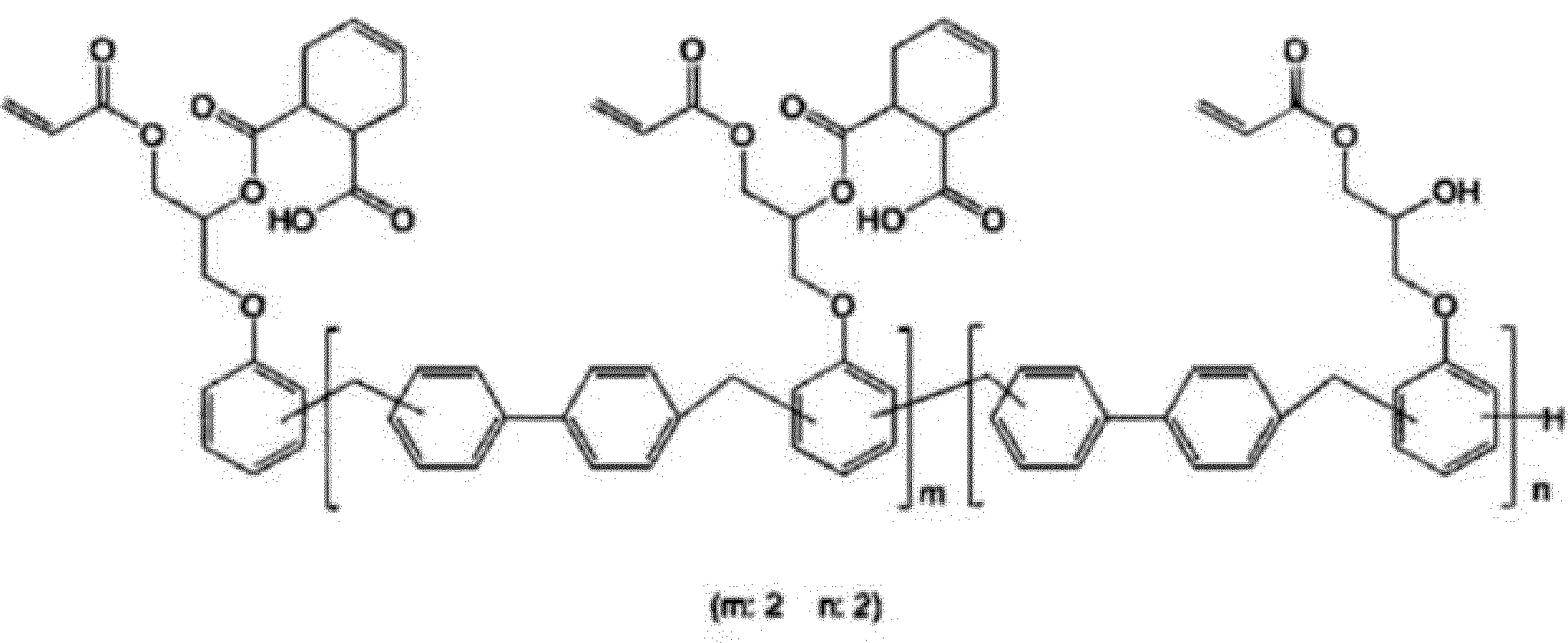
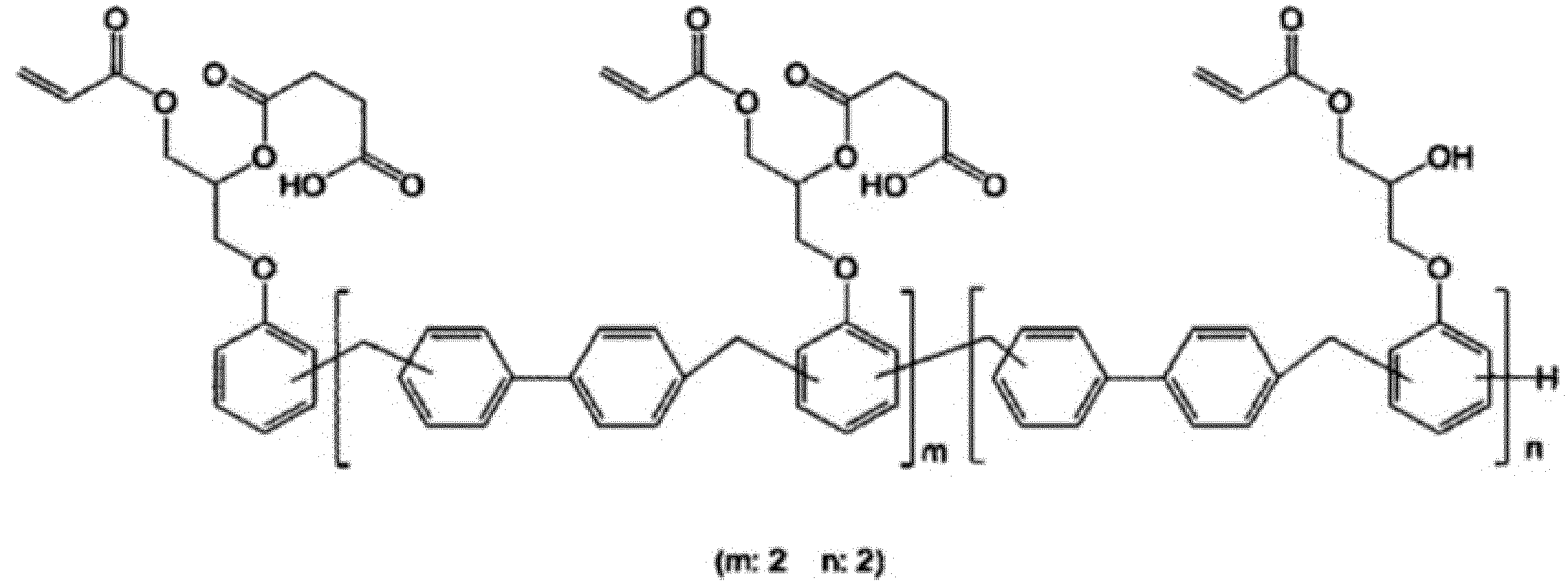
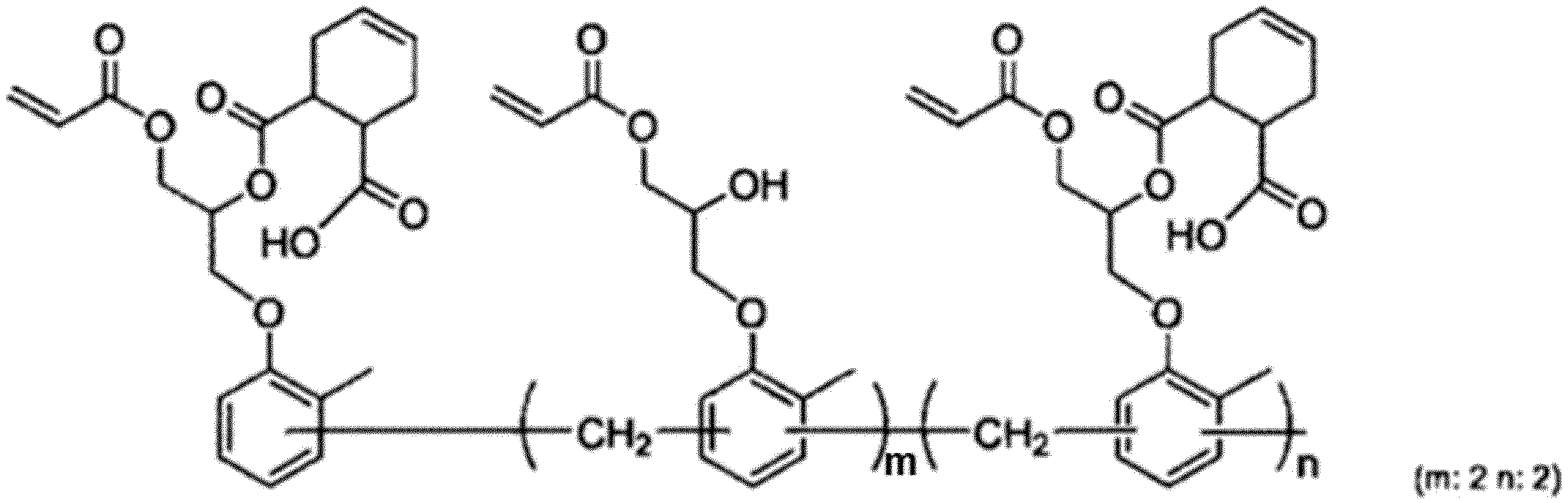
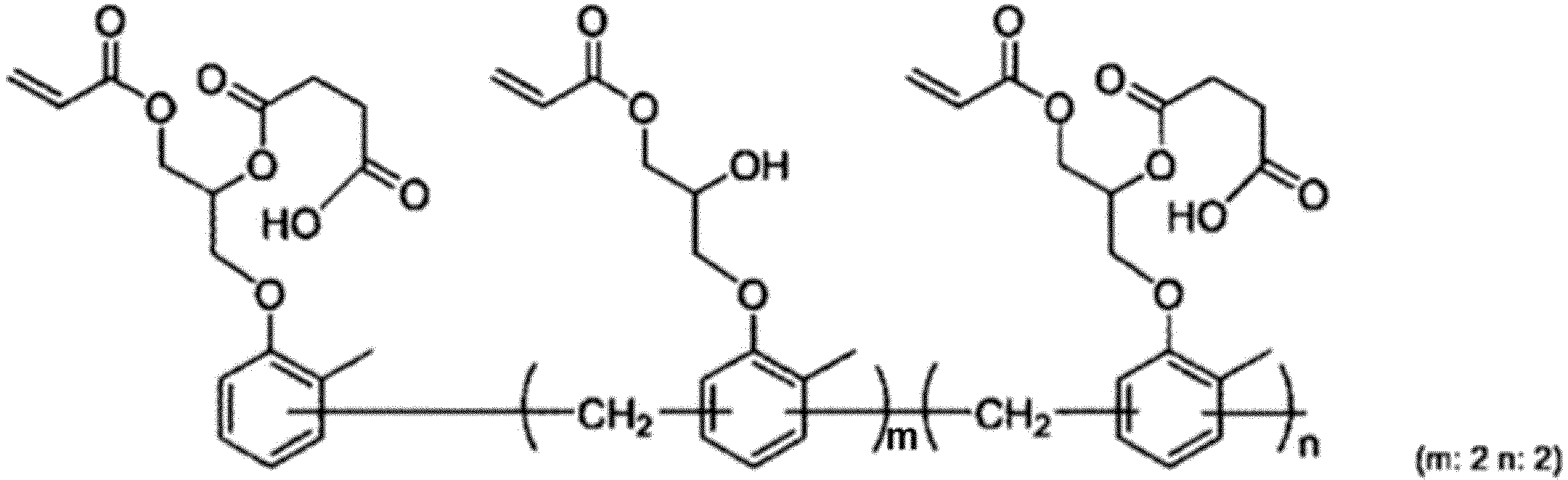
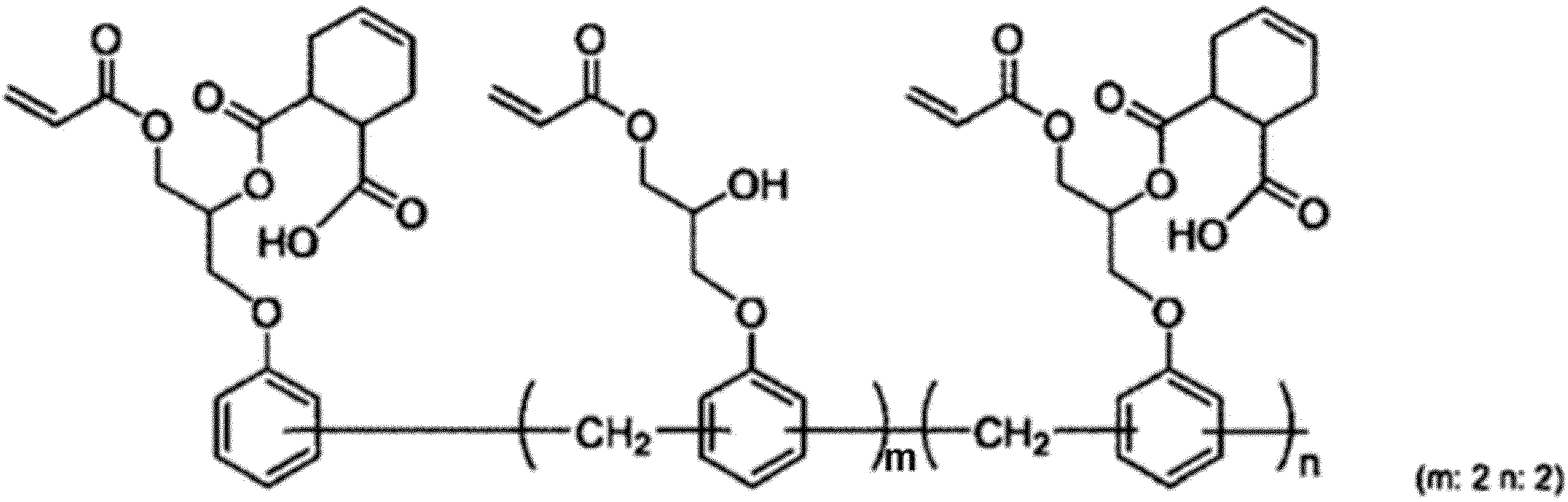
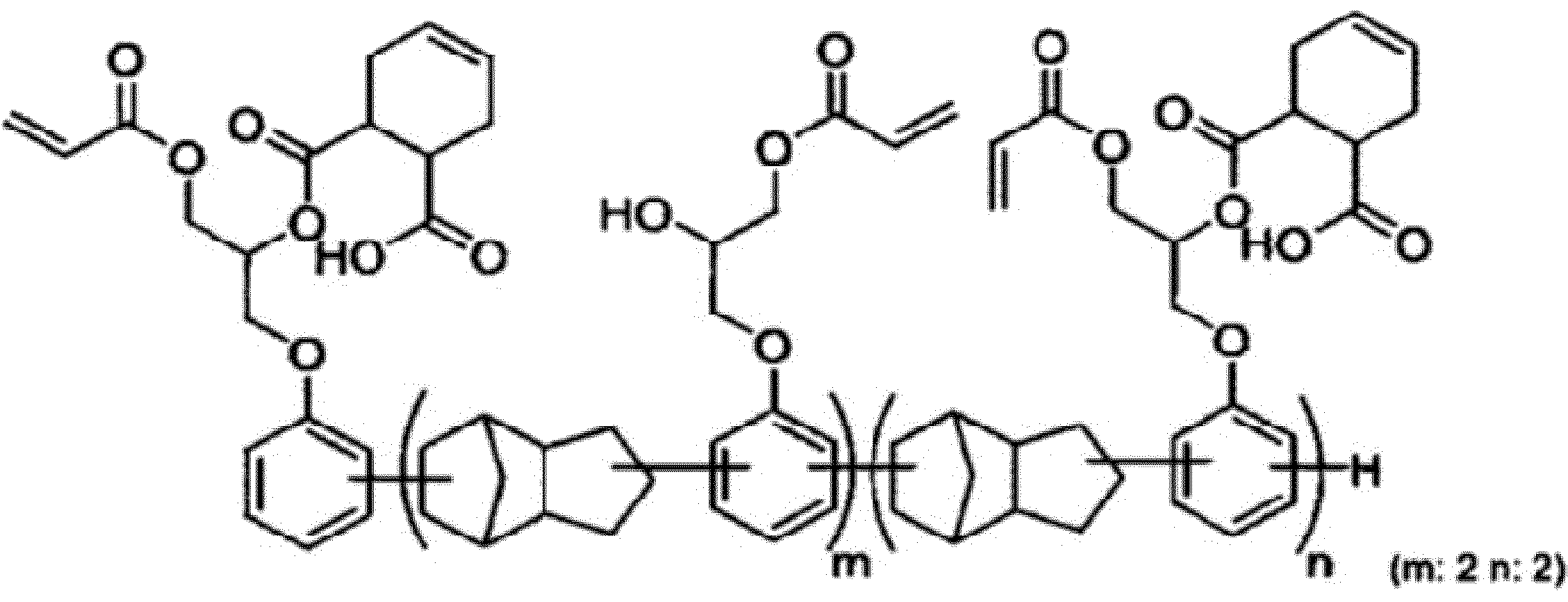

別の態様として、エポキシ(メタ)アクリレート樹脂(b1)は、現像密着性の観点から、下記式(ii)で表される部分構造を含むエポキシ(メタ)アクリレート樹脂(b1-2)であることが好ましい。
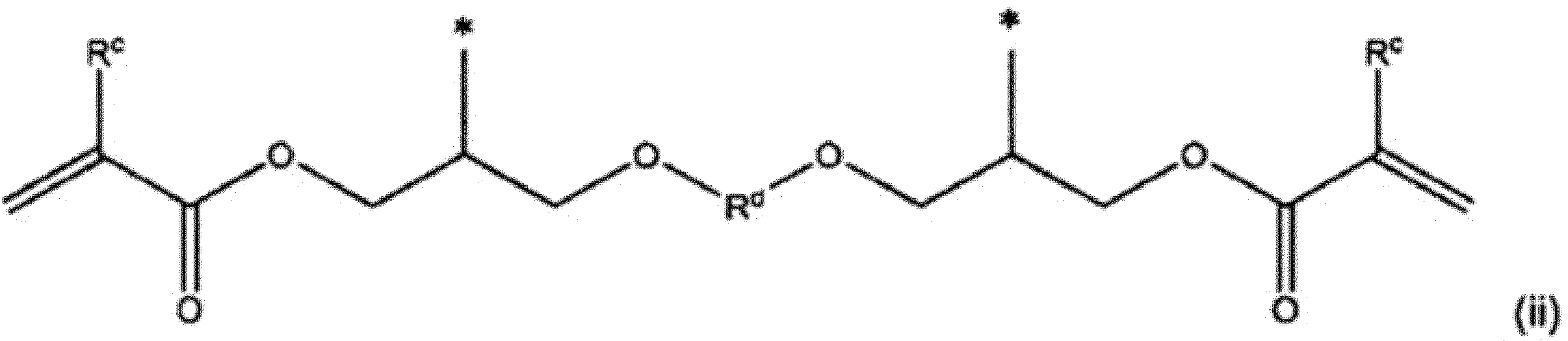
式(ii)中、Rcは各々独立に、水素原子又はメチル基を表す。Rdは、環状炭化水素基を側鎖として有する2価の炭化水素基を表す。*は結合手を表す。
前記式(ii)において、Rdは、環状炭化水素基を側鎖として有する2価の炭化水素基を表す。環状炭化水素基としては、脂肪族環基又は芳香族環基が挙げられる。
前記式(ii)において、Rdは、環状炭化水素基を側鎖として有する2価の炭化水素基を表す。環状炭化水素基としては、脂肪族環基又は芳香族環基が挙げられる。
脂肪族環基が有する環の数は特に限定されないが、通常1以上、2以上が好ましく、また、10以下が好ましく、5以下がより好ましく、3以下がさらに好ましい。前記下限値以上とすることで現像密着性が向上する傾向がある。また、前記上限値以下とすることで良好な現像溶解性を得ることができる。
脂肪族環基の炭素数は通常4以上であり、6以上が好ましく8以上がより好ましく、また、40以下が好ましく、30以下がより好ましく、20以下がさらに好ましく、15以下が特に好ましい。前記下限値以上とすることで現像密着性が向上する傾向がある。また、前記上限値以下とすることで良好な現像溶解性を得ることができる。
脂肪族環基における脂肪族環しては、例えば、シクロヘキサン環、シクロヘプタン環、シクロデカン環、シクロドデカン環、ノルボルナン環、イソボルナン環、アダマンタン環が挙げられる。これらの中でも現像密着性の観点からアダマンタン環が好ましい。
脂肪族環基の炭素数は通常4以上であり、6以上が好ましく8以上がより好ましく、また、40以下が好ましく、30以下がより好ましく、20以下がさらに好ましく、15以下が特に好ましい。前記下限値以上とすることで現像密着性が向上する傾向がある。また、前記上限値以下とすることで良好な現像溶解性を得ることができる。
脂肪族環基における脂肪族環しては、例えば、シクロヘキサン環、シクロヘプタン環、シクロデカン環、シクロドデカン環、ノルボルナン環、イソボルナン環、アダマンタン環が挙げられる。これらの中でも現像密着性の観点からアダマンタン環が好ましい。
芳香族環基が有する環の数は特に限定されないが、通常1以上、2以上が好ましく、3以上がより好ましく、また、10以下が好ましく、5以下がより好ましく、4以下がさらに好ましい。前記下限値以上とすることで良好な現像溶解性を得ることができる。また、前記上限値以下とすることで現像密着性が向上する傾向がある。
芳香族環基としては、芳香族炭化水素環基、芳香族複素環基が挙げられる。芳香族環基の炭素数は通常4以上であり、6以上が好ましく、8以上がより好ましく、10以上がよりさらに好ましく、12以上が特に好ましく、また、40以下が好ましく、30以下がより好ましく、20以下がさらに好ましく、15以下が特に好ましい。前記下限値以上とすることで良好な現像溶解性を得ることができる。また、前記上限値以下とすることで現像密着性が向上する傾向がある。
芳香族環基における芳香族環としては、例えば、ベンゼン環、ナフタレン環、アントラセン環、フェナントレン環、ペリレン環、テトラセン環、ピレン環、ベンズピレン環、クリセン環、トリフェニレン環、アセナフテン環、フルオランテン環、フルオレン環が挙げられる。これらの中でもパターニング特性の観点から、フルオレン環が好ましい。
環状炭化水素基を側鎖として有する2価の炭化水素基における、2価の炭化水素基は特に限定されないが、例えば、2価の脂肪族基、2価の芳香族環基、1以上の2価の脂肪族基と1以上の2価の芳香族環基とを連結した基が挙げられる。
2価の脂肪族基は、直鎖状、分岐鎖状、環状のものが挙げられる。これらの中でも現像溶解性の観点からは直鎖状のものが好ましく、一方で露光部への現像液の浸透低減の観点からは環状のものが好ましい。その炭素数は通常1以上であり、3以上が好ましく、6以上がより好ましく、また、25以下が好ましく、20以下がより好ましく、15以下がさらに好ましい。前記下限値以上とすることで現像密着性が向上する傾向がある。また、前記上限値以下とすることで良好な現像溶解性を得ることができる。
2価の直鎖状脂肪族基としては、例えば、メチレン基、エチレン基、n-プロピレン基、n-ブチレン基、n-ヘキシレン基、n-ヘプチレン基が挙げられる。これらの中でも現像溶解性の観点から、メチレン基が好ましい。
2価の分岐鎖状脂肪族基としては、例えば、前述の2価の直鎖状脂肪族基に、側鎖としてメチル基、エチル基、n-プロピル基、イソプロピル基、n-ブチル基、イソブチル基、sec-ブチル基、tert-ブチル基を有する構造が挙げられる。
2価の環状の脂肪族基が有する環の数は特に限定されないが、通常1以上、2以上が好ましく、また、10以下が好ましく、5以下がより好ましく、3以下がさらに好ましい。前記下限値以上とすることで現像密着性が向上する傾向がある。また、前記上限値以下とすることで残渣が低減する傾向がある。
2価の分岐鎖状脂肪族基としては、例えば、前述の2価の直鎖状脂肪族基に、側鎖としてメチル基、エチル基、n-プロピル基、イソプロピル基、n-ブチル基、イソブチル基、sec-ブチル基、tert-ブチル基を有する構造が挙げられる。
2価の環状の脂肪族基が有する環の数は特に限定されないが、通常1以上、2以上が好ましく、また、10以下が好ましく、5以下がより好ましく、3以下がさらに好ましい。前記下限値以上とすることで現像密着性が向上する傾向がある。また、前記上限値以下とすることで残渣が低減する傾向がある。
2価の環状の脂肪族基としては、例えば、シクロヘキサン環、シクロヘプタン環、シクロデカン環、シクロドデカン環、ノルボルナン環、イソボルナン環、アダマンタン環から水素原子を2つ除した基が挙げられる。これらの中でも現像密着性の観点から、アダマンタン環から水素原子を2つ除した基が好ましい。
2価の脂肪族基が有していてもよい置換基としては、例えば、メトキシ基、エトキシ基等の炭素数1~5のアルコキシ基;水酸基;ニトロ基;シアノ基;カルボキシ基が挙げられ、合成容易性の観点から、無置換が好ましい。
2価の芳香族環基としては、2価の芳香族炭化水素環基及び2価の芳香族複素環基が挙げられる。その炭素数は通常4以上であり、5以上が好ましく、6以上がより好ましく、また、30以下が好ましく、20以下がより好ましく、15以下がさらに好ましい。前記下限値以上とすることで現像密着性が向上する傾向がある。また、前記上限値以下とすることで良好な現像溶解性を得ることができる。
2価の芳香族炭化水素環基における芳香族炭化水素環としては、単環であっても縮合環であってもよい。2価の芳香族炭化水素環基としては、例えば、2個の遊離原子価を有する、ベンゼン環、ナフタレン環、アントラセン環、フェナントレン環、ペリレン環、テトラセン環、ピレン環、ベンズピレン環、クリセン環、トリフェニレン環、アセナフテン環、 フルオランテン環、フルオレン環が挙げられる。
2価の芳香族複素環基における芳香族複素環としては、単環であっても縮合環であってもよい。2価の芳香族複素環基としては、例えば、2個の遊離原子価を有する、フラン環、ベンゾフラン環、チオフェン環、ベンゾチオフェン環、ピロール環、ピラゾール環、イミダゾール環、オキサジアゾール環、インドール環、カルバゾール環、ピロロイミダゾール環、ピロロピラゾール環、ピロロピロール環、チエノピロール環、チエノチオフェン環、フロピロール環、フロフラン環、チエノフラン環、ベンゾイソオキサゾール環、ベンゾイソチアゾール環、ベンゾイミダゾール環、ピリジン環、ピラジン環、ピリダジン環、ピリミジン環、トリアジン環、キノリン環、イソキノリン環、シノリン環、キノキサリン環、フェナントリジン環、ペリミジン環、キナゾリン環、キナゾリノン環、アズレン環が挙げられる。これらの中でも光硬化性の観点から、2個の遊離原子価を有するベンゼン環、ナフタレン環が好ましく、2個の遊離原子価を有するベンゼン環がより好ましい。
2価の芳香族複素環基における芳香族複素環としては、単環であっても縮合環であってもよい。2価の芳香族複素環基としては、例えば、2個の遊離原子価を有する、フラン環、ベンゾフラン環、チオフェン環、ベンゾチオフェン環、ピロール環、ピラゾール環、イミダゾール環、オキサジアゾール環、インドール環、カルバゾール環、ピロロイミダゾール環、ピロロピラゾール環、ピロロピロール環、チエノピロール環、チエノチオフェン環、フロピロール環、フロフラン環、チエノフラン環、ベンゾイソオキサゾール環、ベンゾイソチアゾール環、ベンゾイミダゾール環、ピリジン環、ピラジン環、ピリダジン環、ピリミジン環、トリアジン環、キノリン環、イソキノリン環、シノリン環、キノキサリン環、フェナントリジン環、ペリミジン環、キナゾリン環、キナゾリノン環、アズレン環が挙げられる。これらの中でも光硬化性の観点から、2個の遊離原子価を有するベンゼン環、ナフタレン環が好ましく、2個の遊離原子価を有するベンゼン環がより好ましい。
2価の芳香族環基が有していてもよい置換基としては、例えば、ヒドロキシ基、メチル基、メトキシ基、エチル基、エトキシ基、プロピル基、プロポキシ基が挙げられる。これらの中でも硬化性の観点から、無置換が好ましい。
1以上の2価の脂肪族基と1以上の2価の芳香族環基とを連結した基としては、前述の2価の脂肪族基を1以上と、前述の2価の芳香族環基を1以上とを連結した基が挙げられる。
2価の脂肪族基の数は特に限定されないが、通常1以上、2以上が好ましく、また、10以下が好ましく、5以下がより好ましく、3以下がさらに好ましい。前記下限値以上とすることで現像密着性が向上する傾向がある。また、前記上限値以下とすることで良好な現像溶解性を得ることができる。
2価の芳香族環基の数は特に限定されないが、通常1以上、2以上が好ましく、また、10以下が好ましく、5以下がより好ましく、3以下がさらに好ましい。前記下限値以上とすることで現像密着性が向上する傾向がある。また、前記上限値以下とすることで良好な現像溶解性を得ることができる。
1以上の2価の脂肪族基と1以上の2価の芳香族環基とを連結した基としては、例えば、前記式(i-A)~(i-F)で表される基等が挙げられる。これらの中でも現像溶解性の観点から、前記式(i-C)で表される基が好ましい。
これらの2価の炭化水素基に対して、側鎖である環状炭化水素基の結合態様は特に限定されないが、例えば、脂肪族基や芳香族環基の水素原子1つを側鎖で置換した態様や、脂肪族基の炭素原子の1つを含めて側鎖である環状炭化水素基を構成した態様が挙げられる。
前記式(ii)で表される部分構造は、現像密着性の観点から、下記式(ii-1)で表される部分構造であることが好ましい。
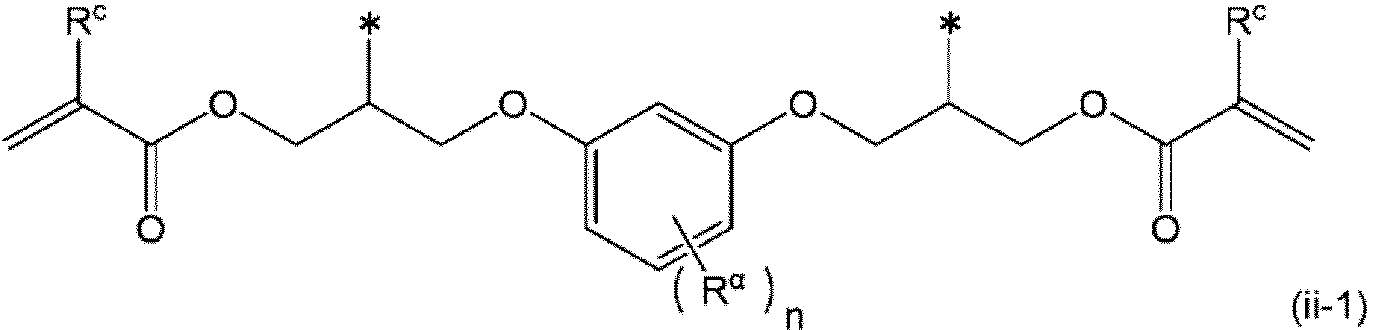
式(ii-1)中、Rcは前記式(ii)と同義である。Raは置換基を有していてもよい1価の環状炭化水素基を表す。nは1以上の整数である。式(ii-1)中のベンゼン環は、さらに任意の置換基により置換されていてもよい。*は結合手を表す。
前記式(ii-1)において、Raは置換基を有していてもよい1価の環状炭化水素基を表す。環状炭化水素基としては、脂肪族環基又は芳香族環基が挙げられる。
前記式(ii-1)において、Raは置換基を有していてもよい1価の環状炭化水素基を表す。環状炭化水素基としては、脂肪族環基又は芳香族環基が挙げられる。
脂肪族環基が有する環の数は特に限定されないが、通常1以上、2以上が好ましく、また、6以下が好ましく、4以下がより好ましく、3以下がさらに好ましい。前記下限値以上とすることで現像密着性が向上する傾向がある。また、前記上限値以下とすることで良好な現像溶解性を得ることができる。
また、脂肪族環基の炭素数は通常4以上であり、6以上が好ましく、8以上がより好ましく、また、40以下が好ましく、30以下がより好ましく、20以下がさらに好ましく、15以下が特に好ましい。前記下限値以上とすることで現像密着性が向上する傾向がある。また、前記上限値以下とすることで良好な現像溶解性を得ることができる。
脂肪族環基における脂肪族環としては、例えば、シクロヘキサン環、シクロヘプタン環、シクロデカン環、シクロドデカン環、ノルボルナン環、イソボルナン環、アダマンタン環が挙げられる。これらの中でも現像密着性の観点から、アダマンタン環が好ましい。
また、脂肪族環基の炭素数は通常4以上であり、6以上が好ましく、8以上がより好ましく、また、40以下が好ましく、30以下がより好ましく、20以下がさらに好ましく、15以下が特に好ましい。前記下限値以上とすることで現像密着性が向上する傾向がある。また、前記上限値以下とすることで良好な現像溶解性を得ることができる。
脂肪族環基における脂肪族環としては、例えば、シクロヘキサン環、シクロヘプタン環、シクロデカン環、シクロドデカン環、ノルボルナン環、イソボルナン環、アダマンタン環が挙げられる。これらの中でも現像密着性の観点から、アダマンタン環が好ましい。
芳香族環基が有する環の数は特に限定されないが、通常1以上、2以上が好ましく、3以上がより好ましく、また、10以下が好ましく、5以下がより好ましい。前記下限値以上とすることで現像密着性が向上する傾向がある。また、前記上限値以下とすることで良好な現像溶解性を得ることができる。
芳香族環基としては、芳香族炭化水素環基、芳香族複素環基が挙げられる。また、芳香族環基の炭素数は通常4以上であり、5以上が好ましく、6以上がより好ましく、また、30以下が好ましく、20以下がより好ましく、15以下がさらに好ましい。前記下限値以上とすることで現像密着性が向上する傾向がある。また、前記上限値以下とすることで良好な現像溶解性を得ることができる。
芳香族環基における芳香族環としては、例えば、ベンゼン環、ナフタレン環、アントラセン環、フェナントレン環、フルオレン環が挙げられる。これらの中でも現像密着性の観点から、フルオレン環が好ましい。
芳香族環基としては、芳香族炭化水素環基、芳香族複素環基が挙げられる。また、芳香族環基の炭素数は通常4以上であり、5以上が好ましく、6以上がより好ましく、また、30以下が好ましく、20以下がより好ましく、15以下がさらに好ましい。前記下限値以上とすることで現像密着性が向上する傾向がある。また、前記上限値以下とすることで良好な現像溶解性を得ることができる。
芳香族環基における芳香族環としては、例えば、ベンゼン環、ナフタレン環、アントラセン環、フェナントレン環、フルオレン環が挙げられる。これらの中でも現像密着性の観点から、フルオレン環が好ましい。
環状炭化水素基が有していてもよい置換基としては、例えば、メチル基、エチル基、n-プロピル基、イソプロピル基、n-ブチル基、sec-ブチル基、tert-ブチル基、アミル基、イソアミル基等の炭素数1~5のアルキル基;メトキシ基、エトキシ基等の炭素数1~5のアルコキシ基;水酸基;ニトロ基;シアノ基;カルボキシ基が挙げられ、合成の容易性の観点から、無置換が好ましい。
nは1以上の整数を表すが、2以上が好ましく、また、3以下が好ましい。例えば、1~3が好ましく、1~2がより好ましい。前記下限値以上とすることで現像密着性が向上する傾向がある。また、前記上限値以下とすることで良好な現像溶解性を得ることができる。
これらの中でも、強固な膜硬化度の観点から、Raが1価の脂肪族環基であることが好ましく、アダマンチル基であることがより好ましい。
前記のとおり、式(ii-1)中のベンゼン環は、さらに任意の置換基により置換されていてもよい。置換基としては、例えば、ヒドロキシ基、メチル基、メトキシ基、エチル基、エトキシ基、プロピル基、プロポキシ基が挙げられる。置換基の数も特に限定されず、1つでもよいし、2つ以上でもよい。硬化性の観点から、無置換が好ましい。
前記のとおり、式(ii-1)中のベンゼン環は、さらに任意の置換基により置換されていてもよい。置換基としては、例えば、ヒドロキシ基、メチル基、メトキシ基、エチル基、エトキシ基、プロピル基、プロポキシ基が挙げられる。置換基の数も特に限定されず、1つでもよいし、2つ以上でもよい。硬化性の観点から、無置換が好ましい。
以下に前記式(ii-1)で表される部分構造の具体例を挙げる。


前記式(ii)で表される部分構造は、現像密着性の観点から、下記式(ii-2)で表される部分構造であることが好ましい。
式(ii-2)中、Rcは前記式(ii)と同義である。Rβは、置換基を有していてもよい2価の環状炭化水素基を表す。式(ii-2)中のベンゼン環は、さらに任意の置換基により置換されていてもよい。*は結合手を表す。
前記式(ii-2)において、Rβは、置換基を有していてもよい2価の環状炭化水素基を表す。環状炭化水素基としては、脂肪族環基又は芳香族環基が挙げられる。
前記式(ii-2)において、Rβは、置換基を有していてもよい2価の環状炭化水素基を表す。環状炭化水素基としては、脂肪族環基又は芳香族環基が挙げられる。
脂肪族環基が有する環の数は特に限定されないが、通常1以上、2以上が好ましく、また、10以下が好ましく、5以下がより好ましい。前記下限値以上とすることで現像密着性が向上する傾向がある。また、前記上限値以下とすることで良好な現像溶解性を得ることができる。
また、脂肪族環基の炭素数は通常4以上であり、6以上が好ましく、8以上がより好ましく、また、40以下が好ましく、35以下がより好ましく、30以下がさらに好ましい。前記下限値以上とすることで現像密着性が向上する傾向がある。また、前記上限値以下とすることで良好な現像溶解性を得ることができる。
脂肪族環基における脂肪族環としては、シクロヘキサン環、シクロヘプタン環、シクロデカン環、シクロドデカン環、ノルボルナン環、イソボルナン環、アダマンタン環が挙げられる。これらの中でも現像密着性の観点から、アダマンタン環が好ましい。
また、脂肪族環基の炭素数は通常4以上であり、6以上が好ましく、8以上がより好ましく、また、40以下が好ましく、35以下がより好ましく、30以下がさらに好ましい。前記下限値以上とすることで現像密着性が向上する傾向がある。また、前記上限値以下とすることで良好な現像溶解性を得ることができる。
脂肪族環基における脂肪族環としては、シクロヘキサン環、シクロヘプタン環、シクロデカン環、シクロドデカン環、ノルボルナン環、イソボルナン環、アダマンタン環が挙げられる。これらの中でも現像密着性の観点から、アダマンタン環が好ましい。
芳香族環基が有する環の数は特に限定されないが、通常1以上、2以上が好ましく、3以上がより好ましく、また、10以下が好ましく、5以下が好ましい。前記下限値以上とすることで現像密着性が向上する傾向がある。また、前記上限値以下とすることで良好な現像溶解性を得ることができる。
芳香族環基としては、芳香族炭化水素環基、芳香族複素環基が挙げられる。また、芳香族環基の炭素数は通常4以上であり、6以上が好ましく、8以上がより好ましく、10以上がさらに好ましく、また、40以下が好ましく、30以下がより好ましく、20以下がさらに好ましく、15以下が特に好ましい。前記下限値以上とすることで現像密着性が向上する傾向がある。また、前記上限値以下とすることで良好な現像溶解性を得ることができる。
芳香族環基における芳香族環としては、例えば、ベンゼン環、ナフタレン環、アントラセン環、フェナントレン環、フルオレン環が挙げられる。これらの中でも現像密着性の観点から、フルオレン環が好ましい。
芳香族環基としては、芳香族炭化水素環基、芳香族複素環基が挙げられる。また、芳香族環基の炭素数は通常4以上であり、6以上が好ましく、8以上がより好ましく、10以上がさらに好ましく、また、40以下が好ましく、30以下がより好ましく、20以下がさらに好ましく、15以下が特に好ましい。前記下限値以上とすることで現像密着性が向上する傾向がある。また、前記上限値以下とすることで良好な現像溶解性を得ることができる。
芳香族環基における芳香族環としては、例えば、ベンゼン環、ナフタレン環、アントラセン環、フェナントレン環、フルオレン環が挙げられる。これらの中でも現像密着性の観点から、フルオレン環が好ましい。
環状炭化水素基が有していてもよい置換基としては、例えば、メチル基、エチル基、n-プロピル基、イソプロピル基、n-ブチル基、sec-ブチル基、tert-ブチル基、アミル基、イソアミル基等の炭素数1~5のアルキル基;メトキシ基、エトキシ基等の炭素数1~5のアルコキシ基;水酸基;ニトロ基;シアノ基;カルボキシ基が挙げられる。これらの中でも合成の簡易性の観点から、無置換が好ましい。
これらの中でも、硬化性の観点から、Rβが2価の脂肪族環基であることが好ましく、2価のアダマンタン環基であることがより好ましい。
別の態様として、現像密着性の観点から、Rβが2価の芳香族環基であることが好ましく、2価のフルオレン環基であることがより好ましい。
これらの中でも、硬化性の観点から、Rβが2価の脂肪族環基であることが好ましく、2価のアダマンタン環基であることがより好ましい。
別の態様として、現像密着性の観点から、Rβが2価の芳香族環基であることが好ましく、2価のフルオレン環基であることがより好ましい。
前記のとおり、式(ii-2)中のベンゼン環は、さらに任意の置換基により置換されていてもよい。式(ii-2)中のベンゼン環の置換基としては、例えば、ヒドロキシ基、メチル基、メトキシ基、エチル基、エトキシ基、プロピル基、プロポキシ基が挙げられる。置換基の数も特に限定されず、1つでもよいし、2つ以上でもよい。硬化性の観点から、無置換が好ましい。
以下に前記式(ii-2)で表される部分構造の具体例を挙げる。


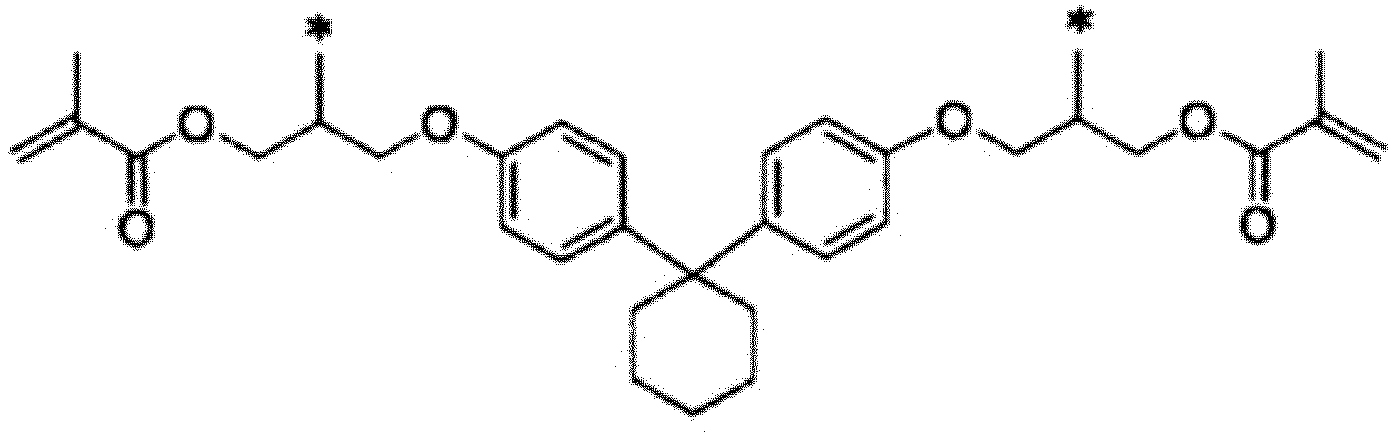

前記式(ii)で表される部分構造は、硬化性の観点から、下記式(ii-3)で表される部分構造であることが好ましい。
式(ii-3)中、Rc及びRdは前記式(ii)と同義である。R1は前記式(i-1)と同義である。*は結合手を表す。
エポキシ(メタ)アクリレート樹脂(b1-2)1分子中に含まれる、前記式(ii-3)で表される部分構造は、1種でも2種以上でもよい。
エポキシ(メタ)アクリレート樹脂(b1-2)1分子中に含まれる、前記式(ii)で表される部分構造の数は特に限定されないが、1以上が好ましく、3以上がより好ましく、また、20以下が好ましく、15以下がより好ましく、10以下がさらに好ましい。前記下限値以上とすることで現像密着性が向上する傾向がある。また、前記上限値以下とすることで良好な現像溶解性を得ることができる。
エポキシ(メタ)アクリレート樹脂(b1-2)1分子中に含まれる、前記式(ii)で表される部分構造の数は特に限定されないが、1以上が好ましく、3以上がより好ましく、また、20以下が好ましく、15以下がより好ましく、10以下がさらに好ましい。前記下限値以上とすることで現像密着性が向上する傾向がある。また、前記上限値以下とすることで良好な現像溶解性を得ることができる。
さらに別の態様として、エポキシ(メタ)アクリレート樹脂(b1)は、良好な現像溶解性を得るとの観点から、下記一般式(iii)で表される部分構造を含むエポキシ(メタ)アクリレート樹脂(b1-3)であることが好ましい。
式(iii)中、Reは水素原子又はメチル基を表し、γは単結合、-CO-、置換基を有していてもよいアルキレン基、又は置換基を有していてもよい2価の環状炭化水素基を表す。式(iii)中のベンゼン環は、さらに任意の置換基により置換されていてもよい。*は結合手を表す。
前記式(iii)において、γは単結合、-CO-、置換基を有していてもよいアルキレン基、又は置換基を有していてもよい2価の環状炭化水素基を表す。
前記式(iii)において、γは単結合、-CO-、置換基を有していてもよいアルキレン基、又は置換基を有していてもよい2価の環状炭化水素基を表す。
アルキレン基は直鎖状でも、分岐鎖状でもよいが、現像溶解性の観点からは直鎖状であることが好ましく、現像密着性の観点からは分岐鎖状であることが好ましい。その炭素数は特に限定されないが、通常1以上、2以上が好ましく、また、6以下が好ましく、4以下がより好ましい。前記下限値以上とすることで現像密着性が向上する傾向がある。また、前記上限値以下とすることで良好な現像溶解性を得ることができる。
アルキレン基としては、例えば、メチレン基、エチレン基、プロピレン基、ブチレン基、ヘキシレン基、ヘプチレン基が挙げられ、現像密着性と現像溶解性の両立の観点から、メチレン基、エチレン基、プロピレン基が好ましく、ジメチルメチレン基(2,2-プロピレン基)がより好ましい。
アルキレン基が有していてもよい置換基としては、例えば、メトキシ基、エトキシ基等の炭素数1~5のアルコキシ基;水酸基;ニトロ基;シアノ基 ;カルボキシ基が挙げられ、現像密着性と現像溶解性の両立の観点から、無置換が好ましい。
アルキレン基としては、例えば、メチレン基、エチレン基、プロピレン基、ブチレン基、ヘキシレン基、ヘプチレン基が挙げられ、現像密着性と現像溶解性の両立の観点から、メチレン基、エチレン基、プロピレン基が好ましく、ジメチルメチレン基(2,2-プロピレン基)がより好ましい。
アルキレン基が有していてもよい置換基としては、例えば、メトキシ基、エトキシ基等の炭素数1~5のアルコキシ基;水酸基;ニトロ基;シアノ基 ;カルボキシ基が挙げられ、現像密着性と現像溶解性の両立の観点から、無置換が好ましい。
2価の環状炭化水素基としては、2価の脂肪族環基又は2価の芳香族環基が挙げられる。
脂肪族環基が有する環の数は特に限定されないが、通常1以上、2以上が好ましく、また、10以下が好ましく、5以下がより好ましい。前記下限値以上とすることで現像密着性が向上する傾向がある。また、前記上限値以下とすることで良好な現像溶解性を得ることができる。
また、脂肪族環基の炭素数は通常4以上であり、6以上が好ましく、8以上がより好ましく、また、40以下が好ましく、35以下がより好ましく、30以下がさらに好ましい。前記下限値以上とすることで現像密着性が向上する傾向がある。また、前記上限値以下とすることで良好な現像溶解性を得ることができる。
脂肪族環基における脂肪族環としては、例えば、シクロヘキサン環、シクロヘプタン環、シクロデカン環、シクロドデカン環、ノルボルナン環、イソボルナン環、アダマンタン環が挙げられる。これらの中でも現像密着性の観点から、アダマンタン環が好ましい。
芳香族環基が有する環の数は特に限定されないが、通常1以上、2以上が好ましく、3以上がより好ましく、また、10以下が好ましく、5以下がより好ましい。前記下限値以上とすることで現像密着性が向上する傾向がある。また、前記上限値以下とすることで良好な現像溶解性を得ることができる。
芳香族環基としては、芳香族炭化水素環基、芳香族複素環基が挙げられる。芳香族環基の炭素数は通常4以上であり、6以上が好ましく、8以上がより好ましく、10以上がさらに好ましく、また、40以下が好ましく、30以下がより好ましく、20以下がさらに好ましく、15以下が特に好ましい。前記下限値以上とすることで現像密着性が向上する傾向がある。また、前記上限値以下とすることで良好な現像溶解性を得ることができる。
芳香族環基における芳香族環としては、例えば、ベンゼン環、ナフタレン環、アントラセン環、フェナントレン環、フルオレン環が挙げられる。これらの中でも現像密着性の観点から、フルオレン環が好ましい。
芳香族環基としては、芳香族炭化水素環基、芳香族複素環基が挙げられる。芳香族環基の炭素数は通常4以上であり、6以上が好ましく、8以上がより好ましく、10以上がさらに好ましく、また、40以下が好ましく、30以下がより好ましく、20以下がさらに好ましく、15以下が特に好ましい。前記下限値以上とすることで現像密着性が向上する傾向がある。また、前記上限値以下とすることで良好な現像溶解性を得ることができる。
芳香族環基における芳香族環としては、例えば、ベンゼン環、ナフタレン環、アントラセン環、フェナントレン環、フルオレン環が挙げられる。これらの中でも現像密着性の観点から、フルオレン環が好ましい。
環状炭化水素基が有していてもよい置換基としては、例えば、メチル基、エチル基、n-プロピル基、イソプロピル基、n-ブチル基、sec-ブチル基、tert-ブチル基、 アミル基、イソアミル基等の炭素数1~5のアルキル基;メトキシ基、エトキシ基等の炭素数1~5のアルコキシ基;水酸基;ニトロ基;シアノ基;カルボキシ基が挙げられ、合成の簡易性の観点から、無置換が好ましい。
これらの中でも、現像溶解性の観点から、γが置換基を有していてもよいアルキレン基であることが好ましく、ジメチルメチレンであることがより好ましい。
これらの中でも、現像溶解性の観点から、γが置換基を有していてもよいアルキレン基であることが好ましく、ジメチルメチレンであることがより好ましい。
前記のとおり、式(iii)中のベンゼン環は、さらに任意の置換基により置換されていてもよい。式(iii)中のベンゼン環の置換基としては、例えば、ヒドロキシ基、メチル基、メトキシ基、エチル基、エトキシ基、プロピル基、プロポキシ基が挙げられる。置換基の数も特に限定されず、1つでもよいし、2つ以上でもよい。硬化性の観点から、無置換が好ましい。
前記式(iii)で表される部分構造は、現像溶解性の観点から、下記式(iii-1)で表される部分構造であることが好ましい。
式(iii-1)中、Re及びγは前記式(iii)と同義である。R1は前記式(i-1)のものと同義である。*は結合手を表す。式(iii-1)中のベンゼン環は、さらに任意の置換基により置換されていてもよい。
エポキシ(メタ)アクリレート樹脂(b1-3)1分子中に含まれる、前記式(iii)で表される部分構造の数は特に限定されないが、1以上が好ましく、5以上がより好ましく、10以上がさらに好ましく、また、18以下が好ましく、15以下がさらに好ましい。前記下限値以上とすることで現像密着性が向上する傾向がある。また、前記上限値以下とすることで良好な現像溶解性を得ることができる。
エポキシ(メタ)アクリレート樹脂(b1-3)1分子中に含まれる、前記式(iii-1)で表される部分構造の数は特に限定されないが、1以上が好ましく、3以上がより好ましく、5以上がさらに好ましく、また、18以下が好ましく、15以下がさらに好ましい。前記下限値以上とすることで現像密着性が向上する傾向がある。また、前記上限値以下とすることで残清が低減する傾向がある。
以下にエポキシ(メタ)アクリレート樹脂(b1-3)の具体例を挙げる。
[アクリル共重合樹脂(b2)]
アクリル共重合樹脂(b2)は、硬化性の観点から、側鎖にエチレン性二重結合を有するものであることが好ましい。
アクリル共重合樹脂(b2)の中でも、現像溶解性の観点から、下記一般式(I)で表される部分構造を含むアクリル共重合樹脂(b2-1)が好ましい。
アクリル共重合樹脂(b2)は、硬化性の観点から、側鎖にエチレン性二重結合を有するものであることが好ましい。
アクリル共重合樹脂(b2)の中でも、現像溶解性の観点から、下記一般式(I)で表される部分構造を含むアクリル共重合樹脂(b2-1)が好ましい。
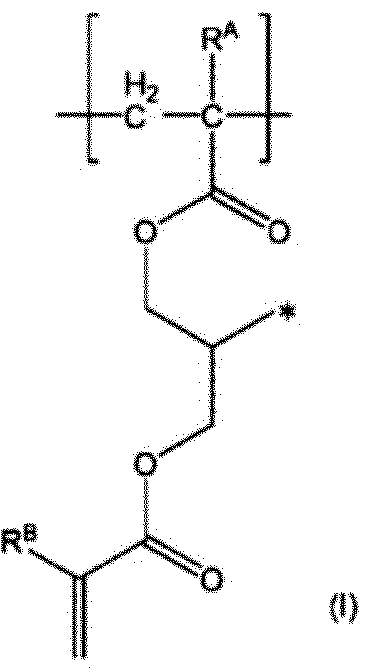
式(I)中、RA及びRBは各々独立に、水素原子又はメチル基を表す。*は結合手を表す。
前記式(I)で表される部分構造は、現像性の観点から、下記一般式(I-1)で表される部分構造であることが好ましい。
前記式(I)で表される部分構造は、現像性の観点から、下記一般式(I-1)で表される部分構造であることが好ましい。
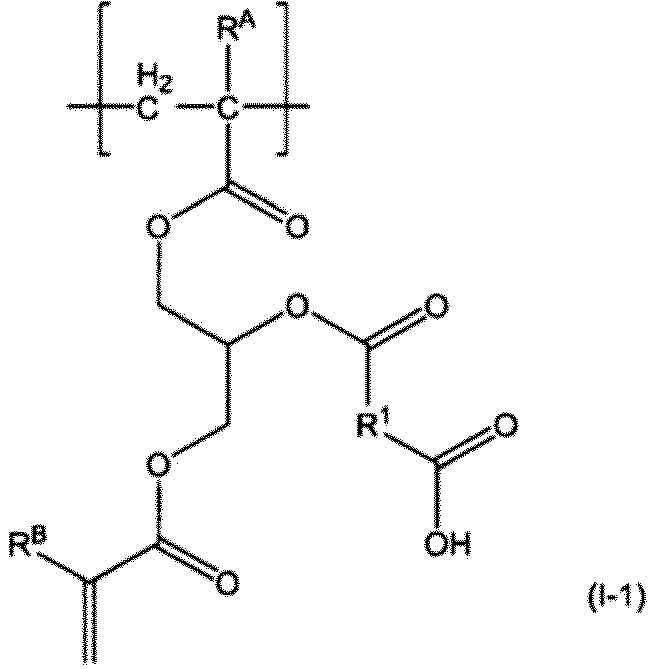
式(I-1)中、RA及びRBは、前記式(I)のものと同義である。R1は前記式(i-1)のものと同義である。
前記式(I)で表される部分構造は、感度の観点から、下記式(I-2)で表される部分構造であることが好ましい。
前記式(I)で表される部分構造は、感度の観点から、下記式(I-2)で表される部分構造であることが好ましい。

式(I-2)中、RA及びRBは、前記式(I)のものと同義である。
アクリル共重合樹脂(b2-1)が前記一般式(I)で表される部分構造を含む場合、アクリル共重合樹脂(b2-1)に含まれる前記一般式(I)で表される部分構造の含有量は特に限定されないが、5モル%以上が好ましく、20モル%以上がより好ましく、30モル%以上がさらに好ましく、50モル%以上がよりさらに好ましく、70モル%以上が特に好ましく、80モル%以上が最も好ましく、また、99モル%以下が好ましく、97モル%以下がより好ましく、95モル%以下がさらに好ましい。前記下限値以上とすることで良好な現像溶解性を得ることができる。また、前記上限値以下とすることで現像密着性が向上する傾向がある。
アクリル共重合樹脂(b2-1)が前記一般式(I-1)で表される部分構造を含む場合、アクリル共重合樹脂(b2-1)に含まれる前記一般式(I-1)で表される部分構造の含有量は特に限定されないが、1モル%以上が好ましく、5モル%以上がより好ましく、8モル%以上がさらに好ましく、10モル%以上がよりさらに好ましく、また、99モル%以下が好ましく、60モル%以下がより好ましく、40モル%以下がさらに好ましく、30モル%以下がよりさらに好ましく、20モル%以下が特に好ましい。前記下限値以上とすることで感度が高くなり、良好な現像溶解性を得ることができる。また、前記上限値以下とすることで現像密着性が向上する傾向がある。
アクリル共重合樹脂(b2-1)が前記一般式(I-2)で表される部分構造を含む場合、アクリル共重合樹脂(b2-1)に含まれる前記一般式(I-2)で表される部分構造の含有量は特に限定されないが、10モル%以上が好ましく、20モル%以上がより好ましく、30モル%以上がさらに好ましく、40モル%以上がよりさらに好ましく、50モル%以上が特に好ましく、70モル%以上が最も好ましく、また、99モル%以下が好ましく、95モル%以下がより好ましく、90モル%以下がさらに好ましく、85モル%以下が特に好ましい。前記下限値以上とすることで感度が高くなる傾向がある。また、前記上限値以下とすることで現像性が向上する傾向がある。
アクリル共重合樹脂(b2-1)が前記一般式(I)で表される部分構造を含む場合、他に含んでいてもよい部分構造は特に限定されないが、現像密着性の観点から、例えば、下記一般式(I')で表される部分構造を含むことが好ましい。
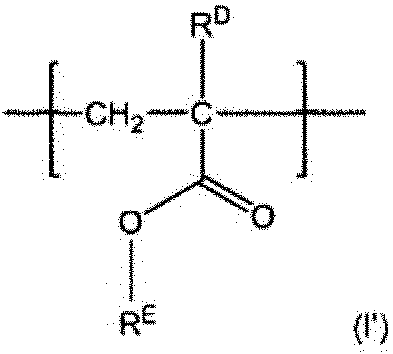
上記式(I')中、RDは水素原子又はメチル基を表し、REは置換基を有していてもよいアルキル基、置換基を有していてもよいアリール基(芳香族環基)、又は置換基を有していてもよいアルケニル基を表す。
前記式(I')において、REは置換基を有していてもよいアルキル基、置換基を有していてもよいアリール基、又は置換基を有していてもよいアルケニル基を表す。
REにおけるアルキル基としては直鎖状、分岐鎖状又は環状のアルキル基が挙げられる。その炭素数は、1以上が好ましく、3以上がより好ましく、5以上がさらに好ましく、また、20以下が好ましく、18以下がより好ましく、16以下がさらに好ましく、14以下がよりさらに好ましく、12以下が特に好ましい。前記下限値以上とすることで膜強度が高くなり、現像密着性が向上する傾向がある。また、前記上限値以下とすることで良好な現像溶解性を得ることができる。
前記式(I')において、REは置換基を有していてもよいアルキル基、置換基を有していてもよいアリール基、又は置換基を有していてもよいアルケニル基を表す。
REにおけるアルキル基としては直鎖状、分岐鎖状又は環状のアルキル基が挙げられる。その炭素数は、1以上が好ましく、3以上がより好ましく、5以上がさらに好ましく、また、20以下が好ましく、18以下がより好ましく、16以下がさらに好ましく、14以下がよりさらに好ましく、12以下が特に好ましい。前記下限値以上とすることで膜強度が高くなり、現像密着性が向上する傾向がある。また、前記上限値以下とすることで良好な現像溶解性を得ることができる。
アルキル基としては、例えば、メチル基、エチル基、シクロヘキシル基、ジシクロペンタニル基、ドデカニル基が挙げられる。これらの中でも膜強度の観点から、ジシクロペンタニル基、ドデカニル基が好ましく、ジシクロペンタニル基がより好ましい。
アルキル基が有していてもよい置換基としては、例えば、メトキシ基、エトキシ基、クロロ基、ブロモ基、フルオロ基、ヒドロキシ基、アミノ基、エポキシ基、オリゴエチレングリコール基、フェニル基、カルボキシ基、アクリロイル基、メタクリロイル基が挙げられ、現像性の観点から、ヒドロキシ基、オリゴエチレングリコール基が好ましい。
アルキル基が有していてもよい置換基としては、例えば、メトキシ基、エトキシ基、クロロ基、ブロモ基、フルオロ基、ヒドロキシ基、アミノ基、エポキシ基、オリゴエチレングリコール基、フェニル基、カルボキシ基、アクリロイル基、メタクリロイル基が挙げられ、現像性の観点から、ヒドロキシ基、オリゴエチレングリコール基が好ましい。
REにおけるアリール基(芳香族環基)としては、1価の芳香族炭化水素環基、1価の芳香族複素環基が挙げられる。その炭素数は6以上が好ましく、また、24以下が好ましく、22以下がより好ましく、20以下がさらに好ましく、18以下が特に好ましい。前記下限値以上とすることで現像密着性が向上する傾向がある。また、前記上限値以下とすることで残渣が低減する傾向がある。
芳香族炭化水素環基における芳香族炭化水素環としては、単環であっても縮合環であってもよく、例えば、ベンゼン環、ナフタレン環、アントラセン環、フェナントレン環、ペリレン環、テトラセン環、ピレン環、ベンズピレン環、クリセン環、トリフェニレン環、アセナフテン環、フルオランテン環、フルオレン環が挙げられる。
芳香族複素環基における芳香族複素環基としては、単環であっても縮合環であってもよく、例えば、フラン環、ベンゾフラン環、チオフェン環、ベンゾチオフェン環、ピロール環、ピラゾール環、イミダゾール環、オキサジアゾール環、インドール環、カルバゾール環、ピロロイミダゾール環、ピロロピラゾール環、ピロロピロール環、チエノピロール環、チエノチオフェン環、フロピロール環、フロフラン環、チエノフラン環、ベンゾイソオキサゾール環、ベンゾイソチアゾール環、ベンゾイミダゾール環、ピリジン環、ピラジン環、ピリダジン環、ピリミジン環、トリアジン環、キノリン環、イソキノリン環、シノリン環、キノキサリン環、フェナントリジン環、ペリミジン環、キナゾリン環、キナゾリノン環、アズレン環が挙げられる。これらの中でも硬化性の観点から、ベンゼン環基、ナフタレン環基が好ましく、ベンゼン環基がより好ましい。
アリール基が有していてもよい置換基としては、例えば、メチル基、エチル基、プロピル基、メトキシ基、エトキシ基、クロロ基、ブロモ基、フルオ口基、ヒドロキシ基、アミノ基、エポキシ基、オリゴエチレングリコール基、フェニル基、カルボキシ基が挙げられ、現像性の観点から、ヒドロキシ基、オリゴエチレングリコール基が好ましい。
REにおけるアルケニル基としては、直鎖状、分岐鎖状又は環状のアルケニル基が挙げられる。その炭素数は、2以上が好ましく、また、22以下が好ましく、20以下がより好ましく、18以下がさらに好ましく、16以下がよりさらに好ましく、14以下が特に好ましい。前記下限値以上とすることで現像密着性が向上する傾向がある。また、前記上限値以下とすることで良好な現像溶解性を得ることができる。
アルケニル基としては、例えば、エテニル基、プロペニル基、ブテニル基、シクロヘキセニル基が挙げられる。これらの中でも硬化性の観点から、エテニル基、プロペニル基が好ましく、エテニル基がより好ましい。
アルケニル基が有していてもよい置換基としては、例えば、メトキシ基、エトキシ基、クロロ基、ブロモ基、フルオロ基、ヒドロキシ基、アミノ基、エポキシ基、オリゴエチレングリコール基、フェニル基、カルボキシ基が挙げられ、現像性の観点から、ヒドロキシ基、オリゴエチレングリコール基が好ましい。
これらの中でも現像性の観点から、REとしては、アルキル基、アルケニル基が好ましく、アルキル基がより好ましく、ジシクロペンタニル基がさらに好ましい。
アクリル共重合樹脂(b2-1)が前記一般式(I')で表される部分構造を含む場合、アクリル共重合樹脂(b2-1)に含まれる前記一般式(I')で表される部分構造の含有量は特に限定されないが、0.5モル%以上が好ましく、1モル%以上がより好ましく、1.5モル%以上がさらに好ましく、2モル%以上が特に好ましく、また、90モル%以下が好ましく、70モル%以下がより好ましく、50モル%以下がさらに好ましく、30モル%以下がよりさらに好ましく、10モル%以下が特に好ましい。前記下限値以上とすることで現像密着性が向上する傾向がある。また、前記上限値以下とすることで良好な現像溶解性を得ることができる。
アクリル共重合樹脂(b2-1)が前記一般式(I)で表される部分構造を含む場合、耐熱性、膜強度の観点から、下記一般式(I'')で表される部分構造をさらに含むことが好ましい。
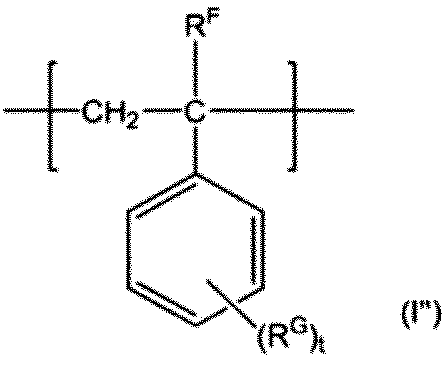
上記式(I'')中、RFは水素原子又はメチル基を表し、RGは置換基を有していてもよいアルキル基、置換基を有していてもよいアルケニル基、ヒドロキシ基、カルボキシ基、ハロゲン原子、置換基を有していてもよいアルコキシ基、チオール基、又は置換基を有していてもよいアルキルスルフィド基を表す。tは0~5の整数を表す。
RGにおけるアルキル基としては、直鎖状、分岐鎖状又は環状のアルキル基が挙げられる。その炭素数は、1以上が好ましく、3以上がより好ましく、5以上がさらに好ましく、また、20以下が好ましく、18以下がより好ましく、16以下がさらに好ましく、14以下がよりさらに好ましく、12以下が特に好ましい。前記下限値以上とすることで現像密着性が向上する傾向がある。また、前記上限値以下とすることで良好な現像溶解性を得ることができる。
RGにおけるアルキル基としては、直鎖状、分岐鎖状又は環状のアルキル基が挙げられる。その炭素数は、1以上が好ましく、3以上がより好ましく、5以上がさらに好ましく、また、20以下が好ましく、18以下がより好ましく、16以下がさらに好ましく、14以下がよりさらに好ましく、12以下が特に好ましい。前記下限値以上とすることで現像密着性が向上する傾向がある。また、前記上限値以下とすることで良好な現像溶解性を得ることができる。
RGにおけるアルキル基としては、例えば、メチル基、エチル基、シクロヘキシル基、ジシクロペンタニル基、ドデカニル基が挙げられる。これらの中でも現像密着性の観点から、ジシクロペンタニル基、ドデカニル基が好ましく、ジシクロペンタニル基がより好ましい。
アルキル基が有していてもよい置換基としては、例えば、メトキシ基、エトキシ基、クロロ基、ブロモ基、フルオロ基、ヒドロキシ基、アミノ基、エポキシ基、オリゴエチレングリコール基、フェニル基、カルボキシ基、アクリロイル基、メタクリロイル基が挙げられ、現像性の観点から、ヒドロキシ基、オリゴエチレングリコール基が好ましい。
アルキル基が有していてもよい置換基としては、例えば、メトキシ基、エトキシ基、クロロ基、ブロモ基、フルオロ基、ヒドロキシ基、アミノ基、エポキシ基、オリゴエチレングリコール基、フェニル基、カルボキシ基、アクリロイル基、メタクリロイル基が挙げられ、現像性の観点から、ヒドロキシ基、オリゴエチレングリコール基が好ましい。
RGにおけるアルケニル基としては、直鎖状、分岐鎖状又は環状のアルケニル基が挙げられる。その炭素数は、2以上が好ましく、また、22以下が好ましく、20以下がより好ましく、18以下がさらに好ましく、16以下がよりさらに好ましく、14以下が特に好ましい。前記下限値以上とすることで現像密着性が向上する傾向がある。また、前記上限値以下とすることで良好な現像溶解性を得ることができる。
アルケニル基としては、例えば、エテニル基、プロペニル基、ブテニル基、シクロヘキセニル基が挙げられる。これらの中でも硬化性の観点から、エテニル基、プロペニル基が好ましく、エテニル基がより好ましい。アルケニル基が有していてもよい置換基としては、例えば、メトキシ基、エトキシ基、クロロ基、ブロモ基、フルオロ基、ヒドロキシ基、アミノ基、エポキシ基、オリゴエチレングリコール基、フェニル基、カルボキシ基が挙げられ、現像性の観点から、ヒドロキシ基、オリゴエチレングリコール基が好ましい。
RGにおけるハロゲン原子としては、フッ素原子、塩素原子、臭素原子、ヨウ素原子が挙げられ、これらの中でも撥液性(撥インク性)の観点からはフッ素原子が好ましい。
RGにおけるアルコキシ基としては、直鎖状、分岐鎖状又は環状のアルコキシ基が挙げられる。その炭素数は、1以上が好ましく、また、20以下が好ましく、18以下がより好ましく、16以下がさらに好ましく、14以下がよりさらに好ましく、12以下が特に好ましい。前記下限値以上とすることで現像密着性が向上する傾向がある。また、前記上限値以下とすることで残清が低減する傾向がある。
アルコキシ基が有していてもよい置換基としては、例えば、メトキシ基、エトキシ基、クロロ基、ブロモ基、フルオロ基、ヒドロキシ基、アミノ基、エポキシ基、オリゴエチレングリコール基、フェニル基、カルボキシ基、アクリロイル基、メタクリロイル基が挙げられ、現像性の観点から、ヒドロキシ基、オリゴエチレングリコール基が好ましい。
アルコキシ基が有していてもよい置換基としては、例えば、メトキシ基、エトキシ基、クロロ基、ブロモ基、フルオロ基、ヒドロキシ基、アミノ基、エポキシ基、オリゴエチレングリコール基、フェニル基、カルボキシ基、アクリロイル基、メタクリロイル基が挙げられ、現像性の観点から、ヒドロキシ基、オリゴエチレングリコール基が好ましい。
RGにおけるアルキルスルフィド基としては、直鎖状、分岐鎖状又は環状のアルキルスルフィド基が挙げられる。その炭素数は、1以上であることが好ましく、また、20以下であることが好ましく、18以下であることがより好ましく、16以下であることがさらに好ましく、14以下であることがよりさらに好ましく、12以下であることが特に好ましい。前記下限値以上とすることで現像密着性が向上する傾向がある。また、前記上限値以下とすることで残渣が低減する傾向がある。
アルキルスルフィド基としては、例えば、メチルスルフィド基、エチルスルフィド基、プロピルスルフィド基、ブチルスルフィド基が挙げられる。これらの中でも現像性の観点から、メチルスルフィド基、エチルスルフィド基が好ましい。
アルキルスルフィド基におけるアルキル基が有していてもよい置換基としては、例えば、メトキシ基、エトキシ基、クロロ基、ブロモ基、フルオロ基、ヒドロキシ基、アミノ基、エポキシ基、オリゴエチレングリコール基、フェニル基、カルボキシ基、アクリロイル基、メタクリロイル基が挙げられ、現像性の観点から、ヒドロキシ基、オリゴエチレングリコール基、カルボキシ基が好ましい。
また、前記式(I'')においてtは0~5の整数を表す。現像性の観点から、0~2が好ましく、0~1がより好ましく、0がさらに好ましい。
アクリル共重合樹脂(b2-1)が前記一般式(I'')で表される部分構造を含む場合、アクリル共重合樹脂(b2-1)に含まれる前記一般式(I'')で表される部分構造の含有量は特に限定されないが、1モル%以上が好ましく、2モル%以上がより好ましく、3モル%以上がさらに好ましく、5モル%以上が特に好ましく、また、90モル%以下が好ましく、70モル%以下がより好ましく、50モル%以下がさらに好ましく、30モル%以下がよりさらに好ましく、20モル%以下が特に好ましく、10モル%以下が最も好ましい。前記下限値以上とすることで現像密着性が向上する傾向がある。また、前記上限値以下とすることで残渣が低減する傾向がある。
アクリル共重合樹脂(b2-1)が前記一般式(I)で表される部分構造を含む場合、現像性の観点から下記一般式(I''')で表される部分構造をさらに含むことが好ましい。
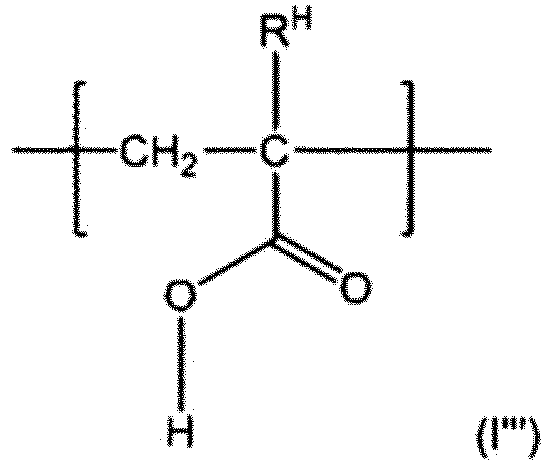
上記式(I''')中、RHは水素原子又はメチル基を表す。
アクリル共重合樹脂(b2-1)が前記一般式(I''')で表される部分構造を含む場合、アクリル共重合樹脂(b2-1)に含まれる前記一般式(I''')で表される部分構造の含有量は特に限定されないが、5モル%以上が好ましく、10モル%以上がより好ましく、30モル%以上がさらに好ましく、また、90モル%以下が好ましく、80モル%以下がより好ましく、70モル%以下がさらに好ましく、50モル%以下が特に好ましい。前記下限値以上とすることで良好な現像溶解性を得ることができる。また、前記上限値以下とすることで現像密着性が向上する傾向がある。
アクリル共重合樹脂(b2)の酸価は特に限定されないが、5mgKOH/g以上が好ましく、10mgKOH/g以上がより好ましく、20mgKOH/g以上がさらに好ましく、25mgKOH/g以上がよりさらに好ましく、また、100mgKOH/g以下が好ましく、80mgKOH/g以下がより好ましく、60mgKOH/g以下がさらに好ましく、40mgKOH/g以下がよりさらに好ましい。前記下限値以上とすることで良好な現像溶解性を得ることができる。また、前記上限値以下とすることで現像密着性が向上する傾向がある。
アクリル共重合樹脂(b2)の重量平均分子量(Mw)は特に限定されないが、好ましくは1000以上、より好ましくは2000以上、さらに好ましくは3000以上、よりさらに好ましくは4000以上、特に好ましくは5000以上であり、また、好ましくは30000以下、より好ましくは20000以下、さらに好ましくは15000以下、よりさらに好ましくは10000以下である。特に好ましくは8000以下である。前記下限値以上とすることで現像密着性が向上する傾向がある。また、前記上限値以下とすることで良好な現像溶解性を得ることができる。
(B)アルカリ可溶性樹脂がアクリル共重合樹脂(b2)を含む場合、(B)アルカリ可溶性樹脂に含まれるアクリル共重合樹脂(b2)の含有量は特に限定されないが、5質量%以上が好ましく、10質量%以上がより好ましく、15質量%以上がさらに好ましく、20質量%以上が特に好ましく、また、通常100質量%以下が好ましく、80質量%以下がより好ましく、50質量%以下がさらに好ましい。前記下限値以上とすることで現像溶解性が良好となる傾向がある。前記上限値以下とすることでテーパー角が高くなる傾向がある。
(B)アルカリ可溶性樹脂中には、エポキシ(メタ)アクリレート樹脂(b1)及びアクリル共重合樹脂(b2)のいずれかが単独で含まれていてもよく、両者が含まれていてもよい。さらに、(B)アルカリ可溶性樹脂中にはアルカリ可溶性樹脂(b)以外のアルカリ可溶性樹脂が含まれていてもよい。
本発明の感光性樹脂組成物における(B)アルカリ可溶性樹脂の含有量は、感光性樹脂組成物の全固形分中に、好ましくは5質量%以上、より好ましくは10質量%以上、さらに好ましくは20質量%以上、よりさらに好ましくは30質量%以上、特に好ましくは40質量%以上、また、好ましくは90質量%以下、より好ましくは70質量%以下、さらに好ましくは60質量%以下、特に好ましくは50質量%以下である。前記下限値以上とすることで現像性が向上する傾向がある。また、前記上限値以下とすることで良好な現像溶解性が得られる。
本発明の感光性樹脂組成物がエポキシ(メタ)アクリレート樹脂(b1)を含む場合、エポキシ(メタ)アクリレート樹脂(b1)の含有量は特に限定されないが、感光性樹脂組成物の全固形分中に、好ましくは5質量%以上、より好ましくは10質量%以上、さらに好ましくは20質量%以上、よりさらに好ましくは30質量%以上、特に好ましくは40質量%以上、また、好ましくは90質量%以下、より好ましくは70質量%以下、さらに好ましくは60質量%以下、特に好ましくは50質量%以下である。前記下限値以上とすることで現像性が向上する傾向がある。また、前記上限値以下とすることで良好な現像溶解性が得られる。
また、本発明の感光性樹脂組成物がアクリル共重合樹脂(b2)を含む場合、アクリル共重合樹脂(b2)の含有量は特に限定されないが、感光性樹脂組成物の全固形分中に、好ましくは5質量%以上、より好ましくは10質量%以上、さらに好ましくは20質量%以上、よりさらに好ましくは30質量%以上、特に好ましくは40質量%以上、また、好ましくは90質量%以下、より好ましくは70質量%以下、さらに好ましくは60質量%以下、特に好ましくは50質量%以下である。前記下限値以上とすることで現像性が向上する傾向がある。また、前記上限値以下とすることで良好な現像溶解性が得られる。
また、感光性樹脂組成物の全固形分中における(B)アルカリ可溶性樹脂及び(C)光重合性化合物の含有量の合計は、好ましくは5質量%以上、より好ましくは10質量%以上、さらに好ましくは30質量%以上、よりさらに好ましくは50質量%以上、特に好ましくは70質量%以上、さらに特に好ましくは80質量%以上であり、最も好ましくは90質量%以上であり、また、好ましくは99質量%以下、より好ましくは97質量%以下、さらに好ましくは95質量%以下である。前記下限値以上とすることで硬化性が向上する傾向がある。また、前記上限値以下とすることで良好な現像溶解性が得られる。
感光性樹脂組成物における(C)光重合性化合物に対する(B)アルカリ可溶性樹脂の配合比としては、(C)光重合性化合物100質量部に対して、50質量部以上が好ましく、60質量部以上がより好ましく、70質量部以上がさらに好ましく、80質量部以上が特に好ましく、また、400質量部以下が好ましく、300質量部以下がより好ましく、200質量部以下がさらに好ましく、120質量部以下が特に好ましい。前記下限値以上とすることで現像密着性が向上する傾向がある。また、前記上限値以下とすることで硬化性が向上する傾向がある。
本発明の感光性樹脂組成物は、基板との密着性を改善するため、リン酸系密着向上剤を含有してもよい。リン酸系密着向上剤としては、(メタ)アクリロイルオキシ基含有ホスフェート類が好ましく、中でも下記一般式(Va)、(Vb)、(Vc)で表されるものが好ましい。
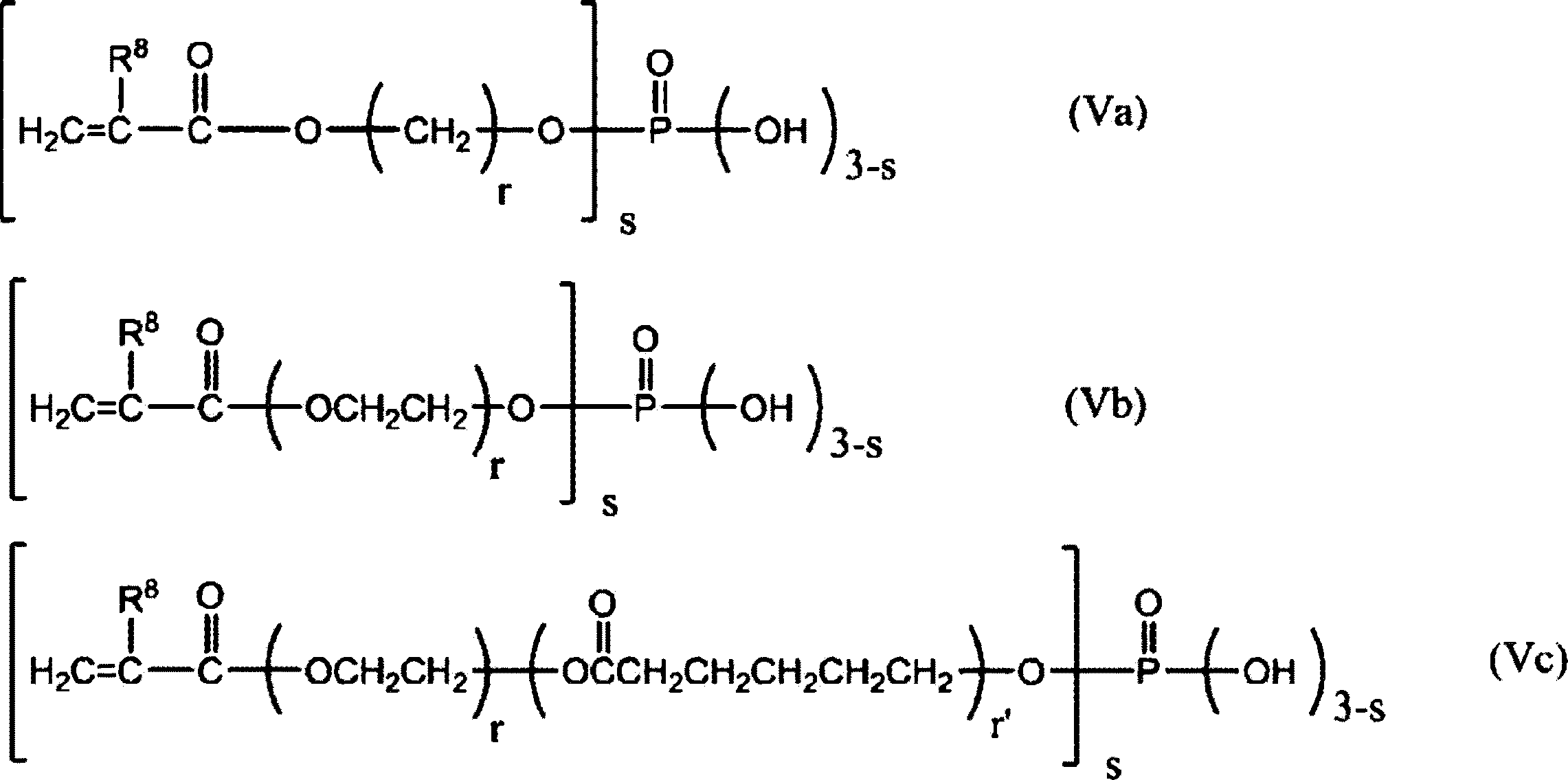
上記一般式(Va)、(Vb)、(Vc)において、R8は水素原子又はメチル基を示し、r及びr’は1~10の整数、sは1~3の実数である。
本発明の感光性樹脂組成物がリン酸系密着向上剤を含有する場合、その含有量は特に限定されないが、感光性樹脂組成物の全固形分中に0.1質量%以上が好ましく、0.2質量%以上がより好ましく、0.3質量%以上がさらに好ましく、また、5質量%以下が好ましく、3質量%以下がより好ましく、1質量%以下がさらに好ましい。前記上限及び下限は任意に組み合わせることができ、例えば、0.1~5質量%が好ましく、0.2~3質量%がより好ましく、0.3~1質量%がさらに好ましい。前記下限値以上とすることで基板との密着性が向上する傾向がある。また、前記上限値以下とすることで表面硬化性が向上する傾向がある。
(C)光重合性化合物
本発明の感光性樹脂組成物は、(C)光重合性化合物を含有する。(C)光重合性化合物を含むことで、高感度となると考えられる。
ここで使用される光重合性化合物としては、エチレン性不飽和結合(エチレン性二重結合)を分子内に1個以上有する化合物を意味するが、重合性、架橋性、及びそれに伴う露光部と非露光部の現像液溶解性の差異を拡大できる等の点から、エチレン性不飽和結合を分子内に2個以上有する化合物であることが好ましい。また、その不飽和結合は(メタ)アクリロイルオキシ基に由来するもの、つまり、(メタ)アクリレート化合物であることがさらに好ましい。
本発明の感光性樹脂組成物は、(C)光重合性化合物を含有する。(C)光重合性化合物を含むことで、高感度となると考えられる。
ここで使用される光重合性化合物としては、エチレン性不飽和結合(エチレン性二重結合)を分子内に1個以上有する化合物を意味するが、重合性、架橋性、及びそれに伴う露光部と非露光部の現像液溶解性の差異を拡大できる等の点から、エチレン性不飽和結合を分子内に2個以上有する化合物であることが好ましい。また、その不飽和結合は(メタ)アクリロイルオキシ基に由来するもの、つまり、(メタ)アクリレート化合物であることがさらに好ましい。
本発明の感光性樹脂組成物においては、特に、1分子中にエチレン性不飽和結合を2個以上有する多官能エチレン性単量体を使用することが望ましい。多官能エチレン性単量体が有するエチレン性不飽和基の数は特に限定されないが、好ましくは2個以上、より好ましくは3個以上、さらに好ましくは4個以上、特に好ましくは5個以上であり、また、好ましくは15個以下、より好ましくは10個以下、さらに好ましくは8個以下、特に好ましくは7個以下である。前記下限値以上とすることで重合性が向上して高感度となる傾向がある。前記上限値以下とすることで現像性がより良好となる傾向がある。
(C)光重合性化合物としては、例えば、脂肪族ポリヒドロキシ化合物と不飽和カルボン酸とのエステル;芳香族ポリヒドロキシ化合物と不飽和カルボン酸とのエステル;脂肪族ポリヒドロキシ化合物、芳香族ポリヒドロキシ化合物等の多価ヒドロキシ化合物と、不飽和カルボン酸及び多塩基性カルボン酸とのエステル化反応により得られるエステル;が挙げられる。
(C)光重合性化合物としては、例えば、脂肪族ポリヒドロキシ化合物と不飽和カルボン酸とのエステル;芳香族ポリヒドロキシ化合物と不飽和カルボン酸とのエステル;脂肪族ポリヒドロキシ化合物、芳香族ポリヒドロキシ化合物等の多価ヒドロキシ化合物と、不飽和カルボン酸及び多塩基性カルボン酸とのエステル化反応により得られるエステル;が挙げられる。
脂肪族ポリヒドロキシ化合物と不飽和カルボン酸とのエステルとしては、例えば、エチレングリコールジアクリレート、トリエチレングリコールジアクリレート、トリメチロールプロパントリアクリレート、トリメチロールエタントリアクリレート、ペンタエリスリトールジアクリレート、ペンタエリスリトールトリアクリレート、ペンタエリスリトールテトラアクリレート、ジペンタエリスリトールテトラアクリレート、ジペンタエリスリトールペンタアクリレート、ジペンタエリスリトールヘキサアクリレート、グリセロールアクリレート等の脂肪族ポリヒドロキシ化合物のアクリル酸エステル;これらの化合物のアクリレートをメタクリレートに代えたメタクリル酸エステル;これらの化合物のアクリレートをイタコネートに代えたイタコン酸エステル;これらの化合物のアクリレートをクロネートに代えたクロトン酸エステル;これらの化合物のアクリレートをマレエートに代えたマレイン酸エステル;が挙げられる。
芳香族ポリヒドロキシ化合物と不飽和カルボン酸とのエステルとしては、例えば、ハイドロキノンジアクリレート、ハイドロキノンジメタクリレート、レゾルシンジアクリレート、レゾルシンジメタクリレート、ピロガロールトリアクリレート等の芳香族ポリヒドロキシ化合物のアクリル酸エステル及びメタクリル酸エステルが挙げられる。
脂肪族ポリヒドロキシ化合物、芳香族ポリヒドロキシ化合物等の多価ヒドロキシ化合物と、不飽和カルボン酸及び多塩基性カルボン酸とのエステル化反応により得られるエステルとしては、必ずしも単一物ではないが、例えば、アクリル酸、フタル酸、及びエチレングリコールの縮合物;アクリル酸、マレイン酸、及びジエチレングリコールの縮合物;メタクリル酸、テレフタル酸及びペンタエリスリトールの縮合物;アクリル酸、アジピン酸、ブタンジオール及びグリセリンの縮合物;が挙げられる。
脂肪族ポリヒドロキシ化合物、芳香族ポリヒドロキシ化合物等の多価ヒドロキシ化合物と、不飽和カルボン酸及び多塩基性カルボン酸とのエステル化反応により得られるエステルとしては、必ずしも単一物ではないが、例えば、アクリル酸、フタル酸、及びエチレングリコールの縮合物;アクリル酸、マレイン酸、及びジエチレングリコールの縮合物;メタクリル酸、テレフタル酸及びペンタエリスリトールの縮合物;アクリル酸、アジピン酸、ブタンジオール及びグリセリンの縮合物;が挙げられる。
本発明の感光性樹脂組成物に用いられる(C)光重合性化合物の上記以外の例としては、例えば、ポリイソシアネート化合物と水酸基含有(メタ)アクリル酸エステル又はポリイソシアネート化合物とポリオール及び水酸基含有(メタ)アクリル酸エステルを反応させて得られるようなウレタン(メタ)アクリレート類;多価エポキシ化合物と水酸基含有(メタ)アクリル酸エステル又は(メタ)アクリル酸との付加反応物のようなエポキシアクリレート類;エチレンビスアクリルアミド等のアクリルアミド類;フタル酸ジアリル等のアリルエステル類;ジビニルフタレート等のビニル基含有化合物が有用である。
ウレタン(メタ)アクリレート類としては、例えば、DPHA-40H、UX-5000、UX-5002D-P20、UX-5003D、UX-5005(日本化薬社製)、U-2PPA、U-6LPA、U-10PA、U-33H、UA-53H、UA-32P、UA-11OOH(新中村化学工業社製)、UA-306H、UA-510H、UF-8001G(協栄社化学社製)、UV-1700B、UV-7600B、UV-7605B、UV-7630B、 UV7640B(三菱ケミカル社製)が挙げられる。
ウレタン(メタ)アクリレート類としては、例えば、DPHA-40H、UX-5000、UX-5002D-P20、UX-5003D、UX-5005(日本化薬社製)、U-2PPA、U-6LPA、U-10PA、U-33H、UA-53H、UA-32P、UA-11OOH(新中村化学工業社製)、UA-306H、UA-510H、UF-8001G(協栄社化学社製)、UV-1700B、UV-7600B、UV-7605B、UV-7630B、 UV7640B(三菱ケミカル社製)が挙げられる。
これらの中でも、適正なテーパー角と感度の観点から(C)光重合性化合物として、エステル(メタ)アクリレート類又はウレタン(メタ)アクリレート類を用いることが好ましく、ジペンタエリスリトールヘキサ(メタ)アクリレート、ジペンタエリスリトールペンタ(メタ)アクリレート、2-トリス(メタ)アクリロイロキシメチルエチルフタル酸、ペンタエリスリトールテトラ(メタ)アクリレート、ペンタエリスリトールトリ(メタ)アクリレート、ペンタエリスリトールジ(メタ)アクリレート、ジペンタエリスリトールペンタ(メタ)アクリレートの二塩基酸無水物付加物、ペンタエリスリトールトリ(メタ)アクリレートの二塩基酸無水物付加物を用いることがより好ましい。これらは1種を単独で用いてもよく、2種以上を併用してもよい。
本発明の感光性樹脂組成物において、(C)光重合性化合物の分子量は特に限定されないが、感度、撥液性(撥インク性)、テーパー角の観点から、好ましくは100以上、より好ましくは150以上で、さらに好ましくは200以上、よりさらに好ましくは300以上、特に好ましくは400以上、最も好ましくは500以上であり、好ましくは1000以下、より好ましくは700以下である。
(C)光重合性化合物の炭素数は特に限定されないが、感度、撥液性(撥インク性)、テーパー角の観点から、好ましくは7以上、より好ましくは10以上、さらに好ましくは15以上、よりさらに好ましくは20以上、特に好ましくは25以上であり、好ましくは50以下、より好ましくは40以下、さらに好ましくは35以下、特に好ましくは30以下である。
感度、撥液性(撥インク性)、テーパー角の観点から、エステル(メタ)アクリレート類、エポキシ(メタ)アクリレート類、及びウレタン(メタ)アクリレート類が好ましく、中でも、ペンタエリスリトールテトラ(メタ)アクリレート、ペンタエリスリトールトリ(メタ)アクリレートジペンタエリスリトールヘキサ(メタ)アクリレート、ジペンタエリスリトールペンタ(メタ)アクリレートなど3官能以上のエステル(メタ)アクリレート類、2,2,2-トリス(メタ)アクリロイロキシメチルエチルフタル酸、ジペンタエリスリトールペンタ(メタ)アクリレートの二塩基酸無水物付加物等の3官能以上のエステル(メタ)アクリレート類への酸無水物の付加物がさらに好ましい。
本発明の感光性樹脂組成物における(C)光重合性化合物の含有量は、感光性樹脂組成物の全固形分中に好ましくは5質量%以上、より好ましくは10質量%以上、さらに好ましくは20質量%以上、よりさらに好ましくは30質量%以上、特に好ましくは40質量%以上、また、好ましくは80質量%以下、より好ましくは70質量%以下、さらに好ましくは60質量%以下、よりさらに好ましくは55質量%以下、特に好ましくは50質量%以下である。前記下限値以上とすることで適切な内部硬化性となる傾向がある。前記上限値以下とすることで現像性が良好となる傾向がある。
(D)撥液剤
撥液剤は、以下の下記一般式(II)で表される繰り返し単位及びフッ素原子を含有するアクリル樹脂(以下、アクリル樹脂(D1)とも称する。)を含むことが好ましい。
撥液剤は、以下の下記一般式(II)で表される繰り返し単位及びフッ素原子を含有するアクリル樹脂(以下、アクリル樹脂(D1)とも称する。)を含むことが好ましい。

(式(II)中、R11はそれぞれ独立に、水素原子又はメチル基を表し、R12は置換基を有していてもよい炭素数2~6のアルキレン基を表し、-O-、-C(=O)-、-S-、-NH-のいずれか1つ以上で中断されていてもよい。*は結合部を表す。)
R12のアルキレン基が有する炭素数は、通常、2以上であり、好ましくは炭素数4以上であり、また、通常、6以下であり、好ましくは5以下である。前記下限値以上とすることで、合成が容易となる。また、前記上限値以下とすることでエチレン性不飽和結合の自由度が高くなり、硬化性、撥液性が良化する傾向にある。
また、R12のアルキレン基は、-O-、-C(=O)-、-S-、-NH-のいずれか1つ以上で中断されていてもよい。別の態様としては、-O-、-C(=O)-又は-NH-で中断されていてもよく、さらに別の態様としては、-O-C(=O)-NH-で中断されていてもよい。
R12が置換基を有する場合、置換基としては、例えば、水酸基、炭素数1~3のアルコキシ基が挙げられる。無置換であるか、又は水酸基で置換されていることが好ましく、無置換であることがより好ましい。
また、R12のアルキレン基は、-O-、-C(=O)-、-S-、-NH-のいずれか1つ以上で中断されていてもよい。別の態様としては、-O-、-C(=O)-又は-NH-で中断されていてもよく、さらに別の態様としては、-O-C(=O)-NH-で中断されていてもよい。
R12が置換基を有する場合、置換基としては、例えば、水酸基、炭素数1~3のアルコキシ基が挙げられる。無置換であるか、又は水酸基で置換されていることが好ましく、無置換であることがより好ましい。
R12としては、-(C2H4)2-NHCOO-(C2H4)2-、-(CH)2-CHOH-(CH2)-で示される基が撥液性の点で好ましく、-(C2H4)2-NHCOO-(C2H4)2-で示される基がより好ましい。
アクリル樹脂(D1)を含有することによって得られる凹凸構造の表面に撥液性を付与できることから、インクジェット法等で液状の導電性材料を塗布し、導電部を作成する際には、凸部表面への導電性材料の付着が予防され、また、隣接する凹部内に注入される導電性材料同士が混合されることが予防できる。
一般式(II)のようなエチレン性不飽和基を有する撥液剤を用いることで、形成した感光性樹脂組成物の塗布膜を露光する際にその表面での架橋反応を加速することができ、撥液剤が現像処理で流出しにくくなり、その結果、得られる凸部表面を高い撥液性を示すものとすることができると考えられる。
また、フッ素原子を含有する樹脂であることで、アクリル樹脂(D1)が凸部表面に偏析して凹部は相対的に親液性が高くなり導電性材料が凹部内に選択的に進入して濡れ広がりやすくなる。その結果、導電性材料の凹部内から凸部表面への決壊を防ぎ、微細な導電部パターンを高精細に形成できる。また、隣接する凹部に異なる導電性材料を配置する場合であっても、異なる導電性材料の混合を防止することができる。さらに詳しくは、フッ素原子を有する基が、導電性材料をはじき、導電性材料が凹凸構造の凸部を越えて隣接する領域に進入することによる導電性材料の混合を防ぐ働きがある。
本発明のメタサーフェス構造体は、撥液性を示す指標である接触角が凸部の上部表面において20°以上であることが好ましい。接触角が20°以上であると、上述の通り、導電性材料を凹凸構造の凹部に効率的に充填することができる。以上の観点から、メタサーフェス構造体の凸部の上部表面の接触角は30°以上であることがより好ましく、40°以上であることがさらに好ましい。
接触角の測定は、実施例に記載の方法で測定した値である。
接触角の測定は、実施例に記載の方法で測定した値である。
本発明のメタサーフェス構造体における凸部の壁部表面の接触角は、導電性材料を凹凸構造の凹部内全面に均一に充填する観点から、前記凸部の上部表面の接触角よりも小さいことが好ましい。凸部の壁部表面の接触角を凸部の上部表面の接触角よりも小さくすることで、導電性材料を凸部の上部表面から凹部に移動しやすくすることができるので、凹部に均一に充填することができる。
凸部の壁部表面の接触角は、20°未満であることが好ましく、10°以下であることがより好ましい。
接触角の値は、実施例に記載の方法で測定した値である。
凸部の壁部表面の接触角は、20°未満であることが好ましく、10°以下であることがより好ましい。
接触角の値は、実施例に記載の方法で測定した値である。
アクリル樹脂(D1)は、フルオロアルキル基及びフルオロアルキレン基のいずれか一方又は両方を有することが好ましく、パーフルオロアルキル基及びパーフルオロアルキレンエーテル鎖のいずれか一方又は両方を有することがより好ましい。フルオロアルキル基及びフルオロアルキレン基のいずれか一方又は両方、あるいは、パーフルオロアルキル基及びパーフルオロアルキレンエーテル鎖のいずれか一方又は両方を有することで、フッ素原子含有樹脂がさらに凹凸構造の凸部の表面に偏析しやすくなり、より高い撥液性を示し、導電性材料の凹部への進入を促進する傾向がある。
パーフルオロアルキル基としては、例えば、パーフルオロブチル基、パーフルオロヘキシル基、パーフルオロオクチル基が挙げられる。パーフルオロアルキレンエーテル鎖としては、例えば、-CF2-O-、-(CF2)2-O-、-(CF2)3-O-、-CF2-CF(CF3)-O-、-CF(CF3)-CF2-O-及びこれらの繰り返し単位をもつ2価の基が挙げられる。
アクリル樹脂(D1)は、一般式(II)で表される繰り返し単位やフッ素原子を含む構成単位以外の構成単位を有してもよい。例えば、エポキシ基を含む構成単位、カルボキシ基を含む構成単位、アルキレンオキサイド鎖をもつ構成単位が挙げられる。
アクリル樹脂(D1)の市販品としては、DIC社製「メガファック(登録商標。以下同じ。)RS-72-K」、「メガファックRS-90」などの商品名で市販されている含フッ素有機化合物を使用することができる。
アクリル樹脂(D1)の市販品としては、DIC社製「メガファック(登録商標。以下同じ。)RS-72-K」、「メガファックRS-90」などの商品名で市販されている含フッ素有機化合物を使用することができる。
アクリル樹脂(D1)中のフッ素原子含有量は特に制限されないが、アクリル樹脂(D1)中、5質量%以上が好ましく、10質量%以上がより好ましく、20質量%以上がさらに好ましく、25質量%以上がよりさらに好ましい。また、50質量%以下が好ましく、35質量%以下がより好ましい。前記下限値以上とすることで高い接触角を確保しやすく、また、前記上限値以下とすることで導電部への流出を抑制することができる。
アクリル樹脂(D1)の分子量は特に制限されず、低分子量の化合物でも、高分子量体であってもよい。高分子量体の方が、ポストベークによる流動性が抑えられ、凹凸構造からの流出を抑えることができるため好ましく、係る観点から、アクリル樹脂(D1)の重量平均分子量は、100以上が好ましく、500以上がより好ましく、100000以下が好ましく、10000以下がより好ましい。
なお、アクリル樹脂(D1)は、1種を単独で用いてもよく、2種以上を併用してもよい。また、本発明において(D)撥液剤として、アクリル樹脂(D1)以外の撥液剤を併用してもよい。
なお、アクリル樹脂(D1)は、1種を単独で用いてもよく、2種以上を併用してもよい。また、本発明において(D)撥液剤として、アクリル樹脂(D1)以外の撥液剤を併用してもよい。
撥液剤は、シロキサン鎖を有する化合物(D2)を含むことも好ましい。
化合物(D2)の有するシロキサン鎖は、具体的には下記構造式で表されるポリシロキサンが好ましい。
R1R2R3Si-O-(SiR4R5-O)n-SiR6R7R8
ここでR1、R2、R3、R4、R5、R6、R7、R8はそれぞれ独立して、1価の有機基又は水素原子を示す。
化合物(D2)の有するシロキサン鎖は、具体的には下記構造式で表されるポリシロキサンが好ましい。
R1R2R3Si-O-(SiR4R5-O)n-SiR6R7R8
ここでR1、R2、R3、R4、R5、R6、R7、R8はそれぞれ独立して、1価の有機基又は水素原子を示す。
1価の有機基として好ましくは、炭素数1~10の炭化水素基であり、その具体例としては、例えば、メチル基、エチル基、プロピル基、ブチル基、ペンチル基、ヘキシル基、ヘプチル基などのアルキル基;ビニル基、アリル基、ブテニル基、ペンテニル基、ヘキセニル基などのアルケニル基;フェニル基、トリル基、キシリル基などのアリール基;ベンジル基、フェネチル基などのアラルキル基;クロロメチル基、3-クロロプロピル基、3,3,3-トリフルオロプロピル基、ノナフルオロブチルエチル基などの置換アルキル基が挙げられ、これらの有機基はエステル結合を有していてもよい。
nは0以上の整数であり、好ましくは5以上、より好ましくは10以上であり、2000以下であり、好ましくは1500以下、より好ましくは1000以下、さらに好ましくは500以下、特に好ましくは300以下である。前記下限値以上とすることで撥液性(撥インク性)が高くなる傾向がある。前記上限値以下とすることで塗膜の均一性が高くなる傾向がある。
nは0以上の整数であり、好ましくは5以上、より好ましくは10以上であり、2000以下であり、好ましくは1500以下、より好ましくは1000以下、さらに好ましくは500以下、特に好ましくは300以下である。前記下限値以上とすることで撥液性(撥インク性)が高くなる傾向がある。前記上限値以下とすることで塗膜の均一性が高くなる傾向がある。
シロキサン鎖を含む化合物(D2)の市販品としては、例えば、ビックケミー社製「BYK-UV3500シリーズ」、大成ファインケミカル社製「8SS」シリーズ、信越化学工業社製「KPシリーズ」の商品名で市販されている化合物が挙げられる。
本発明の感光性樹脂組成物における(D)撥液剤の含有量は特に限定されないが、感光性樹脂組成物の全固形分中に好ましくは0.01質量%以上、より好ましくは0.05質量%以上、さらに好ましくは0.1質量%以上、特に好ましくは0.2質量%以上であり、また、好ましくは5質量%以下、より好ましくは3質量%以下、さらに好ましくは1質量%以下である。前記下限値以上とすることで撥液性(撥インク性)が向上する傾向がある。また、前記上限値以下とすることで凹凸構造形成後にインクを画素部に塗布する時に均一な塗膜が得られやすくなる傾向がある。
本発明の感光性樹脂組成物がアクリル樹脂(D1)を含有する場合、本発明の感光性樹脂組成物におけるアクリル樹脂(D1)の含有量は特に限定されないが、感光性樹脂組成物の全固形分中に好ましくは0.01質量%以上、より好ましくは0.11質量%以上、さらに好ましくは0.2質量%以上であり、また、好ましくは5質量%以下、より好ましくは3質量%以下、さらに好ましくは1質量%以下である。前記下限値以上とすることで撥液性が向上する傾向がある。また、前記上限値以下とすることで凹凸構造形成後に導電性材料を塗布する時に均一な塗膜が得られやすくなる傾向がある。
<導電部>
本発明のメタサーフェス構造体は、図1に示すように、導電部12を備える。導電部は凹凸構造の凹部の少なくとも一部に導電性材料が充填されてなる。導電性材料は、例えばインクジェット法等の印刷により塗布されるが、この際に凹凸構造の凸部が撥液性を有するために、導電性材料は所望する凹部への充填が効果的になされる。すなわち、凸部を越えて、他の領域に導電性材料が流れることを押しとどめ、導電部パターンの微細化や高精細化が可能となり次世代通信に利用される高周波数電波を対象としたメタサーフェスの形成に有利である。また、他の領域の導電性材料と混合されることが防止されるため、導電性材料として、領域ごとに異なる材料を用いる場合に、特に有利である。
導電部12は、図1に示すように、単一の形状又は複数の形状が周期的に繰り返し配置されてなり、メタサーフェス構造体として有用な所望のパターンを形成できる。
導電部の高さは、本発明の効果を奏する範囲であれば、特に制限はないが、5nm以上10μm以下であることが好ましい。導電部の高さが5nm以上であれば、メタサーフェス構造体としての機能を十分に発揮し得る。また、導電部の高さが10μm以下であれば、メタサーフェス構造体として十分な表面平滑性が得られる。以上の観点から、導電部の高さは、10nm以上であることがより好ましく、100nm以上であることがさらに好ましい。一方、上限値としては、5μm以下であることがより好ましく、1μm以下であることがさらに好ましい。
なお、導電部は、図1に示すように、凹型のメニスカス形状を有する場合、導電部の高さは、凹部に樹脂層及びプライマー層が設けられていない場合は、基材から凹型メニスカスの下面までの高さと定義し、導電部が平滑な場合には、基材から導電部上面までの高さと定義する。また、凹部に樹脂層及びプライマー層のいずれか一方、又は両方が設けられている場合は、導電部が凹型のメニスカス形状を有する場合、導電部の高さは、凹部の底面上に形成された樹脂層又はプライマー層の表面から凹型メニスカスの下面までの高さと定義し、導電部が平滑な場合には、凹部の底面上に形成された樹脂層又はプライマー層の表面から導電部上面までの高さと定義する。
また、導電部は凹凸構造の凹部に形成されることから、導電部と凸部の高さの比率も重要である。導電部の高さと凸部の高さの比率(導電部の高さ/凸部の高さ)は0.01以上1以下であることが好ましい。該比率が0.01以上であれば、導電部の厚さが十分であり、メタサーフェスとしての機能を十分に発揮し得る。一方、1以下であれば、凹凸構造の凹部に導電性材料が埋まり、他の領域への流出がない。特に本発明のメタサーフェス構造体では、凸部表面に撥液性を有するため、上記比率が1であっても、導電性材料の他領域への流出が抑制されている。以上の観点から、当該比率は0.05~0.9の範囲であることがより好ましく、0.1~0.8の範囲であることがさらに好ましい。
また、導電部の線幅については、1μm以上1mm以下であることが好ましい。線幅が1μm以上であれば、導電性材料が凹部以外の他領域への流出のない均一で高精細なパターンを形成できる。一方、線幅が1mm以下であれば、微細な導電部パターンを得ることができ、メタサーフェス構造体としての機能を十分に果たすことができる。以上の観点から、導電部の線幅は3μm以上であることがより好ましく、5μm以上であることがさらに好ましい。一方、上限値については、500μm以下であることがより好ましく、100μm以下であることがさらに好ましい。
なお、本発明における導電部の線幅は、図1に示すように、隣り合う2つの凸部の間に形成された導電部12の幅であり、そのうち最も短い長さと定義する。
なお、本発明における導電部の線幅は、図1に示すように、隣り合う2つの凸部の間に形成された導電部12の幅であり、そのうち最も短い長さと定義する。
導電部の導電率については、100S/m以上であることが好ましい。導電率が100S/m以上であれば、メタサーフェス構造体としての機能を十分に果たすことができる。以上の観点から、導電部の導電率は1×103S/m以上であることがより好ましく、1×104S/m以上であることがさらに好ましい。導電率は大きいほど好ましいため、上限値については、特に制限はないが、通常、1×107S/m程度である。
なお、導電率の測定は実施例に記載の方法で測定したものである。
なお、導電率の測定は実施例に記載の方法で測定したものである。
導電部を形成するための導電性材料としては、導電性を有する材料であれば、特に制限はなく、具体的には金、白金、銀、塩化銀、銅、チタン、パラジウム、アルミニウム、ニッケル、クロム又はコバルト等の金属あるいはその合金、PEDOT/PSS等の導電性高分子、カーボン(炭素)等を用いることができ、透明性が必要な場合には、ITO(酸化インジウムスズ)を使用してもよい。これ以外の、酸化ニッケル、酸化スズ、酸化インジウム、インジウム-ジルコニウム酸化物(IZO)、酸化チタン、又は酸化亜鉛等の導電性金属酸化物を使用してもよい。
本発明においては、導電部を形成するための導電性材料として、金属ナノ粒子を用いることが好ましい。金属ナノ粒子を用いることで、インクジェット印刷を使用することができ、生産性が高い。金属ナノ粒子はインクジェット印刷により、凹凸構造の凹部に充填され、金属ナノ粒子の集積体からなる導電部を形成して、導電性を発揮する。金属ナノ粒子の粒径としては、1~100nmの範囲であることが好ましい。この範囲であると金属ナノ粒子の集積体を作りやすい。以上の観点から、金属ナノ粒子の粒径は2~50nmの範囲であることがより好ましく、3~20nmの範囲であることがさらに好ましい。なお、金属ナノ粒子の粒径は透過型電子顕微鏡観察により測定したものである。
本発明においては、導電部を形成するための導電性材料として、金属ナノ粒子を用いることが好ましい。金属ナノ粒子を用いることで、インクジェット印刷を使用することができ、生産性が高い。金属ナノ粒子はインクジェット印刷により、凹凸構造の凹部に充填され、金属ナノ粒子の集積体からなる導電部を形成して、導電性を発揮する。金属ナノ粒子の粒径としては、1~100nmの範囲であることが好ましい。この範囲であると金属ナノ粒子の集積体を作りやすい。以上の観点から、金属ナノ粒子の粒径は2~50nmの範囲であることがより好ましく、3~20nmの範囲であることがさらに好ましい。なお、金属ナノ粒子の粒径は透過型電子顕微鏡観察により測定したものである。
前記ナノ粒子の形状は、導電部を形成できれば特段制限はないが、通常、球形であり、その他、円盤状、棒状、リング状、ワイヤー状等であってもよく、それらを単独又は2種以上を混合して用いてもよい。
<基材>
本発明のメタサーフェス構造体は、基材を備えており、該基材上に凹凸構造を有する樹脂部が形成される。
基材としては、樹脂部及び導電部を形成することができるものであれば、特に制限はないが、取り扱いが容易であり、本発明のメタサーフェス構造体の生産効率を高めるためには、ガラス基材又は樹脂基材が好ましい。基材の厚みとしては、0.001~100mmの範囲であることが好ましく、0.01~10mmの範囲であることが好ましい。また、基材の表面は塗布液の濡れ性向上、樹脂部や導電部との接着性を高めるための表面処理がされていてもよく、樹脂部との間にプライマー層を有していてもよい。
本発明のメタサーフェス構造体は、基材を備えており、該基材上に凹凸構造を有する樹脂部が形成される。
基材としては、樹脂部及び導電部を形成することができるものであれば、特に制限はないが、取り扱いが容易であり、本発明のメタサーフェス構造体の生産効率を高めるためには、ガラス基材又は樹脂基材が好ましい。基材の厚みとしては、0.001~100mmの範囲であることが好ましく、0.01~10mmの範囲であることが好ましい。また、基材の表面は塗布液の濡れ性向上、樹脂部や導電部との接着性を高めるための表面処理がされていてもよく、樹脂部との間にプライマー層を有していてもよい。
[メタサーフェス構造体の製造方法]
本発明のメタサーフェス構造体の製造方法は、以下の(1)~(3)の工程を有する。
(1)(A)光重合開始剤、(B)アルカリ可溶性樹脂、(C)光重合性化合物、及び(D)撥液剤を含有する感光性樹脂組成物を基材上に塗布する塗布工程
(2)前記塗布工程で得られた基材を露光した後に現像し、凹凸構造を有する樹脂部を形成する樹脂部形成工程
(3)前記樹脂部形成工程で得られた前記凹凸構造の凹部に導電性材料を含有する組成物を塗布する導電部形成工程
本発明のメタサーフェス構造体の製造方法は、以下の(1)~(3)の工程を有する。
(1)(A)光重合開始剤、(B)アルカリ可溶性樹脂、(C)光重合性化合物、及び(D)撥液剤を含有する感光性樹脂組成物を基材上に塗布する塗布工程
(2)前記塗布工程で得られた基材を露光した後に現像し、凹凸構造を有する樹脂部を形成する樹脂部形成工程
(3)前記樹脂部形成工程で得られた前記凹凸構造の凹部に導電性材料を含有する組成物を塗布する導電部形成工程
工程(1)は、基材上に、(A)光重合開始剤、(B)アルカリ可溶性樹脂、(C)光重合性化合物、及び(D)撥液剤を含有する感光性樹脂組成物を塗布する工程である。感光性樹脂組成物の構成要素については、前述の通りである。ここで、感光性樹脂組成物中の(D)撥液剤は塗布した後に上部に浮き上がり、後の工程で凸部が構成された際に、凸部の先端部付近に撥液剤濃度の高い部分が生じる。特に凸部の表面に撥液剤が多く存在するために、後の工程(3)で、導電性材料が効率的に凹部に充填される。また、凸部の表面に撥液剤が多く含有されることで、凸部の壁部表面の接触角を凸部の上部表面の接触角よりも小さくすることができる。
基材上に感光性樹脂組成物を塗布する方法としては、例えば、ロールコーター、リバースコーター、バーコーター等の接触転写型塗布装置や、スピナー(回転式塗布装置)、カーテンフローコーター等の非接触型塗布装置を用いて塗布する方法が挙げられる。
感光性樹脂組成物を塗布したのち、必要に応じて、乾燥により溶剤を除去して、感光性樹脂組成物層を形成する。
基材上に感光性樹脂組成物を塗布する方法としては、例えば、ロールコーター、リバースコーター、バーコーター等の接触転写型塗布装置や、スピナー(回転式塗布装置)、カーテンフローコーター等の非接触型塗布装置を用いて塗布する方法が挙げられる。
感光性樹脂組成物を塗布したのち、必要に応じて、乾燥により溶剤を除去して、感光性樹脂組成物層を形成する。
工程(2)はフォトリソグラフィー法により、凹凸構造を形成して樹脂部を形成する工程である。本発明では、フォトマスクを用いて凹凸構造の凸部に光を照射して硬化させ(露光し)、凹部を除去(現像)するものである。
フォトリソグラフィー法により、凹凸構造を形成して樹脂部を形成する方法の一例を以下に示す。
まず、フォトマスクを用いて感光性樹脂組成物層に紫外線、エキシマレーザー光等の活性エネルギー線を照射し、感光性樹脂組成物層を凹凸構造のパターンに応じて部分的に露光する。露光には、高圧水銀灯、超高圧水銀灯、キセノンランプ、カーボンアーク灯等の紫外線を発する光源を用いることができる。露光量は感光性樹脂組成物の組成によっても異なるが、例えば、10~400mJ/cm2程度が好ましい。
次いで、凹凸構造のパターンに応じて部分的に露光された感光性樹脂組成物層を現像液で現像することにより凹凸構造のパターンを形成する。現像方法は特に限定されず、浸漬法、スプレー法等を用いることができる。現像液の具体例としては、ジメチルベンジルアミン、モノエタノールアミン、ジエタノールアミン、トリエタノールアミン等の有機系のものや、水酸化ナトリウム、水酸化カリウム、炭酸ナトリウム、アンモニア、4級アンモニウム塩等の水溶液が挙げられる。又、現像液には消泡剤や界面活性剤を添加することもできる。現像後の凹凸構造のパターンに対し、再度、露光を行ってもよい。
その後、現像後の凹凸構造のパターンにポストベークを施して加熱硬化することで凹凸構造が得られる。ポストベークは、150~250℃で15~60分間が好ましい。
凹凸構造の形成後に未露光部の洗浄を目的とした洗浄処理を行うこともできる。洗浄方法は、特に限定されず、プラズマ照射、エキシマ光照射、UV照射が挙げられる。
工程(3)は凹部に導電性材料を含有する組成物を塗布する工程である。塗布の方法としては、種々の方法があるが、本発明では、凹部に選択的に導電性材料を充填することが重要であるため、インクジェットプリンタを用いて塗布するインクジェット方式が好ましい。インクジェット印刷の際に、凸部に存在する撥液剤の効果によって、所望の凹部に選択的に塗布することができる。
また、導電性材料を含有する組成物を凹部に塗布する方法としては、スクリーン印刷用のスクリーン、バーコーター、スピンコーター、エアーナイフ、又は、プレス用基板を用いて塗布する方法等により、行うことができる。これらの方法においても、凸部に存在する撥液剤の効果によって、所望の凹部に選択的に塗布することができる。
また、導電性材料を含有する組成物を凹部に塗布する方法としては、スクリーン印刷用のスクリーン、バーコーター、スピンコーター、エアーナイフ、又は、プレス用基板を用いて塗布する方法等により、行うことができる。これらの方法においても、凸部に存在する撥液剤の効果によって、所望の凹部に選択的に塗布することができる。
工程(3)の工程において、導電性材料を含有する組成物を塗布後40分以内に100℃以上で加熱し、乾燥することが好ましい。この早期の加熱、乾燥によって、導電性材料の流動が抑制され、電気伝導性の高い導電部が形成される。
また、工程(3)において、導電性材料を含有する組成物には沸点180℃以上の溶剤を含むことが好ましい。沸点180℃以上の溶剤を含むことで、塗布液の蒸発による導電性材料の固化を防ぎ、凸部表面に塗布液が着弾した場合でも液がはじかれて凹部に進入することができる。
また、工程(3)において、導電性材料を含有する組成物には沸点180℃以上の溶剤を含むことが好ましい。沸点180℃以上の溶剤を含むことで、塗布液の蒸発による導電性材料の固化を防ぎ、凸部表面に塗布液が着弾した場合でも液がはじかれて凹部に進入することができる。
導電性材料を含有する組成物は、導電性材料以外に必要に応じて溶剤、増粘剤、分散剤、バインダー等を含有していてもよい。
以下、本発明について、具体的な実施例を挙げて説明するが、本発明はその要旨を超えない限り、以下の実施例に限定されるものではない。
以下の実施例及び比較例で用いた感光性樹脂組成物の構成成分は次の通りである。
以下の実施例及び比較例で用いた感光性樹脂組成物の構成成分は次の通りである。
[使用した材料]
実施例及び比較例において使用した材料は、以下のとおりである。
実施例及び比較例において使用した材料は、以下のとおりである。
<光重合開始剤>
以下の化学構造を有する化合物を光重合開始剤として使用した。
以下の化学構造を有する化合物を光重合開始剤として使用した。

<アルカリ可溶性樹脂>
以下の構造単位を有する化合物(固形分酸価30mgKOH/g、GPCで測定したポリスチレン換算の重量平均分子量(Mw)8000、a:b:c:d=5:2:83:10、二重結合当量260g/mol)をアルカリ可溶性樹脂として使用した。
以下の構造単位を有する化合物(固形分酸価30mgKOH/g、GPCで測定したポリスチレン換算の重量平均分子量(Mw)8000、a:b:c:d=5:2:83:10、二重結合当量260g/mol)をアルカリ可溶性樹脂として使用した。
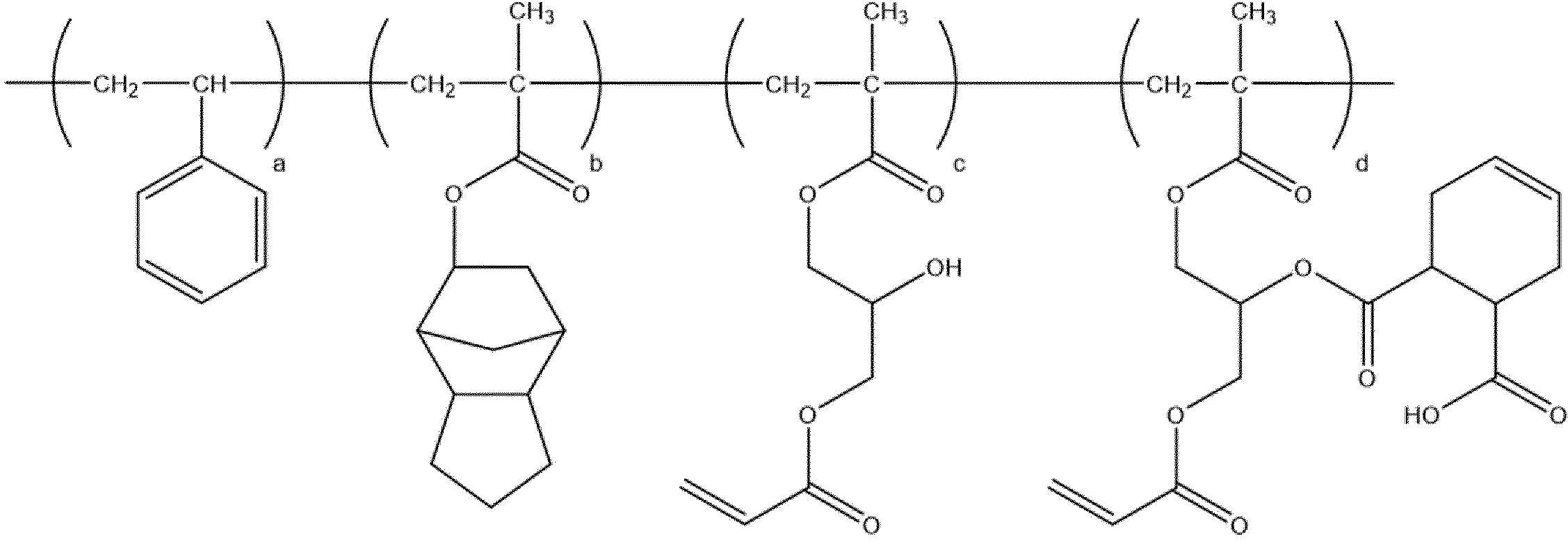
<光重合性化合物>
ペンタエリスリトールジアクリレート、ペンタエリスリトールトリアクリレート及びペンタエリスリトールテトラアクリレートの混合物(混合質量比はペンタエリスリトールジアクリレート:ペンタエリスリトールトリアクリレート:ペンタエリスリトールテトラアクリレート=5:65:30)を光重合性化合物として使用した。
ペンタエリスリトールジアクリレート、ペンタエリスリトールトリアクリレート及びペンタエリスリトールテトラアクリレートの混合物(混合質量比はペンタエリスリトールジアクリレート:ペンタエリスリトールトリアクリレート:ペンタエリスリトールテトラアクリレート=5:65:30)を光重合性化合物として使用した。
<撥液剤1a>
パーフルオロアルキル基を有する構成単位、エチレン性二重結合側鎖を有する構成単位、およびカルボキシ基を有する構成単位を有するアクリル共重合樹脂(重量平均分子量(Mw)は90000、樹脂中のフッ素原子の含有割合は20質量%)を撥液剤1aとして使用した。
パーフルオロアルキル基を有する構成単位、エチレン性二重結合側鎖を有する構成単位、およびカルボキシ基を有する構成単位を有するアクリル共重合樹脂(重量平均分子量(Mw)は90000、樹脂中のフッ素原子の含有割合は20質量%)を撥液剤1aとして使用した。
<撥液剤1b>
シリコーン系化合物(BYK-Chemie社製BYK-3570)を撥液剤1bとして使用した。
シリコーン系化合物(BYK-Chemie社製BYK-3570)を撥液剤1bとして使用した。
<添加剤>
日本化薬社製 KAYAMER PM-21を密着向上剤として使用した。
日本化薬社製 KAYAMER PM-21を密着向上剤として使用した。
[実施例1~10及び比較例1~6]
<感光性樹脂組成物の調製>
各成分を表1に記載の配合割合で用い、かつ、感光性樹脂組成物の全固形分の含有量が実施例1、5~10と比較例1、2、4は10質量%、実施例2~4は6質量%となるようにプロピレングリコールモノメチルエーテルアセテートを用いて、各成分を均一になるまで撹拌して実施例1~10及び比較例1、2、4の感光性樹脂組成物を調製した。なお、表1中の各成分の配合割合(質量%)は、感光性樹脂組成物の全固形分中における各成分の固形分の値を意味する。
<感光性樹脂組成物の調製>
各成分を表1に記載の配合割合で用い、かつ、感光性樹脂組成物の全固形分の含有量が実施例1、5~10と比較例1、2、4は10質量%、実施例2~4は6質量%となるようにプロピレングリコールモノメチルエーテルアセテートを用いて、各成分を均一になるまで撹拌して実施例1~10及び比較例1、2、4の感光性樹脂組成物を調製した。なお、表1中の各成分の配合割合(質量%)は、感光性樹脂組成物の全固形分中における各成分の固形分の値を意味する。

<メタサーフェス構造体の作製>
ガラス基材上に、スピナーを用いて各感光性樹脂組成物を塗布した。真空乾燥60秒後、80℃で80秒間、ホットプレート上で加熱乾燥して塗布基板を得た。凸部形状に対応する開口部を有するフォトマスクを用い、キヤノン社製露光機「MPA600FA」を用いて塗膜を露光した。露光時の強度は前述の露光機に付属の照度計 IUC―M3にて 500mW/cm2、露光量は120mJ/cm2、空気下で行った。
次いで、24℃の0.04質量%KOH(水酸化カリウム)および0.06質量%のノニオン性界面活性剤(花王社製「A-60」)を含有する水溶液で30秒間スプレー現像した後、純水で30秒洗浄した。これらの操作により、不要な部分が除去されて凹凸構造のパターンが形成された基材を、大日本科研社製露光機MA-1100を用いて、ORC社製照度計UV-MO3(ディテクターSN35)での測定で40mW/cm2、露光量1000mJ/cm2で全面露光した後、オーブン中230℃で30分間加熱硬化させた。
次に、富士フイルム社製DMP-2831を用いてジエチレングルコールモノブチルエーテルで希釈した銀ナノインク(GenesInk社製 Smart Jet I S-CS01520)を凹部内にインクジェット塗布し、加熱乾燥することで実施例1~5の導電部を形成した。
比較例1では、撥液剤を使用せずに凹凸パターンを形成して実施例1~5と同様に銀ナノインクをインクジェット塗布した。比較例2では、凹凸パターンを形成せずに実施例1~5と同様に銀ナノインクをインクジェット塗布した。比較例3では感光性樹脂組成物を塗布する前の基材上に実施例1~5と同様に銀ナノインクをインクジェット塗布した。また、比較例4、5では、導電部形成は行っておらず、凹凸パターンが形成されていない感光性樹脂組成物の硬化塗膜を比較例4とし、基材単体を比較例5とした。
実施例6では、スクリーン上にジエチレングルコールモノブチルエーテルで希釈した銀ナノインク(GenesInk社製 Smart Jet I S-CS01520)を滴下してメッシュ部にインクを広げ、実施例1~5と同様に作製した凹凸パターンを有する基材をメッシュ下部に配置後にインクをウレタンゴム製のスキージで掃引して凹凸パターン上に銀ナノインクをスクリーン印刷した。その後、加熱乾燥することで導電部を形成した。
実施例7では、実施例1~5と同様に作製した凹凸パターン付近にジエチレングリコールモノブチルエーテルで希釈した銀ナノインク(GenesInk社製 Smart Jet I S-CS01520)を滴下し、4mm径のステンレス製の棒を用いて凹凸パターン上を掃引し、銀ナノインクをバーコートした。その後、真空乾燥および加熱乾燥することで導電部を形成した。
実施例8では、実施例1~5と同様に作製した凹凸パターン上にジエチレングリコールモノブチルエーテルで希釈した銀ナノインク(GenesInk社製 Smart Jet I S-CS01520)を滴下し、2000rpmで5秒間銀ナノインクをスピンコートした。その後、真空乾燥、加熱乾燥することで導電部を形成した。
実施例9では、実施例1~5と同様に作製した凹凸パターン上にジエチレングリコールモノブチルエーテルで希釈した銀ナノインク(GenesInk社製 Smart Jet I S-CS01520)を滴下し、エアーナイフで銀ナノインクを塗り広げた。その後、真空乾燥、加熱乾燥することで導電部を形成した。
実施例10では、実施例1~5と同様に作製した凹凸パターン上にジエチレングリコールモノブチルエーテルで希釈した銀ナノインク(GenesInk社製 Smart Jet I S-CS01520)を滴下し、ガラス基板でプレスし銀ナノインクを押し広げた。基板を剥がした後、真空乾燥、加熱乾燥することで導電部を形成した。
実施例1~10および比較例1~5の構成部材および作製条件を表2に記載した。

<接触角測定用基板の作成及び評価>
ガラス基板上にスピナーを用いて、加熱硬化後に所望の厚みになるように各感光性樹脂組成物を塗布した。真空乾燥60秒後、80℃で80秒間、ホットプレート上で加熱乾燥して塗膜基板を得た。次に、得られた塗膜を、フォトマスクを使用せずに、大日本科研社製露光機MA-1100を用いて、ORC社製照度計UV-MO3(ディテクターSN35)での測定で40mW/cm2、露光量60mJ/cm2で全面露光した。次いで、24℃の0.04質量%KOH(水酸化カリウム)水溶液で30秒間スプレー現像した後、純水で30秒洗浄した。この基板に、大日本科研社製露光機MA-1100を用いて露光量1000mJ/cm2で露光し、その後オーブン中230℃で30分間加熱硬化させ、凸部表面に対応する接触角測定用全面塗布基板を得た。
また、塗膜に対する露光量を下げることでその後の現像処理時の洗浄に対する耐久性が下がることを利用し、表面の撥液剤偏析部を取り除くことができる。その結果、撥液剤が存在しない凸部の壁部表面の濡れ性を疑似的に再現することができる。具体的には、塗膜に対する露光量を20mJ/cm2に低下させる以外は前記接触角測定用基板の作製方法と同様の処理を行い、疑似的な凸部の壁部表面の接触角測定用全面塗布基板を得た。
接触角の測定は協和界面科学社製接触角測定装置Drop Master 500を用いて、23℃、相対湿度50%の条件下で行った。接触角測定用基板にジエチレングルコールモノブチルエーテルを0.7μL滴下し、1秒後の接触角を測定した。評価結果を表3に示す。
<導電部のパターン形成評価>
メタサーフェス用導電部パターンの導電部形状は図2と略同様の共振器形状を採用した。黒色部が凹部および導電部を表し、導電部の線幅は56μmである。作製したパターンは光学顕微鏡(ニコン社製 ECLIPSE L200)の反射明視野観察法により導電部の状態を観察しメタサーフェス用導電部パターンの形成の可否を評価した。塗布後の銀ナノインクが平滑な導電膜が形成している場合、周辺の樹脂部に比べて反射光が強く観察されるため導電部の状態を評価できる。
メタサーフェス用導電部パターンの導電部形状は図2と略同様の共振器形状を採用した。黒色部が凹部および導電部を表し、導電部の線幅は56μmである。作製したパターンは光学顕微鏡(ニコン社製 ECLIPSE L200)の反射明視野観察法により導電部の状態を観察しメタサーフェス用導電部パターンの形成の可否を評価した。塗布後の銀ナノインクが平滑な導電膜が形成している場合、周辺の樹脂部に比べて反射光が強く観察されるため導電部の状態を評価できる。
実施例1~10について、樹脂部表面の接触角、銀ナノインク塗布、乾燥後の導電部の状態およびメタサーフェス用導電部パターンの作成可否に関する評価結果を表3に記載した。
実施例1~4では、導電部が凹部パターンに沿って形成しており、均一で強い反射光が観察されていることから均一膜を形成していることが分かる。走査型電子顕微鏡(日立ハイテク社製 SU1510)による観察の結果、銀ナノ粒子が堆積した100nmの均一膜の形成が確認された。実施例1~4では、凹部パターンの存在に加えて、凸部表面に偏析した撥液剤1aの効果により表面接触角が高いため、塗布液が凹部内に落下しやすいためと考えられる。
実施例5では、実施例1~4と異なる撥液剤1bを使用したため接触角が小さく一部決壊を生じたが、比較例と比べると良好なメタサーフェス用導電部パターンの形成ができた。
実施例6~10では、インクジェット印刷とは異なる方法でインク塗布を行った。実施例6のスクリーン印刷により得られた塗布膜に一部段差が見られたが、比較例と比べると良好な導電部が形成できた。実施例7~10では均一な導電膜が得られた。またいずれの塗布方法でも良好なメタサーフェス用導電部パターンの形成ができた。
実施例5では、実施例1~4と異なる撥液剤1bを使用したため接触角が小さく一部決壊を生じたが、比較例と比べると良好なメタサーフェス用導電部パターンの形成ができた。
実施例6~10では、インクジェット印刷とは異なる方法でインク塗布を行った。実施例6のスクリーン印刷により得られた塗布膜に一部段差が見られたが、比較例と比べると良好な導電部が形成できた。実施例7~10では均一な導電膜が得られた。またいずれの塗布方法でも良好なメタサーフェス用導電部パターンの形成ができた。
比較例1~5について、樹脂部表面の接触角、銀ナノインク塗布、乾燥後の導電部の状態およびメタサーフェス用導電部パターンの作成可否に関する評価結果を表4に記載した。
比較例1では、樹脂部に撥液剤が存在しないため凸部の表面接触角が低く銀ナノインクが凹部内に落下できずに凸部表面に残存していた。この結果はメタサーフェス用導電部パターンの形成には樹脂部の凹凸構造のみならず凸部表面が撥液性を有する必要があることが示唆している。
比較例2では、樹脂部に凹凸構造が存在しないため塗布された銀ナノインクの液滴同士が凝集して不連続なパターンを形成しておりメタサーフェス用導電部パターンの形成ができなかった。この結果は撥液性だけでなく樹脂部の凹凸構造が必要であることを示唆している。
比較例3では、樹脂部が存在せず基材部表面に銀ナノインクが塗布されるため、塗布領域周辺全体にインクが広がりメタサーフェス用導電部パターンの形成はできなかった。この結果は基材部のみならず撥液性と樹脂部の凹凸構造が必要であることを示唆している。
比較例4は導電部が存在せず、比較例5は導電部および樹脂部が存在しないことからメタサーフェス用導電部パターンの形成は不可能である。
実施例1と同様の構成部材条件における凸部上部表面と疑似的な凸部の壁部表面の接触角の測定結果を表5に記載した。ジエチレングルコールモノブチルエーテルに対して凸部の上部表面は接触角47°であるのに対して、疑似的な凸部の壁部表面の接触角は4.4°であった。この結果から、凸部の上部表面はインクに対する濡れ性が小さくはじきやすいのに対して、凸部の壁部は濡れ性が大きく凹部内にインクが濡れ広がりやすいことが分かった。凸部表面と凹部内で異なる濡れ性を有する凹凸構造は、全体が撥液性を有する凹凸構造や全体が親液性を有する凹凸構造と比べて、凹部内のみに局所的に導電部を導入しやすく狙ったメタサーフェス構造の形成に有利であると考えられる。また、凸部の上部表面にのみ撥液剤を偏析させることが、凸部表面と凹部内で異なる濡れ性を付与するのに重要である。
(電磁波吸収率測定方法)
メタサーフェス構造体のメタサーフェス性能を確認するため、実施例1の電磁波応答特性を自由空間法により測定した。自由空間法は、測定サンプルを送信アンテナと受信アンテナの中央に配置し電磁波をサンプルに垂直に照射し、反射波および透過波のSパラメータを測定する方法である。測定周波数は26.5から110GHzとした。実施例1のメタサーフェス形状は共振周波数付近で強い吸収を生じるため、電磁波吸収率を次式により算出した。
吸収率(%)=(1-|S11|2-|S12|2)×100
ここでS11は反射電力の入射電力に対する比を表し、S12は透過電力の入射電力に対する比を表す。
メタサーフェス構造体のメタサーフェス性能を確認するため、実施例1の電磁波応答特性を自由空間法により測定した。自由空間法は、測定サンプルを送信アンテナと受信アンテナの中央に配置し電磁波をサンプルに垂直に照射し、反射波および透過波のSパラメータを測定する方法である。測定周波数は26.5から110GHzとした。実施例1のメタサーフェス形状は共振周波数付近で強い吸収を生じるため、電磁波吸収率を次式により算出した。
吸収率(%)=(1-|S11|2-|S12|2)×100
ここでS11は反射電力の入射電力に対する比を表し、S12は透過電力の入射電力に対する比を表す。
図1と略同様の電磁波共振器をピッチ668μmで縦横90個ずつ、合計8100個をガラス基材上の60.12mm×60.12mmの領域に形成されたサンプルを自由空間法で測定した。また比較としてガラス基材に厚さ500nmの樹脂部が塗布され、凹凸構造や導電部は存在しない比較例4と、ガラス基材のみで樹脂部や導電部が存在しない比較例5も測定を実施した。
(導電部の導電率測定方法)
ガラス基板上に形成された電極間を橋渡しするように実施例1と同様の手法で導電部を形成し、その導電率を測定した。このとき導電部の線幅は45μm、厚さ0.2μm、長さ500μmとした。この導電部の抵抗値を抵抗測定装置(ISO-TECH社製IDM 67)用いて測定し、次式から導電率を算出した。
導電率(S/m)=導電部体積/抵抗値
ガラス基板上に形成された電極間を橋渡しするように実施例1と同様の手法で導電部を形成し、その導電率を測定した。このとき導電部の線幅は45μm、厚さ0.2μm、長さ500μmとした。この導電部の抵抗値を抵抗測定装置(ISO-TECH社製IDM 67)用いて測定し、次式から導電率を算出した。
導電率(S/m)=導電部体積/抵抗値
(シミュレーション方法)
シミュレーションソフトCOMSOL Multiphysics(登録商標)のRFモジュールに実施例1と同様の単位構造を再現しピッチ0.668mmで縦横方向に無限に配置されるよう周期境界条件を適用した。シミュレーションに使用したパラメータは表6に示す。電磁波は図1の上下方向と平行な電界を持ち樹脂部側から入射させ、Sパラメータを算出し下記式より吸収率を算出した。
吸収率(%)=(1-|S11|2-|S12|2)×100
比較例6として、導電部下部に0.1μmの厚みの樹脂部を挿入した以外、実施例1のシミュレーションと同様の構造モデルを作製し、前記と同様に吸収率を算出した。
シミュレーションソフトCOMSOL Multiphysics(登録商標)のRFモジュールに実施例1と同様の単位構造を再現しピッチ0.668mmで縦横方向に無限に配置されるよう周期境界条件を適用した。シミュレーションに使用したパラメータは表6に示す。電磁波は図1の上下方向と平行な電界を持ち樹脂部側から入射させ、Sパラメータを算出し下記式より吸収率を算出した。
吸収率(%)=(1-|S11|2-|S12|2)×100
比較例6として、導電部下部に0.1μmの厚みの樹脂部を挿入した以外、実施例1のシミュレーションと同様の構造モデルを作製し、前記と同様に吸収率を算出した。
測定及びシミュレーション結果を表7に示す。実施例1では共振器の共振周波数付近の72GHzに強い吸収ピークが現れ、シミュレーション結果と概ね一致する結果が得られた。この結果から実施例1ではシミュレーション通りのメタサーフェス性能を発現することが確認できた。また実施例2~4、6~10も同様の形状が形成されているため同等の性能が発現すると考えられる。一方、比較例4、5ではほとんど吸収が見られずメタサーフェス性能を発現しないことが確認された。また、導電部下部に樹脂層が存在する比較例6のシミュレーション結果では、実施例1のシミュレーション結果に対してピーク周波数が高周波数側にシフトし吸収率も低下した。この結果から、凹部底面には樹脂部が存在せず基材表面となっていることがより好ましいことが分かる。

本発明によれば、設計通りの微細な導電性材料のパターンを有するメタサーフェス構造体を提供することができる。このようなメタサーフェス構造体は、直進性の高いミリ波を用いた場合であっても、設計形状に応じた反射、吸収、透過、屈折などの所望の電波制御特性を発現することができるため、カバレッジホールを低減することができる。
したがって、本発明のメタサーフェス構造体を用いれば、次世代通信において、基地局を増加させることなく、通信経路を確保することができ、その工業的利用価値は高い。
したがって、本発明のメタサーフェス構造体を用いれば、次世代通信において、基地局を増加させることなく、通信経路を確保することができ、その工業的利用価値は高い。
10 メタサーフェス構造体
11 樹脂部
12 導電部
13 基材
14 撥液部
11 樹脂部
12 導電部
13 基材
14 撥液部
Claims (25)
- 樹脂部と導電部と基材を備えるメタサーフェス構造体であって、前記樹脂部は前記基材上に凹凸構造を形成しており、該凹凸構造の凸部表面が撥液性を有し、前記導電部は前記凹凸構造の凹部の少なくとも一部に導電性材料が充填されてなる、メタサーフェス構造体。
- 前記導電部からなる単一又は複数の形状が周期的に繰り返し配置されてなる、請求項1に記載のメタサーフェス構造体。
- 前記凹部は、底面の少なくとも一部が基材表面であり、側面が前記樹脂部からなる、請求項1又は2に記載のメタサーフェス構造体。
- 前記凸部の壁部表面の接触角が前記凸部の上部表面の接触角よりも小さい、請求項1又は2に記載のメタサーフェス構造体。
- 協和界面科学社製接触角測定装置Drop Master 500を用いて、23℃、相対湿度50%の条件下で、前記凸部の上部表面にジエチレングリコールモノブチルエーテルを0.7μL滴下し、1秒後に測定される接触角が20°以上である、請求項1又は2に記載のメタサーフェス構造体。
- 協和界面科学社製接触角測定装置Drop Master 500を用いて、23℃、相対湿度50%の条件下で、前記凸部の壁部表面にジエチレングリコールモノブチルエーテルを0.7μL滴下し、1秒後に測定される接触角が20°未満である、請求項1又は2に記載のメタサーフェス構造体。
- 前記凹凸構造の前記凸部の高さが10nm以上100μm以下である、請求項1又は2に記載のメタサーフェス構造体。
- 前記導電部の高さが5nm以上10μm以下である、請求項1又は2に記載のメタサーフェス構造体。
- 前記導電部と前記凸部の高さの比率(導電部の高さ/凸部の高さ)が0.01以上1以下である、請求項1又は2に記載のメタサーフェス構造体。
- 前記導電部の線幅が1μm以上1mm以下である、請求項1又は2に記載のメタサーフェス構造体。
- 前記導電部の導電率が100S/m以上である、請求項1又は2に記載のメタサーフェス構造体。
- 前記導電部が金属ナノ粒子の集積体からなる、請求項1又は2に記載のメタサーフェス構造体。
- 前記凹凸構造の凹部の断面形状が略四角形である、請求項1又は2に記載のメタサーフェス構造体。
- 前記基材がガラス基材又は樹脂基材からなる、請求項1又は2に記載のメタサーフェス構造体。
- 前記樹脂部が、(A)光重合開始剤、(B)アルカリ可溶性樹脂、(C)光重合性化合物、及び(D)撥液剤を含有する感光性樹脂組成物を硬化してなる、請求項1又は2に記載のメタサーフェス構造体。
- 前記感光性樹脂組成物の固形分中の(D)撥液剤の含有割合が0.01質量%以上である、請求項15に記載のメタサーフェス構造体。
- 下記(1)乃至(3)の工程を含む、メタサーフェス構造体の製造方法。
(1)(A)光重合開始剤、(B)アルカリ可溶性樹脂、(C)光重合性化合物、及び(D)撥液剤を含有する感光性樹脂組成物を基材上に塗布する塗布工程
(2)前記塗布工程で得られた感光性樹脂組成物が塗布された基材を露光した後に現像し、凹凸構造を有する樹脂部を形成する樹脂部形成工程
(3)前記樹脂部形成工程で得られた前記凹凸構造の凹部に導電性材料を含有する組成物を塗布する導電部形成工程 - 前記(3)の工程において、前記導電性材料を含有する組成物を、インクジェットプリンタを用いて塗布する、請求項17に記載のメタサーフェス構造体の製造方法。
- 前記(3)の工程において、前記導電性材料を含有する組成物を、スクリーン印刷用のスクリーンを用いて塗布する、請求項17に記載のメタサーフェス構造体の製造方法。
- 前記(3)の工程において、前記導電性材料を含有する組成物を、バーコーターを用いて塗布する、請求項17に記載のメタサーフェス構造体の製造方法。
- 前記(3)の工程において、前記導電性材料を含有する組成物を、スピンコーターを用いて塗布する、請求項17に記載のメタサーフェス構造体の製造方法。
- 前記(3)の工程において、前記導電性材料を含有する組成物を、エアーナイフを用いて塗布する、請求項17に記載のメタサーフェス構造体の製造方法。
- 前記(3)の工程において、前記導電性材料を含有する組成物を、プレス用基板を用いて塗布する、請求項17に記載のメタサーフェス構造体の製造方法。
- 前記(3)の工程において、前記導電性材料を含有する組成物を塗布後40分以内に100℃以上で加熱し乾燥する、請求項17~23のいずれかに記載のメタサーフェス構造体の製造方法。
- 前記(3)の工程において、前記導電性材料を含有する組成物に沸点180℃以上の溶剤を含む、請求項17~23のいずれかに記載のメタサーフェス構造体の製造方法。
Priority Applications (1)
| Application Number | Priority Date | Filing Date | Title |
|---|---|---|---|
| JP2024573226A JPWO2024158035A1 (ja) | 2023-01-27 | 2024-01-25 |
Applications Claiming Priority (2)
| Application Number | Priority Date | Filing Date | Title |
|---|---|---|---|
| JP2023011232 | 2023-01-27 | ||
| JP2023-011232 | 2023-01-27 |
Publications (1)
| Publication Number | Publication Date |
|---|---|
| WO2024158035A1 true WO2024158035A1 (ja) | 2024-08-02 |
Family
ID=91970708
Family Applications (1)
| Application Number | Title | Priority Date | Filing Date |
|---|---|---|---|
| PCT/JP2024/002246 Ceased WO2024158035A1 (ja) | 2023-01-27 | 2024-01-25 | メタサーフェス構造体及びその製造方法 |
Country Status (2)
| Country | Link |
|---|---|
| JP (1) | JPWO2024158035A1 (ja) |
| WO (1) | WO2024158035A1 (ja) |
Citations (3)
| Publication number | Priority date | Publication date | Assignee | Title |
|---|---|---|---|---|
| JP2016087602A (ja) * | 2014-10-31 | 2016-05-23 | Jsr株式会社 | 親液部と撥液部を有する基材の製造方法、組成物、導電膜の形成方法、電子回路および電子デバイス |
| JP2020149014A (ja) * | 2019-03-15 | 2020-09-17 | シャープ株式会社 | 超撥水性フィルム |
| JP2022510892A (ja) * | 2018-12-04 | 2022-01-28 | ロジャーズ コーポレーション | 誘電体電磁構造およびその製造方法 |
-
2024
- 2024-01-25 WO PCT/JP2024/002246 patent/WO2024158035A1/ja not_active Ceased
- 2024-01-25 JP JP2024573226A patent/JPWO2024158035A1/ja active Pending
Patent Citations (3)
| Publication number | Priority date | Publication date | Assignee | Title |
|---|---|---|---|---|
| JP2016087602A (ja) * | 2014-10-31 | 2016-05-23 | Jsr株式会社 | 親液部と撥液部を有する基材の製造方法、組成物、導電膜の形成方法、電子回路および電子デバイス |
| JP2022510892A (ja) * | 2018-12-04 | 2022-01-28 | ロジャーズ コーポレーション | 誘電体電磁構造およびその製造方法 |
| JP2020149014A (ja) * | 2019-03-15 | 2020-09-17 | シャープ株式会社 | 超撥水性フィルム |
Also Published As
| Publication number | Publication date |
|---|---|
| JPWO2024158035A1 (ja) | 2024-08-02 |
Similar Documents
| Publication | Publication Date | Title |
|---|---|---|
| KR100792096B1 (ko) | 광 경화성 불소 함유 중합체를 포함하는 광학 재료 및 광경화성 불소 함유 수지 조성물 | |
| JP5910629B2 (ja) | ネガ型感光性樹脂組成物、硬化膜、隔壁およびブラックマトリックスとその製造方法、カラーフィルタならびに有機el素子 | |
| KR102289199B1 (ko) | 친액부와 발액부를 갖는 기재의 제조 방법, 조성물 및 도전막의 형성 방법 | |
| US20190227436A1 (en) | Cross-linkable fluorinated photopolymer | |
| CN105607422B (zh) | 碱可溶性树脂与包含其的感光性树脂组合物及应用 | |
| JP5133658B2 (ja) | ブラックマトリックス用感光性樹脂組成物、それを用いた硬化物及びカラーフィルター | |
| JP6136928B2 (ja) | ネガ型感光性樹脂組成物、隔壁の製造方法および光学素子の製造方法 | |
| TW200421019A (en) | Multilayer photoresist systems | |
| JP6506732B2 (ja) | ネガ感光型樹脂組成物及びそれから製造される光硬化パターン | |
| KR101660583B1 (ko) | 감광성 수지 조성물, 드라이 필름, 경화물 및 프린트 배선판 | |
| TW201829493A (zh) | 硬化膜的形成方法及感放射線性樹脂組成物 | |
| CN105573053B (zh) | 具有亲液部与疏液部的基材的制造方法及其应用及组合物 | |
| KR102507428B1 (ko) | 패턴화된 경화막을 형성하는 방법, 감광성 조성물, 드라이 필름, 및 도금 조형물의 제조 방법 | |
| TWI476514B (zh) | Photosensitive resin composition | |
| JP4552584B2 (ja) | 平坦化樹脂層、並びにそれを有する半導体装置及び表示体装置 | |
| JP4958343B2 (ja) | 高屈折率薄膜および反射防止膜 | |
| TW201839512A (zh) | 感光性樹脂組合物及由其製造的光固化圖案 | |
| CN109459914A (zh) | 光固化树脂组合物及其应用 | |
| JP5085342B2 (ja) | 着色感光性樹脂組成物 | |
| JP6410540B2 (ja) | 感光性樹脂組成物 | |
| KR102278837B1 (ko) | 패턴 형성 방법 | |
| JP2022108813A (ja) | 保護膜形成用組成物 | |
| JP7646722B2 (ja) | レンズの製造方法 | |
| TW201921121A (zh) | 半導體微影膜形成組成物,以及阻劑圖型形成方法及裝置 | |
| KR20180073002A (ko) | 네가티브형 감광성 수지 조성물 및 이로부터 형성된 광경화 패턴 |
Legal Events
| Date | Code | Title | Description |
|---|---|---|---|
| 121 | Ep: the epo has been informed by wipo that ep was designated in this application |
Ref document number: 24747359 Country of ref document: EP Kind code of ref document: A1 |
|
| WWE | Wipo information: entry into national phase |
Ref document number: 2024573226 Country of ref document: JP |
|
| NENP | Non-entry into the national phase |
Ref country code: DE |
|
| 122 | Ep: pct application non-entry in european phase |
Ref document number: 24747359 Country of ref document: EP Kind code of ref document: A1 |