WO2024150477A1 - アミノ基含有化合物の製造方法、アミノ基含有化合物の分離方法、およびアミノ基含有化合物の製造装置 - Google Patents
アミノ基含有化合物の製造方法、アミノ基含有化合物の分離方法、およびアミノ基含有化合物の製造装置 Download PDFInfo
- Publication number
- WO2024150477A1 WO2024150477A1 PCT/JP2023/035433 JP2023035433W WO2024150477A1 WO 2024150477 A1 WO2024150477 A1 WO 2024150477A1 JP 2023035433 W JP2023035433 W JP 2023035433W WO 2024150477 A1 WO2024150477 A1 WO 2024150477A1
- Authority
- WO
- WIPO (PCT)
- Prior art keywords
- amino group
- containing compound
- group
- hydrophobic
- solution
- Prior art date
- Legal status (The legal status is an assumption and is not a legal conclusion. Google has not performed a legal analysis and makes no representation as to the accuracy of the status listed.)
- Ceased
Links
Images

Classifications
-
- C—CHEMISTRY; METALLURGY
- C07—ORGANIC CHEMISTRY
- C07K—PEPTIDES
- C07K1/00—General methods for the preparation of peptides, i.e. processes for the organic chemical preparation of peptides or proteins of any length
- C07K1/02—General methods for the preparation of peptides, i.e. processes for the organic chemical preparation of peptides or proteins of any length in solution
-
- C—CHEMISTRY; METALLURGY
- C07—ORGANIC CHEMISTRY
- C07K—PEPTIDES
- C07K1/00—General methods for the preparation of peptides, i.e. processes for the organic chemical preparation of peptides or proteins of any length
- C07K1/06—General methods for the preparation of peptides, i.e. processes for the organic chemical preparation of peptides or proteins of any length using protecting groups or activating agents
-
- C—CHEMISTRY; METALLURGY
- C07—ORGANIC CHEMISTRY
- C07K—PEPTIDES
- C07K1/00—General methods for the preparation of peptides, i.e. processes for the organic chemical preparation of peptides or proteins of any length
- C07K1/14—Extraction; Separation; Purification
Definitions
- the present invention relates to a method for producing an amino group-containing compound, a method for separating an amino group-containing compound, and an apparatus for producing an amino group-containing compound.
- a known technology for mass-producing peptides is a method in which, in liquid phase, a peptide whose C-terminus is protected with a hydrophobic protecting group is condensed with an amino acid residue whose N-terminus is protected, thereby extending the peptide chain.
- This method is also known as the liquid phase tagging method, as the hydrophobic protecting group is called a tag.
- Patent Document 1 describes a method for producing a peptide, which includes a step of purifying the N-unprotected C-protected peptide by washing a reaction solution containing the N-unprotected C-protected peptide with water and/or a hydrophilic organic solvent in a flow reactor using a continuous flow, separating the liquid using an oil-water separation means using a continuous flow, and separating the organic layer containing the N-unprotected C-protected peptide.
- One aspect of the present invention aims to provide a method for producing an amino group-containing compound that can more easily remove compounds derived from N-terminal protecting groups.
- a method for producing an amino group-containing compound includes a slug flow formation step of forming a slug flow of a hydrophobic layer formed by a hydrophobic solution containing the amino group-containing compound to be recovered, an N-terminal protecting group-derived compound which is a compound derived from the N-terminal protecting group that protected the N-terminus of the amino group-containing compound, and an organic solvent, and a hydrophilic layer formed by an acidic aqueous solution, and a separation step of recovering a hydrophobic solution containing the amino group-containing compound to be recovered by separating the hydrophobic layer from the slug flow.
- the method for separating an amino group-containing compound includes a slug flow formation step of forming a slug flow of a hydrophobic layer formed by a hydrophobic solution containing the amino group-containing compound to be recovered, an N-terminal protecting group-derived compound which is a compound derived from the N-terminal protecting group that protected the N-terminus of the amino group-containing compound, and an organic solvent, and a hydrophilic layer formed by an acidic aqueous solution, and a separation step of recovering a hydrophobic solution containing the amino group-containing compound to be recovered by separating the hydrophobic layer from the slug flow.
- the apparatus for producing an amino group-containing compound includes a slug flow forming section that forms a slug flow of the amino group-containing compound to be recovered, an N-terminal protecting group-derived compound that is a compound derived from the N-terminal protecting group that protected the N-terminus of the amino group-containing compound, a hydrophobic layer formed by a hydrophobic solution containing an organic solvent, and a hydrophilic layer formed by an acidic aqueous solution, and a separation section that is connected to the slug flow forming section and recovers a hydrophobic solution containing the amino group-containing compound to be recovered by separating the hydrophobic layer from the slug flow.
- One aspect of the present invention provides a method for producing an amino group-containing compound that can more easily remove compounds derived from N-terminal protecting groups.
- FIG. 1 is a block diagram showing the configuration of an apparatus for producing an amino group-containing compound according to one embodiment of the present invention. 1 is a graph showing the results of HPLC of the hydrophilic layer obtained in Example 1-3.
- N-terminal protecting group-derived compound which is a compound derived from the N-terminal protecting group and which may be produced by deprotection of the N-terminal protecting group after a condensation reaction, in a slug flow using an acidic aqueous solution
- at least a portion of the N-terminal protecting group-derived compound can be easily removed into the acidic aqueous solution, thereby making it possible, for example, to improve the purity of the amino group-containing compound in the hydrophobic solution and to remove a larger amount of components that may be an obstacle when performing another step, such as a step of condensing an amino acid with the amino group-containing compound after washing, and thus completed the present invention.
- the method for producing an amino group-containing compound according to one embodiment of the present invention includes a slug flow formation step of forming a slug flow of the amino group-containing compound to be recovered, an N-terminal protecting group-derived compound which is a compound derived from the N-terminal protecting group that protected the N-terminus of the amino group-containing compound, a hydrophobic layer formed by a hydrophobic solution containing an organic solvent, and a hydrophilic layer formed by an acidic aqueous solution, and a separation step of recovering a hydrophobic solution containing the amino group-containing compound to be recovered by separating the hydrophobic layer from the slug flow.
- the method for producing an amino group-containing compound according to one embodiment of the present invention may be simply referred to as the "production method according to one embodiment of the present invention.”
- the slug flow forming step is a step of forming a slug flow of a hydrophobic layer formed by a hydrophobic solution and a hydrophilic layer formed by an acidic aqueous solution.
- a slug flow is formed in which the hydrophobic layer and the hydrophilic layer flow alternately along the flow direction.
- at least a part of the N-terminal protecting group-derived compound contained in the hydrophobic layer moves to the hydrophilic layer adjacent to the hydrophobic layer, and the captured substance contained in the hydrophobic layer is reduced.
- slug flow refers to a flow in which an alternating flow of hydrophobic layers and hydrophilic layers is formed along the flow direction in at least a part of the flow.
- slug flow includes not only a flow in which an alternating flow of hydrophobic layers and hydrophilic layers is formed throughout the entire flow path in which the flow passes, but also a flow in which an alternating flow of hydrophobic layers and hydrophilic layers is formed only in a part of the flow path.
- the term "slug flow” includes a flow in which an alternating flow of hydrophobic layers and hydrophilic layers is formed from the start point of the flow path where the hydrophobic layers and hydrophilic layers are mixed to the end point of the flow path, a flow in which an alternating flow of hydrophobic layers and hydrophilic layers is formed only in the vicinity of the start point, and a flow in which an alternating flow of hydrophobic layers and hydrophilic layers is formed intermittently in the flow path.
- it is sufficient that an alternating flow of hydrophobic layers and hydrophilic layers is formed in at least a part of the flow path, and a parallel flow and turbulent flow formed by the hydrophobic layers and hydrophilic layers may be formed in a part of the flow path.
- the hydrophobic solution contains the amino group-containing compound to be recovered, the N-terminal protecting group-derived compound, and an organic solvent.
- the hydrophobic solution may further contain a capture agent for capturing the N-terminal protecting group-derived compound.
- the reaction solution used in the condensation reaction for synthesizing the amino group-containing compound may be used as it is as the hydrophobic solution.
- the amino group-containing compound is any compound having at least one of a primary amino group and a secondary amino group.
- the amino group-containing compound include a single amino acid and a peptide formed by peptide bonds of two or more amino acids.
- the peptide may have a substituent such as a protecting group at either the C-terminus or the side chain terminus of the peptide chain.
- the amino group-containing compound to be recovered may be the same as or different from the amino group-containing compound produced as the target product in the production method according to one embodiment of the present invention.
- the amino group-containing compound to be recovered may be a precursor of the amino group-containing compound of the target product, for example, a compound having a part of the peptide sequence of the amino group-containing compound of the target product.
- the amino acid residue sequence of the peptide is not particularly limited, but the N-terminal residue of the peptide may be lysine (Lys) or proline (Pro).
- the N-terminal residue is one of these amino acid residues
- a conventional process for removing the capture body may result in the formation of an emulsion of a hydrophobic solution containing the capture body in the washing solution, which may require a long time for separation.
- the formation of an emulsion during removal of the capture body is reduced, allowing separation to be performed in a shorter time.
- the amino group-containing compound to be recovered may have its C-terminus protected with a C-terminus protecting group.
- the C-terminus protecting group may be a C-terminus protecting group that can be used in the liquid-phase tagging method.
- An example of the C-terminus protecting group is the C-terminus protecting group represented by the following formula (1).
- m Q's each represent an oxygen atom.
- m R 1 's each independently represent a group represented by the following formula (A).
- k R 2 's each independently represent a hydrogen atom, an alkyl group, a cycloalkyl group, an alkoxy group, an aryl group, an aralkyl group, or a halogen atom.
- X represents a bonding position with the C-terminus of the amino group-containing compound.
- m represents an integer of 2 or 3.
- k represents an integer of 0 or more and (5-j) or less.
- At least one of m [Q-R 1 ]'s is substituted at the meta position with respect to the substituent containing X.
- the total carbon number of the C-terminal protecting group represented by formula (1) is 40 or more and 60 or less.
- R 1a , R 1b , R 1c , R 1d and R 1e each independently indicate a hydrogen atom or an alkyl group.
- n 1 indicates an integer of 0 to 6, and when n 1 is 1 or more, the repeating unit shown in the parentheses to which n 1 is added is an alkylene group.
- n 2 indicates an integer of 0 to 6, and when n 2 is 1 or more, the repeating unit shown in the parentheses to which n 2 is added is an alkylene group.
- at least two of R 1a , R 1b , R 1c and R 1d are hydrogen atoms.
- C-terminal protecting groups include protecting groups represented by any of the following formulas, where X represents the bonding position with the C-terminus of the amino group-containing compound.
- the C-terminal protecting group is not limited to the above-mentioned protecting groups, and any protecting group known in the art may be used.
- the N-terminal protecting group-derived compound is a compound derived from an N-terminal protecting group that protected the N-terminus of an amino group-containing compound.
- the N-terminal protecting group-derived compound include N A decomposition product generated by deprotecting the N-terminal protecting group of a terminal-protected amino group-containing compound, and a capture agent bound to the decomposition product (hereinafter, simply referred to as "capture body")
- capture body a capture agent bound to the decomposition product
- the decomposition products and the capture bodies are typically produced as by-products in the production method according to one embodiment of the present invention.
- the decomposition products and the capture bodies are produced in one embodiment of the present invention, it may be desirable to remove at least a portion of the N-terminal protecting group-derived compound, since this may reduce the yield and purity of the resulting amino group-containing compound.
- one aspect of the present invention is preferably applicable when the N-terminal protecting group-derived compound is a capture body.
- one aspect of the present invention can more effectively wash the capture body.
- the production method according to one aspect of the present invention can more easily remove the capture body, and can more effectively achieve reductions in costs and time required.
- the N-terminal protecting group is not particularly limited as long as it is a functional group that can be used to protect at least one of the primary amino group and the secondary amino group of the amino group-containing compound.
- N-terminal protecting groups include protecting groups having a fluorene skeleton, such as the 9-fluorenylmethyloxycarbonyl group (Fmoc group), the tert-butoxycarbonyl group (Boc group), the benzyloxycarbonyl group (Cbz group), the allyloxycarbonyl (Alloc) group, the acetyl (Ac) group, and the trichloroacetyl group.
- the target to be removed may be a decomposition product.
- the decomposition product is a compound generated by decomposing the N-terminal protecting group by deprotecting the N-terminal protecting group of the N-terminal protected amino group-containing compound.
- decomposition products include: dibenzofulvene (DBF) from the Fmoc group; CO2 and isobutene from the Boc group; and toluene from the Cbz group.
- DFS dibenzofulvene
- CO2 and isobutene from the Boc group
- toluene from the Cbz group.
- the object to be removed may be a capture body.
- the capture body is a compound in which a capture agent is bound to a decomposition product derived from an N-terminal protecting group that protected the N-terminus of the amino group-containing compound to be recovered.
- the hydrophobic solution may contain, in addition to the capture body, the capture agent and the decomposition product derived from the N-terminal protecting group in a form that is not bound to each other.
- the scavenger is a compound that forms a capture body by binding with the decomposition product.
- the scavenger can be appropriately selected depending on the structure of the N-terminal protecting group and the structure of the decomposition product derived from the N-terminal protecting group.
- Examples of the scavenger include secondary amines.
- the scavenger is preferably a secondary amine from the viewpoint of capturing the decomposition product with high efficiency and removing the free decomposition product from the reaction system.
- the scavenger is preferably at least one selected from the group consisting of morpholine, piperidine, 3-hydroxypiperidine, 4-hydroxypiperidine, thiomorpholine, thiomorpholine dioxide, 4-methylpiperazine, 4-aminopiperidine, diethylamine, and pyrrolidine.
- the trap is formed by binding the decomposition product with a trapping agent.
- the structure of the trap is determined according to the N-terminal protecting group and the structure of the trapping agent, and is not particularly limited.
- Examples of traps include compounds represented by any of the following formulas. These compounds are traps formed by binding the decomposition product DBF with the trapping agent morpholine, piperidine, pyrrolidine, 4-methylpiperazine, or diethylamine.
- the organic solvent is not particularly limited as long as it is capable of making a hydrophobic solution containing the organic solvent incompatible with an acidic aqueous solution.
- the organic solvent may be a known hydrophobic organic solvent that can be used as a reaction solvent in a peptide condensation reaction.
- the organic solvent in the slug flow formation step is the same as the reaction solvent in the condensation reaction, from the viewpoint of improving the ease of operation and reducing adverse effects that occur between the condensation reaction and the removal of the N-terminal protecting group-derived compound.
- organic solvents include ethers, acetates, halogenated hydrocarbons, aromatic hydrocarbons, and hydrocarbons.
- the organic solvent one type may be used alone, or multiple types may be used in combination. Since the organic solvent is easy to separate and low cost, it is preferable that the organic solvent contains at least one type selected from the group consisting of 4-methyltetrahydropyran (MTHP), cyclopentyl methyl ether (CPME), chloroform, diethyl ether, diisopropyl ether, tetrahydrofuran, 2-methyltetrahydrofuran, 1,4-dioxane, methyl-t-butyl ether, ethyl acetate, isopropyl acetate, dichloromethane, toluene, xylene, hexane, heptane, and cyclohexane, and it is even more preferable that the organic solvent contains at least one type selected from the group consisting of 4-methylte
- the hydrophobic solution may contain other components in addition to the above-mentioned components.
- the other components include a condensation agent, an activator, and a catalyst that can be used in the condensation reaction of the peptide, as well as a by-product of the condensation reaction, and a deprotection agent. Specific examples of the condensation agent, the activator, the catalyst, and the deprotection agent will be described later.
- the hydrophobic solution contains any of the condensing agent, activating agent, and deprotecting agent as a component other than the N-terminal protecting group-derived compound, so separation washing can be performed in a short time. Furthermore, according to the production method of one aspect of the present invention, it is not necessary to perform preliminary separation washing, so the N-terminal protecting group-derived compound can be removed with fewer separation washings.
- the acidic aqueous solution forms a hydrophilic layer in the slug flow, in which the N-terminal protecting group-derived compound is extracted from the hydrophobic layer.
- the acidic aqueous solution may be any aqueous solution containing an acid, and is, for example, an aqueous solution containing a Bronsted acid.
- the acidic aqueous solution is preferably an aqueous solution containing at least one Br ⁇ nsted acid selected from the group consisting of hydrochloric acid, sulfuric acid, acetic acid, phosphoric acid, and citric acid, from the viewpoint of more efficiently removing compounds derived from N-terminal protecting groups.
- the concentration of the Br ⁇ nsted acid contained in the acidic aqueous solution is preferably 1.0 mol/L or more, more preferably 2.0 mol/L or more, from the viewpoint of more efficiently removing compounds derived from N-terminal protecting groups.
- the concentration of the Br ⁇ nsted acid contained in the acidic aqueous solution is preferably 12.0 mol/L or less, more preferably 6.0 mol/L or less, and even more preferably 4.0 mol/L or less, from the viewpoint of reducing decomposition of the amino group-containing compound contained in the hydrophobic layer.
- the pH of the acidic aqueous solution is not particularly limited, but may be, for example, less than 7.0.
- the pH of the acidic aqueous solution is preferably less than 5.0, and more preferably less than 3.0.
- the method for forming a slug flow of a hydrophobic layer formed by a hydrophobic solution and a hydrophilic layer formed by an acidic aqueous solution is not particularly limited, but examples include a method in which the hydrophobic solution and the acidic aqueous solution are introduced from separate flow paths into a confluence and mixed, and a method in which a slug flow is formed by external control such as an electromagnetic valve.
- the inner diameters of the inlet passages for the hydrophobic solution and the acidic aqueous solution and the outlet passage for discharging the formed slag flow can be selected appropriately.
- the inner diameter is preferably 0.4 mm or more, more preferably 0.6 mm or more, and is preferably 6.5 mm or less, more preferably 4.5 mm or less.
- the flow rates of the hydrophobic solution and the acidic aqueous solution introduced into the confluence may be fixed, or may be variably controlled so that the two solutions are introduced alternately into the confluence. From the viewpoint of easily operating the slug flow formation process, it is preferable that the flow rates of the hydrophobic solution and the acidic aqueous solution are fixed.
- the flow rate of the hydrophobic solution is preferably 0.3 mL/min or more, more preferably 1.0 mL/min or more, preferably 10 mL/min or less, and more preferably 6.0 mL/min or less, from the viewpoint of stabilizing the length of one hydrophobic layer in the slug flow in the flow direction, i.e., the slug length, and enhancing the reproducibility of the process.
- the flow rate of the acidic aqueous solution is preferably 0.5 times or more, more preferably 1.0 times or more, of the flow rate of the hydrophobic solution, from the viewpoint of shortening the slug length and increasing the contact area with adjacent layers per volume of each layer to further promote the movement of the N-terminal protecting group-derived compound.
- the flow rate of the acidic aqueous solution is preferably 10 times or less, and more preferably 4.0 times or less, the flow rate of the hydrophobic solution.
- the slug flow forming step may include circulating the formed slug flow through a tube.
- the length of the tube may be appropriately selected so that the residence time of the slug flow in the tube is the desired one.
- the residence time is preferably 3 seconds or more, more preferably 5 seconds or more.
- the residence time is preferably 500 seconds or less, more preferably 300 seconds or less.
- the length of the tube is preferably 0.015 m or more, more preferably 0.1 m or more, preferably 20 m or less, more preferably 10 m or less, but is not limited thereto.
- the inner diameter of the tube may be such that the slug flow is maintained within the tube.
- the inner diameter of the tube is preferably 0.4 mm or more, more preferably 0.6 mm or more, preferably 6.5 mm or less, more preferably 4.5 mm or less, but is not limited thereto.
- the separation step is a step of recovering a hydrophobic solution containing the amino group-containing compound to be recovered by separating the hydrophobic layer from the slag flow.
- the slag flow from which the N-terminal protecting group-derived compound is removed is unlikely to produce fine emulsions, and the hydrophobic layer has a certain size, so that the hydrophobic layer can be easily separated from the slag flow.
- the recovered hydrophobic solution contains the amino group-containing compound to be recovered, but does not contain the N-terminal protecting group-derived compound contained in the hydrophobic solution used in the slag flow formation step, or contains the compound in an amount reduced from that in the slag flow formation step.
- the method for separating the hydrophobic layer is not particularly limited, and may be batch separation or continuous separation.
- a known method may be used, for example, the slug flow introduced into a storage tank may be left to stand, and the hydrophobic layer may be recovered from the hydrophobic layer (hydrophobic solution) and hydrophilic layer (acidic aqueous solution) that have separated into upper and lower layers.
- the slug flow may be introduced into an oil-water separation membrane, or the slug flow may be converted into a parallel flow in which the upper and lower layers flow parallel to the flow, and the layer corresponding to the hydrophobic layer may be recovered from the upper and lower layers.
- the production method according to one aspect of the present invention may further include a deprotection step before the slug flow forming step.
- the deprotection step is a step of contacting an N-terminal protected amino group-containing compound with a deprotecting agent and a capturing agent in an organic solvent before the slug flow forming step to form an amino group-containing compound to be recovered and a captured compound.
- the deprotection step makes it possible to obtain a hydrophobic solution containing the amino group-containing compound and the captured compound.
- the N-terminal protected amino group-containing compound is a compound in which the N-terminus of the amino group-containing compound to be recovered is protected by an N-terminal protecting group.
- the constitution of the N-terminal protected amino group-containing compound will be easily understood by a person skilled in the art who refers to the above description of the amino group-containing compound and the N-terminal protecting group.
- the deprotecting agent is a compound that removes the N-terminal protecting group from the N-terminal protected amino group-containing compound.
- the deprotecting agent can be appropriately selected depending on the N-terminal protecting group.
- Examples of the deprotecting agent include, but are not limited to, 1,8-diazabicyclo[5.4.0]-7-undecene (DBU), 1.5-diazabicyclo[4.3.0]-5-nonene (DBN), 1,4-diazabicyclo[2.2.2]octane (DABCO), organic bases such as triethylamine and tributylamine; and inorganic bases such as potassium tert-butoxide and sodium tert-butoxide.
- DBU 1,8-diazabicyclo[5.4.0]-7-undecene
- DBN 1.5-diazabicyclo[4.3.0]-5-nonene
- DABCO 1,4-diazabicyclo[2.2.2]octane
- the method for contacting the N-terminal protected amino group-containing compound with the deprotecting agent and the scavenger in the organic solvent is not particularly limited.
- the deprotecting agent and the scavenger may be added in any order to the reaction solution containing the N-terminal protected amino group-containing compound.
- a scavenger may not be used in the deprotection step. That is, the deprotection step may be a step in which an N-terminal protected amino group-containing compound is contacted with a deprotection agent in an organic solvent prior to the slug flow formation step to form an amino group-containing compound to be recovered and a decomposition product.
- the mode of the deprotection step may be appropriately selected depending on the type of N-terminal protecting group.
- the manufacturing method according to one aspect of the present invention may further include a condensation step before the deprotection step.
- the condensation step is a step of condensing an N-terminal protected amino acid to the N-terminus of the amino group-containing compound precursor before the deprotection step to obtain an N-terminal protected amino group-containing compound.
- the amino group-containing compound precursor is a compound having a structure in which one N-terminal amino acid residue is removed from the amino group-containing compound.
- the N-terminal protected amino acid is any amino acid having an N-terminal protecting group bonded to the amino group.
- the condensation step can be carried out by adding an N-terminal protected amino acid and a condensation agent, and optionally an activator and a catalyst, to a reaction solution in which an amino group-containing compound precursor is dissolved in an organic solvent.
- condensing agent known compounds that can be used in amidation reactions can be used.
- condensing agents include 4-(4,6-dimethoxy-1,3,5-triazin-2-yl)-4-methylmorphonium chloride (DMT-MM), O-(benzotriazol-1-yl)-1,1,3,3-tetramethyluronium hexafluorophosphate (HBTU), O-(7-azabenzotriazol-1-yl)-1,1,3,3-tetramethyluronium hexafluorophosphate (HATU), O-(6-chlorobenzotriazol-1-yl)-1,1,3,3-tetramethyluronium hexafluorophosphate (HBTU(6-Cl)), O-(benzotriazol-1-yl)-1,1,3,3-tetramethyluronium hexafluorophosphate (HBTU(6-Cl)), and O-(benzotriazol-1-yl)
- TBTU uronium tetrafluoroborate
- TCTU O-(6-chlorobenzotriazol-1-yl)-1,1,3,3-tetramethyluronium tetrafluoroborate
- DIPCCI diisopropylcarbodiimide
- DCC dicyclohexylcarbodiimide
- EDCI 1-ethyl-3-(3-dimethylaminopropyl)carbodiimide
- EDCI 1-ethyl-3-(3-dimethylaminopropyl)carbodiimide hydrochloride
- EDCI.HCl 1-ethyl-3-(3-dimethylaminopropyl)carbodiimide hydrochloride
- the activator may be a known compound that, in the presence of a condensing agent, induces an amino acid into a corresponding active ester or symmetrical acid anhydride, etc., to facilitate the amidation reaction.
- activators include 1-hydroxybenzotriazole (HOBt), 1-hydroxy-7-azabenzotriazole (HOAt), 1-hydroxy-1H-1,2,3-triazole-4-ethyl carboxylate (HOCt), 3-hydroxy-1,2,3-benzotriazin-4(3H)-one (HOOBt), N-hydroxysuccinimide (HOSu), N-hydroxyphthalimide (HOPht), N-hydroxy-5-norbornene-2,3-dicarboximide (HONb), pentafluorophenol, and ethyl cyano(hydroxyimino)acetate (Oxyma).
- the catalyst can be a compound known to catalyze amidation reactions.
- An example of a catalyst is dimethylaminopyridine (DMAP).
- morpholine (0.4 equiv) is added as a scavenger for the active ester Fmoc-AA 2 -Ox, and the mixture is stirred at room temperature for 30 minutes.
- a scavenger morpholine (20.0 equiv) and a deprotecting agent DBU (7.0 equiv) are added and stirred at room temperature for 1 hour to carry out a deprotection reaction, thereby obtaining an amino group-containing compound H-AA 2 -AA 1 -OR.
- the reaction solution may be subsequently transferred to a separatory funnel, and washed and separated by adding 10% saline (25-30 v/w, twice). Furthermore, the organic layer may be washed and separated by adding 2 M hydrochloric acid (25-30 v/w, twice), and further washed and separated with 0.5 M aqueous sodium bicarbonate solution (25-30 v/w). The organic layer may be dried with an appropriate amount of sodium sulfate, and then filtered while washing with an appropriate amount of MTHP to obtain an amino acid condensate as a solution.
- the manufacturing method may further include a neutralization step after the separation step.
- the neutralization step is a step of neutralizing the hydrophobic solution by contacting the hydrophobic solution recovered after the separation step with a base.
- the neutralization step the hydrophobic solution having a low pH recovered in the separation step is neutralized, thereby making it possible to control the reactivity of the hydrophobic solution in the subsequent step.
- the activator that may be contained in the hydrophobic solution can be easily removed.
- the neutralization step may be carried out, for example, by forming a slug flow of a hydrophobic layer formed by the hydrophobic solution and a hydrophilic layer formed by the basic aqueous solution. This method allows the hydrophobic solution after neutralization to be easily separated from the slug flow, and allows the activator that may be contained in the hydrophobic solution to be removed into the basic aqueous solution.
- the basic aqueous solution is not particularly limited as long as it is an aqueous solution containing a base, but for example, it is an aqueous solution containing a Bronsted base.
- the basic aqueous solution is preferably an aqueous solution containing at least one Bronsted base selected from the group consisting of sodium hydrogen carbonate, sodium carbonate, potassium carbonate, and sodium hydroxide.
- the concentration of the Bronsted base contained in the basic aqueous solution is preferably 0.1 mol/L or more, more preferably 0.5 mol/L or more, from the viewpoint of cleaning efficiency. Furthermore, the concentration of the Bronsted base contained in the basic aqueous solution is preferably 2.0 mol/L or less, more preferably 1.0 mol/L or less, from the viewpoint of suppressing peptide decomposition.
- the pH of the basic aqueous solution may be, for example, 8 or more and 12 or less, but is not limited thereto.
- the operating conditions may be the same as those in the slug flow formation process described above.
- the neutralization step may also be carried out using a known method for neutralizing a hydrophobic solution.
- the hydrophobic solution may be neutralized by contacting the hydrophobic solution with a base by adding a base to the hydrophobic solution or by introducing the hydrophobic solution into a basic column.
- bases include tertiary amines such as triethylamine and diisopropylethylamine.
- basic columns include columns packed with anion exchange resins such as DIAION TM (Mitsubishi Chemical Corporation) and columns packed with inorganic bases such as solid sodium bicarbonate.
- the production method may include repeatedly performing a series of steps including, in this order, a condensation step, an optional deprotection step, a slug flow formation step, a separation step, and an optional neutralization step.
- a series of steps including, in this order, a condensation step, an optional deprotection step, a slug flow formation step, a separation step, and an optional neutralization step.
- an amino acid can be condensed to the N-terminus of the amino group-containing compound, thereby elongating the amino group-containing compound.
- the number of times the series of steps is repeated is not particularly limited and may be determined according to the number of times the amino acid is condensed.
- the amino group-containing compound to be recovered in one cycle may be subjected to a condensation step as an amino group-containing compound precursor in the next cycle.
- the amino group-containing compound to be recovered in the last cycle may be the amino group-containing compound produced as the target product by the production method according to one aspect of the present invention.
- the production method according to one aspect of the present invention may further include an extraction step after the separation step.
- the extraction step is a step of extracting the amino group-containing compound to be recovered from the hydrophobic solution recovered in the separation step.
- the method of extracting the amino group-containing compound can be performed using any method for isolating and producing the amino group-containing compound from the hydrophobic solution, for example, extraction washing, crystallization, and chromatography, but is not limited thereto.
- the extraction step may include deprotecting the C-terminal protecting group of the amino group-containing compound.
- the deprotection of the C-terminal protecting group may be carried out using a known method, such as a trifluoroacetic acid (TFA) treatment.
- TFA trifluoroacetic acid
- molecules such as water, thioanisole, 1,2-ethanedithiol, phenol, and triisopropylsilane may also be used.
- the scope of the present invention also includes a method for separating an amino group-containing compound.
- the method for separating an amino group-containing compound according to one embodiment of the present invention includes a slug flow forming step of forming a slug flow of a hydrophobic layer formed by a hydrophobic solution containing the amino group-containing compound to be recovered, an N-terminal protecting group-derived compound which is a compound derived from the N-terminal protecting group that protected the N-terminus of the amino group-containing compound, and an organic solvent, and a hydrophilic layer formed by an acidic aqueous solution, and a separation step of recovering a hydrophobic solution containing the amino group-containing compound to be recovered by separating the hydrophobic layer from the slug flow.
- the method for separating an amino group-containing compound according to one embodiment of the present invention may further include any one of a deprotection step, a condensation step, a neutralization step, and an extraction step.
- the apparatus for producing an amino group-containing compound includes an amino group-containing compound, an N-terminal protecting group-derived compound that is a compound derived from an N-terminal protecting group that has protected the N-terminal of the amino group-containing compound, and a slug flow forming section that forms a slug flow of a hydrophobic layer formed by a hydrophobic solution containing an organic solvent and a hydrophilic layer formed by an acidic aqueous solution, and a separation section that is connected to the slug flow forming section and separates the hydrophobic layer from the slug flow.
- the apparatus for producing an amino group-containing compound may be simply referred to as a "production apparatus".
- the manufacturing apparatus includes a slag flow forming section and a separation section.
- the manufacturing apparatus may further include any one of a deprotection section, a condensation section, a neutralization section, and an extraction section.
- the slag flow forming section, the separation section, the deprotection section, the condensation section, the neutralization section, and the extraction section are configured to carry out the above-mentioned slag flow forming process, the separation process, the deprotection process, the condensation process, and the extraction process, respectively.
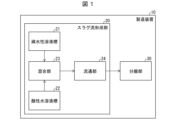
- FIG. 1 is a block diagram showing the configuration of an amino group-containing compound production apparatus 10 according to an embodiment of the present invention.
- the production apparatus 10 includes a slug flow forming section 20 and a separation section 30.
- the slug flow forming section 20 and the separation section 30 are connected to each other.
- the slug flow forming section 20 is configured to form a slug flow of a hydrophobic layer formed by a hydrophobic solution containing an amino group-containing compound, an N-terminal protecting group-derived compound which is a compound derived from the N-terminal protecting group that protected the N-terminus of the amino group-containing compound, and an organic solvent, and a hydrophilic layer formed by an acidic aqueous solution.
- the slug flow forming section 20 includes a hydrophobic solution tank 21, an acidic aqueous solution tank 22, a mixing section 23, and a circulation section 24.
- the hydrophobic solution tank 21, the acidic aqueous solution tank 22, and the circulation section 24 are each connected to the mixing section 23.
- the hydrophobic solution tank 21 is configured to store the hydrophobic solution and introduce the hydrophobic solution into the mixing section 23.
- the hydrophobic solution tank 21 is a combination of a tank that stores the hydrophobic solution and a pump connected to the tank.
- the acidic aqueous solution tank 22 is configured to store the acidic aqueous solution and introduce the acidic aqueous solution into the mixing section 23.
- the acidic aqueous solution tank 22 is a combination of a tank that stores the acidic aqueous solution and a pump connected to the tank.
- the hydrophobic solution tank 21 and the acidic aqueous solution tank 22 are controlled independently, and the stored solutions are introduced into the mixing section 23 at a constant flow rate.
- the hydrophobic solution tank 21 and the acidic aqueous solution tank 22 may be controlled in conjunction with each other, and the stored solutions are introduced into the mixing section 23 at variable flow rates.
- the mixing section 23 is configured to introduce a hydrophobic solution and an acidic aqueous solution to form a slug flow.
- a T-shaped mixer is used as the mixing section 23.
- the hydrophobic solution and the acidic aqueous solution are respectively introduced from two opposing inlet paths, and the slug flow is discharged from the remaining outlet path.
- a circulating flow is formed inside the hydrophobic layer and the hydrophilic layer in the slug flow due to the frictional action of the inner wall of the T-shaped mixer and the inner wall of the tube, further promoting the movement of compounds derived from N-terminal protecting groups.
- the mixing section 23 is not limited to a T-type mixer, and may be any member capable of forming a slug flow.
- the mixing section 23 include a Y-type mixer, a helix type mixer, and a static type mixer.
- a method of forming a slug flow by external control such as a solenoid valve can also be used.
- the flow section 24 is a component for circulating the slag flow formed in the mixing section.
- a PFA (tetrafluoroethylene-perfluoroalkyl vinyl ether copolymer) tube with an inner diameter of 1.59 mm and a length of 1 m is used as the flow section 24.
- the flow section 24 is not limited to the PFA tube described above, and may be any member capable of circulating the slag flow.
- the material, inner diameter, and length of the tube may be appropriately selected.
- the separation section 30 is connected to the slag flow forming section and is configured to separate the hydrophobic layer from the slag flow.
- a storage tank having a slag flow inlet connected to the flow section 24 and an outlet that can be opened and closed at the top and bottom is used as the separation section 30.
- the slag flow is introduced into the storage tank from the inlet, and the introduction is stopped when a predetermined amount of the hydrophobic layer and hydrophilic layer is stored. After a certain settling time, the hydrophobic layer and hydrophilic layer are discharged from the outlet, achieving separation of the hydrophobic layer.
- the separation unit 30 is not limited to the above-mentioned storage tank, but may be a component that utilizes either a batch separation method or a continuous separation method.
- An example of the separation unit 30 is an oil-water separation membrane.
- the method for producing an amino group-containing compound according to the first aspect of the present invention includes a slug flow formation step of forming a slug flow of a hydrophobic layer formed by a hydrophobic solution containing the amino group-containing compound to be recovered, an N-terminal protecting group-derived compound which is a compound derived from the N-terminal protecting group that has protected the N-terminus of the amino group-containing compound, and an organic solvent, and a hydrophilic layer formed by an acidic aqueous solution, and a separation step of recovering a hydrophobic solution containing the amino group-containing compound to be recovered by separating the hydrophobic layer from the slug flow.
- the method for producing an amino group-containing compound according to the second aspect of the present invention has the same configuration as the method for producing an amino group-containing compound according to the first aspect described above, and in addition, the N-terminal protecting group-derived compound is a capture body in which a capture agent is bound to a decomposition product derived from the N-terminal protecting group.
- the method for producing an amino group-containing compound according to the third aspect of the present invention has the same configuration as the method for producing an amino group-containing compound according to the first or second aspect described above, and further comprises the organic solvent comprising at least one selected from the group consisting of 4-methyltetrahydropyran, cyclopentyl methyl ether, chloroform, diethyl ether, diisopropyl ether, tetrahydrofuran, 2-methyltetrahydrofuran, 1,4-dioxane, methyl-t-butyl ether, ethyl acetate, isopropyl acetate, dichloromethane, toluene, xylene, hexane, heptane, and cyclohexane.
- the organic solvent comprising at least one selected from the group consisting of 4-methyltetrahydropyran, cyclopentyl methyl ether, chloroform, diethyl ether, diisopropyl
- the method for producing an amino group-containing compound according to the fourth aspect of the present invention has the same configuration as the method for producing an amino group-containing compound according to the first to third aspects described above, and further, the organic solvent includes at least one selected from the group consisting of 4-methyltetrahydropyran, cyclopentyl methyl ether, and chloroform.
- the method for producing an amino group-containing compound according to the fifth aspect of the present invention has the same configuration as the method for producing an amino group-containing compound according to any one of the first to fourth aspects described above, and further, the acidic aqueous solution is an aqueous solution containing at least one Br ⁇ nsted acid selected from the group consisting of hydrochloric acid, sulfuric acid, acetic acid, phosphoric acid, and citric acid.
- the method for producing an amino group-containing compound according to the sixth aspect of the present invention has the same configuration as the method for producing an amino group-containing compound according to any one of the first to fifth aspects described above, and further has a concentration of the Bronsted acid contained in the acidic aqueous solution of 1.0 mol/L or more and 12.0 mol/L or less.
- the method for producing an amino group-containing compound according to the seventh aspect of the present invention includes the same configuration as the method for producing an amino group-containing compound according to any one of the first to sixth aspects described above, and in addition, the slug flow forming step includes mixing the hydrophobic solution having a flow rate of 0.3 mL/min or more with the acidic aqueous solution having a flow rate of 1.0 times or more and 10 times or less than the flow rate of the hydrophobic solution to form the slug flow.
- the method for producing an amino group-containing compound according to the eighth aspect of the present invention includes, in addition to the configuration of the method for producing an amino group-containing compound according to the second aspect and any one of the third to seventh aspects that cite the second aspect described above, a deprotection step of contacting an N-terminal protected amino group-containing compound in which the N-terminus of the amino group-containing compound to be recovered is protected by the N-terminal protecting group, a deprotecting agent that deprotects the N-terminal protecting group from the N-terminal protected amino group-containing compound, and the capturing agent in the organic solvent prior to the slug flow formation step, to form the amino group-containing compound and the capturing body, the N-terminal protecting group being a protecting group having a fluorene skeleton, and the capturing agent being a secondary amine.
- the method for producing an amino group-containing compound according to the ninth aspect of the present invention includes, in addition to the configuration of the method for producing an amino group-containing compound according to any one of the first to eighth aspects described above, a neutralization step in which the recovered hydrophobic solution is contacted with a base after the separation step to neutralize the hydrophobic solution.
- the method for producing an amino group-containing compound according to the tenth aspect of the present invention has the same configuration as the method for producing an amino group-containing compound according to any one of the first to ninth aspects described above, but the amino group-containing compound to be recovered is a peptide in which two or more amino acids are bound.
- the method for producing an amino group-containing compound according to an eleventh aspect of the present invention has the same configuration as the method for producing an amino group-containing compound according to any one of the first to tenth aspects described above, and further comprises the step of: [In the formula, m Q's each represent an oxygen atom, and m R 1 's each independently represent the following formula (A): (wherein * represents a bonding position, R 1a , R 1b , R 1c , R 1d and R 1e each independently represent a hydrogen atom or an alkyl group, n 1 represents an integer of 0 or more and 6 or less, and when n 1 is 1 or more, the repeating unit shown in the parentheses to which n 1 is added is an alkylene group, and n 2 represents an integer of 0 or more and 6 or less, and when n 2 is 1 or more, the repeating unit shown in the parentheses to which n 2 is added is an alkylene group, with the proviso that at least two of R 1a
- the method for producing an amino group-containing compound according to the twelfth aspect of the present invention includes the configuration of the method for producing an amino group-containing compound according to any one of the first to eleventh aspects described above, and further includes, after the separation step, an extraction step of extracting the amino group-containing compound to be recovered from the recovered hydrophobic solution.
- the method for separating an amino group-containing compound according to the thirteenth aspect of the present invention includes a slug flow forming step of forming a slug flow of a hydrophobic layer formed by a hydrophobic solution containing the amino group-containing compound to be recovered, an N-terminal protecting group-derived compound which is a compound derived from the N-terminal protecting group that protected the N-terminus of the amino group-containing compound, and an organic solvent, and a hydrophilic layer formed by an acidic aqueous solution, and a separation step of recovering a hydrophobic solution containing the amino group-containing compound to be recovered by separating the hydrophobic layer from the slug flow.
- the apparatus for producing an amino group-containing compound according to a fourteenth aspect of the present invention includes a slug flow forming unit that forms a slug flow of the amino group-containing compound to be recovered, an N-terminal protecting group-derived compound which is a compound derived from the N-terminal protecting group that protected the N-terminus of the amino group-containing compound, and a hydrophobic layer formed by a hydrophobic solution containing an organic solvent, and a hydrophilic layer formed by an acidic aqueous solution, and a separation unit that is connected to the slug flow forming unit and recovers a hydrophobic solution containing the amino group-containing compound to be recovered by separating the hydrophobic layer from the slag flow.
- Preparation Example 1 Synthesis of H-Pro-Tyr(tBu)-Ile-Leu-OTagX (1-4)
- Preparation Example 1-1 Synthesis of H-Leu-OTagX (1-1) 5.62 g (6.78 mmol) of compound X was dissolved in 211.1 mL of a mixture of MTHP/acetonitrile (8/2), 3.35 g (9.49 mmol) of Fmoc-Leu-OH, 1.82 g (9.49 mmol) of EDCI.HCl, and 0.083 g (0.678 mmol) of DMAP were added, and the mixture was stirred at room temperature for 2 hours.
- Production Example 1-3 Synthesis of H-Tyr(tBu)-Ile-Leu-OTagX(1-3) The same operations as in Production Example 1-2 were carried out except that H-Ile-Leu-OTagX(1-2) was used as the amino acid condensate and Fmoc-Tyr(tBu)-OH was used as the amino acid to be condensed, to obtain the amino acid condensate H-Tyr(tBu)-Ile-Leu-OTagX(1-3) as a solution.
- Production Example 1-4 Synthesis of H-Pro-Tyr(tBu)-Ile-Leu-OTagX(1-4)
- the peptide (H-Pro-Tyr(tBu)-Ile-Leu-OTagX(1-4)) was obtained as a hydrophobic solution by the same procedure as in Production Example 1-2, except that H-Tyr(tBu)-Ile-Leu-OTagX(1-3) was used as the amino acid condensate, Fmoc-Pro-OH was used as the amino acid to be condensed, and no separation procedure was performed.
- the hydrophobic solution also contains a capture body formed by binding morpholine to dibenzofulvene (DBF) derived from Fmoc.
- DPF dibenzofulvene
- Preparation Example 2 Synthesis of H-Lys(Boc)-Arg(Pbf)-Arg(Pbf)-Pro-Tyr(tBu)-Ile-Leu-OTagX(1-7)
- Preparation Example 2-1 Synthesis of H-Arg(Pbf)-Pro-Tyr(tBu)-Ile-Leu-OTagX(1-5)
- the hydrophobic solution obtained in Preparation Example 1-4 was washed twice with 10% saline, twice with 2 M hydrochloric acid, and once with 0.5 M aqueous sodium hydrogen carbonate solution to obtain a hydrophobic solution.
- Production Example 2-2 Synthesis of H-Arg(Pbf)-Arg(Pbf)-Pro-Tyr(tBu)-Ile-Leu-OTagX(1-6)
- H-Arg(Pbf)-Pro-Tyr(tBu)-Ile-Leu-OTagX(1-5) was used as the amino acid condensate
- Fmoc-Arg(Pbf)-OH was used as the amino acid to be condensed, thereby obtaining the amino acid condensate H-Arg(Pbf)-Arg(Pbf)-Pro-Tyr(tBu)-Ile-Leu-OTagX(1-6) as a solution.
- Production Example 3 Synthesis of H-Tyr(tBu)-Glu(OtBu)-Asn(Trt)-Lys(Boc)-Arg(Pbf)-Arg(Pbf)-Pro-Tyr(tBu)-Ile-Leu-OTagX(1-10)
- Production Example 3-1 Synthesis of H-Asn(Trt)-Lys(Boc)-Arg(Pbf)-Arg(Pbf)-Pro-Tyr(tBu)-Ile-Leu-OTagX(1-8)
- the hydrophobic solution obtained in Production Example 2-3 was further washed twice with 2 M hydrochloric acid and once with 0.5 M aqueous sodium hydrogen carbonate solution to obtain a hydrophobic solution.
- Production Example 3-2 Synthesis of H-Glu(OtBu)-Asn(Trt)-Lys(Boc)-Arg(Pbf)-Arg(Pbf)-Pro-Tyr(tBu)-Ile-Leu-OTagX (1-9)
- H-Asn(Trt)-Lys(Boc)-Arg(Pbf)-Arg(Pbf)-Pro-Tyr(tBu)-Ile-Leu-OTagX(1-8) was used as the amino acid condensate and Fmoc-Glu(OtBu)-OH was used as the amino acid to be condensed, thereby obtaining an amino acid condensate H-Glu(OtBu)-Asn(Trt)-Lys(Boc)-Arg(Pbf)-Arg(Pbf)-Pro-Tyr(tBu)-Ile-Leu-OTagX(1-9) as
- the same operations as in Production Example 1-2 were carried out to obtain the peptide H-Tyr(tBu)-Glu(OtBu)-Asn(Trt)-Lys(Boc)-Arg(Pbf)-Arg(Pbf)-Pro-Tyr(tBu)-Ile-Leu-OTagX(1-10) as a hydrophobic solution.
- the hydrophobic solution also contains a capture body formed by binding morpholine to dibenzofulvene (DBF) derived from Fmoc.
- Production Example 4-3 Synthesis of H-Tyr(tBu)-Ile-Leu-OTagY (4-3) The same operation as in Production Example 4-2 was carried out except that H-Ile-Leu-OTagY (4-2) was used as the amino acid condensate and Fmoc-Tyr(tBu)-OH was used as the amino acid to be condensed, thereby obtaining the amino acid condensate H-Tyr(tBu)-Ile-Leu-OTagY (4-3) as a solution.
- Production Example 4-4 Synthesis of H-Pro-Tyr(tBu)-Ile-Leu-OTagY (4-4)
- the peptide (H-Pro-Tyr(tBu)-Ile-Leu-OTagY (4-4)) was obtained as a hydrophobic solution by the same procedure as in Production Example 4-2, except that H-Tyr(tBu)-Ile-Leu-OTagY (4-3) was used as the amino acid condensate, Fmoc-Pro-OH was used as the amino acid to be condensed, only 10% saline (60 mL) was used as the separation washing, and subsequent drying, washing and filtration were omitted.
- the hydrophobic solution also contains a capture body formed by binding morpholine to dibenzofulvene (DBF) derived from Fmoc.
- DPF dibenzofulvene
- Preparation Example 5-2 Synthesis of H-Ile-Leu-OTagZ (5-2)
- the above-obtained H-Leu-OTagZ (5-1) was dissolved in 48 mL of THF, and 12.0 mL of acetonitrile, 1.01 g (2.85 mmol) of Fmoc-Ile-OH, 0.546 g (2.85 mmol) of EDCI.HCl, and 0.093 g (0.657 mmol) of Oxyma were added, and the mixture was stirred at room temperature for 1 hour. Then, 0.076 mL (0.876 mmol) of morpholine was added, and the mixture was stirred at room temperature for 30 minutes.
- Production Example 5-3 Synthesis of H-Tyr(tBu)-Ile-Leu-OTagZ (5-3) The same procedure as in Production Example 5-2 was carried out except that H-Ile-Leu-OTagZ (5-2) was used as the amino acid condensate and Fmoc-Tyr(tBu)-OH was used as the amino acid to be condensed, thereby obtaining H-Tyr(tBu)-Ile-Leu-OTagZ (5-3) as a solution.
- Production Example 5-4 Synthesis of H-Pro-Tyr(tBu)-Ile-Leu-OTagZ (5-4)
- the peptide (H-Pro-Tyr(tBu)-Ile-Leu-OTagZ (5-4)) was obtained as a hydrophobic solution by the same procedure as in Production Example 5-3, except that H-Tyr(tBu)-Ile-Leu-OTagZ (5-3) was used as the amino acid condensate, Fmoc-Pro-OH was used as the amino acid to be condensed, a mixed solution of MTHP/acetonitrile (8/2) was used as the solvent, 10% saline (60 mL) was used as the separation washing, and the subsequent solvent removal and filtration were omitted.
- the hydrophobic solution also contains a capture body formed by binding morpholine to dibenzofulvene (DBF) derived from Fmoc.
- DPF dibenzofulvene
- Example ⁇ In the following Examples, the hydrophobic solutions obtained in the Production Examples were subjected to washing with slug flows formed under various conditions, and the removal rate of the captured substance in the hydrophobic layer after separation was measured.
- Flow reactor a reactor connected to a PFA tube (inner diameter 1.59 mm, Fluoron Industries) and a PFA union "PFA-220-6" (outer diameter 1/8 inch, Swagelok)
- T-shaped mixer PFA union tee "PFA-220-3" (outer diameter 1/8 inch, Swagelok), stainless steel union tee "SS-200-3” (outer diameter 1/8 inch, Swagelok)
- Pump Diaphragm pump "QI-100-TT-P-S" (Takumina)
- the removal rate of the capture body was calculated by using compound Y, which had been added in advance to the hydrophobic solution, as an internal standard substance and measuring the ratio of the area value of the capture body peak to the area value of the internal standard substance peak using HPLC before and after slug flow washing, using the following formula.
- Example 1 Slug flow cleaning including preliminary cleaning (investigation of conditions for stable formation of slug flow)
- Example 1-1 Washing with a chloroform solution The hydrophobic solution obtained in Production Example 1-4 was pre-washed twice with 10% saline and once with 2M hydrochloric acid to obtain a chloroform solution containing 0.04 mmol/mL of H-Pro-Tyr(tBu)-Ile-Leu-OTagX(1-4).
- the chloroform solution and the 2M hydrochloric acid solution were introduced into a T-shaped mixer (SS-200-3) at flow rates of 0.34 mL/min and 0.37 mL/min, respectively, using a diaphragm pump, and were joined to form a slug flow (a flow in which a hydrophobic layer formed by the chloroform solution and a hydrophilic layer formed by the hydrochloric acid aqueous solution flow alternately along the flow direction).
- the slug flow discharged from the T-shaped mixer was passed through a PFA tube (inner diameter 1.59 mm, length 2 m, residence time 354 seconds) and discharged into a beaker.
- the discharged slug quickly separated into two layers, a hydrophobic layer and a hydrophilic layer.
- the hydrophobic layer was collected to give H-Pro-Tyr(tBu)-Ile-Leu-OTagX (1-4) as a solution.
- the slug length of the hydrophobic layer formed in the slug flow was in the range of 1 to 6 cm.
- Example 1-2 Washing with MTHP solution
- the hydrophobic solution obtained in Production Example 1-4 was pre-washed twice with 10% saline and once with 2M hydrochloric acid to obtain an MTHP solution containing 0.04 mmol/mL of H-Pro-Tyr(tBu)-Ile-Leu-OTagX(1-4).
- the same operation as in Example 1-1 was carried out except that the obtained MTHP solution was used instead of the chloroform solution, and H-Pro-Tyr(tBu)-Ile-Leu-OTagX(1-4) was obtained as a solution.
- the slug flow discharged into the beaker quickly separated into two layers, a hydrophobic layer and a hydrophilic layer.
- the slug length of the hydrophobic layer formed in the slug flow was in the range of 1 to 20 cm.
- the hydrophobic solution obtained in Manufacturing Example 1-4 was pre-washed twice with 10% saline and once with 2M hydrochloric acid to obtain an MTHP solution containing 0.04 mmol/mL of H-Pro-Tyr(tBu)-Ile-Leu-OTagX(1-4).
- Example 1-1 The same operation as in Example 1-1 was performed except that the obtained MTHP solution was used instead of the chloroform solution, and the flow rates of the MTHP solution and the 2M hydrochloric acid aqueous solution were 3.0 mL/min and 3.0 mL/min, respectively (residence time of the slug flow in the PFA tube was 45 seconds), to obtain a solution of H-Pro-Tyr(tBu)-Ile-Leu-OTagX(1-4).
- the slug flow discharged into the beaker quickly separated into two layers, a hydrophobic layer and a hydrophilic layer.
- the slug length of the hydrophobic layer formed in the slug flow was 1 cm and was stable.
- Example 1 The results of Example 1 are shown in Table 2. As shown in Table 2, a slug flow of the hydrophobic solution and the acidic aqueous solution was stably formed in Examples 1-1 to 1-3, especially in Example 1-3.
- the HPLC results of the hydrophilic layer obtained in Example 1-3 are shown in Figure 2.
- the capture body peak (6.3 min) shown in Figure 2 also shows that the capture body was removed to the hydrophilic layer by washing the hydrophobic solution with the slug flow.
- the absence of a peptide peak (17.6 min) in Figure 2 also shows that the target product, the peptide, does not move to the hydrophilic layer.
- Example 2 Slug flow cleaning without preliminary cleaning
- Example 2-1 The MTHP/acetonitrile (8/2) mixed solution containing 0.02 mmol/mL of H-Pro-Tyr(tBu)-Ile-Leu-OTagX (1-4) obtained in Production Example 1-4 and the 2 M hydrochloric acid aqueous solution were introduced into a T-shaped mixer (PFA-220-3) at flow rates of 3.0 mL/min and 3.0 mL/min, respectively, using a diaphragm pump, and were joined to form a slug flow.
- PFA-220-3 T-shaped mixer
- the slug flow discharged from the T-shaped mixer was passed through a PFA tube (inner diameter 1.59 mm, length 2 m, residence time 45 seconds) and discharged into a beaker.
- the discharged slug flow was quickly separated into two layers, a hydrophobic layer and a hydrophilic layer.
- the hydrophobic layer was collected, and H-Pro-Tyr(tBu)-Ile-Leu-OTagX (1-4) was obtained as a solution.
- the removal rate of the capture agent in the obtained solution was 89.16%.
- the pH of the hydrophilic layer after washing was about 1, and the deprotecting agent DBU and the capture agent morpholine contained in the hydrophobic solution before washing were removed from the hydrophobic layer.
- Example 2-2 The same procedure as in Example 2-1 was carried out except that the flow rate of the 2M hydrochloric acid aqueous solution was 4.5 mL/min, and H-Pro-Tyr(tBu)-Ile-Leu-OTagX (1-4) was obtained as a solution. The removal rate of the captured substance was 90.16%.
- Example 2-3 The same procedure as in Example 2-1 was carried out except that the flow rate of the 2M aqueous hydrochloric acid solution was 6.0 mL/min, and H-Pro-Tyr(tBu)-Ile-Leu-OTagX (1-4) was obtained as a solution. The removal rate of the captured substance was 92.56%.
- Example 2-4 The same procedure as in Example 2-1 was carried out except that the flow rate of the 2M aqueous hydrochloric acid solution was 10.0 mL/min, and H-Pro-Tyr(tBu)-Ile-Leu-OTagX (1-4) was obtained as a solution. The removal rate of the captured substance was 96.71%.
- Example 2-5 A solution of H-Pro-Tyr(tBu)-Ile-Leu-OTag (1-4) was obtained by the same procedure as in Example 2-3, except that the hydrochloric acid concentration was 4 M. The removal rate of the captured substance was 94.94%.
- Example 2-6 A solution of H-Pro-Tyr(tBu)-Ile-Leu-OTag (1-4) was obtained by the same procedure as in Example 2-3, except that the hydrochloric acid concentration was 6 M. The removal rate of the captured substance was 97.38%.
- Example 2-7 The same procedure as in Example 2-3 was carried out except that the length of the PFA tube was 4 m, and H-Pro-Tyr(tBu)-Ile-Leu-OTag (1-4) was obtained as a solution. The removal rate of the captured substance was 93.69%.
- Example 2-8 The same procedure as in Example 2-3 was carried out except that the length of the PFA tube was 1 m, and H-Pro-Tyr(tBu)-Ile-Leu-OTag (1-4) was obtained as a solution. The removal rate of the captured substance was 96.14%.
- Example 2-9 The same procedure as in Example 2-3 was carried out except that a chloroform/acetonitrile (8/2) mixed solution was used instead of a MTHP/acetonitrile (8/2) mixed solution as the organic solvent, and H-Pro-Tyr(tBu)-Ile-Leu-OTag (1-4) was obtained as a solution.
- the removal rate of the captured substance was 51.10%.
- Example 2-10 The same procedure as in Example 2-3 was carried out except that a CPME/acetonitrile (8/2) mixed solution was used instead of a MTHP/acetonitrile (8/2) mixed solution as the organic solvent, and H-Pro-Tyr(tBu)-Ile-Leu-OTag (1-4) was obtained as a solution.
- the removal rate of the captured substance was 98.35%.
- Example 2 The results of Example 2 are shown in Table 3. As shown in Table 2, by washing the hydrophobic solution with a slug flow of an acidic aqueous solution, the capture bodies could be removed with a high removal rate. Furthermore, the results of Example 2 show that even if the peptide solution obtained by the condensation reaction is subjected to slug flow washing with an acidic aqueous solution without preliminary washing, no emulsion is formed in the slug flow, and the discharged liquid quickly separates into two layers, a hydrophilic layer and a hydrophobic layer. This shows that by using the manufacturing method according to one embodiment of the present invention, the capture bodies can be removed with fewer separation washes.
- Example 3 Slug flow washing of peptide solution containing tagX
- the hydrophobic solution obtained in Production Example 1-4 was pre-washed once with 10% saline to obtain an MTHP solution containing 0.02 mmol/mL of H-Pro-Tyr(tBu)-Ile-Leu-OTagX (1-4).
- a chloroform solution and a 2M aqueous hydrochloric acid solution were introduced into a T-shaped mixer (PFA-220-3) at flow rates of 3.0 mL/min and 6.0 mL/min, respectively, using a diaphragm pump, and were allowed to join to form a slug flow (a flow in which a hydrophobic layer formed by the chloroform solution and a hydrophilic layer formed by the aqueous hydrochloric acid solution flow alternately along the flow direction).
- the slug flow discharged from the T-shaped mixer was passed through a PFA tube (inner diameter 1.59 mm, length 1 m) and discharged into a beaker.
- the discharged slug flow was quickly separated into two layers, a hydrophobic layer and a hydrophilic layer.
- the hydrophobic layer was collected to obtain H-Pro-Tyr(tBu)-Ile-Leu-OTagX (1-4) as a solution.
- the removal rate of the captured substance was 92.16%.
- Example 4 Slug flow washing of peptide solution containing tag Y
- the MTHP solution containing 0.02 mmol/mL of H-Pro-Tyr(tBu)-Ile-Leu-OTagY (4-4) obtained in Production Example 4-4 and 2 M aqueous hydrochloric acid solution were introduced into a T-shaped mixer (PFA-220-3) at flow rates of 3.0 mL/min and 6.0 mL/min, respectively, using a diaphragm pump, and were joined to form a slug flow.
- the slug flow discharged from the T-shaped mixer was passed through a PFA tube (inner diameter 1.59 mm, length 1 m) and discharged into a beaker.
- the discharged slug flow was quickly separated into two layers, a hydrophobic layer and a hydrophilic layer.
- the hydrophobic layer was collected, and H-Pro-Tyr(tBu)-Ile-Leu-OTagY (4-4) was obtained as a solution.
- the removal rate of the captured substance was 91.66%.
- Example 5 Slug flow washing of peptide solution containing tag Z
- the MTHP solution containing 0.02 mmol/mL of H-Pro-Tyr(tBu)-Ile-Leu-OTagZ (5-4) obtained in Production Example 5-4 and 2 M aqueous hydrochloric acid solution were introduced into a T-shaped mixer (PFA-220-3) at flow rates of 3.0 mL/min and 6.0 mL/min, respectively, using a diaphragm pump, and were joined to form a slug flow.
- the slug flow discharged from the T-shaped mixer was passed through a PFA tube (inner diameter 1.59 mm, length 1 m) and discharged into a beaker.
- the discharged slug flow was quickly separated into two layers, a hydrophobic layer and a hydrophilic layer.
- the hydrophobic layer was collected, and H-Pro-Tyr(tBu)-Ile-Leu-OTagZ (5-4) was obtained as a solution.
- the removal rate of the captured substance was 88.22%.
- Example 6 Study on the generation of peptide digests Incidentally, the tBu group contained as a Tyr side chain protecting group in the peptides used in Examples 3 to 5 may be deprotected under acidic conditions, and therefore, washing in a slug flow using an acidic aqueous solution may generate peptide digests in which the tBu group has been deprotected.
- peptides H-Pro-Tyr(tBu)-Ile-Leu-OTagX (1-4), H-Pro-Tyr(tBu)-Ile-Leu-OTagY (4-4), and H-Pro-Tyr(tBu)-Ile-Leu-OTagZ (5-4) bound with various tags (compounds X to Z) were subjected to slug flow washing and then quantitative analysis by HPLC.
- the production rate of various peptide digests was calculated by calculating the ratio of the area of the peptide digests to the total area of the peptide H-Pro-Tyr(tBu)-Ile-Leu-OTag and various peptide digests H-Pro-Tyr-Ile-Leu-OTag.
- Example 7 Slug flow washing of a 7-residue peptide
- the MTHP solution containing 0.02 mmol/mL of H-Lys(Boc)-Arg(Pbf)-Arg(Pbf)-Pro-Tyr(tBu)-Ile-Leu-OTagX(1-7) obtained in Production Example 2-3 and a 2M aqueous hydrochloric acid solution were introduced into a T-shaped mixer (PFA-220-3) at flow rates of 3.0 mL/min and 6.0 mL/min, respectively, using a diaphragm pump, and were joined to form a slug flow.
- the slug flow discharged from the T-shaped mixer was passed through a PFA tube (inner diameter 1.59 mm, length 2 m) and discharged into a beaker.
- the discharged slug flow was quickly separated into two layers, a hydrophobic layer and a hydrophilic layer.
- the hydrophobic layer was collected to obtain H-Lys(Boc)-Arg(Pbf)-Arg(Pbf)-Pro-Tyr(tBu)-Ile-Leu-OTagX (1-7) as a solution.
- the removal rate of the captured substance was 83.86%.
- Example 8 Slug flow washing of 10-residue peptide
- the MTHP solution containing 0.02 mmol/mL of H-Tyr(tBu)-Glu(OtBu)-Asn(Trt)-Lys(Boc)-Arg(Pbf)-Arg(Pbf)-Pro-Tyr(tBu)-Ile-Leu-OTagX(1-10) obtained in Production Example 3-3 and a 2M aqueous hydrochloric acid solution were introduced into a T-shaped mixer (PFA-220-3) at flow rates of 3.0 mL/min and 6.0 mL/min, respectively, using a diaphragm pump, and were joined to form a slug flow.
- the slug flow discharged from the T-shaped mixer was passed through a PFA tube (inner diameter 1.59 mm, length 2 m) and discharged into a beaker.
- the discharged slug flow was quickly separated into two layers, a hydrophobic layer and a hydrophilic layer.
- the hydrophobic layer was collected to obtain H-Lys(Boc)-Arg(Pbf)-Arg(Pbf)-Pro-Tyr(tBu)-Ile-Leu-OTagX(1-10) as a solution.
- the removal rate of the captured substance was 78.12%.
- Example 9 Slug-flow washing with aqueous sodium bicarbonate solution after washing with aqueous hydrochloric acid solution
- the hydrophobic solution pH 1.97) obtained by combining the hydrophobic layers containing the peptide H-Pro-Tyr(tBu)-Ile-Leu-OTagX(1-4) obtained in Examples 2-1 to 2-8, and 0.5 M aqueous sodium bicarbonate solution were introduced into a T-shaped mixer (PFA-220-3) at flow rates of 3.0 mL/min and 6.0 mL/min, respectively, using a diaphragm pump, and were joined to form a slug flow (a flow in which a hydrophobic layer formed by the hydrophobic solution and a hydrophilic layer formed by the aqueous sodium bicarbonate solution flow alternately along the flow direction).
- the slug flow discharged from the T-shaped mixer was passed through a PFA tube (inner diameter 1.59 mm, length 2 m) and discharged into a beaker.
- the discharged slug flow was quickly separated into two layers, a hydrophobic layer and a hydrophilic layer.
- the hydrophobic layer was collected to obtain H-Pro-Tyr(tBu)-Ile-Leu-OTagX(1-4) as a solution (pH 8.15).
- the removal rate of the activator Oxyma was measured in the same manner as for the capturer, and was found to be 85.20%.
- the present invention can be used to produce amino group-containing compounds, such as peptides.
- Reference Signs List 10 Manufacturing apparatus 20: Slug flow forming section 21: Hydrophobic solution tank 22: Acidic aqueous solution tank 23: Mixing section 24: Circulation section 30: Separation section
Landscapes
- Chemical & Material Sciences (AREA)
- Organic Chemistry (AREA)
- General Health & Medical Sciences (AREA)
- Life Sciences & Earth Sciences (AREA)
- Biochemistry (AREA)
- Biophysics (AREA)
- Health & Medical Sciences (AREA)
- Genetics & Genomics (AREA)
- Medicinal Chemistry (AREA)
- Molecular Biology (AREA)
- Proteomics, Peptides & Aminoacids (AREA)
- Analytical Chemistry (AREA)
- Organic Low-Molecular-Weight Compounds And Preparation Thereof (AREA)
Abstract
Description
本発明者らは、縮合反応後のN末端保護基の脱保護により生じ得る、N末端保護基に由来する化合物であるN末端保護基由来化合物を含む疎水性溶液を、酸性水溶液を用いたスラグ流中で洗浄することにより、N末端保護基由来化合物の少なくとも一部を容易に酸性水溶液へと除去することによって、例えば、疎水性溶液中のアミノ基含有化合物の純度を向上させたり、洗浄後にアミノ基含有化合物に対してさらにアミノ酸を縮合させる工程などの別の工程を行なう際に支障となり得る成分をより多く除去したりできることを見出し、本発明を完成させた。
スラグ流形成工程は、疎水性溶液が形成する疎水層と、酸性水溶液が形成する親水層とのスラグ流を形成する工程である。スラグ流形成工程によれば、流れ方向に沿って疎水層と親水層とが交互に流れるスラグ流が形成される。スラグ流においては、疎水層に含まれるN末端保護基由来化合物の少なくとも一部が当該疎水層に隣接する親水層へと移動し、疎水層に含まれる捕捉体が減じられる。
疎水性溶液は、回収対象のアミノ基含有化合物、N末端保護基由来化合物および有機溶媒を含む。疎水性溶液は、N末端保護基由来化合物を捕捉する捕捉剤をさらに含んでもよい。限定するものではないが、疎水性溶液としては、アミノ基含有化合物を合成するための縮合反応において用いられた反応溶液がそのまま用いられてもよい。
本発明の一態様において、アミノ基含有化合物は、第1級アミノ基および第2級アミノ基のうち少なくとも一方を有する任意の化合物である。アミノ基含有化合物の例としては、単体のアミノ酸、および2個以上のアミノ酸がペプチド結合して形成されるペプチドが挙げられる。ペプチドは、ペプチド鎖のC末端および側鎖末端のいずれかに、保護基などの置換基を有していてもよい。



本発明の一態様において、N末端保護基由来化合物は、アミノ基含有化合物のN末端を保護していたN末端保護基に由来する化合物である。N末端保護基由来化合物の例としては、N末端保護アミノ基含有化合物のN末端保護基を脱保護することによってN末端保護基が分解して生じる分解生成物、および当該分解生成物に対して捕捉剤が結合した捕捉体(以下、単に「捕捉体」という。)が挙げられる。分解生成物および捕捉体は、典型的には、本発明の一態様に係る製造方法において副生成物として生じ得る。分解生成物および捕捉体は、製造されるアミノ基含有化合物の収率および純度を減少させることがあるため、その少なくとも一部を除去することが所望されることがある。本発明の一態様において、N末端保護基由来化合物の少なくとも一部を容易に除去することによって、本発明の一態様に係る製造方法におけるコストおよび所要時間の削減を達成することができる。N末端保護基由来化合物は、1種であってもよく、複数種類の組合せであってもよい。
本発明の一態様において、除去の対象は、分解生成物であってもよい。分解生成物は、N末端保護アミノ基含有化合物のN末端保護基を脱保護することによってN末端保護基が分解して生じる化合物である。
本発明の一態様において、除去の対象は、捕捉体であってもよい。捕捉体は、回収対象のアミノ基含有化合物のN末端を保護していたN末端保護基に由来する分解生成物に捕捉剤が結合した化合物である。なお、疎水性溶液には、捕捉体に加えて、捕捉剤、およびN末端保護基に由来する分解生成物それぞれが、互いに結合していない形態で含まれてもよい。

本発明の一態様において、有機溶媒は、当該有機溶媒を含む疎水性溶液を酸性水溶液に対して非相溶性とするものであればよく、特に限定されない。有機溶媒は、ペプチドの縮合反応において反応溶媒として用いられ得る公知の疎水性有機溶媒であってもよい。本発明の一態様に係る製造方法において縮合反応とN末端保護基由来化合物の除去とを繰り返し行う場合には、操作の簡便性を向上させ、また縮合反応とN末端保護基由来化合物の除去との間に生じる悪影響を低減する観点から、スラグ流形成工程における有機溶媒は縮合反応における反応溶媒と同一であることが好ましい。
疎水性溶液は、上述した成分以外の他の成分を含んでもよい。他の成分の例としては、ペプチドの縮合反応において用いられ得る縮合剤、活性化剤および触媒、ならびに縮合反応の副生成物、ならびに脱保護剤が挙げられる。縮合剤、活性化剤、触媒および脱保護剤の具体例は、後述する。
酸性水溶液は、スラグ流中で、N末端保護基由来化合物が疎水層から抽出される親水層を形成する。酸性水溶液は、酸を含む水溶液であればよく、特に限定されないが、例えばブレンステッド酸を含む水溶液である。
疎水性溶液が形成する疎水層と、酸性水溶液が形成する親水層とのスラグ流を形成する方法は、特に限定されないが、例えば、疎水性溶液および酸性水溶液を別々の流路から合流部へと導入して混合する方法、ならびに電磁弁などの外部制御によりスラグ流を形成する方法が挙げられる。
分離工程は、スラグ流から疎水層を分離することによって、回収対象のアミノ基含有化合物を含む疎水性溶液を回収する工程である。本発明の一態様に係る製造方法においてN末端保護基由来化合物の除去が起こるスラグ流は微細なエマルジョンを生じにくく、疎水層がある程度の大きさを有するため、スラグ流から疎水層を容易に分離することができる。回収される疎水性溶液は、回収対象のアミノ基含有化合物を含むが、スラグ流形成工程において用いられた疎水性溶液が含んでいたN末端保護基由来化合物を含まないか、スラグ流形成工程における量よりも減じられた量で含んでいる。
本発明の一態様に係る製造方法は、スラグ流形成工程の前に、脱保護工程をさらに含んでもよい。脱保護工程は、スラグ流形成工程の前に、有機溶媒中で、N末端保護アミノ基含有化合物と脱保護剤と捕捉剤とを接触させて、回収対象のアミノ基含有化合物および捕捉体を形成させる工程である。脱保護工程によれば、アミノ基含有化合物および捕捉体を含む疎水性溶液を得ることができる。
また、本発明の一態様に係る製造方法は、脱保護工程の前に、縮合工程をさらに含んでもよい。縮合工程は、脱保護工程の前に、アミノ基含有化合物前駆体のN末端に対して、N末端保護アミノ酸を縮合させて、N末端保護アミノ基含有化合物を得る工程である。アミノ基含有化合物前駆体は、アミノ基含有化合物においてN末端アミノ酸1残基が除去された構造を有する化合物である。また、N末端保護アミノ酸は、アミノ基にN末端保護基が結合している任意のアミノ酸である。
縮合工程および脱保護工程のスキームの一例を以下に示す。下記スキームでは、縮合工程として、C末端がR基で保護されているアミノ基含有化合物前駆体H-AA1-ORをMTHP/DMF(8/2)の混合液に30~40v/wになるよう溶解し、N末端保護アミノ酸Fmoc-AA2-OH(1.3equiv)、縮合剤EDCI・HCl(1.3equiv)および活性化剤Oxyma(0.1equiv)を加え、室温で1時間攪拌する。縮合反応の終了をHPLCで確認した後、活性エステルFmoc-AA2-Oxの捕捉剤としてモルホリン(0.4equiv)を加え室温で30分間攪拌する。次いで、脱保護工程として、捕捉剤モルホリン(20.0equiv)および脱保護剤DBU(7.0equiv)を加えて室温で1時間攪拌し、脱保護反応を行い、アミノ基含有化合物H-AA2-AA1-ORを得る。限定するものではないが、続けて、反応溶液を分液ロートに移し、10%食塩水(25~30v/w、2回)を加えて洗浄、分液してもよい。さらに、有機層に2M塩酸(25~30v/w、2回)を加えて洗浄、分液を行い、さらに0.5M炭酸水素ナトリウム水溶液(25~30v/w)で洗浄、分液し、有機層を適量の硫酸ナトリウムで乾燥後、適量のMTHPで洗いこみを行いながら、ろ過し、アミノ酸縮合物を溶液として得てもよい。

また、本発明の一態様に係る製造方法は、分離工程の後に、中和工程をさらに含んでもよい。中和工程は、分離工程の後に、回収された疎水性溶液と塩基とを接触させて、疎水性溶液を中和する工程である。中和工程によれば、分離工程において回収された、低pHを有する疎水性溶液を中和することにより、続く工程における、疎水性溶液の反応性を制御することができる。また、中和工程によれば、疎水性溶液に含まれ得る活性化剤を容易に除去することができる。
本発明の一態様に係る製造方法は、任意に縮合工程と、任意に脱保護工程と、スラグ流形成工程と、分離工程と、任意に中和工程とをこの順番で含む一連の工程を、繰り返し実行することを含んでもよい。一連の工程を繰り返し実行することにより、アミノ基含有化合物のN末端に対してアミノ酸を縮合させて、当該アミノ基含有化合物を伸長させることができる。一連の工程を繰り返す回数は、特に限定されず、アミノ酸を縮合させる回数に応じて定めればよい。
本発明の一態様に係る製造方法は、分離工程の後に、抽出工程をさらに含んでもよい。抽出工程は、分離工程で回収された疎水性溶液から回収対象のアミノ基含有化合物を抽出する工程である。アミノ基含有化合物を抽出する方法は、疎水性溶液からアミノ基含有化合物を単離生成するための任意の方法を用いて行うことができ、例えば抽出洗浄、晶析およびクロマトグラフィーが挙げられるが、これらに限定されない。
本発明の他の態様について、以下に説明する。なお、説明の便宜上、上記にて説明した工程または部材と同じ機能を有する工程または部材については、その説明を繰り返さない。
本発明の一態様は、アミノ基含有化合物の製造装置に関する。本発明の一態様に係るアミノ基含有化合物の製造装置は、アミノ基含有化合物、当該アミノ基含有化合物のN末端を保護していたN末端保護基に由来する化合物であるN末端保護基由来化合物、および有機溶媒を含む疎水性溶液が形成する疎水層と、酸性水溶液が形成する親水層とのスラグ流を形成するスラグ流形成部と、スラグ流形成部と連結しており、スラグ流から疎水層を分離する分離部と、を含む。以下、アミノ基含有化合物の製造装置を、単に「製造装置」と呼ぶことがある。
本製造装置の一実施形態について、図1を参照して説明する。図1は、本発明の一実施形態に係るアミノ基含有化合物の製造装置10の構成を示すブロック図である。図1に示すように、製造装置10は、スラグ流形成部20と、分離部30とを含む。スラグ流形成部20と分離部30とは連結している。
上記の説明から理解されるように、本発明の第1の態様に係るアミノ基含有化合物の製造方法は、回収対象のアミノ基含有化合物、当該アミノ基含有化合物のN末端を保護していたN末端保護基に由来する化合物であるN末端保護基由来化合物、および有機溶媒を含む疎水性溶液が形成する疎水層と、酸性水溶液が形成する親水層とのスラグ流を形成するスラグ流形成工程と、前記スラグ流から前記疎水層を分離することによって、前記回収対象のアミノ基含有化合物を含む疎水性溶液を回収する分離工程と、を含む。

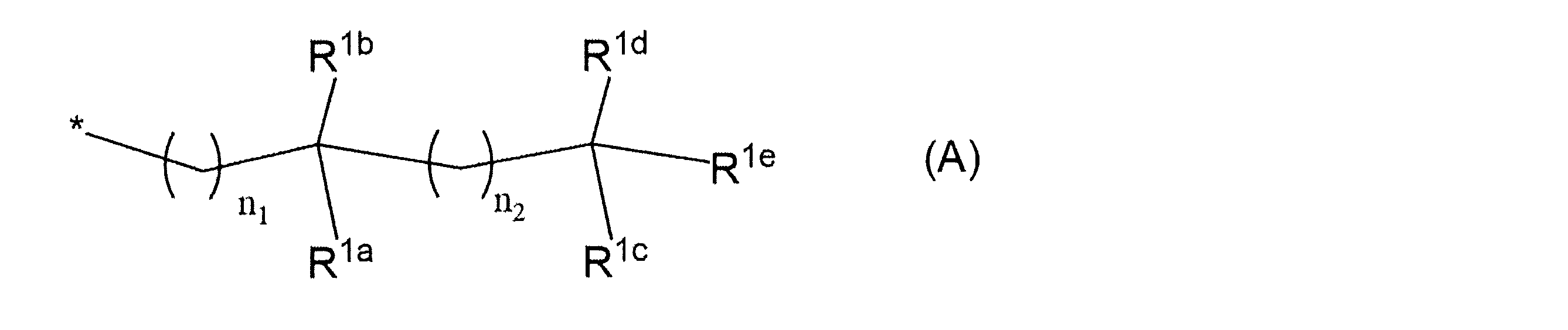
〔付記事項〕
本発明は上述した各実施形態に限定されるものではなく、請求項に示した範囲で種々の変更が可能であり、異なる実施形態にそれぞれ開示された技術的手段を適宜組み合わせて得られる実施形態についても本発明の技術的範囲に含まれる。
以下の製造例では、続く実施例において用いる、ペプチドおよび捕捉体を含む疎水性溶液を製造した。製造例においては、それぞれ下記式(X)、(Y)および(Z)で表される化合物X、YおよびZをアミノ基含有化合物のC末端保護基(タグ)として用いた。

製造例1-1:H-Leu-OTagX(1-1)の合成
化合物X5.62g(6.78mmol)をMTHP/アセトニトリル(8/2)の混合液211.1mLに溶解し、Fmoc-Leu-OH3.35g(9.49mmol)、EDCI・HCl1.82g(9.49mmol)およびDMAP0.083g(0.678mmol)を加え、室温で2時間攪拌した。次いで、モルホリン0.236mL(2.71mmol)を加え、室温で30分間攪拌した。次いで、モルホリン11.8mL(136mmol)およびDBU7.08mL(47.4mmol)を加え、室温で1時間攪拌した。反応溶液を分液ロートに移し、10%食塩水(140mL×2回)を加えて分液洗浄した。さらに、有機層に2M塩酸(140mL×2回)を加えて分液洗浄を行い、さらに0.5M炭酸水素ナトリウム水溶液(140mL)で分液洗浄した。有機層を適量の硫酸ナトリウムで乾燥した後、適量のMTHPで洗いこみを行いながら、ろ過し、アミノ酸縮合物H-Leu-OTagX(1-1)を溶液として得た。
上記で得られたH-Leu-OTagX(1-1)の溶液にアセトニトリル42.1mL、Fmoc-Ile-OH3.11g(8.81mmol)、EDCI・HCl1.69g(8.81mmol)およびOxyma0.289g(2.03mmol)を加え、室温で1時間攪拌した。次いで、モルホリン0.236mL(2.71mmol)を加え、室温で30分間攪拌した。次いで、モルホリン11.8mL(136mmol)およびDBU7.08mL(47.4mmol)を加え、室温で1時間攪拌した。反応溶液を分液ロートに移し、10%食塩水(140mL×2回)を加えて分液洗浄した。さらに、有機層に2M塩酸(140mL×2回)を加えて分液洗浄を行い、さらに0.5M炭酸水素ナトリウム水溶液(140mL)で分液洗浄した。有機層を適量の硫酸ナトリウムで乾燥した後、適量のMTHPで洗いこみを行いながら、ろ過し、アミノ酸縮合物H-Ile-Leu-OTagX(1-2)を溶液として得た。
アミノ酸縮合物としてH-Ile-Leu-OTagX(1-2)を用い、縮合するアミノ酸としてFmoc-Tyr(tBu)-OHを用いたこと以外は製造例1-2と同様の操作を行い、アミノ酸縮合物H-Tyr(tBu)-Ile-Leu-OTagX(1-3)を溶液として得た。
アミノ酸縮合物としてH-Tyr(tBu)-Ile-Leu-OTagX(1-3)を用い、縮合するアミノ酸としてFmoc-Pro-OHを用い、分液操作を行わなかったこと以外は製造例1-2と同様の操作を行い、ペプチド(H-Pro-Tyr(tBu)-Ile-Leu-OTagX(1-4))を疎水性溶液として得た。当該疎水性溶液には、Fmocに由来するジベンゾフルベン(DBF)にモルホリンが結合して形成された捕捉体も含まれる。
製造例2-1:H-Arg(Pbf)-Pro-Tyr(tBu)-Ile-Leu-OTagX(1-5)の合成
製造例1-4で得た疎水性溶液を10%食塩水で2回、2M塩酸で2回、0.5M炭酸水素ナトリウム水溶液で1回洗浄して、疎水性溶液を得た。次いで、アミノ酸縮合物溶液の代わりに得られた疎水性溶液を用い、縮合するアミノ酸としてFmoc-Arg(Pbf)-OHを用いたこと以外は製造例1-2と同様の操作を行い、アミノ酸縮合物H-Arg(Pbf)-Pro-Tyr(tBu)-Ile-Leu-OTagX(1-5)を溶液として得た。
アミノ酸縮合物としてH-Arg(Pbf)-Pro-Tyr(tBu)-Ile-Leu-OTagX(1-5)を用い、縮合するアミノ酸としてFmoc-Arg(Pbf)-OHを用いたこと以外は製造例1-2と同様の操作を行い、アミノ酸縮合物H-Arg(Pbf)-Arg(Pbf)-Pro-Tyr(tBu)-Ile-Leu-OTagX(1-6)を溶液として得た。
アミノ酸縮合物としてH-Arg(Pbf)-Arg(Pbf)-Pro-Tyr(tBu)-Ile-Leu-OTagX(1-6)を用い、縮合するアミノ酸としてFmoc-Lys(Boc)-OHを用い、分液洗浄として10%食塩水(60mL)のみを行い、続く乾燥、洗いこみおよびろ過を省略したこと以外は製造例1-2と同様の操作を行い、ペプチドH-Lys(Boc)-Arg(Pbf)-Arg(Pbf)-Pro-Tyr(tBu)-Ile-Leu-OTagX(1-7)を疎水性溶液として得た。当該疎水性溶液には、Fmocに由来するジベンゾフルベン(DBF)にモルホリンが結合して形成された捕捉体も含まれる。
製造例3-1:H-Asn(Trt)-Lys(Boc)-Arg(Pbf)-Arg(Pbf)-Pro-Tyr(tBu)-Ile-Leu-OTagX(1-8)の合成
製造例2-3で得た疎水性溶液をさらに2M塩酸で2回、0.5M炭酸水素ナトリウム水溶液で1回洗浄して、疎水性溶液を得た。次いで、アミノ酸縮合物溶液の代わりに得られた疎水性溶液を用い、縮合するアミノ酸としてFmoc-Asn(Trt)-OHを用いたこと以外は製造例1-2と同様の操作を行い、アミノ酸縮合物H-Asn(Trt)-Lys(Boc)-Arg(Pbf)-Arg(Pbf)-Pro-Tyr(tBu)-Ile-Leu-OTagX(1-8)を溶液として得た。
アミノ酸縮合物としてH-Asn(Trt)-Lys(Boc)-Arg(Pbf)-Arg(Pbf)-Pro-Tyr(tBu)-Ile-Leu-OTagX(1-8)を用い、縮合するアミノ酸としてFmoc-Glu(OtBu)-OHを用いたこと以外は製造例1-2と同様の操作を行い、アミノ酸縮合物H-Glu(OtBu)-Asn(Trt)-Lys(Boc)-Arg(Pbf)-Arg(Pbf)-Pro-Tyr(tBu)-Ile-Leu-OTagX(1-9)を溶液として得た。
アミノ酸縮合物としてH-Glu(OtBu)-Asn(Trt)-Lys(Boc)-Arg(Pbf)-Arg(Pbf)-Pro-Tyr(tBu)-Ile-Leu-OTagX(1-9)を用い、縮合するアミノ酸としてFmoc-Tyr(tBu)-OHを用い、分液洗浄として10%食塩水(60mL)のみを行い、続く乾燥、洗いこみおよびろ過を省略したこと以外は製造例1-2と同様の操作を行い、ペプチドH-Tyr(tBu)-Glu(OtBu)-Asn(Trt)-Lys(Boc)-Arg(Pbf)-Arg(Pbf)-Pro-Tyr(tBu)-Ile-Leu-OTagX(1-10)を疎水性溶液として得た。当該疎水性溶液には、Fmocに由来するジベンゾフルベン(DBF)にモルホリンが結合して形成された捕捉体も含まれる。
製造例4-1:H-Leu-OTagY(4-1)の合成
化合物Y2.00g(3.03mmol)をMTHP/アセトニトリル(8/2)の混合液60.0mLに溶解し、Fmoc-Leu-OH1.60g(4.54mmol)、EDCI・HCl0.87g(4.54mmol)およびDMAP0.037g(0.303mmol)を加え、室温で2時間攪拌した。次いで、モルホリン0.158mL(1.82mmol)を加え、室温で30分間攪拌した。次いで、モルホリン5.27mL(60.5mmol)およびDBU3.16mL(21.2mmol)を加え、室温で1時間攪拌した。反応溶液を分液ロートに移し、10%食塩水(60mL)を加えて分液洗浄した。さらに、有機層に2M塩酸(60mL×2回)を加えて分液洗浄を行い、さらに0.5M炭酸水素ナトリウム水溶液(60mL)で分液洗浄した。有機層を適量の硫酸ナトリウムで乾燥した後、適量のMTHPで洗いこみを行いながら、ろ過し、アミノ酸縮合物H-Leu-OTagY(4-1)を溶液として得た。
上記で得られたH-Leu-OTagY(4-1)の溶液にアセトニトリル12.0mL、Fmoc-Ile-OH1.39g(3.93mmol)、EDCI・HCl0.754g(3.93mmol)およびOxyma0.129g(0.908mmol)を加え、室温で1時間攪拌した。次いで、モルホリン0.105mL(1.21mmol)を加え、室温で30分間攪拌した。次いで、モルホリン5.27mL(60.5mmol)およびDBU3.16mL(21.2mmol)を加え、室温で1時間攪拌した。反応溶液を分液ロートに移し、10%食塩水(60mL)を加えて分液洗浄した。さらに、有機層に2M塩酸(60mL×2回)を加えて分液洗浄を行い、さらに0.5M炭酸水素ナトリウム水溶液(60mL)で分液洗浄した。有機層を適量の硫酸ナトリウムで乾燥した後、適量のMTHPで洗いこみを行いながら、ろ過し、アミノ酸縮合物H-Ile-Leu-OTagY(4-2)を溶液として得た。
アミノ酸縮合物としてH-Ile-Leu-OTagY(4-2)を用い、縮合するアミノ酸としてFmoc-Tyr(tBu)-OHを用いたこと以外は製造例4-2と同様の操作を行い、アミノ酸縮合物H-Tyr(tBu)-Ile-Leu-OTagY(4-3)を溶液として得た。
アミノ酸縮合物としてH-Tyr(tBu)-Ile-Leu-OTagY(4-3)を用い、縮合するアミノ酸としてFmoc-Pro-OHを用い、分液洗浄として10%食塩水(60mL)のみを行い、続く乾燥、洗いこみおよびろ過を省略したこと以外は製造例4-2と同様の操作を行い、ペプチド(H-Pro-Tyr(tBu)-Ile-Leu-OTagY(4-4))を疎水性溶液として得た。当該疎水性溶液には、Fmocに由来するジベンゾフルベン(DBF)にモルホリンが結合して形成された捕捉体も含まれる。
製造例5-1:H-Leu-OTagZ(5-1)の合成
化合物Z2.00g(2.19mmol)をTHF/アセトニトリル(8/2)の混合液70mLに溶解し、Fmoc-Leu-OH1.16g(3.28mmol)、EDCI・HCl0.63g(3.28mmol)およびDMAP0.027g(0.219mmol)を加え、室温で2時間攪拌した。次いで、モルホリン0.114mL(1.31mmol)を加え、室温で30分間攪拌した。次いで、モルホリン3.81mL(43.8mmol)およびDBU2.29mL(15.3mmol)を加え、室温で1時間攪拌した。エバポレーターを用いて反応溶液から溶媒を除去した後、アセトニトリル100mLを追加し、30分間攪拌した。析出した固体をろ取し、アミノ酸縮合物H-Leu-OTagZ(5-1)を固体として得た。
上記で得られたH-Leu-OTagZ(5-1)をTHF48mLに溶解させ、アセトニトリル12.0mL、Fmoc-Ile-OH1.01g(2.85mmol)、EDCI・HCl0.546g(2.85mmol)およびOxyma0.093g(0.657mmol)を加え、室温で1時間攪拌した。次いで、モルホリン0.076mL(0.876mmol)を加え、室温で30分間攪拌した。次いで、モルホリン3.81mL(43.8mmol)およびDBU2.29mL(15.3mmol)を加え、室温で1時間攪拌した。エバポレーターを用いて反応溶液から溶媒を除去した後、アセトニトリル100mLを追加し、30分間攪拌した。析出した固体をろ取し、アミノ酸縮合物H-Ile-Leu-OTagZ(5-2)を固体として得た。
アミノ酸縮合物としてH-Ile-Leu-OTagZ(5-2)を用い、縮合するアミノ酸としてFmoc-Tyr(tBu)-OHを用いたこと以外は製造例5-2と同様の操作を行い、H-Tyr(tBu)-Ile-Leu-OTagZ(5-3)を溶液として得た。
アミノ酸縮合物としてH-Tyr(tBu)-Ile-Leu-OTagZ(5-3)を用い、縮合するアミノ酸としてFmoc-Pro-OHを用い、溶媒としてMTHP/アセトニトリル(8/2)の混合溶液を用い、分液洗浄として10%食塩水(60mL)を行い、続く溶媒除去およびろ取を省略したこと以外は製造例5-3と同様の操作を行い、ペプチド(H-Pro-Tyr(tBu)-Ile-Leu-OTagZ(5-4))を疎水性溶液として得た。当該疎水性溶液には、Fmocに由来するジベンゾフルベン(DBF)にモルホリンが結合して形成された捕捉体も含まれる。
以下の実施例では、製造例で得た疎水性溶液を、種々の条件で形成したスラグ流による洗浄に供し、分離後の疎水層における捕捉体の除去率を測定した。
実施例では、以下の装置を使用した。
・フローリアクター:PFAチューブ(内径1.59mm、フロン工業社)とPFAユニオン「PFA-220-6」(外径1/8インチ、Swagelok社)とを連結したリアクター
・T字型ミキサー:PFAユニオンティー「PFA-220-3」(外径1/8インチ、Swagelok社)、ステンレスユニオンティー「SS-200-3」(外径1/8インチ、Swagelok社)
・ポンプ:ダイヤフラムポンプ「QI-100-TT-P-S」(タクミナ社)
捕捉体の除去率は、疎水性溶液にあらかじめ加えた化合物Yを内部標準物質とし、捕捉体ピークの面積値の、内部標準物質ピークの面積値に対する比率をスラグ流洗浄前後でHPLCを用いて測定し、下記式を用いて求めた。
除去率(%)=100-残存率(%)
カラム:InertSustainC18(3μm、4.6×125mm)
移動相A:0.1%トリフルオロ酢酸(TFA)水溶液、移動相B:THF
溶出液:移動相A/移動相B:表1に示すグラジエント条件にて測定を実施した。
流量:1.0mL/min
カラム温度:40℃
検出器:紫外可視分光検出器(λ=220nm)

実施例1-1:クロロホルム溶液を用いた洗浄
製造例1-4で得た疎水性溶液を、10%食塩水で2回、2M塩酸で1回予備洗浄して、0.04mmol/mLのH-Pro-Tyr(tBu)-Ile-Leu-OTagX(1-4)を含むクロロホルム溶液を得た。クロロホルム溶液および2M塩酸水溶液を、ダイヤフラムポンプを用いてそれぞれ0.34mL/minおよび0.37mL/minの流量でT字型ミキサー(SS-200-3)に導入して合流させ、スラグ流(流れ方向に沿って、クロロホルム溶液が形成する疎水層と、塩酸水溶液が形成する親水層とが交互に流れる流れ)を形成した。T字型ミキサーから排出されたスラグ流をPFAチューブ(内径1.59mm、長さ2m、滞留時間354秒)中に流通させて、ビーカーに排出した。排出されたスラグ流は、速やかに疎水層と親水層との2層に分離した。疎水層を回収し、H-Pro-Tyr(tBu)-Ile-Leu-OTagX(1-4)を溶液として得た。
製造例1-4で得た疎水性溶液を、10%食塩水で2回、2M塩酸で1回予備洗浄して、0.04mmol/mLのH-Pro-Tyr(tBu)-Ile-Leu-OTagX(1-4)を含むMTHP溶液を得た。クロロホルム溶液の代わりに得られたMTHP溶液を用いたこと以外は実施例1-1と同様の操作を行い、H-Pro-Tyr(tBu)-Ile-Leu-OTagX(1-4)を溶液として得た。本実施例においてビーカーに排出されたスラグ流は、速やかに疎水層と親水層との2層に分離した。

実施例2-1:
製造例1-4で得られた0.02mmol/mLのH-Pro-Tyr(tBu)-Ile-Leu-OTagX(1-4)を含むMTHP/アセトニトリル(8/2)混合溶液および2M塩酸水溶液を、ダイヤフラムポンプを用いてそれぞれ3.0mL/minおよび3.0mL/minの流量でT字型ミキサー(PFA-220-3)に導入して合流させ、スラグ流を形成した。T字型ミキサーから排出されたスラグ流をPFAチューブ(内径1.59mm、長さ2m、滞留時間45秒)中に流通させて、ビーカーに排出した。排出されたスラグ流は、速やかに疎水層と親水層との2層に分離した。疎水層を回収し、H-Pro-Tyr(tBu)-Ile-Leu-OTagX(1-4)を溶液として得た。
2M塩酸水溶液の流量を4.5mL/minとしたこと以外は、実施例2-1と同様の操作を行い、H-Pro-Tyr(tBu)-Ile-Leu-OTagX(1-4)を溶液として得た。捕捉体の除去率は90.16%であった。
2M塩酸水溶液の流量を6.0mL/minとしたこと以外は、実施例2-1と同様の操作を行い、H-Pro-Tyr(tBu)-Ile-Leu-OTagX(1-4)を溶液として得た。捕捉体の除去率は92.56%であった。
2M塩酸水溶液の流量を10.0mL/minとしたこと以外は、実施例2-1と同様の操作を行い、H-Pro-Tyr(tBu)-Ile-Leu-OTagX(1-4)を溶液として得た。捕捉体の除去率は96.71%であった。
塩酸濃度を4Mとしたこと以外は、実施例2-3と同様の操作を行い、H-Pro-Tyr(tBu)-Ile-Leu-OTag(1-4)を溶液として得た。捕捉体の除去率は94.94%であった。
塩酸濃度を6Mとしたこと以外は、実施例2-3と同様の操作を行い、H-Pro-Tyr(tBu)-Ile-Leu-OTag(1-4)を溶液として得た。捕捉体の除去率は97.38%であった。
PFAチューブの長さを4mとしたこと以外は、実施例2-3と同様の操作を行い、H-Pro-Tyr(tBu)-Ile-Leu-OTag(1-4)を溶液として得た。捕捉体の除去率は93.69%であった。
PFAチューブの長さを1mとしたこと以外は、実施例2-3と同様の操作を行い、H-Pro-Tyr(tBu)-Ile-Leu-OTag(1-4)を溶液として得た。捕捉体の除去率は96.14%であった。
有機溶媒としてMTHP/アセトニトリル(8/2)混合溶液の代わりにクロロホルム/アセトニトリル(8/2)混合溶液を用いたこと以外は、実施例2-3と同様の操作を行い、H-Pro-Tyr(tBu)-Ile-Leu-OTag(1-4)を溶液として得た。捕捉体の除去率は51.10%であった。
有機溶媒としてMTHP/アセトニトリル(8/2)混合溶液の代わりにCPME/アセトニトリル(8/2)混合溶液を用いたこと以外は、実施例2-3と同様の操作を行い、H-Pro-Tyr(tBu)-Ile-Leu-OTag(1-4)を溶液として得た。捕捉体の除去率は98.35%であった。
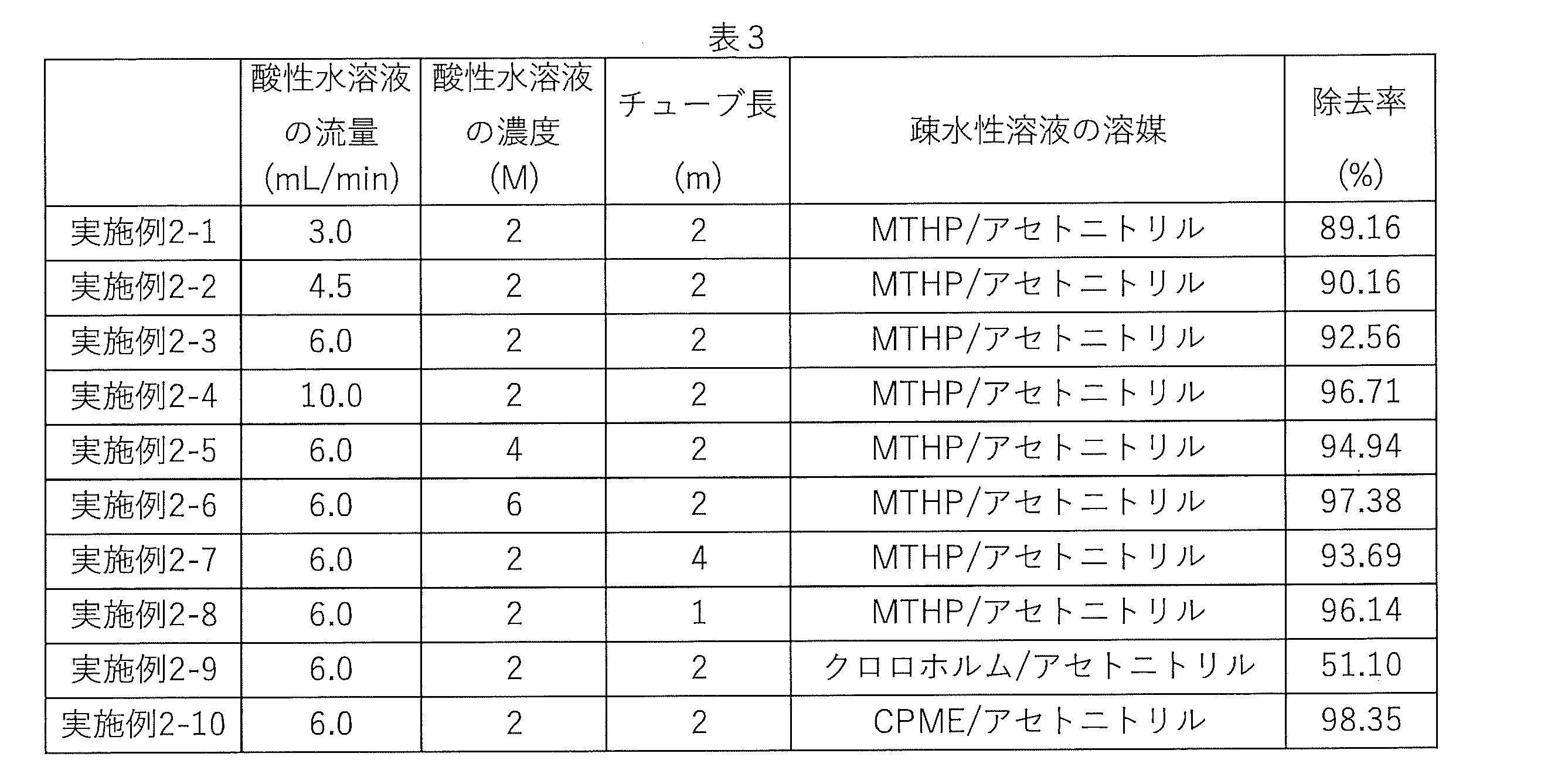
製造例1-4で得た疎水性溶液を、10%食塩水で1回予備洗浄して、0.02mmol/mLのH-Pro-Tyr(tBu)-Ile-Leu-OTagX(1-4)を含むMTHP溶液を得た。クロロホルム溶液および2M塩酸水溶液を、ダイヤフラムポンプを用いてそれぞれ3.0mL/minおよび6.0mL/minの流量でT字型ミキサー(PFA-220-3)に導入して合流させ、スラグ流(流れ方向に沿って、クロロホルム溶液が形成する疎水層と、塩酸水溶液が形成する親水層とが交互に流れる流れ)を形成した。T字型ミキサーから排出されたスラグ流をPFAチューブ(内径1.59mm、長さ1m)中に流通させて、ビーカーに排出した。排出されたスラグ流は、速やかに疎水層と親水層との2層に分離した。疎水層を回収し、H-Pro-Tyr(tBu)-Ile-Leu-OTagX(1-4)を溶液として得た。捕捉体の除去率は92.16%であった。
製造例4-4で得た0.02mmol/mLのH-Pro-Tyr(tBu)-Ile-Leu-OTagY(4-4)を含むMTHP溶液および2M塩酸水溶液を、ダイヤフラムポンプを用いてそれぞれ3.0mL/minおよび6.0mL/minの流量でT字型ミキサー(PFA-220-3)に導入して合流させ、スラグ流を形成した。T字型ミキサーから排出されたスラグ流をPFAチューブ(内径1.59mm、長さ1m)中に流通させて、ビーカーに排出した。排出されたスラグ流は、速やかに疎水層と親水層との2層に分離した。疎水層を回収し、H-Pro-Tyr(tBu)-Ile-Leu-OTagY(4-4)を溶液として得た。捕捉体の除去率は91.66%であった。
製造例5-4で得た0.02mmol/mLのH-Pro-Tyr(tBu)-Ile-Leu-OTagZ(5-4)を含むMTHP溶液および2M塩酸水溶液を、ダイヤフラムポンプを用いてそれぞれ3.0mL/minおよび6.0mL/minの流量でT字型ミキサー(PFA-220-3)に導入して合流させ、スラグ流を形成した。T字型ミキサーから排出されたスラグ流をPFAチューブ(内径1.59mm、長さ1m)中に流通させて、ビーカーに排出した。排出されたスラグ流は、速やかに疎水層と親水層との2層に分離した。疎水層を回収し、H-Pro-Tyr(tBu)-Ile-Leu-OTagZ(5-4)を溶液として得た。捕捉体の除去率は88.22%であった。
ところで、実施例3~5で用いたペプチドにTyr側鎖保護基として含まれるtBu基は、酸性条件下で脱保護されることがある。そのため、酸性水溶液を用いたスラグ流中での洗浄により、tBu基が脱保護されたペプチド分解物が生成することがある。
ペプチド分解物生成の実験結果を表4に示す。表4に示すように、タグ化合物XまたはYが結合したペプチドを、酸性水溶液を用いたスラグ流中での洗浄に供した場合、化合物Zが結合したペプチドと比較して、ペプチド分解物の生成が減じられることが分かった。

製造例2-3で得られた0.02mmol/mLのH-Lys(Boc)-Arg(Pbf)-Arg(Pbf)-Pro-Tyr(tBu)-Ile-Leu-OTagX(1-7)を含むMTHP溶液および2M塩酸水溶液を、ダイヤフラムポンプを用いてそれぞれ3.0mL/minおよび6.0mL/minの流量でT字型ミキサー(PFA-220-3)に導入して合流させ、スラグ流を形成した。T字型ミキサーから排出されたスラグ流をPFAチューブ(内径1.59mm、長さ2m)中に流通させて、ビーカーに排出した。排出されたスラグ流は、速やかに疎水層と親水層との2層に分離した。疎水層を回収し、H-Lys(Boc)-Arg(Pbf)-Arg(Pbf)-Pro-Tyr(tBu)-Ile-Leu-OTagX(1-7)を溶液として得た。捕捉体の除去率は83.86%であった。
製造例3-3で得られた0.02mmol/mLのH-Tyr(tBu)-Glu(OtBu)-Asn(Trt)-Lys(Boc)-Arg(Pbf)-Arg(Pbf)-Pro-Tyr(tBu)-Ile-Leu-OTagX(1-10)を含むMTHP溶液および2M塩酸水溶液を、ダイヤフラムポンプを用いてそれぞれ3.0mL/minおよび6.0mL/minの流量でT字型ミキサー(PFA-220-3)に導入して合流させ、スラグ流を形成した。T字型ミキサーから排出されたスラグ流をPFAチューブ(内径1.59mm、長さ2m)中に流通させて、ビーカーに排出した。排出されたスラグ流は、速やかに疎水層と親水層との2層に分離した。疎水層を回収し、H-Lys(Boc)-Arg(Pbf)-Arg(Pbf)-Pro-Tyr(tBu)-Ile-Leu-OTagX(1-10)を溶液として得た。捕捉体の除去率は78.12%であった。
実施例2-1~2-8で得られたペプチドH-Pro-Tyr(tBu)-Ile-Leu-OTagX(1-4)を含む疎水層を合わせて得られた疎水性溶液(pH1.97)、および0.5M炭酸水素ナトリウム水溶液を、ダイヤフラムポンプを用いてそれぞれ3.0mL/minおよび6.0mL/minの流量でT字型ミキサー(PFA-220-3)に導入して合流させ、スラグ流(流れ方向に沿って、疎水性溶液が形成する疎水層と、炭酸水素ナトリウム水溶液が形成する親水層とが交互に流れる流れ)を形成した。T字型ミキサーから排出されたスラグ流をPFAチューブ(内径1.59mm、長さ2m)中に流通させて、ビーカーに排出した。排出されたスラグ流は、速やかに疎水層と親水層との2層に分離した。疎水層を回収し、H-Pro-Tyr(tBu)-Ile-Leu-OTagX(1-4)を溶液(pH8.15)として得た。活性化剤Oxymaの除去率を捕捉体と同様に測定したところ、活性化剤の除去率は85.20%であった。
20 スラグ流形成部
21 疎水性溶液槽
22 酸性水溶液槽
23 混合部
24 流通部
30 分離部
Claims (14)
- 回収対象のアミノ基含有化合物、当該アミノ基含有化合物のN末端を保護していたN末端保護基に由来する化合物であるN末端保護基由来化合物、および有機溶媒を含む疎水性溶液が形成する疎水層と、酸性水溶液が形成する親水層とのスラグ流を形成するスラグ流形成工程と、
前記スラグ流から前記疎水層を分離することによって、前記回収対象のアミノ基含有化合物を含む疎水性溶液を回収する分離工程と、を含む、
アミノ基含有化合物の製造方法。 - 前記N末端保護基由来化合物は、前記N末端保護基に由来する分解生成物に捕捉剤が結合した捕捉体である、
請求項1に記載のアミノ基含有化合物の製造方法。 - 前記有機溶媒は、4-メチルテトラヒドロピラン、シクロペンチルメチルエーテル、クロロホルム、ジエチルエーテル、ジイソプロピルエーテル、テトラヒドロフラン、2-メチルテトラヒドロフラン、1,4-ジオキサン、メチル-t-ブチルエーテル、酢酸エチル、酢酸イソプロピル、ジクロロメタン、トルエン、キシレン、ヘキサン、ヘプタンおよびシクロヘキサンからなる群より選ばれる少なくとも1種を含む、
請求項1または2に記載のアミノ基含有化合物の製造方法。 - 前記有機溶媒は、4-メチルテトラヒドロピラン、シクロペンチルメチルエーテルおよびクロロホルムからなる群より選ばれる少なくとも1種を含む、
請求項1または2に記載のアミノ基含有化合物の製造方法。 - 前記酸性水溶液は、塩酸、硫酸、酢酸、リン酸およびクエン酸からなる群より選ばれる少なくとも1種のブレンステッド酸を含む水溶液である、
請求項1または2に記載のアミノ基含有化合物の製造方法。 - 前記酸性水溶液に含まれるブレンステッド酸の濃度は、1.0モル/L以上、12.0モル/L以下である、
請求項1または2に記載のアミノ基含有化合物の製造方法。 - 前記スラグ流形成工程は、0.3mL/min以上の流量を有する前記疎水性溶液と、前記疎水性溶液の流量の1.0倍以上、10倍以下の流量を有する前記酸性水溶液とを混合して、前記スラグ流を形成することを含む、
請求項1または2に記載のアミノ基含有化合物の製造方法。 - 前記スラグ流形成工程の前に、前記有機溶媒中で、前記回収対象のアミノ基含有化合物のN末端が前記N末端保護基により保護されているN末端保護アミノ基含有化合物と、当該N末端保護アミノ基含有化合物から前記N末端保護基を脱保護する脱保護剤と、前記捕捉剤と、を接触させて、当該アミノ基含有化合物および前記捕捉体を形成させる、脱保護工程をさらに含み、
前記N末端保護基は、フルオレン骨格を有する保護基であり、
前記捕捉剤は、2級アミンである、
請求項2に記載のアミノ基含有化合物の製造方法。 - 前記分離工程の後に、回収された前記疎水性溶液と塩基とを接触させて、前記疎水性溶液を中和する、中和工程をさらに含む、
請求項1、2および8のいずれか1項に記載のアミノ基含有化合物の製造方法。 - 前記回収対象のアミノ基含有化合物は、2個以上のアミノ酸が結合したペプチドである、
請求項1、2および8のいずれか1項に記載のアミノ基含有化合物の製造方法。 - 前記回収対象のアミノ基含有化合物は、そのC末端が下記式(1):

m個のQは、それぞれ酸素原子を表し、
m個のR1は、それぞれ独立して、下記式(A):

*は、結合位置を示し、
R1a、R1b、R1c、R1dおよびR1eは、それぞれ独立して、水素原子またはアルキル基を示し、
n1は、0以上6以下の整数を示し、該n1が1以上の場合、該n1が付された括弧内に示される繰り返し単位は、アルキレン基であり、
n2は、0以上6以下の整数を示し、該n2が1以上の場合、該n2が付された括弧内に示される繰り返し単位は、アルキレン基であり、
但し、R1a、R1b、R1cおよびR1dのうち少なくとも2つ以上は水素原子である)で表わされる基であり、
k個のR2は、それぞれ独立して、水素原子、アルキル基、シクロアルキル基、アルコキシ基、アリール基、アラルキル基またはハロゲン原子を表し、
Xは、前記アミノ基含有化合物のC末端との結合位置を表し、
mは、2または3の整数を表し、
kは、0以上(5-j)以下の整数を示し、
m個の[Q-R1]のうち少なくとも1つは、前記Xを含む置換基に対してメタ位に置換されており、
総炭素数は、40以上、60以下である]
で表されるC末端保護基で保護されている、
請求項1、2および8のいずれか1項に記載のアミノ基含有化合物の製造方法。 - 前記分離工程の後に、回収された前記疎水性溶液から前記回収対象のアミノ基含有化合物を抽出する抽出工程をさらに含む、
請求項1、2および8のいずれか1項に記載のアミノ基含有化合物の製造方法。 - 回収対象のアミノ基含有化合物、当該アミノ基含有化合物のN末端を保護していたN末端保護基に由来する化合物であるN末端保護基由来化合物、および有機溶媒を含む疎水性溶液が形成する疎水層と、酸性水溶液が形成する親水層とのスラグ流を形成するスラグ流形成工程と、
前記スラグ流から前記疎水層を分離することによって、前記回収対象のアミノ基含有化合物を含む疎水性溶液を回収する分離工程と、を含む、
アミノ基含有化合物の分離方法。 - 回収対象のアミノ基含有化合物、当該アミノ基含有化合物のN末端を保護していたN末端保護基に由来する化合物であるN末端保護基由来化合物、および有機溶媒を含む疎水性溶液が形成する疎水層と、酸性水溶液が形成する親水層とのスラグ流を形成するスラグ流形成部と、
前記スラグ流形成部と連結しており、前記スラグ流から前記疎水層を分離することによって、前記回収対象のアミノ基含有化合物を含む疎水性溶液を回収する分離部と、を含む、
アミノ基含有化合物の製造装置。
Priority Applications (2)
| Application Number | Priority Date | Filing Date | Title |
|---|---|---|---|
| JP2023576411A JP7493115B1 (ja) | 2023-01-13 | 2023-09-28 | アミノ基含有化合物の製造方法、およびアミノ基含有化合物の分離方法 |
| CN202380090403.7A CN120457138A (zh) | 2023-01-13 | 2023-09-28 | 含氨基化合物的制造方法、含氨基化合物的分离方法以及含氨基化合物的制造装置 |
Applications Claiming Priority (2)
| Application Number | Priority Date | Filing Date | Title |
|---|---|---|---|
| JP2023004101 | 2023-01-13 | ||
| JP2023-004101 | 2023-01-13 |
Publications (1)
| Publication Number | Publication Date |
|---|---|
| WO2024150477A1 true WO2024150477A1 (ja) | 2024-07-18 |
Family
ID=91896808
Family Applications (1)
| Application Number | Title | Priority Date | Filing Date |
|---|---|---|---|
| PCT/JP2023/035433 Ceased WO2024150477A1 (ja) | 2023-01-13 | 2023-09-28 | アミノ基含有化合物の製造方法、アミノ基含有化合物の分離方法、およびアミノ基含有化合物の製造装置 |
Country Status (1)
| Country | Link |
|---|---|
| WO (1) | WO2024150477A1 (ja) |
Citations (7)
| Publication number | Priority date | Publication date | Assignee | Title |
|---|---|---|---|---|
| WO2016140232A1 (ja) * | 2015-03-04 | 2016-09-09 | Jitsubo株式会社 | ペプチド合成方法 |
| WO2019198833A1 (ja) * | 2018-04-13 | 2019-10-17 | Jitsubo株式会社 | ペプチド合成方法 |
| WO2020218497A1 (ja) * | 2019-04-25 | 2020-10-29 | 味の素株式会社 | ペプチドの連続的製造方法 |
| WO2021059628A1 (ja) * | 2019-09-24 | 2021-04-01 | 富士フイルム株式会社 | スラグ流の形成方法、有機化合物の製造方法、粒子の製造方法、及び抽出方法 |
| JP2022536775A (ja) * | 2019-06-14 | 2022-08-18 | マイタイド・セラピューティクス・インコーポレーテッド | ペプチド及びタンパク質生産のための製造プロセス |
| JP2022183588A (ja) * | 2021-05-31 | 2022-12-13 | 国立研究開発法人産業技術総合研究所 | スラグ流の生成デバイス、前記生成デバイスを備えた化学物質の処理装置、スラグ流の生成方法、及びスラグ流を用いた化学物質の処理方法 |
| JP7260725B1 (ja) * | 2021-12-27 | 2023-04-18 | 株式会社トクヤマ | ペプチド製造方法、保護基の除去方法、及び除去剤 |
-
2023
- 2023-09-28 WO PCT/JP2023/035433 patent/WO2024150477A1/ja not_active Ceased
Patent Citations (7)
| Publication number | Priority date | Publication date | Assignee | Title |
|---|---|---|---|---|
| WO2016140232A1 (ja) * | 2015-03-04 | 2016-09-09 | Jitsubo株式会社 | ペプチド合成方法 |
| WO2019198833A1 (ja) * | 2018-04-13 | 2019-10-17 | Jitsubo株式会社 | ペプチド合成方法 |
| WO2020218497A1 (ja) * | 2019-04-25 | 2020-10-29 | 味の素株式会社 | ペプチドの連続的製造方法 |
| JP2022536775A (ja) * | 2019-06-14 | 2022-08-18 | マイタイド・セラピューティクス・インコーポレーテッド | ペプチド及びタンパク質生産のための製造プロセス |
| WO2021059628A1 (ja) * | 2019-09-24 | 2021-04-01 | 富士フイルム株式会社 | スラグ流の形成方法、有機化合物の製造方法、粒子の製造方法、及び抽出方法 |
| JP2022183588A (ja) * | 2021-05-31 | 2022-12-13 | 国立研究開発法人産業技術総合研究所 | スラグ流の生成デバイス、前記生成デバイスを備えた化学物質の処理装置、スラグ流の生成方法、及びスラグ流を用いた化学物質の処理方法 |
| JP7260725B1 (ja) * | 2021-12-27 | 2023-04-18 | 株式会社トクヤマ | ペプチド製造方法、保護基の除去方法、及び除去剤 |
Similar Documents
| Publication | Publication Date | Title |
|---|---|---|
| US12281141B2 (en) | Method for synthesizing peptide containing N-substituted amino acid | |
| JP7411414B2 (ja) | ペプチドの製造方法、及び塩基の処理方法 | |
| CN107406480B (zh) | 肽合成方法 | |
| JP5515738B2 (ja) | ジベンゾフルベン誘導体の淘汰方法 | |
| AU2022332278B2 (en) | Compounds and methods for liquid phase synthesis | |
| Mahindra et al. | Microwave-assisted solution phase peptide synthesis in neat water | |
| IL248059B2 (en) | Method for preparing amg 416 | |
| CA2980960A1 (en) | Solution phase method for preparing etelcalcetide | |
| JP2014517022A (ja) | ペプチドの抽出方法および液相ペプチド合成におけるその使用 | |
| CN112386707A (zh) | 一种肿瘤靶向多肽药物偶联物及其制备方法 | |
| US20220033440A1 (en) | An improved process for the preparation of plecanatide | |
| Ruczyński et al. | Problem of aspartimide formation in Fmoc‐based solid‐phase peptide synthesis using Dmab group to protect side chain of aspartic acid | |
| BR112015031679B1 (pt) | Método para a preparação de um peptídeo contendo arginina ou homo-arginina | |
| CN102816213A (zh) | 使用固相和液相组合技术制备普兰林肽的方法 | |
| JP7493115B1 (ja) | アミノ基含有化合物の製造方法、およびアミノ基含有化合物の分離方法 | |
| JP2023097449A (ja) | ペプチド製造方法、及びベンジル化合物 | |
| JP7260725B1 (ja) | ペプチド製造方法、保護基の除去方法、及び除去剤 | |
| JP2025531129A (ja) | ペプチド合成方法 | |
| CN111057129A (zh) | 一种用于合成含有两对二硫键的多肽的制备方法及其试剂盒,以及普利卡那肽的制备方法 | |
| EP3713951A1 (en) | Method for preparing peptides | |
| CN103374058B (zh) | 增血压素固相合成工艺及其中间体和应用 | |
| EA052879B1 (ru) | Соединения и способы для жидкофазного синтеза | |
| CN108148113A (zh) | 一种nmda受体调控剂四肽衍生物的固相合成方法 | |
| JP5670332B2 (ja) | ピペコリン酸リンカーおよび固体支持体についての化学へのその使用 | |
| CN116615411A (zh) | 包含n-取代氨基酸残基的肽化合物的制造方法 |
Legal Events
| Date | Code | Title | Description |
|---|---|---|---|
| WWE | Wipo information: entry into national phase |
Ref document number: 2023576411 Country of ref document: JP |
|
| 121 | Ep: the epo has been informed by wipo that ep was designated in this application |
Ref document number: 23916097 Country of ref document: EP Kind code of ref document: A1 |
|
| WWE | Wipo information: entry into national phase |
Ref document number: 202380090403.7 Country of ref document: CN |
|
| WWE | Wipo information: entry into national phase |
Ref document number: 202517074450 Country of ref document: IN |
|
| WWP | Wipo information: published in national office |
Ref document number: 202380090403.7 Country of ref document: CN |
|
| NENP | Non-entry into the national phase |
Ref country code: DE |
|
| WWP | Wipo information: published in national office |
Ref document number: 202517074450 Country of ref document: IN |
|
| 122 | Ep: pct application non-entry in european phase |
Ref document number: 23916097 Country of ref document: EP Kind code of ref document: A1 |