WO2024111052A1 - 情報出力装置、情報出力システム、情報出力方法、及びプログラム - Google Patents
情報出力装置、情報出力システム、情報出力方法、及びプログラム Download PDFInfo
- Publication number
- WO2024111052A1 WO2024111052A1 PCT/JP2022/043182 JP2022043182W WO2024111052A1 WO 2024111052 A1 WO2024111052 A1 WO 2024111052A1 JP 2022043182 W JP2022043182 W JP 2022043182W WO 2024111052 A1 WO2024111052 A1 WO 2024111052A1
- Authority
- WO
- WIPO (PCT)
- Prior art keywords
- route
- information
- section
- exit
- branch
- Prior art date
- Legal status (The legal status is an assumption and is not a legal conclusion. Google has not performed a legal analysis and makes no representation as to the accuracy of the status listed.)
- Ceased
Links
Images






Classifications
-
- G—PHYSICS
- G01—MEASURING; TESTING
- G01C—MEASURING DISTANCES, LEVELS OR BEARINGS; SURVEYING; NAVIGATION; GYROSCOPIC INSTRUMENTS; PHOTOGRAMMETRY OR VIDEOGRAMMETRY
- G01C21/00—Navigation; Navigational instruments not provided for in groups G01C1/00 - G01C19/00
- G01C21/26—Navigation; Navigational instruments not provided for in groups G01C1/00 - G01C19/00 specially adapted for navigation in a road network
- G01C21/34—Route searching; Route guidance
- G01C21/36—Input/output arrangements for on-board computers
Definitions
- the present invention relates to an information output device, an information output system, an information output method, and a program.
- Patent Document 1 JP 2016-8912 A discloses a vehicle display device that can provide appropriate route guidance while driving on the circular road of a roundabout without impeding the visibility of the scenery and road conditions ahead.
- Patent Document 1 when a driver is given guidance on the exit route for a moving object that has entered a roundabout to exit, the guidance is displayed on a head-up display.
- route guidance is provided by voice rather than by display
- the driver may not be able to recognize which road to exit at, which can lead to confusion for the driver.
- One example of the problem that this invention aims to solve is how to provide voice guidance to a vehicle entering a circular road with multiple branching roads, guiding the driver to an exit road without confusing the driver.
- the invention described in claim 1 is A route acquisition unit that acquires route information regarding a route along which a moving object should proceed; an output control unit that outputs, when the moving body moves along a circular route at least a part of which is included in the route and in which a plurality of branch routes are connected to a circular passage, by voice, exit route information relating to an exit route that is included in the route and is a branch route from which the moving body should exit out of the plurality of branch routes;
- the output control unit is an information output device that, when at least one of the distance of a first section between a first branch of the circular road and a second branch located next to the first branch, and the time required for the moving body to move through the first section, satisfies a predetermined criterion, outputs at least a part of the exit route information by voice as the moving body moves through the first section.
- the invention described in claim 9 is An information output system including a mobile device in a mobile device and a server, a route acquisition unit that acquires route information regarding a route along which the moving object should proceed; an output control unit that outputs, when the moving body moves along a circular route at least a part of which is included in the route and in which a plurality of branch routes are connected to a circular passage, by voice, exit route information relating to an exit route that is included in the route and is a branch route from which the moving body should exit out of the plurality of branch routes;
- the information output system is configured such that, when at least one of the distance of a first section between a first branch of the circular road and a second branch located adjacent to the first branch, and the time required for the moving body to move through the first section, satisfies a predetermined criterion, the output control unit outputs at least a portion of the exit route information by voice as the moving body moves through the first section.
- the invention described in claim 10 is A computer realizing an information output device, Obtaining route information regarding a route that the mobile unit should take; when the moving body moves along a circular route at least a part of which is included in the route and in which a plurality of branch routes are connected to a circular passage, outputting by voice exit route information relating to an exit route which is included in the route and is a branch route from which the moving body should exit among the plurality of branch routes;
- the information output method outputs at least a portion of the exit route information by voice when the moving body moves through the first section, when at least one of the distance of a first section between a first branch of the circular road and a second branch located adjacent to the first branch, and the time required for the moving body to move through the first section, satisfies a predetermined criterion.
- the invention described in claim 11 is A computer that realizes an information output device, A procedure for acquiring route information regarding a route to be taken by a mobile unit; a step of outputting, when the moving object moves along a circular route at least a part of which is included in the route and in which a plurality of branch routes are connected to a circular passage, exit route information relating to an exit route which is included in the route and is a branch route from which the moving object is to exit among the plurality of branch routes; A program for executing a procedure for outputting at least a portion of the exit route information by voice when the moving body moves through the first section, when at least one of the distance of a first section between a first branch road of the circular road and a second branch road located adjacent to the first branch road, and the time required for the moving body to move through the first section, satisfies a predetermined criterion.
- FIG. 1 is a block diagram showing an outline of an information output device according to a first embodiment
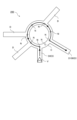
- FIG. 2 is a schematic diagram showing a loop road according to the first embodiment.
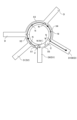
- FIG. 4 is a schematic diagram for explaining a first section.
- FIG. 2 is a diagram illustrating an example of a hardware configuration of an information output device. 4 is a flowchart of a process related to route guidance to a destination in the information output device according to the first embodiment.
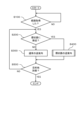
- FIG. FIG. 11 is a flowchart showing a process for route guidance on a circular road in the information output device according to the first embodiment.
- FIG. 11 is a schematic diagram showing a loop road according to a second embodiment.
- FIG. 13 is a block diagram showing an outline of an information output device according to a third embodiment.
- FIG. 11 is a schematic diagram showing a circular road according to a third embodiment.
- FIG. 13 is a block diagram showing an outline of an information output system according to a fourth embodiment.
- each component of each device is shown as a functional block, not a hardware configuration.
- Each component of each device is realized by any combination of hardware and software, centered on the CPU of any computer, memory, a program loaded into the memory, a storage medium such as a hard disk that stores the program, and an interface for network connection. There are many variations in the methods and devices for realizing this.
- FIG. 1 is a block diagram showing an outline of an information output device 1 according to the first embodiment.
- the information output device 1 will be described with reference to Fig. 1.
- the information output device 1 according to the first embodiment is a device used for providing voice guidance on a circular road 200.
- the circular road 200 will be described later.
- the information output device 1 is provided outside a moving object.
- the information output device 1 may be a so-called cloud server.
- the moving body is equipped with a moving body-side device 2.
- the moving body-side device 2 is located inside the moving body.
- the moving body-side device 2 may be brought in from outside the moving body, or may be attached to the moving body in advance.
- the moving body is a vehicle.
- the mobile device 2 is configured to be able to communicate with the information output device 1 via a communication network 101.
- the communication network 101 includes, for example, communication over a 4G or 5G line.
- the mobile device 2 is configured to include an external vehicle communication unit (not shown) for configuring the communication network 101.
- the mobile device 2 includes a camera unit 2a, an audio output unit 2b, an audio input unit 2c, and a position sensor unit 2d. Although not shown, the mobile device 2 may also include a display.
- the camera unit 2a has an inner camera and an outer camera (not shown).
- the inner camera faces the interior of the vehicle, and at least the driver's seat is included in the shooting range.
- the inner camera shoots the interior of the vehicle so that the driver can be seen.
- the inner camera may also shoot the entire interior of the vehicle so that passengers (driver and passengers) can be seen.
- the outer camera faces outside the vehicle. The outer camera shoots the situation outside the vehicle.
- the audio output unit 2b includes a speaker (not shown). In the first embodiment, the audio output unit 2b outputs at least one of voice and sound effects via the speaker.
- the voice input unit 2c includes at least one microphone (not shown). Voice spoken by the passenger is input to the voice input unit 2c through the microphone.
- the position sensor unit 2d acquires the position information of the moving object, for example, using GNSS (Global Navigation Satellite System).
- GNSS Global Navigation Satellite System
- the information output device 1 includes a route acquisition unit 10, an output control unit 20, and a position information acquisition unit 30.
- the route acquisition unit 10 acquires route information regarding a route along which the mobile object should travel.
- the route along which the mobile object should travel is, for example, a route to a destination set by the passenger.
- the route information includes at least information regarding a route from the current location of the mobile object to the destination set by the passenger.
- the route information is generated, for example, using map information.
- the route acquisition unit 10 may acquire the route information from, for example, a car navigation system installed in the mobile object.
- the route acquisition unit 10 may acquire the route information from, for example, a server (which may be a so-called cloud server) outside the mobile object.
- the position information acquiring unit 30 acquires the position information of the moving object.
- the position information acquiring unit 30 acquires the position information of the moving object from the position sensor unit 2 d of the moving object side device 2 .
- FIG. 2 is a schematic diagram showing a loop road 200 according to the first embodiment.
- the loop road 200 according to the first embodiment will be described with reference to Fig. 2.
- V in Fig. 2 indicates the position of the moving body.
- N in Fig. 2 indicates a node.
- the nodes N are connected by links (not shown), and route information is generated using the nodes and the links.
- the circular road 200 is a so-called roundabout.
- the circular road 200 includes a roundabout.
- the circular road 200 is configured by connecting a circular passage C with a plurality of branching roads D.
- the circular road 200 is configured by arranging a plurality of branching roads D radially from the passage C at the center.
- the approach path D0 is a branch path from among the multiple branch paths D that the moving body V takes when entering the circular passage C.
- the moving body V enters the passage C from the approach path D0.
- the moving body that has entered the passage C travels along the passage C in a clockwise direction and exits via the exit path D100.
- the exit path D100 is a branch path from which the moving body V should exit from among the multiple branch paths D.
- the exit road information is information about the exit road D100.
- the exit road information includes, for example, information about the number of the branch road D that the exit road D100 is, counting from the entrance road D0.
- Fig. 3 is a schematic diagram for explaining the first section X.
- Fig. 3 shows a diagram of the moving object V shown in Fig. 2 immediately after entering the passage C from the approach road D0 and turning left.
- the first section X is a part of the passage C.
- the first section X is a circular arc-shaped section.
- the first section X is an arc-shaped section between a certain branch path D (first branch path D1) and the branch path D adjacent thereto (second branch path D2).
- the second branch path D2 is the branch path adjacent to the first branch path D1 in the clockwise direction.
- the first section X is a passage that connects the first branch path D1 and the second branch path D2. For example, if the entrance path D0 is the first branch path D1, then the branch path D adjacent to the entrance path D0 in the clockwise direction is the second branch path D2 (see FIG. 3).
- the output control unit 20 When at least one of the distance of the first section X and the time required for the moving body V to move through the first section X meets a predetermined standard, the output control unit 20 outputs at least a part of the exit route information by voice when the moving body V moves through the first section X. Note that "when the moving body V moves through the first section X" may be immediately before or after the moving body V passes the start point of the first section X, or may be when the moving body V passes the start point of the first section X and moves through the first section X.
- the distance of the first section X may be calculated using link information of the links connecting the nodes N.
- the distance of the first section X may be calculated using map information.
- the method of calculating the distance of the first section X is arbitrary. "The time required for the moving body V to travel through the first section X" may be calculated by predicting it in advance, or may be calculated using the actual speed of the moving body V. The method of calculating the time is arbitrary. "The case where a specified standard is satisfied” refers to, for example, the case where the distance of the first section X is 200 m or more, and the case where the time required for the moving body V to travel through the first section X is 5 seconds or more.
- At least one of the distance of the first section X and the time required for the moving body V to move through the first section X may be calculated as a comparison target with a predetermined standard.
- both the distance of the first section X and the time required for the moving body V to move through the first section X may be calculated as a comparison target with a predetermined standard.
- only one of the distance of the first section X and the time required for the moving body V to move through the first section X may be calculated as a comparison target with a predetermined standard.
- the output control unit 20 may calculate the time required for the moving body to move through the first section X1 using the speed of the moving body V just before it passes through the connection portion N1 in FIG. 3, and the distance of the first section X1.
- the speed may be obtained from a speed information acquisition unit (not shown) mounted on the moving body device 2.
- the (Hardware configuration example) 4 is a diagram showing an example of the hardware configuration of the information output device 1.
- the information output device 1 includes a bus 1010, a processor 1020, a memory 1030, a storage device 1040, an input/output interface 1050, and a network interface 1060.
- the bus 1010 is a data transmission path for the processor 1020, memory 1030, storage device 1040, input/output interface 1050, and network interface 1060 to transmit and receive data to and from each other.
- the method of connecting the processor 1020 and other components to each other is not limited to a bus connection.
- the processor 1020 is a processor realized by a CPU (Central Processing Unit) or a GPU (Graphics Processing Unit), etc.
- Memory 1030 is a main storage device realized by RAM (Random Access Memory) or the like.
- the storage device 1040 is an auxiliary storage device realized by a removable medium such as a HDD (Hard Disk Drive), an SSD (Solid State Drive), a memory card, or a ROM (Read Only Memory), and has a recording medium.
- the recording medium of the storage device 1040 stores program modules that realize each function of the information output device 1 (e.g., the path acquisition unit 10 and the output control unit 20).
- the processor 1020 loads each of these program modules onto the memory 1030 and executes them, thereby realizing each function corresponding to the program module.
- the storage device 1040 may also function as a memory unit (not shown) connected to the information output device 1.
- the input/output interface 1050 is an interface for connecting the information output device 1 to various input/output devices.
- the network interface 1060 is an interface for connecting the information output device 1 to a network.
- This network is, for example, a LAN (Local Area Network) or a WAN (Wide Area Network).
- the method for connecting the network interface 1060 to the network may be a wireless connection or a wired connection.
- the information output device 1 may communicate with the mobile device 2 via the network interface 1060.
- (Operation example of the first embodiment) 5 is a flow diagram of a process related to route guidance to a destination by the information output device 1 according to the first embodiment. The process related to route guidance to a destination executed by the information output device 1 will be described with reference to FIG.
- step S100 the control unit (not shown) determines whether the route acquisition unit 10 has acquired route information. If the control unit determines that the route acquisition unit 10 has acquired route information (YES in step S100), the process proceeds to step S200. If the control unit determines that the route acquisition unit 10 has not acquired route information (NO in step S100), the process returns to step S100 and repeats the process of step S100.
- step S200 the output control unit 20 determines whether the moving object is approaching the circular path 200.
- the output control unit 20 may determine whether the moving object is approaching the circular path 200 using the position information and route information of the moving object.
- the output control unit 20 may determine that the moving object is approaching the circular path 200 when at least one of the distance from the current location of the moving object to passage C of the circular path 200 and the time it takes for the moving object to reach passage C meets a predetermined criterion.
- step S200 If the output control unit 20 determines that the vehicle is approaching the circular road 200 (YES in step S200), the process proceeds to step S400. The details of the process in step S400 will be described later. If the output control unit 20 determines that the vehicle is not approaching the circular road (NO in step S200), the process proceeds to step S300.
- step S300 the information output device 1 performs normal route guidance.
- Normal route guidance refers to route guidance when the mobile object is traveling on a road that is not a circular road.
- Normal route guidance refers to route guidance when the mobile object is traveling on a straight road, a curve, an intersection, a T-junction, etc., for example.
- the output control unit 20 may cause the voice output unit 2b of the mobile object device 2 to output route guidance voice such as "Go straight for 5 km from here" and "Turn left at the intersection 500 m ahead" each time the mobile object approaches a specified guidance point.
- step S500 the output control unit 20 determines whether the moving object has arrived at the destination. If the output control unit 20 determines that the moving object has arrived at the destination (YES in step S500), the process ends. If the output control unit 20 determines that the moving object has not arrived at the destination (NO in step S500), the process returns to step S200 and repeats the process from step S200 onwards.
- Fig. 6 is a flow diagram of a process related to route guidance on the circular road 200 of the information output device 1 according to the first embodiment.
- Fig. 6 shows details of the process of step S400 shown in Fig. 5.
- both the distance of the first section X and the time required for the moving body V to move through the first section X are calculated as objects to be compared with a predetermined standard.
- step S410 the output control unit 20 calculates, for example, using route information, which branch road D the exit road D100 is, counting clockwise from the entry road D0. For example, in FIG. 2, the output control unit 20 calculates that the exit road D100 is the fourth branch road D, counting clockwise from the entry road D0.
- step S420 the output control unit 20 causes the voice output unit 2b to output the exit route information by voice (providing voice guidance to the driver) before entering the circular passage C. Specifically, the output control unit 20 causes the voice output unit 2b to output the exit route information as voice information, such as "You are entering a roundabout. Proceed to the left on the circular passage. Then, take the fourth exit.”
- step S430 the output control unit 20 determines whether or not at least one of the distance of the first section X and the time required for the moving body V to move through the first section X meets a predetermined criterion.
- step S430 if the output control unit 20 determines that both the distance of the first section X1 and the time required for the moving body V to move through the first section X1 do not satisfy the predetermined criteria (NO in step S430), the process proceeds to step S460.
- the output control unit 20 does not output the exit route information by voice in the first section X that does not meet the predetermined criteria. If both the distance of the first section X1 in FIG. 3 and the time required for the moving body V to move through the first section X1 do not meet the predetermined criteria, the output control unit 20 does not output the exit route information by voice in the first section X1.
- step S460 the output control unit 20 determines whether the next branch road D is the exit road D100.
- the "next branch road” is the branch road D that is closest to the current location of the moving body in the traveling direction of the moving body traveling along the passage C.
- the "next branch road” is the branch road D that corresponds to the end point of the first section X1.
- the output control unit 20 may use the position information and route information of the mobile unit to determine whether the next branch road D is the exit road D100. If the output control unit 20 determines that the next branch road D is not the exit road D100 (NO in step S460), the process returns to step S430 and repeats the processes from step S430 onward.
- step S430 determines that both the distance of the first section X1 and the time required for the moving body V to move through the first section X do not meet the predetermined criteria (NO in step S430 in FIG. 6), the process proceeds to step S460, but since the next branch road D is not the exit road D100, the process returns to step S430 again.
- the output control unit 20 determines whether or not at least one of the distance of the first section X2, which is the next first section in the situation in FIG. 3, and the time required for the moving body V to move through the next first section X2, meets the predetermined criteria. In this way, the output control unit 20 repeats its determination of whether or not the predetermined criteria are met until the moving body V reaches the exit road D100.
- step S460 if the output control unit 20 determines that the next branch road D is the exit road D100 (YES in step S460), the process proceeds to step S470.
- step S470 the output control unit 20 determines whether the moving body V has been able to exit the exit path D100.
- the output control unit 20 may determine whether the moving body V has been able to exit the exit path D100 using the position information and route information of the moving body V.
- step S470 If the output control unit 20 determines that the moving body V has exited the exit route D100 (YES in step S470), the process ends (proceeds to step S500 in FIG. 5). If the output control unit 20 determines that the moving body V has not exited the exit route D100 (NO in step S470), the process proceeds to step S480.
- step S480 the output control unit 20 causes the voice output unit 2b to output failure information.
- the failure information includes information informing the driver that they have failed to exit from the exit route D100.
- the output control unit 20 causes voice output, as failure information, such as "The exit was the current fork in the road. Please go around again before proceeding to the exit.” After that, the process returns to step S430, and the process from step S430 onwards is repeated again.
- step S430 if the output control unit 20 determines that at least one of the distance of the first section X and the time required for the moving body V to move through the first section X meets a predetermined criterion (YES in step S430), proceed to step S440.
- FIG. 7 is a schematic diagram for explaining step S440.
- FIG. 7 shows the state after the moving body V in FIG. 3 has passed the second branch road D, counting clockwise from the entrance road D0.
- the output control unit 20 calculates, for example, using the position information and route information of the moving body, which branch road D the exit road D100 is, counting from the current location of the moving body V. For example, in FIG. 7, the output control unit 20 calculates that the exit road D100 is the second branch road D, counting clockwise from the current location of the moving body.
- the output control unit 20 causes the voice output unit 2b to output at least a part of the exit route information when the mobile body moves through the first section X. Specifically, the output control unit 20 causes the exit route information to be output as voice information, such as "Please take the second exit” or "Please take the next exit.”
- the exit route information includes information regarding the number of branch roads D that the exit route D100 is, counting from the current location of the mobile body V.
- the output control unit 20 determines that at least one of the distance of the first section X3 and the time required for the moving body V to move through the first section X3 meets a predetermined standard, the output control unit 20 causes the audio output unit 2b to output at least a portion of the exit route information when the moving body moves through the first section X3.
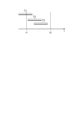
- Figure 8 is a diagram for explaining the timing at which the output control unit 20 outputs the exit route information.
- the horizontal axis in Figure 8 represents time [t].
- t1 in Figure 8 represents the time when the start point x3a (see Figure 7) of the first section X3 is passed.
- t2 in Figure 8 represents the time when the end point x3b (see Figure 7) of the first section X1 is passed.
- T1, T2, and T3 in Figure 8 each represent the length of time from when the output control unit 20 starts to output the exit route information to when it finishes outputting it.
- the output control unit 20 outputs the exit route information before the moving body V approaches the starting point x3a of the first section X3. Then, after passing the starting point x3a of the first section X3, the output of the exit route information is completed before the moving body V approaches the end point x3b of the first section X3.
- the output control unit 20 outputs the exit route information after the moving body passes the starting point x3a of the first section X3, and the output of the exit route information is completed before the moving body V approaches the end point x3b of the first section X3. In this way, the output control unit 20 outputs at least a part of the exit route information by voice as the moving body V moves through the first section X3.
- the output control unit 20 starts outputting the exit route information after passing the start point x3a of the first section X3, as in T2 and T3, and ends outputting the exit route information before approaching the end point x3b of the first section X3. This is to prevent the driver from being confused as to whether to count the branch road D connected at the start point x3a of the first section X3 when counting which branch road D the exit route D100 is, counting from the current location of the mobile body V. It is sufficient that the output control unit 20 finishes outputting the exit route information at least before approaching the end point x3b of the first section X3.
- step S450 the process proceeds to step S460.
- the processing from step S460 onwards is as described above.
- both the distance of the first section X and the time required for the moving body V to move through the first section X are calculated as objects to be compared with the predetermined standard.
- the configuration may be such that either the distance of the first section X or the time required for the moving body V to move through the first section X is calculated as objects to be compared with the predetermined standard.
- the output control unit 20 when the output control unit 20 determines that the distance of the first section X meets the predetermined criterion, the output control unit 20 causes the audio output unit 2b to output at least a portion of the exit route information when the moving body V moves through the first section X.
- the output control unit 20 determines that the distance of the first section X does not meet the predetermined criterion, the output control unit 20 does not cause audio output of the exit route information in the first section X where the distance of the first section X does not meet the predetermined criterion.
- the information output device 1 includes an output control unit 20.
- the voice guidance on the circular road 200 can guide the driver to the exit road without confusing him/her.
- the exit route information includes information indicating which branch route D the exit route D100 is, counting from the current location of the mobile body. This makes it easier for the driver to know which branch route D to exit at.
- the output control unit 20 determines whether or not at least one of the distance of the first section X and the time required for the moving body V to move through the first section X meets a predetermined criterion. This allows the time required for the moving body to move through the first section X to be predicted with high accuracy. Therefore, the output control unit 20 can accurately determine whether or not the predetermined criterion is met.
- the time required for the moving body V to move through the first section X is calculated using the speed at which the moving body passes through the connection N1 between the first branch road D1 and the passage C, and the distance of the first section X.
- the speed at which the moving body passes through the connection N1 the time required for the moving body V to move through the first section X can be predicted with high accuracy.
- the distance of the first section X is short but the time required for the moving body V to move through the first section X is large due to congestion, it is possible to output exit route information, making it possible to provide effective route guidance according to the situation.
- the output control unit 20 does not output the exit route information by voice in the first section X where at least one of the distance of the first section X and the time required for the moving body V to move through the first section X does not satisfy the specified criterion. For example, in a case where both the distance of the first section X and the time required for the moving body V to move through the first section X are calculated as objects to be compared with the specified criterion, the output control unit 20 does not output the exit route information by voice in the first section X where both the distance of the first section X and the time required for the moving body V to move through the first section X do not satisfy the specified criterion.
- the output control unit 20 does not output the exit route information by voice in the first section X where the distance of the first section X does not satisfy the specified criterion.
- Fig. 9 is a schematic diagram showing a circular road 200 according to the second embodiment.
- the information output device 1 according to the second embodiment will be described with reference to Fig. 9 .
- the output control unit 20 does not output the exit route information by voice in the first section X where at least one of the distance of the first section X and the time required for the moving body V to move through the first section X does not meet a predetermined standard, whereas the output control unit 20 according to the second embodiment outputs at least one of the omission information and the sound information in the first section X where the predetermined standard is not met.
- Omission information is information in which part of the exit route information is omitted. For example, if the exit route information is "Please take the fourth exit,” the omission information is, for example, "the fourth exit” or "4.” Sound information includes sound effects, etc. Sound effects can be any sound, such as “beep beep” or "pong.”
- the output control unit 20 may determine whether or not at least one of the distance of the second section Y and the time required for the moving body to move through the second section Y meets a predetermined standard.
- the second section Y is the section between the approach road D0 and the branch road D located next to the approach road D0 in the traveling direction of the moving body.
- the output control unit 20 may repeatedly output at least one of the omission information and the sound information for each first section until the moving body V reaches the exit route D100.
- the output control unit 20 repeatedly outputs at least one of the omission information and the sound information in the second section Y, the first section X2, the first section X3, the first section X4, the first section X5, and the first section X6.
- the number of divided sounds may indicate the number of branch routes that the exit route D100 is, counting from the current location of the moving body V (for example, in the above example, the "beep beep beep" sound information indicates that the exit route D100 is the fourth branch route D, counting from the current location of the moving body V).
- the output control unit 20 may also change the omitted information according to the number of branch roads D that the exit road D100 is, counting from the current location of the mobile body V, such as "6" for the second section Y, "5" for the first section X2, “4" for the first section X3, “3” for the first section X4, "2" for the first section X5, and "1” for the first section X6.
- the omission information and sound information can shorten the sound output time compared to the exit route information. This makes it possible to effectively inform the driver which branch route D the exit route D100 is, without confusing the driver, even if there are a relatively large number of first sections X in which at least one of the distance of the first section X and the time required for the moving body V to move through the first section X does not meet a predetermined standard.
- Fig. 10 is a block diagram showing an outline of the information output device 1 according to the third embodiment.
- Fig. 11 is a schematic diagram showing a circular road 200 according to the third embodiment.
- the information output device 1 according to the third embodiment will be described with reference to Figs. 10 and 11.
- the information output device 1 further includes a lane information acquisition unit 40.
- the lane information acquisition unit 40 acquires lane information.
- the lane information is information about a plurality of lanes L in the circular passage C.
- the lane information includes information about which lane L, among the plurality of lanes L, is located radially innermost of the circular road 200.
- L1 is the lane located radially innermost of the circular road 200.
- At least one of the distance of the first section X and the time required for the moving body V to move through the first section X is calculated using lane information as a comparison target with a predetermined standard. More specifically, the output control unit 20 uses information on the lane L1 to calculate at least one of the distance of the first section X and the time required for the moving body V to move through the first section X.
- the first section X is an arc-shaped section between a certain branch road D (first branch road D1) and the adjacent branch road D (second branch road D2).
- first branch road D first branch road D1
- second branch road D2 second branch road D2
- the output control unit 20 outputs at least a portion of the exit route information by voice when the moving body moves through the first section W if at least one of the distance of the first section W and the time required for the moving body to move through the first section W meets a predetermined criterion.
- [Fourth embodiment] 12 is a block diagram showing an outline of an information output system 100 according to the fourth embodiment.
- the information output system 100 includes a mobile-side device 2 located in a mobile object, and a server 3.
- the mobile-side device 2 according to the fourth embodiment is different from the mobile-side device 2 according to the first embodiment in that it further includes a route acquisition unit 10.
- the server 3 includes an output control unit 20 and a position information acquisition unit 30, but does not include the route acquisition unit 10.
- the functions of the route acquisition unit 10, the output control unit 20, and the location information acquisition unit 30 are the same as those in the first embodiment.
- the route acquisition unit 10 and the output control unit 20 may be mounted in any combination on each of the mobile device 2 and the server 3.
- the route acquisition unit 10 and the output control unit 20 may all be mounted on the mobile device 2.
- program modules that realize each function may be stored in a storage unit possessed by the mobile device 2.
- the route acquisition unit 10 and the output control unit 20 may all be mounted on the server 3.
- the loop 200 includes a roundabout.
- the output control unit 20 may calculate in advance at any timing at least one of the distances of the first section X1, the first section X2, the first section X3, the first section X4, and the first section X5, and the time required to move through the first section X1, the first section X2, the first section X3, the first section X4, and the first section X5, as a comparison target with a predetermined standard.
- a route acquisition unit that acquires route information regarding a route along which a moving object should proceed; an output control unit that outputs, when the moving body moves along a circular route at least a part of which is included in the route and in which a plurality of branch routes are connected to a circular passage, by voice, exit route information relating to an exit route that is included in the route and is a branch route from which the moving body should exit out of the plurality of branch routes;
- the output control unit outputs at least a part of the exit route information by voice as the moving body moves through the first section.
- the output control unit calculates an ordinal number of the branch road from a current location of the moving object to the exit road, An information output device, wherein the exit route information includes information indicating the number of the branch road that the exit route is, counting from the current location of the mobile body. 3. In the information output device according to 1 or 2, The output control unit determines whether the predetermined criterion is satisfied when the moving object passes through a connection portion between the first branch path and the circular passage. 4. In the information output device according to 3., An information output device, wherein the time is calculated using a speed at which the moving object passes through a connection portion between the first branch path and the circular passage and the distance of the first section. 5.
- the output control unit is configured to not output the exit route information by voice in the first section that does not satisfy the specified criterion. 6. In the information output device according to any one of 1 to 5, The output control unit outputs at least one of omission information that omits part of the exit route information and sound information that includes sound effects for the first section that does not satisfy the specified criterion. 7.
- the output control unit determines whether or not the predetermined criterion is satisfied in a second section between the approach road and the branch road located next to the approach road; When the predetermined criterion is not satisfied, the output control unit repeatedly outputs at least one of the omission information and the sound information for each of the first sections until the moving body reaches the exit road.
- a lane information acquisition unit that acquires lane information regarding a plurality of lanes in the circular passage
- An information output device wherein at least one of the distance and the time is calculated using the lane information.
- An information output system including a mobile device in a mobile device and a server, a route acquisition unit that acquires route information regarding a route along which the moving object should proceed; an output control unit that outputs, when the moving body moves along a circular route at least a part of which is included in the route and in which a plurality of branch routes are connected to a circular passage, by voice, exit route information relating to an exit route that is included in the route and is a branch route from which the moving body should exit out of the plurality of branch routes; An information output system, wherein when at least one of the distance of a first section between a first branch road of the circular road and a second branch road located next to the first branch road, and the time required for the moving body to travel the first section, satisfies
- a computer that realizes an information output device, Obtaining route information regarding a route that the mobile unit should take; when the moving body moves along a circular route at least a part of which is included in the route and in which a plurality of branch routes are connected to a circular passage, outputting by voice exit route information relating to an exit route which is included in the route and is a branch route from which the moving body should exit among the plurality of branch routes;
- An information output method comprising: when at least one of the distance of a first section between a first branch road of the circular road and a second branch road located adjacent to the first branch road, and the time required for the moving body to travel through the first section, outputting at least a portion of the exit route information by voice as the moving body travels through the first section.
- a computer that realizes an information output device, A procedure for acquiring route information regarding a route to be taken by a mobile unit; a step of outputting, when the moving object moves along a circular route at least a part of which is included in the route and in which a plurality of branch routes are connected to a circular passage, exit route information relating to an exit route which is included in the route and is a branch route from which the moving object is to exit among the plurality of branch routes;
- a program for executing a procedure for outputting at least a portion of the exit route information by voice when the moving body moves through the first section, when at least one of the distance of a first section between a first branch road of the circular road and a second branch road located adjacent to the first branch road, and the time required for the moving body to move through the first section, satisfies a predetermined criterion.
Landscapes
- Engineering & Computer Science (AREA)
- Radar, Positioning & Navigation (AREA)
- Remote Sensing (AREA)
- Automation & Control Theory (AREA)
- Physics & Mathematics (AREA)
- General Physics & Mathematics (AREA)
- Navigation (AREA)
Priority Applications (2)
| Application Number | Priority Date | Filing Date | Title |
|---|---|---|---|
| PCT/JP2022/043182 WO2024111052A1 (ja) | 2022-11-22 | 2022-11-22 | 情報出力装置、情報出力システム、情報出力方法、及びプログラム |
| JP2024559767A JPWO2024111052A1 (https=) | 2022-11-22 | 2022-11-22 |
Applications Claiming Priority (1)
| Application Number | Priority Date | Filing Date | Title |
|---|---|---|---|
| PCT/JP2022/043182 WO2024111052A1 (ja) | 2022-11-22 | 2022-11-22 | 情報出力装置、情報出力システム、情報出力方法、及びプログラム |
Publications (1)
| Publication Number | Publication Date |
|---|---|
| WO2024111052A1 true WO2024111052A1 (ja) | 2024-05-30 |
Family
ID=91195867
Family Applications (1)
| Application Number | Title | Priority Date | Filing Date |
|---|---|---|---|
| PCT/JP2022/043182 Ceased WO2024111052A1 (ja) | 2022-11-22 | 2022-11-22 | 情報出力装置、情報出力システム、情報出力方法、及びプログラム |
Country Status (2)
| Country | Link |
|---|---|
| JP (1) | JPWO2024111052A1 (https=) |
| WO (1) | WO2024111052A1 (https=) |
Citations (7)
| Publication number | Priority date | Publication date | Assignee | Title |
|---|---|---|---|---|
| JPH07114690A (ja) * | 1993-10-19 | 1995-05-02 | Aqueous Res:Kk | 案内装置 |
| JP2006138798A (ja) * | 2004-11-15 | 2006-06-01 | Nissan Motor Co Ltd | 車載ナビゲーション装置及び経路案内方法 |
| WO2007063906A1 (ja) * | 2005-11-30 | 2007-06-07 | Aisin Aw Co., Ltd. | 経路案内システム及び経路案内方法 |
| JP2013029428A (ja) * | 2011-07-28 | 2013-02-07 | Aisin Aw Co Ltd | 移動案内システム、移動案内装置、移動案内方法及びコンピュータプログラム |
| JP2013029380A (ja) * | 2011-07-27 | 2013-02-07 | Aisin Aw Co Ltd | 移動案内システム、移動案内装置、移動案内方法及びコンピュータプログラム |
| JP2013096744A (ja) * | 2011-10-28 | 2013-05-20 | Alpine Electronics Inc | ナビゲーション装置 |
| JP2021039007A (ja) * | 2019-09-03 | 2021-03-11 | 株式会社デンソー | 表示制御装置、表示制御方法、および表示制御プログラム |
Family Cites Families (2)
| Publication number | Priority date | Publication date | Assignee | Title |
|---|---|---|---|---|
| JP5646980B2 (ja) * | 2010-12-16 | 2014-12-24 | クラリオン株式会社 | 車両用周囲状況監視装置 |
| FR3093690B1 (fr) * | 2019-03-14 | 2021-02-19 | Renault Sas | Procédé de sélection pour un véhicule automobile d’une voie de circulation d’un rond-point |
-
2022
- 2022-11-22 JP JP2024559767A patent/JPWO2024111052A1/ja active Pending
- 2022-11-22 WO PCT/JP2022/043182 patent/WO2024111052A1/ja not_active Ceased
Patent Citations (7)
| Publication number | Priority date | Publication date | Assignee | Title |
|---|---|---|---|---|
| JPH07114690A (ja) * | 1993-10-19 | 1995-05-02 | Aqueous Res:Kk | 案内装置 |
| JP2006138798A (ja) * | 2004-11-15 | 2006-06-01 | Nissan Motor Co Ltd | 車載ナビゲーション装置及び経路案内方法 |
| WO2007063906A1 (ja) * | 2005-11-30 | 2007-06-07 | Aisin Aw Co., Ltd. | 経路案内システム及び経路案内方法 |
| JP2013029380A (ja) * | 2011-07-27 | 2013-02-07 | Aisin Aw Co Ltd | 移動案内システム、移動案内装置、移動案内方法及びコンピュータプログラム |
| JP2013029428A (ja) * | 2011-07-28 | 2013-02-07 | Aisin Aw Co Ltd | 移動案内システム、移動案内装置、移動案内方法及びコンピュータプログラム |
| JP2013096744A (ja) * | 2011-10-28 | 2013-05-20 | Alpine Electronics Inc | ナビゲーション装置 |
| JP2021039007A (ja) * | 2019-09-03 | 2021-03-11 | 株式会社デンソー | 表示制御装置、表示制御方法、および表示制御プログラム |
Also Published As
| Publication number | Publication date |
|---|---|
| JPWO2024111052A1 (https=) | 2024-05-30 |
Similar Documents
| Publication | Publication Date | Title |
|---|---|---|
| CN110998691B (zh) | 行驶辅助方法及行驶辅助装置 | |
| JP7101073B2 (ja) | 隊列走行システム | |
| JP6907895B2 (ja) | 自動運転システム | |
| JP6532593B2 (ja) | 逆走抑制装置、逆走抑制方法及び逆走抑制システム | |
| JP6809611B2 (ja) | 走行支援方法及び走行支援装置 | |
| CN113874267B (zh) | 车辆控制方法及车辆控制装置 | |
| JP6007739B2 (ja) | 運転支援装置及び運転支援方法 | |
| JP7101777B2 (ja) | 走行支援方法及び走行支援装置 | |
| JP6844707B2 (ja) | 運転支援方法及び運転支援装置 | |
| JP7086190B2 (ja) | 走行支援方法及び走行支援装置 | |
| US20220144277A1 (en) | Vehicle Control Method and Vehicle Control Device | |
| JP2008097413A (ja) | 安全支援情報提供車載システム | |
| JP7026228B2 (ja) | 走行支援方法及び走行支援装置 | |
| JP7372868B2 (ja) | 収容領域管理装置 | |
| JPWO2019003277A1 (ja) | 方向指示器制御方法及び方向指示器制御装置 | |
| WO2024111052A1 (ja) | 情報出力装置、情報出力システム、情報出力方法、及びプログラム | |
| WO2020202431A1 (ja) | 運転制御装置及び運転制御方法 | |
| JP7328740B2 (ja) | 運転支援装置及び運転支援システム | |
| JP2007219758A (ja) | 車載情報装置および車載装置用情報処理方法 | |
| JP2017058343A (ja) | 運転支援装置 | |
| WO2023175927A1 (ja) | 運転支援方法及び運転支援装置 | |
| JP5003399B2 (ja) | 道路通信システム,通信端末,データ再生処理方法およびデータ再生用プログラム | |
| JP7853496B2 (ja) | 音声出力装置、音声出力方法、プログラム及び記憶媒体 | |
| JP7467601B2 (ja) | 情報処理装置、情報出力方法、プログラム及び記憶媒体 | |
| JP7390204B2 (ja) | 経路推定装置、経路推定方法、及びプログラム |
Legal Events
| Date | Code | Title | Description |
|---|---|---|---|
| 121 | Ep: the epo has been informed by wipo that ep was designated in this application |
Ref document number: 22966462 Country of ref document: EP Kind code of ref document: A1 |
|
| WWE | Wipo information: entry into national phase |
Ref document number: 2024559767 Country of ref document: JP |
|
| NENP | Non-entry into the national phase |
Ref country code: DE |
|
| 122 | Ep: pct application non-entry in european phase |
Ref document number: 22966462 Country of ref document: EP Kind code of ref document: A1 |