WO2024095940A1 - 積層フィルム、樹脂組成物、及びその製造方法 - Google Patents
積層フィルム、樹脂組成物、及びその製造方法 Download PDFInfo
- Publication number
- WO2024095940A1 WO2024095940A1 PCT/JP2023/039010 JP2023039010W WO2024095940A1 WO 2024095940 A1 WO2024095940 A1 WO 2024095940A1 JP 2023039010 W JP2023039010 W JP 2023039010W WO 2024095940 A1 WO2024095940 A1 WO 2024095940A1
- Authority
- WO
- WIPO (PCT)
- Prior art keywords
- layer
- laminated film
- film
- resin
- pet
- Prior art date
- Legal status (The legal status is an assumption and is not a legal conclusion. Google has not performed a legal analysis and makes no representation as to the accuracy of the status listed.)
- Ceased
Links
Classifications
-
- B—PERFORMING OPERATIONS; TRANSPORTING
- B29—WORKING OF PLASTICS; WORKING OF SUBSTANCES IN A PLASTIC STATE IN GENERAL
- B29B—PREPARATION OR PRETREATMENT OF THE MATERIAL TO BE SHAPED; MAKING GRANULES OR PREFORMS; RECOVERY OF PLASTICS OR OTHER CONSTITUENTS OF WASTE MATERIAL CONTAINING PLASTICS
- B29B17/00—Recovery of plastics or other constituents of waste material containing plastics
- B29B17/02—Separating plastics from other materials
-
- B—PERFORMING OPERATIONS; TRANSPORTING
- B32—LAYERED PRODUCTS
- B32B—LAYERED PRODUCTS, i.e. PRODUCTS BUILT-UP OF STRATA OF FLAT OR NON-FLAT, e.g. CELLULAR OR HONEYCOMB, FORM
- B32B27/00—Layered products comprising a layer of synthetic resin
- B32B27/36—Layered products comprising a layer of synthetic resin comprising polyesters
-
- C—CHEMISTRY; METALLURGY
- C08—ORGANIC MACROMOLECULAR COMPOUNDS; THEIR PREPARATION OR CHEMICAL WORKING-UP; COMPOSITIONS BASED THEREON
- C08J—WORKING-UP; GENERAL PROCESSES OF COMPOUNDING; AFTER-TREATMENT NOT COVERED BY SUBCLASSES C08B, C08C, C08F, C08G or C08H
- C08J5/00—Manufacture of articles or shaped materials containing macromolecular substances
- C08J5/18—Manufacture of films or sheets
Definitions
- the present invention relates to a laminated film made of polyethylene terephthalate resin, a resin composition obtained by material recycling of this laminated film, and a method for producing this resin composition.
- PET polyethylene terephthalate
- Non-Patent Document 1 conventionally known PET resins contain several percent by mass of cyclic oligomers, including cyclic trimers. When monomers are polymerized into PET, cyclic oligomers are generated as by-products. It is known that of all cyclic oligomers, cyclic trimers have the highest content.
- cyclic oligomers there was a problem that when PET film was heated, the cyclic oligomers contained in the PET film precipitated on the surface. For example, when a high level of transparency and quality is required for industrial applications, etc., the precipitation of cyclic oligomers on the surface of the PET film caused the PET film to whiten during the heating process, compromising its transparency and preventing excellent quality from being obtained. In addition, when used for packaging applications such as food, there was a problem that it caused printing defects and lamination defects, which had a significant negative impact on the yield rate during packaging processing.
- Patent Documents 1 and 2 disclose a solid-state polymerization method in which polyester obtained by a polycondensation reaction is heat-treated under reduced pressure or in an inert gas flow at a temperature between 180°C and the melting point of the polyester to reduce the cyclic oligomers to 0.5% by weight or less.
- the present invention aims to provide a sustainable laminated film, resin composition, and manufacturing method thereof that has low precipitation of cyclic oligomers, has excellent transparency after heat processing, and is highly recyclable.
- aliphatic polyester resins containing polylactic acid are hydrolyzable. Therefore, the inventors of the present application have invented a method for producing a resin composition in which the decomposition layer B from the laminated film is decomposed with steam or hot water, the base layer A is extracted and recycled as a material, and a resin composition containing polyethylene terephthalate resin is produced. Therefore, the laminated film of the present invention has a sustainable structure with excellent recyclability.
- a laminate film comprising a base layer A composed of a first composition containing a polyethylene terephthalate resin and a decomposition layer B composed of a second composition containing an aliphatic polyester resin, The base material layer A is in contact with the decomposition layer B, A laminated film, at least one of the outermost layers being the base material layer A.
- the laminated film according to [1] wherein the base material layer A is provided in contact with both surfaces of the decomposition layer B, and the base material layer A constitutes the outermost layers of both layers.
- a resin composition containing a polyethylene terephthalate resin which is obtained by removing the decomposition layer B from the laminate film according to any one of [1] to [7], and then removing the base material layer A for material recycling.
- a method for producing a resin composition in which the decomposition layer B from the laminate film according to any one of [1] to [7] is decomposed with steam or hot water, the base material layer A is removed, and the material is recycled to produce a resin composition containing a polyethylene terephthalate resin.
- the laminated film of the present invention has excellent transparency after heat processing and can suppress the precipitation of cyclic oligomers. Therefore, post-processing at high temperatures is possible and there is little contamination during the film production process, making it suitable for industrial applications such as optical applications that require high quality, as well as packaging materials that undergo precision printing and lamination. Furthermore, it does not use special raw materials that use large amounts of energy and has excellent recyclability that takes the SDGs into consideration.
- the present invention is a laminated film including at least a base layer A composed of a first composition containing a polyethylene terephthalate (hereinafter simply referred to as PET) resin, and a decomposition layer B composed of a second composition containing an aliphatic polyester resin.
- PET polyethylene terephthalate
- the layer structure of the laminated film must be a multi-layer structure with at least one outermost PET layer (base layer A) and an adjacent aliphatic polyester layer (decomposition layer B) in the middle.
- the layer structure can be B/A, A/B, A/B/A, A/B/A/B/A, A/B+A/A, A/B/A+B/B/A, etc.
- “B+A” or “A+B” means a layer containing polyethylene terephthalate resin and aliphatic polyester resin, with the latter blended with the former, which is the main component.
- the base layers A or decomposition layers B may have the same or different compositions, but it is preferable that they have the same composition. However, other structures may be used as long as the outermost layer is a PET layer and the PET layer is in contact with an aliphatic polyester layer.
- PET resin contains a few percent of cyclic oligomers, including cyclic trimers.
- cyclic oligomers When monomers are polymerized into PET, cyclic oligomers are produced as by-products. It is known that of all cyclic oligomers, cyclic trimers have the highest content.
- cyclic oligomers there is a problem in that when a PET film is heat-treated, the cyclic oligomers contained in the PET film precipitate on the surface.
- the molecular mobility of the cyclic trimers in the PET increases due to heat treatment, they migrate inside the PET film, and when they precipitate on the surface of the PET film, they are thought to turn white due to crystallization.
- a decomposition layer B containing an aliphatic polyester resin with a bulk density lower than that of PET resin is laminated onto a substrate layer A containing PET resin.
- the cyclic trimers in the base layer A preferentially migrate to the decomposition layer B. Therefore, the present invention can suppress the precipitation of cyclic oligomers on the surface of the PET film.
- the base layer A is provided in contact with both surfaces of the decomposition layer B, and that the outermost layers of both are base layer A.
- the cyclic trimer can be efficiently transferred to the decomposition layer B during heat processing.
- both outermost layers be base layer A, it is possible to suppress the cyclic trimer from precipitating on the surface, while making it easier to express the high mechanical properties and chemical resistance of the PET layer. From this perspective, it is most preferable to have a layer structure of A/B/A.
- the ratio of the total thickness of all PET layers (substrate layer A) to the thickness of the laminate film is preferably 5% or more and 35% or less, and more preferably 10% or more and 25% or less.
- the ratio of the total thickness of all PET layers (substrate layer A) is 5% or more, the high mechanical properties and chemical resistance of the PET layers are expressed.
- the ratio of the total thickness of all PET layers (substrate layer A) is 35% or less, the deterioration of heat whitening properties can be suppressed.
- the base layer A is composed of a first composition containing a PET resin.
- the PET resin is preferably contained in an amount of 90% by mass or more, more preferably 98% by mass or more, and most preferably 100% by mass, of 100% by mass of the resin constituting the first composition.
- any manufacturing method can be used, such as a direct polymerization method in which terephthalic acid is directly reacted with ethylene glycol, and, if necessary, other dicarboxylic acid components and diol components, and an ester exchange method in which a dimethyl ester of terephthalic acid (containing, if necessary, a methyl ester of another dicarboxylic acid) is reacted with ethylene glycol (containing, if necessary, another diol component) by ester exchange reaction.
- a direct polymerization method in which terephthalic acid is directly reacted with ethylene glycol, and, if necessary, other dicarboxylic acid components and diol components
- an ester exchange method in which a dimethyl ester of terephthalic acid (containing, if necessary, a methyl ester of another dicarboxylic acid) is reacted with ethylene glycol (containing, if necessary, another diol component) by ester exchange reaction.
- the intrinsic viscosity of the PET resin is preferably in the range of 0.45 to 0.70. If the intrinsic viscosity is 0.45 or more, tearing of the PET film can be prevented. If it is 0.70 or less, the increase in filtration pressure is small, making high-precision filtration easier.
- the content of cyclic trimers in PET is preferably 0.9 mass% or more relative to the total mass of the base layer A, since it is not necessary to use a large amount of energy.
- the equilibrium oligomer concentration varies depending on the resin melting temperature, but considering that melt extrusion is usually performed at 270 to 310°C, the upper limit of the cyclic trimer content is 1.1 mass%. In order to reduce the content of cyclic trimers to less than 0.9 mass%, it is necessary to subject the PET raw material to a special treatment using a large amount of energy.
- the cyclic oligomers are ultimately regenerated, which is not preferable from the perspective of the SDGs.
- the decomposition layer B is composed of a second composition containing an aliphatic polyester resin and has hydrolyzability by water vapor or hot water. From the viewpoint of hydrolyzability, it is preferable that the aliphatic polyester resin is contained in an amount of 60 mass% or more in 100 mass% of the resin constituting the second composition, It is more preferable that the content is 80% by mass or more, and most preferable that the content is 100% by mass.
- the aliphatic polyesters used in the present invention include polyglycolic acid, poly-L-lactic acid, poly-D-lactic acid, poly( ⁇ -hydroxybutyric acid), poly( ⁇ -caprolactone), polyethylene succinate, polybutylene succinate, and poly(butylene succinate-butylene adipate).
- poly-L-lactic acid and/or poly-D-lactic acid are preferred as aliphatic polyester resins from the viewpoints of hydrolysis, physical properties when heated, biodegradability, and origin from biomass raw materials.
- the polyester used in the present invention may contain one or more of various additives, such as inert particles such as inorganic particles, heat-resistant polymer particles, and crosslinked polymer particles, fluorescent brighteners, ultraviolet protection agents, infrared absorbing dyes, heat stabilizers, surfactants, and antioxidants, depending on the purpose of use.
- additives such as inert particles such as inorganic particles, heat-resistant polymer particles, and crosslinked polymer particles, fluorescent brighteners, ultraviolet protection agents, infrared absorbing dyes, heat stabilizers, surfactants, and antioxidants, depending on the purpose of use.
- aromatic amine-based and phenol-based antioxidants can be used
- phosphorus-based stabilizers such as phosphoric acid and phosphate ester-based, sulfur-based, and amine-based stabilizers can be used.
- the laminate film used in the present invention is preferably an oriented laminate film, more preferably a biaxially oriented laminate film, from the standpoints of mechanical strength, chemical resistance, heat resistance, and the like.
- the laminated film of the present invention is desirably manufactured through a melting process in which the polyester chips are melted in an extruder, a film forming process in which the molten resin is extruded from the extruder to form an unstretched film, a stretching process in which the unstretched film is stretched in at least one direction, and a heat setting process in which the stretched film is heat treated.
- the stretching method for the laminated film of the present invention is not particularly limited, and a sequential biaxial stretching method or a simultaneous biaxial stretching method can be used as appropriate.
- two or more extruders are used to extrude the raw materials for each layer, and the two layers are joined together using a multi-layer feed block (for example, a joining block with a rectangular joining section), extruded into a sheet from a slit-shaped die, and cooled and solidified on a casting roll to produce an unstretched film.
- a multi-layer feed block for example, a joining block with a rectangular joining section
- extruded into a sheet from a slit-shaped die and cooled and solidified on a casting roll to produce an unstretched film.
- a multi-manifold die may be used instead of the multi-layer feed block.
- the unstretched film is stretched and oriented.
- the most commonly used sequential biaxial stretching method is explained as an example, particularly the method of stretching the unstretched film longitudinally in the machine direction and then stretching it transversely in the width direction.
- the heating means at this time may be a method using a heated roll or a method using a non-contact heating medium, or both may be used together.
- the uniaxially stretched film is introduced into a tenter and stretched 1.1 to 6 times in the width direction at a temperature of (Tg-10°C) to (Tm-10°C) or less, to obtain a biaxially stretched film.
- a heat setting process within 30 seconds, preferably within 10 seconds, and to carry out a longitudinal relaxation process and a transverse relaxation process of 0.5 to 10%.
- the heat setting temperature is not particularly limited, but is more preferably 20°C above the melting point of the aliphatic polyester, and even more preferably 40°C above the melting point of the aliphatic polyester.
- the upper limit of the heat setting temperature is 260°C, which is the melting point of PET. If the temperature is equal to or higher than the melting point of the aliphatic polyester, the peel strength between the film layers is improved, which is preferable. In addition, if the heat setting temperature is equal to or higher than the melting point of the aliphatic polyester, the amount of amorphous regions with a smaller bulk density increases, which suppresses whitening when heated, which is preferable.
- the thickness of the laminated film of the present invention is preferably 2 ⁇ m or more and 500 ⁇ m or less, more preferably 15 ⁇ m or more and 400 ⁇ m or less, and even more preferably 20 ⁇ m or more and 250 ⁇ m or less.
- the thickness of the laminated film is 2 ⁇ m or more, the laminated film has a minimum rigidity and is easy to handle.
- the thickness of the laminated film is 500 ⁇ m or less, the transportability of the laminated film when transporting the laminated film with multiple rolls and the handleability of the produced laminated film are improved, making it easy to handle.
- the breaking strength of the laminated film is preferably 75 MPa or more in both the MD and TD directions.
- the preferred lower limit of the breaking strength is 100 MPa, more preferably 125 MPa, even more preferably 150 MPa, and even more preferably 175 MPa.
- a breaking strength of 75 MPa or more is preferable because it provides sufficient mechanical strength for the laminated film and prevents problems such as stretching and displacement during the processing of the laminated film. Taking manufacturing considerations into account, the upper limit is thought to be 400 MPa.
- the breaking elongation of the laminated film is preferably 10% or more in both the MD and TD directions.
- a breaking elongation of 10% or more is preferable because the mechanical elongation of the laminated film is sufficient, and the occurrence of defects such as cracks and tears during the processing of the laminated film can be suppressed. Taking manufacturing considerations into account, the upper limit is thought to be 300%.
- the peel strength between the base layer A containing PET resin and the decomposition layer B containing aliphatic polyester resin is 20 mN/15 mm or more. It is more preferable that it is 100 mN/15 mm or more.
- a peel strength of 20 mN/15 mm or more is preferable because the base layer A and the decomposition layer B do not peel off easily and the laminated structure can be maintained. The higher the peel strength, the better, but from a manufacturing standpoint, the upper limit is thought to be 1000 mN/15 mm.
- the impact strength (shock resistance) of the laminated film is preferably 0.1 J/15 ⁇ m or more.
- the impact strength (shock resistance) is 0.1 J/15 ⁇ m or more, it is not easily torn when subjected to an impact, and the laminated film is able to maintain its shape as a film, which is preferable.
- the laminated film preferably has a thermal shrinkage rate of 50% or less in both the MD and TD directions when heated at 150°C for 30 minutes, more preferably 30% or less, even more preferably 20% or less, even more preferably 10% or less, particularly preferably 8% or less, and most preferably 4.5% or less. If the thermal shrinkage rate is high, it may be difficult to carry out coating, and the film may deform at high temperatures, resulting in poor appearance. It is preferable for the thermal shrinkage rate to be low, but from a manufacturing standpoint, 0.01% is considered to be the lower limit.
- the total light transmittance of the laminate film is preferably 75% or more.
- the total light transmittance of the laminate film of the present invention is preferably 75% or more, more preferably 80% or more, even more preferably 85% or more, and particularly preferably 88% or more.
- the higher the total light transmittance the better, but it is technically difficult to achieve a total light transmittance of 100%. From a manufacturing standpoint, it is preferable that the total light transmittance is less than 100%.
- the external haze X of the film is preferably 3.0% or less, and more preferably 2.0% or less.
- the laminated film can suppress the precipitation of cyclic oligomers in the post-processing step of the film, and can prevent contamination of the equipment (rolls, etc.) for manufacturing the laminated film.
- the laminated film also has excellent transparency.
- the preferred lower limit of X in the present invention is 1.0%, and more preferably 0.5%. The practical lower limit is considered to be 0%. Note that the total haze before the heat treatment is about 0.2% or less, and the external haze is smaller than this, so the change in external haze before and after the heat treatment is about the same as the external haze X of the film after the heat treatment.
- the resin composition of the present invention is a resin composition containing a polyethylene terephthalate resin, which is obtained by removing the decomposition layer B from the laminate film of the present invention as described above, and then extracting the base layer A and recycling the material.
- the method for producing the resin composition of the present invention is to decompose the decomposition layer B from the laminate film of the present invention as described above with steam or hot water, then extract the base layer A and recycle the material, thereby producing a resin composition containing a polyethylene terephthalate resin.
- Aliphatic polyester resins such as polylactic acid are hydrolyzable. Therefore, the decomposition layer B can be decomposed from the laminated film with steam or hot water, and then the base layer A can be removed and recycled as a material to produce a resin composition containing polyethylene terephthalate resin.
- the resin composition is, for example, in the form of pellets, and contains polyethylene terephthalate resin. Therefore, the laminated film of the present invention also has a configuration that is excellent in recyclability.
- the temperature of the water vapor is, for example, 25°C or higher, which is room temperature, and lower than 250°C, which is the melting point of PET.
- the upper limit of the water vapor temperature is preferably 240°C, more preferably 150°C, and particularly preferably 120°C.
- the lower limit of the water vapor temperature is preferably 25°C, more preferably 50°C, and particularly preferably 100°C.
- the upper limit of the humidity RH is preferably 100%, more preferably 90%, and particularly preferably 80%.
- the lower limit of the humidity RH is preferably 50%, more preferably 60%, and particularly preferably 70%.
- the upper limit of the water vapor pressure is preferably 0.50 MPa, more preferably 0.30 MPa, and particularly preferably 0.20 MPa, in terms of gauge pressure.
- the lower limit of the water vapor pressure is preferably 0.02 MPa, and more preferably 0.01 MPa, in terms of gauge pressure.
- Recycling can be done as a batch process on laminated film in roll form, but it is preferable to do it in film form because moisture is less likely to diffuse inside.
- laminated film in film form hydrolysis
- it in addition to continuous processing using a long body, it can also be done as a batch or continuous process using sheets, small cut pieces, powder, slurry, flakes, etc.
- the laminated film after use into flakes is preferable to crush the laminated film after use into flakes using a crusher, and then treat the resulting film with hot water or the like while continuously supplying it.
- a crusher that can be heated under pressure
- the laminated film crushed into flakes is continuously supplied to the stirring tank, and after treatment with hot water or the like, the flakes are scooped up with a wire mesh or the like using a conveyor belt, and heated and dried in an oven or the like, allowing the base layer to be continuously recovered.
- the size of the flakes is preferably such that the longest part is 10 cm or less, and more preferably 5 cm or less.
- a crusher or shredder may be used as the pulverizer.
- the thickness of the laminate film was measured using a TH-104 manufactured by Tester Sangyo Co., Ltd. The thickness of each layer of the laminate film was measured by observing the cross section of the film cut out with a microtome with a scanning electron microscope (SEM).
- Breaking strength and breaking elongation The breaking strength and breaking elongation of the laminated film were measured in accordance with JIS C 2318. A sample was cut into a strip shape with a length of 120 mm and a width of 10 mm in the MD and TD directions of the laminated film using a single-edged razor. The strip sample was then pulled using an Autograph AG-IS manufactured by Shimadzu Corporation, and the breaking strength (MPa) and breaking elongation (%) in each direction were obtained from the obtained load-strain curve.
- the laminated film was cut into a test piece having a width of 15 mm and a length of 150 mm. Using an autograph AGS-X manufactured by Shimadzu Corporation, the peel strength between the laminated film layers was measured at a tensile speed of 300 mm/min and a peel angle of 90 degrees.
- Heat shrinkage The heat shrinkage of the laminated film was measured in accordance with JIS C 2318.
- the laminated film was cut to a width of 10 mm and a length of 190 mm in the direction to be measured, and marks were made at 150 mm intervals, and the interval (A) between the marks was measured.
- the laminated film was then placed in an oven in an atmosphere of 150°C, and heat-treated at 150 ⁇ 3°C for 30 minutes under no load, after which the interval (B) between the marks was measured.
- the total light transmittance of the laminated film was measured in accordance with JIS K 7136 using a turbidimeter NDH-7000 II manufactured by Nippon Denshoku Industries Co., Ltd.
- Example 1 Production of polyethylene terephthalate resin (PET resin 1) The esterification reactor was heated to 200°C, and a slurry consisting of 86.4 parts by mass of terephthalic acid and 64.4 parts by mass of ethylene glycol was charged, and 0.017 parts by mass of antimony trioxide and 0.16 parts by mass of triethylamine were added as catalysts while stirring. Then, the temperature was increased under pressure, and a pressurized esterification reaction was carried out under conditions of a gauge pressure of 3.5 kgf/ cm2 and 240°C.
- PET resin 1 Polyethylene terephthalate resin
- the pressure in the esterification reactor was returned to normal pressure, and 0.071 parts by mass of magnesium acetate tetrahydrate and then 0.014 parts by mass of trimethyl phosphate were added. Furthermore, the temperature was increased to 260°C over 15 minutes, and 0.012 parts by mass of trimethyl phosphate and then 0.0036 parts by mass of sodium acetate were added. After 15 minutes, the resulting esterification reaction product was transferred to a polycondensation reactor, and the temperature was gradually increased from 260°C to 280°C under reduced pressure, and a polycondensation reaction was carried out at 285°C.
- the mixture was filtered using a Naslon filter with a 95% cutoff diameter of 5 ⁇ m, extruded from a nozzle in the form of strands, cooled and solidified using cooling water that had been previously filtered (pore diameter: 1 ⁇ m or less), and cut into pellets.
- the resulting PET resin had a melting point of 257°C, an intrinsic viscosity of 0.616 dl/g, a cyclic trimer content of 1.0 mass%, and was substantially free of inert particles and internally precipitated particles.
- the raw materials supplied to extruder 2 and extruder 1 were stacked in a three-layer merging block so as to form an A/B/A stack, and then melt-extruded into a sheet from a die.
- the thickness ratio of the base material layer A to the decomposition layer B was controlled using gear pumps for each layer so as to be 5/90/5.
- the filters used were all made of stainless steel sintered body filter media with a filtration particle size of 10 ⁇ m (initial filtration efficiency: 95%).
- the extruded resin was cast onto a cooling drum with a surface temperature of 30°C and adhered to the surface of the cooling drum using an electrostatic application method, allowing it to cool and solidify, creating an unstretched film 300 ⁇ m thick.
- the unstretched sheet obtained was heated to 75°C using a group of heated rolls, and then stretched 3.0 times in the longitudinal direction using a group of rolls with different peripheral speeds.
- the transverse stretching temperature was 80°C, and the transverse stretching ratio was 5.0 times.
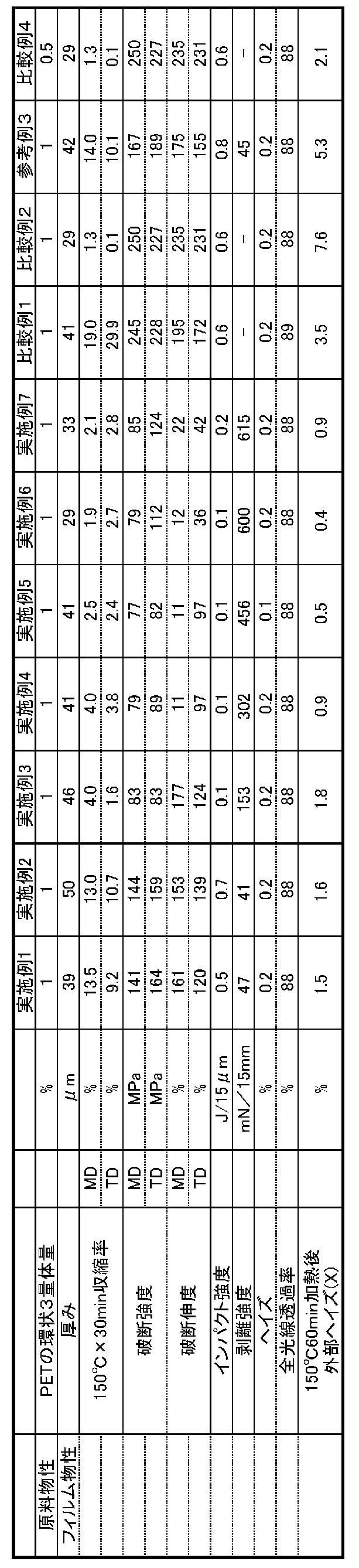
- Example 1 The physical properties of the obtained film of Example 1 are shown in Table 2.
- the obtained laminate film had low external haze after heating, and Example 1 was shown to have little precipitation of cyclic oligomers and excellent transparency after heat processing.
- Examples 2 to 7 biaxially stretched laminate films were obtained in the same manner as in Example 1, except that the conditions were changed as shown in Table 1.
- the physical properties of the obtained films of Examples 2 to 7 are shown in Table 2.
- the obtained laminate films had low external haze after heating, and Examples 2 to 7 also showed little precipitation of cyclic oligomers and excellent transparency after heat processing.
- Reference Example 3 a biaxially stretched laminate film was obtained in the same manner as in Example 1, except that the conditions were changed to those shown in Table 1.
- the film properties of Reference Example 3 obtained are shown in Table 2.
- the ratio of the total thickness of all base layers A to the thickness of the laminate film was higher than 35%.
- the film external haze was 3.0% or more when heated at 150°C for 60 minutes. The reason for such results is believed to be that the thickness of decomposition layer B was thin, and decomposition layer B was unable to sufficiently retain the cyclic trimer that had migrated from within base layer A.
- PET resin 1 as a raw material was dried under reduced pressure (1 Torr) at 135° C. for 6 hours, then fed to extruder 1, and melt-extruded into a sheet from a die.
- a filter medium made of sintered stainless steel with a filtering particle size of 10 ⁇ m (initial filtering efficiency: 95%) was used.
- the extruded resin was cast onto a cooling drum with a surface temperature of 30°C and adhered to the surface of the cooling drum using an electrostatic application method, allowing it to cool and solidify, creating an unstretched film 300 ⁇ m thick.
- the unstretched sheet obtained was heated to 100°C using a group of heated rolls, and then stretched 3.0 times in the longitudinal direction using a group of rolls with different peripheral speeds.
- Comparative Example 1 The physical properties of the obtained film of Comparative Example 1 are shown in Table 2. Comparative Example 1 is outside the scope of the present invention because it does not have decomposition layer B containing an aliphatic polyester resin. Comparative Example 1 had an external film haze of 3.0% or more when heated at 150°C for 60 minutes.
- Comparative Example 2 A biaxially stretched laminate film was obtained in the same manner as in Comparative Example 1, except that the conditions were changed as shown in Table 1. The physical properties of the obtained film of Comparative Example 2 are shown in Table 2. Comparative Example 2 is outside the scope of the present invention because it does not have a decomposition layer B containing an aliphatic polyester resin. In Comparative Example 1, the film external haze was 3.0% or more when heated at 150°C for 60 minutes.
- Comparative Example 4 Production of polyethylene terephthalate resin (PET resin 2) Comparative Example 4 used a method of reducing cyclic oligomers using a large amount of energy.
- PET resin 2 polyethylene terephthalate resin
- Comparative Example 4 used a method of reducing cyclic oligomers using a large amount of energy.
- the above-obtained PET1 resin was subjected to solid-phase polymerization at 220°C for various times under a reduced pressure of 0.5 mmHg using a rotary vacuum polymerization apparatus to obtain PET resin 2.
- the obtained PET resin 2 had a melting point of 257°C, an intrinsic viscosity of 0.732 dl/g, a cyclic trimer content of 0.5% by mass, and was substantially free of inactive particles and internally precipitated particles.
- a biaxially stretched laminate film was obtained in the same manner as in Comparative Example 2, except that PET resin 2 was used as the raw material.
- the physical properties of the film obtained in Comparative Example 4 are shown in Table 2.
- the external haze of the film was 3.0% or less when heated at 150°C for 60 minutes, and the transparency after heat processing was excellent. The reason for this result is thought to be that Comparative Example 4 used PET resin 2 with a cyclic trimer content of 0.5% by mass.
- the decomposition layer B can be decomposed with steam or hot water from the laminated film, and then the base layer A can be taken out and recycled as a material to produce a resin composition containing a polyethylene terephthalate resin.
- This resin composition can also be used to produce a material-recycled laminated film. Therefore, the recyclability of the obtained laminated film was evaluated below.
- Example 11 The laminated film obtained in Example 1 was left to stand for 4 hours under water vapor at 121 ° C, 100% RH, and 0.2 MPa using EHS-221 manufactured by Espec Corporation.
- the PET film of the laminated film after heat treatment could be easily peeled off, and the decomposed polylactic acid was washed and removed from the peeled PET film with hot water to obtain a PET film.
- the removed PET film was material recycled to produce a resin composition containing polyethylene terephthalate resin.
- the removed PET film was cut and re-pelletized by melt extrusion at 280 ° C to obtain recycled PET pellets.
- the obtained PET pellets were again processed to be re-pelletized by melt extrusion at 280 ° C twice, and the pellet-shaped resin composition (hereinafter referred to as recycled PET resin 1) that was re-melted three times in total was used as the recycled raw material.
- the amount of cyclic trimer of the recycled raw material is shown in Table 3.
- Example 11 a biaxially stretched laminate film was obtained in the same manner as in Example 1, except that recycled PET resin 1 was used as the raw material.
- the physical properties of the film obtained in Example 11 are shown in Table 3.
- Example 11 is a sustainable film with low precipitation of cyclic oligomers, excellent transparency after heat processing, and excellent recyclability.
- Example 12 to 17 In Examples 12 to 17, similarly to Example 11, the laminate films obtained in Examples 2 to 7 were recycled, and biaxially stretched laminate films were obtained in the same manner as in Examples 2 to 7, except that recycled PET resin 1 was used as a raw material.
- the physical properties of the obtained films of Examples 12 to 17 are shown in Table 3.
- Comparative Example 11 In Comparative Example 11, similarly to Example 11, each laminate film obtained in Comparative Example 1 was recycled, and a biaxially stretched laminate film was obtained in the same manner as in Comparative Example 1 except that recycled PET resin 1 was used as a raw material.
- the physical properties of the obtained film of Comparative Example 11 are shown in Table 3.
- Comparative Example 1 the external haze of the film when heated at 150° C. for 60 minutes was 3.0% or more.
- Comparative Example 12 In Comparative Example 12, similarly to Example 11, each laminate film obtained in Comparative Example 2 was recycled, and a biaxially stretched laminate film was obtained in the same manner as in Comparative Example 2, except that recycled PET resin 1 was used as a raw material.
- the physical properties of the obtained film of Comparative Example 12 are shown in Table 3.
- Comparative Example 2 in Comparative Example 12, the external haze of the film when heated at 150° C. for 60 minutes was 3.0% or more.
- Reference Example 13 In Reference Example 13, similarly to Example 11, each laminate film obtained in Reference Example 3 was recycled, and a biaxially stretched laminate film was obtained in the same manner as in Reference Example 3, except that recycled PET resin 1 was used as a raw material.
- the physical properties of the film obtained in Reference Example 13 are shown in Table 3.
- the external haze of the film when heated at 150° C. for 60 minutes was 3.0% or more.
- Comparative Example 14 In Comparative Example 14, a biaxially stretched laminate film was obtained in the same manner as in Comparative Example 4, except that recycled PET resin 2 obtained by recycling the biaxially stretched film obtained in Comparative Example 4 in the same manner as in Example 11 was used as a raw material.
- the physical properties of the obtained film of Comparative Example 14 are shown in Table 3. Although the precipitation of cyclic oligomers due to heating was small in Comparative Example 4 before recycling, the transparency of Comparative Example 14 after recycling was significantly deteriorated. Comparative Example 14 could not be used as a film for industrial or packaging purposes.
Landscapes
- Engineering & Computer Science (AREA)
- Chemical & Material Sciences (AREA)
- Manufacturing & Machinery (AREA)
- Environmental & Geological Engineering (AREA)
- Mechanical Engineering (AREA)
- Materials Engineering (AREA)
- Health & Medical Sciences (AREA)
- Chemical Kinetics & Catalysis (AREA)
- Medicinal Chemistry (AREA)
- Polymers & Plastics (AREA)
- Organic Chemistry (AREA)
- Laminated Bodies (AREA)
Abstract
環状オリゴマーの析出が少ない、加熱加工後の透明性に優れ、リサイクル性に優れた持続可能な積層フィルム、樹脂組成物、樹脂組成物の製造方法を提供する。本発明の積層フィルムは、ポリエチレンテレフタレート樹脂を含む第1組成物で構成される基材層Aと、脂肪族ポリエステル樹脂を含む第2組成物で構成される分解層Bとを含む。積層フィルムにおいて、前記基材層Aが前記分解層Bに接しており、少なくとも一方の最外層が前記基材層Aである。好ましくは、前記基材層Aが、前記分解層Bの両表面に接して設けられ、両方の最外層が前記基材層Aである。
Description
本発明は、ポリエチレンテレフタレート樹脂で構成される積層フィルム、この積層フィルムをマテリアルリサイクルした樹脂組成物、及びこの樹脂組成物の製造方法に関する。
ポリエチレンテレフタレート(以下、「PET」と称することもある)樹脂で構成されるフィルムは、機械的強度、寸法安定性、平坦性、耐熱性、耐薬品性、光学特性等に優れた特性を有し、コストパフォーマンスに優れる。
しかし、例えば、非特許文献1に記載のように、従来から公知のPET樹脂は、数質量%の環状3量体等を含む環状オリゴマーを含有している。モノマーからPETに重合する際、環状オリゴマーが副生成物として生成される。環状オリゴマーのうち環状3量体の含有量が最も多いことが知られている。
環状オリゴマーに関しては、PETフィルムを加熱処理すると、PETフィルム中に含まれる環状オリゴマーが表面に析出するという問題があった。例えば、PETフィルムの表面への環状オリゴマーの析出は、工業用途等の高度に透明性や品位が要求される場合、PETフィルムの加熱工程時に白化してPETフィルムの透明性が損なわれ、優れた品位が得られないという問題があった。また食品など包装用途として用いる場合には、印刷時の抜けやラミネート不良などを発生させ、パッケージ加工時の歩留まりに大きく悪影響を及ぼすという問題があった。
このような問題を解決するために、PET原料から改善する方法が従来よりあった。例えば、特許文献1、2は、重縮合反応により得られたポリエステルを減圧条件下または不活性ガス流通下で、180℃から該ポリエステルの融点までの温度で加熱処理して環状オリゴマーを0.5重量%以下に減少させる固相重合法を開示している。
D.R.Cooperand,J.A.Semlyen;Polymer,14,185―192(1973)
しかしながら、SDGsの観点から、環状オリゴマーを大きなエネルギーを使用して低減させる方法は好ましくない。リサイクルフィルム業界では近年、SDGsの観点から大きなエネルギーを使用した特殊な処理をPET原料へ行う必要がない、リサイクル性に優れた持続可能な積層フィルムが求められている。
本発明は、環状オリゴマーの析出が少ない、加熱加工後の透明性に優れ、リサイクル性に優れた持続可能な積層フィルム、樹脂組成物、及びその製造方法を提供することを目的とする。
リサイクル性に優れた持続可能な積層フィルムに関して本願発明者らが鋭意研究した結果、環状オリゴマーの含有量が高い一般的なPET樹脂を含む基材層Aに脂肪族ポリエステル樹脂を含む分解層Bを隣接させて積層することで、環状オリゴマーの析出を抑制できることを見出した。
またポリ乳酸を含む脂肪族ポリエステル樹脂は、加水分解性を有する。そこで本願発明者らは、積層フィルムから分解層Bを水蒸気又は熱水で分解してから基材層A層を取り出しマテリアルリサイクルし、ポリエチレンテレフタレート樹脂を含有する樹脂組成物を生成する樹脂組成物の製造方法を発明した。そのため、本発明の積層フィルムはリサイクル性に優れた持続可能な構成も有している。
本発明は上記課題を解決するため、以下の構成を有する。
[1] ポリエチレンテレフタレート樹脂を含む第1組成物で構成される基材層Aと、脂肪族ポリエステル樹脂を含む第2組成物で構成される分解層Bとを含む積層フィルムであって、
前記基材層Aが前記分解層Bに接しており、
少なくとも一方の最外層が前記基材層Aである積層フィルム。
[2] 前記基材層Aが、前記分解層Bの両表面に接して設けられ、両方の最外層が前記基材層Aである[1]に記載の積層フィルム。
[3] 150℃、60分間加熱したときのフィルム外部ヘイズXが3.0%以下である[1]又は[2]に記載の積層フィルム。
[4] 前記基材層Aの全質量に対してポリエチレンテレフタレート樹脂中の環状3量体の含有量が0.9質量%以上である[1]~[3]何れかに記載の積層フィルム。
[5] 積層フィルムの厚みに対する、全ての前記基材層Aの厚みの合計の比率が35%以下である[1]~[4]何れかに記載の積層フィルム。
[6] 前記基材層Aと前記分解層Bとの剥離強度が20mN/15mm以上である、[1]~[5]何れかに記載の積層フィルム。
[7] 前記脂肪族ポリエステルがポリ乳酸である[1]~[6]何れかに記載の積層フィルム。
[8] [1]~[7]のいずれか1項に記載の積層フィルムから前記分解層Bを除去してから前記基材層Aを取り出しマテリアルリサイクルした、ポリエチレンテレフタレート樹脂を含有する樹脂組成物。
[9] [1]~[7]のいずれか1項に記載の積層フィルムから前記分解層Bを水蒸気又は熱水で分解してから前記基材層Aを取り出しマテリアルリサイクルし、ポリエチレンテレフタレート樹脂を含有する樹脂組成物を生成する樹脂組成物の製造方法。
[1] ポリエチレンテレフタレート樹脂を含む第1組成物で構成される基材層Aと、脂肪族ポリエステル樹脂を含む第2組成物で構成される分解層Bとを含む積層フィルムであって、
前記基材層Aが前記分解層Bに接しており、
少なくとも一方の最外層が前記基材層Aである積層フィルム。
[2] 前記基材層Aが、前記分解層Bの両表面に接して設けられ、両方の最外層が前記基材層Aである[1]に記載の積層フィルム。
[3] 150℃、60分間加熱したときのフィルム外部ヘイズXが3.0%以下である[1]又は[2]に記載の積層フィルム。
[4] 前記基材層Aの全質量に対してポリエチレンテレフタレート樹脂中の環状3量体の含有量が0.9質量%以上である[1]~[3]何れかに記載の積層フィルム。
[5] 積層フィルムの厚みに対する、全ての前記基材層Aの厚みの合計の比率が35%以下である[1]~[4]何れかに記載の積層フィルム。
[6] 前記基材層Aと前記分解層Bとの剥離強度が20mN/15mm以上である、[1]~[5]何れかに記載の積層フィルム。
[7] 前記脂肪族ポリエステルがポリ乳酸である[1]~[6]何れかに記載の積層フィルム。
[8] [1]~[7]のいずれか1項に記載の積層フィルムから前記分解層Bを除去してから前記基材層Aを取り出しマテリアルリサイクルした、ポリエチレンテレフタレート樹脂を含有する樹脂組成物。
[9] [1]~[7]のいずれか1項に記載の積層フィルムから前記分解層Bを水蒸気又は熱水で分解してから前記基材層Aを取り出しマテリアルリサイクルし、ポリエチレンテレフタレート樹脂を含有する樹脂組成物を生成する樹脂組成物の製造方法。
本発明の積層フィルムは、加熱加工後の透明性に優れ、環状オリゴマーの析出を抑制できる。そのため、高温での後加工処理が可能で、且つ、製膜工程内の汚染も少ないため、高品位が必要とされる光学用途をはじめとした工業用途および精密な印刷やラミネート加工を行う包装用材料として好適である。さらに、大きなエネルギーを使用した特殊な原料を用いず、SDGsに配慮した優れたリサイクル性を有する。
(積層フィルムの層構成)
本発明は少なくとも、ポリエチレンテレフタレート(以下、単にPETという)樹脂を含む第1組成物で構成される基材層Aと、脂肪族ポリエステル樹脂を含む第2組成物で構成される分解層Bとを含む積層フィルムである。
本発明は少なくとも、ポリエチレンテレフタレート(以下、単にPETという)樹脂を含む第1組成物で構成される基材層Aと、脂肪族ポリエステル樹脂を含む第2組成物で構成される分解層Bとを含む積層フィルムである。
積層フィルムの層構成としては、少なくとも一方の最外層にPET層(基材層A)を有し、これと隣接して中間に脂肪族ポリエステル層(分解層B)を有する複層構成である必要がある。層構成はB/AやA/BやA/B/AやA/B/A/B/A、A/B+A/A、A/B/A+B/B/Aなどを取ることができる。ここで、「B+A」又は「A+B」は、ポリエチレンテレフタレート樹脂と脂肪族ポリエステル樹脂とを含む層であって、主成分である前者に後者が配合されていることを意味する。また、基材層A同士又は分解層B同士は、同一の組成でも異なる組成でもよいが、同一の組成であることが好ましい。なお、最外層にPET層があり、PET層に脂肪族ポリエステル層が接していれば、他の構成をとってもよい。
ここで、PET樹脂は、数%の環状3量体等を含む環状オリゴマーを含有している。モノマーからPETに重合する際、環状オリゴマーが副生成物として生成される。環状オリゴマーのうち環状3量体の含有量が最も多いことが知られている。
環状オリゴマーに関しては、PETフィルムを加熱処理すると、PETフィルム中に含まれる環状オリゴマーが表面に析出するという問題がある。PET中の環状3量体は加熱処理により分子運動性が高まるとPETフィルム内部を移行し、PETフィルム表面に析出した場合、結晶化することにより白色化すると考えられる。
しかしながら、本発明の積層フィルムでは、PET樹脂より嵩密度の小さい脂肪族ポリエステル樹脂を含む分解層BがPET樹脂を含む基材層Aに積層している。
そのため、基材層A内の環状3量体は分解層Bに優先的に移行すると考えられる。このため本発明は、PETフィルムの表面へ環状オリゴマーが析出することを抑制できる。
本発明では、特に、基材層Aが、分解層Bの両表面に接して設けられ、両方の最外層が基材層Aであることが好ましい。基材層Aが、分解層Bの両表面に接して設けられることで、加熱加工時に効率良く環状3量体を分解層Bへ移行させることができる。また、両方の最外層が基材層Aであることにより、環状3量体が表面に析出するのを抑制しつつ、PET層の有する高い機械特性、耐薬品性などを発現させ易くすることができる。このような観点から、A/B/Aの層構成を有することが、最も好ましい。
層比率について、積層フィルムの厚みに対する全てのPET層(基材層A)の厚みの合計の比率は5%以上35%以下が好ましく、10%以上25%以下がより好ましい。全てのPET層(基材層A)の厚みの合計の比率が5%以上の場合は、PET層の有する高い機械特性、耐薬品性などが発現する。一方、全てのPET層(基材層A)の厚みの合計の比率が35%以下の場合、加熱白化特性が低下することを抑制できる。
(ポリエチレンテレフタレート)
基材層Aは、PET樹脂を含む第1組成物で構成される。PET樹脂の優れた特性を発現させる観点から、第1組成物を構成する樹脂100質量%中に、PET樹脂は90質量%以上含有されることが好ましく、98質量%以上含有されることがより好ましく、100質量%含有されることが最も好ましい。
基材層Aは、PET樹脂を含む第1組成物で構成される。PET樹脂の優れた特性を発現させる観点から、第1組成物を構成する樹脂100質量%中に、PET樹脂は90質量%以上含有されることが好ましく、98質量%以上含有されることがより好ましく、100質量%含有されることが最も好ましい。
PET樹脂の重合法としては、テレフタル酸とエチレングリコール、および必要に応じて他のジカルボン酸成分およびジオール成分を直接反応させる直接重合法、およびテレフタル酸のジメチルエステル(必要に応じて他のジカルボン酸のメチルエステルを含む)とエチレングリコール(必要に応じて他のジオール成分を含む)とをエステル交換反応させるエステル交換法等の任意の製造方法が利用され得る。
また、PET樹脂の固有粘度は、0.45以上0.70以下の範囲が好ましい。固有粘度が0.45以上の場合、PETフィルムが裂けることを防止できる。0.70以下の場合、濾圧上昇が小さくなって高精度濾過が容易となる。
本発明では、PET中の環状3量体の含有量がある程度大きくても、加熱加工後に環状3量体が表面に析出するのを抑制することができる。従って、PET中の環状3量体含有量は、大きなエネルギーを使用しなくても済むため、基材層Aの全質量に対して0.9質量%以上であることが好ましい。樹脂溶融温度によって平衡オリゴマー濃度は変化するが、通常270~310℃で溶融押出しすることを踏まえると環状3量体の含有量の上限は1.1質量%である。環状3量体の含有量を0.9質量%未満にするためには、大きなエネルギーを使用した特殊な処理をPET原料に施すことが必要となる。更に、PET原料に特殊な処理を施したとしても、PET原料を溶融押出してPETフィルムを製膜する際、最終的に環状オリゴマーが再生成してしまうため、SDGsの観点から好ましくない。
(脂肪族ポリエステル)
分解層Bは、脂肪族ポリエステル樹脂を含む第2組成物で構成され、水蒸気又は熱水による加水分解性を有している。加水分解性の観点から、第2組成物を構成する樹脂100質量%中に、脂肪族ポリエステル樹脂は60質量%以上含有されることが好ましく、
80質量%以上含有されることがより好ましく、100質量%含有されることが最も好ましい。
分解層Bは、脂肪族ポリエステル樹脂を含む第2組成物で構成され、水蒸気又は熱水による加水分解性を有している。加水分解性の観点から、第2組成物を構成する樹脂100質量%中に、脂肪族ポリエステル樹脂は60質量%以上含有されることが好ましく、
80質量%以上含有されることがより好ましく、100質量%含有されることが最も好ましい。
本発明に用いられる脂肪族ポリエステルとしては、ポリグリコール酸、ポリ-L-乳酸、ポリ-D-乳酸、ポリ(β-ヒドロキシ酪酸)、ポリ(ε-カプロラクトン)、ポリエチレンサクシネート、ポリブチレンサクシネート、ポリ(ブチレンサクシネート-ブチレンアジペート)などを用いることができる。なかでも、脂肪族ポリエステル樹脂としては、加水分解性、加熱時の物性、生分解性、バイオマス原料由来などの観点から、ポリ-L-乳酸、及び/又はポリ-D-乳酸が好ましい。
本発明で用いるポリエステル中には、使用する目的に応じて、無機粒子、耐熱性高分子粒子、架橋高分子粒子などの不活性粒子、蛍光増白剤、紫外線防止剤、赤外線吸収色素、熱安定剤、界面活性剤、酸化防止剤などの各種添加剤を1種もしくは2種以上含有させることができる。酸化防止剤としては、芳香族アミン系、フェノール系などの酸化防止剤が使用可能であり、安定剤としては、リン酸やリン酸エステル系等のリン系、イオウ系、アミン系などの安定剤が使用可能である。
(積層フィルムの製造方法)
本発明に使用される積層フィルムは、機械的強度、耐薬品性、耐熱性などの点から、配向積層フィルムであることが好ましく、より好ましくは二軸配向積層フィルムである。
本発明に使用される積層フィルムは、機械的強度、耐薬品性、耐熱性などの点から、配向積層フィルムであることが好ましく、より好ましくは二軸配向積層フィルムである。
本発明の積層フィルムは、配向積層フィルムの場合、前記ポリエステルチップを押出機において溶融する溶融工程、押出機から溶融樹脂を押出すことにより未延伸フィルムを形成するフィルム化工程、未延伸フィルムの少なくとも一方向に延伸する延伸工程、および、延伸したフィルムを熱処理する熱固定工程を経ることにより製造することが望ましい。
本発明の積層フィルムの延伸方法は特に限定されず、逐次二軸延伸方法、または同時二軸延伸方法が適宜使用される。
基材層AであるPET層と、分解層Bである脂肪族ポリエステル層とを共押出し積層するためには、2台以上の押出し機を用いて、各層の原料を押出し、多層フィードブロック(例えば角型合流部を有する合流ブロック)を用いて両層を合流させ、スリット状のダイからシート状に押出し、キャスティングロール上で冷却固化せしめて未延伸フィルムを作る。あるいは多層フィードブロックを用いる代わりにマルチマニホールドダイを用いても良い。
次いで、該未延伸フィルムを延伸・配向処理するが、以下では、最も一般的に用いられる逐次二軸延伸方法、特に未延伸フィルムを長手方向に縦延伸し、次いで幅方向に横延伸する方法を例に説明する。まず、長手方向への縦延伸工程では、フィルムを加熱し、周速が異なる2本あるいは多数本のロール間で1.1~6倍に延伸する。このときの加熱手段としては、加熱ロールを用いる方法でも非接触の加熱媒体を用いる方法でもよく、これらを併用してもよい。この際、フィルムの温度を(Tg-10℃)~(Tg+50℃)の範囲とすることが好ましい。次いで1軸延伸フィルムをテンターに導入し、幅方向に(Tg-10℃)~(Tm-10℃)以下の温度で1.1~6倍に延伸することで2軸延伸フィルムが得られる。
さらに、延伸終了後、PETフィルムの熱収縮率を低減させるために、熱固定工程において、30秒以内、好ましくは10秒以内で熱固定処理を行い、0.5~10%の縦弛緩処理、横弛緩処理などを施すことが好ましい。
熱固定温度は特に限定されないが、脂肪族ポリエステルの融点+20℃以上であることがより好ましく、脂肪族ポリエステルの融点+40℃以上であることが更に好ましい。熱固定温度の上限はPETの融点である260℃である。脂肪族ポリエステルの融点以上である場合、フィルム層間の剥離強度が向上するため好ましい。また、熱固定温度が脂肪族ポリエステルの融点以上である場合、嵩密度のより小さい非晶領域が増加することにより加熱時白化性が抑制されるため好ましい。
(積層フィルムの物性)
本発明の積層フィルムの厚みは、2μm以上500μm以下であることが好ましく、より好ましく15μm以上400μm以下であり、さらに好ましくは20μm以上250μm以下である。積層フィルムの厚みが2μm以上の場合、積層フィルムが最低限の剛性を有し取り扱いが容易である。また積層フィルムの厚みが500μm以下の場合、積層フィルムを複数のロールで搬送する際の積層フィルムの搬送性や製造された積層フィルムの取扱い性が向上し、取り扱いが容易となる。
本発明の積層フィルムの厚みは、2μm以上500μm以下であることが好ましく、より好ましく15μm以上400μm以下であり、さらに好ましくは20μm以上250μm以下である。積層フィルムの厚みが2μm以上の場合、積層フィルムが最低限の剛性を有し取り扱いが容易である。また積層フィルムの厚みが500μm以下の場合、積層フィルムを複数のロールで搬送する際の積層フィルムの搬送性や製造された積層フィルムの取扱い性が向上し、取り扱いが容易となる。
積層フィルムの破断強度は、MD方向及びTD方向とも75MPa以上であることが好ましい。破断強度の好ましい下限は100MPa、より好ましい下限は125MPa、さらに好ましい下限は150MPa、よりさらに好ましい下限は175MPaである。破断強度が75MPa以上では、積層フィルムの力学的強度が十分となり、積層フィルムの加工工程で伸び、ズレ等の不具合を生じることを抑制できるので好ましい。製造上の点を考慮して、上限は400MPaであると考えられる。
積層フィルムの破断伸度は、MD方向及びTD方向とも10%以上であることが好ましい。破断伸度が10%以上では、積層フィルムの力学的伸度が十分となり、積層フィルムの加工工程で割れ、破れ等の不具合が生じることを抑制できるので好ましい。製造上の点を考慮して、上限は300%であると考えられる。
積層フィルムにおいて、PET樹脂を含む基材層Aと脂肪族ポリエステル樹脂を含む分解層Bとの剥離強度が20mN/15mm以上であることが好ましい。より好ましくは100mN/15mm以上である。剥離強度が20mN/15mm以上では、基材層Aと分解層Bが容易に剥がれず、積層構成を維持できるので好ましい。剥離強度は高ければ高いほど良いが、製造上の観点から上限は1000mN/15mmであると考えられる。
積層フィルムのインパクト強度(耐衝撃性)は、0.1J/15μm以上であることが好ましい。インパクト強度(耐衝撃性)が0.1J/15μm以上では、衝撃を受けた際に容易に破れず、積層フィルムは、フィルムとしての形状を保つことができるので好ましい。インパクト強度(耐衝撃性)は高ければ高いほど良いが、製造上の観点から上限は3.0J/15μmであると考えられる。
積層フィルムは、150℃で30分間加熱したときの熱収縮率がMD方向およびTD方向とも50%以下であることが好ましく、より好ましくは30%以下であり、さらに好ましくは20%以下であり、さらにより好ましくは10%以下であり、特に好ましくは8%以下であり、最も好ましくは4.5%以下である。熱収縮率が大きいとコーティング実施が困難になること、および高熱化でのフィルムの変形による外観不良などが発生する。上記熱収縮率は低いことが好ましいが、製造上の点から0.01%が下限と考えられる。
積層フィルムの全光線透過率は、75%以上であることが好ましい。積層フィルムの欠点となる内部異物の検出精度を向上させるためには、透明性が高いことが好ましい。そのため、本発明の積層フィルムの全光線透過率は75%以上が好ましく、80%以上がより好ましく、85%以上がさらに好ましく、88%以上が特に好ましい。積層フィルムの欠点となる内部異物の検出精度を向上させるためには、全光線透過率は高ければ高いほどよいが、100%の全光線透過率は技術的に達成困難である。製造上の観点から全光線透過率は100%未満であることが好ましい。
積層フィルムを150℃、60分間加熱したときのフィルム外部ヘイズXは、3.0%以下であることが好ましく、2.0%以下であることがより好ましい。Xが3.0%以下である場合、積層フィルムはフィルムの後加工工程において環状オリゴマーが析出することを抑制でき、積層フィルムを製造する機器(ロール等)が汚染することを防止できる。また積層フィルムは透明性に優れる。本発明における好ましいXの下限は1.0%であり、より好ましくは0.5%である。実質的な下限は0%であると考えられる。なお、加熱処理前の全ヘイズは約0.2%以下であり、外部ヘイズはこれより小さいため、加熱処理の前後における外部ヘイズの変化量は、加熱処理後のフィルム外部ヘイズXと同程度になる。
(樹脂組成物及びその製造方法)
本発明の樹脂組成物は、以上のような本発明の積層フィルムから分解層Bを除去してから基材層Aを取り出しマテリアルリサイクルした、ポリエチレンテレフタレート樹脂を含有する樹脂組成物である。また、本発明の樹脂組成物の製造方法は、以上のような本発明の積層フィルムから前記分解層Bを水蒸気又は熱水で分解してから前記基材層Aを取り出しマテリアルリサイクルし、ポリエチレンテレフタレート樹脂を含有する樹脂組成物を生成するものである。
本発明の樹脂組成物は、以上のような本発明の積層フィルムから分解層Bを除去してから基材層Aを取り出しマテリアルリサイクルした、ポリエチレンテレフタレート樹脂を含有する樹脂組成物である。また、本発明の樹脂組成物の製造方法は、以上のような本発明の積層フィルムから前記分解層Bを水蒸気又は熱水で分解してから前記基材層Aを取り出しマテリアルリサイクルし、ポリエチレンテレフタレート樹脂を含有する樹脂組成物を生成するものである。
ポリ乳酸のような脂肪族ポリエステル樹脂は、加水分解性を有する。そこで、積層フィルムから分解層Bを水蒸気又は熱水で分解してから基材層Aを取り出しマテリアルリサイクルし、ポリエチレンテレフタレート樹脂を含有する樹脂組成物を生成することができる。樹脂組成物は例えばペレット状であり、ポリエチレンテレフタレート樹脂を含有する。そのため、本発明の積層フィルムはリサイクル性に優れた構成も有している。
なお、マテリアルリサイクルする際のリサイクル処理においては、水蒸気の温度は例えば、常温である25℃以上、PETの融点250℃未満である。水蒸気の温度の上限は、240℃であることが好ましく、150℃であることがより好ましく、120℃であることが特に好ましい。水蒸気の温度の下限は、25℃であることが好ましく、50℃であることがより好ましく、100℃であることが特に好ましい。湿度RHの上限は、100%であることが好ましく、90%であることがより好ましく、80%であることが特に好ましい。湿度RHの下限は、50%であることが好ましく、60%であることがより好ましく、70%であることが特に好ましい。水蒸気の圧力の上限は、ゲージ圧で0.50MPaであることが好ましく、0.30MPaであることがより好ましく、0.20MPaであることが特に好ましい。水蒸気の圧力の下限は、ゲージ圧で0.02MPaであることが好ましく、0.01MPaであることがより好ましい。
リサイクル処理は、ロール状態の積層フィルムに対して、バッチ処理で行なうことも可能であるが、水分が内部に拡散しにくいため、フィルム状態で行なうことが好ましい。フィルム状態の積層フィルムに対して、リサイクル処理(加水分解)を行なう場合、長尺体を用いて連続処理する方法の他、枚葉体、小片切断物、粉末体、スラリー体、フレークなどを用いて、バッチ処理又は連続処理により行なうことができる。
効率よく連続処理を行なう観点から、使用後の積層フィルムを粉砕機でフレーク状に粉砕した後に、これを連続的に供給しながら、熱水等で処理することが好ましい。具体的には、加圧下で加熱可能な撹拌槽を具備した装置内に、フレーク状に粉砕した積層フィルムを連続的に撹拌槽に供給して、熱水等で処理した後、ベルトコンベアー方式の金網等でフレークをすくい取り、オーブン等で加熱乾燥することで、連続的に基材層を回収することができる。
なお、フレークの大きさとしては、最長部の長さを10cm以下とするのが好ましく、より好ましくは最長部の長さが5cm以下である。粉砕機として、クラッシャーやシュレッダーを用いてもよい。
次に、本発明の効果を実施例および比較例を用いて説明する。まず、本発明で使用した特性値の評価方法を下記に示す。
[評価方法]
(1)ヘイズ
JIS K 7136に準拠して、日本電色工業社製NDH-7000II型濁度計を用いて積層フィルムのヘイズを測定した。
[評価方法]
(1)ヘイズ
JIS K 7136に準拠して、日本電色工業社製NDH-7000II型濁度計を用いて積層フィルムのヘイズを測定した。
(2)厚み
テスター産業株式会社製TH―104を用いて積層フィルムの厚みを測定した。積層フィルム各層の厚みは、ミクロトームで切り出したフィルム断面を走査型電子顕微鏡(SEM)を用いて観察することで、測定した。
テスター産業株式会社製TH―104を用いて積層フィルムの厚みを測定した。積層フィルム各層の厚みは、ミクロトームで切り出したフィルム断面を走査型電子顕微鏡(SEM)を用いて観察することで、測定した。
(3)破断強度、破断伸度
積層フィルムの破断強度及び破断伸度は、JIS C 2318に準拠して測定した。積層フィルムのMD方向及びTD方向に対して、それぞれ長さ120mm及び幅10mmの短冊状に試料を片刃カミソリで切り出した。次いで、株式会社島津製作所製オートグラフAG-ISを用いて短冊状試料を引っ張り、得られた荷重-歪曲線から各方向の破断強度(MPa)および破断伸度(%)を求めた。
積層フィルムの破断強度及び破断伸度は、JIS C 2318に準拠して測定した。積層フィルムのMD方向及びTD方向に対して、それぞれ長さ120mm及び幅10mmの短冊状に試料を片刃カミソリで切り出した。次いで、株式会社島津製作所製オートグラフAG-ISを用いて短冊状試料を引っ張り、得られた荷重-歪曲線から各方向の破断強度(MPa)および破断伸度(%)を求めた。
(4)剥離強度
積層フィルムを幅15mm、長さ150mmに切り出して試験片とし、株式会社島津製作所製オートグラフAGS-Xを用いて、積層フィルム層間の剥離強度を引張速度300mm/minの条件下で、剥離角度90度で剥離させたときの強度とした。
積層フィルムを幅15mm、長さ150mmに切り出して試験片とし、株式会社島津製作所製オートグラフAGS-Xを用いて、積層フィルム層間の剥離強度を引張速度300mm/minの条件下で、剥離角度90度で剥離させたときの強度とした。
(5)インパクト強度
株式会社東洋精機製作所製のインパクトテスターを用い、23℃の雰囲気下における積層フィルムの衝撃打ち抜きに対する強度を測定した。衝撃球面は、直径1/2インチのものを用いた。単位はJであり、測定した積層フィルムの厚みで測定値を割り、厚み15μmあたりの評価値を用いた。
株式会社東洋精機製作所製のインパクトテスターを用い、23℃の雰囲気下における積層フィルムの衝撃打ち抜きに対する強度を測定した。衝撃球面は、直径1/2インチのものを用いた。単位はJであり、測定した積層フィルムの厚みで測定値を割り、厚み15μmあたりの評価値を用いた。
(6)熱収縮率
積層フィルムの熱収縮率はJIS C 2318に準拠して測定した。測定すべき方向に対し、積層フィルムを幅10mm、長さ190mmに切り取り、150mm間隔で印を付け、印の間隔(A)を測定した。次いで、積層フィルムを150℃の雰囲気中のオーブンに入れ、無荷重下で150±3℃で30分間加熱処理した後、印の間隔(B)を測定した。そして、以下の式より熱収縮率を求めた。
熱収縮率(%)=(A-B)/A×100
積層フィルムの熱収縮率はJIS C 2318に準拠して測定した。測定すべき方向に対し、積層フィルムを幅10mm、長さ190mmに切り取り、150mm間隔で印を付け、印の間隔(A)を測定した。次いで、積層フィルムを150℃の雰囲気中のオーブンに入れ、無荷重下で150±3℃で30分間加熱処理した後、印の間隔(B)を測定した。そして、以下の式より熱収縮率を求めた。
熱収縮率(%)=(A-B)/A×100
(7)全光線透過率
JIS K 7136に準拠して、日本電色工業社製NDH-7000 II型濁度計を用いて積層フィルムの全光線透過率を測定した。
JIS K 7136に準拠して、日本電色工業社製NDH-7000 II型濁度計を用いて積層フィルムの全光線透過率を測定した。
(8)フィルム外部ヘイズX
積層フィルムを150℃の雰囲気中のオーブンに入れ、無荷重下で150±3℃で60分間加熱処理した後、測定サンプルとした。測定サンプルを縦50mm、横50mmに切り出し、日本電色工業株式会社製NDH―5000の濁度計を用いて、JIS-K7136に準拠して、全ヘイズを測定した。次いで、測定サンプルの両表面にシリコーンオイルを塗布した後、同様に測定し内部ヘイズを得た。下記式に従って、外部ヘイズX(%)を求めた。
外部ヘイズX(%)=全へイズ―内部ヘイズ
積層フィルムを150℃の雰囲気中のオーブンに入れ、無荷重下で150±3℃で60分間加熱処理した後、測定サンプルとした。測定サンプルを縦50mm、横50mmに切り出し、日本電色工業株式会社製NDH―5000の濁度計を用いて、JIS-K7136に準拠して、全ヘイズを測定した。次いで、測定サンプルの両表面にシリコーンオイルを塗布した後、同様に測定し内部ヘイズを得た。下記式に従って、外部ヘイズX(%)を求めた。
外部ヘイズX(%)=全へイズ―内部ヘイズ
(9)環状3量体の含有量
積層フィルムまたはポリエステル樹脂を細かく粉砕し、0.1gをヘキサフルオロイソプロパノールール(HFIP)/クロロホルム(2/3(容量比))の混合溶媒3mlに溶解した。得られた溶液にクロロホルム20mlを加えて均一に混合した。得られた混合液にメタノール10mlを加え、線状ポリエステルを再沈殿させた。次いで、この混合液を濾過し、沈殿物をクロロホルム/メタノール(2/1(容量比))の混合溶媒30mlで洗浄し、さらに濾過した。得られた濾液をロータリーエバポレーターで濃縮乾固した。濃縮乾固物にジメチルホルムアミド10mlを加え、環状オリゴマー測定溶液とした。この測定溶液を横河電機(株)社製LC100型の高速液体クロマトグラフィーを使用して定量した。
積層フィルムまたはポリエステル樹脂を細かく粉砕し、0.1gをヘキサフルオロイソプロパノールール(HFIP)/クロロホルム(2/3(容量比))の混合溶媒3mlに溶解した。得られた溶液にクロロホルム20mlを加えて均一に混合した。得られた混合液にメタノール10mlを加え、線状ポリエステルを再沈殿させた。次いで、この混合液を濾過し、沈殿物をクロロホルム/メタノール(2/1(容量比))の混合溶媒30mlで洗浄し、さらに濾過した。得られた濾液をロータリーエバポレーターで濃縮乾固した。濃縮乾固物にジメチルホルムアミド10mlを加え、環状オリゴマー測定溶液とした。この測定溶液を横河電機(株)社製LC100型の高速液体クロマトグラフィーを使用して定量した。
(10)固有粘度
ポリエステル0.2gをフェノール/1,1,2,2-テトラクロルエタン(60/40(重量比))の混合溶媒50ml中に溶解し、30℃でオストワルド粘度計を用いて測定した。単位はdl/g。
ポリエステル0.2gをフェノール/1,1,2,2-テトラクロルエタン(60/40(重量比))の混合溶媒50ml中に溶解し、30℃でオストワルド粘度計を用いて測定した。単位はdl/g。
(実施例1)
(1)ポリエチレンテレフタレート樹脂(PET樹脂1)の製造
エステル化反応缶を昇温し、200℃に到達した時点で、テレフタル酸を86.4質量部及びエチレングリコールを64.4質量部からなるスラリーを仕込み、攪拌しながら触媒として三酸化アンチモンを0.017質量部及びトリエチルアミンを0.16質量部添加した。次いで、加圧昇温を行いゲージ圧3.5kgf/cm2、240℃の条件で、加圧エステル化反応を行った。その後、エステル化反応缶内を常圧に戻し、酢酸マグネシウム4水和物0.071質量部、次いでリン酸トリメチル0.014質量部を添加した。さらに、15分かけて260℃に昇温し、リン酸トリメチル0.012質量部、次いで酢酸ナトリウム0.0036質量部を添加した。15分後、得られたエステル化反応生成物を重縮合反応缶に移送し、減圧下260℃から280℃へ徐々に昇温し、285℃で重縮合反応を行った。
(1)ポリエチレンテレフタレート樹脂(PET樹脂1)の製造
エステル化反応缶を昇温し、200℃に到達した時点で、テレフタル酸を86.4質量部及びエチレングリコールを64.4質量部からなるスラリーを仕込み、攪拌しながら触媒として三酸化アンチモンを0.017質量部及びトリエチルアミンを0.16質量部添加した。次いで、加圧昇温を行いゲージ圧3.5kgf/cm2、240℃の条件で、加圧エステル化反応を行った。その後、エステル化反応缶内を常圧に戻し、酢酸マグネシウム4水和物0.071質量部、次いでリン酸トリメチル0.014質量部を添加した。さらに、15分かけて260℃に昇温し、リン酸トリメチル0.012質量部、次いで酢酸ナトリウム0.0036質量部を添加した。15分後、得られたエステル化反応生成物を重縮合反応缶に移送し、減圧下260℃から280℃へ徐々に昇温し、285℃で重縮合反応を行った。
重縮合反応終了後、95%カット径が5μmのナスロン製フィルターで濾過処理を行い、ノズルからストランド状に押出し、予め濾過処理(孔径:1μm以下)を行った冷却水を用いて冷却、固化させ、ペレット状にカットした。得られたPET樹脂は、融点が257℃、固有粘度が0.616dl/g、環状3量体の含有量が1.0質量%、不活性粒子及び内部析出粒子は実質上含有していなかった。
(2)脂肪族ポリエステル樹脂の製造
脂肪族ポリエステル樹脂としてTotal Corbion製ポリ-L-乳酸 PLA L175を用いた。
脂肪族ポリエステル樹脂としてTotal Corbion製ポリ-L-乳酸 PLA L175を用いた。
(3)積層フィルムの製造
基材層Aの原料としてPET樹脂1を135℃で6時間減圧乾燥(1Torr)した後、押出機1に供給した。分解層Bの原料としてポリ-L-乳酸(L175)を120℃で6時間減圧乾燥(1Torr)した後、押出機2に供給した。
基材層Aの原料としてPET樹脂1を135℃で6時間減圧乾燥(1Torr)した後、押出機1に供給した。分解層Bの原料としてポリ-L-乳酸(L175)を120℃で6時間減圧乾燥(1Torr)した後、押出機2に供給した。
押出機2、及び押出機1に供給された各原料を、A/B/Aとなるよう3層合流ブロックを用いて積層し、口金よりシート状に溶融押し出した。基材層Aと分解層Bとの厚み比率は、5/90/5となるように、各層のギアポンプを用いて制御した。また、フィルターには、いずれもステンレス焼結体の濾過粒子サイズ10μmの濾材(初期濾過効率:95%)を用いた。
押し出した樹脂を、表面温度30℃の冷却ドラム上にキャスティングして静電印加法を用いて冷却ドラム表面に密着させて冷却固化し、厚さ300μmの未延伸フィルムを作成した。
得られた未延伸シートを、加熱されたロール群でフィルム温度を75℃に昇温した後、周速差のあるロール群で、長手方向に3.0倍に延伸した。
次いで、得られた一軸延伸フィルムをクリップで把持し、横延伸を行った。横延伸温度は80℃、横延伸倍率は5.0倍とした。
次いで、140℃で15秒間の熱処理を行い、140℃で3%の弛緩処理を行い、39μmの二軸延伸積層フィルムを得た。得られた実施例1のフィルム物性を表2に示す。得られた積層フィルムの加熱後外部ヘイズは低く、実施例1は、環状オリゴマーの析出が少ない、加熱加工後の透明性に優れることが示された。
(実施例2~7)
実施例2~7は、表1に示す条件に変更する以外は実施例1と同様にして二軸延伸積層フィルムを得た。得られた実施例2~7のフィルム物性を表2に示す。得られた積層フィルムの加熱後外部ヘイズは低く、実施例2~7も、環状オリゴマーの析出が少ない、加熱加工後の透明性に優れることが示された。
実施例2~7は、表1に示す条件に変更する以外は実施例1と同様にして二軸延伸積層フィルムを得た。得られた実施例2~7のフィルム物性を表2に示す。得られた積層フィルムの加熱後外部ヘイズは低く、実施例2~7も、環状オリゴマーの析出が少ない、加熱加工後の透明性に優れることが示された。
(参考例3)
参考例3は、表1に示す条件に変更する以外は実施例1と同様にして二軸延伸積層フィルムを得た。得られた参考例3のフィルム物性を表2に示す。参考例3は、積層フィルムの厚みに対する、全ての基材層Aの厚みの合計の比率が35%より高い。参考例3は、150℃、60分間加熱したときのフィルム外部ヘイズが3.0%以上であった。このような結果となった理由は、分解層Bの厚みが薄く、分解層Bが基材層A内から移行した環状3量体を十分に保持できなかったためであると考えられる。
参考例3は、表1に示す条件に変更する以外は実施例1と同様にして二軸延伸積層フィルムを得た。得られた参考例3のフィルム物性を表2に示す。参考例3は、積層フィルムの厚みに対する、全ての基材層Aの厚みの合計の比率が35%より高い。参考例3は、150℃、60分間加熱したときのフィルム外部ヘイズが3.0%以上であった。このような結果となった理由は、分解層Bの厚みが薄く、分解層Bが基材層A内から移行した環状3量体を十分に保持できなかったためであると考えられる。
(比較例1)
原料としてPET樹脂1を135℃で6時間減圧乾燥(1Torr)した後、押出機1に供給した後、口金よりシート状に溶融押し出した。フィルターには、いずれもステンレス焼結体の濾過粒子サイズ10μmの濾材(初期濾過効率:95%)を用いた。
原料としてPET樹脂1を135℃で6時間減圧乾燥(1Torr)した後、押出機1に供給した後、口金よりシート状に溶融押し出した。フィルターには、いずれもステンレス焼結体の濾過粒子サイズ10μmの濾材(初期濾過効率:95%)を用いた。
押し出した樹脂を、表面温度30℃の冷却ドラム上にキャスティングして静電印加法を用いて冷却ドラム表面に密着させて冷却固化し、厚さ300μmの未延伸フィルムを作成した。
得られた未延伸シートを、加熱されたロール群でフィルム温度を100℃に昇温した後、周速差のあるロール群で、長手方向に3.0倍に延伸した。
次いで、得られた一軸延伸フィルムをクリップで把持し、横延伸を行った。横延伸温度は100℃、横延伸倍率は4.0倍とした。次いで、100℃で15秒間の熱処理を行い、41μmの二軸延伸積層フィルムを得た。得られた比較例1のフィルム物性を表2に示す。比較例1は、脂肪族ポリエステル樹脂を含む分解層Bを有さないため、本発明の範囲外である。比較例1は、150℃、60分間加熱したときのフィルム外部ヘイズが3.0%以上であった。
(比較例2)
表1に示す条件に変更する以外は比較例1と同様にして二軸延伸積層フィルムを得た。得られた比較例2のフィルム物性を表2に示す。比較例2は、脂肪族ポリエステル樹脂を含む分解層Bを有さないため、本発明の範囲外である。比較例1は、150℃、60分間加熱したときのフィルム外部ヘイズが3.0%以上であった。
表1に示す条件に変更する以外は比較例1と同様にして二軸延伸積層フィルムを得た。得られた比較例2のフィルム物性を表2に示す。比較例2は、脂肪族ポリエステル樹脂を含む分解層Bを有さないため、本発明の範囲外である。比較例1は、150℃、60分間加熱したときのフィルム外部ヘイズが3.0%以上であった。
(比較例4)ポリエチレンテレフタレート樹脂(PET樹脂2)の製造
比較例4は、環状オリゴマーを大きなエネルギーを使用して低減させる方法を用いた。詳述すると、得られた上記PET1レジンを回転型真空重合装置を用い、0.5mmHgの減圧下、220℃で時間を変えて固相重合を行い、PET樹脂2を得た。得られたPET樹脂2は、融点が257℃、固有粘度が0.732dl/g、環状3量体含有量が0.5質量%、不活性粒子及び内部析出粒子は実質上含有していなかった。
比較例4は、環状オリゴマーを大きなエネルギーを使用して低減させる方法を用いた。詳述すると、得られた上記PET1レジンを回転型真空重合装置を用い、0.5mmHgの減圧下、220℃で時間を変えて固相重合を行い、PET樹脂2を得た。得られたPET樹脂2は、融点が257℃、固有粘度が0.732dl/g、環状3量体含有量が0.5質量%、不活性粒子及び内部析出粒子は実質上含有していなかった。
原料としてPET樹脂2を用いる以外は比較例2と同様にして二軸延伸積層フィルムを得た。得られた比較例4のフィルム物性を表2に示す。比較例4は、150℃、60分間加熱したときのフィルム外部ヘイズが3.0%以下であり、加熱加工後の透明性に優れていた。このような結果となった理由は比較例4が、環状3量体含有量が0.5質量%のPET樹脂2を用いたためであると考えられる。
(リサイクル性評価)
ポリ乳酸を含む脂肪族ポリエステル樹脂は、加水分解性を有するため、積層フィルムから分解層Bを水蒸気又は熱水で分解してから基材層Aを取り出しマテリアルリサイクルし、ポリエチレンテレフタレート樹脂を含有する樹脂組成物を生成することができる。また、この樹脂組成物を用いて、マテリアルリサイクルされた積層フィルムを製造することができる。そのため、以下では、得られた積層フィルムのリサイクル性を評価した。
ポリ乳酸を含む脂肪族ポリエステル樹脂は、加水分解性を有するため、積層フィルムから分解層Bを水蒸気又は熱水で分解してから基材層Aを取り出しマテリアルリサイクルし、ポリエチレンテレフタレート樹脂を含有する樹脂組成物を生成することができる。また、この樹脂組成物を用いて、マテリアルリサイクルされた積層フィルムを製造することができる。そのため、以下では、得られた積層フィルムのリサイクル性を評価した。
(実施例11)
実施例1で得られた積層フィルムをエスペック社製EHS-221を用いて121℃、100%RH、0.2MPaの水蒸気下に4時間、静置した。熱処理後の積層フィルムは、PETフィルムを容易に剥離でき、剥離したPETフィルムから、分解したポリ乳酸を熱水で洗浄除去し、PETフィルムを得た。取り出したPETフィルムをマテリアルリサイクルし、ポリエチレンテレフタレート樹脂を含有する樹脂組成物を生成した。詳述すると、取り出したPETフィルムを裁断し、280℃にて溶融押出しにより再ペレット化することでリサイクルPETペレットを得た。得られたPETペレットを再度280℃にて溶融押出しにより再ペレット化する加工を2回行い、計3回再溶融加工したペレット状の樹脂組成物(以下、リサイクルPET樹脂1と称する)をリサイクル原料とした。リサイクル原料の環状3量体量を表3に示す。
実施例1で得られた積層フィルムをエスペック社製EHS-221を用いて121℃、100%RH、0.2MPaの水蒸気下に4時間、静置した。熱処理後の積層フィルムは、PETフィルムを容易に剥離でき、剥離したPETフィルムから、分解したポリ乳酸を熱水で洗浄除去し、PETフィルムを得た。取り出したPETフィルムをマテリアルリサイクルし、ポリエチレンテレフタレート樹脂を含有する樹脂組成物を生成した。詳述すると、取り出したPETフィルムを裁断し、280℃にて溶融押出しにより再ペレット化することでリサイクルPETペレットを得た。得られたPETペレットを再度280℃にて溶融押出しにより再ペレット化する加工を2回行い、計3回再溶融加工したペレット状の樹脂組成物(以下、リサイクルPET樹脂1と称する)をリサイクル原料とした。リサイクル原料の環状3量体量を表3に示す。
実施例11は、原料としてリサイクルPET樹脂1を用いる以外は実施例1と同様にして二軸延伸積層フィルムを得た。得られた実施例11のフィルム物性を表3に示す。
得られた積層フィルムの加熱後外部ヘイズは依然として低く、実施例11は上記実施例1と同様に、環状オリゴマーの析出が少ない、加熱加工後の透明性に優れ、リサイクル性に優れた持続可能なフィルムであることが示された。
(実施例12~17)
実施例12~17は、上記実施例11と同様に、実施例2~7で得られた各積層フィルムをリサイクルした、リサイクルPET樹脂1を原料として用いる以外は実施例2~7と同様にして二軸延伸積層フィルムを得た。得られた実施例12~17のフィルム物性を表3に示す。
実施例12~17は、上記実施例11と同様に、実施例2~7で得られた各積層フィルムをリサイクルした、リサイクルPET樹脂1を原料として用いる以外は実施例2~7と同様にして二軸延伸積層フィルムを得た。得られた実施例12~17のフィルム物性を表3に示す。
(比較例11)
比較例11は、上記実施例11と同様に、比較例1で得られた各積層フィルムをリサイクルした、リサイクルPET樹脂1を原料として用いる以外は比較例1と同様にして二軸延伸積層フィルムを得た。得られた比較例11のフィルム物性を表3に示す。比較例11も比較例1と同様に、150℃、60分間加熱したときのフィルム外部ヘイズが3.0%以上であった。
比較例11は、上記実施例11と同様に、比較例1で得られた各積層フィルムをリサイクルした、リサイクルPET樹脂1を原料として用いる以外は比較例1と同様にして二軸延伸積層フィルムを得た。得られた比較例11のフィルム物性を表3に示す。比較例11も比較例1と同様に、150℃、60分間加熱したときのフィルム外部ヘイズが3.0%以上であった。
(比較例12)
比較例12は、上記実施例11と同様に、比較例2で得られた各積層フィルムをリサイクルした、リサイクルPET樹脂1を原料として用いる以外は比較例2と同様にして二軸延伸積層フィルムを得た。得られた比較例12のフィルム物性を表3に示す。比較例12も比較例2と同様に、150℃、60分間加熱したときのフィルム外部ヘイズが3.0%以上であった。
比較例12は、上記実施例11と同様に、比較例2で得られた各積層フィルムをリサイクルした、リサイクルPET樹脂1を原料として用いる以外は比較例2と同様にして二軸延伸積層フィルムを得た。得られた比較例12のフィルム物性を表3に示す。比較例12も比較例2と同様に、150℃、60分間加熱したときのフィルム外部ヘイズが3.0%以上であった。
(参考例13)
参考例13は、上記実施例11と同様に、参考例3で得られた各積層フィルムをリサイクルした、リサイクルPET樹脂1を原料として用いる以外は参考例3と同様にして二軸延伸積層フィルムを得た。得られた参考例13のフィルム物性を表3に示す。参考例13も参考例3と同様に、150℃、60分間加熱したときのフィルム外部ヘイズが3.0%以上であった。
参考例13は、上記実施例11と同様に、参考例3で得られた各積層フィルムをリサイクルした、リサイクルPET樹脂1を原料として用いる以外は参考例3と同様にして二軸延伸積層フィルムを得た。得られた参考例13のフィルム物性を表3に示す。参考例13も参考例3と同様に、150℃、60分間加熱したときのフィルム外部ヘイズが3.0%以上であった。
(比較例14)
比較例14は、比較例4で得られた二軸延伸フィルムを上記実施例11と同様の手法によりリサイクルして得たリサイクルPET樹脂2を原料として用いる以外は比較例4と同様にして二軸延伸積層フィルムを得た。得られた比較例14のフィルム物性を表3に示す。リサイクル前の比較例4では加熱による環状オリゴマーの析出は少ないものの、リサイクル後の比較例14では透明性が大幅に悪化した。比較例14は、工業用や包装用のフィルムとして用いることはできなかった。
比較例14は、比較例4で得られた二軸延伸フィルムを上記実施例11と同様の手法によりリサイクルして得たリサイクルPET樹脂2を原料として用いる以外は比較例4と同様にして二軸延伸積層フィルムを得た。得られた比較例14のフィルム物性を表3に示す。リサイクル前の比較例4では加熱による環状オリゴマーの析出は少ないものの、リサイクル後の比較例14では透明性が大幅に悪化した。比較例14は、工業用や包装用のフィルムとして用いることはできなかった。


Claims (9)
- ポリエチレンテレフタレート樹脂を含む第1組成物で構成される基材層Aと、脂肪族ポリエステル樹脂を含む第2組成物で構成される分解層Bとを含む積層フィルムであって、
前記基材層Aが前記分解層Bに接しており、
少なくとも一方の最外層が前記基材層Aである積層フィルム。 - 前記基材層Aが、前記分解層Bの両表面に接して設けられ、両方の最外層が前記基材層Aである請求項1に記載の積層フィルム。
- 150℃、60分間加熱したときのフィルム外部ヘイズXが3.0%以下である請求項1に記載の積層フィルム。
- 前記基材層Aの全質量に対してポリエチレンテレフタレート樹脂中の環状3量体の含有量が0.9質量%以上である請求項1に記載の積層フィルム。
- 積層フィルムの厚みに対する、全ての前記基材層Aの厚みの合計の比率が35%以下である請求項1に記載の積層フィルム。
- 前記基材層Aと前記分解層Bとの剥離強度が20mN/15mm以上である、請求項1に記載の積層フィルム。
- 前記脂肪族ポリエステルがポリ乳酸である請求項1に記載の積層フィルム。
- 請求項1~7のいずれか1項に記載の積層フィルムから前記分解層Bを除去してから前記基材層Aを取り出しマテリアルリサイクルした、ポリエチレンテレフタレート樹脂を含有する樹脂組成物。
- 請求項1~7のいずれか1項に記載の積層フィルムから前記分解層Bを水蒸気又は熱水で分解してから前記基材層Aを取り出しマテリアルリサイクルし、ポリエチレンテレフタレート樹脂を含有する樹脂組成物を生成する樹脂組成物の製造方法。
Priority Applications (1)
| Application Number | Priority Date | Filing Date | Title |
|---|---|---|---|
| JP2024554488A JPWO2024095940A1 (ja) | 2022-10-31 | 2023-10-30 |
Applications Claiming Priority (2)
| Application Number | Priority Date | Filing Date | Title |
|---|---|---|---|
| JP2022-174685 | 2022-10-31 | ||
| JP2022174685 | 2022-10-31 |
Publications (1)
| Publication Number | Publication Date |
|---|---|
| WO2024095940A1 true WO2024095940A1 (ja) | 2024-05-10 |
Family
ID=90930499
Family Applications (1)
| Application Number | Title | Priority Date | Filing Date |
|---|---|---|---|
| PCT/JP2023/039010 Ceased WO2024095940A1 (ja) | 2022-10-31 | 2023-10-30 | 積層フィルム、樹脂組成物、及びその製造方法 |
Country Status (2)
| Country | Link |
|---|---|
| JP (1) | JPWO2024095940A1 (ja) |
| WO (1) | WO2024095940A1 (ja) |
Citations (6)
| Publication number | Priority date | Publication date | Assignee | Title |
|---|---|---|---|---|
| JP2001038867A (ja) * | 1999-08-02 | 2001-02-13 | Toray Ind Inc | バリア用二軸延伸フィルムおよびバリアフィルム |
| JP2001058372A (ja) * | 1999-06-16 | 2001-03-06 | Toray Ind Inc | 積層体 |
| JP2001260281A (ja) * | 2000-01-11 | 2001-09-25 | Toray Ind Inc | 積層フィルム |
| JP2002265665A (ja) * | 2001-03-12 | 2002-09-18 | Toray Ind Inc | 離型フィルムの回収方法 |
| JP2006232317A (ja) * | 2005-02-24 | 2006-09-07 | Kureha Corp | リサイクル性に優れた容器およびそのリサイクル方法 |
| JP2007268841A (ja) * | 2006-03-31 | 2007-10-18 | Fuji Seal International Inc | 積層シュリンクラベル |
-
2023
- 2023-10-30 JP JP2024554488A patent/JPWO2024095940A1/ja active Pending
- 2023-10-30 WO PCT/JP2023/039010 patent/WO2024095940A1/ja not_active Ceased
Patent Citations (6)
| Publication number | Priority date | Publication date | Assignee | Title |
|---|---|---|---|---|
| JP2001058372A (ja) * | 1999-06-16 | 2001-03-06 | Toray Ind Inc | 積層体 |
| JP2001038867A (ja) * | 1999-08-02 | 2001-02-13 | Toray Ind Inc | バリア用二軸延伸フィルムおよびバリアフィルム |
| JP2001260281A (ja) * | 2000-01-11 | 2001-09-25 | Toray Ind Inc | 積層フィルム |
| JP2002265665A (ja) * | 2001-03-12 | 2002-09-18 | Toray Ind Inc | 離型フィルムの回収方法 |
| JP2006232317A (ja) * | 2005-02-24 | 2006-09-07 | Kureha Corp | リサイクル性に優れた容器およびそのリサイクル方法 |
| JP2007268841A (ja) * | 2006-03-31 | 2007-10-18 | Fuji Seal International Inc | 積層シュリンクラベル |
Also Published As
| Publication number | Publication date |
|---|---|
| JPWO2024095940A1 (ja) | 2024-05-10 |
Similar Documents
| Publication | Publication Date | Title |
|---|---|---|
| KR102920254B1 (ko) | 2축 배향 폴리에스테르 필름 롤 및 그 제조 방법 | |
| KR102212372B1 (ko) | 폴리에스테르 필름 및 이를 이용한 폴리에스테르 용기의 재생 방법 | |
| CN112969743B (zh) | 双轴取向聚酯薄膜和其制造方法 | |
| CN102438832B (zh) | 聚乳酸树脂组合物以及膜 | |
| JP7800619B2 (ja) | 二軸配向ポリエステルフィルム及びその製造方法 | |
| KR102281770B1 (ko) | 폴리에스테르 필름 및 이를 이용한 폴리에스테르 용기의 재생 방법 | |
| WO2024095941A1 (ja) | 積層フィルム、樹脂組成物、及びその製造方法 | |
| JP7666712B2 (ja) | 二軸配向ポリエチレンテレフタレートフィルムロール | |
| JP5655379B2 (ja) | ポリエステルフィルム | |
| JP4386386B2 (ja) | 易引裂性積層ポリエステルフィルム | |
| JP2024066032A (ja) | ポリエステルフィルム | |
| JPWO2004106419A1 (ja) | 熱可塑性樹脂成形体の製造方法 | |
| JP7187774B2 (ja) | ポリエステルフィルム | |
| JP7859238B2 (ja) | ポリエステルフィルム | |
| JP5533170B2 (ja) | ポリエステル成形体の製造方法 | |
| CN118660922A (zh) | 聚酯树脂组合物及其制造方法、叠层聚酯膜 | |
| JP7234563B2 (ja) | ポリエチレンテレフタレートフィルム | |
| JP2024010655A (ja) | ポリエステルフィルム | |
| WO2026029137A1 (ja) | ポリエステルフィルム及びその応用 | |
| CN122070215A (en) | Laminated polyethylene terephthalate film, release film, and method for producing laminated polyethylene terephthalate film | |
| JP2024110921A (ja) | ポリエステルフィルム及びその製造方法 | |
| JP2024123912A (ja) | ポリエステルフィルム | |
| JP2026000397A (ja) | 空洞含有ポリエステルフィルム | |
| JP2026025468A (ja) | ポリエステルフィルム及びその応用 | |
| JP2006249210A (ja) | 光散乱性二軸延伸ポリエテルフィルム |
Legal Events
| Date | Code | Title | Description |
|---|---|---|---|
| 121 | Ep: the epo has been informed by wipo that ep was designated in this application |
Ref document number: 23885696 Country of ref document: EP Kind code of ref document: A1 |
|
| WWE | Wipo information: entry into national phase |
Ref document number: 2024554488 Country of ref document: JP |
|
| NENP | Non-entry into the national phase |
Ref country code: DE |
|
| 122 | Ep: pct application non-entry in european phase |
Ref document number: 23885696 Country of ref document: EP Kind code of ref document: A1 |