WO2024057424A1 - 活性ガス生成装置 - Google Patents
活性ガス生成装置 Download PDFInfo
- Publication number
- WO2024057424A1 WO2024057424A1 PCT/JP2022/034306 JP2022034306W WO2024057424A1 WO 2024057424 A1 WO2024057424 A1 WO 2024057424A1 JP 2022034306 W JP2022034306 W JP 2022034306W WO 2024057424 A1 WO2024057424 A1 WO 2024057424A1
- Authority
- WO
- WIPO (PCT)
- Prior art keywords
- grooves
- active gas
- space
- electrode
- dielectric film
- Prior art date
- Legal status (The legal status is an assumption and is not a legal conclusion. Google has not performed a legal analysis and makes no representation as to the accuracy of the status listed.)
- Ceased
Links
Images






Classifications
-
- H—ELECTRICITY
- H05—ELECTRIC TECHNIQUES NOT OTHERWISE PROVIDED FOR
- H05H—PLASMA TECHNIQUE; PRODUCTION OF ACCELERATED ELECTRICALLY-CHARGED PARTICLES OR OF NEUTRONS; PRODUCTION OR ACCELERATION OF NEUTRAL MOLECULAR OR ATOMIC BEAMS
- H05H1/00—Generating plasma; Handling plasma
- H05H1/24—Generating plasma
-
- H—ELECTRICITY
- H01—ELECTRIC ELEMENTS
- H01J—ELECTRIC DISCHARGE TUBES OR DISCHARGE LAMPS
- H01J37/00—Discharge tubes with provision for introducing objects or material to be exposed to the discharge, e.g. for the purpose of examination or processing thereof
- H01J37/32—Gas-filled discharge tubes
- H01J37/32009—Arrangements for generation of plasma specially adapted for examination or treatment of objects, e.g. plasma sources
- H01J37/32348—Dielectric barrier discharge
-
- H—ELECTRICITY
- H01—ELECTRIC ELEMENTS
- H01J—ELECTRIC DISCHARGE TUBES OR DISCHARGE LAMPS
- H01J37/00—Discharge tubes with provision for introducing objects or material to be exposed to the discharge, e.g. for the purpose of examination or processing thereof
- H01J37/32—Gas-filled discharge tubes
- H01J37/32431—Constructional details of the reactor
- H01J37/3244—Gas supply means
-
- H—ELECTRICITY
- H01—ELECTRIC ELEMENTS
- H01J—ELECTRIC DISCHARGE TUBES OR DISCHARGE LAMPS
- H01J37/00—Discharge tubes with provision for introducing objects or material to be exposed to the discharge, e.g. for the purpose of examination or processing thereof
- H01J37/32—Gas-filled discharge tubes
- H01J37/32431—Constructional details of the reactor
- H01J37/3244—Gas supply means
- H01J37/32449—Gas control, e.g. control of the gas flow
-
- H—ELECTRICITY
- H01—ELECTRIC ELEMENTS
- H01J—ELECTRIC DISCHARGE TUBES OR DISCHARGE LAMPS
- H01J37/00—Discharge tubes with provision for introducing objects or material to be exposed to the discharge, e.g. for the purpose of examination or processing thereof
- H01J37/32—Gas-filled discharge tubes
- H01J37/32431—Constructional details of the reactor
- H01J37/32458—Vessel
-
- H—ELECTRICITY
- H01—ELECTRIC ELEMENTS
- H01J—ELECTRIC DISCHARGE TUBES OR DISCHARGE LAMPS
- H01J37/00—Discharge tubes with provision for introducing objects or material to be exposed to the discharge, e.g. for the purpose of examination or processing thereof
- H01J37/32—Gas-filled discharge tubes
- H01J37/32431—Constructional details of the reactor
- H01J37/32532—Electrodes
- H01J37/3255—Material
-
- H—ELECTRICITY
- H01—ELECTRIC ELEMENTS
- H01J—ELECTRIC DISCHARGE TUBES OR DISCHARGE LAMPS
- H01J37/00—Discharge tubes with provision for introducing objects or material to be exposed to the discharge, e.g. for the purpose of examination or processing thereof
- H01J37/32—Gas-filled discharge tubes
- H01J37/32431—Constructional details of the reactor
- H01J37/32532—Electrodes
- H01J37/32568—Relative arrangement or disposition of electrodes; moving means
-
- H—ELECTRICITY
- H01—ELECTRIC ELEMENTS
- H01J—ELECTRIC DISCHARGE TUBES OR DISCHARGE LAMPS
- H01J37/00—Discharge tubes with provision for introducing objects or material to be exposed to the discharge, e.g. for the purpose of examination or processing thereof
- H01J37/32—Gas-filled discharge tubes
- H01J37/32431—Constructional details of the reactor
- H01J37/32715—Workpiece holder
-
- H—ELECTRICITY
- H05—ELECTRIC TECHNIQUES NOT OTHERWISE PROVIDED FOR
- H05H—PLASMA TECHNIQUE; PRODUCTION OF ACCELERATED ELECTRICALLY-CHARGED PARTICLES OR OF NEUTRONS; PRODUCTION OR ACCELERATION OF NEUTRAL MOLECULAR OR ATOMIC BEAMS
- H05H1/00—Generating plasma; Handling plasma
- H05H1/24—Generating plasma
- H05H1/2406—Generating plasma using dielectric barrier discharges, i.e. with a dielectric interposed between the electrodes
-
- H—ELECTRICITY
- H01—ELECTRIC ELEMENTS
- H01J—ELECTRIC DISCHARGE TUBES OR DISCHARGE LAMPS
- H01J2237/00—Discharge tubes exposing object to beam, e.g. for analysis treatment, etching, imaging
- H01J2237/15—Means for deflecting or directing discharge
- H01J2237/1501—Beam alignment means or procedures
-
- H—ELECTRICITY
- H01—ELECTRIC ELEMENTS
- H01J—ELECTRIC DISCHARGE TUBES OR DISCHARGE LAMPS
- H01J2237/00—Discharge tubes exposing object to beam, e.g. for analysis treatment, etching, imaging
- H01J2237/32—Processing objects by plasma generation
- H01J2237/327—Arrangements for generating the plasma
Definitions
- the present disclosure relates to an active gas generation device that generates active gas in a discharge space.
- the plurality of gas supply holes provided in the high voltage side electrode component and the plurality of gas ejection holes provided in the ground side electrode component are as follows in plan view: The plurality of gas supply holes and the plurality of gas ejection holes are arranged without overlapping each other.
- the active gas generation device disclosed in Patent Document 1 has the following first and second arrangement relationships.
- the first arrangement relationship is such that the discharge space is provided in a region where neither the plurality of gas supply holes nor the plurality of gas ejection holes are formed.
- the second arrangement relationship is such that each of the plurality of gas ejection holes has four gas supply holes adjacent to each other in plan view among the plurality of gas supply holes, and a corresponding gas ejection is emitted from each of the four adjacent gas supply holes.
- the relationship is such that all four distances to the hole are the same distance.
- the above-mentioned conventional active gas generation device has a plurality of gas ejection holes in the ground side electrode component, and generates active gas (gas containing radicals) through the discharge space around the plurality of gas ejection holes.
- the gas is supplied from the gas outlet to the wafer that will become the substrate.
- a conventional active gas generation device after active gas is generated in a discharge space from raw material gas supplied from a plurality of gas supply holes, the active gas is released from a plurality of gas ejection holes to a wafer below. Ru. At this time, the active gas generated in the discharge space is diffused in the horizontal direction and then narrowed down again to proceed to the gas ejection hole, so that radicals in the active gas are deactivated in this process. Note that the discharge space is provided within the interelectrode space provided between the high voltage side electrode component and the ground side electrode component.
- the first problem with conventional active gas generation devices is that as the active gas advances to the gas nozzle, the flow path is constricted, leading to deactivation of the active gas, making it impossible to supply active gas at a high concentration. There was a problem.
- the active gas supplied into the subsequent film-forming processing chamber is blown perpendicularly to the surface of the wafer placed directly below. Therefore, a large amount of radical deactivation occurs at the timing when the active gas collides with the wafer, and the flow rate of the active gas is significantly reduced. As a result, there is a second problem in that the distance of the active gas supplied onto the wafer within a limited time is extremely short. The second problem will be explained in detail below.
- the active gas supplied towards the wafer from multiple gas ejection holes reaches the wafer in the form of a cylindrical gas flux that does not spread very much, so the active gas collides with the wafer in a very limited area, and the collision position It spreads from there to the surrounding area.
- the initial collision with the wafer causes a large amount of active gas to be deactivated, and at the same time, the gas flow rate of the active gas is extremely reduced. Therefore, the wafer area that can be processed before the active gas is completely deactivated is extremely limited.
- an improved structure may be considered in which the number of gas ejection holes is increased in order to equalize the thickness of the thin film formed on the wafer.
- the number of gas ejection holes is increased, the number of gas supply holes provided corresponding to the gas ejection holes must also be increased.
- the discharge space becomes narrower due to the above restrictions, resulting in a decrease in the concentration of radicals contained in the active gas. Therefore, the above-mentioned improved structure causes an increase in the processing time for wafers, and as a result, the second problem cannot be solved.
- An object of the present disclosure is to provide an active gas generation device that can solve at least the first problem and supply highly concentrated active gas.
- the active gas generation device of the present disclosure includes a raw material gas supply space, an active gas output space, a first number of high voltage electrode structures each having a rectangular first plane region when viewed from above, and a second number of ground electrode structures each having a second rectangular planar region when viewed from above, and a discharge space structure provided between the raw material gas supply space and the active gas output space.
- the discharge space structure has a plurality of grooves provided along a predetermined formation direction, the plurality of grooves are provided discretely from each other, and each of the plurality of grooves has a holding space,
- the first number of high voltage electrode structures correspond to a first number of grooves among the plurality of grooves, and the first number of high voltage electrode structures correspond to each of the first number of grooves.
- the second number of ground electrode structures are held in the holding spaces of corresponding grooves
- the second number of ground electrode structures correspond to the second number of grooves among the plurality of grooves
- the second number of ground electrode structures each body is retained within the retaining space of a corresponding groove of the second number of grooves
- the first number of high voltage electrode structures and the second number of ground electrode structures are The first planar area of each of the first number of high voltage electrode structures and the second planar area of each of the second number of ground electrode structures are arranged alternately along a predetermined formation direction.
- the opening on the source gas supply space side serves as a gas supply port
- the opening on the active gas output space side serves as a gas ejection port
- the gas flows from the gas supply port to the gas ejection port.
- the direction is defined as the gas flow direction.
- the high voltage electrode structure and the ground electrode structure are adjacent to each other in a predetermined formation direction, and the discharge space between the high voltage electrode structure and the ground electrode structure to be adjacent to each other.
- One unit of discharge cell is configured. Therefore, by setting at least one of the first number and the second number to "2" or more, a plurality of discharge cells can be provided within the discharge space structure.
- active gas is generated by activating the raw material gas supplied from the raw material gas supply space through the gas supply port within the discharge space.
- the active gas is ejected from the gas ejection port toward the active gas output space.
- the active gas generation device of the present disclosure most of the gas distribution path from the gas supply port to the gas jet port can be used as a discharge space, and there is no need to provide any structure that becomes an obstacle in the gas distribution path. Therefore, the active gas generation device of the present disclosure can effectively suppress deactivation of the active gas since the flow of the active gas in the discharge space is smooth.
- the active gas generation device of the present disclosure can supply highly concentrated active gas from the gas jet ports of each of the plurality of discharge cells to the downstream active gas output space.
- the active gas generation device of the present disclosure holds a first number of high voltage electrode structures within the holding spaces of the first number of grooves, and holds a second number of ground electrode structures within a second number of grooves. Since a plurality of discharge cells can be configured with a relatively simple structure of holding within a holding space of several grooves, manufacturing costs can be reduced.
- FIG. 1 is an explanatory diagram showing the structure of an active gas generation device according to the present embodiment.
- FIG. 2 is an explanatory diagram showing a detailed structure of a region of interest in FIG. 1;
- FIG. 3 is an explanatory diagram showing the structure of a high voltage application electrode section.
- FIG. 3 is an explanatory diagram showing the structure of a ground potential electrode section.
- FIG. 2 is an explanatory diagram (part 1) showing the structure of a dielectric film for a single electrode.
- FIG. 2 is an explanatory diagram (part 2) showing the structure of a dielectric film for a single electrode.
- FIG. 2 is an explanatory diagram (part 1) showing a holding form of a high voltage electrode structure and a ground electrode structure in a plurality of grooves.
- FIG. 1 is an explanatory diagram showing the structure of an active gas generation device according to the present embodiment.
- FIG. 2 is an explanatory diagram showing a detailed structure of a region of interest in FIG. 1;
- FIG. 3 is
- FIG. 3 is an explanatory diagram (Part 1) showing a holding form of a high voltage electrode structure and a ground electrode structure in a plurality of grooves. It is an explanatory view showing the whole structure of a generator base flange. 10 is an explanatory diagram showing the structure of the region of interest in FIG. 9. FIG. It is a perspective view showing the whole structure (initial state) of a generator base flange. FIG. 2 is a perspective view showing the overall structure (completed state) of the generator base flange.
- FIG. 3 is an explanatory diagram schematically showing the structure of a pressing member.
- FIG. 3 is an explanatory diagram schematically showing an example of how blank parts are used.
- FIG. 1 is an explanatory diagram showing the structure of an active gas generation device 5 according to this embodiment.
- FIG. 2 is an explanatory diagram showing the detailed structure of the region of interest S1 in FIG. The XYZ orthogonal coordinate systems of FIGS. 1 and 2 are shown.
- the active gas generation device 5 of this embodiment includes a generator cover 51, a chamber 52, a generator base flange 53, a high frequency power source 100, a first number of high voltage electrode structures 13, and a second number of ground electrode structures 14 as main components.
- a generator base flange 53 is provided on the chamber 52, and a generator cover 51 is provided on the generator base flange 53.
- the generator base flange 53 which is a discharge space structure, has electrical conductivity.
- a raw material gas supply space 61 for the raw material gas G1 is provided above the generator base flange 53 by the generator base flange 53 and the generator cover 51.
- the generator base flange 53 and the chamber 52 provide an active gas output space 62 for the active gas G2 below the generator base flange 53.
- the generator base flange 53 which is a discharge space structure, is provided between the raw material gas supply space 61 and the active gas output space 62.
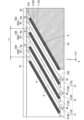
- the generator base flange 53 has a plurality of grooves 54 provided along the Y direction, which is a predetermined forming direction. Each of the plurality of grooves 54 serves as a groove for installing an electrode structure.
- the plurality of grooves 54 are provided discretely from each other, and each of the plurality of grooves 54 has a holding space S54 extending along the gas flow direction FG (FG1, FG2).
- the gas flow direction FG1 shown in FIG. 2 is the flow direction of the source gas G1
- the gas flow direction FG2 is the flow direction of the active gas G2.
- the gas flow direction FG1 and the gas flow direction FG2 are the same direction.
- gas flow directions FG1 and FG2 are collectively referred to, they will simply be referred to as "gas flow direction FG.”
- a wafer support stand 57 which is a substrate support stand, is provided in the active gas output space 62 of the chamber 52, and the wafer support stand 57 has an upper substrate mounting surface 57S.
- the wafer support stand 57 can place the wafer 7 serving as a substrate on the substrate placement surface 57S.
- a first number of high voltage electrode structures 13 correspond to a first number of grooves among the plurality of grooves 54, and each of the first number of high voltage electrode structures 13 corresponds to the first number of grooves. It is held within the holding space S54 of the corresponding groove 54 among the several grooves 54.
- a second number of ground electrode structures 14 correspond to a second number of grooves 54 of the plurality of grooves 54, and each of the second number of ground electrode structures 14 corresponds to a second number of grooves 54 of the plurality of grooves 54. 54 is held within the holding space S54 of the corresponding groove 54.
- the second number of ground electrode structures includes a single electrode dielectric film 3 and a single electrode dielectric film 4 having a structure other than the ground electrode structure 14. There is. In the following description, the ground electrode structure 14 will be represented as a second number of ground electrode structures 14.
- the first number of high voltage electrode structures 13 and the second number of ground electrode structures 14 are arranged alternately along the Y direction.
- an AC voltage is applied to the first number of high voltage electrode structures 13 from the high frequency power source 100 via the electrode connection line L1, and the second number of ground electrode structures 13 is connected to the generator base flange. 53 to the ground potential which is a reference potential.
- a ground potential is applied to the generator base flange 53.
- a separation space S56 is provided between the high voltage electrode structure 13 and the ground electrode structure 14 adjacent in the Y direction, and a part of the separation space S56 becomes the discharge space 6.
- the opening on the raw material gas supply space 61 side becomes the gas supply port 6a
- the opening on the active gas output space 62 side becomes the gas jet port 6b.
- Both the gas supply port 6a and the gas jet port 6b have a vertically long slit shape when viewed in plan on the XY plane.
- the direction from the gas supply port 6a to the gas jet port 6b is the gas flow direction FG.
- the gas flow direction FG is set in an oblique direction having a significant predetermined inclination that is not "0" with respect to the vertical direction (Z direction) with respect to the substrate mounting surface 57S. ing.
- the predetermined inclination may be, for example, 30° to 60°.
- the predetermined inclination is determined based on the gas flow rate of the raw material gas that can be input, the area occupied by the generator base flange 53, the size of the chamber 52, and the like.
- the combined structure of the generator cover 51 and the generator base flange 53 realizes the active gas generation function of generating the active gas G2.
- the generator base flange 53 carries a first number of high voltage electrode structures 13 and a second number of ground electrode structures 14.
- the raw material gas G1 is supplied into the raw material gas supply space 61 from the gas supply opening 50 in the upper part of the generator cover 51, and the raw material gas G1 in the raw material gas supply space 61 flows from the gas supply port 6a in the gas flow direction FG1. It is supplied into the discharge space 6 along the line.
- an active gas G2 (a gas containing radicals) is generated from the raw material gas G1 in the discharge space 6.
- the generated active gas G2 is blown onto the wafer 7 in the active gas output space 62 from the gas outlet 6b along the gas flow direction FG2.
- the active gas G2 ejected from the gas ejection port 6b is blown onto the surface of the wafer 7 in the above-mentioned oblique direction. In this way, the combined structure of the generator cover 51 and the generator base flange 53 can realize the active gas generation function.
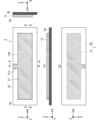
- FIG. 3 is an explanatory diagram showing the structure of the high voltage application electrode section 1, which is a component of the high voltage electrode structure 13.
- 3(a) is a top view
- FIG. 3(b) is a sectional view taken along line AA in FIG. 3(a)
- FIG. 3(c) is a sectional view taken along line BB in FIG. 3(a)
- FIG. d) is a bottom view.
- An XYZ orthogonal coordinate system is shown in each of FIGS. 3(a) to 3(d).
- the direction of stacking is the Z direction
- the long side direction of the rectangular planar area, which will be described later is the X direction
- the short side direction is the Y direction. Therefore, the XYZ orthogonal coordinate system shown in FIGS. 3 to 6 and the XYZ orthogonal coordinate system of the active gas generation device 5 shown in FIGS. 1 and 2 do not match.
- the high voltage application electrode section 1 includes an electrode dielectric film 10 and a metal electrode 11 as main components.
- the electrode dielectric film 10 becomes a first electrode dielectric film constituting the high voltage electrode structure 13
- the metal electrode 11 becomes a first electrode conductive film constituting the high voltage electrode structure 13.
- a metal electrode 11, which is a conductive film for an electrode, is provided on the dielectric film 10 for an electrode.
- the metal electrode 11 is formed on the electrode dielectric film 10 by sputtering, vapor deposition, or printing and baking.
- the metal electrode 11 consists of a main body region 11m and a protruding region 11t, and the main body region 11m has a rectangular planar region when viewed in plan on the XY plane.
- the X direction is the long side direction
- the Y direction is the short side direction.
- the protruding region 11t extends in the +Y direction from the center of the main body region 11m and reaches the long side of the electrode dielectric film 10.
- the electrode dielectric film 10 includes a main body region 11m and has a larger area than the main body region 11m in the XY plane.
- FIG. 4 is an explanatory diagram showing the structure of the ground potential electrode section 2, which is a component of the ground electrode structure 14.
- 4(a) is a top view
- FIG. 4(b) is a sectional view taken along line CC in FIG. 4(a)
- FIG. 4(c) is a sectional view taken along line DD in FIG. 4(a)
- FIG. d) is a bottom view.
- An XYZ orthogonal coordinate system is shown in each of FIGS. 4(a) to 4(d).
- the ground potential electrode section 2 includes an electrode dielectric film 20 and a metal electrode 21 as main components.
- the electrode dielectric film 20 becomes the G21 electrode dielectric film constituting the ground electrode structure 14, and the metal electrode 21 becomes the second electrode conductive film constituting the ground electrode structure 14.
- a metal electrode 21, which is a conductive film for an electrode, is provided on the dielectric film 20 for an electrode.
- the metal electrode 21 is formed on the electrode dielectric film 20 by sputtering, vapor deposition, or printing and baking.
- the metal electrode 21 has a rectangular planar area when viewed in plan on the XY plane.
- the X direction is the long side direction
- the Y direction is the short side direction.
- the lengths of the long sides of the dielectric film 10 for electrodes and the metal electrodes 21 are set to be the same, and the dielectric film 20 for electrodes includes the metal electrodes 21 in the Y direction and has short sides longer than the metal electrodes 21. There is.
- FIG. 5 is an explanatory diagram showing the structure of the dielectric film 3 for single electrode.
- 5(a) is a top view
- FIG. 5(b) is a sectional view taken along line EE in FIG. 5(a)
- FIG. 5(c) is a sectional view taken along line FF in FIG. 5(a).
- An XYZ orthogonal coordinate system is shown in each of FIGS. 5(a) to 5(c).
- the single electrode dielectric film 3 is composed of only the electrode dielectric film 30, and the electrode dielectric film 30 (single electrode dielectric film 3) has a rectangular shape when viewed in plan on the XY plane. It has a flat area of the shape.
- the X direction is the long side direction
- the Y direction is the short side direction.
- a notch 33 is provided at the center of both short sides of the electrode dielectric film 30.
- the planar area of the electrode dielectric film 30 is approximately the same size as the planar area of the electrode dielectric film 10 and the electrode dielectric film 20. Normally, it is desirable that the planar area of the electrode dielectric film 30 be set to be the same as the planar area of each of the electrode dielectric films 10 and 20.
- the single electrode dielectric film 3 is used in the following first to third embodiments.
- the first embodiment is an embodiment used as an auxiliary component of the high voltage electrode structure 13.
- the second embodiment is an embodiment used as an auxiliary component of the ground electrode structure 14.
- the third embodiment is an embodiment in which only the single electrode dielectric film 3 is used independently.
- electrode dielectric film 30 when used in the first and second embodiments, it will be referred to as “electrode dielectric film 30", and when used in the third embodiment, it will be referred to as “single electrode dielectric film 3". .
- FIG. 6 is an explanatory diagram showing the structure of the single electrode dielectric film 4.
- 6(a) is a top view
- FIG. 6(b) is a sectional view taken along line GG in FIG. 6(a)
- FIG. 6(c) is a sectional view taken along line HH in FIG. 6(a).
- An XYZ orthogonal coordinate system is shown in each of FIGS. 6(a) to 6(c).
- the single electrode dielectric film 4 is composed of only the electrode dielectric film 40, and the electrode dielectric film 40 (single electrode dielectric film 4) has a rectangular shape when viewed in plan on the XY plane. It has a flat area of the shape.
- the X direction is the long side direction
- the Y direction is the short side direction.
- the planar area of the electrode dielectric film 40 is approximately the same size as the planar area of the electrode dielectric film 10. It is desirable that the planar area of the electrode dielectric film 40 be set to be the same as the planar area of the electrode dielectric film 10.
- FIGS. 7 and 8 are explanatory diagrams showing how the high voltage electrode structure 13 and the ground electrode structure 140 (14, 3, 4) are held in the plurality of grooves 54.
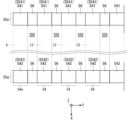
- a plurality of grooves 54 are provided along the Y direction, which is a predetermined formation direction. As shown in FIG. 8, the plurality of grooves 54 are provided separately from each other, and each of the plurality of grooves 54 has a holding space S54.
- the high voltage electrode structure 13 has a first composite structure consisting of an electrode dielectric film 10, a metal electrode 11, and an electrode dielectric film 30. Contains.
- the electrode dielectric film 10 becomes a first electrode dielectric film
- the metal electrode 11 becomes a first electrode conductive film
- the electrode dielectric film 30 becomes a first auxiliary dielectric film.
- the electrode dielectric film 30 serving as the first auxiliary dielectric film is used in the first embodiment described above.
- the planar area of the electrode dielectric film 10 and the metal electrode 11 and the planar area of the electrode dielectric film 30 become a first planar area in the high voltage electrode structure 13.
- the electrode dielectric film 10, the metal electrode 11, and the electrode dielectric film 30 are laminated in this order, and the metal electrode 11 is connected to the electrode connecting line L1 (see FIGS. 1 and 2) from the high frequency power source 100. ), an alternating current voltage is applied through the As shown in FIG. 3, since the metal electrode 11 has a protruding region 11t, the high voltage electrode structure is 13 can be held within the holding space S54 of the groove 54. Therefore, by connecting the electrode connection line L1 to the protruding region 11t of the metal electrode 11, an AC voltage can be applied to the metal electrode 11 from the high frequency power source 100 relatively easily.
- the ground electrode structure 14 includes a second composite structure consisting of an electrode dielectric film 20, a metal electrode 21, and an electrode dielectric film 30. I'm here.
- the electrode dielectric film 20 becomes a second electrode dielectric film
- the metal electrode 21 becomes a second electrode conductive film
- the electrode dielectric film 30 becomes a second auxiliary dielectric film.
- the electrode dielectric film 30, which becomes the second auxiliary dielectric film, is used in the second embodiment described above.
- the plane area of the electrode dielectric film 20 and the metal electrode 21 and the plane area of the electrode dielectric film 30 become a second plane area in the ground electrode structure 14.
- the electrode dielectric film 20, the metal electrode 21, and the electrode dielectric film 30 are laminated in this order, and the metal electrode 21 is connected to the generator base flange to which a ground potential, which is a reference potential, is applied. It is set to ground potential via 53.
- the electrode dielectric film 30 has a pair of notches 33 at the center of both short sides, so that electrical connection means such as a metal pin attached to the generator base flange 53 can be easily connected. By directly contacting the metal electrode 21 through the notch 33, the ground electrode structure 14 can be set to the ground potential.
- the single electrode dielectric film 3 is used alone as the third embodiment.
- the single electrode dielectric film 3 used in the third embodiment is configured as a part of the ground electrode structure.
- the single electrode dielectric film 4 is also configured as a part of the ground electrode structure.
- the second number of ground electrode structures includes the ground electrode structure 14, the single electrode dielectric film 3, and the single electrode dielectric film 4.
- the ground electrode structure 14, the single electrode dielectric film 3, and the single electrode dielectric film 4 may be collectively referred to as the "ground electrode structure 140.”
- the single electrode dielectric film 3 shown in FIGS. 5 and 7(a), the high voltage electrode structure 13 shown in FIGS. 7(b) and 7(e), and FIGS. 7(c) and 7(d) ) and the single electrode dielectric film 4 shown in FIG. 6 are placed inside the holding space S54 of the plurality of grooves 54 provided in the generator base flange 53 shown in FIG. is held in
- the first number of high voltage electrode structures 13 and the first number of grooves 54 among the plurality of grooves 54 correspond to each other, and the first number of high voltage electrode structures 13 correspond to the first number of grooves 54 among the plurality of grooves 54. 13 are each held within the holding space S54 of the corresponding groove 54 among the first number of grooves 54.
- a second number of ground electrode structures 140 and a second number of grooves 54 of the plurality of grooves 54 correspond, and each of the second number of ground electrode structures 140 corresponds to a second number of grooves 54 of the plurality of grooves 54.
- 54 is held within the holding space S54 of the corresponding groove 54.
- the first number of high-voltage electrode structures 13 and the second number of ground electrode structures 140 are arranged alternately along the Y direction, with the first planar area of each of the first number of high-voltage electrode structures 13 and the second planar area of each of the second number of ground electrode structures 140 facing each other across a separation space S56.
- the second number of grooves 54 includes a pair of outermost grooves 54e located outermost in the Y direction among the plurality of grooves 54.
- the holding spaces S54 of each of the pair of outermost grooves 54e are referred to as outermost holding spaces S54e.
- the single electrode dielectric film 3 is held in the outermost holding space S54e of the outermost groove 54e on the +Y direction side, and the single electrode dielectric film 4 is held in the outermost holding space S54e of the outermost groove 54e on the -Y direction side. held within.
- the width of the outermost holding space S54e is approximately the same as the thickness of the single electrode dielectric film 3 (electrode dielectric film 30) or the single electrode dielectric film 4 (electrode dielectric film 40). Set.
- the film thicknesses of the single electrode dielectric film 3 and the single electrode dielectric film 4 are usually set to be the same.
- the width of the holding space S54 excluding the pair of outermost grooves 54e among the plurality of grooves 54 is set to be approximately the same as the film thickness of the high voltage electrode structure 13 or the ground electrode structure 14.
- the film thickness of the high voltage electrode structure 13 is the sum of the film thicknesses of the electrode dielectric film 10, the metal electrode 11, and the electrode dielectric film 30.
- the film thickness of the ground electrode structure 14 is the sum of the film thicknesses of the electrode dielectric film 20, the metal electrode 21, and the electrode dielectric film 30.
- the film thicknesses of the high voltage electrode structure 13 and the ground electrode structure 14 are usually set to be the same.
- a region having a contact relationship with a plane region of the single electrode dielectric film 3 is defined as a first flange contact region.
- This first flange contact area functions as an electrode conductive film corresponding to the single electrode dielectric film 3.
- the plane area of the single electrode dielectric film 4 which is the second plane area of the ground electrode structure 140, is in contact with the generator base flange 53.
- a region having a contact relationship with the plane region of the single electrode dielectric film 4 is defined as a second flange contact region.
- This second flange contact area functions as an electrode conductive film corresponding to the single electrode dielectric film 4.
- the discharge space 6 includes a region where the planar region of the metal electrode 11 and the planar region of the metal electrode 21 face each other in the separation space S56.
- the separation space S56 includes the discharge space 6. However, in the outermost separation space S56 on the +Y direction side, the space where the metal electrode 11 and the above-described first flange contact area face each other becomes the discharge space 6. Similarly, in the outermost separation space S56 on the ⁇ Y direction side, the space where the metal electrode 11 and the above-mentioned second flange contact area face each other becomes the discharge space 6.
- the first number of high voltage electrode structures 13 or the second number of ground electrode structures are arranged in the holding spaces S54 of all the plurality of grooves 54 provided in the generator base flange 53.
- the body 140 is held.
- the combination of the first number of grooves 54 and the second number of grooves 54 is defined as the third number of discharge space forming grooves 54.
- the total number of the plurality of grooves 54 matches the third number.
- the first number is "13" and the second number is “14".
- the third number is "27” and the total number of the plurality of grooves 54 is "27”.
- the single electrode dielectric film 3 and the single electrode dielectric film 4 are inserted into the outermost holding space S54e of the pair of outermost grooves 54e.
- the first and second flange contact areas of the generator base flange 53 each function as an electrode dielectric film.
- the thirteen high voltage electrode structures 13 are held within the holding spaces S54 of the thirteen grooves 54.
- twelve high voltage electrode structures 13 are held within the holding spaces S54 of the twelve grooves 54.
- the high voltage electrode structure 13 and the ground electrode structure 140 are arranged alternately along the Y direction. Ru.
- the high voltage electrode structure 13 is definitely held within the holding space S54 of the groove 54 (referred to as "groove 54x") adjacent to the outermost groove 54e, and adjacent to the groove 54x in the opposite direction to the outermost groove 54e.
- the ground electrode structure 14 is always held within the holding space S54 of the groove 54. Thereafter, the high voltage electrode structures 13 and the ground electrode structures 140 are alternately arranged along the Y direction.
- One unit of discharge cell can be constituted by the adjacent high voltage electrode structure 13 and the ground electrode structure 140, and the discharge space 6 between the adjacent high voltage electrode structure 13 and the ground electrode structure 140. Therefore, when the above specific example is applied to the basic mode, a total of 26 discharge cells (discharge spaces 6) will be configured within the generator base flange 53.
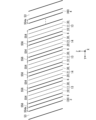
- FIG. 9 is an explanatory diagram showing the overall structure of the generator base flange 53.
- 9(a) is a top view
- FIG. 9(b) is a sectional view taken along line II in FIG. 9(a)
- FIG. 9(c) is a bottom view.
- FIG. 10 is an explanatory diagram showing the structure of the regions of interest S2 and S3 in FIG.
- FIGS. 9 and 12 are perspective views showing the overall structure of the generator base flange 53, respectively, and FIG. 11 shows a first number of high voltage electrode structures 13 and a second number of ground electrode structures 140 held together. 12 shows the completed state after the first number of high voltage electrode structures 13 and the second number of ground electrode structures 140 are retained.
- An XYZ orthogonal coordinate system is shown in each of FIGS. 9 to 12.
- the generator base flange 53 which is a structure for a discharge space, includes an opening region 55 that penetrates inside.
- the opening region 55 has a pair of opening edges 55e that face each other in the X direction, which is an opposing direction that intersects at right angles to the Y direction, which is a predetermined forming direction.
- each of the plurality of grooves 54 is composed of a pair of partial grooves 541 and 542. That is, each of the plurality of grooves 54 includes a pair of partial grooves 541 and 542 provided in a pair of opening edges 55e.
- a plurality of partial grooves 541 are provided on the opening edge 55e of the opening region 55 on the -X direction side, and a plurality of partial grooves 542 are provided on the opening edge 55e of the opening region 55 on the +X direction side.
- the plurality of partial grooves 541 have partial holding spaces S541 that extend in the -Z direction and have a predetermined inclination with respect to the vertical direction (Z direction).
- each of the plurality of partial grooves 542 has a partial holding space S542 extending toward the ⁇ Z direction with a predetermined inclination.
- the holding space S54 of the groove 54 includes the partial holding space S541 and the partial holding space S542 of the partial grooves 541 and 542.
- the predetermined inclination of each of the pair of partial holding spaces S541 and S542 is a space extending in a space forming direction that matches the gas flow direction FG.
- the partial holding space S541 includes a bottom (not shown) provided below the opening edge 55e on the ⁇ X direction side, a pair of groove side wall portions 56 sandwiching the partial holding space S541, and a ⁇ X direction side corresponding to the partial holding space S541. This is a space surrounded by the exposed surface of the opening edge 55e.
- the partial holding space S542 includes a bottom (not shown) provided below the opening edge 55e on the +X direction side, a pair of groove side wall portions 56 sandwiching the partial holding space S542, and a +X direction corresponding to the partial holding space S542. This is a space surrounded by the exposed surface of the side opening edge 55e.
- the short side region on the ⁇ X direction side of the single electrode dielectric film 4 is held in the partial holding space S541, and the short side on the +X direction side The area is held in the partial holding space S542.
- the single electrode dielectric film 4 is held in the holding space S54 of the outermost groove 54e.
- groove 54 ⁇ adjacent to the outermost groove 54e, the short side region on the ⁇ X direction side of the high voltage electrode structure 13 is held in the partial holding space S541, and the short side region on the +X direction side The area is held in the partial holding space S542. As a result, the high voltage electrode structure 13 is held in the holding space S54 of the groove 54 ⁇ .
- groove 54 ⁇ adjacent to the groove 54 ⁇ on the +Y direction side, the short side region on the ⁇ X direction side of the ground electrode structure 14 is held in the partial holding space S541, and the short side region on the +X direction side The side area is held in the partial holding space S542. As a result, the ground electrode structure 14 is held in the holding space S54 of the groove 54 ⁇ .
- the high voltage electrode structure 13 and the ground electrode structure 14 are held alternately in the holding space S54 of the groove 54, and the single electrode dielectric film 3 is held in the holding space S54 of the outermost groove 54e on the +Y direction side. is retained.
- each of the plurality of grooves 54 becomes the holding space S54 (S541 and S542), and the first number of high voltage electrode structures 13 have a pair of partial holding spaces at both ends of each first plane area. It is held within spaces S541 and S542.
- a pair of short side regions of each of the electrode dielectric film 10 and the electrode dielectric film 30 correspond to both ends of the first plane region of the high voltage electrode structure 13 . Therefore, most of the first plane region of the high voltage electrode structure 13 except for the pair of short side regions is exposed within the opening region 55.
- both ends of the second number of ground electrode structures 140 are held within a pair of partial holding spaces S541 and S542.
- the ends of the second planar region correspond to a pair of short side regions of each of the electrode dielectric film 20, the metal electrode 21, and the electrode dielectric film 30.
- the two ends of the second planar area correspond to a pair of short side regions of the dielectric film 3 for a single electrode (30), and the dielectric film 4 for a single electrode
- the pair of short side regions of the single electrode dielectric film 4 (40) correspond.
- the separation space S56 provided between the high voltage electrode structure 13 and the ground electrode structure 140 adjacent in the Y direction also has a predetermined inclination toward the ⁇ Z direction.
- the gas flow direction FG from the gas supply port 6a to the gas jet port 6b also has a predetermined inclination toward the -Z direction.
- the twelve ground electrode structures 14 are held in the holding spaces S54 of the twelve grooves 54.
- the metal electrode 21 of the ground electrode structure 14 is in contact with the groove side wall portion 56 via electrical connection means such as a metal pin. That is, in the above-described second composite structure of the ground electrode structure 14, the metal electrode 21, which is the second electrode conductive film, has an electrical connection relationship with the generator base flange 53, which is the discharge space structure.
- an AC voltage is applied from the high frequency power supply 100 to the metal electrodes 11 of the first number of high voltage electrode structures 13 via the electrode connection line L1.
- the metal electrode 21 of the ground electrode structure 14 is set to the ground potential of the reference battery via the generator base flange 53 by contacting the groove side wall portion 56 via a metal pin or the like. Further, since the generator base flange 53 is provided with a ground potential, the first and second flange contact regions described above are set to the ground potential.
- dielectric barrier discharge occurs within the discharge space 6 of each of the plurality of discharge cells provided on the generator base flange 53.
- the raw material gas G1 supplied from the gas supply opening 50 into the raw material gas supply space 61 is activated when passing through the discharge space 6 and becomes active gas G2, which flows into the chamber 52 along the gas flow direction FG.
- the activated gas is supplied to the active gas output space 62 and sprayed onto the wafer 7 placed on the substrate mounting surface 57S of the wafer support stand 57.
- the manufacturing process using the active gas G2 on the surface of the wafer 7 is performed.
- the active gas G2 is ejected from the gas ejection port 6b in the discharge space 6 along the gas flow direction FG.
- the gas ejection port 6b is slit-shaped, and the gas flow direction FG is set at a significant predetermined inclination from the perpendicular direction (+Z direction) to the surface of the wafer 7, which is the substrate.
- FIG. 13 is an explanatory diagram schematically showing the structure of the pressing member 70.
- FIG. 13 shows an XYZ orthogonal coordinate system.
- the pressing member 70 includes a member main body 71 and a plurality of pressing protruding regions 72 as main components.
- the plurality of pressing protruding regions 72 are provided below the member main body 71 along the Y direction so as to correspond one-to-one to the plurality of grooves 54.
- Each of the plurality of pressing protruding regions 72 has an acute downward tip.
- the formation intervals of the plurality of pressing protruding regions 72 are set to be the same as the formation intervals of the plurality of grooves 54 in the generator base flange 53.
- the pressing member 70 holds the first number of high voltage electrode structures 13 and the second number of ground electrode structures 140 by the plurality of grooves 54 in the generator base flange 53. Used after completion state.
- the pressing member 70 by applying a pressing force to the pressing member 70 in the -Z direction with the tips of the plurality of pressing protruding regions 72 in contact with the high voltage electrode structure 13 or the ground electrode structure 140,
- the first number of high voltage electrode structures 13 and the second number of ground electrode structures 140 arranged in the holding spaces S54 of the plurality of grooves 54 can be pressed by the plurality of pressing protruding regions 72.
- the active gas generation device 5 of the present embodiment can stably hold the first number of high voltage electrode structures 13 and the second number of ground electrode structures 140 within the holding space S54 of the plurality of grooves 54. It can be fixed in a held position.
- the high voltage electrode structure 13 and the ground electrode structure 140 are adjacent to each other in the Y direction, which is the predetermined formation direction, and the high voltage electrode structure 12 is adjacent to each other in the Y direction, which is the predetermined formation direction.
- the discharge space 6 between the ground electrode structures 140 constitutes one unit of discharge cell. Therefore, by setting at least one of the first number and the second number to "2" or more, a plurality of discharge cells can be provided in the generator base flange 53, which is a discharge space structure.
- activated gas G2 is generated by activating the source gas G1 supplied from the source gas supply space 61 through the gas supply port 6a of the discharge space 6 within the discharge space 6.
- the active gas G2 is ejected from the gas ejection port 6b of the discharge space 6 toward the active gas output space 62.
- the active gas generation device 5 of this embodiment most of the gas flow path from the gas supply port 6a to the gas jet port 6b can be made into the discharge space 6, and the gas flow path is free from any structure that becomes an obstacle. There is no need to provide it. Therefore, in the active gas generation device 5 of the present embodiment, the flow of the active gas G2 in the discharge space 6 is smooth, so that deactivation of the active gas G2 can be effectively suppressed.
- the active gas generation device 5 of this embodiment has a structure that allows the active gas G2 to flow smoothly. By realizing such a flow of the active gas G2, unnecessary deactivation of radicals in the active gas G2 is suppressed.
- the active gas generation device 5 of this embodiment can supply highly concentrated active gas G2 to the downstream active gas output space 62 from the gas jet ports 6b of each of the plurality of discharge cells.
- the active gas generation device 5 of this embodiment does not need to provide a gas supply hole or a gas ejection hole in the high voltage electrode structure 13 or the ground electrode structure 140, so the discharge space 6 of each of the plurality of discharge cells A sufficiently large volume can be secured.
- the active gas generation device 5 of the present embodiment holds both short side ends of the first number of high voltage electrode structures 13 within the holding space S54 of the first number of grooves 54, Since a plurality of discharge cells can be configured with a relatively simple structure in which both short side ends of the second number of ground electrode structures 140 are held within the holding spaces S54 of the second number of grooves 54, Manufacturing costs can be reduced.
- the high voltage application electrode section 1 and the electrode dielectric film 30 are simply held within the holding space S54 of the groove 54.
- the ground electrode structure 14 the ground potential electrode portion 2 and the electrode dielectric film 30 are simply held within the holding space S54 of the groove 54.
- the high voltage electrode structure 13 does not require any extra work steps or components such as bonding or a gripping mechanism between the high voltage application electrode section 1 and the electrode dielectric film 30.
- the ground electrode structure 14 does not require extra work steps or parts such as bonding or a gripping mechanism between the ground potential electrode portion 2 and the electrode dielectric film 30.
- the active gas generation device 5 of this embodiment has a very simple structure and is provided with a plurality of discharge cells.
- the gas flow direction FG from the gas supply port 6a to the gas jet port 6b of the discharge space 6 has a significant predetermined inclination (for example, 30°) that is not "0" with respect to the direction (Z direction) perpendicular to the substrate mounting surface 57S. ⁇ 60°). Therefore, the active gas G2 ejected from the slit-shaped gas ejection port 6b comes into contact with the surface of the wafer 7 placed on the substrate mounting surface 57S with a significant inclination, and then the active gas G2 Go smoothly on the surface of 7.
- a significant predetermined inclination for example, 30°
- deactivation of the active gas G2 due to collision of the active gas G2 on the surface of the wafer 7 can be suppressed without reducing the flow velocity of the active gas G2 ejected from the gas ejection port 6b.
- the active gas generation device 5 of this embodiment can supply highly concentrated active gas G2 to a relatively wide area on the surface of the wafer 7 at a desired flow rate.
- the first number of high voltage electrode structures 13 and the second number of ground electrode structures 140 are installed obliquely with respect to the substrate mounting surface 57S on which the wafer 7 is mounted.
- the gas flow direction FG of the active gas G2 containing radicals contacts the surface of the wafer 7 at an angle. Therefore, by preventing sudden collisions of the active gas G2 along the vertical direction, unnecessary deactivation of radicals in the active gas G2 is prevented, and by preventing a decrease in the gas flow velocity of the active gas G2, the wafer 7 enables a wide range of manufacturing processes on the surface of
- the holding space S54 of each of the plurality of grooves 54 includes a pair of partial holding spaces S541 and S542, each extending in a space forming direction that matches the gas flow direction FG. There is.
- the gas flow direction FG in the discharge spaces 6 of the plurality of discharge cells provided in the generator base flange 53 of the active gas generation device 5 of the present embodiment can be set in a diagonal direction relatively easily.
- a discharge space 6 is provided between the first composite structure of the high voltage electrode assembly 13 and the second composite structure of the ground electrode assembly 14.
- the active gas generation device 5 of the present embodiment can activate the raw material gas G1 by the dielectric barrier discharge generated in the discharge space 6 to generate the active gas G2.
- the pressure within the discharge space 6 needs to be set to 75 Torr (10 kPa) or higher.
- the pressure in the active gas output space 62 is also reduced like the discharge space 6. It can be set to 75 Torr or more. Note that it is possible to set the pressure within the discharge space 6 to 75 Torr or more using existing technology.
- the active gas generation device 5 of this embodiment can relatively easily apply high-pressure film formation processing to the wafer 7 in the active gas output space 62.
- the metal electrode 21 of the ground electrode structure 14 has an electrical connection with the groove side wall portion 56 of the generator base flange 53. That is, in the above-described second composite structure of the ground electrode structure 14, the metal electrode 21, which is the second electrode conductive film, is connected to the discharge space structure, which is the discharge space structure, through electrical connection means such as metal pins. It is electrically connected to the container base flange 53.
- the active gas generation device 5 of this embodiment can relatively easily set the ground electrode structure 14 to the ground potential using electrical connection means such as metal pins.
- the single electrode dielectric film 3 or the single electrode dielectric film 4 disposed in the holding space S54 of the outermost groove 54e is connected to the first and second flange contact areas of the generator base flange 53 to which a ground potential is applied. is used as a conductive film for electrodes. Therefore, the high voltage electrode structure 13 and the single electrode dielectric film 3 (4) that are adjacent to each other in the Y direction, and the high voltage electrode structure 13 and the single electrode dielectric film 3 (4) that are adjacent to each other in the Y direction.
- the outermost discharge cell can be configured by the discharge space 6 between the two.
- the ground electrode structure 140 held within the outermost holding space S54e of the outermost groove 54e can be formed of only the single electrode dielectric film 3 (4), the device configuration can be simplified.
- the combination of the first number of grooves 54 and the second number of grooves 54 is defined as a third number of actually used grooves 54u.
- some of the plurality of grooves 54 become the third number of actually used grooves 54u.
- the six grooves 54 become a fourth number (“6”) of unused grooves 54z in which neither the high voltage electrode structure 13 nor the ground electrode structure 140 is inserted.
- the plurality of grooves 54 are classified into a third number of actually used grooves 54u and a fourth number of unused grooves 54z.
- all the plurality of grooves 54 become the third number of actually used grooves 54u.
- the supply area of the active gas G2 in the active gas output space 62 can be set to a desired width. Can be done.
- the processing area for the wafer 7 is relatively small, by setting the third number smaller than the total number of the plurality of grooves 54, it is possible to set the active gas G2 supply area suitable for the processing area.
- the third number of actually used grooves 54u can be increased or decreased depending on the basic mode and the modified mode.
- the size of the discharge space 6 of each discharge cell is always constant regardless of the third number. Therefore, since the radical density of the active gas G2 ejected from the gas ejection port 6b is constant without depending on the third number, the film formation range on the wafer 7, etc. can be adjusted without changing the processing time for the wafer 7. It becomes possible to change.
- the unused separation space S56z means a virtual separation space including the discharge space 6 when the high voltage electrode structure 13 or the ground electrode structure 140 is held in the holding space S54 of the unused groove 54z.
- FIG. 14 is an explanatory diagram schematically showing an example of how the blank component 80 for the unused groove 54z is used.
- the blank component 80 includes a component body 81 and a pair of groove protrusions 82 as main components.
- the groove protrusion 82 on the ⁇ X direction side has the same formation width as that of the partial holding space S541 of the unused groove 54z, and It has the same shape growth as the shape growth of 56).
- the groove protrusion 82 on the +X direction side has the same formation width as the formation width of the partial holding space S542 of the unused groove 54z (not shown in FIG. 14), and It has the same shape growth as that of the partial holding space S542 (groove side wall portion 56).
- the component main body 81 has the same formation width as the overall formation width of the partial holding space S541 and the unused separation space S56z, and has the same shape growth as the distance between the groove side wall parts 56, 56 facing each other in the X direction. have.
- the holding space S54 of the unused groove 54z is (partial holding spaces S541 and S542) and unused separation space S56z can be closed. Therefore, when the active gas generation device 5 is used, the raw material gas G1 and the like do not pass through the holding space S54 of the unused groove 54z and the unused separation space S56z.
- the modified form of the active gas generation device 5 further includes blank parts 80 arranged so as to close the holding spaces S54 of the fourth number of unused grooves 54z and the fourth number of unused separation spaces S56z. We are prepared.
- the blank component 80 blocks the flow of gas in the holding space S54 of the unused groove 54z and the unused separation space S56z, so even if the fourth number of unused grooves 54z is provided, the concentration remains The properties of the active gas G2, including its flow rate and velocity, are not adversely affected.
Landscapes
- Physics & Mathematics (AREA)
- Engineering & Computer Science (AREA)
- Plasma & Fusion (AREA)
- Chemical & Material Sciences (AREA)
- Analytical Chemistry (AREA)
- Spectroscopy & Molecular Physics (AREA)
- Plasma Technology (AREA)
- Physical Or Chemical Processes And Apparatus (AREA)
- Electrostatic Separation (AREA)
- Electrolytic Production Of Non-Metals, Compounds, Apparatuses Therefor (AREA)
Priority Applications (7)
| Application Number | Priority Date | Filing Date | Title |
|---|---|---|---|
| KR1020247009854A KR102939982B1 (ko) | 2022-09-14 | 2022-09-14 | 활성 가스 생성 장치 |
| PCT/JP2022/034306 WO2024057424A1 (ja) | 2022-09-14 | 2022-09-14 | 活性ガス生成装置 |
| CN202280065345.8A CN118044338A (zh) | 2022-09-14 | 2022-09-14 | 活性气体生成装置 |
| US18/700,848 US20240429028A1 (en) | 2022-09-14 | 2022-09-14 | Active gas generation apparatus |
| EP22958754.8A EP4401514A4 (en) | 2022-09-14 | 2022-09-14 | ACTIVE GAS GENERATION DEVICE |
| JP2023517797A JP7366513B1 (ja) | 2022-09-14 | 2022-09-14 | 活性ガス生成装置 |
| TW112122746A TWI875036B (zh) | 2022-09-14 | 2023-06-16 | 活性氣體生成裝置 |
Applications Claiming Priority (1)
| Application Number | Priority Date | Filing Date | Title |
|---|---|---|---|
| PCT/JP2022/034306 WO2024057424A1 (ja) | 2022-09-14 | 2022-09-14 | 活性ガス生成装置 |
Publications (1)
| Publication Number | Publication Date |
|---|---|
| WO2024057424A1 true WO2024057424A1 (ja) | 2024-03-21 |
Family
ID=88418527
Family Applications (1)
| Application Number | Title | Priority Date | Filing Date |
|---|---|---|---|
| PCT/JP2022/034306 Ceased WO2024057424A1 (ja) | 2022-09-14 | 2022-09-14 | 活性ガス生成装置 |
Country Status (7)
| Country | Link |
|---|---|
| US (1) | US20240429028A1 (https=) |
| EP (1) | EP4401514A4 (https=) |
| JP (1) | JP7366513B1 (https=) |
| KR (1) | KR102939982B1 (https=) |
| CN (1) | CN118044338A (https=) |
| TW (1) | TWI875036B (https=) |
| WO (1) | WO2024057424A1 (https=) |
Citations (6)
| Publication number | Priority date | Publication date | Assignee | Title |
|---|---|---|---|---|
| JPS557564A (en) * | 1978-06-30 | 1980-01-19 | Sumitomo Precision Prod Co Ltd | Ozonizer |
| JPH071592U (ja) * | 1993-06-10 | 1995-01-10 | 啓平 李 | コロナ発生器 |
| WO2005005798A1 (ja) * | 2003-07-10 | 2005-01-20 | Ngk Insulators, Ltd. | プラズマ発生電極及びプラズマ反応器 |
| JP2014094863A (ja) * | 2012-11-09 | 2014-05-22 | Wakomu:Kk | オゾン発生装置、及び、オゾン発生方法 |
| US20160233059A1 (en) * | 2015-02-06 | 2016-08-11 | Ionfield Holdings, Llc | Methods and systems for generating plasma to clean objects |
| JP6719856B2 (ja) | 2018-01-10 | 2020-07-08 | 東芝三菱電機産業システム株式会社 | 活性ガス生成装置及び成膜処理装置 |
Family Cites Families (5)
| Publication number | Priority date | Publication date | Assignee | Title |
|---|---|---|---|---|
| US7767167B2 (en) * | 2003-07-28 | 2010-08-03 | Iono2X Engineering, L.L.C. | Dielectric barrier discharge cell with hermetically sealed electrodes, apparatus and method for the treatment of odor and volatile organic compound contaminants in air emissions, and for purifying gases and sterilizing surfaces |
| KR101254342B1 (ko) * | 2006-10-17 | 2013-04-12 | 엘지전자 주식회사 | 플라즈마 발생 장치 |
| US9120073B2 (en) * | 2009-06-05 | 2015-09-01 | Eon Labs, Llc | Distributed dielectric barrier discharge reactor |
| EP2960358A1 (en) * | 2014-06-25 | 2015-12-30 | Nederlandse Organisatie voor toegepast- natuurwetenschappelijk onderzoek TNO | Plasma source and surface treatment method |
| KR102510329B1 (ko) * | 2018-06-25 | 2023-03-17 | 도시바 미쓰비시덴키 산교시스템 가부시키가이샤 | 활성 가스 생성 장치 및 성막 처리 장치 |
-
2022
- 2022-09-14 KR KR1020247009854A patent/KR102939982B1/ko active Active
- 2022-09-14 WO PCT/JP2022/034306 patent/WO2024057424A1/ja not_active Ceased
- 2022-09-14 US US18/700,848 patent/US20240429028A1/en active Pending
- 2022-09-14 EP EP22958754.8A patent/EP4401514A4/en active Pending
- 2022-09-14 CN CN202280065345.8A patent/CN118044338A/zh active Pending
- 2022-09-14 JP JP2023517797A patent/JP7366513B1/ja active Active
-
2023
- 2023-06-16 TW TW112122746A patent/TWI875036B/zh active
Patent Citations (6)
| Publication number | Priority date | Publication date | Assignee | Title |
|---|---|---|---|---|
| JPS557564A (en) * | 1978-06-30 | 1980-01-19 | Sumitomo Precision Prod Co Ltd | Ozonizer |
| JPH071592U (ja) * | 1993-06-10 | 1995-01-10 | 啓平 李 | コロナ発生器 |
| WO2005005798A1 (ja) * | 2003-07-10 | 2005-01-20 | Ngk Insulators, Ltd. | プラズマ発生電極及びプラズマ反応器 |
| JP2014094863A (ja) * | 2012-11-09 | 2014-05-22 | Wakomu:Kk | オゾン発生装置、及び、オゾン発生方法 |
| US20160233059A1 (en) * | 2015-02-06 | 2016-08-11 | Ionfield Holdings, Llc | Methods and systems for generating plasma to clean objects |
| JP6719856B2 (ja) | 2018-01-10 | 2020-07-08 | 東芝三菱電機産業システム株式会社 | 活性ガス生成装置及び成膜処理装置 |
Non-Patent Citations (1)
| Title |
|---|
| See also references of EP4401514A4 |
Also Published As
| Publication number | Publication date |
|---|---|
| JP7366513B1 (ja) | 2023-10-23 |
| TWI875036B (zh) | 2025-03-01 |
| JPWO2024057424A1 (https=) | 2024-03-21 |
| TW202411457A (zh) | 2024-03-16 |
| EP4401514A1 (en) | 2024-07-17 |
| US20240429028A1 (en) | 2024-12-26 |
| KR20240048546A (ko) | 2024-04-15 |
| EP4401514A4 (en) | 2026-02-11 |
| KR102939982B1 (ko) | 2026-03-16 |
| CN118044338A (zh) | 2024-05-14 |
Similar Documents
| Publication | Publication Date | Title |
|---|---|---|
| JP3114739U (ja) | プラズマ反応器のガス分配板電極 | |
| KR930003500B1 (ko) | 잉크제트 시스템용 압전변환기 장치와 이것의 제조방법 | |
| US20210057193A1 (en) | Hollow cathode, an apparatus including a hollow cathode for manufacturing a semiconductor device, and a method of manufacturing a semiconductor device using a hollow cathode | |
| JP2023147625A (ja) | ダイヘッド | |
| TW202019243A (zh) | 電漿產生裝置 | |
| US10793953B2 (en) | Activated gas generation apparatus and film-formation treatment apparatus | |
| EP1646079A1 (en) | Device and method for surface treatment such as plasma treatment | |
| JP2020068350A (ja) | 保持装置 | |
| US10889896B2 (en) | Active gas-generating device and film formation apparatus | |
| JP7366513B1 (ja) | 活性ガス生成装置 | |
| TWI847337B (zh) | 活性氣體生成裝置 | |
| JP2008277774A (ja) | プラズマ処理装置 | |
| JP2765371B2 (ja) | 成膜処理装置 | |
| JPWO2024057424A5 (https=) | ||
| JP7612315B1 (ja) | 活性ガス生成装置 | |
| KR20150027472A (ko) | 가스공급부 | |
| US20170274664A1 (en) | Ink jet head and ink jet device | |
| KR102518875B1 (ko) | 대기압 플라즈마 기판처리장치 | |
| JP3844188B2 (ja) | アクチュエータユニット及びインクジェット式記録ヘッド | |
| WO2023120245A1 (ja) | 基板支持器及びプラズマ処理装置 | |
| KR20230099742A (ko) | 플라즈마 노즐부 및 이를 포함하는 증착 장치 | |
| JPH04133429U (ja) | 半導体製造装置 |
Legal Events
| Date | Code | Title | Description |
|---|---|---|---|
| ENP | Entry into the national phase |
Ref document number: 2023517797 Country of ref document: JP Kind code of ref document: A |
|
| ENP | Entry into the national phase |
Ref document number: 20247009854 Country of ref document: KR Kind code of ref document: A |
|
| WWE | Wipo information: entry into national phase |
Ref document number: 202280065345.8 Country of ref document: CN |
|
| WWE | Wipo information: entry into national phase |
Ref document number: 2022958754 Country of ref document: EP |
|
| WWE | Wipo information: entry into national phase |
Ref document number: 18700848 Country of ref document: US |
|
| ENP | Entry into the national phase |
Ref document number: 2022958754 Country of ref document: EP Effective date: 20240410 |
|
| 121 | Ep: the epo has been informed by wipo that ep was designated in this application |
Ref document number: 22958754 Country of ref document: EP Kind code of ref document: A1 |
|
| NENP | Non-entry into the national phase |
Ref country code: DE |