WO2024048610A1 - 疎水変性処理セルロースファイバーおよびその製造方法 - Google Patents
疎水変性処理セルロースファイバーおよびその製造方法 Download PDFInfo
- Publication number
- WO2024048610A1 WO2024048610A1 PCT/JP2023/031326 JP2023031326W WO2024048610A1 WO 2024048610 A1 WO2024048610 A1 WO 2024048610A1 JP 2023031326 W JP2023031326 W JP 2023031326W WO 2024048610 A1 WO2024048610 A1 WO 2024048610A1
- Authority
- WO
- WIPO (PCT)
- Prior art keywords
- cellulose fiber
- hydrophobically modified
- amide compound
- mass
- cyclic amide
- Prior art date
- Legal status (The legal status is an assumption and is not a legal conclusion. Google has not performed a legal analysis and makes no representation as to the accuracy of the status listed.)
- Ceased
Links
Images


Classifications
-
- C—CHEMISTRY; METALLURGY
- C08—ORGANIC MACROMOLECULAR COMPOUNDS; THEIR PREPARATION OR CHEMICAL WORKING-UP; COMPOSITIONS BASED THEREON
- C08B—POLYSACCHARIDES; DERIVATIVES THEREOF
- C08B1/00—Preparatory treatment of cellulose for making derivatives thereof, e.g. pre-treatment, pre-soaking, activation
- C08B1/003—Preparation of cellulose solutions, i.e. dopes, with different possible solvents, e.g. ionic liquids
-
- C—CHEMISTRY; METALLURGY
- C08—ORGANIC MACROMOLECULAR COMPOUNDS; THEIR PREPARATION OR CHEMICAL WORKING-UP; COMPOSITIONS BASED THEREON
- C08B—POLYSACCHARIDES; DERIVATIVES THEREOF
- C08B3/00—Preparation of cellulose esters of organic acids
- C08B3/14—Preparation of cellulose esters of organic acids in which the organic acid residue contains substituents, e.g. NH2, Cl
-
- C—CHEMISTRY; METALLURGY
- C08—ORGANIC MACROMOLECULAR COMPOUNDS; THEIR PREPARATION OR CHEMICAL WORKING-UP; COMPOSITIONS BASED THEREON
- C08B—POLYSACCHARIDES; DERIVATIVES THEREOF
- C08B15/00—Preparation of other cellulose derivatives or modified cellulose, e.g. complexes
- C08B15/05—Derivatives containing elements other than carbon, hydrogen, oxygen, halogens or sulfur
- C08B15/06—Derivatives containing elements other than carbon, hydrogen, oxygen, halogens or sulfur containing nitrogen, e.g. carbamates
-
- C—CHEMISTRY; METALLURGY
- C08—ORGANIC MACROMOLECULAR COMPOUNDS; THEIR PREPARATION OR CHEMICAL WORKING-UP; COMPOSITIONS BASED THEREON
- C08L—COMPOSITIONS OF MACROMOLECULAR COMPOUNDS
- C08L1/00—Compositions of cellulose, modified cellulose or cellulose derivatives
- C08L1/08—Cellulose derivatives
- C08L1/10—Esters of organic acids, i.e. acylates
Definitions
- the present invention relates to a hydrophobically modified cellulose fiber and a method for producing the same.
- Cellulose fiber is known as one of the materials derived from biomass.
- Cellulose fiber has high hydrophilicity due to the OH groups of glucose units contained in the molecular structure of cellulose.
- cellulose fibers with high hydrophilicity have low compatibility with organic solvents and resins, making it difficult to use them as they are in composite materials.
- Patent Document 1 requires a large amount of acetic anhydride during the hydrophobic modification treatment.
- the reason is as follows.
- Cellulose fibers tend to aggregate when dehydrated. Therefore, the hydrophobic modification treatment is performed by dispersing cellulose fibers in water.
- acetic anhydride irreversibly reacts with water to produce acetic acid.
- the acetic anhydride is consumed by water before it reacts with the cellulose fibers, and the hydrophobic modification treatment of the cellulose fibers does not proceed sufficiently. Therefore, during the hydrophobic modification treatment, it is necessary to add acetic anhydride to react with all the water present in the system and acetic anhydride to hydrophobically modify the cellulose fibers. Acetic acid was required.
- the present invention has been made in view of the above circumstances, and aims to provide a method for efficiently producing hydrophobically modified cellulose fibers using a small amount of hydrophobic modifier, and a hydrophobically modified cellulose fiber obtained by the method. .
- the present invention provides a step of mixing cellulose fiber, a base, and water to prepare an aqueous solution in which the concentration of cellulose fiber is 0.5% by mass or more and 50% by mass or less, and the amount of anhydrous glucose units contained in the cellulose fiber.
- a method for producing a hydrophobically modified cellulose fiber comprising the steps of:
- the present invention further provides a hydrophobically modified cellulose fiber having a structure in which a cyclic amide compound is ring-opening polymerized to the OH groups of cellulose constituting the cellulose fiber.
- hydrophobically modified cellulose fibers can be efficiently produced with a small amount of hydrophobic modifier. Moreover, the hydrophobically modified cellulose fiber obtained by the production method has high affinity with resins and organic solvents, and can be applied to various composite materials.
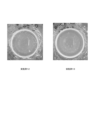
- FIG. 1 is a photograph showing the state of a composition in which the hydrophobically modified cellulose fibers obtained in Examples 1, 3, 4, and 8 were dispersed in an epoxy resin.
- FIG. 2 is a photograph showing the state of a composition in which the (hydrophobically) modified cellulose fibers obtained in Example 11, Comparative Example 1, Comparative Example 3, and Comparative Example 7 are dispersed in an epoxy resin.
- FIG. 3 is a photograph showing the state of a composition in which the hydrophobically modified cellulose fibers obtained in Example 12 and Example 13 were dispersed in an epoxy resin.
- the present invention relates to a method for producing hydrophobically modified cellulose fibers, in which cellulose fibers are hydrophobically modified to improve affinity with various resins and organic solvents.
- acetic anhydride when used as a hydrophobic modifier, a large amount of acetic anhydride is required, which poses problems in terms of cost, manufacturing efficiency, etc.
- a cyclic amide compound is used as a hydrophobic modifier.
- the cyclic amide compound reacts with water in the system, the reaction is reversible. Therefore, when hydrophobically modifying cellulose fibers, the hydrophobic modifier (cyclic amide compound) is not consumed by reaction with water, and the process can be performed efficiently with a small amount of the hydrophobic modifier.
- the method for producing hydrophobically modified cellulose fibers of the present invention involves mixing cellulose fibers, a base, and water to prepare an aqueous solution in which the concentration of cellulose fibers is 0.5% by mass or more and 50% by mass or less. step (hereinafter also referred to as "aqueous solution preparation step"), a cyclic amide compound of 0.2 equivalent or more and 10 equivalents or less based on the amount of anhydrous glucose units contained in the cellulose fiber is added to the above aqueous solution, and the cellulose fiber and cyclic amide compound are added to the above aqueous solution.
- aqueous solution preparation step a cyclic amide compound of 0.2 equivalent or more and 10 equivalents or less based on the amount of anhydrous glucose units contained in the cellulose fiber is added to the above aqueous solution, and the cellulose fiber and cyclic amide compound are added to the above aqueous solution.
- a step of reacting an amide compound (hereinafter also referred to as a “cyclic amide compound reaction step”), a step of further adding an acid to the aqueous solution to neutralize the base (hereinafter also referred to as a “neutralization step”), including.
- the reaction proceeds as shown in the chemical reaction formula shown below.
- Cell in the following formula represents a residue obtained by removing the OH group from the cellulose fiber.
- the chemical reaction formula below shows only one OH group of cellulose fiber, cellulose fiber has many OH groups on its surface, and in reality, multiple OH groups of cellulose fiber are similar. A reaction occurs.
- the OH group represented by the chemical reaction formula below may be any OH group of the glucose unit in the molecular structure of cellulose (fiber). That is, although the glucose unit has three OH groups, the OH groups at any position may react with the cyclic amide compound as described below. In this reaction, only one OH group in the glucose unit may react with the cyclic amide compound, two OH groups may each react with the cyclic amide compound, or all three OH groups may react with the cyclic amide compound. May react with compounds. In the present application, it is considered that the OH group at the 6-position of the glucose unit is particularly likely to react with the cyclic amide compound.
- cellulose fibers, a base (NaOH in the following chemical reaction formula), and water are mixed to prepare an aqueous solution containing cellulose fibers and a base.
- a cyclic amide compound reaction step when a cyclic amide compound (N-methylpyrrolidone (also referred to as "NMP" in the following formula)) is added to the aqueous solution, the cyclic amide compound is reversibly ring-opened by the base in the system. . Further, the cyclic amide compound and the OH groups (O ⁇ Na + groups) on the surface of the base-treated cellulose fiber react, and an ester bond is generated between them.
- NMP N-methylpyrrolidone
- a hydrophobic group is introduced onto the surface of the cellulose fiber, and the cellulose fiber is subjected to a hydrophobic modification treatment.
- the neutralization step it is not necessarily necessary to react the acid with the amine derived from the cyclic amide compound, and for example, it is sufficient to simply neutralize the base in the system with the acid.
- Aqueous solution preparation step In the aqueous solution preparation step, cellulose fibers, a base, and water are mixed to prepare an aqueous solution in which the concentration of cellulose fibers is 0.5% by mass or more and 50% by mass or less.
- the water used in this step is preferably ion-exchanged water in order to suppress side reactions.
- the cellulose fiber used in this step may be any fibrous material containing cellulose, and may partially contain components other than cellulose, such as hemicellulose and lignin.
- components other than cellulose include hydroxyl groups, such as hemicellulose, the hydroxyl groups may react with the cyclic amide compound. Therefore, when the cellulose fiber contains hemicellulose, it is preferable to adjust (increase) the amount of the cyclic amide compound in consideration of the amount of hydroxyl groups contained in components other than cellulose.
- the proportion of cellulose in the cellulose fiber is preferably 30% by mass or more, and more preferably 60% by mass or more.
- the concentration of cellulose in cellulose fibers can be determined by comprehensively evaluating multiple analysis results. Specifically, since hemicellulose and lignin are amorphous, it is possible to determine the amount of cellulose in cellulose fibers by performing sugar analysis using X-ray diffraction or ion chromatography. It is.
- the crystallinity of the cellulose fiber is preferably 50% or more, more preferably 60% or more.
- the crystallinity of the cellulose fiber is 50% or more, when the resulting hydrophobically modified cellulose fiber is used in various composite materials, the mechanical strength of the composite material tends to increase.
- the crystallinity is (crystalline region of cellulose) / ⁇ (crystalline region of cellulose) + (amorphous region of cellulose) + (region derived from non-cellulose (amorphous region)) ⁇ 100. and can be identified by X-ray diffraction, as described above. The Segal method is known as a more specific calculation method.
- the raw material for cellulose fiber is not particularly limited, and examples of raw materials include pulp obtained from wood, bamboo, hemp, jute, kenaf, cotton, beets, agricultural residues, cloth, etc.; recycled materials such as rayon and cellophane; included.
- the above-mentioned pulp may be a chemical pulp obtained by chemically or mechanically treating a plant material. Specifically, sulfite pulp, semi-chemical pulp, chemical ground pulp, chemi-mechanical pulp, ground wood pulp, refiner mechanical pulp, thermo-mechanical pulp, chemi-thermomechanical pulp, deinked waste paper pulp, cardboard waste paper pulp, magazine waste paper pulp, etc. , any pulp may be used.
- the cellulose fibers in this specification include not only completely fibrous fibers, but also cellulose fibers that are rolled into particles, processed or molded into any shape, and the like.
- the average fiber diameter of the cellulose fibers that can be used in this step is 0.02 ⁇ m or more, preferably 1 ⁇ m or more and 100 ⁇ m or less, and more preferably 5 ⁇ m or more and 60 ⁇ m or less.
- the average fiber diameter of the cellulose fiber is 1 ⁇ m or more and 100 ⁇ m or less, it can be obtained at low cost and has good handling properties.
- the average fiber length is preferably 100 ⁇ m or more and 10,000 ⁇ m or less, more preferably 200 ⁇ m or more and 5,000 ⁇ m or less. When the average fiber length of the cellulose fiber is within the above range, the resulting hydrophobically modified cellulose fiber can be easily used for various purposes.
- the above average fiber diameter and fiber length differ depending on the diameter being measured, but are the average values obtained when the fiber diameter and fiber length of 100 or more cellulose fibers are observed by observing the morphology using an optical microscope, electron microscope, AFM, etc. .
- the base is a compound that can open the ring of the cyclic amide compound and promote the reaction between the OH group of the cellulose fiber and the ring-opened form of the cyclic amide compound in the cyclic amide compound reaction step described below. good.
- the base is preferably a compound that can adjust the pH of the aqueous solution to 11 or higher. When the pH of the aqueous solution is 11 or higher, the above reaction is likely to be promoted.
- Examples of the base used in this step include inorganic bases such as alkali metal hydroxides and alkaline earth metal hydroxides; organic bases such as amine compounds.
- alkali metal hydroxides and alkaline earth metal hydroxides that are inorganic bases include sodium hydroxide, potassium hydroxide, lithium hydroxide, calcium hydroxide, and barium hydroxide.
- amine compounds that are organic bases include tertiary amine compounds such as triethylamine, diazabicycloundecene, and diazabicyclononene. In this step, one type of these may be used, or two or more types may be used in combination.
- sodium hydroxide and trimethylamine are preferred from the viewpoint of low cost and the ability to quickly process cellulose fibers, and diazabicycloundecene and diazabicyclononene are more preferred from the viewpoint of being able to proceed with the reaction gently. .
- the method of mixing cellulose fiber, base, and water in the aqueous solution preparation step is not particularly limited, but a mixing method that does not change the crystal structure of cellulose is preferred.
- a mixing method that does not change the crystal structure of cellulose is preferred.
- the crystal structure of cellulose may change. Therefore, in this step, it is preferable to prepare a solution in which cellulose fibers are dispersed in water and a solution in which a base is dispersed in water, and to mix them.
- the concentration of cellulose fiber in the aqueous solution prepared in this step may be 0.5% by mass or more and 50% by mass or less, and preferably 1% by mass or more and 30% by mass or less.
- the concentration of cellulose fiber in the aqueous solution is 0.5% by mass or more, the cellulose fiber can be efficiently hydrophobically modified.
- the concentration of cellulose fiber becomes too high, the viscosity of the aqueous solution increases and becomes difficult to handle, but if it is 50% by mass or less, the viscosity of the aqueous solution can be kept within a desired range.
- the concentration of the inorganic base in the aqueous solution prepared in this step is preferably 1% by mass or more and 10% by mass or less. , more preferably 3% by mass or more and 8% by mass or less.
- the concentration of the inorganic base is 1% by mass or more, the cyclic amide compound and the cellulose fiber will easily react in the cyclic amide compound reaction step described below.
- the concentration of the inorganic base is 10% by mass or less, it will hardly affect the crystal structure of cellulose.
- the amount of the base (amine compound) added is appropriately selected depending on the type, etc., and the pH of the aqueous solution can be set to 11 or more as described above. Any amount is sufficient.
- the stirring time and stirring method are appropriately selected depending on the amount and viscosity (concentration of cellulose fiber) of the aqueous solution. Heat generated by mixing tends to change the crystal structure of cellulose and cause cellulose to decompose. Therefore, when mixing, it is preferable to perform the stirring in multiple steps or to perform the stirring in small amounts at intervals.
- the aqueous solution may be concentrated as necessary.
- the concentration method is not limited, and one example is filtration. At this time, it is preferable to adjust the amount of concentration so that the concentration of cellulose fibers in the aqueous solution after concentration is 0.5% by mass or more and 50% by mass or less, preferably 1% by mass or more and 30% by mass or less.
- the cyclic amide compound reaction step is a step in which a predetermined amount of a cyclic amide compound is added to the aqueous solution, and the cellulose fiber and the cyclic amide compound are reacted.
- a cyclic amide compound is a compound that has a cyclic structure and an amide bond in the cyclic portion, that is, a -NHCO- structure, and opens the ring in the presence of a base to form an ester bond with an OH group on the surface of a cellulose fiber. Any compound may be used.
- Examples of cyclic amide compounds include N-methyl-2-pyrrolidone, N-cyclohexyl-2-pyrrolidone, N-methyl- ⁇ -caprolactam, 2-pyrrolidone, ⁇ -caprolactam, N-dimethylpropylene urea, 1,3- Dimethyl-2-imidazolidinonic acid and various other lactams are included.
- N-methyl-2-pyrrolidone is preferred from the viewpoints of good reactivity and easy availability.
- N-Methyl-2-pyrrolidone does not react with the OH groups inside the crystal structure of cellulose fibers (to maintain the crystal structure), but rather with TEMPO (which is known to interact with the OH groups on the surface of cellulose fibers). It is also suitable because it has a molecular size close to that of (2,2,6,6-tetramethylpiperidine-1-oxyradical).
- the amount of the cyclic amide compound added to the aqueous solution in this step is such that the equivalent amount (hereinafter also referred to as "AGU") to the amount of anhydroglucose units of cellulose fiber in the aqueous solution is 0.2 or more and 10 or less.
- AGU is preferably 0.7 or more and 10 or less, and more preferably 0.7 or more and 1.0 or less.
- cellulose fiber can be sufficiently hydrophobically modified.
- hydrophobically modified cellulose fibers having higher affinity with resins and organic solvents can be obtained.
- AGU is 10 or less
- the amount of excess cyclic amide compound remaining in the system can be reduced.
- AGU is 1.0 or less, it becomes possible to efficiently obtain hydrophobically modified cellulose fibers with a small amount of hydrophobic modifying agent.
- the amount of anhydroglucose units contained in the cellulose fiber is calculated from the mass of the cellulose fiber in the aqueous solution.
- the cellulose fiber is wood flour, lignocellulose, etc. and contains lignin
- the amount of lignin is excluded from the mass of the cellulose fiber for calculation.
- the stirring vessel In this step, after adding the cyclic amide compound, it is preferable to stir the aqueous solution to allow the cyclic amide compound and cellulose fiber to sufficiently react.
- the temperature of the aqueous solution at this time is preferably 5°C or more and 90°C or less, more preferably 10°C or more and 60°C or less.
- the stirring time and stirring method are appropriately selected depending on the amount and viscosity of the aqueous solution.
- the stirring vessel When performing such stirring, in order to prevent changes in the crystal structure of cellulose or decomposition of cellulose due to heat generated by stirring and bases in the system, the stirring vessel must be cooled using a refrigerant or at intervals. It is preferable to perform the stirring in multiple steps.
- the type of acid used in this step is not particularly limited, and may be an inorganic acid such as hydrochloric acid or an organic acid, but an organic acid is more preferable.
- an organic acid is used as the acid, the organic acid reacts with the amino group derived from the cyclic amide compound to form an amide bond. As a result, the organic chains present on the surface of the cellulose fiber become longer, and the hydrophobicity of the resulting hydrophobically modified cellulose fiber is further increased.
- organic acids examples include acetic acid; fatty acids with 3 to 16 carbon atoms such as propionic acid and butyric acid; dicarboxylic acids with 2 to 15 carbon atoms such as oxalic acid; aromatic carboxylic acids such as benzoic acid, phthalic acid, and salicylic acid. Acids; carboxyalkylamino group-containing compounds having an aromatic ring represented by the following chemical formula (hereinafter also referred to as "CP-MABA"); are included. Among these, acetic acid and CP-MABA are preferred from the viewpoint of availability.
- X represents an alkali metal atom or a hydrogen atom.
- the amount of acid to be used is appropriately selected depending on the amount of the above-mentioned base, and it may be added until the aqueous solution becomes neutral.
- a step of washing or drying the hydrophobically modified cellulose fibers may be further performed as necessary.
- hydrophobically modified cellulose fibers produced by the above-described method, that is, hydrophobically modified cellulose fibers containing a structure in which the above-mentioned cyclic amide compound is ring-opening polymerized to the OH group of the cellulose (fiber).
- hydrophobically modified cellulose fibers containing a structure in which the above-mentioned cyclic amide compound is ring-opening polymerized to the OH group of the cellulose (fiber).
- the amine terminal generated by the ring opening of the above-mentioned cyclic amide compound may remain as it is, or the structure derived from the above-mentioned organic acid may be further bonded to the amine. good.
- the hydrophobically modified cellulose fiber includes, for example, the following structure.
- Cell represents a residue obtained by removing an OH group from a glucose unit constituting cellulose.
- X represents a divalent residue obtained by removing a carboxyl group and an amine from the ring-opened product of the above-mentioned cyclic amide compound, and is preferably an alkylene group having 2 or more and 6 or less carbon atoms.
- R 1 represents hydrogen or an alkyl group having 1 or more and 6 or less carbon atoms, and is preferably hydrogen or a methyl group.
- R 2 represents hydrogen or a monovalent group having 1 or more and 10 or less carbon atoms.
- R 2 may contain a carboxy group, carbonyl group, amino group, halogen group, aromatic group, alkyl group, etc. in its structure.
- R 2 include groups derived from organic acids as explained in the above-mentioned production method, and preferably a methyl group or a chlorophenylmethylaminobutyl group.
- cellulose (fiber) contains a large number of OH groups in its molecular structure, it is not necessary that the above-mentioned cyclic amide compound is ring-opening polymerized to all the OH groups. It is sufficient that at least some of the OH groups contain a structure obtained by ring-opening polymerization of the above-mentioned cyclic amide compound.
- the structure can be identified by analysis using, for example, NMR.
- the amount of the ring-opening polymerized structure of the cyclic amide compound contained in the hydrophobically modified cellulose fiber should be an amount that provides affinity with the target resin or organic solvent, and an amount that does not affect the crystal structure of cellulose. It may be selected as appropriate depending on the type of these resins and organic solvents.
- the hydrophobically modified cellulose fiber of the present invention has a high affinity with various resins and organic solvents because the hydrophobic group represented by the above formula is bonded to the cellulose fiber. Therefore, it is possible to easily make a composite material by mixing it with a thermosetting resin, a thermoplastic resin, or an organic solvent. Such composite materials can be used in various applications such as electrical appliances, building materials, vehicles such as automobiles and trains, and aircraft.
- Example 1 Evaluation of dispersibility of cellulose fiber [Example 1]
- Aqueous solution preparation process preparation of base-containing cellulose fiber aqueous solution) 20 g (absolute dry mass) of cellulose fiber (KC Flock W-50GK, manufactured by Nippon Paper Industries) with an absolutely dry rate of 95.1% was immersed in 86 g of ion-exchanged water. Further, 32 g of sodium hydroxide and 262 g of ion-exchanged water were mixed to prepare an aqueous base solution. These were mixed to obtain an aqueous solution having a cellulose fiber concentration of 5% by mass and a base (NaOH) concentration of 8% by mass.
- each 100 g of the obtained aqueous solution was stirred for 200 seconds at 2000 rpm, 97.9 kpa (normal pressure), using Awatori Rentaro (vacuum type, ARV-310P, manufactured by Thinky). This was repeated three times (with an interval time of 600 seconds after the end of one stirring).
- the mixed aqueous solution after stirring was suction-filtered, and the filtration residue was used as a base-containing cellulose fiber aqueous solution.
- the solid content (base-containing cellulose fiber) concentration calculated from the mass of the filtrate was 18.5% by mass, and as a result of dropping a portion onto a pH test paper, the pH was 11 or higher. there were.
- Examples 2 to 5 Hydrophobically modified cellulose fibers were obtained in the same manner as in Example 1, except that the amount of NMP added (AGU) in the reaction step of the cyclic amide compound was changed to the value shown in Table 1.
- AGU NMP added
- Example 11 A hydrophobically modified cellulose fiber was obtained in the same manner as in Example 4, except that the acid in the neutralization step was used as the CP-MABA solution (chlorophenylmethylaminobutanoic acid (CPMABA) as the organic acid). Note that CP-MABA was prepared as follows.
- Example 12 and 13 1,8-diazabicyclo[5.4.0]-7-undecene (1,8-diazabicyclo[5.4.0]-7-undecene ( A mixed solution was prepared by adding 24 g of DBU). The concentration of cellulose fiber in the liquid mixture is 20% by mass, and the concentration of base is 77% by mass. The mixed solution was stirred 10 times for 60 seconds at 2000 rpm, 97.9 kpa (normal pressure) using a foaming Rentaro (vacuum type, ARV-310P, manufactured by Shinky) (interval time after one stirring was completed). 600 seconds). Thereafter, a cyclic amide compound reaction step and a neutralization step were performed in the same manner as in Example 4 or 9 to obtain hydrophobically modified cellulose fibers.
- DBU concentration of cellulose fiber in the liquid mixture is 20% by mass, and the concentration of base is 77% by mass.
- the mixed solution was stirred 10 times for 60 seconds at 2000 rpm, 97.9 kpa (normal
- untreated cellulose fiber (KC Flock W-50GK, manufactured by Nippon Paper Industries Co., Ltd.) was added to BisF type epoxy resin (835LV: manufactured by DIC) so that the cellulose fiber concentration was 5% by mass
- An epoxy composition was prepared by kneading at 2000 rpm, 0.8 kPa, and 300 seconds using a foaming Rentaro (vacuum type, ARV-310P, manufactured by Shinky Co., Ltd.).
- the epoxy resin compositions using the hydrophobically modified cellulose fibers of Examples 4, 9, and 11 had lower viscosity than when unmodified cellulose fibers were used. Ta. It is clear that the affinity between the epoxy resin and the cellulose fibers was increased by the hydrophobic modification treatment. Furthermore, using the hydrophobically modified cellulose fibers of Example 4 neutralized with acetic acid and Example 11 neutralized with CP-MABA solution was better than that of Example 9 neutralized with hydrochloric acid due to the separately measured TI value (thixotropy). index) was low, suppressing friction between cellulose fibers.
- Example 11 which was neutralized with the CP-MABA solution, had a lower TI value and viscosity than Example 4, which was neutralized with acetic acid. Therefore, it can be said that the reaction with CP-MABA having an aromatic ring made it more hydrophobic.
- hydrophobically modified cellulose fibers can be efficiently produced with a small amount of hydrophobic modifier. Moreover, the hydrophobically modified cellulose fiber obtained by the production method has high affinity with resins and organic solvents, and can be applied to various composite materials.
Landscapes
- Chemical & Material Sciences (AREA)
- Health & Medical Sciences (AREA)
- Chemical Kinetics & Catalysis (AREA)
- Medicinal Chemistry (AREA)
- Polymers & Plastics (AREA)
- Organic Chemistry (AREA)
- Life Sciences & Earth Sciences (AREA)
- Engineering & Computer Science (AREA)
- Biochemistry (AREA)
- Materials Engineering (AREA)
- Treatments For Attaching Organic Compounds To Fibrous Goods (AREA)
- Polysaccharides And Polysaccharide Derivatives (AREA)
Priority Applications (4)
| Application Number | Priority Date | Filing Date | Title |
|---|---|---|---|
| US19/106,085 US20260071008A1 (en) | 2022-08-31 | 2023-08-29 | Hydrophobically modified cellulose fibers and method for producing same |
| CN202380061342.1A CN119768440A (zh) | 2022-08-31 | 2023-08-29 | 疏水改性处理纤维素纤维及其制造方法 |
| EP23860372.4A EP4582460A4 (en) | 2022-08-31 | 2023-08-29 | Hydrophobically Modified Cellulose Fibers and Their Production Process |
| JP2024544303A JP7796237B2 (ja) | 2022-08-31 | 2023-08-29 | 疎水変性処理セルロースファイバーおよびその製造方法 |
Applications Claiming Priority (2)
| Application Number | Priority Date | Filing Date | Title |
|---|---|---|---|
| JP2022-138431 | 2022-08-31 | ||
| JP2022138431 | 2022-08-31 |
Publications (1)
| Publication Number | Publication Date |
|---|---|
| WO2024048610A1 true WO2024048610A1 (ja) | 2024-03-07 |
Family
ID=90099627
Family Applications (1)
| Application Number | Title | Priority Date | Filing Date |
|---|---|---|---|
| PCT/JP2023/031326 Ceased WO2024048610A1 (ja) | 2022-08-31 | 2023-08-29 | 疎水変性処理セルロースファイバーおよびその製造方法 |
Country Status (5)
| Country | Link |
|---|---|
| US (1) | US20260071008A1 (https=) |
| EP (1) | EP4582460A4 (https=) |
| JP (1) | JP7796237B2 (https=) |
| CN (1) | CN119768440A (https=) |
| WO (1) | WO2024048610A1 (https=) |
Citations (9)
| Publication number | Priority date | Publication date | Assignee | Title |
|---|---|---|---|---|
| EP2072530A1 (de) * | 2007-12-21 | 2009-06-24 | Dow Wolff Cellulosics GmbH | Verfahren zur Herstellung aminogruppenhaltiger Cellulosederivate in ionischer Flüssigkeit |
| JP2020015813A (ja) * | 2018-07-25 | 2020-01-30 | ユニチカ株式会社 | ポリアミド樹脂組成物 |
| WO2020022153A1 (ja) * | 2018-07-23 | 2020-01-30 | ユニチカ株式会社 | 難燃性樹脂組成物およびその製造方法 |
| JP2020075950A (ja) | 2018-11-05 | 2020-05-21 | 国立大学法人京都大学 | 繊維強化樹脂組成物及びその製造方法、並びに成形体 |
| WO2021085056A1 (ja) * | 2019-10-30 | 2021-05-06 | ユニチカ株式会社 | ポリアミド樹脂組成物およびそれからなる成形体 |
| CN113527664A (zh) * | 2021-09-03 | 2021-10-22 | 青岛科技大学 | 一种纳米纤维素表面接枝尼龙6复合材料的原位制备方法 |
| CN113621082A (zh) * | 2021-09-03 | 2021-11-09 | 青岛科技大学 | 一种纳米纤维素的改性方法及在尼龙6原位开环聚合中的应用 |
| CN114395166A (zh) * | 2022-01-19 | 2022-04-26 | 常州市南挂车辆部件有限公司 | 一种高强度耐磨复合挡泥板及其加工工艺 |
| JP2022138431A (ja) | 2021-03-10 | 2022-09-26 | オルガノ株式会社 | 水処理方法及び水処理装置 |
Family Cites Families (5)
| Publication number | Priority date | Publication date | Assignee | Title |
|---|---|---|---|---|
| JP2510665B2 (ja) * | 1988-03-30 | 1996-06-26 | ダイセル化学工業株式会社 | 多糖エステルの合成法 |
| KR20020070996A (ko) * | 1999-12-21 | 2002-09-11 | 아지노모토 가부시키가이샤 | 질소 함유 카복실산 셀룰로스 부분 에스테르 및 이의제조방법 |
| DK3022340T3 (da) * | 2013-07-18 | 2020-12-21 | Univ Alberta | Parallel organisk syntese på mønstret papir ved brug af et opløsningsmiddel afvisende materiale |
| JPWO2017065037A1 (ja) * | 2015-10-16 | 2018-08-02 | コニカミノルタ株式会社 | 生体適合性樹脂 |
| ES2738913A1 (es) * | 2018-07-26 | 2020-01-27 | Consejo Superior Investigacion | Sensor de humedad |
-
2023
- 2023-08-29 WO PCT/JP2023/031326 patent/WO2024048610A1/ja not_active Ceased
- 2023-08-29 US US19/106,085 patent/US20260071008A1/en active Pending
- 2023-08-29 EP EP23860372.4A patent/EP4582460A4/en active Pending
- 2023-08-29 CN CN202380061342.1A patent/CN119768440A/zh active Pending
- 2023-08-29 JP JP2024544303A patent/JP7796237B2/ja active Active
Patent Citations (9)
| Publication number | Priority date | Publication date | Assignee | Title |
|---|---|---|---|---|
| EP2072530A1 (de) * | 2007-12-21 | 2009-06-24 | Dow Wolff Cellulosics GmbH | Verfahren zur Herstellung aminogruppenhaltiger Cellulosederivate in ionischer Flüssigkeit |
| WO2020022153A1 (ja) * | 2018-07-23 | 2020-01-30 | ユニチカ株式会社 | 難燃性樹脂組成物およびその製造方法 |
| JP2020015813A (ja) * | 2018-07-25 | 2020-01-30 | ユニチカ株式会社 | ポリアミド樹脂組成物 |
| JP2020075950A (ja) | 2018-11-05 | 2020-05-21 | 国立大学法人京都大学 | 繊維強化樹脂組成物及びその製造方法、並びに成形体 |
| WO2021085056A1 (ja) * | 2019-10-30 | 2021-05-06 | ユニチカ株式会社 | ポリアミド樹脂組成物およびそれからなる成形体 |
| JP2022138431A (ja) | 2021-03-10 | 2022-09-26 | オルガノ株式会社 | 水処理方法及び水処理装置 |
| CN113527664A (zh) * | 2021-09-03 | 2021-10-22 | 青岛科技大学 | 一种纳米纤维素表面接枝尼龙6复合材料的原位制备方法 |
| CN113621082A (zh) * | 2021-09-03 | 2021-11-09 | 青岛科技大学 | 一种纳米纤维素的改性方法及在尼龙6原位开环聚合中的应用 |
| CN114395166A (zh) * | 2022-01-19 | 2022-04-26 | 常州市南挂车辆部件有限公司 | 一种高强度耐磨复合挡泥板及其加工工艺 |
Non-Patent Citations (1)
| Title |
|---|
| See also references of EP4582460A4 |
Also Published As
| Publication number | Publication date |
|---|---|
| JPWO2024048610A1 (https=) | 2024-03-07 |
| EP4582460A1 (en) | 2025-07-09 |
| US20260071008A1 (en) | 2026-03-12 |
| EP4582460A4 (en) | 2025-12-03 |
| JP7796237B2 (ja) | 2026-01-08 |
| CN119768440A (zh) | 2025-04-04 |
Similar Documents
| Publication | Publication Date | Title |
|---|---|---|
| JP7252294B2 (ja) | 接着組成物 | |
| JP7435563B2 (ja) | セルロース系樹脂、成形用材料、成形体及びセルロース系樹脂の製造方法 | |
| CN113015711A (zh) | 水性粘合剂组合物 | |
| JP6656960B2 (ja) | リグニンを構成するフェニルプロパン単位のα位が化学修飾されたリグノセルロース誘導体、それを含む繊維、繊維集合体、それらを含有する組成物及び成形体 | |
| JP7688357B2 (ja) | リグニンと多糖類の製造方法 | |
| JP6528684B2 (ja) | セルロース誘導体の製造方法、セルロース誘導体、成形用樹脂組成物および成形体 | |
| JP2024081639A (ja) | 架橋クラフトパルプの組成物及び方法 | |
| KR20200007852A (ko) | 폴리락트산 그라프트화 셀룰로오스 나노파이버 및 그 제조 방법 | |
| JP7231756B2 (ja) | セルロース微細繊維強化ポリアミド樹脂成形体 | |
| WO2016067662A1 (ja) | セルロース誘導体及び成形用樹脂組成物 | |
| CA3008365A1 (en) | Manufacture of nanocellulose and intermediates thereof using oxalic acid dihydrate | |
| WO2017043450A1 (ja) | 改質セルロース繊維 | |
| JP7444669B2 (ja) | 微細セルロース繊維を含む複合粒子、及び複合粒子を含む樹脂組成物 | |
| Jadhav et al. | Synthesis of N-oxyethylene substituted imidazolium-based zwitterions as a recyclable solvent for cellulose dissolution | |
| TW202547919A (zh) | 組合物 | |
| JP7796237B2 (ja) | 疎水変性処理セルロースファイバーおよびその製造方法 | |
| JP6160457B2 (ja) | ロジン変性セルロース、ロジン変性セルロースミクロフィブリル及びこれらの製造方法 | |
| JPWO2018221663A1 (ja) | セルロース系樹脂、成形用材料、成形体及びセルロース系樹脂の製造方法 | |
| WO2019194032A1 (ja) | ソリッド成形材料用樹脂組成物、及びその製造方法、並びにソリッド成形体 | |
| JP7753018B2 (ja) | ポリオール組成物 | |
| JP7712834B2 (ja) | チオール化合物含有組成物 | |
| JP7735139B2 (ja) | アシル化修飾セルロース微細繊維の製造方法 | |
| JP7268694B2 (ja) | セルロースナノファイバー及びリグニン又はそれらの複合体を含む組成物並びにリグノセルロース由来材料の製造方法 | |
| JP2025184834A (ja) | 疎水変性セルロース繊維を含有する組成物の保管方法 | |
| CA3276259A1 (fr) | Method for preparing a thermosetting binder composition based on water-soluble or water-dispersible lignin ester, for binding fibres |
Legal Events
| Date | Code | Title | Description |
|---|---|---|---|
| 121 | Ep: the epo has been informed by wipo that ep was designated in this application |
Ref document number: 23860372 Country of ref document: EP Kind code of ref document: A1 |
|
| WWE | Wipo information: entry into national phase |
Ref document number: 2024544303 Country of ref document: JP |
|
| WWE | Wipo information: entry into national phase |
Ref document number: 202517014990 Country of ref document: IN Ref document number: 202380061342.1 Country of ref document: CN |
|
| WWP | Wipo information: published in national office |
Ref document number: 202517014990 Country of ref document: IN |
|
| WWE | Wipo information: entry into national phase |
Ref document number: 2023860372 Country of ref document: EP |
|
| NENP | Non-entry into the national phase |
Ref country code: DE |
|
| WWP | Wipo information: published in national office |
Ref document number: 202380061342.1 Country of ref document: CN |
|
| ENP | Entry into the national phase |
Ref document number: 2023860372 Country of ref document: EP Effective date: 20250331 |
|
| WWP | Wipo information: published in national office |
Ref document number: 2023860372 Country of ref document: EP |