WO2024029356A1 - 無機基板付偏光板及びその製造方法 - Google Patents
無機基板付偏光板及びその製造方法 Download PDFInfo
- Publication number
- WO2024029356A1 WO2024029356A1 PCT/JP2023/026583 JP2023026583W WO2024029356A1 WO 2024029356 A1 WO2024029356 A1 WO 2024029356A1 JP 2023026583 W JP2023026583 W JP 2023026583W WO 2024029356 A1 WO2024029356 A1 WO 2024029356A1
- Authority
- WO
- WIPO (PCT)
- Prior art keywords
- polarizing plate
- inorganic substrate
- film
- polarizing
- group
- Prior art date
- Legal status (The legal status is an assumption and is not a legal conclusion. Google has not performed a legal analysis and makes no representation as to the accuracy of the status listed.)
- Ceased
Links
Images
Classifications
-
- G—PHYSICS
- G02—OPTICS
- G02B—OPTICAL ELEMENTS, SYSTEMS OR APPARATUS
- G02B5/00—Optical elements other than lenses
- G02B5/30—Polarising elements
-
- B—PERFORMING OPERATIONS; TRANSPORTING
- B32—LAYERED PRODUCTS
- B32B—LAYERED PRODUCTS, i.e. PRODUCTS BUILT-UP OF STRATA OF FLAT OR NON-FLAT, e.g. CELLULAR OR HONEYCOMB, FORM
- B32B7/00—Layered products characterised by the relation between layers; Layered products characterised by the relative orientation of features between layers, or by the relative values of a measurable parameter between layers, i.e. products comprising layers having different physical, chemical or physicochemical properties; Layered products characterised by the interconnection of layers
- B32B7/02—Physical, chemical or physicochemical properties
- B32B7/023—Optical properties
-
- B—PERFORMING OPERATIONS; TRANSPORTING
- B32—LAYERED PRODUCTS
- B32B—LAYERED PRODUCTS, i.e. PRODUCTS BUILT-UP OF STRATA OF FLAT OR NON-FLAT, e.g. CELLULAR OR HONEYCOMB, FORM
- B32B7/00—Layered products characterised by the relation between layers; Layered products characterised by the relative orientation of features between layers, or by the relative values of a measurable parameter between layers, i.e. products comprising layers having different physical, chemical or physicochemical properties; Layered products characterised by the interconnection of layers
- B32B7/04—Interconnection of layers
- B32B7/12—Interconnection of layers using interposed adhesives or interposed materials with bonding properties
-
- B—PERFORMING OPERATIONS; TRANSPORTING
- B32—LAYERED PRODUCTS
- B32B—LAYERED PRODUCTS, i.e. PRODUCTS BUILT-UP OF STRATA OF FLAT OR NON-FLAT, e.g. CELLULAR OR HONEYCOMB, FORM
- B32B9/00—Layered products comprising a layer of a particular substance not covered by groups B32B11/00 - B32B29/00
- B32B9/04—Layered products comprising a layer of a particular substance not covered by groups B32B11/00 - B32B29/00 comprising such particular substance as the main or only constituent of a layer, which is next to another layer of the same or of a different material
- B32B9/045—Layered products comprising a layer of a particular substance not covered by groups B32B11/00 - B32B29/00 comprising such particular substance as the main or only constituent of a layer, which is next to another layer of the same or of a different material of synthetic resin
-
- C—CHEMISTRY; METALLURGY
- C09—DYES; PAINTS; POLISHES; NATURAL RESINS; ADHESIVES; COMPOSITIONS NOT OTHERWISE PROVIDED FOR; APPLICATIONS OF MATERIALS NOT OTHERWISE PROVIDED FOR
- C09J—ADHESIVES; NON-MECHANICAL ASPECTS OF ADHESIVE PROCESSES IN GENERAL; ADHESIVE PROCESSES NOT PROVIDED FOR ELSEWHERE; USE OF MATERIALS AS ADHESIVES
- C09J11/00—Features of adhesives not provided for in group C09J9/00, e.g. additives
- C09J11/02—Non-macromolecular additives
- C09J11/06—Non-macromolecular additives organic
-
- C—CHEMISTRY; METALLURGY
- C09—DYES; PAINTS; POLISHES; NATURAL RESINS; ADHESIVES; COMPOSITIONS NOT OTHERWISE PROVIDED FOR; APPLICATIONS OF MATERIALS NOT OTHERWISE PROVIDED FOR
- C09J—ADHESIVES; NON-MECHANICAL ASPECTS OF ADHESIVE PROCESSES IN GENERAL; ADHESIVE PROCESSES NOT PROVIDED FOR ELSEWHERE; USE OF MATERIALS AS ADHESIVES
- C09J5/00—Adhesive processes in general; Adhesive processes not provided for elsewhere, e.g. relating to primers
- C09J5/02—Adhesive processes in general; Adhesive processes not provided for elsewhere, e.g. relating to primers involving pretreatment of the surfaces to be joined
-
- C—CHEMISTRY; METALLURGY
- C09—DYES; PAINTS; POLISHES; NATURAL RESINS; ADHESIVES; COMPOSITIONS NOT OTHERWISE PROVIDED FOR; APPLICATIONS OF MATERIALS NOT OTHERWISE PROVIDED FOR
- C09J—ADHESIVES; NON-MECHANICAL ASPECTS OF ADHESIVE PROCESSES IN GENERAL; ADHESIVE PROCESSES NOT PROVIDED FOR ELSEWHERE; USE OF MATERIALS AS ADHESIVES
- C09J5/00—Adhesive processes in general; Adhesive processes not provided for elsewhere, e.g. relating to primers
- C09J5/04—Adhesive processes in general; Adhesive processes not provided for elsewhere, e.g. relating to primers involving separate application of adhesive ingredients to the different surfaces to be joined
-
- C—CHEMISTRY; METALLURGY
- C09—DYES; PAINTS; POLISHES; NATURAL RESINS; ADHESIVES; COMPOSITIONS NOT OTHERWISE PROVIDED FOR; APPLICATIONS OF MATERIALS NOT OTHERWISE PROVIDED FOR
- C09J—ADHESIVES; NON-MECHANICAL ASPECTS OF ADHESIVE PROCESSES IN GENERAL; ADHESIVE PROCESSES NOT PROVIDED FOR ELSEWHERE; USE OF MATERIALS AS ADHESIVES
- C09J5/00—Adhesive processes in general; Adhesive processes not provided for elsewhere, e.g. relating to primers
- C09J5/06—Adhesive processes in general; Adhesive processes not provided for elsewhere, e.g. relating to primers involving heating of the applied adhesive
-
- G—PHYSICS
- G02—OPTICS
- G02B—OPTICAL ELEMENTS, SYSTEMS OR APPARATUS
- G02B1/00—Optical elements characterised by the material of which they are made; Optical coatings for optical elements
- G02B1/10—Optical coatings produced by application to, or surface treatment of, optical elements
- G02B1/14—Protective coatings, e.g. hard coatings
-
- G—PHYSICS
- G02—OPTICS
- G02B—OPTICAL ELEMENTS, SYSTEMS OR APPARATUS
- G02B5/00—Optical elements other than lenses
- G02B5/30—Polarising elements
- G02B5/3025—Polarisers, i.e. arrangements capable of producing a definite output polarisation state from an unpolarised input state
- G02B5/3033—Polarisers, i.e. arrangements capable of producing a definite output polarisation state from an unpolarised input state in the form of a thin sheet or foil, e.g. Polaroid
- G02B5/3041—Polarisers, i.e. arrangements capable of producing a definite output polarisation state from an unpolarised input state in the form of a thin sheet or foil, e.g. Polaroid comprising multiple thin layers, e.g. multilayer stacks
- G02B5/305—Polarisers, i.e. arrangements capable of producing a definite output polarisation state from an unpolarised input state in the form of a thin sheet or foil, e.g. Polaroid comprising multiple thin layers, e.g. multilayer stacks including organic materials, e.g. polymeric layers
-
- B—PERFORMING OPERATIONS; TRANSPORTING
- B32—LAYERED PRODUCTS
- B32B—LAYERED PRODUCTS, i.e. PRODUCTS BUILT-UP OF STRATA OF FLAT OR NON-FLAT, e.g. CELLULAR OR HONEYCOMB, FORM
- B32B2307/00—Properties of the layers or laminate
- B32B2307/40—Properties of the layers or laminate having particular optical properties
- B32B2307/42—Polarizing, birefringent, filtering
-
- B—PERFORMING OPERATIONS; TRANSPORTING
- B32—LAYERED PRODUCTS
- B32B—LAYERED PRODUCTS, i.e. PRODUCTS BUILT-UP OF STRATA OF FLAT OR NON-FLAT, e.g. CELLULAR OR HONEYCOMB, FORM
- B32B2329/00—Polyvinylalcohols, polyvinylethers, polyvinylaldehydes, polyvinylketones or polyvinylketals
- B32B2329/04—Polyvinylalcohol
-
- B—PERFORMING OPERATIONS; TRANSPORTING
- B32—LAYERED PRODUCTS
- B32B—LAYERED PRODUCTS, i.e. PRODUCTS BUILT-UP OF STRATA OF FLAT OR NON-FLAT, e.g. CELLULAR OR HONEYCOMB, FORM
- B32B2457/00—Electrical equipment
- B32B2457/20—Displays, e.g. liquid crystal displays, plasma displays
-
- G—PHYSICS
- G02—OPTICS
- G02B—OPTICAL ELEMENTS, SYSTEMS OR APPARATUS
- G02B5/00—Optical elements other than lenses
- G02B5/30—Polarising elements
- G02B5/3025—Polarisers, i.e. arrangements capable of producing a definite output polarisation state from an unpolarised input state
- G02B5/3033—Polarisers, i.e. arrangements capable of producing a definite output polarisation state from an unpolarised input state in the form of a thin sheet or foil, e.g. Polaroid
-
- G—PHYSICS
- G02—OPTICS
- G02B—OPTICAL ELEMENTS, SYSTEMS OR APPARATUS
- G02B5/00—Optical elements other than lenses
- G02B5/30—Polarising elements
- G02B5/3025—Polarisers, i.e. arrangements capable of producing a definite output polarisation state from an unpolarised input state
- G02B5/3058—Polarisers, i.e. arrangements capable of producing a definite output polarisation state from an unpolarised input state comprising electrically conductive elements, e.g. wire grids, conductive particles
Definitions
- the present invention relates to a polarizing plate with an inorganic substrate, which is formed by laminating a polarizing plate and an inorganic substrate via a molecular bonding agent.
- a polarizing plate with an inorganic substrate has been used as an optical member that allows polarized light or polarized light to pass in a specific direction, and has a structure in which a polarizing plate is laminated on a transparent inorganic base material such as glass or crystal via an adhesive. It has been known. (See Patent Document 1)
- polarizing plates there are known absorption type polarizing plates in which transparent protective films are laminated on both sides of a polarizing film made of polyvinyl alcohol resin (PVA polarizing film), and reflective polarizing plates in which wire grid polarizing films are used. There is.
- PVA polarizing film polyvinyl alcohol resin
- PVA polarizing film is a uniaxially stretched polyvinyl alcohol resin film on which iodine and dichroic dyes are adsorbed and oriented. Due to its characteristics, PVA polarizing film absorbs light parallel to its absorption axis. There is a problem in that shrinkage stress is generated in the stretching direction due to temperature rise of the PVA polarizing film due to absorbed light energy, resulting in heat shrinkage. When the PVA polarizing film shrinks due to heat, the PVA polarizing film undergoes external deformation (or poor appearance) such as unevenness and wrinkles. In image display devices such as liquid crystal displays, PVA polarizing films with poor appearance cause image defects and a decrease in contrast.
- image display devices and the like are required to have high brightness and high definition, and light sources with large or high numerical values such as luminous flux, luminous intensity, brightness, and light density are used.
- light sources with large or high numerical values such as luminous flux, luminous intensity, brightness, and light density are used.
- the PVA polarizing film absorbs more light energy, so that the poor appearance due to heat shrinkage of the PVA polarizing film becomes more noticeable.
- a wire grid polarizing film is a transparent base film in which a plurality of linear thin metal wires extend in parallel, and the electric field vector of the incident light is perpendicular to the extending direction of the thin metal wires. It has the property of transmitting linearly polarized light and reflecting linearly polarized light having an electric field vector in the extending direction of the thin metal wire, and is known to have better heat resistance than PVA polarizing film.
- wire grid polarizing films when a light source with a high numerical value such as light density is used, the temperature of the wire grid polarizing film increases due to the light energy that cannot be reflected, causing deformation in appearance, and the image displayed on an image display device. This may cause defects or decrease in contrast.
- the present invention was made in view of these problems, and its object is to provide a polarizing plate with an inorganic substrate that suppresses appearance defects of the polarizing plate due to light energy and the like and has excellent durability.
- the present inventors discovered that by using a molecular bonding agent that bonds the polarizing plate and the inorganic substrate with chemical bonds, the polarizing plate and the inorganic substrate can be bonded together.
- the heat generated in the polarizing plate can be efficiently radiated to the inorganic substrate, reducing the thermal load on the polarizing plate, and further reducing the appearance defects of the polarizing plate. This has led to the completion of the present invention.
- an inorganic substrate-attached polarizing plate comprising: (1) a polarizing plate; and a translucent inorganic substrate laminated on at least one surface of the polarizing plate via a bonding layer.
- a polarizing plate with an inorganic substrate characterized in that the bonding layer is made of a molecular bonding agent containing a triazine derivative that bonds the polarizing plate and the inorganic substrate by a chemical bond, (2) the triazine derivative is
- a polarizing plate with an inorganic substrate according to (1) which is a compound containing two or more OH groups and/or OH-generating groups and one triazine ring;
- a polarizing plate with an inorganic substrate according to (2) wherein the plate is an absorption type polarizing plate having a polarizing film made of a polyvinyl alcohol resin and a protective film having light-transmitting properties; 4) In (3), the OH group on
- a polarizing plate with an inorganic substrate as described above, and (5) the polarizing plate is a reflective polarizing plate having a plurality of linear thin metal wires and a base film having translucency.
- the polarizing plate with an inorganic substrate according to 2) is provided, and (6) the OH group on the surface of the base film and/or the OH group on the surface of the inorganic substrate, and the OH group or OH generating group of the triazine derivative are dehydrated.
- a polarizing plate with an inorganic substrate according to (5) characterized in that the inorganic substrate is chemically bonded by condensation, and (7) the inorganic substrate has a thermal conductivity of 0.7 W/mK or more.
- a polarizing plate with an inorganic substrate which comprises: (8) providing the molecular bonding agent on the surface of the polarizing plate and/or the inorganic substrate; According to any one of (1) to (7), the polarizing plate and the inorganic substrate are bonded by chemical bonding by laminating them via the molecular bonding agent present on the surface of the polarizing plate and the inorganic substrate. A method of manufacturing the described polarizing plate with an inorganic substrate is provided.
- the polarizing plate with an inorganic substrate of the present invention since the polarizing plate and the inorganic substrate are bonded by chemical bonding, the thermal load on the polarizing plate can be reduced, and the appearance defects of the polarizing plate due to light energy etc. can be suppressed. be able to. Moreover, the polarizing plate with an inorganic substrate of the present invention can suppress appearance defects of the polarizing plate, and therefore has high durability that maintains the performance of the polarizing plate for a long period of time.
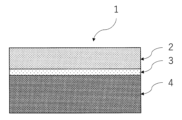
- FIG. 1 is a schematic cross-sectional view showing an example of a polarizing plate with an inorganic substrate according to the present invention.
- FIG. 1 shows an example of a polarizing plate with an inorganic substrate according to the present invention.
- a polarizing plate with an inorganic substrate 1 shown in FIG. 1 includes a polarizing plate 2 and an inorganic substrate 4 laminated on at least one surface of the polarizing plate 2 with a bonding layer 3 in between. More specifically, the polarizing plate 2 and the inorganic substrate 4 are laminated via a bonding layer 3 made of a molecular bonding agent using a molecular bonding technique to bond the polarizing plate 2 and the inorganic substrate 4 by chemical bonding.
- the polarizing plate is an absorption type polarizing plate in which a protective film is laminated on a polarizing film that has absorption dichroism at any wavelength from 380 to 780 nm, and a base film in which multiple linear thin metal wires extend in parallel.
- Examples include reflective polarizing plates using wire grid polarizing films.
- An absorption type polarizing plate is a polarizing film having absorption dichroism at a wavelength of 380 to 780 nm and a protective film laminated thereon.
- a polarizing film having absorption dichroism at a wavelength of 380 to 780 nm a polyvinyl alcohol resin film (H-type polarizing film) or polyvinyl alcohol resin in which iodine and/or dichroic dye is adsorbed and oriented is used.
- Examples include polyvinyl alcohol resin films (K-type polarizing films) that are dehydrated to form light-absorbing vinylene block segments in the polymer.
- An H-type polarizing film made of a polyvinyl alcohol resin on which iodine and/or dichroic dye is adsorbed and oriented can be produced, for example, by a process of uniaxially stretching a polyvinyl alcohol resin film, A step of dyeing and adsorbing the polyvinyl alcohol resin film with a dye, a step of crosslinking the polyvinyl alcohol resin film on which iodine and/or dichroic dye has been adsorbed with a crosslinking liquid such as a boric acid aqueous solution, and washing the polyvinyl alcohol resin film with water. It can be manufactured by a method including steps.
- polyvinyl alcohol resin a saponified polyvinyl acetate resin
- polyvinyl acetate-based resins include polyvinyl acetate, which is a homopolymer of vinyl acetate, and copolymers of vinyl acetate with other monomers that can be copolymerized.
- examples of other monomers copolymerizable with vinyl acetate include unsaturated carboxylic acids, olefins, vinyl ethers, unsaturated sulfonic acids, and (meth)acrylamides having an ammonium group.
- the degree of saponification of the polyvinyl alcohol resin is usually 85 to 100 mol%, preferably 98 mol% or more.
- the polyvinyl alcohol resin may be modified, and for example, polyvinyl formal or polyvinyl acetal modified with aldehydes can also be used.
- the average degree of polymerization of the polyvinyl alcohol resin is usually 1,000 to 10,000, preferably 1,500 to 5,000.
- the average degree of polymerization of polyvinyl alcohol resin can be determined in accordance with JIS K 6726.
- a film formed from such polyvinyl alcohol-based resin is used as a raw film for a polarizing film.
- the method of forming a polyvinyl alcohol resin into a film is not particularly limited, and any known method may be employed.
- the thickness of the polyvinyl alcohol base film is not particularly limited, but it is preferable to use a thickness of, for example, 10 to 200 ⁇ m.
- Uniaxial stretching of the polyvinyl alcohol resin film can be performed before, simultaneously with, or after dyeing with iodine and/or dichroic dye.
- this uniaxial stretching may be performed before or during crosslinking treatment.
- uniaxial stretching may be performed in these plural steps.
- the uniaxial stretching it may be uniaxially stretched between rolls having different circumferential speeds, or it may be uniaxially stretched using hot rolls.
- the uniaxial stretching may be dry stretching in which the film is stretched in the atmosphere, or wet stretching in which the polyvinyl alcohol resin film is stretched in a swollen state using a solvent or water.
- the stretching ratio is usually 3 to 8 times.
- a method for dyeing a polyvinyl alcohol-based resin film with iodine and/or a dichroic dye for example, a method of immersing the film in an aqueous solution containing iodine and/or a dichroic dye is employed.
- the polyvinyl alcohol resin film is subjected to a immersion treatment in water before the dyeing treatment.
- Examples of the crosslinking treatment after dyeing include a method in which the dyed polyvinyl alcohol resin film is immersed in an aqueous solution containing boric acid.
- the crosslinking treatment may be performed once or in multiple steps.
- the water washing treatment after crosslinking is carried out, for example, by immersing the crosslinked polyvinyl alcohol resin film after dyeing in water, spraying it with water as a shower, or using a combination of relative and spraying.
- the polyvinyl alcohol resin film may be dried by a known method.
- a K-type polarizing film made of a polyvinyl alcohol resin in which light-absorbing vinylene block segments are formed in the polymer by dehydrating the polyvinyl alcohol resin can be produced by, for example, the process of uniaxially stretching the polyvinyl alcohol resin film, or the process of dehydrating the polyvinyl alcohol resin film. It can be produced by a method including a step of treating a polyvinyl alcohol resin film, a step of crosslinking a dehydrated polyvinyl alcohol resin film with a crosslinking liquid such as a boric acid aqueous solution, and a step of washing the polyvinyl alcohol resin film with water. Note that the original film is as described above.
- Uniaxial stretching of the polyvinyl alcohol resin film can be performed in various stages.
- the uniaxial stretching may be performed, for example, before the dehydration treatment, at the same time as the dehydration treatment, at the same time as the boric acid crosslinking after the dehydration treatment, or before or after the dehydration treatment. Further, uniaxial stretching may be performed in these plural steps.
- the method of uniaxial stretching is as described above.
- a method for dehydrating a polyvinyl alcohol resin film is, for example, by exposing the polyvinyl alcohol resin film to an acid having a pH of 3 or more, and then heating the exposed film.
- the polyvinyl alcohol resin film can be immersed in deionized water for about 1 second to about 5 minutes, and then immersed in an acid having a pH of 3 or more for a desired period of time.
- the film can be dipped or immersed in an aqueous dehydration catalyst with sufficient residence time to diffuse the catalyst into the film.
- the acid used in the dehydration treatment has a pH of 3 or higher and removes hydrogen and oxygen atoms from the hydroxylated portion of the linear polymer in the presence of heat or other suitable treatment conditions to remove conjugated vinylene units.
- Any acid that can leave behind can be used. Specific examples include hydrochloric acid, hydrobromic acid, hydroiodic acid, phosphoric acid, and sulfuric acid. Further, these acids may be diluted with water or alcohol such as methanol.
- the polyvinyl alcohol-based resin film and the adsorption catalyst can be heated, whereby a portion of the oriented film is converted to the desired dehydration product, polyvinylene. .
- the film can be heated by conduction heating, convection heating, radiation heating, or a combination thereof.
- the film and catalyst can be passed through a heated oven at a temperature ranging from about 88° C. to about 205° C. for about a few seconds to about 10 minutes.
- the film and catalyst can be exposed to microwave radiation heating, laser heating, or radiant infrared heating.
- the dehydration treatment step a portion of the vinyl alcohol polymer in the polyvinyl alcohol resin film is converted into polarizing molecules of a block copolymer of poly(vinylene-co-vinyl alcohol).
- the effect of the dehydration process is to form conjugated polyvinylene blocks from polyvinyl alcohol blocks.
- the transition moments of the conjugated polyvinylene blocks are also oriented, making the material visibly dichroic.
- Examples of the crosslinking treatment after the dehydration treatment include a method of immersing the dehydrated polyvinyl alcohol resin film in an aqueous solution containing boric acid. Specifically, a dehydrated polyvinyl alcohol resin film can be brought into contact with an aqueous boric acid solution having a concentration of 10 to 20% at a temperature of 85 to 95°C.
- the water washing treatment after crosslinking is carried out, for example, by immersing the crosslinked polyvinyl alcohol resin film after dehydration treatment in water, spraying it with water as a shower, or using a relative and spraying together.
- the polyvinyl alcohol resin film may be dried by a known method.
- the thickness of the polarizing film is not particularly limited, but is preferably 50 ⁇ m or less, more preferably 30 ⁇ m or less, and even more preferably 25 ⁇ m or less.
- the thickness of the polarizing film is usually 1 ⁇ m or more, preferably 3 ⁇ m or more.
- the protective film supports the polarizing film, which is easily broken and difficult to handle alone, making it easy to handle, and protecting the polarizing film, and is made of a material that is transparent to visible light.
- light transmittance here refers to a total light transmittance of 80% or more, preferably 85% or more, and more preferably 90% or more. It can be measured using a photometer (manufactured by JASCO Corporation, ultraviolet-visible-near-infrared spectrophotometer "V-570").
- Examples of materials that are transparent to visible light include organic materials, inorganic materials, and organic-inorganic hybrid materials.
- organic materials include triacetyl cellulose resins, diacetyl cellulose resins, polyester resins, polyimide resins, polyamide resins, polyolefin resins such as polyethylene and polypropylene, cycloolefin polymers, and cycloolefin copolymers such as cycloolefin copolymers.
- Examples include olefin resins, polyethersulfone resins, polysulfone resins, polyvinyl chloride, acrylic resins, polycarbonate resins, polystyrene resins, and urethane resins.
- Examples of inorganic materials include silsesquioxane resins and silazane resins.
- Examples of organic-inorganic hybrid materials include resins made of silsesquioxane derivatives having organic functional groups such as (meth)acryloyl groups.
- the thickness of the protective film is not particularly limited, and may be appropriately designed to facilitate handling of the polarizing film and protecting the polarizing film, and is preferably 500 ⁇ m or less, more preferably 100 ⁇ m or less, and even more preferably is 50 ⁇ m or less.
- the thickness of the protective film is usually 5 ⁇ m or more, preferably 10 ⁇ m or more.
- the lamination of the polarizing film and the protective film is not particularly limited, but may be laminated using an adhesive or a pressure-sensitive adhesive, for example.
- adhesive conventionally known adhesives may be used, such as polyvinyl alcohol adhesives, urethane adhesives, acrylic adhesives, epoxy adhesives, and the like.
- adhesive conventionally known adhesives may be used, such as acrylic adhesives, silicone adhesives, urethane adhesives, polyester adhesives, and the like.
- a crosslinking agent or the like may be added to the adhesive or pressure-sensitive adhesive, if necessary.
- the polarizing film and the protective film may be laminated together using a molecular bonding agent using a molecular bonding technique described below.
- the thickness of the adhesive layer made of adhesive or pressure-sensitive adhesive may be appropriately designed depending on the adhesive strength, etc., and is not particularly limited, but is preferably 50 ⁇ m or less, more preferably 30 ⁇ m or less, and even more preferably is 20 ⁇ m or less.
- the thickness of the adhesive layer is usually 1 ⁇ m or more, preferably 3 ⁇ m or more.
- a reflective polarizing plate is a wire grid polarizing film in which a plurality of linear thin metal wires are arranged parallel to each other at a predetermined pitch on a base film. It has a characteristic of transmitting linearly polarized light having an electric field vector orthogonal to each other and reflecting linearly polarized light having an electric field vector in the extending direction of the thin metal wire.
- the base film is a film for forming thin metal wires, and is made of a material that is transparent to visible light. Note that the light transmittance here is as described above.
- Organic materials include polymethyl methacrylate resin, polycarbonate resin, polystyrene resin, cycloolefin resin, crosslinked polyethylene resin, polyvinyl chloride resin, polyacrylate resin, polyphenylene ether resin, and modified polyphenylene ether.
- thermoplastic resins such as polyetherimide resins, polyetherimide resins, polyethersulfone resins, polysulfone resins, and polyetherketone resins; polyethylene terephthalate resins, polyethylene naphthalate resins, polyethylene resins, polypropylene
- examples include crystalline thermoplastic resins such as polybutylene terephthalate resins, polybutylene terephthalate resins, aromatic polyester resins, polyacetal resins, and polyamide resins; curable resins such as acrylic, epoxy, and urethane resins.
- inorganic materials include silsesquioxane resins and silazane resins.
- organic-inorganic hybrid materials include resins made of silsesquioxane derivatives having organic functional groups such as (meth)acryloyl groups.
- Examples of the material constituting the thin metal wire include metals such as aluminum, silver, copper, chromium, titanium, nickel, tungsten, and iron, or alloys thereof.
- the pitch of the thin metal wires is preferably 150 nm or less, more preferably 145 nm or less, and even more preferably 120 nm or less.
- the lower limit of the pitch of the thin metal wires is, for example, 70 nm.
- the width of the thin metal wire is preferably 20 nm to 400 nm, more preferably 30 nm to 200 nm, and even more preferably 50 nm to 100 nm.
- Various functional layers may be formed on the surface of the polarizing plate as necessary.
- Examples of functional layers include conductive layers, antistatic layers, antiglare layers, antifouling layers such as photocatalyst layers, antireflection layers, hard coat layers, ultraviolet shielding layers, heat ray shielding layers, electromagnetic wave shielding layers, and gas barriers. Examples include layers.
- the bonding layer is made of a molecular bonding agent that uses molecular bonding technology to bond through chemical bonds.
- Molecular bonding technology is a technology that uses one or several layers of molecules to bond components using chemical bonds. For example, the surface of an adherend is converted to a surface of one type of functional group, and bonding is performed through the bonding of this functional group. be.
- the molecular bonding agent includes a triazine derivative having a functional group that bonds the polarizing plate and the inorganic substrate through a chemical bond.
- the bonding layer made of a molecular bonding agent containing a triazine derivative preferably contains the triazine derivative as a main component.
- main component means that the composition ratio of the components constituting the bonding layer is 50% by weight or more, preferably 60% by weight or more, and more preferably 80% by weight. The content is more preferably 90% by weight or more, particularly preferably 95% by weight or more.
- the triazine derivative is preferably a compound containing two or more OH groups and/or OH-generating groups and one triazine ring.
- a triazine derivative containing two or more OH groups and/or OH-generating groups and one triazine ring has an OH group on the surface of the polarizing plate and/or an OH group on the inorganic substrate, and an OH group or an OH-generating group on the triazine derivative. and form a chemical bond through dehydration condensation.
- the OH group on the surface of the protective film in the absorption polarizing plate and/or the OH group on the inorganic substrate and the OH group or OH generating group of the triazine derivative form a chemical bond through dehydration condensation.
- the OH group on the surface of the base film in the reflective polarizing plate and/or the OH group on the inorganic substrate and the OH group or OH-generating group of the triazine derivative form a chemical bond through dehydration condensation.
- the triazine derivative conventionally known compounds can be used.
- the OH group or OH-generating group is preferably an alkoxysilyl group (including cases where the alkoxy group is an OH group).
- the molecular bonding agent may contain components other than the triazine derivative as long as the effects of the present invention are not impaired.
- Components other than the triazine derivative include initiators, crosslinking agents, fine particles, ultraviolet absorbers, antifoaming agents, thickeners, dispersants, surfactants, catalysts, lubricants, antistatic agents, and the like.
- the upper limit of the thickness of the bonding layer is not particularly limited, but for example, it is preferably 5 ⁇ m or less, more preferably 1 ⁇ m or less, even more preferably 0.01 ⁇ m or less, and 0.001 ⁇ m or less. It is particularly preferable that There is no particular restriction on the lower limit of the thickness of the bonding layer, but since molecular bonding technology is a technology for bonding components by chemical bonding using one or several layers of molecules, ideally the thickness is one layer of molecules. be.
- the inorganic substrate supports the polarizing plate and facilitates its handling, and is made of an inorganic material that is transparent to visible light. Note that having translucency is as described above.
- inorganic materials having translucency include, but are not limited to, silicate glass, borosilicate glass, titanium silicate glass, fluoride glass such as zirconium fluoride, fused silica, crystal, sapphire, Examples include YAG crystal, fluorite, magnesia, and spinel (MgO.Al2O3).
- the inorganic substrate has a higher thermal conductivity than the polarizing plate.
- the thermal conductivity is, for example, preferably 0.7 W/mK or more, more preferably 0.9 W/mK or more, still more preferably 1 W/mK or more, and particularly preferably 5 W/mK or more.
- examples of such materials include glass (thermal conductivity: 0.94 to 1 W/mK), crystal (thermal conductivity: 8 W/mK), and sapphire (thermal conductivity: 40 W/mK).
- the thickness of the inorganic substrate is not particularly limited, and may be appropriately designed to facilitate handling of the polarizing plate and protecting the polarizing plate, for example, 10 to 3000 ⁇ m, preferably 50 to 2000 ⁇ m, More preferably 100 to 1500 ⁇ m, particularly preferably 300 ⁇ m to 1000 ⁇ m.
- the method for producing a polarizing plate with an inorganic substrate includes a step of providing a molecular bonding agent on the surface of the polarizing plate and/or the inorganic substrate, and laminating these via the molecular bonding agent present on the surface of the polarizing plate and/or the inorganic substrate. and a step of bonding the polarizing plate and the inorganic substrate by chemical bonding.
- the polarizing plate and inorganic substrate described above are prepared.
- the polarizing plate and the inorganic substrate may be long or sheet-like.
- the surfaces of the polarizing plate and the inorganic substrate may be cleaned as necessary, for example, by cleaning with a cleaning agent such as ethanol or acetone.
- the surfaces of the polarizing plate and the inorganic substrate may be subjected to activation treatment if necessary, such as ultraviolet irradiation treatment, corona discharge treatment, plasma treatment, etc.
- a solution or dispersion in which the above-mentioned molecular bonding agent is dissolved is prepared.
- the molecular bonding agent may be diluted with a solvent, such as water, alcohol (e.g. methanol, ethanol, isopropanol, ethylene glycol, propylene glycol, cellosolve, carbitol), ketone (e.g. acetone, methyl ethyl ketone, cyclohexanone), aromatic hydrocarbons (e.g. benzene, toluene, xylene), aliphatic hydrocarbons (e.g.
- the content of the triazine derivative may be appropriately set in consideration of coating work, etc., and is, for example, 0.00001 to 10 wt%, preferably 0.0001 to 1 wt%, more preferably 0.0005 to 0. .5 wt%, more preferably 0.001 to 0.2 wt%.
- the molecular bonding agent may be either a heat-reactive type or an ultraviolet-reactive type.
- a molecular bonding agent is provided on the surface of the polarizing plate and/or the inorganic substrate, and a bonding layer made of the molecular bonding agent is formed on the surface of the polarizing plate and/or the inorganic substrate. Specifically, this is achieved by applying a solution in which the above-mentioned molecular bonding agent is dissolved onto the surface of a polarizing plate and/or an inorganic substrate. Thereafter, drying is performed as necessary, and the solvent is volatilized, so that the molecular bonding agent remains on the surface of the polarizing plate and/or the inorganic substrate to form a bonding layer.
- the coating method is not particularly limited, and any known method may be used, such as wire bar coating, dipping, spraying, spin coating, roll coating, gravure coating, and air knife coating. , curtain coating method, slide coating method, extrusion coating method, die coating method, etc.
- the drying method is not particularly limited, and any known method can be used.
- Step 3 Lamination> After the molecular bonding agent is provided on the surface of the polarizing plate and/or the inorganic substrate, these are laminated via the molecular bonding agent present on the surface of the polarizing plate and/or the inorganic substrate. Specifically, this is achieved by laminating polarizing films and/or supporting substrates coated with a solution containing a molecular binder so that their surfaces face each other.
- the polarizing plate and the inorganic substrate are pressure-bonded, and the polarizing plate and the supporting base material are integrally joined by chemical bonding.
- the polarizing plate is heated and/or UV irradiated with a pressing force applied toward the inorganic substrate
- the inorganic substrate is heated and/or UV irradiated with a pressing force applied toward the polarizing plate. This can be achieved by heating and/or ultraviolet irradiation while applying pressing force from each of the polarizing plate and the inorganic substrate.
- the pressing force may be any pressing force that causes the OH group of the triazine derivative existing on the surface of the polarizing plate and/or the inorganic substrate or the OH group generated from the OH generating group to come into contact with the other surface.
- the pressing force is not particularly limited, but is, for example, preferably 0.01 to 50 MPa, more preferably 0.1 to 20 MPa, even more preferably 0.5 to 10 MPa, particularly preferably 0. .5 to 5 MPa.
- the working time is, for example, 0.1 to 200 minutes in the case of a process using a press, and 0.1 to 300 seconds in the case of a roll-to-roll process.
- the OH groups of the triazine derivative present on the surface of the polarizing plate or inorganic substrate reach the other surface and bond therewith. That is, the polarizing plate and the inorganic substrate are firmly bonded together by the chemical bond (reaction) caused by the triazine derivative.
- the heating temperature is a temperature at which the chemical reaction of the triazine derivative is promoted. The heating temperature is, for example, 30 to 300°C, preferably 50 to 250°C, more preferably 70 to 200°C, and even more preferably 80 to 150°C.
- the molecular bonding agent is an ultraviolet-reactive type
- the cumulative amount of ultraviolet light on the surface of the polarizing plate and/or the inorganic substrate is, for example, 100 to 3,000 mJ/cm 2 or more.
- polarizing plate (Preparation of polarizing plate) Prepare a polyvinyl alcohol-based polarizing film (iodine-based, 25 ⁇ m thick) on which protective film A (triacetylcellulose-based film, 80 ⁇ m thick) is laminated, and place the polarizing film on the side opposite to the side on which protective film A is laminated. After washing the surface with ethanol and drying, the surface was subjected to corona discharge treatment (150 W ⁇ min/m 2 ).
- An adhesive layer (thickness: 15 ⁇ m, NCF-211S, manufactured by Lintec Corporation) was laminated on the corona discharge treated surface of the polarizing film, and a protective film B (cycloolefin film) was attached to the opposite side of the adhesive layer from the polarizing film. , 50 ⁇ m thick) and pressed with a hand roller to produce a polarizing plate (protective film A/iodine polarizing film/adhesive layer/protective film B).
- Example 1 After the surface of the protective film B of the polarizing plate was washed with ethanol and dried, the surface was subjected to a corona discharge treatment (150 W ⁇ min/m 2 ).
- a quartz substrate (length 23.5 mm x width 20.0 mm x thickness 0.7 mm) was prepared as an inorganic substrate, and the quartz substrate was ultrasonically cleaned in acetone (10 minutes), and after drying, the surface was subjected to corona discharge treatment (150 W ⁇ min/m 2 ).
- an aqueous solution containing 0.1% by weight of a triazine derivative (product name: MB1015 aqueous solution, manufactured by Iou Kagaku Kenkyusho Co., Ltd.) was applied to the corona discharge treated surface of the polarizing plate by a spin coating method (coating amount: 2 ml, spin rotation speed). :3000 rpm), and then dried in a constant temperature and humidity dryer (50°C x 10 minutes) to provide a triazine derivative on the surface of the polarizing plate.
- a spin coating method coating amount: 2 ml, spin rotation speed). :3000 rpm
- an aqueous solution containing 0.1% by weight of a triazine derivative (product name: MB1015 aqueous solution, manufactured by Io Kagaku Kenkyusho Co., Ltd.) was applied to the corona discharge treated surface of the quartz substrate by spin coating (coating amount: 2 ml, spin rotation). After drying at 3000 rpm), it was placed in a hot air drying oven and dried at 80° C. for 10 minutes to provide a triazine derivative on the surface of the quartz substrate.
- an adhesive layer (thickness: 15 ⁇ m, NCF-211S, manufactured by Lintec Corporation) was laminated on the corona discharge treated surface of the polarizing plate, and a crystal substrate was laminated on the opposite side of the adhesive layer from the polarizing plate. and pressed with a hand roller to produce a polarizing plate with an inorganic substrate (protective film A/iodine polarizing film/adhesive layer/protective film B/adhesive layer/crystal substrate).
- Example 1 The following evaluations were performed on the inorganic substrate-attached polarizing plates obtained in Example 1 and Comparative Example 1. The evaluation results are shown in Table 1.
- Air was blown toward the polarizing plates with inorganic substrates (23.5 mm x 20 mm) obtained in Examples and Comparative Examples, and the polarizing plates with inorganic substrates were exposed to air at a constant speed.
- a laser beam (wavelength: 455 nm) is irradiated from the polarizing plate side using a laser irradiation device for 2 minutes, and a thermography is used from the polarizing plate side to measure the temperature of the highest temperature point within the polarizing plate surface temperature.
- the appearance of the polarizing plate with an inorganic substrate after laser irradiation and the projected image of the polarizing plate with an inorganic substrate when using a backlight were visually evaluated according to the following criteria.
- the polarizing plate was arranged so as to absorb the polarized light of the laser (the polarized light of the laser and the absorption axis of the polarizing film were parallel).
- ⁇ No change in appearance or projected image
- ⁇ Slight deformation (unevenness, wrinkles, etc.) in appearance, and change (distortion, unevenness) in projected image
- ⁇ Deformation (unevenness, wrinkles, etc.) in appearance and discoloration is clearly seen, and large changes (distortion, unevenness) are seen in the projected image.
- the polarizing plate with an inorganic substrate of Example 1 which is formed by bonding an absorption type polarizing plate and an inorganic substrate with a molecular bonding agent using a molecular bonding technique using chemical bonding, is different from that of Comparative Example 1.
- the surface temperature of the polarizing plate after laser irradiation was lower (4 to 13°C), and the appearance and projected image of the polarizing plate after laser irradiation were excellent.
- Example 2 A wire grid polarizing film (aluminum metal thin wire/cycloolefin film (base film), thickness 190 ⁇ m) was prepared as a polarizing plate, and after washing the surface of the base film of the polarizing plate with ethanol and drying, the surface was subjected to corona discharge treatment (150 W ⁇ min/m 2 ).
- a quartz substrate (length 23.5 mm x width 20.0 mm x thickness 0.7 mm) was prepared as an inorganic substrate, and the quartz substrate was ultrasonically cleaned in acetone (10 minutes), and after drying, the surface was subjected to corona discharge treatment (150 W ⁇ min/m 2 ).
- an aqueous solution containing 0.1% by weight of a triazine derivative (product name: MB1015 aqueous solution, manufactured by Iou Kagaku Kenkyusho Co., Ltd.) was applied to the corona discharge treated surface of the polarizing plate by a spin coating method (coating amount: 2 ml, spin rotation speed). :3000 rpm), and then dried in a constant temperature and humidity dryer (50°C x 10 minutes) to provide a triazine derivative on the surface of the polarizing plate.
- a spin coating method coating amount: 2 ml, spin rotation speed). :3000 rpm
- an aqueous solution containing 0.1% by weight of a triazine derivative (product name: MB1015 aqueous solution, manufactured by Io Kagaku Kenkyusho Co., Ltd.) was applied to the corona discharge treated surface of the quartz substrate by spin coating (coating amount: 2 ml, spin rotation). After drying at 3000 rpm), it was placed in a hot air drying oven and dried at 80° C. for 10 minutes to provide a triazine derivative on the surface of the quartz substrate.
- the surfaces of the polarizing plate and the quartz substrate on which the triazine derivatives were provided were overlapped and thermocompression bonded using a heat press machine (pressure: 10 MPa, temperature: 100°C, time: 12 minutes) to form a polarizing plate with an inorganic substrate (wire grid A polarizing film/bonding layer/crystal substrate) was produced.
- a wire grid polarizing film (aluminum metal thin wire/cycloolefin film (base film), thickness 190 ⁇ m) was prepared as a polarizing plate, and after washing the surface of the base film of the polarizing plate with ethanol and drying, the surface was subjected to corona discharge treatment (150 W ⁇ min/m 2 ).
- a quartz substrate (length 23.5 mm x width 20.0 mm x thickness 0.7 mm) was prepared as an inorganic substrate, and the quartz substrate was ultrasonically cleaned in acetone (10 minutes), and after drying, the surface was subjected to corona discharge treatment (150 W ⁇ min/m 2 ).
- an adhesive layer (thickness: 15 ⁇ m, NCF-211S, manufactured by Lintec Corporation) was laminated on the corona discharge treated surface of the polarizing plate, and a crystal substrate was laminated on the opposite side of the adhesive layer from the polarizing plate. and pressed with a hand roller to produce a polarizing plate with an inorganic substrate (wire grid polarizing film/adhesive layer/crystal substrate).
- Example 2 The above-described durability evaluation was performed on the inorganic substrate-attached polarizing plates obtained in Example 2 and Comparative Example 2. The evaluation results are shown in Table 2.
- the polarizing plate with an inorganic substrate of Example 2 which is formed by bonding a reflective polarizing plate and an inorganic substrate with a molecular bonding agent using a molecular bonding technique that bonds the reflective polarizing plate and an inorganic substrate with chemical bonds, is different from that of Comparative Example 2.
- the surface temperature of the polarizing plate after laser irradiation was lower (9 to 22°C), and the appearance and projected image of the polarizing plate after laser irradiation were excellent.
- a polarizing plate with an inorganic substrate bonded using molecular bonding technology can reduce the thermal load on the polarizing plate, and therefore can suppress appearance defects of the polarizing plate due to light energy and the like. Furthermore, since it is possible to suppress appearance defects of the polarizing plate, the polarizing plate has high durability that maintains its performance over a long period of time. Therefore, a polarizing plate with an inorganic substrate bonded by molecular bonding technology is particularly useful in applications such as image display devices that use light sources with large or high numerical values such as luminous flux, luminous intensity, brightness, and optical density.
- Polarizing plate with inorganic substrate 2 Polarizing plate 3: Bonding layer 4: Inorganic substrate
Landscapes
- Physics & Mathematics (AREA)
- General Physics & Mathematics (AREA)
- Optics & Photonics (AREA)
- Chemical & Material Sciences (AREA)
- Organic Chemistry (AREA)
- Engineering & Computer Science (AREA)
- Ceramic Engineering (AREA)
- Polarising Elements (AREA)
- Laminated Bodies (AREA)
Priority Applications (5)
| Application Number | Priority Date | Filing Date | Title |
|---|---|---|---|
| CN202380055615.1A CN119630994A (zh) | 2022-08-01 | 2023-07-20 | 附无机基板的偏光板及其制造方法 |
| JP2024538925A JPWO2024029356A1 (https=) | 2022-08-01 | 2023-07-20 | |
| KR1020257005003A KR20250048549A (ko) | 2022-08-01 | 2023-07-20 | 무기기판 부착 편광판 및 그 제조 방법 |
| US18/995,133 US20260036734A1 (en) | 2022-08-01 | 2023-07-20 | Inorganic substrate-attached polarizing plate and method for producing same |
| EP23849911.5A EP4567478A4 (en) | 2022-08-01 | 2023-07-20 | POLARIZING PLATE FIXED TO AN INORGANIC SUBSTRATE AND ITS PRODUCTION PROCESS |
Applications Claiming Priority (2)
| Application Number | Priority Date | Filing Date | Title |
|---|---|---|---|
| JP2022-122476 | 2022-08-01 | ||
| JP2022122476 | 2022-08-01 |
Publications (1)
| Publication Number | Publication Date |
|---|---|
| WO2024029356A1 true WO2024029356A1 (ja) | 2024-02-08 |
Family
ID=89848837
Family Applications (1)
| Application Number | Title | Priority Date | Filing Date |
|---|---|---|---|
| PCT/JP2023/026583 Ceased WO2024029356A1 (ja) | 2022-08-01 | 2023-07-20 | 無機基板付偏光板及びその製造方法 |
Country Status (7)
| Country | Link |
|---|---|
| US (1) | US20260036734A1 (https=) |
| EP (1) | EP4567478A4 (https=) |
| JP (1) | JPWO2024029356A1 (https=) |
| KR (1) | KR20250048549A (https=) |
| CN (1) | CN119630994A (https=) |
| TW (1) | TW202411699A (https=) |
| WO (1) | WO2024029356A1 (https=) |
Citations (10)
| Publication number | Priority date | Publication date | Assignee | Title |
|---|---|---|---|---|
| JP2009098465A (ja) * | 2007-10-17 | 2009-05-07 | Seiko Epson Corp | 偏光板、画像表示装置 |
| JP2010254793A (ja) * | 2009-04-24 | 2010-11-11 | Sulfur Chemical Institute Inc | 樹脂複合体の製造方法及び樹脂複合体 |
| WO2012043631A1 (ja) * | 2010-09-30 | 2012-04-05 | 株式会社いおう化学研究所 | 接合方法、接着性向上剤、表面改質方法、表面改質剤、及び新規化合物 |
| WO2013154139A1 (ja) | 2012-04-13 | 2013-10-17 | 日本化薬株式会社 | 偏光素子及び偏光板 |
| JP2015104913A (ja) * | 2013-12-02 | 2015-06-08 | 株式会社有沢製作所 | 積層体 |
| WO2019044481A1 (ja) * | 2017-08-28 | 2019-03-07 | Agc株式会社 | 積層体およびその製造方法 |
| JP2022075630A (ja) * | 2020-11-05 | 2022-05-18 | 国立大学法人岩手大学 | 積層体の製造方法、積層体、電気電子機器、輸送機器、および生産機械 |
| JP2022110832A (ja) * | 2021-01-19 | 2022-07-29 | 東山フイルム株式会社 | フレキシブルディスプレイ用ハードコートフィルムおよびこれを用いたフレキシブルディスプレイ |
| WO2022172755A1 (ja) * | 2021-02-09 | 2022-08-18 | 大倉工業株式会社 | 偏光板 |
| WO2023028828A1 (zh) * | 2021-08-31 | 2023-03-09 | 华为技术有限公司 | 光学叠层结构、显示模组、终端及相关制备方法 |
Family Cites Families (2)
| Publication number | Priority date | Publication date | Assignee | Title |
|---|---|---|---|---|
| TWI702424B (zh) * | 2017-10-24 | 2020-08-21 | 日商旭化成股份有限公司 | 影像顯示裝置、線柵偏光板及其製造方法、線柵偏光板之觀測方法、及、線柵偏光板之偏光軸方向之推定方法 |
| JP7348761B2 (ja) * | 2019-07-03 | 2023-09-21 | 日東電工株式会社 | 粘着シート、粘着剤付き光学フィルム、および画像表示装置の製造方法 |
-
2023
- 2023-06-13 TW TW112122002A patent/TW202411699A/zh unknown
- 2023-07-20 CN CN202380055615.1A patent/CN119630994A/zh active Pending
- 2023-07-20 US US18/995,133 patent/US20260036734A1/en active Pending
- 2023-07-20 KR KR1020257005003A patent/KR20250048549A/ko active Pending
- 2023-07-20 WO PCT/JP2023/026583 patent/WO2024029356A1/ja not_active Ceased
- 2023-07-20 JP JP2024538925A patent/JPWO2024029356A1/ja active Pending
- 2023-07-20 EP EP23849911.5A patent/EP4567478A4/en active Pending
Patent Citations (10)
| Publication number | Priority date | Publication date | Assignee | Title |
|---|---|---|---|---|
| JP2009098465A (ja) * | 2007-10-17 | 2009-05-07 | Seiko Epson Corp | 偏光板、画像表示装置 |
| JP2010254793A (ja) * | 2009-04-24 | 2010-11-11 | Sulfur Chemical Institute Inc | 樹脂複合体の製造方法及び樹脂複合体 |
| WO2012043631A1 (ja) * | 2010-09-30 | 2012-04-05 | 株式会社いおう化学研究所 | 接合方法、接着性向上剤、表面改質方法、表面改質剤、及び新規化合物 |
| WO2013154139A1 (ja) | 2012-04-13 | 2013-10-17 | 日本化薬株式会社 | 偏光素子及び偏光板 |
| JP2015104913A (ja) * | 2013-12-02 | 2015-06-08 | 株式会社有沢製作所 | 積層体 |
| WO2019044481A1 (ja) * | 2017-08-28 | 2019-03-07 | Agc株式会社 | 積層体およびその製造方法 |
| JP2022075630A (ja) * | 2020-11-05 | 2022-05-18 | 国立大学法人岩手大学 | 積層体の製造方法、積層体、電気電子機器、輸送機器、および生産機械 |
| JP2022110832A (ja) * | 2021-01-19 | 2022-07-29 | 東山フイルム株式会社 | フレキシブルディスプレイ用ハードコートフィルムおよびこれを用いたフレキシブルディスプレイ |
| WO2022172755A1 (ja) * | 2021-02-09 | 2022-08-18 | 大倉工業株式会社 | 偏光板 |
| WO2023028828A1 (zh) * | 2021-08-31 | 2023-03-09 | 华为技术有限公司 | 光学叠层结构、显示模组、终端及相关制备方法 |
Non-Patent Citations (1)
| Title |
|---|
| See also references of EP4567478A4 |
Also Published As
| Publication number | Publication date |
|---|---|
| TW202411699A (zh) | 2024-03-16 |
| EP4567478A4 (en) | 2025-11-19 |
| CN119630994A (zh) | 2025-03-14 |
| KR20250048549A (ko) | 2025-04-09 |
| US20260036734A1 (en) | 2026-02-05 |
| JPWO2024029356A1 (https=) | 2024-02-08 |
| EP4567478A1 (en) | 2025-06-11 |
Similar Documents
| Publication | Publication Date | Title |
|---|---|---|
| JP7821750B2 (ja) | 偏光板 | |
| JP2008509433A (ja) | 固有偏光子、および固有偏光子を製造する方法 | |
| KR102901203B1 (ko) | 편광판 및 화상 표시 장치 | |
| CN108152876A (zh) | 偏振膜及偏振性层叠膜的制造方法 | |
| WO2017212960A1 (ja) | 偏光板セット | |
| JP2008122502A (ja) | 偏光板の製造方法 | |
| JP7161004B1 (ja) | 光学積層体 | |
| WO2024029356A1 (ja) | 無機基板付偏光板及びその製造方法 | |
| JP7842197B2 (ja) | 接合層付偏光フィルム、偏光板及びその製造方法 | |
| CN109313306B (zh) | 偏振板组件 | |
| TWI849003B (zh) | 偏光板 | |
| JP2018200413A (ja) | 偏光板のセットおよび液晶パネル | |
| JP2010224098A (ja) | 光学積層体および偏光板の製造方法 | |
| KR20240161084A (ko) | 편광 필름, 및 화상 표시 장치 | |
| KR20240161083A (ko) | 편광 필름, 및 화상 표시 장치 | |
| WO2023189796A1 (ja) | 偏光フィルム積層体、及び画像表示装置 | |
| CN115903118A (zh) | 偏振片的制造方法 | |
| CN118696256A (zh) | 偏振膜的制造方法 | |
| KR20110056934A (ko) | 편광판의 건조 방법 |
Legal Events
| Date | Code | Title | Description |
|---|---|---|---|
| 121 | Ep: the epo has been informed by wipo that ep was designated in this application |
Ref document number: 23849911 Country of ref document: EP Kind code of ref document: A1 |
|
| WWE | Wipo information: entry into national phase |
Ref document number: 18995133 Country of ref document: US |
|
| WWE | Wipo information: entry into national phase |
Ref document number: 2024538925 Country of ref document: JP |
|
| WWE | Wipo information: entry into national phase |
Ref document number: 202380055615.1 Country of ref document: CN |
|
| ENP | Entry into the national phase |
Ref document number: 20257005003 Country of ref document: KR Kind code of ref document: A |
|
| WWE | Wipo information: entry into national phase |
Ref document number: 2023849911 Country of ref document: EP |
|
| NENP | Non-entry into the national phase |
Ref country code: DE |
|
| ENP | Entry into the national phase |
Ref document number: 2023849911 Country of ref document: EP Effective date: 20250303 |
|
| WWP | Wipo information: published in national office |
Ref document number: 202380055615.1 Country of ref document: CN |
|
| WWP | Wipo information: published in national office |
Ref document number: 1020257005003 Country of ref document: KR |
|
| WWP | Wipo information: published in national office |
Ref document number: 2023849911 Country of ref document: EP |
|
| WWP | Wipo information: published in national office |
Ref document number: 18995133 Country of ref document: US |